| Description | Gene expression profiles in the KOLF2.1J cell line following CRISPRi genetic perturbation |
| Measurement | gene expression by RNA-seq |
| Association | gene-gene perturbation associations by differential expression of gene A following perturbation of gene B |
| Category | transcriptomics |
| Resource | Cell Maps for AI |
| Citation(s) | |
| Last Updated | Tue Aug 18 00:00:00 UTC 2026 |
| Stats |
|
Gene Attribute

Gene Similarity

Attribute Similarity

UMAP
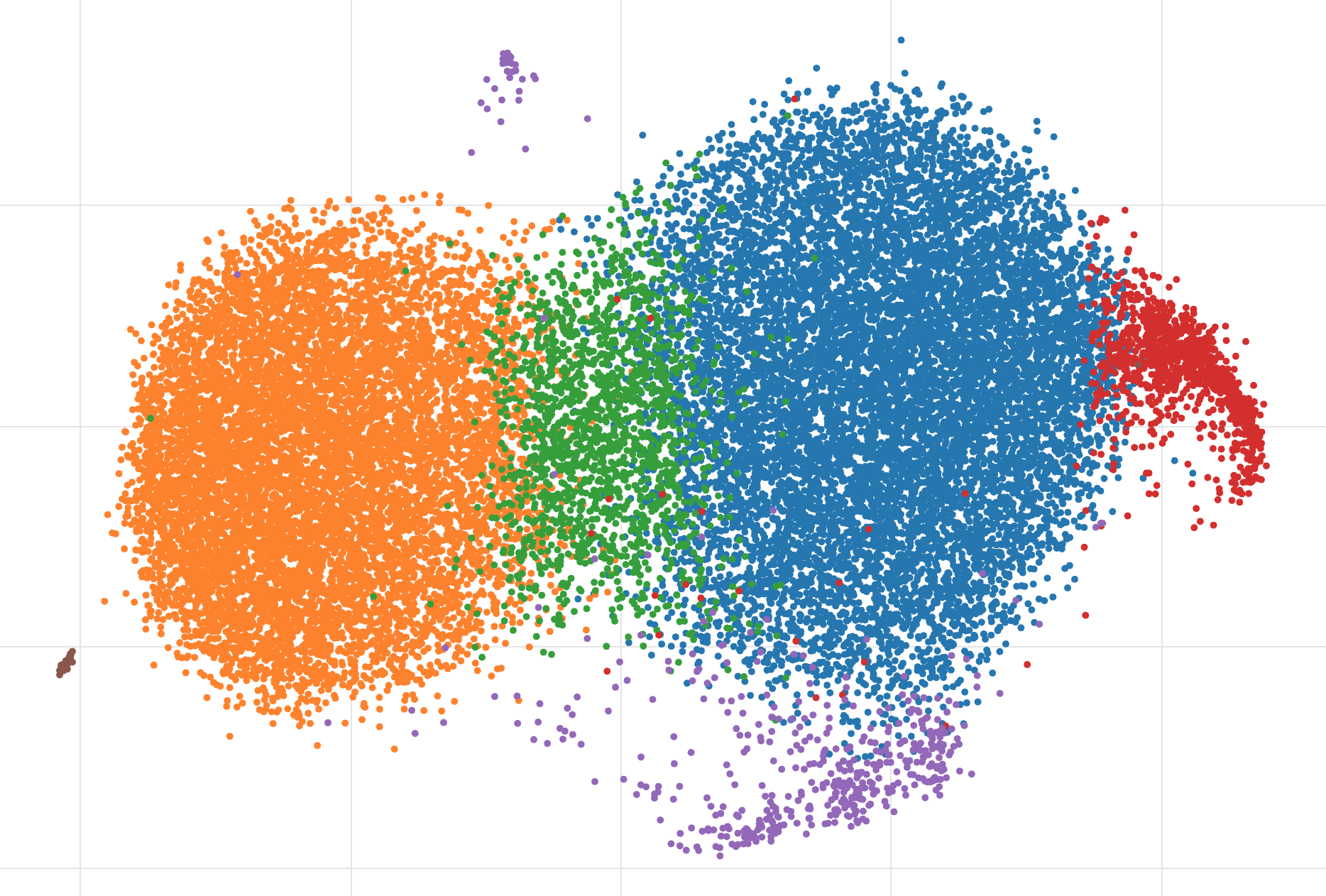
11663 sets of genes differentially expressed following gene perturbation from the CM4AI KOLF21J CRISPRi Gene Perturbation Atlas dataset.
| Gene Set | Description |
|---|---|
| EIF2S1 | eukaryotic translation initiation factor 2, subunit 1 alpha, 35kDa|The translation initiation factor EIF2 catalyzes the first regulated step of protein synthesis initiation, promoting the binding of the initiator tRNA to 40S ribosomal subunits. Binding occurs as a ternary complex of methionyl-tRNA, EIF2, and GTP. EIF2 is composed of 3 nonidentical subunits, the 36-kD EIF2-alpha subunit (EIF2S1), the 38-kD EIF2-beta subunit (EIF2S2; MIM 603908), and the 52-kD EIF2-gamma subunit (EIF2S3; MIM 300161). The rate of formation of the ternary complex is modulated by the phosphorylation state of EIF2-alpha (Ernst et al., 1987 [PubMed 2948954]).[supplied by OMIM, Feb 2010] |
| PSMD12 | proteasome (prosome, macropain) 26S subunit, non-ATPase, 12|The 26S proteasome is a multicatalytic proteinase complex with a highly ordered structure composed of 2 complexes, a 20S core and a 19S regulator. The 20S core is composed of 4 rings of 28 non-identical subunits; 2 rings are composed of 7 alpha subunits and 2 rings are composed of 7 beta subunits. The 19S regulator is composed of a base, which contains 6 ATPase subunits and 2 non-ATPase subunits, and a lid, which contains up to 10 non-ATPase subunits. Proteasomes are distributed throughout eukaryotic cells at a high concentration and cleave peptides in an ATP/ubiquitin-dependent process in a non-lysosomal pathway. An essential function of a modified proteasome, the immunoproteasome, is the processing of class I MHC peptides. This gene encodes a non-ATPase subunit of the 19S regulator. A pseudogene has been identified on chromosome 3. [provided by RefSeq, Jul 2008] |
| EEF1G | eukaryotic translation elongation factor 1 gamma|This gene encodes a subunit of the elongation factor-1 complex, which is responsible for the enzymatic delivery of aminoacyl tRNAs to the ribosome. This subunit contains an N-terminal glutathione transferase domain, which may be involved in regulating the assembly of multisubunit complexes containing this elongation factor and aminoacyl-tRNA synthetases. [provided by RefSeq, Jul 2008] |
| NOP58 | NOP58 ribonucleoprotein| |
| STIL | SCL/TAL1 interrupting locus|This gene encodes a cytoplasmic protein implicated in regulation of the mitotic spindle checkpoint, a regulatory pathway that monitors chromosome segregation during cell division to ensure the proper distribution of chromosomes to daughter cells. The protein is phosphorylated in mitosis and in response to activation of the spindle checkpoint, and disappears when cells transition to G1 phase. It interacts with a mitotic regulator, and its expression is required to efficiently activate the spindle checkpoint. It is proposed to regulate Cdc2 kinase activity during spindle checkpoint arrest. Chromosomal deletions that fuse this gene and the adjacent locus commonly occur in T cell leukemias, and are thought to arise through illegitimate V-(D)-J recombination events. Multiple transcript variants encoding different isoforms have been found for this gene. [provided by RefSeq, Jul 2008] |
| CHERP | calcium homeostasis endoplasmic reticulum protein| |
| YAE1 | YAE1 maturation factor of ABCE1 |
| PFDN5 | prefoldin subunit 5|This gene encodes a member of the prefoldin alpha subunit family. The encoded protein is one of six subunits of prefoldin, a molecular chaperone complex that binds and stabilizes newly synthesized polypeptides, thereby allowing them to fold correctly. The complex, consisting of two alpha and four beta subunits, forms a double beta barrel assembly with six protruding coiled-coils. The encoded protein may also repress the transcriptional activity of the proto-oncogene c-Myc. Alternatively spliced transcript variants encoding different isoforms have been described. [provided by RefSeq, Jul 2008] |
| NOL11 | nucleolar protein 11| |
| TUBA1B | tubulin, alpha 1b| |
| RFC5 | replication factor C (activator 1) 5, 36.5kDa|The elongation of primed DNA templates by DNA polymerase delta and DNA polymerase epsilon requires the accessory proteins proliferating cell nuclear antigen (PCNA) and replication factor C (RFC). RFC, also named activator 1, is a protein complex consisting of five distinct subunits of 140, 40, 38, 37, and 36 kD. This gene encodes the 36 kD subunit. This subunit can interact with the C-terminal region of PCNA. It forms a core complex with the 38 and 40 kDa subunits. The core complex possesses DNA-dependent ATPase activity, which was found to be stimulated by PCNA in an in vitro system. Alternative splicing results in multiple transcript variants. A related pseudogene has been identified on chromosome 9. [provided by RefSeq, May 2011] |
| PRPF31 | pre-mRNA processing factor 31|This gene encodes a component of the spliceosome complex and is one of several retinitis pigmentosa-causing genes. When the gene product is added to the spliceosome complex, activation occurs.[provided by RefSeq, Jan 2009] |
| CAPZA1 | capping protein (actin filament) muscle Z-line, alpha 1|CAPZA1 is a member of the F-actin capping protein alpha subunit family. This gene encodes the alpha subunit of the barbed-end actin binding protein. The protein regulates growth of the actin filament by capping the barbed end of growing actin filaments. [provided by RefSeq, Jul 2008] |
| NOP2 | NOP2 nucleolar protein| |
| DCUN1D3 | DCN1, defective in cullin neddylation 1, domain containing 3| |
| PRPF19 | pre-mRNA processing factor 19|PSO4 is the human homolog of yeast Pso4, a gene essential for cell survival and DNA repair (Beck et al., 2008 [PubMed 18263876]).[supplied by OMIM, Sep 2008] |
| NUDCD3 | NudC domain containing 3|The product of this gene functions to maintain the stability of dynein intermediate chain. Depletion of this gene product results in aggregation and degradation of dynein intermediate chain, mislocalization of the dynein complex from kinetochores, spindle microtubules, and spindle poles, and loss of gamma-tubulin from spindle poles. The protein localizes to the Golgi apparatus during interphase, and levels of the protein increase after the G1/S transition. [provided by RefSeq, Jul 2008] |
| DSTN | destrin (actin depolymerizing factor)|The product of this gene belongs to the actin-binding proteins ADF family. This family of proteins is responsible for enhancing the turnover rate of actin in vivo. This gene encodes the actin depolymerizing protein that severs actin filaments (F-actin) and binds to actin monomers (G-actin). Two transcript variants encoding distinct isoforms have been identified for this gene. [provided by RefSeq, Jul 2008] |
| DDX24 | DEAD (Asp-Glu-Ala-Asp) box helicase 24|DEAD box proteins, characterized by the conserved motif Asp-Glu-Ala-Asp (DEAD), are putative RNA helicases. They are implicated in a number of cellular processes involving alteration of RNA secondary structure such as translation initiation, nuclear and mitochondrial splicing, and ribosome and spliceosome assembly. Based on their distribution patterns, some members of this family are believed to be involved in embryogenesis, spermatogenesis, and cellular growth and division. This gene encodes a DEAD box protein, which shows little similarity to any of the other known human DEAD box proteins, but shows a high similarity to mouse Ddx24 at the amino acid level. [provided by RefSeq, Jul 2008] |
| CCDC96 | coiled-coil domain containing 96| |
| MXI1 | MAX interactor 1, dimerization protein|Expression of the c-myc gene, which produces an oncogenic transcription factor, is tightly regulated in normal cells but is frequently deregulated in human cancers. The protein encoded by this gene is a transcriptional repressor thought to negatively regulate MYC function, and is therefore a potential tumor suppressor. This protein inhibits the transcriptional activity of MYC by competing for MAX, another basic helix-loop-helix protein that binds to MYC and is required for its function. Defects in this gene are frequently found in patients with prostate tumors. Three alternatively spliced transcripts encoding different isoforms have been described. Additional alternatively spliced transcripts may exist but the products of these transcripts have not been verified experimentally. [provided by RefSeq, Jul 2008] |
| NR6A1 | nuclear receptor subfamily 6, group A, member 1|This gene encodes an orphan nuclear receptor which is a member of the nuclear hormone receptor family. Its expression pattern suggests that it may be involved in neurogenesis and germ cell development. The protein can homodimerize and bind DNA, but in vivo targets have not been identified. Alternate splicing results in multiple transcript variants.[provided by RefSeq, Jun 2013] |
| SUPT5H | suppressor of Ty 5 homolog (S. cerevisiae)| |
| CLN5 | ceroid-lipofuscinosis, neuronal 5|This gene is one of eight which have been associated with neuronal ceroid lipofuscinoses (NCL). Also referred to as Batten disease, NCL comprises a class of autosomal recessive, neurodegenerative disorders affecting children. The genes responsible likely encode proteins involved in the degradation of post-translationally modified proteins in lysosomes. The primary defect in NCL disorders is thought to be associated with lysosomal storage function.[provided by RefSeq, Oct 2008] |
| DMRTC2 | DMRT-like family C2| |
| NOB1 | NIN1/RPN12 binding protein 1 homolog (S. cerevisiae)|In yeast, over 200 protein and RNA cofactors are required for ribosome assembly, and these are generally conserved in eukaryotes. These factors orchestrate modification and cleavage of the initial 35S precursor rRNA transcript into the mature 18S, 5.8S, and 25S rRNAs, folding of the rRNA, and binding of ribosomal proteins and 5S RNA. Nob1 is involved in pre-rRNA processing. In a late cytoplasmic processing step, Nob1 cleaves a 20S rRNA intermediate at cleavage site D to produce the mature 18S rRNA (Lamanna and Karbstein, 2009 [PubMed 19706509]).[supplied by OMIM, Nov 2010] |
| PDCD4 | programmed cell death 4 (neoplastic transformation inhibitor)|This gene is a tumor suppressor and encodes a protein that binds to the eukaryotic translation initiation factor 4A1 and inhibits its function by preventing RNA binding. Alternative splicing results in multiple transcript variants. [provided by RefSeq, Dec 2010] |
| CCDC121 | coiled-coil domain containing 121| |
| JADE3 | jade family PHD finger 3 |
| LYRM7 | LYR motif containing 7|Inner mitochondrial membrane complex III (CIII) is the main enzyme complex in the mitochondrial respiratory chain, and Rieske Fe-S protein (UQCRFS1) is the last catalytic subunit added to the complex. The protein encoded by this gene is a nuclear-encoded mitochondrial matrix protein that stabilizes UQCRFS1 and chaperones it to the CIII complex. Defects in this gene are a cause of mitochondrial complex III deficiency, nuclear type 8. Three transcript variants encoding two different isoforms have been found for this gene. [provided by RefSeq, Jun 2014] |
| PLEKHF2 | pleckstrin homology domain containing, family F (with FYVE domain) member 2| |
| TRMT2A | tRNA methyltransferase 2 homolog A (S. cerevisiae)|The protein encoded by this gene is of unknown function. However, it is orthologous to the mouse Trmt2a gene and contains an RNA methyltransferase domain. Expression of this gene varies during the cell cycle, with aberrant expression being a possible biomarker in certain breast cancers. Several transcript variants encoding two different isoforms have been found for this gene. [provided by RefSeq, Apr 2012] |
| CEP164 | centrosomal protein 164kDa|This gene encodes a centrosomal protein involved in microtubule organization, DNA damage response, and chromosome segregation. The encoded protein is required for assembly of primary cilia and localizes to mature centrioles. Defects in this gene are a cause of nephronophthisis-related ciliopathies. Two transcript variants encoding different isoforms have been found for this gene. [provided by RefSeq, Dec 2012] |
| FAM156B | family with sequence similarity 156, member B| |
| KIF13A | kinesin family member 13A|This gene encodes a member of the kinesin family of microtubule-based motor proteins that function in the positioning of endosomes. This family member can direct mannose-6-phosphate receptor-containing vesicles from the trans-Golgi network to the plasma membrane, and it is necessary for the steady-state distribution of late endosomes/lysosomes. It is also required for the translocation of FYVE-CENT and TTC19 from the centrosome to the midbody during cytokinesis, and it plays a role in melanosome maturation. Alternative splicing of this gene results in multiple transcript variants. [provided by RefSeq, Aug 2011] |
| DCTN3 | dynactin 3 (p22)|This gene encodes the smallest subunit of dynactin, a macromolecular complex consisting of 10 subunits ranging in size from 22 to 150 kD. Dynactin binds to both microtubules and cytoplasmic dynein. It is involved in a diverse array of cellular functions, including ER-to-Golgi transport, the centripetal movement of lysosomes and endosomes, spindle formation, cytokinesis, chromosome movement, nuclear positioning, and axonogenesis. This subunit, like most other dynactin subunits, exists only as a part of the dynactin complex. It is primarily an alpha-helical protein with very little coiled coil, and binds directly to the largest subunit (p150) of dynactin. Alternative splicing results in multiple transcript variants. [provided by RefSeq, Jul 2013] |
| SKIC8 | SKI8 subunit of superkiller complex |
| CILK1 | ciliogenesis associated kinase 1 |
| LAMC1 | laminin, gamma 1 (formerly LAMB2)|Laminins, a family of extracellular matrix glycoproteins, are the major noncollagenous constituent of basement membranes. They have been implicated in a wide variety of biological processes including cell adhesion, differentiation, migration, signaling, neurite outgrowth and metastasis. Laminins, composed of 3 non identical chains: laminin alpha, beta and gamma (formerly A, B1, and B2, respectively), have a cruciform structure consisting of 3 short arms, each formed by a different chain, and a long arm composed of all 3 chains. Each laminin chain is a multidomain protein encoded by a distinct gene. Several isoforms of each chain have been described. Different alpha, beta and gamma chain isomers combine to give rise to different heterotrimeric laminin isoforms which are designated by Arabic numerals in the order of their discovery, i.e. alpha1beta1gamma1 heterotrimer is laminin 1. The biological functions of the different chains and trimer molecules are largely unknown, but some of the chains have been shown to differ with respect to their tissue distribution, presumably reflecting diverse functions in vivo. This gene encodes the gamma chain isoform laminin, gamma 1. The gamma 1 chain, formerly thought to be a beta chain, contains structural domains similar to beta chains, however, lacks the short alpha region separating domains I and II. The structural organization of this gene also suggested that it had diverged considerably from the beta chain genes. Embryos of transgenic mice in which both alleles of the gamma 1 chain gene were inactivated by homologous recombination, lacked basement membranes, indicating that laminin, gamma 1 chain is necessary for laminin heterotrimer assembly. It has been inferred by analogy with the strikingly similar 3' UTR sequence in mouse laminin gamma 1 cDNA, that multiple polyadenylation sites are utilized in human to generate the 2 different sized mRNAs (5.5 and 7.5 kb) seen on Northern analysis. [provided by RefSeq, Aug 2011] |
| NUP58 | nucleoporin 58 |
| EXO5 | exonuclease 5| |
| DDX27 | DEAD (Asp-Glu-Ala-Asp) box polypeptide 27|DEAD box proteins, characterized by the conserved motif Asp-Glu-Ala-Asp (DEAD), are putative RNA helicases. They are implicated in a number of cellular processes involving alteration of RNA secondary structure such as translation initiation, nuclear and mitochondrial splicing, and ribosome and spliceosome assembly. Based on their distribution patterns, some members of this family are believed to be involved in embryogenesis, spermatogenesis, and cellular growth and division. This gene encodes a DEAD box protein, the function of which has not been determined. [provided by RefSeq, Jul 2008] |
| ZBED6 | zinc finger BED-type containing 6 |
| H2AC4 | H2A clustered histone 4 |
| RGS2 | regulator of G-protein signaling 2|Regulator of G protein signaling (RGS) family members are regulatory molecules that act as GTPase activating proteins (GAPs) for G alpha subunits of heterotrimeric G proteins. RGS proteins are able to deactivate G protein subunits of the Gi alpha, Go alpha and Gq alpha subtypes. They drive G proteins into their inactive GDP-bound forms. Regulator of G protein signaling 2 belongs to this family. The protein acts as a mediator of myeloid differentiation and may play a role in leukemogenesis. [provided by RefSeq, Aug 2009] |
| THOC2 | THO complex 2|The TREX multiprotein complex binds specifically to spliced mRNAs to facilitate mRNA export. The protein encoded by this gene is a member of the THO complex, a subset of the TREX complex. The encoded protein interacts with the THOC1 protein.[provided by RefSeq, Jun 2010] |
| CCNA1 | cyclin A1|The protein encoded by this gene belongs to the highly conserved cyclin family, whose members are characterized by a dramatic periodicity in protein abundance through the cell cycle. Cyclins function as regulators of CDK kinases. Different cyclins exhibit distinct expression and degradation patterns which contribute to the temporal coordination of each mitotic event. The cyclin encoded by this gene was shown to be expressed in testis and brain, as well as in several leukemic cell lines, and is thought to primarily function in the control of the germline meiotic cell cycle. This cyclin binds both CDK2 and CDC2 kinases, which give two distinct kinase activities, one appearing in S phase, the other in G2, and thus regulate separate functions in cell cycle. This cyclin was found to bind to important cell cycle regulators, such as Rb family proteins, transcription factor E2F-1, and the p21 family proteins. Multiple transcript variants encoding different isoforms have been found for this gene. [provided by RefSeq, Jul 2008] |
| CEP41 | centrosomal protein 41kDa|This gene encodes a centrosomal and microtubule-binding protein which is predicted to have two coiled-coil domains and a rhodanese domain. In human retinal pigment epithelial cells the protein localized to centrioles and cilia. Mutations in this gene have been associated with Joubert Syndrome 15; an autosomal recessive ciliopathy and neurological disorder. Alternative splicing results in multiple transcript variants. [provided by RefSeq, Mar 2012] |
| GRAMD1A | GRAM domain containing 1A| |
| CCDC93 | coiled-coil domain containing 93| |
| CYTL1 | |
| NUCKS1 | nuclear casein kinase and cyclin-dependent kinase substrate 1|This gene encodes a nuclear protein that is highly conserved in vertebrates. The conserved regions of the protein contain several consensus phosphorylation sites for casein kinase II and cyclin-dependent kinases, two putative nuclear localization signals, and a basic DNA-binding domain. It is phosphorylated in vivo by Cdk1 during mitosis of the cell cycle. [provided by RefSeq, Aug 2010] |
| CASKIN2 | CASK interacting protein 2|This gene encodes a large protein that contains six ankyrin repeats, as well as a Src homology 3 (SH3) domain and two sterile alpha motif (SAM) domains, which may be involved in protein-protein interactions. The C-terminal portion of this protein is proline-rich and contains a conserved region. A related protein interacts with calcium/calmodulin-dependent serine protein kinase (CASK). Alternative splicing results in multiple transcript variants. [provided by RefSeq, Mar 2013] |
| FOSL1 | FOS-like antigen 1|The Fos gene family consists of 4 members: FOS, FOSB, FOSL1, and FOSL2. These genes encode leucine zipper proteins that can dimerize with proteins of the JUN family, thereby forming the transcription factor complex AP-1. As such, the FOS proteins have been implicated as regulators of cell proliferation, differentiation, and transformation. Several transcript variants encoding different isoforms have been found for this gene. [provided by RefSeq, Jul 2014] |
| NAA40 | N(alpha)-acetyltransferase 40, NatD catalytic subunit| |
| GDPD3 | glycerophosphodiester phosphodiesterase domain containing 3| |
| RNF170 | ring finger protein 170|This gene encodes a RING domain-containing protein that resides in the endoplasmic reticulum (ER) membrane. This protein functions as an E3 ubiquitin ligase and mediates ubiquitination and processing of inositol 1,4,5-trisphosphate (IP3) receptors via the ER-associated protein degradation pathway. It is recruited to the activated IP3 receptors by the ERLIN1/ERLIN2 complex to which it is constitutively bound. Mutations in this gene are associated with autosomal dominant sensory ataxia. Alternatively spliced transcript variants have been found for this gene. [provided by RefSeq, Jun 2012] |
| H4C6 | H4 clustered histone 6 |
| BIRC6 | baculoviral IAP repeat containing 6|This gene encodes a protein with a BIR (baculoviral inhibition of apoptosis protein repeat) domain and a UBCc (ubiquitin-conjugating enzyme E2, catalytic) domain. This protein inhibits apoptosis by facilitating the degradation of apoptotic proteins by ubiquitination. [provided by RefSeq, Jul 2008] |
| PPP1R12A | protein phosphatase 1, regulatory subunit 12A|Myosin phosphatase target subunit 1, which is also called the myosin-binding subunit of myosin phosphatase, is one of the subunits of myosin phosphatase. Myosin phosphatase regulates the interaction of actin and myosin downstream of the guanosine triphosphatase Rho. The small guanosine triphosphatase Rho is implicated in myosin light chain (MLC) phosphorylation, which results in contraction of smooth muscle and interaction of actin and myosin in nonmuscle cells. The guanosine triphosphate (GTP)-bound, active form of RhoA (GTP.RhoA) specifically interacted with the myosin-binding subunit (MBS) of myosin phosphatase, which regulates the extent of phosphorylation of MLC. Rho-associated kinase (Rho-kinase), which is activated by GTP. RhoA, phosphorylated MBS and consequently inactivated myosin phosphatase. Overexpression of RhoA or activated RhoA in NIH 3T3 cells increased phosphorylation of MBS and MLC. Thus, Rho appears to inhibit myosin phosphatase through the action of Rho-kinase. Several transcript variants encoding different isoforms have been found for this gene. [provided by RefSeq, Jan 2009] |
| ABHD16B | abhydrolase domain containing 16B |
| THG1L | tRNA-histidine guanylyltransferase 1-like (S. cerevisiae)| |
| NR1H3 | nuclear receptor subfamily 1, group H, member 3|The protein encoded by this gene belongs to the NR1 subfamily of the nuclear receptor superfamily. The NR1 family members are key regulators of macrophage function, controlling transcriptional programs involved in lipid homeostasis and inflammation. This protein is highly expressed in visceral organs, including liver, kidney and intestine. It forms a heterodimer with retinoid X receptor (RXR), and regulates expression of target genes containing retinoid response elements. Studies in mice lacking this gene suggest that it may play an important role in the regulation of cholesterol homeostasis. Alternatively spliced transcript variants encoding different isoforms have been found for this gene. [provided by RefSeq, Oct 2011] |
| EMC8 | ER membrane protein complex subunit 8| |
| KIF7 | kinesin family member 7|This gene encodes a cilia-associated protein belonging to the kinesin family. This protein plays a role in the sonic hedgehog (SHH) signaling pathway through the regulation of GLI transcription factors. It functions as a negative regulator of the SHH pathway by preventing inappropriate activation of GLI2 in the absence of ligand, and as a positive regulator by preventing the processing of GLI3 into its repressor form. Mutations in this gene have been associated with various ciliopathies. [provided by RefSeq, Oct 2011] |
| PABPC1L | poly(A) binding protein, cytoplasmic 1-like| |
| RRM1 | ribonucleotide reductase M1|This gene encodes one of two non-identical subunits that constitute ribonucleoside-diphosphate reductase, an enzyme essential for the production of deoxyribonucleotides prior to DNA synthesis in S phase of dividing cells. It is one of several genes located in the imprinted gene domain of 11p15.5, an important tumor-suppressor gene region. Alterations in this region have been associated with the Beckwith-Wiedemann syndrome, Wilms tumor, rhabdomyosarcoma, adrenocrotical carcinoma, and lung, ovarian, and breast cancer. This gene may play a role in malignancies and disease that involve this region. [provided by RefSeq, Jul 2008] |
| SFMBT1 | Scm-like with four mbt domains 1|This gene shares high similarity with the Drosophila Scm (sex comb on midleg) gene. It encodes a protein which contains four malignant brain tumor repeat (mbt) domains and may be involved in antigen recognition. [provided by RefSeq, Jun 2012] |
| SASS6 | spindle assembly 6 homolog (C. elegans)|SAS6 is necessary for centrosome duplication and functions during procentriole formation; SAS6 functions to ensure that each centriole seeds the formation of a single procentriole per cell cycle Strnad et al., (2007) [PubMed 17681132].[supplied by OMIM, Mar 2008] |
| TGOLN2 | trans-golgi network protein 2|This gene encodes a type I integral membrane protein that is localized to the trans-Golgi network, a major sorting station for secretory and membrane proteins. The encoded protein cycles between early endosomes and the trans-Golgi network, and may play a role in exocytic vesicle formation. Alternatively spliced transcript variants encoding multiple isoforms have been observed for this gene. [provided by RefSeq, Oct 2011] |
| SETD7 | SET domain containing (lysine methyltransferase) 7| |
| NR1I2 | nuclear receptor subfamily 1, group I, member 2|This gene product belongs to the nuclear receptor superfamily, members of which are transcription factors characterized by a ligand-binding domain and a DNA-binding domain. The encoded protein is a transcriptional regulator of the cytochrome P450 gene CYP3A4, binding to the response element of the CYP3A4 promoter as a heterodimer with the 9-cis retinoic acid receptor RXR. It is activated by a range of compounds that induce CYP3A4, including dexamethasone and rifampicin. Several alternatively spliced transcripts encoding different isoforms, some of which use non-AUG (CUG) translation initiation codon, have been described for this gene. Additional transcript variants exist, however, they have not been fully characterized. [provided by RefSeq, Jul 2008] |
| SMAD3 | SMAD family member 3|The protein encoded by this gene belongs to the SMAD, a family of proteins similar to the gene products of the Drosophila gene 'mothers against decapentaplegic' (Mad) and the C. elegans gene Sma. SMAD proteins are signal transducers and transcriptional modulators that mediate multiple signaling pathways. This protein functions as a transcriptional modulator activated by transforming growth factor-beta and is thought to play a role in the regulation of carcinogenesis. [provided by RefSeq, Apr 2009] |
| ADD2 | adducin 2 (beta)|Adducins are heteromeric proteins composed of different subunits referred to as adducin alpha, beta and gamma. The three subunits are encoded by distinct genes and belong to a family of membrane skeletal proteins involved in the assembly of spectrin-actin network in erythrocytes and at sites of cell-cell contact in epithelial tissues. While adducins alpha and gamma are ubiquitously expressed, the expression of adducin beta is restricted to brain and hematopoietic tissues. Adducin, originally purified from human erythrocytes, was found to be a heterodimer of adducins alpha and beta. Polymorphisms resulting in amino acid substitutions in these two subunits have been associated with the regulation of blood pressure in an animal model of hypertension. Heterodimers consisting of alpha and gamma subunits have also been described. Structurally, each subunit is comprised of two distinct domains. The amino-terminal region is protease resistant and globular in shape, while the carboxy-terminal region is protease sensitive. The latter contains multiple phosphorylation sites for protein kinase C, the binding site for calmodulin, and is required for association with spectrin and actin. Alternatively spliced transcript variants have been described. [provided by RefSeq, Jun 2010] |
| ERI1 | exoribonuclease 1| |
| WASF3 | WAS protein family, member 3|This gene encodes a member of the Wiskott-Aldrich syndrome protein family. The gene product is a protein that forms a multiprotein complex that links receptor kinases and actin. Binding to actin occurs through a C-terminal verprolin homology domain in all family members. The multiprotein complex serves to tranduce signals that involve changes in cell shape, motility or function. A pseudogene of this gene have been defined on chromosome 6. Alternative splicing results in multiple transcript variants [provided by RefSeq, May 2014] |
| GMNN | geminin, DNA replication inhibitor|This gene encodes a protein that plays a critical role in cell cycle regulation. The encoded protein inhibits DNA replication by binding to DNA replication factor Cdt1, preventing the incorporation of minichromosome maintenance proteins into the pre-replication complex. The encoded protein is expressed during the S and G2 phases of the cell cycle and is degraded by the anaphase-promoting complex during the metaphase-anaphase transition. Increased expression of this gene may play a role in several malignancies including colon, rectal and breast cancer. Alternatively spliced transcript variants have been observed for this gene, and two pseudogenes of this gene are located on the short arm of chromosome 16. [provided by RefSeq, Oct 2011] |
| ANKRD13A | ankyrin repeat domain 13A| |
| APAF1 | apoptotic peptidase activating factor 1|This gene encodes a cytoplasmic protein that initiates apoptosis. This protein contains several copies of the WD-40 domain, a caspase recruitment domain (CARD), and an ATPase domain (NB-ARC). Upon binding cytochrome c and dATP, this protein forms an oligomeric apoptosome. The apoptosome binds and cleaves caspase 9 preproprotein, releasing its mature, activated form. Activated caspase 9 stimulates the subsequent caspase cascade that commits the cell to apoptosis. Alternative splicing results in several transcript variants encoding different isoforms. [provided by RefSeq, Jul 2008] |
| MYOZ1 | myozenin 1|The protein encoded by this gene is primarily expressed in the skeletal muscle, and belongs to the myozenin family. Members of this family function as calcineurin-interacting proteins that help tether calcineurin to the sarcomere of cardiac and skeletal muscle. They play an important role in modulation of calcineurin signaling. [provided by RefSeq, Apr 2012] |
| ZFP42 | ZFP42 zinc finger protein| |
| CNOT10 | CCR4-NOT transcription complex, subunit 10| |
| NEMP1 | nuclear envelope integral membrane protein 1 |
| DDT | A chlorophenylethane that is 1,1,1-trichloro-2,2-diphenylethane substituted by additional chloro substituents at positions 4 of the phenyl substituents. It is a commonly used organochlorine insecticide. |
| RPS20 | ribosomal protein S20|Ribosomes, the organelles that catalyze protein synthesis, consist of a small 40S subunit and a large 60S subunit. Together these subunits are composed of 4 RNA species and approximately 80 structurally distinct proteins. This gene encodes a ribosomal protein that is a component of the 40S subunit. The protein belongs to the S10P family of ribosomal proteins. It is located in the cytoplasm. This gene is co-transcribed with the small nucleolar RNA gene U54, which is located in its second intron. As is typical for genes encoding ribosomal proteins, there are multiple processed pseudogenes of this gene dispersed through the genome. Two transcript variants encoding different isoforms have been identified for this gene. [provided by RefSeq, Apr 2009] |
| H4C5 | H4 clustered histone 5 |
| DDX39A | DEAD (Asp-Glu-Ala-Asp) box polypeptide 39A|This gene encodes a member of the DEAD box protein family. These proteins are characterized by the conserved motif Asp-Glu-Ala-Asp (DEAD) and are putative RNA helicases. They are implicated in a number of cellular processes involving alteration of RNA secondary structure, such as translation initiation, nuclear and mitochondrial splicing, and ribosome and spliceosome assembly. Based on their distribution patterns, some members of the DEAD box protein family are believed to be involved in embryogenesis, spermatogenesis, and cellular growth and division. This gene is thought to play a role in the prognosis of patients with gastrointestinal stromal tumors. A pseudogene of this gene is present on chromosome 13. Alternate splicing results in multiple transcript variants. Additional alternatively spliced transcript variants of this gene have been described, but their full-length nature is not known. [provided by RefSeq, Sep 2013] |
| GNG12 | guanine nucleotide binding protein (G protein), gamma 12| |
| ANKRD17 | ankyrin repeat domain 17|This gene encodes a protein with ankyrin repeats, which are associated with protein-protein interactions. Studies in mice suggest that this protein is involved in liver development. Three transcript variants encoding different isoforms have been found for this gene. [provided by RefSeq, Nov 2013] |
| ASTE1 | asteroid homolog 1 (Drosophila)| |
| WDR91 | WD repeat domain 91| |
| SNRPG | small nuclear ribonucleoprotein polypeptide G| |
| MOSPD3 | motile sperm domain containing 3 |
| LMTK2 | lemur tyrosine kinase 2|The protein encoded by this gene belongs to the protein kinase superfamily and the protein tyrosine kinase family. It contains N-terminal transmembrane helices and a long C-terminal cytoplasmic tail with serine/threonine/tyrosine kinase activity. This protein interacts with several other proteins, such as Inhibitor-2 (Inh2), protein phosphatase-1 (PP1C), p35, and myosin VI. It phosporylates other proteins, and is itself also phosporylated when interacting with cyclin-dependent kinase 5 (cdk5)/p35 complex. This protein involves in nerve growth factor (NGF)-TrkA signalling, and also plays a critical role in endosomal membrane trafficking. Mouse studies suggested an essential role of this protein in spermatogenesis. [provided by RefSeq, Oct 2009] |
| GATA3 | GATA binding protein 3|This gene encodes a protein which belongs to the GATA family of transcription factors. The protein contains two GATA-type zinc fingers and is an important regulator of T-cell development and plays an important role in endothelial cell biology. Defects in this gene are the cause of hypoparathyroidism with sensorineural deafness and renal dysplasia. [provided by RefSeq, Nov 2009] |
| ATL2 | atlastin GTPase 2| |
| RPL41 | ribosomal protein L41|Ribosomes, the organelles that catalyze protein synthesis, consist of a small 40S subunit and a large 60S subunit. Together these subunits are composed of 4 RNA species and approximately 80 structurally distinct proteins. This gene encodes a ribosomal protein that is a component of the 60S subunit. The protein, which shares sequence similarity with the yeast ribosomal protein YL41, belongs to the L41E family of ribosomal proteins. It is located in the cytoplasm. The protein can interact with the beta subunit of protein kinase CKII and can stimulate the phosphorylation of DNA topoisomerase II-alpha by CKII. Two alternative splice variants have been identified, both encoding the same protein. As is typical for genes encoding ribosomal proteins, there are multiple processed pseudogenes of this gene dispersed through the genome. [provided by RefSeq, Jul 2008] |
| NYAP1 | neuronal tyrosine-phosphorylated phosphoinositide-3-kinase adaptor 1| |
| NDUFA1 | NADH dehydrogenase (ubiquinone) 1 alpha subcomplex, 1, 7.5kDa|The human NDUFA1 gene codes for an essential component of complex I of the respiratory chain, which transfers electrons from NADH to ubiquinone. It has been noted that the N-terminal hydrophobic domain has the potential to be folded into an alpha-helix spanning the inner mitochondrial membrane with a C-terminal hydrophilic domain interacting with globular subunits of complex I. The highly conserved two-domain structure suggests that this feature is critical for the protein function and might act as an anchor for the NADH:ubiquinone oxidoreductase complex at the inner mitochondrial membrane. However, the NDUFA1 peptide is one of about 31 components of the "hydrophobic protein" (HP) fraction of complex I which is involved in proton translocation. Thus the NDUFA1 peptide may also participate in that function. [provided by RefSeq, Jul 2008] |
| SLC38A9 | solute carrier family 38 member 9 |
| RAX | retina and anterior neural fold homeobox|This gene encodes a homeobox-containing transcription factor that functions in eye development. The gene is expressed early in the eye primordia, and is required for retinal cell fate determination and also regulates stem cell proliferation. Mutations in this gene have been reported in patients with defects in ocular development, including microphthalmia, anophthalmia, and coloboma.[provided by RefSeq, Oct 2009] |
| ESRRB | estrogen-related receptor beta|This gene encodes a protein with similarity to the estrogen receptor. Its function is unknown; however, a similar protein in mouse plays an essential role in placental development. [provided by RefSeq, Jul 2008] |
| NCL | nucleolin|Nucleolin (NCL), a eukaryotic nucleolar phosphoprotein, is involved in the synthesis and maturation of ribosomes. It is located mainly in dense fibrillar regions of the nucleolus. Human NCL gene consists of 14 exons with 13 introns and spans approximately 11kb. The intron 11 of the NCL gene encodes a small nucleolar RNA, termed U20. [provided by RefSeq, Jul 2008] |
| EIF1B | eukaryotic translation initiation factor 1B| |
| WTAP | Wilms tumor 1 associated protein|The Wilms tumor suppressor gene WT1 appears to play a role in both transcriptional and posttranscriptional regulation of certain cellular genes. This gene encodes a WT1-associating protein, which is a ubiquitously expressed nuclear protein. Like WT1 protein, this protein is localized throughout the nucleoplasm as well as in speckles and partially colocalizes with splicing factors. Alternative splicing of this gene results in several transcript variants encoding three different isoforms. [provided by RefSeq, Jul 2012] |
| METTL2A | methyltransferase like 2A| |
| PARPBP | PARP1 binding protein| |
| ATP2B1 | ATPase, Ca++ transporting, plasma membrane 1|The protein encoded by this gene belongs to the family of P-type primary ion transport ATPases characterized by the formation of an aspartyl phosphate intermediate during the reaction cycle. These enzymes remove bivalent calcium ions from eukaryotic cells against very large concentration gradients and play a critical role in intracellular calcium homeostasis. The mammalian plasma membrane calcium ATPase isoforms are encoded by at least four separate genes and the diversity of these enzymes is further increased by alternative splicing of transcripts. The expression of different isoforms and splice variants is regulated in a developmental, tissue- and cell type-specific manner, suggesting that these pumps are functionally adapted to the physiological needs of particular cells and tissues. This gene encodes the plasma membrane calcium ATPase isoform 1. Alternatively spliced transcript variants encoding different isoforms have been identified. [provided by RefSeq, Jul 2008] |
| RRP12 | ribosomal RNA processing 12 homolog (S. cerevisiae)| |
| TTC19 | tetratricopeptide repeat domain 19|This gene encodes a protein with a tetratricopeptide repeat (TPR) domain containing several TPRs of about 34 aa each. These repeats are found in a variety of organisms including bacteria, fungi and plants, and are involved in a variety of functions including protein-protein interactions. This protein is embedded in the inner mitochondrial membrane and is involved in the formation of the mitochondrial respiratory chain III. It has also been suggested that this protein plays a role in cytokinesis. Mutations in this gene cause mitochondrial complex III deficiency. Alternatively spliced transcript variants have been found for this gene. [provided by RefSeq, Sep 2012] |
| CTSA | cathepsin A|This gene encodes a glycoprotein which associates with lysosomal enzymes beta-galactosidase and neuraminidase to form a complex of high molecular weight multimers. The formation of this complex provides a protective role for stability and activity. Deficiencies in this gene are linked to multiple forms of galactosialidosis. Alternatively spliced transcript variants encoding different isoforms have been found for this gene. [provided by RefSeq, Jul 2008] |
| SPOPL | speckle type BTB/POZ protein like |
| HPN | hepsin|This gene encodes a type II transmembrane serine protease that may be involved in diverse cellular functions, including blood coagulation and the maintenance of cell morphology. Expression of the encoded protein is associated with the growth and progression of cancers, particularly prostate cancer. The protein is cleaved into a catalytic serine protease chain and a non-catalytic scavenger receptor cysteine-rich chain, which associate via a single disulfide bond. Alternative splicing results in multiple transcript variants. [provided by RefSeq, Jan 2013] |
| GSTM4 | glutathione S-transferase mu 4|Cytosolic and membrane-bound forms of glutathione S-transferase are encoded by two distinct supergene families. At present, eight distinct classes of the soluble cytoplasmic mammalian glutathione S-transferases have been identified: alpha, kappa, mu, omega, pi, sigma, theta and zeta. This gene encodes a glutathione S-transferase that belongs to the mu class. The mu class of enzymes functions in the detoxification of electrophilic compounds, including carcinogens, therapeutic drugs, environmental toxins and products of oxidative stress, by conjugation with glutathione. The genes encoding the mu class of enzymes are organized in a gene cluster on chromosome 1p13.3 and are known to be highly polymorphic. These genetic variations can change an individual's susceptibility to carcinogens and toxins as well as affect the toxicity and efficacy of certain drugs. Diversification of these genes has occurred in regions encoding substrate-binding domains, as well as in tissue expression patterns, to accommodate an increasing number of foreign compounds. Multiple transcript variants, each encoding a distinct protein isoform, have been identified. [provided by RefSeq, Jul 2008] |
| ZNF580 | zinc finger protein 580| |
| WBP4 | WW domain binding protein 4|This gene encodes WW domain-containing binding protein 4. The WW domain represents a small and compact globular structure that interacts with proline-rich ligands. This encoded protein is a general spliceosomal protein that may play a role in cross-intron bridging of U1 and U2 snRNPs in the spliceosomal complex A. [provided by RefSeq, Jul 2008] |
| NR5A1 | nuclear receptor subfamily 5, group A, member 1|The protein encoded by this gene is a transcriptional activator involved in sex determination. The encoded protein binds DNA as a monomer. Defects in this gene are a cause of XY sex reversal with or without adrenal failure as well as adrenocortical insufficiency without ovarian defect. [provided by RefSeq, Jul 2008] |
| RCE1 | Ras converting CAAX endopeptidase 1|This gene encodes an integral membrane protein which is classified as a member of the metalloproteinase family. This enzyme is thought to function in the maintenance and processing of CAAX-type prenylated proteins. [provided by RefSeq, Jul 2008] |
| peptide deformylase (mitochondrial)|Protein synthesis proceeds after formylation of methionine by methionyl-tRNA formyl transferase (FMT) and transfer of the charged initiator f-met tRNA to the ribosome. In eubacteria and eukaryotic organelles the product of this gene, peptide deformylase (PDF), removes the formyl group from the initiating methionine of nascent peptides. In eubacteria, deformylation of nascent peptides is required for subsequent cleavage of initiating methionines by methionine aminopeptidase. The discovery that a natural inhibitor of PDF, actinonin, acts as an antimicrobial agent in some bacteria has spurred intensive research into the design of bacterial-specific PDF inhibitors. In human cells, only mitochondrial proteins have N-formylation of initiating methionines. Protein inhibitors of PDF or siRNAs of PDF block the growth of cancer cell lines but have no effect on normal cell growth. In humans, PDF function may therefore be restricted to rapidly growing cells. [provided by RefSeq, Nov 2008] | |
| RANGAP1 | Ran GTPase activating protein 1|This gene encodes a protein that associates with the nuclear pore complex and participates in the regulation of nuclear transport. The encoded protein interacts with Ras-related nuclear protein 1 (RAN) and regulates guanosine triphosphate (GTP)-binding and exchange. Alternative splicing results in multiple transcript variants. [provided by RefSeq, Jul 2013] |
| MAD2L2 | MAD2 mitotic arrest deficient-like 2 (yeast)|The protein encoded by this gene is a component of the mitotic spindle assembly checkpoint that prevents the onset of anaphase until all chromosomes are properly aligned at the metaphase plate. The encoded protein, which is similar to MAD2L1, is capable of interacting with ADAM9, ADAM15, REV1, and REV3 proteins. [provided by RefSeq, Jul 2008] |
| PLEKHN1 | pleckstrin homology domain containing N1 |
| HNRNPAB | heterogeneous nuclear ribonucleoprotein A/B|This gene belongs to the subfamily of ubiquitously expressed heterogeneous nuclear ribonucleoproteins (hnRNPs). The hnRNPs are produced by RNA polymerase II and are components of the heterogeneous nuclear RNA (hnRNA) complexes. They are associated with pre-mRNAs in the nucleus and appear to influence pre-mRNA processing and other aspects of mRNA metabolism and transport. While all of the hnRNPs are present in the nucleus, some seem to shuttle between the nucleus and the cytoplasm. The hnRNP proteins have distinct nucleic acid binding properties. The protein encoded by this gene, which binds to one of the components of the multiprotein editosome complex, has two repeats of quasi-RRM (RNA recognition motif) domains that bind to RNAs. Two alternatively spliced transcript variants encoding different isoforms have been described for this gene. [provided by RefSeq, Jul 2008] |
| ATAD3A | ATPase family, AAA domain containing 3A|ATAD3A and ATAD3B (MIM 612317) are mitochondrial membrane proteins that contribute to the stabilization of large mitochondrial DNA (mtDNA)-protein complexes called nucleoids (He et al., 2007 [PubMed 17210950]).[supplied by OMIM, Sep 2008] |
| H2AZ1 | |
| RBMX2 | RNA binding motif protein, X-linked 2| |
| CUL4B | cullin 4B|This gene is a member of the cullin family. The encoded protein forms a complex that functions as an E3 ubiquitin ligase and catalyzes the polyubiquitination of specific protein substrates in the cell. The protein interacts with a ring finger protein, and is required for the proteolysis of several regulators of DNA replication including chromatin licensing and DNA replication factor 1 and cyclin E. Multiple transcript variants encoding different isoforms have been found for this gene. [provided by RefSeq, Jul 2008] |
| C2CD4C | C2 calcium dependent domain containing 4C |
| RBM28 | RNA binding motif protein 28|The protein encoded by this gene is a specific nucleolar component of the spliceosomal small nuclear ribonucleoprotein (snRNP)complexes . It specifically associates with U1, U2, U4, U5, and U6 small nuclear RNAs (snRNAs), possibly coordinating their transition through the nucleolus. Mutation in this gene causes alopecia, progressive neurological defects, and endocrinopathy (ANE syndrome), a pleiotropic and clinically heterogeneous disorder. Alternatively spliced transcript variants encoding different isoforms have been found for this gene. [provided by RefSeq, Oct 2009] |
| ZFAND2A | zinc finger, AN1-type domain 2A| |
| TRUB2 | TruB pseudouridine (psi) synthase family member 2|Pseudouridine is an abundant component of rRNAs and tRNAs and is enzymatically generated by isomerization of uridine by pseudouridine synthase (Zucchini et al., 2003 [PubMed 12736709]).[supplied by OMIM, Mar 2008] |
| INO80C | INO80 complex subunit C| |
| AGPAT2 | 1-acylglycerol-3-phosphate O-acyltransferase 2|This gene encodes a member of the 1-acylglycerol-3-phosphate O-acyltransferase family. The protein is located within the endoplasmic reticulum membrane and converts lysophosphatidic acid to phosphatidic acid, the second step in de novo phospholipid biosynthesis. Mutations in this gene have been associated with congenital generalized lipodystrophy (CGL), or Berardinelli-Seip syndrome, a disease characterized by a near absence of adipose tissue and severe insulin resistance. Alternate transcriptional splice variants, encoding different isoforms, have been characterized. [provided by RefSeq, Jul 2008] |
| C11orf98 | chromosome 11 open reading frame 98 |
| ICE2 | interactor of little elongation complex ELL subunit 2 |
| H2AC1 | H2A clustered histone 1 |
| SLC30A6 | solute carrier family 30 (zinc transporter), member 6|Zinc functions as a cofactor for numerous enzymes, nuclear factors, and hormones and as an intra- and intercellular signal ion. Members of the zinc transporter (ZNT)/SLC30 subfamily of the cation diffusion facilitator family, such as SLC30A6, permit cellular efflux of zinc (Seve et al., 2004 [PubMed 15154973]).[supplied by OMIM, Mar 2008] |
| RAB3D | RAB3D, member RAS oncogene family| |
| LEO1 | Leo1, Paf1/RNA polymerase II complex component, homolog (S. cerevisiae)|LEO1, parafibromin (CDC73; MIM 607393), CTR9 (MIM 609366), and PAF1 (MIM 610506) form the PAF protein complex that associates with the RNA polymerase II subunit POLR2A (MIM 180660) and with a histone methyltransferase complex (Rozenblatt-Rosen et al., 2005 [PubMed 15632063]).[supplied by OMIM, Mar 2008] |
| ZNF543 | zinc finger protein 543| |
| SLC16A11 | solute carrier family 16 member 11 |
| FBXO31 | F-box protein 31|This gene is a member of the F-box family. Members are classified into three classes according to the substrate interaction domain, FBW for WD40 repeats, FBL for leucing-rich repeats, and FBXO for other domains. This protein, classified into the last category because of the lack of a recognizable substrate binding domain, has been proposed to be a component of the SCF ubiquitination complex. It is thought to bind and recruit substrate for ubiquitination and degradation. This protein may have a role in regulating the cell cycle as well as dendrite growth and neuronal migration. Alternative splicing results in multiple transcript variants. [provided by RefSeq, Sep 2013] |
| ZNF567 | zinc finger protein 567| |
| TMEM8B | transmembrane protein 8B| |
| MED12L | mediator complex subunit 12-like|The protein encoded by this gene is part of the Mediator complex, which is involved in transcriptional coactivation of nearly all RNA polymerase II-dependent genes. The Mediator complex links gene-specific transcriptional activators with the basal transcription machinery. [provided by RefSeq, May 2010] |
| MCEE | methylmalonyl CoA epimerase|The product of this gene catalyzes the interconversion of D- and L-methylmalonyl-CoA during the degradation of branched chain amino acids. odd chain-length fatty acids, and other metabolites. Mutations in this gene result in methylmalonyl-CoA epimerase deficiency, which is presented as mild to moderate methylmalonic aciduria. [provided by RefSeq, Jul 2008] |
| TEX15 | testis expressed 15| |
| MACIR | macrophage immunometabolism regulator |
| KLHL11 | kelch-like family member 11| |
| BRD3 | bromodomain containing 3|This gene was identified based on its homology to the gene encoding the RING3 protein, a serine/threonine kinase. The gene localizes to 9q34, a region which contains several major histocompatibility complex (MHC) genes. The function of the encoded protein is not known. [provided by RefSeq, Jul 2008] |
| JRKL | JRK-like|The function of this gene has not yet been defined, however, the encoded protein shares similarity with the human (41% identical) and mouse (34% identical) jerky gene products. This protein may act as a nuclear regulatory protein. Alternatively spliced transcript variants have been found for this gene. [provided by RefSeq, May 2012] |
| EID2B | EP300 interacting inhibitor of differentiation 2B| |
| SERPINF1 | serpin peptidase inhibitor, clade F (alpha-2 antiplasmin, pigment epithelium derived factor), member 1|The protein encoded by this gene is a member of the serpin family, although it does not display the serine protease inhibitory activity shown by many of the other serpin family members. The encoded protein is secreted and strongly inhibits angiogenesis. In addition, this protein is a neurotrophic factor involved in neuronal differentiation in retinoblastoma cells.[provided by RefSeq, Mar 2011] |
| PEBP1 | phosphatidylethanolamine binding protein 1| |
| RBBP4 | retinoblastoma binding protein 4|This gene encodes a ubiquitously expressed nuclear protein which belongs to a highly conserved subfamily of WD-repeat proteins. It is present in protein complexes involved in histone acetylation and chromatin assembly. It is part of the Mi-2 complex which has been implicated in chromatin remodeling and transcriptional repression associated with histone deacetylation. This encoded protein is also part of co-repressor complexes, which is an integral component of transcriptional silencing. It is found among several cellular proteins that bind directly to retinoblastoma protein to regulate cell proliferation. This protein also seems to be involved in transcriptional repression of E2F-responsive genes. Three transcript variants encoding different isoforms have been found for this gene. [provided by RefSeq, Sep 2008] |
| FNDC11 | fibronectin type III domain containing 11 |
| AXIN1 | axin 1|This gene encodes a cytoplasmic protein which contains a regulation of G-protein signaling (RGS) domain and a dishevelled and axin (DIX) domain. The encoded protein interacts with adenomatosis polyposis coli, catenin beta-1, glycogen synthase kinase 3 beta, protein phosphate 2, and itself. This protein functions as a negative regulator of the wingless-type MMTV integration site family, member 1 (WNT) signaling pathway and can induce apoptosis. The crystal structure of a portion of this protein, alone and in a complex with other proteins, has been resolved. Mutations in this gene have been associated with hepatocellular carcinoma, hepatoblastomas, ovarian endometriod adenocarcinomas, and medullablastomas. Two transcript variants encoding distinct isoforms have been identified for this gene. [provided by RefSeq, Dec 2010] |
| QSOX1 | quiescin Q6 sulfhydryl oxidase 1|This gene encodes a protein that contains domains of thioredoxin and ERV1, members of two long-standing gene families. The gene expression is induced as fibroblasts begin to exit the proliferative cycle and enter quiescence, suggesting that this gene plays an important role in growth regulation. Two transcript variants encoding two different isoforms have been found for this gene. [provided by RefSeq, Jul 2008] |
| SLU7 | SLU7 splicing factor homolog (S. cerevisiae)|Pre-mRNA splicing occurs in two sequential transesterification steps. The protein encoded by this gene is a splicing factor that has been found to be essential during the second catalytic step in the pre-mRNA splicing process. It associates with the spliceosome and contains a zinc knuckle motif that is found in other splicing factors and is involved in protein-nucleic acid and protein-protein interactions. [provided by RefSeq, Jul 2008] |
| PRPF4B | pre-mRNA processing factor 4B|Pre-mRNA splicing occurs in two sequential transesterification steps, and the protein encoded by this gene is thought to be involved in pre-mRNA splicing and in signal transduction. This protein belongs to a kinase family that includes serine/arginine-rich protein-specific kinases and cyclin-dependent kinases (CDKs). This protein is regarded as a CDK-like kinase (Clk) with homology to mitogen-activated protein kinases (MAPKs). [provided by RefSeq, Jul 2008] |
| POU4F1 | POU class 4 homeobox 1|This gene encodes a member of the POU-IV class of neural transcription factors. This protein is expressed in a subset of retinal ganglion cells and may be involved in the developing sensory nervous system. This protein may also promote the growth of cervical tumors. A translocation of this gene is associated with some adult acute myeloid leukemias. [provided by RefSeq, Mar 2012] |
| TMEM230 | transmembrane protein 230| |
| PSMG3 | proteasome (prosome, macropain) assembly chaperone 3| |
| MAPRE2 | microtubule-associated protein, RP/EB family, member 2|The protein encoded by this gene shares significant homology to the adenomatous polyposis coli (APC) protein-binding EB1 gene family. This protein is a microtubule-associated protein that is necessary for spindle symmetry during mitosis. It is thought to play a role in the tumorigenesis of colorectal cancers and the proliferative control of normal cells. Alternative splicing of this gene results in multiple transcript variants. [provided by RefSeq, Jan 2012] |
| RAB40AL | RAB40A, member RAS oncogene family-like|This gene encodes a member of the Rab40 subfamily of Rab small GTP-binding proteins that contains a C-terminal suppressors of cytokine signaling box. Disruptions in this gene are associated with Duchenne muscular dystrophy. [provided by RefSeq, Apr 2010] |
| DNAJA2 | DnaJ (Hsp40) homolog, subfamily A, member 2|The protein encoded by this gene belongs to the evolutionarily conserved DNAJ/HSP40 family of proteins, which regulate molecular chaperone activity by stimulating ATPase activity. DNAJ proteins may have up to 3 distinct domains: a conserved 70-amino acid J domain, usually at the N terminus; a glycine/phenylalanine (G/F)-rich region; and a cysteine-rich domain containing 4 motifs resembling a zinc finger domain. The product of this gene works as a cochaperone of Hsp70s in protein folding and mitochondrial protein import in vitro. [provided by RefSeq, Jul 2008] |
| MBD2 | methyl-CpG binding domain protein 2|DNA methylation is the major modification of eukaryotic genomes and plays an essential role in mammalian development. Human proteins MECP2, MBD1, MBD2, MBD3, and MBD4 comprise a family of nuclear proteins related by the presence in each of a methyl-CpG binding domain (MBD). Each of these proteins, with the exception of MBD3, is capable of binding specifically to methylated DNA. MECP2, MBD1 and MBD2 can also repress transcription from methylated gene promoters. The protein encoded by this gene may function as a mediator of the biological consequences of the methylation signal. It is also reported that the this protein functions as a demethylase to activate transcription, as DNA methylation causes gene silencing. Two transcript variants encoding different isoforms have been found for this gene. [provided by RefSeq, Feb 2011] |
| IGSF8 | immunoglobulin superfamily, member 8|This gene encodes a member the EWI subfamily of the immunoglobulin protein superfamily. Members of this family contain a single transmembrane domain, an EWI (Glu-Trp-Ile)-motif and a variable number of immunoglobulin domains. This protein interacts with the tetraspanins CD81 and CD9 and may regulate their role in certain cellular functions including cell migration and viral infection. The encoded protein may also function as a tumor suppressor by inhibiting the proliferation of certain cancers. Alternate splicing results in multiple transcript variants that encode the same protein. [provided by RefSeq, Sep 2011] |
| PCYOX1 | prenylcysteine oxidase 1|Prenylcysteine is released during the degradation of prenylated proteins. PCYOX1 catalyzes the degradation of prenylcysteine to yield free cysteines and a hydrophobic isoprenoid product (Tschantz et al., 1999 [PubMed 10585463]).[supplied by OMIM, Mar 2008] |
| HEXB | hexosaminidase B (beta polypeptide)|Hexosaminidase B is the beta subunit of the lysosomal enzyme beta-hexosaminidase that, together with the cofactor GM2 activator protein, catalyzes the degradation of the ganglioside GM2, and other molecules containing terminal N-acetyl hexosamines. Beta-hexosaminidase is composed of two subunits, alpha and beta, which are encoded by separate genes. Both beta-hexosaminidase alpha and beta subunits are members of family 20 of glycosyl hydrolases. Mutations in the alpha or beta subunit genes lead to an accumulation of GM2 ganglioside in neurons and neurodegenerative disorders termed the GM2 gangliosidoses. Beta subunit gene mutations lead to Sandhoff disease (GM2-gangliosidosis type II). Alternatively spliced transcript variants encoding different isoforms have been found for this gene. [provided by RefSeq, May 2014] |
| DDX6 | DEAD (Asp-Glu-Ala-Asp) box helicase 6|This gene encodes a member of the DEAD box protein family. The protein is an RNA helicase found in P-bodies and stress granules, and functions in translation suppression and mRNA degradation. It is required for microRNA-induced gene silencing. Multiple alternatively spliced variants, encoding the same protein, have been identified. [provided by RefSeq, Mar 2012] |
| SEPTIN7 | |
| PGBD5 | piggyBac transposable element derived 5|The piggyBac family of proteins, found in diverse animals, are transposases related to the transposase of the canonical piggyBac transposon from the moth, Trichoplusia ni. This family also includes genes in several genomes, including human, that appear to have been derived from the piggyBac transposons. This gene belongs to the subfamily of piggyBac transposable element derived (PGBD) genes. The PGBD proteins appear to be novel, with no obvious relationship to other transposases, or other known protein families. [provided by RefSeq, May 2010] |
| PDCD11 | programmed cell death 11|PDCD11 is a NF-kappa-B (NFKB1; 164011)-binding protein that colocalizes with U3 RNA (MIM 180710) in the nucleolus and is required for rRNA maturation and generation of 18S rRNA (Sweet et al., 2003 [PubMed 14624448]; Sweet et al., 2008 [PubMed 17654514]).[supplied by OMIM, Oct 2008] |
| ROBO3 | roundabout, axon guidance receptor, homolog 3 (Drosophila)|This gene is a member of the Roundabout (ROBO) gene family that controls neurite outgrowth, growth cone guidance, and axon fasciculation. ROBO proteins are a subfamily of the immunoglobulin transmembrane receptor superfamily. SLIT proteins 1-3, a family of secreted chemorepellants, are ligands for ROBO proteins and SLIT/ROBO interactions regulate myogenesis, leukocyte migration, kidney morphogenesis, angiogenesis, and vasculogenesis in addition to neurogenesis. This gene, ROBO3, has a putative extracellular domain with five immunoglobulin (Ig)-like loops and three fibronectin (Fn) type III motifs, a transmembrane segment, and a cytoplasmic tail with three conserved signaling motifs: CC0, CC2, and CC3 (CC for conserved cytoplasmic). Unlike other ROBO family members, ROBO3 lacks motif CC1. The ROBO3 gene regulates axonal navigation at the ventral midline of the neural tube. In mouse, loss of Robo3 results in a complete failure of commissural axons to cross the midline throughout the spinal cord and the hindbrain. Mutations ROBO3 result in horizontal gaze palsy with progressive scoliosis (HGPPS); an autosomal recessive disorder characterized by congenital absence of horizontal gaze, progressive scoliosis, and failure of the corticospinal and somatosensory axon tracts to cross the midline in the medulla. Alternative transcript variants have been described but have not been experimentally validated. [provided by RefSeq, Dec 2009] |
| FUOM | fucose mutarotase| |
| ZNF571 | zinc finger protein 571| |
| TRIM23 | tripartite motif containing 23|The protein encoded by this gene is a member of the tripartite motif (TRIM) family. The TRIM motif includes three zinc-binding domains, a RING, a B-box type 1 and a B-box type 2, and a coiled-coil region. This protein is also a member of the ADP ribosylation factor family of guanine nucleotide-binding family of proteins. Its carboxy terminus contains an ADP-ribosylation factor domain and a guanine nucleotide binding site, while the amino terminus contains a GTPase activating protein domain which acts on the guanine nucleotide binding site. The protein localizes to lysosomes and the Golgi apparatus. It plays a role in the formation of intracellular transport vesicles, their movement from one compartment to another, and phopholipase D activation. Three alternatively spliced transcript variants for this gene have been described. [provided by RefSeq, Jul 2008] |
| NUP133 | nucleoporin 133kDa|The nuclear envelope creates distinct nuclear and cytoplasmic compartments in eukaryotic cells. It consists of two concentric membranes perforated by nuclear pores, large protein complexes that form aqueous channels to regulate the flow of macromolecules between the nucleus and the cytoplasm. These complexes are composed of at least 100 different polypeptide subunits, many of which belong to the nucleoporin family. The nucleoporin protein encoded by this gene displays evolutionarily conserved interactions with other nucleoporins. This protein, which localizes to both sides of the nuclear pore complex at interphase, remains associated with the complex during mitosis and is targeted at early stages to the reforming nuclear envelope. This protein also localizes to kinetochores of mitotic cells. [provided by RefSeq, Jul 2008] |
| SPATA25 | spermatogenesis associated 25 |
| MDN1 | MDN1, midasin homolog (yeast)| |
| DLG4 | discs, large homolog 4 (Drosophila)|This gene encodes a member of the membrane-associated guanylate kinase (MAGUK) family. It heteromultimerizes with another MAGUK protein, DLG2, and is recruited into NMDA receptor and potassium channel clusters. These two MAGUK proteins may interact at postsynaptic sites to form a multimeric scaffold for the clustering of receptors, ion channels, and associated signaling proteins. Multiple transcript variants encoding different isoforms have been found for this gene. [provided by RefSeq, Jul 2008] |
| ZNF490 | zinc finger protein 490| |
| CCDC174 | coiled-coil domain containing 174| |
| PKN3 | protein kinase N3| |
| MPHOSPH8 | M-phase phosphoprotein 8| |
| BCAS2 | breast carcinoma amplified sequence 2| |
| SLC41A1 | solute carrier family 41 (magnesium transporter), member 1| |
| ENDOV | endonuclease V| |
| RASA2 | RAS p21 protein activator 2|The protein encoded by this gene is member of the GAP1 family of GTPase-activating proteins. The gene product stimulates the GTPase activity of normal RAS p21 but not its oncogenic counterpart. Acting as a suppressor of RAS function, the protein enhances the weak intrinsic GTPase activity of RAS proteins resulting in the inactive GDP-bound form of RAS, thereby allowing control of cellular proliferation and differentiation. Alternative splicing results in multiple transcript variants. [provided by RefSeq, Dec 2014] |
| PEX3 | peroxisomal biogenesis factor 3|The product of this gene is involved in peroxisome biosynthesis and integrity. It assembles membrane vesicles before the matrix proteins are translocated. Peroxins (PEXs) are proteins that are essential for the assembly of functional peroxisomes. The peroxisome biogenesis disorders (PBDs) are a group of genetically heterogeneous autosomal recessive, lethal diseases characterized by multiple defects in peroxisome function. The peroxisomal biogenesis disorders are a heterogeneous group with at least 14 complementation groups and with more than 1 phenotype being observed in cases falling into particular complementation groups. Although the clinical features of PBD patients vary, cells from all PBD patients exhibit a defect in the import of one or more classes of peroxisomal matrix proteins into the organelle. Defects in this gene are a cause Zellweger syndrome (ZWS). [provided by RefSeq, Oct 2008] |
| NT5C3A | 5'-nucleotidase, cytosolic IIIA|This gene encodes a member of the 5'-nucleotidase family of enzymes that catalyze the dephosphorylation of nucleoside 5'-monophosphates. The encoded protein is the type 1 isozyme of pyrimidine 5' nucleotidase and catalyzes the dephosphorylation of pyrimidine 5' monophosphates. Mutations in this gene are a cause of hemolytic anemia due to uridine 5-prime monophosphate hydrolase deficiency. Alternatively spliced transcript variants encoding multiple isoforms have been observed for this gene, and pseudogenes of this gene are located on the long arm of chromosomes 3 and 4. [provided by RefSeq, Mar 2012] |
| NDUFAF8 | NADH:ubiquinone oxidoreductase complex assembly factor 8 |
| DCAF10 | DDB1 and CUL4 associated factor 10| |
| ACTL6A | actin-like 6A|This gene encodes a family member of actin-related proteins (ARPs), which share significant amino acid sequence identity to conventional actins. Both actins and ARPs have an actin fold, which is an ATP-binding cleft, as a common feature. The ARPs are involved in diverse cellular processes, including vesicular transport, spindle orientation, nuclear migration and chromatin remodeling. This gene encodes a 53 kDa subunit protein of the BAF (BRG1/brm-associated factor) complex in mammals, which is functionally related to SWI/SNF complex in S. cerevisiae and Drosophila; the latter is thought to facilitate transcriptional activation of specific genes by antagonizing chromatin-mediated transcriptional repression. Together with beta-actin, it is required for maximal ATPase activity of BRG1, and for the association of the BAF complex with chromatin/matrix. Three transcript variants that encode two different protein isoforms have been described. [provided by RefSeq, Jul 2008] |
| ANKS6 | ankyrin repeat and sterile alpha motif domain containing 6| |
| KLHDC10 | kelch domain containing 10| |
| SRY | sex determining region Y|This intronless gene encodes a transcription factor that is a member of the high mobility group (HMG)-box family of DNA-binding proteins. This protein is the testis-determining factor (TDF), which initiates male sex determination. Mutations in this gene give rise to XY females with gonadal dysgenesis (Swyer syndrome); translocation of part of the Y chromosome containing this gene to the X chromosome causes XX male syndrome. [provided by RefSeq, Jul 2008] |
| ARTN | artemin|The protein encoded by this gene is a member of the glial cell line-derived neurotophic factor (GDNF) family of ligands which are a group of ligands within the TGF-beta superfamily of signaling molecules. GDNFs are unique in having neurotrophic properties and have potential use for gene therapy in neurodegenerative disease. Artemin has been shown in culture to support the survival of a number of peripheral neuron populations and at least one population of dopaminergic CNS neurons. Its role in the PNS and CNS is further substantiated by its expression pattern in the proximity of these neurons. This protein is a ligand for the RET receptor and uses GFR-alpha 3 as a coreceptor. Multiple transcript variants encoding different isoforms have been found for this gene. [provided by RefSeq, Oct 2008] |
| IKZF1 | IKAROS family zinc finger 1 (Ikaros)|This gene encodes a transcription factor that belongs to the family of zinc-finger DNA-binding proteins associated with chromatin remodeling. The expression of this protein is restricted to the fetal and adult hemo-lymphopoietic system, and it functions as a regulator of lymphocyte differentiation. Several alternatively spliced transcript variants encoding different isoforms have been described for this gene. Most isoforms share a common C-terminal domain, which contains two zinc finger motifs that are required for hetero- or homo-dimerization, and for interactions with other proteins. The isoforms, however, differ in the number of N-terminal zinc finger motifs that bind DNA and in nuclear localization signal presence, resulting in members with and without DNA-binding properties. Only a few isoforms contain the requisite three or more N-terminal zinc motifs that confer high affinity binding to a specific core DNA sequence element in the promoters of target genes. The non-DNA-binding isoforms are largely found in the cytoplasm, and are thought to function as dominant-negative factors. Overexpression of some dominant-negative isoforms have been associated with B-cell malignancies, such as acute lymphoblastic leukemia (ALL). [provided by RefSeq, May 2014] |
| CCNJ | cyclin J| |
| DBNDD2 | dysbindin (dystrobrevin binding protein 1) domain containing 2| |
| HIPK2 | homeodomain interacting protein kinase 2|This gene encodes a conserved serine/threonine kinase that is a member of the homeodomain-interacting protein kinase family. The encoded protein interacts with homeodomain transcription factors and many other transcription factors such as p53, and can function as both a corepressor and a coactivator depending on the transcription factor and its subcellular localization. Multiple transcript variants encoding different isoforms have been found for this gene. [provided by RefSeq, Nov 2011] |
| NPC1 | Niemann-Pick disease, type C1|This gene encodes a large protein that resides in the limiting membrane of endosomes and lysosomes and mediates intracellular cholesterol trafficking via binding of cholesterol to its N-terminal domain. It is predicted to have a cytoplasmic C-terminus, 13 transmembrane domains, and 3 large loops in the lumen of the endosome - the last loop being at the N-terminus. This protein transports low-density lipoproteins to late endosomal/lysosomal compartments where they are hydrolized and released as free cholesterol. Defects in this gene cause Niemann-Pick type C disease, a rare autosomal recessive neurodegenerative disorder characterized by over accumulation of cholesterol and glycosphingolipids in late endosomal/lysosomal compartments.[provided by RefSeq, Aug 2009] |
| NBDY | negative regulator of P-body association |
| MTCH2 | mitochondrial carrier 2| |
| FOXD4L3 | forkhead box D4 like 3 |
| SCOC | short coiled-coil protein|This gene encodes a short coiled-coiled domain-containing protein that localizes to the Golgi apparatus. The encoded protein interacts with ADP-ribosylation factor-like proteins. Pseudogenes of this gene are found on chromosomes 1 and 14. Alternative splicing results in multiple transcript variants. [provided by RefSeq, Apr 2009] |
| PCDHB4 | protocadherin beta 4|This gene is a member of the protocadherin beta gene cluster, one of three related gene clusters tandemly linked on chromosome five. The gene clusters demonstrate an unusual genomic organization similar to that of B-cell and T-cell receptor gene clusters. The beta cluster contains 16 genes and 3 pseudogenes, each encoding 6 extracellular cadherin domains and a cytoplasmic tail that deviates from others in the cadherin superfamily. The extracellular domains interact in a homophilic manner to specify differential cell-cell connections. Unlike the alpha and gamma clusters, the transcripts from these genes are made up of only one large exon, not sharing common 3' exons as expected. These neural cadherin-like cell adhesion proteins are integral plasma membrane proteins. Their specific functions are unknown but they most likely play a critical role in the establishment and function of specific cell-cell neural connections. [provided by RefSeq, Jul 2008] |
| BAIAP3 | BAI1-associated protein 3|This p53-target gene encodes a brain-specific angiogenesis inhibitor. The protein is a seven-span transmembrane protein and a member of the secretin receptor family. It interacts with the cytoplasmic region of brain-specific angiogenesis inhibitor 1. This protein also contains two C2 domains, which are often found in proteins involved in signal transduction or membrane trafficking. Its expression pattern and similarity to other proteins suggest that it may be involved in synaptic functions. Several transcript variants encoding different isoforms have been found for this gene. [provided by RefSeq, Nov 2010] |
| LINS1 | lines homolog 1 |
| SUPT6H | suppressor of Ty 6 homolog (S. cerevisiae)| |
| NSG1 | neuronal vesicle trafficking associated 1 |
| GIPC3 | GIPC PDZ domain containing family, member 3|The protein encoded by this gene belongs to the GIPC family. Studies in mice suggest that this gene is required for postnatal maturation of the hair bundle and long-term survival of hair cells and spiral ganglion in the ear. Mutations in this gene are associated with autosomal recessive deafness. [provided by RefSeq, Dec 2011] |
| RALGDS | ral guanine nucleotide dissociation stimulator|Guanine nucleotide dissociation stimulators (GDSs, or exchange factors), such as RALGDS, are effectors of Ras-related GTPases (see MIM 190020) that participate in signaling for a variety of cellular processes.[supplied by OMIM, Nov 2010] |
| TWIST2 | twist family bHLH transcription factor 2|The protein encoded by this gene is a basic helix-loop-helix type transcription factor and shares similarity with Twist. This protein may inhibit osteoblast maturation and maintain cells in a preosteoblast phenotype during osteoblast development. This gene may be upregulated in certain cancers. Mutations in this gene cause focal facial dermal dysplasia 3, Setleis type. Two transcript variants encoding the same protein have been found. [provided by RefSeq, Apr 2014] |
| PLA2G12A | phospholipase A2, group XIIA|Secreted phospholipase A2 (sPLA2) enzymes liberate arachidonic acid from phospholipids for production of eicosanoids and exert a variety of physiologic and pathologic effects. Group XII sPLA2s, such as PLA2G12A, have relatively low specific activity and are structurally and functionally distinct from other sPLA2s (Gelb et al., 2000 [PubMed 11031251]).[supplied by OMIM, Mar 2008] |
| PNMT | phenylethanolamine N-methyltransferase|The product of this gene catalyzes the last step of the catecholamine biosynthesis pathway, which methylates norepinephrine to form epinephrine (adrenaline). The enzyme also has beta-carboline 2N-methyltransferase activity. This gene is thought to play a key step in regulating epinephrine production. Alternatively spliced transcript variants have been found for this gene. [provided by RefSeq, Nov 2012] |
| PDZD11 | PDZ domain containing 11| |
| ZFP36L1 | ZFP36 ring finger protein-like 1|This gene is a member of the TIS11 family of early response genes, which are induced by various agonists such as the phorbol ester TPA and the polypeptide mitogen EGF. This gene is well conserved across species and has a promoter that contains motifs seen in other early-response genes. The encoded protein contains a distinguishing putative zinc finger domain with a repeating cys-his motif. This putative nuclear transcription factor most likely functions in regulating the response to growth factors. Alternatively spliced transcript variants encoding different isoforms have been found for this gene. [provided by RefSeq, Sep 2011] |
| CLN6 | ceroid-lipofuscinosis, neuronal 6, late infantile, variant|This gene is one of eight which have been associated with neuronal ceroid lipofuscinoses (NCL). Also referred to as Batten disease, NCL comprises a class of autosomal recessive, neurodegenerative disorders affecting children. The genes responsible likely encode proteins involved in the degradation of post-translationally modified proteins in lysosomes. The primary defect in NCL disorders is thought to be associated with lysosomal storage function. [provided by RefSeq, Oct 2008] |
| COX7A2 | cytochrome c oxidase subunit VIIa polypeptide 2 (liver)|Cytochrome c oxidase, the terminal component of the mitochondrial respiratory chain, catalyzes the electron transfer from reduced cytochrome c to oxygen. This component is a heteromeric complex consisting of three catalytic subunits encoded by mitochondrial genes, and multiple structural subunits encoded by nuclear genes. The mitochondrially-encoded subunits function in electron transfer, while the nuclear-encoded subunits may function in the regulation and assembly of the complex. This nuclear gene encodes polypeptide 2 (liver isoform) of subunit VIIa, with this polypeptide being present in both muscle and non-muscle tissues. In addition to polypeptide 2, subunit VIIa includes polypeptide 1 (muscle isoform), which is present only in muscle tissues, and a related protein, which is present in all tissues. Alternative splicing results in multiple transcript variants. Related pseudogenes have been identified on chromosomes 4 and 14. [provided by RefSeq, Oct 2009] |
| FOXP3 | forkhead box P3|The protein encoded by this gene is a member of the forkhead/winged-helix family of transcriptional regulators. Defects in this gene are the cause of immunodeficiency polyendocrinopathy, enteropathy, X-linked syndrome (IPEX), also known as X-linked autoimmunity-immunodeficiency syndrome. Alternatively spliced transcript variants encoding different isoforms have been identified. [provided by RefSeq, Jul 2008] |
| EFCAB14 | EF-hand calcium binding domain 14| |
| HSD11B2 | hydroxysteroid (11-beta) dehydrogenase 2|There are at least two isozymes of the corticosteroid 11-beta-dehydrogenase, a microsomal enzyme complex responsible for the interconversion of cortisol and cortisone. The type I isozyme has both 11-beta-dehydrogenase (cortisol to cortisone) and 11-oxoreductase (cortisone to cortisol) activities. The type II isozyme, encoded by this gene, has only 11-beta-dehydrogenase activity. In aldosterone-selective epithelial tissues such as the kidney, the type II isozyme catalyzes the glucocorticoid cortisol to the inactive metabolite cortisone, thus preventing illicit activation of the mineralocorticoid receptor. In tissues that do not express the mineralocorticoid receptor, such as the placenta and testis, it protects cells from the growth-inhibiting and/or pro-apoptotic effects of cortisol, particularly during embryonic development. Mutations in this gene cause the syndrome of apparent mineralocorticoid excess and hypertension. [provided by RefSeq, Feb 2010] |
| FOXP2 | forkhead box P2|This gene encodes a member of the forkhead/winged-helix (FOX) family of transcription factors. It is expressed in fetal and adult brain as well as in several other organs such as the lung and gut. The protein product contains a FOX DNA-binding domain and a large polyglutamine tract and is an evolutionarily conserved transcription factor, which may bind directly to approximately 300 to 400 gene promoters in the human genome to regulate the expression of a variety of genes. This gene is required for proper development of speech and language regions of the brain during embryogenesis, and may be involved in a variety of biological pathways and cascades that may ultimately influence language development. Mutations in this gene cause speech-language disorder 1 (SPCH1), also known as autosomal dominant speech and language disorder with orofacial dyspraxia. Multiple alternative transcripts encoding different isoforms have been identified in this gene.[provided by RefSeq, Feb 2010] |
| NNMT | nicotinamide N-methyltransferase|N-methylation is one method by which drug and other xenobiotic compounds are metabolized by the liver. This gene encodes the protein responsible for this enzymatic activity which uses S-adenosyl methionine as the methyl donor. [provided by RefSeq, Jul 2008] |
| KIAA1191 | KIAA1191| |
| EPM2AIP1 | EPM2A (laforin) interacting protein 1|The EPM2A gene, which encodes laforin, is mutated in an autosomal recessive form of adolescent progressive myoclonus epilepsy. The protein encoded by this gene binds to laforin, but its function is not known. This gene is intronless. [provided by RefSeq, Oct 2008] |
| ZNF280D | zinc finger protein 280D| |
| ETHE1 | ethylmalonic encephalopathy 1|This gene encodes a sulfur dioxygenase that localizes within the mitochondrial matrix. The enzyme functions in sulfide catabolism. Mutations in this gene result in ethylmalonic encephalopathy.[provided by RefSeq, May 2009] |
| ZNF785 | zinc finger protein 785| |
| BICRAL | BICRA like chromatin remodeling complex associated protein |
| APOBEC3C | apolipoprotein B mRNA editing enzyme, catalytic polypeptide-like 3C|This gene is a member of the cytidine deaminase gene family. It is one of seven related genes or pseudogenes found in a cluster thought to result from gene duplication, on chromosome 22. Members of the cluster encode proteins that are structurally and functionally related to the C to U RNA-editing cytidine deaminase APOBEC1. It is thought that the proteins may be RNA editing enzymes and have roles in growth or cell cycle control. [provided by RefSeq, Jul 2008] |
| RBM38 | RNA binding motif protein 38| |
| IRF3 | interferon regulatory factor 3|This gene encodes a member of the interferon regulatory transcription factor (IRF) family. The encoded protein is found in an inactive cytoplasmic form that upon serine/threonine phosphorylation forms a complex with CREBBP. This complex translocates to the nucleus and activates the transcription of interferons alpha and beta, as well as other interferon-induced genes. Alternatively spliced transcript variants encoding multiple isoforms have been observed for this gene. [provided by RefSeq, Nov 2011] |
| SS18 | synovial sarcoma translocation, chromosome 18| |
| HLA-A | major histocompatibility complex, class I, A|HLA-A belongs to the HLA class I heavy chain paralogues. This class I molecule is a heterodimer consisting of a heavy chain and a light chain (beta-2 microglobulin). The heavy chain is anchored in the membrane. Class I molecules play a central role in the immune system by presenting peptides derived from the endoplasmic reticulum lumen. They are expressed in nearly all cells. The heavy chain is approximately 45 kDa and its gene contains 8 exons. Exon 1 encodes the leader peptide, exons 2 and 3 encode the alpha1 and alpha2 domains, which both bind the peptide, exon 4 encodes the alpha3 domain, exon 5 encodes the transmembrane region, and exons 6 and 7 encode the cytoplasmic tail. Polymorphisms within exon 2 and exon 3 are responsible for the peptide binding specificity of each class one molecule. Typing for these polymorphisms is routinely done for bone marrow and kidney transplantation. Hundreds of HLA-A alleles have been described. [provided by RefSeq, Jul 2008] |
| DNAJC9 | DnaJ (Hsp40) homolog, subfamily C, member 9| |
| TNFSF12 | tumor necrosis factor (ligand) superfamily, member 12|The protein encoded by this gene is a cytokine that belongs to the tumor necrosis factor (TNF) ligand family. This protein is a ligand for the FN14/TWEAKR receptor. This cytokine has overlapping signaling functions with TNF, but displays a much wider tissue distribution. This cytokine, which exists in both membrane-bound and secreted forms, can induce apoptosis via multiple pathways of cell death in a cell type-specific manner. This cytokine is also found to promote proliferation and migration of endothelial cells, and thus acts as a regulator of angiogenesis. Alternative splicing results in multiple transcript variants. Some transcripts skip the last exon of this gene and continue into the second exon of the neighboring TNFSF13 gene; such read-through transcripts are contained in GeneID 407977, TNFSF12-TNFSF13. [provided by RefSeq, Oct 2010] |
| FRS2 | fibroblast growth factor receptor substrate 2| |
| POLL | polymerase (DNA directed), lambda|This gene encodes a DNA polymerase. DNA polymerases catalyze DNA-template-directed extension of the 3'-end of a DNA strand. This particular polymerase, which is a member of the X family of DNA polymerases, likely plays a role in non-homologous end joining and other DNA repair processes. Alternatively spliced transcript variants have been described. [provided by RefSeq, Mar 2010] |
| SMIM19 | small integral membrane protein 19 |
| SMC1B | structural maintenance of chromosomes 1B|SMC1L2 belongs to a family of proteins required for chromatid cohesion and DNA recombination during meiosis and mitosis (3:Revenkova et al., 2001 [PubMed 11564881]).[supplied by OMIM, Mar 2008] |
| ZNF787 | zinc finger protein 787| |
| KCNJ11 | potassium channel, inwardly rectifying subfamily J, member 11|Potassium channels are present in most mammalian cells, where they participate in a wide range of physiologic responses. The protein encoded by this gene is an integral membrane protein and inward-rectifier type potassium channel. The encoded protein, which has a greater tendency to allow potassium to flow into a cell rather than out of a cell, is controlled by G-proteins and is found associated with the sulfonylurea receptor SUR. Mutations in this gene are a cause of familial persistent hyperinsulinemic hypoglycemia of infancy (PHHI), an autosomal recessive disorder characterized by unregulated insulin secretion. Defects in this gene may also contribute to autosomal dominant non-insulin-dependent diabetes mellitus type II (NIDDM), transient neonatal diabetes mellitus type 3 (TNDM3), and permanent neonatal diabetes mellitus (PNDM). Multiple alternatively spliced transcript variants that encode different protein isoforms have been described for this gene. [provided by RefSeq, Oct 2009] |
| POU2F3 | POU class 2 homeobox 3|This gene encodes a member of the POU domain family of transcription factors. POU domain transcription factors bind to a specific octamer DNA motif and regulate cell type-specific differentiation pathways. The encoded protein is primarily expressed in the epidermis, and plays a critical role in keratinocyte proliferation and differentiation. The encoded protein is also a candidate tumor suppressor protein, and aberrant promoter methylation of this gene may play a role in cervical cancer. Alternatively spliced transcript variants encoding multiple isoforms have been observed for this gene. [provided by RefSeq, Sep 2011] |
| ACSM3 | acyl-CoA synthetase medium-chain family member 3| |
| IKBKB | inhibitor of kappa light polypeptide gene enhancer in B-cells, kinase beta|The protein encoded by this gene phosphorylates the inhibitor in the inhibitor/NF-kappa-B complex, causing dissociation of the inhibitor and activation of NF-kappa-B. The encoded protein itself is found in a complex of proteins. Several transcript variants, some protein-coding and some not, have been found for this gene. [provided by RefSeq, Sep 2011] |
| RNF26 | ring finger protein 26|The protein encoded by this intronless gene contains a C3HC5 type of RING finger, a motif known to be involved in protein-DNA and protein-protein interactions. The expression of this gene was found to be upregulated in cancer cell lines derived from different types of cancer. [provided by RefSeq, Jul 2008] |
| LRFN1 | leucine rich repeat and fibronectin type III domain containing 1| |
| EMC4 | ER membrane protein complex subunit 4| |
| MPND | MPN domain containing| |
| TTLL1 | TTL family tubulin polyglutamylase complex subunit L1 |
| XIAP | X-linked inhibitor of apoptosis, E3 ubiquitin protein ligase|This gene encodes a protein that belongs to a family of apoptotic suppressor proteins. Members of this family share a conserved motif termed, baculovirus IAP repeat, which is necessary for their anti-apoptotic function. This protein functions through binding to tumor necrosis factor receptor-associated factors TRAF1 and TRAF2 and inhibits apoptosis induced by menadione, a potent inducer of free radicals, and interleukin 1-beta converting enzyme. This protein also inhibits at least two members of the caspase family of cell-death proteases, caspase-3 and caspase-7. Mutations in this gene are the cause of X-linked lymphoproliferative syndrome. Alternate splicing results in multiple transcript variants. Pseudogenes of this gene are found on chromosomes 2 and 11.[provided by RefSeq, Feb 2011] |
| NMT2 | N-myristoyltransferase 2|This gene encodes one of two N-myristoyltransferase proteins. N-terminal myristoylation is a lipid modification that is involved in regulating the function and localization of signaling proteins. The encoded protein catalyzes the addition of a myristoyl group to the N-terminal glycine residue of many signaling proteins, including the human immunodeficiency virus type 1 (HIV-1) proteins, Gag and Nef. Alternative splicing results in multiple transcript variants. [provided by RefSeq, Apr 2015] |
| TYW5 | tRNA-yW synthesizing protein 5 |
| UBXN8 | UBX domain protein 8|p97 or VCP (valosin-containing protein) is a versatile ATPase complex, and many cofactors are required for the p97 functional diversity. This gene encodes one of the p97 cofactors. This cofactor is a transmembrane protein and localized in the endoplasmic reticulum (ER) membrane. It tethers p97 to the ER membrane via its UBX domain. The association of this cofactor with p97 facilitates efficient ER-associated degradation of misfolded proteins. Alternatively spliced transcript variants encoding different isoforms have been found for this gene.[provided by RefSeq, Aug 2013] |
| UHRF2 | ubiquitin-like with PHD and ring finger domains 2, E3 ubiquitin protein ligase|This gene encodes a nuclear protein which is involved in cell-cycle regulation. The encoded protein is a ubiquitin-ligase capable of ubiquinating PCNP (PEST-containing nuclear protein), and together they may play a role in tumorigenesis. The encoded protein contains an NIRF_N domain, a PHD finger, a set- and ring-associated (SRA) domain, and a RING finger domain and several of these domains have been shown to be essential for the regulation of cell proliferation. This protein may also have a role in intranuclear degradation of polyglutamine aggregates. Alternative splicing results in multiple transcript variants some of which are non-protein coding. [provided by RefSeq, Feb 2012] |
| ASXL2 | additional sex combs like transcriptional regulator 2|ASXL2 is a human homolog of the Drosophila asx gene. Drosophila asx is an enhancer of trithorax (see MIM 159555) and polycomb (see MIM 610231) (ETP) gene that encodes a chromatin protein with dual functions in transcriptional activation and silencing (Katoh and Katoh, 2003 [PubMed 12888926]).[supplied by OMIM, Sep 2009] |
| RPL26L1 | ribosomal protein L26-like 1|This gene encodes a protein that shares high sequence similarity with ribosomal protein L26. It is not currently known whether the encoded protein is a functional ribosomal protein or whether it has evolved a function that is independent of the ribosome. Transcript variants utilizing alternative polyA signals exist. [provided by RefSeq, Jul 2008] |
| CRIP3 | cysteine rich protein 3 |
| SRRD | SRR1 domain containing |
| RRAS | related RAS viral (r-ras) oncogene homolog| |
| SRSF7 | serine/arginine-rich splicing factor 7|The protein encoded by this gene is a member of the serine/arginine (SR)-rich family of pre-mRNA splicing factors, which constitute part of the spliceosome. Each of these factors contains an RNA recognition motif (RRM) for binding RNA and an RS domain for binding other proteins. The RS domain is rich in serine and arginine residues and facilitates interaction between different SR splicing factors. In addition to being critical for mRNA splicing, the SR proteins have also been shown to be involved in mRNA export from the nucleus and in translation. Two transcript variants encoding different isoforms have been found for this gene. [provided by RefSeq, Sep 2010] |
| MTERF3 | mitochondrial transcription termination factor 3 |
| INF2 | inverted formin, FH2 and WH2 domain containing|This gene represents a member of the formin family of proteins. It is considered a diaphanous formin due to the presence of a diaphanous inhibitory domain located at the N-terminus of the encoded protein. Studies of a similar mouse protein indicate that the protein encoded by this locus may function in polymerization and depolymerization of actin filaments. Mutations at this locus have been associated with focal segmental glomerulosclerosis 5.[provided by RefSeq, Aug 2010] |
| TP73 | tumor protein p73|This gene encodes a member of the p53 family of transcription factors involved in cellular responses to stress and development. It maps to a region on chromosome 1p36 that is frequently deleted in neuroblastoma and other tumors, and thought to contain multiple tumor suppressor genes. The demonstration that this gene is monoallelically expressed (likely from the maternal allele), supports the notion that it is a candidate gene for neuroblastoma. Many transcript variants resulting from alternative splicing and/or use of alternate promoters have been found for this gene, but the biological validity and the full-length nature of some variants have not been determined. [provided by RefSeq, Feb 2011] |
| FKTN | fukutin|The protein encoded by this gene is a putative transmembrane protein that is localized to the cis-Golgi compartment, where it may be involved in the glycosylation of alpha-dystroglycan in skeletal muscle. The encoded protein is thought to be a glycosyltransferase and could play a role in brain development. Defects in this gene are a cause of Fukuyama-type congenital muscular dystrophy (FCMD), Walker-Warburg syndrome (WWS), limb-girdle muscular dystrophy type 2M (LGMD2M), and dilated cardiomyopathy type 1X (CMD1X). Alternatively spliced transcript variants have been found for this gene. [provided by RefSeq, Nov 2010] |
| PCBP4 | poly(rC) binding protein 4|This gene encodes a member of the KH-domain protein subfamily. Proteins of this subfamily, also referred to as alpha-CPs, bind to RNA with a specificity for C-rich pyrimidine regions. Alpha-CPs play important roles in post-transcriptional activities and have different cellular distributions. This gene is induced by the p53 tumor suppressor, and the encoded protein can suppress cell proliferation by inducing apoptosis and cell cycle arrest in G(2)-M. This gene's protein is found in the cytoplasm, yet it lacks the nuclear localization signals found in other subfamily members. Multiple alternatively spliced transcript variants have been described, but the full-length nature for only some has been determined. [provided by RefSeq, Jul 2008] |
| SATB1 | SATB homeobox 1|This gene encodes a matrix protein which binds nuclear matrix and scaffold-associating DNAs through a unique nuclear architecture. The protein recruits chromatin-remodeling factors in order to regulate chromatin structure and gene expression. Multiple transcript variants encoding different isoforms have been found for this gene. [provided by RefSeq, Sep 2010] |
| SEMA4B | sema domain, immunoglobulin domain (Ig), transmembrane domain (TM) and short cytoplasmic domain, (semaphorin) 4B| |
| SPR | sepiapterin reductase (7,8-dihydrobiopterin:NADP+ oxidoreductase)|This gene encodes an aldo-keto reductase that catalyzes the NADPH-dependent reduction of pteridine derivatives and is important in the biosynthesis of tetrahydrobiopterin (BH4). Mutations in this gene result in DOPA-responsive dystonia due to sepiaterin reductase deficiency. A pseudogene has been identified on chromosome 1. [provided by RefSeq, Jul 2008] |
| EIF4G3 | eukaryotic translation initiation factor 4 gamma, 3| |
| CYYR1 | cysteine and tyrosine rich 1 |
| ADCY5 | adenylate cyclase 5|This gene encodes a member of the membrane-bound adenylyl cyclase enzymes. Adenylyl cyclases mediate G protein-coupled receptor signaling through the synthesis of the second messenger cAMP. Activity of the encoded protein is stimulated by the Gs alpha subunit of G protein-coupled receptors and is inhibited by protein kinase A, calcium and Gi alpha subunits. Single nucleotide polymorphisms in this gene may be associated with low birth weight and type 2 diabetes. Alternatively spliced transcript variants that encode different isoforms have been observed for this gene. [provided by RefSeq, Dec 2010] |
| ILF2 | interleukin enhancer binding factor 2|The protein encoded by this gene is a transcription factor required for T-cell expression of the interleukin 2 gene. It also binds RNA and is an essential component for encapsidation and protein priming of hepatitis B viral polymerase. The encoded 45 kDa protein (NF45, ILF2) forms a complex with the 90 kDa interleukin enhancer-binding factor 3 (NF90, ILF3), and this complex has been shown to affect the redistribution of nuclear mRNA to the cytoplasm, to repair DNA breaks by nonhomologous end joining, and to negatively regulate the microRNA processing pathway. Knockdown of NF45 or NF90 protein retards cell growth, possibly by inhibition of mRNA stabilization. Alternative splicing results in multiple transcript variants. Related pseudogenes have been found on chromosomes 3 and 14. [provided by RefSeq, Dec 2014] |
| RBM47 | RNA binding motif protein 47| |
| SQSTM1 | sequestosome 1|This gene encodes a multifunctional protein that binds ubiquitin and regulates activation of the nuclear factor kappa-B (NF-kB) signaling pathway. The protein functions as a scaffolding/adaptor protein in concert with TNF receptor-associated factor 6 to mediate activation of NF-kB in response to upstream signals. Alternatively spliced transcript variants encoding either the same or different isoforms have been identified for this gene. Mutations in this gene result in sporadic and familial Paget disease of bone. [provided by RefSeq, Mar 2009] |
| USP54 | ubiquitin specific peptidase 54| |
| C1QL1 | complement component 1, q subcomponent-like 1| |
| AIP | aryl hydrocarbon receptor interacting protein|The protein encoded by this gene is a receptor for aryl hydrocarbons and a ligand-activated transcription factor. The encoded protein is found in the cytoplasm as part of a multiprotein complex, but upon binding of ligand is transported to the nucleus. This protein can regulate the expression of many xenobiotic metabolizing enzymes. Also, the encoded protein can bind specifically to and inhibit the activity of hepatitis B virus. Three transcript variants encoding different isoforms have been found for this gene. [provided by RefSeq, Dec 2014] |
| MSH6 | mutS homolog 6|This gene encodes a member of the DNA mismatch repair MutS family. In E. coli, the MutS protein helps in the recognition of mismatched nucleotides prior to their repair. A highly conserved region of approximately 150 aa, called the Walker-A adenine nucleotide binding motif, exists in MutS homologs. The encoded protein heterodimerizes with MSH2 to form a mismatch recognition complex that functions as a bidirectional molecular switch that exchanges ADP and ATP as DNA mismatches are bound and dissociated. Mutations in this gene may be associated with hereditary nonpolyposis colon cancer, colorectal cancer, and endometrial cancer. Transcripts variants encoding different isoforms have been described. [provided by RefSeq, Jul 2013] |
| CD24 | CD24 molecule|This gene encodes a sialoglycoprotein that is expressed on mature granulocytes and B cells and modulates growth and differentiation signals to these cells. The precursor protein is cleaved to a short 32 amino acid mature peptide which is anchored via a glycosyl phosphatidylinositol (GPI) link to the cell surface. This gene was missing from previous genome assemblies, but is properly located on chromosome 6. Non-transcribed pseudogenes have been designated on chromosomes 1, 15, 20, and Y. Alternative splicing results in multiple transcript variants. [provided by RefSeq, Apr 2014] |
| SHISA5 | shisa family member 5|This gene encodes a member of the shisa family. The encoded protein is localized to the endoplasmic reticulum, and together with p53 induces apoptosis in a caspase-dependent manner. Alternative splicing results in multiple transcript variants. [provided by RefSeq, Jan 2013] |
| ZNF410 | zinc finger protein 410| |
| INTS13 | integrator complex subunit 13 |
| ADH5 | alcohol dehydrogenase 5 (class III), chi polypeptide|This gene encodes a member of the alcohol dehydrogenase family. Members of this family metabolize a wide variety of substrates, including ethanol, retinol, other aliphatic alcohols, hydroxysteroids, and lipid peroxidation products. The encoded protein forms a homodimer. It has virtually no activity for ethanol oxidation, but exhibits high activity for oxidation of long-chain primary alcohols and for oxidation of S-hydroxymethyl-glutathione, a spontaneous adduct between formaldehyde and glutathione. This enzyme is an important component of cellular metabolism for the elimination of formaldehyde, a potent irritant and sensitizing agent that causes lacrymation, rhinitis, pharyngitis, and contact dermatitis. The human genome contains several non-transcribed pseudogenes related to this gene. [provided by RefSeq, Oct 2008] |
| SNAI1 | snail family zinc finger 1|The Drosophila embryonic protein snail is a zinc finger transcriptional repressor which downregulates the expression of ectodermal genes within the mesoderm. The nuclear protein encoded by this gene is structurally similar to the Drosophila snail protein, and is also thought to be critical for mesoderm formation in the developing embryo. At least two variants of a similar processed pseudogene have been found on chromosome 2. [provided by RefSeq, Jul 2008] |
| RTL6 | retrotransposon Gag like 6 |
| GAL3ST3 | galactose-3-O-sulfotransferase 3|This gene encodes a member of the galactose-3-O-sulfotransferase protein family. The product of this gene catalyzes sulfonation by transferring a sulfate group to the 3' position of galactose in N-acetyllactosamine in both type 2 (Gal-beta-1-4GlcNAc-R) oligosaccharides and core-2-branched O-glycans, but not on type 1 or core-1-branched structures. This gene, which has also been referred to as GAL3ST2, is different from the GAL3ST2 gene located on chromosome 2 that encodes a related enzyme with distinct tissue distribution and substrate specificities, compared to galactose-3-O-sulfotransferase 3. [provided by RefSeq, Jul 2008] |
| BCDIN3D | BCDIN3 domain containing| |
| LMCD1 | LIM and cysteine-rich domains 1|This gene encodes a member of the LIM-domain family of zinc finger proteins. The encoded protein contains an N-terminal cysteine-rich domain and two C-terminal LIM domains. The presence of LIM domains suggests involvement in protein-protein interactions. The protein may act as a co-regulator of transcription along with other transcription factors. Alternate splicing results in multiple transcript variants of this gene. [provided by RefSeq, May 2013] |
| ZNF732 | zinc finger protein 732| |
| TTC1 | tetratricopeptide repeat domain 1|This gene encodes a protein that belongs to the tetratrico peptide repeat superfamily of proteins. The encoded protein plays a role in protein-protein interactions, and binds to the Galpha subunit of G protein-coupled receptors to activate the Ras signaling pathway. Alternate splicing results in multiple transcript variants. [provided by RefSeq, Sep 2013] |
| OR2A4 | olfactory receptor family 2 subfamily A member 4 |
| NR2C2AP | nuclear receptor 2C2-associated protein| |
| H2BW2 | H2B.W histone 2 |
| TECR | trans-2,3-enoyl-CoA reductase|This gene encodes a multi-pass membrane protein that resides in the endoplasmic reticulum, and belongs to the steroid 5-alpha reductase family. The elongation of microsomal long and very long chain fatty acid consists of 4 sequential reactions. This protein catalyzes the final step, reducing trans-2,3-enoyl-CoA to saturated acyl-CoA. Alternatively spliced transcript variants have been found for this gene.[provided by RefSeq, Apr 2011] |
| TIGD6 | tigger transposable element derived 6|The protein encoded by this gene belongs to the tigger subfamily of the pogo superfamily of DNA-mediated transposons in humans. These proteins are related to DNA transposons found in fungi and nematodes, and more distantly to the Tc1 and mariner transposases. They are also very similar to the major mammalian centromere protein B. [provided by RefSeq, Oct 2009] |
| CIRBP | cold inducible RNA binding protein| |
| TMEM138 | |
| MRFAP1L1 | Morf4 family associated protein 1-like 1| |
| FAM98A | family with sequence similarity 98, member A| |
| FHL2 | four and a half LIM domains 2|This gene encodes a member of the four-and-a-half-LIM-only protein family. Family members contain two highly conserved, tandemly arranged, zinc finger domains with four highly conserved cysteines binding a zinc atom in each zinc finger. This protein is thought to have a role in the assembly of extracellular membranes. Also, this gene is down-regulated during transformation of normal myoblasts to rhabdomyosarcoma cells and the encoded protein may function as a link between presenilin-2 and an intracellular signaling pathway. Multiple alternatively spliced variants, encoding the same protein, have been identified. [provided by RefSeq, Aug 2011] |
| ZNF491 | zinc finger protein 491| |
| NELFB | negative elongation factor complex member B|NELFB is a subunit of negative elongation factor (NELF), which also includes NELFA (WHSC2; MIM 606026), either NELFC or NELFD (TH1L; MIM 605297), and NELFE (RDBP; MIM 154040). NELF acts with DRB sensitivity-inducing factor (DSIF), a heterodimer of SPT4 (SUPT4H1; MIM 603555) and SPT5 (SUPT5H; MIM 602102), to cause transcriptional pausing of RNA polymerase II (see MIM 180660) (Narita et al., 2003 [PubMed 12612062]).[supplied by OMIM, Mar 2008] |
| POU6F2 | |
| OIP5 | Opa interacting protein 5| |
| ACER3 | alkaline ceramidase 3| |
| EIF2AK1 | eukaryotic translation initiation factor 2-alpha kinase 1|The protein encoded by this gene acts at the level of translation initiation to downregulate protein synthesis in response to stress. The encoded protein is a kinase that can be inactivated by hemin. Two transcript variants encoding different isoforms have been found for this gene. [provided by RefSeq, Aug 2008] |
| SRA1 | steroid receptor RNA activator 1|Both long non-coding and protein-coding RNAs are transcribed from this gene, and they represent alternatively spliced transcript variants. This gene was initially defined as a non-coding RNA, which is a coactivator for several nuclear receptors (NRs) and is associated with breast cancer. It has now been found that this gene is involved in the regulation of many NR and non-NR activities, including metabolism, adipogenesis and chromatin organization. The long non-coding RNA transcripts interact with a variety of proteins, including the protein encoded by this gene. The encoded protein acts as a transcriptional repressor by binding to the non-coding RNA. [provided by RefSeq, Mar 2012] |
| DEF8 | differentially expressed in FDCP 8 homolog (mouse)| |
| SRXN1 | sulfiredoxin 1| |
| UNC119 | unc-119 homolog (C. elegans)|This gene is specifically expressed in the photoreceptors in the retina. The encoded product shares strong homology with the C. elegans unc119 protein and it can functionally complement the C. elegans unc119 mutation. It has been localized to the photoreceptor synapses in the outer plexiform layer of the retina, and suggested to play a role in the mechanism of photoreceptor neurotransmitter release through the synaptic vesicle cycle. Two transcript variants encoding different isoforms have been described for this gene. [provided by RefSeq, Jul 2008] |
| MANBAL | mannosidase, beta A, lysosomal-like| |
| PAX9 | paired box 9|This gene is a member of the paired box (PAX) family of transcription factors. Members of this gene family typically contain a paired box domain, an octapeptide, and a paired-type homeodomain. These genes play critical roles during fetal development and cancer growth. The specific function of the paired box 9 gene is unknown but it may involve development of stratified squamous epithelia as well as various organs and skeletal elements. [provided by RefSeq, Jul 2008] |
| PPP2R5B | protein phosphatase 2, regulatory subunit B', beta|The product of this gene belongs to the phosphatase 2A regulatory subunit B family. Protein phosphatase 2A is one of the four major Ser/Thr phosphatases, and it is implicated in the negative control of cell growth and division. It consists of a common heteromeric core enzyme, which is composed of a catalytic subunit and a constant regulatory subunit, that associates with a variety of regulatory subunits. The B regulatory subunit might modulate substrate selectivity and catalytic activity. This gene encodes a beta isoform of the regulatory subunit B56 subfamily. [provided by RefSeq, Jul 2008] |
| HNRNPH3 | heterogeneous nuclear ribonucleoprotein H3 (2H9)|This gene belongs to the subfamily of ubiquitously expressed heterogeneous nuclear ribonucleoproteins (hnRNPs). The hnRNPs are RNA binding proteins and they complex with heterogeneous nuclear RNA (hnRNA). These proteins are associated with pre-mRNAs in the nucleus and appear to influence pre-mRNA processing and other aspects of mRNA metabolism and transport. While all of the hnRNPs are present in the nucleus, some seem to shuttle between the nucleus and the cytoplasm. The hnRNP proteins have distinct nucleic acid binding properties. The protein encoded by this gene has two repeats of quasi-RRM domains that bind to RNAs. It is localized in nuclear bodies of the nucleus. This protein is involved in the splicing process and it also participates in early heat shock-induced splicing arrest by transiently leaving the hnRNP complexes. Several alternatively spliced transcript variants have been noted for this gene, however, not all are fully characterized. [provided by RefSeq, Jul 2008] |
| CENPC | |
| TFCP2 | transcription factor CP2|This gene encodes a transcription factor that binds the alpha-globin promoter and activates transcription of the alpha-globin gene. The encoded protein regulates erythroid gene expression, plays a role in the transcriptional switch of globin gene promoters, and it activates many other cellular and viral gene promoters. The gene product interacts with certain inflammatory response factors, and polymorphisms of this gene may be involved in the pathogenesis of Alzheimer's disease. [provided by RefSeq, Mar 2010] |
| FBXO3 | F-box protein 3|This gene encodes a member of the F-box protein family which is characterized by an approximately 40 amino acid motif, the F-box. The F-box proteins constitute one of the four subunits of the ubiquitin protein ligase complex called SCFs (SKP1-cullin-F-box), which function in phosphorylation-dependent ubiquitination. The F-box proteins are divided into 3 classes: Fbws containing WD-40 domains, Fbls containing leucine-rich repeats, and Fbxs containing either different protein-protein interaction modules or no recognizable motifs. The protein encoded by this gene belongs to the Fbxs class. Alternative splicing of this gene generates 2 transcript variants diverging at the 3' end. [provided by RefSeq, Jul 2008] |
| CLK3 | CDC-like kinase 3|This gene encodes a protein belonging to the serine/threonine type protein kinase family. This protein is a nuclear dual-specificity kinase that regulates the intranuclear distribution of the serine/arginine-rich (SR) family of splicing factors. Two transcript variants encoding different isoforms have been found for this gene. Related pseudogenes are located on chromosomes 1 and 9. [provided by RefSeq, Jul 2008] |
| ATF6B | activating transcription factor 6 beta|The protein encoded by this gene is a transcription factor in the unfolded protein response (UPR) pathway during ER stress. Either as a homodimer or as a heterodimer with ATF6-alpha, the encoded protein binds to the ER stress response element, interacting with nuclear transcription factor Y to activate UPR target genes. The protein is normally found in the membrane of the endoplasmic reticulum; however, under ER stress, the N-terminal cytoplasmic domain is cleaved from the rest of the protein and translocates to the nucleus. Two transcript variants encoding different isoforms have been found for this gene. [provided by RefSeq, Oct 2008] |
| PHLPP2 | PH domain and leucine rich repeat protein phosphatase 2| |
| ISY1 | ISY1 splicing factor homolog (S. cerevisiae)| |
| DENND4C | DENN/MADD domain containing 4C| |
| RBP2 | retinol binding protein 2, cellular|RBP2 is an abundant protein present in the small intestinal epithelium. It is thought to participate in the uptake and/or intracellular metabolism of vitamin A. Vitamin A is a fat-soluble vitamin necessary for growth, reproduction, differentiation of epithelial tissues, and vision. RBP2 may also modulate the supply of retinoic acid to the nuclei of endometrial cells during the menstrual cycle. [provided by RefSeq, Jul 2008] |
| ARRDC1 | arrestin domain containing 1| |
| BCL11B | B-cell CLL/lymphoma 11B (zinc finger protein)|This gene encodes a C2H2-type zinc finger protein and is closely related to BCL11A, a gene whose translocation may be associated with B-cell malignancies. Although the specific function of this gene has not been determined, the encoded protein is known to be a transcriptional repressor, and is regulated by the NURD nucleosome remodeling and histone deacetylase complex. Four alternatively spliced transcript variants encoding distinct isoforms have been found for this gene. [provided by RefSeq, Aug 2013] |
| VANGL2 | VANGL planar cell polarity protein 2|The protein encoded by this gene is a membrane protein involved in the regulation of planar cell polarity, especially in the stereociliary bundles of the cochlea. The encoded protein transmits directional signals to individual cells or groups of cells in epithelial sheets. This protein is also involved in the development of the neural plate. [provided by RefSeq, Sep 2011] |
| ZFP14 | ZFP14 zinc finger protein| |
| SPRTN | SprT-like N-terminal domain|The protein encoded by this gene may play a role in DNA repair during replication of damaged DNA. This protein recruits valosin containing protein (p97) to stalled DNA replication forks where it may prevent excessive translesional DNA synthesis and limit the number of DNA-damage induced mutations. It may also be involved in replication-related G2/M-checkpoint regulation. Deficiency of a similar protein in mouse causes chromosomal instability and progeroid phenotypes. Mutations in this gene have been associated with Ruijs-Aalfs syndrome (RJALS). Alternatively spliced transcript variants have been identified. [provided by RefSeq, Mar 2015] |
| SETBP1 | SET binding protein 1|This gene encodes a protein which contains a several motifs including a ski homology region and a SET-binding region in addition to three nuclear localization signals. The encoded protein has been shown to bind the SET nuclear oncogene which is involved in DNA replication. Mutations in this gene are associated with Schinzel-Giedion midface retraction syndrome. Multiple transcript variants encoding different isoforms have been found for this gene. [provided by RefSeq, Aug 2011] |
| SEC24C | SEC24 family member C|The protein encoded by this gene is a member of the SEC24 subfamily of the SEC23/SEC24 family, which is involved in vesicle trafficking. The encoded protein has similarity to yeast Sec24p component of COPII. COPII is the coat protein complex responsible for vesicle budding from the ER. The product of this gene may play a role in shaping the vesicle, as well as in cargo selection and concentration. Alternatively spliced transcript variants encoding the same protein have been identified. [provided by RefSeq, Jul 2008] |
| MYSM1 | Myb-like, SWIRM and MPN domains 1| |
| SLC52A3 | |
| MFSD14B | NULL |
| THUMPD1 | THUMP domain containing 1| |
| ZCCHC4 | zinc finger, CCHC domain containing 4| |
| IL17RD | interleukin 17 receptor D|This gene encodes a membrane protein belonging to the interleukin-17 receptor (IL-17R) protein family. The encoded protein is a component of the interleukin-17 receptor signaling complex, and the interaction between this protein and IL-17R does not require the interleukin (PMID: 19079364). The gene product also affects fibroblast growth factor signaling, inhibiting or stimulating growth through MAPK/ERK signaling (PMID: 21663947, 18096367). [provided by RefSeq, Nov 2011] |
| TUT4 | |
| TBKBP1 | TBK1 binding protein 1|TBKBP1 is an adaptor protein that binds to TBK1 (MIM 604834) and is part of the interaction network in the TNF (MIM 191160)/NFKB (see MIM 164011) pathway (Bouwmeester et al., 2004 [PubMed 14743216]).[supplied by OMIM, Mar 2008] |
| MUS81 | MUS81 structure-specific endonuclease subunit| |
| FEZ1 | fasciculation and elongation protein zeta 1 (zygin I)|This gene is an ortholog of the C. elegans unc-76 gene, which is necessary for normal axonal bundling and elongation within axon bundles. Expression of this gene in C. elegans unc-76 mutants can restore to the mutants partial locomotion and axonal fasciculation, suggesting that it also functions in axonal outgrowth. The N-terminal half of the gene product is highly acidic. Alternatively spliced transcript variants encoding different isoforms of this protein have been described. [provided by RefSeq, Jul 2008] |
| OGFOD3 | 2-oxoglutarate and iron-dependent oxygenase domain containing 3| |
| ZNRF3 | zinc and ring finger 3| |
| OTP | |
| DUSP14 | dual specificity phosphatase 14|Dual-specificity phosphatases (DUSPs) constitute a large heterogeneous subgroup of the type I cysteine-based protein-tyrosine phosphatase superfamily. DUSPs are characterized by their ability to dephosphorylate both tyrosine and serine/threonine residues. They have been implicated as major modulators of critical signaling pathways. DUSP14 contains the consensus DUSP C-terminal catalytic domain but lacks the N-terminal CH2 domain found in the MKP (mitogen-activated protein kinase phosphatase) class of DUSPs (see MIM 600714) (summary by Patterson et al., 2009 [PubMed 19228121]).[supplied by OMIM, Dec 2009] |
| ZBTB10 | zinc finger and BTB domain containing 10| |
| MINDY1 | MINDY lysine 48 deubiquitinase 1 |
| NAA10 | N(alpha)-acetyltransferase 10, NatA catalytic subunit|N-alpha-acetylation is among the most common post-translational protein modifications in eukaryotic cells. This process involves the transfer of an acetyl group from acetyl-coenzyme A to the alpha-amino group on a nascent polypeptide and is essential for normal cell function. This gene encodes an N-terminal acetyltransferase that functions as the catalytic subunit of the major amino-terminal acetyltransferase A complex. Mutations in this gene are the cause of Ogden syndrome. Alternate splicing results in multiple transcript variants. [provided by RefSeq, Jan 2012] |
| CYB5D1 | cytochrome b5 domain containing 1| |
| EPHA2 | EPH receptor A2|This gene belongs to the ephrin receptor subfamily of the protein-tyrosine kinase family. EPH and EPH-related receptors have been implicated in mediating developmental events, particularly in the nervous system. Receptors in the EPH subfamily typically have a single kinase domain and an extracellular region containing a Cys-rich domain and 2 fibronectin type III repeats. The ephrin receptors are divided into 2 groups based on the similarity of their extracellular domain sequences and their affinities for binding ephrin-A and ephrin-B ligands. This gene encodes a protein that binds ephrin-A ligands. Mutations in this gene are the cause of certain genetically-related cataract disorders.[provided by RefSeq, May 2010] |
| TNFRSF1A | tumor necrosis factor receptor superfamily, member 1A|The protein encoded by this gene is a member of the TNF-receptor superfamily. This protein is one of the major receptors for the tumor necrosis factor-alpha. This receptor can activate NF-kappaB, mediate apoptosis, and function as a regulator of inflammation. Antiapoptotic protein BCL2-associated athanogene 4 (BAG4/SODD) and adaptor proteins TRADD and TRAF2 have been shown to interact with this receptor, and thus play regulatory roles in the signal transduction mediated by the receptor. Germline mutations of the extracellular domains of this receptor were found to be associated with the autosomal dominant periodic fever syndrome. The impaired receptor clearance is thought to be a mechanism of the disease. [provided by RefSeq, Jul 2008] |
| TJAP1 | tight junction associated protein 1 (peripheral)|This gene encodes a tight junction-associated protein. Incorporation of the encoded protein into tight junctions occurs at a late stage of formation of the junctions. The encoded protein localizes to the Golgi and may function in vesicle trafficking. Alternatively spliced transcript variants have been described. A related pseudogene exists on the X chromosome. [provided by RefSeq, Mar 2009] |
| HCFC1 | host cell factor C1|This gene is a member of the host cell factor family and encodes a protein with five Kelch repeats, a fibronectin-like motif, and six HCF repeats, each of which contains a highly specific cleavage signal. This nuclear coactivator is proteolytically cleaved at one of the six possible sites, resulting in the creation of an N-terminal chain and the corresponding C-terminal chain. The final form of this protein consists of noncovalently bound N- and C-terminal chains. The protein is involved in control of the cell cycle and transcriptional regulation during herpes simplex virus infection. Alternatively spliced variants which encode different protein isoforms have been described; however, not all variants have been fully characterized. [provided by RefSeq, Jul 2008] |
| CHRNA9 | cholinergic receptor, nicotinic, alpha 9 (neuronal)|This gene is a member of the ligand-gated ionic channel family and nicotinic acetylcholine receptor gene superfamily. It encodes a plasma membrane protein that forms homo- or hetero-oligomeric divalent cation channels. This protein is involved in cochlea hair cell development and is also expressed in the outer hair cells (OHCs) of the adult cochlea. [provided by RefSeq, Feb 2012] |
| C15orf40 | chromosome 15 open reading frame 40| |
| TNNT1 | troponin T type 1 (skeletal, slow)|This gene encodes a protein that is a subunit of troponin, which is a regulatory complex located on the thin filament of the sarcomere. This complex regulates striated muscle contraction in response to fluctuations in intracellular calcium concentration. This complex is composed of three subunits: troponin C, which binds calcium, troponin T, which binds tropomyosin, and troponin I, which is an inhibitory subunit. This protein is the slow skeletal troponin T subunit. Mutations in this gene cause nemaline myopathy type 5, also known as Amish nemaline myopathy, a neuromuscular disorder characterized by muscle weakness and rod-shaped, or nemaline, inclusions in skeletal muscle fibers which affects infants, resulting in death due to respiratory insufficiency, usually in the second year. Multiple transcript variants encoding different isoforms have been found for this gene. [provided by RefSeq, Jul 2008] |
| ZNF689 | zinc finger protein 689| |
| ZNF213 | zinc finger protein 213|C2H2 zinc finger proteins, such as ZNF213, have bipartite structures in which one domain binds DNA or RNA and the other modulates target gene expression.[supplied by OMIM, Apr 2004] |
| RAD18 | RAD18 E3 ubiquitin protein ligase|The protein encoded by this gene is highly similar to S. cerevisiae DNA damage repair protein Rad18. Yeast Rad18 functions through its interaction with Rad6, which is an ubiquitin-conjugating enzyme required for post-replication repair of damaged DNA. Similar to its yeast counterpart, this protein is able to interact with the human homolog of yeast Rad6 protein through a conserved ring-finger motif. Mutation of this motif results in defective replication of UV-damaged DNA and hypersensitivity to multiple mutagens. [provided by RefSeq, Jul 2008] |
| CEP192 | centrosomal protein 192kDa| |
| ELP1 | elongator acetyltransferase complex subunit 1 |
| TOMM22 | translocase of outer mitochondrial membrane 22 homolog (yeast)|The protein encoded by this gene is an integral membrane protein of the mitochondrial outer membrane. The encoded protein interacts with TOMM20 and TOMM40, and forms a complex with several other proteins to import cytosolic preproteins into the mitochondrion. [provided by RefSeq, Jul 2008] |
| PAK6 | p21 protein (Cdc42/Rac)-activated kinase 6|This gene encodes a member of a family of p21-stimulated serine/threonine protein kinases, which contain an amino-terminal Cdc42/Rac interactive binding (CRIB) domain and a carboxyl-terminal kinase domain. These kinases function in a number of cellular processes, including cytoskeleton rearrangement, apoptosis, and the mitogen-activated protein (MAP) kinase signaling pathway. The protein encoded by this gene interacts with androgen receptor (AR) and translocates to the nucleus, where it is involved in transcriptional regulation. Changes in expression of this gene have been linked to prostate cancer. Alternative splicing results in multiple transcript variants. [provided by RefSeq, Mar 2013] |
| EIF1AD | eukaryotic translation initiation factor 1A domain containing| |
| HIC2 | hypermethylated in cancer 2| |
| NPY1R | neuropeptide Y receptor Y1|This gene belongs to the G-protein-coupled receptor superfamily. The encoded transmembrane protein mediates the function of neuropeptide Y (NPY), a neurotransmitter, and peptide YY (PYY), a gastrointestinal hormone. The encoded receptor undergoes fast agonist-induced internalization through clathrin-coated pits and is subsequently recycled back to the cell membrane. Activation of Y1 receptors may result in mobilization of intracellular calcium and inhibition of adenylate cyclase activity. [provided by RefSeq, Aug 2013] |
| ARHGEF18 | Rho/Rac guanine nucleotide exchange factor (GEF) 18|Rho GTPases are GTP binding proteins that regulate a wide spectrum of cellular functions. These cellular processes include cytoskeletal rearrangements, gene transcription, cell growth and motility. Activation of Rho GTPases is under the direct control of guanine nucleotide exchange factors (GEFs). The protein encoded by this gene is a guanine nucleotide exchange factor and belongs to the Rho GTPase GFE family. Family members share a common feature, a Dbl (DH) homology domain followed by a pleckstrin (PH) homology domain. Alternatively spliced transcript variants encoding different isoforms have been identified. [provided by RefSeq, Oct 2008] |
| EIF2A | eukaryotic translation initiation factor 2A, 65kDa|EIF2A is a 65-kD protein that catalyzes the formation of puromycin-sensitive 80S preinitiation complexes (Zoll et al., 2002 [PubMed 12133843]).[supplied by OMIM, Mar 2008] |
| DAPK3 | death-associated protein kinase 3|Death-associated protein kinase 3 (DAPK3) induces morphological changes in apoptosis when overexpressed in mammalian cells. These results suggest that DAPK3 may play a role in the induction of apoptosis. [provided by RefSeq, Jul 2008] |
| EMX2 | empty spiracles homeobox 2|This gene encodes a homeobox-containing transcription factor that is the homolog to the 'empty spiracles' gene in Drosophila. Research on this gene in humans has focused on its expression in three tissues: dorsal telencephalon, olfactory neuroepithelium, and urogenetial system. It is expressed in the dorsal telencephalon during development in a low rostral-lateral to high caudal-medial gradient and is proposed to pattern the neocortex into defined functional areas. It is also expressed in embryonic and adult olfactory neuroepithelia where it complexes with eukaryotic translation initiation factor 4E (eIF4E) and possibly regulates mRNA transport or translation. In the developing urogenital system, it is expressed in epithelial tissues and is negatively regulated by HOXA10. Alternative splicing results in multiple transcript variants encoding distinct proteins.[provided by RefSeq, Sep 2009] |
| SNAI3 | snail family zinc finger 3|SNAI3 is a member of the SNAIL gene family, named for the Drosophila snail gene, which plays roles in mesodermal formation during embryogenesis (Katoh and Katoh, 2003 [PubMed 12579345]).[supplied by OMIM, Apr 2009] |
| HOXD4 | homeobox D4|This gene belongs to the homeobox family of genes. The homeobox genes encode a highly conserved family of transcription factors that play an important role in morphogenesis in all multicellular organisms. Mammals possess four similar homeobox gene clusters, HOXA, HOXB, HOXC and HOXD, located on different chromosomes, consisting of 9 to 11 genes arranged in tandem. This gene is one of several homeobox HOXD genes located at 2q31-2q37 chromosome regions. Deletions that removed the entire HOXD gene cluster or 5' end of this cluster have been associated with severe limb and genital abnormalities. The protein encoded by this gene may play a role in determining positional values in developing limb buds. Alternatively spliced variants have been described but their full length nature has not been determined. [provided by RefSeq, Jul 2008] |
| CABP1 | calcium binding protein 1|Calcium binding proteins are an important component of calcium mediated cellular signal transduction. This gene encodes a protein that belongs to a subfamily of calcium binding proteins which share similarity to calmodulin. The protein encoded by this gene regulates the gating of voltage-gated calcium ion channels. This protein inhibits calcium-dependent inactivation and supports calcium-dependent facilitation of ion channels containing voltage-dependent L-type calcium channel subunit alpha-1C. This protein also regulates calcium-dependent activity of inositol 1,4,5-triphosphate receptors, P/Q-type voltage-gated calcium channels, and transient receptor potential channel TRPC5. This gene is predominantly expressed in retina and brain. Alternative splicing results in multiple transcript variants encoding disinct isoforms. [provided by RefSeq, Jul 2012] |
| ZNF716 | zinc finger protein 716| |
| UPF1 | UPF1 regulator of nonsense transcripts homolog (yeast)|This gene encodes a protein that is part of a post-splicing multiprotein complex involved in both mRNA nuclear export and mRNA surveillance. mRNA surveillance detects exported mRNAs with truncated open reading frames and initiates nonsense-mediated mRNA decay (NMD). When translation ends upstream from the last exon-exon junction, this triggers NMD to degrade mRNAs containing premature stop codons. This protein is located only in the cytoplasm. When translation ends, it interacts with the protein that is a functional homolog of yeast Upf2p to trigger mRNA decapping. Use of multiple polyadenylation sites has been noted for this gene. Alternative splicing results in multiple transcript variants. [provided by RefSeq, Jul 2014] |
| ZNF169 | zinc finger protein 169 |
| ZFP30 | ZFP30 zinc finger protein| |
| ZNF141 | zinc finger protein 141| |
| FAM118A | family with sequence similarity 118, member A| |
| STARD10 | StAR-related lipid transfer (START) domain containing 10| |
| ZNF862 | zinc finger protein 862| |
| JMJD1C | jumonji domain containing 1C| |
| STRBP | spermatid perinuclear RNA binding protein| |
| DLL3 | delta-like 3 (Drosophila)|This gene encodes a member of the delta protein ligand family. This family functions as Notch ligands that are characterized by a DSL domain, EGF repeats, and a transmembrane domain. Mutations in this gene cause autosomal recessive spondylocostal dysostosis 1. Two transcript variants encoding distinct isoforms have been identified for this gene. [provided by RefSeq, Jul 2008] |
| CCDC107 | coiled-coil domain containing 107|This gene encodes a membrane protein which contains a coiled-coil domain in the central region. Multiple alternatively spliced transcript variants encoding different isoforms have been found for this gene. [provided by RefSeq, Jan 2013] |
| ZNHIT2 | zinc finger, HIT-type containing 2| |
| SEC11A | SEC11 homolog A (S. cerevisiae)|This gene encodes a member of the peptidase S26B family. The encoded protein is an 18kDa subunit of the signal peptidase complex and has been linked to cell migration and invasion, gastric cancer and lymph node metastasis. Alternative splicing results in multiple transcript variants. A related pseudogene has been identified on chromosome 8. [provided by RefSeq, Dec 2012] |
| TAF6 | TAF6 RNA polymerase II, TATA box binding protein (TBP)-associated factor, 80kDa|Initiation of transcription by RNA polymerase II requires the activities of more than 70 polypeptides. The protein that coordinates these activities is transcription factor IID (TFIID), which binds to the core promoter to position the polymerase properly, serves as the scaffold for assembly of the remainder of the transcription complex, and acts as a channel for regulatory signals. TFIID is composed of the TATA-binding protein (TBP) and a group of evolutionarily conserved proteins known as TBP-associated factors or TAFs. TAFs may participate in basal transcription, serve as coactivators, function in promoter recognition or modify general transcription factors (GTFs) to facilitate complex assembly and transcription initiation. This gene encodes one of the smaller subunits of TFIID that binds weakly to TBP but strongly to TAF1, the largest subunit of TFIID. Alternative splicing results in multiple transcript variants. [provided by RefSeq, Jun 2010] |
| RAB33B | RAB33B, member RAS oncogene family|Small GTP-binding proteins of the RAB family, such as RAB33B, play important roles at defined steps of vesicular transport in protein secretion and the endocytosis pathway (Zheng et al., 1998 [PubMed 9512502]).[supplied by OMIM, Feb 2010] |
| MITF | microphthalmia-associated transcription factor|This gene encodes a transcription factor that contains both basic helix-loop-helix and leucine zipper structural features. It regulates the differentiation and development of melanocytes retinal pigment epithelium and is also responsible for pigment cell-specific transcription of the melanogenesis enzyme genes. Heterozygous mutations in the this gene cause auditory-pigmentary syndromes, such as Waardenburg syndrome type 2 and Tietz syndrome. Alternatively spliced transcript variants encoding different isoforms have been identified. [provided by RefSeq, Jul 2008] |
| FUNDC2 | FUN14 domain containing 2| |
| PPP2R5C | protein phosphatase 2, regulatory subunit B', gamma|The product of this gene belongs to the phosphatase 2A regulatory subunit B family. Protein phosphatase 2A is one of the four major Ser/Thr phosphatases, and it is implicated in the negative control of cell growth and division. It consists of a common heteromeric core enzyme, which is composed of a catalytic subunit and a constant regulatory subunit, that associates with a variety of regulatory subunits. The B regulatory subunit might modulate substrate selectivity and catalytic activity. This gene encodes a gamma isoform of the regulatory subunit B56 subfamily. Alternatively spliced transcript variants encoding different isoforms have been identified. [provided by RefSeq, Jul 2008] |
| POU2AF3 | POU class 2 homeobox associating factor 3 |
| RNF126 | ring finger protein 126|The protein encoded by this gene contains a RING finger domain, a motif present in a variety of functionally distinct proteins and known to be involved in protein-protein and protein-DNA interactions. [provided by RefSeq, Jul 2008] |
| SH3GL1 | SH3-domain GRB2-like 1|This gene encodes a member of the endophilin family of Src homology 3 domain-containing proteins. The encoded protein is involved in endocytosis and may also play a role in the cell cycle. Overexpression of this gene may play a role in leukemogenesis, and the encoded protein has been implicated in acute myeloid leukemia as a fusion partner of the myeloid-lymphoid leukemia protein. Pseudogenes of this gene are located on the long arm of chromosomes 11 and 17. Alternatively spliced transcript variants encoding multiple isoforms have been observed for this gene. [provided by RefSeq, Jan 2011] |
| RNF166 | ring finger protein 166| |
| ZNF131 | zinc finger protein 131| |
| ARL5B | ADP-ribosylation factor-like 5B|ARL5B (ARL8) belongs to a family of proteins that are structurally similar to ADP-ribosylation factors (ARFs; see MIM 103180). ARLs and ARFs are part of the RAS superfamily of regulatory GTPases.[supplied by OMIM, Nov 2010] |
| BARX1 | BARX homeobox 1|This gene encodes a member of the Bar subclass of homeobox transcription factors. Studies of the mouse and chick homolog suggest the encoded protein may play a role in developing teeth and craniofacial mesenchyme of neural crest origin. The protein may also be associated with differentiation of stomach epithelia. [provided by RefSeq, Jul 2008] |
| ENTPD6 | ectonucleoside triphosphate diphosphohydrolase 6 (putative)|ENTPD6 is similar to E-type nucleotidases (NTPases). NTPases, such as CD39, mediate catabolism of extracellular nucleotides. ENTPD6 contains 4 apyrase-conserved regions which is characteristic of NTPases. Alternatively spliced transcript variants encoding different isoforms have been found for this gene. [provided by RefSeq, Jul 2008] |
| ANKRD33 | ankyrin repeat domain 33 |
| RIPK1 | receptor (TNFRSF)-interacting serine-threonine kinase 1| |
| TP53I3 | tumor protein p53 inducible protein 3|The protein encoded by this gene is similar to oxidoreductases, which are enzymes involved in cellular responses to oxidative stresses and irradiation. This gene is induced by the tumor suppressor p53 and is thought to be involved in p53-mediated cell death. It contains a p53 consensus binding site in its promoter region and a downstream pentanucleotide microsatellite sequence. P53 has been shown to transcriptionally activate this gene by interacting with the downstream pentanucleotide microsatellite sequence. The microsatellite is polymorphic, with a varying number of pentanucleotide repeats directly correlated with the extent of transcriptional activation by p53. It has been suggested that the microsatellite polymorphism may be associated with differential susceptibility to cancer. Alternatively spliced transcript variants encoding different isoforms have been found for this gene. [provided by RefSeq, May 2011] |
| RPA3 | replication protein A3, 14kDa| |
| NR1D2 | nuclear receptor subfamily 1, group D, member 2|This gene encodes a member of the nuclear hormone receptor family, specifically the NR1 subfamily of receptors. The encoded protein functions as a transcriptional repressor and may play a role in circadian rhythms and carbohydrate and lipid metabolism. Alternatively spliced transcript variants have been described. [provided by RefSeq, Feb 2009] |
| KDM1B | lysine (K)-specific demethylase 1B|Flavin-dependent histone demethylases, such as KDM1B, regulate histone lysine methylation, an epigenetic mark that regulates gene expression and chromatin function (Karytinos et al., 2009 [PubMed 19407342]).[supplied by OMIM, Oct 2009] |
| MBD3 | methyl-CpG binding domain protein 3|DNA methylation is the major modification of eukaryotic genomes and plays an essential role in mammalian development. This gene belongs to a family of nuclear proteins which are characterized by the presence of a methyl-CpG binding domain (MBD). The encoded protein is a subunit of the NuRD, a multisubunit complex containing nucleosome remodeling and histone deacetylase activities. Unlike the other family members, the encoded protein is not capable of binding to methylated DNA. The protein mediates the association of metastasis-associated protein 2 with the core histone deacetylase complex. Alternative splicing results in multiple transcript variants of this gene. [provided by RefSeq, Jul 2013] |
| SLC35F6 | solute carrier family 35, member F6| |
| CIT | citron rho-interacting serine/threonine kinase|This gene encodes a serine/threonine-protein kinase that functions in cell division. Together with the kinesin KIF14, this protein localizes to the central spindle and midbody, and functions to promote efficient cytokinesis. This protein is involved in central nervous system development. Polymorphisms in this gene are associated with bipolar disorder and risk for schizophrenia. Alternative splicing results in multiple transcript variants. [provided by RefSeq, Aug 2011] |
| ANKRD61 | ankyrin repeat domain 61 |
| MLLT6 | myeloid/lymphoid or mixed-lineage leukemia (trithorax homolog, Drosophila); translocated to, 6| |
| FBXL12 | F-box and leucine-rich repeat protein 12|Members of the F-box protein family, such as FBXL12, are characterized by an approximately 40-amino acid F-box motif. SCF complexes, formed by SKP1 (MIM 601434), cullin (see CUL1; MIM 603134), and F-box proteins, act as protein-ubiquitin ligases. F-box proteins interact with SKP1 through the F box, and they interact with ubiquitination targets through other protein interaction domains (Jin et al., 2004 [PubMed 15520277]).[supplied by OMIM, Mar 2008] |
| RNF31 | ring finger protein 31|The protein encoded by this gene contains a RING finger, a motif present in a variety of functionally distinct proteins and known to be involved in protein-DNA and protein-protein interactions. [provided by RefSeq, Jul 2008] |
| ZNF524 | zinc finger protein 524| |
| IRX4 | iroquois homeobox 4| |
| TINF2 | TERF1 (TRF1)-interacting nuclear factor 2|This gene encodes one of the proteins of the shelterin, or telosome, complex which protects telomeres by allowing the cell to distinguish between telomeres and regions of DNA damage. The protein encoded by this gene is a critical part of shelterin; it interacts with the three DNA-binding proteins of the shelterin complex, and it is important for assembly of the complex. Mutations in this gene cause dyskeratosis congenita (DKC), an inherited bone marrow failure syndrome. [provided by RefSeq, Mar 2010] |
| USP12 | ubiquitin specific peptidase 12| |
| DZIP1 | DAZ interacting zinc finger protein 1| |
| ZNF587 | zinc finger protein 587| |
| AZIN1 | antizyme inhibitor 1|The protein encoded by this gene belongs to the antizyme inhibitor family, which plays a role in cell growth and proliferation by maintaining polyamine homeostasis within the cell. Antizyme inhibitors are homologs of ornithine decarboxylase (ODC, the key enzyme in polyamine biosynthesis) that have lost the ability to decarboxylase ornithine; however, retain the ability to bind to antizymes. Antizymes negatively regulate intracellular polyamine levels by binding to ODC and targeting it for degradation, as well as by inhibiting polyamine uptake. Antizyme inhibitors function as positive regulators of polyamine levels by sequestering antizymes and neutralizing their effect. This gene encodes antizyme inhibitor 1, the first member of this gene family that is ubiquitously expressed, and is localized in the nucleus and cytoplasm. Overexpression of antizyme inhibitor 1 gene has been associated with increased proliferation, cellular transformation and tumorigenesis. Gene knockout studies showed that homozygous mutant mice lacking functional antizyme inhibitor 1 gene died at birth with abnormal liver morphology. RNA editing of this gene, predominantly in the liver tissue, has been linked to the progression of hepatocellular carcinoma. Alternatively spliced transcript variants have been described for this gene. [provided by RefSeq, Sep 2014] |
| NHP2 | NHP2 ribonucleoprotein|This gene is a member of the H/ACA snoRNPs (small nucleolar ribonucleoproteins) gene family. snoRNPs are involved in various aspects of rRNA processing and modification and have been classified into two families: C/D and H/ACA. The H/ACA snoRNPs also include the DKC1, NOLA1 and NOLA3 proteins. These four H/ACA snoRNP proteins localize to the dense fibrillar components of nucleoli and to coiled (Cajal) bodies in the nucleus. Both 18S rRNA production and rRNA pseudouridylation are impaired if any one of the four proteins is depleted. The four H/ACA snoRNP proteins are also components of the telomerase complex. This gene encodes a protein related to Saccharomyces cerevisiae Nhp2p. Alternative splicing results in multiple transcript variants. [provided by RefSeq, Oct 2008] |
| PRELID1 | PRELI domain containing 1|This gene encodes a member of the late embryogenesis abundant motif-containing protein family. The encoded protein is localized to mitochondria and may function as a cytoprotectant by regulating cell death and differentiation. Alternative splicing results in multiple transcript variants encoding different isoforms. Several related pseudogenes have been identified. [provided by RefSeq, Nov 2012] |
| ENO1 | enolase 1, (alpha)|This gene encodes alpha-enolase, one of three enolase isoenzymes found in mammals. Each isoenzyme is a homodimer composed of 2 alpha, 2 gamma, or 2 beta subunits, and functions as a glycolytic enzyme. Alpha-enolase in addition, functions as a structural lens protein (tau-crystallin) in the monomeric form. Alternative splicing of this gene results in a shorter isoform that has been shown to bind to the c-myc promoter and function as a tumor suppressor. Several pseudogenes have been identified, including one on the long arm of chromosome 1. Alpha-enolase has also been identified as an autoantigen in Hashimoto encephalopathy. [provided by RefSeq, Jan 2011] |
| SESN3 | sestrin 3|This gene encodes a member of the sestrin family of stress-induced proteins. The encoded protein reduces the levels of intracellular reactive oxygen species induced by activated Ras downstream of RAC-alpha serine/threonine-protein kinase (Akt) and FoxO transcription factor. The protein is required for normal regulation of blood glucose, insulin resistance and plays a role in lipid storage in obesity. Alternative splicing results in multiple transcript variants. [provided by RefSeq, Oct 2012] |
| TROAP | trophinin associated protein| |
| MAP3K11 | mitogen-activated protein kinase kinase kinase 11|The protein encoded by this gene is a member of the serine/threonine kinase family. This kinase contains a SH3 domain and a leucine zipper-basic motif. This kinase preferentially activates MAPK8/JNK kinase, and functions as a positive regulator of JNK signaling pathway. This kinase can directly phosphorylate, and activates IkappaB kinase alpha and beta, and is found to be involved in the transcription activity of NF-kappaB mediated by Rho family GTPases and CDC42. [provided by RefSeq, Jul 2008] |
| GAL3ST4 | galactose-3-O-sulfotransferase 4|This gene encodes a member of the galactose-3-O-sulfotransferase protein family. The product of this gene catalyzes sulfonation by transferring a sulfate to the C-3' position of galactose residues in O-linked glycoproteins. This enzyme is highly specific for core 1 structures, with asialofetuin, Gal-beta-1,3-GalNAc and Gal-beta-1,3 (GlcNAc-beta-1,6)GalNAc being good substrates. [provided by RefSeq, Jul 2008] |
| TRAPPC6B | trafficking protein particle complex 6B|TRAPPC6B is a component of TRAPP complexes, which are tethering complexes involved in vesicle transport (Kummel et al., 2005 [PubMed 16025134]).[supplied by OMIM, Mar 2008] |
| CLNS1A | chloride channel, nucleotide-sensitive, 1A|This gene encodes a protein that functions in multiple regulatory pathways. The encoded protein complexes with numerous cytosolic proteins and performs diverse functions including regulation of small nuclear ribonucleoprotein biosynthesis, platelet activation and cytoskeletal organization. The protein is also found associated with the plasma membrane where it functions as a chloride current regulator. Pseudogenes of this gene are found on chromosomes 1, 4 and 6. [provided by RefSeq, Feb 2009] |
| FOSB | FBJ murine osteosarcoma viral oncogene homolog B|The Fos gene family consists of 4 members: FOS, FOSB, FOSL1, and FOSL2. These genes encode leucine zipper proteins that can dimerize with proteins of the JUN family, thereby forming the transcription factor complex AP-1. As such, the FOS proteins have been implicated as regulators of cell proliferation, differentiation, and transformation. Alternatively spliced transcript variants encoding different isoforms have been found for this gene. [provided by RefSeq, Jul 2008] |
| CRKL | v-crk avian sarcoma virus CT10 oncogene homolog-like|This gene encodes a protein kinase containing SH2 and SH3 (src homology) domains which has been shown to activate the RAS and JUN kinase signaling pathways and transform fibroblasts in a RAS-dependent fashion. It is a substrate of the BCR-ABL tyrosine kinase, plays a role in fibroblast transformation by BCR-ABL, and may be oncogenic.[provided by RefSeq, Jan 2009] |
| DENND5A | DENN/MADD domain containing 5A| |
| KANK1 | KN motif and ankyrin repeat domains 1|The protein encoded by this gene belongs to the Kank family of proteins, which contain multiple ankyrin repeat domains. This family member functions in cytoskeleton formation by regulating actin polymerization. This gene is a candidate tumor suppressor for renal cell carcinoma. Mutations in this gene cause cerebral palsy spastic quadriplegic type 2, a central nervous system development disorder. A t(5;9) translocation results in fusion of the platelet-derived growth factor receptor beta gene (PDGFRB) on chromosome 5 with this gene in a myeloproliferative neoplasm featuring severe thrombocythemia. Alternative splicing of this gene results in multiple transcript variants. A related pseudogene has been identified on chromosome 20. [provided by RefSeq, Dec 2014] |
| LRP11 | low density lipoprotein receptor-related protein 11| |
| ACTL6B | actin-like 6B|The protein encoded by this gene is a member of a family of actin-related proteins (ARPs) which share significant amino acid sequence identity to conventional actins. Both actins and ARPs have an actin fold, which is an ATP-binding cleft, as a common feature. The ARPs are involved in diverse cellular processes, including vesicular transport, spindle orientation, nuclear migration and chromatin remodeling. This gene encodes a subunit of the BAF (BRG1/brm-associated factor) complex in mammals, which is functionally related to SWI/SNF complex in S. cerevisiae and Drosophila; the latter is thought to facilitate transcriptional activation of specific genes by antagonizing chromatin-mediated transcriptional repression. This subunit may be involved in the regulation of genes by structural modulation of their chromatin, specifically in the brain. [provided by RefSeq, Jul 2008] |
| SMARCC1 | SWI/SNF related, matrix associated, actin dependent regulator of chromatin, subfamily c, member 1|The protein encoded by this gene is a member of the SWI/SNF family of proteins, whose members display helicase and ATPase activities and which are thought to regulate transcription of certain genes by altering the chromatin structure around those genes. The encoded protein is part of the large ATP-dependent chromatin remodeling complex SNF/SWI and contains a predicted leucine zipper motif typical of many transcription factors. [provided by RefSeq, Jul 2008] |
| METTL27 | methyltransferase like 27 |
| ZCCHC12 | zinc finger, CCHC domain containing 12| |
| IFRD1 | interferon-related developmental regulator 1|This gene is an immediate early gene that encodes a protein related to interferon-gamma. This protein may function as a transcriptional co-activator/repressor that controls the growth and differentiation of specific cell types during embryonic development and tissue regeneration. Mutations in this gene are associated with sensory/motor neuropathy with ataxia. This gene may also be involved in modulating the pathogenesis of cystic fibrosis lung disease. Alternate splicing results in multiple transcript variants. [provided by RefSeq, Oct 2010] |
| ZNF418 | zinc finger protein 418| |
| RANBP9 | RAN binding protein 9|This gene encodes a protein that binds RAN, a small GTP binding protein belonging to the RAS superfamily that is essential for the translocation of RNA and proteins through the nuclear pore complex. The protein encoded by this gene has also been shown to interact with several other proteins, including met proto-oncogene, homeodomain interacting protein kinase 2, androgen receptor, and cyclin-dependent kinase 11. [provided by RefSeq, Jul 2008] |
| GZF1 | GDNF-inducible zinc finger protein 1| |
| ING5 | inhibitor of growth family, member 5|The protein encoded by this gene is similar to ING1, a tumor suppressor protein that can interact with TP53, inhibit cell growth, and induce apoptosis. This protein contains a PHD-finger, which is a common motif in proteins involved in chromatin remodeling. This protein can bind TP53 and EP300/p300, a component of the histone acetyl transferase complex, suggesting its involvement in TP53-dependent regulatory pathway. [provided by RefSeq, Jul 2008] |
| PSME3IP1 | proteasome activator subunit 3 interacting protein 1 |
| ZNF727 | zinc finger protein 727 |
| PPIF | peptidylprolyl isomerase F|The protein encoded by this gene is a member of the peptidyl-prolyl cis-trans isomerase (PPIase) family. PPIases catalyze the cis-trans isomerization of proline imidic peptide bonds in oligopeptides and accelerate the folding of proteins. This protein is part of the mitochondrial permeability transition pore in the inner mitochondrial membrane. Activation of this pore is thought to be involved in the induction of apoptotic and necrotic cell death. [provided by RefSeq, Jul 2008] |
| PAPSS1 | 3'-phosphoadenosine 5'-phosphosulfate synthase 1|Three-prime-phosphoadenosine 5-prime-phosphosulfate (PAPS) is the sulfate donor cosubstrate for all sulfotransferase (SULT) enzymes (Xu et al., 2000 [PubMed 10679223]). SULTs catalyze the sulfate conjugation of many endogenous and exogenous compounds, including drugs and other xenobiotics. In humans, PAPS is synthesized from adenosine 5-prime triphosphate (ATP) and inorganic sulfate by 2 isoforms, PAPSS1 and PAPSS2 (MIM 603005).[supplied by OMIM, Mar 2008] |
| MAP7D3 | MAP7 domain containing 3|The protein encoded by this gene belongs to the MAP7 (microtubule-associated protein 7) family. Alternatively spliced transcript variants encoding different isoforms have been found. [provided by RefSeq, Mar 2010] |
| KIF14 | kinesin family member 14|This gene encodes a member of the kinesin-3 superfamily of microtubule motor proteins. These proteins are involved in numerous processes including vesicle transport, chromosome segregation, mitotic spindle formation, and cytokinesis. In human HeLa-S3 and 293T cells, this protein is localized to the cytoplasm during interphase, to the spindle poles and spindle microtubules during mitosis, and to the midbody during cytokinesis. An internal motor domain displays microtubule-dependent ATPase activity, consistent with its function as a microtubule motor protein. Knockdown of this gene results in failed cytokinesis with endoreplication, which results in multinucleated cells. This gene has been identified as a likely oncogene in breast, lung and ovarian cancers, as well as retinoblastomas and gliomas. Alternative splicing results in multiple transcript variants. [provided by RefSeq, Mar 2015] |
| SEC14L1 | SEC14-like 1 (S. cerevisiae)|The protein encoded by this gene belongs to the SEC14 cytosolic factor family. It has similarity to yeast SEC14 and to Japanese flying squid RALBP which suggests a possible role of the gene product in an intracellular transport system. Multiple alternatively spliced transcript variants have been found for this gene; some variants represent read-through transcripts that include exons from the upstream gene C17orf86. [provided by RefSeq, Feb 2011] |
| ASH1L | ash1 (absent, small, or homeotic)-like (Drosophila)|This gene encodes a member of the trithorax group of transcriptional activators. The protein contains four AT hooks, a SET domain, a PHD-finger motif, and a bromodomain. It is localized to many small speckles in the nucleus, and also to cell-cell tight junctions. [provided by RefSeq, Jul 2008] |
| CCNG2 | cyclin G2|The eukaryotic cell cycle is governed by cyclin-dependent protein kinases (CDKs) whose activities are regulated by cyclins and CDK inhibitors. The 8 species of cyclins reported in mammals, cyclins A through H, share a conserved amino acid sequence of about 90 residues called the cyclin box. The amino acid sequence of cyclin G is well conserved among mammals. The nucleotide sequence of cyclin G1 and cyclin G2 are 53% identical. Unlike cyclin G1, cyclin G2 contains a C-terminal PEST protein destabilization motif, suggesting that cyclin G2 expression is tightly regulated through the cell cycle. [provided by RefSeq, Jul 2008] |
| CAPRIN2 | caprin family member 2|The protein encoded by this gene may be involved in the transitioning of erythroblasts from a highly proliferative state to a terminal phase of differentiation. High level expression of the encoded protein can lead to apoptosis. Several transcript variants encoding different isoforms have been found for this gene. [provided by RefSeq, Jul 2011] |
| MRPL52 | mitochondrial ribosomal protein L52|Mammalian mitochondrial ribosomal proteins are encoded by nuclear genes and help in protein synthesis within the mitochondrion. Mitochondrial ribosomes (mitoribosomes) consist of a small 28S subunit and a large 39S subunit. They have an estimated 75% protein to rRNA composition compared to prokaryotic ribosomes, where this ratio is reversed. Another difference between mammalian mitoribosomes and prokaryotic ribosomes is that the latter contain a 5S rRNA. Among different species, the proteins comprising the mitoribosome differ greatly in sequence, and sometimes in biochemical properties, which prevents easy recognition by sequence homology. This gene encodes a 39S subunit protein which has no bacterial homolog. Multiple transcript variants encoding different protein isoforms were identified through sequence analysis. [provided by RefSeq, Jul 2008] |
| RHEB | Ras homolog enriched in brain|This gene is a member of the small GTPase superfamily and encodes a lipid-anchored, cell membrane protein with five repeats of the RAS-related GTP-binding region. This protein is vital in regulation of growth and cell cycle progression due to its role in the insulin/TOR/S6K signaling pathway. The protein has GTPase activity and shuttles between a GDP-bound form and a GTP-bound form, and farnesylation of the protein is required for this activity. Three pseudogenes have been mapped, two on chromosome 10 and one on chromosome 22. [provided by RefSeq, Jul 2008] |
| SLC6A6 | solute carrier family 6 (neurotransmitter transporter), member 6|This gene encodes a multi-pass membrane protein that is a member of a family of sodium and chloride-ion dependent transporters. The encoded protein transports taurine and beta-alanine. There is a pseudogene for this gene on chromosome 21. Alternative splicing results in multiple transcript variants. [provided by RefSeq, May 2013] |
| PACS2 | phosphofurin acidic cluster sorting protein 2| |
| SNRPA | small nuclear ribonucleoprotein polypeptide A|The protein encoded by this gene associates with stem loop II of the U1 small nuclear ribonucleoprotein, which binds the 5' splice site of precursor mRNAs and is required for splicing. The encoded protein autoregulates itself by polyadenylation inhibition of its own pre-mRNA via dimerization and has been implicated in the coupling of splicing and polyadenylation. [provided by RefSeq, Oct 2010] |
| ROMO1 | |
| FLOT2 | flotillin 2|Caveolae are small domains on the inner cell membrane involved in vesicular trafficking and signal transduction. This gene encodes a caveolae-associated, integral membrane protein, which is thought to function in neuronal signaling. [provided by RefSeq, Jul 2008] |
| SRD5A3 | steroid 5 alpha-reductase 3|The protein encoded by this gene belongs to the steroid 5-alpha reductase family, and polyprenol reductase subfamily. It is involved in the production of androgen 5-alpha-dihydrotestosterone (DHT) from testosterone, and maintenance of the androgen-androgen receptor activation pathway. This protein is also necessary for the conversion of polyprenol into dolichol, which is required for the synthesis of dolichol-linked monosaccharides and the oligosaccharide precursor used for N-linked glycosylation of proteins. Mutations in this gene are associated with congenital disorder of glycosylation type Iq. [provided by RefSeq, Mar 2011] |
| RHOB | ras homolog family member B| |
| SLC35A5 | solute carrier family 35, member A5| |
| APOBEC3H | |
| ERCC8 | excision repair cross-complementation group 8|This gene encodes a WD repeat protein, which interacts with Cockayne syndrome type B (CSB) protein and with p44 protein, a subunit of the RNA polymerase II transcription factor IIH. Mutations in this gene have been identified in patients with hereditary disease Cockayne syndrome (CS). CS cells are abnormally sensitive to ultraviolet radiation and are defective in the repair of transcriptionally active genes. Several transcript variants encoding different isoforms have been found for this gene. [provided by RefSeq, Mar 2014] |
| C19orf25 | chromosome 19 open reading frame 25| |
| TMEM132A | transmembrane protein 132A|This gene encodes a protein that is highly similar to the rat Grp78-binding protein (GBP). Alternatively spliced transcript variants encoding different isoforms have been described. [provided by RefSeq, Jul 2008] |
| ETV5 | ets variant 5| |
| DNALI1 | dynein, axonemal, light intermediate chain 1|This gene is the human homolog of the Chlamydomonas inner dynein arm gene, p28. The precise function of this gene is not known, however, it is a potential candidate for immotile cilia syndrome (ICS). Ultrastructural defects of the inner dynein arms are seen in patients with ICS. Immotile mutant strains of Chlamydomonas, a biflagellated algae, exhibit similar defects. [provided by RefSeq, Jul 2008] |
| CHST15 | carbohydrate (N-acetylgalactosamine 4-sulfate 6-O) sulfotransferase 15|Chondroitin sulfate (CS) is a glycosaminoglycan which is an important structural component of the extracellular matrix and which links to proteins to form proteoglycans. Chondroitin sulfate E (CS-E) is an isomer of chondroitin sulfate in which the C-4 and C-6 hydroxyl groups are sulfated. This gene encodes a type II transmembrane glycoprotein that acts as a sulfotransferase to transfer sulfate to the C-6 hydroxal group of chondroitin sulfate. This gene has also been identified as being co-expressed with RAG1 in B-cells and as potentially acting as a B-cell surface signaling receptor. Alternative splicing results in multiple transcript variants encoding distinct isoforms. [provided by RefSeq, Jul 2012] |
| ASCL2 | achaete-scute family bHLH transcription factor 2|This gene is a member of the basic helix-loop-helix (BHLH) family of transcription factors. It activates transcription by binding to the E box (5'-CANNTG-3'). Dimerization with other BHLH proteins is required for efficient DNA binding. Involved in the determination of the neuronal precursors in the peripheral nervous system and the central nervous system. [provided by RefSeq, Jul 2008] |
| EXOSC5 | exosome component 5| |
| ALAS1 | 5'-aminolevulinate synthase 1|This gene encodes the mitochondrial enzyme which is catalyzes the rate-limiting step in heme (iron-protoporphyrin) biosynthesis. The enzyme encoded by this gene is the housekeeping enzyme; a separate gene encodes a form of the enzyme that is specific for erythroid tissue. The level of the mature encoded protein is regulated by heme: high levels of heme down-regulate the mature enzyme in mitochondria while low heme levels up-regulate. A pseudogene of this gene is located on chromosome 12. Alternative splicing results in multiple transcript variants encoding different isoforms. [provided by RefSeq, Jan 2015] |
| CRK | v-crk avian sarcoma virus CT10 oncogene homolog|This gene encodes a member of an adapter protein family that binds to several tyrosine-phosphorylated proteins. The product of this gene has several SH2 and SH3 domains (src-homology domains) and is involved in several signaling pathways, recruiting cytoplasmic proteins in the vicinity of tyrosine kinase through SH2-phosphotyrosine interaction. The N-terminal SH2 domain of this protein functions as a positive regulator of transformation whereas the C-terminal SH3 domain functions as a negative regulator of transformation. Two alternative transcripts encoding different isoforms with distinct biological activity have been described. [provided by RefSeq, Jul 2008] |
| ERCC5 | excision repair cross-complementation group 5|This gene encodes a single-strand specific DNA endonuclease that makes the 3' incision in DNA excision repair following UV-induced damage. The protein may also function in other cellular processes, including RNA polymerase II transcription, and transcription-coupled DNA repair. Mutations in this gene cause xeroderma pigmentosum complementation group G (XP-G), which is also referred to as xeroderma pigmentosum VII (XP7), a skin disorder characterized by hypersensitivity to UV light and increased susceptibility for skin cancer development following UV exposure. Some patients also develop Cockayne syndrome, which is characterized by severe growth defects, mental retardation, and cachexia. Read-through transcription exists between this gene and the neighboring upstream BIVM (basic, immunoglobulin-like variable motif containing) gene. [provided by RefSeq, Feb 2011] |
| INO80E | INO80 complex subunit E| |
| ODF2 | outer dense fiber of sperm tails 2|The outer dense fibers are cytoskeletal structures that surround the axoneme in the middle piece and principal piece of the sperm tail. The fibers function in maintaining the elastic structure and recoil of the sperm tail as well as in protecting the tail from shear forces during epididymal transport and ejaculation. Defects in the outer dense fibers lead to abnormal sperm morphology and infertility. This gene encodes one of the major outer dense fiber proteins. Alternative splicing results in multiple transcript variants. The longer transcripts, also known as 'Cenexins', encode proteins with a C-terminal extension that are differentially targeted to somatic centrioles and thought to be crucial for the formation of microtubule organizing centers. [provided by RefSeq, Oct 2010] |
| TTLL4 | tubulin tyrosine ligase-like family member 4| |
| TCF20 | transcription factor 20 (AR1)|This gene encodes a transcription factor that recognizes the platelet-derived growth factor-responsive element in the matrix metalloproteinase 3 promoter. The encoded protein is thought to be a transcriptional coactivator, enhancing the activity of transcription factors such as JUN and SP1. Alternative splicing results in multiple transcript variants. [provided by RefSeq, Jul 2013] |
| RARS1 | arginyl-tRNA synthetase 1 |
| ZNF486 | zinc finger protein 486| |
| PYCR2 | pyrroline-5-carboxylate reductase family, member 2|This gene belongs to the pyrroline-5-carboxylate reductase family. The encoded mitochondrial protein catalyzes the conversion of pyrroline-5-carboxylate to proline, which is the last step in proline biosynthesis. Alternatively spliced transcript variants have been described for this gene. [provided by RefSeq, Nov 2012] |
| CD320 | CD320 molecule|This gene encodes the transcobalamin receptor that is expressed at the cell surface. It mediates the cellular uptake of transcobalamin bound cobalamin (vitamin B12), and is involved in B-cell proliferation and immunoglobulin secretion. Mutations in this gene are associated with methylmalonic aciduria. Alternatively spliced transcript variants encoding different isoforms have been found for this gene.[provided by RefSeq, Jan 2011] |
| GNG5 | guanine nucleotide binding protein (G protein), gamma 5|G proteins are trimeric (alpha-beta-gamma) membrane-associated proteins that regulate flow of information from cell surface receptors to a variety of internal metabolic effectors. Interaction of a G protein with its activated receptor promotes exchange of GTP for GDP that is bound to the alpha subunit. The alpha-GTP complex dissociates from the beta-gamma heterodimer so that the subunits, in turn, may interact with and regulate effector molecules (Gilman, 1987 [PubMed 3113327]; summary by Ahmad et al., 1995) [PubMed 7606925].[supplied by OMIM, Nov 2010] |
| DDX55 | DEAD (Asp-Glu-Ala-Asp) box polypeptide 55|This gene encodes a member of the DEAD box protein family. DEAD box proteins, characterized by the conserved motif Asp-Glu-Ala-Asp (DEAD), are putative RNA helicases. They are implicated in a number of cellular processes involving alteration of RNA secondary structure, such as translation initiation, nuclear and mitochondrial splicing, and ribosome and spliceosome assembly. Based on their distribution patterns, some members of this family are believed to be involved in embryogenesis, spermatogenesis, and cellular growth and division. Multiple alternatively spliced transcript variants have been found for this gene, but the biological validity of only one transcript has been confirmed. [provided by RefSeq, Jul 2008] |
| ZNF429 | zinc finger protein 429| |
| SP5 | Sp5 transcription factor| |
| MBTD1 | mbt domain containing 1| |
| SLC16A2 | solute carrier family 16, member 2 (thyroid hormone transporter)|This gene encodes an integral membrane protein that functions as a transporter of thyroid hormone. The encoded protein facilitates the cellular importation of thyroxine (T4), triiodothyronine (T3), reverse triiodothyronine (rT3) and diidothyronine (T2). This gene is expressed in many tissues and likely plays an important role in the development of the central nervous system. Loss of function mutations in this gene are associated with psychomotor retardation in males while females exhibit no neurological defects and more moderate thyroid-deficient phenotypes. This gene is subject to X-chromosome inactivation. Mutations in this gene are the cause of Allan-Herndon-Dudley syndrome. [provided by RefSeq, Mar 2012] |
| GRPEL2 | GrpE-like 2, mitochondrial (E. coli)| |
| INTS6 | integrator complex subunit 6|DEAD box proteins, characterized by the conserved motif Asp-Glu-Ala-Asp (DEAD), are putative RNA helicases. The protein encoded by this gene is a DEAD box protein that is part of a complex that interacts with the C-terminus of RNA polymerase II and is involved in 3' end processing of snRNAs. In addition, this gene is a candidate tumor suppressor and is located in the critical region of loss of heterozygosity (LOH). Multiple transcript variants encoding different isoforms have been found for this gene. [provided by RefSeq, Apr 2015] |
| SMPD4 | sphingomyelin phosphodiesterase 4, neutral membrane (neutral sphingomyelinase-3)|Sphingomyelinases (EC 3.1.4.12), such as SMPD4, catalyze the hydrolysis of membrane sphingomyelin to form phosphorylcholine and ceramide (Krut et al., 2006 [PubMed 16517606]).[supplied by OMIM, Mar 2008] |
| TUT7 | |
| PHF20 | PHD finger protein 20| |
| ADNP | activity-dependent neuroprotector homeobox|Vasoactive intestinal peptide is a neuroprotective factor that has a stimulatory effect on the growth of some tumor cells and an inhibitory effect on others. This gene encodes a protein that is upregulated by vasoactive intestinal peptide and may be involved in its stimulatory effect on certain tumor cells. The encoded protein contains one homeobox and nine zinc finger domains, suggesting that it functions as a transcription factor. This gene is also upregulated in normal proliferative tissues. Finally, the encoded protein may increase the viability of certain cell types through modulation of p53 activity. Alternatively spliced transcript variants encoding the same protein have been described. [provided by RefSeq, Jul 2008] |
| ZBTB37 | zinc finger and BTB domain containing 37| |
| ZHX2 | zinc fingers and homeoboxes 2|The members of the zinc fingers and homeoboxes gene family are nuclear homodimeric transcriptional repressors that interact with the A subunit of nuclear factor-Y (NF-YA) and contain two C2H2-type zinc fingers and five homeobox DNA-binding domains. This gene encodes member 2 of this gene family. In addition to forming homodimers, this protein heterodimerizes with member 1 of the zinc fingers and homeoboxes family. [provided by RefSeq, Jul 2008] |
| TEX13B | testis expressed 13B |
| CAPG | capping protein (actin filament), gelsolin-like|This gene encodes a member of the gelsolin/villin family of actin-regulatory proteins. The encoded protein reversibly blocks the barbed ends of F-actin filaments in a Ca2+ and phosphoinositide-regulated manner, but does not sever preformed actin filaments. By capping the barbed ends of actin filaments, the encoded protein contributes to the control of actin-based motility in non-muscle cells. Alternatively spliced transcript variants have been observed for this gene. [provided by RefSeq, Jan 2012] |
| PCDH18 | protocadherin 18|This gene belongs to the protocadherin gene family, a subfamily of the cadherin superfamily. This gene encodes a protein which contains 6 extracellular cadherin domains, a transmembrane domain and a cytoplasmic tail differing from those of the classical cadherins. Although its specific function is undetermined, the cadherin-related neuronal receptor is thought to play a role in the establishment and function of specific cell-cell connections in the brain. [provided by RefSeq, Jul 2008] |
| UBE2G1 | ubiquitin-conjugating enzyme E2G 1|The modification of proteins with ubiquitin is an important cellular mechanism for targeting abnormal or short-lived proteins for degradation. Ubiquitination involves at least three classes of enzymes: ubiquitin-activating enzymes, or E1s, ubiquitin-conjugating enzymes, or E2s, and ubiquitin-protein ligases, or E3s. This gene encodes a member of the E2 ubiquitin-conjugating enzyme family and catalyzes the covalent attachment of ubiquitin to other proteins. The protein may be involved in degradation of muscle-specific proteins. [provided by RefSeq, Jul 2008] |
| ZFAT | zinc finger and AT hook domain containing|This gene encodes a protein that likely binds DNA and functions as a transcriptional regulator involved in apoptosis and cell survival. This gene resides in a susceptibility locus for autoimmune thyroid disease (AITD) on chromosome 8q24. Alternative splicing results in multiple transcript variants encoding distinct isoforms. [provided by RefSeq, Nov 2009] |
| LARS1 | leucyl-tRNA synthetase 1 |
| PON2 | paraoxonase 2|This gene encodes a member of the paraoxonase gene family, which includes three known members located adjacent to each other on the long arm of chromosome 7. The encoded protein is ubiquitously expressed in human tissues, membrane-bound, and may act as a cellular antioxidant, protecting cells from oxidative stress. Hydrolytic activity against acylhomoserine lactones, important bacterial quorum-sensing mediators, suggests the encoded protein may also play a role in defense responses to pathogenic bacteria. Mutations in this gene may be associated with vascular disease and a number of quantitative phenotypes related to diabetes. Alternatively spliced transcript variants encoding different isoforms have been described. [provided by RefSeq, Jul 2008] |
| ARVCF | armadillo repeat gene deleted in velocardiofacial syndrome|Armadillo Repeat gene deleted in Velo-Cardio-Facial syndrome (ARVCF) is a member of the catenin family. This family plays an important role in the formation of adherens junction complexes, which are thought to facilitate communication between the inside and outside environments of a cell. The ARVCF gene was isolated in the search for the genetic defect responsible for the autosomal dominant Velo-Cardio-Facial syndrome (VCFS), a relatively common human disorder with phenotypic features including cleft palate, conotruncal heart defects and facial dysmorphology. The ARVCF gene encodes a protein containing two motifs, a coiled coil domain in the N-terminus and a 10 armadillo repeat sequence in the midregion. Since these sequences can facilitate protein-protein interactions ARVCF is thought to function in a protein complex. In addition, ARVCF contains a predicted nuclear-targeting sequence suggesting that it may have a function as a nuclear protein. [provided by RefSeq, Jun 2010] |
| SIRT1 | sirtuin 1|This gene encodes a member of the sirtuin family of proteins, homologs to the yeast Sir2 protein. Members of the sirtuin family are characterized by a sirtuin core domain and grouped into four classes. The functions of human sirtuins have not yet been determined; however, yeast sirtuin proteins are known to regulate epigenetic gene silencing and suppress recombination of rDNA. Studies suggest that the human sirtuins may function as intracellular regulatory proteins with mono-ADP-ribosyltransferase activity. The protein encoded by this gene is included in class I of the sirtuin family. Alternative splicing results in multiple transcript variants. [provided by RefSeq, Dec 2008] |
| TMUB1 | transmembrane and ubiquitin-like domain containing 1| |
| UNCX | UNC homeobox| |
| ATF7IP2 | activating transcription factor 7 interacting protein 2| |
| ITGAV | integrin, alpha V|This gene encodes a protein that is a member of the integrin superfamily. Integrins are heterodimeric integral membrane proteins composed of an alpha chain and a beta chain. This protein undergoes post-translational cleavage to yield disulfide-linked heavy and light chains that combine with multiple integrin beta chains to form different integrins. This protein has been shown to heterodimerize with beta 1, beta 3, beta 5, beta 6, and beta 8; the heterodimer of alpha v and beta 3 is the Vitronectin receptor. This protein interacts with several extracellular matrix proteins to mediate cell adhesion and may play a role in cell migration. It is proposed that this protein may regulate angiogenesis and cancer progression. Alternative splicing results in multiple transcript variants that encode different protein isoforms. Note that the integrin alpha 5 and integrin alpha V chains are produced by distinct genes. [provided by RefSeq, Jan 2015] |
| TSSK6 | testis-specific serine kinase 6|This intronless gene encodes a member of the CAMK (calcium/calmodulin-dependent) serine/threonine protein kinase family. The encoded kinase has a broad expression pattern but is described as testis-specific due to effects on fertility. Male mice which lack the gene encoding a highly similar protein are sterile and have morphologically abnormal sperm. [provided by RefSeq, Jan 2012] |
| ACSBG1 | acyl-CoA synthetase bubblegum family member 1|The protein encoded by this gene possesses long-chain acyl-CoA synthetase activity. It is thought to play a central role in brain very long-chain fatty acids metabolism and myelinogenesis. [provided by RefSeq, Jul 2008] |
| SCYL1 | SCY1-like 1 (S. cerevisiae)|This gene encodes a transcriptional regulator belonging to the SCY1-like family of kinase-like proteins. The protein has a divergent N-terminal kinase domain that is thought to be catalytically inactive, and can bind specific DNA sequences through its C-terminal domain. It activates transcription of the telomerase reverse transcriptase and DNA polymerase beta genes. The protein has been localized to the nucleus, and also to the cytoplasm and centrosomes during mitosis. Multiple transcript variants encoding different isoforms have been found for this gene. [provided by RefSeq, Jul 2008] |
| NIBAN1 | niban apoptosis regulator 1 |
| TTLL2 | tubulin tyrosine ligase like 2 |
| MICAL3 | microtubule associated monooxygenase, calponin and LIM domain containing 3| |
| ZNF71 | zinc finger protein 71| |
| STK36 | serine/threonine kinase 36|This gene encodes a member of the serine/threonine kinase family of enzymes. This family member is similar to a Drosophila protein that plays a key role in the Hedgehog signaling pathway. This human protein is a positive regulator of the GLI zinc-finger transcription factors. Knockout studies of the homologous mouse gene suggest that defects in this human gene may lead to congenital hydrocephalus, possibly due to a functional defect in motile cilia. Because Hedgehog signaling is frequently activated in certain kinds of gastrointestinal cancers, it has been suggested that this gene is a target for the treatment of these cancers. Alternative splicing of this gene results in multiple transcript variants. [provided by RefSeq, Aug 2011] |
| RGS5 | regulator of G-protein signaling 5|This gene encodes a member of the regulators of G protein signaling (RGS) family. The RGS proteins are signal transduction molecules which are involved in the regulation of heterotrimeric G proteins by acting as GTPase activators. This gene is a hypoxia-inducible factor-1 dependent, hypoxia-induced gene which is involved in the induction of endothelial apoptosis. This gene is also one of three genes on chromosome 1q contributing to elevated blood pressure. Alternatively spliced transcript variants have been identified. [provided by RefSeq, Dec 2011] |
| FBXL6 | F-box and leucine-rich repeat protein 6|This gene encodes a member of a family of proteins that are characterized by an F-box motif. The encoded protein also contains leucine-rich repeats. F-box-containing proteins comprise one of the subunits of the SCF (SKP1-cullin-F-box) complex, which functions in phosphorylation-dependent ubiquitination. Alternative splicing results in multiple transcript variants. [provided by RefSeq, Jul 2013] |
| NDRG4 | NDRG family member 4 |
| MAP4K3 | mitogen-activated protein kinase kinase kinase kinase 3|This gene encodes a member of the mitogen-activated protein kinase kinase kinase kinase family. The encoded protein activates key effectors in cell signalling, among them c-Jun. Alternatively spliced transcripts encoding multiple isoforms have been observed for this gene. [provided by RefSeq, Jul 2012] |
| RPP40 | ribonuclease P/MRP 40kDa subunit| |
| HTR7 | 5-hydroxytryptamine (serotonin) receptor 7, adenylate cyclase-coupled|The neurotransmitter, serotonin, is thought to play a role in various cognitive and behavioral functions. The serotonin receptor encoded by this gene belongs to the superfamily of G protein-coupled receptors and the gene is a candidate locus for involvement in autistic disorder and other neuropsychiatric disorders. Three splice variants have been identified which encode proteins that differ in the length of their carboxy terminal ends. [provided by RefSeq, Jul 2008] |
| UNC5D | unc-5 homolog D (C. elegans)| |
| SULT1C4 | sulfotransferase family 1C member 4 |
| UNC13D | unc-13 homolog D (C. elegans)|This gene encodes a protein that is a member of the UNC13 family, containing similar domain structure as other family members but lacking an N-terminal phorbol ester-binding C1 domain present in other Munc13 proteins. The protein appears to play a role in vesicle maturation during exocytosis and is involved in regulation of cytolytic granules secretion. Mutations in this gene are associated with familial hemophagocytic lymphohistiocytosis type 3, a genetically heterogeneous, rare autosomal recessive disorder. [provided by RefSeq, Jul 2008] |
| DCBLD2 | discoidin, CUB and LCCL domain containing 2| |
| SNX21 | sorting nexin family member 21|This gene encodes a member of the sorting nexin family. Members of this family contain a phox (PX) domain, which is a phosphoinositide binding domain, and are involved in intracellular trafficking. This protein does not contain a coiled coil region, like some family members. The specific function of this protein has not been determined. Multiple transcript variants encoding distinct isoforms have been identified for this gene. [provided by RefSeq, Jul 2008] |
| GOLGA2 | golgin A2|The Golgi apparatus, which participates in glycosylation and transport of proteins and lipids in the secretory pathway, consists of a series of stacked cisternae (flattened membrane sacs). Interactions between the Golgi and microtubules are thought to be important for the reorganization of the Golgi after it fragments during mitosis. This gene encodes one of the golgins, a family of proteins localized to the Golgi. This encoded protein has been postulated to play roles in the stacking of Golgi cisternae and in vesicular transport. Several alternatively spliced transcript variants of this gene have been described, but the full-length nature of these variants has not been determined. [provided by RefSeq, Feb 2010] |
| IQSEC1 | IQ motif and Sec7 domain 1| |
| CGB7 | |
| SYAP1 | synapse associated protein 1| |
| RPS6KA3 | ribosomal protein S6 kinase, 90kDa, polypeptide 3|This gene encodes a member of the RSK (ribosomal S6 kinase) family of serine/threonine kinases. This kinase contains 2 non-identical kinase catalytic domains and phosphorylates various substrates, including members of the mitogen-activated kinase (MAPK) signalling pathway. The activity of this protein has been implicated in controlling cell growth and differentiation. Mutations in this gene have been associated with Coffin-Lowry syndrome (CLS). [provided by RefSeq, Jul 2008] |
| TMEM167A | transmembrane protein 167A| |
| KLF3 | Kruppel-like factor 3 (basic)| |
| GTF2IRD2B | GTF2I repeat domain containing 2B|This gene encodes a glycosylated phosphoprotein with a leucine zipper motif, two helix-loop-helix motifs (I repeats) that are similar to domains found in the TFII-I family of transcription factors, one CHARLIE8 transposable element-like sequence, and a BED zinc finger. This gene lies within a region that is deleted in Williams-Beuren syndrome. Alternatively spliced variants which encode different protein isoforms have been described; however, not all variants have been fully characterized. [provided by RefSeq, Jul 2008] |
| KAT6A | K(lysine) acetyltransferase 6A|This gene encodes a member of the MOZ, YBFR2, SAS2, TIP60 family of histone acetyltransferases. The protein is composed of a nuclear localization domain, a double C2H2 zinc finger domain that binds to acetylated histone tails, a histone acetyl-transferase domain, a glutamate/aspartate-rich region, and a serine- and methionine-rich transactivation domain. It is part of a complex that acetylates lysine-9 residues in histone 3, and in addition, it acts as a co-activator for several transcription factors. Allelic variants of this gene are associated with autosomal dominant mental retardation-32. Alternative splicing results in multiple transcript variants. [provided by RefSeq, Apr 2015] |
| KCNIP2 | Kv channel interacting protein 2|This gene encodes a member of the family of voltage-gated potassium (Kv) channel-interacting proteins (KCNIPs), which belongs to the recoverin branch of the EF-hand superfamily. Members of the KCNIP family are small calcium binding proteins. They all have EF-hand-like domains, and differ from each other in the N-terminus. They are integral subunit components of native Kv4 channel complexes. They may regulate A-type currents, and hence neuronal excitability, in response to changes in intracellular calcium. Multiple alternatively spliced transcript variants encoding distinct isoforms have been identified from this gene. [provided by RefSeq, Jul 2008] |
| DHRS4 | dehydrogenase/reductase (SDR family) member 4| |
| MYRFL | myelin regulatory factor like |
| PBXIP1 | pre-B-cell leukemia homeobox interacting protein 1| |
| PIAS4 | protein inhibitor of activated STAT, 4| |
| RPF2 | ribosome production factor 2 homolog (S. cerevisiae)| |
| ARMCX2 | armadillo repeat containing, X-linked 2|This gene encodes a protein containing a potential N-terminal transmembrane domain and multiple armadillo (arm) repeats. Proteins containing arm repeats are involved in development, maintenance of tissue integrity, and tumorigenesis. This gene is located in a cluster of related genes on chromosome X. There is a pseudogene for this gene on chromosome 7. Alternative splicing in the 5' UTR results in multiple transcript variants encoding the same protein. [provided by RefSeq, Aug 2013] |
| GBA1 | |
| REEP3 | receptor accessory protein 3| |
| PRMT9 | protein arginine methyltransferase 9 |
| ZNF518A | zinc finger protein 518A|The protein encoded by this gene is a member of the krueppel C2H2-type zinc finger protein family. The encoded protein contains five zinc fingers and is likely a nuclear transcriptional regulator. Several transcript variants encoding two different isoforms have been found for this gene. [provided by RefSeq, Jun 2013] |
| SPINT2 | serine peptidase inhibitor, Kunitz type, 2|This gene encodes a transmembrane protein with two extracellular Kunitz domains that inhibits a variety of serine proteases. The protein inhibits HGF activator which prevents the formation of active hepatocyte growth factor. This gene is a putative tumor suppressor, and mutations in this gene result in congenital sodium diarrhea. Multiple transcript variants encoding different isoforms have been found for this gene. [provided by RefSeq, Oct 2009] |
| SERINC2 | serine incorporator 2 |
| RPS16 | ribosomal protein S16|Ribosomes, the organelles that catalyze protein synthesis, consist of a small 40S subunit and a large 60S subunit. Together these subunits are composed of 4 RNA species and approximately 80 structurally distinct proteins. This gene encodes a ribosomal protein that is a component of the 40S subunit. The protein belongs to the S9P family of ribosomal proteins. It is located in the cytoplasm. As is typical for genes encoding ribosomal proteins, there are multiple processed pseudogenes of this gene dispersed through the genome. [provided by RefSeq, Jul 2008] |
| CDY2A | chromodomain Y-linked 2A |
| ZNF560 | zinc finger protein 560| |
| MEIOSIN | meiosis initiator |
| TRMT1L | tRNA methyltransferase 1 homolog (S. cerevisiae)-like|This gene encodes a protein that has some similarity to N2,N2-dimethylguanosine tRNA methyltransferase from other organisms. Studies of the mouse ortholog have shown that this protein plays a role in motor coordination and exploratory behavior, and it may also be involved in modulating postnatal neuronal functions. Alternatively spliced transcripts have been identified for this gene. [provided by RefSeq, Jan 2011] |
| ARPC5L | actin related protein 2/3 complex, subunit 5-like| |
| NSFL1C | NSFL1 (p97) cofactor (p47)|N-ethylmaleimide-sensitive factor (NSF) and valosin-containing protein (p97) are two ATPases known to be involved in transport vesicle/target membrane fusion and fusions between membrane compartments. A trimer of the protein encoded by this gene binds a hexamer of cytosolic p97 and is required for p97-mediated regrowth of Golgi cisternae from mitotic Golgi fragments. Alternative splicing results in multiple transcript variants. A related pseudogene has been identified on chromosome 8. [provided by RefSeq, May 2011] |
| KCMF1 | potassium channel modulatory factor 1| |
| ACO2 | aconitase 2, mitochondrial|The protein encoded by this gene belongs to the aconitase/IPM isomerase family. It is an enzyme that catalyzes the interconversion of citrate to isocitrate via cis-aconitate in the second step of the TCA cycle. This protein is encoded in the nucleus and functions in the mitochondrion. It was found to be one of the mitochondrial matrix proteins that are preferentially degraded by the serine protease 15(PRSS15), also known as Lon protease, after oxidative modification. [provided by RefSeq, Jul 2008] |
| TSPAN3 | tetraspanin 3|The protein encoded by this gene is a member of the transmembrane 4 superfamily, also known as the tetraspanin family. Most of these members are cell-surface proteins that are characterized by the presence of four hydrophobic domains. The proteins mediate signal transduction events that play a role in the regulation of cell development, activation, growth and motility. The use of alternate polyadenylation sites has been found for this gene. Multiple alternative transcripts encoding different isoforms have been described. [provided by RefSeq, Dec 2009] |
| AP2A2 | adaptor-related protein complex 2, alpha 2 subunit| |
| EFCAB6 | EF-hand calcium binding domain 6|This gene encodes a protein which directly binds the oncogene DJ-1 and androgen receptor to form a ternary complex in cells. This binding protein recruits histone-deacetylase complexes in order to repress transcription activity of androgen receptor. This protein may also play a role in spermatogenesis and fertilization. Multiple transcript variants encoding different isoforms have been found for this gene. [provided by RefSeq, Sep 2011] |
| ATAD3C | ATPase family, AAA domain containing 3C| |
| PAK4 | p21 protein (Cdc42/Rac)-activated kinase 4|PAK proteins, a family of serine/threonine p21-activating kinases, include PAK1, PAK2, PAK3 and PAK4. PAK proteins are critical effectors that link Rho GTPases to cytoskeleton reorganization and nuclear signaling. They serve as targets for the small GTP binding proteins Cdc42 and Rac and have been implicated in a wide range of biological activities. PAK4 interacts specifically with the GTP-bound form of Cdc42Hs and weakly activates the JNK family of MAP kinases. PAK4 is a mediator of filopodia formation and may play a role in the reorganization of the actin cytoskeleton. Multiple alternatively spliced transcript variants encoding distinct isoforms have been found for this gene. [provided by RefSeq, Jul 2008] |
| USP44 | ubiquitin specific peptidase 44|Modification of cellular proteins by ubiquitin is an essential regulatory mechanism controlled by the coordinated action of multiple ubiquitin-conjugating and deubiquitinating enzymes. USP44 belongs to a large family of cysteine proteases that function as deubiquitinating enzymes (Quesada et al., 2004 [PubMed 14715245]).[supplied by OMIM, Mar 2008] |
| BLOC1S6 | biogenesis of lysosomal organelles complex-1, subunit 6, pallidin|The protein encoded by this gene may play a role in intracellular vesicle trafficking. It interacts with Syntaxin 13 which mediates intracellular membrane fusion. Several alternatively spliced transcript variants of this gene have been described, but the full-length nature of some of these variants has not been determined. [provided by RefSeq, Jul 2008] |
| MAP3K2 | mitogen-activated protein kinase kinase kinase 2|The protein encoded by this gene is a member of serine/threonine protein kinase family. This kinase preferentially activates other kinases involved in the MAP kinase signaling pathway. This kinase has been shown to directly phosphorylate and activate Ikappa B kinases, and thus plays a role in NF-kappa B signaling pathway. This kinase has also been found to bind and activate protein kinase C-related kinase 2, which suggests its involvement in a regulated signaling process. [provided by RefSeq, Jul 2008] |
| STX16 | syntaxin 16|This gene encodes a protein that is a member of the syntaxin or t-SNARE (target-SNAP receptor) family. These proteins are found on cell membranes and serve as the targets for V-SNARES (vesicle-SNAP receptors) permitting specific synaptic vesicle docking and fusion. A microdeletion in the region of chromosome 20 where this gene is located has been associated with pseudohypoparathyroidism type Ib. Multiple transcript variants have been found for this gene. Read-through transcription also exists between this gene and the neighboring downstream aminopeptidase-like 1 (NPEPL1) gene. [provided by RefSeq, Mar 2011] |
| DDR1 | discoidin domain receptor tyrosine kinase 1|Receptor tyrosine kinases play a key role in the communication of cells with their microenvironment. These kinases are involved in the regulation of cell growth, differentiation and metabolism. The protein encoded by this gene belongs to a subfamily of tyrosine kinase receptors with homology to Dictyostelium discoideum protein discoidin I in their extracellular domain, and that are activated by various types of collagen. Expression of this protein is restricted to epithelial cells, particularly in the kidney, lung, gastrointestinal tract, and brain. In addition, it has been shown to be significantly overexpressed in several human tumors. Alternatively spliced transcript variants encoding different isoforms have been described for this gene. [provided by RefSeq, Feb 2011] |
| TRIM52 | tripartite motif containing 52| |
| EYA2 | EYA transcriptional coactivator and phosphatase 2|This gene encodes a member of the eyes absent (EYA) family of proteins. The encoded protein may be post-translationally modified and may play a role in eye development. A similar protein in mice can act as a transcriptional activator. Alternative splicing results in multiple transcript variants, but the full-length natures of all of these variants have not yet been determined. [provided by RefSeq, Jul 2009] |
| ZNF608 | zinc finger protein 608| |
| DCTN2 | dynactin 2 (p50)|This gene encodes a 50-kD subunit of dynactin, a macromolecular complex consisting of 10-11 subunits ranging in size from 22 to 150 kD. Dynactin binds to both microtubules and cytoplasmic dynein. It is involved in a diverse array of cellular functions, including ER-to-Golgi transport, the centripetal movement of lysosomes and endosomes, spindle formation, chromosome movement, nuclear positioning, and axonogenesis. This subunit is present in 4-5 copies per dynactin molecule. It contains three short alpha-helical coiled-coil domains that may mediate association with self or other dynactin subunits. It may interact directly with the largest subunit (p150) of dynactin and may affix p150 in place. Multiple alternatively spliced transcript variants encoding distinct isoforms have been found for this gene. [provided by RefSeq, May 2012] |
| RAB17 | RAB17, member RAS oncogene family|The Rab subfamily of small GTPases plays an important role in the regulation of membrane trafficking. RAB17 is an epithelial cell-specific GTPase (Lutcke et al., 1993 [PubMed 8486736]).[supplied by OMIM, Oct 2009] |
| PELI3 | pellino E3 ubiquitin protein ligase family member 3|The protein encoded by this gene is a scaffold protein and an intermediate signaling protein in the innate immune response pathway. The encoded protein helps transmit the immune response signal from Toll-like receptors to IRAK1/TRAF6 complexes. Several transcript variants encoding different isoforms have been found for this gene.[provided by RefSeq, Jul 2011] |
| POLR2D | polymerase (RNA) II (DNA directed) polypeptide D|This gene encodes the fourth largest subunit of RNA polymerase II, the polymerase responsible for synthesizing messenger RNA in eukaryotes. In yeast, this polymerase subunit is associated with the polymerase under suboptimal growth conditions and may have a stress protective role. A sequence for a ribosomal pseudogene is contained within the 3' untranslated region of the transcript from this gene. [provided by RefSeq, Jul 2008] |
| SRRM3 | serine/arginine repetitive matrix 3 |
| NAGA | N-acetylgalactosaminidase, alpha-|NAGA encodes the lysosomal enzyme alpha-N-acetylgalactosaminidase, which cleaves alpha-N-acetylgalactosaminyl moieties from glycoconjugates. Mutations in NAGA have been identified as the cause of Schindler disease types I and II (type II also known as Kanzaki disease). [provided by RefSeq, Jul 2008] |
| KRT10 | keratin 10, type I|This gene encodes a member of the type I (acidic) cytokeratin family, which belongs to the superfamily of intermediate filament (IF) proteins. Keratins are heteropolymeric structural proteins which form the intermediate filament. These filaments, along with actin microfilaments and microtubules, compose the cytoskeleton of epithelial cells. Mutations in this gene are associated with epidermolytic hyperkeratosis. This gene is located within a cluster of keratin family members on chromosome 17q21. [provided by RefSeq, Jul 2008] |
| TMEM198 | |
| SOX2 | SRY (sex determining region Y)-box 2|This intronless gene encodes a member of the SRY-related HMG-box (SOX) family of transcription factors involved in the regulation of embryonic development and in the determination of cell fate. The product of this gene is required for stem-cell maintenance in the central nervous system, and also regulates gene expression in the stomach. Mutations in this gene have been associated with optic nerve hypoplasia and with syndromic microphthalmia, a severe form of structural eye malformation. This gene lies within an intron of another gene called SOX2 overlapping transcript (SOX2OT). [provided by RefSeq, Jul 2008] |
| ZNF132 | zinc finger protein 132 |
| MRPL45 | mitochondrial ribosomal protein L45|Mammalian mitochondrial ribosomal proteins are encoded by nuclear genes and help in protein synthesis within the mitochondrion. Mitochondrial ribosomes (mitoribosomes) consist of a small 28S subunit and a large 39S subunit. They have an estimated 75% protein to rRNA composition compared to prokaryotic ribosomes, where this ratio is reversed. Another difference between mammalian mitoribosomes and prokaryotic ribosomes is that the latter contain a 5S rRNA. Among different species, the proteins comprising the mitoribosome differ greatly in sequence, and sometimes in biochemical properties, which prevents easy recognition by sequence homology. This gene encodes a 39S subunit protein. Alternative splicing results in multiple transcript variants. Pseudogenes corresponding to this gene are found on chromosomes 2p and 17q. [provided by RefSeq, May 2013] |
| H1-7 | H1.7 linker histone |
| ST13 | suppression of tumorigenicity 13 (colon carcinoma) (Hsp70 interacting protein)|The protein encoded by this gene is an adaptor protein that mediates the association of the heat shock proteins HSP70 and HSP90. This protein has been shown to be involved in the assembly process of glucocorticoid receptor, which requires the assistance of multiple molecular chaperones. The expression of this gene is reported to be downregulated in colorectal carcinoma tissue suggesting that it is a candidate tumor suppressor gene. Alternative splicing results in multiple transcript variants encoding different isoforms. [provided by RefSeq, Jun 2013] |
| GTF3C4 | general transcription factor IIIC, polypeptide 4, 90kDa| |
| TNFRSF10A | tumor necrosis factor receptor superfamily, member 10a|The protein encoded by this gene is a member of the TNF-receptor superfamily. This receptor is activated by tumor necrosis factor-related apoptosis inducing ligand (TNFSF10/TRAIL), and thus transduces cell death signal and induces cell apoptosis. Studies with FADD-deficient mice suggested that FADD, a death domain containing adaptor protein, is required for the apoptosis mediated by this protein. [provided by RefSeq, Jul 2008] |
| DLX3 | distal-less homeobox 3|Many vertebrate homeo box-containing genes have been identified on the basis of their sequence similarity with Drosophila developmental genes. Members of the Dlx gene family contain a homeobox that is related to that of Distal-less (Dll), a gene expressed in the head and limbs of the developing fruit fly. The Distal-less (Dlx) family of genes comprises at least 6 different members, DLX1-DLX6. Trichodentoosseous syndrome (TDO), an autosomal dominant condition, has been correlated with DLX3 gene mutation. This gene is located in a tail-to-tail configuration with another member of the gene family on the long arm of chromosome 17. Mutations in this gene have been associated with the autosomal dominant conditions trichodentoosseous syndrome and amelogenesis imperfecta with taurodontism. [provided by RefSeq, Jul 2008] |
| CHST7 | carbohydrate (N-acetylglucosamine 6-O) sulfotransferase 7|This gene is a member of the Gal/GalNAc/GlcNAc (galactose/N-acetylgalactosamine/N-acetylglucosamine) 6-O-sulfotransferase (GST) family. Members of this family encode enzymes that catalyze the specific addition of sulfate groups to distinct hydroxyl and amino groups of carbohydrates. The encoded protein catalyzes the sulfation of 6-hydroxyl group of GalNAc in chondroitin. [provided by RefSeq, Aug 2013] |
| FLYWCH2 | FLYWCH family member 2| |
| BCL6 | B-cell CLL/lymphoma 6|The protein encoded by this gene is a zinc finger transcription factor and contains an N-terminal POZ domain. This protein acts as a sequence-specific repressor of transcription, and has been shown to modulate the transcription of START-dependent IL-4 responses of B cells. This protein can interact with a variety of POZ-containing proteins that function as transcription corepressors. This gene is found to be frequently translocated and hypermutated in diffuse large-cell lymphoma (DLCL), and may be involved in the pathogenesis of DLCL. Alternatively spliced transcript variants encoding different protein isoforms have been found for this gene. [provided by RefSeq, Sep 2008] |
| TMEM205 | transmembrane protein 205| |
| MT1X | metallothionein 1X| |
| RASGEF1A | RasGEF domain family, member 1A| |
| CSDE1 | cold shock domain containing E1, RNA-binding| |
| ZNF17 | zinc finger protein 17| |
| SLFN11 | schlafen family member 11| |
| COL6A2 | collagen, type VI, alpha 2|This gene encodes one of the three alpha chains of type VI collagen, a beaded filament collagen found in most connective tissues. The product of this gene contains several domains similar to von Willebrand Factor type A domains. These domains have been shown to bind extracellular matrix proteins, an interaction that explains the importance of this collagen in organizing matrix components. Mutations in this gene are associated with Bethlem myopathy and Ullrich scleroatonic muscular dystrophy. Three transcript variants have been identified for this gene. [provided by RefSeq, Jul 2008] |
| KIT | v-kit Hardy-Zuckerman 4 feline sarcoma viral oncogene homolog|This gene encodes the human homolog of the proto-oncogene c-kit. C-kit was first identified as the cellular homolog of the feline sarcoma viral oncogene v-kit. This protein is a type 3 transmembrane receptor for MGF (mast cell growth factor, also known as stem cell factor). Mutations in this gene are associated with gastrointestinal stromal tumors, mast cell disease, acute myelogenous lukemia, and piebaldism. Multiple transcript variants encoding different isoforms have been found for this gene. [provided by RefSeq, Jul 2008] |
| RAB38 | RAB38, member RAS oncogene family| |
| MARCHF5 | membrane associated ring-CH-type finger 5 |
| POLR2F | polymerase (RNA) II (DNA directed) polypeptide F|This gene encodes the sixth largest subunit of RNA polymerase II, the polymerase responsible for synthesizing messenger RNA in eukaryotes. In yeast, this polymerase subunit, in combination with at least two other subunits, forms a structure that stabilizes the transcribing polymerase on the DNA template. Alternative splicing results in multiple transcript variants. [provided by RefSeq, Jul 2014] |
| NUDT15 | nudix (nucleoside diphosphate linked moiety X)-type motif 15| |
| FBXL16 | F-box and leucine-rich repeat protein 16|Members of the F-box protein family, such as FBXL16, are characterized by an approximately 40-amino acid F-box motif. SCF complexes, formed by SKP1 (MIM 601434), cullin (see CUL1; MIM 603134), and F-box proteins, act as protein-ubiquitin ligases. F-box proteins interact with SKP1 through the F box, and they interact with ubiquitination targets through other protein interaction domains (Jin et al., 2004 [PubMed 15520277]).[supplied by OMIM, Mar 2008] |
| MXD4 | MAX dimerization protein 4|This gene is a member of the MAD gene family . The MAD genes encode basic helix-loop-helix-leucine zipper proteins that heterodimerize with MAX protein, forming a transcriptional repression complex. The MAD proteins compete for MAX binding with MYC, which heterodimerizes with MAX forming a transcriptional activation complex. Studies in rodents suggest that the MAD genes are tumor suppressors and contribute to the regulation of cell growth in differentiating tissues. [provided by RefSeq, Jul 2008] |
| KHSRP | KH-type splicing regulatory protein|The KHSRP gene encodes a multifunctional RNA-binding protein implicated in a variety of cellular processes, including transcription, alternative pre-mRNA splicing, and mRNA localization (Min et al., 1997 [PubMed 9136930]; Gherzi et al., 2004 [PubMed 15175153]).[supplied by OMIM, Apr 2010] |
| CLDND1 | claudin domain containing 1| |
| USP33 | ubiquitin specific peptidase 33|This gene encodes a deubiquinating enzyme important in a variety of processes, including Slit-dependent cell migration and beta-2 adrenergic receptor signaling. The protein is negatively regulated through ubiquitination by von Hippel-Lindau tumor protein (VHL). Alternative splicing results in multiple transcript variants and protein isoforms. [provided by RefSeq, Jun 2012] |
| ZNF740 | zinc finger protein 740| |
| POLR1G | RNA polymerase I subunit G |
| SLC2A10 | solute carrier family 2 (facilitated glucose transporter), member 10|This gene encodes a member of the class III facilitative glucose transporter family. The encoded protein plays a role in regulation of glucose homeostasis. Mutations in this gene have been associated with arterial tortuosity syndrome.[provided by RefSeq, Dec 2009] |
| ARHGAP23 | Rho GTPase activating protein 23|The RHO (see ARHA; MIM 165390) family of small GTPases are involved in signal transduction through transmembrane receptors, and they are inactive in the GDP-bound form and active in the GTP-bound form. GTPase-activating proteins, such as ARHGAP23, inactivate RHO family proteins by stimulating their hydrolysis of GTP (Katoh and Katoh, 2004 [PubMed 15254754]).[supplied by OMIM, Mar 2008] |
| U2SURP | U2 snRNP-associated SURP domain containing| |
| SSX2IP | synovial sarcoma, X breakpoint 2 interacting protein|This gene encodes a protein that binds the cancer-testis antigen Synovial Sarcoma X breakpoint 2 protein. The encoded protein may regulate the activity of Synovial Sarcoma X breakpoint 2 protein in malignant cells. Alternate splicing results in multiple transcript variants. A pseudogene of this gene is found on chromosome 3. [provided by RefSeq, Oct 2009] |
| INTS11 | |
| MARS2 | methionyl-tRNA synthetase 2, mitochondrial|This gene produces a mitochondrial methionyl-tRNA synthetase protein that is encoded by the nuclear genome and imported to the mitochondrion. This protein likely functions as a monomer and is predicted to localize to the mitochondrial matrix. Mutations in this gene are associated with the autosomal recessive neurodegenerative disease spastic ataxia-3 (SPAX3). [provided by RefSeq, Apr 2014] |
| SDF2L1 | stromal cell-derived factor 2-like 1| |
| SYT12 | synaptotagmin XII|This gene is a member of the synaptotagmin gene family and encodes a protein similar to other family members that mediate calcium-dependent regulation of membrane trafficking in synaptic transmission. Studies of the orthologous gene in rat have shown that the encoded protein selectively modulates spontaneous synaptic-vesicle exocytosis and may also be involved in regulating calcium independent secretion in nonneuronal cells. Alternative splicing results in multiple transcript variants. The gene has previously been referred to as synaptotagmin XI but has been renamed synaptotagmin XII to be standard with mouse and rat official nomenclature.[provided by RefSeq, Apr 2010] |
| DHCR24 | 24-dehydrocholesterol reductase|This gene encodes a flavin adenine dinucleotide (FAD)-dependent oxidoreductase which catalyzes the reduction of the delta-24 double bond of sterol intermediates during cholesterol biosynthesis. The protein contains a leader sequence that directs it to the endoplasmic reticulum membrane. Missense mutations in this gene have been associated with desmosterolosis. Also, reduced expression of the gene occurs in the temporal cortex of Alzheimer disease patients and overexpression has been observed in adrenal gland cancer cells. [provided by RefSeq, Jul 2008] |
| C2orf49 | chromosome 2 open reading frame 49| |
| PPP1CA | protein phosphatase 1, catalytic subunit, alpha isozyme|The protein encoded by this gene is one of the three catalytic subunits of protein phosphatase 1 (PP1). PP1 is a serine/threonine specific protein phosphatase known to be involved in the regulation of a variety of cellular processes, such as cell division, glycogen metabolism, muscle contractility, protein synthesis, and HIV-1 viral transcription. Increased PP1 activity has been observed in the end stage of heart failure. Studies in both human and mice suggest that PP1 is an important regulator of cardiac function. Mouse studies also suggest that PP1 functions as a suppressor of learning and memory. Three alternatively spliced transcript variants encoding different isoforms have been found for this gene. [provided by RefSeq, Jul 2008] |
| RGS14 | regulator of G-protein signaling 14|This gene encodes a member of the regulator of G-protein signaling family. This protein contains one RGS domain, two Raf-like Ras-binding domains (RBDs), and one GoLoco domain. The protein attenuates the signaling activity of G-proteins by binding, through its GoLoco domain, to specific types of activated, GTP-bound G alpha subunits. Acting as a GTPase activating protein (GAP), the protein increases the rate of conversion of the GTP to GDP. This hydrolysis allows the G alpha subunits to bind G beta/gamma subunit heterodimers, forming inactive G-protein heterotrimers, thereby terminating the signal. Alternate transcriptional splice variants of this gene have been observed but have not been thoroughly characterized. [provided by RefSeq, Jul 2008] |
| GPR162 | G protein-coupled receptor 162 |
| ELOA2 | elongin A2 |
| TRMT1 | tRNA methyltransferase 1 homolog (S. cerevisiae)| |
| COQ7 | coenzyme Q7 homolog, ubiquinone (yeast)|The protein encoded by this gene is similar to a mitochondrial di-iron containing hydroxylase in Saccharomyces cerevisiae that is involved with ubiquinone biosynthesis. Mutations in the yeast gene lead to slower development and longer life span. Alternatively spliced transcript variants have been found for this gene. [provided by RefSeq, Jul 2010] |
| UBA1 | ubiquitin-like modifier activating enzyme 1|The protein encoded by this gene catalyzes the first step in ubiquitin conjugation to mark cellular proteins for degradation. This gene complements an X-linked mouse temperature-sensitive defect in DNA synthesis, and thus may function in DNA repair. It is part of a gene cluster on chromosome Xp11.23. Alternatively spliced transcript variants that encode the same protein have been described. [provided by RefSeq, Jul 2008] |
| BICD2 | bicaudal D homolog 2 (Drosophila)|This gene is one of two human homologs of Drosophila bicaudal-D and a member of the Bicoid family. It has been implicated in dynein-mediated, minus end-directed motility along microtubules. It has also been reported to be a phosphorylation target of NIMA related kinase 8. Two alternative splice variants have been described. [provided by RefSeq, Jul 2008] |
| HEATR5B | HEAT repeat containing 5B| |
| MAGEH1 | melanoma antigen family H1|This gene belongs to the non-CT (non cancer/testis) subgroup of the melanoma-associated antigen (MAGE) superfamily. The encoded protein is likely associated with apoptosis, cell cycle arrest, growth inhibition or cell differentiation. The protein may be involved in the atRA (all-trans retinoic acid) signaling through the STAT1-alpha (signal transducer and activator of transcription 1-alpha) pathway. [provided by RefSeq, Aug 2013] |
| TMEM168 | transmembrane protein 168| |
| SLITRK3 | SLIT and NTRK-like family, member 3|Members of the SLITRK family, such as SLITRK3, are integral membrane proteins with 2 N-terminal leucine-rich repeat (LRR) domains similar to those of SLIT proteins (see SLIT1; MIM 603742). Most SLITRKs, including SLITRK3, also have C-terminal regions that share homology with neurotrophin receptors (see NTRK1; MIM 191315). SLITRKs are expressed predominantly in neural tissues and have neurite-modulating activity (Aruga et al., 2003 [PubMed 14557068]).[supplied by OMIM, Mar 2008] |
| UQCRFS1 | ubiquinol-cytochrome c reductase, Rieske iron-sulfur polypeptide 1| |
| CYP20A1 | cytochrome P450, family 20, subfamily A, polypeptide 1|This gene encodes a member of the cytochrome P450 superfamily of enzymes. The cytochrome P450 proteins are monooxygenases that catalyze many reactions involved in drug metabolism and synthesis of cholesterol, steroids and other lipids. This protein lacks one amino acid of the conserved heme binding site. It also lacks the conserved I-helix motif AGX(D,E)T, suggesting that its substrate may carry its own oxygen. [provided by RefSeq, Jul 2008] |
| MYO1C | myosin IC|This gene encodes a member of the unconventional myosin protein family, which are actin-based molecular motors. The protein is found in the cytoplasm, and one isoform with a unique N-terminus is also found in the nucleus. The nuclear isoform associates with RNA polymerase I and II and functions in transcription initiation. The mouse ortholog of this protein also functions in intracellular vesicle transport to the plasma membrane. Multiple transcript variants encoding different isoforms have been found for this gene. The related gene myosin IE has been referred to as myosin IC in the literature, but it is a distinct locus on chromosome 19. [provided by RefSeq, Jul 2008] |
| HTATIP2 | HIV-1 Tat interactive protein 2, 30kDa| |
| ZNF784 | zinc finger protein 784| |
| ZBTB39 | zinc finger and BTB domain containing 39| |
| KYAT1 | kynurenine aminotransferase 1 |
| GABRG1 | gamma-aminobutyric acid (GABA) A receptor, gamma 1|The protein encoded by this gene belongs to the ligand-gated ionic channel family. It is an integral membrane protein and plays an important role in inhibiting neurotransmission by binding to the benzodiazepine receptor and opening an integral chloride channel. This gene is clustered with three other family members on chromosome 4. [provided by RefSeq, Jul 2008] |
| SPRY1 | sprouty homolog 1, antagonist of FGF signaling (Drosophila)| |
| PRPS1 | phosphoribosyl pyrophosphate synthetase 1|This gene encodes an enzyme that catalyzes the phosphoribosylation of ribose 5-phosphate to 5-phosphoribosyl-1-pyrophosphate, which is necessary for purine metabolism and nucleotide biosynthesis. Defects in this gene are a cause of phosphoribosylpyrophosphate synthetase superactivity, Charcot-Marie-Tooth disease X-linked recessive type 5 and Arts Syndrome. Two transcript variants encoding different isoforms have been found for this gene. [provided by RefSeq, Feb 2011] |
| HTR1A | 5-hydroxytryptamine (serotonin) receptor 1A, G protein-coupled|This gene encodes a G protein-coupled receptor for 5-hydroxytryptamine (serotonin), and belongs to the 5-hydroxytryptamine receptor subfamily. Serotonin has been implicated in a number of physiologic processes and pathologic conditions. Inactivation of this gene in mice results in behavior consistent with an increased anxiety and stress response. Mutation in the promoter of this gene has been associated with menstrual cycle-dependent periodic fevers. [provided by RefSeq, Jun 2012] |
| SUSD2 | sushi domain containing 2| |
| TESMIN | testis expressed metallothionein like protein |
| TSNAX | translin-associated factor X|This gene encodes a protein which specifically interacts with translin, a DNA-binding protein that binds consensus sequences at breakpoint junctions of chromosomal translocations. The encoded protein contains bipartite nuclear targeting sequences that may provide nuclear transport for translin, which lacks any nuclear targeting motifs. [provided by RefSeq, Jul 2008] |
| ABCD1 | ATP-binding cassette, sub-family D (ALD), member 1|The protein encoded by this gene is a member of the superfamily of ATP-binding cassette (ABC) transporters. ABC proteins transport various molecules across extra- and intra-cellular membranes. ABC genes are divided into seven distinct subfamilies (ABC1, MDR/TAP, MRP, ALD, OABP, GCN20, White). This protein is a member of the ALD subfamily, which is involved in peroxisomal import of fatty acids and/or fatty acyl-CoAs in the organelle. All known peroxisomal ABC transporters are half transporters which require a partner half transporter molecule to form a functional homodimeric or heterodimeric transporter. This peroxisomal membrane protein is likely involved in the peroxisomal transport or catabolism of very long chain fatty acids. Defects in this gene have been identified as the underlying cause of adrenoleukodystrophy, an X-chromosome recessively inherited demyelinating disorder of the nervous system. [provided by RefSeq, Jul 2008] |
| MANEAL | mannosidase endo-alpha like |
| IFT22 | intraflagellar transport 22 |
| DESI1 | desumoylating isopeptidase 1| |
| ZNF35 | zinc finger protein 35| |
| CENPB | centromere protein B, 80kDa|This gene product is a highly conserved protein that facilitates centromere formation. It is a DNA-binding protein that is derived from transposases of the pogo DNA transposon family. It contains a helix-loop-helix DNA binding motif at the N-terminus, and a dimerization domain at the C-terminus. The DNA binding domain recognizes and binds a 17-bp sequence (CENP-B box) in the centromeric alpha satellite DNA. This protein is proposed to play an important role in the assembly of specific centromere structures in interphase nuclei and on mitotic chromosomes. It is also considered a major centromere autoantigen recognized by sera from patients with anti-centromere antibodies. [provided by RefSeq, Jul 2008] |
| CNN3 | calponin 3, acidic|This gene encodes a protein with a markedly acidic C terminus; the basic N-terminus is highly homologous to the N-terminus of a related gene, CNN1. Members of the CNN gene family all contain similar tandemly repeated motifs. This encoded protein is associated with the cytoskeleton but is not involved in contraction. [provided by RefSeq, Jul 2008] |
| FSBP | fibrinogen silencer binding protein| |
| KLF8 | Kruppel-like factor 8|This gene encodes a protein which is a member of the Sp/KLF family of transcription factors. Members of this family contain a C-terminal DNA-binding domain with three Kruppel-like zinc fingers. The encoded protein is thought to play an important role in the regulation of epithelial to mesenchymal transition, a process which occurs normally during development but also during metastasis. A pseudogene has been identified on chromosome 16. Alternative splicing results in multiple transcript variants. [provided by RefSeq, Apr 2009] |
| MRE11 | |
| DNM1 | dynamin 1|This gene encodes a member of the dynamin subfamily of GTP-binding proteins. The encoded protein possesses unique mechanochemical properties used to tubulate and sever membranes, and is involved in clathrin-mediated endocytosis and other vesicular trafficking processes. Actin and other cytoskeletal proteins act as binding partners for the encoded protein, which can also self-assemble leading to stimulation of GTPase activity. More than sixty highly conserved copies of the 3' region of this gene are found elsewhere in the genome, particularly on chromosomes Y and 15. Alternatively spliced transcript variants encoding different isoforms have been described. [provided by RefSeq, Jul 2008] |
| EXOSC10 | exosome component 10| |
| FSD1 | fibronectin type III and SPRY domain containing 1|This gene encodes a centrosome associated protein that is characterized by an N-terminal coiled-coil region downstream of B-box (BBC) domain, a central fibronectin type III domain, and a C-terminal repeats in splA and RyR (SPRY) domain. The encoded protein associates with a subset of microtubules and may be involved in the stability and organization of microtubules during cytokinesis. [provided by RefSeq, Apr 2009] |
| MLLT1 | myeloid/lymphoid or mixed-lineage leukemia (trithorax homolog, Drosophila); translocated to, 1| |
| POLR3D | polymerase (RNA) III (DNA directed) polypeptide D, 44kDa|This gene complements a temperature-sensitive mutant isolated from the BHK-21 Syrian hamster cell line. It leads to a block in progression through the G1 phase of the cell cycle at nonpermissive temperatures. [provided by RefSeq, Jul 2008] |
| MAGOH | mago-nashi homolog, proliferation-associated (Drosophila)|Drosophila that have mutations in their mago nashi (grandchildless) gene produce progeny with defects in germplasm assembly and germline development. This gene encodes the mammalian mago nashi homolog. In mammals, mRNA expression is not limited to the germ plasm, but is expressed ubiquitously in adult tissues and can be induced by serum stimulation of quiescent fibroblasts. [provided by RefSeq, Jul 2008] |
| BCCIP | BRCA2 and CDKN1A interacting protein|This gene product was isolated on the basis of its interaction with BRCA2 and p21 proteins. It is an evolutionarily conserved nuclear protein with multiple interacting domains. The N-terminal half shares moderate homology with regions of calmodulin and M-calpain, suggesting that it may also bind calcium. Functional studies indicate that this protein may be an important cofactor for BRCA2 in tumor suppression, and a modulator of CDK2 kinase activity via p21. This protein has also been implicated in the regulation of BRCA2 and RAD51 nuclear focus formation, double-strand break-induced homologous recombination, and cell cycle progression. Multiple transcript variants encoding different isoforms have been described for this gene. [provided by RefSeq, Jul 2008] |
| USP14 | ubiquitin specific peptidase 14 (tRNA-guanine transglycosylase)|This gene encodes a member of the ubiquitin-specific processing (UBP) family of proteases that is a deubiquitinating enzyme (DUB) with His and Cys domains. This protein is located in the cytoplasm and cleaves the ubiquitin moiety from ubiquitin-fused precursors and ubiquitinylated proteins. Mice with a mutation that results in reduced expression of the ortholog of this protein are retarded for growth, develop severe tremors by 2 to 3 weeks of age followed by hindlimb paralysis and death by 6 to 10 weeks of age. Alternate transcriptional splice variants, encoding different isoforms, have been characterized. [provided by RefSeq, Jul 2008] |
| SMCR8 | Smith-Magenis syndrome chromosome region, candidate 8| |
| ZNF181 | zinc finger protein 181|Zinc finger proteins have been shown to interact with nucleic acids and to have diverse functions. The zinc finger domain is a conserved amino acid sequence motif containing 2 specifically positioned cysteines and 2 histidines that are involved in coordinating zinc. Kruppel-related proteins form 1 family of zinc finger proteins. See MIM 604749 for additional information on zinc finger proteins.[supplied by OMIM, Jul 2003] |
| PPP6C | protein phosphatase 6, catalytic subunit|This gene encodes the catalytic subunit of protein phosphatase, a component of a signaling pathway regulating cell cycle progression. Splice variants encoding different protein isoforms exist. The pseudogene of this gene is located on chromosome X. [provided by RefSeq, Jul 2008] |
| S100A16 | S100 calcium binding protein A16| |
| RPL34 | ribosomal protein L34|Ribosomes, the organelles that catalyze protein synthesis, consist of a small 40S subunit and a large 60S subunit. Together these subunits are composed of 4 RNA species and approximately 80 structurally distinct proteins. This gene encodes a ribosomal protein that is a component of the 60S subunit. The protein belongs to the L34E family of ribosomal proteins. It is located in the cytoplasm. This gene originally was thought to be located at 17q21, but it has been mapped to 4q. Transcript variants derived from alternative splicing, alternative transcription initiation sites, and/or alternative polyadenylation exist; these variants encode the same protein. As is typical for genes encoding ribosomal proteins, there are multiple processed pseudogenes of this gene dispersed through the genome. [provided by RefSeq, Jul 2008] |
| SCAMP5 | secretory carrier membrane protein 5| |
| SOX8 | SRY (sex determining region Y)-box 8|This gene encodes a member of the SOX (SRY-related HMG-box) family of transcription factors involved in the regulation of embryonic development and in the determination of the cell fate. The encoded protein may act as a transcriptional activator after forming a protein complex with other proteins. This protein may be involved in brain development and function. Haploinsufficiency for this protein may contribute to the mental retardation found in haemoglobin H-related mental retardation (ART-16 syndrome). [provided by RefSeq, Jul 2008] |
| ARHGAP12 | Rho GTPase activating protein 12|This gene encodes a member of a large family of proteins that activate Rho-type guanosine triphosphate (GTP) metabolizing enzymes. The encoded protein may be involved in suppressing tumor formation by regulating cell invasion and adhesion. Alternatively spliced transcript variants encoding multiple isoforms have been observed for this gene. [provided by RefSeq, Jul 2012] |
| TMSB10 | thymosin beta 10| |
| ODAD1 | outer dynein arm docking complex subunit 1 |
| ARFIP2 | ADP-ribosylation factor interacting protein 2| |
| FIZ1 | FLT3-interacting zinc finger 1|This gene encodes zinc finger protein, which interacts with a receptor tyrosine kinase involved in the regulation of hematopoietic and lymphoid cells. This gene product also interacts with a transcription factor that regulates the expression of rod-specific genes in retina. [provided by RefSeq, Jul 2008] |
| TRNT1 | tRNA nucleotidyl transferase, CCA-adding, 1|The protein encoded by this gene is a CCA-adding enzyme which belongs to the tRNA nucleotidyltransferase/poly(A) polymerase family. This essential enzyme functions by catalyzing the addition of the conserved nucleotide triplet CCA to the 3' terminus of tRNA molecules. Mutations in this gene result in sideroblastic anemia with B-cell immunodeficiency, periodic fevers, and developmental delay. Alternative splicing results in multiple transcript variants. [provided by RefSeq, Dec 2014] |
| MPLKIP | M-phase specific PLK1 interacting protein|The protein encoded by this gene localizes to the centrosome during mitosis and to the midbody during cytokinesis. The protein is phosphorylated by cyclin-dependent kinase 1 during mitosis and subsequently interacts with polo-like kinase 1. The protein is thought to function in regulating mitosis and cytokinesis. Mutations in this gene result in nonphotosensitive trichothiodystrophy. [provided by RefSeq, Nov 2009] |
| TDRD6 | tudor domain containing 6| |
| PPP2R3B | protein phosphatase 2, regulatory subunit B'', beta|Protein phosphatase 2 (formerly named type 2A) is one of the four major Ser/Thr phosphatases and is implicated in the negative control of cell growth and division. Protein phosphatase 2 holoenzymes are heterotrimeric proteins composed of a structural subunit A, a catalytic subunit C, and a regulatory subunit B. The regulatory subunit is encoded by a diverse set of genes that have been grouped into the B/PR55, B'/PR61, and B''/PR72 families. These different regulatory subunits confer distinct enzymatic specificities and intracellular localizations to the holozenzyme. The product of this gene belongs to the B'' family. The B'' family has been further divided into subfamilies. The product of this gene belongs to the beta subfamily of regulatory subunit B''. [provided by RefSeq, Apr 2010] |
| SARM1 | sterile alpha and TIR motif containing 1| |
| ZFP69 | ZFP69 zinc finger protein |
| RRAGC | Ras-related GTP binding C|This gene encodes a member of the GTR/RAG GTP-binding protein family. The encoded protein is a monomeric guanine nucleotide-binding protein which forms a heterodimer with RRAGA and RRAGB and is primarily localized to the cytoplasm. The encoded protein promotes intracellular localization of the mTOR complex. Alternative splicing results in multiple transcript variants. [provided by RefSeq, Dec 2012] |
| BNC1 | basonuclin 1|The protein encoded by this gene is a zinc finger protein present in the basal cell layer of the epidermis and in hair follicles. It is also found in abundance in the germ cells of testis and ovary. This protein is thought to play a regulatory role in keratinocyte proliferation and it may also be a regulator for rRNA transcription. Alternative splicing of this gene results in multiple transcript variants, and multiple polyadenylation sites are indicated.[provided by RefSeq, Jul 2014] |
| ADAL | adenosine deaminase-like| |
| ZFY | zinc finger protein, Y-linked|This gene encodes a zinc finger-containing protein that may function as a transcription factor. This gene was once a candidate gene for the testis-determining factor (TDF) and was erroneously referred to as TDF. [provided by RefSeq, Jul 2008] |
| H4C16 | H4 histone 16 |
| CCNB2 | cyclin B2|Cyclin B2 is a member of the cyclin family, specifically the B-type cyclins. The B-type cyclins, B1 and B2, associate with p34cdc2 and are essential components of the cell cycle regulatory machinery. B1 and B2 differ in their subcellular localization. Cyclin B1 co-localizes with microtubules, whereas cyclin B2 is primarily associated with the Golgi region. Cyclin B2 also binds to transforming growth factor beta RII and thus cyclin B2/cdc2 may play a key role in transforming growth factor beta-mediated cell cycle control. [provided by RefSeq, Jul 2008] |
| CHUK | conserved helix-loop-helix ubiquitous kinase|This gene encodes a member of the serine/threonine protein kinase family. The encoded protein, a component of a cytokine-activated protein complex that is an inhibitor of the essential transcription factor NF-kappa-B complex, phosphorylates sites that trigger the degradation of the inhibitor via the ubiquination pathway, thereby activating the transcription factor. [provided by RefSeq, Jul 2008] |
| DCP1A | decapping mRNA 1A|Decapping is a key step in general and regulated mRNA decay. The protein encoded by this gene is a decapping enzyme. This protein and another decapping enzyme form a decapping complex, which interacts with the nonsense-mediated decay factor hUpf1 and may be recruited to mRNAs containing premature termination codons. This protein also participates in the TGF-beta signaling pathway. Alternative splicing of this gene results in multiple transcript variants. [provided by RefSeq, Feb 2014] |
| ACAP3 | ArfGAP with coiled-coil, ankyrin repeat and PH domains 3| |
| ZNF48 | zinc finger protein 48 |
| DNAAF9 | dynein axonemal assembly factor 9 |
| SMYD3 | SET and MYND domain containing 3|This gene encodes a histone methyltransferase which functions in RNA polymerase II complexes by an interaction with a specific RNA helicase. Multiple transcript variants encoding different isoforms have been found for this gene. [provided by RefSeq, Dec 2011] |
| ZNF768 | zinc finger protein 768| |
| MIER2 | mesoderm induction early response 1, family member 2| |
| NKX2-8 | |
| KCTD2 | potassium channel tetramerization domain containing 2| |
| AMFR | autocrine motility factor receptor, E3 ubiquitin protein ligase|This locus encodes a glycosylated transmembrane receptor. Its ligand, autocrine motility factor, is a tumor motility-stimulating protein secreted by tumor cells. The encoded receptor is also a member of the E3 ubiquitin ligase family of proteins. It catalyzes ubiquitination and endoplasmic reticulum-associated degradation of specific proteins. [provided by RefSeq, Feb 2012] |
| CISD2 | CDGSH iron sulfur domain 2|The protein encoded by this gene is a zinc finger protein that localizes to the endoplasmic reticulum. The encoded protein binds an iron/sulfur cluster and may be involved in calcium homeostasis. Defects in this gene are a cause of Wolfram syndrome 2. [provided by RefSeq, Mar 2011] |
| FMO5 | flavin containing dimethylaniline monoxygenase 5 |
| ADAMTS4 | ADAM metallopeptidase with thrombospondin type 1 motif, 4|This gene encodes a member of the ADAMTS (a disintegrin and metalloproteinase with thrombospondin motifs) protein family. Members of the family share several distinct protein modules, including a propeptide region, a metalloproteinase domain, a disintegrin-like domain, and a thrombospondin type 1 (TS) motif. Individual members of this family differ in the number of C-terminal TS motifs, and some have unique C-terminal domains. The enzyme encoded by this gene lacks a C-terminal TS motif. It is responsible for the degradation of aggrecan, a major proteoglycan of cartilage, and brevican, a brain-specific extracellular matrix protein. The cleavage of aggrecan and brevican suggests key roles of this enzyme in arthritic disease and in the central nervous system, potentially, in the progression of glioma. [provided by RefSeq, Jul 2008] |
| RAB6A | RAB6A, member RAS oncogene family|This gene encodes a member of the RAB family, which belongs to the small GTPase superfamily. GTPases of the RAB family bind to various effectors to regulate the targeting and fusion of transport carriers to acceptor compartments. This protein is located at the Golgi apparatus, which regulates trafficking in both a retrograde (from early endosomes and Golgi to the endoplasmic reticulum) and an anterograde (from the Golgi to the plasma membrane) directions. Myosin II is an effector of this protein in these processes. This protein is also involved in assembly of human cytomegalovirus (HCMV) by interacting with the cellular protein Bicaudal D1, which interacts with the HCMV virion tegument protein, pp150. Multiple alternatively spliced transcript variants encoding different isoforms have been identified. [provided by RefSeq, Aug 2011] |
| EEF1AKMT3 | EEF1A lysine methyltransferase 3 |
| ZNF77 | zinc finger protein 77| |
| SOCS7 | suppressor of cytokine signaling 7| |
| RACK1 | |
| ZNF821 | zinc finger protein 821|This gene encodes a protein with two C2H2 zinc finger motifs and a score-and-three (23)-amino acid peptide repeat (STPR) domain. The STPR domain of the encoded protein binds to double stranded DNA and may also contain a nuclear localization signal, suggesting that this protein interacts with chromosomal DNA. Alternatively spliced transcript variants encoding multiple isoforms have been observed for this gene. [provided by RefSeq, Jan 2011] |
| C6orf132 | chromosome 6 open reading frame 132 |
| TNNC1 | troponin C type 1 (slow)|Troponin is a central regulatory protein of striated muscle contraction, and together with tropomyosin, is located on the actin filament. Troponin consists of 3 subunits: TnI, which is the inhibitor of actomyosin ATPase; TnT, which contains the binding site for tropomyosin; and TnC, the protein encoded by this gene. The binding of calcium to TnC abolishes the inhibitory action of TnI, thus allowing the interaction of actin with myosin, the hydrolysis of ATP, and the generation of tension. Mutations in this gene are associated with cardiomyopathy dilated type 1Z. [provided by RefSeq, Oct 2008] |
| VDAC3 | voltage-dependent anion channel 3|This gene encodes a voltage-dependent anion channel (VDAC), and belongs to the mitochondrial porin family. VDACs are small, integral membrane proteins that traverse the outer mitochondrial membrane and conduct ATP and other small metabolites. They are known to bind several kinases of intermediary metabolism, thought to be involved in translocation of adenine nucleotides, and are hypothesized to form part of the mitochondrial permeability transition pore, which results in the release of cytochrome c at the onset of apoptotic cell death. Alternatively transcript variants encoding different isoforms have been described for this gene. [provided by RefSeq, Oct 2011] |
| SMAD1 | SMAD family member 1|The protein encoded by this gene belongs to the SMAD, a family of proteins similar to the gene products of the Drosophila gene 'mothers against decapentaplegic' (Mad) and the C. elegans gene Sma. SMAD proteins are signal transducers and transcriptional modulators that mediate multiple signaling pathways. This protein mediates the signals of the bone morphogenetic proteins (BMPs), which are involved in a range of biological activities including cell growth, apoptosis, morphogenesis, development and immune responses. In response to BMP ligands, this protein can be phosphorylated and activated by the BMP receptor kinase. The phosphorylated form of this protein forms a complex with SMAD4, which is important for its function in the transcription regulation. This protein is a target for SMAD-specific E3 ubiquitin ligases, such as SMURF1 and SMURF2, and undergoes ubiquitination and proteasome-mediated degradation. Alternatively spliced transcript variants encoding the same protein have been observed. [provided by RefSeq, Jul 2008] |
| ABHD11 | abhydrolase domain containing 11|This gene encodes a protein containing an alpha/beta hydrolase fold domain. This gene is deleted in Williams syndrome, a multisystem developmental disorder caused by the deletion of contiguous genes at 7q11.23. Alternatively spliced transcript variants have been described, but their biological validity has not been determined. [provided by RefSeq, Jul 2008] |
| ATP6V1G1 | ATPase, H+ transporting, lysosomal 13kDa, V1 subunit G1|This gene encodes a component of vacuolar ATPase (V-ATPase), a multisubunit enzyme that mediates acidification of eukaryotic intracellular organelles. V-ATPase dependent organelle acidification is necessary for such intracellular processes as protein sorting, zymogen activation, receptor-mediated endocytosis, and synaptic vesicle proton gradient generation. V-ATPase is composed of a cytosolic V1 domain and a transmembrane V0 domain. The V1 domain consists of three A, three B, and two G subunits, as well as a C, D, E, F, and H subunit. The V1 domain contains the ATP catalytic site. The protein encoded by this gene is one of three V1 domain G subunit proteins. Pseudogenes of this gene have been characterized. [provided by RefSeq, Jul 2008] |
| F8A2 | coagulation factor VIII associated 2 |
| RAB13 | RAB13, member RAS oncogene family|This gene is a member of the Rab family of small G proteins and plays a role in regulating membrane trafficking between trans-Golgi network (TGN) and recycling endosomes (RE). The encoded protein is involved in the assembly of tight junctions, which are components of the apical junctional complex (AJC) of epithelial cells. The AJC plays a role in forming a barrier between luminal contents and the underlying tissue. Additional functions associated with the protein include endocytic recycling of occludin, regulation of epithelial cell scattering, neuronal regeneration and regulation of neurite outgrowth. Alternately spliced transcript variants have been observed for this gene. A pseudogene associated with this gene is located on chromosome 12. [provided by RefSeq, Jan 2013] |
| TBCD | tubulin folding cofactor D|Cofactor D is one of four proteins (cofactors A, D, E, and C) involved in the pathway leading to correctly folded beta-tubulin from folding intermediates. Cofactors A and D are believed to play a role in capturing and stabilizing beta-tubulin intermediates in a quasi-native confirmation. Cofactor E binds to the cofactor D/beta-tubulin complex; interaction with cofactor C then causes the release of beta-tubulin polypeptides that are committed to the native state. [provided by RefSeq, Jul 2008] |
| FITM2 | fat storage-inducing transmembrane protein 2|FIT2 belongs to an evolutionarily conserved family of proteins involved in fat storage (Kadereit et al., 2008 [PubMed 18160536]).[supplied by OMIM, May 2008] |
| GORASP1 | golgi reassembly stacking protein 1, 65kDa|The Golgi complex plays a key role in the sorting and modification of proteins exported from the endoplasmic reticulum. The protein encoded by this gene is a membrane protein involved in establishing the stacked structure of the Golgi apparatus. It is a caspase-3 substrate, and cleavage of this encoded protein contributes to Golgi fragmentation in apoptosis. This encoded protein can form a complex with the Golgi matrix protein GOLGA2, and this complex binds to the vesicle docking protein p115. Alternative splicing results in multiple transcript variants of this gene. [provided by RefSeq, Jul 2013] |
| ZNF763 | zinc finger protein 763| |
| RPL13A | ribosomal protein L13a|Ribosomes, the organelles that catalyze protein synthesis, consist of a small 40S subunit and a large 60S subunit. Together these subunits are composed of 4 RNA species and approximately 80 structurally distinct proteins. This gene encodes a member of the L13P family of ribosomal proteins that is a component of the 60S subunit. The encoded protein also plays a role in the repression of inflammatory genes as a component of the IFN-gamma-activated inhibitor of translation (GAIT) complex. This gene is co-transcribed with the small nucleolar RNA genes U32, U33, U34, and U35, which are located in the second, fourth, fifth, and sixth introns, respectively. As is typical for genes encoding ribosomal proteins, there are multiple processed pseudogenes of this gene dispersed throughout the genome. Alternatively spliced transcript variants encoding multiple isoforms have been observed for this gene. [provided by RefSeq, Jul 2012] |
| KIF1A | kinesin family member 1A|The protein encoded by this gene is a member of the kinesin family and functions as an anterograde motor protein that transports membranous organelles along axonal microtubules. Mutations at this locus have been associated with spastic paraplegia-30 and hereditary sensory neuropathy IIC. Alternatively spliced transcript variants encoding distinct isoforms have been described. [provided by RefSeq, Apr 2012] |
| ASB7 | ankyrin repeat and SOCS box containing 7|The protein encoded by this gene belongs to a family of ankyrin repeat proteins that, along with four other protein families, contains a C-terminal SOCS box motif. Growing evidence suggests that the SOCS box acts as a bridge between specific substrate-binding domains and the more generic proteins that comprise a large family of E3 ubiquitin protein ligases. In this way, SOCS box containing proteins may regulate protein turnover by targeting proteins for polyubiquination and, therefore, for proteasome-mediated degradation. Two alternative transcripts encoding different isoforms have been described. [provided by RefSeq, Jul 2008] |
| C18orf25 | chromosome 18 open reading frame 25| |
| SCARB1 | scavenger receptor class B, member 1|The protein encoded by this gene is a plasma membrane receptor for high density lipoprotein cholesterol (HDL). The encoded protein mediates cholesterol transfer to and from HDL. In addition, this protein is a receptor for hepatitis C virus glycoprotein E2. Two transcript variants encoding different isoforms have been found for this gene.[provided by RefSeq, Mar 2011] |
| TGFBR2 | transforming growth factor, beta receptor II (70/80kDa)|This gene encodes a member of the Ser/Thr protein kinase family and the TGFB receptor subfamily. The encoded protein is a transmembrane protein that has a protein kinase domain, forms a heterodimeric complex with another receptor protein, and binds TGF-beta. This receptor/ligand complex phosphorylates proteins, which then enter the nucleus and regulate the transcription of a subset of genes related to cell proliferation. Mutations in this gene have been associated with Marfan Syndrome, Loeys-Deitz Aortic Aneurysm Syndrome, and the development of various types of tumors. Alternatively spliced transcript variants encoding different isoforms have been characterized. [provided by RefSeq, Jul 2008] |
| ATXN7L3 | ataxin 7-like 3| |
| ZFHX2 | zinc finger homeobox 2| |
| FMNL1 | formin-like 1|This gene encodes a formin-related protein. Formin-related proteins have been implicated in morphogenesis, cytokinesis, and cell polarity. An alternative splice variant has been described but its full length sequence has not been determined. [provided by RefSeq, Jul 2008] |
| RORB | RAR-related orphan receptor B|The protein encoded by this gene is a member of the NR1 subfamily of nuclear hormone receptors. It is a DNA-binding protein that can bind as a monomer or as a homodimer to hormone response elements upstream of several genes to enhance the expression of those genes. The encoded protein has been shown to interact with NM23-2, a nucleoside diphosphate kinase involved in organogenesis and differentiation, and to help regulate the expression of some genes involved in circadian rhythm. [provided by RefSeq, Feb 2014] |
| ZNF750 | zinc finger protein 750|This gene encodes a protein with a nuclear localization site and a C2H2 zinc finger domain. Mutations in this gene have been associated with seborrhea-like dermatitis with psoriasiform elements. [provided by RefSeq, Jul 2008] |
| PHYKPL | 5-phosphohydroxy-L-lysine phospho-lyase|This is a nuclear gene encoding a mitochondrial enzyme that catalyzes the conversion of 5-phosphonooxy-L-lysine to ammonia, inorganic phosphate, and 2-aminoadipate semialdehyde. Mutations in this gene may cause phosphohydroxylysinuria. Alternative splicing results in multiple transcript variants. [provided by RefSeq, May 2013] |
| CHRNA3 | cholinergic receptor, nicotinic, alpha 3 (neuronal)|This locus encodes a member of the nicotinic acetylcholine receptor family of proteins. Members of this family of proteins form pentameric complexes comprised of both alpha and beta subunits. This locus encodes an alpha-type subunit, as it contains characteristic adjacent cysteine residues. The encoded protein is a ligand-gated ion channel that likely plays a role in neurotransmission. Polymorphisms in this gene have been associated with an increased risk of smoking initiation and an increased susceptibility to lung cancer. Alternatively spliced transcript variants have been described. [provided by RefSeq, Nov 2009] |
| ERMP1 | endoplasmic reticulum metallopeptidase 1| |
| FEZF2 | FEZ family zinc finger 2| |
| MRPS35 | mitochondrial ribosomal protein S35|Mammalian mitochondrial ribosomal proteins are encoded by nuclear genes and help in protein synthesis within the mitochondrion. Mitochondrial ribosomes (mitoribosomes) consist of a small 28S subunit and a large 39S subunit. They have an estimated 75% protein to rRNA composition compared to prokaryotic ribosomes, where this ratio is reversed. Another difference between mammalian mitoribosomes and prokaryotic ribosomes is that the latter contain a 5S rRNA. Among different species, the proteins comprising the mitoribosome differ greatly in sequence, and sometimes in biochemical properties, which prevents easy recognition by sequence homology. This gene encodes a 28S subunit protein that has had confusing nomenclature in the literature. Alternatively spliced transcript variants encoding different isoforms have been found for this gene. Pseudogenes corresponding to this gene are found on chromosomes 3p, 5q, and 10q. [provided by RefSeq, Jul 2010] |
| NSUN5 | NOP2/Sun domain family, member 5|This gene encodes a member of an evolutionarily conserved family of proteins that may function as methyltransferases. This gene is located in a larger region of chromosome 7 that is deleted in Williams-Beuren syndrome, a multisystem developmental disorder. There are two pseudogenes for this gene located in the same region of chromosome 7. Alternative splicing results in multiple transcript variants encoding different isoforms. [provided by RefSeq, Jul 2013] |
| ZNF804A | zinc finger protein 804A| |
| GALNT6 | polypeptide N-acetylgalactosaminyltransferase 6|This gene encodes a member of the UDP-N-acetyl-alpha-D-galactosamine:polypeptide N-acetylgalactosaminyltransferase (GalNAc-T) family of enzymes. GalNAc-Ts initiate mucin-type O-linked glycosylation in the Golgi apparatus by catalyzing the transfer of GalNAc to serine and threonine residues on target proteins. They are characterized by an N-terminal transmembrane domain, a stem region, a lumenal catalytic domain containing a GT1 motif and Gal/GalNAc transferase motif, and a C-terminal ricin/lectin-like domain. GalNAc-Ts have different, but overlapping, substrate specificities and patterns of expression. The encoded protein is capable of glycosylating fibronectin peptide in vitro and is expressed in a fibroblast cell line, indicating that it may be involved in the synthesis of oncofetal fibronectin. [provided by RefSeq, Jul 2008] |
| BARHL1 | BarH-like homeobox 1| |
| RABGEF1 | RAB guanine nucleotide exchange factor (GEF) 1|RABGEF1 forms a complex with rabaptin-5 (RABPT5; MIM 603616) that is required for endocytic membrane fusion, and it serves as a specific guanine nucleotide exchange factor (GEF) for RAB5 (RAB5A; MIM 179512) (Horiuchi et al., 1997 [PubMed 9323142]).[supplied by OMIM, Mar 2010] |
| NIF3L1 | NIF3 NGG1 interacting factor 3-like 1 (S. cerevisiae)| |
| CD2BP2 | CD2 (cytoplasmic tail) binding protein 2|This gene encodes a bi-functional protein. In the cytoplasm, the encoded protein binds the cytoplasmic tail of human surface antigen CD2 via its C-terminal GYF domain, and regulate CD2-triggered T lymphocyte activation. In the nucleus, this protein is a component of the U5 small nuclear ribonucleoprotein complex and is involved in RNA splicing. A pseudogene has been identified on chromosome 7. Alternative splicing results in multiple transcript variants but their biological validity has not been determined. [provided by RefSeq, Nov 2008] |
| ZNF648 | zinc finger protein 648 |
| TAX1BP1 | Tax1 (human T-cell leukemia virus type I) binding protein 1|This gene encodes a HTLV-1 tax1 binding protein. The encoded protein interacts with TNFAIP3, and inhibits TNF-induced apoptosis by mediating the TNFAIP3 anti-apoptotic activity. Degradation of this protein by caspase-3-like family proteins is associated with apoptosis induced by TNF. This protein may also have a role in the inhibition of inflammatory signaling pathways. Alternatively spliced transcript variants encoding different isoforms have been found for this gene.[provided by RefSeq, May 2011] |
| GPR160 | G protein-coupled receptor 160| |
| H2AC12 | H2A clustered histone 12 |
| SRPK3 | SRSF protein kinase 3|This gene encodes a protein kinase similar to a protein kinase which is specific for the SR (serine/arginine-rich domain) family of splicing factors. A highly similar protein has been shown to play a role in muscle development in mice. Multiple transcript variants encoding different isoforms have been found for this gene. [provided by RefSeq, Dec 2009] |
| ERLIN2 | ER lipid raft associated 2|This gene encodes a member of the SPFH domain-containing family of lipid raft-associated proteins. The encoded protein is localized to lipid rafts of the endoplasmic reticulum and plays a critical role in inositol 1,4,5-trisphosphate (IP3) signaling by mediating ER-associated degradation of activated IP3 receptors. Mutations in this gene are a cause of spastic paraplegia-18 (SPG18). Alternatively spliced transcript variants encoding multiple isoforms have been observed for this gene. [provided by RefSeq, Feb 2012] |
| TBCEL | tubulin folding cofactor E-like| |
| SLC39A4 | solute carrier family 39 (zinc transporter), member 4|This gene encodes a member of the zinc/iron-regulated transporter-like protein (ZIP) family. The encoded protein localizes to cell membranes and is required for zinc uptake in the intestine. Mutations in this gene result in acrodermatitis enteropathica. Multiple transcript variants encoding different isoforms have been found for this gene. [provided by RefSeq, Jul 2013] |
| KIAA0232 | KIAA0232| |
| FABP7 | |
| PRPF38A | pre-mRNA processing factor 38A| |
| NUCB1 | nucleobindin 1|This gene encodes a member of a small calcium-binding EF-hand protein family. The encoded protein is thought to have a key role in Golgi calcium homeostasis and Ca(2+)-regulated signal transduction events. [provided by RefSeq, Jun 2010] |
| ESS2 | ess-2 spliceosome associated protein |
| LRP8 | low density lipoprotein receptor-related protein 8, apolipoprotein e receptor|This gene encodes a member of the low density lipoprotein receptor (LDLR) family. Low density lipoprotein receptors are cell surface proteins that play roles in both signal transduction and receptor-mediated endocytosis of specific ligands for lysosomal degradation. The encoded protein plays a critical role in the migration of neurons during development by mediating Reelin signaling, and also functions as a receptor for the cholesterol transport protein apolipoprotein E. Expression of this gene may be a marker for major depressive disorder. Alternatively spliced transcript variants encoding multiple isoforms have been observed for this gene. [provided by RefSeq, Jun 2011] |
| STMN3 | stathmin-like 3|This gene encodes a protein which is a member of the stathmin protein family. Members of this protein family form a complex with tubulins at a ratio of 2 tubulins for each stathmin protein. Microtubules require the ordered assembly of alpha- and beta-tubulins, and formation of a complex with stathmin disrupts microtubule formation and function. A pseudogene of this gene is located on chromosome 22. Alternative splicing results in multiple transcript variants. [provided by RefSeq, Jan 2013] |
| GON4L | gon-4-like (C. elegans)| |
| BBIP1 | BBSome interacting protein 1|This gene encodes one of eight proteins that form the BBSome complex and is essential for its assembly. The BBSome complex is involved in trafficking signal receptors to and from the cilia. Mutations in this gene result in Bardet-Biedl syndrome 18. Alternative splicing results in multiple transcript variants. [provided by RefSeq, Oct 2014] |
| SUV39H2 | suppressor of variegation 3-9 homolog 2 (Drosophila)| |
| BCAP31 | B-cell receptor-associated protein 31|This gene encodes a member of the B-cell receptor associated protein 31 superfamily. The encoded protein is a multi-pass transmembrane protein of the endoplasmic reticulum that is involved in the anterograde transport of membrane proteins from the endoplasmic reticulum to the Golgi and in caspase 8-mediated apoptosis. Microdeletions in this gene are associated with contiguous ABCD1/DXS1375E deletion syndrome (CADDS), a neonatal disorder. Alternative splicing of this gene results in multiple transcript variants. Two related pseudogenes have been identified on chromosome 16. [provided by RefSeq, Jan 2012] |
| TRIM6 | tripartite motif containing 6|The protein encoded by this gene is a member of the tripartite motif (TRIM) family. The TRIM motif includes three zinc-binding domains, a RING, B-box type 1 and B-box type 2 domain, and a coiled-coil region. The protein localizes to the nucleus, but its specific function has not been identified. This gene is mapped to chromosome 11p15, where it resides within a TRIM gene cluster. Alternative splicing results in multiple transcript variants. A read-through transcript from this gene into the downstream TRIM34 gene has also been observed, which results in a fusion product from these neighboring family members. [provided by RefSeq, Oct 2010] |
| ZNF2 | zinc finger protein 2|The protein encoded by this gene belongs to the C2H2-type zinc-finger protein family. The exact function of this gene is not known, however, zinc-finger proteins are known to interact with DNA and function as transcription regulators. Alternatively spliced transcript variants encoding different isoforms have been found for this gene. [provided by RefSeq, Apr 2014] |
| RAPH1 | Ras association (RalGDS/AF-6) and pleckstrin homology domains 1| |
| SLC45A3 | |
| APOBEC3G | apolipoprotein B mRNA editing enzyme, catalytic polypeptide-like 3G|This gene is a member of the cytidine deaminase gene family. It is one of seven related genes or pseudogenes found in a cluster, thought to result from gene duplication, on chromosome 22. Members of the cluster encode proteins that are structurally and functionally related to the C to U RNA-editing cytidine deaminase APOBEC1. It is thought that the proteins may be RNA editing enzymes and have roles in growth or cell cycle control. The protein encoded by this gene has been found to be a specific inhibitor of human immunodeficiency virus-1 (HIV-1) infectivity. [provided by RefSeq, Jul 2008] |
| PEMT | phosphatidylethanolamine N-methyltransferase|Phosphatidylcholine (PC) is the most abundant mammalian phospholipid. This gene encodes an enzyme which converts phosphatidylethanolamine to phosphatidylcholine by sequential methylation in the liver. Another distinct synthetic pathway in nucleated cells converts intracellular choline to phosphatidylcholine by a three-step process. The protein isoforms encoded by this gene localize to the endoplasmic reticulum and mitochondria-associated membranes. Alternate splicing of this gene results in multiple transcript variants encoding different isoforms. [provided by RefSeq, May 2012] |
| BLTP3A | bridge-like lipid transfer protein family member 3A |
| MITD1 | MIT, microtubule interacting and transport, domain containing 1| |
| MAP4 | microtubule-associated protein 4|The protein encoded by this gene is a major non-neuronal microtubule-associated protein. This protein contains a domain similar to the microtubule-binding domains of neuronal microtubule-associated protein (MAP2) and microtubule-associated protein tau (MAPT/TAU). This protein promotes microtubule assembly, and has been shown to counteract destabilization of interphase microtubule catastrophe promotion. Cyclin B was found to interact with this protein, which targets cell division cycle 2 (CDC2) kinase to microtubules. The phosphorylation of this protein affects microtubule properties and cell cycle progression. Multiple transcript variants encoding different isoforms have been found for this gene. [provided by RefSeq, Aug 2008] |
| HOPX | HOP homeobox|The protein encoded by this gene is a homeodomain protein that lacks certain conserved residues required for DNA binding. It was reported that choriocarcinoma cell lines and tissues failed to express this gene, which suggested the possible involvement of this gene in malignant conversion of placental trophoblasts. Studies in mice suggest that this protein may interact with serum response factor (SRF) and modulate SRF-dependent cardiac-specific gene expression and cardiac development. Multiple alternatively spliced transcript variants have been identified for this gene. [provided by RefSeq, Feb 2009] |
| BRCC3 | BRCA1/BRCA2-containing complex, subunit 3|This gene encodes a subunit of the BRCA1-BRCA2-containing complex (BRCC), which is an E3 ubiquitin ligase. This complex plays a role in the DNA damage response, where it is responsible for the stable accumulation of BRCA1 at DNA break sites. The component encoded by this gene can specifically cleave Lys 63-linked polyubiquitin chains, and it regulates the abundance of these polyubiquitin chains in chromatin. The loss of this gene results in abnormal angiogenesis and is associated with syndromic moyamoya, a cerebrovascular angiopathy. Alternative splicing results in multiple transcript variants. A related pseudogene has been identified on chromosome 5. [provided by RefSeq, Jun 2011] |
| SLC2A4RG | SLC2A4 regulator|The protein encoded by this gene is a nuclear transcription factor involved in the activation of the solute carrier family 2 member 4 gene. The encoded protein interacts with another transcription factor, myocyte enhancer factor 2, to activate transcription of this gene. [provided by RefSeq, Jul 2008] |
| ZNF705B | zinc finger protein 705B |
| PRRG2 | proline rich Gla (G-carboxyglutamic acid) 2| |
| NPM1 | nucleophosmin (nucleolar phosphoprotein B23, numatrin)|This gene encodes a phosphoprotein which moves between the nucleus and the cytoplasm. The gene product is thought to be involved in several processes including regulation of the ARF/p53 pathway. A number of genes are fusion partners have been characterized, in particular the anaplastic lymphoma kinase gene on chromosome 2. Mutations in this gene are associated with acute myeloid leukemia. More than a dozen pseudogenes of this gene have been identified. Alternative splicing results in multiple transcript variants.[provided by RefSeq, Nov 2009] |
| MTHFD1 | methylenetetrahydrofolate dehydrogenase (NADP+ dependent) 1, methenyltetrahydrofolate cyclohydrolase, formyltetrahydrofolate synthetase|This gene encodes a protein that possesses three distinct enzymatic activities, 5,10-methylenetetrahydrofolate dehydrogenase, 5,10-methenyltetrahydrofolate cyclohydrolase and 10-formyltetrahydrofolate synthetase. Each of these activities catalyzes one of three sequential reactions in the interconversion of 1-carbon derivatives of tetrahydrofolate, which are substrates for methionine, thymidylate, and de novo purine syntheses. The trifunctional enzymatic activities are conferred by two major domains, an aminoterminal portion containing the dehydrogenase and cyclohydrolase activities and a larger synthetase domain. [provided by RefSeq, Jul 2008] |
| STRN | striatin, calmodulin binding protein| |
| NUBP1 | nucleotide binding protein 1|NUBP1 is a member of the NUBP/MRP subfamily of ATP-binding proteins (Nakashima et al., 1999 [PubMed 10486206]).[supplied by OMIM, Mar 2008] |
| SLC39A14 | solute carrier family 39 (zinc transporter), member 14|Zinc is an essential cofactor for hundreds of enzymes. It is involved in protein, nucleic acid, carbohydrate, and lipid metabolism, as well as in the control of gene transcription, growth, development, and differentiation. SLC39A14 belongs to a subfamily of proteins that show structural characteristics of zinc transporters (Taylor and Nicholson, 2003 [PubMed 12659941]).[supplied by OMIM, Mar 2008] |
| PRPF3 | pre-mRNA processing factor 3|The removal of introns from nuclear pre-mRNAs occurs on complexes called spliceosomes, which are made up of 4 small nuclear ribonucleoprotein (snRNP) particles and an undefined number of transiently associated splicing factors. This gene product is one of several proteins that associate with U4 and U6 snRNPs. Mutations in this gene are associated with retinitis pigmentosa-18. [provided by RefSeq, Jul 2008] |
| MTMR3 | myotubularin related protein 3|This gene encodes a member of the myotubularin dual specificity protein phosphatase gene family. The encoded protein is structurally similar to myotubularin but in addition contains a FYVE domain and an N-terminal PH-GRAM domain. The protein can self-associate and also form heteromers with another myotubularin related protein. The protein binds to phosphoinositide lipids through the PH-GRAM domain, and can hydrolyze phosphatidylinositol(3)-phosphate and phosphatidylinositol(3,5)-biphosphate in vitro. The encoded protein has been observed to have a perinuclear, possibly membrane-bound, distribution in cells, but it has also been found free in the cytoplasm. Multiple transcript variants encoding different isoforms have been found for this gene. [provided by RefSeq, Jul 2008] |
| CDC27 | cell division cycle 27|The protein encoded by this gene shares strong similarity with Saccharomyces cerevisiae protein Cdc27, and the gene product of Schizosaccharomyces pombe nuc 2. This protein is a component of the anaphase-promoting complex (APC), which is composed of eight protein subunits and is highly conserved in eukaryotic cells. This complex catalyzes the formation of cyclin B-ubiquitin conjugate, which is responsible for the ubiquitin-mediated proteolysis of B-type cyclins. The protein encoded by this gene and three other members of the APC complex contain tetratricopeptide (TPR) repeats, which are important for protein-protein interactions. This protein was shown to interact with mitotic checkpoint proteins including Mad2, p55CDC and BUBR1, and it may thus be involved in controlling the timing of mitosis. Alternative splicing of this gene results in multiple transcript variants. Related pseudogenes have been identified on chromosomes 2, 22 and Y. [provided by RefSeq, May 2014] |
| FAM110A | family with sequence similarity 110, member A| |
| PRC1 | protein regulator of cytokinesis 1|This gene encodes a protein that is involved in cytokinesis. The protein is present at high levels during the S and G2/M phases of mitosis but its levels drop dramatically when the cell exits mitosis and enters the G1 phase. It is located in the nucleus during interphase, becomes associated with mitotic spindles in a highly dynamic manner during mitosis, and localizes to the cell mid-body during cytokinesis. This protein has been shown to be a substrate of several cyclin-dependent kinases (CDKs). It is necessary for polarizing parallel microtubules and concentrating the factors responsible for contractile ring assembly. Alternative splicing results in multiple transcript variants. [provided by RefSeq, Jun 2012] |
| POU5F1 | POU class 5 homeobox 1|This gene encodes a transcription factor containing a POU homeodomain that plays a key role in embryonic development and stem cell pluripotency. Aberrant expression of this gene in adult tissues is associated with tumorigenesis. This gene can participate in a translocation with the Ewing's sarcoma gene on chromosome 21, which also leads to tumor formation. Alternative splicing, as well as usage of alternative AUG and non-AUG translation initiation codons, results in multiple isoforms. One of the AUG start codons is polymorphic in human populations. Related pseudogenes have been identified on chromosomes 1, 3, 8, 10, and 12. [provided by RefSeq, Oct 2013] |
| NOXO1 | NADPH oxidase organizer 1|This gene encodes an NADPH oxidase (NOX) organizer, which positively regulates NOX1 and NOX3. The protein contains a PX domain and two SH3 domains. Alternatively spliced transcript variants encoding multiple isoforms have been observed for this gene. [provided by RefSeq, Jun 2012] |
| SH3GLB2 | SH3-domain GRB2-like endophilin B2| |
| ATP5F1A | ATP synthase F1 subunit alpha |
| NUDCD1 | NudC domain containing 1| |
| COMTD1 | catechol-O-methyltransferase domain containing 1| |
| PPP2R3C | protein phosphatase 2, regulatory subunit B'', gamma|This gene encodes a regulatory subunit of the serine/threonine phosphatase, protein phosphatase 2. This protein is localized to both nuclear and cytoplasmic regions depending on cell cycle phase. Homozygous conditional knockout mice for this gene exhibit reduced numbers and impaired proliferation of immune system B cells. This protein may regulate the expression of the P-glycoprotein ATP-binding cassette transporter through its phosphatase activity. Alternative splicing results in multiple transcript variants. [provided by RefSeq, Feb 2015] |
| FOXN3 | forkhead box N3|This gene is a member of the forkhead/winged helix transcription factor family. Checkpoints are eukaryotic DNA damage-inducible cell cycle arrests at G1 and G2. Checkpoint suppressor 1 suppresses multiple yeast checkpoint mutations including mec1, rad9, rad53 and dun1 by activating a MEC1-independent checkpoint pathway. Alternative splicing is observed at the locus, resulting in distinct isoforms. [provided by RefSeq, Jul 2008] |
| RNF2 | ring finger protein 2|Polycomb group (PcG) of proteins form the multiprotein complexes that are important for the transcription repression of various genes involved in development and cell proliferation. The protein encoded by this gene is one of the PcG proteins. It has been shown to interact with, and suppress the activity of, transcription factor CP2 (TFCP2/CP2). Studies of the mouse counterpart suggested the involvement of this gene in the specification of anterior-posterior axis, as well as in cell proliferation in early development. This protein was also found to interact with huntingtin interacting protein 2 (HIP2), an ubiquitin-conjugating enzyme, and possess ubiquitin ligase activity. [provided by RefSeq, Jul 2008] |
| ZNF500 | zinc finger protein 500 |
| DIMT1 | DIM1 dimethyladenosine transferase 1 homolog (S. cerevisiae)| |
| GALNT11 | polypeptide N-acetylgalactosaminyltransferase 11| |
| ZNF827 | zinc finger protein 827| |
| DPCD | deleted in primary ciliary dyskinesia homolog (mouse)| |
| CLDN23 | claudin 23|This gene encodes a member of the claudin family. Claudins are integral membrane proteins and components of tight junction strands. Tight junction strands serve as a physical barrier to prevent solutes and water from passing freely through the paracellular space between epithelial or endothelial cell sheets, and also play critical roles in maintaining cell polarity and signal transductions. This gene is expressed in germinal center B-cells, placenta and stomach as well as in colon tumor. This gene is down-regulated in intestinal type gastric cancer. [provided by RefSeq, Aug 2010] |
| MRPS23 | mitochondrial ribosomal protein S23|Mammalian mitochondrial ribosomal proteins are encoded by nuclear genes and help in protein synthesis within the mitochondrion. Mitochondrial ribosomes (mitoribosomes) consist of a small 28S subunit and a large 39S subunit. They have an estimated 75% protein to rRNA composition compared to prokaryotic ribosomes, where this ratio is reversed. Another difference between mammalian mitoribosomes and prokaryotic ribosomes is that the latter contain a 5S rRNA. Among different species, the proteins comprising the mitoribosome differ greatly in sequence, and sometimes in biochemical properties, which prevents easy recognition by sequence homology. This gene encodes a 28S subunit protein. A pseudogene corresponding to this gene is found on chromosome 7p. [provided by RefSeq, Jul 2008] |
| EHMT2 | euchromatic histone-lysine N-methyltransferase 2|This gene is located in a gene cluster within the human major histocompatibility complex class III region on chromosome 6. This gene was thought to be two different genes, NG36 and G9a, adjacent to each other but recent publications show that there is only a single gene at this locus. The encoded protein is a histone methyltransferase, which may be involved in repression of transcription. Alternative splicing results in multiple transcript variants. [provided by RefSeq, Jan 2014] |
| HNRNPC | heterogeneous nuclear ribonucleoprotein C (C1/C2)|This gene belongs to the subfamily of ubiquitously expressed heterogeneous nuclear ribonucleoproteins (hnRNPs). The hnRNPs are RNA binding proteins and they complex with heterogeneous nuclear RNA (hnRNA). These proteins are associated with pre-mRNAs in the nucleus and appear to influence pre-mRNA processing and other aspects of mRNA metabolism and transport. While all of the hnRNPs are present in the nucleus, some seem to shuttle between the nucleus and the cytoplasm. The hnRNP proteins have distinct nucleic acid binding properties. The protein encoded by this gene can act as a tetramer and is involved in the assembly of 40S hnRNP particles. Multiple transcript variants encoding at least two different isoforms have been described for this gene. [provided by RefSeq, Jul 2008] |
| RRN3 | RRN3 RNA polymerase I transcription factor homolog (S. cerevisiae)| |
| BLCAP | bladder cancer associated protein|This gene encodes a tumor suppressor protein that reduces cell growth by stimulating apoptosis. The first intron of this gene contains the neuronatin gene, which is imprinted and only expressed from the paternal allele. This gene is imprinted in brain where it is differentially expressed from different promoters. Transcription from the upstream promoter occurs preferentially on the maternal allele, and transcripts are preferentially expressed from the downstream promoter on the paternal allele. Alternative promoters and alternative splicing result in multiple transcript variants that encode the same protein.[provided by RefSeq, Nov 2009] |
| BBLN | bublin coiled coil protein |
| IDH1 | isocitrate dehydrogenase 1 (NADP+), soluble|Isocitrate dehydrogenases catalyze the oxidative decarboxylation of isocitrate to 2-oxoglutarate. These enzymes belong to two distinct subclasses, one of which utilizes NAD(+) as the electron acceptor and the other NADP(+). Five isocitrate dehydrogenases have been reported: three NAD(+)-dependent isocitrate dehydrogenases, which localize to the mitochondrial matrix, and two NADP(+)-dependent isocitrate dehydrogenases, one of which is mitochondrial and the other predominantly cytosolic. Each NADP(+)-dependent isozyme is a homodimer. The protein encoded by this gene is the NADP(+)-dependent isocitrate dehydrogenase found in the cytoplasm and peroxisomes. It contains the PTS-1 peroxisomal targeting signal sequence. The presence of this enzyme in peroxisomes suggests roles in the regeneration of NADPH for intraperoxisomal reductions, such as the conversion of 2, 4-dienoyl-CoAs to 3-enoyl-CoAs, as well as in peroxisomal reactions that consume 2-oxoglutarate, namely the alpha-hydroxylation of phytanic acid. The cytoplasmic enzyme serves a significant role in cytoplasmic NADPH production. Alternatively spliced transcript variants encoding the same protein have been found for this gene. [provided by RefSeq, Sep 2013] |
| FBXL15 | F-box and leucine-rich repeat protein 15| |
| HEATR3 | HEAT repeat containing 3| |
| SLC10A4 | solute carrier family 10, member 4| |
| SORBS3 | sorbin and SH3 domain containing 3|This gene encodes an SH3 domain-containing adaptor protein. The presence of SH3 domains play a role in this protein's ability to bind other cytoplasmic molecules and contribute to cystoskeletal organization, cell adhesion and migration, signaling, and gene expression. Multiple transcript variants encoding different isoforms have been found for this gene. [provided by RefSeq, Nov 2011] |
| GRB2 | growth factor receptor-bound protein 2|The protein encoded by this gene binds the epidermal growth factor receptor and contains one SH2 domain and two SH3 domains. Its two SH3 domains direct complex formation with proline-rich regions of other proteins, and its SH2 domain binds tyrosine phosphorylated sequences. This gene is similar to the Sem5 gene of C.elegans, which is involved in the signal transduction pathway. Two alternatively spliced transcript variants encoding different isoforms have been found for this gene. [provided by RefSeq, Jul 2008] |
| SOCS5 | suppressor of cytokine signaling 5|The protein encoded by this gene contains a SH2 domain and a SOCS BOX domain. The protein thus belongs to the suppressor of cytokine signaling (SOCS) family, also known as STAT-induced STAT inhibitor (SSI) protein family. SOCS family members are known to be cytokine-inducible negative regulators of cytokine signaling. The specific function of this protein has not yet been determined. Two alternatively spliced transcript variants encoding an identical protein have been reported. [provided by RefSeq, Jul 2008] |
| ECEL1 | endothelin converting enzyme-like 1|This gene encodes a member of the M13 family of endopeptidases. Members of this family are zinc-containing type II integral-membrane proteins that are important regulators of neuropeptide and peptide hormone activity. Mutations in this gene are associated with autosomal recessive distal arthrogryposis, type 5D. This gene has multiple pseudogenes on chromosome 2. Alternative splicing results in multiple transcript variants encoding different isoforms. [provided by RefSeq, Mar 2014] |
| ZNF75A | zinc finger protein 75a| |
| GLIPR2 | GLI pathogenesis-related 2| |
| AP3S1 | adaptor-related protein complex 3, sigma 1 subunit| |
| TEAD4 | TEA domain family member 4|This gene product is a member of the transcriptional enhancer factor (TEF) family of transcription factors, which contain the TEA/ATTS DNA-binding domain. It is preferentially expressed in the skeletal muscle, and binds to the M-CAT regulatory element found in promoters of muscle-specific genes to direct their gene expression. Alternatively spliced transcripts encoding distinct isoforms, some of which are translated through the use of a non-AUG (UUG) initiation codon, have been described for this gene. [provided by RefSeq, Jul 2008] |
| EMP3 | epithelial membrane protein 3| |
| ZNF799 | zinc finger protein 799| |
| ALDH7A1 | aldehyde dehydrogenase 7 family, member A1|The protein encoded by this gene is a member of subfamily 7 in the aldehyde dehydrogenase gene family. These enzymes are thought to play a major role in the detoxification of aldehydes generated by alcohol metabolism and lipid peroxidation. This particular member has homology to a previously described protein from the green garden pea, the 26g pea turgor protein. It is also involved in lysine catabolism that is known to occur in the mitochondrial matrix. Recent reports show that this protein is found both in the cytosol and the mitochondria, and the two forms likely arise from the use of alternative translation initiation sites. An additional variant encoding a different isoform has also been found for this gene. Mutations in this gene are associated with pyridoxine-dependent epilepsy. Several related pseudogenes have also been identified. [provided by RefSeq, Jan 2011] |
| C1orf116 | chromosome 1 open reading frame 116| |
| CETN3 | centrin, EF-hand protein, 3|The protein encoded by this gene contains four EF-hand calcium binding domains, and is a member of the centrin protein family. Centrins are evolutionarily conserved proteins similar to the CDC31 protein of S. cerevisiae. Yeast CDC31 is located at the centrosome of interphase and mitotic cells, where it plays a fundamental role in centrosome duplication and separation. Multiple forms of the proteins similar to the yeast centrin have been identified in human and other mammalian cells, some of which have been shown to be associated with centrosome fractions. This protein appears to be one of the most abundant centrins associated with centrosome, which suggests a similar function to its yeast counterpart. Alternatively spliced transcript variants encoding different isoforms have been found for this gene. [provided by RefSeq, Jul 2014] |
| FOXL1 | forkhead box L1|This gene encodes a member of the forkhead/winged helix-box (FOX) family of transcription factors. FOX transcription factors are characterized by a distinct DNA-binding forkhead domain and play critical roles in the regulation of multiple processes including metabolism, cell proliferation and gene expression during ontogenesis. [provided by RefSeq, Nov 2012] |
| ZNF688 | zinc finger protein 688| |
| ARFGEF3 | ARFGEF family member 3| |
| OSR1 | odd-skipped related transciption factor 1| |
| ATXN1 | ataxin 1|The autosomal dominant cerebellar ataxias (ADCA) are a heterogeneous group of neurodegenerative disorders characterized by progressive degeneration of the cerebellum, brain stem and spinal cord. Clinically, ADCA has been divided into three groups: ADCA types I-III. ADCAI is genetically heterogeneous, with five genetic loci, designated spinocerebellar ataxia (SCA) 1, 2, 3, 4 and 6, being assigned to five different chromosomes. ADCAII, which always presents with retinal degeneration (SCA7), and ADCAIII often referred to as the `pure' cerebellar syndrome (SCA5), are most likely homogeneous disorders. Several SCA genes have been cloned and shown to contain CAG repeats in their coding regions. ADCA is caused by the expansion of the CAG repeats, producing an elongated polyglutamine tract in the corresponding protein. The expanded repeats are variable in size and unstable, usually increasing in size when transmitted to successive generations. The function of the ataxins is not known. This locus has been mapped to chromosome 6, and it has been determined that the diseased allele contains 41-81 CAG repeats, compared to 6-39 in the normal allele, and is associated with spinocerebellar ataxia type 1 (SCA1). At least two transcript variants encoding the same protein have been found for this gene. [provided by RefSeq, Jan 2010] |
| ALG12 | ALG12, alpha-1,6-mannosyltransferase|This gene encodes a member of the glycosyltransferase 22 family. The encoded protein catalyzes the addition of the eighth mannose residue in an alpha-1,6 linkage onto the dolichol-PP-oligosaccharide precursor (dolichol-PP-Man(7)GlcNAc(2)) required for protein glycosylation. Mutations in this gene have been associated with congenital disorder of glycosylation type Ig (CDG-Ig)characterized by abnormal N-glycosylation. [provided by RefSeq, Jul 2008] |
| SPAST | spastin|This gene encodes a member of the AAA (ATPases associated with a variety of cellular activities) protein family. Members of this protein family share an ATPase domain and have roles in diverse cellular processes including membrane trafficking, intracellular motility, organelle biogenesis, protein folding, and proteolysis. The encoded ATPase may be involved in the assembly or function of nuclear protein complexes. Two transcript variants encoding distinct isoforms have been identified for this gene. Other alternative splice variants have been described but their full length sequences have not been determined. Mutations associated with this gene cause the most frequent form of autosomal dominant spastic paraplegia 4. [provided by RefSeq, Jul 2008] |
| MEGF10 | multiple EGF-like-domains 10|This gene encodes a member of the multiple epidermal growth factor-like domains protein family. The encoded protein plays a role in cell adhesion, motility and proliferation, and is a critical mediator of apoptotic cell phagocytosis as well as amyloid-beta peptide uptake in the brain. Expression of this gene may be associated with schizophrenia, and mutations in this gene are a cause of early-onset myopathy, areflexia, respiratory distress, and dysphagia (EMARDD) as well as congenital myopathy with minicores. Alternatively spliced transcript variants have been observed for this gene. [provided by RefSeq, Apr 2012] |
| MMADHC | methylmalonic aciduria (cobalamin deficiency) cblD type, with homocystinuria|This gene encodes a mitochondrial protein that is involved in an early step of vitamin B12 metabolism. Vitamin B12 (cobalamin) is essential for normal development and survival in humans. Mutations in this gene cause methylmalonic aciduria and homocystinuria type cblD (MMADHC), a disorder of cobalamin metabolism that is characterized by decreased levels of the coenzymes adenosylcobalamin and methylcobalamin. Pseudogenes have been identified on chromosomes 11 and X.[provided by RefSeq, Nov 2008] |
| CRABP1 | cellular retinoic acid binding protein 1|This gene encodes a specific binding protein for a vitamin A family member and is thought to play an important role in retinoic acid-mediated differentiation and proliferation processes. It is structurally similar to the cellular retinol-binding proteins, but binds only retinoic acid at specific sites within the nucleus, which may contribute to vitamin A-directed differentiation in epithelial tissue. [provided by RefSeq, Jul 2008] |
| HM13 | histocompatibility (minor) 13|The protein encoded by this gene, which localizes to the endoplasmic reticulum, catalyzes intramembrane proteolysis of some signal peptides after they have been cleaved from a preprotein. This activity is required to generate signal sequence-derived human lymphocyte antigen-E epitopes that are recognized by the immune system, and to process hepatitis C virus core protein. The encoded protein is an integral membrane protein with sequence motifs characteristic of the presenilin-type aspartic proteases. Multiple transcript variants encoding several different isoforms have been found for this gene. [provided by RefSeq, Jul 2008] |
| ZNRF2 | zinc and ring finger 2, E3 ubiquitin protein ligase| |
| GJB5 | gap junction protein, beta 5, 31.1kDa|This gene encodes a member of the beta-type (group I) connexin family. The encoded protein is a gap junction protein involved in intercellular communication related to epidermal differentiation and environmental sensing. This gene has been linked to non-small cell lung cancer. [provided by RefSeq, Nov 2012] |
| GAS2L3 | growth arrest-specific 2 like 3| |
| FAM72A | family with sequence similarity 72, member A| |
| GPATCH11 | G patch domain containing 11| |
| NF1 | neurofibromin 1|This gene product appears to function as a negative regulator of the ras signal transduction pathway. Mutations in this gene have been linked to neurofibromatosis type 1, juvenile myelomonocytic leukemia and Watson syndrome. The mRNA for this gene is subject to RNA editing (CGA>UGA->Arg1306Term) resulting in premature translation termination. Alternatively spliced transcript variants encoding different isoforms have also been described for this gene. [provided by RefSeq, Jul 2008] |
| TALDO1 | transaldolase 1|Transaldolase 1 is a key enzyme of the nonoxidative pentose phosphate pathway providing ribose-5-phosphate for nucleic acid synthesis and NADPH for lipid biosynthesis. This pathway can also maintain glutathione at a reduced state and thus protect sulfhydryl groups and cellular integrity from oxygen radicals. The functional gene of transaldolase 1 is located on chromosome 11 and a pseudogene is identified on chromosome 1 but there are conflicting map locations. The second and third exon of this gene were developed by insertion of a retrotransposable element. This gene is thought to be involved in multiple sclerosis. [provided by RefSeq, Jul 2008] |
| PITX2 | paired-like homeodomain 2|This gene encodes a member of the RIEG/PITX homeobox family, which is in the bicoid class of homeodomain proteins. The encoded protein acts as a transcription factor and regulates procollagen lysyl hydroxylase gene expression. This protein plays a role in the terminal differentiation of somatotroph and lactotroph cell phenotypes, is involved in the development of the eye, tooth and abdominal organs, and acts as a transcriptional regulator involved in basal and hormone-regulated activity of prolactin. Mutations in this gene are associated with Axenfeld-Rieger syndrome, iridogoniodysgenesis syndrome, and sporadic cases of Peters anomaly. A similar protein in other vertebrates is involved in the determination of left-right asymmetry during development. Alternatively spliced transcript variants encoding distinct isoforms have been described. [provided by RefSeq, Jul 2008] |
| PORCN | porcupine homolog (Drosophila)|This gene belongs to the evolutionarily conserved porcupine (Porc) gene family. Genes of the porcupine family encode endoplasmic reticulum proteins with multiple transmembrane domains. Porcupine proteins are involved in the processing of Wnt (wingless and int homologue) proteins. Disruption of this gene is associated with focal dermal hypoplasia, and the encoded protein has been implicated in cancer. Multiple alternatively spliced transcript variants encoding distinct isoforms have been observed. [provided by RefSeq, Aug 2013] |
| GDF3 | growth differentiation factor 3|The protein encoded by this gene is a member of the bone morphogenetic protein (BMP) family and the TGF-beta superfamily. This group of proteins is characterized by a polybasic proteolytic processing site which is cleaved to produce a mature protein containing seven conserved cysteine residues. The members of this family are regulators of cell growth and differentiation in both embryonic and adult tissues. [provided by RefSeq, Jul 2008] |
| INO80D | INO80 complex subunit D| |
| GDE1 | glycerophosphodiester phosphodiesterase 1| |
| MOSMO | modulator of smoothened |
| NFKBIB | nuclear factor of kappa light polypeptide gene enhancer in B-cells inhibitor, beta|The protein encoded by this gene belongs to the NF-kappa-B inhibitor family, which inhibit NF-kappa-B by complexing with, and trapping it in the cytoplasm. Phosphorylation of serine residues on these proteins by kinases marks them for destruction via the ubiquitination pathway, thereby allowing activation of the NF-kappa-B, which translocates to the nucleus to function as a transcription factor. Alternatively spliced transcript variants have been found for this gene.[provided by RefSeq, Jul 2011] |
| RRAGD | Ras-related GTP binding D|RRAGD is a monomeric guanine nucleotide-binding protein, or G protein. By binding GTP or GDP, small G proteins act as molecular switches in numerous cell processes and signaling pathways.[supplied by OMIM, Apr 2004] |
| FZD8 | frizzled class receptor 8|This intronless gene is a member of the frizzled gene family. Members of this family encode seven-transmembrane domain proteins that are receptors for the Wingless type MMTV integration site family of signaling proteins. Most frizzled receptors are coupled to the beta-catenin canonical signaling pathway. This gene is highly expressed in two human cancer cell lines, indicating that it may play a role in several types of cancer. The crystal structure of the extracellular cysteine-rich domain of a similar mouse protein has been determined. [provided by RefSeq, Jul 2008] |
| ZNF485 | zinc finger protein 485| |
| HSD17B10 | hydroxysteroid (17-beta) dehydrogenase 10|This gene encodes 3-hydroxyacyl-CoA dehydrogenase type II, a member of the short-chain dehydrogenase/reductase superfamily. The gene product is a mitochondrial protein that catalyzes the oxidation of a wide variety of fatty acids and steroids, and is a subunit of mitochondrial ribonuclease P, which is involved in tRNA maturation. The protein has been implicated in the development of Alzheimer disease, and mutations in the gene are the cause of 17beta-hydroxysteroid dehydrogenase type 10 (HSD10) deficiency. Several alternatively spliced transcript variants have been identified, but the full-length nature of only two transcript variants has been determined. [provided by RefSeq, Aug 2014] |
| GEMIN6 | gem (nuclear organelle) associated protein 6|GEMIN6 is part of a large macromolecular complex, localized to both the cytoplasm and the nucleus, that plays a role in the cytoplasmic assembly of small nuclear ribonucleoproteins (snRNPs). Other members of this complex include SMN (MIM 600354), GEMIN2 (SIP1; MIM 602595), GEMIN3 (DDX20; MIM 606168), GEMIN4 (MIM 606969), and GEMIN5 (MIM 607005).[supplied by OMIM, Jul 2002] |
| MRPS7 | mitochondrial ribosomal protein S7|Mammalian mitochondrial ribosomal proteins are encoded by nuclear genes and help in protein synthesis within the mitochondrion. Mitochondrial ribosomes (mitoribosomes) consist of a small 28S subunit and a large 39S subunit. They have an estimated 75% protein to rRNA composition compared to prokaryotic ribosomes, where this ratio is reversed. Another difference between mammalian mitoribosomes and prokaryotic ribosomes is that the latter contain a 5S rRNA. Among different species, the proteins comprising the mitoribosome differ greatly in sequence, and sometimes in biochemical properties, which prevents easy recognition by sequence homology. This gene encodes a 28S subunit protein. In the prokaryotic ribosome, the comparable protein is thought to play an essential role in organizing the 3' domain of the 16 S rRNA in the vicinity of the P- and A-sites. Pseudogenes corresponding to this gene are found on chromosomes 8p and 12p. [provided by RefSeq, Jul 2008] |
| PKN1 | protein kinase N1|The protein encoded by this gene belongs to the protein kinase C superfamily. This kinase is activated by Rho family of small G proteins and may mediate the Rho-dependent signaling pathway. This kinase can be activated by phospholipids and by limited proteolysis. The 3-phosphoinositide dependent protein kinase-1 (PDPK1/PDK1) is reported to phosphorylate this kinase, which may mediate insulin signals to the actin cytoskeleton. The proteolytic activation of this kinase by caspase-3 or related proteases during apoptosis suggests its role in signal transduction related to apoptosis. Alternatively spliced transcript variants encoding distinct isoforms have been observed. [provided by RefSeq, Jul 2008] |
| TMEM14C | transmembrane protein 14C| |
| CCIN | calicin|The protein encoded by this gene is a basic protein of the sperm head cytoskeleton. This protein contains kelch repeats and a BTB/POZ domain and is necessary for normal morphology during sperm differentiation. This gene is intronless. [provided by RefSeq, Jul 2008] |
| SOWAHB | sosondowah ankyrin repeat domain family member B |
| CHMP4B | charged multivesicular body protein 4B|This gene encodes a member of the chromatin-modifying protein/charged multivesicular body protein (CHMP) protein family. The protein is part of the endosomal sorting complex required for transport (ESCRT) complex III (ESCRT-III), which functions in the sorting of endocytosed cell-surface receptors into multivesicular endosomes. The ESCRT machinery also functions in the final abscisson stage of cytokinesis and in the budding of enveloped viruses such as HIV-1. The three proteins of the CHMP4 subfamily interact with programmed cell death 6 interacting protein (PDCD6IP, also known as ALIX), which also functions in the ESCRT pathway. The CHMP4 proteins assemble into membrane-attached 5-nm filaments that form circular scaffolds and promote or stabilize outward budding. These polymers are proposed to help generate the luminal vesicles of multivesicular bodies. Mutations in this gene result in autosomal dominant posterior polar cataracts.[provided by RefSeq, Oct 2009] |
| TNPO1 | transportin 1|This gene encodes the beta subunit of the karyopherin receptor complex which interacts with nuclear localization signals to target nuclear proteins to the nucleus. The karyopherin receptor complex is a heterodimer of an alpha subunit which recognizes the nuclear localization signal and a beta subunit which docks the complex at nucleoporins. Alternate splicing of this gene results in two transcript variants encoding different proteins. [provided by RefSeq, Jul 2008] |
| DNAJB6 | DnaJ (Hsp40) homolog, subfamily B, member 6|This gene encodes a member of the DNAJ protein family. DNAJ family members are characterized by a highly conserved amino acid stretch called the 'J-domain' and function as one of the two major classes of molecular chaperones involved in a wide range of cellular events, such as protein folding and oligomeric protein complex assembly. This family member may also play a role in polyglutamine aggregation in specific neurons. Alternative splicing of this gene results in multiple transcript variants; however, not all variants have been fully described. [provided by RefSeq, Jul 2008] |
| TGFBR3L | transforming growth factor beta receptor 3 like |
| SYT13 | synaptotagmin XIII|This gene encodes a member of the large synaptotagmin protein family. Family members have an extracellular N-terminal transmembrane domain and a cytoplasmic C terminus with two tandem C2 domains (C2A and C2B). Synaptotogmin family members can form homo- and heteromeric complexes with each other. They also have different biochemical properties and developmental profiles, and patterns of tissue distribution. Synaptotagmins function as membrane traffickers in multicellular organisms. Two alternatively spliced transcript variants that encode different protein isoforms have been described for this gene. [provided by RefSeq, Oct 2011] |
| FAM117B | family with sequence similarity 117, member B| |
| BTBD18 | BTB domain containing 18 |
| EZH1 | enhancer of zeste 1 polycomb repressive complex 2 subunit|EZH1 is a component of a noncanonical Polycomb repressive complex-2 (PRC2) that mediates methylation of histone H3 (see MIM 602812) lys27 (H3K27) and functions in the maintenance of embryonic stem cell pluripotency and plasticity (Shen et al., 2008 [PubMed 19026780]).[supplied by OMIM, Mar 2009] |
| PDLIM1 | PDZ and LIM domain 1|This gene encodes a member of the enigma protein family. The protein contains two protein interacting domains, a PDZ domain at the amino terminal end and one to three LIM domains at the carboxyl terminal. It is a cytoplasmic protein associated with the cytoskeleton. The protein may function as an adapter to bring other LIM-interacting proteins to the cytoskeleton. Pseudogenes associated with this gene are located on chromosomes 3, 14 and 17. [provided by RefSeq, Oct 2012] |
| ZNF668 | zinc finger protein 668| |
| NAXE | NAD(P)HX epimerase |
| COX10 | |
| AP1B1 | adaptor-related protein complex 1, beta 1 subunit|Adaptor protein complex 1 is found at the cytoplasmic face of coated vesicles located at the Golgi complex, where it mediates both the recruitment of clathrin to the membrane and the recognition of sorting signals within the cytosolic tails of transmembrane receptors. This complex is a heterotetramer composed of two large, one medium, and one small adaptin subunit. The protein encoded by this gene serves as one of the large subunits of this complex and is a member of the adaptin protein family. This gene is a candidate meningioma gene. Alternative splicing results in multiple transcript variants. [provided by RefSeq, Oct 2009] |
| FBRSL1 | fibrosin-like 1| |
| EVA1B | eva-1 homolog B |
| MAFG | v-maf avian musculoaponeurotic fibrosarcoma oncogene homolog G|Globin gene expression is regulated through nuclear factor erythroid-2 (NFE2) elements located in enhancer-like locus control regions positioned many kb upstream of alpha- and beta-gene clusters (summarized by Blank et al., 1997 [PubMed 9166829]). NFE2 DNA-binding activity consists of a heterodimer containing a ubiquitous small Maf protein (MafF, MIM 604877; MafG; or MafK, MIM 600197) and the tissue-restricted protein p45 NFE2 (MIM 601490). Both subunits are members of the activator protein-1-like superfamily of basic leucine zipper (bZIP) proteins (see MIM 165160).[supplied by OMIM, Mar 2010] |
| TMEM41B | transmembrane protein 41B| |
| GPC3 | glypican 3|Cell surface heparan sulfate proteoglycans are composed of a membrane-associated protein core substituted with a variable number of heparan sulfate chains. Members of the glypican-related integral membrane proteoglycan family (GRIPS) contain a core protein anchored to the cytoplasmic membrane via a glycosyl phosphatidylinositol linkage. These proteins may play a role in the control of cell division and growth regulation. The protein encoded by this gene can bind to and inhibit the dipeptidyl peptidase activity of CD26, and it can induce apoptosis in certain cell types. Deletion mutations in this gene are associated with Simpson-Golabi-Behmel syndrome, also known as Simpson dysmorphia syndrome. Alternative splicing results in multiple transcript variants. [provided by RefSeq, Sep 2009] |
| MARCKSL1 | MARCKS-like 1|This gene encodes a member of the myristoylated alanine-rich C-kinase substrate (MARCKS) family. Members of this family play a role in cytoskeletal regulation, protein kinase C signaling and calmodulin signaling. The encoded protein affects the formation of adherens junction. Alternative splicing results in multiple transcript variants. Pseudogenes of this gene are located on the long arm of chromosomes 6 and 10. [provided by RefSeq, Jun 2012] |
| WDR75 | WD repeat domain 75| |
| AHR | aryl hydrocarbon receptor|This gene encodes a ligand-activated transcription factor involved in the regulation of biological responses to planar aromatic hydrocarbons. This receptor has been shown to regulate xenobiotic-metabolizing enzymes such as cytochrome P450. Its ligands included a variety of aromatic hydrocarbons. [provided by RefSeq, Jul 2008] |
| TCF21 | transcription factor 21|TCF21 encodes a transcription factor of the basic helix-loop-helix family. The TCF21 product is mesoderm specific, and expressed in embryonic epicardium, mesenchyme-derived tissues of lung, gut, gonad, and both mesenchymal and glomerular epithelial cells in the kidney. Two transcript variants encoding the same protein have been found for this gene. [provided by RefSeq, Jul 2008] |
| RAB18 | RAB18, member RAS oncogene family|The protein encoded by this gene is a member of a family of Ras-related small GTPases that regulate membrane trafficking in organelles and transport vesicles. Knockdown studies is zebrafish suggest that this protein may have a role in eye and brain development. Mutations in this gene are associated with Warburg micro syndrome type 3. Alternatively spliced transcript variants have been found for this gene. [provided by RefSeq, Jan 2012] |
| SPART | spartin |
| NDEL1 | nudE neurodevelopment protein 1-like 1|This gene encodes a coiled-coil protein that plays a role in multiple processes including cytoskeletal organization, cell signaling and neuron migration, outgrowth and maintenance. Alternatively spliced transcript variants encoding multiple isoforms have been observed for this gene, and a pseudogene of this gene is located on the long arm of chromosome X. [provided by RefSeq, Mar 2012] |
| ACSS1 | acyl-CoA synthetase short-chain family member 1|This gene encodes a mitochondrial acetyl-CoA synthetase enzyme. A similar protein in mice plays an important role in the tricarboxylic acid cycle by catalyzing the conversion of acetate to acetyl CoA. Alternatively spliced transcript variants encoding multiple isoforms have been observed for this gene. [provided by RefSeq, Nov 2011] |
| IMPDH2 | IMP (inosine 5'-monophosphate) dehydrogenase 2|This gene encodes the rate-limiting enzyme in the de novo guanine nucleotide biosynthesis. It is thus involved in maintaining cellular guanine deoxy- and ribonucleotide pools needed for DNA and RNA synthesis. The encoded protein catalyzes the NAD-dependent oxidation of inosine-5'-monophosphate into xanthine-5'-monophosphate, which is then converted into guanosine-5'-monophosphate. This gene is up-regulated in some neoplasms, suggesting it may play a role in malignant transformation. [provided by RefSeq, Jul 2008] |
| TULP1 | tubby like protein 1|This gene encodes a member of the tubby-like gene family (TULPs). Members of this family have been identified in plants, vertebrates, and invertebrates and encode proteins of unknown function. TULP proteins share a conserved C-terminal region of approximately 200 amino acid residues. Mutations in this gene may be associated with juvenile retinitis pigmentosa and Leber congenital amaurosis-15. Alternative splicing results in multiple transcript variants. [provided by RefSeq, Jan 2014] |
| DNAJC30 | DnaJ (Hsp40) homolog, subfamily C, member 30|This intronless gene encodes a member of the DNAJ molecular chaperone homology domain-containing protein family. This gene is deleted in Williams syndrome, a multisystem developmental disorder caused by the deletion of contiguous genes at 7q11.23. [provided by RefSeq, Jul 2008] |
| HSFY1 | heat shock transcription factor Y-linked 1 |
| CACHD1 | cache domain containing 1| |
| BOP1 | block of proliferation 1| |
| INO80B | INO80 complex subunit B|This gene encodes a subunit of an ATP-dependent chromatin remodeling complex, INO80, which plays a role in DNA and nucleosome-activated ATPase activity and ATP-dependent nucleosome sliding. Readthrough transcription of this gene into the neighboring downstream gene, which encodes WW domain-binding protein 1, generates a non-coding transcript. [provided by RefSeq, Feb 2011] |
| PLAA | phospholipase A2-activating protein| |
| PABIR2 | PABIR family member 2 |
| RPL23A | ribosomal protein L23a|Ribosomes, the organelles that catalyze protein synthesis, consist of a small 40S subunit and a large 60S subunit. Together these subunits are composed of 4 RNA species and approximately 80 structurally distinct proteins. This gene encodes a ribosomal protein that is a component of the 60S subunit. The protein belongs to the L23P family of ribosomal proteins. It is located in the cytoplasm. The protein may be one of the target molecules involved in mediating growth inhibition by interferon. In yeast, the corresponding protein binds to a specific site on the 26S rRNA. This gene is co-transcribed with the U42A, U42B, U101A, and U101B small nucleolar RNA genes, which are located in its third, first, second, and fourth introns, respectively. As is typical for genes encoding ribosomal proteins, there are multiple processed pseudogenes of this gene dispersed through the genome. [provided by RefSeq, Jul 2008] |
| CHRD | chordin|This gene encodes a secreted protein that dorsalizes early vertebrate embryonic tissues by binding to ventralizing TGF-beta-like bone morphogenetic proteins and sequestering them in latent complexes. The encoded protein may also have roles in organogenesis and during adulthood. It has been suggested that this gene could be a candidate gene for Cornelia de Lange syndrome. Reduced expression of this gene results in enhanced bone regeneration. Alternative splicing results in multiple transcript variants. Other alternative splice variants have been described but their full length sequence has not been determined. [provided by RefSeq, Jan 2015] |
| FGD6 | FYVE, RhoGEF and PH domain containing 6| |
| LDHB | lactate dehydrogenase B|This gene encodes an enzyme which catalyzes the reversible conversion of lactate and pyruvate, and NAD and NADH, in the glycolytic pathway. Mutations in this gene are associated with lactate dehydrogenase B deficiency. Pseudogenes have been identified on the X chromosome and on chromosome. Multiple alternatively spliced variants, encoding the same protein, have been identified. [provided by RefSeq, Mar 2010] |
| COL27A1 | collagen, type XXVII, alpha 1|This gene encodes a member of the fibrillar collagen family, and plays a role during the calcification of cartilage and the transition of cartilage to bone. The encoded protein product is a preproprotein. It includes an N-terminal signal peptide, which is followed by an N-terminal propetide, mature peptide and a C-terminal propeptide. The N-terminal propeptide contains thrombospondin N-terminal-like and laminin G-like domains. The mature peptide is a major triple-helical region. The C-terminal propeptide, also known as COLFI domain, plays crucial roles in tissue growth and repair. Mutations in this gene cause Steel syndrome. Alternatively spliced transcript variants have been found, but the full-length nature of some variants has not been determined. [provided by RefSeq, Sep 2014] |
| CHAC1 | ChaC glutathione-specific gamma-glutamylcyclotransferase 1| |
| GATAD2B | GATA zinc finger domain containing 2B| |
| ATP5PO | ATP synthase peripheral stalk subunit OSCP |
| NENF | neudesin neurotrophic factor|This gene encodes a neurotrophic factor that may play a role in neuron differentiation and development. A pseudogene of this gene is found on chromosome 12. Alternate splicing of this gene results in multiple transcript variants. [provided by RefSeq, Jan 2009] |
| MEF2D | myocyte enhancer factor 2D|This gene is a member of the myocyte-specific enhancer factor 2 (MEF2) family of transcription factors. Members of this family are involved in control of muscle and neuronal cell differentiation and development, and are regulated by class II histone deacetylases. Fusions of the encoded protein with Deleted in Azoospermia-Associated Protein 1 (DAZAP1) due to a translocation have been found in an acute lymphoblastic leukemia cell line, suggesting a role in leukemogenesis. The encoded protein may also be involved in Parkinson disease and myotonic dystrophy. Alternative splicing results in multiple transcript variants. [provided by RefSeq, Oct 2012] |
| HYAL2 | hyaluronoglucosaminidase 2|This gene encodes a weak acid-active hyaluronidase. The encoded protein is similar in structure to other more active hyaluronidases. Hyaluronidases degrade hyaluronan, one of the major glycosaminoglycans of the extracellular matrix. Hyaluronan and fragments of hyaluronan are thought to be involved in cell proliferation, migration and differentiation. Although it was previously thought to be a lysosomal hyaluronidase that is active at a pH below 4, the encoded protein is likely a GPI-anchored cell surface protein. This hyaluronidase serves as a receptor for the oncogenic virus Jaagsiekte sheep retrovirus. The gene is one of several related genes in a region of chromosome 3p21.3 associated with tumor suppression. This gene encodes two alternatively spliced transcript variants which differ only in the 5' UTR.[provided by RefSeq, Mar 2010] |
| KLK8 | kallikrein-related peptidase 8|Kallikreins are a subgroup of serine proteases having diverse physiological functions. Growing evidence suggests that many kallikreins are implicated in carcinogenesis and some have potential as novel cancer and other disease biomarkers. This gene is one of the fifteen kallikrein subfamily members located in tandem in a gene cluster on chromosome 19. The encoded protein may be involved in proteolytic cascade in the skin and may serve as a biomarker for ovarian cancer. Alternate splicing of this gene results in multiple transcript variants encoding different isoforms. [provided by RefSeq, Jul 2013] |
| PSMD8 | proteasome (prosome, macropain) 26S subunit, non-ATPase, 8|The 26S proteasome is a multicatalytic proteinase complex with a highly ordered structure composed of 2 complexes, a 20S core and a 19S regulator. The 20S core is composed of 4 rings of 28 non-identical subunits; 2 rings are composed of 7 alpha subunits and 2 rings are composed of 7 beta subunits. The 19S regulator is composed of a base, which contains 6 ATPase subunits and 2 non-ATPase subunits, and a lid, which contains up to 10 non-ATPase subunits. Proteasomes are distributed throughout eukaryotic cells at a high concentration and cleave peptides in an ATP/ubiquitin-dependent process in a non-lysosomal pathway. An essential function of a modified proteasome, the immunoproteasome, is the processing of class I MHC peptides. This gene encodes a non-ATPase subunit of the 19S regulator. A pseudogene has been identified on chromosome 1. [provided by RefSeq, Jul 2008] |
| PDIA3 | protein disulfide isomerase family A, member 3|This gene encodes a protein of the endoplasmic reticulum that interacts with lectin chaperones calreticulin and calnexin to modulate folding of newly synthesized glycoproteins. The protein was once thought to be a phospholipase; however, it has been demonstrated that the protein actually has protein disulfide isomerase activity. It is thought that complexes of lectins and this protein mediate protein folding by promoting formation of disulfide bonds in their glycoprotein substrates. [provided by RefSeq, Jul 2008] |
| CAMLG | calcium modulating ligand|The immunosuppressant drug cyclosporin A blocks a calcium-dependent signal from the T-cell receptor (TCR) that normally leads to T-cell activation. When bound to cyclophilin B, cyclosporin A binds and inactivates the key signaling intermediate calcineurin. The protein encoded by this gene functions similarly to cyclosporin A, binding to cyclophilin B and acting downstream of the TCR and upstream of calcineurin by causing an influx of calcium. This integral membrane protein appears to be a new participant in the calcium signal transduction pathway, implicating cyclophilin B in calcium signaling, even in the absence of cyclosporin. [provided by RefSeq, Jul 2008] |
| NTMT1 | N-terminal Xaa-Pro-Lys N-methyltransferase 1|The METTL11A gene encodes an N-terminal methyltransferase for the RAN (MIM 601179) guanine nucleotide exchange factor regulator of chromosome condensation 1 (RCC1; MIM 179710). METTL11A enzyme alpha-N-methylates other protein targets such as SET (MIM 600960) and RB (MIM 180200).[supplied by OMIM, Nov 2010] |
| FBXL19 | F-box and leucine-rich repeat protein 19|This gene encodes a member of the Skp1-Cullin-F-box family of E3 ubiquitin ligases. The encoded protein is reported to bind to the transmembrane receptor interleukin 1 receptor-like 1 and regulate its ubiquitination and degradation. This protein has been linked to the regulation of pulmonary inflammation and psoriasis. Alternative splicing results in multiple transcript variants. [provided by RefSeq, Aug 2013] |
| CSPG4 | chondroitin sulfate proteoglycan 4|A human melanoma-associated chondroitin sulfate proteoglycan plays a role in stabilizing cell-substratum interactions during early events of melanoma cell spreading on endothelial basement membranes. CSPG4 represents an integral membrane chondroitin sulfate proteoglycan expressed by human malignant melanoma cells. [provided by RefSeq, Jul 2008] |
| PCYOX1L | prenylcysteine oxidase 1 like| |
| SLC25A46 | solute carrier family 25, member 46|SLC25A46 belongs to the SLC25 family of mitochondrial carrier proteins (Haitina et al., 2006 [PubMed 16949250]).[supplied by OMIM, Mar 2008] |
| SLC22A17 | solute carrier family 22, member 17| |
| B4GALT1 | UDP-Gal:betaGlcNAc beta 1,4- galactosyltransferase, polypeptide 1|This gene is one of seven beta-1,4-galactosyltransferase (beta4GalT) genes. They encode type II membrane-bound glycoproteins that appear to have exclusive specificity for the donor substrate UDP-galactose; all transfer galactose in a beta1,4 linkage to similar acceptor sugars: GlcNAc, Glc, and Xyl. Each beta4GalT has a distinct function in the biosynthesis of different glycoconjugates and saccharide structures. As type II membrane proteins, they have an N-terminal hydrophobic signal sequence that directs the protein to the Golgi apparatus and which then remains uncleaved to function as a transmembrane anchor. By sequence similarity, the beta4GalTs form four groups: beta4GalT1 and beta4GalT2, beta4GalT3 and beta4GalT4, beta4GalT5 and beta4GalT6, and beta4GalT7. This gene is unique among the beta4GalT genes because it encodes an enzyme that participates both in glycoconjugate and lactose biosynthesis. For the first activity, the enzyme adds galactose to N-acetylglucosamine residues that are either monosaccharides or the nonreducing ends of glycoprotein carbohydrate chains. The second activity is restricted to lactating mammary tissues where the enzyme forms a heterodimer with alpha-lactalbumin to catalyze UDP-galactose + D-glucose <=> UDP + lactose. The two enzymatic forms result from alternate transcription initiation sites and post-translational processing. Two transcripts, which differ only at the 5' end, with approximate lengths of 4.1 kb and 3.9 kb encode the same protein. The longer transcript encodes the type II membrane-bound, trans-Golgi resident protein involved in glycoconjugate biosynthesis. The shorter transcript encodes a protein which is cleaved to form the soluble lactose synthase. [provided by RefSeq, Jul 2008] |
| MLKL | mixed lineage kinase domain-like| |
| COLGALT1 | collagen beta(1-O)galactosyltransferase 1| |
| RAB21 | RAB21, member RAS oncogene family|This gene belongs to the Rab family of monomeric GTPases, which are involved in the control of cellular membrane traffic. The encoded protein plays a role in the targeted trafficking of integrins via its association with integrin alpha tails. As a consequence, the encoded protein is involved in the regulation of cell adhesion and migration. [provided by RefSeq, Aug 2013] |
| DMRT1 | doublesex and mab-3 related transcription factor 1|This gene is found in a cluster with two other members of the gene family, having in common a zinc finger-like DNA-binding motif (DM domain). The DM domain is an ancient, conserved component of the vertebrate sex-determining pathway that is also a key regulator of male development in flies and nematodes. This gene exhibits a gonad-specific and sexually dimorphic expression pattern. Defective testicular development and XY feminization occur when this gene is hemizygous. [provided by RefSeq, Jul 2008] |
| ATR | ATR serine/threonine kinase|The protein encoded by this gene belongs the PI3/PI4-kinase family, and is most closely related to ATM, a protein kinase encoded by the gene mutated in ataxia telangiectasia. This protein and ATM share similarity with Schizosaccharomyces pombe rad3, a cell cycle checkpoint gene required for cell cycle arrest and DNA damage repair in response to DNA damage. This kinase has been shown to phosphorylate checkpoint kinase CHK1, checkpoint proteins RAD17, and RAD9, as well as tumor suppressor protein BRCA1. Mutations of this gene are associated with Seckel syndrome. An alternatively spliced transcript variant of this gene has been reported, however, its full length nature is not known. Transcript variants utilizing alternative polyA sites exist. [provided by RefSeq, Jul 2008] |
| EFNA4 | ephrin-A4|This gene encodes a member of the ephrin (EPH) family. The ephrins and EPH-related receptors comprise the largest subfamily of receptor protein-tyrosine kinases and have been implicated in mediating developmental events, especially in the nervous system and in erythropoiesis. Based on their structures and sequence relationships, ephrins are divided into the ephrin-A (EFNA) class, which are anchored to the membrane by a glycosylphosphatidylinositol linkage, and the ephrin-B (EFNB) class, which are transmembrane proteins. This gene encodes an EFNA class ephrin. Three transcript variants that encode distinct proteins have been identified. [provided by RefSeq, Jul 2008] |
| PHB1 | |
| PIGW | phosphatidylinositol glycan anchor biosynthesis, class W|Glycosylphosphatidylinositol (GPI) is a complex glycolipid that anchors many proteins to the cell surface. PIGW acts in the third step of GPI biosynthesis and acylates the inositol ring of phosphatidylinositol (Murakami et al., 2003 [PubMed 14517336]).[supplied by OMIM, Mar 2008] |
| PPARG | peroxisome proliferator-activated receptor gamma|This gene encodes a member of the peroxisome proliferator-activated receptor (PPAR) subfamily of nuclear receptors. PPARs form heterodimers with retinoid X receptors (RXRs) and these heterodimers regulate transcription of various genes. Three subtypes of PPARs are known: PPAR-alpha, PPAR-delta, and PPAR-gamma. The protein encoded by this gene is PPAR-gamma and is a regulator of adipocyte differentiation. Additionally, PPAR-gamma has been implicated in the pathology of numerous diseases including obesity, diabetes, atherosclerosis and cancer. Alternatively spliced transcript variants that encode different isoforms have been described. [provided by RefSeq, Jul 2008] |
| CDK2AP2 | cyclin-dependent kinase 2 associated protein 2|This gene encodes a protein that interacts with cyclin-dependent kinase 2 associated protein 1. Pseudogenes associated with this gene are located on chromosomes 7 and 9. Alternatively spliced transcript variants have been observed for this gene. [provided by RefSeq, Dec 2012] |
| BTBD10 | BTB (POZ) domain containing 10| |
| RCOR2 | REST corepressor 2| |
| GNA12 | guanine nucleotide binding protein (G protein) alpha 12| |
| ABI2 | abl-interactor 2| |
| OVCA2 | ovarian tumor suppressor candidate 2| |
| TFB2M | transcription factor B2, mitochondrial| |
| AP2B1 | adaptor-related protein complex 2, beta 1 subunit|The protein encoded by this gene is one of two large chain components of the assembly protein complex 2, which serves to link clathrin to receptors in coated vesicles. The encoded protein is found on the cytoplasmic face of coated vesicles in the plasma membrane. Two transcript variants encoding different isoforms have been found for this gene. [provided by RefSeq, Jul 2008] |
| SMARCD1 | SWI/SNF related, matrix associated, actin dependent regulator of chromatin, subfamily d, member 1|The protein encoded by this gene is a member of the SWI/SNF family of proteins, whose members display helicase and ATPase activities and which are thought to regulate transcription of certain genes by altering the chromatin structure around those genes. The encoded protein is part of the large ATP-dependent chromatin remodeling complex SNF/SWI and has sequence similarity to the yeast Swp73 protein. Two transcript variants encoding different isoforms have been found for this gene. [provided by RefSeq, Jul 2008] |
| CCNB1 | cyclin B1|The protein encoded by this gene is a regulatory protein involved in mitosis. The gene product complexes with p34(cdc2) to form the maturation-promoting factor (MPF). Two alternative transcripts have been found, a constitutively expressed transcript and a cell cycle-regulated transcript, that is expressed predominantly during G2/M phase. The different transcripts result from the use of alternate transcription initiation sites. [provided by RefSeq, Jul 2008] |
| EEF1AKMT4 | EEF1A lysine methyltransferase 4 |
| AEBP2 | AE binding protein 2| |
| SLC25A35 | solute carrier family 25 member 35 |
| APOE | apolipoprotein E|The protein encoded by this gene is a major apoprotein of the chylomicron. It binds to a specific liver and peripheral cell receptor, and is essential for the normal catabolism of triglyceride-rich lipoprotein constituents. This gene maps to chromosome 19 in a cluster with the related apolipoprotein C1 and C2 genes. Mutations in this gene result in familial dysbetalipoproteinemia, or type III hyperlipoproteinemia (HLP III), in which increased plasma cholesterol and triglycerides are the consequence of impaired clearance of chylomicron and VLDL remnants. Alternative splicing results in multiple transcript variants. [provided by RefSeq, Nov 2014] |
| SAYSD1 | SAYSVFN motif domain containing 1| |
| ANKLE1 | ankyrin repeat and LEM domain containing 1| |
| DCLRE1A | DNA cross-link repair 1A|This gene encodes a conserved protein that is involved in the repair of DNA interstrand cross-links. DNA cross-links suppress transcription, replication, and DNA segregation. The encoded protein is a regulator of the mitotic cell cycle checkpoint. Alternative splicing results in multiple transcript variants. [provided by RefSeq, Nov 2012] |
| IDE | insulin-degrading enzyme|This gene encodes a zinc metallopeptidase that degrades intracellular insulin, and thereby terminates insulins activity, as well as participating in intercellular peptide signalling by degrading diverse peptides such as glucagon, amylin, bradykinin, and kallidin. The preferential affinity of this enzyme for insulin results in insulin-mediated inhibition of the degradation of other peptides such as beta-amyloid. Deficiencies in this protein's function are associated with Alzheimer's disease and type 2 diabetes mellitus but mutations in this gene have not been shown to be causitive for these diseases. This protein localizes primarily to the cytoplasm but in some cell types localizes to the extracellular space, cell membrane, peroxisome, and mitochondrion. Alternative splicing results in multiple transcript variants encoding distinct isoforms. Additional transcript variants have been described but have not been experimentally verified.[provided by RefSeq, Sep 2009] |
| HOXD13 | homeobox D13|This gene belongs to the homeobox family of genes. The homeobox genes encode a highly conserved family of transcription factors that play an important role in morphogenesis in all multicellular organisms. Mammals possess four similar homeobox gene clusters, HOXA, HOXB, HOXC and HOXD, located on different chromosomes, consisting of 9 to 11 genes arranged in tandem. This gene is one of several homeobox HOXD genes located in a cluster on chromosome 2. Deletions that remove the entire HOXD gene cluster or the 5' end of this cluster have been associated with severe limb and genital abnormalities. Mutations in this particular gene cause synpolydactyly. [provided by RefSeq, Jul 2008] |
| PHF7 | PHD finger protein 7|Spermatogenesis is a complex process regulated by extracellular and intracellular factors as well as cellular interactions among interstitial cells of the testis, Sertoli cells, and germ cells. This gene is expressed in the testis in Sertoli cells but not germ cells. The protein encoded by this gene contains plant homeodomain (PHD) finger domains, also known as leukemia associated protein (LAP) domains, believed to be involved in transcriptional regulation. The protein, which localizes to the nucleus of transfected cells, has been implicated in the transcriptional regulation of spermatogenesis. Alternate splicing results in multiple transcript variants of this gene. [provided by RefSeq, May 2013] |
| SDHAF1 | |
| LAMTOR5 | late endosomal/lysosomal adaptor, MAPK and MTOR activator 5|This gene encodes a protein that specifically complexes with the C-terminus of hepatitis B virus X protein (HBx). The function of this protein is to negatively regulate HBx activity and thus to alter the replication life cycle of the virus. [provided by RefSeq, Jul 2008] |
| FN1 | fibronectin 1|This gene encodes fibronectin, a glycoprotein present in a soluble dimeric form in plasma, and in a dimeric or multimeric form at the cell surface and in extracellular matrix. Fibronectin is involved in cell adhesion and migration processes including embryogenesis, wound healing, blood coagulation, host defense, and metastasis. The gene has three regions subject to alternative splicing, with the potential to produce 20 different transcript variants. However, the full-length nature of some variants has not been determined. [provided by RefSeq, Jul 2008] |
| TRIM22 | tripartite motif containing 22|The protein encoded by this gene is a member of the tripartite motif (TRIM) family. The TRIM motif includes three zinc-binding domains, a RING, a B-box type 1 and a B-box type 2, and a coiled-coil region. This protein localizes to the cytoplasm and its expression is induced by interferon. The protein down-regulates transcription from the HIV-1 LTR promoter region, suggesting that function of this protein may be to mediate interferon's antiviral effects. Alternative splicing results in multiple transcript variants. [provided by RefSeq, Dec 2010] |
| GMCL1 | germ cell-less, spermatogenesis associated 1|This gene encodes a nuclear envelope protein that appears to be involved in spermatogenesis, either directly or by influencing genes that play a more direct role in the process. This multi-exon locus is the homolog of the mouse and drosophila germ cell-less gene but the human genome also contains a single-exon locus on chromosome 5 that contains an open reading frame capable of encoding a highly-related protein. [provided by RefSeq, Jul 2008] |
| TTYH2 | tweety family member 2|This gene encodes a member of the tweety family of proteins. Members of this family function as chloride anion channels. The encoded protein functions as a calcium(2+)-activated large conductance chloride(-) channel, and may play a role in kidney tumorigenesis. Two transcript variants encoding distinct isoforms have been identified for this gene. [provided by RefSeq, Jul 2008] |
| RBM39 | RNA binding motif protein 39|This gene encodes a member of the U2AF65 family of proteins. The encoded protein is found in the nucleus, where it co-localizes with core spliceosomal proteins. It has been shown to play a role in both steroid hormone receptor-mediated transcription and alternative splicing, and it is also a transcriptional coregulator of the viral oncoprotein v-Rel. Multiple transcript variants have been observed for this gene. A related pseudogene has been identified on chromosome X. [provided by RefSeq, Aug 2011] |
| FOXJ3 | forkhead box J3| |
| CEMIP2 | cell migration inducing hyaluronidase 2 |
| MT-CO1 | NULL |
| PRRC2C | proline-rich coiled-coil 2C| |
| TOR1B | torsin family 1, member B (torsin B)| |
| LIN7C | lin-7 homolog C (C. elegans)| |
| ST6GAL2 | ST6 beta-galactosamide alpha-2,6-sialyltranferase 2|This locus encodes a sialyltransferase. The encoded type II transmembrane protein catalyzes the transfer of sialic acid from CMP to an oligosaccharide substrate. Polymorphisms at this locus may be associated with variations in risperidone response in schizophrenic patients. Alternatively spliced transcript variants have been described. [provided by RefSeq, Jan 2012] |
| MTA1 | metastasis associated 1|This gene encodes a protein that was identified in a screen for genes expressed in metastatic cells, specifically, mammary adenocarcinoma cell lines. Expression of this gene has been correlated with the metastatic potential of at least two types of carcinomas although it is also expressed in many normal tissues. The role it plays in metastasis is unclear. It was initially thought to be the 70kD component of a nucleosome remodeling deacetylase complex, NuRD, but it is more likely that this component is a different but very similar protein. These two proteins are so closely related, though, that they share the same types of domains. These domains include two DNA binding domains, a dimerization domain, and a domain commonly found in proteins that methylate DNA. The profile and activity of this gene product suggest that it is involved in regulating transcription and that this may be accomplished by chromatin remodeling. Two transcript variants encoding different isoforms have been found for this gene. [provided by RefSeq, Feb 2011] |
| VKORC1 | vitamin K epoxide reductase complex, subunit 1|Vitamin K is essential for blood clotting but must be enzymatically activated. This enzymatically activated form of vitamin K is a reduced form required for the carboxylation of glutamic acid residues in some blood-clotting proteins. The product of this gene encodes the enzyme that is responsible for reducing vitamin K 2,3-epoxide to the enzymatically activated form. Fatal bleeding can be caused by vitamin K deficiency and by the vitamin K antagonist warfarin, and it is the product of this gene that is sensitive to warfarin. In humans, mutations in this gene can be associated with deficiencies in vitamin-K-dependent clotting factors and, in humans and rats, with warfarin resistance. Two pseudogenes have been identified on chromosome 1 and the X chromosome. Two alternatively spliced transcripts encoding different isoforms have been described. [provided by RefSeq, Jul 2008] |
| MEGF8 | multiple EGF-like-domains 8|The protein encoded by this gene is a single-pass type I membrane protein of unknown function that contains several EGF-like domains, Kelch repeats, and PSI domains. Defects in this gene are a cause of Carpenter syndrome 2. Two transcript variants encoding different isoforms have been found for this gene. [provided by RefSeq, Dec 2012] |
| TSC22D1 | TSC22 domain family, member 1|This gene encodes a member of the TSC22 domain family of leucine zipper transcription factors. The encoded protein is stimulated by transforming growth factor beta, and regulates the transcription of multiple genes including C-type natriuretic peptide. The encoded protein may play a critical role in tumor suppression through the induction of cancer cell apoptosis, and a single nucleotide polymorphism in the promoter of this gene has been associated with diabetic nephropathy. Alternatively spliced transcript variants encoding multiple isoforms have been observed for this gene. [provided by RefSeq, Aug 2011] |
| ZNF722 | zinc finger protein 722 |
| NPIPA1 | nuclear pore complex interacting protein family, member A1| |
| NUTM2G | NUT family member 2G |
| VASH1 | vasohibin 1| |
| VWA5A | von Willebrand factor A domain containing 5A| |
| GDF9 | growth differentiation factor 9|This gene encodes a member of the transforming growth factor-beta superfamily. The encoded preproprotein is processed into a secreted factor that is required for ovarian folliculogenesis. Alternative splicing results in multiple transcript variants. [provided by RefSeq, Jan 2014] |
| INA | internexin neuronal intermediate filament protein, alpha|Neurofilaments are type IV intermediate filament heteropolymers composed of light, medium, and heavy chains. Neurofilaments comprise the axoskeleton and they functionally maintain the neuronal caliber. They may also play a role in intracellular transport to axons and dendrites. This gene is a member of the intermediate filament family and is involved in the morphogenesis of neurons. [provided by RefSeq, Jun 2009] |
| SFXN5 | sideroflexin 5 |
| BAG5 | BCL2-associated athanogene 5|The protein encoded by this gene is a member of the BAG1-related protein family. BAG1 is an anti-apoptotic protein that functions through interactions with a variety of cell apoptosis and growth related proteins including BCL-2, Raf-protein kinase, steroid hormone receptors, growth factor receptors and members of the heat shock protein 70 kDa family. This protein contains a BAG domain near the C-terminus, which could bind and inhibit the chaperone activity of Hsc70/Hsp70. Three transcript variants encoding two different isoforms have been found for this gene. [provided by RefSeq, Jul 2008] |
| ISX | intestine-specific homeobox|Homeobox genes encode DNA-binding proteins, many of which are thought to be involved in early embryonic development. Homeobox genes encode a DNA-binding domain of 60 to 63 amino acids referred to as the homeodomain. This gene is a member of the RAXLX homeobox gene family. [provided by RefSeq, Jul 2008] |
| BASP1 | brain abundant, membrane attached signal protein 1|This gene encodes a membrane bound protein with several transient phosphorylation sites and PEST motifs. Conservation of proteins with PEST sequences among different species supports their functional significance. PEST sequences typically occur in proteins with high turnover rates. Immunological characteristics of this protein are species specific. This protein also undergoes N-terminal myristoylation. Alternative splicing results in multiple transcript variants that encode the same protein. [provided by RefSeq, Oct 2012] |
| THOC3 | THO complex 3|This gene encodes a component of the nuclear THO transcription elongation complex, which is part of the larger transcription export (TREX) complex that couples messenger RNA processing and export. In humans, the transcription export complex is recruited to the 5'-end of messenger RNAs in a splicing- and cap-dependent manner. Studies of a related complex in mouse suggest that the metazoan transcription export complex is involved in cell differentiation and development. A pseudogene of this gene has been defined on chromosome 5. [provided by RefSeq, May 2013] |
| GUCA1A | guanylate cyclase activator 1A (retina)|This gene plays a role in the recovery of retinal photoreceptors from photobleaching. In the recovery phase, the phototransduction messeneger cGMP is replenished by retinal guanylyl cyclase-1 (GC1). GC1 is activated by decreasing Ca(2+) concentrations following photobleaching. The protein encoded by this gene, guanylyl cyclase activating protein 1 (GCAP1), mediates the sensitivity of GC1 to Ca(2+) concentrations. GCAP1 promotes activity of GC1 at low Ca(2+) concentrations and inhibits GC1 activity at high Ca(2+) concentrations. Mutations in this gene cause autosomal dominant cone dystrophy (COD3); a disease characterized by reduced visual acuity associated with progressive loss of color vision. Mutations in this gene prohibit the inactivation of RetGC1 at high Ca(2+) concentrations; causing the constitutive activation of RetGC1 and, presumably, increased cell death. This gene is expressed in retina and spermatagonia. [provided by RefSeq, Feb 2009] |
| ELK3 | ELK3, ETS-domain protein (SRF accessory protein 2)|This gene encodes a member of the ETS-domain transcription factor family and the ternary complex factor (TCF) subfamily. Proteins in this subfamily regulate transcription when recruited by serum response factor to bind to serum response elements. This protein is activated by signal-induced phosphorylation; studies in rodents suggest that it is a transcriptional inhibitor in the absence of Ras, but activates transcription when Ras is present. Alternate splicing results in multiple transcript variants. [provided by RefSeq, Jan 2015] |
| NUS1 | nuclear undecaprenyl pyrophosphate synthase 1 homolog (S. cerevisiae)| |
| SUCLG2 | succinate-CoA ligase, GDP-forming, beta subunit|This gene encodes a GTP-specific beta subunit of succinyl-CoA synthetase. Succinyl-CoA synthetase catalyzes the reversible reaction involving the formation of succinyl-CoA and succinate. Alternate splicing results in multiple transcript variants. Pseudogenes of this gene are found on chromosomes 5 and 12. [provided by RefSeq, Apr 2010] |
| TCAP | titin-cap|Sarcomere assembly is regulated by the muscle protein titin. Titin is a giant elastic protein with kinase activity that extends half the length of a sarcomere. It serves as a scaffold to which myofibrils and other muscle related proteins are attached. This gene encodes a protein found in striated and cardiac muscle that binds to the titin Z1-Z2 domains and is a substrate of titin kinase, interactions thought to be critical to sarcomere assembly. Mutations in this gene are associated with limb-girdle muscular dystrophy type 2G. [provided by RefSeq, Jul 2008] |
| MOV10 | Mov10 RISC complex RNA helicase| |
| NKX6-2 | |
| UBQLN1 | ubiquilin 1|This gene encodes an ubiquitin-like protein (ubiquilin) that shares a high degree of similarity with related products in yeast, rat and frog. Ubiquilins contain an N-terminal ubiquitin-like domain and a C-terminal ubiquitin-associated domain. They physically associate with both proteasomes and ubiquitin ligases, and thus are thought to functionally link the ubiquitination machinery to the proteasome to affect in vivo protein degradation. This ubiquilin has also been shown to modulate accumulation of presenilin proteins, and it is found in lesions associated with Alzheimer's and Parkinson's disease. Two transcript variants encoding different isoforms have been found for this gene. [provided by RefSeq, Jul 2008] |
| ADM2 | adrenomedullin 2|This gene encodes a protein which is a member of the calcitonin-related hormones. The encoded protein is involved in maintaining homeostasis in many tissues, acting via CRLR/RAMP receptor (calcitonin receptor-like receptor/receptor activity-modifying protein) complexes. Multiple alternatively spliced variants, encoding the same protein, have been identified. [provided by RefSeq, Dec 2011] |
| PRKAR1B | protein kinase, cAMP-dependent, regulatory, type I, beta|Cyclic AMP-dependent protein kinase A (PKA) is an essential enzyme in the signaling pathway of the second messenger cAMP. Through phosphorylation of target proteins, PKA controls many biochemical events in the cell including regulation of metabolism, ion transport, and gene transcription. The PKA holoenzyme is composed of 2 regulatory and 2 catalytic subunits and dissociates from the regulatory subunits upon binding of cAMP.[supplied by OMIM, Jun 2009] |
| MED21 | mediator complex subunit 21|This gene encodes a member of the mediator complex subunit 21 family. The encoded protein interacts with the human RNA polymerase II holoenzyme and is involved in transcriptional regulation of RNA polymerase II transcribed genes. A pseudogene of this gene is located on chromosome 8. Alternative splicing results in multiple transcript variants. [provided by RefSeq, Nov 2012] |
| MBD3L1 | methyl-CpG binding domain protein 3-like 1|This gene encodes a protein that is related to methyl-CpG-binding proteins but lacks the methyl-CpG binding domain. The protein is localized to discrete areas in the nucleus, and expression appears to be restricted to round spermatids, suggesting that the protein plays a role in the postmeiotic stages of male germ cell development. [provided by RefSeq, Jul 2008] |
| ANP32A | acidic (leucine-rich) nuclear phosphoprotein 32 family, member A| |
| PYCARD | PYD and CARD domain containing|This gene encodes an adaptor protein that is composed of two protein-protein interaction domains: a N-terminal PYRIN-PAAD-DAPIN domain (PYD) and a C-terminal caspase-recruitment domain (CARD). The PYD and CARD domains are members of the six-helix bundle death domain-fold superfamily that mediates assembly of large signaling complexes in the inflammatory and apoptotic signaling pathways via the activation of caspase. In normal cells, this protein is localized to the cytoplasm; however, in cells undergoing apoptosis, it forms ball-like aggregates near the nuclear periphery. Two transcript variants encoding different isoforms have been found for this gene. [provided by RefSeq, Jul 2008] |
| ADAMTSL4 | ADAMTS-like 4|This gene is a member of ADAMTS (a disintegrin and metalloproteinase with thrombospondin motifs)-like gene family and encodes a protein with seven thrombospondin type 1 repeats. The thrombospondin type 1 repeat domain is found in many proteins with diverse biological functions including cellular adhesion, angiogenesis, and patterning of the developing nervous system. Alternate transcriptional splice variants, encoding different isoforms, have been characterized. [provided by RefSeq, Sep 2014] |
| ZNF488 | zinc finger protein 488| |
| CPNE3 | copine III|Calcium-dependent membrane-binding proteins may regulate molecular events at the interface of the cell membrane and cytoplasm. This gene encodes a protein which contains two type II C2 domains in the amino-terminus and an A domain-like sequence in the carboxy-terminus. The A domain mediates interactions between integrins and extracellular ligands. [provided by RefSeq, Aug 2008] |
| TPRX1 | tetrapeptide repeat homeobox 1 |
| ARMC8 | armadillo repeat containing 8| |
| H2AB1 | H2A.B variant histone 1 |
| ARID4A | AT rich interactive domain 4A (RBP1-like)|The protein encoded by this gene is a ubiquitously expressed nuclear protein. It binds directly, with several other proteins, to retinoblastoma protein (pRB) which regulates cell proliferation. pRB represses transcription by recruiting the encoded protein. This protein, in turn, serves as a bridging molecule to recruit HDACs and, in addition, provides a second HDAC-independent repression function. The encoded protein possesses transcriptional repression activity. Multiple alternatively spliced transcripts have been observed for this gene, although not all transcript variants have been fully described. [provided by RefSeq, Jul 2008] |
| RMDN1 | regulator of microtubule dynamics 1| |
| ETV7 | ets variant 7|The protein encoded by this gene belongs to the ETS family of transcription factors, which is a large group of evolutionarily conserved transcriptional regulators that play an important role in a variety of cellular processes throughout development and differentiation, and are involved in oncogenesis as well. This protein is predominantly expressed in hematopoietic tissues. Several alternatively spliced transcript variants encoding different isoforms have been described for this gene (PMID:11108721).[provided by RefSeq, May 2011] |
| PTBP3 | polypyrimidine tract binding protein 3|The protein encoded by this gene binds RNA and is a regulator of cell differentiation. The encoded protein preferentially binds to poly(G) and poly(U) sequences in vitro. Several transcript variants encoding different isoforms have been found for this gene. [provided by RefSeq, Oct 2011] |
| GREB1 | |
| SIRT7 | sirtuin 7|This gene encodes a member of the sirtuin family of proteins, homologs to the yeast Sir2 protein. Members of the sirtuin family are characterized by a sirtuin core domain and grouped into four classes. The functions of human sirtuins have not yet been determined; however, yeast sirtuin proteins are known to regulate epigenetic gene silencing and suppress recombination of rDNA. Studies suggest that the human sirtuins may function as intracellular regulatory proteins with mono-ADP-ribosyltransferase activity. The protein encoded by this gene is included in class IV of the sirtuin family. [provided by RefSeq, Jul 2008] |
| RGPD6 | RANBP2-like and GRIP domain containing 6| |
| PCGF1 | polycomb group ring finger 1|PCGF1 is a mammalian homolog of the Drosophila polycomb group genes, which act as transcriptional repressors to regulate anterior-posterior patterning in early embryonic development (Nunes et al., 2001 [PubMed 11287196]). See also PCGF2 (MIM 600346).[supplied by OMIM, Aug 2008] |
| FOXRED1 | FAD-dependent oxidoreductase domain containing 1|This gene encodes a protein that contains a FAD-dependent oxidoreductase domain. The encoded protein is localized to the mitochondria and may function as a chaperone protein required for the function of mitochondrial complex I. Mutations in this gene are associated with mitochondrial complex I deficiency. Alternatively spliced transcript variants have been observed for this gene. [provided by RefSeq, Dec 2010] |
| YWHAE | tyrosine 3-monooxygenase/tryptophan 5-monooxygenase activation protein, epsilon|This gene product belongs to the 14-3-3 family of proteins which mediate signal transduction by binding to phosphoserine-containing proteins. This highly conserved protein family is found in both plants and mammals, and this protein is 100% identical to the mouse ortholog. It interacts with CDC25 phosphatases, RAF1 and IRS1 proteins, suggesting its role in diverse biochemical activities related to signal transduction, such as cell division and regulation of insulin sensitivity. It has also been implicated in the pathogenesis of small cell lung cancer. Two transcript variants, one protein-coding and the other non-protein-coding, have been found for this gene. [provided by RefSeq, Aug 2008] |
| ZNF99 | zinc finger protein 99 |
| FAM168A | family with sequence similarity 168, member A| |
| ARHGAP5 | Rho GTPase activating protein 5|Rho GTPase activating protein 5 negatively regulates RHO GTPases, a family which may mediate cytoskeleton changes by stimulating the hydrolysis of bound GTP. Two transcript variants encoding different isoforms have been found for this gene. [provided by RefSeq, Jul 2008] |
| SLC25A37 | solute carrier family 25 (mitochondrial iron transporter), member 37|SLC25A37 is a solute carrier localized in the mitochondrial inner membrane. It functions as an essential iron importer for the synthesis of mitochondrial heme and iron-sulfur clusters (summary by Chen et al., 2009 [PubMed 19805291]).[supplied by OMIM, Jan 2011] |
| BRIP1 | BRCA1 interacting protein C-terminal helicase 1|The protein encoded by this gene is a member of the RecQ DEAH helicase family and interacts with the BRCT repeats of breast cancer, type 1 (BRCA1). The bound complex is important in the normal double-strand break repair function of breast cancer, type 1 (BRCA1). This gene may be a target of germline cancer-inducing mutations. [provided by RefSeq, Jul 2008] |
| PRKAR2A | protein kinase, cAMP-dependent, regulatory, type II, alpha|cAMP is a signaling molecule important for a variety of cellular functions. cAMP exerts its effects by activating the cAMP-dependent protein kinase, which transduces the signal through phosphorylation of different target proteins. The inactive kinase holoenzyme is a tetramer composed of two regulatory and two catalytic subunits. cAMP causes the dissociation of the inactive holoenzyme into a dimer of regulatory subunits bound to four cAMP and two free monomeric catalytic subunits. Four different regulatory subunits and three catalytic subunits have been identified in humans. The protein encoded by this gene is one of the regulatory subunits. This subunit can be phosphorylated by the activated catalytic subunit. It may interact with various A-kinase anchoring proteins and determine the subcellular localization of cAMP-dependent protein kinase. This subunit has been shown to regulate protein transport from endosomes to the Golgi apparatus and further to the endoplasmic reticulum (ER). [provided by RefSeq, Jul 2008] |
| ANXA7 | annexin A7|Annexin VII is a member of the annexin family of calcium-dependent phospholipid binding proteins.The Annexin VII gene contains 14 exons and spans approximately 34 kb of DNA. An alternatively spliced cassette exon results in two mRNA transcripts of 2.0 and 2.4 kb which are predicted to generate two protein isoforms differing in their N-terminal domain. The alternative splicing event is tissue specific and the mRNA containing the cassette exon is prevalent in brain, heart and skeletal muscle. The transcripts also differ in their 3'-non coding regions by the use of two alternative poly(A) signals. Annexin VII encodes a protein with a molecular weight of approximately 51 kDa with a unique, highly hydrophobic N-terminal domain of 167 amino acids and a conserved C-terminal region of 299 amino acids. The latter domain is composed of alternating hydrophobic and hydrophilic segments. Structural analysis of the protein suggests that Annexin VII is a membrane binding protein with diverse properties, including voltage-sensitive calcium channel activity, ion selectivity and membrane fusion. [provided by RefSeq, Jul 2008] |
| TPSG1 | tryptase gamma 1 |
| BACH1 | BTB and CNC homology 1, basic leucine zipper transcription factor 1|This gene encodes a transcription factor that belongs to the cap'n'collar type of basic region leucine zipper factor family (CNC-bZip). The encoded protein contains broad complex, tramtrack, bric-a-brac/poxvirus and zinc finger (BTB/POZ) domains, which is atypical of CNC-bZip family members. These BTB/POZ domains facilitate protein-protein interactions and formation of homo- and/or hetero-oligomers. When this encoded protein forms a heterodimer with MafK, it functions as a repressor of Maf recognition element (MARE) and transcription is repressed. Multiple alternatively spliced transcript variants have been identified for this gene. [provided by RefSeq, May 2009] |
| PMPCB | peptidase (mitochondrial processing) beta|This gene is a member of the peptidase M16 family and encodes a protein with a zinc-binding motif. This protein is located in the mitochondrial matrix and catalyzes the cleavage of the leader peptides of precursor proteins newly imported into the mitochondria, though it only functions as part of a heterodimeric complex. [provided by RefSeq, Jul 2008] |
| IL4R | interleukin 4 receptor|This gene encodes the alpha chain of the interleukin-4 receptor, a type I transmembrane protein that can bind interleukin 4 and interleukin 13 to regulate IgE production. The encoded protein also can bind interleukin 4 to promote differentiation of Th2 cells. A soluble form of the encoded protein can be produced by proteolysis of the membrane-bound protein, and this soluble form can inhibit IL4-mediated cell proliferation and IL5 upregulation by T-cells. Allelic variations in this gene have been associated with atopy, a condition that can manifest itself as allergic rhinitis, sinusitus, asthma, or eczema. Polymorphisms in this gene are also associated with resistance to human immunodeficiency virus type-1 infection. Alternate splicing results in multiple transcript variants. [provided by RefSeq, Apr 2012] |
| CTCFL | CCCTC-binding factor (zinc finger protein)-like|CCCTC-binding factor (CTCF), an 11-zinc-finger factor involved in gene regulation, utilizes different zinc fingers to bind varying DNA target sites. CTCF forms methylation-sensitive insulators that regulate X-chromosome inactivation. This gene is a paralog of CTCF and appears to be expressed primarily in the cytoplasm of spermatocytes, unlike CTCF which is expressed primarily in the nucleus of somatic cells. CTCF and the protein encoded by this gene are normally expressed in a mutually exclusive pattern that correlates with resetting of methylation marks during male germ cell differentiation. Multiple alternatively spliced transcript variants encoding different isoforms have been found for this gene. [provided by RefSeq, Jun 2012] |
| TMEM128 | transmembrane protein 128| |
| COPZ1 | coatomer protein complex, subunit zeta 1|This gene encodes a subunit of the cytoplasmic coatamer protein complex, which is involved in autophagy and intracellular protein trafficking. The coatomer protein complex is comprised of seven subunits and functions as the coat protein of coat protein complex (COP)I-vesicles. Alternative splicing results in multiple transcript variants. [provided by RefSeq, Nov 2012] |
| PLPPR2 | phospholipid phosphatase related 2 |
| ANO8 | anoctamin 8| |
| DERL3 | derlin 3|The protein encoded by this gene belongs to the derlin family, and resides in the endoplasmic reticulum (ER). Proteins that are unfolded or misfolded in the ER must be refolded or degraded to maintain the homeostasis of the ER. This protein appears to be involved in the degradation of misfolded glycoproteins in the ER. Several alternatively spliced transcript variants encoding different isoforms have been identified for this gene. [provided by RefSeq, Oct 2008] |
| MTMR1 | myotubularin related protein 1|This gene encodes a member of the myotubularin related family of proteins. Members of this family contain the consensus sequence for the active site of protein tyrosine phosphatases. Alternatively spliced variants have been described but their biological validity has not been determined. [provided by RefSeq, Jul 2008] |
| MROH1 | maestro heat-like repeat family member 1| |
| DUSP7 | dual specificity phosphatase 7|Dual-specificity phosphatases (DUSPs) constitute a large heterogeneous subgroup of the type I cysteine-based protein-tyrosine phosphatase superfamily. DUSPs are characterized by their ability to dephosphorylate both tyrosine and serine/threonine residues. DUSP7 belongs to a class of DUSPs, designated MKPs, that dephosphorylate MAPK (mitogen-activated protein kinase) proteins ERK (see MIM 601795), JNK (see MIM 601158), and p38 (see MIM 600289) with specificity distinct from that of individual MKP proteins. MKPs contain a highly conserved C-terminal catalytic domain and an N-terminal Cdc25 (see MIM 116947)-like (CH2) domain. MAPK activation cascades mediate various physiologic processes, including cellular proliferation, apoptosis, differentiation, and stress responses (summary by Patterson et al., 2009 [PubMed 19228121]).[supplied by OMIM, Dec 2009] |
| ZFTA | zinc finger translocation associated |
| TAF1B | TATA box binding protein (TBP)-associated factor, RNA polymerase I, B, 63kDa|Initiation of transcription by RNA polymerase I requires the formation of a complex composed of the TATA-binding protein (TBP) and three TBP-associated factors (TAFs) specific for RNA polymerase I. This complex, known as SL1, binds to the core promoter of ribosomal RNA genes to position the polymerase properly and acts as a channel for regulatory signals. This gene encodes one of the SL1-specific TAFs. [provided by RefSeq, Jul 2008] |
| CCDC90B | coiled-coil domain containing 90B| |
| SEPHS2 | selenophosphate synthetase 2|This gene encodes an enzyme that synthesizes selenophosphate from selenide and ATP. Selenophosphate is the selenium donor used to synthesize selenocysteine, which is co-translationally incorporated into selenoproteins at in-frame UGA codons. Genes encoding selenocysteine contain a stem-loop secondary structure in their 3' UTR called a selenocysteine insertion sequence (SECIS) element. The protein encoded by this gene contains a selenocysteine residue in its predicted active site. There is a pseudogene for this gene on chromosome 5. [provided by RefSeq, Aug 2013] |
| CAMKMT | calmodulin-lysine N-methyltransferase|This gene encodes a class I protein methyltransferase that acts in the formation of trimethyllysine in calmodulin. The protein contains a AdoMet-binding motif and may play a role in calcium-dependent signaling. [provided by RefSeq, Sep 2012] |
| CNEP1R1 | CTD nuclear envelope phosphatase 1 regulatory subunit 1|This gene encodes a transmembrane protein that belongs to the Tmemb_18A family. A similar protein in yeast is a component of an endoplasmic reticulum-associated protein phosphatase complex and is thought to play a role in the synthesis of triacylglycerol. Alternate splicing results in multiple transcript variants. [provided by RefSeq, Aug 2013] |
| DCUN1D2 | DCN1, defective in cullin neddylation 1, domain containing 2| |
| PCDHB7 | protocadherin beta 7|This gene is a member of the protocadherin beta gene cluster, one of three related gene clusters tandemly linked on chromosome five. The gene clusters demonstrate an unusual genomic organization similar to that of B-cell and T-cell receptor gene clusters. The beta cluster contains 16 genes and 3 pseudogenes, each encoding 6 extracellular cadherin domains and a cytoplasmic tail that deviates from others in the cadherin superfamily. The extracellular domains interact in a homophilic manner to specify differential cell-cell connections. Unlike the alpha and gamma clusters, the transcripts from these genes are made up of only one large exon, not sharing common 3' exons as expected. These neural cadherin-like cell adhesion proteins are integral plasma membrane proteins. Their specific functions are unknown but they most likely play a critical role in the establishment and function of specific cell-cell neural connections. The transcript for this particular family member uses more than one polyadenylation site. [provided by RefSeq, Jul 2008] |
| PIP5K1C | phosphatidylinositol-4-phosphate 5-kinase, type I, gamma|This locus encodes a type I phosphatidylinositol 4-phosphate 5-kinase. The encoded protein catalyzes phosphorylation of phosphatidylinositol 4-phosphate, producing phosphatidylinositol 4,5-bisphosphate. This enzyme is found at synapses and has been found to play roles in endocytosis and cell migration. Mutations at this locus have been associated with lethal congenital contractural syndrome. Alternatively spliced transcript variants encoding different isoforms have been described.[provided by RefSeq, Sep 2010] |
| APP | amyloid beta (A4) precursor protein|This gene encodes a cell surface receptor and transmembrane precursor protein that is cleaved by secretases to form a number of peptides. Some of these peptides are secreted and can bind to the acetyltransferase complex APBB1/TIP60 to promote transcriptional activation, while others form the protein basis of the amyloid plaques found in the brains of patients with Alzheimer disease. In addition, two of the peptides are antimicrobial peptides, having been shown to have bacteriocidal and antifungal activities. Mutations in this gene have been implicated in autosomal dominant Alzheimer disease and cerebroarterial amyloidosis (cerebral amyloid angiopathy). Multiple transcript variants encoding several different isoforms have been found for this gene. [provided by RefSeq, Aug 2014] |
| PRDM14 | PR domain containing 14|This gene encodes a member of the PRDI-BF1 and RIZ homology domain containing (PRDM) family of transcriptional regulators. The encoded protein may possess histone methyltransferase activity and plays a critical role in cell pluripotency by suppressing the expression of differentiation marker genes. Expression of this gene may play a role in breast cancer. [provided by RefSeq, Dec 2011] |
| HNRNPA1 | heterogeneous nuclear ribonucleoprotein A1|This gene belongs to the A/B subfamily of ubiquitously expressed heterogeneous nuclear ribonucleoproteins (hnRNPs). The hnRNPs are RNA binding proteins and they complex with heterogeneous nuclear RNA (hnRNA). These proteins are associated with pre-mRNAs in the nucleus and appear to influence pre-mRNA processing and other aspects of mRNA metabolism and transport. While all of the hnRNPs are present in the nucleus, some seem to shuttle between the nucleus and the cytoplasm. The hnRNP proteins have distinct nucleic acid binding properties. The protein encoded by this gene has two repeats of quasi-RRM domains that bind to RNAs. It is one of the most abundant core proteins of hnRNP complexes and it is localized to the nucleoplasm. This protein, along with other hnRNP proteins, is exported from the nucleus, probably bound to mRNA, and is immediately re-imported. Its M9 domain acts as both a nuclear localization and nuclear export signal. The encoded protein is involved in the packaging of pre-mRNA into hnRNP particles, transport of poly A+ mRNA from the nucleus to the cytoplasm, and may modulate splice site selection. It is also thought have a primary role in the formation of specific myometrial protein species in parturition. Multiple alternatively spliced transcript variants have been found for this gene but only two transcripts are fully described. These variants have multiple alternative transcription initiation sites and multiple polyA sites. [provided by RefSeq, Jul 2008] |
| PMEL | premelanosome protein|This gene encodes a melanocyte-specific type I transmembrane glycoprotein. The encoded protein is enriched in melanosomes, which are the melanin-producing organelles in melanocytes, and plays an essential role in the structural organization of premelanosomes. This protein is involved in generating internal matrix fibers that define the transition from Stage I to Stage II melanosomes. This protein undergoes a complex pattern of prosttranslational processing and modification that is essential to the proper functioning of the protein. A secreted form of this protein that is released by proteolytic ectodomain shedding may be used as a melanoma-specific serum marker. Alternate splicing results in multiple transcript variants. [provided by RefSeq, Jan 2011] |
| FASTKD2 | FAST kinase domains 2|This gene encodes a protein that is localized in the mitochondrial inner compartment and that may play a role in mitochondrial apoptosis. Nonsense mutations have been reported to result in cytochrome c oxidase deficiency. [provided by RefSeq, Oct 2008] |
| MTARC2 | mitochondrial amidoxime reducing component 2 |
| ZNG1A | Zn regulated GTPase metalloprotein activator 1A |
| PRKACB | protein kinase, cAMP-dependent, catalytic, beta|The protein encoded by this gene is a member of the serine/threonine protein kinase family. The encoded protein is a catalytic subunit of cAMP (cyclic AMP)-dependent protein kinase, which mediates signalling though cAMP. cAMP signaling is important to a number of processes, including cell proliferaton and differentiation. Multiple alternatively spliced transcript variants encoding distinct isoforms have been observed. [provided by RefSeq, Jul 2014] |
| ID4 | inhibitor of DNA binding 4, dominant negative helix-loop-helix protein|This gene encodes a member of the inhibitor of DNA binding (ID) protein family. These proteins are basic helix-loop-helix transcription factors which can act as tumor suppressors but lack DNA binding activity. Consequently, the activity of the encoded protein depends on the protein binding partner. [provided by RefSeq, Dec 2011] |
| AAGAB | alpha- and gamma-adaptin binding protein|The protein encoded by this gene interacts with the gamma-adaptin and alpha-adaptin subunits of complexes involved in clathrin-coated vesicle trafficking. Mutations in this gene are associated with type I punctate palmoplantar keratoderma. Alternatively spliced transcript variants have been found for this gene. [provided by RefSeq, Dec 2012] |
| CEP68 | centrosomal protein 68kDa| |
| SMIM7 | small integral membrane protein 7| |
| RIMKLA | ribosomal modification protein rimK-like family member A| |
| TXNDC11 | thioredoxin domain containing 11| |
| NACA2 | nascent polypeptide-associated complex alpha subunit 2| |
| YY1 | YY1 transcription factor|YY1 is a ubiquitously distributed transcription factor belonging to the GLI-Kruppel class of zinc finger proteins. The protein is involved in repressing and activating a diverse number of promoters. YY1 may direct histone deacetylases and histone acetyltransferases to a promoter in order to activate or repress the promoter, thus implicating histone modification in the function of YY1. [provided by RefSeq, Jul 2008] |
| UQCRQ | ubiquinol-cytochrome c reductase, complex III subunit VII, 9.5kDa|This gene encodes a ubiquinone-binding protein of low molecular mass. This protein is a small core-associated protein and a subunit of ubiquinol-cytochrome c reductase complex III, which is part of the mitochondrial respiratory chain. [provided by RefSeq, Jul 2008] |
| ACOT13 | acyl-CoA thioesterase 13|This gene encodes a member of the thioesterase superfamily. In humans, the protein co-localizes with microtubules and is essential for sustained cell proliferation. The orthologous mouse protein forms a homotetramer and is associated with mitochondria. The mouse protein functions as a medium- and long-chain acyl-CoA thioesterase. Multiple transcript variants encoding different isoforms have been found for this gene.[provided by RefSeq, May 2009] |
| UBR7 | ubiquitin protein ligase E3 component n-recognin 7 (putative)| |
| TMEM249 | NULL |
| DFFA | DNA fragmentation factor, 45kDa, alpha polypeptide|Apoptosis is a cell death process that removes toxic and/or useless cells during mammalian development. The apoptotic process is accompanied by shrinkage and fragmentation of the cells and nuclei and degradation of the chromosomal DNA into nucleosomal units. DNA fragmentation factor (DFF) is a heterodimeric protein of 40-kD (DFFB) and 45-kD (DFFA) subunits. DFFA is the substrate for caspase-3 and triggers DNA fragmentation during apoptosis. DFF becomes activated when DFFA is cleaved by caspase-3. The cleaved fragments of DFFA dissociate from DFFB, the active component of DFF. DFFB has been found to trigger both DNA fragmentation and chromatin condensation during apoptosis. Two alternatively spliced transcript variants encoding distinct isoforms have been found for this gene. [provided by RefSeq, Jul 2008] |
| ZNF510 | zinc finger protein 510| |
| PAIP2 | poly(A) binding protein interacting protein 2| |
| TRMT9B | tRNA methyltransferase 9B (putative) |
| MEIS2 | Meis homeobox 2|This gene encodes a homeobox protein belonging to the TALE ('three amino acid loop extension') family of homeodomain-containing proteins. TALE homeobox proteins are highly conserved transcription regulators, and several members have been shown to be essential contributors to developmental programs. Multiple transcript variants encoding distinct isoforms have been described for this gene. [provided by RefSeq, Jul 2008] |
| KLK10 | kallikrein-related peptidase 10|Kallikreins are a subgroup of serine proteases having diverse physiological functions. Growing evidence suggests that many kallikreins are implicated in carcinogenesis and some have potential as novel cancer and other disease biomarkers. This gene is one of the fifteen kallikrein subfamily members located in a cluster on chromosome 19. Its encoded protein is secreted and may play a role in suppression of tumorigenesis in breast and prostate cancers. Alternate splicing of this gene results in multiple transcript variants encoding the same protein. [provided by RefSeq, Jul 2008] |
| SLC12A2 | solute carrier family 12 (sodium/potassium/chloride transporter), member 2|The protein encoded by this gene mediates sodium and chloride transport and reabsorption. The encoded protein is a membrane protein and is important in maintaining proper ionic balance and cell volume. This protein is phosphorylated in response to DNA damage. Three transcript variants encoding two different isoforms have been found for this gene. [provided by RefSeq, Jan 2012] |
| SUMF2 | sulfatase modifying factor 2|The catalytic sites of sulfatases are only active if they contain a unique amino acid, C-alpha-formylglycine (FGly). The FGly residue is posttranslationally generated from a cysteine by enzymes with FGly-generating activity. The gene described in this record is a member of the sulfatase-modifying factor family and encodes a protein with a DUF323 domain that localizes to the lumen of the endoplasmic reticulum. This protein has low levels of FGly-generating activity but can heterodimerize with another family member - a protein with high levels of FGly-generating activity. Alternate transcriptional splice variants, encoding different isoforms, have been characterized. [provided by RefSeq, Jul 2008] |
| TMEM14B | transmembrane protein 14B| |
| SLC35E4 | solute carrier family 35, member E4| |
| H2BC21 | H2B clustered histone 21 |
| BAG2 | BCL2-associated athanogene 2|BAG proteins compete with Hip for binding to the Hsc70/Hsp70 ATPase domain and promote substrate release. All the BAG proteins have an approximately 45-amino acid BAG domain near the C terminus but differ markedly in their N-terminal regions. The predicted BAG2 protein contains 211 amino acids. The BAG domains of BAG1, BAG2, and BAG3 interact specifically with the Hsc70 ATPase domain in vitro and in mammalian cells. All 3 proteins bind with high affinity to the ATPase domain of Hsc70 and inhibit its chaperone activity in a Hip-repressible manner. [provided by RefSeq, Jul 2008] |
| PVR | poliovirus receptor|The protein encoded by this gene is a transmembrane glycoprotein belonging to the immunoglobulin superfamily. The external domain mediates cell attachment to the extracellular matrix molecule vitronectin, while its intracellular domain interacts with the dynein light chain Tctex-1/DYNLT1. The gene is specific to the primate lineage, and serves as a cellular receptor for poliovirus in the first step of poliovirus replication. Multiple transcript variants encoding different isoforms have been found for this gene. [provided by RefSeq, Oct 2008] |
| SPHK2 | sphingosine kinase 2|This gene encodes one of two sphingosine kinase isozymes that catalyze the phosphorylation of sphingosine into sphingosine 1-phosphate. Sphingosine 1-phosphate mediates many cellular processes including migration, proliferation and apoptosis, and also plays a role in several types of cancer by promoting angiogenesis and tumorigenesis. The encoded protein may play a role in breast cancer proliferation and chemoresistance. Alternatively spliced transcript variants encoding multiple isoforms have been observed for this gene. [provided by RefSeq, Aug 2011] |
| NSUN4 | NOP2/Sun domain family, member 4| |
| MTPAP | mitochondrial poly(A) polymerase|The protein encoded by this gene is a member of the DNA polymerase type-B-like family. This enzyme synthesizes the 3' poly(A) tail of mitochondrial transcripts and plays a role in replication-dependent histone mRNA degradation.[provided by RefSeq, Jan 2011] |
| CAD | carbamoyl-phosphate synthetase 2, aspartate transcarbamylase, and dihydroorotase|The de novo synthesis of pyrimidine nucleotides is required for mammalian cells to proliferate. This gene encodes a trifunctional protein which is associated with the enzymatic activities of the first 3 enzymes in the 6-step pathway of pyrimidine biosynthesis: carbamoylphosphate synthetase (CPS II), aspartate transcarbamoylase, and dihydroorotase. This protein is regulated by the mitogen-activated protein kinase (MAPK) cascade, which indicates a direct link between activation of the MAPK cascade and de novo biosynthesis of pyrimidine nucleotides. Alternative splicing results in multiple transcript variants encoding different isoforms. [provided by RefSeq, Apr 2015] |
| ZNF496 | zinc finger protein 496| |
| TP63 | tumor protein p63|This gene encodes a member of the p53 family of transcription factors. An animal model, p63 -/- mice, has been useful in defining the role this protein plays in the development and maintenance of stratified epithelial tissues. p63 -/- mice have several developmental defects which include the lack of limbs and other tissues, such as teeth and mammary glands, which develop as a result of interactions between mesenchyme and epithelium. Mutations in this gene are associated with ectodermal dysplasia, and cleft lip/palate syndrome 3 (EEC3); split-hand/foot malformation 4 (SHFM4); ankyloblepharon-ectodermal defects-cleft lip/palate; ADULT syndrome (acro-dermato-ungual-lacrimal-tooth); limb-mammary syndrome; Rap-Hodgkin syndrome (RHS); and orofacial cleft 8. Both alternative splicing and the use of alternative promoters results in multiple transcript variants encoding different proteins. Many transcripts encoding different proteins have been reported but the biological validity and the full-length nature of these variants have not been determined. [provided by RefSeq, Jul 2008] |
| AGAP9 | ArfGAP with GTPase domain, ankyrin repeat and PH domain 9 |
| RBBP6 | retinoblastoma binding protein 6|The retinoblastoma tumor suppressor (pRB) protein binds with many other proteins. In various human cancers, pRB suppresses cellular proliferation and is inactivated. Cell cycle-dependent phosphorylation regulates the activity of pRB. This gene encodes a protein which binds to underphosphorylated but not phosphorylated pRB. Multiple alternatively spliced transcript variants that encode different isoforms have been found for this gene. [provided by RefSeq, Jul 2008] |
| BLACAT1 | BLACAT1 overlapping LEMD1 locus |
| APBA3 | amyloid beta (A4) precursor protein-binding, family A, member 3|The protein encoded by this gene is a member of the X11 protein family. It is an adapter protein that interacts with the Alzheimer's disease amyloid precursor protein. This gene product is believed to be involved in signal transduction processes. This gene is a candidate gene for Alzheimer's disease. [provided by RefSeq, Jul 2008] |
| MATN3 | matrilin 3|This gene encodes a member of von Willebrand factor A domain containing protein family. This family of proteins is thought to be involved in the formation of filamentous networks in the extracellular matrices of various tissues. This protein contains two von Willebrand factor A domains; it is present in the cartilage extracellular matrix and has a role in the development and homeostasis of cartilage and bone. Mutations in this gene result in multiple epiphyseal dysplasia. [provided by RefSeq, Jul 2008] |
| MMGT1 | membrane magnesium transporter 1| |
| TMED10 | transmembrane emp24-like trafficking protein 10 (yeast)|This gene is a member of the EMP24/GP25L/p24 family and encodes a protein with a GOLD domain. This type I membrane protein is localized to the plasma membrane and golgi cisternae and is involved in vesicular protein trafficking. The protein is also a member of a heteromeric secretase complex and regulates the complex's gamma-secretase activity without affecting its epsilon-secretase activity. Mutations in this gene have been associated with early-onset familial Alzheimer's disease. This gene has a pseudogene on chromosome 8. [provided by RefSeq, Jul 2008] |
| EWSR1 | EWS RNA-binding protein 1|This gene encodes a multifunctional protein that is involved in various cellular processes, including gene expression, cell signaling, and RNA processing and transport. The protein includes an N-terminal transcriptional activation domain and a C-terminal RNA-binding domain. Chromosomal translocations between this gene and various genes encoding transcription factors result in the production of chimeric proteins that are involved in tumorigenesis. These chimeric proteins usually consist of the N-terminal transcriptional activation domain of this protein fused to the C-terminal DNA-binding domain of the transcription factor protein. Mutations in this gene, specifically a t(11;22)(q24;q12) translocation, are known to cause Ewing sarcoma as well as neuroectodermal and various other tumors. Alternative splicing of this gene results in multiple transcript variants. Related pseudogenes have been identified on chromosomes 1 and 14. [provided by RefSeq, Jul 2009] |
| CDC16 | cell division cycle 16|This gene encodes a component protein of the APC complex, which is composed of eight proteins and functions as a protein ubiquitin ligase. The APC complex is a cyclin degradation system that governs exit from mitosis. Each component protein of the APC complex is highly conserved among eukaryotic organisms. This protein and two other APC complex proteins, CDC23 and CDC27, contain a tetratricopeptide repeat (TPR), a protein domain that may be involved in protein-protein interaction. Multiple alternatively spliced variants, encoding the same protein, have been identified. [provided by RefSeq, Jul 2008] |
| UROD | uroporphyrinogen decarboxylase|This gene encodes an enzyme in the heme biosynthetic pathway. This enzyme is responsible for catalyzing the conversion of uroporphyrinogen to coproporphyrinogen through the removal of four carboxymethyl side chains. Mutations and deficiency in this enzyme are known to cause familial porphyria cutanea tarda and hepatoerythropoetic porphyria.[provided by RefSeq, Aug 2010] |
| ABHD17B | abhydrolase domain containing 17B| |
| ZFC3H1 | zinc finger, C3H1-type containing| |
| MIDN | midnolin| |
| CHMP1B | charged multivesicular body protein 1B|CHMP1B belongs to the chromatin-modifying protein/charged multivesicular body protein (CHMP) family. These proteins are components of ESCRT-III (endosomal sorting complex required for transport III), a complex involved in degradation of surface receptor proteins and formation of endocytic multivesicular bodies (MVBs). Some CHMPs have both nuclear and cytoplasmic/vesicular distributions, and one such CHMP, CHMP1A (MIM 164010), is required for both MVB formation and regulation of cell cycle progression (Tsang et al., 2006 [PubMed 16730941]).[supplied by OMIM, Mar 2008] |
| GLDC | glycine dehydrogenase (decarboxylating)|Degradation of glycine is brought about by the glycine cleavage system, which is composed of four mitochondrial protein components: P protein (a pyridoxal phosphate-dependent glycine decarboxylase), H protein (a lipoic acid-containing protein), T protein (a tetrahydrofolate-requiring enzyme), and L protein (a lipoamide dehydrogenase). The protein encoded by this gene is the P protein, which binds to glycine and enables the methylamine group from glycine to be transferred to the T protein. Defects in this gene are a cause of nonketotic hyperglycinemia (NKH).[provided by RefSeq, Jan 2010] |
| EIF4ENIF1 | eukaryotic translation initiation factor 4E nuclear import factor 1|The protein encoded by this gene is a nucleocytoplasmic shuttle protein for the translation initiation factor eIF4E. This shuttle protein interacts with the importin alpha-beta complex to mediate nuclear import of eIF4E. It is predominantly cytoplasmic; its own nuclear import is regulated by a nuclear localization signal and nuclear export signals. Multiple transcript variants encoding different isoforms have been found for this gene. [provided by RefSeq, Aug 2009] |
| GPR161 | G protein-coupled receptor 161|Upon ligand binding, G protein-coupled receptors, such as GPR161, activate cytoplasmic G proteins (see GNAS, MIM 139320), allowing the receptors to transduce extracellular signals across the plasma membrane into the cell. Phosphorylation of the receptor attenuates signaling (Matteson et al., 2008 [PubMed 18250320]).[supplied by OMIM, Aug 2008] |
| ALPK3 | alpha-kinase 3| |
| TARBP1 | TAR (HIV-1) RNA binding protein 1|HIV-1, the causative agent of acquired immunodeficiency syndrome (AIDS), contains an RNA genome that produces a chromosomally integrated DNA during the replicative cycle. Activation of HIV-1 gene expression by the transactivator Tat is dependent on an RNA regulatory element (TAR) located downstream of the transcription initiation site. This element forms a stable stem-loop structure and can be bound by either the protein encoded by this gene or by RNA polymerase II. This protein may act to disengage RNA polymerase II from TAR during transcriptional elongation. Alternatively spliced transcripts of this gene may exist, but their full-length natures have not been determined. [provided by RefSeq, Jul 2008] |
| NAV2 | neuron navigator 2|This gene encodes a member of the neuron navigator gene family, which may play a role in cellular growth and migration. Multiple transcript variants encoding different isoforms have been found for this gene. [provided by RefSeq, Oct 2011] |
| TBC1D25 | TBC1 domain family, member 25|This gene encodes a protein with a TBC domain and may function as a Rab GTPase activating protein. This gene was previously known as ornithine aminotransferase-like 1, but has no similarity to ornithine aminotransferase. [provided by RefSeq, Jul 2008] |
| ZNF624 | zinc finger protein 624| |
| PPP1R3D | protein phosphatase 1, regulatory subunit 3D|Phosphorylation of serine and threonine residues in proteins is a crucial step in the regulation of many cellular functions ranging from hormonal regulation to cell division and even short-term memory. The level of phosphorylation is controlled by the opposing actions of protein kinases and protein phosphatases. Protein phosphatase 1 (PP1) is 1 of 4 major serine/threonine-specific protein phosphatases which have been identified in eukaryotic cells. PP1 associates with various regulatory subunits that dictate its subcellular localization and modulate its substrate specificity. Several subunits that target PP1 to glycogen have been identified. This gene encodes a glycogen-targeting subunit of PP1. [provided by RefSeq, Jul 2008] |
| LDAF1 | lipid droplet assembly factor 1 |
| OGT | O-linked N-acetylglucosamine (GlcNAc) transferase|This gene encodes a glycosyltransferase that catalyzes the addition of a single N-acetylglucosamine in O-glycosidic linkage to serine or threonine residues. Since both phosphorylation and glycosylation compete for similar serine or threonine residues, the two processes may compete for sites, or they may alter the substrate specificity of nearby sites by steric or electrostatic effects. The protein contains multiple tetratricopeptide repeats that are required for optimal recognition of substrates. Alternatively spliced transcript variants encoding distinct isoforms have been found for this gene. [provided by RefSeq, Oct 2009] |
| BCOR | BCL6 corepressor|The protein encoded by this gene was identified as an interacting corepressor of BCL6, a POZ/zinc finger transcription repressor that is required for germinal center formation and may influence apoptosis. This protein selectively interacts with the POZ domain of BCL6, but not with eight other POZ proteins. Specific class I and II histone deacetylases (HDACs) have been shown to interact with this protein, which suggests a possible link between the two classes of HDACs. Several transcript variants encoding different isoforms have been found for this gene. A pseudogene of this gene is found on chromosome Y.[provided by RefSeq, Jun 2010] |
| DSCC1 | DNA replication and sister chromatid cohesion 1|CHTF18 (MIM 613201), CHTF8 (MIM 613202), and DSCC1 are components of an alternative replication factor C (RFC) (see MIM 600404) complex that loads PCNA (MIM 176740) onto DNA during S phase of the cell cycle (Merkle et al., 2003 [PubMed 12766176]; Bermudez et al., 2003 [PubMed 12930902]).[supplied by OMIM, Dec 2009] |
| ONECUT2 | one cut homeobox 2|This gene encodes a member of the onecut family of transcription factors, which are characterized by a cut domain and an atypical homeodomain. The protein binds to specific DNA sequences and stimulates expression of target genes, including genes involved in melanocyte and hepatocyte differentiation. [provided by RefSeq, Jul 2008] |
| NDUFB8 | NADH dehydrogenase (ubiquinone) 1 beta subcomplex, 8, 19kDa| |
| FAM72B | family with sequence similarity 72, member B| |
| MT-ND1 | NULL |
| ILF3 | interleukin enhancer binding factor 3, 90kDa|This gene encodes a double-stranded RNA (dsRNA) binding protein that complexes with other proteins, dsRNAs, small noncoding RNAs, and mRNAs to regulate gene expression and stabilize mRNAs. This protein (NF90, ILF3) forms a heterodimer with a 45 kDa transcription factor (NF45, ILF2) required for T-cell expression of interleukin 2. This complex has been shown to affect the redistribution of nuclear mRNA to the cytoplasm. Knockdown of NF45 or NF90 protein retards cell growth, possibly by inhibition of mRNA stabilization. In contrast, an isoform (NF110) of this gene that is predominantly restricted to the nucleus has only minor effects on cell growth when its levels are reduced. Alternative splicing results in multiple transcript variants encoding distinct isoforms.[provided by RefSeq, Dec 2014] |
| BRMS1L | breast cancer metastasis-suppressor 1-like|The protein encoded by this gene shows sequence similarity to the human breast carcinoma metastasis suppressor (BRMS1) protein and the mammalian Sds3 (suppressor of defective silencing 3) proteins. This protein is a component of the mSin3a family of histone deacetylase complexes (HDAC). [provided by RefSeq, Jul 2008] |
| ZNF542P | NULL |
| ACTR1A | ARP1 actin-related protein 1 homolog A, centractin alpha (yeast)|This gene encodes a 42.6 kD subunit of dynactin, a macromolecular complex consisting of 10-11 subunits ranging in size from 22 to 150 kD. Dynactin binds to both microtubules and cytoplasmic dynein. It is involved in a diverse array of cellular functions, including ER-to-Golgi transport, the centripetal movement of lysosomes and endosomes, spindle formation, chromosome movement, nuclear positioning, and axonogenesis. This subunit is present in 8-13 copies per dynactin molecule, and is the most abundant molecule in the dynactin complex. It is an actin-related protein, and is approximately 60% identical at the amino acid level to conventional actin. [provided by RefSeq, Jul 2008] |
| RAP1GAP2 | RAP1 GTPase activating protein 2|This gene encodes a GTPase-activating protein that activates the small guanine-nucleotide-binding protein Rap1 in platelets. The protein interacts with synaptotagmin-like protein 1 and Rab27 and regulates secretion of dense granules from platelets at sites of endothelial damage. Multiple transcript variants encoding different isoforms have been found for this gene. [provided by RefSeq, Sep 2009] |
| ATRIP | ATR interacting protein|This gene encodes an essential component of the DNA damage checkpoint. The encoded protein binds to single-stranded DNA coated with replication protein A. The protein also interacts with the ataxia telangiectasia and Rad3 related protein kinase, resulting in its accumulation at intranuclear foci induced by DNA damage. Multiple transcript variants encoding different isoforms have been found for this gene. [provided by RefSeq, Aug 2012] |
| NDOR1 | NADPH dependent diflavin oxidoreductase 1|This gene encodes an NADPH-dependent diflavin reductase that contains both flavin mononucleotide (FMN) and flavin adenine dinucleotide (FAD) binding domains. The encoded protein catalyzes the transfer of electrons from NADPH through FAD and FMN cofactors to potential redox partners. Alternative splicing results in multiple transcript variants. [provided by RefSeq, Mar 2012] |
| ZNF195 | zinc finger protein 195|This gene encodes a protein belonging to the Krueppel C2H2-type zinc-finger protein family. These family members are transcription factors that are implicated in a variety of cellular processes. This gene is located near the centromeric border of chromosome 11p15.5, next to an imprinted domain that is associated with maternal-specific loss of heterozygosity in Wilms' tumors. Alternative splicing results in multiple transcript variants. [provided by RefSeq, Feb 2012] |
| ELF1 | E74-like factor 1 (ets domain transcription factor)|This gene encodes an E26 transformation-specific related transcription factor. The encoded protein is primarily expressed in lymphoid cells and acts as both an enhancer and a repressor to regulate transcription of various genes. Alternative splicing results in multiple transcript variants. [provided by RefSeq, Feb 2009] |
| LRRC55 | leucine rich repeat containing 55 |
| EHBP1L1 | EH domain binding protein 1-like 1| |
| FBXW8 | F-box and WD repeat domain containing 8|This gene encodes a member of the F-box protein family, members of which are characterized by an approximately 40 amino acid motif, the F-box. The F-box proteins constitute one of the four subunits of ubiquitin protein ligase complex called SCFs (SKP1-cullin-F-box), which function in phosphorylation-dependent ubiquitination. The F-box proteins are divided into three classes: Fbws containing WD-40 domains, Fbls containing leucine-rich repeats, and Fbxs containing either different protein-protein interaction modules or no recognizable motifs. The protein encoded by this gene contains a WD-40 domain, in addition to an F-box motif, so it belongs to the Fbw class. Alternatively spliced transcript variants encoding distinct isoforms have been identified for this gene. [provided by RefSeq, Jul 2008] |
| IER5L | immediate early response 5-like| |
| NTF4 | neurotrophin 4|This gene is a member of a family of neurotrophic factors, neurotrophins, that control survival and differentiation of mammalian neurons. The expression of this gene is ubiquitous and less influenced by environmental signals. While knock-outs of other neurotrophins including nerve growth factor, brain-derived neurotrophic factor, and neurotrophin 3 prove lethal during early postnatal development, NTF5-deficient mice only show minor cellular deficits and develop normally to adulthood. [provided by RefSeq, Jul 2008] |
| PPM1F | protein phosphatase, Mg2+/Mn2+ dependent, 1F|The protein encoded by this gene is a member of the PP2C family of Ser/Thr protein phosphatases. PP2C family members are known to be negative regulators of cell stress response pathways. This phosphatase can interact with Rho guanine nucleotide exchange factors (PIX), and thus block the effects of p21-activated kinase 1 (PAK), a protein kinase mediating biological effects downstream of Rho GTPases. Calcium/calmodulin-dependent protein kinase II gamma (CAMK2G/CAMK-II) is found to be one of the substrates of this phosphatase. The overexpression of this phosphatase or CAMK2G has been shown to mediate caspase-dependent apoptosis. An alternatively spliced transcript variant has been identified, but its full-length nature has not been determined. [provided by RefSeq, Jul 2008] |
| ZNF710 | zinc finger protein 710 |
| DALRD3 | DALR anticodon binding domain containing 3|The exact function of this gene is not known. It encodes a protein with a DALR anticodon binding domain similar to that of class Ia aminoacyl tRNA synthetases. This gene is located in a cluster of genes (with a complex sense-anti-sense genome architecture) on chromosome 3, and contains two micro RNA (miRNA) precursors (mir-425 and mir-191) in one of its introns. Preferential expression of this gene (the miRNAs and other genes in the cluster) in testis suggests a role of this gene in spermatogenesis (PMID:19906709). [provided by RefSeq, Feb 2013] |
| TMUB2 | transmembrane and ubiquitin-like domain containing 2| |
| CEBPA | CCAAT/enhancer binding protein (C/EBP), alpha|This intronless gene encodes a transcription factor that contains a basic leucine zipper (bZIP) domain and recognizes the CCAAT motif in the promoters of target genes. The encoded protein functions in homodimers and also heterodimers with CCAAT/enhancer-binding proteins beta and gamma. Activity of this protein can modulate the expression of genes involved in cell cycle regulation as well as in body weight homeostasis. Mutation of this gene is associated with acute myeloid leukemia. The use of alternative in-frame non-AUG (GUG) and AUG start codons results in protein isoforms with different lengths. Differential translation initiation is mediated by an out-of-frame, upstream open reading frame which is located between the GUG and the first AUG start codons. [provided by RefSeq, Dec 2013] |
| HEXA | hexosaminidase A (alpha polypeptide)|This gene encodes the alpha subunit of the lysosomal enzyme beta-hexosaminidase that, together with the cofactor GM2 activator protein, catalyzes the degradation of the ganglioside GM2, and other molecules containing terminal N-acetyl hexosamines. Beta-hexosaminidase is composed of two subunits, alpha and beta, which are encoded by separate genes. Both beta-hexosaminidase alpha and beta subunits are members of family 20 of glycosyl hydrolases. Mutations in the alpha or beta subunit genes lead to an accumulation of GM2 ganglioside in neurons and neurodegenerative disorders termed the GM2 gangliosidoses. Alpha subunit gene mutations lead to Tay-Sachs disease (GM2-gangliosidosis type I). [provided by RefSeq, Jul 2009] |
| SARAF | |
| IGFBP1 | insulin-like growth factor binding protein 1|This gene is a member of the insulin-like growth factor binding protein (IGFBP) family and encodes a protein with an IGFBP domain and a thyroglobulin type-I domain. The protein binds both insulin-like growth factors (IGFs) I and II and circulates in the plasma. Binding of this protein prolongs the half-life of the IGFs and alters their interaction with cell surface receptors. [provided by RefSeq, Jul 2008] |
| HOXA10 | homeobox A10|In vertebrates, the genes encoding the class of transcription factors called homeobox genes are found in clusters named A, B, C, and D on four separate chromosomes. Expression of these proteins is spatially and temporally regulated during embryonic development. This gene is part of the A cluster on chromosome 7 and encodes a DNA-binding transcription factor that may regulate gene expression, morphogenesis, and differentiation. More specifically, it may function in fertility, embryo viability, and regulation of hematopoietic lineage commitment. Alternatively spliced transcript variants have been described. Read-through transcription also exists between this gene and the downstream homeobox A9 (HOXA9) gene. [provided by RefSeq, Mar 2011] |
| ZNHIT3 | zinc finger, HIT-type containing 3| |
| MMP14 | matrix metallopeptidase 14 (membrane-inserted)|Proteins of the matrix metalloproteinase (MMP) family are involved in the breakdown of extracellular matrix in normal physiological processes, such as embryonic development, reproduction, and tissue remodeling, as well as in disease processes, such as arthritis and metastasis. Most MMP's are secreted as inactive proproteins which are activated when cleaved by extracellular proteinases. However, the protein encoded by this gene is a member of the membrane-type MMP (MT-MMP) subfamily; each member of this subfamily contains a potential transmembrane domain suggesting that these proteins are expressed at the cell surface rather than secreted. This protein activates MMP2 protein, and this activity may be involved in tumor invasion. [provided by RefSeq, Jul 2008] |
| FAM229B | family with sequence similarity 229 member B |
| MEN1 | multiple endocrine neoplasia I|This gene encodes menin, a putative tumor suppressor associated with a syndrome known as multiple endocrine neoplasia type 1. In vitro studies have shown menin is localized to the nucleus, possesses two functional nuclear localization signals, and inhibits transcriptional activation by JunD, however, the function of this protein is not known. Two messages have been detected on northern blots but the larger message has not been characterized. Alternative splicing results in multiple transcript variants. [provided by RefSeq, Oct 2008] |
| ZNF396 | zinc finger protein 396| |
| MIB1 | mindbomb E3 ubiquitin protein ligase 1|This gene encodes a protein containing multiple ankyrin repeats and RING finger domains that functions as an E3 ubiquitin ligase. The encoded protein positively regulates Notch signaling by ubiquitinating the Notch receptors, thereby facilitating their endocytosis. This protein may also promote the ubiquitination and degradation of death-associated protein kinase 1 (DAPK1). [provided by RefSeq, Jun 2013] |
| RPA4 | replication protein A4, 30kDa|This gene encodes a single-stranded DNA-binding protein that is the 30-kDa subunit of the replication protein A complex. Replication protein A is an essential factor for DNA double-strand break repair and cell cycle checkpoint activation. The encoded protein localizes to DNA repair foci and may be involved in the cellular DNA damage response. This protein may also play a role in inhibiting viral replication.[provided by RefSeq, Apr 2010] |
| ZNF250 | zinc finger protein 250| |
| ZNF212 | zinc finger protein 212|This gene belongs to the C2H2-type zinc finger gene family. The zinc finger proteins are involved in gene regulation and development, and are quite conserved throughout evolution. Like this gene product, a third of the zinc finger proteins containing C2H2 fingers also contain the KRAB domain, which has been found to be involved in protein-protein interactions. [provided by RefSeq, Jul 2008] |
| TMEM88B | NULL |
| TGFBRAP1 | transforming growth factor, beta receptor associated protein 1| |
| TSHZ2 | teashirt zinc finger homeobox 2| |
| RNASEL | ribonuclease L (2',5'-oligoisoadenylate synthetase-dependent)|This gene encodes a component of the interferon-regulated 2-5A system that functions in the antiviral and antiproliferative roles of interferons. Mutations in this gene have been associated with predisposition to prostate cancer and this gene is a candidate for the hereditary prostate cancer 1 (HPC1) allele. [provided by RefSeq, Jul 2008] |
| RRP9 | ribosomal RNA processing 9, small subunit (SSU) processome component, homolog (yeast)|This gene encodes a member of the WD-repeat protein family. The encoded protein is a component of the nucleolar small nuclear ribonucleoprotein particle (snoRNP) and is essential for 18s rRNA processing during ribosome synthesis. It contains seven WD domains required for nucleolar localization and specific interaction with the U3 small nucleolar RNA (U3 snoRNA). [provided by RefSeq, Oct 2012] |
| MED14 | mediator complex subunit 14|The activation of gene transcription is a multistep process that is triggered by factors that recognize transcriptional enhancer sites in DNA. These factors work with co-activators to direct transcriptional initiation by the RNA polymerase II apparatus. The protein encoded by this gene is a subunit of the CRSP (cofactor required for SP1 activation) complex, which, along with TFIID, is required for efficient activation by SP1. This protein is also a component of other multisubunit complexes e.g. thyroid hormone receptor-(TR-) associated proteins which interact with TR and facilitate TR function on DNA templates in conjunction with initiation factors and cofactors. This protein contains a bipartite nuclear localization signal. This gene is known to escape chromosome X-inactivation. [provided by RefSeq, Jul 2008] |
| SERHL2 | serine hydrolase-like 2| |
| CXCR4 | chemokine (C-X-C motif) receptor 4|This gene encodes a CXC chemokine receptor specific for stromal cell-derived factor-1. The protein has 7 transmembrane regions and is located on the cell surface. It acts with the CD4 protein to support HIV entry into cells and is also highly expressed in breast cancer cells. Mutations in this gene have been associated with WHIM (warts, hypogammaglobulinemia, infections, and myelokathexis) syndrome. Alternate transcriptional splice variants, encoding different isoforms, have been characterized. [provided by RefSeq, Jul 2008] |
| SYMPK | symplekin|This gene encodes a nuclear protein that functions in the regulation of polyadenylation and promotes gene expression. The protein forms a high-molecular weight complex with components of the polyadenylation machinery. It is thought to serve as a scaffold for recruiting regulatory factors to the polyadenylation complex. It also participates in 3'-end maturation of histone mRNAs, which do not undergo polyadenylation. The protein also localizes to the cytoplasmic plaques of tight junctions in some cell types. [provided by RefSeq, Jul 2008] |
| ACSM6 | acyl-CoA synthetase medium chain family member 6 |
| ACAD10 | acyl-CoA dehydrogenase family, member 10|This gene encodes a member of the acyl-CoA dehydrogenase family of enzymes (ACADs), which participate in the beta-oxidation of fatty acids in mitochondria. The encoded enzyme contains a hydrolase domain at the N-terminal portion, a serine/threonine protein kinase catlytic domain in the central region, and a conserved ACAD domain at the C-terminus. Several alternatively spliced transcript variants of this gene have been described, but the full-length nature of some of these variants has not been determined. [provided by RefSeq, Nov 2008] |
| DDIT4 | DNA-damage-inducible transcript 4| |
| NME4 | NME/NM23 nucleoside diphosphate kinase 4|The nucleoside diphosphate (NDP) kinases (EC 2.7.4.6) are ubiquitous enzymes that catalyze transfer of gamma-phosphates, via a phosphohistidine intermediate, between nucleoside and dioxynucleoside tri- and diphosphates. The enzymes are products of the nm23 gene family, which includes NME4 (Milon et al., 1997 [PubMed 9099850]).[supplied by OMIM, May 2008] |
| UBA7 | ubiquitin-like modifier activating enzyme 7|The modification of proteins with ubiquitin is an important cellular mechanism for targeting abnormal or short-lived proteins for degradation. Ubiquitination involves at least three classes of enzymes: ubiquitin-activating enzymes, or E1s, ubiquitin-conjugating enzymes, or E2s, and ubiquitin-protein ligases, or E3s. This gene encodes a member of the E1 ubiquitin-activating enzyme family. The encoded enzyme is a retinoid target that triggers promyelocytic leukemia (PML)/retinoic acid receptor alpha (RARalpha) degradation and apoptosis in acute promyelocytic leukemia, where it is involved in the conjugation of the ubiquitin-like interferon-stimulated gene 15 protein. [provided by RefSeq, Jul 2008] |
| CCN1 | |
| NMT1 | N-myristoyltransferase 1|Myristate, a rare 14-carbon saturated fatty acid, is cotranslationally attached by an amide linkage to the N-terminal glycine residue of cellular and viral proteins with diverse functions. N-myristoyltransferase (NMT; EC 2.3.1.97) catalyzes the transfer of myristate from CoA to proteins. N-myristoylation appears to be irreversible and is required for full expression of the biologic activities of several N-myristoylated proteins, including the alpha subunit of the signal-transducing guanine nucleotide-binding protein (G protein) GO (GNAO1; MIM 139311) (Duronio et al., 1992 [PubMed 1570339]).[supplied by OMIM, Nov 2008] |
| MON2 | MON2 homolog (S. cerevisiae)| |
| BZW2 | basic leucine zipper and W2 domains 2| |
| ACTR3B | ARP3 actin-related protein 3 homolog B (yeast)|This gene encodes a member of the actin-related proteins (ARP), which form multiprotein complexes and share 35-55% amino acid identity with conventional actin. The protein encoded by this gene may have a regulatory role in the actin cytoskeleton and induce cell-shape change and motility. Pseudogenes of this gene are located on chromosomes 2, 4, 10, 16, 22 and Y. Alternative splicing results in multiple transcript variants and protein isoforms. [provided by RefSeq, Jul 2012] |
| TENM3 | teneurin transmembrane protein 3| |
| ZBTB43 | zinc finger and BTB domain containing 43| |
| HS2ST1 | heparan sulfate 2-O-sulfotransferase 1|Heparan sulfate biosynthetic enzymes are key components in generating a myriad of distinct heparan sulfate fine structures that carry out multiple biologic activities. This gene encodes a member of the heparan sulfate biosynthetic enzyme family that transfers sulfate to the 2 position of the iduronic acid residue of heparan sulfate. The disruption of this gene resulted in no kidney formation in knockout embryonic mice, indicating that the absence of this enzyme may interfere with the signaling required for kidney formation. Two alternatively spliced transcript variants that encode different proteins have been found for this gene. [provided by RefSeq, Aug 2008] |
| SPEG | SPEG complex locus|This gene encodes a protein with similarity to members of the myosin light chain kinase family. This protein family is required for myocyte cytoskeletal development. Studies in mouse have determined that a lack of this protein affected myocardial development. Multiple alternatively spliced transcript variants have been reported for this gene, but the full-length nature of only two variants that encode different protein isoforms has been defined. [provided by RefSeq, Mar 2010] |
| TMEM74B | transmembrane protein 74B| |
| SEC24D | SEC24 family member D|The protein encoded by this gene is a member of the SEC24 subfamily of the SEC23/SEC24 family, which is involved in vesicle trafficking. The encoded protein has similarity to yeast Sec24p component of COPII. COPII is the coat protein complex responsible for vesicle budding from the ER. This gene product is implicated in the shaping of the vesicle, and also in cargo selection and concentration. [provided by RefSeq, Jul 2008] |
| ZNF662 | zinc finger protein 662 |
| USE1 | unconventional SNARE in the ER 1 homolog (S. cerevisiae)| |
| IQCB1 | IQ motif containing B1|This gene encodes a nephrocystin protein that interacts with calmodulin and the retinitis pigmentosa GTPase regulator protein. The encoded protein has a central coiled-coil region and two calmodulin-binding IQ domains. It is localized to the primary cilia of renal epithelial cells and connecting cilia of photoreceptor cells. The protein is thought to play a role in ciliary function. Defects in this gene result in Senior-Loken syndrome type 5. Alternative splicing results in multiple transcript variants. [provided by RefSeq, Nov 2009] |
| PRPF38B | pre-mRNA processing factor 38B| |
| DPH5 | diphthamide biosynthesis 5|This gene encodes a component of the diphthamide synthesis pathway. Diphthamide is a post-translationally modified histidine residue found only on translation elongation factor 2. It is conserved from archaebacteria to humans, and is targeted by diphtheria toxin and Pseudomonas exotoxin A to halt cellular protein synthesis. The yeast and Chinese hamster homologs of this protein catalyze the trimethylation of the histidine residue on elongation factor 2, resulting in a diphthine moiety that is subsequently amidated to yield diphthamide. Multiple transcript variants encoding different isoforms have been found for this gene. [provided by RefSeq, Jul 2008] |
| MZT1 | mitotic spindle organizing protein 1| |
| SOD2 | superoxide dismutase 2, mitochondrial|This gene is a member of the iron/manganese superoxide dismutase family. It encodes a mitochondrial protein that forms a homotetramer and binds one manganese ion per subunit. This protein binds to the superoxide byproducts of oxidative phosphorylation and converts them to hydrogen peroxide and diatomic oxygen. Mutations in this gene have been associated with idiopathic cardiomyopathy (IDC), premature aging, sporadic motor neuron disease, and cancer. Alternate transcriptional splice variants, encoding different isoforms, have been characterized. [provided by RefSeq, Jul 2008] |
| HIF1A | hypoxia inducible factor 1, alpha subunit (basic helix-loop-helix transcription factor)|This gene encodes the alpha subunit of transcription factor hypoxia-inducible factor-1 (HIF-1), which is a heterodimer composed of an alpha and a beta subunit. HIF-1 functions as a master regulator of cellular and systemic homeostatic response to hypoxia by activating transcription of many genes, including those involved in energy metabolism, angiogenesis, apoptosis, and other genes whose protein products increase oxygen delivery or facilitate metabolic adaptation to hypoxia. HIF-1 thus plays an essential role in embryonic vascularization, tumor angiogenesis and pathophysiology of ischemic disease. Alternatively spliced transcript variants encoding different isoforms have been identified for this gene. [provided by RefSeq, Jul 2011] |
| EGLN1 | egl-9 family hypoxia-inducible factor 1|The protein encoded by this gene catalyzes the post-translational formation of 4-hydroxyproline in hypoxia-inducible factor (HIF) alpha proteins. HIF is a transcriptional complex that plays a central role in mammalian oxygen homeostasis. This protein functions as a cellular oxygen sensor, and under normal oxygen concentration, modification by prolyl hydroxylation is a key regulatory event that targets HIF subunits for proteasomal destruction via the von Hippel-Lindau ubiquitylation complex. Mutations in this gene are associated with erythrocytosis familial type 3 (ECYT3). [provided by RefSeq, Nov 2009] |
| RCOR1 | REST corepressor 1|This gene encodes a protein that is well-conserved, downregulated at birth, and with a specific role in determining neural cell differentiation. The encoded protein binds to the C-terminal domain of REST (repressor element-1 silencing transcription factor). [provided by RefSeq, Aug 2011] |
| TMEM106B | transmembrane protein 106B| |
| USF2 | upstream transcription factor 2, c-fos interacting|This gene encodes a member of the basic helix-loop-helix leucine zipper family, and can function as a cellular transcription factor. The encoded protein can activate transcription through pyrimidine-rich initiator (Inr) elements and E-box motifs. Two transcript variants encoding distinct isoforms have been identified for this gene. [provided by RefSeq, Jul 2008] |
| GOLM2 | golgi membrane protein 2 |
| ZNF738 | zinc finger protein 738 |
| MEX3A | mex-3 RNA binding family member A| |
| ADAMTS13 | ADAM metallopeptidase with thrombospondin type 1 motif, 13|This gene encodes a member of a family of proteins containing several distinct regions, including a metalloproteinase domain, a disintegrin-like domain, and a thrombospondin type 1 (TS) motif. The enzyme encoded by this gene specifically cleaves von Willebrand Factor (vWF). Defects in this gene are associated with thrombotic thrombocytopenic purpura. Alternative splicing results in multiple transcript variants. [provided by RefSeq, Jul 2013] |
| CAPN1 | calpain 1, (mu/I) large subunit|The calpains, calcium-activated neutral proteases, are nonlysosomal, intracellular cysteine proteases. The mammalian calpains include ubiquitous, stomach-specific, and muscle-specific proteins. The ubiquitous enzymes consist of heterodimers with distinct large, catalytic subunits associated with a common small, regulatory subunit. This gene encodes the large subunit of the ubiquitous enzyme, calpain 1. Several transcript variants encoding two different isoforms have been found for this gene. [provided by RefSeq, Nov 2010] |
| FLT1 | fms-related tyrosine kinase 1|This gene encodes a member of the vascular endothelial growth factor receptor (VEGFR) family. VEGFR family members are receptor tyrosine kinases (RTKs) which contain an extracellular ligand-binding region with seven immunoglobulin (Ig)-like domains, a transmembrane segment, and a tyrosine kinase (TK) domain within the cytoplasmic domain. This protein binds to VEGFR-A, VEGFR-B and placental growth factor and plays an important role in angiogenesis and vasculogenesis. Expression of this receptor is found in vascular endothelial cells, placental trophoblast cells and peripheral blood monocytes. Multiple transcript variants encoding different isoforms have been found for this gene. Isoforms include a full-length transmembrane receptor isoform and shortened, soluble isoforms. The soluble isoforms are associated with the onset of pre-eclampsia.[provided by RefSeq, May 2009] |
| GON7 | GON7 subunit of KEOPS complex |
| HOXB8 | homeobox B8|This gene is a member of the Antp homeobox family and encodes a nuclear protein with a homeobox DNA-binding domain. It is included in a cluster of homeobox B genes located on chromosome 17. The encoded protein functions as a sequence-specific transcription factor that is involved in development. Increased expression of this gene is associated with colorectal cancer. Mice that have had the murine ortholog of this gene knocked out exhibit an excessive pathologic grooming behavior. This behavior is similar to the behavior of humans suffering from the obsessive-compulsive spectrum disorder trichotillomania. [provided by RefSeq, Jul 2008] |
| ENTPD7 | ectonucleoside triphosphate diphosphohydrolase 7| |
| WDR62 | WD repeat domain 62|This gene is proposed to play a role in cerebral cortical development. Mutations in this gene have been associated with microencephaly, cortical malformations, and mental retardation. Alternative splicing results in multiple transcript variants. [provided by RefSeq, Jan 2011] |
| MTA3 | metastasis associated 1 family, member 3| |
| FOXK2 | forkhead box K2|The protein encoded by this gene contains a fork head DNA binding domain. This protein can bind to the purine-rich motifs of the HIV long terminal repeat (LTR), and to the similar purine-rich motif in the interleukin 2 (IL2) promoter. It may be involved in the regulation of viral and cellular promoter elements. [provided by RefSeq, Jul 2008] |
| ZNF239 | zinc finger protein 239|MOK2 proteins are DNA- and RNA-binding proteins that are mainly associated with nuclear RNP components, including the nucleoli and extranucleolar structures (Arranz et al., 1997 [PubMed 9121460]).[supplied by OMIM, Mar 2008] |
| DCUN1D4 | DCN1, defective in cullin neddylation 1, domain containing 4| |
| TRIM54 | tripartite motif containing 54|The protein encoded by this gene contains a RING finger motif and is highly similar to the ring finger proteins RNF28/MURF1 and RNF29/MURF2. In vitro studies demonstrated that this protein, RNF28, and RNF29 form heterodimers, which may be important for the regulation of titin kinase and microtubule-dependent signal pathways in striated muscles. Alternatively spliced transcript variants encoding distinct isoforms have been reported. [provided by RefSeq, Jul 2008] |
| YBX2 | Y box binding protein 2|This gene encodes a nucleic acid binding protein which is highly expressed in germ cells. The encoded protein binds to a Y-box element in the promoters of certain genes but also binds to mRNA transcribed from these genes. Pseudogenes for this gene are located on chromosome 10 and 15. [provided by RefSeq, Feb 2012] |
| ATP2C1 | ATPase, Ca++ transporting, type 2C, member 1|The protein encoded by this gene belongs to the family of P-type cation transport ATPases. This magnesium-dependent enzyme catalyzes the hydrolysis of ATP coupled with the transport of calcium ions. Defects in this gene cause Hailey-Hailey disease, an autosomal dominant disorder. Alternatively spliced transcript variants encoding different isoforms have been identified. [provided by RefSeq, Aug 2011] |
| NDUFV2 | NADH dehydrogenase (ubiquinone) flavoprotein 2, 24kDa|The NADH-ubiquinone oxidoreductase complex (complex I) of the mitochondrial respiratory chain catalyzes the transfer of electrons from NADH to ubiquinone, and consists of at least 43 subunits. The complex is located in the inner mitochondrial membrane. This gene encodes the 24 kDa subunit of complex I, and is involved in electron transfer. Mutations in this gene are implicated in Parkinson's disease, bipolar disorder, schizophrenia, and have been found in one case of early onset hypertrophic cardiomyopathy and encephalopathy. A non-transcribed pseudogene of this locus is found on chromosome 19. [provided by RefSeq, Oct 2009] |
| MTMR11 | myotubularin related protein 11| |
| GUK1 | guanylate kinase 1|The protein encoded by this gene is an enzyme that catalyzes the transfer of a phosphate group from ATP to guanosine monophosphate (GMP) to form guanosine diphosphate (GDP). The encoded protein is thought to be a good target for cancer chemotherapy. Several transcript variants encoding different isoforms have been found for this gene. [provided by RefSeq, Jun 2011] |
| LRRC57 | leucine rich repeat containing 57| |
| ZNF776 | zinc finger protein 776 |
| NCOR2 | nuclear receptor corepressor 2|This gene encodes a nuclear receptor co-repressor that mediates transcriptional silencing of certain target genes. The encoded protein is a member of a family of thyroid hormone- and retinoic acid receptor-associated co-repressors. This protein acts as part of a multisubunit complex which includes histone deacetylases to modify chromatin structure that prevents basal transcriptional activity of target genes. Aberrant expression of this gene is associated with certain cancers. Alternate splicing results in multiple transcript variants encoding different isoforms.[provided by RefSeq, Apr 2011] |
| SYPL2 | synaptophysin-like 2| |
| NAA16 | N(alpha)-acetyltransferase 16, NatA auxiliary subunit| |
| CTNND1 | catenin (cadherin-associated protein), delta 1|This gene encodes a member of the Armadillo protein family, which function in adhesion between cells and signal transduction. Multiple translation initiation codons and alternative splicing result in many different isoforms being translated. Not all of the full-length natures of the described transcript variants have been determined. Read-through transcription also exists between this gene and the neighboring upstream thioredoxin-related transmembrane protein 2 (TMX2) gene. [provided by RefSeq, Dec 2010] |
| ABCD3 | ATP-binding cassette, sub-family D (ALD), member 3|The protein encoded by this gene is a member of the superfamily of ATP-binding cassette (ABC) transporters. ABC proteins transport various molecules across extra- and intra-cellular membranes. ABC genes are divided into seven distinct subfamilies (ABC1, MDR/TAP, MRP, ALD, OABP, GCN20, White). This protein is a member of the ALD subfamily, which is involved in peroxisomal import of fatty acids and/or fatty acyl-CoAs in the organelle. All known peroxisomal ABC transporters are half transporters which require a partner half transporter molecule to form a functional homodimeric or heterodimeric transporter. This peroxisomal membrane protein likely plays an important role in peroxisome biogenesis. Mutations have been associated with some forms of Zellweger syndrome, a heterogeneous group of peroxisome assembly disorders. Alternative splicing results in multiple transcript variants encoding distinct isoforms. [provided by RefSeq, Jul 2008] |
| CHD1L | chromodomain helicase DNA binding protein 1-like|This gene encodes a DNA helicase protein involved in DNA repair. The protein converts ATP to add poly(ADP-ribose) as it regulates chromatin relaxation following DNA damage. Several alternatively spliced transcripts variants have been described for this gene. [provided by RefSeq, Jan 2012] |
| BUB3 | BUB3 mitotic checkpoint protein|This gene encodes a protein involved in spindle checkpoint function. The encoded protein contains four WD repeat domains and has sequence similarity with the yeast BUB3 protein. Alternate transcriptional splice variants, encoding different isoforms, have been characterized. [provided by RefSeq, Jul 2008] |
| CORO6 | coronin 6| |
| ZSCAN2 | zinc finger and SCAN domain containing 2|The protein encoded by this gene contains several copies of zinc finger motif, which is commonly found in transcriptional regulatory proteins. Studies in mice show that this gene is expressed during embryonic development, and specifically in the testis in adult mice, suggesting that it may play a role in regulating genes in germ cells. Alternative splicing of this gene results in several transcript variants encoding different isoforms. [provided by RefSeq, Jul 2008] |
| SPG11 | spastic paraplegia 11 (autosomal recessive)|The protein encoded by this gene is a potential transmembrane protein that is phosphorylated upon DNA damage. Defects in this gene are a cause of spastic paraplegia type 11 (SPG11). Multiple transcript variants encoding different isoforms have been found for this gene. [provided by RefSeq, May 2009] |
| VEZF1 | vascular endothelial zinc finger 1|Transcriptional regulatory proteins containing tandemly repeated zinc finger domains are thought to be involved in both normal and abnormal cellular proliferation and differentiation. ZNF161 is a C2H2-type zinc finger protein (Koyano-Nakagawa et al., 1994 [PubMed 8035792]). See MIM 603971 for general information on zinc finger proteins.[supplied by OMIM, Sep 2008] |
| USP22 | ubiquitin specific peptidase 22| |
| C22orf23 | chromosome 22 open reading frame 23| |
| BRCA1 | breast cancer 1, early onset|This gene encodes a nuclear phosphoprotein that plays a role in maintaining genomic stability, and it also acts as a tumor suppressor. The encoded protein combines with other tumor suppressors, DNA damage sensors, and signal transducers to form a large multi-subunit protein complex known as the BRCA1-associated genome surveillance complex (BASC). This gene product associates with RNA polymerase II, and through the C-terminal domain, also interacts with histone deacetylase complexes. This protein thus plays a role in transcription, DNA repair of double-stranded breaks, and recombination. Mutations in this gene are responsible for approximately 40% of inherited breast cancers and more than 80% of inherited breast and ovarian cancers. Alternative splicing plays a role in modulating the subcellular localization and physiological function of this gene. Many alternatively spliced transcript variants, some of which are disease-associated mutations, have been described for this gene, but the full-length natures of only some of these variants has been described. A related pseudogene, which is also located on chromosome 17, has been identified. [provided by RefSeq, May 2009] |
| INHBE | inhibin, beta E|INHBE is a member of the activin beta family (see INHBA; MIM 147290) that plays a role in pancreatic exocrine cell growth and proliferation (Hashimoto et al., 2006 [PubMed 16426570]).[supplied by OMIM, May 2008] |
| DMRT2 | doublesex and mab-3 related transcription factor 2|The protein encoded by this gene belongs to the DMRT gene family, sharing a DM DNA-binding domain with Drosophila 'doublesex' (dsx) and C. elegans mab3, genes involved in sex determination in these organisms. Also, this gene is located in a region of the human genome (chromosome 9p24.3) associated with gonadal dysgenesis and XY sex reversal. Hence this gene is one of the candidates for sex-determining gene(s) on chr 9. [provided by RefSeq, Apr 2010] |
| USP32 | ubiquitin specific peptidase 32| |
| ZFP36 | ZFP36 ring finger protein| |
| LDHD | lactate dehydrogenase D|The protein encoded by this gene belongs to the D-isomer specific 2-hydroxyacid dehydrogenase family. The similar protein in yeast has both D-lactate and D-glycerate dehydrogenase activities. Alternative splicing occurs at this locus and two transcript variants encoding distinct isoforms have been identified. [provided by RefSeq, Jul 2008] |
| GNA13 | guanine nucleotide binding protein (G protein), alpha 13| |
| SOGA3 | SOGA family member 3| |
| GATB | glutamyl-tRNA amidotransferase subunit B |
| PROKR2 | |
| RNF5 | ring finger protein 5, E3 ubiquitin protein ligase|The protein encoded by this gene contains a RING finger, which is a motif known to be involved in protein-protein interactions. This protein is a membrane-bound ubiquitin ligase. It can regulate cell motility by targeting paxillin ubiquitination and altering the distribution and localization of paxillin in cytoplasm and cell focal adhesions. [provided by RefSeq, Jul 2008] |
| DNAJC16 | DnaJ (Hsp40) homolog, subfamily C, member 16| |
| NELFE | negative elongation factor complex member E|The protein encoded by this gene is part of a complex termed negative elongation factor (NELF) which represses RNA polymerase II transcript elongation. This protein bears similarity to nuclear RNA-binding proteins; however, it has not been demonstrated that this protein binds RNA. The protein contains a tract of alternating basic and acidic residues, largely arginine (R) and aspartic acid (D). The gene localizes to the major histocompatibility complex (MHC) class III region on chromosome 6. [provided by RefSeq, Jul 2008] |
| BCL9L | B-cell CLL/lymphoma 9-like| |
| WDFY2 | WD repeat and FYVE domain containing 2|This gene encodes a protein that contains two WD domains and an FYVE zinc finger region. The function of this gene is unknown. An alternatively spliced transcript variant of this gene may exist. [provided by RefSeq, Jul 2008] |
| PDCD5 | programmed cell death 5|This gene encodes a protein that is upregulated during apoptosis where it translocates rapidly from the cytoplasm to the nucleus. The encoded protein may be an important regulator of K(lysine) acetyltransferase 5 (a protein involved in transcription, DNA damage response and cell cycle control) by inhibiting its proteasome-dependent degradation. Pseudogenes have been identified on chromosomes 5 and 12 [provided by RefSeq, Dec 2010] |
| XPO1 | exportin 1|This cell-cycle-regulated gene encodes a protein that mediates leucine-rich nuclear export signal (NES)-dependent protein transport. The protein specifically inhibits the nuclear export of Rev and U snRNAs. It is involved in the control of several cellular processes by controlling the localization of cyclin B, MPAK, and MAPKAP kinase 2. This protein also regulates NFAT and AP-1. [provided by RefSeq, Jan 2015] |
| ARID1A | AT rich interactive domain 1A (SWI-like)|This gene encodes a member of the SWI/SNF family, whose members have helicase and ATPase activities and are thought to regulate transcription of certain genes by altering the chromatin structure around those genes. The encoded protein is part of the large ATP-dependent chromatin remodeling complex SNF/SWI, which is required for transcriptional activation of genes normally repressed by chromatin. It possesses at least two conserved domains that could be important for its function. First, it has a DNA-binding domain that can specifically bind an AT-rich DNA sequence known to be recognized by a SNF/SWI complex at the beta-globin locus. Second, the C-terminus of the protein can stimulate glucocorticoid receptor-dependent transcriptional activation. It is thought that the protein encoded by this gene confers specificity to the SNF/SWI complex and may recruit the complex to its targets through either protein-DNA or protein-protein interactions. Two transcript variants encoding different isoforms have been found for this gene. [provided by RefSeq, Jul 2008] |
| RABGAP1 | RAB GTPase activating protein 1| |
| SPIN1 | spindlin 1| |
| CFP | complement factor properdin|This gene encodes a plasma glycoprotein that positively regulates the alternative complement pathway of the innate immune system. This protein binds to many microbial surfaces and apoptotic cells and stabilizes the C3- and C5-convertase enzyme complexes in a feedback loop that ultimately leads to formation of the membrane attack complex and lysis of the target cell. Mutations in this gene result in two forms of properdin deficiency, which results in high susceptibility to meningococcal infections. Multiple alternatively spliced variants, encoding the same protein, have been identified.[provided by RefSeq, Feb 2009] |
| RPS26 | ribosomal protein S26|Ribosomes, the organelles that catalyze protein synthesis, consist of a small 40S subunit and a large 60S subunit. Together these subunits are composed of 4 RNA species and approximately 80 structurally distinct proteins. This gene encodes a ribosomal protein that is a component of the 40S subunit. The protein belongs to the S26E family of ribosomal proteins. It is located in the cytoplasm. As is typical for genes encoding ribosomal proteins, there are multiple processed pseudogenes of this gene dispersed through the genome. [provided by RefSeq, Jul 2008] |
| C4orf3 | chromosome 4 open reading frame 3| |
| CHCHD7 | |
| ZNF518B | zinc finger protein 518B| |
| LPIN2 | lipin 2|Mouse studies suggest that this gene functions during normal adipose tissue development and may play a role in human triglyceride metabolism. This gene represents a candidate gene for human lipodystrophy, characterized by loss of body fat, fatty liver, hypertriglyceridemia, and insulin resistance. [provided by RefSeq, Jul 2008] |
| ISOC1 | isochorismatase domain containing 1| |
| PARN | poly(A)-specific ribonuclease|The protein encoded by this gene is a 3'-exoribonuclease, with similarity to the RNase D family of 3'-exonucleases. It prefers poly(A) as the substrate, hence, efficiently degrades poly(A) tails of mRNAs. Exonucleolytic degradation of the poly(A) tail is often the first step in the decay of eukaryotic mRNAs. This protein is also involved in silencing of certain maternal mRNAs during oocyte maturation and early embryonic development, as well as in nonsense-mediated decay (NMD) of mRNAs that contain premature stop codons. Alternatively spliced transcript variants encoding different isoforms have been found for this gene. [provided by RefSeq, Aug 2008] |
| RRP15 | ribosomal RNA processing 15 homolog (S. cerevisiae)|This gene encodes a protein that co-purifies with human nucleoli. A similar protein in budding yeast is a component of pre-60S ribosomal particles, and is required for the early maturation steps of the 60S subunit. [provided by RefSeq, Jul 2008] |
| MLH3 | mutL homolog 3|This gene is a member of the MutL-homolog (MLH) family of DNA mismatch repair (MMR) genes. MLH genes are implicated in maintaining genomic integrity during DNA replication and after meiotic recombination. The protein encoded by this gene functions as a heterodimer with other family members. Somatic mutations in this gene frequently occur in tumors exhibiting microsatellite instability, and germline mutations have been linked to hereditary nonpolyposis colorectal cancer type 7 (HNPCC7). Several alternatively spliced transcript variants have been identified, but the full-length nature of only two transcript variants has been determined. [provided by RefSeq, Jul 2008] |
| CAPN5 | calpain 5|Calpains are calcium-dependent cysteine proteases involved in signal transduction in a variety of cellular processes. A functional calpain protein consists of an invariant small subunit and 1 of a family of large subunits. CAPN5 is one of the large subunits. Unlike some of the calpains, CAPN5 and CAPN6 lack a calmodulin-like domain IV. Because of the significant similarity to Caenorhabditis elegans sex determination gene tra-3, CAPN5 is also called as HTRA3. [provided by RefSeq, Jul 2008] |
| TSPAN31 | tetraspanin 31|The protein encoded by this gene is a member of the transmembrane 4 superfamily, also known as the tetraspanin family. Most of these members are cell-surface proteins that are characterized by the presence of four hydrophobic domains. The proteins mediate signal transduction events that play a role in the regulation of cell development, activation, growth and motility. This encoded protein is thought to be involved in growth-related cellular processes. This gene is associated with tumorigenesis and osteosarcoma. [provided by RefSeq, Jul 2008] |
| BBS4 | Bardet-Biedl syndrome 4|This gene is a member of the Bardet-Biedl syndrome (BBS) gene family. Bardet-Biedl syndrome is an autosomal recessive disorder characterized by severe pigmentary retinopathy, obesity, polydactyly, renal malformation and mental retardation. The proteins encoded by BBS gene family members are structurally diverse. The similar phenotypes exhibited by mutations in BBS gene family members are likely due to the protein's shared roles in cilia formation and function. Many BBS proteins localize to the basal bodies, ciliary axonemes, and pericentriolar regions of cells. BBS proteins may also be involved in intracellular trafficking via microtubule-related transport. The protein encoded by this gene has sequence similarity to O-linked N-acetylglucosamine (O-GlcNAc) transferases in plants and archaebacteria and in human forms a multi-protein "BBSome" complex with seven other BBS proteins. Alternative splice variants have been described but their predicted protein products have not been experimentally verified.[provided by RefSeq, Oct 2014] |
| CCDC14 | coiled-coil domain containing 14| |
| GPT2 | glutamic pyruvate transaminase (alanine aminotransferase) 2|This gene encodes a mitochondrial alanine transaminase, a pyridoxal enzyme that catalyzes the reversible transamination between alanine and 2-oxoglutarate to generate pyruvate and glutamate. Alanine transaminases play roles in gluconeogenesis and amino acid metabolism in many tissues including skeletal muscle, kidney, and liver. Activating transcription factor 4 upregulates this gene under metabolic stress conditions in hepatocyte cell lines. A loss of function mutation in this gene has been associated with developmental encephalopathy. Alternative splicing results in multiple transcript variants. [provided by RefSeq, Apr 2015] |
| IPO4 | importin 4| |
| EFS | embryonal Fyn-associated substrate|The longest protein isoform encoded by this gene contains an SH3 domain, which is known to be important in intracellular signal transduction. The protein encoded by a similiar gene in mice was shown to bind to SH3 domains of protein-tyrosine kinases. The function of this gene is unknown. Three alternatively spliced variants encoding different isoforms have been described for this gene. [provided by RefSeq, Mar 2013] |
| PICALM | phosphatidylinositol binding clathrin assembly protein|This gene encodes a clathrin assembly protein, which recruits clathrin and adaptor protein complex 2 (AP2) to cell membranes at sites of coated-pit formation and clathrin-vesicle assembly. The protein may be required to determine the amount of membrane to be recycled, possibly by regulating the size of the clathrin cage. The protein is involved in AP2-dependent clathrin-mediated endocytosis at the neuromuscular junction. A chromosomal translocation t(10;11)(p13;q14) leading to the fusion of this gene and the MLLT10 gene is found in acute lymphoblastic leukemia, acute myeloid leukemia and malignant lymphomas. The polymorphisms of this gene are associated with the risk of Alzheimer disease. Multiple alternatively spliced transcript variants encoding different isoforms have been found for this gene. [provided by RefSeq, May 2011] |
| CGGBP1 | CGG triplet repeat binding protein 1|CGGBP1 influences expression of the FMR1 gene (MIM 309550), which is associated with the fragile X mental retardation syndrome (MIM 300624), by specifically interacting with the 5-prime (CGG)n-3-prime repeat in its 5-prime UTR.[supplied by OMIM, Mar 2008] |
| HAUS3 | HAUS augmin-like complex, subunit 3|This gene encodes a component of the HAUS augmin-like protein complex, which plays a key role in cytokinesis and mitosis. Disruption of the encoded protein causes mitotic defects resulting from fragmentation of centrosomes and microtubule destabilization. This gene shares its 5' exons with some transcripts from overlapping GeneID: 353497, which encodes a DNA polymerase. Alternative splicing results in multiple transcript variants. [provided by RefSeq, Dec 2014] |
| TPM3 | tropomyosin 3|This gene encodes a member of the tropomyosin family of actin-binding proteins. Tropomyosins are dimers of coiled-coil proteins that provide stability to actin filaments and regulate access of other actin-binding proteins. Mutations in this gene result in autosomal dominant nemaline myopathy and other muscle disorders. This locus is involved in translocations with other loci, including anaplastic lymphoma receptor tyrosine kinase (ALK) and neurotrophic tyrosine kinase receptor type 1 (NTRK1), which result in the formation of fusion proteins that act as oncogenes. There are numerous pseudogenes for this gene on different chromosomes. Alternative splicing results in multiple transcript variants. [provided by RefSeq, May 2013] |
| SNRPF | small nuclear ribonucleoprotein polypeptide F| |
| ASPHD1 | aspartate beta-hydroxylase domain containing 1 |
| DDHD1 | DDHD domain containing 1| |
| CLDN11 | claudin 11|This gene encodes a member of the claudin family. Claudins are integral membrane proteins and components of tight junction strands. Tight junction strands serve as a physical barrier to prevent solutes and water from passing freely through the paracellular space between epithelial or endothelial cell sheets, and also play critical roles in maintaining cell polarity and signal transductions. The protein encoded by this gene is a major component of central nervous system (CNS) myelin and plays an important role in regulating proliferation and migration of oligodendrocytes. Mouse studies showed that the gene deficiency results in deafness and loss of the Sertoli cell epithelial phenotype in the testis. This protein is a tight junction protein at the human blood-testis barrier (BTB), and the BTB disruption is related to a dysfunction of this gene. Alternatively spliced transcript variants encoding different isoforms have been identified.[provided by RefSeq, Aug 2010] |
| RING1 | ring finger protein 1|This gene belongs to the RING finger family, members of which encode proteins characterized by a RING domain, a zinc-binding motif related to the zinc finger domain. The gene product can bind DNA and can act as a transcriptional repressor. It is associated with the multimeric polycomb group protein complex. The gene product interacts with the polycomb group proteins BMI1, EDR1, and CBX4, and colocalizes with these proteins in large nuclear domains. It interacts with the CBX4 protein via its glycine-rich C-terminal domain. The gene maps to the HLA class II region, where it is contiguous with the RING finger genes FABGL and HKE4. [provided by RefSeq, Jul 2008] |
| CHDH | choline dehydrogenase|The protein encoded by this gene is a choline dehydrogenase that localizes to the mitochondrion. Variations in this gene can affect susceptibility to choline deficiency. A few transcript variants have been found for this gene, but the full-length nature of only one has been characterized to date. [provided by RefSeq, Dec 2010] |
| B3GNT2 | UDP-GlcNAc:betaGal beta-1,3-N-acetylglucosaminyltransferase 2|This gene encodes a member of the beta-1,3-N-acetylglucosaminyltransferase family. This enzyme is a type II transmembrane protein. It prefers the substrate of lacto-N-neotetraose, and is involved in the biosynthesis of poly-N-acetyllactosamine chains. [provided by RefSeq, Jul 2008] |
| CDC25B | cell division cycle 25B|CDC25B is a member of the CDC25 family of phosphatases. CDC25B activates the cyclin dependent kinase CDC2 by removing two phosphate groups and it is required for entry into mitosis. CDC25B shuttles between the nucleus and the cytoplasm due to nuclear localization and nuclear export signals. The protein is nuclear in the M and G1 phases of the cell cycle and moves to the cytoplasm during S and G2. CDC25B has oncogenic properties, although its role in tumor formation has not been determined. Multiple transcript variants for this gene exist. [provided by RefSeq, Jul 2008] |
| FOXK1 | forkhead box K1| |
| FLNC | filamin C, gamma|This gene encodes one of three related filamin genes, specifically gamma filamin. These filamin proteins crosslink actin filaments into orthogonal networks in cortical cytoplasm and participate in the anchoring of membrane proteins for the actin cytoskeleton. Three functional domains exist in filamin: an N-terminal filamentous actin-binding domain, a C-terminal self-association domain, and a membrane glycoprotein-binding domain. Two transcript variants encoding different isoforms have been found for this gene. [provided by RefSeq, Jul 2008] |
| ZNF774 | zinc finger protein 774 |
| MAP1LC3B | microtubule-associated protein 1 light chain 3 beta|The product of this gene is a subunit of neuronal microtubule-associated MAP1A and MAP1B proteins, which are involved in microtubule assembly and important for neurogenesis. Studies on the rat homolog implicate a role for this gene in autophagy, a process that involves the bulk degradation of cytoplasmic component. [provided by RefSeq, Jul 2008] |
| ZMAT3 | zinc finger, matrin-type 3|This gene encodes a protein containing three zinc finger domains and a nuclear localization signal. The mRNA and the protein of this gene are upregulated by wildtype p53 and overexpression of this gene inhibits tumor cell growth, suggesting that this gene may have a role in the p53-dependent growth regulatory pathway. Alternative splicing of this gene results in two transcript variants encoding two isoforms differing in only one amino acid. [provided by RefSeq, Jul 2008] |
| ZNF273 | zinc finger protein 273|This gene is a member of the krueppel C2H2-type zinc-finger protein family and encodes a protein with 13 C2H2-type zinc fingers and a KRAB domain. This nuclear protein is involved in transcriptional regulation. Alternative splicing results in multiple transcript variants. [provided by RefSeq, Jul 2008] |
| POU4F3 | |
| EBF4 | early B-cell factor 4|EBF4 belongs to the conserved Olf/EBF family of helix-loop-helix transcription factors, members of which play important roles in neural development and B-cell maturation (Wang et al., 2002 [PubMed 12139918]).[supplied by OMIM, Mar 2008] |
| ELAVL2 | ELAV like neuron-specific RNA binding protein 2|The protein encoded by this gene is a neural-specific RNA-binding protein that is known to bind to several 3' UTRs, including its own and also that of FOS and ID. The encoded protein may recognize a GAAA motif in the RNA. Three transcript variants encoding two different isoforms have been found for this gene. [provided by RefSeq, Jan 2010] |
| USP25 | ubiquitin specific peptidase 25|Ubiquitin (MIM 191339) is a highly conserved 76-amino acid protein involved in regulation of intracellular protein breakdown, cell cycle regulation, and stress response. Ubiquitin is released from degraded proteins by disassembly of the polyubiquitin chains, which is mediated by ubiquitin-specific proteases (USPs), such as USP25 (Valero et al., 1999 [PubMed 10644437]).[supplied by OMIM, Mar 2008] |
| NODAL | nodal growth differentiation factor|The protein encoded by this gene is a member of the TGF-beta superfamily. Studies of the mouse counterpart suggested that this gene may be essential for mesoderm formation and subsequent organization of axial structures in early embryonic development. [provided by RefSeq, Jul 2008] |
| THAP1 | THAP domain containing, apoptosis associated protein 1|The protein encoded by this gene contains a THAP domain, a conserved DNA-binding domain. This protein colocalizes with the apoptosis response protein PAWR/PAR-4 in promyelocytic leukemia (PML) nuclear bodies, and functions as a proapoptotic factor that links PAWR to PML nuclear bodies. Alternatively spliced transcript variants encoding distinct isoforms have been observed. [provided by RefSeq, Jul 2008] |
| C4orf36 | chromosome 4 open reading frame 36 |
| NFYA | nuclear transcription factor Y, alpha|The protein encoded by this gene is one subunit of a trimeric complex, forming a highly conserved transcription factor that binds to CCAAT motifs in the promoter regions in a variety of genes. Subunit A associates with a tight dimer composed of the B and C subunits, resulting in a trimer that binds to DNA with high specificity and affinity. The sequence specific interactions of the complex are made by the A subunit, suggesting a role as the regulatory subunit. In addition, there is evidence of post-transcriptional regulation in this gene product, either by protein degradation or control of translation. Further regulation is represented by alternative splicing in the glutamine-rich activation domain, with clear tissue-specific preferences for the two isoforms. [provided by RefSeq, Jul 2008] |
| SERBP1 | SERPINE1 mRNA binding protein 1| |
| COA4 | cytochrome c oxidase assembly factor 4 homolog (S. cerevisiae)| |
| DPY19L1 | dpy-19-like 1 (C. elegans)| |
| RANBP1 | RAN binding protein 1|This gene encodes a protein that forms a complex with Ras-related nuclear protein (Ran) and metabolizes guanoside triphosphate (GTP). This complex participates in the regulation of the cell cycle by controlling transport of proteins and nucleic acids into the nucleus. There are multiple pseudogenes for this gene on chromosomes 9, 12, 17, and X. Alternative splicing results in multiple transcript variants. [provided by RefSeq, Jul 2013] |
| TOX3 | |
| RNF41 | ring finger protein 41, E3 ubiquitin protein ligase|This gene encodes an E3 ubiquitin ligase. The encoded protein plays a role in type 1 cytokine receptor signaling by controlling the balance between JAK2-associated cytokine receptor degradation and ectodomain shedding. Alternative splicing results in multiple transcript variants. [provided by RefSeq, Jun 2011] |
| MEIS3 | Meis homeobox 3| |
| NSMAF | neutral sphingomyelinase (N-SMase) activation associated factor|This gene encodes a WD-repeat protein that binds the cytoplasmic sphingomyelinase activation domain of the 55kD tumor necrosis factor receptor. This protein is required for TNF-mediated activation of neutral sphingomyelinase and may play a role in regulating TNF-induced cellular responses such as inflammation. Alternative splicing results in multiple transcript variants.[provided by RefSeq, Jan 2009] |
| ZNF823 | zinc finger protein 823| |
| EPB41L1 | erythrocyte membrane protein band 4.1-like 1|Erythrocyte membrane protein band 4.1 (EPB41) is a multifunctional protein that mediates interactions between the erythrocyte cytoskeleton and the overlying plasma membrane. The encoded protein binds and stabilizes D2 and D3 dopamine receptors at the neuronal plasma membrane. Multiple transcript variants encoding different isoforms have been found for this gene. [provided by RefSeq, Jan 2015] |
| CD40 | CD40 molecule, TNF receptor superfamily member 5|This gene is a member of the TNF-receptor superfamily. The encoded protein is a receptor on antigen-presenting cells of the immune system and is essential for mediating a broad variety of immune and inflammatory responses including T cell-dependent immunoglobulin class switching, memory B cell development, and germinal center formation. AT-hook transcription factor AKNA is reported to coordinately regulate the expression of this receptor and its ligand, which may be important for homotypic cell interactions. Adaptor protein TNFR2 interacts with this receptor and serves as a mediator of the signal transduction. The interaction of this receptor and its ligand is found to be necessary for amyloid-beta-induced microglial activation, and thus is thought to be an early event in Alzheimer disease pathogenesis. Mutations affecting this gene are the cause of autosomal recessive hyper-IgM immunodeficiency type 3 (HIGM3). Multiple alternatively spliced transcript variants of this gene encoding distinct isoforms have been reported. [provided by RefSeq, Nov 2014] |
| CARNMT1 | carnosine N-methyltransferase 1 |
| KLHL18 | kelch-like family member 18| |
| NCAN | neurocan|Neurocan is a chondroitin sulfate proteoglycan thought to be involved in the modulation of cell adhesion and migration.[supplied by OMIM, Jul 2002] |
| PNCK | pregnancy up-regulated nonubiquitous CaM kinase|PNCK is a member of the calcium/calmodulin-dependent protein kinase family of protein serine/threonine kinases (see CAMK1; MIM 604998) (Gardner et al., 2000 [PubMed 10673339]).[supplied by OMIM, Mar 2008] |
| ADAM11 | ADAM metallopeptidase domain 11|This gene encodes a member of the ADAM (a disintegrin and metalloprotease) protein family. Members of this family are membrane-anchored proteins structurally related to snake venom disintegrins, and have been implicated in a variety of biological processes involving cell-cell and cell-matrix interactions, including fertilization, muscle development, and neurogenesis. This gene represents a candidate tumor suppressor gene for human breast cancer based on its location within a minimal region of chromosome 17q21 previously defined by tumor deletion mapping. [provided by RefSeq, Dec 2014] |
| CCZ1B | CCZ1 vacuolar protein trafficking and biogenesis associated homolog B (S. cerevisiae)| |
| SPATA33 | spermatogenesis associated 33 |
| NT5DC3 | 5'-nucleotidase domain containing 3| |
| MLXIPL | MLX interacting protein-like|This gene encodes a basic helix-loop-helix leucine zipper transcription factor of the Myc/Max/Mad superfamily. This protein forms a heterodimeric complex and binds and activates, in a glucose-dependent manner, carbohydrate response element (ChoRE) motifs in the promoters of triglyceride synthesis genes. The gene is deleted in Williams-Beuren syndrome, a multisystem developmental disorder caused by the deletion of contiguous genes at chromosome 7q11.23. [provided by RefSeq, Jul 2008] |
| CNOT7 | CCR4-NOT transcription complex, subunit 7|The protein encoded by this gene binds to an anti-proliferative protein, B-cell translocation protein 1, which negatively regulates cell proliferation. Binding of the two proteins, which is driven by phosphorylation of the anti-proliferative protein, causes signaling events in cell division that lead to changes in cell proliferation associated with cell-cell contact. The encoded protein downregulates the innate immune response and therefore provides a therapeutic target for enhancing its antimicrobial activity against foreign agents. Alternate splicing of this gene results in two transcript variants encoding different isoforms. [provided by RefSeq, Sep 2014] |
| NUDT7 | nudix (nucleoside diphosphate linked moiety X)-type motif 7|The protein encoded by this gene is a member of the Nudix hydrolase family. Nudix hydrolases eliminate potentially toxic nucleotide metabolites from the cell and regulate the concentrations and availability of many different nucleotide substrates, cofactors, and signaling molecules. Alternatively spliced transcript variants encoding multiple isoforms have been found for this gene. [provided by RefSeq, Aug 2011] |
| SEH1L | SEH1-like (S. cerevisiae)|The protein encoded by this gene is part of a nuclear pore complex, Nup107-160. This protein contains WD repeats and shares 34% amino acid identity with yeast Seh1 and 30% identity with yeast Sec13. All constituents of the Nup107-160 complex, including this protein, specifically localize to kinetochores in mitosis. Two alternatively spliced transcript variants encoding distinct isoforms have been found for this gene. [provided by RefSeq, Jul 2008] |
| NXPH3 | neurexophilin 3| |
| SPATA13 | spermatogenesis associated 13| |
| PSMC3 | proteasome (prosome, macropain) 26S subunit, ATPase, 3|The 26S proteasome is a multicatalytic proteinase complex with a highly ordered structure composed of 2 complexes, a 20S core and a 19S regulator. The 20S core is composed of 4 rings of 28 non-identical subunits; 2 rings are composed of 7 alpha subunits and 2 rings are composed of 7 beta subunits. The 19S regulator is composed of a base, which contains 6 ATPase subunits and 2 non-ATPase subunits, and a lid, which contains up to 10 non-ATPase subunits. Proteasomes are distributed throughout eukaryotic cells at a high concentration and cleave peptides in an ATP/ubiquitin-dependent process in a non-lysosomal pathway. An essential function of a modified proteasome, the immunoproteasome, is the processing of class I MHC peptides. This gene encodes one of the ATPase subunits, a member of the triple-A family of ATPases that have chaperone-like activity. This subunit may compete with PSMC2 for binding to the HIV tat protein to regulate the interaction between the viral protein and the transcription complex. A pseudogene has been identified on chromosome 9. [provided by RefSeq, Jul 2008] |
| LYPD3 | LY6/PLAUR domain containing 3| |
| TEF | thyrotrophic embryonic factor|This gene encodes a member of the PAR (proline and acidic amino acid-rich) subfamily of basic region/leucine zipper (bZIP) transcription factors. It is expressed in a broad range of cells and tissues in adult animals, however, during embryonic development, TEF expression appears to be restricted to the developing anterior pituitary gland, coincident with the appearance of thyroid-stimulating hormone, beta (TSHB). Indeed, TEF can bind to, and transactivate the TSHB promoter. It shows homology (in the functional domains) with other members of the PAR-bZIP subfamily of transcription factors, which include albumin D box-binding protein (DBP), human hepatic leukemia factor (HLF) and chicken vitellogenin gene-binding protein (VBP); VBP is considered the chicken homologue of TEF. Different members of the subfamily can readily form heterodimers, and share DNA-binding, and transcriptional regulatory properties. Alternatively spliced transcript variants encoding different isoforms have been found for this gene. [provided by RefSeq, Jan 2012] |
| PRDM2 | PR domain containing 2, with ZNF domain|This tumor suppressor gene is a member of a nuclear histone/protein methyltransferase superfamily. It encodes a zinc finger protein that can bind to retinoblastoma protein, estrogen receptor, and the TPA-responsive element (MTE) of the heme-oxygenase-1 gene. Although the functions of this protein have not been fully characterized, it may (1) play a role in transcriptional regulation during neuronal differentiation and pathogenesis of retinoblastoma, (2) act as a transcriptional activator of the heme-oxygenase-1 gene, and (3) be a specific effector of estrogen action. Multiple transcript variants encoding different isoforms have been found for this gene. [provided by RefSeq, Oct 2008] |
| JADE2 | jade family PHD finger 2 |
| SMCO4 | single-pass membrane protein with coiled-coil domains 4| |
| GNPDA1 | glucosamine-6-phosphate deaminase 1|Glucosamine-6-phosphate deaminase (EC 3.5.99.6) is an allosteric enzyme that catalyzes the reversible conversion of D-glucosamine-6-phosphate into D-fructose-6-phosphate and ammonium (Arreola et al., 2003 [PubMed 12965206]).[supplied by OMIM, Jan 2010] |
| ZNF443 | zinc finger protein 443|Zinc finger proteins (ZNFs) bind DNA and, through this binding, regulate gene transcription. Most ZNFs contain conserved C2H2 motifs and are classified as Kruppel-type zinc fingers. For a general description of these proteins, see ZNF91 (MIM 603971).[supplied by OMIM, Jul 2002] |
| ZNF341 | zinc finger protein 341| |
| SEC14L2 | SEC14-like 2 (S. cerevisiae)|This gene encodes a cytosolic protein which belongs to a family of lipid-binding proteins including Sec14p, alpha-tocopherol transfer protein, and cellular retinol-binding protein. The encoded protein stimulates squalene monooxygenase which is a downstream enzyme in the cholesterol biosynthetic pathway. Alternatively spliced transcript variants encoding different isoforms have been identified for this gene. [provided by RefSeq, Oct 2008] |
| NXN | nucleoredoxin| |
| ZNF780B | zinc finger protein 780B |
| RREB1 | ras responsive element binding protein 1|The protein encoded by this gene is a zinc finger transcription factor that binds to RAS-responsive elements (RREs) of gene promoters. It has been shown that the calcitonin gene promoter contains an RRE and that the encoded protein binds there and increases expression of calcitonin, which may be involved in Ras/Raf-mediated cell differentiation. Multiple transcript variants encoding several different isoforms have been found for this gene. [provided by RefSeq, Dec 2009] |
| CDK9 | cyclin-dependent kinase 9|The protein encoded by this gene is a member of the cyclin-dependent protein kinase (CDK) family. CDK family members are highly similar to the gene products of S. cerevisiae cdc28, and S. pombe cdc2, and known as important cell cycle regulators. This kinase was found to be a component of the multiprotein complex TAK/P-TEFb, which is an elongation factor for RNA polymerase II-directed transcription and functions by phosphorylating the C-terminal domain of the largest subunit of RNA polymerase II. This protein forms a complex with and is regulated by its regulatory subunit cyclin T or cyclin K. HIV-1 Tat protein was found to interact with this protein and cyclin T, which suggested a possible involvement of this protein in AIDS. [provided by RefSeq, Jul 2008] |
| MORC2 | MORC family CW-type zinc finger 2| |
| ZNF280B | zinc finger protein 280B|The protein encoded by this gene is a transcription factor that upregulates expression of MDM2, which negatively regulates p53 expression. This gene is highly expressed in prostate cancer cells, which leads to a reduction in p53 levels and an increase in growth of the cancer cells. Several transcript variants have been found for this gene, but only one of them is protein-coding. [provided by RefSeq, Jan 2015] |
| ELP5 | elongator acetyltransferase complex subunit 5| |
| FZD2 | frizzled class receptor 2|This intronless gene is a member of the frizzled gene family. Members of this family encode seven-transmembrane domain proteins that are receptors for the wingless type MMTV integration site family of signaling proteins. This gene encodes a protein that is coupled to the beta-catenin canonical signaling pathway. Competition between the wingless-type MMTV integration site family, member 3A and wingless-type MMTV integration site family, member 5A gene products for binding of this protein is thought to regulate the beta-catenin-dependent and -independent pathways. [provided by RefSeq, Dec 2010] |
| ENPP4 | ectonucleotide pyrophosphatase/phosphodiesterase 4 |
| RXRB | retinoid X receptor, beta|This gene encodes a member of the retinoid X receptor (RXR) family of nuclear receptors which are involved in mediating the effects of retinoic acid (RA). The encoded protein forms homodimers with the retinoic acid, thyroid hormone, and vitamin D receptors, increasing both DNA binding and transcriptional function on their respective response elements. This gene lies within the major histocompatibility complex (MHC) class II region on chromosome 6. Alternatively spliced transcript variants encoding multiple isoforms have been observed for this gene. [provided by RefSeq, Jul 2012] |
| UBLCP1 | ubiquitin-like domain containing CTD phosphatase 1| |
| ZC3H18 | zinc finger CCCH-type containing 18| |
| CMTR1 | cap methyltransferase 1| |
| ZNF451 | zinc finger protein 451| |
| CTSC | cathepsin C|The protein encoded by this gene, a member of the peptidase C1 family, is a lysosomal cysteine proteinase that appears to be a central coordinator for activation of many serine proteinases in immune/inflammatory cells. It is composed of a dimer of disulfide-linked heavy and light chains, both produced from a single protein precursor, and a residual portion of the propeptide acts as an intramolecular chaperone for the folding and stabilization of the mature enzyme. This enzyme requires chloride ions for activity and can degrade glucagon. Defects in the encoded protein have been shown to be a cause of Papillon-Lefevre syndrome, an autosomal recessive disorder characterized by palmoplantar keratosis and periodontitis. Multiple transcript variants encoding different isoforms have been found for this gene. [provided by RefSeq, Jul 2008] |
| SHF | Src homology 2 domain containing F| |
| TOR4A | torsin family 4, member A| |
| WIPI2 | WD repeat domain, phosphoinositide interacting 2|WD40 repeat proteins are key components of many essential biologic functions. They regulate the assembly of multiprotein complexes by presenting a beta-propeller platform for simultaneous and reversible protein-protein interactions. Members of the WIPI subfamily of WD40 repeat proteins, such as WIPI2, have a 7-bladed propeller structure and contain a conserved motif for interaction with phospholipids (Proikas-Cezanne et al., 2004 [PubMed 15602573]).[supplied by OMIM, Mar 2008] |
| ADAT2 | adenosine deaminase, tRNA-specific 2| |
| NRF1 | nuclear respiratory factor 1|This gene encodes a protein that homodimerizes and functions as a transcription factor which activates the expression of some key metabolic genes regulating cellular growth and nuclear genes required for respiration, heme biosynthesis, and mitochondrial DNA transcription and replication. The protein has also been associated with the regulation of neurite outgrowth. Alternative splicing results in multiple transcript variants. Confusion has occurred in bibliographic databases due to the shared symbol of NRF1 for this gene and for "nuclear factor (erythroid-derived 2)-like 1" which has an official symbol of NFE2L1. [provided by RefSeq, May 2014] |
| UBE2L6 | ubiquitin-conjugating enzyme E2L 6|The modification of proteins with ubiquitin is an important cellular mechanism for targeting abnormal or short-lived proteins for degradation. Ubiquitination involves at least three classes of enzymes: ubiquitin-activating enzymes (E1s), ubiquitin-conjugating enzymes (E2s) and ubiquitin-protein ligases (E3s). This gene encodes a member of the E2 ubiquitin-conjugating enzyme family. This enzyme is highly similar in primary structure to the enzyme encoded by the UBE2L3 gene. Two alternatively spliced transcript variants encoding distinct isoforms have been found for this gene. [provided by RefSeq, May 2011] |
| RPN2 | ribophorin II|This gene encodes a type I integral membrane protein found only in the rough endoplasmic reticulum. The encoded protein is part of an N-oligosaccharyl transferase complex that links high mannose oligosaccharides to asparagine residues found in the Asn-X-Ser/Thr consensus motif of nascent polypeptide chains. This protein is similar in sequence to the yeast oligosaccharyl transferase subunit SWP1. Alternatively spliced transcript variants encoding different isoforms have been found for this gene. [provided by RefSeq, Oct 2008] |
| MED28 | mediator complex subunit 28| |
| CILP2 | cartilage intermediate layer protein 2| |
| B4GALT5 | UDP-Gal:betaGlcNAc beta 1,4- galactosyltransferase, polypeptide 5|This gene is one of seven beta-1,4-galactosyltransferase (beta4GalT) genes. They encode type II membrane-bound glycoproteins that appear to have exclusive specificity for the donor substrate UDP-galactose; all transfer galactose in a beta1,4 linkage to similar acceptor sugars: GlcNAc, Glc, and Xyl. Each beta4GalT has a distinct function in the biosynthesis of different glycoconjugates and saccharide structures. As type II membrane proteins, they have an N-terminal hydrophobic signal sequence that directs the protein to the Golgi apparatus and which then remains uncleaved to function as a transmembrane anchor. By sequence similarity, the beta4GalTs form four groups: beta4GalT1 and beta4GalT2, beta4GalT3 and beta4GalT4, beta4GalT5 and beta4GalT6, and beta4GalT7. The function of the enzyme encoded by this gene is not clear. This gene was previously designated as B4GALT4 but was renamed to B4GALT5. In the literature it is also referred to as beta4GalT2. [provided by RefSeq, Jul 2008] |
| MCCC1 | methylcrotonoyl-CoA carboxylase 1 (alpha)|This gene encodes the large subunit of 3-methylcrotonyl-CoA carboxylase. This enzyme functions as a heterodimer and catalyzes the carboxylation of 3-methylcrotonyl-CoA to form 3-methylglutaconyl-CoA. Mutations in this gene are associated with 3-Methylcrotonylglycinuria, an autosomal recessive disorder of leucine catabolism. [provided by RefSeq, Jul 2008] |
| NALF2 | NALCN channel auxiliary factor 2 |
| ATP1B3 | ATPase, Na+/K+ transporting, beta 3 polypeptide|The protein encoded by this gene belongs to the family of Na+/K+ and H+/K+ ATPases beta chain proteins, and to the subfamily of Na+/K+ -ATPases. Na+/K+ -ATPase is an integral membrane protein responsible for establishing and maintaining the electrochemical gradients of Na and K ions across the plasma membrane. These gradients are essential for osmoregulation, for sodium-coupled transport of a variety of organic and inorganic molecules, and for electrical excitability of nerve and muscle. This enzyme is composed of two subunits, a large catalytic subunit (alpha) and a smaller glycoprotein subunit (beta). The beta subunit regulates, through assembly of alpha/beta heterodimers, the number of sodium pumps transported to the plasma membrane. The glycoprotein subunit of Na+/K+ -ATPase is encoded by multiple genes. This gene encodes a beta 3 subunit. This gene encodes a beta 3 subunit. A pseudogene exists for this gene, and it is located on chromosome 2. [provided by RefSeq, Jul 2008] |
| ZNF526 | zinc finger protein 526| |
| CERT1 | ceramide transporter 1 |
| PPP4R3A | protein phosphatase 4 regulatory subunit 3A |
| PCIF1 | PDX1 C-terminal inhibiting factor 1| |
| ATAD1 | ATPase family, AAA domain containing 1| |
| IL17RE | interleukin 17 receptor E|This gene encodes a transmembrane protein that functions as the receptor for interleukin-17C. The encoded protein signals to downstream components of the mitogen activated protein kinase (MAPK) pathway. Activity of this protein is important in the immune response to bacterial pathogens. Alternatively spliced transcript variants have been described for this gene. [provided by RefSeq, Sep 2013] |
| SRF | serum response factor (c-fos serum response element-binding transcription factor)|This gene encodes a ubiquitous nuclear protein that stimulates both cell proliferation and differentiation. It is a member of the MADS (MCM1, Agamous, Deficiens, and SRF) box superfamily of transcription factors. This protein binds to the serum response element (SRE) in the promoter region of target genes. This protein regulates the activity of many immediate-early genes, for example c-fos, and thereby participates in cell cycle regulation, apoptosis, cell growth, and cell differentiation. This gene is the downstream target of many pathways; for example, the mitogen-activated protein kinase pathway (MAPK) that acts through the ternary complex factors (TCFs). Two transcript variants encoding different isoforms have been found for this gene. [provided by RefSeq, May 2014] |
| TDRD10 | tudor domain containing 10 |
| SGTB | small glutamine-rich tetratricopeptide repeat (TPR)-containing, beta| |
| NCOA7 | nuclear receptor coactivator 7| |
| RAPGEF1 | Rap guanine nucleotide exchange factor (GEF) 1|This gene encodes a human guanine nucleotide exchange factor. It transduces signals from CRK by binding the SH3 domain of CRK, and activating several members of the Ras family of GTPases. This signaling cascade that may be involved in apoptosis, integrin-mediated signal transduction, and cell transformation. Several alternatively spliced transcript variants of this gene have been described, but the full-length nature of some variants has not been determined. [provided by RefSeq, Jul 2008] |
| ZNF532 | zinc finger protein 532| |
| HDAC3 | histone deacetylase 3|Histones play a critical role in transcriptional regulation, cell cycle progression, and developmental events. Histone acetylation/deacetylation alters chromosome structure and affects transcription factor access to DNA. The protein encoded by this gene belongs to the histone deacetylase/acuc/apha family. It has histone deacetylase activity and represses transcription when tethered to a promoter. It may participate in the regulation of transcription through its binding with the zinc-finger transcription factor YY1. This protein can also down-regulate p53 function and thus modulate cell growth and apoptosis. This gene is regarded as a potential tumor suppressor gene. [provided by RefSeq, Jul 2008] |
| B3GALNT2 | beta-1,3-N-acetylgalactosaminyltransferase 2|This gene encodes a member of the glycosyltransferase 31 family. The encoded protein synthesizes GalNAc:beta-1,3GlcNAc, a novel carbohydrate structure, on N- and O-glycans. Alternatively spliced transcript variants that encode different isoforms have been described. [provided by RefSeq, Mar 2013] |
| FXR1 | fragile X mental retardation, autosomal homolog 1|The protein encoded by this gene is an RNA binding protein that interacts with the functionally-similar proteins FMR1 and FXR2. These proteins shuttle between the nucleus and cytoplasm and associate with polyribosomes, predominantly with the 60S ribosomal subunit. Three transcript variants encoding different isoforms have been found for this gene. [provided by RefSeq, Jul 2008] |
| AMOT | angiomotin|This gene belongs to the motin family of angiostatin binding proteins characterized by conserved coiled-coil domains and C-terminal PDZ binding motifs. The encoded protein is expressed predominantly in endothelial cells of capillaries as well as larger vessels of the placenta where it may mediate the inhibitory effect of angiostatin on tube formation and the migration of endothelial cells toward growth factors during the formation of new blood vessels. Alternative splicing results in multiple transcript variants encoding different isoforms. [provided by RefSeq, Jul 2008] |
| CARS2 | cysteinyl-tRNA synthetase 2, mitochondrial (putative)|This gene encodes a putative member of the class I family of aminoacyl-tRNA synthetases. These enzymes play a critical role in protein biosynthesis by charging tRNAs with their cognate amino acids. This protein is encoded by the nuclear genome but is likely to be imported to the mitochondrion where it is thought to catalyze the ligation of cysteine to tRNA molecules. A splice-site mutation in this gene has been associated with a novel progressive myoclonic epilepsy disease with similar symptoms to MERRF syndrome. [provided by RefSeq, Mar 2015] |
| RMDN3 | regulator of microtubule dynamics 3| |
| BLMH | bleomycin hydrolase|Bleomycin hydrolase (BMH) is a cytoplasmic cysteine peptidase that is highly conserved through evolution; however, the only known activity of the enzyme is metabolic inactivation of the glycopeptide bleomycin (BLM), an essential component of combination chemotherapy regimens for cancer. The protein contains the signature active site residues of the cysteine protease papain superfamily. [provided by RefSeq, Jul 2008] |
| TADA2A | transcriptional adaptor 2A|Many DNA-binding transcriptional activator proteins enhance the initiation rate of RNA polymerase II-mediated gene transcription by interacting functionally with the general transcription machinery bound at the basal promoter. Adaptor proteins are usually required for this activation, possibly to acetylate and destabilize nucleosomes, thereby relieving chromatin constraints at the promoter. The protein encoded by this gene is a transcriptional activator adaptor and has been found to be part of the PCAF histone acetylase complex. Several alternatively spliced transcript variants encoding different isoforms of this gene have been described, but the full-length nature of some of these variants has not been determined. [provided by RefSeq, Oct 2009] |
| FBXL5 | F-box and leucine-rich repeat protein 5|This gene encodes a member of the F-box protein family which is characterized by an approximately 40 amino acid motif, the F-box. The F-box proteins constitute one of the four subunits of ubiquitin protein ligase complex called SCFs (SKP1-cullin-F-box), which function in phosphorylation-dependent ubiquitination. The F-box proteins are divided into 3 classes: Fbws containing WD-40 domains, Fbls containing leucine-rich repeats, and Fbxs containing either different protein-protein interaction modules or no recognizable motifs. The protein encoded by this gene belongs to the Fbls class and, in addition to an F-box, contains several tandem leucine-rich repeats. Alternatively spliced transcript variants have been described for this locus. [provided by RefSeq, Aug 2010] |
| RAB26 | RAB26, member RAS oncogene family|Members of the RAB protein family, including RAB26, are important regulators of vesicular fusion and trafficking. The RAB family of small G proteins regulates intercellular vesicle trafficking, including exocytosis, endocytosis, and recycling (summary by Seki et al., 2000 [PubMed 11043516]).[supplied by OMIM, Nov 2010] |
| NUDT10 | nudix (nucleoside diphosphate linked moiety X)-type motif 10|This gene is a member of the nudix (nucleoside diphosphate linked moiety X)-type motif containing family. The encoded protein is a phosphohydrolase and may regulate the turnover of diphosphoinositol polyphosphates. The turnover of these high-energy diphosphoinositol polyphosphates represents a molecular switching activity with important regulatory consequences. Molecular switching by diphosphoinositol polyphosphates may contribute to the regulation of intracellular trafficking. In some populations putative prostate cancer susceptibility alleles have been identified for this gene. Alternatively spliced transcript variants, which differ only in the 5' UTR, have been found for this gene. [provided by RefSeq, Feb 2015] |
| MRM3 | mitochondrial rRNA methyltransferase 3 |
| SEPTIN8 | septin 8 |
| HOXB1 | homeobox B1|This gene belongs to the homeobox family of genes. The homeobox genes encode a highly conserved family of transcription factors that play an important role in morphogenesis in all multicellular organisms. Mammals possess four similar homeobox gene clusters, HOXA, HOXB, HOXC and HOXD, located on different chromosomes, consisting of 9 to 11 genes arranged in tandem. This gene is one of several homeobox HOXB genes located in a cluster on chromosome 17. [provided by RefSeq, Jul 2008] |
| SAP18 | Sin3A-associated protein, 18kDa|Histone acetylation plays a key role in the regulation of eukaryotic gene expression. Histone acetylation and deacetylation are catalyzed by multisubunit complexes. The protein encoded by this gene is a component of the histone deacetylase complex, which includes SIN3, SAP30, HDAC1, HDAC2, RbAp46, RbAp48, and other polypeptides. This protein directly interacts with SIN3 and enhances SIN3-mediated transcriptional repression when tethered to the promoter. A pseudogene has been identified on chromosome 2. [provided by RefSeq, Dec 2008] |
| GRHL2 | grainyhead-like 2 (Drosophila)|The protein encoded by this gene is a transcription factor that can act as a homodimer or as a heterodimer with either GRHL1 or GRHL3. Defects in this gene are a cause of non-syndromic sensorineural deafness autosomal dominant type 28 (DFNA28).[provided by RefSeq, Mar 2009] |
| DDX50 | DEAD (Asp-Glu-Ala-Asp) box polypeptide 50|DEAD box proteins, characterized by the conserved motif Asp-Glu-Ala-Asp (DEAD), are putative RNA helicases. They are implicated in a number of cellular processes involving alteration of RNA secondary structure such as translation initiation, nuclear and mitochondrial splicing, and ribosome and spliceosome assembly. Based on their distribution patterns, some members of this DEAD box protein family are believed to be involved in embryogenesis, spermatogenesis, and cellular growth and division. This gene encodes a DEAD box enzyme that may be involved in ribosomal RNA synthesis or processing. This gene and DDX21, also called RH-II/GuA, have similar genomic structures and are in tandem orientation on chromosome 10, suggesting that the two genes arose by gene duplication in evolution. This gene has pseudogenes on chromosomes 2, 3 and 4. Alternative splicing of this gene generates multiple transcript variants, but the full length nature of all the other variants but one has not been defined. [provided by RefSeq, Jul 2008] |
| RELB | v-rel avian reticuloendotheliosis viral oncogene homolog B| |
| ADPRM | ADP-ribose/CDP-alcohol diphosphatase, manganese-dependent| |
| PRKCD | protein kinase C, delta|Protein kinase C (PKC) is a family of serine- and threonine-specific protein kinases that can be activated by calcium and the second messenger diacylglycerol. PKC family members phosphorylate a wide variety of protein targets and are known to be involved in diverse cellular signaling pathways. PKC family members also serve as major receptors for phorbol esters, a class of tumor promoters. Each member of the PKC family has a specific expression profile and is believed to play distinct roles in cells. The protein encoded by this gene is one of the PKC family members. Studies both in human and mice demonstrate that this kinase is involved in B cell signaling and in the regulation of growth, apoptosis, and differentiation of a variety of cell types. Alternatively spliced transcript variants encoding the same protein have been observed. [provided by RefSeq, Jul 2008] |
| ZNF91 | zinc finger protein 91|The ZNF91 gene encodes a zinc finger protein of the KRAB (Kruppel-associated box) subfamily (Bellefroid et al., 1991, 1993 [PubMed 2023909] [PubMed 8467795]).[supplied by OMIM, May 2010] |
| ERCC6L2 | excision repair cross-complementation group 6-like 2|This gene encodes a member of the Snf2 family of helicase-like proteins. The encoded protein may play a role in DNA repair and mitochondrial function. Mutations in this gene have been associated with bone marrow failure syndrome 2. Alternatively spliced transcript variants that encode different protein isoforms have been described. [provided by RefSeq, Apr 2014] |
| TYMS | thymidylate synthetase|Thymidylate synthase catalyzes the methylation of deoxyuridylate to deoxythymidylate using 5,10-methylenetetrahydrofolate (methylene-THF) as a cofactor. This function maintains the dTMP (thymidine-5-prime monophosphate) pool critical for DNA replication and repair. The enzyme has been of interest as a target for cancer chemotherapeutic agents. It is considered to be the primary site of action for 5-fluorouracil, 5-fluoro-2-prime-deoxyuridine, and some folate analogs. Expression of this gene and that of a naturally occuring antisense transcript rTSalpha (GeneID:55556) vary inversely when cell-growth progresses from late-log to plateau phase. [provided by RefSeq, Jul 2008] |
| TMEM199 | transmembrane protein 199| |
| COMMD6 | COMM domain containing 6|COMMD6 belongs to a family of NF-kappa-B (see RELA; MIM 164014)-inhibiting proteins characterized by the presence of a COMM domain (see COMMD1; MIM 607238) (de Bie et al., 2006 [PubMed 16573520]).[supplied by OMIM, Mar 2009] |
| RASD1 | RAS, dexamethasone-induced 1|This gene encodes a member of the Ras superfamily of small GTPases and is induced by dexamethasone. The encoded protein is an activator of G-protein signaling and acts as a direct nucleotide exchange factor for Gi-Go proteins. This protein interacts with the neuronal nitric oxide adaptor protein CAPON, and a nuclear adaptor protein FE65, which interacts with the Alzheimer's disease amyloid precursor protein. This gene may play a role in dexamethasone-induced alterations in cell morphology, growth and cell-extracellular matrix interactions. Epigenetic inactivation of this gene is closely correlated with resistance to dexamethasone in multiple myeloma cells. Alternatively spliced transcript variants encoding different isoforms have been found for this gene.[provided by RefSeq, Sep 2011] |
| NPM2 | nucleophosmin/nucleoplasmin 2| |
| CXCL5 | chemokine (C-X-C motif) ligand 5|This gene encodes a protein that is a member of the CXC subfamily of chemokines. Chemokines, which recruit and activate leukocytes, are classified by function (inflammatory or homeostatic) or by structure. This protein is proposed to bind the G-protein coupled receptor chemokine (C-X-C motif) receptor 2 to recruit neutrophils, to promote angiogenesis and to remodel connective tissues. This protein is thought to play a role in cancer cell proliferation, migration, and invasion. [provided by RefSeq, May 2013] |
| SLC26A11 | solute carrier family 26 (anion exchanger), member 11|This gene encodes a member of the solute linked carrier 26 family of anion exchangers. Members of this family of proteins are essential for numerous cellular functions including homeostasis and intracellular electrolyte balance. The encoded protein is a sodium independent sulfate transporter that is sensitive to the anion exchanger inhibitor 4,4'-diisothiocyanostilbene-2,2'-disulfonic acid. Alternate splicing results in multiple transcript variants.[provided by RefSeq, Oct 2009] |
| GOLGA6L4 | golgin A6 family like 4 |
| KMT5A | lysine methyltransferase 5A |
| ADAMTS15 | ADAM metallopeptidase with thrombospondin type 1 motif, 15|This gene encodes a member of the ADAMTS (a disintegrin and metalloproteinase with thrombospondin motifs) protein family. ADAMTS family members share several distinct protein modules, including a propeptide region, a metalloproteinase domain, a disintegrin-like domain, and a thrombospondin type 1 (TS) motif. Individual members of this family differ in the number of C-terminal TS motifs, and some have unique C-terminal domains. The protein encoded by this gene has a high sequence similarity to the proteins encoded by ADAMTS1 and ADAMTS8. [provided by RefSeq, Jul 2008] |
| APEX2 | APEX nuclease (apurinic/apyrimidinic endonuclease) 2|Apurinic/apyrimidinic (AP) sites occur frequently in DNA molecules by spontaneous hydrolysis, by DNA damaging agents or by DNA glycosylases that remove specific abnormal bases. AP sites are pre-mutagenic lesions that can prevent normal DNA replication so the cell contains systems to identify and repair such sites. Class II AP endonucleases cleave the phosphodiester backbone 5' to the AP site. This gene encodes a protein shown to have a weak class II AP endonuclease activity. Most of the encoded protein is located in the nucleus but some is also present in mitochondria. This protein may play an important role in both nuclear and mitochondrial base excision repair. Alternatively spliced transcript variants encoding multiple isoforms have been observed for this gene. [provided by RefSeq, Nov 2012] |
| BAIAP2L2 | BAR/IMD domain containing adaptor protein 2 like 2 |
| KAT6B | K(lysine) acetyltransferase 6B|The protein encoded by this gene is a histone acetyltransferase and component of the MOZ/MORF protein complex. In addition to its acetyltransferase activity, the encoded protein has transcriptional activation activity in its N-terminal end and transcriptional repression activity in its C-terminal end. This protein is necessary for RUNX2-dependent transcriptional activation and could be involved in brain development. Mutations have been found in patients with genitopatellar syndrome. A translocation of this gene and the CREBBP gene results in acute myeloid leukemias. Three transcript variants encoding different isoforms have been found for this gene. [provided by RefSeq, Mar 2012] |
| VSIG10 | V-set and immunoglobulin domain containing 10| |
| PEA15 | phosphoprotein enriched in astrocytes 15|This gene encodes a death effector domain-containing protein that functions as a negative regulator of apoptosis. The encoded protein is an endogenous substrate for protein kinase C. This protein is also overexpressed in type 2 diabetes mellitus, where it may contribute to insulin resistance in glucose uptake. Alternative splicing results in multiple transcript variants. [provided by RefSeq, Jul 2014] |
| RBAK | RB-associated KRAB zinc finger|This gene encodes a nuclear protein which interacts with the tumor suppressor retinoblastoma 1. The two interacting proteins are thought to act as a transcriptional repressor for promoters which are activated by the E2F1 transcription factor. This protein contains a Kruppel-associated box (KRAB), which is a transcriptional repressor motif. Read-through transcripts that include exons from the downstream gene LOC389458 are expressed from this locus. [provided by RefSeq, Mar 2011] |
| CPD | carboxypeptidase D|The metallocarboxypeptidase family of enzymes is divided into 2 subfamilies based on sequence similarities. The pancreatic carboxypeptidase-like and the regulatory B-type carboxypeptidase subfamilies. Carboxypeptidase D has been identified as a regulatory B-type carboxypeptidase. CPD is a homolog of duck gp180, a hepatitis B virus-binding protein. Transcript variants utilizing alternative polyadenylation signals exist for this gene. [provided by RefSeq, Jul 2008] |
| PMEPA1 | prostate transmembrane protein, androgen induced 1|This gene encodes a transmembrane protein that contains a Smad interacting motif (SIM). Expression of this gene is induced by androgens and transforming growth factor beta, and the encoded protein suppresses the androgen receptor and transforming growth factor beta signaling pathways though interactions with Smad proteins. Overexpression of this gene may play a role in multiple types of cancer. Alternatively spliced transcript variants encoding multiple isoforms have been observed for this gene. [provided by RefSeq, Dec 2011] |
| ACTA1 | actin, alpha 1, skeletal muscle|The product encoded by this gene belongs to the actin family of proteins, which are highly conserved proteins that play a role in cell motility, structure and integrity. Alpha, beta and gamma actin isoforms have been identified, with alpha actins being a major constituent of the contractile apparatus, while beta and gamma actins are involved in the regulation of cell motility. This actin is an alpha actin that is found in skeletal muscle. Mutations in this gene cause nemaline myopathy type 3, congenital myopathy with excess of thin myofilaments, congenital myopathy with cores, and congenital myopathy with fiber-type disproportion, diseases that lead to muscle fiber defects. [provided by RefSeq, Jul 2008] |
| ZSCAN12 | zinc finger and SCAN domain containing 12| |
| SOD3 | superoxide dismutase 3, extracellular|This gene encodes a member of the superoxide dismutase (SOD) protein family. SODs are antioxidant enzymes that catalyze the dismutation of two superoxide radicals into hydrogen peroxide and oxygen. The product of this gene is thought to protect the brain, lungs, and other tissues from oxidative stress. The protein is secreted into the extracellular space and forms a glycosylated homotetramer that is anchored to the extracellular matrix (ECM) and cell surfaces through an interaction with heparan sulfate proteoglycan and collagen. A fraction of the protein is cleaved near the C-terminus before secretion to generate circulating tetramers that do not interact with the ECM. [provided by RefSeq, Jul 2008] |
| ZNF32 | zinc finger protein 32| |
| SEMA4G | sema domain, immunoglobulin domain (Ig), transmembrane domain (TM) and short cytoplasmic domain, (semaphorin) 4G|Semaphorins are a large family of conserved secreted and membrane associated proteins which possess a semaphorin (Sema) domain and a PSI domain (found in plexins, semaphorins and integrins) in the N-terminal extracellular portion. Based on sequence and structural similarities, semaphorins are put into eight classes: invertebrates contain classes 1 and 2, viruses have class V, and vertebrates contain classes 3-7. Semaphorins serve as axon guidance ligands via multimeric receptor complexes, some (if not all) containing plexin proteins. Multiple transcript variants encoding different isoforms have been found for this gene. [provided by RefSeq, Feb 2011] |
| GDAP1 | ganglioside induced differentiation associated protein 1|This gene encodes a member of the ganglioside-induced differentiation-associated protein family, which may play a role in a signal transduction pathway during neuronal development. Mutations in this gene have been associated with various forms of Charcot-Marie-Tooth Disease and neuropathy. Two transcript variants encoding different isoforms and a noncoding variant have been identified for this gene. [provided by RefSeq, Feb 2012] |
| TMED1 | transmembrane emp24 protein transport domain containing 1|This gene belongs to the TMED (transmembrane emp24 domain-containing) protein family, which is involved in the vesicular trafficking of proteins. The protein encoded by this gene was identified by its interaction with interleukin 1 receptor-like 1 (IL1RL1) and may play a role in innate immunity. This protein lacks any similarity to other interleukin 1 ligands. Alternative splicing results in multiple transcript variants of this gene. [provided by RefSeq, Jul 2013] |
| GNE | glucosamine (UDP-N-acetyl)-2-epimerase/N-acetylmannosamine kinase|The protein encoded by this gene is a bifunctional enzyme that initiates and regulates the biosynthesis of N-acetylneuraminic acid (NeuAc), a precursor of sialic acids. It is a rate-limiting enzyme in the sialic acid biosynthetic pathway. Sialic acid modification of cell surface molecules is crucial for their function in many biologic processes, including cell adhesion and signal transduction. Differential sialylation of cell surface molecules is also implicated in the tumorigenicity and metastatic behavior of malignant cells. Mutations in this gene are associated with sialuria, autosomal recessive inclusion body myopathy, and Nonaka myopathy. Alternative splicing of this gene results in transcript variants encoding different isoforms. [provided by RefSeq, Jul 2008] |
| KNDC1 | kinase non-catalytic C-lobe domain (KIND) containing 1| |
| TST | thiosulfate sulfurtransferase (rhodanese)|This is one of two neighboring genes encoding similar proteins that each contain two rhodanese domains. The encoded protein is localized to the mitochondria and catalyzes the conversion of thiosulfate and cyanide to thiocyanate and sulfite. In addition, the protein interacts with 5S ribosomal RNA and facilitates its import into the mitochondria. Alternative splicing results in multiple transcript variants. [provided by RefSeq, Jul 2012] |
| UTF1 | undifferentiated embryonic cell transcription factor 1| |
| NEU1 | sialidase 1 (lysosomal sialidase)|The protein encoded by this gene is a lysosomal enzyme that cleaves terminal sialic acid residues from substrates such as glycoproteins and glycolipids. In the lysosome, this enzyme is part of a heterotrimeric complex together with beta-galactosidase and cathepsin A (the latter is also referred to as 'protective protein'). Mutations in this gene can lead to sialidosis, a lysosomal storage disease that can be type 1 (cherry red spot-myoclonus syndrome or normosomatic type), which is late-onset, or type 2 (the dysmorphic type), which occurs at an earlier age with increased severity. [provided by RefSeq, Jul 2008] |
| MAGT1 | magnesium transporter 1|This gene encodes a magnesium cation transporter protein that localizes to the cell membrane. This protein also associates with N-oligosaccharyl transferase and therefore may have a role in N-glycosylation. Mutations in this gene cause mental retardation X-linked type 95 (MRX95). This gene may have multiple in-frame translation initiation sites, one of which would encode a shorter protein with an N-terminus containing a signal peptide at amino acids 1-29. [provided by RefSeq, Jan 2010] |
| LRRC3 | leucine rich repeat containing 3| |
| BCL7B | B-cell CLL/lymphoma 7B|This gene encodes a member of the BCL7 family including BCL7A, BCL7B and BCL7C proteins. This member is BCL7B, which contains a region that is highly similar to the N-terminal segment of BCL7A or BCL7C proteins. The BCL7A protein is encoded by the gene known to be directly involved in a three-way gene translocation in a Burkitt lymphoma cell line. This gene is located at a chromosomal region commonly deleted in Williams syndrome. This gene is highly conserved from C. elegans to human. Multiple alternatively spliced transcript variants have been found for this gene. [provided by RefSeq, Oct 2010] |
| ANKRD39 | ankyrin repeat domain 39| |
| B4GAT1 | beta-1,4-glucuronyltransferase 1 |
| DHX35 | DEAH (Asp-Glu-Ala-His) box polypeptide 35|DEAD box proteins characterized by the conserved motif Asp-Glu-Ala-Asp (DEAD), are putative RNA helicases. They are implicated in a number of cellular processes involving alteration of RNA secondary structure such as translation initiation, nuclear and mitochondrial splicing, and ribosome and spliceosome assembly. Based on their distribution patterns, some members of the DEAD box protein family are believed to be involved in embryogenesis, spermatogenesis, and cellular growth and division. The function of this gene product which is a member of this family, has not been determined. Alternatively spliced transcript variants have been found for this gene. [provided by RefSeq, Jun 2010] |
| USP46 | ubiquitin specific peptidase 46|Modification of cellular proteins by ubiquitin is an essential regulatory mechanism controlled by the coordinated action of multiple ubiquitin-conjugating and deubiquitinating enzymes. USP46 belongs to a large family of cysteine proteases that function as deubiquitinating enzymes (Quesada et al., 2004 [PubMed 14715245]).[supplied by OMIM, Jun 2009] |
| NAPRT | nicotinate phosphoribosyltransferase |
| DHX57 | DEAH (Asp-Glu-Ala-Asp/His) box polypeptide 57| |
| LCK | LCK proto-oncogene, Src family tyrosine kinase|This gene is a member of the Src family of protein tyrosine kinases (PTKs). The encoded protein is a key signaling molecule in the selection and maturation of developing T-cells. It contains N-terminal sites for myristylation and palmitylation, a PTK domain, and SH2 and SH3 domains which are involved in mediating protein-protein interactions with phosphotyrosine-containing and proline-rich motifs, respectively. The protein localizes to the plasma membrane and pericentrosomal vesicles, and binds to cell surface receptors, including CD4 and CD8, and other signaling molecules. Multiple alternatively spliced variants, encoding the same protein, have been described. [provided by RefSeq, Jul 2008] |
| KDM2A | lysine (K)-specific demethylase 2A|This gene encodes a member of the F-box protein family which is characterized by an approximately 40 amino acid motif, the F-box. The F-box proteins constitute one of the four subunits of ubiquitin protein ligase complex called SCFs (SKP1-cullin-F-box), which function in phosphorylation-dependent ubiquitination. The F-box proteins are divided into 3 classes: Fbws containing WD-40 domains, Fbls containing leucine-rich repeats, and Fbxs containing either different protein-protein interaction modules or no recognizable motifs. The protein encoded by this gene belongs to the Fbls class and, in addition to an F-box, contains at least six highly degenerated leucine-rich repeats. This family member plays a role in epigenetic silencing. It nucleates at CpG islands and specifically demethylates both mono- and di-methylated lysine-36 of histone H3. Alternative splicing results in multiple transcript variants. [provided by RefSeq, Jan 2012] |
| HOOK2 | hook microtubule-tethering protein 2|Hook proteins are cytosolic coiled-coil proteins that contain conserved N-terminal domains, which attach to microtubules, and more divergent C-terminal domains, which mediate binding to organelles. The Drosophila Hook protein is a component of the endocytic compartment.[supplied by OMIM, Apr 2004] |
| PKNOX2 | PBX/knotted 1 homeobox 2|Homeodomain proteins are sequence-specific transcription factors that share a highly conserved DNA-binding domain and play fundamental roles in cell proliferation, differentiation, and death. PKNOX2 belongs to the TALE (3-amino acid loop extension) class of homeodomain proteins characterized by a 3-amino acid extension between alpha helices 1 and 2 within the homeodomain (Imoto et al., 2001 [PubMed 11549286]).[supplied by OMIM, Oct 2009] |
| CANT1 | calcium activated nucleotidase 1|This protein encoded by this gene belongs to the apyrase family. It functions as a calcium-dependent nucleotidase with a preference for UDP. Mutations in this gene are associated with Desbuquois dysplasia with hand anomalies. Alternatively spliced transcript variants have been noted for this gene.[provided by RefSeq, Mar 2010] |
| POLK | polymerase (DNA directed) kappa|External and internal DNA-damaging agents continually threaten the integrity of genetic material in cells. Although a variety of repair mechanisms exist to remove the resulting lesions, some lesions escape repair and block the replication machinery. Members of the Y family of DNA polymerases, such as POLK, permit the continuity of the replication fork by allowing replication through such DNA lesions. Each Y family polymerase has a unique DNA-damage bypass and fidelity profile. POLK is specialized for the extension step of lesion bypass (summary by Lone et al., 2007 [PubMed 17317631]).[supplied by OMIM, Jan 2010] |
| ESYT3 | extended synaptotagmin-like protein 3| |
| GPATCH1 | G patch domain containing 1| |
| SHPK | sedoheptulokinase|The protein encoded by this gene has weak homology to several carbohydrate kinases, a class of proteins involved in the phosphorylation of sugars as they enter a cell, inhibiting return across the cell membrane. Sequence variation between this novel gene and known carbohydrate kinases suggests the possibility of a different substrate, cofactor or changes in kinetic properties distinguishing it from other carbohydrate kinases. The gene resides in a region commonly deleted in cystinosis patients, suggesting a role as a modifier for the cystinosis phenotype. The genomic region is also rich in Alu repetitive sequences, frequently involved in chromosomal rearrangements. [provided by RefSeq, Jul 2008] |
| SIGLEC10 | sialic acid binding Ig-like lectin 10|SIGLECs are members of the immunoglobulin superfamily that are expressed on the cell surface. Most SIGLECs have 1 or more cytoplasmic immune receptor tyrosine-based inhibitory motifs, or ITIMs. SIGLECs are typically expressed on cells of the innate immune system, with the exception of the B-cell expressed SIGLEC6 (MIM 604405).[supplied by OMIM, Jul 2002] |
| DTD2 | D-tyrosyl-tRNA deacylase 2 (putative)| |
| DHX58 | DEXH (Asp-Glu-X-His) box polypeptide 58| |
| DPPA3 | developmental pluripotency associated 3|This gene encodes a protein that in mice may function as a maternal factor during the preimplantation stage of development. In mice, this gene may play a role in transcriptional repression, cell division, and maintenance of cell pluripotentiality. In humans, related intronless loci are located on chromosomes 14 and X. [provided by RefSeq, Jul 2008] |
| PLCB2 | phospholipase C, beta 2| |
| C1orf56 | chromosome 1 open reading frame 56 |
| DYNC1H1 | dynein, cytoplasmic 1, heavy chain 1|Dyneins are a group of microtubule-activated ATPases that function as molecular motors. They are divided into two subgroups of axonemal and cytoplasmic dyneins. The cytoplasmic dyneins function in intracellular motility, including retrograde axonal transport, protein sorting, organelle movement, and spindle dynamics. Molecules of conventional cytoplasmic dynein are comprised of 2 heavy chain polypeptides and a number of intermediate and light chains.This gene encodes a member of the cytoplasmic dynein heavy chain family. [provided by RefSeq, Oct 2008] |
| ZNF772 | zinc finger protein 772| |
| ANKRD33B | ankyrin repeat domain 33B |
| GRSF1 | G-rich RNA sequence binding factor 1|The protein encoded by this gene is a cellular protein that binds RNAs containing the G-rich element. The protein is localized in the cytoplasm, and has been shown to stimulate translation of viral mRNAs in vitro. Multiple transcript variants encoding different isoforms have been found for this gene. [provided by RefSeq, Jul 2008] |
| GPX7 | glutathione peroxidase 7| |
| TPGS1 | tubulin polyglutamylase complex subunit 1| |
| ANXA6 | annexin A6|Annexin VI belongs to a family of calcium-dependent membrane and phospholipid binding proteins. Several members of the annexin family have been implicated in membrane-related events along exocytotic and endocytotic pathways. The annexin VI gene is approximately 60 kbp long and contains 26 exons. It encodes a protein of about 68 kDa that consists of eight 68-amino acid repeats separated by linking sequences of variable lengths. It is highly similar to human annexins I and II sequences, each of which contain four such repeats. Annexin VI has been implicated in mediating the endosome aggregation and vesicle fusion in secreting epithelia during exocytosis. Alternatively spliced transcript variants have been described. [provided by RefSeq, Aug 2010] |
| PPP2CB | protein phosphatase 2, catalytic subunit, beta isozyme|This gene encodes the phosphatase 2A catalytic subunit. Protein phosphatase 2A is one of the four major Ser/Thr phosphatases, and it is implicated in the negative control of cell growth and division. It consists of a common heteromeric core enzyme, which is composed of a catalytic subunit and a constant regulatory subunit, that associates with a variety of regulatory subunits. This gene encodes a beta isoform of the catalytic subunit. [provided by RefSeq, Mar 2010] |
| SLC12A9 | solute carrier family 12, member 9| |
| HIVEP3 | human immunodeficiency virus type I enhancer binding protein 3|This gene encodes a member of the human immunodeficiency virus type 1 enhancer-binding protein family. Members of this protein family contain multiple zinc finger and acid-rich (ZAS) domains and serine-threonine rich regions. This protein acts as a transcription factor and is able to regulate nuclear factor kappaB-mediated transcription by binding the kappaB motif in target genes. This protein also binds the recombination signal sequence that flanks the V, D, and J regions of immunoglobulin and T-cell receptors. Alternate splicing results in both coding and non-coding transcript variants. [provided by RefSeq, Sep 2011] |
| IL17RC | interleukin 17 receptor C|This gene encodes a single-pass type I membrane protein that shares similarity with the interleukin-17 receptor (IL-17RA). Unlike IL-17RA, which is predominantly expressed in hemopoietic cells, and binds with high affinity to only IL-17A, this protein is expressed in nonhemopoietic tissues, and binds both IL-17A and IL-17F with similar affinities. The proinflammatory cytokines, IL-17A and IL-17F, have been implicated in the progression of inflammatory and autoimmune diseases. Multiple alternatively spliced transcript variants encoding different isoforms have been detected for this gene, and it has been proposed that soluble, secreted proteins lacking transmembrane and intracellular domains may function as extracellular antagonists to cytokine signaling. [provided by RefSeq, Feb 2011] |
| MRPL17 | mitochondrial ribosomal protein L17|Mammalian mitochondrial ribosomal proteins are encoded by nuclear genes and help in protein synthesis within the mitochondrion. Mitochondrial ribosomes (mitoribosomes) consist of a small 28S subunit and a large 39S subunit. They have an estimated 75% protein to rRNA composition compared to prokaryotic ribosomes, where this ratio is reversed. Another difference between mammalian mitoribosomes and prokaryotic ribosomes is that the latter contain a 5S rRNA. Among different species, the proteins comprising the mitoribosome differ greatly in sequence, and sometimes in biochemical properties, which prevents easy recognition by sequence homology. This gene encodes a 39S subunit protein. [provided by RefSeq, Jul 2008] |
| ECE2 | endothelin converting enzyme 2|This gene encodes a member of the M13 family, which includes type 2 integral membrane metallopeptidases. The encoded enzyme is a membrane-bound zinc-dependent metalloprotease. The enzyme catalyzes the cleavage of big endothelin to produce the vasoconstrictor endothelin-1, and plays a role in the processing of several neuroendocrine peptides. It may also have methyltransferase activity. Alternative splicing results in multiple transcript variants. [provided by RefSeq, Aug 2013] |
| MMP23B | matrix metallopeptidase 23B|This gene (MMP23B) encodes a member of the matrix metalloproteinase (MMP) family, and it is part of a duplicated region of chromosome 1p36.3. Proteins of the matrix metalloproteinase (MMP) family are involved in the breakdown of extracellular matrix in normal physiological processes, such as embryonic development, reproduction, and tissue remodeling, as well as in disease processes, such as arthritis and metastasis. This gene belongs to the more telomeric copy of the duplicated region. [provided by RefSeq, Jul 2008] |
| ZNF217 | zinc finger protein 217| |
| TIMP3 | TIMP metallopeptidase inhibitor 3|This gene belongs to the TIMP gene family. The proteins encoded by this gene family are inhibitors of the matrix metalloproteinases, a group of peptidases involved in degradation of the extracellular matrix (ECM). Expression of this gene is induced in response to mitogenic stimulation and this netrin domain-containing protein is localized to the ECM. Mutations in this gene have been associated with the autosomal dominant disorder Sorsby's fundus dystrophy. [provided by RefSeq, Jul 2008] |
| C7orf25 | chromosome 7 open reading frame 25| |
| ZBTB33 | zinc finger and BTB domain containing 33|This gene encodes a transcriptional regulator with bimodal DNA-binding specificity, which binds to methylated CGCG and also to the non-methylated consensus KAISO-binding site TCCTGCNA. The protein contains an N-terminal POZ/BTB domain and 3 C-terminal zinc finger motifs. It recruits the N-CoR repressor complex to promote histone deacetylation and the formation of repressive chromatin structures in target gene promoters. It may contribute to the repression of target genes of the Wnt signaling pathway, and may also activate transcription of a subset of target genes by the recruitment of catenin delta-2 (CTNND2). Its interaction with catenin delta-1 (CTNND1) inhibits binding to both methylated and non-methylated DNA. It also interacts directly with the nuclear import receptor Importin-&#945;2 (also known as karyopherin alpha2 or RAG cohort 1), which may mediate nuclear import of this protein. Alternatively spliced transcript variants encoding the same protein have been identified.[provided by RefSeq, May 2010] |
| UFL1 | UFM1-specific ligase 1| |
| GSX2 | GS homeobox 2| |
| TMEM160 | transmembrane protein 160| |
| TAF3 | TAF3 RNA polymerase II, TATA box binding protein (TBP)-associated factor, 140kDa|The highly conserved RNA polymerase II transcription factor TFIID (see TAF1; MIM 313650) comprises the TATA box-binding protein (TBP; MIM 600075) and a set of TBP-associated factors (TAFs), including TAF3. TAFs contribute to promoter recognition and selectivity and act as antiapoptotic factors (Gangloff et al., 2001 [PubMed 11438666]).[supplied by OMIM, May 2009] |
| FAM3C | family with sequence similarity 3, member C|This gene is a member of the family with sequence similarity 3 (FAM3) family and encodes a secreted protein with a GG domain. A change in expression of this protein has been noted in pancreatic cancer-derived cells. [provided by RefSeq, Mar 2010] |
| TMEM9 | transmembrane protein 9| |
| THAP10 | THAP domain containing 10|This gene encodes a member of a family of proteins sharing an N-terminal Thanatos-associated domain. The Thanatos-associated domain contains a zinc finger signature similar to DNA-binding domains. This gene is part of a bidirectional gene pair on the long arm of chromosome 15 that is regulated by estrogen and may play a role in breast cancer. [provided by RefSeq, Nov 2010] |
| HOXB3 | homeobox B3|This gene is a member of the Antp homeobox family and encodes a nuclear protein with a homeobox DNA-binding domain. It is included in a cluster of homeobox B genes located on chromosome 17. The encoded protein functions as a sequence-specific transcription factor that is involved in development. Increased expression of this gene is associated with a distinct biologic subset of acute myeloid leukemia (AML). [provided by RefSeq, Jul 2008] |
| CLDN3 | claudin 3|Tight junctions represent one mode of cell-to-cell adhesion in epithelial or endothelial cell sheets, forming continuous seals around cells and serving as a physical barrier to prevent solutes and water from passing freely through the paracellular space. These junctions are comprised of sets of continuous networking strands in the outwardly facing cytoplasmic leaflet, with complementary grooves in the inwardly facing extracytoplasmic leaflet. The protein encoded by this intronless gene, a member of the claudin family, is an integral membrane protein and a component of tight junction strands. It is also a low-affinity receptor for Clostridium perfringens enterotoxin, and shares aa sequence similarity with a putative apoptosis-related protein found in rat. [provided by RefSeq, Jul 2008] |
| SREK1 | splicing regulatory glutamine/lysine-rich protein 1|This gene encodes a member of a family of serine/arginine-rich (SR) splicing proteins containing RNA recognition motif (RRM) domains. The encoded protein interacts with other SR proteins to modulate splice site selection. Alternatively spliced transcript variants encoding multiple isoforms have been observed for this gene. [provided by RefSeq, Jul 2012] |
| OCIAD1 | OCIA domain containing 1| |
| PSMD10 | proteasome (prosome, macropain) 26S subunit, non-ATPase, 10|This gene encodes a subunit of the PA700/19S complex, which is the regulatory component of the 26S proteasome. The 26S proteosome complex is required for ubiquitin-dependent protein degradation. This protein is a non-ATPase subunit that may be involved in protein-protein interactions. Aberrant expression of this gene may paly a role in tumorigenesis. Two transcripts encoding different isoforms have been described. Pseudogenes have been identified on chromosomes 3 and 20.[provided by RefSeq, Mar 2011] |
| ING4 | inhibitor of growth family, member 4|This gene encodes a tumor suppressor protein that contains a PHD-finger, which is a common motif in proteins involved in chromatin remodeling. This protein can bind TP53 and EP300/p300, a component of the histone acetyl transferase complex, suggesting its involvement in the TP53-dependent regulatory pathway. Multiple alternatively spliced transcript variants have been observed that encode distinct proteins. [provided by RefSeq, Jul 2008] |
| IFITM3 | interferon induced transmembrane protein 3|The protein encoded by this gene is an interferon-induced membrane protein that helps confer immunity to influenza A H1N1 virus, West Nile virus, and dengue virus. Two transcript variants, only one of them protein-coding, have been found for this gene. Another variant encoding an N-terminally truncated isoform has been reported, but the full-length nature of this variant has not been determined. [provided by RefSeq, May 2012] |
| KRBOX5 | NULL |
| PPP1R2B | PPP1R2 family member B |
| PCMTD2 | protein-L-isoaspartate (D-aspartate) O-methyltransferase domain containing 2| |
| FAM131A | family with sequence similarity 131, member A| |
| SCAF1 | SR-related CTD-associated factor 1| |
| TCF23 | transcription factor 23|The gene encodes a member of the basic helix-loop-helix transcription factor family. Studies of the orthologous gene in mouse have shown the encoded protein does not bind DNA but may negatively regulate other basic helix-loop-helix factors via the formation of a functionally inactive heterodimeric complex. [provided by RefSeq, May 2010] |
| WDR44 | WD repeat domain 44|This gene encodes a protein that interacts with the small GTPase rab11. A similar protein in rat binds the GTP-containing active form of rab11. This protein may play a role in endosome recycling. Alternate splicing results in multiple transcript variants.[provided by RefSeq, May 2010] |
| EPHA1 | EPH receptor A1|This gene belongs to the ephrin receptor subfamily of the protein-tyrosine kinase family. EPH and EPH-related receptors have been implicated in mediating developmental events, particularly in the nervous system. Receptors in the EPH subfamily typically have a single kinase domain and an extracellular region containing a Cys-rich domain and 2 fibronectin type III repeats. The ephrin receptors are divided into 2 groups based on the similarity of their extracellular domain sequences and their affinities for binding ephrin-A and ephrin-B ligands. This gene is expressed in some human cancer cell lines and has been implicated in carcinogenesis. [provided by RefSeq, Jul 2008] |
| CDCA7L | cell division cycle associated 7-like| |
| KANSL2 | KAT8 regulatory NSL complex subunit 2| |
| ZNF736 | zinc finger protein 736| |
| ZNF836 | zinc finger protein 836| |
| INTS1 | integrator complex subunit 1|INTS1 is a subunit of the Integrator complex, which associates with the C-terminal domain of RNA polymerase II large subunit (POLR2A; MIM 180660) and mediates 3-prime end processing of small nuclear RNAs U1 (RNU1; MIM 180680) and U2 (RNU2; MIM 180690) (Baillat et al., 2005 [PubMed 16239144]).[supplied by OMIM, Mar 2008] |
| ASCC2 | activating signal cointegrator 1 complex subunit 2| |
| SHCBP1 | SHC SH2-domain binding protein 1| |
| ZNF839 | zinc finger protein 839| |
| RPL6 | ribosomal protein L6|Ribosomes, the organelles that catalyze protein synthesis, consist of a small 40S subunit and a large 60S subunit. Together these subunits are composed of 4 RNA species and approximately 80 structurally distinct proteins. This gene encodes a ribosomal protein that is a component of the 60S subunit. The protein belongs to the L6E family of ribosomal proteins. It is located in the cytoplasm. The protein can bind specifically to domain C of the tax-responsive enhancer element of human T-cell leukemia virus type 1, and it has been suggested that the protein may participate in tax-mediated transactivation of transcription. As is typical for genes encoding ribosomal proteins, there are multiple processed pseudogenes of this gene dispersed through the genome. Two alternatively spliced transcript variants encoding the same protein have been found for this gene. [provided by RefSeq, Jul 2008] |
| MAP3K6 | mitogen-activated protein kinase kinase kinase 6|This gene encodes a serine/threonine protein kinase that forms a component of protein kinase-mediated signal transduction cascades. The encoded kinase participates in the regulation of vascular endothelial growth factor (VEGF) expression. Alternative splicing results in multiple transcript variants. [provided by RefSeq, Jul 2014] |
| SMG6 | SMG6 nonsense mediated mRNA decay factor|This gene encodes a component of the telomerase ribonucleoprotein complex responsible for the replication and maintenance of chromosome ends. The encoded protein also plays a role in the nonsense-mediated mRNA decay (NMD) pathway, providing the endonuclease activity near the premature translation termination codon that is needed to initiate NMD. Alternatively spliced transcript variants encoding distinct protein isoforms have been described. [provided by RefSeq, Feb 2014] |
| ZBED1 | zinc finger, BED-type containing 1|This gene is located in the pseudoautosomal region 1 (PAR1) of X and Y chromosomes. It was earlier identified as a gene with similarity to Ac transposable elements, however, was found not to have transposase activity. Later studies show that this gene product is localized in the nucleus and functions as a transcription factor. It binds to DNA elements found in the promoter regions of several genes related to cell proliferation, such as histone H1, hence may have a role in regulating genes related to cell proliferation. Alternatively spliced transcript variants with different 5' untranslated region have been found for this gene. [provided by RefSeq, Jan 2010] |
| MDC1 | mediator of DNA-damage checkpoint 1|The protein encoded by this gene contains an N-terminal forkhead domain, two BRCA1 C-terminal (BRCT) motifs and a central domain with 13 repetitions of an approximately 41-amino acid sequence. The encoded protein is required to activate the intra-S phase and G2/M phase cell cycle checkpoints in response to DNA damage. This nuclear protein interacts with phosphorylated histone H2AX near sites of DNA double-strand breaks through its BRCT motifs, and facilitates recruitment of the ATM kinase and meiotic recombination 11 protein complex to DNA damage foci. [provided by RefSeq, Jul 2008] |
| XAB2 | XPA binding protein 2| |
| NLGN2 | neuroligin 2|This gene encodes a member of a family of neuronal cell surface proteins. Members of this family may act as splice site-specific ligands for beta-neurexins and may be involved in the formation and remodeling of central nervous system synapses. [provided by RefSeq, Jul 2008] |
| ZNF831 | zinc finger protein 831 |
| TLN1 | talin 1|This gene encodes a cytoskeletal protein that is concentrated in areas of cell-substratum and cell-cell contacts. The encoded protein plays a significant role in the assembly of actin filaments and in spreading and migration of various cell types, including fibroblasts and osteoclasts. It codistributes with integrins in the cell surface membrane in order to assist in the attachment of adherent cells to extracellular matrices and of lymphocytes to other cells. The N-terminus of this protein contains elements for localization to cell-extracellular matrix junctions. The C-terminus contains binding sites for proteins such as beta-1-integrin, actin, and vinculin. [provided by RefSeq, Feb 2009] |
| SENP2 | SUMO1/sentrin/SMT3 specific peptidase 2|SUMO1 (UBL1; MIM 601912) is a small ubiquitin-like protein that can be covalently conjugated to other proteins. SENP2 is one of a group of enzymes that process newly synthesized SUMO1 into the conjugatable form and catalyze the deconjugation of SUMO1-containing species.[supplied by OMIM, Apr 2004] |
| ETV6 | ets variant 6|This gene encodes an ETS family transcription factor. The product of this gene contains two functional domains: a N-terminal pointed (PNT) domain that is involved in protein-protein interactions with itself and other proteins, and a C-terminal DNA-binding domain. Gene knockout studies in mice suggest that it is required for hematopoiesis and maintenance of the developing vascular network. This gene is known to be involved in a large number of chromosomal rearrangements associated with leukemia and congenital fibrosarcoma. [provided by RefSeq, Sep 2008] |
| CFAP20 | cilia and flagella associated protein 20 |
| SYNM | synemin, intermediate filament protein|The protein encoded by this gene is an intermediate filament (IF) family member. IF proteins are cytoskeletal proteins that confer resistance to mechanical stress and are encoded by a dispersed multigene family. This protein has been found to form a linkage between desmin, which is a subunit of the IF network, and the extracellular matrix, and provides an important structural support in muscle. Two alternatively spliced variants encoding different isoforms have been described for this gene. [provided by RefSeq, Jul 2008] |
| PRDM5 | PR domain containing 5|The protein encoded by this gene is a transcription factor of the PR-domain protein family. It contains a PR-domain and multiple zinc finger motifs. Transcription factors of the PR-domain family are known to be involved in cell differentiation and tumorigenesis. [provided by RefSeq, Jul 2008] |
| IFFO2 | intermediate filament family orphan 2| |
| KIF3B | kinesin family member 3B|The protein encoded by this gene acts as a heterodimer with kinesin family member 3A to aid in chromosome movement during mitosis and meiosis. The encoded protein is a plus end-directed microtubule motor and can interact with the SMC3 subunit of the cohesin complex. In addition, the encoded protein may be involved in the intracellular movement of membranous organelles. This protein and kinesin family member 3A form the kinesin II subfamily of the kinesin superfamily. [provided by RefSeq, Jul 2008] |
| CREBZF | CREB/ATF bZIP transcription factor| |
| SCCPDH | saccharopine dehydrogenase (putative)| |
| PPP1R16A | protein phosphatase 1, regulatory subunit 16A| |
| BCORL1 | BCL6 corepressor-like 1|The protein encoded by this gene is a transcriptional corepressor that is found tethered to promoter regions by DNA-binding proteins. The encoded protein can interact with several different class II histone deacetylases to repress transcription. Two transcript variants encoding different isoforms have been found for this gene. [provided by RefSeq, May 2010] |
| LMO2 | LIM domain only 2 (rhombotin-like 1)|LMO2 encodes a cysteine-rich, two LIM-domain protein that is required for yolk sac erythropoiesis. The LMO2 protein has a central and crucial role in hematopoietic development and is highly conserved. The LMO2 transcription start site is located approximately 25 kb downstream from the 11p13 T-cell translocation cluster (11p13 ttc), where a number T-cell acute lymphoblastic leukemia-specific translocations occur. Alternative splicing results in multiple transcript variants encoding different isoforms.[provided by RefSeq, Nov 2008] |
| UBQLN4 | ubiquilin 4| |
| RPL35A | ribosomal protein L35a|Ribosomes, the organelles that catalyze protein synthesis, consist of a small 40S subunit and a large 60S subunit. Together these subunits are composed of 4 RNA species and approximately 80 structurally distinct proteins. This gene encodes a ribosomal protein that is a component of the 60S subunit. The protein belongs to the L35AE family of ribosomal proteins. It is located in the cytoplasm. The rat protein has been shown to bind to both initiator and elongator tRNAs, and thus, it is located at the P site, or P and A sites, of the ribosome. Although this gene was originally mapped to chromosome 18, it has been established that it is located at 3q29-qter. Transcript variants utilizing alternative transcription initiation sites and alternative polyA signals exist. As is typical for genes encoding ribosomal proteins, there are multiple processed pseudogenes of this gene dispersed through the genome. [provided by RefSeq, Jul 2008] |
| LAMP2 | lysosomal-associated membrane protein 2|The protein encoded by this gene is a member of a family of membrane glycoproteins. This glycoprotein provides selectins with carbohydrate ligands. It may play a role in tumor cell metastasis. It may also function in the protection, maintenance, and adhesion of the lysosome. Alternative splicing of this gene results in multiple transcript variants encoding distinct proteins. [provided by RefSeq, Jul 2008] |
| CLTB | clathrin, light chain B|Clathrin is a large, soluble protein composed of heavy and light chains. It functions as the main structural component of the lattice-type cytoplasmic face of coated pits and vesicles which entrap specific macromolecules during receptor-mediated endocytosis. This gene encodes one of two clathrin light chain proteins which are believed to function as regulatory elements. Alternative splicing results in multiple transcript variants. [provided by RefSeq, Jul 2008] |
| PGRMC2 | progesterone receptor membrane component 2| |
| ZNF600 | zinc finger protein 600| |
| XRN2 | 5'-3' exoribonuclease 2|This gene shares similarity with the mouse Dhm1 and the yeast dhp1 gene. The yeast gene is involved in homologous recombination and RNA metabolism, such as RNA synthesis and RNA trafficking. Complementation studies show that Dhm1 has a similar function in mouse as dhp1. The function of the human gene has not yet been determined. Transcript variants encoding different isoforms have been noted for this gene; however, their full-length nature is not known. [provided by RefSeq, Jul 2008] |
| CHST3 | carbohydrate (chondroitin 6) sulfotransferase 3|This gene encodes an enzyme which catalyzes the sulfation of chondroitin, a proteoglycan found in the extracellular matrix and most cells which is involved in cell migration and differentiation. Mutations in this gene are associated with spondylepiphyseal dysplasia and humerospinal dysostosis. [provided by RefSeq, Mar 2009] |
| CHURC1 | churchill domain containing 1| |
| MBD3L3 | methyl-CpG binding domain protein 3 like 3 |
| SMARCB1 | SWI/SNF related, matrix associated, actin dependent regulator of chromatin, subfamily b, member 1|The protein encoded by this gene is part of a complex that relieves repressive chromatin structures, allowing the transcriptional machinery to access its targets more effectively. The encoded nuclear protein may also bind to and enhance the DNA joining activity of HIV-1 integrase. This gene has been found to be a tumor suppressor, and mutations in it have been associated with malignant rhabdoid tumors. Two transcript variants encoding different isoforms have been found for this gene. [provided by RefSeq, Jul 2008] |
| CPTP | ceramide-1-phosphate transfer protein |
| MGAT5B | mannosyl (alpha-1,6-)-glycoprotein beta-1,6-N-acetyl-glucosaminyltransferase, isozyme B|The MGAT5B gene encodes a beta-1,6-N-acetylglucosaminyltransferase (EC 2.4.1.155) that functions in the synthesis of complex cell surface N-glycans (Kaneko et al., 2003 [PubMed 14623122]).[supplied by OMIM, Nov 2008] |
| NR3C2 | nuclear receptor subfamily 3, group C, member 2|This gene encodes the mineralocorticoid receptor, which mediates aldosterone actions on salt and water balance within restricted target cells. The protein functions as a ligand-dependent transcription factor that binds to mineralocorticoid response elements in order to transactivate target genes. Mutations in this gene cause autosomal dominant pseudohypoaldosteronism type I, a disorder characterized by urinary salt wasting. Defects in this gene are also associated with early onset hypertension with severe exacerbation in pregnancy. Alternative splicing results in multiple transcript variants. [provided by RefSeq, Oct 2009] |
| C4orf46 | chromosome 4 open reading frame 46|This gene encodes a small, conserved protein of unknown function that is expressed in a variety of tissues. There are pseudogenes for this gene on chromosomes 6, 8, 16, and X. Alternative splicing results in multiple transcript variants. [provided by RefSeq, Feb 2013] |
| TPP2 | tripeptidyl peptidase II|This gene encodes a mammalian peptidase that, at neutral pH, removes tripeptides from the N terminus of longer peptides. The protein has a specialized function that is essential for some MHC class I antigen presentation. The protein is a high molecular mass serine exopeptidase; the amino acid sequence surrounding the serine residue at the active site is similar to the peptidases of the subtilisin class rather than the trypsin class. [provided by RefSeq, Jul 2008] |
| CHST2 | carbohydrate (N-acetylglucosamine-6-O) sulfotransferase 2|This locus encodes a sulfotransferase protein. The encoded enzyme catalyzes the sulfation of a nonreducing N-acetylglucosamine residue, and may play a role in biosynthesis of 6-sulfosialyl Lewis X antigen. [provided by RefSeq, Aug 2011] |
| AARD | alanine and arginine rich domain containing protein| |
| CEP120 | centrosomal protein 120kDa|This gene encodes a protein that functions in the microtubule-dependent coupling of the nucleus and the centrosome. A similar protein in mouse plays a role in both interkinetic nuclear migration, which is a characteristic pattern of nuclear movement in neural progenitors, and in neural progenitor self-renewal. Mutations in this gene are predicted to result in neurogenic defects. Alternative splicing results in multiple transcript variants. [provided by RefSeq, Oct 2009] |
| MAPKAPK3 | mitogen-activated protein kinase-activated protein kinase 3|This gene encodes a member of the Ser/Thr protein kinase family. This kinase functions as a mitogen-activated protein kinase (MAP kinase)- activated protein kinase. MAP kinases are also known as extracellular signal-regulated kinases (ERKs), act as an integration point for multiple biochemical signals. This kinase was shown to be activated by growth inducers and stress stimulation of cells. In vitro studies demonstrated that ERK, p38 MAP kinase and Jun N-terminal kinase were all able to phosphorylate and activate this kinase, which suggested the role of this kinase as an integrative element of signaling in both mitogen and stress responses. This kinase was reported to interact with, phosphorylate and repress the activity of E47, which is a basic helix-loop-helix transcription factor known to be involved in the regulation of tissue-specific gene expression and cell differentiation. Alternate splicing results in multiple transcript variants that encode the same protein. [provided by RefSeq, Sep 2011] |
| AKAP17A | A kinase (PRKA) anchor protein 17A|This locus encodes a protein kinase A anchoring protein. The encoded protein is part of the spliceosome complex and is involved in the regulation of alternate splicing in some mRNA precursors. Alternatively spliced transcript variants have been identified for this gene.[provided by RefSeq, Sep 2010] |
| ESX1 | ESX homeobox 1|This gene encodes a dual-function 65 kDa protein that undergoes proteolytic cleavage to produce a 45 kDa N-terminal fragment with a paired-like homeodomain and a 20 kDa C-terminal fragment with a proline-rich domain. The C-terminal fragment localizes to the cytoplasm while the N-terminal fragment localizes exclusively to the nucleus. In contrast to human, the mouse homolog has a novel PN/PF motif in the C-terminus and is paternally imprinted in placental tissue. This gene likely plays a role in placental development and spermatogenesis. [provided by RefSeq, Jan 2010] |
| ZNF80 | zinc finger protein 80| |
| ZNF708 | zinc finger protein 708| |
| GPR3 | G protein-coupled receptor 3|This gene is a member of the G protein-coupled receptor family and is found in the cell membrane. G protein-coupled receptors, characterized by a seven transmembrane domain motif, are involved in translating outside signals into G protein mediated intracellular effects. The encoded protein activates adenylate cyclase and modulates amyloid-beta production in a mouse model, suggesting that it may play a role in Alzheimer's disease. [provided by RefSeq, Oct 2012] |
| FOXO6 | |
| CYBA | cytochrome b-245, alpha polypeptide|Cytochrome b is comprised of a light chain (alpha) and a heavy chain (beta). This gene encodes the light, alpha subunit which has been proposed as a primary component of the microbicidal oxidase system of phagocytes. Mutations in this gene are associated with autosomal recessive chronic granulomatous disease (CGD), that is characterized by the failure of activated phagocytes to generate superoxide, which is important for the microbicidal activity of these cells. [provided by RefSeq, Jul 2008] |
| TMEM265 | transmembrane protein 265 |
| CLIP2 | CAP-GLY domain containing linker protein 2|The protein encoded by this gene belongs to the family of cytoplasmic linker proteins, which have been proposed to mediate the interaction between specific membranous organelles and microtubules. This protein was found to associate with both microtubules and an organelle called the dendritic lamellar body. This gene is hemizygously deleted in Williams syndrome, a multisystem developmental disorder caused by the deletion of contiguous genes at 7q11.23. Alternative splicing of this gene generates 2 transcript variants. [provided by RefSeq, Jul 2008] |
| DOT1L | DOT1-like histone H3K79 methyltransferase|The protein encoded by this gene is a histone methyltransferase that methylates lysine-79 of histone H3. It is inactive against free core histones, but shows significant histone methyltransferase activity against nucleosomes. [provided by RefSeq, Aug 2011] |
| ST6GALNAC6 | ST6 (alpha-N-acetyl-neuraminyl-2,3-beta-galactosyl-1,3)-N-acetylgalactosaminide alpha-2,6-sialyltransferase 6|ST6GALNAC6 belongs to a family of sialyltransferases that modify proteins and ceramides on the cell surface to alter cell-cell or cell-extracellular matrix interactions (Tsuchida et al., 2003 [PubMed 12668675]).[supplied by OMIM, Mar 2008] |
| HDHD5 | haloacid dehalogenase like hydrolase domain containing 5 |
| GNPTAB | N-acetylglucosamine-1-phosphate transferase, alpha and beta subunits|This gene encodes two of three subunit types of the membrane-bound enzyme N-acetylglucosamine-1-phosphotransferase, a heterohexameric complex composed of two alpha, two beta, and two gamma subunits. The encoded protein is proteolytically cleaved at the Lys928-Asp929 bond to yield mature alpha and beta polypeptides while the gamma subunits are the product of a distinct gene (GeneID 84572). In the Golgi apparatus, the heterohexameric complex catalyzes the first step in the synthesis of mannose 6-phosphate recognition markers on certain oligosaccharides of newly synthesized lysosomal enzymes. These recognition markers are essential for appropriate trafficking of lysosomal enzymes. Mutations in this gene have been associated with both mucolipidosis II and mucolipidosis IIIA.[provided by RefSeq, May 2010] |
| ZFP91 | ZFP91 zinc finger protein|The protein encoded by this gene is a member of the zinc finger family of proteins. The gene product contains C2H2-type domains, which are the classical zinc finger domains found in numerous nucleic acid-binding proteins. This protein functions as a regulator of the non-canonical NF-kappaB pathway in lymphotoxin-beta receptor signaling. Alternative splicing results in multiple transcript variants. A read-through transcript variant composed of ZFP91 and the downstream CNTF gene sequence has been identified, but it is thought to be non-coding. Read-through transcription of ZFP91 and CNTF has also been observed in mouse. A ZFP91-related pseudogene has also been identified on chromosome 2. [provided by RefSeq, Oct 2010] |
| MARK2 | MAP/microtubule affinity-regulating kinase 2|This gene encodes a member of the Par-1 family of serine/threonine protein kinases. The protein is an important regulator of cell polarity in epithelial and neuronal cells, and also controls the stability of microtubules through phosphorylation and inactivation of several microtubule-associating proteins. The protein localizes to cell membranes. Multiple transcript variants encoding different isoforms have been found for this gene. [provided by RefSeq, Jul 2009] |
| POU6F1 | POU class 6 homeobox 1| |
| SPATA24 | spermatogenesis associated 24| |
| PARP8 | poly (ADP-ribose) polymerase family, member 8| |
| CTAGE4 | CTAGE family member 4 |
| CBR4 | carbonyl reductase 4| |
| ATP11B | ATPase, class VI, type 11B|P-type ATPases, such as ATP11B, are phosphorylated in their intermediate state and drive uphill transport of ions across membranes. Several subfamilies of P-type ATPases have been identified. One subfamily transports heavy metal ions, such as Cu(2+) or Cd(2+). Another subfamily transports non-heavy metal ions, such as H(+), Na(+), K(+), or Ca(+). A third subfamily transports amphipaths, such as phosphatidylserine.[supplied by OMIM, Feb 2005] |
| KNOP1 | lysine-rich nucleolar protein 1| |
| MAP3K21 | mitogen-activated protein kinase kinase kinase 21 |
| STOX2 | storkhead box 2| |
| GOLM1 | golgi membrane protein 1|The Golgi complex plays a key role in the sorting and modification of proteins exported from the endoplasmic reticulum. The protein encoded by this gene is a type II Golgi transmembrane protein. It processes proteins synthesized in the rough endoplasmic reticulum and assists in the transport of protein cargo through the Golgi apparatus. The expression of this gene has been observed to be upregulated in response to viral infection. Alternatively spliced transcript variants encoding the same protein have been described for this gene. [provided by RefSeq, Sep 2009] |
| TMEM14A | transmembrane protein 14A| |
| GPR176 | G protein-coupled receptor 176|Members of the G protein-coupled receptor family, such as GPR176, are cell surface receptors involved in responses to hormones, growth factors, and neurotransmitters (Hata et al., 1995 [PubMed 7893747]).[supplied by OMIM, Jul 2008] |
| WDR48 | WD repeat domain 48| |
| FBXW9 | F-box and WD repeat domain containing 9|Members of the F-box protein family, such as FBXW9, are characterized by an approximately 40-amino acid F-box motif. SCF complexes, formed by SKP1 (MIM 601434), cullin (see CUL1; MIM 603034), and F-box proteins, act as protein-ubiquitin ligases. F-box proteins interact with SKP1 through the F box, and they interact with ubiquitination targets through other protein interaction domains (Jin et al., 2004 [PubMed 15520277]).[supplied by OMIM, Mar 2008] |
| GRHPR | glyoxylate reductase/hydroxypyruvate reductase|This gene encodes an enzyme with hydroxypyruvate reductase, glyoxylate reductase, and D-glycerate dehydrogenase enzymatic activities. The enzyme has widespread tissue expression and has a role in metabolism. Type II hyperoxaluria is caused by mutations in this gene. [provided by RefSeq, Jul 2008] |
| EOMES | eomesodermin|This gene belongs to the TBR1 (T-box brain protein 1) sub-family of T-box genes that share the common DNA-binding T-box domain. The encoded protein is a transcription factor which is crucial for embryonic development of mesoderm and the central nervous system in vertebrates. The protein may also be necessary for the differentiation of effector CD8+ T cells which are involved in defense against viral infections. A similar gene disrupted in mice is shown to be essential during trophoblast development and gastrulation. Alternative splicing results in multiple transcript variants. [provided by RefSeq, May 2013] |
| CITED1 | Cbp/p300-interacting transactivator, with Glu/Asp-rich carboxy-terminal domain, 1|This gene encodes a member of the CREB-binding protein/p300-interacting transactivator with Asp/Glu-rich C-terminal domain (CITED) family of proteins. The encoded protein, also known as melanocyte-specific gene 1, may function as a transcriptional coactivator and may play a role in pigmentation of melanocytes. Alternatively spliced transcript variants have been described. [provided by RefSeq, Jan 2009] |
| UAP1L1 | UDP-N-acetylglucosamine pyrophosphorylase 1 like 1 |
| CDC37 | cell division cycle 37|The protein encoded by this gene is highly similar to Cdc 37, a cell division cycle control protein of Sacchromyces cerevisiae. This protein is a molecular chaperone with specific function in cell signal transduction. It has been shown to form complex with Hsp90 and a variety of protein kinases including CDK4, CDK6, SRC, RAF-1, MOK, as well as eIF2 alpha kinases. It is thought to play a critical role in directing Hsp90 to its target kinases. [provided by RefSeq, Jul 2008] |
| UBE4A | ubiquitination factor E4A|This gene encodes a member of the U-box ubiquitin ligase family. The encoded protein is involved in multiubiquitin chain assembly and plays a critical role in chromosome condensation and separation through the polyubiquitination of securin. Autoantibodies against the encoded protein may be markers for scleroderma and Crohn's disease. A pseudogene of this gene is located on the long arm of chromosome 3. Alternatively spliced transcript variants encoding multiple isoforms have been observed for this gene. [provided by RefSeq, Feb 2011] |
| FASTKD3 | FAST kinase domains 3|This gene encodes a member of a small family of Fas-activated serine/threonine kinase domain (FASTKD) containing proteins that share an amino terminal mitochondrial targeting domain and multiple carboxy terminal FAST domains as well as a putative RNA-binding RAP domain. The members of this family are ubiquitously expressed and are generally most abundant in mitochondria-enriched tissues such as heart, skeletal muscle and brown-adipose tissue. Some members of this protein family may play a role in apoptosis. The protein encoded by this gene interacts with components of the mitochondrial respiratory and translation networks. A pseudogene of this gene is also present on chromosome 5. Alternative splicing results in multiple transcript variants. [provided by RefSeq, Jan 2013] |
| TAGLN3 | transgelin 3| |
| ZDHHC16 | zinc finger, DHHC-type containing 16| |
| PAX1 | paired box 1|This gene is a member of the paired box (PAX) family of transcription factors. Members of the PAX family typically contain a paired box domain and a paired-type homeodomain. These genes play critical roles during fetal development. This gene plays a role in pattern formation during embryogenesis and may be essential for development of the vertebral column. This gene is silenced by methylation in ovarian and cervical cancers and may be a tumor suppressor gene. Mutations in this gene are also associated with vertebral malformations. [provided by RefSeq, Mar 2012] |
| ALX4 | ALX homeobox 4|This gene encodes a paired-like homeodomain transcription factor expressed in the mesenchyme of developing bones, limbs, hair, teeth, and mammary tissue. Mutations in this gene cause parietal foramina 2 (PFM2); an autosomal dominant disease characterized by deficient ossification of the parietal bones. Mutations in this gene also cause a form of frontonasal dysplasia with alopecia and hypogonadism; suggesting a role for this gene in craniofacial development, mesenchymal-epithelial communication, and hair follicle development. Deletion of a segment of chromosome 11 containing this gene, del(11)(p11p12), causes Potocki-Shaffer syndrome (PSS); a syndrome characterized by craniofacial anomalies, mental retardation, multiple exostoses, and genital abnormalities in males. In mouse, this gene has been shown to use dual translation initiation sites located 16 codons apart. [provided by RefSeq, Oct 2009] |
| ZNF707 | zinc finger protein 707| |
| DBR1 | debranching RNA lariats 1|The protein encoded by this gene is an RNA lariat debranching enzyme that hydrolyzes 2'-5' prime branched phosphodiester bonds. The encoded protein specifically targets the bonds at the branch point of excised lariat intron RNA, converting them to linear molecules that are then degraded. This protein may also be involved in retroviral replication. [provided by RefSeq, Nov 2011] |
| TERF1 | telomeric repeat binding factor (NIMA-interacting) 1|This gene encodes a telomere specific protein which is a component of the telomere nucleoprotein complex. This protein is present at telomeres throughout the cell cycle and functions as an inhibitor of telomerase, acting in cis to limit the elongation of individual chromosome ends. The protein structure contains a C-terminal Myb motif, a dimerization domain near its N-terminus and an acidic N-terminus. Two transcripts of this gene are alternatively spliced products. [provided by RefSeq, Jul 2008] |
| SEMA6C | sema domain, transmembrane domain (TM), and cytoplasmic domain, (semaphorin) 6C|This gene encodes a member of the semaphorin family. Semaphorins represent important molecular signals controlling multiple aspects of the cellular response that follows CNS injury, and thus may play an important role in neural regeneration. [provided by RefSeq, May 2010] |
| ANKS1A | ankyrin repeat and sterile alpha motif domain containing 1A| |
| ZNF317 | zinc finger protein 317| |
| PDK3 | pyruvate dehydrogenase kinase, isozyme 3|The pyruvate dehydrogenase (PDH) complex is a nuclear-encoded mitochondrial multienzyme complex that catalyzes the overall conversion of pyruvate to acetyl-CoA and CO(2). It provides the primary link between glycolysis and the tricarboxylic acid (TCA) cycle, and thus is one of the major enzymes responsible for the regulation of glucose metabolism. The enzymatic activity of PDH is regulated by a phosphorylation/dephosphorylation cycle, and phosphorylation results in inactivation of PDH. The protein encoded by this gene is one of the three pyruvate dehydrogenase kinases that inhibits the PDH complex by phosphorylation of the E1 alpha subunit. This gene is predominantly expressed in the heart and skeletal muscles. Alternatively spliced transcript variants encoding different isoforms have been found for this gene. [provided by RefSeq, Mar 2010] |
| AP2S1 | adaptor-related protein complex 2, sigma 1 subunit|One of two major clathrin-associated adaptor complexes, AP-2, is a heterotetramer which is associated with the plasma membrane. This complex is composed of two large chains, a medium chain, and a small chain. This gene encodes the small chain of this complex. Alternative splicing results in multiple transcript variants. [provided by RefSeq, Jul 2014] |
| PIP4K2C | phosphatidylinositol-5-phosphate 4-kinase, type II, gamma| |
| ANKZF1 | ankyrin repeat and zinc finger domain containing 1| |
| PARP6 | poly (ADP-ribose) polymerase family, member 6| |
| ZNF208 | zinc finger protein 208|Zinc finger proteins (ZNFs), such as ZNF208, bind DNA and, through this binding, regulate gene transcription. Most ZNFs contain conserved C2H2 motifs and are classified as Kruppel-type zinc fingers. A conserved protein motif, termed the Kruppel-associated box (KRAB) domain, mediates protein-protein interactions (Eichler et al., 1998 [PubMed 9724325]). See ZNF91 (MIM 603971) for further information on ZNFs.[supplied by OMIM, Aug 2009] |
| C4orf48 | chromosome 4 open reading frame 48| |
| MRPS24 | mitochondrial ribosomal protein S24|Mammalian mitochondrial ribosomal proteins are encoded by nuclear genes and help in protein synthesis within the mitochondrion. Mitochondrial ribosomes (mitoribosomes) consist of a small 28S subunit and a large 39S subunit. They have an estimated 75% protein to rRNA composition compared to prokaryotic ribosomes, where this ratio is reversed. Another difference between mammalian mitoribosomes and prokaryotic ribosomes is that the latter contain a 5S rRNA. Among different species, the proteins comprising the mitoribosome differ greatly in sequence, and sometimes in biochemical properties, which prevents easy recognition by sequence homology. This gene encodes a 28S subunit protein. A pseudogene corresponding to this gene is found on chromosome 11. Read-through transcription exists between this gene and the upstream upregulator of cell proliferation (URGCP) gene. [provided by RefSeq, Mar 2011] |
| TWF1 | twinfilin actin binding protein 1|This gene encodes twinfilin, an actin monomer-binding protein conserved from yeast to mammals. Studies of the mouse counterpart suggest that this protein may be an actin monomer-binding protein, and its localization to cortical G-actin-rich structures may be regulated by the small GTPase RAC1. [provided by RefSeq, Jul 2008] |
| UBE2NL | ubiquitin-conjugating enzyme E2N-like (gene/pseudogene)|This gene is intronless and encodes a member of the ubiquitin-conjugating enzyme family. The protein product is 91% identical to ubiquitin-conjugating enzyme E2N, a multi-exon gene product. This locus represents a polymorphic pseudogene, where some individuals contain an allele that can encode a full-length protein, while others have a non-functional allele containing a premature stop codon (reference SNP rs237520) that truncates the coding sequence. [provided by RefSeq, Jun 2014] |
| AGAP4 | ArfGAP with GTPase domain, ankyrin repeat and PH domain 4| |
| DSEL | dermatan sulfate epimerase-like| |
| NFKB1 | nuclear factor of kappa light polypeptide gene enhancer in B-cells 1|This gene encodes a 105 kD protein which can undergo cotranslational processing by the 26S proteasome to produce a 50 kD protein. The 105 kD protein is a Rel protein-specific transcription inhibitor and the 50 kD protein is a DNA binding subunit of the NF-kappa-B (NFKB) protein complex. NFKB is a transcription regulator that is activated by various intra- and extra-cellular stimuli such as cytokines, oxidant-free radicals, ultraviolet irradiation, and bacterial or viral products. Activated NFKB translocates into the nucleus and stimulates the expression of genes involved in a wide variety of biological functions. Inappropriate activation of NFKB has been associated with a number of inflammatory diseases while persistent inhibition of NFKB leads to inappropriate immune cell development or delayed cell growth. Two transcript variants encoding different isoforms have been found for this gene. [provided by RefSeq, Sep 2009] |
| ARPC1B | actin related protein 2/3 complex, subunit 1B, 41kDa|This gene encodes one of seven subunits of the human Arp2/3 protein complex. This subunit is a member of the SOP2 family of proteins and is most similar to the protein encoded by gene ARPC1A. The similarity between these two proteins suggests that they both may function as p41 subunit of the human Arp2/3 complex that has been implicated in the control of actin polymerization in cells. It is possible that the p41 subunit is involved in assembling and maintaining the structure of the Arp2/3 complex. Multiple versions of the p41 subunit may adapt the functions of the complex to different cell types or developmental stages. This protein also has a role in centrosomal homeostasis by being an activator and substrate of the Aurora A kinase. [provided by RefSeq, Mar 2011] |
| HCN3 | hyperpolarization activated cyclic nucleotide gated potassium channel 3|This gene encodes a multi-pass membrane protein that functions as a voltage gated cation channel. The encoded protein is a member of a family of closely related cyclic adenosine monophosphate-binding channel proteins. Alternative splicing results in multiple transcript variants. [provided by RefSeq, Aug 2012] |
| IFT20 | intraflagellar transport 20|This gene encodes a intraflagellar transport protein important for intracellular transport. The encoded protein forms part of a complex involved in trafficking of proteins from the Golgi body, including recycling of immune signalling components (Finetti et al., PubMed: 19855387). This gene is part of a complex set of sense-antisense loci that may be co-regulated. Alternatively spliced transcript variants encoding multiple isoforms have been observed for this gene. A pseudogene of this gene is located on the long arm of chromosome 14.[provided by RefSeq, Jun 2012] |
| TUBE1 | tubulin, epsilon 1|This gene encodes a member of the tubulin superfamily. This protein localizes to the centriolar sub-distal appendages that are associated with the older of the two centrioles after centrosome duplication. This protein plays a central role in organization of the microtubules during centriole duplication. A pseudogene of this gene is found on chromosome 5.[provided by RefSeq, Jan 2009] |
| FANCE | Fanconi anemia, complementation group E|The Fanconi anemia complementation group (FANC) currently includes FANCA, FANCB, FANCC, FANCD1 (also called BRCA2), FANCD2, FANCE, FANCF, FANCG, FANCI, FANCJ (also called BRIP1), FANCL, FANCM and FANCN (also called PALB2). The previously defined group FANCH is the same as FANCA. Fanconi anemia is a genetically heterogeneous recessive disorder characterized by cytogenetic instability, hypersensitivity to DNA crosslinking agents, increased chromosomal breakage, and defective DNA repair. The members of the Fanconi anemia complementation group do not share sequence similarity; they are related by their assembly into a common nuclear protein complex. This gene encodes the protein for complementation group E. [provided by RefSeq, Jul 2008] |
| LGALSL | lectin, galactoside-binding-like| |
| ZBTB8A | zinc finger and BTB domain containing 8A| |
| PSMB7 | proteasome (prosome, macropain) subunit, beta type, 7|The proteasome is a multicatalytic proteinase complex with a highly ordered ring-shaped 20S core structure. The core structure is composed of 4 rings of 28 non-identical subunits; 2 rings are composed of 7 alpha subunits and 2 rings are composed of 7 beta subunits. Proteasomes are distributed throughout eukaryotic cells at a high concentration and cleave peptides in an ATP/ubiquitin-dependent process in a non-lysosomal pathway. The encoded protein is a member of the proteasome B-type family, also known as the T1B family, and is a 20S core beta subunit in the proteasome. Expression of this catalytic subunit is downregulated by gamma interferon, and proteolytic processing is required to generate a mature subunit. A pseudogene of this gene is located on the long arm of chromosome 14. [provided by RefSeq, Jul 2012] |
| MRPL28 | mitochondrial ribosomal protein L28|Mammalian mitochondrial ribosomal proteins are encoded by nuclear genes and help in protein synthesis within the mitochondrion. Mitochondrial ribosomes (mitoribosomes) consist of a small 28S subunit and a large 39S subunit. They have an estimated 75% protein to rRNA composition compared to prokaryotic ribosomes, where this ratio is reversed. Another difference between mammalian mitoribosomes and prokaryotic ribosomes is that the latter contain a 5S rRNA. Among different species, the proteins comprising the mitoribosome differ greatly in sequence, and sometimes in biochemical properties, which prevents easy recognition by sequence homology. This gene encodes a 39S subunit protein, a part of which was originally isolated by its ability to recognize tyrosinase in an HLA-A24-restricted fashion. [provided by RefSeq, Jul 2008] |
| MSLN | mesothelin|This gene encodes a precursor protein that is cleaved into two products, megakaryocyte potentiating factor and mesothelin. Megakaryocyte potentiation factor functions as a cytokine that can stimulate colony formation in bone marrow megakaryocytes. Mesothelian is a glycosylphosphatidylinositol-anchored cell-surface protein that may function as a cell adhesion protein. This protein is overexpressed in epithelial mesotheliomas, ovarian cancers and in specific squamous cell carcinomas. Alternative splicing results in multiple transcript variants.[provided by RefSeq, Apr 2010] |
| ARHGEF1 | Rho guanine nucleotide exchange factor (GEF) 1|Rho GTPases play a fundamental role in numerous cellular processes that are initiated by extracellular stimuli that work through G protein coupled receptors. The encoded protein may form complex with G proteins and stimulate Rho-dependent signals. Multiple alternatively spliced transcript variants have been found for this gene, but the full-length nature of some variants has not been defined. [provided by RefSeq, Jul 2008] |
| FHL3 | four and a half LIM domains 3|The protein encoded by this gene is a member of a family of proteins containing a four-and-a-half LIM domain, which is a highly conserved double zinc finger motif. The encoded protein has been shown to interact with the cancer developmental regulators SMAD2, SMAD3, and SMAD4, the skeletal muscle myogenesis protein MyoD, and the high-affinity IgE beta chain regulator MZF-1. This protein may be involved in tumor suppression, repression of MyoD expression, and repression of IgE receptor expression. Two transcript variants encoding different isoforms have been found for this gene. [provided by RefSeq, Aug 2011] |
| CARD11 | caspase recruitment domain family, member 11|The protein encoded by this gene belongs to the membrane-associated guanylate kinase (MAGUK) family, a class of proteins that functions as molecular scaffolds for the assembly of multiprotein complexes at specialized regions of the plasma membrane. This protein is also a member of the CARD protein family, which is defined by carrying a characteristic caspase-associated recruitment domain (CARD). This protein has a domain structure similar to that of CARD14 protein. The CARD domains of both proteins have been shown to specifically interact with BCL10, a protein known to function as a positive regulator of cell apoptosis and NF-kappaB activation. When expressed in cells, this protein activated NF-kappaB and induced the phosphorylation of BCL10. [provided by RefSeq, Jul 2008] |
| TCP11L1 | t-complex 11, testis-specific-like 1| |
| CIZ1 | CDKN1A interacting zinc finger protein 1|The protein encoded by this gene is a zinc finger DNA binding protein that interacts with CIP1, part of a complex with cyclin E. The encoded protein may regulate the cellular localization of CIP1. Several transcript variants encoding different isoforms have been found for this gene. [provided by RefSeq, Apr 2012] |
| THAP12 | THAP domain containing 12 |
| PATZ1 | POZ (BTB) and AT hook containing zinc finger 1|The protein encoded by this gene contains an A-T hook DNA binding motif which usually binds to other DNA binding structures to play an important role in chromatin modeling and transcription regulation. Its Poz domain is thought to function as a site for protein-protein interaction and is required for transcriptional repression, and the zinc-fingers comprise the DNA binding domain. Since the encoded protein has typical features of a transcription factor, it is postulated to be a repressor of gene expression. In small round cell sarcoma, this gene is fused to EWS by a small inversion of 22q, then the hybrid is thought to be translocated (t(1;22)(p36.1;q12). The rearrangement of chromosome 22 involves intron 8 of EWS and exon 1 of this gene creating a chimeric sequence containing the transactivation domain of EWS fused to zinc finger domain of this protein. This is a distinct example of an intra-chromosomal rearrangement of chromosome 22. Four alternatively spliced transcript variants are described for this gene. [provided by RefSeq, Jul 2008] |
| PLK2 | polo-like kinase 2|The protein encoded by this gene is a member of the polo family of serine/threonine protein kinases that have a role in normal cell division. This gene is most abundantly expressed in testis, spleen and fetal tissues, and its expression is inducible by serum, suggesting that it may also play an important role in cells undergoing rapid cell division. Alternatively spliced transcript variants encoding different isoforms have been found for this gene. [provided by RefSeq, Nov 2011] |
| THUMPD3 | THUMP domain containing 3| |
| ADPRH | ADP-ribosylarginine hydrolase|The enzyme encoded by this gene catalyzes removal of mono-ADP-ribose from arginine residues of proteins in the ADP-ribosylation cycle. Unlike the rat and mouse enzymes that require DTT for maximal activity, the human enzyme is DTT-independent. Alternatively spliced transcript variants that encode different protein isoforms have been described. [provided by RefSeq, May 2014] |
| NFIC | nuclear factor I/C (CCAAT-binding transcription factor)|The protein encoded by this gene belongs to the CTF/NF-I family. These are dimeric DNA-binding proteins, and function as cellular transcription factors and as replication factors for adenovirus DNA replication. Alternatively spliced transcript variants encoding different isoforms have been described for this gene. [provided by RefSeq, Oct 2011] |
| INSM2 | insulinoma-associated 2| |
| INHA | inhibin, alpha|This gene encodes the alpha subunit of inhibins A and B protein complexes. These complexes negatively regulate follicle stimulating hormone secretion from the pituitary gland. Inhibins have also been implicated in regulating numerous cellular processes including cell proliferation, apoptosis, immune response and hormone secretion.[provided by RefSeq, Dec 2010] |
| POU3F2 | POU class 3 homeobox 2|This gene encodes a member of the POU-III class of neural transcription factors. The encoded protein is involved in neuronal differentiation and enhances the activation of corticotropin-releasing hormone regulated genes. Overexpression of this protein is associated with an increase in the proliferation of melanoma cells. [provided by RefSeq, Mar 2012] |
| RAD23A | RAD23 homolog A (S. cerevisiae)|The protein encoded by this gene is one of two human homologs of Saccharomyces cerevisiae Rad23, a protein involved in nucleotide excision repair. Proteins in this family have a modular domain structure consisting of an ubiquitin-like domain (UbL), ubiquitin-associated domain 1 (UbA1), XPC-binding domain and UbA2. The protein encoded by this gene plays an important role in nucleotide excision repair and also in delivery of polyubiquitinated proteins to the proteasome. Alternative splicing results in multiple transcript variants encoding multiple isoforms. [provided by RefSeq, Jun 2012] |
| GRB7 | growth factor receptor-bound protein 7|The product of this gene belongs to a small family of adapter proteins that are known to interact with a number of receptor tyrosine kinases and signaling molecules. This gene encodes a growth factor receptor-binding protein that interacts with epidermal growth factor receptor (EGFR) and ephrin receptors. The protein plays a role in the integrin signaling pathway and cell migration by binding with focal adhesion kinase (FAK). Several transcript variants encoding two different isoforms have been found for this gene. [provided by RefSeq, Jun 2011] |
| AIFM2 | apoptosis-inducing factor, mitochondrion-associated, 2|This gene encodes a flavoprotein oxidoreductase that binds single stranded DNA and is thought to contribute to apoptosis in the presence of bacterial and viral DNA. The expression of this gene is also found to be induced by tumor suppressor protein p53 in colon cancer cells. [provided by RefSeq, Nov 2010] |
| SYT4 | synaptotagmin IV| |
| RFX4 | regulatory factor X, 4 (influences HLA class II expression)|This gene is a member of the regulatory factor X gene family, which encodes transcription factors that contain a highly-conserved winged helix DNA binding domain. The protein encoded by this gene is structurally related to regulatory factors X1, X2, X3, and X5. It has been shown to interact with itself as well as with regulatory factors X2 and X3, but it does not interact with regulatory factor X1. Alternative splicing results in multiple transcript variants. [provided by RefSeq, May 2011] |
| DPEP3 | dipeptidase 3 |
| H2AB3 | H2A.B variant histone 3 |
| ADRB2 | adrenoceptor beta 2, surface|This gene encodes beta-2-adrenergic receptor which is a member of the G protein-coupled receptor superfamily. This receptor is directly associated with one of its ultimate effectors, the class C L-type calcium channel Ca(V)1.2. This receptor-channel complex also contains a G protein, an adenylyl cyclase, cAMP-dependent kinase, and the counterbalancing phosphatase, PP2A. The assembly of the signaling complex provides a mechanism that ensures specific and rapid signaling by this G protein-coupled receptor. This gene is intronless. Different polymorphic forms, point mutations, and/or downregulation of this gene are associated with nocturnal asthma, obesity and type 2 diabetes. [provided by RefSeq, Jul 2008] |
| ZNF607 | zinc finger protein 607| |
| TTLL9 | tubulin tyrosine ligase-like family member 9| |
| TOP3B | topoisomerase (DNA) III beta|This gene encodes a DNA topoisomerase, an enzyme that controls and alters the topologic states of DNA during transcription. This enzyme catalyzes the transient breaking and rejoining of a single strand of DNA which allows the strands to pass through one another, thus relaxing the supercoils and altering the topology of DNA. The enzyme interacts with DNA helicase SGS1 and plays a role in DNA recombination, cellular aging and maintenance of genome stability. Low expression of this gene may be related to higher survival rates in breast cancer patients. This gene has a pseudogene on chromosome 22. Alternate splicing results in multiple transcript variants. Additional alternatively spliced transcript variants of this gene have been described, but their full-length nature is not known. [provided by RefSeq, Aug 2013] |
| CLTA | clathrin, light chain A|Clathrin is a large, soluble protein composed of heavy and light chains. It functions as the main structural component of the lattice-type cytoplasmic face of coated pits and vesicles which entrap specific macromolecules during receptor-mediated endocytosis. This gene encodes one of two clathrin light chain proteins which are believed to function as regulatory elements. Alternative splicing results in multiple transcript variants. Related pseudogenes have been identified on chromosomes 8 and 12. [provided by RefSeq, May 2010] |
| CC2D1A | coiled-coil and C2 domain containing 1A|This gene encodes a transcriptional repressor that binds to a conserved 14-bp 5'-repressor element and regulates expression of the 5-hydroxytryptamine (serotonin) receptor 1A gene in neuronal cells. The DNA binding and transcriptional repressor activities of the protein are inhibited by calcium. A mutation in this gene results in nonsyndromic mental retardation-3.[provided by RefSeq, Oct 2009] |
| SLC6A8 | solute carrier family 6 (neurotransmitter transporter), member 8|The protein encoded by this gene is a plasma membrane protein whose function is to transport creatine into and out of cells. Defects in this gene can result in X-linked creatine deficiency syndrome. Multiple transcript variants encoding different isoforms have been found for this gene. [provided by RefSeq, Dec 2008] |
| ZDHHC12 | zinc finger, DHHC-type containing 12| |
| NFE2L2 | nuclear factor, erythroid 2-like 2|This gene encodes a transcription factor which is a member of a small family of basic leucine zipper (bZIP) proteins. The encoded transcription factor regulates genes which contain antioxidant response elements (ARE) in their promoters; many of these genes encode proteins involved in response to injury and inflammation which includes the production of free radicals. Multiple transcript variants encoding different isoforms have been found for this gene. [provided by RefSeq, Jan 2012] |
| CHST1 | carbohydrate (keratan sulfate Gal-6) sulfotransferase 1|This locus encodes a member of the keratin sulfotransferase family of proteins. The encoded enzyme catalyzes the sulfation of the proteoglycan keratin. [provided by RefSeq, Aug 2011] |
| H2BC26 | H2B clustered histone 26 |
| SLC19A2 | solute carrier family 19 (thiamine transporter), member 2|This gene encodes the thiamin transporter protein. Mutations in this gene cause thiamin-responsive megaloblastic anemia syndrome (TRMA), which is an autosomal recessive disorder characterized by diabetes mellitus, megaloblastic anemia and sensorineural deafness. [provided by RefSeq, Jul 2008] |
| EFHD2 | EF-hand domain family, member D2| |
| UBE2F | ubiquitin-conjugating enzyme E2F (putative)| |
| TCIRG1 | T-cell, immune regulator 1, ATPase, H+ transporting, lysosomal V0 subunit A3|Through alternate splicing, this gene encodes two proteins with similarity to subunits of the vacuolar ATPase (V-ATPase) but the encoded proteins seem to have different functions. V-ATPase is a multisubunit enzyme that mediates acidification of eukaryotic intracellular organelles. V-ATPase dependent organelle acidification is necessary for such intracellular processes as protein sorting, zymogen activation, and receptor-mediated endocytosis. V-ATPase is comprised of a cytosolic V1 domain and a transmembrane V0 domain. Mutations in this gene are associated with infantile malignant osteopetrosis. [provided by RefSeq, Jul 2008] |
| ATOH7 | atonal homolog 7 (Drosophila)|This intronless gene encodes a member of the basic helix-loop-helix family of transcription factors, with similarity to Drosophila atonal gene that controls photoreceptor development. Studies in mice suggest that this gene plays a central role in retinal ganglion cell and optic nerve formation. Mutations in this gene are associated with nonsyndromic congenital retinal nonattachment. [provided by RefSeq, Dec 2011] |
| TMEM63B | transmembrane protein 63B| |
| KLHDC8B | kelch domain containing 8B|This gene encodes a protein which forms a distinct beta-propeller protein structure of kelch domains allowing for protein-protein interactions. Mutations in this gene have been associated with Hodgkin lymphoma. [provided by RefSeq, Sep 2010] |
| MVK | mevalonate kinase|This gene encodes the peroxisomal enzyme mevalonate kinase. Mevalonate is a key intermediate, and mevalonate kinase a key early enzyme, in isoprenoid and sterol synthesis. Mevalonate kinase deficiency caused by mutation of this gene results in mevalonic aciduria, a disease characterized psychomotor retardation, failure to thrive, hepatosplenomegaly, anemia and recurrent febrile crises. Defects in this gene also cause hyperimmunoglobulinaemia D and periodic fever syndrome, a disorder characterized by recurrent episodes of fever associated with lymphadenopathy, arthralgia, gastrointestinal dismay and skin rash. Alternative splicing results in multiple transcript variants. [provided by RefSeq, Jul 2014] |
| ZNF263 | zinc finger protein 263| |
| HBA1 | |
| GAMT | guanidinoacetate N-methyltransferase|The protein encoded by this gene is a methyltransferase that converts guanidoacetate to creatine, using S-adenosylmethionine as the methyl donor. Defects in this gene have been implicated in neurologic syndromes and muscular hypotonia, probably due to creatine deficiency and accumulation of guanidinoacetate in the brain of affected individuals. Two transcript variants encoding different isoforms have been described for this gene. Pseudogenes of this gene are found on chromosomes 2 and 13. [provided by RefSeq, Feb 2012] |
| DKC1 | dyskeratosis congenita 1, dyskerin|This gene functions in two distinct complexes. It plays an active role in telomerase stabilization and maintenance, as well as recognition of snoRNAs containing H/ACA sequences which provides stability during biogenesis and assembly into H/ACA small nucleolar RNA ribonucleoproteins (snoRNPs). This gene is highly conserved and widely expressed, and may play additional roles in nucleo-cytoplasmic shuttling, DNA damage response, and cell adhesion. Mutations have been associated with X-linked dyskeratosis congenita. Alternative splicing results in multiple transcript variants. [provided by RefSeq, Jan 2014] |
| SIPA1L1 | signal-induced proliferation-associated 1 like 1| |
| ECE1 | endothelin converting enzyme 1|The protein encoded by this gene is involved in proteolytic processing of endothelin precursors to biologically active peptides. Mutations in this gene are associated with Hirschsprung disease, cardiac defects and autonomic dysfunction. Alternatively spliced transcript variants encoding different isoforms have been noted for this gene.[provided by RefSeq, Sep 2009] |
| PTX3 | pentraxin 3, long| |
| CAMKK1 | calcium/calmodulin-dependent protein kinase kinase 1, alpha|The product of this gene belongs to the Serine/Threonine protein kinase family, and to the Ca(2+)/calmodulin-dependent protein kinase subfamily. This protein plays a role in the calcium/calmodulin-dependent (CaM) kinase cascade. Three transcript variants encoding two distinct isoforms have been identified for this gene. [provided by RefSeq, Jul 2008] |
| HLA-DRB1 | major histocompatibility complex, class II, DR beta 1|HLA-DRB1 belongs to the HLA class II beta chain paralogs. The class II molecule is a heterodimer consisting of an alpha (DRA) and a beta chain (DRB), both anchored in the membrane. It plays a central role in the immune system by presenting peptides derived from extracellular proteins. Class II molecules are expressed in antigen presenting cells (APC: B lymphocytes, dendritic cells, macrophages). The beta chain is approximately 26-28 kDa. It is encoded by 6 exons. Exon one encodes the leader peptide; exons 2 and 3 encode the two extracellular domains; exon 4 encodes the transmembrane domain; and exon 5 encodes the cytoplasmic tail. Within the DR molecule the beta chain contains all the polymorphisms specifying the peptide binding specificities. Hundreds of DRB1 alleles have been described and typing for these polymorphisms is routinely done for bone marrow and kidney transplantation. DRB1 is expressed at a level five times higher than its paralogs DRB3, DRB4 and DRB5. DRB1 is present in all individuals. Allelic variants of DRB1 are linked with either none or one of the genes DRB3, DRB4 and DRB5. There are 4 related pseudogenes: DRB2, DRB6, DRB7, DRB8 and DRB9. [provided by RefSeq, Jul 2008] |
| MAL2 | mal, T-cell differentiation protein 2 (gene/pseudogene)|This gene encodes a multispan transmembrane protein belonging to the MAL proteolipid family. The protein is a component of lipid rafts and, in polarized cells, it primarily localizes to endosomal structures beneath the apical membrane. It is required for transcytosis, an intracellular transport pathway used to deliver membrane-bound proteins and exogenous cargos from the basolateral to the apical surface. [provided by RefSeq, Jul 2008] |
| MTMR4 | myotubularin related protein 4| |
| ARL4C | ADP-ribosylation factor-like 4C|ADP-ribosylation factor-like 4C is a member of the ADP-ribosylation factor family of GTP-binding proteins. ARL4C is closely similar to ARL4A and ARL4D and each has a nuclear localization signal and an unusually high guanine nucleotide exchange rate. This protein may play a role in cholesterol transport. [provided by RefSeq, Jul 2008] |
| ACVR2B | activin A receptor, type IIB|Activins are dimeric growth and differentiation factors which belong to the transforming growth factor-beta (TGF-beta) superfamily of structurally related signaling proteins. Activins signal through a heteromeric complex of receptor serine kinases which include at least two type I (I and IB) and two type II (II and IIB) receptors. These receptors are all transmembrane proteins, composed of a ligand-binding extracellular domain with cysteine-rich region, a transmembrane domain, and a cytoplasmic domain with predicted serine/threonine specificity. Type I receptors are essential for signaling; and type II receptors are required for binding ligands and for expression of type I receptors. Type I and II receptors form a stable complex after ligand binding, resulting in phosphorylation of type I receptors by type II receptors. Type II receptors are considered to be constitutively active kinases. This gene encodes activin A type IIB receptor, which displays a 3- to 4-fold higher affinity for the ligand than activin A type II receptor. [provided by RefSeq, Jul 2008] |
| KLHL25 | kelch-like family member 25| |
| FBXO21 | F-box protein 21|This gene encodes a member of the F-box protein family which is characterized by an approximately 40 amino acid motif, the F-box. The F-box proteins constitute one of the four subunits of ubiquitin protein ligase complex called SCFs (SKP1-cullin-F-box), which function in phosphorylation-dependent ubiquitination. The F-box proteins are divided into 3 classes: Fbws containing WD-40 domains, Fbls containing leucine-rich repeats, and Fbxs containing either different protein-protein interaction modules or no recognizable motifs. The protein encoded by this gene belongs to the Fbxs class. Alternative splicing of this gene generates 2 transcript variants. [provided by RefSeq, Jul 2008] |
| GCM2 | |
| TRNAU1AP | tRNA selenocysteine 1 associated protein 1| |
| IPO13 | importin 13|This gene encodes a member of the importin-beta family of nuclear transport proteins. The encoded protein mediates the import of specific cargo proteins from the cytoplasm to the nucleus and is dependent on the Ras-related nuclear protein-GTPase system. The encoded protein is also involved in nuclear export of the eukaryotic translation initiation factor 1A.[provided by RefSeq, Mar 2009] |
| DDX3Y | DEAD (Asp-Glu-Ala-Asp) box helicase 3, Y-linked|The protein encoded by this gene is a member of the DEAD-box RNA helicase family, characterized by nine conserved motifs, included the conserved Asp-Glu-Ala-Asp (DEAD) motif. These motifs are thought to be involved in ATP binding, hydrolysis, RNA binding, and in the formation of intramolecular interactions. This protein shares high similarity to DDX3X, on the X chromosome, but a deletion of this gene is not complemented by DDX3X. Mutations in this gene result in male infertility, a reduction in germ cell numbers, and can result in Sertoli-cell only sydrome. Pseudogenes sharing similarity to both this gene and the DDX3X paralog are found on chromosome 4 and the X chromosome. Alternative splicing results in multiple transcript variants encoding different isoforms. [provided by RefSeq, Oct 2014] |
| KAT2A | K(lysine) acetyltransferase 2A|KAT2A, or GCN5, is a histone acetyltransferase (HAT) that functions primarily as a transcriptional activator. It also functions as a repressor of NF-kappa-B (see MIM 164011) by promoting ubiquitination of the NF-kappa-B subunit RELA (MIM 164014) in a HAT-independent manner (Mao et al., 2009 [PubMed 19339690]).[supplied by OMIM, Sep 2009] |
| CLASP1 | cytoplasmic linker associated protein 1|CLASPs, such as CLASP1, are nonmotor microtubule-associated proteins that interact with CLIPs (e.g., CLIP170; MIM 179838). CLASP1 is involved in the regulation of microtubule dynamics at the kinetochore and throughout the spindle (Maiato et al., 2003 [PubMed 12837247]).[supplied by OMIM, Mar 2008] |
| NCOA3 | nuclear receptor coactivator 3|The protein encoded by this gene is a nuclear receptor coactivator that interacts with nuclear hormone receptors to enhance their transcriptional activator functions. The encoded protein has histone acetyltransferase activity and recruits p300/CBP-associated factor and CREB binding protein as part of a multisubunit coactivation complex. This protein is initially found in the cytoplasm but is translocated into the nucleus upon phosphorylation. Several transcript variants encoding different isoforms have been found for this gene. In addition, a polymorphic repeat region is found in the C-terminus of the encoded protein. [provided by RefSeq, Mar 2010] |
| WDR45B | WD repeat domain 45B|This gene encodes a member of the WIPI or SVP1 family of WD40 repeat-containing proteins. The protein contains seven WD40 repeats that are thought to fold into a beta-propeller structure that mediates protein-protein interactions, and a conserved motif for interaction with phospholipids. The human genome contains several pseudogenes of this gene. [provided by RefSeq, Jul 2008] |
| PRICKLE1 | prickle homolog 1 (Drosophila)|This gene encodes a nuclear receptor that may be a negative regulator of the Wnt/beta-catenin signaling pathway. The encoded protein localizes to the nuclear membrane and has been implicated in the nuclear trafficking of the transcription repressors REST/NRSF and REST4. Mutations in this gene have been linked to progressive myoclonus epilepsy. Alternate splicing results in multiple transcript variants. A pseudogene of this gene is found on chromosome 3. [provided by RefSeq, Sep 2009] |
| MRS2 | MRS2 magnesium transporter| |
| AGAP5 | ArfGAP with GTPase domain, ankyrin repeat and PH domain 5 |
| SLC17A7 | solute carrier family 17 (vesicular glutamate transporter), member 7|The protein encoded by this gene is a vesicle-bound, sodium-dependent phosphate transporter that is specifically expressed in the neuron-rich regions of the brain. It is preferentially associated with the membranes of synaptic vesicles and functions in glutamate transport. The protein shares 82% identity with the differentiation-associated Na-dependent inorganic phosphate cotransporter and they appear to form a distinct class within the Na+/Pi cotransporter family. [provided by RefSeq, Jul 2008] |
| ACSL3 | acyl-CoA synthetase long-chain family member 3|The protein encoded by this gene is an isozyme of the long-chain fatty-acid-coenzyme A ligase family. Although differing in substrate specificity, subcellular localization, and tissue distribution, all isozymes of this family convert free long-chain fatty acids into fatty acyl-CoA esters, and thereby play a key role in lipid biosynthesis and fatty acid degradation. This isozyme is highly expressed in brain, and preferentially utilizes myristate, arachidonate, and eicosapentaenoate as substrates. The amino acid sequence of this isozyme is 92% identical to that of rat homolog. Two transcript variants encoding the same protein have been found for this gene. [provided by RefSeq, Jul 2008] |
| CYP51A1 | cytochrome P450, family 51, subfamily A, polypeptide 1|This gene encodes a member of the cytochrome P450 superfamily of enzymes. The cytochrome P450 proteins are monooxygenases which catalyze many reactions involved in drug metabolism and synthesis of cholesterol, steroids and other lipids. This endoplasmic reticulum protein participates in the synthesis of cholesterol by catalyzing the removal of the 14alpha-methyl group from lanosterol. Homologous genes are found in all three eukaryotic phyla, fungi, plants, and animals, suggesting that this is one of the oldest cytochrome P450 genes. Two transcript variants encoding different isoforms have been found for this gene. [provided by RefSeq, Mar 2009] |
| ADAR | adenosine deaminase, RNA-specific|This gene encodes the enzyme responsible for RNA editing by site-specific deamination of adenosines. This enzyme destabilizes double-stranded RNA through conversion of adenosine to inosine. Mutations in this gene have been associated with dyschromatosis symmetrica hereditaria. Alternative splicing results in multiple transcript variants. [provided by RefSeq, Jul 2010] |
| NOP53 | NOP53 ribosome biogenesis factor |
| MAGED2 | melanoma antigen family D2|This gene is a member of the MAGED gene family. The MAGED genes are clustered on chromosome Xp11. This gene is located in Xp11.2, a hot spot for X-linked mental retardation (XLMR). This gene may also be involved in several types of cancer, including breast cancer and melanoma. Alternative splicing results in multiple transcript variants. [provided by RefSeq, Aug 2013] |
| FKBP2 | FK506 binding protein 2, 13kDa|The protein encoded by this gene is a member of the immunophilin protein family, which play a role in immunoregulation and basic cellular processes involving protein folding and trafficking. This encoded protein is a cis-trans prolyl isomerase that binds the immunosuppressants FK506 and rapamycin. It is thought to function as an ER chaperone and may also act as a component of membrane cytoskeletal scaffolds. Multiple alternatively spliced variants, encoding the same protein, have been identified. [provided by RefSeq, Sep 2008] |
| ING1 | inhibitor of growth family, member 1|This gene encodes a tumor suppressor protein that can induce cell growth arrest and apoptosis. The encoded protein is a nuclear protein that physically interacts with the tumor suppressor protein TP53 and is a component of the p53 signaling pathway. Reduced expression and rearrangement of this gene have been detected in various cancers. Multiple alternatively spliced transcript variants encoding distinct isoforms have been reported. [provided by RefSeq, Jul 2008] |
| NANOS1 | nanos homolog 1 (Drosophila)| |
| CCNYL1 | cyclin Y-like 1| |
| KCNF1 | potassium channel, voltage gated modifier subfamily F, member 1|Voltage-gated potassium (Kv) channels represent the most complex class of voltage-gated ion channels from both functional and structural standpoints. Their diverse functions include regulating neurotransmitter release, heart rate, insulin secretion, neuronal excitability, epithelial electrolyte transport, smooth muscle contraction, and cell volume. This gene encodes a member of the potassium channel, voltage-gated, subfamily F. This gene is intronless and expressed in all tissues tested, including the heart, skeletal muscle, brain, kidney, and pancreas. [provided by RefSeq, Jul 2008] |
| ZDBF2 | zinc finger, DBF-type containing 2| |
| ZNF675 | zinc finger protein 675| |
| RAB1B | RAB1B, member RAS oncogene family|Members of the RAB protein family, such as RAB1B, are low molecular mass monomeric GTPases localized on the cytoplasmic surfaces of distinct membrane-bound organelles. RAB1B functions in the early secretory pathway and is essential for vesicle transport between the endoplasmic reticulum (ER) and Golgi (Chen et al., 1997 [PubMed 9030196]; Alvarez et al., 2003 [PubMed 12802079]).[supplied by OMIM, Jan 2009] |
| TDG | thymine-DNA glycosylase|The protein encoded by this gene belongs to the TDG/mug DNA glycosylase family. Thymine-DNA glycosylase (TDG) removes thymine moieties from G/T mismatches by hydrolyzing the carbon-nitrogen bond between the sugar-phosphate backbone of DNA and the mispaired thymine. With lower activity, this enzyme also removes thymine from C/T and T/T mispairings. TDG can also remove uracil and 5-bromouracil from mispairings with guanine. This enzyme plays a central role in cellular defense against genetic mutation caused by the spontaneous deamination of 5-methylcytosine and cytosine. This gene may have a pseudogene in the p arm of chromosome 12. [provided by RefSeq, Jul 2008] |
| CAMSAP3 | calmodulin regulated spectrin-associated protein family, member 3| |
| CDK2 | cyclin-dependent kinase 2|This gene encodes a member of a family of serine/threonine protein kinases that participate in cell cycle regulation. The encoded protein is the catalytic subunit of the cyclin-dependent protein kinase complex, which regulates progression through the cell cycle. Activity of this protein is especially critical during the G1 to S phase transition. This protein associates with and regulated by other subunits of the complex including cyclin A or E, CDK inhibitor p21Cip1 (CDKN1A), and p27Kip1 (CDKN1B). Alternative splicing results in multiple transcript variants. [provided by RefSeq, Mar 2014] |
| NR1H4 | nuclear receptor subfamily 1, group H, member 4|This gene encodes a ligand-activated transcription factor, which shares structural features in common with nuclear hormone receptor family, such as a DNA-binding domain that targets the receptor to specific DNA sequences, and a ligand-binding domain, which interacts directly with the ligand and contains a ligand-dependent transcriptional activation domain. This protein functions as a receptor for bile acids, and when bound to bile acids, regulates the expression of genes involved in bile acid synthesis and transport. Alternatively spliced transcript variants encoding different isoforms have been described for this gene. [provided by RefSeq, Aug 2011] |
| ESCO2 | establishment of sister chromatid cohesion N-acetyltransferase 2|This gene encodes a protein that may have acetyltransferase activity and may be required for the establishment of sister chromatid cohesion during the S phase of mitosis. Mutations in this gene have been associated with Roberts syndrome. [provided by RefSeq, Jul 2008] |
| HOXD10 | homeobox D10|This gene is a member of the Abd-B homeobox family and encodes a protein with a homeobox DNA-binding domain. It is included in a cluster of homeobox D genes located on chromosome 2. The encoded nuclear protein functions as a sequence-specific transcription factor that is expressed in the developing limb buds and is involved in differentiation and limb development. Mutations in this gene have been associated with Wilm's tumor and congenital vertical talus (also known as "rocker-bottom foot" deformity or congenital convex pes valgus) and/or a foot deformity resembling that seen in Charcot-Marie-Tooth disease. [provided by RefSeq, Jul 2008] |
| SMC3 | structural maintenance of chromosomes 3|This gene belongs to the SMC3 subfamily of SMC proteins. The encoded protein occurs in certain cell types as either an intracellular, nuclear protein or a secreted protein. The nuclear form, known as structural maintenance of chromosomes 3, is a component of the multimeric cohesin complex that holds together sister chromatids during mitosis, enabling proper chromosome segregation. Post-translational modification of the encoded protein by the addition of chondroitin sulfate chains gives rise to the secreted proteoglycan bamacan, an abundant basement membrane protein. [provided by RefSeq, Jul 2008] |
| LHX5 | LIM homeobox 5|This gene encodes a protein belonging to a large protein family, members of which carry the LIM domain, a unique cysteine-rich zinc-binding domain. The encoded protein may function as a transcriptional regulator and be involved in the control of differentiation and development of the forebrain. In mice, this protein is essential for the regulation of precursor cell proliferation and the control of neuronal differentiation and migration during hippocampal development. This protein is involved in learning and motor functions in adult mice. [provided by RefSeq, Jul 2008] |
| PFKFB4 | 6-phosphofructo-2-kinase/fructose-2,6-biphosphatase 4| |
| A4GALT | alpha 1,4-galactosyltransferase (P1PK blood group) |
| MBD1 | methyl-CpG binding domain protein 1|The protein encoded by this gene is a member of a family of nuclear proteins related by the presence of a methyl-CpG binding domain (MBD). These proteins are capable of binding specifically to methylated DNA, and some members can also repress transcription from methylated gene promoters. This protein contains multiple domains: MBD at the N-terminus that functions both in binding to methylated DNA and in protein interactions; several CXXC-type zinc finger domains that mediate binding to non-methylated CpG dinucleotides; transcriptional repression domain (TRD) at the C-terminus that is involved in transcription repression and in protein interactions. Numerous alternatively spliced transcript variants encoding different isoforms have been noted for this gene.[provided by RefSeq, Feb 2011] |
| CALU | calumenin|The product of this gene is a calcium-binding protein localized in the endoplasmic reticulum (ER) and it is involved in such ER functions as protein folding and sorting. This protein belongs to a family of multiple EF-hand proteins (CERC) that include reticulocalbin, ERC-55, and Cab45 and the product of this gene. Alternatively spliced transcript variants encoding different isoforms have been identified. [provided by RefSeq, Oct 2008] |
| TERF2IP | telomeric repeat binding factor 2, interacting protein|The gene encodes a protein that is part of a complex involved in telomere length regulation. Pseudogenes are present on chromosomes 5 and 22. [provided by RefSeq, Apr 2010] |
| SLC30A7 | solute carrier family 30 (zinc transporter), member 7|Zinc functions as a cofactor for numerous enzymes, nuclear factors, and hormones and as an intra- and intercellular signal ion. Members of the zinc transporter (ZNT)/SLC30 subfamily of the cation diffusion facilitator family, such as SLC30A7, permit cellular efflux of zinc (Seve et al., 2004 [PubMed 15154973]).[supplied by OMIM, Mar 2008] |
| NECAB3 | N-terminal EF-hand calcium binding protein 3|The protein encoded by this gene interacts with the amino-terminal domain of the neuron-specific X11-like protein (X11L), inhibits the association of X11L with amyloid precursor protein through a non-competitive mechanism, and abolishes the suppression of beta-amyloid production by X11L. This protein, together with X11L, may play an important role in the regulatory system of amyloid precursor protein metabolism and beta-amyloid generation. The protein is phosphorylated by NIMA-related expressed kinase 2, and localizes to the Golgi apparatus. Multiple transcript variants encoding different isoforms have been found for this gene. [provided by RefSeq, Jul 2008] |
| PNN | pinin, desmosome associated protein| |
| ANKRD12 | ankyrin repeat domain 12|This gene encodes a member of the ankyrin repeats-containing cofactor family. These proteins may inhibit the transcriptional activity of nuclear receptors through the recruitment of histone deacetylases. The encoded protein interacts with p160 coactivators and also represses transcription mediated by the coactivator alteration/deficiency in activation 3 (ADA3). Alternatively spliced transcript variants encoding multiple isoforms have been observed for this gene. [provided by RefSeq, Feb 2011] |
| CHSY1 | chondroitin sulfate synthase 1|This gene encodes a member of the chondroitin N-acetylgalactosaminyltransferase family. These enzymes possess dual glucuronyltransferase and galactosaminyltransferase activity and play critical roles in the biosynthesis of chondroitin sulfate, a glycosaminoglycan involved in many biological processes including cell proliferation and morphogenesis. Decreased expression of this gene may play a role in colorectal cancer, and mutations in this gene are a cause of temtamy preaxial brachydactyly syndrome. [provided by RefSeq, Dec 2011] |
| CCDC152 | coiled-coil domain containing 152 |
| ASPH | aspartate beta-hydroxylase|This gene is thought to play an important role in calcium homeostasis. The gene is expressed from two promoters and undergoes extensive alternative splicing. The encoded set of proteins share varying amounts of overlap near their N-termini but have substantial variations in their C-terminal domains resulting in distinct functional properties. The longest isoforms (a and f) include a C-terminal Aspartyl/Asparaginyl beta-hydroxylase domain that hydroxylates aspartic acid or asparagine residues in the epidermal growth factor (EGF)-like domains of some proteins, including protein C, coagulation factors VII, IX, and X, and the complement factors C1R and C1S. Other isoforms differ primarily in the C-terminal sequence and lack the hydroxylase domain, and some have been localized to the endoplasmic and sarcoplasmic reticulum. Some of these isoforms are found in complexes with calsequestrin, triadin, and the ryanodine receptor, and have been shown to regulate calcium release from the sarcoplasmic reticulum. Some isoforms have been implicated in metastasis. [provided by RefSeq, Sep 2009] |
| STAT3 | signal transducer and activator of transcription 3 (acute-phase response factor)|The protein encoded by this gene is a member of the STAT protein family. In response to cytokines and growth factors, STAT family members are phosphorylated by the receptor associated kinases, and then form homo- or heterodimers that translocate to the cell nucleus where they act as transcription activators. This protein is activated through phosphorylation in response to various cytokines and growth factors including IFNs, EGF, IL5, IL6, HGF, LIF and BMP2. This protein mediates the expression of a variety of genes in response to cell stimuli, and thus plays a key role in many cellular processes such as cell growth and apoptosis. The small GTPase Rac1 has been shown to bind and regulate the activity of this protein. PIAS3 protein is a specific inhibitor of this protein. Three alternatively spliced transcript variants encoding distinct isoforms have been described. [provided by RefSeq, Jul 2008] |
| CDKN2A | cyclin-dependent kinase inhibitor 2A|This gene generates several transcript variants which differ in their first exons. At least three alternatively spliced variants encoding distinct proteins have been reported, two of which encode structurally related isoforms known to function as inhibitors of CDK4 kinase. The remaining transcript includes an alternate first exon located 20 Kb upstream of the remainder of the gene; this transcript contains an alternate open reading frame (ARF) that specifies a protein which is structurally unrelated to the products of the other variants. This ARF product functions as a stabilizer of the tumor suppressor protein p53 as it can interact with, and sequester, the E3 ubiquitin-protein ligase MDM2, a protein responsible for the degradation of p53. In spite of the structural and functional differences, the CDK inhibitor isoforms and the ARF product encoded by this gene, through the regulatory roles of CDK4 and p53 in cell cycle G1 progression, share a common functionality in cell cycle G1 control. This gene is frequently mutated or deleted in a wide variety of tumors, and is known to be an important tumor suppressor gene. [provided by RefSeq, Sep 2012] |
| SLC25A23 | solute carrier family 25 (mitochondrial carrier; phosphate carrier), member 23| |
| WDR89 | WD repeat domain 89| |
| CHST12 | carbohydrate (chondroitin 4) sulfotransferase 12|The protein encoded by this gene belongs to the sulfotransferase 2 family. It is localized to the golgi membrane, and catalyzes the transfer of sulfate to position 4 of the N-acetylgalactosamine (GalNAc) residue of chondroitin and desulfated dermatan sulfate. Chondroitin sulfate constitutes the predominant proteoglycan present in cartilage, and is distributed on the surfaces of many cells and extracellular matrices. Alternatively spliced transcript variants differing only in their 5' UTRs have been found for this gene. [provided by RefSeq, Aug 2011] |
| FASTKD5 | FAST kinase domains 5| |
| DTX1 | deltex 1, E3 ubiquitin ligase|Studies in Drosophila have identified this gene as encoding a positive regulator of the Notch-signaling pathway. The human gene encodes a protein of unknown function; however, it may play a role in basic helix-loop-helix transcription factor activity. [provided by RefSeq, Jul 2008] |
| DHX8 | DEAH (Asp-Glu-Ala-His) box polypeptide 8|This gene is a member of the DEAH box polypeptide family. The encoded protein contains the DEAH (Asp-Glu-Ala-His) motif which is characteristic of all DEAH box proteins, and is thought to function as an ATP-dependent RNA helicase that regulates the release of spliced mRNAs from spliceosomes prior to their export from the nucleus. This protein may be required for the replication of human immunodeficiency virus type 1 (HIV-1). Alternative splicing results in multiple transcript variants. [provided by RefSeq, Oct 2014] |
| STXBP1 | syntaxin binding protein 1|This gene encodes a syntaxin-binding protein. The encoded protein appears to play a role in release of neurotransmitters via regulation of syntaxin, a transmembrane attachment protein receptor. Mutations in this gene have been associated with infantile epileptic encephalopathy-4. Alternatively spliced transcript variants have been described. [provided by RefSeq, Feb 2010] |
| ZNF609 | zinc finger protein 609| |
| RPH3A | rabphilin 3A|Exocytosis of neurotransmitters and hormones is fundamental to synaptic neurotransmission and cell-cell communication. RAB3A (MIM 179390) is a small G protein that is thought to act at late stages of exocytosis, and RPH3A is a RAB3A effector (Lin et al., 2007 [PubMed 17149709]).[supplied by OMIM, Jul 2008] |
| PGLS | 6-phosphogluconolactonase| |
| NUF2 | NUF2, NDC80 kinetochore complex component|This gene encodes a protein that is highly similar to yeast Nuf2, a component of a conserved protein complex associated with the centromere. Yeast Nuf2 disappears from the centromere during meiotic prophase when centromeres lose their connection to the spindle pole body, and plays a regulatory role in chromosome segregation. The encoded protein is found to be associated with centromeres of mitotic HeLa cells, which suggests that this protein is a functional homolog of yeast Nuf2. Alternatively spliced transcript variants that encode the same protein have been described. [provided by RefSeq, Jul 2008] |
| RNF24 | ring finger protein 24|The protein encoded by this gene contains similarity to the Drosophila goliath protein and thus may function as a transcription factor. Multiple alternatively spliced transcript variants that encode different isoforms have been found for this gene. [provided by RefSeq, Aug 2008] |
| B4GALT2 | UDP-Gal:betaGlcNAc beta 1,4- galactosyltransferase, polypeptide 2|This gene is one of seven beta-1,4-galactosyltransferase (beta4GalT) genes. They encode type II membrane-bound glycoproteins that appear to have exclusive specificity for the donor substrate UDP-galactose; all transfer galactose in a beta1,4 linkage to similar acceptor sugars: GlcNAc, Glc, and Xyl. Each beta4GalT has a distinct function in the biosynthesis of different glycoconjugates and saccharide structures. As type II membrane proteins, they have an N-terminal hydrophobic signal sequence that directs the protein to the Golgi apparatus and which then remains uncleaved to function as a transmembrane anchor. By sequence similarity, the beta4GalTs form four groups: beta4GalT1 and beta4GalT2, beta4GalT3 and beta4GalT4, beta4GalT5 and beta4GalT6, and beta4GalT7. The enzyme encoded by this gene synthesizes N-acetyllactosamine in glycolipids and glycoproteins. Its substrate specificity is affected by alpha-lactalbumin but it is not expressed in lactating mammary tissue. Three transcript variants encoding two different isoforms have been found for this gene. [provided by RefSeq, Jul 2011] |
| FAM200A | family with sequence similarity 200, member A|This gene encodes a protein of unknown function. The protein is weakly similar to transposase-like proteins in human and mouse. [provided by RefSeq, Jul 2008] |
| MECP2 | methyl CpG binding protein 2|DNA methylation is the major modification of eukaryotic genomes and plays an essential role in mammalian development. Human proteins MECP2, MBD1, MBD2, MBD3, and MBD4 comprise a family of nuclear proteins related by the presence in each of a methyl-CpG binding domain (MBD). Each of these proteins, with the exception of MBD3, is capable of binding specifically to methylated DNA. MECP2, MBD1 and MBD2 can also repress transcription from methylated gene promoters. In contrast to other MBD family members, MECP2 is X-linked and subject to X inactivation. MECP2 is dispensible in stem cells, but is essential for embryonic development. MECP2 gene mutations are the cause of most cases of Rett syndrome, a progressive neurologic developmental disorder and one of the most common causes of mental retardation in females. [provided by RefSeq, Jul 2009] |
| ALKBH3 | alkB, alkylation repair homolog 3 (E. coli)|The Escherichia coli AlkB protein protects against the cytotoxicity of methylating agents by repair of the specific DNA lesions generated in single-stranded DNA. ALKBH2 (MIM 610602) and ALKBH3 are E. coli AlkB homologs that catalyze the removal of 1-methyladenine and 3-methylcytosine (Duncan et al., 2002 [PubMed 12486230]).[supplied by OMIM, Mar 2008] |
| EIF5AL1 | eukaryotic translation initiation factor 5A-like 1| |
| DKK3 | dickkopf WNT signaling pathway inhibitor 3|This gene encodes a protein that is a member of the dickkopf family. The secreted protein contains two cysteine rich regions and is involved in embryonic development through its interactions with the Wnt signaling pathway. The expression of this gene is decreased in a variety of cancer cell lines and it may function as a tumor suppressor gene. Alternative splicing results in multiple transcript variants encoding the same protein. [provided by RefSeq, Jul 2008] |
| CACNG6 | calcium voltage-gated channel auxiliary subunit gamma 6 |
| METTL22 | methyltransferase like 22| |
| NSUN3 | NOP2/Sun domain family, member 3| |
| GNL3L | guanine nucleotide binding protein-like 3 (nucleolar)-like|The protein encoded by this gene appears to be a nucleolar GTPase that is essential for ribosomal pre-rRNA processing and cell proliferation. Two transcript variants encoding the same protein have been found for this gene. [provided by RefSeq, May 2010] |
| ZNF527 | zinc finger protein 527| |
| ATPAF1 | ATP synthase mitochondrial F1 complex assembly factor 1|This gene encodes an assembly factor for the F(1) component of the mitochondrial ATP synthase. This protein binds specifically to the F1 beta subunit and is thought to prevent this subunit from forming nonproductive homooligomers during enzyme assembly. Alternatively spliced transcript variants have been identified. [provided by RefSeq, Aug 2011] |
| CMTM3 | CKLF-like MARVEL transmembrane domain containing 3|This gene belongs to the chemokine-like factor gene superfamily, a novel family that is similar to the chemokine and the transmembrane 4 superfamilies of signaling molecules. This gene is one of several chemokine-like factor genes located in a cluster on chromosome 16. Alternatively spliced transcript variants containing different 5' UTRs, but encoding the same protein, have been identified. [provided by RefSeq, Jul 2008] |
| PARP3 | poly (ADP-ribose) polymerase family, member 3|The protein encoded by this gene belongs to the PARP family. These enzymes modify nuclear proteins by poly-ADP-ribosylation, which is required for DNA repair, regulation of apoptosis, and maintenance of genomic stability. This gene encodes the poly(ADP-ribosyl)transferase 3, which is preferentially localized to the daughter centriole throughout the cell cycle. Alternatively spliced transcript variants encoding different isoforms have been identified. [provided by RefSeq, Jul 2008] |
| VANGL1 | VANGL planar cell polarity protein 1|This gene encodes a member of the tretraspanin family. The encoded protein may be involved in mediating intestinal trefoil factor induced wound healing in the intestinal mucosa. Mutations in this gene are associated with neural tube defects. Alternate splicing results in multiple transcript variants. [provided by RefSeq, Feb 2010] |
| CUL1 | cullin 1| |
| CERS1 | ceramide synthase 1|This gene encodes a member of the bone morphogenetic protein (BMP) family and the TGF-beta superfamily. This group of proteins is characterized by a polybasic proteolytic processing site that is cleaved to produce a mature protein containing seven conserved cysteine residues. Members of this family are regulators of cell growth and differentiation in both embryonic and adult tissues. Studies in yeast suggest that the encoded protein is involved in aging. This protein is transcribed from a monocistronic mRNA as well as a bicistronic mRNA, which also encodes growth differentiation factor 1. [provided by RefSeq, Jul 2008] |
| NR2F1 | nuclear receptor subfamily 2, group F, member 1|The protein encoded by this gene is a nuclear hormone receptor and transcriptional regulator. The encoded protein acts as a homodimer and binds to 5'-AGGTCA-3' repeats. Defects in this gene are a cause of Bosch-Boonstra optic atrophy syndrome (BBOAS). [provided by RefSeq, Apr 2014] |
| RER1 | retention in endoplasmic reticulum sorting receptor 1|The protein encoded by this gene is a multi-pass membrane protein that is localized to the golgi apparatus. It is involved in the retention of endoplasmic reticulum (ER) membrane proteins in the ER and retrieval of ER membrane proteins from the early Golgi compartment to facilitate gamma-secretase complex assembly. [provided by RefSeq, Oct 2009] |
| BMP4 | bone morphogenetic protein 4|The protein encoded by this gene is a member of the bone morphogenetic protein family which is part of the transforming growth factor-beta superfamily. The superfamily includes large families of growth and differentiation factors. Bone morphogenetic proteins were originally identified by an ability of demineralized bone extract to induce endochondral osteogenesis in vivo in an extraskeletal site. This particular family member plays an important role in the onset of endochondral bone formation in humans, and a reduction in expression has been associated with a variety of bone diseases, including the heritable disorder Fibrodysplasia Ossificans Progressiva. Alternative splicing in the 5' untranslated region of this gene has been described and three variants are described, all encoding an identical protein. [provided by RefSeq, Jul 2008] |
| TP53INP1 | tumor protein p53 inducible nuclear protein 1| |
| TMEM33 | transmembrane protein 33| |
| ZFAND5 | zinc finger, AN1-type domain 5| |
| PUS1 | pseudouridylate synthase 1|This gene encodes a pseudouridine synthase that converts uridine to pseudouridine once it has been incorporated into an RNA molecule. The encoded enzyme may play an essential role in tRNA function and in stabilizing the secondary and tertiary structure of many RNAs. A mutation in this gene has been linked to mitochondrial myopathy and sideroblastic anemia. Alternate splicing results in multiple transcript variants.[provided by RefSeq, Sep 2009] |
| XBP1 | X-box binding protein 1|This gene encodes a transcription factor that regulates MHC class II genes by binding to a promoter element referred to as an X box. This gene product is a bZIP protein, which was also identified as a cellular transcription factor that binds to an enhancer in the promoter of the T cell leukemia virus type 1 promoter. It may increase expression of viral proteins by acting as the DNA binding partner of a viral transactivator. It has been found that upon accumulation of unfolded proteins in the endoplasmic reticulum (ER), the mRNA of this gene is processed to an active form by an unconventional splicing mechanism that is mediated by the endonuclease inositol-requiring enzyme 1 (IRE1). The resulting loss of 26 nt from the spliced mRNA causes a frame-shift and an isoform XBP1(S), which is the functionally active transcription factor. The isoform encoded by the unspliced mRNA, XBP1(U), is constitutively expressed, and thought to function as a negative feedback regulator of XBP1(S), which shuts off transcription of target genes during the recovery phase of ER stress. A pseudogene of XBP1 has been identified and localized to chromosome 5. [provided by RefSeq, Jul 2008] |
| PTMS | parathymosin| |
| SAC3D1 | SAC3 domain containing 1| |
| PWWP2A | PWWP domain containing 2A| |
| TM2D2 | TM2 domain containing 2|The protein encoded by this gene contains a structural module related to that of the seven transmembrane domain G protein-coupled receptor superfamily. This protein has sequence and structural similarities to the beta-amyloid binding protein (BBP), but, unlike BBP, it does not regulate a response to beta-amyloid peptide. This protein may have regulatory roles in cell death or proliferation signal cascades. This gene has multiple alternatively spliced transcript variants which encode two different isoforms. [provided by RefSeq, Jul 2008] |
| TARDBP | TAR DNA binding protein|HIV-1, the causative agent of acquired immunodeficiency syndrome (AIDS), contains an RNA genome that produces a chromosomally integrated DNA during the replicative cycle. Activation of HIV-1 gene expression by the transactivator Tat is dependent on an RNA regulatory element (TAR) located downstream of the transcription initiation site. The protein encoded by this gene is a transcriptional repressor that binds to chromosomally integrated TAR DNA and represses HIV-1 transcription. In addition, this protein regulates alternate splicing of the CFTR gene. A similar pseudogene is present on chromosome 20. [provided by RefSeq, Jul 2008] |
| SNAPC4 | small nuclear RNA activating complex, polypeptide 4, 190kDa| |
| FOXD4L5 | forkhead box D4 like 5 |
| TOP1 | topoisomerase (DNA) I|This gene encodes a DNA topoisomerase, an enzyme that controls and alters the topologic states of DNA during transcription. This enzyme catalyzes the transient breaking and rejoining of a single strand of DNA which allows the strands to pass through one another, thus altering the topology of DNA. This gene is localized to chromosome 20 and has pseudogenes which reside on chromosomes 1 and 22. [provided by RefSeq, Jul 2008] |
| PLAUR | plasminogen activator, urokinase receptor|This gene encodes the receptor for urokinase plasminogen activator and, given its role in localizing and promoting plasmin formation, likely influences many normal and pathological processes related to cell-surface plasminogen activation and localized degradation of the extracellular matrix. It binds both the proprotein and mature forms of urokinase plasminogen activator and permits the activation of the receptor-bound pro-enzyme by plasmin. The protein lacks transmembrane or cytoplasmic domains and may be anchored to the plasma membrane by a glycosyl-phosphatidylinositol (GPI) moiety following cleavage of the nascent polypeptide near its carboxy-terminus. However, a soluble protein is also produced in some cell types. Alternative splicing results in multiple transcript variants encoding different isoforms. The proprotein experiences several post-translational cleavage reactions that have not yet been fully defined. [provided by RefSeq, Jul 2008] |
| FZD4 | frizzled class receptor 4|This gene is a member of the frizzled gene family. Members of this family encode seven-transmembrane domain proteins that are receptors for the Wingless type MMTV integration site family of signaling proteins. Most frizzled receptors are coupled to the beta-catenin canonical signaling pathway. This protein may play a role as a positive regulator of the Wingless type MMTV integration site signaling pathway. A transcript variant retaining intronic sequence and encoding a shorter isoform has been described, however, its expression is not supported by other experimental evidence. [provided by RefSeq, Jul 2008] |
| IFT140 | intraflagellar transport 140|This gene encodes one of the subunits of the intraflagellar transport (IFT) complex A. Intraflagellar transport is involved in the genesis, resorption and signaling of primary cilia. The primary cilium is a microtubule-based sensory organelle at the surface of most quiescent mammalian cells, that receives signals from its environment, such as the flow of fluid, light or odors, and transduces those signals to the nucleus. Loss of the corresponding protein in mouse results in renal cystic disease. [provided by RefSeq, Jun 2012] |
| CBFA2T3 | core-binding factor, runt domain, alpha subunit 2; translocated to, 3|This gene encodes a member of the myeloid translocation gene family which interact with DNA-bound transcription factors and recruit a range of corepressors to facilitate transcriptional repression. The t(16;21)(q24;q22) translocation is one of the less common karyotypic abnormalities in acute myeloid leukemia. The translocation produces a chimeric gene made up of the 5'-region of the runt-related transcription factor 1 gene fused to the 3'-region of this gene. This gene is also a putative breast tumor suppressor. Alternative splicing results in transcript variants. [provided by RefSeq, Nov 2010] |
| CDK12 | cyclin-dependent kinase 12| |
| ARF4 | ADP-ribosylation factor 4|This gene is a member of the human ARF gene family whose members encode small guanine nucleotide-binding proteins that stimulate the ADP-ribosyltransferase activity of cholera toxin and play a role in vesicular trafficking and as activators of phospholipase D. The gene products include 5 ARF proteins and 11 ARF-like proteins and constitute one family of the RAS superfamily. The ARF proteins are categorized as class I, class II and class III; this gene is a class II member. The members of each class share a common gene organization. The ARF4 gene spans approximately 12kb and contains six exons and five introns. This gene is the most divergent member of the human ARFs. Conflicting map positions at 3p14 or 3p21 have been reported for this gene. [provided by RefSeq, Jul 2008] |
| RDM1 | RAD52 motif containing 1|This gene encodes a protein involved in the cellular response to cisplatin, a drug commonly used in chemotherapy. The protein encoded by this gene contains two motifs: a motif found in RAD52, a protein that functions in DNA double-strand breaks and homologous recombination, and an RNA recognition motif (RRM) that is not found in RAD52. The RAD52 motif region in RAD52 is important for protein function and may be involved in DNA binding or oligomerization. Alternatively spliced transcript variants encoding different isoforms have been reported. [provided by RefSeq, Jul 2008] |
| FOXB2 | forkhead box B2 |
| LYRM2 | LYR motif containing 2| |
| EVI5L | ecotropic viral integration site 5-like| |
| PSMD13 | proteasome (prosome, macropain) 26S subunit, non-ATPase, 13|The 26S proteasome is a multicatalytic proteinase complex with a highly ordered structure composed of 2 complexes, a 20S core and a 19S regulator. The 20S core is composed of 4 rings of 28 non-identical subunits; 2 rings are composed of 7 alpha subunits and 2 rings are composed of 7 beta subunits. The 19S regulator is composed of a base, which contains 6 ATPase subunits and 2 non-ATPase subunits, and a lid, which contains up to 10 non-ATPase subunits. Proteasomes are distributed throughout eukaryotic cells at a high concentration and cleave peptides in an ATP/ubiquitin-dependent process in a non-lysosomal pathway. An essential function of a modified proteasome, the immunoproteasome, is the processing of class I MHC peptides. This gene encodes a non-ATPase subunit of the 19S regulator. Two transcripts encoding different isoforms have been described. [provided by RefSeq, Jul 2008] |
| ZNF501 | zinc finger protein 501| |
| ECSCR | endothelial cell surface expressed chemotaxis and apoptosis regulator|The protein encoded by this gene is primarily found in endothelial cells and blood vessels, where it is involved in cell shape changes and EGF-induced cell migration. It can enhance the activation of vascular endothelial growth factor receptor-2/kinase insert domain receptor and also promote the proteolysis of internalized kinase insert domain receptor. This gene may play a role in angiogenesis-related diseases. Alternative splicing results in multiple transcript variants. [provided by RefSeq, Jun 2014] |
| ANAPC4 | anaphase promoting complex subunit 4|A large protein complex, termed the anaphase-promoting complex (APC), or the cyclosome, promotes metaphase-anaphase transition by ubiquitinating its specific substrates such as mitotic cyclins and anaphase inhibitor, which are subsequently degraded by the 26S proteasome. Biochemical studies have shown that the vertebrate APC contains eight subunits. The composition of the APC is highly conserved in organisms from yeast to humans. The exact function of this gene product is not known. Two transcript variants encoding different isoforms have been found for this gene. [provided by RefSeq, Nov 2013] |
| TBX4 | T-box 4|This gene is a member of a phylogenetically conserved family of genes that share a common DNA-binding domain, the T-box. T-box genes encode transcription factors involved in the regulation of developmental processes. This gene is the human homolog of mouse Tbx4, which is closely linked to Tbx2 on mouse chromosome 11. Similarly this gene, like TBX2, maps to human chromosome 17. Expression studies in mouse and chicken show that Tbx4 is expressed in developing hindlimb, but not in forelimb buds, suggesting a role for this gene in regulating limb development and specification of limb identity. [provided by RefSeq, Jul 2008] |
| RBMS2 | RNA binding motif, single stranded interacting protein 2|The protein encoded by this gene is a member of a small family of proteins which bind single stranded DNA/RNA. These proteins are characterized by the presence of two sets of ribonucleoprotein consensus sequence (RNP-CS) that contain conserved motifs, RNP1 and RNP2, originally described in RNA binding proteins, and required for DNA binding. The RBMS proteins have been implicated in such diverse functions as DNA replication, gene transcription, cell cycle progression and apoptosis. This protein was isolated by phenotypic complementation of cdc2 and cdc13 mutants of yeast and is thought to suppress cdc2 and cdc13 mutants through the induction of translation of cdc2. [provided by RefSeq, Jul 2008] |
| DBX1 | developing brain homeobox 1 |
| TFDP1 | transcription factor Dp-1|This gene encodes a member of a family of transcription factors that heterodimerize with E2F proteins to enhance their DNA-binding activity and promote transcription from E2F target genes. The encoded protein functions as part of this complex to control the transcriptional activity of numerous genes involved in cell cycle progression from G1 to S phase. Alternative splicing results in multiple transcript variants. Pseudogenes of this gene are found on chromosomes 1, 15, and X.[provided by RefSeq, Jan 2009] |
| VAMP3 | vesicle-associated membrane protein 3|Synaptobrevins/VAMPs, syntaxins, and the 25-kD synaptosomal-associated protein are the main components of a protein complex involved in the docking and/or fusion of synaptic vesicles with the presynaptic membrane. This gene is a member of the vesicle-associated membrane protein (VAMP)/synaptobrevin family. Because of its high homology to other known VAMPs, its broad tissue distribution, and its subcellular localization, the protein encoded by this gene was shown to be the human equivalent of the rodent cellubrevin. In platelets the protein resides on a compartment that is not mobilized to the plasma membrane on calcium or thrombin stimulation. [provided by RefSeq, Jul 2008] |
| HMGB3 | high mobility group box 3|This gene encodes a member of a family of proteins containing one or more high mobility group DNA-binding motifs. The encoded protein plays an important role in maintaining stem cell populations, and may be aberrantly expressed in tumor cells. A mutation in this gene was associated with microphthalmia, syndromic 13. There are numerous pseudogenes of this gene on multiple chromosomes. Alternative splicing results in multiple transcript variants. [provided by RefSeq, Jul 2014] |
| ZBTB14 | zinc finger and BTB domain containing 14| |
| ZNF507 | zinc finger protein 507 |
| NME3 | NME/NM23 nucleoside diphosphate kinase 3| |
| DARS2 | aspartyl-tRNA synthetase 2, mitochondrial|The protein encoded by this gene belongs to the class-II aminoacyl-tRNA synthetase family. It is a mitochondrial enzyme that specifically aminoacylates aspartyl-tRNA. Mutations in this gene are associated with leukoencephalopathy with brainstem and spinal cord involvement and lactate elevation (LBSL). [provided by RefSeq, Nov 2009] |
| FKRP | fukutin related protein|This gene encodes a protein which is targeted to the medial Golgi apparatus and is necessary for posttranslational modification of dystroglycan. Mutations in this gene have been associated with congenital muscular dystrophy, mental retardation, and cerebellar cysts. Several alternatively spliced transcript variants of this gene have been described, but the full-length nature of some of these variants has not been determined. [provided by RefSeq, Oct 2008] |
| RNF168 | ring finger protein 168, E3 ubiquitin protein ligase|This gene encodes an E3 ubiquitin ligase protein that contains a RING finger, a motif present in a variety of functionally distinct proteins and known to be involved in protein-DNA and protein-protein interactions. The protein is involved in DNA double-strand break (DSB) repair. Mutations in this gene result in Riddle syndrome. [provided by RefSeq, Sep 2011] |
| OARD1 | O-acyl-ADP-ribose deacylase 1| |
| ZNF569 | zinc finger protein 569| |
| FOXF1 | |
| SERINC4 | serine incorporator 4 |
| POLB | polymerase (DNA directed), beta|The protein encoded by this gene is a DNA polymerase involved in base excision and repair, also called gap-filling DNA synthesis. The encoded protein, acting as a monomer, is normally found in the cytoplasm, but it translocates to the nucleus upon DNA damage. Several transcript variants of this gene exist, but the full-length nature of only one has been described to date. [provided by RefSeq, Sep 2011] |
| ATIC | 5-aminoimidazole-4-carboxamide ribonucleotide formyltransferase/IMP cyclohydrolase|This gene encodes a bifunctional protein that catalyzes the last two steps of the de novo purine biosynthetic pathway. The N-terminal domain has phosphoribosylaminoimidazolecarboxamide formyltransferase activity, and the C-terminal domain has IMP cyclohydrolase activity. A mutation in this gene results in AICA-ribosiduria. [provided by RefSeq, Sep 2009] |
| TAB2 | TGF-beta activated kinase 1/MAP3K7 binding protein 2|The protein encoded by this gene is an activator of MAP3K7/TAK1, which is required for for the IL-1 induced activation of nuclear factor kappaB and MAPK8/JNK. This protein forms a kinase complex with TRAF6, MAP3K7 and TAB1, and it thus serves as an adaptor that links MAP3K7 and TRAF6. This protein, along with TAB1 and MAP3K7, also participates in the signal transduction induced by TNFSF11/RANKl through the activation of the receptor activator of NF-kappaB (TNFRSF11A/RANK), which may regulate the development and function of osteoclasts. Studies of the related mouse protein indicate that it functions to protect against liver damage caused by chemical stressors. Mutations in this gene cause congenital heart defects, multiple types, 2 (CHTD2). Alternative splicing results in multiple transcript variants. [provided by RefSeq, May 2014] |
| APRT | adenine phosphoribosyltransferase|Adenine phosphoribosyltransferase belongs to the purine/pyrimidine phosphoribosyltransferase family. A conserved feature of this gene is the distribution of CpG dinucleotides. This enzyme catalyzes the formation of AMP and inorganic pyrophosphate from adenine and 5-phosphoribosyl-1-pyrophosphate (PRPP). It also produces adenine as a by-product of the polyamine biosynthesis pathway. A homozygous deficiency in this enzyme causes 2,8-dihydroxyadenine urolithiasis. Two transcript variants encoding different isoforms have been found for this gene. [provided by RefSeq, Jul 2008] |
| RUNX1 | runt-related transcription factor 1|Core binding factor (CBF) is a heterodimeric transcription factor that binds to the core element of many enhancers and promoters. The protein encoded by this gene represents the alpha subunit of CBF and is thought to be involved in the development of normal hematopoiesis. Chromosomal translocations involving this gene are well-documented and have been associated with several types of leukemia. Three transcript variants encoding different isoforms have been found for this gene. [provided by RefSeq, Jul 2008] |
| KCNK6 | potassium two pore domain channel subfamily K member 6 |
| DUS4L | dihydrouridine synthase 4-like (S. cerevisiae)| |
| DDIT4L | DNA-damage-inducible transcript 4-like| |
| PTP4A1 | protein tyrosine phosphatase type IVA, member 1|This gene encodes a member of a small class of prenylated protein tyrosine phosphatases (PTPs), which contain a PTP domain and a characteristic C-terminal prenylation motif. The encoded protein is a cell signaling molecule that plays regulatory roles in a variety of cellular processes, including cell proliferation and migration. The protein may also be involved in cancer development and metastasis. This tyrosine phosphatase is a nuclear protein, but may associate with plasma membrane by means of its prenylation motif. Pseudogenes related to this gene are located on chromosomes 1, 2, 5, 7, 11 and X. [provided by RefSeq, Jun 2013] |
| MPPE1 | metallophosphoesterase 1| |
| FAM83H | family with sequence similarity 83, member H|The protein encoded by this gene plays an important role in the structural development and calcification of tooth enamel. Defects in this gene are a cause of amelogenesis imperfecta type 3 (AI3). [provided by RefSeq, Mar 2010] |
| ZNF585A | zinc finger protein 585A| |
| ATAT1 | alpha tubulin acetyltransferase 1| |
| B3GNT4 | UDP-GlcNAc:betaGal beta-1,3-N-acetylglucosaminyltransferase 4|This gene encodes a member of the beta-1,3-N-acetylglucosaminyltransferase protein family. The encoded enzyme is involved in the biosynthesis of poly-N-acetyllactosamine chains and prefers lacto-N-neotetraose as a substrate. It is a type II transmembrane protein. [provided by RefSeq, Jul 2008] |
| ZFHX4 | zinc finger homeobox 4| |
| SMAD4 | SMAD family member 4|This gene encodes a member of the Smad family of signal transduction proteins. Smad proteins are phosphorylated and activated by transmembrane serine-threonine receptor kinases in response to TGF-beta signaling. The product of this gene forms homomeric complexes and heteromeric complexes with other activated Smad proteins, which then accumulate in the nucleus and regulate the transcription of target genes. This protein binds to DNA and recognizes an 8-bp palindromic sequence (GTCTAGAC) called the Smad-binding element (SBE). The Smad proteins are subject to complex regulation by post-translational modifications. Mutations or deletions in this gene have been shown to result in pancreatic cancer, juvenile polyposis syndrome, and hereditary hemorrhagic telangiectasia syndrome. [provided by RefSeq, Oct 2009] |
| TBX21 | T-box 21|This gene is a member of a phylogenetically conserved family of genes that share a common DNA-binding domain, the T-box. T-box genes encode transcription factors involved in the regulation of developmental processes. This gene is the human ortholog of mouse Tbx21/Tbet gene. Studies in mouse show that Tbx21 protein is a Th1 cell-specific transcription factor that controls the expression of the hallmark Th1 cytokine, interferon-gamma (IFNG). Expression of the human ortholog also correlates with IFNG expression in Th1 and natural killer cells, suggesting a role for this gene in initiating Th1 lineage development from naive Th precursor cells. [provided by RefSeq, Jul 2008] |
| PNKP | polynucleotide kinase 3'-phosphatase|This locus represents a gene involved in DNA repair. In response to ionizing radiation or oxidative damage, the protein encoded by this locus catalyzes 5' phosphorylation and 3' dephosphorylation of nucleic acids. Mutations at this locus have been associated with microcephaly, seizures, and developmental delay.[provided by RefSeq, Sep 2010] |
| DPRX | |
| ORAI1 | ORAI calcium release-activated calcium modulator 1|The protein encoded by this gene is a membrane calcium channel subunit that is activated by the calcium sensor STIM1 when calcium stores are depleted. This type of channel is the primary way for calcium influx into T-cells. Defects in this gene are a cause of immune dysfunction with T-cell inactivation due to calcium entry defect type 1 (IDTICED1). [provided by RefSeq, Sep 2011] |
| RNF149 | ring finger protein 149| |
| RAD54L2 | RAD54-like 2 (S. cerevisiae)| |
| ALG3 | ALG3, alpha-1,3- mannosyltransferase|This gene encodes a member of the ALG3 family. The encoded protein catalyses the addition of the first dol-P-Man derived mannose in an alpha 1,3 linkage to Man5GlcNAc2-PP-Dol. Defects in this gene have been associated with congenital disorder of glycosylation type Id (CDG-Id) characterized by abnormal N-glycosylation. Multiple transcript variants encoding different isoforms have been found for this gene. [provided by RefSeq, Nov 2008] |
| UBB | ubiquitin B|This gene encodes ubiquitin, one of the most conserved proteins known. Ubiquitin has a major role in targeting cellular proteins for degradation by the 26S proteosome. It is also involved in the maintenance of chromatin structure, the regulation of gene expression, and the stress response. Ubiquitin is synthesized as a precursor protein consisting of either polyubiquitin chains or a single ubiquitin moiety fused to an unrelated protein. This gene consists of three direct repeats of the ubiquitin coding sequence with no spacer sequence. Consequently, the protein is expressed as a polyubiquitin precursor with a final amino acid after the last repeat. An aberrant form of this protein has been detected in patients with Alzheimer's disease and Down syndrome. Pseudogenes of this gene are located on chromosomes 1, 2, 13, and 17. Alternative splicing results in multiple transcript variants. [provided by RefSeq, Aug 2013] |
| CYBRD1 | cytochrome b reductase 1|This gene is a member of the cytochrome b(561) family that encodes an iron-regulated protein. It highly expressed in the duodenal brush border membrane. It has ferric reductase activity and is believed to play a physiological role in dietary iron absorption. [provided by RefSeq, Jul 2008] |
| ENDOG | endonuclease G|The protein encoded by this gene is a nuclear encoded endonuclease that is localized in the mitochondrion. The encoded protein is widely distributed among animals and cleaves DNA at GC tracts. This protein is capable of generating the RNA primers required by DNA polymerase gamma to initiate replication of mitochondrial DNA. [provided by RefSeq, Jul 2008] |
| BLZF1 | basic leucine zipper nuclear factor 1| |
| DOK3 | docking protein 3| |
| SLAIN1 | SLAIN motif family, member 1| |
| UBE2I | ubiquitin-conjugating enzyme E2I|The modification of proteins with ubiquitin is an important cellular mechanism for targeting abnormal or short-lived proteins for degradation. Ubiquitination involves at least three classes of enzymes: ubiquitin-activating enzymes, or E1s, ubiquitin-conjugating enzymes, or E2s, and ubiquitin-protein ligases, or E3s. This gene encodes a member of the E2 ubiquitin-conjugating enzyme family. Four alternatively spliced transcript variants encoding the same protein have been found for this gene. [provided by RefSeq, Jul 2008] |
| KCNG1 | potassium channel, voltage gated modifier subfamily G, member 1|Voltage-gated potassium (Kv) channels represent the most complex class of voltage-gated ion channels from both functional and structural standpoints. Their diverse functions include regulating neurotransmitter release, heart rate, insulin secretion, neuronal excitability, epithelial electrolyte transport, smooth muscle contraction, and cell volume. This gene encodes a member of the potassium channel, voltage-gated, subfamily G. This gene is abundantly expressed in skeletal muscle. Multiple alternatively spliced transcript variants have been found in normal and cancerous tissues. [provided by RefSeq, Jul 2008] |
| GLCCI1 | glucocorticoid induced 1|This gene encodes a protein of unknown function. Expression of this gene is induced by glucocorticoids and may be an early marker for glucocorticoid-induced apoptosis. Single nucleotide polymorphisms in this gene are associated with a decreased response to inhaled glucocorticoids in asthmatic patients. [provided by RefSeq, Feb 2012] |
| RWDD2A | RWD domain containing 2A |
| TRIM13 | tripartite motif containing 13|This gene encodes a member of the tripartite motif (TRIM) family. The TRIM motif includes three zinc-binding domains, a RING, a B-box type 1 and a B-box type 2, and a coiled-coil region. This gene is located on chromosome 13 within the minimal deletion region for B-cell chronic lymphocytic leukemia. Multiple alternatively spliced transcript variants have been found for this gene. [provided by RefSeq, Jul 2008] |
| COMMD5 | COMM domain containing 5| |
| DMRTA2 | |
| LRWD1 | leucine-rich repeats and WD repeat domain containing 1| |
| AP1G2 | adaptor-related protein complex 1, gamma 2 subunit|Adaptins are important components of clathrin-coated vesicles transporting ligand-receptor complexes from the plasma membrane or from the trans-Golgi network to lysosomes. The adaptin family of proteins is compsed of four classes of molecules named alpha, beta-, beta prime- and gamma- adaptins. Adaptins, together with medium and small subunits, form a heterotetrameric complex called an adaptor, whose role is to promote the formation of clathrin-coated pits and vesicles. The protein encoded by this gene is a gamma-adaptin protein and it belongs to the adaptor complexes large subunits family. This protein along with the complex is thought to function at some trafficking step in the complex pathways between the trans-Golgi network and the cell surface. Several alternatively spliced transcript variants of this gene exist, but their full-length nature is not known. [provided by RefSeq, Aug 2013] |
| DCAF7 | DDB1 and CUL4 associated factor 7|This gene encodes a protein with multiple WD40 repeats which facilitate protein-protein interactions and thereby enable the assembly of multiprotein complexes. This protein has been shown to function as a scaffold protein for protein complexes involved in kinase signaling. This highly conserved gene is present in eukaryotic plants, fungi, and animals. The ortholog of this gene was first identified in plants as a key regulator of anthocyanin biosynthesis and flower pigmentation. Alternative splicing results in multiple transcript variants. [provided by RefSeq, Feb 2014] |
| KLF16 | Kruppel-like factor 16| |
| TET2 | tet methylcytosine dioxygenase 2|The protein encoded by this gene is a methylcytosine dioxygenase that catalyzes the conversion of methylcytosine to 5-hydroxymethylcytosine. The encoded protein is involved in myelopoiesis, and defects in this gene have been associated with several myeloproliferative disorders. Two variants encoding different isoforms have been found for this gene. [provided by RefSeq, Mar 2011] |
| RAB3B | RAB3B, member RAS oncogene family| |
| USP51 | ubiquitin specific peptidase 51| |
| AGXT2 | alanine--glyoxylate aminotransferase 2|The protein encoded by this gene is a class III pyridoxal-phosphate-dependent mitochondrial aminotransferase. It catalyzes the conversion of glyoxylate to glycine using L-alanine as the amino donor. It is an important regulator of methylarginines and is involved in the control of blood pressure in kidney. Polymorphisms in this gene affect methylarginine and beta-aminoisobutyrate metabolism, and are associated with carotid atherosclerosis. Alternative splicing results in multiple transcript variants. [provided by RefSeq, Apr 2015] |
| FUS | FUS RNA binding protein|This gene encodes a multifunctional protein component of the heterogeneous nuclear ribonucleoprotein (hnRNP) complex. The hnRNP complex is involved in pre-mRNA splicing and the export of fully processed mRNA to the cytoplasm. This protein belongs to the FET family of RNA-binding proteins which have been implicated in cellular processes that include regulation of gene expression, maintenance of genomic integrity and mRNA/microRNA processing. Alternative splicing results in multiple transcript variants. Defects in this gene result in amyotrophic lateral sclerosis type 6. [provided by RefSeq, Sep 2009] |
| ZSCAN29 | zinc finger and SCAN domain containing 29| |
| HROB | homologous recombination factor with OB-fold |
| RRP1B | ribosomal RNA processing 1B| |
| JPT1 | Jupiter microtubule associated homolog 1 |
| RP2 | retinitis pigmentosa 2 (X-linked recessive)|The RP2 locus has been implicated as one cause of X-linked retinitis pigmentosa. The predicted gene product shows homology with human cofactor C, a protein involved in the ultimate step of beta-tubulin folding. Progressive retinal degeneration may therefore be due to the accumulation of incorrectly-folded photoreceptor or neuron-specific tubulin isoforms followed by progressive cell death [provided by RefSeq, Jul 2008] |
| ACSF2 | acyl-CoA synthetase family member 2| |
| DPYSL4 | dihydropyrimidinase-like 4| |
| HDX | highly divergent homeobox| |
| MED9 | mediator complex subunit 9|The multiprotein Mediator complex is a coactivator required for activation of RNA polymerase II transcription by DNA bound transcription factors. The protein encoded by this gene is thought to be a subunit of the Mediator complex. This gene is located within the Smith-Magenis syndrome region on chromosome 17. [provided by RefSeq, Jul 2008] |
| CDK7 | cyclin-dependent kinase 7|The protein encoded by this gene is a member of the cyclin-dependent protein kinase (CDK) family. CDK family members are highly similar to the gene products of Saccharomyces cerevisiae cdc28, and Schizosaccharomyces pombe cdc2, and are known to be important regulators of cell cycle progression. This protein forms a trimeric complex with cyclin H and MAT1, which functions as a Cdk-activating kinase (CAK). It is an essential component of the transcription factor TFIIH, that is involved in transcription initiation and DNA repair. This protein is thought to serve as a direct link between the regulation of transcription and the cell cycle. [provided by RefSeq, Jul 2008] |
| FOXO3 | forkhead box O3|This gene belongs to the forkhead family of transcription factors which are characterized by a distinct forkhead domain. This gene likely functions as a trigger for apoptosis through expression of genes necessary for cell death. Translocation of this gene with the MLL gene is associated with secondary acute leukemia. Alternatively spliced transcript variants encoding the same protein have been observed. [provided by RefSeq, Jul 2008] |
| ZNF557 | zinc finger protein 557| |
| ZNF428 | zinc finger protein 428| |
| SLC38A1 | solute carrier family 38, member 1|Amino acid transporters play essential roles in the uptake of nutrients, production of energy, chemical metabolism, detoxification, and neurotransmitter cycling. SLC38A1 is an important transporter of glutamine, an intermediate in the detoxification of ammonia and the production of urea. Glutamine serves as a precursor for the synaptic transmitter, glutamate (Gu et al., 2001 [PubMed 11325958]).[supplied by OMIM, Mar 2008] |
| CLPX | caseinolytic mitochondrial matrix peptidase chaperone subunit| |
| PRXL2A | peroxiredoxin like 2A |
| ZNF419 | zinc finger protein 419| |
| ALKBH1 | alkB, alkylation repair homolog 1 (E. coli)|This gene encodes a homolog to the E. coli alkB gene product. The E. coli alkB protein is part of the adaptive response mechanism of DNA alkylation damage repair. It is involved in damage reversal by oxidative demethylation of 1-methyladenine and 3-methylcytosine. [provided by RefSeq, Jul 2008] |
| PRKCA | protein kinase C, alpha|Protein kinase C (PKC) is a family of serine- and threonine-specific protein kinases that can be activated by calcium and the second messenger diacylglycerol. PKC family members phosphorylate a wide variety of protein targets and are known to be involved in diverse cellular signaling pathways. PKC family members also serve as major receptors for phorbol esters, a class of tumor promoters. Each member of the PKC family has a specific expression profile and is believed to play a distinct role in cells. The protein encoded by this gene is one of the PKC family members. This kinase has been reported to play roles in many different cellular processes, such as cell adhesion, cell transformation, cell cycle checkpoint, and cell volume control. Knockout studies in mice suggest that this kinase may be a fundamental regulator of cardiac contractility and Ca(2+) handling in myocytes. [provided by RefSeq, Jul 2008] |
| ELP2 | elongator acetyltransferase complex subunit 2| |
| CABLES2 | Cdk5 and Abl enzyme substrate 2| |
| SLC41A3 | solute carrier family 41, member 3| |
| ZFAND3 | zinc finger, AN1-type domain 3| |
| ACSM1 | acyl-CoA synthetase medium chain family member 1 |
| HTR3A | 5-hydroxytryptamine (serotonin) receptor 3A, ionotropic|The product of this gene belongs to the ligand-gated ion channel receptor superfamily. This gene encodes subunit A of the type 3 receptor for 5-hydroxytryptamine (serotonin), a biogenic hormone that functions as a neurotransmitter, a hormone, and a mitogen. This receptor causes fast, depolarizing responses in neurons after activation. It appears that the heteromeric combination of A and B subunits is necessary to provide the full functional features of this receptor, since either subunit alone results in receptors with very low conductance and response amplitude. Alternatively spliced transcript variants encoding different isoforms have been identified. [provided by RefSeq, Jul 2008] |
| CAMK1 | calcium/calmodulin-dependent protein kinase I|Calcium/calmodulin-dependent protein kinase I is expressed in many tissues and is a component of a calmodulin-dependent protein kinase cascade. Calcium/calmodulin directly activates calcium/calmodulin-dependent protein kinase I by binding to the enzyme and indirectly promotes the phosphorylation and synergistic activation of the enzyme by calcium/calmodulin-dependent protein kinase I kinase. [provided by RefSeq, Jul 2008] |
| DENND4B | DENN domain containing 4B |
| LMAN2 | lectin, mannose-binding 2|This gene encodes a type I transmembrane lectin that shuttles between the endoplasmic reticulum, the Golgi apparatus and the plasma membrane. The encoded protein binds high mannose type glycoproteins and may facilitate their sorting, trafficking and quality control. [provided by RefSeq, Oct 2008] |
| MUTYH | mutY homolog|This gene encodes a DNA glycosylase involved in oxidative DNA damage repair. The enzyme excises adenine bases from the DNA backbone at sites where adenine is inappropriately paired with guanine, cytosine, or 8-oxo-7,8-dihydroguanine, a major oxidatively damaged DNA lesion. The protein is localized to the nucleus and mitochondria. Mutations in this gene result in heritable predisposition to colon and stomach cancer. Multiple transcript variants encoding different isoforms have been found for this gene. [provided by RefSeq, Jul 2008] |
| HERC4 | HECT and RLD domain containing E3 ubiquitin protein ligase 4|HERC4 belongs to the HERC family of ubiquitin ligases, all of which contain a HECT domain and at least 1 RCC1 (MIM 179710)-like domain (RLD). The 350-amino acid HECT domain is predicted to catalyze the formation of a thioester with ubiquitin before transferring it to a substrate, and the RLD is predicted to act as a guanine nucleotide exchange factor for small G proteins (Hochrainer et al., 2005 [PubMed 15676274]).[supplied by OMIM, Mar 2008] |
| SLC8A2 | solute carrier family 8 (sodium/calcium exchanger), member 2| |
| CPHXL | cytoplasmic polyadenylated homeobox like |
| ZSCAN5B | zinc finger and SCAN domain containing 5B |
| FOXL2NB | FOXL2 neighbor |
| MGST1 | microsomal glutathione S-transferase 1|The MAPEG (Membrane Associated Proteins in Eicosanoid and Glutathione metabolism) family consists of six human proteins, two of which are involved in the production of leukotrienes and prostaglandin E, important mediators of inflammation. Other family members, demonstrating glutathione S-transferase and peroxidase activities, are involved in cellular defense against toxic, carcinogenic, and pharmacologically active electrophilic compounds. This gene encodes a protein that catalyzes the conjugation of glutathione to electrophiles and the reduction of lipid hydroperoxides. This protein is localized to the endoplasmic reticulum and outer mitochondrial membrane where it is thought to protect these membranes from oxidative stress. Several transcript variants, some non-protein coding and some protein coding, have been found for this gene. [provided by RefSeq, May 2012] |
| RNF220 | ring finger protein 220| |
| MYL5 | myosin, light chain 5, regulatory|This gene encodes one of the myosin light chains, a component of the hexameric ATPase cellular motor protein myosin. Myosin is composed of two heavy chains, two nonphosphorylatable alkali light chains, and two phosphorylatable regulatory light chains. This gene product, one of the regulatory light chains, is expressed in fetal muscle and in adult retina, cerebellum, and basal ganglia. [provided by RefSeq, Jul 2008] |
| NDUFV1 | NADH dehydrogenase (ubiquinone) flavoprotein 1, 51kDa|The mitochondrial respiratory chain provides energy to cells via oxidative phosphorylation and consists of four membrane-bound electron-transporting protein complexes (I-IV) and an ATP synthase (complex V). This gene encodes a 51 kDa subunit of the NADH:ubiquinone oxidoreductase complex I; a large complex with at least 45 nuclear and mitochondrial encoded subunits that liberates electrons from NADH and channels them to ubiquinone. This subunit carries the NADH-binding site as well as flavin mononucleotide (FMN)- and Fe-S-biding sites. Defects in complex I are a common cause of mitochondrial dysfunction; a syndrome that occurs in approximately 1 in 10,000 live births. Mitochondrial complex I deficiency is linked to myopathies, encephalomyopathies, and neurodegenerative disorders such as Parkinson's disease and Leigh syndrome. Alternative splicing results in multiple transcript variants encoding distinct isoforms.[provided by RefSeq, Oct 2009] |
| PRR29 | proline rich 29 |
| DHX36 | DEAH (Asp-Glu-Ala-His) box polypeptide 36|This gene is a member of the DEAH-box family of RNA-dependent NTPases which are named after the conserved amino acid sequence Asp-Glu-Ala-His in motif II. The protein encoded by this gene has been shown to enhance the deadenylation and decay of mRNAs with 3'-UTR AU-rich elements (ARE-mRNA). The protein has also been shown to resolve into single strands the highly stable tetramolecular DNA configuration (G4) that can form spontaneously in guanine-rich regions of DNA. Alternative splicing results in multiple transcript variants encoding different isoforms. [provided by RefSeq, Jul 2008] |
| COL9A3 | collagen, type IX, alpha 3|This gene encodes one of the three alpha chains of type IX collagen, the major collagen component of hyaline cartilage. Type IX collagen, a heterotrimeric molecule, is usually found in tissues containing type II collagen, a fibrillar collagen. Mutations in this gene are associated with multiple epiphyseal dysplasia type 3. [provided by RefSeq, Jan 2010] |
| TCEAL9 | transcription elongation factor A like 9 |
| DNAJC14 | DnaJ (Hsp40) homolog, subfamily C, member 14| |
| B4GALT7 | xylosylprotein beta 1,4-galactosyltransferase, polypeptide 7|This gene is a member of the beta-1,4-galactosyltransferase (beta4GalT) family. Family members encode type II membrane-bound glycoproteins that appear to have exclusive specificity for the donor substrate UDP-galactose. Each beta4GalT member has a distinct function in the biosynthesis of different glycoconjugates and saccharide structures. As type II membrane proteins, they have an N-terminal hydrophobic signal sequence that directs the protein to the Golgi apparatus which then remains uncleaved to function as a transmembrane anchor. The enzyme encoded by this gene attaches the first galactose in the common carbohydrate-protein linkage (GlcA-beta1,3-Gal-beta1,3-Gal-beta1,4-Xyl-beta1-O-Ser) found in proteoglycans. This enzyme differs from other beta4GalTs because it lacks the conserved Cys residues found in beta4GalT1-beta4GalT6 and it is located in cis-Golgi instead of trans-Golgi. Mutations in this gene have been associated with the progeroid form of Ehlers-Danlos syndrome. [provided by RefSeq, Oct 2009] |
| ALDH9A1 | aldehyde dehydrogenase 9 family, member A1|This protein belongs to the aldehyde dehydrogenase family of proteins. It has a high activity for oxidation of gamma-aminobutyraldehyde and other amino aldehydes. The enzyme catalyzes the dehydrogenation of gamma-aminobutyraldehyde to gamma-aminobutyric acid (GABA). This isozyme is a tetramer of identical 54-kD subunits. [provided by RefSeq, Jul 2008] |
| NECTIN1 | |
| SCAP | SREBF chaperone|This gene encodes a protein with a sterol sensing domain (SSD) and seven WD domains. In the presence of cholesterol, this protein binds to sterol regulatory element binding proteins (SREBPs) and mediates their transport from the ER to the Golgi. The SREBPs are then proteolytically cleaved and regulate sterol biosynthesis. [provided by RefSeq, Jul 2008] |
| HMGB1 | high mobility group box 1| |
| MAK16 | MAK16 homolog (S. cerevisiae)| |
| LMNB2 | lamin B2|This gene encodes a B type nuclear lamin. The nuclear lamina consists of a two-dimensional matrix of proteins located next to the inner nuclear membrane. The lamin family of proteins make up the matrix and are highly conserved in evolution. During mitosis, the lamina matrix is reversibly disassembled as the lamin proteins are phosphorylated. Lamin proteins are thought to be involved in nuclear stability, chromatin structure and gene expression. Vertebrate lamins consist of two types, A and B. Mutations in this gene are associated with acquired partial lipodystrophy. [provided by RefSeq, May 2012] |
| USP48 | ubiquitin specific peptidase 48|This gene encodes a protein containing domains that associate it with the peptidase family C19, also known as family 2 of ubiquitin carboxyl-terminal hydrolases. Family members function as deubiquitinating enzymes, recognizing and hydrolyzing the peptide bond at the C-terminal glycine of ubiquitin. Enzymes in peptidase family C19 are involved in the processing of poly-ubiquitin precursors as well as that of ubiquitinated proteins. Alternate transcriptional splice variants, encoding different isoforms, have been characterized. [provided by RefSeq, Jul 2008] |
| SPRED1 | sprouty-related, EVH1 domain containing 1|The protein encoded by this gene is a member of the Sprouty family of proteins and is phosphorylated by tyrosine kinase in response to several growth factors. The encoded protein can act as a homodimer or as a heterodimer with SPRED2 to regulate activation of the MAP kinase cascade. Defects in this gene are a cause of neurofibromatosis type 1-like syndrome (NFLS). [provided by RefSeq, Jul 2008] |
| VTA1 | vesicle (multivesicular body) trafficking 1|C6ORF55 encodes a protein involved in trafficking of the multivesicular body, an endosomal compartment involved in sorting membrane proteins for degradation in lysosomes (Ward et al., 2005 [PubMed 15644320]).[supplied by OMIM, Mar 2008] |
| HMX2 | H6 family homeobox 2|The protein encoded by this gene is a member of the NKL homeobox family of transcription factors. Members in this family are of ancient origin and play an important role in organ development during embryogenesis. A related mouse protein plays a role in patterning of inner ear structures. In humans, variations in a region containing this gene have been associated with inner ear malformations, vestibular dysfunction, and hearing loss. [provided by RefSeq, Aug 2012] |
| LAPTM4B | lysosomal protein transmembrane 4 beta| |
| DAP3 | death associated protein 3|Mammalian mitochondrial ribosomal proteins are encoded by nuclear genes and help in protein synthesis within the mitochondrion. Mitochondrial ribosomes (mitoribosomes) consist of a small 28S subunit and a large 39S subunit. They have an estimated 75% protein to rRNA composition compared to prokaryotic ribosomes, where this ratio is reversed. Another difference between mammalian mitoribosomes and prokaryotic ribosomes is that the latter contain a 5S rRNA. Among different species, the proteins comprising the mitoribosome differ greatly in sequence, and sometimes in biochemical properties, which prevents easy recognition by sequence homology. This gene encodes a 28S subunit protein that also participates in apoptotic pathways which are initiated by tumor necrosis factor-alpha, Fas ligand, and gamma interferon. This protein potentially binds ATP/GTP and might be a functional partner of the mitoribosomal protein S27. Multiple alternatively spliced transcript variants encoding distinct isoforms have been found for this gene. Pseudogenes corresponding to this gene are found on chromosomes 1q and 2q. [provided by RefSeq, Dec 2010] |
| NUDT16 | nudix (nucleoside diphosphate linked moiety X)-type motif 16| |
| ZNF22 | zinc finger protein 22| |
| NUPR1 | nuclear protein, transcriptional regulator, 1| |
| RNF225 | ring finger protein 225 |
| SETD2 | SET domain containing 2|Huntington's disease (HD), a neurodegenerative disorder characterized by loss of striatal neurons, is caused by an expansion of a polyglutamine tract in the HD protein huntingtin. This gene encodes a protein belonging to a class of huntingtin interacting proteins characterized by WW motifs. This protein is a histone methyltransferase that is specific for lysine-36 of histone H3, and methylation of this residue is associated with active chromatin. This protein also contains a novel transcriptional activation domain and has been found associated with hyperphosphorylated RNA polymerase II. [provided by RefSeq, Aug 2008] |
| TPMT | thiopurine S-methyltransferase|This gene encodes the enzyme that metabolizes thiopurine drugs via S-adenosyl-L-methionine as the S-methyl donor and S-adenosyl-L-homocysteine as a byproduct. Thiopurine drugs such as 6-mercaptopurine are used as chemotherapeutic agents. Genetic polymorphisms that affect this enzymatic activity are correlated with variations in sensitivity and toxicity to such drugs within individuals, causing thiopurine S-methyltransferase deficiency. Related pseudogenes have been identified on chromosomes 3, 18 and X. [provided by RefSeq, Aug 2014] |
| SLFN14 | schlafen family member 14 |
| ALDH4A1 | aldehyde dehydrogenase 4 family, member A1|This protein belongs to the aldehyde dehydrogenase family of proteins. This enzyme is a mitochondrial matrix NAD-dependent dehydrogenase which catalyzes the second step of the proline degradation pathway, converting pyrroline-5-carboxylate to glutamate. Deficiency of this enzyme is associated with type II hyperprolinemia, an autosomal recessive disorder characterized by accumulation of delta-1-pyrroline-5-carboxylate (P5C) and proline. Alternatively spliced transcript variants encoding different isoforms have been identified for this gene. [provided by RefSeq, Jun 2009] |
| BORCS7 | BLOC-1 related complex subunit 7 |
| ZNF559 | zinc finger protein 559| |
| GATC | glutamyl-tRNA(Gln) amidotransferase, subunit C| |
| MATCAP1 | microtubule associated tyrosine carboxypeptidase 1 |
| CITED4 | Cbp/p300-interacting transactivator, with Glu/Asp-rich carboxy-terminal domain, 4|The protein encoded by this intronless gene belongs to the CITED family of transcriptional coactivators that bind to several proteins, including CREB-binding protein (CBP) and p300, via a conserved 32 aa C-terminal motif, and regulate gene transcription. This protein also interacts with transcription factor AP2 (TFAP2), and thus may function as a co-activator for TFAP2. Hypermethylation and transcriptional downregulation of this gene has been observed in oligodendroglial tumors with deletions of chromosomal arms 1p and 19q, and associated with longer recurrence-free and overall survival of patients with oligodendroglial tumors. [provided by RefSeq, Aug 2011] |
| SHISAL2B | shisa like 2B |
| DNASE1L3 | deoxyribonuclease 1 like 3 |
| PPP1R10 | protein phosphatase 1, regulatory subunit 10|This gene encodes a protein phosphatase 1 binding protein. The encoded protein plays a role in many cellular processes including cell cycle progression, DNA repair and apoptosis by regulating the activity of protein phosphatase 1. This gene lies within the major histocompatibility complex class I region on chromosome 6, and alternatively spliced transcript variants have been observed for this gene. [provided by RefSeq, Jul 2012] |
| RUNX3 | runt-related transcription factor 3|This gene encodes a member of the runt domain-containing family of transcription factors. A heterodimer of this protein and a beta subunit forms a complex that binds to the core DNA sequence 5'-PYGPYGGT-3' found in a number of enhancers and promoters, and can either activate or suppress transcription. It also interacts with other transcription factors. It functions as a tumor suppressor, and the gene is frequently deleted or transcriptionally silenced in cancer. Multiple transcript variants encoding different isoforms have been found for this gene. [provided by RefSeq, Jul 2008] |
| ZNF200 | zinc finger protein 200| |
| FARP1 | FERM, RhoGEF (ARHGEF) and pleckstrin domain protein 1 (chondrocyte-derived)|This gene encodes a protein containing a FERM (4.2, exrin, radixin, moesin) domain, a Dbl homology domain, and two pleckstrin homology domains. These domains are found in guanine nucleotide exchange factors and proteins that link the cytoskeleton to the cell membrane. The encoded protein functions in neurons to promote dendritic growth. Alternative splicing results in multiple transcript variants. [provided by RefSeq, Nov 2013] |
| SEMA3G | |
| PPM1D | protein phosphatase, Mg2+/Mn2+ dependent, 1D|The protein encoded by this gene is a member of the PP2C family of Ser/Thr protein phosphatases. PP2C family members are known to be negative regulators of cell stress response pathways. The expression of this gene is induced in a p53-dependent manner in response to various environmental stresses. While being induced by tumor suppressor protein TP53/p53, this phosphatase negatively regulates the activity of p38 MAP kinase, MAPK/p38, through which it reduces the phosphorylation of p53, and in turn suppresses p53-mediated transcription and apoptosis. This phosphatase thus mediates a feedback regulation of p38-p53 signaling that contributes to growth inhibition and the suppression of stress induced apoptosis. This gene is located in a chromosomal region known to be amplified in breast cancer. The amplification of this gene has been detected in both breast cancer cell line and primary breast tumors, which suggests a role of this gene in cancer development. [provided by RefSeq, Jul 2008] |
| REP15 | RAB15 effector protein |
| RSAD1 | radical S-adenosyl methionine domain containing 1 |
| KPTN | kaptin (actin binding protein)|This gene encodes a filamentous-actin-associated protein, which is involved in actin dynamics and plays an important role in neuromorphogenesis. Mutations in this gene result in recessive mental retardation-41. Alternatively spliced transcript variants have been found for this gene. [provided by RefSeq, Apr 2014] |
| KDM6B | lysine (K)-specific demethylase 6B| |
| SIX5 | SIX homeobox 5|The protein encoded by this gene is a homeodomain-containing transcription factor that appears to function in the regulation of organogenesis. This gene is located downstream of the dystrophia myotonica-protein kinase gene. Mutations in this gene are a cause of branchiootorenal syndrome type 2. [provided by RefSeq, Jul 2009] |
| SOX4 | SRY (sex determining region Y)-box 4|This intronless gene encodes a member of the SOX (SRY-related HMG-box) family of transcription factors involved in the regulation of embryonic development and in the determination of the cell fate. The encoded protein may act as a transcriptional regulator after forming a protein complex with other proteins, such as syndecan binding protein (syntenin). The protein may function in the apoptosis pathway leading to cell death as well as to tumorigenesis and may mediate downstream effects of parathyroid hormone (PTH) and PTH-related protein (PTHrP) in bone development. The solution structure has been resolved for the HMG-box of a similar mouse protein. [provided by RefSeq, Jul 2008] |
| TP53I13 | tumor protein p53 inducible protein 13 |
| SLC25A10 | solute carrier family 25 (mitochondrial carrier; dicarboxylate transporter), member 10|This gene encodes a member of a family of proteins that translocate small metabolites across the mitochondrial membrane. The encoded protein exchanges dicarboxylates, such as malate and succinate, for phosphate, sulfate, and other small molecules, thereby providing substrates for metabolic processes including the Krebs cycle and fatty acid synthesis. Alternatively spliced transcript variants encoding multiple isoforms have been observed for this gene. [provided by RefSeq, Aug 2012] |
| MOB3B | MOB kinase activator 3B|The protein encoded by this gene shares similarity with the yeast Mob1 protein. Yeast Mob1 binds Mps1p, a protein kinase essential for spindle pole body duplication and mitotic checkpoint regulation. This gene is located on the opposite strand as the interferon kappa precursor (IFNK) gene. [provided by RefSeq, Jul 2008] |
| RAB5B | RAB5B, member RAS oncogene family| |
| DUX4 | |
| CHTF18 | CTF18, chromosome transmission fidelity factor 18 homolog (S. cerevisiae)|CHTF18, CHTF8 (MIM 613202), and DCC1 (DSCC1; MIM 613203) are components of an alternative replication factor C (RFC) (see MIM 600404) complex that loads PCNA (MIM 176740) onto DNA during S phase of the cell cycle (Merkle et al., 2003 [PubMed 12766176]; Bermudez et al., 2003 [PubMed 12930902]).[supplied by OMIM, Dec 2009] |
| ACSL6 | acyl-CoA synthetase long-chain family member 6|The protein encoded by this gene catalyzes the formation of acyl-CoA from fatty acids, ATP, and CoA, using magnesium as a cofactor. The encoded protein plays a major role in fatty acid metabolism in the brain. Translocations with the ETV6 gene are causes of myelodysplastic syndrome with basophilia, acute myelogenous leukemia with eosinophilia, and acute eosinophilic leukemia. Several transcript variants encoding different isoforms have been found for this gene.[provided by RefSeq, Apr 2011] |
| FCSK | fucose kinase |
| SERF2 | small EDRK-rich factor 2| |
| SOS1 | son of sevenless homolog 1 (Drosophila)|This gene encodes a protein that is a guanine nucleotide exchange factor for RAS proteins, membrane proteins that bind guanine nucleotides and participate in signal transduction pathways. GTP binding activates and GTP hydrolysis inactivates RAS proteins. The product of this gene may regulate RAS proteins by facilitating the exchange of GTP for GDP. Mutations in this gene are associated with gingival fibromatosis 1 and Noonan syndrome type 4. [provided by RefSeq, Jul 2008] |
| DYNLL2 | dynein, light chain, LC8-type 2| |
| DYNLT3 | dynein, light chain, Tctex-type 3|This gene encodes a member of a subclass of dynein light chains. The encoded protein homodimerizes and forms the light chain component of the cytoplasmic dynein motor protein complex. This protein may be important for binding dynein to specific cargos including the spindle checkpoint protein BUB3. This protein may also function independently of dynein as a transcriptional modulator. Pseudogenes of this gene are found on chromosomes 2 and 20.[provided by RefSeq, Mar 2010] |
| MTMR6 | myotubularin related protein 6| |
| CAMSAP1 | calmodulin regulated spectrin-associated protein 1| |
| COX5A | cytochrome c oxidase subunit Va|Cytochrome c oxidase (COX) is the terminal enzyme of the mitochondrial respiratory chain. It is a multi-subunit enzyme complex that couples the transfer of electrons from cytochrome c to molecular oxygen and contributes to a proton electrochemical gradient across the inner mitochondrial membrane. The complex consists of 13 mitochondrial- and nuclear-encoded subunits. The mitochondrially-encoded subunits perform the electron transfer of proton pumping activities. The functions of the nuclear-encoded subunits are unknown but they may play a role in the regulation and assembly of the complex. This gene encodes the nuclear-encoded subunit Va of the human mitochondrial respiratory chain enzyme. A pseudogene COX5AP1 has been found in chromosome 14q22. [provided by RefSeq, Jul 2008] |
| NFKBIE | nuclear factor of kappa light polypeptide gene enhancer in B-cells inhibitor, epsilon|The protein encoded by this gene binds to components of NF-kappa-B, trapping the complex in the cytoplasm and preventing it from activating genes in the nucleus. Phosphorylation of the encoded protein targets it for destruction by the ubiquitin pathway, which activates NF-kappa-B by making it available to translocate to the nucleus. [provided by RefSeq, Sep 2011] |
| CD177 | CD177 molecule|This gene encodes a glycosyl-phosphatidylinositol (GPI)-linked cell surface glycoprotein that plays a role in neutrophil activation. The protein can bind platelet endothelial cell adhesion molecule-1 and function in neutrophil transmigration. Mutations in this gene are associated with myeloproliferative diseases. Over-expression of this gene has been found in patients with polycythemia rubra vera. Autoantibodies against the protein may result in pulmonary transfusion reactions, and it may be involved in Wegener's granulomatosis. A related pseudogene, which is adjacent to this gene on chromosome 19, has been identified. [provided by RefSeq, Apr 2014] |
| ZUP1 | zinc finger containing ubiquitin peptidase 1 |
| DSN1 | DSN1, MIS12 kinetochore complex component|This gene encodes a kinetochore protein that functions as part of the minichromosome instability-12 centromere complex. The encoded protein is required for proper kinetochore assembly and progression through the cell cycle. Alternative splicing results in multiple transcript variants. [provided by RefSeq, Feb 2009] |
| B3GNT8 | UDP-GlcNAc:betaGal beta-1,3-N-acetylglucosaminyltransferase 8| |
| OCEL1 | occludin/ELL domain containing 1| |
| CBR1 | carbonyl reductase 1|The protein encoded by this gene belongs to the short-chain dehydrogenases/reductases (SDR) family, which function as NADPH-dependent oxidoreductases having wide specificity for carbonyl compounds, such as quinones, prostaglandins, and various xenobiotics. Alternatively spliced transcript variants have been found for this gene. [provided by RefSeq, Nov 2013] |
| DCAF1 | |
| HACD1 | 3-hydroxyacyl-CoA dehydratase 1 |
| ZNF555 | zinc finger protein 555| |
| POLM | polymerase (DNA directed), mu| |
| DGCR8 | DGCR8 microprocessor complex subunit|This gene encodes a subunit of the microprocessor complex which mediates the biogenesis of microRNAs from the primary microRNA transcript. The encoded protein is a double-stranded RNA binding protein that functions as the non-catalytic subunit of the microprocessor complex. This protein is required for binding the double-stranded RNA substrate and facilitates cleavage of the RNA by the ribonuclease III protein, Drosha. Alternate splicing results in multiple transcript variants. [provided by RefSeq, Jun 2010] |
| TMEFF1 | transmembrane protein with EGF like and two follistatin like domains 1 |
| PANX1 | pannexin 1|The protein encoded by this gene belongs to the innexin family. Innexin family members are the structural components of gap junctions. This protein and pannexin 2 are abundantly expressed in central nerve system (CNS) and are coexpressed in various neuronal populations. Studies in Xenopus oocytes suggest that this protein alone and in combination with pannexin 2 may form cell type-specific gap junctions with distinct properties. [provided by RefSeq, Jul 2008] |
| HSD17B4 | hydroxysteroid (17-beta) dehydrogenase 4|The protein encoded by this gene is a bifunctional enzyme that is involved in the peroxisomal beta-oxidation pathway for fatty acids. It also acts as a catalyst for the formation of 3-ketoacyl-CoA intermediates from both straight-chain and 2-methyl-branched-chain fatty acids. Defects in this gene that affect the peroxisomal fatty acid beta-oxidation activity are a cause of D-bifunctional protein deficiency (DBPD). An apparent pseudogene of this gene is present on chromosome 8. Multiple alternatively spliced transcript variants encoding distinct isoforms have been found for this gene. [provided by RefSeq, May 2014] |
| TNP2 | transition protein 2 (during histone to protamine replacement)| |
| POM121C | POM121 transmembrane nucleoporin C |
| CPNE2 | copine II|Calcium-dependent membrane-binding proteins may regulate molecular events at the interface of the cell membrane and cytoplasm. This gene is one of several genes that encode a calcium-dependent protein containing two N-terminal type II C2 domains and an integrin A domain-like sequence in the C-terminus. Sequence analysis identified multiple alternatively spliced transcript variants but their full-length natures could not be determined. [provided by RefSeq, Jul 2008] |
| SIM1 | single-minded family bHLH transcription factor 1|SIM1 and SIM2 genes are Drosophila single-minded (sim) gene homologs. SIM1 transcript was detected only in fetal kidney out of various adult and fetal tissues tested. Since the sim gene plays an important role in Drosophila development and has peak levels of expression during the period of neurogenesis,it was proposed that the human SIM gene is a candidate for involvement in certain dysmorphic features (particularly the facial and skull characteristics), abnormalities of brain development, and/or mental retardation of Down syndrome. [provided by RefSeq, Jul 2008] |
| CREG1 | cellular repressor of E1A-stimulated genes 1|The adenovirus E1A protein both activates and represses gene expression to promote cellular proliferation and inhibit differentiation. The protein encoded by this gene antagonizes transcriptional activation and cellular transformation by E1A. This protein shares limited sequence similarity with E1A and binds both the general transcription factor TBP and the tumor suppressor pRb in vitro. This gene may contribute to the transcriptional control of cell growth and differentiation. [provided by RefSeq, Jul 2008] |
| SNX4 | sorting nexin 4|This gene encodes a member of the sorting nexin family. Members of this family contain a phox (PX) domain, which is a phosphoinositide binding domain, and are involved in intracellular trafficking. This protein associated with the long isoform of the leptin receptor and with receptor tyrosine kinases for platelet-derived growth factor, insulin, and epidermal growth factor in cell cultures, but its function is unknown. This protein may form oligomeric complexes with family members. Two transcript variants, one protein coding and the other non-protein coding, have been found for this gene. [provided by RefSeq, Nov 2012] |
| EDEM2 | ER degradation enhancer, mannosidase alpha-like 2|In the endoplasmic reticulum (ER), misfolded proteins are retrotranslocated to the cytosol and degraded by the proteasome in a process known as ER-associated degradation (ERAD). EDEM2 belongs to a family of proteins involved in ERAD of glycoproteins (Mast et al., 2005 [PubMed 15537790]).[supplied by OMIM, Mar 2008] |
| MMP3 | matrix metallopeptidase 3|Proteins of the matrix metalloproteinase (MMP) family are involved in the breakdown of extracellular matrix in normal physiological processes, such as embryonic development, reproduction, and tissue remodeling, as well as in disease processes, such as arthritis and metastasis. Most MMP's are secreted as inactive proproteins which are activated when cleaved by extracellular proteinases. This gene encodes an enzyme which degrades fibronectin, laminin, collagens III, IV, IX, and X, and cartilage proteoglycans. The enzyme is thought to be involved in wound repair, progression of atherosclerosis, and tumor initiation. The gene is part of a cluster of MMP genes which localize to chromosome 11q22.3. [provided by RefSeq, Jul 2008] |
| ZNF354B | zinc finger protein 354B| |
| ATP5MC2 | ATP synthase membrane subunit c locus 2 |
| HELB | helicase (DNA) B|This gene encodes a DNA-dependent ATPase which catalyzes the unwinding of DNA necessary for DNA replication, repair, recombination, and transcription. This gene is thought to function specifically during the S phase entry of the cell cycle. [provided by RefSeq, Mar 2012] |
| SCML4 | Scm polycomb group protein like 4 |
| TAF4 | TAF4 RNA polymerase II, TATA box binding protein (TBP)-associated factor, 135kDa|Initiation of transcription by RNA polymerase II requires the activities of more than 70 polypeptides. The protein that coordinates these activities is transcription factor IID (TFIID), which binds to the core promoter to position the polymerase properly, serves as the scaffold for assembly of the remainder of the transcription complex, and acts as a channel for regulatory signals. TFIID is composed of the TATA-binding protein (TBP) and a group of evolutionarily conserved proteins known as TBP-associated factors or TAFs. TAFs may participate in basal transcription, serve as coactivators, function in promoter recognition or modify general transcription factors (GTFs) to facilitate complex assembly and transcription initiation. This gene encodes one of the larger subunits of TFIID that has been shown to potentiate transcriptional activation by retinoic acid, thyroid hormone and vitamin D3 receptors. In addition, this subunit interacts with the transcription factor CREB, which has a glutamine-rich activation domain, and binds to other proteins containing glutamine-rich regions. Aberrant binding to this subunit by proteins with expanded polyglutamine regions has been suggested as one of the pathogenetic mechanisms underlying a group of neurodegenerative disorders referred to as polyglutamine diseases. [provided by RefSeq, Jul 2008] |
| TPST2 | tyrosylprotein sulfotransferase 2|The protein encoded by this gene catalyzes the O-sulfation of tyrosine residues within acidic regions of proteins. The encoded protein is a type II integral membrane protein found in the Golgi body. Two transcript variants encoding the same protein have been found for this gene. [provided by RefSeq, Jul 2008] |
| SHANK3 | SH3 and multiple ankyrin repeat domains 3|This gene is a member of the Shank gene family. Shank proteins are multidomain scaffold proteins of the postsynaptic density that connect neurotransmitter receptors, ion channels, and other membrane proteins to the actin cytoskeleton and G-protein-coupled signaling pathways. Shank proteins also play a role in synapse formation and dendritic spine maturation. Mutations in this gene are a cause of autism spectrum disorder (ASD), which is characterized by impairments in social interaction and communication, and restricted behavioral patterns and interests. Mutations in this gene also cause schizophrenia type 15, and are a major causative factor in the neurological symptoms of 22q13.3 deletion syndrome, which is also known as Phelan-McDermid syndrome. Additional isoforms have been described for this gene but they have not yet been experimentally verified. [provided by RefSeq, Mar 2012] |
| ATRX | alpha thalassemia/mental retardation syndrome X-linked|The protein encoded by this gene contains an ATPase/helicase domain, and thus it belongs to the SWI/SNF family of chromatin remodeling proteins. This protein is found to undergo cell cycle-dependent phosphorylation, which regulates its nuclear matrix and chromatin association, and suggests its involvement in the gene regulation at interphase and chromosomal segregation in mitosis. Mutations in this gene are associated with an X-linked mental retardation (XLMR) syndrome most often accompanied by alpha-thalassemia (ATRX) syndrome. These mutations have been shown to cause diverse changes in the pattern of DNA methylation, which may provide a link between chromatin remodeling, DNA methylation, and gene expression in developmental processes. Multiple alternatively spliced transcript variants encoding distinct isoforms have been reported. [provided by RefSeq, Aug 2013] |
| DNMT3A | DNA (cytosine-5-)-methyltransferase 3 alpha|CpG methylation is an epigenetic modification that is important for embryonic development, imprinting, and X-chromosome inactivation. Studies in mice have demonstrated that DNA methylation is required for mammalian development. This gene encodes a DNA methyltransferase that is thought to function in de novo methylation, rather than maintenance methylation. The protein localizes to the cytoplasm and nucleus and its expression is developmentally regulated. Alternative splicing results in multiple transcript variants encoding different isoforms. [provided by RefSeq, Jul 2008] |
| IDH2 | isocitrate dehydrogenase 2 (NADP+), mitochondrial|Isocitrate dehydrogenases catalyze the oxidative decarboxylation of isocitrate to 2-oxoglutarate. These enzymes belong to two distinct subclasses, one of which utilizes NAD(+) as the electron acceptor and the other NADP(+). Five isocitrate dehydrogenases have been reported: three NAD(+)-dependent isocitrate dehydrogenases, which localize to the mitochondrial matrix, and two NADP(+)-dependent isocitrate dehydrogenases, one of which is mitochondrial and the other predominantly cytosolic. Each NADP(+)-dependent isozyme is a homodimer. The protein encoded by this gene is the NADP(+)-dependent isocitrate dehydrogenase found in the mitochondria. It plays a role in intermediary metabolism and energy production. This protein may tightly associate or interact with the pyruvate dehydrogenase complex. Alternative splicing results in multiple transcript variants. [provided by RefSeq, Feb 2014] |
| HARBI1 | |
| MACROH2A1 | |
| TMED4 | transmembrane emp24 protein transport domain containing 4| |
| FBXO48 | F-box protein 48| |
| RC3H2 | ring finger and CCCH-type domains 2| |
| SEPTIN9 | septin 9 |
| RAB32 | RAB32, member RAS oncogene family|Small GTP-binding proteins of the RAB family, such as RAB32, play essential roles in vesicle and granule targeting (Bao et al., 2002 [PubMed 11784320]).[supplied by OMIM, Aug 2009] |
| EME2 | essential meiotic structure-specific endonuclease subunit 2|EME2 forms a heterodimer with MUS81 (MIM 606591) that functions as an XPF (MIM 278760)-type flap/fork endonuclease in DNA repair (Ciccia et al., 2007 [PubMed 17289582]).[supplied by OMIM, Mar 2008] |
| SENP3 | SUMO1/sentrin/SMT3 specific peptidase 3|The reversible posttranslational modification of proteins by the addition of small ubiquitin-like SUMO proteins (see SUMO1; MIM 601912) is required for numerous biologic processes. SUMO-specific proteases, such as SENP3, are responsible for the initial processing of SUMO precursors to generate a C-terminal diglycine motif required for the conjugation reaction. They also have isopeptidase activity for the removal of SUMO from high molecular mass SUMO conjugates (Di Bacco et al., 2006 [PubMed 16738315]).[supplied by OMIM, Jun 2009] |
| ANKRD13C | ankyrin repeat domain 13C| |
| LAMTOR2 | late endosomal/lysosomal adaptor, MAPK and MTOR activator 2|The product of this gene is highly conserved with a mouse protein associated with the cytoplasmic face of late endosomes and lysosomes. The mouse protein interacts with MAPK scaffold protein 1, a component of the mitogen-activated protein kinase pathway. In humans, a mutation in this gene has been associated with a primary immunodeficiency syndrome, and suggests a role for this protein in endosomal biogenesis. Multiple transcript variants encoding different isoforms have been found for this gene. [provided by RefSeq, Feb 2009] |
| GAB1 | GRB2-associated binding protein 1|The protein encoded by this gene is a member of the IRS1-like multisubstrate docking protein family. It is an important mediator of branching tubulogenesis and plays a central role in cellular growth response, transformation and apoptosis. Two transcript variants encoding different isoforms have been found for this gene. [provided by RefSeq, Aug 2008] |
| ZNF121 | zinc finger protein 121| |
| PLXNB3 | plexin B3|The protein encoded by this gene is a member of the plexin family. It functions as a receptor for semaphorin 5A, and plays a role in axon guidance, invasive growth and cell migration. Alternatively spliced transcript variants encoding different isoforms have been found for this gene. [provided by RefSeq, Sep 2009] |
| CBLL2 | Cbl proto-oncogene like 2 |
| GEN1 | GEN1 Holliday junction 5' flap endonuclease| |
| NFKBIZ | nuclear factor of kappa light polypeptide gene enhancer in B-cells inhibitor, zeta|This gene is a member of the ankyrin-repeat family and is induced by lipopolysaccharide (LPS). The C-terminal portion of the encoded product which contains the ankyrin repeats, shares high sequence similarity with the I kappa B family of proteins. The latter are known to play a role in inflammatory responses to LPS by their interaction with NF-B proteins through ankyrin-repeat domains. Studies in mouse indicate that this gene product is one of the nuclear I kappa B proteins and an activator of IL-6 production. Two transcript variants encoding different isoforms have been found for this gene. [provided by RefSeq, Jul 2008] |
| BAZ1A | bromodomain adjacent to zinc finger domain, 1A|The BAZ1A gene encodes the accessory subunit of the ATP-dependent chromatin assembly factor (ACF), a member of the ISWI ('imitation switch') family of chromatin remodeling complexes (summarized by Racki et al., 2009 [PubMed 20033039]).[supplied by OMIM, Apr 2010] |
| HEPH | hephaestin|This gene encodes a member of the multicopper oxidase protein family. The encoded protein is involved in the transport of dietary iron from epithelial cells of the intestinal lumen into the circulatory system, and may be involved in copper transport and homeostasis. In mouse, defects in this gene can lead to severe microcytic anemia. Alternative splicing results in multiple transcript variants. [provided by RefSeq, Aug 2013] |
| LSM11 | LSM11, U7 small nuclear RNA associated| |
| SLC1A1 | solute carrier family 1 (neuronal/epithelial high affinity glutamate transporter, system Xag), member 1|This gene encodes a member of the high-affinity glutamate transporters that play an essential role in transporting glutamate across plasma membranes. In brain, these transporters are crucial in terminating the postsynaptic action of the neurotransmitter glutamate, and in maintaining extracellular glutamate concentrations below neurotoxic levels. This transporter also transports aspartate, and mutations in this gene are thought to cause dicarboxylicamino aciduria, also known as glutamate-aspartate transport defect. [provided by RefSeq, Mar 2010] |
| LSM12 | LSM12 homolog (S. cerevisiae)| |
| RBP1 | retinol binding protein 1, cellular|This gene encodes the carrier protein involved in the transport of retinol (vitamin A alcohol) from the liver storage site to peripheral tissue. Vitamin A is a fat-soluble vitamin necessary for growth, reproduction, differentiation of epithelial tissues, and vision. Multiple transcript variants encoding different isoforms have been found for this gene. [provided by RefSeq, Aug 2008] |
| SALL1 | spalt-like transcription factor 1|The protein encoded by this gene is a zinc finger transcriptional repressor and may be part of the NuRD histone deacetylase complex (HDAC). Defects in this gene are a cause of Townes-Brocks syndrome (TBS) as well as bronchio-oto-renal syndrome (BOR). Two transcript variants encoding different isoforms have been found for this gene. [provided by RefSeq, Jul 2008] |
| NDUFA4 | NDUFA4, mitochondrial complex associated|The protein encoded by this gene belongs to the complex I 9kDa subunit family. Mammalian complex I of mitochondrial respiratory chain is composed of 45 different subunits. This protein has NADH dehydrogenase activity and oxidoreductase activity. It transfers electrons from NADH to the respiratory chain. The immediate electron acceptor for the enzyme is believed to be ubiquinone. [provided by RefSeq, Jul 2008] |
| VPS11 | vacuolar protein sorting 11 homolog (S. cerevisiae)|Vesicle mediated protein sorting plays an important role in segregation of intracellular molecules into distinct organelles. Genetic studies in yeast have identified more than 40 vacuolar protein sorting (VPS) genes involved in vesicle transport to vacuoles. This gene encodes the human homolog of yeast class C Vps11 protein. The mammalian class C Vps proteins are predominantly associated with late endosomes/lysosomes, and like their yeast counterparts, may mediate vesicle trafficking steps in the endosome/lysosome pathway. Alternative splicing results in multiple transcript variants. [provided by RefSeq, Feb 2014] |
| CCDC124 | coiled-coil domain containing 124| |
| PIP4P2 | phosphatidylinositol-4,5-bisphosphate 4-phosphatase 2 |
| INSYN1 | inhibitory synaptic factor 1 |
| DISP3 | dispatched RND transporter family member 3 |
| POLR3A | polymerase (RNA) III (DNA directed) polypeptide A, 155kDa|The protein encoded by this gene is the catalytic component of RNA polymerase III, which synthesizes small RNAs. The encoded protein also acts as a sensor to detect foreign DNA and trigger an innate immune response. [provided by RefSeq, Aug 2011] |
| MT-CO3 | NULL |
| PEX16 | peroxisomal biogenesis factor 16|The protein encoded by this gene is an integral peroxisomal membrane protein. An inactivating nonsense mutation localized to this gene was observed in a patient with Zellweger syndrome of the complementation group CGD/CG9. Expression of this gene product morphologically and biochemically restores the formation of new peroxisomes, suggesting a role in peroxisome organization and biogenesis. Alternative splicing has been observed for this gene and two variants have been described. [provided by RefSeq, Jul 2008] |
| CFAP119 | cilia and flagella associated protein 119 |
| CD200 | CD200 molecule|The protein encoded by this gene is a type-1 membrane glycoprotein, which contains two immunoglobulin domains, and thus belongs to the immunoglobulin superfamily. Studies of the related genes in mouse and rat suggest that this gene may regulate myeloid cell activity and delivers an inhibitory signal for the macrophage lineage in diverse tissues. Multiple alternatively spliced transcript variants that encode different isoforms have been found for this gene. [provided by RefSeq, Jul 2008] |
| LBX2 | ladybird homeobox 2| |
| RSBN1L | round spermatid basic protein 1-like| |
| CXCL2 | chemokine (C-X-C motif) ligand 2|This antimicrobial gene is part of a chemokine superfamily that encodes secreted proteins involved in immunoregulatory and inflammatory processes. The superfamily is divided into four subfamilies based on the arrangement of the N-terminal cysteine residues of the mature peptide. This chemokine, a member of the CXC subfamily, is expressed at sites of inflammation and may suppress hematopoietic progenitor cell proliferation. [provided by RefSeq, Sep 2014] |
| BRD4 | bromodomain containing 4|The protein encoded by this gene is homologous to the murine protein MCAP, which associates with chromosomes during mitosis, and to the human RING3 protein, a serine/threonine kinase. Each of these proteins contains two bromodomains, a conserved sequence motif which may be involved in chromatin targeting. This gene has been implicated as the chromosome 19 target of translocation t(15;19)(q13;p13.1), which defines an upper respiratory tract carcinoma in young people. Two alternatively spliced transcript variants have been described. [provided by RefSeq, Jul 2008] |
| HBEGF | heparin-binding EGF-like growth factor| |
| ZKSCAN7 | zinc finger with KRAB and SCAN domains 7| |
| DYNC2I1 | dynein 2 intermediate chain 1 |
| TUB | tubby bipartite transcription factor|This gene encodes a member of the Tubby family of bipartite transcription factors. The encoded protein may play a role in obesity and sensorineural degradation. The crystal structure has been determined for a similar protein in mouse, and it functions as a membrane-bound transcription regulator that translocates to the nucleus in response to phosphoinositide hydrolysis. Two transcript variants encoding distinct isoforms have been identified for this gene. [provided by RefSeq, Jul 2008] |
| YBX3 | Y box binding protein 3| |
| FOXM1 | forkhead box M1|The protein encoded by this gene is a transcriptional activator involved in cell proliferation. The encoded protein is phosphorylated in M phase and regulates the expression of several cell cycle genes, such as cyclin B1 and cyclin D1. Several transcript variants encoding different isoforms have been found for this gene. [provided by RefSeq, Jul 2011] |
| MZT2B | mitotic spindle organizing protein 2B| |
| CTSH | cathepsin H|The protein encoded by this gene is a lysosomal cysteine proteinase important in the overall degradation of lysosomal proteins. It is composed of a dimer of disulfide-linked heavy and light chains, both produced from a single protein precursor. The encoded protein, which belongs to the peptidase C1 protein family, can act both as an aminopeptidase and as an endopeptidase. Increased expression of this gene has been correlated with malignant progression of prostate tumors. [provided by RefSeq, Mar 2010] |
| HYCC1 | hyccin PI4KA lipid kinase complex subunit 1 |
| H2BC13 | H2B clustered histone 13 |
| NTAQ1 | N-terminal glutamine amidase 1 |
| IFI27L1 | interferon alpha inducible protein 27 like 1 |
| CDK3 | cyclin-dependent kinase 3|This gene encodes a member of the cyclin-dependent protein kinase family. The protein promotes entry into S phase, in part by activating members of the E2F family of transcription factors. The protein also associates with cyclin C and phosphorylates the retinoblastoma 1 protein to promote exit from G0. [provided by RefSeq, Jul 2008] |
| E2F2 | E2F transcription factor 2|The protein encoded by this gene is a member of the E2F family of transcription factors. The E2F family plays a crucial role in the control of cell cycle and action of tumor suppressor proteins and is also a target of the transforming proteins of small DNA tumor viruses. The E2F proteins contain several evolutionally conserved domains found in most members of the family. These domains include a DNA binding domain, a dimerization domain which determines interaction with the differentiation regulated transcription factor proteins (DP), a transactivation domain enriched in acidic amino acids, and a tumor suppressor protein association domain which is embedded within the transactivation domain. This protein and another 2 members, E2F1 and E2F3, have an additional cyclin binding domain. This protein binds specifically to retinoblastoma protein pRB in a cell-cycle dependent manner, and it exhibits overall 46% amino acid identity to E2F1. [provided by RefSeq, Jul 2008] |
| ZNF362 | zinc finger protein 362| |
| FTL | ferritin, light polypeptide|This gene encodes the light subunit of the ferritin protein. Ferritin is the major intracellular iron storage protein in prokaryotes and eukaryotes. It is composed of 24 subunits of the heavy and light ferritin chains. Variation in ferritin subunit composition may affect the rates of iron uptake and release in different tissues. A major function of ferritin is the storage of iron in a soluble and nontoxic state. Defects in this light chain ferritin gene are associated with several neurodegenerative diseases and hyperferritinemia-cataract syndrome. This gene has multiple pseudogenes. [provided by RefSeq, Jul 2008] |
| SLC52A2 | solute carrier family 52 (riboflavin transporter), member 2|This gene encodes a membrane protein which belongs to the riboflavin transporter family. In humans, riboflavin must be obtained by intestinal absorption because it cannot be synthesized by the body. The water-soluble vitamin riboflavin is processed to the coenzymes flavin mononucleotide (FMN) and flavin adenine dinucleotide (FAD) which then act as intermediaries in many cellular metabolic reactions. Paralogous members of the riboflavin transporter gene family are located on chromosomes 17 and 20. Unlike other members of this family, this gene has higher expression in brain tissue than small intestine. Alternative splicing of this gene results in multiple transcript variants encoding the same protein. Mutations in this gene have been associated with Brown-Vialetto-Van Laere syndrome 2 - an autosomal recessive progressive neurologic disorder characterized by deafness, bulbar dysfunction, and axial and limb hypotonia. [provided by RefSeq, Jul 2012] |
| CSRNP3 | cysteine-serine-rich nuclear protein 3| |
| FAM47E | family with sequence similarity 47, member E| |
| PFDN6 | prefoldin subunit 6|PFDN6 is a subunit of the heteromeric prefoldin complex that chaperones nascent actin (see MIM 102560) and alpha- and beta-tubulin (see MIM 602529 and MIM 191130, respectively) chains pending their transfer to the cytosolic chaperonin containing TCP1 (MIM 186980) (CCT) complex (Hansen et al., 1999 [PubMed 10209023]).[supplied by OMIM, Jul 2010] |
| PLEKHA3 | pleckstrin homology domain containing, family A (phosphoinositide binding specific) member 3| |
| ZNF638 | zinc finger protein 638|The protein encoded by this gene is a nucleoplasmic protein. It binds cytidine-rich sequences in double-stranded DNA. This protein has three types of domains: MH1, MH2 (repeated three times) and MH3. It is associated with packaging, transferring, or processing transcripts. Multiple alternatively spliced transcript variants have been found for this gene, but the biological validity of some variants has not been determined. [provided by RefSeq, Jul 2008] |
| SH2B1 | SH2B adaptor protein 1|This gene encodes a member of the SH2-domain containing mediators family. The encoded protein mediates activation of various kinases and may function in cytokine and growth factor receptor signaling and cellular transformation. Alternatively spliced transcript variants have been described. [provided by RefSeq, Mar 2009] |
| FLI1 | Fli-1 proto-oncogene, ETS transcription factor|This gene encodes a transcription factor containing an ETS DNA-binding domain. The gene can undergo a t(11;22)(q24;q12) translocation with the Ewing sarcoma gene on chromosome 22, which results in a fusion gene that is present in the majority of Ewing sarcoma cases. An acute lymphoblastic leukemia-associated t(4;11)(q21;q23) translocation involving this gene has also been identified. Alternative splicing results in multiple transcript variants. [provided by RefSeq, Aug 2012] |
| ZNF8 | zinc finger protein 8| |
| PEX1 | peroxisomal biogenesis factor 1|This gene encodes a member of the AAA ATPase family, a large group of ATPases associated with diverse cellular activities. This protein is cytoplasmic but is often anchored to a peroxisomal membrane where it forms a heteromeric complex and plays a role in the import of proteins into peroxisomes and peroxisome biogenesis. Mutations in this gene have been associated with complementation group 1 peroxisomal disorders such as neonatal adrenoleukodystrophy, infantile Refsum disease, and Zellweger syndrome. Alternatively spliced transcript variants have been found for this gene. [provided by RefSeq, Sep 2013] |
| SLC15A3 | solute carrier family 15 (oligopeptide transporter), member 3| |
| CDO1 | cysteine dioxygenase type 1| |
| GATM | glycine amidinotransferase (L-arginine:glycine amidinotransferase)|This gene encodes a mitochondrial enzyme that belongs to the amidinotransferase family. This enzyme is involved in creatine biosynthesis, whereby it catalyzes the transfer of a guanido group from L-arginine to glycine, resulting in guanidinoacetic acid, the immediate precursor of creatine. Mutations in this gene cause arginine:glycine amidinotransferase deficiency, an inborn error of creatine synthesis characterized by mental retardation, language impairment, and behavioral disorders. [provided by RefSeq, Jul 2008] |
| SSTR1 | somatostatin receptor 1|Somatostatins are peptide hormones that regulate diverse cellular functions such as neurotransmission, cell proliferation, and endocrine signaling as well as inhibiting the release of many hormones and other secretory proteins. Somatostatin has two active forms of 14 and 28 amino acids. The biological effects of somatostatins are mediated by a family of G-protein coupled somatostatin receptors that are expressed in a tissue-specific manner. The protein encoded by this gene is a member of the superfamily of somatostatin receptors having seven transmembrane segments. Somatostatin receptors form homodimers and heterodimers with other members of the superfamily as well as with other G-protein coupled receptors and receptor tyrosine kinases. This somatostatin receptor has greater affinity for somatostatin-14 than -28. [provided by RefSeq, Jul 2012] |
| WDR90 | WD repeat domain 90| |
| SEPHS1 | selenophosphate synthetase 1|This gene encodes an enzyme that synthesizes selenophosphate from selenide and ATP. Selenophosphate is the selenium donor used to synthesize selenocysteine, which is co-translationally incorporated into selenoproteins at in-frame UGA codons. [provided by RefSeq, Sep 2010] |
| PAPLN | papilin, proteoglycan like sulfated glycoprotein |
| LRRC59 | leucine rich repeat containing 59| |
| HDAC11 | histone deacetylase 11|This gene encodes a class IV histone deacetylase. The encoded protein is localized to the nucleus and may be involved in regulating the expression of interleukin 10. Alternative splicing results in multiple transcript variants.[provided by RefSeq, Apr 2009] |
| CCDC24 | coiled-coil domain containing 24| |
| TMEM256 | transmembrane protein 256| |
| ZNF790 | zinc finger protein 790| |
| CCDC142 | coiled-coil domain containing 142 |
| SH3BGRL | SH3 domain binding glutamate-rich protein like| |
| HAPLN4 | |
| ZNF623 | zinc finger protein 623| |
| EDA2R | ectodysplasin A2 receptor|EDA-A1 and EDA-A2 are two isoforms of ectodysplasin that are encoded by the anhidrotic ectodermal dysplasia (EDA) gene. Mutations in EDA give rise to a clinical syndrome characterized by loss of hair, sweat glands, and teeth. The protein encoded by this gene specifically binds to EDA-A2 isoform. This protein is a type III transmembrane protein of the TNFR (tumor necrosis factor receptor) superfamily, and contains 3 cysteine-rich repeats and a single transmembrane domain but lacks an N-terminal signal peptide. Alternatively spliced transcript variants have been found for this gene.[provided by RefSeq, May 2011] |
| TMEM167B | transmembrane protein 167B| |
| SRCAP | Snf2-related CREBBP activator protein|This gene encodes the core catalytic component of the multiprotein chromatin-remodeling SRCAP complex. The encoded protein is an ATPase that is necessary for the incorporation of the histone variant H2A.Z into nucleosomes. It can function as a transcriptional activator in Notch-mediated, CREB-mediated and steroid receptor-mediated transcription. Mutations in this gene cause Floating-Harbor syndrome, a rare disorder characterized by short stature, language deficits and dysmorphic facial features. [provided by RefSeq, Feb 2012] |
| DMKN | dermokine|This gene is upregulated in inflammatory diseases, and it was first observed as expressed in the differentiated layers of skin. The most interesting aspect of this gene is the differential use of promoters and terminators to generate isoforms with unique cellular distributions and domain components. Alternatively spliced transcript variants encoding different isoforms have been identified for this gene. [provided by RefSeq, Jun 2010] |
| EFR3A | EFR3 homolog A (S. cerevisiae)|This gene encodes a membrane protein. Studies with orthologous gene in mouse show that it is differentially expressed in the auditory brainstem neurons of mice with hearing deficit, compared to mice with normal hearing ability, suggesting a role for this gene in hearing. [provided by RefSeq, Jan 2011] |
| NME1 | NME/NM23 nucleoside diphosphate kinase 1|This gene (NME1) was identified because of its reduced mRNA transcript levels in highly metastatic cells. Nucleoside diphosphate kinase (NDK) exists as a hexamer composed of 'A' (encoded by this gene) and 'B' (encoded by NME2) isoforms. Mutations in this gene have been identified in aggressive neuroblastomas. Two transcript variants encoding different isoforms have been found for this gene. Co-transcription of this gene and the neighboring downstream gene (NME2) generates naturally-occurring transcripts (NME1-NME2), which encodes a fusion protein comprised of sequence sharing identity with each individual gene product. [provided by RefSeq, Jul 2008] |
| STAG2 | stromal antigen 2|The protein encoded by this gene is a subunit of the cohesin complex, which regulates the separation of sister chromatids during cell division. Targeted inactivation of this gene results in chromatid cohesion defects and aneuploidy, suggesting that genetic disruption of cohesin is a cause of aneuploidy in human cancer. Alternatively spliced transcript variants encoding different isoforms have been found for this gene. [provided by RefSeq, Sep 2013] |
| QDPR | quinoid dihydropteridine reductase|This gene encodes the enzyme dihydropteridine reductase, which catalyzes the NADH-mediated reduction of quinonoid dihydrobiopterin. This enzyme is an essential component of the pterin-dependent aromatic amino acid hydroxylating systems. Mutations in this gene resulting in QDPR deficiency include aberrant splicing, amino acid substitutions, insertions, or premature terminations. Dihydropteridine reductase deficiency presents as atypical phenylketonuria due to insufficient production of biopterin, a cofactor for phenylalanine hydroxylase. [provided by RefSeq, Jul 2008] |
| RAB34 | RAB34, member RAS oncogene family|This gene encodes a protein belonging to the RAB family of proteins, which are small GTPases involved in protein transport. This family member is a Golgi-bound member of the secretory pathway that is involved in the repositioning of lysosomes and the activation of macropinocytosis. Alternative splicing of this gene results in multiple transcript variants. This gene overlaps and shares exon structure with the nine-amino acid residue-repeats (NARR) gene, which encodes a functionally distinct nucleolar protein from a different reading frame. [provided by RefSeq, Jan 2012] |
| SELENOM | selenoprotein M |
| WIPF3 | WAS/WASL interacting protein family, member 3| |
| PRPSAP1 | phosphoribosyl pyrophosphate synthetase-associated protein 1| |
| FGFBP3 | fibroblast growth factor binding protein 3 |
| FAM86B2 | family with sequence similarity 86, member B2| |
| CCDC136 | coiled-coil domain containing 136| |
| ACY1 | aminoacylase 1|This gene encodes a cytosolic, homodimeric, zinc-binding enzyme that catalyzes the hydrolysis of acylated L-amino acids to L-amino acids and an acyl group, and has been postulated to function in the catabolism and salvage of acylated amino acids. This gene is located on chromosome 3p21.1, a region reduced to homozygosity in small-cell lung cancer (SCLC), and its expression has been reported to be reduced or undetectable in SCLC cell lines and tumors. The amino acid sequence of human aminoacylase-1 is highly homologous to the porcine counterpart, and this enzyme is the first member of a new family of zinc-binding enzymes. Mutations in this gene cause aminoacylase-1 deficiency, a metabolic disorder characterized by central nervous system defects and increased urinary excretion of N-acetylated amino acids. Alternative splicing of this gene results in multiple transcript variants. Read-through transcription also exists between this gene and the upstream ABHD14A (abhydrolase domain containing 14A) gene, as represented in GeneID:100526760. A related pseudogene has been identified on chromosome 18. [provided by RefSeq, Nov 2010] |
| CDC42SE2 | CDC42 small effector 2| |
| PIAS3 | protein inhibitor of activated STAT, 3|This gene encodes a member of the PIAS [protein inhibitor of activated STAT (signal transducer and activator of transcription)] family of transcriptional modulators. The protein functions as a SUMO (small ubiquitin-like modifier)-E3 ligase which catalyzes the covalent attachment of a SUMO protein to specific target substrates. It directly binds to several transcription factors and either blocks or enhances their activity. Alternatively spliced transcript variants of this gene have been identified, but the full-length nature of some of these variants has not been determined. [provided by RefSeq, Jul 2008] |
| SNPH | syntaphilin|Syntaxin-1, synaptobrevin/VAMP, and SNAP25 interact to form the SNARE complex, which is required for synaptic vesicle docking and fusion. The protein encoded by this gene is membrane-associated and inhibits SNARE complex formation by binding free syntaxin-1. Expression of this gene appears to be brain-specific. [provided by RefSeq, Jul 2008] |
| AIFM1 | apoptosis-inducing factor, mitochondrion-associated, 1|This gene encodes a flavoprotein essential for nuclear disassembly in apoptotic cells, and it is found in the mitochondrial intermembrane space in healthy cells. Induction of apoptosis results in the translocation of this protein to the nucleus where it affects chromosome condensation and fragmentation. In addition, this gene product induces mitochondria to release the apoptogenic proteins cytochrome c and caspase-9. Mutations in this gene cause combined oxidative phosphorylation deficiency 6, which results in a severe mitochondrial encephalomyopathy. Alternative splicing results in multiple transcript variants. A related pseudogene has been identified on chromosome 10. [provided by RefSeq, May 2010] |
| SPECC1 | sperm antigen with calponin homology and coiled-coil domains 1|The protein encoded by this gene belongs to the cytospin-A family. It is localized in the nucleus, and highly expressed in testis and some cancer cell lines. A chromosomal translocation involving this gene and platelet-derived growth factor receptor, beta gene (PDGFRB) may be a cause of juvenile myelomonocytic leukemia. Alternatively spliced transcript variants encoding different isoforms have been described for this gene. [provided by RefSeq, Aug 2011] |
| LDLRAP1 | low density lipoprotein receptor adaptor protein 1|The protein encoded by this gene is a cytosolic protein which contains a phosphotyrosine binding (PTD) domain. The PTD domain has been found to interact with the cytoplasmic tail of the LDL receptor. Mutations in this gene lead to LDL receptor malfunction and cause the disorder autosomal recessive hypercholesterolaemia. [provided by RefSeq, Jul 2008] |
| NMD3 | NMD3 ribosome export adaptor|Ribosomes are composed of 60S and 40S subunits that are assembled in the nucleolus and exported to the cytoplasm through nuclear pore complexes in the nuclear envelope. NMD3 is an adaptor for 60S subunit export via the CRM1 (XPO1; MIM 602559) pathway (Trotta et al., 2003 [PubMed 12773398]).[supplied by OMIM, Mar 2008] |
| ELOVL5 | ELOVL fatty acid elongase 5|This gene belongs to the ELO family. It is highly expressed in the adrenal gland and testis, and encodes a multi-pass membrane protein that is localized in the endoplasmic reticulum. This protein is involved in the elongation of long-chain polyunsaturated fatty acids. Mutations in this gene have been associated with spinocerebellar ataxia-38 (SCA38). Alternatively spliced transcript variants have been found for this gene. [provided by RefSeq, Sep 2014] |
| SOX15 | SRY (sex determining region Y)-box 15|This gene encodes a member of the SOX (SRY-related HMG-box) family of transcription factors involved in the regulation of embryonic development and in the determination of the cell fate. The encoded protein may act as a transcriptional regulator after forming a protein complex with other proteins. [provided by RefSeq, Jul 2008] |
| OTX2 | orthodenticle homeobox 2|This gene encodes a member of the bicoid subfamily of homeodomain-containing transcription factors. The encoded protein acts as a transcription factor and plays a role in brain, craniofacial, and sensory organ development. The encoded protein also influences the proliferation and differentiation of dopaminergic neuronal progenitor cells during mitosis. Mutations in this gene cause syndromic microphthalmia 5 (MCOPS5) and combined pituitary hormone deficiency 6 (CPHD6). This gene is also suspected of having an oncogenic role in medulloblastoma. Alternative splicing results in multiple transcript variants encoding distinct isoforms. Pseudogenes of this gene are known to exist on chromosomes two and nine. [provided by RefSeq, Jul 2012] |
| H2AC19 | H2A clustered histone 19 |
| FOXI3 | forkhead box I3 |
| ZNF143 | zinc finger protein 143| |
| EBF3 | early B-cell factor 3|This gene encodes a member of the early B-cell factor (EBF) family of DNA binding transcription factors. EBF proteins are involved in B-cell differentiation, bone development and neurogenesis, and may also function as tumor suppressors. The encoded protein inhibits cell survival through the regulation of genes involved in cell cycle arrest and apoptosis, and aberrant methylation or deletion of this gene may play a role in multiple malignancies including glioblastoma multiforme and gastric carcinoma. [provided by RefSeq, Sep 2011] |
| TOP2B | topoisomerase (DNA) II beta 180kDa|This gene encodes a DNA topoisomerase, an enzyme that controls and alters the topologic states of DNA during transcription. This nuclear enzyme is involved in processes such as chromosome condensation, chromatid separation, and the relief of torsional stress that occurs during DNA transcription and replication. It catalyzes the transient breaking and rejoining of two strands of duplex DNA which allows the strands to pass through one another, thus altering the topology of DNA. Two forms of this enzyme exist as likely products of a gene duplication event. The gene encoding this form, beta, is localized to chromosome 3 and the alpha form is localized to chromosome 17. The gene encoding this enzyme functions as the target for several anticancer agents and a variety of mutations in this gene have been associated with the development of drug resistance. Reduced activity of this enzyme may also play a role in ataxia-telangiectasia. Alternative splicing of this gene results in two transcript variants; however, the second variant has not yet been fully described. [provided by RefSeq, Jul 2008] |
| STK24 | serine/threonine kinase 24|This gene encodes a serine/threonine protein kinase that functions upstream of mitogen-activated protein kinase (MAPK) signaling. The encoded protein is cleaved into two chains by caspases; the N-terminal fragment (MST3/N) translocates to the nucleus and promotes programmed cells death. There is a pseudogene for this gene on chromosome X. Alternative splicing results in multiple transcript variants. [provided by RefSeq, Nov 2013] |
| ZKSCAN4 | zinc finger with KRAB and SCAN domains 4| |
| PNKD | paroxysmal nonkinesigenic dyskinesia|This gene is thought to play a role in the regulation of myofibrillogenesis. Mutations in this gene have been associated with the movement disorder paroxysmal non-kinesigenic dyskinesia. Alternative splicing results in multiple transcript variants. [provided by RefSeq, Mar 2010] |
| ZNF420 | zinc finger protein 420| |
| UBE2E1 | ubiquitin-conjugating enzyme E2E 1|The modification of proteins with ubiquitin is an important cellular mechanism for targeting abnormal or short-lived proteins for degradation. Ubiquitination involves at least three classes of enzymes: ubiquitin-activating enzymes, or E1s, ubiquitin-conjugating enzymes, or E2s, and ubiquitin-protein ligases, or E3s. This gene encodes a member of the E2 ubiquitin-conjugating enzyme family. Three alternatively spliced transcript variants encoding distinct isoforms have been found for this gene. [provided by RefSeq, Jan 2011] |
| CRIM1 | cysteine rich transmembrane BMP regulator 1 (chordin-like)|This gene encodes a transmembrane protein containing six cysteine-rich repeat domains and an insulin-like growth factor-binding domain. The encoded protein may play a role in tissue development though interactions with members of the transforming growth factor beta family, such as bone morphogenetic proteins. [provided by RefSeq, Nov 2010] |
| ATP2A3 | ATPase, Ca++ transporting, ubiquitous|This gene encodes one of the SERCA Ca(2+)-ATPases, which are intracellular pumps located in the sarcoplasmic or endoplasmic reticula of muscle cells. This enzyme catalyzes the hydrolysis of ATP coupled with the translocation of calcium from the cytosol to the sarcoplasmic reticulum lumen, and is involved in calcium sequestration associated with muscular excitation and contraction. Alternative splicing results in multiple transcript variants encoding different isoforms. [provided by RefSeq, Jul 2008] |
| HNMT | histamine N-methyltransferase|In mammals, histamine is metabolized by two major pathways: N(tau)-methylation via histamine N-methyltransferase and oxidative deamination via diamine oxidase. This gene encodes the first enzyme which is found in the cytosol and uses S-adenosyl-L-methionine as the methyl donor. In the mammalian brain, the neurotransmitter activity of histamine is controlled by N(tau)-methylation as diamine oxidase is not found in the central nervous system. A common genetic polymorphism affects the activity levels of this gene product in red blood cells. Multiple alternatively spliced transcript variants that encode different proteins have been found for this gene. [provided by RefSeq, Jul 2008] |
| EMC1 | ER membrane protein complex subunit 1|This gene encodes a single-pass type I transmembrane protein, which is a subunit of the endoplasmic reticulum membrane protein complex (EMC). Multiple alternatively spliced transcript variants encoding different isoforms have been found for this gene. [provided by RefSeq, Sep 2012] |
| MRC2 | mannose receptor, C type 2|This gene encodes a member of the mannose receptor family of proteins that contain a fibronectin type II domain and multiple C-type lectin-like domains. The encoded protein plays a role in extracellular matrix remodeling by mediating the internalization and lysosomal degradation of collagen ligands. Expression of this gene may play a role in the tumorigenesis and metastasis of several malignancies including breast cancer, gliomas and metastatic bone disease. [provided by RefSeq, Feb 2012] |
| IRAK1 | interleukin-1 receptor-associated kinase 1|This gene encodes the interleukin-1 receptor-associated kinase 1, one of two putative serine/threonine kinases that become associated with the interleukin-1 receptor (IL1R) upon stimulation. This gene is partially responsible for IL1-induced upregulation of the transcription factor NF-kappa B. Alternatively spliced transcript variants encoding different isoforms have been found for this gene. [provided by RefSeq, Jul 2008] |
| KCNMB4 | potassium channel subfamily M regulatory beta subunit 4|MaxiK channels are large conductance, voltage and calcium-sensitive potassium channels which are fundamental to the control of smooth muscle tone and neuronal excitability. MaxiK channels can be formed by 2 subunits: the pore-forming alpha subunit and the modulatory beta subunit. The protein encoded by this gene is an auxiliary beta subunit which slows activation kinetics, leads to steeper calcium sensitivity, and shifts the voltage range of current activation to more negative potentials than does the beta 1 subunit. [provided by RefSeq, Jul 2008] |
| MLF1 | myeloid leukemia factor 1|This gene encodes an oncoprotein which is thought to play a role in the phenotypic determination of hemopoetic cells. Translocations between this gene and nucleophosmin have been associated with myelodysplastic syndrome and acute myeloid leukemia. Multiple transcript variants encoding different isoforms have been found for this gene. [provided by RefSeq, Sep 2010] |
| SPSB4 | splA/ryanodine receptor domain and SOCS box containing 4| |
| ASCL1 | achaete-scute family bHLH transcription factor 1|This gene encodes a member of the basic helix-loop-helix (BHLH) family of transcription factors. The protein activates transcription by binding to the E box (5'-CANNTG-3'). Dimerization with other BHLH proteins is required for efficient DNA binding. This protein plays a role in the neuronal commitment and differentiation and in the generation of olfactory and autonomic neurons. Mutations in this gene may contribute to the congenital central hypoventilation syndrome (CCHS) phenotype in rare cases. [provided by RefSeq, Jul 2008] |
| ALDOA | aldolase A, fructose-bisphosphate|The protein encoded by this gene, Aldolase A (fructose-bisphosphate aldolase), is a glycolytic enzyme that catalyzes the reversible conversion of fructose-1,6-bisphosphate to glyceraldehyde 3-phosphate and dihydroxyacetone phosphate. Three aldolase isozymes (A, B, and C), encoded by three different genes, are differentially expressed during development. Aldolase A is found in the developing embryo and is produced in even greater amounts in adult muscle. Aldolase A expression is repressed in adult liver, kidney and intestine and similar to aldolase C levels in brain and other nervous tissue. Aldolase A deficiency has been associated with myopathy and hemolytic anemia. Alternative splicing and alternative promoter usage results in multiple transcript variants. Related pseudogenes have been identified on chromosomes 3 and 10. [provided by RefSeq, Aug 2011] |
| MAP3K14 | mitogen-activated protein kinase kinase kinase 14|This gene encodes mitogen-activated protein kinase kinase kinase 14, which is a serine/threonine protein-kinase. This kinase binds to TRAF2 and stimulates NF-kappaB activity. It shares sequence similarity with several other MAPKK kinases. It participates in an NF-kappaB-inducing signalling cascade common to receptors of the tumour-necrosis/nerve-growth factor (TNF/NGF) family and to the interleukin-1 type-I receptor. [provided by RefSeq, Jul 2008] |
| CDAN1 | codanin 1|This gene encodes a protein that appears to play a role in nuclear envelope integrity, possibly related to microtubule attachments. Mutations in this gene cause congenital dyserythropoietic anemia type I, a disease resulting in morphological and functional abnormalities of erythropoiesis. [provided by RefSeq, Jul 2009] |
| NDRG3 | NDRG family member 3| |
| TNKS2 | tankyrase, TRF1-interacting ankyrin-related ADP-ribose polymerase 2| |
| ZFP90 | ZFP90 zinc finger protein |
| ZNF174 | zinc finger protein 174| |
| ZNF34 | zinc finger protein 34| |
| SRSF4 | serine/arginine-rich splicing factor 4|This gene encodes a member of the arginine/serine-rich splicing factor family. The encoded protein likely functions in mRNA processing. [provided by RefSeq, Feb 2009] |
| TBL1Y | transducin (beta)-like 1, Y-linked|The protein encoded by this gene has sequence similarity with members of the WD40 repeat-containing protein family. The WD40 group is a large family of proteins, which appear to have a regulatory function. It is believed that the WD40 repeats mediate protein-protein interactions and members of the family are involved in signal transduction, RNA processing, gene regulation, vesicular trafficking, cytoskeletal assembly and may play a role in the control of cytotypic differentiation. This gene is highly similar to TBL1X gene in nucleotide sequence and protein sequence, but the TBL1X gene is located on chromosome X and this gene is on chromosome Y. This gene has three alternatively spliced transcript variants encoding the same protein. [provided by RefSeq, Jul 2008] |
| OGFOD1 | 2-oxoglutarate and iron-dependent oxygenase domain containing 1| |
| CYCS | cytochrome c, somatic|This gene encodes a small heme protein that functions as a central component of the electron transport chain in mitochondria. The encoded protein associates with the inner membrane of the mitochondrion where it accepts electrons from cytochrome b and transfers them to the cytochrome oxidase complex. This protein is also involved in initiation of apoptosis. Mutations in this gene are associated with autosomal dominant nonsyndromic thrombocytopenia. Numerous processed pseudogenes of this gene are found throughout the human genome.[provided by RefSeq, Jul 2010] |
| ABHD15 | abhydrolase domain containing 15 |
| FBN3 | fibrillin 3|This gene encodes a protein that belongs to the fibrillin gene family. Fibrillins are extracellular matrix molecules that assemble into microfibrils in many connective tissues. This gene is most highly expressed in fetal tissues and its protein product is localized to extracellular microfibrils of developing skeletal elements, skin, lung, kidney, and skeletal muscle. This gene is potentially involved in Weill-Marchesani syndrome. While several transcript variants may exist for this gene, their full-length natures have not been described to date. [provided by RefSeq, Jul 2008] |
| ADM | adrenomedullin|The protein encoded by this gene is a preprohormone which is cleaved to form two biologically active peptides, adrenomedullin and proadrenomedullin N-terminal 20 peptide. Adrenomedullin is a 52 aa peptide with several functions, including vasodilation, regulation of hormone secretion, promotion of angiogenesis, and antimicrobial activity. The antimicrobial activity is antibacterial, as the peptide has been shown to kill E. coli and S. aureus at low concentration. [provided by RefSeq, Aug 2014] |
| TAB1 | TGF-beta activated kinase 1/MAP3K7 binding protein 1|The protein encoded by this gene was identified as a regulator of the MAP kinase kinase kinase MAP3K7/TAK1, which is known to mediate various intracellular signaling pathways, such as those induced by TGF beta, interleukin 1, and WNT-1. This protein interacts and thus activates TAK1 kinase. It has been shown that the C-terminal portion of this protein is sufficient for binding and activation of TAK1, while a portion of the N-terminus acts as a dominant-negative inhibitor of TGF beta, suggesting that this protein may function as a mediator between TGF beta receptors and TAK1. This protein can also interact with and activate the mitogen-activated protein kinase 14 (MAPK14/p38alpha), and thus represents an alternative activation pathway, in addition to the MAPKK pathways, which contributes to the biological responses of MAPK14 to various stimuli. Alternatively spliced transcript variants encoding distinct isoforms have been reported. [provided by RefSeq, Jul 2008] |
| MGAT5 | |
| SEBOX | SEBOX homeobox |
| ZIC2 | Zic family member 2|This gene encodes a member of the ZIC family of C2H2-type zinc finger proteins. This protein functions as a transcriptional repressor and may regulate tissue specific expression of dopamine receptor D1. Mutations in this gene cause holoprosencephaly type 5. Holoprosencephaly is the most common structural anomaly of the human brain. A polyhistidine tract polymorphism in this gene may be associated with increased risk of neural tube defects. This gene is closely linked to a gene encoding zinc finger protein of the cerebellum 5, a related family member on chromosome 13. [provided by RefSeq, Jul 2008] |
| FTH1 | ferritin, heavy polypeptide 1|This gene encodes the heavy subunit of ferritin, the major intracellular iron storage protein in prokaryotes and eukaryotes. It is composed of 24 subunits of the heavy and light ferritin chains. Variation in ferritin subunit composition may affect the rates of iron uptake and release in different tissues. A major function of ferritin is the storage of iron in a soluble and nontoxic state. Defects in ferritin proteins are associated with several neurodegenerative diseases. This gene has multiple pseudogenes. Several alternatively spliced transcript variants have been observed, but their biological validity has not been determined. [provided by RefSeq, Jul 2008] |
| DOHH | deoxyhypusine hydroxylase/monooxygenase|This gene encodes a metalloenzyme that catalyzes the last step in the conversion of lysine to the unique amino acid hypusine in eukaryotic initiation factor 5A. The encoded protein hydroxylates deoxyhypusine to form hypusine in the mature eukaryotic initiation factor 5A protein. Alternative splicing results in multiple transcript variants.[provided by RefSeq, Feb 2009] |
| FTO | fat mass and obesity associated|This gene is a nuclear protein of the AlkB related non-haem iron and 2-oxoglutarate-dependent oxygenase superfamily but the exact physiological function of this gene is not known. Other non-heme iron enzymes function to reverse alkylated DNA and RNA damage by oxidative demethylation. Studies in mice and humans indicate a role in nervous and cardiovascular systems and a strong association with body mass index, obesity risk, and type 2 diabetes. [provided by RefSeq, Jul 2011] |
| CCNI2 | cyclin I family member 2 |
| ARL8A | ADP-ribosylation factor-like 8A| |
| MACF1 | microtubule-actin crosslinking factor 1|This gene encodes a large protein containing numerous spectrin and leucine-rich repeat (LRR) domains. The encoded protein is a member of a family of proteins that form bridges between different cytoskeletal elements. This protein facilitates actin-microtubule interactions at the cell periphery and couples the microtubule network to cellular junctions. Alternative splicing results in multiple transcript variants, but the full-length nature of some of these variants has not been determined. [provided by RefSeq, May 2013] |
| CFAP97 | cilia and flagella associated protein 97 |
| SSTR3 | somatostatin receptor 3|This gene encodes a member of the somatostatin receptor protein family. Somatostatins are peptide hormones that regulate diverse cellular functions such as neurotransmission, cell proliferation, and endocrine signaling as well as inhibiting the release of many hormones and other secretory proteins. Somatostatin has two active forms of 14 and 28 amino acids. The biological effects of somatostatins are mediated by a family of G-protein coupled somatostatin receptors that are expressed in a tissue-specific manner. Somatostatin receptors form homodimers and heterodimers with other members of the superfamily as well as with other G-protein coupled receptors and receptor tyrosine kinases. This protein is functionally coupled to adenylyl cyclase. Alternate splicing results in multiple transcript variants. [provided by RefSeq, Jul 2013] |
| ASIC3 | acid sensing (proton gated) ion channel 3|This gene encodes a member of the degenerin/epithelial sodium channel (DEG/ENaC) superfamily. The members of this family are amiloride-sensitive sodium channels that contain intracellular N and C termini, two hydrophobic transmembrane regions, and a large extracellular loop, which has many cysteine residues with conserved spacing. The member encoded by this gene is an acid sensor and may play an important role in the detection of lasting pH changes. In addition, a heteromeric association between this member and acid-sensing (proton-gated) ion channel 2 has been observed as proton-gated channels sensitive to gadolinium. Alternatively spliced transcript variants have been described. [provided by RefSeq, Feb 2012] |
| SH3PXD2B | SH3 and PX domains 2B|This gene encodes an adapter protein that is characterized by a PX domain and four Src homology 3 domains. The encoded protein is required for podosome formation and is involved in cell adhesion and migration of numerous cell types. Mutations in this gene are the cause of Frank-ter Haar syndrome (FTHS), and also Borrone Dermato-Cardio-Skeletal (BDCS) syndrome. Alternative splicing of this gene results in multiple transcript variants. [provided by RefSeq, Apr 2015] |
| CCDC102A | coiled-coil domain containing 102A |
| ACOT1 | acyl-CoA thioesterase 1| |
| SNX30 | sorting nexin family member 30| |
| LDB2 | LIM domain binding 2|The protein encoded by this gene belongs to the LIM-domain binding family. Members of this family are characterized by a conserved nuclear localization sequence, an amino-terminal homodimerization domain and a carboxy-terminal LIM interaction domain. These proteins function as adapter molecules to allow assembly of transcriptional regulatory complexes. Genetic association studies suggest functions for this gene in rhegmatogenous retinal detachment and coronary artery disease. Alternative splicing results in multiple transcript variants. [provided by RefSeq, Jan 2015] |
| NUPR2 | nuclear protein 2, transcriptional regulator |
| LMNA | lamin A/C|The nuclear lamina consists of a two-dimensional matrix of proteins located next to the inner nuclear membrane. The lamin family of proteins make up the matrix and are highly conserved in evolution. During mitosis, the lamina matrix is reversibly disassembled as the lamin proteins are phosphorylated. Lamin proteins are thought to be involved in nuclear stability, chromatin structure and gene expression. Vertebrate lamins consist of two types, A and B. Alternative splicing results in multiple transcript variants. Mutations in this gene lead to several diseases: Emery-Dreifuss muscular dystrophy, familial partial lipodystrophy, limb girdle muscular dystrophy, dilated cardiomyopathy, Charcot-Marie-Tooth disease, and Hutchinson-Gilford progeria syndrome. [provided by RefSeq, Apr 2012] |
| NR2C1 | nuclear receptor subfamily 2, group C, member 1|This gene encodes a nuclear hormone receptor characterized by a highly conserved DNA binding domain (DBD), a variable hinge region, and a carboxy-terminal ligand binding domain (LBD) that is typical for all members of the steroid/thyroid hormone receptor superfamily. This protein also belongs to a large family of ligand-inducible transcription factors that regulate gene expression by binding to specific DNA sequences within promoters of target genes. Multiple alternatively spliced transcript variants have been described, but the full-length nature of some of these variants has not been determined. [provided by RefSeq, Jul 2008] |
| LMX1A | LIM homeobox transcription factor 1, alpha|This gene encodes a homeodomain and LIM-domain containing protein. The encoded protein is a transcription factor that acts as a positive regulator of insulin gene transcription. This gene also plays a role in the development of dopamine producing neurons during embryogenesis. Mutations in this gene are associated with an increased risk of developing Parkinson's disease. Alternate splicing results in multiple transcript variants. [provided by RefSeq, Feb 2012] |
| RHBDF1 | rhomboid 5 homolog 1 (Drosophila)| |
| IBTK | inhibitor of Bruton agammaglobulinemia tyrosine kinase|Bruton tyrosine kinase (BTK) is a protein tyrosine kinase that is expressed in B cells, macrophages, and neutrophils. The protein encoded by this gene binds to BTK and downregulates BTK's kinase activity. In addition, the encoded protein disrupts BTK-mediated calcium mobilization and negatively regulates the activation of nuclear factor-kappa-B-driven transcription. This gene has a pseudogene on chromosome 18. Alternative splicing results in multiple transcript variants encoding distinct isoforms. [provided by RefSeq, Jul 2014] |
| NICN1 | nicolin 1, tubulin polyglutamylase complex subunit |
| TRIM61 | tripartite motif containing 61 |
| ZNF397 | zinc finger protein 397|This gene encodes a protein with a N-terminal SCAN domain, and the longer isoform contains nine C2H2-type zinc finger repeats in the C-terminal domain. The protein localizes to centromeres during interphase and early prophase, and different isoforms can repress or activate transcription in transfection studies. Multiple transcript variants encoding different isoforms have been found for this gene. Additional variants have been described, but their biological validity has not been determined. [provided by RefSeq, Oct 2009] |
| ENO3 | enolase 3 (beta, muscle)|This gene encodes one of the three enolase isoenzymes found in mammals. This isoenzyme is found in skeletal muscle cells in the adult where it may play a role in muscle development and regeneration. A switch from alpha enolase to beta enolase occurs in muscle tissue during development in rodents. Mutations in this gene have be associated glycogen storage disease. Alternatively spliced transcript variants encoding different isoforms have been described.[provided by RefSeq, Jul 2010] |
| ALG11 | ALG11, alpha-1,2-mannosyltransferase|This gene encodes a GDP-Man:Man3GlcNAc2-PP-dolichol-alpha1,2-mannosyltransferase which is localized to the cytosolic side of the endoplasmic reticulum (ER) and catalyzes the transfer of the fourth and fifth mannose residue from GDP-mannose (GDP-Man) to Man3GlcNAc2-PP-dolichol and Man4GlcNAc2-PP-dolichol resulting in the production of Man5GlcNAc2-PP-dolichol. Mutations in this gene are associated with congenital disorder of glycosylation type Ip (CDGIP). This gene overlaps but is distinct from the UTP14, U3 small nucleolar ribonucleoprotein, homolog C (yeast) gene. A pseudogene of the GDP-Man:Man3GlcNAc2-PP-dolichol-alpha1,2-mannosyltransferase has been identified on chromosome 19. [provided by RefSeq, Aug 2010] |
| ZBTB5 | zinc finger and BTB domain containing 5| |
| HDAC1 | histone deacetylase 1|Histone acetylation and deacetylation, catalyzed by multisubunit complexes, play a key role in the regulation of eukaryotic gene expression. The protein encoded by this gene belongs to the histone deacetylase/acuc/apha family and is a component of the histone deacetylase complex. It also interacts with retinoblastoma tumor-suppressor protein and this complex is a key element in the control of cell proliferation and differentiation. Together with metastasis-associated protein-2, it deacetylates p53 and modulates its effect on cell growth and apoptosis. [provided by RefSeq, Jul 2008] |
| GRINA | glutamate ionotropic receptor NMDA type subunit associated protein 1 |
| ASPRV1 | aspartic peptidase, retroviral-like 1| |
| KDM3B | lysine (K)-specific demethylase 3B| |
| GPR180 | G protein-coupled receptor 180|This gene encodes a protein that is a member of the G protein-coupled receptor superfamily. This protein is produced predominantly in vascular smooth muscle cells and may play an important role in the regulation of vascular remodeling. [provided by RefSeq, Jul 2008] |
| DAB2IP | DAB2 interacting protein|DAB2IP is a Ras (MIM 190020) GTPase-activating protein (GAP) that acts as a tumor suppressor. The DAB2IP gene is inactivated by methylation in prostate and breast cancers (Yano et al., 2005 [PubMed 15386433]).[supplied by OMIM, May 2010] |
| NAA35 | N(alpha)-acetyltransferase 35, NatC auxiliary subunit| |
| AQP5 | aquaporin 5|Aquaporin 5 (AQP5) is a water channel protein. Aquaporins are a family of small integral membrane proteins related to the major intrinsic protein (MIP or AQP0). Aquaporin 5 plays a role in the generation of saliva, tears and pulmonary secretions. AQP0, AQP2, AQP5, and AQP6 are closely related and all map to 12q13. [provided by RefSeq, Jul 2008] |
| COPS4 | COP9 signalosome subunit 4|This gene encodes one of eight subunits composing COP9 signalosome, a highly conserved protein complex that functions as an important regulator in multiple signaling pathways. The structure and function of COP9 signalosome is similar to that of the 19S regulatory particle of 26S proteasome. COP9 signalosome has been shown to interact with SCF-type E3 ubiquitin ligases and act as a positive regulator of E3 ubiquitin ligases. Two transcript variants encoding different isoforms have been found for this gene. [provided by RefSeq, Apr 2012] |
| BHLHE23 | |
| CCDC34 | coiled-coil domain containing 34| |
| ZNF484 | zinc finger protein 484| |
| ZBTB1 | zinc finger and BTB domain containing 1| |
| F8A1 | coagulation factor VIII-associated 1|This gene is contained entirely within intron 22 of the factor VIII gene; spans less than 2 kb, and is transcribed in the direction opposite of factor VIII. A portion of intron 22 (int22h), containing F8A, is repeated twice extragenically closer to the Xq telomere. Although its function is unknown, the observation that this gene is conserved in the mouse implies it has some function. Unlike factor VIII, this gene is transcribed abundantly in a wide variety of cell types. [provided by RefSeq, Jul 2008] |
| ZNF280A | zinc finger protein 280A|This gene encodes a zinc finger protein. The encoded protein contains 4 C2H2-type zinc fingers, which are commonly found in transcription factors. A variety of functions may be performed by this type of zinc finger protein, including the binding of DNA or RNA. [provided by RefSeq, Apr 2014] |
| GMEB2 | glucocorticoid modulatory element binding protein 2|This gene is a member of KDWK gene family. The product of this gene associates with GMEB1 protein, and the complex is essential for parvovirus DNA replication. Study of rat homolog implicates the role of this gene in modulation of transactivation by the glucocorticoid receptor bound to glucocorticoid response elements. This gene appears to use multiple polyadenylation sites. [provided by RefSeq, Jul 2008] |
| NELFA | negative elongation factor complex member A|This gene is expressed ubiquitously with higher levels in fetal than in adult tissues. It encodes a protein sharing 93% sequence identity with the mouse protein. Wolf-Hirschhorn syndrome (WHS) is a malformation syndrome associated with a hemizygous deletion of the distal short arm of chromosome 4. This gene is mapped to the 165 kb WHS critical region, and may play a role in the phenotype of the WHS or Pitt-Rogers-Danks syndrome. The encoded protein is found to be capable of reacting with HLA-A2-restricted and tumor-specific cytotoxic T lymphocytes, suggesting a target for use in specific immunotherapy for a large number of cancer patients. This protein has also been shown to be a member of the NELF (negative elongation factor) protein complex that participates in the regulation of RNA polymerase II transcription elongation. [provided by RefSeq, Jul 2008] |
| RHBDD3 | rhomboid domain containing 3| |
| GNL3 | guanine nucleotide binding protein-like 3 (nucleolar)|The protein encoded by this gene may interact with p53 and may be involved in tumorigenesis. The encoded protein also appears to be important for stem cell proliferation. This protein is found in both the nucleus and nucleolus. Three transcript variants encoding two different isoforms have been found for this gene. [provided by RefSeq, Nov 2010] |
| GABRB3 | gamma-aminobutyric acid (GABA) A receptor, beta 3|This gene encodes a member of the ligand-gated ionic channel family. The encoded protein is one the subunits of a multi-subunit chloride channel that serves as the receptor for gamma-aminobutyric acid, a major inhibitory neurotransmitter of the mammalian nervous system. This gene is located on the long arm of chromosome 15 in a cluster with two other genes encoding related subunits of the family. This gene may be associated with the pathogenesis of several disorders including Angelman syndrome, Prader-Willi syndrome, nonsyndromic orofacial clefts, epilepsy and autism. Alternatively spliced transcript variants encoding distinct isoforms have been described. [provided by RefSeq, Jul 2013] |
| JPT2 | Jupiter microtubule associated homolog 2 |
| ANKRD10 | ankyrin repeat domain 10| |
| HOXD8 | homeobox D8|This gene belongs to the homeobox family of genes. The homeobox genes encode a highly conserved family of transcription factors that play an important role in morphogenesis in all multicellular organisms. Mammals possess four similar homeobox gene clusters, HOXA, HOXB, HOXC and HOXD, located on different chromosomes, consisting of 9 to 11 genes arranged in tandem. This gene is one of several homeobox HOXD genes located in a cluster on chromosome 2. Deletions that remove the entire HOXD gene cluster or the 5' end of this cluster have been associated with severe limb and genital abnormalities. In addition to effects during embryogenesis, this particular gene may also play a role in adult urogenital tract function. Alternate splicing results in multiple transcript variants.[provided by RefSeq, Dec 2010] |
| LKAAEAR1 | LKAAEAR motif containing 1 |
| CXorf38 | chromosome X open reading frame 38| |
| TUNAR | transmembrane neural differentiation associated intracellular calcium regulator |
| SNAPC1 | small nuclear RNA activating complex, polypeptide 1, 43kDa| |
| SHH | sonic hedgehog|This gene encodes a protein that is instrumental in patterning the early embryo. It has been implicated as the key inductive signal in patterning of the ventral neural tube, the anterior-posterior limb axis, and the ventral somites. Of three human proteins showing sequence and functional similarity to the sonic hedgehog protein of Drosophila, this protein is the most similar. The protein is made as a precursor that is autocatalytically cleaved; the N-terminal portion is soluble and contains the signalling activity while the C-terminal portion is involved in precursor processing. More importantly, the C-terminal product covalently attaches a cholesterol moiety to the N-terminal product, restricting the N-terminal product to the cell surface and preventing it from freely diffusing throughout the developing embryo. Defects in this protein or in its signalling pathway are a cause of holoprosencephaly (HPE), a disorder in which the developing forebrain fails to correctly separate into right and left hemispheres. HPE is manifested by facial deformities. It is also thought that mutations in this gene or in its signalling pathway may be responsible for VACTERL syndrome, which is characterized by vertebral defects, anal atresia, tracheoesophageal fistula with esophageal atresia, radial and renal dysplasia, cardiac anomalies, and limb abnormalities. Additionally, mutations in a long range enhancer located approximately 1 megabase upstream of this gene disrupt limb patterning and can result in preaxial polydactyly. [provided by RefSeq, Jul 2008] |
| HERC2 | HECT and RLD domain containing E3 ubiquitin protein ligase 2|This gene belongs to the HERC gene family that encodes a group of unusually large proteins, which contain multiple structural domains. All members have at least 1 copy of an N-terminal region showing homology to the cell cycle regulator RCC1 and a C-terminal HECT (homologous to E6-AP C terminus) domain found in a number of E3 ubiquitin protein ligases. Genetic variations in this gene are associated with skin/hair/eye pigmentation variability. Multiple pseudogenes of this gene are located on chromosomes 15 and 16. [provided by RefSeq, Mar 2012] |
| TMEM185B | transmembrane protein 185B| |
| METTL24 | methyltransferase like 24 |
| FBXO42 | F-box protein 42|Members of the F-box protein family, such as FBXO42, are characterized by an approximately 40-amino acid F-box motif. SCF complexes, formed by SKP1 (SKP1A; MIM 601434), cullin (see CUL1; MIM 603134), and F-box proteins, act as protein-ubiquitin ligases. F-box proteins interact with SKP1 through the F box, and they interact with ubiquitination targets through other protein interaction domains (Jin et al., 2004 [PubMed 15520277]).[supplied by OMIM, Dec 2010] |
| RIOX1 | ribosomal oxygenase 1 |
| VPS4B | vacuolar protein sorting 4 homolog B (S. cerevisiae)|The protein encoded by this gene is a member of the AAA protein family (ATPases associated with diverse cellular activities), and is the homolog of the yeast Vps4 protein. In humans, two paralogs of the yeast protein have been identified. The former share a high degree of aa sequence similarity with each other, and also with yeast Vps4 and mouse Skd1 proteins. Mouse Skd1 (suppressor of K+ transport defect 1) has been shown to be a yeast Vps4 ortholog. Functional studies indicate that both human paralogs associate with the endosomal compartments, and are involved in intracellular protein trafficking, similar to Vps4 protein in yeast. The gene encoding this paralog has been mapped to chromosome 18; the gene for the other resides on chromosome 16. [provided by RefSeq, Jul 2008] |
| PLEKHM2 | pleckstrin homology domain containing, family M (with RUN domain) member 2| |
| IL11RA | interleukin 11 receptor, alpha|Interleukin 11 is a stromal cell-derived cytokine that belongs to a family of pleiotropic and redundant cytokines that use the gp130 transducing subunit in their high affinity receptors. This gene encodes the IL-11 receptor, which is a member of the hematopoietic cytokine receptor family. This particular receptor is very similar to ciliary neurotrophic factor, since both contain an extracellular region with a 2-domain structure composed of an immunoglobulin-like domain and a cytokine receptor-like domain. Multiple alternatively spliced transcript variants have been found for this gene. [provided by RefSeq, Jun 2012] |
| UBE2L5 | ubiquitin conjugating enzyme E2 L5 |
| TMEM200A | transmembrane protein 200A| |
| FEZF1 | FEZ family zinc finger 1|This gene encodes a transcriptional repressor that belongs to the zinc finger double domain protein family. The encoded protein is thought to play a role in the embryonic migration of gonadotropin-releasing hormone neurons into the brain. Mutations in this gene are associated with hypogonadotropic hypogonadism-22 with anosmia. Alternative splicing results in multiple transcript variants. [provided by RefSeq, Oct 2014] |
| DDX5 | DEAD (Asp-Glu-Ala-Asp) box helicase 5|DEAD box proteins, characterized by the conserved motif Asp-Glu-Ala-Asp (DEAD), are putative RNA helicases. They are implicated in a number of cellular processes involving alteration of RNA secondary structure, such as translation initiation, nuclear and mitochondrial splicing, and ribosome and spliceosome assembly. Based on their distribution patterns, some members of this family are believed to be involved in embryogenesis, spermatogenesis, and cellular growth and division. This gene encodes a DEAD box protein, which is a RNA-dependent ATPase, and also a proliferation-associated nuclear antigen, specifically reacting with the simian virus 40 tumor antigen. This gene consists of 13 exons, and alternatively spliced transcripts containing several intron sequences have been detected, but no isoforms encoded by these transcripts have been identified. [provided by RefSeq, Jul 2008] |
| OGG1 | 8-oxoguanine DNA glycosylase|This gene encodes the enzyme responsible for the excision of 8-oxoguanine, a mutagenic base byproduct which occurs as a result of exposure to reactive oxygen. The action of this enzyme includes lyase activity for chain cleavage. Alternative splicing of the C-terminal region of this gene classifies splice variants into two major groups, type 1 and type 2, depending on the last exon of the sequence. Type 1 alternative splice variants end with exon 7 and type 2 end with exon 8. All variants share the N-terminal region in common, which contains a mitochondrial targeting signal that is essential for mitochondrial localization. Many alternative splice variants for this gene have been described, but the full-length nature for every variant has not been determined. [provided by RefSeq, Aug 2008] |
| METTL8 | methyltransferase like 8| |
| ZNF770 | zinc finger protein 770| |
| ASMT | |
| SPRY2 | sprouty homolog 2 (Drosophila)|This gene encodes a protein belonging to the sprouty family. The encoded protein contains a carboxyl-terminal cysteine-rich domain essential for the inhibitory activity on receptor tyrosine kinase signaling proteins and is required for growth factor stimulated translocation of the protein to membrane ruffles. In primary dermal endothelial cells this gene is transiently upregulated in response to fibroblast growth factor two. This protein is indirectly involved in the non-cell autonomous inhibitory effect on fibroblast growth factor two signaling. The protein interacts with Cas-Br-M (murine) ectropic retroviral transforming sequence, and can function as a bimodal regulator of epidermal growth factor receptor/mitogen-activated protein kinase signaling. This protein may play a role in alveoli branching during lung development as shown by a similar mouse protein. [provided by RefSeq, Jul 2008] |
| NKAIN1 | sodium/potassium transporting ATPase interacting 1 |
| TRPS1 | trichorhinophalangeal syndrome I|This gene encodes a transcription factor that represses GATA-regulated genes and binds to a dynein light chain protein. Binding of the encoded protein to the dynein light chain protein affects binding to GATA consensus sequences and suppresses its transcriptional activity. Defects in this gene are a cause of tricho-rhino-phalangeal syndrome (TRPS) types I-III. [provided by RefSeq, Jul 2008] |
| PHACTR2 | phosphatase and actin regulator 2| |
| CDKN2AIPNL | CDKN2A interacting protein N-terminal like| |
| ZXDB | zinc finger, X-linked, duplicated B|The ZXDB gene is one of a pair of duplicated zinc finger genes on chromosome Xp11.21 (Greig et al., 1993 [PubMed 8268913]); see also ZXDA (MIM 300235).[supplied by OMIM, Jul 2010] |
| COL26A1 | collagen, type XXVI, alpha 1|This gene encodes a protein containing an emilin domain and two collagen stretches. This gene may be associated with aspirin-intolerant asthma. Alternatively spliced transcript variants encoding different isoforms have been found for this gene. [provided by RefSeq, Aug 2013] |
| HTRA2 | HtrA serine peptidase 2|This gene encodes a serine protease. The protein has been localized in the endoplasmic reticulum and interacts with an alternatively spliced form of mitogen-activated protein kinase 14. The protein has also been localized to the mitochondria with release to the cytosol following apoptotic stimulus. The protein is thought to induce apoptosis by binding the apoptosis inhibitory protein baculoviral IAP repeat-containing 4. Nuclear localization of this protein has also been observed. Alternate splicing of this gene results in two transcript variants encoding different isoforms. Additional transcript variants have been described, but their full-length sequences have not been determined. [provided by RefSeq, Jul 2008] |
| ZNF846 | zinc finger protein 846| |
| TMEM183A | transmembrane protein 183A| |
| C20orf96 | chromosome 20 open reading frame 96| |
| MAT2A | methionine adenosyltransferase II, alpha|The protein encoded by this gene catalyzes the production of S-adenosylmethionine (AdoMet) from methionine and ATP. AdoMet is the key methyl donor in cellular processes. [provided by RefSeq, Jun 2011] |
| SETDB1 | SET domain, bifurcated 1|This gene encodes a histone methyltransferase which regulates histone methylation, gene silencing, and transcriptional repression. This gene has been identified as a target for treatment in Huntington Disease, given that gene silencing and transcription dysfunction likely play a role in the disease pathogenesis. Alternatively spliced transcript variants of this gene have been described.[provided by RefSeq, Jun 2011] |
| LIPG | lipase, endothelial|The protein encoded by this gene has substantial phospholipase activity and may be involved in lipoprotein metabolism and vascular biology. This protein is designated a member of the TG lipase family by its sequence and characteristic lid region which provides substrate specificity for enzymes of the TG lipase family. [provided by RefSeq, Jul 2008] |
| LMX1B | LIM homeobox transcription factor 1, beta|This gene encodes a member of LIM-homeodomain family of proteins containing two N-terminal zinc-binding LIM domains, 1 homeodomain, and a C-terminal glutamine-rich domain. It functions as a transcription factor, and is essential for the normal development of dorsal limb structures, the glomerular basement membrane, the anterior segment of the eye, and dopaminergic and serotonergic neurons. Mutations in this gene are associated with nail-patella syndrome. Alternatively spliced transcript variants encoding different isoforms have been found for this gene. [provided by RefSeq, Mar 2010] |
| C2CD2L | C2CD2-like| |
| HES7 | hes family bHLH transcription factor 7|This gene encodes a member of the hairy and enhancer of split family of bHLH transcription factors. The mouse ortholog of this gene is regulated by Notch signaling. The protein functions as a transcriptional repressor, and is implicated in correct patterning of the axial skeleton. A mutation in this gene has been shown to result in spondylocostal dysostosis. Multiple transcript variants encoding different isoforms have been found for this gene.[provided by RefSeq, Sep 2009] |
| RPL35 | ribosomal protein L35|Ribosomes, the organelles that catalyze protein synthesis, consist of a small 40S subunit and a large 60S subunit. Together these subunits are composed of 4 RNA species and approximately 80 structurally distinct proteins. This gene encodes a ribosomal protein that is a component of the 60S subunit. The protein belongs to the L29P family of ribosomal proteins. It is located in the cytoplasm. As is typical for genes encoding ribosomal proteins, there are multiple processed pseudogenes of this gene dispersed through the genome. [provided by RefSeq, Jul 2008] |
| MAP9 | microtubule-associated protein 9|ASAP is a microtubule-associated protein required for spindle function, mitotic progression, and cytokinesis (Saffin et al., 2005 [PubMed 16049101]).[supplied by OMIM, Mar 2008] |
| ZMYM5 | zinc finger, MYM-type 5| |
| ELMO2 | engulfment and cell motility 2|The protein encoded by this gene interacts with the dedicator of cyto-kinesis 1 protein. Similarity to a C. elegans protein suggests that this protein may function in phagocytosis of apoptotic cells and in cell migration. Alternative splicing results in multiple transcript variants encoding the same protein. [provided by RefSeq, Jul 2008] |
| ENGASE | endo-beta-N-acetylglucosaminidase|This gene encodes a cytosolic enzyme which catalyzes the hydrolysis of peptides and proteins with mannose modifications to produce free oligosaccharides. [provided by RefSeq, Feb 2012] |
| H2BW1 | H2B.W histone 1 |
| PHC1 | polyhomeotic homolog 1 (Drosophila)|This gene is a homolog of the Drosophila polyhomeotic gene, which is a member of the Polycomb group of genes. The gene product is a component of a multimeric protein complex that contains EDR2 and the vertebrate Polycomb protein BMH1. The gene product, the EDR2 protein, and the Drosophila polyhomeotic protein share 2 highly conserved domains, named homology domains I and II. These domains are involved in protein-protein interactions and may mediate heterodimerization of the protein encoded by this gene and the EDR2 protein. [provided by RefSeq, Jul 2008] |
| SUOX | sulfite oxidase|Sulfite oxidase is a homodimeric protein localized to the intermembrane space of mitochondria. Each subunit contains a heme domain and a molybdopterin-binding domain. The enzyme catalyzes the oxidation of sulfite to sulfate, the final reaction in the oxidative degradation of the sulfur amino acids cysteine and methionine. Sulfite oxidase deficiency results in neurological abnormalities which are often fatal at an early age. Alternative splicing results in multiple transcript variants encoding identical proteins. [provided by RefSeq, Jul 2008] |
| EAF1 | ELL associated factor 1| |
| PEF1 | penta-EF-hand domain containing 1|This gene encodes a calcium-binding protein belonging to the penta-EF-hand protein family. The encoded protein has been shown to form a heterodimer with the programmed cell death 6 gene product and may modulate its function in Ca(2+) signaling. Alternative splicing results in multiple transcript variants and a pseudogene has been identified on chromosome 1.[provided by RefSeq, May 2010] |
| C18orf32 | chromosome 18 open reading frame 32| |
| TCEAL7 | transcription elongation factor A (SII)-like 7| |
| ZNF134 | zinc finger protein 134| |
| MFHAS1 | malignant fibrous histiocytoma amplified sequence 1|Identified in a human 8p amplicon, this gene is a potential oncogene whose expression is enhanced in some malignant fibrous histiocytomas (MFH). The primary structure of its product includes an ATP/GTP-binding site, three leucine zipper domains, and a leucine-rich tandem repeat, which are structural or functional elements for interactions among proteins related to the cell cycle, and which suggest that overexpression might be oncogenic with respect to MFH. [provided by RefSeq, Jul 2008] |
| LRRC75B | leucine rich repeat containing 75B |
| LAMTOR3 | late endosomal/lysosomal adaptor, MAPK and MTOR activator 3|This gene encodes a scaffold protein that functions in the extracellular signal-regulated kinase (ERK) cascade. The protein is localized to late endosomes by the mitogen-activated protein-binding protein-interacting protein, and binds specifically to MAP kinase kinase MAP2K1/MEK1, MAP kinase MAPK3/ERK1, and MAP kinase MAPK1/ERK2. Studies of the orthologous gene in mouse indicate that it regulates late endosomal traffic and cell proliferation. Alternatively spliced transcript variants encoding multiple isoforms have been observed for this gene. A pseudogene of this gene is located on the long arm of chromosome 13. [provided by RefSeq, Aug 2011] |
| CELF5 | CUGBP, Elav-like family member 5|This gene encodes a member of the the CELF/BRUNOL protein family, which contain two N-terminal RNA recognition motif (RRM) domains, one C-terminal RRM domain, and a divergent segment of 160-230 aa between the second and third RRM domains. Members of this protein family regulate pre-mRNA alternative splicing and may also be involved in mRNA editing and translation. Alternatively spliced transcript variants have been found for this gene. [provided by RefSeq, Jan 2012] |
| HID1 | HID1 domain containing| |
| COQ8A | coenzyme Q8A |
| UBA3 | ubiquitin-like modifier activating enzyme 3|The modification of proteins with ubiquitin is an important cellular mechanism for targeting abnormal or short-lived proteins for degradation. Ubiquitination involves at least three classes of enzymes: ubiquitin-activating enzymes, or E1s, ubiquitin-conjugating enzymes, or E2s, and ubiquitin-protein ligases, or E3s. This gene encodes a member of the E1 ubiquitin-activating enzyme family. The encoded enzyme associates with AppBp1, an amyloid beta precursor protein binding protein, to form a heterodimer, and then the enzyme complex activates NEDD8, a ubiquitin-like protein, which regulates cell division, signaling and embryogenesis. Multiple alternatively spliced transcript variants encoding distinct isoforms have been found for this gene. [provided by RefSeq, Jul 2008] |
| MRPS18A | mitochondrial ribosomal protein S18A|Mammalian mitochondrial ribosomal proteins are encoded by nuclear genes and help in protein synthesis within the mitochondrion. Mitochondrial ribosomes (mitoribosomes) consist of a small 28S subunit and a large 39S subunit. They have an estimated 75% protein to rRNA composition compared to prokaryotic ribosomes, where this ratio is reversed. Another difference between mammalian mitoribosomes and prokaryotic ribosomes is that the latter contain a 5S rRNA. Among different species, the proteins comprising the mitoribosome differ greatly in sequence, and sometimes in biochemical properties, which prevents easy recognition by sequence homology. This gene encodes a 28S subunit protein that belongs to the ribosomal protein S18P family. The encoded protein is one of three that has significant sequence similarity to bacterial S18 proteins. The primary sequences of the three human mitochondrial S18 proteins are no more closely related to each other than they are to the prokaryotic S18 proteins. A pseudogene corresponding to this gene is found on chromosome 3p. Alternative splicing results in multiple transcript variants.[provided by RefSeq, Jul 2010] |
| RAB29 | RAB29, member RAS oncogene family| |
| CNOT6L | CCR4-NOT transcription complex, subunit 6-like| |
| GRPR | gastrin-releasing peptide receptor|Gastrin-releasing peptide (GRP) regulates numerous functions of the gastrointestinal and central nervous systems, including release of gastrointestinal hormones, smooth muscle cell contraction, and epithelial cell proliferation and is a potent mitogen for neoplastic tissues. The effects of GRP are mediated through the gastrin-releasing peptide receptor. This receptor is a glycosylated, 7-transmembrane G-protein coupled receptor that activates the phospholipase C signaling pathway. The receptor is aberrantly expressed in numerous cancers such as those of the lung, colon, and prostate. An individual with autism and multiple exostoses was found to have a balanced translocation between chromosome 8 and a chromosome X breakpoint located within the gastrin-releasing peptide receptor gene. [provided by RefSeq, Jul 2008] |
| SRPRB | signal recognition particle receptor, B subunit|The protein encoded by this gene has similarity to mouse protein which is a subunit of the signal recognition particle receptor (SR). This subunit is a transmembrane GTPase belonging to the GTPase superfamily. It anchors alpha subunit, a peripheral membrane GTPase, to the ER membrane. SR is required for the cotranslational targeting of both secretory and membrane proteins to the ER membrane. [provided by RefSeq, Jul 2008] |
| PRDX3 | peroxiredoxin 3|This gene encodes a mitochondrial protein with antioxidant function. The protein is similar to the C22 subunit of Salmonella typhimurium alkylhydroperoxide reductase, and it can rescue bacterial resistance to alkylhydroperoxide in E. coli that lack the C22 subunit. The human and mouse genes are highly conserved, and they map to the regions syntenic between mouse and human chromosomes. Sequence comparisons with recently cloned mammalian homologs suggest that these genes consist of a family that is responsible for the regulation of cellular proliferation, differentiation and antioxidant functions. This family member can protect cells from oxidative stress, and it can promote cell survival in prostate cancer. Alternative splicing of this gene results in multiple transcript variants. Related pseudogenes have been identified on chromosomes 1, 3, 13 and 22. [provided by RefSeq, Oct 2014] |
| RPS6KA4 | ribosomal protein S6 kinase, 90kDa, polypeptide 4|This gene encodes a member of the RSK (ribosomal S6 kinase) family of serine/threonine kinases. This kinase contains 2 non-identical kinase catalytic domains and phosphorylates various substrates, including CREB1 and c-fos. Alternate transcriptional splice variants of this gene have been observed but have not been thoroughly characterized. [provided by RefSeq, Jul 2008] |
| BTRC | beta-transducin repeat containing E3 ubiquitin protein ligase|This gene encodes a member of the F-box protein family which is characterized by an approximately 40 amino acid motif, the F-box. The F-box proteins constitute one of the four subunits of ubiquitin protein ligase complex called SCFs (SKP1-cullin-F-box), which function in phosphorylation-dependent ubiquitination. The F-box proteins are divided into 3 classes: Fbws containing WD-40 domains, Fbls containing leucine-rich repeats, and Fbxs containing either different protein-protein interaction modules or no recognizable motifs. The protein encoded by this gene belongs to the Fbws class; in addition to an F-box, this protein contains multiple WD-40 repeats. The encoded protein mediates degradation of CD4 via its interaction with HIV-1 Vpu. It has also been shown to ubiquitinate phosphorylated NFKBIA (nuclear factor of kappa light polypeptide gene enhancer in B-cells inhibitor, alpha), targeting it for degradation and thus activating nuclear factor kappa-B. Alternatively spliced transcript variants have been described. A related pseudogene exists in chromosome 6. [provided by RefSeq, Mar 2012] |
| RFXAP | regulatory factor X-associated protein|Major histocompatibility (MHC) class II molecules are transmembrane proteins that have a central role in development and control of the immune system. The protein encoded by this gene, along with regulatory factor X-associated ankyrin-containing protein and regulatory factor-5, forms a complex that binds to the X box motif of certain MHC class II gene promoters and activates their transcription. Once bound to the promoter, this complex associates with the non-DNA-binding factor MHC class II transactivator, which controls the cell type specificity and inducibility of MHC class II gene expression. Mutations in this gene have been linked to bare lymphocyte syndrome type II, complementation group D. Transcript variants utilizing different polyA signals have been found for this gene. [provided by RefSeq, Jul 2008] |
| BMI1 | BMI1 proto-oncogene, polycomb ring finger| |
| ETAA1 | Ewing tumor-associated antigen 1| |
| DCAF4L1 | DDB1 and CUL4 associated factor 4-like 1| |
| TUFT1 | tuftelin 1|Tuftelin is an acidic protein that is thought to play a role in dental enamel mineralization and is implicated in caries susceptibility. It is also thought to be involved with adaptation to hypoxia, mesenchymal stem cell function, and neurotrophin nerve growth factor mediated neuronal differentiation. [provided by RefSeq, Aug 2014] |
| ATAD2B | ATPase family, AAA domain containing 2B|The protein encoded by this gene belongs to the AAA ATPase family. This family member includes an N-terminal bromodomain. It has been found to be localized to the nucleus, partly to replication sites, consistent with a chromatin-related function. Alternative splicing of this gene results in multiple transcript variants. [provided by RefSeq, Jul 2014] |
| PTPN23 | protein tyrosine phosphatase, non-receptor type 23| |
| DCAF17 | DDB1 and CUL4 associated factor 17|This gene encodes a nuclear transmembrane protein that associates with cullin 4A/damaged DNA binding protein 1 ubiquitin ligase complex. Mutations in this gene are associated with Woodhouse-Sakati syndrome. Alternate splicing results in multiple transcript variants. [provided by RefSeq, Sep 2009] |
| GNMT | glycine N-methyltransferase|The protein encoded by this gene is an enzyme that catalyzes the conversion of S-adenosyl-L-methionine (along with glycine) to S-adenosyl-L-homocysteine and sarcosine. The encoded protein is found in the cytoplasm and acts as a homotetramer. Defects in this gene are a cause of GNMT deficiency (hypermethioninemia). [provided by RefSeq, Oct 2008] |
| ZNF594 | zinc finger protein 594| |
| CLDN5 | claudin 5|This gene encodes a member of the claudin family. Claudins are integral membrane proteins and components of tight junction strands. Tight junction strands serve as a physical barrier to prevent solutes and water from passing freely through the paracellular space between epithelial or endothelial cell sheets. Mutations in this gene have been found in patients with velocardiofacial syndrome. Alternatively spliced transcript variants encoding the same protein have been found for this gene. [provided by RefSeq, Aug 2008] |
| ZNF669 | zinc finger protein 669| |
| IFFO1 | intermediate filament family orphan 1|This gene is a member of the intermediate filament family. Intermediate filaments are proteins which are primordial components of the cytoskeleton and nuclear envelope. The proteins encoded by the members of this gene family are evolutionarily and structurally related but have limited sequence homology, with the exception of the central rod domain. Multiple alternatively spliced transcript variants encoding different isoforms have been found for this gene. [provided by RefSeq, Jul 2010] |
| MRPS30 | mitochondrial ribosomal protein S30|Mammalian mitochondrial ribosomal proteins are encoded by nuclear genes and help in protein synthesis within the mitochondrion. Mitochondrial ribosomes (mitoribosomes) consist of a small 28S subunit and a large 39S subunit. They have an estimated 75% protein to rRNA composition compared to prokaryotic ribosomes, where this ratio is reversed. Another difference between mammalian mitoribosomes and prokaryotic ribosomes is that the latter contain a 5S rRNA. Among different species, the proteins comprising the mitoribosome differ greatly in sequence, and sometimes in biochemical properties, which prevents easy recognition by sequence homology. This gene encodes a 28S subunit protein that is similar to the chicken pro-apoptotic protein p52. Transcript variants using alternative promoters or polyA sites have been mentioned in the literature but the complete description of these sequences is not available. [provided by RefSeq, Jul 2008] |
| PLXND1 | plexin D1| |
| SCML1 | sex comb on midleg-like 1 (Drosophila)| |
| GPRC5C | G protein-coupled receptor, class C, group 5, member C|The protein encoded by this gene is a member of the type 3 G protein-coupled receptor family. Members of this superfamily are characterized by a signature 7-transmembrane domain motif. The specific function of this protein is unknown; however, this protein may mediate the cellular effects of retinoic acid on the G protein signal transduction cascade. Two transcript variants encoding different isoforms have been found for this gene. [provided by RefSeq, Jul 2008] |
| PRKRA | protein kinase, interferon-inducible double stranded RNA dependent activator|This gene encodes a protein kinase activated by double-stranded RNA which mediates the effects of interferon in response to viral infection. Mutations in this gene have been associated with dystonia. Alternative splicing results in multiple transcript variants. [provided by RefSeq, Nov 2008] |
| PHKA2 | phosphorylase kinase, alpha 2 (liver)|Phosphorylase kinase is a polymer of 16 subunits, four each of alpha, beta, gamma and delta. The alpha subunit includes the skeletal muscle and hepatic isoforms, and the hepatic isoform is encoded by this gene. The beta subunit is the same in both the muscle and hepatic isoforms, and encoded by one gene. The gamma subunit also includes the skeletal muscle and hepatic isoforms, which are encoded by two different genes. The delta subunit is a calmodulin and can be encoded by three different genes. The gamma subunits contain the active site of the enzyme, whereas the alpha and beta subunits have regulatory functions controlled by phosphorylation. The delta subunit mediates the dependence of the enzyme on calcium concentration. Mutations in this gene cause glycogen storage disease type 9A, also known as X-linked liver glycogenosis. Alternatively spliced transcript variants have been reported, but the full-length nature of these variants has not been determined.[provided by RefSeq, Feb 2010] |
| UCHL5 | ubiquitin carboxyl-terminal hydrolase L5| |
| ARHGAP11B | Rho GTPase activating protein 11B| |
| HOXC11 | homeobox C11|This gene belongs to the homeobox family of genes. The homeobox genes encode a highly conserved family of transcription factors that play an important role in morphogenesis in all multicellular organisms. Mammals possess four similar homeobox gene clusters, HOXA, HOXB, HOXC and HOXD, which are located on different chromosomes and consist of 9 to 11 genes arranged in tandem. This gene is one of several homeobox HOXC genes located in a cluster on chromosome 12. The product of this gene binds to a promoter element of the lactase-phlorizin hydrolase. It also may play a role in early intestinal development. An alternatively spliced variant encoding a shorter isoform has been described but its full-length nature has not been determined. [provided by RefSeq, Jul 2008] |
| SORL1 | sortilin-related receptor, L(DLR class) A repeats containing|This gene encodes a mosaic protein that belongs to at least two families: the vacuolar protein sorting 10 (VPS10) domain-containing receptor family, and the low density lipoprotein receptor (LDLR) family. The encoded protein also contains fibronectin type III repeats and an epidermal growth factor repeat. The encoded protein is translated as a preproprotein and likely plays roles in endocytosis and sorting. There may be an association between expression of this locus and Alzheimer's Disease.[provided by RefSeq, Sep 2010] |
| USP9X | ubiquitin specific peptidase 9, X-linked|This gene is a member of the peptidase C19 family and encodes a protein that is similar to ubiquitin-specific proteases. Though this gene is located on the X chromosome, it escapes X-inactivation. Mutations in this gene have been associated with Turner syndrome. Alternate transcriptional splice variants, encoding different isoforms, have been characterized. [provided by RefSeq, Jul 2008] |
| KIFC2 | kinesin family member C2| |
| CYP27B1 | cytochrome P450, family 27, subfamily B, polypeptide 1|This gene encodes a member of the cytochrome P450 superfamily of enzymes. The cytochrome P450 proteins are monooxygenases which catalyze many reactions involved in drug metabolism and synthesis of cholesterol, steroids and other lipids. The protein encoded by this gene localizes to the inner mitochondrial membrane where it hydroxylates 25-hydroxyvitamin D3 at the 1alpha position. This reaction synthesizes 1alpha,25-dihydroxyvitamin D3, the active form of vitamin D3, which binds to the vitamin D receptor and regulates calcium metabolism. Thus this enzyme regulates the level of biologically active vitamin D and plays an important role in calcium homeostasis. Mutations in this gene can result in vitamin D-dependent rickets type I. [provided by RefSeq, Jul 2008] |
| ITPR3 | inositol 1,4,5-trisphosphate receptor, type 3|This gene encodes a receptor for inositol 1,4,5-trisphosphate, a second messenger that mediates the release of intracellular calcium. The receptor contains a calcium channel at the C-terminus and the ligand-binding site at the N-terminus. Knockout studies in mice suggest that type 2 and type 3 inositol 1,4,5-trisphosphate receptors play a key role in exocrine secretion underlying energy metabolism and growth. [provided by RefSeq, Aug 2010] |
| ZBTB32 | zinc finger and BTB domain containing 32| |
| CALHM6 | calcium homeostasis modulator family member 6 |
| SETMAR | SET domain and mariner transposase fusion gene|This gene encodes a fusion protein that contains an N-terminal histone-lysine N-methyltransferase domain and a C-terminal mariner transposase domain. The encoded protein binds DNA and functions in DNA repair activities including non-homologous end joining and double strand break repair. The SET domain portion of this protein specifically methylates histone H3 lysines 4 and 36. This gene exists as a fusion gene only in anthropoid primates, other organisms lack mariner transposase domain. Alternate splicing results in multiple transcript variants. [provided by RefSeq, Jan 2013] |
| LHX4 | LIM homeobox 4|This gene encodes a member of a large protein family which contains the LIM domain, a unique cysteine-rich zinc-binding domain. The encoded protein is a transcription factor involved in the control of differentiation and development of the pituitary gland. Mutations in this gene cause combined pituitary hormone deficiency 4. [provided by RefSeq, Dec 2010] |
| CSNK1E | casein kinase 1, epsilon|The protein encoded by this gene is a serine/threonine protein kinase and a member of the casein kinase I protein family, whose members have been implicated in the control of cytoplasmic and nuclear processes, including DNA replication and repair. The encoded protein is found in the cytoplasm as a monomer and can phosphorylate a variety of proteins, including itself. This protein has been shown to phosphorylate period, a circadian rhythm protein. Two transcript variants encoding the same protein have been found for this gene. [provided by RefSeq, Feb 2014] |
| EFEMP2 | EGF containing fibulin-like extracellular matrix protein 2|A large number of extracellular matrix proteins have been found to contain variations of the epidermal growth factor (EGF) domain and have been implicated in functions as diverse as blood coagulation, activation of complement and determination of cell fate during development. The protein encoded by this gene contains four EGF2 domains and six calcium-binding EGF2 domains. This gene is necessary for elastic fiber formation and connective tissue development. Defects in this gene are cause of an autosomal recessive cutis laxa syndrome. Alternatively spliced transcript variants have been identified for this gene. [provided by RefSeq, Jan 2011] |
| JPH4 | junctophilin 4|This gene encodes a member of the junctophilin family of transmembrane proteins that are involved in the formation of the junctional membrane complexes between the plasma membrane and the endoplasmic/sarcoplasmic reticulum in excitable cells. The encoded protein contains a conserved N-terminal repeat region called the membrane occupation and recognition nexus sequence that is found in other members of the junctophilin family. Alternative splicing results in multiple transcript variants. [provided by RefSeq, Mar 2009] |
| MIER1 | mesoderm induction early response 1, transcriptional regulator|This gene encodes a protein that was first identified in Xenopus laevis by its role in a mesoderm induction early response (MIER). The encoded protein functions as a transcriptional regulator. Alternatively spliced transcript variants encode multiple isoforms, some of which lack a C-terminal nuclear localization signal. [provided by RefSeq, May 2013] |
| LOXL2 | lysyl oxidase-like 2|This gene encodes a member of the lysyl oxidase gene family. The prototypic member of the family is essential to the biogenesis of connective tissue, encoding an extracellular copper-dependent amine oxidase that catalyses the first step in the formation of crosslinks in collagens and elastin. A highly conserved amino acid sequence at the C-terminus end appears to be sufficient for amine oxidase activity, suggesting that each family member may retain this function. The N-terminus is poorly conserved and may impart additional roles in developmental regulation, senescence, tumor suppression, cell growth control, and chemotaxis to each member of the family. [provided by RefSeq, Jul 2008] |
| SYCP3 | synaptonemal complex protein 3|This gene encodes an essential structural component of the synaptonemal complex. This complex is involved in synapsis, recombination and segregation of meiotic chromosomes. Mutations in this gene are associated with azoospermia in males and susceptibility to pregnancy loss in females. Alternate splicing results in multiple transcript variants that encode the same protein. [provided by RefSeq, May 2010] |
| ARID5B | AT rich interactive domain 5B (MRF1-like)|This gene encodes a member of the AT-rich interaction domain (ARID) family of DNA binding proteins. The encoded protein forms a histone H3K9Me2 demethylase complex with PHD finger protein 2 and regulates the transcription of target genes involved in adipogenesis and liver development. This gene also plays a role in cell growth and differentiation of B-lymphocyte progenitors, and single nucleotide polymorphisms in this gene are associated with acute lymphoblastic leukemia. Alternatively spliced transcript variants encoding multiple isoforms have been observed for this gene. [provided by RefSeq, Sep 2011] |
| ZNHIT1 | zinc finger, HIT-type containing 1| |
| CCDC92B | coiled-coil domain containing 92B |
| KMT5B | lysine methyltransferase 5B |
| CCDC113 | coiled-coil domain containing 113| |
| URGCP | upregulator of cell proliferation|URG4 is upregulated in the presence of hepatitis B virus (HBV)-encoded X antigen (HBxAg) and may contribute to the development of hepatocellular carcinoma by promoting hepatocellular growth and survival (Tufan et al., 2002 [PubMed 12082552]).[supplied by OMIM, Mar 2008] |
| RBM41 | RNA binding motif protein 41| |
| KLHL26 | kelch-like family member 26| |
| ANXA9 | annexin A9|The annexins are a family of calcium-dependent phospholipid-binding proteins. Members of the annexin family contain 4 internal repeat domains, each of which includes a type II calcium-binding site. The calcium-binding sites are required for annexins to aggregate and cooperatively bind anionic phospholipids and extracellular matrix proteins. This gene encodes a divergent member of the annexin protein family in which all four homologous type II calcium-binding sites in the conserved tetrad core contain amino acid substitutions that ablate their function. However, structural analysis suggests that the conserved putative ion channel formed by the tetrad core is intact. [provided by RefSeq, Jul 2008] |
| RPUSD1 | RNA pseudouridylate synthase domain containing 1| |
| FAM167B | family with sequence similarity 167 member B |
| TRAP1 | TNF receptor-associated protein 1|This gene encodes a mitochondrial chaperone protein that is member of the heat shock protein 90 (HSP90) family. The encoded protein has ATPase activity and interacts with tumor necrosis factor type I. This protein may function in regulating cellular stress responses. Alternate splicing results in multiple transcript variants. [provided by RefSeq, Jan 2013] |
| SECISBP2L | SECIS binding protein 2-like| |
| OPA1 | optic atrophy 1 (autosomal dominant)|This gene product is a nuclear-encoded mitochondrial protein with similarity to dynamin-related GTPases. It is a component of the mitochondrial network. Mutations in this gene have been associated with optic atrophy type 1, which is a dominantly inherited optic neuropathy resulting in progressive loss of visual acuity, leading in many cases to legal blindness. Multiple transcript variants encoding different isoforms have been found for this gene. [provided by RefSeq, Mar 2009] |
| TAPBPL | TAP binding protein-like|Tapasin, or TAPBP (MIM 601962), is a member of the variable-constant Ig superfamily that links major histocompatibility complex (MHC) class I molecules to the transporter associated with antigen processing (TAP; see MIM 170260) in the endoplasmic reticulum (ER). The TAPBP gene is located near the MHC complex on chromosome 6p21.3. TAPBPL is a member of the Ig superfamily that is localized on chromosome 12p13.3, a region somewhat paralogous to the MHC.[supplied by OMIM, Mar 2008] |
| COL7A1 | collagen, type VII, alpha 1|This gene encodes the alpha chain of type VII collagen. The type VII collagen fibril, composed of three identical alpha collagen chains, is restricted to the basement zone beneath stratified squamous epithelia. It functions as an anchoring fibril between the external epithelia and the underlying stroma. Mutations in this gene are associated with all forms of dystrophic epidermolysis bullosa. In the absence of mutations, however, an acquired form of this disease can result from an autoimmune response made to type VII collagen. [provided by RefSeq, Jul 2008] |
| N6AMT1 | N-6 adenine-specific DNA methyltransferase 1 (putative)|This gene encodes an N(6)-adenine-specific DNA methyltransferase. The encoded enzyme may be involved in the methylation of release factor I during translation termination. This enzyme is also involved in converting the arsenic metabolite monomethylarsonous acid to the less toxic dimethylarsonic acid. Alternative splicing pf this gene results in multiple transcript variants. A related pseudogene has been identified on chromosome 11. [provided by RefSeq, Jul 2014] |
| POLR2I | polymerase (RNA) II (DNA directed) polypeptide I, 14.5kDa|This gene encodes a subunit of RNA polymerase II, the polymerase responsible for synthesizing messenger RNA in eukaryotes. This subunit, in combination with two other polymerase subunits, forms the DNA binding domain of the polymerase, a groove in which the DNA template is transcribed into RNA. The product of this gene has two zinc finger motifs with conserved cysteines and the subunit does possess zinc binding activity. [provided by RefSeq, Jul 2008] |
| RPS12 | ribosomal protein S12|Ribosomes, the organelles that catalyze protein synthesis, consist of a small 40S subunit and a large 60S subunit. Together these subunits are composed of 4 RNA species and approximately 80 structurally distinct proteins. This gene encodes a ribosomal protein that is a component of the 40S subunit. The protein belongs to the S12E family of ribosomal proteins. It is located in the cytoplasm. Increased expression of this gene in colorectal cancers compared to matched normal colonic mucosa has been observed. As is typical for genes encoding ribosomal proteins, there are multiple processed pseudogenes of this gene dispersed through the genome. [provided by RefSeq, Jul 2008] |
| PLXNA1 | plexin A1| |
| SKP1 | S-phase kinase-associated protein 1|This gene encodes a component of SCF complexes, which are composed of this protein, cullin 1, a ring-box protein, and one member of the F-box family of proteins. This protein binds directly to the F-box motif found in F-box proteins. SCF complexes are involved in the regulated ubiquitination of specific protein substrates, which targets them for degradation by the proteosome. Specific F-box proteins recognize different target protein(s), and many specific SCF substrates have been identified including regulators of cell cycle progression and development. Studies have also characterized the protein as an RNA polymerase II elongation factor. Alternative splicing of this gene results in two transcript variants. A related pseudogene has been identified on chromosome 7. [provided by RefSeq, Jul 2008] |
| TRMT2B | tRNA methyltransferase 2 homolog B (S. cerevisiae)|This gene encodes a homolog of the TRM2 gene in S. cerevisiae. The yeast gene encodes a tRNA methyltransferase that plays a role in tRNA maturation. The yeast protein also has endo-exonuclease activity and may be involved in DNA double strand break repair. Alternative splicing results in multiple transcripts encoding different isoforms. [provided by RefSeq, Nov 2009] |
| GHITM | growth hormone inducible transmembrane protein| |
| MFSD3 | major facilitator superfamily domain containing 3| |
| KCND1 | potassium channel, voltage gated Shal related subfamily D, member 1|This gene encodes a multipass membrane protein that comprises the pore subunit of the voltage-gated A-type potassium channel, which functions in the repolarization of membrane action potentials. Activity of voltage-gated potassium channels is important in a number of physiological processes, among them the regulation of neurotransmitter release, heart rate, insulin secretion, and smooth muscle contraction. [provided by RefSeq, Aug 2013] |
| BCL3 | B-cell CLL/lymphoma 3|This gene is a proto-oncogene candidate. It is identified by its translocation into the immunoglobulin alpha-locus in some cases of B-cell leukemia. The protein encoded by this gene contains seven ankyrin repeats, which are most closely related to those found in I kappa B proteins. This protein functions as a transcriptional co-activator that activates through its association with NF-kappa B homodimers. The expression of this gene can be induced by NF-kappa B, which forms a part of the autoregulatory loop that controls the nuclear residence of p50 NF-kappa B. [provided by RefSeq, Jul 2008] |
| PSME3 | proteasome (prosome, macropain) activator subunit 3 (PA28 gamma; Ki)|The 26S proteasome is a multicatalytic proteinase complex with a highly ordered structure composed of 2 complexes, a 20S core and a 19S regulator. The 20S core is composed of 4 rings of 28 non-identical subunits; 2 rings are composed of 7 alpha subunits and 2 rings are composed of 7 beta subunits. The 19S regulator is composed of a base, which contains 6 ATPase subunits and 2 non-ATPase subunits, and a lid, which contains up to 10 non-ATPase subunits. Proteasomes are distributed throughout eukaryotic cells at a high concentration and cleave peptides in an ATP/ubiquitin-dependent process in a non-lysosomal pathway. An essential function of a modified proteasome, the immunoproteasome, is the processing of class I MHC peptides. The immunoproteasome contains an alternate regulator, referred to as the 11S regulator or PA28, that replaces the 19S regulator. Three subunits (alpha, beta and gamma) of the 11S regulator have been identified. This gene encodes the gamma subunit of the 11S regulator. Six gamma subunits combine to form a homohexameric ring. Alternate splicing results in multiple transcript variants. [provided by RefSeq, May 2012] |
| SLC29A4 | solute carrier family 29 member 4 |
| WDR45 | WD repeat domain 45|This gene encodes a member of the WD repeat protein family. WD repeats are minimally conserved regions of approximately 40 amino acids typically bracketed by gly-his and trp-asp (GH-WD), which may facilitate formation of heterotrimeric or multiprotein complexes. Members of this family are involved in a variety of cellular processes, including cell cycle progression, signal transduction, apoptosis, and gene regulation. This gene has a pseudogene at chromosome 4q31.3. Multiple alternatively spliced transcript variants encoding distinct isoforms have been found for this gene, but the biological validity and full-length nature of some variants have not been determined. [provided by RefSeq, Jul 2008] |
| NXT1 | nuclear transport factor 2-like export factor 1|The protein encoded by this gene is located in the nuclear envelope. It has protein similarity to nuclear transport factor 2. This protein functions as a nuclear export factor in both RAN (Ras-related nuclear protein)- and CRM1 (required for chromosome region maintenance)-dependent pathways. It is found to stimulate the export of U1 snRNA in RAN- and CRM1-dependent pathways and the export of tRNA and mRNA in a CRM1-independent pathway. The encoded protein heterodimerizes with Tap protein and may regulate the ability of Tap protein to mediate nuclear mRNA export. The use of alternate polyadenylation sites has been found for this gene. [provided by RefSeq, Jul 2008] |
| AXL | AXL receptor tyrosine kinase|The protein encoded by this gene is a member of the Tyro3-Axl-Mer (TAM) receptor tyrosine kinase subfamily. The encoded protein possesses an extracellular domain which is composed of two immunoglobulin-like motifs at the N-terminal, followed by two fibronectin type-III motifs. It transduces signals from the extracellular matrix into the cytoplasm by binding to the vitamin K-dependent protein growth arrest-specific 6 (Gas6). This gene may be involved in several cellular functions including growth, migration, aggregation and anti-inflammation in multiple cell types. Alternative splicing results in multiple transcript variants of this gene. [provided by RefSeq, Jul 2013] |
| AEN | apoptosis enhancing nuclease| |
| ZNF471 | zinc finger protein 471| |
| REL | v-rel avian reticuloendotheliosis viral oncogene homolog|This gene encodes a protein that belongs to the Rel homology domain/immunoglobulin-like fold, plexin, transcription factor (RHD/IPT) family. Members of this family regulate genes involved in apoptosis, inflammation, the immune response, and oncogenic processes. This proto-oncogene plays a role in the survival and proliferation of B lymphocytes. Mutation or amplification of this gene is associated with B-cell lymphomas, including Hodgkin's lymphoma. Single nucleotide polymorphisms in this gene are associated with susceptibility to ulcerative colitis and rheumatoid arthritis. Alternative splicing results in multiple transcript variants encoding different isoforms. [provided by RefSeq, Apr 2014] |
| TEN1 | TEN1 CST complex subunit|C17ORF106, or TEN1, appears to function in a telomere-associated complex with STN1 (OBFC1; MIM 613128) and CTC1 (C17ORF68; MIM 613129) (Miyake et al., 2009 [PubMed 19854130]).[supplied by OMIM, Nov 2009] |
| NCOA4 | nuclear receptor coactivator 4|This gene encodes an androgen receptor coactivator. The encoded protein interacts with the androgen receptor in a ligand-dependent manner to enhance its transcriptional activity. Chromosomal translocations between this gene and the ret tyrosine kinase gene, also located on chromosome 10, have been associated with papillary thyroid carcinoma. Alternatively spliced transcript variants have been described. Pseudogenes are present on chromosomes 4, 5, 10, and 14. [provided by RefSeq, Feb 2009] |
| GJC1 | gap junction protein, gamma 1, 45kDa|This gene is a member of the connexin gene family. The encoded protein is a component of gap junctions, which are composed of arrays of intercellular channels that provide a route for the diffusion of low molecular weight materials from cell to cell. Alternatively spliced transcript variants encoding the same isoform have been described. [provided by RefSeq, Jul 2008] |
| NDUFB7 | NADH dehydrogenase (ubiquinone) 1 beta subcomplex, 7, 18kDa|The protein encoded by this gene is a subunit of the multisubunit NADH:ubiquinone oxidoreductase (complex I). Mammalian complex I is composed of 45 different subunits. It is located at the mitochondrial inner membrane. This protein has NADH dehydrogenase activity and oxidoreductase activity. It transfers electrons from NADH to the respiratory chain. The immediate electron acceptor for the enzyme is believed to be ubiquinone. [provided by RefSeq, Jul 2008] |
| H3C15 | H3 clustered histone 15 |
| TKFC | triokinase/FMN cyclase|This gene is a member of the family of dihydroxyacetone kinases, which have a protein structure distinct from other kinases. The product of this gene phosphorylates dihydroxyacetone, and also catalyzes the formation of riboflavin 4',5'-phosphate (aka cyclin FMN) from FAD. Several alternatively spliced transcript variants have been identified, but the full-length nature of only one has been determined. [provided by RefSeq, Jul 2008] |
| PKP4 | plakophilin 4|Armadillo-like proteins are characterized by a series of armadillo repeats, first defined in the Drosophila 'armadillo' gene product, that are typically 42 to 45 amino acids in length. These proteins can be divided into subfamilies based on their number of repeats, their overall sequence similarity, and the dispersion of the repeats throughout their sequences. Members of the p120(ctn)/plakophilin subfamily of Armadillo-like proteins, including CTNND1, CTNND2, PKP1, PKP2, PKP4, and ARVCF. PKP4 may be a component of desmosomal plaque and other adhesion plaques and is thought to be involved in regulating junctional plaque organization and cadherin function. Multiple transcript variants encoding different isoforms have been found for this gene. [provided by RefSeq, Feb 2015] |
| NUP214 | nucleoporin 214kDa|The nuclear pore complex is a massive structure that extends across the nuclear envelope, forming a gateway that regulates the flow of macromolecules between the nucleus and the cytoplasm. Nucleoporins are the main components of the nuclear pore complex in eukaryotic cells. This gene is a member of the FG-repeat-containing nucleoporins. The protein encoded by this gene is localized to the cytoplasmic face of the nuclear pore complex where it is required for proper cell cycle progression and nucleocytoplasmic transport. The 3' portion of this gene forms a fusion gene with the DEK gene on chromosome 6 in a t(6,9) translocation associated with acute myeloid leukemia and myelodysplastic syndrome. [provided by RefSeq, Jul 2008] |
| SPG7 | spastic paraplegia 7 (pure and complicated autosomal recessive)|This gene encodes a mitochondrial metalloprotease protein that is a member of the AAA family. Members of this protein family share an ATPase domain and have roles in diverse cellular processes including membrane trafficking, intracellular motility, organelle biogenesis, protein folding, and proteolysis. Mutations in this gene cause autosomal recessive spastic paraplegia 7. Two transcript variants encoding distinct isoforms have been identified. [provided by RefSeq, Mar 2014] |
| ZNF394 | zinc finger protein 394| |
| SLC35A3 | solute carrier family 35 (UDP-N-acetylglucosamine (UDP-GlcNAc) transporter), member A3|This gene encodes a UDP-N-acetylglucosamine transporter found in the golgi apparatus membrane. In cattle, a missense mutation in this gene causes complex vertebral malformation. Alternative splicing results in multiple transcript variants. [provided by RefSeq, Nov 2012] |
| PRPF8 | pre-mRNA processing factor 8|Pre-mRNA splicing occurs in 2 sequential transesterification steps. The protein encoded by this gene is a component of both U2- and U12-dependent spliceosomes, and found to be essential for the catalytic step II in pre-mRNA splicing process. It contains several WD repeats, which function in protein-protein interactions. This protein has a sequence similarity to yeast Prp8 protein. This gene is a candidate gene for autosomal dominant retinitis pigmentosa. [provided by RefSeq, Jul 2008] |
| NXF1 | nuclear RNA export factor 1|This gene is one member of a family of nuclear RNA export factor genes. Common domain features of this family are a noncanonical RNP-type RNA-binding domain (RBD), 4 leucine-rich repeats (LRRs), a nuclear transport factor 2 (NTF2)-like domain that allows heterodimerization with NTF2-related export protein-1 (NXT1), and a ubiquitin-associated domain that mediates interactions with nucleoporins. The LRRs and NTF2-like domains are required for export activity. Alternative splicing seems to be a common mechanism in this gene family. The encoded protein of this gene shuttles between the nucleus and the cytoplasm and binds in vivo to poly(A)+ RNA. It is the vertebrate homologue of the yeast protein Mex67p. The encoded protein overcomes the mRNA export block caused by the presence of saturating amounts of CTE (constitutive transport element) RNA of type D retroviruses. Alternative splicing results in multiple transcript variants. [provided by RefSeq, Jul 2008] |
| DPH7 | diphthamide biosynthesis 7|WDR85 is a WD repeat-containing protein that plays a role in the first step of diphthamide biosynthesis (Carette et al., 2009 [PubMed 19965467]).[supplied by OMIM, Feb 2010] |
| FAM124B | family with sequence similarity 124B| |
| PTPN5 | protein tyrosine phosphatase, non-receptor type 5 (striatum-enriched)| |
| SYT6 | synaptotagmin VI|The protein encoded by this gene belongs to the synaptotagmin family. Synaptotagmins share a common domain structure that includes a transmembrane domain and a cytoplasmic region composed of 2 C2 domains, and are involved in calcium-dependent exocytosis of synaptic vesicles. This protein has been shown to be a key component of the secretory machinery involved in acrosomal exocytosis. Alternatively spliced transcript variants have been found for this gene. [provided by RefSeq, Dec 2011] |
| KBTBD8 | kelch repeat and BTB (POZ) domain containing 8| |
| ASCL3 | achaete-scute family bHLH transcription factor 3|Basic helix-loop-helix transcription factors, such as ASCL3, are essential for the determination of cell fate and the development and differentiation of numerous tissues (Jonsson et al., 2004 [PubMed 15475265]).[supplied by OMIM, Mar 2008] |
| UQCC1 | |
| SEC31B | SEC31 homolog B (S. cerevisiae)|This gene encodes a protein of unknown function. The protein has moderate similarity to rat VAP1 protein which is an endosomal membrane-associated protein, containing a putative Ca2+/calmodulin-dependent kinase II phosphorylation site. [provided by RefSeq, Jul 2008] |
| TUBA4A | tubulin, alpha 4a|Microtubules of the eukaryotic cytoskeleton perform essential and diverse functions and are composed of a heterodimer of alpha and beta tubulin. The genes encoding these microtubule constituents are part of the tubulin superfamily, which is composed of six distinct families. Genes from the alpha, beta and gamma tubulin families are found in all eukaryotes. The alpha and beta tubulins represent the major components of microtubules, while gamma tubulin plays a critical role in the nucleation of microtubule assembly. There are multiple alpha and beta tubulin genes and they are highly conserved among and between species. This gene encodes an alpha tubulin that is a highly conserved homolog of a rat testis-specific alpha tubulin. Alternatively spliced transcript variants encoding different isoforms have been found for this gene. [provided by RefSeq, Jun 2013] |
| TEX261 | testis expressed 261 |
| CIBAR1 | CBY1 interacting BAR domain containing 1 |
| DUSP6 | dual specificity phosphatase 6|The protein encoded by this gene is a member of the dual specificity protein phosphatase subfamily. These phosphatases inactivate their target kinases by dephosphorylating both the phosphoserine/threonine and phosphotyrosine residues. They negatively regulate members of the mitogen-activated protein (MAP) kinase superfamily (MAPK/ERK, SAPK/JNK, p38), which are associated with cellular proliferation and differentiation. Different members of the family of dual specificity phosphatases show distinct substrate specificities for various MAP kinases, different tissue distribution and subcellular localization, and different modes of inducibility of their expression by extracellular stimuli. This gene product inactivates ERK2, is expressed in a variety of tissues with the highest levels in heart and pancreas, and unlike most other members of this family, is localized in the cytoplasm. Mutations in this gene have been associated with congenital hypogonadotropic hypogonadism. Alternatively spliced transcript variants have been found for this gene. [provided by RefSeq, Jan 2014] |
| ABHD17A | abhydrolase domain containing 17A| |
| CHP2 | calcineurin-like EF-hand protein 2|This gene product is a small calcium-binding protein that regulates cell pH by controlling plasma membrane-type Na+/H+ exchange activity. This protein shares sequence similarity with calcineurin B and can bind to and stimulate the protein phosphatase activity of calcineurin A (CnA) and functions in the calcineurin/NFAT (nuclear factor of activated T cells) signaling pathway. Another member of the CHP subfamily, Calcineurin B homologous protein 1, is located on Chromosome 15 and is an inhibitor of calcineurin activity and has a genetic phenotype associated with Parkinson's Disease (OMIM:606988). This gene was initially identified as a tumor-associated antigen and was previously referred to as Hepatocellular carcinoma-associated antigen 520. [provided by RefSeq, Jul 2013] |
| PPP3CB | protein phosphatase 3, catalytic subunit, beta isozyme| |
| EMB | embigin|This gene encodes a transmembrane glycoprotein that is a member of the immunoglobulin superfamily. The encoded protein may be involved in cell growth and development by mediating interactions between the cell and extracellular matrix. A pseudogene of this gene is found on chromosome 1. [provided by RefSeq, Jan 2009] |
| GCLM | glutamate-cysteine ligase, modifier subunit|Glutamate-cysteine ligase, also known as gamma-glutamylcysteine synthetase, is the first rate limiting enzyme of glutathione synthesis. The enzyme consists of two subunits, a heavy catalytic subunit and a light regulatory subunit. Gamma glutamylcysteine synthetase deficiency has been implicated in some forms of hemolytic anemia. Alternative splicing results in multiple transcript variants encoding different isoforms. [provided by RefSeq, Apr 2015] |
| CD63 | CD63 molecule|The protein encoded by this gene is a member of the transmembrane 4 superfamily, also known as the tetraspanin family. Most of these members are cell-surface proteins that are characterized by the presence of four hydrophobic domains. The proteins mediate signal transduction events that play a role in the regulation of cell development, activation, growth and motility. The encoded protein is a cell surface glycoprotein that is known to complex with integrins. It may function as a blood platelet activation marker. Deficiency of this protein is associated with Hermansky-Pudlak syndrome. Also this gene has been associated with tumor progression. Alternative splicing results in multiple transcript variants encoding different protein isoforms. [provided by RefSeq, Apr 2012] |
| DENND1C | DENN/MADD domain containing 1C|Clathrin (see MIM 118955)-mediated endocytosis is a major mechanism for internalization of proteins and lipids. Members of the connecdenn family, such as DENND1C, function as guanine nucleotide exchange factors (GEFs) for the early endosomal small GTPase RAB35 (MIM 604199) and bind to clathrin and clathrin adaptor protein-2 (AP2; see MIM 601024). Thus, connecdenns link RAB35 activation with the clathrin machinery (Marat and McPherson, 2010 [PubMed 20154091]).[supplied by OMIM, Nov 2010] |
| NNT | nicotinamide nucleotide transhydrogenase|This gene encodes an integral protein of the inner mitochondrial membrane. The enzyme couples hydride transfer between NAD(H) and NADP(+) to proton translocation across the inner mitochondrial membrane. Under most physiological conditions, the enzyme uses energy from the mitochondrial proton gradient to produce high concentrations of NADPH. The resulting NADPH is used for biosynthesis and in free radical detoxification. Two alternatively spliced variants, encoding the same protein, have been found for this gene. [provided by RefSeq, Jul 2008] |
| PRAF2 | PRA1 domain family, member 2| |
| ZSCAN30 | zinc finger and SCAN domain containing 30| |
| PDK1 | pyruvate dehydrogenase kinase, isozyme 1|Pyruvate dehydrogenase (PDH) is a mitochondrial multienzyme complex that catalyzes the oxidative decarboxylation of pyruvate and is one of the major enzymes responsible for the regulation of homeostasis of carbohydrate fuels in mammals. The enzymatic activity is regulated by a phosphorylation/dephosphorylation cycle. Phosphorylation of PDH by a specific pyruvate dehydrogenase kinase (PDK) results in inactivation. Multiple alternatively spliced transcript variants have been found for this gene. [provided by RefSeq, Jun 2013] |
| TCF4 | transcription factor 4|This gene encodes transcription factor 4, a basic helix-loop-helix transcription factor. The encoded protein recognizes an Ephrussi-box ('E-box') binding site ('CANNTG') - a motif first identified in immunoglobulin enhancers. This gene is broadly expressed, and may play an important role in nervous system development. Defects in this gene are a cause of Pitt-Hopkins syndrome. Multiple alternatively spliced transcript variants that encode different proteins have been described. [provided by RefSeq, Aug 2011] |
| CKAP2 | cytoskeleton associated protein 2|This gene encodes a cytoskeleton-associated protein that stabalizes microtubules and plays a role in the regulation of cell division. The encoded protein is itself regulated through phosphorylation at multiple serine and threonine residues. There is a pseudogene of this gene on chromosome 14. Alternative splicing results in multiple transcript variations. [provided by RefSeq, Nov 2013] |
| ZNF133 | zinc finger protein 133| |
| CBX6 | chromobox homolog 6| |
| PDE6B | phosphodiesterase 6B, cGMP-specific, rod, beta|Photon absorption triggers a signaling cascade in rod photoreceptors that activates cGMP phosphodiesterase (PDE), resulting in the rapid hydrolysis of cGMP, closure of cGMP-gated cation channels, and hyperpolarization of the cell. PDE is a peripheral membrane heterotrimeric enzyme made up of alpha, beta, and gamma subunits. This gene encodes the beta subunit. Mutations in this gene result in retinitis pigmentosa and autosomal dominant congenital stationary night blindness. Multiple transcript variants encoding different isoforms have been found for this gene. [provided by RefSeq, Feb 2009] |
| CAPN6 | calpain 6|Calpains are ubiquitous, well-conserved family of calcium-dependent, cysteine proteases. The calpain proteins are heterodimers consisting of an invariant small subunit and variable large subunits. The large subunit possesses a cysteine protease domain, and both subunits possess calcium-binding domains. Calpains have been implicated in neurodegenerative processes, as their activation can be triggered by calcium influx and oxidative stress. The protein encoded by this gene is highly expressed in the placenta. Its C-terminal region lacks any homology to the calmodulin-like domain of other calpains. The protein lacks critical active site residues and thus is suggested to be proteolytically inactive. The protein may play a role in tumor formation by inhibiting apoptosis and promoting angiogenesis. [provided by RefSeq, Nov 2009] |
| SPARC | secreted protein, acidic, cysteine-rich (osteonectin)|This gene encodes a cysteine-rich acidic matrix-associated protein. The encoded protein is required for the collagen in bone to become calcified but is also involved in extracellular matrix synthesis and promotion of changes to cell shape. The gene product has been associated with tumor suppression but has also been correlated with metastasis based on changes to cell shape which can promote tumor cell invasion. [provided by RefSeq, Dec 2011] |
| DUSP28 | dual specificity phosphatase 28| |
| DRGX | |
| PLPP5 | phospholipid phosphatase 5 |
| SELENOO | selenoprotein O |
| GBA2 | glucosidase, beta (bile acid) 2|This gene encodes a microsomal beta-glucosidase that catalyzes the hydrolysis of bile acid 3-O-glucosides as endogenous compounds. Studies to determine subcellular localization of this protein in the liver indicated that the enzyme was mainly enriched in the microsomal fraction where it appeared to be confined to the endoplasmic reticulum. This putative transmembrane protein is thought to play a role in carbohydrate transport and metabolism. [provided by RefSeq, Jul 2008] |
| ARF5 | ADP-ribosylation factor 5|This gene is a member of the human ADP-ribosylation factor (ARF) gene family. These genes encode small guanine nucleotide-binding proteins that stimulate the ADP-ribosyltransferase activity of cholera toxin and play a role in vesicular trafficking and as activators of phospholipase D. The gene products include 6 ARF proteins and 11 ARF-like proteins and constitute 1 family of the RAS superfamily. The ARF proteins are categorized as class I (ARF1, ARF2,and ARF3), class II (ARF4 and ARF5) and class III (ARF6). The members of each class share a common gene organization. [provided by RefSeq, Dec 2010] |
| ANKRD35 | ankyrin repeat domain 35| |
| SUN1 | Sad1 and UNC84 domain containing 1|This gene is a member of the unc-84 homolog family and encodes a nuclear nuclear envelope protein with an Unc84 (SUN) domain. The protein is involved in nuclear anchorage and migration. Alternatively spliced transcript variants have been described. [provided by RefSeq, Jan 2010] |
| MTRF1 | mitochondrial translational release factor 1|The protein encoded by this gene was determined by in silico methods to be a mitochondrial protein with similarity to the peptide chain release factors (RFs) discovered in bacteria and yeast. The peptide chain release factors direct the termination of translation in response to the peptide chain termination codons. Initially thought to have a role in the termination of mitochondria protein synthesis, a recent publication found no mitochondrial translation release functionality. Multiple alternatively spliced transcript variants have been suggested by mRNA and EST data; however, their full-length natures are not clear. [provided by RefSeq, Jul 2008] |
| AK3 | adenylate kinase 3|The protein encoded by this gene is a GTP:ATP phosphotransferase that is found in the mitochondrial matrix. Several transcript variants encoding a few different isoforms have been found for this gene. [provided by RefSeq, Dec 2010] |
| PSMG1 | proteasome (prosome, macropain) assembly chaperone 1| |
| ATP5F1C | ATP synthase F1 subunit gamma |
| FNBP1L | formin binding protein 1-like|The protein encoded by this gene binds to both CDC42 and N-WASP. This protein promotes CDC42-induced actin polymerization by activating the N-WASP-WIP complex and, therefore, is involved in a pathway that links cell surface signals to the actin cytoskeleton. Alternative splicing results in multiple transcript variants encoding different isoforms. [provided by RefSeq, Jul 2008] |
| DYNLT2 | dynein light chain Tctex-type 2 |
| MYT1 | myelin transcription factor 1|The protein encoded by this gene is a member of a family of neural specific, zinc finger-containing DNA-binding proteins. The protein binds to the promoter regions of proteolipid proteins of the central nervous system and plays a role in the developing nervous system. [provided by RefSeq, Jul 2008] |
| WDR46 | WD repeat domain 46| |
| TSPYL2 | TSPY-like 2|This gene encodes a member of the testis-specific protein Y-encoded, TSPY-like/SET/nucleosome assembly protein-1 superfamily. The encoded protein is localized to the nucleolus where it functions in chromatin remodeling and as an inhibitor of cell-cycle progression. This protein may play a role in the suppression of tumor growth. [provided by RefSeq, Sep 2009] |
| ZSWIM1 | zinc finger, SWIM-type containing 1| |
| SAMD1 | sterile alpha motif domain containing 1| |
| ZNF783 | zinc finger protein 783 |
| PDIA4 | protein disulfide isomerase family A, member 4| |
| TEFM | transcription elongation factor, mitochondrial| |
| TOR3A | torsin family 3, member A| |
| DOCK6 | dedicator of cytokinesis 6|This gene encodes a member of the dedicator of cytokinesis (DOCK) family of atypical guanine nucleotide exchange factors. Guanine nucleotide exchange factors interact with small GTPases and are components of intracellular signaling networks. The encoded protein is a group C DOCK protein and plays a role in actin cytoskeletal reorganization by activating the Rho GTPases Cdc42 and Rac1. Mutations in this gene are associated with Adams-Oliver syndrome 2. [provided by RefSeq, Dec 2011] |
| NCOA2 | nuclear receptor coactivator 2|The NCOA2 gene encodes nuclear receptor coactivator 2, which aids in the function of nuclear hormone receptors. Nuclear hormone receptors are conditional transcription factors that play important roles in various aspects of cell growth, development, and homeostasis by controlling expression of specific genes. Members of the nuclear hormone receptor superfamily, which includes the 5 steroid receptors and class II nuclear receptors (see below), are structurally characterized by 3 distinct domains: an N-terminal transcriptional activation domain, a central DNA-binding domain, and a C-terminal hormone-binding domain. Before the binding of hormone, steroid receptors, which are sometimes called class I of the nuclear hormone receptor family, remain inactive in a complex with heat-shock protein-90 (MIM 140571) and other stress family proteins. Binding of hormone induces critical conformational changes in steroid receptors that cause them to dissociate from the inhibitory complex, bind as homodimers to specific DNA enhancer elements associated with target genes, and modulate that gene's transcription. After binding to enhancer elements, transcription factors require transcriptional coactivator proteins to mediate their stimulation of transcription initiation (Hong et al., 1997 [PubMed 9111344]).[supplied by OMIM, Nov 2010] |
| ZNF251 | zinc finger protein 251| |
| RUVBL1 | RuvB-like AAA ATPase 1| |
| PNPLA6 | patatin-like phospholipase domain containing 6|This gene encodes a phospholipase that deacetylates intracellular phosphatidylcholine to produce glycerophosphocholine. It is thought to function in neurite outgrowth and process elongation during neuronal differentiation. The protein is anchored to the cytoplasmic face of the endoplasmic reticulum in both neurons and non-neuronal cells. Mutations in this gene result in autosomal recessive spastic paraplegia, and the protein is the target for neurodegeneration induced by organophosphorus compounds and chemical warfare agents. Multiple transcript variants encoding different isoforms have been found for this gene. [provided by RefSeq, Oct 2009] |
| FAM236B | family with sequence similarity 236 member B |
| TTLL8 | tubulin tyrosine ligase like 8 |
| EIF4E | eukaryotic translation initiation factor 4E|The protein encoded by this gene is a component of the eukaryotic translation initiation factor 4F complex, which recognizes the 7-methylguanosine cap structure at the 5' end of cellular mRNAs. The encoded protein aids in translation initiation by recruiting ribosomes to the mRNA. Association of this protein with the 4F complex is the rate-limiting step in translation initiation. Three transcript variants encoding different isoforms have been found for this gene. [provided by RefSeq, Jan 2012] |
| SPATS2L | spermatogenesis associated, serine-rich 2-like| |
| MRGPRF | MAS related GPR family member F |
| MACROH2A2 | |
| ACCS | 1-aminocyclopropane-1-carboxylate synthase homolog (Arabidopsis)(non-functional)| |
| SLC4A3 | solute carrier family 4 (anion exchanger), member 3| |
| ZCCHC3 | zinc finger, CCHC domain containing 3| |
| PKIB | protein kinase (cAMP-dependent, catalytic) inhibitor beta|This gene encodes a member of the cAMP-dependent protein kinase inhibitor family. The encoded protein may play a role in the protein kinase A (PKA) pathway by interacting with the catalytic subunit of PKA, and overexpression of this gene may play a role in prostate cancer. Alternatively spliced transcript variants encoding multiple isoforms have been observed for this gene. [provided by RefSeq, Jul 2012] |
| PMS2 | PMS2 postmeiotic segregation increased 2 (S. cerevisiae)|This gene is one of the PMS2 gene family members found in clusters on chromosome 7. The product of this gene is involved in DNA mismatch repair. It forms a heterodimer with MLH1 and this complex interacts with other complexes bound to mismatched bases. Mutations in this gene are associated with hereditary nonpolyposis colorectal cancer, Turcot syndrome, and are a cause of supratentorial primitive neuroectodermal tumors. Alternatively spliced transcript variants have been observed for this gene. [provided by RefSeq, Jul 2008] |
| ZNF670 | zinc finger protein 670| |
| ATP13A2 | ATPase type 13A2|This gene encodes a member of the P5 subfamily of ATPases which transports inorganic cations as well as other substrates. Mutations in this gene are associated with Kufor-Rakeb syndrome (KRS), also referred to as Parkinson disease 9. Multiple transcript variants encoding different isoforms have been found for this gene.[provided by RefSeq, Nov 2008] |
| GID4 | GID complex subunit 4|The multiprotein Mediator complex is a coactivator required for activation of RNA polymerase II transcription by DNA bound transcription factors. The protein encoded by this gene is thought to be a subunit of the Mediator complex. This gene is located within the Smith-Magenis syndrome region on chromosome 17. [provided by RefSeq, Jul 2008] |
| TNFRSF8 | tumor necrosis factor receptor superfamily, member 8|The protein encoded by this gene is a member of the TNF-receptor superfamily. This receptor is expressed by activated, but not by resting, T and B cells. TRAF2 and TRAF5 can interact with this receptor, and mediate the signal transduction that leads to the activation of NF-kappaB. This receptor is a positive regulator of apoptosis, and also has been shown to limit the proliferative potential of autoreactive CD8 effector T cells and protect the body against autoimmunity. Two alternatively spliced transcript variants of this gene encoding distinct isoforms have been reported. [provided by RefSeq, Jul 2008] |
| PLCB3 | phospholipase C, beta 3 (phosphatidylinositol-specific)|This gene encodes a member of the phosphoinositide phospholipase C beta enzyme family that catalyze the production of the secondary messengers diacylglycerol and inositol 1,4,5-triphosphate from phosphatidylinositol in G-protein-linked receptor-mediated signal transduction. Alternative splicing results in multiple transcript variants.[provided by RefSeq, May 2010] |
| CSTB | cystatin B (stefin B)|The cystatin superfamily encompasses proteins that contain multiple cystatin-like sequences. Some of the members are active cysteine protease inhibitors, while others have lost or perhaps never acquired this inhibitory activity. There are three inhibitory families in the superfamily, including the type 1 cystatins (stefins), type 2 cystatins and kininogens. This gene encodes a stefin that functions as an intracellular thiol protease inhibitor. The protein is able to form a dimer stabilized by noncovalent forces, inhibiting papain and cathepsins l, h and b. The protein is thought to play a role in protecting against the proteases leaking from lysosomes. Evidence indicates that mutations in this gene are responsible for the primary defects in patients with progressive myoclonic epilepsy (EPM1). [provided by RefSeq, Jul 2008] |
| BPNT1 | 3'(2'), 5'-bisphosphate nucleotidase 1|BPNT1, also called bisphosphate 3-prime-nucleotidase, or BPntase, is a member of a magnesium-dependent phosphomonoesterase family. Lithium, a major drug used to treat manic depression, acts as an uncompetitive inhibitor of BPntase. The predicted human protein is 92% identical to mouse BPntase. BPntase's physiologic role in nucleotide metabolism may be regulated by inositol signaling pathways. The inhibition of human BPntase may account for lithium-induced nephrotoxicity. [provided by RefSeq, Jul 2008] |
| RNF167 | ring finger protein 167|RNF167 is an E3 ubiquitin ligase that interacts with TSSC5 (SLC22A18; MIM 602631) and, together with UBCH6 (UBE2E1; MIM 602916), facilitates TSSC5 polyubiquitylation (Yamada and Gorbsky, 2006 [PubMed 16314844]).[supplied by OMIM, Mar 2008] |
| TBRG4 | transforming growth factor beta regulator 4| |
| ATAD3B | ATPase family, AAA domain containing 3B|ATAD3A (MIM 612316) and ATAD3B are mitochondrial membrane proteins that contribute to the stabilization of large mitochondrial DNA (mtDNA)-protein complexes called nucleoids (He et al., 2007 [PubMed 17210950]).[supplied by OMIM, Sep 2008] |
| EXOG | endo/exonuclease (5'-3'), endonuclease G-like|This gene encodes an endo/exonuclease with 5'-3' exonuclease activity. The encoded enzyme catalyzes the hydrolysis of ester linkages at the 5' end of a nucleic acid chain. This enzyme is localized to the mitochondria and may play a role in programmed cell death. Alternatively spliced transcript variants have been described. A pseudogene exists on chromosome 18. [provided by RefSeq, Feb 2009] |
| CAMTA1 | calmodulin binding transcription activator 1| |
| GNL1 | guanine nucleotide binding protein-like 1|The GNL1 gene, identified in the human major histocompatibility complex class I region, shows a high degree of similarity with its mouse counterpart. The GNL1 gene is located less than 2 kb centromeric to HLA-E, in the same transcriptional orientation. GNL1 is telomeric to HLA-B and HLA-C. [provided by RefSeq, Jul 2008] |
| LRPAP1 | low density lipoprotein receptor-related protein associated protein 1|This gene encodes a protein that interacts with the low density lipoprotein (LDL) receptor-related protein and facilitates its proper folding and localization by preventing the binding of ligands. Mutations in this gene have been identified in individuals with myopia 23. Alternative splicing results in multiple transcript variants. [provided by RefSeq, Dec 2013] |
| TMEM35A | transmembrane protein 35A |
| ADAMTS16 | ADAM metallopeptidase with thrombospondin type 1 motif, 16|This gene encodes a member of the ADAMTS (a disintegrin and metalloproteinase with thrombospondin motifs) protein family. ADAMTS family members share several distinct protein modules, including a propeptide region, a metalloproteinase domain, a disintegrin-like domain, and a thrombospondin type 1 (TS) motif. Individual members of this family differ in the number of C-terminal TS motifs, and some have unique C-terminal domains. The protein encoded by this gene has high sequence similarity to the protein encoded by ADAMTS18, another family member. [provided by RefSeq, Jul 2008] |
| ZNF267 | zinc finger protein 267| |
| AGXT | alanine-glyoxylate aminotransferase|This gene is expressed only in the liver and the encoded protein is localized mostly in the peroxisomes, where it is involved in glyoxylate detoxification. Mutations in this gene, some of which alter subcellular targetting, have been associated with type I primary hyperoxaluria. [provided by RefSeq, Jul 2008] |
| CAAP1 | caspase activity and apoptosis inhibitor 1| |
| PUSL1 | pseudouridylate synthase-like 1| |
| RIC3 | RIC3 acetylcholine receptor chaperone|The protein encoded by this gene promotes functional expression of homomeric nicotinic acetylcholine receptors at the cell surface. It enhances currents generated by these receptors by expediting receptor transport to the cell surface and by increasing receptor number. Alternatively spliced transcript variants encoding different isoforms have been found for this gene. [provided by RefSeq, Oct 2011] |
| CZIB | CXXC motif containing zinc binding protein |
| RBL2 | retinoblastoma-like 2| |
| ARPC5 | actin related protein 2/3 complex, subunit 5, 16kDa|This gene encodes one of seven subunits of the human Arp2/3 protein complex. The Arp2/3 protein complex has been implicated in the control of actin polymerization in cells and has been conserved through evolution. The exact role of the protein encoded by this gene, the p16 subunit, has yet to be determined. Alternatively spliced transcript variants encoding different isoforms have been observed for this gene. [provided by RefSeq, Jul 2012] |
| SPIB | Spi-B transcription factor (Spi-1/PU.1 related)|The protein encoded by this gene is a transcriptional activator that binds to the PU-box (5'-GAGGAA-3') and acts as a lymphoid-specific enhancer. Four transcript variants encoding different isoforms have been found for this gene. [provided by RefSeq, Sep 2011] |
| CNOT3 | CCR4-NOT transcription complex, subunit 3| |
| UBE2J2 | ubiquitin-conjugating enzyme E2, J2|The modification of proteins with ubiquitin is an important cellular mechanism for targeting abnormal or short-lived proteins for degradation. Ubiquitination involves at least three classes of enzymes: ubiquitin-activating enzymes, or E1s, ubiquitin-conjugating enzymes, or E2s, and ubiquitin-protein ligases, or E3s. This gene encodes a member of the E2 ubiquitin-conjugating enzyme family. This enzyme is located in the membrane of the endoplasmic reticulum. Multiple alternatively spliced transcript variants have been found for this gene, but the full-length nature of some variants has not been defined. [provided by RefSeq, Jul 2008] |
| GFER | growth factor, augmenter of liver regeneration|The hepatotrophic factor designated augmenter of liver regeneration (ALR) is thought to be one of the factors responsible for the extraordinary regenerative capacity of mammalian liver. It has also been called hepatic regenerative stimulation substance (HSS). The gene resides on chromosome 16 in the interval containing the locus for polycystic kidney disease (PKD1). The putative gene product is 42% similar to the scERV1 protein of yeast. The yeast scERV1 gene had been found to be essential for oxidative phosphorylation, the maintenance of mitochondrial genomes, and the cell division cycle. The human gene is both the structural and functional homolog of the yeast scERV1 gene. [provided by RefSeq, Jul 2008] |
| ACTRT3 | actin related protein T3 |
| QPCTL | glutaminyl-peptide cyclotransferase-like| |
| TTLL13 | tubulin tyrosine ligase like 13 |
| EHD1 | EH-domain containing 1|This gene belongs to a highly conserved gene family encoding EPS15 homology (EH) domain-containing proteins. The protein-binding EH domain was first noted in EPS15, a substrate for the epidermal growth factor receptor. The EH domain has been shown to be an important motif in proteins involved in protein-protein interactions and in intracellular sorting. The protein encoded by this gene is thought to play a role in the endocytosis of IGF1 receptors. Alternatively spliced transcript variants have been found for this gene. [provided by RefSeq, Sep 2013] |
| MED23 | mediator complex subunit 23|The activation of gene transcription is a multistep process that is triggered by factors that recognize transcriptional enhancer sites in DNA. These factors work with co-activators to direct transcriptional initiation by the RNA polymerase II apparatus. The protein encoded by this gene is a subunit of the CRSP (cofactor required for SP1 activation) complex, which, along with TFIID, is required for efficient activation by SP1. This protein is also a component of other multisubunit complexes e.g. thyroid hormone receptor-(TR-) associated proteins which interact with TR and facilitate TR function on DNA templates in conjunction with initiation factors and cofactors. This protein also acts as a metastasis suppressor. Several alternatively spliced transcript variants encoding different isoforms have been described for this gene. [provided by RefSeq, Jul 2012] |
| VEGFA | vascular endothelial growth factor A|This gene is a member of the PDGF/VEGF growth factor family and encodes a protein that is often found as a disulfide linked homodimer. This protein is a glycosylated mitogen that specifically acts on endothelial cells and has various effects, including mediating increased vascular permeability, inducing angiogenesis, vasculogenesis and endothelial cell growth, promoting cell migration, and inhibiting apoptosis. Elevated levels of this protein is linked to POEMS syndrome, also known as Crow-Fukase syndrome. Mutations in this gene have been associated with proliferative and nonproliferative diabetic retinopathy. Alternatively spliced transcript variants, encoding either freely secreted or cell-associated isoforms, have been characterized. There is also evidence for the use of non-AUG (CUG) translation initiation sites upstream of, and in-frame with the first AUG, leading to additional isoforms. [provided by RefSeq, Jul 2008] |
| COX19 | COX19 cytochrome c oxidase assembly factor|COX19 encodes a cytochrome c oxidase (COX)-assembly protein. The S. cerevisiae Cox19 protein may play a role in metal transport to the mitochondrial intermembrane space and assembly of complex IV of the mitochondrial respiratory chain (Sacconi et al., 2005 [PubMed 16212937]).[supplied by OMIM, Mar 2008] |
| NEXN | nexilin (F actin binding protein)|This gene encodes a filamentous actin-binding protein that may function in cell adhesion and migration. Mutations in this gene have been associated with dilated cardiomyopathy, also known as CMD1CC. Alternatively spliced transcript variants have been described.[provided by RefSeq, Feb 2010] |
| SLC36A4 | solute carrier family 36 (proton/amino acid symporter), member 4|SLC36A4 belongs to the SLC36 family of amino acid transporters based on sequence similarity with other family members (e.g., SLC36A1; MIM 606561). SLC36 proteins contain about 500 amino acids and have 9 to 11 transmembrane domains. Unlike other SLC36 family members, which are proton-coupled amino acid transporters, SLC36A4 is a high-affinity/low-capacity non-proton-coupled amino acid transporter (Pillai and Meredith, 2011 [PubMed 21097500]).[supplied by OMIM, Feb 2011] |
| ZNF664 | zinc finger protein 664| |
| ERAL1 | Era-like 12S mitochondrial rRNA chaperone 1| |
| LGALS8 | lectin, galactoside-binding, soluble, 8|This gene encodes a member of the galectin family. Galectins are beta-galactoside-binding animal lectins with conserved carbohydrate recognition domains. The galectins have been implicated in many essential functions including development, differentiation, cell-cell adhesion, cell-matrix interaction, growth regulation, apoptosis, and RNA splicing. This gene is widely expressed in tumoral tissues and seems to be involved in integrin-like cell interactions. Alternatively spliced transcript variants encoding different isoforms have been identified. [provided by RefSeq, Jul 2008] |
| FOSL2 | FOS-like antigen 2|The Fos gene family consists of 4 members: FOS, FOSB, FOSL1, and FOSL2. These genes encode leucine zipper proteins that can dimerize with proteins of the JUN family, thereby forming the transcription factor complex AP-1. As such, the FOS proteins have been implicated as regulators of cell proliferation, differentiation, and transformation. [provided by RefSeq, Jul 2014] |
| MEPCE | methylphosphate capping enzyme| |
| FOXD4L4 | forkhead box D4 like 4 |
| ATOH8 | atonal homolog 8 (Drosophila)| |
| KSR1 | kinase suppressor of ras 1| |
| FEN1 | flap structure-specific endonuclease 1|The protein encoded by this gene removes 5' overhanging flaps in DNA repair and processes the 5' ends of Okazaki fragments in lagging strand DNA synthesis. Direct physical interaction between this protein and AP endonuclease 1 during long-patch base excision repair provides coordinated loading of the proteins onto the substrate, thus passing the substrate from one enzyme to another. The protein is a member of the XPG/RAD2 endonuclease family and is one of ten proteins essential for cell-free DNA replication. DNA secondary structure can inhibit flap processing at certain trinucleotide repeats in a length-dependent manner by concealing the 5' end of the flap that is necessary for both binding and cleavage by the protein encoded by this gene. Therefore, secondary structure can deter the protective function of this protein, leading to site-specific trinucleotide expansions. [provided by RefSeq, Jul 2008] |
| SKIL | SKI-like proto-oncogene|The protein encoded by this gene is a component of the SMAD pathway, which regulates cell growth and differentiation through transforming growth factor-beta (TGFB). In the absence of ligand, the encoded protein binds to the promoter region of TGFB-responsive genes and recruits a nuclear repressor complex. TGFB signaling causes SMAD3 to enter the nucleus and degrade this protein, allowing these genes to be activated. Four transcript variants encoding three different isoforms have been found for this gene. [provided by RefSeq, Oct 2011] |
| MIEF2 | |
| ZNF853 | zinc finger protein 853 |
| TMEM52 | transmembrane protein 52| |
| FOXD4L6 | forkhead box D4-like 6| |
| TMPO | thymopoietin|The protein encoded by this gene resides in the nucleus and may play a role in the assembly of the nuclear lamina, and thus help maintain the structural organization of the nuclear envelope. It may function as a receptor for the attachment of lamin filaments to the inner nuclear membrane. Mutations in this gene are associated with dilated cardiomyopathy. Alternatively spliced transcript variants encoding different isoforms have been noted for this gene. [provided by RefSeq, May 2010] |
| ZDHHC4 | zinc finger, DHHC-type containing 4| |
| RUFY3 | RUN and FYVE domain containing 3| |
| MEF2B | myocyte enhancer factor 2B|The product of this gene is a member of the MADS/MEF2 family of DNA binding proteins. The protein is thought to regulate gene expression, including expression of the smooth muscle myosin heavy chain gene. This region undergoes considerable alternative splicing, with transcripts supporting two non-overlapping loci (GeneID 729991 and 100271849) as well as numerous read-through transcripts that span both loci (annotated as GeneID 4207). Several isoforms of this protein are expressed from either this locus or from some of the read-through transcripts annotated on GeneID 4207. [provided by RefSeq, Jan 2014] |
| ROM1 | retinal outer segment membrane protein 1|This gene is a member of a photoreceptor-specific gene family and encodes an integral membrane protein found in the photoreceptor disk rim of the eye. This protein can form homodimers or can heterodimerize with another photoreceptor, retinal degeneration slow (RDS). It is essential for disk morphogenesis, and may also function as an adhesion molecule involved in the stabilization and compaction of outer segment disks or in the maintenance of the curvature of the rim. Certain defects in this gene have been associated with the degenerative eye disease retinitis pigmentosa. [provided by RefSeq, Jul 2008] |
| AFDN | afadin, adherens junction formation factor |
| ABHD17C | abhydrolase domain containing 17C| |
| RNF7 | ring finger protein 7|The protein encoded by this gene is a highly conserved ring finger protein. It is an essential subunit of SKP1-cullin/CDC53-F box protein ubiquitin ligases, which are a part of the protein degradation machinery important for cell cycle progression and signal transduction. This protein interacts with, and is a substrate of, casein kinase II (CSNK2A1/CKII). The phosphorylation of this protein by CSNK2A1 has been shown to promote the degradation of IkappaBalpha (CHUK/IKK-alpha/IKBKA) and p27Kip1(CDKN1B). Alternatively spliced transcript variants encoding distinct isoforms have been reported. [provided by RefSeq, Jul 2008] |
| MEST | mesoderm specific transcript|This gene encodes a member of the alpha/beta hydrolase superfamily. It is imprinted, exhibiting preferential expression from the paternal allele in fetal tissues, and isoform-specific imprinting in lymphocytes. The loss of imprinting of this gene has been linked to certain types of cancer and may be due to promotor switching. The encoded protein may play a role in development. Alternatively spliced transcript variants encoding multiple isoforms have been identified for this gene. Pseudogenes of this gene are located on the short arm of chromosomes 3 and 4, and the long arm of chromosomes 6 and 15. [provided by RefSeq, Dec 2011] |
| MCM2 | minichromosome maintenance complex component 2|The protein encoded by this gene is one of the highly conserved mini-chromosome maintenance proteins (MCM) that are involved in the initiation of eukaryotic genome replication. The hexameric protein complex formed by MCM proteins is a key component of the pre-replication complex (pre_RC) and may be involved in the formation of replication forks and in the recruitment of other DNA replication related proteins. This protein forms a complex with MCM4, 6, and 7, and has been shown to regulate the helicase activity of the complex. This protein is phosphorylated, and thus regulated by, protein kinases CDC2 and CDC7. Multiple alternatively spliced transcript variants have been found, but the full-length nature of some variants has not been defined. [provided by RefSeq, Oct 2012] |
| ZNF470 | zinc finger protein 470 |
| CTPS2 | CTP synthase 2|The protein encoded by this gene catalyzes the formation of CTP from UTP with the concomitant deamination of glutamine to glutamate. This protein is the rate-limiting enzyme in the synthesis of cytosine nucleotides, which play an important role in various metabolic processes and provide the precursors necessary for the synthesis of RNA and DNA. Cancer cells that exhibit increased cell proliferation also exhibit an increased activity of this encoded protein. Thus, this protein is an attractive target for selective chemotherapy. Alternative splicing results in multiple transcript variants. [provided by RefSeq, Aug 2013] |
| DCAF11 | DDB1 and CUL4 associated factor 11|This gene encodes a WD repeat-containing protein that interacts with the COP9 signalosome, a macromolecular complex that interacts with cullin-RING E3 ligases and regulates their activity by hydrolyzing cullin-Nedd8 conjugates. Multiple alternatively spliced transcript variants have been found for this gene. [provided by RefSeq, Jul 2009] |
| CALCOCO2 | calcium binding and coiled-coil domain 2|This gene encodes a coiled-coil domain-containing protein. The encoded protein functions as a receptor for ubiquitin-coated bacteria and plays an important role in innate immunity by mediating macroautophagy. Alternatively spliced transcript variants encoding multiple isoforms have been observed for this gene. [provided by RefSeq, May 2012] |
| ARHGEF16 | Rho guanine nucleotide exchange factor (GEF) 16|Although the specific function of this protein is not known yet, it is thought to be involved in protein-protein and protein-lipid interactions. [provided by RefSeq, Jul 2008] |
| ZNF677 | zinc finger protein 677| |
| MRPL22 | mitochondrial ribosomal protein L22|Mammalian mitochondrial ribosomal proteins are encoded by nuclear genes and help in protein synthesis within the mitochondrion. Mitochondrial ribosomes (mitoribosomes) consist of a small 28S subunit and a large 39S subunit. They have an estimated 75% protein to rRNA composition compared to prokaryotic ribosomes, where this ratio is reversed. Another difference between mammalian mitoribosomes and prokaryotic ribosomes is that the latter contain a 5S rRNA. Among different species, the proteins comprising the mitoribosome differ greatly in sequence, and sometimes in biochemical properties, which prevents easy recognition by sequence homology. This gene encodes a 39S subunit protein that belongs to the L22 ribosomal protein family. A pseudogene corresponding to this gene is found on chromosome 4q. Two transcript variants encoding different isoforms have been found for this gene. [provided by RefSeq, Jul 2008] |
| GPM6B | glycoprotein M6B|This gene encodes a membrane glycoprotein that belongs to the proteolipid protein family. Proteolipid protein family members are expressed in most brain regions and are thought to be involved in cellular housekeeping functions, such as membrane trafficking and cell-to-cell communication. [provided by RefSeq, Apr 2009] |
| PINX1 | PIN2/TERF1 interacting, telomerase inhibitor 1| |
| GPT | glutamic-pyruvate transaminase (alanine aminotransferase)|This gene encodes cytosolic alanine aminotransaminase 1 (ALT1); also known as glutamate-pyruvate transaminase 1. This enzyme catalyzes the reversible transamination between alanine and 2-oxoglutarate to generate pyruvate and glutamate and, therefore, plays a key role in the intermediary metabolism of glucose and amino acids. Serum activity levels of this enzyme are routinely used as a biomarker of liver injury caused by drug toxicity, infection, alcohol, and steatosis. A related gene on chromosome 16 encodes a putative mitochondrial alanine aminotransaminase.[provided by RefSeq, Nov 2009] |
| SCO2 | SCO2 cytochrome c oxidase assembly protein|Cytochrome c oxidase (COX) catalyzes the transfer of electrons from cytochrome c to molecular oxygen, which helps to maintain the proton gradient across the inner mitochondrial membrane that is necessary for aerobic ATP production. Human COX is a multimeric protein complex that requires several assembly factors; this gene encodes one of the COX assembly factors. The encoded protein is a metallochaperone that is involved in the biogenesis of cytochrome c oxidase subunit II. Mutations in this gene are associated with fatal infantile encephalocardiomyopathy and myopia 6. [provided by RefSeq, Oct 2014] |
| MYCBP | MYC binding protein|The protein encoded by this gene binds to the N-terminus of the oncogenic protein C-MYC, enhancing the ability of C-MYC to activate E box-dependent transcription. The encoded protein is normally found in the cytoplasm, but it translocates to the nucleus during S phase of the cell cycle and associates with C-MYC. This protein may be involved in spermatogenesis. This gene can be silenced by microRNA-22. Two transcript variants, one protein-coding and the other probably not protein-coding, have been found for this gene. [provided by RefSeq, Nov 2011] |
| PACC1 | proton activated chloride channel 1 |
| GAL | galanin/GMAP prepropeptide|Galanin is small neuropeptide that functions as a cellular messenger within the central and peripheral nervous systems, modulating diverse physiologic functions (Mechenthaler, 2008 [PubMed 18500643]).[supplied by OMIM, Jan 2009] |
| TBL1XR1 | transducin (beta)-like 1 X-linked receptor 1|The protein encoded by this gene has sequence similarity with members of the WD40 repeat-containing protein family. The WD40 group is a large family of proteins, which appear to have a regulatory function. It is believed that the WD40 repeats mediate protein-protein interactions and members of the family are involved in signal transduction, RNA processing, gene regulation, vesicular trafficking, cytoskeletal assembly and may play a role in the control of cytotypic differentiation. [provided by RefSeq, Jul 2008] |
| MRPS18C | mitochondrial ribosomal protein S18C|Mammalian mitochondrial ribosomal proteins are encoded by nuclear genes and help in protein synthesis within the mitochondrion. Mitochondrial ribosomes (mitoribosomes) consist of a small 28S subunit and a large 39S subunit. They have an estimated 75% protein to rRNA composition compared to prokaryotic ribosomes, where this ratio is reversed. Another difference between mammalian mitoribosomes and prokaryotic ribosomes is that the latter contain a 5S rRNA. Among different species, the proteins comprising the mitoribosome differ greatly in sequence, and sometimes in biochemical properties, which prevents easy recognition by sequence homology. This gene encodes a 28S subunit protein that belongs to the ribosomal protein S18P family. The encoded protein is one of three that has significant sequence similarity to bacterial S18 proteins. The primary sequences of the three human mitochondrial S18 proteins are no more closely related to each other than they are to the prokaryotic S18 proteins. Pseudogenes corresponding to this gene are found on chromosomes 8p, 12p, 15q, and 22q. [provided by RefSeq, Jul 2008] |
| ZNF587B | zinc finger protein 587B| |
| CXCL1 | chemokine (C-X-C motif) ligand 1 (melanoma growth stimulating activity, alpha)|This antimicrobial gene encodes a member of the CXC subfamily of chemokines. The encoded protein is a secreted growth factor that signals through the G-protein coupled receptor, CXC receptor 2. This protein plays a role in inflammation and as a chemoattractant for neutrophils. Aberrant expression of this protein is associated with the growth and progression of certain tumors. A naturally occurring processed form of this protein has increased chemotactic activity. Alternate splicing results in coding and non-coding variants of this gene. A pseudogene of this gene is found on chromosome 4. [provided by RefSeq, Sep 2014] |
| NOP16 | NOP16 nucleolar protein|NOP16 is transcriptionally regulated by c-Myc (MYC; MIM 190080), upregulated in breast cancer, and overexpression is associated with poor patient survival (Butt et al., 2008).[supplied by OMIM, Jun 2009] |
| TUBB4A | tubulin, beta 4A class IVa|This gene encodes a member of the beta tubulin family. Beta tubulins are one of two core protein families (alpha and beta tubulins) that heterodimerize and assemble to form microtubules. Mutations in this gene cause hypomyelinating leukodystrophy-6 and autosomal dominant torsion dystonia-4. Alternate splicing results in multiple transcript variants encoding different isoforms. A pseudogene of this gene is found on chromosome X. [provided by RefSeq, Jan 2014] |
| ENTPD5 | ectonucleoside triphosphate diphosphohydrolase 5|The protein encoded by this gene is similar to E-type nucleotidases (NTPases)/ecto-ATPase/apyrases. NTPases, such as CD39, mediate catabolism of extracellular nucleotides. ENTPD5 contains 4 apyrase-conserved regions which is characteristic of NTPases. [provided by RefSeq, Jan 2009] |
| AFF3 | AF4/FMR2 family, member 3|This gene encodes a tissue-restricted nuclear transcriptional activator that is preferentially expressed in lymphoid tissue. Isolation of this protein initially defined a highly conserved LAF4/MLLT2 gene family of nuclear transcription factors that may function in lymphoid development and oncogenesis. In some ALL patients, this gene has been found fused to the gene for MLL. Multiple alternatively spliced transcript variants that encode different proteins have been found for this gene. [provided by RefSeq, Jul 2008] |
| RABEP1 | rabaptin, RAB GTPase binding effector protein 1| |
| APH1A | APH1A gamma secretase subunit|This gene encodes a component of the gamma secretase complex that cleaves integral membrane proteins such as Notch receptors and beta-amyloid precursor protein. The gamma secretase complex contains this gene product, or the paralogous anterior pharynx defective 1 homolog B (APH1B), along with the presenilin, nicastrin, and presenilin enhancer-2 proteins. The precise function of this seven-transmembrane-domain protein is unknown though it is suspected of facilitating the association of nicastrin and presenilin in the gamma secretase complex as well as interacting with substrates of the gamma secretase complex prior to their proteolytic processing. Polymorphisms in a promoter region of this gene have been associated with an increased risk for developing sporadic Alzheimer's disease. Alternative splicing results in multiple protein-coding and non-protein-coding transcript variants. [provided by RefSeq, Aug 2011] |
| SLC4A2 | solute carrier family 4 (anion exchanger), member 2| |
| KIZ | kizuna centrosomal protein |
| PDCD2L | programmed cell death 2-like| |
| CTSF | cathepsin F|Cathepsins are papain family cysteine proteinases that represent a major component of the lysosomal proteolytic system. Cathepsins generally contain a signal sequence, followed by a propeptide and then a catalytically active mature region. The very long (251 amino acid residues) proregion of the cathepsin F precursor contains a C-terminal domain similar to the pro-segment of cathepsin L-like enzymes, a 50-residue flexible linker peptide, and an N-terminal domain predicted to adopt a cystatin-like fold. The cathepsin F proregion is unique within the papain family cysteine proteases in that it contains this additional N-terminal segment predicted to share structural similarities with cysteine protease inhibitors of the cystatin superfamily. This cystatin-like domain contains some of the elements known to be important for inhibitory activity. CTSF encodes a predicted protein of 484 amino acids which contains a 19 residue signal peptide. Cathepsin F contains five potential N-glycosylation sites, and it may be targeted to the endosomal/lysosomal compartment via the mannose 6-phosphate receptor pathway. The cathepsin F gene is ubiquitously expressed, and it maps to chromosome 11q13, close to the gene encoding cathepsin W. [provided by RefSeq, Jul 2008] |
| MRPL32 | mitochondrial ribosomal protein L32|Mammalian mitochondrial ribosomal proteins are encoded by nuclear genes and help in protein synthesis within the mitochondrion. Mitochondrial ribosomes (mitoribosomes) consist of a small 28S subunit and a large 39S subunit. They have an estimated 75% protein to rRNA composition compared to prokaryotic ribosomes, where this ratio is reversed. Another difference between mammalian mitoribosomes and prokaryotic ribosomes is that the latter contain a 5S rRNA. Among different species, the proteins comprising the mitoribosome differ greatly in sequence, and sometimes in biochemical properties, which prevents easy recognition by sequence homology. This gene encodes a 39S subunit protein that belongs to the L32 ribosomal protein family. A pseudogene corresponding to this gene is found on chromosome Xp. [provided by RefSeq, Jul 2008] |
| ZNF492 | zinc finger protein 492| |
| RAB2B | RAB2B, member RAS oncogene family|Members of the Rab protein family are nontransforming monomeric GTP-binding proteins of the Ras superfamily that contain 4 highly conserved regions involved in GTP binding and hydrolysis. Rab proteins are prenylated, membrane-bound proteins involved in vesicular fusion and trafficking; see MIM 179508.[supplied by OMIM, Apr 2006] |
| UBE2L3 | ubiquitin-conjugating enzyme E2L 3|The modification of proteins with ubiquitin is an important cellular mechanism for targeting abnormal or short-lived proteins for degradation. Ubiquitination involves at least three classes of enzymes: ubiquitin-activating enzymes (E1s), ubiquitin-conjugating enzymes (E2s) and ubiquitin-protein ligases (E3s). This gene encodes a member of the E2 ubiquitin-conjugating enzyme family. This enzyme is demonstrated to participate in the ubiquitination of p53, c-Fos, and the NF-kB precursor p105 in vitro. Several alternatively spliced transcript variants have been found for this gene. [provided by RefSeq, Sep 2009] |
| RNF181 | ring finger protein 181|RNF181 binds the integrin alpha-IIb (ITGA2B; MIM 607759)/beta-3 (ITGB3; MIM 173470) complex and has E3 ubiquitin ligase activity (Brophy et al., 2008 [PubMed 18331836]).[supplied by OMIM, Dec 2008] |
| THUMPD2 | THUMP domain containing 2| |
| ALG6 | ALG6 alpha-1,3-glucosyltransferase |
| ADNP2 | ADNP homeobox 2| |
| ACOT7 | acyl-CoA thioesterase 7|This gene encodes a member of the acyl coenzyme family. The encoded protein hydrolyzes the CoA thioester of palmitoyl-CoA and other long-chain fatty acids. Decreased expression of this gene may be associated with mesial temporal lobe epilepsy. Alternatively spliced transcript variants encoding distinct isoforms with different subcellular locations have been characterized. [provided by RefSeq, Jul 2008] |
| CSNK1A1 | casein kinase 1, alpha 1| |
| APEX1 | APEX nuclease (multifunctional DNA repair enzyme) 1|Apurinic/apyrimidinic (AP) sites occur frequently in DNA molecules by spontaneous hydrolysis, by DNA damaging agents or by DNA glycosylases that remove specific abnormal bases. AP sites are pre-mutagenic lesions that can prevent normal DNA replication so the cell contains systems to identify and repair such sites. Class II AP endonucleases cleave the phosphodiester backbone 5' to the AP site. This gene encodes the major AP endonuclease in human cells. Splice variants have been found for this gene; all encode the same protein. [provided by RefSeq, Jul 2008] |
| AURKA | aurora kinase A|The protein encoded by this gene is a cell cycle-regulated kinase that appears to be involved in microtubule formation and/or stabilization at the spindle pole during chromosome segregation. The encoded protein is found at the centrosome in interphase cells and at the spindle poles in mitosis. This gene may play a role in tumor development and progression. A processed pseudogene of this gene has been found on chromosome 1, and an unprocessed pseudogene has been found on chromosome 10. Multiple transcript variants encoding the same protein have been found for this gene. [provided by RefSeq, Jul 2008] |
| DNAJC24 | DnaJ heat shock protein family (Hsp40) member C24 |
| GLYR1 | glyoxylate reductase 1 homolog (Arabidopsis)| |
| DPY30 | dpy-30 homolog (C. elegans)|DPY30 is a component of a Set1-like multiprotein histone methyltransferase complex (Cho et al., 2007 [PubMed 17500065]).[supplied by OMIM, May 2008] |
| CHD8 | chromodomain helicase DNA binding protein 8|This gene encodes a DNA helicase that functions as a transcription repressor by remodeling chromatin structure. It binds beta-catenin and negatively regulates Wnt signaling pathway, which plays a pivotal role in vertebrate early development and morphogenesis. Mice lacking this gene exhibit early embryonic death. Alternatively spliced transcript variants encoding different isoforms have been found for this gene. [provided by RefSeq, May 2010] |
| ATP5PF | ATP synthase peripheral stalk subunit F6 |
| SP140 | SP140 nuclear body protein| |
| SPDYE3 | speedy/RINGO cell cycle regulator family member E3 |
| MTCH1 | mitochondrial carrier 1|This gene encodes a member of the mitochondrial carrier family. The encoded protein is localized to the mitochondrion inner membrane and induces apoptosis independent of the proapoptotic proteins Bax and Bak. Pseudogenes on chromosomes 6 and 11 have been identified for this gene. Alternatively spliced transcript variants encoding multiple isoforms have been observed. [provided by RefSeq, Oct 2012] |
| MED30 | mediator complex subunit 30|The multiprotein TRAP/Mediator complex facilitates gene expression through a wide variety of transcriptional activators. MED30 is a component of this complex that appears to be metazoan specific (Baek et al., 2002 [PubMed 11909976]).[supplied by OMIM, Nov 2010] |
| BCL7C | B-cell CLL/lymphoma 7C|This gene is identified by the similarity of its product to the N-terminal region of BCL7A protein. The BCL7A protein is encoded by the gene known to be directly involved in a three-way gene translocation in a Burkitt lymphoma cell line. The function of this gene has not yet been determined. Two transcript variants encoding different isoforms have been found for this gene. [provided by RefSeq, Nov 2013] |
| MOV10L1 | Mov10 like RNA helicase 1 |
| CHAMP1 | chromosome alignment maintaining phosphoprotein 1| |
| SHROOM1 | shroom family member 1|SHROOM family members play diverse roles in the development of the nervous system and other tissues (Hagens et al., 2006 [PubMed 16615870]).[supplied by OMIM, Mar 2008] |
| TRAPPC13 | trafficking protein particle complex 13| |
| ANAPC1 | anaphase promoting complex subunit 1|This gene encodes a subunit of the anaphase-promoting complex. This complex is an E3 ubiquitin ligase that regulates progression through the metaphase to anaphase portion of the cell cycle by ubiquitinating proteins which targets them for degradation. [provided by RefSeq, Dec 2011] |
| GRM2 | glutamate receptor, metabotropic 2|L-glutamate is the major excitatory neurotransmitter in the central nervous system and activates both ionotropic and metabotropic glutamate receptors. Glutamatergic neurotransmission is involved in most aspects of normal brain function and can be perturbed in many neuropathologic conditions. The metabotropic glutamate receptors are a family of G protein-coupled receptors, that have been divided into 3 groups on the basis of sequence homology, putative signal transduction mechanisms, and pharmacologic properties. Group I includes GRM1 and GRM5 and these receptors have been shown to activate phospholipase C. Group II includes GRM2 and GRM3 while Group III includes GRM4, GRM6, GRM7 and GRM8. Group II and III receptors are linked to the inhibition of the cyclic AMP cascade but differ in their agonist selectivities. Two transcript variants encoding different isoforms have been found for this gene. [provided by RefSeq, Jul 2008] |
| EPHB6 | EPH receptor B6|This gene encodes a member of a family of transmembrane proteins that function as receptors for ephrin-B family proteins. Unlike other members of this family, the encoded protein does not contain a functional kinase domain. Activity of this protein can influence cell adhesion and migration. Expression of this gene is downregulated during tumor progression, suggesting that the protein may suppress tumor invasion and metastasis. Alternative splicing results in multiple transcript variants. [provided by RefSeq, Jul 2013] |
| HNRNPA3 | heterogeneous nuclear ribonucleoprotein A3| |
| BACE1 | beta-site APP-cleaving enzyme 1|Cerebral deposition of amyloid beta peptide is an early and critical feature of Alzheimer's disease. Amyloid beta peptide is generated by proteolytic cleavage of amyloid precursor protein (APP) by two proteases, one of which is the protein encoded by this gene. The encoded protein, a member of the peptidase A1 protein family, is a type I integral membrane glycoprotein and aspartic protease that is found mainly in the Golgi. Multiple transcript variants encoding different isoforms have been described for this gene. [provided by RefSeq, May 2011] |
| MAN2B1 | mannosidase, alpha, class 2B, member 1|This gene encodes an enzyme that hydrolyzes terminal, non-reducing alpha-D-mannose residues in alpha-D-mannosides. Its activity is necessary for the catabolism of N-linked carbohydrates released during glycoprotein turnover and it is member of family 38 of glycosyl hydrolases. The full length protein is processed in two steps. First, a 49 aa leader sequence is cleaved off and the remainder of the protein is processed into 3 peptides of 70 kDa, 42 kDa (D) and 13/15 kDa (E). Next, the 70 kDa peptide is further processed into three peptides (A, B and C). The A, B and C peptides are disulfide-linked. Defects in this gene have been associated with lysosomal alpha-mannosidosis. Alternatively spliced transcript variants encoding different isoforms have been found for this gene.[provided by RefSeq, Mar 2010] |
| TBC1D3K | TBC1 domain family member 3K |
| ZNF584 | zinc finger protein 584| |
| RPP14 | ribonuclease P/MRP 14kDa subunit| |
| ORAI3 | ORAI calcium release-activated calcium modulator 3| |
| C6orf136 | chromosome 6 open reading frame 136| |
| GTF3C1 | general transcription factor IIIC, polypeptide 1, alpha 220kDa| |
| NPAS3 | neuronal PAS domain protein 3|This gene encodes a member of the basic helix-loop-helix and PAS domain-containing family of transcription factors. The encoded protein is localized to the nucleus and may regulate genes involved in neurogenesis. Chromosomal abnormalities that affect the coding potential of this gene are associated with schizophrenia and mental retardation. Alternate splicing results in multiple transcript variants. [provided by RefSeq, Sep 2009] |
| C11orf86 | chromosome 11 open reading frame 86 |
| PLAGL2 | pleiomorphic adenoma gene-like 2|Pleiomorphic adenoma gene-like 2 is a zinc-finger protein that recognizes DNA and/or RNA. [provided by RefSeq, Jul 2008] |
| HDGFL3 | HDGF like 3 |
| SUMO2 | small ubiquitin-like modifier 2|This gene encodes a protein that is a member of the SUMO (small ubiquitin-like modifier) protein family. It functions in a manner similar to ubiquitin in that it is bound to target proteins as part of a post-translational modification system. However, unlike ubiquitin which targets proteins for degradation, this protein is involved in a variety of cellular processes, such as nuclear transport, transcriptional regulation, apoptosis, and protein stability. It is not active until the last two amino acids of the carboxy-terminus have been cleaved off. Numerous pseudogenes have been reported for this gene. Alternate transcriptional splice variants, encoding different isoforms, have been characterized. [provided by RefSeq, Jul 2008] |
| UBE2A | ubiquitin-conjugating enzyme E2A|The modification of proteins with ubiquitin is an important cellular mechanism for targeting abnormal or short-lived proteins for degradation. Ubiquitination involves at least three classes of enzymes: ubiquitin-activating enzymes, ubiquitin-conjugating enzymes, and ubiquitin-protein ligases. This gene encodes a member of the E2 ubiquitin-conjugating enzyme family. This enzyme is required for post-replicative DNA damage repair, and may play a role in transcriptional regulation. Mutations in this gene are associated with mental retardation. Alternative splicing results in multiple transcript variants. [provided by RefSeq, Aug 2013] |
| P3H1 | prolyl 3-hydroxylase 1|This gene encodes an enzyme that is a member of the collagen prolyl hydroxylase family. These enzymes are localized to the endoplasmic reticulum and their activity is required for proper collagen synthesis and assembly. Mutations in this gene are associated with osteogenesis imperfecta type VIII. Three alternatively spliced transcript variants encoding different isoforms have been described. Other variants may exist, but their biological validity has not been determined. [provided by RefSeq, Aug 2011] |
| BIRC5 | baculoviral IAP repeat containing 5|This gene is a member of the inhibitor of apoptosis (IAP) gene family, which encode negative regulatory proteins that prevent apoptotic cell death. IAP family members usually contain multiple baculovirus IAP repeat (BIR) domains, but this gene encodes proteins with only a single BIR domain. The encoded proteins also lack a C-terminus RING finger domain. Gene expression is high during fetal development and in most tumors, yet low in adult tissues. Alternatively spliced transcript variants encoding distinct isoforms have been found for this gene. [provided by RefSeq, Jun 2011] |
| CALB1 | calbindin 1, 28kDa|The protein encoded by this gene is a member of the calcium-binding protein superfamily that includes calmodulin and troponin C. Originally described as a 27 kDa protein, it is now known to be a 28 kDa protein. It contains four active calcium-binding domains, and has two modified domains that are thought to have lost their calcium binding capability. This protein is thought to buffer entry of calcium upon stimulation of glutamate receptors. Depletion of this protein was noted in patients with Huntington disease. [provided by RefSeq, Jan 2015] |
| MSI1 | musashi RNA-binding protein 1|This gene encodes a protein containing two conserved tandem RNA recognition motifs. Similar proteins in other species function as RNA-binding proteins and play central roles in posttranscriptional gene regulation. Expression of this gene has been correlated with the grade of the malignancy and proliferative activity in gliomas and melanomas. A pseudogene for this gene is located on chromosome 11q13. [provided by RefSeq, Jul 2008] |
| PSMD4 | proteasome (prosome, macropain) 26S subunit, non-ATPase, 4|The 26S proteasome is a multicatalytic proteinase complex with a highly ordered structure composed of 2 complexes, a 20S core and a 19S regulator. The 20S core is composed of 4 rings of 28 non-identical subunits; 2 rings are composed of 7 alpha subunits and 2 rings are composed of 7 beta subunits. The 19S regulator is composed of a base, which contains 6 ATPase subunits and 2 non-ATPase subunits, and a lid, which contains up to 10 non-ATPase subunits. Proteasomes are distributed throughout eukaryotic cells at a high concentration and cleave peptides in an ATP/ubiquitin-dependent process in a non-lysosomal pathway. An essential function of a modified proteasome, the immunoproteasome, is the processing of class I MHC peptides. This gene encodes one of the non-ATPase subunits of the 19S regulator lid. Pseudogenes have been identified on chromosomes 10 and 21. [provided by RefSeq, Jul 2008] |
| C1orf210 | chromosome 1 open reading frame 210 |
| ACOT9 | acyl-CoA thioesterase 9|The protein encoded by this gene is a mitochondrial acyl-CoA thioesterase of unknown function. Two transcript variants encoding different isoforms have been found for this gene. [provided by RefSeq, Mar 2010] |
| NANOGNB | NANOG neighbor homeobox |
| SLC25A3 | solute carrier family 25 (mitochondrial carrier; phosphate carrier), member 3|The protein encoded by this gene catalyzes the transport of phosphate into the mitochondrial matrix, either by proton cotransport or in exchange for hydroxyl ions. The protein contains three related segments arranged in tandem which are related to those found in other characterized members of the mitochondrial carrier family. Both the N-terminal and C-terminal regions of this protein protrude toward the cytosol. Multiple alternatively spliced transcript variants have been isolated. [provided by RefSeq, Jul 2008] |
| LZTS3 | leucine zipper tumor suppressor family member 3 |
| TIPARP | TCDD-inducible poly(ADP-ribose) polymerase|This gene encodes a member of the poly(ADP-ribose) polymerase superfamily. Studies of the mouse ortholog have shown that the encoded protein catalyzes histone poly(ADP-ribosyl)ation and may be involved in T-cell function. Alternative splicing results in multiple transcript variants. [provided by RefSeq, May 2010] |
| HJURP | Holliday junction recognition protein| |
| KIF22 | kinesin family member 22|The protein encoded by this gene is a member of the kinesin-like protein family. The family members are microtubule-dependent molecular motors that transport organelles within cells and move chromosomes during cell division. The C-terminal half of this protein has been shown to bind DNA. Studies with the Xenopus homolog suggests its essential role in metaphase chromosome alignment and maintenance. Alternatively spliced transcript variants encoding different isoforms have been found for this gene. [provided by RefSeq, Jan 2012] |
| POU3F3 | POU class 3 homeobox 3|This gene encodes a POU-domain containing protein that functions as a transcription factor. The encoded protein recognizes an octamer sequence in the DNA of target genes. This protein may play a role in development of the nervous system. [provided by RefSeq, Apr 2015] |
| NBPF12 | NBPF member 12 |
| BRPF3 | bromodomain and PHD finger containing, 3| |
| TXNDC5 | thioredoxin domain containing 5 (endoplasmic reticulum)|This gene encodes a protein-disulfide isomerase. Its expression is induced by hypoxia and its role may be to protect hypoxic cells from apoptosis. Alternative splicing results in multiple transcript variants. Read-through transcription also exists between this gene and the neighboring upstream MUTED (muted homolog) gene. [provided by RefSeq, Dec 2010] |
| TCAF1 | TRPM8 channel-associated factor 1| |
| FREM2 | FRAS1 related extracellular matrix protein 2|This gene encodes an integral membrane protein containing numerous CSPG (chondroitin sulfate proteoglycan element) repeats and Calx-beta domains. The encoded protein localizes to the basement membrane, forming a ternary complex that plays a role in epidermal-dermal interactions. This protein is important for the integrity of skin and renal epithelia. Mutations in this gene are associated with Fraser syndrome. [provided by RefSeq, Apr 2014] |
| C3orf18 | chromosome 3 open reading frame 18 |
| CACUL1 | CDK2-associated, cullin domain 1| |
| SLC2A4 | solute carrier family 2 (facilitated glucose transporter), member 4|This gene is a member of the solute carrier family 2 (facilitated glucose transporter) family and encodes a protein that functions as an insulin-regulated facilitative glucose transporter. In the absence of insulin, this integral membrane protein is sequestered within the cells of muscle and adipose tissue. Within minutes of insulin stimulation, the protein moves to the cell surface and begins to transport glucose across the cell membrane. Mutations in this gene have been associated with noninsulin-dependent diabetes mellitus (NIDDM). [provided by RefSeq, Jul 2008] |
| TRIM11 | tripartite motif containing 11|The protein encoded by this gene is a member of the tripartite motif (TRIM) family. The TRIM motif includes three zinc-binding domains, a RING, a B-box type 1 and a B-box type 2, and a coiled-coil region. This protein localizes to the nucleus and the cytoplasm. Its function has not been identified. [provided by RefSeq, Jul 2008] |
| FOXJ2 | forkhead box J2| |
| TEP1 | telomerase-associated protein 1|This gene product is a component of the ribonucleoprotein complex responsible for telomerase activity which catalyzes the addition of new telomeres on the chromosome ends. The telomerase-associated proteins are conserved from ciliates to humans. [provided by RefSeq, Jul 2008] |
| PLEKHG5 | pleckstrin homology domain containing, family G (with RhoGef domain) member 5|This gene encodes a protein that activates the nuclear factor kappa B (NFKB1) signaling pathway. Mutations in this gene are associated with autosomal recessive distal spinal muscular atrophy. Multiple transcript variants encoding different isoforms have been found for this gene. [provided by RefSeq, May 2012] |
| SLC24A1 | solute carrier family 24 (sodium/potassium/calcium exchanger), member 1|This gene encodes a member of the potassium-dependent sodium/calcium exchanger protein family. The encoded protein plays an important role in sodium/calcium exchange in retinal rod and cone photoreceptors by mediating the extrusion of one calcium ion and one potassium ion in exchange for four sodium ions. Mutations in this gene may play a role in congenital stationary night blindness. Alternatively spliced transcript variants encoding multiple isoforms have been observed for this gene. [provided by RefSeq, Dec 2011] |
| FAM43B | family with sequence similarity 43, member B| |
| ATAD2 | ATPase family, AAA domain containing 2|A large family of ATPases has been described, whose key feature is that they share a conserved region of about 220 amino acids that contains an ATP-binding site. The proteins that belong to this family either contain one or two AAA (ATPases Associated with diverse cellular Activities) domains. AAA family proteins often perform chaperone-like functions that assist in the assembly, operation, or disassembly of protein complexes. The protein encoded by this gene contains two AAA domains, as well as a bromodomain. [provided by RefSeq, Jul 2008] |
| GLI2 | GLI family zinc finger 2|This gene encodes a protein which belongs to the C2H2-type zinc finger protein subclass of the Gli family. Members of this subclass are characterized as transcription factors which bind DNA through zinc finger motifs. These motifs contain conserved H-C links. Gli family zinc finger proteins are mediators of Sonic hedgehog (Shh) signaling and they are implicated as potent oncogenes in the embryonal carcinoma cell. The protein encoded by this gene localizes to the cytoplasm and activates patched Drosophila homolog (PTCH) gene expression. It is also thought to play a role during embryogenesis. The encoded protein is associated with several phenotypes- Greig cephalopolysyndactyly syndrome, Pallister-Hall syndrome, preaxial polydactyly type IV, postaxial polydactyly types A1 and B. [provided by RefSeq, Jul 2008] |
| DHX29 | DEAH (Asp-Glu-Ala-His) box polypeptide 29| |
| CYB561A3 | cytochrome b561 family member A3 |
| FGF3 | fibroblast growth factor 3|The protein encoded by this gene is a member of the fibroblast growth factor (FGF) family. FGF family members possess broad mitogenic and cell survival activities and are involved in a variety of biological processes including embryonic development, cell growth, morphogenesis, tissue repair, tumor growth and invasion. This gene was identified by its similarity with mouse fgf3/int-2, a proto-oncogene activated in virally induced mammary tumors in the mouse. Frequent amplification of this gene has been found in human tumors, which may be important for neoplastic transformation and tumor progression. Studies of the similar genes in mouse and chicken suggested the role in inner ear formation. [provided by RefSeq, Jul 2008] |
| FERMT1 | fermitin family member 1|This gene encodes a member of the fermitin family, and contains a FERM domain and a pleckstrin homology domain. The encoded protein is involved in integrin signaling and linkage of the actin cytoskeleton to the extracellular matrix. Mutations in this gene have been linked to Kindler syndrome. [provided by RefSeq, Dec 2009] |
| PAGE4 | P antigen family, member 4 (prostate associated)|This gene is a member of the GAGE family. The GAGE genes are expressed in a variety of tumors and in some fetal and reproductive tissues. This gene is strongly expressed in prostate and prostate cancer. It is also expressed in other male and female reproductive tissues including testis, fallopian tube, uterus, and placenta, as well as in testicular cancer and uterine cancer. The protein encoded by this gene shares sequence similarity with other GAGE/PAGE proteins, and also belongs to a family of CT (cancer-testis) antigens. The protein may play a role in benign and malignant prostate diseases. A related pseudogene is located on chromosome 7. [provided by RefSeq, Aug 2013] |
| PPP1R13L | protein phosphatase 1, regulatory subunit 13 like|IASPP is one of the most evolutionarily conserved inhibitors of p53 (TP53; MIM 191170), whereas ASPP1 (MIM 606455) and ASPP2 (MIM 602143) are activators of p53.[supplied by OMIM, Mar 2008] |
| B3GNT5 | UDP-GlcNAc:betaGal beta-1,3-N-acetylglucosaminyltransferase 5|This gene encodes a member of the beta-1,3-N-acetylglucosaminyltransferase family. This enzyme is a type II membrane protein. It exhibits strong activity to transfer GlcNAc to glycolipid substrates and is identified as the most likely candidate for lactotriaosylceramide synthase. This enzyme is essential for the expression of Lewis X epitopes on glycolipids. [provided by RefSeq, Jul 2008] |
| KIAA1143 | KIAA1143| |
| NFE2L3 | nuclear factor, erythroid 2-like 3|This gene encodes a member of the cap 'n' collar basic-region leucine zipper family of transcription factors. The encoded protein heterodimerizes with small musculoaponeurotic fibrosarcoma factors to bind antioxidant response elements in target genes. This protein is a membrane bound glycoprotein that is targeted to the endoplasmic reticulum and the nuclear envelope. Pseudogenes of this gene are found on chromosomes 16, 17, and 18. [provided by RefSeq, Mar 2009] |
| VPS26A | vacuolar protein sorting 26 homolog A (S. pombe)|This gene belongs to a group of vacuolar protein sorting (VPS) genes. The encoded protein is a component of a large multimeric complex, termed the retromer complex, involved in retrograde transport of proteins from endosomes to the trans-Golgi network. The close structural similarity between the yeast and human proteins that make up this complex suggests a similarity in function. Expression studies in yeast and mammalian cells indicate that this protein interacts directly with VPS35, which serves as the core of the retromer complex. Alternative splicing results in multiple transcript variants encoding different isoforms. [provided by RefSeq, Jul 2008] |
| ZNF814 | zinc finger protein 814 |
| LAPTM4A | lysosomal protein transmembrane 4 alpha|This gene encodes a protein that has four predicted transmembrane domains. The function of this gene has not yet been determined; however, studies in the mouse homolog suggest a role in the transport of small molecules across endosomal and lysosomal membranes. [provided by RefSeq, Jul 2008] |
| TIGD7 | tigger transposable element derived 7|The protein encoded by this gene belongs to the tigger subfamily of the pogo superfamily of DNA-mediated transposons in humans. These proteins are related to DNA transposons found in fungi and nematodes, and more distantly to the Tc1 and mariner transposases. They are also very similar to the major mammalian centromere protein B. The exact function of this gene is not known. [provided by RefSeq, Jul 2008] |
| FANCM | Fanconi anemia, complementation group M|The Fanconi anemia complementation group (FANC) currently includes FANCA, FANCB, FANCC, FANCD1 (also called BRCA2), FANCD2, FANCE, FANCF, FANCG, FANCI, FANCJ (also called BRIP1), FANCL, FANCM and FANCN (also called PALB2). The previously defined group FANCH is the same as FANCA. Fanconi anemia is a genetically heterogeneous recessive disorder characterized by cytogenetic instability, hypersensitivity to DNA crosslinking agents, increased chromosomal breakage, and defective DNA repair. The members of the Fanconi anemia complementation group do not share sequence similarity; they are related by their assembly into a common nuclear protein complex. This gene encodes the protein for complementation group M. Alternative splicing results in multiple transcript variants. [provided by RefSeq, Apr 2015] |
| EDF1 | endothelial differentiation-related factor 1|This gene encodes a protein that may regulate endothelial cell differentiation, lipid metabolism, and hormone-induced cardiomyocyte hypertrophy. The encoded protein has also been found to act as a transcriptional coactivator by interconnecting the general transcription factor TATA element-binding protein (TBP) and gene-specific activators. Alternate splicing results in multiple transcript variants. [provided by RefSeq, Jul 2013] |
| PCCB | propionyl CoA carboxylase, beta polypeptide|The protein encoded by this gene is a subunit of the propionyl-CoA carboxylase (PCC) enzyme, which is involved in the catabolism of propionyl-CoA. PCC is a mitochondrial enzyme that probably acts as a dodecamer of six alpha subunits and six beta subunits. This gene encodes the beta subunit of PCC. Defects in this gene are a cause of propionic acidemia type II (PA-2). Multiple transcript variants encoding different isoforms have been found for this gene.[provided by RefSeq, May 2010] |
| GFPT2 | glutamine-fructose-6-phosphate transaminase 2| |
| ATXN7L1 | ataxin 7-like 1| |
| ARID3A | AT rich interactive domain 3A (BRIGHT-like)|This gene encodes a member of the ARID (AT-rich interaction domain) family of DNA binding proteins. It was found by homology to the Drosophila dead ringer gene, which is important for normal embryogenesis. Other ARID family members have roles in embryonic patterning, cell lineage gene regulation, cell cycle control, transcriptional regulation, and possibly in chromatin structure modification. [provided by RefSeq, Jul 2008] |
| REC8 | REC8 meiotic recombination protein|This gene encodes a member of the kleisin family of SMC (structural maintenance of chromosome) protein partners. The protein localizes to the axial elements of chromosomes during meiosis in both oocytes and spermatocytes. In the mouse, the homologous protein is a key component of the meiotic cohesion complex, which regulates sister chromatid cohesion and recombination between homologous chromosomes. Multiple alternatively spliced variants, encoding the same protein, have been found for this gene. [provided by RefSeq, Jul 2008] |
| NEUROG3 | |
| BBC3 | BCL2 binding component 3|This gene encodes a member of the BCL-2 family of proteins. This family member belongs to the BH3-only pro-apoptotic subclass. The protein cooperates with direct activator proteins to induce mitochondrial outer membrane permeabilization and apoptosis. It can bind to anti-apoptotic Bcl-2 family members to induce mitochondrial dysfunction and caspase activation. Because of its pro-apoptotic role, this gene is a potential drug target for cancer therapy and for tissue injury. Alternative splicing results in multiple transcript variants. [provided by RefSeq, Dec 2011] |
| COQ10A | coenzyme Q10A |
| KHK | ketohexokinase (fructokinase)|This gene encodes ketohexokinase that catalyzes conversion of fructose to fructose-1-phosphate. The product of this gene is the first enzyme with a specialized pathway that catabolizes dietary fructose. Alternatively spliced transcript variants encoding different isoforms have been identified. [provided by RefSeq, Jul 2008] |
| C1D | C1D nuclear receptor corepressor|The protein encoded by this gene is a DNA binding and apoptosis-inducing protein and is localized in the nucleus. It is also a Rac3-interacting protein which acts as a corepressor for the thyroid hormone receptor. This protein is thought to regulate TRAX/Translin complex formation. Alternate splicing results in multiple transcript variants that encode the same protein. Multiple pseudogenes of this gene are found on chromosome 10.[provided by RefSeq, Jun 2010] |
| ARRDC2 | arrestin domain containing 2| |
| TNK1 | tyrosine kinase, non-receptor, 1|The protein encoded by this gene belongs to the tyrosine protein kinase family. Tyrosine protein kinases are important regulators of intracellular signal transduction pathways, mediating cellular proliferation, survival, and development. This gene is highly expressed in fetal tissues and at lower levels in few adult tissues, thus may function in signaling pathways utilized broadly during fetal development, and more selectively in adult tissues. It plays a negative regulatory role in the Ras-Raf1-MAPK pathway, and knockout mice have been shown to develop spontaneous tumors, suggesting a role as a tumor suppressor gene. Alternatively spliced transcript variants encoding different isoforms have been found for this gene. [provided by RefSeq, Oct 2011] |
| C21orf91 | chromosome 21 open reading frame 91| |
| PROP1 | PROP paired-like homeobox 1|This gene encodes a paired-like homeodomain transcription factor in the developing pituitary gland. Expression occurs prior to and is required for expression of pou domain transcription factor 1, which is responsible for pituitary development and hormone expression. Mutations in this gene have been associated with combined pituitary hormone deficiency-2 as well as deficiencies in luteinizing hormone, follicle-stimulating hormone, growth hormone, prolactin, and thyroid-stimulating hormone. [provided by RefSeq, Sep 2011] |
| PGRMC1 | progesterone receptor membrane component 1|This gene encodes a putative membrane-associated progesterone steroid receptor. The protein is expressed predominantly in the liver and kidney. [provided by RefSeq, Mar 2010] |
| CBLN1 | cerebellin 1 precursor|This gene encodes a cerebellum-specific precursor protein, precerebellin, with similarity to the globular (non-collagen-like) domain of complement component C1qB. Precerebellin is processed to give rise to several derivatives, including the hexadecapeptide, cerebellin, which is highly enriched in postsynaptic structures of Purkinje cells. Cerebellin has also been found in human and rat adrenals, where it has been shown to enhance the secretory activity of this gland. [provided by RefSeq, Aug 2008] |
| C6orf89 | chromosome 6 open reading frame 89| |
| TMEM242 | transmembrane protein 242| |
| STUB1 | STIP1 homology and U-box containing protein 1, E3 ubiquitin protein ligase|This gene encodes a protein containing tetratricopeptide repeat and a U-box that functions as a ubiquitin ligase/cochaperone. The encoded protein binds to and ubiquitinates shock cognate 71 kDa protein (Hspa8) and DNA polymerase beta (Polb), among other targets. Mutations in this gene cause spinocerebellar ataxia, autosomal recessive 16. Alternative splicing results in multiple transcript variants. There is a pseudogene for this gene on chromosome 2. [provided by RefSeq, Jun 2014] |
| METTL13 | methyltransferase like 13| |
| ZNF28 | zinc finger protein 28| |
| PRR3 | proline rich 3| |
| RAD54B | RAD54 homolog B (S. cerevisiae)|The protein encoded by this gene belongs to the DEAD-like helicase superfamily. It shares similarity with Saccharomyces cerevisiae RAD54 and RDH54, both of which are involved in homologous recombination and repair of DNA. This protein binds to double-stranded DNA, and displays ATPase activity in the presence of DNA. This gene is highly expressed in testis and spleen, which suggests active roles in meiotic and mitotic recombination. Homozygous mutations of this gene were observed in primary lymphoma and colon cancer. [provided by RefSeq, Jul 2008] |
| ZNF433 | zinc finger protein 433| |
| NEFH | neurofilament, heavy polypeptide|Neurofilaments are type IV intermediate filament heteropolymers composed of light, medium, and heavy chains. Neurofilaments comprise the axoskeleton and functionally maintain neuronal caliber. They may also play a role in intracellular transport to axons and dendrites. This gene encodes the heavy neurofilament protein. This protein is commonly used as a biomarker of neuronal damage and susceptibility to amyotrophic lateral sclerosis (ALS) has been associated with mutations in this gene. [provided by RefSeq, Oct 2008] |
| UFSP2 | UFM1-specific peptidase 2|Like ubiquitin (see MIM 191339), ubiquitin-fold modifier-1 (UFM1; MIM 610553) must be processed by a protease before it can conjugate with its target proteins. UFSP2 is a thiol protease that specifically processes the C terminus of UFM1 (Kang et al., 2007 [PubMed 17182609]).[supplied by OMIM, Oct 2009] |
| TASOR2 | transcription activation suppressor family member 2 |
| HES6 | hes family bHLH transcription factor 6|This gene encodes a member of a subfamily of basic helix-loop-helix transcription repressors that have homology to the Drosophila enhancer of split genes. Members of this gene family regulate cell differentiation in numerous cell types. The protein encoded by this gene functions as a cofactor, interacting with other transcription factors through a tetrapeptide domain in its C-terminus. Alternatively spliced transcript variants encoding different isoforms have been described.[provided by RefSeq, Dec 2008] |
| ZNF728 | zinc finger protein 728| |
| PLEK | pleckstrin| |
| TIMM21 | translocase of inner mitochondrial membrane 21 homolog (yeast)| |
| C1orf226 | chromosome 1 open reading frame 226| |
| N4BP3 | NEDD4 binding protein 3| |
| TCF25 | transcription factor 25 (basic helix-loop-helix)|TCF25 is a member of the basic helix-loop-helix (bHLH) family of transcription factors that are important in embryonic development (Steen and Lindholm, 2008 [PubMed 18068114]).[supplied by OMIM, Sep 2008] |
| TDRD9 | tudor domain containing 9| |
| RBMX | RNA binding motif protein, X-linked|This gene belongs to the RBMY gene family which includes candidate Y chromosome spermatogenesis genes. This gene, an active X chromosome homolog of the Y chromosome RBMY gene, is widely expressed whereas the RBMY gene evolved a male-specific function in spermatogenesis. Pseudogenes of this gene, found on chromosomes 1, 4, 9, 11, and 6, were likely derived by retrotransposition from the original gene. Alternatively spliced transcript variants encoding different isoforms have been identified. A snoRNA gene (SNORD61) is found in one of its introns. [provided by RefSeq, Sep 2009] |
| ACTR10 | actin-related protein 10 homolog (S. cerevisiae)| |
| NYNRIN | NYN domain and retroviral integrase containing| |
| PHKG2 | phosphorylase kinase, gamma 2 (testis)|Phosphorylase kinase is a polymer of 16 subunits, four each of alpha, beta, gamma and delta. The alpha subunit includes the skeletal muscle and hepatic isoforms, encoded by two different genes. The beta subunit is the same in both the muscle and hepatic isoforms, and encoded by one gene. The gamma subunit also includes the skeletal muscle and hepatic isoforms, and the hepatic isoform is encoded by this gene. The delta subunit is a calmodulin and can be encoded by three different genes. The gamma subunits contain the active site of the enzyme, whereas the alpha and beta subunits have regulatory functions controlled by phosphorylation. The delta subunit mediates the dependence of the enzyme on calcium concentration. Mutations in this gene cause glycogen storage disease type 9C, also known as autosomal liver glycogenosis. Alternatively spliced transcript variants encoding different isoforms have been identified in this gene.[provided by RefSeq, Feb 2010] |
| TMEM87B | transmembrane protein 87B| |
| PFKFB3 | 6-phosphofructo-2-kinase/fructose-2,6-biphosphatase 3| |
| STAT5B | signal transducer and activator of transcription 5B|The protein encoded by this gene is a member of the STAT family of transcription factors. In response to cytokines and growth factors, STAT family members are phosphorylated by the receptor associated kinases, and then form homo- or heterodimers that translocate to the cell nucleus where they act as transcription activators. This protein mediates the signal transduction triggered by various cell ligands, such as IL2, IL4, CSF1, and different growth hormones. It has been shown to be involved in diverse biological processes, such as TCR signaling, apoptosis, adult mammary gland development, and sexual dimorphism of liver gene expression. This gene was found to fuse to retinoic acid receptor-alpha (RARA) gene in a small subset of acute promyelocytic leukemias (APLL). The dysregulation of the signaling pathways mediated by this protein may be the cause of the APLL. [provided by RefSeq, Jul 2008] |
| DUSP5 | dual specificity phosphatase 5|The protein encoded by this gene is a member of the dual specificity protein phosphatase subfamily. These phosphatases inactivate their target kinases by dephosphorylating both the phosphoserine/threonine and phosphotyrosine residues. They negatively regulate members of the mitogen-activated protein (MAP) kinase superfamily (MAPK/ERK, SAPK/JNK, p38), which are associated with cellular proliferation and differentiation. Different members of the family of dual specificity phosphatases show distinct substrate specificities for various MAP kinases, different tissue distribution and subcellular localization, and different modes of inducibility of their expression by extracellular stimuli. This gene product inactivates ERK1, is expressed in a variety of tissues with the highest levels in pancreas and brain, and is localized in the nucleus. [provided by RefSeq, Jul 2008] |
| GPAA1 | glycosylphosphatidylinositol anchor attachment 1|Posttranslational glycosylphosphatidylinositol (GPI) anchor attachment serves as a general mechanism for linking proteins to the cell surface membrane. The protein encoded by this gene presumably functions in GPI anchoring at the GPI transfer step. The mRNA transcript is ubiquitously expressed in both fetal and adult tissues. The anchor attachment protein 1 contains an N-terminal signal sequence, 1 cAMP- and cGMP-dependent protein kinase phosphorylation site, 1 leucine zipper pattern, 2 potential N-glycosylation sites, and 8 putative transmembrane domains. [provided by RefSeq, Jul 2008] |
| EN1 | engrailed homeobox 1|Homeobox-containing genes are thought to have a role in controlling development. In Drosophila, the 'engrailed' (en) gene plays an important role during development in segmentation, where it is required for the formation of posterior compartments. Different mutations in the mouse homologs, En1 and En2, produced different developmental defects that frequently are lethal. The human engrailed homologs 1 and 2 encode homeodomain-containing proteins and have been implicated in the control of pattern formation during development of the central nervous system. [provided by RefSeq, Jul 2008] |
| TBL2 | transducin (beta)-like 2|This gene encodes a member of the beta-transducin protein family. Most proteins of the beta-transducin family are involved in regulatory functions. This protein is possibly involved in some intracellular signaling pathway. This gene is deleted in Williams-Beuren syndrome, a developmental disorder caused by deletion of multiple genes at 7q11.23. [provided by RefSeq, Jul 2008] |
| RHNO1 | RAD9-HUS1-RAD1 interacting nuclear orphan 1| |
| MRPL38 | mitochondrial ribosomal protein L38|Mammalian mitochondrial ribosomal proteins are encoded by nuclear genes and help in protein synthesis within the mitochondrion. Mitochondrial ribosomes (mitoribosomes) consist of a small 28S subunit and a large 39S subunit. They have an estimated 75% protein to rRNA composition compared to prokaryotic ribosomes, where this ratio is reversed. Another difference between mammalian mitoribosomes and prokaryotic ribosomes is that the latter contain a 5S rRNA. Among different species, the proteins comprising the mitoribosome differ greatly in sequence, and sometimes in biochemical properties, which prevents easy recognition by sequence homology. This gene encodes a 39S subunit protein. [provided by RefSeq, Jul 2008] |
| SUB1 | SUB1 homolog (S. cerevisiae)| |
| TLX3 | T-cell leukemia homeobox 3|RNX (HOX11L2, TLX3) belongs to a family of orphan homeobox genes that encode DNA-binding nuclear transcription factors. Members of the HOX11 gene family are characterized by a threonine-47 replacing cytosine in the highly conserved homeodomain (Dear et al., 1993 [PubMed 8099440]).[supplied by OMIM, Mar 2008] |
| MRPL9 | mitochondrial ribosomal protein L9|This is a nuclear gene encoding a protein component of the 39S subunit of the mitochondrial ribosome. Alternative splicing results in multiple transcript variants. A pseudogene of this gene is found on chromosome 8. [provided by RefSeq, Jul 2014] |
| C6orf120 | chromosome 6 open reading frame 120 |
| S100A1 | S100 calcium binding protein A1|The protein encoded by this gene is a member of the S100 family of proteins containing 2 EF-hand calcium-binding motifs. S100 proteins are localized in the cytoplasm and/or nucleus of a wide range of cells, and involved in the regulation of a number of cellular processes such as cell cycle progression and differentiation. S100 genes include at least 13 members which are located as a cluster on chromosome 1q21. This protein may function in stimulation of Ca2+-induced Ca2+ release, inhibition of microtubule assembly, and inhibition of protein kinase C-mediated phosphorylation. Reduced expression of this protein has been implicated in cardiomyopathies. [provided by RefSeq, Jul 2008] |
| HNF4G | hepatocyte nuclear factor 4, gamma| |
| ABCG1 | ATP-binding cassette, sub-family G (WHITE), member 1|The protein encoded by this gene is a member of the superfamily of ATP-binding cassette (ABC) transporters. ABC proteins transport various molecules across extra- and intra-cellular membranes. ABC genes are divided into seven distinct subfamilies (ABC1, MDR/TAP, MRP, ALD, OABP, GCN20, White). This protein is a member of the White subfamily. It is involved in macrophage cholesterol and phospholipids transport, and may regulate cellular lipid homeostasis in other cell types. Six alternative splice variants have been identified. [provided by RefSeq, Jul 2008] |
| SOX11 | SRY (sex determining region Y)-box 11|This intronless gene encodes a member of the SOX (SRY-related HMG-box) family of transcription factors involved in the regulation of embryonic development and in the determination of the cell fate. The encoded protein may act as a transcriptional regulator after forming a protein complex with other proteins. The protein may function in the developing nervous system and play a role in tumorigenesis. [provided by RefSeq, Jul 2008] |
| ZNF440 | zinc finger protein 440| |
| LDLR | low density lipoprotein receptor|The low density lipoprotein receptor (LDLR) gene family consists of cell surface proteins involved in receptor-mediated endocytosis of specific ligands. Low density lipoprotein (LDL) is normally bound at the cell membrane and taken into the cell ending up in lysosomes where the protein is degraded and the cholesterol is made available for repression of microsomal enzyme 3-hydroxy-3-methylglutaryl coenzyme A (HMG CoA) reductase, the rate-limiting step in cholesterol synthesis. At the same time, a reciprocal stimulation of cholesterol ester synthesis takes place. Mutations in this gene cause the autosomal dominant disorder, familial hypercholesterolemia. Alternate splicing results in multiple transcript variants.[provided by RefSeq, Sep 2010] |
| RBM4 | RNA binding motif protein 4| |
| PTRH1 | peptidyl-tRNA hydrolase 1 homolog (S. cerevisiae)| |
| TDGF1P3 | NULL |
| ZSCAN10 | zinc finger and SCAN domain containing 10 |
| GCSAM | germinal center-associated, signaling and motility|This gene encodes a protein which may function in signal transduction pathways and whose expression is elevated in germinal cell lymphomas. It contains a putative PDZ-interacting domain, an immunoreceptor tyrosine-based activation motif (ITAM), and two putative SH2 binding sites. In B cells, its expression is specifically induced by interleukin-4. Alternative splicing results in multiple transcript variants encoding different isoforms. [provided by RefSeq, Jul 2008] |
| EXD3 | exonuclease 3'-5' domain containing 3| |
| NEK6 | NIMA-related kinase 6|The protein encoded by this gene is a kinase required for progression through the metaphase portion of mitosis. Inhibition of the encoded protein can lead to apoptosis. This protein also can enhance tumorigenesis by suppressing tumor cell senescence. Several transcript variants encoding a few different isoforms have been found for this gene. [provided by RefSeq, Oct 2011] |
| SNX18 | sorting nexin 18|This gene encodes a member of the sorting nexin family. Members of this family contain a phox (PX) domain, which is a phosphoinositide binding domain, and are involved in intracellular trafficking. This protein does not contain a coiled coil region, like some family members, but contains a SH3 domain. Multiple transcript variants encoding different isoforms have been found for this gene. [provided by RefSeq, Jul 2008] |
| INPP5B | inositol polyphosphate-5-phosphatase, 75kDa|This gene encodes a member of a family of inositol polyphosphate-5-phosphatases. These enzymes function in the regulation of calcium signaling by inactivating inositol phosphates. The encoded protein is localized to the cytosol and mitochondria, and associates with membranes through an isoprenyl modification near the C-terminus. Alternatively spliced transcript variants of this gene have been described. [provided by RefSeq, Jul 2014] |
| JUN | jun proto-oncogene|This gene is the putative transforming gene of avian sarcoma virus 17. It encodes a protein which is highly similar to the viral protein, and which interacts directly with specific target DNA sequences to regulate gene expression. This gene is intronless and is mapped to 1p32-p31, a chromosomal region involved in both translocations and deletions in human malignancies. [provided by RefSeq, Jul 2008] |
| TRAPPC5 | trafficking protein particle complex 5| |
| C5orf24 | chromosome 5 open reading frame 24| |
| CEP43 | centrosomal protein 43 |
| ZNF346 | zinc finger protein 346|The protein encoded by this gene is a nucleolar, zinc finger protein that preferentially binds to double-stranded (ds) RNA or RNA/DNA hybrids, rather than DNA alone. Mutational studies indicate that the zinc finger domains are not only essential for dsRNA binding, but are also required for its nucleolar localization. The encoded protein may be involved in cell growth and survival. It plays a role in protecting neurons by inhibiting cell cycle re-entry via stimulation of p21 gene expression. Alternative splicing of this gene results in multiple transcript variants. [provided by RefSeq, Apr 2015] |
| TBC1D3L | TBC1 domain family member 3L |
| PCNA | proliferating cell nuclear antigen|The protein encoded by this gene is found in the nucleus and is a cofactor of DNA polymerase delta. The encoded protein acts as a homotrimer and helps increase the processivity of leading strand synthesis during DNA replication. In response to DNA damage, this protein is ubiquitinated and is involved in the RAD6-dependent DNA repair pathway. Two transcript variants encoding the same protein have been found for this gene. Pseudogenes of this gene have been described on chromosome 4 and on the X chromosome. [provided by RefSeq, Jul 2008] |
| CDR2L | cerebellar degeneration-related protein 2-like| |
| ZNF229 | zinc finger protein 229| |
| IRX1 | iroquois homeobox 1|This gene encodes a member of the Iroquois homeobox protein family. Homeobox genes in this family are involved in pattern formation in the embryo. The gene product has been identified as a tumor suppressor in gastric (PMID: 21602894, 20440264) and head and neck cancers (PMID: 18559491). A pseudogene of this gene is located on chromosome 13. [provided by RefSeq, Dec 2011] |
| JMJD8 | jumonji domain containing 8 |
| ZNF596 | zinc finger protein 596| |
| SPRYD4 | SPRY domain containing 4| |
| ZNF766 | zinc finger protein 766| |
| ZNF302 | zinc finger protein 302|This gene encodes a member of the zinc-finger protein family. The encoded protein contains seven C2H2-type zinc fingers and a KRAB domain, but its function has yet to be determined. Alternatively spliced transcript variants have been described. [provided by RefSeq, Mar 2014] |
| RAG1 | recombination activating gene 1|The protein encoded by this gene is involved in activation of immunoglobulin V-D-J recombination. The encoded protein is involved in recognition of the DNA substrate, but stable binding and cleavage activity also requires RAG2. Defects in this gene can be the cause of several diseases. [provided by RefSeq, Jul 2008] |
| FBXW4 | F-box and WD repeat domain containing 4|This gene is a member of the F-box/WD-40 gene family, which recruit specific target proteins through their WD-40 protein-protein binding domains for ubiquitin mediated degradation. In mouse, a highly similar protein is thought to be responsible for maintaining the apical ectodermal ridge of developing limb buds; disruption of the mouse gene results in the absence of central digits, underdeveloped or absent metacarpal/metatarsal bones and syndactyly. This phenotype is remarkably similar to split hand-split foot malformation in humans, a clinically heterogeneous condition with a variety of modes of transmission. An autosomal recessive form has been mapped to the chromosomal region where this gene is located, and complex rearrangements involving duplications of this gene and others have been associated with the condition. A pseudogene of this locus has been mapped to one of the introns of the BCR gene on chromosome 22. [provided by RefSeq, Jul 2008] |
| ITGB1 | integrin, beta 1 (fibronectin receptor, beta polypeptide, antigen CD29 includes MDF2, MSK12)|Integrins are heterodimeric proteins made up of alpha and beta subunits. At least 18 alpha and 8 beta subunits have been described in mammals. Integrin family members are membrane receptors involved in cell adhesion and recognition in a variety of processes including embryogenesis, hemostasis, tissue repair, immune response and metastatic diffusion of tumor cells. This gene encodes a beta subunit. Multiple alternatively spliced transcript variants which encode different protein isoforms have been found for this gene. [provided by RefSeq, Jul 2008] |
| RAB42 | RAB42, member RAS oncogene family |
| SLC35B2 | solute carrier family 35 (adenosine 3'-phospho 5'-phosphosulfate transporter), member B2|Sulfotransferases (e.g., SULT4A1; MIM 608359) use an activated form of sulfate, 3-prime-phosphoadenosine 5-prime-phosphosulfate (PAPS), as a common sulfate donor for sulfation of glycoproteins, proteoglycans, and glycolipids in the endoplasmic reticulum and Golgi apparatus. SLC35B2 is located in the microsomal membrane and transports PAPS from the cytosol, where it is synthesized, into the Golgi lumen (Kamiyama et al., 2003 [PubMed 12716889]).[supplied by OMIM, Mar 2008] |
| CTAGE15 | CTAGE family, member 15| |
| ZNF235 | zinc finger protein 235|This gene product belongs to the zinc finger protein superfamily, members of which are regulatory proteins characterized by nucleic acid-binding zinc finger domains. The encoded protein is a member of the Kruppel family of zinc finger proteins, and contains Kruppel-associated box (KRAB) A and B domains and 15 tandemly arrayed C2H2-type zinc fingers. It is an ortholog of the mouse Zfp93 protein. This gene is located in a cluster of zinc finger genes on 19q13.2. [provided by RefSeq, Jul 2008] |
| MAVS | mitochondrial antiviral signaling protein|This gene encodes an intermediary protein necessary in the virus-triggered beta interferon signaling pathways. It is required for activation of transcription factors which regulate expression of beta interferon and contributes to antiviral immunity. Multiple transcript variants encoding different isoforms have been found for this gene. [provided by RefSeq, Sep 2011] |
| MYOCD | myocardin|This gene encodes a nuclear protein, which is expressed in heart, aorta, and in smooth muscle cell-containing tissues. It functions as a transcriptional co-activator of serum response factor (SRF) and modulates expression of cardiac and smooth muscle-specific SRF-target genes, and thus may play a crucial role in cardiogenesis and differentiation of the smooth muscle cell lineage. Alternatively spliced transcript variants encoding different isoforms have been found for this gene.[provided by RefSeq, Sep 2009] |
| DAPK1 | death-associated protein kinase 1|Death-associated protein kinase 1 is a positive mediator of gamma-interferon induced programmed cell death. DAPK1 encodes a structurally unique 160-kD calmodulin dependent serine-threonine kinase that carries 8 ankyrin repeats and 2 putative P-loop consensus sites. It is a tumor suppressor candidate. Alternative splicing results in multiple transcript variants. [provided by RefSeq, Dec 2013] |
| CHD1 | chromodomain helicase DNA binding protein 1|The CHD family of proteins is characterized by the presence of chromo (chromatin organization modifier) domains and SNF2-related helicase/ATPase domains. CHD genes alter gene expression possibly by modification of chromatin structure thus altering access of the transcriptional apparatus to its chromosomal DNA template. [provided by RefSeq, Jul 2008] |
| BAMBI | BMP and activin membrane-bound inhibitor|This gene encodes a transmembrane glycoprotein related to the type I receptors of the transforming growth factor-beta (TGF-beta) family, whose members play important roles in signal transduction in many developmental and pathological processes. The encoded protein however is a pseudoreceptor, lacking an intracellular serine/threonine kinase domain required for signaling. Similar proteins in frog, mouse and zebrafish function as negative regulators of TGF-beta, which has led to the suggestion that the encoded protein may function to limit the signaling range of the TGF-beta family during early embryogenesis. [provided by RefSeq, Jul 2008] |
| COQ9 | coenzyme Q9|This locus represents a mitochondrial ubiquinone biosynthesis gene. The encoded protein is likely necessary for biosynthesis of coenzyme Q10, as mutations at this locus have been associated with autosomal-recessive neonatal-onset primary coenzyme Q10 deficiency.[provided by RefSeq, Sep 2010] |
| KIFBP | kinesin family binding protein |
| TSHZ1 | teashirt zinc finger homeobox 1|This gene encodes a colon cancer antigen that was defined by serological analysis of recombinant cDNA expression libraries. The encoded protein is a member of the teashirt C2H2-type zinc-finger protein family and may be involved in transcriptional regulation of developmental processes. Mutations in this gene may be associated with congenital aural atresia syndrome. [provided by RefSeq, Jan 2012] |
| ABCA3 | ATP-binding cassette, sub-family A (ABC1), member 3|The membrane-associated protein encoded by this gene is a member of the superfamily of ATP-binding cassette (ABC) transporters. ABC proteins transport various molecules across extra- and intracellular membranes. ABC genes are divided into seven distinct subfamilies (ABC1, MDR/TAP, MRP, ALD, OABP, GCN20, White). This protein is a member of the ABC1 subfamily. Members of the ABC1 subfamily comprise the only major ABC subfamily found exclusively in multicellular eukaryotes. The full transporter encoded by this gene may be involved in development of resistance to xenobiotics and engulfment during programmed cell death. [provided by RefSeq, Jul 2008] |
| GLI3 | GLI family zinc finger 3|This gene encodes a protein which belongs to the C2H2-type zinc finger proteins subclass of the Gli family. They are characterized as DNA-binding transcription factors and are mediators of Sonic hedgehog (Shh) signaling. The protein encoded by this gene localizes in the cytoplasm and activates patched Drosophila homolog (PTCH) gene expression. It is also thought to play a role during embryogenesis. Mutations in this gene have been associated with several diseases, including Greig cephalopolysyndactyly syndrome, Pallister-Hall syndrome, preaxial polydactyly type IV, and postaxial polydactyly types A1 and B. [provided by RefSeq, Jul 2008] |
| PPFIA1 | protein tyrosine phosphatase, receptor type, f polypeptide (PTPRF), interacting protein (liprin), alpha 1|The protein encoded by this gene is a member of the LAR protein-tyrosine phosphatase-interacting protein (liprin) family. Liprins interact with members of LAR family of transmembrane protein tyrosine phosphatases, which are known to be important for axon guidance and mammary gland development. This protein binds to the intracellular membrane-distal phosphatase domain of tyrosine phosphatase LAR, and appears to localize LAR to cell focal adhesions. This interaction may regulate the disassembly of focal adhesion and thus help orchestrate cell-matrix interactions. Alternatively spliced transcript variants encoding distinct isoforms have been described. [provided by RefSeq, Jul 2008] |
| MYB | v-myb avian myeloblastosis viral oncogene homolog|This gene encodes a transcription factor that is a member of the MYB family of transcription factor genes. The protein contains three domains, an N-terminal DNA-binding domain, a central transcriptional activation domain and a C-terminal domain involved in transcriptional repression. This protein plays an essential role in the regulation of hematopoiesis and may play a role in tumorigenesis. Alternative splicing results in multiple transcript variants. [provided by RefSeq, Jun 2009] |
| DST | dystonin|This gene encodes a member of the plakin protein family of adhesion junction plaque proteins. Multiple alternatively spliced transcript variants encoding distinct isoforms have been found for this gene, but the full-length nature of some variants has not been defined. It has been reported that some isoforms are expressed in neural and muscle tissue, anchoring neural intermediate filaments to the actin cytoskeleton, and some isoforms are expressed in epithelial tissue, anchoring keratin-containing intermediate filaments to hemidesmosomes. Consistent with the expression, mice defective for this gene show skin blistering and neurodegeneration. [provided by RefSeq, Mar 2010] |
| ATP5MF | ATP synthase membrane subunit f |
| SNAPC2 | small nuclear RNA activating complex, polypeptide 2, 45kDa|This gene encodes a subunit of the snRNA-activating protein complex which is associated with the TATA box-binding protein. The encoded protein is necessary for RNA polymerase II and III dependent small-nuclear RNA gene transcription. Alternative splicing results in multiple transcript variants. [provided by RefSeq, Nov 2009] |
| SRC | SRC proto-oncogene, non-receptor tyrosine kinase|This gene is highly similar to the v-src gene of Rous sarcoma virus. This proto-oncogene may play a role in the regulation of embryonic development and cell growth. The protein encoded by this gene is a tyrosine-protein kinase whose activity can be inhibited by phosphorylation by c-SRC kinase. Mutations in this gene could be involved in the malignant progression of colon cancer. Two transcript variants encoding the same protein have been found for this gene. [provided by RefSeq, Jul 2008] |
| ZNF671 | zinc finger protein 671| |
| BTBD3 | BTB (POZ) domain containing 3| |
| LIN54 | lin-54 DREAM MuvB core complex component|LIN54 is a component of the LIN, or DREAM, complex, an essential regulator of cell cycle genes (Schmit et al., 2009 [PubMed 19725879]).[supplied by OMIM, Dec 2010] |
| OVOL2 | ovo-like zinc finger 2| |
| ATP2A2 | ATPase, Ca++ transporting, cardiac muscle, slow twitch 2|This gene encodes one of the SERCA Ca(2+)-ATPases, which are intracellular pumps located in the sarcoplasmic or endoplasmic reticula of muscle cells. This enzyme catalyzes the hydrolysis of ATP coupled with the translocation of calcium from the cytosol into the sarcoplasmic reticulum lumen, and is involved in regulation of the contraction/relaxation cycle. Mutations in this gene cause Darier-White disease, also known as keratosis follicularis, an autosomal dominant skin disorder characterized by loss of adhesion between epidermal cells and abnormal keratinization. Alternative splicing results in multiple transcript variants encoding different isoforms. [provided by RefSeq, Oct 2008] |
| SGTA | small glutamine-rich tetratricopeptide repeat (TPR)-containing, alpha|This gene encodes a protein which is capable of interacting with the major nonstructural protein of parvovirus H-1 and 70-kDa heat shock cognate protein; however, its function is not known. Since this transcript is expressed ubiquitously in various tissues, this protein may serve a housekeeping function. [provided by RefSeq, Jul 2008] |
| CHP1 | calcineurin-like EF-hand protein 1|This gene encodes a phosphoprotein that binds to the Na+/H+ exchanger NHE1. This protein serves as an essential cofactor which supports the physiological activity of NHE family members and may play a role in the mitogenic regulation of NHE1. The protein shares similarity with calcineurin B and calmodulin and it is also known to be an endogenous inhibitor of calcineurin activity. [provided by RefSeq, Jul 2008] |
| ELK4 | ELK4, ETS-domain protein (SRF accessory protein 1)|This gene is a member of the Ets family of transcription factors and of the ternary complex factor (TCF) subfamily. Proteins of the TCF subfamily form a ternary complex by binding to the the serum response factor and the serum reponse element in the promoter of the c-fos proto-oncogene. The protein encoded by this gene is phosphorylated by the kinases, MAPK1 and MAPK8. Several transcript variants have been described for this gene. [provided by RefSeq, Jul 2008] |
| SOWAHD | sosondowah ankyrin repeat domain family member D |
| PHYHD1 | phytanoyl-CoA dioxygenase domain containing 1| |
| TCF19 | transcription factor 19|This gene encodes a protein that belongs to the Plant Homeo Domain finger family of transcription factors. The encoded protein is thought to function during the G1/S transition in the cell cycle. Alternate splicing results in multiple transcript variants. [provided by RefSeq, Sep 2013] |
| DPP8 | dipeptidyl-peptidase 8|This gene encodes a member of the peptidase S9B family, a small family of dipeptidyl peptidases that are able to cleave peptide substrates at a prolyl bond. The encoded protein shares similarity with dipeptidyl peptidase IV in that it is ubiquitously expressed, and hydrolyzes the same substrates. These similarities suggest that, like dipeptidyl peptidase IV, this protein may play a role in T-cell activation and immune function. Alternatively spliced transcript variants encoding different isoforms have been described. [provided by RefSeq, Jul 2008] |
| ITCH | itchy E3 ubiquitin protein ligase|This gene encodes a member of the Nedd4 family of HECT domain E3 ubiquitin ligases. HECT domain E3 ubiquitin ligases transfer ubiquitin from E2 ubiquitin-conjugating enzymes to protein substrates, thus targeting specific proteins for lysosomal degradation. The encoded protein plays a role in multiple cellular processes including erythroid and lymphoid cell differentiation and the regulation of immune responses. Mutations in this gene are a cause of syndromic multisystem autoimmune disease. Alternatively spliced transcript variants encoding multiple isoforms have been observed for this gene. [provided by RefSeq, Mar 2012] |
| SFRP1 | secreted frizzled-related protein 1|This gene encodes a member of the SFRP family that contains a cysteine-rich domain homologous to the putative Wnt-binding site of Frizzled proteins. Members of this family act as soluble modulators of Wnt signaling; epigenetic silencing of SFRP genes leads to deregulated activation of the Wnt-pathway which is associated with cancer. This gene may also be involved in determining the polarity of photoreceptor cells in the retina. [provided by RefSeq, Sep 2009] |
| MMACHC | methylmalonic aciduria (cobalamin deficiency) cblC type, with homocystinuria|The exact function of the protein encoded by this gene is not known, however, its C-terminal region shows similarity to TonB, a bacterial protein involved in energy transduction for cobalamin (vitamin B12) uptake. Hence, it is postulated that this protein may have a role in the binding and intracellular trafficking of cobalamin. Mutations in this gene are associated with methylmalonic aciduria and homocystinuria type cblC. [provided by RefSeq, Oct 2009] |
| SH3D19 | SH3 domain containing 19|This gene encodes a multiple SH3 domain-containing protein, which interacts with other proteins, such as EBP and members of ADAM family, via the SH3 domains. This protein may be involved in suppression of Ras-induced cellular transformation and Ras-mediated activation of ELK1 by EBP, and regulation of ADAM proteins in the signaling of EGFR-ligand shedding. Alternatively spliced transcript variants encoding different isoforms have been found for this gene. [provided by RefSeq, Aug 2011] |
| NFATC2 | nuclear factor of activated T-cells, cytoplasmic, calcineurin-dependent 2|This gene is a member of the nuclear factor of activated T cells (NFAT) family. The product of this gene is a DNA-binding protein with a REL-homology region (RHR) and an NFAT-homology region (NHR). This protein is present in the cytosol and only translocates to the nucleus upon T cell receptor (TCR) stimulation, where it becomes a member of the nuclear factors of activated T cells transcription complex. This complex plays a central role in inducing gene transcription during the immune response. Alternate transcriptional splice variants encoding different isoforms have been characterized. [provided by RefSeq, Apr 2012] |
| ZNF461 | zinc finger protein 461| |
| PITX1 | paired-like homeodomain 1|This gene encodes a member of the RIEG/PITX homeobox family, which is in the bicoid class of homeodomain proteins. Members of this family are involved in organ development and left-right asymmetry. This protein acts as a transcriptional regulator involved in basal and hormone-regulated activity of prolactin. [provided by RefSeq, Jul 2008] |
| ERF | Ets2 repressor factor|Members of the ETS family of transcription factors, such as ERF, regulate cell proliferation and differentiation. They share a highly conserved DNA-binding domain, the ETS domain, that recognizes the sequence GGAA/T (de Castro et al., 1997 [PubMed 9192842]). For further information on ETS transcription factors, see ETS1 (MIM 164720).[supplied by OMIM, Mar 2008] |
| MYL6 | myosin, light chain 6, alkali, smooth muscle and non-muscle|Myosin is a hexameric ATPase cellular motor protein. It is composed of two heavy chains, two nonphosphorylatable alkali light chains, and two phosphorylatable regulatory light chains. This gene encodes a myosin alkali light chain that is expressed in smooth muscle and non-muscle tissues. Genomic sequences representing several pseudogenes have been described and two transcript variants encoding different isoforms have been identified for this gene. [provided by RefSeq, Jul 2008] |
| WSB1 | WD repeat and SOCS box containing 1|This gene encodes a member of the WD-protein subfamily. This protein shares a high sequence identity to mouse and chick proteins. It contains several WD-repeats spanning most of the protein and an SOCS box in the C-terminus. Alternatively spliced transcript variants encoding distinct isoforms have been found for this gene. [provided by RefSeq, Jul 2008] |
| YTHDC2 | YTH domain containing 2| |
| FBXO38 | F-box protein 38|This gene encodes a large protein that contains an F-box domain and may participate in protein ubiquitination. The encoded protein is a transcriptional co-activator of Krueppel-like factor 7 (Klf7). A heterozygous mutation in this gene was found in individuals with autosomal dominant distal hereditary motor neuronopathy type IID. There is a pseudogene for this gene on chromosome 4. Alternative splicing results in multiple transcript variants. [provided by RefSeq, Dec 2013] |
| TACC2 | transforming, acidic coiled-coil containing protein 2|Transforming acidic coiled-coil proteins are a conserved family of centrosome- and microtubule-interacting proteins that are implicated in cancer. This gene encodes a protein that concentrates at centrosomes throughout the cell cycle. This gene lies within a chromosomal region associated with tumorigenesis. Expression of this gene is induced by erythropoietin and is thought to affect the progression of breast tumors. Several transcript variants encoding different isoforms have been found for this gene. [provided by RefSeq, Jul 2008] |
| BCL2L12 | BCL2-like 12 (proline rich)|This gene encodes a member of a family of proteins containing a Bcl-2 homology domain 2 (BH2). The encoded protein is an anti-apoptotic factor that acts as an inhibitor of caspases 3 and 7 in the cytoplasm. In the nucleus, it binds to the p53 tumor suppressor protein, preventing its association with target genes. Overexpression of this gene has been detected in a number of different cancers. There is a pseudogene for this gene on chromosome 3. Alternative splicing results in multiple transcript variants. [provided by RefSeq, Sep 2013] |
| CTAGE9 | CTAGE family member 9 |
| OTUD3 | OTU deubiquitinase 3| |
| ZNF813 | zinc finger protein 813| |
| TGFB1 | transforming growth factor, beta 1|This gene encodes a member of the transforming growth factor beta (TGFB) family of cytokines, which are multifunctional peptides that regulate proliferation, differentiation, adhesion, migration, and other functions in many cell types. Many cells have TGFB receptors, and the protein positively and negatively regulates many other growth factors. The secreted protein is cleaved into a latency-associated peptide (LAP) and a mature TGFB1 peptide, and is found in either a latent form composed of a TGFB1 homodimer, a LAP homodimer, and a latent TGFB1-binding protein, or in an active form composed of a TGFB1 homodimer. The mature peptide may also form heterodimers with other TGFB family members. This gene is frequently upregulated in tumor cells, and mutations in this gene result in Camurati-Engelmann disease.[provided by RefSeq, Oct 2009] |
| TRAPPC4 | trafficking protein particle complex 4| |
| GEMIN2 | gem (nuclear organelle) associated protein 2|This gene encodes one of the proteins found in the SMN complex, which consists of several gemin proteins and the protein known as the survival of motor neuron protein. The SMN complex is localized to a subnuclear compartment called gems (gemini of coiled bodies) and is required for assembly of spliceosomal snRNPs and for pre-mRNA splicing. This protein interacts directly with the survival of motor neuron protein and it is required for formation of the SMN complex. A knockout mouse targeting the mouse homolog of this gene exhibited disrupted snRNP assembly and motor neuron degeneration. [provided by RefSeq, Aug 2011] |
| PABPC4L | poly(A) binding protein, cytoplasmic 4-like| |
| OST4 | oligosaccharyltransferase 4 homolog (S. cerevisiae)| |
| FAM193B | family with sequence similarity 193, member B| |
| IRF2BP2 | interferon regulatory factor 2 binding protein 2|This gene encodes an interferon regulatory factor-2 (IRF2) binding protein that interacts with the C-terminal transcriptional repression domain of IRF2. Alternative splicing results in multiple transcript variants encoding distinct isoforms. [provided by RefSeq, Jul 2008] |
| H3C13 | H3 clustered histone 13 |
| TXNDC9 | thioredoxin domain containing 9|The protein encoded by this gene is a member of the thioredoxin family. The exact function of this protein is not known but it is associated with cell differentiation. [provided by RefSeq, Jul 2008] |
| ERFL | ETS repressor factor like |
| GTF2H1 | general transcription factor IIH, polypeptide 1, 62kDa| |
| SLC35A2 | solute carrier family 35 (UDP-galactose transporter), member A2|This gene encodes a member of the nucleotide-sugar transporter family. The encoded protein is a multi-pass membrane protein. It transports UDP-galactose from the cytosol into Golgi vesicles, where it serves as a glycosyl donor for the generation of glycans. Mutations in this gene cause congenital disorder of glycosylation type IIm (CDG2M). Multiple alternatively spliced transcript variants encoding distinct isoforms have been found for this gene. [provided by RefSeq, Oct 2014] |
| GJD4 | gap junction protein, delta 4, 40.1kDa|Connexins, such as GJD4, are involved in the formation of gap junctions, intercellular conduits that directly connect the cytoplasms of contacting cells. Each gap junction channel is formed by docking of 2 hemichannels, each of which contains 6 connexin subunits (Sohl et al., 2003 [PubMed 12881038]).[supplied by OMIM, Mar 2008] |
| RNASET2 | ribonuclease T2|This ribonuclease gene is a novel member of the Rh/T2/S-glycoprotein class of extracellular ribonucleases. It is a single copy gene that maps to 6q27, a region associated with human malignancies and chromosomal rearrangement. [provided by RefSeq, Jul 2008] |
| RIPK4 | receptor-interacting serine-threonine kinase 4|The protein encoded by this gene is a serine/threonine protein kinase that interacts with protein kinase C-delta. The encoded protein can also activate NFkappaB and is required for keratinocyte differentiation. This kinase undergoes autophosphorylation. [provided by RefSeq, Jul 2008] |
| ZNF281 | zinc finger protein 281| |
| HIP1 | huntingtin interacting protein 1|The product of this gene is a membrane-associated protein that functions in clathrin-mediated endocytosis and protein trafficking within the cell. The encoded protein binds to the huntingtin protein in the brain; this interaction is lost in Huntington's disease. Alternative splicing results in multiple transcript variants. [provided by RefSeq, Jul 2013] |
| ESPNL | espin like |
| MCM8 | minichromosome maintenance complex component 8|The protein encoded by this gene is one of the highly conserved mini-chromosome maintenance proteins (MCM) that are essential for the initiation of eukaryotic genome replication. The hexameric protein complex formed by the mini-chromosome maintenance proteins is a key component of the pre-replication complex and may be involved in the formation of replication forks and in the recruitment of other DNA replication related proteins. This protein contains the central domain that is conserved among the mini-chromosome maintenance proteins. The encoded protein may interact with other mini-chromosome maintenance proteins and play a role in DNA replication. This gene may be associated with length of reproductive lifespan and menopause. Alternatively spliced transcript variants encoding distinct isoforms have been described. [provided by RefSeq, Jul 2013] |
| TMEM231 | transmembrane protein 231|This gene encodes a transmembrane protein, which is a component of the B9 complex involved in the formation of the diffusion barrier between the cilia and plasma membrane. Mutations in this gene cause Joubert syndrome (JBTS). Multiple alternatively spliced transcript variants have been found for this gene. [provided by RefSeq, Jan 2013] |
| PPP1R13B | protein phosphatase 1, regulatory subunit 13B|This gene encodes a member of the ASPP (apoptosis-stimulating protein of p53) family of p53 interacting proteins. The protein contains four ankyrin repeats and an SH3 domain involved in protein-protein interactions. ASPP proteins are required for the induction of apoptosis by p53-family proteins. They promote DNA binding and transactivation of p53-family proteins on the promoters of proapoptotic genes. Expression of this gene is regulated by the E2F transcription factor. [provided by RefSeq, Jul 2008] |
| POMT1 | protein-O-mannosyltransferase 1|The protein encoded by this gene is an O-mannosyltransferase that requires interaction with the product of the POMT2 gene for enzymatic function. The encoded protein is found in the membrane of the endoplasmic reticulum. Defects in this gene are a cause of Walker-Warburg syndrome (WWS) and limb-girdle muscular dystrophy type 2K (LGMD2K). Several transcript variants encoding different isoforms have been found for this gene.[provided by RefSeq, Oct 2008] |
| NFILZ | NFIL3 like basic leucine zipper |
| SDF2 | stromal cell-derived factor 2|The protein encoded by this gene is believed to be a secretory protein. It has regions of similarity to hydrophilic segments of yeast mannosyltransferases. Its expression is ubiquitous and the gene appears to be relatively conserved among mammals. Alternate splicing results in both coding and non-coding variants. A pseudogene of this gene is located on chromosome 15. [provided by RefSeq, Dec 2011] |
| ATL3 | atlastin GTPase 3|This gene encodes a member of a family of dynamin-like, integral membrane GTPases. The encoded protein is required for the proper formation of the network of interconnected tubules of the endoplasmic reticulum. Mutations in this gene may be associated with hereditary sensory neuropathy type IF. Alternatively spliced transcript variants that encode distinct isoforms have been described. [provided by RefSeq, Feb 2014] |
| TNRC6C | trinucleotide repeat containing 6C| |
| TMEM147 | transmembrane protein 147| |
| CHD9 | chromodomain helicase DNA binding protein 9| |
| FBF1 | Fas (TNFRSF6) binding factor 1| |
| RARS2 | arginyl-tRNA synthetase 2, mitochondrial|The protein encoded by this gene is an arginyl-tRNA synthetase that is found in the mitochondrial matrix. Defects in this gene are a cause of pontocerebellar hypoplasia type 6 (PCH6). [provided by RefSeq, Oct 2008] |
| DNAJC10 | DnaJ (Hsp40) homolog, subfamily C, member 10|This gene encodes an endoplasmic reticulum co-chaperone which is part of the endoplasmic reticulum-associated degradation complex involved in recognizing and degrading misfolded proteins. The encoded protein reduces incorrect disulfide bonds in misfolded glycoproteins. Alternatively spliced transcript variants encoding multiple isoforms have been observed for this gene. [provided by RefSeq, Oct 2012] |
| TXK | TXK tyrosine kinase| |
| ADAM15 | ADAM metallopeptidase domain 15|The protein encoded by this gene is a member of the ADAM (a disintegrin and metalloproteinase) protein family. ADAM family members are type I transmembrane glycoproteins known to be involved in cell adhesion and proteolytic ectodomain processing of cytokines and adhesion molecules. This protein contains multiple functional domains including a zinc-binding metalloprotease domain, a disintegrin-like domain, as well as a EGF-like domain. Through its disintegrin-like domain, this protein specifically interacts with the integrin beta chain, beta 3. It also interacts with Src family protein-tyrosine kinases in a phosphorylation-dependent manner, suggesting that this protein may function in cell-cell adhesion as well as in cellular signaling. Multiple alternatively spliced transcript variants encoding distinct isoforms have been observed. [provided by RefSeq, Jul 2008] |
| HAND1 | heart and neural crest derivatives expressed 1|The protein encoded by this gene belongs to the basic helix-loop-helix family of transcription factors. This gene product is one of two closely related family members, the HAND proteins, which are asymmetrically expressed in the developing ventricular chambers and play an essential role in cardiac morphogenesis. Working in a complementary fashion, they function in the formation of the right ventricle and aortic arch arteries, implicating them as mediators of congenital heart disease. In addition, it has been suggested that this transcription factor may be required for early trophoblast differentiation. [provided by RefSeq, Jul 2008] |
| CES3 | carboxylesterase 3|This gene encodes a member of the carboxylesterase large family. The family members are responsible for the hydrolysis or transesterification of various xenobiotics, such as cocaine and heroin, and endogenous substrates with ester, thioester, or amide bonds. They may participate in fatty acyl and cholesterol ester metabolism, and may play a role in the blood-brain barrier system. This gene is expressed in several tissues, particularly in colon, trachea and in brain, and the protein participates in colon and neural drug metabolism. Multiple alternatively spliced transcript variants encoding distinct isoforms have been reported, but the biological validity and/or full-length nature of some variants have not been determined.[provided by RefSeq, Jun 2010] |
| GGNBP2 | gametogenetin binding protein 2| |
| FLII | flightless I homolog (Drosophila)|This gene encodes a protein with a gelsolin-like actin binding domain and an N-terminal leucine-rich repeat-protein protein interaction domain. The protein is similar to a Drosophila protein involved in early embryogenesis and the structural organization of indirect flight muscle. The gene is located within the Smith-Magenis syndrome region on chromosome 17. [provided by RefSeq, Jul 2008] |
| ZNF713 | zinc finger protein 713|The protein encoded by this gene contains C2H2 zinc finger domains. In some individuals a CGG-repeat expansion mutation has been identified in the first intron of this gene. This mutation is thought to effect the expression of this gene and it has been proposed that it may be associated with Autistic Spectrum Disorder. [provided by RefSeq, Feb 2015] |
| ALAD | aminolevulinate dehydratase|The ALAD enzyme is composed of 8 identical subunits and catalyzes the condensation of 2 molecules of delta-aminolevulinate to form porphobilinogen (a precursor of heme, cytochromes and other hemoproteins). ALAD catalyzes the second step in the porphyrin and heme biosynthetic pathway; zinc is essential for enzymatic activity. ALAD enzymatic activity is inhibited by lead and a defect in the ALAD structural gene can cause increased sensitivity to lead poisoning and acute hepatic porphyria. [provided by RefSeq, Jul 2008] |
| MAD2L1BP | MAD2L1 binding protein|The protein encoded by this gene was identified as a binding protein of the MAD2 mitotic arrest deficient-like 1 (MAD2/MAD2L1). MAD2 is a key component of the spindle checkpoint that delays the onset of anaphase until all the kinetochores are attached to the spindle. This protein may interact with the spindle checkpoint and coordinate cell cycle events in late mitosis. Alternatively spliced transcript variants encoding distinct isoforms have been observed. [provided by RefSeq, Jul 2008] |
| RRS1 | RRS1 ribosome biogenesis regulator homolog (S. cerevisiae)| |
| ARSA | arylsulfatase A|The protein encoded by this gene hydrolyzes cerebroside sulfate to cerebroside and sulfate. Defects in this gene lead to metachromatic leucodystrophy (MLD), a progressive demyelination disease which results in a variety of neurological symptoms and ultimately death. Alternatively spliced transcript variants have been described for this gene. [provided by RefSeq, Dec 2010] |
| ANP32E | acidic (leucine-rich) nuclear phosphoprotein 32 family, member E| |
| MLH1 | mutL homolog 1|This gene was identified as a locus frequently mutated in hereditary nonpolyposis colon cancer (HNPCC). It is a human homolog of the E. coli DNA mismatch repair gene mutL, consistent with the characteristic alterations in microsatellite sequences (RER+phenotype) found in HNPCC. Alternative splicing results in multiple transcript variants encoding distinct isoforms. Additional transcript variants have been described, but their full-length natures have not been determined.[provided by RefSeq, Nov 2009] |
| APBB3 | amyloid beta (A4) precursor protein-binding, family B, member 3|The protein encoded by this gene is a member of the APBB protein family. It is found in the cytoplasm and binds to the intracellular domain of the Alzheimer's disease beta-amyloid precursor protein (APP) as well as to other APP-like proteins. It is thought that the protein encoded by this gene may modulate the internalization of APP. Multiple transcript variants encoding several different isoforms have been found for this gene. [provided by RefSeq, Jul 2008] |
| SELENOI | selenoprotein I |
| C1orf74 | chromosome 1 open reading frame 74| |
| KRTCAP3 | keratinocyte associated protein 3| |
| SF3B2 | splicing factor 3b, subunit 2, 145kDa|This gene encodes subunit 2 of the splicing factor 3b protein complex. Splicing factor 3b, together with splicing factor 3a and a 12S RNA unit, forms the U2 small nuclear ribonucleoproteins complex (U2 snRNP). The splicing factor 3b/3a complex binds pre-mRNA upstream of the intron's branch site in a sequence-independent manner and may anchor the U2 snRNP to the pre-mRNA. Splicing factor 3b is also a component of the minor U12-type spliceosome. Subunit 2 associates with pre-mRNA upstream of the branch site at the anchoring site. Subunit 2 also interacts directly with subunit 4 of the splicing factor 3b complex. Subunit 2 is a highly hydrophilic protein with a proline-rich N-terminus and a glutamate-rich stretch in the C-terminus. [provided by RefSeq, Jul 2008] |
| P2RY1 | purinergic receptor P2Y, G-protein coupled, 1|The product of this gene belongs to the family of G-protein coupled receptors. This family has several receptor subtypes with different pharmacological selectivity, which overlaps in some cases, for various adenosine and uridine nucleotides. This receptor functions as a receptor for extracellular ATP and ADP. In platelets binding to ADP leads to mobilization of intracellular calcium ions via activation of phospholipase C, a change in platelet shape, and probably to platelet aggregation. [provided by RefSeq, Jul 2008] |
| MRPL21 | mitochondrial ribosomal protein L21|Mammalian mitochondrial ribosomal proteins are encoded by nuclear genes and help in protein synthesis within the mitochondrion. Mitochondrial ribosomes (mitoribosomes) consist of a small 28S subunit and a large 39S subunit. They have an estimated 75% protein to rRNA composition compared to prokaryotic ribosomes, where this ratio is reversed. Another difference between mammalian mitoribosomes and prokaryotic ribosomes is that the latter contain a 5S rRNA. Among different species, the proteins comprising the mitoribosome differ greatly in sequence, and sometimes in biochemical properties, which prevents easy recognition by sequence homology. This gene encodes a 39S subunit protein. Multiple transcript variants encoding different isoforms were identified through sequence analysis although some may be subject to nonsense-mediated decay (NMD). [provided by RefSeq, Jul 2008] |
| SUZ12 | SUZ12 polycomb repressive complex 2 subunit|This zinc finger gene has been identified at the breakpoints of a recurrent chromosomal translocation reported in endometrial stromal sarcoma. Recombination of these breakpoints results in the fusion of this gene and JAZF1. The protein encoded by this gene contains a zinc finger domain in the C terminus of the coding region. [provided by RefSeq, Jul 2009] |
| ZC3H3 | zinc finger CCCH-type containing 3| |
| KRT19 | keratin 19, type I|The protein encoded by this gene is a member of the keratin family. The keratins are intermediate filament proteins responsible for the structural integrity of epithelial cells and are subdivided into cytokeratins and hair keratins. The type I cytokeratins consist of acidic proteins which are arranged in pairs of heterotypic keratin chains. Unlike its related family members, this smallest known acidic cytokeratin is not paired with a basic cytokeratin in epithelial cells. It is specifically expressed in the periderm, the transiently superficial layer that envelopes the developing epidermis. The type I cytokeratins are clustered in a region of chromosome 17q12-q21. [provided by RefSeq, Jul 2008] |
| CYP2R1 | cytochrome P450, family 2, subfamily R, polypeptide 1|This gene encodes a member of the cytochrome P450 superfamily of enzymes. The cytochrome P450 proteins are monooxygenases which catalyze many reactions involved in drug metabolism and synthesis of cholesterol, steroids and other lipids. This enzyme is a microsomal vitamin D hydroxylase that converts vitamin D into the active ligand for the vitamin D receptor. A mutation in this gene has been associated with selective 25-hydroxyvitamin D deficiency. [provided by RefSeq, Jul 2008] |
| MCM3AP | minichromosome maintenance complex component 3 associated protein|The minichromosome maintenance protein 3 (MCM3) is one of the MCM proteins essential for the initiation of DNA replication. The protein encoded by this gene is a MCM3 binding protein. It was reported to have phosphorylation-dependent DNA-primase activity, which was up-regulated in antigen immunization induced germinal center. This protein was demonstrated to be an acetyltransferase that acetylates MCM3 and plays a role in DNA replication. The mutagenesis of a nuclear localization signal of MCM3 affects the binding of this protein with MCM3, suggesting that this protein may also facilitate MCM3 nuclear localization. This gene is expressed in the brain or in neuronal tissue. An allelic variant encoding amino acid Lys at 915, instead of conserved Glu, has been identified in patients with mild intellectual disability. [provided by RefSeq, Jan 2014] |
| RPS15 | ribosomal protein S15|Ribosomes, the organelles that catalyze protein synthesis, consist of a small 40S subunit and a large 60S subunit. Together these subunits are composed of 4 RNA species and approximately 80 structurally distinct proteins. This gene encodes a ribosomal protein that is a component of the 40S subunit. The protein belongs to the S19P family of ribosomal proteins. It is located in the cytoplasm. This gene has been found to be activated in various tumors, such as insulinomas, esophageal cancers, and colon cancers. As is typical for genes encoding ribosomal proteins, there are multiple processed pseudogenes of this gene dispersed through the genome. Alternative splicing results in multiple transcript variants. [provided by RefSeq, Apr 2015] |
| RDH14 | retinol dehydrogenase 14 (all-trans/9-cis/11-cis)| |
| RANGRF | RAN guanine nucleotide release factor|This gene encodes a protein that has been shown to function as a guanine nucleotide release factor in mouse and to regulate the expression and function of the Nav1.5 cardiac sodium channel in human. Alternative splicing results in multiple transcript variants. [provided by RefSeq, Apr 2010] |
| APOL2 | apolipoprotein L, 2|This gene is a member of the apolipoprotein L gene family. The encoded protein is found in the cytoplasm, where it may affect the movement of lipids or allow the binding of lipids to organelles. Two transcript variants encoding the same protein have been found for this gene. [provided by RefSeq, Jul 2008] |
| NOMO2 | NODAL modulator 2|This gene encodes a protein originally thought to be related to the collagenase gene family. This gene is one of three highly similar genes in a region of duplication located on the p arm of chromosome 16. These three genes encode closely related proteins that may have the same function. The protein encoded by one of these genes has been identified as part of a protein complex that participates in the Nodal signaling pathway during vertebrate development. Mutations in ABCC6, which is located nearby, rather than mutations in this gene are associated with pseudoxanthoma elasticum (PXE). Two transcripts encoding different isoforms have been described. [provided by RefSeq, Jul 2008] |
| E2F6 | E2F transcription factor 6|This gene encodes a member of a family of transcription factors that play a crucial role in the control of the cell cycle. The protein encoded by this gene lacks the transactivation and tumor suppressor protein association domains found in other family members, and contains a modular suppression domain that functions in the inhibition of transcription. It interacts in a complex with chromatin modifying factors. There are pseudogenes for this gene on chromosomes 22 and X. Alternative splicing results in multiple transcript variants. [provided by RefSeq, May 2013] |
| PSMD1 | proteasome (prosome, macropain) 26S subunit, non-ATPase, 1|The 26S proteasome is a multicatalytic proteinase complex with a highly ordered structure composed of 2 complexes, a 20S core and a 19S regulator. The 20S core is composed of 4 rings of 28 non-identical subunits; 2 rings are composed of 7 alpha subunits and 2 rings are composed of 7 beta subunits. The 19S regulator is composed of a base, which contains 6 ATPase subunits and 2 non-ATPase subunits, and a lid, which contains up to 10 non-ATPase subunits. Proteasomes are distributed throughout eukaryotic cells at a high concentration and cleave peptides in an ATP/ubiquitin-dependent process in a non-lysosomal pathway. An essential function of a modified proteasome, the immunoproteasome, is the processing of class I MHC peptides. This gene encodes the largest non-ATPase subunit of the 19S regulator lid, which is responsible for substrate recognition and binding. Alternatively spliced transcript variants have been found for this gene.[provided by RefSeq, Jul 2010] |
| IRF2 | interferon regulatory factor 2|IRF2 encodes interferon regulatory factor 2, a member of the interferon regulatory transcription factor (IRF) family. IRF2 competitively inhibits the IRF1-mediated transcriptional activation of interferons alpha and beta, and presumably other genes that employ IRF1 for transcription activation. However, IRF2 also functions as a transcriptional activator of histone H4. [provided by RefSeq, Jul 2008] |
| OSTM1 | osteopetrosis associated transmembrane protein 1|This gene encodes a protein that may be involved in the degradation of G proteins via the ubiquitin-dependent proteasome pathway. The encoded protein binds to members of subfamily A of the regulator of the G-protein signaling (RGS) family through an N-terminal leucine-rich region. This protein also has a central RING finger-like domain and E3 ubiquitin ligase activity. This protein is highly conserved from flies to humans. Defects in this gene may cause the autosomal recessive, infantile malignant form of osteopetrosis. [provided by RefSeq, Jul 2008] |
| ATF7 | activating transcription factor 7| |
| PAQR6 | progestin and adipoQ receptor family member VI| |
| EED | embryonic ectoderm development|This gene encodes a member of the Polycomb-group (PcG) family. PcG family members form multimeric protein complexes, which are involved in maintaining the transcriptional repressive state of genes over successive cell generations. This protein interacts with enhancer of zeste 2, the cytoplasmic tail of integrin beta7, immunodeficiency virus type 1 (HIV-1) MA protein, and histone deacetylase proteins. This protein mediates repression of gene activity through histone deacetylation, and may act as a specific regulator of integrin function. Two transcript variants encoding distinct isoforms have been identified for this gene. [provided by RefSeq, Jul 2008] |
| NUMBL | numb homolog (Drosophila)-like| |
| SGF29 | SAGA complex associated factor 29 |
| PCYT2 | phosphate cytidylyltransferase 2, ethanolamine|This gene encodes an enzyme that catalyzes the formation of CDP-ethanolamine from CTP and phosphoethanolamine in the Kennedy pathway of phospholipid synthesis. Alternative splicing results in multiple transcript variants. [provided by RefSeq, May 2010] |
| CLSTN1 | calsyntenin 1|This gene is a member of the calsyntenin family, a subset of the cadherin superfamily. The encoded transmembrane protein, also known as alcadein-alpha, is thought to bind to kinesin-1 motors to mediate the axonal anterograde transport of certain types of vesicle. Amyloid precursor protein (APP) is trafficked via these vesicles and so this protein is being investigated to see how it might contribute to the mechanisms underlying Alzheimer's disease. Alternative splicing results in multiple transcript variants. [provided by RefSeq, Nov 2014] |
| RPP30 | ribonuclease P/MRP 30kDa subunit| |
| UQCC2 | |
| FOXI2 | forkhead box I2 |
| FAM3A | family with sequence similarity 3, member A|This gene encodes a cytokine-like protein. The expression of this gene may be regulated by peroxisome proliferator-activated receptor gamma, and the encoded protein may be involved in the regulation of glucose and lipid metabolism. Alternative splicing results in multiple transcript variants. [provided by RefSeq, Aug 2013] |
| NAIF1 | nuclear apoptosis inducing factor 1| |
| CLPTM1 | cleft lip and palate associated transmembrane protein 1| |
| PCNX4 | pecanex 4 |
| TRAF6 | TNF receptor-associated factor 6, E3 ubiquitin protein ligase|The protein encoded by this gene is a member of the TNF receptor associated factor (TRAF) protein family. TRAF proteins are associated with, and mediate signal transduction from, members of the TNF receptor superfamily. This protein mediates signaling from members of the TNF receptor superfamily as well as the Toll/IL-1 family. Signals from receptors such as CD40, TNFSF11/RANCE and IL-1 have been shown to be mediated by this protein. This protein also interacts with various protein kinases including IRAK1/IRAK, SRC and PKCzeta, which provides a link between distinct signaling pathways. This protein functions as a signal transducer in the NF-kappaB pathway that activates IkappaB kinase (IKK) in response to proinflammatory cytokines. The interaction of this protein with UBE2N/UBC13, and UBE2V1/UEV1A, which are ubiquitin conjugating enzymes catalyzing the formation of polyubiquitin chains, has been found to be required for IKK activation by this protein. This protein also interacts with the transforming growth factor (TGF) beta receptor complex and is required for Smad-independent activation of the JNK and p38 kinases. This protein has an amino terminal RING domain which is followed by four zinc-finger motifs, a central coiled-coil region and a highly conserved carboxyl terminal domain, known as the TRAF-C domain. Two alternatively spliced transcript variants, encoding an identical protein, have been reported. [provided by RefSeq, Feb 2012] |
| CHCHD4 | coiled-coil-helix-coiled-coil-helix domain containing 4|CHCHD4, a component of human mitochondria, belongs to a protein family whose members share 6 highly conserved cysteine residues constituting a -CXC-CX(9)C-CX(9)C- motif in the C terminus (Hofmann et al., 2005 [PubMed 16185709]).[supplied by OMIM, Mar 2008] |
| CSK | c-src tyrosine kinase| |
| PAQR7 | progestin and adipoQ receptor family member VII| |
| CHN1 | chimerin 1|This gene encodes GTPase-activating protein for ras-related p21-rac and a phorbol ester receptor. It is predominantly expressed in neurons, and plays an important role in neuronal signal-transduction mechanisms. Mutations in this gene are associated with Duane's retraction syndrome 2 (DURS2). Alternatively spliced transcript variants encoding different isoforms have been described for this gene. [provided by RefSeq, Apr 2011] |
| HLTF | helicase-like transcription factor|This gene encodes a member of the SWI/SNF family. Members of this family have helicase and ATPase activities and are thought to regulate transcription of certain genes by altering the chromatin structure around those genes. The encoded protein contains a RING finger DNA binding motif. Two transcript variants encoding the same protein have been found for this gene. However, use of an alternative translation start site produces an isoform that is truncated at the N-terminus compared to the full-length protein. [provided by RefSeq, Jul 2008] |
| ESRRA | estrogen-related receptor alpha|The protein encoded by this gene is a nuclear receptor that is closely related to the estrogen receptor. This protein acts as a site-specific transcription regulator and has been also shown to interact with estrogen and the transcripton factor TFIIB by direct protein-protein contact. The binding and regulatory activities of this protein have been demonstrated in the regulation of a variety of genes including lactoferrin, osteopontin, medium-chain acyl coenzyme A dehydrogenase (MCAD) and thyroid hormone receptor genes. A processed pseudogene of ESRRA is located on chromosome 13q12.1. Alternatively spliced transcript variants have been found for this gene. [provided by RefSeq, Sep 2013] |
| BNC2 | basonuclin 2| |
| DBP | D site of albumin promoter (albumin D-box) binding protein|The protein encoded by this gene is a member of the PAR bZIP transcription factor family and binds to specific sequences in the promoters of several genes, such as albumin, CYP2A4, and CYP2A5. The encoded protein can bind DNA as a homo- or heterodimer and is involved in the regulation of some circadian rhythm genes. [provided by RefSeq, Jul 2014] |
| VPS37B | vacuolar protein sorting 37 homolog B (S. cerevisiae)| |
| RTL8B | retrotransposon Gag like 8B |
| DNAJB1 | DnaJ (Hsp40) homolog, subfamily B, member 1| |
| AKT1S1 | AKT1 substrate 1 (proline-rich)|AKT1S1 is a proline-rich substrate of AKT (MIM 164730) that binds 14-3-3 protein (see YWHAH, MIM 113508) when phosphorylated (Kovacina et al., 2003 [PubMed 12524439]).[supplied by OMIM, Mar 2008] |
| MAST1 | microtubule associated serine/threonine kinase 1| |
| PRXL2C | peroxiredoxin like 2C |
| PRR12 | proline rich 12| |
| RAB11B | RAB11B, member RAS oncogene family|The Ras superfamily of small GTP-binding proteins, which includes the Ras (see MIM 190020), Ral (see MIM 179550), Rho (see MIM 165390), Rap (see MIM 179520), and Rab (see MIM 179508) families, is involved in controlling a diverse set of essential cellular functions. The Rab family, including RAB11B, appears to play a critical role in regulating exocytotic and endocytotic pathways (summary by Zhu et al., 1994 [PubMed 7811277]).[supplied by OMIM, Nov 2010] |
| ZBTB6 | zinc finger and BTB domain containing 6| |
| TRAPPC2B | trafficking protein particle complex subunit 2B |
| STIP1 | stress-induced phosphoprotein 1|STIP1 is an adaptor protein that coordinates the functions of HSP70 (see HSPA1A; MIM 140550) and HSP90 (see HSP90AA1; MIM 140571) in protein folding. It is thought to assist in the transfer of proteins from HSP70 to HSP90 by binding both HSP90 and substrate-bound HSP70. STIP1 also stimulates the ATPase activity of HSP70 and inhibits the ATPase activity of HSP90, suggesting that it regulates both the conformations and ATPase cycles of these chaperones (Song and Masison, 2005 [PubMed 16100115]).[supplied by OMIM, Jul 2009] |
| CHML | choroideremia-like (Rab escort protein 2)|The product of the CHML gene supports geranylgeranylation of most Rab proteins and may substitute for REP-1 in tissues other than retina. CHML is localized close to the gene for Usher syndrome type II. [provided by RefSeq, Jul 2008] |
| FBXO46 | F-box protein 46|Members of the F-box protein family, such as FBXO46, are characterized by an approximately 40-amino acid F-box motif. SCF complexes, formed by SKP1 (MIM 601434), cullin (see CUL1; MIM 603134), and F-box proteins, act as protein-ubiquitin ligases. F-box proteins interact with SKP1 through the F box, and they interact with ubiquitination targets through other protein interaction domains (Jin et al., 2004 [PubMed 15520277]).[supplied by OMIM, Mar 2008] |
| ABI3 | ABI family, member 3|This gene encodes a member of an adaptor protein family. Members of this family encode proteins containing a homeobox homology domain, proline rich region and Src-homology 3 (SH3) domain, and are components of the Abi/WAVE complex which regulates actin polymerization. The encoded protein inhibits ectopic metastasis of tumor cells as well as cell migration. This may be accomplished through interaction with p21-activated kinase. Alternative splicing results in multiple transcript variants. [provided by RefSeq, Sep 2013] |
| GNAQ | guanine nucleotide binding protein (G protein), q polypeptide|This locus encodes a guanine nucleotide-binding protein. The encoded protein, an alpha subunit in the Gq class, couples a seven-transmembrane domain receptor to activation of phospolipase C-beta. Mutations at this locus have been associated with problems in platelet activation and aggregation. A related pseudogene exists on chromosome 2.[provided by RefSeq, Nov 2010] |
| DPPA5 | developmental pluripotency associated 5 |
| HOXD9 | homeobox D9|This gene belongs to the homeobox family of genes. The homeobox genes encode a highly conserved family of transcription factors that play an important role in morphogenesis in all multicellular organisms. Mammals possess four similar homeobox gene clusters, HOXA, HOXB, HOXC and HOXD, located on different chromosomes, consisting of 9 to 11 genes arranged in tandem. This gene is one of several homeobox HOXD genes located at 2q31-2q37 chromosome regions. Deletions that removed the entire HOXD gene cluster or 5' end of this cluster have been associated with severe limb and genital abnormalities. The exact role of this gene has not been determined. [provided by RefSeq, Jul 2008] |
| MIB2 | mindbomb E3 ubiquitin protein ligase 2| |
| XRCC1 | X-ray repair complementing defective repair in Chinese hamster cells 1|The protein encoded by this gene is involved in the efficient repair of DNA single-strand breaks formed by exposure to ionizing radiation and alkylating agents. This protein interacts with DNA ligase III, polymerase beta and poly (ADP-ribose) polymerase to participate in the base excision repair pathway. It may play a role in DNA processing during meiogenesis and recombination in germ cells. A rare microsatellite polymorphism in this gene is associated with cancer in patients of varying radiosensitivity. [provided by RefSeq, Jul 2008] |
| RB1 | retinoblastoma 1|The protein encoded by this gene is a negative regulator of the cell cycle and was the first tumor suppressor gene found. The encoded protein also stabilizes constitutive heterochromatin to maintain the overall chromatin structure. The active, hypophosphorylated form of the protein binds transcription factor E2F1. Defects in this gene are a cause of childhood cancer retinoblastoma (RB), bladder cancer, and osteogenic sarcoma. [provided by RefSeq, Jul 2008] |
| FOXD4 | forkhead box D4 |
| ZNF628 | zinc finger protein 628|Zinc finger proteins (ZNFs), which bind nucleic acids, perform many key functions, the most important of which is regulating transcription. See ZNF91 (MIM 603971) for general information on ZNFs.[supplied by OMIM, Mar 2008] |
| TMEM80 | transmembrane protein 80 |
| ACAD8 | acyl-CoA dehydrogenase family, member 8|This gene encodes a member of the acyl-CoA dehydrogenase family of enzymes that catalyze the dehydrogenation of acyl-CoA derivatives in the metabolism of fatty acids or branch chained amino acids. The encoded protein is a mitochondrial enzyme that functions in catabolism of the branched-chain amino acid valine. Defects in this gene are the cause of isobutyryl-CoA dehydrogenase deficiency.[provided by RefSeq, Nov 2009] |
| SMARCE1 | SWI/SNF related, matrix associated, actin dependent regulator of chromatin, subfamily e, member 1|The protein encoded by this gene is part of the large ATP-dependent chromatin remodeling complex SWI/SNF, which is required for transcriptional activation of genes normally repressed by chromatin. The encoded protein, either alone or when in the SWI/SNF complex, can bind to 4-way junction DNA, which is thought to mimic the topology of DNA as it enters or exits the nucleosome. The protein contains a DNA-binding HMG domain, but disruption of this domain does not abolish the DNA-binding or nucleosome-displacement activities of the SWI/SNF complex. Unlike most of the SWI/SNF complex proteins, this protein has no yeast counterpart. [provided by RefSeq, Jul 2008] |
| TADA2B | transcriptional adaptor 2B|TADA2B functions as a transcriptional adaptor protein that potentiates transcription through coordination of histone acetyltransferase (HAT) activity and by linking activation factors to basal transcriptional machinery (Barlev et al., 2003 [PubMed 12972612]).[supplied by OMIM, Apr 2010] |
| NPRL2 | nitrogen permease regulator-like 2 (S. cerevisiae)| |
| MAEA | macrophage erythroblast attacher|This gene encodes a protein that mediates the attachment of erythroblasts to macrophages. This attachment promotes terminal maturation and enucleation of erythroblasts, presumably by suppressing apoptosis. The encoded protein is an integral membrane protein with the N-terminus on the extracellular side and the C-terminus on the cytoplasmic side of the cell. Alternative splicing results in multiple transcript variants. [provided by RefSeq, Jul 2014] |
| SNN | stannin| |
| DPF1 | D4, zinc and double PHD fingers family 1| |
| KCNQ2 | potassium channel, voltage gated KQT-like subfamily Q, member 2|The M channel is a slowly activating and deactivating potassium channel that plays a critical role in the regulation of neuronal excitability. The M channel is formed by the association of the protein encoded by this gene and a related protein encoded by the KCNQ3 gene, both integral membrane proteins. M channel currents are inhibited by M1 muscarinic acetylcholine receptors and activated by retigabine, a novel anti-convulsant drug. Defects in this gene are a cause of benign familial neonatal convulsions type 1 (BFNC), also known as epilepsy, benign neonatal type 1 (EBN1). At least five transcript variants encoding five different isoforms have been found for this gene. [provided by RefSeq, Jul 2008] |
| DNPEP | aspartyl aminopeptidase|The protein encoded by this gene is an aminopeptidase which prefers acidic amino acids, and specifically favors aspartic acid over glutamic acid. It is thought to be a cytosolic protein involved in general metabolism of intracellular proteins. [provided by RefSeq, Jul 2008] |
| SIM2 | single-minded family bHLH transcription factor 2|This gene represents a homolog of the Drosophila single-minded (sim) gene, which encodes a transcription factor that is a master regulator of neurogenesis. The encoded protein is ubiquitinated by RING-IBR-RING-type E3 ubiquitin ligases, including the parkin RBR E3 ubiquitin protein ligase. This gene maps within the so-called Down syndrome chromosomal region, and is thus thought to contribute to some specific Down syndrome phenotypes. Alternative splicing of this gene results in multiple transcript variants. [provided by RefSeq, Sep 2014] |
| MIDEAS | mitotic deacetylase associated SANT domain protein |
| MAP4K2 | mitogen-activated protein kinase kinase kinase kinase 2|The protein encoded by this gene is a member of the serine/threonine protein kinase family. Although this kinase is found in many tissues, its expression in lymphoid follicles is restricted to the cells of germinal centre, where it may participate in B-cell differentiation. This kinase can be activated by TNF-alpha, and has been shown to specifically activate MAP kinases. This kinase is also found to interact with TNF receptor-associated factor 2 (TRAF2), which is involved in the activation of MAP3K1/MEKK1. Alternative splicing results in multiple transcript variants. [provided by RefSeq, Apr 2015] |
| RASAL1 | RAS protein activator like 1 (GAP1 like)|The protein encoded by this gene is member of the GAP1 family of GTPase-activating proteins. These proteins stimulate the GTPase activity of normal RAS p21 but not its oncogenic counterpart. Acting as a suppressor of RAS function, the protein enhances the weak intrinsic GTPase activity of RAS proteins resulting in the inactive GDP-bound form of RAS, thereby allowing control of cellular proliferation and differentiation. This particular family member contains domains which are characteristic of the GAP1 subfamily of RasGAP proteins but, in contrast to the other GAP1 family members, this protein is strongly and selectively expressed in endocrine tissues. Alternatively spliced transcript variants that encode different isoforms have been described [provided by RefSeq, Jul 2010] |
| TCEA3 | transcription elongation factor A (SII), 3| |
| LRRC37B | leucine rich repeat containing 37B| |
| POLR2E | polymerase (RNA) II (DNA directed) polypeptide E, 25kDa|This gene encodes the fifth largest subunit of RNA polymerase II, the polymerase responsible for synthesizing messenger RNA in eukaryotes. This subunit is shared by the other two DNA-directed RNA polymerases and is present in two-fold molar excess over the other polymerase subunits. An interaction between this subunit and a hepatitis virus transactivating protein has been demonstrated, suggesting that interaction between transcriptional activators and the polymerase can occur through this subunit. A pseudogene is located on chromosome 11. [provided by RefSeq, Jul 2008] |
| SLC39A13 | solute carrier family 39 member 13 |
| OBSL1 | obscurin-like 1|Cytoskeletal adaptor proteins function in linking the internal cytoskeleton of cells to the cell membrane. This gene encodes a cytoskeletal adaptor protein, which is a member of the Unc-89/obscurin family. The protein contains multiple N- and C-terminal immunoglobulin (Ig)-like domains and a central fibronectin type 3 domain. Mutations in this gene cause 3M syndrome type 2. Alternatively spliced transcript variants encoding different isoforms have been found in this gene. [provided by RefSeq, Mar 2010] |
| CDS1 | CDP-diacylglycerol synthase (phosphatidate cytidylyltransferase) 1|Breakdown products of phosphoinositides are ubiquitous second messengers that function downstream of many G protein-coupled receptors and tyrosine kinases regulating cell growth, calcium metabolism, and protein kinase C activity. This gene encodes an enzyme which regulates the amount of phosphatidylinositol available for signaling by catalyzing the conversion of phosphatidic acid to CDP-diacylglycerol. This enzyme is an integral membrane protein localized to two subcellular domains, the matrix side of the inner mitochondrial membrane where it is thought to be involved in the synthesis of phosphatidylglycerol and cardiolipin and the cytoplasmic side of the endoplasmic reticulum where it functions in phosphatidylinositol biosynthesis. Two genes encoding this enzyme have been identified in humans, one mapping to human chromosome 4q21 and a second to 20p13. [provided by RefSeq, Jul 2008] |
| P4HTM | prolyl 4-hydroxylase, transmembrane (endoplasmic reticulum)|The product of this gene belongs to the family of prolyl 4-hydroxylases. This protein is a prolyl hydroxylase that may be involved in the degradation of hypoxia-inducible transcription factors under normoxia. It plays a role in adaptation to hypoxia and may be related to cellular oxygen sensing. Alternatively spliced variants encoding different isoforms have been identified. [provided by RefSeq, Jul 2008] |
| HMGCR | 3-hydroxy-3-methylglutaryl-CoA reductase|HMG-CoA reductase is the rate-limiting enzyme for cholesterol synthesis and is regulated via a negative feedback mechanism mediated by sterols and non-sterol metabolites derived from mevalonate, the product of the reaction catalyzed by reductase. Normally in mammalian cells this enzyme is suppressed by cholesterol derived from the internalization and degradation of low density lipoprotein (LDL) via the LDL receptor. Competitive inhibitors of the reductase induce the expression of LDL receptors in the liver, which in turn increases the catabolism of plasma LDL and lowers the plasma concentration of cholesterol, an important determinant of atherosclerosis. Alternatively spliced transcript variants encoding different isoforms have been found for this gene. [provided by RefSeq, Aug 2008] |
| PKD1 | polycystic kidney disease 1 (autosomal dominant)|This gene encodes a member of the polycystin protein family. The encoded glycoprotein contains a large N-terminal extracellular region, multiple transmembrane domains and a cytoplasmic C-tail. It is an integral membrane protein that functions as a regulator of calcium permeable cation channels and intracellular calcium homoeostasis. It is also involved in cell-cell/matrix interactions and may modulate G-protein-coupled signal-transduction pathways. It plays a role in renal tubular development, and mutations in this gene cause autosomal dominant polycystic kidney disease type 1 (ADPKD1). ADPKD1 is characterized by the growth of fluid-filled cysts that replace normal renal tissue and result in end-stage renal failure. Splice variants encoding different isoforms have been noted for this gene. Also, six pseudogenes, closely linked in a known duplicated region on chromosome 16p, have been described. [provided by RefSeq, Oct 2008] |
| YAP1 | Yes-associated protein 1|This gene encodes a downstream nuclear effector of the Hippo signaling pathway which is involved in development, growth, repair, and homeostasis. This gene is known to play a role in the development and progression of multiple cancers as a transcriptional regulator of this signaling pathway and may function as a potential target for cancer treatment. Alternative splicing results in multiple transcript variants encoding different isoforms. [provided by RefSeq, Aug 2013] |
| NES | nestin|This gene encodes a member of the intermediate filament protein family and is expressed primarily in nerve cells. [provided by RefSeq, Sep 2011] |
| IL17RA | interleukin 17 receptor A|Interleukin 17A (IL17A) is a proinflammatory cytokine secreted by activated T-lymphocytes. It is a potent inducer of the maturation of CD34-positive hematopoietic precursors into neutrophils. The transmembrane protein encoded by this gene (interleukin 17A receptor; IL17RA) is a ubiquitous type I membrane glycoprotein that binds with low affinity to interleukin 17A. Interleukin 17A and its receptor play a pathogenic role in many inflammatory and autoimmune diseases such as rheumatoid arthritis. Like other cytokine receptors, this receptor likely has a multimeric structure. Alternative splicing results in multiple transcript variants encoding different isoforms. [provided by RefSeq, Feb 2014] |
| NR0B1 | nuclear receptor subfamily 0, group B, member 1|This gene encodes a protein that contains a DNA-binding domain. The encoded protein acts as a dominant-negative regulator of transcription which is mediated by the retinoic acid receptor. This protein also functions as an anti-testis gene by acting antagonistically to Sry. Mutations in this gene result in both X-linked congenital adrenal hypoplasia and hypogonadotropic hypogonadism. [provided by RefSeq, Jul 2008] |
| POLD4 | polymerase (DNA-directed), delta 4, accessory subunit|This gene encodes the smallest subunit of DNA polymerase delta. DNA polymerase delta possesses both polymerase and 3' to 5' exonuclease activity and plays a critical role in DNA replication and repair. The encoded protein enhances the activity of DNA polymerase delta and plays a role in fork repair and stabilization through interactions with the DNA helicase Bloom syndrome protein. Alternatively spliced transcript variants encoding multiple isoforms have been observed for this gene. [provided by RefSeq, Mar 2012] |
| CNIH4 | cornichon family AMPA receptor auxiliary protein 4| |
| GTF2IRD1 | GTF2I repeat domain containing 1|The protein encoded by this gene contains five GTF2I-like repeats and each repeat possesses a potential helix-loop-helix (HLH) motif. It may have the ability to interact with other HLH-proteins and function as a transcription factor or as a positive transcriptional regulator under the control of Retinoblastoma protein. This gene plays a role in craniofacial and cognitive development and mutations have been associated with Williams-Beuren syndrome, a multisystem developmental disorder caused by deletion of multiple genes at 7q11.23. Alternative splicing results in multiple transcript variants. [provided by RefSeq, Nov 2010] |
| PADI4 | peptidyl arginine deiminase, type IV|This gene is a member of a gene family which encodes enzymes responsible for the conversion of arginine residues to citrulline residues. This gene may play a role in granulocyte and macrophage development leading to inflammation and immune response. [provided by RefSeq, Jul 2008] |
| ZMAT4 | zinc finger, matrin-type 4| |
| WDR59 | WD repeat domain 59| |
| MXD3 | MAX dimerization protein 3|This gene encodes a member of the Myc superfamily of basic helix-loop-helix leucine zipper transcriptional regulators. The encoded protein forms a heterodimer with the cofactor MAX which binds specific E-box DNA motifs in the promoters of target genes and regulates their transcription. Disruption of the MAX-MXD3 complex is associated with uncontrolled cell proliferation and tumorigenesis. Transcript variants of this gene encoding different isoforms have been described.[provided by RefSeq, Dec 2008] |
| H2BC18 | H2B clustered histone 18 |
| EPCAM | epithelial cell adhesion molecule|This gene encodes a carcinoma-associated antigen and is a member of a family that includes at least two type I membrane proteins. This antigen is expressed on most normal epithelial cells and gastrointestinal carcinomas and functions as a homotypic calcium-independent cell adhesion molecule. The antigen is being used as a target for immunotherapy treatment of human carcinomas. Mutations in this gene result in congenital tufting enteropathy. [provided by RefSeq, Dec 2008] |
| SNCG | synuclein, gamma (breast cancer-specific protein 1)|This gene encodes a member of the synuclein family of proteins which are believed to be involved in the pathogenesis of neurodegenerative diseases. Mutations in this gene have also been associated with breast tumor development. [provided by RefSeq, Jan 2010] |
| ROCK1 | Rho-associated, coiled-coil containing protein kinase 1|This gene encodes a protein serine/threonine kinase that is activated when bound to the GTP-bound form of Rho. The small GTPase Rho regulates formation of focal adhesions and stress fibers of fibroblasts, as well as adhesion and aggregation of platelets and lymphocytes by shuttling between the inactive GDP-bound form and the active GTP-bound form. Rho is also essential in cytokinesis and plays a role in transcriptional activation by serum response factor. This protein, a downstream effector of Rho, phosphorylates and activates LIM kinase, which in turn, phosphorylates cofilin, inhibiting its actin-depolymerizing activity. [provided by RefSeq, Jul 2008] |
| SGCB | sarcoglycan, beta (43kDa dystrophin-associated glycoprotein)|This gene encodes a member of the sarcoglycan family. Sarcoglycans are transmembrane components in the dystrophin-glycoprotein complex which help stabilize the muscle fiber membranes and link the muscle cytoskeleton to the extracellular matrix. Mutations in this gene have been associated with limb-girdle muscular dystrophy.[provided by RefSeq, Oct 2008] |
| SSH1 | slingshot protein phosphatase 1|The protein encoded by this gene belongs to the slingshot homolog (SSH) family of phosphatases, which regulate actin filament dynamics. The SSH proteins dephosphorylate and activate the actin binding/depolymerizing factor cofilin, which subsequently binds to actin filaments and stimulates their disassembly. Cofilin is inactivated by kinases such as LIM domain kinase-1 (LIMK1), which may also be dephosphorylated and inactivated by SSH proteins. The SSH family thus appears to play a role in actin dynamics by reactivating cofilin proteins. Alternatively spliced transcript variants encoding different isoforms have been described for this gene. [provided by RefSeq, Aug 2011] |
| WASF2 | WAS protein family, member 2|This gene encodes a member of the Wiskott-Aldrich syndrome protein family. The gene product is a protein that forms a multiprotein complex that links receptor kinases and actin. Binding to actin occurs through a C-terminal verprolin homology domain in all family members. The multiprotein complex serves to tranduce signals that involve changes in cell shape, motility or function. The published map location (PMID:10381382) has been changed based on recent genomic sequence comparisons, which indicate that the expressed gene is located on chromosome 1, and a pseudogene may be located on chromosome X. Two transcript variants encoding different isoforms have been found for this gene. [provided by RefSeq, Jan 2011] |
| LZIC | leucine zipper and CTNNBIP1 domain containing| |
| METTL17 | methyltransferase like 17| |
| MTFR1L | mitochondrial fission regulator 1-like| |
| COA6 | cytochrome c oxidase assembly factor 6|This gene encodes a member of the cytochrome c oxidase subunit 6B family. The encoded protein associates with cytochrome c oxidase may act has an cytochrome c oxidase mitochondrial respiratory complex VI assembly factor. Mutations in this gene may be associated with fatal infantile cardiomyopathy. Alternate splicing results in multiple transcript variants. [provided by RefSeq, Sep 2014] |
| TERF2 | telomeric repeat binding factor 2|This gene encodes a telomere specific protein, TERF2, which is a component of the telomere nucleoprotein complex. This protein is present at telomeres in metaphase of the cell cycle, is a second negative regulator of telomere length and plays a key role in the protective activity of telomeres. While having similar telomere binding activity and domain organization, TERF2 differs from TERF1 in that its N terminus is basic rather than acidic. [provided by RefSeq, Jul 2008] |
| KLF1 | Kruppel-like factor 1 (erythroid)|This gene encodes a hematopoietic-specific transcription factor that induces high-level expression of adult beta-globin and other erythroid genes. The zinc-finger protein binds to the DNA sequence CCACACCCT found in the beta hemoglobin promoter. Heterozygous loss-of-function mutations in this gene result in the dominant In(Lu) blood phenotype. [provided by RefSeq, Oct 2009] |
| TRIOBP | TRIO and F-actin binding protein|This gene encodes a protein with an N-terminal pleckstrin homology domain and a C-terminal coiled-coil region. The protein interacts with trio, which is involved with neural tissue development and controlling actin cytoskeleton organization, cell motility and cell growth. The protein also associates with F-actin and stabilizes F-actin structures. Mutations in this gene have been associated with a form of autosomal recessive nonsyndromic deafness. Multiple alternatively spliced transcript variants that would encode different isoforms have been found for this gene, however some transcripts may be subject to nonsense-mediated decay (NMD). [provided by RefSeq, Nov 2008] |
| DMAC2L | distal membrane arm assembly component 2 like |
| PER3 | period circadian clock 3|This gene is a member of the Period family of genes and is expressed in a circadian pattern in the suprachiasmatic nucleus, the primary circadian pacemaker in the mammalian brain. Genes in this family encode components of the circadian rhythms of locomotor activity, metabolism, and behavior. This gene is upregulated by CLOCK/ARNTL heterodimers but then represses this upregulation in a feedback loop using PER/CRY heterodimers to interact with CLOCK/ARNTL. Polymorphisms in this gene have been linked to sleep disorders. Multiple transcript variants encoding different isoforms have been found for this gene. [provided by RefSeq, Jan 2014] |
| MVB12A | multivesicular body subunit 12A| |
| ZNF45 | zinc finger protein 45| |
| FXYD5 | FXYD domain containing ion transport regulator 5|This gene encodes a member of a family of small membrane proteins that share a 35-amino acid signature sequence domain, beginning with the sequence PFXYD and containing 7 invariant and 6 highly conserved amino acids. The approved human gene nomenclature for the family is FXYD-domain containing ion transport regulator. Mouse FXYD5 has been termed RIC (Related to Ion Channel). FXYD2, also known as the gamma subunit of the Na,K-ATPase, regulates the properties of that enzyme. FXYD1 (phospholemman), FXYD2 (gamma), FXYD3 (MAT-8), FXYD4 (CHIF), and FXYD5 (RIC) have been shown to induce channel activity in experimental expression systems. Transmembrane topology has been established for two family members (FXYD1 and FXYD2), with the N-terminus extracellular and the C-terminus on the cytoplasmic side of the membrane. This gene product, FXYD5, is a glycoprotein that functions in the up-regulation of chemokine production, and it is involved in the reduction of cell adhesion via its ability to down-regulate E-cadherin. It also promotes metastasis, and has been linked to a variety of cancers. Alternative splicing results in multiple transcript variants. [RefSeq curation by Kathleen J. Sweadner, Ph.D., sweadner@helix.mgh.harvard.edu., Sep 2009] |
| VAPA | VAMP (vesicle-associated membrane protein)-associated protein A, 33kDa|The protein encoded by this gene is a type IV membrane protein. It is present in the plasma membrane and intracellular vesicles. It may also be associated with the cytoskeleton. This protein may function in vesicle trafficking, membrane fusion, protein complex assembly and cell motility. Alternative splicing occurs at this locus and two transcript variants encoding distinct isoforms have been identified. [provided by RefSeq, Jul 2008] |
| NEUROD2 | neuronal differentiation 2|This gene encodes a member of the neuroD family of neurogenic basic helix-loop-helix (bHLH) proteins. Expression of this gene can induce transcription from neuron-specific promoters, such as the GAP-43 promoter, which contain a specific DNA sequence known as an E-box. The product of the human gene can induce neurogenic differentiation in non-neuronal cells in Xenopus embryos, and is thought to play a role in the determination and maintenance of neuronal cell fates. [provided by RefSeq, Jul 2008] |
| PCBP1 | poly(rC) binding protein 1|This intronless gene is thought to have been generated by retrotransposition of a fully processed PCBP-2 mRNA. This gene and PCBP-2 have paralogues (PCBP3 and PCBP4) which are thought to have arisen as a result of duplication events of entire genes. The protein encoded by this gene appears to be multifunctional. It along with PCBP-2 and hnRNPK corresponds to the major cellular poly(rC)-binding protein. It contains three K-homologous (KH) domains which may be involved in RNA binding. This encoded protein together with PCBP-2 also functions as translational coactivators of poliovirus RNA via a sequence-specific interaction with stem-loop IV of the IRES and promote poliovirus RNA replication by binding to its 5'-terminal cloverleaf structure. It has also been implicated in translational control of the 15-lipoxygenase mRNA, human Papillomavirus type 16 L2 mRNA, and hepatitis A virus RNA. The encoded protein is also suggested to play a part in formation of a sequence-specific alpha-globin mRNP complex which is associated with alpha-globin mRNA stability. [provided by RefSeq, Jul 2008] |
| IGFBP4 | insulin-like growth factor binding protein 4|This gene is a member of the insulin-like growth factor binding protein (IGFBP) family and encodes a protein with an IGFBP domain and a thyroglobulin type-I domain. The protein binds both insulin-like growth factors (IGFs) I and II and circulates in the plasma in both glycosylated and non-glycosylated forms. Binding of this protein prolongs the half-life of the IGFs and alters their interaction with cell surface receptors. [provided by RefSeq, Jul 2008] |
| BTAF1 | BTAF1 RNA polymerase II, B-TFIID transcription factor-associated, 170kDa|This gene encodes a TAF (TATA box-binding protein-associated factor), which associates with TBP (TATA box-binding protein) to form the B-TFIID complex that is required for transcription initiation of genes by RNA polymerase II. This TAF has DNA-dependent ATPase activity, which drives the dissociation of TBP from DNA, freeing the TBP to associate with other TATA boxes or TATA-less promoters. [provided by RefSeq, Sep 2011] |
| HOXD12 | homeobox D12|This gene belongs to the homeobox family of genes. The homeobox genes encode a highly conserved family of transcription factors that play an important role in morphogenesis in all multicellular organisms. Mammals possess four similar homeobox gene clusters, HOXA, HOXB, HOXC and HOXD, located on different chromosomes, consisting of 9 to 11 genes arranged in tandem. This gene is one of several homeobox HOXD genes located in a cluster on chromosome 2. Deletions that remove the entire HOXD gene cluster or the 5' end of this cluster have been associated with severe limb and genital abnormalities. The exact role of this gene has not been determined. [provided by RefSeq, Jul 2008] |
| CDC34 | cell division cycle 34|The protein encoded by this gene is a member of the ubiquitin-conjugating enzyme family. Ubiquitin-conjugating enzyme catalyzes the covalent attachment of ubiquitin to other proteins. This protein is a part of the large multiprotein complex, which is required for ubiquitin-mediated degradation of cell cycle G1 regulators, and for the initiation of DNA replication. [provided by RefSeq, Jul 2008] |
| YRDC | yrdC N(6)-threonylcarbamoyltransferase domain containing| |
| UGP2 | UDP-glucose pyrophosphorylase 2|The enzyme encoded by this gene is an important intermediary in mammalian carbohydrate interconversions. It transfers a glucose moiety from glucose-1-phosphate to MgUTP and forms UDP-glucose and MgPPi. In liver and muscle tissue, UDP-glucose is a direct precursor of glycogen; in lactating mammary gland it is converted to UDP-galactose which is then converted to lactose. The eukaryotic enzyme has no significant sequence similarity to the prokaryotic enzyme. Two transcript variants encoding different isoforms have been found for this gene. [provided by RefSeq, Jul 2008] |
| DHX38 | DEAH (Asp-Glu-Ala-His) box polypeptide 38|DEAD box proteins, characterized by the conserved motif Asp-Glu-Ala-Asp (DEAD), are putative RNA helicases. They are implicated in a number of cellular processes involving alteration of RNA secondary structure such as translation initiation, nuclear and mitochondrial splicing, and ribosome and spliceosome assembly. Based on their distribution patterns, some members of this family are believed to be involved in embryogenesis, spermatogenesis, and cellular growth and division. The protein encoded by this gene is a member of the DEAD/H box family of splicing factors. This protein resembles yeast Prp16 more closely than other DEAD/H family members. It is an ATPase and essential for the catalytic step II in pre-mRNA splicing process. [provided by RefSeq, Jul 2008] |
| BEND6 | BEN domain containing 6 |
| PAX7 | paired box 7|This gene is a member of the paired box (PAX) family of transcription factors. Members of this gene family typically contain a paired box domain, an octapeptide, and a paired-type homeodomain. These genes play critical roles during fetal development and cancer growth. The specific function of the paired box 7 gene is unknown but speculated to involve tumor suppression since fusion of this gene with a forkhead domain family member has been associated with alveolar rhabdomyosarcoma. Three transcript variants encoding different isoforms have been found for this gene. [provided by RefSeq, Sep 2008] |
| ATP1B2 | ATPase, Na+/K+ transporting, beta 2 polypeptide|The protein encoded by this gene belongs to the family of Na+/K+ and H+/K+ ATPases beta chain proteins, and to the subfamily of Na+/K+ -ATPases. Na+/K+ -ATPase is an integral membrane protein responsible for establishing and maintaining the electrochemical gradients of Na and K ions across the plasma membrane. These gradients are essential for osmoregulation, for sodium-coupled transport of a variety of organic and inorganic molecules, and for electrical excitability of nerve and muscle. This enzyme is composed of two subunits, a large catalytic subunit (alpha) and a smaller glycoprotein subunit (beta). The beta subunit regulates, through assembly of alpha/beta heterodimers, the number of sodium pumps transported to the plasma membrane. The glycoprotein subunit of Na+/K+ -ATPase is encoded by multiple genes. This gene encodes a beta 2 subunit. Two transcript variants encoding different isoforms have been found for this gene. [provided by RefSeq, Dec 2014] |
| SH3BGRL3 | SH3 domain binding glutamate-rich protein like 3| |
| SETD1A | SET domain containing 1A|The protein encoded by this gene is a component of a histone methyltransferase (HMT) complex that produces mono-, di-, and trimethylated histone H3 at Lys4. The protein contains SET domains, a RNA recognition motif domain and is a member of the class V-like SAM-binding methyltransferase superfamily. [provided by RefSeq, Jan 2015] |
| HIVEP2 | human immunodeficiency virus type I enhancer binding protein 2|This gene encodes a member of a family of closely related, large, zinc finger-containing transcription factors. The encoded protein regulates transcription by binding to regulatory regions of various cellular and viral genes that maybe involved in growth, development and metastasis. The protein contains the ZAS domain comprised of two widely separated regions of zinc finger motifs, a stretch of highly acidic amino acids and a serine/threonine-rich sequence. [provided by RefSeq, Nov 2012] |
| VEZT | vezatin, adherens junctions transmembrane protein|This gene encodes a transmembrane protein which has been localized to adherens junctions and shown to bind to myosin VIIA. Examination of expression of this gene in gastric cancer tissues have shown that expression is decreased which appears to be related to hypermethylation of the promoter. Expression of this gene may also be inhibited by binding of a specific microRNA to a target sequence in the 3' UTR of the transcripts. A pseudogene of this gene is located on the X chromosome. Alternative splicing results in multiple transcript variants. [provided by RefSeq, May 2011] |
| RPL37A | ribosomal protein L37a|Ribosomes, the organelles that catalyze protein synthesis, consist of a small 40S subunit and a large 60S subunit. Together these subunits are composed of 4 RNA species and approximately 80 structurally distinct proteins. This gene encodes a ribosomal protein that is a component of the 60S subunit. The protein belongs to the L37AE family of ribosomal proteins. It is located in the cytoplasm. The protein contains a C4-type zinc finger-like domain. As is typical for genes encoding ribosomal proteins, there are multiple processed pseudogenes of this gene dispersed through the genome. [provided by RefSeq, Jul 2008] |
| GAPDH | glyceraldehyde-3-phosphate dehydrogenase|This gene encodes a member of the glyceraldehyde-3-phosphate dehydrogenase protein family. The encoded protein has been identified as a moonlighting protein based on its ability to perform mechanistically distinct functions. The product of this gene catalyzes an important energy-yielding step in carbohydrate metabolism, the reversible oxidative phosphorylation of glyceraldehyde-3-phosphate in the presence of inorganic phosphate and nicotinamide adenine dinucleotide (NAD). The encoded protein has additionally been identified to have uracil DNA glycosylase activity in the nucleus. Also, this protein contains a peptide that has antimicrobial activity against E. coli, P. aeruginosa, and C. albicans. Studies of a similar protein in mouse have assigned a variety of additional functions including nitrosylation of nuclear proteins, the regulation of mRNA stability, and acting as a transferrin receptor on the cell surface of macrophage. Many pseudogenes similar to this locus are present in the human genome. Alternative splicing results in multiple transcript variants. [provided by RefSeq, Nov 2014] |
| UBE2B | ubiquitin-conjugating enzyme E2B|The modification of proteins with ubiquitin is an important cellular mechanism for targeting abnormal or short-lived proteins for degradation. Ubiquitination involves at least three classes of enzymes: ubiquitin-activating enzymes, or E1s, ubiquitin-conjugating enzymes, or E2s, and ubiquitin-protein ligases, or E3s. This gene encodes a member of the E2 ubiquitin-conjugating enzyme family. This enzyme is required for post-replicative DNA damage repair. Its protein sequence is 100% identical to the mouse, rat, and rabbit homologs, which indicates that this enzyme is highly conserved in eukaryotic evolution. [provided by RefSeq, Jul 2008] |
| SNX27 | sorting nexin family member 27|This gene encodes a member of the sorting nexin family, a diverse group of cytoplasmic and membrane-associated proteins involved in endocytosis of plasma membrane receptors and protein trafficking through these compartments. All members of this protein family contain a phosphoinositide binding domain (PX domain). A highly similar protein in mouse is responsible for the specific recruitment of an isoform of serotonin 5-hydroxytryptamine 4 receptor into early endosomes, suggesting the analogous role for the human protein. [provided by RefSeq, Jul 2008] |
| ABHD4 | abhydrolase domain containing 4| |
| BHLHE40 | basic helix-loop-helix family, member e40|This gene encodes a basic helix-loop-helix protein expressed in various tissues. The encoded protein can interact with ARNTL or compete for E-box binding sites in the promoter of PER1 and repress CLOCK/ARNTL's transactivation of PER1. This gene is believed to be involved in the control of circadian rhythm and cell differentiation. [provided by RefSeq, Feb 2014] |
| KLHDC9 | kelch domain containing 9| |
| GCHFR | GTP cyclohydrolase I feedback regulator|GTP cyclohydrolase I feedback regulatory protein binds to and mediates tetrahydrobiopterin inhibition of GTP cyclohydrolase I. The regulatory protein, GCHFR, consists of a homodimer. It is postulated that GCHFR may play a role in regulating phenylalanine metabolism in the liver and in the production of biogenic amine neurotransmitters and nitric oxide. [provided by RefSeq, Jul 2008] |
| TSPYL1 | TSPY-like 1|The protein encoded by this gene is found in the nucleolus and is similar to that of a family of genes on the Y-chromosome. This gene is intronless. Defects in this gene are a cause of sudden infant death with dysgenesis of the testes syndrome (SIDDT). [provided by RefSeq, Dec 2009] |
| TRIM62 | tripartite motif containing 62| |
| CYB5RL | cytochrome b5 reductase like |
| RESF1 | retroelement silencing factor 1 |
| ZNF616 | zinc finger protein 616| |
| PQBP1 | polyglutamine binding protein 1|This gene encodes a nuclear polyglutamine-binding protein that is involved with transcription activation. The encoded protein contains a WW domain. Mutations in this gene have been found in patients with Renpenning syndrome 1 and other syndromes with X-linked mental retardation. Multiple alternatively spliced transcript variants that encode different protein isoforms have been described for this gene.[provided by RefSeq, Nov 2009] |
| RPL39 | ribosomal protein L39|Ribosomes, the organelles that catalyze protein synthesis, consist of a small 40S subunit and a large 60S subunit. Together these subunits are composed of 4 RNA species and approximately 80 structurally distinct proteins. This gene encodes a ribosomal protein that is a component of the 60S subunit. The protein belongs to the S39E family of ribosomal proteins. It is located in the cytoplasm. In rat, the protein is the smallest, and one of the most basic, proteins of the ribosome. This gene is co-transcribed with the U69 small nucleolar RNA gene, which is located in its second intron. As is typical for genes encoding ribosomal proteins, there are multiple processed pseudogenes of this gene dispersed through the genome. [provided by RefSeq, Jul 2008] |
| GEM | GTP binding protein overexpressed in skeletal muscle|The protein encoded by this gene belongs to the RAD/GEM family of GTP-binding proteins. It is associated with the inner face of the plasma membrane and could play a role as a regulatory protein in receptor-mediated signal transduction. Alternative splicing occurs at this locus and two transcript variants encoding the same protein have been identified. [provided by RefSeq, Jul 2008] |
| CDK18 | cyclin-dependent kinase 18| |
| TFAP2A | transcription factor AP-2 alpha (activating enhancer binding protein 2 alpha)|The protein encoded by this gene is a transcription factor that binds the consensus sequence 5'-GCCNNNGGC-3'. The encoded protein functions as either a homodimer or as a heterodimer with similar family members. This protein activates the transcription of some genes while inhibiting the transcription of others. Defects in this gene are a cause of branchiooculofacial syndrome (BOFS). Three transcript variants encoding different isoforms have been found for this gene.[provided by RefSeq, Dec 2009] |
| FOXE1 | forkhead box E1|This intronless gene belongs to the forkhead family of transcription factors, which is characterized by a distinct forkhead domain. This gene functions as a thyroid transcription factor which likely plays a crucial role in thyroid morphogenesis. Mutations in this gene are associated with congenital hypothyroidism and cleft palate with thyroid dysgenesis. The map localization of this gene suggests it may also be a candidate gene for squamous cell epithelioma and hereditary sensory neuropathy type I. [provided by RefSeq, Jul 2008] |
| BRAP | BRCA1 associated protein|The protein encoded by this gene was identified by its ability to bind to the nuclear localization signal of BRCA1 and other proteins. It is a cytoplasmic protein which may regulate nuclear targeting by retaining proteins with a nuclear localization signal in the cytoplasm. [provided by RefSeq, Jul 2008] |
| ATG101 | |
| SWAP70 | SWAP switching B-cell complex 70kDa subunit| |
| C10orf105 | chromosome 10 open reading frame 105 |
| TLE1 | transducin-like enhancer of split 1 (E(sp1) homolog, Drosophila)| |
| CDX1 | caudal type homeobox 1|This gene is a member of the caudal-related homeobox transcription factor gene family. The encoded DNA-binding protein regulates intestine-specific gene expression and enterocyte differentiation. It has been shown to induce expression of the intestinal alkaline phosphatase gene, and inhibit beta-catenin/T-cell factor transcriptional activity. [provided by RefSeq, Jul 2008] |
| H2BC3 | H2B clustered histone 3 |
| SLC5A6 | solute carrier family 5 (sodium/multivitamin and iodide cotransporter), member 6| |
| SF3B4 | splicing factor 3b, subunit 4, 49kDa|This gene encodes one of four subunits of the splicing factor 3B. The protein encoded by this gene cross-links to a region in the pre-mRNA immediately upstream of the branchpoint sequence in pre-mRNA in the prespliceosomal complex A. It also may be involved in the assembly of the B, C and E spliceosomal complexes. In addition to RNA-binding activity, this protein interacts directly and highly specifically with subunit 2 of the splicing factor 3B. This protein contains two N-terminal RNA-recognition motifs (RRMs), consistent with the observation that it binds directly to pre-mRNA. [provided by RefSeq, Jul 2008] |
| PPARA | peroxisome proliferator-activated receptor alpha|Peroxisome proliferators include hypolipidemic drugs, herbicides, leukotriene antagonists, and plasticizers; this term arises because they induce an increase in the size and number of peroxisomes. Peroxisomes are subcellular organelles found in plants and animals that contain enzymes for respiration and for cholesterol and lipid metabolism. The action of peroxisome proliferators is thought to be mediated via specific receptors, called PPARs, which belong to the steroid hormone receptor superfamily. PPARs affect the expression of target genes involved in cell proliferation, cell differentiation and in immune and inflammation responses. Three closely related subtypes (alpha, beta/delta, and gamma) have been identified. This gene encodes the subtype PPAR-alpha, which is a nuclear transcription factor. Multiple alternatively spliced transcript variants have been described for this gene, although the full-length nature of only two has been determined. [provided by RefSeq, Jul 2008] |
| CDC42EP4 | CDC42 effector protein (Rho GTPase binding) 4|The product of this gene is a member of the CDC42-binding protein family. Members of this family interact with Rho family GTPases and regulate the organization of the actin cytoskeleton. This protein has been shown to bind both CDC42 and TC10 GTPases in a GTP-dependent manner. When overexpressed in fibroblasts, this protein was able to induce pseudopodia formation, which suggested a role in inducing actin filament assembly and cell shape control. [provided by RefSeq, Jul 2008] |
| MPZL3 | myelin protein zero-like 3| |
| PRDM13 | PR domain containing 13| |
| SAR1B | secretion associated, Ras related GTPase 1B|The protein encoded by this gene is a small GTPase that acts as a homodimer. The encoded protein is activated by the guanine nucleotide exchange factor PREB and is involved in protein transport from the endoplasmic reticulum to the Golgi. This protein is part of the COPII coat complex. Defects in this gene are a cause of chylomicron retention disease (CMRD), also known as Anderson disease (ANDD). Two transcript variants encoding the same protein have been found for this gene. [provided by RefSeq, Mar 2010] |
| CNPY4 | canopy FGF signaling regulator 4| |
| SPPL2B | signal peptide peptidase like 2B|This gene encodes a member of the GXGD family of aspartic proteases. The GXGD proteases are transmembrane proteins with two conserved catalytic motifs localized within the membrane-spanning regions. This enzyme localizes to endosomes, lysosomes, and the plasma membrane. It cleaves the transmembrane domain of tumor necrosis factor alpha to release the intracellular domain, which triggers cytokine expression in the innate and adaptive immunity pathways. Multiple transcript variants encoding different isoforms have been found for this gene. [provided by RefSeq, Jul 2008] |
| CLPTM1L | CLPTM1-like| |
| MARCHF2 | membrane associated ring-CH-type finger 2 |
| DHX15 | DEAH (Asp-Glu-Ala-His) box helicase 15|The protein encoded by this gene is a putative ATP-dependent RNA helicase implicated in pre-mRNA splicing. [provided by RefSeq, Jul 2008] |
| CHRAC1 | chromatin accessibility complex 1|CHRAC1 is a histone-fold protein that interacts with other histone-fold proteins to bind DNA in a sequence-independent manner. These histone-fold protein dimers combine within larger enzymatic complexes for DNA transcription, replication, and packaging.[supplied by OMIM, Apr 2004] |
| SPIRE2 | spire type actin nucleation factor 2 |
| PTPMT1 | protein tyrosine phosphatase, mitochondrial 1| |
| ONECUT1 | one cut homeobox 1|This gene encodes a member of the Cut homeobox family of transcription factors. Expression of the encoded protein is enriched in the liver, where it stimulates transcription of liver-expressed genes, and antagonizes glucocorticoid-stimulated gene transcription. This gene may influence a variety of cellular processes including glucose metabolism, cell cycle regulation, and it may also be associated with cancer. Alternative splicing results in multiple transcript variants. [provided by RefSeq, Dec 2012] |
| MYRF | myelin regulatory factor|This gene encodes a transcription factor that is required for central nervous system myelination and may regulate oligodendrocyte differentiation. It is thought to act by increasing the expression of genes that effect myelin production but may also directly promote myelin gene expression. Loss of a similar gene in mouse models results in severe demyelination. Alternative splicing results in multiple transcript variants. [provided by RefSeq, Nov 2014] |
| METTL25 | methyltransferase like 25| |
| STRAP | serine/threonine kinase receptor associated protein| |
| BNIP3 | BCL2/adenovirus E1B 19kDa interacting protein 3|This gene is encodes a mitochondrial protein that contains a BH3 domain and acts as a pro-apoptotic factor. The encoded protein interacts with anti-apoptotic proteins, including the E1B 19 kDa protein and Bcl2. This gene is silenced in tumors by DNA methylation. [provided by RefSeq, Dec 2014] |
| ORC2 | origin recognition complex, subunit 2|The origin recognition complex (ORC) is a highly conserved six subunits protein complex essential for the initiation of the DNA replication in eukaryotic cells. Studies in yeast demonstrated that ORC binds specifically to origins of replication and serves as a platform for the assembly of additional initiation factors such as Cdc6 and Mcm proteins. The protein encoded by this gene is a subunit of the ORC complex. This protein forms a core complex with ORC3, -4, and -5. It also interacts with CDC45 and MCM10, which are proteins known to be important for the initiation of DNA replication. This protein has been demonstrated to specifically associate with the origin of replication of Epstein-Barr virus in human cells, and is thought to be required for DNA replication from viral origin of replication. Alternatively spliced transcript variants have been found, one of which is a nonsense-mediated mRNA decay candidate. [provided by RefSeq, Oct 2010] |
| OLIG2 | oligodendrocyte lineage transcription factor 2|This gene encodes a basic helix-loop-helix transcription factor which is expressed in oligodendroglial tumors of the brain. The protein is an essential regulator of ventral neuroectodermal progenitor cell fate. The gene is involved in a chromosomal translocation t(14;21)(q11.2;q22) associated with T-cell acute lymphoblastic leukemia. Its chromosomal location is within a region of chromosome 21 which has been suggested to play a role in learning deficits associated with Down syndrome. [provided by RefSeq, Jul 2008] |
| PCYT1B | phosphate cytidylyltransferase 1, choline, beta|The protein encoded by this gene belongs to the cytidylyltransferase family. It is involved in the regulation of phosphatidylcholine biosynthesis. Several alternatively spliced transcript variants encoding different isoforms have been found for this gene. [provided by RefSeq, Sep 2009] |
| SLC29A1 | solute carrier family 29 (equilibrative nucleoside transporter), member 1|This gene is a member of the equilibrative nucleoside transporter family. The gene encodes a transmembrane glycoprotein that localizes to the plasma and mitochondrial membranes and mediates the cellular uptake of nucleosides from the surrounding medium. The protein is categorized as an equilibrative (as opposed to concentrative) transporter that is sensitive to inhibition by nitrobenzylthioinosine (NBMPR). Nucleoside transporters are required for nucleotide synthesis in cells that lack de novo nucleoside synthesis pathways, and are also necessary for the uptake of cytotoxic nucleosides used for cancer and viral chemotherapies. Multiple alternatively spliced variants, encoding the same protein, have been found for this gene. [provided by RefSeq, Jul 2008] |
| SPAG8 | sperm associated antigen 8|The correlation of anti-sperm antibodies with cases of unexplained infertility implicates a role for these antibodies in blocking fertilization. Improved diagnosis and treatment of immunologic infertility, as well as identification of proteins for targeted contraception, are dependent on the identification and characterization of relevant sperm antigens. The protein encoded by this gene is recognized by sperm agglutinating antibodies from an infertile woman. This protein is localized in germ cells of the testis at all stages of spermatogenesis and is localized to the acrosomal region of mature spermatozoa. This protein interacts with ACT (activator of CREM in testis) and may play a role in CREM (cAMP response element modulator)-ACT-mediated gene transcription during spermatogenesis. This protein may also play a role in spermatogenesis by regulating microtubule formation and cell division. Alternatively spliced variants that encode different protein isoforms have been described but the full-length sequences of only two have been determined. [provided by RefSeq, Jul 2012] |
| ZNF211 | zinc finger protein 211|This gene encodes a protein containing a Kruppel-associated box domain and multiple zinc finger domains. This protein may play a role in developmental processes. Alternative splicing results in multiple transcript variants. [provided by RefSeq, Mar 2014] |
| HIKESHI | heat shock protein nuclear import factor hikeshi |
| CST3 | cystatin C|The cystatin superfamily encompasses proteins that contain multiple cystatin-like sequences. Some of the members are active cysteine protease inhibitors, while others have lost or perhaps never acquired this inhibitory activity. There are three inhibitory families in the superfamily, including the type 1 cystatins (stefins), type 2 cystatins and the kininogens. The type 2 cystatin proteins are a class of cysteine proteinase inhibitors found in a variety of human fluids and secretions, where they appear to provide protective functions. The cystatin locus on chromosome 20 contains the majority of the type 2 cystatin genes and pseudogenes. This gene is located in the cystatin locus and encodes the most abundant extracellular inhibitor of cysteine proteases, which is found in high concentrations in biological fluids and is expressed in virtually all organs of the body. A mutation in this gene has been associated with amyloid angiopathy. Expression of this protein in vascular wall smooth muscle cells is severely reduced in both atherosclerotic and aneurysmal aortic lesions, establishing its role in vascular disease. In addition, this protein has been shown to have an antimicrobial function, inhibiting the replication of herpes simplex virus. Alternative splicing results in multiple transcript variants encoding a single protein. [provided by RefSeq, Nov 2014] |
| SLC2A6 | solute carrier family 2 (facilitated glucose transporter), member 6|Hexose transport into mammalian cells is catalyzed by a family of membrane proteins, including SLC2A6, that contain 12 transmembrane domains and a number of critical conserved residues.[supplied by OMIM, Jul 2002] |
| ACTR2 | ARP2 actin-related protein 2 homolog (yeast)|The specific function of this gene has not yet been determined; however, the protein it encodes is known to be a major constituent of the ARP2/3 complex. This complex is located at the cell surface and is essential to cell shape and motility through lamellipodial actin assembly and protrusion. Two transcript variants encoding different isoforms have been found for this gene. [provided by RefSeq, Jul 2008] |
| FLOT1 | flotillin 1|Caveolae are small domains on the inner cell membrane involved in vesicular trafficking and signal transduction. FLOT1 encodes a caveolae-associated, integral membrane protein. The function of flotillin 1 has not been determined. [provided by RefSeq, Jul 2008] |
| NFE4 | |
| TRIM28 | tripartite motif containing 28|The protein encoded by this gene mediates transcriptional control by interaction with the Kruppel-associated box repression domain found in many transcription factors. The protein localizes to the nucleus and is thought to associate with specific chromatin regions. The protein is a member of the tripartite motif family. This tripartite motif includes three zinc-binding domains, a RING, a B-box type 1 and a B-box type 2, and a coiled-coil region. [provided by RefSeq, Jul 2008] |
| ATG2A | autophagy related 2A| |
| HSF2 | heat shock transcription factor 2|The protein encoded by this gene belongs to the HSF family of transcription factors that bind specifically to the heat-shock promoter element and activate transcription. Heat shock transcription factors activate heat-shock response genes under conditions of heat or other stresses. Alternatively spliced transcript variants encoding different isoforms have been found for this gene. [provided by RefSeq, Jul 2011] |
| AMOTL1 | angiomotin like 1|The protein encoded by this gene is a peripheral membrane protein that is a component of tight junctions or TJs. TJs form an apical junctional structure and act to control paracellular permeability and maintain cell polarity. This protein is related to angiomotin, an angiostatin binding protein that regulates endothelial cell migration and capillary formation. Two transcript variants encoding different isoforms have been found for this gene. [provided by RefSeq, Jul 2014] |
| CCDC184 | coiled-coil domain containing 184 |
| TARS3 | threonyl-tRNA synthetase 3 |
| ISL2 | ISL LIM homeobox 2| |
| AKAP5 | A kinase (PRKA) anchor protein 5|The A-kinase anchor proteins (AKAPs) are a group of structurally diverse proteins, which have the common function of binding to the regulatory subunit of protein kinase A (PKA) and confining the holoenzyme to discrete locations within the cell. This gene encodes a member of the AKAP family. The encoded protein binds to the RII-beta regulatory subunit of PKA, and also to protein kinase C and the phosphatase calcineurin. It is predominantly expressed in cerebral cortex and may anchor the PKA protein at postsynaptic densities (PSD) and be involved in the regulation of postsynaptic events. It is also expressed in T lymphocytes and may function to inhibit interleukin-2 transcription by disrupting calcineurin-dependent dephosphorylation of NFAT. [provided by RefSeq, Jul 2008] |
| ZNF558 | zinc finger protein 558| |
| TBL1X | transducin (beta)-like 1X-linked|The protein encoded by this gene has sequence similarity with members of the WD40 repeat-containing protein family. The WD40 group is a large family of proteins, which appear to have a regulatory function. It is believed that the WD40 repeats mediate protein-protein interactions and members of the family are involved in signal transduction, RNA processing, gene regulation, vesicular trafficking, cytoskeletal assembly and may play a role in the control of cytotypic differentiation. This encoded protein is found as a subunit in corepressor SMRT (silencing mediator for retinoid and thyroid receptors) complex along with histone deacetylase 3 protein. This gene is located adjacent to the ocular albinism gene and it is thought to be involved in the pathogenesis of the ocular albinism with late-onset sensorineural deafness phenotype. Four transcript variants encoding two different isoforms have been found for this gene. This gene is highly similar to the Y chromosome TBL1Y gene. [provided by RefSeq, Nov 2008] |
| CSRNP1 | cysteine-serine-rich nuclear protein 1|This gene encodes a protein that localizes to the nucleus and expression of this gene is induced in response to elevated levels of axin. The Wnt signalling pathway, which is negatively regulated by axin, is important in axis formation in early development and impaired regulation of this signalling pathway is often involved in tumors. A decreased level of expression of this gene in tumors compared to the level of expression in their corresponding normal tissues suggests that this gene product has a tumor suppressor function. [provided by RefSeq, Jul 2008] |
| CCER2 | coiled-coil glutamate rich protein 2 |
| AGO2 | argonaute RISC catalytic component 2|This gene encodes a member of the Argonaute family of proteins which play a role in RNA interference. The encoded protein is highly basic, and contains a PAZ domain and a PIWI domain. It may interact with dicer1 and play a role in short-interfering-RNA-mediated gene silencing. Multiple transcript variants encoding different isoforms have been found for this gene. [provided by RefSeq, Sep 2009] |
| ZNF880 | zinc finger protein 880| |
| GOLGA6A | golgin A6 family member A |
| ESRRG | estrogen-related receptor gamma|This gene encodes a member of the estrogen receptor-related receptor (ESRR) family, which belongs to the nuclear hormone receptor superfamily. All members of the ESRR family share an almost identical DNA binding domain, which is composed of two C4-type zinc finger motifs. The ESRR members are orphan nuclear receptors; they bind to the estrogen response element and steroidogenic factor 1 response element, and activate genes controlled by both response elements in the absence of any ligands. The ESRR family is closely related to the estrogen receptor (ER) family. They share target genes, co-regulators and promoters, and by targeting the same set of genes, the ESRRs seem to interfere with the ER-mediated estrogen response in various ways. It has been reported that the family member encoded by this gene functions as a transcriptional activator of DNA cytosine-5-methyltransferases 1 (Dnmt1) expression by direct binding to its response elements in the DNMT1 promoters, modulates cell proliferation and estrogen signaling in breast cancer, and negatively regulates bone morphogenetic protein 2-induced osteoblast differentiation and bone formation. Multiple alternatively spliced transcript variants have been identified, which mainly differ at the 5' end and some of which encode protein isoforms differing in the N-terminal region. [provided by RefSeq, Aug 2011] |
| KIAA0753 | KIAA0753| |
| TBX10 | T-box transcription factor 10 |
| LLGL2 | lethal giant larvae homolog 2 (Drosophila)|The lethal (2) giant larvae protein of Drosophila plays a role in asymmetric cell division, epithelial cell polarity, and cell migration. This human gene encodes a protein similar to lethal (2) giant larvae of Drosophila. In fly, the protein's ability to localize cell fate determinants is regulated by the atypical protein kinase C (aPKC). In human, this protein interacts with aPKC-containing complexes and is cortically localized in mitotic cells. Alternative splicing results in multiple transcript variants encoding different isoforms. [provided by RefSeq, Jul 2008] |
| MAT2B | methionine adenosyltransferase II, beta|The protein encoded by this gene belongs to the methionine adenosyltransferase (MAT) family. MAT catalyzes the biosynthesis of S-adenosylmethionine from methionine and ATP. This protein is the regulatory beta subunit of MAT. Alternative splicing results in multiple transcript variants encoding different isoforms. [provided by RefSeq, Nov 2012] |
| VAMP8 | vesicle-associated membrane protein 8|This gene encodes an integral membrane protein that belongs to the synaptobrevin/vesicle-associated membrane protein subfamily of soluble N-ethylmaleimide-sensitive factor attachment protein receptors (SNAREs). The encoded protein is involved in the fusion of synaptic vesicles with the presynaptic membrane.[provided by RefSeq, Jun 2010] |
| ZNF529 | zinc finger protein 529| |
| PTK2 | protein tyrosine kinase 2|This gene encodes a cytoplasmic protein tyrosine kinase which is found concentrated in the focal adhesions that form between cells growing in the presence of extracellular matrix constituents. The encoded protein is a member of the FAK subfamily of protein tyrosine kinases but lacks significant sequence similarity to kinases from other subfamilies. Activation of this gene may be an important early step in cell growth and intracellular signal transduction pathways triggered in response to certain neural peptides or to cell interactions with the extracellular matrix. Several transcript variants encoding different isoforms have been found for this gene, but the full-length natures of only three of them have been determined. [provided by RefSeq, Dec 2010] |
| GSC2 | goosecoid homeobox 2|Goosecoidlike (GSCL), a homeodomain-containing gene, resides in the critical region for VCFS/DGS on 22q11. Velocardiofacial syndrome (VCFS) is a developmental disorder characterized by conotruncal heart defects, craniofacial anomalies, and learning disabilities. VCFS is phenotypically related to DiGeorge syndrome (DGS) and both syndromes are associated with hemizygous 22q11 deletions. Because many of the tissues and structures affected in VCFS/DGS derive from the pharyngeal arches of the developing embryo, it is believed that haploinsufficiency of a gene involved in embryonic development may be responsible for its etiology. The gene is expressed in a limited number of adult tissues, as well as in early human development. [provided by RefSeq, Jul 2008] |
| PNPLA4 | patatin like domain 4, phospholipase and triacylglycerol lipase |
| SMG8 | SMG8 nonsense mediated mRNA decay factor| |
| EFNB2 | ephrin-B2|This gene encodes a member of the ephrin (EPH) family. The ephrins and EPH-related receptors comprise the largest subfamily of receptor protein-tyrosine kinases and have been implicated in mediating developmental events, especially in the nervous system and in erythropoiesis. Based on their structures and sequence relationships, ephrins are divided into the ephrin-A (EFNA) class, which are anchored to the membrane by a glycosylphosphatidylinositol linkage, and the ephrin-B (EFNB) class, which are transmembrane proteins. This gene encodes an EFNB class ephrin which binds to the EPHB4 and EPHA3 receptors. [provided by RefSeq, Jul 2008] |
| FAM241B | family with sequence similarity 241 member B |
| BHLHE22 | |
| UNK | unkempt family zinc finger| |
| TMEM178A | transmembrane protein 178A |
| HRH2 | histamine receptor H2|Histamine is a ubiquitous messenger molecule released from mast cells, enterochromaffin-like cells, and neurons. Its various actions are mediated by histamine receptors H1, H2, H3 and H4. Histamine receptor H2 belongs to the family 1 of G protein-coupled receptors. It is an integral membrane protein and stimulates gastric acid secretion. It also regulates gastrointestinal motility and intestinal secretion and is thought to be involved in regulating cell growth and differentiation. Alternatively spliced transcript variants encoding different isoforms have been found for this gene. [provided by RefSeq, Aug 2008] |
| CCDC18 | coiled-coil domain containing 18| |
| AMH | anti-Mullerian hormone|Anti-Mullerian hormone is a member of the transforming growth factor-beta gene family which mediates male sexual differentiation. Anti-Mullerian hormone causes the regression of Mullerian ducts which would otherwise differentiate into the uterus and fallopian tubes. Some mutations in the anti-Mullerian hormone result in persistent Mullerian duct syndrome. [provided by RefSeq, Jul 2008] |
| STPG3 | sperm-tail PG-rich repeat containing 3 |
| UHRF1 | ubiquitin-like with PHD and ring finger domains 1|This gene encodes a member of a subfamily of RING-finger type E3 ubiquitin ligases. The protein binds to specific DNA sequences, and recruits a histone deacetylase to regulate gene expression. Its expression peaks at late G1 phase and continues during G2 and M phases of the cell cycle. It plays a major role in the G1/S transition by regulating topoisomerase IIalpha and retinoblastoma gene expression, and functions in the p53-dependent DNA damage checkpoint. It is regarded as a hub protein for the integration of epigenetic information. This gene is up-regulated in various cancers, and it is therefore considered to be a therapeutic target. Multiple transcript variants encoding different isoforms have been found for this gene. A related pseudogene exists on chromosome 12. [provided by RefSeq, Feb 2014] |
| MRPS36 | mitochondrial ribosomal protein S36|Mammalian mitochondrial ribosomal proteins are encoded by nuclear genes and help in protein synthesis within the mitochondrion. The mitochondrial ribosome (mitoribosome) consists of a small 28S subunit and a large 39S subunit. They have an estimated 75% protein to rRNA composition compared to prokaryotic ribosomes, where this ratio is reversed. Another difference between mammalian mitoribosomes and prokaryotic ribosomes is that the latter contain a 5S rRNA. Among different species, the proteins comprising the mitoribosome differ greatly in sequence, and sometimes in biochemical properties, which prevents easy recognition by sequence homology. This gene encodes a 28S subunit protein. Pseudogenes corresponding to this gene are found on chromosomes 3p, 4q, 8p, 11q, 12q, and 20p. [provided by RefSeq, Jul 2008] |
| DQX1 | DEAQ-box RNA dependent ATPase 1 |
| TMEM186 | transmembrane protein 186|This gene encodes a potential transmembrane protein. [provided by RefSeq, Dec 2012] |
| AVL9 | AVL9 homolog (S. cerevisiase)| |
| GTF2B | general transcription factor IIB|This gene encodes the general transcription factor IIB, one of the ubiquitous factors required for transcription initiation by RNA polymerase II. The protein localizes to the nucleus where it forms a complex (the DAB complex) with transcription factors IID and IIA. Transcription factor IIB serves as a bridge between IID, the factor which initially recognizes the promoter sequence, and RNA polymerase II. [provided by RefSeq, Jul 2008] |
| USH1G | Usher syndrome 1G (autosomal recessive)|This gene encodes a protein that contains three ankyrin domains, a class I PDZ-binding motif and a sterile alpha motif. The encoded protein interacts with harmonin, which is associated with Usher syndrome type 1C. This protein plays a role in the development and maintenance of the auditory and visual systems and functions in the cohesion of hair bundles formed by inner ear sensory cells. Mutations in this gene are associated with Usher syndrome type 1G (USH1G). Alternative splicing results in multiple transcript variants. [provided by RefSeq, Sep 2013] |
| CPT1C | carnitine palmitoyltransferase 1C|This gene encodes a member of the carnitine/choline acetyltransferase family. The encoded protein regulates the beta-oxidation and transport of long-chain fatty acids into mitochondria, and may play a role in the regulation of feeding behavior and whole-body energy homeostasis. Alternatively spliced transcript variants encoding multiple protein isoforms have been observed for this gene. [provided by RefSeq, Dec 2010] |
| KDM4F | lysine demethylase 4F (putative) |
| PGBD1 | |
| TAF15 | TAF15 RNA polymerase II, TATA box binding protein (TBP)-associated factor, 68kDa|This gene encodes a member of the TET family of RNA-binding proteins. The encoded protein plays a role in RNA polymerase II gene transcription as a component of a distinct subset of multi-subunit transcription initiation factor TFIID complexes. Translocations involving this gene play a role in acute leukemia and extraskeletal myxoid chondrosarcoma, and mutations in this gene may play a role in amyotrophic lateral sclerosis. Alternatively spliced transcript variants encoding multiple isoforms have been observed for this gene. [provided by RefSeq, May 2012] |
| HSPE1 | heat shock 10kDa protein 1|This gene encodes a major heat shock protein which functions as a chaperonin. Its structure consists of a heptameric ring which binds to another heat shock protein in order to form a symmetric, functional heterodimer which enhances protein folding in an ATP-dependent manner. This gene and its co-chaperonin, HSPD1, are arranged in a head-to-head orientation on chromosome 2. Naturally occurring read-through transcription occurs between this locus and the neighboring locus MOBKL3.[provided by RefSeq, Feb 2011] |
| COMMD4 | COMM domain containing 4| |
| NAP1L1 | nucleosome assembly protein 1-like 1|This gene encodes a member of the nucleosome assembly protein (NAP) family. This protein participates in DNA replication and may play a role in modulating chromatin formation and contribute to the regulation of cell proliferation. Alternative splicing results in multiple transcript variants encoding different isoforms; however, not all have been fully described. [provided by RefSeq, Apr 2015] |
| H4C4 | H4 clustered histone 4 |
| ZNF438 | zinc finger protein 438| |
| BRD1 | bromodomain containing 1|This gene encodes a bromodomain-containing protein that localizes to the nucleus and can interact with DNA and histone tails. The encoded protein is a component of the MOZ/MORF acetyltransferase complex and can stimulate acetylation of histones H3 and H4, thereby potentially playing a role in gene activation. Variation in this gene is associated with schozophrenia and bipolar disorder in some study populations. Alternative splicing results in multiple transcript variants. [provided by RefSeq, Feb 2015] |
| MACO1 | macoilin 1 |
| THOC7 | THO complex 7| |
| ZNF404 | zinc finger protein 404 |
| PRNP | prion protein|The protein encoded by this gene is a membrane glycosylphosphatidylinositol-anchored glycoprotein that tends to aggregate into rod-like structures. The encoded protein contains a highly unstable region of five tandem octapeptide repeats. This gene is found on chromosome 20, approximately 20 kbp upstream of a gene which encodes a biochemically and structurally similar protein to the one encoded by this gene. Mutations in the repeat region as well as elsewhere in this gene have been associated with Creutzfeldt-Jakob disease, fatal familial insomnia, Gerstmann-Straussler disease, Huntington disease-like 1, and kuru. An overlapping open reading frame has been found for this gene that encodes a smaller, structurally unrelated protein, AltPrp. Alternative splicing results in multiple transcript variants. [provided by RefSeq, Nov 2014] |
| MST1 | macrophage stimulating 1|The protein encoded by this gene contains four kringle domains and a serine protease domain, similar to that found in hepatic growth factor. Despite the presence of the serine protease domain, the encoded protein may not have any proteolytic activity. The receptor for this protein is RON tyrosine kinase, which upon activation stimulates ciliary motility of ciliated epithelial lung cells. This protein is secreted and cleaved to form an alpha chain and a beta chain bridged by disulfide bonds. [provided by RefSeq, Jan 2010] |
| LGR4 | leucine-rich repeat containing G protein-coupled receptor 4|G protein-coupled receptors (GPCRs) play key roles in a variety of physiologic functions. Members of the leucine-rich GPCR (LGR) family, such as GPR48, have multiple N-terminal leucine-rich repeats (LRRs) and a 7-transmembrane domain (Weng et al., 2008 [PubMed 18424556]).[supplied by OMIM, Aug 2008] |
| MYADM | myeloid-associated differentiation marker| |
| NUCB2 | nucleobindin 2|This gene encodes a protein with a suggested role in calcium level maintenance, eating regulation in the hypothalamus, and release of tumor necrosis factor from vascular endothelial cells. This protein binds calcium and has EF-folding domains. [provided by RefSeq, Oct 2011] |
| SLC35E3 | solute carrier family 35, member E3| |
| ACO1 | aconitase 1, soluble|The protein encoded by this gene is a bifunctional, cytosolic protein that functions as an essential enzyme in the TCA cycle and interacts with mRNA to control the levels of iron inside cells. When cellular iron levels are high, this protein binds to a 4Fe-4S cluster and functions as an aconitase. Aconitases are iron-sulfur proteins that function to catalyze the conversion of citrate to isocitrate. When cellular iron levels are low, the protein binds to iron-responsive elements (IREs), which are stem-loop structures found in the 5' UTR of ferritin mRNA, and in the 3' UTR of transferrin receptor mRNA. When the protein binds to IRE, it results in repression of translation of ferritin mRNA, and inhibition of degradation of the otherwise rapidly degraded transferrin receptor mRNA. The encoded protein has been identified as a moonlighting protein based on its ability to perform mechanistically distinct functions. Alternative splicing results in multiple transcript variants [provided by RefSeq, Jan 2014] |
| UBE3A | ubiquitin protein ligase E3A|This gene encodes an E3 ubiquitin-protein ligase, part of the ubiquitin protein degradation system. This imprinted gene is maternally expressed in brain and biallelically expressed in other tissues. Maternally inherited deletion of this gene causes Angelman Syndrome, characterized by severe motor and intellectual retardation, ataxia, hypotonia, epilepsy, absence of speech, and characteristic facies. The protein also interacts with the E6 protein of human papillomavirus types 16 and 18, resulting in ubiquitination and proteolysis of tumor protein p53. Alternative splicing of this gene results in three transcript variants encoding three isoforms with different N-termini. Additional transcript variants have been described, but their full length nature has not been determined. [provided by RefSeq, Jul 2008] |
| DDX42 | DEAD (Asp-Glu-Ala-Asp) box helicase 42|This gene encodes a member of the Asp-Glu-Ala-Asp (DEAD) box protein family. Members of this protein family are putative RNA helicases, and are implicated in a number of cellular processes involving alteration of RNA secondary structure such as translation initiation, nuclear and mitochondrial splicing, and ribosome and spliceosome assembly. Members of this family are believed to be involved in embryogenesis, spermatogenesis, and cellular growth and division. Two transcript variants encoding the same protein have been identified for this gene. [provided by RefSeq, Jul 2008] |
| PLEKHG4 | pleckstrin homology domain containing, family G (with RhoGef domain) member 4|The protein encoded by this gene can function as a guanine nucleotide exchange factor (GEF) and may play a role in intracellular signaling and cytoskeleton dynamics at the Golgi apparatus. Polymorphisms in the region of this gene have been found to be associated with spinocerebellar ataxia in some study populations. Alternative splicing results in multiple transcript variants. [provided by RefSeq, Jan 2015] |
| KXD1 | KxDL motif containing 1| |
| SCARF1 | scavenger receptor class F, member 1|The protein encoded by this gene is a scavenger receptor that is expressed in endothelial cells. It regulates the uptake of chemically modified low density lipoproteins, including acetylated low density lipoprotein (Ac-LDL), and it may be involved in atherogenesis. This gene is regulated by the transcription factors ZNF444/EZF-2 and SP1. Alternative splicing results in multiple transcript variants. [provided by RefSeq, Apr 2013] |
| RNASEH2C | ribonuclease H2, subunit C|This gene encodes a ribonuclease H subunit that can cleave ribonucleotides from RNA:DNA duplexes. Mutations in this gene cause Aicardi-Goutieres syndrome-3, a disease that causes severe neurologic dysfunction. A pseudogene for this gene has been identified on chromosome Y, near the sex determining region Y (SRY) gene. [provided by RefSeq, Jul 2008] |
| CHMP5 | charged multivesicular body protein 5|CHMP5 belongs to the chromatin-modifying protein/charged multivesicular body protein (CHMP) family. These proteins are components of ESCRT-III (endosomal sorting complex required for transport III), a complex involved in degradation of surface receptor proteins and formation of endocytic multivesicular bodies (MVBs). Some CHMPs have both nuclear and cytoplasmic/vesicular distributions, and one such CHMP, CHMP1A (MIM 164010), is required for both MVB formation and regulation of cell cycle progression (Tsang et al., 2006 [PubMed 16730941]).[supplied by OMIM, Mar 2008] |
| DNASE1L1 | deoxyribonuclease 1 like 1 |
| ZNF197 | zinc finger protein 197|This gene product belongs to the zinc finger protein superfamily, members of which are regulatory proteins characterized by nucleic acid-binding zinc finger domains. The encoded protein contains 20 tandemly arrayed C2H2-type zinc fingers, a Kruppel-associated box (KRAB) domain, and a SCAN box. This transcript turns over rapidly and contains 3' UTR AUUUA motifs, which are often a hallmark of rapid turnover. It is overexpressed in some thyroid papillary carcinomas. This gene is located in a cluster of zinc finger genes at 3p21. Two alternatively spliced transcripts encoding different isoforms have been described. [provided by RefSeq, Jul 2008] |
| KDM1A | lysine (K)-specific demethylase 1A|This gene encodes a nuclear protein containing a SWIRM domain, a FAD-binding motif, and an amine oxidase domain. This protein is a component of several histone deacetylase complexes, though it silences genes by functioning as a histone demethylase. Alternative splicing results in multiple transcript variants. [provided by RefSeq, Apr 2009] |
| H4C12 | H4 clustered histone 12 |
| S100A10 | S100 calcium binding protein A10|The protein encoded by this gene is a member of the S100 family of proteins containing 2 EF-hand calcium-binding motifs. S100 proteins are localized in the cytoplasm and/or nucleus of a wide range of cells, and involved in the regulation of a number of cellular processes such as cell cycle progression and differentiation. S100 genes include at least 13 members which are located as a cluster on chromosome 1q21. This protein may function in exocytosis and endocytosis. [provided by RefSeq, Jul 2008] |
| KDM4B | lysine (K)-specific demethylase 4B| |
| RAP1GAP | RAP1 GTPase activating protein|This gene encodes a type of GTPase-activating-protein (GAP) that down-regulates the activity of the ras-related RAP1 protein. RAP1 acts as a molecular switch by cycling between an inactive GDP-bound form and an active GTP-bound form. The product of this gene, RAP1GAP, promotes the hydrolysis of bound GTP and hence returns RAP1 to the inactive state whereas other proteins, guanine nucleotide exchange factors (GEFs), act as RAP1 activators by facilitating the conversion of RAP1 from the GDP- to the GTP-bound form. In general, ras subfamily proteins, such as RAP1, play key roles in receptor-linked signaling pathways that control cell growth and differentiation. RAP1 plays a role in diverse processes such as cell proliferation, adhesion, differentiation, and embryogenesis. Alternative splicing results in multiple transcript variants encoding distinct proteins. [provided by RefSeq, Aug 2011] |
| FKBPL | FK506 binding protein like|The protein encoded by this gene has similarity to the immunophilin protein family, which play a role in immunoregulation and basic cellular processes involving protein folding and trafficking. The encoded protein is thought to have a potential role in the induced radioresistance. Also it appears to have some involvement in the control of the cell cycle. [provided by RefSeq, Jul 2008] |
| RASD2 | RASD family, member 2|This gene encodes a Ras-related protein that enriched in striatum. The product of this gene binds to GTP and possesses intrinsic GTPase activity. The gene belongs to the Ras superfamily of small GTPases. The exact function of this gene is unknown, but most striatum-specific mRNAs characterized to date encode components of signal transduction cascades. [provided by RefSeq, Jul 2008] |
| TET3 | tet methylcytosine dioxygenase 3|Members of the ten-eleven translocation (TET) gene family, including TET3, play a role in the DNA methylation process (Langemeijer et al., 2009 [PubMed 19923888]).[supplied by OMIM, Nov 2010] |
| ACLY | ATP citrate lyase|ATP citrate lyase is the primary enzyme responsible for the synthesis of cytosolic acetyl-CoA in many tissues. The enzyme is a tetramer (relative molecular weight approximately 440,000) of apparently identical subunits. It catalyzes the formation of acetyl-CoA and oxaloacetate from citrate and CoA with a concomitant hydrolysis of ATP to ADP and phosphate. The product, acetyl-CoA, serves several important biosynthetic pathways, including lipogenesis and cholesterogenesis. In nervous tissue, ATP citrate-lyase may be involved in the biosynthesis of acetylcholine. Multiple transcript variants encoding distinct isoforms have been identified for this gene. [provided by RefSeq, Dec 2014] |
| PPP1R15A | protein phosphatase 1, regulatory subunit 15A|This gene is a member of a group of genes whose transcript levels are increased following stressful growth arrest conditions and treatment with DNA-damaging agents. The induction of this gene by ionizing radiation occurs in certain cell lines regardless of p53 status, and its protein response is correlated with apoptosis following ionizing radiation. [provided by RefSeq, Jul 2008] |
| ARL6IP5 | ADP-ribosylation factor-like 6 interacting protein 5|Expression of this gene is affected by vitamin A. The encoded protein of this gene may be associated with the cytoskeleton. A similar protein in rats may play a role in the regulation of cell differentiation. The rat protein binds and inhibits the cell membrane glutamate transporter EAAC1. The expression of the rat gene is upregulated by retinoic acid, which results in a specific reduction in EAAC1-mediated glutamate transport. [provided by RefSeq, Jul 2008] |
| UBE2V2 | ubiquitin-conjugating enzyme E2 variant 2|Ubiquitin-conjugating enzyme E2 variant proteins constitute a distinct subfamily within the E2 protein family. They have sequence similarity to other ubiquitin-conjugating enzymes but lack the conserved cysteine residue that is critical for the catalytic activity of E2s. The protein encoded by this gene also shares homology with ubiquitin-conjugating enzyme E2 variant 1 and yeast MMS2 gene product. It may be involved in the differentiation of monocytes and enterocytes. [provided by RefSeq, Jul 2008] |
| GPR20 | G protein-coupled receptor 20| |
| NELFCD | negative elongation factor complex member C/D|The NELF complex of proteins interacts with the DSIF protein complex to repress transcriptional elongation by RNA polymerase II. The protein encoded by this gene is an essential part of the NELF complex. Alternative translation initiation site usage results in the formation of two isoforms with different N-termini. [provided by RefSeq, Jul 2008] |
| KCNJ14 | potassium inwardly rectifying channel subfamily J member 14 |
| SP110 | SP110 nuclear body protein|The nuclear body is a multiprotein complex that may have a role in the regulation of gene transcription. This gene is a member of the SP100/SP140 family of nuclear body proteins and encodes a leukocyte-specific nuclear body component. The protein can function as an activator of gene transcription and may serve as a nuclear hormone receptor coactivator. In addition, it has been suggested that the protein may play a role in ribosome biogenesis and in the induction of myeloid cell differentiation. Alternative splicing has been observed for this gene and three transcript variants, encoding distinct isoforms, have been identified. [provided by RefSeq, Jul 2008] |
| RFXANK | regulatory factor X-associated ankyrin-containing protein|Major histocompatibility (MHC) class II molecules are transmembrane proteins that have a central role in development and control of the immune system. The protein encoded by this gene, along with regulatory factor X-associated protein and regulatory factor-5, forms a complex that binds to the X box motif of certain MHC class II gene promoters and activates their transcription. Once bound to the promoter, this complex associates with the non-DNA-binding factor MHC class II transactivator, which controls the cell type specificity and inducibility of MHC class II gene expression. This protein contains ankyrin repeats involved in protein-protein interactions. Mutations in this gene have been linked to bare lymphocyte syndrome type II, complementation group B. Multiple alternatively spliced transcript variants encoding different isoforms have been described for this gene. [provided by RefSeq, Jul 2013] |
| PDCD6 | programmed cell death 6|This gene encodes a calcium-binding protein belonging to the penta-EF-hand protein family. Calcium binding is important for homodimerization and for conformational changes required for binding to other protein partners. This gene product participates in T cell receptor-, Fas-, and glucocorticoid-induced programmed cell death. In mice deficient for this gene product, however, apoptosis was not blocked suggesting this gene product is functionally redundant. Alternatively spliced transcript variants encoding multiple isoforms have been observed for this gene, and a pseudogene of this gene is also located on the short arm of chromosome 5. [provided by RefSeq, May 2012] |
| PPIL1 | peptidylprolyl isomerase (cyclophilin)-like 1|This gene is a member of the cyclophilin family of peptidylprolyl isomerases (PPIases). The cyclophilins are a highly conserved, ubiquitous family, members of which play an important role in protein folding, immunosuppression by cyclosporin A, and infection of HIV-1 virions. Based on similarity to other PPIases, this protein could accelerate the folding of proteins and might catalyze the cis-trans isomerization of proline imidic peptide bonds in oligopeptides. [provided by RefSeq, Jul 2008] |
| PCSK9 | proprotein convertase subtilisin/kexin type 9|This gene encodes a member of the subtilisin-like proprotein convertase family, which includes proteases that process protein and peptide precursors trafficking through regulated or constitutive branches of the secretory pathway. The encoded protein undergoes an autocatalytic processing event with its prosegment in the ER and is constitutively secreted as an inactive protease into the extracellular matrix and trans-Golgi network. It is expressed in liver, intestine and kidney tissues and escorts specific receptors for lysosomal degradation. It plays a role in cholesterol and fatty acid metabolism. Mutations in this gene have been associated with autosomal dominant familial hypercholesterolemia. Alternative splicing results in multiple transcript variants. [provided by RefSeq, Feb 2014] |
| ZNF835 | zinc finger protein 835| |
| TRAPPC6A | trafficking protein particle complex 6A|This gene encodes a component of the trafficking protein particle complex, which tethers transport vesicles to the cis-Golgi membrane. Loss of expression of the related gene in mouse affects coat and eye pigmentation, suggesting that the encoded protein may be involved in melanosome biogenesis. Alternatively spliced transcript variants encoding multiple isoforms have been observed for this gene. [provided by RefSeq, Aug 2012] |
| RNF115 | ring finger protein 115| |
| AGPAT1 | 1-acylglycerol-3-phosphate O-acyltransferase 1|This gene encodes an enzyme that converts lysophosphatidic acid (LPA) into phosphatidic acid (PA). LPA and PA are two phospholipids involved in signal transduction and in lipid biosynthesis in cells. This enzyme localizes to the endoplasmic reticulum. This gene is located in the class III region of the human major histocompatibility complex. Alternative splicing results in two transcript variants encoding the same protein. [provided by RefSeq, Jul 2008] |
| CHD4 | chromodomain helicase DNA binding protein 4|The product of this gene belongs to the SNF2/RAD54 helicase family. It represents the main component of the nucleosome remodeling and deacetylase complex and plays an important role in epigenetic transcriptional repression. Patients with dermatomyositis develop antibodies against this protein. Somatic mutations in this gene are associated with serous endometrial tumors. Alternative splicing results in multiple transcript variants encoding different isoforms. [provided by RefSeq, Jul 2014] |
| GALNS | galactosamine (N-acetyl)-6-sulfatase|This gene encodes N-acetylgalactosamine-6-sulfatase which is a lysosomal exohydrolase required for the degradation of the glycosaminoglycans, keratan sulfate, and chondroitin 6-sulfate. Sequence alterations including point, missense and nonsense mutations, as well as those that affect splicing, result in a deficiency of this enzyme. Deficiencies of this enzyme lead to Morquio A syndrome, a lysosomal storage disorder. [provided by RefSeq, Jul 2008] |
| SEPTIN10 | septin 10 |
| RHOXF2 | Rhox homeobox family, member 2| |
| C14orf28 | chromosome 14 open reading frame 28| |
| RPL31 | ribosomal protein L31|Ribosomes, the organelles that catalyze protein synthesis, consist of a small 40S subunit and a large 60S subunit. Together these subunits are composed of 4 RNA species and approximately 80 structurally distinct proteins. This gene encodes a ribosomal protein that is a component of the 60S subunit. The protein belongs to the L31E family of ribosomal proteins. It is located in the cytoplasm. Higher levels of expression of this gene in familial adenomatous polyps compared to matched normal tissues have been observed. As is typical for genes encoding ribosomal proteins, there are multiple processed pseudogenes of this gene dispersed through the genome. Alternatively spliced transcript variants encoding distinct isoforms have been found for this gene. [provided by RefSeq, Jul 2008] |
| TMEM43 | transmembrane protein 43|This gene belongs to the TMEM43 family. Defects in this gene are the cause of familial arrhythmogenic right ventricular dysplasia type 5 (ARVD5), also known as arrhythmogenic right ventricular cardiomyopathy type 5 (ARVC5). Arrhythmogenic right ventricular dysplasia is an inherited disorder, often involving both ventricles, and is characterized by ventricular tachycardia, heart failure, sudden cardiac death, and fibrofatty replacement of cardiomyocytes. This gene contains a response element for PPAR gamma (an adipogenic transcription factor), which may explain the fibrofatty replacement of the myocardium, a characteristic pathological finding in ARVC. [provided by RefSeq, Oct 2008] |
| RGMB | repulsive guidance molecule family member b|RGMB is a glycosylphosphatidylinositol (GPI)-anchored member of the repulsive guidance molecule family (see RGMA, MIM 607362) and contributes to the patterning of the developing nervous system (Samad et al., 2005 [PubMed 15671031]).[supplied by OMIM, Apr 2009] |
| LIMA1 | LIM domain and actin binding 1|This gene encodes a cytoskeleton-associated protein that inhibits actin filament depolymerization and cross-links filaments in bundles. It is downregulated in some cancer cell lines. Alternatively spliced transcript variants encoding different isoforms have been described for this gene, and expression of some of the variants maybe independently regulated. [provided by RefSeq, Aug 2011] |
| BTN2A1 | butyrophilin, subfamily 2, member A1|This gene encodes a member of the immunoglobulin superfamily. The gene is located in a cluster of butyrophilin-like genes in the juxta-telomeric region of the major histocompatibility complex on chromosome 6. A pseudogene of this gene has been identified in this cluster. The encoded protein is an integral plasma membrane protein involved in lipid, fatty-acid, and sterol metabolism. Alterations in this gene may be associated with several disease states including metabolic syndrome. Multiple alternatively spliced transcript variants encoding different isoforms have been found for this gene. [provided by RefSeq, Jul 2013] |
| EDEM1 | ER degradation enhancer, mannosidase alpha-like 1| |
| ZNF575 | zinc finger protein 575 |
| PRKX | protein kinase, X-linked|This gene encodes a serine threonine protein kinase that has similarity to the catalytic subunit of cyclic AMP dependent protein kinases. The encoded protein is developmentally regulated and may be involved in renal epithelial morphogenesis. This protein may also be involved in macrophage and granulocyte maturation. Abnormal recombination between this gene and a related pseudogene on chromosome Y is a frequent cause of sex reversal disorder in XX males and XY females. Pseudogenes of this gene are found on chromosomes X, 15 and Y. [provided by RefSeq, Feb 2010] |
| SLC35B3 | solute carrier family 35 (adenosine 3'-phospho 5'-phosphosulfate transporter), member B3|This gene is a member of the solute carrier family. The encoded protein is involved in the transport of 3-prime phosphoadenosine 5-prime phosphosulfate (PAPS) from the nucleus or the cytosol to the Golgi lumen. This gene has been reported to be expressed preferentially in the human colon tissues. Alternative splicing results in multiple transcript variants. [provided by RefSeq, Dec 2013] |
| ZNF696 | zinc finger protein 696| |
| NUFIP2 | nuclear fragile X mental retardation protein interacting protein 2| |
| PLEKHA4 | pleckstrin homology domain containing, family A (phosphoinositide binding specific) member 4| |
| CHD7 | chromodomain helicase DNA binding protein 7|This gene encodes a protein that contains several helicase family domains. Mutations in this gene have been found in some patients with the CHARGE syndrome. [provided by RefSeq, Jul 2008] |
| THEMIS2 | thymocyte selection associated family member 2 |
| TXNIP | thioredoxin interacting protein| |
| GNB1 | guanine nucleotide binding protein (G protein), beta polypeptide 1|Heterotrimeric guanine nucleotide-binding proteins (G proteins), which integrate signals between receptors and effector proteins, are composed of an alpha, a beta, and a gamma subunit. These subunits are encoded by families of related genes. This gene encodes a beta subunit. Beta subunits are important regulators of alpha subunits, as well as of certain signal transduction receptors and effectors. Alternative splicing results in multiple transcript variants. [provided by RefSeq, Sep 2013] |
| NBEAL1 | neurobeachin-like 1| |
| GRK6 | G protein-coupled receptor kinase 6|This gene encodes a member of the guanine nucleotide-binding protein (G protein)-coupled receptor kinase subfamily of the Ser/Thr protein kinase family. The protein phosphorylates the activated forms of G protein-coupled receptors thus initiating their deactivation. Several transcript variants encoding different isoforms have been described for this gene. [provided by RefSeq, Jul 2008] |
| PALB2 | partner and localizer of BRCA2|This gene encodes a protein that may function in tumor suppression. This protein binds to and colocalizes with the breast cancer 2 early onset protein (BRCA2) in nuclear foci and likely permits the stable intranuclear localization and accumulation of BRCA2. [provided by RefSeq, Jul 2008] |
| NRBP2 | nuclear receptor binding protein 2 |
| MEAF6 | MYST/Esa1-associated factor 6|This gene encodes a nuclear protein involved in transcriptional activation. The encoded protein may form a component of several different histone acetyltransferase complexes. There is a pseudogene for this gene on chromosome 2. Alternative splicing results in multiple transcript variants. [provided by RefSeq, Aug 2012] |
| VSIG10L | V-set and immunoglobulin domain containing 10 like |
| EFTUD2 | elongation factor Tu GTP binding domain containing 2|This gene encodes a GTPase which is a component of the spliceosome complex which processes precursor mRNAs to produce mature mRNAs. Mutations in this gene are associated with mandibulofacial dysostosis with microcephaly. Multiple transcript variants encoding different isoforms have been found for this gene. [provided by RefSeq, Apr 2012] |
| HMGB1P1 | NULL |
| SH2D3A | SH2 domain containing 3A| |
| TUBB2A | tubulin, beta 2A class IIa| |
| HSP90AA1 | heat shock protein 90kDa alpha (cytosolic), class A member 1|The protein encoded by this gene is an inducible molecular chaperone that functions as a homodimer. The encoded protein aids in the proper folding of specific target proteins by use of an ATPase activity that is modulated by co-chaperones. Two transcript variants encoding different isoforms have been found for this gene. [provided by RefSeq, Jan 2012] |
| ACAT2 | acetyl-CoA acetyltransferase 2|The product of this gene is an enzyme involved in lipid metabolism, and it encodes cytosolic acetoacetyl-CoA thiolase. This gene shows complementary overlapping with the 3-prime region of the TCP1 gene in both mouse and human. These genes are encoded on opposite strands of DNA, as well as in opposite transcriptional orientation. Alternatively spliced transcript variants encoding different isoforms have been found for this gene. [provided by RefSeq, Dec 2014] |
| HNF1B | HNF1 homeobox B|This gene encodes a member of the homeodomain-containing superfamily of transcription factors. The protein binds to DNA as either a homodimer, or a heterodimer with the related protein hepatocyte nuclear factor 1-alpha. The gene has been shown to function in nephron development, and regulates development of the embryonic pancreas. Mutations in this gene result in renal cysts and diabetes syndrome and noninsulin-dependent diabetes mellitus, and expression of this gene is altered in some types of cancer. Multiple transcript variants encoding different isoforms have been found for this gene.[provided by RefSeq, Sep 2009] |
| ATXN7L2 | ataxin 7-like 2| |
| KREMEN2 | kringle containing transmembrane protein 2|This gene encodes a high-affinity dickkopf homolog 1 (DKK1) transmembrane receptor. A similar protein in mouse functions interacts with with DKK1 to block wingless (WNT)/beta-catenin signaling. The encoded protein forms a ternary membrane complex with DKK1 and the WNT receptor lipoprotein receptor-related protein 6 (LRP6), and induces rapid endocytosis and removal of LRP6 from the plasma membrane. It contains extracellular kringle, WSC, and CUB domains. Alternatively spliced transcript variants encoding distinct isoforms have been observed for this gene. [provided by RefSeq, Dec 2011] |
| ISCA2 | |
| NAT10 | N-acetyltransferase 10 (GCN5-related)| |
| SUDS3 | suppressor of defective silencing 3 homolog (S. cerevisiae)|SDS3 is a subunit of the histone deacetylase (see HDAC1; MIM 601241)-dependent SIN3A (MIM 607776) corepressor complex (Fleischer et al., 2003 [PubMed 12724404]).[supplied by OMIM, Mar 2008] |
| ZNF277 | zinc finger protein 277| |
| HADH | hydroxyacyl-CoA dehydrogenase|This gene is a member of the 3-hydroxyacyl-CoA dehydrogenase gene family. The encoded protein functions in the mitochondrial matrix to catalyze the oxidation of straight-chain 3-hydroxyacyl-CoAs as part of the beta-oxidation pathway. Its enzymatic activity is highest with medium-chain-length fatty acids. Mutations in this gene cause one form of familial hyperinsulinemic hypoglycemia. The human genome contains a related pseudogene of this gene on chromosome 15. [provided by RefSeq, May 2010] |
| F2RL1 | coagulation factor II (thrombin) receptor-like 1|Coagulation factor II (thrombin) receptor-like 1 (F2RL1) is a member of the large family of 7-transmembrane-region receptors that couple to guanosine-nucleotide-binding proteins. F2RL1 is also a member of the protease-activated receptor family. It is activated by trypsin, but not by thrombin. It is activated by proteolytic cleavage of its extracellular amino terminus. The new amino terminus functions as a tethered ligand and activates the receptor. The F2RL1 gene contains two exons and is widely expressed in human tissues. The predicted protein sequence is 83% identical to the mouse receptor sequence. [provided by RefSeq, Jul 2008] |
| HNRNPK | heterogeneous nuclear ribonucleoprotein K|This gene belongs to the subfamily of ubiquitously expressed heterogeneous nuclear ribonucleoproteins (hnRNPs). The hnRNPs are RNA binding proteins and they complex with heterogeneous nuclear RNA (hnRNA). These proteins are associated with pre-mRNAs in the nucleus and appear to influence pre-mRNA processing and other aspects of mRNA metabolism and transport. While all of the hnRNPs are present in the nucleus, some seem to shuttle between the nucleus and the cytoplasm. The hnRNP proteins have distinct nucleic acid binding properties. The protein encoded by this gene is located in the nucleoplasm and has three repeats of KH domains that binds to RNAs. It is distinct among other hnRNP proteins in its binding preference; it binds tenaciously to poly(C). This protein is also thought to have a role during cell cycle progession. Several alternatively spliced transcript variants have been described for this gene, however, not all of them are fully characterized. [provided by RefSeq, Jul 2008] |
| ZMYND11 | zinc finger, MYND-type containing 11|The protein encoded by this gene was first identified by its ability to bind the adenovirus E1A protein. The protein localizes to the nucleus. It functions as a transcriptional repressor, and expression of E1A inhibits this repression. Alternatively spliced transcript variants encoding different isoforms have been identified. [provided by RefSeq, Jul 2008] |
| FOXJ1 | forkhead box J1|This gene encodes a member of the forkhead family of transcription factors. Similar genes in zebrafish and mouse have been shown to regulate the transcription of genes that control the production of motile cilia. The mouse ortholog also functions in the determination of left-right asymmetry. Polymorphisms in this gene are associated with systemic lupus erythematosus and allergic rhinitis.[provided by RefSeq, Sep 2009] |
| ANKRD34B | ankyrin repeat domain 34B |
| ZCWPW1 | zinc finger, CW type with PWWP domain 1| |
| PGBD4 | piggyBac transposable element derived 4 |
| GSKIP | GSK3B interacting protein|This gene encodes a protein that is involved as a negative regulator of GSK3-beta in the Wnt signaling pathway. The encoded protein may play a role in the retinoic acid signaling pathway by regulating the functional interactions between GSK3-beta, beta-catenin and cyclin D1, and it regulates the beta-catenin/N-cadherin pool. The encoded protein contains a GSK3-beta interacting domain (GID) in its C-terminus, which is similar to the GID of Axin. The protein also contains an evolutionarily conserved RII-binding domain, which facilitates binding with protein kinase-A and GSK3-beta, enabling its role as an A-kinase anchoring protein. Alternatively spliced transcript variants have been observed for this gene. [provided by RefSeq, Dec 2012] |
| CCDC22 | coiled-coil domain containing 22|This gene encodes a protein containing a coiled-coil domain. The encoded protein functions in the regulation of NF-kB (nuclear factor kappa-light-chain-enhancer of activated B cells) by interacting with COMMD (copper metabolism Murr1 domain-containing) proteins. The mouse orthologous protein has been shown to bind copines, which are calcium-dependent, membrane-binding proteins that may function in calcium signaling. This human gene has been identified as a novel candidate gene for syndromic X-linked intellectual disability. [provided by RefSeq, Aug 2013] |
| ZNF222 | zinc finger protein 222| |
| UXT | ubiquitously-expressed, prefoldin-like chaperone|The protein encoded by this gene functions as a cofactor that modulates androgen receptor-dependent transcription, and also plays a critical role in tumor necrosis factor-induced apoptosis. Expression of this gene may play a role in tumorigenesis. Alternatively spliced transcript variants encoding multiple isoforms have been observed for this gene. [provided by RefSeq, Nov 2011] |
| H3-7 | H3.7 histone (putative) |
| SBK1 | SH3 domain binding kinase 1| |
| RIC8A | RIC8 guanine nucleotide exchange factor A| |
| RTN4RL2 | reticulon 4 receptor-like 2| |
| DNASE2 | deoxyribonuclease II, lysosomal|This gene encodes a member of the DNase family. The protein, located in the lysosome, hydrolyzes DNA under acidic conditions and mediates the breakdown of DNA during erythropoiesis and apoptosis. Two codominant alleles have been characterized, DNASE2*L (low activity) and DNASE2*H (high activity), that differ at one nucleotide in the promoter region. The DNASE2*H allele is represented in this record. [provided by RefSeq, Jul 2008] |
| CGN | cingulin| |
| WDFY1 | WD repeat and FYVE domain containing 1|The protein encoded by this gene is a phosphatidylinositol 3-phosphate binding protein, which contains a FYVE zinc finger domain and multiple WD-40 repeat domains. When exogenously expressed, it localizes to early endosomes. Mutagenesis analysis demonstrates that this endosomal localization is mediated by the FYVE domain. [provided by RefSeq, Jan 2015] |
| SAP30BP | SAP30 binding protein| |
| FIBP | fibroblast growth factor (acidic) intracellular binding protein|Acidic fibroblast growth factor is mitogenic for a variety of different cell types and acts by stimulating mitogenesis or inducing morphological changes and differentiation. The FIBP protein is an intracellular protein that binds selectively to acidic fibroblast growth factor (aFGF). It is postulated that FIBP may be involved in the mitogenic action of aFGF. Two transcript variants encoding different isoforms have been found for this gene. [provided by RefSeq, Jul 2008] |
| ZNF577 | zinc finger protein 577| |
| ZNF408 | zinc finger protein 408| |
| ACACB | acetyl-CoA carboxylase beta|Acetyl-CoA carboxylase (ACC) is a complex multifunctional enzyme system. ACC is a biotin-containing enzyme which catalyzes the carboxylation of acetyl-CoA to malonyl-CoA, the rate-limiting step in fatty acid synthesis. ACC-beta is thought to control fatty acid oxidation by means of the ability of malonyl-CoA to inhibit carnitine-palmitoyl-CoA transferase I, the rate-limiting step in fatty acid uptake and oxidation by mitochondria. ACC-beta may be involved in the regulation of fatty acid oxidation, rather than fatty acid biosynthesis. There is evidence for the presence of two ACC-beta isoforms. [provided by RefSeq, Jul 2008] |
| UVSSA | UV-stimulated scaffold protein A|The protein encoded by this gene appears to be involved in ubiquitination and dephosphorylation of RNA polymerase II subunits that stall after UV irradiation. The encoded protein interacts with several members of the nucleotide excision repair complex to help repair UV-induced DNA damage. Defects in this gene can cause UV-sensitive syndrome 3. [provided by RefSeq, May 2012] |
| SERINC3 | serine incorporator 3| |
| FIGNL1 | fidgetin-like 1| |
| ZNF777 | zinc finger protein 777| |
| WDR35 | WD repeat domain 35|This gene encodes a member of the WD repeat protein family. WD repeats are minimally conserved regions of approximately 40 amino acids typically bracketed by gly-his and trp-asp (GH-WD), which may facilitate formation of heterotrimeric or multiprotein complexes. Members of this family are involved in a variety of cellular processes, including cell cycle progression, signal transduction, apoptosis, and gene regulation. Multiple alternatively spliced transcript variants encoding distinct isoforms have been found for this gene. Two patients with Sensenbrenner syndrome / cranioectodermal dysplasia (CED) were identified with mutations in this gene, consistent with a possible ciliary function.[provided by RefSeq, Sep 2010] |
| ADRA2B | adrenoceptor alpha 2B|This intronless gene encodes a seven-pass transmembrane protein. This protein is a member of a subfamily of G protein-coupled receptors that regulate neurotransmitter release from sympathetic nerves and from adrenergic neurons in the central nervous system. [provided by RefSeq, Apr 2014] |
| DDX31 | DEAD (Asp-Glu-Ala-Asp) box polypeptide 31|DEAD box proteins, characterized by the conserved motif Asp-Glu-Ala-Asp (DEAD), are putative RNA helicases. They are implicated in a number of cellular processes involving alteration of RNA secondary structure such as translation initiation, nuclear and mitochondrial splicing, and ribosome and spliceosome assembly. Based on their distribution patterns, some members of this DEAD box protein family are believed to be involved in embryogenesis, spermatogenesis, and cellular growth and division. This gene encodes a member of this family. The function of this member has not been determined. Alternative splicing of this gene generates 2 transcript variants. [provided by RefSeq, Jul 2008] |
| PAXX | PAXX non-homologous end joining factor |
| YJEFN3 | YjeF N-terminal domain containing 3 |
| NPTXR | neuronal pentraxin receptor|This gene encodes a protein similar to the rat neuronal pentraxin receptor. The rat pentraxin receptor is an integral membrane protein that is thought to mediate neuronal uptake of the snake venom toxin, taipoxin, and its transport into the synapses. Studies in rat indicate that translation of this mRNA initiates at a non-AUG (CUG) codon. This may also be true for mouse and human, based on strong sequence conservation amongst these species. [provided by RefSeq, Jul 2008] |
| PDK2 | pyruvate dehydrogenase kinase, isozyme 2|This gene encodes a member of the pyruvate dehydrogenase kinase family. The encoded protein phosphorylates pyruvate dehydrogenase, down-regulating the activity of the mitochondrial pyruvate dehydrogenase complex. Overexpression of this gene may play a role in both cancer and diabetes. Alternatively spliced transcript variants encoding multiple isoforms have been observed for this gene. [provided by RefSeq, Dec 2010] |
| PANK1 | pantothenate kinase 1|This gene encodes a member of the pantothenate kinase family. Pantothenate kinases are key regulatory enzymes in the biosynthesis of coenzyme A (CoA). The encoded protein catalyzes the first and rate-limiting enzymatic reaction in CoA biosynthesis and is regulated by CoA through feedback inhibition. Alternatively spliced transcript variants encoding multiple isoforms have been observed for this gene. This gene and an intronic miRNA on the same strand are co-regulated by the tumor suppressor p53 (see PMID 20833636). [provided by RefSeq, Apr 2011] |
| CBX8 | chromobox homolog 8| |
| WBP2 | WW domain binding protein 2|The globular WW domain is composed of 38 to 40 semiconserved amino acids shared by proteins of diverse functions including structural, regulatory, and signaling proteins. The domain is involved in mediating protein-protein interactions through the binding of polyproline ligands. This gene encodes a WW domain binding protein, which binds to the WW domain of Yes kinase-associated protein by its PY motifs. The function of this protein has not been determined. [provided by RefSeq, Jul 2008] |
| SNAI2 | snail family zinc finger 2|This gene encodes a member of the Snail family of C2H2-type zinc finger transcription factors. The encoded protein acts as a transcriptional repressor that binds to E-box motifs and is also likely to repress E-cadherin transcription in breast carcinoma. This protein is involved in epithelial-mesenchymal transitions and has antiapoptotic activity. Mutations in this gene may be associated with sporatic cases of neural tube defects. [provided by RefSeq, Jul 2008] |
| MAPK6 | mitogen-activated protein kinase 6|The protein encoded by this gene is a member of the Ser/Thr protein kinase family, and is most closely related to mitogen-activated protein kinases (MAP kinases). MAP kinases also known as extracellular signal-regulated kinases (ERKs), are activated through protein phosphorylation cascades and act as integration points for multiple biochemical signals. This kinase is localized in the nucleus, and has been reported to be activated in fibroblasts upon treatment with serum or phorbol esters. [provided by RefSeq, Jul 2008] |
| FOXS1 | forkhead box S1|The forkhead family of transcription factors belongs to the winged helix class of DNA-binding proteins. The protein encoded by this intronless gene contains a forkhead domain and is found predominantly in aorta and kidney. The function of the encoded protein is unknown. [provided by RefSeq, Jul 2008] |
| KIAA1549 | KIAA1549|The protein encoded by this gene belongs to the UPF0606 family. This gene has been found to be fused to the BRAF oncogene in many cases of pilocytic astrocytoma. The fusion results from 2Mb tandem duplications at 7q34. Alternative splicing results in multiple transcript variants. [provided by RefSeq, Oct 2012] |
| CORO2A | coronin, actin binding protein, 2A|This gene encodes a member of the WD repeat protein family. WD repeats are minimally conserved regions of approximately 40 amino acids typically bracketed by gly-his and trp-asp (GH-WD), which may facilitate formation of heterotrimeric or multiprotein complexes. Members of this family are involved in a variety of cellular processes, including cell cycle progression, signal transduction, apoptosis, and gene regulation. This protein contains 5 WD repeats, and has a structural similarity with actin-binding proteins: the D. discoideum coronin and the human p57 protein, suggesting that this protein may also be an actin-binding protein that regulates cell motility. Alternative splicing of this gene generates 2 transcript variants. [provided by RefSeq, Jul 2008] |
| C12orf76 | chromosome 12 open reading frame 76| |
| MRPL39 | mitochondrial ribosomal protein L39|Mammalian mitochondrial ribosomal proteins are encoded by nuclear genes and help in protein synthesis within the mitochondrion. Mitochondrial ribosomes (mitoribosomes) consist of a small 28S subunit and a large 39S subunit. They have an estimated 75% protein to rRNA composition compared to prokaryotic ribosomes, where this ratio is reversed. Another difference between mammalian mitoribosomes and prokaryotic ribosomes is that the latter contain a 5S rRNA. Among different species, the proteins comprising the mitoribosome differ greatly in sequence, and sometimes in biochemical properties, which prevents easy recognition by sequence homology. This gene encodes a 39S subunit protein. Two transcript variants encoding distinct isoforms have been described. A pseudogene corresponding to this gene is found on chromosome 5q. [provided by RefSeq, Jul 2008] |
| BRSK2 | BR serine/threonine kinase 2| |
| LONP2 | lon peptidase 2, peroxisomal| |
| POMC | proopiomelanocortin|This gene encodes a polypeptide hormone precursor that undergoes extensive, tissue-specific, post-translational processing via cleavage by subtilisin-like enzymes known as prohormone convertases. There are eight potential cleavage sites within the polypeptide precursor and, depending on tissue type and the available convertases, processing may yield as many as ten biologically active peptides involved in diverse cellular functions. The encoded protein is synthesized mainly in corticotroph cells of the anterior pituitary where four cleavage sites are used; adrenocorticotrophin, essential for normal steroidogenesis and the maintenance of normal adrenal weight, and lipotropin beta are the major end products. In other tissues, including the hypothalamus, placenta, and epithelium, all cleavage sites may be used, giving rise to peptides with roles in pain and energy homeostasis, melanocyte stimulation, and immune modulation. These include several distinct melanotropins, lipotropins, and endorphins that are contained within the adrenocorticotrophin and beta-lipotropin peptides. The antimicrobial melanotropin alpha peptide exhibits antibacterial and antifungal activity. Mutations in this gene have been associated with early onset obesity, adrenal insufficiency, and red hair pigmentation. Alternatively spliced transcript variants encoding the same protein have been described. [provided by RefSeq, Nov 2014] |
| RHEBL1 | Ras homolog enriched in brain like 1| |
| DTX3 | deltex 3, E3 ubiquitin ligase|DTX3 functions as an E3 ubiquitin ligase (Takeyama et al., 2003 [PubMed 12670957]).[supplied by OMIM, Nov 2009] |
| VSNL1 | visinin-like 1|This gene is a member of the visinin/recoverin subfamily of neuronal calcium sensor proteins. The encoded protein is strongly expressed in granule cells of the cerebellum where it associates with membranes in a calcium-dependent manner and modulates intracellular signaling pathways of the central nervous system by directly or indirectly regulating the activity of adenylyl cyclase. Alternatively spliced transcript variants have been observed, but their full-length nature has not been determined. [provided by RefSeq, Jul 2008] |
| NPY5R | neuropeptide Y receptor Y5| |
| ANP32B | acidic (leucine-rich) nuclear phosphoprotein 32 family, member B| |
| ARHGAP1 | Rho GTPase activating protein 1|This gene encodes a member of a large family of proteins that activate Rho-type guanosine triphosphate (GTP) metabolizing enzymes. The encoded protein contains a SRC homology 3 domain and interacts with Bcl-2-associated protein family members. [provided by RefSeq, Aug 2012] |
| TTC21B | tetratricopeptide repeat domain 21B|This gene encodes a member of TTC21 family, containing several tetratricopeptide repeat (TPR) domains. This protein is localized to the cilium axoneme, and may play a role in retrograde intraflagellar transport in cilia. Mutations in this gene are associated with various ciliopathies, nephronophthisis 12, and asphyxiating thoracic dystrophy 4. [provided by RefSeq, Oct 2011] |
| JPH2 | junctophilin 2|Junctional complexes between the plasma membrane and endoplasmic/sarcoplasmic reticulum are a common feature of all excitable cell types and mediate cross talk between cell surface and intracellular ion channels. The protein encoded by this gene is a component of junctional complexes and is composed of a C-terminal hydrophobic segment spanning the endoplasmic/sarcoplasmic reticulum membrane and a remaining cytoplasmic domain that shows specific affinity for the plasma membrane. This gene is a member of the junctophilin gene family. Alternative splicing has been observed at this locus and two variants encoding distinct isoforms are described. [provided by RefSeq, Jul 2008] |
| SH3PXD2A | SH3 and PX domains 2A| |
| PRADC1 | protease-associated domain containing 1| |
| ZNF354C | zinc finger protein 354C| |
| ERO1A | endoplasmic reticulum oxidoreductase 1 alpha |
| TFAP2D | transcription factor AP-2 delta (activating enhancer binding protein 2 delta)| |
| NFXL1 | nuclear transcription factor, X-box binding-like 1| |
| GLTP | glycolipid transfer protein|The protein encoded by this gene is similar to bovine and porcine proteins which accelerate transfer of certain glycosphingolipids and glyceroglycolipids between membranes. It is thought to be a cytoplasmic protein. [provided by RefSeq, Jul 2008] |
| ING2 | inhibitor of growth family, member 2|This gene is a member of the inhibitor of growth (ING) family. Members of the ING family associate with and modulate the activity of histone acetyltransferase (HAT) and histone deacetylase (HDAC) complexes and function in DNA repair and apoptosis. Alternative splicing results in multiple transcript variants. [provided by RefSeq, May 2014] |
| SELENOH | selenoprotein H |
| CFL2 | cofilin 2 (muscle)|This gene encodes an intracellular protein that is involved in the regulation of actin-filament dynamics. This protein is a major component of intranuclear and cytoplasmic actin rods. It can bind G- and F-actin in a 1:1 ratio of cofilin to actin, and it reversibly controls actin polymerization and depolymerization in a pH-dependent manner. Mutations in this gene cause nemaline myopathy type 7, a form of congenital myopathy. Alternative splicing results in multiple transcript variants. [provided by RefSeq, Jul 2009] |
| ZNF358 | zinc finger protein 358| |
| INPP4A | inositol polyphosphate-4-phosphatase, type I, 107kDa|This gene encodes an Mg++ independent enzyme that hydrolyzes the 4-position phosphate from the inositol ring of phosphatidylinositol 3,4-bisphosphate, inositol 1,3,4-trisphosphate, and inositol 3,4-bisphosphate. Multiple transcript variants encoding distinct isoforms have been described. [provided by RefSeq, Aug 2008] |
| SLC35B4 | solute carrier family 35 (UDP-xylose/UDP-N-acetylglucosamine transporter), member B4|Glycosyltransferases, such as SLC35B4, transport nucleotide sugars from the cytoplasm where they are synthesized, to the Golgi apparatus where they are utilized in the synthesis of glycoproteins, glycolipids, and proteoglycans (Ashikov et al., 2005 [PubMed 15911612]).[supplied by OMIM, Mar 2008] |
| RTN2 | reticulon 2|This gene belongs to the family of reticulon encoding genes. Reticulons are necessary for proper generation of tubular endoplasmic reticulum and likely play a role in intracellular vesicular transport. Alternatively spliced transcript variants encoding different isoforms have been identified. Mutations at this locus have been associated with autosomal dominant spastic paraplegia-12. [provided by RefSeq, Apr 2012] |
| IER2 | immediate early response 2| |
| TAF1L | TAF1 RNA polymerase II, TATA box binding protein (TBP)-associated factor, 210kDa-like|This locus is intronless, and apparently arose in the primate lineage from retrotransposition of the transcript from the multi-exon TAF1 locus on the X chromosome. The gene is expressed in male germ cells, and the product has been shown to function interchangeably with the TAF1 product. [provided by RefSeq, Aug 2009] |
| ACAA1 | acetyl-CoA acyltransferase 1|This gene encodes an enzyme operative in the beta-oxidation system of the peroxisomes. Deficiency of this enzyme leads to pseudo-Zellweger syndrome. Alternative splicing results in multiple transcript variants. [provided by RefSeq, Jul 2008] |
| MSX1 | msh homeobox 1|This gene encodes a member of the muscle segment homeobox gene family. The encoded protein functions as a transcriptional repressor during embryogenesis through interactions with components of the core transcription complex and other homeoproteins. It may also have roles in limb-pattern formation, craniofacial development, particularly odontogenesis, and tumor growth inhibition. Mutations in this gene, which was once known as homeobox 7, have been associated with nonsyndromic cleft lip with or without cleft palate 5, Witkop syndrome, Wolf-Hirschom syndrome, and autosomoal dominant hypodontia. [provided by RefSeq, Jul 2008] |
| TCL1A | T-cell leukemia/lymphoma 1A|Overexpression of the TCL1 gene in humans has been implicated in the development of mature T cell leukemia, in which chromosomal rearrangements bring the TCL1 gene in close proximity to the T-cell antigen receptor (TCR)-alpha (MIM 186880) or TCR-beta (MIM 186930) regulatory elements (summarized by Virgilio et al., 1998 [PubMed 9520462]). In normal T cells TCL1 is expressed in CD4-/CD8- cells, but not in cells at later stages of differentiation. TCL1 functions as a coactivator of the cell survival kinase AKT (MIM 164730) (Laine et al., 2000 [PubMed 10983986]).[supplied by OMIM, Jul 2010] |
| ZNF37A | zinc finger protein 37A |
| ATG9A | autophagy related 9A| |
| PRR15 | proline rich 15| |
| LIN37 | lin-37 DREAM MuvB core complex component|This gene encodes a protein expressed in the eye. [provided by RefSeq, Jul 2008] |
| ABL1 | ABL proto-oncogene 1, non-receptor tyrosine kinase|This gene is a protooncogene that encodes a protein tyrosine kinase involved in a variety of cellular processes, including cell division, adhesion, differentiation, and response to stress. The activity of the protein is negatively regulated by its SH3 domain, whereby deletion of the region encoding this domain results in an oncogene. The ubiquitously expressed protein has DNA-binding activity that is regulated by CDC2-mediated phosphorylation, suggesting a cell cycle function. This gene has been found fused to a variety of translocation partner genes in various leukemias, most notably the t(9;22) translocation that results in a fusion with the 5' end of the breakpoint cluster region gene (BCR; MIM:151410). Alternative splicing of this gene results in two transcript variants, which contain alternative first exons that are spliced to the remaining common exons. [provided by RefSeq, Aug 2014] |
| GAS1 | growth arrest-specific 1|Growth arrest-specific 1 plays a role in growth suppression. GAS1 blocks entry to S phase and prevents cycling of normal and transformed cells. Gas1 is a putative tumor suppressor gene. [provided by RefSeq, Jul 2008] |
| PTPN12 | protein tyrosine phosphatase, non-receptor type 12|The protein encoded by this gene is a member of the protein tyrosine phosphatase (PTP) family. PTPs are signaling molecules that regulate a variety of cellular processes including cell growth, differentiation, mitotic cycle, and oncogenic transformation. This PTP contains a C-terminal PEST motif, which serves as a protein-protein interaction domain, and may regulate protein intracellular half-life. This PTP was found to bind and dephosphorylate the product of the oncogene c-ABL and thus may play a role in oncogenesis. This PTP was also shown to interact with, and dephosphorylate, various products related to cytoskeletal structure and cell adhesion, such as p130 (Cas), CAKbeta/PTK2B, PSTPIP1, and paxillin. This suggests it has a regulatory role in controlling cell shape and mobility. Alternative splicing results in multiple transcript variants encoding distinct isoforms. [provided by RefSeq, Oct 2008] |
| CELF1 | CUGBP, Elav-like family member 1|Members of the CELF/BRUNOL protein family contain two N-terminal RNA recognition motif (RRM) domains, one C-terminal RRM domain, and a divergent segment of 160-230 aa between the second and third RRM domains. Members of this protein family regulate pre-mRNA alternative splicing and may also be involved in mRNA editing, and translation. This gene may play a role in myotonic dystrophy type 1 (DM1) via interactions with the dystrophia myotonica-protein kinase (DMPK) gene. Alternative splicing results in multiple transcript variants encoding different isoforms. [provided by RefSeq, Jul 2008] |
| HYLS1 | hydrolethalus syndrome 1|This gene encodes a protein localized to the cytoplasm. Mutations in this gene are associated with hydrolethalus syndrome. Multiple alternatively spliced variants, encoding the same protein, have been identified. [provided by RefSeq, Oct 2008] |
| PIP4K2B | phosphatidylinositol-5-phosphate 4-kinase, type II, beta|The protein encoded by this gene catalyzes the phosphorylation of phosphatidylinositol-5-phosphate on the fourth hydroxyl of the myo-inositol ring to form phosphatidylinositol-5,4-bisphosphate. This gene is a member of the phosphatidylinositol-5-phosphate 4-kinase family. The encoded protein sequence does not show similarity to other kinases, but the protein does exhibit kinase activity. Additionally, the encoded protein interacts with p55 TNF receptor. [provided by RefSeq, Jul 2008] |
| DCP2 | decapping mRNA 2|The protein encoded by this gene is a key component of an mRNA-decapping complex required for degradation of mRNAs, both in normal mRNA turnover, and in nonsense-mediated mRNA decay (NMD). It removes the 7-methyl guanine cap structure from mRNA, prior to its degradation from the 5' end. Alternatively spliced transcript variants encoding different isoforms have been noted for this gene.[provided by RefSeq, Jun 2011] |
| ANKRD13D | ankyrin repeat domain 13 family, member D| |
| VILL | villin like |
| PLS1 | plastin 1|Plastins are a family of actin-binding proteins that are conserved throughout eukaryote evolution and expressed in most tissues of higher eukaryotes. In humans, two ubiquitous plastin isoforms (L and T) have been identified. The protein encoded by this gene is a third distinct plastin isoform, which is specifically expressed at high levels in the small intestine. Alternatively spliced transcript variants varying in the 5' UTR, but encoding the same protein, have been found for this gene. A pseudogene of this gene is found on chromosome 11.[provided by RefSeq, Feb 2010] |
| RFC4 | replication factor C (activator 1) 4, 37kDa|The elongation of primed DNA templates by DNA polymerase delta and DNA polymerase epsilon requires the accessory proteins proliferating cell nuclear antigen (PCNA) and replication factor C (RFC). RFC, also named activator 1, is a protein complex consisting of five distinct subunits of 140, 40, 38, 37, and 36 kD. This gene encodes the 37 kD subunit. This subunit forms a core complex with the 36 and 40 kDa subunits. The core complex possesses DNA-dependent ATPase activity, which was found to be stimulated by PCNA in an in vitro system. Alternatively spliced transcript variants encoding the same protein have been reported. [provided by RefSeq, Jul 2008] |
| LNX2 | ligand of numb-protein X 2| |
| HSPD1 | heat shock 60kDa protein 1 (chaperonin)|This gene encodes a member of the chaperonin family. The encoded mitochondrial protein may function as a signaling molecule in the innate immune system. This protein is essential for the folding and assembly of newly imported proteins in the mitochondria. This gene is adjacent to a related family member and the region between the 2 genes functions as a bidirectional promoter. Several pseudogenes have been associated with this gene. Two transcript variants encoding the same protein have been identified for this gene. Mutations associated with this gene cause autosomal recessive spastic paraplegia 13. [provided by RefSeq, Jun 2010] |
| FAM193A | family with sequence similarity 193, member A| |
| TRIM33 | tripartite motif containing 33|The protein encoded by this gene is thought to be a transcriptional corepressor. However, molecules that interact with this protein have not yet been identified. The protein is a member of the tripartite motif family. This motif includes three zinc-binding domains, a RING, a B-box type 1 and a B-box type 2, and a coiled-coil region. Three alternatively spliced transcript variants for this gene have been described, however, the full-length nature of one variant has not been determined. [provided by RefSeq, Jul 2008] |
| LONRF1 | LON peptidase N-terminal domain and ring finger 1| |
| ZC3H14 | zinc finger CCCH-type containing 14|ZC3H14 belongs to a family of poly(A)-binding proteins that influence gene expression by regulating mRNA stability, nuclear export, and translation (Kelly et al., 2007 [PubMed 17630287]).[supplied by OMIM, Mar 2010] |
| POLI | polymerase (DNA directed) iota| |
| CHFR | checkpoint with forkhead and ring finger domains, E3 ubiquitin protein ligase|This gene encodes an E3 ubiquitin-protein ligase required for the maintenance of the antephase checkpoint that regulates cell cycle entry into mitosis and, therefore, may play a key role in cell cycle progression and tumorigenesis. The encoded protein has an N-terminal forkhead-associated domain, a central RING-finger domain, and a cysteine-rich C-terminal region. Alternatively spliced transcript variants that encode different protein isoforms have been described. [provided by RefSeq, Mar 2014] |
| COL2A1 | collagen, type II, alpha 1|This gene encodes the alpha-1 chain of type II collagen, a fibrillar collagen found in cartilage and the vitreous humor of the eye. Mutations in this gene are associated with achondrogenesis, chondrodysplasia, early onset familial osteoarthritis, SED congenita, Langer-Saldino achondrogenesis, Kniest dysplasia, Stickler syndrome type I, and spondyloepimetaphyseal dysplasia Strudwick type. In addition, defects in processing chondrocalcin, a calcium binding protein that is the C-propeptide of this collagen molecule, are also associated with chondrodysplasia. There are two transcripts identified for this gene. [provided by RefSeq, Jul 2008] |
| DMRTA1 | DMRT-like family A1| |
| TCEAL8 | transcription elongation factor A (SII)-like 8|This gene encodes a member of the transcription elongation factor A (SII)-like (TCEAL) gene family. Members of this family contain TFA domains and may function as nuclear phosphoproteins that modulate transcription in a promoter context-dependent manner. Multiple family members are located on the X chromosome. Alternative splicing results in multiple transcript variants encoding a single isoform. [provided by RefSeq, Jul 2008] |
| MAP3K10 | mitogen-activated protein kinase kinase kinase 10|The protein encoded by this gene is a member of the serine/threonine kinase family. This kinase has been shown to activate MAPK8/JNK and MKK4/SEK1, and this kinase itself can be phoshorylated, and thus activated by JNK kinases. This kinase functions preferentially on the JNK signaling pathway, and is reported to be involved in nerve growth factor (NGF) induced neuronal apoptosis. [provided by RefSeq, Jul 2008] |
| AADAT | aminoadipate aminotransferase |
| COL6A1 | collagen, type VI, alpha 1|The collagens are a superfamily of proteins that play a role in maintaining the integrity of various tissues. Collagens are extracellular matrix proteins and have a triple-helical domain as their common structural element. Collagen VI is a major structural component of microfibrils. The basic structural unit of collagen VI is a heterotrimer of the alpha1(VI), alpha2(VI), and alpha3(VI) chains. The alpha2(VI) and alpha3(VI) chains are encoded by the COL6A2 and COL6A3 genes, respectively. The protein encoded by this gene is the alpha 1 subunit of type VI collagen (alpha1(VI) chain). Mutations in the genes that code for the collagen VI subunits result in the autosomal dominant disorder, Bethlem myopathy. [provided by RefSeq, Jul 2008] |
| MT2A | metallothionein 2A| |
| BRINP1 | BMP/retinoic acid inducible neural specific 1 |
| ZNF678 | zinc finger protein 678| |
| TM9SF2 | transmembrane 9 superfamily member 2|This gene encodes a member of the transmembrane 9 superfamily. The encoded 76 kDa protein localizes to early endosomes in human cells. The encoded protein possesses a conserved and highly hydrophobic C-terminal domain which contains nine transmembrane domains. The protein may play a role in small molecule transport or act as an ion channel. A pseudogene associated with this gene is located on the X chromosome. [provided by RefSeq, Oct 2012] |
| METTL18 | methyltransferase like 18| |
| CFAP36 | cilia and flagella associated protein 36 |
| N4BP1 | NEDD4 binding protein 1| |
| ZFYVE16 | zinc finger, FYVE domain containing 16|This gene encodes an endosomal protein that belongs to the FYVE zinc finger family of proteins. The encoded protein is thought to regulate membrane trafficking in the endosome. This protein functions as a scaffold protein in the transforming growth factor-beta signaling pathway and is involved in positive and negative feedback regulation of the bone morphogenetic protein signaling pathway. Alternate splicing results in multiple transcript variants. [provided by RefSeq, Sep 2013] |
| SETD6 | SET domain containing 6| |
| CCNYL2 | NULL |
| ZNF703 | zinc finger protein 703| |
| ANKRD9 | ankyrin repeat domain 9 |
| AHCYL1 | adenosylhomocysteinase-like 1|The protein encoded by this gene interacts with inositol 1,4,5-trisphosphate receptor, type 1 and may be involved in the conversion of S-adenosyl-L-homocysteine to L-homocysteine and adenosine. Several transcript variants encoding two different isoforms have been found for this gene. [provided by RefSeq, Jun 2011] |
| MKRN2 | makorin ring finger protein 2|This gene encodes a probable E3 ubiquitin ligase containing several zinc finger domains, that is a member of the makorin RING zinc-finger protein family. This gene overlaps the v-raf-1 murine leukemia viral oncogene homolog 1 (RAF1) gene in an antisense orientation and may have a co-regulatory function with RAF1. Alternative splicing results in multiple transcript variants. [provided by RefSeq, Nov 2012] |
| STX1A | syntaxin 1A (brain)|This gene encodes a member of the syntaxin superfamily. Syntaxins are nervous system-specific proteins implicated in the docking of synaptic vesicles with the presynaptic plasma membrane. Syntaxins possess a single C-terminal transmembrane domain, a SNARE [Soluble NSF (N-ethylmaleimide-sensitive fusion protein)-Attachment protein REceptor] domain (known as H3), and an N-terminal regulatory domain (Habc). Syntaxins bind synaptotagmin in a calcium-dependent fashion and interact with voltage dependent calcium and potassium channels via the C-terminal H3 domain. This gene product is a key molecule in ion channel regulation and synaptic exocytosis. Alternatively spliced transcript variants encoding different isoforms have been found for this gene.[provided by RefSeq, Sep 2009] |
| ZBTB17 | zinc finger and BTB domain containing 17|This gene encodes a zinc finger protein involved in the regulation of c-myc. The symbol MIZ1 has also been associated with PIAS2 which is a different gene located on chromosome 18. [provided by RefSeq, Jul 2008] |
| ZNF57 | zinc finger protein 57| |
| ACSM4 | acyl-CoA synthetase medium chain family member 4 |
| GNPTG | N-acetylglucosamine-1-phosphate transferase, gamma subunit|This gene encodes the gamma sunbunit of the N-acetylglucosamine-1-phosphotransferase complex. This hexameric complex, composed of alpha, beta and gamma subunits, catalyzes the first step in synthesis of a mannose 6-phosphate lysosomal recognition marker. This enzyme complex is necessary for targeting of lysosomal hydrolases to the lysosome. Mutations in the gene encoding the gamma subunit have been associated with mucolipidosis IIIC, also known as mucolipidosis III gamma.[provided by RefSeq, Feb 2010] |
| AKAP1 | A kinase (PRKA) anchor protein 1|The A-kinase anchor proteins (AKAPs) are a group of structurally diverse proteins, which have the common function of binding to the regulatory subunit of protein kinase A (PKA) and confining the holoenzyme to discrete locations within the cell. This gene encodes a member of the AKAP family. The encoded protein binds to type I and type II regulatory subunits of PKA and anchors them to the mitochondrion. This protein is speculated to be involved in the cAMP-dependent signal transduction pathway and in directing RNA to a specific cellular compartment. [provided by RefSeq, Jul 2008] |
| IRF6 | interferon regulatory factor 6|This gene encodes a member of the interferon regulatory transcription factor (IRF) family. Family members share a highly-conserved N-terminal helix-turn-helix DNA-binding domain and a less conserved C-terminal protein-binding domain. The encoded protein may be a transcriptional activator. Mutations in this gene can cause van der Woude syndrome and popliteal pterygium syndrome. Mutations in this gene are also associated with non-syndromic orofacial cleft type 6. Alternate splicing results in multiple transcript variants.[provided by RefSeq, May 2011] |
| AMZ2 | archaelysin family metallopeptidase 2| |
| INMT | indolethylamine N-methyltransferase |
| AMD1 | adenosylmethionine decarboxylase 1|This gene encodes an important intermediate enzyme in polyamine biosynthesis. The polyamines spermine, spermidine, and putrescine are low-molecular-weight aliphatic amines essential for cellular proliferation and tumor promotion. Multiple alternatively spliced transcript variants have been identified. Pseudogenes of this gene are found on chromosomes 5, 6, 10, X and Y. [provided by RefSeq, Dec 2013] |
| MUC1 | mucin 1, cell surface associated|This gene encodes a membrane-bound protein that is a member of the mucin family. Mucins are O-glycosylated proteins that play an essential role in forming protective mucous barriers on epithelial surfaces. These proteins also play a role in intracellular signaling. This protein is expressed on the apical surface of epithelial cells that line the mucosal surfaces of many different tissues including lung, breast stomach and pancreas. This protein is proteolytically cleaved into alpha and beta subunits that form a heterodimeric complex. The N-terminal alpha subunit functions in cell-adhesion and the C-terminal beta subunit is involved in cell signaling. Overexpression, aberrant intracellular localization, and changes in glycosylation of this protein have been associated with carcinomas. This gene is known to contain a highly polymorphic variable number tandem repeats (VNTR) domain. Alternate splicing results in multiple transcript variants.[provided by RefSeq, Feb 2011] |
| NQO1 | NAD(P)H dehydrogenase, quinone 1|This gene is a member of the NAD(P)H dehydrogenase (quinone) family and encodes a cytoplasmic 2-electron reductase. This FAD-binding protein forms homodimers and reduces quinones to hydroquinones. This protein's enzymatic activity prevents the one electron reduction of quinones that results in the production of radical species. Mutations in this gene have been associated with tardive dyskinesia (TD), an increased risk of hematotoxicity after exposure to benzene, and susceptibility to various forms of cancer. Altered expression of this protein has been seen in many tumors and is also associated with Alzheimer's disease (AD). Alternate transcriptional splice variants, encoding different isoforms, have been characterized. [provided by RefSeq, Jul 2008] |
| SLC37A3 | solute carrier family 37, member 3| |
| PGAP6 | post-GPI attachment to proteins 6 |
| OTOL1 | otolin 1 |
| HOXB9 | homeobox B9|This gene is a member of the Abd-B homeobox family and encodes a protein with a homeobox DNA-binding domain. It is included in a cluster of homeobox B genes located on chromosome 17. The encoded nuclear protein functions as a sequence-specific transcription factor that is involved in cell proliferation and differentiation. Increased expression of this gene is associated with some cases of leukemia, prostate cancer and lung cancer. [provided by RefSeq, Jul 2008] |
| ERP44 | endoplasmic reticulum protein 44| |
| SEL1L | sel-1 suppressor of lin-12-like (C. elegans)|The protein encoded by this gene is part of a protein complex required for the retrotranslocation or dislocation of misfolded proteins from the endoplasmic reticulum lumen to the cytosol, where they are degraded by the proteasome in a ubiquitin-dependent manner. Alternatively spliced transcript variants encoding different isoforms have been found for this gene. [provided by RefSeq, Oct 2011] |
| EXTL2 | exostosin like glycosyltransferase 2 |
| SEC23B | Sec23 homolog B (S. cerevisiae)|The protein encoded by this gene is a member of the SEC23 subfamily of the SEC23/SEC24 family, which is involved in vesicle trafficking. The encoded protein has similarity to yeast Sec23p component of COPII. COPII is the coat protein complex responsible for vesicle budding from the ER. The function of this gene product has been implicated in cargo selection and concentration. Multiple alternatively spliced transcript variants have been identified in this gene. [provided by RefSeq, Feb 2010] |
| PRDX6 | peroxiredoxin 6|The protein encoded by this gene is a member of the thiol-specific antioxidant protein family. This protein is a bifunctional enzyme with two distinct active sites. It is involved in redox regulation of the cell; it can reduce H(2)O(2) and short chain organic, fatty acid, and phospholipid hydroperoxides. It may play a role in the regulation of phospholipid turnover as well as in protection against oxidative injury. [provided by RefSeq, Jul 2008] |
| CREBBP | CREB binding protein|This gene is ubiquitously expressed and is involved in the transcriptional coactivation of many different transcription factors. First isolated as a nuclear protein that binds to cAMP-response element binding protein (CREB), this gene is now known to play critical roles in embryonic development, growth control, and homeostasis by coupling chromatin remodeling to transcription factor recognition. The protein encoded by this gene has intrinsic histone acetyltransferase activity and also acts as a scaffold to stabilize additional protein interactions with the transcription complex. This protein acetylates both histone and non-histone proteins. This protein shares regions of very high sequence similarity with protein p300 in its bromodomain, cysteine-histidine-rich regions, and histone acetyltransferase domain. Mutations in this gene cause Rubinstein-Taybi syndrome (RTS). Chromosomal translocations involving this gene have been associated with acute myeloid leukemia. Alternative splicing results in multiple transcript variants encoding different isoforms. [provided by RefSeq, Feb 2009] |
| KYAT3 | kynurenine aminotransferase 3 |
| RGPD5 | RANBP2 like and GRIP domain containing 5 |
| WNK2 | WNK lysine deficient protein kinase 2|The protein encoded by this gene is a cytoplasmic serine-threonine kinase that belongs to the protein kinase superfamily. The protein plays an important role in the regulation of electrolyte homeostasis, cell signaling survival, and proliferation. Alternative splicing results in multiple transcript variants. [provided by RefSeq, Sep 2013] |
| GATA1 | GATA binding protein 1 (globin transcription factor 1)|This gene encodes a protein which belongs to the GATA family of transcription factors. The protein plays an important role in erythroid development by regulating the switch of fetal hemoglobin to adult hemoglobin. Mutations in this gene have been associated with X-linked dyserythropoietic anemia and thrombocytopenia. [provided by RefSeq, Jul 2008] |
| TTI2 | TELO2 interacting protein 2|This gene encodes a regulator of the DNA damage response. The protein is a component of the Triple T complex (TTT) which also includes telomere length regulation protein and TELO2 interacting protein 1. The TTT complex is involved in cellular resistance to DNA damage stresses and may act as a regulator of phosphoinositide-3-kinase-related protein kinase (PIKK) abundance. [provided by RefSeq, May 2013] |
| CALM2 | calmodulin 2 (phosphorylase kinase, delta)|This gene is a member of the calmodulin gene family. There are three distinct calmodulin genes dispersed throughout the genome that encode the identical protein, but differ at the nucleotide level. Calmodulin is a calcium binding protein that plays a role in signaling pathways, cell cycle progression and proliferation. Several infants with severe forms of long-QT syndrome (LQTS) who displayed life-threatening ventricular arrhythmias together with delayed neurodevelopment and epilepsy were found to have mutations in either this gene or another member of the calmodulin gene family (PMID:23388215). Mutations in this gene have also been identified in patients with less severe forms of LQTS (PMID:24917665), while mutations in another calmodulin gene family member have been associated with catecholaminergic polymorphic ventricular tachycardia (CPVT)(PMID:23040497), a rare disorder thought to be the cause of a significant fraction of sudden cardiac deaths in young individuals. Pseudogenes of this gene are found on chromosomes 10, 13, and 17. Alternative splicing results in multiple transcript variants encoding different isoforms. [provided by RefSeq, Mar 2015] |
| RPUSD2 | RNA pseudouridylate synthase domain containing 2| |
| HLA-DQB1 | major histocompatibility complex, class II, DQ beta 1|HLA-DQB1 belongs to the HLA class II beta chain paralogs. This class II molecule is a heterodimer consisting of an alpha (DQA) and a beta chain (DQB), both anchored in the membrane. It plays a central role in the immune system by presenting peptides derived from extracellular proteins. Class II molecules are expressed in antigen presenting cells (APC: B lymphocytes, dendritic cells, macrophages). The beta chain is approximately 26-28 kDa and it contains six exons. Exon 1 encodes the leader peptide, exons 2 and 3 encode the two extracellular domains, exon 4 encodes the transmembrane domain and exon 5 encodes the cytoplasmic tail. Within the DQ molecule both the alpha chain and the beta chain contain the polymorphisms specifying the peptide binding specificities, resulting in up to four different molecules. Typing for these polymorphisms is routinely done for bone marrow transplantation. Alternative splicing results in multiple transcript variants. [provided by RefSeq, Sep 2011] |
| CNNM3 | cyclin and CBS domain divalent metal cation transport mediator 3| |
| MRAS | muscle RAS oncogene homolog|This gene encodes a member of the Ras family of small GTPases. These membrane-associated proteins function as signal transducers in multiple processes including cell growth and differentiation, and dysregulation of Ras signaling has been associated with many types of cancer. The encoded protein may play a role in the tumor necrosis factor-alpha and MAP kinase signaling pathways. Alternatively spliced transcript variants encoding multiple isoforms have been observed for this gene. [provided by RefSeq, Nov 2011] |
| HBP1 | HMG-box transcription factor 1| |
| EIF3L | eukaryotic translation initiation factor 3, subunit L| |
| SEMA4D | sema domain, immunoglobulin domain (Ig), transmembrane domain (TM) and short cytoplasmic domain, (semaphorin) 4D| |
| G3BP2 | GTPase activating protein (SH3 domain) binding protein 2| |
| LACTB2 | lactamase, beta 2| |
| NSMCE4A | non-SMC element 4 homolog A (S. cerevisiae)| |
| MORC3 | MORC family CW-type zinc finger 3|This gene encodes a protein that localizes to the nuclear matrix. The protein also has RNA binding activity, and has a predicted coiled-coil domain. [provided by RefSeq, Jul 2008] |
| SNX5 | sorting nexin 5|This gene encodes a member of the sorting nexin family. Members of this family contain a phox (PX) domain, which is a phosphoinositide binding domain, and are involved in intracellular trafficking. This protein functions in endosomal sorting, the phosphoinositide-signaling pathway, and macropinocytosis. This gene may play a role in the tumorigenesis of papillary thyroid carcinoma. Alternative splicing results in multiple transcript variants encoding different isoforms. [provided by RefSeq, Sep 2013] |
| IRX5 | iroquois homeobox 5|This gene encodes a member of the iroquois homeobox gene family, which are involved in several embryonic developmental processes. Knockout mice lacking this gene show that it is required for retinal cone bipolar cell differentiation, and that it negatively regulates potassium channel gene expression in the heart to ensure coordinated cardiac repolarization. Alternatively spliced transcript variants encoding different isoforms have been found for this gene. [provided by RefSeq, Nov 2011] |
| RAB6C | RAB6C, member RAS oncogene family| |
| MAZ | MYC-associated zinc finger protein (purine-binding transcription factor)| |
| SMYD5 | SMYD family member 5| |
| COX8A | cytochrome c oxidase subunit VIIIA (ubiquitous)|The protein encoded by this gene is the terminal enzyme of the respiratory chain, coupling the transfer of electrons from cytochrome c to molecular oxygen, with the concomitant production of a proton electrochemical gradient across the inner mitochondrial membrane. In addition to 3 mitochondrially encoded subunits, which perform the catalytic function, the eukaryotic enzyme contains nuclear-encoded smaller subunits, ranging in number from 4 in some organisms to 10 in mammals. It has been proposed that nuclear-encoded subunits may be involved in the modulation of the catalytic function. This gene encodes one of the nuclear-encoded subunits. [provided by RefSeq, Jul 2008] |
| ABI1 | abl-interactor 1|This gene encodes a member of the Abelson-interactor family of adaptor proteins. These proteins facilitate signal transduction as components of several multiprotein complexes, and regulate actin polymerization and cytoskeletal remodeling through interactions with Abelson tyrosine kinases. The encoded protein plays a role in macropinocytosis as a component of the WAVE2 complex, and also forms a complex with EPS8 and SOS1 that mediates signal transduction from Ras to Rac. This gene may play a role in the progression of several malignancies including melanoma, colon cancer and breast cancer, and a t(10;11) chromosomal translocation involving this gene and the MLL gene has been associated with acute myeloid leukemia. Alternatively spliced transcript variants encoding multiple isoforms have been observed for this gene, and a pseudogene of this gene is located on the long arm of chromosome 14. [provided by RefSeq, Sep 2011] |
| CDC23 | cell division cycle 23|The protein encoded by this gene shares strong similarity with Saccharomyces cerevisiae Cdc23, a protein essential for cell cycle progression through the G2/M transition. This protein is a component of anaphase-promoting complex (APC), which is composed of eight protein subunits and highly conserved in eukaryotic cells. APC catalyzes the formation of cyclin B-ubiquitin conjugate that is responsible for the ubiquitin-mediated proteolysis of B-type cyclins. This protein and 3 other members of the APC complex contain the TPR (tetratricopeptide repeat), a protein domain important for protein-protein interaction. [provided by RefSeq, Jul 2008] |
| RND1 | Rho family GTPase 1|This gene encodes a protein that belongs to the Rho GTPase family. Members of this family regulate the organization of the actin cytoskeleton in response to extracellular growth factors. A similar protein in rat interacts with a microtubule regulator to control axon extension. [provided by RefSeq, Apr 2014] |
| ZFP69B | ZFP69 zinc finger protein B| |
| GFOD2 | glucose-fructose oxidoreductase domain containing 2| |
| GDF15 | growth differentiation factor 15|Bone morphogenetic proteins (e.g., BMP9; MIM 605120) are members of the transforming growth factor-beta (see TGFB1; MIM 190180) superfamily and regulate tissue differentiation and maintenance. They are synthesized as precursor molecules that are processed at a dibasic cleavage site to release C-terminal domains containing a characteristic motif of 7 conserved cysteines in the mature protein.[supplied by OMIM, Oct 2009] |
| ITPK1 | inositol-tetrakisphosphate 1-kinase| |
| ATCAY | ataxia, cerebellar, Cayman type|This gene encodes a neuron-restricted protein that contains a CRAL-TRIO motif common to proteins that bind small lipophilic molecules. Mutations in this gene are associated with cerebellar ataxia, Cayman type. [provided by RefSeq, Jul 2008] |
| PTBP2 | polypyrimidine tract binding protein 2|The protein encoded by this gene binds to intronic polypyrimidine clusters in pre-mRNA molecules and is implicated in controlling the assembly of other splicing-regulatory proteins. This protein is very similar to the polypyrimidine tract binding protein (PTB) but most of its isoforms are expressed primarily in the brain. Alternative splicing results in multiple transcript variants. [provided by RefSeq, Jul 2014] |
| AGO1 | argonaute RISC catalytic component 1|This gene encodes a member of the Argonaute family of proteins which play a role in RNA interference. The encoded protein is highly basic, and contains a PAZ domain and a PIWI domain. It may interact with dicer1 and play a role in short-interfering-RNA-mediated gene silencing. This gene is located on chromosome 1 in a cluster of closely related family members including argonaute 3, and argonaute 4. [provided by RefSeq, Jul 2008] |
| CACNA1H | calcium channel, voltage-dependent, T type, alpha 1H subunit|This gene encodes a T-type member of the alpha-1 subunit family, a protein in the voltage-dependent calcium channel complex. Calcium channels mediate the influx of calcium ions into the cell upon membrane polarization and consist of a complex of alpha-1, alpha-2/delta, beta, and gamma subunits in a 1:1:1:1 ratio. The alpha-1 subunit has 24 transmembrane segments and forms the pore through which ions pass into the cell. There are multiple isoforms of each of the proteins in the complex, either encoded by different genes or the result of alternative splicing of transcripts. Alternate transcriptional splice variants, encoding different isoforms, have been characterized for the gene described here. Studies suggest certain mutations in this gene lead to childhood absence epilepsy (CAE). [provided by RefSeq, Jul 2008] |
| SCAPER | S-phase cyclin A-associated protein in the ER| |
| PCNX1 | pecanex 1 |
| PRSS8 | protease, serine, 8|This gene encodes a trypsinogen, which is a member of the trypsin family of serine proteases. This enzyme is highly expressed in prostate epithelia and is one of several proteolytic enzymes found in seminal fluid. The proprotein is cleaved to produce a light chain and a heavy chain which are associated by a disulfide bond. It is active on peptide linkages involving the carboxyl group of lysine or arginine. [provided by RefSeq, Jul 2008] |
| SEC31A | SEC31 homolog A (S. cerevisiae)|The protein encoded by this gene is similar to yeast Sec31 protein. Yeast Sec31 protein is known to be a component of the COPII protein complex which is responsible for vesicle budding from endoplasmic reticulum (ER). This protein was found to colocalize with SEC13, one of the other components of COPII , in the subcellular structures corresponding to the vesicle transport function. An immunodepletion experiment confirmed that this protein is required for ER-Golgi transport. Alternative splicing results in multiple transcript variants encoding different isoforms. [provided by RefSeq, Jul 2008] |
| NCAPH2 | non-SMC condensin II complex, subunit H2|This gene encodes one of the non-SMC subunits of the condensin II complex. This complex plays an essential role in mitotic chromosome assembly. Alternate splicing of this gene results in multiple transcript variants.[provided by RefSeq, May 2010] |
| TRIM45 | tripartite motif containing 45|This gene encodes a member of the tripartite motif family. The encoded protein may function as a transcriptional repressor of the mitogen-activated protein kinase pathway. Alternatively spliced transcript variants have been described.[provided by RefSeq, Mar 2009] |
| FPGS | folylpolyglutamate synthase|This gene encodes the folylpolyglutamate synthetase enzyme. This enzyme has a central role in establishing and maintaining both cytosolic and mitochondrial folylpolyglutamate concentrations and, therefore, is essential for folate homeostasis and the survival of proliferating cells. This enzyme catalyzes the ATP-dependent addition of glutamate moieties to folate and folate derivatives. Alternative splicing results in transcript variants encoding different isoforms. [provided by RefSeq, Jan 2014] |
| NAXD | NAD(P)HX dehydratase |
| CDX4 | caudal type homeobox 4|This gene encodes a member of a small subfamily of homeobox containing transcription factors. The encoded protein may regulate homeobox gene expression during anteroposterior patterning and hematopoiesis. [provided by RefSeq, Aug 2012] |
| SNW1 | SNW domain containing 1|This gene, a member of the SNW gene family, encodes a coactivator that enhances transcription from some Pol II promoters. This coactivator can bind to the ligand-binding domain of the vitamin D receptor and to retinoid receptors to enhance vitamin D-, retinoic acid-, estrogen-, and glucocorticoid-mediated gene expression. It can also function as a splicing factor by interacting with poly(A)-binding protein 2 to directly control the expression of muscle-specific genes at the transcriptional level. Finally, the protein may be involved in oncogenesis since it interacts with a region of SKI oncoproteins that is required for transforming activity. [provided by RefSeq, Jul 2008] |
| ARL4A | ADP-ribosylation factor-like 4A|ADP-ribosylation factor-like 4A is a member of the ADP-ribosylation factor family of GTP-binding proteins. ARL4A is similar to ARL4C and ARL4D and each has a nuclear localization signal and an unusually high guaninine nucleotide exchange rate. ARL4A is located in both the nuclear and extranuclear cell compartments. Multiple transcript variants encoding the same protein have been found for this gene. [provided by RefSeq, Jul 2008] |
| BLOC1S4 | biogenesis of lysosomal organelles complex-1, subunit 4, cappuccino|This intronless gene encodes a protein that may play a role in organelle biogenesis associated with melanosomes, platelet dense granules, and lysosomes. A similar protein in mouse is a component of a protein complex termed biogenesis of lysosome-related organelles complex 1 (BLOC-1), and is a model for Hermansky-Pudlak syndrome. The encoded protein may play a role in intracellular vesicular trafficking. [provided by RefSeq, Jul 2008] |
| G3BP1 | GTPase activating protein (SH3 domain) binding protein 1|This gene encodes one of the DNA-unwinding enzymes which prefers partially unwound 3'-tailed substrates and can also unwind partial RNA/DNA and RNA/RNA duplexes in an ATP-dependent fashion. This enzyme is a member of the heterogeneous nuclear RNA-binding proteins and is also an element of the Ras signal transduction pathway. It binds specifically to the Ras-GTPase-activating protein by associating with its SH3 domain. Several alternatively spliced transcript variants of this gene have been described, but the full-length nature of some of these variants has not been determined. [provided by RefSeq, Jul 2008] |
| TMEM258 | transmembrane protein 258| |
| PRKACA | protein kinase, cAMP-dependent, catalytic, alpha|This gene encodes one of the catalytic subunits of protein kinase A, which exists as a tetrameric holoenzyme with two regulatory subunits and two catalytic subunits, in its inactive form. cAMP causes the dissociation of the inactive holoenzyme into a dimer of regulatory subunits bound to four cAMP and two free monomeric catalytic subunits. Four different regulatory subunits and three catalytic subunits have been identified in humans. cAMP-dependent phosphorylation of proteins by protein kinase A is important to many cellular processes, including differentiation, proliferation, and apoptosis. Constitutive activation of this gene caused either by somatic mutations, or genomic duplications of regions that include this gene, have been associated with hyperplasias and adenomas of the adrenal cortex and are linked to corticotropin-independent Cushing's syndrome. Alternative splicing results in multiple transcript variants encoding different isoforms. Tissue-specific isoforms that differ at the N-terminus have been described, and these isoforms may differ in the post-translational modifications that occur at the N-terminus of some isoforms. [provided by RefSeq, Jan 2015] |
| GIT1 | G protein-coupled receptor kinase interacting ArfGAP 1| |
| NUP37 | nucleoporin 37kDa|Bidirectional transport of macromolecules between the cytoplasm and nucleus occurs through nuclear pore complexes (NPCs) embedded in the nuclear envelope. NPCs are composed of subcomplexes, and NUP37 is part of one such subcomplex, Nup107-160 (Loiodice et al., 2004 [PubMed 15146057]).[supplied by OMIM, Mar 2008] |
| ZNF14 | zinc finger protein 14|The protein encoded by this gene contains a zinc finger and a Kruppel-associated box (KRAB) domain. KRAB domain is known to be involved in the transcriptional repression of a number of zinc finger proteins. [provided by RefSeq, Jul 2008] |
| CTBP2 | C-terminal binding protein 2|This gene produces alternative transcripts encoding two distinct proteins. One protein is a transcriptional repressor, while the other isoform is a major component of specialized synapses known as synaptic ribbons. Both proteins contain a NAD+ binding domain similar to NAD+-dependent 2-hydroxyacid dehydrogenases. A portion of the 3' untranslated region was used to map this gene to chromosome 21q21.3; however, it was noted that similar loci elsewhere in the genome are likely. Blast analysis shows that this gene is present on chromosome 10. Several transcript variants encoding two different isoforms have been found for this gene. [provided by RefSeq, Feb 2014] |
| UBE2N | ubiquitin-conjugating enzyme E2N|The modification of proteins with ubiquitin is an important cellular mechanism for targeting abnormal or short-lived proteins for degradation. Ubiquitination involves at least three classes of enzymes: ubiquitin-activating enzymes, or E1s, ubiquitin-conjugating enzymes, or E2s, and ubiquitin-protein ligases, or E3s. This gene encodes a member of the E2 ubiquitin-conjugating enzyme family. Studies in mouse suggest that this protein plays a role in DNA postreplication repair. [provided by RefSeq, Jul 2008] |
| MFAP2 | microfibrillar-associated protein 2|Microfibrillar-associated protein 2 is a major antigen of elastin-associated microfibrils and a candidate for involvement in the etiology of inherited connective tissue diseases. Four transcript variants encoding two different isoforms have been found for this gene. [provided by RefSeq, Sep 2008] |
| ZNF550 | zinc finger protein 550 |
| FMNL2 | formin-like 2|This gene encodes a formin-related protein. Formin-related proteins have been implicated in morphogenesis, cytokinesis, and cell polarity. Alternatively spliced transcript variants encoding different isoforms have been described but their full-length nature has yet to be determined. [provided by RefSeq, Jul 2008] |
| ARL11 | ADP-ribosylation factor-like 11|This gene encodes a tumor suppressor related to the ADP-ribosylation factor (ARF) family of proteins. The encoded protein may play a role in apoptosis in a caspase-dependent manner. Polymorphisms in this gene have been associated with some familial cancers. [provided by RefSeq, May 2010] |
| SETD5 | SET domain containing 5|This function of this gene has yet to be determined but mutations in this gene have been associated with autosomal dominant mental retardation-23. Alternative splicing results in multiple transcript variants encoding different isoforms. [provided by RefSeq, May 2014] |
| BORCS8 | BLOC-1 related complex subunit 8 |
| ADCY7 | adenylate cyclase 7|This gene encodes a membrane-bound adenylate cyclase that catalyses the formation of cyclic AMP from ATP and is inhibitable by calcium. The product of this gene is a member of the adenylyl cyclase class-4/guanylyl cyclase enzyme family that is characterized by the presence of twelve membrane-spanning domains in its sequences. Several transcript variants have been observed for this gene, but the full-length natures of only two have been determined so far. [provided by RefSeq, Oct 2013] |
| CXXC5 | CXXC finger protein 5| |
| OSBPL10 | oxysterol binding protein-like 10|This gene encodes a member of the oxysterol-binding protein (OSBP) family, a group of intracellular lipid receptors. Like most members, the encoded protein contains an N-terminal pleckstrin homology domain and a highly conserved C-terminal OSBP-like sterol-binding domain. Multiple transcript variants encoding different isoforms have been found for this gene. [provided by RefSeq, Mar 2010] |
| PFDN1 | prefoldin subunit 1|This gene encodes a member of the prefoldin beta subunit family. The encoded protein is one of six subunits of prefoldin, a molecular chaperone complex that binds and stabilizes newly synthesized polypeptides, thereby allowing them to fold correctly. The complex, consisting of two alpha and four beta subunits, forms a double beta barrel assembly with six protruding coiled-coils. [provided by RefSeq, Jul 2008] |
| TACC1 | transforming, acidic coiled-coil containing protein 1|This locus may represent a breast cancer candidate gene. It is located close to FGFR1 on a region of chromosome 8 that is amplified in some breast cancers. Three transcript variants encoding different isoforms have been found for this gene. [provided by RefSeq, Apr 2009] |
| JARID2 | jumonji, AT rich interactive domain 2|This gene encodes a Jumonji- and AT-rich interaction domain (ARID)-domain-containing protein. The encoded protein is a DNA-binding protein that functions as a transcriptional repressor. This protein interacts with the Polycomb repressive complex 2 (PRC2) which plays an essential role in regulating gene expression during embryonic development. This protein facilitates the recruitment of the PRC2 complex to target genes. Alternate splicing results in multiple transcript variants. Mutations in this gene are associated with chronic myeloid malignancies. [provided by RefSeq, May 2012] |
| G6PC3 | |
| SEZ6L2 | seizure related 6 homolog (mouse)-like 2|This gene encodes a seizure-related protein that is localized on the cell surface. The gene is located in a region of chromosome 16p11.2 that is thought to contain candidate genes for autism spectrum disorders (ASD), though there is no evidence directly implicating this gene in ASD. Increased expression of this gene has been found in lung cancers, and the protein is therefore considered to be a novel prognostic marker for lung cancer. Alternative splicing of this gene results in multiple transcript variants. [provided by RefSeq, Aug 2011] |
| LIMD1 | LIM domains containing 1| |
| RXRG | retinoid X receptor, gamma|This gene encodes a member of the retinoid X receptor (RXR) family of nuclear receptors which are involved in mediating the antiproliferative effects of retinoic acid (RA). This receptor forms dimers with the retinoic acid, thyroid hormone, and vitamin D receptors, increasing both DNA binding and transcriptional function on their respective response elements. This gene is expressed at significantly lower levels in non-small cell lung cancer cells. Alternatively spliced transcript variants have been described. [provided by RefSeq, Jun 2010] |
| B3GALNT1 | beta-1,3-N-acetylgalactosaminyltransferase 1 (globoside blood group)|This gene is a member of the beta-1,3-galactosyltransferase (beta3GalT) gene family. This family encodes type II membrane-bound glycoproteins with diverse enzymatic functions using different donor substrates (UDP-galactose and UDP-N-acetylglucosamine) and different acceptor sugars (N-acetylglucosamine, galactose, N-acetylgalactosamine). The beta3GalT genes are distantly related to the Drosophila Brainiac gene and have the protein coding sequence contained in a single exon. The beta3GalT proteins also contain conserved sequences not found in the beta4GalT or alpha3GalT proteins. The carbohydrate chains synthesized by these enzymes are designated as type 1, whereas beta4GalT enzymes synthesize type 2 carbohydrate chains. The ratio of type 1:type 2 chains changes during embryogenesis. By sequence similarity, the beta3GalT genes fall into at least two groups: beta3GalT4 and 4 other beta3GalT genes (beta3GalT1-3, beta3GalT5). The encoded protein of this gene does not use N-acetylglucosamine as an acceptor sugar at all. Multiple transcript variants that are alternatively spliced in the 5' UTR have been described; they all encode the same protein. [provided by RefSeq, Jul 2008] |
| TRIR | telomerase RNA component interacting RNase |
| TLE2 | transducin-like enhancer of split 2| |
| STX1B | syntaxin 1B|The protein encoded by this gene belongs to a family of proteins thought to play a role in the exocytosis of synaptic vesicles. Vesicle exocytosis releases vesicular contents and is important to various cellular functions. For instance, the secretion of transmitters from neurons plays an important role in synaptic transmission. After exocytosis, the membrane and proteins from the vesicle are retrieved from the plasma membrane through the process of endocytosis. Mutations in this gene have been identified as one cause of fever-associated epilepsy syndromes. A possible link between this gene and Parkinson's disease has also been suggested. [provided by RefSeq, Jan 2015] |
| KDM5D | lysine (K)-specific demethylase 5D|This gene encodes a protein containing zinc finger domains. A short peptide derived from this protein is a minor histocompatibility antigen which can lead to graft rejection of male donor cells in a female recipient. Alternative splicing results in multiple transcript variants. [provided by RefSeq, Apr 2009] |
| ELL2 | elongation factor, RNA polymerase II, 2| |
| DMRTC1 | DMRT like family C1 |
| WDR54 | WD repeat domain 54| |
| HMX1 | |
| TSC22D4 | TSC22 domain family, member 4|TSC22D4 is a member of the TSC22 domain family of leucine zipper transcriptional regulators (see TSC22D3; MIM 300506) (Kester et al., 1999 [PubMed 10488076]; Fiorenza et al., 2001 [PubMed 11707329]).[supplied by OMIM, Mar 2008] |
| ZNG1B | Zn regulated GTPase metalloprotein activator 1B |
| SOX5 | SRY (sex determining region Y)-box 5|This gene encodes a member of the SOX (SRY-related HMG-box) family of transcription factors involved in the regulation of embryonic development and in the determination of the cell fate. The encoded protein may act as a transcriptional regulator after forming a protein complex with other proteins. The encoded protein may play a role in chondrogenesis. A pseudogene of this gene is located on chromosome 8. Multiple transcript variants encoding distinct isoforms have been identified for this gene. [provided by RefSeq, Jul 2008] |
| ATG4C | autophagy related 4C, cysteine peptidase|Autophagy is the process by which endogenous proteins and damaged organelles are destroyed intracellularly. Autophagy is postulated to be essential for cell homeostasis and cell remodeling during differentiation, metamorphosis, non-apoptotic cell death, and aging. Reduced levels of autophagy have been described in some malignant tumors, and a role for autophagy in controlling the unregulated cell growth linked to cancer has been proposed. This gene encodes a member of the autophagin protein family. The encoded protein is also designated as a member of the C-54 family of cysteine proteases. Alternate transcriptional splice variants, encoding the same protein, have been characterized. [provided by RefSeq, Jul 2008] |
| GARIN5A | golgi associated RAB2 interactor 5A |
| SLC7A2 | solute carrier family 7 (cationic amino acid transporter, y+ system), member 2|The protein encoded by this gene is a cationic amino acid transporter and a member of the APC (amino acid-polyamine-organocation) family of transporters. The encoded membrane protein is responsible for the cellular uptake of arginine, lysine and ornithine. Three transcript variants encoding different isoforms have been found for this gene. [provided by RefSeq, Oct 2011] |
| CTTN | cortactin|This gene is overexpressed in breast cancer and squamous cell carcinomas of the head and neck. The encoded protein is localized in the cytoplasm and in areas of the cell-substratum contacts. This gene has two roles: (1) regulating the interactions between components of adherens-type junctions and (2) organizing the cytoskeleton and cell adhesion structures of epithelia and carcinoma cells. During apoptosis, the encoded protein is degraded in a caspase-dependent manner. The aberrant regulation of this gene contributes to tumor cell invasion and metastasis. Three splice variants that encode different isoforms have been identified for this gene. [provided by RefSeq, May 2010] |
| AFMID | arylformamidase| |
| PRODH | |
| INTS15 | integrator complex subunit 15 |
| RIC1 | RIC1 partner of RAB6A GEF complex |
| CALML6 | calmodulin-like 6| |
| GMFB | glia maturation factor, beta| |
| DDX56 | DEAD (Asp-Glu-Ala-Asp) box helicase 56|This gene encodes a member of the DEAD box protein family. DEAD box proteins, characterized by the conserved motif Asp-Glu-Ala-Asp (DEAD), are putative RNA helicases. They are implicated in a number of cellular processes involving alteration of RNA secondary structure such as translation initiation, nuclear and mitochondrial splicing, and ribosome and spliceosome assembly. Based on their distribution patterns, some members of this family are believed to be involved in embryogenesis, spermatogenesis, and cellular growth and division. The protein encoded by this gene shows ATPase activity in the presence of polynucleotides and associates with nucleoplasmic 65S preribosomal particles. This gene may be involved in ribosome synthesis, most likely during assembly of the large 60S ribosomal subunit. Multiple transcript variants encoding different isoforms have been found for this gene. [provided by RefSeq, Mar 2012] |
| UBC | ubiquitin C|This gene represents a ubiquitin gene, ubiquitin C. The encoded protein is a polyubiquitin precursor. Conjugation of ubiquitin monomers or polymers can lead to various effects within a cell, depending on the residues to which ubiquitin is conjugated. Ubiquitination has been associated with protein degradation, DNA repair, cell cycle regulation, kinase modification, endocytosis, and regulation of other cell signaling pathways. [provided by RefSeq, Aug 2010] |
| ABRACL | ABRA C-terminal like| |
| NCLN | nicalin| |
| H2BC5 | H2B clustered histone 5 |
| SLC7A5 | solute carrier family 7 (amino acid transporter light chain, L system), member 5| |
| ARHGEF25 | Rho guanine nucleotide exchange factor (GEF) 25|Rho GTPases alternate between an inactive GDP-bound state and an active GTP-bound state, and GEFs facilitate GDP/GTP exchange. This gene encodes a guanine nucleotide exchange factor (GEF) which interacts with Rho GTPases involved in contraction of vascular smooth muscles, regulation of responses to angiotensin II and lens cell differentiation. Multiple transcript variants encoding different isoforms have been found for this gene. [provided by RefSeq, Jan 2012] |
| LDOC1 | leucine zipper, down-regulated in cancer 1|The protein encoded by this gene contains a leucine zipper-like motif and a proline-rich region that shares marked similarity with an SH3-binding domain. The protein localizes to the nucleus and is down-regulated in some cancer cell lines. It is thought to regulate the transcriptional response mediated by the nuclear factor kappa B (NF-kappaB). The gene has been proposed as a tumor suppressor gene whose protein product may have an important role in the development and/or progression of some cancers. [provided by RefSeq, Jul 2008] |
| RPE | ribulose-5-phosphate-3-epimerase| |
| UFC1 | ubiquitin-fold modifier conjugating enzyme 1|UFC1 is an E2-like conjugating enzyme for ubiquitin-fold modifier-1 (UFM1; MIM 610553) (Komatsu et al., 2004 [PubMed 15071506]).[supplied by OMIM, Mar 2008] |
| GPATCH8 | G patch domain containing 8|The protein encoded by this gene contains an RNA-processing domain, a zinc finger domain, a lysine-rich region and a serine-rich region. A mutation in the serine-rich region of the protein is thought to be associated with hyperuricemia (PMID: 21594610). Alternative splicing results in multiple transcript variants encoding different isoforms. [provided by RefSeq, Feb 2015] |
| SLMAP | sarcolemma associated protein| |
| SAMD4A | sterile alpha motif domain containing 4A|Sterile alpha motifs (SAMs) in proteins such as SAMD4A are part of an RNA-binding domain that functions as a posttranscriptional regulator by binding to an RNA sequence motif known as the Smaug recognition element, which was named after the Drosophila Smaug protein (Baez and Boccaccio, 2005 [PubMed 16221671]).[supplied by OMIM, Mar 2008] |
| TSEN34 | TSEN34 tRNA splicing endonuclease subunit|This gene encodes a catalytic subunit of the tRNA splicing endonuclease, which catalyzes the removal of introns from precursor tRNAs. The endonuclease complex is also associated with a pre-mRNA 3-prime end processing factor. A mutation in this gene results in the neurological disorder pontocerebellar hypoplasia type 2. Multiple alternatively spliced variants, encoding the same protein, have been identified.[provided by RefSeq, Oct 2009] |
| GYPC | glycophorin C (Gerbich blood group)|Glycophorin C (GYPC) is an integral membrane glycoprotein. It is a minor species carried by human erythrocytes, but plays an important role in regulating the mechanical stability of red cells. A number of glycophorin C mutations have been described. The Gerbich and Yus phenotypes are due to deletion of exon 3 and 2, respectively. The Webb and Duch antigens, also known as glycophorin D, result from single point mutations of the glycophorin C gene. The glycophorin C protein has very little homology with glycophorins A and B. Alternate splicing results in multiple transcript variants. [provided by RefSeq, Feb 2012] |
| PRKAR1A | protein kinase, cAMP-dependent, regulatory, type I, alpha|cAMP is a signaling molecule important for a variety of cellular functions. cAMP exerts its effects by activating the cAMP-dependent protein kinase, which transduces the signal through phosphorylation of different target proteins. The inactive kinase holoenzyme is a tetramer composed of two regulatory and two catalytic subunits. cAMP causes the dissociation of the inactive holoenzyme into a dimer of regulatory subunits bound to four cAMP and two free monomeric catalytic subunits. Four different regulatory subunits and three catalytic subunits have been identified in humans. This gene encodes one of the regulatory subunits. This protein was found to be a tissue-specific extinguisher that down-regulates the expression of seven liver genes in hepatoma x fibroblast hybrids. Mutations in this gene cause Carney complex (CNC). This gene can fuse to the RET protooncogene by gene rearrangement and form the thyroid tumor-specific chimeric oncogene known as PTC2. A nonconventional nuclear localization sequence (NLS) has been found for this protein which suggests a role in DNA replication via the protein serving as a nuclear transport protein for the second subunit of the Replication Factor C (RFC40). Several alternatively spliced transcript variants encoding two different isoforms have been observed. [provided by RefSeq, Jan 2013] |
| HNRNPA1L2 | heterogeneous nuclear ribonucleoprotein A1-like 2| |
| GJA4 | gap junction protein, alpha 4, 37kDa|This gene encodes a member of the connexin gene family. The encoded protein is a component of gap junctions, which are composed of arrays of intercellular channels that provide a route for the diffusion of low molecular weight materials from cell to cell. Mutations in this gene have been associated with atherosclerosis and a higher risk of myocardial infarction. [provided by RefSeq, Jul 2008] |
| FDXACB1 | ferredoxin-fold anticodon binding domain containing 1|This gene encodes a protein which contains a ferredoxin-fold anticodon-binding domain which is contained in a subset of phenylalanyl tRNA synthetases. Alternative splicing results in multiple transcript variants. [provided by RefSeq, Aug 2011] |
| ETV2 | ets variant 2| |
| TMF1 | TATA element modulatory factor 1| |
| ZNF43 | zinc finger protein 43|This gene belongs to the C2H2-type zinc finger gene family. The zinc finger proteins are involved in gene regulation and development, and are quite conserved throughout evolution. Like this gene product, a third of the zinc finger proteins containing C2H2 fingers also contain the KRAB domain, which has been found to be involved in protein-protein interactions. [provided by RefSeq, Jul 2008] |
| PBX2 | pre-B-cell leukemia homeobox 2|This gene encodes a ubiquitously expressed member of the TALE/PBX homeobox family. It was identified by its similarity to a homeobox gene which is involved in t(1;19) translocation in acute pre-B-cell leukemias. This protein is a transcriptional activator which binds to the TLX1 promoter. The gene is located within the major histocompatibility complex (MHC) on chromosome 6. [provided by RefSeq, Jul 2008] |
| PLSCR1 | phospholipid scramblase 1| |
| GSTA4 | glutathione S-transferase alpha 4|Cytosolic and membrane-bound forms of glutathione S-transferase are encoded by two distinct supergene families. These enzymes are involved in cellular defense against toxic, carcinogenic, and pharmacologically active electrophilic compounds. At present, eight distinct classes of the soluble cytoplasmic mammalian glutathione S-transferases have been identified: alpha, kappa, mu, omega, pi, sigma, theta and zeta. This gene encodes a glutathione S-tranferase belonging to the alpha class. The alpha class genes, which are located in a cluster on chromosome 6, are highly related and encode enzymes with glutathione peroxidase activity that function in the detoxification of lipid peroxidation products. Reactive electrophiles produced by oxidative metabolism have been linked to a number of degenerative diseases including Parkinson's disease, Alzheimer's disease, cataract formation, and atherosclerosis. [provided by RefSeq, Jul 2008] |
| SLC12A6 | solute carrier family 12 (potassium/chloride transporter), member 6|This gene is a member of the K-Cl cotransporter (KCC) family. K-Cl cotransporters are integral membrane proteins that lower intracellular chloride concentrations below the electrochemical equilibrium potential. The proteins encoded by this gene are activated by cell swelling induced by hypotonic conditions. Alternate splicing results in multiple transcript variants encoding different isoforms. Mutations in this gene are associated with agenesis of the corpus callosum with peripheral neuropathy. [provided by RefSeq, Jul 2008] |
| ABL2 | ABL proto-oncogene 2, non-receptor tyrosine kinase|This gene encodes a member of the Abelson family of nonreceptor tyrosine protein kinases. The protein is highly similar to the c-abl oncogene 1 protein, including the tyrosine kinase, SH2 and SH3 domains, and it plays a role in cytoskeletal rearrangements through its C-terminal F-actin- and microtubule-binding sequences. This gene is expressed in both normal and tumor cells, and is involved in translocation with the ets variant 6 gene in leukemia. Multiple alternatively spliced transcript variants encoding different protein isoforms have been found for this gene. [provided by RefSeq, Nov 2009] |
| MPI | mannose phosphate isomerase|Phosphomannose isomerase catalyzes the interconversion of fructose-6-phosphate and mannose-6-phosphate and plays a critical role in maintaining the supply of D-mannose derivatives, which are required for most glycosylation reactions. Mutations in the MPI gene were found in patients with carbohydrate-deficient glycoprotein syndrome, type Ib. Alternative splicing results in multiple transcript variants. [provided by RefSeq, Jan 2014] |
| CD47 | CD47 molecule|This gene encodes a membrane protein, which is involved in the increase in intracellular calcium concentration that occurs upon cell adhesion to extracellular matrix. The encoded protein is also a receptor for the C-terminal cell binding domain of thrombospondin, and it may play a role in membrane transport and signal transduction. This gene has broad tissue distribution, and is reduced in expression on Rh erythrocytes. Alternatively spliced transcript variants have been found for this gene. [provided by RefSeq, Jul 2010] |
| TMEM81 | transmembrane protein 81 |
| LRRC14 | leucine rich repeat containing 14|This gene encodes a leucine-rich repeat-containing protein. Alternate splicing results in multiple transcript variants. [provided by RefSeq, Dec 2012] |
| DOLPP1 | dolichyldiphosphatase 1|A similar gene has been characterized in mice and encodes dolichyl pyrophosphate (Dol-P-P) phosphatase. This protein dephosphorylates dolichyl pyrophosphate so that it may be re-utilized as a glycosyl carrier lipid by the oligosaccharyltransferase multisubunit complex in the ER. Alternative splicing results in multiple transcript variants and protein isoforms. [provided by RefSeq, Jun 2012] |
| TMEM267 | transmembrane protein 267 |
| ABCF1 | ATP-binding cassette, sub-family F (GCN20), member 1|The protein encoded by this gene is a member of the superfamily of ATP-binding cassette (ABC) transporters. ABC proteins transport various molecules across extra- and intra-cellular membranes. ABC genes are divided into seven distinct subfamilies (ABC1, MDR/TAP, MRP, ALD, OABP, GCN20, White). This protein is a member of the GCN20 subfamily. Unlike other members of the superfamily, this protein lacks the transmembrane domains which are characteristic of most ABC transporters. This protein may be regulated by tumor necrosis factor-alpha and play a role in enhancement of protein synthesis and the inflammation process. [provided by RefSeq, Jul 2008] |
| RAB11FIP5 | RAB11 family interacting protein 5 (class I)| |
| UTP18 | UTP18 small subunit (SSU) processome component homolog (yeast)| |
| DNAJC3 | DnaJ (Hsp40) homolog, subfamily C, member 3|This gene encodes a protein with multiple tetratricopeptide repeat (TPR) motifs as well as the highly conserved J domain found in DNAJ chaperone family members. It is a member of the tetratricopeptide repeat family of proteins and acts as an inhibitor of the interferon-induced, dsRNA-activated protein kinase (PKR). [provided by RefSeq, Jul 2010] |
| UQCRH | ubiquinol-cytochrome c reductase hinge protein| |
| SLC27A4 | solute carrier family 27 (fatty acid transporter), member 4|This gene encodes a member of a family of fatty acid transport proteins, which are involved in translocation of long-chain fatty acids cross the plasma membrane. This protein is expressed at high levels on the apical side of mature enterocytes in the small intestine, and appears to be the principal fatty acid transporter in enterocytes. Clinical studies suggest this gene as a candidate gene for the insulin resistance syndrome. Mutations in this gene have been associated with ichthyosis prematurity syndrome. [provided by RefSeq, Apr 2010] |
| PMM1 | phosphomannomutase 1|Phosphomannomutase catalyzes the conversion between D-mannose 6-phosphate and D-mannose 1-phosphate which is a substrate for GDP-mannose synthesis. GDP-mannose is used for synthesis of dolichol-phosphate-mannose, which is essential for N-linked glycosylation and thus the secretion of several glycoproteins as well as for the synthesis of glycosyl-phosphatidyl-inositol (GPI) anchored proteins. [provided by RefSeq, Jul 2008] |
| CAMKK2 | calcium/calmodulin-dependent protein kinase kinase 2, beta|The product of this gene belongs to the Serine/Threonine protein kinase family, and to the Ca(2+)/calmodulin-dependent protein kinase subfamily. The major isoform of this gene plays a role in the calcium/calmodulin-dependent (CaM) kinase cascade by phosphorylating the downstream kinases CaMK1 and CaMK4. Protein products of this gene also phosphorylate AMP-activated protein kinase (AMPK). This gene has its strongest expression in the brain and influences signalling cascades involved with learning and memory, neuronal differentiation and migration, neurite outgrowth, and synapse formation. Alternative splicing results in multiple transcript variants encoding distinct isoforms. The identified isoforms differ in their ability to undergo autophosphorylation and to phosphorylate downstream kinases. [provided by RefSeq, Jul 2012] |
| ZNF189 | zinc finger protein 189|Kruppel-like zinc finger proteins such as ZNF189 contain a conserved stretch of 7 amino acids that connects a variable number of DNA-binding zinc finger repeats of the cys(2)his(2) (C2H2) type (summarized by Odeberg et al., 1998 [PubMed 9653648]). Approximately 30% of human Kruppel-like zinc finger proteins contain an N-terminal Kruppel-associated box (KRAB) domain. The KRAB domain consists of approximately 75 amino acids that may be subdivided into an A box, which is present in every KRAB domain and is essential for transcriptional repression, and a B box, which is not always present.[supplied by OMIM, May 2010] |
| CA11 | carbonic anhydrase XI|Carbonic anhydrases (CAs) are a large family of zinc metalloenzymes that catalyze the reversible hydration of carbon dioxide. They participate in a variety of biological processes, including respiration, calcification, acid-base balance, bone resorption, and the formation of aqueous humor, cerebrospinal fluid, saliva, and gastric acid. They show extensive diversity in tissue distribution and in their subcellular localization. CA XI is likely a secreted protein, however, radical changes at active site residues completely conserved in CA isozymes with catalytic activity, make it unlikely that it has carbonic anhydrase activity. It shares properties in common with two other acatalytic CA isoforms, CA VIII and CA X. CA XI is most abundantly expressed in brain, and may play a general role in the central nervous system. [provided by RefSeq, Jul 2008] |
| CLDND2 | claudin domain containing 2 |
| SEMA5B | sema domain, seven thrombospondin repeats (type 1 and type 1-like), transmembrane domain (TM) and short cytoplasmic domain, (semaphorin) 5B|This gene encodes a member of the semaphorin protein family which regulates axon growth during development of the nervous system. The encoded protein has a characteristic Sema domain near the N-terminus, through which semaphorins bind to plexin, and five thrombospondin type 1 repeats in the C-terminal region of the protein. The protein product may be cleaved and exist as a secreted molecule (PMID: 19463192). Multiple transcript variants encoding different isoforms have been found for this gene. [provided by RefSeq, Jan 2012] |
| CCNB1IP1 | cyclin B1 interacting protein 1, E3 ubiquitin protein ligase|HEI10 is a member of the E3 ubiquitin ligase family and functions in progression of the cell cycle through G(2)/M.[supplied by OMIM, Apr 2004] |
| TMEM184A | transmembrane protein 184A| |
| KLHDC4 | kelch domain containing 4| |
| RPSA | ribosomal protein SA|Laminins, a family of extracellular matrix glycoproteins, are the major noncollagenous constituent of basement membranes. They have been implicated in a wide variety of biological processes including cell adhesion, differentiation, migration, signaling, neurite outgrowth and metastasis. Many of the effects of laminin are mediated through interactions with cell surface receptors. These receptors include members of the integrin family, as well as non-integrin laminin-binding proteins. This gene encodes a high-affinity, non-integrin family, laminin receptor 1. This receptor has been variously called 67 kD laminin receptor, 37 kD laminin receptor precursor (37LRP) and p40 ribosome-associated protein. The amino acid sequence of laminin receptor 1 is highly conserved through evolution, suggesting a key biological function. It has been observed that the level of the laminin receptor transcript is higher in colon carcinoma tissue and lung cancer cell line than their normal counterparts. Also, there is a correlation between the upregulation of this polypeptide in cancer cells and their invasive and metastatic phenotype. Multiple copies of this gene exist, however, most of them are pseudogenes thought to have arisen from retropositional events. Two alternatively spliced transcript variants encoding the same protein have been found for this gene. [provided by RefSeq, Jul 2008] |
| TMX2 | thioredoxin-related transmembrane protein 2| |
| PDLIM7 | PDZ and LIM domain 7 (enigma)|The protein encoded by this gene is representative of a family of proteins composed of conserved PDZ and LIM domains. LIM domains are proposed to function in protein-protein recognition in a variety of contexts including gene transcription and development and in cytoskeletal interaction. The LIM domains of this protein bind to protein kinases, whereas the PDZ domain binds to actin filaments. The gene product is involved in the assembly of an actin filament-associated complex essential for transmission of ret/ptc2 mitogenic signaling. The biological function is likely to be that of an adapter, with the PDZ domain localizing the LIM-binding proteins to actin filaments of both skeletal muscle and nonmuscle tissues. Alternative splicing of this gene results in multiple transcript variants. [provided by RefSeq, Jul 2008] |
| SMYD4 | SET and MYND domain containing 4| |
| TRRAP | transformation/transcription domain-associated protein|This gene encodes a large multidomain protein of the phosphoinositide 3-kinase-related kinases (PIKK) family. The encoded protein is a common component of many histone acetyltransferase (HAT) complexes and plays a role in transcription and DNA repair by recruiting HAT complexes to chromatin. Deregulation of this gene may play a role in several types of cancer including glioblastoma multiforme. Alternatively spliced transcript variants encoding multiple isoforms have been observed for this gene. [provided by RefSeq, Sep 2011] |
| ZSWIM7 | zinc finger, SWIM-type containing 7| |
| PPP4R3B | protein phosphatase 4 regulatory subunit 3B |
| TFAM | transcription factor A, mitochondrial|This gene encodes a key mitochondrial transcription factor containing two high mobility group motifs. The encoded protein also functions in mitochondrial DNA replication and repair. Sequence polymorphisms in this gene are associated with Alzheimer's and Parkinson's diseases. There are pseudogenes for this gene on chromosomes 6, 7, and 11. Alternative splicing results in multiple transcript variants. [provided by RefSeq, Aug 2012] |
| SKA2 | spindle and kinetochore associated complex subunit 2| |
| CSGALNACT2 | chondroitin sulfate N-acetylgalactosaminyltransferase 2|This gene encodes a member of the chondroitin N-acetylgalactosaminyltransferase family. The encoded protein is involved in elongation during chondroitin sulfate synthesis. A related pseudogene has been identified on chromosome X. [provided by RefSeq, Dec 2012] |
| CKLF | chemokine-like factor|The product of this gene is a cytokine. Cytokines are small proteins that have an essential role in the immune and inflammatory responses. This gene is one of several chemokine-like factor genes located in a cluster on chromosome 16. The protein encoded by this gene is a potent chemoattractant for neutrophils, monocytes and lymphocytes. It also can stimulate the proliferation of skeletal muscle cells. This protein may play important roles in inflammation and in the regeneration of skeletal muscle. Alternatively spliced transcript variants encoding different isoforms have been identified. Naturally occurring read-through transcription occurs between this locus and the neighboring locus CMTM1 (CKLF-like MARVEL transmembrane domain containing 1).[provided by RefSeq, Feb 2011] |
| VSX1 | |
| HOXC6 | homeobox C6|This gene belongs to the homeobox family, members of which encode a highly conserved family of transcription factors that play an important role in morphogenesis in all multicellular organisms. Mammals possess four similar homeobox gene clusters, HOXA, HOXB, HOXC and HOXD, which are located on different chromosomes and consist of 9 to 11 genes arranged in tandem. This gene, HOXC6, is one of several HOXC genes located in a cluster on chromosome 12. Three genes, HOXC5, HOXC4 and HOXC6, share a 5' non-coding exon. Transcripts may include the shared exon spliced to the gene-specific exons, or they may include only the gene-specific exons. Alternatively spliced transcript variants encoding different isoforms have been identified for HOXC6. Transcript variant two includes the shared exon, and transcript variant one includes only gene-specific exons. [provided by RefSeq, Jul 2008] |
| RFX8 | regulatory factor X8 |
| STMP1 | short transmembrane mitochondrial protein 1 |
| ISL1 | ISL LIM homeobox 1|This gene encodes a member of the LIM/homeodomain family of transcription factors. The encoded protein binds to the enhancer region of the insulin gene, among others, and may play an important role in regulating insulin gene expression. The encoded protein is central to the development of pancreatic cell lineages and may also be required for motor neuron generation. Mutations in this gene have been associated with maturity-onset diabetes of the young. [provided by RefSeq, Jul 2008] |
| MRPL10 | mitochondrial ribosomal protein L10|Mammalian mitochondrial ribosomal proteins are encoded by nuclear genes and help in protein synthesis within the mitochondrion. Mitochondrial ribosomes (mitoribosomes) consist of a small 28S subunit and a large 39S subunit. They have an estimated 75% protein to rRNA composition compared to prokaryotic ribosomes, where this ratio is reversed. Another difference between mammalian mitoribosomes and prokaryotic ribosomes is that the latter contain a 5S rRNA. Among different species, the proteins comprising the mitoribosome differ greatly in sequence, and sometimes in biochemical properties, which prevents easy recognition by sequence homology. This gene encodes a 39S subunit protein. Sequence analysis identified three transcript variants that encode two different isoforms. A pseudogene corresponding to this gene is found on chromosome 5q. [provided by RefSeq, Nov 2010] |
| PHLDA1 | pleckstrin homology-like domain, family A, member 1|This gene encodes an evolutionarily conserved proline-histidine rich nuclear protein. The encoded protein may play an important role in the anti-apoptotic effects of insulin-like growth factor-1. [provided by RefSeq, Jul 2008] |
| TENT2 | terminal nucleotidyltransferase 2 |
| SCPEP1 | serine carboxypeptidase 1| |
| CIR1 | corepressor interacting with RBPJ, 1| |
| TWIST1 | twist family bHLH transcription factor 1|Basic helix-loop-helix (bHLH) transcription factors have been implicated in cell lineage determination and differentiation. The protein encoded by this gene is a bHLH transcription factor and shares similarity with another bHLH transcription factor, Dermo1. The strongest expression of this mRNA is in placental tissue; in adults, mesodermally derived tissues express this mRNA preferentially. Mutations in this gene have been found in patients with Saethre-Chotzen syndrome. [provided by RefSeq, Jul 2008] |
| ADPRS | ADP-ribosylserine hydrolase |
| COQ2 | coenzyme Q2 4-hydroxybenzoate polyprenyltransferase|This gene encodes an enzyme that functions in the final steps in the biosynthesis of CoQ (ubiquinone), a redox carrier in the mitochondrial respiratory chain and a lipid-soluble antioxidant. This enzyme, which is part of the coenzyme Q10 pathway, catalyzes the prenylation of parahydroxybenzoate with an all-trans polyprenyl group. Mutations in this gene cause coenzyme Q10 deficiency, a mitochondrial encephalomyopathy, and also COQ2 nephropathy, an inherited form of mitochondriopathy with primary renal involvement. [provided by RefSeq, Oct 2009] |
| DGCR6 | DiGeorge syndrome critical region gene 6|DiGeorge syndrome, and more widely, the CATCH 22 syndrome, are associated with microdeletions in chromosomal region 22q11.2. The product of this gene shares homology with the Drosophila melanogaster gonadal protein, which participates in gonadal and germ cell development, and with the gamma-1 subunit of human laminin. This gene is a candidate for involvement in DiGeorge syndrome pathology and in schizophrenia. [provided by RefSeq, Nov 2008] |
| MAMDC4 | MAM domain containing 4 |
| ISG20L2 | interferon stimulated exonuclease gene 20kDa-like 2|This gene encodes a 3'-5' exoribonuclease that may be involved in the processing of the 12S pre-rRNA. Pseudogenes have been identified on chromosomes 6 and 11. [provided by RefSeq, Dec 2014] |
| TM6SF2 | |
| SMAD9 | SMAD family member 9|The protein encoded by this gene is a member of the SMAD family, which transduces signals from TGF-beta family members. The encoded protein is activated by bone morphogenetic proteins and interacts with SMAD4. Two transcript variants encoding different isoforms have been found for this gene.[provided by RefSeq, Jan 2010] |
| RUSC1 | RUN and SH3 domain containing 1| |
| TCF7 | transcription factor 7 (T-cell specific, HMG-box)|The protein encoded by this gene is a transcriptional activator that plays an important role in lymphocyte differentiation. This gene is expressed predominantly in T-cells. The encoded protein can bind an enhancer element and activate the CD3E gene, and it also may repress the CTNNB1 and TCF7L2 genes through a feedback mechanism. Several transcript variants encoding different isoforms have been found for this gene. [provided by RefSeq, Oct 2011] |
| DHCR7 | 7-dehydrocholesterol reductase|This gene encodes an enzyme that removes the C(7-8) double bond in the B ring of sterols and catalyzes the conversion of 7-dehydrocholesterol to cholesterol. This gene is ubiquitously expressed and its transmembrane protein localizes to the endoplasmic reticulum membrane and nuclear outer membrane. Mutations in this gene cause Smith-Lemli-Opitz syndrome (SLOS); a syndrome that is metabolically characterized by reduced serum cholesterol levels and elevated serum 7-dehydrocholesterol levels and phenotypically characterized by mental retardation, facial dysmorphism, syndactyly of second and third toes, and holoprosencephaly in severe cases to minimal physical abnormalities and near-normal intelligence in mild cases. Alternative splicing results in multiple transcript variants that encode the same protein.[provided by RefSeq, Aug 2009] |
| NUP93 | nucleoporin 93kDa| |
| ACKR1 | atypical chemokine receptor 1 (Duffy blood group) |
| TMEM63A | transmembrane protein 63A| |
| ZNF74 | zinc finger protein 74| |
| E2F4 | E2F transcription factor 4, p107/p130-binding|The protein encoded by this gene is a member of the E2F family of transcription factors. The E2F family plays a crucial role in the control of cell cycle and action of tumor suppressor proteins and is also a target of the transforming proteins of small DNA tumor viruses. The E2F proteins contain several evolutionally conserved domains found in most members of the family. These domains include a DNA binding domain, a dimerization domain which determines interaction with the differentiation regulated transcription factor proteins (DP), a transactivation domain enriched in acidic amino acids, and a tumor suppressor protein association domain which is embedded within the transactivation domain. This protein binds to all three of the tumor suppressor proteins pRB, p107 and p130, but with higher affinity to the last two. It plays an important role in the suppression of proliferation-associated genes, and its gene mutation and increased expression may be associated with human cancer. [provided by RefSeq, Jul 2008] |
| DHX32 | DEAH (Asp-Glu-Ala-His) box polypeptide 32|DEAD box proteins, characterized by the conserved motif Asp-Glu-Ala-Asp (DEAD), are putative RNA helicases. They are implicated in a number of cellular processes involving alteration of RNA secondary structure such as translation initiation, nuclear and mitochondrial splicing, and ribosome and spliceosome assembly. Based on their distribution patterns, some members of this DEAD box protein family are believed to be involved in embryogenesis, spermatogenesis, and cellular growth and division. This gene encodes a member of this family. The function of this member has not been determined. Alternative splicing of this gene generates 2 transcript variants, but the full length nature of one of the variants has not been defined. [provided by RefSeq, Jul 2008] |
| PELO | pelota homolog (Drosophila)|This gene encodes a protein which contains a conserved nuclear localization signal. The encoded protein may have a role in spermatogenesis, cell cycle control, and in meiotic cell division. [provided by RefSeq, Jul 2008] |
| NUP35 | nucleoporin 35kDa|This gene encodes a member of the nucleoporin family. The encoded protein contains two membrane binding regions, is localized to the nuclear rim, and is part of the nuclear pore complex. All molecules entering or leaving the nucleus either diffuse through or are actively transported by the nuclear pore complex. Alternative splicing results in multiple transcript variants. Pseudogenes of this gene have been defined on chromosomes 7 and 10. [provided by RefSeq, Dec 2013] |
| ZNF232 | zinc finger protein 232| |
| CD55 | CD55 molecule, decay accelerating factor for complement (Cromer blood group)|This gene encodes a glycoprotein involved in the regulation of the complement cascade. Binding of the encoded protein to complement proteins accelerates their decay, thereby disrupting the cascade and preventing damage to host cells. Antigens present on this protein constitute the Cromer blood group system (CROM). Alternative splicing results in multiple transcript variants. The predominant transcript variant encodes a membrane-bound protein, but alternatively spliced transcripts may produce soluble proteins. [provided by RefSeq, Jul 2014] |
| TERT | telomerase reverse transcriptase|Telomerase is a ribonucleoprotein polymerase that maintains telomere ends by addition of the telomere repeat TTAGGG. The enzyme consists of a protein component with reverse transcriptase activity, encoded by this gene, and an RNA component which serves as a template for the telomere repeat. Telomerase expression plays a role in cellular senescence, as it is normally repressed in postnatal somatic cells resulting in progressive shortening of telomeres. Deregulation of telomerase expression in somatic cells may be involved in oncogenesis. Studies in mouse suggest that telomerase also participates in chromosomal repair, since de novo synthesis of telomere repeats may occur at double-stranded breaks. Alternatively spliced variants encoding different isoforms of telomerase reverse transcriptase have been identified; the full-length sequence of some variants has not been determined. Alternative splicing at this locus is thought to be one mechanism of regulation of telomerase activity. [provided by RefSeq, Jul 2008] |
| POU5F1B | |
| CCAR2 | cell cycle and apoptosis regulator 2 |
| RMI2 | RecQ mediated genome instability 2|RMI2 is a component of the BLM (RECQL3; MIM 604610) complex, which plays a role in homologous recombination-dependent DNA repair and is essential for genome stability (Xu et al., 2008 [PubMed 18923082]).[supplied by OMIM, Nov 2008] |
| GALK1 | galactokinase 1|Galactokinase is a major enzyme for the metabolism of galactose and its deficiency causes congenital cataracts during infancy and presenile cataracts in the adult population. [provided by RefSeq, Jul 2008] |
| USP6NL | USP6 N-terminal like| |
| ZFAND6 | zinc finger, AN1-type domain 6| |
| JADE1 | |
| FBXO44 | F-box protein 44|This gene encodes a member of the F-box protein family which is characterized by an approximately 40 amino acid motif, the F-box. The F-box proteins constitute one of the four subunits of the ubiquitin protein ligase complex called SCFs (SKP1-cullin-F-box), which function in phosphorylation-dependent ubiquitination. The F-box proteins are divided into 3 classes: Fbws containing WD-40 domains, Fbls containing leucine-rich repeats, and Fbxs containing either different protein-protein interaction modules or no recognizable motifs. The protein encoded by this gene belongs to the Fbxs class. It is also a member of the NFB42 (neural F Box 42 kDa) family, similar to F-box only protein 2 and F-box only protein 6. Several alternatively spliced transcript variants encoding two distinct isoforms have been found for this gene. [provided by RefSeq, Feb 2015] |
| USP53 | ubiquitin specific peptidase 53| |
| KMT2A | lysine (K)-specific methyltransferase 2A|This gene encodes a transcriptional coactivator that plays an essential role in regulating gene expression during early development and hematopoiesis. The encoded protein contains multiple conserved functional domains. One of these domains, the SET domain, is responsible for its histone H3 lysine 4 (H3K4) methyltransferase activity which mediates chromatin modifications associated with epigenetic transcriptional activation. This protein is processed by the enzyme Taspase 1 into two fragments, MLL-C and MLL-N. These fragments reassociate and further assemble into different multiprotein complexes that regulate the transcription of specific target genes, including many of the HOX genes. Multiple chromosomal translocations involving this gene are the cause of certain acute lymphoid leukemias and acute myeloid leukemias. Alternate splicing results in multiple transcript variants.[provided by RefSeq, Oct 2010] |
| ZBTB25 | zinc finger and BTB domain containing 25| |
| NIPSNAP2 | nipsnap homolog 2 |
| MIXL1 | |
| DYNLT1 | dynein, light chain, Tctex-type 1|This gene encodes a component of the motor complex, cytoplasmic dynein, which transports cellular cargo along microtubules in the cell. The encoded protein regulates the length of primary cilia which are sensory organelles found on the surface of cells. The protein encoded by this gene interacts with viral proteins, like the minor capsid protein L2 of human papillomavirus, and is required for dynein-mediated delivery of the viral nucleic acid to the host nucleus. This protein interacts with oncogenic nucleoporins to disrupt gene regulation and cause leukemic transformation. Pseudogenes of this gene are present on chromosomes 4 and 17. Alternative splicing results in multiple transcript variants encoding different isoforms. [provided by RefSeq, Apr 2014] |
| TAPBP | TAP binding protein (tapasin)|This gene encodes a transmembrane glycoprotein which mediates interaction between newly assembled major histocompatibility complex (MHC) class I molecules and the transporter associated with antigen processing (TAP), which is required for the transport of antigenic peptides across the endoplasmic reticulum membrane. This interaction is essential for optimal peptide loading on the MHC class I molecule. Up to four complexes of MHC class I and this protein may be bound to a single TAP molecule. This protein contains a C-terminal double-lysine motif (KKKAE) known to maintain membrane proteins in the endoplasmic reticulum. This gene lies within the major histocompatibility complex on chromosome 6. Alternative splicing results in three transcript variants encoding different isoforms. [provided by RefSeq, Jul 2008] |
| SNX22 | sorting nexin 22|The protein encoded by this gene is a sorting nexin that is found in the cytoplasm, where it interacts with membrane-bound phosphatidylinositol 3-phosphate. The encoded protein may play a role in intracellular trafficking. Two transcript variants, one protein-coding and the other not protein-coding, have been found for this gene. [provided by RefSeq, Dec 2012] |
| CPT2 | carnitine palmitoyltransferase 2|The protein encoded by this gene is a nuclear protein which is transported to the mitochondrial inner membrane. Together with carnitine palmitoyltransferase I, the encoded protein oxidizes long-chain fatty acids in the mitochondria. Defects in this gene are associated with mitochondrial long-chain fatty-acid (LCFA) oxidation disorders. [provided by RefSeq, Jul 2008] |
| PCSK7 | proprotein convertase subtilisin/kexin type 7|This gene encodes a member of the subtilisin-like proprotein convertase family, which includes proteases that process protein and peptide precursors trafficking through regulated or constitutive branches of the secretory pathway. It encodes a type 1 membrane bound protease that is expressed in many tissues, including neuroendocrine, liver, gut, and brain. The encoded protein undergoes an initial autocatalytic processing event in the ER and then sorts to the trans-Golgi network through endosomes where a second autocatalytic event takes place and the catalytic activity is acquired. This gene encodes one of the seven basic amino acid-specific members which cleave their substrates at single or paired basic residues. It can process proalbumin and is thought to be responsible for the activation of HIV envelope glycoproteins gp160 and gp140. This gene has been implicated in the transcriptional regulation of housekeeping genes and plays a role in the regulation of iron metabolism. A t(11;14)(q23;q32) chromosome translocation associated with B-cell lymphoma occurs between this gene and its inverted counterpart. [provided by RefSeq, Feb 2014] |
| RGS11 | regulator of G-protein signaling 11|The protein encoded by this gene belongs to the RGS (regulator of G protein signaling) family. Members of the RGS family act as GTPase-activating proteins on the alpha subunits of heterotrimeric, signal-transducing G proteins. This protein inhibits signal transduction by increasing the GTPase activity of G protein alpha subunits, thereby driving them into their inactive GDP-bound form. Alternative splicing occurs at this locus and four transcript variants encoding distinct isoforms have been identified. [provided by RefSeq, Nov 2013] |
| SCX | |
| PAX4 | paired box 4|This gene is a member of the paired box (PAX) family of transcription factors. Members of this gene family typically contain a paired box domain, an octapeptide, and a paired-type homeodomain. These genes play critical roles during fetal development and cancer growth. The paired box 4 gene is involved in pancreatic islet development and mouse studies have demonstrated a role for this gene in differentiation of insulin-producing beta cells. [provided by RefSeq, Jul 2008] |
| STK35 | serine/threonine kinase 35|The protein encoded by this gene is a kinase that is predominantly found in the nucleus. However, it can interact with PDLIM1/CLP-36 in the cytoplasm and localize to actin stress fibers. The encoded protein may be a regulator of actin stress fibers in nonmuscle cells. [provided by RefSeq, Jul 2008] |
| TET1 | tet methylcytosine dioxygenase 1| |
| PRICKLE3 | prickle homolog 3 (Drosophila)|LIM domain only 6 is a three LIM domain-containing protein. The LIM domain is a cysteine-rich sequence motif that binds zinc atoms to form a specific protein-binding interface for protein-protein interactions. [provided by RefSeq, Jul 2008] |
| ACTR5 | ARP5 actin-related protein 5 homolog (yeast)| |
| C1orf109 | chromosome 1 open reading frame 109| |
| FAM162A | family with sequence similarity 162, member A| |
| NOC4L | nucleolar complex associated 4 homolog (S. cerevisiae)| |
| TMEM190 | transmembrane protein 190 |
| ZDHHC8 | zinc finger, DHHC-type containing 8|This gene encodes a four transmembrane protein that is a member of the zinc finger DHHC domain-containing protein family. The encoded protein may function as a palmitoyltransferase. Defects in this gene may be associated with a susceptibility to schizophrenia. Alternate splicing of this gene results in multiple transcript variants. A pseudogene of this gene is found on chromosome 22.[provided by RefSeq, May 2010] |
| POLR1H | RNA polymerase I subunit H |
| TNFAIP2 | tumor necrosis factor, alpha-induced protein 2|This gene was identified as a gene whose expression can be induced by the tumor necrosis factor alpha (TNF) in umbilical vein endothelial cells. The expression of this gene was shown to be induced by retinoic acid in a cell line expressing a oncogenic version of the retinoic acid receptor alpha fusion protein, which suggested that this gene may be a retinoic acid target gene in acute promyelocytic leukemia. [provided by RefSeq, Jul 2008] |
| WDR26 | WD repeat domain 26|This gene encodes a member of the WD repeat protein family. WD repeats are minimally conserved regions of approximately 40 amino acids typically bracketed by gly-his and trp-asp (GH-WD), which may facilitate formation of heterotrimeric or multiprotein complexes. Members of this family are involved in a variety of cellular processes, including cell cycle progression, signal transduction, apoptosis, and gene regulation. Two transcript variants encoding two different isoforms have been found for this gene. [provided by RefSeq, Jul 2008] |
| TMEM203 | transmembrane protein 203| |
| ITGA2B | integrin, alpha 2b (platelet glycoprotein IIb of IIb/IIIa complex, antigen CD41)|ITGA2B encodes integrin alpha chain 2b. Integrins are heterodimeric integral membrane proteins composed of an alpha chain and a beta chain. Alpha chain 2b undergoes post-translational cleavage to yield disulfide-linked light and heavy chains that join with beta 3 to form a fibronectin receptor expressed in platelets that plays a crucial role in coagulation. Mutations that interfere with this role result in thrombasthenia. In addition to adhesion, integrins are known to participate in cell-surface mediated signalling. [provided by RefSeq, Jul 2008] |
| BMAL2 | |
| PLCXD1 | phosphatidylinositol-specific phospholipase C, X domain containing 1|This gene is the most terminal protein-coding gene in the pseudoautosomal (PAR) region on chromosomes X and Y. Alternate splicing results in multiple transcript variants. [provided by RefSeq, Mar 2010] |
| XRCC4 | X-ray repair complementing defective repair in Chinese hamster cells 4|The protein encoded by this gene functions together with DNA ligase IV and the DNA-dependent protein kinase in the repair of DNA double-strand break by non-homologous end joining and the completion of V(D)J recombination events. The non-homologous end-joining pathway is required both for normal development and for suppression of tumors. This gene functionally complements XR-1 Chinese hamster ovary cell mutant, which is impaired in DNA double-strand breaks produced by ionizing radiation and restriction enzymes. Alternative transcription initiation and alternative splicing generates several transcript variants. [provided by RefSeq, Sep 2008] |
| VPS33A | vacuolar protein sorting 33 homolog A (S. cerevisiae)|Vesicle mediated protein sorting plays an important role in segregation of intracellular molecules into distinct organelles. Genetic studies in yeast have identified more than 40 vacuolar protein sorting (VPS) genes involved in vesicle transport to vacuoles. This gene is a member of the Sec-1 domain family, and it encodes a protein similar to the yeast class C Vps33 protein. The mammalian class C VPS proteins are predominantly associated with late endosomes/lysosomes, and like their yeast counterparts, may mediate vesicle trafficking steps in the endosome/lysosome pathway. [provided by RefSeq, Jul 2008] |
| TMEM140 | transmembrane protein 140| |
| ZFP92 | ZFP92 zinc finger protein |
| FZR1 | fizzy/cell division cycle 20 related 1 (Drosophila)| |
| SOX12 | SRY (sex determining region Y)-box 12|Members of the SOX family of transcription factors are characterized by the presence of a DNA-binding high mobility group (HMG) domain, homologous to the HMG box of sex-determining region Y (SRY). Forming a subgroup of the HMG domain superfamily, SOX proteins have been implicated in cell fate decisions in a diverse range of developmental processes. SOX transcription factors have diverse tissue-specific expression patterns during early development and have been proposed to act as target-specific transcription factors and/or as chromatin structure regulatory elements. The protein encoded by this gene was identified as a SOX family member based on conserved domains, and its expression in various tissues suggests a role in both differentiation and maintenance of several cell types. [provided by RefSeq, Jan 2013] |
| ENC1 | ectodermal-neural cortex 1 (with BTB domain)|This gene encodes a member of the kelch-related family of actin-binding proteins. The encoded protein plays a role in the oxidative stress response as a regulator of the transcription factor Nrf2, and expression of this gene may play a role in malignant transformation. Alternatively spliced transcript variants encoding multiple isoforms have been observed for this gene. [provided by RefSeq, Feb 2012] |
| ADAMTS1 | ADAM metallopeptidase with thrombospondin type 1 motif, 1|This gene encodes a member of the ADAMTS (a disintegrin and metalloproteinase with thrombospondin motif) protein family. Members of the family share several distinct protein modules, including a propeptide region, a metalloproteinase domain, a disintegrin-like domain, and a thrombospondin type 1 (TS) motif. Individual members of this family differ in the number of C-terminal TS motifs, and some have unique C-terminal domains. The protein encoded by this gene contains two disintegrin loops and three C-terminal TS motifs and has anti-angiogenic activity. The expression of this gene may be associated with various inflammatory processes as well as development of cancer cachexia. This gene is likely to be necessary for normal growth, fertility, and organ morphology and function. [provided by RefSeq, Jul 2008] |
| TNRC6A | trinucleotide repeat containing 6A|This gene encodes a member of the trinucleotide repeat containing 6 protein family. The protein functions in post-transcriptional gene silencing through the RNA interference (RNAi) and microRNA pathways. The protein associates with messenger RNAs and Argonaute proteins in cytoplasmic bodies known as GW-bodies or P-bodies. Inhibiting expression of this gene delocalizes other GW-body proteins and impairs RNAi and microRNA-induced gene silencing. [provided by RefSeq, Jul 2008] |
| PTPA | |
| ZNF706 | zinc finger protein 706| |
| RNF112 | ring finger protein 112|This gene encodes a member of the RING finger protein family of transcription factors. The protein is primarily expressed in brain. The gene is located within the Smith-Magenis syndrome region on chromosome 17. [provided by RefSeq, Jul 2008] |
| ZC3H15 | zinc finger CCCH-type containing 15| |
| SLC38A5 | solute carrier family 38, member 5|The protein encoded by this gene is a system N sodium-coupled amino acid transporter. The encoded protein transports glutamine, asparagine, histidine, serine, alanine, and glycine across the cell membrane, but does not transport charged amino acids, imino acids, or N-alkylated amino acids. Alternative splicing results in multiple transcript variants, but the full-length nature of some of these variants has not been determined. [provided by RefSeq, Aug 2013] |
| OTUD5 | OTU deubiquitinase 5|This gene encodes a member of the OTU (ovarian tumor) domain-containing cysteine protease superfamily. The OTU domain confers deubiquitinase activity and the encoded protein has been shown to suppress the type I interferon-dependent innate immune response by cleaving the polyubiquitin chain from an essential type I interferon adaptor protein. Cleavage results in disassociation of the adaptor protein from a downstream signaling complex and disruption of the type I interferon signaling cascade. Alternatively spliced transcript variants encoding different isoforms have been described. [provided by RefSeq, Oct 2008] |
| MT-ATP6 | NULL |
| SSNA1 | Sjogren syndrome nuclear autoantigen 1| |
| TSC1 | tuberous sclerosis 1|This gene encodes a growth inhibitory protein thought to play a role in the stabilization of tuberin. Mutations in this gene have been associated with tuberous sclerosis. Alternative splicing results in multiple transcript variants. [provided by RefSeq, Jun 2009] |
| NHERF1 | |
| DYNLL1 | dynein, light chain, LC8-type 1|Cytoplasmic dyneins are large enzyme complexes with a molecular mass of about 1,200 kD. They contain two force-producing heads formed primarily from dynein heavy chains, and stalks linking the heads to a basal domain, which contains a varying number of accessory intermediate chains. The complex is involved in intracellular transport and motility. The protein described in this record is a light chain and exists as part of this complex but also physically interacts with and inhibits the activity of neuronal nitric oxide synthase. Binding of this protein destabilizes the neuronal nitric oxide synthase dimer, a conformation necessary for activity, and it may regulate numerous biologic processes through its effects on nitric oxide synthase activity. Alternate transcriptional splice variants have been characterized. [provided by RefSeq, Jul 2008] |
| IMP4 | IMP4, U3 small nucleolar ribonucleoprotein|IMP4 forms a ternary complex with IMP3 (MIM 612980) and MPP10 (MPHOSPHO10; MIM 605503) that interacts with U3 small nucleolar RNA (snoRNA), which is required for the early cleavage steps in pre-rRNA processing (Granneman et al., 2003 [PubMed 12655004]).[supplied by OMIM, Aug 2009] |
| G0S2 | G0/G1 switch 2| |
| NHLRC2 | NHL repeat containing 2| |
| ENPP1 | ectonucleotide pyrophosphatase/phosphodiesterase 1|This gene is a member of the ecto-nucleotide pyrophosphatase/phosphodiesterase (ENPP) family. The encoded protein is a type II transmembrane glycoprotein comprising two identical disulfide-bonded subunits. This protein has broad specificity and cleaves a variety of substrates, including phosphodiester bonds of nucleotides and nucleotide sugars and pyrophosphate bonds of nucleotides and nucleotide sugars. This protein may function to hydrolyze nucleoside 5' triphosphates to their corresponding monophosphates and may also hydrolyze diadenosine polyphosphates. Mutations in this gene have been associated with 'idiopathic' infantile arterial calcification, ossification of the posterior longitudinal ligament of the spine (OPLL), and insulin resistance. [provided by RefSeq, Jul 2008] |
| PAXBP1 | PAX3 and PAX7 binding protein 1|This gene encodes a protein that may bind to GC-rich DNA sequences, which suggests its involvement in the regulation of transcription. Alternative splicing of this gene results in multiple transcript variants. [provided by RefSeq, Jun 2009] |
| MCAM | melanoma cell adhesion molecule| |
| USP21 | ubiquitin specific peptidase 21|This gene encodes a member of the C19 peptidase family, also known as family 2 of ubiquitin carboxy-terminal hydrolases. The encoded protein cleaves ubiquitin from ubiquitinated proteins for recycling in intracellular protein degradation. The encoded protein is also able to release NEDD8, a ubiquitin-like protein, from NEDD8-conjugated proteins. This gene has been referred to as USP16 and USP23 but is now known as USP21. Alternatively spliced transcript variants have been described. [provided by RefSeq, Jul 2008] |
| DIRAS1 | DIRAS family, GTP-binding RAS-like 1|DIRAS1 belongs to a distinct branch of the functionally diverse Ras (see HRAS; MIM 190020) superfamily of monomeric GTPases.[supplied by OMIM, Apr 2004] |
| TBR1 | T-box, brain, 1|This gene is a member of a conserved family of genes that share a common DNA-binding domain, the T-box. T-box genes encode transcription factors involved in the regulation of developmental processes. A similar protein has been disrupted in mice and shown to be critical for early cortical development, and causes loss of projection neurons in the olfactory bulbs and olfactory cortex. The C-terminal region this similar protein was found to be necessary and sufficient for association with the guanylate kinase domain of calcium/calmodulin-dependent serine protein kinase. [provided by RefSeq, Jul 2008] |
| TOB2 | transducer of ERBB2, 2|TOB2 belongs to the TOB (see TOB1; MIM 605523)/BTG1 (MIM 109580) family of antiproliferative proteins, which are involved in the regulation of cell cycle progression.[supplied by OMIM, Apr 2004] |
| ACACA | acetyl-CoA carboxylase alpha|Acetyl-CoA carboxylase (ACC) is a complex multifunctional enzyme system. ACC is a biotin-containing enzyme which catalyzes the carboxylation of acetyl-CoA to malonyl-CoA, the rate-limiting step in fatty acid synthesis. There are two ACC forms, alpha and beta, encoded by two different genes. ACC-alpha is highly enriched in lipogenic tissues. The enzyme is under long term control at the transcriptional and translational levels and under short term regulation by the phosphorylation/dephosphorylation of targeted serine residues and by allosteric transformation by citrate or palmitoyl-CoA. Multiple alternatively spliced transcript variants divergent in the 5' sequence and encoding distinct isoforms have been found for this gene. [provided by RefSeq, Jul 2008] |
| RARB | retinoic acid receptor, beta|This gene encodes retinoic acid receptor beta, a member of the thyroid-steroid hormone receptor superfamily of nuclear transcriptional regulators. This receptor localizes to the cytoplasm and to subnuclear compartments. It binds retinoic acid, the biologically active form of vitamin A which mediates cellular signalling in embryonic morphogenesis, cell growth and differentiation. It is thought that this protein limits growth of many cell types by regulating gene expression. The gene was first identified in a hepatocellular carcinoma where it flanks a hepatitis B virus integration site. Alternate promoter usage and differential splicing result in multiple transcript variants. [provided by RefSeq, Mar 2014] |
| IPMK | inositol polyphosphate multikinase|This gene encodes a member of the inositol phosphokinase family. The encoded protein has 3-kinase, 5-kinase and 6-kinase activities on phosphorylated inositol substrates. The encoded protein plays an important role in the biosynthesis of inositol 1,3,4,5,6-pentakisphosphate, and has a preferred 5-kinase activity. This gene may play a role in nuclear mRNA export. Pseudogenes of this gene are located on the long arm of chromosome 13 and the short arm of chromosome 19. [provided by RefSeq, Dec 2010] |
| SMG1 | SMG1 phosphatidylinositol 3-kinase-related kinase|This gene encodes a protein involved in nonsense-mediated mRNA decay (NMD) as part of the mRNA surveillance complex. The protein has kinase activity and is thought to function in NMD by phosphorylating the regulator of nonsense transcripts 1 protein. Alternatively spliced transcript variants have been described, but their full-length nature has yet to be determined. [provided by RefSeq, Mar 2013] |
| LARS2 | leucyl-tRNA synthetase 2, mitochondrial|This gene encodes a class 1 aminoacyl-tRNA synthetase, mitochondrial leucyl-tRNA synthetase. Each of the twenty aminoacyl-tRNA synthetases catalyzes the aminoacylation of a specific tRNA or tRNA isoaccepting family with the cognate amino acid. [provided by RefSeq, Jul 2008] |
| ZNF175 | zinc finger protein 175| |
| IFRD2 | interferon-related developmental regulator 2| |
| GPAM | glycerol-3-phosphate acyltransferase, mitochondrial|This gene encodes a mitochondrial enzyme which prefers saturated fatty acids as its substrate for the synthesis of glycerolipids. This metabolic pathway's first step is catalyzed by the encoded enzyme. Two forms for this enzyme exist, one in the mitochondria and one in the endoplasmic reticulum. Two alternatively spliced transcript variants have been described for this gene. [provided by RefSeq, Oct 2011] |
| HDGFL1 | HDGF like 1 |
| PYGM | phosphorylase, glycogen, muscle|This gene encodes a muscle enzyme involved in glycogenolysis. Highly similar enzymes encoded by different genes are found in liver and brain. Mutations in this gene are associated with McArdle disease (myophosphorylase deficiency), a glycogen storage disease of muscle. Alternative splicing results in multiple transcript variants.[provided by RefSeq, Sep 2009] |
| LMNTD2 | lamin tail domain containing 2 |
| SMYD2 | SET and MYND domain containing 2|SET domain-containing proteins, such as SMYD2, catalyze lysine methylation (Brown et al., 2006 [PubMed 16805913]).[supplied by OMIM, Nov 2008] |
| RIMOC1 | RAB7A interacting MON1-CCZ1 complex subunit 1 |
| ZNF611 | zinc finger protein 611| |
| UPF2 | UPF2 regulator of nonsense transcripts homolog (yeast)|This gene encodes a protein that is part of a post-splicing multiprotein complex involved in both mRNA nuclear export and mRNA surveillance. mRNA surveillance detects exported mRNAs with truncated open reading frames and initiates nonsense-mediated mRNA decay (NMD). When translation ends upstream from the last exon-exon junction, this triggers NMD to degrade mRNAs containing premature stop codons. This protein is located in the perinuclear area. It interacts with translation release factors and the proteins that are functional homologs of yeast Upf1p and Upf3p. Two splice variants have been found for this gene; both variants encode the same protein. [provided by RefSeq, Jul 2008] |
| UBAP1 | ubiquitin associated protein 1|This gene is a member of the UBA domain family, whose members include proteins having connections to ubiquitin and the ubiquitination pathway. The ubiquitin associated domain is thought to be a non-covalent ubiquitin binding domain consisting of a compact three helix bundle. This particular protein originates from a gene locus in a refined region on chromosome 9 undergoing loss of heterozygosity in nasopharyngeal carcinoma (NPC). Taking into account its cytogenetic location, this UBA domain family member is being studies as a putative target for mutation in nasopharyngeal carcinomas. Multiple alternatively spliced transcript variants encoding different isoforms have been found for this gene. [provided by RefSeq, Jan 2010] |
| SLC44A2 | solute carrier family 44 (choline transporter), member 2| |
| NPPA | natriuretic peptide A|The protein encoded by this gene belongs to the natriuretic peptide family. Natriuretic peptides are implicated in the control of extracellular fluid volume and electrolyte homeostasis. This protein is synthesized as a large precursor (containing a signal peptide), which is processed to release a peptide from the N-terminus with similarity to vasoactive peptide, cardiodilatin, and another peptide from the C-terminus with natriuretic-diuretic activity. Mutations in this gene have been associated with atrial fibrillation familial type 6. [provided by RefSeq, Sep 2009] |
| RFX3 | regulatory factor X, 3 (influences HLA class II expression)|This gene is a member of the regulatory factor X gene family, which encodes transcription factors that contain a highly-conserved winged helix DNA binding domain. The protein encoded by this gene is structurally related to regulatory factors X1, X2, X4, and X5. It is a transcriptional activator that can bind DNA as a monomer or as a heterodimer with other RFX family members. Multiple transcript variants encoding different isoforms have been described for this gene. [provided by RefSeq, Aug 2013] |
| AMER1 | APC membrane recruitment protein 1|The protein encoded by this gene upregulates trancriptional activation by the Wilms tumor protein and interacts with many other proteins, including CTNNB1, APC, AXIN1, and AXIN2. Defects in this gene are a cause of osteopathia striata with cranial sclerosis (OSCS). [provided by RefSeq, May 2010] |
| HACL1 | 2-hydroxyacyl-CoA lyase 1| |
| TCP10L | t-complex 10-like| |
| APOBEC2 | apolipoprotein B mRNA editing enzyme, catalytic polypeptide-like 2| |
| ANKRD23 | ankyrin repeat domain 23|This gene is a member of the muscle ankyrin repeat protein (MARP) family and encodes a protein with four tandem ankyrin-like repeats. The protein is localized to the nucleus, functioning as a transcriptional regulator. Expression of this protein is induced during recovery following starvation. [provided by RefSeq, Jul 2008] |
| GSX1 | |
| EEF1AKMT2 | EEF1A lysine methyltransferase 2 |
| EPHB4 | EPH receptor B4|Ephrin receptors and their ligands, the ephrins, mediate numerous developmental processes, particularly in the nervous system. Based on their structures and sequence relationships, ephrins are divided into the ephrin-A (EFNA) class, which are anchored to the membrane by a glycosylphosphatidylinositol linkage, and the ephrin-B (EFNB) class, which are transmembrane proteins. The Eph family of receptors are divided into 2 groups based on the similarity of their extracellular domain sequences and their affinities for binding ephrin-A and ephrin-B ligands. Ephrin receptors make up the largest subgroup of the receptor tyrosine kinase (RTK) family. The protein encoded by this gene binds to ephrin-B2 and plays an essential role in vascular development. [provided by RefSeq, Jul 2008] |
| NXPE3 | neurexophilin and PC-esterase domain family, member 3| |
| FBXO17 | F-box protein 17|This gene encodes a member of the F-box protein family which is characterized by the F-box motif. The F-box proteins constitute one of the four subunits of the ubiquitin protein ligase complex called SCFs (SKP1-cullin-F-box), which function in phosphorylation-dependent ubiquitination. The F-box proteins are divided into 3 classes: Fbws containing WD-40 domains, Fbls containing leucine-rich repeats, and Fbxs containing either different protein-protein interaction modules or no recognizable motifs. The protein encoded by this gene belongs to the Fbxs class and it contains an F-box domain. Alternative splicing results in multiple transcript variants. [provided by RefSeq, Jul 2013] |
| MTFMT | mitochondrial methionyl-tRNA formyltransferase|The protein encoded by this nuclear gene localizes to the mitochondrion, where it catalyzes the formylation of methionyl-tRNA. [provided by RefSeq, Jun 2011] |
| SLC20A2 | solute carrier family 20 (phosphate transporter), member 2|This gene encodes a member of the inorganic phosphate transporter family. The encoded protein is a type 3 sodium-dependent phosphate symporter that plays an important role in phosphate homeostasis by mediating cellular phosphate uptake. The encoded protein also confers susceptibility to viral infection as a gamma-retroviral receptor. Mutations in this gene may play a role in familial idiopathic basal ganglia calcification. Alternatively spliced transcript variants encoding multiple isoforms have been observed for this gene. [provided by RefSeq, Mar 2012] |
| NIPA1 | |
| TMEM134 | transmembrane protein 134| |
| RAG2 | recombination activating gene 2|This gene encodes a protein that is involved in the initiation of V(D)J recombination during B and T cell development. This protein forms a complex with the product of the adjacent recombination activating gene 1, and this complex can form double-strand breaks by cleaving DNA at conserved recombination signal sequences. The recombination activating gene 1 component is thought to contain most of the catalytic activity, while the N-terminal of the recombination activating gene 2 component is thought to form a six-bladed propeller in the active core that serves as a binding scaffold for the tight association of the complex with DNA. A C-terminal plant homeodomain finger-like motif in this protein is necessary for interactions with chromatin components, specifically with histone H3 that is trimethylated at lysine 4. Mutations in this gene cause Omenn syndrome, a form of severe combined immunodeficiency associated with autoimmune-like symptoms. [provided by RefSeq, Jul 2008] |
| CGB2 | |
| KHDRBS1 | KH domain containing, RNA binding, signal transduction associated 1|This gene encodes a member of the K homology domain-containing, RNA-binding, signal transduction-associated protein family. The encoded protein appears to have many functions and may be involved in a variety of cellular processes, including alternative splicing, cell cycle regulation, RNA 3'-end formation, tumorigenesis, and regulation of human immunodeficiency virus gene expression. Alternative splicing results in multiple transcript variants. [provided by RefSeq, Dec 2012] |
| ICAM3 | intercellular adhesion molecule 3|The protein encoded by this gene is a member of the intercellular adhesion molecule (ICAM) family. All ICAM proteins are type I transmembrane glycoproteins, contain 2-9 immunoglobulin-like C2-type domains, and bind to the leukocyte adhesion LFA-1 protein. This protein is constitutively and abundantly expressed by all leucocytes and may be the most important ligand for LFA-1 in the initiation of the immune response. It functions not only as an adhesion molecule, but also as a potent signalling molecule. [provided by RefSeq, Jul 2008] |
| WDR81 | WD repeat domain 81|This gene encodes a multi-domain transmembrane protein, which is predominantly expressed in the brain. Mutations in this gene are associated with autosomal recessive cerebellar ataxia, mental retardation, and dysequilibrium syndrome-2. Alternatively spliced transcript variants encoding different isoforms have been found for this gene. [provided by RefSeq, Jun 2012] |
| ZSCAN31 | zinc finger and SCAN domain containing 31|ZNF323 is a member of the subfamily of C2H2 Kruppel-like zinc finger transcription factors that have a SCAN box domain (Pi et al., 2002 [PubMed 12147252]).[supplied by OMIM, Mar 2008] |
| ATXN2 | ataxin 2|The autosomal dominant cerebellar ataxias (ADCA) are a heterogeneous group of neurodegenerative disorders characterized by progressive degeneration of the cerebellum, brain stem and spinal cord. Clinically, ADCA has been divided into three groups: ADCA types I-III. Defects in this gene are the cause of spinocerebellar ataxia type 2 (SCA2). SCA2 belongs to the autosomal dominant cerebellar ataxias type I (ADCA I) which are characterized by cerebellar ataxia in combination with additional clinical features like optic atrophy, ophthalmoplegia, bulbar and extrapyramidal signs, peripheral neuropathy and dementia. SCA2 is caused by expansion of a CAG repeat in the coding region of this gene. This locus has been mapped to chromosome 12, and it has been determined that the diseased allele contains 37-50 CAG repeats, compared to 17-29 in the normal allele. Longer expansions result in earlier onset of the disease. Alternatively spliced transcript variants encoding different isoforms have been identified but their full length sequence has not been determined. [provided by RefSeq, Jan 2010] |
| PDCD2 | programmed cell death 2|This gene encodes a nuclear protein expressed in a variety of tissues. Expression of this gene has been shown to be repressed by B-cell CLL/lymphoma 6 (BCL6), a transcriptional repressor required for lymph node germinal center development, suggesting that BCL6 regulates apoptosis by its effects on this protein. Alternative splicing results in multiple transcript variants and pseudogenes have been identified on chromosomes 9 and 12. [provided by RefSeq, Dec 2010] |
| PURB | purine-rich element binding protein B|This gene product is a sequence-specific, single-stranded DNA-binding protein. It binds preferentially to the single strand of the purine-rich element termed PUR, which is present at origins of replication and in gene flanking regions in a variety of eukaryotes from yeasts through humans. Thus, it is implicated in the control of both DNA replication and transcription. Deletion of this gene has been associated with myelodysplastic syndrome and acute myelogenous leukemia. [provided by RefSeq, Jul 2008] |
| DERL1 | derlin 1|The protein encoded by this gene is a member of the derlin family. Members of this family participate in the ER-associated degradation response and retrotranslocate misfolded or unfolded proteins from the ER lumen to the cytosol for proteasomal degradation. This protein recognizes substrate in the ER and works in a complex to retrotranslocate it across the ER membrane into the cytosol. This protein may select cystic fibrosis transmembrane conductance regulator protein (CFTR) for degradation as well as unfolded proteins in Alzheimer's disease. Alternative splicing results in multiple transcript variants that encode different protein isoforms. [provided by RefSeq, Aug 2012] |
| PTGR1 | prostaglandin reductase 1|This gene encodes an enzyme that is involved in the inactivation of the chemotactic factor, leukotriene B4. The encoded protein specifically catalyzes the NADP+ dependent conversion of leukotriene B4 to 12-oxo-leukotriene B4. A pseudogene of this gene is found on chromosome 1. Alternative splicing results in multiple transcript variants. [provided by RefSeq, Mar 2009] |
| HSPA1A | heat shock 70kDa protein 1A|This intronless gene encodes a 70kDa heat shock protein which is a member of the heat shock protein 70 family. In conjuction with other heat shock proteins, this protein stabilizes existing proteins against aggregation and mediates the folding of newly translated proteins in the cytosol and in organelles. It is also involved in the ubiquitin-proteasome pathway through interaction with the AU-rich element RNA-binding protein 1. The gene is located in the major histocompatibility complex class III region, in a cluster with two closely related genes which encode similar proteins. [provided by RefSeq, Jul 2008] |
| ACSL4 | acyl-CoA synthetase long-chain family member 4|The protein encoded by this gene is an isozyme of the long-chain fatty-acid-coenzyme A ligase family. Although differing in substrate specificity, subcellular localization, and tissue distribution, all isozymes of this family convert free long-chain fatty acids into fatty acyl-CoA esters, and thereby play a key role in lipid biosynthesis and fatty acid degradation. This isozyme preferentially utilizes arachidonate as substrate. The absence of this enzyme may contribute to the mental retardation or Alport syndrome. Alternative splicing of this gene generates 2 transcript variants. [provided by RefSeq, Jul 2008] |
| RBM15 | RNA binding motif protein 15|Members of the SPEN (Split-end) family of proteins, including RBM15, have repressor function in several signaling pathways and may bind to RNA through interaction with spliceosome components (Hiriart et al., 2005 [PubMed 16129689]).[supplied by OMIM, Feb 2009] |
| CCDC112 | coiled-coil domain containing 112| |
| FAT1 | FAT atypical cadherin 1|This gene is an ortholog of the Drosophila fat gene, which encodes a tumor suppressor essential for controlling cell proliferation during Drosophila development. The gene product is a member of the cadherin superfamily, a group of integral membrane proteins characterized by the presence of cadherin-type repeats. In addition to containing 34 tandem cadherin-type repeats, the gene product has five epidermal growth factor (EGF)-like repeats and one laminin A-G domain. This gene is expressed at high levels in a number of fetal epithelia. Its product probably functions as an adhesion molecule and/or signaling receptor, and is likely to be important in developmental processes and cell communication. Transcript variants derived from alternative splicing and/or alternative promoter usage exist, but they have not been fully described. [provided by RefSeq, Jul 2008] |
| PABIR1 | PP2A Aalpha (PPP2R1A) and B55A (PPP2R2A) interacting phosphatase regulator 1 |
| GFUS | GDP-L-fucose synthase |
| APOBEC3A | apolipoprotein B mRNA editing enzyme, catalytic polypeptide-like 3A|This gene is a member of the cytidine deaminase gene family. It is one of seven related genes or pseudogenes found in a cluster, thought to result from gene duplication, on chromosome 22. Members of the cluster encode proteins that are structurally and functionally related to the C to U RNA-editing cytidine deaminase APOBEC1. The protein encoded by this gene lacks the zinc binding activity of other family members. The protein plays a role in immunity, by restricting transmission of foreign DNA such as viruses. One mechanism of foreign DNA restriction is deamination of foreign double-stranded DNA cytidines to uridines, which leads to DNA degradation. However, other mechanisms are also thought to be involved, as anti-viral effect is not dependent on deaminase activity. Two transcript variants encoding different isoforms have been found for this gene. [provided by RefSeq, Jul 2012] |
| RNF141 | ring finger protein 141|The protein encoded by this gene contains a RING finger, a motif known to be involved in protein-DNA and protein-protein interactions. Abundant expression of this gene was found in the testicular tissue of fertile men, but was not detected in azoospermic patients. Studies of the mouse counterpart suggest that this gene may function as a testis specific transcription factor during spermatogenesis. [provided by RefSeq, Jul 2008] |
| ARPP19 | cAMP-regulated phosphoprotein, 19kDa|The 19-kD cAMP-regulated phosphoprotein plays a role in regulating mitosis by inhibiting protein phosphatase-2A (PP2A; see MIM 176915) (summary by Gharbi-Ayachi et al., 2010 [PubMed 21164014]).[supplied by OMIM, Feb 2011] |
| UBR1 | ubiquitin protein ligase E3 component n-recognin 1|The N-end rule pathway is one proteolytic pathway of the ubiquitin system. The recognition component of this pathway, encoded by this gene, binds to a destabilizing N-terminal residue of a substrate protein and participates in the formation of a substrate-linked multiubiquitin chain. This leads to the eventual degradation of the substrate protein. The protein described in this record has a RING-type zinc finger and a UBR-type zinc finger. Mutations in this gene have been associated with Johanson-Blizzard syndrome. [provided by RefSeq, Jul 2008] |
| RAB6D | RAB6D, member RAS oncogene family |
| FOXB1 | forkhead box B1| |
| E2F5 | E2F transcription factor 5, p130-binding|The protein encoded by this gene is a member of the E2F family of transcription factors. The E2F family plays a crucial role in the control of cell cycle and action of tumor suppressor proteins and is also a target of the transforming proteins of small DNA tumor viruses. The E2F proteins contain several evolutionarily conserved domains that are present in most members of the family. These domains include a DNA binding domain, a dimerization domain which determines interaction with the differentiation regulated transcription factor proteins (DP), a transactivation domain enriched in acidic amino acids, and a tumor suppressor protein association domain which is embedded within the transactivation domain. This protein is differentially phosphorylated and is expressed in a wide variety of human tissues. It has higher identity to E2F4 than to other family members. Both this protein and E2F4 interact with tumor suppressor proteins p130 and p107, but not with pRB. Alternative splicing results in multiple variants encoding different isoforms. [provided by RefSeq, Jul 2008] |
| JMJD6 | jumonji domain containing 6|This gene encodes a nuclear protein with a JmjC domain. JmjC domain-containing proteins are predicted to function as protein hydroxylases or histone demethylases. This protein was first identified as a putative phosphatidylserine receptor involved in phagocytosis of apoptotic cells; however, subsequent studies have indicated that it does not directly function in the clearance of apoptotic cells, and questioned whether it is a true phosphatidylserine receptor. Multiple transcript variants encoding different isoforms have been found for this gene. [provided by RefSeq, Jul 2008] |
| ARHGEF17 | Rho guanine nucleotide exchange factor (GEF) 17| |
| XPA | xeroderma pigmentosum, complementation group A|This gene encodes a zinc finger protein involved in DNA excision repair. The encoded protein is part of the NER (nucleotide excision repair) complext which is responsible for repair of UV radiation-induced photoproducts and DNA adducts induced by chemical carcinogens. Mutations in this gene are associated with xeroderma pigmentosum complementation group A. Alternatively spliced transcript variants have been found for this gene. [provided by RefSeq, Mar 2009] |
| PES1 | pescadillo ribosomal biogenesis factor 1|This gene encodes a nuclear protein that contains a breast cancer associated gene 1 (BRCA1) C-terminal interaction domain. The encoded protein interacts with BOP1 and WDR12 to form the PeBoW complex, which plays a critical role in cell proliferation via pre-rRNA processing and 60S ribosomal subunit maturation. Expression of this gene may play an important role in breast cancer proliferation and tumorigenicity. Alternatively spliced transcript variants encoding multiple isoforms have been observed for this gene. Pseudogenes of this gene are located on the long arm of chromosome 4 and the short arm of chromosome 9. [provided by RefSeq, Aug 2011] |
| INSM1 | insulinoma-associated 1|Insulinoma-associated 1 (INSM1) gene is intronless and encodes a protein containing both a zinc finger DNA-binding domain and a putative prohormone domain. This gene is a sensitive marker for neuroendocrine differentiation of human lung tumors. [provided by RefSeq, Jul 2008] |
| DNAJB5 | DnaJ (Hsp40) homolog, subfamily B, member 5|DNAJB5 belongs to the evolutionarily conserved DNAJ/HSP40 protein family. For background information on the DNAJ family, see MIM 608375.[supplied by OMIM, Mar 2008] |
| EEF1E1 | eukaryotic translation elongation factor 1 epsilon 1|This gene encodes a multifunctional protein that localizes to both the cytoplasm and nucleus. In the cytoplasm, the encoded protein is an auxiliary component of the macromolecular aminoacyl-tRNA synthase complex. However, its mouse homolog has been shown to translocate to the nucleus in response to DNA damage, and it plays a positive role in ATM/ATR-mediated p53 activation. Alternative splicing results in multiple transcript variants. Read-through transcription also exists between this gene and the neighboring downstream MUTED (muted homolog) gene. An EEF1E1-related pseudogene has been identified on chromosome 2. [provided by RefSeq, Dec 2010] |
| MRPL34 | mitochondrial ribosomal protein L34|Mammalian mitochondrial ribosomal proteins are encoded by nuclear genes and help in protein synthesis within the mitochondrion. Mitochondrial ribosomes (mitoribosomes) consist of a small 28S subunit and a large 39S subunit. They have an estimated 75% protein to rRNA composition compared to prokaryotic ribosomes, where this ratio is reversed. Another difference between mammalian mitoribosomes and prokaryotic ribosomes is that the latter contain a 5S rRNA. Among different species, the proteins comprising the mitoribosome differ greatly in sequence, and sometimes in biochemical properties, which prevents easy recognition by sequence homology. This gene encodes a 39S subunit protein. [provided by RefSeq, Jul 2008] |
| IRF9 | interferon regulatory factor 9| |
| PPP1R26 | protein phosphatase 1, regulatory subunit 26| |
| CLDN19 | claudin 19|The product of this gene belongs to the claudin family. It plays a major role in tight junction-specific obliteration of the intercellular space, through calcium-independent cell-adhesion activity. Defects in this gene are the cause of hypomagnesemia renal with ocular involvement (HOMGO). HOMGO is a progressive renal disease characterized by primary renal magnesium wasting with hypomagnesemia, hypercalciuria and nephrocalcinosis associated with severe ocular abnormalities such as bilateral chorioretinal scars, macular colobomata, significant myopia and nystagmus. Alternatively spliced transcript variants encoding distinct isoforms have been identified for this gene. [provided by RefSeq, Jun 2010] |
| SPZ1 | spermatogenic leucine zipper 1|This gene encodes a bHLH-zip transcription factor which functions in the mitogen-activate protein kinase (MAPK) signaling pathway. Because of its role in the upregulation of cell proliferation and tumorigenesis, this gene may serve as a target for Ras-induced tumor treatments. [provided by RefSeq, Oct 2011] |
| AIMP1 | aminoacyl tRNA synthetase complex-interacting multifunctional protein 1|The protein encoded by this gene is a cytokine that is specifically induced by apoptosis, and it is involved in the control of angiogenesis, inflammation, and wound healing. The release of this cytokine renders the tumor-associated vasculature sensitive to tumor necrosis factor. The precursor protein is identical to the p43 subunit, which is associated with the multi-tRNA synthetase complex, and it modulates aminoacylation activity of tRNA synthetase in normal cells. This protein is also involved in the stimulation of inflammatory responses after proteolytic cleavage in tumor cells. Multiple transcript variants encoding different isoforms have been found for this gene. A pseudogene has been identified on chromosome 20. [provided by RefSeq, Dec 2008] |
| JUNB | jun B proto-oncogene| |
| CASKIN1 | CASK interacting protein 1| |
| MFN2 | mitofusin 2|This gene encodes a mitochondrial membrane protein that participates in mitochondrial fusion and contributes to the maintenance and operation of the mitochondrial network. This protein is involved in the regulation of vascular smooth muscle cell proliferation, and it may play a role in the pathophysiology of obesity. Mutations in this gene cause Charcot-Marie-Tooth disease type 2A2, and hereditary motor and sensory neuropathy VI, which are both disorders of the peripheral nervous system. Defects in this gene have also been associated with early-onset stroke. Two transcript variants encoding the same protein have been identified. [provided by RefSeq, Jul 2008] |
| FYN | FYN proto-oncogene, Src family tyrosine kinase|This gene is a member of the protein-tyrosine kinase oncogene family. It encodes a membrane-associated tyrosine kinase that has been implicated in the control of cell growth. The protein associates with the p85 subunit of phosphatidylinositol 3-kinase and interacts with the fyn-binding protein. Alternatively spliced transcript variants encoding distinct isoforms exist. [provided by RefSeq, Jul 2008] |
| UBN1 | ubinuclein 1| |
| CCT6A | chaperonin containing TCP1, subunit 6A (zeta 1)|The protein encoded by this gene is a molecular chaperone that is a member of the chaperonin containing TCP1 complex (CCT), also known as the TCP1 ring complex (TRiC). This complex consists of two identical stacked rings, each containing eight different proteins. Unfolded polypeptides enter the central cavity of the complex and are folded in an ATP-dependent manner. The complex folds various proteins, including actin and tubulin. Alternate transcriptional splice variants of this gene, encoding different isoforms, have been characterized. In addition, several pseudogenes of this gene have been located. [provided by RefSeq, Jun 2010] |
| CENPX | |
| RHBDD2 | rhomboid domain containing 2| |
| SSC4D | scavenger receptor cysteine rich family member with 4 domains |
| TMC6 | transmembrane channel-like 6|Epidermodysplasia verruciformis (EV) is an autosomal recessive dermatosis characterized by abnormal susceptibility to human papillomaviruses (HPVs) and a high rate of progression to squamous cell carcinoma on sun-exposed skin. EV is caused by mutations in either of two adjacent genes located on chromosome 17q25.3. Both of these genes encode integral membrane proteins that localize to the endoplasmic reticulum and are predicted to form transmembrane channels. This gene encodes a transmembrane channel-like protein with 10 transmembrane domains and 2 leucine zipper motifs. [provided by RefSeq, Jul 2008] |
| SAAL1 | serum amyloid A-like 1| |
| FHIP2A | FHF complex subunit HOOK interacting protein 2A |
| TRIM25 | tripartite motif containing 25|The protein encoded by this gene is a member of the tripartite motif (TRIM) family. The TRIM motif includes three zinc-binding domains, a RING, a B-box type 1 and a B-box type 2, and a coiled-coil region. The protein localizes to the cytoplasm. The presence of potential DNA-binding and dimerization-transactivation domains suggests that this protein may act as a transcription factor, similar to several other members of the TRIM family. Expression of the gene is upregulated in response to estrogen, and it is thought to mediate estrogen actions in breast cancer as a primary response gene. [provided by RefSeq, Jul 2008] |
| RRM2 | ribonucleotide reductase M2|This gene encodes one of two non-identical subunits for ribonucleotide reductase. This reductase catalyzes the formation of deoxyribonucleotides from ribonucleotides. Synthesis of the encoded protein (M2) is regulated in a cell-cycle dependent fashion. Transcription from this gene can initiate from alternative promoters, which results in two isoforms that differ in the lengths of their N-termini. Related pseudogenes have been identified on chromosomes 1 and X. [provided by RefSeq, Sep 2009] |
| ANHX | anomalous homeobox |
| TPBGL | trophoblast glycoprotein-like| |
| CAPS | |
| HMBOX1 | homeobox containing 1| |
| ZIK1 | zinc finger protein interacting with K protein 1| |
| PAICS | phosphoribosylaminoimidazole carboxylase, phosphoribosylaminoimidazole succinocarboxamide synthetase|This gene encodes a bifunctional enzyme containing phosphoribosylaminoimidazole carboxylase activity in its N-terminal region and phosphoribosylaminoimidazole succinocarboxamide synthetase in its C-terminal region. It catalyzes steps 6 and 7 of purine biosynthesis. The gene is closely linked and divergently transcribed with a locus that encodes an enzyme in the same pathway, and transcription of the two genes is coordinately regulated. The human genome contains several pseudogenes of this gene. Multiple transcript variants encoding different isoforms have been found for this gene. [provided by RefSeq, Jul 2008] |
| PTPN18 | protein tyrosine phosphatase, non-receptor type 18 (brain-derived)|The protein encoded by this gene is a member of the protein tyrosine phosphatase (PTP) family. PTPs are known to be signaling molecules that regulate a variety of cellular processes including cell growth, differentiation, the mitotic cycle, and oncogenic transformation. This PTP contains a PEST motif, which often serves as a protein-protein interaction domain, and may be related to protein intracellular half-live. This protein can differentially dephosphorylate autophosphorylated tyrosine kinases that are overexpressed in tumor tissues, and it appears to regulate HER2, a member of the epidermal growth factor receptor family of receptor tyrosine kinases. Two transcript variants encoding different isoforms have been found for this gene. [provided by RefSeq, Nov 2008] |
| BRWD1 | bromodomain and WD repeat domain containing 1|This gene encodes a member of the WD repeat protein family. WD repeats are minimally conserved regions of approximately 40 amino acids typically bracketed by gly-his and trp-asp (GH-WD) residues which may facilitate formation of heterotrimeric or multiprotein complexes. Members of this family are involved in a variety of cellular processes including cell cycle progression, signal transduction, apoptosis, and gene regulation. This protein contains 2 bromodomains and multiple WD repeats. This gene is located within the Down syndrome region-2 on chromosome 21. Alternative splicing of this gene generates multiple transcript variants encoding distinct isoforms. In mouse, this gene encodes a nuclear protein that has a polyglutamine-containing region that functions as a transcriptional activation domain which may regulate chromatin remodelling and associates with a component of the SWI/SNF chromatin remodelling complex.[provided by RefSeq, Jun 2011] |
| STPG4 | sperm-tail PG-rich repeat containing 4 |
| SLC35F5 | solute carrier family 35, member F5| |
| SEPTIN11 | septin 11 |
| UCK1 | uridine-cytidine kinase 1|This gene encodes a uridine-cytidine kinase that catalyzes the phosphorylation of uridine and cytidine to uridine monophosphate (UMP) and cytidine monophosphate (CMP) but not the phosphorylation of deoxyribonucleosides or purine ribonucleosides. This enzyme can also phosphorylate uridine and cytidine analogs and uses both ATP and GTP as a phosphate donor. Alternative splicing results in multiple splice variants encoding distinct isoforms. [provided by RefSeq, May 2012] |
| ZNF586 | zinc finger protein 586| |
| COX11 | COX11 cytochrome c oxidase copper chaperone|Cytochrome c oxidase (COX), the terminal component of the mitochondrial respiratory chain, catalyzes the electron transfer from reduced cytochrome c to oxygen. This component is a heteromeric complex consisting of 3 catalytic subunits encoded by mitochondrial genes and multiple structural subunits encoded by nuclear genes. The mitochondrially-encoded subunits function in electron transfer, and the nuclear-encoded subunits may function in the regulation and assembly of the complex. This nuclear gene encodes a protein which is not a structural subunit, but may be a heme A biosynthetic enzyme involved in COX formation, according to the yeast mutant studies. However, the studies in Rhodobacter sphaeroides suggest that this gene is not required for heme A biosynthesis, but required for stable formation of the Cu(B) and magnesium centers of COX. This human protein is predicted to contain a transmembrane domain localized in the mitochondrial inner membrane. Multiple transcript variants encoding different isoforms have been found for this gene. A related pseudogene has been found on chromosome 6. [provided by RefSeq, Jun 2009] |
| KLKB1 | kallikrein B, plasma (Fletcher factor) 1|Plasma prekallikrein is a glycoprotein that participates in the surface-dependent activation of blood coagulation, fibrinolysis, kinin generation and inflammation. It is synthesized in the liver and secreted into the blood as a single polypeptide chain. Plasma prekallikrein is converted to plasma kallikrein by factor XIIa by the cleavage of an internal Arg-Ile bond. Plasma kallikrein therefore is composed of a heavy chain and a light chain held together by a disulphide bond. The heavy chain originates from the amino-terminal end of the zymogen and contains 4 tandem repeats of 90 or 91 amino acids. Each repeat harbors a novel structure called the apple domain. The heavy chain is required for the surface-dependent pro-coagulant activity of plasma kallikrein. The light chain contains the active site or catalytic domain of the enzyme and is homologous to the trypsin family of serine proteases. Plasma prekallikrein deficiency causes a prolonged activated partial thromboplastin time in patients. [provided by RefSeq, Jul 2008] |
| STRADB | STE20-related kinase adaptor beta|This gene encodes a protein that belongs to the serine/threonine protein kinase STE20 subfamily. One of the active site residues in the protein kinase domain of this protein is altered, and it is thus a pseudokinase. This protein is a component of a complex involved in the activation of serine/threonine kinase 11, a master kinase that regulates cell polarity and energy-generating metabolism. This complex regulates the relocation of this kinase from the nucleus to the cytoplasm, and it is essential for G1 cell cycle arrest mediated by this kinase. The protein encoded by this gene can also interact with the X chromosome-linked inhibitor of apoptosis protein, and this interaction enhances the anti-apoptotic activity of this protein via the JNK1 signal transduction pathway. Two pseudogenes, located on chromosomes 1 and 7, have been found for this gene. Alternatively spliced transcript variants encoding different isoforms have been found for this gene. [provided by RefSeq, May 2011] |
| GPR107 | G protein-coupled receptor 107| |
| LRR1 | leucine rich repeat protein 1|The protein encoded by this gene contains a leucine-rich repeat (LRR). It specifically interacts with TNFRSF9/4-1BB, a member of the tumor necrosis factor receptor (TNFR) superfamily. Overexpression of this gene suppresses the activation of NF-kappa B induced by TNFRSF9 or TNF receptor-associated factor 2 (TRAF2), which suggests that this protein is a negative regulator of TNFRSF9-mediated signaling cascades. Alternative splicing results in multiple transcript variants.[provided by RefSeq, Feb 2011] |
| LYL1 | lymphoblastic leukemia associated hematopoiesis regulator 1|This gene represents a basic helix-loop-helix transcription factor. The encoded protein may play roles in blood vessel maturation and hematopoeisis. A translocation between this locus and the T cell receptor beta locus (GeneID 6957) on chromosome 7 has been associated with acute lymphoblastic leukemia. [provided by RefSeq, Sep 2010] |
| FAM161A | family with sequence similarity 161, member A|This gene belongs to the FAM161 family. It is expressed mainly in the retina. Mouse studies suggested that this gene is involved in development of retinal progenitors during embryogenesis, and that its activity is restricted to mature photoreceptors after birth. Mutations in this gene cause autosomal recessive retinitis pigmentosa-28. Alternatively spliced transcript variants have been identified.[provided by RefSeq, Jan 2011] |
| MON1B | MON1 secretory trafficking family member B| |
| HUS1 | HUS1 checkpoint homolog (S. pombe)|The protein encoded by this gene is a component of an evolutionarily conserved, genotoxin-activated checkpoint complex that is involved in the cell cycle arrest in response to DNA damage. This protein forms a heterotrimeric complex with checkpoint proteins RAD9 and RAD1. In response to DNA damage, the trimeric complex interacts with another protein complex consisting of checkpoint protein RAD17 and four small subunits of the replication factor C (RFC), which loads the combined complex onto the chromatin. The DNA damage induced chromatin binding has been shown to depend on the activation of the checkpoint kinase ATM, and is thought to be an early checkpoint signaling event. Alternative splicing results in multiple transcript variants. [provided by RefSeq, Feb 2011] |
| KCNIP3 | Kv channel interacting protein 3, calsenilin|This gene encodes a member of the family of voltage-gated potassium (Kv) channel-interacting proteins, which belong to the recoverin branch of the EF-hand superfamily. Members of this family are small calcium binding proteins containing EF-hand-like domains. They are integral subunit components of native Kv4 channel complexes that may regulate A-type currents, and hence neuronal excitability, in response to changes in intracellular calcium. The encoded protein also functions as a calcium-regulated transcriptional repressor, and interacts with presenilins. Alternatively spliced transcript variants encoding different isoforms have been described. [provided by RefSeq, Jul 2008] |
| ZNF718 | zinc finger protein 718| |
| ZNF391 | zinc finger protein 391| |
| BUD31 | BUD31 homolog (S. cerevisiae)| |
| PPIC | peptidylprolyl isomerase C (cyclophilin C)|The protein encoded by this gene is a member of the peptidyl-prolyl cis-trans isomerase (PPIase)) family. PPIases catalyze the cis-trans isomerization of proline imidic peptide bonds in oligopeptides and accelerate the folding of proteins. Similar to other PPIases, this protein can bind immunosuppressant cyclosporin A. [provided by RefSeq, Jul 2008] |
| PPP5C | protein phosphatase 5, catalytic subunit|This gene encodes a serine/threonine phosphatase which is a member of the protein phosphatase catalytic subunit family. Proteins in this family participate in pathways regulated by reversible phosphorylation at serine and threonine residues; many of these pathways are involved in the regulation of cell growth and differentiation. The product of this gene has been shown to participate in signaling pathways in response to hormones or cellular stress, and elevated levels of this protein may be associated with breast cancer development. Alternative splicing results in multiple transcript variants. [provided by RefSeq, Feb 2011] |
| NDUFB11 | NADH dehydrogenase (ubiquinone) 1 beta subcomplex, 11, 17.3kDa|NDUFB11 is a component of mitochondrial complex I. Complex I catalyzes the first step in the electron transport chain, the transfer of 2 electrons from NADH to ubiquinone, coupled to the translocation of 4 protons across the membrane (Carroll et al., 2002 [PubMed 12381726]).[supplied by OMIM, Feb 2009] |
| MAGED4 | melanoma antigen family D4| |
| SEMA4A | sema domain, immunoglobulin domain (Ig), transmembrane domain (TM) and short cytoplasmic domain, (semaphorin) 4A|This gene encodes a member of the semaphorin family of soluble and transmembrane proteins. Semaphorins are involved in numerous functions, including axon guidance, morphogenesis, carcinogenesis, and immunomodulation. The encoded protein is a single-pass type I membrane protein containing an immunoglobulin-like C2-type domain, a PSI domain and a sema domain. It inhibits axonal extension by providing local signals to specify territories inaccessible for growing axons. It is an activator of T-cell-mediated immunity and suppresses vascular endothelial growth factor (VEGF)-mediated endothelial cell migration and proliferation in vitro and angiogenesis in vivo. Mutations in this gene are associated with retinal degenerative diseases including retinitis pigmentosa type 35 (RP35) and cone-rod dystrophy type 10 (CORD10). Multiple alternatively spliced transcript variants encoding different isoforms have been identified.[provided by RefSeq, Sep 2010] |
| CPLANE2 | ciliogenesis and planar polarity effector complex subunit 2 |
| ZNF236 | zinc finger protein 236| |
| CD81 | CD81 molecule|The protein encoded by this gene is a member of the transmembrane 4 superfamily, also known as the tetraspanin family. Most of these members are cell-surface proteins that are characterized by the presence of four hydrophobic domains. The proteins mediate signal transduction events that play a role in the regulation of cell development, activation, growth and motility. This encoded protein is a cell surface glycoprotein that is known to complex with integrins. This protein appears to promote muscle cell fusion and support myotube maintenance. Also it may be involved in signal transduction. This gene is localized in the tumor-suppressor gene region and thus it is a candidate gene for malignancies. Two transcript variants encoding different isoforms have been found for this gene. [provided by RefSeq, Jul 2014] |
| KDM5C | lysine (K)-specific demethylase 5C|This gene is a member of the SMCY homolog family and encodes a protein with one ARID domain, one JmjC domain, one JmjN domain and two PHD-type zinc fingers. The DNA-binding motifs suggest this protein is involved in the regulation of transcription and chromatin remodeling. Mutations in this gene have been associated with X-linked mental retardation. Alternative splicing results in multiple transcript variants. [provided by RefSeq, Apr 2009] |
| SMARCA1 | SWI/SNF related, matrix associated, actin dependent regulator of chromatin, subfamily a, member 1|This gene encodes a member of the SWI/SNF family of proteins. The encoded protein is an ATPase which is expressed in diverse tissues and contributes to the chromatin remodeling complex that is involved in transcription. The protein may also play a role in DNA damage, growth inhibition and apoptosis of cancer cells. Alternative splicing results in multiple transcript variants. [provided by RefSeq, Sep 2013] |
| CKB | creatine kinase, brain|The protein encoded by this gene is a cytoplasmic enzyme involved in energy homeostasis. The encoded protein reversibly catalyzes the transfer of phosphate between ATP and various phosphogens such as creatine phosphate. It acts as a homodimer in brain as well as in other tissues, and as a heterodimer with a similar muscle isozyme in heart. The encoded protein is a member of the ATP:guanido phosphotransferase protein family. A pseudogene of this gene has been characterized. [provided by RefSeq, Jul 2008] |
| MIF4GD | MIF4G domain containing|This gene encodes a protein which interacts with the N-terminus of the stem-loop binding protein (SLBP) and the 3' end of histone mRNA. This interaction facilitates the activation of histone mRNA translation. Alternative splicing results in multiple transcript variants encoding different isoforms. [provided by RefSeq, Jun 2011] |
| CRB3 | crumbs family member 3|This gene encodes a member of the Crumbs family of proteins. This protein may play a role in epithelial cell polarity and is associated with tight junctions at the apical surface of epithelial cells. Alternate transcriptional splice variants, encoding different isoforms, have been characterized. [provided by RefSeq, Jul 2008] |
| PRB3 | proline-rich protein BstNI subfamily 3|The protein encoded by this gene is a proline-rich salivary protein. It is a major constituent of parotid saliva. This protein is proposed to act as a bacterial receptor. This gene and five other genes that also encode salivary proline-rich proteins (PRPs), as well as a gene encoding a lacrimal gland PRP, form a PRP gene cluster in the chromosomal 12p13 region. [provided by RefSeq, Jul 2008] |
| POLR2B | polymerase (RNA) II (DNA directed) polypeptide B, 140kDa|This gene encodes the second largest subunit of RNA polymerase II (Pol II), a DNA-dependent RNA polymerase that catalyzes the transcription of DNA into precursors of mRNA, snRNA and microRNA. This subunit and the largest subunit form opposite sides of the center cleft of Pol II. Deletion of the flap loop region of this subunit results in a decrease in the rate of transcriptional elongation. Alternative splicing results in multiple transcript variants. [provided by RefSeq, Dec 2014] |
| METTL21A | methyltransferase like 21A| |
| SPN | sialophorin|The protein encoded by this gene is a major sialoglycoprotein found on the surface of thymocytes, T lymphocytes, monocytes, granulocytes, and some B lymphocytes. It may be part of a physiologic ligand-receptor complex involved in T-cell activation. During T-cell activation, this protein is actively removed from the T-cell-APC (antigen-presenting cell) contact site, suggesting a negative regulatory role in adaptive immune response. [provided by RefSeq, Sep 2011] |
| HSF4 | heat shock transcription factor 4|Heat-shock transcription factors (HSFs) activate heat-shock response genes under conditions of heat or other stresses. HSF4 lacks the carboxyl-terminal hydrophobic repeat which is shared among all vertebrate HSFs and has been suggested to be involved in the negative regulation of DNA binding activity. Two alternatively spliced transcripts encoding distinct isoforms and possessing different transcriptional activity have been described. [provided by RefSeq, Jul 2008] |
| CH25H | cholesterol 25-hydroxylase|This is an intronless gene that is involved in cholesterol and lipid metabolism. The encoded protein is a membrane protein and contains clusters of histidine residues essential for catalytic activity. Unlike most other sterol hydroxylases, this enzyme is a member of a small family of enzymes that utilize diiron cofactors to catalyze the hydroxylation of hydrophobic substrates. [provided by RefSeq, Jul 2008] |
| NDUFA13 | NADH dehydrogenase (ubiquinone) 1 alpha subcomplex, 13|This gene encodes a subunit of the mitochondrial membrane respiratory chain NADH dehydrogenase (Complex I), which functions in the transfer of electrons from NADH to the respiratory chain. The protein is required for complex I assembly and electron transfer activity. The protein binds the signal transducers and activators of transcription 3 (STAT3) transcription factor, and can function as a tumor suppressor. The human protein purified from mitochondria migrates at approximately 16 kDa. Transcripts originating from an upstream promoter and capable of expressing a protein with a longer N-terminus have been found, but their biological validity has not been determined. [provided by RefSeq, Oct 2009] |
| PIWIL4 | piwi-like RNA-mediated gene silencing 4|PIWIL4 belongs to the Argonaute family of proteins, which function in development and maintenance of germline stem cells (Sasaki et al., 2003 [PubMed 12906857]).[supplied by OMIM, Mar 2008] |
| PLEC | plectin|Plectin is a prominent member of an important family of structurally and in part functionally related proteins, termed plakins or cytolinkers, that are capable of interlinking different elements of the cytoskeleton. Plakins, with their multi-domain structure and enormous size, not only play crucial roles in maintaining cell and tissue integrity and orchestrating dynamic changes in cytoarchitecture and cell shape, but also serve as scaffolding platforms for the assembly, positioning, and regulation of signaling complexes (reviewed in PMID: 9701547, 11854008, and 17499243). Plectin is expressed as several protein isoforms in a wide range of cell types and tissues from a single gene located on chromosome 8 in humans (PMID: 8633055, 8698233). Until 2010, this locus was named plectin 1 (symbol PLEC1 in human; Plec1 in mouse and rat) and the gene product had been referred to as "hemidesmosomal protein 1" or "plectin 1, intermediate filament binding 500kDa". These names were superseded by plectin. The plectin gene locus in mouse on chromosome 15 has been analyzed in detail (PMID: 10556294, 14559777), revealing a genomic exon-intron organization with well over 40 exons spanning over 62 kb and an unusual 5' transcript complexity of plectin isoforms. Eleven exons (1-1j) have been identified that alternatively splice directly into a common exon 2 which is the first exon to encode plectin's highly conserved actin binding domain (ABD). Three additional exons (-1, 0a, and 0) splice into an alternative first coding exon (1c), and two additional exons (2alpha and 3alpha) are optionally spliced within the exons encoding the acting binding domain (exons 2-8). Analysis of the human locus has identified eight of the eleven alternative 5' exons found in mouse and rat (PMID: 14672974); exons 1i, 1j and 1h have not been confirmed in human. Furthermore, isoforms lacking the central rod domain encoded by exon 31 have been detected in mouse (PMID:10556294), rat (PMID: 9177781), and human (PMID: 11441066, 10780662, 20052759). The short alternative amino-terminal sequences encoded by the different first exons direct the targeting of the various isoforms to distinct subcellular locations (PMID: 14559777). As the expression of specific plectin isoforms was found to be dependent on cell type (tissue) and stage of development (PMID: 10556294, 12542521, 17389230) it appears that each cell type (tissue) contains a unique set (proportion and composition) of plectin isoforms, as if custom-made for specific requirements of the particular cells. Concordantly, individual isoforms were found to carry out distinct and specific functions (PMID: 14559777, 12542521, 18541706). In 1996, a number of groups reported that patients suffering from epidermolysis bullosa simplex with muscular dystrophy (EBS-MD) lacked plectin expression in skin and muscle tissues due to defects in the plectin gene (PMID: 8698233, 8941634, 8636409, 8894687, 8696340). Two other subtypes of plectin-related EBS have been described: EBS-pyloric atresia (PA) and EBS-Ogna. For reviews of plectin-related diseases see PMID: 15810881, 19945614. Mutations in the plectin gene related to human diseases should be named based on the position in NM_000445 (variant 1, isoform 1c), unless the mutation is located within one of the other alternative first exons, in which case the position in the respective Reference Sequence should be used. [provided by RefSeq, Aug 2011] |
| SVIP | small VCP/p97-interacting protein| |
| TSFM | Ts translation elongation factor, mitochondrial|This gene encodes a mitochondrial translation elongation factor. The encoded protein is an enzyme that catalyzes the exchange of guanine nucleotides on the translation elongation factor Tu during the elongation step of mitchondrial protein translation. Mutations in this gene are associated with combined oxidative phosphorylation deficiency-3 syndrome. Alternate splicing results in multiple transcript variants.[provided by RefSeq, Mar 2010] |
| STAC2 | SH3 and cysteine rich domain 2| |
| DLGAP5 | discs, large (Drosophila) homolog-associated protein 5| |
| RALA | v-ral simian leukemia viral oncogene homolog A (ras related)|The product of this gene belongs to the small GTPase superfamily, Ras family of proteins. GTP-binding proteins mediate the transmembrane signaling initiated by the occupancy of certain cell surface receptors. This gene encodes a low molecular mass ras-like GTP-binding protein that shares about 50% similarity with other ras proteins. [provided by RefSeq, Jul 2008] |
| MEF2A | myocyte enhancer factor 2A|The protein encoded by this gene is a DNA-binding transcription factor that activates many muscle-specific, growth factor-induced, and stress-induced genes. The encoded protein can act as a homodimer or as a heterodimer and is involved in several cellular processes, including muscle development, neuronal differentiation, cell growth control, and apoptosis. Defects in this gene could be a cause of autosomal dominant coronary artery disease 1 with myocardial infarction (ADCAD1). Several transcript variants encoding different isoforms have been found for this gene.[provided by RefSeq, Jan 2010] |
| ZSCAN23 | zinc finger and SCAN domain containing 23| |
| ZNF548 | zinc finger protein 548| |
| ARHGAP39 | Rho GTPase activating protein 39| |
| H2BC14 | H2B clustered histone 14 |
| EFNA3 | ephrin-A3|This gene encodes a member of the ephrin (EPH) family. The ephrins and EPH-related receptors comprise the largest subfamily of receptor protein-tyrosine kinases and have been implicated in mediating developmental events, especially in the nervous system and in erythropoiesis. Based on their structures and sequence relationships, ephrins are divided into the ephrin-A (EFNA) class, which are anchored to the membrane by a glycosylphosphatidylinositol linkage, and the ephrin-B (EFNB) class, which are transmembrane proteins. This gene encodes an EFNA class ephrin. [provided by RefSeq, Jul 2008] |
| ZRANB2 | zinc finger, RAN-binding domain containing 2| |
| PFDN2 | prefoldin subunit 2|This gene encodes a member of the prefoldin beta subunit family. The encoded protein is one of six subunits of prefoldin, a molecular chaperone complex that binds and stabilizes newly synthesized polypeptides, thereby allowing them to fold correctly. The complex, consisting of two alpha and four beta subunits, forms a double beta barrel assembly with six protruding coiled-coils. [provided by RefSeq, Jul 2008] |
| MSC | musculin|The protein encoded by this gene is a transcriptional repressor capable of binding an E-box element either as a homodimer or as a heterodimer with E2A in vitro. The encoded protein also forms heterodimers with E2A proteins in vivo. This protein is capable of inhibiting the transactivation capability of E47, an E2A protein, in mammalian cells. This gene is a downstream target of the B-cell receptor signal transduction pathway. [provided by RefSeq, Jul 2008] |
| NOTO | |
| SHKBP1 | SH3KBP1 binding protein 1| |
| TGIF1 | TGFB-induced factor homeobox 1|The protein encoded by this gene is a member of the three-amino acid loop extension (TALE) superclass of atypical homeodomains. TALE homeobox proteins are highly conserved transcription regulators. This particular homeodomain binds to a previously characterized retinoid X receptor responsive element from the cellular retinol-binding protein II promoter. In addition to its role in inhibiting 9-cis-retinoic acid-dependent RXR alpha transcription activation of the retinoic acid responsive element, the protein is an active transcriptional co-repressor of SMAD2 and may participate in the transmission of nuclear signals during development and in the adult. Mutations in this gene are associated with holoprosencephaly type 4, which is a structural anomaly of the brain. Alternative splicing has been observed at this locus and multiple splice variants encoding distinct isoforms are described. [provided by RefSeq, Jul 2013] |
| LMBR1L | limb development membrane protein 1-like| |
| TOLLIP | toll interacting protein|This gene encodes a ubiquitin-binding protein that interacts with several Toll-like receptor (TLR) signaling cascade components. The encoded protein regulates inflammatory signaling and is involved in interleukin-1 receptor trafficking and in the turnover of IL1R-associated kinase. [provided by RefSeq, Aug 2011] |
| MPHOSPH9 | M-phase phosphoprotein 9| |
| NASP | nuclear autoantigenic sperm protein (histone-binding)|This gene encodes a H1 histone binding protein that is involved in transporting histones into the nucleus of dividing cells. Multiple isoforms are encoded by transcript variants of this gene. The somatic form is expressed in all mitotic cells, is localized to the nucleus, and is coupled to the cell cycle. The testicular form is expressed in embryonic tissues, tumor cells, and the testis. In male germ cells, this protein is localized to the cytoplasm of primary spermatocytes, the nucleus of spermatids, and the periacrosomal region of mature spermatozoa. [provided by RefSeq, Jul 2008] |
| CRYZ | crystallin, zeta (quinone reductase)|Crystallins are separated into two classes: taxon-specific, or enzyme, and ubiquitous. The latter class constitutes the major proteins of vertebrate eye lens and maintains the transparency and refractive index of the lens. The former class is also called phylogenetically-restricted crystallins. This gene encodes a taxon-specific crystallin protein which has NADPH-dependent quinone reductase activity distinct from other known quinone reductases. It lacks alcohol dehydrogenase activity although by similarity it is considered a member of the zinc-containing alcohol dehydrogenase family. Unlike other mammalian species, in humans, lens expression is low. Alternatively spliced transcript variants encoding different isoforms have been found for this gene. One pseudogene is known to exist. [provided by RefSeq, Sep 2008] |
| TPCN2 | two pore segment channel 2|This gene encodes a putative cation-selective ion channel with two repeats of a six-transmembrane-domain. The protein localizes to lysosomal membranes and enables nicotinic acid adenine dinucleotide phosphate (NAADP) -induced calcium ion release from lysosome-related stores. This ubiquitously expressed gene has elevated expression in liver and kidney. Two common nonsynonymous SNPs in this gene strongly associate with blond versus brown hair pigmentation.[provided by RefSeq, Dec 2009] |
| SCN4A | sodium channel, voltage gated, type IV alpha subunit|Voltage-gated sodium channels are transmembrane glycoprotein complexes composed of a large alpha subunit with 24 transmembrane domains and one or more regulatory beta subunits. They are responsible for the generation and propagation of action potentials in neurons and muscle. This gene encodes one member of the sodium channel alpha subunit gene family. It is expressed in skeletal muscle, and mutations in this gene have been linked to several myotonia and periodic paralysis disorders. [provided by RefSeq, Jul 2008] |
| PGBD2 | piggyBac transposable element derived 2 |
| DHRS7B | dehydrogenase/reductase (SDR family) member 7B|This gene is located within the Smith-Magenis syndrome region on chromosome 17. It encodes a protein of unknown function. [provided by RefSeq, Jul 2008] |
| EXOSC7 | exosome component 7| |
| HOXC8 | homeobox C8|This gene belongs to the homeobox family of genes. The homeobox genes encode a highly conserved family of transcription factors that play an important role in morphogenesis in all multicellular organisms. Mammals possess four similar homeobox gene clusters, HOXA, HOXB, HOXC and HOXD, which are located on different chromosomes and consist of 9 to 11 genes arranged in tandem. This gene is one of several homeobox HOXC genes located in a cluster on chromosome 12. The product of this gene may play a role in the regulation of cartilage differentiation. It could also be involved in chondrodysplasias or other cartilage disorders. [provided by RefSeq, Jul 2008] |
| ZNF493 | zinc finger protein 493| |
| POU5F2 | POU domain class 5, transcription factor 2 |
| DDX52 | DEAD (Asp-Glu-Ala-Asp) box polypeptide 52| |
| CHMP7 | charged multivesicular body protein 7| |
| SDR42E1 | short chain dehydrogenase/reductase family 42E, member 1| |
| H4C3 | H4 clustered histone 3 |
| OXLD1 | oxidoreductase like domain containing 1 |
| TAF6L | TAF6-like RNA polymerase II, p300/CBP-associated factor (PCAF)-associated factor, 65kDa|Initiation of transcription by RNA polymerase II requires the activities of more than 70 polypeptides. The protein that coordinates these activities is transcription factor IID (TFIID), which binds to the core promoter to position the polymerase properly, serves as the scaffold for assembly of the remainder of the transcription complex, and acts as a channel for regulatory signals. TFIID is composed of the TATA-binding protein (TBP) and a group of evolutionarily conserved proteins known as TBP-associated factors or TAFs. TAFs may participate in basal transcription, serve as coactivators, function in promoter recognition or modify general transcription factors (GTFs) to facilitate complex assembly and transcription initiation. This gene encodes a protein that is a component of the PCAF histone acetylase complex and structurally similar to one of the histone-like TAFs, TAF6. The PCAF histone acetylase complex, which is composed of more than 20 polypeptides some of which are TAFs, is required for myogenic transcription and differentiation. [provided by RefSeq, Jul 2008] |
| MED25 | mediator complex subunit 25|This gene encodes a component of the transcriptional coactivator complex termed the Mediator complex. This complex is required for transcription of most RNA polymerase II-dependent genes. The encoded protein plays a role in chromatin modification and in preinitiation complex assembly. Mutations in this gene are associated with Charcot-Marie-Tooth disease type 2B2. [provided by RefSeq, Apr 2010] |
| H3C11 | H3 clustered histone 11 |
| EI24 | etoposide induced 2.4|This gene encodes a putative tumor suppressor and has higher expression in p53-expressing cells than in control cells and is an immediate-early induction target of p53-mediated apoptosis. The encoded protein may suppress cell growth by inducing apoptotic cell death through the caspase 9 and mitochondrial pathways. This gene is located on human chromosome 11q24, a region frequently altered in cancers. Alternative splicing results in multiple transcript variants. Pseudogenes of this gene have been defined on chromosomes 1, 3, 7, and 8. [provided by RefSeq, Feb 2014] |
| M6PR | mannose-6-phosphate receptor (cation dependent)|This gene encodes a member of the P-type lectin family. P-type lectins play a critical role in lysosome function through the specific transport of mannose-6-phosphate-containing acid hydrolases from the Golgi complex to lysosomes. The encoded protein functions as a homodimer and requires divalent cations for ligand binding. Alternatively spliced transcript variants encoding multiple isoforms have been observed for this gene. A pseudogene of this gene is located on the long arm of chromosome X. [provided by RefSeq, May 2011] |
| DISP2 | dispatched homolog 2 (Drosophila)|The pattern of cellular proliferation and differentiation that leads to normal development of embryonic structures often depends upon the localized production of secreted protein signals. Cells surrounding the source of a particular signal respond in a graded manner according to the effective concentration of the signal, and this response produces the pattern of cell types constituting the mature structure. A segment-polarity gene known as dispatched has been identified in Drosophila and its protein product is required for normal Hedgehog (Hh) signaling. This gene is one of two human homologs of Drosophila dispatched. [provided by RefSeq, Jul 2008] |
| TSACC | TSSK6 activating co-chaperone| |
| RBM23 | RNA binding motif protein 23|This gene encodes a member of the U2AF-like family of RNA binding proteins. This protein interacts with some steroid nuclear receptors, localizes to the promoter of a steroid- responsive gene, and increases transcription of steroid-responsive transcriptional reporters in a hormone-dependent manner. It is also implicated in the steroid receptor-dependent regulation of alternative splicing. Multiple transcript variants encoding different isoforms have been found for this gene. [provided by RefSeq, Jul 2008] |
| SELENOF | selenoprotein F |
| SYNGAP1 | synaptic Ras GTPase activating protein 1|The protein encoded by this gene is a major component of the postsynaptic density (PSD), a group of proteins found associated with NMDA receptors at synapses. The encoded protein is phosphorylated by calmodulin-dependent protein kinase II and dephosphorylated by NMDA receptor activation. Defects in this gene are a cause of mental retardation autosomal dominant type 5 (MRD5). [provided by RefSeq, Dec 2009] |
| ETV4 | ets variant 4| |
| PSMD5 | proteasome (prosome, macropain) 26S subunit, non-ATPase, 5|The 26S proteasome is a multicatalytic proteinase complex with a highly ordered structure composed of 2 complexes, a 20S core and a 19S regulator. The 20S core is composed of 4 rings of 28 non-identical subunits; 2 rings are composed of 7 alpha subunits and 2 rings are composed of 7 beta subunits. The 19S regulator is composed of a base, which contains 6 ATPase subunits and 2 non-ATPase subunits, and a lid, which contains up to 10 non-ATPase subunits. Proteasomes are distributed throughout eukaryotic cells at a high concentration and cleave peptides in an ATP/ubiquitin-dependent process in a non-lysosomal pathway. This gene encodes a non-ATPase subunit of the 19S regulator base that functions as a chaperone protein during 26S proteasome assembly. [provided by RefSeq, Jul 2012] |
| PLEKHA5 | pleckstrin homology domain containing, family A member 5| |
| PHAF1 | phagophore assembly factor 1 |
| PC | pyruvate carboxylase|This gene encodes pyruvate carboxylase, which requires biotin and ATP to catalyse the carboxylation of pyruvate to oxaloacetate. The active enzyme is a homotetramer arranged in a tetrahedron which is located exclusively in the mitochondrial matrix. Pyruvate carboxylase is involved in gluconeogenesis, lipogenesis, insulin secretion and synthesis of the neurotransmitter glutamate. Mutations in this gene have been associated with pyruvate carboxylase deficiency. Alternatively spliced transcript variants with different 5' UTRs, but encoding the same protein, have been found for this gene. [provided by RefSeq, Jul 2008] |
| SERTAD1 | SERTA domain containing 1| |
| ZNF444 | zinc finger protein 444|This gene encodes a zinc finger protein which activates transcription of a scavenger receptor gene involved in the degradation of acetylated low density lipoprotein (Ac-LDL) (PMID: 11978792). This gene is located in a cluster of zinc finger genes on chromosome 19 at q13.4. A pseudogene of this gene is located on chromosome 15. Multiple transcript variants encoding different isoforms have been found for this gene. [provided by RefSeq, Dec 2011] |
| KIAA2013 | KIAA2013| |
| RPRM | reprimo, TP53 dependent G2 arrest mediator candidate| |
| SCAMP1 | secretory carrier membrane protein 1|This gene product belongs to the SCAMP family of proteins, which are secretory carrier membrane proteins. They function as carriers to the cell surface in post-golgi recycling pathways. Different family members are highly related products of distinct genes, and are usually expressed together. These findings suggest that these protein family members may function at the same site during vesicular transport rather than in separate pathways. A pseudogene of this gene has been defined on chromosome 1. Alternative splicing results in multiple transcript variants. [provided by RefSeq, Mar 2014] |
| CDC42EP2 | CDC42 effector protein (Rho GTPase binding) 2|CDC42, a small Rho GTPase, regulates the formation of F-actin-containing structures through its interaction with the downstream effector proteins. The protein encoded by this gene is a member of the Borg family of CDC42 effector proteins. Borg family proteins contain a CRIB (Cdc42/Rac interactive-binding) domain. They bind to, and negatively regulate the function of CDC42. Coexpression of this protein with CDC42 suggested a role of this protein in actin filament assembly and cell shape control. [provided by RefSeq, Aug 2011] |
| TMEM25 | transmembrane protein 25| |
| TMEM9B | TMEM9 domain family, member B| |
| LCAT | lecithin-cholesterol acyltransferase|This gene encodes the extracellular cholesterol esterifying enzyme, lecithin-cholesterol acyltransferase. The esterification of cholesterol is required for cholesterol transport. Mutations in this gene have been found to cause fish-eye disease as well as LCAT deficiency. [provided by RefSeq, Jul 2008] |
| TFRC | transferrin receptor| |
| H2AL3 | H2A.L variant histone 3 |
| VOPP1 | vesicular, overexpressed in cancer, prosurvival protein 1| |
| NUDT16L1 | nudix (nucleoside diphosphate linked moiety X)-type motif 16-like 1| |
| LTBP4 | latent transforming growth factor beta binding protein 4|The protein encoded by this gene binds transforming growth factor beta (TGFB) as it is secreted and targeted to the extracellular matrix. TGFB is biologically latent after secretion and insertion into the extracellular matrix, and sheds TGFB and other proteins upon activation. Defects in this gene may be a cause of cutis laxa and severe pulmonary, gastrointestinal, and urinary abnormalities. Three transcript variants encoding different isoforms have been found for this gene.[provided by RefSeq, May 2010] |
| TNFRSF25 | tumor necrosis factor receptor superfamily, member 25|The protein encoded by this gene is a member of the TNF-receptor superfamily. This receptor is expressed preferentially in the tissues enriched in lymphocytes, and it may play a role in regulating lymphocyte homeostasis. This receptor has been shown to stimulate NF-kappa B activity and regulate cell apoptosis. The signal transduction of this receptor is mediated by various death domain containing adaptor proteins. Knockout studies in mice suggested the role of this gene in the removal of self-reactive T cells in the thymus. Multiple alternatively spliced transcript variants of this gene encoding distinct isoforms have been reported, most of which are potentially secreted molecules. The alternative splicing of this gene in B and T cells encounters a programmed change upon T-cell activation, which predominantly produces full-length, membrane bound isoforms, and is thought to be involved in controlling lymphocyte proliferation induced by T-cell activation. [provided by RefSeq, Jul 2008] |
| H4C14 | H4 clustered histone 14 |
| FBXL14 | F-box and leucine-rich repeat protein 14|Members of the F-box protein family, such as FBXL14, are characterized by an approximately 40-amino acid F-box motif. SCF complexes, formed by SKP1 (MIM 601434), cullin (see CUL1; MIM 603134), and F-box proteins, act as protein-ubiquitin ligases. F-box proteins interact with SKP1 through the F box, and they interact with ubiquitination targets through other protein interaction domains (Jin et al., 2004 [PubMed 15520277]).[supplied by OMIM, Mar 2008] |
| MRPS18B | mitochondrial ribosomal protein S18B|Mammalian mitochondrial ribosomal proteins are encoded by nuclear genes and help in protein synthesis within the mitochondrion. Mitochondrial ribosomes (mitoribosomes) consist of a small 28S subunit and a large 39S subunit. They have an estimated 75% protein to rRNA composition compared to prokaryotic ribosomes, where this ratio is reversed. Another difference between mammalian mitoribosomes and prokaryotic ribosomes is that the latter contain a 5S rRNA. Among different species, the proteins comprising the mitoribosome differ greatly in sequence, and sometimes in biochemical properties, which prevents easy recognition by sequence homology. This gene encodes a 28S subunit protein that belongs to the ribosomal protein S18P family. The encoded protein is one of three that has significant sequence similarity to bacterial S18 proteins. The primary sequences of the three human mitochondrial S18 proteins are no more closely related to each other than they are to the prokaryotic S18 proteins. Pseudogenes corresponding to this gene are found on chromosomes 1q and 2q. [provided by RefSeq, Jul 2008] |
| RELCH | RAB11 binding and LisH domain, coiled-coil and HEAT repeat containing |
| CREM | cAMP responsive element modulator|This gene encodes a bZIP transcription factor that binds to the cAMP responsive element found in many viral and cellular promoters. It is an important component of cAMP-mediated signal transduction during the spermatogenetic cycle, as well as other complex processes. Alternative promoter and translation initiation site usage allows this gene to exert spatial and temporal specificity to cAMP responsiveness. Multiple alternatively spliced transcript variants encoding several different isoforms have been found for this gene, with some of them functioning as activators and some as repressors of transcription. [provided by RefSeq, Jul 2008] |
| GALM | galactose mutarotase (aldose 1-epimerase)|This gene encodes an enzyme that catalyzes the epimerization of hexose sugars such as glucose and galactose. The encoded protein is expressed in the cytoplasm and has a preference for galactose. The encoded protein may be required for normal galactose metabolism by maintaining the equilibrium of alpha and beta anomers of galactose.[provided by RefSeq, Mar 2009] |
| MMP2 | matrix metallopeptidase 2|This gene is a member of the matrix metalloproteinase (MMP) gene family, that are zinc-dependent enzymes capable of cleaving components of the extracellular matrix and molecules involved in signal transduction. The protein encoded by this gene is a gelatinase A, type IV collagenase, that contains three fibronectin type II repeats in its catalytic site that allow binding of denatured type IV and V collagen and elastin. Unlike most MMP family members, activation of this protein can occur on the cell membrane. This enzyme can be activated extracellularly by proteases, or, intracellulary by its S-glutathiolation with no requirement for proteolytical removal of the pro-domain. This protein is thought to be involved in multiple pathways including roles in the nervous system, endometrial menstrual breakdown, regulation of vascularization, and metastasis. Mutations in this gene have been associated with Winchester syndrome and Nodulosis-Arthropathy-Osteolysis (NAO) syndrome. Alternative splicing results in multiple transcript variants encoding different isoforms. [provided by RefSeq, Oct 2014] |
| H2AC18 | H2A clustered histone 18 |
| STAT1 | signal transducer and activator of transcription 1, 91kDa|The protein encoded by this gene is a member of the STAT protein family. In response to cytokines and growth factors, STAT family members are phosphorylated by the receptor associated kinases, and then form homo- or heterodimers that translocate to the cell nucleus where they act as transcription activators. This protein can be activated by various ligands including interferon-alpha, interferon-gamma, EGF, PDGF and IL6. This protein mediates the expression of a variety of genes, which is thought to be important for cell viability in response to different cell stimuli and pathogens. Two alternatively spliced transcript variants encoding distinct isoforms have been described. [provided by RefSeq, Jul 2008] |
| DUSP3 | dual specificity phosphatase 3|The protein encoded by this gene is a member of the dual specificity protein phosphatase subfamily. These phosphatases inactivate their target kinases by dephosphorylating both the phosphoserine/threonine and phosphotyrosine residues. They negatively regulate members of the mitogen-activated protein (MAP) kinase superfamily (MAPK/ERK, SAPK/JNK, p38), which are associated with cellular proliferation and differentiation. Different members of the family of dual specificity phosphatases show distinct substrate specificities for various MAP kinases, different tissue distribution and subcellular localization, and different modes of inducibility of their expression by extracellular stimuli. This gene maps in a region that contains the BRCA1 locus which confers susceptibility to breast and ovarian cancer. Although DUSP3 is expressed in both breast and ovarian tissues, mutation screening in breast cancer pedigrees and in sporadic tumors was negative, leading to the conclusion that this gene is not BRCA1. [provided by RefSeq, Jul 2008] |
| HTRA3 | |
| GLS2 | glutaminase 2 (liver, mitochondrial)|The protein encoded by this gene is a mitochondrial phosphate-activated glutaminase that catalyzes the hydrolysis of glutamine to stoichiometric amounts of glutamate and ammonia. Originally thought to be liver-specific, this protein has been found in other tissues as well. Alternative splicing results in multiple transcript variants that encode different isoforms. [provided by RefSeq, Jul 2013] |
| MRPS26 | mitochondrial ribosomal protein S26|Mammalian mitochondrial ribosomal proteins are encoded by nuclear genes and help in protein synthesis within the mitochondrion. Mitochondrial ribosomes (mitoribosomes) consist of a small 28S subunit and a large 39S subunit. They have an estimated 75% protein to rRNA composition compared to prokaryotic ribosomes, where this ratio is reversed. Another difference between mammalian mitoribosomes and prokaryotic ribosomes is that the latter contain a 5S rRNA. Among different species, the proteins comprising the mitoribosome differ greatly in sequence, and sometimes in biochemical properties, which prevents easy recognition by sequence homology. This gene encodes a 28S subunit protein. This gene lies adjacent to and downstream of the gonadotropin-releasing hormone precursor gene. [provided by RefSeq, Jul 2008] |
| ZNF292 | zinc finger protein 292| |
| NFKBIA | nuclear factor of kappa light polypeptide gene enhancer in B-cells inhibitor, alpha|This gene encodes a member of the NF-kappa-B inhibitor family, which contain multiple ankrin repeat domains. The encoded protein interacts with REL dimers to inhibit NF-kappa-B/REL complexes which are involved in inflammatory responses. The encoded protein moves between the cytoplasm and the nucleus via a nuclear localization signal and CRM1-mediated nuclear export. Mutations in this gene have been found in ectodermal dysplasia anhidrotic with T-cell immunodeficiency autosomal dominant disease. [provided by RefSeq, Aug 2011] |
| PURA | purine-rich element binding protein A|This gene product is a sequence-specific, single-stranded DNA-binding protein. It binds preferentially to the single strand of the purine-rich element termed PUR, which is present at origins of replication and in gene flanking regions in a variety of eukaryotes from yeasts through humans. Thus, it is implicated in the control of both DNA replication and transcription. Deletion of this gene has been associated with myelodysplastic syndrome and acute myelogenous leukemia. [provided by RefSeq, Jul 2008] |
| TRIM37 | tripartite motif containing 37|This gene encodes a member of the tripartite motif (TRIM) family, whose members are involved in diverse cellular functions such as developmental patterning and oncogenesis. The TRIM motif includes zinc-binding domains, a RING finger region, a B-box motif and a coiled-coil domain. The RING finger and B-box domains chelate zinc and might be involved in protein-protein and/or protein-nucleic acid interactions. The gene mutations are associated with mulibrey (muscle-liver-brain-eye) nanism, an autosomal recessive disorder that involves several tissues of mesodermal origin. Alternatively spliced transcript variants encoding the same protein have been identified. [provided by RefSeq, Jul 2008] |
| PIDD1 | p53-induced death domain protein 1 |
| GET4 | golgi to ER traffic protein 4 homolog (S. cerevisiae)| |
| HHEX | hematopoietically expressed homeobox|This gene encodes a member of the homeobox family of transcription factors, many of which are involved in developmental processes. Expression in specific hematopoietic lineages suggests that this protein may play a role in hematopoietic differentiation. [provided by RefSeq, Jul 2008] |
| GOLGA8A | golgin A8 family, member A|The Golgi apparatus, which participates in glycosylation and transport of proteins and lipids in the secretory pathway, consists of a series of stacked, flattened membrane sacs referred to as cisternae. Interactions between the Golgi and microtubules are thought to be important for the reorganization of the Golgi after it fragments during mitosis. The golgins constitute a family of proteins which are localized to the Golgi. This gene encodes a golgin which structurally resembles its family member GOLGA2, suggesting that they may share a similar function. There are many similar copies of this gene on chromosome 15. Alternative splicing results in multiple transcript variants. [provided by RefSeq, Mar 2009] |
| NFE2 | nuclear factor, erythroid 2| |
| EXOSC8 | exosome component 8|This gene encodes a 3'-5' exoribonuclease that specifically interacts with mRNAs containing AU-rich elements. The encoded protein is part of the exosome complex that is important for the degradation of numerous RNA species. A pseudogene of this gene is found on chromosome 6. [provided by RefSeq, Mar 2009] |
| LAYN | layilin| |
| SLC25A33 | solute carrier family 25 (pyrimidine nucleotide carrier), member 33|SLC25A33 belongs to the SLC25 family of mitochondrial carrier proteins (Haitina et al., 2006 [PubMed 16949250]).[supplied by OMIM, Mar 2008] |
| POLR2H | polymerase (RNA) II (DNA directed) polypeptide H|The three eukaryotic RNA polymerases are complex multisubunit enzymes that play a central role in the transcription of nuclear genes. This gene encodes an essential and highly conserved subunit of RNA polymerase II that is shared by the other two eukaryotic DNA-directed RNA polymerases, I and III. Alternative splicing results in multiple transcript variants of this gene. [provided by RefSeq, Jul 2013] |
| UBE2M | ubiquitin-conjugating enzyme E2M|The modification of proteins with ubiquitin is an important cellular mechanism for targeting abnormal or short-lived proteins for degradation. Ubiquitination involves at least three classes of enzymes: ubiquitin-activating enzymes, or E1s, ubiquitin-conjugating enzymes, or E2s, and ubiquitin-protein ligases, or E3s. This gene encodes a member of the E2 ubiquitin-conjugating enzyme family. The encoded protein is linked with a ubiquitin-like protein, NEDD8, which can be conjugated to cellular proteins, such as Cdc53/culin. [provided by RefSeq, Jul 2008] |
| LIN28B | lin-28 homolog B (C. elegans)|The protein encoded by this gene belongs to the lin-28 family, which is characterized by the presence of a cold-shock domain and a pair of CCHC zinc finger domains. This gene is highly expressed in testis, fetal liver, placenta, and in primary human tumors and cancer cell lines. It is negatively regulated by microRNAs that target sites in the 3' UTR, and overexpression of this gene in primary tumors is linked to the repression of let-7 family of microRNAs and derepression of let-7 targets, which facilitates cellular transformation. [provided by RefSeq, Jun 2012] |
| GTF3C2 | general transcription factor IIIC, polypeptide 2, beta 110kDa| |
| ZNF81 | zinc finger protein 81 |
| UBE3B | ubiquitin protein ligase E3B|The modification of proteins with ubiquitin is an important cellular mechanism for targeting abnormal or short-lived proteins for degradation. Ubiquitination involves at least three classes of enzymes: E1 ubiquitin-activating enzymes, E2 ubiquitin-conjugating enzymes, and E3 ubiquitin-protein ligases. This gene encodes a member of the E3 ubiquitin-conjugating enzyme family which accepts ubiquitin from an E2 ubiquitin-conjugating enzyme and transfers the ubiquitin to the targeted substrates. A HECT (homology to E6-AP C-terminus) domain in the C-terminus of the longer isoform of this protein is the catalytic site of ubiquitin transfer and forms a complex with E2 conjugases. Shorter isoforms of this protein which lack the C-terminal HECT domain are therefore unlikely to bind E2 enzymes. Alternatively spliced transcript variants encoding distinct isoforms have been identified for this gene. [provided by RefSeq, Jul 2012] |
| KIF4A | kinesin family member 4A|This gene encodes a member of the kinesin 4 subfamily of kinesin related proteins. The encoded protein is an ATP dependent microtubule-based motor protein that is involved in the intracellular transport of membranous organelles. This protein also associates with condensed chromosome arms and may be involved in maintaining chromosome integrity during mitosis. This protein may also be involved in the organization of the central spindle prior to cytokinesis. A pseudogene of this gene is found on chromosome X.[provided by RefSeq, Mar 2010] |
| R3HCC1 | R3H domain and coiled-coil containing 1| |
| RNASE11 | ribonuclease, RNase A family, 11 (non-active)| |
| KLF11 | Kruppel-like factor 11|The protein encoded by this gene is a zinc finger transcription factor that binds to SP1-like sequences in epsilon- and gamma-globin gene promoters. This binding inhibits cell growth and causes apoptosis. Defects in this gene are a cause of maturity-onset diabetes of the young type 7 (MODY7). Three transcript variants encoding two different isoforms have been found for this gene. [provided by RefSeq, Apr 2010] |
| HSPA5 | heat shock 70kDa protein 5 (glucose-regulated protein, 78kDa)|The protein encoded by this gene is a member of the heat shock protein 70 (HSP70) family. It is localized in the lumen of the endoplasmic reticulum (ER), and is involved in the folding and assembly of proteins in the ER. As this protein interacts with many ER proteins, it may play a key role in monitoring protein transport through the cell.[provided by RefSeq, Sep 2010] |
| STK31 | serine/threonine kinase 31|This gene is similar to a mouse gene that encodes a putative protein kinase with a tudor domain, and shows testis-specific expression. Alternative splicing results in multiple transcript variants encoding different isoforms. [provided by RefSeq, Jul 2008] |
| BAK1 | BCL2-antagonist/killer 1|The protein encoded by this gene belongs to the BCL2 protein family. BCL2 family members form oligomers or heterodimers and act as anti- or pro-apoptotic regulators that are involved in a wide variety of cellular activities. This protein localizes to mitochondria, and functions to induce apoptosis. It interacts with and accelerates the opening of the mitochondrial voltage-dependent anion channel, which leads to a loss in membrane potential and the release of cytochrome c. This protein also interacts with the tumor suppressor P53 after exposure to cell stress. [provided by RefSeq, Jul 2008] |
| SLC25A19 | solute carrier family 25 (mitochondrial thiamine pyrophosphate carrier), member 19|This gene encodes a mitochondrial protein that is a member of the solute carrier family. Although this protein was initially thought to be the mitochondrial deoxynucleotide carrier involved in the uptake of deoxynucleotides into the matrix of the mitochondria, further studies have demonstrated that this protein instead functions as the mitochondrial thiamine pyrophosphate carrier, which transports thiamine pyrophosphates into mitochondria. Mutations in this gene cause microcephaly, Amish type, a metabolic disease that results in severe congenital microcephaly, severe 2-ketoglutaric aciduria, and death within the first year. Multiple alternatively spliced variants, encoding the same protein, have been identified for this gene. [provided by RefSeq, Jul 2008] |
| CLDN12 | claudin 12|This gene encodes a member of the claudin family. Claudins are integral membrane proteins and components of tight junction strands. Tight junction strands serve as a physical barrier to prevent solutes and water from passing freely through the paracellular space between epithelial or endothelial cell sheets, and also play critical roles in maintaining cell polarity and signal transductions. This gene is expressed in the inner ear and bladder epithelium, and it is over-expressed in colorectal carcinomas. This protein and claudin 2 are critical for vitamin D-dependent Ca2+ absorption between enterocytes. Multiple alternatively spliced transcript variants encoding the same protein have been found.[provided by RefSeq, Sep 2011] |
| DMRTB1 | DMRT-like family B with proline-rich C-terminal, 1| |
| BHMT2 | betaine--homocysteine S-methyltransferase 2|Homocysteine is a sulfur-containing amino acid that plays a crucial role in methylation reactions. Transfer of the methyl group from betaine to homocysteine creates methionine, which donates the methyl group to methylate DNA, proteins, lipids, and other intracellular metabolites. The protein encoded by this gene is one of two methyl transferases that can catalyze the transfer of the methyl group from betaine to homocysteine. Anomalies in homocysteine metabolism have been implicated in disorders ranging from vascular disease to neural tube birth defects such as spina bifida. Alternatively spliced transcript variants encoding different isoforms have been found for this gene. [provided by RefSeq, May 2010] |
| UCK2 | uridine-cytidine kinase 2|This gene encodes a pyrimidine ribonucleoside kinase. The encoded protein (EC 2.7.1.48) catalyzes phosphorylation of uridine and cytidine to uridine monophosphate (UMP) and cytidine monophosphate (CMP), respectively.[provided by RefSeq, Oct 2010] |
| POM121 | POM121 transmembrane nucleoporin|This gene encodes a transmembrane protein that localizes to the inner nuclear membrane and forms a core component of the nuclear pore complex, which mediates transport to and from the nucleus. The encoded protein may anchor this complex to the nuclear envelope. There are multiple related genes and pseudogenes for this gene on chromosomes 5, 7, 15, and 22. Alternatively spliced transcript variants encoding different isoforms have been observed. [provided by RefSeq, Jul 2013] |
| TMED3 | transmembrane emp24 protein transport domain containing 3| |
| KNTC1 | kinetochore associated 1|This gene encodes a protein that is one of many involved in mechanisms to ensure proper chromosome segregation during cell division. Experimental evidence indicated that the encoded protein functioned in a similar manner to that of the Drosophila rough deal protein. [provided by RefSeq, Jul 2008] |
| LDB1 | LIM domain binding 1| |
| UHMK1 | U2AF homology motif (UHM) kinase 1|The gene encodes a serine/threonine protein kinase that promotes cell cycle progression through G1 by phosphorylation of the cyclin-dependent kinase inhibitor 1B (p27Kip1), which causes nuclear export and degradation. The encoded protein is also thought to function in the adult nervous system and the gene has been associated with schizophrenia. Alternative splicing results in multiple transcript variants. [provided by RefSeq, May 2010] |
| DTX4 | deltex 4, E3 ubiquitin ligase| |
| TCF12 | transcription factor 12|The protein encoded by this gene is a member of the basic helix-loop-helix (bHLH) E-protein family that recognizes the consensus binding site (E-box) CANNTG. This encoded protein is expressed in many tissues, among them skeletal muscle, thymus, B- and T-cells, and may participate in regulating lineage-specific gene expression through the formation of heterodimers with other bHLH E-proteins. Several alternatively spliced transcript variants of this gene have been described, but the full-length nature of some of these variants has not been determined. [provided by RefSeq, Jul 2008] |
| EIF3B | eukaryotic translation initiation factor 3, subunit B| |
| HADHB | hydroxyacyl-CoA dehydrogenase/3-ketoacyl-CoA thiolase/enoyl-CoA hydratase (trifunctional protein), beta subunit|This gene encodes the beta subunit of the mitochondrial trifunctional protein, which catalyzes the last three steps of mitochondrial beta-oxidation of long chain fatty acids. The mitochondrial membrane-bound heterocomplex is composed of four alpha and four beta subunits, with the beta subunit catalyzing the 3-ketoacyl-CoA thiolase activity. The encoded protein can also bind RNA and decreases the stability of some mRNAs. The genes of the alpha and beta subunits of the mitochondrial trifunctional protein are located adjacent to each other in the human genome in a head-to-head orientation. Mutations in this gene result in trifunctional protein deficiency. Alternatively spliced transcript variants encoding different isoforms have been described. [provided by RefSeq, Jul 2013] |
| APOC1 | apolipoprotein C-I|The protein encoded by this gene is a member of the apolipoprotein C1 family. This gene is expressed primarily in the liver, and it is activated when monocytes differentiate into macrophages. A pseudogene of this gene is located 4 kb downstream in the same orientation, on the same chromosome. This gene is mapped to chromosome 19, where it resides within a apolipoprotein gene cluster. Alternatively spliced transcript variants have been found for this gene, but the biological validity of some variants has not been determined. [provided by RefSeq, Jul 2008] |
| SH3YL1 | SH3 and SYLF domain containing 1| |
| TRMT6 | tRNA methyltransferase 6|This gene encodes a member of the tRNA methyltransferase 6 protein family. A similar protein in yeast is part of a two component methyltransferase, which is involved in the posttranslational modification that produces the modified nucleoside 1-methyladenosine in tRNAs. Modified 1-methyladenosine influences initiator methionine stability and may be involved in the replication of human immunodeficiency virus type 1. Alternative splicing results in multiple transcript variants. [provided by RefSeq, Jul 2013] |
| ORAI2 | ORAI calcium release-activated calcium modulator 2| |
| KLF6 | Kruppel-like factor 6|This gene encodes a member of the Kruppel-like family of transcription factors. The zinc finger protein is a transcriptional activator, and functions as a tumor suppressor. Multiple transcript variants encoding different isoforms have been found for this gene, some of which are implicated in carcinogenesis. [provided by RefSeq, May 2009] |
| RAD9A | RAD9 homolog A (S. pombe)|This gene product is highly similar to Schizosaccharomyces pombe rad9, a cell cycle checkpoint protein required for cell cycle arrest and DNA damage repair. This protein possesses 3' to 5' exonuclease activity, which may contribute to its role in sensing and repairing DNA damage. It forms a checkpoint protein complex with RAD1 and HUS1. This complex is recruited by checkpoint protein RAD17 to the sites of DNA damage, which is thought to be important for triggering the checkpoint-signaling cascade. Alternatively spliced transcript variants encoding different isoforms have been found for this gene. [provided by RefSeq, Aug 2011] |
| TSSC4 | tumor suppressing subtransferable candidate 4|This gene is one of several tumor-suppressing subtransferable fragments located in the imprinted gene domain of 11p15.5, an important tumor-suppressor gene region. Alterations in this region have been associated with the Beckwith-Wiedemann syndrome, Wilms tumor, rhabdomyosarcoma, adrenocortical carcinoma, and lung, ovarian, and breast cancer. This gene is located among several imprinted genes; however, this gene, as well as the pan-hematopoietic expression gene (PHEMX), escapes imprinting. This gene may play a role in malignancies and disease that involve this region. Several transcript variants encoding two different isoforms have been found for this gene. [provided by RefSeq, Jul 2014] |
| COL18A1 | collagen, type XVIII, alpha 1|This gene encodes the alpha chain of type XVIII collagen. This collagen is one of the multiplexins, extracellular matrix proteins that contain multiple triple-helix domains (collagenous domains) interrupted by non-collagenous domains. A long isoform of the protein has an N-terminal domain that is homologous to the extracellular part of frizzled receptors. Proteolytic processing at several endogenous cleavage sites in the C-terminal domain results in production of endostatin, a potent antiangiogenic protein that is able to inhibit angiogenesis and tumor growth. Mutations in this gene are associated with Knobloch syndrome. The main features of this syndrome involve retinal abnormalities, so type XVIII collagen may play an important role in retinal structure and in neural tube closure. Alternative splicing results in multiple transcript variants. [provided by RefSeq, Dec 2014] |
| CEP131 | centrosomal protein 131kDa| |
| CBLL1 | Cbl proto-oncogene-like 1, E3 ubiquitin protein ligase|This gene encodes an E3 ubiquitin-ligase for the E-cadherin complex and mediates its ubiquitination, endocytosis, and degradation in the lysosomes. The encoded protein contains a RING-finger domain and is also thought to have a role in control of cell proliferation. A related pseudogene has been identified on chromosome X. Alternative splicing results in a non-coding transcript variant. [provided by RefSeq, Aug 2011] |
| PRKAR2B | protein kinase, cAMP-dependent, regulatory, type II, beta|cAMP is a signaling molecule important for a variety of cellular functions. cAMP exerts its effects by activating the cAMP-dependent protein kinase, which transduces the signal through phosphorylation of different target proteins. The inactive kinase holoenzyme is a tetramer composed of two regulatory and two catalytic subunits. cAMP causes the dissociation of the inactive holoenzyme into a dimer of regulatory subunits bound to four cAMP and two free monomeric catalytic subunits. Four different regulatory subunits and three catalytic subunits have been identified in humans. The protein encoded by this gene is one of the regulatory subunits. This subunit can be phosphorylated by the activated catalytic subunit. This subunit has been shown to interact with and suppress the transcriptional activity of the cAMP responsive element binding protein 1 (CREB1) in activated T cells. Knockout studies in mice suggest that this subunit may play an important role in regulating energy balance and adiposity. The studies also suggest that this subunit may mediate the gene induction and cataleptic behavior induced by haloperidol. [provided by RefSeq, Jul 2008] |
| PRDM7 | |
| HMGN4 | high mobility group nucleosomal binding domain 4|The protein encoded by this gene, a member of the HMGN protein family, is thought to reduce the compactness of the chromatin fiber in nucleosomes, thereby enhancing transcription from chromatin templates. [provided by RefSeq, Mar 2013] |
| BABAM2 | BRISC and BRCA1 A complex member 2 |
| PAX2 | paired box 2|PAX2 encodes paired box gene 2, one of many human homologues of the Drosophila melanogaster gene prd. The central feature of this transcription factor gene family is the conserved DNA-binding paired box domain. PAX2 is believed to be a target of transcriptional supression by the tumor suppressor gene WT1. Mutations within PAX2 have been shown to result in optic nerve colobomas and renal hypoplasia. Alternative splicing of this gene results in multiple transcript variants. [provided by RefSeq, Dec 2014] |
| POGK | pogo transposable element with KRAB domain|The exact function of the protein encoded by this gene is not known. However, this gene product contains a KRAB domain (which is involved in protein-protein interactions) at the N-terminus, and a transposase domain at the C-terminus, suggesting that it may belong to the family of DNA-mediated transposons in human. [provided by RefSeq, Jul 2008] |
| CERK | ceramide kinase|CERK converts ceramide to ceramide 1-phosphate (C1P), a sphingolipid metabolite. Both CERK and C1P have been implicated in various cellular processes, including proliferation, apoptosis, phagocytosis, and inflammation (Kim et al., 2006 [PubMed 16488390]).[supplied by OMIM, Mar 2008] |
| ZNF793 | zinc finger protein 793| |
| PHIP | pleckstrin homology domain interacting protein|PHIP binds the pleckstrin homology (PH) domain of insulin receptor substrate-1 (IRS1; MIM 147545), modulates insulin signaling, and plays a role in pancreatic beta cell growth and survival (Farhang-Fallah et al., 2000 [PubMed 11018022]; Podcheko et al., 2007 [PubMed 17636024]).[supplied by OMIM, Jun 2009] |
| NUDT11 | nudix (nucleoside diphosphate linked moiety X)-type motif 11|NUDT11 belongs to a subgroup of phosphohydrolases that preferentially attack diphosphoinositol polyphosphates (Hidaka et al., 2002 [PubMed 12105228]).[supplied by OMIM, Mar 2008] |
| C17orf107 | chromosome 17 open reading frame 107 |
| C2CD4B | C2 calcium dependent domain containing 4B |
| PFKL | phosphofructokinase, liver|This gene encodes the liver (L) subunit of an enzyme that catalyzes the conversion of D-fructose 6-phosphate to D-fructose 1,6-bisphosphate, which is a key step in glucose metabolism (glycolysis). This enzyme is a tetramer that may be composed of different subunits encoded by distinct genes in different tissues. Alternative splicing results in multiple transcript variants. [provided by RefSeq, Mar 2014] |
| HSD3B7 | hydroxy-delta-5-steroid dehydrogenase, 3 beta- and steroid delta-isomerase 7|This gene encodes an enzyme which is involved in the initial stages of the synthesis of bile acids from cholesterol and a member of the short-chain dehydrogenase/reductase superfamily. The encoded protein is a membrane-associated endoplasmic reticulum protein which is active against 7-alpha hydrosylated sterol substrates. Mutations in this gene are associated with a congenital bile acid synthesis defect which leads to neonatal cholestasis, a form of progressive liver disease. Multiple transcript variants encoding different isoforms have been found for this gene. [provided by RefSeq, Dec 2008] |
| MARCKS | myristoylated alanine-rich protein kinase C substrate|The protein encoded by this gene is a substrate for protein kinase C. It is localized to the plasma membrane and is an actin filament crosslinking protein. Phosphorylation by protein kinase C or binding to calcium-calmodulin inhibits its association with actin and with the plasma membrane, leading to its presence in the cytoplasm. The protein is thought to be involved in cell motility, phagocytosis, membrane trafficking and mitogenesis. [provided by RefSeq, Jul 2008] |
| NVL | nuclear VCP-like|This gene encodes a member of the AAA (ATPases associated with diverse cellular activities) superfamily. Multiple transcript variants encoding different isoforms have been found for this gene. Two encoded proteins, described as major and minor isoforms, have been localized to distinct regions of the nucleus. The largest encoded protein (major isoform) has been localized to the nucleolus and shown to participate in ribosome biosynthesis (PMID: 15469983, 16782053), while the minor isoform has been localized to the nucleoplasmin. [provided by RefSeq, Aug 2011] |
| USP1 | ubiquitin specific peptidase 1|This gene encodes a member of the ubiquitin-specific processing (UBP) family of proteases that is a deubiquitinating enzyme (DUB) with His and Cys domains. This protein is located in the cytoplasm and cleaves the ubiquitin moiety from ubiquitin-fused precursors and ubiquitinylated proteins. The protein specifically deubiquitinates a protein in the Fanconi anemia (FA) DNA repair pathway. Alternate transcriptional splice variants have been characterized. [provided by RefSeq, Jul 2008] |
| NKX2-1 | NK2 homeobox 1|This gene encodes a protein initially identified as a thyroid-specific transcription factor. The encoded protein binds to the thyroglobulin promoter and regulates the expression of thyroid-specific genes but has also been shown to regulate the expression of genes involved in morphogenesis. Mutations and deletions in this gene are associated with benign hereditary chorea, choreoathetosis, congenital hypothyroidism, and neonatal respiratory distress, and may be associated with thyroid cancer. Multiple transcript variants encoding different isoforms have been found for this gene. This gene shares the symbol/alias 'TTF1' with another gene, transcription termination factor 1, which plays a role in ribosomal gene transcription. [provided by RefSeq, Feb 2014] |
| SP100 | SP100 nuclear antigen|This gene encodes a subnuclear organelle and major component of the PML (promyelocytic leukemia)-SP100 nuclear bodies. PML and SP100 are covalently modified by the SUMO-1 modifier, which is considered crucial to nuclear body interactions. The encoded protein binds heterochromatin proteins and is thought to play a role in tumorigenesis, immunity, and gene regulation. Alternatively spliced variants have been identified for this gene; one of which encodes a high-mobility group protein. [provided by RefSeq, Aug 2011] |
| ZHX1 | zinc fingers and homeoboxes 1|The members of the zinc fingers and homeoboxes gene family are nuclear homodimeric transcriptional repressors that interact with the A subunit of nuclear factor-Y (NF-YA) and contain two C2H2-type zinc fingers and five homeobox DNA-binding domains. This gene encodes member 1 of this gene family. In addition to forming homodimers, this protein heterodimerizes with members 2 and 3 of the zinc fingers and homeoboxes family. Alternative splicing results in multiple transcript variants. Read-through transcription also exists between this gene and the downstream chromosome 8 open reading frame 76 (C8orf76) gene. [provided by RefSeq, Feb 2011] |
| ZBTB3 | zinc finger and BTB domain containing 3| |
| RUFY1 | RUN and FYVE domain containing 1|This gene encodes a protein that contains a RUN domain and a FYVE-type zinc finger domain. The encoded protein binds to phosphatidylinositol-3-phosphate (PI3P) and plays a role in early endosomal trafficking, tethering and fusion through interactions with small GTPases including Rab4, Rab5 and Rab14. Alternatively spliced transcript variants encoding multiple isoforms have been observed for this gene. [provided by RefSeq, Dec 2011] |
| FOXD2 | |
| POLH | polymerase (DNA directed), eta|This gene encodes a member of the Y family of specialized DNA polymerases. It copies undamaged DNA with a lower fidelity than other DNA-directed polymerases. However, it accurately replicates UV-damaged DNA; when thymine dimers are present, this polymerase inserts the complementary nucleotides in the newly synthesized DNA, thereby bypassing the lesion and suppressing the mutagenic effect of UV-induced DNA damage. This polymerase is thought to be involved in hypermutation during immunoglobulin class switch recombination. Mutations in this gene result in XPV, a variant type of xeroderma pigmentosum. Several transcript variants encoding different isoforms have been found for this gene. [provided by RefSeq, May 2014] |
| RNF175 | ring finger protein 175 |
| SARDH | sarcosine dehydrogenase|This gene encodes an enzyme localized to the mitochondrial matrix which catalyzes the oxidative demethylation of sarcosine. This enzyme is distinct from another mitochondrial matrix enzyme, dimethylglycine dehydrogenase, which catalyzes a reaction resulting in the formation of sarcosine. Mutations in this gene are associated with sarcosinemia. Alternatively spliced transcript variants have been described. [provided by RefSeq, Oct 2008] |
| MICALL2 | MICAL-like 2| |
| SCAMP2 | secretory carrier membrane protein 2|This gene product belongs to the SCAMP family of proteins which are secretory carrier membrane proteins. They function as carriers to the cell surface in post-golgi recycling pathways. Different family members are highly related products of distinct genes, and are usually expressed together. These findings suggest that the SCAMPs may function at the same site during vesicular transport rather than in separate pathways. [provided by RefSeq, Jul 2008] |
| RGS16 | regulator of G-protein signaling 16|The protein encoded by this gene belongs to the 'regulator of G protein signaling' family. It inhibits signal transduction by increasing the GTPase activity of G protein alpha subunits. It also may play a role in regulating the kinetics of signaling in the phototransduction cascade. [provided by RefSeq, Jul 2008] |
| PSMF1 | proteasome (prosome, macropain) inhibitor subunit 1 (PI31)|The 26S proteasome is a multicatalytic proteinase complex with a highly ordered structure composed of 2 complexes, a 20S core and a 19S regulator. The 20S core is composed of 4 rings of 28 non-identical subunits; 2 rings are composed of 7 alpha subunits and 2 rings are composed of 7 beta subunits. The 19S regulator is composed of a base, which contains 6 ATPase subunits and 2 non-ATPase subunits, and a lid, which contains up to 10 non-ATPase subunits. Proteasomes are distributed throughout eukaryotic cells at a high concentration and cleave peptides in an ATP/ubiquitin-dependent process in a non-lysosomal pathway. An essential function of a modified proteasome, the immunoproteasome, is the processing of class I MHC peptides. This gene encodes a protein that inhibits the activation of the proteasome by the 11S and 19S regulators. Alternative transcript variants have been identified for this gene. [provided by RefSeq, Jul 2008] |
| JMJD7 | jumonji domain containing 7|This gene encodes a highly conserved protein with a JmjC domain, which are part of the cupin metalloenzyme superfamily. JmjC proteins may function as 2-oxoglutarate-Fe(II)-dependent dioxygenases. Most tissues also express read-through transcripts from this gene into the downstream phospholipase A2, group IVB (cytosolic) gene, some of which may encode fusion proteins combining the N-terminus of this protein with the phospholipase A2, group IVB protein. [provided by RefSeq, Jul 2008] |
| ZNF107 | zinc finger protein 107|This gene encodes a protein containing multiple C2H2-type zinc finger regions. Proteins containing zinc fingers may act as transcriptional regulators, but may also have other cellular functions. Alternative splicing results in multiple transcript variants. [provided by RefSeq, Aug 2013] |
| SNX2 | sorting nexin 2|This gene belongs to the sorting nexin family whose members contain the phosphoinositide-binding phox (PX) domain. The encoded protein is a component of the retromer complex which plays a role in protein sorting in the endocytic pathway. This protein may form oligomeric complexes with other family members. Alternate splicing results in multiple transcript variants of this gene. Pseudogenes associated with this gene are located on chromosomes 1 and 7. [provided by RefSeq, May 2013] |
| SOX21 | SRY (sex determining region Y)-box 21|SRY-related HMG-box (SOX) genes encode a family of DNA-binding proteins containing a 79-amino acid HMG (high mobility group) domain that shares at least 50% sequence identity with the DNA-binding HMG box of the SRY protein (MIM 480000). SOX proteins are divided into 6 subgroups based on sequence similarity within and outside of the HMG domain. For additional background information on SOX genes, see SOX1 (MIM 602148).[supplied by OMIM, Apr 2004] |
| ZNF516 | zinc finger protein 516|Zinc-finger proteins bind nucleic acids and play important roles in various cellular functions, including cell proliferation, differentiation, and apoptosis. This gene encodes a zinc-finger protein, and belongs to the krueppel C2H2-type zinc-finger protein family. It may be involved in transcriptional regulation. [provided by RefSeq, Sep 2012] |
| TPM2 | tropomyosin 2 (beta)|This gene encodes beta-tropomyosin, a member of the actin filament binding protein family, and mainly expressed in slow, type 1 muscle fibers. Mutations in this gene can alter the expression of other sarcomeric tropomyosin proteins, and cause cap disease, nemaline myopathy and distal arthrogryposis syndromes. Alternatively spliced transcript variants encoding different isoforms have been found for this gene.[provided by RefSeq, Mar 2009] |
| NSD1 | nuclear receptor binding SET domain protein 1|This gene encodes a protein containing a SET domain, 2 LXXLL motifs, 3 nuclear translocation signals (NLSs), 4 plant homeodomain (PHD) finger regions, and a proline-rich region. The encoded protein enhances androgen receptor (AR) transactivation, and this enhancement can be increased further in the presence of other androgen receptor associated coregulators. This protein may act as a nucleus-localized, basic transcriptional factor and also as a bifunctional transcriptional regulator. Mutations of this gene have been associated with Sotos syndrome and Weaver syndrome. One version of childhood acute myeloid leukemia is the result of a cryptic translocation with the breakpoints occurring within nuclear receptor-binding Su-var, enhancer of zeste, and trithorax domain protein 1 on chromosome 5 and nucleoporin, 98-kd on chromosome 11. Two transcript variants encoding distinct isoforms have been identified for this gene. [provided by RefSeq, Jul 2008] |
| DDX19B | DEAD (Asp-Glu-Ala-Asp) box polypeptide 19B|DEAD box proteins, characterized by the conserved motif Asp-Glu-Ala-Asp (DEAD), are putative RNA helicases. They are implicated in a number of cellular processes involving alteration of RNA secondary structure such as translation initiation, nuclear and mitochondrial splicing, and ribosome and spliceosome assembly. Based on their distribution patterns, some members of this family are believed to be involved in embryogenesis, spermatogenesis, and cellular growth and division. This gene encodes a DEAD box protein, which exhibits RNA-dependent ATPase and ATP-dependent RNA-unwinding activities. This protein is recruited to the cytoplasmic fibrils of the nuclear pore complex, where it participates in the export of mRNA from the nucleus. Multiple alternatively spliced transcript variants encoding different isoforms have been found for this gene. [provided by RefSeq, Jul 2008] |
| TTC30A | tetratricopeptide repeat domain 30A| |
| NDUFS1 | NADH dehydrogenase (ubiquinone) Fe-S protein 1, 75kDa (NADH-coenzyme Q reductase)|The protein encoded by this gene belongs to the complex I 75 kDa subunit family. Mammalian complex I is composed of 45 different subunits. It locates at the mitochondrial inner membrane. This protein has NADH dehydrogenase activity and oxidoreductase activity. It transfers electrons from NADH to the respiratory chain. The immediate electron acceptor for the enzyme is believed to be ubiquinone. This protein is the largest subunit of complex I and it is a component of the iron-sulfur (IP) fragment of the enzyme. It may form part of the active site crevice where NADH is oxidized. Mutations in this gene are associated with complex I deficiency. Several transcript variants encoding different isoforms have been found for this gene. [provided by RefSeq, Jan 2011] |
| ZNF382 | zinc finger protein 382|This gene encodes a KRAB domain zinc finger transcription factor (KZNF). KZNFs play critical roles in the regulation of many cellular processes including differentiation, proliferation and apoptosis. The encoded protein inhibits activating protein 1 (AP-1) and nuclear factor kappa-B (NF-kB) signaling and may function as a tumor suppressor in multiple carcinomas. This gene is found in a cluster with other zinc finger protein genes on the long arm of chromosome 19, and alternatively spliced transcript variants encoding multiple isoforms have been observed for this gene. [provided by RefSeq, Feb 2012] |
| KLF7 | Kruppel-like factor 7 (ubiquitous)|The protein encoded by this gene is a member of the Kruppel-like transcriptional regulator family. Members in this family regulate cell proliferation, differentiation and survival and contain three C2H2 zinc fingers at the C-terminus that mediate binding to GC-rich sites. This protein may contribute to the progression of type 2 diabetes by inhibiting insulin expression and secretion in pancreatic beta-cells and by deregulating adipocytokine secretion in adipocytes. A pseudogene of this gene is located on the long arm of chromosome 3. Alternative splicing results in multiple transcript variants. [provided by RefSeq, Aug 2012] |
| EXOC5 | exocyst complex component 5|The protein encoded by this gene is a component of the exocyst complex, a multiple protein complex essential for targeting exocytic vesicles to specific docking sites on the plasma membrane. Though best characterized in yeast, the component proteins and functions of exocyst complex have been demonstrated to be highly conserved in higher eukaryotes. At least eight components of the exocyst complex, including this protein, are found to interact with the actin cytoskeletal remodeling and vesicle transport machinery. The complex is also essential for the biogenesis of epithelial cell surface polarity. [provided by RefSeq, Jul 2008] |
| TMEM151A | transmembrane protein 151A |
| MRPL14 | mitochondrial ribosomal protein L14|Mammalian mitochondrial ribosomal proteins are encoded by nuclear genes and help in protein synthesis within the mitochondrion. Mitochondrial ribosomes (mitoribosomes) consist of a small 28S subunit and a large 39S subunit. They have an estimated 75% protein to rRNA composition compared to prokaryotic ribosomes, where this ratio is reversed. Another difference between mammalian mitoribosomes and prokaryotic ribosomes is that the latter contain a 5S rRNA. Among different species, the proteins comprising the mitoribosome differ greatly in sequence, and sometimes in biochemical properties, which prevents easy recognition by sequence homology. This gene encodes a 39S subunit protein. A pseudogene corresponding to this gene is found at 17p13.3. [provided by RefSeq, Jul 2008] |
| ZC3H12A | zinc finger CCCH-type containing 12A|ZC3H12A is an MCP1 (CCL2; MIM 158105)-induced protein that acts as a transcriptional activator and causes cell death of cardiomyocytes, possibly via induction of genes associated with apoptosis.[supplied by OMIM, Mar 2008] |
| HEY2 | hes-related family bHLH transcription factor with YRPW motif 2|This gene encodes a member of the hairy and enhancer of split-related (HESR) family of basic helix-loop-helix (bHLH)-type transcription factors. The encoded protein forms homo- or hetero-dimers that localize to the nucleus and interact with a histone deacetylase complex to repress transcription. Expression of this gene is induced by the Notch signal transduction pathway. Two similar and redundant genes in mouse are required for embryonic cardiovascular development, and are also implicated in neurogenesis and somitogenesis. Alternatively spliced transcript variants have been found, but their biological validity has not been determined. [provided by RefSeq, Jul 2008] |
| SPCS3 | signal peptidase complex subunit 3 homolog (S. cerevisiae)| |
| SLC45A2 | |
| CCDC115 | coiled-coil domain containing 115| |
| PROM1 | prominin 1|This gene encodes a pentaspan transmembrane glycoprotein. The protein localizes to membrane protrusions and is often expressed on adult stem cells, where it is thought to function in maintaining stem cell properties by suppressing differentiation. Mutations in this gene have been shown to result in retinitis pigmentosa and Stargardt disease. Expression of this gene is also associated with several types of cancer. This gene is expressed from at least five alternative promoters that are expressed in a tissue-dependent manner. Multiple transcript variants encoding different isoforms have been found for this gene. [provided by RefSeq, Mar 2009] |
| TPR | translocated promoter region, nuclear basket protein|This gene encodes a large coiled-coil protein that forms intranuclear filaments attached to the inner surface of nuclear pore complexes (NPCs). The protein directly interacts with several components of the NPC. It is required for the nuclear export of mRNAs and some proteins. Oncogenic fusions of the 5' end of this gene with several different kinase genes occur in some neoplasias. [provided by RefSeq, Jul 2008] |
| ERBB4 | erb-b2 receptor tyrosine kinase 4|This gene is a member of the Tyr protein kinase family and the epidermal growth factor receptor subfamily. It encodes a single-pass type I membrane protein with multiple cysteine rich domains, a transmembrane domain, a tyrosine kinase domain, a phosphotidylinositol-3 kinase binding site and a PDZ domain binding motif. The protein binds to and is activated by neuregulins and other factors and induces a variety of cellular responses including mitogenesis and differentiation. Multiple proteolytic events allow for the release of a cytoplasmic fragment and an extracellular fragment. Mutations in this gene have been associated with cancer. Alternatively spliced variants which encode different protein isoforms have been described; however, not all variants have been fully characterized. [provided by RefSeq, Jul 2008] |
| ENPP5 | ectonucleotide pyrophosphatase/phosphodiesterase family member 5 |
| PIP5K1A | phosphatidylinositol-4-phosphate 5-kinase, type I, alpha| |
| TSPAN5 | tetraspanin 5|The protein encoded by this gene is a member of the transmembrane 4 superfamily, also known as the tetraspanin family. Most of these members are cell-surface proteins that are characterized by the presence of four hydrophobic domains. The proteins mediate signal transduction events that play a role in the regulation of cell development, activation, growth and motility. [provided by RefSeq, Jul 2008] |
| MAGEE1 | melanoma antigen family E1|This gene encodes an alpha-dystrobrevin-associated MAGE (melanoma-associated antigen) protein, which is a member of the MAGE family. The protein contains a nuclear localization signal in the N-terminus, 30 12-amino acid repeats beginning at nt 60 with the consensus sequence ASEGPSTSVLPT, and two MAGE domains in the C-terminus. It may play a signaling role in brain, muscle, and peripheral nerve. This gene is located on X chromosome in a region containing loci linked to mental retardation. [provided by RefSeq, Mar 2010] |
| ARV1 | ARV1 homolog (S. cerevisiae)| |
| LYRM4 | LYR motif containing 4| |
| SMIM26 | small integral membrane protein 26 |
| MPDU1 | mannose-P-dolichol utilization defect 1|This gene encodes an endoplasmic reticulum membrane protein that is required for utilization of the mannose donor mannose-P-dolichol in the synthesis of lipid-linked oligosaccharides and glycosylphosphatidylinositols. Mutations in this gene result in congenital disorder of glycosylation type If. Alternative splicing results in multiple transcript variants. [provided by RefSeq, Dec 2008] |
| LMF2 | lipase maturation factor 2| |
| SHMT1 | serine hydroxymethyltransferase 1 (soluble)|This gene encodes the cytosolic form of serine hydroxymethyltransferase, a pyridoxal phosphate-containing enzyme that catalyzes the reversible conversion of serine and tetrahydrofolate to glycine and 5,10-methylene tetrahydrofolate. This reaction provides one-carbon units for synthesis of methionine, thymidylate, and purines in the cytoplasm. This gene is located within the Smith-Magenis syndrome region on chromosome 17. A pseudogene of this gene is located on the short arm of chromosome 1. Alternative splicing results in multiple transcript variants. [provided by RefSeq, Aug 2013] |
| OVOL3 | |
| POGLUT3 | protein O-glucosyltransferase 3 |
| PASK | PAS domain containing serine/threonine kinase|This gene encodes a member of the serine/threonine kinase family that contains two PAS domains. Expression of this gene is regulated by glucose, and the encoded protein plays a role in the regulation of insulin gene expression. Downregulation of this gene may play a role in type 2 diabetes. Alternatively spliced transcript variants encoding multiple isoforms have been observed for this gene. [provided by RefSeq, Nov 2011] |
| NDUFA11 | NADH dehydrogenase (ubiquinone) 1 alpha subcomplex, 11, 14.7kDa|This gene encodes a subunit of the membrane-bound mitochondrial complex I. Complex I is composed of numerous subunits and functions as the NADH-ubiquinol reductase of the mitochondrial electron transport chain. Mutations in this gene are associated with severe mitochondrial complex I deficiency. Alternate splicing results in multiple transcript variants.[provided by RefSeq, Oct 2010] |
| TMED5 | transmembrane emp24 protein transport domain containing 5| |
| ACVR1B | activin A receptor, type IB|This gene encodes an activin A type IB receptor. Activins are dimeric growth and differentiation factors which belong to the transforming growth factor-beta (TGF-beta) superfamily of structurally related signaling proteins. Activins signal through a heteromeric complex of receptor serine kinases which include at least two type I and two type II receptors. This protein is a type I receptor which is essential for signaling. Mutations in this gene are associated with pituitary tumors. Alternate splicing results in multiple transcript variants.[provided by RefSeq, Jun 2010] |
| PIK3CD | phosphatidylinositol-4,5-bisphosphate 3-kinase, catalytic subunit delta|Phosphoinositide 3-kinases (PI3Ks) phosphorylate inositol lipids and are involved in the immune response. The protein encoded by this gene is a class I PI3K found primarily in leukocytes. Like other class I PI3Ks (p110-alpha p110-beta, and p110-gamma), the encoded protein binds p85 adapter proteins and GTP-bound RAS. However, unlike the other class I PI3Ks, this protein phosphorylates itself, not p85 protein.[provided by RefSeq, Jul 2010] |
| PPP2R2D | protein phosphatase 2, regulatory subunit B, delta| |
| ZNF879 | zinc finger protein 879| |
| HEXD | hexosaminidase D |
| SH3BP4 | SH3-domain binding protein 4|This gene encodes a protein with 3 Asn-Pro-Phe (NPF) motifs, an SH3 domain, a PXXP motif, a bipartite nuclear targeting signal, and a tyrosine phosphorylation site. This protein is involved in cargo-specific control of clathrin-mediated endocytosis, specifically controlling the internalization of a specific protein receptor. [provided by RefSeq, Jul 2008] |
| HMMR | hyaluronan-mediated motility receptor (RHAMM)|The protein encoded by this gene is involved in cell motility. It is expressed in breast tissue and together with other proteins, it forms a complex with BRCA1 and BRCA2, thus is potentially associated with higher risk of breast cancer. Alternatively spliced transcript variants encoding different isoforms have been noted for this gene. [provided by RefSeq, Dec 2008] |
| CLEC14A | |
| USP49 | ubiquitin specific peptidase 49| |
| ZBTB9 | zinc finger and BTB domain containing 9| |
| LRCH4 | leucine-rich repeats and calponin homology (CH) domain containing 4|This gene encodes a protein that contains leucine-rich repeats (LRR) at its amino terminus and that is known to be involved in ligand binding. The carboxyl terminus may act as a membrane anchor. Identified structural elements suggest that the encoded protein resembles a receptor. [provided by RefSeq, Jul 2008] |
| HECA | headcase homolog (Drosophila)|This gene encodes the homolog of the Drosophila headcase protein, a highly basic, cytoplasmic protein that regulates the re-entry of imaginal cells into the mitotic cycle during adult morphogenesis. In Drosophila, the encoded protein also inhibits terminal branching of neighboring cells during tracheal development. [provided by RefSeq, Jul 2008] |
| MTG1 | mitochondrial ribosome-associated GTPase 1| |
| HK1 | hexokinase 1|Hexokinases phosphorylate glucose to produce glucose-6-phosphate, the first step in most glucose metabolism pathways. This gene encodes a ubiquitous form of hexokinase which localizes to the outer membrane of mitochondria. Mutations in this gene have been associated with hemolytic anemia due to hexokinase deficiency. Alternative splicing of this gene results in five transcript variants which encode different isoforms, some of which are tissue-specific. Each isoform has a distinct N-terminus; the remainder of the protein is identical among all the isoforms. A sixth transcript variant has been described, but due to the presence of several stop codons, it is not thought to encode a protein. [provided by RefSeq, Apr 2009] |
| LPAR4 | lysophosphatidic acid receptor 4|This gene encodes a member of the lysophosphatidic acid receptor family. It may also be related to the P2Y receptors, a family of receptors that bind purine and pyrimidine nucleotides and are coupled to G proteins. The encoded protein may play a role in monocytic differentiation. [provided by RefSeq, Feb 2009] |
| PAOX | polyamine oxidase (exo-N4-amino)| |
| MAPK11 | mitogen-activated protein kinase 11|This gene encodes a member of a family of protein kinases that are involved in the integration of biochemical signals for a wide variety of cellular processes, including cell proliferation, differentiation, transcriptional regulation, and development. The encoded protein can be activated by proinflammatory cytokines and environmental stresses through phosphorylation by mitogen activated protein kinase kinases (MKKs). Alternative splicing results in multiple transcript variants. [provided by RefSeq, Mar 2014] |
| MBIP | MAP3K12 binding inhibitory protein 1| |
| KLK5 | kallikrein-related peptidase 5|Kallikreins are a subgroup of serine proteases having diverse physiological functions. Growing evidence suggests that many kallikreins are implicated in carcinogenesis and some have potential as novel cancer and other disease biomarkers. This gene is one of the fifteen kallikrein subfamily members located in a cluster on chromosome 19. Its expression is up-regulated by estrogens and progestins. The encoded protein is secreted and may be involved in desquamation in the epidermis. Alternative splicing results in multiple transcript variants encoding the same protein. [provided by RefSeq, Jul 2008] |
| H2AC6 | H2A clustered histone 6 |
| ARAF | A-Raf proto-oncogene, serine/threonine kinase|This proto-oncogene belongs to the RAF subfamily of the Ser/Thr protein kinase family, and maybe involved in cell growth and development. Alternatively spliced transcript variants encoding different isoforms have been found for this gene.[provided by RefSeq, Jan 2012] |
| MSH2 | mutS homolog 2|This locus is frequently mutated in hereditary nonpolyposis colon cancer (HNPCC). When cloned, it was discovered to be a human homolog of the E. coli mismatch repair gene mutS, consistent with the characteristic alterations in microsatellite sequences (RER+ phenotype) found in HNPCC. Two transcript variants encoding different isoforms have been found for this gene. [provided by RefSeq, Apr 2012] |
| FHL1 | four and a half LIM domains 1|This gene encodes a member of the four-and-a-half-LIM-only protein family. Family members contain two highly conserved, tandemly arranged, zinc finger domains with four highly conserved cysteines binding a zinc atom in each zinc finger. Expression of these family members occurs in a cell- and tissue-specific mode and these proteins are involved in many cellular processes. Mutations in this gene have been found in patients with Emery-Dreifuss muscular dystrophy. Multiple alternately spliced transcript variants which encode different protein isoforms have been described.[provided by RefSeq, Nov 2009] |
| PDS5B | PDS5 cohesin associated factor B|This gene encodes a protein that interacts with the conserved protein complex termed cohesion. The cohesion complex holds together sister chromatids and facilitates accurate chromosome segregation during mitosis and meiosis. This protein is also a negative regulator of cell proliferation and may be a tumor-suppressor gene. [provided by RefSeq, May 2010] |
| PAPOLG | poly(A) polymerase gamma|This gene encodes a member of the poly(A) polymerase family which catalyzes template-independent extension of the 3' end of a DNA/RNA strand. This enzyme shares 60% identity to the well characterized poly(A) polymerase II (PAPII) at the amino acid level. These two enzymes have similar organization of structural and functional domains. This enzyme is exclusively localized in the nucleus and exhibits both nonspecific and CPSF (cleavage and polyadenylation specificity factor)/AAUAAA-dependent polyadenylation activity. This gene is located on chromosome 2 in contrast to the PAPII gene, which is located on chromosome 14. [provided by RefSeq, Jul 2008] |
| GRHL1 | grainyhead-like 1 (Drosophila)|This gene encodes a member of the grainyhead family of transcription factors. The encoded protein can exist as a homodimer or can form heterodimers with sister-of-mammalian grainyhead or brother-of-mammalian grainyhead. This protein functions as a transcription factor during development. [provided by RefSeq, Jun 2009] |
| ZNF618 | zinc finger protein 618| |
| SOD1 | superoxide dismutase 1, soluble|The protein encoded by this gene binds copper and zinc ions and is one of two isozymes responsible for destroying free superoxide radicals in the body. The encoded isozyme is a soluble cytoplasmic protein, acting as a homodimer to convert naturally-occuring but harmful superoxide radicals to molecular oxygen and hydrogen peroxide. The other isozyme is a mitochondrial protein. Mutations in this gene have been implicated as causes of familial amyotrophic lateral sclerosis. Rare transcript variants have been reported for this gene. [provided by RefSeq, Jul 2008] |
| PIGC | phosphatidylinositol glycan anchor biosynthesis, class C|This gene encodes an endoplasmic reticulum associated protein that is involved in glycosylphosphatidylinositol (GPI) lipid anchor biosynthesis. The GPI lipid anchor is a glycolipid found on many blood cells and serves to anchor proteins to the cell surface. The encoded protein is one subunit of the GPI N-acetylglucosaminyl (GlcNAc) transferase that transfers GlcNAc to phosphatidylinositol (PI) on the cytoplasmic side of the endoplasmic reticulum. Two alternatively spliced transcripts that encode the same protein have been found for this gene. A pseudogene on chromosome 11 has also been characterized. [provided by RefSeq, Jul 2008] |
| AAR2 | AAR2 splicing factor homolog (S. cerevisiae)|This gene encodes the homolog of the yeast A1-alpha2 repressin protein that is involved in mRNA splicing. Alternately spliced transcript variants have been found for this gene. [provided by RefSeq, Dec 2012] |
| SLC39A8 | solute carrier family 39 (zinc transporter), member 8|This gene encodes a member of the SLC39 family of solute-carrier genes, which show structural characteristics of zinc transporters. The encoded protein is glycosylated and found in the plasma membrane and mitochondria, and functions in the cellular import of zinc at the onset of inflammation. It is also thought to be the primary transporter of the toxic cation cadmium, which is found in cigarette smoke. Multiple transcript variants encoding different isoforms have been found for this gene. Additional alternatively spliced transcript variants of this gene have been described, but their full-length nature is not known. [provided by RefSeq, Oct 2008] |
| SOX10 | SRY (sex determining region Y)-box 10|This gene encodes a member of the SOX (SRY-related HMG-box) family of transcription factors involved in the regulation of embryonic development and in the determination of the cell fate. The encoded protein may act as a transcriptional activator after forming a protein complex with other proteins. This protein acts as a nucleocytoplasmic shuttle protein and is important for neural crest and peripheral nervous system development. Mutations in this gene are associated with Waardenburg-Shah and Waardenburg-Hirschsprung disease. [provided by RefSeq, Jul 2008] |
| PHAX | phosphorylated adaptor for RNA export| |
| COPRS | coordinator of PRMT5, differentiation stimulator| |
| RASL12 | RAS-like, family 12| |
| CLCN4 | chloride channel, voltage-sensitive 4|The CLCN family of voltage-dependent chloride channel genes comprises nine members (CLCN1-7, Ka and Kb) which demonstrate quite diverse functional characteristics while sharing significant sequence homology. Chloride channel 4 has an evolutionary conserved CpG island and is conserved in both mouse and hamster. This gene is mapped in close proximity to APXL (Apical protein Xenopus laevis-like) and OA1 (Ocular albinism type I), which are both located on the human X chromosome at band p22.3. The physiological role of chloride channel 4 remains unknown but may contribute to the pathogenesis of neuronal disorders. Alternate splicing results in two transcript variants that encode different proteins. [provided by RefSeq, Mar 2012] |
| MRPS25 | mitochondrial ribosomal protein S25|Mammalian mitochondrial ribosomal proteins are encoded by nuclear genes and help in protein synthesis within the mitochondrion. Mitochondrial ribosomes (mitoribosomes) consist of a small 28S subunit and a large 39S subunit. They have an estimated 75% protein to rRNA composition compared to prokaryotic ribosomes, where this ratio is reversed. Another difference between mammalian mitoribosomes and prokaryotic ribosomes is that the latter contain a 5S rRNA. Among different species, the proteins comprising the mitoribosome differ greatly in sequence, and sometimes in biochemical properties, which prevents easy recognition by sequence homology. This gene encodes a 28S subunit protein. A pseudogene corresponding to this gene is found on chromosome 4. [provided by RefSeq, Jul 2008] |
| PCDHB10 | protocadherin beta 10|This gene is a member of the protocadherin beta gene cluster, one of three related gene clusters tandemly linked on chromosome five. The gene clusters demonstrate an unusual genomic organization similar to that of B-cell and T-cell receptor gene clusters. The beta cluster contains 16 genes and 3 pseudogenes, each encoding 6 extracellular cadherin domains and a cytoplasmic tail that deviates from others in the cadherin superfamily. The extracellular domains interact in a homophilic manner to specify differential cell-cell connections. Unlike the alpha and gamma clusters, the transcripts from these genes are made up of only one large exon, not sharing common 3' exons as expected. These neural cadherin-like cell adhesion proteins are integral plasma membrane proteins. Their specific functions are unknown but they most likely play a critical role in the establishment and function of specific cell-cell neural connections. [provided by RefSeq, Jul 2008] |
| TXNL1 | thioredoxin-like 1| |
| MAPKAPK2 | mitogen-activated protein kinase-activated protein kinase 2|This gene encodes a member of the Ser/Thr protein kinase family. This kinase is regulated through direct phosphorylation by p38 MAP kinase. In conjunction with p38 MAP kinase, this kinase is known to be involved in many cellular processes including stress and inflammatory responses, nuclear export, gene expression regulation and cell proliferation. Heat shock protein HSP27 was shown to be one of the substrates of this kinase in vivo. Two transcript variants encoding two different isoforms have been found for this gene. [provided by RefSeq, Jul 2008] |
| TIE1 | tyrosine kinase with immunoglobulin-like and EGF-like domains 1|This gene encodes a member of the tyrosine protein kinase family. The encoded protein plays a critical role in angiogenesis and blood vessel stability by inhibiting angiopoietin 1 signaling through the endothelial receptor tyrosine kinase Tie2. Ectodomain cleavage of the encoded protein relieves inhibition of Tie2 and is mediated by multiple factors including vascular endothelial growth factor. Alternatively spliced transcript variants encoding multiple isoforms have been observed for this gene. [provided by RefSeq, Nov 2011] |
| ZBED3 | zinc finger, BED-type containing 3| |
| IPO7 | importin 7|The importin-alpha/beta complex and the GTPase Ran mediate nuclear import of proteins with a classical nuclear localization signal. The protein encoded by this gene is a member of a class of approximately 20 potential Ran targets that share a sequence motif related to the Ran-binding site of importin-beta. Similar to importin-beta, this protein prevents the activation of Ran's GTPase by RanGAP1 and inhibits nucleotide exchange on RanGTP, and also binds directly to nuclear pore complexes where it competes for binding sites with importin-beta and transportin. This protein has a Ran-dependent transport cycle and it can cross the nuclear envelope rapidly and in both directions. At least four importin beta-like transport receptors, namely importin beta itself, transportin, RanBP5 and RanBP7, directly bind and import ribosomal proteins. [provided by RefSeq, Jul 2008] |
| INKA1 | inka box actin regulator 1 |
| COX6B1 | cytochrome c oxidase subunit VIb polypeptide 1 (ubiquitous)|Cytochrome c oxidase (COX), the terminal enzyme of the mitochondrial respiratory chain, catalyzes the electron transfer from reduced cytochrome c to oxygen. It is a heteromeric complex consisting of 3 catalytic subunits encoded by mitochondrial genes and multiple structural subunits encoded by nuclear genes. The mitochondrially-encoded subunits function in electron transfer, and the nuclear-encoded subunits may be involved in the regulation and assembly of the complex. This nuclear gene encodes subunit VIb. Mutations in this gene are associated with severe infantile encephalomyopathy. Three pseudogenes COX6BP-1, COX6BP-2 and COX6BP-3 have been found on chromosomes 7, 17 and 22q13.1-13.2, respectively. [provided by RefSeq, Jan 2010] |
| TIGD3 | tigger transposable element derived 3 |
| PHF12 | PHD finger protein 12| |
| LRP5 | low density lipoprotein receptor-related protein 5|This gene encodes a transmembrane low-density lipoprotein receptor that binds and internalizes ligands in the process of receptor-mediated endocytosis. This protein also acts as a co-receptor with Frizzled protein family members for transducing signals by Wnt proteins and was originally cloned on the basis of its association with type 1 diabetes mellitus in humans. This protein plays a key role in skeletal homeostasis and many bone density related diseases are caused by mutations in this gene. Mutations in this gene also cause familial exudative vitreoretinopathy. Alternative splicing results in multiple transcript variants. [provided by RefSeq, May 2014] |
| ITPRIPL2 | ITPRIP like 2 |
| YIPF6 | Yip1 domain family, member 6| |
| EFNA1 | ephrin-A1|This gene encodes a member of the ephrin (EPH) family. The ephrins and EPH-related receptors comprise the largest subfamily of receptor protein-tyrosine kinases and have been implicated in mediating developmental events, especially in the nervous system and in erythropoiesis. Based on their structures and sequence relationships, ephrins are divided into the ephrin-A (EFNA) class, which are anchored to the membrane by a glycosylphosphatidylinositol linkage, and the ephrin-B (EFNB) class, which are transmembrane proteins. This gene encodes an EFNA class ephrin which binds to the EPHA2, EPHA4, EPHA5, EPHA6, and EPHA7 receptors. Two transcript variants that encode different isoforms were identified through sequence analysis. [provided by RefSeq, Jul 2008] |
| H1-6 | H1.6 linker histone, cluster member |
| ITGA7 | integrin, alpha 7|The protein encoded by this gene belongs to the integrin alpha chain family. Integrins are heterodimeric integral membrane proteins composed of an alpha chain and a beta chain. They mediate a wide spectrum of cell-cell and cell-matrix interactions, and thus play a role in cell migration, morphologic development, differentiation, and metastasis. This protein functions as a receptor for the basement membrane protein laminin-1. It is mainly expressed in skeletal and cardiac muscles and may be involved in differentiation and migration processes during myogenesis. Defects in this gene are associated with congenital myopathy. Alternatively spliced transcript variants encoding different isoforms have been noted for this gene. [provided by RefSeq, Feb 2009] |
| INTS12 | integrator complex subunit 12|INTS12 is a subunit of the Integrator complex, which associates with the C-terminal domain of RNA polymerase II large subunit (POLR2A; MIM 180660) and mediates 3-prime end processing of small nuclear RNAs U1 (RNU1; MIM 180680) and U2 (RNU2; MIM 180690) (Baillat et al., 2005 [PubMed 16239144]).[supplied by OMIM, Mar 2008] |
| PDAP1 | PDGFA associated protein 1|The protein encoded by this gene is a phosphoprotein that may upregulate the PDGFA-stimulated growth of fibroblasts and also downregulate the mitogenicity of PDGFB. The encoded protein in rodents has been shown to bind PDGFA with a low affinity. [provided by RefSeq, Dec 2010] |
| COX18 | COX18 cytochrome c oxidase assembly factor|This gene encodes a cytochrome c oxidase assembly protein. The encoded protein is essential for integral membrane protein insertion into the mitochondrial inner membrane. It is also required for cytochrome c oxidase assembly and activity. Alternative splicing results in multiple transcript variants. [provided by RefSeq, Jul 2014] |
| ADAMTS10 | ADAM metallopeptidase with thrombospondin type 1 motif, 10|This gene belongs to the ADAMTS (a disintegrin and metalloproteinase domain with thrombospondin type-1 motifs) family of zinc-dependent proteases. ADAMTS proteases are complex secreted enzymes containing a prometalloprotease domain of the reprolysin type attached to an ancillary domain with a highly conserved structure that includes at least one thrombospondin type 1 repeat. They have been demonstrated to have important roles in connective tissue organization, coagulation, inflammation, arthritis, angiogenesis and cell migration. The product of this gene plays a major role in growth and in skin, lens, and heart development. It is also a candidate gene for autosomal recessive Weill-Marchesani syndrome. [provided by RefSeq, Jul 2008] |
| SIDT2 | SID1 transmembrane family, member 2| |
| ZNF621 | zinc finger protein 621 |
| LMNB1 | lamin B1|The nuclear lamina consists of a two-dimensional matrix of proteins located next to the inner nuclear membrane. The lamin family of proteins make up the matrix and are highly conserved in evolution. During mitosis, the lamina matrix is reversibly disassembled as the lamin proteins are phosphorylated. Lamin proteins are thought to be involved in nuclear stability, chromatin structure and gene expression. Vertebrate lamins consist of two types, A and B. This gene encodes one of the two B type proteins, B1. Alternative splicing results in transcript variants and a duplication of this gene is associated with autosomal dominant adult-onset leukodystrophy (ADLD). [provided by RefSeq, Oct 2010] |
| MBLAC2 | metallo-beta-lactamase domain containing 2| |
| PSMB2 | proteasome (prosome, macropain) subunit, beta type, 2|The proteasome is a multicatalytic proteinase complex with a highly ordered ring-shaped 20S core structure. The core structure is composed of 4 rings of 28 non-identical subunits; 2 rings are composed of 7 alpha subunits and 2 rings are composed of 7 beta subunits. Proteasomes are distributed throughout eukaryotic cells at a high concentration and cleave peptides in an ATP/ubiquitin-dependent process in a non-lysosomal pathway. An essential function of a modified proteasome, the immunoproteasome, is the processing of class I MHC peptides. This gene encodes a member of the proteasome B-type family, also known as the T1B family, that is a 20S core beta subunit. Multiple alternatively spliced transcript variants encoding distinct isoforms have been found for this gene. [provided by RefSeq, Dec 2010] |
| LAMA5 | laminin, alpha 5|This gene encodes one of the vertebrate laminin alpha chains. Laminins, a family of extracellular matrix glycoproteins, are the major noncollagenous constituent of basement membranes. They have been implicated in a wide variety of biological processes including cell adhesion, differentiation, migration, signaling, neurite outgrowth and metastasis. Laminins are composed of 3 non identical chains: laminin alpha, beta and gamma (formerly A, B1, and B2, respectively) and they form a cruciform structure consisting of 3 short arms, each formed by a different chain, and a long arm composed of all 3 chains. Each laminin chain is a multidomain protein encoded by a distinct gene. The protein encoded by this gene is the alpha-5 subunit of of laminin-10 (laminin-511), laminin-11 (laminin-521) and laminin-15 (laminin-523). [provided by RefSeq, Jun 2013] |
| ATOH1 | atonal homolog 1 (Drosophila)|This protein belongs to the basic helix-loop-helix (BHLH) family of transcription factors. It activates E-box dependent transcription along with E47. [provided by RefSeq, Jul 2008] |
| COPS2 | COP9 signalosome subunit 2| |
| LAMP1 | lysosomal-associated membrane protein 1|The protein encoded by this gene is a member of a family of membrane glycoproteins. This glycoprotein provides selectins with carbohydrate ligands. It may also play a role in tumor cell metastasis. [provided by RefSeq, Jul 2008] |
| TMEM200C | transmembrane protein 200C |
| MARK3 | MAP/microtubule affinity-regulating kinase 3|The protein encoded by this gene is activated by phosphorylation and in turn is involved in the phosphorylation of tau proteins MAP2 and MAP4. Several transcript variants encoding different isoforms have been found for this gene. [provided by RefSeq, Oct 2011] |
| VPREB3 | pre-B lymphocyte 3|The protein encoded by this gene is the human ortholog of the mouse VpreB3 (8HS20) protein, is thought to be involved in B-cell maturation, and may play a role in assembly of the pre-B cell receptor (pre-BCR). While the role of this protein in B-cell development has not yet been elucidated, studies with the chicken ortholog of this protein have found that when overexpressed, this protein localizes to the endoplasmic reticulum. The mouse ortholog of this protein has been shown to associate with membrane mu heavy chains early in the course of pre-B cell receptor biosynthesis. Expression of this gene has been observed in some lymphomas. [provided by RefSeq, Apr 2015] |
| KDELR1 | KDEL (Lys-Asp-Glu-Leu) endoplasmic reticulum protein retention receptor 1|Retention of resident soluble proteins in the lumen of the endoplasmic reticulum (ER) is achieved in both yeast and animal cells by their continual retrieval from the cis-Golgi, or a pre-Golgi compartment. Sorting of these proteins is dependent on a C-terminal tetrapeptide signal, usually lys-asp-glu-leu (KDEL) in animal cells, and his-asp-glu-leu (HDEL) in S. cerevisiae. This process is mediated by a receptor that recognizes, and binds the tetrapeptide-containing protein, and returns it to the ER. In yeast, the sorting receptor encoded by a single gene, ERD2, which is a seven-transmembrane protein. Unlike yeast, several human homologs of the ERD2 gene, constituting the KDEL receptor gene family, have been described. The protein encoded by this gene was the first member of the family to be identified, and it encodes a protein structurally and functionally similar to the yeast ERD2 gene product. [provided by RefSeq, Jul 2008] |
| GBX2 | gastrulation brain homeobox 2| |
| KPNA1 | karyopherin alpha 1 (importin alpha 5)|The transport of molecules between the nucleus and the cytoplasm in eukaryotic cells is mediated by the nuclear pore complex (NPC), which consists of 60-100 proteins. Small molecules (up to 70 kD) can pass through the nuclear pore by nonselective diffusion while larger molecules are transported by an active process. The protein encoded by this gene belongs to the importin alpha family, and is involved in nuclear protein import. This protein interacts with the recombination activating gene 1 (RAG1) protein and is a putative substrate of the RAG1 ubiquitin ligase. Alternative splicing results in multiple transcript variants. [provided by RefSeq, Nov 2012] |
| FGF21 | fibroblast growth factor 21|The protein encoded by this gene is a member of the fibroblast growth factor (FGF) family. FGF family members possess broad mitogenic and cell survival activities and are involved in a variety of biological processes including embryonic development, cell growth, morphogenesis, tissue repair, tumor growth and invasion. The function of this growth factor has not yet been determined. [provided by RefSeq, Jul 2008] |
| CCDC85C | coiled-coil domain containing 85C| |
| TRIM66 | tripartite motif containing 66 |
| TECPR2 | tectonin beta-propeller repeat containing 2| |
| ITM2A | integral membrane protein 2A|This gene encodes a type II membrane protein that belongs to the ITM2 family. Studies in mouse suggest that it may be involved in osteo- and chondrogenic differentiation. Alternatively spliced transcript variants encoding different isoforms have been found for this gene. [provided by RefSeq, Jan 2010] |
| HELQ | helicase, POLQ-like|HEL308 is a single-stranded DNA-dependent ATPase and DNA helicase (Marini and Wood, 2002 [PubMed 11751861]).[supplied by OMIM, Mar 2008] |
| CMIP | c-Maf inducing protein|This gene encodes a c-Maf inducing protein that plays a role in T-cell signaling pathway. Alternatively spliced transcript variants encoding different isoforms have been described for this gene. [provided by RefSeq, Aug 2011] |
| MALL | mal, T-cell differentiation protein-like|This gene encodes an element of the machinery for raft-mediated trafficking in endothelial cells. The encoded protein, a member of the MAL proteolipid family, predominantly localizes in glycolipid- and cholesterol-enriched membrane (GEM) rafts. It interacts with caveolin-1. [provided by RefSeq, Jul 2008] |
| CREB5 | cAMP responsive element binding protein 5|The product of this gene belongs to the CRE (cAMP response element)-binding protein family. Members of this family contain zinc-finger and bZIP DNA-binding domains. The encoded protein specifically binds to CRE as a homodimer or a heterodimer with c-Jun or CRE-BP1, and functions as a CRE-dependent trans-activator. Alternatively spliced transcript variants encoding different isoforms have been identified. [provided by RefSeq, Jul 2008] |
| PDIK1L | PDLIM1 interacting kinase 1 like| |
| CSNK2B | casein kinase 2, beta polypeptide|This gene encodes the beta subunit of casein kinase II, a ubiquitous protein kinase which regulates metabolic pathways, signal transduction, transcription, translation, and replication. The enzyme is composed of three subunits, alpha, alpha prime and beta, which form a tetrameric holoenzyme. The alpha and alpha prime subunits are catalytic, while the beta subunit serves regulatory functions. The enzyme localizes to the endoplasmic reticulum and the Golgi apparatus. Two transcript variants encoding different isoforms have been found for this gene. [provided by RefSeq, Sep 2013] |
| KIF15 | kinesin family member 15| |
| YDJC | YdjC homolog (bacterial)| |
| FBXO28 | F-box protein 28|Members of the F-box protein family, such as FBXO28, are characterized by an approximately 40-amino acid F-box motif. SCF complexes, formed by SKP1 (MIM 601434), cullin (see CUL1; MIM 603134), and F-box proteins, act as protein-ubiquitin ligases. F-box proteins interact with SKP1 through the F box, and they interact with ubiquitination targets through other protein interaction domains (Jin et al., 2004 [PubMed 15520277]).[supplied by OMIM, Mar 2008] |
| ATP1A1 | ATPase, Na+/K+ transporting, alpha 1 polypeptide|The protein encoded by this gene belongs to the family of P-type cation transport ATPases, and to the subfamily of Na+/K+ -ATPases. Na+/K+ -ATPase is an integral membrane protein responsible for establishing and maintaining the electrochemical gradients of Na and K ions across the plasma membrane. These gradients are essential for osmoregulation, for sodium-coupled transport of a variety of organic and inorganic molecules, and for electrical excitability of nerve and muscle. This enzyme is composed of two subunits, a large catalytic subunit (alpha) and a smaller glycoprotein subunit (beta). The catalytic subunit of Na+/K+ -ATPase is encoded by multiple genes. This gene encodes an alpha 1 subunit. Multiple transcript variants encoding different isoforms have been found for this gene. [provided by RefSeq, May 2009] |
| GLG1 | golgi glycoprotein 1| |
| RILPL2 | Rab interacting lysosomal protein-like 2|This gene encodes a protein that contains a rab-interacting lysosomal protein-like domain. This protein may be involved in regulating lysosome morphology. This protein may also be a target for the Hepatitis C virus and assist in viral replication. Alternate splicing results in multiple transcript variants. [provided by RefSeq, Jan 2015] |
| OXTR | oxytocin receptor|The protein encoded by this gene belongs to the G-protein coupled receptor family and acts as a receptor for oxytocin. Its activity is mediated by G proteins which activate a phosphatidylinositol-calcium second messenger system. The oxytocin-oxytocin receptor system plays an important role in the uterus during parturition. [provided by RefSeq, Jul 2008] |
| TBCB | tubulin folding cofactor B| |
| NKX3-2 | NK3 homeobox 2|This gene encodes a member of the NK family of homeobox-containing proteins. The encoded protein may play a role in skeletal development. [provided by RefSeq, Jul 2008] |
| UGT8 | UDP glycosyltransferase 8|The protein encoded by this gene belongs to the UDP-glycosyltransferase family. It catalyzes the transfer of galactose to ceramide, a key enzymatic step in the biosynthesis of galactocerebrosides, which are abundant sphingolipids of the myelin membrane of the central and peripheral nervous systems. Alternatively spliced transcript variants have been found for this gene. [provided by RefSeq, Sep 2011] |
| FAM86C2P | NULL |
| GPR19 | G protein-coupled receptor 19| |
| RPS7 | ribosomal protein S7|Ribosomes, the organelles that catalyze protein synthesis, consist of a small 40S subunit and a large 60S subunit. Together these subunits are composed of 4 RNA species and approximately 80 structurally distinct proteins. This gene encodes a ribosomal protein that is a component of the 40S subunit. The protein belongs to the S7E family of ribosomal proteins. It is located in the cytoplasm. As is typical for genes encoding ribosomal proteins, there are multiple processed pseudogenes of this gene dispersed through the genome. [provided by RefSeq, Jul 2008] |
| MYCN | v-myc avian myelocytomatosis viral oncogene neuroblastoma derived homolog|This gene is a member of the MYC family and encodes a protein with a basic helix-loop-helix (bHLH) domain. This protein is located in the nucleus and must dimerize with another bHLH protein in order to bind DNA. Amplification of this gene is associated with a variety of tumors, most notably neuroblastomas. Multiple alternatively spliced transcript variants encoding different isoforms have been found for this gene. [provided by RefSeq, Jun 2014] |
| GNAI2 | guanine nucleotide binding protein (G protein), alpha inhibiting activity polypeptide 2|The protein encoded by this gene is an alpha subunit of guanine nucleotide binding proteins (G proteins). The encoded protein contains the guanine nucleotide binding site and is involved in the hormonal regulation of adenylate cyclase. Several transcript variants encoding different isoforms have been found for this gene. [provided by RefSeq, Sep 2013] |
| IER3IP1 | immediate early response 3 interacting protein 1|This gene encodes a small protein that is localized to the endoplasmic reticulum (ER) and may play a role in the ER stress response by mediating cell differentiation and apoptosis. Transcription of this gene is regulated by tumor necrosis factor alpha and specificity protein 1 (Sp1). Mutations in this gene may play a role in microcephaly, epilepsy, and diabetes syndrome (MEDS), and a pseudogene of this gene is located on the long arm of chromosome 12. [provided by RefSeq, Dec 2011] |
| RPS6KA1 | ribosomal protein S6 kinase, 90kDa, polypeptide 1|This gene encodes a member of the RSK (ribosomal S6 kinase) family of serine/threonine kinases. This kinase contains 2 nonidentical kinase catalytic domains and phosphorylates various substrates, including members of the mitogen-activated kinase (MAPK) signalling pathway. The activity of this protein has been implicated in controlling cell growth and differentiation. Alternate transcriptional splice variants, encoding different isoforms, have been characterized. [provided by RefSeq, Jul 2008] |
| SLFN12 | schlafen family member 12| |
| PARP15 | poly (ADP-ribose) polymerase family, member 15|PARP15 is a macrodomain-containing transcriptional repressor with poly(ADP-ribose) polymerase activity (Aguiar et al., 2005 [PubMed 16061477]).[supplied by OMIM, May 2008] |
| NSA2 | NSA2 ribosome biogenesis homolog (S. cerevisiae)|This gene encodes a nucleolar protein involved in cell cycle regulation and proliferation. This gene was identified based on sequence similarity to a highly conserved Saccharomyces cerevisiae gene encoding a pre-ribosomal protein, which is involved in large ribosomal subunit biogenesis. The encoded protein is found at elevated levels in diabetic nephropathy. Alternative splicing results in multiple transcript variants. Several related pseudogenes have been identified. [provided by RefSeq, Nov 2012] |
| NUAK2 | NUAK family, SNF1-like kinase, 2| |
| SOX6 | SRY (sex determining region Y)-box 6|This gene encodes a member of the D subfamily of sex determining region y-related transcription factors that are characterized by a conserved DNA-binding domain termed the high mobility group box and by their ability to bind the minor groove of DNA. The encoded protein is a transcriptional activator that is required for normal development of the central nervous system, chondrogenesis and maintenance of cardiac and skeletal muscle cells. The encoded protein interacts with other family members to cooperatively activate gene expression. Alternative splicing results in multiple transcript variants.[provided by RefSeq, Mar 2009] |
| CRAT | carnitine O-acetyltransferase|This gene encodes carnitine acetyltransferase (CRAT), which is a key enzyme in the metabolic pathway in mitochondria, peroxisomes and endoplasmic reticulum. CRAT catalyzes the reversible transfer of acyl groups from an acyl-CoA thioester to carnitine and regulates the ratio of acylCoA/CoA in the subcellular compartments. Two transcript variants encoding different isoforms have been found for this gene. [provided by RefSeq, Apr 2012] |
| ASGR1 | asialoglycoprotein receptor 1|This gene encodes a subunit of the asialoglycoprotein receptor. This receptor is a transmembrane protein that plays a critical role in serum glycoprotein homeostasis by mediating the endocytosis and lysosomal degradation of glycoproteins with exposed terminal galactose or N-acetylgalactosamine residues. The asialoglycoprotein receptor may facilitate hepatic infection by multiple viruses including hepatitis B, and is also a target for liver-specific drug delivery. The asialoglycoprotein receptor is a hetero-oligomeric protein composed of major and minor subunits, which are encoded by different genes. The protein encoded by this gene is the more abundant major subunit. Alternatively spliced transcript variants encoding multiple isoforms have been observed for this gene. [provided by RefSeq, Jan 2011] |
| TP53I11 | tumor protein p53 inducible protein 11| |
| FCF1 | FCF1 rRNA-processing protein| |
| NRBF2 | nuclear receptor binding factor 2| |
| SNAP47 | synaptosomal-associated protein, 47kDa| |
| VSX2 | visual system homeobox 2|This gene encodes a homeobox protein originally described as a retina-specific transcription factor. Mutations in this gene are associated with microphthalmia, cataracts and iris abnormalities. [provided by RefSeq, Oct 2009] |
| RHOT2 | ras homolog family member T2|This gene encodes a member of the Rho family of GTPases. The encoded protein is localized to the outer mitochondrial membrane and plays a role in mitochondrial trafficking and fusion-fission dynamics. [provided by RefSeq, Nov 2011] |
| DNMT1 | DNA (cytosine-5-)-methyltransferase 1|DNA (cytosine-5-)-methyltransferase 1 has a role in the establishment and regulation of tissue-specific patterns of methylated cytosine residues. Aberrant methylation patterns are associated with certain human tumors and developmental abnormalities. Two transcript variants encoding different isoforms have been found for this gene. [provided by RefSeq, Aug 2008] |
| ZNF207 | zinc finger protein 207| |
| FBLIM1 | filamin binding LIM protein 1|This gene encodes a protein with an N-terminal filamin-binding domain, a central proline-rich domain, and, multiple C-terminal LIM domains. This protein localizes at cell junctions and may link cell adhesion structures to the actin cytoskeleton. This protein may be involved in the assembly and stabilization of actin-filaments and likely plays a role in modulating cell adhesion, cell morphology and cell motility. This protein also localizes to the nucleus and may affect cardiomyocyte differentiation after binding with the CSX/NKX2-5 transcription factor. Alternative splicing results in multiple transcript variants encoding different isoforms. [provided by RefSeq, Jul 2008] |
| GOT2 | glutamic-oxaloacetic transaminase 2, mitochondrial|Glutamic-oxaloacetic transaminase is a pyridoxal phosphate-dependent enzyme which exists in cytoplasmic and inner-membrane mitochondrial forms, GOT1 and GOT2, respectively. GOT plays a role in amino acid metabolism and the urea and tricarboxylic acid cycles. The two enzymes are homodimeric and show close homology. Two transcript variants encoding different isoforms have been found for this gene. [provided by RefSeq, Oct 2013] |
| NOVA2 | |
| DACH1 | dachshund family transcription factor 1|This gene encodes a chromatin-associated protein that associates with other DNA-binding transcription factors to regulate gene expression and cell fate determination during development. The protein contains a Ski domain that is highly conserved from Drosophila to human. Expression of this gene is lost in some forms of metastatic cancer, and is correlated with poor prognosis. Multiple transcript variants encoding different isoforms have been found for this gene. [provided by RefSeq, Sep 2009] |
| HPS6 | Hermansky-Pudlak syndrome 6|This intronless gene encodes a protein that may play a role in organelle biogenesis associated with melanosomes, platelet dense granules, and lysosomes. This protein interacts with Hermansky-Pudlak syndrome 5 protein. Mutations in this gene are associated with Hermansky-Pudlak syndrome type 6. [provided by RefSeq, Jul 2008] |
| NOA1 | nitric oxide associated 1| |
| ZDHHC6 | zinc finger, DHHC-type containing 6| |
| YY2 | YY2 transcription factor|The protein encoded by this gene is a transcription factor that includes several Kruppel-like zinc fingers in its C-terminal region. It possesses both activation and repression domains, and it can therefore have both positive and negative effects on the transcription of target genes. This gene has an intronless coding region, and it appears to have arisen by retrotransposition of the related YY1 transcription factor gene, which is located on chromosome 14. [provided by RefSeq, May 2010] |
| PPP3R1 | protein phosphatase 3, regulatory subunit B, alpha| |
| LAMB2 | laminin, beta 2 (laminin S)|Laminins, a family of extracellular matrix glycoproteins, are the major noncollagenous constituent of basement membranes. They have been implicated in a wide variety of biological processes including cell adhesion, differentiation, migration, signaling, neurite outgrowth and metastasis. Laminins, composed of 3 non identical chains: laminin alpha, beta and gamma (formerly A, B1, and B2, respectively), form a cruciform structure consisting of 3 short arms, each formed by a different chain, and a long arm composed of all 3 chains. Each laminin chain is a multidomain protein encoded by a distinct gene. Several isoforms of each chain have been described. Different alpha, beta and gamma chain isomers combine to give rise to different heterotrimeric laminin isoforms which are designated by Arabic numerals in the order of their discovery, i.e. alpha1beta1gamma1 heterotrimer is laminin 1. The biological functions of the different chains and trimer molecules are largely unknown, but some of the chains have been shown to differ with respect to their tissue distribution, presumably reflecting diverse functions in vivo. This gene encodes the beta chain isoform laminin, beta 2. The beta 2 chain contains the 7 structural domains typical of beta chains of laminin, including the short alpha region. However, unlike beta 1 chain, beta 2 has a more restricted tissue distribution. It is enriched in the basement membrane of muscles at the neuromuscular junctions, kidney glomerulus and vascular smooth muscle. Transgenic mice in which the beta 2 chain gene was inactivated by homologous recombination, showed defects in the maturation of neuromuscular junctions and impairment of glomerular filtration. Alternative splicing involving a non consensus 5' splice site (gc) in the 5' UTR of this gene has been reported. It was suggested that inefficient splicing of this first intron, which does not change the protein sequence, results in a greater abundance of the unspliced form of the transcript than the spliced form. The full-length nature of the spliced transcript is not known. [provided by RefSeq, Aug 2011] |
| MIIP | migration and invasion inhibitory protein|This gene encodes a protein that interacts with the oncogene protein insulin-like growth factor binding protein 2 and may function as an inhibitor of cell migration and invasion. This protein also interacts with the cell division protein 20 and may be involved in regulating mitotic progression. This protein may function as a tumor suppressor by inhibiting the growth or certain cancers. [provided by RefSeq, Sep 2011] |
| GOLPH3L | golgi phosphoprotein 3-like|The Golgi complex plays a key role in the sorting and modification of proteins exported from the endoplasmic reticulum. The protein encoded by this gene is localized at the Golgi stack and may have a regulatory role in Golgi trafficking. [provided by RefSeq, Jul 2008] |
| GTF2A1L | general transcription factor IIA, 1-like|The assembly and stability of the RNA polymerase II transcription pre-initiation complex on a eukaryotic core promoter involve the effects of transcription factor IIA (TFIIA) on the interaction between TATA-binding protein (TBP) and DNA. This gene encodes a germ cell-specific counterpart of the large (alpha/beta) subunit of general transcription factor TFIIA that is able to stabilize the binding of TBP to DNA and may be uniquely important to testis biology. Alternative splicing for this locus has been observed and two variants, encoding distinct isoforms, have been identified. Co-transcription of this gene and the neighboring upstream gene generates a rare transcript (SALF), which encodes a fusion protein comprised of sequence sharing identity with each individual gene product. [provided by RefSeq, Mar 2014] |
| CPSF3 | cleavage and polyadenylation specific factor 3, 73kDa|This gene encodes a member of the metallo-beta-lactamase family. The encoded protein is a 73kDa subunit of the cleavage and polyadenylation specificity factor and functions as an endonuclease that recognizes the pre-mRNA 3'-cleavage site AAUAAA prior to polyadenylation. It also cleaves after the pre-mRNA sequence ACCCA during histone 3'-end pre-mRNA processing. [provided by RefSeq, Oct 2012] |
| RIPPLY3 | ripply transcriptional repressor 3| |
| ZNF697 | zinc finger protein 697 |
| ZNF681 | zinc finger protein 681| |
| SCRN1 | secernin 1|This gene likely encodes a member of the secernin family of proteins. A similar protein in rat functions in regulation of exocytosis in mast cells. Alternatively spliced transcript variants have been described. [provided by RefSeq, Mar 2009] |
| URB1 | URB1 ribosome biogenesis 1 homolog (S. cerevisiae)| |
| DRG2 | developmentally regulated GTP binding protein 2|This gene encodes a GTP-binding protein known to function in the regulation of cell growth and differentiation. Read-through transcripts containing this gene and a downstream gene have been identified, but they are not thought to encode a fusion protein. This gene is located within the Smith-Magenis syndrome region on chromosome 17. [provided by RefSeq, Jan 2012] |
| YIPF1 | Yip1 domain family, member 1| |
| BCL2L13 | BCL2-like 13 (apoptosis facilitator)|This gene encodes a mitochondrially-localized protein with conserved B-cell lymphoma 2 homology motifs. Overexpression of the encoded protein results in apoptosis. Alternatively spliced transcript variants have been observed for this gene. [provided by RefSeq, Jul 2012] |
| SMARCAL1 | SWI/SNF related, matrix associated, actin dependent regulator of chromatin, subfamily a-like 1|The protein encoded by this gene is a member of the SWI/SNF family of proteins. Members of this family have helicase and ATPase activities and are thought to regulate transcription of certain genes by altering the chromatin structure around those genes. The encoded protein shows sequence similarity to the E. coli RNA polymerase-binding protein HepA. Mutations in this gene are a cause of Schimke immunoosseous dysplasia (SIOD), an autosomal recessive disorder with the diagnostic features of spondyloepiphyseal dysplasia, renal dysfunction, and T-cell immunodeficiency. [provided by RefSeq, Jul 2008] |
| ATP6V0C | ATPase, H+ transporting, lysosomal 16kDa, V0 subunit c|This gene encodes a component of vacuolar ATPase (V-ATPase), a multisubunit enzyme that mediates acidification of eukaryotic intracellular organelles. V-ATPase dependent organelle acidification is necessary for such intracellular processes as protein sorting, zymogen activation, receptor-mediated endocytosis, and synaptic vesicle proton gradient generation. V-ATPase is composed of a cytosolic V1 domain and a transmembrane V0 domain. The V1 domain consists of three A and three B subunits, two G subunits plus the C, D, E, F, and H subunits. The V1 domain contains the ATP catalytic site. The V0 domain consists of five different subunits: a, c, c', c", and d. This gene encodes the V0 subunit c. Alternative splicing results in transcript variants. Pseudogenes have been identified on chromosomes 6 and 17. [provided by RefSeq, Nov 2010] |
| DPY19L3 | dpy-19-like 3 (C. elegans)| |
| SPIN2A | spindlin family, member 2A|This gene encodes one of three members of the DXF34 gene family, located in a 100-kb region of chromosome Xp11.21. [provided by RefSeq, Nov 2009] |
| SHLD2 | shieldin complex subunit 2 |
| SLC25A1 | solute carrier family 25 (mitochondrial carrier; citrate transporter), member 1|This gene encodes a member of the mitochondrial carrier subfamily of solute carrier proteins. Members of this family include nuclear-encoded transporters that translocate small metabolites across the mitochondrial membrane. This protein regulates the movement of citrate across the inner membranes of the mitochondria. Mutations in this gene have been associated with combined D-2- and L-2-hydroxyglutaric aciduria. Pseudogenes of this gene have been identified on chromosomes 7, 11, 16, and 19. Alternative splicing results in multiple transcript variants. [provided by RefSeq, Dec 2013] |
| ZBTB46 | zinc finger and BTB domain containing 46| |
| MAML3 | mastermind-like 3 (Drosophila)| |
| SPATA2L | spermatogenesis associated 2-like| |
| ERCC6L | excision repair cross-complementation group 6-like| |
| ZNF330 | zinc finger protein 330| |
| ADAM19 | ADAM metallopeptidase domain 19|This gene encodes a member of the ADAM (a disintegrin and metalloprotease domain) family. Members of this family are membrane-anchored proteins structurally related to snake venom disintegrins and have been implicated in a variety of biological processes involving cell-cell and cell-matrix interactions, including fertilization, muscle development, and neurogenesis. This member is a type I transmembrane protein and serves as a marker for dendritic cell differentiation. It has been demonstrated to be an active metalloproteinase, which may be involved in normal physiological processes such as cell migration, cell adhesion, cell-cell and cell-matrix interactions, and signal transduction. It is proposed to play a role in pathological processes, such as cancer, inflammatory diseases, renal diseases, and Alzheimer's disease. [provided by RefSeq, May 2013] |
| CHGA | chromogranin A|The protein encoded by this gene is a member of the chromogranin/secretogranin family of neuroendocrine secretory proteins. It is found in secretory vesicles of neurons and endocrine cells. This gene product is a precursor to three biologically active peptides; vasostatin, pancreastatin, and parastatin. These peptides act as autocrine or paracrine negative modulators of the neuroendocrine system. Two other peptides, catestatin and chromofungin, have antimicrobial activity and antifungal activity, respectively. Two transcript variants encoding different isoforms have been found for this gene. [provided by RefSeq, Sep 2014] |
| SLC25A29 | solute carrier family 25 member 29 |
| WBP1 | WW domain binding protein 1|The globular WW domain, named for the conserved tryptophan residues in the protein motif present in various structural and regulatory proteins, is known to play a role in the mediation of protein-protein interactions. This gene encodes a ligand of the WW domain of the Yes kinase-associated protein. Readthrough transcription of the neighboring upstream gene, which encodes INO80 complex subunit B, into this gene generates a non-coding transcript. [provided by RefSeq, Feb 2011] |
| UBE2J1 | ubiquitin-conjugating enzyme E2, J1|The modification of proteins with ubiquitin is an important cellular mechanism for targeting abnormal or short-lived proteins for degradation. Ubiquitination involves at least three classes of enzymes: ubiquitin-activating enzymes, or E1s, ubiquitin-conjugating enzymes, or E2s, and ubiquitin-protein ligases, or E3s. This gene encodes a member of the E2 ubiquitin-conjugating enzyme family. This enzyme is located in the membrane of the endoplasmic reticulum (ER) and may contribute to quality control ER-associated degradation by the ubiquitin-proteasome system. [provided by RefSeq, Jul 2008] |
| SCAF4 | SR-related CTD-associated factor 4|This gene likely encodes a member of the arginine/serine-rich splicing factor family. A similar protein in Rat appears to bind the large subunit of RNA polymerase II and provide a link between transcription and pre-mRNA splicing. Alternatively spliced transcript variants have been described. [provided by RefSeq, Feb 2009] |
| DIABLO | diablo, IAP-binding mitochondrial protein|This gene encodes an inhibitor of apoptosis protein (IAP)-binding protein. The encoded mitochondrial protein enters the cytosol when cells undergo apoptosis, and allows activation of caspases by binding to inhibitor of apoptosis proteins. Overexpression of the encoded protein sensitizes tumor cells to apoptosis. A mutation in this gene is associated with young-adult onset of nonsyndromic deafness-64. Alternative splicing results in multiple transcript variants encoding different isoforms. [provided by RefSeq, May 2013] |
| EPN3 | epsin 3| |
| SLC25A15 | solute carrier family 25 (mitochondrial carrier; ornithine transporter) member 15|This gene is a member of the mitochondrial carrier family. The encoded protein transports ornithine across the inner mitochondrial membrane from the cytosol to the mitochondrial matrix. The protein is an essential component of the urea cycle, and functions in ammonium detoxification and biosynthesis of the amino acid arginine. Mutations in this gene result in hyperornithinemia-hyperammonemia-homocitrullinuria (HHH) syndrome. There is a pseudogene of this locus on the Y chromosome.[provided by RefSeq, May 2009] |
| PHOX2A | paired-like homeobox 2a|The protein encoded by this gene contains a paired-like homeodomain most similar to that of the Drosophila aristaless gene product. The encoded protein plays a central role in development of the autonomic nervous system. It regulates the expression of tyrosine hydroxylase and dopamine beta-hydroxylase, two catecholaminergic biosynthetic enzymes essential for the differentiation and maintenance of the noradrenergic neurotransmitter phenotype. The encoded protein has also been shown to regulate transcription of the alpha3 nicotinic acetylcholine receptor gene. Mutations in this gene have been associated with autosomal recessive congenital fibrosis of the extraocular muscles. [provided by RefSeq, Jul 2008] |
| NKX1-1 | NK1 homeobox 1| |
| SUPV3L1 | suppressor of var1, 3-like 1 (S. cerevisiae)| |
| NEU3 | sialidase 3 (membrane sialidase)|This gene product belongs to a family of glycohydrolytic enzymes which remove sialic acid residues from glycoproteins and glycolipids. It is localized in the plasma membrane, and its activity is specific for gangliosides. It may play a role in modulating the ganglioside content of the lipid bilayer. [provided by RefSeq, Jul 2008] |
| RSRP1 | arginine and serine rich protein 1 |
| MTHFD2 | methylenetetrahydrofolate dehydrogenase (NADP+ dependent) 2, methenyltetrahydrofolate cyclohydrolase|This gene encodes a nuclear-encoded mitochondrial bifunctional enzyme with methylenetetrahydrofolate dehydrogenase and methenyltetrahydrofolate cyclohydrolase activities. The enzyme functions as a homodimer and is unique in its absolute requirement for magnesium and inorganic phosphate. Formation of the enzyme-magnesium complex allows binding of NAD. Alternative splicing results in two different transcripts, one protein-coding and the other not protein-coding. This gene has a pseudogene on chromosome 7. [provided by RefSeq, Mar 2009] |
| FMR1 | fragile X mental retardation 1|The protein encoded by this gene binds RNA and is associated with polysomes. The encoded protein may be involved in mRNA trafficking from the nucleus to the cytoplasm. A trinucleotide repeat (CGG) in the 5' UTR is normally found at 6-53 copies, but an expansion to 55-230 repeats is the cause of fragile X syndrome. Expansion of the trinucleotide repeat may also cause one form of premature ovarian failure (POF1). Multiple alternatively spliced transcript variants that encode different protein isoforms and which are located in different cellular locations have been described for this gene. [provided by RefSeq, May 2010] |
| CDCA2 | cell division cycle associated 2| |
| SLC26A6 | solute carrier family 26 (anion exchanger), member 6|This gene belongs to the solute carrier 26 family, whose members encode anion transporter proteins. This particular family member encodes a protein involved in transporting chloride, oxalate, sulfate and bicarbonate. Alternatively spliced transcript variants encoding distinct isoforms have been described. [provided by RefSeq, Aug 2013] |
| ASF1A | anti-silencing function 1A histone chaperone|This gene encodes a member of the H3/H4 family of histone chaperone proteins and is similar to the anti-silencing function-1 gene in yeast. The protein is a key component of a histone donor complex that functions in nucleosome assembly. It interacts with histones H3 and H4, and functions together with a chromatin assembly factor during DNA replication and repair. [provided by RefSeq, Jul 2008] |
| PRRX2 | paired related homeobox 2|The DNA-associated protein encoded by this gene is a member of the paired family of homeobox proteins. Expression is localized to proliferating fetal fibroblasts and the developing dermal layer, with downregulated expression in adult skin. Increases in expression of this gene during fetal but not adult wound healing suggest a possible role in mechanisms that control mammalian dermal regeneration and prevent formation of scar response to wounding. The expression patterns provide evidence consistent with a role in fetal skin development and a possible role in cellular proliferation. [provided by RefSeq, Jul 2008] |
| LYNX1 | Ly6/neurotoxin 1|This gene encodes a member of the Ly-6/neurotoxin gene family, a group of lymphocyte antigens that attach to the cell surface by a glycosylphosphatidylinositol anchor and have a unique structure showing conserved 8-10 cysteine residues with a characteristic spacing pattern. Functional analysis indicates that this protein is not a ligand or neurotransmitter but has the capacity to enhance nicotinic acetylcholine receptor function in the presence of acetylcholine. This gene may also play a role in the pathogenesis of psoriasis vulgaris. Alternatively spliced variants encoding different isoforms have been identified. [provided by RefSeq, Jul 2008] |
| RPP25 | ribonuclease P/MRP 25kDa subunit| |
| CINP | cyclin-dependent kinase 2 interacting protein|The protein encoded by this gene is reported to be a component of the DNA replication complex as well as a genome-maintenance protein. It may interact with proteins important for replication initiation and has been shown to bind chromatin at the G1 phase of the cell cycle and dissociate from chromatin with replication initiation. It may also serve to regulate checkpoint signaling as part of the DNA damage response. [provided by RefSeq, Jul 2013] |
| DLX2 | distal-less homeobox 2|Many vertebrate homeo box-containing genes have been identified on the basis of their sequence similarity with Drosophila developmental genes. Members of the Dlx gene family contain a homeobox that is related to that of Distal-less (Dll), a gene expressed in the head and limbs of the developing fruit fly. The Distal-less (Dlx) family of genes comprises at least 6 different members, DLX1-DLX6. The DLX proteins are postulated to play a role in forebrain and craniofacial development. This gene is located in a tail-to-tail configuration with another member of the gene family on the long arm of chromosome 2. [provided by RefSeq, Jul 2008] |
| CENPV | centromere protein V| |
| ARHGAP17 | Rho GTPase activating protein 17|RICH1 is a GTPase-activating protein (GAP). GAPs stimulate the intrinsic GTP hydrolysis of small G proteins, such as RHOA (MIM 165390), RAC1 (MIM 602048), and CDC42 (MIM 116952).[supplied by OMIM, Apr 2004] |
| ADM5 | adrenomedullin 5 (putative)| |
| HMGA1 | high mobility group AT-hook 1|This gene encodes a non-histone protein involved in many cellular processes, including regulation of inducible gene transcription, integration of retroviruses into chromosomes, and the metastatic progression of cancer cells. The encoded protein preferentially binds to the minor groove of A+T-rich regions in double-stranded DNA. It has little secondary structure in solution but assumes distinct conformations when bound to substrates such as DNA or other proteins. The encoded protein is frequently acetylated and is found in the nucleus. At least seven transcript variants encoding two different isoforms have been found for this gene. [provided by RefSeq, Jul 2008] |
| WDR5 | WD repeat domain 5|This gene encodes a member of the WD repeat protein family. WD repeats are minimally conserved regions of approximately 40 amino acids typically bracketed by gly-his and trp-asp (GH-WD), which may facilitate formation of heterotrimeric or multiprotein complexes. Members of this family are involved in a variety of cellular processes, including cell cycle progression, signal transduction, apoptosis, and gene regulation. This protein contains 7 WD repeats. Alternatively spliced transcript variants encoding the same protein have been identified. [provided by RefSeq, Jul 2008] |
| HYAL1 | hyaluronoglucosaminidase 1|This gene encodes a lysosomal hyaluronidase. Hyaluronidases intracellularly degrade hyaluronan, one of the major glycosaminoglycans of the extracellular matrix. Hyaluronan is thought to be involved in cell proliferation, migration and differentiation. This enzyme is active at an acidic pH and is the major hyaluronidase in plasma. Mutations in this gene are associated with mucopolysaccharidosis type IX, or hyaluronidase deficiency. The gene is one of several related genes in a region of chromosome 3p21.3 associated with tumor suppression. Multiple transcript variants encoding different isoforms have been found for this gene. [provided by RefSeq, Jul 2008] |
| PCNP | PEST proteolytic signal containing nuclear protein| |
| BATF3 | basic leucine zipper transcription factor, ATF-like 3|This gene encodes a member of the basic leucine zipper protein family. The encoded protein functions as a transcriptional repressor when heterodimerizing with JUN. The protein may play a role in repression of interleukin-2 and matrix metalloproteinase-1 transcription.[provided by RefSeq, Feb 2009] |
| ARX | |
| NAGLU | N-acetylglucosaminidase, alpha|This gene encodes an enzyme that degrades heparan sulfate by hydrolysis of terminal N-acetyl-D-glucosamine residues in N-acetyl-alpha-D-glucosaminides. Defects in this gene are the cause of mucopolysaccharidosis type IIIB (MPS-IIIB), also known as Sanfilippo syndrome B. This disease is characterized by the lysosomal accumulation and urinary excretion of heparan sulfate. [provided by RefSeq, Jul 2008] |
| PNRC2 | proline-rich nuclear receptor coactivator 2| |
| ACOT2 | acyl-CoA thioesterase 2|This gene encodes a member of the acyl-CoA thioesterase protein family, and is one of four acyl-CoA hydrolase genes located in a cluster on chromosome 14. Alternative splicing results in multiple transcript variants. [provided by RefSeq, Jan 2012] |
| TFB1M | transcription factor B1, mitochondrial|The protein encoded by this gene is a dimethyltransferase that methylates the conserved stem loop of mitochondrial 12S rRNA. The encoded protein also is part of the basal mitochondrial transcription complex and is necessary for mitochondrial gene expression. The methylation and transcriptional activities of this protein are independent of one another. Variations in this gene may influence the severity of aminoglycoside-induced deafness (AID).[provided by RefSeq, Aug 2010] |
| KIF1B | kinesin family member 1B|This gene encodes a motor protein that transports mitochondria and synaptic vesicle precursors. Mutations in this gene cause Charcot-Marie-Tooth disease, type 2A1. [provided by RefSeq, Jul 2008] |
| PPP6R2 | protein phosphatase 6, regulatory subunit 2|Protein phosphatase regulatory subunits, such as SAPS2, modulate the activity of protein phosphatase catalytic subunits by restricting substrate specificity, recruiting substrates, and determining the intracellular localization of the holoenzyme. SAPS2 is a regulatory subunit for the protein phosphatase-6 catalytic subunit (PPP6C; MIM 612725) (Stefansson and Brautigan, 2006 [PubMed 16769727]).[supplied by OMIM, Nov 2010] |
| GABARAPL1 | GABA(A) receptor-associated protein like 1| |
| NECTIN3 | |
| SIPA1L2 | signal-induced proliferation-associated 1 like 2| |
| ELN | elastin|This gene encodes a protein that is one of the two components of elastic fibers. The encoded protein is rich in hydrophobic amino acids such as glycine and proline, which form mobile hydrophobic regions bounded by crosslinks between lysine residues. Deletions and mutations in this gene are associated with supravalvular aortic stenosis (SVAS) and autosomal dominant cutis laxa. Multiple transcript variants encoding different isoforms have been found for this gene. [provided by RefSeq, Jul 2008] |
| TCEAL5 | transcription elongation factor A (SII)-like 5|This gene, which is located on the X chromosome, encodes a protein which contains a BEX (brain expressed X-liked like family) domain. This domain is found in proteins encoded by the TCEAL elongation factor (transcription elongation factor A (SII)-like) gene family also located on the X chromosome. The coding region for this gene is located entirely in the terminal exon. [provided by RefSeq, Sep 2011] |
| RAC3 | ras-related C3 botulinum toxin substrate 3 (rho family, small GTP binding protein Rac3)|The protein encoded by this gene is a GTPase which belongs to the RAS superfamily of small GTP-binding proteins. Members of this superfamily appear to regulate a diverse array of cellular events, including the control of cell growth, cytoskeletal reorganization, and the activation of protein kinases. [provided by RefSeq, Jul 2008] |
| EME1 | essential meiotic structure-specific endonuclease 1|This gene encodes a protein that complexes with methyl methanesulfonate-sensitive UV-sensitive 81 protein to form an endonuclease complex. The encoded protein interacts with specifc DNA structures including nicked Holliday junctions, 3'-flap structures and aberrant replication fork structures. This protein may be involved in repairing DNA damage and in maintaining genomic stability. Alternative splicing results in multiple transcript variants.[provided by RefSeq, Oct 2009] |
| BCL9 | B-cell CLL/lymphoma 9|BCL9 is associated with B-cell acute lymphoblastic leukemia. It may be a target of translocation in B-cell malignancies with abnormalities of 1q21. Its function is unknown. The overexpression of BCL9 may be of pathogenic significance in B-cell malignancies. [provided by RefSeq, Jul 2008] |
| EHD4 | EH-domain containing 4| |
| HDGFL2 | HDGF like 2 |
| PJA1 | praja ring finger 1, E3 ubiquitin protein ligase|This gene encodes an enzyme that has E2-dependent E3 ubiquitin-protein ligase activity. This enzyme belongs to a class of ubiquitin ligases that include a RING finger motif, and it can interact with the E2 ubiquitin-conjugating enzyme UbcH5B. This gene is located in an area of chromosome X where several X-linked mental retardation disorders have been associated, and it has also been found as part of a contiguous gene deletion associated with craniofrontonasal syndrome, though a direct link to any disorder has yet to be demonstrated. Alternative splicing results in multiple transcript variants. [provided by RefSeq, May 2010] |
| GLRX2 | glutaredoxin 2|The protein encoded by this gene is a member of the glutaredoxin family of proteins, which maintain cellular thiol homeostasis. These proteins are thiol-disulfide oxidoreductases that use a glutathione-binding site and one or two active cysteines in their active site. This gene undergoes alternative splicing to produce multiple isoforms, one of which is ubiquitously expressed and localizes to mitochondria, where it functions in mitochondrial redox homeostasis and is important for the protection against and recovery from oxidative stress. Other isoforms, which have more restrictive expression patterns, show cytosolic and nuclear localization, and are thought to function in cellular differentiation and transformation, possibly with a role in tumor progression. [provided by RefSeq, Aug 2011] |
| ZSWIM9 | zinc finger SWIM-type containing 9 |
| LARP1 | La ribonucleoprotein domain family, member 1| |
| S100PBP | S100P binding protein|This gene encodes a protein that was originally identified by its interaction with S100 calcium-binding protein P. Expression of this protein has been reported to be associated with pancreatic ductal adenocarcinoma. Alternatively spliced transcript variants have been described. [provided by RefSeq, Jan 2012] |
| ZNF468 | zinc finger protein 468| |
| FAM199X | family with sequence similarity 199, X-linked| |
| GFI1 | growth factor independent 1 transcription repressor|This gene encodes a nuclear zinc finger protein that functions as a transcriptional repressor. This protein plays a role in diverse developmental contexts, including hematopoiesis and oncogenesis. It functions as part of a complex along with other cofactors to control histone modifications that lead to silencing of the target gene promoters. Mutations in this gene cause autosomal dominant severe congenital neutropenia, and also dominant nonimmune chronic idiopathic neutropenia of adults, which are heterogeneous hematopoietic disorders that cause predispositions to leukemias and infections. Multiple alternatively spliced variants, encoding the same protein, have been identified for this gene. [provided by RefSeq, Jul 2008] |
| CCDC82 | coiled-coil domain containing 82| |
| QPRT | quinolinate phosphoribosyltransferase|This gene encodes a key enzyme in catabolism of quinolinate, an intermediate in the tryptophan-nicotinamide adenine dinucleotide pathway. Quinolinate acts as a most potent endogenous exitotoxin to neurons. Elevation of quinolinate levels in the brain has been linked to the pathogenesis of neurodegenerative disorders such as epilepsy, Alzheimer's disease, and Huntington's disease. [provided by RefSeq, Jul 2008] |
| UBE2D2 | ubiquitin-conjugating enzyme E2D 2|Regulated degradation of misfolded, damaged or short-lived proteins in eukaryotes occurs via the ubiquitin (Ub)-proteasome system (UPS). An integral part of the UPS system is the ubiquitination of target proteins and covalent linkage of Ub-containing proteins to form polymeric chains, marking them as targets for 26S proteasome-mediated degradation. Ubiquitination of proteins is mediated by a cascade of enzymes which includes E1 (ubiquitin activating), E2 (ubiquitin conjugating), and E3 (ubiquitin ligases) enzymes. This gene encodes a member of the E2 enzyme family. Substrates of this enzyme include the tumor suppressor protein p53 and peroxisomal biogenesis factor 5 (PEX5). Alternative splicing results in multiple transcript variants of this gene. [provided by RefSeq, May 2013] |
| PCGF6 | polycomb group ring finger 6|The protein encoded by this gene contains a RING finger motif, which is most closely related to those of polycomb group (PcG) proteins RNF110/MEL-18 and BMI1. PcG proteins are known to form protein complexes and function as transcription repressors. This protein has been shown to interact with some PcG proteins and act as a transcription repressor. The activity of this protein is found to be regulated by cell cycle dependent phosphorylation. Alternatively spliced transcript variants encoding different isoforms have been identified. [provided by RefSeq, Jul 2008] |
| CGRRF1 | cell growth regulator with ring finger domain 1| |
| CLCC1 | chloride channel CLIC-like 1| |
| PARP1 | poly (ADP-ribose) polymerase 1|This gene encodes a chromatin-associated enzyme, poly(ADP-ribosyl)transferase, which modifies various nuclear proteins by poly(ADP-ribosyl)ation. The modification is dependent on DNA and is involved in the regulation of various important cellular processes such as differentiation, proliferation, and tumor transformation and also in the regulation of the molecular events involved in the recovery of cell from DNA damage. In addition, this enzyme may be the site of mutation in Fanconi anemia, and may participate in the pathophysiology of type I diabetes. [provided by RefSeq, Jul 2008] |
| ZW10 | zw10 kinetochore protein|This gene encodes a protein that is one of many involved in mechanisms to ensure proper chromosome segregation during cell division. This protein is an essential component of the mitotic checkpoint, which prevents cells from prematurely exiting mitosis. [provided by RefSeq, Aug 2011] |
| FEM1C | fem-1 homolog c (C. elegans)| |
| TUBB6 | tubulin, beta 6 class V| |
| FCHSD1 | FCH and double SH3 domains 1| |
| SLC9A1 | solute carrier family 9, subfamily A (NHE1, cation proton antiporter 1), member 1|This gene encodes a Na+/H+ antiporter that is a member of the solute carrier family 9. The encoded protein is a plasma membrane transporter that is expressed in the kidney and intestine. This protein plays a central role in regulating pH homeostasis, cell migration and cell volume. This protein may also be involved in tumor growth. [provided by RefSeq, Sep 2011] |
| UNC13A | unc-13 homolog A (C. elegans)|This gene encodes a member of the UNC13 family. UNC13 proteins bind to phorbol esters and diacylglycerol and play important roles in neurotransmitter release at synapses. Single nucleotide polymorphisms in this gene may be associated with sporadic amyotrophic lateral sclerosis. [provided by RefSeq, Feb 2012] |
| TSEN15 | TSEN15 tRNA splicing endonuclease subunit|This gene encodes a subunit of the tRNA splicing endonuclease, which catalyzes the removal of introns from tRNA precursors. Alternative splicing results in multiple transcript variants. There is a pseudogene of this gene on chromosome 17. [provided by RefSeq, Jul 2014] |
| CERS5 | ceramide synthase 5|This gene encodes a protein that belongs to the TLC (TRAM, LAG1 and CLN8 homology domains) family of proteins. The encoded protein functions in the synthesis of ceramide, a lipid molecule that is involved in a several cellular signaling pathways. Alternate splicing results in multiple transcript variants. [provided by RefSeq, Aug 2013] |
| SCN4B | sodium channel, voltage gated, type IV beta subunit|The protein encoded by this gene is one of several sodium channel beta subunits. These subunits interact with voltage-gated alpha subunits to change sodium channel kinetics. The encoded transmembrane protein forms interchain disulfide bonds with SCN2A. Defects in this gene are a cause of long QT syndrome type 10 (LQT10). Three protein-coding and one non-coding transcript variant have been found for this gene.[provided by RefSeq, Mar 2009] |
| NDC80 | NDC80 kinetochore complex component|This gene encodes a component of the NDC80 kinetochore complex. The encoded protein consists of an N-terminal microtubule binding domain and a C-terminal coiled-coiled domain that interacts with other components of the complex. This protein functions to organize and stabilize microtubule-kinetochore interactions and is required for proper chromosome segregation. [provided by RefSeq, Oct 2011] |
| ACAA2 | acetyl-CoA acyltransferase 2|The encoded protein catalyzes the last step of the mitochondrial fatty acid beta-oxidation spiral. Unlike most mitochondrial matrix proteins, it contains a non-cleavable amino-terminal targeting signal. [provided by RefSeq, Jul 2008] |
| MTR | 5-methyltetrahydrofolate-homocysteine methyltransferase|This gene encodes the 5-methyltetrahydrofolate-homocysteine methyltransferase. This enzyme, also known as cobalamin-dependent methionine synthase, catalyzes the final step in methionine biosynthesis. Mutations in MTR have been identified as the underlying cause of methylcobalamin deficiency complementation group G. Alternatively spliced transcript variants encoding distinct isoforms have been found for this gene. [provided by RefSeq, May 2014] |
| CBX3 | chromobox homolog 3|At the nuclear envelope, the nuclear lamina and heterochromatin are adjacent to the inner nuclear membrane. The protein encoded by this gene binds DNA and is a component of heterochromatin. This protein also can bind lamin B receptor, an integral membrane protein found in the inner nuclear membrane. The dual binding functions of the encoded protein may explain the association of heterochromatin with the inner nuclear membrane. This protein binds histone H3 tails methylated at Lys-9 sites. This protein is also recruited to sites of ultraviolet-induced DNA damage and double-strand breaks. Two transcript variants encoding the same protein but differing in the 5' UTR, have been found for this gene.[provided by RefSeq, Mar 2011] |
| DDX23 | DEAD (Asp-Glu-Ala-Asp) box polypeptide 23|This gene encodes a member of the DEAD box protein family. DEAD box proteins, characterized by the conserved motif Asp-Glu-Ala-Asp (DEAD), are putative RNA helicases. They are implicated in a number of cellular processes involving alteration of RNA secondary structure, such as translation initiation, nuclear and mitochondrial splicing, and ribosome and spliceosome assembly. Based on their distribution patterns, some members of this family are believed to be involved in embryogenesis, spermatogenesis, and cellular growth and division. The protein encoded by this gene is a component of the U5 snRNP complex; it may facilitate conformational changes in the spliceosome during nuclear pre-mRNA splicing. An alternatively spliced transcript variant has been found for this gene, but its biological validity has not been determined. [provided by RefSeq, Jul 2008] |
| FOS | FBJ murine osteosarcoma viral oncogene homolog|The Fos gene family consists of 4 members: FOS, FOSB, FOSL1, and FOSL2. These genes encode leucine zipper proteins that can dimerize with proteins of the JUN family, thereby forming the transcription factor complex AP-1. As such, the FOS proteins have been implicated as regulators of cell proliferation, differentiation, and transformation. In some cases, expression of the FOS gene has also been associated with apoptotic cell death. [provided by RefSeq, Jul 2008] |
| NT5DC1 | 5'-nucleotidase domain containing 1|While the exact function of the protein encoded by this gene is not known, it belongs to the 5'(3')-deoxyribonucleotidase family. [provided by RefSeq, May 2010] |
| ZNF572 | zinc finger protein 572 |
| SNAPC3 | small nuclear RNA activating complex, polypeptide 3, 50kDa| |
| LCORL | ligand dependent nuclear receptor corepressor-like|This gene encodes a transcription factor that appears to function in spermatogenesis. Polymorphisms in this gene are associated with measures of skeletal frame size and adult height. Alternative splicing results in multiple transcript variants. [provided by RefSeq, Oct 2009] |
| SAMD14 | sterile alpha motif domain containing 14 |
| PLEKHA8 | pleckstrin homology domain containing, family A (phosphoinositide binding specific) member 8| |
| ZNF614 | zinc finger protein 614| |
| TRIM32 | tripartite motif containing 32|The protein encoded by this gene is a member of the tripartite motif (TRIM) family. The TRIM motif includes three zinc-binding domains, a RING, a B-box type 1 and a B-box type 2, and a coiled-coil region. The protein localizes to cytoplasmic bodies. The protein has also been localized to the nucleus, where it interacts with the activation domain of the HIV-1 Tat protein. The Tat protein activates transcription of HIV-1 genes. [provided by RefSeq, Jul 2008] |
| ZFPM1 | zinc finger protein, FOG family member 1| |
| NAE1 | NEDD8 activating enzyme E1 subunit 1|The protein encoded by this gene binds to the beta-amyloid precursor protein. Beta-amyloid precursor protein is a cell surface protein with signal-transducing properties, and it is thought to play a role in the pathogenesis of Alzheimer's disease. In addition, the encoded protein can form a heterodimer with UBE1C and bind and activate NEDD8, a ubiquitin-like protein. This protein is required for cell cycle progression through the S/M checkpoint. Three transcript variants encoding different isoforms have been found for this gene. [provided by RefSeq, Jul 2008] |
| CTCF | CCCTC-binding factor (zinc finger protein)|This gene is a member of the BORIS + CTCF gene family and encodes a transcriptional regulator protein with 11 highly conserved zinc finger (ZF) domains. This nuclear protein is able to use different combinations of the ZF domains to bind different DNA target sequences and proteins. Depending upon the context of the site, the protein can bind a histone acetyltransferase (HAT)-containing complex and function as a transcriptional activator or bind a histone deacetylase (HDAC)-containing complex and function as a transcriptional repressor. If the protein is bound to a transcriptional insulator element, it can block communication between enhancers and upstream promoters, thereby regulating imprinted expression. Mutations in this gene have been associated with invasive breast cancers, prostate cancers, and Wilms' tumors. Alternatively spliced transcript variants encoding different isoforms have been found for this gene. [provided by RefSeq, Jul 2010] |
| ZBTB42 | zinc finger and BTB domain containing 42 |
| SDC1 | syndecan 1|The protein encoded by this gene is a transmembrane (type I) heparan sulfate proteoglycan and is a member of the syndecan proteoglycan family. The syndecans mediate cell binding, cell signaling, and cytoskeletal organization and syndecan receptors are required for internalization of the HIV-1 tat protein. The syndecan-1 protein functions as an integral membrane protein and participates in cell proliferation, cell migration and cell-matrix interactions via its receptor for extracellular matrix proteins. Altered syndecan-1 expression has been detected in several different tumor types. While several transcript variants may exist for this gene, the full-length natures of only two have been described to date. These two represent the major variants of this gene and encode the same protein. [provided by RefSeq, Jul 2008] |
| ZNF316 | zinc finger protein 316| |
| ARFIP1 | ADP-ribosylation factor interacting protein 1| |
| PERP | PERP, TP53 apoptosis effector| |
| SLC20A1 | solute carrier family 20 (phosphate transporter), member 1|The protein encoded by this gene is a sodium-phosphate symporter that absorbs phosphate from interstitial fluid for use in cellular functions such as metabolism, signal transduction, and nucleic acid and lipid synthesis. The encoded protein is also a retroviral receptor, causing human cells to be susceptible to infection by gibbon ape leukemia virus, simian sarcoma-associated virus, feline leukemia virus subgroup B, and 10A1 murine leukemia virus.[provided by RefSeq, Mar 2011] |
| PPP1R8 | protein phosphatase 1, regulatory subunit 8|This gene, through alternative splicing, encodes three different isoforms. Two of the protein isoforms encoded by this gene are specific inhibitors of type 1 serine/threonine protein phosphatases and can bind but not cleave RNA. The third protein isoform lacks the phosphatase inhibitory function but is a single-strand endoribonuclease comparable to RNase E of E. coli. This isoform requires magnesium for its function and cleaves specific sites in A+U-rich regions of RNA. [provided by RefSeq, Jul 2008] |
| TOX4 | TOX high mobility group box family member 4| |
| SLC48A1 | solute carrier family 48 (heme transporter), member 1| |
| ZSCAN5A | zinc finger and SCAN domain containing 5A| |
| MMAB | methylmalonic aciduria (cobalamin deficiency) cblB type|This gene encodes a protein that catalyzes the final step in the conversion of vitamin B(12) into adenosylcobalamin (AdoCbl), a vitamin B12-containing coenzyme for methylmalonyl-CoA mutase. Mutations in the gene are the cause of vitamin B12-dependent methylmalonic aciduria linked to the cblB complementation group. Alternatively spliced transcript variants have been found. [provided by RefSeq, Apr 2011] |
| H3C4 | H3 clustered histone 4 |
| ELOB | |
| CBX1 | chromobox homolog 1|This gene encodes a highly conserved nonhistone protein, which is a member of the heterochromatin protein family . The protein is enriched in the heterochromatin and associated with centromeres. The protein has a single N-terminal chromodomain which can bind to histone proteins via methylated lysine residues, and a C-terminal chromo shadow-domain (CSD) which is responsible for the homodimerization and interaction with a number of chromatin-associated nonhistone proteins. The protein may play an important role in the epigenetic control of chromatin structure and gene expression. Several related pseudogenes are located on chromosomes 1, 3, and X. Multiple alternatively spliced variants, encoding the same protein, have been identified. [provided by RefSeq, Jul 2008] |
| AKIRIN2 | akirin 2| |
| BRF2 | BRF2, RNA polymerase III transcription initiation factor 50 kDa subunit|This gene encodes one of the multiple subunits of the RNA polymerase III transcription factor complex required for transcription of genes with promoter elements upstream of the initiation site. The product of this gene, a TFIIB-like factor, is directly recruited to the TATA-box of polymerase III small nuclear RNA gene promoters through its interaction with the TATA-binding protein. [provided by RefSeq, Jul 2008] |
| ZC4H2 | zinc finger, C4H2 domain containing|This gene encodes a member of the zinc finger domain-containing protein family. This family member has a C-terminal zinc finger domain that is characterized by four cysteine residues and two histidine residues, and it also includes a coiled-coil region. This protein has been detected as an autoantigen in hepatocellular carcinoma patients. This gene has been identified as a potential candidate for X-linked mental retardation. Alternative splicing results in multiple transcript variants. [provided by RefSeq, Aug 2011] |
| BNIPL | BCL2/adenovirus E1B 19kD interacting protein like|The protein encoded by this gene interacts with several other proteins, such as BCL2, ARHGAP1, MIF and GFER. It may function as a bridge molecule between BCL2 and ARHGAP1/CDC42 in promoting cell death. Alternatively spliced transcript variants encoding different isoforms have been described for this gene. [provided by RefSeq, Aug 2011] |
| ING3 | inhibitor of growth family, member 3|The protein encoded by this gene is similar to ING1, a tumor suppressor protein that can interact with TP53, inhibit cell growth, and induce apoptosis. This protein contains a PHD-finger, which is a common motif in proteins involved in chromatin remodeling. This gene can activate p53 trans-activated promoters, including promoters of p21/waf1 and bax. Overexpression of this gene has been shown to inhibit cell growth and induce apoptosis. Allelic loss and reduced expression of this gene were detected in head and neck cancers. Two alternatively spliced transcript variants encoding different isoforms have been observed. [provided by RefSeq, Jul 2008] |
| H4C9 | H4 clustered histone 9 |
| IFI6 | interferon, alpha-inducible protein 6|This gene was first identified as one of the many genes induced by interferon. The encoded protein may play a critical role in the regulation of apoptosis. A minisatellite that consists of 26 repeats of a 12 nucleotide repeating element resembling the mammalian splice donor consensus sequence begins near the end of the second exon. Alternatively spliced transcript variants that encode different isoforms by using the two downstream repeat units as splice donor sites have been described. [provided by RefSeq, Jul 2008] |
| ERG | v-ets avian erythroblastosis virus E26 oncogene homolog|This gene encodes a member of the erythroblast transformation-specific (ETS) family of transcriptions factors. All members of this family are key regulators of embryonic development, cell proliferation, differentiation, angiogenesis, inflammation, and apoptosis. The protein encoded by this gene is mainly expressed in the nucleus. It contains an ETS DNA-binding domain and a PNT (pointed) domain which is implicated in the self-association of chimeric oncoproteins. This protein is required for platelet adhesion to the subendothelium, inducing vascular cell remodeling. It also regulates hematopoesis, and the differentiation and maturation of megakaryocytic cells. This gene is involved in chromosomal translocations, resulting in different fusion gene products, such as TMPSSR2-ERG and NDRG1-ERG in prostate cancer, EWS-ERG in Ewing's sarcoma and FUS-ERG in acute myeloid leukemia. More than two dozens of transcript variants generated from combinatorial usage of three alternative promoters and multiple alternative splicing events have been reported, but the full-length nature of many of these variants has not been determined. [provided by RefSeq, Apr 2014] |
| OLIG1 | oligodendrocyte transcription factor 1| |
| C10orf88 | chromosome 10 open reading frame 88| |
| ACTG1 | actin gamma 1|Actins are highly conserved proteins that are involved in various types of cell motility, and maintenance of the cytoskeleton. In vertebrates, three main groups of actin isoforms, alpha, beta and gamma have been identified. The alpha actins are found in muscle tissues and are a major constituent of the contractile apparatus. The beta and gamma actins co-exist in most cell types as components of the cytoskeleton, and as mediators of internal cell motility. Actin, gamma 1, encoded by this gene, is a cytoplasmic actin found in non-muscle cells. Mutations in this gene are associated with DFNA20/26, a subtype of autosomal dominant non-syndromic sensorineural progressive hearing loss. Alternative splicing results in multiple transcript variants.[provided by RefSeq, Jan 2011] |
| CPNE7 | copine VII|This gene encodes a member of the copine family, which is composed of calcium-dependent membrane-binding proteins. The gene product contains two N-terminal C2 domains and one von Willebrand factor A domain. The encoded protein may be involved in membrane trafficking. Two alternatively spliced transcript variants encoding different isoforms have been found for this gene. [provided by RefSeq, Nov 2008] |
| KBTBD7 | kelch repeat and BTB (POZ) domain containing 7| |
| SREK1IP1 | SREK1 interacting protein 1 |
| H2BC12L | H2B clustered histone 12 like |
| MIER3 | mesoderm induction early response 1, family member 3| |
| CTSL | |
| ZNF12 | zinc finger protein 12|This gene is a member of the krueppel C2H2-type zinc-finger protein family and encodes a protein with eight C2H2-type zinc fingers and a KRAB domain. This nuclear protein is involved in developmental control of gene expression. Alternate transcriptional splice variants, encoding different isoforms, have been characterized. [provided by RefSeq, Jul 2008] |
| TMEM18 | transmembrane protein 18| |
| BLM | Bloom syndrome, RecQ helicase-like|The Bloom syndrome gene product is related to the RecQ subset of DExH box-containing DNA helicases and has both DNA-stimulated ATPase and ATP-dependent DNA helicase activities. Mutations causing Bloom syndrome delete or alter helicase motifs and may disable the 3'-5' helicase activity. The normal protein may act to suppress inappropriate recombination. [provided by RefSeq, Jul 2008] |
| TMEM248 | transmembrane protein 248| |
| ZFP2 | ZFP2 zinc finger protein| |
| YBX1 | Y box binding protein 1| |
| WIPF2 | WAS/WASL interacting protein family, member 2|This gene encodes a WASP interacting protein (WIP)-related protein. It has been shown that this protein has a role in the WASP-mediated organization of the actin cytoskeleton and that this protein is a potential link between the activated platelet-derived growth factor receptor and the actin polymerization machinery. [provided by RefSeq, Jul 2008] |
| JOSD1 | Josephin domain containing 1| |
| BLVRB | biliverdin reductase B|The final step in heme metabolism in mammals is catalyzed by the cytosolic biliverdin reductase enzymes A and B (EC 1.3.1.24).[supplied by OMIM, Jul 2009] |
| CTDSPL | CTD (carboxy-terminal domain, RNA polymerase II, polypeptide A) small phosphatase-like| |
| CUL9 | cullin 9| |
| PODXL2 | podocalyxin-like 2|This gene is a member of the CD34 family of cell surface transmembrane proteins, which are characterized by an N-terminal extracellular mucin domain, globular and stalk domains, a single pass transmembrane region, and a charged cytoplasmic tail. The encoded protein is a ligand for vascular selectins. [provided by RefSeq, Oct 2012] |
| MBD4 | methyl-CpG binding domain protein 4|The protein encoded by this gene is a member of a family of nuclear proteins related by the presence of a methyl-CpG binding domain (MBD). These proteins are capable of binding specifically to methylated DNA, and some members can also repress transcription from methylated gene promoters. This protein contains an MBD domain at the N-terminus that functions both in binding to methylated DNA and in protein interactions and a C-terminal mismatch-specific glycosylase domain that is involved in DNA repair. Alternatively spliced transcript variants encoding multiple isoforms have been observed for this gene. [provided by RefSeq, Jan 2013] |
| ZNF454 | zinc finger protein 454| |
| GPATCH3 | G patch domain containing 3| |
| PRRT2 | proline-rich transmembrane protein 2|This gene encodes a transmembrane protein containing a proline-rich domain in its N-terminal half. Studies in mice suggest that it is predominantly expressed in brain and spinal cord in embryonic and postnatal stages. Mutations in this gene are associated with episodic kinesigenic dyskinesia-1. Alternatively spliced transcript variants encoding different isoforms have been found for this gene. [provided by RefSeq, Jan 2012] |
| C17orf49 | chromosome 17 open reading frame 49| |
| SPO11 | SPO11 meiotic protein covalently bound to DSB|Meiotic recombination and chromosome segregation require the formation of double-strand breaks (DSBs) in paired chromosome homologs. During meiosis in yeast, a meiotic recombination protein is covalently-linked to the 5' end of DSBs and is essential for the formation of DSBs. The protein encoded by this gene is similar in sequence and conserved features to the yeast meiotic recombination protein. The encoded protein belongs to the TOP6A protein family. Several transcript variants encoding different isoforms have been found for this gene, but the full-length nature of only two of them have been described. [provided by RefSeq, Jul 2008] |
| EIF3K | eukaryotic translation initiation factor 3, subunit K|The 700-kD eukaryotic translation initiation factor-3 (eIF3) is the largest eIF and contains at least 12 subunits, including EIF2S12. eIF3 plays an essential role in translation by binding directly to the 40S ribosomal subunit and promoting formation of the 40S preinitiation complex (Mayeur et al., 2003 [PubMed 14519125]).[supplied by OMIM, Mar 2008] |
| DSTYK | dual serine/threonine and tyrosine protein kinase|This gene encodes a dual serine/threonine and tyrosine protein kinase which is expressed in multiple tissues. It is thought to function as a regulator of cell death. Multiple transcript variants encoding different isoforms have been found for this gene. [provided by RefSeq, Dec 2008] |
| ZNF146 | zinc finger protein 146| |
| TRIP12 | thyroid hormone receptor interactor 12| |
| TENM1 | teneurin transmembrane protein 1|The protein encoded by this gene belongs to the tenascin family and teneurin subfamily. It is expressed in the neurons and may function as a cellular signal transducer. Several alternatively spliced transcript variants encoding different isoforms have been found for this gene. [provided by RefSeq, Sep 2009] |
| DICER1 | dicer 1, ribonuclease type III|This gene encodes a protein possessing an RNA helicase motif containing a DEXH box in its amino terminus and an RNA motif in the carboxy terminus. The encoded protein functions as a ribonuclease and is required by the RNA interference and small temporal RNA (stRNA) pathways to produce the active small RNA component that represses gene expression. Alternative splicing results in multiple transcript variants. [provided by RefSeq, Sep 2010] |
| WASL | Wiskott-Aldrich syndrome-like|This gene encodes a member of the Wiskott-Aldrich syndrome (WAS) protein family. Wiskott-Aldrich syndrome proteins share similar domain structure, and associate with a variety of signaling molecules to alter the actin cytoskeleton. The encoded protein is highly expressed in neural tissues, and interacts with several proteins involved in cytoskeletal organization, including cell division control protein 42 (CDC42) and the actin-related protein-2/3 (ARP2/3) complex. The encoded protein may be involved in the formation of long actin microspikes, and in neurite extension. [provided by RefSeq, Jul 2013] |
| GPD2 | glycerol-3-phosphate dehydrogenase 2 (mitochondrial)|The protein encoded by this gene localizes to the inner mitochondrial membrane and catalyzes the conversion of glycerol-3-phosphate to dihydroxyacetone phosphate, using FAD as a cofactor. Along with GDP1, the encoded protein constitutes the glycerol phosphate shuttle, which reoxidizes NADH formed during glycolysis. Two transcript variants encoding the same protein have been found for this gene.[provided by RefSeq, Jan 2010] |
| SMYD1 | SET and MYND domain containing 1| |
| ARPC1A | actin related protein 2/3 complex, subunit 1A, 41kDa|This gene encodes one of seven subunits of the human Arp2/3 protein complex. This subunit is a member of the SOP2 family of proteins and is most similar to the protein encoded by gene ARPC1B. The similarity between these two proteins suggests that they both may function as p41 subunit of the human Arp2/3 complex that has been implicated in the control of actin polymerization in cells. It is possible that the p41 subunit is involved in assembling and maintaining the structure of the Arp2/3 complex. Multiple versions of the p41 subunit may adapt the functions of the complex to different cell types or developmental stages. Alternatively spliced transcript variants encoding different isoforms have been found for this gene. [provided by RefSeq, Jul 2010] |
| MOB3C | MOB kinase activator 3C|The protein encoded by this gene is similar to the yeast Mob1 protein. Yeast Mob1 binds Mps1p, a protein kinase essential for spindle pole body duplication and mitotic checkpoint regulation. Alternatively spliced transcript variants encoding distinct isoforms have been observed. [provided by RefSeq, Jul 2008] |
| NR2F6 | nuclear receptor subfamily 2, group F, member 6| |
| ZBTB8B | zinc finger and BTB domain containing 8B| |
| UBTFL1 | upstream binding transcription factor like 1 |
| DCP1B | decapping mRNA 1B|DCP1B is a core component of the mRNA decapping complex, a key factor in the regulation of mRNA decay (Lykke-Andersen, 2002 [PubMed 12417715]).[supplied by OMIM, Mar 2008] |
| DIAPH1 | diaphanous-related formin 1|This gene is a homolog of the Drosophila diaphanous gene, and has been linked to autosomal dominant, fully penetrant, nonsyndromic sensorineural progressive low-frequency hearing loss. Actin polymerization involves proteins known to interact with diaphanous protein in Drosophila and mouse. It has therefore been speculated that this gene may have a role in the regulation of actin polymerization in hair cells of the inner ear. Alternatively spliced transcript variants encoding distinct isoforms have been found for this gene. [provided by RefSeq, Jul 2008] |
| PBK | PDZ binding kinase|This gene encodes a serine/threonine protein kinase related to the dual specific mitogen-activated protein kinase kinase (MAPKK) family. Evidence suggests that mitotic phosphorylation is required for its catalytic activity. The encoded protein may be involved in the activation of lymphoid cells and support testicular functions, with a suggested role in the process of spermatogenesis. Overexpression of this gene has been implicated in tumorigenesis. Alternative splicing results in multiple transcript variants. [provided by RefSeq, Jul 2013] |
| FIS1 | fission 1 (mitochondrial outer membrane) homolog (S. cerevisiae)|The balance between fission and fusion regulates the morphology of mitochondria. TTC11 is a component of a mitochondrial complex that promotes mitochondrial fission (James et al., 2003 [PubMed 12783892]).[supplied by OMIM, Mar 2008] |
| COIL | coilin|The protein encoded by this gene is an integral component of Cajal bodies (also called coiled bodies). Cajal bodies are nuclear suborganelles of varying number and composition that are involved in the post-transcriptional modification of small nuclear and small nucleolar RNAs. The N-terminus of the coilin protein directs its self-oligomerization while the C-terminus influences the number of nuclear bodies assembled per cell. Differential methylation and phosphorylation of coilin likely influences its localization among nuclear bodies and the composition and assembly of Cajal bodies. This gene has pseudogenes on chromosome 4 and chromosome 14. [provided by RefSeq, Jul 2008] |
| REX1BD | required for excision 1-B domain containing |
| EMC6 | ER membrane protein complex subunit 6| |
| NFYC | nuclear transcription factor Y, gamma|This gene encodes one subunit of a trimeric complex forming a highly conserved transcription factor that binds with high specificity to CCAAT motifs in the promoters of a variety of genes. The encoded protein, subunit C, forms a tight dimer with the B subunit, a prerequisite for subunit A association. The resulting trimer binds to DNA with high specificity and affinity. Subunits B and C each contain a histone-like motif. Multiple transcript variants encoding different isoforms have been found for this gene. [provided by RefSeq, Dec 2008] |
| ZNF816 | zinc finger protein 816| |
| ZNF549 | zinc finger protein 549| |
| GANAB | glucosidase, alpha; neutral AB| |
| ITPA | inosine triphosphatase (nucleoside triphosphate pyrophosphatase)|This gene encodes an inosine triphosphate pyrophosphohydrolase. The encoded protein hydrolyzes inosine triphosphate and deoxyinosine triphosphate to the monophosphate nucleotide and diphosphate. This protein, which is a member of the HAM1 NTPase protein family, is found in the cytoplasm and acts as a homodimer. Defects in the encoded protein can result in inosine triphosphate pyrophosphorylase deficiency which causes an accumulation of ITP in red blood cells. Alternate splicing results in multiple transcript variants. [provided by RefSeq, Jun 2012] |
| TRMT11 | tRNA methyltransferase 11 homolog (S. cerevisiae)| |
| DRG1 | developmentally regulated GTP binding protein 1| |
| TLCD1 | TLC domain containing 1| |
| IKZF5 | IKAROS family zinc finger 5 (Pegasus)|Members of the Ikaros (ZNFN1A1; MIM 603023) family of transcription factors, which includes Pegasus, are expressed in lymphocytes and are implicated in the control of lymphoid development.[supplied by OMIM, Jul 2002] |
| FNDC8 | fibronectin type III domain containing 8 |
| PLIN2 | perilipin 2|The protein encoded by this gene belongs to the perilipin family, members of which coat intracellular lipid storage droplets. This protein is associated with the lipid globule surface membrane material, and maybe involved in development and maintenance of adipose tissue. However, it is not restricted to adipocytes as previously thought, but is found in a wide range of cultured cell lines, including fibroblasts, endothelial and epithelial cells, and tissues, such as lactating mammary gland, adrenal cortex, Sertoli and Leydig cells, and hepatocytes in alcoholic liver cirrhosis, suggesting that it may serve as a marker of lipid accumulation in diverse cell types and diseases. Alternatively spliced transcript variants have been found for this gene. [provided by RefSeq, Mar 2011] |
| ATPAF2 | ATP synthase mitochondrial F1 complex assembly factor 2|This gene encodes an assembly factor for the F(1) component of the mitochondrial ATP synthase. This protein binds specifically to the F1 alpha subunit and is thought to prevent this subunit from forming nonproductive homooligomers during enzyme assembly. This gene is located within the Smith-Magenis syndrome region on chromosome 17. An alternatively spliced transcript variant has been described, but its biological validity has not been determined. [provided by RefSeq, Jul 2008] |
| SGPL1 | sphingosine-1-phosphate lyase 1| |
| IPPK | inositol 1,3,4,5,6-pentakisphosphate 2-kinase|The protein encoded by this gene is a kinase that phosphorylates position 2 of inositol-1,3,4,5,6-pentakisphosphate to form inositol-1,2,3,4,5,6-hexakisphosphate (InsP6). InsP6 has a variety of functions, including stimulation of DNA repair, endocytosis, and mRNA export. [provided by RefSeq, Nov 2010] |
| GLUL | glutamate-ammonia ligase|The protein encoded by this gene belongs to the glutamine synthetase family. It catalyzes the synthesis of glutamine from glutamate and ammonia in an ATP-dependent reaction. This protein plays a role in ammonia and glutamate detoxification, acid-base homeostasis, cell signaling, and cell proliferation. Glutamine is an abundant amino acid, and is important to the biosynthesis of several amino acids, pyrimidines, and purines. Mutations in this gene are associated with congenital glutamine deficiency, and overexpression of this gene was observed in some primary liver cancer samples. There are six pseudogenes of this gene found on chromosomes 2, 5, 9, 11, and 12. Alternative splicing results in multiple transcript variants. [provided by RefSeq, Dec 2014] |
| MIS18A | MIS18 kinetochore protein A| |
| SLC15A1 | solute carrier family 15 (oligopeptide transporter), member 1|This gene encodes an intestinal hydrogen peptide cotransporter that is a member of the solute carrier family 15. The encoded protein is localized to the brush border membrane of the intestinal epithelium and mediates the uptake of di- and tripeptides from the lumen into the enterocytes. This protein plays an important role in the uptake and digestion of dietary proteins. This protein also facilitates the absorption of numerous peptidomimetic drugs. [provided by RefSeq, Apr 2010] |
| SRRT | serrate, RNA effector molecule| |
| DHX40 | DEAH (Asp-Glu-Ala-His) box polypeptide 40|This gene encodes a member of the DExH/D box family of ATP-dependent RNA helicases that have an essential role in RNA metabolism. Alternate splicing results in multiple transcript variants. A pseudogene of this gene is found on chromosome 17.[provided by RefSeq, Oct 2009] |
| SKOR2 | SKI family transcriptional corepressor 2| |
| RPS19 | ribosomal protein S19|Ribosomes, the organelles that catalyze protein synthesis, consist of a small 40S subunit and a large 60S subunit. Together these subunits are composed of 4 RNA species and approximately 80 structurally distinct proteins. This gene encodes a ribosomal protein that is a component of the 40S subunit. The protein belongs to the S19E family of ribosomal proteins. It is located in the cytoplasm. Mutations in this gene cause Diamond-Blackfan anemia (DBA), a constitutional erythroblastopenia characterized by absent or decreased erythroid precursors, in a subset of patients. This suggests a possible extra-ribosomal function for this gene in erythropoietic differentiation and proliferation, in addition to its ribosomal function. Higher expression levels of this gene in some primary colon carcinomas compared to matched normal colon tissues has been observed. As is typical for genes encoding ribosomal proteins, there are multiple processed pseudogenes of this gene dispersed through the genome. [provided by RefSeq, Jul 2008] |
| CDC42BPB | CDC42 binding protein kinase beta (DMPK-like)|This gene encodes a member of the serine/threonine protein kinase family. The encoded protein contains a Cdc42/Rac-binding p21 binding domain resembling that of PAK kinase. The kinase domain of this protein is most closely related to that of myotonic dystrophy kinase-related ROK. Studies of the similar gene in rat suggested that this kinase may act as a downstream effector of Cdc42 in cytoskeletal reorganization. [provided by RefSeq, Jul 2008] |
| YAF2 | YY1 associated factor 2|The protein encoded by this gene interacts with YY1, a zinc finger protein involved in negative regulation of muscle-restricted genes. This gene product itself contains a single N-terminal C2-X10-C2 zinc finger, and in contrast to YY1, is up-regulated during myogenic differentiation. It also facilitates proteolytic cleavage of YY1 by the calcium- activated protease, m-calpain, suggesting a mechanism by which this protein antagonizes the negative effect of YY1. Multiple alternatively spliced transcript variants have been found for this gene. [provided by RefSeq, Jul 2010] |
| C11orf96 | chromosome 11 open reading frame 96 |
| TAL2 | T-cell acute lymphocytic leukemia 2|This intronless gene encodes a helix-loop-helix protein. Translocations between this gene on chromosome 9 and the T-cell receptor beta-chain locus on chromosome 7 have been associated with activation of the T-cell acute lymphocytic leukemia 2 gene and T-cell acute lymphoblastic leukemia. [provided by RefSeq, Mar 2009] |
| SEC13 | SEC13 homolog (S. cerevisiae)|The protein encoded by this gene belongs to the SEC13 family of WD-repeat proteins. It is a constituent of the endoplasmic reticulum and the nuclear pore complex. It has similarity to the yeast SEC13 protein, which is required for vesicle biogenesis from endoplasmic reticulum during the transport of proteins. Multiple alternatively spliced transcript variants have been found. [provided by RefSeq, Oct 2008] |
| PRR11 | proline rich 11| |
| WDR4 | WD repeat domain 4|This gene encodes a member of the WD repeat protein family. WD repeats are minimally conserved regions of approximately 40 amino acids typically bracketed by gly-his and trp-asp (GH-WD), which may facilitate formation of heterotrimeric or multiprotein complexes. Members of this family are involved in a variety of cellular processes, including cell cycle progression, signal transduction, apoptosis, and gene regulation. This gene is excluded as a candidate for a form of nonsyndromic deafness (DFNB10), but is still a candidate for other disorders mapped to 21q22.3 as well as for the development of Down syndrome phenotypes. Alternatively spliced transcript variants have been found for this gene. [provided by RefSeq, May 2012] |
| FREY1 | Frey regulator of sperm-oocyte fusion 1 |
| ZNF219 | zinc finger protein 219| |
| GPR62 | G protein-coupled receptor 62 |
| VRK1 | vaccinia related kinase 1|This gene encodes a member of the vaccinia-related kinase (VRK) family of serine/threonine protein kinases. This gene is widely expressed in human tissues and has increased expression in actively dividing cells, such as those in testis, thymus, fetal liver, and carcinomas. Its protein localizes to the nucleus and has been shown to promote the stability and nuclear accumulation of a transcriptionally active p53 molecule and, in vitro, to phosphorylate Thr18 of p53 and reduce p53 ubiquitination. This gene, therefore, may regulate cell proliferation. This protein also phosphorylates histone, casein, and the transcription factors ATF2 (activating transcription factor 2) and c-JUN. [provided by RefSeq, Jul 2008] |
| DIS3L2 | DIS3 like 3'-5' exoribonuclease 2|The protein encoded by this gene is similar in sequence to 3'/5' exonucleolytic subunits of the RNA exosome. The exosome is a large multimeric ribonucleotide complex responsible for degrading various RNA substrates. Several transcript variants, some protein-coding and some not, have been found for this gene. [provided by RefSeq, Mar 2012] |
| CNPY2 | canopy FGF signaling regulator 2| |
| ENTPD8 | ectonucleoside triphosphate diphosphohydrolase 8 |
| NT5C | 5', 3'-nucleotidase, cytosolic|This gene encodes a nucleotidase that catalyzes the dephosphorylation of the 5' deoxyribonucleotides (dNTP) and 2'(3')-dNTP and ribonucleotides, but not 5' ribonucleotides. Of the different forms of nucleotidases characterized, this enzyme is unique in its preference for 5'-dNTP. It may be one of the enzymes involved in regulating the size of dNTP pools in cells. Alternatively spliced transcript variants have been found for this gene. [provided by RefSeq, Nov 2011] |
| OXNAD1 | oxidoreductase NAD-binding domain containing 1| |
| TOP3A | topoisomerase (DNA) III alpha|This gene encodes a DNA topoisomerase, an enzyme that controls and alters the topologic states of DNA during transcription. This enzyme catalyzes the transient breaking and rejoining of a single strand of DNA which allows the strands to pass through one another, thus reducing the number of supercoils and altering the topology of DNA. This enzyme forms a complex with BLM which functions in the regulation of recombination in somatic cells. [provided by RefSeq, Jul 2008] |
| ZNF761 | zinc finger protein 761| |
| APOBEC1 | apolipoprotein B mRNA editing enzyme, catalytic polypeptide 1|This gene encodes a member of the cytidine deaminase enzyme family. The encoded protein forms a multiple-protein editing holoenzyme with APOBEC1 complementation factor (ACF) and APOBEC1 stimulating protein (ASP). This holoenzyme is involved in the editing of C-to-U nucleotide bases in apolipoprotein B and neurofibromatosis-1 mRNAs. Multiple transcript variants encoding different isoforms have been found for this gene. [provided by RefSeq, Feb 2015] |
| PCBD1 | pterin-4 alpha-carbinolamine dehydratase/dimerization cofactor of hepatocyte nuclear factor 1 alpha|This gene encodes a member of the pterin-4-alpha-carbinolamine dehydratase family. The encoded protein has been identified as a moonlighting protein based on its ability to perform mechanistically distinct functions. The encoded protein functions as both a dehydratase involved in tetrahydrobiopterin biosynthesis, and as a cofactor for HNF1A-dependent transcription. A deficiency of this enzyme leads to hyperphenylalaninemia. Alternative splicing results in multiple transcript variants. [provided by RefSeq, Jan 2014] |
| KLHL15 | kelch-like family member 15|This gene encodes a member of the kelch-like family of proteins that share a common domain structure consisting of an N-terminal broad-complex, tramtrack, bric-a-brac/poxvirus and zinc finger domain and C-terminal kelch repeat motifs. The encoded protein may be involved in protein ubiquitination and cytoskeletal organization. [provided by RefSeq, Apr 2009] |
| TSEN2 | TSEN2 tRNA splicing endonuclease subunit|This gene encodes one of the subunits of the tRNA splicing endonuclease. This endonuclease catalyzes the first step in RNA splicing which is the removal of introns. Mutations in this gene have been associated with pontocerebellar hypoplasia type 2. A pseudogene has been identified on chromosome 4. Multiple transcript variants encoding different isoforms have been found for this gene.[provided by RefSeq, Feb 2009] |
| MAML2 | mastermind-like 2 (Drosophila)|The protein encoded by this gene is a member of the Mastermind-like family of proteins. All family members are proline and glutamine-rich, and contain a conserved basic domain that binds the ankyrin repeat domain of the intracellular domain of the Notch receptors (ICN1-4) in their N-terminus, and a transcriptional activation domain in their C-terminus. This protein binds to an extended groove that is formed by the interaction of CBF1, Suppressor of Hairless, LAG-1 (CSL) with ICN, and positively regulates Notch signaling. High levels of expression of this gene have been observed in several B cell-derived lymphomas. Translocations resulting in fusion proteins with both CRTC1 and CRTC3 have been implicated in the development of mucoepidermoid carcinomas, while a translocation event with CXCR4 has been linked with chronic lymphocytic leukemia (CLL). Copy number variation in the polyglutamine tract has been observed. [provided by RefSeq, Jan 2015] |
| PRDM16 | PR domain containing 16|The reciprocal translocation t(1;3)(p36;q21) occurs in a subset of myelodysplastic syndrome (MDS) and acute myeloid leukemia (AML). This gene is located near the 1p36.3 breakpoint and has been shown to be specifically expressed in the t(1:3)(p36,q21)-positive MDS/AML. The protein encoded by this gene is a zinc finger transcription factor and contains an N-terminal PR domain. The translocation results in the overexpression of a truncated version of this protein that lacks the PR domain, which may play an important role in the pathogenesis of MDS and AML. Alternatively spliced transcript variants encoding distinct isoforms have been reported. [provided by RefSeq, Jul 2008] |
| AHSP | alpha hemoglobin stabilizing protein| |
| MAGED1 | melanoma antigen family D1|This gene is a member of the melanoma antigen gene (MAGE) family. Most of the genes of this family encode tumor specific antigens that are not expressed in normal adult tissues except testis. Although the protein encoded by this gene shares strong homology with members of the MAGE family, it is expressed in almost all normal adult tissues. This gene has been demonstrated to be involved in the p75 neurotrophin receptor mediated programmed cell death pathway. Three transcript variants encoding two different isoforms have been found for this gene. [provided by RefSeq, Jul 2008] |
| LIN7A | lin-7 homolog A (C. elegans)| |
| CCDC137 | coiled-coil domain containing 137| |
| AKTIP | AKT interacting protein|The mouse homolog of this gene produces fused toes and thymic hyperplasia in heterozygous mutant animals while homozygous mutants die in early development. This gene may play a role in apoptosis as these morphological abnormalities are caused by altered patterns of programmed cell death. The protein encoded by this gene is similar to the ubiquitin ligase domain of other ubiquitin-conjugating enzymes but lacks the conserved cysteine residue that enables those enzymes to conjugate ubiquitin to the target protein. This protein interacts directly with serine/threonine kinase protein kinase B (PKB)/Akt and modulates PKB activity by enhancing the phosphorylation of PKB's regulatory sites. Alternative splicing results in two transcript variants encoding the same protein. [provided by RefSeq, Jul 2008] |
| KHDC1 | KH domain containing 1 |
| EZH2 | enhancer of zeste 2 polycomb repressive complex 2 subunit|This gene encodes a member of the Polycomb-group (PcG) family. PcG family members form multimeric protein complexes, which are involved in maintaining the transcriptional repressive state of genes over successive cell generations. This protein associates with the embryonic ectoderm development protein, the VAV1 oncoprotein, and the X-linked nuclear protein. This protein may play a role in the hematopoietic and central nervous systems. Multiple alternatively splcied transcript variants encoding distinct isoforms have been identified for this gene. [provided by RefSeq, Feb 2011] |
| PROSER2 | proline and serine rich 2| |
| ZNF700 | zinc finger protein 700| |
| DEXI | Dexi homolog (mouse)| |
| ZNF184 | zinc finger protein 184| |
| VPS35 | vacuolar protein sorting 35 homolog (S. cerevisiae)|This gene belongs to a group of vacuolar protein sorting (VPS) genes. The encoded protein is a component of a large multimeric complex, termed the retromer complex, involved in retrograde transport of proteins from endosomes to the trans-Golgi network. The close structural similarity between the yeast and human proteins that make up this complex suggests a similarity in function. Expression studies in yeast and mammalian cells indicate that this protein interacts directly with VPS35, which serves as the core of the retromer complex. [provided by RefSeq, Jul 2008] |
| TIMP1 | TIMP metallopeptidase inhibitor 1|This gene belongs to the TIMP gene family. The proteins encoded by this gene family are natural inhibitors of the matrix metalloproteinases (MMPs), a group of peptidases involved in degradation of the extracellular matrix. In addition to its inhibitory role against most of the known MMPs, the encoded protein is able to promote cell proliferation in a wide range of cell types, and may also have an anti-apoptotic function. Transcription of this gene is highly inducible in response to many cytokines and hormones. In addition, the expression from some but not all inactive X chromosomes suggests that this gene inactivation is polymorphic in human females. This gene is located within intron 6 of the synapsin I gene and is transcribed in the opposite direction. [provided by RefSeq, Jul 2008] |
| TMEM42 | transmembrane protein 42 |
| SNTB2 | syntrophin, beta 2 (dystrophin-associated protein A1, 59kDa, basic component 2)|Dystrophin is a large, rod-like cytoskeletal protein found at the inner surface of muscle fibers. Dystrophin is missing in Duchenne Muscular Dystrophy patients and is present in reduced amounts in Becker Muscular Dystrophy patients. The protein encoded by this gene is a peripheral membrane protein found associated with dystrophin and dystrophin-related proteins. This gene is a member of the syntrophin gene family, which contains at least two other structurally-related genes. [provided by RefSeq, Jul 2008] |
| NADK | NAD kinase|NADK catalyzes the transfer of a phosphate group from ATP to NAD to generate NADP, which in its reduced form acts as an electron donor for biosynthetic reactions (Lerner et al., 2001 [PubMed 11594753]).[supplied by OMIM, Mar 2008] |
| DNAJC13 | DnaJ (Hsp40) homolog, subfamily C, member 13| |
| PPM1A | protein phosphatase, Mg2+/Mn2+ dependent, 1A|The protein encoded by this gene is a member of the PP2C family of Ser/Thr protein phosphatases. PP2C family members are known to be negative regulators of cell stress response pathways. This phosphatase dephosphorylates, and negatively regulates the activities of, MAP kinases and MAP kinase kinases. It has been shown to inhibit the activation of p38 and JNK kinase cascades induced by environmental stresses. This phosphatase can also dephosphorylate cyclin-dependent kinases, and thus may be involved in cell cycle control. Overexpression of this phosphatase is reported to activate the expression of the tumor suppressor gene TP53/p53, which leads to G2/M cell cycle arrest and apoptosis. Three alternatively spliced transcript variants encoding distinct isoforms have been described. [provided by RefSeq, Jul 2008] |
| ZNF536 | zinc finger protein 536| |
| PHACTR4 | phosphatase and actin regulator 4|This gene encodes a member of the phosphatase and actin regulator (PHACTR) family. Other PHACTR family members have been shown to inhibit protein phosphatase 1 (PP1) activity, and the homolog of this gene in the mouse has been shown to interact with actin and PP1. Multiple transcript variants encoding different isoforms have been found for this gene. [provided by RefSeq, Jul 2008] |
| NRIP3 | nuclear receptor interacting protein 3| |
| PDPN | podoplanin|This gene encodes a type-I integral membrane glycoprotein with diverse distribution in human tissues. The physiological function of this protein may be related to its mucin-type character. The homologous protein in other species has been described as a differentiation antigen and influenza-virus receptor. The specific function of this protein has not been determined but it has been proposed as a marker of lung injury. Alternatively spliced transcript variants encoding different isoforms have been identified. [provided by RefSeq, Jul 2008] |
| MSN | moesin|Moesin (for membrane-organizing extension spike protein) is a member of the ERM family which includes ezrin and radixin. ERM proteins appear to function as cross-linkers between plasma membranes and actin-based cytoskeletons. Moesin is localized to filopodia and other membranous protrusions that are important for cell-cell recognition and signaling and for cell movement. [provided by RefSeq, Jul 2008] |
| ZSCAN1 | zinc finger and SCAN domain containing 1| |
| PLP1 | proteolipid protein 1|This gene encodes a transmembrane proteolipid protein that is the predominant component of myelin. The encoded protein may play a role in the compaction, stabilization, and maintenance of myelin sheaths, as well as in oligodendrocyte development and axonal survival. Mutations in this gene cause Pelizaeus-Merzbacher disease and spastic paraplegia type 2. Alternatively splicing results in multiple transcript variants, including the DM20 splice variant. [provided by RefSeq, Feb 2015] |
| FASTK | Fas-activated serine/threonine kinase|The protein encoded by this gene is a member of the serine/threonine protein kinase family. This kinase was shown to be activated rapidly during Fas-mediated apoptosis in Jurkat cells. In response to Fas receptor ligation, it phosphorylates TIA1, an apoptosis-promoting nuclear RNA-binding protein. The encoded protein is a strong inducer of lymphocyte apoptosis. Two transcript variants encoding different isoforms have been found for this gene. Other variants exist, but their full-length natures have not yet been determined. [provided by RefSeq, Jul 2008] |
| NPAS1 | neuronal PAS domain protein 1|The protein encoded by this gene is a member of the basic helix-loop-helix (bHLH)-PAS family of transcription factors. Studies of a related mouse gene suggest that it functions in neurons. The exact function of this gene is unclear, but it may play protective or modulatory roles during late embryogenesis and postnatal development. [provided by RefSeq, Jul 2008] |
| HNRNPLL | heterogeneous nuclear ribonucleoprotein L-like|HNRNPLL is a master regulator of activation-induced alternative splicing in T cells. In particular, it alters splicing of CD45 (PTPRC; MIM 151460), a tyrosine phosphatase essential for T-cell development and activation (Oberdoerffer et al., 2008 [PubMed 18669861]).[supplied by OMIM, Aug 2008] |
| CCL2 | chemokine (C-C motif) ligand 2|This gene is one of several cytokine genes clustered on the q-arm of chromosome 17. Chemokines are a superfamily of secreted proteins involved in immunoregulatory and inflammatory processes. The superfamily is divided into four subfamilies based on the arrangement of N-terminal cysteine residues of the mature peptide. This chemokine is a member of the CC subfamily which is characterized by two adjacent cysteine residues. This cytokine displays chemotactic activity for monocytes and basophils but not for neutrophils or eosinophils. It has been implicated in the pathogenesis of diseases characterized by monocytic infiltrates, like psoriasis, rheumatoid arthritis and atherosclerosis. It binds to chemokine receptors CCR2 and CCR4. [provided by RefSeq, Jul 2013] |
| IL18 | interleukin 18|The protein encoded by this gene is a proinflammatory cytokine that augments natural killer cell activity in spleen cells, and stimulates interferon gamma production in T-helper type I cells. Alternatively spliced transcript variants encoding different isoforms have been found for this gene.[provided by RefSeq, Aug 2011] |
| ARHGEF5 | Rho guanine nucleotide exchange factor (GEF) 5|Rho GTPases play a fundamental role in numerous cellular processes initiated by extracellular stimuli that work through G protein coupled receptors. The encoded protein may form a complex with G proteins and stimulate Rho-dependent signals. This protein may be involved in the control of cytoskeletal organization. [provided by RefSeq, Jul 2008] |
| RERE | arginine-glutamic acid dipeptide (RE) repeats|This gene encodes a member of the atrophin family of arginine-glutamic acid (RE) dipeptide repeat-containing proteins. The encoded protein co-localizes with a transcription factor in the nucleus, and its overexpression triggers apoptosis. A similar protein in mouse associates with histone deacetylase and is thought to function as a transcriptional co-repressor during embryonic development. Multiple transcript variants encoding different isoforms have been found for this gene. [provided by RefSeq, Jul 2008] |
| ACBD4 | acyl-CoA binding domain containing 4|This gene encodes a member of the acyl-coenzyme A binding domain containing protein family. All family members contain the conserved acyl-Coenzyme A binding domain, which binds acyl-CoA thiol esters. They are thought to play roles in acyl-CoA dependent lipid metabolism. Multiple transcript variants encoding different isoforms have been found for this gene. [provided by RefSeq, Oct 2008] |
| MYH3 | myosin, heavy chain 3, skeletal muscle, embryonic|Myosin is a major contractile protein which converts chemical energy into mechanical energy through the hydrolysis of ATP. Myosin is a hexameric protein composed of a pair of myosin heavy chains (MYH) and two pairs of nonidentical light chains. This gene is a member of the MYH family and encodes a protein with an IQ domain and a myosin head-like domain. Mutations in this gene have been associated with two congenital contracture (arthrogryposis) syndromes, Freeman-Sheldon syndrome and Sheldon-Hall syndrome. [provided by RefSeq, Jul 2008] |
| TBK1 | TANK-binding kinase 1|The NF-kappa-B (NFKB) complex of proteins is inhibited by I-kappa-B (IKB) proteins, which inactivate NFKB by trapping it in the cytoplasm. Phosphorylation of serine residues on the IKB proteins by IKB kinases marks them for destruction via the ubiquitination pathway, thereby allowing activation and nuclear translocation of the NFKB complex. The protein encoded by this gene is similar to IKB kinases and can mediate NFKB activation in response to certain growth factors. [provided by RefSeq, Oct 2010] |
| C19orf44 | chromosome 19 open reading frame 44| |
| PHLDA3 | pleckstrin homology-like domain, family A, member 3| |
| AJUBA | ajuba LIM protein| |
| CDC42EP3 | CDC42 effector protein (Rho GTPase binding) 3|This gene encodes a member of a small family of guanosine triphosphate (GTP) metabolizing proteins that contain a CRIB (Cdc42, Rac interactive binding) domain. Members of this family of proteins act as effectors of CDC42 function. The encoded protein is involved in actin cytoskeleton re-organization during cell shape changes, including pseudopodia formation. A pseudogene of this gene is found on chromosome 19. Alternative splicing results in multiple transcript variants. [provided by RefSeq, Jul 2012] |
| CLDN6 | claudin 6|Tight junctions represent one mode of cell-to-cell adhesion in epithelial or endothelial cell sheets, forming continuous seals around cells and serving as a physical barrier to prevent solutes and water from passing freely through the paracellular space. These junctions are comprised of sets of continuous networking strands in the outwardly facing cytoplasmic leaflet, with complementary grooves in the inwardly facing extracytoplasmic leaflet. This gene encodes a component of tight junction strands, which is a member of the claudin family. The protein is an integral membrane protein and is one of the entry cofactors for hepatitis C virus. The gene methylation may be involved in esophageal tumorigenesis. This gene is adjacent to another family member CLDN9 on chromosome 16.[provided by RefSeq, Aug 2010] |
| POMGNT2 | protein O-linked mannose N-acetylglucosaminyltransferase 2 (beta 1,4-) |
| NIBAN2 | niban apoptosis regulator 2 |
| KCTD7 | potassium channel tetramerization domain containing 7|This gene encodes a member of the potassium channel tetramerization domain-containing protein family. Family members are identified on a structural basis and contain an amino-terminal domain similar to the T1 domain present in the voltage-gated potassium channel. Mutations in this gene have been associated with progressive myoclonic epilepsy-3. Alternative splicing results in multiple transcript variants.[provided by RefSeq, Jan 2011] |
| RUBCN | rubicon autophagy regulator |
| HOXA1 | homeobox A1|In vertebrates, the genes encoding the class of transcription factors called homeobox genes are found in clusters named A, B, C, and D on four separate chromosomes. Expression of these proteins is spatially and temporally regulated during embryonic development. This gene is part of the A cluster on chromosome 7 and encodes a DNA-binding transcription factor which may regulate gene expression, morphogenesis, and differentiation. The encoded protein may be involved in the placement of hindbrain segments in the proper location along the anterior-posterior axis during development. Two transcript variants encoding two different isoforms have been found for this gene, with only one of the isoforms containing the homeodomain region. [provided by RefSeq, Jul 2008] |
| ADAT1 | adenosine deaminase, tRNA-specific 1|This gene is a member of the ADAR (adenosine deaminase acting on RNA) family. Using site-specific adenosine modification, proteins encoded by these genes participate in the pre-mRNA editing of nuclear transcripts. The protein encoded by this gene, tRNA-specific adenosine deaminase 1, is responsible for the deamination of adenosine 37 to inosine in eukaryotic tRNA. Alternatively spliced transcript variants have been described. [provided by RefSeq, Jul 2010] |
| THBS3 | thrombospondin 3|The protein encoded by this gene belongs to the thrombospondin family. Thrombospondin family members are adhesive glycoproteins that mediate cell-to-cell and cell-to-matrix interactions. This protein forms a pentameric molecule linked by a single disulfide bond. This gene shares a common promoter with metaxin 1. Alternate splicing results in coding and non-coding transcript variants. [provided by RefSeq, Nov 2011] |
| HSFX2 | heat shock transcription factor family, X-linked 2 |
| CEP97 | centrosomal protein 97kDa| |
| C5orf15 | chromosome 5 open reading frame 15| |
| RTF1 | Rtf1, Paf1/RNA polymerase II complex component, homolog (S. cerevisiae)|This locus may represent a gene involved in regulation of transcription elongation and chromatin remodeling, based on studies of similar proteins in other organisms. The encoded protein may bind single-stranded DNA. [provided by RefSeq, Sep 2010] |
| HERC5 | HECT and RLD domain containing E3 ubiquitin protein ligase 5|This gene is a member of the HERC family of ubiquitin ligases and encodes a protein with a HECT domain and five RCC1 repeats. Pro-inflammatory cytokines upregulate expression of this gene in endothelial cells. The protein localizes to the cytoplasm and perinuclear region and functions as an interferon-induced E3 protein ligase that mediates ISGylation of protein targets. The gene lies in a cluster of HERC family genes on chromosome 4. [provided by RefSeq, Jul 2008] |
| SRSF10 | serine/arginine-rich splicing factor 10|This gene product is a member of the serine-arginine (SR) family of proteins, which are involved in constitutive and regulated RNA splicing. Members of this family are characterized by N-terminal RNP1 and RNP2 motifs, which are required for binding to RNA, and multiple C-terminal SR/RS repeats, which are important in mediating association with other cellular proteins. This protein interacts with the oncoprotein TLS, and abrogates the influence of TLS on adenovirus E1A pre-mRNA splicing. This gene has pseudogenes on chromosomes 4, 9, 14, 18, and 20. Alternative splicing results in multiple transcript variants. [provided by RefSeq, Jul 2014] |
| ALMS1 | Alstrom syndrome protein 1|This gene encodes a protein containing a large tandem-repeat domain as well as additional low complexity regions. The encoded protein functions in microtubule organization, particularly in the formation and maintanance of cilia. Mutations in this gene cause Alstrom syndrome. There is a pseudogene for this gene located adjacent in the same region of chromosome 2. Alternative splice variants have been described but their full length nature has not been determined. [provided by RefSeq, Apr 2014] |
| PARP2 | poly (ADP-ribose) polymerase 2|This gene encodes poly(ADP-ribosyl)transferase-like 2 protein, which contains a catalytic domain and is capable of catalyzing a poly(ADP-ribosyl)ation reaction. This protein has a catalytic domain which is homologous to that of poly (ADP-ribosyl) transferase, but lacks an N-terminal DNA binding domain which activates the C-terminal catalytic domain of poly (ADP-ribosyl) transferase. The basic residues within the N-terminal region of this protein may bear potential DNA-binding properties, and may be involved in the nuclear and/or nucleolar targeting of the protein. Two alternatively spliced transcript variants encoding distinct isoforms have been found. [provided by RefSeq, Jul 2008] |
| FRAS1 | Fraser extracellular matrix complex subunit 1|This gene encodes an extracellular matrix protein that appears to function in the regulation of epidermal-basement membrane adhesion and organogenesis during development. Mutations in this gene cause Fraser syndrome, a multisystem malformation that can include craniofacial, urogenital and respiratory system abnormalities. Alternative splicing results in multiple transcript variants. [provided by RefSeq, Oct 2009] |
| TMC8 | transmembrane channel like 8 |
| BAX | BCL2-associated X protein|The protein encoded by this gene belongs to the BCL2 protein family. BCL2 family members form hetero- or homodimers and act as anti- or pro-apoptotic regulators that are involved in a wide variety of cellular activities. This protein forms a heterodimer with BCL2, and functions as an apoptotic activator. This protein is reported to interact with, and increase the opening of, the mitochondrial voltage-dependent anion channel (VDAC), which leads to the loss in membrane potential and the release of cytochrome c. The expression of this gene is regulated by the tumor suppressor P53 and has been shown to be involved in P53-mediated apoptosis. Multiple alternatively spliced transcript variants, which encode different isoforms, have been reported for this gene. [provided by RefSeq, Jul 2008] |
| LRRC20 | leucine rich repeat containing 20| |
| H2AC15 | H2A clustered histone 15 |
| CXXC4 | CXXC finger protein 4| |
| SMNDC1 | survival motor neuron domain containing 1|This gene is a paralog of SMN1 gene, which encodes the survival motor neuron protein, mutations in which are cause of autosomal recessive proximal spinal muscular atrophy. The protein encoded by this gene is a nuclear protein that has been identified as a constituent of the spliceosome complex. This gene is differentially expressed, with abundant levels in skeletal muscle, and may share similar cellular function as the SMN1 gene. [provided by RefSeq, Jul 2008] |
| DNAJB14 | DnaJ (Hsp40) homolog, subfamily B, member 14| |
| RHOA | ras homolog family member A| |
| SRP14 | signal recognition particle 14kDa (homologous Alu RNA binding protein)| |
| RRP8 | ribosomal RNA processing 8, methyltransferase, homolog (yeast)| |
| PDXP | pyridoxal (pyridoxine, vitamin B6) phosphatase|Pyridoxal 5-prime-phosphate (PLP) is the active form of vitamin B6 that acts as a coenzyme in maintaining biochemical homeostasis. The preferred degradation route from PLP to 4-pyridoxic acid involves the dephosphorylation of PLP by PDXP (Jang et al., 2003 [PubMed 14522954]).[supplied by OMIM, Mar 2008] |
| WT1 | Wilms tumor 1|This gene encodes a transcription factor that contains four zinc-finger motifs at the C-terminus and a proline/glutamine-rich DNA-binding domain at the N-terminus. It has an essential role in the normal development of the urogenital system, and it is mutated in a small subset of patients with Wilms tumor. This gene exhibits complex tissue-specific and polymorphic imprinting pattern, with biallelic, and monoallelic expression from the maternal and paternal alleles in different tissues. Multiple transcript variants have been described. In several variants, there is evidence for the use of a non-AUG (CUG) translation initiation codon upstream of, and in-frame with the first AUG. Authors of PMID:7926762 also provide evidence that WT1 mRNA undergoes RNA editing in human and rat, and that this process is tissue-restricted and developmentally regulated. [provided by RefSeq, Mar 2015] |
| HLF | hepatic leukemia factor|This gene encodes a member of the proline and acidic-rich (PAR) protein family, a subset of the bZIP transcription factors. The encoded protein forms homodimers or heterodimers with other PAR family members and binds sequence-specific promoter elements to activate transcription. Chromosomal translocations fusing portions of this gene with the E2A gene cause a subset of childhood B-lineage acute lymphoid leukemias. Alternatively spliced transcript variants have been described, but their biological validity has not been determined. [provided by RefSeq, Jul 2008] |
| CARHSP1 | calcium regulated heat stable protein 1, 24kDa| |
| SGPP1 | sphingosine-1-phosphate phosphatase 1|Sphingosine-1-phosphate (S1P) is a bioactive sphingolipid metabolite that regulates diverse biologic processes. SGPP1 catalyzes the degradation of S1P via salvage and recycling of sphingosine into long-chain ceramides (Mandala et al., 2000 [PubMed 10859351]; Le Stunff et al., 2007 [PubMed 17895250]).[supplied by OMIM, Jun 2009] |
| ERH | enhancer of rudimentary homolog (Drosophila)| |
| CHAF1A | chromatin assembly factor 1, subunit A (p150)|Chromatin assembly factor I (CAF1) is a nuclear complex consisting of p50, p60 (CHAF1B; MIM 601245), and p150 (CHAF1A) subunits that assembles histone octamers onto replicating DNA in vitro (Kaufman et al., 1995 [PubMed 7600578]).[supplied by OMIM, Mar 2008] |
| BEX4 | brain expressed, X-linked 4|This gene is a member of the brain expressed X-linked gene family. The proteins encoded by some of the other members of this family act as transcription elongation factors which allow RNA polymerase II to escape pausing during elongation. Multiple alternatively spliced variants, encoding the same protein, have been identified. [provided by RefSeq, Aug 2011] |
| MAFB | v-maf avian musculoaponeurotic fibrosarcoma oncogene homolog B|The protein encoded by this gene is a basic leucine zipper (bZIP) transcription factor that plays an important role in the regulation of lineage-specific hematopoiesis. The encoded nuclear protein represses ETS1-mediated transcription of erythroid-specific genes in myeloid cells. This gene contains no introns. [provided by RefSeq, Jul 2008] |
| FEM1A | fem-1 homolog a (C. elegans)| |
| TAC3 | tachykinin 3|This gene encodes a member of the tachykinin family of secreted neuropeptides. The encoded protein is primarily expressed in the central and peripheral nervous system and functions as a neurotransmitter. This protein is the ligand for the neurokinin-3 receptor. This protein is also expressed in the outer syncytiotrophoblast of the placenta and may be associated with pregnancy-induced hypertension and pre-eclampsia. Mutations in this gene are associated with normosmic hypogonadotropic hypogonadism. Alternate splicing results in multiple transcript variants. [provided by RefSeq, May 2010] |
| CABIN1 | calcineurin binding protein 1|Calcineurin plays an important role in the T-cell receptor-mediated signal transduction pathway. The protein encoded by this gene binds specifically to the activated form of calcineurin and inhibits calcineurin-mediated signal transduction. The encoded protein is found in the nucleus and contains a leucine zipper domain as well as several PEST motifs, sequences which confer targeted degradation to those proteins which contain them. Alternative splicing results in multiple transcript variants encoding two different isoforms. [provided by RefSeq, Jan 2011] |
| ZNF227 | zinc finger protein 227| |
| TRIM47 | tripartite motif containing 47| |
| GRIN2D | glutamate receptor, ionotropic, N-methyl D-aspartate 2D|N-methyl-D-aspartate (NMDA) receptors are a class of ionotropic glutamate receptors. NMDA channel has been shown to be involved in long-term potentiation, an activity-dependent increase in the efficiency of synaptic transmission thought to underlie certain kinds of memory and learning. NMDA receptor channels are heteromers composed of the key receptor subunit NMDAR1 (GRIN1) and 1 or more of the 4 NMDAR2 subunits: NMDAR2A (GRIN2A), NMDAR2B (GRIN2B), NMDAR2C (GRIN2C), and NMDAR2D (GRIN2D). [provided by RefSeq, Mar 2010] |
| L3MBTL2 | l(3)mbt-like 2 (Drosophila)| |
| KCNQ4 | potassium channel, voltage gated KQT-like subfamily Q, member 4|The protein encoded by this gene forms a potassium channel that is thought to play a critical role in the regulation of neuronal excitability, particularly in sensory cells of the cochlea. The current generated by this channel is inhibited by M1 muscarinic acetylcholine receptors and activated by retigabine, a novel anti-convulsant drug. The encoded protein can form a homomultimeric potassium channel or possibly a heteromultimeric channel in association with the protein encoded by the KCNQ3 gene. Defects in this gene are a cause of nonsyndromic sensorineural deafness type 2 (DFNA2), an autosomal dominant form of progressive hearing loss. Two transcript variants encoding different isoforms have been found for this gene. [provided by RefSeq, Jul 2008] |
| ADA2 | |
| TPT1 | tumor protein, translationally-controlled 1| |
| GPX8 | glutathione peroxidase 8 (putative)| |
| SYDE1 | synapse defective 1, Rho GTPase, homolog 1 (C. elegans)| |
| SRP54 | signal recognition particle 54kDa| |
| IRF2BP1 | interferon regulatory factor 2 binding protein 1| |
| CERS6 | ceramide synthase 6| |
| PHF21B | PHD finger protein 21B |
| EPN1 | epsin 1|The protein encoded by this gene binds clathrin and is involved in the endocytosis of clathrin-coated vesicles. Three transcript variants encoding different isoforms have been found for this gene. [provided by RefSeq, Nov 2011] |
| DEGS1 | delta(4)-desaturase, sphingolipid 1|This gene encodes a member of the membrane fatty acid desaturase family which is responsible for inserting double bonds into specific positions in fatty acids. This protein contains three His-containing consensus motifs that are characteristic of a group of membrane fatty acid desaturases. It is predicted to be a multiple membrane-spanning protein localized to the endoplasmic reticulum. Overexpression of this gene inhibited biosynthesis of the EGF receptor, suggesting a possible role of a fatty acid desaturase in regulating biosynthetic processing of the EGF receptor. [provided by RefSeq, Mar 2010] |
| MAPK8 | mitogen-activated protein kinase 8|The protein encoded by this gene is a member of the MAP kinase family. MAP kinases act as an integration point for multiple biochemical signals, and are involved in a wide variety of cellular processes such as proliferation, differentiation, transcription regulation and development. This kinase is activated by various cell stimuli, and targets specific transcription factors, and thus mediates immediate-early gene expression in response to cell stimuli. The activation of this kinase by tumor-necrosis factor alpha (TNF-alpha) is found to be required for TNF-alpha induced apoptosis. This kinase is also involved in UV radiation induced apoptosis, which is thought to be related to cytochrom c-mediated cell death pathway. Studies of the mouse counterpart of this gene suggested that this kinase play a key role in T cell proliferation, apoptosis and differentiation. Five alternatively spliced transcript variants encoding distinct isoforms have been reported. [provided by RefSeq, Jun 2013] |
| NEK3 | NIMA-related kinase 3|This gene encodes a member of the NimA (never in mitosis A) family of serine/threonine protein kinases. The encoded protein differs from other NimA family members in that it is not cell cycle regulated and is found primarily in the cytoplasm. The kinase is activated by prolactin stimulation, leading to phosphorylation of VAV2 guanine nucleotide exchange factor, paxillin, and activation of the RAC1 GTPase. Multiple transcript variants encoding different isoforms have been found for this gene.[provided by RefSeq, Mar 2009] |
| ZKSCAN1 | zinc finger with KRAB and SCAN domains 1|The ZKSCAN1 gene encodes a transcriptional regulator of the KRAB (Kruppel-associated box) subfamily of zinc finger proteins, which contain repeated Cys2-His2 (C2H2) zinc finger domains that are connected by conserved sequences, called H/C links (summarized by Tommerup and Vissing, 1995 [PubMed 7557990]). Transcriptional regulatory proteins containing tandemly repeated zinc finger domains are thought to be involved in both normal and abnormal cellular proliferation and differentiation. See ZNF91 (MIM 603971) for general information on zinc finger proteins.[supplied by OMIM, Jul 2010] |
| SLC49A3 | solute carrier family 49 member 3 |
| ZNF215 | zinc finger protein 215| |
| FAM86B1 | family with sequence similarity 86, member B1| |
| PUF60 | poly-U binding splicing factor 60KDa|This gene encodes a nucleic acid-binding protein that plays a role in a variety of nuclear processes, including pre-mRNA splicing and transcriptional regulation. The encoded protein forms a complex with the far upstream DNA element (FUSE) and FUSE-binding protein at the myelocytomatosis oncogene (MYC) promoter. This complex represses MYC transcription through the core-TFIIH basal transcription factor. Alternatively spliced transcript variants encoding multiple isoforms have been observed for this gene. [provided by RefSeq, Aug 2012] |
| MPP2 | membrane protein, palmitoylated 2 (MAGUK p55 subfamily member 2)|Palmitoylated membrane protein 2 is a member of a family of membrane-associated proteins termed MAGUKs (membrane-associated guanylate kinase homologs). MAGUKs interact with the cytoskeleton and regulate cell proliferation, signaling pathways, and intracellular junctions. Palmitoylated membrane protein 2 contains a conserved sequence, called the SH3 (src homology 3) motif, found in several other proteins that associate with the cytoskeleton and are suspected to play important roles in signal transduction. [provided by RefSeq, Jul 2008] |
| NUDT19 | nudix (nucleoside diphosphate linked moiety X)-type motif 19| |
| CLCN3 | chloride channel, voltage-sensitive 3|This gene encodes a member of the voltage-gated chloride channel (ClC) family. The encoded protein is present in all cell types and localized in plasma membranes and in intracellular vesicles. It is a multi-pass membrane protein which contains a ClC domain and two additional C-terminal CBS (cystathionine beta-synthase) domains. The ClC domain catalyzes the selective flow of Cl- ions across cell membranes, and the CBS domain may have a regulatory function. This protein plays a role in both acidification and transmitter loading of GABAergic synaptic vesicles, and in smooth muscle cell activation and neointima formation. This protein is required for lysophosphatidic acid (LPA)-activated Cl- current activity and fibroblast-to-myofibroblast differentiation. The protein activity is regulated by Ca(2+)/calmodulin-dependent protein kinase II (CaMKII) in glioma cells. Multiple alternatively spliced transcript variants encoding different isoforms have been identified. [provided by RefSeq, Aug 2011] |
| FASTKD1 | FAST kinase domains 1| |
| DLGAP4 | discs, large (Drosophila) homolog-associated protein 4|The product of this gene is a membrane-associated guanylate kinase found at the postsynaptic density in neuronal cells. It is a signaling molecule that can interact with potassium channels and receptors, as well as other signaling molecules. The protein encoded by this gene can interact with PSD-95 through its guanylate kinase domain and may be involved in clustering PSD-95 in the postsynaptic density region. The encoded protein is one of at least four similar proteins that have been found. Alternatively spliced transcript variants encoding different isoforms have been found for this gene. [provided by RefSeq, Jul 2008] |
| AGA | aspartylglucosaminidase|Aspartylglucosaminidase is involved in the catabolism of N-linked oligosaccharides of glycoproteins. It cleaves asparagine from N-acetylglucosamines as one of the final steps in the lysosomal breakdown of glycoproteins. The lysosomal storage disease aspartylglycosaminuria is caused by a deficiency in the AGA enzyme. Alternatively spliced transcript variants have been identified. [provided by RefSeq, Jan 2010] |
| GIT2 | G protein-coupled receptor kinase interacting ArfGAP 2|This gene encodes a member of the GIT protein family, which interact with G protein-coupled receptor kinases and possess ADP-ribosylation factor (ARF) GTPase-activating protein (GAP) activity. GIT proteins traffic between cytoplasmic complexes, focal adhesions, and the cell periphery, and interact with Pak interacting exchange factor beta (PIX) to form large oligomeric complexes that transiently recruit other proteins. GIT proteins regulate cytoskeletal dynamics and participate in receptor internalization and membrane trafficking. This gene has been shown to repress lamellipodial extension and focal adhesion turnover, and is thought to regulate cell motility. This gene undergoes extensive alternative splicing to generate multiple isoforms, but the full-length nature of some of these variants has not been determined. The various isoforms have functional differences, with respect to ARF GAP activity and to G protein-coupled receptor kinase 2 binding. [provided by RefSeq, Sep 2008] |
| HSFY2 | heat shock transcription factor, Y linked 2|This gene encodes a member of the heat shock factor (HSF) family of transcriptional activators for heat shock proteins. This gene is a candidate gene for azoospermia, since it localizes to a region of chromosome Y that is sometimes deleted in infertile males. The genome has two identical copies of this gene within a palindromic region; this record represents the more telomeric copy. Alternative splicing results in multiple transcript variants encoding distinct isoforms. [provided by RefSeq, Jul 2008] |
| IFT57 | intraflagellar transport 57| |
| SIPA1 | signal-induced proliferation-associated 1|The product of this gene is a mitogen induced GTPase activating protein (GAP). It exhibits a specific GAP activity for Ras-related regulatory proteins Rap1 and Rap2, but not for Ran or other small GTPases. This protein may also hamper mitogen-induced cell cycle progression when abnormally or prematurely expressed. It is localized to the perinuclear region. Two alternatively spliced variants encoding the same isoform have been characterized to date. [provided by RefSeq, Jul 2008] |
| CREB3L1 | cAMP responsive element binding protein 3-like 1|The protein encoded by this gene is normally found in the membrane of the endoplasmic reticulum (ER). However, upon stress to the ER, the encoded protein is cleaved and the released cytoplasmic transcription factor domain translocates to the nucleus. There it activates the transcription of target genes by binding to box-B elements. [provided by RefSeq, Jun 2013] |
| AP1S1 | adaptor-related protein complex 1, sigma 1 subunit|The protein encoded by this gene is part of the clathrin coat assembly complex which links clathrin to receptors in coated vesicles. These vesicles are involved in endocytosis and Golgi processing. This protein, as well as beta-prime-adaptin, gamma-adaptin, and the medium (mu) chain AP47, form the AP-1 assembly protein complex located at the Golgi vesicle. [provided by RefSeq, Jul 2008] |
| GGT7 | gamma-glutamyltransferase 7|This gene is a member of a gene family that encodes enzymes involved in both the metabolism of glutathione and in the transpeptidation of amino acids. Changes in the activity of gamma-glutamyltransferase may signal preneoplastic or toxic conditions in the liver or kidney. The protein encoded by this gene consists of a heavy and a light chain, and it can interact with CT120, a plasma membrane-associated protein that is possibly involved in lung carcinogenesis. [provided by RefSeq, Jul 2008] |
| SLC25A39 | solute carrier family 25, member 39|SLC25A39 belongs to the SLC25 family of mitochondrial carrier proteins (Haitina et al., 2006 [PubMed 16949250]).[supplied by OMIM, Mar 2008] |
| RCN3 | reticulocalbin 3, EF-hand calcium binding domain| |
| FAAH | fatty acid amide hydrolase|This gene encodes a protein that is responsible for the hydrolysis of a number of primary and secondary fatty acid amides, including the neuromodulatory compounds anandamide and oleamide. [provided by RefSeq, Jul 2008] |
| SOCS1 | suppressor of cytokine signaling 1|This gene encodes a member of the STAT-induced STAT inhibitor (SSI), also known as suppressor of cytokine signaling (SOCS), family. SSI family members are cytokine-inducible negative regulators of cytokine signaling. The expression of this gene can be induced by a subset of cytokines, including IL2, IL3 erythropoietin (EPO), CSF2/GM-CSF, and interferon (IFN)-gamma. The protein encoded by this gene functions downstream of cytokine receptors, and takes part in a negative feedback loop to attenuate cytokine signaling. Knockout studies in mice suggested the role of this gene as a modulator of IFN-gamma action, which is required for normal postnatal growth and survival. [provided by RefSeq, Jul 2008] |
| FH | fumarate hydratase|The protein encoded by this gene is an enzymatic component of the tricarboxylic acid (TCA) cycle, or Krebs cycle, and catalyzes the formation of L-malate from fumarate. It exists in both a cytosolic form and an N-terminal extended form, differing only in the translation start site used. The N-terminal extended form is targeted to the mitochondrion, where the removal of the extension generates the same form as in the cytoplasm. It is similar to some thermostable class II fumarases and functions as a homotetramer. Mutations in this gene can cause fumarase deficiency and lead to progressive encephalopathy. [provided by RefSeq, Jul 2008] |
| CHRNB2 | cholinergic receptor, nicotinic, beta 2 (neuronal)|Neuronal acetylcholine receptors are homo- or heteropentameric complexes composed of homologous alpha and beta subunits. They belong to a superfamily of ligand-gated ion channels which allow the flow of sodium and potassium across the plasma membrane in response to ligands such as acetylcholine and nicotine. This gene encodes one of several beta subunits. Mutations in this gene are associated with autosomal dominant nocturnal frontal lobe epilepsy. [provided by RefSeq, Jul 2008] |
| CLDN15 | claudin 15|This gene encodes a member of the claudin family. Claudins are integral membrane proteins and components of tight junction strands. Tight junction strands serve as a physical barrier to prevent solutes and water from passing freely through the paracellular space between epithelial or endothelial cell sheets, and also play critical roles in maintaining cell polarity and signal transductions. Alternatively spliced transcript variants encoding the same protein have been found for this gene. [provided by RefSeq, Jun 2010] |
| FOXO4 | forkhead box O4|This gene encodes a member of the O class of winged helix/forkhead transcription factor family. Proteins encoded by this class are regulated by factors involved in growth and differentiation indicating they play a role in these processes. A translocation involving this gene on chromosome X and the homolog of the Drosophila trithorax gene, encoding a DNA binding protein, located on chromosome 11 is associated with leukemia. Multiple transcript variants encoding different isoforms have been found for this gene. [provided by RefSeq, Jan 2010] |
| RPL36A | ribosomal protein L36a|Cytoplasmic ribosomes, organelles that catalyze protein synthesis, consist of a small 40S subunit and a large 60S subunit. Together these subunits are composed of 4 RNA species and approximately 80 structurally distinct proteins. This gene encodes a ribosomal protein that is a component of the 60S subunit. The protein, which shares sequence similarity with yeast ribosomal protein L44, belongs to the L44E (L36AE) family of ribosomal proteins. Although this gene has been referred to as ribosomal protein L44 (RPL44), its official name is ribosomal protein L36a (RPL36A). This gene and the human gene officially named ribosomal protein L36a-like (RPL36AL) encode nearly identical proteins; however, they are distinct genes. As is typical for genes encoding ribosomal proteins, there are multiple processed pseudogenes of this gene dispersed through the genome. Naturally occurring read-through transcription occurs between this locus and the heterogeneous nuclear ribonucleoprotein H2 (H') gene. [provided by RefSeq, Jan 2011] |
| STAR | steroidogenic acute regulatory protein|The protein encoded by this gene plays a key role in the acute regulation of steroid hormone synthesis by enhancing the conversion of cholesterol into pregnenolone. This protein permits the cleavage of cholesterol into pregnenolone by mediating the transport of cholesterol from the outer mitochondrial membrane to the inner mitochondrial membrane. Mutations in this gene are a cause of congenital lipoid adrenal hyperplasia (CLAH), also called lipoid CAH. A pseudogene of this gene is located on chromosome 13. [provided by RefSeq, Jul 2008] |
| RAD17 | RAD17 homolog (S. pombe)|The protein encoded by this gene is highly similar to the gene product of Schizosaccharomyces pombe rad17, a cell cycle checkpoint gene required for cell cycle arrest and DNA damage repair in response to DNA damage. This protein shares strong similarity with DNA replication factor C (RFC), and can form a complex with RFCs. This protein binds to chromatin prior to DNA damage and is phosphorylated by the checkpoint kinase ATR following damage. This protein recruits the RAD1-RAD9-HUS1 checkpoint protein complex onto chromatin after DNA damage, which may be required for its phosphorylation. The phosphorylation of this protein is required for the DNA-damage-induced cell cycle G2 arrest, and is thought to be a critical early event during checkpoint signaling in DNA-damaged cells. Multiple alternatively spliced transcript variants of this gene, which encode four distinct protein isoforms, have been reported. Two pseudogenes, located on chromosomes 7 and 13, have been identified. [provided by RefSeq, Jul 2013] |
| ZNF679 | zinc finger protein 679| |
| ATOSB | atos homolog B |
| RANBP10 | RAN binding protein 10| |
| ARMC5 | armadillo repeat containing 5|This gene encodes a member of the ARM (armadillo/beta-catenin-like repeat) superfamily. The ARM repeat is a tandemly repeated sequence motif with approximately 40 amino acid long. This repeat is implicated in mediating protein-protein interactions. The encoded protein contains seven ARM repeats. Mutations in this gene are associated with primary bilateral macronodular adrenal hyperplasia, which is also known as ACTH-independent macronodular adrenal hyperplasia 2. Alternatively spliced transcript variants encoding different isoforms have been found for this gene. [provided by RefSeq, Sep 2014] |
| CCM2 | cerebral cavernous malformation 2|This gene encodes a scaffold protein that functions in the stress-activated p38 Mitogen-activated protein kinase (MAPK) signaling cascade. The protein interacts with SMAD specific E3 ubiquitin protein ligase 1 (also known as SMURF1) via a phosphotyrosine binding domain to promote RhoA degradation. The protein is required for normal cytoskeletal structure, cell-cell interactions, and lumen formation in endothelial cells. Mutations in this gene result in cerebral cavernous malformations. Multiple transcript variants encoding different isoforms have been found for this gene.[provided by RefSeq, Nov 2009] |
| VIM | vimentin|This gene encodes a member of the intermediate filament family. Intermediate filamentents, along with microtubules and actin microfilaments, make up the cytoskeleton. The protein encoded by this gene is responsible for maintaining cell shape, integrity of the cytoplasm, and stabilizing cytoskeletal interactions. It is also involved in the immune response, and controls the transport of low-density lipoprotein (LDL)-derived cholesterol from a lysosome to the site of esterification. It functions as an organizer of a number of critical proteins involved in attachment, migration, and cell signaling. Mutations in this gene causes a dominant, pulverulent cataract.[provided by RefSeq, Jun 2009] |
| BTF3L4 | basic transcription factor 3-like 4| |
| PDIA6 | protein disulfide isomerase family A, member 6|Protein disulfide isomerases (EC 5.3.4.1), such as PDIA6, are endoplasmic reticulum (ER) resident proteins that catalyze formation, reduction, and isomerization of disulfide bonds in proteins and are thought to play a role in folding of disulfide-bonded proteins (Hayano and Kikuchi, 1995 [PubMed 7590364]).[supplied by OMIM, Mar 2008] |
| STX17 | syntaxin 17| |
| TECPR1 | tectonin beta-propeller repeat containing 1|This gene encodes a tethering factor involved in autophagy. The encoded protein is found at autolysosomes, and is involved in targeting protein aggregates, damaged mitochondria, and bacterial pathogens for autophagy [provided by RefSeq, Nov 2012] |
| EPHA8 | EPH receptor A8|This gene encodes a member of the ephrin receptor subfamily of the protein-tyrosine kinase family. EPH and EPH-related receptors have been implicated in mediating developmental events, particularly in the nervous system. Receptors in the EPH subfamily typically have a single kinase domain and an extracellular region containing a Cys-rich domain and 2 fibronectin type III repeats. The ephrin receptors are divided into 2 groups based on the similarity of their extracellular domain sequences and their affinities for binding ephrin-A and ephrin-B ligands. The protein encoded by this gene functions as a receptor for ephrin A2, A3 and A5 and plays a role in short-range contact-mediated axonal guidance during development of the mammalian nervous system. [provided by RefSeq, Jul 2008] |
| CDC14B | cell division cycle 14B|The protein encoded by this gene is a member of the dual specificity protein tyrosine phosphatase family. This protein is highly similar to Saccharomyces cerevisiae Cdc14, a protein tyrosine phosphatase involved in the exit of cell mitosis and initiation of DNA replication, which suggests the role in cell cycle control. This protein has been shown to interact with and dephosphorylates tumor suppressor protein p53, and is thought to regulate the function of p53. Alternative splice of this gene results in 3 transcript variants encoding distinct isoforms. [provided by RefSeq, Jul 2008] |
| FBXO2 | F-box protein 2|This gene encodes a member of the F-box protein family which is characterized by an approximately 40 amino acid motif, the F-box. The F-box proteins constitute one of the four subunits of the ubiquitin protein ligase complex called SCFs (SKP1-cullin-F-box), which function in phosphorylation-dependent ubiquitination. The F-box proteins are divided into 3 classes: Fbws containing WD-40 domains, Fbls containing leucine-rich repeats, and Fbxs containing either different protein-protein interaction modules or no recognizable motifs. The protein encoded by this gene belongs to the Fbxs class. This protein is highly similar to the rat NFB42 (neural F Box 42 kDa) protein which is enriched in the nervous system and may play a role in maintaining neurons in a postmitotic state. [provided by RefSeq, Jul 2008] |
| SUGP2 | SURP and G patch domain containing 2|This gene encodes a member of the arginine/serine-rich family of splicing factors. The encoded protein functions in mRNA processing. Alternatively spliced transcript variants have been described. [provided by RefSeq, Feb 2009] |
| CHCHD5 | coiled-coil-helix-coiled-coil-helix domain containing 5| |
| GTF2F1 | general transcription factor IIF, polypeptide 1, 74kDa| |
| MT-ND2 | NULL |
| CUEDC2 | CUE domain containing 2| |
| ZSCAN25 | zinc finger and SCAN domain containing 25 |
| MADD | MAP-kinase activating death domain|Tumor necrosis factor alpha (TNF-alpha) is a signaling molecule that interacts with one of two receptors on cells targeted for apoptosis. The apoptotic signal is transduced inside these cells by cytoplasmic adaptor proteins. The protein encoded by this gene is a death domain-containing adaptor protein that interacts with the death domain of TNF-alpha receptor 1 to activate mitogen-activated protein kinase (MAPK) and propagate the apoptotic signal. It is membrane-bound and expressed at a higher level in neoplastic cells than in normal cells. Several transcript variants encoding different isoforms have been described for this gene. [provided by RefSeq, Jul 2008] |
| ZNF672 | zinc finger protein 672 |
| ZNF234 | zinc finger protein 234| |
| GNG4 | guanine nucleotide binding protein (G protein), gamma 4| |
| H2BC8 | H2B clustered histone 8 |
| SLC66A1 | solute carrier family 66 member 1 |
| ZNF684 | zinc finger protein 684| |
| PRSS16 | |
| IZUMO4 | IZUMO family member 4| |
| HNRNPM | heterogeneous nuclear ribonucleoprotein M|This gene belongs to the subfamily of ubiquitously expressed heterogeneous nuclear ribonucleoproteins (hnRNPs). The hnRNPs are RNA binding proteins and they complex with heterogeneous nuclear RNA (hnRNA). These proteins are associated with pre-mRNAs in the nucleus and appear to influence pre-mRNA processing and other aspects of mRNA metabolism and transport. While all of the hnRNPs are present in the nucleus, some seem to shuttle between the nucleus and the cytoplasm. The hnRNP proteins have distinct nucleic acid binding properties. The protein encoded by this gene has three repeats of quasi-RRM domains that bind to RNAs. This protein also constitutes a monomer of the N-acetylglucosamine-specific receptor which is postulated to trigger selective recycling of immature GlcNAc-bearing thyroglobulin molecules. Alternative splicing results in multiple transcript variants. [provided by RefSeq, Aug 2011] |
| PRKAA2 | protein kinase, AMP-activated, alpha 2 catalytic subunit|The protein encoded by this gene is a catalytic subunit of the AMP-activated protein kinase (AMPK). AMPK is a heterotrimer consisting of an alpha catalytic subunit, and non-catalytic beta and gamma subunits. AMPK is an important energy-sensing enzyme that monitors cellular energy status. In response to cellular metabolic stresses, AMPK is activated, and thus phosphorylates and inactivates acetyl-CoA carboxylase (ACC) and beta-hydroxy beta-methylglutaryl-CoA reductase (HMGCR), key enzymes involved in regulating de novo biosynthesis of fatty acid and cholesterol. Studies of the mouse counterpart suggest that this catalytic subunit may control whole-body insulin sensitivity and is necessary for maintaining myocardial energy homeostasis during ischemia. [provided by RefSeq, Jul 2008] |
| UBE2T | ubiquitin-conjugating enzyme E2T|The covalent conjugation of ubiquitin to proteins regulates diverse cellular pathways and proteins. Ubiquitin is transferred to a target protein through a concerted action of a ubiquitin-activating enzyme (E1), a ubiquitin-conjugating enzyme (E2), such as UBE2T, and a ubiquitin ligase (E3) (Machida et al., 2006 [PubMed 16916645]).[supplied by OMIM, Mar 2008] |
| SERPING1 | serpin peptidase inhibitor, clade G (C1 inhibitor), member 1|This gene encodes a highly glycosylated plasma protein involved in the regulation of the complement cascade. Its protein inhibits activated C1r and C1s of the first complement component and thus regulates complement activation. Deficiency of this protein is associated with hereditary angioneurotic oedema (HANE). Alternative splicing results in multiple transcript variants encoding the same isoform. [provided by RefSeq, Jul 2008] |
| BPTF | bromodomain PHD finger transcription factor|This gene was identified by the reactivity of its encoded protein to a monoclonal antibody prepared against brain homogenates from patients with Alzheimer's disease. Analysis of the original protein (fetal Alz-50 reactive clone 1, or FAC1), identified as an 810 aa protein containing a DNA-binding domain and a zinc finger motif, suggested it might play a role in the regulation of transcription. High levels of FAC1 were detected in fetal brain and in patients with neurodegenerative diseases. The protein encoded by this gene is actually much larger than originally thought, and it also contains a C-terminal bromodomain characteristic of proteins that regulate transcription during proliferation. The encoded protein is highly similar to the largest subunit of the Drosophila NURF (nucleosome remodeling factor) complex. In Drosophila, the NURF complex, which catalyzes nucleosome sliding on DNA and interacts with sequence-specific transcription factors, is necessary for the chromatin remodeling required for transcription. Two alternative transcripts encoding different isoforms have been described completely. [provided by RefSeq, Jul 2008] |
| SHROOM2 | shroom family member 2|The protein encoded by this gene shares significant similarities with the apical protein from Xenopus laevis which is implicated in amiloride-sensitive sodium channel activity. This gene is a strong candidate gene for ocular albinism type 1 syndrome. [provided by RefSeq, Jul 2008] |
| AK4 | adenylate kinase 4|This gene encodes a member of the adenylate kinase family of enzymes. The encoded protein is localized to the mitochondrial matrix. Adenylate kinases regulate the adenine and guanine nucleotide compositions within a cell by catalyzing the reversible transfer of phosphate group among these nucleotides. Five isozymes of adenylate kinase have been identified in vertebrates. Expression of these isozymes is tissue-specific and developmentally regulated. A pseudogene for this gene has been located on chromosome 17. Three transcript variants encoding the same protein have been identified for this gene. Sequence alignment suggests that the gene defined by NM_013410, NM_203464, and NM_001005353 is located on chromosome 1. [provided by RefSeq, Jul 2008] |
| GNAS | GNAS complex locus|This locus has a highly complex imprinted expression pattern. It gives rise to maternally, paternally, and biallelically expressed transcripts that are derived from four alternative promoters and 5' exons. Some transcripts contain a differentially methylated region (DMR) at their 5' exons, and this DMR is commonly found in imprinted genes and correlates with transcript expression. An antisense transcript is produced from an overlapping locus on the opposite strand. One of the transcripts produced from this locus, and the antisense transcript, are paternally expressed noncoding RNAs, and may regulate imprinting in this region. In addition, one of the transcripts contains a second overlapping ORF, which encodes a structurally unrelated protein - Alex. Alternative splicing of downstream exons is also observed, which results in different forms of the stimulatory G-protein alpha subunit, a key element of the classical signal transduction pathway linking receptor-ligand interactions with the activation of adenylyl cyclase and a variety of cellular reponses. Multiple transcript variants encoding different isoforms have been found for this gene. Mutations in this gene result in pseudohypoparathyroidism type 1a, pseudohypoparathyroidism type 1b, Albright hereditary osteodystrophy, pseudopseudohypoparathyroidism, McCune-Albright syndrome, progressive osseus heteroplasia, polyostotic fibrous dysplasia of bone, and some pituitary tumors. [provided by RefSeq, Aug 2012] |
| ACSS3 | acyl-CoA synthetase short-chain family member 3| |
| LFNG | LFNG O-fucosylpeptide 3-beta-N-acetylglucosaminyltransferase|This gene is a member of the fringe gene family which also includes radical and manic fringe genes. They all encode evolutionarily conserved glycosyltransferases that act in the Notch signaling pathway to define boundaries during embryonic development. While their genomic structure is distinct from other glycosyltransferases, fringe proteins have a fucose-specific beta-1,3-N-acetylglucosaminyltransferase activity that leads to elongation of O-linked fucose residues on Notch, which alters Notch signaling. This gene product is predicted to be a single-pass type II Golgi membrane protein but it may also be secreted and proteolytically processed like the related proteins in mouse and Drosophila (PMID: 9187150). Mutations in this gene have been associated with autosomal recessive spondylocostal dysostosis 3. Multiple transcript variants encoding different isoforms have been found for this gene. [provided by RefSeq, Oct 2009] |
| DMPK | dystrophia myotonica-protein kinase|The protein encoded by this gene is a serine-threonine kinase that is closely related to other kinases that interact with members of the Rho family of small GTPases. Substrates for this enzyme include myogenin, the beta-subunit of the L-type calcium channels, and phospholemman. The 3' untranslated region of this gene contains 5-37 copies of a CTG trinucleotide repeat. Expansion of this unstable motif to 50-5,000 copies causes myotonic dystrophy type I, which increases in severity with increasing repeat element copy number. Repeat expansion is associated with condensation of local chromatin structure that disrupts the expression of genes in this region. Several alternatively spliced transcript variants of this gene have been described, but the full-length nature of some of these variants has not been determined. [provided by RefSeq, Jul 2008] |
| SAE1 | SUMO1 activating enzyme subunit 1|Posttranslational modification of proteins by the addition of the small protein SUMO (see SUMO1; MIM 601912), or sumoylation, regulates protein structure and intracellular localization. SAE1 and UBA2 (MIM 613295) form a heterodimer that functions as a SUMO-activating enzyme for the sumoylation of proteins (Okuma et al., 1999 [PubMed 9920803]).[supplied by OMIM, Mar 2010] |
| SIRT4 | sirtuin 4|This gene encodes a member of the sirtuin family of proteins, homologs to the yeast Sir2 protein. Members of the sirtuin family are characterized by a sirtuin core domain and grouped into four classes. The functions of human sirtuins have not yet been determined; however, yeast sirtuin proteins are known to regulate epigenetic gene silencing and suppress recombination of rDNA. Studies suggest that the human sirtuins may function as intracellular regulatory proteins with mono-ADP-ribosyltransferase activity. The protein encoded by this gene is included in class IV of the sirtuin family. [provided by RefSeq, Jul 2008] |
| DACT2 | |
| HMCN2 | hemicentin 2 |
| TIMM17A | translocase of inner mitochondrial membrane 17 homolog A (yeast)| |
| PSMD6 | proteasome (prosome, macropain) 26S subunit, non-ATPase, 6|This gene encodes a member of the protease subunit S10 family. The encoded protein is a subunit of the 26S proteasome which colocalizes with DNA damage foci and is involved in the ATP-dependent degradation of ubiquinated proteins. Alternative splicing results in multiple transcript variants [provided by RefSeq, Nov 2012] |
| CDC25C | cell division cycle 25C|This gene is highly conserved during evolution and it plays a key role in the regulation of cell division. The encoded protein is a tyrosine phosphatase and belongs to the Cdc25 phosphatase family. It directs dephosphorylation of cyclin B-bound CDC2 and triggers entry into mitosis. It is also thought to suppress p53-induced growth arrest. Multiple alternatively spliced transcript variants of this gene have been described, however, the full-length nature of many of them is not known. [provided by RefSeq, Jul 2008] |
| PTBP1 | polypyrimidine tract binding protein 1|This gene belongs to the subfamily of ubiquitously expressed heterogeneous nuclear ribonucleoproteins (hnRNPs). The hnRNPs are RNA-binding proteins and they complex with heterogeneous nuclear RNA (hnRNA). These proteins are associated with pre-mRNAs in the nucleus and appear to influence pre-mRNA processing and other aspects of mRNA metabolism and transport. While all of the hnRNPs are present in the nucleus, some seem to shuttle between the nucleus and the cytoplasm. The hnRNP proteins have distinct nucleic acid binding properties. The protein encoded by this gene has four repeats of quasi-RNA recognition motif (RRM) domains that bind RNAs. This protein binds to the intronic polypyrimidine tracts that requires pre-mRNA splicing and acts via the protein degradation ubiquitin-proteasome pathway. It may also promote the binding of U2 snRNP to pre-mRNAs. This protein is localized in the nucleoplasm and it is also detected in the perinucleolar structure. Alternatively spliced transcript variants encoding different isoforms have been described. [provided by RefSeq, Jul 2008] |
| ZNF85 | zinc finger protein 85| |
| TEX19 | testis expressed 19 |
| MED12 | mediator complex subunit 12|The initiation of transcription is controlled in part by a large protein assembly known as the preinitiation complex. A component of this preinitiation complex is a 1.2 MDa protein aggregate called Mediator. This Mediator component binds with a CDK8 subcomplex which contains the protein encoded by this gene, mediator complex subunit 12 (MED12), along with MED13, CDK8 kinase, and cyclin C. The CDK8 subcomplex modulates Mediator-polymerase II interactions and thereby regulates transcription initiation and reinitation rates. The MED12 protein is essential for activating CDK8 kinase. Defects in this gene cause X-linked Opitz-Kaveggia syndrome, also known as FG syndrome, and Lujan-Fryns syndrome. [provided by RefSeq, Aug 2009] |
| GSN | gelsolin|The protein encoded by this gene binds to the "plus" ends of actin monomers and filaments to prevent monomer exchange. The encoded calcium-regulated protein functions in both assembly and disassembly of actin filaments. Defects in this gene are a cause of familial amyloidosis Finnish type (FAF). Multiple transcript variants encoding several different isoforms have been found for this gene. [provided by RefSeq, Jul 2008] |
| MID1 | midline 1|The protein encoded by this gene is a member of the tripartite motif (TRIM) family, also known as the 'RING-B box-coiled coil' (RBCC) subgroup of RING finger proteins. The TRIM motif includes three zinc-binding domains, a RING, a B-box type 1 and a B-box type 2, and a coiled-coil region. This protein forms homodimers which associate with microtubules in the cytoplasm. The protein is likely involved in the formation of multiprotein structures acting as anchor points to microtubules. Mutations in this gene have been associated with the X-linked form of Opitz syndrome, which is characterized by midline abnormalities such as cleft lip, laryngeal cleft, heart defects, hypospadias, and agenesis of the corpus callosum. This gene was also the first example of a gene subject to X inactivation in human while escaping it in mouse. Multiple different transcript variants are generated by alternate splicing; however, the full-length nature of some of the variants has not been determined. [provided by RefSeq, Jul 2010] |
| MAML1 | mastermind-like 1 (Drosophila)|This protein is the human homolog of mastermind, a Drosophila protein that plays a role in the Notch signaling pathway involved in cell-fate determination. There is in vitro evidence that the human homolog forms a complex with the intracellular portion of human Notch receptors and can increase expression of a Notch-induced gene. This evidence supports its proposed function as a transcriptional co-activator in the Notch signaling pathway. [provided by RefSeq, Jul 2008] |
| PLCG1 | phospholipase C, gamma 1|The protein encoded by this gene catalyzes the formation of inositol 1,4,5-trisphosphate and diacylglycerol from phosphatidylinositol 4,5-bisphosphate. This reaction uses calcium as a cofactor and plays an important role in the intracellular transduction of receptor-mediated tyrosine kinase activators. For example, when activated by SRC, the encoded protein causes the Ras guanine nucleotide exchange factor RasGRP1 to translocate to the Golgi, where it activates Ras. Also, this protein has been shown to be a major substrate for heparin-binding growth factor 1 (acidic fibroblast growth factor)-activated tyrosine kinase. Two transcript variants encoding different isoforms have been found for this gene. [provided by RefSeq, Jul 2008] |
| LTN1 | listerin E3 ubiquitin protein ligase 1|Like most RING finger proteins, LTN1 functions as an E3 ubiquitin ligase (Chu et al., 2009 [PubMed 19196968]).[supplied by OMIM, Nov 2010] |
| PPARD | peroxisome proliferator-activated receptor delta|This gene encodes a member of the peroxisome proliferator-activated receptor (PPAR) family. PPARs are nuclear hormone receptors that bind peroxisome proliferators and control the size and number of peroxisomes produced by cells. PPARs mediate a variety of biological processes, and may be involved in the development of several chronic diseases, including diabetes, obesity, atherosclerosis, and cancer. This protein is a potent inhibitor of ligand-induced transcription activity of PPAR alpha and PPAR gamma. It may function as an integrator of transcription repression and nuclear receptor signaling. The expression of this gene is found to be elevated in colorectal cancer cells. The elevated expression can be repressed by adenomatosis polyposis coli (APC), a tumor suppressor protein related to APC/beta-catenin signaling pathway. Knockout studies in mice suggested the role of this protein in myelination of the corpus callosum, lipid metabolism, and epidermal cell proliferation. Alternate splicing results in multiple transcript variants. [provided by RefSeq, Jan 2010] |
| ZNF333 | zinc finger protein 333| |
| ZNF24 | zinc finger protein 24| |
| DYNC1LI2 | dynein, cytoplasmic 1, light intermediate chain 2|Cytoplasmic dynein is a microtubule-associated motor protein (Hughes et al., 1995 [PubMed 7738094]). See DYNC1H1 (MIM 600112) for general information about dyneins.[supplied by OMIM, Mar 2008] |
| MDM4 | MDM4, p53 regulator|This gene encodes a nuclear protein that contains a p53 binding domain at the N-terminus and a RING finger domain at the C-terminus, and shows structural similarity to p53-binding protein MDM2. Both proteins bind the p53 tumor suppressor protein and inhibit its activity, and have been shown to be overexpressed in a variety of human cancers. However, unlike MDM2 which degrades p53, this protein inhibits p53 by binding its transcriptional activation domain. This protein also interacts with MDM2 protein via the RING finger domain, and inhibits the latter's degradation. So this protein can reverse MDM2-targeted degradation of p53, while maintaining suppression of p53 transactivation and apoptotic functions. Alternatively spliced transcript variants encoding different isoforms have been noted for this gene. [provided by RefSeq, Feb 2011] |
| SPG21 | spastic paraplegia 21 (autosomal recessive, Mast syndrome)|The protein encoded by this gene binds to the hydrophobic C-terminal amino acids of CD4 which are involved in repression of T cell activation. The interaction with CD4 is mediated by the noncatalytic alpha/beta hydrolase fold domain of this protein. It is thus proposed that this gene product modulates the stimulatory activity of CD4. Mutations in this gene are associated with autosomal recessive spastic paraplegia 21 (SPG21), also known as mast syndrome. Alternative splicing results in multiple transcript variants. [provided by RefSeq, Aug 2014] |
| PAXIP1 | PAX interacting (with transcription-activation domain) protein 1|This gene is a member of the paired box (PAX) gene family and encodes a nuclear protein with six BRCT (breast cancer carboxy-terminal) domains. This protein plays a critical role in maintaining genome stability, condensation of chromatin and progression through mitosis. [provided by RefSeq, Jul 2008] |
| IFI30 | interferon, gamma-inducible protein 30|The protein encoded by this gene is a lysosomal thiol reductase that at low pH can reduce protein disulfide bonds. The enzyme is expressed constitutively in antigen-presenting cells and induced by gamma-interferon in other cell types. This enzyme has an important role in MHC class II-restricted antigen processing. [provided by RefSeq, Jul 2008] |
| F3 | coagulation factor III (thromboplastin, tissue factor)|This gene encodes coagulation factor III which is a cell surface glycoprotein. This factor enables cells to initiate the blood coagulation cascades, and it functions as the high-affinity receptor for the coagulation factor VII. The resulting complex provides a catalytic event that is responsible for initiation of the coagulation protease cascades by specific limited proteolysis. Unlike the other cofactors of these protease cascades, which circulate as nonfunctional precursors, this factor is a potent initiator that is fully functional when expressed on cell surfaces. There are 3 distinct domains of this factor: extracellular, transmembrane, and cytoplasmic. This protein is the only one in the coagulation pathway for which a congenital deficiency has not been described. Alternate splicing results in multiple transcript variants.[provided by RefSeq, May 2010] |
| KDM3A | lysine (K)-specific demethylase 3A|This gene encodes a zinc finger protein that contains a jumonji domain and may play a role in hormone-dependent transcriptional activation. Alternative splicing results in multiple transcript variants. [provided by RefSeq, Apr 2009] |
| KDM8 | lysine (K)-specific demethylase 8|This gene likely encodes a histone lysine demethylase. Studies of a similar protein in mouse indicate a potential role for this protein as a tumor suppressor. Alternatively spliced transcript variants have been described.[provided by RefSeq, Feb 2009] |
| RTKN2 | rhotekin 2| |
| ZNFX1 | zinc finger, NFX1-type containing 1| |
| TEAD3 | TEA domain family member 3|This gene product is a member of the transcriptional enhancer factor (TEF) family of transcription factors, which contain the TEA/ATTS DNA-binding domain. It is predominantly expressed in the placenta and is involved in the transactivation of the chorionic somatomammotropin-B gene enhancer. Translation of this protein is initiated at a non-AUG (AUA) start codon. [provided by RefSeq, Jul 2008] |
| GLRX5 | glutaredoxin 5|This gene encodes a mitochondrial protein, which is evolutionarily conserved. It is involved in the biogenesis of iron-sulfur clusters, which are required for normal iron homeostasis. Mutations in this gene are associated with autosomal recessive pyridoxine-refractory sideroblastic anemia. [provided by RefSeq, May 2010] |
| SRP9 | signal recognition particle 9kDa| |
| TAF13 | TAF13 RNA polymerase II, TATA box binding protein (TBP)-associated factor, 18kDa|Initiation of transcription by RNA polymerase II requires the activities of more than 70 polypeptides. The protein that coordinates these activities is transcription factor IID (TFIID), which binds to the core promoter to position the polymerase properly, serves as the scaffold for assembly of the remainder of the transcription complex, and acts as a channel for regulatory signals. TFIID is composed of the TATA-binding protein (TBP) and a group of evolutionarily conserved proteins known as TBP-associated factors or TAFs. TAFs may participate in basal transcription, serve as coactivators, function in promoter recognition or modify general transcription factors (GTFs) to facilitate complex assembly and transcription initiation. This gene encodes a small subunit associated with a subset of TFIID complexes. This subunit interacts with TBP and with two other small subunits of TFIID, TAF10 and TAF11. There is a pseudogene located on chromosome 6. [provided by RefSeq, Jul 2008] |
| DAP | death-associated protein|This gene encodes a basic, proline-rich, 15-kD protein. The protein acts as a positive mediator of programmed cell death that is induced by interferon-gamma. Alternatively spliced transcript variants encoding distinct isoforms have been found for this gene. [provided by RefSeq, May 2014] |
| NTHL1 | nth endonuclease III-like 1 (E. coli)|The protein encoded by this gene is a DNA N-glycosylase of the endonuclease III family. Like a similar protein in E. coli, the encoded protein has DNA glycosylase activity on DNA substrates containing oxidized pyrimidine residues and has apurinic/apyrimidinic lyase activity. [provided by RefSeq, Oct 2008] |
| CDK11A | cyclin-dependent kinase 11A|This gene encodes a member of the p34Cdc2 protein kinase family. p34Cdc2 kinase family members are known to be essential for eukaryotic cell cycle control. This gene is in close proximity to CDC2L1, a nearly identical gene in the same chromosomal region. The gene loci including this gene, CDC2L1, as well as metalloprotease MMP21/22, consist of two identical, tandemly linked genomic regions, which are thought to be a part of the larger region that has been duplicated. This gene and CDC2L1 were shown to be deleted or altered frequently in neuroblastoma with amplified MYCN genes. The protein kinase encoded by this gene could be cleaved by caspases and was demonstrated to play roles in cell apoptosis. Many transcript variants encoding several different isoforms have been found for this gene, but the full-length nature of only two have been determined so far. [provided by RefSeq, Jul 2008] |
| GRHL3 | grainyhead-like 3 (Drosophila)|This gene encodes a member of the grainyhead family of transcription factors. The encoded protein may function as a transcription factor during development, and has been shown to stimulate migration of endothelial cells. Multiple transcript variants encoding distinct isoforms have been identified for this gene.[provided by RefSeq, Aug 2010] |
| ALKBH4 | alkB, alkylation repair homolog 4 (E. coli)| |
| NFATC1 | nuclear factor of activated T-cells, cytoplasmic, calcineurin-dependent 1|The product of this gene is a component of the nuclear factor of activated T cells DNA-binding transcription complex. This complex consists of at least two components: a preexisting cytosolic component that translocates to the nucleus upon T cell receptor (TCR) stimulation, and an inducible nuclear component. Proteins belonging to this family of transcription factors play a central role in inducible gene transcription during immune response. The product of this gene is an inducible nuclear component. It functions as a major molecular target for the immunosuppressive drugs such as cyclosporin A. Multiple alternatively spliced transcript variants encoding distinct isoforms have been identified for this gene. Different isoforms of this protein may regulate inducible expression of different cytokine genes. [provided by RefSeq, Jul 2013] |
| CCDC97 | coiled-coil domain containing 97| |
| H3C7 | H3 clustered histone 7 |
| RNF130 | ring finger protein 130|The protein encoded by this gene contains a RING finger motif and is similar to g1, a Drosophila zinc-finger protein that is expressed in mesoderm and involved in embryonic development. The expression of the mouse counterpart was found to be upregulated in myeloblastic cells following IL3 deprivation, suggesting that this gene may regulate growth factor withdrawal-induced apoptosis of myeloid precursor cells. Alternative splicing results in multiple transcript variants. [provided by RefSeq, Jul 2013] |
| MC1R | melanocortin 1 receptor (alpha melanocyte stimulating hormone receptor)|This intronless gene encodes the receptor protein for melanocyte-stimulating hormone (MSH). The encoded protein, a seven pass transmembrane G protein coupled receptor, controls melanogenesis. Two types of melanin exist: red pheomelanin and black eumelanin. Gene mutations that lead to a loss in function are associated with increased pheomelanin production, which leads to lighter skin and hair color. Eumelanin is photoprotective but pheomelanin may contribute to UV-induced skin damage by generating free radicals upon UV radiation. Binding of MSH to its receptor activates the receptor and stimulates eumelanin synthesis. This receptor is a major determining factor in sun sensitivity and is a genetic risk factor for melanoma and non-melanoma skin cancer. Over 30 variant alleles have been identified which correlate with skin and hair color, providing evidence that this gene is an important component in determining normal human pigment variation. [provided by RefSeq, Jul 2008] |
| MARVELD3 | MARVEL domain containing 3| |
| RHOH | ras homolog family member H|The protein encoded by this gene is a member of the Ras superfamily of guanosine triphosphate (GTP)-metabolizing enzymes. The encoded protein is expressed in hematopoietic cells, where it functions as a negative regulator of cell growth and survival. This gene may be hypermutated or misexpressed in leukemias and lymphomas. Chromosomal translocations in non-Hodgkin's lymphoma occur between this locus and B-cell CLL/lymphoma 6 (BCL6) on chromosome 3, leading to the production of fusion transcripts. Alternative splicing in the 5' untranslated region results in multiple transcript variants that encode the same protein. [provided by RefSeq, May 2013] |
| FSCN2 | fascin actin-bundling protein 2, retinal |
| ZNF33A | zinc finger protein 33A| |
| MMP17 | matrix metallopeptidase 17 (membrane-inserted)|Proteins of the matrix metalloproteinase (MMP) family are involved in the breakdown of extracellular matrix in normal physiological processes, such as embryonic development, reproduction, and tissue remodeling, as well as in disease processes, such as arthritis and metastasis. Most MMP's are secreted as inactive proproteins which are activated when cleaved by extracellular proteinases. The protein encoded by this gene is considered a member of the membrane-type MMP (MT-MMP) subfamily. However, this protein is unique among the MT-MMP's in that it is a GPI-anchored protein rather than a transmembrane protein. The protein activates MMP-2 by cleavage. [provided by RefSeq, Jul 2008] |
| MSH5 | mutS homolog 5|This gene encodes a member of the mutS family of proteins that are involved in DNA mismatch repair and meiotic recombination. This protein is similar to a Saccharomyces cerevisiae protein that participates in segregation fidelity and crossing-over events during meiosis. This protein plays a role in promoting ionizing radiation-induced apoptosis. This protein forms hetero-oligomers with another member of this family, mutS homolog 4. Polymorphisms in this gene have been linked to various human diseases, including IgA deficiency, common variable immunodeficiency, and premature ovarian failure. Alternative splicing results multiple transcript variants. Read-through transcription also exists between this gene and the downstream chromosome 6 open reading frame 26 (C6orf26) gene. [provided by RefSeq, Feb 2011] |
| TERB1 | telomere repeat binding bouquet formation protein 1 |
| RABIF | RAB interacting factor|This gene encodes a member of the SCE4/YPT1/RAB family of small GTP-binding proteins that are involved in the regulation of intracellular vesicular transport. This protein stimulates GTP-GDP exchange in SEC4, and to a lesser extent in YPT1 and RAB3A, and may play a general role in vesicular transport. [provided by RefSeq, Oct 2011] |
| CRTAP | cartilage associated protein|The protein encoded by this gene is similar to the chicken and mouse CRTAP genes. The encoded protein is a scaffolding protein that may influence the activity of at least one member of the cytohesin/ARNO family in response to specific cellular stimuli. Defects in this gene are associated with osteogenesis imperfecta, a connective tissue disorder characterized by bone fragility and low bone mass. [provided by RefSeq, Jul 2008] |
| LRRC4B | leucine rich repeat containing 4B |
| FAM136A | family with sequence similarity 136, member A| |
| BAZ2B | bromodomain adjacent to zinc finger domain, 2B| |
| RBM15B | RNA binding motif protein 15B|Members of the SPEN (Split-end) family of proteins, including RBM15B, have repressor function in several signaling pathways and may bind to RNA through interaction with spliceosome components (Hiriart et al., 2005 [PubMed 16129689]).[supplied by OMIM, Feb 2009] |
| WDR55 | WD repeat domain 55| |
| SEC14L4 | SEC14-like 4 (S. cerevisiae)|The protein encoded by this gene is highly similar to the protein encoded by the Saccharomyces cerevisiae SEC14 gene. The SEC14 protein is a phophatidylinositol transfer protein that is essential for biogenesis of Golgi-derived transport vesicles, and thus is required for the export of yeast secretory proteins from the Golgi complex. The specific function of this protein has not yet been determined. Alternative splicing results in multiple transcript variants. [provided by RefSeq, May 2009] |
| SAMD10 | sterile alpha motif domain containing 10 |
| ZKSCAN3 | zinc finger with KRAB and SCAN domains 3| |
| CAVIN4 | caveolae associated protein 4 |
| TEX10 | testis expressed 10| |
| ZNF606 | zinc finger protein 606| |
| PDZD8 | PDZ domain containing 8| |
| EIF4A3 | eukaryotic translation initiation factor 4A3|This gene encodes a member of the DEAD box protein family. DEAD box proteins, characterized by the conserved motif Asp-Glu-Ala-Asp (DEAD), are putative RNA helicases. They are implicated in a number of cellular processes involving alteration of RNA secondary structure, such as translation initiation, nuclear and mitochondrial splicing, and ribosome and spliceosome assembly. Based on their distribution patterns, some members of this family are believed to be involved in embryogenesis, spermatogenesis, and cellular growth and division. The protein encoded by this gene is a nuclear matrix protein. Its amino acid sequence is highly similar to the amino acid sequences of the translation initiation factors eIF4AI and eIF4AII, two other members of the DEAD box protein family. [provided by RefSeq, Jul 2008] |
| RBM19 | RNA binding motif protein 19|This gene encodes a nucleolar protein that contains six RNA-binding motifs. The encoded protein may be involved in regulating ribosome biogenesis. Multiple alternatively spliced variants, encoding the same protein, have been identified.[provided by RefSeq, Apr 2009] |
| TRIM46 | tripartite motif containing 46| |
| TRAF5 | TNF receptor-associated factor 5|The scaffold protein encoded by this gene is a member of the tumor necrosis factor receptor-associated factor (TRAF) protein family and contains a meprin and TRAF homology (MATH) domain, a RING-type zinc finger, and two TRAF-type zinc fingers. TRAF proteins are associated with, and mediate signal transduction from members of the TNF receptor superfamily. This protein is one of the components of a multiple protein complex which binds to tumor necrosis factor (TNF) receptor cytoplasmic domains and mediates TNF-induced activation. Alternate transcriptional splice variants have been characterized. [provided by RefSeq, Jul 2008] |
| TNFRSF12A | tumor necrosis factor receptor superfamily, member 12A| |
| DIP2B | DIP2 disco-interacting protein 2 homolog B (Drosophila)|This gene encodes a member of the disco-interacting protein homolog 2 protein family. The encoded protein contains a binding site for the transcriptional regulator DNA methyltransferase 1 associated protein 1 as well as AMP-binding sites. The presence of these sites suggests that the encoded protein may participate in DNA methylation. This gene is located near a folate-sensitive fragile site, and CGG-repeat expansion in the promoter of this gene which affects transcription has been detected in individuals containing this fragile site on chromosome 12. [provided by RefSeq, Aug 2011] |
| NEUROG2 | neurogenin 2|This gene encodes a neural-specific basic helix-loop-helix (bHLH) transcription factor that can specify a neuronal fate on ectodermal cells and is expressed in neural progenitor cells within the developing central and peripheral nervous systems. The protein product of this gene also plays a role in the differentiation and survival of midbrain dopaminergic neurons. [provided by RefSeq, Apr 2012] |
| HEATR5A | HEAT repeat containing 5A| |
| PNRC1 | proline-rich nuclear receptor coactivator 1| |
| CSTF1 | cleavage stimulation factor, 3' pre-RNA, subunit 1, 50kDa|This gene encodes one of three subunits which combine to form cleavage stimulation factor (CSTF). CSTF is involved in the polyadenylation and 3'end cleavage of pre-mRNAs. Similar to mammalian G protein beta subunits, this protein contains transducin-like repeats. Several transcript variants with different 5' UTR, but encoding the same protein, have been found for this gene. [provided by RefSeq, Jul 2008] |
| WDR3 | WD repeat domain 3|This gene encodes a nuclear protein containing 10 WD repeats. WD repeats are approximately 30- to 40-amino acid domains containing several conserved residues, which usually include a trp-asp at the C-terminal end. Proteins belonging to the WD repeat family are involved in a variety of cellular processes, including cell cycle progression, signal transduction, apoptosis, and gene regulation. [provided by RefSeq, Jul 2008] |
| ZNF445 | zinc finger protein 445| |
| SMG5 | SMG5 nonsense mediated mRNA decay factor|SMG5 is involved in nonsense-mediated mRNA decay (Ohnishi et al., 2003 [PubMed 14636577]).[supplied by OMIM, Mar 2008] |
| PLPP6 | phospholipid phosphatase 6 |
| NOTCH2 | notch 2|This gene encodes a member of the Notch family. Members of this Type 1 transmembrane protein family share structural characteristics including an extracellular domain consisting of multiple epidermal growth factor-like (EGF) repeats, and an intracellular domain consisting of multiple, different domain types. Notch family members play a role in a variety of developmental processes by controlling cell fate decisions. The Notch signaling network is an evolutionarily conserved intercellular signaling pathway which regulates interactions between physically adjacent cells. In Drosophilia, notch interaction with its cell-bound ligands (delta, serrate) establishes an intercellular signaling pathway that plays a key role in development. Homologues of the notch-ligands have also been identified in human, but precise interactions between these ligands and the human notch homologues remain to be determined. This protein is cleaved in the trans-Golgi network, and presented on the cell surface as a heterodimer. This protein functions as a receptor for membrane bound ligands, and may play a role in vascular, renal and hepatic development. Two transcript variants encoding different isoforms have been found for this gene. [provided by RefSeq, Jan 2011] |
| KIF18B | kinesin family member 18B| |
| MAP10 | microtubule associated protein 10 |
| C11orf58 | chromosome 11 open reading frame 58| |
| SEZ6 | seizure related 6 homolog (mouse)| |
| KAT2B | K(lysine) acetyltransferase 2B|CBP and p300 are large nuclear proteins that bind to many sequence-specific factors involved in cell growth and/or differentiation, including c-jun and the adenoviral oncoprotein E1A. The protein encoded by this gene associates with p300/CBP. It has in vitro and in vivo binding activity with CBP and p300, and competes with E1A for binding sites in p300/CBP. It has histone acetyl transferase activity with core histones and nucleosome core particles, indicating that this protein plays a direct role in transcriptional regulation. [provided by RefSeq, Jul 2008] |
| PPP1R1B | protein phosphatase 1, regulatory (inhibitor) subunit 1B|This gene encodes a bifunctional signal transduction molecule. Dopaminergic and glutamatergic receptor stimulation regulates its phosphorylation and function as a kinase or phosphatase inhibitor. As a target for dopamine, this gene may serve as a therapeutic target for neurologic and psychiatric disorders. Multiple transcript variants encoding different isoforms have been found for this gene. [provided by RefSeq, Oct 2011] |
| USF3 | upstream transcription factor family member 3 |
| NAV1 | neuron navigator 1|This gene belongs to the neuron navigator family and is expressed predominantly in the nervous system. The encoded protein contains coiled-coil domains and a conserved AAA domain characteristic for ATPases associated with a variety of cellular activities. This gene is similar to unc-53, a Caenorhabditis elegans gene involved in axon guidance. The exact function of this gene is not known, but it is thought to play a role in in neuronal development and regeneration. Alternative splicing results in multiple transcript variants. [provided by RefSeq, Nov 2009] |
| INAFM1 | InaF motif containing 1 |
| SHISA8 | shisa family member 8 |
| TPP1 | tripeptidyl peptidase I|This gene encodes a member of the sedolisin family of serine proteases. The protease functions in the lysosome to cleave N-terminal tripeptides from substrates, and has weaker endopeptidase activity. It is synthesized as a catalytically-inactive enzyme which is activated and auto-proteolyzed upon acidification. Mutations in this gene result in late-infantile neuronal ceroid lipofuscinosis, which is associated with the failure to degrade specific neuropeptides and a subunit of ATP synthase in the lysosome. [provided by RefSeq, Jul 2008] |
| PXMP4 | peroxisomal membrane protein 4, 24kDa| |
| SMARCD3 | SWI/SNF related, matrix associated, actin dependent regulator of chromatin, subfamily d, member 3|The protein encoded by this gene is a member of the SWI/SNF family of proteins, whose members display helicase and ATPase activities and which are thought to regulate transcription of certain genes by altering the chromatin structure around those genes. The encoded protein is part of the large ATP-dependent chromatin remodeling complex SNF/SWI and has sequence similarity to the yeast Swp73 protein. Multiple alternatively spliced transcript variants have been found for this gene, but the biological validity of some variants has not been determined. [provided by RefSeq, Jul 2008] |
| RPL13 | ribosomal protein L13|Ribosomes, the organelles that catalyze protein synthesis, consist of a small 40S subunit and a large 60S subunit. Together these subunits are composed of 4 RNA species and approximately 80 structurally distinct proteins. This gene encodes a ribosomal protein that is a component of the 60S subunit. The protein belongs to the L13E family of ribosomal proteins. It is located in the cytoplasm. This gene is expressed at significantly higher levels in benign breast lesions than in breast carcinomas. Alternatively spliced transcript variants encoding distinct isoforms have been found for this gene. As is typical for genes encoding ribosomal proteins, there are multiple processed pseudogenes of this gene dispersed through the genome. [provided by RefSeq, Jul 2011] |
| TTC31 | tetratricopeptide repeat domain 31| |
| GOT1 | glutamic-oxaloacetic transaminase 1, soluble|Glutamic-oxaloacetic transaminase is a pyridoxal phosphate-dependent enzyme which exists in cytoplasmic and mitochondrial forms, GOT1 and GOT2, respectively. GOT plays a role in amino acid metabolism and the urea and tricarboxylic acid cycles. The two enzymes are homodimeric and show close homology. [provided by RefSeq, Jul 2008] |
| COX7A1 | cytochrome c oxidase subunit 7A1 |
| RAF1 | Raf-1 proto-oncogene, serine/threonine kinase|This gene is the cellular homolog of viral raf gene (v-raf). The encoded protein is a MAP kinase kinase kinase (MAP3K), which functions downstream of the Ras family of membrane associated GTPases to which it binds directly. Once activated, the cellular RAF1 protein can phosphorylate to activate the dual specificity protein kinases MEK1 and MEK2, which in turn phosphorylate to activate the serine/threonine specific protein kinases, ERK1 and ERK2. Activated ERKs are pleiotropic effectors of cell physiology and play an important role in the control of gene expression involved in the cell division cycle, apoptosis, cell differentiation and cell migration. Mutations in this gene are associated with Noonan syndrome 5 and LEOPARD syndrome 2. [provided by RefSeq, Jul 2008] |
| CERS3 | ceramide synthase 3 |
| ASAP3 | ArfGAP with SH3 domain, ankyrin repeat and PH domain 3|This gene encodes a member of a subfamily of ADP-ribosylation factor(Arf) GTPase-activating proteins that contain additional ankyrin repeat and pleckstrin homology domains. The Arf GAP domain of this protein catalyzes the hydrolysis of GTP bound to Arf proteins. The encoded protein promotes cell differentiation and migration and has been implicated in cancer cell invasion. Alternative splicing results in multiple transcript variants. [provided by RefSeq, Jan 2009] |
| ZMPSTE24 | zinc metallopeptidase STE24|This gene encodes a member of the peptidase M48A family. The encoded protein is a zinc metalloproteinase involved in the two step post-translational proteolytic cleavage of carboxy terminal residues of farnesylated prelamin A to form mature lamin A. Mutations in this gene have been associated with mandibuloacral dysplasia and restrictive dermopathy. [provided by RefSeq, Jul 2008] |
| LY6G5B | lymphocyte antigen 6 complex, locus G5B|LY6G5B belongs to a cluster of leukocyte antigen-6 (LY6) genes located in the major histocompatibility complex (MHC) class III region on chromosome 6. Members of the LY6 superfamily typically contain 70 to 80 amino acids, including 8 to 10 cysteines. Most LY6 proteins are attached to the cell surface by a glycosylphosphatidylinositol (GPI) anchor that is directly involved in signal transduction (Mallya et al., 2002 [PubMed 12079290]).[supplied by OMIM, Mar 2008] |
| PROKR1 | |
| INSIG2 | insulin induced gene 2|The protein encoded by this gene is highly similar to the protein product encoded by gene INSIG1. Both INSIG1 protein and this protein are endoplasmic reticulum proteins that block the processing of sterol regulatory element binding proteins (SREBPs) by binding to SREBP cleavage-activating protein (SCAP), and thus prevent SCAP from escorting SREBPs to the Golgi. [provided by RefSeq, Jul 2008] |
| FOXE3 | |
| MTREX | Mtr4 exosome RNA helicase |
| GJA5 | gap junction protein, alpha 5, 40kDa|This gene is a member of the connexin gene family. The encoded protein is a component of gap junctions, which are composed of arrays of intercellular channels that provide a route for the diffusion of low molecular weight materials from cell to cell. Mutations in this gene may be associated with atrial fibrillation. Alternatively spliced transcript variants encoding the same isoform have been described. [provided by RefSeq, Jul 2008] |
| TSPAN9 | tetraspanin 9|The protein encoded by this gene is a member of the transmembrane 4 superfamily, also known as the tetraspanin family. Most of these members are cell-surface proteins that are characterized by the presence of four hydrophobic domains. The proteins mediate signal transduction events that play a role in the regulation of cell development, activation, growth and motility. Alternatively spliced transcripts encoding the same protein have been identified. [provided by RefSeq, Nov 2009] |
| USP36 | ubiquitin specific peptidase 36|Modification of cellular proteins by ubiquitin is an essential regulatory mechanism controlled by the coordinated action of multiple ubiquitin-conjugating and deubiquitinating enzymes. USP36 belongs to a large family of cysteine proteases that function as deubiquitinating enzymes (Quesada et al., 2004 [PubMed 14715245]).[supplied by OMIM, Jan 2009] |
| ZNF274 | zinc finger protein 274|This gene encodes a zinc finger protein containing five C2H2-type zinc finger domains, one or two Kruppel-associated box A (KRAB A) domains, and a leucine-rich domain. The encoded protein has been suggested to be a transcriptional repressor. It localizes predominantly to the nucleolus. Alternatively spliced transcript variants encoding different isoforms exist. These variants utilize alternative polyadenylation signals. [provided by RefSeq, Jul 2008] |
| CYB5R1 | cytochrome b5 reductase 1| |
| GGA1 | golgi-associated, gamma adaptin ear containing, ARF binding protein 1|This gene encodes a member of the Golgi-localized, gamma adaptin ear-containing, ARF-binding (GGA) protein family. Members of this family are ubiquitous coat proteins that regulate the trafficking of proteins between the trans-Golgi network and the lysosome. These proteins share an amino-terminal VHS domain which mediates sorting of the mannose 6-phosphate receptors at the trans-Golgi network. They also contain a carboxy-terminal region with homology to the ear domain of gamma-adaptins. Multiple alternatively spliced transcript variants encoding different isoforms have been found for this gene. [provided by RefSeq, Jul 2008] |
| GET1 | guided entry of tail-anchored proteins factor 1 |
| PPID | peptidylprolyl isomerase D|The protein encoded by this gene is a member of the peptidyl-prolyl cis-trans isomerase (PPIase) family. PPIases catalyze the cis-trans isomerization of proline imidic peptide bonds in oligopeptides and accelerate the folding of proteins. This protein has been shown to possess PPIase activity and, similar to other family members, can bind to the immunosuppressant cyclosporin A. [provided by RefSeq, Jul 2008] |
| ARL6IP1 | ADP-ribosylation factor-like 6 interacting protein 1| |
| MEIOB | meiosis specific with OB domains| |
| ADD3 | adducin 3 (gamma)|Adducins are heteromeric proteins composed of different subunits referred to as adducin alpha, beta and gamma. The three subunits are encoded by distinct genes and belong to a family of membrane skeletal proteins involved in the assembly of spectrin-actin network in erythrocytes and at sites of cell-cell contact in epithelial tissues. While adducins alpha and gamma are ubiquitously expressed, the expression of adducin beta is restricted to brain and hematopoietic tissues. Adducin, originally purified from human erythrocytes, was found to be a heterodimer of adducins alpha and beta. Polymorphisms resulting in amino acid substitutions in these two subunits have been associated with the regulation of blood pressure in an animal model of hypertension. Heterodimers consisting of alpha and gamma subunits have also been described. Structurally, each subunit is comprised of two distinct domains. The amino-terminal region is protease resistant and globular in shape, while the carboxy-terminal region is protease sensitive. The latter contains multiple phosphorylation sites for protein kinase C, the binding site for calmodulin, and is required for association with spectrin and actin. Alternatively spliced adducin gamma transcripts encoding different isoforms have been described. The functions of the different isoforms are not known. [provided by RefSeq, Jul 2008] |
| LSM2 | LSM2 homolog, U6 small nuclear RNA associated (S. cerevisiae)|This gene encodes a member of the LSm family of RNA-binding proteins. LSm proteins form stable heteromers that bind specifically to the 3'-terminal oligo(U) tract of U6 snRNA and may play a role in pre-mRNA splicing by mediating U4/U6 snRNP formation. Pseudogenes of this gene are located on the short arm of chromosomes 6 and 19. [provided by RefSeq, Nov 2011] |
| GATA4 | GATA binding protein 4|This gene encodes a member of the GATA family of zinc-finger transcription factors. Members of this family recognize the GATA motif which is present in the promoters of many genes. This protein is thought to regulate genes involved in embryogenesis and in myocardial differentiation and function, and is necessary for normal testicular development. Mutations in this gene have been associated with cardiac septal defects. Additionally, alterations in gene expression have been associated with several cancer types. Alternative splicing results in multiple transcript variants. [provided by RefSeq, Apr 2015] |
| TMEM131 | transmembrane protein 131| |
| KIF21A | kinesin family member 21A|This gene encodes a member of the KIF4 subfamily of kinesin-like motor proteins. The encoded protein is characterized by an N-terminal motor domain a coiled-coil stalk domain and a C-terminal WD-40 repeat domain. This protein may be involved in microtubule dependent transport. Mutations in this gene are the cause of congenital fibrosis of extraocular muscles-1. Alternate splicing results in multiple transcript variants.[provided by RefSeq, Mar 2010] |
| DNTTIP1 | deoxynucleotidyltransferase, terminal, interacting protein 1|DNTTIP1 binds DNA and enhances the activity of terminal deoxynucleotidyltransferase (TDT, or DNTT; MIM 187410), a DNA polymerase that catalyzes the polymerization of DNA in the absence of a DNA template (Yamashita et al., 2001 [PubMed 11473582]).[supplied by OMIM, Mar 2008] |
| TLR7 | toll-like receptor 7|The protein encoded by this gene is a member of the Toll-like receptor (TLR) family which plays a fundamental role in pathogen recognition and activation of innate immunity. TLRs are highly conserved from Drosophila to humans and share structural and functional similarities. They recognize pathogen-associated molecular patterns (PAMPs) that are expressed on infectious agents, and mediate the production of cytokines necessary for the development of effective immunity. The various TLRs exhibit different patterns of expression. This gene is predominantly expressed in lung, placenta, and spleen, and lies in close proximity to another family member, TLR8, on chromosome X. [provided by RefSeq, Jul 2008] |
| TRIM2 | tripartite motif containing 2|The protein encoded by this gene is a member of the tripartite motif (TRIM) family. The TRIM motif includes three zinc-binding domains, a RING, a B-box type 1 and a B-box type 2, and a coiled-coil region. The protein localizes to cytoplasmic filaments. It plays a neuroprotective role and functions as an E3-ubiquitin ligase in proteasome-mediated degradation of target proteins. Mutations in this gene can cause early-onset axonal neuropathy. Alternative splicing results in multiple transcript variants. [provided by RefSeq, Nov 2014] |
| PALM3 | |
| MMP24 | matrix metallopeptidase 24 (membrane-inserted)|Proteins of the matrix metalloproteinase (MMP) family are involved in the breakdown of extracellular matrix in normal physiological processes, such as embryonic development, reproduction, and tissue remodeling, as well as in disease processes, such as arthritis and metastasis. Most MMP's are secreted as inactive proproteins which are activated when cleaved by extracellular proteinases. However, the protein encoded by this gene is a member of the membrane-type MMP (MT-MMP) subfamily; each member of this subfamily contains a potential transmembrane domain suggesting that these proteins are expressed at the cell surface rather than secreted. This protein activates MMP2 by cleavage. The gene has previously been referred to as MMP25 but has been renamed MMP24. [provided by RefSeq, Jul 2008] |
| RAB5C | RAB5C, member RAS oncogene family|Members of the Rab protein family are small GTPases of the Ras superfamily that are thought to ensure fidelity in the process of docking and/or fusion of vesicles with their correct acceptor compartment (Han et al., 1996 [PubMed 8646882]).[supplied by OMIM, Nov 2010] |
| BID | BH3 interacting domain death agonist|This gene encodes a death agonist that heterodimerizes with either agonist BAX or antagonist BCL2. The encoded protein is a member of the BCL-2 family of cell death regulators. It is a mediator of mitochondrial damage induced by caspase-8 (CASP8); CASP8 cleaves this encoded protein, and the COOH-terminal part translocates to mitochondria where it triggers cytochrome c release. Multiple alternatively spliced transcript variants have been found, but the full-length nature of some variants has not been defined. [provided by RefSeq, Jul 2008] |
| AQP3 | aquaporin 3 (Gill blood group)|This gene encodes the water channel protein aquaporin 3. Aquaporins are a family of small integral membrane proteins related to the major intrinsic protein, also known as aquaporin 0. Aquaporin 3 is localized at the basal lateral membranes of collecting duct cells in the kidney. In addition to its water channel function, aquaporin 3 has been found to facilitate the transport of nonionic small solutes such as urea and glycerol, but to a smaller degree. It has been suggested that water channels can be functionally heterogeneous and possess water and solute permeation mechanisms. [provided by RefSeq, Aug 2011] |
| HBQ1 | hemoglobin, theta 1|Theta-globin mRNA is found in human fetal erythroid tissue but not in adult erythroid or other nonerythroid tissue. The theta-1 gene may be expressed very early in embryonic life, perhaps sometime before 5 weeks. Theta-1 is a member of the human alpha-globin gene cluster that involves five functional genes and two pseudogenes. The order of genes is: 5' - zeta - pseudozeta - mu - pseudoalpha-2 -pseudoalpha-1 - alpha-2 - alpha-1 - theta-1 - 3'. Research supports a transcriptionally active role for the gene and a functional role for the peptide in specific cells, possibly those of early erythroid tissue. [provided by RefSeq, Jul 2008] |
| ZNF10 | zinc finger protein 10|The protein encoded by this gene contains a C2H2 zinc finger, and has been shown to function as a transcriptional repressor. The Kruppel-associated box (KRAB) domain of this protein is found to be responsible for its transcriptional repression activity. RING finger containing protein TIF1 was reported to interact with the KRAB domain, and may serve as a mediator for the repression activity of this protein. [provided by RefSeq, Jul 2008] |
| UBTF | upstream binding transcription factor, RNA polymerase I|This gene encodes a member of the HMG-box DNA-binding protein family. The encoded protein plays a critical role in ribosomal RNA transcription as a key component of the pre-initiation complex, mediating the recruitment of RNA polymerase I to rDNA promoter regions. The encoded protein may also play important roles in chromatin remodeling and pre-rRNA processing, and its activity is regulated by both phosphorylation and acetylation. Alternatively spliced transcript variants encoding multiple isoforms have been observed for this gene. Pseudogenes of this gene are located on the short arm of chromosomes 3, 11 and X and the long arm of chromosome 11. [provided by RefSeq, Aug 2011] |
| FAM169A | family with sequence similarity 169, member A| |
| BAIAP2 | BAI1-associated protein 2|The protein encoded by this gene has been identified as a brain-specific angiogenesis inhibitor (BAI1)-binding protein. This adaptor protein links membrane bound G-proteins to cytoplasmic effector proteins. This protein functions as an insulin receptor tyrosine kinase substrate and suggests a role for insulin in the central nervous system. It also associates with a downstream effector of Rho small G proteins, which is associated with the formation of stress fibers and cytokinesis. This protein is involved in lamellipodia and filopodia formation in motile cells and may affect neuronal growth-cone guidance. This protein has also been identified as interacting with the dentatorubral-pallidoluysian atrophy gene, which is associated with an autosomal dominant neurodegenerative disease. Alternative splicing results in multiple transcript variants encoding distinct isoforms.[provided by RefSeq, Jan 2009] |
| APBB1 | amyloid beta (A4) precursor protein-binding, family B, member 1 (Fe65)|The protein encoded by this gene is a member of the Fe65 protein family. It is an adaptor protein localized in the nucleus. It interacts with the Alzheimer's disease amyloid precursor protein (APP), transcription factor CP2/LSF/LBP1 and the low-density lipoprotein receptor-related protein. APP functions as a cytosolic anchoring site that can prevent the gene product's nuclear translocation. This encoded protein could play an important role in the pathogenesis of Alzheimer's disease. It is thought to regulate transcription. Also it is observed to block cell cycle progression by downregulating thymidylate synthase expression. Multiple alternatively spliced transcript variants encoding different isoforms have been described for this gene. [provided by RefSeq, Mar 2012] |
| DMBX1 | diencephalon/mesencephalon homeobox 1|This gene encodes a member of the bicoid sub-family of homeodomain-containing transcription factors. The encoded protein acts as a transcription factor and may play a role in brain and sensory organ development. Two transcript variants encoding distinct isoforms have been identified for this gene. [provided by RefSeq, Jul 2008] |
| RBMY1A1 | RNA binding motif protein, Y-linked, family 1, member A1|This gene encodes a protein containing an RNA-binding motif in the N-terminus and four SRGY (serine, arginine, glycine, tyrosine) boxes in the C-terminus. Multiple copies of this gene are found in the AZFb azoospermia factor region of chromosome Y and the encoded protein is thought to be involved in spermatogenesis. Most copies of this locus are pseudogenes, although six highly similar copies have full-length ORFs and are considered functional. Four functional copies of this gene are found within inverted repeat IR2; two functional copies of this gene are found in palindrome P3, along with two copies of PTPN13-like, Y-linked. [provided by RefSeq, Jul 2008] |
| FOXO1 | forkhead box O1|This gene belongs to the forkhead family of transcription factors which are characterized by a distinct forkhead domain. The specific function of this gene has not yet been determined; however, it may play a role in myogenic growth and differentiation. Translocation of this gene with PAX3 has been associated with alveolar rhabdomyosarcoma. [provided by RefSeq, Jul 2008] |
| POMGNT1 | protein O-linked mannose N-acetylglucosaminyltransferase 1 (beta 1,2-)|This gene encodes a type II transmembrane protein that resides in the Golgi apparatus. It participates in O-mannosyl glycosylation and is specific for alpha linked terminal mannose. Mutations in this gene may be associated with muscle-eye-brain disease and several congenital muscular dystrophies. Alternatively spliced transcript variants that encode different protein isoforms have been described. [provided by RefSeq, Feb 2014] |
| METTL9 | methyltransferase like 9| |
| ERCC4 | excision repair cross-complementation group 4|The protein encoded by this gene forms a complex with ERCC1 and is involved in the 5' incision made during nucleotide excision repair. This complex is a structure specific DNA repair endonuclease that interacts with EME1. Defects in this gene are a cause of xeroderma pigmentosum complementation group F (XP-F), or xeroderma pigmentosum VI (XP6).[provided by RefSeq, Mar 2009] |
| ACE | angiotensin I converting enzyme|This gene encodes an enzyme involved in catalyzing the conversion of angiotensin I into a physiologically active peptide angiotensin II. Angiotensin II is a potent vasopressor and aldosterone-stimulating peptide that controls blood pressure and fluid-electrolyte balance. This enzyme plays a key role in the renin-angiotensin system. Many studies have associated the presence or absence of a 287 bp Alu repeat element in this gene with the levels of circulating enzyme or cardiovascular pathophysiologies. Multiple alternatively spliced transcript variants encoding different isoforms have been identified, and two most abundant spliced variants encode the somatic form and the testicular form, respectively, that are equally active. [provided by RefSeq, May 2010] |
| TTLL5 | tubulin tyrosine ligase-like family member 5|This gene encodes a member of the tubulin tyrosine ligase like protein family. This protein interacts with two glucocorticoid receptor coactivators, transcriptional intermediary factor 2 and steroid receptor coactivator 1. This protein may function as a coregulator of glucocorticoid receptor mediated gene induction and repression. This protein may also function as an alpha tubulin polyglutamylase.[provided by RefSeq, Feb 2010] |
| MAP2K3 | mitogen-activated protein kinase kinase 3|The protein encoded by this gene is a dual specificity protein kinase that belongs to the MAP kinase kinase family. This kinase is activated by mitogenic and environmental stress, and participates in the MAP kinase-mediated signaling cascade. It phosphorylates and thus activates MAPK14/p38-MAPK. This kinase can be activated by insulin, and is necessary for the expression of glucose transporter. Expression of RAS oncogene is found to result in the accumulation of the active form of this kinase, which thus leads to the constitutive activation of MAPK14, and confers oncogenic transformation of primary cells. The inhibition of this kinase is involved in the pathogenesis of Yersina pseudotuberculosis. Multiple alternatively spliced transcript variants that encode distinct isoforms have been reported for this gene. [provided by RefSeq, Jul 2008] |
| MCCC2 | methylcrotonoyl-CoA carboxylase 2 (beta)|This gene encodes the small subunit of 3-methylcrotonyl-CoA carboxylase. This enzyme functions as a heterodimer and catalyzes the carboxylation of 3-methylcrotonyl-CoA to form 3-methylglutaconyl-CoA. Mutations in this gene are associated with 3-Methylcrotonylglycinuria, an autosomal recessive disorder of leucine catabolism. [provided by RefSeq, Jul 2008] |
| EGR1 | early growth response 1|The protein encoded by this gene belongs to the EGR family of C2H2-type zinc-finger proteins. It is a nuclear protein and functions as a transcriptional regulator. The products of target genes it activates are required for differentitation and mitogenesis. Studies suggest this is a cancer suppressor gene. [provided by RefSeq, Dec 2014] |
| TMCO3 | transmembrane and coiled-coil domains 3| |
| MRPL23 | mitochondrial ribosomal protein L23|Mammalian mitochondrial ribosomal proteins are encoded by nuclear genes and help in protein synthesis within the mitochondrion. Mitochondrial ribosomes (mitoribosomes) consist of a small 28S subunit and a large 39S subunit. They have an estimated 75% protein to rRNA composition compared to prokaryotic ribosomes, where this ratio is reversed. Another difference between mammalian mitoribosomes and prokaryotic ribosomes is that the latter contain a 5S rRNA. Among different species, the proteins comprising the mitoribosome differ greatly in sequence, and sometimes in biochemical properties, which prevents easy recognition by sequence homology. This gene encodes a 39S subunit protein. The gene is biallelically expressed, despite its location within a region of imprinted genes on chromosome 11. [provided by RefSeq, Jul 2008] |
| ZNF605 | zinc finger protein 605 |
| ZNF843 | zinc finger protein 843| |
| TRIM17 | tripartite motif containing 17|The protein encoded by this gene is a member of the tripartite motif (TRIM) family. The TRIM motif includes three zinc-binding domains, a RING, a B-box type 1 and a B-box type 2, and a coiled-coil region. The protein localizes to cytoplasmic bodies. The protein is expressed almost exclusively in the testis, but its function is unknown. Multiple alternatively spliced transcript variants have been found for this gene. [provided by RefSeq, Jul 2008] |
| TAL1 | T-cell acute lymphocytic leukemia 1| |
| SHC1 | SHC (Src homology 2 domain containing) transforming protein 1|This gene encodes three main isoforms that differ in activities and subcellular location. While all three are adapter proteins in signal transduction pathways, the longest (p66Shc) may be involved in regulating life span and the effects of reactive oxygen species. The other two isoforms, p52Shc and p46Shc, link activated receptor tyrosine kinases to the Ras pathway by recruitment of the GRB2/SOS complex. p66Shc is not involved in Ras activation. Unlike the other two isoforms, p46Shc is targeted to the mitochondrial matrix. Several transcript variants encoding different isoforms have been found for this gene. [provided by RefSeq, Feb 2011] |
| CORT | cortistatin|This gene encodes a neuropeptide that is structurally similar to somatostatin. It binds to all known somatostatin receptors, and shares many pharmacological and functional properties with somatostatin, including the depression of neuronal activity. However, it also has many properties distinct from somatostatin, such as induction of slow-wave sleep, apparently by antagonism of the excitatory effects of acetylcholine on the cortex, reduction of locomotor activity, and activation of cation selective currents not responsive to somatostatin. The preproprotein undergoes further processing into multiple mature products. Read-through transcripts exist between this gene and the upstream APITD1 (apoptosis-inducing, TAF9-like domain 1) gene, as represented in GeneID:100526739. [provided by RefSeq, Nov 2010] |
| C1GALT1C1 | C1GALT1-specific chaperone 1|This gene encodes a type II transmembrane protein that is similar to the core 1 beta1,3-galactosyltransferase 1, which catalyzes the synthesis of the core-1 structure, also known as Thomsen-Friedenreich antigen, on O-linked glycans. This gene product lacks the galactosyltransferase activity itself, but instead acts as a molecular chaperone required for the folding, stability and full activity of the core 1 beta1,3-galactosyltransferase 1. Mutations in this gene have been associated with Tn syndrome. Alternatively spliced transcript variants encoding the same protein have been identified. [provided by RefSeq, Dec 2009] |
| ARFGEF2 | ADP-ribosylation factor guanine nucleotide-exchange factor 2 (brefeldin A-inhibited)|ADP-ribosylation factors (ARFs) play an important role in intracellular vesicular trafficking. The protein encoded by this gene is involved in the activation of ARFs by accelerating replacement of bound GDP with GTP and is involved in Golgi transport. It contains a Sec7 domain, which may be responsible for its guanine-nucleotide exchange activity and also brefeldin A inhibition. [provided by RefSeq, Jul 2008] |
| H2AC13 | H2A clustered histone 13 |
| CEND1 | cell cycle exit and neuronal differentiation 1|The protein encoded by this gene is a neuron-specific protein. The similar protein in pig enhances neuroblastoma cell differentiation in vitro and may be involved in neuronal differentiation in vivo. Multiple pseudogenes have been reported for this gene. [provided by RefSeq, Jul 2008] |
| BAG4 | BCL2-associated athanogene 4|The protein encoded by this gene is a member of the BAG1-related protein family. BAG1 is an anti-apoptotic protein that functions through interactions with a variety of cell apoptosis and growth related proteins including BCL-2, Raf-protein kinase, steroid hormone receptors, growth factor receptors and members of the heat shock protein 70 kDa family. This protein contains a BAG domain near the C-terminus, which could bind and inhibit the chaperone activity of Hsc70/Hsp70. This protein was found to be associated with the death domain of tumor necrosis factor receptor type 1 (TNF-R1) and death receptor-3 (DR3), and thereby negatively regulates downstream cell death signaling. The regulatory role of this protein in cell death was demonstrated in epithelial cells which undergo apoptosis while integrin mediated matrix contacts are lost. Alternatively spliced transcript variants encoding distinct isoforms have been identified. [provided by RefSeq, Mar 2011] |
| ZNF782 | zinc finger protein 782| |
| KLF4 | Kruppel-like factor 4 (gut)| |
| MGME1 | mitochondrial genome maintenance exonuclease 1| |
| CHEK1 | checkpoint kinase 1|The protein encoded by this gene belongs to the Ser/Thr protein kinase family. It is required for checkpoint mediated cell cycle arrest in response to DNA damage or the presence of unreplicated DNA. This protein acts to integrate signals from ATM and ATR, two cell cycle proteins involved in DNA damage responses, that also associate with chromatin in meiotic prophase I. Phosphorylation of CDC25A protein phosphatase by this protein is required for cells to delay cell cycle progression in response to double-strand DNA breaks. Several alternatively spliced transcript variants have been found for this gene. [provided by RefSeq, Oct 2011] |
| DDA1 | DET1 and DDB1 associated 1| |
| PRKAG3 | protein kinase, AMP-activated, gamma 3 non-catalytic subunit|The protein encoded by this gene is a regulatory subunit of the AMP-activated protein kinase (AMPK). AMPK is a heterotrimer consisting of an alpha catalytic subunit, and non-catalytic beta and gamma subunits. AMPK is an important energy-sensing enzyme that monitors cellular energy status. In response to cellular metabolic stresses, AMPK is activated, and thus phosphorylates and inactivates acetyl-CoA carboxylase (ACC) and beta-hydroxy beta-methylglutaryl-CoA reductase (HMGCR), key enzymes involved in regulating de novo biosynthesis of fatty acid and cholesterol. This subunit is one of the gamma regulatory subunits of AMPK. It is dominantly expressed in skeletal muscle. Studies of the pig counterpart suggest that this subunit may play a key role in the regulation of energy metabolism in skeletal muscle. [provided by RefSeq, Jul 2008] |
| EMP2 | epithelial membrane protein 2|This gene encodes a tetraspan protein of the PMP22/EMP family. The encoded protein regulates cell membrane composition. It has been associated with various functions including endocytosis, cell signaling, cell proliferation, cell migration, cell adhesion, cell death, cholesterol homeostasis, urinary albumin excretion, and embryo implantation. It is known to negatively regulate caveolin-1, a scaffolding protein which is the main component of the caveolae plasma membrane invaginations found in most cell types. Through activation of PTK2 it positively regulates vascular endothelial growth factor A. It also modulates the function of specific integrin isomers in the plasma membrane. Up-regulation of this gene has been linked to cancer progression in multiple different tissues. Mutations in this gene have been associated with nephrotic syndrome type 10 (NPHS10). [provided by RefSeq, Mar 2015] |
| POLDIP3 | polymerase (DNA-directed), delta interacting protein 3|This gene encodes an RRM (RNA recognition motif)-containing protein that participates in the regulation of translation by recruiting ribosomal protein S6 kinase beta-1 to mRNAs. Alternative splicing results in multiple transcript variants. [provided by RefSeq, Jul 2013] |
| ALG5 | ALG5, dolichyl-phosphate beta-glucosyltransferase|This gene encodes a member of the glycosyltransferase 2 family. The encoded protein participates in glucosylation of the oligomannose core in N-linked glycosylation of proteins. The addition of glucose residues to the oligomannose core is necessary to ensure substrate recognition, and therefore, effectual transfer of the oligomannose core to the nascent glycoproteins. Multiple transcript variants encoding different isoforms have been found for this gene. [provided by RefSeq, Nov 2008] |
| DNM2 | dynamin 2|Dynamins represent one of the subfamilies of GTP-binding proteins. These proteins share considerable sequence similarity over the N-terminal portion of the molecule, which contains the GTPase domain. Dynamins are associated with microtubules. They have been implicated in cell processes such as endocytosis and cell motility, and in alterations of the membrane that accompany certain activities such as bone resorption by osteoclasts. Dynamins bind many proteins that bind actin and other cytoskeletal proteins. Dynamins can also self-assemble, a process that stimulates GTPase activity. Five alternatively spliced transcripts encoding different proteins have been described. Additional alternatively spliced transcripts may exist, but their full-length nature has not been determined. [provided by RefSeq, Jun 2010] |
| NDUFA10 | NADH dehydrogenase (ubiquinone) 1 alpha subcomplex, 10, 42kDa|The protein encoded by this gene belongs to the complex I 42kDA subunit family. Mammalian complex I is the first enzyme complex in the electron transport chain of mitochondria. It is composed of 45 different subunits. This protein is a component of the hydrophobic protein fraction and has NADH dehydrogenase activity and oxidoreductase activity. It transfers electrons from NADH to the respiratory chain. [provided by RefSeq, Jul 2008] |
| METTL4 | methyltransferase like 4| |
| TLCD3A | TLC domain containing 3A |
| C11orf71 | chromosome 11 open reading frame 71| |
| AKR1B1 | aldo-keto reductase family 1, member B1 (aldose reductase)|This gene encodes a member of the aldo/keto reductase superfamily, which consists of more than 40 known enzymes and proteins. This member catalyzes the reduction of a number of aldehydes, including the aldehyde form of glucose, and is thereby implicated in the development of diabetic complications by catalyzing the reduction of glucose to sorbitol. Multiple pseudogenes have been identified for this gene. The nomenclature system used by the HUGO Gene Nomenclature Committee to define human aldo-keto reductase family members is known to differ from that used by the Mouse Genome Informatics database. [provided by RefSeq, Feb 2009] |
| KCTD11 | potassium channel tetramerization domain containing 11| |
| PCDHB2 | protocadherin beta 2|This gene is a member of the protocadherin beta gene cluster, one of three related gene clusters tandemly linked on chromosome five. The gene clusters demonstrate an unusual genomic organization similar to that of B-cell and T-cell receptor gene clusters. The beta cluster contains 16 genes and 3 pseudogenes, each encoding 6 extracellular cadherin domains and a cytoplasmic tail that deviates from others in the cadherin superfamily. The extracellular domains interact in a homophilic manner to specify differential cell-cell connections. Unlike the alpha and gamma clusters, the transcripts from these genes are made up of only one large exon, not sharing common 3' exons as expected. These neural cadherin-like cell adhesion proteins are integral plasma membrane proteins. Their specific functions are unknown but they most likely play a critical role in the establishment and function of specific cell-cell neural connections. [provided by RefSeq, Jul 2008] |
| TBX1 | T-box 1|This gene is a member of a phylogenetically conserved family of genes that share a common DNA-binding domain, the T-box. T-box genes encode transcription factors involved in the regulation of developmental processes. This gene product shares 98% amino acid sequence identity with the mouse ortholog. DiGeorge syndrome (DGS)/velocardiofacial syndrome (VCFS), a common congenital disorder characterized by neural-crest-related developmental defects, has been associated with deletions of chromosome 22q11.2, where this gene has been mapped. Studies using mouse models of DiGeorge syndrome suggest a major role for this gene in the molecular etiology of DGS/VCFS. Several alternatively spliced transcript variants encoding different isoforms have been described for this gene. [provided by RefSeq, Jul 2008] |
| TULP3 | tubby like protein 3|This gene encodes a member of the tubby gene family of bipartite transcription factors. Members of this family have been identified in plants, vertebrates, and invertebrates, and they share a conserved N-terminal transcription activation region and a conserved C-terminal DNA and phosphatidylinositol-phosphate binding region. The encoded protein binds to phosphoinositides in the plasma membrane via its C-terminal region and probably functions as a membrane-bound transcription regulator that translocates to the nucleus in response to phosphoinositide hydrolysis, for instance, induced by G-protein-coupled-receptor signaling. It plays an important role in neuronal development and function. Two transcript variants encoding distinct isoforms have been identified for this gene. [provided by RefSeq, May 2009] |
| FEV | FEV (ETS oncogene family)|This gene belongs to the ETS transcription factor family. ETS family members have a highly conserved 85-amino acid ETS domain that binds purine-rich DNA sequences. The alanine-rich C-terminus of this gene indicates that it may act as a transcription repressor. This gene is exclusively expressed in neurons of the central serotonin (5-HT) system, a system implicated in the pathogeny of such psychiatric diseases as depression, anxiety, and eating disorders. In some types of Ewing tumors, this gene is fused to the Ewing sarcoma (EWS) gene following chromosome translocations. [provided by RefSeq, Jul 2008] |
| PRAME | preferentially expressed antigen in melanoma|This gene encodes an antigen that is preferentially expressed in human melanomas and that is recognized by cytolytic T lymphocytes. It is not expressed in normal tissues, except testis. The encoded protein acts as a repressor of retinoic acid receptor, and likely confers a growth advantage to cancer cells via this function. Alternative splicing results in multiple transcript variants. [provided by RefSeq, Apr 2014] |
| TRAPPC2 | trafficking protein particle complex 2|The protein encoded by this gene is thought to be part of a large multi-subunit complex involved in the targeting and fusion of endoplasmic reticulum-to-Golgi transport vesicles with their acceptor compartment. In addition, the encoded protein can bind c-myc promoter-binding protein 1 and block its transcriptional repression capability. Mutations in this gene are a cause of spondyloepiphyseal dysplasia tarda (SEDT). A processed pseudogene of this gene is located on chromosome 19, and other pseudogenes are found on chromosomes 8 and Y. Alternatively spliced transcript variants have been found for this gene. [provided by RefSeq, Mar 2010] |
| RAB15 | RAB15, member RAS oncogene family| |
| PLD4 | phospholipase D family, member 4| |
| TMEM184B | transmembrane protein 184B| |
| PLEKHH1 | pleckstrin homology domain containing, family H (with MyTH4 domain) member 1| |
| ASXL1 | additional sex combs like transcriptional regulator 1|This gene is similar to the Drosophila additional sex combs gene, which encodes a chromatin-binding protein required for normal determination of segment identity in the developing embryo. The protein is a member of the Polycomb group of proteins, which are necessary for the maintenance of stable repression of homeotic and other loci. The protein is thought to disrupt chromatin in localized areas, enhancing transcription of certain genes while repressing the transcription of other genes. The protein encoded by this gene functions as a ligand-dependent co-activator for retinoic acid receptor in cooperation with nuclear receptor coactivator 1. Mutations in this gene are associated with myelodysplastic syndromes and chronic myelomonocytic leukemia. Alternative splicing results in multiple transcript variants. [provided by RefSeq, Sep 2009] |
| SMS | spermine synthase|This gene encodes a protein belonging to the spermidine/spermin synthase family. Pseudogenes of this gene are located on chromosomes 1, 5, 6 and X. Mutations in this gene are associated with X-linked Snyder-Robinson mental retardation syndrome. Multiple transcript variants encoding different isoforms have been found for this gene. [provided by RefSeq, May 2012] |
| NAT8L | |
| PYCR3 | pyrroline-5-carboxylate reductase 3 |
| MMP11 | matrix metallopeptidase 11|Proteins of the matrix metalloproteinase (MMP) family are involved in the breakdown of extracellular matrix in normal physiological processes, such as embryonic development, reproduction, and tissue remodeling, as well as in disease processes, such as arthritis and metastasis. Most MMP's are secreted as inactive proproteins which are activated when cleaved by extracellular proteinases. However, the enzyme encoded by this gene is activated intracellularly by furin within the constitutive secretory pathway. Also in contrast to other MMP's, this enzyme cleaves alpha 1-proteinase inhibitor but weakly degrades structural proteins of the extracellular matrix. [provided by RefSeq, Jul 2008] |
| GABPA | GA binding protein transcription factor, alpha subunit 60kDa|This gene encodes one of three GA-binding protein transcription factor subunits which functions as a DNA-binding subunit. Since this subunit shares identity with a subunit encoding the nuclear respiratory factor 2 gene, it is likely involved in activation of cytochrome oxidase expression and nuclear control of mitochondrial function. This subunit also shares identity with a subunit constituting the transcription factor E4TF1, responsible for expression of the adenovirus E4 gene. Because of its chromosomal localization and ability to form heterodimers with other polypeptides, this gene may play a role in the Down Syndrome phenotype. Two transcript variants encoding the same protein have been found for this gene. [provided by RefSeq, Oct 2010] |
| ZNF442 | zinc finger protein 442| |
| MYL12B | myosin, light chain 12B, regulatory|The activity of nonmuscle myosin II (see MYH9; MIM 160775) is regulated by phosphorylation of a regulatory light chain, such as MRLC2. This phosphorylation results in higher MgATPase activity and the assembly of myosin II filaments (Iwasaki et al., 2001 [PubMed 11942626]).[supplied by OMIM, Mar 2008] |
| TFDP3 | transcription factor Dp family, member 3|This gene encodes a member of the DP family of transcription factors. These factors heterodimerize with E2F proteins to enhance their DNA-binding activity and promote transcription from E2F target genes. This protein functions as a negative regulator and inhibits the DNA binding and transcriptional activities of E2F factors.[provided by RefSeq, May 2010] |
| FADS3 | fatty acid desaturase 3|The protein encoded by this gene is a member of the fatty acid desaturase (FADS) gene family. Desaturase enzymes regulate unsaturation of fatty acids through the introduction of double bonds between defined carbons of the fatty acyl chain. FADS family members are considered fusion products composed of an N-terminal cytochrome b5-like domain and a C-terminal multiple membrane-spanning desaturase portion, both of which are characterized by conserved histidine motifs. This gene is clustered with family members FADS1 and FADS2 at 11q12-q13.1; this cluster is thought to have arisen evolutionarily from gene duplication based on its similar exon/intron organization. [provided by RefSeq, Jul 2008] |
| IMPA2 | inositol(myo)-1(or 4)-monophosphatase 2|This locus encodes an inositol monophosphatase. The encoded protein catalyzes the dephosphoylration of inositol monophosphate and plays an important role in phosphatidylinositol signaling. This locus may be associated with susceptibility to bipolar disorder. [provided by RefSeq, Jan 2011] |
| PIANP | PILR alpha associated neural protein |
| NUDCD2 | NudC domain containing 2| |
| TEAD2 | TEA domain family member 2| |
| TBX20 | T-box 20|This gene encodes a T-box family member. The T-box family members share a common DNA binding domain, termed the T-box, and they are transcription factors involved in the regulation of developmental processes. This gene is essential for heart development. Mutations in this gene are associated with diverse cardiac pathologies, including defects in septation, valvulogenesis and cardiomyopathy. Alternatively spliced transcript variants encoding different isoforms have been found for this gene. [provided by RefSeq, Oct 2009] |
| LPAR3 | lysophosphatidic acid receptor 3|This gene encodes a member of the G protein-coupled receptor family, as well as the EDG family of proteins. This protein functions as a cellular receptor for lysophosphatidic acid and mediates lysophosphatidic acid-evoked calcium mobilization. This receptor couples predominantly to G(q/11) alpha proteins. [provided by RefSeq, Jul 2008] |
| PCDHB6 | protocadherin beta 6|This gene is a member of the protocadherin beta gene cluster, one of three related gene clusters tandemly linked on chromosome five. The gene clusters demonstrate an unusual genomic organization similar to that of B-cell and T-cell receptor gene clusters. Unlike the alpha and gamma clusters, the transcripts from these genes do not share common 3' exons. These neural cadherin-like cell adhesion proteins are integral plasma membrane proteins that most likely play a critical role in the establishment and function of specific cell-cell neural connections. Alternative splicing results in multiple transcript variants. [provided by RefSeq, Dec 2014] |
| LANCL1 | LanC lantibiotic synthetase component C-like 1 (bacterial)|This gene encodes a loosely associated peripheral membrane protein related to the LanC family of bacterial membrane-associated proteins involved in the biosynthesis of antimicrobial peptides. This protein may play a role as a peptide-modifying enzyme component in eukaryotic cells. Previously considered a member of the G-protein-coupled receptor superfamily, this protein is now in the LanC family. Multiple alternatively spliced variants, encoding the same protein, have been identified. [provided by RefSeq, Nov 2008] |
| TPD52L2 | tumor protein D52-like 2|This gene encodes a member of the tumor protein D52-like family. These proteins are characterized by an N-terminal coiled-coil motif that is used to form homo- and heteromeric complexes with other tumor protein D52-like proteins. Expression of this gene may be a marker for breast cancer and acute lymphoblastic leukemia. Alternatively spliced transcript variants encoding multiple isoforms have been observed for this gene, and a pseudogene of this gene is located on the long arm of chromosome 12. [provided by RefSeq, Aug 2011] |
| ENDOD1 | endonuclease domain containing 1| |
| ADAM8 | ADAM metallopeptidase domain 8|This gene encodes a member of the ADAM (a disintegrin and metalloprotease domain) family. Members of this family are membrane-anchored proteins structurally related to snake venom disintegrins, and have been implicated in a variety of biological processes involving cell-cell and cell-matrix interactions, including fertilization, muscle development, and neurogenesis. The protein encoded by this gene may be involved in cell adhesion during neurodegeneration, and it is thought to be a target for allergic respiratory diseases, including asthma. Alternative splicing results in multiple transcript variants. [provided by RefSeq, Aug 2009] |
| CENPT | centromere protein T|The centromere is a specialized chromatin domain, present throughout the cell cycle, that acts as a platform on which the transient assembly of the kinetochore occurs during mitosis. All active centromeres are characterized by the presence of long arrays of nucleosomes in which CENPA (MIM 117139) replaces histone H3 (see MIM 601128). CENPT is an additional factor required for centromere assembly (Foltz et al., 2006 [PubMed 16622419]).[supplied by OMIM, Mar 2008] |
| MED19 | mediator complex subunit 19|MED19 is a component of the Mediator complex, which is a coactivator for DNA-binding factors that activate transcription via RNA polymerase II (Sato et al., 2003 [PubMed 12584197]).[supplied by OMIM, Oct 2008] |
| GNG14 | G protein subunit gamma 14 |
| HDHD3 | haloacid dehalogenase-like hydrolase domain containing 3| |
| PHGDH | phosphoglycerate dehydrogenase|This gene encodes the enzyme which is involved in the early steps of L-serine synthesis in animal cells. L-serine is required for D-serine and other amino acid synthesis. The enzyme requires NAD/NADH as a cofactor and forms homotetramers for activity. Mutations in this gene have been found in a family with congenital microcephaly, psychomotor retardation and other symptoms. Multiple alternatively spliced transcript variants have been found, however the full-length nature of most are not known. [provided by RefSeq, Aug 2011] |
| ZNF714 | zinc finger protein 714| |
| RAD51 | RAD51 recombinase|The protein encoded by this gene is a member of the RAD51 protein family. RAD51 family members are highly similar to bacterial RecA and Saccharomyces cerevisiae Rad51, and are known to be involved in the homologous recombination and repair of DNA. This protein can interact with the ssDNA-binding protein RPA and RAD52, and it is thought to play roles in homologous pairing and strand transfer of DNA. This protein is also found to interact with BRCA1 and BRCA2, which may be important for the cellular response to DNA damage. BRCA2 is shown to regulate both the intracellular localization and DNA-binding ability of this protein. Loss of these controls following BRCA2 inactivation may be a key event leading to genomic instability and tumorigenesis. Multiple transcript variants encoding different isoforms have been found for this gene. [provided by RefSeq, Aug 2009] |
| MST1R | macrophage stimulating 1 receptor|This gene encodes a cell surface receptor for macrophage-stimulating protein (MSP) with tyrosine kinase activity. The mature form of this protein is a heterodimer of disulfide-linked alpha and beta subunits, generated by proteolytic cleavage of a single-chain precursor. The beta subunit undergoes tyrosine phosphorylation upon stimulation by MSP. This protein is expressed on the ciliated epithelia of the mucociliary transport apparatus of the lung, and together with MSP, thought to be involved in host defense. Alternatively spliced transcript variants encoding different isoforms with different structural and biochemical properties have been described (PMID:8816464). [provided by RefSeq, Oct 2011] |
| BLTP1 | bridge-like lipid transfer protein family member 1 |
| MYO10 | myosin X|This gene encodes a member of the myosin superfamily. The protein represents an unconventional myosin; it should not be confused with the conventional non-muscle myosin-10 (MYH10). Unconventional myosins contain the basic domains of conventional myosins and are further distinguished from class members by their tail domains. This gene functions as an actin-based molecular motor and plays a role in integration of F-actin and microtubule cytoskeletons during meiosis. [provided by RefSeq, Dec 2011] |
| PPP1R7 | protein phosphatase 1, regulatory subunit 7|This gene encodes a protein subunit that regulates the activity of the serine/threonine phosphatase, protein phosphatase-1. The encoded protein is required for completion of the mitotic cycle and for targeting protein phosphatase-1 to mitotic kinetochores. Alternate splicing results in multiple transcript variants. [provided by RefSeq, Sep 2013] |
| COX7C | cytochrome c oxidase subunit VIIc|Cytochrome c oxidase (COX), the terminal component of the mitochondrial respiratory chain, catalyzes the electron transfer from reduced cytochrome c to oxygen. This component is a heteromeric complex consisting of 3 catalytic subunits encoded by mitochondrial genes and multiple structural subunits encoded by nuclear genes. The mitochondrially-encoded subunits function in electron transfer, and the nuclear-encoded subunits may function in the regulation and assembly of the complex. This nuclear gene encodes subunit VIIc, which shares 87% and 85% amino acid sequence identity with mouse and bovine COX VIIc, respectively, and is found in all tissues. A pseudogene COX7CP1 has been found on chromosome 13. [provided by RefSeq, Jul 2008] |
| RCCD1 | RCC1 domain containing 1| |
| THBS1 | thrombospondin 1|The protein encoded by this gene is a subunit of a disulfide-linked homotrimeric protein. This protein is an adhesive glycoprotein that mediates cell-to-cell and cell-to-matrix interactions. This protein can bind to fibrinogen, fibronectin, laminin, type V collagen and integrins alpha-V/beta-1. This protein has been shown to play roles in platelet aggregation, angiogenesis, and tumorigenesis. [provided by RefSeq, Jul 2008] |
| DSC2 | desmocollin 2|This gene encodes a member of the desmocollin protein subfamily. Desmocollins, along with desmogleins, are cadherin-like transmembrane glycoproteins that are major components of the desmosome. Desmosomes are cell-cell junctions that help resist shearing forces and are found in high concentrations in cells subject to mechanical stress. This gene is found in a cluster with other desmocollin family members on chromosome 18. Mutations in this gene are associated with arrhythmogenic right ventricular dysplasia-11, and reduced protein expression has been described in several types of cancer. Alternative splicing results in multiple transcript variants. [provided by RefSeq, Feb 2015] |
| ZNF746 | zinc finger protein 746| |
| MSANTD2 | Myb/SANT-like DNA-binding domain containing 2| |
| MAST2 | microtubule associated serine/threonine kinase 2| |
| ZBTB45 | zinc finger and BTB domain containing 45| |
| DNAL4 | dynein, axonemal, light chain 4|This gene encodes an axonemal dynein light chain which functions as a component of the outer dynein arms complex. This complex acts as the molecular motor that provides the force to move cilia in an ATP-dependent manner. The encoded protein is expressed in tissues with motile cilia or flagella and may be involved in the movement of sperm flagella. [provided by RefSeq, Dec 2014] |
| STEAP1 | six transmembrane epithelial antigen of the prostate 1|This gene is predominantly expressed in prostate tissue, and is found to be upregulated in multiple cancer cell lines. The gene product is predicted to be a six-transmembrane protein, and was shown to be a cell surface antigen significantly expressed at cell-cell junctions. [provided by RefSeq, Jul 2008] |
| SDHD | succinate dehydrogenase complex, subunit D, integral membrane protein|This gene encodes a member of complex II of the respiratory chain, which is responsible for the oxidation of succinate. The encoded protein is one of two integral membrane proteins anchoring the complex to the matrix side of the mitochondrial inner membrane. Mutations in this gene are associated with the formation of tumors, including hereditary paraganglioma. Transmission of disease occurs almost exclusively through the paternal allele, suggesting that this locus may be maternally imprinted. There are pseudogenes for this gene on chromosomes 1, 2, 3, 7, and 18. Alternative splicing results in multiple transcript variants. [provided by RefSeq, Feb 2013] |
| JOSD2 | Josephin domain containing 2|This gene encodes a protein containing a Josephin domain. Josephin domain-containing proteins are deubiquitinating enzymes which catalyze the hydrolysis of the bond between the C-terminal glycine of the ubiquitin peptide and protein substrates. Alternatively spliced transcript variants encoding multiple isoforms have been observed for this gene. [provided by RefSeq, Jul 2012] |
| H4C1 | H4 clustered histone 1 |
| TMEM191B | transmembrane protein 191B |
| UBALD1 | UBA-like domain containing 1| |
| CASTOR1 | cytosolic arginine sensor for mTORC1 subunit 1 |
| ZNF649 | zinc finger protein 649| |
| NRDC | |
| CASP2 | caspase 2, apoptosis-related cysteine peptidase|This gene encodes a member of the cysteine-aspartic acid protease (caspase) family. Caspases mediate cellular apoptosis through the proteolytic cleavage of specific protein substrates. The encoded protein may function in stress-induced cell death pathways, cell cycle maintenance, and the suppression of tumorigenesis. Increased expression of this gene may play a role in neurodegenerative disorders including Alzheimer's disease, Huntington's disease and temporal lobe epilepsy. Alternatively spliced transcript variants encoding multiple isoforms have been observed for this gene. [provided by RefSeq, Jan 2011] |
| ZNF155 | zinc finger protein 155| |
| ZC3H12B | |
| BCL7A | B-cell CLL/lymphoma 7A|This gene is directly involved, with Myc and IgH, in a three-way gene translocation in a Burkitt lymphoma cell line. As a result of the gene translocation, the N-terminal region of the gene product is disrupted, which is thought to be related to the pathogenesis of a subset of high-grade B cell non-Hodgkin lymphoma. The N-terminal segment involved in the translocation includes the region that shares a strong sequence similarity with those of BCL7B and BCL7C. Two transcript variants encoding different isoforms have been found for this gene. [provided by RefSeq, Jul 2008] |
| ZNF319 | zinc finger protein 319| |
| FASN | fatty acid synthase|The enzyme encoded by this gene is a multifunctional protein. Its main function is to catalyze the synthesis of palmitate from acetyl-CoA and malonyl-CoA, in the presence of NADPH, into long-chain saturated fatty acids. In some cancer cell lines, this protein has been found to be fused with estrogen receptor-alpha (ER-alpha), in which the N-terminus of FAS is fused in-frame with the C-terminus of ER-alpha. [provided by RefSeq, Jul 2008] |
| NAGPA | N-acetylglucosamine-1-phosphodiester alpha-N-acetylglucosaminidase|Hydrolases are transported to lysosomes after binding to mannose 6-phosphate receptors in the trans-Golgi network. This gene encodes the enzyme that catalyzes the second step in the formation of the mannose 6-phosphate recognition marker on lysosomal hydrolases. Commonly known as 'uncovering enzyme' or UCE, this enzyme removes N-acetyl-D-glucosamine (GlcNAc) residues from GlcNAc-alpha-P-mannose moieties and thereby produces the recognition marker. This reaction most likely occurs in the trans-Golgi network. This enzyme functions as a homotetramer of two disulfide-linked homodimers. In addition to having an N-terminal signal peptide, the protein's C-terminus contains multiple signals for trafficking it between lysosomes, the plasma membrane, and trans-Golgi network. [provided by RefSeq, Jul 2008] |
| PSPC1 | paraspeckle component 1|This gene encodes a nucleolar protein that localizes to punctate subnuclear structures that occur close to splicing speckles, known as paraspeckles. These paraspeckles are composed of RNA-protein structures that include a non-coding RNA, NEAT1/Men epsilon/beta, and the Drosophila Behavior Human Splicing family of proteins, which include the product of this gene and the P54NRB/NONO and PSF/SFPQ proteins. Paraspeckles may function in the control of gene expression via an RNA nuclear retention mechanism. The protein encoded by this gene is found in paraspeckles in transcriptionally active cells, but it localizes to unique cap structures at the nucleolar periphery when RNA polymerase II transcription is inhibited, or during telophase. Alternative splicing of this gene results in multiple transcript variants. A related pseudogene, which is also located on chromosome 13, has been identified. [provided by RefSeq, Aug 2011] |
| TMEM47 | transmembrane protein 47 |
| DCANP1 | dendritic cell associated nuclear protein 1 |
| ARHGAP35 | Rho GTPase activating protein 35|The human glucocorticoid receptor DNA binding factor, which associates with the promoter region of the glucocorticoid receptor gene (hGR gene), is a repressor of glucocorticoid receptor transcription. The amino acid sequence deduced from the cDNA sequences show the presence of three sequence motifs characteristic of a zinc finger and one motif suggestive of a leucine zipper in which 1 cysteine is found instead of all leucines. The GRLF1 enhances the homologous down-regulation of wild-type hGR gene expression. Biochemical analysis suggests that GRLF1 interaction is sequence specific and that transcriptional efficacy of GRLF1 is regulated through its interaction with specific sequence motif. The level of expression is regulated by glucocorticoids. [provided by RefSeq, Jul 2008] |
| TNK2 | tyrosine kinase, non-receptor, 2|This gene encodes a tyrosine kinase that binds Cdc42Hs in its GTP-bound form and inhibits both the intrinsic and GTPase-activating protein (GAP)-stimulated GTPase activity of Cdc42Hs. This binding is mediated by a unique sequence of 47 amino acids C-terminal to an SH3 domain. The protein may be involved in a regulatory mechanism that sustains the GTP-bound active form of Cdc42Hs and which is directly linked to a tyrosine phosphorylation signal transduction pathway. Several alternatively spliced transcript variants have been identified from this gene, but the full-length nature of only two transcript variants has been determined. [provided by RefSeq, Jul 2008] |
| ARIH1 | ariadne RBR E3 ubiquitin protein ligase 1| |
| STK26 | serine/threonine protein kinase 26|The product of this gene is a member of the GCK group III family of kinases, which are a subset of the Ste20-like kinases. The encoded protein contains an amino-terminal kinase domain, and a carboxy-terminal regulatory domain that mediates homodimerization. The protein kinase localizes to the Golgi apparatus and is specifically activated by binding to the Golgi matrix protein GM130. It is also cleaved by caspase-3 in vitro, and may function in the apoptotic pathway. Several alternatively spliced transcript variants of this gene have been described, but the full-length nature of some of these variants has not been determined. [provided by RefSeq, Jul 2008] |
| LPXN | leupaxin|The product encoded by this gene is preferentially expressed in hematopoietic cells and belongs to the paxillin protein family. Similar to other members of this focal-adhesion-associated adaptor-protein family, it has four leucine-rich LD-motifs in the N-terminus and four LIM domains in the C-terminus. It may function in cell type-specific signaling by associating with PYK2, a member of focal adhesion kinase family. As a substrate for a tyrosine kinase in lymphoid cells, this protein may also function in, and be regulated by, tyrosine kinase activity. Alternative splicing results in multiple transcript variants encoding distinct isoforms.[provided by RefSeq, Jan 2009] |
| SP7 | Sp7 transcription factor|This gene encodes a member of the Sp subfamily of Sp/XKLF transcription factors. Sp family proteins are sequence-specific DNA-binding proteins characterized by an amino-terminal trans-activation domain and three carboxy-terminal zinc finger motifs. This protein is a bone specific transcription factor and is required for osteoblast differentiation and bone formation.[provided by RefSeq, Jul 2010] |
| TMEM120B | transmembrane protein 120B| |
| FGF4 | fibroblast growth factor 4|The protein encoded by this gene is a member of the fibroblast growth factor (FGF) family. FGF family members possess broad mitogenic and cell survival activities and are involved in a variety of biological processes including embryonic development, cell growth, morphogenesis, tissue repair, tumor growth and invasion. This gene was identified by its oncogenic transforming activity. This gene and FGF3, another oncogenic growth factor, are located closely on chromosome 11. Co-amplification of both genes was found in various kinds of human tumors. Studies on the mouse homolog suggested a function in bone morphogenesis and limb development through the sonic hedgehog (SHH) signaling pathway. [provided by RefSeq, Jul 2008] |
| H2BC11 | H2B clustered histone 11 |
| CCDC6 | coiled-coil domain containing 6|This gene encodes a coiled-coil domain-containing protein. The encoded protein is ubiquitously expressed and may function as a tumor suppressor. A chromosomal rearrangement resulting in the expression of a fusion gene containing a portion of this gene and the intracellular kinase-encoding domain of the ret proto-oncogene is the cause of thyroid papillary carcinoma.[provided by RefSeq, Sep 2010] |
| CLC | |
| TMEM209 | transmembrane protein 209| |
| ARGLU1 | arginine and glutamate rich 1| |
| CRTC2 | CREB regulated transcription coactivator 2|This gene encodes a member of the transducers of regulated cAMP response element-binding protein activity family of transcription coactivators. These proteins promote the transcription of genes targeted by the cAMP response element-binding protein, and therefore play an important role in many cellular processes. Under basal conditions the encoded protein is phosphorylated by AMP-activated protein kinase or the salt-inducible kinases and is sequestered in the cytoplasm. Upon activation by elevated cAMP or calcium, the encoded protein translocates to the nucleus and increases target gene expression. Single nucleotide polymorphisms in this gene may increase the risk of type 2 diabetes. A pseudogene of this gene is located on the long arm of chromosome 5. [provided by RefSeq, Dec 2010] |
| MALT1 | MALT1 paracaspase|This gene has been found to be recurrently rearranged in chromosomal translocation with two other genes - baculoviral IAP repeat-containing protein 3 (also known as apoptosis inhibitor 2) and immunoglobulin heavy chain locus - in mucosa-associated lymphoid tissue lymphomas. The protein encoded by this gene may play a role in NF-kappaB activation. Two alternatively spliced transcript variants encoding different isoforms have been described for this gene. [provided by RefSeq, Jul 2008] |
| ELAC2 | elaC ribonuclease Z 2|The protein encoded by this gene has a C-terminal domain with tRNA 3&#8242; processing endoribonuclease activity, which catalyzes the removal of the 3' trailer from precursor tRNAs. The protein also interacts with activated Smad family member 2 (Smad2) and its nuclear partner forkhead box H1 (also known as FAST-1), and reduced expression can suppress transforming growth factor-beta induced growth arrest. Mutations in this gene result in an increased risk of prostate cancer. Multiple transcript variants encoding different isoforms have been found for this gene. [provided by RefSeq, Sep 2009] |
| CCDC28A | coiled-coil domain containing 28A|This gene is located in a region close to the locus of the pseudogene of chemokine (C-C motif) receptor-like 1 on chromosome 6. The specific function of this gene has not yet been determined. [provided by RefSeq, Jul 2008] |
| YWHAQ | tyrosine 3-monooxygenase/tryptophan 5-monooxygenase activation protein, theta|This gene product belongs to the 14-3-3 family of proteins which mediate signal transduction by binding to phosphoserine-containing proteins. This highly conserved protein family is found in both plants and mammals, and this protein is 99% identical to the mouse and rat orthologs. This gene is upregulated in patients with amyotrophic lateral sclerosis. It contains in its 5' UTR a 6 bp tandem repeat sequence which is polymorphic, however, there is no correlation between the repeat number and the disease. [provided by RefSeq, Jul 2008] |
| GLMP | glycosylated lysosomal membrane protein| |
| ARFRP1 | ADP-ribosylation factor related protein 1|The protein encoded by this gene is a membrane-associated GTP-ase which localizes to the plasma membrane and is related to the ADP-ribosylation factor (ARF) and ARF-like (ARL) proteins. This gene plays a role in membrane trafficking between the trans-Golgi network and endosomes. Alternatively spliced transcript variants encoding different isoforms have been identified. [provided by RefSeq, May 2012] |
| NKX2-2 | NK2 homeobox 2|The protein encoded by this gene contains a homeobox domain and may be involved in the morphogenesis of the central nervous system. This gene is found on chromosome 20 near NKX2-4, and these two genes appear to be duplicated on chromosome 14 in the form of TITF1 and NKX2-8. The encoded protein is likely to be a nuclear transcription factor. [provided by RefSeq, Jul 2008] |
| UTP11 | UTP11 small subunit processome component |
| DCUN1D1 | DCN1, defective in cullin neddylation 1, domain containing 1| |
| SDHA | succinate dehydrogenase complex, subunit A, flavoprotein (Fp)|This gene encodes a major catalytic subunit of succinate-ubiquinone oxidoreductase, a complex of the mitochondrial respiratory chain. The complex is composed of four nuclear-encoded subunits and is localized in the mitochondrial inner membrane. Mutations in this gene have been associated with a form of mitochondrial respiratory chain deficiency known as Leigh Syndrome. A pseudogene has been identified on chromosome 3q29. Alternatively spliced transcript variants encoding different isoforms have been found for this gene. [provided by RefSeq, Jun 2014] |
| PIERCE1 | piercer of microtubule wall 1 |
| E4F1 | E4F transcription factor 1|The zinc finger protein encoded by this gene is one of several cellular transcription factors whose DNA-binding activities are regulated through the action of adenovirus E1A. A 50-kDa amino-terminal product is generated from the full-length protein through proteolytic cleavage. The protein is differentially regulated by E1A-induced phosphorylation. The full-length gene product represses transcription from the E4 promoter in the absence of E1A, while the 50-kDa form acts as a transcriptional activator in its presence. Alternative splicing results in multiple transcripts encoding different proteins. [provided by RefSeq, Jan 2014] |
| CAPN10 | calpain 10|Calpains represent a ubiquitous, well-conserved family of calcium-dependent cysteine proteases. The calpain proteins are heterodimers consisting of an invariant small subunit and variable large subunits. The large catalytic subunit has four domains: domain I, the N-terminal regulatory domain that is processed upon calpain activation; domain II, the protease domain; domain III, a linker domain of unknown function; and domain IV, the calmodulin-like calcium-binding domain. This gene encodes a large subunit. It is an atypical calpain in that it lacks the calmodulin-like calcium-binding domain and instead has a divergent C-terminal domain. It is similar in organization to calpains 5 and 6. This gene is associated with type 2 or non-insulin-dependent diabetes mellitus (NIDDM), and is located within the NIDDM1 region. Multiple alternative transcript variants have been described for this gene. [provided by RefSeq, Sep 2010] |
| ZNF280C | zinc finger protein 280C|This gene encodes a member of the zinc finger domain-containing protein family. This family member contains multiple Cys2-His2(C2H2)-type zinc finger domains, the most common type of zinc finger domain that self-folds to form a beta-beta-alpha structure that binds a zinc ion. [provided by RefSeq, Aug 2011] |
| TRIM71 | tripartite motif containing 71, E3 ubiquitin protein ligase| |
| CARD8 | caspase recruitment domain family, member 8|The protein encoded by this gene belongs to the caspase recruitment domain (CARD)-containing family of proteins, which are involved in pathways leading to activation of caspases or nuclear factor kappa-B (NFKB). This protein may be a component of the inflammasome, a protein complex that plays a role in the activation of proinflammatory caspases. It is thought that this protein acts as an adaptor molecule that negatively regulates NFKB activation, CASP1-dependent IL1B secretion, and apoptosis. Polymorphisms in this gene may be associated with a susceptibility to rheumatoid arthritis. Alternatively spliced transcript variants have been described for this gene. [provided by RefSeq, May 2010] |
| IFT25 | intraflagellar transport 25 |
| ISG15 | ISG15 ubiquitin-like modifier|The protein encoded by this gene is a ubiquitin-like protein that is conjugated to intracellular target proteins upon activation by interferon-alpha and interferon-beta. Several functions have been ascribed to the encoded protein, including chemotactic activity towards neutrophils, direction of ligated target proteins to intermediate filaments, cell-to-cell signaling, and antiviral activity during viral infections. While conjugates of this protein have been found to be noncovalently attached to intermediate filaments, this protein is sometimes secreted. [provided by RefSeq, Dec 2012] |
| TDRD5 | tudor domain containing 5| |
| ZMYND8 | zinc finger, MYND-type containing 8|The protein encoded by this gene is a receptor for activated C-kinase (RACK) protein. The encoded protein has been shown to bind in vitro to activated protein kinase C beta I. In addition, this protein is a cutaneous T-cell lymphoma-associated antigen. Finally, the protein contains a bromodomain and two zinc fingers, and is thought to be a transcriptional regulator. Multiple transcript variants encoding several different isoforms have been found for this gene. [provided by RefSeq, Jul 2008] |
| ZCCHC9 | zinc finger, CCHC domain containing 9| |
| H1-1 | H1.1 linker histone, cluster member |
| B3GAT3 | beta-1,3-glucuronyltransferase 3|The protein encoded by this gene is a member of the glucuronyltransferase gene family, enzymes that exhibit strict acceptor specificity, recognizing nonreducing terminal sugars and their anomeric linkages. This gene product catalyzes the formation of the glycosaminoglycan-protein linkage by way of a glucuronyl transfer reaction in the final step of the biosynthesis of the linkage region of proteoglycans. A pseudogene of this gene has been identified on chromosome 3. [provided by RefSeq, Dec 2013] |
| ADPGK | ADP-dependent glucokinase|ADPGK (EC 2.7.1.147) catalyzes the ADP-dependent phosphorylation of glucose to glucose-6-phosphate and may play a role in glycolysis, possibly during ischemic conditions (Ronimus and Morgan, 2004 [PubMed 14975750]).[supplied by OMIM, Mar 2008] |
| ATF1 | activating transcription factor 1|This gene encodes an activating transcription factor, which belongs to the ATF subfamily and bZIP (basic-region leucine zipper) family. It influences cellular physiologic processes by regulating the expression of downstream target genes, which are related to growth, survival, and other cellular activities. This protein is phosphorylated at serine 63 in its kinase-inducible domain by serine/threonine kinases, cAMP-dependent protein kinase A, calmodulin-dependent protein kinase I/II, mitogen- and stress-activated protein kinase and cyclin-dependent kinase 3 (cdk-3). Its phosphorylation enhances its transactivation and transcriptional activities, and enhances cell transformation. Fusion of this gene and FUS on chromosome 16 or EWSR1 on chromosome 22 induced by translocation generates chimeric proteins in angiomatoid fibrous histiocytoma and clear cell sarcoma. This gene has a pseudogene on chromosome 6. [provided by RefSeq, Aug 2010] |
| SLC16A8 | solute carrier family 16 (monocarboxylate transporter), member 8|SLC16A8 is a member of a family of proton-coupled monocarboxylate transporters that mediate lactate transport across cell membranes (Yoon et al., 1999 [PubMed 10493836]).[supplied by OMIM, Apr 2010] |
| YWHAB | tyrosine 3-monooxygenase/tryptophan 5-monooxygenase activation protein, beta|This gene encodes a protein belonging to the 14-3-3 family of proteins, members of which mediate signal transduction by binding to phosphoserine-containing proteins. This highly conserved protein family is found in both plants and mammals. The encoded protein has been shown to interact with RAF1 and CDC25 phosphatases, suggesting that it may play a role in linking mitogenic signaling and the cell cycle machinery. Two transcript variants, which encode the same protein, have been identified for this gene. [provided by RefSeq, Jul 2008] |
| EGR3 | early growth response 3|This gene encodes a transcriptional regulator that belongs to the EGR family of C2H2-type zinc-finger proteins. It is an immediate-early growth response gene which is induced by mitogenic stimulation. The protein encoded by this gene participates in the transcriptional regulation of genes in controling biological rhythm. It may also play a role in a wide variety of processes including muscle development, lymphocyte development, endothelial cell growth and migration, and neuronal development. Alternative splicing results in multiple transcript variants encoding distinct isoforms.[provided by RefSeq, Dec 2010] |
| SHOX2 | short stature homeobox 2|This gene is a member of the homeobox family of genes that encode proteins containing a 60-amino acid residue motif that represents a DNA binding domain. Homeobox genes have been characterized extensively as transcriptional regulators involved in pattern formation in both invertebrate and vertebrate species. Several human genetic disorders are caused by aberrations in human homeobox genes. This locus represents a pseudoautosomal homeobox gene that is thought to be responsible for idiopathic short stature, and it is implicated in the short stature phenotype of Turner syndrome patients. This gene is considered to be a candidate gene for Cornelia de Lange syndrome. Alternative splicing results in multiple transcript variants. [provided by RefSeq, Jul 2009] |
| RBM33 | RNA binding motif protein 33| |
| FBXL3 | F-box and leucine-rich repeat protein 3|This gene encodes a member of the F-box protein family which is characterized by an approximately 40 amino acid motif, the F-box. The F-box proteins constitute one of the four subunits of ubiquitin protein ligase complex called SCFs (SKP1-cullin-F-box), which function in phosphorylation-dependent ubiquitination. The F-box proteins are divided into 3 classes: Fbws containing WD-40 domains, Fbls containing leucine-rich repeats, and Fbxs containing either different protein-protein interaction modules or no recognizable motifs. The protein encoded by this gene belongs to the Fbls class and, in addition to an F-box, contains several tandem leucine-rich repeats and is localized in the nucleus. [provided by RefSeq, Jul 2008] |
| MAP2K2 | mitogen-activated protein kinase kinase 2|The protein encoded by this gene is a dual specificity protein kinase that belongs to the MAP kinase kinase family. This kinase is known to play a critical role in mitogen growth factor signal transduction. It phosphorylates and thus activates MAPK1/ERK2 and MAPK2/ERK3. The activation of this kinase itself is dependent on the Ser/Thr phosphorylation by MAP kinase kinase kinases. Mutations in this gene cause cardiofaciocutaneous syndrome (CFC syndrome), a disease characterized by heart defects, mental retardation, and distinctive facial features similar to those found in Noonan syndrome. The inhibition or degradation of this kinase is also found to be involved in the pathogenesis of Yersinia and anthrax. A pseudogene, which is located on chromosome 7, has been identified for this gene. [provided by RefSeq, Jul 2008] |
| CTH | cystathionine gamma-lyase|This gene encodes a cytoplasmic enzyme in the trans-sulfuration pathway that converts cystathione derived from methionine into cysteine. Glutathione synthesis in the liver is dependent upon the availability of cysteine. Mutations in this gene cause cystathioninuria. Alternative splicing of this gene results in three transcript variants encoding different isoforms. [provided by RefSeq, Jun 2010] |
| SLC39A6 | solute carrier family 39 (zinc transporter), member 6|Zinc is an essential cofactor for hundreds of enzymes. It is involved in protein, nucleic acid, carbohydrate, and lipid metabolism, as well as in the control of gene transcription, growth, development, and differentiation. SLC39A6 belongs to a subfamily of proteins that show structural characteristics of zinc transporters (Taylor and Nicholson, 2003 [PubMed 12659941]).[supplied by OMIM, Mar 2008] |
| COPS5 | COP9 signalosome subunit 5|The protein encoded by this gene is one of the eight subunits of COP9 signalosome, a highly conserved protein complex that functions as an important regulator in multiple signaling pathways. The structure and function of COP9 signalosome is similar to that of the 19S regulatory particle of 26S proteasome. COP9 signalosome has been shown to interact with SCF-type E3 ubiquitin ligases and act as a positive regulator of E3 ubiquitin ligases. This protein is reported to be involved in the degradation of cyclin-dependent kinase inhibitor CDKN1B/p27Kip1. It is also known to be an coactivator that increases the specificity of JUN/AP1 transcription factors. [provided by RefSeq, Jul 2008] |
| PM20D2 | peptidase M20 domain containing 2| |
| TNP1 | transition protein 1 (during histone to protamine replacement)|Transition protein-1 is a spermatid-specific product of the haploid genome which replaces histone and is itself replaced in the mature sperm by the protamines (see PRM1, MIM 182880; PRM2, MIM 182890) (Luerssen et al., 1990 [PubMed 2249851]).[supplied by OMIM, Mar 2008] |
| HCST | hematopoietic cell signal transducer|This gene encodes a transmembrane signaling adaptor that contains a YxxM motif in its cytoplasmic domain. The encoded protein may form part of the immune recognition receptor complex with the C-type lectin-like receptor NKG2D. As part of this receptor complex, this protein may activate phosphatidylinositol 3-kinase dependent signaling pathways through its intracytoplasmic YxxM motif. This receptor complex may have a role in cell survival and proliferation by activation of NK and T cell responses. Alternative splicing results in two transcript variants encoding different isoforms. [provided by RefSeq, Jul 2008] |
| SCN1B | sodium channel, voltage gated, type I beta subunit|Voltage-gated sodium channels are heteromeric proteins that function in the generation and propagation of action potentials in muscle and neuronal cells. They are composed of one alpha and two beta subunits, where the alpha subunit provides channel activity and the beta-1 subunit modulates the kinetics of channel inactivation. This gene encodes a sodium channel beta-1 subunit. Mutations in this gene result in generalized epilepsy with febrile seizures plus, Brugada syndrome 5, and defects in cardiac conduction. Multiple transcript variants encoding different isoforms have been found for this gene.[provided by RefSeq, Oct 2009] |
| MTHFR | methylenetetrahydrofolate reductase (NAD(P)H)|The protein encoded by this gene catalyzes the conversion of 5,10-methylenetetrahydrofolate to 5-methyltetrahydrofolate, a co-substrate for homocysteine remethylation to methionine. Genetic variation in this gene influences susceptibility to occlusive vascular disease, neural tube defects, colon cancer and acute leukemia, and mutations in this gene are associated with methylenetetrahydrofolate reductase deficiency.[provided by RefSeq, Oct 2009] |
| POLE3 | polymerase (DNA directed), epsilon 3, accessory subunit|POLE3 is a histone-fold protein that interacts with other histone-fold proteins to bind DNA in a sequence-independent manner. These histone-fold protein dimers combine within larger enzymatic complexes for DNA transcription, replication, and packaging.[supplied by OMIM, Apr 2004] |
| KLC2 | kinesin light chain 2|Kinesin is a molecular motor that generates ATP-dependent movement of vesicles and organelles along microtubules. Kinesin consists of 2 light chains, such as KLC2, and 2 heavy chains (see KIF5B; MIM 602809) in a 1:1 stoichiometric ratio (Rahman et al., 1998 [PubMed 9624122]).[supplied by OMIM, Mar 2008] |
| HMX3 | H6 family homeobox 3| |
| FOXN1 | |
| CYC1 | cytochrome c-1|This gene encodes a subunit of the cytochrome bc1 complex, which plays an important role in the mitochondrial respiratory chain by transferring electrons from the Rieske iron-sulfur protein to cytochrome c. Mutations in this gene may cause mitochondrial complex III deficiency, nuclear type 6. [provided by RefSeq, Dec 2013] |
| ZSCAN18 | zinc finger and SCAN domain containing 18| |
| RAD50 | RAD50 homolog (S. cerevisiae)|The protein encoded by this gene is highly similar to Saccharomyces cerevisiae Rad50, a protein involved in DNA double-strand break repair. This protein forms a complex with MRE11 and NBS1. The protein complex binds to DNA and displays numerous enzymatic activities that are required for nonhomologous joining of DNA ends. This protein, cooperating with its partners, is important for DNA double-strand break repair, cell cycle checkpoint activation, telomere maintenance, and meiotic recombination. Knockout studies of the mouse homolog suggest this gene is essential for cell growth and viability. Mutations in this gene are the cause of Nijmegen breakage syndrome-like disorder.[provided by RefSeq, Apr 2010] |
| UCKL1 | uridine-cytidine kinase 1-like 1|The protein encoded by this gene is a uridine kinase. Uridine kinases catalyze the phosphorylation of uridine to uridine monophosphate. This protein has been shown to bind to Epstein-Barr nuclear antigen 3 as well as natural killer lytic-associated molecule. Ubiquitination of this protein is enhanced by the presence of natural killer lytic-associated molecule. In addition, protein levels decrease in the presence of natural killer lytic-associated molecule, suggesting that association with natural killer lytic-associated molecule results in ubiquitination and subsequent degradation of this protein. Alternative splicing results in multiple transcript variants. [provided by RefSeq, Nov 2014] |
| NFIB | nuclear factor I/B| |
| ATXN10 | ataxin 10|This gene encodes a protein that may function in neuron survival, neuron differentiation, and neuritogenesis. These roles may be carried out via activation of the mitogen-activated protein kinase cascade. Expansion of a pentanucleotide repeat in an intronic region of this locus has been associated with spinocerebellar ataxia, type 10. Alternatively spliced transcript variants have been described.[provided by RefSeq, Nov 2009] |
| SETD1B | SET domain containing 1B|SET1B is a component of a histone methyltransferase complex that produces trimethylated histone H3 at Lys4 (Lee et al., 2007 [PubMed 17355966]).[supplied by OMIM, Mar 2008] |
| SETD4 | SET domain containing 4| |
| ZNF483 | zinc finger protein 483| |
| ZNF582 | zinc finger protein 582| |
| TRIP11 | thyroid hormone receptor interactor 11|This gene was identified based on the interaction of its protein product with thyroid hormone receptor beta. This protein is associated with the Golgi apparatus. The N-terminal region of the protein binds Golgi membranes and the C-terminal region binds the minus ends of microtubules; thus, the protein is thought to play a role in assembly and maintenance of the Golgi ribbon structure around the centrosome. Mutations in this gene cause achondrogenesis type IA.[provided by RefSeq, Mar 2010] |
| EVX1 | even-skipped homeobox 1|This gene encodes a member of the even-skipped homeobox family characterized by the presence of a homeodomain closely related to the Drosophila even-skipped (eve) segmentation gene of the pair-rule class. The encoded protein may play an important role as a transcriptional repressor during embryogenesis. [provided by RefSeq, Jul 2008] |
| SYCE1L | synaptonemal complex central element protein 1 like |
| IER5 | immediate early response 5|This gene encodes a protein that is similar to other immediate early response proteins. In the mouse, a similar gene may play an important role in mediating the cellular response to mitogenic signals. Studies in rats found the expression of a similar gene to be increased after waking and sleep deprivation. [provided by RefSeq, Jul 2008] |
| PARD6G | par-6 family cell polarity regulator gamma| |
| SLC12A4 | solute carrier family 12 (potassium/chloride transporter), member 4|This gene encodes a member of the SLC12A transporter family. The encoded protein mediates the coupled movement of potassium and chloride ions across the plasma membrane. This gene is expressed ubiquitously. Multiple alternatively spliced transcript variants encoding distinct isoforms have been found for this gene. [provided by RefSeq, Jan 2013] |
| GM2A | GM2 ganglioside activator|This gene encodes a small glycolipid transport protein which acts as a substrate specific co-factor for the lysosomal enzyme beta-hexosaminidase A. Beta-hexosaminidase A, together with GM2 ganglioside activator, catalyzes the degradation of the ganglioside GM2, and other molecules containing terminal N-acetyl hexosamines. Mutations in this gene result in GM2-gangliosidosis type AB or the AB variant of Tay-Sachs disease. Alternative splicing results in multiple transcript variants. [provided by RefSeq, Nov 2009] |
| PAX3 | paired box 3|This gene is a member of the paired box (PAX) family of transcription factors. Members of the PAX family typically contain a paired box domain and a paired-type homeodomain. These genes play critical roles during fetal development. Mutations in paired box gene 3 are associated with Waardenburg syndrome, craniofacial-deafness-hand syndrome, and alveolar rhabdomyosarcoma. The translocation t(2;13)(q35;q14), which represents a fusion between PAX3 and the forkhead gene, is a frequent finding in alveolar rhabdomyosarcoma. Alternative splicing results in transcripts encoding isoforms with different C-termini. [provided by RefSeq, Jul 2008] |
| ARNT2 | aryl-hydrocarbon receptor nuclear translocator 2|This gene encodes a member of the basic-helix-loop-helix-Per-Arnt-Sim (bHLH-PAS) superfamily of transcription factors. The encoded protein acts as a partner for several sensor proteins of the bHLH-PAS family, forming heterodimers with the sensor proteins that bind regulatory DNA sequences in genes responsive to developmental and environmental stimuli. Under hypoxic conditions, the encoded protein complexes with hypoxia-inducible factor 1alpha in the nucleus and this complex binds to hypoxia-responsive elements in enhancers and promoters of oxygen-responsive genes. A highly similar protein in mouse forms functional complexes with both aryl hydrocarbon receptors and Single-minded proteins, suggesting additional roles for the encoded protein in the metabolism of xenobiotic compounds and the regulation of neurogenesis, respectively. [provided by RefSeq, Dec 2013] |
| POTEE | POTE ankyrin domain family, member E| |
| CANX | calnexin|This gene encodes a member of the calnexin family of molecular chaperones. The encoded protein is a calcium-binding, endoplasmic reticulum (ER)-associated protein that interacts transiently with newly synthesized N-linked glycoproteins, facilitating protein folding and assembly. It may also play a central role in the quality control of protein folding by retaining incorrectly folded protein subunits within the ER for degradation. Alternatively spliced transcript variants encoding the same protein have been described. [provided by RefSeq, Jul 2008] |
| CLDN34 | claudin 34 |
| TEX264 | testis expressed 264| |
| ENSG00000286190 | NULL |
| ZDHHC21 | zinc finger, DHHC-type containing 21| |
| PROCR | protein C receptor, endothelial|The protein encoded by this gene is a receptor for activated protein C, a serine protease activated by and involved in the blood coagulation pathway. The encoded protein is an N-glycosylated type I membrane protein that enhances the activation of protein C. Mutations in this gene have been associated with venous thromboembolism and myocardial infarction, as well as with late fetal loss during pregnancy. The encoded protein may also play a role in malarial infection and has been associated with cancer. [provided by RefSeq, Jul 2013] |
| IGF2R | insulin-like growth factor 2 receptor|This gene encodes a receptor for both insulin-like growth factor 2 and mannose 6-phosphate, although the binding sites for either are located on different segments of the receptor. This receptor functions in the intracellular trafficking of lysosomal enzymes, the activation of transforming growth factor beta, and the degradation of insulin-like growth factor 2. While the related mouse gene shows exclusive expression from the maternal allele, imprinting of the human gene appears to be polymorphic, with only a minority of individuals showing expression from the maternal allele. [provided by RefSeq, Apr 2013] |
| MRPL49 | mitochondrial ribosomal protein L49|Mammalian mitochondrial ribosomal proteins are encoded by nuclear genes and help in protein synthesis within the mitochondrion. Mitochondrial ribosomes (mitoribosomes) consist of a small 28S subunit and a large 39S subunit. They have an estimated 75% protein to rRNA composition compared to prokaryotic ribosomes, where this ratio is reversed. Another difference between mammalian mitoribosomes and prokaryotic ribosomes is that the latter contain a 5S rRNA. Among different species, the proteins comprising the mitoribosome differ greatly in sequence, and sometimes in biochemical properties, which prevents easy recognition by sequence homology. Pseudogenes corresponding to this gene are found on chromosomes 5q and 8p. [provided by RefSeq, May 2011] |
| GSTCD | glutathione S-transferase, C-terminal domain containing| |
| MTHFSD | methenyltetrahydrofolate synthetase domain containing| |
| MPST | mercaptopyruvate sulfurtransferase|This protein encoded by this gene catalyzes the transfer of a sulfur ion from 3-mercaptopyruvate to cyanide or other thiol compounds. It may be involved in cysteine degradation and cyanide detoxification. There is confusion in literature between this protein (mercaptopyruvate sulfurtransferase, MPST), which appears to be cytoplasmic, and thiosulfate sulfurtransferase (rhodanese, TST, GeneID:7263), which is a mitochondrial protein. Deficiency in MPST activity has been implicated in a rare inheritable disorder known as mercaptolactate-cysteine disulfiduria (MCDU). Alternatively spliced transcript variants encoding same or different isoforms have been identified for this gene. [provided by RefSeq, Jul 2008] |
| PPIA | peptidylprolyl isomerase A (cyclophilin A)|This gene encodes a member of the peptidyl-prolyl cis-trans isomerase (PPIase) family. PPIases catalyze the cis-trans isomerization of proline imidic peptide bonds in oligopeptides and accelerate the folding of proteins. The encoded protein is a cyclosporin binding-protein and may play a role in cyclosporin A-mediated immunosuppression. The protein can also interact with several HIV proteins, including p55 gag, Vpr, and capsid protein, and has been shown to be necessary for the formation of infectious HIV virions. Multiple pseudogenes that map to different chromosomes have been reported. [provided by RefSeq, Jul 2008] |
| DPAGT1 | dolichyl-phosphate (UDP-N-acetylglucosamine) N-acetylglucosaminephosphotransferase 1 (GlcNAc-1-P transferase)|The protein encoded by this gene is an enzyme that catalyzes the first step in the dolichol-linked oligosaccharide pathway for glycoprotein biosynthesis. This enzyme belongs to the glycosyltransferase family 4. This protein is an integral membrane protein of the endoplasmic reticulum. The congenital disorder of glycosylation type Ij is caused by mutation in the gene encoding this enzyme. [provided by RefSeq, Jul 2008] |
| NDUFA6 | NADH dehydrogenase (ubiquinone) 1 alpha subcomplex, 6, 14kDa| |
| MSRB1 | methionine sulfoxide reductase B1|This gene encodes a selenoprotein, which contains a selenocysteine (Sec) residue at its active site. The selenocysteine is encoded by the UGA codon that normally signals translation termination. The 3' UTR of selenoprotein genes have a common stem-loop structure, the sec insertion sequence (SECIS), that is necessary for the recognition of UGA as a Sec codon rather than as a stop signal. This protein belongs to the methionine sulfoxide reductase (Msr) protein family which includes repair enzymes that reduce oxidized methionine residues in proteins. The protein encoded by this gene is expressed in a variety of adult and fetal tissues and localizes to the cell nucleus and cytosol. [provided by RefSeq, Mar 2012] |
| STAMBP | STAM binding protein|Cytokine-mediated signal transduction in the JAK-STAT cascade requires the involvement of adaptor molecules. One such signal-transducing adaptor molecule contains an SH3 domain that is required for induction of MYC and cell growth. The protein encoded by this gene binds to the SH3 domain of the signal-transducing adaptor molecule, and plays a critical role in cytokine-mediated signaling for MYC induction and cell cycle progression. Multiple alternatively spliced transcript variants encoding the same protein isoform have been found for this gene. [provided by RefSeq, Jul 2008] |
| LIFR | leukemia inhibitory factor receptor alpha|This gene encodes a protein that belongs to the type I cytokine receptor family. This protein combines with a high-affinity converter subunit, gp130, to form a receptor complex that mediates the action of the leukemia inhibitory factor, a polyfunctional cytokine that is involved in cellular differentiation, proliferation and survival in the adult and the embryo. Mutations in this gene cause Schwartz-Jampel syndrome type 2, a disease belonging to the group of the bent-bone dysplasias. A translocation that involves the promoter of this gene, t(5;8)(p13;q12) with the pleiomorphic adenoma gene 1, is associated with salivary gland pleiomorphic adenoma, a common type of benign epithelial tumor of the salivary gland. Multiple splice variants encoding the same protein have been found for this gene. [provided by RefSeq, Jul 2008] |
| MBOAT1 | membrane bound glycerophospholipid O-acyltransferase 1 |
| PYGO1 | pygopus family PHD finger 1| |
| NAB1 | NGFI-A binding protein 1 (EGR1 binding protein 1)| |
| SMIM14 | small integral membrane protein 14| |
| DIP2A | DIP2 disco-interacting protein 2 homolog A (Drosophila)|The protein encoded by this gene may be involved in axon patterning in the central nervous system. This gene is not highly expressed. Several transcript variants encoding different isoforms have been found for this gene. [provided by RefSeq, Mar 2009] |
| UACA | uveal autoantigen with coiled-coil domains and ankyrin repeats| |
| NSMF | NMDA receptor synaptonuclear signaling and neuronal migration factor|The protein encoded by this gene is involved in guidance of olfactory axon projections and migration of luteinizing hormone-releasing hormone neurons. Defects in this gene are a cause of idiopathic hypogonadotropic hypogonadism (IHH). Several transcript variants encoding different isoforms have been found for this gene. [provided by RefSeq, May 2010] |
| CLP1 | cleavage and polyadenylation factor I subunit 1|This gene encodes a member of the Clp1 family. The encoded protein is a multifunctional kinase which is a component of the tRNA splicing endonuclease complex and a component of the pre-mRNA cleavage complex II. This protein is implicated in tRNA, mRNA, and siRNA maturation. Mutations in this gene are associated with pontocerebellar hypoplasia type 10 (PCH10). Alternatively splice transcript variants encoding different isoforms have been found for this gene. [provided by RefSeq, Sep 2014] |
| NR2E1 | nuclear receptor subfamily 2, group E, member 1| |
| UBR5 | ubiquitin protein ligase E3 component n-recognin 5|This gene encodes a progestin-induced protein, which belongs to the HECT (homology to E6-AP carboxyl terminus) family. The HECT family proteins function as E3 ubiquitin-protein ligases, targeting specific proteins for ubiquitin-mediated proteolysis. This gene is localized to chromosome 8q22 which is disrupted in a variety of cancers. This gene potentially has a role in regulation of cell proliferation or differentiation. [provided by RefSeq, Jul 2008] |
| INPP5K | inositol polyphosphate-5-phosphatase K|This gene encodes a protein with 5-phosphatase activity toward polyphosphate inositol. The protein localizes to the cytosol in regions lacking actin stress fibers. It is thought that this protein may negatively regulate the actin cytoskeleton. Alternatively spliced transcript variants encoding different isoforms have been identified. [provided by RefSeq, Oct 2008] |
| TIMM13 | translocase of inner mitochondrial membrane 13 homolog (yeast)|This gene encodes a member of the evolutionarily conserved TIMM (translocase of inner mitochondrial membrane) family of proteins that function as chaperones in the import of proteins from the cytoplasm into the mitochondrial inner membrane. Proteins of this family play a role in collecting substrate proteins from the translocase of the outer mitochondrial membrane (TOM) complex and delivering them to either the sorting and assembly machinery in the outer mitochondrial membrane (SAM) complex or the TIMM22 complex in the inner mitochondrial membrane. The encoded protein and the translocase of mitochondrial inner membrane 8a protein form a 70 kDa complex in the intermembrane space. [provided by RefSeq, Jul 2013] |
| YES1 | YES proto-oncogene 1, Src family tyrosine kinase|This gene is the cellular homolog of the Yamaguchi sarcoma virus oncogene. The encoded protein has tyrosine kinase activity and belongs to the src family of proteins. This gene lies in close proximity to thymidylate synthase gene on chromosome 18, and a corresponding pseudogene has been found on chromosome 22. [provided by RefSeq, Jul 2008] |
| RPL29 | ribosomal protein L29|Ribosomes, the organelles that catalyze protein synthesis, consist of a small 40S subunit and a large 60S subunit. Together these subunits are composed of 4 RNA species and approximately 80 structurally distinct proteins. This gene encodes a cytoplasmic ribosomal protein that is a component of the 60S subunit. The protein belongs to the L29E family of ribosomal proteins. The protein is also a peripheral membrane protein expressed on the cell surface that directly binds heparin. Although this gene was previously reported to map to 3q29-qter, it is believed that it is located at 3p21.3-p21.2. As is typical for genes encoding ribosomal proteins, there are multiple processed pseudogenes of this gene dispersed through the genome. [provided by RefSeq, Jul 2008] |
| CAP1 | CAP, adenylate cyclase-associated protein 1 (yeast)|The protein encoded by this gene is related to the S. cerevisiae CAP protein, which is involved in the cyclic AMP pathway. The human protein is able to interact with other molecules of the same protein, as well as with CAP2 and actin. Alternatively spliced transcript variants have been identified. [provided by RefSeq, Jul 2008] |
| PALM | paralemmin|This gene encodes a member of the paralemmin protein family. The product of this gene is a prenylated and palmitoylated phosphoprotein that associates with the cytoplasmic face of plasma membranes and is implicated in plasma membrane dynamics in neurons and other cell types. Several alternatively spliced transcript variants have been identified, but the full-length nature of only two transcript variants has been determined. [provided by RefSeq, Jul 2008] |
| PABPC1L2A | poly(A) binding protein, cytoplasmic 1-like 2A| |
| DACT1 | dishevelled-binding antagonist of beta-catenin 1|The protein encoded by this gene belongs to the dapper family, characterized by the presence of PDZ-binding motif at the C-terminus. It interacts with, and positively regulates dishevelled-mediated signaling pathways during development. Depletion of this mRNA from xenopus embryos resulted in loss of notochord and head structures, and mice lacking this gene died shortly after birth from severe posterior malformations. Alternatively spliced transcript variants have been found for this gene. [provided by RefSeq, Jan 2012] |
| CSTF2 | cleavage stimulation factor, 3' pre-RNA, subunit 2, 64kDa|This gene encodes a nuclear protein with an RRM (RNA recognition motif) domain. The protein is a member of the cleavage stimulation factor (CSTF) complex that is involved in the 3' end cleavage and polyadenylation of pre-mRNAs. Specifically, this protein binds GU-rich elements within the 3'-untranslated region of mRNAs. [provided by RefSeq, Jul 2008] |
| ITPRID2 | ITPR interacting domain containing 2 |
| ICMT | isoprenylcysteine carboxyl methyltransferase|This gene encodes the third of three enzymes that posttranslationally modify isoprenylated C-terminal cysteine residues in certain proteins and target those proteins to the cell membrane. This enzyme localizes to the endoplasmic reticulum. Alternative splicing may result in other transcript variants, but the biological validity of those transcripts has not been determined. [provided by RefSeq, Jul 2008] |
| TMEM120A | transmembrane protein 120A| |
| SLC25A17 | solute carrier family 25 (mitochondrial carrier; peroxisomal membrane protein, 34kDa), member 17|This gene encodes a peroxisomal membrane protein that belongs to the family of mitochondrial solute carriers. It is expressed in the liver, and is likely involved in transport. Alternative splicing results in multiple transcript variants. [provided by RefSeq, Sep 2013] |
| DYRK2 | dual-specificity tyrosine-(Y)-phosphorylation regulated kinase 2|DYRK2 belongs to a family of protein kinases whose members are presumed to be involved in cellular growth and/or development. The family is defined by structural similarity of their kinase domains and their capability to autophosphorylate on tyrosine residues. DYRK2 has demonstrated tyrosine autophosphorylation and catalyzed phosphorylation of histones H3 and H2B in vitro. Two isoforms of DYRK2 have been isolated. The predominant isoform, isoform 1, lacks a 5' terminal insert. [provided by RefSeq, Jul 2008] |
| SEC11C | SEC11 homolog C (S. cerevisiae)| |
| BCL2L11 | BCL2-like 11 (apoptosis facilitator)|The protein encoded by this gene belongs to the BCL-2 protein family. BCL-2 family members form hetero- or homodimers and act as anti- or pro-apoptotic regulators that are involved in a wide variety of cellular activities. The protein encoded by this gene contains a Bcl-2 homology domain 3 (BH3). It has been shown to interact with other members of the BCL-2 protein family and to act as an apoptotic activator. The expression of this gene can be induced by nerve growth factor (NGF), as well as by the forkhead transcription factor FKHR-L1, which suggests a role of this gene in neuronal and lymphocyte apoptosis. Transgenic studies of the mouse counterpart suggested that this gene functions as an essential initiator of apoptosis in thymocyte-negative selection. Several alternatively spliced transcript variants of this gene have been identified. [provided by RefSeq, Jun 2013] |
| FASLG | Fas ligand (TNF superfamily, member 6)|This gene is a member of the tumor necrosis factor superfamily. The primary function of the encoded transmembrane protein is the induction of apoptosis triggered by binding to FAS. The FAS/FASLG signaling pathway is essential for immune system regulation, including activation-induced cell death (AICD) of T cells and cytotoxic T lymphocyte induced cell death. It has also been implicated in the progression of several cancers. Defects in this gene may be related to some cases of systemic lupus erythematosus (SLE). Alternatively spliced transcript variants have been described. [provided by RefSeq, Nov 2014] |
| TMEM218 | transmembrane protein 218 |
| PHF14 | PHD finger protein 14| |
| MINPP1 | multiple inositol-polyphosphate phosphatase 1|This gene encodes multiple inositol polyphosphate phosphatase; an enzyme that removes 3-phosphate from inositol phosphate substrates. It is the only enzyme known to hydrolzye inositol pentakisphosphate and inositol hexakisphosphate. This enzyme also converts 2,3 bisphosphoglycerate (2,3-BPG) to 2-phosphoglycerate; an activity formerly thought to be exclusive to 2,3-BPG synthase/2-phosphatase (BPGM) in the Rapoport-Luebering shunt of the glycolytic pathway.[provided by RefSeq, Sep 2009] |
| SHOC1 | shortage in chiasmata 1 |
| DYNLRB1 | dynein, light chain, roadblock-type 1|This gene is a member of the roadblock dynein light chain family. The encoded cytoplasmic protein is capable of binding intermediate chain proteins, interacts with transforming growth factor-beta, and has been implicated in the regulation of actin modulating proteins. Upregulation of this gene has been associated with hepatocellular carcinomas, suggesting that this gene may be involved in tumor progression. Alternative splicing results in multiple transcript variants. Pseudogenes of this gene have been defined on chromosomes 12 and 18. [provided by RefSeq, Aug 2013] |
| FUBP3 | far upstream element (FUSE) binding protein 3| |
| C9orf40 | chromosome 9 open reading frame 40| |
| SLC16A13 | solute carrier family 16, member 13| |
| CRELD2 | cysteine-rich with EGF-like domains 2| |
| PSMD9 | proteasome (prosome, macropain) 26S subunit, non-ATPase, 9|The 26S proteasome is a multicatalytic proteinase complex with a highly ordered structure composed of 2 complexes, a 20S core and a 19S regulator. The 20S core is composed of 4 rings of 28 non-identical subunits; 2 rings are composed of 7 alpha subunits and 2 rings are composed of 7 beta subunits. The 19S regulator is composed of a base, which contains 6 ATPase subunits and 2 non-ATPase subunits, and a lid, which contains up to 10 non-ATPase subunits. Proteasomes are distributed throughout eukaryotic cells at a high concentration and cleave peptides in an ATP/ubiquitin-dependent process in a non-lysosomal pathway. An essential function of a modified proteasome, the immunoproteasome, is the processing of class I MHC peptides. This gene encodes a non-ATPase subunit of the 19S regulator. Three transcript variants encoding two different isoforms have been found for this gene. [provided by RefSeq, May 2012] |
| MRM1 | mitochondrial rRNA methyltransferase 1 homolog (S. cerevisiae)| |
| CCDC17 | coiled-coil domain containing 17| |
| CACTIN | cactin, spliceosome C complex subunit| |
| ILRUN | inflammation and lipid regulator with UBA-like and NBR1-like domains |
| TAF11 | TAF11 RNA polymerase II, TATA box binding protein (TBP)-associated factor, 28kDa|Initiation of transcription by RNA polymerase II requires the activities of more than 70 polypeptides. The protein that coordinates these activities is transcription factor IID (TFIID), which binds to the core promoter to position the polymerase properly, serves as the scaffold for assembly of the remainder of the transcription complex, and acts as a channel for regulatory signals. TFIID is composed of the TATA-binding protein (TBP) and a group of evolutionarily conserved proteins known as TBP-associated factors or TAFs. TAFs may participate in basal transcription, serve as coactivators, function in promoter recognition or modify general transcription factors (GTFs) to facilitate complex assembly and transcription initiation. This gene encodes a small subunit of TFIID that is present in all TFIID complexes and interacts with TBP. This subunit also interacts with another small subunit, TAF13, to form a heterodimer with a structure similar to the histone core structure. Two transcript variants encoding different isoforms have been found for this gene. [provided by RefSeq, Jul 2012] |
| H1-10 | H1.10 linker histone |
| ERI3 | ERI1 exoribonuclease family member 3| |
| SHMT2 | serine hydroxymethyltransferase 2 (mitochondrial)|This gene encodes the mitochondrial form of a pyridoxal phosphate-dependent enzyme that catalyzes the reversible reaction of serine and tetrahydrofolate to glycine and 5,10-methylene tetrahydrofolate. The encoded product is primarily responsible for glycine synthesis. The activity of the encoded protein has been suggested to be the primary source of intracellular glycine. The gene which encodes the cytosolic form of this enzyme is located on chromosome 17. Alternative splicing results in multiple transcript variants. [provided by RefSeq, Oct 2009] |
| RNF4 | ring finger protein 4|The protein encoded by this gene contains a RING finger motif and acts as a transcription regulator. This protein has been shown to interact with, and inhibit the activity of, TRPS1, a transcription suppressor of GATA-mediated transcription. Transcription repressor ZNF278/PATZ is found to interact with this protein, and thus reduce the enhancement of androgen receptor-dependent transcription mediated by this protein. Studies of the mouse and rat counterparts suggested a role of this protein in spermatogenesis. A pseudogene of this gene is found on chromosome 1.[provided by RefSeq, Jul 2010] |
| NKX2-4 | |
| MARCHF9 | membrane associated ring-CH-type finger 9 |
| PRPF40A | PRP40 pre-mRNA processing factor 40 homolog A (S. cerevisiae)| |
| RAB41 | |
| CENPF | centromere protein F, 350/400kDa|This gene encodes a protein that associates with the centromere-kinetochore complex. The protein is a component of the nuclear matrix during the G2 phase of interphase. In late G2 the protein associates with the kinetochore and maintains this association through early anaphase. It localizes to the spindle midzone and the intracellular bridge in late anaphase and telophase, respectively, and is thought to be subsequently degraded. The localization of this protein suggests that it may play a role in chromosome segregation during mitotis. It is thought to form either a homodimer or heterodimer. Autoantibodies against this protein have been found in patients with cancer or graft versus host disease. [provided by RefSeq, Jul 2008] |
| EVPL | envoplakin| |
| FGFR3 | fibroblast growth factor receptor 3|This gene encodes a member of the fibroblast growth factor receptor (FGFR) family, with its amino acid sequence being highly conserved between members and among divergent species. FGFR family members differ from one another in their ligand affinities and tissue distribution. A full-length representative protein would consist of an extracellular region, composed of three immunoglobulin-like domains, a single hydrophobic membrane-spanning segment and a cytoplasmic tyrosine kinase domain. The extracellular portion of the protein interacts with fibroblast growth factors, setting in motion a cascade of downstream signals, ultimately influencing mitogenesis and differentiation. This particular family member binds acidic and basic fibroblast growth hormone and plays a role in bone development and maintenance. Mutations in this gene lead to craniosynostosis and multiple types of skeletal dysplasia. Three alternatively spliced transcript variants that encode different protein isoforms have been described. [provided by RefSeq, Jul 2009] |
| CCDC12 | coiled-coil domain containing 12| |
| MKRN1 | makorin ring finger protein 1|This gene encodes a protein that belongs to a novel class of zinc finger proteins. The encoded protein functions as a transcriptional co-regulator, and as an E3 ubiquitin ligase that promotes the ubiquitination and proteasomal degradation of target proteins. The protein encoded by this gene is thought to regulate RNA polymerase II-catalyzed transcription. Substrates for this protein's E3 ubiquitin ligase activity include the capsid protein of the West Nile virus and the catalytic subunit of the telomerase ribonucleoprotein. This protein controls cell cycle arrest and apoptosis by regulating p21, a cell cycle regulator, and the tumor suppressor protein p53. Pseudogenes of this gene are present on chromosomes 1, 3, 9, 12 and 20, and on the X chromosome. Alternative splicing results in multiple transcript variants encoding different isoforms. [provided by RefSeq, Apr 2014] |
| SREBF1 | sterol regulatory element binding transcription factor 1|This gene encodes a transcription factor that binds to the sterol regulatory element-1 (SRE1), which is a decamer flanking the low density lipoprotein receptor gene and some genes involved in sterol biosynthesis. The protein is synthesized as a precursor that is attached to the nuclear membrane and endoplasmic reticulum. Following cleavage, the mature protein translocates to the nucleus and activates transcription by binding to the SRE1. Sterols inhibit the cleavage of the precursor, and the mature nuclear form is rapidly catabolized, thereby reducing transcription. The protein is a member of the basic helix-loop-helix-leucine zipper (bHLH-Zip) transcription factor family. This gene is located within the Smith-Magenis syndrome region on chromosome 17. Two transcript variants encoding different isoforms have been found for this gene. [provided by RefSeq, Jul 2008] |
| RTL8A | retrotransposon Gag like 8A |
| CSPG5 | chondroitin sulfate proteoglycan 5 (neuroglycan C)|The protein encoded by this gene is a proteoglycan that may function as a neural growth and differentiation factor. Several transcript variants encoding different isoforms have been found for this gene. [provided by RefSeq, May 2011] |
| MEOX2 | mesenchyme homeobox 2|This gene encodes a member of a subfamily of non-clustered, diverged, antennapedia-like homeobox-containing genes. The encoded protein may play a role in the regulation of vertebrate limb myogenesis. Mutations in the related mouse protein may be associated with craniofacial and/or skeletal abnormalities, in addition to neurovascular dysfunction observed in Alzheimer's disease. [provided by RefSeq, Jul 2008] |
| SLC5A2 | solute carrier family 5 (sodium/glucose cotransporter), member 2|This gene encodes a member of the sodium glucose cotransporter family which are sodium-dependent glucose transport proteins. The encoded protein is the major cotransporter involved in glucose reabsorption in the kidney. Mutations in this gene are associated with renal glucosuria. Two transcript variants, one protein-coding and one not, have been found for this gene. [provided by RefSeq, Feb 2015] |
| FCHO1 | FCH domain only 1| |
| DMAC1 | distal membrane arm assembly component 1 |
| FGD5 | FYVE, RhoGEF and PH domain containing 5| |
| ACTMAP | actin maturation protease |
| UBXN6 | UBX domain protein 6| |
| RASSF4 | Ras association (RalGDS/AF-6) domain family member 4|The function of this gene has not yet been determined but may involve a role in tumor suppression. Alternative splicing of this gene results in several transcript variants; however, most of the variants have not been fully described. [provided by RefSeq, Jul 2008] |
| MAMLD1 | mastermind-like domain containing 1|This gene encodes a mastermind-like domain containing protein. This protein may function as a transcriptional co-activator. Mutations in this gene are the cause of X-linked hypospadias type 2. Alternate splicing results in multiple transcript variants. [provided by RefSeq, Apr 2010] |
| CYP2S1 | cytochrome P450, family 2, subfamily S, polypeptide 1|This gene encodes a member of the cytochrome P450 superfamily of enzymes. The cytochrome P450 proteins are monooxygenases which catalyze many reactions involved in drug metabolism and synthesis of cholesterol, steroids and other lipids. This protein localizes to the endoplasmic reticulum. In rodents, the homologous protein has been shown to metabolize certain carcinogens; however, the specific function of the human protein has not been determined. [provided by RefSeq, Jul 2008] |
| NOP10 | NOP10 ribonucleoprotein|This gene is a member of the H/ACA snoRNPs (small nucleolar ribonucleoproteins) gene family. snoRNPs are involved in various aspects of rRNA processing and modification and have been classified into two families: C/D and H/ACA. The H/ACA snoRNPs also include the DKC1, NOLA1 and NOLA2 proteins. These four H/ACA snoRNP proteins localize to the dense fibrillar components of nucleoli and to coiled (Cajal) bodies in the nucleus. Both 18S rRNA production and rRNA pseudouridylation are impaired if any one of the four proteins is depleted. The four H/ACA snoRNP proteins are also components of the telomerase complex. This gene encodes a protein related to Saccharomyces cerevisiae Nop10p. [provided by RefSeq, Jul 2008] |
| NR2E3 | nuclear receptor subfamily 2, group E, member 3|This protein is part of a large family of nuclear receptor transcription factors involved in signaling pathways. Nuclear receptors have been shown to regulate pathways involved in embryonic development, as well as in maintenance of proper cell function in adults. Members of this family are characterized by discrete domains that function in DNA and ligand binding. This gene encodes a retinal nuclear receptor that is a ligand-dependent transcription factor. Defects in this gene are a cause of enhanced S cone syndrome. Alternatively spliced transcript variants encoding different isoforms have been identified. [provided by RefSeq, Jul 2008] |
| CLSTN3 | calsyntenin 3| |
| FBXW5 | F-box and WD repeat domain containing 5|This gene encodes a member of the F-box protein family, members of which are characterized by an approximately 40 amino acid motif, the F-box. The F-box proteins constitute one of the four subunits of ubiquitin protein ligase complex called SCFs (SKP1-cullin-F-box), which function in phosphorylation-dependent ubiquitination. The F-box proteins are divided into three classes: Fbws containing WD-40 domains, Fbls containing leucine-rich repeats, and Fbxs containing either different protein-protein interaction modules or no recognizable motifs. The protein encoded by this gene contains WD-40 domains, in addition to an F-box motif, so it belongs to the Fbw class. Alternatively spliced transcript variants encoding distinct isoforms have been identified for this gene, however, they were found to be nonsense-mediated mRNA decay (NMD) candidates, hence not represented. [provided by RefSeq, Jul 2008] |
| SACM1L | SAC1 suppressor of actin mutations 1-like (yeast)| |
| ZSCAN16 | zinc finger and SCAN domain containing 16| |
| SH2D2A | SH2 domain containing 2A|This gene encodes an adaptor protein thought to function in T-cell signal transduction. A related protein in mouse is responsible for the activation of lymphocyte-specific protein-tyrosine kinase and functions in downstream signaling. Alternative splicing results in multiple transcript variants. [provided by RefSeq, Mar 2010] |
| MTHFS | 5,10-methenyltetrahydrofolate synthetase (5-formyltetrahydrofolate cyclo-ligase)|The protein encoded by this gene is an enzyme that catalyzes the conversion of 5-formyltetrahydrofolate to 5,10-methenyltetrahydrofolate, a precursor of reduced folates involved in 1-carbon metabolism. An increased activity of the encoded protein can result in an increased folate turnover rate and folate depletion. Three transcript variants encoding two different isoforms have been found for this gene. [provided by RefSeq, Jun 2011] |
| CWC25 | CWC25 spliceosome-associated protein homolog (S. cerevisiae)|This gene encodes a factor that is part of the multi-protein C complex involved in pre-mRNA splicing. Alternatively spliced transcripts have been described for this gene. [provided by RefSeq, Nov 2012] |
| CNKSR1 | connector enhancer of kinase suppressor of Ras 1|This gene encodes a protein containing several motifs involved in protein-protein interaction, including PDZ, PH (Pleckstrin homology), and SAM (sterile alpha motif) domains. The encoded protein acts as a scaffold component for receptor tyrosine kinase signaling and may mediate crosstalk between different signaling pathways. Alternative splicing results in multiple transcript variants. [provided by RefSeq, Jul 2014] |
| TPSD1 | tryptase delta 1 |
| ELMO3 | engulfment and cell motility 3|The protein encoded by this gene is similar to a C. elegans protein that functions in phagocytosis of apoptotic cells and in cell migration. Other members of this small family of engulfment and cell motility (ELMO) proteins have been shown to interact with the dedicator of cyto-kinesis 1 protein to promote phagocytosis and effect cell shape changes. [provided by RefSeq, Jul 2008] |
| PHRF1 | PHD and ring finger domains 1| |
| ZBTB12 | zinc finger and BTB domain containing 12| |
| RNASEH2A | ribonuclease H2, subunit A|The protein encoded by this gene is a component of the heterotrimeric type II ribonuclease H enzyme (RNAseH2). RNAseH2 is the major source of ribonuclease H activity in mammalian cells and endonucleolytically cleaves ribonucleotides. It is predicted to remove Okazaki fragment RNA primers during lagging strand DNA synthesis and to excise single ribonucleotides from DNA-DNA duplexes. Mutations in this gene cause Aicardi-Goutieres Syndrome (AGS), a an autosomal recessive neurological disorder characterized by progressive microcephaly and psychomotor retardation, intracranial calcifications, elevated levels of interferon-alpha and white blood cells in the cerebrospinal fluid.[provided by RefSeq, Aug 2009] |
| GATA6 | GATA binding protein 6|This gene is a member of a small family of zinc finger transcription factors that play an important role in the regulation of cellular differentiation and organogenesis during vertebrate development. This gene is expressed during early embryogenesis and localizes to endo- and mesodermally derived cells during later embryogenesis and thereby plays an important role in gut, lung, and heart development. Mutations in this gene are associated with several congenital defects. [provided by RefSeq, Mar 2012] |
| LRP10 | low density lipoprotein receptor-related protein 10| |
| MORN4 | MORN repeat containing 4 |
| ELOVL6 | ELOVL fatty acid elongase 6|Fatty acid elongases (EC 6.2.1.3), such as ELOVL6, use malonyl-CoA as a 2-carbon donor in the first and rate-limiting step of fatty acid elongation (Moon et al., 2001 [PubMed 11567032]).[supplied by OMIM, Mar 2008] |
| B3GAT1 | beta-1,3-glucuronyltransferase 1|The protein encoded by this gene is a member of the glucuronyltransferase gene family. These enzymes exhibit strict acceptor specificity, recognizing nonreducing terminal sugars and their anomeric linkages. This gene product functions as the key enzyme in a glucuronyl transfer reaction during the biosynthesis of the carbohydrate epitope HNK-1 (human natural killer-1, also known as CD57 and LEU7). Alternate transcriptional splice variants have been characterized. [provided by RefSeq, Jul 2008] |
| SLC7A3 | solute carrier family 7 member 3 |
| FOXA1 | forkhead box A1|This gene encodes a member of the forkhead class of DNA-binding proteins. These hepatocyte nuclear factors are transcriptional activators for liver-specific transcripts such as albumin and transthyretin, and they also interact with chromatin. Similar family members in mice have roles in the regulation of metabolism and in the differentiation of the pancreas and liver. [provided by RefSeq, Jul 2008] |
| PAWR | PRKC, apoptosis, WT1, regulator|The tumor suppressor WT1 represses and activates transcription. The protein encoded by this gene is a WT1-interacting protein that itself functions as a transcriptional repressor. It contains a putative leucine zipper domain which interacts with the zinc finger DNA binding domain of WT1. This protein is specifically upregulated during apoptosis of prostate cells. [provided by RefSeq, Jul 2008] |
| VCAN | versican|This gene is a member of the aggrecan/versican proteoglycan family. The protein encoded is a large chondroitin sulfate proteoglycan and is a major component of the extracellular matrix. This protein is involved in cell adhesion, proliferation, proliferation, migration and angiogenesis and plays a central role in tissue morphogenesis and maintenance. Mutations in this gene are the cause of Wagner syndrome type 1. Multiple transcript variants encoding different isoforms have been found for this gene. [provided by RefSeq, Aug 2009] |
| PLEKHH3 | pleckstrin homology domain containing, family H (with MyTH4 domain) member 3| |
| ATP5MG | ATP synthase membrane subunit g |
| UNC93B1 | unc-93 homolog B1 (C. elegans)|This gene encodes a protein that is involved in innate and adaptive immune response by regulating toll-like receptor signaling. The encoded protein traffics nucleotide sensing toll-like receptors to the endolysosome from the endoplasmic reticulum. Deficiency of the encoded protein has been associated with herpes simplex encephalitis. [provided by RefSeq, Feb 2014] |
| PACSIN1 | protein kinase C and casein kinase substrate in neurons 1| |
| B4GALNT3 | beta-1,4-N-acetyl-galactosaminyltransferase 3 |
| NRIP1 | nuclear receptor interacting protein 1|Nuclear receptor interacting protein 1 (NRIP1) is a nuclear protein that specifically interacts with the hormone-dependent activation domain AF2 of nuclear receptors. Also known as RIP140, this protein modulates transcriptional activity of the estrogen receptor. [provided by RefSeq, Jul 2008] |
| NDST1 | N-deacetylase/N-sulfotransferase (heparan glucosaminyl) 1|This gene encodes a member of the heparan sulfate/heparin GlcNAc N-deacetylase/ N-sulfotransferase family. The encoded enzyme is a type II transmembrane protein that resides in the Golgi apparatus. The encoded protein catalyzes the transfer of sulfate from 3'-phosphoadenosine 5'-phosphosulfate to nitrogen of glucosamine in heparan sulfate. Alternative splicing results in multiple transcript variants. [provided by RefSeq, Dec 2014] |
| FOXA2 | forkhead box A2|This gene encodes a member of the forkhead class of DNA-binding proteins. These hepatocyte nuclear factors are transcriptional activators for liver-specific genes such as albumin and transthyretin, and they also interact with chromatin. Similar family members in mice have roles in the regulation of metabolism and in the differentiation of the pancreas and liver. This gene has been linked to sporadic cases of maturity-onset diabetes of the young. Transcript variants encoding different isoforms have been identified for this gene. [provided by RefSeq, Oct 2008] |
| GNPNAT1 | glucosamine-phosphate N-acetyltransferase 1| |
| TNFRSF18 | tumor necrosis factor receptor superfamily, member 18|This gene encodes a member of the TNF-receptor superfamily. The encoded receptor has been shown to have increased expression upon T-cell activation, and it is thought to play a key role in dominant immunological self-tolerance maintained by CD25(+)CD4(+) regulatory T cells. Knockout studies in mice also suggest the role of this receptor is in the regulation of CD3-driven T-cell activation and programmed cell death. Three alternatively spliced transcript variants of this gene encoding distinct isoforms have been reported. [provided by RefSeq, Feb 2011] |
| NCK1 | NCK adaptor protein 1|The protein encoded by this gene is one of the signaling and transforming proteins containing Src homology 2 and 3 (SH2 and SH3) domains. It is located in the cytoplasm and is an adaptor protein involved in transducing signals from receptor tyrosine kinases to downstream signal recipients such as RAS. Alternatively spliced transcript variants encoding different isoforms have been found. [provided by RefSeq, Jun 2010] |
| EBPL | emopamil binding protein-like| |
| HNRNPF | heterogeneous nuclear ribonucleoprotein F|This gene belongs to the subfamily of ubiquitously expressed heterogeneous nuclear ribonucleoproteins (hnRNPs). The hnRNPs are RNA binding proteins that complex with heterogeneous nuclear RNA (hnRNA). These proteins are associated with pre-mRNAs in the nucleus and regulate alternative splicing, polyadenylation, and other aspects of mRNA metabolism and transport. While all of the hnRNPs are present in the nucleus, some seem to shuttle between the nucleus and the cytoplasm. The hnRNP proteins have distinct nucleic acid binding properties. The protein encoded by this gene has three repeats of quasi-RRM domains that bind to RNAs which have guanosine-rich sequences. This protein is very similar to the family member hnRPH. Multiple alternatively spliced variants, encoding the same protein, have been identified. [provided by RefSeq, Jul 2008] |
| PUM2 | pumilio RNA-binding family member 2|This gene encodes a protein that belongs to a family of RNA-binding proteins. The encoded protein functions as a translational repressor during embryonic development and cell differentiation. This protein is also thought to be a positive regulator of cell proliferation in adipose-derived stem cells. Alternate splicing results in multiple transcript variants. [provided by RefSeq, Sep 2013] |
| GSR | glutathione reductase|This gene encodes a member of the class-I pyridine nucleotide-disulfide oxidoreductase family. This enzyme is a homodimeric flavoprotein. It is a central enzyme of cellular antioxidant defense, and reduces oxidized glutathione disulfide (GSSG) to the sulfhydryl form GSH, which is an important cellular antioxidant. Rare mutations in this gene result in hereditary glutathione reductase deficiency. Multiple alternatively spliced transcript variants encoding different isoforms have been found. [provided by RefSeq, Aug 2010] |
| ACADVL | acyl-CoA dehydrogenase, very long chain|The protein encoded by this gene is targeted to the inner mitochondrial membrane where it catalyzes the first step of the mitochondrial fatty acid beta-oxidation pathway. This acyl-Coenzyme A dehydrogenase is specific to long-chain and very-long-chain fatty acids. A deficiency in this gene product reduces myocardial fatty acid beta-oxidation and is associated with cardiomyopathy. Alternative splicing results in multiple transcript variants encoding different isoforms. [provided by RefSeq, Jul 2008] |
| FMNL3 | formin-like 3|The protein encoded by this gene contains a formin homology 2 domain and has high sequence identity to the mouse Wbp3 protein. Two alternative transcripts encoding different isoforms have been described. [provided by RefSeq, Jul 2008] |
| ZFP1 | ZFP1 zinc finger protein| |
| RNF122 | ring finger protein 122|The encoded protein contains a RING finger, a motif present in a variety of functionally distinct proteins and known to be involved in protein-protein and protein-DNA interactions. The encoded protein is localized to the endoplasmic reticulum and golgi apparatus, and may be associated with cell viability. [provided by RefSeq, Jul 2013] |
| TMEM30B | transmembrane protein 30B| |
| TUFM | Tu translation elongation factor, mitochondrial|This gene encodes a protein which participates in protein translation in mitochondria. Mutations in this gene have been associated with combined oxidative phosphorylation deficiency resulting in lactic acidosis and fatal encephalopathy. A pseudogene has been identified on chromosome 17. [provided by RefSeq, Jul 2008] |
| HIF1AN | hypoxia inducible factor 1, alpha subunit inhibitor| |
| RIOX2 | ribosomal oxygenase 2 |
| TRIM8 | tripartite motif containing 8|The protein encoded by this gene is a member of the tripartite motif (TRIM) family. The TRIM motif includes three zinc-binding domains, a RING, a B-box type 1 and a B-box type 2, and a coiled-coil region. This protein localizes to nuclear bodies. Its structure is similar to some tumor suppressor proteins and its gene maps to a locus thought to contain tumor suppressor genes. [provided by RefSeq, Jul 2008] |
| SRSF5 | serine/arginine-rich splicing factor 5|The protein encoded by this gene is a member of the serine/arginine (SR)-rich family of pre-mRNA splicing factors, which constitute part of the spliceosome. Each of these factors contains an RNA recognition motif (RRM) for binding RNA and an RS domain for binding other proteins. The RS domain is rich in serine and arginine residues and facilitates interaction between different SR splicing factors. In addition to being critical for mRNA splicing, the SR proteins have also been shown to be involved in mRNA export from the nucleus and in translation. Two transcript variants encoding the same protein have been found for this gene. [provided by RefSeq, Sep 2010] |
| RNF125 | ring finger protein 125, E3 ubiquitin protein ligase|This gene encodes a novel E3 ubiquitin ligase that contains a RING finger domain in the N-terminus and three zinc-binding and one ubiquitin-interacting motif in the C-terminus. As a result of myristoylation, this protein associates with membranes and is primarily localized to intracellular membrane systems. The encoded protein may function as a positive regulator in the T-cell receptor signaling pathway. [provided by RefSeq, Mar 2012] |
| SRSF12 | serine/arginine-rich splicing factor 12| |
| MYNN | myoneurin|This gene encodes a member of the BTB/POZ and zinc finger domain-containing protein family that are involved in the control of gene expression. Alternative splicing results in multiple transcript variants and a pseudogene has been identified on chromosome 14. [provided by RefSeq, Jun 2010] |
| CBY1 | chibby homolog 1 (Drosophila)|Beta-catenin is a transcriptional activator and oncoprotein involved in the development of several cancers. The protein encoded by this gene interacts directly with the C-terminal region of beta-catenin, inhibiting oncogenic beta-catenin-mediated transcriptional activation by competing with transcription factors for binding to beta-catenin. Two transcript variants encoding different isoforms have been found for this gene. [provided by RefSeq, Jul 2008] |
| HEBP1 | heme binding protein 1|The full-length protein encoded by this gene is an intracellular tetrapyrrole-binding protein. This protein includes a natural chemoattractant peptide of 21 amino acids at the N-terminus, which is a natural ligand for formyl peptide receptor-like receptor 2 (FPRL2) and promotes calcium mobilization and chemotaxis in monocytes and dendritic cells. [provided by RefSeq, Jul 2008] |
| PA2G4 | proliferation-associated 2G4, 38kDa|This gene encodes an RNA-binding protein that is involved in growth regulation. This protein is present in pre-ribosomal ribonucleoprotein complexes and may be involved in ribosome assembly and the regulation of intermediate and late steps of rRNA processing. This protein can interact with the cytoplasmic domain of the ErbB3 receptor and may contribute to transducing growth regulatory signals. This protein is also a transcriptional co-repressor of androgen receptor-regulated genes and other cell cycle regulatory genes through its interactions with histone deacetylases. This protein has been implicated in growth inhibition and the induction of differentiation of human cancer cells. Six pseudogenes, located on chromosomes 3, 6, 9, 18, 20 and X, have been identified. [provided by RefSeq, Jul 2008] |
| PNPLA2 | patatin-like phospholipase domain containing 2|This gene encodes an enzyme which catalyzes the first step in the hydrolysis of triglycerides in adipose tissue. Mutations in this gene are associated with neutral lipid storage disease with myopathy. [provided by RefSeq, Jul 2010] |
| IGF2BP1 | insulin-like growth factor 2 mRNA binding protein 1|This gene encodes a member of the insulin-like growth factor 2 mRNA-binding protein family. The protein encoded by this gene contains four K homology domains and two RNA recognition motifs. It functions by binding to the mRNAs of certain genes, including insulin-like growth factor 2, beta-actin and beta-transducin repeat-containing protein, and regulating their translation. Two transcript variants encoding different isoforms have been found for this gene. [provided by RefSeq, May 2009] |
| TCN2 | transcobalamin II|This gene encodes a member of the vitamin B12-binding protein family. This family of proteins, alternatively referred to as R binders, is expressed in various tissues and secretions. This plasma protein binds cobalamin and mediates the transport of cobalamin into cells. This protein and other mammalian cobalamin-binding proteins, such as transcobalamin I and gastric intrisic factor, may have evolved by duplication of a common ancestral gene. Alternative splicing results in multiple transcript variants.[provided by RefSeq, May 2010] |
| PTPRS | protein tyrosine phosphatase, receptor type, S|The protein encoded by this gene is a member of the protein tyrosine phosphatase (PTP) family. PTPs are known to be signaling molecules that regulate a variety of cellular processes including cell growth, differentiation, mitotic cycle, and oncogenic transformation. This PTP contains an extracellular region, a single transmembrane segment and two tandem intracytoplasmic catalytic domains, and thus represents a receptor-type PTP. The extracellular region of this protein is composed of multiple Ig-like and fibronectin type III-like domains. Studies of the similar gene in mice suggested that this PTP may be involved in cell-cell interaction, primary axonogenesis, and axon guidance during embryogenesis. This PTP has been also implicated in the molecular control of adult nerve repair. Four alternatively spliced transcript variants, which encode distinct proteins, have been reported. [provided by RefSeq, Jul 2008] |
| SART3 | squamous cell carcinoma antigen recognized by T cells 3|The protein encoded by this gene is an RNA-binding nuclear protein that is a tumor-rejection antigen. This antigen possesses tumor epitopes capable of inducing HLA-A24-restricted and tumor-specific cytotoxic T lymphocytes in cancer patients and may be useful for specific immunotherapy. This gene product is found to be an important cellular factor for HIV-1 gene expression and viral replication. It also associates transiently with U6 and U4/U6 snRNPs during the recycling phase of the spliceosome cycle. This encoded protein is thought to be involved in the regulation of mRNA splicing. [provided by RefSeq, Jul 2008] |
| CCDC8 | coiled-coil domain containing 8|This gene encodes a coiled-coil domain-containing protein. The encoded protein functions as a cofactor required for p53-mediated apoptosis following DNA damage, and may also play a role in growth through interactions with the cytoskeletal adaptor protein obscurin-like 1. Mutations in this gene are a cause of 3M syndrome-3 (3M3). [provided by RefSeq, Dec 2011] |
| ZNF626 | zinc finger protein 626| |
| VPS36 | vacuolar protein sorting 36 homolog (S. cerevisiae)|This gene encodes a protein that is a subunit of the endosomal sorting complex required for transport II (ESCRT-II). This protein complex functions in sorting of ubiquitinated membrane proteins during endocytosis. A similar protein complex in rat is associated with RNA polymerase elongation factor II. [provided by RefSeq, Aug 2013] |
| TCF24 | transcription factor 24| |
| TENT5B | terminal nucleotidyltransferase 5B |
| TLDC2 | TBC/LysM-associated domain containing 2 |
| SEC22C | SEC22 vesicle trafficking protein homolog C (S. cerevisiae)|This gene encodes a member of the SEC22 family of vesicle trafficking proteins. The encoded protein is localized to the endoplasmic reticulum and may play a role in the early stages of ER-Golgi protein trafficking. Alternatively spliced transcript variants encoding multiple isoforms have been observed for this gene. [provided by RefSeq, Jan 2011] |
| MED29 | mediator complex subunit 29|MED29 is a subunit of the Mediator complex, a multiprotein coactivator of RNA transcription that interacts with DNA-bound transcriptional activators, RNA polymerase II (see MIM 180660), and general initiation factors (Sato et al., 2003 [PubMed 14576168]).[supplied by OMIM, Aug 2009] |
| BCAN | brevican|This gene encodes a member of the lectican family of chondroitin sulfate proteoglycans that is specifically expressed in the central nervous system. This protein is developmentally regulated and may function in the formation of the brain extracellular matrix. This protein is highly expressed in gliomas and may promote the growth and cell motility of brain tumor cells. Alternate splicing results in multiple transcript variants. [provided by RefSeq, Sep 2011] |
| TEX45 | NULL |
| EAF2 | ELL associated factor 2| |
| PXMP2 | peroxisomal membrane protein 2, 22kDa| |
| EPHX1 | epoxide hydrolase 1, microsomal (xenobiotic)|Epoxide hydrolase is a critical biotransformation enzyme that converts epoxides from the degradation of aromatic compounds to trans-dihydrodiols which can be conjugated and excreted from the body. Epoxide hydrolase functions in both the activation and detoxification of epoxides. Mutations in this gene cause preeclampsia, epoxide hydrolase deficiency or increased epoxide hydrolase activity. Alternatively spliced transcript variants encoding the same protein have been found for this gene.[provided by RefSeq, Dec 2008] |
| LHFPL4 | LHFPL tetraspan subfamily member 4 |
| FTSJ3 | FtsJ homolog 3 (E. coli)|Although the function of this gene is not known, the existence of this gene is supported by mRNA and EST data. A possible function of the encoded protein can be inferred from amino acid sequence similarity to the E.coli FtsJ protein and to a mouse protein possibly involved in embryogenesis. [provided by RefSeq, Jul 2008] |
| H2AB2 | H2A.B variant histone 2 |
| AIMP2 | aminoacyl tRNA synthetase complex-interacting multifunctional protein 2|The JTV1 gene is located on chromosome 7p22 flanked by two genes, HRI and PMS2. JTV1 and HRI overlap slightly and are arranged in a tail-to-tail fashion. JTV1 and PMS2 are separated by approximately 200 base pairs and are arranged head-to-head. JTV1 is transcribed in the opposite direction compared to HRI and PMS2. The function of the JTV1 gene product is unknown. [provided by RefSeq, Jul 2008] |
| USB1 | U6 snRNA biogenesis 1|This gene encodes a protein with several conserved domains, however, its exact function is not known. Mutations in this gene are associated with poikiloderma with neutropenia (PN), which shows phenotypic overlap with Rothmund-Thomson syndrome (RTS) caused by mutations in the RECQL4 gene. It is believed that this gene product interacts with RECQL4 protein via SMAD4 proteins, explaining the partial clinical overlap between PN and RTS. Alternatively spliced transcript variants encoding different isoforms have been noted for this gene. [provided by RefSeq, Mar 2011] |
| NEIL3 | nei endonuclease VIII-like 3 (E. coli)|NEIL3 belongs to a class of DNA glycosylases homologous to the bacterial Fpg/Nei family. These glycosylases initiate the first step in base excision repair by cleaving bases damaged by reactive oxygen species and introducing a DNA strand break via the associated lyase reaction (Bandaru et al., 2002 [PubMed 12509226]).[supplied by OMIM, Mar 2008] |
| PTPN11 | protein tyrosine phosphatase, non-receptor type 11|The protein encoded by this gene is a member of the protein tyrosine phosphatase (PTP) family. PTPs are known to be signaling molecules that regulate a variety of cellular processes including cell growth, differentiation, mitotic cycle, and oncogenic transformation. This PTP contains two tandem Src homology-2 domains, which function as phospho-tyrosine binding domains and mediate the interaction of this PTP with its substrates. This PTP is widely expressed in most tissues and plays a regulatory role in various cell signaling events that are important for a diversity of cell functions, such as mitogenic activation, metabolic control, transcription regulation, and cell migration. Mutations in this gene are a cause of Noonan syndrome as well as acute myeloid leukemia. Two transcript variants encoding different isoforms have been found for this gene. [provided by RefSeq, May 2012] |
| AKNA | AT-hook transcription factor| |
| MAPK1 | mitogen-activated protein kinase 1|This gene encodes a member of the MAP kinase family. MAP kinases, also known as extracellular signal-regulated kinases (ERKs), act as an integration point for multiple biochemical signals, and are involved in a wide variety of cellular processes such as proliferation, differentiation, transcription regulation and development. The activation of this kinase requires its phosphorylation by upstream kinases. Upon activation, this kinase translocates to the nucleus of the stimulated cells, where it phosphorylates nuclear targets. One study also suggests that this protein acts as a transcriptional repressor independent of its kinase activity. The encoded protein has been identified as a moonlighting protein based on its ability to perform mechanistically distinct functions. Two alternatively spliced transcript variants encoding the same protein, but differing in the UTRs, have been reported for this gene. [provided by RefSeq, Jan 2014] |
| TIGD2 | tigger transposable element derived 2 |
| PLA2G15 | phospholipase A2, group XV|Lysophospholipases are enzymes that act on biological membranes to regulate the multifunctional lysophospholipids. The protein encoded by this gene hydrolyzes lysophosphatidylcholine to glycerophosphorylcholine and a free fatty acid. This enzyme is present in the plasma and thought to be associated with high-density lipoprotein. A later paper contradicts the function of this gene. It demonstrates that this gene encodes a lysosomal enzyme instead of a lysophospholipase and has both calcium-independent phospholipase A2 and transacylase activities. [provided by RefSeq, Jul 2008] |
| LRRC73 | leucine rich repeat containing 73 |
| TMOD3 | tropomodulin 3 (ubiquitous)| |
| ZNF436 | zinc finger protein 436| |
| TMEM50A | transmembrane protein 50A|This gene is located in the RH gene locus, between the RHD and RHCE genes. The function of its protein product is unknown; however, its sequence has potential transmembrane domains suggesting that it may be an integral membrane protein. Its position between the RH genes suggests that polymorphisms in this gene may be tightly linked to RH haplotypes and may contribute to selective pressure for or against certain RH haplotypes. [provided by RefSeq, Jul 2008] |
| BHLHE41 | basic helix-loop-helix family, member e41|This gene encodes a basic helix-loop-helix protein expressed in various tissues. The encoded protein can interact with ARNTL or compete for E-box binding sites in the promoter of PER1 and repress CLOCK/ARNTL's transactivation of PER1. This gene is believed to be involved in the control of circadian rhythm and cell differentiation. Defects in this gene are associated with the short sleep phenotype. [provided by RefSeq, Feb 2014] |
| DDX46 | DEAD (Asp-Glu-Ala-Asp) box polypeptide 46|This gene encodes a member of the DEAD box protein family. DEAD box proteins, characterized by the conserved motif Asp-Glu-Ala-Asp (DEAD), are putative RNA helicases. They are implicated in a number of cellular processes involving alteration of RNA secondary structure, such as translation initiation, nuclear and mitochondrial splicing, and ribosome and spliceosome assembly. Based on their distribution patterns, some members of this family are believed to be involved in embryogenesis, spermatogenesis, and cellular growth and division. The protein encoded by this gene is a component of the 17S U2 snRNP complex; it plays an important role in pre-mRNA splicing. Multiple alternatively spliced transcript variants have been found for this gene. [provided by RefSeq, Jul 2014] |
| HCFC1R1 | host cell factor C1 regulator 1 (XPO1 dependent)| |
| KLF13 | Kruppel-like factor 13|KLF13 belongs to a family of transcription factors that contain 3 classical zinc finger DNA-binding domains consisting of a zinc atom tetrahedrally coordinated by 2 cysteines and 2 histidines (C2H2 motif). These transcription factors bind to GC-rich sequences and related GT and CACCC boxes (Scohy et al., 2000 [PubMed 11087666]).[supplied by OMIM, Mar 2008] |
| PIWIL2 | piwi-like RNA-mediated gene silencing 2|PIWIL2 belongs to the Argonaute family of proteins, which function in development and maintenance of germline stem cells (Sasaki et al., 2003 [PubMed 12906857]).[supplied by OMIM, Mar 2008] |
| HMGN1 | high mobility group nucleosome binding domain 1|The protein encoded by this gene binds nucleosomal DNA and is associated with transcriptionally active chromatin. Along with a similar protein, HMG17, the encoded protein may help maintain an open chromatin configuration around transcribable genes. [provided by RefSeq, Aug 2011] |
| SOX1 | SRY (sex determining region Y)-box 1|This intronless gene encodes a member of the SOX (SRY-related HMG-box) family of transcription factors involved in the regulation of embryonic development and in the determination of the cell fate. The encoded protein may act as a transcriptional activator after forming a protein complex with other proteins. In mice, a similar protein regulates the gamma-crystallin genes and is essential for lens development. [provided by RefSeq, Jul 2008] |
| PHC2 | polyhomeotic homolog 2 (Drosophila)|In Drosophila melanogaster, the 'Polycomb' group (PcG) of genes are part of a cellular memory system that is responsible for the stable inheritance of gene activity. PcG proteins form a large multimeric, chromatin-associated protein complex. The protein encoded by this gene has homology to the Drosophila PcG protein 'polyhomeotic' (Ph) and is known to heterodimerize with EDR1 and colocalize with BMI1 in interphase nuclei of human cells. The specific function in human cells has not yet been determined. Two transcript variants encoding different isoforms have been found for this gene. [provided by RefSeq, Jul 2008] |
| ASPHD2 | aspartate beta-hydroxylase domain containing 2 |
| TBX5 | T-box 5|This gene is a member of a phylogenetically conserved family of genes that share a common DNA-binding domain, the T-box. T-box genes encode transcription factors involved in the regulation of developmental processes. This gene is closely linked to related family member T-box 3 (ulnar mammary syndrome) on human chromosome 12. The encoded protein may play a role in heart development and specification of limb identity. Mutations in this gene have been associated with Holt-Oram syndrome, a developmental disorder affecting the heart and upper limbs. Several transcript variants encoding different isoforms have been described for this gene. [provided by RefSeq, Jul 2008] |
| ARAP1 | ArfGAP with RhoGAP domain, ankyrin repeat and PH domain 1|The protein encoded by this gene contains SAM, ARF-GAP, RHO-GAP, ankyrin repeat, RAS-associating, and pleckstrin homology (PH) domains. In vitro, this protein displays RHO-GAP and phosphatidylinositol (3,4,5) trisphosphate (PIP3)-dependent ARF-GAP activity. The encoded protein associates with the Golgi, and the ARF-GAP activity mediates changes in the Golgi and the formation of filopodia. It is thought to regulate the cell-specific trafficking of a receptor protein involved in apoptosis. Multiple transcript variants encoding different isoforms have been found for this gene. [provided by RefSeq, Sep 2008] |
| ASMTL | acetylserotonin O-methyltransferase-like|The protein encoded by this gene has an N-terminus that is similar to the multicopy associated filamentation (maf) protein of Bacillus subtilis and to orfE of Escherichia coli, while the C-terminus is similar to N-acetylserotonin O-methyltransferase. This gene is located in the pseudoautosomal region 1 (PAR1) of X and Y chromosomes. Three transcript variants encoding different isoforms have been found for this gene. [provided by RefSeq, Mar 2010] |
| EHD2 | EH-domain containing 2|This gene encodes a member of the EH domain-containing protein family. These proteins are characterized by a C-terminal EF-hand domain, a nucleotide-binding consensus site at the N terminus and a bipartite nuclear localization signal. The encoded protein interacts with the actin cytoskeleton through an N-terminal domain and also binds to an EH domain-binding protein through the C-terminal EH domain. This interaction appears to connect clathrin-dependent endocytosis to actin, suggesting that this gene product participates in the endocytic pathway. [provided by RefSeq, Jul 2008] |
| TRAM1L1 | translocation associated membrane protein 1-like 1| |
| GGT1 | gamma-glutamyltransferase 1|The enzyme encoded by this gene is a type I gamma-glutamyltransferase that catalyzes the transfer of the glutamyl moiety of glutathione to a variety of amino acids and dipeptide acceptors. The enzyme is composed of a heavy chain and a light chain, which are derived from a single precursor protein. It is expressed in tissues involved in absorption and secretion and may contribute to the etiology of diabetes and other metabolic disorders. Multiple alternatively spliced variants have been identified. There are a number of related genes present on chromosomes 20 and 22, and putative pseudogenes for this gene on chromosomes 2, 13, and 22. [provided by RefSeq, Jan 2014] |
| POLR2J2 | polymerase (RNA) II (DNA directed) polypeptide J2|This gene is a member of the RNA polymerase II subunit 11 gene family, which includes three genes in a cluster on chromosome 7q22.1 and a pseudogene on chromosome 7p13. The founding member of this family, DNA directed RNA polymerase II polypeptide J, has been shown to encode a subunit of RNA polymerase II, the polymerase responsible for synthesizing messenger RNA in eukaryotes. This locus produces multiple, alternatively spliced transcripts that potentially express isoforms with distinct C-termini compared to DNA directed RNA polymerase II polypeptide J. Most or all variants are spliced to include additional non-coding exons at the 3' end which makes them candidates for nonsense-mediated decay (NMD). Consequently, it is not known if this locus expresses a protein or proteins in vivo. [provided by RefSeq, Jul 2008] |
| ZNF730 | zinc finger protein 730| |
| HOMEZ | homeobox and leucine zipper encoding| |
| MFSD11 | major facilitator superfamily domain containing 11 |
| HSPB1 | heat shock 27kDa protein 1|The protein encoded by this gene is induced by environmental stress and developmental changes. The encoded protein is involved in stress resistance and actin organization and translocates from the cytoplasm to the nucleus upon stress induction. Defects in this gene are a cause of Charcot-Marie-Tooth disease type 2F (CMT2F) and distal hereditary motor neuropathy (dHMN). [provided by RefSeq, Oct 2008] |
| CIAO2A | cytosolic iron-sulfur assembly component 2A |
| SYCP2 | synaptonemal complex protein 2|The synaptonemal complex is a proteinaceous structure that links homologous chromosomes during the prophase of meiosis. The protein encoded by this gene is a major component of the synaptonemal complex and may bind DNA at scaffold attachment regions. The encoded protein requires synaptonemal complex protein 3, but not 1, for inclusion in the synaptonemal complex. [provided by RefSeq, Jul 2008] |
| CELF3 | CUGBP, Elav-like family member 3|Members of the CELF/BRUNOL protein family contain two N-terminal RNA recognition motif (RRM) domains, one C-terminal RRM domain, and a divergent segment of 160-230 aa between the second and third RRM domains. Members of this protein family regulate pre-mRNA alternative splicing and may also be involved in mRNA editing, and translation. Multiple alternatively spliced transcript variants encoding different isoforms have been identified in this gene. [provided by RefSeq, Feb 2010] |
| TM4SF18 | transmembrane 4 L six family member 18 |
| EIF4G2 | eukaryotic translation initiation factor 4 gamma, 2|Translation initiation is mediated by specific recognition of the cap structure by eukaryotic translation initiation factor 4F (eIF4F), which is a cap binding protein complex that consists of three subunits: eIF4A, eIF4E and eIF4G. The protein encoded by this gene shares similarity with the C-terminal region of eIF4G that contains the binding sites for eIF4A and eIF3; eIF4G, in addition, contains a binding site for eIF4E at the N-terminus. Unlike eIF4G, which supports cap-dependent and independent translation, this gene product functions as a general repressor of translation by forming translationally inactive complexes. In vitro and in vivo studies indicate that translation of this mRNA initiates exclusively at a non-AUG (GUG) codon. Alternatively spliced transcript variants encoding different isoforms of this gene have been described. [provided by RefSeq, Jul 2008] |
| DMXL1 | Dmx-like 1|The protein encoded by this gene is a member of the WD repeat superfamily of proteins, which have regulatory functions. This gene is expressed in many tissue types including several types of eye tissue, and it has been associated with ocular phenotypes. In addition, it is upregulated in cultured cells that overexpress growth factor independence 1B, a transcription factor that is essential for hematopoietic cell development. Alternative splicing results in multiple transcript variants. [provided by RefSeq, Nov 2014] |
| TICRR | TOPBP1-interacting checkpoint and replication regulator|Treslin is involved in the initiation of DNA replication (Kumagai et al., 2010 [PubMed 20116089]).[supplied by OMIM, Apr 2010] |
| FAM234B | family with sequence similarity 234 member B |
| ZNF160 | zinc finger protein 160|The protein encoded by this gene is a Kruppel-related zinc finger protein which is characterized by the presence of an N-terminal repressor domain, the Kruppel-associated box (KRAB). The KRAB domain is a potent repressor of transcription; thus this protein may function in transcription regulation. Three alternative transcripts encoding the same protein have been described. [provided by RefSeq, Jul 2008] |
| GGA3 | golgi-associated, gamma adaptin ear containing, ARF binding protein 3|This gene encodes a member of the Golgi-localized, gamma adaptin ear-containing, ARF-binding (GGA) family. This family includes ubiquitous coat proteins that regulate the trafficking of proteins between the trans-Golgi network and the lysosome. These proteins share an amino-terminal VHS domain which mediates sorting of the mannose 6-phosphate receptors at the trans-Golgi network. They also contain a carboxy-terminal region with homology to the ear domain of gamma-adaptins. Multiple alternatively spliced transcript variants have been identified in this gene. [provided by RefSeq, Feb 2010] |
| PCID2 | PCI domain containing 2|PCID2 is expressed in immature and early-stage B lymphocytes and regulates expression of the mitotic checkpoint protein MAD2 (MAD2L1; MIM 601467) (Nakaya et al., 2010 [PubMed 20870947]).[supplied by OMIM, Jan 2011] |
| NGDN | neuroguidin, EIF4E binding protein|Neuroguidin is an EIF4E (MIM 133440)-binding protein that interacts with CPEB (MIM 607342) and functions as a translational regulatory protein during development of the vertebrate nervous system (Jung et al., 2006 [PubMed 16705177]).[supplied by OMIM, Mar 2008] |
| ASNS | asparagine synthetase (glutamine-hydrolyzing)|The protein encoded by this gene is involved in the synthesis of asparagine. This gene complements a mutation in the temperature-sensitive hamster mutant ts11, which blocks progression through the G1 phase of the cell cycle at nonpermissive temperature. Alternatively spliced transcript variants have been described for this gene. [provided by RefSeq, May 2010] |
| ZBTB7B | zinc finger and BTB domain containing 7B|This gene encodes a zinc finger-containing transcription factor that acts as a key regulator of lineage commitment of immature T-cell precursors. It is necessary and sufficient for commitment of CD4 lineage, while its absence causes CD8 commitment. It also functions as a transcriptional repressor of type I collagen genes. Alternatively spliced transcript variants have been found for this gene. [provided by RefSeq, Jan 2012] |
| USO1 | USO1 vesicle transport factor|The protein encoded by this gene is a peripheral membrane protein which recycles between the cytosol and the Golgi apparatus during interphase. It is regulated by phosphorylation: dephosphorylated protein associates with the Golgi membrane and dissociates from the membrane upon phosphorylation. Ras-associated protein 1 recruits this protein to coat protein complex II (COPII) vesicles during budding from the endoplasmic reticulum, where it interacts with a set of COPII vesicle-associated SNAREs to form a cis-SNARE complex that promotes targeting to the Golgi apparatus. Alternative splicing results in multiple transcript variants. [provided by RefSeq, Feb 2014] |
| EDNRB | endothelin receptor type B|The protein encoded by this gene is a G protein-coupled receptor which activates a phosphatidylinositol-calcium second messenger system. Its ligand, endothelin, consists of a family of three potent vasoactive peptides: ET1, ET2, and ET3. Studies suggest that the multigenic disorder, Hirschsprung disease type 2, is due to mutations in the endothelin receptor type B gene. Alternatively spliced transcript variants encoding different isoforms have been found for this gene. [provided by RefSeq, Jan 2011] |
| NANOG | Nanog homeobox| |
| STAT5A | signal transducer and activator of transcription 5A|The protein encoded by this gene is a member of the STAT family of transcription factors. In response to cytokines and growth factors, STAT family members are phosphorylated by the receptor associated kinases, and then form homo- or heterodimers that translocate to the cell nucleus where they act as transcription activators. This protein is activated by, and mediates the responses of many cell ligands, such as IL2, IL3, IL7 GM-CSF, erythropoietin, thrombopoietin, and different growth hormones. Activation of this protein in myeloma and lymphoma associated with a TEL/JAK2 gene fusion is independent of cell stimulus and has been shown to be essential for tumorigenesis. The mouse counterpart of this gene is found to induce the expression of BCL2L1/BCL-X(L), which suggests the antiapoptotic function of this gene in cells. Alternatively spliced transcript variants have been found for this gene. [provided by RefSeq, Dec 2013] |
| CCNO | cyclin O|This gene encodes a member of the cyclin protein family, and the encoded protein is involved in regulation of the cell cycle. Disruption of this gene is associated with primary ciliary dyskinesia-19. Alternative splicing results in multiple transcript variants. This gene, which has a previous symbol of UNG2, was erroneously identified as a uracil DNA glycosylase in PubMed ID: 2001396. A later publication, PubMed ID: 8419333, identified this gene's product as a cyclin protein family member. The UNG2 symbol is also used as a specific protein isoform name for the UNG gene (GeneID 7374), so confusion exists in the scientific literature and in some databases for these two genes. [provided by RefSeq, Jul 2014] |
| OSR2 | odd-skipped related transciption factor 2|OSR2 is a mammalian homolog of the Drosophila odd-skipped family of transcription factors (Lan et al., 2004 [PubMed 15175245]).[supplied by OMIM, Mar 2008] |
| LHFPL2 | lipoma HMGIC fusion partner-like 2|This gene is a member of the lipoma HMGIC fusion partner (LHFP) gene family, which is a subset of the superfamily of tetraspan transmembrane protein encoding genes. Mutations in one LHFP-like gene result in deafness in humans and mice, and a second LHFP-like gene is fused to a high-mobility group gene in a translocation-associated lipoma. Alternatively spliced transcript variants have been found, but their biological validity has not been determined. [provided by RefSeq, Jul 2008] |
| APPBP2 | amyloid beta precursor protein (cytoplasmic tail) binding protein 2|The protein encoded by this gene interacts with microtubules and is functionally associated with beta-amyloid precursor protein transport and/or processing. The beta-amyloid precursor protein is a cell surface protein with signal-transducing properties, and it is thought to play a role in the pathogenesis of Alzheimer's disease. The encoded protein may be involved in regulating cell death. This gene has been found to be highly expressed in breast cancer. Alternative splicing results in multiple transcript variants. [provided by RefSeq, Sep 2013] |
| ERICH2 | glutamate-rich 2| |
| ALDH5A1 | aldehyde dehydrogenase 5 family, member A1|This protein belongs to the aldehyde dehydrogenase family of proteins. This gene encodes a mitochondrial NAD(+)-dependent succinic semialdehyde dehydrogenase. A deficiency of this enzyme, known as 4-hydroxybutyricaciduria, is a rare inborn error in the metabolism of the neurotransmitter 4-aminobutyric acid (GABA). In response to the defect, physiologic fluids from patients accumulate GHB, a compound with numerous neuromodulatory properties. Two transcript variants encoding distinct isoforms have been identified for this gene. [provided by RefSeq, Jul 2008] |
| NLRP3 | NLR family, pyrin domain containing 3|This gene encodes a pyrin-like protein containing a pyrin domain, a nucleotide-binding site (NBS) domain, and a leucine-rich repeat (LRR) motif. This protein interacts with the apoptosis-associated speck-like protein PYCARD/ASC, which contains a caspase recruitment domain, and is a member of the NALP3 inflammasome complex. This complex functions as an upstream activator of NF-kappaB signaling, and it plays a role in the regulation of inflammation, the immune response, and apoptosis. Mutations in this gene are associated with familial cold autoinflammatory syndrome (FCAS), Muckle-Wells syndrome (MWS), chronic infantile neurological cutaneous and articular (CINCA) syndrome, and neonatal-onset multisystem inflammatory disease (NOMID). Multiple alternatively spliced transcript variants encoding distinct isoforms have been identified for this gene. Alternative 5' UTR structures are suggested by available data; however, insufficient evidence is available to determine if all of the represented 5' UTR splice patterns are biologically valid. [provided by RefSeq, Oct 2008] |
| FAM171A1 | family with sequence similarity 171, member A1| |
| RIN1 | Ras and Rab interactor 1| |
| CUX1 | cut-like homeobox 1|The protein encoded by this gene is a member of the homeodomain family of DNA binding proteins. It may regulate gene expression, morphogenesis, and differentiation and it may also play a role in the cell cycle progession. Several alternatively spliced transcript variants encoding different isoforms have been identified.[provided by RefSeq, Feb 2011] |
| TRIM16 | tripartite motif containing 16|This gene was identified as an estrogen and anti-estrogen regulated gene in epithelial cells stably expressing estrogen receptor. The protein encoded by this gene contains two B box domains and a coiled-coiled region that are characteristic of the B box zinc finger protein family. The proteins of this family have been reported to be involved in a variety of biological processes including cell growth, differentiation and pathogenesis. Expression of this gene was detected in most tissues. Its function, however, has not yet been determined. [provided by RefSeq, Jul 2008] |
| NCBP3 | nuclear cap binding subunit 3 |
| ZIC1 | Zic family member 1|This gene encodes a member of the ZIC family of C2H2-type zinc finger proteins. Members of this family are important during development. Aberrant expression of this gene is seen in medulloblastoma, a childhood brain tumor. This gene is closely linked to the gene encoding zinc finger protein of the cerebellum 4, a related family member on chromosome 3. This gene encodes a transcription factor that can bind and transactivate the apolipoprotein E gene. [provided by RefSeq, Jul 2008] |
| H2BC1 | H2B clustered histone 1 |
| GPN1 | GPN-loop GTPase 1|This gene encodes a guanosine triphosphatase enzyme. The encoded protein may play a role in DNA repair and may function in activation of transcription. Alternatively spliced transcript variants have been described. [provided by RefSeq, Feb 2009] |
| ZNF398 | zinc finger protein 398|This gene encodes a member of the Kruppel family of C2H2-type zinc-finger transcription factor proteins. The encoded protein acts as a transcriptional activator. Two transcript variants encoding distinct isoforms have been identified for this gene. Other transcript variants have been described, but their full length sequence has not been determined. [provided by RefSeq, Jul 2008] |
| CYP26A1 | |
| SCARF2 | scavenger receptor class F, member 2|The protein encoded by this gene is similar to SCARF1/SREC-I, a scavenger receptor protein that mediates the binding and degradation of acetylated low density lipoprotein (Ac-LDL). This protein has only little activity of internalizing modified low density lipoproteins (LDL), but it can interact with SCARF1 through its extracellular domain. The association of this protein with SCARF1 is suppressed by the presence of scavenger ligands. Alternatively spliced transcript variants encoding distinct isoforms have been reported. [provided by RefSeq, Jul 2008] |
| PGAP1 | post-GPI attachment to proteins 1|PGAP1 catalyzes the inositol deacylation of glycosylphosphatidylinositol (GPI) at an early step in GPI biosynthesis. Inositol deacylation is essential for the generation of mature GPI capable of attachment to proteins (Tanaka et al., 2004 [PubMed 14734546]).[supplied by OMIM, Mar 2008] |
| NBN | nibrin|Mutations in this gene are associated with Nijmegen breakage syndrome, an autosomal recessive chromosomal instability syndrome characterized by microcephaly, growth retardation, immunodeficiency, and cancer predisposition. The encoded protein is a member of the MRE11/RAD50 double-strand break repair complex which consists of 5 proteins. This gene product is thought to be involved in DNA double-strand break repair and DNA damage-induced checkpoint activation. [provided by RefSeq, Jul 2008] |
| HPS1 | Hermansky-Pudlak syndrome 1|This gene encodes a protein that may play a role in organelle biogenesis associated with melanosomes, platelet dense granules, and lysosomes. The encoded protein is a component of three different protein complexes termed biogenesis of lysosome-related organelles complex (BLOC)-3, BLOC4, and BLOC5. Mutations in this gene are associated with Hermansky-Pudlak syndrome type 1. Multiple transcript variants encoding distinct isoforms have been identified for this gene; the full-length sequences of some of these have not been determined yet. [provided by RefSeq, Jul 2008] |
| HDAC9 | histone deacetylase 9|Histones play a critical role in transcriptional regulation, cell cycle progression, and developmental events. Histone acetylation/deacetylation alters chromosome structure and affects transcription factor access to DNA. The protein encoded by this gene has sequence homology to members of the histone deacetylase family. This gene is orthologous to the Xenopus and mouse MITR genes. The MITR protein lacks the histone deacetylase catalytic domain. It represses MEF2 activity through recruitment of multicomponent corepressor complexes that include CtBP and HDACs. This encoded protein may play a role in hematopoiesis. Multiple alternatively spliced transcripts have been described for this gene but the full-length nature of some of them has not been determined. [provided by RefSeq, Jul 2008] |
| UQCRC1 | ubiquinol-cytochrome c reductase core protein I| |
| DVL1 | dishevelled segment polarity protein 1|DVL1, the human homolog of the Drosophila dishevelled gene (dsh) encodes a cytoplasmic phosphoprotein that regulates cell proliferation, acting as a transducer molecule for developmental processes, including segmentation and neuroblast specification. DVL1 is a candidate gene for neuroblastomatous transformation. The Schwartz-Jampel syndrome and Charcot-Marie-Tooth disease type 2A have been mapped to the same region as DVL1. The phenotypes of these diseases may be consistent with defects which might be expected from aberrant expression of a DVL gene during development. [provided by RefSeq, Jul 2008] |
| TUBD1 | tubulin, delta 1| |
| PRDX1 | peroxiredoxin 1|This gene encodes a member of the peroxiredoxin family of antioxidant enzymes, which reduce hydrogen peroxide and alkyl hydroperoxides. The encoded protein may play an antioxidant protective role in cells, and may contribute to the antiviral activity of CD8(+) T-cells. This protein may have a proliferative effect and play a role in cancer development or progression. Four transcript variants encoding the same protein have been identified for this gene. [provided by RefSeq, Jan 2011] |
| ECHS1 | enoyl CoA hydratase, short chain, 1, mitochondrial|The protein encoded by this gene functions in the second step of the mitochondrial fatty acid beta-oxidation pathway. It catalyzes the hydration of 2-trans-enoyl-coenzyme A (CoA) intermediates to L-3-hydroxyacyl-CoAs. The gene product is a member of the hydratase/isomerase superfamily. It localizes to the mitochondrial matrix. Transcript variants utilizing alternative transcription initiation sites have been described in the literature. [provided by RefSeq, Jul 2008] |
| L1TD1 | LINE-1 type transposase domain containing 1| |
| HMBS | hydroxymethylbilane synthase|This gene encodes a member of the hydroxymethylbilane synthase superfamily. The encoded protein is the third enzyme of the heme biosynthetic pathway and catalyzes the head to tail condensation of four porphobilinogen molecules into the linear hydroxymethylbilane. Mutations in this gene are associated with the autosomal dominant disease acute intermittent porphyria. Alternatively spliced transcript variants encoding different isoforms have been described. [provided by RefSeq, Jul 2008] |
| PLA2G3 | phospholipase A2, group III|This gene encodes a protein that belongs to the secreted phospholipase A2 family, whose members include the bee venom enzyme. The encoded enzyme functions in lipid metabolism and catalyzes the calcium-dependent hydrolysis of the sn-2 acyl bond of phospholipids to release arachidonic acid and lysophospholipids. This enzyme acts as a negative regulator of ciliogenesis, and may play a role in cancer development by stimulating tumor cell growth and angiogenesis. This gene is associated with oxidative stress, and polymorphisms in this gene are linked to risk for Alzheimer's disease. [provided by RefSeq, Apr 2014] |
| SFT2D3 | SFT2 domain containing 3| |
| NCKAP1 | NCK-associated protein 1| |
| SNRPB2 | small nuclear ribonucleoprotein polypeptide B|The protein encoded by this gene associates with stem loop IV of U2 small nuclear ribonucleoprotein (U2 snRNP) in the presence of snRNP-A'. The encoded protein may play a role in pre-mRNA splicing. Autoantibodies from patients with systemic lupus erythematosus frequently recognize epitopes on the encoded protein. Two transcript variants encoding the same protein have been found for this gene. [provided by RefSeq, Jul 2008] |
| RPUSD4 | RNA pseudouridylate synthase domain containing 4| |
| AGTRAP | angiotensin II receptor-associated protein|This gene encodes a transmembrane protein localized to the plasma membrane and perinuclear vesicular structures. The gene product interacts with the angiotensin II type I receptor and negatively regulates angiotensin II signaling. Alternative splicing of this gene generates multiple transcript variants encoding different isoforms. [provided by RefSeq, Jul 2008] |
| CTSD | cathepsin D|This gene encodes a lysosomal aspartyl protease composed of a dimer of disulfide-linked heavy and light chains, both produced from a single protein precursor. This proteinase, which is a member of the peptidase C1 family, has a specificity similar to but narrower than that of pepsin A. Transcription of this gene is initiated from several sites, including one which is a start site for an estrogen-regulated transcript. Mutations in this gene are involved in the pathogenesis of several diseases, including breast cancer and possibly Alzheimer disease. [provided by RefSeq, Jul 2008] |
| MESP2 | mesoderm posterior basic helix-loop-helix transcription factor 2|This gene encodes a member of the bHLH family of transcription factors and plays a key role in defining the rostrocaudal patterning of somites via interactions with multiple Notch signaling pathways. This gene is expressed in the anterior presomitic mesoderm and is downregulated immediately after the formation of segmented somites. This gene also plays a role in the formation of epithelial somitic mesoderm and cardiac mesoderm. Mutations in the MESP2 gene cause autosomal recessive spondylocostal dystosis 2 (SCD02). [provided by RefSeq, Oct 2008] |
| CEP104 | centrosomal protein 104kDa| |
| TPGS2 | tubulin polyglutamylase complex subunit 2|This gene encodes a protein that is a component of the neuronal polyglutamylase complex, which plays a role in post-translational addition of glutamate residues to C-terminal tubulin tails. Alternatively spliced transcript variants encoding multiple isoforms have been observed for this gene. [provided by RefSeq, Dec 2012] |
| TRNP1 | TMF1 regulated nuclear protein 1 |
| NAP1L4 | nucleosome assembly protein 1-like 4|This gene encodes a member of the nucleosome assembly protein (NAP) family which can interact with both core and linker histones. It can shuttle between the cytoplasm and nucleus, suggesting a role as a histone chaperone. This gene is one of several located near the imprinted gene domain of 11p15.5, an important tumor-suppressor gene region. Alterations in this region have been associated with the Beckwith-Wiedemann syndrome, Wilms tumor, rhabdomyosarcoma, adrenocortical carcinoma, and lung, ovarian, and breast cancer. [provided by RefSeq, Jul 2008] |
| RPAP3 | RNA polymerase II associated protein 3|This gene encodes an RNA polymerase II-associated protein. The encoded protein may function in transcriptional regulation and may also regulate apoptosis. Alternatively spliced transcript variants have been described. [provided by RefSeq, Mar 2009] |
| HES1 | hes family bHLH transcription factor 1|This protein belongs to the basic helix-loop-helix family of transcription factors. It is a transcriptional repressor of genes that require a bHLH protein for their transcription. The protein has a particular type of basic domain that contains a helix interrupting protein that binds to the N-box rather than the canonical E-box. [provided by RefSeq, Jul 2008] |
| CASP3 | caspase 3, apoptosis-related cysteine peptidase|This gene encodes a protein which is a member of the cysteine-aspartic acid protease (caspase) family. Sequential activation of caspases plays a central role in the execution-phase of cell apoptosis. Caspases exist as inactive proenzymes which undergo proteolytic processing at conserved aspartic residues to produce two subunits, large and small, that dimerize to form the active enzyme. This protein cleaves and activates caspases 6, 7 and 9, and the protein itself is processed by caspases 8, 9 and 10. It is the predominant caspase involved in the cleavage of amyloid-beta 4A precursor protein, which is associated with neuronal death in Alzheimer's disease. Alternative splicing of this gene results in two transcript variants that encode the same protein. [provided by RefSeq, Jul 2008] |
| ZNF683 | zinc finger protein 683 |
| THEM5 | thioesterase superfamily member 5 |
| HRH3 | histamine receptor H3|Histamine is a ubiquitous messenger molecule released from mast cells, enterochromaffin-like cells, and neurons. Its various actions are mediated by histamine receptors H1, H2, H3 and H4. This gene encodes one of the histamine receptors (H3) which belongs to the family 1 of G protein-coupled receptors. It is an integral membrane protein and can regulate neurotransmitter release. This receptor can also increase voltage-dependent calcium current in smooth muscles and innervates the blood vessels and the heart in cardiovascular system. [provided by RefSeq, Jul 2008] |
| SCMH1 | sex comb on midleg homolog 1 (Drosophila)| |
| TRAF1 | TNF receptor-associated factor 1|The protein encoded by this gene is a member of the TNF receptor (TNFR) associated factor (TRAF) protein family. TRAF proteins associate with, and mediate the signal transduction from various receptors of the TNFR superfamily. This protein and TRAF2 form a heterodimeric complex, which is required for TNF-alpha-mediated activation of MAPK8/JNK and NF-kappaB. The protein complex formed by this protein and TRAF2 also interacts with inhibitor-of-apoptosis proteins (IAPs), and thus mediates the anti-apoptotic signals from TNF receptors. The expression of this protein can be induced by Epstein-Barr virus (EBV). EBV infection membrane protein 1 (LMP1) is found to interact with this and other TRAF proteins; this interaction is thought to link LMP1-mediated B lymphocyte transformation to the signal transduction from TNFR family receptors. Three transcript variants encoding two different isoforms have been found for this gene. [provided by RefSeq, Jul 2010] |
| DDI2 | DNA-damage inducible 1 homolog 2 (S. cerevisiae)| |
| TBC1D23 | TBC1 domain family, member 23| |
| MRPS15 | mitochondrial ribosomal protein S15|Mammalian mitochondrial ribosomal proteins are encoded by nuclear genes and help in protein synthesis within the mitochondrion. Mitochondrial ribosomes (mitoribosomes) consist of a small 28S subunit and a large 39S subunit. They have an estimated 75% protein to rRNA composition compared to prokaryotic ribosomes, where this ratio is reversed. Another difference between mammalian mitoribosomes and prokaryotic ribosomes is that the latter contain a 5S rRNA. Among different species, the proteins comprising the mitoribosome differ greatly in sequence, and sometimes in biochemical properties, which prevents easy recognition by sequence homology. This gene encodes a 28S subunit protein that belongs to the ribosomal protein S15P family. The encoded protein is more than two times the size of its E. coli counterpart, with the 12S rRNA binding sites conserved. Between human and mouse, the encoded protein is the least conserved among small subunit ribosomal proteins. Pseudogenes corresponding to this gene are found on chromosomes 15q and 19q. [provided by RefSeq, Jul 2008] |
| FNTA | farnesyltransferase, CAAX box, alpha|Prenyltransferases can attach either a farnesyl group or a geranylgeranyl group in thioether linkage to the cysteine residue of proteins with a C-terminal CAAX box. CAAX geranylgeranyltransferase and CAAX farnesyltransferase are heterodimers that share the same alpha subunit but have different beta subunits. This gene encodes the alpha subunit of these transferases. Alternative splicing results in multiple transcript variants. Related pseudogenes have been identified on chromosomes 11 and 13. [provided by RefSeq, May 2010] |
| GJB3 | gap junction protein, beta 3, 31kDa|This gene is a member of the connexin gene family. The encoded protein is a component of gap junctions, which are composed of arrays of intercellular channels that provide a route for the diffusion of low molecular weight materials from cell to cell. Mutations in this gene can cause non-syndromic deafness or erythrokeratodermia variabilis, a skin disorder. Alternative splicing results in multiple transcript variants encoding the same protein. [provided by RefSeq, Jul 2008] |
| XRCC2 | X-ray repair complementing defective repair in Chinese hamster cells 2|This gene encodes a member of the RecA/Rad51-related protein family that participates in homologous recombination to maintain chromosome stability and repair DNA damage. This gene is involved in the repair of DNA double-strand breaks by homologous recombination and it functionally complements Chinese hamster irs1, a repair-deficient mutant that exhibits hypersensitivity to a number of different DNA-damaging agents. [provided by RefSeq, Jul 2008] |
| IRAK4 | interleukin-1 receptor-associated kinase 4|This gene encodes a kinase that activates NF-kappaB in both the Toll-like receptor (TLR) and T-cell receptor (TCR) signaling pathways. The protein is essential for most innate immune responses. Mutations in this gene result in IRAK4 deficiency and recurrent invasive pneumococcal disease. Multiple transcript variants encoding different isoforms have been found for this gene. [provided by RefSeq, Aug 2011] |
| RAX2 | retina and anterior neural fold homeobox 2|This gene encodes a homeodomain-containing protein that plays a role in eye development. Mutation of this gene causes age-related macular degeneration type 6, an eye disorder resulting in accumulations of protein and lipid beneath the retinal pigment epithelium and within the Bruch's membrane. Defects in this gene can also cause cone-rod dystrophy type 11, a disease characterized by the initial degeneration of cone photoreceptor cells and resulting in loss of color vision and visual acuity, followed by the degeneration of rod photoreceptor cells, which progresses to night blindness and the loss of peripheral vision. [provided by RefSeq, Jul 2008] |
| MCOLN1 | mucolipin 1|This gene encodes a memberof the transient receptor potential (TRP) cation channel gene family. The transmembrane protein localizes to intracellular vesicular membranes including lysosomes, and functions in the late endocytic pathway and in the regulation of lysosomal exocytosis. The channel is permeable to Ca(2+), Fe(2+), Na(+), K(+), and H(+), and is modulated by changes in Ca(2+) concentration. Mutations in this gene result in mucolipidosis type IV. [provided by RefSeq, Oct 2009] |
| LTV1 | LTV1 ribosome biogenesis factor| |
| DCAF12L1 | DDB1 and CUL4 associated factor 12 like 1 |
| HCN4 | hyperpolarization activated cyclic nucleotide gated potassium channel 4|This gene encodes a member of the hyperpolarization-activated cyclic nucleotide-gated potassium channels. The encoded protein shows slow kinetics of activation and inactivation, and is necessary for the cardiac pacemaking process. This channel may also mediate responses to sour stimuli. Mutations in this gene have been linked to sick sinus syndrome 2, also known as atrial fibrillation with bradyarrhythmia or familial sinus bradycardia. Two pseudogenes have been identified on chromosome 15. [provided by RefSeq, Oct 2008] |
| L1CAM | L1 cell adhesion molecule|The protein encoded by this gene is an axonal glycoprotein belonging to the immunoglobulin supergene family. The ectodomain, consisting of several immunoglobulin-like domains and fibronectin-like repeats (type III), is linked via a single transmembrane sequence to a conserved cytoplasmic domain. This cell adhesion molecule plays an important role in nervous system development, including neuronal migration and differentiation. Mutations in the gene cause X-linked neurological syndromes known as CRASH (corpus callosum hypoplasia, retardation, aphasia, spastic paraplegia and hydrocephalus). Alternative splicing of this gene results in multiple transcript variants, some of which include an alternate exon that is considered to be specific to neurons. [provided by RefSeq, May 2013] |
| TMEM59 | transmembrane protein 59|This gene encodes a protein shown to regulate autophagy in response to bacterial infection. This protein may also regulate the retention of amyloid precursor protein (APP) in the Golgi apparatus through its control of APP glycosylation. Overexpression of this protein has been found to promote apoptosis in a glioma cell line. Alternative splicing results in multiple transcript variants. [provided by RefSeq, Feb 2015] |
| PPP1R12C | protein phosphatase 1, regulatory subunit 12C|The gene encodes a subunit of myosin phosphatase. The encoded protein regulates the catalytic activity of protein phosphatase 1 delta and assembly of the actin cytoskeleton. Alternatively spliced transcript variants encoding multiple isoforms have been observed for this gene. [provided by RefSeq, Oct 2012] |
| CHRNA10 | cholinergic receptor nicotinic alpha 10 subunit |
| ZNF83 | zinc finger protein 83| |
| OTX1 | orthodenticle homeobox 1|This gene encodes a member of the bicoid sub-family of homeodomain-containing transcription factors. The encoded protein acts as a transcription factor and may play a role in brain and sensory organ development. A similar protein in mouse is required for proper brain and sensory organ development and can cause epilepsy. Alternative splicing results in multiple transcript variants. [provided by RefSeq, Jan 2015] |
| ZNF205 | zinc finger protein 205| |
| COMT | catechol-O-methyltransferase|Catechol-O-methyltransferase catalyzes the transfer of a methyl group from S-adenosylmethionine to catecholamines, including the neurotransmitters dopamine, epinephrine, and norepinephrine. This O-methylation results in one of the major degradative pathways of the catecholamine transmitters. In addition to its role in the metabolism of endogenous substances, COMT is important in the metabolism of catechol drugs used in the treatment of hypertension, asthma, and Parkinson disease. COMT is found in two forms in tissues, a soluble form (S-COMT) and a membrane-bound form (MB-COMT). The differences between S-COMT and MB-COMT reside within the N-termini. Several transcript variants are formed through the use of alternative translation initiation sites and promoters. [provided by RefSeq, Sep 2008] |
| GALNT3 | polypeptide N-acetylgalactosaminyltransferase 3|This gene encodes UDP-GalNAc transferase 3, a member of the GalNAc-transferases family. This family transfers an N-acetyl galactosamine to the hydroxyl group of a serine or threonine residue in the first step of O-linked oligosaccharide biosynthesis. Individual GalNAc-transferases have distinct activities and initiation of O-glycosylation is regulated by a repertoire of GalNAc-transferases. The protein encoded by this gene is highly homologous to other family members, however the enzymes have different substrate specificities. [provided by RefSeq, Jul 2008] |
| PRMT2 | protein arginine methyltransferase 2| |
| CCDC88A | coiled-coil domain containing 88A|This gene encodes a member of the Girdin family of coiled-coil domain containing proteins. The encoded protein is an actin-binding protein that is activated by the serine/threonine kinase Akt and plays a role in cytoskeleton remodeling and cell migration. The encoded protein also enhances Akt signaling by mediating phosphoinositide 3-kinase (PI3K)-dependent activation of Akt by growth factor receptor tyrosine kinases and G protein-coupled receptors. Increased expression of this gene and phosphorylation of the encoded protein may play a role in cancer metastasis. Alternatively spliced transcript variants encoding multiple isoforms have been observed for this gene. [provided by RefSeq, Dec 2011] |
| FAH | fumarylacetoacetate hydrolase (fumarylacetoacetase)|This gene encodes the last enzyme in the tyrosine catabolism pathway. FAH deficiency is associated with Type 1 hereditary tyrosinemia (HT). [provided by RefSeq, Jul 2008] |
| ZCCHC10 | zinc finger, CCHC domain containing 10| |
| ECHDC2 | enoyl CoA hydratase domain containing 2| |
| TEK | TEK tyrosine kinase, endothelial|This gene encodes a receptor that belongs to the protein tyrosine kinase Tie2 family. The encoded protein possesses a unique extracellular region that contains two immunoglobulin-like domains, three epidermal growth factor (EGF)-like domains and three fibronectin type III repeats. The ligand angiopoietin-1 binds to this receptor and mediates a signaling pathway that functions in embryonic vascular development. Mutations in this gene are associated with inherited venous malformations of the skin and mucous membranes. Alternative splicing results in multiple transcript variants. Additional alternatively spliced transcript variants of this gene have been described, but their full-length nature is not known. [provided by RefSeq, Feb 2014] |
| DNAJC18 | DnaJ heat shock protein family (Hsp40) member C18 |
| THOP1 | thimet oligopeptidase 1| |
| CKAP4 | cytoskeleton-associated protein 4| |
| APOBEC3F | apolipoprotein B mRNA editing enzyme, catalytic polypeptide-like 3F|This gene is a member of the cytidine deaminase gene family. It is one of seven related genes or pseudogenes found in a cluster, thought to result from gene duplication, on chromosome 22. Members of the cluster encode proteins that are structurally and functionally related to the C to U RNA-editing cytidine deaminase APOBEC1. It is thought that the proteins may be RNA editing enzymes and have roles in growth or cell cycle control. Alternatively spliced transcript variants encoding different isoforms have been identified. [provided by RefSeq, Jul 2008] |
| MT-ND4 | NULL |
| FAM120A | family with sequence similarity 120A| |
| ZIC5 | |
| ADAM10 | ADAM metallopeptidase domain 10|Members of the ADAM family are cell surface proteins with a unique structure possessing both potential adhesion and protease domains. This gene encodes and ADAM family member that cleaves many proteins including TNF-alpha and E-cadherin. [provided by RefSeq, Jul 2008] |
| NTPCR | nucleoside-triphosphatase, cancer-related| |
| RNFT1 | ring finger protein, transmembrane 1| |
| GPHA2 | glycoprotein hormone alpha 2|GPHA2 is a cystine knot-forming polypeptide and a subunit of the dimeric glycoprotein hormone family (Hsu et al., 2002 [PubMed 12089349]).[supplied by OMIM, Mar 2008] |
| IDH3A | isocitrate dehydrogenase 3 (NAD+) alpha|Isocitrate dehydrogenases catalyze the oxidative decarboxylation of isocitrate to 2-oxoglutarate. These enzymes belong to two distinct subclasses, one of which utilizes NAD(+) as the electron acceptor and the other NADP(+). Five isocitrate dehydrogenases have been reported: three NAD(+)-dependent isocitrate dehydrogenases, which localize to the mitochondrial matrix, and two NADP(+)-dependent isocitrate dehydrogenases, one of which is mitochondrial and the other predominantly cytosolic. NAD(+)-dependent isocitrate dehydrogenases catalyze the allosterically regulated rate-limiting step of the tricarboxylic acid cycle. Each isozyme is a heterotetramer that is composed of two alpha subunits, one beta subunit, and one gamma subunit. The protein encoded by this gene is the alpha subunit of one isozyme of NAD(+)-dependent isocitrate dehydrogenase. [provided by RefSeq, Jul 2008] |
| TM6SF1 | transmembrane 6 superfamily member 1| |
| DPP9 | dipeptidyl-peptidase 9|This gene encodes a protein that is a member of the S9B family in clan SC of the serine proteases. The protein has been shown to have post-proline dipeptidyl aminopeptidase activity, cleaving Xaa-Pro dipeptides from the N-termini of proteins. Although the activity of this protein is similar to that of dipeptidyl peptidase 4 (DPP4), it does not appear to be membrane bound. In general, dipeptidyl peptidases appear to be involved in the regulation of the activity of their substrates and have been linked to a variety of diseases including type 2 diabetes, obesity and cancer. Several transcript variants of this gene have been described but not fully characterized. [provided by RefSeq, Jul 2008] |
| PANX2 | pannexin 2|The protein encoded by this gene belongs to the innexin family. Innexin family members are the structural components of gap junctions. This protein and pannexin 1 are abundantly expressed in central nervous system (CNS) and are coexpressed in various neuronal populations. Studies in Xenopus oocytes suggest that this protein alone and in combination with pannexin 1 may form cell type-specific gap junctions with distinct properties. Multiple transcript variants encoding different isoforms have been found for this gene. [provided by RefSeq, May 2009] |
| TMEM141 | transmembrane protein 141| |
| FOXC2 | forkhead box C2|This gene belongs to the forkhead family of transcription factors which is characterized by a distinct DNA-binding forkhead domain. The specific function of this gene has not yet been determined; however, it may play a role in the development of mesenchymal tissues. [provided by RefSeq, Jul 2008] |
| CSNK2A2 | casein kinase 2, alpha prime polypeptide| |
| ZNF7 | zinc finger protein 7| |
| ATP13A3 | ATPase type 13A3|ATP13A3 is a member of the P-type ATPase family of proteins that transport a variety of cations across membranes. Other P-type ATPases include ATP7B (MIM 606882) and ATP7A (MIM 300011).[supplied by OMIM, Aug 2008] |
| FLT4 | fms-related tyrosine kinase 4|This gene encodes a tyrosine kinase receptor for vascular endothelial growth factors C and D. The protein is thought to be involved in lymphangiogenesis and maintenance of the lymphatic endothelium. Mutations in this gene cause hereditary lymphedema type IA. [provided by RefSeq, Jul 2008] |
| SMIM13 | small integral membrane protein 13 |
| GRN | granulin|Granulins are a family of secreted, glycosylated peptides that are cleaved from a single precursor protein with 7.5 repeats of a highly conserved 12-cysteine granulin/epithelin motif. The 88 kDa precursor protein, progranulin, is also called proepithelin and PC cell-derived growth factor. Cleavage of the signal peptide produces mature granulin which can be further cleaved into a variety of active, 6 kDa peptides. These smaller cleavage products are named granulin A, granulin B, granulin C, etc. Epithelins 1 and 2 are synonymous with granulins A and B, respectively. Both the peptides and intact granulin protein regulate cell growth. However, different members of the granulin protein family may act as inhibitors, stimulators, or have dual actions on cell growth. Granulin family members are important in normal development, wound healing, and tumorigenesis. [provided by RefSeq, Jul 2008] |
| CHD5 | chromodomain helicase DNA binding protein 5|This gene encodes a member of the chromodomain helicase DNA-binding protein family. Members of this family are characterized by a chromodomain, a helicase ATP-binding domain and an additional functional domain. This gene encodes a neuron-specific protein that may function in chromatin remodeling and gene transcription. This gene is a potential tumor suppressor gene that may play a role in the development of neuroblastoma. [provided by RefSeq, Feb 2012] |
| TRAPPC14 | trafficking protein particle complex subunit 14 |
| NPIPB11 | nuclear pore complex interacting protein family member B11 |
| FOXL2 | forkhead box L2|This gene encodes a forkhead transcription factor. The protein contains a fork-head DNA-binding domain and may play a role in ovarian development and function. Mutations in this gene are a cause of blepharophimosis syndrome and premature ovarian failure 3. [provided by RefSeq, Jun 2009] |
| RPS24 | ribosomal protein S24|Ribosomes, the organelles that catalyze protein synthesis, consist of a small 40S subunit and a large 60S subunit. Together these subunits are composed of 4 RNA species and approximately 80 structurally distinct proteins. This gene encodes a ribosomal protein that is a component of the 40S subunit. The protein belongs to the S24E family of ribosomal proteins. It is located in the cytoplasm. Multiple transcript variants encoding different isoforms have been found for this gene. As is typical for genes encoding ribosomal proteins, there are multiple processed pseudogenes of this gene dispersed through the genome. Mutations in this gene result in Diamond-Blackfan anemia. [provided by RefSeq, Nov 2008] |
| PCDHAC2 | protocadherin alpha subfamily C, 2|This gene is a member of the protocadherin alpha gene cluster, one of three related gene clusters tandemly linked on chromosome five that demonstrate an unusual genomic organization similar to that of B-cell and T-cell receptor gene clusters. The alpha gene cluster is composed of 15 cadherin superfamily genes related to the mouse CNR genes and consists of 13 highly similar and 2 more distantly related coding sequences. The tandem array of 15 N-terminal exons, or variable exons, are followed by downstream C-terminal exons, or constant exons, which are shared by all genes in the cluster. The large, uninterrupted N-terminal exons each encode six cadherin ectodomains while the C-terminal exons encode the cytoplasmic domain. These neural cadherin-like cell adhesion proteins are integral plasma membrane proteins that most likely play a critical role in the establishment and function of specific cell-cell connections in the brain. Alternative splicing has been observed and additional variants have been suggested but their full-length nature has yet to be determined. [provided by RefSeq, Jul 2008] |
| DCAKD | dephospho-CoA kinase domain containing| |
| NANP | N-acetylneuraminic acid phosphatase| |
| RGL2 | ral guanine nucleotide dissociation stimulator-like 2| |
| H2AC7 | H2A clustered histone 7 |
| TCTN2 | tectonic family member 2|This gene encodes a type I membrane protein that belongs to the tectonic family. Studies in mice suggest that this protein may be involved in hedgehog signaling, and essential for ciliogenesis. Mutations in this gene are associated with Meckel syndrome type 8. Alternatively spliced transcript variants encoding different isoforms have been found for this gene. [provided by RefSeq, Oct 2011] |
| DEF6 | differentially expressed in FDCP 6 homolog (mouse)|DEF6, or IBP, is a guanine nucleotide exchange factor (GEF) for RAC (MIM 602048) and CDC42 (MIM 116952) that is highly expressed in B and T cells (Gupta et al., 2003 [PubMed 12923183]).[supplied by OMIM, Mar 2008] |
| GBGT1 | globoside alpha-1,3-N-acetylgalactosaminyltransferase 1 (FORS blood group) |
| KCNC3 | potassium channel, voltage gated Shaw related subfamily C, member 3|The Shaker gene family of Drosophila encodes components of voltage-gated potassium channels and is comprised of four subfamilies. Based on sequence similarity, this gene is similar to one of these subfamilies, namely the Shaw subfamily. The protein encoded by this gene belongs to the delayed rectifier class of channel proteins and is an integral membrane protein that mediates the voltage-dependent potassium ion permeability of excitable membranes. Alternate splicing results in several transcript variants. [provided by RefSeq, Mar 2014] |
| SCARB2 | scavenger receptor class B, member 2|The protein encoded by this gene is a type III glycoprotein that is located primarily in limiting membranes of lysosomes and endosomes. Earlier studies in mice and rat suggested that this protein may participate in membrane transportation and the reorganization of endosomal/lysosomal compartment. The protein deficiency in mice was reported to impair cell membrane transport processes and cause pelvic junction obstruction, deafness, and peripheral neuropathy. Further studies in human showed that this protein is a ubiquitously expressed protein and that it is involved in the pathogenesis of HFMD (hand, foot, and mouth disease) caused by enterovirus-71 and possibly by coxsackievirus A16. Mutations in this gene caused an autosomal recessive progressive myoclonic epilepsy-4 (EPM4), also known as action myoclonus-renal failure syndrome (AMRF). Alternatively spliced transcript variants encoding different isoforms have been found for this gene.[provided by RefSeq, Feb 2011] |
| PPM1H | protein phosphatase, Mg2+/Mn2+ dependent, 1H| |
| WDR83OS | WD repeat domain 83 opposite strand| |
| CCNT2 | cyclin T2|The protein encoded by this gene belongs to the highly conserved cyclin family, whose members are characterized by a dramatic periodicity in protein abundance through the cell cycle. Cyclins function as regulators of CDK kinases. Different cyclins exhibit distinct expression and degradation patterns which contribute to the temporal coordination of each mitotic event. This cyclin and its kinase partner CDK9 were found to be subunits of the transcription elongation factor p-TEFb. The p-TEFb complex containing this cyclin was reported to interact with, and act as a negative regulator of human immunodeficiency virus type 1 (HIV-1) Tat protein. A pseudogene of this gene is found on chromosome 1. Alternate splicing results in multiple transcript variants.[provided by RefSeq, Dec 2010] |
| SLC35E1 | solute carrier family 35, member E1| |
| KCNH2 | potassium channel, voltage gated eag related subfamily H, member 2|This gene encodes a voltage-activated potassium channel belonging to the eag family. It shares sequence similarity with the Drosophila ether-a-go-go (eag) gene. Mutations in this gene can cause long QT syndrome type 2 (LQT2). Transcript variants encoding distinct isoforms have been identified. [provided by RefSeq, Jul 2008] |
| PLPP2 | phospholipid phosphatase 2 |
| ZNF540 | zinc finger protein 540| |
| LAMA1 | laminin, alpha 1|This gene encodes one of the alpha 1 subunits of laminin. The laminins are a family of extracellular matrix glycoproteins that have a heterotrimeric structure consisting of an alpha, beta and gamma chain. These proteins make up a major component of the basement membrane and have been implicated in a wide variety of biological processes including cell adhesion, differentiation, migration, signaling, neurite outgrowth and metastasis. Mutations in this gene may be associated with Poretti-Boltshauser syndrome. [provided by RefSeq, Sep 2014] |
| SPI1 | Spi-1 proto-oncogene|This gene encodes an ETS-domain transcription factor that activates gene expression during myeloid and B-lymphoid cell development. The nuclear protein binds to a purine-rich sequence known as the PU-box found near the promoters of target genes, and regulates their expression in coordination with other transcription factors and cofactors. The protein can also regulate alternative splicing of target genes. Multiple transcript variants encoding different isoforms have been found for this gene. [provided by RefSeq, Jul 2008] |
| LUC7L | LUC7-like (S. cerevisiae)|The LUC7L gene may represent a mammalian heterochromatic gene, encoding a putative RNA-binding protein similar to the yeast Luc7p subunit of the U1 snRNP splicing complex that is normally required for 5-prime splice site selection (Tufarelli et al., 2001 [PubMed 11170747]).[supplied by OMIM, Mar 2008] |
| CRACR2B | calcium release activated channel regulator 2B |
| LPAR2 | lysophosphatidic acid receptor 2|This gene encodes a member of family I of the G protein-coupled receptors, as well as the EDG family of proteins. This protein functions as a lysophosphatidic acid (LPA) receptor and contributes to Ca2+ mobilization, a critical cellular response to LPA in cells, through association with Gi and Gq proteins. An alternative splice variant has been described but its full length sequence has not been determined. [provided by RefSeq, Jul 2008] |
| RAB5IF | RAB5 interacting factor |
| PLK3 | polo-like kinase 3|Cytokine-inducible kinase is a putative serine/threonine kinase. CNK contains both a catalytic domain and a putative regulatory domain. It may play a role in regulation of cell cycle progression and tumorigenesis. [provided by RefSeq, Jul 2008] |
| ABRAXAS2 | abraxas 2, BRISC complex subunit |
| PEX13 | peroxisomal biogenesis factor 13|This gene encodes a peroxisomal membrane protein that binds the type 1 peroxisomal targeting signal receptor via a SH3 domain located in the cytoplasm. Mutations and deficiencies in peroxisomal protein importing and peroxisome assembly lead to peroxisomal biogenesis disorders, an example of which is Zellweger syndrome. [provided by RefSeq, Oct 2008] |
| CBFA2T2 | core-binding factor, runt domain, alpha subunit 2; translocated to, 2|In acute myeloid leukemia, especially in the M2 subtype, the t(8;21)(q22;q22) translocation is one of the most frequent karyotypic abnormalities. The translocation produces a chimeric gene made up of the 5'-region of the RUNX1 (AML1) gene fused to the 3'-region of the CBFA2T1 (MTG8) gene. The chimeric protein is thought to associate with the nuclear corepressor/histone deacetylase complex to block hematopoietic differentiation. The protein encoded by this gene binds to the AML1-MTG8 complex and may be important in promoting leukemogenesis. Several transcript variants are thought to exist for this gene, but the full-length natures of only three have been described. [provided by RefSeq, Jul 2008] |
| RRP36 | ribosomal RNA processing 36 homolog (S. cerevisiae)|RRP36 functions at an early stage in the processing of 35S preribosomal RNA into the mature 18S species (Gerus et al., 2010 [PubMed 20038530]).[supplied by OMIM, Jul 2010] |
| CRY1 | cryptochrome circadian clock 1|This gene encodes a flavin adenine dinucleotide-binding protein that is a key component of the circadian core oscillator complex, which regulates the circadian clock. This gene is upregulated by CLOCK/ARNTL heterodimers but then represses this upregulation in a feedback loop using PER/CRY heterodimers to interact with CLOCK/ARNTL. Polymorphisms in this gene have been associated with altered sleep patterns. The encoded protein is widely conserved across plants and animals. Loss of the related gene in mouse results in a shortened circadian cycle in complete darkness. [provided by RefSeq, Jan 2014] |
| LDAH | lipid droplet associated hydrolase| |
| B4GALT4 | UDP-Gal:betaGlcNAc beta 1,4- galactosyltransferase, polypeptide 4|This gene is one of seven beta-1,4-galactosyltransferase (beta4GalT) genes. They encode type II membrane-bound glycoproteins that appear to have exclusive specificity for the donor substrate UDP-galactose; all transfer galactose in a beta1,4 linkage to similar acceptor sugars: GlcNAc, Glc, and Xyl. Each beta4GalT has a distinct function in the biosynthesis of different glycoconjugates and saccharide structures. As type II membrane proteins, they have an N-terminal hydrophobic signal sequence that directs the protein to the Golgi apparatus and which then remains uncleaved to function as a transmembrane anchor. By sequence similarity, the beta4GalTs form four groups: beta4GalT1 and beta4GalT2, beta4GalT3 and beta4GalT4, beta4GalT5 and beta4GalT6, and beta4GalT7. The enzyme encoded by this gene appears to mainly play a role in glycolipid biosynthesis. Two alternatively spliced transcript variants have been found for this gene. [provided by RefSeq, Jul 2008] |
| TXNDC16 | thioredoxin domain containing 16 |
| CEP57 | centrosomal protein 57kDa|This gene encodes a cytoplasmic protein called Translokin. This protein localizes to the centrosome and has a function in microtubular stabilization. The N-terminal half of this protein is required for its centrosome localization and for its multimerization, and the C-terminal half is required for nucleating, bundling and anchoring microtubules to the centrosomes. This protein specifically interacts with fibroblast growth factor 2 (FGF2), sorting nexin 6, Ran-binding protein M and the kinesins KIF3A and KIF3B, and thus mediates the nuclear translocation and mitogenic activity of the FGF2. It also interacts with cyclin D1 and controls nucleocytoplasmic distribution of the cyclin D1 in quiescent cells. This protein is crucial for maintaining correct chromosomal number during cell division. Mutations in this gene cause mosaic variegated aneuploidy syndrome, a rare autosomal recessive disorder. Multiple alternatively spliced transcript variants encoding different isoforms have been identified. [provided by RefSeq, Aug 2011] |
| CXCL6 | chemokine (C-X-C motif) ligand 6| |
| CRB2 | crumbs family member 2| |
| GMEB1 | glucocorticoid modulatory element binding protein 1|This gene encodes a member of KDWK gene family which associates with GMEB2 protein. The GMEB1-GMEB2 complex is essential for parvovirus DNA replication. Studies in rat for a similar gene suggest that this gene's role is to modulate the transactivation of the glucocorticoid receptor when it is bound to glucocorticoid response elements. Two alternative spliced transcript variants encoding different isoforms exist. [provided by RefSeq, Feb 2011] |
| ZNF747 | zinc finger protein 747| |
| ZNF414 | zinc finger protein 414| |
| RP9 | retinitis pigmentosa 9 (autosomal dominant)|The protein encoded by this gene can be bound and phosphorylated by the protooncogene PIM1 product, a serine/threonine protein kinase . This protein localizes in nuclear speckles containing the splicing factors, and has a role in pre-mRNA splicing. CBF1-interacting protein (CIR), a corepressor of CBF1, can also bind to this protein and effects alternative splicing. Mutations in this gene result in autosomal dominant retinitis pigmentosa-9. This gene has a pseudogene (GeneID: 441212), which is located in tandem array approximately 166 kb distal to this gene. [provided by RefSeq, Sep 2009] |
| CEPT1 | choline/ethanolamine phosphotransferase 1|Cholinephosphotransferase catalyses the final step in the synthesis of phosphatidylcholine by the transfer of phosphocholine from CDP-choline to diacylglycerol. The synthesis of phosphatidylethanolamine by ethanolaminephosphotransferase occurs using an analogous reaction. This gene codes for a choline/ethanolaminephosphotransferase. The protein can synthesize either choline- or ethanolamine- containing phospholipids. Two alternatively spliced transcripts encoding the same isoform have been identified. [provided by RefSeq, Jul 2008] |
| SKIC3 | SKI3 subunit of superkiller complex |
| ABCA7 | ATP-binding cassette, sub-family A (ABC1), member 7|The protein encoded by this gene is a member of the superfamily of ATP-binding cassette (ABC) transporters. ABC proteins transport various molecules across extra- and intra-cellular membranes. ABC genes are divided into seven distinct subfamilies (ABC1, MDR/TAP, MRP, ALD, OABP, GCN20, White). This protein is a member of the ABC1 subfamily. Members of the ABC1 subfamily comprise the only major ABC subfamily found exclusively in multicellular eukaryotes. This full transporter has been detected predominantly in myelo-lymphatic tissues with the highest expression in peripheral leukocytes, thymus, spleen, and bone marrow. The function of this protein is not yet known; however, the expression pattern suggests a role in lipid homeostasis in cells of the immune system. [provided by RefSeq, Jul 2008] |
| SPAG7 | sperm associated antigen 7| |
| C2orf81 | chromosome 2 open reading frame 81 |
| SAV1 | salvador family WW domain containing protein 1|WW domain-containing proteins are found in all eukaryotes and play an important role in the regulation of a wide variety of cellular functions such as protein degradation, transcription, and RNA splicing. This gene encodes a protein with two WW domains, a SARAH domain, and a coiled-coil region and is ubiquitously expressed in adult tissues. This protein binds to MST1 (mammalian sterile 20-like kinase 1) and promotes MST1-induced apoptosis. It has also been shown to bind to HAX1 (hematopoietic cell-specific protein 1 (HS1)-associated protein X-1) and to attenuate the anti-apoptotic effects of HAX1. Studies in human and mouse suggest this gene acts as a tumor suppressor. [provided by RefSeq, Aug 2012] |
| MRPL19 | mitochondrial ribosomal protein L19|Mammalian mitochondrial ribosomal proteins are encoded by nuclear genes and help in protein synthesis within the mitochondrion. Mitochondrial ribosomes (mitoribosomes) consist of a small 28S subunit and a large 39S subunit. They have an estimated 75% protein to rRNA composition compared to prokaryotic ribosomes, where this ratio is reversed. Another difference between mammalian mitoribosomes and prokaryotic ribosomes is that the latter contain a 5S rRNA. Among different species, the proteins comprising the mitoribosome differ greatly in sequence, and sometimes in biochemical properties, which prevents easy recognition by sequence homology. This gene encodes a 39S subunit protein. [provided by RefSeq, Jul 2008] |
| LRIG2 | leucine-rich repeats and immunoglobulin-like domains 2| |
| SPRYD7 | SPRY domain containing 7| |
| KMT2D | lysine (K)-specific methyltransferase 2D|The protein encoded by this gene is a histone methyltransferase that methylates the Lys-4 position of histone H3. The encoded protein is part of a large protein complex called ASCOM, which has been shown to be a transcriptional regulator of the beta-globin and estrogen receptor genes. Mutations in this gene have been shown to be a cause of Kabuki syndrome. [provided by RefSeq, Oct 2010] |
| PPP1R3B | protein phosphatase 1, regulatory subunit 3B|This gene encodes the catalytic subunit of the serine/theonine phosphatase, protein phosphatase-1. The encoded protein is expressed in liver and skeletal muscle tissue and may be involved in regulating glycogen synthesis in these tissues. This gene may be a involved in type 2 diabetes and maturity-onset diabetes of the young. Alternate splicing results in multiple transcript variants that encode the same protein.[provided by RefSeq, Jan 2011] |
| MAN2A1 | mannosidase, alpha, class 2A, member 1|This gene encodes a glycosyl hydrolase that localizes to the Golgi and catalyzes the final hydrolytic step in the asparagine-linked oligosaccharide (N-glycan) maturation pathway. Mutations in the mouse homolog of this gene have been shown to cause a systemic autoimmune disease similar to human systemic lupus erythematosus. [provided by RefSeq, Dec 2013] |
| PRDM12 | PR domain containing 12| |
| CCDC177 | coiled-coil domain containing 177 |
| HDLBP | high density lipoprotein binding protein|The protein encoded by this gene binds high density lipoprotein (HDL) and may function to regulate excess cholesterol levels in cells. The encoded protein also binds RNA and can induce heterochromatin formation. Three transcript variants encoding two different isoforms have been found for this gene. [provided by RefSeq, Aug 2011] |
| CHD3 | chromodomain helicase DNA binding protein 3|This gene encodes a member of the CHD family of proteins which are characterized by the presence of chromo (chromatin organization modifier) domains and SNF2-related helicase/ATPase domains. This protein is one of the components of a histone deacetylase complex referred to as the Mi-2/NuRD complex which participates in the remodeling of chromatin by deacetylating histones. Chromatin remodeling is essential for many processes including transcription. Autoantibodies against this protein are found in a subset of patients with dermatomyositis. Three alternatively spliced transcripts encoding different isoforms have been described. [provided by RefSeq, Jul 2008] |
| SLC17A5 | solute carrier family 17 (acidic sugar transporter), member 5|This gene encodes a membrane transporter that exports free sialic acids that have been cleaved off of cell surface lipids and proteins from lysosomes. Mutations in this gene cause sialic acid storage diseases, including infantile sialic acid storage disorder and and Salla disease, an adult form. [provided by RefSeq, Jul 2008] |
| DBF4 | DBF4 zinc finger| |
| SULT4A1 | sulfotransferase family 4A, member 1|This gene encodes a member of the sulfotransferase family. The encoded protein is a brain-specific sulfotransferase believed to be involved in the metabolism of neurotransmitters. Polymorphisms in this gene may be associated with susceptibility to schizophrenia. [provided by RefSeq, Jul 2008] |
| COMMD8 | COMM domain containing 8| |
| VPS51 | vacuolar protein sorting 51 homolog (S. cerevisiae)|This gene encodes a member of the vacuolar protein sorting-associated protein 51 family. The encoded protein is a component of the Golgi-associated retrograde protein complex which acts as a tethering factor for carriers in retrograde transport from the early and late endosomes to the trans-Golgi network. Alternative splicing results in multiple transcript variants. [provided by RefSeq, Dec 2012] |
| ZSCAN26 | zinc finger and SCAN domain containing 26| |
| CORO1C | coronin, actin binding protein, 1C|This gene encodes a member of the WD repeat protein family. WD repeats are minimally conserved regions of approximately 40 amino acids typically bracketed by gly-his and trp-asp (GH-WD), which may facilitate formation of heterotrimeric or multiprotein complexes. Members of this family are involved in a variety of cellular processes, including cell cycle progression, signal transduction, apoptosis, and gene regulation. Three transcript variants encoding two different isoforms have been found for this gene. [provided by RefSeq, Feb 2013] |
| SEL1L3 | sel-1 suppressor of lin-12-like 3 (C. elegans)| |
| SDCBP | syndecan binding protein (syntenin)|The protein encoded by this gene was initially identified as a molecule linking syndecan-mediated signaling to the cytoskeleton. The syntenin protein contains tandemly repeated PDZ domains that bind the cytoplasmic, C-terminal domains of a variety of transmembrane proteins. This protein may also affect cytoskeletal-membrane organization, cell adhesion, protein trafficking, and the activation of transcription factors. The protein is primarily localized to membrane-associated adherens junctions and focal adhesions but is also found at the endoplasmic reticulum and nucleus. Alternative splicing results in multiple transcript variants encoding different isoforms. [provided by RefSeq, Jul 2008] |
| TATDN1 | TatD DNase domain containing 1| |
| NEIL2 | nei endonuclease VIII-like 2 (E. coli)|NEIL2 belongs to a class of DNA glycosylases homologous to the bacterial Fpg/Nei family. These glycosylases initiate the first step in base excision repair by cleaving bases damaged by reactive oxygen species and introducing a DNA strand break via the associated lyase reaction (Bandaru et al., 2002 [PubMed 12509226])[supplied by OMIM, Mar 2008] |
| PRAG1 | PEAK1 related, kinase-activating pseudokinase 1 |
| PIK3C2B | phosphatidylinositol-4-phosphate 3-kinase, catalytic subunit type 2 beta|The protein encoded by this gene belongs to the phosphoinositide 3-kinase (PI3K) family. PI3-kinases play roles in signaling pathways involved in cell proliferation, oncogenic transformation, cell survival, cell migration, and intracellular protein trafficking. This protein contains a lipid kinase catalytic domain as well as a C-terminal C2 domain, a characteristic of class II PI3-kinases. C2 domains act as calcium-dependent phospholipid binding motifs that mediate translocation of proteins to membranes, and may also mediate protein-protein interactions. The PI3-kinase activity of this protein is sensitive to low nanomolar levels of the inhibitor wortmanin. The C2 domain of this protein was shown to bind phospholipids but not Ca2+, which suggests that this enzyme may function in a calcium-independent manner. [provided by RefSeq, Jul 2008] |
| AKAP9 | A kinase (PRKA) anchor protein 9|The A-kinase anchor proteins (AKAPs) are a group of structurally diverse proteins which have the common function of binding to the regulatory subunit of protein kinase A (PKA) and confining the holoenzyme to discrete locations within the cell. This gene encodes a member of the AKAP family. Alternate splicing of this gene results in at least two isoforms that localize to the centrosome and the Golgi apparatus, and interact with numerous signaling proteins from multiple signal transduction pathways. These signaling proteins include type II protein kinase A, serine/threonine kinase protein kinase N, protein phosphatase 1, protein phosphatase 2a, protein kinase C-epsilon and phosphodiesterase 4D3. [provided by RefSeq, Aug 2008] |
| C1QTNF6 | C1q and TNF related 6 |
| FOXD1 | forkhead box D1|This gene belongs to the forkhead family of transcription factors which are characterized by a distinct forkhead domain. Studies of the orthologous mouse protein indicate that it functions in kidney development by promoting nephron progenitor differentiation, and it also functions in the development of the retina and optic chiasm. It may also regulate inflammatory reactions and prevent autoimmunity. [provided by RefSeq, Apr 2014] |
| HCCS | holocytochrome c synthase|The protein encoded by this gene is an enzyme that covalently links a heme group to the apoprotein of cytochrome c. Defects in this gene are a cause of microphthalmia syndromic type 7 (MCOPS7). Three transcript variants encoding the same protein have been found for this gene. [provided by RefSeq, Jan 2010] |
| FKBP1A | FK506 binding protein 1A, 12kDa|The protein encoded by this gene is a member of the immunophilin protein family, which play a role in immunoregulation and basic cellular processes involving protein folding and trafficking. The protein is a cis-trans prolyl isomerase that binds the immunosuppressants FK506 and rapamycin. It interacts with several intracellular signal transduction proteins including type I TGF-beta receptor. It also interacts with multiple intracellular calcium release channels, and coordinates multi-protein complex formation of the tetrameric skeletal muscle ryanodine receptor. In mouse, deletion of this homologous gene causes congenital heart disorder known as noncompaction of left ventricular myocardium. Multiple alternatively spliced variants, encoding the same protein, have been identified. The human genome contains five pseudogenes related to this gene, at least one of which is transcribed. [provided by RefSeq, Sep 2008] |
| CWF19L1 | CWF19-like 1, cell cycle control (S. pombe)|This gene encodes a member of the CWF19 protein family. Mutations in this gene have been associated with autosomal recessive spinocerebellar ataxia-17 and mild mental retardation. Alternative splicing results in multiple transcript variants. [provided by RefSeq, Dec 2014] |
| ATG13 | autophagy related 13| |
| SFMBT2 | Scm-like with four mbt domains 2| |
| CCS | copper chaperone for superoxide dismutase|Copper chaperone for superoxide dismutase specifically delivers Cu to copper/zinc superoxide dismutase and may activate copper/zinc superoxide dismutase through direct insertion of the Cu cofactor. [provided by RefSeq, Jul 2008] |
| CAPNS1 | calpain, small subunit 1|This gene is a member of the calpain small subunit family. Calpains are calcium-dependent cysteine proteinases that are widely distributed in mammalian cells. Calpains operate as heterodimers, comprising a specific large catalytic subunit (calpain 1 subunit in Calpain I, and calpain 2 subunit in Calpain II), and a common small regulatory subunit encoded by this gene. This encoded protein is essential for the stability and function of both calpain heterodimers, whose proteolytic activities influence various cellular functions including apoptosis, proliferation, migration, adhesion, and autophagy. Calpains have been implicated in neurodegenerative processes, such as myotonic dystrophy. A pseudogene of this gene has been defined on chromosome 1. Alternative splicing results in multiple transcript variants. [provided by RefSeq, Oct 2014] |
| YARS2 | tyrosyl-tRNA synthetase 2, mitochondrial|This gene encodes a mitochondrial protein that catalyzes the attachment of tyrosine to tRNA(Tyr). Mutations in this gene are associated with myopathy with lactic acidosis and sideroblastic anemia type 2 (MLASA2). [provided by RefSeq, Jan 2011] |
| RPS29 | ribosomal protein S29|Ribosomes, the organelles that catalyze protein synthesis, consist of a small 40S subunit and a large 60S subunit. Together these subunits are composed of 4 RNA species and approximately 80 structurally distinct proteins. This gene encodes a ribosomal protein that is a component of the 40S subunit and a member of the S14P family of ribosomal proteins. The protein, which contains a C2-C2 zinc finger-like domain that can bind to zinc, can enhance the tumor suppressor activity of Ras-related protein 1A (KREV1). It is located in the cytoplasm. Variable expression of this gene in colorectal cancers compared to adjacent normal tissues has been observed, although no correlation between the level of expression and the severity of the disease has been found. As is typical for genes encoding ribosomal proteins, there are multiple processed pseudogenes of this gene dispersed through the genome. Alternatively spliced transcript variants encoding different isoforms have been found for this gene. [provided by RefSeq, Mar 2013] |
| LCN10 | lipocalin 10 |
| DVL2 | dishevelled segment polarity protein 2|This gene encodes a member of the dishevelled (dsh) protein family. The vertebrate dsh proteins have approximately 40% amino acid sequence similarity with Drosophila dsh. This gene encodes a 90-kD protein that undergoes posttranslational phosphorylation to form a 95-kD cytoplasmic protein, which may play a role in the signal transduction pathway mediated by multiple Wnt proteins. The mechanisms of dishevelled function in Wnt signaling are likely to be conserved among metazoans. [provided by RefSeq, Jul 2008] |
| BCL2L1 | BCL2-like 1|The protein encoded by this gene belongs to the BCL-2 protein family. BCL-2 family members form hetero- or homodimers and act as anti- or pro-apoptotic regulators that are involved in a wide variety of cellular activities. The proteins encoded by this gene are located at the outer mitochondrial membrane, and have been shown to regulate outer mitochondrial membrane channel (VDAC) opening. VDAC regulates mitochondrial membrane potential, and thus controls the production of reactive oxygen species and release of cytochrome C by mitochondria, both of which are the potent inducers of cell apoptosis. Two alternatively spliced transcript variants, which encode distinct isoforms, have been reported. The longer isoform acts as an apoptotic inhibitor and the shorter form acts as an apoptotic activator. [provided by RefSeq, Jul 2008] |
| RNF114 | ring finger protein 114| |
| FOXD4L1 | forkhead box D4 like 1 |
| NRL | neural retina leucine zipper|This gene encodes a basic motif-leucine zipper transcription factor of the Maf subfamily. The encoded protein is conserved among vertebrates and is a critical intrinsic regulator of photoceptor development and function. Mutations in this gene have been associated with retinitis pigmentosa and retinal degenerative diseases. [provided by RefSeq, Jul 2008] |
| DHODH | dihydroorotate dehydrogenase (quinone)|The protein encoded by this gene catalyzes the fourth enzymatic step, the ubiquinone-mediated oxidation of dihydroorotate to orotate, in de novo pyrimidine biosynthesis. This protein is a mitochondrial protein located on the outer surface of the inner mitochondrial membrane. [provided by RefSeq, Jul 2008] |
| HTR1D | 5-hydroxytryptamine (serotonin) receptor 1D, G protein-coupled| |
| SMIM12 | small integral membrane protein 12| |
| BRMS1 | breast cancer metastasis suppressor 1|This gene reduces the metastatic potential, but not the tumorogenicity, of human breast cancer and melanoma cell lines. The protein encoded by this gene localizes primarily to the nucleus and is a component of the mSin3a family of histone deacetylase complexes (HDAC). The protein contains two coiled-coil motifs and several imperfect leucine zipper motifs. Alternative splicing results in two transcript variants encoding different isoforms. [provided by RefSeq, Jul 2008] |
| HNRNPDL | heterogeneous nuclear ribonucleoprotein D-like|This gene belongs to the subfamily of ubiquitously expressed heterogeneous nuclear ribonucleoproteins (hnRNPs). The hnRNPs are RNA binding proteins and they complex with heterogeneous nuclear RNA (hnRNA). These proteins are associated with pre-mRNAs in the nucleus and appear to influence pre-mRNA processing and other aspects of mRNA metabolism and transport. While all of the hnRNPs are present in the nucleus, some seem to shuttle between the nucleus and the cytoplasm. The hnRNP proteins have distinct nucleic acid binding properties. The protein encoded by this gene has two RRM domains that bind to RNAs. Three alternatively spliced transcript variants have been described for this gene. One of the variants is probably not translated because the transcript is a candidate for nonsense-mediated mRNA decay. The protein isoforms encoded by this gene are similar to its family member HNRPD. [provided by RefSeq, May 2011] |
| HDAC2 | histone deacetylase 2|This gene product belongs to the histone deacetylase family. Histone deacetylases act via the formation of large multiprotein complexes, and are responsible for the deacetylation of lysine residues at the N-terminal regions of core histones (H2A, H2B, H3 and H4). This protein forms transcriptional repressor complexes by associating with many different proteins, including YY1, a mammalian zinc-finger transcription factor. Thus, it plays an important role in transcriptional regulation, cell cycle progression and developmental events. Alternative splicing results in multiple transcript variants. [provided by RefSeq, Apr 2010] |
| SNRNP48 | small nuclear ribonucleoprotein 48kDa (U11/U12)| |
| SYCP1 | synaptonemal complex protein 1| |
| KIRREL1 | kirre like nephrin family adhesion molecule 1 |
| METRNL | meteorin like, glial cell differentiation regulator |
| PKD2 | polycystic kidney disease 2 (autosomal dominant)|This gene encodes a member of the polycystin protein family. The encoded protein is a multi-pass membrane protein that functions as a calcium permeable cation channel, and is involved in calcium transport and calcium signaling in renal epithelial cells. This protein interacts with polycystin 1, and they may be partners in a common signaling cascade involved in tubular morphogenesis. Mutations in this gene are associated with autosomal dominant polycystic kidney disease type 2. [provided by RefSeq, Mar 2011] |
| TRAPPC12 | trafficking protein particle complex 12| |
| THY1 | Thy-1 cell surface antigen| |
| B9D2 | B9 protein domain 2|This gene encodes a B9 domain protein, which are exclusively found in ciliated organisms. The gene is upregulated during mucociliary differentiation, and the encoded protein localizes to basal bodies and cilia. Disrupting expression of this gene results in ciliogenesis defects. [provided by RefSeq, Oct 2009] |
| COASY | CoA synthase|Coenzyme A (CoA) functions as a carrier of acetyl and acyl groups in cells and thus plays an important role in numerous synthetic and degradative metabolic pathways in all organisms. In eukaryotes, CoA and its derivatives are also involved in membrane trafficking and signal transduction. This gene encodes the bifunctional protein coenzyme A synthase (CoAsy) which carries out the last two steps in the biosynthesis of CoA from pantothenic acid (vitamin B5). The phosphopantetheine adenylyltransferase domain of this bifunctional protein catalyzes the conversion of 4'-phosphopantetheine into dephospho-coenzyme A (dpCoA) while its dephospho-CoA kinase domain completes the final step by phosphorylating dpCoA to form CoA. Mutations in this gene are associated with neurodegeneration with brain iron accumulation (NBIA). Alternative splicing results in multiple isoforms. [provided by RefSeq, Apr 2014] |
| NECAP1 | NECAP endocytosis associated 1|This gene encodes a protein containing two characteristic WXXF motifs. The encoded protein localizes to clathrin-coated vesicles, where it binds components of the adapter protein complexes and aids in endocytosis. Loss of function of this gene results in early infantile epileptic encephalopathy-21. There is a pseudogene for this gene on chromosome 7. Alternative splicing results in multiple transcript variants. [provided by RefSeq, Jun 2014] |
| IRF4 | interferon regulatory factor 4|The protein encoded by this gene belongs to the IRF (interferon regulatory factor) family of transcription factors, characterized by an unique tryptophan pentad repeat DNA-binding domain. The IRFs are important in the regulation of interferons in response to infection by virus, and in the regulation of interferon-inducible genes. This family member is lymphocyte specific and negatively regulates Toll-like-receptor (TLR) signaling that is central to the activation of innate and adaptive immune systems. A chromosomal translocation involving this gene and the IgH locus, t(6;14)(p25;q32), may be a cause of multiple myeloma. Alternatively spliced transcript variants have been found for this gene. [provided by RefSeq, Aug 2010] |
| GTF2I | general transcription factor IIi|This gene encodes a phosphoprotein containing six characteristic repeat motifs. The encoded protein binds to the initiator element (Inr) and E-box element in promoters and functions as a regulator of transcription. This locus, along with several other neighboring genes, is deleted in Williams-Beuren syndrome. There are many closely related genes and pseudogenes for this gene on chromosome 7. This gene also has pseudogenes on chromosomes 9, 13, and 21. Alternatively spliced transcript variants encoding multiple isoforms have been observed. [provided by RefSeq, Jul 2013] |
| RWDD1 | RWD domain containing 1| |
| MATN4 | matrilin 4|This gene encodes a member of von Willebrand factor A domain-containing protein family. The proteins of this family are thought to be involved in the formation of filamentous networks in the extracellular matrices of various tissues. This family member is thought to be play a role in reorganizing and regenerating the corneal matrix in granular and lattice type I dystrophies. It may also be involved in wound healing in the dentin-pulp complex. Alternative splicing results in multiple transcript variants. [provided by RefSeq, May 2013] |
| RIPOR1 | RHO family interacting cell polarization regulator 1 |
| WDR86 | WD repeat domain 86 |
| ZNF16 | zinc finger protein 16|The protein encoded by this gene contains multiple tandem zinc finger motifs. The encoded protein is involved in the differentiation of erythroid and megakaryocytic cells. This gene is located in a cluster of related genes on chromosome 8 encoding zinc finger proteins. Alternative splicing results in multiple transcript variants. [provided by RefSeq, Sep 2012] |
| MOB1B | MOB kinase activator 1B|The protein encoded by this gene is similar to the yeast Mob1 protein. Yeast Mob1 binds Mps1p, a protein kinase essential for spindle pole body duplication and mitotic checkpoint regulation. Three transcript variants encoding different isoforms have been found for this gene. [provided by RefSeq, Sep 2011] |
| ZNF878 | zinc finger protein 878| |
| PRELID3A | PRELI domain containing 3A |
| PLEKHG4B | pleckstrin homology domain containing, family G (with RhoGef domain) member 4B| |
| NFATC3 | nuclear factor of activated T-cells, cytoplasmic, calcineurin-dependent 3|The product of this gene is a member of the nuclear factors of activated T cells DNA-binding transcription complex. This complex consists of at least two components: a preexisting cytosolic component that translocates to the nucleus upon T cell receptor (TCR) stimulation and an inducible nuclear component. Other members of this family participate to form this complex also. The product of this gene plays a role in the regulation of gene expression in T cells and immature thymocytes. Several transcript variants encoding distinct isoforms have been identified for this gene. [provided by RefSeq, Nov 2010] |
| USP11 | ubiquitin specific peptidase 11|Protein ubiquitination controls many intracellular processes, including cell cycle progression, transcriptional activation, and signal transduction. This dynamic process, involving ubiquitin conjugating enzymes and deubiquitinating enzymes, adds and removes ubiquitin. Deubiquitinating enzymes are cysteine proteases that specifically cleave ubiquitin from ubiquitin-conjugated protein substrates. This gene encodes a deubiquitinating enzyme which lies in a gene cluster on chromosome Xp11.23 [provided by RefSeq, Jul 2008] |
| SNX1 | sorting nexin 1|This gene encodes a member of the sorting nexin family. Members of this family contain a phox (PX) domain, which is a phosphoinositide binding domain, and are involved in intracellular trafficking. This endosomal protein regulates the cell-surface expression of epidermal growth factor receptor. This protein also has a role in sorting protease-activated receptor-1 from early endosomes to lysosomes. This protein may form oligomeric complexes with family members. This gene results in three transcript variants encoding distinct isoforms. [provided by RefSeq, Jul 2008] |
| CSF1 | colony stimulating factor 1 (macrophage)|The protein encoded by this gene is a cytokine that controls the production, differentiation, and function of macrophages. The active form of the protein is found extracellularly as a disulfide-linked homodimer, and is thought to be produced by proteolytic cleavage of membrane-bound precursors. The encoded protein may be involved in development of the placenta. Alternate splicing results in multiple transcript variants. [provided by RefSeq, Sep 2011] |
| C3orf80 | chromosome 3 open reading frame 80 |
| GNB5 | guanine nucleotide binding protein (G protein), beta 5|Heterotrimeric guanine nucleotide-binding proteins (G proteins), which integrate signals between receptors and effector proteins, are composed of an alpha, a beta, and a gamma subunit. These subunits are encoded by families of related genes. This gene encodes a beta subunit. Beta subunits are important regulators of alpha subunits, as well as of certain signal transduction receptors and effectors. Alternatively spliced transcript variants encoding different isoforms exist. [provided by RefSeq, Jul 2008] |
| ARID3B | AT rich interactive domain 3B (BRIGHT-like)|This gene encodes a member of the ARID (AT-rich interaction domain) family of DNA-binding proteins. The encoded protein is homologous with two proteins that bind to the retinoblastoma gene product, and also with the mouse Bright and Drosophila dead ringer proteins. A pseudogene on chromosome 1p31 exists for this gene. Members of the ARID family have roles in embryonic patterning, cell lineage gene regulation, cell cycle control, transcriptional regulation and possibly in chromatin structure modification. [provided by RefSeq, Jul 2008] |
| ELF3 | E74-like factor 3 (ets domain transcription factor, epithelial-specific )| |
| RIGI | |
| INSIG1 | insulin induced gene 1|Oxysterols regulate cholesterol homeostasis through the liver X receptor (LXR)- and sterol regulatory element-binding protein (SREBP)-mediated signaling pathways. This gene is an insulin-induced gene. It encodes an endoplasmic reticulum (ER) membrane protein that plays a critical role in regulating cholesterol concentrations in cells. This protein binds to the sterol-sensing domains of SREBP cleavage-activating protein (SCAP) and HMG CoA reductase, and is essential for the sterol-mediated trafficking of the two proteins. Alternatively spliced transcript variants encoding distinct isoforms have been observed. [provided by RefSeq, Jun 2009] |
| WDR1 | WD repeat domain 1|This gene encodes a protein containing 9 WD repeats. WD repeats are approximately 30- to 40-amino acid domains containing several conserved residues, mostly including a trp-asp at the C-terminal end. WD domains are involved in protein-protein interactions. The encoded protein may help induce the disassembly of actin filaments. Two transcript variants encoding different isoforms have been found for this gene. [provided by RefSeq, Jul 2008] |
| COL4A1 | collagen, type IV, alpha 1|This gene encodes a type IV collagen alpha protein. Type IV collagen proteins are integral components of basement membranes. This gene shares a bidirectional promoter with a paralogous gene on the opposite strand. The protein consists of an amino-terminal 7S domain, a triple-helix forming collagenous domain, and a carboxy-terminal non-collagenous domain. It functions as part of a heterotrimer and interacts with other extracellular matrix components such as perlecans, proteoglycans, and laminins. In addition, proteolytic cleavage of the non-collagenous carboxy-terminal domain results in a biologically active fragment known as arresten, which has anti-angiogenic and tumor suppressor properties. Mutations in this gene cause porencephaly, cerebrovascular disease, and renal and muscular defects. Alternative splicing results in multiple transcript variants. [provided by RefSeq, Dec 2014] |
| VDAC1 | voltage-dependent anion channel 1|This gene encodes a voltage-dependent anion channel protein that is a major component of the outer mitochondrial membrane. The encoded protein facilitates the exchange of metabolites and ions across the outer mitochondrial membrane and may regulate mitochondrial functions. This protein also forms channels in the plasma membrane and may be involved in transmembrane electron transport. Alternate splicing results in multiple transcript variants. Multiple pseudogenes of this gene are found on chromosomes 1, 2 3, 6, 9, 12, X and Y.[provided by RefSeq, Sep 2010] |
| NLGN3 | neuroligin 3|This gene encodes a member of a family of neuronal cell surface proteins. Members of this family may act as splice site-specific ligands for beta-neurexins and may be involved in the formation and remodeling of central nervous system synapses. Mutations in this gene may be associated with autism and Asperger syndrome. Multiple transcript variants encoding distinct isoforms have been identified for this gene. [provided by RefSeq, Oct 2009] |
| AMDHD2 | amidohydrolase domain containing 2| |
| IRF2BPL | interferon regulatory factor 2 binding protein-like|This gene encodes a transcription factor that may play a role in regulating female reproductive function. [provided by RefSeq, Jun 2012] |
| ZCRB1 | zinc finger CCHC-type and RNA binding motif 1|Pre-mRNA splicing is catalyzed by the spliceosome. U12-type spliceosome binds U12-type pre-mRNAs and recognizes the 5' splice site and branch-point sequence. U11 and U12 snRNPs are components of U12-type spliceosome and function as a molecular bridge connecting both ends of the intron. The protein encoded by this gene contains a RNA recognition motif. It was identified as one of the protein components of U11/U12 snRNPs. This protein and many other U11/U12 snRNP proteins are highly conserved in organisms known to contain U12-type introns. These proteins have been shown to be essential for cell viability, suggesting the key roles in U12-type splicing. [provided by RefSeq, Jul 2008] |
| POFUT2 | protein O-fucosyltransferase 2|Fucose is typically found as a terminal modification of branched chain glycoconjugates, but it also exists in direct O-linkage to serine or threonine residues within cystine knot motifs in epidermal growth factor (EGF; MIM 131530)-like repeats or thrombospondin (THBS; see MIM 188060) type-1 repeats. POFUT2 is an O-fucosyltransferase that use THBS type-1 repeats as substrates (Luo et al., 2006 [PubMed 16464857]).[supplied by OMIM, Mar 2008] |
| TRMT112 | tRNA methyltransferase 11-2 homolog (S. cerevisiae)| |
| SLC30A3 | solute carrier family 30 (zinc transporter), member 3| |
| AMIGO2 | adhesion molecule with Ig-like domain 2| |
| MYEF2 | myelin expression factor 2| |
| MDH1 | malate dehydrogenase 1, NAD (soluble)|Malate dehydrogenase catalyzes the reversible oxidation of malate to oxaloacetate, utilizing the NAD/NADH cofactor system in the citric acid cycle. The protein encoded by this gene is localized to the cytoplasm and may play pivotal roles in the malate-aspartate shuttle that operates in the metabolic coordination between cytosol and mitochondria. Alternatively spliced transcript variants encoding distinct isoforms have been found for this gene.[provided by RefSeq, Nov 2010] |
| PRRT3 | proline-rich transmembrane protein 3| |
| SLC9A5 | solute carrier family 9, subfamily A (NHE5, cation proton antiporter 5), member 5| |
| PCDH10 | protocadherin 10|This gene belongs to the protocadherin gene family, a subfamily of the cadherin superfamily. This family member contains 6 extracellular cadherin domains, a transmembrane domain and a cytoplasmic tail differing from those of the classical cadherins. The encoded protein is a cadherin-related neuronal receptor thought to function in the establishment of specific cell-cell connections in the brain. This gene plays a role in inhibiting cancer cell motility and cell migration. Alternative splicing results in multiple transcript variants encoding different isoforms. [provided by RefSeq, Jan 2015] |
| BECN1 | beclin 1, autophagy related|Beclin-1 participates in the regulation of autophagy and has an important role in development, tumorigenesis, and neurodegeneration (Zhong et al., 2009 [PubMed 19270693]).[supplied by OMIM, Jul 2010] |
| MMP9 | matrix metallopeptidase 9|Proteins of the matrix metalloproteinase (MMP) family are involved in the breakdown of extracellular matrix in normal physiological processes, such as embryonic development, reproduction, and tissue remodeling, as well as in disease processes, such as arthritis and metastasis. Most MMP's are secreted as inactive proproteins which are activated when cleaved by extracellular proteinases. The enzyme encoded by this gene degrades type IV and V collagens. Studies in rhesus monkeys suggest that the enzyme is involved in IL-8-induced mobilization of hematopoietic progenitor cells from bone marrow, and murine studies suggest a role in tumor-associated tissue remodeling. [provided by RefSeq, Jul 2008] |
| FOXO3B | |
| RGMA | repulsive guidance molecule family member a|This gene encodes a member of the repulsive guidance molecule family. The encoded protein is a glycosylphosphatidylinositol-anchored glycoprotein that functions as an axon guidance protein in the developing and adult central nervous system. This protein may also function as a tumor suppressor in some cancers. Alternate splicing results in multiple transcript variants. [provided by RefSeq, Oct 2009] |
| NSL1 | NSL1, MIS12 kinetochore complex component|This gene encodes a protein with two coiled-coil domains that localizes to kinetochores, which are chromosome-associated structures that attach to microtubules and mediate chromosome movements during cell division. The encoded protein is part of a conserved protein complex that includes two chromodomain-containing proteins and a component of the outer plate of the kinetochore. This protein complex is proposed to bridge centromeric heterochromatin with the outer kinetochore structure. Multiple transcript variants encoding different isoforms have been found for this gene. There is a pseudogene of the 3' UTR region of this gene on chromosome X. [provided by RefSeq, Jul 2014] |
| TMEM143 | transmembrane protein 143| |
| SP1 | Sp1 transcription factor|The protein encoded by this gene is a zinc finger transcription factor that binds to GC-rich motifs of many promoters. The encoded protein is involved in many cellular processes, including cell differentiation, cell growth, apoptosis, immune responses, response to DNA damage, and chromatin remodeling. Post-translational modifications such as phosphorylation, acetylation, glycosylation, and proteolytic processing significantly affect the activity of this protein, which can be an activator or a repressor. Three transcript variants encoding different isoforms have been found for this gene. [provided by RefSeq, Nov 2014] |
| KAT5 | K(lysine) acetyltransferase 5|The protein encoded by this gene belongs to the MYST family of histone acetyl transferases (HATs) and was originally isolated as an HIV-1 TAT-interactive protein. HATs play important roles in regulating chromatin remodeling, transcription and other nuclear processes by acetylating histone and nonhistone proteins. This protein is a histone acetylase that has a role in DNA repair and apoptosis and is thought to play an important role in signal transduction. Alternative splicing of this gene results in multiple transcript variants. [provided by RefSeq, Jul 2008] |
| ELF4 | E74-like factor 4 (ets domain transcription factor)|The protein encoded by this gene is a transcriptional activator that binds and activates the promoters of the CSF2, IL3, IL8, and PRF1 genes. The encoded protein is involved in natural killer cell development and function, innate immunity, and induction of cell cycle arrest in naive CD8+ cells. Two transcript variants encoding the same protein have been found for this gene.[provided by RefSeq, Jan 2010] |
| RPUSD3 | RNA pseudouridylate synthase domain containing 3| |
| UCP2 | uncoupling protein 2 (mitochondrial, proton carrier)|Mitochondrial uncoupling proteins (UCP) are members of the larger family of mitochondrial anion carrier proteins (MACP). UCPs separate oxidative phosphorylation from ATP synthesis with energy dissipated as heat, also referred to as the mitochondrial proton leak. UCPs facilitate the transfer of anions from the inner to the outer mitochondrial membrane and the return transfer of protons from the outer to the inner mitochondrial membrane. They also reduce the mitochondrial membrane potential in mammalian cells. Tissue specificity occurs for the different UCPs and the exact methods of how UCPs transfer H+/OH- are not known. UCPs contain the three homologous protein domains of MACPs. This gene is expressed in many tissues, with the greatest expression in skeletal muscle. It is thought to play a role in nonshivering thermogenesis, obesity and diabetes. Chromosomal order is 5'-UCP3-UCP2-3'. [provided by RefSeq, Jul 2008] |
| ENKD1 | enkurin domain containing 1| |
| CEP350 | centrosomal protein 350kDa|The product of this gene is a large protein with a CAP-Gly domain typically found in cytoskeleton-associated proteins. The encoded protein primarily localizes to the centrosome, a non-membraneous organelle that functions as the major microtubule-organizing center in animal cells. The encoded protein directly interacts with another large centrosomal protein and is required to anchor microtubules at the centrosome. It is also implicated in the regulation of a class of nuclear hormone receptors in the nucleus. Several alternatively spliced transcript variants have been found, but their full-length nature has not been determined. [provided by RefSeq, Jul 2008] |
| DNAJA1 | DnaJ (Hsp40) homolog, subfamily A, member 1| |
| ADAM17 | ADAM metallopeptidase domain 17|This gene encodes a member of the ADAM (a disintegrin and metalloprotease domain) family. Members of this family are membrane-anchored proteins structurally related to snake venom disintegrins, and have been implicated in a variety of biologic processes involving cell-cell and cell-matrix interactions, including fertilization, muscle development, and neurogenesis. The protein encoded by this gene functions as a tumor necrosis factor-alpha converting enzyme; binds mitotic arrest deficient 2 protein; and also plays a prominent role in the activation of the Notch signaling pathway. [provided by RefSeq, Jul 2008] |
| SLC1A6 | solute carrier family 1 (high affinity aspartate/glutamate transporter), member 6| |
| RASSF8 | Ras association (RalGDS/AF-6) domain family (N-terminal) member 8|This gene encodes a member of the Ras-assocation domain family (RASSF) of tumor suppressor proteins. This gene is essential for maintaining adherens junction function in epithelial cells and has a role in epithelial cell migration. It is a lung tumor suppressor gene candidate. A chromosomal translocation t(12;22)(p11.2;q13.3) leading to the fusion of this gene and the FBLN1 gene is found in a complex type of synpolydactyly. Multiple alternatively spliced transcript variants encoding different isoforms have been found for this gene. [provided by RefSeq, May 2011] |
| NOBOX | NOBOX oogenesis homeobox|This homeobox gene encodes a transcription factor that is thought to play a role in oogenesis. In mice, it is essential for folliculogenesis and regulation of oocyte-specific genes. Defects in this gene result in premature ovarian failure type 5.[provided by RefSeq, May 2011] |
| MRPL3 | mitochondrial ribosomal protein L3|Mammalian mitochondrial ribosomal proteins are encoded by nuclear genes and help in protein synthesis within the mitochondrion. Mitochondrial ribosomes (mitoribosomes) consist of a small 28S subunit and a large 39S subunit. They have an estimated 75% protein to rRNA composition compared to prokaryotic ribosomes, where this ratio is reversed. Another difference between mammalian mitoribosomes and prokaryotic ribosomes is that the latter contain a 5S rRNA. Among different species, the proteins comprising the mitoribosome differ greatly in sequence, and sometimes in biochemical properties, which prevents easy recognition by sequence homology. This gene encodes a 39S subunit protein that belongs to the L3P ribosomal protein family. A pseudogene corresponding to this gene is found on chromosome 13q. [provided by RefSeq, Jul 2008] |
| ARFGEF1 | ADP-ribosylation factor guanine nucleotide-exchange factor 1 (brefeldin A-inhibited)|ADP-ribosylation factors (ARFs) play an important role in intracellular vesicular trafficking. The protein encoded by this gene is involved in the activation of ARFs by accelerating replacement of bound GDP with GTP. It contains a Sec7 domain, which may be responsible for guanine-nucleotide exchange activity and also brefeldin A inhibition. [provided by RefSeq, Aug 2011] |
| IRF8 | interferon regulatory factor 8|Interferon consensus sequence-binding protein (ICSBP) is a transcription factor of the interferon (IFN) regulatory factor (IRF) family. Proteins of this family are composed of a conserved DNA-binding domain in the N-terminal region and a divergent C-terminal region that serves as the regulatory domain. The IRF family proteins bind to the IFN-stimulated response element (ISRE) and regulate expression of genes stimulated by type I IFNs, namely IFN-alpha and IFN-beta. IRF family proteins also control expression of IFN-alpha and IFN-beta-regulated genes that are induced by viral infection. [provided by RefSeq, Jul 2008] |
| KPNA6 | karyopherin alpha 6 (importin alpha 7)|Nucleocytoplasmic transport, a signal- and energy-dependent process, takes place through nuclear pore complexes embedded in the nuclear envelope. The import of proteins containing a nuclear localization signal (NLS) requires the NLS import receptor, a heterodimer of importin alpha and beta subunits also known as karyopherins. Importin alpha binds the NLS-containing cargo in the cytoplasm and importin beta docks the complex at the cytoplasmic side of the nuclear pore complex. In the presence of nucleoside triphosphates and the small GTP binding protein Ran, the complex moves into the nuclear pore complex and the importin subunits dissociate. Importin alpha enters the nucleoplasm with its passenger protein and importin beta remains at the pore. The protein encoded by this gene is a member of the importin alpha family. [provided by RefSeq, Jul 2008] |
| ZNF157 | |
| URI1 | URI1, prefoldin-like chaperone|This gene encodes member of the prefoldin family of molecular chaperones. The encoded protein functions as a scaffolding protein and plays roles in ubiquitination and transcription, in part though interactions with the RNA polymerase II subunit RPB5. This gene may play a role in multiple malignancies including ovarian cancer and hepatocellular carcinoma. Alternatively spliced transcript variants encoding multiple isoforms have been observed for this gene, and a pseudogene of this gene is located on the long arm of chromosome 22. [provided by RefSeq, Nov 2011] |
| CNOT2 | CCR4-NOT transcription complex, subunit 2|This gene encodes a subunit of the multi-component CCR4-NOT complex. The CCR4-NOT complex regulates mRNA synthesis and degradation and is also thought to be involved in mRNA splicing, transport and localization. The encoded protein interacts with histone deacetylases and functions as a repressor of polymerase II transcription. Alternatively spliced transcript variants have been observed for this gene. [provided by RefSeq, Dec 2010] |
| GLUD1 | glutamate dehydrogenase 1|This gene encodes glutamate dehydrogenase protein; a mitochondrial matrix enzyme that catalyzes the oxidative deamination of glutamate to alpha-ketoglutarate and ammonia. This enzyme has an important role in regulating amino acid induced insulin secretion and activating mutations in this gene are a common cause of congenital hyperinsulinism. This enzyme is allosterically activated by ADP and inhibited by GTP and ATP. The related glutamate dehydrogenase 2 gene on the human X-chromosome originated from this gene via retrotransposition and encodes a soluble form of glutamate dehydrogenase. Multiple pseudogenes of this gene are present in humans.[provided by RefSeq, Sep 2009] |
| PPP1R1A | protein phosphatase 1, regulatory (inhibitor) subunit 1A| |
| ALKBH8 | alkB homolog 8, tRNA methyltransferase |
| ALS2 | amyotrophic lateral sclerosis 2 (juvenile)|The protein encoded by this gene contains an ATS1/RCC1-like domain, a RhoGEF domain, and a vacuolar protein sorting 9 (VPS9) domain, all of which are guanine-nucleotide exchange factors that activate members of the Ras superfamily of GTPases. The protein functions as a guanine nucleotide exchange factor for the small GTPase RAB5. The protein localizes with RAB5 on early endosomal compartments, and functions as a modulator for endosomal dynamics. Mutations in this gene result in several forms of juvenile lateral sclerosis and infantile-onset ascending spastic paralysis. Multiple transcript variants encoding different isoforms have been found for this gene. [provided by RefSeq, Oct 2008] |
| AFTPH | aftiphilin| |
| PITPNM1 | phosphatidylinositol transfer protein, membrane-associated 1|PITPNM1 belongs to a family of membrane-associated phosphatidylinositol transfer domain-containing proteins that share homology with the Drosophila retinal degeneration B (rdgB) protein (Ocaka et al., 2005 [PubMed 15627748]).[supplied by OMIM, Mar 2008] |
| OTUD4 | OTU deubiquitinase 4|Alternatively spliced transcript variants have been found for this gene. The smaller protein isoform encoded by the shorter transcript variant is found only in HIV-1 infected cells. [provided by RefSeq, Jul 2010] |
| PARG | poly (ADP-ribose) glycohydrolase|Poly(ADP-ribose) glycohydrolase (PARG) is the major enzyme responsible for the catabolism of poly(ADP-ribose), a reversible covalent-modifier of chromosomal proteins. The protein is found in many tissues and may be subject to proteolysis generating smaller, active products. Several transcript variants encoding different isoforms have been found for this gene. [provided by RefSeq, Jan 2015] |
| FOXRED2 | FAD-dependent oxidoreductase domain containing 2| |
| RASIP1 | Ras interacting protein 1| |
| IREB2 | iron-responsive element binding protein 2| |
| KDM4D | lysine (K)-specific demethylase 4D| |
| ATP6V0E2 | ATPase, H+ transporting V0 subunit e2|Multisubunit vacuolar-type proton pumps, or H(+)-ATPases, acidify various intracellular compartments, such as vacuoles, clathrin-coated and synaptic vesicles, endosomes, lysosomes, and chromaffin granules. H(+)-ATPases are also found in plasma membranes of specialized cells, where they play roles in urinary acidification, bone resorption, and sperm maturation. Multiple subunits form H(+)-ATPases, with proteins of the V1 class hydrolyzing ATP for energy to transport H+, and proteins of the V0 class forming an integral membrane domain through which H+ is transported. ATP6V0E2 encodes an isoform of the H(+)-ATPase V0 e subunit, an essential proton pump component (Blake-Palmer et al., 2007 [PubMed 17350184]).[supplied by OMIM, Mar 2008] |
| ELOC | elongin C |
| HEYL | hes-related family bHLH transcription factor with YRPW motif-like|This gene encodes a member of the hairy and enhancer of split-related (HESR) family of basic helix-loop-helix (bHLH)-type transcription factors. The sequence of the encoded protein contains a conserved bHLH and orange domain, but its YRPW motif has diverged from other HESR family members. It is thought to be an effector of Notch signaling and a regulator of cell fate decisions. Alternatively spliced transcript variants have been found, but their biological validity has not been determined. [provided by RefSeq, Jul 2008] |
| DACH2 | dachshund family transcription factor 2|This gene is one of two genes which encode a protein similar to the Drosophila protein dachshund, a transcription factor involved in cell fate determination in the eye, limb and genital disc of the fly. The encoded protein contains two characteristic dachshund domains: an N-terminal domain responsible for DNA binding and a C-terminal domain responsible for protein-protein interactions. This gene is located on the X chromosome and is subject to inactivation by DNA methylation. The encoded protein may be involved in regulation of organogenesis and myogenesis, and may play a role in premature ovarian failure. Multiple transcript variants encoding different isoforms have been found for this gene. [provided by RefSeq, Nov 2008] |
| DMAC2 | distal membrane arm assembly component 2 |
| CMPK1 | cytidine monophosphate (UMP-CMP) kinase 1, cytosolic|This gene encodes one of the enzymes required for cellular nucleic acid biosynthesis. This enzyme catalyzes the transfer of a phosphate group from ATP to CMP, UMP, or dCMP, to form the corresponding diphosphate nucleotide. Alternate splicing results in both coding and non-coding transcript variants. [provided by RefSeq, Feb 2012] |
| CNBP | CCHC-type zinc finger, nucleic acid binding protein|This gene encodes a nucleic-acid binding protein with seven zinc-finger domains. The protein has a preference for binding single stranded DNA and RNA. The protein functions in cap-independent translation of ornithine decarboxylase mRNA, and may also function in sterol-mediated transcriptional regulation. A CCTG expansion in the first intron of this gene results in myotonic dystrophy type 2. Multiple transcript variants encoding different isoforms have been found for this gene. [provided by RefSeq, Jul 2008] |
| ZNF423 | zinc finger protein 423|The protein encoded by this gene is a nuclear protein that belongs to the family of Kruppel-like C2H2 zinc finger proteins. It functions as a DNA-binding transcription factor by using distinct zinc fingers in different signaling pathways. Thus, it is thought that this gene may have multiple roles in signal transduction during development. Mutations in this gene are associated with nephronophthisis-14 and Joubert syndrome-19. Alternatively spliced transcript variants encoding different isoforms have been found for this gene. [provided by RefSeq, Oct 2012] |
| RPRD2 | regulation of nuclear pre-mRNA domain containing 2| |
| RBMS1 | RNA binding motif, single stranded interacting protein 1|This gene encodes a member of a small family of proteins which bind single stranded DNA/RNA. These proteins are characterized by the presence of two sets of ribonucleoprotein consensus sequence (RNP-CS) that contain conserved motifs, RNP1 and RNP2, originally described in RNA binding proteins, and required for DNA binding. These proteins have been implicated in such diverse functions as DNA replication, gene transcription, cell cycle progression and apoptosis. Several transcript variants, resulting from alternative splicing and encoding different isoforms, have been described. A pseudogene for this locus is found on chromosome 12. [provided by RefSeq, Feb 2009] |
| YPEL1 | yippee like 1 |
| TRIM4 | tripartite motif containing 4|The protein encoded by this gene is a member of the tripartite motif (TRIM) family. The TRIM motif includes three zinc-binding domains, a RING, a B-box type 1 and a B-box type 2, and a coiled-coil region. The protein localizes to cytoplasmic bodies. Its function has not been identified. Alternatively spliced transcript variants that encode different isoforms have been described.[provided by RefSeq, Jul 2010] |
| WAC | WW domain containing adaptor with coiled-coil|The protein encoded by this gene contains a WW domain, which is a protein module found in a wide range of signaling proteins. This domain mediates protein-protein interactions and binds proteins containing short linear peptide motifs that are proline-rich or contain at least one proline. This gene product shares 94% sequence identity with the WAC protein in mouse, however, its exact function is not known. Alternative splicing results in multiple transcript variants. [provided by RefSeq, Dec 2008] |
| MFSD13A | major facilitator superfamily domain containing 13A |
| RHOXF2B | Rhox homeobox family member 2B |
| TATDN2 | TatD DNase domain containing 2| |
| TUBA1C | tubulin, alpha 1c| |
| PDGFA | platelet-derived growth factor alpha polypeptide|The protein encoded by this gene is a member of the platelet-derived growth factor family. The four members of this family are mitogenic factors for cells of mesenchymal origin and are characterized by a motif of eight cysteines. This gene product can exist either as a homodimer or as a heterodimer with the platelet-derived growth factor beta polypeptide, where the dimers are connected by disulfide bonds. Studies using knockout mice have shown cellular defects in oligodendrocytes, alveolar smooth muscle cells, and Leydig cells in the testis; knockout mice die either as embryos or shortly after birth. Two splice variants have been identified for this gene. [provided by RefSeq, Jul 2008] |
| TGIF2 | TGFB-induced factor homeobox 2|The protein encoded by this gene is a DNA-binding homeobox protein and a transcriptional repressor, which appears to repress transcription by recruiting histone deacetylases to TGF beta-responsive genes. This gene is amplified and over-expressed in some ovarian cancers. Alternative splicing results in multiple transcript variants. A related pseudogene has been identified on chromosome 1. Read-through transcription also exists between this gene and the neighboring downstream C20orf24 (chromosome 20 open reading frame 24) gene. [provided by RefSeq, Dec 2010] |
| SLTM | SAFB-like, transcription modulator| |
| SOX3 | SRY (sex determining region Y)-box 3|This gene encodes a member of the SOX (SRY-related HMG-box) family of transcription factors involved in the regulation of embryonic development and in the determination of the cell fate. The encoded protein may act as a transcriptional regulator after forming a protein complex with other proteins. Mutations in this gene have been associated with X-linked mental retardation with growth hormone deficiency. [provided by RefSeq, Jul 2008] |
| NOC2L | nucleolar complex associated 2 homolog (S. cerevisiae)|Histone modification by histone acetyltransferases (HAT) and histone deacetylases (HDAC) can control major aspects of transcriptional regulation. NOC2L represents a novel HDAC-independent inhibitor of histone acetyltransferase (INHAT) (Hublitz et al., 2005 [PubMed 16322561]).[supplied by OMIM, Mar 2008] |
| GNG3 | guanine nucleotide binding protein (G protein), gamma 3|Guanine nucleotide binding proteins are heterotrimeric signal-transducing molecules consisting of alpha, beta, and gamma subunits. The gamma subunit determines the specificity of which signaling pathways will be affected by this particular complex. The protein encoded by this gene represents the gamma subunit of both inhibitory and stimulatory complexes. [provided by RefSeq, Jan 2012] |
| ACSF3 | acyl-CoA synthetase family member 3|This gene encodes a member of the acyl-CoA synthetase family of enzymes that activate fatty acids by catalyzing the formation of a thioester linkage between fatty acids and coenzyme A. The encoded protein is localized to mitochondria, has high specificity for malonate and methylmalonate and possesses malonyl-CoA synthetase activity. Mutations in this gene are a cause of combined malonic and methylmalonic aciduria. Alternatively spliced transcript variants have been observed for this gene. [provided by RefSeq, Sep 2013] |
| GALR3 | galanin receptor 3|The neuropeptide galanin modulates a variety of physiologic processes including cognition/memory, sensory/pain processing, hormone secretion, and feeding behavior. The human galanin receptors are G protein-coupled receptors that functionally couple to their intracellular effector through distinct signaling pathways. GALR3 is found in many tissues and may be expressed as 1.4-, 2.4-, and 5-kb transcripts [provided by RefSeq, Jul 2008] |
| TPD52 | tumor protein D52| |
| NDUFS3 | NADH dehydrogenase (ubiquinone) Fe-S protein 3, 30kDa (NADH-coenzyme Q reductase)|This gene encodes one of the iron-sulfur protein (IP) components of mitochondrial NADH:ubiquinone oxidoreductase (complex I). Mutations in this gene are associated with Leigh syndrome resulting from mitochondrial complex I deficiency.[provided by RefSeq, Apr 2009] |
| APLNR | apelin receptor|This gene encodes a member of the G protein-coupled receptor gene family. The encoded protein is related to the angiotensin receptor, but is actually an apelin receptor that inhibits adenylate cyclase activity and plays a counter-regulatory role against the pressure action of angiotensin II by exerting hypertensive effect. It functions in the cardiovascular and central nervous systems, in glucose metabolism, in embryonic and tumor angiogenesis and as a human immunodeficiency virus (HIV-1) coreceptor. Two transcript variants resulting from alternative splicing have been identified. [provided by RefSeq, Jul 2009] |
| HNRNPU | heterogeneous nuclear ribonucleoprotein U (scaffold attachment factor A)|This gene belongs to the subfamily of ubiquitously expressed heterogeneous nuclear ribonucleoproteins (hnRNPs). The hnRNPs are RNA binding proteins and they form complexes with heterogeneous nuclear RNA (hnRNA). These proteins are associated with pre-mRNAs in the nucleus and appear to influence pre-mRNA processing and other aspects of mRNA metabolism and transport. While all of the hnRNPs are present in the nucleus, some seem to shuttle between the nucleus and the cytoplasm. The hnRNP proteins have distinct nucleic acid binding properties. The protein encoded by this gene contains a RNA binding domain and scaffold-associated region (SAR)-specific bipartite DNA-binding domain. This protein is also thought to be involved in the packaging of hnRNA into large ribonucleoprotein complexes. During apoptosis, this protein is cleaved in a caspase-dependent way. Cleavage occurs at the SALD site, resulting in a loss of DNA-binding activity and a concomitant detachment of this protein from nuclear structural sites. But this cleavage does not affect the function of the encoded protein in RNA metabolism. At least two alternatively spliced transcript variants have been identified for this gene. [provided by RefSeq, Jul 2008] |
| NT5C2 | 5'-nucleotidase, cytosolic II|This gene encodes a hydrolase that serves as an important role in cellular purine metabolism by acting primarily on inosine 5'-monophosphate and other purine nucleotides. [provided by RefSeq, Oct 2011] |
| DHFR2 | dihydrofolate reductase 2 |
| EPB41L4B | erythrocyte membrane protein band 4.1 like 4B| |
| PTPN13 | protein tyrosine phosphatase, non-receptor type 13 (APO-1/CD95 (Fas)-associated phosphatase)|The protein encoded by this gene is a member of the protein tyrosine phosphatase (PTP) family. PTPs are signaling molecules that regulate a variety of cellular processes including cell growth, differentiation, mitotic cycle, and oncogenic transformation. This PTP is a large intracellular protein. It has a catalytic PTP domain at its C-terminus and two major structural domains: a region with five PDZ domains and a FERM domain that binds to plasma membrane and cytoskeletal elements. This PTP was found to interact with, and dephosphorylate, Fas receptor and IkappaBalpha through the PDZ domains. This suggests it has a role in Fas mediated programmed cell death. This PTP was also shown to interact with GTPase-activating protein, and thus may function as a regulator of Rho signaling pathways. Four alternatively spliced transcript variants, which encode distinct proteins, have been reported. [provided by RefSeq, Oct 2008] |
| SETDB2 | SET domain, bifurcated 2|Proteins that contain a SET domain, such as SETDB2, modulate gene expression epigenetically through histone H3 (see MIM 601128) methylation. SETDB2 is likely a histone H3 methyltransferase, as it contains both the active site and flanking cysteine residues required for catalytic activity (Zhang et al., 2003 [PubMed 12754510]).[supplied by OMIM, Mar 2008] |
| PEG10 | paternally expressed 10|This is a paternally expressed imprinted gene that is thought to have been derived from the Ty3/Gypsy family of retrotransposons. It contains two overlapping open reading frames, RF1 and RF2, and expresses two proteins: a shorter, gag-like protein (with a CCHC-type zinc finger domain) from RF1; and a longer, gag/pol-like fusion protein (with an additional aspartic protease motif) from RF1/RF2 by -1 translational frameshifting (-1 FS). While -1 FS has been observed in RNA viruses and transposons in both prokaryotes and eukaryotes, this gene represents the first example of -1 FS in a eukaryotic cellular gene. This gene is highly conserved across mammalian species and retains the heptanucleotide (GGGAAAC) and pseudoknot elements required for -1 FS. It is expressed in adult and embryonic tissues (most notably in placenta) and reported to have a role in cell proliferation, differentiation and apoptosis. Overexpression of this gene has been associated with several malignancies, such as hepatocellular carcinoma and B-cell lymphocytic leukemia. Knockout mice lacking this gene showed early embryonic lethality with placental defects, indicating the importance of this gene in embryonic development. Additional isoforms resulting from alternatively spliced transcript variants, and use of upstream non-AUG (CUG) start codon have been reported for this gene. [provided by RefSeq, Oct 2014] |
| ZNF23 | zinc finger protein 23| |
| TRAK2 | trafficking protein, kinesin binding 2| |
| TRAPPC1 | trafficking protein particle complex 1|This gene product plays a role in vesicular transport of proteins to the Golgi apparatus from the endoplasmic reticulum. The encoded protein is a component of the multisubunit transport protein particle (TRAPP) complex. Alternative splicing results in multiple transcript variants.[provided by RefSeq, Oct 2009] |
| GLB1L | galactosidase, beta 1-like| |
| UQCC5 | ubiquinol-cytochrome c reductase complex assembly factor 5 |
| POU2AF2 | POU class 2 homeobox associating factor 2 |
| TMED8 | transmembrane emp24 protein transport domain containing 8| |
| TLE3 | transducin-like enhancer of split 3|This gene encodes a transcriptional co-repressor protein that belongs to the transducin-like enhancer family of proteins. The members of this family function in the Notch signaling pathway that regulates determination of cell fate during development. Expression of this gene has been associated with a favorable outcome to chemotherapy with taxanes for ovarian carcinoma. Alternate splicing results in multiple transcript variants. Additional alternatively spliced transcript variants of this gene have been described, but their full-length nature is not known. [provided by RefSeq, Sep 2013] |
| RBM42 | RNA binding motif protein 42| |
| ABCD4 | ATP-binding cassette, sub-family D (ALD), member 4|The protein encoded by this gene is a member of the superfamily of ATP-binding cassette (ABC) transporters. ABC proteins transport various molecules across extra- and intra-cellular membranes. ABC genes are divided into seven distinct subfamilies (ABC1, MDR/TAP, MRP, ALD, OABP, GCN20, White). This protein is a member of the ALD subfamily, which is involved in peroxisomal import of fatty acids and/or fatty acyl-CoAs in the organelle. All known peroxisomal ABC transporters are half transporters which require a partner half transporter molecule to form a functional homodimeric or heterodimeric transporter. The function of this peroxisomal membrane protein is unknown. However, it is speculated that it may function as a heterodimer for another peroxisomal ABC transporter and, therefore, may modify the adrenoleukodystrophy phenotype. It may also play a role in the process of peroxisome biogenesis. Alternative splicing results in at least two different transcript variants, one which is protein-coding and one which is probably not protein-coding. [provided by RefSeq, Jul 2008] |
| KANK2 | KN motif and ankyrin repeat domains 2| |
| CCDC85B | coiled-coil domain containing 85B|Hepatitis delta virus (HDV) is a pathogenic human virus whose RNA genome and replication cycle resemble those of plant viroids. Delta-interacting protein A (DIPA), a cellular gene product, has been found to have homology to hepatitis delta virus antigen (HDAg). DIPA interacts with the viral antigen, HDAg, and can affect HDV replication in vitro. [provided by RefSeq, Jul 2008] |
| EOLA2 | endothelium and lymphocyte associated ASCH domain 2 |
| TNIP2 | TNFAIP3 interacting protein 2|This gene encodes a protein which acts as an inhibitor of NFkappaB activation. The encoded protein is also involved in MAP/ERK signaling pathway in specific cell types. It may be involved in apoptosis of endothelial cells. Alternative splicing results in multiple transcript variants. A pseudogene related to this gene is located on the X chromosome.[provided by RefSeq, May 2014] |
| GIGYF1 | GRB10 interacting GYF protein 1| |
| SLC25A13 | solute carrier family 25 (aspartate/glutamate carrier), member 13|This gene is a member of the mitochondrial carrier family. The encoded protein contains four EF-hand Ca(2+) binding motifs in the N-terminal domain, and localizes to mitochondria. The protein catalyzes the exchange of aspartate for glutamate and a proton across the inner mitochondrial membrane, and is stimulated by calcium on the external side of the inner mitochondrial membrane. Mutations in this gene result in citrullinemia, type II. Multiple transcript variants encoding different isoforms have been found for this gene. [provided by RefSeq, May 2009] |
| ZNF704 | zinc finger protein 704 |
| CEL | carboxyl ester lipase|The protein encoded by this gene is a glycoprotein secreted from the pancreas into the digestive tract and from the lactating mammary gland into human milk. The physiological role of this protein is in cholesterol and lipid-soluble vitamin ester hydrolysis and absorption. This encoded protein promotes large chylomicron production in the intestine. Also its presence in plasma suggests its interactions with cholesterol and oxidized lipoproteins to modulate the progression of atherosclerosis. In pancreatic tumoral cells, this encoded protein is thought to be sequestrated within the Golgi compartment and is probably not secreted. This gene contains a variable number of tandem repeat (VNTR) polymorphism in the coding region that may influence the function of the encoded protein. [provided by RefSeq, Jul 2008] |
| SOCS3 | suppressor of cytokine signaling 3|This gene encodes a member of the STAT-induced STAT inhibitor (SSI), also known as suppressor of cytokine signaling (SOCS), family. SSI family members are cytokine-inducible negative regulators of cytokine signaling. The expression of this gene is induced by various cytokines, including IL6, IL10, and interferon (IFN)-gamma. The protein encoded by this gene can bind to JAK2 kinase, and inhibit the activity of JAK2 kinase. Studies of the mouse counterpart of this gene suggested the roles of this gene in the negative regulation of fetal liver hematopoiesis, and placental development. [provided by RefSeq, Jul 2008] |
| RASGRP4 | RAS guanyl releasing protein 4|The protein encoded by this gene is a member of the Ras guanyl nucleotide-releasing protein (RasGRP) family of Ras guanine nucleotide exchange factors. It contains a Ras exchange motif, a diacylglycerol-binding domain, and two calcium-binding EF hands. This protein was shown to activate H-Ras in a cation-dependent manner in vitro. Expression of this protein in myeloid cell lines was found to be correlated with elevated level of activated RAS protein, and the RAS activation can be greatly enhanced by phorbol ester treatment, which suggested a role of this protein in diacylglycerol regulated cell signaling pathways. Studies of a mast cell leukemia cell line expressing substantial amounts of abnormal transcripts of this gene indicated that this gene may play an important role in the final stages of mast cell development. Multiple transcript variants encoding different isoforms have been found for this gene. [provided by RefSeq, Apr 2009] |
| HIF3A | hypoxia inducible factor 3, alpha subunit|The protein encoded by this gene is the alpha-3 subunit of one of several alpha/beta-subunit heterodimeric transcription factors that regulate many adaptive responses to low oxygen tension (hypoxia). The alpha-3 subunit lacks the transactivation domain found in factors containing either the alpha-1 or alpha-2 subunits. It is thought that factors containing the alpha-3 subunit are negative regulators of hypoxia-inducible gene expression. Multiple alternatively spliced transcript variants have been found for this gene. [provided by RefSeq, Mar 2011] |
| DEAF1 | DEAF1 transcription factor|This gene encodes a zinc finger domain-containing protein that functions as a regulator of transcription. The encoded proteins binds to its own promoter as well as to that of several target genes. Activity of this protein is important in the regulation of embryonic development. Mutations in this gene have been found in individuals with autosomal dominant mental retardation. Alternative splicing results in multiple transcript variants. [provided by RefSeq, Jun 2014] |
| NEK4 | NIMA-related kinase 4| |
| REPIN1 | replication initiator 1| |
| UGGT1 | UDP-glucose glycoprotein glucosyltransferase 1|UDP-glucose:glycoprotein glucosyltransferase (UGT) is a soluble protein of the endoplasmic reticulum (ER) that selectively reglucosylates unfolded glycoproteins, thus providing quality control for protein transport out of the ER.[supplied by OMIM, Oct 2009] |
| NPPC | natriuretic peptide C|The protein encoded by this gene is proteolytically processed to form a secreted hormone of the natriuretic peptide family. The encoded hormone regulates the growth and differentiation of cartilaginous growth plate chondrocytes and may also be vasoactive and natriuretic. [provided by RefSeq, Sep 2011] |
| RABAC1 | Rab acceptor 1 (prenylated)| |
| MKNK1 | MAP kinase interacting serine/threonine kinase 1|This gene encodes a Ser/Thr protein kinase that interacts with, and is activated by ERK1 and p38 mitogen-activated protein kinases, and thus may play a role in the response to environmental stress and cytokines. This kinase may also regulate transcription by phosphorylating eIF4E via interaction with the C-terminal region of eIF4G. Alternatively spliced transcript variants have been noted for this gene. [provided by RefSeq, Jan 2012] |
| ZNF425 | zinc finger protein 425 |
| CLN3 | ceroid-lipofuscinosis, neuronal 3|This gene encodes a protein that is involved in lysosomal function. Mutations in this, as well as other neuronal ceroid-lipofuscinosis (CLN) genes, cause neurodegenerative diseases commonly known as Batten disease or collectively known as neuronal ceroid lipofuscinoses (NCLs). Many alternatively spliced transcript variants have been found for this gene. [provided by RefSeq, Jul 2008] |
| SLX4 | SLX4 structure-specific endonuclease subunit|This gene encodes a structure-specific endonuclease subunit. The encoded protein contains a central BTB domain and it forms a multiprotein complex with the ERCC4(XPF)-ERCC1, MUS81-EME1, and SLX1 endonucleases, and also associates with MSH2/MSH3 mismatch repair complex, telomere binding complex TERF2(TRF2)-TERF2IP(RAP1), the protein kinase PLK1 and the uncharacterized protein C20orf94. The multiprotein complex is required for repair of specific types of DNA lesions and is critical for cellular responses to replication fork failure. The encoded protein acts as a docking platform for the assembly of multiple structure-specific endonucleases.[provided by RefSeq, Jan 2011] |
| ITGB3BP | integrin beta 3 binding protein (beta3-endonexin)|This gene encodes a transcriptional coregulator that binds to and enhances the activity of members of the nuclear receptor families, thyroid hormone receptors and retinoid X receptors. This protein also acts as a corepressor of NF-kappaB-dependent signaling. This protein induces apoptosis in breast cancer cells through a caspase 2-mediated signaling pathway. This protein is also a component of the centromere-specific histone H3 variant nucleosome associated complex (CENP-NAC) and may be involved in mitotic progression by recruiting the histone H3 variant CENP-A to the centromere. Alternate splicing results in multiple transcript variants. [provided by RefSeq, Sep 2011] |
| PCSK4 | proprotein convertase subtilisin/kexin type 4|This gene encodes a member of the subtilisin-like proprotein convertase family, which includes proteases that process protein and peptide precursors trafficking through regulated or constitutive branches of the secretory pathway. The encoded protein undergoes an initial autocatalytic processing event in the ER to generate a heterodimer which exits the ER and sorts to subcellular compartments where a second autocatalytic even takes place and the catalytic activity is acquired. This gene encodes one of the seven basic amino acid-specific members which cleave their substrates at single or paired basic residues. The protease is expressed only in the testis, placenta, and ovary. It plays a critical role in fertilization, fetoplacental growth, and embryonic development and processes multiple prohormones including pro-pituitary adenylate cyclase-activating protein and pro-insulin-like growth factor II. [provided by RefSeq, Jan 2014] |
| RBM11 | RNA binding motif protein 11| |
| ABLIM1 | actin binding LIM protein 1|This gene encodes a cytoskeletal LIM protein that binds to actin filaments via a domain that is homologous to erythrocyte dematin. LIM domains, found in over 60 proteins, play key roles in the regulation of developmental pathways. LIM domains also function as protein-binding interfaces, mediating specific protein-protein interactions. The protein encoded by this gene could mediate such interactions between actin filaments and cytoplasmic targets. Alternatively spliced transcript variants encoding different isoforms have been identified. [provided by RefSeq, Jul 2008] |
| XPR1 | xenotropic and polytropic retrovirus receptor 1| |
| MFSD6L | major facilitator superfamily domain containing 6 like |
| TMEM121B | transmembrane protein 121B |
| SPEN | spen family transcriptional repressor|This gene encodes a hormone inducible transcriptional repressor. Repression of transcription by this gene product can occur through interactions with other repressors, by the recruitment of proteins involved in histone deacetylation, or through sequestration of transcriptional activators. The product of this gene contains a carboxy-terminal domain that permits binding to other corepressor proteins. This domain also permits interaction with members of the NuRD complex, a nucleosome remodeling protein complex that contains deacetylase activity. In addition, this repressor contains several RNA recognition motifs that confer binding to a steroid receptor RNA coactivator; this binding can modulate the activity of both liganded and nonliganded steroid receptors. [provided by RefSeq, Jul 2008] |
| MMS19 | MMS19 nucleotide excision repair homolog (S. cerevisiae)| |
| CUTA | cutA divalent cation tolerance homolog (E. coli)| |
| SNF8 | SNF8, ESCRT-II complex subunit|SNF8, VPS25 (MIM 610907), and VPS36 (MIM 610903) form ESCRT-II (endosomal sorting complex required for transport II), a complex involved in endocytosis of ubiquitinated membrane proteins. SNF8, VPS25, and VPS36 are also associated in a multiprotein complex with RNA polymerase II elongation factor (ELL; MIM 600284) (Slagsvold et al., 2005 [PubMed 15755741]; Kamura et al., 2001 [PubMed 11278625]).[supplied by OMIM, Mar 2008] |
| SLC16A1 | solute carrier family 16 (monocarboxylate transporter), member 1|The protein encoded by this gene is a proton-linked monocarboxylate transporter that catalyzes the movement of many monocarboxylates, such as lactate and pyruvate, across the plasma membrane. Mutations in this gene are associated with erythrocyte lactate transporter defect. Alternatively spliced transcript variants have been found for this gene.[provided by RefSeq, Oct 2009] |
| ZNF503 | zinc finger protein 503| |
| ACADM | acyl-CoA dehydrogenase, C-4 to C-12 straight chain|This gene encodes the medium-chain specific (C4 to C12 straight chain) acyl-Coenzyme A dehydrogenase. The homotetramer enzyme catalyzes the initial step of the mitochondrial fatty acid beta-oxidation pathway. Defects in this gene cause medium-chain acyl-CoA dehydrogenase deficiency, a disease characterized by hepatic dysfunction, fasting hypoglycemia, and encephalopathy, which can result in infantile death. Alternatively spliced transcript variants encoding different isoforms have been found for this gene. [provided by RefSeq, Jul 2008] |
| XPO6 | exportin 6|The protein encoded by this gene is a member of the importin-beta family. Members of this family are regulated by the GTPase Ran to mediate transport of cargo across the nuclear envelope. This protein has been shown to mediate nuclear export of profilin-actin complexes. A pseudogene of this gene is located on the long arm of chromosome 14. Alternative splicing results in multiple transcript variants that encode different protein isoforms. [provided by RefSeq, Aug 2012] |
| WARS2 | tryptophanyl tRNA synthetase 2, mitochondrial|Aminoacyl-tRNA synthetases catalyze the aminoacylation of tRNA by their cognate amino acid. Because of their central role in linking amino acids with nucleotide triplets contained in tRNAs, aminoacyl-tRNA synthetases are thought to be among the first proteins that appeared in evolution. Two forms of tryptophanyl-tRNA synthetase exist, a cytoplasmic form, named WARS, and a mitochondrial form, named WARS2. This gene encodes the mitochondrial tryptophanyl-tRNA synthetase. Two alternative transcripts encoding different isoforms have been described. [provided by RefSeq, Jul 2008] |
| RNF207 | |
| TMCC2 | transmembrane and coiled-coil domain family 2| |
| NMRK1 | nicotinamide riboside kinase 1|Nicotinamide adenine dinucleotide (NAD+) is essential for life in all organisms, both as a coenzyme for oxidoreductases and as a source of ADP-ribosyl groups used in various reactions. Nicotinic acid and nicotinamide, collectively known as niacin, are the vitamin precursors of NAD+. Nicotinamide riboside kinases, such as NRK1, function to synthesize NAD+ through nicotinamide mononucleotide using nicotinamide riboside as the precursor (Bieganowski and Brenner, 2004 [PubMed 15137942]).[supplied by OMIM, Mar 2008] |
| KRTAP13-4 | keratin associated protein 13-4 |
| ACYP1 | acylphosphatase 1, erythrocyte (common) type|This gene is a member of the acylphosphatase family. The encoded protein is a small cytosolic enzyme that catalyzes the hydrolysis of the carboxyl-phosphate bond of acylphosphates. Two isoenzymes have been isolated and described based on their tissue localization: erythrocyte (common) type acylphosphatase encoded by this gene, and muscle type acylphosphatase. Alternative splicing results in multiple transcript variants. [provided by RefSeq, Oct 2014] |
| EGFL7 | EGF-like-domain, multiple 7|This gene encodes a secreted endothelial cell protein that contains two epidermal growth factor-like domains. The encoded protein may play a role in regulating vasculogenesis. This protein may be involved in the growth and proliferation of tumor cells. Alternate splicing results in multiple transcript variants. [provided by RefSeq, Feb 2012] |
| DPF3 | D4, zinc and double PHD fingers, family 3|This gene encodes a member of the D4 protein family. The encoded protein is a transcription regulator that binds acetylated histones and is a component of the BAF chromatin remodeling complex. Alternate splicing results in multiple transcript variants encoding different isoforms. [provided by RefSeq, Jul 2013] |
| FXYD6 | FXYD domain containing ion transport regulator 6|This gene encodes a member of the FXYD family of transmembrane proteins. This particular protein encodes phosphohippolin, which likely affects the activity of Na,K-ATPase. Multiple alternatively spliced transcript variants encoding the same protein have been described. Related pseudogenes have been identified on chromosomes 10 and X. Read-through transcripts have been observed between this locus and the downstream sodium/potassium-transporting ATPase subunit gamma (FXYD2, GeneID 486) locus.[provided by RefSeq, Feb 2011] |
| SNX3 | sorting nexin 3|This gene encodes a member of the sorting nexin family. Members of this family contain a phox (PX) domain, which is a phosphoinositide binding domain, and are involved in intracellular trafficking. This protein does not contain a coiled coil region, like most family members. This protein interacts with phosphatidylinositol-3-phosphate, and is involved in protein trafficking. A pseudogene of this gene is present on the sex chromosomes. Alternative splicing results in multiple transcript variants encoding distinct isoforms. [provided by RefSeq, Jul 2014] |
| FERD3L | Fer3-like bHLH transcription factor| |
| ONECUT3 | |
| TCEAL6 | transcription elongation factor A (SII)-like 6| |
| FADS1 | fatty acid desaturase 1|The protein encoded by this gene is a member of the fatty acid desaturase (FADS) gene family. Desaturase enzymes regulate unsaturation of fatty acids through the introduction of double bonds between defined carbons of the fatty acyl chain. FADS family members are considered fusion products composed of an N-terminal cytochrome b5-like domain and a C-terminal multiple membrane-spanning desaturase portion, both of which are characterized by conserved histidine motifs. This gene is clustered with family members FADS1 and FADS2 at 11q12-q13.1; this cluster is thought to have arisen evolutionarily from gene duplication based on its similar exon/intron organization. [provided by RefSeq, Jul 2008] |
| RNF103 | ring finger protein 103|The protein encoded by this gene contains a RING-H2 finger, a motif known to be involved in protein-protein and protein-DNA interactions. This gene is highly expressed in normal cerebellum, but not in the cerebral cortex. The expression of the rat counterpart in the frontal cortex and hippocampus was shown to be induced by elctroconvulsive treatment (ECT) as well as chronic antidepressant treatment, suggesting that this gene may be a molecular target for ECT and antidepressants. The protein is a ubiquitin ligase that functions in the endoplasmic reticulum-associated degradation pathway. Alternative splicing of this gene results in multiple transcript variants. Read-through transcription also exists between this gene and the downstream CHMP3 (charged multivesicular body protein 3) gene. [provided by RefSeq, Oct 2011] |
| ZIM3 | zinc finger, imprinted 3| |
| ZGLP1 | zinc finger GATA like protein 1 |
| MGAT4B | mannosyl (alpha-1,3-)-glycoprotein beta-1,4-N-acetylglucosaminyltransferase, isozyme B|This gene encodes a key glycosyltransferase that regulates the formation of tri- and multiantennary branching structures in the Golgi apparatus. The encoded protein, in addition to the related isoenzyme A, catalyzes the transfer of N-acetylglucosamine (GlcNAc) from UDP-GlcNAc in a beta-1,4 linkage to the Man-alpha-1,3-Man-beta-1,4-GlcNAc arm of R-Man-alpha-1,6(GlcNAc-beta-1,2-Man-alpha-1,3)Man-beta-1,4-GlcNAc-beta-1,4-GlcNAc-beta-1-Asn. The encoded protein may play a role in regulating the availability of serum glycoproteins, oncogenesis, and differentiation. [provided by RefSeq, Jul 2008] |
| SF3A1 | splicing factor 3a, subunit 1, 120kDa|This gene encodes a subunit of the splicing factor 3a protein complex. The splicing factor 3a heterotrimer is a component of the mature U2 small nuclear ribonucleoprotein particle (snRNP). U2 small nuclear ribonucleoproteins play a critical role in spliceosome assembly and pre-mRNA splicing. [provided by RefSeq, Aug 2014] |
| APCDD1L | APC down-regulated 1 like |
| DUSP11 | dual specificity phosphatase 11 (RNA/RNP complex 1-interacting)|The protein encoded by this gene is a member of the dual specificity protein phosphatase subfamily. These phosphatases inactivate their target kinases by dephosphorylating both the phosphoserine/threonine and phosphotyrosine residues. They negatively regulate members of the mitogen-activated protein (MAP) kinase superfamily (MAPK/ERK, SAPK/JNK, p38), which is associated with cellular proliferation and differentiation. Different members of the family of dual specificity phosphatases show distinct substrate specificities for various MAP kinases, different tissue distribution and subcellular localization, and different modes of inducibility of their expression by extracellular stimuli. This gene product is localized to the nucleus and binds directly to RNA and splicing factors, and thus it is suggested to participate in nuclear mRNA metabolism. [provided by RefSeq, Sep 2008] |
| MOSPD1 | motile sperm domain containing 1| |
| BYSL | bystin-like|Bystin is expressed as a 2-kb major transcript and a 3.6-kb minor transcript in SNG-M cells and in human trophoblastic teratocarcinoma HT-H cells. Protein binding assays determined that bystin binds directly to trophinin and tastin, and that binding is enhanced when cytokeratins 8 and 18 are present. Immunocytochemistry of HT-H cells showed that bystin colocalizes with trophinin, tastin, and the cytokeratins, suggesting that these molecules form a complex in trophectoderm cells at the time of implantation. Using immunohistochemistry it was determined that trophinin and bystin are found in the placenta from the sixth week of pregnancy. Both proteins were localized in the cytoplasm of the syncytiotrophoblast in the chorionic villi and in endometrial decidual cells at the uteroplacental interface. After week 10, the levels of trophinin, tastin, and bystin decreased and then disappeared from placental villi. [provided by RefSeq, Jul 2008] |
| ARPC3 | actin related protein 2/3 complex, subunit 3, 21kDa|This gene encodes one of seven subunits of the human Arp2/3 protein complex. The Arp2/3 protein complex has been conserved through evolution and is implicated in the control of actin polymerization in cells. Alternatively spliced transcript variants have been found for this gene. [provided by RefSeq, Dec 2013] |
| NDFIP2 | Nedd4 family interacting protein 2| |
| HTATSF1 | HIV-1 Tat specific factor 1|The protein encoded by this gene functions as a cofactor for the stimulation of transcriptional elongation by HIV-1 Tat, which binds to the HIV-1 promoter through Tat-TAR interaction. This protein may also serve as a dual-function factor to couple transcription and splicing and to facilitate their reciprocal activation. Alternatively spliced transcript variants have been found for this gene.[provided by RefSeq, Sep 2009] |
| SH3BP5L | SH3-binding domain protein 5-like| |
| MRPL12 | mitochondrial ribosomal protein L12|Mammalian mitochondrial ribosomal proteins are encoded by nuclear genes and help in protein synthesis within the mitochondrion. Mitochondrial ribosomes (mitoribosomes) consist of a small 28S subunit and a large 39S subunit. They have an estimated 75% protein to rRNA composition compared to prokaryotic ribosomes, where this ratio is reversed. Another difference between mammalian mitoribosomes and prokaryotic ribosomes is that the latter contain a 5S rRNA. Among different species, the proteins comprising the mitoribosome differ greatly in sequence, and sometimes in biochemical properties, which prevents easy recognition by sequence homology. This gene encodes a 39S subunit protein which forms homodimers. In prokaryotic ribosomes, two L7/L12 dimers and one L10 protein form the L8 protein complex. [provided by RefSeq, Jul 2008] |
| EOLA1 | |
| RBBP5 | retinoblastoma binding protein 5|This gene encodes a ubiquitously expressed nuclear protein which belongs to a highly conserved subfamily of WD-repeat proteins. The encoded protein binds directly to retinoblastoma protein, which regulates cell proliferation. It interacts preferentially with the underphosphorylated retinoblastoma protein via the E1A-binding pocket B. Three alternatively spliced transcript variants that encode different protein isoforms have been described for this gene. [provided by RefSeq, Jul 2010] |
| FSTL3 | follistatin-like 3 (secreted glycoprotein)|Follistatin-like 3 is a secreted glycoprotein of the follistatin-module-protein family. It may have a role in leukemogenesis. [provided by RefSeq, Jul 2008] |
| SPTBN2 | spectrin, beta, non-erythrocytic 2|Spectrins are principle components of a cell's membrane-cytoskeleton and are composed of two alpha and two beta spectrin subunits. The protein encoded by this gene (SPTBN2), is called spectrin beta non-erythrocytic 2 or beta-III spectrin. It is related to, but distinct from, the beta-II spectrin gene which is also known as spectrin beta non-erythrocytic 1 (SPTBN1). SPTBN2 regulates the glutamate signaling pathway by stabilizing the glutamate transporter EAAT4 at the surface of the plasma membrane. Mutations in this gene cause a form of spinocerebellar ataxia, SCA5, that is characterized by neurodegeneration, progressive locomotor incoordination, dysarthria, and uncoordinated eye movements. [provided by RefSeq, Dec 2009] |
| MSL2 | male-specific lethal 2 homolog (Drosophila)| |
| FGFR1 | fibroblast growth factor receptor 1|The protein encoded by this gene is a member of the fibroblast growth factor receptor (FGFR) family, where amino acid sequence is highly conserved between members and throughout evolution. FGFR family members differ from one another in their ligand affinities and tissue distribution. A full-length representative protein consists of an extracellular region, composed of three immunoglobulin-like domains, a single hydrophobic membrane-spanning segment and a cytoplasmic tyrosine kinase domain. The extracellular portion of the protein interacts with fibroblast growth factors, setting in motion a cascade of downstream signals, ultimately influencing mitogenesis and differentiation. This particular family member binds both acidic and basic fibroblast growth factors and is involved in limb induction. Mutations in this gene have been associated with Pfeiffer syndrome, Jackson-Weiss syndrome, Antley-Bixler syndrome, osteoglophonic dysplasia, and autosomal dominant Kallmann syndrome 2. Chromosomal aberrations involving this gene are associated with stem cell myeloproliferative disorder and stem cell leukemia lymphoma syndrome. Alternatively spliced variants which encode different protein isoforms have been described; however, not all variants have been fully characterized. [provided by RefSeq, Jul 2008] |
| KATNA1 | katanin p60 (ATPase containing) subunit A 1|Microtubules, polymers of alpha and beta tubulin subunits, form the mitotic spindle of a dividing cell and help to organize membranous organelles during interphase. Katanin is a heterodimer that consists of a 60 kDa ATPase (p60 subunit A 1) and an 80 kDa accessory protein (p80 subunit B 1). The p60 subunit acts to sever and disassemble microtubules, while the p80 subunit targets the enzyme to the centrosome. This gene encodes the p80 subunit. This protein is a member of the AAA family of ATPases. Multiple alternatively spliced variants, encoding the same protein, have been identified. [provided by RefSeq, Feb 2011] |
| SLC35C1 | solute carrier family 35 member C1 |
| KEAP1 | kelch-like ECH-associated protein 1|This gene encodes a protein containing KELCH-1 like domains, as well as a BTB/POZ domain. Kelch-like ECH-associated protein 1 interacts with NF-E2-related factor 2 in a redox-sensitive manner and the dissociation of the proteins in the cytoplasm is followed by transportation of NF-E2-related factor 2 to the nucleus. This interaction results in the expression of the catalytic subunit of gamma-glutamylcysteine synthetase. Two alternatively spliced transcript variants encoding the same isoform have been found for this gene. [provided by RefSeq, Jul 2008] |
| SLC26A2 | solute carrier family 26 (anion exchanger), member 2|The diastrophic dysplasia sulfate transporter is a transmembrane glycoprotein implicated in the pathogenesis of several human chondrodysplasias. It apparently is critical in cartilage for sulfation of proteoglycans and matrix organization. [provided by RefSeq, Jul 2008] |
| PRCP | prolylcarboxypeptidase (angiotensinase C)|The protein encoded by this gene is a lysosomal prolylcarboxypeptidase, which cleaves C-terminal amino acids linked to proline in peptides such as angiotension II, III and des-Arg9-bradykinin. The cleavage occurs at acidic pH, but the enzyme activity is retained with some substrates at neutral pH. This enzyme has been shown to be an activator of the cell matrix-associated prekallikrein. The importance of angiotension II, one of the substrates of this enzyme, in regulating blood pressure and electrolyte balance suggests that this gene may be related to essential hypertension. Alternatively spliced transcript variants encoding distinct isoforms have been observed. [provided by RefSeq, Jul 2008] |
| YIPF3 | Yip1 domain family, member 3| |
| RAC1 | ras-related C3 botulinum toxin substrate 1 (rho family, small GTP binding protein Rac1)|The protein encoded by this gene is a GTPase which belongs to the RAS superfamily of small GTP-binding proteins. Members of this superfamily appear to regulate a diverse array of cellular events, including the control of cell growth, cytoskeletal reorganization, and the activation of protein kinases. Two transcript variants encoding different isoforms have been found for this gene. [provided by RefSeq, Mar 2009] |
| IGFBP3 | insulin-like growth factor binding protein 3|This gene is a member of the insulin-like growth factor binding protein (IGFBP) family and encodes a protein with an IGFBP domain and a thyroglobulin type-I domain. The protein forms a ternary complex with insulin-like growth factor acid-labile subunit (IGFALS) and either insulin-like growth factor (IGF) I or II. In this form, it circulates in the plasma, prolonging the half-life of IGFs and altering their interaction with cell surface receptors. Alternate transcriptional splice variants, encoding different isoforms, have been characterized. [provided by RefSeq, Jul 2008] |
| DUSP4 | dual specificity phosphatase 4|The protein encoded by this gene is a member of the dual specificity protein phosphatase subfamily. These phosphatases inactivate their target kinases by dephosphorylating both the phosphoserine/threonine and phosphotyrosine residues. They negatively regulate members of the mitogen-activated protein (MAP) kinase superfamily (MAPK/ERK, SAPK/JNK, p38), which are associated with cellular proliferation and differentiation. Different members of the family of dual specificity phosphatases show distinct substrate specificities for various MAP kinases, different tissue distribution and subcellular localization, and different modes of inducibility of their expression by extracellular stimuli. This gene product inactivates ERK1, ERK2 and JNK, is expressed in a variety of tissues, and is localized in the nucleus. Two alternatively spliced transcript variants, encoding distinct isoforms, have been observed for this gene. In addition, multiple polyadenylation sites have been reported. [provided by RefSeq, Jul 2008] |
| BTBD2 | BTB (POZ) domain containing 2|The C-terminus of the protein encoded by this gene binds topoisomerase I. The N-terminus contains a proline-rich region and a BTB/POZ domain (broad-complex, Tramtrack and bric a brac/Pox virus and Zinc finger), both of which are typically involved in protein-protein interactions. Subcellularly, the protein localizes to cytoplasmic bodies. [provided by RefSeq, Jul 2008] |
| SPEGNB | SPEG neighbor |
| ZNF556 | zinc finger protein 556| |
| HMGN3 | high mobility group nucleosomal binding domain 3|Thyroid hormone receptors are hormone-dependent transcription factors that regulate expression of a variety of specific target genes. The protein encoded by this gene binds thyroid hormone receptor beta, but only in the presence of thyroid hormone. The encoded protein, a member of the HMGN protein family, is thought to reduce the compactness of the chromatin fiber in nucleosomes, thereby enhancing transcription from chromatin templates. Alternatively spliced transcript variants encoding different isoforms have been found for this gene. [provided by RefSeq, Jan 2011] |
| ADRM1 | adhesion regulating molecule 1|This gene encodes a member of the adhesion regulating molecule 1 protein family. The encoded protein is a component of the proteasome where it acts as a ubiquitin receptor and recruits the deubiquitinating enzyme, ubiquitin carboxyl-terminal hydrolase L5. Increased levels of the encoded protein are associated with increased cell adhesion, which is likely an indirect effect of this intracellular protein. Dysregulation of this gene has been implicated in carcinogenesis. Alternative splicing results in multiple transcript variants. [provided by RefSeq, Jul 2013] |
| TOR1A | torsin family 1, member A (torsin A)|The protein encoded by this gene is a member of the AAA family of adenosine triphosphatases (ATPases), is related to the Clp protease/heat shock family and is expressed prominently in the substantia nigra pars compacta. Mutations in this gene result in the autosomal dominant disorder, torsion dystonia 1. [provided by RefSeq, Jul 2008] |
| FUCA1 | fucosidase, alpha-L- 1, tissue|The protein encoded by this gene is a lysosomal enzyme involved in the degradation of fucose-containing glycoproteins and glycolipids. Mutations in this gene are associated with fucosidosis (FUCA1D), which is an autosomal recessive lysosomal storage disease. A pseudogene of this locus is present on chr 2.[provided by RefSeq, Oct 2009] |
| SLC19A3 | solute carrier family 19 (thiamine transporter), member 3|This gene encodes a ubiquitously expressed transmembrane thiamine transporter that lacks folate transport activity. Mutations in this gene cause biotin-responsive basal ganglia disease (BBGD); a recessive disorder manifested in childhood that progresses to chronic encephalopathy, dystonia, quadriparesis, and death if untreated. Patients with BBGD have bilateral necrosis in the head of the caudate nucleus and in the putamen. Administration of high doses of biotin in the early progression of the disorder eliminates pathological symptoms while delayed treatment results in residual paraparesis, mild mental retardation, or dystonia. Administration of thiamine is ineffective in the treatment of this disorder. Experiments have failed to show that this protein can transport biotin. Mutations in this gene also cause a Wernicke's-like encephalopathy.[provided by RefSeq, Jan 2010] |
| RBM10 | RNA binding motif protein 10|This gene encodes a nuclear protein that belongs to a family proteins that contain an RNA-binding motif. The encoded protein associates with hnRNP proteins and may be involved in regulating alternative splicing. Defects in this gene are the cause of the X-linked recessive disorder, TARP syndrome. Alternate splicing results in multiple transcript variants.[provided by RefSeq, Mar 2011] |
| REXO4 | REX4, RNA exonuclease 4 homolog (S. cerevisiae)| |
| OVOL1 | ovo-like zinc finger 1|This gene encodes a putative zinc finger containing transcription factor that is highly similar to homologous protein in Drosophila and mouse. Based on known functions in these species, this protein is likely involved in hair formation and spermatogenesis in human as well. [provided by RefSeq, Aug 2011] |
| MED1 | mediator complex subunit 1|The activation of gene transcription is a multistep process that is triggered by factors that recognize transcriptional enhancer sites in DNA. These factors work with co-activators to direct transcriptional initiation by the RNA polymerase II apparatus. The protein encoded by this gene is a subunit of the CRSP (cofactor required for SP1 activation) complex, which, along with TFIID, is required for efficient activation by SP1. This protein is also a component of other multisubunit complexes e.g. thyroid hormone receptor-(TR-) associated proteins which interact with TR and facilitate TR function on DNA templates in conjunction with initiation factors and cofactors. It also regulates p53-dependent apoptosis and it is essential for adipogenesis. This protein is known to have the ability to self-oligomerize. [provided by RefSeq, Jul 2008] |
| COX15 | cytochrome c oxidase assembly homolog 15 (yeast)|Cytochrome c oxidase (COX), the terminal component of the mitochondrial respiratory chain, catalyzes the electron transfer from reduced cytochrome c to oxygen. This component is a heteromeric complex consisting of 3 catalytic subunits encoded by mitochondrial genes and multiple structural subunits encoded by nuclear genes. The mitochondrially-encoded subunits function in electron transfer, and the nuclear-encoded subunits may function in the regulation and assembly of the complex. This nuclear gene encodes a protein which is not a structural subunit, but may be essential for the biogenesis of COX formation and may function in the hydroxylation of heme O, according to the yeast mutant studies. This protein is predicted to contain 5 transmembrane domains localized in the mitochondrial inner membrane. Alternative splicing of this gene generates two transcript variants diverging in the 3' region. [provided by RefSeq, Jul 2008] |
| SLC22A31 | solute carrier family 22 member 31 |
| EXD2 | exonuclease 3'-5' domain containing 2| |
| H2BK1 | H2B.K variant histone 1 |
| ZDHHC5 | zinc finger, DHHC-type containing 5| |
| PSMB10 | proteasome (prosome, macropain) subunit, beta type, 10|The proteasome is a multicatalytic proteinase complex with a highly ordered ring-shaped 20S core structure. The core structure is composed of 4 rings of 28 non-identical subunits; 2 rings are composed of 7 alpha subunits and 2 rings are composed of 7 beta subunits. Proteasomes are distributed throughout eukaryotic cells at a high concentration and cleave peptides in an ATP/ubiquitin-dependent process in a non-lysosomal pathway. An essential function of a modified proteasome, the immunoproteasome, is the processing of class I MHC peptides. This gene encodes a member of the proteasome B-type family, also known as the T1B family, that is a 20S core beta subunit. Proteolytic processing is required to generate a mature subunit. Expression of this gene is induced by gamma interferon, and this gene product replaces catalytic subunit 2 (proteasome beta 7 subunit) in the immunoproteasome. [provided by RefSeq, Jul 2008] |
| CLK2 | CDC-like kinase 2|This gene encodes a dual specificity protein kinase that phosphorylates serine/threonine and tyrosine-containing substrates. Activity of this protein regulates serine- and arginine-rich (SR) proteins of the spliceosomal complex, thereby influencing alternative transcript splicing. Chromosomal translocations have been characterized between this locus and the PAFAH1B3 (platelet-activating factor acetylhydrolase 1b, catalytic subunit 3 (29kDa)) gene on chromosome 19, resulting in the production of a fusion protein. Note that this gene is distinct from the TELO2 gene (GeneID:9894), which shares the CLK2 alias, but encodes a protein that is involved in telomere length regulation. There is a pseudogene for this gene on chromosome 7. Alternative splicing results in multiple transcript variants. [provided by RefSeq, Jun 2014] |
| RAB11FIP1 | RAB11 family interacting protein 1 (class I)|This gene encodes one of the Rab11-family interacting proteins (Rab11-FIPs), which play a role in the Rab-11 mediated recycling of vesicles. The encoded protein may be involved in endocytic sorting, trafficking of proteins including integrin subunits and epidermal growth factor receptor (EGFR), and transport between the recycling endosome and the trans-Golgi network. Alternative splicing results in multiple transcript variants. A pseudogene is described on the X chromosome. [provided by RefSeq, Dec 2013] |
| FABP3 | fatty acid binding protein 3, muscle and heart|The intracellular fatty acid-binding proteins (FABPs) belongs to a multigene family. FABPs are divided into at least three distinct types, namely the hepatic-, intestinal- and cardiac-type. They form 14-15 kDa proteins and are thought to participate in the uptake, intracellular metabolism and/or transport of long-chain fatty acids. They may also be responsible in the modulation of cell growth and proliferation. Fatty acid-binding protein 3 gene contains four exons and its function is to arrest growth of mammary epithelial cells. This gene is a candidate tumor suppressor gene for human breast cancer. [provided by RefSeq, Jul 2008] |
| EHMT1 | euchromatic histone-lysine N-methyltransferase 1|The protein encoded by this gene is a histone methyltransferase that is part of the E2F6 complex, which represses transcription. The encoded protein methylates the Lys-9 position of histone H3, which tags it for transcriptional repression. This protein may be involved in the silencing of MYC- and E2F-responsive genes and therefore could play a role in the G0/G1 cell cycle transition. Defects in this gene are a cause of chromosome 9q subtelomeric deletion syndrome (9q-syndrome, also known as Kleefstra syndrome). Alternative splicing results in multiple transcript variants. [provided by RefSeq, May 2014] |
| RIF1 | replication timing regulatory factor 1|This gene encodes a protein that shares homology with the yeast teleomere binding protein, Rap1 interacting factor 1. This protein localizes to aberrant telomeres may be involved in DNA repair. Alternate splicing results in multiple transcript variants. [provided by RefSeq, Apr 2010] |
| SLC35E2B | solute carrier family 35 member E2B |
| CCDC88C | coiled-coil domain containing 88C|This gene encodes a ubiquitously expressed coiled-coil domain-containing protein that interacts with the dishevelled protein and is a negative regulator of the Wnt signalling pathway. The protein encoded by this gene has a PDZ-domain binding motif in its C-terminus with which it interacts with the dishevelled protein. Dishevelled is a scaffold protein involved in the regulation of the Wnt signaling pathway. The Wnt signaling pathway plays an important role in embryonic development, tissue maintenance, and cancer progression. Mutations in this gene cause autosomal recessive, primary non-syndromic congenital hydrocephalus; a condition characterized by excessive accumulation of cerebrospinal fluid in the ventricles of the brain. [provided by RefSeq, Jan 2013] |
| PODXL | podocalyxin-like|This gene encodes a member of the sialomucin protein family. The encoded protein was originally identified as an important component of glomerular podocytes. Podocytes are highly differentiated epithelial cells with interdigitating foot processes covering the outer aspect of the glomerular basement membrane. Other biological activities of the encoded protein include: binding in a membrane protein complex with Na+/H+ exchanger regulatory factor to intracellular cytoskeletal elements, playing a role in hematopoetic cell differentiation, and being expressed in vascular endothelium cells and binding to L-selectin. [provided by RefSeq, Jul 2008] |
| SMC6 | structural maintenance of chromosomes 6| |
| ANXA2 | annexin A2|This gene encodes a member of the annexin family. Members of this calcium-dependent phospholipid-binding protein family play a role in the regulation of cellular growth and in signal transduction pathways. This protein functions as an autocrine factor which heightens osteoclast formation and bone resorption. This gene has three pseudogenes located on chromosomes 4, 9 and 10, respectively. Multiple alternatively spliced transcript variants encoding different isoforms have been found for this gene. [provided by RefSeq, Jul 2008] |
| RPS6KL1 | ribosomal protein S6 kinase-like 1| |
| MON1A | MON1 secretory trafficking family member A| |
| LEMD2 | LEM domain containing 2| |
| AARS2 | alanyl-tRNA synthetase 2, mitochondrial|The protein encoded by this gene belongs to the class-II aminoacyl-tRNA synthetase family. Aminoacyl-tRNA synthetases play critical roles in mRNA translation by charging tRNAs with their cognate amino acids. The encoded protein is a mitochondrial enzyme that specifically aminoacylates alanyl-tRNA. Mutations in this gene are a cause of combined oxidative phosphorylation deficiency 8. [provided by RefSeq, Dec 2011] |
| CLDN1 | claudin 1|Tight junctions represent one mode of cell-to-cell adhesion in epithelial or endothelial cell sheets, forming continuous seals around cells and serving as a physical barrier to prevent solutes and water from passing freely through the paracellular space. These junctions are comprised of sets of continuous networking strands in the outwardly facing cytoplasmic leaflet, with complementary grooves in the inwardly facing extracytoplasmic leaflet. The protein encoded by this gene, a member of the claudin family, is an integral membrane protein and a component of tight junction strands. Loss of function mutations result in neonatal ichthyosis-sclerosing cholangitis syndrome. [provided by RefSeq, Jul 2008] |
| SIX3 | SIX homeobox 3|This gene encodes a member of the sine oculis homeobox transcription factor family. The encoded protein plays a role in eye development. Mutations in this gene have been associated with holoprosencephaly type 2. [provided by RefSeq, Oct 2009] |
| LTO1 | LTO1 maturation factor of ABCE1 |
| RAB3IL1 | RAB3A interacting protein (rabin3)-like 1|This gene encodes a guanine nucleotide exchange factor for the ras-related protein Rab3A. The encoded protein binds Rab3a and the inositol hexakisphosphate kinase InsP6K1. Alternative splicing results in multiple transcript variants. A related pseudogene has been identified on chromosome 7. [provided by RefSeq, Nov 2012] |
| CHRNA4 | cholinergic receptor, nicotinic, alpha 4 (neuronal)|This gene encodes a nicotinic acetylcholine receptor, which belongs to a superfamily of ligand-gated ion channels that play a role in fast signal transmission at synapses. These pentameric receptors can bind acetylcholine, which causes an extensive change in conformation that leads to the opening of an ion-conducting channel across the plasma membrane. This protein is an integral membrane receptor subunit that can interact with either nAChR beta-2 or nAChR beta-4 to form a functional receptor. Mutations in this gene cause nocturnal frontal lobe epilepsy type 1. Polymorphisms in this gene that provide protection against nicotine addiction have been described. Alternative splicing results in multiple transcript variants. [provided by RefSeq, Feb 2012] |
| SUCLA2 | succinate-CoA ligase, ADP-forming, beta subunit|Succinyl-CoA synthetase (SCS) is a mitochondrial matrix enzyme that acts as a heterodimer, being composed of an invariant alpha subunit and a substrate-specific beta subunit. The protein encoded by this gene is an ATP-specific SCS beta subunit that dimerizes with the SCS alpha subunit to form SCS-A, an essential component of the tricarboxylic acid cycle. SCS-A hydrolyzes ATP to convert succinate to succinyl-CoA. Defects in this gene are a cause of myopathic mitochondrial DNA depletion syndrome. A pseudogene of this gene has been found on chromosome 6. [provided by RefSeq, Jul 2008] |
| TMEM106C | transmembrane protein 106C| |
| ZNF875 | zinc finger protein 875 |
| STOM | stomatin|This gene encodes a member of a highly conserved family of integral membrane proteins. The encoded protein localizes to the cell membrane of red blood cells and other cell types, where it may regulate ion channels and transporters. Loss of localization of the encoded protein is associated with hereditary stomatocytosis, a form of hemolytic anemia. There is a pseudogene for this gene on chromosome 6. Alternative splicing results in multiple transcript variants. [provided by RefSeq, Jul 2012] |
| PEX14 | peroxisomal biogenesis factor 14|This gene encodes an essential component of the peroxisomal import machinery. The protein is integrated into peroxisome membranes with its C-terminus exposed to the cytosol, and interacts with the cytosolic receptor for proteins containing a PTS1 peroxisomal targeting signal. The protein also functions as a transcriptional corepressor and interacts with a histone deacetylase. A mutation in this gene results in one form of Zellweger syndrome. [provided by RefSeq, Jul 2008] |
| BRK1 | BRICK1, SCAR/WAVE actin-nucleating complex subunit| |
| ID3 | inhibitor of DNA binding 3, dominant negative helix-loop-helix protein|The protein encoded by this gene is a helix-loop-helix (HLH) protein that can form heterodimers with other HLH proteins. However, the encoded protein lacks a basic DNA-binding domain and therefore inhibits the DNA binding of any HLH protein with which it interacts. [provided by RefSeq, Aug 2011] |
| GATA2 | GATA binding protein 2|This gene encodes a member of the GATA family of zinc-finger transcription factors that are named for the consensus nucleotide sequence they bind in the promoter regions of target genes. The encoded protein plays an essential role in regulating transcription of genes involved in the development and proliferation of hematopoietic and endocrine cell lineages. Alternative splicing results in multiple transcript variants.[provided by RefSeq, Mar 2009] |
| HSPA14 | heat shock 70kDa protein 14| |
| HSD11B1L | hydroxysteroid (11-beta) dehydrogenase 1-like|This gene is a member of the hydroxysteroid dehydrogenase family. The encoded protein is similar to an enzyme that catalyzes the interconversion of inactive to active glucocorticoids (e.g. cortisone). Alternatively spliced transcript variants encoding multiple isoforms have been observed for this gene. [provided by RefSeq, Jun 2012] |
| DND1 | |
| RIPOR2 | RHO family interacting cell polarization regulator 2 |
| FKBP8 | FK506 binding protein 8, 38kDa|The protein encoded by this gene is a member of the immunophilin protein family, which play a role in immunoregulation and basic cellular processes involving protein folding and trafficking. Unlike the other members of the family, this encoded protein does not seem to have PPIase/rotamase activity. It may have a role in neurons associated with memory function. [provided by RefSeq, Jul 2008] |
| PARD6A | par-6 family cell polarity regulator alpha|This gene is a member of the PAR6 family and encodes a protein with a PSD95/Discs-large/ZO1 (PDZ) domain and a semi-Cdc42/Rac interactive binding (CRIB) domain. This cell membrane protein is involved in asymmetrical cell division and cell polarization processes as a member of a multi-protein complex. The protein also has a role in the epithelial-to-mesenchymal transition (EMT) that characterizes the invasive phenotype associated with metastatic carcinomas. Alternate transcriptional splice variants, encoding different isoforms, have been characterized. [provided by RefSeq, Jul 2008] |
| TSG101 | tumor susceptibility 101|The protein encoded by this gene belongs to a group of apparently inactive homologs of ubiquitin-conjugating enzymes. The gene product contains a coiled-coil domain that interacts with stathmin, a cytosolic phosphoprotein implicated in tumorigenesis. The protein may play a role in cell growth and differentiation and act as a negative growth regulator. In vitro steady-state expression of this tumor susceptibility gene appears to be important for maintenance of genomic stability and cell cycle regulation. Mutations and alternative splicing in this gene occur in high frequency in breast cancer and suggest that defects occur during breast cancer tumorigenesis and/or progression. [provided by RefSeq, Jul 2008] |
| PPP1R9B | protein phosphatase 1, regulatory subunit 9B|This gene encodes a scaffold protein that functions as a regulatory subunit of protein phosphatase 1a. Expression of this gene is particularly high in dendritic spines, suggesting that the encoded protein may play a role in receiving signals from the central nervous system. The encoded protein has putative tumor suppressor function and decreased expression has been observed in tumors. [provided by RefSeq, Feb 2014] |
| STMN1 | stathmin 1|This gene belongs to the stathmin family of genes. It encodes a ubiquitous cytosolic phosphoprotein proposed to function as an intracellular relay integrating regulatory signals of the cellular environment. The encoded protein is involved in the regulation of the microtubule filament system by destabilizing microtubules. It prevents assembly and promotes disassembly of microtubules. Multiple transcript variants encoding different isoforms have been found for this gene. [provided by RefSeq, Feb 2009] |
| ZBTB18 | zinc finger and BTB domain containing 18|This gene encodes a C2H2-type zinc finger protein which acts a transcriptional repressor of genes involved in neuronal development. The encoded protein recognizes a specific sequence motif and recruits components of chromatin to target genes. Alternative splicing results in multiple transcript variants. [provided by RefSeq, May 2013] |
| PCDHB12 | protocadherin beta 12|This gene is a member of the protocadherin beta gene cluster, one of three related gene clusters tandemly linked on chromosome five. The gene clusters demonstrate an unusual genomic organization similar to that of B-cell and T-cell receptor gene clusters. The beta cluster contains 16 genes and 3 pseudogenes, each encoding 6 extracellular cadherin domains and a cytoplasmic tail that deviates from others in the cadherin superfamily. The extracellular domains interact in a homophilic manner to specify differential cell-cell connections. Unlike the alpha and gamma clusters, the transcripts from these genes are made up of only one large exon, not sharing common 3' exons as expected. These neural cadherin-like cell adhesion proteins are integral plasma membrane proteins. Their specific functions are unknown but they most likely play a critical role in the establishment and function of specific cell-cell neural connections. [provided by RefSeq, Jul 2008] |
| HNRNPUL1 | heterogeneous nuclear ribonucleoprotein U-like 1|This gene encodes a nuclear RNA-binding protein of the heterogeneous nuclear ribonucleoprotein (hnRNP) family. This protein binds specifically to adenovirus E1B-55kDa oncoprotein. It may play an important role in nucleocytoplasmic RNA transport, and its function is modulated by E1B-55kDa in adenovirus-infected cells. Two transcript variants encoding different isoforms have been found for this gene. Additional variants have also been found, but their full-length natures have not been determined. [provided by RefSeq, Jul 2008] |
| ETS2 | v-ets avian erythroblastosis virus E26 oncogene homolog 2|This gene encodes a transcription factor which regulates genes involved in development and apoptosis. The encoded protein is also a protooncogene and shown to be involved in regulation of telomerase. A pseudogene of this gene is located on the X chromosome. Alternative splicing results in multiple transcript variants. [provided by RefSeq, Jan 2012] |
| KCNAB3 | potassium channel, voltage gated subfamily A regulatory beta subunit 3|This gene encodes a member of the potassium channel, voltage-gated, shaker-related subfamily. The encoded protein is one of the beta subunits, which are auxiliary proteins associating with functional Kv-alpha subunits. The encoded protein forms a heterodimer with the potassium voltage-gated channel, shaker-related subfamily, member 5 gene product and regulates the activity of the alpha subunit. [provided by RefSeq, May 2012] |
| PDE6G | phosphodiesterase 6G, cGMP-specific, rod, gamma|This gene encodes the gamma subunit of cyclic GMP-phosphodiesterase, which is composed of alpha- and beta- catalytic subunits and two identical, inhibitory gamma subunits. This gene is expressed in rod photoreceptors and functions in the phototransduction signaling cascade. It is also expressed in a variety of other tissues, and has been shown to regulate the c-Src protein kinase and G-protein-coupled receptor kinase 2. Alternative splicing results in multiple transcript variants. [provided by RefSeq, Feb 2009] |
| KCTD1 | potassium channel tetramerization domain containing 1| |
| MNDA | myeloid cell nuclear differentiation antigen|The myeloid cell nuclear differentiation antigen (MNDA) is detected only in nuclei of cells of the granulocyte-monocyte lineage. A 200-amino acid region of human MNDA is strikingly similar to a region in the proteins encoded by a family of interferon-inducible mouse genes, designated Ifi-201, Ifi-202, and Ifi-203, that are not regulated in a cell- or tissue-specific fashion. The 1.8-kb MNDA mRNA, which contains an interferon-stimulated response element in the 5-prime untranslated region, was significantly upregulated in human monocytes exposed to interferon alpha. MNDA is located within 2,200 kb of FCER1A, APCS, CRP, and SPTA1. In its pattern of expression and/or regulation, MNDA resembles IFI16, suggesting that these genes participate in blood cell-specific responses to interferons. [provided by RefSeq, Jul 2008] |
| HDAC6 | histone deacetylase 6|Histones play a critical role in transcriptional regulation, cell cycle progression, and developmental events. Histone acetylation/deacetylation alters chromosome structure and affects transcription factor access to DNA. The protein encoded by this gene belongs to class II of the histone deacetylase/acuc/apha family. It contains an internal duplication of two catalytic domains which appear to function independently of each other. This protein possesses histone deacetylase activity and represses transcription. [provided by RefSeq, Jul 2008] |
| TENT4B | terminal nucleotidyltransferase 4B |
| KCNA6 | potassium channel, voltage gated shaker related subfamily A, member 6|Potassium channels represent the most complex class of voltage-gated ion channels from both functional and structural standpoints. Their diverse functions include regulating neurotransmitter release, heart rate, insulin secretion, neuronal excitability, epithelial electrolyte transport, smooth muscle contraction, and cell volume. Four sequence-related potassium channel genes - shaker, shaw, shab, and shal - have been identified in Drosophila, and each has been shown to have human homolog(s). This gene encodes a member of the potassium channel, voltage-gated, shaker-related subfamily. This member contains six membrane-spanning domains with a shaker-type repeat in the fourth segment. It belongs to the delayed rectifier class. The coding region of this gene is intronless, and the gene is clustered with genes KCNA1 and KCNA5 on chromosome 12. [provided by RefSeq, Jul 2008] |
| SLC35A4 | solute carrier family 35, member A4| |
| TBC1D10B | TBC1 domain family, member 10B|Small G proteins of the RAB family (see MIM 179508) function in intracellular vesicle trafficking by switching from the GTP-bound state to the GDP-bound state with the assistance of guanine nucleotide exchange factors (GEFs; see MIM 609700) and GTPase-activating proteins (GAPs). TBC1D10B functions as a GAP for several proteins of the Rab family (Ishibashi et al., 2009 [PubMed 19077034]).[supplied by OMIM, Nov 2010] |
| ZNF264 | zinc finger protein 264|This gene encodes a zinc finger protein and belongs to the krueppel C2H2-type zinc-finger protein family. Zinc finger proteins are often localized in the nucleus, bind nucleic acids, and regulate transcription. [provided by RefSeq, Jan 2010] |
| PRPF39 | pre-mRNA processing factor 39| |
| ELOF1 | elongation factor 1 homolog (S. cerevisiae)| |
| VAV1 | vav 1 guanine nucleotide exchange factor|This gene is a member of the VAV gene family. The VAV proteins are guanine nucleotide exchange factors (GEFs) for Rho family GTPases that activate pathways leading to actin cytoskeletal rearrangements and transcriptional alterations. The encoded protein is important in hematopoiesis, playing a role in T-cell and B-cell development and activation. The encoded protein has been identified as the specific binding partner of Nef proteins from HIV-1. Coexpression and binding of these partners initiates profound morphological changes, cytoskeletal rearrangements and the JNK/SAPK signaling cascade, leading to increased levels of viral transcription and replication. Alternatively spliced transcript variants encoding multiple isoforms have been observed for this gene. [provided by RefSeq, Apr 2012] |
| MAP1LC3B2 | microtubule-associated protein 1 light chain 3 beta 2| |
| RAB22A | RAB22A, member RAS oncogene family|The protein encoded by this gene is a member of the RAB family of small GTPases. The GTP-bound form of the encoded protein has been shown to interact with early-endosomal antigen 1, and may be involved in the trafficking of and interaction between endosomal compartments. [provided by RefSeq, Jul 2008] |
| REXO1 | REX1, RNA exonuclease 1 homolog (S. cerevisiae)| |
| HPRT1 | hypoxanthine phosphoribosyltransferase 1|The protein encoded by this gene is a transferase, which catalyzes conversion of hypoxanthine to inosine monophosphate and guanine to guanosine monophosphate via transfer of the 5-phosphoribosyl group from 5-phosphoribosyl 1-pyrophosphate. This enzyme plays a central role in the generation of purine nucleotides through the purine salvage pathway. Mutations in this gene result in Lesch-Nyhan syndrome or gout.[provided by RefSeq, Jun 2009] |
| RAVER1 | ribonucleoprotein, PTB-binding 1| |
| PDE5A | phosphodiesterase 5A, cGMP-specific|This gene encodes a cGMP-binding, cGMP-specific phosphodiesterase, a member of the cyclic nucleotide phosphodiesterase family. This phosphodiesterase specifically hydrolyzes cGMP to 5'-GMP. It is involved in the regulation of intracellular concentrations of cyclic nucleotides and is important for smooth muscle relaxation in the cardiovascular system. Alternative splicing of this gene results in three transcript variants encoding distinct isoforms. [provided by RefSeq, Jul 2008] |
| ALKBH6 | alkB, alkylation repair homolog 6 (E. coli)| |
| PDHX | pyruvate dehydrogenase complex, component X|The pyruvate dehydrogenase (PDH) complex is located in the mitochondrial matrix and catalyzes the conversion of pyruvate to acetyl coenzyme A. The PDH complex thereby links glycolysis to Krebs cycle. The PDH complex contains three catalytic subunits, E1, E2, and E3, two regulatory subunits, E1 kinase and E1 phosphatase, and a non-catalytic subunit, E3 binding protein (E3BP). This gene encodes the E3 binding protein subunit; also known as component X of the pyruvate dehydrogenase complex. This protein tethers E3 dimers to the E2 core of the PDH complex. Defects in this gene are a cause of pyruvate dehydrogenase deficiency which results in neurological dysfunction and lactic acidosis in infancy and early childhood. This protein is also a minor antigen for antimitochondrial antibodies. These autoantibodies are present in nearly 95% of patients with the autoimmune liver disease primary biliary cirrhosis (PBC). In PBC, activated T lymphocytes attack and destroy epithelial cells in the bile duct where this protein is abnormally distributed and overexpressed. PBC eventually leads to cirrhosis and liver failure. Alternative splicing results in multiple transcript variants encoding distinct isoforms.[provided by RefSeq, Oct 2009] |
| LHX6 | LIM homeobox 6|This gene encodes a member of a large protein family that contains the LIM domain, a unique cysteine-rich zinc-binding domain. The encoded protein may function as a transcriptional regulator and may be involved in the control of differentiation and development of neural and lymphoid cells. Two alternatively spliced transcript variants encoding distinct isoforms have been described for this gene. Alternatively spliced transcript variants have been identified, but their biological validity has not been determined. [provided by RefSeq, Jul 2008] |
| SOCS6 | suppressor of cytokine signaling 6|The protein encoded by this gene contains a SH2 domain and a CIS homolog domain. The protein thus belongs to the cytokine-induced STAT inhibitor (CIS), also known as suppressor of cytokine signaling (SOCS) or STAT-induced STAT inhibitor (SSI), protein family. CIS family members are known to be cytokine-inducible negative regulators of cytokine signaling. The expression of this gene can be induced by GM-CSF and EPO in hematopoietic cells. A high expression level of this gene was found in factor-independent chronic myelogenous leukemia (CML) and erythroleukemia (HEL) cell lines. [provided by RefSeq, Jul 2008] |
| MDFI | MyoD family inhibitor|This protein is a transcription factor that negatively regulates other myogenic family proteins. Studies of the mouse homolog, I-mf, show that it interferes with myogenic factor function by masking nuclear localization signals and preventing DNA binding. Knockout mouse studies show defects in the formation of vertebrae and ribs that also involve cartilage formation in these structures. [provided by RefSeq, Jul 2008] |
| MTCL1 | microtubule crosslinking factor 1| |
| VAMP2 | vesicle-associated membrane protein 2 (synaptobrevin 2)|The protein encoded by this gene is a member of the vesicle-associated membrane protein (VAMP)/synaptobrevin family. Synaptobrevins/VAMPs, syntaxins, and the 25-kD synaptosomal-associated protein SNAP25 are the main components of a protein complex involved in the docking and/or fusion of synaptic vesicles with the presynaptic membrane. This gene is thought to participate in neurotransmitter release at a step between docking and fusion. The protein forms a stable complex with syntaxin, synaptosomal-associated protein, 25 kD, and synaptotagmin. It also forms a distinct complex with synaptophysin. It is a likely candidate gene for familial infantile myasthenia (FIMG) because of its map location and because it encodes a synaptic vesicle protein of the type that has been implicated in the pathogenesis of FIMG. [provided by RefSeq, Jul 2008] |
| PTDSS1 | phosphatidylserine synthase 1|The protein encoded by this gene catalyzes the formation of phosphatidylserine from either phosphatidylcholine or phosphatidylethanolamine. Phosphatidylserine localizes to the mitochondria-associated membrane of the endoplasmic reticulum, where it serves a structural role as well as a signaling role. Defects in this gene are a cause of Lenz-Majewski hyperostotic dwarfism. Two transcript variants encoding different isoforms have been found for this gene. [provided by RefSeq, Mar 2014] |
| MTRES1 | mitochondrial transcription rescue factor 1 |
| MAPK8IP3 | mitogen-activated protein kinase 8 interacting protein 3|The protein encoded by this gene shares similarity with the product of Drosophila syd gene, required for the functional interaction of kinesin I with axonal cargo. Studies of the similar gene in mouse suggested that this protein may interact with, and regulate the activity of numerous protein kinases of the JNK signaling pathway, and thus function as a scaffold protein in neuronal cells. The C. elegans counterpart of this gene is found to regulate synaptic vesicle transport possibly by integrating JNK signaling and kinesin-1 transport. Several alternatively spliced transcript variants of this gene have been described, but the full-length nature of some of these variants has not been determined. [provided by RefSeq, Jul 2008] |
| ANAPC7 | anaphase promoting complex subunit 7|This gene encodes a tetratricopeptide repeat containing component of the anaphase promoting complex/cyclosome (APC/C), a large E3 ubiquitin ligase that controls cell cycle progression by targeting a number of cell cycle regulators such as B-type cyclins for 26S proteasome-mediated degradation through ubiquitination. The encoded protein is required for proper protein ubiquitination function of APC/C and for the interaction of APC/C with certain transcription coactivators. Multiple transcript variants encoding different isoforms have been found for this gene. [provided by RefSeq, Nov 2008] |
| AMIGO1 | adhesion molecule with Ig-like domain 1| |
| DUXB | double homeobox B |
| UBAP2 | ubiquitin associated protein 2|The protein encoded by this gene contains a UBA (ubiquitin associated) domain, which is characteristic of proteins that function in the ubiquitination pathway. This gene may show increased expression in the adrenal gland and lymphatic tissues. Alternative splicing results in multiple transcript variants. [provided by RefSeq, Sep 2013] |
| CD151 | CD151 molecule (Raph blood group)|The protein encoded by this gene is a member of the transmembrane 4 superfamily, also known as the tetraspanin family. Most of these members are cell-surface proteins that are characterized by the presence of four hydrophobic domains. The proteins mediate signal transduction events that play a role in the regulation of cell development, activation, growth and motility. This encoded protein is a cell surface glycoprotein that is known to complex with integrins and other transmembrane 4 superfamily proteins. It is involved in cellular processes including cell adhesion and may regulate integrin trafficking and/or function. This protein enhances cell motility, invasion and metastasis of cancer cells. Multiple alternatively spliced transcript variants that encode the same protein have been described for this gene. [provided by RefSeq, Jul 2008] |
| ATP6V0A2 | ATPase, H+ transporting, lysosomal V0 subunit a2|The protein encoded by this gene is a subunit of the vacuolar ATPase (v-ATPase), an heteromultimeric enzyme that is present in intracellular vesicles and in the plasma membrane of specialized cells, and which is essential for the acidification of diverse cellular components. V-ATPase is comprised of a membrane peripheral V(1) domain for ATP hydrolysis, and an integral membrane V(0) domain for proton translocation. The subunit encoded by this gene is a component of the V(0) domain. Mutations in this gene are a cause of both cutis laxa type II and wrinkly skin syndrome. [provided by RefSeq, Jul 2009] |
| NOCT | nocturnin |
| LIPT1 | lipoyltransferase 1|The process of transferring lipoic acid to proteins is a two-step process. The first step is the activation of lipoic acid by lipoate-activating enzyme to form lipoyl-AMP. For the second step, the protein encoded by this gene transfers the lipoyl moiety to apoproteins. Alternative splicing results in multiple transcript variants. A related pseudogene has been identified on chromosome 13. Read-through transcription also exists between this gene and the neighboring downstream mitochondrial ribosomal protein L30 (MRPL30) gene. [provided by RefSeq, Mar 2011] |
| IZUMO2 | IZUMO family member 2 |
| HSFX4 | heat shock transcription factor family, X-linked member 4 |
| PITPNB | phosphatidylinositol transfer protein, beta|This gene encodes a cytoplasmic protein that catalyzes the transfer of phosphatidylinositol and phosphatidylcholine between membranes. This transfer activity is required for COPI complex-mediated retrograde transport from the Golgi apparatus to the endoplasmic reticulum. Alternative splicing of this gene results in multiple transcript variants. [provided by RefSeq, Sep 2013] |
| ASIC1 | acid sensing (proton gated) ion channel 1|This gene encodes a member of the acid-sensing ion channel (ASIC) family of proteins, which are part of the degenerin/epithelial sodium channel (DEG/ENaC) superfamily. Members of the ASIC family are sensitive to amiloride and function in neurotransmission. The encoded proteins function in learning, pain transduction, touch sensation, and development of memory and fear. Alternatively spliced transcript variants have been described. [provided by RefSeq, Feb 2012] |
| ANKIB1 | ankyrin repeat and IBR domain containing 1| |
| CYB5D2 | cytochrome b5 domain containing 2 |
| NEO1 | neogenin 1|This gene encodes a cell surface protein that is a member of the immunoglobulin superfamily. The encoded protein consists of four N-terminal immunoglobulin-like domains, six fibronectin type III domains, a transmembrane domain and a C-terminal internal domain that shares homology with the tumor suppressor candidate gene DCC. This protein may be involved in cell growth and differentiation and in cell-cell adhesion. Defects in this gene are associated with cell proliferation in certain cancers. Alternate splicing results in multiple transcript variants. [provided by RefSeq, Feb 2010] |
| SEMA6A | sema domain, transmembrane domain (TM), and cytoplasmic domain, (semaphorin) 6A|The transmembrane semaphorin SEMA6A is expressed in developing neural tissue and is required for proper development of the thalamocortical projection (Leighton et al., 2001 [PubMed 11242070]).[supplied by OMIM, Feb 2011] |
| MAP7D1 | MAP7 domain containing 1| |
| NR4A2 | nuclear receptor subfamily 4, group A, member 2|This gene encodes a member of the steroid-thyroid hormone-retinoid receptor superfamily. The encoded protein may act as a transcription factor. Mutations in this gene have been associated with disorders related to dopaminergic dysfunction, including Parkinson disease, schizophernia, and manic depression. Misregulation of this gene may be associated with rheumatoid arthritis. Alternatively spliced transcript variants have been described, but their biological validity has not been determined. [provided by RefSeq, Jul 2008] |
| HEATR6 | HEAT repeat containing 6| |
| ANOS1 | anosmin 1|Mutations in this gene cause the X-linked Kallmann syndrome. The encoded protein is similar in sequence to proteins known to function in neural cell adhesion and axonal migration. In addition, this cell surface protein is N-glycosylated and may have anti-protease activity. [provided by RefSeq, Jul 2008] |
| F11R | F11 receptor|Tight junctions represent one mode of cell-to-cell adhesion in epithelial or endothelial cell sheets, forming continuous seals around cells and serving as a physical barrier to prevent solutes and water from passing freely through the paracellular space. The protein encoded by this immunoglobulin superfamily gene member is an important regulator of tight junction assembly in epithelia. In addition, the encoded protein can act as (1) a receptor for reovirus, (2) a ligand for the integrin LFA1, involved in leukocyte transmigration, and (3) a platelet receptor. Multiple 5' alternatively spliced variants, encoding the same protein, have been identified but their biological validity has not been established. [provided by RefSeq, Jul 2008] |
| SP9 | |
| TMTC3 | transmembrane and tetratricopeptide repeat containing 3|This gene encodes a protein that belongs to the transmembrane and tetratricopeptide repeat-containing protein family. [provided by RefSeq, May 2010] |
| FOXD3 | forkhead box D3|This gene belongs to the forkhead family of transcription factors which is characterized by a distinct forkhead domain. Mutations in this gene cause autoimmune susceptibility 1. [provided by RefSeq, Nov 2008] |
| TARS2 | threonyl-tRNA synthetase 2, mitochondrial (putative)|This gene encodes a member of the class-II aminoacyl-tRNA synthetase family. The encoded protein is a mitochondrial aminoacyl-tRNA synthetase. Alternative splicing results in multiple transcript variants. A related pseudogene has been identified on chromosome 4. [provided by RefSeq, Dec 2012] |
| SREBF2 | sterol regulatory element binding transcription factor 2|This gene encodes a member of the a ubiquitously expressed transcription factor that controls cholesterol homeostasis by regulating transcription of sterol-regulated genes. The encoded protein contains a basic helix-loop-helix-leucine zipper (bHLH-Zip) domain and binds the sterol regulatory element 1 motif. Alternate splicing results in multiple transcript variants. [provided by RefSeq, Jul 2013] |
| BUD23 | BUD23 rRNA methyltransferase and ribosome maturation factor |
| CMC4 | C-x(9)-C motif containing 4|This gene was identified by involvement in some t(X;14) translocations associated with mature T-cell proliferations. This region has a complex gene structure, with a common promoter and 5' exon spliced to two different sets of 3' exons that encode two different proteins. This gene represents the downstream 8 kDa protein that localizes to mitochondria.[provided by RefSeq, Mar 2009] |
| NRSN2 | neurensin 2| |
| CDK4 | cyclin-dependent kinase 4|The protein encoded by this gene is a member of the Ser/Thr protein kinase family. This protein is highly similar to the gene products of S. cerevisiae cdc28 and S. pombe cdc2. It is a catalytic subunit of the protein kinase complex that is important for cell cycle G1 phase progression. The activity of this kinase is restricted to the G1-S phase, which is controlled by the regulatory subunits D-type cyclins and CDK inhibitor p16(INK4a). This kinase was shown to be responsible for the phosphorylation of retinoblastoma gene product (Rb). Mutations in this gene as well as in its related proteins including D-type cyclins, p16(INK4a) and Rb were all found to be associated with tumorigenesis of a variety of cancers. Multiple polyadenylation sites of this gene have been reported. [provided by RefSeq, Jul 2008] |
| BEX3 | brain expressed X-linked 3 |
| SHISA2 | shisa family member 2| |
| IGFBP6 | insulin-like growth factor binding protein 6| |
| PXYLP1 | 2-phosphoxylose phosphatase 1 |
| ZBTB16 | zinc finger and BTB domain containing 16|This gene is a member of the Krueppel C2H2-type zinc-finger protein family and encodes a zinc finger transcription factor that contains nine Kruppel-type zinc finger domains at the carboxyl terminus. This protein is located in the nucleus, is involved in cell cycle progression, and interacts with a histone deacetylase. Specific instances of aberrant gene rearrangement at this locus have been associated with acute promyelocytic leukemia (APL). Alternate transcriptional splice variants have been characterized. [provided by RefSeq, Jul 2008] |
| NADK2 | NAD kinase 2, mitochondrial|This gene encodes a mitochondrial kinase that catalyzes the phosphorylation of NAD to yield NADP. Mutations in this gene result in 2,4-dienoyl-CoA reductase deficiency. Alternative splicing results in multiple transcript variants. [provided by RefSeq, Oct 2014] |
| GTF2A1 | general transcription factor IIA, 1, 19/37kDa|Accurate transcription initiation on TATA-containing class II genes involves the ordered assembly of RNA polymerase II (POLR2A; MIM 180660) and several general initiation factors (summarized by DeJong and Roeder, 1993 [PubMed 8224848]). One of these factors is TFIIA, which when purified from HeLa extracts consists of 35-, 19-, and 12-kD subunits.[supplied by OMIM, Jul 2010] |
| RPS18 | ribosomal protein S18|Ribosomes, the organelles that catalyze protein synthesis, consist of a small 40S subunit and a large 60S subunit. Together these subunits are composed of 4 RNA species and approximately 80 structurally distinct proteins. This gene encodes a ribosomal protein that is a component of the 40S subunit. The protein belongs to the S13P family of ribosomal proteins. It is located in the cytoplasm. The gene product of the E. coli ortholog (ribosomal protein S13) is involved in the binding of fMet-tRNA, and thus, in the initiation of translation. This gene is an ortholog of mouse Ke3. As is typical for genes encoding ribosomal proteins, there are multiple processed pseudogenes of this gene dispersed through the genome. [provided by RefSeq, Jul 2008] |
| P2RY11 | purinergic receptor P2Y, G-protein coupled, 11|The product of this gene belongs to the family of G-protein coupled receptors. This family has several receptor subtypes with different pharmacological selectivity, which overlaps in some cases, for various adenosine and uridine nucleotides. This receptor is coupled to the stimulation of the phosphoinositide and adenylyl cyclase pathways and behaves as a selective purinoceptor. Naturally occuring read-through transcripts, resulting from intergenic splicing between this gene and an immediately upstream gene (PPAN, encoding peter pan homolog), have been found. The PPAN-P2RY11 read-through mRNA is ubiquitously expressed and encodes a fusion protein that shares identity with each individual gene product. [provided by RefSeq, Jul 2008] |
| ADRA2A | adrenoceptor alpha 2A|Alpha-2-adrenergic receptors are members of the G protein-coupled receptor superfamily. They include 3 highly homologous subtypes: alpha2A, alpha2B, and alpha2C. These receptors have a critical role in regulating neurotransmitter release from sympathetic nerves and from adrenergic neurons in the central nervous system. Studies in mouse revealed that both the alpha2A and alpha2C subtypes were required for normal presynaptic control of transmitter release from sympathetic nerves in the heart and from central noradrenergic neurons; the alpha2A subtype inhibited transmitter release at high stimulation frequencies, whereas the alpha2C subtype modulated neurotransmission at lower levels of nerve activity. This gene encodes alpha2A subtype and it contains no introns in either its coding or untranslated sequences. [provided by RefSeq, Jul 2008] |
| H2BC15 | H2B clustered histone 15 |
| KCNIP4 | Kv channel interacting protein 4|This gene encodes a member of the family of voltage-gated potassium (Kv) channel-interacting proteins (KCNIPs), which belong to the recoverin branch of the EF-hand superfamily. Members of the KCNIP family are small calcium binding proteins. They all have EF-hand-like domains, and differ from each other in the N-terminus. They are integral subunit components of native Kv4 channel complexes. They may regulate A-type currents, and hence neuronal excitability, in response to changes in intracellular calcium. This protein member also interacts with presenilin. Multiple alternatively spliced transcript variants encoding distinct isoforms have been identified for this gene. [provided by RefSeq, Jul 2008] |
| CCNY | cyclin Y|Cyclins, such as CCNY, control cell division cycles and regulate cyclin-dependent kinases (e.g., CDC2; MIM 116940) (Li et al., 2009 [PubMed 18060517]).[supplied by OMIM, May 2009] |
| ADGRA3 | adhesion G protein-coupled receptor A3|This gene encodes a member of the G protein-coupled receptor superfamily. This membrane protein may play a role in tumor angiogenesis through its interaction with the human homolog of the Drosophila disc large tumor suppressor gene. This gene is mapped to a candidate region of chromosome 4 which may be associated with bipolar disorder and schizophrenia. [provided by RefSeq, Oct 2012] |
| RFX2 | regulatory factor X, 2 (influences HLA class II expression)|This gene is a member of the regulatory factor X gene family, which encodes transcription factors that contain a highly-conserved winged helix DNA binding domain. The protein encoded by this gene is structurally related to regulatory factors X1, X3, X4, and X5. It is a transcriptional activator that can bind DNA as a monomer or as a heterodimer with other RFX family members. This protein can bind to cis elements in the promoter of the IL-5 receptor alpha gene. Two transcript variants encoding different isoforms have been described for this gene, and both variants utilize alternative polyadenylation sites. [provided by RefSeq, Jul 2008] |
| GARIN1B | golgi associated RAB2 interactor 1B |
| CEBPD | CCAAT/enhancer binding protein (C/EBP), delta|The protein encoded by this intronless gene is a bZIP transcription factor which can bind as a homodimer to certain DNA regulatory regions. It can also form heterodimers with the related protein CEBP-alpha. The encoded protein is important in the regulation of genes involved in immune and inflammatory responses, and may be involved in the regulation of genes associated with activation and/or differentiation of macrophages. The cytogenetic location of this locus has been reported as both 8p11 and 8q11. [provided by RefSeq, Sep 2010] |
| COL9A1 | collagen, type IX, alpha 1|This gene encodes one of the three alpha chains of type IX collagen, which is a minor (5-20%) collagen component of hyaline cartilage. Type IX collagen is usually found in tissues containing type II collagen, a fibrillar collagen. Studies in knockout mice have shown that synthesis of the alpha 1 chain is essential for assembly of type IX collagen molecules, a heterotrimeric molecule, and that lack of type IX collagen is associated with early onset osteoarthritis. Mutations in this gene are associated with osteoarthritis in humans, with multiple epiphyseal dysplasia, 6, a form of chondrodysplasia, and with Stickler syndrome, a disease characterized by ophthalmic, orofacial, articular, and auditory defects. Two transcript variants that encode different isoforms have been identified for this gene. [provided by RefSeq, Jul 2008] |
| EIF2AK3 | eukaryotic translation initiation factor 2-alpha kinase 3|The protein encoded by this gene phosphorylates the alpha subunit of eukaryotic translation-initiation factor 2 (EIF2), leading to its inactivation, and thus to a rapid reduction of translational initiation and repression of global protein synthesis. It is a type I membrane protein located in the endoplasmic reticulum (ER), where it is induced by ER stress caused by malfolded proteins. Mutations in this gene are associated with Wolcott-Rallison syndrome. [provided by RefSeq, Jan 2010] |
| MFN1 | mitofusin 1|The protein encoded by this gene is a mediator of mitochondrial fusion. This protein and mitofusin 2 are homologs of the Drosophila protein fuzzy onion (Fzo). They are mitochondrial membrane proteins that interact with each other to facilitate mitochondrial targeting. [provided by RefSeq, Jul 2008] |
| SCYL2 | SCY1-like 2 (S. cerevisiae)| |
| USP28 | ubiquitin specific peptidase 28|The ubiquitin-dependent protein degradation pathway is essential for proteolysis of intracellular proteins and peptides. Enzymes that remove ubiquitin from ubiquitin-conjugated peptides, like USP28, affect the fate and degradation of intracellular proteins and are essential for maintenance of cell-free ubiquitin pools (Valero et al., 2001).[supplied by OMIM, Mar 2008] |
| PRSS27 | serine protease 27 |
| CHPF2 | chondroitin polymerizing factor 2| |
| NUDT4 | nudix (nucleoside diphosphate linked moiety X)-type motif 4|The protein encoded by this gene regulates the turnover of diphosphoinositol polyphosphates. The turnover of these high-energy diphosphoinositol polyphosphates represents a molecular switching activity with important regulatory consequences. Molecular switching by diphosphoinositol polyphosphates may contribute to regulating intracellular trafficking. Several alternatively spliced transcript variants have been described, but the full-length nature of some variants has not been determined. Isoforms DIPP2alpha and DIPP2beta are distinguishable from each other solely by DIPP2beta possessing one additional amino acid due to intron boundary skidding in alternate splicing. [provided by RefSeq, Jul 2008] |
| PLAGL1 | pleiomorphic adenoma gene-like 1|This gene encodes a C2H2 zinc finger protein with transactivation and DNA-binding activities. It has been shown to have anti-proliferative properties, and thus thought to function as a tumor suppressor. In addition, overexpression of this gene during fetal development is believed to underlie the rare disorder, transient neonatal diabetes mellitus (TNDM). This gene is imprinted, with preferential expression of the paternal allele in many tissues, however, biallelic expression has been noted in peripheral blood leucocytes. A recent study reports that tissue-specific imprinting results from variable utilization of monoallelic and biallelic promoters. Many transcript variants differing in the 5' UTR and encoding two different isoforms, have been found for this gene. [provided by RefSeq, Oct 2010] |
| BNIP1 | BCL2/adenovirus E1B 19kDa interacting protein 1|This gene is a member of the BCL2/adenovirus E1B 19 kd-interacting protein (BNIP) family. It interacts with the E1B 19 kDa protein, which protects cells from virally-induced cell death. The encoded protein also interacts with E1B 19 kDa-like sequences of BCL2, another apoptotic protector. In addition, this protein is involved in vesicle transport into the endoplasmic reticulum. Alternative splicing of this gene results in four protein products with identical N- and C-termini. [provided by RefSeq, Mar 2011] |
| GTPBP6 | GTP binding protein 6 (putative)|This gene encodes a GTP binding protein and is located in the pseudoautosomal region (PAR) at the end of the short arms of the X and Y chromosomes. [provided by RefSeq, Nov 2011] |
| SPSB2 | splA/ryanodine receptor domain and SOCS box containing 2|This gene encodes encodes a suppressor of cytokine signaling (SOCS) family member, and it belongs to the subfamily of proteins containing a central SPRY (repeats in splA and RyR) domain and a C-terminal SOCS box. This gene is present in a gene-rich cluster on chromosome 12p13 in the vicinity of the CD4 antigen and triosephosphate isomerase genes. Alternative splicing results in multiple transcript variants. [provided by RefSeq, Sep 2009] |
| C1orf50 | chromosome 1 open reading frame 50| |
| DDX17 | DEAD (Asp-Glu-Ala-Asp) box helicase 17|DEAD box proteins, characterized by the conserved motif Asp-Glu-Ala-Asp (DEAD), are putative RNA helicases. They are implicated in a number of cellular processes involving alteration of RNA secondary structure, such as translation initiation, nuclear and mitochondrial splicing, and ribosome and splicesosome assembly. Based on their distribution patterns, some members of this family are believed to be involved in embryogenesis, spermatogenesis, and cellular growth and division. This gene encodes a DEAD box protein, which is an ATPase activated by a variety of RNA species, but not by dsDNA. This protein, and that encoded by DDX5 gene, are more closely related to each other than to any other member of the DEAD box family. This gene can encode multiple isoforms due to both alternative splicing and the use of alternative translation initiation codons, including a non-AUG (CUG) start codon. [provided by RefSeq, Apr 2011] |
| DPH1 | diphthamide biosynthesis 1|Diphthamide is a unique posttranslationally modified histidine found only in translation elongation factor-2 (EEF2; MIM 130610). This modification is conserved from archaebacteria to humans and serves as the target for ADP-ribosylation and inactivation of EEF2 by diphtheria toxin (DT) and Pseudomonas exotoxin A. DPH1 is 1 of several enzymes involved in synthesis of diphthamide in EEF2 (Liu et al., 2004 [PubMed 15485916]).[supplied by OMIM, Mar 2008] |
| CCDC127 | coiled-coil domain containing 127| |
| GPR143 | G protein-coupled receptor 143|This gene encodes a protein that binds to heterotrimeric G proteins and is targeted to melanosomes in pigment cells. This protein is thought to be involved in intracellular signal transduction mechanisms. Mutations in this gene cause ocular albinism type 1, also referred to as Nettleship-Falls type ocular albinism, a severe visual disorder. A related pseudogene has been identified on chromosome Y. [provided by RefSeq, Dec 2009] |
| RNF10 | ring finger protein 10|The protein encoded by this gene contains a ring finger motif, which is known to be involved in protein-protein interactions. The specific function of this protein has not yet been determined. EST data suggests the existence of multiple alternatively spliced transcript variants, however, their full length nature is not known. [provided by RefSeq, Jul 2008] |
| ZFR | zinc finger RNA binding protein| |
| KCNE3 | potassium channel, voltage gated subfamily E regulatory beta subunit 3|Voltage-gated potassium (Kv) channels represent the most complex class of voltage-gated ion channels from both functional and structural standpoints. Their diverse functions include regulating neurotransmitter release, heart rate, insulin secretion, neuronal excitability, epithelial electrolyte transport, smooth muscle contraction, and cell volume. This gene encodes a member of the potassium channel, voltage-gated, isk-related subfamily. This member is a type I membrane protein, and a beta subunit that assembles with a potassium channel alpha-subunit to modulate the gating kinetics and enhance stability of the multimeric complex. This gene is prominently expressed in the kidney. A missense mutation in this gene is associated with hypokalemic periodic paralysis. [provided by RefSeq, Jul 2008] |
| GSE1 | Gse1 coiled-coil protein| |
| SMAD2 | SMAD family member 2|The protein encoded by this gene belongs to the SMAD, a family of proteins similar to the gene products of the Drosophila gene 'mothers against decapentaplegic' (Mad) and the C. elegans gene Sma. SMAD proteins are signal transducers and transcriptional modulators that mediate multiple signaling pathways. This protein mediates the signal of the transforming growth factor (TGF)-beta, and thus regulates multiple cellular processes, such as cell proliferation, apoptosis, and differentiation. This protein is recruited to the TGF-beta receptors through its interaction with the SMAD anchor for receptor activation (SARA) protein. In response to TGF-beta signal, this protein is phosphorylated by the TGF-beta receptors. The phosphorylation induces the dissociation of this protein with SARA and the association with the family member SMAD4. The association with SMAD4 is important for the translocation of this protein into the nucleus, where it binds to target promoters and forms a transcription repressor complex with other cofactors. This protein can also be phosphorylated by activin type 1 receptor kinase, and mediates the signal from the activin. Alternatively spliced transcript variants have been observed for this gene. [provided by RefSeq, May 2012] |
| ACOT8 | acyl-CoA thioesterase 8|The protein encoded by this gene is a peroxisomal thioesterase that appears to be involved more in the oxidation of fatty acids rather than in their formation. The encoded protein can bind to the human immunodeficiency virus-1 protein Nef, and mediate Nef-induced down-regulation of CD4 in T-cells. [provided by RefSeq, Oct 2010] |
| LYSMD3 | LysM, putative peptidoglycan-binding, domain containing 3| |
| H2AC8 | H2A clustered histone 8 |
| UBA52 | ubiquitin A-52 residue ribosomal protein fusion product 1|Ubiquitin is a highly conserved nuclear and cytoplasmic protein that has a major role in targeting cellular proteins for degradation by the 26S proteosome. It is also involved in the maintenance of chromatin structure, the regulation of gene expression, and the stress response. Ubiquitin is synthesized as a precursor protein consisting of either polyubiquitin chains or a single ubiquitin moiety fused to an unrelated protein. This gene encodes a fusion protein consisting of ubiquitin at the N terminus and ribosomal protein L40 at the C terminus, a C-terminal extension protein (CEP). Multiple processed pseudogenes derived from this gene are present in the genome. [provided by RefSeq, Jul 2008] |
| MRPL43 | mitochondrial ribosomal protein L43|Mammalian mitochondrial ribosomal proteins are encoded by nuclear genes and help in protein synthesis within the mitochondrion. Mitochondrial ribosomes (mitoribosomes) consist of a small 28S subunit and a large 39S subunit. They have an estimated 75% protein to rRNA composition compared to prokaryotic ribosomes, where this ratio is reversed. Another difference between mammalian mitoribosomes and prokaryotic ribosomes is that the latter contain a 5S rRNA. Among different species, the proteins comprising the mitoribosome differ greatly in sequence, and sometimes in biochemical properties, which prevents easy recognition by sequence homology. This gene encodes a 39S subunit protein. This gene and the gene for a semaphorin class 4 protein (SEMA4G) overlap at map location 10q24.31 and are transcribed in opposite directions. Sequence analysis identified multiple transcript variants encoding at least four different protein isoforms. [provided by RefSeq, Jul 2008] |
| FTSJ1 | FtsJ RNA methyltransferase homolog 1 (E. coli)|This gene encodes a member of the methyltransferase superfamily. The encoded protein localizes to the nucleolus, binds to S-adenosylmethionine, and may be involved in the processing and modification of ribosomal RNA. Mutations in this gene are associated with mental retardation. Alternative splicing results in multiple transcript variants. [provided by RefSeq, Aug 2013] |
| ANKRD63 | ankyrin repeat domain 63 |
| LYPLA2 | lysophospholipase II|Lysophospholipases are enzymes that act on biological membranes to regulate the multifunctional lysophospholipids. There are alternatively spliced transcript variants described for this gene but the full length nature is not known yet. [provided by RefSeq, Jul 2008] |
| RABEPK | Rab9 effector protein with kelch motifs| |
| ACTN1 | actinin, alpha 1|Alpha actinins belong to the spectrin gene superfamily which represents a diverse group of cytoskeletal proteins, including the alpha and beta spectrins and dystrophins. Alpha actinin is an actin-binding protein with multiple roles in different cell types. In nonmuscle cells, the cytoskeletal isoform is found along microfilament bundles and adherens-type junctions, where it is involved in binding actin to the membrane. In contrast, skeletal, cardiac, and smooth muscle isoforms are localized to the Z-disc and analogous dense bodies, where they help anchor the myofibrillar actin filaments. This gene encodes a nonmuscle, cytoskeletal, alpha actinin isoform and maps to the same site as the structurally similar erythroid beta spectrin gene. Three transcript variants encoding different isoforms have been found for this gene. [provided by RefSeq, Jul 2008] |
| RRBP1 | ribosome binding protein 1|This gene encodes a ribosome-binding protein of the endoplasmic reticulum (ER) membrane. Studies suggest that this gene plays a role in ER proliferation, secretory pathways and secretory cell differentiation, and mediation of ER-microtubule interactions. Alternative splicing has been observed and protein isoforms are characterized by regions of N-terminal decapeptide and C-terminal heptad repeats. Splicing of the tandem repeats results in variations in ribosome-binding affinity and secretory function. The full-length nature of variants which differ in repeat length has not been determined. Pseudogenes of this gene have been identified on chromosomes 3 and 7, and RRBP1 has been excluded as a candidate gene in the cause of Alagille syndrome, the result of a mutation in a nearby gene on chromosome 20p12. [provided by RefSeq, Apr 2012] |
| CDK13 | cyclin-dependent kinase 13|The protein encoded by this gene is a member of the cyclin-dependent serine/threonine protein kinase family. Members of this family are well known for their essential roles as master switches in cell cycle control. The exact function of this protein has not yet been determined, but it may play a role in mRNA processing and may be involved in regulation of hematopoiesis. Alternatively spliced transcript variants have been described.[provided by RefSeq, Dec 2009] |
| CSE1L | CSE1 chromosome segregation 1-like (yeast)|Proteins that carry a nuclear localization signal (NLS) are transported into the nucleus by the importin-alpha/beta heterodimer. Importin-alpha binds the NLS, while importin-beta mediates translocation through the nuclear pore complex. After translocation, RanGTP binds importin-beta and displaces importin-alpha. Importin-alpha must then be returned to the cytoplasm, leaving the NLS protein behind. The protein encoded by this gene binds strongly to NLS-free importin-alpha, and this binding is released in the cytoplasm by the combined action of RANBP1 and RANGAP1. In addition, the encoded protein may play a role both in apoptosis and in cell proliferation. Alternatively spliced transcript variants have been found for this gene. [provided by RefSeq, Jan 2012] |
| UPF3A | UPF3 regulator of nonsense transcripts homolog A (yeast)|This gene encodes a protein that is part of a post-splicing multiprotein complex involved in both mRNA nuclear export and mRNA surveillance. The encoded protein is one of two functional homologs to yeast Upf3p. mRNA surveillance detects exported mRNAs with truncated open reading frames and initiates nonsense-mediated mRNA decay (NMD). When translation ends upstream from the last exon-exon junction, this triggers NMD to degrade mRNAs containing premature stop codons. This protein binds to the mRNA and remains bound after nuclear export, acting as a nucleocytoplasmic shuttling protein. It forms with Y14 a complex that binds specifically 20 nt upstream of exon-exon junctions. This gene is located on the long arm of chromosome 13. Two splice variants encoding different isoforms have been found for this gene. [provided by RefSeq, Jul 2008] |
| ACAP2 | ArfGAP with coiled-coil, ankyrin repeat and PH domains 2| |
| MRPS27 | mitochondrial ribosomal protein S27|Mammalian mitochondrial ribosomal proteins are encoded by nuclear genes and help in protein synthesis within the mitochondrion. Mitochondrial ribosomes (mitoribosomes) consist of a small 28S subunit and a large 39S subunit. They have an estimated 75% protein to rRNA composition compared to prokaryotic ribosomes, where this ratio is reversed. Another difference between mammalian mitoribosomes and prokaryotic ribosomes is that the latter contain a 5S rRNA. Among different species, the proteins comprising the mitoribosome differ greatly in sequence, and sometimes in biochemical properties, which prevents easy recognition by sequence homology. This gene encodes a 28S subunit protein that may be a functional partner of the death associated protein 3 (DAP3). Alternative splicing results in multiple transcript variants encoding different isoforms. [provided by RefSeq, Nov 2013] |
| METAP1 | methionyl aminopeptidase 1| |
| EMC10 | ER membrane protein complex subunit 10| |
| EXOSC4 | exosome component 4| |
| MKX | mohawk homeobox|The protein encoded by this gene is an IRX family-related homeobox protein that may play a role in cell adhesion. Studies in mice suggest that this protein may be a regulator of tendon development. Two transcript variants encoding the same protein have been found for this gene.[provided by RefSeq, Jun 2011] |
| FBXO33 | F-box protein 33|This locus represents an member of the F-box gene family. The encoded protein contains an F-box motif and a domain that might form a structure similar to a leucine-rich repeat found in placental RNAse inhibitor. This locus may be associated with copy number variation of UGT2B17 (GeneID 7367), which has been associated with susceptibility to osteoporosis.[provided by RefSeq, Sep 2010] |
| CAPRIN1 | cell cycle associated protein 1| |
| SOX30 | SRY (sex determining region Y)-box 30|This gene encodes a member of the SOX (SRY-related HMG-box) family of transcription factors involved in the regulation of embryonic development and in the determination of the cell fate. The encoded protein acts as a transcriptional regulator when present in a complex with other proteins. It can activate p53 transcription to promote tumor cell apoptosis in lung cancer. The protein may be involved in the differentiation of developing male germ cells. Alternative splicing of this gene results in multiple transcript variants. A related pseudogene has been identified on chromosome 5. [provided by RefSeq, Apr 2015] |
| ERMAP | erythroblast membrane-associated protein (Scianna blood group)|The protein encoded by this gene is a cell surface transmembrane protein that may act as an erythroid cell receptor, possibly as a mediator of cell adhesion. Polymorphisms in this gene are responsible for the Scianna/Radin blood group system. Two transcript variants encoding the same protein have been found for this gene. [provided by RefSeq, Jul 2008] |
| C11orf87 | chromosome 11 open reading frame 87| |
| ARMCX4 | armadillo repeat containing X-linked 4 |
| PAK2 | p21 protein (Cdc42/Rac)-activated kinase 2|The p21 activated kinases (PAK) are critical effectors that link Rho GTPases to cytoskeleton reorganization and nuclear signaling. The PAK proteins are a family of serine/threonine kinases that serve as targets for the small GTP binding proteins, CDC42 and RAC1, and have been implicated in a wide range of biological activities. The protein encoded by this gene is activated by proteolytic cleavage during caspase-mediated apoptosis, and may play a role in regulating the apoptotic events in the dying cell. [provided by RefSeq, Jul 2008] |
| TSPAN4 | tetraspanin 4|The protein encoded by this gene is a member of the transmembrane 4 superfamily, also known as the tetraspanin family. Most of these members are cell-surface proteins that are characterized by the presence of four hydrophobic domains. The proteins mediate signal transduction events that play a role in the regulation of cell development, activation, growth and motility. This encoded protein is a cell surface glycoprotein and is similar in sequence to its family member CD53 antigen. It is known to complex with integrins and other transmembrane 4 superfamily proteins. Alternatively spliced transcript variants encoding different isoforms have been identified. [provided by RefSeq, Jul 2008] |
| ZNF573 | zinc finger protein 573| |
| ZNF142 | zinc finger protein 142|The protein encoded by this gene belongs to the Kruppel family of C2H2-type zinc finger proteins. It contains 31 C2H2-type zinc fingers and may be involved in transcriptional regulation. Alternatively spliced transcript variants have been found for this gene. [provided by RefSeq, Jan 2013] |
| U2AF1L4 | U2 small nuclear RNA auxiliary factor 1-like 4| |
| HCN2 | hyperpolarization activated cyclic nucleotide gated potassium channel 2|Hyperpolarization-activated cation channels of the HCN gene family, such as HCN2, contribute to spontaneous rhythmic activity in both heart and brain.[supplied by OMIM, Jul 2010] |
| PAQR8 | progestin and adipoQ receptor family member VIII| |
| CLIC4 | chloride intracellular channel 4|Chloride channels are a diverse group of proteins that regulate fundamental cellular processes including stabilization of cell membrane potential, transepithelial transport, maintenance of intracellular pH, and regulation of cell volume. Chloride intracellular channel 4 (CLIC4) protein, encoded by the CLIC4 gene, is a member of the p64 family; the gene is expressed in many tissues and exhibits a intracellular vesicular pattern in Panc-1 cells (pancreatic cancer cells). [provided by RefSeq, Jul 2008] |
| GCDH | glutaryl-CoA dehydrogenase|The protein encoded by this gene belongs to the acyl-CoA dehydrogenase family. It catalyzes the oxidative decarboxylation of glutaryl-CoA to crotonyl-CoA and CO(2) in the degradative pathway of L-lysine, L-hydroxylysine, and L-tryptophan metabolism. It uses electron transfer flavoprotein as its electron acceptor. The enzyme exists in the mitochondrial matrix as a homotetramer of 45-kD subunits. Mutations in this gene result in the metabolic disorder glutaric aciduria type 1, which is also known as glutaric acidemia type I. Alternative splicing of this gene results in multiple transcript variants. A related pseudogene has been identified on chromosome 12. [provided by RefSeq, Mar 2013] |
| SNX33 | sorting nexin 33| |
| OS9 | osteosarcoma amplified 9, endoplasmic reticulum lectin|This gene encodes a protein that is highly expressed in osteosarcomas. This protein binds to the hypoxia-inducible factor 1 (HIF-1), a key regulator of the hypoxic response and angiogenesis, and promotes the degradation of one of its subunits. Alternate transcriptional splice variants, encoding different isoforms, have been characterized. [provided by RefSeq, Jul 2008] |
| TENT4A | terminal nucleotidyltransferase 4A |
| ZNF138 | zinc finger protein 138| |
| PPP2R5E | protein phosphatase 2, regulatory subunit B', epsilon isoform|The protein encoded by this gene belongs to the phosphatase 2A regulatory subunit B family. Protein phosphatase 2A is one of the four major Ser/Thr phosphatases, and it is implicated in the negative control of cell growth and division. It consists of a common heteromeric core enzyme, which is composed of a catalytic subunit and a constant regulatory subunit, that associates with a variety of regulatory subunits. The B regulatory subunit might modulate substrate selectivity and catalytic activity. This gene encodes an epsilon isoform of the regulatory subunit B56 subfamily. Multiple transcript variants encoding several different isoforms have been found for this gene. [provided by RefSeq, Aug 2013] |
| RASL11B | RAS-like, family 11, member B|RASL11B is a member of the small GTPase protein family with a high degree of similarity to RAS (see HRAS, MIM 190020) proteins.[supplied by OMIM, Nov 2008] |
| LYAR | Ly1 antibody reactive| |
| GOSR1 | golgi SNAP receptor complex member 1|This gene encodes a trafficking membrane protein which transports proteins among the endoplasmic reticulum and the Golgi and between Golgi compartments. This protein is considered an essential component of the Golgi SNAP receptor (SNARE) complex. Alternatively spliced transcript variants encoding distinct isoforms have been found for this gene. [provided by RefSeq, Jul 2008] |
| FBXO41 | F-box protein 41|This gene encodes a member of the F-box protein family, which is characterized by an approximately 40 amino acid motif, the F-box. F-box proteins constitute one of the four subunits of the SCF ubiquitin protein ligase complex that plays a role in phosphorylation-dependent ubiquitination. F-box proteins are divided into three classes depending on the interaction substrate domain each contains in addition to the F-box motif: FBXW proteins contain WD-40 domains, FBXL proteins contain leucine-rich repeats, and FBXO proteins contain either different protein-protein interaction modules or no recognizable motifs. The protein encoded by this gene belongs to the FBXO class. [provided by RefSeq, Feb 2014] |
| ALG13 | ALG13, UDP-N-acetylglucosaminyltransferase subunit|The protein encoded by this gene is a subunit of a bipartite UDP-N-acetylglucosamine transferase. It heterodimerizes with asparagine-linked glycosylation 14 homolog to form a functional UDP-GlcNAc glycosyltransferase that catalyzes the second sugar addition of the highly conserved oligosaccharide precursor in endoplasmic reticulum N-linked glycosylation. Multiple transcript variants encoding different isoforms have been found for this gene. [provided by RefSeq, Dec 2009] |
| KISS1R | KISS1 receptor|The protein encoded by this gene is a galanin-like G protein-coupled receptor that binds metastin, a peptide encoded by the metastasis suppressor gene KISS1. The tissue distribution of the expressed gene suggests that it is involved in the regulation of endocrine function, and this is supported by the finding that this gene appears to play a role in the onset of puberty. Mutations in this gene have been associated with hypogonadotropic hypogonadism and central precocious puberty. [provided by RefSeq, Jul 2008] |
| CETN2 | centrin, EF-hand protein, 2|Caltractin belongs to a family of calcium-binding proteins and is a structural component of the centrosome. The high level of conservation from algae to humans and its association with the centrosome suggested that caltractin plays a fundamental role in the structure and function of the microtubule-organizing center, possibly required for the proper duplication and segregation of the centrosome. [provided by RefSeq, Jul 2008] |
| NECTIN2 | |
| ISOC2 | isochorismatase domain containing 2| |
| SRSF6 | serine/arginine-rich splicing factor 6|The protein encoded by this gene is involved in mRNA splicing and may play a role in the determination of alternative splicing. The encoded nuclear protein belongs to the splicing factor SR family and has been shown to bind with and modulate another member of the family, SFRS12. Alternative splicing results in multiple transcript variants. In addition, two pseudogenes, one on chromosome 17 and the other on the X chromosome, have been found for this gene.[provided by RefSeq, Sep 2010] |
| XPO5 | exportin 5|This gene encodes a member of the karyopherin family that is required for the transport of small RNAs and double-stranded RNA-binding proteins from the nucleus to the cytoplasm. The encoded protein translocates cargo through the nuclear pore complex in a RanGTP-dependent process. [provided by RefSeq, Aug 2011] |
| PLEKHG6 | pleckstrin homology domain containing, family G (with RhoGef domain) member 6| |
| DDIAS | DNA damage induced apoptosis suppressor |
| EIF4G1 | eukaryotic translation initiation factor 4 gamma, 1|The protein encoded by this gene is a component of the multi-subunit protein complex EIF4F. This complex facilitates the recruitment of mRNA to the ribosome, which is a rate-limiting step during the initiation phase of protein synthesis. The recognition of the mRNA cap and the ATP-dependent unwinding of 5'-terminal secondary structure is catalyzed by factors in this complex. The subunit encoded by this gene is a large scaffolding protein that contains binding sites for other members of the EIF4F complex. A domain at its N-terminus can also interact with the poly(A)-binding protein, which may mediate the circularization of mRNA during translation. Alternative splicing results in multiple transcript variants, some of which are derived from alternative promoter usage. [provided by RefSeq, Aug 2010] |
| NRAS | neuroblastoma RAS viral (v-ras) oncogene homolog|This is an N-ras oncogene encoding a membrane protein that shuttles between the Golgi apparatus and the plasma membrane. This shuttling is regulated through palmitoylation and depalmitoylation by the ZDHHC9-GOLGA7 complex. The encoded protein, which has intrinsic GTPase activity, is activated by a guanine nucleotide-exchange factor and inactivated by a GTPase activating protein. Mutations in this gene have been associated with somatic rectal cancer, follicular thyroid cancer, autoimmune lymphoproliferative syndrome, Noonan syndrome, and juvenile myelomonocytic leukemia. [provided by RefSeq, Jun 2011] |
| INPP5E | inositol polyphosphate-5-phosphatase, 72 kDa|The protein encoded by this gene is an inositol 1,4,5-trisphosphate (InsP3) 5-phosphatase. InsP3 5-phosphatases hydrolyze Ins(1,4,5)P3, which mobilizes intracellular calcium and acts as a second messenger mediating cell responses to various stimulation. Studies of the mouse counterpart suggest that this protein may hydrolyze phosphatidylinositol 3,4,5-trisphosphate and phosphatidylinositol 3,5-bisphosphate on the cytoplasmic Golgi membrane and thereby regulate Golgi-vesicular trafficking. Mutations in this gene cause Joubert syndrome; a clinically and genetically heterogenous group of disorders characterized by midbrain-hindbrain malformation and various associated ciliopathies that include retinal dystrophy, nephronophthisis, liver fibrosis and polydactyly.[provided by RefSeq, Feb 2011] |
| BEST2 | |
| TANGO2 | transport and golgi organization 2 homolog (Drosophila)| |
| RBCK1 | RanBP-type and C3HC4-type zinc finger containing 1|The protein encoded by this gene is similar to mouse UIP28/UbcM4 interacting protein. Alternative splicing has been observed at this locus, resulting in distinct isoforms. [provided by RefSeq, Jul 2008] |
| MRPS14 | mitochondrial ribosomal protein S14|Mammalian mitochondrial ribosomal proteins are encoded by nuclear genes and help in protein synthesis within the mitochondrion. Mitochondrial ribosomes (mitoribosomes) consist of a small 28S subunit and a large 39S subunit. They have an estimated 75% protein to rRNA composition compared to prokaryotic ribosomes, where this ratio is reversed. Another difference between mammalian mitoribosomes and prokaryotic ribosomes is that the latter contain a 5S rRNA. Among different species, the proteins comprising the mitoribosome differ greatly in sequence, and sometimes in biochemical properties, which prevents easy recognition by sequence homology. This gene encodes a 28S subunit protein that belongs to the ribosomal protein S14P family. Alternative splicing results in multiple transcript variants. [provided by RefSeq, Nov 2010] |
| TRMT61B | tRNA methyltransferase 61B| |
| ACP5 | acid phosphatase 5, tartrate resistant|This gene encodes an iron containing glycoprotein which catalyzes the conversion of orthophosphoric monoester to alcohol and orthophosphate. It is the most basic of the acid phosphatases and is the only form not inhibited by L(+)-tartrate. [provided by RefSeq, Aug 2008] |
| NFKBID | NFKB inhibitor delta |
| BRIX1 | BRX1, biogenesis of ribosomes| |
| MFSD8 | major facilitator superfamily domain containing 8|This gene encodes a ubiquitous integral membrane protein that contains a transporter domain and a major facilitator superfamily (MFS) domain. Other members of the major facilitator superfamily transport small solutes through chemiosmotic ion gradients. The substrate transported by this protein is unknown. The protein likely localizes to lysosomal membranes. Mutations in this gene are correlated with a variant form of late infantile-onset neuronal ceroid lipofuscinoses (vLINCL). [provided by RefSeq, Oct 2008] |
| BEX5 | brain expressed X-linked 5 |
| PTPN21 | protein tyrosine phosphatase, non-receptor type 21|The protein encoded by this gene is a member of the protein tyrosine phosphatase (PTP) family. PTPs are known to be signaling molecules that regulate a variety of cellular processes including cell growth, differentiation, mitotic cycle, and oncogenic transformation. This PTP contains an N-terminal domain, similar to cytoskeletal- associated proteins including band 4.1, ezrin, merlin, and radixin. This PTP was shown to specially interact with BMX/ETK, a member of Tec tyrosine kinase family characterized by a multimodular structures including PH, SH3, and SH2 domains. The interaction of this PTP with BMX kinase was found to increase the activation of STAT3, but not STAT2 kinase. Studies of the similar gene in mice suggested the possible roles of this PTP in liver regeneration and spermatogenesis. [provided by RefSeq, Jul 2008] |
| RBL1 | retinoblastoma-like 1|The protein encoded by this gene is similar in sequence and possibly function to the product of the retinoblastoma 1 (RB1) gene. The RB1 gene product is a tumor suppressor protein that appears to be involved in cell cycle regulation, as it is phosphorylated in the S to M phase transition and is dephosphorylated in the G1 phase of the cell cycle. Both the RB1 protein and the product of this gene can form a complex with adenovirus E1A protein and SV40 large T-antigen, with the SV40 large T-antigen binding only to the unphosphorylated form of each protein. In addition, both proteins can inhibit the transcription of cell cycle genes containing E2F binding sites in their promoters. Due to the sequence and biochemical similarities with the RB1 protein, it is thought that the protein encoded by this gene may also be a tumor suppressor. Two transcript variants encoding different isoforms have been found for this gene. [provided by RefSeq, Jul 2008] |
| CCDC80 | coiled-coil domain containing 80| |
| PRSS22 | serine protease 22 |
| ZNF808 | zinc finger protein 808| |
| SIRT2 | sirtuin 2|This gene encodes a member of the sirtuin family of proteins, homologs to the yeast Sir2 protein. Members of the sirtuin family are characterized by a sirtuin core domain and grouped into four classes. The functions of human sirtuins have not yet been determined; however, yeast sirtuin proteins are known to regulate epigenetic gene silencing and suppress recombination of rDNA. Studies suggest that the human sirtuins may function as intracellular regulatory proteins with mono-ADP-ribosyltransferase activity. The protein encoded by this gene is included in class I of the sirtuin family. Several transcript variants are resulted from alternative splicing of this gene. [provided by RefSeq, Jul 2010] |
| RABEP2 | rabaptin, RAB GTPase binding effector protein 2| |
| HUWE1 | HECT, UBA and WWE domain containing 1, E3 ubiquitin protein ligase|This gene encodes a protein containing a C-terminal HECT (E6AP type E3 ubiquitin protein ligase) domain that functions as an E3 ubiquitin ligase. The encoded protein is required for the ubiquitination and subsequent degradation of the anti-apoptotic protein Mcl1 (myeloid cell leukemia sequence 1 (BCL2-related)). This protein also ubiquitinates the p53 tumor suppressor, core histones, and DNA polymerase beta. Mutations in this gene are associated with Turner type X-linked syndromic mental retardation. [provided by RefSeq, Aug 2013] |
| EFR3B | EFR3 homolog B (S. cerevisiae)| |
| PHTF2 | putative homeodomain transcription factor 2| |
| KATNB1 | katanin p80 (WD repeat containing) subunit B 1|Microtubules, polymers of alpha and beta tubulin subunits, form the mitotic spindle of a dividing cell and help to organize membranous organelles during interphase. Katanin is a heterodimer that consists of a 60 kDa ATPase (p60 subunit A 1) and an 80 kDa accessory protein (p80 subunit B 1). The p60 subunit acts to sever and disassemble microtubules, while the p80 subunit targets the enzyme to the centrosome. Katanin is a member of the AAA family of ATPases. [provided by RefSeq, Jul 2008] |
| NKX6-1 | NK6 homeobox 1|In the pancreas, NKX6.1 is required for the development of beta cells and is a potent bifunctional transcription regulator that binds to AT-rich sequences within the promoter region of target genes Iype et al. (2004) [PubMed 15056733].[supplied by OMIM, Mar 2008] |
| LBHD1 | LBH domain containing 1 |
| ZNF230 | zinc finger protein 230| |
| COX6A1 | cytochrome c oxidase subunit VIa polypeptide 1|Cytochrome c oxidase (COX), the terminal enzyme of the mitochondrial respiratory chain, catalyzes the electron transfer from reduced cytochrome c to oxygen. It is a heteromeric complex consisting of 3 catalytic subunits encoded by mitochondrial genes and multiple structural subunits encoded by nuclear genes. The mitochondrially-encoded subunits function in the electron transfer and the nuclear-encoded subunits may function in the regulation and assembly of the complex. This nuclear gene encodes polypeptide 1 (liver isoform) of subunit VIa, and polypeptide 1 is found in all non-muscle tissues. Polypeptide 2 (heart/muscle isoform) of subunit VIa is encoded by a different gene, and is present only in striated muscles. These two polypeptides share 66% amino acid sequence identity. It has been reported that there may be several pseudogenes on chromosomes 1, 6, 7q21, 7q31-32 and 12. However, only one pseudogene (COX6A1P) on chromosome 1p31.1 has been documented. [provided by RefSeq, Jul 2008] |
| NRP2 | neuropilin 2|This gene encodes a member of the neuropilin family of receptor proteins. The encoded transmembrane protein binds to SEMA3C protein {sema domain, immunoglobulin domain (Ig), short basic domain, secreted, (semaphorin) 3C} and SEMA3F protein {sema domain, immunoglobulin domain (Ig), short basic domain, secreted, (semaphorin) 3F}, and interacts with vascular endothelial growth factor (VEGF). This protein may play a role in cardiovascular development, axon guidance, and tumorigenesis. Multiple transcript variants encoding distinct isoforms have been identified for this gene. [provided by RefSeq, Jul 2008] |
| OSBPL7 | |
| PRMT8 | protein arginine methyltransferase 8|Arginine methylation is a widespread posttranslational modification mediated by arginine methyltransferases, such as PRMT8. Arginine methylation is involved in a number of cellular processes, including DNA repair, RNA transcription, signal transduction, protein compartmentalization, and possibly protein translation (Lee et al., 2005 [PubMed 16051612]).[supplied by OMIM, Mar 2008] |
| SRSF9 | serine/arginine-rich splicing factor 9|The protein encoded by this gene is a member of the serine/arginine (SR)-rich family of pre-mRNA splicing factors, which constitute part of the spliceosome. Each of these factors contains an RNA recognition motif (RRM) for binding RNA and an RS domain for binding other proteins. The RS domain is rich in serine and arginine residues and facilitates interaction between different SR splicing factors. In addition to being critical for mRNA splicing, the SR proteins have also been shown to be involved in mRNA export from the nucleus and in translation. Two pseudogenes, one on chromosome 15 and the other on chromosome 21, have been found for this gene. [provided by RefSeq, Sep 2010] |
| ZFPL1 | zinc finger protein-like 1| |
| PFN2 | profilin 2|The protein encoded by this gene is a ubiquitous actin monomer-binding protein belonging to the profilin family. It is thought to regulate actin polymerization in response to extracellular signals. There are two alternatively spliced transcript variants encoding different isoforms described for this gene. [provided by RefSeq, Jul 2008] |
| MAP3K7 | mitogen-activated protein kinase kinase kinase 7|The protein encoded by this gene is a member of the serine/threonine protein kinase family. This kinase mediates the signaling transduction induced by TGF beta and morphogenetic protein (BMP), and controls a variety of cell functions including transcription regulation and apoptosis. In response to IL-1, this protein forms a kinase complex including TRAF6, MAP3K7P1/TAB1 and MAP3K7P2/TAB2; this complex is required for the activation of nuclear factor kappa B. This kinase can also activate MAPK8/JNK, MAP2K4/MKK4, and thus plays a role in the cell response to environmental stresses. Four alternatively spliced transcript variants encoding distinct isoforms have been reported. [provided by RefSeq, Jul 2008] |
| ARL6 | ADP-ribosylation factor-like 6|The protein encoded by this gene belongs to the ARF-like (ADP ribosylation factor-like) sub-family of the ARF family of GTP-binding proteins which are involved in regulation of intracellular traffic. Mutations in this gene are associated with Bardet-Biedl syndrome (BBS). Alternative splicing results in multiple transcript variants of this gene. A vision-specific transcript encoding a different protein has been described (PMID: 20333246). [provided by RefSeq, May 2013] |
| SSR3 | signal sequence receptor, gamma (translocon-associated protein gamma)|The signal sequence receptor (SSR) is a glycosylated endoplasmic reticulum (ER) membrane receptor associated with protein translocation across the ER membrane. The SSR is comprised of four membrane proteins/subunits: alpha, beta, gamma, and delta. The first two are glycosylated subunits and the latter two are non-glycosylated subunits. This gene encodes the gamma subunit, which is predicted to span the membrane four times. [provided by RefSeq, Aug 2010] |
| ZEB2 | zinc finger E-box binding homeobox 2|The protein encoded by this gene is a member of the Zfh1 family of 2-handed zinc finger/homeodomain proteins. It is located in the nucleus and functions as a DNA-binding transcriptional repressor that interacts with activated SMADs. Mutations in this gene are associated with Hirschsprung disease/Mowat-Wilson syndrome. Alternatively spliced transcript variants have been found for this gene.[provided by RefSeq, Jan 2010] |
| CENPU | |
| EPS8L1 | EPS8-like 1|This gene encodes a protein that is related to epidermal growth factor receptor pathway substrate 8 (EPS8), a substrate for the epidermal growth factor receptor. The function of this protein is unknown. At least two alternatively spliced transcript variants encoding different isoforms have been found for this gene. [provided by RefSeq, Jul 2008] |
| MCM4 | minichromosome maintenance complex component 4|The protein encoded by this gene is one of the highly conserved mini-chromosome maintenance proteins (MCM) that are essential for the initiation of eukaryotic genome replication. The hexameric protein complex formed by MCM proteins is a key component of the pre-replication complex (pre_RC) and may be involved in the formation of replication forks and in the recruitment of other DNA replication related proteins. The MCM complex consisting of this protein and MCM2, 6 and 7 proteins possesses DNA helicase activity, and may act as a DNA unwinding enzyme. The phosphorylation of this protein by CDC2 kinase reduces the DNA helicase activity and chromatin binding of the MCM complex. This gene is mapped to a region on the chromosome 8 head-to-head next to the PRKDC/DNA-PK, a DNA-activated protein kinase involved in the repair of DNA double-strand breaks. Alternatively spliced transcript variants encoding the same protein have been reported. [provided by RefSeq, Jul 2008] |
| SIT1 | signaling threshold regulating transmembrane adaptor 1| |
| TMEM187 | transmembrane protein 187|This gene consists of two exons and encodes a multi-pass membrane protein. An alternatively spliced transcript variant encoding the same protein has been found, but its biological validity is not determined. [provided by RefSeq, May 2010] |
| LATS1 | large tumor suppressor kinase 1|The protein encoded by this gene is a putative serine/threonine kinase that localizes to the mitotic apparatus and complexes with cell cycle controller CDC2 kinase in early mitosis. The protein is phosphorylated in a cell-cycle dependent manner, with late prophase phosphorylation remaining through metaphase. The N-terminal region of the protein binds CDC2 to form a complex showing reduced H1 histone kinase activity, indicating a role as a negative regulator of CDC2/cyclin A. In addition, the C-terminal kinase domain binds to its own N-terminal region, suggesting potential negative regulation through interference with complex formation via intramolecular binding. Biochemical and genetic data suggest a role as a tumor suppressor. This is supported by studies in knockout mice showing development of soft-tissue sarcomas, ovarian stromal cell tumors and a high sensitivity to carcinogenic treatments. Two protein-coding transcripts and one non-protein coding transcript have been found for this gene. [provided by RefSeq, Jul 2012] |
| SLC4A7 | solute carrier family 4, sodium bicarbonate cotransporter, member 7|This locus encodes a sodium bicarbonate cotransporter. The encoded transmembrane protein appears to transport sodium and bicarbonate ions in a 1:1 ratio, and is thus considered an electroneutral cotransporter. The encoded protein likely plays a critical role in regulation of intracellular pH involved in visual and auditory sensory transmission. Alternatively spliced transcript variants encoding distinct isoforms have been described. [provided by RefSeq, Apr 2012] |
| WNT5A | wingless-type MMTV integration site family, member 5A|The WNT gene family consists of structurally related genes which encode secreted signaling proteins. These proteins have been implicated in oncogenesis and in several developmental processes, including regulation of cell fate and patterning during embryogenesis. This gene encodes a member of the WNT family that signals through both the canonical and non-canonical WNT pathways. This protein is a ligand for the seven transmembrane receptor frizzled-5 and the tyrosine kinase orphan receptor 2. This protein plays an essential role in regulating developmental pathways during embryogenesis. This protein may also play a role in oncogenesis. Mutations in this gene are the cause of autosomal dominant Robinow syndrome. Alternate splicing results in multiple transcript variants. [provided by RefSeq, Jan 2012] |
| ZNF33B | zinc finger protein 33B|This gene encodes a member of the zinc finger family of proteins. This gene shows decreased expression in cumulus cells derived from patients undergoing controlled ovarian stimulation. This gene is present in a gene cluster with several related zinc finger genes in the pericentromeric region of chromosome 10. Pseudogenes have been identified on chromosomes 7 and 10. Alternative splicing results in multiple transcript variants. [provided by RefSeq, Feb 2015] |
| OLFM1 | olfactomedin 1|This gene product shares extensive sequence similarity with the rat neuronal olfactomedin-related ER localized protein. While the exact function of the encoded protein is not known, its abundant expression in brain suggests that it may have an essential role in nerve tissue. Several alternatively spliced transcripts encoding different isoforms have been found for this gene. [provided by RefSeq, Jul 2008] |
| SMG7 | SMG7 nonsense mediated mRNA decay factor|This gene encodes a protein that is essential for nonsense-mediated mRNA decay (NMD); a process whereby transcripts with premature termination codons are targeted for rapid degradation by a mRNA decay complex. The mRNA decay complex consists, in part, of this protein along with proteins SMG5 and UPF1. The N-terminal domain of this protein is thought to mediate its association with SMG5 or UPF1 while the C-terminal domain interacts with the mRNA decay complex. This protein may therefore couple changes in UPF1 phosphorylation state to the degradation of NMD-candidate transcripts. Alternative splicing results in multiple transcript variants encoding distinct isoforms. [provided by RefSeq, Aug 2011] |
| RECQL4 | RecQ protein-like 4|The protein encoded by this gene is a DNA helicase that belongs to the RecQ helicase family. DNA helicases unwind double-stranded DNA into single-stranded DNAs and may modulate chromosome segregation. This gene is predominantly expressed in thymus and testis. Mutations in this gene are associated with Rothmund-Thomson, RAPADILINO and Baller-Gerold syndromes. [provided by RefSeq, Jan 2010] |
| NDST2 | N-deacetylase/N-sulfotransferase (heparan glucosaminyl) 2|This gene encodes a member of the N-deacetylase/N-sulfotransferase subfamily of the sulfotransferase 1 proteins. The encoded enzyme has dual functions in processing glucosamine and heparin polymers, including N-deacetylation and N-sulfation. The encoded protein may be localized to the Golgi. [provided by RefSeq, Feb 2009] |
| NET1 | neuroepithelial cell transforming 1|This gene is part of the family of Rho guanine nucleotide exchange factors. Members of this family activate Rho proteins by catalyzing the exchange of GDP for GTP. The protein encoded by this gene interacts with RhoA within the cell nucleus and may play a role in repairing DNA damage after ionizing radiation. Pseudogenes of this gene are located on the long arms of chromosomes 1, 7 and 18. Alternative splicing results in multiple transcript variants that encode different protein isoforms. [provided by RefSeq, Jul 2012] |
| NAPB | N-ethylmaleimide-sensitive factor attachment protein, beta| |
| PDCL | phosducin-like|Phosducin-like protein is a putative modulator of heterotrimeric G proteins. The protein shares extensive amino acid sequence homology with phosducin, a phosphoprotein expressed in retina and pineal gland. Both phosducin-like protein and phosphoducin have been shown to regulate G-protein signaling by binding to the beta-gamma subunits of G proteins. [provided by RefSeq, Jul 2008] |
| ATP6V0E1 | ATPase, H+ transporting, lysosomal 9kDa, V0 subunit e1|This gene encodes a component of vacuolar ATPase (V-ATPase), a multisubunit enzyme that mediates acidification of eukaryotic intracellular organelles. V-ATPase dependent organelle acidification is necessary for such intracellular processes as protein sorting, zymogen activation, receptor-mediated endocytosis, and synaptic vesicle proton gradient generation. V-ATPase is composed of a cytosolic V1 domain and a transmembrane V0 domain. The V1 domain consists of three A and three B subunits, two G subunits plus the C, D, E, F, and H subunits. The V1 domain contains the ATP catalytic site. The V0 domain consists of five different subunits: a, c, c', c", and d. Additional isoforms of many of the V1 and V0 subunit proteins are encoded by multiple genes or alternatively spliced transcript variants. This encoded protein is possibly part of the V0 subunit. Since two nontranscribed pseudogenes have been found in dog, it is possible that the localization to chromosome 2 for this gene by radiation hybrid mapping is representing a pseudogene. Genomic mapping puts the chromosomal location on 5q35.3. [provided by RefSeq, Jul 2008] |
| MBD3L4 | methyl-CpG binding domain protein 3 like 4 |
| DNAJC19 | DnaJ (Hsp40) homolog, subfamily C, member 19|The protein encoded by this gene is thought to be part of a complex involved in the ATP-dependent transport of transit peptide-containing proteins from the inner cell membrane to the mitochondrial matrix. Defects in this gene are a cause of 3-methylglutaconic aciduria type 5 (MGA5), also known as dilated cardiomyopathy with ataxia (DCMA). Alternative splicing of this gene results in multiple transcript variants. Related pseudogenes have been identified on chromosomes 1, 2, 6, 10, 14 and 19. [provided by RefSeq, Jan 2012] |
| PHETA1 | PH domain containing endocytic trafficking adaptor 1 |
| GSS | glutathione synthetase|Glutathione is important for a variety of biological functions, including protection of cells from oxidative damage by free radicals, detoxification of xenobiotics, and membrane transport. The protein encoded by this gene functions as a homodimer to catalyze the second step of glutathione biosynthesis, which is the ATP-dependent conversion of gamma-L-glutamyl-L-cysteine to glutathione. Defects in this gene are a cause of glutathione synthetase deficiency. [provided by RefSeq, Jul 2008] |
| ZNF226 | zinc finger protein 226| |
| NAB2 | NGFI-A binding protein 2 (EGR1 binding protein 2)|This gene encodes a member of the family of NGFI-A binding (NAB) proteins, which function in the nucleus to repress transcription induced by some members of the EGR (early growth response) family of transactivators. NAB proteins can homo- or hetero-multimerize with other EGR or NAB proteins through a conserved N-terminal domain, and repress transcription through two partially redundant C-terminal domains. Transcriptional repression by the encoded protein is mediated in part by interactions with the nucleosome remodeling and deactylase (NuRD) complex. Alternatively spliced transcript variants have been described, but their biological validity has not been determined. [provided by RefSeq, Jul 2008] |
| PRKAG1 | protein kinase, AMP-activated, gamma 1 non-catalytic subunit|The protein encoded by this gene is a regulatory subunit of the AMP-activated protein kinase (AMPK). AMPK is a heterotrimer consisting of an alpha catalytic subunit, and non-catalytic beta and gamma subunits. AMPK is an important energy-sensing enzyme that monitors cellular energy status. In response to cellular metabolic stresses, AMPK is activated, and thus phosphorylates and inactivates acetyl-CoA carboxylase (ACC) and beta-hydroxy beta-methylglutaryl-CoA reductase (HMGCR), key enzymes involved in regulating de novo biosynthesis of fatty acid and cholesterol. This subunit is one of the gamma regulatory subunits of AMPK. Alternatively spliced transcript variants encoding distinct isoforms have been observed. [provided by RefSeq, Jul 2008] |
| BTD | biotinidase|The protein encoded by this gene functions to recycle protein-bound biotin by cleaving biocytin (biotin-epsilon-lysine), a normal product of carboxylase degradation, resulting in regeneration of free biotin. The encoded protein has also been shown to have biotinyl transferase activity. Mutations in this gene are associated with biotinidase deficiency. Multiple transcript variants encoding different isoforms have been described. [provided by RefSeq, Aug 2013] |
| SEMG1 | semenogelin I|The protein encoded by this gene is the predominant protein in semen. The encoded secreted protein is involved in the formation of a gel matrix that encases ejaculated spermatozoa. The prostate-specific antigen (PSA) protease processes this protein into smaller peptides, with each possibly having a separate function. The proteolysis process breaks down the gel matrix and allows the spermatozoa to move more freely. The antimicrobial peptide SgI-29 is an antimicrobial peptide with antibacterial activity. [provided by RefSeq, Nov 2014] |
| PCK2 | phosphoenolpyruvate carboxykinase 2 (mitochondrial)|This gene encodes a mitochondrial enzyme that catalyzes the conversion of oxaloacetate to phosphoenolpyruvate in the presence of guanosine triphosphate (GTP). A cytosolic form of this protein is encoded by a different gene and is the key enzyme of gluconeogenesis in the liver. Alternatively spliced transcript variants have been described. [provided by RefSeq, Apr 2014] |
| NMB | neuromedin B| |
| CIPC | CLOCK interacting pacemaker |
| KAT7 | K(lysine) acetyltransferase 7| |
| CEP72 | centrosomal protein 72kDa|The product of this gene is a member of the leucine-rich-repeat (LRR) superfamily of proteins. The protein is localized to the centrosome, a non-membraneous organelle that functions as the major microtubule-organizing center in animal cells. [provided by RefSeq, Jul 2008] |
| REEP5 | receptor accessory protein 5| |
| BRDT | bromodomain, testis-specific|BRDT is similar to the RING3 protein family. It possesses 2 bromodomain motifs and a PEST sequence (a cluster of proline, glutamic acid, serine, and threonine residues), characteristic of proteins that undergo rapid intracellular degradation. The bromodomain is found in proteins that regulate transcription. Several transcript variants encoding multiple isoforms have been found for this gene. [provided by RefSeq, Jun 2011] |
| HOXD3 | homeobox D3|This gene belongs to the homeobox family of genes. The homeobox genes encode a highly conserved family of transcription factors that play an important role in morphogenesis in all multicellular organisms. Mammals possess four similar homeobox gene clusters, HOXA, HOXB, HOXC and HOXD, located on different chromosomes, consisting of 9 to 11 genes arranged in tandem. This gene is one of several homeobox HOXD genes located at 2q31-2q37 chromosome regions. Deletions that removed the entire HOXD gene cluster or 5' end of this cluster have been associated with severe limb and genital abnormalities. The protein encoded by this gene may play a role in the regulation of cell adhesion processes. [provided by RefSeq, Jul 2008] |
| LTA4H | leukotriene A4 hydrolase| |
| ST6GALNAC4 | ST6 (alpha-N-acetyl-neuraminyl-2,3-beta-galactosyl-1,3)-N-acetylgalactosaminide alpha-2,6-sialyltransferase 4|The protein encoded by this gene is a type II membrane protein that catalyzes the transfer of sialic acid from CMP-sialic acid to galactose-containing substrates. The encoded protein prefers glycoproteins rather than glycolipids as substrates and shows restricted substrate specificity, utilizing only the trisaccharide sequence Neu5Ac-alpha-2,3-Gal-beta-1,3-GalNAc. In addition, it is involved in the synthesis of ganglioside GD1A from GM1B. The encoded protein is normally found in the Golgi apparatus but can be proteolytically processed to a soluble form. This protein is a member of glycosyltransferase family 29. Transcript variants encoding different isoforms have been found for this gene. [provided by RefSeq, Jul 2008] |
| CYP2U1 | cytochrome P450, family 2, subfamily U, polypeptide 1|This gene encodes a member of the cytochrome P450 superfamily of enzymes. The cytochrome P450 proteins are monooxygenases which catalyze many reactions involved in drug metabolism and synthesis of cholesterol, steroids and other lipids. This enzyme is a hydroxylase that metabolizes arachidonic acid, docosahexaenoic acid, and other long chain fatty acids. [provided by RefSeq, Jul 2008] |
| ATP1A3 | ATPase, Na+/K+ transporting, alpha 3 polypeptide|The protein encoded by this gene belongs to the family of P-type cation transport ATPases, and to the subfamily of Na+/K+ -ATPases. Na+/K+ -ATPase is an integral membrane protein responsible for establishing and maintaining the electrochemical gradients of Na and K ions across the plasma membrane. These gradients are essential for osmoregulation, for sodium-coupled transport of a variety of organic and inorganic molecules, and for electrical excitability of nerve and muscle. This enzyme is composed of two subunits, a large catalytic subunit (alpha) and a smaller glycoprotein subunit (beta). The catalytic subunit of Na+/K+ -ATPase is encoded by multiple genes. This gene encodes an alpha 3 subunit. Alternatively spliced transcript variants encoding different isoforms have been found for this gene. [provided by RefSeq, Jan 2012] |
| ARHGEF10 | Rho guanine nucleotide exchange factor (GEF) 10|This gene encodes a Rho guanine nucleotide exchange factor (GEF). Rho GEFs regulate the activity of small Rho GTPases by stimulating the exchange of guanine diphosphate (GDP) for guanine triphosphate (GTP) and may play a role in neural morphogenesis. Mutations in this gene are associated with slowed nerve conduction velocity (SNCV). Alternative splicing results in multiple transcript variants. [provided by RefSeq, Apr 2015] |
| SMIM20 | small integral membrane protein 20| |
| FAM111B | family with sequence similarity 111, member B|This gene encodes a protein with a trypsin-like cysteine/serine peptidase domain in the C-terminus. Mutations in this gene are associated with an autosomal dominant form of hereditary fibrosing poikiloderma (HFP). Affected individuals display mottled pigmentation, telangiectasia, epidermal atrophy, tendon contractures, and progressive pulmonary fibrosis. Alternative splicing results in multiple transcript variants encoding distinct isoforms. A paralog of this gene which also has a trypsin&#8208;like peptidase domain, FAM111A, is located only 16 kb from this gene on human chromosome 11q12.1. [provided by RefSeq, Apr 2014] |
| JAK3 | Janus kinase 3|The protein encoded by this gene is a member of the Janus kinase (JAK) family of tyrosine kinases involved in cytokine receptor-mediated intracellular signal transduction. It is predominantly expressed in immune cells and transduces a signal in response to its activation via tyrosine phosphorylation by interleukin receptors. Mutations in this gene are associated with autosomal SCID (severe combined immunodeficiency disease). [provided by RefSeq, Jul 2008] |
| ZNF619 | zinc finger protein 619| |
| FOXA3 | forkhead box A3|This gene encodes a member of the forkhead class of DNA-binding proteins. These hepatocyte nuclear factors are transcriptional activators for liver-specific transcripts such as albumin and transthyretin, and they also interact with chromatin. Similar family members in mice have roles in the regulation of metabolism and in the differentiation of the pancreas and liver. The crystal structure of a similar protein in rat has been resolved. [provided by RefSeq, Jul 2008] |
| FUT11 | fucosyltransferase 11 (alpha (1,3) fucosyltransferase)| |
| H2AJ | H2A.J histone |
| NUTM2B | NUT family member 2B| |
| GPR27 | G protein-coupled receptor 27 |
| CNOT1 | CCR4-NOT transcription complex, subunit 1| |
| CSTF2T | cleavage stimulation factor, 3' pre-RNA, subunit 2, 64kDa, tau variant| |
| CEP20 | centrosomal protein 20 |
| ANKRD40 | ankyrin repeat domain 40| |
| PDE12 | phosphodiesterase 12| |
| SCAMP3 | secretory carrier membrane protein 3|This gene encodes an integral membrane protein that belongs to the secretory carrier membrane protein family. The encoded protein functions as a carrier to the cell surface in post-golgi recycling pathways. This protein is also involved in protein trafficking in endosomal pathways. Two transcript variants encoding different isoforms have been found for this gene.[provided by RefSeq, May 2011] |
| NDUFC1 | NADH dehydrogenase (ubiquinone) 1, subcomplex unknown, 1, 6kDa|The encoded protein is a subunit of the NADH:ubiquinone oxidoreductase (complex I), the first enzyme complex in the electron transport chain located in the inner mitochondrial membrane. Alternative splicing results in multiple transcript variants. [provided by RefSeq, May 2010] |
| SLC27A5 | solute carrier family 27 (fatty acid transporter), member 5|The protein encoded by this gene is an isozyme of very long-chain acyl-CoA synthetase (VLCS). It is capable of activating very long-chain fatty-acids containing 24- and 26-carbons. It is expressed in liver and associated with endoplasmic reticulum but not with peroxisomes. Its primary role is in fatty acid elongation or complex lipid synthesis rather than in degradation. This gene has a mouse ortholog. [provided by RefSeq, Jul 2008] |
| NABP2 | nucleic acid binding protein 2|Single-stranded DNA (ssDNA)-binding proteins, such as OBFC2B, are ubiquitous and essential for a variety of DNA metabolic processes, including replication, recombination, and detection and repair of damage (Richard et al., 2008 [PubMed 18449195]).[supplied by OMIM, Jun 2008] |
| ANXA5 | annexin A5|The protein encoded by this gene belongs to the annexin family of calcium-dependent phospholipid binding proteins some of which have been implicated in membrane-related events along exocytotic and endocytotic pathways. Annexin 5 is a phospholipase A2 and protein kinase C inhibitory protein with calcium channel activity and a potential role in cellular signal transduction, inflammation, growth and differentiation. Annexin 5 has also been described as placental anticoagulant protein I, vascular anticoagulant-alpha, endonexin II, lipocortin V, placental protein 4 and anchorin CII. The gene spans 29 kb containing 13 exons, and encodes a single transcript of approximately 1.6 kb and a protein product with a molecular weight of about 35 kDa. [provided by RefSeq, Jul 2008] |
| BAG1 | BCL2-associated athanogene|The oncogene BCL2 is a membrane protein that blocks a step in a pathway leading to apoptosis or programmed cell death. The protein encoded by this gene binds to BCL2 and is referred to as BCL2-associated athanogene. It enhances the anti-apoptotic effects of BCL2 and represents a link between growth factor receptors and anti-apoptotic mechanisms. Multiple protein isoforms are encoded by this mRNA through the use of a non-AUG (CUG) initiation codon, and three alternative downstream AUG initiation codons. A related pseudogene has been defined on chromosome X. [provided by RefSeq, Feb 2010] |
| SLC9A8 | solute carrier family 9, subfamily A (NHE8, cation proton antiporter 8), member 8|Sodium-hydrogen exchangers (NHEs), such as SLC9A8, are integral transmembrane proteins that exchange extracellular Na+ for intracellular H+. NHEs have multiple functions, including intracellular pH homeostasis, cell volume regulation, and electroneutral NaCl absorption in epithelia (Xu et al., 2008 [PubMed 18209477]).[supplied by OMIM, Apr 2009] |
| DYNC2I2 | dynein 2 intermediate chain 2 |
| MCRS1 | microspherule protein 1| |
| TIGD4 | tigger transposable element derived 4|The protein encoded by this gene belongs to the tigger subfamily of the pogo superfamily of DNA-mediated transposons in humans. These proteins are related to DNA transposons found in fungi and nematodes, and more distantly to the Tc1 and mariner transposases. They are also very similar to the major mammalian centromere protein B. The exact function of this gene is not known. [provided by RefSeq, Jul 2008] |
| ARL2 | ADP-ribosylation factor-like 2|This gene encodes a small GTP-binding protein of the RAS superfamily which functions as an ADP-ribosylation factor (ARF). The encoded protein is one of a functionally distinct group of ARF-like genes. [provided by RefSeq, Jul 2008] |
| SMIM3 | small integral membrane protein 3| |
| FAHD2B | fumarylacetoacetate hydrolase domain containing 2B| |
| TOX2 | TOX high mobility group box family member 2| |
| TRMO | tRNA methyltransferase O |
| PIK3R3 | phosphoinositide-3-kinase, regulatory subunit 3 (gamma)| |
| SNAP29 | synaptosomal-associated protein, 29kDa|This gene, a member of the SNAP25 gene family, encodes a protein involved in multiple membrane trafficking steps. Two other members of this gene family, SNAP23 and SNAP25, encode proteins that bind a syntaxin protein and mediate synaptic vesicle membrane docking and fusion to the plasma membrane. The protein encoded by this gene binds tightly to multiple syntaxins and is localized to intracellular membrane structures rather than to the plasma membrane. While the protein is mostly membrane-bound, a significant fraction of it is found free in the cytoplasm. Use of multiple polyadenylation sites has been noted for this gene. [provided by RefSeq, Jul 2008] |
| PRPS2 | phosphoribosyl pyrophosphate synthetase 2|This gene encodes a phosphoribosyl pyrophosphate synthetase that plays a central role in the synthesis of purines and pyrimidines. The encoded protein catalyzes the synthesis of 5-phosphoribosyl 1-pyrophosphate from ATP and D-ribose 5-phosphate. Alternate splicing results in multiple transcript variants. [provided by RefSeq, Mar 2010] |
| PRMT3 | protein arginine methyltransferase 3|This gene belongs to the protein arginine methyltransferase (PRMT) family. The encoded enzyme catalyzes the methylation of guanidino nitrogens of arginyl residues of proteins. The enzyme acts on 40S ribosomal protein S2 (rpS2), which is its major in-vivo substrate, and is involved in the proper maturation of the 80S ribosome. Alternative splicing results in multiple transcript variants. [provided by RefSeq, Aug 2013] |
| MAFK | v-maf avian musculoaponeurotic fibrosarcoma oncogene homolog K|The developmentally regulated expression of the globin genes depends on upstream regulatory elements termed locus control regions (LCRs). LCRs are associated with powerful enhancer activity that is mediated by the transcription factor NFE2 (nuclear factor erythroid-2). NFE2 recognition sites are also present in the gene promoters of 2 heme biosynthetic enzymes, porphobilinogen deaminase (PBGD; MIM 609806) and ferrochelatase (FECH; MIM 612386). NFE2 DNA-binding activity consists of a heterodimer containing an 18-kD Maf protein (MafF, MafG (MIM 602020), or MafK) and p45 (MIM 601490). Both subunits are members of the activator protein-1 superfamily of basic leucine zipper (bZIP) proteins (see MIM 165160). Maf homodimers suppress transcription at NFE2 sites.[supplied by OMIM, Nov 2008] |
| TRIM3 | tripartite motif containing 3|The protein encoded by this gene is a member of the tripartite motif (TRIM) family, also called the 'RING-B-box-coiled-coil' (RBCC) subgroup of RING finger proteins. The TRIM motif includes three zinc-binding domains, a RING, a B-box type 1 and a B-box type 2, and a coiled-coil region. This protein localizes to cytoplasmic filaments. It is similar to a rat protein which is a specific partner for the tail domain of myosin V, a class of myosins which are involved in the targeted transport of organelles. The rat protein can also interact with alpha-actinin-4. Thus it is suggested that this human protein may play a role in myosin V-mediated cargo transport. Alternatively spliced transcript variants encoding the same isoform have been identified. [provided by RefSeq, Jul 2008] |
| CDK1 | cyclin-dependent kinase 1|The protein encoded by this gene is a member of the Ser/Thr protein kinase family. This protein is a catalytic subunit of the highly conserved protein kinase complex known as M-phase promoting factor (MPF), which is essential for G1/S and G2/M phase transitions of eukaryotic cell cycle. Mitotic cyclins stably associate with this protein and function as regulatory subunits. The kinase activity of this protein is controlled by cyclin accumulation and destruction through the cell cycle. The phosphorylation and dephosphorylation of this protein also play important regulatory roles in cell cycle control. Alternatively spliced transcript variants encoding different isoforms have been found for this gene. [provided by RefSeq, Mar 2009] |
| ZDHHC17 | zinc finger, DHHC-type containing 17| |
| ZNF480 | zinc finger protein 480| |
| PPIG | peptidylprolyl isomerase G (cyclophilin G)| |
| TCF7L1 | transcription factor 7-like 1 (T-cell specific, HMG-box)|This gene encodes a member of the T cell factor/lymphoid enhancer factor family of transcription factors. These transcription factors are activated by beta catenin, mediate the Wnt signaling pathway and are antagonized by the transforming growth factor beta signaling pathway. The encoded protein contains a high mobility group-box DNA binding domain and participates in the regulation of cell cycle genes and cellular senescence. [provided by RefSeq, Nov 2010] |
| GLOD4 | glyoxalase domain containing 4| |
| SAP25 | Sin3A-associated protein, 25kDa| |
| ZMAT1 | zinc finger matrin-type 1 |
| CDYL2 | chromodomain protein, Y-like 2| |
| PEAK1 | pseudopodium enriched atypical kinase 1 |
| TMEM94 | transmembrane protein 94 |
| RFX1 | regulatory factor X, 1 (influences HLA class II expression)|This gene is a member of the regulatory factor X gene family, which encodes transcription factors that contain a highly-conserved winged helix DNA binding domain. The protein encoded by this gene is structurally related to regulatory factors X2, X3, X4, and X5. It is a transcriptional activator that can bind DNA as a monomer or as a heterodimer with RFX family members X2, X3, and X5, but not with X4. This protein binds to the X-boxes of MHC class II genes and is essential for their expression. Also, it can bind to an inverted repeat that is required for expression of hepatitis B virus genes. [provided by RefSeq, Jul 2008] |
| CITED2 | Cbp/p300-interacting transactivator, with Glu/Asp-rich carboxy-terminal domain, 2|The protein encoded by this gene inhibits transactivation of HIF1A-induced genes by competing with binding of hypoxia-inducible factor 1-alpha to p300-CH1. Mutations in this gene are a cause of cardiac septal defects. Alternatively spliced transcript variants encoding multiple isoforms have been observed for this gene. [provided by RefSeq, May 2012] |
| PRDM4 | PR domain containing 4|The protein encoded by this gene is a transcription factor of the PR-domain protein family. It contains a PR-domain and multiple zinc finger motifs. Transcription factors of the PR-domain family are known to be involved in cell differentiation and tumorigenesis. An elevated expression level of this gene has been observed in PC12 cells treated with nerve growth factor, beta polypeptide (NGF). This gene is located in a chromosomal region that is thought to contain tumor suppressor genes. [provided by RefSeq, Jul 2008] |
| EXOC7 | exocyst complex component 7|The protein encoded by this gene is a component of the exocyst complex. The exocyst complex plays a critical role in vesicular trafficking and the secretory pathway by targeting post-Golgi vesicles to the plasma membrane. The encoded protein is required for assembly of the exocyst complex and docking of the complex to the plasma membrane. The encoded protein may also play a role in pre-mRNA splicing through interactions with pre-mRNA-processing factor 19. Alternatively spliced transcript variants encoding multiple isoforms have been observed for this gene, and a pseudogene of this gene is located on the long arm of chromosome 4. [provided by RefSeq, Nov 2011] |
| P2RX4 | purinergic receptor P2X, ligand gated ion channel, 4|The product of this gene belongs to the family of purinoceptors for ATP. This receptor functions as a ligand-gated ion channel with high calcium permeability. The main pharmacological distinction between the members of the purinoceptor family is the relative sensitivity to the antagonists suramin and PPADS. The product of this gene has the lowest sensitivity for these antagonists. Multiple alternatively spliced transcript variants, some protein-coding and some not protein-coding, have been found for this gene. [provided by RefSeq, Feb 2012] |
| C16orf54 | chromosome 16 open reading frame 54| |
| BCKDK | branched chain ketoacid dehydrogenase kinase|The branched-chain alpha-ketoacid dehydrogenase complex (BCKD) is an important regulator of the valine, leucine, and isoleucine catabolic pathways. The protein encoded by this gene is found in the mitochondrion, where it phosphorylates and inactivates BCKD. Several transcript variants encoding different isoforms have been found for this gene. [provided by RefSeq, Dec 2012] |
| SECISBP2 | SECIS binding protein 2|The incorporation of selenocysteine into a protein requires the concerted action of an mRNA element called a sec insertion sequence (SECIS), a selenocysteine-specific translation elongation factor and a SECIS binding protein. With these elements in place, a UGA codon can be decoded as selenocysteine. The gene described in this record encodes a nuclear protein that functions as a SECIS binding protein. Mutations in this gene have been associated with a reduction in activity of a specific thyroxine deiodinase, a selenocysteine-containing enzyme, and abnormal thyroid hormone metabolism. Alternate splicing results in multiple transcript variants. [provided by RefSeq, Sep 2013] |
| PANK4 | pantothenate kinase 4|This gene encodes a protein belonging to the pantothenate kinase family. Pantothenate kinase is a key regulatory enzyme in the biosynthesis of coenzyme A (CoA) in bacteria and mammalian cells. It catalyzes the first committed step in the universal biosynthetic pathway leading to CoA and is itself subject to regulation through feedback inhibition by CoA. This family member is most abundant in muscle but is expressed in all tissues. [provided by RefSeq, Jul 2008] |
| ANG | angiogenin, ribonuclease, RNase A family, 5|The protein encoded by this gene is an exceedingly potent mediator of new blood vessel formation. It hydrolyzes cellular tRNAs resulting in decreased protein synthesis and is similar to pancreatic ribonuclease. In addition, the mature peptide has antimicrobial activity against some bacteria and fungi, including S. pneumoniae and C. albicans. Alternative splicing results in two transcript variants encoding the same protein. This gene and the gene that encodes ribonuclease, RNase A family, 4 share promoters and 5' exons. Each gene splices to a unique downstream exon that contains its complete coding region. [provided by RefSeq, Aug 2014] |
| MRRF | mitochondrial ribosome recycling factor| |
| IST1 | increased sodium tolerance 1 homolog (yeast)|This gene encodes a protein with MIT-interacting motifs that interacts with components of endosomal sorting complexes required for transport (ESCRT). ESCRT functions in vesicle budding, such as that which occurs during membrane abscission in cytokinesis. There is a pseudogene for this gene on chromosome 19. Alternatively spliced transcript variants encoding multiple isoforms have been observed for this gene. [provided by RefSeq, Aug 2012] |
| CCNE2 | cyclin E2|The protein encoded by this gene belongs to the highly conserved cyclin family, whose members are characterized by a dramatic periodicity in protein abundance through the cell cycle. Cyclins function as regulators of CDK kinases. Different cyclins exhibit distinct expression and degradation patterns which contribute to the temporal coordination of each mitotic event. This cyclin forms a complex with and functions as a regulatory subunit of CDK2. This cyclin has been shown to specifically interact with CIP/KIP family of CDK inhibitors, and plays a role in cell cycle G1/S transition. The expression of this gene peaks at the G1-S phase and exhibits a pattern of tissue specificity distinct from that of cyclin E1. A significantly increased expression level of this gene was observed in tumor-derived cells. [provided by RefSeq, Jul 2008] |
| PMF1 | polyamine-modulated factor 1| |
| CEP170B | centrosomal protein 170B| |
| CCDC43 | coiled-coil domain containing 43| |
| SPTSSA | serine palmitoyltransferase, small subunit A|Serine palmitoyltransferase (SPT; EC 2.3.1.50) catalyzes the first committed and rate-limiting step in sphingolipid biosynthesis. SSSPTA is a small SPT subunit that stimulates SPT activity and confers acyl-CoA preference to the SPT catalytic heterodimer of SPTLC1 (MIM 605712) and either SPTLC2 (MIM 605713) or SPTLC3 (MIM 611120) (Han et al., 2009 [PubMed 19416851]).[supplied by OMIM, Nov 2010] |
| MRPL18 | mitochondrial ribosomal protein L18|Mammalian mitochondrial ribosomal proteins are encoded by nuclear genes and help in protein synthesis within the mitochondrion. Mitochondrial ribosomes (mitoribosomes) consist of a small 28S subunit and a large 39S subunit. They have an estimated 75% protein to rRNA composition compared to prokaryotic ribosomes, where this ratio is reversed. Another difference between mammalian mitoribosomes and prokaryotic ribosomes is that the latter contain a 5S rRNA. Among different species, the proteins comprising the mitoribosome differ greatly in sequence, and sometimes in biochemical properties, which prevents easy recognition by sequence homology. This gene encodes a 39S subunit protein that belongs to the L18P ribosomal protein family. Three polymorphic sites exist in this gene, one of which is three nt in length which causes an extra aa near the N-terminus. [provided by RefSeq, Jul 2008] |
| GLA | galactosidase, alpha|This gene encodes a homodimeric glycoprotein that hydrolyses the terminal alpha-galactosyl moieties from glycolipids and glycoproteins. This enzyme predominantly hydrolyzes ceramide trihexoside, and it can catalyze the hydrolysis of melibiose into galactose and glucose. A variety of mutations in this gene affect the synthesis, processing, and stability of this enzyme, which causes Fabry disease, a rare lysosomal storage disorder that results from a failure to catabolize alpha-D-galactosyl glycolipid moieties. [provided by RefSeq, Jul 2008] |
| NAT9 | N-acetyltransferase 9 (GCN5-related, putative)| |
| MRPL36 | mitochondrial ribosomal protein L36|Mammalian mitochondrial ribosomal proteins are encoded by nuclear genes and help in protein synthesis within the mitochondrion. Mitochondrial ribosomes (mitoribosomes) consist of a small 28S subunit and a large 39S subunit. They have an estimated 75% protein to rRNA composition compared to prokaryotic ribosomes, where this ratio is reversed. Another difference between mammalian mitoribosomes and prokaryotic ribosomes is that the latter contain a 5S rRNA. Among different species, the proteins comprising the mitoribosome differ greatly in sequence, and sometimes in biochemical properties, which prevents easy recognition by sequence homology. This gene encodes a 39S subunit protein. A pseudogene corresponding to this gene is found on chromosome 2p. [provided by RefSeq, Jul 2008] |
| IGFBP5 | insulin-like growth factor binding protein 5| |
| CPXM1 | carboxypeptidase X (M14 family), member 1|This gene likely encodes a member of the carboxypeptidase family of proteins. Cloning of a comparable locus in mouse indicates that the encoded protein contains a discoidin domain and a carboxypeptidase domain, but the protein appears to lack residues necessary for carboxypeptidase activity.[provided by RefSeq, May 2010] |
| ZNF214 | zinc finger protein 214| |
| APLP2 | amyloid beta (A4) precursor-like protein 2|This gene encodes amyloid precursor- like protein 2 (APLP2), which is a member of the APP (amyloid precursor protein) family including APP, APLP1 and APLP2. This protein is ubiquitously expressed. It contains heparin-, copper- and zinc- binding domains at the N-terminus, BPTI/Kunitz inhibitor and E2 domains in the middle region, and transmembrane and intracellular domains at the C-terminus. This protein interacts with major histocompatibility complex (MHC) class I molecules. The synergy of this protein and the APP is required to mediate neuromuscular transmission, spatial learning and synaptic plasticity. This protein has been implicated in the pathogenesis of Alzheimer's disease. Multiple alternatively spliced transcript variants encoding different isoforms have been identified. [provided by RefSeq, Aug 2011] |
| GORAB | golgin, RAB6-interacting|This gene encodes a member of the golgin family, a group of coiled-coil proteins localized to the Golgi. The encoded protein may function in the secretory pathway. The encoded protein, which also localizes to the cytoplasm, was identified by interactions with the N-terminal kinase-like protein, and thus it may function in mitosis. Mutations in this gene have been associated with geroderma osteodysplastica. Alternatively spliced transcript variants have been described. [provided by RefSeq, Mar 2009] |
| MAP3K1 | mitogen-activated protein kinase kinase kinase 1, E3 ubiquitin protein ligase|The protein encoded by this gene is a serine/threonine kinase and is part of some signal transduction cascades, including the ERK and JNK kinase pathways as well as the NF-kappa-B pathway. The encoded protein is activated by autophosphorylation and requires magnesium as a cofactor in phosphorylating other proteins. This protein has E3 ligase activity conferred by a plant homeodomain (PHD) in its N-terminus and phospho-kinase activity conferred by a kinase domain in its C-terminus. [provided by RefSeq, Mar 2012] |
| CCN3 | |
| VPS16 | vacuolar protein sorting 16 homolog (S. cerevisiae)|Vesicle mediated protein sorting plays an important role in segregation of intracellular molecules into distinct organelles. Genetic studies in yeast have identified more than 40 vacuolar protein sorting (VPS) genes involved in vesicle transport to vacuoles. This gene encodes the human homolog of yeast class C Vps16 protein. The mammalian class C Vps proteins are predominantly associated with late endosomes/lysosomes, and like their yeast counterparts, may mediate vesicle trafficking steps in the endosome/lysosome pathway. Two transcript variants encoding different isoforms have been found for this gene. [provided by RefSeq, Jul 2009] |
| GATD3 | glutamine amidotransferase class 1 domain containing 3 |
| LRRN1 | leucine rich repeat neuronal 1| |
| ZNF775 | zinc finger protein 775| |
| RASSF2 | Ras association (RalGDS/AF-6) domain family member 2|This gene encodes a protein that contains a Ras association domain. Similar to its cattle and sheep counterparts, this gene is located near the prion gene. Two alternatively spliced transcripts encoding the same isoform have been reported. [provided by RefSeq, Jul 2008] |
| VDAC2 | voltage-dependent anion channel 2|This gene encodes a member of the voltage-dependent anion channel pore-forming family of proteins that are considered the main pathway for metabolite diffusion across the mitochondrial outer membrane. The encoded protein is also thought to be involved in the mitochondrial apoptotic pathway via regulation of BCL2-antagonist/killer 1 protein activity. Pseudogenes have been identified on chromosomes 1, 2, 12 and 21, and alternative splicing results in multiple transcript variants. [provided by RefSeq, May 2010] |
| PHF3 | PHD finger protein 3|This gene encodes a member of a PHD finger-containing gene family. This gene may function as a transcription factor and may be involved in glioblastomas development. Alternative splicing results in multiple transcript variants. [provided by RefSeq, Mar 2014] |
| NDUFA9 | NADH dehydrogenase (ubiquinone) 1 alpha subcomplex, 9, 39kDa|The encoded protein is a subunit of the hydrophobic protein fraction of the NADH:ubiquinone oxidoreductase (complex I), the first enzyme complex in the electron transport chain located in the inner mitochondrial membrane. A pseudogene has been identified on chromosome 12. [provided by RefSeq, May 2010] |
| FOXN2 | forkhead box N2|This gene encodes a forkhead domain binding protein and may function in the transcriptional regulation of the human T-cell leukemia virus long terminal repeat. [provided by RefSeq, Jul 2008] |
| AGO3 | argonaute RISC catalytic component 3|This gene encodes a member of the Argonaute family of proteins which play a role in RNA interference. The encoded protein is highly basic, contains a PAZ domain and a PIWI domain, and may play a role in short-interfering-RNA-mediated gene silencing. This gene is located on chromosome 1 in a tandem cluster of closely related family members including argonaute 4 and eukaryotic translation initiation factor 2C, 1. Two transcript variants encoding distinct isoforms have been identified for this gene. [provided by RefSeq, Jul 2008] |
| KIF5C | kinesin family member 5C| |
| TGIF2LX | |
| MARK1 | MAP/microtubule affinity-regulating kinase 1| |
| BRICD5 | BRICHOS domain containing 5 |
| COA3 | cytochrome c oxidase assembly factor 3|This gene encodes a member of the cytochrome c oxidase assembly factor family. Studies of a related gene in fly suggest that the encoded protein is localized to mitochondria and is essential for cytochrome c oxidase function. [provided by RefSeq, Nov 2012] |
| TULP4 | tubby like protein 4| |
| LHX9 | LIM homeobox 9|This gene encodes a member of the LIM homeobox gene family of developmentally expressed transcription factors. The encoded protein contains a homeodomain and two cysteine-rich zinc-binding LIM domains involved in protein-protein interactions. The protein is highly similar to a mouse protein that causes gonadal agenesis when inactivated, suggesting a role in gonadal development. Alternative splicing results in multiple transcript variants. [provided by RefSeq, Jul 2008] |
| FOXH1 | forkhead box H1|FOXH1 encodes a human homolog of Xenopus forkhead activin signal transducer-1. FOXH1 protein binds SMAD2 and activates an activin response element via binding the DNA motif TGT(G/T)(T/G)ATT. [provided by RefSeq, Jul 2008] |
| PSMC3IP | PSMC3 interacting protein|This gene encodes a protein that functions in meiotic recombination. It is a subunit of the PSMC3IP/MND1 complex, which interacts with PSMC3/TBP1 to stimulate DMC1- and RAD51-mediated strand exchange during meiosis. The protein encoded by this gene can also co-activate ligand-driven transcription mediated by estrogen, androgen, glucocorticoid, progesterone, and thyroid nuclear receptors. Mutations in this gene cause XX female gonadal dysgenesis. Alternative splicing of this gene results in multiple transcript variants. [provided by RefSeq, Dec 2011] |
| CER1 | cerberus 1, DAN family BMP antagonist|This gene encodes a cytokine member of the cysteine knot superfamily, characterized by nine conserved cysteines and a cysteine knot region. The cerberus-related cytokines, together with Dan and DRM/Gremlin, represent a group of bone morphogenetic protein (BMP) antagonists that can bind directly to BMPs and inhibit their activity. [provided by RefSeq, Jul 2008] |
| PLD6 | phospholipase D family, member 6| |
| SMIM24 | small integral membrane protein 24 |
| AOC2 | amine oxidase copper containing 2 |
| RTCA | RNA 3'-terminal phosphate cyclase|This gene encodes a member of the RNA 3'-phosphate cyclase family. The encoded protein plays a role in RNA metabolism by catalyzing the ATP-dependent conversion of the 3'-phosphate of RNA substrates to a 2',3'-cyclic phosphodiester. Alternatively spliced transcript variants encoding multiple isoforms have been observed for this gene. [provided by RefSeq, Feb 2012] |
| POLR2K | polymerase (RNA) II (DNA directed) polypeptide K, 7.0kDa|This gene encodes one of the smallest subunits of RNA polymerase II, the polymerase responsible for synthesizing messenger RNA in eukaryotes. This subunit is shared by the other two DNA-directed RNA polymerases. [provided by RefSeq, Jul 2008] |
| LAMTOR4 | late endosomal/lysosomal adaptor, MAPK and MTOR activator 4| |
| RCN1 | reticulocalbin 1, EF-hand calcium binding domain|Reticulocalbin 1 is a calcium-binding protein located in the lumen of the ER. The protein contains six conserved regions with similarity to a high affinity Ca(+2)-binding motif, the EF-hand. High conservation of amino acid residues outside of these motifs, in comparison to mouse reticulocalbin, is consistent with a possible biochemical function besides that of calcium binding. In human endothelial and prostate cancer cell lines this protein localizes to the plasma membrane.[provided by RefSeq, Jan 2009] |
| RTKN | rhotekin|This gene encodes a scaffold protein that interacts with GTP-bound Rho proteins. Binding of this protein inhibits the GTPase activity of Rho proteins. This protein may interfere with the conversion of active, GTP-bound Rho to the inactive GDP-bound form by RhoGAP. Rho proteins regulate many important cellular processes, including cytokinesis, transcription, smooth muscle contraction, cell growth and transformation. Dysregulation of the Rho signal transduction pathway has been implicated in many forms of cancer. Alternative splicing results in multiple transcript variants encoding different isoforms. [provided by RefSeq, Jul 2008] |
| GFI1B | growth factor independent 1B transcription repressor|This gene encodes a zinc-finger containing transcriptional regulator that is primarily expressed in cells of hematopoietic lineage. The encoded protein complexes with numerous other transcriptional regulatory proteins including GATA-1, runt-related transcription factor 1 and histone deacetylases to control expression of genes involved in the development and maturation of erythrocytes and megakaryocytes. Mutations in this gene are the cause of the autosomal dominant platelet disorder, platelet-type bleeding disorder-17. Alternate splicing results in multiple transcript variants. [provided by RefSeq, Aug 2014] |
| RNF227 | ring finger protein 227 |
| ERBB2 | erb-b2 receptor tyrosine kinase 2|This gene encodes a member of the epidermal growth factor (EGF) receptor family of receptor tyrosine kinases. This protein has no ligand binding domain of its own and therefore cannot bind growth factors. However, it does bind tightly to other ligand-bound EGF receptor family members to form a heterodimer, stabilizing ligand binding and enhancing kinase-mediated activation of downstream signalling pathways, such as those involving mitogen-activated protein kinase and phosphatidylinositol-3 kinase. Allelic variations at amino acid positions 654 and 655 of isoform a (positions 624 and 625 of isoform b) have been reported, with the most common allele, Ile654/Ile655, shown here. Amplification and/or overexpression of this gene has been reported in numerous cancers, including breast and ovarian tumors. Alternative splicing results in several additional transcript variants, some encoding different isoforms and others that have not been fully characterized. [provided by RefSeq, Jul 2008] |
| TMEM179B | transmembrane protein 179B| |
| SLC30A5 | solute carrier family 30 (zinc transporter), member 5|This gene encodes a member of the SLC30A/ZnT family of zinc transporter proteins. ZnT proteins mediate both cellular zinc efflux and zinc sequestration into membrane-bound organelles. The encoded protein plays a role in the early secretory pathway as a heterodimer with zinc transporter 6, and may also regulate zinc sequestration into secretory granules of pancreatic beta cells. Alternatively spliced transcript variants encoding multiple isoforms have been observed for this gene, and a pseudogene of this gene is located on the long arm of chromosome 19. [provided by RefSeq, Oct 2011] |
| PTPRN | protein tyrosine phosphatase, receptor type, N|The protein encoded by this gene is a member of the protein tyrosine phosphatase (PTP) family. PTPs are known to be signaling molecules that regulate a variety of cellular processes including cell growth, differentiation, mitotic cycle, and oncogenic transformation. This PTP possesses an extracellular region, a single transmembrane region, and a single catalytic domain, and thus represents a receptor-type PTP. This PTP was found to be an autoantigen that is reactive with insulin-dependent diabetes mellitus (IDDM) patient sera, and thus may be a potential target of autoimmunity in diabetes mellitus. Alternate splicing results in multiple transcript variants.[provided by RefSeq, Dec 2010] |
| PPP1R14A | protein phosphatase 1, regulatory (inhibitor) subunit 14A|The protein encoded by this gene belongs to the protein phosphatase 1 (PP1) inhibitor family. This protein is an inhibitor of smooth muscle myosin phosphatase, and has higher inhibitory activity when phosphorylated. Inhibition of myosin phosphatase leads to increased myosin phosphorylation and enhanced smooth muscle contraction. Alternatively spliced transcript variants encoding different isoforms have been noted for this gene. [provided by RefSeq, Sep 2011] |
| TBC1D20 | TBC1 domain family, member 20|This gene encodes a protein that belongs to a family of GTPase activator proteins of Rab-like small GTPases. The encoded protein and its cognate GTPase, Rab1, bind the nonstructural protein 5A (NS5A) of the hepatitis C virus (HCV) to mediate viral replication. Depletion of this protein inhibits replication of the virus and HCV infection. Mutations in this gene are associated with Warburg micro syndrome 4. Alternative splicing results in multiple transcript variants. [provided by RefSeq, Mar 2014] |
| LEPROTL1 | leptin receptor overlapping transcript-like 1| |
| TSKU | tsukushi, small leucine rich proteoglycan| |
| MTSS2 | MTSS I-BAR domain containing 2 |
| PAK1IP1 | PAK1 interacting protein 1| |
| KDF1 | keratinocyte differentiation factor 1 |
| DCTN5 | dynactin 5 (p25)|This gene encodes a subunit of dynactin, a component of the cytoplasmic dynein motor machinery involved in minus-end-directed transport. The encoded protein is a component of the pointed-end subcomplex and is thought to bind membranous cargo. A pseudogene of this gene is located on the long arm of chromosome 1. Alternatively spliced transcript variants encoding multiple isoforms have been observed for this gene. [provided by RefSeq, Jan 2011] |
| CUL5 | cullin 5| |
| SIK2 | salt-inducible kinase 2| |
| TOX | thymocyte selection-associated high mobility group box|The protein encoded by this gene contains a HMG box DNA binding domain. HMG boxes are found in many eukaryotic proteins involved in chromatin assembly, transcription and replication. This protein may function to regulate T-cell development.[provided by RefSeq, Apr 2009] |
| KLRG1 | killer cell lectin-like receptor subfamily G, member 1|Natural killer (NK) cells are lymphocytes that can mediate lysis of certain tumor cells and virus-infected cells without previous activation. They can also regulate specific humoral and cell-mediated immunity. The protein encoded by this gene belongs to the killer cell lectin-like receptor (KLR) family, which is a group of transmembrane proteins preferentially expressed in NK cells. Studies in mice suggested that the expression of this gene may be regulated by MHC class I molecules. Alternatively spliced transcript variants have been reported, but their full-length natures have not yet been determined. [provided by RefSeq, Jul 2008] |
| FAM110C | family with sequence similarity 110, member C| |
| TCTA | T-cell leukemia translocation altered| |
| ARL5A | ADP-ribosylation factor-like 5A|The protein encoded by this gene belongs to the ARF family of GTP-binding proteins. With its distinctive nuclear/nucleolar localization and interaction with HP1alpha, the protein is developmentally regulated and may play a role(s) in nuclear dynamics and/or signaling cascades during embryonic development. Alternative splicing results in multiple transcript variants encoding different isoforms. This gene has multiple pseudogenes. [provided by RefSeq, Jul 2008] |
| RAPGEF3 | Rap guanine nucleotide exchange factor (GEF) 3| |
| HNRNPR | heterogeneous nuclear ribonucleoprotein R|This gene encodes an RNA-binding protein that is a member of the spliceosome C complex, which functions in pre-mRNA processing and transport. The encoded protein also promotes transcription at the c-fos gene. Alternative splicing results in multiple transcript variants. There are pseudogenes for this gene on chromosomes 4, 11, and 10. [provided by RefSeq, Jul 2014] |
| RIOK1 | RIO kinase 1|This gene includes two alternatively spliced transcript variants, which encode different isoforms. The function of this gene has not been determined. [provided by RefSeq, Jul 2008] |
| CD164L2 | CD164 molecule like 2 |
| DNMT3L | DNA (cytosine-5-)-methyltransferase 3-like|CpG methylation is an epigenetic modification that is important for embryonic development, imprinting, and X-chromosome inactivation. Studies in mice have demonstrated that DNA methylation is required for mammalian development. This gene encodes a nuclear protein with similarity to DNA methyltransferases, but is not thought to function as a DNA methyltransferase as it does not contain the amino acid residues necessary for methyltransferase activity. However, it does stimulate de novo methylation by DNA cytosine methyltransferase 3 alpha and is thought to be required for the establishment of maternal genomic imprints. This protein also mediates transcriptional repression through interaction with histone deacetylase 1. Alternatively spliced transcript variants encoding different isoforms have been found for this gene. [provided by RefSeq, Jul 2012] |
| ILVBL | ilvB (bacterial acetolactate synthase)-like|The protein encoded by this gene shares similarity with several thiamine pyrophosphate-binding proteins identified in bacteria, yeast, and plants. The highest degree of similarity is found with bacterial acetolactate synthases (AHAS), which are enzymes that catalyze the first step in branched-chain amino acid biosynthesis. [provided by RefSeq, Jul 2008] |
| C1orf216 | chromosome 1 open reading frame 216| |
| TMEM41A | transmembrane protein 41A| |
| DLAT | dihydrolipoamide S-acetyltransferase|This gene encodes component E2 of the multi-enzyme pyruvate dehydrogenase complex (PDC). PDC resides in the inner mitochondrial membrane and catalyzes the conversion of pyruvate to acetyl coenzyme A. The protein product of this gene, dihydrolipoamide acetyltransferase, accepts acetyl groups formed by the oxidative decarboxylation of pyruvate and transfers them to coenzyme A. Dihydrolipoamide acetyltransferase is the antigen for antimitochondrial antibodies. These autoantibodies are present in nearly 95% of patients with the autoimmune liver disease primary biliary cirrhosis (PBC). In PBC, activated T lymphocytes attack and destroy epithelial cells in the bile duct where this protein is abnormally distributed and overexpressed. PBC enventually leads to cirrhosis and liver failure. Mutations in this gene are also a cause of pyruvate dehydrogenase E2 deficiency which causes primary lactic acidosis in infancy and early childhood.[provided by RefSeq, Oct 2009] |
| NAP1L2 | nucleosome assembly protein 1-like 2|The protein encoded by this intronless gene is a member of the nucleosome assembly protein (NAP) family. The encoded protein represents a class of tissue-specific factors that interact with chromatin to regulate neuronal cell proliferation. [provided by RefSeq, Jan 2011] |
| SPACA4 | sperm acrosome associated 4 |
| TGDS | TDP-glucose 4,6-dehydratase|The protein encoded by this gene is a member of the short-chain dehydrogenases/reductases (SDR) superfamily, and is thought to contain a nicotinamide adenine dinucleotide (NAD) binding domain. This large SDR family of enzymes is involved in the metabolism of a variety of compounds, including prostaglandins, retinoids, lipids, steroid hormones, and xenobiotics. Mutations in this gene have been associated with Catel-Manzke syndrome, which is characterized by Pierre Robin sequence, and radial deviation of the index finger due to the presence of an accessory bone between the index finger and its proximal phalanx. Pierre Robin sequence is defined by an undersized jaw, backwards displacement of the tongue base that causes an obstruction of the airways, and can also be associated with a cleft palate. Alternative splicing results in multiple transcript variants. [provided by RefSeq, Jan 2015] |
| ZNF350 | zinc finger protein 350| |
| STRIP2 | striatin interacting protein 2| |
| COA7 | cytochrome c oxidase assembly factor 7 |
| RAVER2 | ribonucleoprotein, PTB-binding 2| |
| HOXC10 | homeobox C10|This gene belongs to the homeobox family of genes. The homeobox genes encode a highly conserved family of transcription factors that play an important role in morphogenesis in all multicellular organisms. Mammals possess four similar homeobox gene clusters, HOXA, HOXB, HOXC and HOXD, which are located on different chromosomes and consist of 9 to 11 genes arranged in tandem. This gene is one of several homeobox HOXC genes located in a cluster on chromosome 12. The protein level is controlled during cell differentiation and proliferation, which may indicate this protein has a role in origin activation. [provided by RefSeq, Jul 2008] |
| DFFB | DNA fragmentation factor, 40kDa, beta polypeptide (caspase-activated DNase)|Apoptosis is a cell death process that removes toxic and/or useless cells during mammalian development. The apoptotic process is accompanied by shrinkage and fragmentation of the cells and nuclei and degradation of the chromosomal DNA into nucleosomal units. DNA fragmentation factor (DFF) is a heterodimeric protein of 40-kD (DFFB) and 45-kD (DFFA) subunits. DFFA is the substrate for caspase-3 and triggers DNA fragmentation during apoptosis. DFF becomes activated when DFFA is cleaved by caspase-3. The cleaved fragments of DFFA dissociate from DFFB, the active component of DFF. DFFB has been found to trigger both DNA fragmentation and chromatin condensation during apoptosis. Alternatively spliced transcript variants encoding distinct isoforms have been found for this gene but the biological validity of some of these variants has not been determined. [provided by RefSeq, Sep 2013] |
| ARHGDIA | Rho GDP dissociation inhibitor (GDI) alpha|This gene encodes a protein that plays a key role in the regulation of signaling through Rho GTPases. The encoded protein inhibits the disassociation of Rho family members from GDP (guanine diphosphate), thereby maintaining these factors in an inactive state. Activity of this protein is important in a variety of cellular processes, and expression of this gene may be altered in tumors. Mutations in this gene have been found in individuals with nephrotic syndrome, type 8. Alternate splicing results in multiple transcript variants. [provided by RefSeq, Jul 2014] |
| FAU | Finkel-Biskis-Reilly murine sarcoma virus (FBR-MuSV) ubiquitously expressed|This gene is the cellular homolog of the fox sequence in the Finkel-Biskis-Reilly murine sarcoma virus (FBR-MuSV). It encodes a fusion protein consisting of the ubiquitin-like protein fubi at the N terminus and ribosomal protein S30 at the C terminus. It has been proposed that the fusion protein is post-translationally processed to generate free fubi and free ribosomal protein S30. Fubi is a member of the ubiquitin family, and ribosomal protein S30 belongs to the S30E family of ribosomal proteins. Whereas the function of fubi is currently unknown, ribosomal protein S30 is a component of the 40S subunit of the cytoplasmic ribosome and displays antimicrobial activity. Pseudogenes derived from this gene are present in the genome. Similar to ribosomal protein S30, ribosomal proteins S27a and L40 are synthesized as fusion proteins with ubiquitin. [provided by RefSeq, Nov 2014] |
| FGFR2 | fibroblast growth factor receptor 2|The protein encoded by this gene is a member of the fibroblast growth factor receptor family, where amino acid sequence is highly conserved between members and throughout evolution. FGFR family members differ from one another in their ligand affinities and tissue distribution. A full-length representative protein consists of an extracellular region, composed of three immunoglobulin-like domains, a single hydrophobic membrane-spanning segment and a cytoplasmic tyrosine kinase domain. The extracellular portion of the protein interacts with fibroblast growth factors, setting in motion a cascade of downstream signals, ultimately influencing mitogenesis and differentiation. This particular family member is a high-affinity receptor for acidic, basic and/or keratinocyte growth factor, depending on the isoform. Mutations in this gene are associated with Crouzon syndrome, Pfeiffer syndrome, Craniosynostosis, Apert syndrome, Jackson-Weiss syndrome, Beare-Stevenson cutis gyrata syndrome, Saethre-Chotzen syndrome, and syndromic craniosynostosis. Multiple alternatively spliced transcript variants encoding different isoforms have been noted for this gene. [provided by RefSeq, Jan 2009] |
| HTT | huntingtin|Huntingtin is a disease gene linked to Huntington's disease, a neurodegenerative disorder characterized by loss of striatal neurons. This is thought to be caused by an expanded, unstable trinucleotide repeat in the huntingtin gene, which translates as a polyglutamine repeat in the protein product. A fairly broad range in the number of trinucleotide repeats has been identified in normal controls, and repeat numbers in excess of 40 have been described as pathological. The huntingtin locus is large, spanning 180 kb and consisting of 67 exons. The huntingtin gene is widely expressed and is required for normal development. It is expressed as 2 alternatively polyadenylated forms displaying different relative abundance in various fetal and adult tissues. The larger transcript is approximately 13.7 kb and is expressed predominantly in adult and fetal brain whereas the smaller transcript of approximately 10.3 kb is more widely expressed. The genetic defect leading to Huntington's disease may not necessarily eliminate transcription, but may confer a new property on the mRNA or alter the function of the protein. One candidate is the huntingtin-associated protein-1, highly expressed in brain, which has increased affinity for huntingtin protein with expanded polyglutamine repeats. This gene contains an upstream open reading frame in the 5' UTR that inhibits expression of the huntingtin gene product through translational repression. [provided by RefSeq, Jul 2008] |
| DDX47 | DEAD (Asp-Glu-Ala-Asp) box polypeptide 47|This gene encodes a member of the DEAD box protein family. DEAD box proteins, characterized by the conserved motif Asp-Glu-Ala-Asp (DEAD), are putative RNA helicases. They are implicated in a number of cellular processes involving alteration of RNA secondary structure, such as translation initiation, nuclear and mitochondrial splicing, and ribosome and spliceosome assembly. Based on their distribution patterns, some members of this family are believed to be involved in embryogenesis, spermatogenesis, and cellular growth and division. The protein encoded by this gene can shuttle between the nucleus and the cytoplasm, and has an RNA-independent ATPase activity. Two alternatively spliced transcript variants encoding distinct isoforms have been found for this gene. [provided by RefSeq, Jul 2008] |
| TEKT2 | tektin 2 |
| CEP290 | centrosomal protein 290kDa|This gene encodes a protein with 13 putative coiled-coil domains, a region with homology to SMC chromosome segregation ATPases, six KID motifs, three tropomyosin homology domains and an ATP/GTP binding site motif A. The protein is localized to the centrosome and cilia and has sites for N-glycosylation, tyrosine sulfation, phosphorylation, N-myristoylation, and amidation. Mutations in this gene have been associated with Joubert syndrome and nephronophthisis and the presence of antibodies against this protein is associated with several forms of cancer. [provided by RefSeq, Jul 2008] |
| UBXN2A | UBX domain protein 2A| |
| ZNF615 | zinc finger protein 615| |
| CFAP410 | cilia and flagella associated protein 410 |
| PTGR2 | prostaglandin reductase 2|This gene encodes an enzyme involved in the metabolism of prostaglandins. The encoded protein catalyzes the NADPH-dependent conversion of 15-keto-prostaglandin E2 to 15-keto-13,14-dihydro-prostaglandin E2. This protein may also be involved in regulating activation of the peroxisome proliferator-activated receptor. Alternative splicing results in multiple transcript variants. [provided by RefSeq, Apr 2009] |
| SON | SON DNA binding protein|This gene encodes a protein that contains multiple simple repeats. The encoded protein binds RNA and promotes pre-mRNA splicing, particularly of transcripts with poor splice sites. The protein also recognizes a specific DNA sequence found in the human hepatitis B virus (HBV) and represses HBV core promoter activity. There is a pseudogene for this gene on chromosome 1. Alternative splicing results in multiple transcript variants. [provided by RefSeq, Jul 2013] |
| ASCL5 | achaete-scute family bHLH transcription factor 5 |
| SLC7A6 | solute carrier family 7 (amino acid transporter light chain, y+L system), member 6| |
| TDRD3 | tudor domain containing 3| |
| SEC63 | SEC63 homolog (S. cerevisiae)|The Sec61 complex is the central component of the protein translocation apparatus of the endoplasmic reticulum (ER) membrane. The protein encoded by this gene and SEC62 protein are found to be associated with ribosome-free SEC61 complex. It is speculated that Sec61-Sec62-Sec63 may perform post-translational protein translocation into the ER. The Sec61-Sec62-Sec63 complex might also perform the backward transport of ER proteins that are subject to the ubiquitin-proteasome-dependent degradation pathway. The encoded protein is an integral membrane protein located in the rough ER. [provided by RefSeq, Jul 2008] |
| PPDPF | pancreatic progenitor cell differentiation and proliferation factor| |
| MAPK8IP1 | mitogen-activated protein kinase 8 interacting protein 1|This gene encodes a regulator of the pancreatic beta-cell function. It is highly similar to JIP-1, a mouse protein known to be a regulator of c-Jun amino-terminal kinase (Mapk8). This protein has been shown to prevent MAPK8 mediated activation of transcription factors, and to decrease IL-1 beta and MAP kinase kinase 1 (MEKK1) induced apoptosis in pancreatic beta cells. This protein also functions as a DNA-binding transactivator of the glucose transporter GLUT2. RE1-silencing transcription factor (REST) is reported to repress the expression of this gene in insulin-secreting beta cells. This gene is found to be mutated in a type 2 diabetes family, and thus is thought to be a susceptibility gene for type 2 diabetes. [provided by RefSeq, May 2011] |
| RAB3IP | RAB3A interacting protein| |
| ZZEF1 | zinc finger, ZZ-type with EF-hand domain 1| |
| GALR2 | galanin receptor 2|Galanin is an important neuromodulator present in the brain, gastrointestinal system, and hypothalamopituitary axis. It is a 30-amino acid non-C-terminally amidated peptide that potently stimulates growth hormone secretion, inhibits cardiac vagal slowing of heart rate, abolishes sinus arrhythmia, and inhibits postprandial gastrointestinal motility. The actions of galanin are mediated through interaction with specific membrane receptors that are members of the 7-transmembrane family of G protein-coupled receptors. GALR2 interacts with the N-terminal residues of the galanin peptide. The primary signaling mechanism for GALR2 is through the phospholipase C/protein kinase C pathway (via Gq), in contrast to GALR1, which communicates its intracellular signal by inhibition of adenylyl cyclase through Gi. However, it has been demonstrated that GALR2 couples efficiently to both the Gq and Gi proteins to simultaneously activate 2 independent signal transduction pathways. [provided by RefSeq, Jul 2008] |
| SSBP4 | single stranded DNA binding protein 4| |
| TMEM181 | transmembrane protein 181|The TMEM181 gene encodes a putative G protein-coupled receptor expressed on the cell surface (Carette et al., 2009 [PubMed 19965467]; Wollscheid et al., 2009 [PubMed 19349973]).[supplied by OMIM, Jan 2010] |
| DNAJB11 | DnaJ (Hsp40) homolog, subfamily B, member 11|This gene encodes a soluble glycoprotein of the endoplasmic reticulum (ER) lumen that functions as a co-chaperone of binding immunoglobulin protein, a 70 kilodalton heat shock protein chaperone required for the proper folding and assembly of proteins in the ER. The encoded protein contains a highly conserved J domain of about 70 amino acids with a characteristic His-Pro-Asp (HPD) motif and may regulate the activity of binding immunoglobulin protein by stimulating ATPase activity. [provided by RefSeq, Mar 2014] |
| UTY | ubiquitously transcribed tetratricopeptide repeat containing, Y-linked|This gene encodes a protein containing tetratricopeptide repeats which are thought to be involved in protein-protein interactions. The encoded protein is also a minor histocompatibility antigen which may induce graft rejection of male stem cell grafts. A large number of alternatively spliced transcripts have been observed for this gene, but the full length nature of some of these variants has not been determined. [provided by RefSeq, Apr 2012] |
| MPC2 | mitochondrial pyruvate carrier 2| |
| LACTB | lactamase, beta|This gene encodes a mitochondrially-localized protein that has sequence similarity to prokaryotic beta-lactamases. Many of the residues responsible for beta-lactamase activity are not conserved in this protein, suggesting it may have a different enzymatic function. Increased expression of the related mouse gene was found to be associated with obesity. Alternative splicing results in multiple transcript variants encoding different protein isoforms. [provided by RefSeq, Dec 2013] |
| PSENEN | presenilin enhancer gamma secretase subunit|Presenilins, which are components of the gamma-secretase protein complex, are required for intramembranous processing of some type I transmembrane proteins, such as the Notch proteins and the beta-amyloid precursor protein. Signaling by Notch receptors mediates a wide range of developmental cell fates. Processing of the beta-amyloid precursor protein generates neurotoxic amyloid beta peptides, the major component of senile plaques associated with Alzheimer's disease. This gene encodes a protein that is required for Notch pathway signaling, and for the activity and accumulation of gamma-secretase. Mutations resulting in haploinsufficiency for this gene cause familial acne inversa-2 (ACNINV2). Alternative splicing results in multiple transcript variants. [provided by RefSeq, Jul 2013] |
| PKDCC | protein kinase domain containing, cytoplasmic| |
| ZNF595 | zinc finger protein 595 |
| ANAPC13 | anaphase promoting complex subunit 13|This gene encodes a component of the anaphase promoting complex, a large ubiquitin-protein ligase that controls cell cycle progression by regulating the degradation of cell cycle regulators such as B-type cyclins. The encoded protein is evolutionarily conserved and is required for the integrity and ubiquitin ligase activity of the anaphase promoting complex. Pseudogenes and splice variants have been found for this gene; however, the biological validity of some of the splice variants has not been determined. [provided by RefSeq, Nov 2008] |
| PARP11 | poly (ADP-ribose) polymerase family, member 11| |
| ZNF865 | zinc finger protein 865| |
| HDAC10 | histone deacetylase 10|The protein encoded by this gene belongs to the histone deacetylase family, members of which deacetylate lysine residues on the N-terminal part of the core histones. Histone deacetylation modulates chromatin structure, and plays an important role in transcriptional regulation, cell cycle progression, and developmental events. Alternatively spliced transcript variants encoding different isoforms have been found for this gene. [provided by RefSeq, Aug 2011] |
| LCN12 | lipocalin 12|Members of the lipocalin family, such as LCN12, have a common structure consisting of an 8-stranded antiparallel beta-barrel that forms a cup-shaped ligand-binding pocket or calyx. Lipocalins generally bind small hydrophobic ligands and transport them to specific cells (Suzuki et al., 2004 [PubMed 15363845]).[supplied by OMIM, Aug 2009] |
| IDS | iduronate 2-sulfatase|The protein encoded by this gene belongs to the sulfatase family, is localized to the lysosome, and is involved in lysosomal degradation of heparan sulfate and dermatan sulfate. Mutations in this gene are associated with the X-linked lysosomal storage disease, mucopolysaccharidosis type II, also known as Hunter syndrome. Alternatively spliced transcript variants have been described for this gene. [provided by RefSeq, Aug 2013] |
| TSPAN12 | tetraspanin 12|The protein encoded by this gene is a member of the transmembrane 4 superfamily, also known as the tetraspanin family. Most of these members are cell-surface proteins that are characterized by the presence of four hydrophobic domains. The proteins mediate signal transduction events that play a role in the regulation of cell development, activation, growth and motility. [provided by RefSeq, Jul 2008] |
| ZNF320 | zinc finger protein 320|ZNF320 encodes a Kruppel-like zinc finger protein. Members of this protein family are involved in activation or repression of transcription.[supplied by OMIM, Jul 2002] |
| CDK10 | cyclin-dependent kinase 10|The protein encoded by this gene belongs to the CDK subfamily of the Ser/Thr protein kinase family. The CDK subfamily members are highly similar to the gene products of S. cerevisiae cdc28, and S. pombe cdc2, and are known to be essential for cell cycle progression. This kinase has been shown to play a role in cellular proliferation and its function is limited to cell cycle G2-M phase. Multiple transcript variants encoding different isoforms have been found for this gene. [provided by RefSeq, May 2009] |
| TWF2 | twinfilin actin binding protein 2|The protein encoded by this gene was identified by its interaction with the catalytic domain of protein kinase C-zeta. The encoded protein contains an actin-binding site and an ATP-binding site. It is most closely related to twinfilin (PTK9), a conserved actin monomer-binding protein. [provided by RefSeq, Jul 2008] |
| EFNB1 | ephrin-B1|The protein encoded by this gene is a type I membrane protein and a ligand of Eph-related receptor tyrosine kinases. It may play a role in cell adhesion and function in the development or maintenance of the nervous system. [provided by RefSeq, Jul 2008] |
| VPS33B | vacuolar protein sorting 33 homolog B (yeast)|Vesicle mediated protein sorting plays an important role in segregation of intracellular molecules into distinct organelles. Genetic studies in yeast have identified more than 40 vacuolar protein sorting (VPS) genes involved in vesicle transport to vacuoles. This gene is a member of the Sec-1 domain family, and encodes the human ortholog of rat Vps33b which is homologous to the yeast class C Vps33 protein. The mammalian class C vacuolar protein sorting proteins are predominantly associated with late endosomes/lysosomes, and like their yeast counterparts, may mediate vesicle trafficking steps in the endosome/lysosome pathway. Mutations in this gene are associated with arthrogryposis-renal dysfunction-cholestasis syndrome. Alternative splicing results in multiple transcript variants. [provided by RefSeq, Jan 2014] |
| GCN1 | GCN1 activator of EIF2AK4 |
| ITGA5 | integrin, alpha 5 (fibronectin receptor, alpha polypeptide)|The product of this gene belongs to the integrin alpha chain family. Integrins are heterodimeric integral membrane proteins composed of an alpha chain and a beta chain. This gene encodes the integrin alpha 5 chain. Alpha chain 5 undergoes post-translational cleavage in the extracellular domain to yield disulfide-linked light and heavy chains that join with beta 1 to form a fibronectin receptor. In addition to adhesion, integrins are known to participate in cell-surface mediated signalling. Integrin alpha 5 and integrin alpha V chains are produced by distinct genes. [provided by RefSeq, Jan 2015] |
| EPAS1 | endothelial PAS domain protein 1|This gene encodes a transcription factor involved in the induction of genes regulated by oxygen, which is induced as oxygen levels fall. The encoded protein contains a basic-helix-loop-helix domain protein dimerization domain as well as a domain found in proteins in signal transduction pathways which respond to oxygen levels. Mutations in this gene are associated with erythrocytosis familial type 4. [provided by RefSeq, Nov 2009] |
| TIMM10B | translocase of inner mitochondrial membrane 10 homolog B (yeast)|FXC1, or TIMM10B, belongs to a family of evolutionarily conserved proteins that are organized in heterooligomeric complexes in the mitochondrial intermembrane space. These proteins mediate the import and insertion of hydrophobic membrane proteins into the mitochondrial inner membrane.[supplied by OMIM, Apr 2004] |
| FAM200C | NULL |
| POGZ | pogo transposable element with ZNF domain|The protein encoded by this gene appears to be a zinc finger protein containing a transposase domain at the C-terminus. This protein was found to interact with the transcription factor SP1 in a yeast two-hybrid system. Alternatively spliced transcript variants encoding distinct isoforms have been observed. [provided by RefSeq, Aug 2010] |
| MGAT2 | mannosyl (alpha-1,6-)-glycoprotein beta-1,2-N-acetylglucosaminyltransferase|The product of this gene is a Golgi enzyme catalyzing an essential step in the conversion of oligomannose to complex N-glycans. The enzyme has the typical glycosyltransferase domains: a short N-terminal cytoplasmic domain, a hydrophobic non-cleavable signal-anchor domain, and a C-terminal catalytic domain. Mutations in this gene may lead to carbohydrate-deficient glycoprotein syndrome, type II. The coding region of this gene is intronless. Transcript variants with a spliced 5' UTR may exist, but their biological validity has not been determined. [provided by RefSeq, Jul 2008] |
| TSPAN33 | tetraspanin 33 |
| ENG | endoglin|This gene encodes a homodimeric transmembrane protein which is a major glycoprotein of the vascular endothelium. This protein is a component of the transforming growth factor beta receptor complex and it binds to the beta1 and beta3 peptides with high affinity. Mutations in this gene cause hereditary hemorrhagic telangiectasia, also known as Osler-Rendu-Weber syndrome 1, an autosomal dominant multisystemic vascular dysplasia. This gene may also be involved in preeclampsia and several types of cancer. Alternatively spliced transcript variants encoding different isoforms have been found for this gene. [provided by RefSeq, May 2013] |
| DGKZ | diacylglycerol kinase, zeta|The protein encoded by this gene belongs to the eukaryotic diacylglycerol kinase family. It may attenuate protein kinase C activity by regulating diacylglycerol levels in intracellular signaling cascade and signal transduction. Alternative splicing occurs at this locus and multiple transcript variants encoding distinct isoforms have been identified. [provided by RefSeq, Nov 2010] |
| HNF1A | HNF1 homeobox A|The protein encoded by this gene is a transcription factor required for the expression of several liver-specific genes. The encoded protein functions as a homodimer and binds to the inverted palindrome 5'-GTTAATNATTAAC-3'. Defects in this gene are a cause of maturity onset diabetes of the young type 3 (MODY3) and also can result in the appearance of hepatic adenomas. Alternative splicing results in multiple transcript variants encoding different isoforms. [provided by RefSeq, Apr 2015] |
| ATXN7 | ataxin 7|The autosomal dominant cerebellar ataxias (ADCA) are a heterogeneous group of neurodegenerative disorders characterized by progressive degeneration of the cerebellum, brain stem and spinal cord. Clinically, ADCA has been divided into three groups: ADCA types I-III. ADCAI is genetically heterogeneous, with five genetic loci, designated spinocerebellar ataxia (SCA) 1, 2, 3, 4 and 6, being assigned to five different chromosomes. ADCAII, which always presents with retinal degeneration (SCA7), and ADCAIII often referred to as the 'pure' cerebellar syndrome (SCA5), are most likely homogeneous disorders. Several SCA genes have been cloned and shown to contain CAG repeats in their coding regions. ADCA is caused by the expansion of the CAG repeats, producing an elongated polyglutamine tract in the corresponding protein. The expanded repeats are variable in size and unstable, usually increasing in size when transmitted to successive generations. This locus has been mapped to chromosome 3, and it has been determined that the diseased allele associated with spinocerebellar ataxia-7 contains 38-130 CAG repeats (near the N-terminus), compared to 7-17 in the normal allele. The encoded protein is a component of the SPT3/TAF9/GCN5 acetyltransferase (STAGA) and TBP-free TAF-containing (TFTC) chromatin remodeling complexes, and it thus plays a role in transcriptional regulation. Alternative splicing results in multiple transcript variants. [provided by RefSeq, Apr 2010] |
| LETM1 | leucine zipper-EF-hand containing transmembrane protein 1|This gene encodes a protein that is localized to the inner mitochondrial membrane. The protein functions to maintain the mitochondrial tubular shapes and is required for normal mitochondrial morphology and cellular viability. Mutations in this gene cause Wolf-Hirschhorn syndrome, a complex malformation syndrome caused by the deletion of parts of the distal short arm of chromosome 4. Related pseudogenes have been identified on chromosomes 8, 15 and 19. [provided by RefSeq, Oct 2009] |
| C16orf86 | chromosome 16 open reading frame 86 |
| ITGB1BP1 | integrin beta 1 binding protein 1|The cytoplasmic domains of integrins are essential for cell adhesion. The protein encoded by this gene binds to the beta1 integrin cytoplasmic domain. The interaction between this protein and beta1 integrin is highly specific. Two isoforms of this protein are derived from alternatively spliced transcripts. The shorter form of this protein does not interact with the beta1 integrin cytoplasmic domain. The longer form is a phosphoprotein and the extent of its phosphorylation is regulated by the cell-matrix interaction, suggesting an important role of this protein during integrin-dependent cell adhesion. [provided by RefSeq, Jul 2008] |
| GMPR2 | guanosine monophosphate reductase 2| |
| NFKB2 | nuclear factor of kappa light polypeptide gene enhancer in B-cells 2 (p49/p100)|This gene encodes a subunit of the transcription factor complex nuclear factor-kappa-B (NFkB). The NFkB complex is expressed in numerous cell types and functions as a central activator of genes involved in inflammation and immune function. The protein encoded by this gene can function as both a transcriptional activator or repressor depending on its dimerization partner. The p100 full-length protein is co-translationally processed into a p52 active form. Chromosomal rearrangements and translocations of this locus have been observed in B cell lymphomas, some of which may result in the formation of fusion proteins. There is a pseudogene for this gene on chromosome 18. Alternative splicing results in multiple transcript variants. [provided by RefSeq, Dec 2013] |
| TRIB2 | tribbles pseudokinase 2|This gene encodes one of three members of the Tribbles family. The Tribbles members share a Trb domain, which is homologous to protein serine-threonine kinases, but lacks the active site lysine and probably lacks a catalytic function. The Tribbles proteins interact and modulate the activity of signal transduction pathways in a number of physiological and pathological processes. This Tribbles member induces apoptosis of cells mainly of the hematopoietic origin. It has been identified as a protein up-regulated by inflammatory stimuli in myeloid (THP-1) cells, and also as an oncogene that inactivates the transcription factor C/EBPalpha (CCAAT/enhancer-binding protein alpha) and causes acute myelogenous leukemia. Alternatively spliced transcript variants have been found for this gene. [provided by RefSeq, Mar 2009] |
| PGD | phosphogluconate dehydrogenase|6-phosphogluconate dehydrogenase is the second dehydrogenase in the pentose phosphate shunt. Deficiency of this enzyme is generally asymptomatic, and the inheritance of this disorder is autosomal dominant. Hemolysis results from combined deficiency of 6-phosphogluconate dehydrogenase and 6-phosphogluconolactonase suggesting a synergism of the two enzymopathies. Several transcript variants encoding different isoforms have been found for this gene. [provided by RefSeq, Jan 2015] |
| ASF1B | anti-silencing function 1B histone chaperone|This gene encodes a member of the H3/H4 family of histone chaperone proteins and is similar to the anti-silencing function-1 gene in yeast. The encoded protein is the substrate of the tousled-like kinase family of cell cycle-regulated kinases, and may play a key role in modulating the nucleosome structure of chromatin by ensuring a constant supply of histones at sites of nucleosome assembly. [provided by RefSeq, Jul 2008] |
| LRRC26 | leucine rich repeat containing 26| |
| SLC4A11 | solute carrier family 4, sodium borate transporter, member 11|This gene encodes a voltage-regulated, electrogenic sodium-coupled borate cotransporter that is essential for borate homeostasis, cell growth and cell proliferation. Mutations in this gene have been associated with a number of endothelial corneal dystrophies including recessive corneal endothelial dystrophy 2, corneal dystrophy and perceptive deafness, and Fuchs endothelial corneal dystrophy. Multiple transcript variants encoding different isoforms have been described. [provided by RefSeq, Mar 2010] |
| HRAS | Harvey rat sarcoma viral oncogene homolog|This gene belongs to the Ras oncogene family, whose members are related to the transforming genes of mammalian sarcoma retroviruses. The products encoded by these genes function in signal transduction pathways. These proteins can bind GTP and GDP, and they have intrinsic GTPase activity. This protein undergoes a continuous cycle of de- and re-palmitoylation, which regulates its rapid exchange between the plasma membrane and the Golgi apparatus. Mutations in this gene cause Costello syndrome, a disease characterized by increased growth at the prenatal stage, growth deficiency at the postnatal stage, predisposition to tumor formation, mental retardation, skin and musculoskeletal abnormalities, distinctive facial appearance and cardiovascular abnormalities. Defects in this gene are implicated in a variety of cancers, including bladder cancer, follicular thyroid cancer, and oral squamous cell carcinoma. Multiple transcript variants, which encode different isoforms, have been identified for this gene. [provided by RefSeq, Jul 2008] |
| LIMK2 | LIM domain kinase 2|There are approximately 40 known eukaryotic LIM proteins, so named for the LIM domains they contain. LIM domains are highly conserved cysteine-rich structures containing 2 zinc fingers. Although zinc fingers usually function by binding to DNA or RNA, the LIM motif probably mediates protein-protein interactions. LIM kinase-1 and LIM kinase-2 belong to a small subfamily with a unique combination of 2 N-terminal LIM motifs and a C-terminal protein kinase domain. The protein encoded by this gene is phosphorylated and activated by ROCK, a downstream effector of Rho, and the encoded protein, in turn, phosphorylates cofilin, inhibiting its actin-depolymerizing activity. It is thought that this pathway contributes to Rho-induced reorganization of the actin cytoskeleton. At least three transcript variants encoding different isoforms have been found for this gene. [provided by RefSeq, Jul 2008] |
| ZDHHC13 | zinc finger, DHHC-type containing 13| |
| SLC25A30 | solute carrier family 25, member 30|Although the outer mitochondrial membrane is permeable to many small metabolites, transport of solutes across the inner mitochondrial membrane is achieved by members of the mitochondrial carrier protein family, such as SLC25A30 (Haguenauer et al., 2005 [PubMed 15809292]).[supplied by OMIM, Mar 2008] |
| NOP9 | NOP9 nucleolar protein| |
| TAF5L | TAF5-like RNA polymerase II, p300/CBP-associated factor (PCAF)-associated factor, 65kDa|The product of this gene belongs to the WD-repeat TAF5 family of proteins. This gene encodes a protein that is a component of the PCAF histone acetylase complex. The PCAF histone acetylase complex, which is composed of more than 20 polypeptides some of which are TAFs, is required for myogenic transcription and differentiation. TAFs may participate in basal transcription, serve as coactivators, function in promoter recognition or modify general transcription factors to facilitate complex assembly and transcription initiation. The encoded protein is structurally similar to one of the histone-like TAFs, TAF5. Alternatively spliced transcript variants encoding different isoforms have been identified for this gene. [provided by RefSeq, Jul 2008] |
| PHF6 | PHD finger protein 6|This gene is a member of the plant homeodomain (PHD)-like finger (PHF) family. It encodes a protein with two PHD-type zinc finger domains, indicating a potential role in transcriptional regulation, that localizes to the nucleolus. Mutations affecting the coding region of this gene or the splicing of the transcript have been associated with Borjeson-Forssman-Lehmann syndrome (BFLS), a disorder characterized by mental retardation, epilepsy, hypogonadism, hypometabolism, obesity, swelling of subcutaneous tissue of the face, narrow palpebral fissures, and large ears. Alternate splicing results in multiple transcript variants, encoding different isoforms. [provided by RefSeq, Jun 2010] |
| ZNF735 | zinc finger protein 735 |
| TIMM8A | translocase of inner mitochondrial membrane 8 homolog A (yeast)|This translocase is involved in the import and insertion of hydrophobic membrane proteins from the cytoplasm into the mitochondrial inner membrane. The gene is mutated in Mohr-Tranebjaerg syndrome/Deafness Dystonia Syndrome (MTS/DDS) and it is postulated that MTS/DDS is a mitochondrial disease caused by a defective mitochondrial protein import system. Defects in this gene also cause Jensen syndrome; an X-linked disease with opticoacoustic nerve atrophy and muscle weakness. This protein, along with TIMM13, forms a 70 kDa heterohexamer. Alternative splicing results in multiple transcript variants encoding distinct isoforms.[provided by RefSeq, Mar 2009] |
| PLEKHO1 | pleckstrin homology domain containing, family O member 1| |
| ABCF3 | ATP-binding cassette, sub-family F (GCN20), member 3| |
| EMC2 | ER membrane protein complex subunit 2| |
| GGA2 | golgi-associated, gamma adaptin ear containing, ARF binding protein 2|This gene encodes a member of the Golgi-localized, gamma adaptin ear-containing, ARF-binding (GGA) family. This family includes ubiquitous coat proteins that regulate the trafficking of proteins between the trans-Golgi network and the lysosome. These proteins share an amino-terminal VHS domain which mediates sorting of the mannose 6-phosphate receptors at the trans-Golgi network. They also contain a carboxy-terminal region with homology to the ear domain of gamma-adaptins. This family member may play a significant role in cargo molecules regulation and clathrin-coated vesicle assembly. [provided by RefSeq, Jul 2008] |
| WASHC4 | WASH complex subunit 4 |
| TNFAIP1 | tumor necrosis factor, alpha-induced protein 1 (endothelial)|This gene was identified as a gene whose expression can be induced by the tumor necrosis factor alpha (TNF) in umbilical vein endothelial cells. Studies of a similar gene in mouse suggest that the expression of this gene is developmentally regulated in a tissue-specific manner. [provided by RefSeq, Jul 2008] |
| BATF2 | basic leucine zipper transcription factor, ATF-like 2| |
| CCDC28B | coiled-coil domain containing 28B|The product of this gene localizes to centrosomes and basal bodies. The protein colocalizes with several proteins associated with Bardet-Biedl syndrome (BBS) and participates in the regulation of cilia development. Alternative splicing results in multiple transcript variants. [provided by RefSeq, Jul 2014] |
| ZNF804B | zinc finger protein 804B| |
| CBX4 | chromobox homolog 4| |
| ZBTB47 | zinc finger and BTB domain containing 47| |
| ATRN | attractin|Multiple transcript variants encoding different isoforms exist for this gene. One of the isoforms is a membrane-bound protein with sequence similarity to the mouse mahogany protein, a receptor involved in controlling obesity. The other two isoforms are secreted proteins involved in the initial immune cell clustering during inflammatory responses that may regulate the chemotactic activity of chemokines. [provided by RefSeq, May 2011] |
| PHOX2B | paired-like homeobox 2b|The DNA-associated protein encoded by this gene is a member of the paired family of homeobox proteins localized to the nucleus. The protein functions as a transcription factor involved in the development of several major noradrenergic neuron populations and the determination of neurotransmitter phenotype. The gene product is linked to enhancement of second messenger-mediated activation of the dopamine beta-hydroylase, c-fos promoters and several enhancers, including cyclic amp-response element and serum-response element. [provided by RefSeq, Jul 2008] |
| DDX60L | DEAD (Asp-Glu-Ala-Asp) box polypeptide 60-like| |
| HOXB4 | homeobox B4|This gene is a member of the Antp homeobox family and encodes a nuclear protein with a homeobox DNA-binding domain. It is included in a cluster of homeobox B genes located on chromosome 17. The encoded protein functions as a sequence-specific transcription factor that is involved in development. Intracellular or ectopic expression of this protein expands hematopoietic stem and progenitor cells in vivo and in vitro, making it a potential candidate for therapeutic stem cell expansion. [provided by RefSeq, Jul 2008] |
| POU3F1 | POU class 3 homeobox 1| |
| CNMD | chondromodulin |
| UGCG | UDP-glucose ceramide glucosyltransferase|This gene encodes an enzyme that catalyzes the first glycosylation step in the biosynthesis of glycosphingolipids, which are membrane components containing lipid and sugar moieties. The product of this reaction is glucosylceramide, which is the core structure of many glycosphingolipids. [provided by RefSeq, Dec 2014] |
| RND3 | Rho family GTPase 3|This gene encodes a protein which is a member of the small GTPase protein superfamily. The encoded protein binds only GTP but has no GTPase activity, and appears to act as a negative regulator of cytoskeletal organization leading to loss of adhesion. Multiple alternatively spliced variants, encoding the same protein, have been identified. [provided by RefSeq, Dec 2011] |
| PYM1 | PYM1 exon junction complex associated factor |
| INO80 | INO80 complex subunit|This gene encodes a subunit of the chromatin remodeling complex, which is classified into subfamilies depending on sequence features apart from the conserved ATPase domain. This protein is the catalytic ATPase subunit of the INO80 chromatin remodeling complex, which is characterized by a DNA-binding domain. This protein is proposed to bind DNA and be recruited by the YY1 transcription factor to activate certain genes. Alternative splicing results in multiple transcript variants. [provided by RefSeq, Aug 2013] |
| SMTN | smoothelin|This gene encodes a structural protein that is found exclusively in contractile smooth muscle cells. It associates with stress fibers and constitutes part of the cytoskeleton. This gene is localized to chromosome 22q12.3, distal to the TUPLE1 locus and outside the DiGeorge syndrome deletion. Alternative splicing of this gene results in multiple transcript variants encoding distinct isoforms. [provided by RefSeq, May 2011] |
| MRPS33 | mitochondrial ribosomal protein S33|Mammalian mitochondrial ribosomal proteins are encoded by nuclear genes and help in protein synthesis within the mitochondrion. Mitochondrial ribosomes (mitoribosomes) consist of a small 28S subunit and a large 39S subunit. They have an estimated 75% protein to rRNA composition compared to prokaryotic ribosomes, where this ratio is reversed. Another difference between mammalian mitoribosomes and prokaryotic ribosomes is that the latter contain a 5S rRNA. Among different species, the proteins comprising the mitoribosome differ greatly in sequence, and sometimes in biochemical properties, which prevents easy recognition by sequence homology. The 28S subunit of the mammalian mitoribosome may play a crucial and characteristic role in translation initiation. This gene encodes a 28S subunit protein that is one of the more highly conserved mitochondrial ribosomal proteins among mammals, Drosophila and C. elegans. Splice variants that differ in the 5' UTR have been found for this gene; all variants encode the same protein. Pseudogenes corresponding to this gene are found on chromosomes 1q, 4p, 4q, and 20q [provided by RefSeq, Jul 2008] |
| WRNIP1 | Werner helicase interacting protein 1|Werner's syndrome is a rare autosomal recessive disorder characterized by accelerated aging that is caused by defects in the Werner syndrome ATP-dependent helicase gene (WRN). The protein encoded by this gene interacts with the exonuclease-containing N-terminal portion of the Werner protein. This protein has a ubiquitin-binding zinc-finger domain in the N-terminus, an ATPase domain, and two leucine zipper motifs in the C-terminus. It has sequence similarity to replication factor C family proteins and is conserved from E. coli to human. This protein likely accumulates at sites of DNA damage by interacting with polyubiquinated proteins and also binds to DNA polymerase delta and increases the initiation frequency of DNA polymerase delta-mediated DNA synthesis. This protein also interacts with nucleoporins at nuclear pore complexes. Two transcript variants encoding different isoforms have been isolated for this gene. [provided by RefSeq, Jul 2012] |
| CKS2 | CDC28 protein kinase regulatory subunit 2|CKS2 protein binds to the catalytic subunit of the cyclin dependent kinases and is essential for their biological function. The CKS2 mRNA is found to be expressed in different patterns through the cell cycle in HeLa cells, which reflects specialized role for the encoded protein. [provided by RefSeq, Jul 2008] |
| NFATC4 | nuclear factor of activated T-cells, cytoplasmic, calcineurin-dependent 4|This gene encodes a member of the nuclear factor of activated T cells (NFAT) protein family. The encoded protein is part of a DNA-binding transcription complex. This complex consists of at least two components: a preexisting cytosolic component that translocates to the nucleus upon T cell receptor stimulation and an inducible nuclear component. NFAT proteins are activated by the calmodulin-dependent phosphatase, calcineurin. The encoded protein plays a role in the inducible expression of cytokine genes in T cells, especially in the induction of interleukin-2 and interleukin-4. Alternative splicing results in multiple transcript variants. [provided by RefSeq, Jan 2014] |
| GABRE | gamma-aminobutyric acid (GABA) A receptor, epsilon|The product of this gene belongs to the ligand-gated ionic channel (TC 1.A.9) family. It encodes the gamma-aminobutyric acid (GABA) A receptor which is a multisubunit chloride channel that mediates the fastest inhibitory synaptic transmission in the central nervous system. This gene encodes an epsilon subunit. It is mapped to chromosome Xq28 in a cluster comprised of genes encoding alpha 3, beta 4 and theta subunits of the same receptor. Alternatively spliced transcript variants have been identified, but only one is thought to encode a protein. [provided by RefSeq, Oct 2008] |
| ZNF449 | zinc finger protein 449|This gene encodes a nuclear protein that likely functions as a transcription factor. The protein includes an N-terminal SCAN domain, and seven C2H2-type zinc finger motifs. [provided by RefSeq, May 2010] |
| SLC35B1 | solute carrier family 35, member B1|This gene encodes a nucleotide sugar transporter which is a member of solute carrier family 35. The transporters in this family are highly conserved hydrophobic proteins with multiple transmembrane domains. Alternative splicing results in multiple transcript variants encoding different isoforms. [provided by RefSeq, Jul 2013] |
| DCAF12 | DDB1 and CUL4 associated factor 12|This gene encodes a WD repeat-containing protein that interacts with the COP9 signalosome, a macromolecular complex that interacts with cullin-RING E3 ligases and regulates their activity by hydrolyzing cullin-Nedd8 conjugates. [provided by RefSeq, Jul 2009] |
| DPH3 | diphthamide biosynthesis 3|This gene encodes a CSL zinc finger-containing protein that is required for dipthamide biosynthesis. The encoded protein is necessary for the initial step in the modification of a histidine residue in elongation factor-2 to diphthamide. This modified residue is a target for ADP ribosylation by the bacterial toxins diphtheria toxin and Pseudomonas exotoxin A. Alternative splicing results in multiple transcript variants that encode the same isoform. [provided by RefSeq, Feb 2009] |
| TRIL | TLR4 interactor with leucine-rich repeats|TRIL is a component of the TLR4 (MIM 603030) complex and is induced in a number of cell types by lipopolysaccharide (LPS) (Carpenter et al., 2009 [PubMed 19710467]).[supplied by OMIM, Apr 2010] |
| EP400 | E1A binding protein p400| |
| SENP1 | SUMO1/sentrin specific peptidase 1|This gene encodes a cysteine protease that specifically targets members of the small ubiquitin-like modifier (SUMO) protein family. This protease regulates SUMO pathways by deconjugating sumoylated proteins. This protease also functions to process the precursor SUMO proteins into their mature form. Alternate splicing results in multiple transcript variants. [provided by RefSeq, Jun 2012] |
| CPSF4 | cleavage and polyadenylation specific factor 4, 30kDa|Inhibition of the nuclear export of poly(A)-containing mRNAs caused by the influenza A virus NS1 protein requires its effector domain. The NS1 effector domain functionally interacts with the cellular 30 kDa subunit of cleavage and polyadenylation specific factor 4, an essential component of the 3' end processing machinery of cellular pre-mRNAs. In influenza virus-infected cells, the NS1 protein is physically associated with cleavage and polyadenylation specific factor 4, 30kD subunit. Binding of the NS1 protein to the 30 kDa protein in vitro prevents CPSF binding to the RNA substrate and inhibits 3' end cleavage and polyadenylation of host pre-mRNAs. Thus the NS1 protein selectively inhibits the nuclear export of cellular, and not viral, mRNAs. Multiple alternatively spliced transcript variants that encode different isoforms have been described for this gene. [provided by RefSeq, Jul 2008] |
| JAM3 | junctional adhesion molecule 3|Tight junctions represent one mode of cell-to-cell adhesion in epithelial or endothelial cell sheets, forming continuous seals around cells and serving as a physical barrier to prevent solutes and water from passing freely through the paracellular space. The protein encoded by this immunoglobulin superfamily gene member is localized in the tight junctions between high endothelial cells. Unlike other proteins in this family, the this protein is unable to adhere to leukocyte cell lines and only forms weak homotypic interactions. The encoded protein is a member of the junctional adhesion molecule protein family and acts as a receptor for another member of this family. A mutation in an intron of this gene is associated with hemorrhagic destruction of the brain, subependymal calcification, and congenital cataracts. Alternative splicing results in multiple transcript variants.[provided by RefSeq, Apr 2011] |
| KCNS1 | |
| FGF2 | fibroblast growth factor 2 (basic)|The protein encoded by this gene is a member of the fibroblast growth factor (FGF) family. FGF family members bind heparin and possess broad mitogenic and angiogenic activities. This protein has been implicated in diverse biological processes, such as limb and nervous system development, wound healing, and tumor growth. The mRNA for this gene contains multiple polyadenylation sites, and is alternatively translated from non-AUG (CUG) and AUG initiation codons, resulting in five different isoforms with distinct properties. The CUG-initiated isoforms are localized in the nucleus and are responsible for the intracrine effect, whereas, the AUG-initiated form is mostly cytosolic and is responsible for the paracrine and autocrine effects of this FGF. [provided by RefSeq, Jul 2008] |
| TSC2 | tuberous sclerosis 2|Mutations in this gene lead to tuberous sclerosis complex. Its gene product is believed to be a tumor suppressor and is able to stimulate specific GTPases. The protein associates with hamartin in a cytosolic complex, possibly acting as a chaperone for hamartin. Alternative splicing results in multiple transcript variants encoding different isoforms. [provided by RefSeq, Jul 2008] |
| NSDHL | NAD(P) dependent steroid dehydrogenase-like|The protein encoded by this gene is localized in the endoplasmic reticulum and is involved in cholesterol biosynthesis. Mutations in this gene are associated with CHILD syndrome, which is a X-linked dominant disorder of lipid metabolism with disturbed cholesterol biosynthesis, and typically lethal in males. Alternatively spliced transcript variants with differing 5' UTR have been found for this gene. [provided by RefSeq, Jul 2008] |
| FBL | fibrillarin|This gene product is a component of a nucleolar small nuclear ribonucleoprotein (snRNP) particle thought to participate in the first step in processing preribosomal RNA. It is associated with the U3, U8, and U13 small nuclear RNAs and is located in the dense fibrillar component (DFC) of the nucleolus. The encoded protein contains an N-terminal repetitive domain that is rich in glycine and arginine residues, like fibrillarins in other species. Its central region resembles an RNA-binding domain and contains an RNP consensus sequence. Antisera from approximately 8% of humans with the autoimmune disease scleroderma recognize fibrillarin. [provided by RefSeq, Jul 2008] |
| PNPO | pyridoxamine 5'-phosphate oxidase|The enzyme encoded by this gene catalyzes the terminal, rate-limiting step in the synthesis of pyridoxal 5'-phosphate, also known as vitamin B6. Vitamin B6 is a required co-factor for enzymes involved in both homocysteine metabolism and synthesis of neurotransmitters such as catecholamine. Mutations in this gene result in pyridoxamine 5'-phosphate oxidase (PNPO) deficiency, a form of neonatal epileptic encephalopathy. [provided by RefSeq, Oct 2008] |
| TESK1 | testis-specific kinase 1|This gene product is a serine/threonine protein kinase that contains an N-terminal protein kinase domain and a C-terminal proline-rich domain. Its protein kinase domain is most closely related to those of the LIM motif-containing protein kinases (LIMKs). The encoded protein can phosphorylate myelin basic protein and histone in vitro. The testicular germ cell-specific expression and developmental pattern of expression of the mouse gene suggests that this gene plays an important role at and after the meiotic phase of spermatogenesis. [provided by RefSeq, Jul 2008] |
| RPAP1 | RNA polymerase II associated protein 1|This protein forms part of the RNA polymerase II (RNAPII) enzyme complex and may recruit RNAPII to chromatin through its interaction with acetylated histones. [provided by RefSeq, Jul 2012] |
| HDGF | hepatoma-derived growth factor|This gene encodes a member of the hepatoma-derived growth factor family. The encoded protein has mitogenic and DNA-binding activity and may play a role in cellular proliferation and differentiation. This gene was thought initially to be located on chromosome X, however, that location has been determined to correspond to a related pseudogene. Alternatively spliced transcript variants encoding distinct isoforms have been described. [provided by RefSeq, Jul 2008] |
| SPTAN1 | spectrin, alpha, non-erythrocytic 1|Spectrins are a family of filamentous cytoskeletal proteins that function as essential scaffold proteins that stabilize the plasma membrane and organize intracellular organelles. Spectrins are composed of alpha and beta dimers that associate to form tetramers linked in a head-to-head arrangement. This gene encodes an alpha spectrin that is specifically expressed in nonerythrocytic cells. The encoded protein has been implicated in other cellular functions including DNA repair and cell cycle regulation. Mutations in this gene are the cause of early infantile epileptic encephalopathy-5. Alternate splicing results in multiple transcript variants.[provided by RefSeq, Sep 2010] |
| SRD5A1 | steroid-5-alpha-reductase, alpha polypeptide 1 (3-oxo-5 alpha-steroid delta 4-dehydrogenase alpha 1)|Steroid 5-alpha-reductase (EC 1.3.99.5) catalyzes the conversion of testosterone into the more potent androgen, dihydrotestosterone (DHT). Also see SRD5A2 (MIM 607306).[supplied by OMIM, Mar 2008] |
| ATP1A2 | ATPase, Na+/K+ transporting, alpha 2 polypeptide|The protein encoded by this gene belongs to the family of P-type cation transport ATPases, and to the subfamily of Na+/K+ -ATPases. Na+/K+ -ATPase is an integral membrane protein responsible for establishing and maintaining the electrochemical gradients of Na and K ions across the plasma membrane. These gradients are essential for osmoregulation, for sodium-coupled transport of a variety of organic and inorganic molecules, and for electrical excitability of nerve and muscle. This enzyme is composed of two subunits, a large catalytic subunit (alpha) and a smaller glycoprotein subunit (beta). The catalytic subunit of Na+/K+ -ATPase is encoded by multiple genes. This gene encodes an alpha 2 subunit. Mutations in this gene result in familial basilar or hemiplegic migraines, and in a rare syndrome known as alternating hemiplegia of childhood. [provided by RefSeq, Oct 2008] |
| ST18 | suppression of tumorigenicity 18, zinc finger| |
| CMTM4 | CKLF-like MARVEL transmembrane domain containing 4|This gene belongs to the chemokine-like factor gene superfamily, a novel family that is similar to the chemokine and the transmembrane 4 superfamilies of signaling molecules. This gene is one of several chemokine-like factor genes located in a cluster on chromosome 16. Alternatively spliced transcript variants encoding different isoforms have been identified. [provided by RefSeq, Jul 2008] |
| AP2M1 | adaptor-related protein complex 2, mu 1 subunit|This gene encodes a subunit of the heterotetrameric coat assembly protein complex 2 (AP2), which belongs to the adaptor complexes medium subunits family. The encoded protein is required for the activity of a vacuolar ATPase, which is responsible for proton pumping occurring in the acidification of endosomes and lysosomes. The encoded protein may also play an important role in regulating the intracellular trafficking and function of CTLA-4 protein. Two transcript variants encoding different isoforms have been found for this gene. [provided by RefSeq, Jul 2008] |
| SLC22A5 | solute carrier family 22 (organic cation/carnitine transporter), member 5|Polyspecific organic cation transporters in the liver, kidney, intestine, and other organs are critical for elimination of many endogenous small organic cations as well as a wide array of drugs and environmental toxins. The encoded protein is a plasma integral membrane protein which functions both as an organic cation transporter and as a sodium-dependent high affinity carnitine transporter. The encoded protein is involved in the active cellular uptake of carnitine. Mutations in this gene are the cause of systemic primary carnitine deficiency (CDSP), an autosomal recessive disorder manifested early in life by hypoketotic hypoglycemia and acute metabolic decompensation, and later in life by skeletal myopathy or cardiomyopathy. Alternative splicing of this gene results in multiple transcript variants. [provided by RefSeq, Apr 2015] |
| TJP1 | tight junction protein 1|This gene encodes a protein located on a cytoplasmic membrane surface of intercellular tight junctions. The encoded protein may be involved in signal transduction at cell-cell junctions. Alternative splicing of this gene results in multiple transcript variants. [provided by RefSeq, Jul 2014] |
| HRC | histidine rich calcium binding protein|This gene encodes a luminal sarcoplasmic reticulum protein identified by its ability to bind low-density lipoprotein with high affinity. The protein interacts with the cytoplasmic domain of triadin, the main transmembrane protein of the junctional sarcoplasmic reticulum (SR) of skeletal muscle. The protein functions in the regulation of releasable calcium into the SR. [provided by RefSeq, Sep 2008] |
| SUMO3 | small ubiquitin-like modifier 3|This gene encodes a member of the small ubiquitin-related modifier (SUMO) family of eukaryotic proteins. The encoded protein is covalently conjugated to other proteins via a post-translation modification known as sumoylation. Sumoylation may play a role in a wide variety of cellular processes, including nuclear transport, DNA replication and repair, mitosis, transcriptional regulation, and signal transduction. Alternatively spliced transcript variants encoding distinct proteins have been described. [provided by RefSeq, Feb 2014] |
| GPI | glucose-6-phosphate isomerase|This gene encodes a member of the glucose phosphate isomerase protein family. The encoded protein has been identified as a moonlighting protein based on its ability to perform mechanistically distinct functions. In the cytoplasm, the gene product functions as a glycolytic enzyme (glucose-6-phosphate isomerase) that interconverts glucose-6-phophsate and fructose-6-phosphate. Extracellularly, the encoded protein (also referred to as neuroleukin) functions as a neurotrophic factor that promotes survival of skeletal motor neurons and sensory neurons, and as a lymphokine that induces immunoglobulin secretion. The encoded protein is also referred to as autocrine motility factor based on an additional function as a tumor-secreted cytokine and angiogenic factor. Defects in this gene are the cause of nonspherocytic hemolytic anemia and a severe enzyme deficiency can be associated with hydrops fetalis, immediate neonatal death and neurological impairment. Alternative splicing results in multiple transcript variants. [provided by RefSeq, Jan 2014] |
| USP24 | ubiquitin specific peptidase 24|Modification of cellular proteins by ubiquitin is an essential regulatory mechanism controlled by the coordinated action of multiple ubiquitin-conjugating and deubiquitinating enzymes. USP24 belongs to a large family of cysteine proteases that function as deubiquitinating enzymes (Quesada et al., 2004 [PubMed 14715245]).[supplied by OMIM, Mar 2008] |
| ACSS2 | acyl-CoA synthetase short-chain family member 2|This gene encodes a cytosolic enzyme that catalyzes the activation of acetate for use in lipid synthesis and energy generation. The protein acts as a monomer and produces acetyl-CoA from acetate in a reaction that requires ATP. Expression of this gene is regulated by sterol regulatory element-binding proteins, transcription factors that activate genes required for the synthesis of cholesterol and unsaturated fatty acids. Alternative splicing results in multiple transcript variants. [provided by RefSeq, Jul 2009] |
| UGDH | UDP-glucose 6-dehydrogenase|The protein encoded by this gene converts UDP-glucose to UDP-glucuronate and thereby participates in the biosynthesis of glycosaminoglycans such as hyaluronan, chondroitin sulfate, and heparan sulfate. These glycosylated compounds are common components of the extracellular matrix and likely play roles in signal transduction, cell migration, and cancer growth and metastasis. The expression of this gene is up-regulated by transforming growth factor beta and down-regulated by hypoxia. Alternative splicing results in multiple transcript variants.[provided by RefSeq, May 2010] |
| VPS4A | vacuolar protein sorting 4 homolog A (S. cerevisiae)|The protein encoded by this gene is a member of the AAA protein family (ATPases associated with diverse cellular activities), and is the homolog of the yeast Vps4 protein. In humans, two paralogs of the yeast protein have been identified. The former share a high degree of aa sequence similarity with each other, and also with yeast Vps4 and mouse Skd1 proteins. The mouse Skd1 (suppressor of K+ transport defect 1) has been shown to be really an yeast Vps4 ortholog. Functional studies indicate that both human paralogs associate with the endosomal compartments, and are involved in intracellular protein trafficking, similar to Vps4 protein in yeast. The gene encoding this paralog has been mapped to chromosome 16; the gene for the other resides on chromosome 18. [provided by RefSeq, Jul 2008] |
| MBD6 | methyl-CpG binding domain protein 6| |
| COX6A2 | cytochrome c oxidase subunit VIa polypeptide 2|Cytochrome c oxidase (COX), the terminal enzyme of the mitochondrial respiratory chain, catalyzes the electron transfer from reduced cytochrome c to oxygen. It is a heteromeric complex consisting of 3 catalytic subunits encoded by mitochondrial genes and multiple structural subunits encoded by nuclear genes. The mitochondrially-encoded subunits function in electron transfer, and the nuclear-encoded subunits may be involved in the regulation and assembly of the complex. This nuclear gene encodes polypeptide 2 (heart/muscle isoform) of subunit VIa, and polypeptide 2 is present only in striated muscles. Polypeptide 1 (liver isoform) of subunit VIa is encoded by a different gene, and is found in all non-muscle tissues. These two polypeptides share 66% amino acid sequence identity. [provided by RefSeq, Jul 2008] |
| C9orf78 | chromosome 9 open reading frame 78| |
| TEKTIP1 | tektin bundle interacting protein 1 |
| ECSIT | ECSIT signalling integrator| |
| MYCL | v-myc avian myelocytomatosis viral oncogene lung carcinoma derived homolog| |
| CA14 | carbonic anhydrase XIV|Carbonic anhydrases (CAs) are a large family of zinc metalloenzymes that catalyze the reversible hydration of carbon dioxide. They participate in a variety of biological processes, including respiration, calcification, acid-base balance, bone resorption, and the formation of aqueous humor, cerebrospinal fluid, saliva, and gastric acid. They show extensive diversity in tissue distribution and in their subcellular localization. CA XIV is predicted to be a type I membrane protein and shares highest sequence similarity with the other transmembrane CA isoform, CA XII; however, they have different patterns of tissue-specific expression and thus may play different physiologic roles. [provided by RefSeq, Jul 2008] |
| GSDMD | gasdermin D|Gasdermin D is a member of the gasdermin family. Members of this family appear to play a role in regulation of epithelial proliferation. Gasdermin D has been suggested to act as a tumor suppressor. Alternatively spliced transcript variants have been described. [provided by RefSeq, Oct 2009] |
| ADAMTS8 | ADAM metallopeptidase with thrombospondin type 1 motif, 8|This gene encodes a member of the ADAMTS (a disintegrin and metalloproteinase with thrombospondin motifs) protein family. Members of the family share several distinct protein modules, including a propeptide region, a metalloproteinase domain, a disintegrin-like domain, and a thrombospondin type 1 (TS) motif. Individual members of this family differ in the number of C-terminal TS motifs, and some have unique C-terminal domains. The enzyme encoded by this gene contains two C-terminal TS motifs, and disrupts angiogenesis in vivo. A number of disorders have been mapped in the vicinity of this gene, most notably lung neoplasms. [provided by RefSeq, Jul 2008] |
| NSUN6 | NOP2/Sun domain family, member 6| |
| TPCN1 | two pore segment channel 1|Voltage-gated Ca(2+) and Na+ channels have 4 homologous domains, each containing 6 transmembrane segments, S1 to S6. TPCN1 is similar to these channels, but it has only 2 domains containing S1 to S6 (Ishibashi et al., 2000 [PubMed 10753632]).[supplied by OMIM, Mar 2008] |
| IFT27 | intraflagellar transport 27|This gene encodes a GTP-binding protein that is a core component of the intraflagellar transport complex B. Characterization of the similar Chlamydomonas protein indicates a function in cell cycle control. Alternative splicing of this gene results in multiple transcript variants. [provided by RefSeq, Jan 2012] |
| SYDE2 | synapse defective 1, Rho GTPase, homolog 2 (C. elegans)| |
| TMEM51 | transmembrane protein 51| |
| EBF2 | early B-cell factor 2|The protein encoded by this gene belongs to the COE (Collier/Olf/EBF) family of non-basic, helix-loop-helix transcription factors that have a well conserved DNA binding domain. The COE family proteins play an important role in variety of developmental processes. Studies in mouse suggest that this gene may be involved in the differentiation of osteoblasts. [provided by RefSeq, Oct 2011] |
| ARSK | arylsulfatase family, member K|Sulfatases (EC 3.1.5.6), such as ARSK, hydrolyze sulfate esters from sulfated steroids, carbohydrates, proteoglycans, and glycolipids. They are involved in hormone biosynthesis, modulation of cell signaling, and degradation of macromolecules (Sardiello et al., 2005 [PubMed 16174644]).[supplied by OMIM, Mar 2008] |
| CDHR1 | cadherin-related family member 1|This gene belongs to the cadherin superfamily of calcium-dependent cell adhesion molecules. The encoded protein is a photoreceptor-specific cadherin that plays a role in outer segment disc morphogenesis. Mutations in this gene are associated with inherited retinal dystrophies. Alternatively spliced transcript variants encoding different isoforms have been identified. [provided by RefSeq, Jul 2013] |
| GFM2 | G elongation factor, mitochondrial 2|Eukaryotes contain two protein translational systems, one in the cytoplasm and one in the mitochondria. Mitochondrial translation is crucial for maintaining mitochondrial function and mutations in this system lead to a breakdown in the respiratory chain-oxidative phosphorylation system and to impaired maintenance of mitochondrial DNA. This gene encodes one of the mitochondrial translation elongation factors, which is a GTPase that plays a role at the termination of mitochondrial translation by mediating the disassembly of ribosomes from messenger RNA . Its role in the regulation of normal mitochondrial function and in disease states attributed to mitochondrial dysfunction is not known. Alternative splicing results in multiple transcript variants encoding distinct isoforms. [provided by RefSeq, Jul 2013] |
| SHOX | short stature homeobox|This gene belongs to the paired homeobox family and is located in the pseudoautosomal region 1 (PAR1) of X and Y chromosomes. Defects in this gene are associated with idiopathic growth retardation and in the short stature phenotype of Turner syndrome patients. This gene is highly conserved across species from mammals to fish to flies. Alternatively spliced transcript variants encoding different isoforms have been noted for this gene. [provided by RefSeq, Jul 2008] |
| JMJD4 | jumonji domain containing 4| |
| CNDP2 | CNDP dipeptidase 2 (metallopeptidase M20 family)|CNDP2, also known as tissue carnosinase and peptidase A (EC 3.4.13.18), is a nonspecific dipeptidase rather than a selective carnosinase (Teufel et al., 2003 [PubMed 12473676]).[supplied by OMIM, Mar 2008] |
| SKIDA1 | SKI/DACH domain containing 1| |
| CBX2 | chromobox homolog 2|This gene encodes a component of the polycomb multiprotein complex, which is required to maintain the transcriptionally repressive state of many genes throughout development via chromatin remodeling and modification of histones. Disruption of this gene in mice results in male-to-female gonadal sex reversal. Mutations in this gene are also associated with gonadal dysgenesis in humans. Alternatively spliced transcript variants encoding different isoforms have been noted for this gene.[provided by RefSeq, Mar 2010] |
| RFX7 | regulatory factor X, 7|RFX7 is a member of the regulatory factor X (RFX) family of transcription factors (see RFX1, MIM 600006) (Aftab et al., 2008 [PubMed 18673564]).[supplied by OMIM, Mar 2009] |
| MBLAC1 | metallo-beta-lactamase domain containing 1 |
| SETSIP | SET like protein |
| RAD21 | RAD21 homolog (S. pombe)|The protein encoded by this gene is highly similar to the gene product of Schizosaccharomyces pombe rad21, a gene involved in the repair of DNA double-strand breaks, as well as in chromatid cohesion during mitosis. This protein is a nuclear phospho-protein, which becomes hyperphosphorylated in cell cycle M phase. The highly regulated association of this protein with mitotic chromatin specifically at the centromere region suggests its role in sister chromatid cohesion in mitotic cells. [provided by RefSeq, Jul 2008] |
| BSDC1 | BSD domain containing 1| |
| PTGES | prostaglandin E synthase|The protein encoded by this gene is a glutathione-dependent prostaglandin E synthase. The expression of this gene has been shown to be induced by proinflammatory cytokine interleukin 1 beta (IL1B). Its expression can also be induced by tumor suppressor protein TP53, and may be involved in TP53 induced apoptosis. Knockout studies in mice suggest that this gene may contribute to the pathogenesis of collagen-induced arthritis and mediate acute pain during inflammatory responses. [provided by RefSeq, Jul 2008] |
| RTRAF | RNA transcription, translation and transport factor |
| PFKP | phosphofructokinase, platelet|The PFKP gene encodes the platelet isoform of phosphofructokinase (PFK) (ATP:D-fructose-6-phosphate-1-phosphotransferase, EC 2.7.1.11). PFK catalyzes the irreversible conversion of fructose-6-phosphate to fructose-1,6-bisphosphate and is a key regulatory enzyme in glycolysis. The PFKP gene, which maps to chromosome 10p, is also expressed in fibroblasts. See also the muscle (PFKM; MIM 610681) and liver (PFKL; MIM 171860) isoforms of phosphofructokinase, which map to chromosomes 12q13 and 21q22, respectively. Vora (1981) [PubMed 6451249] determined that full tetrameric phophofructokinase enzyme expressed in platelets can be composed of subunits P4, P3L, and P2L2.[supplied by OMIM, Mar 2008] |
| DTX2 | deltex 2, E3 ubiquitin ligase|DTX2 functions as an E3 ubiquitin ligase (Takeyama et al., 2003 [PubMed 12670957]).[supplied by OMIM, Nov 2009] |
| SOWAHC | sosondowah ankyrin repeat domain family member C| |
| ZNF597 | zinc finger protein 597| |
| MBP | myelin basic protein|The protein encoded by the classic MBP gene is a major constituent of the myelin sheath of oligodendrocytes and Schwann cells in the nervous system. However, MBP-related transcripts are also present in the bone marrow and the immune system. These mRNAs arise from the long MBP gene (otherwise called "Golli-MBP") that contains 3 additional exons located upstream of the classic MBP exons. Alternative splicing from the Golli and the MBP transcription start sites gives rise to 2 sets of MBP-related transcripts and gene products. The Golli mRNAs contain 3 exons unique to Golli-MBP, spliced in-frame to 1 or more MBP exons. They encode hybrid proteins that have N-terminal Golli aa sequence linked to MBP aa sequence. The second family of transcripts contain only MBP exons and produce the well characterized myelin basic proteins. This complex gene structure is conserved among species suggesting that the MBP transcription unit is an integral part of the Golli transcription unit and that this arrangement is important for the function and/or regulation of these genes. [provided by RefSeq, Jul 2008] |
| F2R | coagulation factor II (thrombin) receptor|Coagulation factor II receptor is a 7-transmembrane receptor involved in the regulation of thrombotic response. Proteolytic cleavage leads to the activation of the receptor. F2R is a G-protein coupled receptor family member. [provided by RefSeq, Jul 2008] |
| WSB2 | WD repeat and SOCS box containing 2|This gene encodes a member of the WD-protein subfamily. The encoded protein contains five WD-repeats spanning most of the protein and an SOCS box in the C-terminus. The SOCS box may act as a bridge between specific substrate-binding domains and E3 ubiquitin protein ligases. Three transcript variants encoding different isoforms have been found for this gene. [provided by RefSeq, Jun 2013] |
| ZIC3 | Zic family member 3|This gene encodes a member of the ZIC family of C2H2-type zinc finger proteins. This nuclear protein probably functions as a transcription factor in early stages of left-right body axis formation. Mutations in this gene cause X-linked visceral heterotaxy, which includes congenital heart disease and left-right axis defects in organs. [provided by RefSeq, Jul 2008] |
| SMIM10L2B | small integral membrane protein 10 like 2B |
| XKR8 | XK related 8 |
| TMSB15A | |
| GCNT2 | glucosaminyl (N-acetyl) transferase 2, I-branching enzyme (I blood group)|This gene encodes the enzyme responsible for formation of the blood group I antigen. The i and I antigens are distinguished by linear and branched poly-N-acetyllactosaminoglycans, respectively. The encoded protein is the I-branching enzyme, a beta-1,6-N-acetylglucosaminyltransferase responsible for the conversion of fetal i antigen to adult I antigen in erythrocytes during embryonic development. Mutations in this gene have been associated with adult i blood group phenotype. Alternatively spliced transcript variants encoding different isoforms have been described. [provided by RefSeq, Jul 2008] |
| COQ10B | coenzyme Q10 homolog B (S. cerevisiae)| |
| CEP170 | centrosomal protein 170kDa|The product of this gene is a component of the centrosome, a non-membraneous organelle that functions as the major microtubule-organizing center in animal cells. During interphase, the encoded protein localizes to the sub-distal appendages of mature centrioles, which are microtubule-based structures thought to help organize centrosomes. During mitosis, the protein associates with spindle microtubules near the centrosomes. The protein interacts with and is phosphorylated by polo-like kinase 1, and functions in maintaining microtubule organization and cell morphology. The human genome contains a putative transcribed pseudogene. Several alternatively spliced transcript variants of this gene have been found, but the full-length nature of some of these variants has not been determined. [provided by RefSeq, Jul 2008] |
| ASRGL1 | asparaginase like 1| |
| TMEM17 | transmembrane protein 17 |
| PCBP2 | poly(rC) binding protein 2|The protein encoded by this gene appears to be multifunctional. Along with PCBP-1 and hnRNPK, it is one of the major cellular poly(rC)-binding proteins. The encoded protein contains three K-homologous (KH) domains which may be involved in RNA binding. Together with PCBP-1, this protein also functions as a translational coactivator of poliovirus RNA via a sequence-specific interaction with stem-loop IV of the IRES, promoting poliovirus RNA replication by binding to its 5'-terminal cloverleaf structure. It has also been implicated in translational control of the 15-lipoxygenase mRNA, human papillomavirus type 16 L2 mRNA, and hepatitis A virus RNA. The encoded protein is also suggested to play a part in formation of a sequence-specific alpha-globin mRNP complex which is associated with alpha-globin mRNA stability. This multiexon structural mRNA is thought to be retrotransposed to generate PCBP-1, an intronless gene with functions similar to that of PCBP2. This gene and PCBP-1 have paralogous genes (PCBP3 and PCBP4) which are thought to have arisen as a result of duplication events of entire genes. Thsi gene also has two processed pseudogenes (PCBP2P1 and PCBP2P2). Multiple transcript variants encoding different isoforms have been found for this gene. [provided by RefSeq, Jul 2008] |
| RASSF10 | Ras association (RalGDS/AF-6) domain family (N-terminal) member 10| |
| STX10 | syntaxin 10|This gene belongs to the syntaxin family and encodes a soluble N-ethylmaleimide sensitive factor attachment protein receptor (SNARE). The encoded protein is involved in docking and fusion events at the Golgi apparatus. Alternative splicing results in multiple transcript variants. [provided by RefSeq, Oct 2012] |
| RPIA | ribose 5-phosphate isomerase A|The protein encoded by this gene is an enzyme, which catalyzes the reversible conversion between ribose-5-phosphate and ribulose-5-phosphate in the pentose-phosphate pathway. This gene is highly conserved in most organisms. The enzyme plays an essential role in the carbohydrate metabolism. Mutations in this gene cause ribose 5-phosphate isomerase deficiency. A pseudogene is found on chromosome 18. [provided by RefSeq, Mar 2010] |
| ZNF805 | zinc finger protein 805 |
| PKNOX1 | PBX/knotted 1 homeobox 1| |
| C11orf68 | chromosome 11 open reading frame 68| |
| EXTL3 | exostosin-like glycosyltransferase 3|This gene encodes a single-pass membrane protein which functions as a glycosyltransferase. The encoded protein catalyzes the transfer of N-acetylglucosamine to glycosaminoglycan chains. This reaction is important in heparin and heparan sulfate synthesis. Alternative splicing results in the multiple transcript variants. [provided by RefSeq, Nov 2012] |
| AOC3 | amine oxidase, copper containing 3|This gene encodes a member of the semicarbazide-sensitive amine oxidase family. Copper amine oxidases catalyze the oxidative conversion of amines to aldehydes in the presence of copper and quinone cofactor. The encoded protein is localized to the cell surface, has adhesive properties as well as monoamine oxidase activity, and may be involved in leukocyte trafficking. Alterations in levels of the encoded protein may be associated with many diseases, including diabetes mellitus. A pseudogene of this gene has been described and is located approximately 9-kb downstream on the same chromosome. Alternative splicing results in multiple transcript variants. [provided by RefSeq, Apr 2013] |
| NLGN4X | neuroligin 4, X-linked|This gene encodes a member of the type-B carboxylesterase/lipase protein family. The encoded protein belongs to a family of neuronal cell surface proteins. Members of this family may act as splice site-specific ligands for beta-neurexins and may be involved in the formation and remodeling of central nervous system synapses. The encoded protein interacts with discs large homolog 4 (DLG4). Mutations in this gene have been associated with autism and Asperger syndrome. Alternative splicing results in multiple transcript variants. [provided by RefSeq, Aug 2013] |
| NEUROD6 | neuronal differentiation 6|This gene is a member of the NEUROD family of basic helix-loop-helix transcription factors. The encoded protein may be involved in the development and differentiation of the nervous system. [provided by RefSeq, Nov 2012] |
| ATG14 | autophagy related 14| |
| TAC1 | tachykinin, precursor 1|This gene encodes four products of the tachykinin peptide hormone family, substance P and neurokinin A, as well as the related peptides, neuropeptide K and neuropeptide gamma. These hormones are thought to function as neurotransmitters which interact with nerve receptors and smooth muscle cells. They are known to induce behavioral responses and function as vasodilators and secretagogues. Substance P is an antimicrobial peptide with antibacterial and antifungal properties. Multiple transcript variants encoding different isoforms have been found for this gene. [provided by RefSeq, Nov 2014] |
| SMARCA5 | SWI/SNF related, matrix associated, actin dependent regulator of chromatin, subfamily a, member 5|The protein encoded by this gene is a member of the SWI/SNF family of proteins. Members of this family have helicase and ATPase activities and are thought to regulate transcription of certain genes by altering the chromatin structure around those genes. The protein encoded by this gene is a component of the chromatin remodeling and spacing factor RSF, a facilitator of the transcription of class II genes by RNA polymerase II. The encoded protein is similar in sequence to the Drosophila ISWI chromatin remodeling protein. [provided by RefSeq, Jul 2008] |
| TIGAR | TP53 induced glycolysis regulatory phosphatase|This gene is regulated as part of the p53 tumor suppressor pathway and encodes a protein with sequence similarity to the bisphosphate domain of the glycolytic enzyme that degrades fructose-2,6-bisphosphate. The protein functions by blocking glycolysis and directing the pathway into the pentose phosphate shunt. Expression of this protein also protects cells from DNA damaging reactive oxygen species and provides some protection from DNA damage-induced apoptosis. The 12p13.32 region that includes this gene is paralogous to the 11q13.3 region. [provided by RefSeq, Jul 2008] |
| RAB43 | RAB43, member RAS oncogene family| |
| CBFB | core-binding factor, beta subunit|The protein encoded by this gene is the beta subunit of a heterodimeric core-binding transcription factor belonging to the PEBP2/CBF transcription factor family which master-regulates a host of genes specific to hematopoiesis (e.g., RUNX1) and osteogenesis (e.g., RUNX2). The beta subunit is a non-DNA binding regulatory subunit; it allosterically enhances DNA binding by alpha subunit as the complex binds to the core site of various enhancers and promoters, including murine leukemia virus, polyomavirus enhancer, T-cell receptor enhancers and GM-CSF promoters. Alternative splicing generates two mRNA variants, each encoding a distinct carboxyl terminus. In some cases, a pericentric inversion of chromosome 16 [inv(16)(p13q22)] produces a chimeric transcript consisting of the N terminus of core-binding factor beta in a fusion with the C-terminal portion of the smooth muscle myosin heavy chain 11. This chromosomal rearrangement is associated with acute myeloid leukemia of the M4Eo subtype. Two transcript variants encoding different isoforms have been found for this gene. [provided by RefSeq, Jul 2008] |
| HPCAL4 | hippocalcin like 4|The protein encoded by this gene is highly similar to human hippocalcin protein and hippocalcin like-1 protein. It also has similarity to rat neural visinin-like Ca2+-binding protein-type 1 and 2 proteins. This encoded protein may be involved in the calcium-dependent regulation of rhodopsin phosphorylation. The transcript of this gene has multiple polyadenylation sites. Alternatively spliced transcript variants encoding different isoforms have been found for this gene. [provided by RefSeq, Sep 2013] |
| MYDGF | myeloid-derived growth factor|The protein encoded by this gene was previously thought to support proliferation of lymphoid cells and was considered an interleukin. However, this activity has not been reproducible and the function of this protein is currently unknown. [provided by RefSeq, Jul 2008] |
| PCDH8 | protocadherin 8|This gene belongs to the protocadherin gene family, a subfamily of the cadherin superfamily. The gene encodes an integral membrane protein that is thought to function in cell adhesion in a CNS-specific manner. Unlike classical cadherins, which are generally encoded by 15-17 exons, this gene includes only 3 exons. Notable is the large first exon encoding the extracellular region, including 6 cadherin domains and a transmembrane region. Alternative splicing yields isoforms with unique cytoplasmic tails. [provided by RefSeq, Jul 2008] |
| UPK3B | uroplakin 3B|UPK3B is a minor component of the apical plaques of mammalian urothelium that binds and dimerizes with uroplakin-1b (UPK1B; MIM 602380), one of the major conserved urothelium membrane proteins. The other major conserved integral membrane proteins of urothelial plaques are UPK1A (MIM 611557), UPK2 (MIM 611558), and UPK3A (MIM 611559) (Deng et al., 2002 [PubMed 12446744]).[supplied by OMIM, Mar 2008] |
| RETSAT | retinol saturase (all-trans-retinol 13,14-reductase)| |
| H3-3B | H3.3 histone B |
| PGAP3 | post-GPI attachment to proteins phospholipase 3 |
| NAA38 | N(alpha)-acetyltransferase 38, NatC auxiliary subunit| |
| ANGEL1 | angel homolog 1 (Drosophila)| |
| FBXO5 | F-box protein 5|This gene encodes a member of the F-box protein family which is characterized by an approximately 40 amino acid motif, the F-box. The F-box proteins constitute one of the four subunits of the ubiquitin protein ligase complex called SCFs (SKP1-cullin-F-box), which function in phosphorylation-dependent ubiquitination. The F-box proteins are divided into 3 classes: Fbws containing WD-40 domains, Fbls containing leucine-rich repeats, and Fbxs containing either different protein-protein interaction modules or no recognizable motifs. The protein encoded by this gene belongs to the Fbxs class. This protein is similar to xenopus early mitotic inhibitor-1 (Emi1), which is a mitotic regulator that interacts with Cdc20 and inhibits the anaphase promoting complex. Alternatively spliced transcript variants encoding different isoforms have been identified. [provided by RefSeq, Dec 2008] |
| NFE2L1 | nuclear factor, erythroid 2-like 1|This gene encodes a protein that is involved in globin gene expression in erythrocytes. Confusion has occurred in bibliographic databases due to the shared symbol of NRF1 for this gene, NFE2L1, and for "nuclear respiratory factor 1" which has an official symbol of NRF1. [provided by RefSeq, Jul 2008] |
| ZNF724 | zinc finger protein 724 |
| GCNT4 | glucosaminyl (N-acetyl) transferase 4, core 2| |
| NIT1 | nitrilase 1|This gene encodes a member of the nitrilase protein family with homology to bacterial and plant nitrilases, enzymes that cleave nitriles and organic amides to the corresponding carboxylic acids plus ammonia. Multiple transcript variants encoding different isoforms have been found for this gene. [provided by RefSeq, Jun 2010] |
| SLC31A2 | solute carrier family 31 (copper transporter), member 2| |
| C1QBP | complement component 1, q subcomponent binding protein|The human complement subcomponent C1q associates with C1r and C1s in order to yield the first component of the serum complement system. The protein encoded by this gene is known to bind to the globular heads of C1q molecules and inhibit C1 activation. This protein has also been identified as the p32 subunit of pre-mRNA splicing factor SF2, as well as a hyaluronic acid-binding protein. [provided by RefSeq, Jul 2008] |
| KLRG2 | killer cell lectin like receptor G2 |
| KANSL1 | KAT8 regulatory NSL complex subunit 1|This gene encodes a nuclear protein that is a subunit of two protein complexes involved with histone acetylation, the MLL1 complex and the NSL1 complex. The corresponding protein in Drosophila interacts with K(lysine) acetyltransferase 8, which is also a subunit of both the MLL1 and NSL1 complexes. [provided by RefSeq, Jun 2012] |
| AFG3L2 | AFG3-like AAA ATPase 2|This gene encodes a protein localized in mitochondria and closely related to paraplegin. The paraplegin gene is responsible for an autosomal recessive form of hereditary spastic paraplegia. This gene is a candidate gene for other hereditary spastic paraplegias or neurodegenerative disorders. [provided by RefSeq, Jul 2008] |
| CACNG7 | calcium voltage-gated channel auxiliary subunit gamma 7 |
| TCEAL4 | transcription elongation factor A (SII)-like 4|This gene encodes a member of the transcription elongation factor A (SII)-like (TCEAL) gene family. This family is comprised of nuclear phosphoproteins that modulate transcription in a promoter context-dependent manner. Multiple family members are located on the X chromosome. Alternatively splicing results in multiple transcript variants. There is a pseudogene for this gene on chromosome 13. [provided by RefSeq, Apr 2015] |
| FKBP9 | FK506 binding protein 9, 63 kDa| |
| ALDH1B1 | aldehyde dehydrogenase 1 family, member B1|This protein belongs to the aldehyde dehydrogenases family of proteins. Aldehyde dehydrogenase is the second enzyme of the major oxidative pathway of alcohol metabolism. This gene does not contain introns in the coding sequence. The variation of this locus may affect the development of alcohol-related problems. [provided by RefSeq, Jul 2008] |
| C16orf87 | chromosome 16 open reading frame 87| |
| LRRC8E | leucine rich repeat containing 8 family, member E|This gene encodes a member of a small, conserved family of proteins with similar structure, including a string of extracellular leucine-rich repeats. A related protein was shown to be involved in B-cell development. Alternatively spliced transcript variants encoding multiple isoforms have been observed for this gene. [provided by RefSeq, Jun 2012] |
| MANBA | mannosidase, beta A, lysosomal|This gene encodes a member of the glycosyl hydrolase 2 family. The encoded protein localizes to the lysosome where it is the final exoglycosidase in the pathway for N-linked glycoprotein oligosaccharide catabolism. Mutations in this gene are associated with beta-mannosidosis, a lysosomal storage disease that has a wide spectrum of neurological involvement. [provided by RefSeq, Jul 2008] |
| CASTOR2 | cytosolic arginine sensor for mTORC1 subunit 2 |
| ZNF780A | zinc finger protein 780A |
| PRDM1 | PR domain containing 1, with ZNF domain|This gene encodes a protein that acts as a repressor of beta-interferon gene expression. The protein binds specifically to the PRDI (positive regulatory domain I element) of the beta-IFN gene promoter. Transcription of this gene increases upon virus induction. Two alternatively spliced transcript variants that encode different isoforms have been reported. [provided by RefSeq, Jul 2008] |
| H3C10 | H3 clustered histone 10 |
| TXNDC17 | thioredoxin domain containing 17| |
| AMOTL2 | angiomotin like 2|Angiomotin is a protein that binds angiostatin, a circulating inhibitor of the formation of new blood vessels (angiogenesis). Angiomotin mediates angiostatin inhibition of endothelial cell migration and tube formation in vitro. The protein encoded by this gene is related to angiomotin and is a member of the motin protein family. Alternative splicing results in multiple transcript variants of this gene. [provided by RefSeq, Jul 2013] |
| SMC1A | structural maintenance of chromosomes 1A|Proper cohesion of sister chromatids is a prerequisite for the correct segregation of chromosomes during cell division. The cohesin multiprotein complex is required for sister chromatid cohesion. This complex is composed partly of two structural maintenance of chromosomes (SMC) proteins, SMC3 and either SMC1B or the protein encoded by this gene. Most of the cohesin complexes dissociate from the chromosomes before mitosis, although those complexes at the kinetochore remain. Therefore, the encoded protein is thought to be an important part of functional kinetochores. In addition, this protein interacts with BRCA1 and is phosphorylated by ATM, indicating a potential role for this protein in DNA repair. This gene, which belongs to the SMC gene family, is located in an area of the X-chromosome that escapes X inactivation. Mutations in this gene result in Cornelia de Lange syndrome. Alternative splicing results in multiple transcript variants encoding different isoforms. [provided by RefSeq, Jul 2013] |
| COG2 | component of oligomeric golgi complex 2|This gene encodes a subunit of the conserved oligomeric Golgi complex that is required for maintaining normal structure and activity of the Golgi complex. The encoded protein specifically interacts with the USO1 vesicle docking protein and may be necessary for normal Golgi ribbon formation and trafficking of Golgi enzymes. Mutations of this gene are associated with abnormal glycosylation within the Golgi apparatus. Alternative splicing results in multiple transcript variants.[provided by RefSeq, Feb 2009] |
| ZNF578 | zinc finger protein 578| |
| ATP6V1A | ATPase, H+ transporting, lysosomal 70kDa, V1 subunit A|This gene encodes a component of vacuolar ATPase (V-ATPase), a multisubunit enzyme that mediates acidification of eukaryotic intracellular organelles. V-ATPase dependent organelle acidification is necessary for such intracellular processes as protein sorting, zymogen activation, receptor-mediated endocytosis, and synaptic vesicle proton gradient generation. V-ATPase is composed of a cytosolic V1 domain and a transmembrane V0 domain. The V1 domain consists of three A and three B subunits, two G subunits plus the C, D, E, F, and H subunits. The V1 domain contains the ATP catalytic site. The V0 domain consists of five different subunits: a, c, c', c", and d. Additional isoforms of many of the V1 and V0 subunit proteins are encoded by multiple genes or alternatively spliced transcript variants. This encoded protein is one of two V1 domain A subunit isoforms and is found in all tissues. Transcript variants derived from alternative polyadenylation exist. [provided by RefSeq, Jul 2008] |
| PGAM1 | phosphoglycerate mutase 1 (brain)|Phosphoglyceric acid mutase (EC 2.7.5.3) is widely distributed in mammalian tissues where it catalyzes the reversible reaction of 3-phosphoglycerate (3-PGA) to 2-phosphoglycerate (2-PGA) in the glycolytic pathway (summary by Chen et al., 1974 [PubMed 4811757]).[supplied by OMIM, Nov 2010] |
| C2orf69 | chromosome 2 open reading frame 69| |
| CLK4 | CDC-like kinase 4|The protein encoded by this gene belongs to the CDC2-like protein kinase (CLK) family. This protein kinase can interact with and phosphorylate the serine- and arginine-rich (SR) proteins, which are known to play an important role in the formation of spliceosomes, and thus may be involved in the regulation of alternative splicing. Studies in the Israeli sand rat Psammomys obesus suggested that the ubiquitin-like 5 (UBL5/BEACON), a highly conserved ubiquitin-like protein, may interact with and regulate the activity of this kinase. Multiple alternatively spliced transcript variants have been observed, but the full-length natures of which have not yet been determined. [provided by RefSeq, Jul 2008] |
| MFAP4 | microfibrillar-associated protein 4|This gene encodes a protein with similarity to a bovine microfibril-associated protein. The protein has binding specificities for both collagen and carbohydrate. It is thought to be an extracellular matrix protein which is involved in cell adhesion or intercellular interactions. The gene is located within the Smith-Magenis syndrome region. Two transcript variants encoding different isoforms have been found for this gene. [provided by RefSeq, Nov 2010] |
| HS6ST1 | heparan sulfate 6-O-sulfotransferase 1|The protein encoded by this gene is a member of the heparan sulfate biosynthetic enzyme family. Heparan sulfate biosynthetic enzymes are key components in generating a myriad of distinct heparan sulfate fine structures that carry out multiple biological activities. This enzyme is a type II integral membrane protein and is responsible for 6-O-sulfation of heparan sulfate. This enzyme does not share significant sequence similarity with other known sulfotransferases. A pseudogene located on chromosome 1 has been found for this gene. [provided by RefSeq, Jul 2008] |
| UTP25 | UTP25 small subunit processome component |
| TMED7 | transmembrane emp24 protein transport domain containing 7| |
| ARPIN | actin related protein 2/3 complex inhibitor |
| PPTC7 | PTC7 protein phosphatase homolog (S. cerevisiae)| |
| TMEM158 | transmembrane protein 158 |
| PNPLA5 | patatin like domain 5, triacylglycerol lipase |
| MESP1 | mesoderm posterior basic helix-loop-helix transcription factor 1| |
| SHPRH | SNF2 histone linker PHD RING helicase, E3 ubiquitin protein ligase|SHPRH is a ubiquitously expressed protein that contains motifs characteristics of several DNA repair proteins, transcription factors, and helicases. SHPRH is a functional homolog of S. cerevisiae RAD5 (Unk et al., 2006 [PubMed 17108083]).[supplied by OMIM, Mar 2008] |
| ZNF639 | zinc finger protein 639|This gene encodes a member of the Kruppel-like zinc finger family of proteins. Amplification and overexpression of this gene have been observed in esophageal squamous cell carcinoma. The encoded protein has been shown to bind DNA in a sequence-specific manner and may regulate HIV-1 gene expression. Alternative splicing results in multiple transcript variants. [provided by RefSeq, Dec 2014] |
| E2F3 | E2F transcription factor 3|This gene encodes a member of a small family of transcription factors that function through binding of DP interaction partner proteins. The encoded protein recognizes a specific sequence motif in DNA and interacts directly with the retinoblastoma protein (pRB) to regulate the expression of genes involved in the cell cycle. Altered copy number and activity of this gene have been observed in a number of human cancers. There are pseudogenes for this gene on chromosomes 2 and 17. Alternative splicing results in multiple transcript variants. [provided by RefSeq, Mar 2013] |
| SARS1 | seryl-tRNA synthetase 1 |
| RAB11FIP4 | RAB11 family interacting protein 4 (class II)|Proteins of the large Rab GTPase family (see RAB1A; MIM 179508) have regulatory roles in the formation, targeting, and fusion of intracellular transport vesicles. RAB11FIP4 is one of many proteins that interact with and regulate Rab GTPases (Hales et al., 2001 [PubMed 11495908]).[supplied by OMIM, Apr 2008] |
| CACYBP | calcyclin binding protein|The protein encoded by this gene is a calcyclin binding protein. It may be involved in calcium-dependent ubiquitination and subsequent proteosomal degradation of target proteins. It probably serves as a molecular bridge in ubiquitin E3 complexes and participates in the ubiquitin-mediated degradation of beta-catenin. Two alternatively spliced transcript variants encoding different isoforms have been found for this gene. [provided by RefSeq, Jul 2008] |
| PCBP3 | poly(rC) binding protein 3|This gene encodes a member of the KH-domain protein subfamily. Proteins of this subfamily, also referred to as alpha-CPs, bind to RNA with a specificity for C-rich pyrimidine regions. Alpha-CPs play important roles in post-transcriptional activities and have different cellular distributions. This gene's protein is found in the cytoplasm, yet it lacks the nuclear localization signals found in other subfamily members. Alternative splicing results in multiple transcript variants encoding distinct isoforms. [provided by RefSeq, Jul 2008] |
| CYLD | cylindromatosis (turban tumor syndrome)|This gene is encodes a cytoplasmic protein with three cytoskeletal-associated protein-glycine-conserved (CAP-GLY) domains that functions as a deubiquitinating enzyme. Mutations in this gene have been associated with cylindromatosis, multiple familial trichoepithelioma, and Brooke-Spiegler syndrome. Alternate transcriptional splice variants, encoding different isoforms, have been characterized. [provided by RefSeq, Jul 2008] |
| NFYB | nuclear transcription factor Y, beta|The protein encoded by this gene is one subunit of a trimeric complex, forming a highly conserved transcription factor that binds with high specificity to CCAAT motifs in the promoter regions in a variety of genes. This gene product, subunit B, forms a tight dimer with the C subunit, a prerequisite for subunit A association. The resulting trimer binds to DNA with high specificity and affinity. Subunits B and C each contain a histone-like motif. Observation of the histone nature of these subunits is supported by two types of evidence; protein sequence alignments and experiments with mutants. [provided by RefSeq, Jul 2008] |
| ETFBKMT | electron transfer flavoprotein subunit beta lysine methyltransferase |
| CLIP1 | CAP-GLY domain containing linker protein 1|The protein encoded by this gene links endocytic vesicles to microtubules. This gene is highly expressed in Reed-Sternberg cells of Hodgkin disease. Several transcript variants encoding different isoforms have been found for this gene. [provided by RefSeq, Oct 2011] |
| ZNF627 | zinc finger protein 627| |
| EIF3H | eukaryotic translation initiation factor 3, subunit H| |
| EARS2 | glutamyl-tRNA synthetase 2, mitochondrial|This gene encodes a member of the class I family of aminoacyl-tRNA synthetases. These enzymes play a critical role in protein biosynthesis by charging tRNAs with their cognate amino acids. This protein is encoded by the nuclear genome but is likely to be imported to the mitochondrion where it is thought to catalyze the ligation of glutamate to tRNA molecules. Mutations in this gene have been associated with combined oxidative phosphorylation deficiency 12 (COXPD12). Alternative splicing results in multiple transcript variants. [provided by RefSeq, Mar 2015] |
| SIX2 | SIX homeobox 2|This gene is a member of the vertebrate gene family which encode proteins homologous to the Drosophila 'sine oculis' homeobox protein. The encoded protein is a transcription factor which, like other members of this gene family, may be involved in limb or eye development. [provided by RefSeq, Dec 2008] |
| C1orf54 | chromosome 1 open reading frame 54 |
| TVP23B | trans-golgi network vesicle protein 23 homolog B (S. cerevisiae)| |
| DDX43 | DEAD (Asp-Glu-Ala-Asp) box polypeptide 43|The protein encoded by this gene is an ATP-dependent RNA helicase in the DEAD-box family and displays tumor-specific expression. [provided by RefSeq, Jul 2008] |
| H2AC21 | H2A clustered histone 21 |
| PSD | pleckstrin and Sec7 domain containing|This gene encodes a Plekstrin homology and SEC7 domains-containing protein that functions as a guanine nucleotide exchange factor. The encoded protein regulates signal transduction by activating ADP-ribosylation factor 6. Alternative splicing results in multiple transcript variants. [provided by RefSeq, Aug 2012] |
| CYBC1 | cytochrome b-245 chaperone 1 |
| VPS52 | vacuolar protein sorting 52 homolog (S. cerevisiae)|This gene encodes a protein that is similar to the yeast suppressor of actin mutations 2 gene. The yeast protein forms a subunit of the tetrameric Golgi-associated retrograde protein complex that is involved in vesicle trafficking from from both early and late endosomes, back to the trans-Golgi network. This gene is located on chromosome 6 in a head-to-head orientation with the gene encoding ribosomal protein S18. Alternative splicing results in multiple transcript variants. [provided by RefSeq, Jan 2014] |
| SH3D21 | SH3 domain containing 21| |
| PLTP | phospholipid transfer protein|The protein encoded by this gene is one of at least two lipid transfer proteins found in human plasma. The encoded protein transfers phospholipids from triglyceride-rich lipoproteins to high density lipoprotein (HDL). In addition to regulating the size of HDL particles, this protein may be involved in cholesterol metabolism. At least two transcript variants encoding different isoforms have been found for this gene. [provided by RefSeq, Jul 2008] |
| B3GNT7 | UDP-GlcNAc:betaGal beta-1,3-N-acetylglucosaminyltransferase 7| |
| ODR4 | odr-4 GPCR localization factor homolog |
| PIP5KL1 | phosphatidylinositol-4-phosphate 5-kinase-like 1|PIP5KL1 is a phosphoinositide kinase-like protein that lacks intrinsic lipid kinase activity but associates with type I PIPKs (see PIP5K1A; MIM 603275) and may play a role in localization of PIPK activity (Chang et al., 2004 [PubMed 14701839]).[supplied by OMIM, Jun 2009] |
| MGMT | O-6-methylguanine-DNA methyltransferase| |
| PGAM2 | phosphoglycerate mutase 2 (muscle)|Phosphoglycerate mutase (PGAM) catalyzes the reversible reaction of 3-phosphoglycerate (3-PGA) to 2-phosphoglycerate (2-PGA) in the glycolytic pathway. The PGAM is a dimeric enzyme containing, in different tissues, different proportions of a slow-migrating muscle (MM) isozyme, a fast-migrating brain (BB) isozyme, and a hybrid form (MB). This gene encodes muscle-specific PGAM subunit. Mutations in this gene cause muscle phosphoglycerate mutase eficiency, also known as glycogen storage disease X. [provided by RefSeq, Sep 2009] |
| ATF3 | activating transcription factor 3|This gene encodes a member of the mammalian activation transcription factor/cAMP responsive element-binding (CREB) protein family of transcription factors. This gene is induced by a variety of signals, including many of those encountered by cancer cells, and is involved in the complex process of cellular stress response. Multiple transcript variants encoding different isoforms have been found for this gene. It is possible that alternative splicing of this gene may be physiologically important in the regulation of target genes. [provided by RefSeq, Apr 2011] |
| ZCCHC8 | zinc finger, CCHC domain containing 8| |
| MPHOSPH6 | M-phase phosphoprotein 6| |
| SP3 | Sp3 transcription factor|This gene belongs to a family of Sp1 related genes that encode transcription factors that regulate transcription by binding to consensus GC- and GT-box regulatory elements in target genes. This protein contains a zinc finger DNA-binding domain and several transactivation domains, and has been reported to function as a bifunctional transcription factor that either stimulates or represses the transcription of numerous genes. Transcript variants encoding different isoforms have been described for this gene, and one has been reported to initiate translation from a non-AUG (AUA) start codon. Additional isoforms, resulting from the use of alternate downstream translation initiation sites, have also been noted. A related pseudogene has been identified on chromosome 13. [provided by RefSeq, Feb 2010] |
| NDUFB2 | NADH dehydrogenase (ubiquinone) 1 beta subcomplex, 2, 8kDa|The protein encoded by this gene is a subunit of the multisubunit NADH:ubiquinone oxidoreductase (complex I). Mammalian complex I is composed of 45 different subunits. This protein has NADH dehydrogenase activity and oxidoreductase activity. It plays a important role in transfering electrons from NADH to the respiratory chain. The immediate electron acceptor for the enzyme is believed to be ubiquinone. Hydropathy analysis revealed that this subunit and 4 other subunits have an overall hydrophilic pattern, even though they are found within the hydrophobic protein (HP) fraction of complex I. [provided by RefSeq, Jul 2008] |
| METTL23 | methyltransferase like 23|The protein encoded by this gene functions as a transcription factor regulator in the transcriptional pathway for human cognition. It is a partner of the alpha subunit of the GA-binding protein transcription factor. Mutations in this gene cause mild autosomal recessive intellectual disability. Alternative splicing results in multiple transcript variants. [provided by RefSeq, Nov 2014] |
| SLC35C2 | solute carrier family 35 (GDP-fucose transporter), member C2|This gene encodes a member of the triose-phosphate transporter protein family. This gene is regulated by oxygen tension, is induced in hypoxic trophoblast cells, and is overexpressed in ovarian cancer. Alternative splicing results in multiple transcript variants. A pseudogene of this gene has been defined on the X chromosome. [provided by RefSeq, Jul 2013] |
| ZNF268 | |
| PPP1R16B | protein phosphatase 1, regulatory subunit 16B|The protein encoded by this gene is membrane-associated and contains five ankyrin repeats, a protein phosphatase-1-interacting domain, and a carboxy-terminal CAAX box domain. Synthesis of the encoded protein is inhibited by transforming growth factor beta-1. The protein may bind to the membrane through its CAAX box domain and may act as a signaling molecule through interaction with protein phosphatase-1. Alternatively spliced transcript variants encoding different isoforms have been identified in this gene.[provided by RefSeq, Feb 2010] |
| ZNF692 | zinc finger protein 692| |
| ACBD6 | acyl-CoA binding domain containing 6| |
| STRA6 | stimulated by retinoic acid 6|The protein encoded by this gene is a membrane protein involved in the metabolism of retinol. The encoded protein acts as a receptor for retinol/retinol binding protein complexes. This protein removes the retinol from the complex and transports it across the cell membrane. Defects in this gene are a cause of syndromic microphthalmia type 9 (MCOPS9). Several transcript variants encoding a few different isoforms have been found for this gene. [provided by RefSeq, Dec 2008] |
| PDP1 | pyruvate dehyrogenase phosphatase catalytic subunit 1|Pyruvate dehydrogenase (E1) is one of the three components (E1, E2, and E3) of the large pyruvate dehydrogenase complex. Pyruvate dehydrogenase kinases catalyze phosphorylation of serine residues of E1 to inactivate the E1 component and inhibit the complex. Pyruvate dehydrogenase phosphatases catalyze the dephosphorylation and activation of the E1 component to reverse the effects of pyruvate dehydrogenase kinases. Pyruvate dehydrogenase phosphatase is a heterodimer consisting of catalytic and regulatory subunits. Two catalytic subunits have been reported; one is predominantly expressed in skeletal muscle and another one is is much more abundant in the liver. The catalytic subunit, encoded by this gene, is the former, and belongs to the protein phosphatase 2C (PP2C) superfamily. Along with the pyruvate dehydrogenase complex and pyruvate dehydrogenase kinases, this enzyme is located in the mitochondrial matrix. Mutation in this gene causes pyruvate dehydrogenase phosphatase deficiency. Multiple alternatively spliced transcript variants encoding different isoforms have been identified.[provided by RefSeq, Jun 2009] |
| PHOSPHO2 | |
| CPS1 | carbamoyl-phosphate synthase 1, mitochondrial|The mitochondrial enzyme encoded by this gene catalyzes synthesis of carbamoyl phosphate from ammonia and bicarbonate. This reaction is the first committed step of the urea cycle, which is important in the removal of excess urea from cells. The encoded protein may also represent a core mitochondrial nucleoid protein. Three transcript variants encoding different isoforms have been found for this gene. The shortest isoform may not be localized to the mitochondrion. Mutations in this gene have been associated with carbamoyl phosphate synthetase deficiency, susceptibility to persistent pulmonary hypertension, and susceptibility to venoocclusive disease after bone marrow transplantation.[provided by RefSeq, May 2010] |
| MRPL51 | mitochondrial ribosomal protein L51|Mammalian mitochondrial ribosomal proteins are encoded by nuclear genes and help in protein synthesis within the mitochondrion. Mitochondrial ribosomes (mitoribosomes) consist of a small 28S subunit and a large 39S subunit. They have an estimated 75% protein to rRNA composition compared to prokaryotic ribosomes, where this ratio is reversed. Another difference between mammalian mitoribosomes and prokaryotic ribosomes is that the latter contain a 5S rRNA. Among different species, the proteins comprising the mitoribosome differ greatly in sequence, and sometimes in biochemical properties, which prevents easy recognition by sequence homology. This gene encodes a 39S subunit protein. Pseudogenes corresponding to this gene are found on chromosomes 4p and 21q. [provided by RefSeq, Jul 2008] |
| CSNK1A1L | casein kinase 1, alpha 1-like| |
| PHLDB1 | pleckstrin homology-like domain, family B, member 1| |
| HMGA2 | high mobility group AT-hook 2|This gene encodes a protein that belongs to the non-histone chromosomal high mobility group (HMG) protein family. HMG proteins function as architectural factors and are essential components of the enhancesome. This protein contains structural DNA-binding domains and may act as a transcriptional regulating factor. Identification of the deletion, amplification, and rearrangement of this gene that are associated with myxoid liposarcoma suggests a role in adipogenesis and mesenchymal differentiation. A gene knock out study of the mouse counterpart demonstrated that this gene is involved in diet-induced obesity. Alternate transcriptional splice variants, encoding different isoforms, have been characterized. [provided by RefSeq, Jul 2008] |
| RNF138 | ring finger protein 138, E3 ubiquitin protein ligase|The protein encoded by this gene contains a RING finger, a motif present in a variety of functionally distinct proteins and known to be involved in protein-DNA and protein-protein interactions. Alternatively spliced transcript variants encoding distinct isoforms have been observed. [provided by RefSeq, Jul 2008] |
| SMCHD1 | structural maintenance of chromosomes flexible hinge domain containing 1|This gene encodes a protein which contains a hinge region domain found in members of the SMC (structural maintenance of chromosomes) protein family. [provided by RefSeq, Dec 2011] |
| PCGF2 | polycomb group ring finger 2|The protein encoded by this gene contains a RING finger motif and is similar to the polycomb group (PcG) gene products. PcG gene products form complexes via protein-protein interaction and maintain the transcription repression of genes involved in embryogenesis, cell cycles, and tumorigenesis. This protein was shown to act as a negative regulator of transcription and has tumor suppressor activity. The expression of this gene was detected in various tumor cells, but is limited in neural organs in normal tissues. Knockout studies in mice suggested that this protein may negatively regulate the expression of different cytokines, chemokines, and chemokine receptors, and thus plays an important role in lymphocyte differentiation and migration, as well as in immune responses. [provided by RefSeq, Jul 2008] |
| NCAPG2 | non-SMC condensin II complex, subunit G2|This gene encodes a protein that belongs to the Condensin2nSMC family of proteins. The encoded protein is a regulatory subunit of the condensin II complex which, along with the condensin I complex, plays a role in chromosome assembly and segregation during mitosis. A similar protein in mouse is required for early development of the embryo. Alternate splicing results in multiple transcript variants. [provided by RefSeq, Aug 2013] |
| PDCD10 | programmed cell death 10|This gene encodes an evolutionarily conserved protein associated with cell apoptosis. The protein interacts with the serine/threonine protein kinase MST4 to modulate the extracellular signal-regulated kinase (ERK) pathway. It also interacts with and is phosphoryated by serine/threonine kinase 25, and is thought to function in a signaling pathway essential for vascular developent. Mutations in this gene are one cause of cerebral cavernous malformations, which are vascular malformations that cause seizures and cerebral hemorrhages. Multiple alternatively spliced variants, encoding the same protein, have been identified. [provided by RefSeq, Jul 2008] |
| THOC6 | THO complex 6| |
| PAX5 | paired box 5|This gene encodes a member of the paired box (PAX) family of transcription factors. The central feature of this gene family is a novel, highly conserved DNA-binding motif, known as the paired box. Paired box transcription factors are important regulators in early development, and alterations in the expression of their genes are thought to contribute to neoplastic transformation. This gene encodes the B-cell lineage specific activator protein that is expressed at early, but not late stages of B-cell differentiation. Its expression has also been detected in developing CNS and testis and so the encoded protein may also play a role in neural development and spermatogenesis. This gene is located at 9p13, which is involved in t(9;14)(p13;q32) translocations recurring in small lymphocytic lymphomas of the plasmacytoid subtype, and in derived large-cell lymphomas. This translocation brings the potent E-mu enhancer of the IgH gene into close proximity of the PAX5 promoter, suggesting that the deregulation of transcription of this gene contributes to the pathogenesis of these lymphomas. Alternative splicing results in multiple transcript variants encoding different isoforms. [provided by RefSeq, Jul 2013] |
| H2BC17 | H2B clustered histone 17 |
| ATG2B | autophagy related 2B| |
| HMOX2 | heme oxygenase 2|Heme oxygenase, an essential enzyme in heme catabolism, cleaves heme to form biliverdin, which is subsequently converted to bilirubin by biliverdin reductase, and carbon monoxide, a putative neurotransmitter. Heme oxygenase activity is induced by its substrate heme and by various nonheme substances. Heme oxygenase occurs as 2 isozymes, an inducible heme oxygenase-1 and a constitutive heme oxygenase-2. HMOX1 and HMOX2 belong to the heme oxygenase family. Several alternatively spliced transcript variants encoding three different isoforms have been found for this gene. [provided by RefSeq, Oct 2013] |
| WDR83 | WD repeat domain 83|This gene encodes a member of the WD-40 protein family. The protein is proposed to function as a molecular scaffold for various multimeric protein complexes. The protein associates with several components of the extracellular signal-regulated kinase (ERK) pathway, and promotes ERK activity in response to serum or other signals. The protein also interacts with egl nine homolog 3 (EGLN3, also known as PHD3) and regulates expression of hypoxia-inducible factor 1, and has been purified as part of the spliceosome. Alternative splicing results in multiple transcript variants. [provided by RefSeq, Oct 2009] |
| GLT8D1 | glycosyltransferase 8 domain containing 1|This gene encodes a member of the glycosyltransferase family. The specific function of this protein has not been determined. Alternative splicing results in multiple transcript variants of this gene [provided by RefSeq, May 2013] |
| GSC | goosecoid homeobox|This gene encodes a member of the bicoid subfamily of the paired (PRD) homeobox family of proteins. The encoded protein acts as a transcription factor and may be autoregulatory. A similar protein in mice plays a role in craniofacial and rib cage development during embryogenesis. [provided by RefSeq, Jul 2008] |
| HSP90AB1 | heat shock protein 90kDa alpha (cytosolic), class B member 1|This gene encodes a member of the heat shock protein 90 family; these proteins are involved in signal transduction, protein folding and degradation and morphological evolution. This gene encodes the constitutive form of the cytosolic 90 kDa heat-shock protein and is thought to play a role in gastric apoptosis and inflammation. Alternative splicing results in multiple transcript variants. Pseudogenes have been identified on multiple chromosomes. [provided by RefSeq, Dec 2012] |
| SYNRG | synergin, gamma|This gene encodes a protein that interacts with the gamma subunit of AP1 clathrin-adaptor complex. The AP1 complex is located at the trans-Golgi network and associates specific proteins with clathrin-coated vesicles. This encoded protein may act to connect the AP1 complex to other proteins. Alternatively spliced transcript variants that encode different isoforms have been described for this gene. [provided by RefSeq, Jul 2008] |
| SMN1 | survival of motor neuron 1, telomeric|This gene is part of a 500 kb inverted duplication on chromosome 5q13. This duplicated region contains at least four genes and repetitive elements which make it prone to rearrangements and deletions. The repetitiveness and complexity of the sequence have also caused difficulty in determining the organization of this genomic region. The telomeric and centromeric copies of this gene are nearly identical and encode the same protein. However, mutations in this gene, the telomeric copy, are associated with spinal muscular atrophy; mutations in the centromeric copy do not lead to disease. The centromeric copy may be a modifier of disease caused by mutation in the telomeric copy. The critical sequence difference between the two genes is a single nucleotide in exon 7, which is thought to be an exon splice enhancer. Note that the nine exons of both the telomeric and centromeric copies are designated historically as exon 1, 2a, 2b, and 3-8. It is thought that gene conversion events may involve the two genes, leading to varying copy numbers of each gene. The protein encoded by this gene localizes to both the cytoplasm and the nucleus. Within the nucleus, the protein localizes to subnuclear bodies called gems which are found near coiled bodies containing high concentrations of small ribonucleoproteins (snRNPs). This protein forms heteromeric complexes with proteins such as SIP1 and GEMIN4, and also interacts with several proteins known to be involved in the biogenesis of snRNPs, such as hnRNP U protein and the small nucleolar RNA binding protein. Multiple transcript variants encoding distinct isoforms have been described. [provided by RefSeq, Jul 2014] |
| GNB3 | guanine nucleotide binding protein (G protein), beta polypeptide 3|Heterotrimeric guanine nucleotide-binding proteins (G proteins), which integrate signals between receptors and effector proteins, are composed of an alpha, a beta, and a gamma subunit. These subunits are encoded by families of related genes. This gene encodes a beta subunit which belongs to the WD repeat G protein beta family. Beta subunits are important regulators of alpha subunits, as well as of certain signal transduction receptors and effectors. A single-nucleotide polymorphism (C825T) in this gene is associated with essential hypertension and obesity. This polymorphism is also associated with the occurrence of the splice variant GNB3-s, which appears to have increased activity. GNB3-s is an example of alternative splicing caused by a nucleotide change outside of the splice donor and acceptor sites. Alternative splicing results in multiple transcript variants. Additional alternatively spliced transcript variants of this gene have been described, but their full-length nature is not known. [provided by RefSeq, Jul 2014] |
| GLB1L3 | galactosidase beta 1 like 3 |
| ZNF726 | zinc finger protein 726| |
| RABL6 | RAB, member RAS oncogene family-like 6|This gene encodes a member of the Ras superfamily of small GTPases. The encoded protein binds to both GTP and GDP and may play a role in cell growth and survival. Overexpression of this gene may play a role in breast cancer tumorigenesis, and pseudogenes of this gene are located on the long arm of chromosome 2 and the short arm of chromosome 18. Alternatively spliced transcript variants encoding multiple isoforms have been observed for this gene. [provided by RefSeq, Dec 2011] |
| TBX22 | T-box 22|This gene is a member of a phylogenetically conserved family of genes that share a common DNA-binding domain, the T-box. T-box genes encode transcription factors involved in the regulation of developmental processes. Mutations in this gene have been associated with the inherited X-linked disorder, Cleft palate with ankyloglossia, and it is believed to play a major role in human palatogenesis. Alternatively spliced transcript variants encoding different isoforms have been found for this gene. [provided by RefSeq, Jul 2008] |
| ZNF66 | zinc finger protein 66 |
| RINL | |
| SNTA1 | syntrophin, alpha 1|Syntrophins are cytoplasmic peripheral membrane scaffold proteins that are components of the dystrophin-associated protein complex. This gene is a member of the syntrophin gene family and encodes the most common syntrophin isoform found in cardiac tissues. The N-terminal PDZ domain of this syntrophin protein interacts with the C-terminus of the pore-forming alpha subunit (SCN5A) of the cardiac sodium channel Nav1.5. This protein also associates cardiac sodium channels with the nitric oxide synthase-PMCA4b (plasma membrane Ca-ATPase subtype 4b) complex in cardiomyocytes. This gene is a susceptibility locus for Long-QT syndrome (LQT) - an inherited disorder associated with sudden cardiac death from arrhythmia - and sudden infant death syndrome (SIDS). This protein also associates with dystrophin and dystrophin-related proteins at the neuromuscular junction and alters intracellular calcium ion levels in muscle tissue. [provided by RefSeq, Jan 2013] |
| AP1AR | adaptor-related protein complex 1 associated regulatory protein| |
| FAHD1 | fumarylacetoacetate hydrolase domain containing 1| |
| PGM1 | phosphoglucomutase 1|The protein encoded by this gene is an isozyme of phosphoglucomutase (PGM) and belongs to the phosphohexose mutase family. There are several PGM isozymes, which are encoded by different genes and catalyze the transfer of phosphate between the 1 and 6 positions of glucose. In most cell types, this PGM isozyme is predominant, representing about 90% of total PGM activity. In red cells, PGM2 is a major isozyme. This gene is highly polymorphic. Mutations in this gene cause glycogen storage disease type 14. Alternativley spliced transcript variants encoding different isoforms have been identified in this gene.[provided by RefSeq, Mar 2010] |
| FAM170A | family with sequence similarity 170 member A |
| MAGED4B | MAGE family member D4B |
| ALKBH2 | alkB, alkylation repair homolog 2 (E. coli)|The Escherichia coli AlkB protein protects against the cytotoxicity of methylating agents by repair of the specific DNA lesions generated in single-stranded DNA. ALKBH2 and ALKBH3 (MIM 610603) are E. coli AlkB homologs that catalyze the removal of 1-methyladenine and 3-methylcytosine (Duncan et al., 2002 [PubMed 12486230]).[supplied by OMIM, Mar 2008] |
| C2orf68 | chromosome 2 open reading frame 68| |
| OLFML2A | olfactomedin-like 2A| |
| TMEM97 | transmembrane protein 97|TMEM97 is a conserved integral membrane protein that plays a role in controlling cellular cholesterol levels (Bartz et al., 2009 [PubMed 19583955]).[supplied by OMIM, Aug 2009] |
| MTX1 | metaxin 1| |
| KCNK15 | potassium channel, two pore domain subfamily K, member 15|This gene encodes one of the members of the superfamily of potassium channel proteins containing two pore-forming P domains. The product of this gene has not been shown to be a functional channel, however, it may require other non-pore-forming proteins for activity. [provided by RefSeq, Jul 2008] |
| SUN2 | Sad1 and UNC84 domain containing 2|SUN1 (MIM 607723) and SUN2 are inner nuclear membrane (INM) proteins that play a major role in nuclear-cytoplasmic connection by formation of a 'bridge' across the nuclear envelope, known as the LINC complex, via interaction with the conserved luminal KASH domain of nesprins (e.g., SYNE1; MIM 608441) located in the outer nuclear membrane (ONM). The LINC complex provides a direct connection between the nuclear lamina and the cytoskeleton, which contributes to nuclear positioning and cellular rigidity (summary by Haque et al., 2010 [PubMed 19933576]).[supplied by OMIM, Nov 2010] |
| NARS1 | asparaginyl-tRNA synthetase 1 |
| TYRO3 | TYRO3 protein tyrosine kinase|The gene is part of a 3-member transmembrane receptor kinase receptor family with a processed pseudogene distal on chromosome 15. The encoded protein is activated by the products of the growth arrest-specific gene 6 and protein S genes and is involved in controlling cell survival and proliferation, spermatogenesis, immunoregulation and phagocytosis. The encoded protein has also been identified as a cell entry factor for Ebola and Marburg viruses. [provided by RefSeq, May 2010] |
| RPL22 | ribosomal protein L22|Ribosomes, the organelles that catalyze protein synthesis, consist of a small 40S subunit and a large 60S subunit. Together these subunits are composed of 4 RNA species and approximately 80 structurally distinct proteins. This gene encodes a cytoplasmic ribosomal protein that is a component of the 60S subunit. The protein belongs to the L22E family of ribosomal proteins. Its initiating methionine residue is post-translationally removed. The protein can bind specifically to Epstein-Barr virus-encoded RNAs (EBERs) 1 and 2. The mouse protein has been shown to be capable of binding to heparin. Transcript variants utilizing alternative polyA signals exist. As is typical for genes encoding ribosomal proteins, there are multiple processed pseudogenes of this gene dispersed through the genome. It was previously thought that this gene mapped to 3q26 and that it was fused to the acute myeloid leukemia 1 (AML1) gene located at 21q22 in some therapy-related myelodysplastic syndrome patients with 3;21 translocations; however, these fusions actually involve a ribosomal protein L22 pseudogene located at 3q26, and this gene actually maps to 1p36.3-p36.2. [provided by RefSeq, Jul 2008] |
| UBE2S | ubiquitin-conjugating enzyme E2S|This gene encodes a member of the ubiquitin-conjugating enzyme family. The encoded protein is able to form a thiol ester linkage with ubiquitin in a ubiquitin activating enzyme-dependent manner, a characteristic property of ubiquitin carrier proteins. [provided by RefSeq, Jul 2008] |
| PLK4 | polo-like kinase 4|This gene encodes a member of the polo family of serine/threonine protein kinases. The protein localizes to centrioles, complex microtubule-based structures found in centrosomes, and regulates centriole duplication during the cell cycle. Three alternatively spliced transcript variants that encode different protein isoforms have been found for this gene. [provided by RefSeq, Jun 2010] |
| NDUFA8 | NADH dehydrogenase (ubiquinone) 1 alpha subcomplex, 8, 19kDa|The protein encoded by this gene belongs to the complex I 19 kDA subunit family. Mammalian complex I is composed of 45 different subunits. This protein has NADH dehydrogenase activity and oxidoreductase activity. It plays an important role in transfering electrons from NADH to the respiratory chain. The immediate electron acceptor for the enzyme is believed to be ubiquinone. [provided by RefSeq, Jul 2008] |
| UBP1 | upstream binding protein 1 (LBP-1a)| |
| TMEM234 | transmembrane protein 234| |
| NT5C3B | 5'-nucleotidase, cytosolic IIIB| |
| THRAP3 | thyroid hormone receptor associated protein 3| |
| NUBP2 | nucleotide binding protein 2|This gene encodes an adenosine triphosphate (ATP) and metal-binding protein that is required for the assembly of cyotosolic iron-sulfur proteins. The encoded protein functions in a heterotetramer with nucleotide-binding protein 1 (NUBP1). Alternative splicing results in multiple transcript variants. [provided by RefSeq, Oct 2013] |
| IFT46 | intraflagellar transport 46| |
| CDK5RAP2 | CDK5 regulatory subunit associated protein 2|This gene encodes a regulator of CDK5 (cyclin-dependent kinase 5) activity. The protein encoded by this gene is localized to the centrosome and Golgi complex, interacts with CDK5R1 and pericentrin (PCNT), plays a role in centriole engagement and microtubule nucleation, and has been linked to primary microcephaly and Alzheimer's disease. Alternative splicing results in multiple transcript variants. [provided by RefSeq, Jan 2013] |
| NDUFA5 | NADH dehydrogenase (ubiquinone) 1 alpha subcomplex, 5|This nuclear gene encodes a conserved protein that comprises the B13 subunit of complex I of the mitochondrial respiratory chain. The encoded protein localizes to the inner mitochondrial membrane, where it is thought to aid in the transfer of electrons from NADH to ubiquinone. Alternative splicing results in multiple transcript variants. There are numerous pseudogenes of this gene on chromosomes 1, 3, 6, 8, 9, 11, 12, and 16. [provided by RefSeq, Apr 2014] |
| C15orf39 | chromosome 15 open reading frame 39| |
| COPS3 | COP9 signalosome subunit 3|The protein encoded by this gene possesses kinase activity that phosphorylates regulators involved in signal transduction. It phosphorylates I kappa-Balpha, p105, and c-Jun. It acts as a docking site for complex-mediated phosphorylation. The gene is located within the Smith-Magenis syndrome region on chromosome 17. Two transcript variants encoding different isoforms have been found for this gene. [provided by RefSeq, Nov 2010] |
| TDP1 | tyrosyl-DNA phosphodiesterase 1|The protein encoded by this gene is involved in repairing stalled topoisomerase I-DNA complexes by catalyzing the hydrolysis of the phosphodiester bond between the tyrosine residue of topoisomerase I and the 3-prime phosphate of DNA. This protein may also remove glycolate from single-stranded DNA containing 3-prime phosphoglycolate, suggesting a role in repair of free-radical mediated DNA double-strand breaks. This gene is a member of the phospholipase D family and contains two PLD phosphodiesterase domains. Mutations in this gene are associated with the disease spinocerebellar ataxia with axonal neuropathy (SCAN1). While several transcript variants may exist for this gene, the full-length natures of only two have been described to date. These two represent the major variants of this gene and encode the same isoform. [provided by RefSeq, Jul 2008] |
| CX3CL1 | chemokine (C-X3-C motif) ligand 1| |
| CCDC69 | coiled-coil domain containing 69| |
| CLU | clusterin|The protein encoded by this gene is a secreted chaperone that can under some stress conditions also be found in the cell cytosol. It has been suggested to be involved in several basic biological events such as cell death, tumor progression, and neurodegenerative disorders. Alternate splicing results in both coding and non-coding variants.[provided by RefSeq, May 2011] |
| LZTS1 | leucine zipper, putative tumor suppressor 1|This gene encodes a tumor suppressor protein that is ubiquitously expressed in normal tissues. In uveal melanomas, expression of this protein is silenced in rapidly metastasizing and metastatic tumor cells but has normal expression in slowly metastasizing or nonmetastasizing tumor cells. This protein may have a role in cell-cycle control by interacting with the Cdk1/cyclinB1 complex. This gene is located on chromosomal region 8p22. Loss of heterozygosity (LOH) in the 8p arm is a common characteristic of many types of cancer. [provided by RefSeq, Nov 2009] |
| RBBP9 | retinoblastoma binding protein 9|The protein encoded by this gene is a retinoblastoma binding protein that may play a role in the regulation of cell proliferation and differentiation. Two alternatively spliced transcript variants of this gene with identical predicted protein products have been reported, one of which is a nonsense-mediated decay candidate. [provided by RefSeq, Jul 2008] |
| SAMHD1 | SAM domain and HD domain 1|This gene may play a role in regulation of the innate immune response. The encoded protein is upregulated in response to viral infection and may be involved in mediation of tumor necrosis factor-alpha proinflammatory responses. Mutations in this gene have been associated with Aicardi-Goutieres syndrome. [provided by RefSeq, Mar 2010] |
| TOMM20 | translocase of outer mitochondrial membrane 20 homolog (yeast)| |
| EPB41L2 | erythrocyte membrane protein band 4.1-like 2| |
| PPP4R2 | protein phosphatase 4, regulatory subunit 2| |
| CDCA7 | cell division cycle associated 7|This gene was identified as a c-Myc responsive gene, and behaves as a direct c-Myc target gene. Overexpression of this gene is found to enhance the transformation of lymphoblastoid cells, and it complements a transformation-defective Myc Box II mutant, suggesting its involvement in c-Myc-mediated cell transformation. Two alternatively spliced transcript variants encoding distinct isoforms have been reported. [provided by RefSeq, Jul 2008] |
| H2AC14 | H2A clustered histone 14 |
| OTUD6B | OTU domain containing 6B|This gene encodes a member of the ovarian tumor domain (OTU)-containing subfamily of deubiquitinating enzymes. Deubiquitinating enzymes are primarily involved in removing ubiquitin from proteins targeted for degradation. This protein may function as a negative regulator of the cell cycle in B cells. [provided by RefSeq, Nov 2013] |
| FNDC4 | fibronectin type III domain containing 4| |
| LCMT2 | leucine carboxyl methyltransferase 2|The protein encoded by this intronless gene belongs to the highly variable methyltransferase superfamily. This gene is the inferred homolog of the Saccharomyces cerevisiae carboxymethyltransferase gene PPM2 that is essential for the synthesis of the hypermodified guanosine Wybutosine (yW). [provided by RefSeq, Jul 2008] |
| H4C8 | H4 clustered histone 8 |
| PSORS1C2 | psoriasis susceptibility 1 candidate 2| |
| SPHK1 | sphingosine kinase 1|The protein encoded by this gene catalyzes the phosphorylation of sphingosine to form sphingosine-1-phosphate (S1P), a lipid mediator with both intra- and extracellular functions. Intracellularly, S1P regulates proliferation and survival, and extracellularly, it is a ligand for cell surface G protein-coupled receptors. This protein, and its product S1P, play a key role in TNF-alpha signaling and the NF-kappa-B activation pathway important in inflammatory, antiapoptotic, and immune processes. Alternatively spliced transcript variants encoding different isoforms have been found for this gene. [provided by RefSeq, Sep 2011] |
| MFAP3 | microfibrillar-associated protein 3| |
| PCDHB14 | protocadherin beta 14|This gene is a member of the protocadherin beta gene cluster, one of three related gene clusters tandemly linked on chromosome five. The gene clusters demonstrate an unusual genomic organization similar to that of B-cell and T-cell receptor gene clusters. The beta cluster contains 16 genes and 3 pseudogenes, each encoding 6 extracellular cadherin domains and a cytoplasmic tail that deviates from others in the cadherin superfamily. The extracellular domains interact in a homophilic manner to specify differential cell-cell connections. Unlike the alpha and gamma clusters, the transcripts from these genes are made up of only one large exon, not sharing common 3' exons as expected. These neural cadherin-like cell adhesion proteins are integral plasma membrane proteins. Their specific functions are unknown but they most likely play a critical role in the establishment and function of specific cell-cell neural connections. [provided by RefSeq, Jul 2008] |
| PPP3CA | protein phosphatase 3, catalytic subunit, alpha isozyme| |
| ZNF561 | zinc finger protein 561| |
| VHL | von Hippel-Lindau tumor suppressor, E3 ubiquitin protein ligase|Von Hippel-Lindau syndrome (VHL) is a dominantly inherited familial cancer syndrome predisposing to a variety of malignant and benign tumors. A germline mutation of this gene is the basis of familial inheritance of VHL syndrome. The protein encoded by this gene is a component of the protein complex that includes elongin B, elongin C, and cullin-2, and possesses ubiquitin ligase E3 activity. This protein is involved in the ubiquitination and degradation of hypoxia-inducible-factor (HIF), which is a transcription factor that plays a central role in the regulation of gene expression by oxygen. RNA polymerase II subunit POLR2G/RPB7 is also reported to be a target of this protein. Alternatively spliced transcript variants encoding distinct isoforms have been observed. [provided by RefSeq, Jul 2008] |
| NOTCH4 | notch 4|This gene encodes a member of the Notch family. Members of this Type 1 transmembrane protein family share structural characteristics including an extracellular domain consisting of multiple epidermal growth factor-like (EGF) repeats, and an intracellular domain consisting of multiple, different domain types. Notch family members play a role in a variety of developmental processes by controlling cell fate decisions. The Notch signaling network is an evolutionarily conserved intercellular signaling pathway which regulates interactions between physically adjacent cells. In Drosophilia, notch interaction with its cell-bound ligands (delta, serrate) establishes an intercellular signaling pathway that plays a key role in development. Homologues of the notch-ligands have also been identified in human, but precise interactions between these ligands and the human notch homologues remain to be determined. This protein is cleaved in the trans-Golgi network, and presented on the cell surface as a heterodimer. This protein functions as a receptor for membrane bound ligands, and may play a role in vascular, renal and hepatic development. This gene may be associated with susceptibility to schizophrenia in a small portion of cases. An alternative splice variant has been described but its biological nature has not been determined. [provided by RefSeq, Jul 2008] |
| EPC1 | enhancer of polycomb homolog 1 (Drosophila)|This gene encodes a member of the polycomb group (PcG) family. The encoded protein is a component of the NuA4 histone acetyltransferase complex and can act as both a transcriptional activator and repressor. The encoded protein has been linked to apoptosis, DNA repair, skeletal muscle differentiation, gene silencing, and adult T-cell leukemia/lymphoma. Alternative splicing results in multiple transcript variants. [provided by RefSeq, Dec 2012] |
| EXOC1 | exocyst complex component 1|The protein encoded by this gene is a component of the exocyst complex, a multiple protein complex essential for targeting exocytic vesicles to specific docking sites on the plasma membrane. Though best characterized in yeast, the component proteins and functions of the exocyst complex have been demonstrated to be highly conserved in higher eukaryotes. At least eight components of the exocyst complex, including this protein, are found to interact with the actin cytoskeletal remodeling and vesicle transport machinery. Alternatively spliced transcript variants encoding distinct isoforms have been described. [provided by RefSeq, Jul 2008] |
| PHLPP1 | PH domain and leucine rich repeat protein phosphatase 1|This gene encodes a member of the serine/threonine phosphatase family. The encoded protein promotes apoptosis by dephosphorylating and inactivating the serine/threonine kinase Akt, and functions as a tumor suppressor in multiple types of cancer. Increased expression of this gene may also play a role in obesity and type 2 diabetes by interfering with Akt-mediated insulin signaling. [provided by RefSeq, Dec 2011] |
| MED20 | mediator complex subunit 20|This gene encodes a component of the mediator complex (also known as TRAP, SMCC, DRIP, or ARC), a transcriptional coactivator complex thought to be required for the expression of almost all genes. The mediator complex is recruited by transcriptional activators or nuclear receptors to induce gene expression, by interacting with RNA polymerase II and promoting the formation of a transcriptional pre-initiation complex. A mutation in this gene has been associated with a novel infantile-onset neurodegenerative movement disorder. Alternatively spliced transcript variants have been identified. [provided by RefSeq, Mar 2015] |
| ZNF620 | zinc finger protein 620| |
| OTULIN | |
| DNAJA4 | DnaJ (Hsp40) homolog, subfamily A, member 4| |
| ORMDL3 | ORMDL sphingolipid biosynthesis regulator 3| |
| PTS | 6-pyruvoyltetrahydropterin synthase|The enzyme encoded by this gene catalyzes the elimination of inorganic triphosphate from dihydroneopterin triphosphate, which is the second and irreversible step in the biosynthesis of tetrahydrobiopterin from GTP. Tetrahydrobiopterin, also known as BH(4), is an essential cofactor and regulator of various enzyme activities, including enzymes involved in serotonin biosynthesis and NO synthase activity. Mutations in this gene result in hyperphenylalaninemia. [provided by RefSeq, Oct 2008] |
| SFXN1 | sideroflexin 1| |
| PHF1 | PHD finger protein 1|This gene encodes a Polycomb group protein. The protein is a component of a histone H3 lysine-27 (H3K27)-specific methyltransferase complex, and functions in transcriptional repression of homeotic genes. The protein is also recruited to double-strand breaks, and reduced protein levels results in X-ray sensitivity and increased homologous recombination. Multiple transcript variants encoding different isoforms have been found for this gene. [provided by RefSeq, May 2009] |
| ZNF845 | zinc finger protein 845| |
| SNX6 | sorting nexin 6|This gene encodes a member of the sorting nexin family. Members of this family contain a phox (PX) domain, which is a phosphoinositide binding domain, and are involved in intracellular trafficking. This protein associates with the long isoform of the leptin receptor, the transforming growth factor-beta family of receptor serine-threonine kinases, and with receptor tyrosine kinases for platelet-derived growth factor, insulin, and epidermal growth factor. This protein may form oligomeric complexes with family member proteins through interactions of both the PX domain and the coiled coil regions of the molecules. Translocation of this protein from the cytoplasm to the nucleus occurs after binding to proviral integration site 1 protein. This gene results in two transcripts encoding two distinct isoforms. [provided by RefSeq, Jul 2008] |
| UBIAD1 | UbiA prenyltransferase domain containing 1|This gene encodes a protein thought to be involved in cholesterol and phospholipid metabolism. Mutations in this gene are associated with Schnyder crystalline corneal dystrophy. [provided by RefSeq, Oct 2008] |
| MFF | mitochondrial fission factor|This is a nuclear gene encoding a protein that functions in mitochondrial and peroxisomal fission. The encoded protein recruits dynamin-1-like protein (DNM1L) to mitochondria. There are multiple pseudogenes for this gene on chromosomes 1, 5, and X. Alternative splicing results in multiple transcript variants. [provided by RefSeq, Mar 2013] |
| SLC4A1AP | solute carrier family 4 (anion exchanger), member 1, adaptor protein| |
| SAT2 | spermidine/spermine N1-acetyltransferase family member 2| |
| RASGRP2 | RAS guanyl releasing protein 2 (calcium and DAG-regulated)|The protein encoded by this gene is a brain-enriched nucleotide exchanged factor that contains an N-terminal GEF domain, 2 tandem repeats of EF-hand calcium-binding motifs, and a C-terminal diacylglycerol/phorbol ester-binding domain. This protein can activate small GTPases, including RAS and RAP1/RAS3. The nucleotide exchange activity of this protein can be stimulated by calcium and diacylglycerol. Three alternatively spliced transcript variants encoding the same protein have been found for this gene. [provided by RefSeq, Jul 2008] |
| ANKRD50 | ankyrin repeat domain 50| |
| RLIM | ring finger protein, LIM domain interacting|The protein encoded by this gene is a RING-H2 zinc finger protein. It has been shown to be an E3 ubiquitin protein ligase that targets LIM domain binding 1 (LDB1/CLIM), and causes proteasome-dependent degradation of LDB1. This protein and LDB1 are co-repressors of LHX1/LIM-1, a homeodomain transcription factor. Multiple alternatively spliced variants, encoding the same protein, have been identified. [provided by RefSeq, Feb 2009] |
| GABRQ | gamma-aminobutyric acid (GABA) A receptor, theta|The gamma-aminobutyric acid (GABA) A receptor is a multisubunit chloride channel that mediates the fastest inhibitory synaptic transmission in the central nervous system. This gene encodes the theta subunit of the GABA A receptor. The gene is mapped to chromosome Xq28 in a cluster of genes including those that encode the alpha 3 and epsilon subunits of the GABA A receptor. This gene location is also the candidate region of two different neurologic diseases: early-onset parkinsonism (Waisman syndrome) and X-linked mental retardation (MRX3). [provided by RefSeq, Nov 2009] |
| EIF4E2 | eukaryotic translation initiation factor 4E family member 2| |
| TUSC1 | tumor suppressor candidate 1|This gene is located within the region of chromosome 9p that harbors tumor suppressor genes critical in carcinogenesis. It is an intronless gene which is downregulated in non-small-cell lung cancer and small-cell lung cancer cell lines, suggesting that it may play a role in lung tumorigenesis. [provided by RefSeq, Jul 2008] |
| GPRASP3 | G protein-coupled receptor associated sorting protein family member 3 |
| ZNF76 | zinc finger protein 76| |
| GLIS1 | |
| DPM3 | dolichyl-phosphate mannosyltransferase polypeptide 3|Dolichol-phosphate mannose (Dol-P-Man) serves as a donor of mannosyl residues on the lumenal side of the endoplasmic reticulum (ER). Lack of Dol-P-Man results in defective surface expression of GPI-anchored proteins. Dol-P-Man is synthesized from GDP-mannose and dolichol-phosphate on the cytosolic side of the ER by the enzyme dolichyl-phosphate mannosyltransferase. The protein encoded by this gene is a subunit of dolichyl-phosphate mannosyltransferase and acts as a stabilizer subunit of the dolichyl-phosphate mannosyltransferase complex. [provided by RefSeq, Jul 2008] |
| VPS25 | vacuolar protein sorting 25 homolog (S. cerevisiae)|This gene encodes a protein that is a subunit of the endosomal sorting complex required for transport II (ESCRT-II). This protein complex functions in sorting of ubiquitinated membrane proteins during endocytosis. A pseudogene of this gene is present on chromosome 1. [provided by RefSeq, Jul 2013] |
| TLE5 | TLE family member 5, transcriptional modulator |
| SPATA2 | spermatogenesis associated 2| |
| ZNF41 | zinc finger protein 41|This gene product is a likely zinc finger family transcription factor. It contains KRAB-A and KRAB-B domains that act as transcriptional repressors in related proteins, and multiple zinc finger DNA binding motifs and finger linking regions characteristic of the Kruppel family. This gene is part of a gene cluster on chromosome Xp11.23. Several alternatively spliced transcript variants have been described, however, the full-length nature of only some of them is known. [provided by RefSeq, Jul 2008] |
| DBX2 | developing brain homeobox 2 |
| VPS45 | vacuolar protein sorting 45 homolog (S. cerevisiae)|Vesicle mediated protein sorting plays an important role in segregation of intracellular molecules into distinct organelles. Genetic studies in yeast have identified more than 40 vacuolar protein sorting (VPS) genes involved in vesicle transport to vacuoles. This gene is a member of the Sec1 domain family, and shows a high degree of sequence similarity to mouse, rat and yeast Vps45. The exact function of this gene is not known, but its high expression in peripheral blood mononuclear cells suggests a role in trafficking proteins, including inflammatory mediators. Multiple alternatively spliced transcript variants have been found for this gene. [provided by RefSeq, Jul 2013] |
| PPL | periplakin|The protein encoded by this gene is a component of desmosomes and of the epidermal cornified envelope in keratinocytes. The N-terminal domain of this protein interacts with the plasma membrane and its C-terminus interacts with intermediate filaments. Through its rod domain, this protein forms complexes with envoplakin. This protein may serve as a link between the cornified envelope and desmosomes as well as intermediate filaments. AKT1/PKB, a protein kinase mediating a variety of cell growth and survival signaling processes, is reported to interact with this protein, suggesting a possible role for this protein as a localization signal in AKT1-mediated signaling. [provided by RefSeq, Jul 2008] |
| CYB561D2 | cytochrome b561 family, member D2| |
| SOX14 | SRY (sex determining region Y)-box 14|This intronless gene encodes a member of the SOX (SRY-related HMG-box) family of transcription factors involved in the regulation of embryonic development and in the determination of the cell fate. The encoded protein may act as a transcriptional regulator after forming a protein complex with other proteins. Mutations in this gene are suggested to be responsible for the limb defects associated with blepharophimosis, ptosis, epicanthus inversus syndrome (BPES) and Mobius syndrome. [provided by RefSeq, Jul 2008] |
| WDR18 | WD repeat domain 18|This gene encodes a member of the WD repeat protein family. WD repeats are minimally conserved regions of approximately 40 amino acids typically bracketed by gly-his and trp-asp (GH-WD), which may facilitate formation of heterotrimeric or multiprotein complexes. Members of this family are involved in a variety of cellular processes, including cell cycle progression, signal transduction, apoptosis, and gene regulation. [provided by RefSeq, Jul 2008] |
| EPN2 | epsin 2|This gene encodes a protein which interacts with clathrin and adaptor-related protein complex 2, alpha 1 subunit. The protein is found in a brain-derived clathrin-coated vesicle fraction and localizes to the peri-Golgi region and the cell periphery. The protein is thought to be involved in clathrin-mediated endocytosis. Alternate splicing of this gene results in multiple transcript variants encoding different isoforms. [provided by RefSeq, Jul 2008] |
| RAB40A | RAB40A, member RAS oncogene family|This gene encodes a member of the Rab40 subfamily of Rab small GTP-binding proteins that contains a C-terminal suppressors of cytokine signaling box. [provided by RefSeq, Apr 2010] |
| GNB2 | guanine nucleotide binding protein (G protein), beta polypeptide 2|Heterotrimeric guanine nucleotide-binding proteins (G proteins), which integrate signals between receptors and effector proteins, are composed of an alpha, a beta, and a gamma subunit. These subunits are encoded by families of related genes. This gene encodes a beta subunit. Beta subunits are important regulators of alpha subunits, as well as of certain signal transduction receptors and effectors. This gene contains a trinucleotide (CCG) repeat length polymorphism in its 5' UTR. [provided by RefSeq, Jul 2008] |
| RNF38 | ring finger protein 38|This gene encodes a protein with a coiled-coil motif and a RING-H2 motif (C3H2C2) at its carboxy-terminus. The RING motif is a zinc-binding domain found in a large set of proteins playing roles in diverse cellular processes including oncogenesis, development, signal transduction, and apoptosis. Multiple transcript variants encoding different isoforms have been found for this gene. [provided by RefSeq, Dec 2008] |
| LAP3 | leucine aminopeptidase 3| |
| CYTH3 | cytohesin 3|This gene encodes a member of the PSCD (pleckstrin homology, Sec7 and coiled-coil domains) family. PSCD family members have identical structural organization that consists of an N-terminal coiled-coil motif, a central Sec7 domain, and a C-terminal pleckstrin homology (PH) domain. The coiled-coil motif is involved in homodimerization, the Sec7 domain contains guanine-nucleotide exchange protein (GEP) activity, and the PH domain interacts with phospholipids and is responsible for association of PSCDs with membranes. Members of this family appear to mediate the regulation of protein sorting and membrane trafficking. This encoded protein is involved in the control of Golgi structure and function, and it may have a physiological role in regulating ADP-ribosylation factor protein 6 (ARF) functions, in addition to acting on ARF1. [provided by RefSeq, Jul 2008] |
| RAP1B | RAP1B, member of RAS oncogene family|This gene encodes a member of the RAS-like small GTP-binding protein superfamily. Members of this family regulate multiple cellular processes including cell adhesion and growth and differentiation. This protein localizes to cellular membranes and has been shown to regulate integrin-mediated cell signaling. This protein also plays a role in regulating outside-in signaling in platelets. Alternate splicing results in multiple transcript variants. Pseudogenes of this gene are found on chromosomes 3, 5, 6 and 9. [provided by RefSeq, Oct 2011] |
| CABLES1 | Cdk5 and Abl enzyme substrate 1|This gene encodes a protein involved in regulation of the cell cycle through interactions with several cyclin-dependent kinases. One study (PMID: 16177568) reported aberrant splicing of transcripts from this gene which results in removal of the cyclin binding domain only in human cancer cells, and reduction in gene expression was shown in colorectal cancers (PMID: 17982127).Multiple transcript variants encoding different isoforms have been found for this gene. [provided by RefSeq, Jan 2012] |
| ZNF469 | |
| ARFGAP1 | ADP-ribosylation factor GTPase activating protein 1|The protein encoded by this gene is a GTPase-activating protein, which associates with the Golgi apparatus and which interacts with ADP-ribosylation factor 1. The encoded protein promotes hydrolysis of ADP-ribosylation factor 1-bound GTP and is required for the dissociation of coat proteins from Golgi-derived membranes and vesicles. Dissociation of the coat proteins is required for the fusion of these vesicles with target compartments. The activity of this protein is stimulated by phosphoinosides and inhibited by phosphatidylcholine. Alternative splicing results in multiple transcript variants. [provided by RefSeq, Jul 2013] |
| LGALS1 | lectin, galactoside-binding, soluble, 1|The galectins are a family of beta-galactoside-binding proteins implicated in modulating cell-cell and cell-matrix interactions. This gene product may act as an autocrine negative growth factor that regulates cell proliferation. [provided by RefSeq, Jul 2008] |
| CTAGE6 | CTAGE family member 6 |
| MINDY2 | MINDY lysine 48 deubiquitinase 2 |
| PLS3 | plastin 3|Plastins are a family of actin-binding proteins that are conserved throughout eukaryote evolution and expressed in most tissues of higher eukaryotes. In humans, two ubiquitous plastin isoforms (L and T) have been identified. Plastin 1 (otherwise known as Fimbrin) is a third distinct plastin isoform which is specifically expressed at high levels in the small intestine. The L isoform is expressed only in hemopoietic cell lineages, while the T isoform has been found in all other normal cells of solid tissues that have replicative potential (fibroblasts, endothelial cells, epithelial cells, melanocytes, etc.). The C-terminal 570 amino acids of the T-plastin and L-plastin proteins are 83% identical. It contains a potential calcium-binding site near the N terminus. Alternate splicing results in multiple transcript variants.[provided by RefSeq, Feb 2010] |
| SULT2A1 | sulfotransferase family, cytosolic, 2A, dehydroepiandrosterone (DHEA)-preferring, member 1|This gene encodes a member of the sulfotransferase family. Sulfotransferases aid in the metabolism of drugs and endogenous compounds by converting these substances into more hydrophilic water-soluble sulfate conjugates that can be easily excreted. This protein catalyzes the sulfation of steroids and bile acids in the liver and adrenal glands, and may have a role in the inherited adrenal androgen excess in women with polycystic ovary syndrome. [provided by RefSeq, Mar 2010] |
| MET | MET proto-oncogene, receptor tyrosine kinase|The proto-oncogene MET product is the hepatocyte growth factor receptor and encodes tyrosine-kinase activity. The primary single chain precursor protein is post-translationally cleaved to produce the alpha and beta subunits, which are disulfide linked to form the mature receptor. Various mutations in the MET gene are associated with papillary renal carcinoma. Two transcript variants encoding different isoforms have been found for this gene. [provided by RefSeq, Jul 2008] |
| CSRNP2 | cysteine-serine-rich nuclear protein 2|The protein encoded by this gene belongs to the CSRNP family of nuclear proteins that share conserved regions, including cysteine- and serine- rich regions, a basic domain, a transcriptional activation domain, and bind the sequence 'AGAGTG', thus have the hallmark of transcription factors. Studies in mice suggest that these genes may have redundant functions. Alternatively spliced transcript variants have been found for this gene. [provided by RefSeq, Aug 2011] |
| ENTPD4 | ectonucleoside triphosphate diphosphohydrolase 4|This gene encodes a member of the apyrase protein family. Apyrases are enzymes that catalyze the hydrolysis of nucleotide diphosphates and triphosphates in a calcium or magnesium-dependent manner. The encoded protein is an endo-apyrase and may play a role in salvaging nucleotides from lysosomes. Alternatively spliced transcript variants encoding multiple isoforms have been observed for this gene, and these isoforms may differ in divalent cation dependence and substrate specificity. [provided by RefSeq, Sep 2011] |
| CASC3 | cancer susceptibility candidate 3|The product of this gene is a core component of the exon junction complex (EJC), a protein complex that is deposited on spliced mRNAs at exon-exon junctions and functions in nonsense-mediated mRNA decay (NMD). The encoded protein binds RNA and interacts with two other EJC core components. It is predominantly located in the cytoplasm, but shuttles into the nucleus where it localizes to nuclear speckles. [provided by RefSeq, Jul 2008] |
| PLEKHG3 | pleckstrin homology domain containing, family G (with RhoGef domain) member 3| |
| IRS4 | insulin receptor substrate 4|IRS4 encodes the insulin receptor substrate 4, a cytoplasmic protein that contains many potential tyrosine and serine/threonine phosphorylation sites. Tyrosine-phosphorylated IRS4 protein has been shown to associate with cytoplasmic signalling molecules that contain SH2 domains. The IRS4 protein is phosphorylated by the insulin receptor tyrosine kinase upon receptor stimulation.. [provided by RefSeq, Jul 2008] |
| ZMYND19 | zinc finger, MYND-type containing 19|ZMYND19 is a MYND zinc finger domain-containing protein that binds to the C terminus of melanin-concentrating hormone receptor-1 (MCHR1; MIM 601751) (Bachner et al., 2002 [PubMed 12208518]), and to the N termini of alpha-tubulin (TUBA1; MIM 191110), and beta-tubulin (TUBB; MIM 191130) (Francke et al., 2005 [PubMed 16039987]).[supplied by OMIM, Mar 2008] |
| RCC2 | regulator of chromosome condensation 2| |
| AIM2 | absent in melanoma 2|AIM2 is a member of the IFI20X /IFI16 family. It plays a putative role in tumorigenic reversion and may control cell proliferation. Interferon-gamma induces expression of AIM2. [provided by RefSeq, Jul 2008] |
| WHRN | whirlin |
| PIK3R4 | phosphoinositide-3-kinase, regulatory subunit 4| |
| ZFYVE1 | zinc finger, FYVE domain containing 1|The FYVE domain mediates the recruitment of proteins involved in membrane trafficking and cell signaling to phosphatidylinositol 3-phosphate-containing membranes. This protein contains two zinc-binding FYVE domains in tandem and is reported to localize to the Golgi apparatus. Alternative splicing results in multiple transcript variants. [provided by RefSeq, Aug 2013] |
| HNRNPUL2 | heterogeneous nuclear ribonucleoprotein U-like 2| |
| COX4I1 | cytochrome c oxidase subunit IV isoform 1|Cytochrome c oxidase (COX) is the terminal enzyme of the mitochondrial respiratory chain. It is a multi-subunit enzyme complex that couples the transfer of electrons from cytochrome c to molecular oxygen and contributes to a proton electrochemical gradient across the inner mitochondrial membrane. The complex consists of 13 mitochondrial- and nuclear-encoded subunits. The mitochondrially-encoded subunits perform the electron transfer and proton pumping activities. The functions of the nuclear-encoded subunits are unknown but they may play a role in the regulation and assembly of the complex. This gene encodes the nuclear-encoded subunit IV isoform 1 of the human mitochondrial respiratory chain enzyme. It is located at the 3' of the NOC4 (neighbor of COX4) gene in a head-to-head orientation, and shares a promoter with it. [provided by RefSeq, Jul 2008] |
| SLC3A2 | solute carrier family 3 (amino acid transporter heavy chain), member 2|This gene is a member of the solute carrier family and encodes a cell surface, transmembrane protein. The protein exists as the heavy chain of a heterodimer, covalently bound through di-sulfide bonds to one of several possible light chains. The encoded transporter plays a role in regulation of intracellular calcium levels and transports L-type amino acids. Alternatively spliced transcript variants, encoding different isoforms, have been characterized. [provided by RefSeq, Nov 2010] |
| GAS6 | growth arrest-specific 6|This gene encodes a gamma-carboxyglutamic acid (Gla)-containing protein thought to be involved in the stimulation of cell proliferation. This gene is frequently overexpressed in many cancers and has been implicated as an adverse prognostic marker. Elevated protein levels are additionally associated with a variety of disease states, including venous thromboembolic disease, systemic lupus erythematosus, chronic renal failure, and preeclampsia. [provided by RefSeq, Aug 2014] |
| COCH | cochlin|The protein encoded by this gene is highly conserved in human, mouse, and chicken, showing 94% and 79% amino acid identity of human to mouse and chicken sequences, respectively. Hybridization to this gene was detected in spindle-shaped cells located along nerve fibers between the auditory ganglion and sensory epithelium. These cells accompany neurites at the habenula perforata, the opening through which neurites extend to innervate hair cells. This and the pattern of expression of this gene in chicken inner ear paralleled the histologic findings of acidophilic deposits, consistent with mucopolysaccharide ground substance, in temporal bones from DFNA9 (autosomal dominant nonsyndromic sensorineural deafness 9) patients. Mutations that cause DFNA9 have been reported in this gene. Alternative splicing results in multiple transcript variants encoding the same protein. Additional splice variants encoding distinct isoforms have been described but their biological validities have not been demonstrated. [provided by RefSeq, Oct 2008] |
| TBPL2 | TATA box binding protein like 2| |
| GSPT1 | G1 to S phase transition 1| |
| PTPN1 | protein tyrosine phosphatase, non-receptor type 1|The protein encoded by this gene is the founding member of the protein tyrosine phosphatase (PTP) family, which was isolated and identified based on its enzymatic activity and amino acid sequence. PTPs catalyze the hydrolysis of the phosphate monoesters specifically on tyrosine residues. Members of the PTP family share a highly conserved catalytic motif, which is essential for the catalytic activity. PTPs are known to be signaling molecules that regulate a variety of cellular processes including cell growth, differentiation, mitotic cycle, and oncogenic transformation. This PTP has been shown to act as a negative regulator of insulin signaling by dephosphorylating the phosphotryosine residues of insulin receptor kinase. This PTP was also reported to dephosphorylate epidermal growth factor receptor kinase, as well as JAK2 and TYK2 kinases, which implicated the role of this PTP in cell growth control, and cell response to interferon stimulation. Two transcript variants encoding different isoforms have been found for this gene. [provided by RefSeq, Jul 2013] |
| ZNF765 | zinc finger protein 765| |
| VPS39 | vacuolar protein sorting 39 homolog (S. cerevisiae)|This gene encodes a protein that may promote clustering and fusion of late endosomes and lysosomes. The protein may also act as an adaptor protein that modulates the transforming growth factor-beta response by coupling the transforming growth factor-beta receptor complex to the Smad pathway. Alternative splicing results in multiple transcript variants. [provided by RefSeq, Jul 2014] |
| ZNF311 | zinc finger protein 311| |
| H2AC11 | H2A clustered histone 11 |
| ARID3C | AT-rich interaction domain 3C |
| SYVN1 | synovial apoptosis inhibitor 1, synoviolin|This gene encodes a protein involved in endoplasmic reticulum (ER)-associated degradation. The encoded protein removes unfolded proteins, accumulated during ER stress, by retrograde transport to the cytosol from the ER. This protein also uses the ubiquitin-proteasome system for additional degradation of unfolded proteins. Sequence analysis identified two transcript variants that encode different isoforms. [provided by RefSeq, May 2011] |
| ARHGEF10L | Rho guanine nucleotide exchange factor (GEF) 10-like|ARHGEF10L is a member of the RhoGEF family of guanine nucleotide exchange factors (GEFs) that activate Rho GTPases (Winkler et al., 2005 [PubMed 16112081]).[supplied by OMIM, Dec 2008] |
| CREBRF | CREB3 regulatory factor| |
| NCCRP1 | non-specific cytotoxic cell receptor protein 1 homolog (zebrafish)| |
| ZDHHC11 | |
| CACNB1 | calcium channel, voltage-dependent, beta 1 subunit|The protein encoded by this gene belongs to the calcium channel beta subunit family. It plays an important role in the calcium channel by modulating G protein inhibition, increasing peak calcium current, controlling the alpha-1 subunit membrane targeting and shifting the voltage dependence of activation and inactivation. Alternative splicing occurs at this locus and three transcript variants encoding three distinct isoforms have been identified. [provided by RefSeq, Jul 2008] |
| ZNF337 | zinc finger protein 337|This gene encodes a zinc finger domain containing protein. The function of this protein has yet to be determined. Alternative splicing results in multiple transcript variants. [provided by RefSeq, Mar 2014] |
| KLHL42 | kelch-like family member 42| |
| YIF1A | Yip1 interacting factor homolog A (S. cerevisiae)| |
| HLA-C | major histocompatibility complex, class I, C|HLA-C belongs to the HLA class I heavy chain paralogues. This class I molecule is a heterodimer consisting of a heavy chain and a light chain (beta-2 microglobulin). The heavy chain is anchored in the membrane. Class I molecules play a central role in the immune system by presenting peptides derived from endoplasmic reticulum lumen. They are expressed in nearly all cells. The heavy chain is approximately 45 kDa and its gene contains 8 exons. Exon one encodes the leader peptide, exons 2 and 3 encode the alpha1 and alpha2 domain, which both bind the peptide, exon 4 encodes the alpha3 domain, exon 5 encodes the transmembrane region, and exons 6 and 7 encode the cytoplasmic tail. Polymorphisms within exon 2 and exon 3 are responsible for the peptide binding specificity of each class one molecule. Typing for these polymorphisms is routinely done for bone marrow and kidney transplantation. Over one hundred HLA-C alleles have been described [provided by RefSeq, Jul 2008] |
| DSG2 | desmoglein 2|Desmosomes are cell-cell junctions between epithelial, myocardial, and certain other cell types. This gene product is a calcium-binding transmembrane glycoprotein component of desmosomes in vertebrate epithelial cells. Currently, three desmoglein subfamily members have been identified and all are members of the cadherin cell adhesion molecule superfamily. These desmoglein gene family members are located in a cluster on chromosome 18. This second family member is expressed in colon, colon carcinoma, and other simple and stratified epithelial-derived cell lines. Mutations in this gene have been associated with arrhythmogenic right ventricular dysplasia, familial, 10. [provided by RefSeq, Jul 2008] |
| CALM1 | calmodulin 1 (phosphorylase kinase, delta)|This gene encodes a member of the EF-hand calcium-binding protein family. It is one of three genes which encode an identical calcium binding protein which is one of the four subunits of phosphorylase kinase. Two pseudogenes have been identified on chromosome 7 and X. Multiple transcript variants encoding different isoforms have been found for this gene.[provided by RefSeq, Oct 2009] |
| BDH1 | 3-hydroxybutyrate dehydrogenase, type 1|This gene encodes a member of the short-chain dehydrogenase/reductase gene family. The encoded protein forms a homotetrameric lipid-requiring enzyme of the mitochondrial membrane and has a specific requirement for phosphatidylcholine for optimal enzymatic activity. The encoded protein catalyzes the interconversion of acetoacetate and (R)-3-hydroxybutyrate, the two major ketone bodies produced during fatty acid catabolism. Alternatively spliced transcript variants encoding the same protein have been described. [provided by RefSeq, Jul 2008] |
| SLC11A2 | solute carrier family 11 (proton-coupled divalent metal ion transporter), member 2|This gene encodes a member of the solute carrier family 11 protein family. The product of this gene transports divalent metals and is involved in iron absorption. Mutations in this gene are associated with hypochromic microcytic anemia with iron overload. A related solute carrier family 11 protein gene is located on chromosome 2. Multiple transcript variants encoding different isoforms have been found for this gene.[provided by RefSeq, Apr 2010] |
| HOMER1 | homer scaffolding protein 1|This gene encodes a member of the homer family of dendritic proteins. Members of this family regulate group 1 metabotrophic glutamate receptor function. [provided by RefSeq, Jul 2008] |
| CYREN | cell cycle regulator of NHEJ |
| METTL3 | methyltransferase like 3|This gene encodes the 70 kDa subunit of MT-A which is part of N6-adenosine-methyltransferase. This enzyme is involved in the posttranscriptional methylation of internal adenosine residues in eukaryotic mRNAs, forming N6-methyladenosine. [provided by RefSeq, Jul 2008] |
| HIVEP1 | human immunodeficiency virus type I enhancer binding protein 1|This gene encodes a transcription factor belonging to the ZAS family, members of which are large proteins that contain a ZAS domain - a modular protein structure consisting of a pair of C2H2 zinc fingers with an acidic-rich region and a serine/threonine-rich sequence. These proteins bind specifically to the DNA sequence motif, GGGACTTTCC, found in the enhancer elements of several viral promoters, including human immunodeficiency virus (HIV), and to related sequences found in the enhancer elements of a number of cellular promoters. This protein binds to this sequence motif, suggesting a role in the transcriptional regulation of both viral and cellular genes. [provided by RefSeq, Oct 2011] |
| TLK1 | tousled-like kinase 1|The protein encoded by this gene is a serine/threonine kinase that may be involved in the regulation of chromatin assembly. The encoded protein is only active when it is phosphorylated, and this phosphorylation is cell cycle-dependent, with the maximal activity of this protein coming during S phase. The catalytic activity of this protein is diminished by DNA damage and by blockage of DNA replication. Three transcript variants encoding different isoforms have been found for this gene. [provided by RefSeq, Nov 2011] |
| FDX1 | ferredoxin 1|This gene encodes a small iron-sulfur protein that transfers electrons from NADPH through ferredoxin reductase to mitochondrial cytochrome P450, involved in steroid, vitamin D, and bile acid metabolism. Pseudogenes of this functional gene are found on chromosomes 20 and 21. [provided by RefSeq, Aug 2011] |
| ZC3HAV1 | zinc finger CCCH-type, antiviral 1|This gene encodes a CCCH-type zinc finger protein that is thought to prevent infection by retroviruses. Studies of the rat homolog indicate that the protein may primarily function to inhibit viral gene expression and induce an innate immunity to viral infection. Alternative splicing occurs at this locus and two variants, each encoding distinct isoforms, are described. [provided by RefSeq, Jul 2008] |
| CYB561D1 | cytochrome b561 family member D1 |
| NR4A1 | nuclear receptor subfamily 4, group A, member 1|This gene encodes a member of the steroid-thyroid hormone-retinoid receptor superfamily. Expression is induced by phytohemagglutinin in human lymphocytes and by serum stimulation of arrested fibroblasts. The encoded protein acts as a nuclear transcription factor. Translocation of the protein from the nucleus to mitochondria induces apoptosis. Multiple transcript variants encoding different isoforms have been found for this gene. [provided by RefSeq, Jan 2011] |
| RHOG | ras homolog family member G|This gene encodes a member of the Rho family of small GTPases, which cycle between inactive GDP-bound and active GTP-bound states and function as molecular switches in signal transduction cascades. Rho proteins promote reorganization of the actin cytoskeleton and regulate cell shape, attachment, and motility. The encoded protein facilitates translocation of a functional guanine nucleotide exchange factor (GEF) complex from the cytoplasm to the plasma membrane where ras-related C3 botulinum toxin substrate 1 is activated to promote lamellipodium formation and cell migration. Two related pseudogene have been identified on chromosomes 20 and X. [provided by RefSeq, Aug 2011] |
| FYCO1 | FYVE and coiled-coil domain containing 1|This gene encodes a protein that contains a RUN domain, FYVE-type zinc finger domain and Golgi dynamics (GOLD) domain. The encoded protein plays a role in microtubule plus end-directed transport of autophagic vesicles through interactions with the small GTPase Rab7, phosphatidylinositol-3-phosphate (PI3P) and the autophagosome marker LC3. Mutations in this gene are a cause of autosomal recessive congenital cataract-2 (CATC2). [provided by RefSeq, Dec 2011] |
| CAMK2N2 | calcium/calmodulin-dependent protein kinase II inhibitor 2|This gene encodes a protein that is highly similar to the rat CaM-KII inhibitory protein, an inhibitor of calcium/calmodulin-dependent protein kinase II (CAMKII). CAMKII regulates numerous physiological functions, including neuronal synaptic plasticity through the phosphorylation of alpha-amino-3-hydroxy-5-methyl-4-isoxazolepropionic acid-type glutamate (AMPA) receptors. Studies of the similar protein in rat suggest that this protein may function as a negative regulator of CaM-KII and may act to inhibit the phosphorylation of AMPA receptors. [provided by RefSeq, Jul 2008] |
| SMAD5 | SMAD family member 5|The protein encoded by this gene is involved in the transforming growth factor beta signaling pathway that results in an inhibition of the proliferation of hematopoietic progenitor cells. The encoded protein is activated by bone morphogenetic proteins type 1 receptor kinase, and may be involved in cancer. Alternative splicing results in multiple transcript variants. [provided by RefSeq, Feb 2014] |
| DHX30 | DEAH (Asp-Glu-Ala-His) box helicase 30|DEAD box proteins, characterized by the conserved motif Asp-Glu-Ala-Asp (DEAD), are putative RNA helicases. They are implicated in a number of cellular processes involving alteration of RNA secondary structure such as translation initiation, nuclear and mitochondrial splicing, and ribosome and spliceosome assembly. Based on their distribution patterns, some members of this DEAD box protein family are believed to be involved in embryogenesis, spermatogenesis, and cellular growth and division. The family member encoded by this gene is a mitochondrial nucleoid protein that associates with mitochondrial DNA. It has also been identified as a component of a transcriptional repressor complex that functions in retinal development, and it is required to optimize the function of the zinc-finger antiviral protein. Alternatively spliced transcript variants have been found for this gene. [provided by RefSeq, Feb 2013] |
| EPOR | erythropoietin receptor|This gene encodes the erythropoietin receptor which is a member of the cytokine receptor family. Upon erythropoietin binding, this receptor activates Jak2 tyrosine kinase which activates different intracellular pathways including: Ras/MAP kinase, phosphatidylinositol 3-kinase and STAT transcription factors. The stimulated erythropoietin receptor appears to have a role in erythroid cell survival. Defects in the erythropoietin receptor may produce erythroleukemia and familial erythrocytosis. Dysregulation of this gene may affect the growth of certain tumors. Alternate splicing results in multiple transcript variants.[provided by RefSeq, May 2010] |
| EEF1AKMT1 | EEF1A lysine methyltransferase 1 |
| PRMT1 | protein arginine methyltransferase 1|This gene encodes a member of the protein arginine N-methyltransferase (PRMT) family. Post-translational modification of target proteins by PRMTs plays an important regulatory role in many biological processes, whereby PRMTs methylate arginine residues by transferring methyl groups from S-adenosyl-L-methionine to terminal guanidino nitrogen atoms. The encoded protein is a type I PRMT and is responsible for the majority of cellular arginine methylation activity. Increased expression of this gene may play a role in many types of cancer. Alternatively spliced transcript variants encoding multiple isoforms have been observed for this gene, and a pseudogene of this gene is located on the long arm of chromosome 5. [provided by RefSeq, Dec 2011] |
| SERPINB4 | serpin peptidase inhibitor, clade B (ovalbumin), member 4| |
| GJC3 | gap junction protein gamma 3 |
| CCT7 | chaperonin containing TCP1, subunit 7 (eta)|This gene encodes a molecular chaperone that is a member of the chaperonin containing TCP1 complex (CCT), also known as the TCP1 ring complex (TRiC). This complex consists of two identical stacked rings, each containing eight different proteins. Unfolded polypeptides enter the central cavity of the complex and are folded in an ATP-dependent manner. The complex folds various proteins, including actin and tubulin. Alternative splicing results in multiple transcript variants. Related pseudogenes have been identified on chromosomes 5 and 6. [provided by RefSeq, Oct 2009] |
| RINT1 | RAD50 interactor 1| |
| E2F8 | E2F transcription factor 8|This gene encodes a member of a family of transcription factors which regulate the expression of genes required for progression through the cell cycle. The encoded protein regulates progression from G1 to S phase by ensuring the nucleus divides at the proper time. Multiple alternatively spliced variants, encoding the same protein, have been identified. [provided by RefSeq, Jan 2012] |
| RPS6KA5 | ribosomal protein S6 kinase, 90kDa, polypeptide 5| |
| SNURF | SNRPN upstream reading frame|This gene encodes a highly basic protein localized to the nucleus. The evolutionarily constrained open reading frame is found on a bicistronic transcript which has a downstream ORF encoding the small nuclear ribonucleoprotein polypeptide N. The upstream coding region utilizes the first three exons of the transcript, a region that has been identified as an imprinting center. Multiple transcription initiation sites have been identified and extensive alternative splicing occurs in the 5' untranslated region but the full-length nature of these transcripts has not been determined. An alternate exon has been identified that substitutes for exon 4 and leads to a truncated, monocistronic transcript. Alternative splicing or deletion caused by a translocation event in the 5' UTR or coding region of this gene leads to Angelman syndrome or Prader-Willi syndrome due to parental imprint switch failure. The function of this protein is not yet known. [provided by RefSeq, Jul 2008] |
| AAAS | achalasia, adrenocortical insufficiency, alacrimia|The protein encoded by this gene is a member of the WD-repeat family of regulatory proteins and may be involved in normal development of the peripheral and central nervous system. The encoded protein is part of the nuclear pore complex and is anchored there by NDC1. Defects in this gene are a cause of achalasia-addisonianism-alacrima syndrome (AAAS), also called triple-A syndrome or Allgrove syndrome. Two transcript variants encoding different isoforms have been found for this gene. [provided by RefSeq, Mar 2010] |
| ARMC10 | armadillo repeat containing 10|This gene encodes a protein that contains an armadillo repeat and transmembrane domain. The encoded protein decreases the transcriptional activity of the tumor suppressor protein p53 through direct interaction with the DNA-binding domain of p53, and may play a role in cell growth and survival. Upregulation of this gene may play a role in hepatocellular carcinoma. Alternatively spliced transcript variants encoding multiple isoforms have been observed for this gene, and a pseudogene of this gene is located on the long arm of chromosome 3. [provided by RefSeq, Sep 2011] |
| EGR4 | early growth response 4| |
| HLX | H2.0-like homeobox| |
| PEX10 | peroxisomal biogenesis factor 10|This gene encodes a protein involved in import of peroxisomal matrix proteins. This protein localizes to the peroxisomal membrane. Mutations in this gene result in phenotypes within the Zellweger spectrum of peroxisomal biogenesis disorders, ranging from neonatal adrenoleukodystrophy to Zellweger syndrome. Alternative splicing results in two transcript variants encoding different isoforms. [provided by RefSeq, Jul 2008] |
| CPOX | coproporphyrinogen oxidase|The protein encoded by this gene is the sixth enzyme of the heme biosynthetic pathway. The encoded enzyme is soluble and found in the intermembrane space of mitochondria. This enzyme catalyzes the stepwise oxidative decarboxylation of coproporphyrinogen III to protoporphyrinogen IX, a precursor of heme. Defects in this gene are a cause of hereditary coproporphyria (HCP).[provided by RefSeq, Oct 2009] |
| LRPPRC | leucine-rich pentatricopeptide repeat containing|This gene encodes a leucine-rich protein that has multiple pentatricopeptide repeats (PPR). The precise role of this protein is unknown but studies suggest it may play a role in cytoskeletal organization, vesicular transport, or in transcriptional regulation of both nuclear and mitochondrial genes. The protein localizes primarily to mitochondria and is predicted to have an N-terminal mitochondrial targeting sequence. Mutations in this gene are associated with the French-Canadian type of Leigh syndrome. [provided by RefSeq, Mar 2012] |
| PMVK | phosphomevalonate kinase|This gene encodes a peroxisomal enzyme that catalyzes the conversion of mevalonate 5-phosphate into mevalonate 5-diphosphate, the fifth reaction of the cholesterol biosynthetic pathway. Studies in rat show that the message level and the enzyme activity of this protein is regulated by sterol, and that this regulation is coordinated with 3-hydroxy-3-methylglutaryl coenzyme A reductase, the rate-limiting enzyme of cholesterol biosynthesis. [provided by RefSeq, Sep 2011] |
| ANO6 | anoctamin 6|This gene encodes a multi-pass transmembrane protein that belongs to the anoctamin family. This protein is an essential component for the calcium-dependent exposure of phosphatidylserine on the cell surface. The scrambling of phospholipid occurs in various biological systems, such as when blood platelets are activated, they expose phosphatidylserine to trigger the clotting system. Mutations in this gene are associated with Scott syndrome. Alternatively spliced transcript variants encoding different isoforms have been found for this gene.[provided by RefSeq, Mar 2011] |
| TDRD1 | tudor domain containing 1|This gene is similar to a mouse gene that encodes a tudor domain protein. Alternatively spliced transcript variants have been described but their full length sequences have not been determined. [provided by RefSeq, Jul 2008] |
| YPEL3 | yippee-like 3 (Drosophila)| |
| H3C2 | H3 clustered histone 2 |
| ZNF544 | zinc finger protein 544| |
| LRSAM1 | leucine rich repeat and sterile alpha motif containing 1|This gene encodes a ring finger protein involved in a variety of functions, including regulation of signaling pathways and cell adhesion, mediation of self-ubiquitylation, and involvement in cargo sorting during receptor endocytosis. Mutations in this gene have been associated with Charcot-Marie-Tooth disease. Multiple transcript variants encoding different isoforms have been identified for this gene. [provided by RefSeq, Jan 2012] |
| TSSK4 | testis-specific serine kinase 4|This gene encodes a member of the testis-specific serine/threonine kinase family. The encoded protein is thought to be involved in spermatogenesis via stimulation of the CREB/CRE responsive pathway through phosphorylation of the cAMP responsive element binding protein transcription factor. Alternative splicing results in multiple transcript variants.[provided by RefSeq, May 2010] |
| SMARCA4 | SWI/SNF related, matrix associated, actin dependent regulator of chromatin, subfamily a, member 4|The protein encoded by this gene is a member of the SWI/SNF family of proteins and is similar to the brahma protein of Drosophila. Members of this family have helicase and ATPase activities and are thought to regulate transcription of certain genes by altering the chromatin structure around those genes. The encoded protein is part of the large ATP-dependent chromatin remodeling complex SNF/SWI, which is required for transcriptional activation of genes normally repressed by chromatin. In addition, this protein can bind BRCA1, as well as regulate the expression of the tumorigenic protein CD44. Mutations in this gene cause rhabdoid tumor predisposition syndrome type 2. Multiple transcript variants encoding different isoforms have been found for this gene. [provided by RefSeq, May 2012] |
| AP1S2 | adaptor-related protein complex 1, sigma 2 subunit|Adaptor protein complex 1 is found at the cytoplasmic face of coated vesicles located at the Golgi complex, where it mediates both the recruitment of clathrin to the membrane and the recognition of sorting signals within the cytosolic tails of transmembrane receptors. This complex is a heterotetramer composed of two large, one medium, and one small adaptin subunit. The protein encoded by this gene serves as the small subunit of this complex and is a member of the adaptin protein family. Transcript variants encoding different isoforms have been found for this gene. [provided by RefSeq, Jan 2013] |
| KIRREL2 | kirre like nephrin family adhesion molecule 2 |
| OAZ1 | ornithine decarboxylase antizyme 1|The protein encoded by this gene belongs to the ornithine decarboxylase antizyme family, which plays a role in cell growth and proliferation by regulating intracellular polyamine levels. Expression of antizymes requires +1 ribosomal frameshifting, which is enhanced by high levels of polyamines. Antizymes in turn bind to and inhibit ornithine decarboxylase (ODC), the key enzyme in polyamine biosynthesis; thus, completing the auto-regulatory circuit. This gene encodes antizyme 1, the first member of the antizyme family, that has broad tissue distribution, and negatively regulates intracellular polyamine levels by binding to and targeting ODC for degradation, as well as inhibiting polyamine uptake. Antizyme 1 mRNA contains two potential in-frame AUGs; and studies in rat suggest that alternative use of the two translation initiation sites results in N-terminally distinct protein isoforms with different subcellular localization. Alternatively spliced transcript variants have also been noted for this gene. [provided by RefSeq, Dec 2014] |
| DENND4A | DENN/MADD domain containing 4A| |
| SCP2 | sterol carrier protein 2|This gene encodes two proteins: sterol carrier protein X (SCPx) and sterol carrier protein 2 (SCP2), as a result of transcription initiation from 2 independently regulated promoters. The transcript initiated from the proximal promoter encodes the longer SCPx protein, and the transcript initiated from the distal promoter encodes the shorter SCP2 protein, with the 2 proteins sharing a common C-terminus. Evidence suggests that the SCPx protein is a peroxisome-associated thiolase that is involved in the oxidation of branched chain fatty acids, while the SCP2 protein is thought to be an intracellular lipid transfer protein. This gene is highly expressed in organs involved in lipid metabolism, and may play a role in Zellweger syndrome, in which cells are deficient in peroxisomes and have impaired bile acid synthesis. Alternative splicing of this gene produces multiple transcript variants, some encoding different isoforms.[provided by RefSeq, Aug 2010] |
| SMO | smoothened, frizzled class receptor|The protein encoded by this gene is a G protein-coupled receptor that interacts with the patched protein, a receptor for hedgehog proteins. The encoded protein tranduces signals to other proteins after activation by a hedgehog protein/patched protein complex. [provided by RefSeq, Jul 2010] |
| CASP9 | caspase 9, apoptosis-related cysteine peptidase|This gene encodes a member of the cysteine-aspartic acid protease (caspase) family. Sequential activation of caspases plays a central role in the execution-phase of cell apoptosis. Caspases exist as inactive proenzymes which undergo proteolytic processing at conserved aspartic residues to produce two subunits, large and small, that dimerize to form the active enzyme. This protein can undergo autoproteolytic processing and activation by the apoptosome, a protein complex of cytochrome c and the apoptotic peptidase activating factor 1; this step is thought to be one of the earliest in the caspase activation cascade. This protein is thought to play a central role in apoptosis and to be a tumor suppressor. Alternative splicing results in multiple transcript variants. [provided by RefSeq, May 2013] |
| BUB1 | BUB1 mitotic checkpoint serine/threonine kinase|This gene encodes a serine/threonine-protein kinase that play a central role in mitosis. The encoded protein functions in part by phosphorylating members of the mitotic checkpoint complex and activating the spindle checkpoint. This protein also plays a role in inhibiting the activation of the anaphase promoting complex/cyclosome. This protein may also function in the DNA damage response. Mutations in this gene have been associated with aneuploidy and several forms of cancer. Alternate splicing results in multiple transcript variants. [provided by RefSeq, Jul 2013] |
| KMT2E | lysine (K)-specific methyltransferase 2E|This gene is a member of the myeloid/lymphoid or mixed-lineage leukemia (MLL) family and encodes a protein with an N-terminal PHD zinc finger and a central SET domain. Overexpression of the protein inhibits cell cycle progression. Alternate transcriptional splice variants have been characterized. [provided by RefSeq, Jul 2008] |
| NEMP2 | nuclear envelope integral membrane protein 2 |
| ZNF729 | zinc finger protein 729 |
| ARL4D | ADP-ribosylation factor-like 4D|ADP-ribosylation factor 4D is a member of the ADP-ribosylation factor family of GTP-binding proteins. ARL4D is closely similar to ARL4A and ARL4C and each has a nuclear localization signal and an unusually high guanine nucleotide exchange rate. This protein may play a role in membrane-associated intracellular trafficking. Mutations in this gene have been associated with Bardet-Biedl syndrome (BBS). [provided by RefSeq, Jul 2008] |
| BOLA2B | bolA family member 2B |
| SYT2 | synaptotagmin II|This gene encodes a synaptic vesicle membrane protein. The encoded protein is thought to function as a calcium sensor in vesicular trafficking and exocytosis. Mutations in this gene are associated with myasthenic syndrome, presynaptic, congenital, with or without motor neuropathy. Alternative splicing results in multiple transcript variants. [provided by RefSeq, Oct 2014] |
| XRCC3 | X-ray repair complementing defective repair in Chinese hamster cells 3|This gene encodes a member of the RecA/Rad51-related protein family that participates in homologous recombination to maintain chromosome stability and repair DNA damage. This gene functionally complements Chinese hamster irs1SF, a repair-deficient mutant that exhibits hypersensitivity to a number of different DNA-damaging agents and is chromosomally unstable. A rare microsatellite polymorphism in this gene is associated with cancer in patients of varying radiosensitivity. Alternatively spliced transcript variants encoding the same protein have been identified. [provided by RefSeq, Jul 2008] |
| COPG1 | coatomer protein complex, subunit gamma 1| |
| DDX60 | DEAD (Asp-Glu-Ala-Asp) box polypeptide 60| |
| TCF3 | transcription factor 3|This gene encodes a member of the E protein (class I) family of helix-loop-helix transcription factors. E proteins activate transcription by binding to regulatory E-box sequences on target genes as heterodimers or homodimers, and are inhibited by heterodimerization with inhibitor of DNA-binding (class IV) helix-loop-helix proteins. E proteins play a critical role in lymphopoiesis, and the encoded protein is required for B and T lymphocyte development. Deletion of this gene or diminished activity of the encoded protein may play a role in lymphoid malignancies. This gene is also involved in several chromosomal translocations that are associated with lymphoid malignancies including pre-B-cell acute lymphoblastic leukemia (t(1;19), with PBX1), childhood leukemia (t(19;19), with TFPT) and acute leukemia (t(12;19), with ZNF384). Alternatively spliced transcript variants encoding multiple isoforms have been observed for this gene, and a pseudogene of this gene is located on the short arm of chromosome 9. [provided by RefSeq, Sep 2011] |
| PIGG | phosphatidylinositol glycan anchor biosynthesis, class G| |
| PTTG1IP | pituitary tumor-transforming 1 interacting protein|This gene encodes a single-pass type I integral membrane protein, which binds to pituitary tumor-transforming 1 protein (PTTG1), and facilitates translocation of PTTG1 into the nucleus. Coexpression of this protein and PTTG1 induces transcriptional activation of basic fibroblast growth factor. Alternatively spliced transcript variants have been found for this gene. [provided by RefSeq, Nov 2013] |
| AKAP10 | A kinase (PRKA) anchor protein 10|This gene encodes a member of the A-kinase anchor protein family. A-kinase anchor proteins bind to the regulatory subunits of protein kinase A (PKA) and confine the holoenzyme to discrete locations within the cell. The encoded protein is localized to mitochondria and interacts with both the type I and type II regulatory subunits of PKA. Polymorphisms in this gene may be associated with increased risk of arrhythmias and sudden cardiac death. [provided by RefSeq, May 2012] |
| KIF2C | kinesin family member 2C|This gene encodes a kinesin-like protein that functions as a microtubule-dependent molecular motor. The encoded protein can depolymerize microtubules at the plus end, thereby promoting mitotic chromosome segregation. Alternative splicing results in multiple transcript variants. [provided by RefSeq, Jul 2014] |
| NTMT2 | N-terminal Xaa-Pro-Lys N-methyltransferase 2 |
| HOXD11 | homeobox D11|This gene belongs to the homeobox family of genes. The homeobox genes encode a highly conserved family of transcription factors that play an important role in morphogenesis in all multicellular organisms. Mammals possess four similar homeobox gene clusters, HOXA, HOXB, HOXC and HOXD, located on different chromosomes, consisting of 9 to 11 genes arranged in tandem. This gene is one of several homeobox HOXD genes located in a cluster on chromosome 2. Deletions that remove the entire HOXD gene cluster or the 5' end of this cluster have been associated with severe limb and genital abnormalities. The product of the mouse Hoxd11 gene plays a role in forelimb morphogenesis. [provided by RefSeq, Jul 2008] |
| RCL1 | RNA terminal phosphate cyclase-like 1| |
| ITGB4 | integrin, beta 4|Integrins are heterodimers comprised of alpha and beta subunits, that are noncovalently associated transmembrane glycoprotein receptors. Different combinations of alpha and beta polypeptides form complexes that vary in their ligand-binding specificities. Integrins mediate cell-matrix or cell-cell adhesion, and transduced signals that regulate gene expression and cell growth. This gene encodes the integrin beta 4 subunit, a receptor for the laminins. This subunit tends to associate with alpha 6 subunit and is likely to play a pivotal role in the biology of invasive carcinoma. Mutations in this gene are associated with epidermolysis bullosa with pyloric atresia. Multiple alternatively spliced transcript variants encoding distinct isoforms have been found for this gene. [provided by RefSeq, Jul 2008] |
| MYOG | myogenin (myogenic factor 4)|Myogenin is a muscle-specific transcription factor that can induce myogenesis in a variety of cell types in tissue culture. It is a member of a large family of proteins related by sequence homology, the helix-loop-helix (HLH) proteins. It is essential for the development of functional skeletal muscle. [provided by RefSeq, Jul 2008] |
| RARG | retinoic acid receptor, gamma|This gene encodes a retinoic acid receptor that belongs to the nuclear hormone receptor family. Retinoic acid receptors (RARs) act as ligand-dependent transcriptional regulators. When bound to ligands, RARs activate transcription by binding as heterodimers to the retinoic acid response elements (RARE) found in the promoter regions of the target genes. In their unbound form, RARs repress transcription of their target genes. RARs are involved in various biological processes, including limb bud development, skeletal growth, and matrix homeostasis. Alternatively spliced transcript variants encoding different isoforms have been found for this gene. [provided by RefSeq, Aug 2011] |
| GLRX | glutaredoxin (thioltransferase)|This gene encodes a member of the glutaredoxin family. The encoded protein is a cytoplasmic enzyme catalyzing the reversible reduction of glutathione-protein mixed disulfides. This enzyme highly contributes to the antioxidant defense system. It is crucial for several signalling pathways by controlling the S-glutathionylation status of signalling mediators. It is involved in beta-amyloid toxicity and Alzheimer's disease. Multiple alternatively spliced transcript variants encoding the same protein have been identified. [provided by RefSeq, Aug 2011] |
| CHMP1A | charged multivesicular body protein 1A|This gene encodes a member of the CHMP/Chmp family of proteins which are involved in multivesicular body sorting of proteins to the interiors of lysosomes. The initial prediction of the protein sequence encoded by this gene suggested that the encoded protein was a metallopeptidase. The nomenclature has been updated recently to reflect the correct biological function of this encoded protein. Several transcripts encoding different isoforms have been found for this gene. [provided by RefSeq, Dec 2012] |
| TCERG1 | transcription elongation regulator 1|This gene encodes a nuclear protein that regulates transcriptional elongation and pre-mRNA splicing. The encoded protein interacts with the hyperphosphorylated C-terminal domain of RNA polymerase II via multiple FF domains, and with the pre-mRNA splicing factor SF1 via a WW domain. Alternative splicing results in multiple transcripts variants encoding different isoforms. [provided by RefSeq, Jul 2008] |
| PREP | prolyl endopeptidase|The protein encoded by this gene is a cytosolic prolyl endopeptidase that cleaves peptide bonds on the C-terminal side of prolyl residues within peptides that are up to approximately 30 amino acids long. Prolyl endopeptidases have been reported to be involved in the maturation and degradation of peptide hormones and neuropeptides. [provided by RefSeq, Jul 2008] |
| ABTB1 | ankyrin repeat and BTB (POZ) domain containing 1|This gene encodes a protein with an ankyrin repeat region and two BTB/POZ domains, which are thought to be involved in protein-protein interactions. Expression of this gene is activated by the phosphatase and tensin homolog, a tumor suppressor. Alternate splicing results in three transcript variants. [provided by RefSeq, Mar 2010] |
| CNST | consortin, connexin sorting protein|Targeting of numerous transmembrane proteins to the cell surface is thought to depend on their recognition by cargo receptors that interact with the adaptor machinery for anterograde traffic at the distal end of the Golgi complex. Consortin (CNST) is an integral membrane protein that acts as a binding partner of connexins, the building blocks of gap junctions, and acts as a trans-Golgi network (TGN) receptor involved in connexin targeting to the plasma membrane and recycling from the cell surface (del Castillo et al., 2010 [PubMed 19864490]).[supplied by OMIM, Jun 2010] |
| PRKAB1 | protein kinase, AMP-activated, beta 1 non-catalytic subunit|The protein encoded by this gene is a regulatory subunit of the AMP-activated protein kinase (AMPK). AMPK is a heterotrimer consisting of an alpha catalytic subunit, and non-catalytic beta and gamma subunits. AMPK is an important energy-sensing enzyme that monitors cellular energy status. In response to cellular metabolic stresses, AMPK is activated, and thus phosphorylates and inactivates acetyl-CoA carboxylase (ACC) and beta-hydroxy beta-methylglutaryl-CoA reductase (HMGCR), key enzymes involved in regulating de novo biosynthesis of fatty acid and cholesterol. This subunit may be a positive regulator of AMPK activity. The myristoylation and phosphorylation of this subunit have been shown to affect the enzyme activity and cellular localization of AMPK. This subunit may also serve as an adaptor molecule mediating the association of the AMPK complex. [provided by RefSeq, Jul 2008] |
| CDH24 | cadherin 24, type 2| |
| SLC1A5 | solute carrier family 1 (neutral amino acid transporter), member 5|The SLC1A5 gene encodes a sodium-dependent neutral amino acid transporter that can act as a receptor for RD114/type D retrovirus (Larriba et al., 2001 [PubMed 11781704]).[supplied by OMIM, Jan 2011] |
| FAM53B | family with sequence similarity 53, member B| |
| IPO8 | importin 8|The importin-alpha/beta complex and the GTPase Ran mediate nuclear import of proteins with a classical nuclear localization signal. The protein encoded by this gene is a member of a class of approximately 20 potential Ran targets that share a sequence motif related to the Ran-binding site of importin-beta. This protein binds to the nuclear pore complex and, along with RanGTP and RANBP1, inhibits the GAP stimulation of the Ran GTPase. Alternatively spliced transcript variants encoding different isoforms have been found for this gene. [provided by RefSeq, Jul 2010] |
| TDRD12 | tudor domain containing 12| |
| TDRKH | tudor and KH domain containing| |
| BTBD7 | BTB (POZ) domain containing 7| |
| KLF2 | Kruppel-like factor 2|Kruppel-like factors (KLFs) are a family of broadly expressed zinc finger transcription factors. KLF2 regulates T-cell trafficking by promoting expression of the lipid-binding receptor S1P1 (S1PR1; MIM 601974) and the selectin CD62L (SELL; MIM 153240) (summary by Weinreich et al., 2009 [PubMed 19592277]).[supplied by OMIM, Feb 2011] |
| ZFHX3 | zinc finger homeobox 3|This gene encodes a transcription factor with multiple homeodomains and zinc finger motifs, and regulates myogenic and neuronal differentiation. The encoded protein suppresses expression of the alpha-fetoprotein gene by binding to an AT-rich enhancer motif. The protein has also been shown to negatively regulate c-Myb, and transactivate the cell cycle inhibitor cyclin-dependent kinase inhibitor 1A (also known as p21CIP1). This gene is reported to function as a tumor suppressor in several cancers, and sequence variants of this gene are also associated with atrial fibrillation. Multiple transcript variants expressed from alternate promoters and encoding different isoforms have been found for this gene. [provided by RefSeq, Sep 2009] |
| IGSF9B | immunoglobulin superfamily member 9B |
| TSPAN2 | tetraspanin 2|The protein encoded by this gene is a member of the transmembrane 4 superfamily, also known as the tetraspanin family. Most of these members are cell-surface proteins that are characterized by the presence of four hydrophobic domains. The proteins mediate signal transduction events that play a role in the regulation of cell development, activation, growth and motility. Alternative splicing results in multiple transcript variants encoding different isoforms. [provided by RefSeq, Apr 2015] |
| H4C11 | H4 clustered histone 11 |
| FAR1 | fatty acyl CoA reductase 1|The protein encoded by this gene is required for the reduction of fatty acids to fatty alcohols, a process that is required for the synthesis of monoesters and ether lipids. NADPH is required as a cofactor in this reaction, and 16-18 carbon saturated and unsaturated fatty acids are the preferred substrate. This is a peroxisomal membrane protein, and studies suggest that the N-terminus contains a large catalytic domain located on the outside of the peroxisome, while the C-terminus is exposed to the matrix of the peroxisome. Studies indicate that the regulation of this protein is dependent on plasmalogen levels. Mutations in this gene have been associated with individuals affected by severe intellectual disability, early-onset epilepsy, microcephaly, congenital cataracts, growth retardation, and spasticity (PMID: 25439727). A pseudogene of this gene is located on chromosome 13. [provided by RefSeq, Jan 2015] |
| SLC2A14 | solute carrier family 2 (facilitated glucose transporter), member 14|Members of the glucose transporter (GLUT) family, including SLC2A14, are highly conserved integral membrane proteins that transport hexoses such as glucose and fructose into all mammalian cells. GLUTs show tissue and cell-type specific expression (Wu and Freeze, 2002 [PubMed 12504846]).[supplied by OMIM, Mar 2008] |
| BRPF1 | bromodomain and PHD finger containing, 1|The protein encoded by this gene is expressed ubiquitously and at the highest level in testes and spermatogonia. The protein is localized within nuclei, and it is very similar in structure to two zinc finger proteins, AF10 and AF17. It is suggested that these proteins form a family of regulatory proteins. Two alternatively spliced transcript variants encoding different isoforms have been found for this gene. [provided by RefSeq, Jul 2008] |
| FAM200B | family with sequence similarity 200 member B |
| CA12 | carbonic anhydrase XII|Carbonic anhydrases (CAs) are a large family of zinc metalloenzymes that catalyze the reversible hydration of carbon dioxide. They participate in a variety of biological processes, including respiration, calcification, acid-base balance, bone resorption, and the formation of aqueous humor, cerebrospinal fluid, saliva, and gastric acid. This gene product is a type I membrane protein that is highly expressed in normal tissues, such as kidney, colon and pancreas, and has been found to be overexpressed in 10% of clear cell renal carcinomas. Three transcript variants encoding different isoforms have been identified for this gene. [provided by RefSeq, Jun 2014] |
| SLC25A52 | solute carrier family 25 member 52 |
| ALX3 | |
| MMP15 | matrix metallopeptidase 15 (membrane-inserted)|Proteins of the matrix metalloproteinase (MMP) family are involved in the breakdown of extracellular matrix in normal physiological processes, such as embryonic development, reproduction, and tissue remodeling, as well as in disease processes, such as arthritis and metastasis. Most MMP's are secreted as inactive proproteins which are activated when cleaved by extracellular proteinases. However, the protein encoded by this gene is a member of the membrane-type MMP (MT-MMP) subfamily; each member of this subfamily contains a potential transmembrane domain suggesting that these proteins are expressed at the cell surface rather than secreted. [provided by RefSeq, Jul 2008] |
| PARP12 | poly (ADP-ribose) polymerase family, member 12| |
| CMAS | cytidine monophosphate N-acetylneuraminic acid synthetase|Sialic acids are a family of nine-carbon sugars on cell surface glycoproteins and glycolipids that play a pivotal role in determining the structure and function of many animal tissues. The pattern of cell surface sialylation is highly regulated during embryonic development and N-glycosylation is a common post-translational modification during cellular differentiation. Sialic acids play important roles in cell-cell communications and immune responses. Sialylated glycoprotein and glycolipid formation requires the activation of a sialic acid to a cytidine monophosphate (CMP) diester by the enzyme encoded by this gene: CMP-N-acetylneuraminic acid synthetase. [provided by RefSeq, Jul 2012] |
| COX7B | cytochrome c oxidase subunit VIIb|Cytochrome c oxidase (COX), the terminal component of the mitochondrial respiratory chain, catalyzes the electron transfer from reduced cytochrome c to oxygen. This component is a heteromeric complex consisting of 3 catalytic subunits encoded by mitochondrial genes and multiple structural subunits encoded by nuclear genes. The mitochondrially-encoded subunits function in electron transfer, and the nuclear-encoded subunits may function in the regulation and assembly of the complex. This nuclear gene encodes subunit VIIb, which is highly similar to bovine COX VIIb protein and is found in all tissues. This gene may have several pseudogenes on chromosomes 1, 2, 20 and 22. [provided by RefSeq, Jun 2011] |
| TTC30B | tetratricopeptide repeat domain 30B| |
| ELAVL1 | ELAV like RNA binding protein 1|The protein encoded by this gene is a member of the ELAVL family of RNA-binding proteins that contain several RNA recognition motifs, and selectively bind AU-rich elements (AREs) found in the 3' untranslated regions of mRNAs. AREs signal degradation of mRNAs as a means to regulate gene expression, thus by binding AREs, the ELAVL family of proteins play a role in stabilizing ARE-containing mRNAs. This gene has been implicated in a variety of biological processes and has been linked to a number of diseases, including cancer. It is highly expressed in many cancers, and could be potentially useful in cancer diagnosis, prognosis, and therapy. [provided by RefSeq, Sep 2012] |
| RTL10 | retrotransposon Gag like 10 |
| EIF5B | eukaryotic translation initiation factor 5B|Accurate initiation of translation in eukaryotes is complex and requires many factors, some of which are composed of multiple subunits. The process is simpler in prokaryotes which have only three initiation factors (IF1, IF2, IF3). Two of these factors are conserved in eukaryotes: the homolog of IF1 is eIF1A and the homolog of IF2 is eIF5B. This gene encodes eIF5B. Factors eIF1A and eIF5B interact on the ribosome along with other initiation factors and GTP to position the initiation methionine tRNA on the start codon of the mRNA so that translation initiates accurately. [provided by RefSeq, Jul 2008] |
| SETD9 | SET domain containing 9| |
| DNAJC7 | DnaJ (Hsp40) homolog, subfamily C, member 7|This gene encodes a member of the DNAJ heat shock protein 40 family of proteins that is characterized by two N-terminal tetratricopeptide repeat domains and a C-terminal DNAJ domain. This protein binds the chaperone proteins heat shock proteins 70 and 90 in an ATP-dependent manner and may function as a co-chaperone. Pseudogenes of this gene are found on chromosomes 1 and 6. Alternate splicing results in multiple transcript variants.[provided by RefSeq, Oct 2009] |
| AHCY | adenosylhomocysteinase|S-adenosylhomocysteine hydrolase belongs to the adenosylhomocysteinase family. It catalyzes the reversible hydrolysis of S-adenosylhomocysteine (AdoHcy) to adenosine (Ado) and L-homocysteine (Hcy). Thus, it regulates the intracellular S-adenosylhomocysteine (SAH) concentration thought to be important for transmethylation reactions. Deficiency in this protein is one of the different causes of hypermethioninemia. Alternatively spliced transcript variants encoding different isoforms have been found for this gene. [provided by RefSeq, Jun 2009] |
| GALNT12 | polypeptide N-acetylgalactosaminyltransferase 12|This gene encodes a member of a family of UDP-GalNAc:polypeptide N-acetylgalactosaminyltransferases, which catalyze the transfer of N-acetylgalactosamine (GalNAc) from UDP-GalNAc to a serine or threonine residue on a polypeptide acceptor in the initial step of O-linked protein glycosylation. Mutations in this gene are associated with an increased susceptibility to colorectal cancer.[provided by RefSeq, Mar 2011] |
| RNF11 | ring finger protein 11|The protein encoded by this gene contains a RING-H2 finger motif, which is known to be important for protein-protein interactions. The expression of this gene has been shown to be induced by mutant RET proteins (MEN2A/MEN2B). The germline mutations in RET gene are known to be responsible for the development of multiple endocrine neoplasia (MEN). [provided by RefSeq, Jul 2008] |
| MTIF2 | mitochondrial translational initiation factor 2|During the initiation of protein biosynthesis, initiation factor-2 (IF-2) promotes the binding of the initiator tRNA to the small subunit of the ribosome in a GTP-dependent manner. Prokaryotic IF-2 is a single polypeptide, while eukaryotic cytoplasmic IF-2 (eIF-2) is a trimeric protein. Bovine liver mitochondria contain IF-2(mt), an 85-kD monomeric protein that is equivalent to prokaryotic IF-2. The predicted 727-amino acid human protein contains a 29-amino acid presequence. Human IF-2(mt) shares 32 to 38% amino acid sequence identity with yeast IF-2(mt) and several prokaryotic IF-2s, with the greatest degree of conservation in the G domains of the proteins. Two transcript variants encoding the same protein have been found for this gene. [provided by RefSeq, Jul 2008] |
| ZBTB7C | zinc finger and BTB domain containing 7C| |
| PTCH1 | patched 1|This gene encodes a member of the patched gene family. The encoded protein is the receptor for sonic hedgehog, a secreted molecule implicated in the formation of embryonic structures and in tumorigenesis, as well as the desert hedgehog and indian hedgehog proteins. This gene functions as a tumor suppressor. Mutations of this gene have been associated with basal cell nevus syndrome, esophageal squamous cell carcinoma, trichoepitheliomas, transitional cell carcinomas of the bladder, as well as holoprosencephaly. Alternative splicing results in multiple transcript variants encoding different isoforms. Additional splice variants have been described, but their full length sequences and biological validity cannot be determined currently. [provided by RefSeq, Jul 2008] |
| STK38 | serine/threonine kinase 38|This gene encodes a member of the AGC serine/threonine kinase family of proteins. The kinase activity of this protein is regulated by autophosphorylation and phosphorylation by other upstream kinases. This protein has been shown to function in the cell cycle and apoptosis. This protein has also been found to regulate the protein stability and transcriptional activity of the MYC oncogene. Alternative splicing results in multiple transcript variants. [provided by RefSeq, Feb 2015] |
| SEC16A | SEC16 homolog A (S. cerevisiae)|This gene encodes a protein that forms part of the Sec16 complex. This protein has a role in protein transport from the endoplasmic reticulum (ER) to the Golgi and mediates COPII vesicle formation at the transitional ER. Alternative splicing results in multiple transcript variants that encode different protein isoforms. [provided by RefSeq, Feb 2013] |
| GYG2 | glycogenin 2|This gene encodes a member of the the glycogenin family. Glycogenin is a self-glucosylating protein involved in the initiation reactions of glycogen biosynthesis. A gene on chromosome 3 encodes the muscle glycogenin and this X-linked gene encodes the glycogenin mainly present in liver; both are involved in blood glucose homeostasis. This gene has a short version on chromosome Y, which is 3' truncated and can not make a functional protein. Multiple alternatively spliced transcript variants encoding different isoforms have been identified.[provided by RefSeq, May 2010] |
| SFXN4 | sideroflexin 4|This gene encodes a member of the sideroflexin family. The encoded protein is a transmembrane protein of the inner mitochondrial membrane, and is required for mitochondrial respiratory homeostasis and erythropoiesis. Mutations in this gene are associated with mitochondriopathy and macrocytic anemia. Alternatively spliced transcript variants have been found in this gene. [provided by RefSeq, Jan 2014] |
| ZNF667 | zinc finger protein 667| |
| CREB3L2 | cAMP responsive element binding protein 3-like 2|This gene encodes a member of the oasis bZIP transcription factor family. Members of this family can dimerize but form homodimers only. The encoded protein is a transcriptional activator. Translocations between this gene on chromosome 7 and the gene fused in sarcoma on chromosome 16 can be found in some tumors. Multiple transcript variants encoding different isoforms have been found for this gene. [provided by RefSeq, Dec 2011] |
| MFSD10 | major facilitator superfamily domain containing 10|This gene encodes a member of the major facilitator superfamily of transporter proteins. The encoded protein likely functions in efflux of organic anions, including the non-steroidal anti-inflammatory drugs indomethacin and diclofenac. Alternatively spliced transcript variants have been described. [provided by RefSeq, Mar 2009] |
| RHOT1 | ras homolog family member T1| |
| GRTP1 | growth hormone regulated TBC protein 1| |
| TCTN3 | tectonic family member 3|This gene encodes a member of the tectonic gene family which functions in Hedgehog signal transduction and development of the neural tube. Mutations in this gene have been associated with Orofaciodigital Syndrome IV and Joubert Syndrom 18. Alternatively spliced transcript variants encoding multiple isoforms have been observed for this gene. [provided by RefSeq, Sep 2012] |
| DMTF1 | cyclin D binding myb-like transcription factor 1|This gene encodes a transcription factor that contains a cyclin D-binding domain, three central Myb-like repeats, and two flanking acidic transactivation domains at the N- and C-termini. The encoded protein is induced by the oncogenic Ras signaling pathway and functions as a tumor suppressor by activating the transcription of ARF and thus the ARF-p53 pathway to arrest cell growth or induce apoptosis. It also activates the transcription of aminopeptidase N and may play a role in hematopoietic cell differentiation. The transcriptional activity of this protein is regulated by binding of D-cyclins. This gene is hemizygously deleted in approximately 40% of human non-small-cell lung cancer and is a potential prognostic and gene-therapy target for non-small-cell lung cancer. Multiple transcript variants encoding different isoforms have been found for this gene. [provided by RefSeq, Dec 2008] |
| STIMATE | STIM activating enhancer |
| PXN | paxillin|This gene encodes a cytoskeletal protein involved in actin-membrane attachment at sites of cell adhesion to the extracellular matrix (focal adhesion). Alternatively spliced transcript variants encoding different isoforms have been described for this gene. These isoforms exhibit different expression pattern, and have different biochemical, as well as physiological properties (PMID:9054445). [provided by RefSeq, Aug 2011] |
| ALG1 | ALG1, chitobiosyldiphosphodolichol beta-mannosyltransferase|The enzyme encoded by this gene catalyzes the first mannosylation step in the biosynthesis of lipid-linked oligosaccharides. This gene is mutated in congenital disorder of glycosylation type Ik. [provided by RefSeq, Dec 2008] |
| TFIP11 | tuftelin interacting protein 11|TFIP11 is a nuclear speckle-localized protein that may play a role in spliceosome disassembly in Cajal bodies (Stanek et al., 2008 [PubMed 18367544]).[supplied by OMIM, Apr 2009] |
| COX6B2 | cytochrome c oxidase subunit 6B2 |
| LIF | leukemia inhibitory factor|The protein encoded by this gene is a pleiotropic cytokine with roles in several different systems. It is involved in the induction of hematopoietic differentiation in normal and myeloid leukemia cells, induction of neuronal cell differentiation, regulator of mesenchymal to epithelial conversion during kidney development, and may also have a role in immune tolerance at the maternal-fetal interface. Alternatively spliced transcript variants encoding multiple isoforms have been observed for this gene. [provided by RefSeq, Mar 2012] |
| CHCHD2 | coiled-coil-helix-coiled-coil-helix domain containing 2| |
| ZNF284 | zinc finger protein 284| |
| PHF13 | PHD finger protein 13 |
| COL1A2 | collagen, type I, alpha 2|This gene encodes the pro-alpha2 chain of type I collagen whose triple helix comprises two alpha1 chains and one alpha2 chain. Type I is a fibril-forming collagen found in most connective tissues and is abundant in bone, cornea, dermis and tendon. Mutations in this gene are associated with osteogenesis imperfecta types I-IV, Ehlers-Danlos syndrome type VIIB, recessive Ehlers-Danlos syndrome Classical type, idiopathic osteoporosis, and atypical Marfan syndrome. Symptoms associated with mutations in this gene, however, tend to be less severe than mutations in the gene for the alpha1 chain of type I collagen (COL1A1) reflecting the different role of alpha2 chains in matrix integrity. Three transcripts, resulting from the use of alternate polyadenylation signals, have been identified for this gene. [provided by R. Dalgleish, Feb 2008] |
| CNOT11 | CCR4-NOT transcription complex, subunit 11| |
| STK40 | serine/threonine kinase 40| |
| PHF11 | PHD finger protein 11| |
| TXNDC12 | thioredoxin domain containing 12 (endoplasmic reticulum)|This gene encodes a member of the thioredoxin superfamily. Members of this family are characterized by a conserved active motif called the thioredoxin fold that catalyzes disulfide bond formation and isomerization. This protein localizes to the endoplasmic reticulum and has a single atypical active motif. The encoded protein is mainly involved in catalyzing native disulfide bond formation and displays activity similar to protein-disulfide isomerases. This protein may play a role in defense against endoplasmic reticulum stress. Alternate splicing results in both coding and non-coding variants. [provided by RefSeq, Mar 2012] |
| ZNF148 | zinc finger protein 148| |
| RNPS1 | RNA binding protein S1, serine-rich domain|This gene encodes a protein that is part of a post-splicing multiprotein complex involved in both mRNA nuclear export and mRNA surveillance. mRNA surveillance detects exported mRNAs with truncated open reading frames and initiates nonsense-mediated mRNA decay (NMD). When translation ends upstream from the last exon-exon junction, this triggers NMD to degrade mRNAs containing premature stop codons. This protein binds to the mRNA and remains bound after nuclear export, acting as a nucleocytoplasmic shuttling protein. This protein contains many serine residues. Several transcript variants encoding different isoforms have been found for this gene. [provided by RefSeq, Nov 2013] |
| HOXC13 | homeobox C13|This gene belongs to the homeobox family of genes. The homeobox genes encode a highly conserved family of transcription factors that play an important role in morphogenesis in all multicellular organisms. Mammals possess four similar homeobox gene clusters, HOXA, HOXB, HOXC and HOXD, which are located on different chromosomes and consist of 9 to 11 genes arranged in tandem. This gene is one of several homeobox HOXC genes located in a cluster on chromosome 12. The product of this gene may play a role in the development of hair, nail, and filiform papilla. [provided by RefSeq, Jul 2008] |
| CLUH | clustered mitochondria (cluA/CLU1) homolog| |
| UBE2G2 | ubiquitin-conjugating enzyme E2G 2|The modification of proteins with ubiquitin is an important cellular mechanism for targeting abnormal or short-lived proteins for degradation. Ubiquitination involves at least three classes of enzymes: ubiquitin-activating enzymes, or E1s, ubiquitin-conjugating enzymes, or E2s, and ubiquitin-protein ligases, or E3s. This gene encodes a member of the E2 ubiquitin-conjugating enzyme family. The encoded protein shares 100% sequence identity with the mouse counterpart. This gene is ubiquitously expressed, with high expression seen in adult muscle. Three alternatively spliced transcript variants encoding distinct isoforms have been found for this gene. [provided by RefSeq, Jan 2011] |
| LRP4 | low density lipoprotein receptor-related protein 4|This gene encodes a member of the low-density lipoprotein receptor-related protein family. The encoded protein may be a regulator of Wnt signaling. Mutations in this gene are associated with Cenani-Lenz syndrome. [provided by RefSeq, May 2010] |
| ZNF257 | zinc finger protein 257| |
| NPTX2 | neuronal pentraxin II|This gene encodes a member of the family of neuronal petraxins, synaptic proteins that are related to C-reactive protein. This protein is involved in excitatory synapse formation. It also plays a role in clustering of alpha-amino-3-hydroxy-5-methyl-4-isoxazolepropionic acid (AMPA)-type glutamate receptors at established synapses, resulting in non-apoptotic cell death of dopaminergic nerve cells. Up-regulation of this gene in Parkinson disease (PD) tissues suggests that the protein may be involved in the pathology of PD. [provided by RefSeq, Feb 2009] |
| GINS4 | GINS complex subunit 4 (Sld5 homolog)|The yeast heterotetrameric GINS complex is made up of Sld5, Psf1 (GINS1; MIM 610608), Psf2 (GINS2; MIM 610609), and Psf3 (GINS3; MIM 610610). The formation of the GINS complex is essential for the initiation of DNA replication in yeast and Xenopus egg extracts (Ueno et al., 2005 [PubMed 16287864]). See GINS1 for additional information about the GINS complex.[supplied by OMIM, Mar 2008] |
| RPEL1 | ribulose-5-phosphate-3-epimerase like 1 |
| TMEM245 | transmembrane protein 245| |
| FBH1 | |
| MN1 | meningioma (disrupted in balanced translocation) 1|Meningioma 1 (MN1) contains two sets of CAG repeats. It is disrupted by a balanced translocation (4;22) in a meningioma, and its inactivation may contribute to meningioma 32 pathogenesis. [provided by RefSeq, Jul 2008] |
| TAF10 | TAF10 RNA polymerase II, TATA box binding protein (TBP)-associated factor, 30kDa|Initiation of transcription by RNA polymerase II requires the activities of more than 70 polypeptides. The protein that coordinates these activities is transcription factor IID (TFIID), which binds to the core promoter to position the polymerase properly, serves as the scaffold for assembly of the remainder of the transcription complex, and acts as a channel for regulatory signals. TFIID is composed of the TATA-binding protein (TBP) and a group of evolutionarily conserved proteins known as TBP-associated factors or TAFs. TAFs may participate in basal transcription, serve as coactivators, function in promoter recognition or modify general transcription factors (GTFs) to facilitate complex assembly and transcription initiation. This gene encodes one of the small subunits of TFIID that is associated with a subset of TFIID complexes. Studies with human and mammalian cells have shown that this subunit is required for transcriptional activation by the estrogen receptor, for progression through the cell cycle, and may also be required for certain cellular differentiation programs. [provided by RefSeq, Jul 2008] |
| POLE | polymerase (DNA directed), epsilon, catalytic subunit|This gene encodes the catalytic subunit of DNA polymerase epsilon. The enzyme is involved in DNA repair and chromosomal DNA replication. Mutations in this gene have been associated with colorectal cancer 12 and facial dysmorphism, immunodeficiency, livedo, and short stature. [provided by RefSeq, Sep 2013] |
| MYC | v-myc avian myelocytomatosis viral oncogene homolog|The protein encoded by this gene is a multifunctional, nuclear phosphoprotein that plays a role in cell cycle progression, apoptosis and cellular transformation. It functions as a transcription factor that regulates transcription of specific target genes. Mutations, overexpression, rearrangement and translocation of this gene have been associated with a variety of hematopoietic tumors, leukemias and lymphomas, including Burkitt lymphoma. There is evidence to show that alternative translation initiations from an upstream, in-frame non-AUG (CUG) and a downstream AUG start site result in the production of two isoforms with distinct N-termini. The synthesis of non-AUG initiated protein is suppressed in Burkitt's lymphomas, suggesting its importance in the normal function of this gene. [provided by RefSeq, Jul 2008] |
| BCS1L | BC1 (ubiquinol-cytochrome c reductase) synthesis-like|This gene encodes a homolog of the S. cerevisiae bcs1 protein which is involved in the assembly of complex III of the mitochondrial respiratory chain. The encoded protein does not contain a mitochondrial targeting sequence but experimental studies confirm that it is imported into mitochondria. Mutations in this gene are associated with mitochondrial complex III deficiency and the GRACILE syndrome. Five alternatively spliced transcripts encoding the same protein have been described. [provided by RefSeq, Mar 2012] |
| FAM210B | family with sequence similarity 210, member B| |
| GATAD1 | GATA zinc finger domain containing 1|The protein encoded by this gene contains a zinc finger at the N-terminus, and is thought to bind to a histone modification site that regulates gene expression. Mutations in this gene have been associated with autosomal recessive dilated cardiomyopathy. Alternatively spliced transcript variants have been found for this gene. [provided by RefSeq, Jun 2012] |
| IRX6 | iroquois homeobox 6 |
| RSC1A1 | regulatory solute carrier protein, family 1, member 1| |
| ZNF479 | zinc finger protein 479| |
| SPIN4 | spindlin family, member 4| |
| BAD | BCL2-associated agonist of cell death|The protein encoded by this gene is a member of the BCL-2 family. BCL-2 family members are known to be regulators of programmed cell death. This protein positively regulates cell apoptosis by forming heterodimers with BCL-xL and BCL-2, and reversing their death repressor activity. Proapoptotic activity of this protein is regulated through its phosphorylation. Protein kinases AKT and MAP kinase, as well as protein phosphatase calcineurin were found to be involved in the regulation of this protein. Alternative splicing of this gene results in two transcript variants which encode the same isoform. [provided by RefSeq, Jul 2008] |
| ANKRD65 | ankyrin repeat domain 65| |
| ZNF283 | zinc finger protein 283| |
| NT5DC2 | 5'-nucleotidase domain containing 2| |
| TYK2 | tyrosine kinase 2|This gene encodes a member of the tyrosine kinase and, more specifically, the Janus kinases (JAKs) protein families. This protein associates with the cytoplasmic domain of type I and type II cytokine receptors and promulgate cytokine signals by phosphorylating receptor subunits. It is also component of both the type I and type III interferon signaling pathways. As such, it may play a role in anti-viral immunity. A mutation in this gene has been associated with hyperimmunoglobulin E syndrome (HIES) - a primary immunodeficiency characterized by elevated serum immunoglobulin E. [provided by RefSeq, Jul 2008] |
| SALL3 | spalt-like transcription factor 3|This gene encodes a sal-like C2H2-type zinc-finger protein, and belongs to a family of evolutionarily conserved genes found in species as diverse as Drosophila, C. elegans, and vertebrates. Mutations in some of these genes are associated with congenital disorders in human, suggesting their importance in embryonic development. This protein binds to DNA methyltransferase 3 alpha (DNMT3A), and reduces DNMT3A-mediated CpG island methylation. It is suggested that silencing of this gene, resulting in acceleration of DNA methylation, may have a role in oncogenesis. [provided by RefSeq, Oct 2011] |
| PURG | purine-rich element binding protein G|The exact function of this gene is not known, however, its encoded product is highly similar to purine-rich element binding protein A. The latter is a DNA-binding protein which binds preferentially to the single strand of the purine-rich element termed PUR, and has been implicated in the control of both DNA replication and transcription. This gene lies in close proximity to the Werner syndrome gene, but on the opposite strand, on chromosome 8p11. Two transcript variants encoding different isoforms have been found for this gene. [provided by RefSeq, Jul 2008] |
| FUBP1 | far upstream element (FUSE) binding protein 1|The protein encoded by this gene is a single stranded DNA-binding protein that binds to multiple DNA elements, including the far upstream element (FUSE) located upstream of c-myc. Binding to FUSE occurs on the non-coding strand, and is important to the regulation of c-myc in undifferentiated cells. This protein contains three domains, an amphipathic helix N-terminal domain, a DNA-binding central domain, and a C-terminal transactivation domain that contains three tyrosine-rich motifs. The N-terminal domain is thought to repress the activity of the C-terminal domain. This protein is also thought to bind RNA, and contains 3'-5' helicase activity with in vitro activity on both DNA-DNA and RNA-RNA duplexes. Aberrant expression of this gene has been found in malignant tissues, and this gene is important to neural system and lung development. Binding of this protein to viral RNA is thought to play a role in several viral diseases, including hepatitis C and hand, foot and mouth disease. Alternative splicing results in multiple transcript variants. [provided by RefSeq, Dec 2014] |
| RHOXF1 | Rhox homeobox family, member 1|This gene is a member of the PEPP subfamily of paired-like homoebox genes. The gene may be regulated by androgens and epigenetic mechanisms. The encoded nuclear protein is likely a transcription factor that may play a role in human reproduction. [provided by RefSeq, Dec 2012] |
| KLHL34 | kelch-like family member 34| |
| ACTC1 | actin, alpha, cardiac muscle 1|Actins are highly conserved proteins that are involved in various types of cell motility. Polymerization of globular actin (G-actin) leads to a structural filament (F-actin) in the form of a two-stranded helix. Each actin can bind to four others. The protein encoded by this gene belongs to the actin family which is comprised of three main groups of actin isoforms, alpha, beta, and gamma. The alpha actins are found in muscle tissues and are a major constituent of the contractile apparatus. Defects in this gene have been associated with idiopathic dilated cardiomyopathy (IDC) and familial hypertrophic cardiomyopathy (FHC). [provided by RefSeq, Jul 2008] |
| ZNF514 | zinc finger protein 514| |
| CHCHD1 | coiled-coil-helix-coiled-coil-helix domain containing 1| |
| RCAN3 | RCAN family member 3| |
| ELP4 | elongator acetyltransferase complex subunit 4|This gene encodes a component of the six subunit elongator complex, a histone acetyltransferase complex that associates directly with RNA polymerase II during transcriptional elongation. The human gene can partially complement sensitivity phenotypes of yeast ELP4 deletion mutants. This gene has also been associated with Rolandic epilepsy. Alternative splicing results in multiple transcript variants. [provided by RefSeq, Dec 2013] |
| ERVMER34-1 | endogenous retrovirus group MER34 member 1, envelope |
| TNFRSF10D | tumor necrosis factor receptor superfamily, member 10d, decoy with truncated death domain|The protein encoded by this gene is a member of the TNF-receptor superfamily. This receptor contains an extracellular TRAIL-binding domain, a transmembrane domain, and a truncated cytoplamic death domain. This receptor does not induce apoptosis, and has been shown to play an inhibitory role in TRAIL-induced cell apoptosis. [provided by RefSeq, Jul 2008] |
| AHRR | aryl-hydrocarbon receptor repressor|The protein encoded by this gene participates in the aryl hydrocarbon receptor (AhR) signaling cascade, which mediates dioxin toxicity, and is involved in regulation of cell growth and differentiation. It functions as a feedback modulator by repressing AhR-dependent gene expression. Alternatively spliced transcript variants encoding different isoforms have been described for this gene. [provided by RefSeq, Jun 2011] |
| FAM110D | family with sequence similarity 110 member D |
| COQ6 | coenzyme Q6 monooxygenase|The protein encoded by this gene belongs to the ubiH/COQ6 family. It is an evolutionarily conserved monooxygenase required for the biosynthesis of coenzyme Q10 (or ubiquinone), which is an essential component of the mitochondrial electron transport chain, and one of the most potent lipophilic antioxidants implicated in the protection of cell damage by reactive oxygen species. Knockdown of this gene in mouse and zebrafish results in decreased growth due to increased apoptosis. Mutations in this gene are associated with autosomal recessive coenzyme Q10 deficiency-6 (COQ10D6), which manifests as nephrotic syndrome with sensorineural deafness. Alternatively spliced transcript variants encoding different isoforms have been described for this gene. [provided by RefSeq, Jun 2012] |
| KIF1C | kinesin family member 1C|The protein encoded by this gene is a member of the kinesin-like protein family. The family members are microtubule-dependent molecular motors that transport organelles within cells and move chromosomes during cell division. Mutations in this gene are a cause of spastic ataxia 2, autosomal recessive. [provided by RefSeq, May 2014] |
| TYW3 | tRNA-yW synthesizing protein 3 homolog (S. cerevisiae)|Wybutosine (yW) is a hypermodified guanosine at the 3-prime position adjacent to the anticodon of phenylalanine tRNA that stabilizes codon-anticodon interactions during decoding on the ribosome. TYW3 is the human homolog of a yeast gene essential for yW synthesis (Noma and Suzuki, 2006).[supplied by OMIM, Mar 2008] |
| RHBDL3 | rhomboid, veinlet-like 3 (Drosophila)| |
| CREB1 | cAMP responsive element binding protein 1|This gene encodes a transcription factor that is a member of the leucine zipper family of DNA binding proteins. This protein binds as a homodimer to the cAMP-responsive element, an octameric palindrome. The protein is phosphorylated by several protein kinases, and induces transcription of genes in response to hormonal stimulation of the cAMP pathway. Alternate splicing of this gene results in two transcript variants encoding different isoforms. [provided by RefSeq, Jul 2008] |
| TMEM102 | transmembrane protein 102| |
| TSN | translin|This gene encodes a DNA-binding protein which specifically recognizes conserved target sequences at the breakpoint junction of chromosomal translocations. Translin polypeptides form a multimeric structure that is responsible for its DNA-binding activity. Recombination-associated motifs and translin-binding sites are present at recombination hotspots and may serve as indicators of breakpoints in genes which are fused by translocations. These binding activities may play a crucial role in chromosomal translocation in lymphoid neoplasms. This protein encoded by this gene, when complexed with translin-associated protein X, also forms a Mg ion-dependent endoribonuclease that promotes RNA-induced silencing complex (RISC) activation. Alternative splicing results in multiple transcript variants. [provided by RefSeq, May 2012] |
| IGSF9 | immunoglobulin superfamily, member 9| |
| PAK1 | p21 protein (Cdc42/Rac)-activated kinase 1|This gene encodes a family member of serine/threonine p21-activating kinases, known as PAK proteins. These proteins are critical effectors that link RhoGTPases to cytoskeleton reorganization and nuclear signaling, and they serve as targets for the small GTP binding proteins Cdc42 and Rac. This specific family member regulates cell motility and morphology. Alternatively spliced transcript variants encoding different isoforms have been found for this gene. [provided by RefSeq, Apr 2010] |
| ZNF79 | zinc finger protein 79| |
| ANAPC15 | anaphase promoting complex subunit 15| |
| PEPD | peptidase D|This gene encodes a member of the peptidase family. The protein forms a homodimer that hydrolyzes dipeptides or tripeptides with C-terminal proline or hydroxyproline residues. The enzyme serves an important role in the recycling of proline, and may be rate limiting for the production of collagen. Mutations in this gene result in prolidase deficiency, which is characterized by the excretion of large amount of di- and tri-peptides containing proline. Multiple transcript variants encoding different isoforms have been found for this gene.[provided by RefSeq, Oct 2009] |
| TFCP2L1 | transcription factor CP2-like 1| |
| SLC30A1 | solute carrier family 30 (zinc transporter), member 1| |
| CLIP3 | CAP-GLY domain containing linker protein 3|This gene encodes a member of the cytoplasmic linker protein 170 family. Members of this protein family contain a cytoskeleton-associated protein glycine-rich domain and mediate the interaction of microtubules with cellular organelles. The encoded protein plays a role in T cell apoptosis by facilitating the association of tubulin and the lipid raft ganglioside GD3. The encoded protein also functions as a scaffold protein mediating membrane localization of phosphorylated protein kinase B. Alternatively spliced transcript variants have been observed for this gene. [provided by RefSeq, Dec 2010] |
| MKNK2 | MAP kinase interacting serine/threonine kinase 2|This gene encodes a member of the calcium/calmodulin-dependent protein kinases (CAMK) Ser/Thr protein kinase family, which belongs to the protein kinase superfamily. This protein contains conserved DLG (asp-leu-gly) and ENIL (glu-asn-ile-leu) motifs, and an N-terminal polybasic region which binds importin A and the translation factor scaffold protein eukaryotic initiation factor 4G (eIF4G). This protein is one of the downstream kinases activated by mitogen-activated protein (MAP) kinases. It phosphorylates the eukaryotic initiation factor 4E (eIF4E), thus playing important roles in the initiation of mRNA translation, oncogenic transformation and malignant cell proliferation. In addition to eIF4E, this protein also interacts with von Hippel-Lindau tumor suppressor (VHL), ring-box 1 (Rbx1) and Cullin2 (Cul2), which are all components of the CBC(VHL) ubiquitin ligase E3 complex. Multiple alternatively spliced transcript variants have been found, but the full-length nature and biological activity of only two variants are determined. These two variants encode distinct isoforms which differ in activity and regulation, and in subcellular localization. [provided by RefSeq, Aug 2011] |
| RAP2A | RAP2A, member of RAS oncogene family| |
| PDHB | pyruvate dehydrogenase (lipoamide) beta|The pyruvate dehydrogenase (PDH) complex is a nuclear-encoded mitochondrial multienzyme complex that catalyzes the overall conversion of pyruvate to acetyl-CoA and carbon dioxide, and provides the primary link between glycolysis and the tricarboxylic acid (TCA) cycle. The PDH complex is composed of multiple copies of three enzymatic components: pyruvate dehydrogenase (E1), dihydrolipoamide acetyltransferase (E2) and lipoamide dehydrogenase (E3). The E1 enzyme is a heterotetramer of two alpha and two beta subunits. This gene encodes the E1 beta subunit. Mutations in this gene are associated with pyruvate dehydrogenase E1-beta deficiency. Alternatively spliced transcript variants have been found for this gene. [provided by RefSeq, Mar 2012] |
| LHX3 | LIM homeobox 3|This gene encodes a member a large protein family which carry the LIM domain, a unique cysteine-rich zinc-binding domain. The encoded protein is a transcription factor that is required for pituitary development and motor neuron specification. Mutations in this gene cause combined pituitary hormone deficiency 3. Alternative splicing results in multiple transcript variants. [provided by RefSeq, Dec 2010] |
| CROCC | ciliary rootlet coiled-coil, rootletin| |
| TRIM56 | tripartite motif containing 56| |
| YIF1B | Yip1 interacting factor homolog B (S. cerevisiae)| |
| SPATA20 | spermatogenesis associated 20| |
| ELOVL1 | ELOVL fatty acid elongase 1| |
| OSBPL1A | oxysterol binding protein-like 1A|This gene encodes a member of the oxysterol-binding protein (OSBP) family, a group of intracellular lipid receptors. Most members contain an N-terminal pleckstrin homology domain and a highly conserved C-terminal OSBP-like sterol-binding domain, although some members contain only the sterol-binding domain. Transcript variants derived from alternative promoter usage and/or alternative splicing exist; they encode different isoforms. [provided by RefSeq, Jul 2008] |
| WDR37 | WD repeat domain 37|This gene encodes a member of the WD repeat protein family. WD repeats are minimally conserved regions of approximately 40 amino acids typically bracketed by gly-his and trp-asp (GH-WD), which may facilitate formation of heterotrimeric or multiprotein complexes. Members of this family are involved in a variety of cellular processes, including cell cycle progression, signal transduction, apoptosis, and gene regulation. [provided by RefSeq, Jul 2008] |
| KCNN1 | potassium channel, calcium activated intermediate/small conductance subfamily N alpha, member 1|Action potentials in vertebrate neurons are followed by an afterhyperpolarization (AHP) that may persist for several seconds and may have profound consequences for the firing pattern of the neuron. Each component of the AHP is kinetically distinct and is mediated by different calcium-activated potassium channels. The protein encoded by this gene is activated before membrane hyperpolarization and is thought to regulate neuronal excitability by contributing to the slow component of synaptic AHP. The encoded protein is an integral membrane protein that forms a voltage-independent calcium-activated channel with three other calmodulin-binding subunits. This gene is a member of the KCNN family of potassium channel genes. [provided by RefSeq, Jul 2008] |
| IKBIP | IKBKB interacting protein| |
| FAM220A | family with sequence similarity 220, member A| |
| ENTR1 | endosome associated trafficking regulator 1 |
| EID1 | EP300 interacting inhibitor of differentiation 1| |
| UBE3C | ubiquitin protein ligase E3C| |
| HS3ST3B1 | heparan sulfate (glucosamine) 3-O-sulfotransferase 3B1|The protein encoded by this gene is a type II integral membrane protein that belongs to the 3-O-sulfotransferases family. These proteins catalyze the addition of sulfate groups at the 3-OH position of glucosamine in heparan sulfate. The substrate specificity of individual members of the family is based on prior modification of the heparan sulfate chain, thus allowing different members of the family to generate binding sites for different proteins on the same heparan sulfate chain. Following treatment with a histone deacetylase inhibitor, expression of this gene is activated in a pancreatic cell line. The increased expression results in promotion of the epithelial-mesenchymal transition. In addition, the modification catalyzed by this protein allows herpes simplex virus membrane fusion and penetration. A very closely related homolog with an almost identical sulfotransferase domain maps less than 1 Mb away. Alternative splicing results in multiple transcript variants. [provided by RefSeq, Dec 2014] |
| KIF4B | kinesin family member 4B| |
| LY6E | lymphocyte antigen 6 complex, locus E| |
| METTL14 | methyltransferase like 14| |
| RAB5A | RAB5A, member RAS oncogene family| |
| GTF2H2 | general transcription factor IIH, polypeptide 2, 44kDa|This gene is part of a 500 kb inverted duplication on chromosome 5q13. This duplicated region contains at least four genes and repetitive elements which make it prone to rearrangements and deletions. The repetitiveness and complexity of the sequence have also caused difficulty in determining the organization of this genomic region. This gene is within the telomeric copy of the duplication. Deletion of this gene sometimes accompanies deletion of the neighboring SMN1 gene in spinal muscular atrophy (SMA) patients but it is unclear if deletion of this gene contributes to the SMA phenotype. This gene encodes the 44 kDa subunit of RNA polymerase II transcription initiation factor IIH which is involved in basal transcription and nucleotide excision repair. Transcript variants for this gene have been described, but their full length nature has not been determined. A second copy of this gene within the centromeric copy of the duplication has been described in the literature. It is reported to be different by either two or four base pairs; however, no sequence data is currently available for the centromeric copy of the gene. [provided by RefSeq, Jul 2008] |
| WAPL | |
| ABAT | 4-aminobutyrate aminotransferase|4-aminobutyrate aminotransferase (ABAT) is responsible for catabolism of gamma-aminobutyric acid (GABA), an important, mostly inhibitory neurotransmitter in the central nervous system, into succinic semialdehyde. The active enzyme is a homodimer of 50-kD subunits complexed to pyridoxal-5-phosphate. The protein sequence is over 95% similar to the pig protein. GABA is estimated to be present in nearly one-third of human synapses. ABAT in liver and brain is controlled by 2 codominant alleles with a frequency in a Caucasian population of 0.56 and 0.44. The ABAT deficiency phenotype includes psychomotor retardation, hypotonia, hyperreflexia, lethargy, refractory seizures, and EEG abnormalities. Multiple alternatively spliced transcript variants encoding the same protein isoform have been found for this gene. [provided by RefSeq, Jul 2008] |
| DDX1 | DEAD (Asp-Glu-Ala-Asp) box helicase 1|DEAD box proteins, characterized by the conserved motif Asp-Glu-Ala-Asp (DEAD), are putative RNA helicases. They are implicated in a number of cellular processes involving alteration of RNA secondary structure such as translation initiation, nuclear and mitochondrial splicing, and ribosome and spliceosome assembly. Based on their distribution patterns, some members of this family are believed to be involved in embryogenesis, spermatogenesis, and cellular growth and division. This gene encodes a DEAD box protein of unknown function. It shows high transcription levels in 2 retinoblastoma cell lines and in tissues of neuroectodermal origin. [provided by RefSeq, Jul 2008] |
| TRIM21 | tripartite motif containing 21|This gene encodes a member of the tripartite motif (TRIM) family. The TRIM motif includes three zinc-binding domains, a RING, a B-box type 1 and a B-box type 2, and a coiled-coil region. The encoded protein is part of the RoSSA ribonucleoprotein, which includes a single polypeptide and one of four small RNA molecules. The RoSSA particle localizes to both the cytoplasm and the nucleus. RoSSA interacts with autoantigens in patients with Sjogren syndrome and systemic lupus erythematosus. Alternatively spliced transcript variants for this gene have been described but the full-length nature of only one has been determined. [provided by RefSeq, Jul 2008] |
| RSF1 | remodeling and spacing factor 1|This gene encodes a nuclear protein that interacts with hepatitis B virus X protein (HBX) and facilitates transcription of hepatitis B virus genes by the HBX transcription activator, suggesting a role for this interaction in the virus life cycle. This protein also interacts with SNF2H protein to form the RSF chromatin-remodeling complex, where the SNF2H subunit functions as the nucleosome-dependent ATPase, and this protein as the histone chaperone. [provided by RefSeq, Sep 2011] |
| DOK4 | docking protein 4| |
| MMD | monocyte to macrophage differentiation-associated|This protein is expressed by in vitro differentiated macrophages but not freshly isolated monocytes. Although sequence analysis identifies seven potential transmembrane domains, this protein has little homology to G-protein receptors and it has not been positively identified as a receptor. A suggested alternative function is that of an ion channel protein in maturing macrophages. [provided by RefSeq, Jul 2008] |
| FAM98C | family with sequence similarity 98, member C| |
| IFI27L2 | interferon, alpha-inducible protein 27-like 2| |
| RPL7L1 | ribosomal protein L7-like 1| |
| IGHMBP2 | immunoglobulin mu binding protein 2|This gene encodes a helicase superfamily member that binds a specific DNA sequence from the immunoglobulin mu chain switch region. Mutations in this gene lead to spinal muscle atrophy with respiratory distress type 1. [provided by RefSeq, Jul 2008] |
| CDK5 | cyclin-dependent kinase 5|This gene encodes a proline-directed serine/threonine kinase that is a member of the cyclin-dependent kinase family of proteins. Unlike other members of the family, the protein encoded by this gene does not directly control cell cycle regulation. Instead the protein, which is predominantly expressed at high levels in mammalian postmitotic central nervous system neurons, functions in diverse processes such as synaptic plasticity and neuronal migration through phosphorylation of proteins required for cytoskeletal organization, endocytosis and exocytosis, and apoptosis. In humans, an allelic variant of the gene that results in undetectable levels of the protein has been associated with lethal autosomal recessive lissencephaly-7. Alternative splicing results in multiple transcript variants. [provided by RefSeq, May 2015] |
| SEMA4F | sema domain, immunoglobulin domain (Ig), transmembrane domain (TM) and short cytoplasmic domain, (semaphorin) 4F|This gene encodes a transmembrane class IV semaphorin family protein, which plays a role in neural development. This gene may be involved in neurogenesis in prostate cancer, the development of neurofibromas, and breast cancer tumorigenesis. Alternative splicing results in multiple transcript variants. [provided by RefSeq, Nov 2012] |
| TBC1D7 | TBC1 domain family, member 7|This gene encodes a member of the TBC-domain containing protein family. The encoded protein functions as a subunit of the tuberous sclerosis TSC1-TSC2 complex which plays a role in the regulation of cellular growth and differentiation. Mutations in this gene have been associated with autosomal recessive megalencephaly. Alternative splicing results in multiple transcript variants. [provided by RefSeq, Dec 2013] |
| TNFRSF10B | tumor necrosis factor receptor superfamily, member 10b|The protein encoded by this gene is a member of the TNF-receptor superfamily, and contains an intracellular death domain. This receptor can be activated by tumor necrosis factor-related apoptosis inducing ligand (TNFSF10/TRAIL/APO-2L), and transduces an apoptosis signal. Studies with FADD-deficient mice suggested that FADD, a death domain containing adaptor protein, is required for the apoptosis mediated by this protein. Two transcript variants encoding different isoforms and one non-coding transcript have been found for this gene. [provided by RefSeq, Mar 2009] |
| NIPSNAP1 | nipsnap homolog 1 (C. elegans)|This gene encodes a member of the NipSnap family of proteins that may be involved in vesicular transport. A similar protein in mice inhibits the calcium channel TRPV6, and is also localized to the inner mitochondrial membrane where it may play a role in mitochondrial DNA maintenance. A pseudogene of this gene is located on the short arm of chromosome 17. Alternatively spliced transcript variants encoding multiple isoforms have been observed for this gene. [provided by RefSeq, Feb 2011] |
| BABAM1 | BRISC and BRCA1 A complex member 1| |
| HAPLN3 | hyaluronan and proteoglycan link protein 3 |
| NANS | N-acetylneuraminic acid synthase|This gene encodes an enzyme that functions in the biosynthetic pathways of sialic acids. In vitro, the encoded protein uses N-acetylmannosamine 6-phosphate and mannose 6-phosphate as substrates to generate phosphorylated forms of N-acetylneuraminic acid (Neu5Ac) and 2-keto-3-deoxy-D-glycero-D-galacto-nononic acid (KDN), respectively; however, it exhibits much higher activity toward the Neu5Ac phosphate product. In insect cells, expression of this gene results in Neu5Ac and KDN production. This gene is related to the E. coli sialic acid synthase gene neuB, and it can partially restore sialic acid synthase activity in an E. coli neuB-negative mutant. [provided by RefSeq, Jul 2008] |
| FBXL22 | F-box and leucine-rich repeat protein 22|This gene encodes a member of the F-box protein family. This F-box protein interacts with S-phase kinase-associated protein 1A and cullin in order to form SCF complexes which function as ubiquitin ligases.[provided by RefSeq, Sep 2010] |
| RBM8A | RNA binding motif protein 8A|This gene encodes a protein with a conserved RNA-binding motif. The protein is found predominantly in the nucleus, although it is also present in the cytoplasm. It is preferentially associated with mRNAs produced by splicing, including both nuclear mRNAs and newly exported cytoplasmic mRNAs. It is thought that the protein remains associated with spliced mRNAs as a tag to indicate where introns had been present, thus coupling pre- and post-mRNA splicing events. Previously, it was thought that two genes encode this protein, RBM8A and RBM8B; it is now thought that the RBM8B locus is a pseudogene. There are two alternate translation start codons with this gene, which result in two forms of the protein. An allele mutation and a low-frequency noncoding single-nucleotide polymorphism (SNP) in this gene cause thrombocytopenia-absent radius (TAR) syndrome. [provided by RefSeq, Jul 2013] |
| MFSD2A | |
| UTP20 | UTP20, small subunit (SSU) processome component, homolog (yeast)|UTP20 is a component of the U3 small nucleolar RNA (snoRNA) (SNORD3A; MIM 180710) protein complex (U3 snoRNP) and is involved in 18S rRNA processing (Wang et al., 2007 [PubMed 17498821]).[supplied by OMIM, Jun 2009] |
| CHAD | chondroadherin|Chondroadherin is a cartilage matrix protein thought to mediate adhesion of isolated chondrocytes. The protein contains 11 leucine-rich repeats flanked by cysteine-rich regions. The chondroadherin messenger RNA is present in chondrocytes at all ages. [provided by RefSeq, Jul 2008] |
| STARD3NL | STARD3 N-terminal like|This gene encodes a late-endosomal protein that contains a conserved MENTAL (MLN64 N-terminal) domain. The encoded protein binds cholesterol molecules and may play a role in endosomal cholesterol transport through interactions with metastatic lymph node protein 64 (MLN64). [provided by RefSeq, Sep 2011] |
| PLAG1 | pleiomorphic adenoma gene 1|Pleomorphic adenoma gene 1 encodes a zinc finger protein with 2 putative nuclear localization signals. PLAG1, which is developmentally regulated, has been shown to be consistently rearranged in pleomorphic adenomas of the salivary glands. PLAG1 is activated by the reciprocal chromosomal translocations involving 8q12 in a subset of salivary gland pleomorphic adenomas. Three transcript variants encoding two different isoforms have been found for this gene. [provided by RefSeq, Jul 2008] |
| DGKK | diacylglycerol kinase, kappa|The protein encoded by this gene is an enzyme that phosphorylates diacylglycerol, converting it to phosphatidic acid. The encoded protein is a membrane protein and is inhibited by hydrogen peroxide. Variations in this gene have been associated with hypospadias. [provided by RefSeq, Mar 2011] |
| ZFTRAF1 | zinc finger TRAF-type and ring finger containing 1 |
| H2AX | |
| LYSMD4 | LysM domain containing 4 |
| ZZZ3 | zinc finger, ZZ-type containing 3| |
| MT-ATP8 | NULL |
| AUP1 | ancient ubiquitous protein 1|The protein encoded this gene is involved in several pathways including quality control of misfolded proteins in the endoplasmic reticulum and lipid droplet accumulation. Lipid droplets are organelles in the cytoplasm that store neutral lipids such as cholesterol esters and trigylycerides to prevent the overabundance of free cholesterol and fatty acids in cells, but also to act as storage for other metabolic processes, such as membrane biogenesis. Reduced expression of this gene results in reduced lipid droplet clustering, a function that is dependent on ubiquitination of the protein. This protein contains multiple domains including a hydrophobic N-terminal domain, an acetyltranferase domain, a ubiquitin-binding CUE domain, and a UBE2B2-binding domain (G2BR). Alternative splicing results in multiple transcript variants. [provided by RefSeq, Nov 2014] |
| RARA | retinoic acid receptor, alpha|This gene represents a nuclear retinoic acid receptor. The encoded protein, retinoic acid receptor alpha, regulates transcription in a ligand-dependent manner. This gene has been implicated in regulation of development, differentiation, apoptosis, granulopoeisis, and transcription of clock genes. Translocations between this locus and several other loci have been associated with acute promyelocytic leukemia. Alternatively spliced transcript variants have been found for this locus.[provided by RefSeq, Sep 2010] |
| TLCD3B | TLC domain containing 3B |
| PRSS53 | serine protease 53 |
| SLC38A10 | solute carrier family 38, member 10| |
| USP47 | ubiquitin specific peptidase 47| |
| EPC2 | enhancer of polycomb homolog 2 (Drosophila)| |
| KMT2B | lysine (K)-specific methyltransferase 2B|This gene encodes a protein which contains multiple domains including a CXXC zinc finger, three PHD zinc fingers, two FY-rich domains, and a SET (suppressor of variegation, enhancer of zeste, and trithorax) domain. The SET domain is a conserved C-terminal domain that characterizes proteins of the MLL (mixed-lineage leukemia) family. This gene is ubiquitously expressed in adult tissues. It is also amplified in solid tumor cell lines, and may be involved in human cancer. Two alternatively spliced transcript variants encoding distinct isoforms have been reported for this gene, however, the full length nature of the shorter transcript is not known. [provided by RefSeq, Jul 2008] |
| UTP14A | UTP14, U3 small nucleolar ribonucleoprotein, homolog A (yeast)|This gene encodes a member of the uridine triphosphate 14 family. As an essential component of a large ribonucleoprotein complex bound to the U3 small nucleolar RNA, the encoded protein is involved in ribosome biogenesis and 18S rRNA synthesis. An autosomal retrotransposed copy of this X-linked gene exists on chromosome 13. Alternative splicing results in multiple transcript variants.[provided by RefSeq, Oct 2009] |
| REEP6 | receptor accessory protein 6| |
| SLCO4A1 | solute carrier organic anion transporter family, member 4A1| |
| PRR7 | proline rich 7 (synaptic)| |
| LRG1 | leucine-rich alpha-2-glycoprotein 1|The leucine-rich repeat (LRR) family of proteins, including LRG1, have been shown to be involved in protein-protein interaction, signal transduction, and cell adhesion and development. LRG1 is expressed during granulocyte differentiation (O'Donnell et al., 2002 [PubMed 12223515]).[supplied by OMIM, Mar 2008] |
| MRPS17 | mitochondrial ribosomal protein S17|Mammalian mitochondrial ribosomal proteins are encoded by nuclear genes and help in protein synthesis within the mitochondrion. Mitochondrial ribosomes (mitoribosomes) consist of a small 28S subunit and a large 39S subunit. They have an estimated 75% protein to rRNA composition compared to prokaryotic ribosomes, where this ratio is reversed. Another difference between mammalian mitoribosomes and prokaryotic ribosomes is that the latter contain a 5S rRNA. Among different species, the proteins comprising the mitoribosome differ greatly in sequence, and sometimes in biochemical properties, which prevents easy recognition by sequence homology. This gene encodes a 28S subunit protein that belongs to the ribosomal protein S17P family. The encoded protein is moderately conserved between human mitochondrial and prokaryotic ribosomal proteins. Pseudogenes corresponding to this gene are found on chromosomes 1p, 3p, 6q, 14p, 18q, and Xq. [provided by RefSeq, Jul 2008] |
| DPPA4 | developmental pluripotency associated 4| |
| SUPT4H1 | suppressor of Ty 4 homolog 1 (S. cerevisiae)|This gene encodes the small subunit of DRB (5,6-dichloro-1-beta-d-ribofuranosylbenzimidazole) sensitivity-inducing factor (DSIF) complex, which regulates mRNA processing and transcription elongation by RNA polymerase II. The encoded protein is localized to the nucleus and interacts with the large subunit (SUPT5H) to form the DSIF complex. Related pseudogenes have been identified on chromosomes 2 and 12. Alternatively spliced transcript variants have been found for this gene. [provided by RefSeq, Nov 2012] |
| PTK7 | protein tyrosine kinase 7 (inactive)|This gene encodes a member of the receptor protein tyrosine kinase family of proteins that transduce extracellular signals across the cell membrane. The encoded protein lacks detectable catalytic tyrosine kinase activity, is involved in the Wnt signaling pathway and plays a role in multiple cellular processes including polarity and adhesion. Alternatively spliced transcript variants encoding multiple isoforms have been observed for this gene. [provided by RefSeq, Jul 2012] |
| ZNF347 | zinc finger protein 347| |
| LSM14B | LSM14B, SCD6 homolog B (S. cerevisiae)| |
| BOK | BCL2-related ovarian killer|The protein encoded by this gene belongs to the BCL2 family, members of which form homo- or heterodimers, and act as anti- or proapoptotic regulators that are involved in a wide variety of cellular processes. Studies in rat show that this protein has restricted expression in reproductive tissues, interacts strongly with some antiapoptotic BCL2 proteins, not at all with proapoptotic BCL2 proteins, and induces apoptosis in transfected cells. Thus, this protein represents a proapoptotic member of the BCL2 family. [provided by RefSeq, Sep 2011] |
| PDGFB | platelet-derived growth factor beta polypeptide|The protein encoded by this gene is a member of the platelet-derived growth factor family. The four members of this family are mitogenic factors for cells of mesenchymal origin and are characterized by a motif of eight cysteines. This gene product can exist either as a homodimer (PDGF-BB) or as a heterodimer with the platelet-derived growth factor alpha polypeptide (PDGF-AB), where the dimers are connected by disulfide bonds. Mutations in this gene are associated with meningioma. Reciprocal translocations between chromosomes 22 and 17, at sites where this gene and that for collagen type 1, alpha 1 are located, are associated with a particular type of skin tumor called dermatofibrosarcoma protuberans resulting from unregulated expression of growth factor. Two alternatively spliced transcript variants encoding different isoforms have been identified for this gene. [provided by RefSeq, Feb 2013] |
| EP300 | E1A binding protein p300|This gene encodes the adenovirus E1A-associated cellular p300 transcriptional co-activator protein. It functions as histone acetyltransferase that regulates transcription via chromatin remodeling and is important in the processes of cell proliferation and differentiation. It mediates cAMP-gene regulation by binding specifically to phosphorylated CREB protein. This gene has also been identified as a co-activator of HIF1A (hypoxia-inducible factor 1 alpha), and thus plays a role in the stimulation of hypoxia-induced genes such as VEGF. Defects in this gene are a cause of Rubinstein-Taybi syndrome and may also play a role in epithelial cancer. [provided by RefSeq, Jul 2008] |
| ADAD2 | adenosine deaminase domain containing 2| |
| ADI1 | acireductone dioxygenase 1|This gene encodes an enzyme that belongs to the aci-reductone dioxygenase family of metal-binding enzymes, which are involved in methionine salvage. This enzyme may regulate mRNA processing in the nucleus, and may carry out different functions depending on its localization. Related pseudogenes have been defined on chromosomes 8 and 20. Alternative splicing results in multiple transcript variants encoding different isoforms. [provided by RefSeq, Apr 2015] |
| MYT1L | myelin transcription factor 1-like| |
| WDR36 | WD repeat domain 36|This gene encodes a member of the WD repeat protein family. WD repeats are minimally conserved regions of approximately 40 amino acids typically bracketed by gly-his and trp-asp (GH-WD), which may facilitate formation of heterotrimeric or multiprotein complexes. Members of this family are involved in a variety of cellular processes, including cell cycle progression, signal transduction, apoptosis, and gene regulation. Mutations in this gene have been associated with adult-onset primary open-angle glaucoma (POAG). [provided by RefSeq, Jul 2008] |
| SALL4 | spalt-like transcription factor 4|The protein encoded by this gene may be a zinc finger transcription factor. Defects in this gene are a cause of Duane-radial ray syndrome (DRRS). [provided by RefSeq, Jul 2008] |
| LPCAT4 | lysophosphatidylcholine acyltransferase 4|Members of the 1-acylglycerol-3-phosphate O-acyltransferase (EC 2.3.1.51) family, such as AGPAT7, catalyze the conversion of lysophosphatidic acid (LPA) to phosphatidic acid (PA), a precursor in the biosynthesis of all glycerolipids. Both LPA and PA are involved in signal transduction (Ye et al., 2005 [PubMed 16243729]).[supplied by OMIM, May 2008] |
| ZNF711 | zinc finger protein 711|This gene encodes a zinc finger protein of unknown function. It bears similarity to a zinc finger protein which acts as a transcriptional activator. This gene lies in a region of the X chromosome which has been associated with mental retardation. [provided by RefSeq, Jul 2008] |
| TAT | tyrosine aminotransferase|This nuclear gene encodes a mitochondrial protein tyrosine aminotransferase which is present in the liver and catalyzes the conversion of L-tyrosine into p-hydroxyphenylpyruvate. Mutations in this gene cause tyrosinemia (type II, Richner-Hanhart syndrome), a disorder accompanied by major skin and corneal lesions, with possible mental retardation. A regulator gene for tyrosine aminotransferase is X-linked. [provided by RefSeq, Jul 2008] |
| RNASEH1 | ribonuclease H1|This gene encodes an endonuclease that specifically degrades the RNA of RNA-DNA hybrids and is necessary for DNA replication and repair. This enzyme is present in both mitochondria and nuclei, which are resulted from translation of a single mRNA with two in-frame initiation start codons. The use of the first start codon produces the mitochondrial isoform and the use of the second start codon produces the nuclear isoform. The production of the mitochondrial isoform is modulated by an upstream open reading frame (uORF) which overlaps the first initiation start codon in human. An alternately spliced transcript variant has been found which encodes a shorter isoform. This gene has three pseudogenes; two of them are at different locations of chromosome 17 and one of them is on chromosome 1q32.2. [provided by RefSeq, Sep 2014] |
| MUC3A | mucin 3A, cell surface associated|The mucin genes encode epithelial glycoproteins, some of which are secreted and some membrane bound. Each of the genes contains at least one large domain of tandemly repeated sequence that encodes the peptide sequence rich in serine and/or threonine residues, which carries most of the O-linked glycosylation (Gendler and Spicer, 1995 [PubMed 7778880]).[supplied by OMIM, Aug 2008] |
| SRSF11 | serine/arginine-rich splicing factor 11|This gene encodes 54-kD nuclear protein that contains an arginine/serine-rich region similar to segments found in pre-mRNA splicing factors. Although the function of this protein is not yet known, structure and immunolocalization data suggest that it may play a role in pre-mRNA processing. Alternative splicing results in multiple transcript variants encoding different proteins. In addition, a pseudogene of this gene has been found on chromosome 12.[provided by RefSeq, Sep 2010] |
| CLOCK | clock circadian regulator|The protein encoded by this gene plays a central role in the regulation of circadian rhythms. The protein encodes a transcription factor of the basic helix-loop-helix (bHLH) family and contains DNA binding histone acetyltransferase activity. The encoded protein forms a heterodimer with ARNTL (BMAL1) that binds E-box enhancer elements upstream of Period (PER1, PER2, PER3) and Cryptochrome (CRY1, CRY2) genes and activates transcription of these genes. PER and CRY proteins heterodimerize and repress their own transcription by interacting in a feedback loop with CLOCK/ARNTL complexes. Polymorphisms in this gene may be associated with behavioral changes in certain populations and with obesity and metabolic syndrome. Alternative splicing results in multiple transcript variants. [provided by RefSeq, Jan 2014] |
| SSBP2 | single-stranded DNA binding protein 2|SSBP2 is a subunit of a single-stranded DNA (ssDNA)-binding complex involved in the maintenance of genome stability (Huang et al., 2009) [PubMed 19683501].[supplied by OMIM, Feb 2010] |
| PAGR1 | PAXIP1 associated glutamate-rich protein 1|C16ORF53 (PA1) is a component of a Set1-like multiprotein histone methyltransferase complex (Cho et al., 2007 [PubMed 17500065]).[supplied by OMIM, May 2008] |
| E2F7 | E2F transcription factor 7|E2F transcription factors, such as E2F7, play an essential role in the regulation of cell cycle progression (Di Stefano et al., 2003 [PubMed 14633988]).[supplied by OMIM, May 2008] |
| AGL | amylo-alpha-1, 6-glucosidase, 4-alpha-glucanotransferase|This gene encodes the glycogen debrancher enzyme which is involved in glycogen degradation. This enzyme has two independent catalytic activities which occur at different sites on the protein: a 4-alpha-glucotransferase activity and a amylo-1,6-glucosidase activity. Mutations in this gene are associated with glycogen storage disease although a wide range of enzymatic and clinical variability occurs which may be due to tissue-specific alternative splicing. Alternatively spliced transcripts encoding different isoforms have been described. [provided by RefSeq, Jul 2008] |
| ADGRB1 | adhesion G protein-coupled receptor B1|Angiogenesis is controlled by a local balance between stimulators and inhibitors of new vessel growth and is suppressed under normal physiologic conditions. Angiogenesis has been shown to be essential for growth and metastasis of solid tumors. In order to obtain blood supply for their growth, tumor cells are potently angiogenic and attract new vessels as results of increased secretion of inducers and decreased production of endogenous negative regulators. BAI1 contains at least one 'functional' p53-binding site within an intron, and its expression has been shown to be induced by wildtype p53. There are two other brain-specific angiogenesis inhibitor genes, designated BAI2 and BAI3 which along with BAI1 have similar tissue specificities and structures, however only BAI1 is transcriptionally regulated by p53. BAI1 is postulated to be a member of the secretin receptor family, an inhibitor of angiogenesis and a growth suppressor of glioblastomas [provided by RefSeq, Jul 2008] |
| SUPT3H | suppressor of Ty 3 homolog (S. cerevisiae)| |
| RNF213 | ring finger protein 213|This gene encodes a protein containing a C3HC4-type RING finger domain, which is a specialized type of Zn-finger that binds two atoms of zinc and is thought to be involved in mediating protein-protein interactions. The protein also contains an AAA domain, which is associated with ATPase activity. This gene is a susceptibility gene for Moyamoya disease, a vascular disorder of intracranial arteries. This gene is also a translocation partner in anaplastic large cell lymphoma and inflammatory myofibroblastic tumor cases, where a t(2;17)(p23;q25) translocation has been identified with the anaplastic lymphoma kinase (ALK) gene on chromosome 2, and a t(8;17)(q24;q25) translocation has been identified with the MYC gene on chromosome 8. Alternative splicing results in multiple transcript variants. [provided by RefSeq, Dec 2011] |
| TLCD2 | TLC domain containing 2 |
| MRPL27 | mitochondrial ribosomal protein L27|Mammalian mitochondrial ribosomal proteins are encoded by nuclear genes and help in protein synthesis within the mitochondrion. Mitochondrial ribosomes (mitoribosomes) consist of a small 28S subunit and a large 39S subunit. They have an estimated 75% protein to rRNA composition compared to prokaryotic ribosomes, where this ratio is reversed. Another difference between mammalian mitoribosomes and prokaryotic ribosomes is that the latter contain a 5S rRNA. Among different species, the proteins comprising the mitoribosome differ greatly in sequence, and sometimes in biochemical properties, which prevents easy recognition by sequence homology. This gene encodes a 39S subunit protein. [provided by RefSeq, Jul 2008] |
| CCDC9B | coiled-coil domain containing 9B |
| ATP6AP2 | ATPase, H+ transporting, lysosomal accessory protein 2|This gene encodes a protein that is associated with adenosine triphosphatases (ATPases). Proton-translocating ATPases have fundamental roles in energy conservation, secondary active transport, acidification of intracellular compartments, and cellular pH homeostasis. There are three classes of ATPases- F, P, and V. The vacuolar (V-type) ATPases have a transmembrane proton-conducting sector and an extramembrane catalytic sector. The encoded protein has been found associated with the transmembrane sector of the V-type ATPases. [provided by RefSeq, Jul 2008] |
| FCGRT | Fc fragment of IgG, receptor, transporter, alpha|This gene encodes a receptor that binds the Fc region of monomeric immunoglobulin G. The encoded protein transfers immunoglobulin G antibodies from mother to fetus across the placenta. This protein also binds immunoglobulin G to protect the antibody from degradation. Alternative splicing results in multiple transcript variants. [provided by RefSeq, Apr 2009] |
| CPXCR1 | CPX chromosome region, candidate 1|This gene is one of several genes identified in a region of the X chromosome associated with an X-linked cleft palate (CPX) disorder. The encoded protein contains a motif similar to a motif found in zinc-finger proteins. Mutation analysis of this gene has not revealed any mutation which causes the CPX disorder. Multiple alternatively spliced variants, encoding the same protein, have been identified. [provided by RefSeq, Sep 2011] |
| CCDC61 | coiled-coil domain containing 61 |
| AK2 | adenylate kinase 2|Adenylate kinases are involved in regulating the adenine nucleotide composition within a cell by catalyzing the reversible transfer of phosphate groups among adenine nucleotides. Three isozymes of adenylate kinase, namely 1, 2, and 3, have been identified in vertebrates; this gene encodes isozyme 2. Expression of these isozymes is tissue-specific and developmentally regulated. Isozyme 2 is localized in the mitochondrial intermembrane space and may play a role in apoptosis. Mutations in this gene are the cause of reticular dysgenesis. Alternate splicing results in multiple transcript variants. Pseudogenes of this gene are found on chromosomes 1 and 2.[provided by RefSeq, Nov 2010] |
| MAP2K7 | mitogen-activated protein kinase kinase 7|The protein encoded by this gene is a dual specificity protein kinase that belongs to the MAP kinase kinase family. This kinase specifically activates MAPK8/JNK1 and MAPK9/JNK2, and this kinase itself is phosphorylated and activated by MAP kinase kinase kinases including MAP3K1/MEKK1, MAP3K2/MEKK2,MAP3K3/MEKK5, and MAP4K2/GCK. This kinase is involved in the signal transduction mediating the cell responses to proinflammatory cytokines, and environmental stresses. Alternative splicing results in multiple transcript variants. [provided by RefSeq, Jul 2014] |
| ANKRD54 | ankyrin repeat domain 54| |
| PRKRIP1 | PRKR interacting protein 1 (IL11 inducible)| |
| GCM1 | glial cells missing homolog 1 (Drosophila)|This gene encodes a DNA-binding protein with a gcm-motif (glial cell missing motif). The encoded protein is a homolog of the Drosophila glial cells missing gene (gcm). This protein binds to the GCM-motif (A/G)CCCGCAT, a novel sequence among known targets of DNA-binding proteins. The N-terminal DNA-binding domain confers the unique DNA-binding activity of this protein. [provided by RefSeq, Jul 2008] |
| MED24 | mediator complex subunit 24|This gene encodes a component of the mediator complex (also known as TRAP, SMCC, DRIP, or ARC), a transcriptional coactivator complex thought to be required for the expression of almost all genes. The mediator complex is recruited by transcriptional activators or nuclear receptors to induce gene expression, possibly by interacting with RNA polymerase II and promoting the formation of a transcriptional pre-initiation complex. Multiple transcript variants encoding different isoforms have been found for this gene. [provided by RefSeq, Jul 2008] |
| NEK8 | NIMA-related kinase 8|This gene encodes a member of the serine/threionine protein kinase family related to NIMA (never in mitosis, gene A) of Aspergillus nidulans. The encoded protein may play a role in cell cycle progression from G2 to M phase. Mutations in the related mouse gene are associated with a disease phenotype that closely parallels the juvenile autosomal recessive form of polycystic kidney disease in humans. [provided by RefSeq, Jul 2008] |
| APLP1 | amyloid beta (A4) precursor-like protein 1|This gene encodes a member of the highly conserved amyloid precursor protein gene family. The encoded protein is a membrane-associated glycoprotein that is cleaved by secretases in a manner similar to amyloid beta A4 precursor protein cleavage. This cleavage liberates an intracellular cytoplasmic fragment that may act as a transcriptional activator. The encoded protein may also play a role in synaptic maturation during cortical development. Alternatively spliced transcript variants encoding different isoforms have been described. [provided by RefSeq, Jul 2008] |
| DENND10 | DENN domain containing 10 |
| VAT1L | vesicle amine transport 1-like| |
| TMBIM1 | transmembrane BAX inhibitor motif containing 1| |
| NCBP2 | nuclear cap binding protein subunit 2, 20kDa|The product of this gene is a component of the nuclear cap-binding protein complex (CBC), which binds to the monomethylated 5' cap of nascent pre-mRNA in the nucleoplasm. The encoded protein has an RNP domain commonly found in RNA binding proteins, and contains the cap-binding activity. The CBC promotes pre-mRNA splicing, 3'-end processing, RNA nuclear export, and nonsense-mediated mRNA decay. Multiple transcript variants encoding different isoforms have been found for this gene. [provided by RefSeq, Jul 2008] |
| SLC2A8 | solute carrier family 2 (facilitated glucose transporter), member 8|This gene belongs to the solute carrier 2A family, which includes intracellular glucose transporters. Based on sequence comparison, the glucose transporters are grouped into three classes and this gene is a member of class II. The encoded protein, like other members of the family, contains several conserved residues and motifs and 12 transmembrane domains with both amino and carboxyl ends being on the cytosolic side of the membrane. Alternatively spliced transcript variants have been described for this gene. [provided by RefSeq, Nov 2012] |
| WBP1L | WW domain binding protein 1-like| |
| EFL1 | |
| NPFF | neuropeptide FF-amide peptide precursor|FMFRamide-related protein precursor plays a role in the regulation of heart rate and blood pressure and the modulation of morphine-induced antinociception. FMRFAL encodes a preproprotein which is cleaved to form two active peptides with similar function. [provided by RefSeq, Jul 2008] |
| TTC3 | tetratricopeptide repeat domain 3| |
| AGRN | agrin|This gene encodes one of several proteins that are critical in the development of the neuromuscular junction (NMJ), as identified in mouse knock-out studies. The encoded protein contains several laminin G, Kazal type serine protease inhibitor, and epidermal growth factor domains. Additional post-translational modifications occur to add glycosaminoglycans and disulfide bonds. In one family with congenital myasthenic syndrome affecting limb-girdle muscles, a mutation in this gene was found. Alternative splicing results in multiple transcript variants encoding different isoforms. [provided by RefSeq, Mar 2015] |
| PSMD3 | proteasome (prosome, macropain) 26S subunit, non-ATPase, 3|The 26S proteasome is a multicatalytic proteinase complex with a highly ordered structure composed of 2 complexes, a 20S core and a 19S regulator. The 20S core is composed of 4 rings of 28 non-identical subunits; 2 rings are composed of 7 alpha subunits and 2 rings are composed of 7 beta subunits. The 19S regulator is composed of a base, which contains 6 ATPase subunits and 2 non-ATPase subunits, and a lid, which contains up to 10 non-ATPase subunits. Proteasomes are distributed throughout eukaryotic cells at a high concentration and cleave peptides in an ATP/ubiquitin-dependent process in a non-lysosomal pathway. This gene encodes a member of the proteasome subunit S3 family that functions as one of the non-ATPase subunits of the 19S regulator lid. Single nucleotide polymorphisms in this gene are associated with neutrophil count. [provided by RefSeq, Jul 2012] |
| H3-3A | H3.3 histone A |
| DHX9 | DEAH (Asp-Glu-Ala-His) box helicase 9|This gene encodes a member of the DEAH-containing family of RNA helicases. The encoded protein is an enzyme that catalyzes the ATP-dependent unwinding of double-stranded RNA and DNA-RNA complexes. This protein localizes to both the nucleus and the cytoplasm and functions as a transcriptional regulator. This protein may also be involved in the expression and nuclear export of retroviral RNAs. Alternate splicing results in multiple transcript variants. Pseudogenes of this gene are found on chromosomes 11 and 13.[provided by RefSeq, Feb 2010] |
| CHEK2 | checkpoint kinase 2|In response to DNA damage and replication blocks, cell cycle progression is halted through the control of critical cell cycle regulators. The protein encoded by this gene is a cell cycle checkpoint regulator and putative tumor suppressor. It contains a forkhead-associated protein interaction domain essential for activation in response to DNA damage and is rapidly phosphorylated in response to replication blocks and DNA damage. When activated, the encoded protein is known to inhibit CDC25C phosphatase, preventing entry into mitosis, and has been shown to stabilize the tumor suppressor protein p53, leading to cell cycle arrest in G1. In addition, this protein interacts with and phosphorylates BRCA1, allowing BRCA1 to restore survival after DNA damage. Mutations in this gene have been linked with Li-Fraumeni syndrome, a highly penetrant familial cancer phenotype usually associated with inherited mutations in TP53. Also, mutations in this gene are thought to confer a predisposition to sarcomas, breast cancer, and brain tumors. This nuclear protein is a member of the CDS1 subfamily of serine/threonine protein kinases. Several transcript variants encoding different isoforms have been found for this gene. [provided by RefSeq, Apr 2012] |
| RAD54L | RAD54-like (S. cerevisiae)|The protein encoded by this gene belongs to the DEAD-like helicase superfamily, and shares similarity with Saccharomyces cerevisiae Rad54, a protein known to be involved in the homologous recombination and repair of DNA. This protein has been shown to play a role in homologous recombination related repair of DNA double-strand breaks. The binding of this protein to double-strand DNA induces a DNA topological change, which is thought to facilitate homologous DNA paring, and stimulate DNA recombination. Alternative splicing results in multiple transcript variants encoding the same protein.[provided by RefSeq, Dec 2008] |
| FKBP14 | FK506 binding protein 14, 22 kDa|The protein encoded by this gene is a member of the FK506-binding protein family of peptidyl-prolyl cis-trans isomerases. The encoded protein is found in the lumen of the endoplasmic reticulum, where it is thought to accelerate protein folding. Defects in this gene are a cause of a type of Ehlers-Danlos syndrome (EDS). Both a protein-coding variant and noncoding variants are transcribed from this gene. [provided by RefSeq, Mar 2012] |
| CCNL1 | cyclin L1| |
| VPS37D | vacuolar protein sorting 37 homolog D (S. cerevisiae)| |
| YPEL4 | |
| NLK | nemo-like kinase| |
| C15orf61 | chromosome 15 open reading frame 61 |
| ZNF417 | zinc finger protein 417| |
| PLD3 | phospholipase D family, member 3|This gene encodes a member of the phospholipase D (PLD) family of enzymes that catalyze the hydrolysis of membrane phospholipids. The encoded protein is a single-pass type II membrane protein and contains two PLD phosphodiesterase domains. This protein influences processing of amyloid-beta precursor protein. Mutations in this gene are associated with Alzheimer disease risk. Alternatively spliced transcript variants encoding the same protein have been found for this gene. [provided by RefSeq, Apr 2014] |
| S100A14 | S100 calcium binding protein A14|This gene encodes a member of the S100 protein family which contains an EF-hand motif and binds calcium. The gene is located in a cluster of S100 genes on chromosome 1. Levels of the encoded protein have been found to be lower in cancerous tissue and associated with metastasis suggesting a tumor suppressor function (PMID: 19956863, 19351828). [provided by RefSeq, Dec 2011] |
| CPSF7 | cleavage and polyadenylation specific factor 7, 59kDa| |
| FXR2 | fragile X mental retardation, autosomal homolog 2|The protein encoded by this gene is a RNA binding protein containing two KH domains and one RCG box, which is similar to FMRP and FXR1. It associates with polyribosomes, predominantly with 60S large ribosomal subunits. This encoded protein may self-associate or interact with FMRP and FXR1. It may have a role in the development of fragile X mental retardation syndrome. [provided by RefSeq, Jul 2008] |
| AASDH | aminoadipate-semialdehyde dehydrogenase| |
| TEX41 | NULL |
| UBA2 | ubiquitin-like modifier activating enzyme 2|Posttranslational modification of proteins by the addition of the small protein SUMO (see SUMO1; MIM 601912), or sumoylation, regulates protein structure and intracellular localization. SAE1 (MIM 613294) and UBA2 form a heterodimer that functions as a SUMO-activating enzyme for the sumoylation of proteins (Okuma et al., 1999 [PubMed 9920803]).[supplied by OMIM, Mar 2010] |
| ATP5IF1 | ATP synthase inhibitory factor subunit 1 |
| CCNF | cyclin F|This gene encodes a member of the cyclin family. Cyclins are important regulators of cell cycle transitions through their ability to bind and activate cyclin-dependent protein kinases. This member also belongs to the F-box protein family which is characterized by an approximately 40 amino acid motif, the F-box. The F-box proteins constitute one of the four subunits of the ubiquitin protein ligase complex called SCFs (SKP1-cullin-F-box), which function in phosphorylation-dependent ubiquitination. The F-box proteins are divided into 3 classes: Fbws containing WD-40 domains, Fbls containing leucine-rich repeats, and Fbxs containing either different protein-protein interaction modules or no recognizable motifs. The protein encoded by this gene belongs to the Fbxs class and it was one of the first proteins in which the F-box motif was identified. [provided by RefSeq, Jul 2008] |
| RNASE2 | ribonuclease, RNase A family, 2 (liver, eosinophil-derived neurotoxin)|The protein encoded by this gene is a non-secretory ribonuclease that belongs to the pancreatic ribonuclease family, a subset of the ribonuclease A superfamily. The protein antimicrobial activity against viruses. [provided by RefSeq, Oct 2014] |
| PNISR | PNN-interacting serine/arginine-rich protein| |
| H2BC6 | H2B clustered histone 6 |
| CD68 | CD68 molecule|This gene encodes a 110-kD transmembrane glycoprotein that is highly expressed by human monocytes and tissue macrophages. It is a member of the lysosomal/endosomal-associated membrane glycoprotein (LAMP) family. The protein primarily localizes to lysosomes and endosomes with a smaller fraction circulating to the cell surface. It is a type I integral membrane protein with a heavily glycosylated extracellular domain and binds to tissue- and organ-specific lectins or selectins. The protein is also a member of the scavenger receptor family. Scavenger receptors typically function to clear cellular debris, promote phagocytosis, and mediate the recruitment and activation of macrophages. Alternative splicing results in multiple transcripts encoding different isoforms. [provided by RefSeq, Jul 2008] |
| EDARADD | EDAR-associated death domain|This gene was identified by its association with ectodermal dysplasia, a genetic disorder characterized by defective development of hair, teeth, and eccrine sweat glands. The protein encoded by this gene is a death domain-containing protein, and is found to interact with EDAR, a death domain receptor known to be required for the development of hair, teeth and other ectodermal derivatives. This protein and EDAR are coexpressed in epithelial cells during the formation of hair follicles and teeth. Through its interaction with EDAR, this protein acts as an adaptor, and links the receptor to downstream signaling pathways. Two alternatively spliced transcript variants of this gene encoding distinct isoforms have been reported. [provided by RefSeq, Jul 2008] |
| THYN1 | thymocyte nuclear protein 1|This gene encodes a protein that is highly conserved among vertebrates and plant species and may be involved in the induction of apoptosis. Alternatively spliced transcript variants encoding different isoforms have been described. [provided by RefSeq, Jul 2008] |
| PNMA1 | paraneoplastic Ma antigen 1|This gene encodes a neuron- and testis-specific protein that is also expressed in some paraneoplastic syndromes affecting the nervous system. Some patients with neurologic disorders develop antibodies against the protein encoded by this gene. The identification of the antineuronal antibodies in the sera of these patients has facilitated the diagnosis of paraneoplastic neurological disorders and the early detection of the associated tumors. [provided by RefSeq, Feb 2014] |
| FAM104B | family with sequence similarity 104, member B| |
| RBM14 | RNA binding motif protein 14|This gene encodes a ribonucleoprotein that functions as a general nuclear coactivator, and an RNA splicing modulator. This protein contains two RNA recognition motifs (RRM) at the N-terminus, and multiple hexapeptide repeat domain at the C-terminus that interacts with thyroid hormone receptor-binding protein (TRBP), and is required for transcription activation. Alternatively spliced transcript variants encoding different isoforms (with opposing effects on transcription) have been described for this gene. [provided by RefSeq, Oct 2011] |
| ENSA | endosulfine alpha|The protein encoded by this gene belongs to a highly conserved cAMP-regulated phosphoprotein (ARPP) family. This protein was identified as an endogenous ligand for the sulfonylurea receptor, ABCC8/SUR1. ABCC8 is the regulatory subunit of the ATP-sensitive potassium (KATP) channel, which is located on the plasma membrane of pancreatic beta cells and plays a key role in the control of insulin release from pancreatic beta cells. This protein is thought to be an endogenous regulator of KATP channels. In vitro studies have demonstrated that this protein modulates insulin secretion through the interaction with KATP channel, and this gene has been proposed as a candidate gene for type 2 diabetes. At least eight alternatively spliced transcript variants encoding distinct isoforms have been observed. [provided by RefSeq, Jul 2008] |
| COG1 | component of oligomeric golgi complex 1|The protein encoded by this gene is one of eight proteins (Cog1-8) which form a Golgi-localized complex (COG) required for normal Golgi morphology and function. It is thought that this protein is required for steps in the normal medial and trans Golgi-associated processing of glycoconjugates and plays a role in the organization of the Golgi-localized complex. [provided by RefSeq, Jul 2008] |
| KCNK12 | potassium two pore domain channel subfamily K member 12 |
| METTL7A | methyltransferase like 7A| |
| FAM216A | family with sequence similarity 216, member A| |
| SLC25A51 | solute carrier family 25, member 51| |
| MRTFB | myocardin related transcription factor B |
| ZNF789 | zinc finger protein 789| |
| GFM1 | G elongation factor, mitochondrial 1|Eukaryotes contain two protein translational systems, one in the cytoplasm and one in the mitochondria. Mitochondrial translation is crucial for maintaining mitochondrial function and mutations in this system lead to a breakdown in the respiratory chain-oxidative phosphorylation system and to impaired maintenance of mitochondrial DNA. This gene encodes one of the mitochondrial translation elongation factors. Its role in the regulation of normal mitochondrial function and in different disease states attributed to mitochondrial dysfunction is not known. [provided by RefSeq, Jul 2008] |
| AURKAIP1 | aurora kinase A interacting protein 1| |
| FAM111A | family with sequence similarity 111, member A| |
| NDRG2 | NDRG family member 2|This gene is a member of the N-myc downregulated gene family which belongs to the alpha/beta hydrolase superfamily. The protein encoded by this gene is a cytoplasmic protein that may play a role in neurite outgrowth. This gene may be involved in glioblastoma carcinogenesis. Several alternatively spliced transcript variants of this gene have been described, but the full-length nature of some of these variants has not been determined. [provided by RefSeq, Jul 2008] |
| DTD1 | D-tyrosyl-tRNA deacylase 1|The protein encoded by this gene is similar in sequence to histidyl-tRNA synthetase, which hydrolyzes D-tyrosyl-tRNA(Tyr) into D-tyrosine and free tRNA(Tyr). The encoded protein is found in the cytoplasm. [provided by RefSeq, Jul 2008] |
| LYRM9 | |
| SACS | sacsin molecular chaperone|This gene encodes the sacsin protein, which includes a UbL domain at the N-terminus, a DnaJ domain, and a HEPN domain at the C-terminus. The gene is highly expressed in the central nervous system, also found in skin, skeletal muscles and at low levels in the pancreas. This gene includes a very large exon spanning more than 12.8 kb. Mutations in this gene result in autosomal recessive spastic ataxia of Charlevoix-Saguenay (ARSACS), a neurodegenerative disorder characterized by early-onset cerebellar ataxia with spasticity and peripheral neuropathy. The authors of a publication on the effects of siRNA-mediated sacsin knockdown concluded that sacsin protects against mutant ataxin-1 and suggest that "the large multi-domain sacsin protein is able to recruit Hsp70 chaperone action and has the potential to regulate the effects of other ataxia proteins" (Parfitt et al., PubMed: 19208651). A pseudogene associated with this gene is located on chromosome 11. Alternative splicing of this gene results in multiple transcript variants. [provided by RefSeq, May 2013] |
| PRMT5 | protein arginine methyltransferase 5| |
| EID3 | EP300 interacting inhibitor of differentiation 3| |
| ATG4D | autophagy related 4D, cysteine peptidase|Autophagy is the process by which endogenous proteins and damaged organelles are destroyed intracellularly. Autophagy is postulated to be essential for cell homeostasis and cell remodeling during differentiation, metamorphosis, non-apoptotic cell death, and aging. Reduced levels of autophagy have been described in some malignant tumors, and a role for autophagy in controlling the unregulated cell growth linked to cancer has been proposed. This gene belongs to the autophagy-related protein 4 (Atg4) family of C54 endopeptidases. Members of this family encode proteins that play a role in the biogenesis of autophagosomes, which sequester the cytosol and organelles for degradation by lysosomes. Alternative splicing results in multiple transcript variants. [provided by RefSeq, Jul 2013] |
| KCTD9 | potassium channel tetramerization domain containing 9| |
| SLC29A2 | solute carrier family 29 (equilibrative nucleoside transporter), member 2|The uptake of nucleosides by transporters, such as SLC29A2, is essential for nucleotide synthesis by salvage pathways in cells that lack de novo biosynthetic pathways. Nucleoside transport also plays a key role in the regulation of many physiologic processes through its effect on adenosine concentration at the cell surface (Griffiths et al., 1997 [PubMed 9396714]).[supplied by OMIM, Nov 2008] |
| ATXN3 | ataxin 3|Machado-Joseph disease, also known as spinocerebellar ataxia-3, is an autosomal dominant neurologic disorder. The protein encoded by this gene contains (CAG)n repeats in the coding region, and the expansion of these repeats from the normal 13-36 to 68-79 is one cause of Machado-Joseph disease. There is a negative correlation between the age of onset and CAG repeat numbers. Alternatively spliced transcript variants encoding different isoforms have been described for this gene. [provided by RefSeq, Sep 2009] |
| TMEM104 | transmembrane protein 104| |
| RASA3 | RAS p21 protein activator 3|The protein encoded by this gene is member of the GAP1 family of GTPase-activating proteins. The gene product stimulates the GTPase activity of normal RAS p21 but not its oncogenic counterpart. Acting as a suppressor of RAS function, the protein enhances the weak intrinsic GTPase activity of RAS proteins resulting in the inactive GDP-bound form of RAS, thereby allowing control of cellular proliferation and differentiation. This family member is an inositol 1,3,4,5-tetrakisphosphate-binding protein, like the closely related RAS p21 protein activator 2. The two family members have distinct pleckstrin-homology domains, with this particular member having a domain consistent with its localization to the plasma membrane. [provided by RefSeq, Jul 2008] |
| KLHL36 | kelch-like family member 36| |
| ERCC3 | excision repair cross-complementation group 3|This gene encodes an ATP-dependent DNA helicase that functions in nucleotide excision repair. The encoded protein is a subunit of basal transcription factor 2 (TFIIH) and, therefore, also functions in class II transcription. Mutations in this gene are associated with Xeroderma pigmentosum B, Cockayne's syndrome, and trichothiodystrophy. Alternative splicing results in multiple transcript variants. [provided by RefSeq, Dec 2014] |
| BMF | Bcl2 modifying factor|The protein encoded by this gene belongs to the BCL2 protein family. BCL2 family members form hetero- or homodimers and act as anti- or pro-apoptotic regulators that are involved in a wide variety of cellular activities. This protein contains a single BCL2 homology domain 3 (BH3), and has been shown to bind BCL2 proteins and function as an apoptotic activator. This protein is found to be sequestered to myosin V motors by its association with dynein light chain 2, which may be important for sensing intracellular damage and triggering apoptosis. Alternatively spliced transcript variants encoding different isoforms have been identified. [provided by RefSeq, Jul 2008] |
| VPS26B | vacuolar protein sorting 26 homolog B (S. pombe)| |
| KCNA5 | potassium channel, voltage gated shaker related subfamily A, member 5|Potassium channels represent the most complex class of voltage-gated ino channels from both functional and structural standpoints. Their diverse functions include regulating neurotransmitter release, heart rate, insulin secretion, neuronal excitability, epithelial electrolyte transport, smooth muscle contraction, and cell volume. Four sequence-related potassium channel genes - shaker, shaw, shab, and shal - have been identified in Drosophila, and each has been shown to have human homolog(s). This gene encodes a member of the potassium channel, voltage-gated, shaker-related subfamily. This member contains six membrane-spanning domains with a shaker-type repeat in the fourth segment. It belongs to the delayed rectifier class, the function of which could restore the resting membrane potential of beta cells after depolarization and thereby contribute to the regulation of insulin secretion. This gene is intronless, and the gene is clustered with genes KCNA1 and KCNA6 on chromosome 12. Defects in this gene are a cause of familial atrial fibrillation type 7 (ATFB7). [provided by RefSeq, May 2012] |
| MYF5 | myogenic factor 5| |
| NBPF1 | neuroblastoma breakpoint family, member 1|This gene is a member of the neuroblastoma breakpoint family (NBPF) which consists of dozens of recently duplicated genes primarily located in segmental duplications on human chromosome 1. This gene family has experienced its greatest expansion within the human lineage and has expanded, to a lesser extent, among primates in general. Members of this gene family are characterized by tandemly repeated copies of DUF1220 protein domains. Gene copy number variations in the human chromosomal region 1q21.1, where most DUF1220 domains are located, have been implicated in a number of developmental and neurogenetic diseases such as microcephaly, macrocephaly, autism, schizophrenia, mental retardation, congenital heart disease, neuroblastoma, and congenital kidney and urinary tract anomalies. Altered expression of some gene family members is associated with several types of cancer. This gene family contains numerous pseudogenes. [provided by RefSeq, Apr 2013] |
| PFAS | phosphoribosylformylglycinamidine synthase|Purines are necessary for many cellular processes, including DNA replication, transcription, and energy metabolism. Ten enzymatic steps are required to synthesize inosine monophosphate (IMP) in the de novo pathway of purine biosynthesis. The enzyme encoded by this gene catalyzes the fourth step of IMP biosynthesis. [provided by RefSeq, Jul 2008] |
| PRDM11 | PR/SET domain 11 |
| MRTO4 | mRNA turnover 4 homolog (S. cerevisiae)|This gene encodes a protein sharing a low level of sequence similarity with ribosomal protein P0. While the precise function of the encoded protein is currently unknown, it appears to be involved in mRNA turnover and ribosome assembly. [provided by RefSeq, Jul 2008] |
| NRIP2 | nuclear receptor interacting protein 2| |
| CNOT8 | CCR4-NOT transcription complex, subunit 8| |
| TBX2 | T-box 2|This gene is a member of a phylogenetically conserved family of genes that share a common DNA-binding domain, the T-box. T-box genes encode transcription factors involved in the regulation of developmental processes. This gene product is the human homolog of mouse Tbx2, and shares strong sequence similarity with Drosophila omb protein. Expression studies indicate that this gene may have a potential role in tumorigenesis as an immortalizing agent. Transcript heterogeneity due to alternative polyadenylation has been noted for this gene. [provided by RefSeq, Jul 2008] |
| COG8 | component of oligomeric golgi complex 8|This gene encodes a protein that is a component of the conserved oligomeric Golgi (COG) complex, a multiprotein complex that plays a structural role in the Golgi apparatus, and is involved in intracellular membrane trafficking and glycoprotein modification. Mutations in this gene cause congenital disorder of glycosylation, type IIh, a disease that is characterized by under-glycosylated serum proteins, and whose symptoms include severe psychomotor retardation, failure to thrive, seizures, and dairy and wheat product intolerance. [provided by RefSeq, Jul 2008] |
| TMEM89 | transmembrane protein 89 |
| EIF4EBP3 | eukaryotic translation initiation factor 4E binding protein 3|This gene encodes a member of the EIF4EBP family, which consists of proteins that bind to eukaryotic translation initiation factor 4E and regulate its assembly into EIF4F, the multi-subunit translation initiation factor that recognizes the mRNA cap structure. Read-through transcription from the neighboring upstream gene (MASK or ANKHD1) generates a transcript (MASK-BP3) that encodes a protein comprised of the MASK protein sequence for the majority of the protein and a different C-terminus due to an alternate reading frame for the EIF4EBP3 segments. [provided by RefSeq, Oct 2010] |
| GLB1L2 | galactosidase, beta 1-like 2| |
| NEMF | nuclear export mediator factor| |
| ZBP1 | Z-DNA binding protein 1|This gene encodes a Z-DNA binding protein. The encoded protein plays a role in the innate immune response by binding to foreign DNA and inducing type-I interferon production. Alternatively spliced transcript variants encoding multiple isoforms have been observed for this gene. [provided by RefSeq, Dec 2011] |
| DIPK1B | divergent protein kinase domain 1B |
| TMEM161A | transmembrane protein 161A| |
| DLG3 | discs, large homolog 3 (Drosophila)|This gene encodes a member of the membrane-associated guanylate kinase protein family. The encoded protein may play a role in clustering of NMDA receptors at excitatory synapses. It may also negatively regulate cell proliferation through interaction with the C-terminal region of the adenomatosis polyposis coli tumor suppressor protein. Mutations in this gene have been associated with X-linked mental retardation. Alternatively spliced transcript variants have been described. [provided by RefSeq, Oct 2009] |
| POLRMT | polymerase (RNA) mitochondrial (DNA directed)|This gene encodes a mitochondrial DNA-directed RNA polymerase. The gene product is responsible for mitochondrial gene expression as well as for providing RNA primers for initiation of replication of the mitochondrial genome. Although this polypeptide has the same function as the three nuclear DNA-directed RNA polymerases, it is more closely related to RNA polymerases of phage and mitochondrial polymerases of lower eukaryotes. [provided by RefSeq, Jul 2008] |
| PPFIA3 | protein tyrosine phosphatase, receptor type, f polypeptide (PTPRF), interacting protein (liprin), alpha 3|The protein encoded by this gene is a member of the LAR protein-tyrosine phosphatase-interacting protein (liprin) family. Liprins interact with members of LAR family of transmembrane protein tyrosine phosphatases, which are known to be important for axon guidance and mammary gland development. Liprin family protein has been shown to localize phosphatase LAR to cell focal adhesions and may be involved in the molecular organization of presynaptic active zones. [provided by RefSeq, Jul 2008] |
| TAOK2 | TAO kinase 2|This gene encodes a serine/threonine protein kinase that is involved in many different processes, including, cell signaling, microtubule organization and stability, and apoptosis. Alternatively spliced transcript variants encoding different isoforms have been described for this gene. [provided by RefSeq, Oct 2011] |
| CD7 | CD7 molecule|This gene encodes a transmembrane protein which is a member of the immunoglobulin superfamily. This protein is found on thymocytes and mature T cells. It plays an essential role in T-cell interactions and also in T-cell/B-cell interaction during early lymphoid development. [provided by RefSeq, Jul 2008] |
| DNAL1 | dynein, axonemal, light chain 1|This gene encodes an axonemal dynein light chain which functions as a component of the outer dynein arms complex. This complex acts as the molecular motor that provides the force to move cilia in an ATP-dependent manner. The encoded protein is expressed in tissues with motile cilia or flagella and may be involved in the movement of sperm flagella. Alternate splicing results in multiple transcript variants.[provided by RefSeq, Jan 2011] |
| CELSR3 | cadherin, EGF LAG seven-pass G-type receptor 3|This gene belongs to the flamingo subfamily, which is included in the cadherin superfamily. The flamingo cadherins consist of nonclassic-type cadherins that do not interact with catenins. They are plasma membrane proteins containing seven epidermal growth factor-like repeats, nine cadherin domains and two laminin A G-type repeats in their ectodomain. They also have seven transmembrane domains, a characteristic feature of their subfamily. The encoded protein may be involved in the regulation of contact-dependent neurite growth and may play a role in tumor formation. [provided by RefSeq, Jun 2013] |
| RTCB | RNA 2',3'-cyclic phosphate and 5'-OH ligase| |
| HOXB6 | homeobox B6|This gene is a member of the Antp homeobox family and encodes a protein with a homeobox DNA-binding domain. It is included in a cluster of homeobox B genes located on chromosome 17. The encoded protein functions as a sequence-specific transcription factor that is involved in development, including that of lung and skin, and has been localized to both the nucleus and cytoplasm. Altered expression of this gene or a change in the subcellular localization of its protein is associated with some cases of acute myeloid leukemia and colorectal cancer. [provided by RefSeq, Jul 2008] |
| CRY2 | cryptochrome circadian clock 2|This gene encodes a flavin adenine dinucleotide-binding protein that is a key component of the circadian core oscillator complex, which regulates the circadian clock. This gene is upregulated by CLOCK/ARNTL heterodimers but then represses this upregulation in a feedback loop using PER/CRY heterodimers to interact with CLOCK/ARNTL. Polymorphisms in this gene have been associated with altered sleep patterns. The encoded protein is widely conserved across plants and animals. Two transcript variants encoding different isoforms have been found for this gene. [provided by RefSeq, Feb 2014] |
| MRFAP1 | Morf4 family associated protein 1|This gene encodes an intracellular protein that interacts with members of the MORF4/MRG (mortality factor on chromosome 4/MORF4 related gene) family and the tumor suppressor Rb (retinoblastoma protein.) The protein may play a role in senescence, cell growth and immortalization. Alternative splicing results in multiple transcript variants. [provided by RefSeq, Jan 2013] |
| EYA3 | EYA transcriptional coactivator and phosphatase 3|This gene encodes a member of the eyes absent (EYA) family of proteins. The encoded protein may act as a transcriptional activator and have a role during development. It can act as a mediator of chemoresistance and cell survival in Ewing sarcoma cells, where this gene is up-regulated via a micro-RNA that binds to the 3' UTR of the transcript. A similar protein in mice acts as a transcriptional activator. Alternative splicing of this gene results in multiple transcript variants. [provided by RefSeq, Sep 2013] |
| MYG1 | MYG1 exonuclease |
| LARP1B | La ribonucleoprotein domain family, member 1B|This gene encodes a protein containing domains found in the La related protein of Drosophila melanogaster. La motif-containing proteins are thought to be RNA-binding proteins, where the La motif and adjacent amino acids fold into an RNA recognition motif. The La motif is also found in proteins unrelated to the La protein. Alternative splicing has been observed at this locus and multiple variants, encoding distinct isoforms, are described. Additional splice variation has been identified but the full-length nature of these transcripts has not been determined. [provided by RefSeq, Jun 2013] |
| DACT3 | dishevelled-binding antagonist of beta-catenin 3| |
| KBTBD2 | kelch repeat and BTB (POZ) domain containing 2| |
| TTC17 | tetratricopeptide repeat domain 17| |
| SHOC2 | soc-2 suppressor of clear homolog (C. elegans)|This gene encodes a protein that consists almost entirely of leucine-rich repeats, a domain implicated in protein-protein interactions. The protein may function as a scaffold linking RAS to downstream signal transducers in the RAS/ERK MAP kinase signaling cascade. Mutations in this gene have been associated with Noonan-like syndrome with loose anagen hair. [provided by RefSeq, May 2010] |
| SSRP1 | structure specific recognition protein 1|The protein encoded by this gene is a subunit of a heterodimer that, along with SUPT16H, forms chromatin transcriptional elongation factor FACT. FACT interacts specifically with histones H2A/H2B to effect nucleosome disassembly and transcription elongation. FACT and cisplatin-damaged DNA may be crucial to the anticancer mechanism of cisplatin. This encoded protein contains a high mobility group box which most likely constitutes the structure recognition element for cisplatin-modified DNA. This protein also functions as a co-activator of the transcriptional activator p63. An alternatively spliced transcript variant of this gene has been described, but its full-length nature is not known. [provided by RefSeq, Jul 2008] |
| FABP5 | fatty acid binding protein 5 (psoriasis-associated)|This gene encodes the fatty acid binding protein found in epidermal cells, and was first identified as being upregulated in psoriasis tissue. Fatty acid binding proteins are a family of small, highly conserved, cytoplasmic proteins that bind long-chain fatty acids and other hydrophobic ligands. FABPs may play roles in fatty acid uptake, transport, and metabolism. Polymorphisms in this gene are associated with type 2 diabetes. The human genome contains many pseudogenes similar to this locus.[provided by RefSeq, Feb 2011] |
| UQCRC2 | ubiquinol-cytochrome c reductase core protein II| |
| MT-CYB | NULL |
| SAP30L | SAP30-like| |
| PARK7 | parkinson protein 7|The product of this gene belongs to the peptidase C56 family of proteins. It acts as a positive regulator of androgen receptor-dependent transcription. It may also function as a redox-sensitive chaperone, as a sensor for oxidative stress, and it apparently protects neurons against oxidative stress and cell death. Defects in this gene are the cause of autosomal recessive early-onset Parkinson disease 7. Two transcript variants encoding the same protein have been identified for this gene. [provided by RefSeq, Jul 2008] |
| GJD3 | gap junction protein, delta 3, 31.9kDa|This gene is a member of the large family of connexins that are required for the formation of gap junctions. Six connexin monomers form a hemichannel, or connexon, on the cell surface. This connexon can interact with a connexon from a neighboring cell, thus forming a channel linking the cytoplasm of the 2 cells. [provided by RefSeq, Jul 2008] |
| SLX1A | structure-specific endonuclease subunit SLX1A |
| STK17A | serine/threonine kinase 17a|This gene is a member of the DAP kinase-related apoptosis-inducing protein kinase family and encodes an autophosphorylated nuclear protein with a protein kinase domain. The protein has apoptosis-inducing activity. [provided by RefSeq, Jul 2008] |
| EIF4E3 | eukaryotic translation initiation factor 4E family member 3|EIF4E3 belongs to the EIF4E family of translational initiation factors that interact with the 5-prime cap structure of mRNA and recruit mRNA to the ribosome (Joshi et al., 2004 [PubMed 15153109]).[supplied by OMIM, Mar 2008] |
| ABCB8 | ATP-binding cassette, sub-family B (MDR/TAP), member 8|This nuclear gene encodes a multi-pass membrane protein that is targeted to the mitochondrial inner membrane. The encoded protein is an ATP-dependent transporter that may mediate the passage of organic and inorganic molecules out of the mitochondria. Loss of function of the related gene in mouse results in a disruption of iron homeostasis between the mitochondria and cytosol. Alternative splicing results in multiple transcript variants. [provided by RefSeq, Aug 2013] |
| TRIB1 | tribbles pseudokinase 1| |
| AICDA | activation-induced cytidine deaminase|This gene encodes a RNA-editing deaminase that is a member of the cytidine deaminase family. The protein is involved in somatic hypermutation, gene conversion, and class-switch recombination of immunoglobulin genes. Defects in this gene are the cause of autosomal recessive hyper-IgM immunodeficiency syndrome type 2 (HIGM2). [provided by RefSeq, Feb 2009] |
| HECTD1 | HECT domain containing E3 ubiquitin protein ligase 1| |
| HMGB2 | high mobility group box 2|This gene encodes a member of the non-histone chromosomal high mobility group protein family. The proteins of this family are chromatin-associated and ubiquitously distributed in the nucleus of higher eukaryotic cells. In vitro studies have demonstrated that this protein is able to efficiently bend DNA and form DNA circles. These studies suggest a role in facilitating cooperative interactions between cis-acting proteins by promoting DNA flexibility. This protein was also reported to be involved in the final ligation step in DNA end-joining processes of DNA double-strand breaks repair and V(D)J recombination. [provided by RefSeq, Jul 2008] |
| RNASE1 | ribonuclease, RNase A family, 1 (pancreatic)|This gene encodes a member of the pancreatic-type of secretory ribonucleases, a subset of the ribonuclease A superfamily. The encoded endonuclease cleaves internal phosphodiester RNA bonds on the 3'-side of pyrimidine bases. It prefers poly(C) as a substrate and hydrolyzes 2',3'-cyclic nucleotides, with a pH optimum near 8.0. The encoded protein is monomeric and more commonly acts to degrade ds-RNA over ss-RNA. Alternative splicing occurs at this locus and four transcript variants encoding the same protein have been identified. [provided by RefSeq, Jul 2008] |
| TMEM107 | transmembrane protein 107| |
| TMEM126A | transmembrane protein 126A|The protein encoded by this gene is a mitochondrial membrane protein of unknown function. Defects in this gene are a cause of optic atrophy type 7 (OPA7). Two transcript variants encoding different isoforms have been found for this gene. [provided by RefSeq, Sep 2011] |
| KPNA2 | karyopherin alpha 2 (RAG cohort 1, importin alpha 1)|The import of proteins into the nucleus is a process that involves at least 2 steps. The first is an energy-independent docking of the protein to the nuclear envelope and the second is an energy-dependent translocation through the nuclear pore complex. Imported proteins require a nuclear localization sequence (NLS) which generally consists of a short region of basic amino acids or 2 such regions spaced about 10 amino acids apart. Proteins involved in the first step of nuclear import have been identified in different systems. These include the Xenopus protein importin and its yeast homolog, SRP1 (a suppressor of certain temperature-sensitive mutations of RNA polymerase I in Saccharomyces cerevisiae), which bind to the NLS. KPNA2 protein interacts with the NLSs of DNA helicase Q1 and SV40 T antigen and may be involved in the nuclear transport of proteins. KPNA2 also may play a role in V(D)J recombination [provided by RefSeq, Jul 2008] |
| SLC30A9 | solute carrier family 30 (zinc transporter), member 9| |
| RBPMS2 | RNA binding protein with multiple splicing 2| |
| FIGNL2 | fidgetin-like 2| |
| ARHGEF19 | Rho guanine nucleotide exchange factor (GEF) 19|Guanine nucleotide exchange factors (GEFs) such as ARHGEF19 accelerate the GTPase activity of Rho GTPases (see RHOA, MIM 165390).[supplied by OMIM, Dec 2008] |
| KDSR | 3-ketodihydrosphingosine reductase|The protein encoded by this gene catalyzes the reduction of 3-ketodihydrosphingosine to dihydrosphingosine. The putative active site residues of the encoded protein are found on the cytosolic side of the endoplasmic reticulum membrane. A chromosomal rearrangement involving this gene is a cause of follicular lymphoma, also known as type II chronic lymphatic leukemia. The mutation of a conserved residue in the bovine ortholog causes spinal muscular atrophy. [provided by RefSeq, Jul 2008] |
| NR3C1 | nuclear receptor subfamily 3, group C, member 1 (glucocorticoid receptor)|This gene encodes glucocorticoid receptor, which can function both as a transcription factor that binds to glucocorticoid response elements in the promoters of glucocorticoid responsive genes to activate their transcription, and as a regulator of other transcription factors. This receptor is typically found in the cytoplasm, but upon ligand binding, is transported into the nucleus. It is involved in inflammatory responses, cellular proliferation, and differentiation in target tissues. Mutations in this gene are associated with generalized glucocorticoid resistance. Alternative splicing of this gene results in transcript variants encoding either the same or different isoforms. Additional isoforms resulting from the use of alternate in-frame translation initiation sites have also been described, and shown to be functional, displaying diverse cytoplasm-to-nucleus trafficking patterns and distinct transcriptional activities (PMID:15866175). [provided by RefSeq, Feb 2011] |
| LRRC58 | leucine rich repeat containing 58| |
| DPH2 | DPH2 homolog (S. cerevisiae)|This gene is one of two human genes similar to the yeast gene dph2. The yeast gene was identified by its ability to complement a diphthamide mutant strain, and thus probably functions in diphthamide biosynthesis. Diphthamide is a post-translationally modified histidine residue present in elongation factor 2 (EF2) that is the target of diphtheria toxin ADP-ribosylation. Two transcript variants encoding different isoforms have been found for this gene. [provided by RefSeq, Jul 2008] |
| NAT14 | N-acetyltransferase 14 (GCN5-related, putative)| |
| IGF2BP3 | insulin-like growth factor 2 mRNA binding protein 3|The protein encoded by this gene is primarily found in the nucleolus, where it can bind to the 5' UTR of the insulin-like growth factor II leader 3 mRNA and may repress translation of insulin-like growth factor II during late development. The encoded protein contains several KH domains, which are important in RNA binding and are known to be involved in RNA synthesis and metabolism. A pseudogene exists on chromosome 7, and there are putative pseudogenes on other chromosomes. [provided by RefSeq, Jul 2008] |
| NFIX | nuclear factor I/X (CCAAT-binding transcription factor)|The protein encoded by this gene is a transcription factor that binds the palindromic sequence 5'-TTGGCNNNNNGCCAA-3 in viral and cellular promoters. The encoded protein can also stimulate adenovirus replication in vitro. Three transcript variants encoding different isoforms have been found for this gene. [provided by RefSeq, Aug 2012] |
| STK38L | serine/threonine kinase 38 like| |
| NEIL1 | nei endonuclease VIII-like 1 (E. coli)|This gene is a member of the Nei endonuclease VIII-like gene family which encodes DNA glycosylases. The encoded enzyme participates in the DNA repair pathway by initiating base excision repair by removing damaged bases, primarily oxidized pyrimidines. Multiple transcript variants encoding different isoforms have been found for this gene. [provided by RefSeq, Feb 2012] |
| PLXNB1 | plexin B1| |
| GOLGA5 | golgin A5|The Golgi apparatus, which participates in glycosylation and transport of proteins and lipids in the secretory pathway, consists of a series of stacked cisternae (flattened membrane sacs). Interactions between the Golgi and microtubules are thought to be important for the reorganization of the Golgi after it fragments during mitosis. This gene encodes one of the golgins, a family of proteins localized to the Golgi. This protein is a coiled-coil membrane protein that has been postulated to play a role in vesicle tethering and docking. Translocations involving this gene and the ret proto-oncogene have been found in tumor tissues; the chimeric sequences have been designated RET-II and PTC5. A pseudogene of this gene is located on the short arm of chromosome 5. [provided by RefSeq, Jul 2013] |
| FOXN4 | forkhead box N4 |
| DNLZ | DNL-type zinc finger| |
| ZKSCAN2 | zinc finger with KRAB and SCAN domains 2 |
| AIF1 | allograft inflammatory factor 1|This gene is induced by cytokines and interferon. Its protein product is thought to be involved in negative regulation of growth of vascular smooth muscle cells, which contributes to the anti-inflammatory response to vessel wall trauma. Three transcript variants encoding different isoforms have been found for this gene. [provided by RefSeq, Sep 2008] |
| EVX2 | |
| SULF2 | sulfatase 2|Heparan sulfate proteoglycans (HSPGs) act as coreceptors for numerous heparin-binding growth factors and cytokines and are involved in cell signaling. Heparan sulfate 6-O-endosulfatases, such as SULF2, selectively remove 6-O-sulfate groups from heparan sulfate. This activity modulates the effects of heparan sulfate by altering binding sites for signaling molecules (Dai et al., 2005 [PubMed 16192265]).[supplied by OMIM, Mar 2008] |
| RGS19 | regulator of G-protein signaling 19|G proteins mediate a number of cellular processes. The protein encoded by this gene belongs to the RGS (regulators of G-protein signaling) family and specifically interacts with G protein, GAI3. This protein is a guanosine triphosphatase-activating protein that functions to down-regulate Galpha i/Galpha q-linked signaling. Alternatively spliced transcript variants encoding the same protein isoform have been found for this gene. [provided by RefSeq, Jul 2008] |
| XPO4 | exportin 4|XPO4 belongs to a large family of karyopherins (see MIM 602738) that mediate the transport of proteins and other cargo between the nuclear and cytoplasmic compartments (Lipowsky et al., 2000 [PubMed 10944119]).[supplied by OMIM, Mar 2009] |
| DDIT3 | DNA-damage-inducible transcript 3|This gene encodes a member of the CCAAT/enhancer-binding protein (C/EBP) family of transcription factors. The protein functions as a dominant-negative inhibitor by forming heterodimers with other C/EBP members, such as C/EBP and LAP (liver activator protein), and preventing their DNA binding activity. The protein is implicated in adipogenesis and erythropoiesis, is activated by endoplasmic reticulum stress, and promotes apoptosis. Fusion of this gene and FUS on chromosome 16 or EWSR1 on chromosome 22 induced by translocation generates chimeric proteins in myxoid liposarcomas or Ewing sarcoma. Multiple alternatively spliced transcript variants encoding two isoforms with different length have been identified. [provided by RefSeq, Aug 2010] |
| HEG1 | heart development protein with EGF-like domains 1| |
| EDEM3 | ER degradation enhancer, mannosidase alpha-like 3|Quality control in the endoplasmic reticulum (ER) ensures that only properly folded proteins are retained in the cell through recognition and degradation of misfolded or unassembled proteins. EDEM3 belongs to a group of proteins that accelerate degradation of misfolded glycoproteins in the ER (Hirao et al., 2006 [PubMed 16431915]).[supplied by OMIM, Mar 2008] |
| PKN2 | protein kinase N2| |
| VTI1B | vesicle transport through interaction with t-SNAREs 1B| |
| B4GALNT4 | beta-1,4-N-acetyl-galactosaminyltransferase 4 |
| KIAA1522 | KIAA1522| |
| PPHLN1 | periphilin 1|The protein encoded by this gene is one of the several proteins that become sequentially incorporated into the cornified cell envelope during the terminal differentiation of keratinocyte at the outer layers of epidermis. This protein interacts with periplakin, which is known as a precursor of the cornified cell envelope. The cellular localization pattern and insolubility of this protein suggest that it may play a role in epithelial differentiation and contribute to epidermal integrity and barrier formation. Multiple alternatively spliced transcript variants encoding distinct isoforms have been observed. [provided by RefSeq, Jul 2008] |
| P2RY2 | purinergic receptor P2Y, G-protein coupled, 2|The product of this gene belongs to the family of P2 receptors, which is activated by extracellular nucleotides and subdivided into P2X ligand-gated ion channels and P2Y G-protein coupled receptors. This family has several receptor subtypes with different pharmacological selectivity, which overlaps in some cases, for various adenosine and uridine nucleotides. This receptor, found on many cell types, is activated by ATP and UTP and is reported to be overexpressed on some cancer cell types. It is involved in many cellular functions, such as proliferation, apoptosis and inflammation. Three transcript variants encoding the same protein have been identified for this gene. [provided by RefSeq, Mar 2013] |
| DKKL1 | dickkopf-like 1|The dickkopf protein family interacts with the Wnt signaling pathway and its members are characterized by two conserved cysteine-rich domains. This gene encodes a secreted protein that has low sequence similarity to the dickkopf-3 protein. Multiple alternatively spliced transcript variants encoding distinct isoforms have been found for this gene. [provided by RefSeq, Oct 2010] |
| MTDH | metadherin| |
| TTC32 | tetratricopeptide repeat domain 32| |
| HOXB13 | homeobox B13|This gene encodes a transcription factor that belongs to the homeobox gene family. Genes of this family are highly conserved among vertebrates and essential for vertebrate embryonic development. This gene has been implicated to play a role in fetal skin development and cutaneous regeneration. In mice, a similar gene was shown to exhibit temporal and spatial colinearity in the main body axis of the embryo, but was not expressed in the secondary axes, which suggests functions in body patterning along the axis. This gene and other HOXB genes form a gene cluster at chromosome the 17q21-22 region. [provided by RefSeq, Jul 2008] |
| PLEKHF1 | pleckstrin homology domain containing, family F (with FYVE domain) member 1| |
| ZDHHC20 | zinc finger, DHHC-type containing 20| |
| SAMM50 | SAMM50 sorting and assembly machinery component|This gene encodes a component of the Sorting and Assembly Machinery (SAM) of the mitochondrial outer membrane. The Sam complex functions in the assembly of beta-barrel proteins into the outer mitochondrial membrane.[provided by RefSeq, Jun 2011] |
| CD59 | CD59 molecule, complement regulatory protein|This gene encodes a cell surface glycoprotein that regulates complement-mediated cell lysis, and it is involved in lymphocyte signal transduction. This protein is a potent inhibitor of the complement membrane attack complex, whereby it binds complement C8 and/or C9 during the assembly of this complex, thereby inhibiting the incorporation of multiple copies of C9 into the complex, which is necessary for osmolytic pore formation. This protein also plays a role in signal transduction pathways in the activation of T cells. Mutations in this gene cause CD59 deficiency, a disease resulting in hemolytic anemia and thrombosis, and which causes cerebral infarction. Multiple alternatively spliced transcript variants, which encode the same protein, have been identified for this gene. [provided by RefSeq, Jul 2008] |
| CLBA1 | clathrin binding box of aftiphilin containing 1 |
| TAFAZZIN | |
| CD164 | CD164 molecule, sialomucin|Sialomucins are a heterogeneous group of secreted or membrane-associated mucins that appear to play 2 key but opposing roles in vivo: first as cytoprotective or antiadhesive agents, and second as adhesion receptors. CD164 is a type I integral transmembrane sialomucin that functions as an adhesion receptor (Watt et al., 1998 [PubMed 9680353]; Forde et al., 2007 [PubMed 17077324]).[supplied by OMIM, Aug 2008] |
| TULP2 | tubby like protein 2|TULP2 is a member of a family of tubby-like genes (TULPs) that encode proteins of unknown function. Members of this family have been identified in plants, vertebrates, and invertebrates. The TULP proteins share a conserved C-terminal region of approximately 200 amino acid residues. [provided by RefSeq, Jul 2008] |
| UPP1 | uridine phosphorylase 1|The 2 known types of pyrimidine nucleoside phosphorylases, uridine phosphorylase (UP; EC 2.4.2.3) and thymidine phosphorylase (TP; EC 2.4.2.4), in the presence of orthophosphate, catalyze the reversible phosphorolysis of uridine and thymidine or deoxyuridine, respectively, to free bases and ribose-1-phosphate or deoxyribose-1-phosphate. Pyrimidine nucleoside phosphorylases can add ribose or deoxyribose to pyrimidine bases to form nucleosides that can be incorporated into RNA or DNA (Watanabe and Uchida, 1995 [PubMed 7488099]).[supplied by OMIM, Aug 2009] |
| ZNF415 | zinc finger protein 415| |
| UBL4A | ubiquitin-like 4A| |
| TMEM184C | transmembrane protein 184C| |
| CLDN7 | claudin 7|This gene encodes a member of the claudin family. Claudins are integral membrane proteins and components of tight junction strands. Tight junction strands serve as a physical barrier to prevent solutes and water from passing freely through the paracellular space between epithelial or endothelial cell sheets, and also play critical roles in maintaining cell polarity and signal transductions. Differential expression of this gene has been observed in different types of malignancies, including breast cancer, ovarian cancer, hepatocellular carcinomas, urinary tumors, prostate cancer, lung cancer, head and neck cancers, thyroid carcinomas, etc.. Alternatively spliced transcript variants encoding different isoforms have been found.[provided by RefSeq, May 2010] |
| RAB40C | RAB40C, member RAS oncogene family| |
| SCD | stearoyl-CoA desaturase (delta-9-desaturase)|This gene encodes an enzyme involved in fatty acid biosynthesis, primarily the synthesis of oleic acid. Transcripts of approximately 3.9 and 5.2 kb, differing only by alternative polyadenlyation signals, have been detected. A gene encoding a similar enzyme is located on chromosome 4 and a pseudogene of this gene is located on chromosome 17. [provided by RefSeq, Feb 2012] |
| SCAF8 | SR-related CTD-associated factor 8| |
| DNPH1 | 2'-deoxynucleoside 5'-phosphate N-hydrolase 1|This gene was identified on the basis of its stimulation by c-Myc protein. The latter is a transcription factor that participates in the regulation of cell proliferation, differentiation, and apoptosis. The exact function of this gene is not known but studies in rat suggest a role in cellular proliferation and c-Myc-mediated transformation. Two alternative transcripts encoding different proteins have been described. [provided by RefSeq, Jul 2008] |
| FES | FES proto-oncogene, tyrosine kinase|This gene encodes the human cellular counterpart of a feline sarcoma retrovirus protein with transforming capabilities. The gene product has tyrosine-specific protein kinase activity and that activity is required for maintenance of cellular transformation. Its chromosomal location has linked it to a specific translocation event identified in patients with acute promyelocytic leukemia but it is also involved in normal hematopoiesis as well as growth factor and cytokine receptor signaling. Alternative splicing results in multiple variants encoding different isoforms.[provided by RefSeq, Jan 2009] |
| PXDNL | peroxidasin-like| |
| PABPC4 | poly(A) binding protein, cytoplasmic 4 (inducible form)|Poly(A)-binding proteins (PABPs) bind to the poly(A) tail present at the 3-prime ends of most eukaryotic mRNAs. PABPC4 or IPABP (inducible PABP) was isolated as an activation-induced T-cell mRNA encoding a protein. Activation of T cells increased PABPC4 mRNA levels in T cells approximately 5-fold. PABPC4 contains 4 RNA-binding domains and proline-rich C terminus. PABPC4 is localized primarily to the cytoplasm. It is suggested that PABPC4 might be necessary for regulation of stability of labile mRNA species in activated T cells. PABPC4 was also identified as an antigen, APP1 (activated-platelet protein-1), expressed on thrombin-activated rabbit platelets. PABPC4 may also be involved in the regulation of protein translation in platelets and megakaryocytes or may participate in the binding or stabilization of polyadenylates in platelet dense granules. Alternatively spliced transcript variants encoding different isoforms have been found for this gene. [provided by RefSeq, Oct 2008] |
| ACTN4 | actinin, alpha 4|Alpha actinins belong to the spectrin gene superfamily which represents a diverse group of cytoskeletal proteins, including the alpha and beta spectrins and dystrophins. Alpha actinin is an actin-binding protein with multiple roles in different cell types. In nonmuscle cells, the cytoskeletal isoform is found along microfilament bundles and adherens-type junctions, where it is involved in binding actin to the membrane. In contrast, skeletal, cardiac, and smooth muscle isoforms are localized to the Z-disc and analogous dense bodies, where they help anchor the myofibrillar actin filaments. This gene encodes a nonmuscle, alpha actinin isoform which is concentrated in the cytoplasm, and thought to be involved in metastatic processes. Mutations in this gene have been associated with focal and segmental glomerulosclerosis. [provided by RefSeq, Jul 2008] |
| RHOD | ras homolog family member D|Ras homolog, or Rho, proteins interact with protein kinases and may serve as targets for activated GTPase. They play a critical role in muscle differentiation. The protein encoded by this gene binds GTP and is a member of the small GTPase superfamily. It is involved in endosome dynamics and reorganization of the actin cytoskeleton, and it may coordinate membrane transport with the function of the cytoskeleton. Two transcript variants encoding different isoforms have been found for this gene. [provided by RefSeq, Jul 2014] |
| ZNF318 | zinc finger protein 318| |
| FECH | ferrochelatase|The protein encoded by this gene is localized to the mitochondrion, where it catalyzes the insertion of the ferrous form of iron into protoporphyrin IX in the heme synthesis pathway. Mutations in this gene are associated with erythropoietic protoporphyria. Two transcript variants encoding different isoforms have been found for this gene. A pseudogene of this gene is found on chromosome 3.[provided by RefSeq, May 2010] |
| NEURL2 | neuralized E3 ubiquitin protein ligase 2|This gene encodes a protein that is involved in the regulation of myofibril organization. This protein is likely the adaptor component of the E3 ubiquitin ligase complex in striated muscle, and it regulates the ubiquitin-mediated degradation of beta-catenin during myogenesis. Alternative splicing of this gene results in multiple transcript variants. [provided by RefSeq, Jun 2013] |
| TBC1D22B | TBC1 domain family, member 22B| |
| ELOVL4 | ELOVL fatty acid elongase 4|This gene encodes a membrane-bound protein which is a member of the ELO family, proteins which participate in the biosynthesis of fatty acids. Consistent with the expression of the encoded protein in photoreceptor cells of the retina, mutations and small deletions in this gene are associated with Stargardt-like macular dystrophy (STGD3) and autosomal dominant Stargardt-like macular dystrophy (ADMD), also referred to as autosomal dominant atrophic macular degeneration. [provided by RefSeq, Jul 2008] |
| NIPSNAP3A | nipsnap homolog 3A (C. elegans)|NIPSNAP3A belongs to a family of proteins with putative roles in vesicular transport (Buechler et al., 2004 [PubMed 15177564]).[supplied by OMIM, Mar 2008] |
| MAP7 | microtubule-associated protein 7|The product of this gene is a microtubule-associated protein that is predominantly expressed in cells of epithelial origin. Microtubule-associated proteins are thought to be involved in microtubule dynamics, which is essential for cell polarization and differentiation. This protein has been shown to be able to stabilize microtubules, and may serve to modulate microtubule functions. Studies of the related mouse protein also suggested an essential role in microtubule function required for spermatogenesis. Multiple alternatively spliced transcript variants encoding different isoforms have been found for this gene. [provided by RefSeq, Oct 2010] |
| DDX4 | DEAD (Asp-Glu-Ala-Asp) box polypeptide 4|DEAD box proteins, characterized by the conserved motif Asp-Glu-Ala-Asp (DEAD), are putative RNA helicases. They are implicated in a number of cellular processes involving alteration of RNA secondary structure such as translation initiation, nuclear and mitochondrial splicing, and ribosome and spliceosome assembly. Based on their distribution patterns, some members of this family are believed to be involved in embryogenesis, spermatogenesis, and cellular growth and division. This gene encodes a DEAD box protein, which is a homolog of VASA proteins in Drosophila and several other species. The gene is specifically expressed in the germ cell lineage in both sexes and functions in germ cell development. Multiple transcript variants encoding different isoforms have been found for this gene. [provided by RefSeq, Oct 2009] |
| CERS4 | ceramide synthase 4 |
| CALR | calreticulin|Calreticulin is a multifunctional protein that acts as a major Ca(2+)-binding (storage) protein in the lumen of the endoplasmic reticulum. It is also found in the nucleus, suggesting that it may have a role in transcription regulation. Calreticulin binds to the synthetic peptide KLGFFKR, which is almost identical to an amino acid sequence in the DNA-binding domain of the superfamily of nuclear receptors. Calreticulin binds to antibodies in certain sera of systemic lupus and Sjogren patients which contain anti-Ro/SSA antibodies, it is highly conserved among species, and it is located in the endoplasmic and sarcoplasmic reticulum where it may bind calcium. The amino terminus of calreticulin interacts with the DNA-binding domain of the glucocorticoid receptor and prevents the receptor from binding to its specific glucocorticoid response element. Calreticulin can inhibit the binding of androgen receptor to its hormone-responsive DNA element and can inhibit androgen receptor and retinoic acid receptor transcriptional activities in vivo, as well as retinoic acid-induced neuronal differentiation. Thus, calreticulin can act as an important modulator of the regulation of gene transcription by nuclear hormone receptors. Systemic lupus erythematosus is associated with increased autoantibody titers against calreticulin but calreticulin is not a Ro/SS-A antigen. Earlier papers referred to calreticulin as an Ro/SS-A antigen but this was later disproven. Increased autoantibody titer against human calreticulin is found in infants with complete congenital heart block of both the IgG and IgM classes. [provided by RefSeq, Jul 2008] |
| ZNF781 | zinc finger protein 781| |
| NFKBIL1 | nuclear factor of kappa light polypeptide gene enhancer in B-cells inhibitor-like 1|This gene encodes a divergent member of the I-kappa-B family of proteins. Its function has not been determined. The gene lies within the major histocompatibility complex (MHC) class I region on chromosome 6. Multiple transcript variants encoding different isoforms have been found for this gene. [provided by RefSeq, Jan 2009] |
| EIF3J | eukaryotic translation initiation factor 3, subunit J|This gene encodes a core subunit of the eukaryotic initiation factor 3 complex, which participates in the initiation of translation by aiding in the recruitment of protein and mRNA components to the 40S ribosome. There are pseudogenes for this gene on chromosomes 1, 3, and 9. Alternative splicing results in multiple transcript variants encoding different isoforms. [provided by RefSeq, Sep 2013] |
| TRIP10 | thyroid hormone receptor interactor 10| |
| CNN2 | calponin 2|The protein encoded by this gene, which can bind actin, calmodulin, troponin C, and tropomyosin, may function in the structural organization of actin filaments. The encoded protein could play a role in smooth muscle contraction and cell adhesion. Several pseudogenes of this gene have been identified, and are present on chromosomes 1, 2, 3, 6, 9, 11, 13, 15, 16, 21 and 22. Alternative splicing results in multiple transcript variants encoding different isoforms. [provided by RefSeq, Jan 2015] |
| MRPS21 | mitochondrial ribosomal protein S21|Mammalian mitochondrial ribosomal proteins are encoded by nuclear genes and help in protein synthesis within the mitochondrion. Mitochondrial ribosomes (mitoribosomes) consist of a small 28S subunit and a large 39S subunit. They have an estimated 75% protein to rRNA composition compared to prokaryotic ribosomes, where this ratio is reversed. Another difference between mammalian mitoribosomes and prokaryotic ribosomes is that the latter contain a 5S rRNA. Among different species, the proteins comprising the mitoribosome differ greatly in sequence, and sometimes in biochemical properties, which prevents easy recognition by sequence homology. This gene encodes a 28S subunit protein that belongs to the ribosomal protein S21P family. Pseudogenes corresponding to this gene are found on chromosomes 1p, 1q, 9p, 10p, 10q, 16q, and 17q. Available sequence data analyses identified splice variants that differ in the 5' UTR; both transcripts encode the same protein. [provided by RefSeq, Jul 2008] |
| HSPA9 | heat shock 70kDa protein 9 (mortalin)|This gene encodes a member of the heat shock protein 70 gene family. The encoded protein is primarily localized to the mitochondria but is also found in the endoplasmic reticulum, plasma membrane and cytoplasmic vesicles. This protein is a heat-shock cognate protein. This protein plays a role in cell proliferation, stress response and maintenance of the mitochondria. A pseudogene of this gene is found on chromosome 2.[provided by RefSeq, May 2010] |
| CBY3 | chibby homolog 3 (Drosophila)| |
| C1orf198 | chromosome 1 open reading frame 198| |
| ARL14EP | ADP-ribosylation factor-like 14 effector protein|The protein encoded by this gene is an effector protein. It interacts with ADP-ribosylation factor-like 14 [ARL14, also known as ADP-ribosylation factor 7 (ARF7)], beta-actin (ACTB) and actin-based motor protein myosin 1E (MYO1E). ARL14 is a small GTPase; it controls the export of major histocompatibility class II molecules by connecting to the actin network via this effector protein. [provided by RefSeq, Sep 2014] |
| SOX13 | SRY (sex determining region Y)-box 13|This gene encodes a member of the SOX (SRY-related HMG-box) family of transcription factors involved in the regulation of embryonic development and in the determination of cell fate. The encoded protein may act as a transcriptional regulator after forming a protein complex with other proteins. It has also been determined to be a type-1 diabetes autoantigen, also known as islet cell antibody 12. [provided by RefSeq, Jul 2008] |
| ZNF324 | zinc finger protein 324| |
| PTPRF | protein tyrosine phosphatase, receptor type, F|The protein encoded by this gene is a member of the protein tyrosine phosphatase (PTP) family. PTPs are known to be signaling molecules that regulate a variety of cellular processes including cell growth, differentiation, mitotic cycle, and oncogenic transformation. This PTP possesses an extracellular region, a single transmembrane region, and two tandem intracytoplasmic catalytic domains, and thus represents a receptor-type PTP. The extracellular region contains three Ig-like domains, and nine non-Ig like domains similar to that of neural-cell adhesion molecule. This PTP was shown to function in the regulation of epithelial cell-cell contacts at adherents junctions, as well as in the control of beta-catenin signaling. An increased expression level of this protein was found in the insulin-responsive tissue of obese, insulin-resistant individuals, and may contribute to the pathogenesis of insulin resistance. Two alternatively spliced transcript variants of this gene, which encode distinct proteins, have been reported. [provided by RefSeq, Jul 2008] |
| SKOR1 | SKI family transcriptional corepressor 1 |
| TONSL | tonsoku-like, DNA repair protein|The protein encoded by this gene is thought to be a negative regulator of NF-kappa-B mediated transcription. The encoded protein may bind NF-kappa-B complexes and trap them in the cytoplasm, preventing them from entering the nucleus and interacting with the DNA. Phosphorylation of this protein targets it for degradation by the ubiquitination pathway, which frees the NF-kappa-B complexes to enter the nucleus. [provided by RefSeq, Jul 2008] |
| SEMA3F | sema domain, immunoglobulin domain (Ig), short basic domain, secreted, (semaphorin) 3F|The semaphorins are a family of proteins that are involved in signaling. All the family members have a secretion signal, a 500-amino acid sema domain, and 16 conserved cysteine residues (Kolodkin et al., 1993 [PubMed 8269517]). Sequence comparisons have grouped the secreted semaphorins into 3 general classes, all of which also have an immunoglobulin domain. The semaphorin III family, consisting of human semaphorin III (SEMA3A; MIM 603961), chicken collapsin, and mouse semaphorins A, D, and E, all have a basic domain at the C terminus. Chicken collapsin contributes to path finding by axons during development by inhibiting extension of growth cones (Luo et al., 1993 [PubMed 8402908]) through an interaction with a collapsin response mediator protein of relative molecular mass 62K (CRMP62) (Goshima et al., 1995 [PubMed 7637782]), a putative homolog of an axonal guidance associated UNC33 gene product (MIM 601168). SEMA3F is a secreted member of the semaphorin III family.[supplied by OMIM, Mar 2008] |
| INPP5F | inositol polyphosphate-5-phosphatase F|The protein encoded by this gene is an inositol 1,4,5-trisphosphate (InsP3) 5-phosphatase and contains a Sac domain. The activity of this protein is specific for phosphatidylinositol 4,5-bisphosphate and phosphatidylinositol 3,4,5-trisphosphate. Alternatively spliced transcript variants encoding multiple isoforms have been observed for this gene. [provided by RefSeq, Aug 2011] |
| DHX34 | DEAH (Asp-Glu-Ala-His) box polypeptide 34|DEAD box proteins, characterized by the conserved motif Asp-Glu-Ala-Asp (DEAD), are putative RNA helicases. They are implicated in a number of cellular processes involving alteration of RNA secondary structure such as translation initiation, nuclear and mitochondrial splicing, and ribosome and spliceosome assembly. Based on their distribution patterns, some members of this DEAD box protein family are believed to be involved in embryogenesis, spermatogenesis, and cellular growth and division. This gene encodes a member of this family. It is mapped to the glioma 19q tumor suppressor region and is a tumor suppressor candidate gene. [provided by RefSeq, Jul 2008] |
| GABARAPL2 | GABA(A) receptor-associated protein-like 2| |
| SIRPA | signal-regulatory protein alpha|The protein encoded by this gene is a member of the signal-regulatory-protein (SIRP) family, and also belongs to the immunoglobulin superfamily. SIRP family members are receptor-type transmembrane glycoproteins known to be involved in the negative regulation of receptor tyrosine kinase-coupled signaling processes. This protein can be phosphorylated by tyrosine kinases. The phospho-tyrosine residues of this PTP have been shown to recruit SH2 domain containing tyrosine phosphatases (PTP), and serve as substrates of PTPs. This protein was found to participate in signal transduction mediated by various growth factor receptors. CD47 has been demonstrated to be a ligand for this receptor protein. This gene and its product share very high similarity with several other members of the SIRP family. These related genes are located in close proximity to each other on chromosome 20p13. Multiple alternatively spliced transcript variants have been determined for this gene. [provided by RefSeq, Jul 2008] |
| KDM4A | lysine (K)-specific demethylase 4A|This gene is a member of the Jumonji domain 2 (JMJD2) family and encodes a protein containing a JmjN domain, a JmjC domain, a JD2H domain, two TUDOR domains, and two PHD-type zinc fingers. This nuclear protein functions as a trimethylation-specific demethylase, converting specific trimethylated histone residues to the dimethylated form, and as a transcriptional repressor. [provided by RefSeq, Apr 2009] |
| SP140L | SP140 nuclear body protein-like| |
| NKRF | NFKB repressing factor|This gene encodes a transcriptional repressor that interacts with specific negative regulatory elements to mediate transcriptional repression of certain nuclear factor kappa B responsive genes. The protein localizes predominantly to the nucleolus with a small fraction found in the nucleoplasm and cytoplasm. Alternate splicing results in multiple transcript variants. [provided by RefSeq, Mar 2010] |
| RETREG3 | reticulophagy regulator family member 3 |
| UBE2W | ubiquitin-conjugating enzyme E2W (putative)|This gene encodes a nuclear-localized ubiquitin-conjugating enzyme (E2) that, along with ubiquitin-activating (E1) and ligating (E3) enzymes, coordinates the addition of a ubiquitin moiety to existing proteins. The encoded protein promotes the ubiquitination of Fanconi anemia complementation group proteins and may be important in the repair of DNA damage. There is a pseudogene for this gene on chromosome 1. Alternative splicing results in multiple transcript variants. [provided by RefSeq, Aug 2012] |
| CLASRP | CLK4-associating serine/arginine rich protein| |
| STYXL1 | serine/threonine/tyrosine interacting-like 1| |
| PLOD3 | procollagen-lysine, 2-oxoglutarate 5-dioxygenase 3|The protein encoded by this gene is a membrane-bound homodimeric enzyme that is localized to the cisternae of the rough endoplasmic reticulum. The enzyme (cofactors iron and ascorbate) catalyzes the hydroxylation of lysyl residues in collagen-like peptides. The resultant hydroxylysyl groups are attachment sites for carbohydrates in collagen and thus are critical for the stability of intermolecular crosslinks. Some patients with Ehlers-Danlos syndrome type VIB have deficiencies in lysyl hydroxylase activity. [provided by RefSeq, Jul 2008] |
| MT-ND6 | NULL |
| CTDSPL2 | CTD (carboxy-terminal domain, RNA polymerase II, polypeptide A) small phosphatase like 2| |
| TOR1AIP1 | torsin A interacting protein 1|This gene encodes a type 2 integral membrane protein that binds A- and B-type laminins. The encoded protein localizes to the inner nuclear membrane and may be involved in maintaining the attachment of the nuclear membrane to the nuclear lamina during cell division. Alternate splicing results in multiple transcript variants. [provided by RefSeq, Jun 2012] |
| SLITRK4 | SLIT and NTRK-like family, member 4|This gene encodes a transmembrane protein belonging to the the SLITRK family. These family members include two N-terminal leucine-rich repeat domains similar to those found in the axonal growth-controlling protein SLIT, as well as C-terminal regions similar to neurotrophin receptors. Studies of an homologous protein in mouse suggest that this family member functions to suppress neurite outgrowth. Alternative splicing results in multiple transcript variants. [provided by RefSeq, May 2010] |
| OBI1 | ORC ubiquitin ligase 1 |
| DNASE1 | deoxyribonuclease I|This gene encodes a member of the DNase family. This protein is stored in the zymogen granules of the nuclear envelope and functions by cleaving DNA in an endonucleolytic manner. At least six autosomal codominant alleles have been characterized, DNASE1*1 through DNASE1*6, and the sequence of DNASE1*2 represented in this record. Mutations in this gene have been associated with systemic lupus erythematosus (SLE), an autoimmune disease. A recombinant form of this protein is used to treat the one of the symptoms of cystic fibrosis by hydrolyzing the extracellular DNA in sputum and reducing its viscosity. Alternate transcriptional splice variants of this gene have been observed but have not been thoroughly characterized. [provided by RefSeq, Jul 2008] |
| FBXO34 | F-box protein 34|Members of the F-box protein family, such as FBXO34, are characterized by an approximately 40-amino acid F-box motif. SCF complexes, formed by SKP1 (MIM 601434), cullin (see CUL1; MIM 603134), and F-box proteins, act as protein-ubiquitin ligases. F-box proteins interact with SKP1 through the F box, and they interact with ubiquitination targets through other protein interaction domains (Jin et al., 2004 [PubMed 15520277]).[supplied by OMIM, Mar 2008] |
| LMAN1 | lectin, mannose-binding, 1|The protein encoded by this gene is a type I integral membrane protein localized in the intermediate region between the endoplasmic reticulum and the Golgi, presumably recycling between the two compartments. The protein is a mannose-specific lectin and is a member of a novel family of plant lectin homologs in the secretory pathway of animal cells. Mutations in the gene are associated with a coagulation defect. Using positional cloning, the gene was identified as the disease gene leading to combined factor V-factor VIII deficiency, a rare, autosomal recessive disorder in which both coagulation factors V and VIII are diminished. [provided by RefSeq, Jul 2008] |
| ABHD2 | abhydrolase domain containing 2|This gene encodes a protein containing an alpha/beta hydrolase fold, which is a catalytic domain found in a very wide range of enzymes. The function of this protein has not been determined. Alternative splicing of this gene results in two transcript variants encoding the same protein. [provided by RefSeq, Jul 2008] |
| EPS15 | epidermal growth factor receptor pathway substrate 15|This gene encodes a protein that is part of the EGFR pathway. The protein is present at clatherin-coated pits and is involved in receptor-mediated endocytosis of EGF. Notably, this gene is rearranged with the HRX/ALL/MLL gene in acute myelogeneous leukemias. Alternative splicing results in multiple transcript variants encoding distinct isoforms. [provided by RefSeq, May 2009] |
| TTLL7 | tubulin tyrosine ligase-like family member 7| |
| NCS1 | neuronal calcium sensor 1|This gene is a member of the neuronal calcium sensor gene family, which encode calcium-binding proteins expressed predominantly in neurons. The protein encoded by this gene regulates G protein-coupled receptor phosphorylation in a calcium-dependent manner and can substitute for calmodulin. The protein is associated with secretory granules and modulates synaptic transmission and synaptic plasticity. Multiple transcript variants encoding different isoforms have been found for this gene. [provided by RefSeq, Jul 2008] |
| UFM1 | ubiquitin-fold modifier 1|UFM1 is a ubiquitin-like protein that is conjugated to target proteins by E1-like activating enzyme UBA5 (UBE1DC1; MIM 610552) and E2-like conjugating enzyme UFC1 (MIM 610554) in a manner analogous to ubiquitylation (see UBE2M; MIM 603173) (Komatsu et al., 2004 [PubMed 15071506]).[supplied by OMIM, Dec 2008] |
| AKAP8 | A kinase (PRKA) anchor protein 8|This gene encodes a member of the A-kinase anchor protein family. A-kinase anchor proteins are scaffold proteins that contain a binding domain for the RI/RII subunit of protein kinase A (PKA) and recruit PKA and other signaling molecules to specific subcellular locations. This gene encodes a nuclear A-kinase anchor protein that binds to the RII alpha subunit of PKA and may play a role in chromosome condensation during mitosis by targeting PKA and the condensin complex to chromatin. A pseudogene of this gene is located on the short arm of chromosome 9. [provided by RefSeq, May 2011] |
| GPR89A | NULL |
| GSTP1 | glutathione S-transferase pi 1|Glutathione S-transferases (GSTs) are a family of enzymes that play an important role in detoxification by catalyzing the conjugation of many hydrophobic and electrophilic compounds with reduced glutathione. Based on their biochemical, immunologic, and structural properties, the soluble GSTs are categorized into 4 main classes: alpha, mu, pi, and theta. This GST family member is a polymorphic gene encoding active, functionally different GSTP1 variant proteins that are thought to function in xenobiotic metabolism and play a role in susceptibility to cancer, and other diseases. [provided by RefSeq, Jul 2008] |
| ZNF876P | NULL |
| IWS1 | IWS1 homolog (S. cerevisiae)| |
| PUS3 | pseudouridylate synthase 3|The protein encoded by this gene catalyzes the formation of tRNA pseudouridine from tRNA uridine at position 39 in the anticodon stem and loop of transfer RNAs. Two transcript variants encoding different isoforms have been found for this gene. [provided by RefSeq, Dec 2012] |
| WDR6 | WD repeat domain 6|This gene encodes a member of the WD repeat protein family. WD repeats are minimally conserved regions of approximately 40 amino acids typically bracketed by gly-his and trp-asp (GH-WD), which may facilitate formation of heterotrimeric or multiprotein complexes. The encoded protein interacts with serine/threonine kinase 11, and is implicated in cell growth arrest. [provided by RefSeq, Aug 2008] |
| EIF4B | eukaryotic translation initiation factor 4B| |
| STOML1 | stomatin (EPB72)-like 1| |
| TMEM44 | transmembrane protein 44| |
| SEPTIN3 | septin 3 |
| LETMD1 | LETM1 domain containing 1|This gene encodes a mitochondrial outer membrane protein. It has a potential role in tumorigenesis, which may result from negative regulation of the p53 tumor suppressor gene. Alternatively spliced transcript variants have been noted for this gene. [provided by RefSeq, Aug 2011] |
| TMA7 | translation machinery associated 7 homolog (S. cerevisiae)| |
| RAP2C | RAP2C, member of RAS oncogene family|The protein encoded by this gene is a member of the Ras-related protein subfamily of the Ras GTPase superfamily. Members of this family are small GTPases that act as molecular switches to regulate cellular proliferation, differentiation, and apoptosis. This protein has been reported to activate in vitro transcriptional activity of the serum response element. Alternative splicing results in multiple transcript variants. [provided by RefSeq, Sep 2012] |
| PRR5 | proline rich 5 (renal)|This gene encodes a protein with a proline-rich domain. This gene is located in a region of chromosome 22 reported to contain a tumor suppressor gene that may be involved in breast and colorectal tumorigenesis. The protein is a component of the mammalian target of rapamycin complex 2 (mTORC2), and it regulates platelet-derived growth factor (PDGF) receptor beta expression and PDGF signaling to Akt and S6K1. Alternative splicing and the use of alternative promoters results in transcripts encoding different isoforms. Read-through transcripts from this gene into the downstream Rho GTPase activating protein 8 (ARHGAP8) gene also exist, which led to the original description of PRR5 and ARHGAP8 being a single gene. [provided by RefSeq, Nov 2010] |
| VCPIP1 | valosin containing protein (p97)/p47 complex interacting protein 1| |
| ATP6V1C1 | ATPase, H+ transporting, lysosomal 42kDa, V1 subunit C1|This gene encodes a component of vacuolar ATPase (V-ATPase), a multisubunit enzyme that mediates acidification of intracellular compartments of eukaryotic cells. V-ATPase dependent acidification is necessary for such intracellular processes as protein sorting, zymogen activation, receptor-mediated endocytosis, and synaptic vesicle proton gradient generation. V-ATPase is composed of a cytosolic V1 domain and a transmembrane V0 domain. The V1 domain consists of three A and three B subunits, two G subunits plus the C, D, E, F, and H subunits. The V1 domain contains the ATP catalytic site. The V0 domain consists of five different subunits: a, c, c', c'', and d. Additional isoforms of many of the V1 and V0 subunit proteins are encoded by multiple genes or alternatively spliced transcript variants. This gene is one of two genes that encode the V1 domain C subunit proteins and is found ubiquitously. This C subunit is analogous but not homologous to gamma subunit of F-ATPases. Previously, this gene was designated ATP6D. [provided by RefSeq, Jul 2008] |
| ANKS3 | ankyrin repeat and sterile alpha motif domain containing 3| |
| FBXO27 | F-box protein 27|Members of the F-box protein family, such as FBXO27, are characterized by an approximately 40-amino acid F-box motif. SCF complexes, formed by SKP1 (MIM 601434), cullin (see CUL1; MIM 603134), and F-box proteins, act as protein-ubiquitin ligases. F-box proteins interact with SKP1 through the F box, and they interact with ubiquitination targets through other protein interaction domains (Jin et al., 2004 [PubMed 15520277]).[supplied by OMIM, Mar 2008] |
| EIF3E | eukaryotic translation initiation factor 3, subunit E| |
| PALD1 | phosphatase domain containing, paladin 1| |
| TIPRL | TOR signaling pathway regulator|TIPRL is an inhibitory regulator of protein phosphatase-2A (PP2A) (see PPP2CA; MIM 176915), PP4 (see PPP4C; MIM 602035), and PP6 (see PPP6C; MIM 612725) (McConnell et al., 2007 [PubMed 17384681]).[supplied by OMIM, Nov 2010] |
| LRRC61 | leucine rich repeat containing 61| |
| ZNF737 | zinc finger protein 737| |
| DCTN4 | dynactin 4 (p62)| |
| ZNF800 | zinc finger protein 800| |
| ZNF519 | zinc finger protein 519| |
| TOMM34 | translocase of outer mitochondrial membrane 34|The protein encoded by this gene is involved in the import of precursor proteins into mitochondria. The encoded protein has a chaperone-like activity, binding the mature portion of unfolded proteins and aiding their import into mitochondria. This protein, which is found in the cytoplasm and sometimes associated with the outer mitochondrial membrane, has a weak ATPase activity and contains 6 TPR repeats. [provided by RefSeq, Jul 2008] |
| PCDHB3 | protocadherin beta 3|This gene is a member of the protocadherin beta gene cluster, one of three related gene clusters tandemly linked on chromosome five. The gene clusters demonstrate an unusual genomic organization similar to that of B-cell and T-cell receptor gene clusters. The beta cluster contains 16 genes and 3 pseudogenes, each encoding 6 extracellular cadherin domains and a cytoplasmic tail that deviates from others in the cadherin superfamily. The extracellular domains interact in a homophilic manner to specify differential cell-cell connections. Unlike the alpha and gamma clusters, the transcripts from these genes are made up of only one large exon, not sharing common 3' exons as expected. These neural cadherin-like cell adhesion proteins are integral plasma membrane proteins. Their specific functions are unknown but they most likely play a critical role in the establishment and function of specific cell-cell neural connections. [provided by RefSeq, Jul 2008] |
| FAM32A | family with sequence similarity 32, member A| |
| TMCO1 | transmembrane and coiled-coil domains 1|This locus encodes a transmembrane protein. Mutations at this locus have been associated with craniofacial dysmorphism, skeletal anomalies, and mental retardation. Mutations at this locus have also been associated with open angle glaucoma blindness. Alternatively spliced transcript variants have been described. [provided by RefSeq, Jan 2012] |
| EHF | ets homologous factor|This gene encodes a protein that belongs to an ETS transcription factor subfamily characterized by epithelial-specific expression (ESEs). The encoded protein acts as a transcriptional repressor and may be involved in epithelial differentiation and carcinogenesis. Three transcript variants encoding different isoforms have been found for this gene. [provided by RefSeq, Jun 2011] |
| MEIS1 | Meis homeobox 1|Homeobox genes, of which the most well-characterized category is represented by the HOX genes, play a crucial role in normal development. In addition, several homeoproteins are involved in neoplasia. This gene encodes a homeobox protein belonging to the TALE ('three amino acid loop extension') family of homeodomain-containing proteins. [provided by RefSeq, Jul 2008] |
| MRPL42 | mitochondrial ribosomal protein L42|Mammalian mitochondrial ribosomal proteins are encoded by nuclear genes and help in protein synthesis within the mitochondrion. Mitochondrial ribosomes (mitoribosomes) consist of a small 28S subunit and a large 39S subunit. They have an estimated 75% protein to rRNA composition compared to prokaryotic ribosomes, where this ratio is reversed. Another difference between mammalian mitoribosomes and prokaryotic ribosomes is that the latter contain a 5S rRNA. Among different species, the proteins comprising the mitoribosome differ greatly in sequence, and sometimes in biochemical properties, which prevents easy recognition by sequence homology. This gene encodes a protein identified as belonging to both the 28S and the 39S subunits. Alternative splicing results in multiple transcript variants. Pseudogenes corresponding to this gene are found on chromosomes 4q, 6p, 6q, 7p, and 15q. [provided by RefSeq, May 2011] |
| ZNF276 | zinc finger protein 276| |
| COPE | coatomer protein complex, subunit epsilon|The product of this gene is an epsilon subunit of coatomer protein complex. Coatomer is a cytosolic protein complex that binds to dilysine motifs and reversibly associates with Golgi non-clathrin-coated vesicles. It is required for budding from Golgi membranes, and is essential for the retrograde Golgi-to-ER transport of dilysine-tagged proteins. Coatomer complex consists of at least the alpha, beta, beta', gamma, delta, epsilon and zeta subunits. Alternatively spliced transcript variants encoding different isoforms have been identified. [provided by RefSeq, Jul 2008] |
| TEAD1 | TEA domain family member 1 (SV40 transcriptional enhancer factor)|This gene encodes a ubiquitous transcriptional enhancer factor that is a member of the TEA/ATTS domain family. This protein directs the transactivation of a wide variety of genes and, in placental cells, also acts as a transcriptional repressor. Mutations in this gene cause Sveinsson's chorioretinal atrophy. Additional transcript variants have been described but their full-length natures have not been experimentally verified. [provided by RefSeq, May 2010] |
| HOXA2 | homeobox A2|In vertebrates, the genes encoding the class of transcription factors called homeobox genes are found in clusters named A, B, C, and D on four separate chromosomes. Expression of these proteins is spatially and temporally regulated during embryonic development. This gene is part of the A cluster on chromosome 7 and encodes a DNA-binding transcription factor which may regulate gene expression, morphogenesis, and differentiation. The encoded protein may be involved in the placement of hindbrain segments in the proper location along the anterior-posterior axis during development. [provided by RefSeq, Jul 2008] |
| CGREF1 | cell growth regulator with EF-hand domain 1 |
| NOTCH1 | notch 1|This gene encodes a member of the Notch family. Members of this Type 1 transmembrane protein family share structural characteristics including an extracellular domain consisting of multiple epidermal growth factor-like (EGF) repeats, and an intracellular domain consisting of multiple, different domain types. Notch family members play a role in a variety of developmental processes by controlling cell fate decisions. The Notch signaling network is an evolutionarily conserved intercellular signaling pathway which regulates interactions between physically adjacent cells. In Drosophilia, notch interaction with its cell-bound ligands (delta, serrate) establishes an intercellular signaling pathway that plays a key role in development. Homologues of the notch-ligands have also been identified in human, but precise interactions between these ligands and the human notch homologues remain to be determined. This protein is cleaved in the trans-Golgi network, and presented on the cell surface as a heterodimer. This protein functions as a receptor for membrane bound ligands, and may play multiple roles during development. [provided by RefSeq, Jul 2008] |
| SLC25A45 | solute carrier family 25 member 45 |
| ELF2 | E74-like factor 2 (ets domain transcription factor)| |
| PCSK1N | proprotein convertase subtilisin/kexin type 1 inhibitor|The protein encoded by this gene functions as an inhibitor of prohormone convertase 1, which regulates the proteolytic cleavage of neuroendocrine peptide precursors. The proprotein is further processed into multiple short peptides. A polymorphism within this gene may be associated with obesity. [provided by RefSeq, Aug 2013] |
| PPT1 | palmitoyl-protein thioesterase 1|The protein encoded by this gene is a small glycoprotein involved in the catabolism of lipid-modified proteins during lysosomal degradation. The encoded enzyme removes thioester-linked fatty acyl groups such as palmitate from cysteine residues. Defects in this gene are a cause of infantile neuronal ceroid lipofuscinosis 1 (CLN1, or INCL) and neuronal ceroid lipofuscinosis 4 (CLN4). Two transcript variants encoding different isoforms have been found for this gene.[provided by RefSeq, Dec 2008] |
| GPR63 | G protein-coupled receptor 63|This gene encodes a G protein-coupled receptor. Multiple alternatively spliced variants, encoding the same protein, have been identified. [provided by RefSeq, Dec 2011] |
| PANK2 | pantothenate kinase 2|This gene encodes a protein belonging to the pantothenate kinase family and is the only member of that family to be expressed in mitochondria. Pantothenate kinase is a key regulatory enzyme in the biosynthesis of coenzyme A (CoA) in bacteria and mammalian cells. It catalyzes the first committed step in the universal biosynthetic pathway leading to CoA and is itself subject to regulation through feedback inhibition by acyl CoA species. Mutations in this gene are associated with HARP syndrome and pantothenate kinase-associated neurodegeneration (PKAN), formerly Hallervorden-Spatz syndrome. Alternative splicing, involving the use of alternate first exons, results in multiple transcripts encoding different isoforms. [provided by RefSeq, Jul 2008] |
| VASP | vasodilator-stimulated phosphoprotein|Vasodilator-stimulated phosphoprotein (VASP) is a member of the Ena-VASP protein family. Ena-VASP family members contain an EHV1 N-terminal domain that binds proteins containing E/DFPPPPXD/E motifs and targets Ena-VASP proteins to focal adhesions. In the mid-region of the protein, family members have a proline-rich domain that binds SH3 and WW domain-containing proteins. Their C-terminal EVH2 domain mediates tetramerization and binds both G and F actin. VASP is associated with filamentous actin formation and likely plays a widespread role in cell adhesion and motility. VASP may also be involved in the intracellular signaling pathways that regulate integrin-extracellular matrix interactions. VASP is regulated by the cyclic nucleotide-dependent kinases PKA and PKG. [provided by RefSeq, Jul 2008] |
| ORC5 | origin recognition complex, subunit 5|The origin recognition complex (ORC) is a highly conserved six subunit protein complex essential for the initiation of the DNA replication in eukaryotic cells. Studies in yeast demonstrated that ORC binds specifically to origins of replication and serves as a platform for the assembly of additional initiation factors such as Cdc6 and Mcm proteins. The protein encoded by this gene is a subunit of the ORC complex. Alternatively spliced transcript variants encoding distinct isoforms have been described. [provided by RefSeq, Oct 2010] |
| SIRT3 | sirtuin 3|This gene encodes a member of the sirtuin family of proteins, homologs to the yeast Sir2 protein. Members of the sirtuin family are characterized by a sirtuin core domain and grouped into four classes. The functions of human sirtuins have not yet been determined; however, yeast sirtuin proteins are known to regulate epigenetic gene silencing and suppress recombination of rDNA. Studies suggest that the human sirtuins may function as intracellular regulatory proteins with mono-ADP-ribosyltransferase activity. The protein encoded by this gene is included in class I of the sirtuin family. Two alternatively spliced transcript variants that encode different proteins have been described for this gene. [provided by RefSeq, Jul 2008] |
| SERINC5 | serine incorporator 5 |
| FNDC10 | fibronectin type III domain containing 10 |
| VCL | vinculin|Vinculin is a cytoskeletal protein associated with cell-cell and cell-matrix junctions, where it is thought to function as one of several interacting proteins involved in anchoring F-actin to the membrane. Defects in VCL are the cause of cardiomyopathy dilated type 1W. Dilated cardiomyopathy is a disorder characterized by ventricular dilation and impaired systolic function, resulting in congestive heart failure and arrhythmia. Multiple alternatively spliced transcript variants have been found for this gene, but the biological validity of some variants has not been determined. [provided by RefSeq, Jul 2008] |
| RBP5 | retinol binding protein 5, cellular| |
| ZNF497 | zinc finger protein 497| |
| ERICH1 | glutamate-rich 1| |
| SLC25A27 | solute carrier family 25, member 27|Mitochondrial uncoupling proteins (UCP) are members of the larger family of mitochondrial anion carrier proteins (MACP). UCPs separate oxidative phosphorylation from ATP synthesis with energy dissipated as heat, also referred to as the mitochondrial proton leak. UCPs facilitate the transfer of anions from the inner to the outer mitochondrial membrane and the return transfer of protons from the outer to the inner mitochondrial membrane. They also reduce the mitochondrial membrane potential in mammalian cells. Tissue specificity occurs for the different UCPs and the exact methods of how UCPs transfer H+/OH- are not known. UCPs contain the three homologous protein domains of MACPs. Transcripts of this gene are only detected in brain tissue and are specifically modulated by various environmental conditions. Alternative splicing results in multiple transcript variants.[provided by RefSeq, Feb 2011] |
| ZNF554 | zinc finger protein 554| |
| RTN4 | reticulon 4|This gene belongs to the family of reticulon encoding genes. Reticulons are associated with the endoplasmic reticulum, and are involved in neuroendocrine secretion or in membrane trafficking in neuroendocrine cells. The product of this gene is a potent neurite outgrowth inhibitor which may also help block the regeneration of the central nervous system in higher vertebrates. Alternatively spliced transcript variants derived both from differential splicing and differential promoter usage and encoding different isoforms have been identified. [provided by RefSeq, Jul 2008] |
| MRPL24 | mitochondrial ribosomal protein L24|Mammalian mitochondrial ribosomal proteins are encoded by nuclear genes and help in protein synthesis within the mitochondrion. Mitochondrial ribosomes (mitoribosomes) consist of a small 28S subunit and a large 39S subunit. They have an estimated 75% protein to rRNA composition compared to prokaryotic ribosomes, where this ratio is reversed. Another difference between mammalian mitoribosomes and prokaryotic ribosomes is that the latter contain a 5S rRNA. Among different species, the proteins comprising the mitoribosome differ greatly in sequence, and sometimes in biochemical properties, which prevents easy recognition by sequence homology. This gene encodes a 39S subunit protein which is more than twice the size of its E.coli counterpart (EcoL24). Sequence analysis identified two transcript variants that encode the same protein. [provided by RefSeq, Jul 2008] |
| ARID1B | AT rich interactive domain 1B (SWI1-like)|This locus encodes an AT-rich DNA interacting domain-containing protein. The encoded protein is a component of the SWI/SNF chromatin remodeling complex and may play a role in cell-cycle activation. The protein encoded by this locus is similar to AT-rich interactive domain-containing protein 1A. These two proteins function as alternative, mutually exclusive ARID-subunits of the SWI/SNF complex. The associated complexes play opposing roles. Alternatively spliced transcript variants encoding different isoforms have been described. [provided by RefSeq, Feb 2012] |
| PLD2 | phospholipase D2|The protein encoded by this gene catalyzes the hydrolysis of phosphatidylcholine to phosphatidic acid and choline. The activity of the encoded enzyme is enhanced by phosphatidylinositol 4,5-bisphosphate and ADP-ribosylation factor-1. This protein localizes to the peripheral membrane and may be involved in cytoskeletal organization, cell cycle control, transcriptional regulation, and/or regulated secretion. Two transcript variants encoding different isoforms have been found for this gene.[provided by RefSeq, Jul 2011] |
| RWDD3 | RWD domain containing 3| |
| TOM1 | target of myb1 (chicken)|This gene was identified as a target of the v-myb oncogene. The encoded protein shares its N-terminal domain in common with proteins associated with vesicular trafficking at the endosome. It is recruited to the endosomes by its interaction with endofin. Several alternatively spliced transcript variants encoding different isoforms have been found for this gene. [provided by RefSeq, Oct 2008] |
| LUC7L3 | LUC7-like 3 (S. cerevisiae)|This gene encodes a protein with an N-terminal half that contains cysteine/histidine motifs and leucine zipper-like repeats, and the C-terminal half is rich in arginine and glutamate residues (RE domain) and arginine and serine residues (RS domain). This protein localizes with a speckled pattern in the nucleus, and could be involved in the formation of splicesome via the RE and RS domains. Two alternatively spliced transcript variants encoding the same protein have been found for this gene. [provided by RefSeq, Aug 2009] |
| DEPDC7 | DEP domain containing 7| |
| HNF4A | hepatocyte nuclear factor 4, alpha|The protein encoded by this gene is a nuclear transcription factor which binds DNA as a homodimer. The encoded protein controls the expression of several genes, including hepatocyte nuclear factor 1 alpha, a transcription factor which regulates the expression of several hepatic genes. This gene may play a role in development of the liver, kidney, and intestines. Mutations in this gene have been associated with monogenic autosomal dominant non-insulin-dependent diabetes mellitus type I. Alternative splicing of this gene results in multiple transcript variants encoding several different isoforms. [provided by RefSeq, Apr 2012] |
| ETNK2 | ethanolamine kinase 2|The protein encoded by this gene is a member of choline/ethanolamine kinase family which catalyzes the first step of phosphatidylethanolamine (PtdEtn) biosynthesis via the cytidine diphosphate (CDP) ethanolamine pathway. Alternative splicing results in multiple transcript variants. [provided by RefSeq, Jul 2014] |
| GPR137 | G protein-coupled receptor 137| |
| CECR2 | cat eye syndrome chromosome region, candidate 2|This gene encodes a bromodomain-containing protein that is involved in chromatin remodeling, and may additionally play a role in DNA damage response. The encoded protein functions as part of an ATP-dependent complex that is involved in neurulation. This gene is a candidate gene for Cat Eye Syndrome. Alternative splicing results in multiple transcript variants. [provided by RefSeq, Feb 2014] |
| GNRH2 | gonadotropin-releasing hormone 2|The protein encoded by this gene is a preproprotein that is cleaved to form a secreted 10 aa peptide hormone. The secreted decapeptide regulates reproduction in females by stimulating the secretion of both luteinizing- and follicle-stimulating hormones. Three transcript variants that encode unique proproteins but the same peptide hormone have been found for this gene. [provided by RefSeq, Jul 2008] |
| APPL1 | adaptor protein, phosphotyrosine interaction, PH domain and leucine zipper containing 1|The protein encoded by this gene has been shown to be involved in the regulation of cell proliferation, and in the crosstalk between the adiponectin signalling and insulin signalling pathways. The encoded protein binds many other proteins, including RAB5A, DCC, AKT2, PIK3CA, adiponectin receptors, and proteins of the NuRD/MeCP1 complex. This protein is found associated with endosomal membranes, but can be released by EGF and translocated to the nucleus. [provided by RefSeq, Jul 2008] |
| CEP135 | centrosomal protein 135kDa|This gene encodes a centrosomal protein, which acts as a scaffolding protein during early centriole biogenesis, and is also required for centriole-centriole cohesion during interphase. Mutations in this gene are associated with autosomal recessive primary microcephaly-8. [provided by RefSeq, Jun 2012] |
| SLC66A3 | solute carrier family 66 member 3 |
| LAD1 | ladinin 1|The protein encoded by this gene may be an anchoring filament that is a component of basement membranes. It may contribute to the stability of the association of the epithelial layers with the underlying mesenchyme. [provided by RefSeq, Jul 2008] |
| USP20 | ubiquitin specific peptidase 20|This gene encodes a ubiquitin specific processing protease that was first identified as a substrate of the VHL (von Hippel-Lindau disease) protein E3 ubiquitin ligase complex. In addition to being ubiquitinated by the VHL-E3 ligase complex, this enzyme deubiquitinates hypoxia-inducible factor (HIF)-1 alpha and thereby causes increased expression of HIF-1alpha targeted genes which play a role in angiogenesis, glucose metabolism, cell proliferation and metastasis. The enzyme encoded by this gene also regulates G-protein coupled receptor signaling by mediating the deubiquitination of beta-2 adrenergic receptor (ADRB2). This enzyme is a ubiquitously expressed thiolester hydrolase. Alternative splicing results in multiple transcript variants encoding the same protein. [provided by RefSeq, Jan 2013] |
| BRD2 | bromodomain containing 2|This gene encodes a transcriptional regulator that belongs to the BET (bromodomains and extra terminal domain) family of proteins. This protein associates with transcription complexes and with acetylated chromatin during mitosis, and it selectively binds to the acetylated lysine-12 residue of histone H4 via its two bromodomains. The gene maps to the major histocompatability complex (MHC) class II region on chromosome 6p21.3, but sequence comparison suggests that the protein is not involved in the immune response. This gene has been implicated in juvenile myoclonic epilepsy, a common form of epilepsy that becomes apparent in adolescence. Multiple alternatively spliced variants have been described for this gene. [provided by RefSeq, Dec 2010] |
| MTARC1 | mitochondrial amidoxime reducing component 1 |
| PIH1D1 | PIH1 domain containing 1| |
| PSMG4 | proteasome (prosome, macropain) assembly chaperone 4| |
| LARGE2 | |
| CIAO3 | cytosolic iron-sulfur assembly component 3 |
| RFT1 | RFT1 homolog (S. cerevisiae)|This gene encodes an enzyme which catalyzes the translocation of the Man(5)GlcNAc (2)-PP-Dol intermediate from the cytoplasmic to the luminal side of the endoplasmic reticulum membrane in the pathway for the N-glycosylation of proteins. Mutations in this gene are associated with congenital disorder of glycosylation type In.[provided by RefSeq, Dec 2008] |
| RHOC | ras homolog family member C|This gene encodes a member of the Rho family of small GTPases, which cycle between inactive GDP-bound and active GTP-bound states and function as molecular switches in signal transduction cascades. Rho proteins promote reorganization of the actin cytoskeleton and regulate cell shape, attachment, and motility. The protein encoded by this gene is prenylated at its C-terminus, and localizes to the cytoplasm and plasma membrane. It is thought to be important in cell locomotion. Overexpression of this gene is associated with tumor cell proliferation and metastasis. Multiple alternatively spliced variants, encoding the same protein, have been identified. [provided by RefSeq, Jul 2008] |
| SLC43A1 | solute carrier family 43 (amino acid system L transporter), member 1|SLC43A1 belongs to the system L family of plasma membrane carrier proteins that transports large neutral amino acids (Babu et al., 2003 [PubMed 12930836]).[supplied by OMIM, Mar 2008] |
| SIX6 | SIX homeobox 6|The protein encoded by this gene is a homeobox protein that is similar to the Drosophila 'sine oculis' gene product. This gene is found in a cluster of related genes on chromosome 14 and is thought to be involved in eye development. Defects in this gene are a cause of isolated microphthalmia with cataract type 2 (MCOPCT2). [provided by RefSeq, Jul 2008] |
| FAAP24 | |
| ANKRD49 | ankyrin repeat domain 49| |
| CISD3 | CDGSH iron sulfur domain 3|CISD3 is a member of the CDGSH domain-containing family, which may play a role in regulating electron transport and oxidative phosphorylation (Wiley et al., 2007 [PubMed 17376863]).[supplied by OMIM, Apr 2008] |
| RXYLT1 | ribitol xylosyltransferase 1 |
| SERPINB6 | serpin peptidase inhibitor, clade B (ovalbumin), member 6|The protein encoded by this gene is a member of the serpin (serine proteinase inhibitor) superfamily, and ovalbumin(ov)-serpin subfamily. It was originally discovered as a placental thrombin inhibitor. The mouse homolog was found to be expressed in the hair cells of the inner ear. Mutations in this gene are associated with nonsyndromic progressive hearing loss, suggesting that this serpin plays an important role in the inner ear in the protection against leakage of lysosomal content during stress, and that loss of this protection results in cell death and sensorineural hearing loss. Alternatively spliced transcript variants have been found for this gene. [provided by RefSeq, Sep 2010] |
| TMEM175 | transmembrane protein 175| |
| BCL6B | B-cell CLL/lymphoma 6, member B| |
| PDRG1 | p53 and DNA-damage regulated 1| |
| ATXN1L | ataxin 1-like| |
| PSPH | phosphoserine phosphatase|The protein encoded by this gene belongs to a subfamily of the phosphotransferases. This encoded enzyme is responsible for the third and last step in L-serine formation. It catalyzes magnesium-dependent hydrolysis of L-phosphoserine and is also involved in an exchange reaction between L-serine and L-phosphoserine. Deficiency of this protein is thought to be linked to Williams syndrome. [provided by RefSeq, Jul 2008] |
| C2orf15 | chromosome 2 open reading frame 15| |
| UCN | urocortin|This gene is a member of the sauvagine/corticotropin-releasing factor/urotensin I family. It is structurally related to the corticotropin-releasing factor (CRF) gene and the encoded product is an endogenous ligand for CRF type 2 receptors. In the brain it may be responsible for the effects of stress on appetite. In spite of the gene family name similarity, the product of this gene has no sequence similarity to urotensin II. [provided by RefSeq, Jul 2008] |
| SELENOW | selenoprotein W |
| ASPSCR1 | alveolar soft part sarcoma chromosome region, candidate 1|The protein encoded by this gene contains a UBX domain and interacts with glucose transporter type 4 (GLUT4). This protein is a tether, which sequesters the GLUT4 in intracellular vesicles in muscle and fat cells in the absence of insulin, and redistributes the GLUT4 to the plasma membrane within minutes of insulin stimulation. Translocation t(X;17)(p11;q25) of this gene with transcription factor TFE3 gene results in a ASPSCR1-TFE3 fusion protein in alveolar soft part sarcoma and in renal cell carcinomas. Multiple alternatively spliced transcript variants have been found. [provided by RefSeq, Oct 2011] |
| ZFP3 | ZFP3 zinc finger protein |
| UPF3B | UPF3 regulator of nonsense transcripts homolog B (yeast)|This gene encodes a protein that is part of a post-splicing multiprotein complex involved in both mRNA nuclear export and mRNA surveillance. The encoded protein is one of two functional homologs to yeast Upf3p. mRNA surveillance detects exported mRNAs with truncated open reading frames and initiates nonsense-mediated mRNA decay (NMD). When translation ends upstream from the last exon-exon junction, this triggers NMD to degrade mRNAs containing premature stop codons. This protein binds to the mRNA and remains bound after nuclear export, acting as a nucleocytoplasmic shuttling protein. It forms with Y14 a complex that binds specifically 20 nt upstream of exon-exon junctions. This gene is located on the long arm of chromosome X. Two splice variants encoding different isoforms have been found for this gene. [provided by RefSeq, Jul 2008] |
| GAK | cyclin G associated kinase|In all eukaryotes, the cell cycle is governed by cyclin-dependent protein kinases (CDKs), whose activities are regulated by cyclins and CDK inhibitors in a diverse array of mechanisms that involve the control of phosphorylation and dephosphorylation of Ser, Thr or Tyr residues. Cyclins are molecules that possess a consensus domain called the 'cyclin box.' In mammalian cells, 9 cyclin species have been identified, and they are referred to as cyclins A through I. Cyclin G is a direct transcriptional target of the p53 tumor suppressor gene product and thus functions downstream of p53. GAK is an association partner of cyclin G and CDK5. Two transcript variants encoding different isoforms have been found for this gene. [provided by RefSeq, Nov 2013] |
| GPBP1L1 | GC-rich promoter binding protein 1-like 1| |
| NUDT1 | nudix (nucleoside diphosphate linked moiety X)-type motif 1|Misincorporation of oxidized nucleoside triphosphates into DNA/RNA during replication and transcription can cause mutations that may result in carcinogenesis or neurodegeneration. The protein encoded by this gene is an enzyme that hydrolyzes oxidized purine nucleoside triphosphates, such as 8-oxo-dGTP, 8-oxo-dATP, 2-hydroxy-dATP, and 2-hydroxy rATP, to monophosphates, thereby preventing misincorporation. The encoded protein is localized mainly in the cytoplasm, with some in the mitochondria, suggesting that it is involved in the sanitization of nucleotide pools both for nuclear and mitochondrial genomes. Several alternatively spliced transcript variants, some of which encode distinct isoforms, have been identified. Additional variants have been observed, but their full-length natures have not been determined. A single-nucleotide polymorphism that results in the production of an additional, longer isoform (p26) has been described. [provided by RefSeq, Jul 2008] |
| ZNF140 | zinc finger protein 140| |
| ZNF407 | zinc finger protein 407|This gene encodes a zinc finger protein whose exact function is not known. It may be involved in transcriptional regulation. Several alternatively spliced transcript variants encoding different isoforms have been found for this gene. [provided by RefSeq, Sep 2009] |
| DCUN1D5 | DCN1, defective in cullin neddylation 1, domain containing 5| |
| A1CF | APOBEC1 complementation factor|Mammalian apolipoprotein B mRNA undergoes site-specific C to U deamination, which is mediated by a multi-component enzyme complex containing a minimal core composed of APOBEC-1 and a complementation factor encoded by this gene. The gene product has three non-identical RNA recognition motifs and belongs to the hnRNP R family of RNA-binding proteins. It has been proposed that this complementation factor functions as an RNA-binding subunit and docks APOBEC-1 to deaminate the upstream cytidine. Studies suggest that the protein may also be involved in other RNA editing or RNA processing events. Several transcript variants encoding a few different isoforms have been found for this gene. [provided by RefSeq, Nov 2010] |
| ZSCAN4 | zinc finger and SCAN domain containing 4|The ZSCAN4 gene encodes a protein involved in telomere maintenance and with a key role in the critical feature of mouse embryonic stem (ES) cells, namely, defying cellular senescence and maintaining normal karyotype for many cell divisions in culture (Zalzman et al., 2010 [PubMed 20336070]).[supplied by OMIM, May 2010] |
| HLCS | holocarboxylase synthetase (biotin-(proprionyl-CoA-carboxylase (ATP-hydrolysing)) ligase)|This gene encodes an enzyme that catalyzes the binding of biotin to carboxylases and histones. The protein plays an important role in gluconeogenesis, fatty acid synthesis and branched chain amino acid catabolism. Defects in this gene are the cause of holocarboxylase synthetase deficiency. Multiple alternatively spliced variants, encoding the same protein, have been identified.[provided by RefSeq, Jun 2011] |
| EPS15L1 | epidermal growth factor receptor pathway substrate 15-like 1| |
| ZNF343 | zinc finger protein 343| |
| GLS | glutaminase|This gene encodes the K-type mitochondrial glutaminase. The encoded protein is an phosphate-activated amidohydrolase that catalyzes the hydrolysis of glutamine to glutamate and ammonia. This protein is primarily expressed in the brain and kidney plays an essential role in generating energy for metabolism, synthesizing the brain neurotransmitter glutamate and maintaining acid-base balance in the kidney. Alternate splicing results in multiple transcript variants. [provided by RefSeq, Jan 2012] |
| TBXT | |
| STK11 | serine/threonine kinase 11|This gene, which encodes a member of the serine/threonine kinase family, regulates cell polarity and functions as a tumor suppressor. Mutations in this gene have been associated with Peutz-Jeghers syndrome, an autosomal dominant disorder characterized by the growth of polyps in the gastrointestinal tract, pigmented macules on the skin and mouth, and other neoplasms. Alternate transcriptional splice variants of this gene have been observed but have not been thoroughly characterized. [provided by RefSeq, Jul 2008] |
| MAP1A | microtubule-associated protein 1A|This gene encodes a protein that belongs to the microtubule-associated protein family. The proteins of this family are thought to be involved in microtubule assembly, which is an essential step in neurogenesis. The product of this gene is a precursor polypeptide that presumably undergoes proteolytic processing to generate the final MAP1A heavy chain and LC2 light chain. Expression of this gene is almost exclusively in the brain. Studies of the rat microtubule-associated protein 1A gene suggested a role in early events of spinal cord development. [provided by RefSeq, Jul 2008] |
| DNER | delta/notch-like EGF repeat containing| |
| TINAGL1 | tubulointerstitial nephritis antigen-like 1|The protein encoded by this gene is similar in sequence to tubulointerstitial nephritis antigen, a secreted glycoprotein that is recognized by antibodies in some types of immune-related tubulointerstitial nephritis. Three transcript variants encoding different isoforms have been found for this gene. [provided by RefSeq, Feb 2011] |
| RFK | riboflavin kinase|Riboflavin kinase (RFK; EC 2.7.1.26) is an essential enzyme that catalyzes the phosphorylation of riboflavin (vitamin B2) to form flavin mononucleotide (FMN), an obligatory step in vitamin B2 utilization and flavin cofactor synthesis (Karthikeyan et al., 2003 [PubMed 12623014]).[supplied by OMIM, Nov 2009] |
| TMEM254 | transmembrane protein 254| |
| HMG20B | high mobility group 20B| |
| LTF | lactotransferrin|This gene is a member of the transferrin family of genes and its protein product is found in the secondary granules of neutrophils. The protein is a major iron-binding protein in milk and body secretions with an antimicrobial activity, making it an important component of the non-specific immune system. The protein demonstrates a broad spectrum of properties, including regulation of iron homeostasis, host defense against a broad range of microbial infections, anti-inflammatory activity, regulation of cellular growth and differentiation and protection against cancer development and metastasis. Antimicrobial, antiviral, antifungal and antiparasitic activity has been found for this protein and its peptides. Alternatively spliced transcript variants encoding different isoforms have been found for this gene. [provided by RefSeq, Sep 2014] |
| DNTTIP2 | deoxynucleotidyltransferase, terminal, interacting protein 2|This gene is thought to be involved in chromatin remodeling and gene transcription. The encoded nuclear protein binds to and enhances the transcriptional activity of the estrogen receptor alpha, and also interacts with terminal deoxynucleotidyltransferase. The expression profile of this gene is a potential biomarker for chronic obstructive pulmonary disease. [provided by RefSeq, Dec 2010] |
| BCLAF1 | BCL2-associated transcription factor 1|This gene encodes a transcriptional repressor that interacts with several members of the BCL2 family of proteins. Overexpression of this protein induces apoptosis, which can be suppressed by co-expression of BCL2 proteins. The protein localizes to dot-like structures throughout the nucleus, and redistributes to a zone near the nuclear envelope in cells undergoing apoptosis. Multiple transcript variants encoding different isoforms have been found for this gene. [provided by RefSeq, Jul 2008] |
| DAZAP1 | DAZ associated protein 1|In mammals, the Y chromosome directs the development of the testes and plays an important role in spermatogenesis. A high percentage of infertile men have deletions that map to regions of the Y chromosome. The DAZ (deleted in azoospermia) gene cluster maps to the AZFc region of the Y chromosome and is deleted in many azoospermic and severely oligospermic men. It is thought that the DAZ gene cluster arose from the transposition, amplification, and pruning of the ancestral autosomal gene DAZL also involved in germ cell development and gametogenesis. This gene encodes a RNA-binding protein with two RNP motifs that was originally identified by its interaction with the infertility factors DAZ and DAZL. Two isoforms are encoded by transcript variants of this gene. [provided by RefSeq, Jul 2008] |
| H3-5 | H3.5 histone |
| SULT1A1 | sulfotransferase family, cytosolic, 1A, phenol-preferring, member 1|Sulfotransferase enzymes catalyze the sulfate conjugation of many hormones, neurotransmitters, drugs, and xenobiotic compounds. These cytosolic enzymes are different in their tissue distributions and substrate specificities. The gene structure (number and length of exons) is similar among family members. This gene encodes one of two phenol sulfotransferases with thermostable enzyme activity. Multiple alternatively spliced variants that encode two isoforms have been identified for this gene. [provided by RefSeq, Jul 2008] |
| U2AF1 | U2 small nuclear RNA auxiliary factor 1|This gene belongs to the splicing factor SR family of genes. U2 auxiliary factor, comprising a large and a small subunit, is a non-snRNP protein required for the binding of U2 snRNP to the pre-mRNA branch site. This gene encodes the small subunit which plays a critical role in both constitutive and enhancer-dependent RNA splicing by directly mediating interactions between the large subunit and proteins bound to the enhancers. Alternatively spliced transcript variants encoding different isoforms have been identified. [provided by RefSeq, Jul 2008] |
| PRR22 | proline rich 22 |
| METTL7B | methyltransferase like 7B| |
| WSCD1 | WSC domain sialate O sulfotransferase 1 |
| GAS2L1 | growth arrest-specific 2 like 1|This gene encodes a member of the growth arrest-specific 2 protein family. This protein binds components of the cytoskeleton and may be involved in mediating interactions between microtubules and microfilaments. Alternate splicing results in multiple transcript variants. A pseudogene of this gene is found on chromosome 9. [provided by RefSeq, Jul 2013] |
| B3GALT6 | UDP-Gal:betaGal beta 1,3-galactosyltransferase polypeptide 6|The enzyme encoded by this intronless gene is a beta-1,3-galactosyltransferase found in the medial Golgi apparatus, where it catalyzes the transfer of galactose from UDP-galactose to substrates containing a terminal beta-linked galactose moiety. The encoded enzyme has a particular affinity for galactose-beta-1,4-xylose found in the linker region of glycosamines. This enzyme is required for glycosaminoglycan synthesis. [provided by RefSeq, Jun 2013] |
| UCHL3 | ubiquitin carboxyl-terminal esterase L3 (ubiquitin thiolesterase)|The protein encoded by this gene is a member of the deubiquitinating enzyme family. Members of this family are proteases that catalyze the removal of ubiquitin from polypeptides and are divided into five classes, depending on the mechanism of catalysis. This protein may hydrolyze the ubiquitinyl-N-epsilon amide bond of ubiquitinated proteins to regenerate ubiquitin for another catalytic cycle. Alternative splicing results in multiple transcript variants that encode different protein isoforms. [provided by RefSeq, Aug 2012] |
| EPB41L5 | erythrocyte membrane protein band 4.1 like 5| |
| PDE7A | phosphodiesterase 7A|The protein encoded by this gene belongs to the cyclic nucleotide phosphodiesterase (PDE) family, and PDE7 subfamily. This PDE hydrolyzes the second messenger, cAMP, which is a regulator and mediator of a number of cellular responses to extracellular signals. Thus, by regulating the cellular concentration of cAMP, this protein plays a key role in many important physiological processes. Alternatively spliced transcript variants encoding different isoforms have been described for this gene. [provided by RefSeq, Jul 2011] |
| ZNF705D | zinc finger protein 705D |
| HMGB4 | high mobility group box 4| |
| KDM2B | lysine (K)-specific demethylase 2B|This gene encodes a member of the F-box protein family which is characterized by an approximately 40 amino acid motif, the F-box. The F-box proteins constitute one of the four subunits of ubiquitin protein ligase complex called SCFs (SKP1-cullin-F-box), which function in phosphorylation-dependent ubiquitination. The F-box proteins are divided into 3 classes: Fbws containing WD-40 domains, Fbls containing leucine-rich repeats, and Fbxs containing either different protein-protein interaction modules or no recognizable motifs. The protein encoded by this gene belongs to the Fbls class. Multiple alternatively spliced transcript variants have been found for this gene, but the full-length nature of some variants has not been determined. [provided by RefSeq, Jul 2008] |
| SYP | synaptophysin|This gene encodes an integral membrane protein of small synaptic vesicles in brain and endocrine cells. The protein also binds cholesterol and is thought to direct targeting of vesicle-associated membrane protein 2 (synaptobrevin) to intracellular compartments. Mutations in this gene are associated with X-linked mental retardation (XLMR). [provided by RefSeq, Aug 2011] |
| CKMT1A | creatine kinase, mitochondrial 1A|Mitochondrial creatine (MtCK) kinase is responsible for the transfer of high energy phosphate from mitochondria to the cytosolic carrier, creatine. It belongs to the creatine kinase isoenzyme family. It exists as two isoenzymes, sarcomeric MtCK and ubiquitous MtCK, encoded by separate genes. Mitochondrial creatine kinase occurs in two different oligomeric forms: dimers and octamers, in contrast to the exclusively dimeric cytosolic creatine kinase isoenzymes. Many malignant cancers with poor prognosis have shown overexpression of ubiquitous mitochondrial creatine kinase; this may be related to high energy turnover and failure to eliminate cancer cells via apoptosis. Ubiquitous mitochondrial creatine kinase has 80% homology with the coding exons of sarcomeric mitochondrial creatine kinase. Two genes located near each other on chromosome 15 have been identified which encode identical mitochondrial creatine kinase proteins. [provided by RefSeq, Jul 2008] |
| TMEM125 | transmembrane protein 125 |
| GARS1 | glycyl-tRNA synthetase 1 |
| TTLL11 | tubulin tyrosine ligase like 11 |
| RAB39A | RAB39A, member RAS oncogene family| |
| RHOU | ras homolog family member U|This gene encodes a member of the Rho family of GTPases. This protein can activate PAK1 and JNK1, and can induce filopodium formation and stress fiber dissolution. It may also mediate the effects of WNT1 signaling in the regulation of cell morphology, cytoskeletal organization, and cell proliferation. A non-coding transcript variant of this gene results from naturally occurring read-through transcription between this locus and the neighboring DUSP5P (dual specificity phosphatase 5 pseudogene) locus.[provided by RefSeq, Mar 2011] |
| PSMC1 | proteasome (prosome, macropain) 26S subunit, ATPase, 1|The 26S proteasome is a multicatalytic proteinase complex with a highly ordered structure composed of 2 complexes, a 20S core and a 19S regulator. The 20S core is composed of 4 rings of 28 non-identical subunits; 2 rings are composed of 7 alpha subunits and 2 rings are composed of 7 beta subunits. The 19S regulator is composed of a base, which contains 6 ATPase subunits and 2 non-ATPase subunits, and a lid, which contains up to 10 non-ATPase subunits. Proteasomes are distributed throughout eukaryotic cells at a high concentration and cleave peptides in an ATP/ubiquitin-dependent process in a non-lysosomal pathway. An essential function of a modified proteasome, the immunoproteasome, is the processing of class I MHC peptides. This gene encodes one of the ATPase subunits, a member of the triple-A family of ATPases which have a chaperone-like activity. This subunit and a 20S core alpha subunit interact specifically with the hepatitis B virus X protein, a protein critical to viral replication. This subunit also interacts with the adenovirus E1A protein and this interaction alters the activity of the proteasome. Finally, this subunit interacts with ataxin-7, suggesting a role for the proteasome in the development of spinocerebellar ataxia type 7, a progressive neurodegenerative disorder. [provided by RefSeq, Jul 2008] |
| WDHD1 | WD repeat and HMG-box DNA binding protein 1|The protein encoded by this gene contains multiple N-terminal WD40 domains and a C-terminal high mobility group (HMG) box. WD40 domains are found in a variety of eukaryotic proteins and may function as adaptor/regulatory modules in signal transduction, pre-mRNA processing and cytoskeleton assembly. HMG boxes are found in many eukaryotic proteins involved in chromatin assembly, transcription and replication. Alternative splicing results in two transcript variants encoding different isoforms. [provided by RefSeq, Jul 2008] |
| TBX15 | |
| PTGES3 | prostaglandin E synthase 3 (cytosolic)| |
| PRR14L | proline rich 14-like| |
| NSMCE1 | non-SMC element 1 homolog (S. cerevisiae)| |
| DLX6 | distal-less homeobox 6|This gene encodes a member of a homeobox transcription factor gene family similiar to the Drosophila distal-less gene. This family is comprised of at least 6 different members that encode proteins with roles in forebrain and craniofacial development. This gene is in a tail-to-tail configuration with another member of the family on the long arm of chromosome 7. [provided by RefSeq, Jul 2008] |
| CSTF3 | cleavage stimulation factor, 3' pre-RNA, subunit 3, 77kDa|The protein encoded by this gene is one of three (including CSTF1 and CSTF2) cleavage stimulation factors that combine to form the cleavage stimulation factor complex (CSTF). This complex is involved in the polyadenylation and 3' end cleavage of pre-mRNAs. The encoded protein functions as a homodimer and interacts directly with both CSTF1 and CSTF2 in the CSTF complex. Alternative splicing results in multiple transcript variants encoding different isoforms. [provided by RefSeq, Jul 2008] |
| FAM8A1 | family with sequence similarity 8, member A1| |
| IMPACT | impact RWD domain protein| |
| DTYMK | deoxythymidylate kinase (thymidylate kinase)| |
| MBNL3 | muscleblind-like splicing regulator 3|This gene encodes a member of the muscleblind-like family of proteins. The encoded protein may function in regulation of alternative splicing and may play a role in the pathophysiology of myotonic dystrophy. Alternatively spliced transcript variants have been described. [provided by RefSeq, Dec 2009] |
| NGRN | neugrin, neurite outgrowth associated| |
| ZMYM3 | zinc finger, MYM-type 3|This gene is located on the X chromosome and is subject to X inactivation. It is highly conserved in vertebrates and most abundantly expressed in the brain. The encoded protein is a component of histone deacetylase-containing multiprotein complexes that function through modifying chromatin structure to keep genes silent. A chromosomal translocation (X;13) involving this gene is associated with X-linked mental retardation. Several alternatively spliced transcript variants have been found for this gene. [provided by RefSeq, Jan 2010] |
| YIPF4 | Yip1 domain family, member 4| |
| UBXN4 | UBX domain protein 4|UBXD2 is an integral membrane protein of the endoplasmic reticulum (ER) that binds valosin-containing protein (VCP; MIM 601023) and promotes ER-associated protein degradation (ERAD) (Liang et al., 2006 [PubMed 16968747]).[supplied by OMIM, Mar 2008] |
| MEOX1 | mesenchyme homeobox 1|This gene encodes a member of a subfamily of non-clustered, diverged, antennapedia-like homeobox-containing genes. The encoded protein may play a role in the molecular signaling network regulating somite development. Alternatively spliced transcript variants encoding different isoforms have been described. [provided by RefSeq, Jul 2008] |
| DCTN6 | dynactin 6|The protein encoded by this gene contains an RGD (Arg-Gly-Asp) motif in the N-terminal region, which confers adhesive properties to macromolecular proteins like fibronectin. It shares a high degree of sequence similarity with the mouse homolog, which has been suggested to play a role in mitochondrial biogenesis. The exact biological function of this gene is not known. [provided by RefSeq, Jul 2008] |
| SMURF2 | SMAD specific E3 ubiquitin protein ligase 2| |
| KIFC1 | kinesin family member C1| |
| SLC27A1 | solute carrier family 27 (fatty acid transporter), member 1| |
| KCTD17 | potassium channel tetramerization domain containing 17| |
| ZFX | zinc finger protein, X-linked|This gene on the X chromosome is structurally similar to a related gene on the Y chromosome. It encodes a member of the krueppel C2H2-type zinc-finger protein family. The full-length protein contains an acidic transcriptional activation domain (AD), a nuclear localization sequence (NLS) and a DNA binding domain (DBD) consisting of 13 C2H2-type zinc fingers. Studies in mouse embryonic and adult hematopoietic stem cells showed that this gene was required as a transcriptional regulator for self-renewal of both stem cell types, but it was dispensable for growth and differentiation of their progeny. Multiple alternatively spliced transcript variants encoding different isoforms have been identified, but the full-length nature of some variants has not been determined. [provided by RefSeq, May 2010] |
| EDRF1 | |
| CNTRL | centriolin|This gene encodes a centrosomal protein required for the centrosome to function as a microtubule organizing center. The gene product is also associated with centrosome maturation. One version of stem cell myeloproliferative disorder is the result of a reciprocal translocation between chromosomes 8 and 9, with the breakpoint associated with fibroblast growth factor receptor 1 and centrosomal protein 1. [provided by RefSeq, Jul 2008] |
| METRN | meteorin, glial cell differentiation regulator |
| PABPC5 | poly(A) binding protein, cytoplasmic 5|This gene encodes a protein that binds to the polyA tail found at the 3' end of most eukaryotic mRNAs. It is thought to play a role in the regulation of mRNA metabolic processes in the cytoplasm. This gene is located in a gene-poor region within the X-specific 13d-sY43 subinterval of the chromosome Xq21.3/Yp11.2 homology block. It is located close to translocation breakpoints associated with premature ovarian failure, and is therefore a potential candidate gene for this disorder. [provided by RefSeq, May 2010] |
| ZNF521 | zinc finger protein 521| |
| SNRPA1 | small nuclear ribonucleoprotein polypeptide A'| |
| GGH | gamma-glutamyl hydrolase (conjugase, folylpolygammaglutamyl hydrolase)|This gene catalyzes the hydrolysis of folylpoly-gamma-glutamates and antifolylpoly-gamma-glutamates by the removal of gamma-linked polyglutamates and glutamate. [provided by RefSeq, Jul 2008] |
| MYO5C | myosin VC| |
| ZNF92 | zinc finger protein 92| |
| HOXA6 | homeobox A6|In vertebrates, the genes encoding the class of transcription factors called homeobox genes are found in clusters named A, B, C, and D on four separate chromosomes. Expression of these proteins is spatially and temporally regulated during embryonic development. This gene is part of the A cluster on chromosome 7 and encodes a DNA-binding transcription factor which may regulate gene expression, morphogenesis, and differentiation. [provided by RefSeq, Jul 2008] |
| PNPLA3 | patatin-like phospholipase domain containing 3|The protein encoded by this gene is a triacylglycerol lipase that mediates triacylglycerol hydrolysis in adipocytes. The encoded protein, which appears to be membrane bound, may be involved in the balance of energy usage/storage in adipocytes. [provided by RefSeq, Jul 2008] |
| CDK17 | cyclin-dependent kinase 17|The protein encoded by this gene belongs to the cdc2/cdkx subfamily of the ser/thr family of protein kinases. It has similarity to a rat protein that is thought to play a role in terminally differentiated neurons. Alternatively spliced transcript variants encoding different isoforms have been found. [provided by RefSeq, Jul 2010] |
| ZNF345 | zinc finger protein 345| |
| ATP5MC3 | ATP synthase membrane subunit c locus 3 |
| PMS1 | PMS1 postmeiotic segregation increased 1 (S. cerevisiae)|This gene encodes a protein belonging to the DNA mismatch repair mutL/hexB family. This protein is thought to be involved in the repair of DNA mismatches, and it can form heterodimers with MLH1, a known DNA mismatch repair protein. Mutations in this gene cause hereditary nonpolyposis colorectal cancer type 3 (HNPCC3) either alone or in combination with mutations in other genes involved in the HNPCC phenotype, which is also known as Lynch syndrome. [provided by RefSeq, Jul 2008] |
| CD79B | CD79b molecule, immunoglobulin-associated beta|The B lymphocyte antigen receptor is a multimeric complex that includes the antigen-specific component, surface immunoglobulin (Ig). Surface Ig non-covalently associates with two other proteins, Ig-alpha and Ig-beta, which are necessary for expression and function of the B-cell antigen receptor. This gene encodes the Ig-beta protein of the B-cell antigen component. Alternatively spliced transcript variants encoding different isoforms have been described. [provided by RefSeq, Jul 2008] |
| TTLL6 | tubulin tyrosine ligase-like family member 6| |
| DENND11 | DENN domain containing 11 |
| TBX19 | T-box 19|This gene is a member of a phylogenetically conserved family of genes that share a common DNA-binding domain, the T-box. T-box genes encode transcription factors involved in the regulation of developmental processes. Mutations in this gene were found in patients with isolated deficiency of pituitary POMC-derived ACTH, suggesting an essential role for this gene in differentiation of the pituitary POMC lineage. ACTH deficiency is characterized by adrenal insufficiency symptoms such as weight loss, lack of appetite (anorexia), weakness, nausea, vomiting, and low blood pressure. [provided by RefSeq, Jul 2008] |
| TMBIM4 | transmembrane BAX inhibitor motif containing 4| |
| PLAT | plasminogen activator, tissue|This gene encodes tissue-type plasminogen activator, a secreted serine protease which converts the proenzyme plasminogen to plasmin, a fibrinolytic enzyme. Tissue-type plasminogen activator is synthesized as a single chain which is cleaved by plasmin to a two chain disulfide linked protein. This enzyme plays a role in cell migration and tissue remodeling. Increased enzymatic activity causes hyperfibrinolysis, which manifests as excessive bleeding; decreased activity leads to hypofibrinolysis which can result in thrombosis or embolism. Alternative splicing of this gene results in multiple transcript variants encoding different isoforms. [provided by RefSeq, Jul 2008] |
| ATPSCKMT | ATP synthase c subunit lysine N-methyltransferase |
| ACVR2A | activin A receptor, type IIA|This gene encodes a receptor that mediates the functions of activins, which are members of the transforming growth factor-beta (TGF-beta) superfamily involved in diverse biological processes. The encoded protein is a transmembrane serine-threonine kinase receptor which mediates signaling by forming heterodimeric complexes with various combinations of type I and type II receptors and ligands in a cell-specific manner. The encoded type II receptor is primarily involved in ligand-binding and includes an extracellular ligand-binding domain, a transmembrane domain and a cytoplasmic serine-threonine kinase domain. This gene may be associated with susceptibility to preeclampsia, a pregnancy-related disease which can result in maternal and fetal morbidity and mortality. Alternative splicing results in multiple transcript variants of this gene. [provided by RefSeq, Jun 2013] |
| EPOP | elongin BC and polycomb repressive complex 2 associated protein |
| ARHGEF15 | Rho guanine nucleotide exchange factor (GEF) 15|Rho GTPases play a fundamental role in numerous cellular processes that are initiated by extracellular stimuli that work through G protein-coupled receptors. This gene encodes a protein that functions as a specific guanine nucleotide exchange factor for RhoA. It also interacts with ephrin A4 in vascular smooth muscle cells. Two alternatively spliced transcripts variants that encode the same protein have been found for this gene. [provided by RefSeq, Aug 2010] |
| C1orf122 | chromosome 1 open reading frame 122| |
| C5orf22 | chromosome 5 open reading frame 22| |
| RPL12 | ribosomal protein L12|Ribosomes, the organelles that catalyze protein synthesis, consist of a small 40S subunit and a large 60S subunit. Together these subunits are composed of 4 RNA species and approximately 80 structurally distinct proteins. This gene encodes a ribosomal protein that is a component of the 60S subunit. The protein belongs to the L11P family of ribosomal proteins. It is located in the cytoplasm. The protein binds directly to the 26S rRNA. This gene is co-transcribed with the U65 snoRNA, which is located in its fourth intron. As is typical for genes encoding ribosomal proteins, there are multiple processed pseudogenes of this gene dispersed through the genome. [provided by RefSeq, Jul 2008] |
| MISP3 | MISP family member 3 |
| NFX1 | nuclear transcription factor, X-box binding 1|MHC class II gene expression is controlled primarily at the transcriptional level by transcription factors that bind to the X and Y boxes, two highly conserved elements in the proximal promoter of MHC class II genes. The protein encoded by this gene is a transcriptional repressor capable of binding to the conserved X box motif of HLA-DRA and other MHC class II genes in vitro. The protein may play a role in regulating the duration of an inflammatory response by limiting the period in which class II MHC molecules are induced by IFN-gamma. Three alternative splice variants, each of which encodes a different isoform, have been identified. [provided by RefSeq, Jul 2008] |
| PRM3 | protamine 3 |
| GTF2H5 | general transcription factor IIH, polypeptide 5|This gene encodes a subunit of transcription/repair factor TFIIH, which functions in gene transcription and DNA repair. This protein stimulates ERCC3/XPB ATPase activity to trigger DNA opening during DNA repair, and is implicated in regulating cellular levels of TFIIH. Mutations in this gene result in trichothiodystrophy, complementation group A. [provided by RefSeq, Mar 2009] |
| SAP30 | Sin3A-associated protein, 30kDa|Histone acetylation plays a key role in the regulation of eukaryotic gene expression. Histone acetylation and deacetylation are catalyzed by multisubunit complexes. The protein encoded by this gene is a component of the histone deacetylase complex, which includes SIN3, SAP18, HDAC1, HDAC2, RbAp46, RbAp48, and other polypeptides. This complex is active in deacetylating core histone octamers, but inactive in deacetylating nucleosomal histones. A pseudogene of this gene is located on chromosome 3. [provided by RefSeq, Jul 2008] |
| MPG | N-methylpurine-DNA glycosylase| |
| FLVCR1 | feline leukemia virus subgroup C cellular receptor 1|This gene encodes a member of the major facilitator superfamily of transporter proteins. The encoded protein is a heme transporter that may play a critical role in erythropoiesis by protecting developing erythroid cells from heme toxicity. This gene may play a role in posterior column ataxia with retinitis pigmentosa and the hematological disorder Diamond-Blackfan syndrome. [provided by RefSeq, Jan 2011] |
| PAFAH1B1 | platelet-activating factor acetylhydrolase 1b, regulatory subunit 1 (45kDa)|This locus was identified as encoding a gene that when mutated or lost caused the lissencephaly associated with Miller-Dieker lissencephaly syndrome. This gene encodes the non-catalytic alpha subunit of the intracellular Ib isoform of platelet-activating factor acteylhydrolase, a heterotrimeric enzyme that specifically catalyzes the removal of the acetyl group at the SN-2 position of platelet-activating factor (identified as 1-O-alkyl-2-acetyl-sn-glyceryl-3-phosphorylcholine). Two other isoforms of intracellular platelet-activating factor acetylhydrolase exist: one composed of multiple subunits, the other, a single subunit. In addition, a single-subunit isoform of this enzyme is found in serum. [provided by RefSeq, Apr 2009] |
| ZNF233 | zinc finger protein 233| |
| KTN1 | kinectin 1 (kinesin receptor)|This gene encodes an integral membrane protein that is a member of the kinectin protein family. The encoded protein is primarily localized to the endoplasmic reticulum membrane. This protein binds kinesin and may be involved in intracellular organelle motility. This protein also binds translation elongation factor-delta and may be involved in the assembly of the elongation factor-1 complex. Alternate splicing results in multiple transcript variants of this gene. [provided by RefSeq, Aug 2012] |
| SDHC | succinate dehydrogenase complex, subunit C, integral membrane protein, 15kDa|This gene encodes one of four nuclear-encoded subunits that comprise succinate dehydrogenase, also known as mitochondrial complex II, a key enzyme complex of the tricarboxylic acid cycle and aerobic respiratory chains of mitochondria. The encoded protein is one of two integral membrane proteins that anchor other subunits of the complex, which form the catalytic core, to the inner mitochondrial membrane. There are several related pseudogenes for this gene on different chromosomes. Mutations in this gene have been associated with paragangliomas. Alternatively spliced transcript variants have been described. [provided by RefSeq, May 2013] |
| NDUFS6 | NADH dehydrogenase (ubiquinone) Fe-S protein 6, 13kDa (NADH-coenzyme Q reductase)|This gene encodes a subunit of the NADH:ubiquinone oxidoreductase (complex I), which is the first enzyme complex in the electron transport chain of mitochondria. This complex functions in the transfer of electrons from NADH to the respiratory chain. The subunit encoded by this gene is one of seven subunits in the iron-sulfur protein fraction. Mutations in this gene cause mitochondrial complex I deficiency, a disease that causes a wide variety of clinical disorders, including neonatal disease and adult-onset neurodegenerative disorders.[provided by RefSeq, Oct 2009] |
| COA5 | cytochrome c oxidase assembly factor 5|This gene encodes an ortholog of yeast Pet191, which in yeast is a subunit of a large oligomeric complex associated with the mitochondrial inner membrane, and required for the assembly of the cytochrome c oxidase complex. Mutations in this gene are associated with mitochondrial complex IV deficiency, a disorder of the mitochondrial respiratory chain with heterogeneous clinical manifestations, ranging from isolated myopathy to a severe disease affecting several tissues and organs. [provided by RefSeq, Dec 2011] |
| AMT | aminomethyltransferase|This gene encodes one of four critical components of the glycine cleavage system. Mutations in this gene have been associated with glycine encephalopathy. Multiple transcript variants encoding different isoforms have been found for this gene. [provided by RefSeq, Sep 2011] |
| ZNF778 | zinc finger protein 778|The protein encoded by this gene is a member of the krueppel C2H2-type zinc-finger protein family, and it contains one KRAB domain and eighteen C2H2-type zinc fingers. This gene is a candidate gene for autism and variable cognitive impairment in the 16q24.3 microdeletion syndrome. Alternatively spliced transcript variants have been found for this gene. [provided by RefSeq, Jan 2011] |
| ACIN1 | apoptotic chromatin condensation inducer 1|Apoptosis is defined by several morphologic nuclear changes, including chromatin condensation and nuclear fragmentation. This gene encodes a nuclear protein that induces apoptotic chromatin condensation after activation by caspase-3, without inducing DNA fragmentation. This protein has also been shown to be a component of a splicing-dependent multiprotein exon junction complex (EJC) that is deposited at splice junctions on mRNAs, as a consequence of pre-mRNA splicing. It may thus be involved in mRNA metabolism associated with splicing. Alternatively spliced transcript variants encoding different isoforms have been described for this gene. [provided by RefSeq, Oct 2011] |
| CNIH1 | cornichon family member 1 |
| FUT1 | fucosyltransferase 1 (galactoside 2-alpha-L-fucosyltransferase, H blood group)|The protein encoded by this gene is a Golgi stack membrane protein that is involved in the creation of a precursor of the H antigen, which is required for the final step in the soluble A and B antigen synthesis pathway. This gene is one of two encoding the galactoside 2-L-fucosyltransferase enzyme. Mutations in this gene are a cause of the H-Bombay blood group. [provided by RefSeq, Jul 2008] |
| CCDC134 | coiled-coil domain containing 134| |
| ZNF100 | zinc finger protein 100| |
| MLLT11 | myeloid/lymphoid or mixed-lineage leukemia (trithorax homolog, Drosophila); translocated to, 11|The gene variously symbolized ALL1, HRX, or MLL located on 11q23 has been demonstrated to be fused with a number of translocation partners in cases of leukemia. t(1;11)(q21;q23) translocations that fused the MLL gene to a gene on chromosomal band 1q21 in 2 infants with acute myelomonocytic leukemia have been demonstrated. The N-terminal portion of the MLL gene is critical for leukemogenesis in translocations involving band 11q23. This gene encodes 90 amino acids. It was found to be highly expressed in the thymus but not in peripheral lymphoid tissues. In contrast to its restricted distribution in normal hematopoietic tissue, this gene was expressed in all leukemic cell lines tested. [provided by RefSeq, Jul 2008] |
| PRSS50 | protease, serine, 50| |
| TMED9 | transmembrane emp24 protein transport domain containing 9| |
| SEMA3B | sema domain, immunoglobulin domain (Ig), short basic domain, secreted, (semaphorin) 3B|The protein encoded by this gene belongs to the class-3 semaphorin/collapsin family, whose members function in growth cone guidance during neuronal development. This family member inhibits axonal extension and has been shown to act as a tumor suppressor by inducing apoptosis. Alternative splicing of this gene results in multiple transcript variants. [provided by RefSeq, Feb 2014] |
| ARSD | arylsulfatase D|The protein encoded by this gene is a member of the sulfatase family. Sulfatases are essential for the correct composition of bone and cartilage matrix. The encoded protein is postranslationally glycosylated and localized to the lysosome. This gene is located within a cluster of similar arylsulfatase genes on chromosome X. A related pseudogene has been identified in the pseudoautosomal region of chromosome Y. [provided by RefSeq, Jul 2011] |
| DNAJC4 | DnaJ (Hsp40) homolog, subfamily C, member 4| |
| ZFP57 | ZFP57 zinc finger protein|The protein encoded by this gene is a zinc finger protein containing a KRAB domain. Studies in mouse suggest that this protein may function as a transcriptional repressor. Mutations in this gene have been associated with transient neonatal diabetes mellitus type 1 (TNDM1).[provided by RefSeq, Sep 2009] |
| TTF2 | transcription termination factor, RNA polymerase II|This gene encodes a member of the SWI2/SNF2 family of proteins, which play a critical role in altering protein-DNA interactions. The encoded protein has been shown to have dsDNA-dependent ATPase activity and RNA polymerase II termination activity. This protein interacts with cell division cycle 5-like, associates with human splicing complexes, and plays a role in pre-mRNA splicing. [provided by RefSeq, Jul 2008] |
| ZWINT | ZW10 interacting kinetochore protein|This gene encodes a protein that is clearly involved in kinetochore function although an exact role is not known. It interacts with ZW10, another kinetochore protein, possibly regulating the association between ZW10 and kinetochores. The encoded protein localizes to prophase kinetochores before ZW10 does and it remains detectable on the kinetochore until late anaphase. It has a uniform distribution in the cytoplasm of interphase cells. Alternatively spliced transcript variants encoding different isoforms have been found for this gene. [provided by RefSeq, Jul 2008] |
| TMEM35B | transmembrane protein 35B |
| LRATD1 | LRAT domain containing 1 |
| LRIG1 | leucine-rich repeats and immunoglobulin-like domains 1| |
| EIF5A2 | eukaryotic translation initiation factor 5A2| |
| RAB14 | RAB14, member RAS oncogene family|RAB14 belongs to the large RAB family of low molecular mass GTPases that are involved in intracellular membrane trafficking. These proteins act as molecular switches that flip between an inactive GDP-bound state and an active GTP-bound state in which they recruit downstream effector proteins onto membranes (Junutula et al., 2004 [PubMed 15004230]).[supplied by OMIM, Mar 2009] |
| ABHD8 | abhydrolase domain containing 8 |
| NME6 | NME/NM23 nucleoside diphosphate kinase 6|Nucleoside diphosphate (NDP) kinases (EC 2.7.4.6), such as NME6, are ubiquitous enzymes that catalyze transfer of gamma-phosphates, via a phosphohistidine intermediate, between nucleoside and dioxynucleoside tri- and diphosphates (Mehus et al., 1999 [PubMed 10453732]).[supplied by OMIM, Jul 2010] |
| FOXR2 | forkhead box R2| |
| DROSHA | drosha, ribonuclease type III|Members of the ribonuclease III superfamily of double-stranded (ds) RNA-specific endoribonucleases participate in diverse RNA maturation and decay pathways in eukaryotic and prokaryotic cells (Fortin et al., 2002 [PubMed 12191433]). The RNase III Drosha is the core nuclease that executes the initiation step of microRNA (miRNA) processing in the nucleus (Lee et al., 2003 [PubMed 14508493]).[supplied by OMIM, Mar 2008] |
| ZNF182 | zinc finger protein 182|Zinc-finger proteins bind nucleic acids and play important roles in various cellular functions, including cell proliferation, differentiation, and apoptosis. This gene encodes a zinc finger protein, and belongs to the krueppel C2H2-type zinc-finger protein family. It may be involved in transcriptional regulation. Multiple alternatively spliced transcript variants encoding different isoforms have been identified. [provided by RefSeq, May 2010] |
| HOXB5 | homeobox B5|This gene is a member of the Antp homeobox family and encodes a nuclear protein with a homeobox DNA-binding domain. It is included in a cluster of homeobox B genes located on chromosome 17. The encoded protein functions as a sequence-specific transcription factor that is involved in lung and gut development. Increased expression of this gene is associated with a distinct biologic subset of acute myeloid leukemia (AML) and the occurrence of bronchopulmonary sequestration (BPS) and congenital cystic adenomatoid malformation (CCAM) tissue. [provided by RefSeq, Jul 2008] |
| BRSK1 | BR serine/threonine kinase 1| |
| PAQR3 | progestin and adipoQ receptor family member III| |
| NIPAL3 | NIPA-like domain containing 3| |
| SLC25A5 | solute carrier family 25 (mitochondrial carrier; adenine nucleotide translocator), member 5|This gene is a member of the mitochondrial carrier subfamily of solute carrier protein genes. The product of this gene functions as a gated pore that translocates ADP from the cytoplasm into the mitochondrial matrix and ATP from the mitochondrial matrix into the cytoplasm. The protein forms a homodimer embedded in the inner mitochondria membrane. Suppressed expression of this gene has been shown to induce apoptosis and inhibit tumor growth. The human genome contains several non-transcribed pseudogenes of this gene.[provided by RefSeq, Jun 2013] |
| SUGP1 | SURP and G patch domain containing 1|SF4 is a member of the SURP family of splicing factors.[supplied by OMIM, Sep 2003] |
| SPRN | shadow of prion protein homolog (zebrafish)| |
| COX7A2L | cytochrome c oxidase subunit VIIa polypeptide 2 like|Cytochrome c oxidase (COX), the terminal component of the mitochondrial respiratory chain, catalyzes the electron transfer from reduced cytochrome c to oxygen. This component is a heteromeric complex consisting of 3 catalytic subunits encoded by mitochondrial genes and multiple structural subunits encoded by nuclear genes. The mitochondrially-encoded subunits function in electron transfer, and the nuclear-encoded subunits may function in the regulation and assembly of the complex. This nuclear gene encodes a protein similar to polypeptides 1 and 2 of subunit VIIa in the C-terminal region, and also highly similar to the mouse Sig81 protein sequence. This gene is expressed in all tissues, and upregulated in a breast cancer cell line after estrogen treatment. It is possible that this gene represents a regulatory subunit of COX and mediates the higher level of energy production in target cells by estrogen. [provided by RefSeq, Jul 2008] |
| KLF14 | Kruppel-like factor 14|This intronless gene encodes a member of the Kruppel-like family of transcription factors. The encoded protein functions as a transcriptional co-repressor, and is induced by transforming growth factor-beta (TGF-beta) to repress TGF-beta receptor II gene expression. This gene exhibits imprinted expression from the maternal allele in embryonic and extra-embryonic tissues. [provided by RefSeq, Jul 2013] |
| PPM1G | protein phosphatase, Mg2+/Mn2+ dependent, 1G|The protein encoded by this gene is a member of the PP2C family of Ser/Thr protein phosphatases. PP2C family members are known to be negative regulators of cell stress response pathways. This phosphatase is found to be responsible for the dephosphorylation of Pre-mRNA splicing factors, which is important for the formation of functional spliceosome. Studies of a similar gene in mice suggested a role of this phosphatase in regulating cell cycle progression. [provided by RefSeq, Apr 2010] |
| TREX2 | three prime repair exonuclease 2|This gene encodes a nuclear protein with 3' to 5' exonuclease activity. The encoded protein participates in double-stranded DNA break repair, and may interact with DNA polymerase delta. [provided by RefSeq, Nov 2012] |
| HUS1B | HUS1 checkpoint homolog b (S. pombe)|The protein encoded by this gene is most closely related to HUS1, a component of a cell cycle checkpoint protein complex involved in cell cycle arrest in response to DNA damage. This protein can interact with the check point protein RAD1 but not with RAD9. Overexpression of this protein has been shown to induce cell death, which suggests a related but distinct role of this protein, as compared to the HUS1. [provided by RefSeq, Jul 2008] |
| CFAP126 | cilia and flagella associated protein 126 |
| MAMSTR | MEF2 activating motif and SAP domain containing transcriptional regulator| |
| SPRED2 | sprouty-related, EVH1 domain containing 2|SPRED2 is a member of the Sprouty (see SPRY1; MIM 602465)/SPRED family of proteins that regulate growth factor-induced activation of the MAP kinase cascade (see MAPK1; MIM 176948) (Nonami et al., 2004 [PubMed 15465815]).[supplied by OMIM, Mar 2008] |
| EHD3 | EH-domain containing 3| |
| IRX2 | iroquois homeobox 2|IRX2 is a member of the Iroquois homeobox gene family. Members of this family appear to play multiple roles during pattern formation of vertebrate embryos.[supplied by OMIM, Apr 2004] |
| TRIM41 | tripartite motif containing 41|This gene encodes a member of the tripartite motif (TRIM) family. The TRIM family is characterized by a signature motif composed of a RING finger, one or more B-box domains, and a coiled-coil region. This encoded protein may play a role in protein kinase C signaling. Multiple transcript variants encoding different isoforms have been found for this gene. [provided by RefSeq, Oct 2011] |
| PPCS | phosphopantothenoylcysteine synthetase|Biosynthesis of coenzyme A (CoA) from pantothenic acid (vitamin B5) is an essential universal pathway in prokaryotes and eukaryotes. PPCS (EC 6.3.2.5), one of the last enzymes in this pathway, converts phosphopantothenate to phosphopantothenoylcysteine (Daugherty et al., 2002 [PubMed 11923312]).[supplied by OMIM, Mar 2008] |
| PSIP1 | PC4 and SFRS1 interacting protein 1| |
| LAMTOR1 | late endosomal/lysosomal adaptor, MAPK and MTOR activator 1| |
| SLC44A1 | solute carrier family 44 (choline transporter), member 1| |
| FAM20C | family with sequence similarity 20, member C|This gene encodes a member of the family of secreted protein kinases. The encoded protein binds calcium and phosphorylates proteins involved in bone mineralization. Mutations in this gene are associated with the autosomal recessive disorder Raine syndrome. [provided by RefSeq, Apr 2014] |
| RNF215 | ring finger protein 215 |
| CXCL12 | chemokine (C-X-C motif) ligand 12|This antimicrobial gene encodes a stromal cell-derived alpha chemokine member of the intercrine family. The encoded protein functions as the ligand for the G-protein coupled receptor, chemokine (C-X-C motif) receptor 4, and plays a role in many diverse cellular functions, including embryogenesis, immune surveillance, inflammation response, tissue homeostasis, and tumor growth and metastasis. Mutations in this gene are associated with resistance to human immunodeficiency virus type 1 infections. Multiple transcript variants encoding different isoforms have been found for this gene. [provided by RefSeq, Sep 2014] |
| SNUPN | snurportin 1|The nuclear import of the spliceosomal snRNPs U1, U2, U4 and U5, is dependent on the presence of a complex nuclear localization signal. The latter is composed of the 5'-2,2,7-terminal trimethylguanosine (m3G) cap structure of the U snRNA and the Sm core domain. The protein encoded by this gene interacts specifically with m3G-cap and functions as an snRNP-specific nuclear import receptor. Alternatively spliced transcript variants encoding the same protein have been identified for this gene. [provided by RefSeq, Jul 2008] |
| DCAF4 | DDB1 and CUL4 associated factor 4|This gene encodes a WD repeat-containing protein that interacts with the Cul4-Ddb1 E3 ligase macromolecular complex. Multiple alternatively spliced transcript variants have been found for this gene. [provided by RefSeq, Jul 2009] |
| MASP2 | mannan-binding lectin serine peptidase 2|The Ra-reactive factor (RARF) is a complement-dependent bactericidal factor that binds to the Ra and R2 polysaccharides expressed by certain enterobacteria. Alternate splicing of this gene results in two transcript variants encoding two RARF components that are involved in the mannan-binding lectin pathway of complement activation. The longer isoform is cleaved into two chains which form a heterodimer linked by a disulfide bond. The encoded proteins are members of the trypsin family of peptidases. [provided by RefSeq, Jul 2008] |
| TAF12 | TAF12 RNA polymerase II, TATA box binding protein (TBP)-associated factor, 20kDa|Control of transcription by RNA polymerase II involves the basal transcription machinery which is a collection of proteins. These proteins with RNA polymerase II, assemble into complexes which are modulated by transactivator proteins that bind to cis-regulatory elements located adjacent to the transcription start site. Some modulators interact directly with the basal complex, whereas others may act as bridging proteins linking transactivators to the basal transcription factors. Some of these associated factors are weakly attached while others are tightly associated with TBP in the TFIID complex. Among the latter are the TAF proteins. Different TAFs are predicted to mediate the function of distinct transcriptional activators for a variety of gene promoters and RNA polymerases. TAF12 interacts directly with TBP as well as with TAF2I. Two transcript variants encoding the same protein have been found for this gene. [provided by RefSeq, Sep 2008] |
| TUBB2B | tubulin, beta 2B class IIb|The protein encoded by this gene is a beta isoform of tubulin, which binds GTP and is a major component of microtubules. This gene is highly similar to TUBB2A and TUBB2C. Defects in this gene are a cause of asymmetric polymicrogyria. [provided by RefSeq, Mar 2010] |
| STRN4 | striatin, calmodulin binding protein 4| |
| JAZF1 | JAZF zinc finger 1|This gene encodes a nuclear protein with three C2H2-type zinc fingers, and functions as a transcriptional repressor. Chromosomal aberrations involving this gene are associated with endometrial stromal tumors. Alternatively spliced variants which encode different protein isoforms have been described; however, not all variants have been fully characterized [provided by RefSeq, Jul 2008] |
| ICAM1 | intercellular adhesion molecule 1|This gene encodes a cell surface glycoprotein which is typically expressed on endothelial cells and cells of the immune system. It binds to integrins of type CD11a / CD18, or CD11b / CD18 and is also exploited by Rhinovirus as a receptor. [provided by RefSeq, Jul 2008] |
| TRIO | trio Rho guanine nucleotide exchange factor| |
| AKR7A2 | aldo-keto reductase family 7, member A2 (aflatoxin aldehyde reductase)|The protein encoded by this gene belongs to the aldo/keto reductase (AKR) superfamily and AKR7 family, which are involved in the detoxification of aldehydes and ketones. The AKR7 family consists of 3 genes that are present in a cluster on the p arm of chromosome 1. This protein, thought to be localized in the golgi, catalyzes the NADPH-dependent reduction of succinic semialdehyde to the endogenous neuromodulator, gamma-hydroxybutyrate. It may also function as a detoxication enzyme in the reduction of aflatoxin B1 and 2-carboxybenzaldehyde. [provided by RefSeq, Oct 2011] |
| ETV3 | ets variant 3| |
| POLR2M | polymerase (RNA) II (DNA directed) polypeptide M|This gene encodes a subunit of a specific form of RNA polymerase II termed Pol II(G). The encoded protein may act as a negative regulator of transcriptional activation by the Mediator complex. Alternative splicing results in multiple transcript variants. There is a pseudogene for this gene on chromosome 4. Readthrough transcription between this gene and the neighboring upstream gene MYZAP (myocardial zonula adherens protein) is represented with GeneID 145781. [provided by RefSeq, Oct 2013] |
| NMI | N-myc (and STAT) interactor|NMYC interactor (NMI) encodes a protein that interacts with NMYC and CMYC (two members of the oncogene Myc family), and other transcription factors containing a Zip, HLH, or HLH-Zip motif. The NMI protein also interacts with all STATs except STAT2 and augments STAT-mediated transcription in response to cytokines IL2 and IFN-gamma. The NMI mRNA has low expression levels in all human fetal and adult tissues tested except brain and has high expression in cancer cell line-myeloid leukemias. [provided by RefSeq, Jul 2008] |
| PROM2 | |
| PCM1 | pericentriolar material 1|The protein encoded by this gene is a component of centriolar satellites, which are electron dense granules scattered around centrosomes. Inhibition studies show that this protein is essential for the correct localization of several centrosomal proteins, and for anchoring microtubules to the centrosome. Chromosomal aberrations involving this gene are associated with papillary thyroid carcinomas and a variety of hematological malignancies, including atypical chronic myeloid leukemia and T-cell lymphoma. [provided by RefSeq, Sep 2010] |
| PELP1 | proline, glutamate and leucine rich protein 1|This gene encodes a transcription factor which coactivates transcription of estrogen receptor responsive genes and corepresses genes activated by other hormone receptors or sequence-specific transcription factors. Expression of this gene is regulated by both members of the estrogen receptor family. This gene may be involved in the progression of several types of cancer. Alternative splicing results in multiple transcript variants. [provided by RefSeq, May 2013] |
| RFLNB | refilin B |
| USP34 | ubiquitin specific peptidase 34| |
| TRUB1 | TruB pseudouridine (psi) synthase family member 1|Pseudouridine is an abundant component of rRNAs and tRNAs and is enzymatically generated by isomerization of uridine by pseudouridine synthase (Zucchini et al., 2003 [PubMed 12736709]).[supplied by OMIM, Mar 2008] |
| CTR9 | CTR9, Paf1/RNA polymerase II complex component|CTR9, parafibromin (CDC73; MIM 607393), LEO1 (MIM 610507), and PAF1 (MIM 610506) form the PAF protein complex, which associates with the RNA polymerase II subunit POLR2A (MIM 180660) and with a histone methyltransferase complex (Rozenblatt-Rosen et al., 2005 [PubMed 15632063]).[supplied by OMIM, Mar 2008] |
| CENPP | centromere protein P|CENPP is a subunit of a CENPH (MIM 605607)-CENPI (MIM 300065)-associated centromeric complex that targets CENPA (MIM 117139) to centromeres and is required for proper kinetochore function and mitotic progression (Okada et al., 2006 [PubMed 16622420]).[supplied by OMIM, Mar 2008] |
| BCAT1 | branched chain amino-acid transaminase 1, cytosolic|This gene encodes the cytosolic form of the enzyme branched-chain amino acid transaminase. This enzyme catalyzes the reversible transamination of branched-chain alpha-keto acids to branched-chain L-amino acids essential for cell growth. Two different clinical disorders have been attributed to a defect of branched-chain amino acid transamination: hypervalinemia and hyperleucine-isoleucinemia. As there is also a gene encoding a mitochondrial form of this enzyme, mutations in either gene may contribute to these disorders. Alternatively spliced transcript variants have been described. [provided by RefSeq, May 2010] |
| DAAM1 | dishevelled associated activator of morphogenesis 1|Cell motility, adhesion, cytokinesis, and other functions of the cell cortex are mediated by reorganization of the actin cytoskeleton and several formin homology (FH) proteins have been associated with these processes. The protein encoded by this gene contains two FH domains and belongs to a novel FH protein subfamily implicated in cell polarity. A key regulator of cytoskeletal architecture, the small GTPase Rho, is activated during development by Wnt/Fz signaling to control cell polarity and movement. The protein encoded by this gene is thought to function as a scaffolding protein for the Wnt-induced assembly of a disheveled (Dvl)-Rho complex. This protein also promotes the nucleation and elongation of new actin filaments and regulates cell growth through the stabilization of microtubules. Alternative splicing results in multiple transcript variants encoding distinct proteins. [provided by RefSeq, Jul 2012] |
| PCGF3 | polycomb group ring finger 3|The protein encoded by this gene contains a C3HC4 type RING finger, which is a motif known to be involved in protein-protein interactions. The specific function of this protein has not yet been determined. [provided by RefSeq, Jul 2008] |
| SERINC1 | serine incorporator 1| |
| FXYD7 | FXYD domain containing ion transport regulator 7|This reference sequence was derived from multiple replicate ESTs and validated by similar human genomic sequence. This gene encodes a member of a family of small membrane proteins that share a 35-amino acid signature sequence domain, beginning with the sequence PFXYD and containing 7 invariant and 6 highly conserved amino acids. The approved human gene nomenclature for the family is FXYD-domain containing ion transport regulator. Transmembrane topology has been established for two family members (FXYD1 and FXYD2), with the N-terminus extracellular and the C-terminus on the cytoplasmic side of the membrane. FXYD2, also known as the gamma subunit of the Na,K-ATPase, regulates the properties of that enzyme. FXYD1 (phospholemman), FXYD2 (gamma), FXYD3 (MAT-8), FXYD4 (CHIF), and FXYD5 (RIC) have been shown to induce channel activity in experimental expression systems. This gene product, FXYD7, is novel and has not been characterized as a protein. [RefSeq curation by Kathleen J. Sweadner, Ph.D., sweadner@helix.mgh.harvard.edu., Dec 2000] |
| MICOS13 | mitochondrial contact site and cristae organizing system subunit 13 |
| EXOSC2 | exosome component 2| |
| GTF3A | general transcription factor IIIA|The product of this gene is a zinc finger protein with nine Cis[2]-His[2] zinc finger domains. It functions as an RNA polymerase III transcription factor to induce transcription of the 5S rRNA genes. The protein binds to a 50 bp internal promoter in the 5S genes called the internal control region (ICR), and nucleates formation of a stable preinitiation complex. This complex recruits the TFIIIC and TFIIIB transcription factors and RNA polymerase III to form the complete transcription complex. The protein is thought to be translated using a non-AUG translation initiation site in mammals based on sequence analysis, protein homology, and the size of the purified protein. [provided by RefSeq, Jul 2008] |
| HMGCL | 3-hydroxymethyl-3-methylglutaryl-CoA lyase|The protein encoded by this gene belongs to the HMG-CoA lyase family. It is a mitochondrial enzyme that catalyzes the final step of leucine degradation and plays a key role in ketone body formation. Mutations in this gene are associated with HMG-CoA lyase deficiency. Alternatively spliced transcript variants encoding different isoforms have been found for this gene. [provided by RefSeq, Oct 2009] |
| SEPTIN6 | septin 6 |
| ARL10 | ADP-ribosylation factor-like 10| |
| AK6 | adenylate kinase 6 |
| UST | uronyl-2-sulfotransferase|Uronyl 2-sulfotransferase transfers sulfate to the 2-position of uronyl residues, such as iduronyl residues in dermatan sulfate and glucuronyl residues in chondroitin sulfate (Kobayashi et al., 1999 [PubMed 10187838]).[supplied by OMIM, Mar 2008] |
| SYNGR1 | synaptogyrin 1|This gene encodes an integral membrane protein associated with presynaptic vesicles in neuronal cells. The exact function of this protein is unclear, but studies of a similar murine protein suggest that it functions in synaptic plasticity without being required for synaptic transmission. The gene product belongs to the synaptogyrin gene family. Three alternatively spliced variants encoding three different isoforms have been identified. [provided by RefSeq, Jul 2008] |
| BHMT | betaine--homocysteine S-methyltransferase|This gene encodes a cytosolic enzyme that catalyzes the conversion of betaine and homocysteine to dimethylglycine and methionine, respectively. Defects in this gene could lead to hyperhomocyst(e)inemia, but such a defect has not yet been observed. [provided by RefSeq, Jul 2008] |
| FBXL18 | F-box and leucine-rich repeat protein 18|Members of the F-box protein family, such as FBXL18, are characterized by an approximately 40-amino acid F-box motif. SCF complexes, formed by SKP1 (MIM 601434), cullin (see CUL1; MIM 603134), and F-box proteins, act as protein-ubiquitin ligases. F-box proteins interact with SKP1 through the F box, and they interact with ubiquitination targets through other protein interaction domains (Jin et al., 2004 [PubMed 15520277]).[supplied by OMIM, Mar 2008] |
| MFSD9 | major facilitator superfamily domain containing 9| |
| ZNF300 | zinc finger protein 300|The protein encoded by this gene is a C2H2-type zinc finger DNA binding protein and likely transcriptional regulator. The function of this protein is not yet known. Three transcript variants encoding different isoforms have been found for this gene.[provided by RefSeq, Mar 2010] |
| MAEL | maelstrom spermatogenic transposon silencer| |
| PMAIP1 | phorbol-12-myristate-13-acetate-induced protein 1| |
| TP53BP1 | tumor protein p53 binding protein 1| |
| RAB31 | RAB31, member RAS oncogene family|Small GTP-binding proteins of the RAB family, such as RAB31, play essential roles in vesicle and granule targeting (Bao et al., 2002 [PubMed 11784320]).[supplied by OMIM, Jul 2009] |
| POTEI | POTE ankyrin domain family, member I| |
| FOXP1 | forkhead box P1|This gene belongs to subfamily P of the forkhead box (FOX) transcription factor family. Forkhead box transcription factors play important roles in the regulation of tissue- and cell type-specific gene transcription during both development and adulthood. Forkhead box P1 protein contains both DNA-binding- and protein-protein binding-domains. This gene may act as a tumor suppressor as it is lost in several tumor types and maps to a chromosomal region (3p14.1) reported to contain a tumor suppressor gene(s). Alternative splicing results in multiple transcript variants encoding different isoforms. [provided by RefSeq, Jul 2008] |
| RUNX1T1 | runt-related transcription factor 1; translocated to, 1 (cyclin D-related)|This gene encodes a member of the myeloid translocation gene family which interact with DNA-bound transcription factors and recruit a range of corepressors to facilitate transcriptional repression. The t(8;21)(q22;q22) translocation is one of the most frequent karyotypic abnormalities in acute myeloid leukemia. The translocation produces a chimeric gene made up of the 5'-region of the runt-related transcription factor 1 gene fused to the 3'-region of this gene. The chimeric protein is thought to associate with the nuclear corepressor/histone deacetylase complex to block hematopoietic differentiation. Alternative splicing results in multiple transcript variants. [provided by RefSeq, Nov 2010] |
| PKIG | protein kinase (cAMP-dependent, catalytic) inhibitor gamma|This gene encodes a member of the protein kinase inhibitor family. Studies of a similar protein in mice suggest that this protein acts as a potent competitive cAMP-dependent protein kinase inhibitor, and is a predominant form of inhibitor in various tissues. The encoded protein may be involved in osteogenesis. Alternative splicing results in multiple transcript variants. [provided by RefSeq, Jul 2013] |
| CD248 | CD248 molecule, endosialin| |
| ZNF253 | zinc finger protein 253| |
| RAB12 | RAB12, member RAS oncogene family| |
| MOB1A | MOB kinase activator 1A| |
| ZNF223 | zinc finger protein 223|This gene encodes a protein containing a Kruppel-associated box domain and multiple zinc finger domains. The function of this protein has yet to be determined. [provided by RefSeq, Mar 2014] |
| SFPQ | splicing factor proline/glutamine-rich| |
| RPL22L1 | ribosomal protein L22-like 1| |
| CD276 | CD276 molecule|The protein encoded by this gene belongs to the immunoglobulin superfamily, and thought to participate in the regulation of T-cell-mediated immune response. Studies show that while the transcript of this gene is ubiquitously expressed in normal tissues and solid tumors, the protein is preferentially expressed only in tumor tissues. Additionally, it was observed that the 3' UTR of this transcript contains a target site for miR29 microRNA, and there is an inverse correlation between the expression of this protein and miR29 levels, suggesting regulation of expression of this gene product by miR29. Alternatively spliced transcript variants encoding different isoforms have been found for this gene. [provided by RefSeq, Sep 2011] |
| SNRPC | small nuclear ribonucleoprotein polypeptide C|This gene encodes one of the specific protein components of the U1 small nuclear ribonucleoprotein (snRNP) particle required for the formation of the spliceosome. The encoded protein participates in the processing of nuclear precursor messenger RNA splicing. snRNP particles are attacked by autoantibodies frequently produced by patients with connective tissue diseases. The genome contains several pseudogenes of this functional gene. Alternative splicing results in a non-coding transcript variant.[provided by RefSeq, Oct 2009] |
| RAB3A | RAB3A, member RAS oncogene family| |
| GABPB1 | GA binding protein transcription factor, beta subunit 1|This gene encodes the GA-binding protein transcription factor, beta subunit. This protein forms a tetrameric complex with the alpha subunit, and stimulates transcription of target genes. The encoded protein may be involved in activation of cytochrome oxidase expression and nuclear control of mitochondrial function. The crystal structure of a similar protein in mouse has been resolved as a ternary protein complex. Multiple transcript variants encoding distinct isoforms have been identified for this gene. [provided by RefSeq, Jul 2008] |
| ZNF135 | zinc finger protein 135| |
| PNP | purine nucleoside phosphorylase|This gene encodes an enzyme which reversibly catalyzes the phosphorolysis of purine nucleosides. The enzyme is trimeric, containing three identical subunits. Mutations which result in nucleoside phosphorylase deficiency result in defective T-cell (cell-mediated) immunity but can also affect B-cell immunity and antibody responses. Neurologic disorders may also be apparent in patients with immune defects. A known polymorphism at aa position 51 that does not affect enzyme activity has been described. A pseudogene has been identified on chromosome 2. [provided by RefSeq, Jul 2008] |
| TEPSIN | TEPSIN adaptor related protein complex 4 accessory protein |
| SERPINB1 | serpin peptidase inhibitor, clade B (ovalbumin), member 1|The protein encoded by this gene is a member of the serpin family of proteinase inhibitors. Members of this family maintain homeostasis by neutralizing overexpressed proteinase activity through their function as suicide substrates. This protein inhibits the neutrophil-derived proteinases neutrophil elastase, cathepsin G, and proteinase-3 and thus protects tissues from damage at inflammatory sites. Alternative splicing results in multiple transcript variants. [provided by RefSeq, Aug 2012] |
| ARHGEF7 | Rho guanine nucleotide exchange factor (GEF) 7|Rho GTPases play a fundamental role in numerous cellular processes triggered by extracellular stimuli that work through G protein coupled receptors. The encoded protein belongs to a family of cytoplasmic proteins that activate the Ras-like family of Rho proteins by exchanging bound GDP for GTP. It forms a complex with the small GTP binding protein Rac1 and recruits Rac1 to membrane ruffles and to focal adhesions. This protein can induce membrane ruffling. Multiple alternatively spliced transcript variants encoding different isoforms have been described for this gene. [provided by RefSeq, Jul 2008] |
| SYT7 | synaptotagmin VII|This gene is a member of the synaptotagmin gene family and encodes a protein similar to other family members that mediate calcium-dependent regulation of membrane trafficking in synaptic transmission. A similar protein in rodents mediates hormone secretion and lysosome exocytosis. In humans, expression of this gene has been associated with prostate cancer. Alternatively spliced transcript variants encoding multiple isoforms have been observed for this gene. [provided by RefSeq, Oct 2011] |
| KLF15 | Kruppel-like factor 15| |
| MSANTD3 | Myb/SANT-like DNA-binding domain containing 3| |
| MAN2A2 | mannosidase, alpha, class 2A, member 2| |
| PLPBP | pyridoxal phosphate binding protein |
| ZNF771 | zinc finger protein 771| |
| KDM5A | lysine (K)-specific demethylase 5A|This gene encodes a member of the Jumonji, AT-rich interactive domain 1 (JARID1) histone demethylase protein family. The encoded protein plays a role in gene regulation through the histone code by specifically demethylating lysine 4 of histone H3. The encoded protein interacts with many other proteins, including retinoblastoma protein, and is implicated in the transcriptional regulation of Hox genes and cytokines. This gene may play a role in tumor progression. [provided by RefSeq, Aug 2013] |
| IL6ST | interleukin 6 signal transducer|The protein encoded by this gene is a signal transducer shared by many cytokines, including interleukin 6 (IL6), ciliary neurotrophic factor (CNTF), leukemia inhibitory factor (LIF), and oncostatin M (OSM). This protein functions as a part of the cytokine receptor complex. The activation of this protein is dependent upon the binding of cytokines to their receptors. vIL6, a protein related to IL6 and encoded by the Kaposi sarcoma-associated herpesvirus, can bypass the interleukin 6 receptor (IL6R) and directly activate this protein. Knockout studies in mice suggest that this gene plays a critical role in regulating myocyte apoptosis. Alternatively spliced transcript variants have been described. A related pseudogene has been identified on chromosome 17. [provided by RefSeq, May 2014] |
| PHETA2 | PH domain containing endocytic trafficking adaptor 2 |
| HMCES | 5-hydroxymethylcytosine binding, ES cell specific |
| KIAA2026 | KIAA2026| |
| ACSL5 | acyl-CoA synthetase long-chain family member 5|The protein encoded by this gene is an isozyme of the long-chain fatty-acid-coenzyme A ligase family. Although differing in substrate specificity, subcellular localization, and tissue distribution, all isozymes of this family convert free long-chain fatty acids into fatty acyl-CoA esters, and thereby play a key role in lipid biosynthesis and fatty acid degradation. This isozyme is highly expressed in uterus and spleen, and in trace amounts in normal brain, but has markedly increased levels in malignant gliomas. This gene functions in mediating fatty acid-induced glioma cell growth. Three transcript variants encoding two different isoforms have been found for this gene. [provided by RefSeq, Jul 2008] |
| PPIH | peptidylprolyl isomerase H (cyclophilin H)|The protein encoded by this gene is a member of the peptidyl-prolyl cis-trans isomerase (PPIase) family. PPIases catalyze the cis-trans isomerization of proline imidic peptide bonds in oligopeptides and accelerate the folding of proteins. This protein is a specific component of the complex that includes pre-mRNA processing factors PRPF3, PRPF4, and PRPF18, as well as U4/U5/U6 tri-snRNP. This protein has been shown to possess PPIase activity and may act as a protein chaperone that mediates the interactions between different proteins inside the spliceosome. [provided by RefSeq, Jul 2008] |
| IVNS1ABP | influenza virus NS1A binding protein| |
| H1-3 | H1.3 linker histone, cluster member |
| CRABP2 | cellular retinoic acid binding protein 2|This gene encodes a member of the retinoic acid (RA, a form of vitamin A) binding protein family and lipocalin/cytosolic fatty-acid binding protein family. The protein is a cytosol-to-nuclear shuttling protein, which facilitates RA binding to its cognate receptor complex and transfer to the nucleus. It is involved in the retinoid signaling pathway, and is associated with increased circulating low-density lipoprotein cholesterol. Alternatively spliced transcript variants encoding the same protein have been found for this gene.[provided by RefSeq, Dec 2010] |
| CA2 | carbonic anhydrase II|The protein encoded by this gene is one of several isozymes of carbonic anhydrase, which catalyzes reversible hydration of carbon dioxide. Defects in this enzyme are associated with osteopetrosis and renal tubular acidosis. Two transcript variants encoding different isoforms have been found for this gene. [provided by RefSeq, Jun 2014] |
| ACP1 | acid phosphatase 1, soluble|The product of this gene belongs to the phosphotyrosine protein phosphatase family of proteins. It functions as an acid phosphatase and a protein tyrosine phosphatase by hydrolyzing protein tyrosine phosphate to protein tyrosine and orthophosphate. This enzyme also hydrolyzes orthophosphoric monoesters to alcohol and orthophosphate. This gene is genetically polymorphic, and three common alleles segregating at the corresponding locus give rise to six phenotypes. Each allele appears to encode at least two electrophoretically different isozymes, Bf and Bs, which are produced in allele-specific ratios. Multiple alternatively spliced transcript variants encoding distinct isoforms have been identified for this gene. [provided by RefSeq, Aug 2008] |
| CDIP1 | cell death-inducing p53 target 1| |
| PF4 | platelet factor 4|This gene encodes a member of the CXC chemokine family. This chemokine is released from the alpha granules of activated platelets in the form of a homotetramer which has high affinity for heparin and is involved in platelet aggregation. This protein is chemotactic for numerous other cell type and also functions as an inhibitor of hematopoiesis, angiogenesis and T-cell function. The protein also exhibits antimicrobial activity against Plasmodium falciparum. [provided by RefSeq, Oct 2014] |
| LRRCC1 | leucine rich repeat and coiled-coil centrosomal protein 1| |
| IFIT5 | interferon-induced protein with tetratricopeptide repeats 5| |
| NCOA6 | nuclear receptor coactivator 6|The protein encoded by this gene is a transcriptional coactivator that can interact with nuclear hormone receptors to enhance their transcriptional activator functions. This protein has been shown to be involved in the hormone-dependent coactivation of several receptors, including prostanoid, retinoid, vitamin D3, thyroid hormone, and steroid receptors. Alternatively spliced transcript variants encoding different isoforms have been described for this gene. [provided by RefSeq, Jun 2011] |
| MCTS2 | MCTS family member 2 |
| C12orf29 | chromosome 12 open reading frame 29| |
| ZNF106 | zinc finger protein 106| |
| RPS17 | ribosomal protein S17|Ribosomes, the organelles that catalyze protein synthesis, consist of a small 40S subunit and a large 60S subunit. Together these subunits are composed of four RNA species and approximately 80 structurally distinct proteins. This gene encodes a ribosomal protein that is a component of the 40S subunit. The protein belongs to the S17E family of ribosomal proteins and is located in the cytoplasm. Mutations in this gene cause Diamond-Blackfan anemia 4. Alternative splicing of this gene results in multiple transcript variants. As is typical for genes encoding ribosomal proteins, there are multiple processed pseudogenes of this gene dispersed through the genome. [provided by RefSeq, Apr 2014] |
| DTX3L | deltex 3 like, E3 ubiquitin ligase|DTX3L functions as an E3 ubiquitin ligase (Takeyama et al., 2003 [PubMed 12670957]).[supplied by OMIM, Nov 2009] |
| DCTD | dCMP deaminase|The protein encoded by this gene catalyzes the deamination of dCMP to dUMP, the nucleotide substrate for thymidylate synthase. The encoded protein is allosterically activated by dCTP and inhibited by dTTP, and is found as a homohexamer. This protein uses zinc as a cofactor for its activity. Two transcript variants encoding different isoforms have been found for this gene. [provided by RefSeq, Jul 2008] |
| PGM2 | phosphoglucomutase 2| |
| STON2 | stonin 2|This gene encodes a protein which is a membrane protein involved in regulating endocytotic complexes. The protein product is described as one of the clathrin-associated sorting proteins, adaptor molecules which ensure specific proteins are internalized. The encoded protein has also been shown to participate in synaptic vesicle recycling through interaction with synaptotagmin 1 required for neurotransmission. Multiple transcript variants encoding different isoforms have been found for this gene. [provided by RefSeq, Jan 2012] |
| ZNF275 | zinc finger protein 275 |
| HAUS4 | HAUS augmin-like complex, subunit 4|This gene encodes a subunit of the centrosome complex termed the human augmin complex. The encoded protein localizes to the spindle microtubules and may play a role in mitotic spindle assembly and maintenance of centrosome integrity during cell division. Alternate splicing results in multiple transcript variants. A pseudogene of this gene is found on chromosome 1. [provided by RefSeq, Oct 2009] |
| WWP2 | WW domain containing E3 ubiquitin protein ligase 2|This gene encodes a member of the Nedd4 family of E3 ligases, which play an important role in protein ubiquitination. The encoded protein contains four WW domains and may play a role in multiple processes including chondrogenesis and the regulation of oncogenic signaling pathways via interactions with Smad proteins and the tumor suppressor PTEN. Alternatively spliced transcript variants encoding multiple isoforms have been observed for this gene, and a pseudogene of this gene is located on the long arm of chromosome 10. [provided by RefSeq, Jul 2012] |
| RNPEP | arginyl aminopeptidase (aminopeptidase B)| |
| HES5 | hes family bHLH transcription factor 5|This gene encodes a member of a family of basic helix-loop-helix transcriptional repressors. The protein product of this gene, which is activated downstream of the Notch pathway, regulates cell differentiation in multiple tissues. Disruptions in the normal expression of this gene have been associated with developmental diseases and cancer. [provided by RefSeq, Dec 2008] |
| MAF | v-maf avian musculoaponeurotic fibrosarcoma oncogene homolog|The protein encoded by this gene is a DNA-binding, leucine zipper-containing transcription factor that acts as a homodimer or as a heterodimer. Depending on the binding site and binding partner, the encoded protein can be a transcriptional activator or repressor. This protein plays a role in the regulation of several cellular processes, including embryonic lens fiber cell development, increased T-cell susceptibility to apoptosis, and chondrocyte terminal differentiation. Defects in this gene are a cause of juvenile-onset pulverulent cataract as well as congenital cerulean cataract 4 (CCA4). Two transcript variants encoding different isoforms have been found for this gene. [provided by RefSeq, Jan 2010] |
| DUXA | |
| BGN | biglycan|The protein encoded by this gene is a small cellular or pericellular matrix proteoglycan that is closely related in structure to two other small proteoglycans, decorin and fibromodulin. The encoded protein and decorin are thought to be the result of a gene duplication. Decorin contains one attached glycosaminoglycan chain, while this protein probably contains two chains. For this reason, this protein is called biglycan. This protein plays a role in assembly of collagen fibrils and muscle regeneration. It interacts with several proteins involved in muscular dystrophy, including alpha-dystroglycan, alpha- and gamma-sarcoglycan and collagen VI, and it is critical for the assembly of the dystrophin-associated protein complex. [provided by RefSeq, Nov 2009] |
| PLEKHA1 | pleckstrin homology domain containing, family A (phosphoinositide binding specific) member 1|This gene encodes a pleckstrin homology domain-containing adapter protein. The encoded protein is localized to the plasma membrane where it specifically binds phosphatidylinositol 3,4-bisphosphate. This protein may be involved in the formation of signaling complexes in the plasma membrane. Polymorphisms in this gene are associated with age-related macular degeneration. Alternate splicing results in multiple transcript variants. A pseudogene of this gene is found on chromosome 5.[provided by RefSeq, Sep 2010] |
| GLO1 | glyoxalase I|The enzyme encoded by this gene is responsible for the catalysis and formation of S-lactoyl-glutathione from methylglyoxal condensation and reduced glutatione. Glyoxalase I is linked to HLA and is localized to 6p21.3-p21.1, between HLA and the centromere. [provided by RefSeq, Jul 2008] |
| HNRNPCL1 | heterogeneous nuclear ribonucleoprotein C-like 1| |
| ZNF180 | zinc finger protein 180|Zinc finger proteins have been shown to interact with nucleic acids and to have diverse functions. The zinc finger domain is a conserved amino acid sequence motif containing 2 specifically positioned cysteines and 2 histidines that are involved in coordinating zinc. Kruppel-related proteins form 1 family of zinc finger proteins. See MIM 604749 for additional information on zinc finger proteins.[supplied by OMIM, Jul 2002] |
| THBS2 | thrombospondin 2|The protein encoded by this gene belongs to the thrombospondin family. It is a disulfide-linked homotrimeric glycoprotein that mediates cell-to-cell and cell-to-matrix interactions. This protein has been shown to function as a potent inhibitor of tumor growth and angiogenesis. Studies of the mouse counterpart suggest that this protein may modulate the cell surface properties of mesenchymal cells and be involved in cell adhesion and migration. [provided by RefSeq, Jul 2008] |
| HECTD3 | HECT domain containing E3 ubiquitin protein ligase 3|The protein encoded by this gene transfers ubiquitin from an E2 ubiquitin-conjugating enzyme to targeted substrates, leading to the degradation of those substrates. The encoded protein has been shown to transfer ubiquitin to TRIOBP to facilitate cell cycle progression, and to STX8. [provided by RefSeq, Dec 2012] |
| CDC5L | cell division cycle 5-like|The protein encoded by this gene shares a significant similarity with Schizosaccharomyces pombe cdc5 gene product, which is a cell cycle regulator important for G2/M transition. This protein has been demonstrated to act as a positive regulator of cell cycle G2/M progression. It was also found to be an essential component of a non-snRNA spliceosome, which contains at least five additional protein factors and is required for the second catalytic step of pre-mRNA splicing. [provided by RefSeq, Jul 2008] |
| N4BP2L2 | NEDD4 binding protein 2-like 2| |
| APLN | apelin|This gene encodes a peptide that functions as an endogenous ligand for the G protein coupled receptor APJ. The encoded protein is synthesized as a prepropeptide that is processed into biologically active C-terminal fragments. The peptide fragments activate different tissue specific signaling pathways that regulate diverse biological functions including fluid homeostasis, cardiovascular function and insulin secretion. This protein also functions as a coreceptor for the human immunodeficiency virus 1.[provided by RefSeq, Feb 2010] |
| APH1B | APH1B gamma secretase subunit|This gene encodes a multi-pass transmembrane protein that is a functional component of the gamma-secretase complex, which also contains presenilin and nicastrin. This protein represents a stabilizing cofactor for the presenilin holoprotein in the complex. The gamma-secretase complex catalyzes the cleavage of integral proteins such as notch receptors and beta-amyloid precursor protein. [provided by RefSeq, Sep 2011] |
| CHPF | chondroitin polymerizing factor| |
| TMEM60 | transmembrane protein 60 |
| MIEN1 | migration and invasion enhancer 1| |
| YPEL5 | yippee-like 5 (Drosophila)| |
| ICAM4 | intercellular adhesion molecule 4 (Landsteiner-Wiener blood group)|This gene encodes the Landsteiner-Wiener (LW) blood group antigen(s) that belongs to the immunoglobulin (Ig) superfamily, and that shares similarity with the intercellular adhesion molecule (ICAM) protein family. This ICAM protein contains 2 Ig-like C2-type domains and binds to the leukocyte adhesion LFA-1 protein. The molecular basis of the LW(A)/LW(B) blood group antigens is a single aa variation at position 100; Gln-100=LW(A) and Arg-100=LW(B). Alternative splicing results in multiple transcript variants encoding distinct isoforms. [provided by RefSeq, Jul 2008] |
| DNAJC5 | DnaJ (Hsp40) homolog, subfamily C, member 5|This gene is a member of the J protein family. J proteins function in many cellular processes by regulating the ATPase activity of 70 kDa heat shock proteins. The encoded protein plays a role in membrane trafficking and protein folding, and has been shown to have anti-neurodegenerative properties. The encoded protein is known to play a role in cystic fibrosis and Huntington's disease. A pseudogene of this gene is located on the short arm of chromosome 8. [provided by RefSeq, Nov 2010] |
| GALNT1 | polypeptide N-acetylgalactosaminyltransferase 1|This gene encodes a member of the UDP-N-acetyl-alpha-D-galactosamine:polypeptide N-acetylgalactosaminyltransferase (GalNAc-T) family of enzymes. GalNAc-Ts initiate mucin-type O-linked glycosylation in the Golgi apparatus by catalyzing the transfer of GalNAc to serine and threonine residues on target proteins. They are characterized by an N-terminal transmembrane domain, a stem region, a lumenal catalytic domain containing a GT1 motif and Gal/GalNAc transferase motif, and a C-terminal ricin/lectin-like domain. GalNAc-Ts have different, but overlapping, substrate specificities and patterns of expression. Transcript variants derived from this gene that utilize alternative polyA signals have been described in the literature. [provided by RefSeq, Jul 2008] |
| LPGAT1 | lysophosphatidylglycerol acyltransferase 1|Acyl-CoA:lysophosphatidylglycerol (LPG) acyltransferase catalyzes the reacylation of LPG to phosphatidylglycerol, a membrane phospholipid that is an important precursor for the synthesis of cardiolipin (Yang et al., 2004 [PubMed 15485873]).[supplied by OMIM, Mar 2008] |
| TUG1 | |
| ATXN2L | ataxin 2-like|This gene encodes an ataxin type 2 related protein of unknown function. This protein is a member of the spinocerebellar ataxia (SCAs) family, which is associated with a complex group of neurodegenerative disorders. Several alternatively spliced transcripts encoding different isoforms have been found for this gene. [provided by RefSeq, Jul 2008] |
| SMPDL3B | sphingomyelin phosphodiesterase, acid-like 3B| |
| RAD51AP1 | RAD51 associated protein 1| |
| MLLT10 | myeloid/lymphoid or mixed-lineage leukemia (trithorax homolog, Drosophila); translocated to, 10|This gene encodes a transcription factor and has been identified as a partner gene involved in several chromosomal rearrangements resulting in various leukemias. Multiple transcript variants encoding different isoforms have been found for this gene. [provided by RefSeq, Sep 2010] |
| IFNAR1 | interferon (alpha, beta and omega) receptor 1|The protein encoded by this gene is a type I membrane protein that forms one of the two chains of a receptor for interferons alpha and beta. Binding and activation of the receptor stimulates Janus protein kinases, which in turn phosphorylate several proteins, including STAT1 and STAT2. The encoded protein also functions as an antiviral factor. [provided by RefSeq, Jul 2008] |
| MED16 | mediator complex subunit 16| |
| HSPA4 | heat shock 70kDa protein 4| |
| TBX6 | T-box 6|This gene is a member of a phylogenetically conserved family of genes that share a common DNA-binding domain, the T-box. T-box genes encode transcription factors involved in the regulation of developmental processes. Knockout studies in mice indicate that this gene is important for specification of paraxial mesoderm structures. [provided by RefSeq, Aug 2008] |
| CAND1 | cullin-associated and neddylation-dissociated 1| |
| DBNDD1 | dysbindin domain containing 1 |
| S1PR1 | sphingosine-1-phosphate receptor 1|The protein encoded by this gene is structurally similar to G protein-coupled receptors and is highly expressed in endothelial cells. It binds the ligand sphingosine-1-phosphate with high affinity and high specificity, and suggested to be involved in the processes that regulate the differentiation of endothelial cells. Activation of this receptor induces cell-cell adhesion. [provided by RefSeq, Jul 2008] |
| ZNF721 | zinc finger protein 721| |
| UCMA | upper zone of growth plate and cartilage matrix associated |
| THAP6 | THAP domain containing 6| |
| CPNE1 | copine I|Calcium-dependent membrane-binding proteins may regulate molecular events at the interface of the cell membrane and cytoplasm. This gene encodes a calcium-dependent protein that also contains two N-terminal type II C2 domains and an integrin A domain-like sequence in the C-terminus. However, the encoded protein does not contain a predicted signal sequence or transmembrane domains. This protein has a broad tissue distribution and it may function in membrane trafficking. This gene and the gene for RNA binding motif protein 12 overlap at map location 20q11.21. Alternate splicing results in multiple transcript variants encoding different proteins. [provided by RefSeq, Aug 2008] |
| PIK3C2A | phosphatidylinositol-4-phosphate 3-kinase, catalytic subunit type 2 alpha|The protein encoded by this gene belongs to the phosphoinositide 3-kinase (PI3K) family. PI3-kinases play roles in signaling pathways involved in cell proliferation, oncogenic transformation, cell survival, cell migration, and intracellular protein trafficking. This protein contains a lipid kinase catalytic domain as well as a C-terminal C2 domain, a characteristic of class II PI3-kinases. C2 domains act as calcium-dependent phospholipid binding motifs that mediate translocation of proteins to membranes, and may also mediate protein-protein interactions. The PI3-kinase activity of this protein is not sensitive to nanomolar levels of the inhibitor wortmanin. This protein was shown to be able to be activated by insulin and may be involved in integrin-dependent signaling. [provided by RefSeq, Jul 2008] |
| ZNF512 | zinc finger protein 512|This gene encodes a protein containing four putative zinc finger motifs. Zinc finger motifs may bind to proteins or nucleic acids. Zinc finger-containing proteins are involved in a variety of processes, including regulation of transcription. Alternative splicing results in multiple transcript variants for this gene. [provided by RefSeq, Sep 2012] |
| RIOK2 | RIO kinase 2| |
| UBAC1 | UBA domain containing 1| |
| TMEM177 | transmembrane protein 177| |
| PSEN2 | presenilin 2|Alzheimer's disease (AD) patients with an inherited form of the disease carry mutations in the presenilin proteins (PSEN1 or PSEN2) or the amyloid precursor protein (APP). These disease-linked mutations result in increased production of the longer form of amyloid-beta (main component of amyloid deposits found in AD brains). Presenilins are postulated to regulate APP processing through their effects on gamma-secretase, an enzyme that cleaves APP. Also, it is thought that the presenilins are involved in the cleavage of the Notch receptor such that, they either directly regulate gamma-secretase activity, or themselves act are protease enzymes. Two alternatively spliced transcript variants encoding different isoforms of PSEN2 have been identified. [provided by RefSeq, Jul 2008] |
| DNAAF2 | dynein, axonemal, assembly factor 2|This gene encodes a highly conserved protein involved in the preassembly of dynein arm complexes which power cilia. These complexes are found in some cilia and are assembled in the cytoplasm prior to transport for cilia formation. Mutations in this gene have been associated with primary ciliary dyskinesia. Multiple transcript variants encoding different isoforms have been found for this gene.[provided by RefSeq, Oct 2009] |
| HSFX1 | heat shock transcription factor family, X linked 1| |
| FAM219B | family with sequence similarity 219, member B| |
| TADA1 | transcriptional adaptor 1|TADA1L is a protein subunit of the human STAGA complex (SPT3; (MIM 602947)/TAF9 (MIM 600822)/GCN5 (MIM 602301) acetyltransferase complex), which is a chromatin-modifying multiprotein complex (Martinez et al., 2001 [PubMed 11564863]).[supplied by OMIM, Apr 2009] |
| CDK5RAP3 | CDK5 regulatory subunit associated protein 3|This gene encodes a protein that has been reported to function in signaling pathways governing transcriptional regulation and cell cycle progression. It may play a role in tumorigenesis and metastasis. A pseudogene of this gene is located on the long arm of chromosome 20. Alternative splicing results in multiple transcript variants that encode different isoforms. [provided by RefSeq, May 2013] |
| RGL4 | ral guanine nucleotide dissociation stimulator-like 4| |
| FSTL1 | follistatin-like 1|This gene encodes a protein with similarity to follistatin, an activin-binding protein. It contains an FS module, a follistatin-like sequence containing 10 conserved cysteine residues. This gene product is thought to be an autoantigen associated with rheumatoid arthritis. [provided by RefSeq, Jul 2008] |
| DCLRE1B | DNA cross-link repair 1B|DNA interstrand cross-links prevent strand separation, thereby physically blocking transcription, replication, and segregation of DNA. DCLRE1B is one of several evolutionarily conserved genes involved in repair of interstrand cross-links (Dronkert et al., 2000 [PubMed 10848582]).[supplied by OMIM, Mar 2008] |
| ZFAND2B | zinc finger, AN1-type domain 2B|This gene encodes a protein containing AN1-type zinc-fingers and ubiquitin-interacting motifs. The encoded protein likely associates with the proteosome to stimulate the degradation of toxic or misfolded proteins. Alternatively spliced transcript variants encoding multiple isoforms have been observed for this gene. [provided by RefSeq, Aug 2012] |
| RHOV | ras homolog family member V| |
| TRIP13 | thyroid hormone receptor interactor 13|This gene encodes a protein that interacts with thyroid hormone receptors, also known as hormone-dependent transcription factors. The gene product interacts specifically with the ligand binding domain. This gene is one of several that may play a role in early-stage non-small cell lung cancer. [provided by RefSeq, Oct 2009] |
| BEX2 | brain expressed X-linked 2|This gene belongs to the brain expressed X-linked gene family. The encoded protein interacts with the transcription factor LIM domain only 2 in a DNA-binding complex that recognizes the E-box element and promotes transcription. This gene has been found to be a tumor suppressor that is silenced in human glioma. In breast cancer cells, this gene product modulates apoptosis in response to estrogen and tamoxifen, and enhances the anti-proliferative effect of tamoxifen. Multiple transcript variants encoding different isoforms have been found for this gene. [provided by RefSeq, Dec 2009] |
| FAM234A | family with sequence similarity 234 member A |
| CNNM4 | cyclin and CBS domain divalent metal cation transport mediator 4|This gene encodes a member of the ancient conserved domain containing protein family. Members of this protein family contain a cyclin box motif and have structural similarity to the cyclins. The encoded protein may play a role in metal ion transport. Mutations in this gene are associated with Jalili syndrome which consists of cone-rod dystrophy and amelogenesis imperfecta. [provided by RefSeq, Feb 2010] |
| SMARCA2 | SWI/SNF related, matrix associated, actin dependent regulator of chromatin, subfamily a, member 2|The protein encoded by this gene is a member of the SWI/SNF family of proteins and is highly similar to the brahma protein of Drosophila. Members of this family have helicase and ATPase activities and are thought to regulate transcription of certain genes by altering the chromatin structure around those genes. The encoded protein is part of the large ATP-dependent chromatin remodeling complex SNF/SWI, which is required for transcriptional activation of genes normally repressed by chromatin. Alternatively spliced transcript variants encoding different isoforms have been found for this gene, which contains a trinucleotide repeat (CAG) length polymorphism. [provided by RefSeq, Jan 2014] |
| LGALS3BP | lectin, galactoside-binding, soluble, 3 binding protein|The galectins are a family of beta-galactoside-binding proteins implicated in modulating cell-cell and cell-matrix interactions. LGALS3BP has been found elevated in the serum of patients with cancer and in those infected by the human immunodeficiency virus (HIV). It appears to be implicated in immune response associated with natural killer (NK) and lymphokine-activated killer (LAK) cell cytotoxicity. Using fluorescence in situ hybridization the full length 90K cDNA has been localized to chromosome 17q25. The native protein binds specifically to a human macrophage-associated lectin known as Mac-2 and also binds galectin 1. [provided by RefSeq, Jul 2008] |
| NMUR1 | neuromedin U receptor 1| |
| TMEM263 | transmembrane protein 263 |
| SLC25A25 | solute carrier family 25 (mitochondrial carrier; phosphate carrier), member 25|The protein encoded by this gene belongs to the family of calcium-binding mitochondrial carriers, with a characteristic mitochondrial carrier domain at the C-terminus. These proteins are found in the inner membranes of mitochondria, and function as transport proteins. They shuttle metabolites, nucleotides and cofactors through the mitochondrial membrane and thereby connect and/or regulate cytoplasm and matrix functions. This protein may function as an ATP-Mg/Pi carrier that mediates the transport of Mg-ATP in exchange for phosphate, and likely responsible for the net uptake or efflux of adenine nucleotides into or from the mitochondria. Alternatively spliced transcript variants encoding different isoforms with a common C-terminus but variable N-termini have been described for this gene. [provided by RefSeq, Jul 2012] |
| GID8 | GID complex subunit 8| |
| CD37 | CD37 molecule|The protein encoded by this gene is a member of the transmembrane 4 superfamily, also known as the tetraspanin family. Most of these members are cell-surface proteins that are characterized by the presence of four hydrophobic domains. The proteins mediate signal transduction events that play a role in the regulation of cell development, activation, growth and motility. This encoded protein is a cell surface glycoprotein that is known to complex with integrins and other transmembrane 4 superfamily proteins. It may play a role in T-cell-B-cell interactions. Alternate splicing results in multiple transcript variants encoding different isoforms. [provided by RefSeq, Jul 2008] |
| POU2F2 | POU class 2 homeobox 2|The protein encoded by this gene is a homeobox-containing transcription factor of the POU domain family. The encoded protein binds the octamer sequence 5'-ATTTGCAT-3', a common transcription factor binding site in immunoglobulin gene promoters. Several transcript variants encoding different isoforms have been found for this gene. [provided by RefSeq, Oct 2011] |
| NUP153 | nucleoporin 153kDa|Nuclear pore complexes regulate the transport of macromolecules between the nucleus and cytoplasm. They are composed of at least 100 different polypeptide subunits, many of which belong to the nucleoporin family. Nucleoporins are glycoproteins found in nuclear pores and contain characteristic pentapeptide XFXFG repeats as well as O-linked N-acetylglucosamine residues oriented towards the cytoplasm. The protein encoded by this gene has three distinct domains: a N-terminal region containing a pore targeting and an RNA-binding domain domain, a central region containing multiple zinc finger motifs, and a C-terminal region containing multiple XFXFG repeats. Alternative splicing results in multiple transcript variants of this gene. [provided by RefSeq, May 2013] |
| SYPL1 | synaptophysin-like 1| |
| RAB3GAP1 | RAB3 GTPase activating protein subunit 1 (catalytic)|This gene encodes the catalytic subunit of a Rab GTPase activating protein. The encoded protein forms a heterodimer with a non-catalytic subunit to specifically regulate the activity of members of the Rab3 subfamily of small G proteins. This protein mediates the hydrolysis of GTP bound Rab3 to the GDP bound form. Mutations in this gene are associated with Warburg micro syndrome. Alternate splicing results in multiple transcript variants.[provided by RefSeq, Feb 2010] |
| TAS2R5 | taste 2 receptor member 5 |
| UBE2Z | ubiquitin-conjugating enzyme E2Z|This gene encodes an enzyme which ubiquitinates proteins which participate in signaling pathways and apoptosis. [provided by RefSeq, Feb 2012] |
| TIMM17B | translocase of inner mitochondrial membrane 17 homolog B (yeast)|This gene encodes a multipass transmembrane protein that forms an integral component of the mitochondrial translocase TIM23 complex. This complex facilitates the transport of mitochondrial proteins from the cytosol across the mitochondrial inner membrane and into the mitochondrion. There is a pseudogene for this gene on chromosome 12. Alternative splicing results in multiple transcript variants. [provided by RefSeq, Aug 2013] |
| SGSH | N-sulfoglucosamine sulfohydrolase|This gene encodes one of several enzymes involved in the lysosomal degradation of heparan sulfate. Mutations in this gene are associated with Sanfilippo syndrome A, one type of the lysosomal storage disease mucopolysaccaridosis III, which results from impaired degradation of heparan sulfate. Transcripts of varying sizes have been reported but their biological validity has not been determined. [provided by RefSeq, Jul 2008] |
| TMSB4Y | thymosin beta 4, Y-linked|This gene lies within the male specific region of chromosome Y. Its homolog on chromosome X escapes X inactivation and encodes an actin sequestering protein. [provided by RefSeq, Jul 2008] |
| PITPNC1 | phosphatidylinositol transfer protein, cytoplasmic 1|This gene encodes a member of the phosphatidylinositol transfer protein family. The encoded cytoplasmic protein plays a role in multiple processes including cell signaling and lipid metabolism by facilitating the transfer of phosphatidylinositol between membrane compartments. Alternatively spliced transcript variants encoding multiple isoforms have been observed for this gene, and a pseudogene of this gene is located on the long arm of chromosome 1. [provided by RefSeq, May 2012] |
| KCTD20 | potassium channel tetramerization domain containing 20| |
| C15orf62 | chromosome 15 open reading frame 62 |
| GCA | grancalcin, EF-hand calcium binding protein|This gene product, grancalcin, is a calcium-binding protein abundant in neutrophils and macrophages. It belongs to the penta-EF-hand subfamily of proteins which includes sorcin, calpain, and ALG-2. Grancalcin localization is dependent upon calcium and magnesium. In the absence of divalent cation, grancalcin localizes to the cytosolic fraction; with magnesium alone, it partitions with the granule fraction; and in the presence of magnesium and calcium, it associates with both the granule and membrane fractions, suggesting a role for grancalcin in granule-membrane fusion and degranulation. [provided by RefSeq, Jul 2008] |
| EIF1 | eukaryotic translation initiation factor 1| |
| RIC8B | RIC8 guanine nucleotide exchange factor B| |
| MIA3 | melanoma inhibitory activity family, member 3| |
| FRG1 | FSHD region gene 1|This gene maps to a location 100 kb centromeric of the repeat units on chromosome 4q35 which are deleted in facioscapulohumeral muscular dystrophy (FSHD). It is evolutionarily conserved and has related sequences on multiple human chromosomes but DNA sequence analysis did not reveal any homology to known genes. In vivo studies demonstrate the encoded protein is localized to the nucleolus. [provided by RefSeq, Jul 2008] |
| HOXA13 | homeobox A13|In vertebrates, the genes encoding the class of transcription factors called homeobox genes are found in clusters named A, B, C, and D on four separate chromosomes. Expression of these proteins is spatially and temporally regulated during embryonic development. This gene is part of the A cluster on chromosome 7 and encodes a DNA-binding transcription factor which may regulate gene expression, morphogenesis, and differentiation. Expansion of a polyalanine tract in the encoded protein can cause hand-foot-uterus syndrome, also known as hand-foot-genital syndrome. [provided by RefSeq, Jul 2008] |
| SPEF1 | sperm flagellar 1| |
| TAF1 | TAF1 RNA polymerase II, TATA box binding protein (TBP)-associated factor, 250kDa|Initiation of transcription by RNA polymerase II requires the activities of more than 70 polypeptides. The protein that coordinates these activities is the basal transcription factor TFIID, which binds to the core promoter to position the polymerase properly, serves as the scaffold for assembly of the remainder of the transcription complex, and acts as a channel for regulatory signals. TFIID is composed of the TATA-binding protein (TBP) and a group of evolutionarily conserved proteins known as TBP-associated factors or TAFs. TAFs may participate in basal transcription, serve as coactivators, function in promoter recognition or modify general transcription factors (GTFs) to facilitate complex assembly and transcription initiation. This gene encodes the largest subunit of TFIID. This subunit binds to core promoter sequences encompassing the transcription start site. It also binds to activators and other transcriptional regulators, and these interactions affect the rate of transcription initiation. This subunit contains two independent protein kinase domains at the N- and C-terminals, but also possesses acetyltransferase activity and can act as a ubiquitin-activating/conjugating enzyme. Mutations in this gene result in Dystonia 3, torsion, X-linked, a dystonia-parkinsonism disorder. Alternative splicing of this gene results in multiple transcript variants. This gene is part of a complex transcription unit (TAF1/DYT3), wherein some transcript variants share exons with TAF1 as well as additional downstream DYT3 exons. [provided by RefSeq, Oct 2013] |
| MLST8 | MTOR associated protein, LST8 homolog (S. cerevisiae)| |
| ARID2 | AT rich interactive domain 2 (ARID, RFX-like)|ARID2 is a subunit of the PBAF chromatin-remodeling complex (see BAF180; MIM 606083), which facilitates ligand-dependent transcriptional activation by nuclear receptors (Yan et al., 2005 [PubMed 15985610]).[supplied by OMIM, Mar 2008] |
| TM7SF2 | transmembrane 7 superfamily member 2| |
| MPZL1 | myelin protein zero-like 1| |
| PGM3 | phosphoglucomutase 3|This gene encodes a member of the phosphohexose mutase family. The encoded protein mediates both glycogen formation and utilization by catalyzing the interconversion of glucose-1-phosphate and glucose-6-phosphate. A non-synonymous single nucleotide polymorphism in this gene may play a role in resistance to diabetic nephropathy and neuropathy. Alternatively spliced transcript variants encoding multiple isoforms have been observed for this gene. [provided by RefSeq, Dec 2010] |
| RAI14 | retinoic acid induced 14| |
| SSBP3 | single stranded DNA binding protein 3| |
| POLR1C | polymerase (RNA) I polypeptide C, 30kDa|The protein encoded by this gene is a subunit of both RNA polymerase I and RNA polymerase III complexes. The encoded protein is part of the Pol core element. Defects in this gene have been associated with Treacher Collins syndrome (TCS). [provided by RefSeq, Mar 2011] |
| TSR3 | TSR3, 20S rRNA accumulation, homolog (S. cerevisiae)| |
| EVL | Enah/Vasp-like| |
| DCAF13 | DDB1 and CUL4 associated factor 13| |
| KARS1 | lysyl-tRNA synthetase 1 |
| TMSB4X | thymosin beta 4, X-linked|This gene encodes an actin sequestering protein which plays a role in regulation of actin polymerization. The protein is also involved in cell proliferation, migration, and differentiation. This gene escapes X inactivation and has a homolog on chromosome Y. [provided by RefSeq, Jul 2008] |
| CTDSP2 | CTD (carboxy-terminal domain, RNA polymerase II, polypeptide A) small phosphatase 2| |
| TJP3 | tight junction protein 3|The protein encoded by this gene is a member of the membrane-associated guanylate kinase-like (MAGUK) protein family which is characterized by members having multiple PDZ domains, a single SH3 domain, and a single guanylate kinase-like (GUK)-domain. In addition, members of the zonula occludens protein subfamily have an acidic domain, a basic arginine-rich region, and a proline-rich domain. The protein encoded by this gene plays a role in the linkage between the actin cytoskeleton and tight-junctions and also sequesters cyclin D1 at tight junctions during mitosis. Alternative splicing results in multiple transcript variants encoding distinct isoforms. This gene has a partial pseudogene on chromosome 1. [provided by RefSeq, May 2012] |
| HMGCS1 | 3-hydroxy-3-methylglutaryl-CoA synthase 1 (soluble)| |
| PAAF1 | proteasomal ATPase-associated factor 1|This gene encodes a WD repeat-containing protein involved in regulation of association of proteasome components. During HIV infection, the encoded protein is thought to promote provirus transcription through recruitment of the 19S regulatory complex. Alternatively spliced transcript variants encoding multiple isoforms have been observed for this gene. [provided by RefSeq, Jun 2012] |
| SNX8 | sorting nexin 8| |
| THEM6 | thioesterase superfamily member 6| |
| CDK20 | cyclin-dependent kinase 20|The protein encoded by this gene contains a kinase domain most closely related to the cyclin-dependent protein kinases. The encoded kinase may activate cyclin-dependent kinase 2 and is involved in cell growth. Alternatively spliced transcript variants encoding distinct isoforms have been reported. [provided by RefSeq, Dec 2009] |
| REEP2 | receptor accessory protein 2 |
| GFY | golgi associated olfactory signaling regulator |
| DHX37 | DEAH (Asp-Glu-Ala-His) box polypeptide 37|This gene encodes a DEAD box protein. DEAD box proteins, characterized by the conserved motif Asp-Glu-Ala-Asp (DEAD), are putative RNA helicases. They are implicated in a number of cellular processes involving alteration of RNA secondary structure such as translation initiation, nuclear and mitochondrial splicing, and ribosome and spliceosome assembly. Based on their distribution patterns, some members of this family are believed to be involved in embryogenesis, spermatogenesis, and cellular growth and division. [provided by RefSeq, Jul 2008] |
| LAG3 | lymphocyte-activation gene 3|Lymphocyte-activation protein 3 belongs to Ig superfamily and contains 4 extracellular Ig-like domains. The LAG3 gene contains 8 exons. The sequence data, exon/intron organization, and chromosomal localization all indicate a close relationship of LAG3 to CD4. [provided by RefSeq, Jul 2008] |
| GTPBP1 | GTP binding protein 1|This gene is upregulated by interferon-gamma and encodes a protein that is a member of the AGP11/GTPBP1 family of GTP-binding proteins. A structurally similar protein has been found in mouse, where disruption of the gene for that protein had no observable phenotype. [provided by RefSeq, Jul 2008] |
| TOMM40 | translocase of outer mitochondrial membrane 40 homolog (yeast)|TOMM40 is the channel-forming subunit of the translocase of the mitochondrial outer membrane (TOM) complex that is essential for protein import into mitochondria (Humphries et al., 2005 [PubMed 15644312]).[supplied by OMIM, May 2008] |
| TMEM169 | transmembrane protein 169| |
| ZMIZ1 | zinc finger, MIZ-type containing 1|This gene encodes a member of the PIAS (protein inhibitor of activated STAT) family of proteins. The encoded protein regulates the activity of various transcription factors, including the androgen receptor, Smad3/4, and p53. The encoded protein may also play a role in sumoylation. A translocation between this locus on chromosome 10 and the protein tyrosine kinase ABL1 locus on chromosome 9 has been associated with acute lymphoblastic leukemia. [provided by RefSeq, Mar 2010] |
| GALNT2 | polypeptide N-acetylgalactosaminyltransferase 2|This gene encodes a member of the glycosyltransferase 2 protein family. Members of this family initiate mucin-type O-glycoslation of peptides in the Golgi apparatus. The encoded protein may be involved in O-linked glycosylation of the immunoglobulin A1 hinge region. This gene may influence triglyceride levels, and may be involved Type 2 diabetes, as well as several types of cancer. Alternative splicing results in multiple transcript variants. [provided by RefSeq, May 2014] |
| GMIP | GEM interacting protein|This gene encodes a member of the ARHGAP family of Rho/Rac/Cdc42-like GTPase activating proteins. The encoded protein interacts with the Ras-related protein Gem through its N-terminal domain. Separately, it interacts with RhoA through a RhoGAP domain, and stimulates RhoA-dependent GTPase activity. Alternative splicing results in multiple transcript variants. [provided by RefSeq, Jan 2014] |
| CCT3 | chaperonin containing TCP1, subunit 3 (gamma)|The protein encoded by this gene is a molecular chaperone that is a member of the chaperonin containing TCP1 complex (CCT), also known as the TCP1 ring complex (TRiC). This complex consists of two identical stacked rings, each containing eight different proteins. Unfolded polypeptides enter the central cavity of the complex and are folded in an ATP-dependent manner. The complex folds various proteins, including actin and tubulin. Alternate transcriptional splice variants have been characterized for this gene. In addition, a pseudogene of this gene has been found on chromosome 8. [provided by RefSeq, Aug 2010] |
| PACSIN2 | protein kinase C and casein kinase substrate in neurons 2|This gene is a member of the protein kinase C and casein kinase substrate in neurons family. The encoded protein is involved in linking the actin cytoskeleton with vesicle formation by regulating tubulin polymerization. Alternative splicing results in multiple transcript variants. [provided by RefSeq, May 2010] |
| PABPC1L2B | poly(A) binding protein cytoplasmic 1 like 2B |
| PDGFRB | platelet-derived growth factor receptor, beta polypeptide|This gene encodes a cell surface tyrosine kinase receptor for members of the platelet-derived growth factor family. These growth factors are mitogens for cells of mesenchymal origin. The identity of the growth factor bound to a receptor monomer determines whether the functional receptor is a homodimer or a heterodimer, composed of both platelet-derived growth factor receptor alpha and beta polypeptides. This gene is flanked on chromosome 5 by the genes for granulocyte-macrophage colony-stimulating factor and macrophage-colony stimulating factor receptor; all three genes may be implicated in the 5-q syndrome. A translocation between chromosomes 5 and 12, that fuses this gene to that of the translocation, ETV6, leukemia gene, results in chronic myeloproliferative disorder with eosinophilia. [provided by RefSeq, Jul 2008] |
| LIG1 | ligase I, DNA, ATP-dependent|This gene encodes a member of the ATP-dependent DNA ligase protein family. The encoded protein functions in DNA replication, recombination, and the base excision repair process. Mutations in this gene that lead to DNA ligase I deficiency result in immunodeficiency and increased sensitivity to DNA-damaging agents. Disruption of this gene may also be associated with a variety of cancers. Alternative splicing results in multiple transcript variants. [provided by RefSeq, Jan 2014] |
| RYK | receptor-like tyrosine kinase|The protein encoded by this gene is an atypical member of the family of growth factor receptor protein tyrosine kinases, differing from other members at a number of conserved residues in the activation and nucleotide binding domains. This gene product belongs to a subfamily whose members do not appear to be regulated by phosphorylation in the activation segment. It has been suggested that mediation of biological activity by recruitment of a signaling-competent auxiliary protein may occur through an as yet uncharacterized mechanism. The encoded protein has a leucine-rich extracellular domain with a WIF-type Wnt binding region, a single transmembrane domain, and an intracellular tyrosine kinase domain. This protein is involved in stimulating Wnt signaling pathways such as the regulation of axon pathfinding. Alternative splicing results in multiple transcript variants encoding distinct isoforms. [provided by RefSeq, Feb 2012] |
| PDZD9 | PDZ domain containing 9| |
| RTN4IP1 | reticulon 4 interacting protein 1|This gene encodes a novel mitochondrial protein that interacts with reticulon 4, which is a potent inhibitor of regeneration following spinal cord injury. The interaction of reticulon 4 with mitochondrial proteins may provide insight into the mechanisms for reticulon-induced inhibition of neurite growth. [provided by RefSeq, Jul 2008] |
| RPL11 | ribosomal protein L11|Ribosomes, the organelles that catalyze protein synthesis, consist of a small 40S subunit and a large 60S subunit. Together these subunits are composed of 4 RNA species and approximately 80 structurally distinct proteins. This gene encodes a ribosomal protein that is a component of the 60S subunit. The protein belongs to the L5P family of ribosomal proteins. It is located in the cytoplasm. The protein probably associates with the 5S rRNA. Alternatively spliced transcript variants encoding different isoforms have been found for this gene. As is typical for genes encoding ribosomal proteins, there are multiple processed pseudogenes of this gene dispersed through the genome. [provided by RefSeq, Dec 2010] |
| IRX3 | |
| SCRN2 | secernin 2| |
| MRPL35 | mitochondrial ribosomal protein L35|Mammalian mitochondrial ribosomal proteins are encoded by nuclear genes and help in protein synthesis within the mitochondrion. Mitochondrial ribosomes (mitoribosomes) consist of a small 28S subunit and a large 39S subunit. They have an estimated 75% protein to rRNA composition compared to prokaryotic ribosomes, where this ratio is reversed. Another difference between mammalian mitoribosomes and prokaryotic ribosomes is that the latter contain a 5S rRNA. Among different species, the proteins comprising the mitoribosome differ greatly in sequence, and sometimes in biochemical properties, which prevents easy recognition by sequence homology. This gene encodes a 39S subunit protein. Sequence analysis identified three transcript variants. Pseudogenes corresponding to this gene are found on chromosomes 6p, 10q, and Xp. [provided by RefSeq, Jul 2008] |
| KIAA1671 | KIAA1671| |
| ZBTB38 | zinc finger and BTB domain containing 38|The protein encoded by this gene is a zinc finger transcriptional activator that binds methylated DNA. The encoded protein can form homodimers or heterodimers through the zinc finger domains. In mouse, inhibition of this protein has been associated with apoptosis in some cell types. [provided by RefSeq, Jun 2010] |
| BST2 | bone marrow stromal cell antigen 2|Bone marrow stromal cells are involved in the growth and development of B-cells. The specific function of the protein encoded by the bone marrow stromal cell antigen 2 is undetermined; however, this protein may play a role in pre-B-cell growth and in rheumatoid arthritis. [provided by RefSeq, Jul 2008] |
| SELENOV | selenoprotein V |
| SENP5 | SUMO1/sentrin specific peptidase 5|The reversible posttranslational modification of proteins by the addition of small ubiquitin-like SUMO proteins (see SUMO1; MIM 601912) is required for numerous biologic processes. SUMO-specific proteases, such as SENP5, are responsible for the initial processing of SUMO precursors to generate a C-terminal diglycine motif required for the conjugation reaction. They also have isopeptidase activity for the removal of SUMO from high molecular mass SUMO conjugates (Di Bacco et al., 2006 [PubMed 16738315]).[supplied by OMIM, Jun 2009] |
| ZBTB20 | zinc finger and BTB domain containing 20| |
| ARHGEF40 | Rho guanine nucleotide exchange factor (GEF) 40|This gene encodes a protein similar to guanosine nucleotide exchange factors for Rho GTPases. The encoded protein contains in its C-terminus a GEF domain involved in exchange activity and a pleckstrin homology domain. Alternatively spliced transcripts that encode different proteins have been described. [provided by RefSeq, Mar 2014] |
| PITPNA | phosphatidylinositol transfer protein, alpha|This gene encodes a member of a family of lipid-binding proteins that transfer molecules of phosphatidylinositol or phosphatidylcholine between membrane surfaces. The protein is implicated in phospholipase C signaling and in the production of phosphatidylinositol 3,4,5-trisphosphate (PIP3) by phosphoinositide-3-kinase.[provided by RefSeq, Sep 2009] |
| NPEPPS | aminopeptidase puromycin sensitive|This gene encodes the puromycin-sensitive aminopeptidase, a zinc metallopeptidase which hydrolyzes amino acids from the N-terminus of its substrate. The protein has been localized to both the cytoplasm and to cellular membranes. This enzyme degrades enkaphalins in the brain, and studies in mouse suggest that it is involved in proteolytic events regulating the cell cycle. [provided by RefSeq, Jul 2008] |
| NR2F2 | nuclear receptor subfamily 2, group F, member 2|This gene encodes a member of the steroid thyroid hormone superfamily of nuclear receptors. The encoded protein is a ligand inducible transcription factor that is involved in the regulation of many different genes. Alternate splicing results in multiple transcript variants. [provided by RefSeq, Mar 2010] |
| PIGO | phosphatidylinositol glycan anchor biosynthesis, class O|This gene encodes a protein that is involved in glycosylphosphatidylinositol (GPI)-anchor biosynthesis. The GPI-anchor is a glycolipid which contains three mannose molecules in its core backbone. The GPI-anchor is found on many blood cells and serves to anchor proteins to the cell surface. This protein is involved in the transfer of ethanolaminephosphate (EtNP) to the third mannose in GPI. At least three alternatively spliced transcripts encoding two distinct isoforms have been found for this gene. [provided by RefSeq, Jan 2011] |
| IQGAP1 | IQ motif containing GTPase activating protein 1|This gene encodes a member of the IQGAP family. The protein contains four IQ domains, one calponin homology domain, one Ras-GAP domain and one WW domain. It interacts with components of the cytoskeleton, with cell adhesion molecules, and with several signaling molecules to regulate cell morphology and motility. Expression of the protein is upregulated by gene amplification in two gastric cancer cell lines. [provided by RefSeq, Jul 2008] |
| ZC3H13 | zinc finger CCCH-type containing 13| |
| ZC3H7A | zinc finger CCCH-type containing 7A| |
| STK25 | serine/threonine kinase 25|This gene encodes a member of the germinal centre kinase III (GCK III) subfamily of the sterile 20 superfamily of kinases. The encoded enzyme plays a role in serine-threonine liver kinase B1 (LKB1) signaling pathway to regulate neuronal polarization and morphology of the Golgi apparatus. The protein is translocated from the Golgi apparatus to the nucleus in response to chemical anoxia and plays a role in regulation of cell death. A pseudogene associated with this gene is located on chromosome 18. Multiple alternatively spliced transcript variants have been observed for this gene. [provided by RefSeq, Dec 2012] |
| MDK | midkine (neurite growth-promoting factor 2)|This gene encodes a member of a small family of secreted growth factors that binds heparin and responds to retinoic acid. The encoded protein promotes cell growth, migration, and angiogenesis, in particular during tumorigenesis. This gene has been targeted as a therapeutic for a variety of different disorders. Alternatively spliced transcript variants encoding multiple isoforms have been observed. [provided by RefSeq, Jul 2012] |
| UBTD2 | ubiquitin domain containing 2| |
| PTN | pleiotrophin| |
| SWSAP1 | SWIM-type zinc finger 7 associated protein 1| |
| CCDC106 | coiled-coil domain containing 106| |
| ALDH3A2 | aldehyde dehydrogenase 3 family, member A2|Aldehyde dehydrogenase isozymes are thought to play a major role in the detoxification of aldehydes generated by alcohol metabolism and lipid peroxidation. This gene product catalyzes the oxidation of long-chain aliphatic aldehydes to fatty acid. Mutations in the gene cause Sjogren-Larsson syndrome. Alternatively spliced transcript variants encoding different isoforms have been found for this gene. [provided by RefSeq, Jul 2008] |
| NPDC1 | neural proliferation, differentiation and control, 1| |
| IFI16 | interferon, gamma-inducible protein 16|This gene encodes a member of the HIN-200 (hematopoietic interferon-inducible nuclear antigens with 200 amino acid repeats) family of cytokines. The encoded protein contains domains involved in DNA binding, transcriptional regulation, and protein-protein interactions. The protein localizes to the nucleoplasm and nucleoli, and interacts with p53 and retinoblastoma-1. It modulates p53 function, and inhibits cell growth in the Ras/Raf signaling pathway. Alternatively spliced transcript variants encoding different isoforms have been found for this gene. [provided by RefSeq, Apr 2011] |
| DZIP3 | DAZ interacting zinc finger protein 3| |
| APPL2 | adaptor protein, phosphotyrosine interaction, PH domain and leucine zipper containing 2|The protein encoded by this gene is one of two effectors of the small GTPase RAB5A/Rab5, which are involved in a signal transduction pathway. Both effectors contain an N-terminal Bin/Amphiphysin/Rvs (BAR) domain, a central pleckstrin homology (PH) domain, and a C-terminal phosphotyrosine binding (PTB) domain, and they bind the Rab5 through the BAR domain. They are associated with endosomal membranes and can be translocated to the nucleus in response to the EGF stimulus. They interact with the NuRD/MeCP1 complex (nucleosome remodeling and deacetylase /methyl-CpG-binding protein 1 complex) and are required for efficient cell proliferation. A chromosomal aberration t(12;22)(q24.1;q13.3) involving this gene and the PSAP2 gene results in 22q13.3 deletion syndrome, also known as Phelan-McDermid syndrome. [provided by RefSeq, Oct 2011] |
| NEUROD1 | neuronal differentiation 1|This gene encodes a member of the NeuroD family of basic helix-loop-helix (bHLH) transcription factors. The protein forms heterodimers with other bHLH proteins and activates transcription of genes that contain a specific DNA sequence known as the E-box. It regulates expression of the insulin gene, and mutations in this gene result in type II diabetes mellitus. [provided by RefSeq, Jul 2008] |
| TM9SF4 | transmembrane 9 superfamily protein member 4| |
| PROCA1 | protein interacting with cyclin A1| |
| STX6 | syntaxin 6| |
| NOLC1 | nucleolar and coiled-body phosphoprotein 1| |
| EGR2 | early growth response 2|The protein encoded by this gene is a transcription factor with three tandem C2H2-type zinc fingers. Defects in this gene are associated with Charcot-Marie-Tooth disease type 1D (CMT1D), Charcot-Marie-Tooth disease type 4E (CMT4E), and with Dejerine-Sottas syndrome (DSS). Multiple transcript variants encoding two different isoforms have been found for this gene. [provided by RefSeq, Oct 2008] |
| ESRP1 | epithelial splicing regulatory protein 1|ESPR1 is an epithelial cell-type-specific splicing regulator (Warzecha et al., 2009 [PubMed 19285943]).[supplied by OMIM, Aug 2009] |
| KLHL12 | kelch-like family member 12|This gene encodes a member of the KLHL (Kelch-like) family of proteins. This protein has been identified as an autoantigen in the autoimmune disease Sjogren's syndrome and as a potential biomarker in primary biliary cirrhosis. This protein may act as a substrate adaptor of the Cullin-3 ubiquitin ligase complex to promote substrate-specific ubiquitylation. Ubiquitylation by this complex has been shown to regulate the Wnt signaling pathway as well as COPII vesicle coat size. A pseudogene has been identified on chromosome 22. Alternative splicing results in multiple transcript variants. [provided by RefSeq, Dec 2014] |
| INTS7 | integrator complex subunit 7|This gene encodes a subunit of the integrator complex. The integrator complex associates with the C-terminal domain of RNA polymerase II and mediates 3'-end processing of the small nuclear RNAs U1 and U2. Alternatively spliced transcript variants encoding multiple isoforms have been observed for this gene. [provided by RefSeq, Dec 2010] |
| UBE2E3 | ubiquitin-conjugating enzyme E2E 3|The modification of proteins with ubiquitin is an important cellular mechanism for targeting abnormal or short-lived proteins for degradation. Ubiquitination involves at least three classes of enzymes: ubiquitin-activating enzymes, or E1s, ubiquitin-conjugating enzymes, or E2s, and ubiquitin-protein ligases, or E3s. This gene encodes a member of the E2 ubiquitin-conjugating enzyme family. The encoded protein shares 100% sequence identity with the mouse and rat counterparts, which indicates that this enzyme is highly conserved in eukaryotes. Multiple alternatively spliced transcript variants encoding the same protein have been found for this gene. [provided by RefSeq, Jun 2013] |
| EMX1 | empty spiracles homeobox 1| |
| NONO | non-POU domain containing, octamer-binding|This gene encodes an RNA-binding protein which plays various roles in the nucleus, including transcriptional regulation and RNA splicing. A rearrangement between this gene and the transcription factor E3 gene has been observed in papillary renal cell carcinoma. Alternatively spliced transcript variants have been described. Pseudogenes exist on Chromosomes 2 and 16. [provided by RefSeq, Feb 2009] |
| CIAO1 | cytosolic iron-sulfur assembly component 1| |
| PGAM5 | phosphoglycerate mutase family member 5| |
| MYBL2 | v-myb avian myeloblastosis viral oncogene homolog-like 2|The protein encoded by this gene, a member of the MYB family of transcription factor genes, is a nuclear protein involved in cell cycle progression. The encoded protein is phosphorylated by cyclin A/cyclin-dependent kinase 2 during the S-phase of the cell cycle and possesses both activator and repressor activities. It has been shown to activate the cell division cycle 2, cyclin D1, and insulin-like growth factor-binding protein 5 genes. Two transcript variants encoding different isoforms have been found for this gene. [provided by RefSeq, Jul 2013] |
| KLHL4 | kelch-like family member 4|This gene encodes a member of the kelch family of proteins, which are characterized by kelch repeat motifs and a POZ/BTB protein-binding domain. It is thought that kelch repeats are actin binding domains. However, the specific function of this protein has not been determined. Alternative splicing of this gene results in two transcript variants encoding different isoforms. [provided by RefSeq, Jul 2008] |
| INTS5 | integrator complex subunit 5|INTS5 is a subunit of the Integrator complex, which associates with the C-terminal domain of RNA polymerase II large subunit (POLR2A; MIM 180660) and mediates 3-prime end processing of small nuclear RNAs U1 (RNU1; MIM 180680) and U2 (RNU2; MIM 180690) (Baillat et al., 2005 [PubMed 16239144]).[supplied by OMIM, Mar 2008] |
| ZNF841 | zinc finger protein 841| |
| ZNF852 | zinc finger protein 852| |
| NINJ1 | ninjurin 1|The ninjurin protein is upregulated after nerve injury both in dorsal root ganglion neurons and in Schwann cells (Araki and Milbrandt, 1996 [PubMed 8780658]). It demonstrates properties of a homophilic adhesion molecule and promotes neurite outgrowth from primary cultured dorsal root ganglion neurons.[supplied by OMIM, Aug 2009] |
| RYBP | RING1 and YY1 binding protein| |
| FZD9 | frizzled class receptor 9|Members of the 'frizzled' gene family encode 7-transmembrane domain proteins that are receptors for Wnt signaling proteins. The FZD9 gene is located within the Williams syndrome common deletion region of chromosome 7, and heterozygous deletion of the FZD9 gene may contribute to the Williams syndrome phenotype. FZD9 is expressed predominantly in brain, testis, eye, skeletal muscle, and kidney. [provided by RefSeq, Jul 2008] |
| MORF4L2 | mortality factor 4 like 2| |
| GSTO1 | glutathione S-transferase omega 1|The protein encoded by this gene is an omega class glutathione S-transferase (GST) with glutathione-dependent thiol transferase and dehydroascorbate reductase activities. GSTs are involved in the metabolism of xenobiotics and carcinogens. The encoded protein acts as a homodimer and is found in the cytoplasm. Three transcript variants encoding different isoforms have been found for this gene. [provided by RefSeq, Jul 2010] |
| FARS2 | phenylalanyl-tRNA synthetase 2, mitochondrial|Aminoacyl-tRNA synthetases are a class of enzymes that charge tRNAs with their cognate amino acids. This gene encodes a phenylalanine-tRNA synthetase (PheRS) localized to the mitochondrion which consists of a single polypeptide chain, unlike the (alpha-beta)2 structure of the prokaryotic and eukaryotic cytoplasmic forms of PheRS. Structure analysis and catalytic properties indicate mitochondrial PheRSs may constitute a class of PheRS distinct from the enzymes found in prokaryotes and in the eukaryotic cytoplasm. [provided by RefSeq, Jul 2008] |
| TSHZ3 | teashirt zinc finger homeobox 3| |
| FAM72D | family with sequence similarity 72, member D| |
| MTMR14 | myotubularin related protein 14|This gene encodes a myotubularin-related protein. The encoded protein is a phosphoinositide phosphatase that specifically dephosphorylates phosphatidylinositol 3,5-biphosphate and phosphatidylinositol 3-phosphate. Mutations in this gene are correlated with autosomal dominant centronuclear myopathy. Alternate splicing results in multiple transcript variants. A pseudogene of this gene is found on chromosome 18.[provided by RefSeq, Apr 2010] |
| MRPS16 | mitochondrial ribosomal protein S16|Mammalian mitochondrial ribosomal proteins are encoded by nuclear genes and help in protein synthesis within the mitochondrion. Mitochondrial ribosomes (mitoribosomes) consist of a small 28S subunit and a large 39S subunit. They have an estimated 75% protein to rRNA composition compared to prokaryotic ribosomes, where this ratio is reversed. Another difference between mammalian mitoribosomes and prokaryotic ribosomes is that the latter contain a 5S rRNA. Among different species, the proteins comprising the mitoribosome differ greatly in sequence, and sometimes in biochemical properties, which prevents easy recognition by sequence homology. This gene encodes a 28S subunit protein that belongs to the ribosomal protein S16P family. The encoded protein is one of the most highly conserved ribosomal proteins between mammalian and yeast mitochondria. Three pseudogenes (located at 8q21.3, 20q13.32, 22q12-q13.1) for this gene have been described. [provided by RefSeq, Jul 2008] |
| G6PD | glucose-6-phosphate dehydrogenase|This gene encodes glucose-6-phosphate dehydrogenase. This protein is a cytosolic enzyme encoded by a housekeeping X-linked gene whose main function is to produce NADPH, a key electron donor in the defense against oxidizing agents and in reductive biosynthetic reactions. G6PD is remarkable for its genetic diversity. Many variants of G6PD, mostly produced from missense mutations, have been described with wide ranging levels of enzyme activity and associated clinical symptoms. G6PD deficiency may cause neonatal jaundice, acute hemolysis, or severe chronic non-spherocytic hemolytic anemia. Two transcript variants encoding different isoforms have been found for this gene. [provided by RefSeq, Jul 2008] |
| PRRG3 | proline rich and Gla domain 3 |
| FZD3 | frizzled class receptor 3|This gene is a member of the frizzled gene family. Members of this family encode seven-transmembrane domain proteins that are receptors for the wingless type MMTV integration site family of signaling proteins. Most frizzled receptors are coupled to the beta-catenin canonical signaling pathway. The function of this protein is unknown, although it may play a role in mammalian hair follicle development. Alternative splicing results in multiple transcript variants. This gene is a susceptibility locus for schizophrenia. [provided by RefSeq, Dec 2010] |
| LMBRD2 | LMBR1 domain containing 2| |
| NID2 | nidogen 2 (osteonidogen)|This gene encodes a member of the nidogen family of basement membrane proteins. This protein is a cell-adhesion protein that binds collagens I and IV and laminin and may be involved in maintaining the structure of the basement membrane.[provided by RefSeq, Jun 2010] |
| SZRD1 | SUZ RNA binding domain containing 1| |
| YOD1 | YOD1 deubiquitinase|Protein ubiquitination controls many intracellular processes, including cell cycle progression, transcriptional activation, and signal transduction. This dynamic process, involving ubiquitin conjugating enzymes and deubiquitinating enzymes, adds and removes ubiquitin. Deubiquitinating enzymes are cysteine proteases that specifically cleave ubiquitin from ubiquitin-conjugated protein substrates. The protein encoded by this gene belongs to a DUB subfamily characterized by an ovarian tumor (OTU) domain. Alternative splicing results in multiple transcript variants. [provided by RefSeq, Jan 2013] |
| COMMD9 | COMM domain containing 9| |
| SCAI | suppressor of cancer cell invasion|This gene encodes a regulator of cell migration. The encoded protein appears to function in the RhoA (ras homolog gene family, member A)-Dia1 (diaphanous homolog 1) signal transduction pathway. Alternatively spliced transcript variants have been described. [provided by RefSeq, Feb 2010] |
| TMEM214 | transmembrane protein 214| |
| FOXQ1 | |
| MRPL20 | mitochondrial ribosomal protein L20|Mammalian mitochondrial ribosomal proteins are encoded by nuclear genes and help in protein synthesis within the mitochondrion. Mitochondrial ribosomes (mitoribosomes) consist of a small 28S subunit and a large 39S subunit. They have an estimated 75% protein to rRNA composition compared to prokaryotic ribosomes, where this ratio is reversed. Another difference between mammalian mitoribosomes and prokaryotic ribosomes is that the latter contain a 5S rRNA. Among different species, the proteins comprising the mitoribosome differ greatly in sequence, and sometimes in biochemical properties, which prevents easy recognition by sequence homology. This gene encodes a 39S subunit protein. A pseudogene corresponding to this gene is found on chromosome 21q. [provided by RefSeq, Jul 2008] |
| KRT7 | keratin 7, type II|The protein encoded by this gene is a member of the keratin gene family. The type II cytokeratins consist of basic or neutral proteins which are arranged in pairs of heterotypic keratin chains coexpressed during differentiation of simple and stratified epithelial tissues. This type II cytokeratin is specifically expressed in the simple epithelia lining the cavities of the internal organs and in the gland ducts and blood vessels. The genes encoding the type II cytokeratins are clustered in a region of chromosome 12q12-q13. Alternative splicing may result in several transcript variants; however, not all variants have been fully described. [provided by RefSeq, Jul 2008] |
| TRMT10B | tRNA methyltransferase 10 homolog B (S. cerevisiae)| |
| RARRES2 | retinoic acid receptor responder (tazarotene induced) 2|This gene encodes a secreted chemotactic protein that initiates chemotaxis via the ChemR23 G protein-coupled seven-transmembrane domain ligand. Expression of this gene is upregulated by the synthetic retinoid tazarotene and occurs in a wide variety of tissues. The active protein has several roles, including that as an adipokine and as an antimicrobial protein with activity against bacteria and fungi. [provided by RefSeq, Nov 2014] |
| ZSCAN32 | zinc finger and SCAN domain containing 32| |
| CBX7 | chromobox homolog 7| |
| CCND3 | cyclin D3|The protein encoded by this gene belongs to the highly conserved cyclin family, whose members are characterized by a dramatic periodicity in protein abundance through the cell cycle. Cyclins function as regulators of CDK kinases. Different cyclins exhibit distinct expression and degradation patterns which contribute to the temporal coordination of each mitotic event. This cyclin forms a complex with and functions as a regulatory subunit of CDK4 or CDK6, whose activtiy is required for cell cycle G1/S transition. This protein has been shown to interact with and be involved in the phosphorylation of tumor suppressor protein Rb. The CDK4 activity associated with this cyclin was reported to be necessary for cell cycle progression through G2 phase into mitosis after UV radiation. Several transcript variants encoding different isoforms have been found for this gene. [provided by RefSeq, Oct 2008] |
| ZNF563 | zinc finger protein 563| |
| PPP1R3E | protein phosphatase 1, regulatory subunit 3E| |
| MALSU1 | mitochondrial assembly of ribosomal large subunit 1| |
| CCNG1 | cyclin G1|The eukaryotic cell cycle is governed by cyclin-dependent protein kinases (CDKs) whose activities are regulated by cyclins and CDK inhibitors. The protein encoded by this gene is a member of the cyclin family and contains the cyclin box. The encoded protein lacks the protein destabilizing (PEST) sequence that is present in other family members. Transcriptional activation of this gene can be induced by tumor protein p53. Two transcript variants encoding the same protein have been identified for this gene. [provided by RefSeq, Jul 2008] |
| KCNK5 | potassium channel, two pore domain subfamily K, member 5|This gene encodes one of the members of the superfamily of potassium channel proteins containing two pore-forming P domains. The message for this gene is mainly expressed in the cortical distal tubules and collecting ducts of the kidney. The protein is highly sensitive to external pH and this, in combination with its expression pattern, suggests it may play an important role in renal potassium transport. [provided by RefSeq, Jul 2008] |
| NQO2 | NAD(P)H dehydrogenase, quinone 2|This gene encodes a member of the thioredoxin family of enzymes. It is a cytosolic and ubiquitously expressed flavoprotein that catalyzes the two-electron reduction of quinone substrates and uses dihydronicotinamide riboside as a reducing coenzyme. Mutations in this gene have been associated with neurodegenerative diseases and several cancers. Alternative splicing results in multiple transcript variants. [provided by RefSeq, Mar 2014] |
| SEC24A | SEC24 family member A|The protein encoded by this gene belongs to a family of proteins that are homologous to yeast Sec24. This protein is a component of coat protein II (COPII)-coated vesicles that mediate protein transport from the endoplasmic reticulum. COPII acts in the cytoplasm to promote the transport of secretory, plasma membrane, and vacuolar proteins from the endoplasmic reticulum to the golgi complex. Alternatively spliced transcript variants encoding different isoforms have been found for this gene. [provided by RefSeq, Nov 2011] |
| TNFRSF11A | tumor necrosis factor receptor superfamily, member 11a, NFKB activator|The protein encoded by this gene is a member of the TNF-receptor superfamily. This receptors can interact with various TRAF family proteins, through which this receptor induces the activation of NF-kappa B and MAPK8/JNK. This receptor and its ligand are important regulators of the interaction between T cells and dendritic cells. This receptor is also an essential mediator for osteoclast and lymph node development. Mutations at this locus have been associated with familial expansile osteolysis, autosomal recessive osteopetrosis, and Paget disease of bone. Alternatively spliced transcript variants have been described for this locus. [provided by RefSeq, Aug 2012] |
| PCGF5 | polycomb group ring finger 5| |
| KIAA0319L | KIAA0319-like|This gene is a candidate gene for dyslexia susceptibility.[provided by RefSeq, Apr 2009] |
| CRLF1 | cytokine receptor-like factor 1|This gene encodes a member of the cytokine type I receptor family. The protein forms a secreted complex with cardiotrophin-like cytokine factor 1 and acts on cells expressing ciliary neurotrophic factor receptors. The complex can promote survival of neuronal cells. Mutations in this gene result in Crisponi syndrome and cold-induced sweating syndrome. [provided by RefSeq, Oct 2009] |
| ZSCAN21 | zinc finger and SCAN domain containing 21| |
| RBX1 | ring-box 1, E3 ubiquitin protein ligase|This locus encodes a RING finger-like domain-containing protein. The encoded protein interacts with cullin proteins and likely plays a role in ubiquitination processes necessary for cell cycle progression. This protein may also affect protein turnover. Related pseudogenes exist on chromosomes 2 and 5.[provided by RefSeq, Sep 2010] |
| MBD5 | methyl-CpG binding domain protein 5|This gene encodes a member of the methyl-CpG-binding domain (MBD) family. The MBD consists of about 70 residues and is the minimal region required for a methyl-CpG-binding protein binding specifically to methylated DNA. In addition to the MBD domain, this protein contains a PWWP domain (Pro-Trp-Trp-Pro motif), which consists of 100-150 amino acids and is found in numerous proteins that are involved in cell division, growth and differentiation. Mutations in this gene cause mental retardation autosomal dominant type 1. Haploinsufficiency of this gene is associated with a syndrome involving microcephaly, intellectual disabilities, severe speech impairment, and seizures. Alternatively spliced transcript variants have been found, but their full-length nature is not determined. [provided by RefSeq, Mar 2010] |
| QTRT1 | queuine tRNA-ribosyltransferase 1|This gene encodes the catalytic subunit of tRNA-guanine transglycosylase. tRNA-guanine transglycosylase is a heterodimeric enzyme complex that plays a critical role in tRNA modification by synthesizing the 7-deazaguanosine queuosine, which is found in tRNAs that code for asparagine, aspartic acid, histidine and tyrosine. A pseudogene of this gene is located on the long arm of chromosome X. [provided by RefSeq, Feb 2012] |
| CAMK2G | calcium/calmodulin-dependent protein kinase II gamma|The product of this gene is one of the four subunits of an enzyme which belongs to the serine/threonine protein kinase family, and to the Ca(2+)/calmodulin-dependent protein kinase subfamily. Calcium signaling is crucial for several aspects of plasticity at glutamatergic synapses. In mammalian cells the enzyme is composed of four different chains: alpha, beta, gamma, and delta. The product of this gene is a gamma chain. Many alternatively spliced transcripts encoding different isoforms have been described but the full-length nature of all the variants has not been determined.[provided by RefSeq, Mar 2011] |
| THAP11 | THAP domain containing 11|The protein encoded by this gene contains a THAP domain, which is a conserved DNA-binding domain that has striking similarity to the site-specific DNA-binding domain (DBD) of Drosophila P element transposases. [provided by RefSeq, Jul 2008] |
| UBALD2 | UBA like domain containing 2 |
| HAUS2 | HAUS augmin-like complex, subunit 2|HAUS2 is 1 of 8 subunits of the 390-kD human augmin complex, or HAUS complex. The augmin complex was first identified in Drosophila, and its name comes from the Latin verb 'augmentare,' meaning 'to increase.' The augmin complex is a microtubule-binding complex involved in microtubule generation within the mitotic spindle and is vital to mitotic spindle assembly (Goshima et al., 2008 [PubMed 18443220]; Uehara et al., 2009 [PubMed 19369198]).[supplied by OMIM, Jun 2010] |
| CES2 | carboxylesterase 2|This gene encodes a member of the carboxylesterase large family. The family members are responsible for the hydrolysis or transesterification of various xenobiotics, such as cocaine and heroin, and endogenous substrates with ester, thioester, or amide bonds. They may participate in fatty acyl and cholesterol ester metabolism, and may play a role in the blood-brain barrier system. The protein encoded by this gene is the major intestinal enzyme and functions in intestine drug clearance. Alternatively spliced transcript variants have been found for this gene.[provided by RefSeq, Oct 2010] |
| MROH6 | maestro heat-like repeat family member 6| |
| KNSTRN | kinetochore-localized astrin/SPAG5 binding protein| |
| IQCC | IQ motif containing C| |
| SELENOS | selenoprotein S |
| SBDS | Shwachman-Bodian-Diamond syndrome|This gene encodes a member of a highly conserved protein family that exists from archaea to vertebrates and plants. The encoded protein may function in RNA metabolism. Mutations within this gene are associated with Shwachman-Bodian-Diamond syndrome. An alternative transcript has been described, but its biological nature has not been determined. This gene has a closely linked pseudogene that is distally located. [provided by RefSeq, Jul 2008] |
| APTX | aprataxin|This gene encodes a member of the histidine triad (HIT) superfamily. The encoded protein may play a role in single-stranded DNA repair through its nucleotide-binding activity and its diadenosine polyphosphate hydrolase activity. Mutations in this gene have been associated with ataxia-ocular apraxia. Alternatively spliced transcript variants have been identified for this gene.[provided by RefSeq, Aug 2010] |
| ATF7IP | activating transcription factor 7 interacting protein|ATF7IP is a multifunctional nuclear protein that associates with heterochromatin. It can act as a transcriptional coactivator or corepressor depending upon its binding partners (summary by Liu et al., 2009 [PubMed 19106100]).[supplied by OMIM, Nov 2010] |
| REST | RE1-silencing transcription factor|This gene encodes a transcriptional repressor that represses neuronal genes in non-neuronal tissues. It is a member of the Kruppel-type zinc finger transcription factor family. It represses transcription by binding a DNA sequence element called the neuron-restrictive silencer element. The protein is also found in undifferentiated neuronal progenitor cells and it is thought that this repressor may act as a master negative regular of neurogenesis. Alternatively spliced transcript variants have been described [provided by RefSeq, Jul 2010] |
| RPSA2 | ribosomal protein SA 2 |
| MYBPC2 | myosin binding protein C, fast type|This gene encodes a member of the myosin-binding protein C family. This family includes the fast-, slow- and cardiac-type isoforms, each of which is a myosin-associated protein found in the cross-bridge-bearing zone (C region) of A bands in striated muscle. The protein encoded by this locus is referred to as the fast-type isoform. Mutations in the related but distinct genes encoding the slow-type and cardiac-type isoforms have been associated with distal arthrogryposis, type 1 and hypertrophic cardiomyopathy, respectively. [provided by RefSeq, Jul 2012] |
| AMMECR1L | AMMECR1-like| |
| MAPK1IP1L | mitogen-activated protein kinase 1 interacting protein 1-like| |
| FBRS | fibrosin|Fibrosin is a lymphokine secreted by activated lymphocytes that induces fibroblast proliferation (Prakash and Robbins, 1998 [PubMed 9809749]).[supplied by OMIM, Mar 2008] |
| TNPO3 | transportin 3|The protein encoded by this gene is a nuclear import receptor for serine/arginine-rich (SR) proteins such as the splicing factors SFRS1 and SFRS2. The encoded protein has also been shown to be involved in HIV-1 infection, apparently through interaction with the HIV-1 capsid protein. Two transcript variants encoding different isoforms as well as a noncoding transcript have been found for this gene.[provided by RefSeq, Jul 2010] |
| ATP5MC1 | ATP synthase membrane subunit c locus 1 |
| RASL11A | RAS-like, family 11, member A|RASL11A is a member of the small GTPase protein family with a high degree of similarity to RAS (see HRAS, MIM 190020) proteins.[supplied by OMIM, Nov 2008] |
| SAFB2 | scaffold attachment factor B2| |
| PSMG2 | proteasome (prosome, macropain) assembly chaperone 2| |
| ADGRG5 | adhesion G protein-coupled receptor G5| |
| RAB39B | RAB39B, member RAS oncogene family|This gene encodes a member of the Rab family of proteins. Rab proteins are small GTPases that are involved in vesicular trafficking. Mutations in this gene are associated with X-linked mental retardation. [provided by RefSeq, Aug 2013] |
| PTDSS2 | phosphatidylserine synthase 2|Phosphatidylserine (PS) accounts for 5 to 10% of cell membrane phospholipids. In addition to its role as a structural component, PS is involved in cell signaling, blood coagulation, and apoptosis. PS is synthesized by a calcium-dependent base-exchange reaction catalyzed by PS synthases (EC 2.7.8.8), like PTDSS2, that exchange L-serine for the polar head group of phosphatidylcholine (PC) or phosphatidylethanolamine (PE) (Sturbois-Balcerzak et al., 2001 [PubMed 11084049]).[supplied by OMIM, May 2009] |
| RB1CC1 | RB1-inducible coiled-coil 1|The protein encoded by this gene interacts with signaling pathways to coordinately regulate cell growth, cell proliferation, apoptosis, autophagy, and cell migration. This tumor suppressor also enhances retinoblastoma 1 gene expression in cancer cells. Alternative splicing results in multiple transcript variants encoding distinct isoforms. [provided by RefSeq, Nov 2009] |
| TMEM65 | transmembrane protein 65| |
| VCX3B | variable charge X-linked 3B |
| ZFYVE19 | zinc finger, FYVE domain containing 19| |
| DXO | decapping exoribonuclease |
| KMT5C | lysine methyltransferase 5C |
| PISD | phosphatidylserine decarboxylase|Phosphatidylserine decarboxylases (PSDs; EC 4.1.1.65) catalyze the formation of phosphatidylethanolamine (PE) by decarboxylation of phosphatidylserine (PS). Type I PSDs, such as PISD, are targeted to the inner mitochondrial membrane by an N-terminal targeting sequence. PISD also contains a conserved LGST motif that functions as an autocatalytic cleavage site where the proenzyme is split into mature alpha and beta subunits (Schuiki and Daum, 2009 [PubMed 19165886]).[supplied by OMIM, Jul 2010] |
| NCKAP5L | NCK-associated protein 5-like| |
| SEC14L5 | SEC14 like lipid binding 5 |
| SET | SET nuclear proto-oncogene|The protein encoded by this gene inhibits acetylation of nucleosomes, especially histone H4, by histone acetylases (HAT). This inhibition is most likely accomplished by masking histone lysines from being acetylated, and the consequence is to silence HAT-dependent transcription. The encoded protein is part of a complex localized to the endoplasmic reticulum but is found in the nucleus and inhibits apoptosis following attack by cytotoxic T lymphocytes. This protein can also enhance DNA replication of the adenovirus genome. Several transcript variants encoding different isoforms have been found for this gene. [provided by RefSeq, Oct 2011] |
| GCFC2 | GC-rich sequence DNA-binding factor 2|The first mRNA transcript isolated for this gene was part of an artificial chimera derived from two distinct gene transcripts and a primer used in the cloning process (see Genbank accession M29204). A positively charged amino terminus present only in the chimera was determined to bind GC-rich DNA, thus mistakenly thought to identify a transcription factor gene. [provided by RefSeq, Jul 2008] |
| PSME1 | proteasome (prosome, macropain) activator subunit 1 (PA28 alpha)|The 26S proteasome is a multicatalytic proteinase complex with a highly ordered structure composed of 2 complexes, a 20S core and a 19S regulator. The 20S core is composed of 4 rings of 28 non-identical subunits; 2 rings are composed of 7 alpha subunits and 2 rings are composed of 7 beta subunits. The 19S regulator is composed of a base, which contains 6 ATPase subunits and 2 non-ATPase subunits, and a lid, which contains up to 10 non-ATPase subunits. Proteasomes are distributed throughout eukaryotic cells at a high concentration and cleave peptides in an ATP/ubiquitin-dependent process in a non-lysosomal pathway. An essential function of a modified proteasome, the immunoproteasome, is the processing of class I MHC peptides. The immunoproteasome contains an alternate regulator, referred to as the 11S regulator or PA28, that replaces the 19S regulator. Three subunits (alpha, beta and gamma) of the 11S regulator have been identified. This gene encodes the alpha subunit of the 11S regulator, one of the two 11S subunits that is induced by gamma-interferon. Three alpha and three beta subunits combine to form a heterohexameric ring. Alternative splicing results in multiple transcript variants. [provided by RefSeq, Jul 2013] |
| PRR19 | proline rich 19 |
| CREB3L4 | cAMP responsive element binding protein 3-like 4|This gene encodes a CREB (cAMP responsive element binding) protein with a transmembrane domain which localizes it to the ER membrane. The encoded protein is a transcriptional activator which contains a dimerization domain, and this protein may function in a number of processing pathways including protein processing. Multiple transcript variants encoding different isoforms have been found for this gene. [provided by RefSeq, Dec 2011] |
| SORD | sorbitol dehydrogenase|Sorbitol dehydrogenase (SORD; EC 1.1.1.14) catalyzes the interconversion of polyols and their corresponding ketoses, and together with aldose reductase (ALDR1; MIM 103880), makes up the sorbitol pathway that is believed to play an important role in the development of diabetic complications (summarized by Carr and Markham, 1995 [PubMed 8535074]). The first reaction of the pathway (also called the polyol pathway) is the reduction of glucose to sorbitol by ALDR1 with NADPH as the cofactor. SORD then oxidizes the sorbitol to fructose using NAD(+) cofactor.[supplied by OMIM, Jul 2010] |
| HDAC4 | histone deacetylase 4|Histones play a critical role in transcriptional regulation, cell cycle progression, and developmental events. Histone acetylation/deacetylation alters chromosome structure and affects transcription factor access to DNA. The protein encoded by this gene belongs to class II of the histone deacetylase/acuc/apha family. It possesses histone deacetylase activity and represses transcription when tethered to a promoter. This protein does not bind DNA directly, but through transcription factors MEF2C and MEF2D. It seems to interact in a multiprotein complex with RbAp48 and HDAC3. [provided by RefSeq, Jul 2008] |
| ACSBG2 | acyl-CoA synthetase bubblegum family member 2| |
| PLXNA3 | plexin A3|This gene encodes a member of the plexin class of proteins. The encoded protein is a class 3 semaphorin receptor, and may be involved in cytoskeletal remodeling and as well as apoptosis. Studies of a similar gene in zebrafish suggest that it is important for axon pathfinding in the developing nervous system. This gene may be associated with tumor progression. [provided by RefSeq, Aug 2013] |
| SNX12 | sorting nexin 12|This gene encodes a member of the sorting nexin family. Members of this family contain a phox (PX) domain, which is a phosphoinositide binding domain, and are involved in intracellular trafficking. This protein does not contain a coiled coil region, like some family members. A similar protein in mouse may be involved in regulating the neurite outgrowth. Alternate splicing results in multiple transcript variants. [provided by RefSeq, Jan 2012] |
| NEURL4 | neuralized E3 ubiquitin protein ligase 4|The protein encoded by this gene is predicted and it includes two isoforms resulting from two alternatively spliced transcript variants. [provided by RefSeq, Jul 2008] |
| HDHD2 | haloacid dehalogenase-like hydrolase domain containing 2| |
| TPM4 | tropomyosin 4|This gene encodes a member of the tropomyosin family of actin-binding proteins involved in the contractile system of striated and smooth muscles and the cytoskeleton of non-muscle cells. Tropomyosins are dimers of coiled-coil proteins that polymerize end-to-end along the major groove in most actin filaments. They provide stability to the filaments and regulate access of other actin-binding proteins. In muscle cells, they regulate muscle contraction by controlling the binding of myosin heads to the actin filament. Multiple transcript variants encoding different isoforms have been found for this gene. [provided by RefSeq, Nov 2009] |
| PDSS1 | prenyl (decaprenyl) diphosphate synthase, subunit 1|The protein encoded by this gene is an enzyme that elongates the prenyl side-chain of coenzyme Q, or ubiquinone, one of the key elements in the respiratory chain. The gene product catalyzes the formation of all trans-polyprenyl pyrophosphates from isopentyl diphosphate in the assembly of polyisoprenoid side chains, the first step in coenzyme Q biosynthesis. The protein may be peripherally associated with the inner mitochondrial membrane, though no transit peptide has been definitively identified to date. Defects in this gene are a cause of coenzyme Q10 deficiency. [provided by RefSeq, Jul 2008] |
| SLC27A3 | solute carrier family 27 (fatty acid transporter), member 3| |
| MLF2 | myeloid leukemia factor 2| |
| ZNF331 | zinc finger protein 331|This gene encodes a zinc finger protein containing a KRAB (Kruppel-associated box) domain found in transcriptional repressors. A pseudogene of this gene is located on chromosome 17. Multiple alternatively spliced variants, encoding the same protein, have been identified. [provided by RefSeq, Dec 2011] |
| INCA1 | inhibitor of CDK, cyclin A1 interacting protein 1| |
| PROSER1 | proline and serine rich 1|This gene encodes a conserved protein containing proline and serine rich regions. These regions may be important in protein-protein interactions. [provided by RefSeq, Aug 2012] |
| SSU72 | SSU72 RNA polymerase II CTD phosphatase homolog (S. cerevisiae)| |
| C14orf93 | chromosome 14 open reading frame 93| |
| FUNDC1 | FUN14 domain containing 1|This gene encodes a protein with a FUN14 superfamily domain. The function of the encoded protein is not known. [provided by RefSeq, Sep 2011] |
| RPS27L | ribosomal protein S27-like|This gene encodes a protein sharing 96% amino acid similarity with ribosomal protein S27, which suggests the encoded protein may be a component of the 40S ribosomal subunit. [provided by RefSeq, Jul 2008] |
| CLEC11A | C-type lectin domain family 11, member A|This gene encodes a member of the C-type lectin superfamily. The encoded protein is a secreted sulfated glycoprotein and functions as a growth factor for primitive hematopoietic progenitor cells. An alternative splice variant has been described but its biological nature has not been determined. [provided by RefSeq, Jul 2008] |
| ZBED4 | zinc finger, BED-type containing 4| |
| DLC1 | DLC1 Rho GTPase activating protein|This gene encodes a GTPase-activating protein (GAP) that is a member of the rhoGAP family of proteins which play a role in the regulation of small GTP-binding proteins. GAP family proteins participate in signaling pathways that regulate cell processes involved in cytoskeletal changes. This gene functions as a tumor suppressor gene in a number of common cancers, including prostate, lung, colorectal, and breast cancers. Multiple transcript variants due to alternative promoters and alternative splicing have been found for this gene.[provided by RefSeq, Apr 2010] |
| XPOT | exportin, tRNA|This gene encodes a protein belonging to the RAN-GTPase exportin family that mediates export of tRNA from the nucleus to the cytoplasm. Translocation of tRNA to the cytoplasm occurs once exportin has bound both tRNA and GTP-bound RAN. [provided by RefSeq, Jul 2008] |
| CASZ1 | castor zinc finger 1|The protein encoded by this gene is a zinc finger transcription factor. The encoded protein may function as a tumor suppressor, and single nucleotide polymorphisms in this gene are associated with blood pressure variation. Alternative splicing results in multiple transcript variants that encode different protein isoforms. [provided by RefSeq, Jul 2012] |
| ETS1 | v-ets avian erythroblastosis virus E26 oncogene homolog 1|This gene encodes a member of the ETS family of transcription factors, which are defined by the presence of a conserved ETS DNA-binding domain that recognizes the core consensus DNA sequence GGAA/T in target genes. These proteins function either as transcriptional activators or repressors of numerous genes, and are involved in stem cell development, cell senescence and death, and tumorigenesis. Alternatively spliced transcript variants encoding different isoforms have been described for this gene.[provided by RefSeq, Jul 2011] |
| HSF1 | heat shock transcription factor 1|The product of this gene is a heat-shock transcription factor. Transcription of heat-shock genes is rapidly induced after temperature stress. Hsp90, by itself and/or associated with multichaperone complexes, is a major repressor of this gene. [provided by RefSeq, Jul 2008] |
| ODAD3 | outer dynein arm docking complex subunit 3 |
| THAP3 | THAP domain containing, apoptosis associated protein 3| |
| GNA11 | guanine nucleotide binding protein (G protein), alpha 11 (Gq class)|The protein encoded by this gene belongs to the family of guanine nucleotide-binding proteins (G proteins), which function as modulators or transducers in various transmembrane signaling systems. G proteins are composed of 3 units: alpha, beta and gamma. This gene encodes one of the alpha subunits (subunit alpha-11). Mutations in this gene have been associated with hypocalciuric hypercalcemia type II (HHC2) and hypocalcemia dominant 2 (HYPOC2). Patients with HHC2 and HYPOC2 exhibit decreased or increased sensitivity, respectively, to changes in extracellular calcium concentrations. [provided by RefSeq, Dec 2013] |
| CSAD | cysteine sulfinic acid decarboxylase|This gene encodes a member of the group 2 decarboxylase family. A similar protein in rodents plays a role in multiple biological processes as the rate-limiting enzyme in taurine biosynthesis, catalyzing the decarboxylation of cysteinesulfinate to hypotaurine. Alternatively spliced transcript variants encoding multiple isoforms have been observed for this gene. [provided by RefSeq, Sep 2011] |
| NRM | nurim (nuclear envelope membrane protein)|The protein encoded by this gene contains transmembrane domains and resides within the inner nuclear membrane, where it is tightly associated with the nucleus. This protein shares homology with isoprenylcysteine carboxymethyltransferase enzymes. Alternative splicing results in multiple transcript variants that encode different protein isoforms. [provided by RefSeq, Jul 2012] |
| ZBED5 | zinc finger, BED-type containing 5|This gene is unusual in that its coding sequence is mostly derived from Charlie-like DNA transposon; however, it does not appear to be an active DNA transposon as it is not flanked by terminal inverted repeats. The encoded protein is conserved among the mammalian Laurasiatheria branch. Multiple alternatively spliced variants, encoding the same protein, have been identified. [provided by RefSeq, Jan 2009] |
| DDX3X | DEAD (Asp-Glu-Ala-Asp) box helicase 3, X-linked|The protein encoded by this gene is a member of the large DEAD-box protein family, that is defined by the presence of the conserved Asp-Glu-Ala-Asp (DEAD) motif, and has ATP-dependent RNA helicase activity. This protein has been reported to display a high level of RNA-independent ATPase activity, and unlike most DEAD-box helicases, the ATPase activity is thought to be stimulated by both RNA and DNA. This protein has multiple conserved domains and is thought to play roles in both the nucleus and cytoplasm. Nuclear roles include transcriptional regulation, mRNP assembly, pre-mRNA splicing, and mRNA export. In the cytoplasm, this protein is thought to be involved in translation, cellular signaling, and viral replication. Misregulation of this gene has been implicated in tumorigenesis. This gene has a paralog located in the nonrecombining region of the Y chromosome. Pseudogenes sharing similarity to both this gene and the DDX3Y paralog are found on chromosome 4 and the X chromosome. Alternative splicing results in multiple transcript variants. [provided by RefSeq, Oct 2014] |
| GSTO2 | glutathione S-transferase omega 2|The protein encoded by this gene is an omega class glutathione S-transferase (GST). GSTs are involved in the metabolism of xenobiotics and carcinogens. Four transcript variants encoding different isoforms have been found for this gene.[provided by RefSeq, Jul 2010] |
| MRPS10 | mitochondrial ribosomal protein S10|Mammalian mitochondrial ribosomal proteins are encoded by nuclear genes and help in protein synthesis within the mitochondrion. Mitochondrial ribosomes (mitoribosomes) consist of a small 28S subunit and a large 39S subunit. They have an estimated 75% protein to rRNA composition compared to prokaryotic ribosomes, where this ratio is reversed. Another difference between mammalian mitoribosomes and prokaryotic ribosomes is that the latter contain a 5S rRNA. Among different species, the proteins comprising the mitoribosome differ greatly in sequence, and sometimes in biochemical properties, which prevents easy recognition by sequence homology. This gene encodes a 28S subunit protein that belongs to the ribosomal protein S10P family. Pseudogenes corresponding to this gene are found on chromosomes 1q, 3p, and 9p. [provided by RefSeq, Jul 2008] |
| PIK3R2 | phosphoinositide-3-kinase, regulatory subunit 2 (beta)|Phosphatidylinositol 3-kinase (PI3K) is a lipid kinase that phosphorylates phosphatidylinositol and similar compounds, creating second messengers important in growth signaling pathways. PI3K functions as a heterodimer of a regulatory and a catalytic subunit. The protein encoded by this gene is a regulatory component of PI3K. Two transcript variants, one protein coding and the other non-protein coding, have been found for this gene. [provided by RefSeq, Dec 2012] |
| COQ4 | coenzyme Q4|This gene encodes a component of the coenzyme Q biosynthesis pathway. Coenzyme Q, an essential component of the electron transport chain, shuttles electrons between complexes I or II to complex III of the mitochondrial transport chain. This protein appears to play a structural role in stabilizing a complex that contains most of the coenzyme Q biosynthesis enzymes. Mutations in this gene are associated with mitochondrial disorders linked to coenzyme Q deficiency. Alternative splicing results in multiple transcript variants. [provided by RefSeq, Apr 2015] |
| SF3A3 | splicing factor 3a, subunit 3, 60kDa|This gene encodes subunit 3 of the splicing factor 3a protein complex. The splicing factor 3a heterotrimer includes subunits 1, 2 and 3 and is necessary for the in vitro conversion of 15S U2 snRNP into an active 17S particle that performs pre-mRNA splicing. Subunit 3 interacts with subunit 1 through its amino-terminus while the zinc finger domain of subunit 3 plays a role in its binding to the 15S U2 snRNP. This gene has a pseudogene on chromosome 20. [provided by RefSeq, Jul 2008] |
| USP7 | ubiquitin specific peptidase 7 (herpes virus-associated)| |
| IFT122 | intraflagellar transport 122|This gene encodes a member of the WD repeat protein family. WD repeats are minimally conserved regions of approximately 40 amino acids typically bracketed by gly-his and trp-asp (GH-WD), which may facilitate formation of heterotrimeric or multiprotein complexes. Members of this family are involved in a variety of cellular processes, including cell cycle progression, signal transduction, apoptosis, and gene regulation. This cytoplasmic protein contains seven WD repeats and an AF-2 domain which function by recruiting coregulatory molecules and in transcriptional activation. Mutations in this gene cause cranioectodermal dysplasia-1. A related pseudogene is located on chromosome 3. Alternative splicing results in multiple transcript variants encoding different isoforms. [provided by RefSeq, Jul 2013] |
| PAPOLB | poly(A) polymerase beta (testis specific)| |
| VCP | valosin containing protein|The protein encoded by this gene is a member of a family that includes putative ATP-binding proteins involved in vesicle transport and fusion, 26S proteasome function, and assembly of peroxisomes. This protein, as a structural protein, is associated with clathrin, and heat-shock protein Hsc70, to form a complex. It has been implicated in a number of cellular events that are regulated during mitosis, including homotypic membrane fusion, spindle pole body function, and ubiquitin-dependent protein degradation. [provided by RefSeq, Jul 2008] |
| USPL1 | ubiquitin specific peptidase like 1| |
| FHIP2B | FHF complex subunit HOOK interacting protein 2B |
| ATG12 | autophagy related 12|Autophagy is a process of bulk protein degradation in which cytoplasmic components, including organelles, are enclosed in double-membrane structures called autophagosomes and delivered to lysosomes or vacuoles for degradation. ATG12 is the human homolog of a yeast protein involved in autophagy (Mizushima et al., 1998 [PubMed 9852036]).[supplied by OMIM, Mar 2008] |
| SHROOM3 | shroom family member 3|This gene encodes a PDZ-domain-containing protein that belongs to a family of Shroom-related proteins. This protein may be involved in regulating cell shape in certain tissues. A similar protein in mice is required for proper neurulation. [provided by RefSeq, Jan 2011] |
| LZTS2 | leucine zipper, putative tumor suppressor 2| |
| UMPS | uridine monophosphate synthetase|This gene encodes a uridine 5'-monophosphate synthase. The encoded protein is a bifunctional enzyme that catalyzes the final two steps of the de novo pyrimidine biosynthetic pathway. The first reaction is carried out by the N-terminal enzyme orotate phosphoribosyltransferase which converts orotic acid to orotidine-5'-monophosphate. The terminal reaction is carried out by the C-terminal enzyme OMP decarboxylase which converts orotidine-5'-monophosphate to uridine monophosphate. Defects in this gene are the cause of hereditary orotic aciduria. Alternate splicing results in multiple transcript variants. [provided by RefSeq, Mar 2010] |
| CHORDC1 | cysteine and histidine-rich domain (CHORD) containing 1| |
| STAU1 | staufen double-stranded RNA binding protein 1|Staufen is a member of the family of double-stranded RNA (dsRNA)-binding proteins involved in the transport and/or localization of mRNAs to different subcellular compartments and/or organelles. These proteins are characterized by the presence of multiple dsRNA-binding domains which are required to bind RNAs having double-stranded secondary structures. The human homologue of staufen encoded by STAU, in addition contains a microtubule- binding domain similar to that of microtubule-associated protein 1B, and binds tubulin. The STAU gene product has been shown to be present in the cytoplasm in association with the rough endoplasmic reticulum (RER), implicating this protein in the transport of mRNA via the microtubule network to the RER, the site of translation. Five transcript variants resulting from alternative splicing of STAU gene and encoding three isoforms have been described. Three of these variants encode the same isoform, however, differ in their 5'UTR. [provided by RefSeq, Jul 2008] |
| HIBADH | 3-hydroxyisobutyrate dehydrogenase|This gene encodes a mitochondrial 3-hydroxyisobutyrate dehydrogenase enzyme. The encoded protein plays a critical role in the catabolism of L-valine by catalyzing the oxidation of 3-hydroxyisobutyrate to methylmalonate semialdehyde. [provided by RefSeq, Nov 2011] |
| EEIG2 | EEIG family member 2 |
| RASA4 | RAS p21 protein activator 4|This gene encodes a member of the GAP1 family of GTPase-activating proteins that suppresses the Ras/mitogen-activated protein kinase pathway in response to Ca(2+). Stimuli that increase intracellular Ca(2+) levels result in the translocation of this protein to the plasma membrane, where it activates Ras GTPase activity. Consequently, Ras is converted from the active GTP-bound state to the inactive GDP-bound state and no longer activates downstream pathways that regulate gene expression, cell growth, and differentiation. Multiple transcript variants encoding different isoforms have been found for this gene. [provided by RefSeq, Jul 2008] |
| RNF121 | ring finger protein 121|The protein encoded by this gene contains a RING finger, a motif present in a variety of functionally distinct proteins and known to be involved in protein-protein and protein-DNA interactions. Several alternatively spliced transcript variants have been noted for this gene, however, not all are likely to encode viable protein products. [provided by RefSeq, Sep 2008] |
| AKT1 | v-akt murine thymoma viral oncogene homolog 1|The serine-threonine protein kinase encoded by the AKT1 gene is catalytically inactive in serum-starved primary and immortalized fibroblasts. AKT1 and the related AKT2 are activated by platelet-derived growth factor. The activation is rapid and specific, and it is abrogated by mutations in the pleckstrin homology domain of AKT1. It was shown that the activation occurs through phosphatidylinositol 3-kinase. In the developing nervous system AKT is a critical mediator of growth factor-induced neuronal survival. Survival factors can suppress apoptosis in a transcription-independent manner by activating the serine/threonine kinase AKT1, which then phosphorylates and inactivates components of the apoptotic machinery. Mutations in this gene have been associated with the Proteus syndrome. Multiple alternatively spliced transcript variants have been found for this gene. [provided by RefSeq, Jul 2011] |
| EXOSC1 | exosome component 1|This gene encodes a core component of the exosome. The mammalian exosome is required for rapid degradation of AU rich element-containing RNAs but not for poly(A) shortening. The association of this protein with the exosome is mediated by protein-protein interactions with ribosomal RNA-processing protein 42 and ribosomal RNA-processing protein 46. [provided by RefSeq, Jul 2008] |
| ALDH2 | aldehyde dehydrogenase 2 family (mitochondrial)|This protein belongs to the aldehyde dehydrogenase family of proteins. Aldehyde dehydrogenase is the second enzyme of the major oxidative pathway of alcohol metabolism. Two major liver isoforms of aldehyde dehydrogenase, cytosolic and mitochondrial, can be distinguished by their electrophoretic mobilities, kinetic properties, and subcellular localizations. Most Caucasians have two major isozymes, while approximately 50% of Orientals have the cytosolic isozyme but not the mitochondrial isozyme. A remarkably higher frequency of acute alcohol intoxication among Orientals than among Caucasians could be related to the absence of a catalytically active form of the mitochondrial isozyme. The increased exposure to acetaldehyde in individuals with the catalytically inactive form may also confer greater susceptibility to many types of cancer. This gene encodes a mitochondrial isoform, which has a low Km for acetaldehydes, and is localized in mitochondrial matrix. Alternative splicing results in multiple transcript variants encoding distinct isoforms.[provided by RefSeq, Mar 2011] |
| RNF214 | ring finger protein 214| |
| CTDNEP1 | CTD nuclear envelope phosphatase 1| |
| NRN1L | neuritin 1 like |
| GNL2 | guanine nucleotide binding protein-like 2 (nucleolar)| |
| PRKCI | protein kinase C, iota|This gene encodes a member of the protein kinase C (PKC) family of serine/threonine protein kinases. The PKC family comprises at least eight members, which are differentially expressed and are involved in a wide variety of cellular processes. This protein kinase is calcium-independent and phospholipid-dependent. It is not activated by phorbolesters or diacylglycerol. This kinase can be recruited to vesicle tubular clusters (VTCs) by direct interaction with the small GTPase RAB2, where this kinase phosphorylates glyceraldehyde-3-phosphate dehydrogenase (GAPD/GAPDH) and plays a role in microtubule dynamics in the early secretory pathway. This kinase is found to be necessary for BCL-ABL-mediated resistance to drug-induced apoptosis and therefore protects leukemia cells against drug-induced apoptosis. There is a single exon pseudogene mapped on chromosome X. [provided by RefSeq, Jul 2008] |
| CSNK2A3 | casein kinase 2, alpha 3 polypeptide|This gene encodes a protein that is highly similar to the casein kinase II alpha protein. Casein kinase II is a serine/threonine protein kinase complex that phosphorylates numerous substrates including casein. The alpha subunit is the catalytic component of the complex. Mutations in this gene may be associated with a susceptibility to lung cancer. There are contradictory views among published reports of this gene as to whether or not it is a protein-coding gene or a processed pseudogene (PMIDs: 20625391, 20625391 and 10094393). [provided by RefSeq, Feb 2012] |
| PIMREG | PICALM interacting mitotic regulator |
| PWWP2B | PWWP domain containing 2B| |
| CDK6 | cyclin-dependent kinase 6|The protein encoded by this gene is a member of the cyclin-dependent protein kinase (CDK) family. CDK family members are highly similar to the gene products of Saccharomyces cerevisiae cdc28, and Schizosaccharomyces pombe cdc2, and are known to be important regulators of cell cycle progression. This kinase is a catalytic subunit of the protein kinase complex that is important for cell cycle G1 phase progression and G1/S transition. The activity of this kinase first appears in mid-G1 phase, which is controlled by the regulatory subunits including D-type cyclins and members of INK4 family of CDK inhibitors. This kinase, as well as CDK4, has been shown to phosphorylate, and thus regulate the activity of, tumor suppressor protein Rb. Expression of this gene is up-regulated in some types of cancer. Multiple alternatively spliced variants, encoding the same protein, have been identified. [provided by RefSeq, Nov 2009] |
| AP5Z1 | adaptor-related protein complex 5, zeta 1 subunit|This gene was identified by genome-wide screen for genes involved in homologous recombination DNA double-strand break repair (HR-DSBR). The encoded protein was found in a complex with other proteins that have a role in HR-DSBR. Knockdown of this gene reduced homologous recombination, and mutations in this gene were found in patients with spastic paraplegia. It was concluded that this gene likely encodes a helicase (PMID:20613862). [provided by RefSeq, Jan 2011] |
| L3MBTL3 | l(3)mbt-like 3 (Drosophila)| |
| LPP | LIM domain containing preferred translocation partner in lipoma|This gene encodes a member of a subfamily of LIM domain proteins that are characterized by an N-terminal proline-rich region and three C-terminal LIM domains. The encoded protein localizes to the cell periphery in focal adhesions and may be involved in cell-cell adhesion and cell motility. This protein also shuttles through the nucleus and may function as a transcriptional co-activator. This gene is located at the junction of certain disease-related chromosomal translocations, which result in the expression of chimeric proteins that may promote tumor growth. Alternative splicing results in multiple transcript variants. [provided by RefSeq, Jul 2014] |
| SLC7A8 | solute carrier family 7 (amino acid transporter light chain, L system), member 8| |
| A1BG | alpha-1-B glycoprotein|The protein encoded by this gene is a plasma glycoprotein of unknown function. The protein shows sequence similarity to the variable regions of some immunoglobulin supergene family member proteins. [provided by RefSeq, Jul 2008] |
| ITGB5 | integrin, beta 5| |
| C9orf72 | chromosome 9 open reading frame 72|The protein encoded by this gene plays an important role in the regulation of endosomal trafficking, and has been shown to interact with Rab proteins that are involved in autophagy and endocytic transport. Expansion of a hexanucleotide repeat in non-coding sequence between alternate 5' exons in transcripts from this gene is associated with 9p-linked ALS (amyotrophic lateral sclerosis) and FTD (frontotemporal dementia) (PMID: 21944778, 21944779). Studies suggest that hexanucleotide expansions could result in the selective stabilization of repeat-containing pre-mRNA, and the accumulation of insoluble dipeptide repeat protein aggregates that could be pathogenic in FTD-ALS patients (PMID: 23393093). Alternative splicing results in multiple transcript variants encoding different isoforms. [provided by RefSeq, Feb 2015] |
| YTHDF1 | YTH N(6)-methyladenosine RNA binding protein 1| |
| POLQ | polymerase (DNA directed), theta| |
| VWCE | von Willebrand factor C and EGF domains |
| ALOX12 | arachidonate 12-lipoxygenase| |
| DYNC1LI1 | dynein, cytoplasmic 1, light intermediate chain 1| |
| NFIA | nuclear factor I/A|This gene encodes a member of the NF1 (nuclear factor 1) family of transcription factors. Multiple transcript variants encoding different isoforms have been found for this gene. [provided by RefSeq, Sep 2011] |
| HHIPL1 | HHIP like 1 |
| COBL | cordon-bleu WH2 repeat protein| |
| MCFD2 | multiple coagulation factor deficiency 2|This gene encodes a soluble luminal protein with two calmodulin-like EF-hand motifs at its C-terminus. This protein forms a complex with LAMN1 (lectin mannose binding protein 1; also known as ERGIC-53) that facilitates the transport of coagulation factors V (FV) and VIII (FVIII) from the endoplasmic reticulum to the Golgi apparatus via an endoplasmic reticulum Golgi intermediate compartment (ERGIC). Mutations in this gene cause combined deficiency of FV and FVIII (F5F8D); a rare autosomal recessive bleeding disorder characterized by mild to moderate bleeding and coordinate reduction in plasma FV and FVIII levels. This protein has also been shown to maintain stem cell potential in adult central nervous system and is a marker for testicular germ cell tumors. The 3' UTR of this gene contains a transposon-like human repeat element named 'THE 1'. A processed RNA pseudogene of this gene is on chromosome 6p22.1. Alternative splicing results in multiple transcript variants encoding distinct isoforms. [provided by RefSeq, Jun 2010] |
| AP1G1 | adaptor-related protein complex 1, gamma 1 subunit|Adaptins are important components of clathrin-coated vesicles transporting ligand-receptor complexes from the plasma membrane or from the trans-Golgi network to lysosomes. The adaptin family of proteins is composed of four classes of molecules named alpha, beta-, beta prime- and gamma- adaptins. Adaptins, together with medium and small subunits, form a heterotetrameric complex called an adaptor, whose role is to promote the formation of clathrin-coated pits and vesicles. The protein encoded by this gene is a gamma-adaptin protein and it belongs to the adaptor complexes large subunits family. Two transcript variants encoding different isoforms have been found for this gene. [provided by RefSeq, Jul 2008] |
| SMIM30 | small integral membrane protein 30 |
| LARP4 | La ribonucleoprotein domain family, member 4| |
| EIF2B4 | eukaryotic translation initiation factor 2B, subunit 4 delta, 67kDa|Eukaryotic initiation factor 2B (EIF2B), which is necessary for protein synthesis, is a GTP exchange factor composed of five different subunits. The protein encoded by this gene is the fourth, or delta, subunit. Defects in this gene are a cause of leukoencephalopathy with vanishing white matter (VWM) and ovarioleukodystrophy. Multiple transcript variants encoding different isoforms have been found for this gene. [provided by RefSeq, Jul 2008] |
| TAP2 | transporter 2, ATP-binding cassette, sub-family B (MDR/TAP)|The membrane-associated protein encoded by this gene is a member of the superfamily of ATP-binding cassette (ABC) transporters. ABC proteins transport various molecules across extra- and intra-cellular membranes. ABC genes are divided into seven distinct subfamilies (ABC1, MDR/TAP, MRP, ALD, OABP, GCN20, White). This protein is a member of the MDR/TAP subfamily. Members of the MDR/TAP subfamily are involved in multidrug resistance. This gene is located 7 kb telomeric to gene family member ABCB2. The protein encoded by this gene is involved in antigen presentation. This protein forms a heterodimer with ABCB2 in order to transport peptides from the cytoplasm to the endoplasmic reticulum. Mutations in this gene may be associated with ankylosing spondylitis, insulin-dependent diabetes mellitus, and celiac disease. Alternative splicing of this gene produces products which differ in peptide selectivity and level of restoration of surface expression of MHC class I molecules. [provided by RefSeq, Feb 2014] |
| NF2 | neurofibromin 2 (merlin)|This gene encodes a protein that is similar to some members of the ERM (ezrin, radixin, moesin) family of proteins that are thought to link cytoskeletal components with proteins in the cell membrane. This gene product has been shown to interact with cell-surface proteins, proteins involved in cytoskeletal dynamics and proteins involved in regulating ion transport. This gene is expressed at high levels during embryonic development; in adults, significant expression is found in Schwann cells, meningeal cells, lens and nerve. Mutations in this gene are associated with neurofibromatosis type II which is characterized by nervous system and skin tumors and ocular abnormalities. Two predominant isoforms and a number of minor isoforms are produced by alternatively spliced transcripts. [provided by RefSeq, Jul 2008] |
| NEFL | neurofilament, light polypeptide|Neurofilaments are type IV intermediate filament heteropolymers composed of light, medium, and heavy chains. Neurofilaments comprise the axoskeleton and they functionally maintain the neuronal caliber. They may also play a role in intracellular transport to axons and dendrites. This gene encodes the light chain neurofilament protein. Mutations in this gene cause Charcot-Marie-Tooth disease types 1F (CMT1F) and 2E (CMT2E), disorders of the peripheral nervous system that are characterized by distinct neuropathies. A pseudogene has been identified on chromosome Y. [provided by RefSeq, Oct 2008] |
| ARHGAP19 | Rho GTPase activating protein 19|Members of the ARHGAP family, such as ARHGAP19, encode negative regulators of Rho GTPases (see RHOA; MIM 165390), which are involved in cell migration, proliferation, and differentiation, actin remodeling, and G1 cell cycle progression (Lv et al., 2007 [PubMed 17454002]).[supplied by OMIM, Mar 2008] |
| UBE2O | ubiquitin-conjugating enzyme E2O| |
| GYS1 | glycogen synthase 1 (muscle)|The protein encoded by this gene catalyzes the addition of glucose monomers to the growing glycogen molecule through the formation of alpha-1,4-glycoside linkages. Mutations in this gene are associated with muscle glycogen storage disease. Alternatively spliced transcript variants encoding different isoforms have been found for this gene.[provided by RefSeq, Sep 2009] |
| GALNT4 | polypeptide N-acetylgalactosaminyltransferase 4|This gene encodes a member of the UDP-N-acetyl-alpha-D-galactosamine:polypeptide N-acetylgalactosaminyltransferase (GalNAc-T) family of enzymes. GalNAc-Ts initiate mucin-type O-linked glycosylation in the Golgi apparatus by catalyzing the transfer of GalNAc to serine and threonine residues on target proteins. They are characterized by an N-terminal transmembrane domain, a stem region, a lumenal catalytic domain containing a GT1 motif and Gal/GalNAc transferase motif, and a C-terminal ricin/lectin-like domain. GalNAc-Ts have different, but overlapping, substrate specificities and patterns of expression. In vitro, the encoded protein can complement other GalNAc-Ts in the complete O-glycosylation of the mucin-1 tandem repeat and can O-glycosylate the P-selectin glycoprotein ligand-1 molecule. The coding region of this gene is contained within a single exon. Fusion transcripts, which combine part of this gene with the 5' exons of the neighboring POC1B (POC1 centriolar protein homolog B) gene, also exist. [provided by RefSeq, Dec 2010] |
| CDIPT | CDP-diacylglycerol--inositol 3-phosphatidyltransferase|Phosphatidylinositol breakdown products are ubiquitous second messengers that function downstream of many G protein-coupled receptors and tyrosine kinases regulating cell growth, calcium metabolism, and protein kinase C activity. Two enzymes, CDP-diacylglycerol synthase and phosphatidylinositol synthase, are involved in the biosynthesis of phosphatidylinositol. Phosphatidylinositol synthase, a member of the CDP-alcohol phosphatidyl transferase class-I family, is an integral membrane protein found on the cytoplasmic side of the endoplasmic reticulum and the Golgi apparatus. Several transcript variants encoding different isoforms have been found for this gene. [provided by RefSeq, Nov 2013] |
| TMEM238 | transmembrane protein 238 |
| ELF5 | E74-like factor 5 (ets domain transcription factor)|The protein encoded by this gene is a member of an epithelium-specific subclass of the Ets transcritpion factor family. In addition to its role in regulating the later stages of terminal differentiation of keratinocytes, it appears to regulate a number of epithelium-specific genes found in tissues containing glandular epithelium such as salivary gland and prostate. It has very low affinity to DNA due to its negative regulatory domain at the amino terminus. Several alternatively spliced transcript variants encoding different isoforms have been described for this gene. [provided by RefSeq, Jul 2011] |
| DPYSL3 | dihydropyrimidinase-like 3| |
| KLK1 | kallikrein 1|Kallikreins are a subgroup of serine proteases having diverse physiological functions. Growing evidence suggests that many kallikreins are implicated in carcinogenesis and some have potential as novel cancer and other disease biomarkers. This gene is one of the fifteen kallikrein subfamily members located in a cluster on chromosome 19. This protein is functionally conserved in its capacity to release the vasoactive peptide, Lys-bradykinin, from low molecular weight kininogen. [provided by RefSeq, Jul 2008] |
| DUSP1 | dual specificity phosphatase 1|The expression of DUSP1 gene is induced in human skin fibroblasts by oxidative/heat stress and growth factors. It specifies a protein with structural features similar to members of the non-receptor-type protein-tyrosine phosphatase family, and which has significant amino-acid sequence similarity to a Tyr/Ser-protein phosphatase encoded by the late gene H1 of vaccinia virus. The bacterially expressed and purified DUSP1 protein has intrinsic phosphatase activity, and specifically inactivates mitogen-activated protein (MAP) kinase in vitro by the concomitant dephosphorylation of both its phosphothreonine and phosphotyrosine residues. Furthermore, it suppresses the activation of MAP kinase by oncogenic ras in extracts of Xenopus oocytes. Thus, DUSP1 may play an important role in the human cellular response to environmental stress as well as in the negative regulation of cellular proliferation. [provided by RefSeq, Jul 2008] |
| ITPRIPL1 | inositol 1,4,5-trisphosphate receptor interacting protein-like 1| |
| TMEM229A | transmembrane protein 229A |
| ZCCHC2 | zinc finger, CCHC domain containing 2| |
| PIFO | NULL |
| NUP50 | nucleoporin 50kDa|The nuclear pore complex is a massive structure that extends across the nuclear envelope, forming a gateway that regulates the flow of macromolecules between the nucleus and the cytoplasm. Nucleoporins are the main components of the nuclear pore complex in eukaryotic cells. The protein encoded by this gene is a member of the FG-repeat containing nucleoporins that functions as a soluble cofactor in importin-alpha:beta-mediated nuclear protein import. Pseudogenes of this gene are found on chromosomes 5, 6, and 14. Two transcript variants encoding different isoforms have been found for this gene. [provided by RefSeq, Jul 2008] |
| TMEM145 | transmembrane protein 145| |
| NDUFV3 | NADH dehydrogenase (ubiquinone) flavoprotein 3, 10kDa|The protein encoded by this gene is one of at least forty-one subunits that make up the NADH-ubiquinone oxidoreductase complex. This complex is part of the mitochondrial respiratory chain and serves to catalyze the rotenone-sensitive oxidation of NADH and the reduction of ubiquinone. The encoded protein is one of three proteins found in the flavoprotein fraction of the complex. The specific function of the encoded protein is unknown. Two transcript variants encoding different isoforms have been found for this gene. [provided by RefSeq, Jul 2008] |
| ZNF583 | zinc finger protein 583| |
| NEUROG1 | neurogenin 1| |
| IARS2 | isoleucyl-tRNA synthetase 2, mitochondrial|Aminoacyl-tRNA synthetases catalyze the aminoacylation of tRNA by their cognate amino acid. Because of their central role in linking amino acids with nucleotide triplets contained in tRNAS, aminoacyl-tRNA synthetases are thought to be among the first proteins that appeared in evolution. Two forms of isoleucine-tRNA synthetase exist, a cytoplasmic form and a mitochondrial form. This gene encodes the mitochondrial isoleucine-tRNA synthetase which belongs to the class-I aminoacyl-tRNA synthetase family. [provided by RefSeq, Dec 2014] |
| LITAF | lipopolysaccharide-induced TNF factor|Lipopolysaccharide is a potent stimulator of monocytes and macrophages, causing secretion of tumor necrosis factor-alpha (TNF-alpha) and other inflammatory mediators. This gene encodes lipopolysaccharide-induced TNF-alpha factor, which is a DNA-binding protein and can mediate the TNF-alpha expression by direct binding to the promoter region of the TNF-alpha gene. The transcription of this gene is induced by tumor suppressor p53 and has been implicated in the p53-induced apoptotic pathway. Mutations in this gene cause Charcot-Marie-Tooth disease type 1C (CMT1C) and may be involved in the carcinogenesis of extramammary Paget's disease (EMPD). Multiple alternatively spliced transcript variants have been found for this gene. [provided by RefSeq, Dec 2014] |
| AKAP11 | A kinase (PRKA) anchor protein 11|The A-kinase anchor proteins (AKAPs) are a group of structurally diverse proteins, which have the common function of binding to the regulatory subunit of protein kinase A (PKA) and confining the holoenzyme to discrete locations within the cell. This gene encodes a member of the AKAP family. The encoded protein is expressed at high levels throughout spermatogenesis and in mature sperm. It binds the RI and RII subunits of PKA in testis. It may serve a function in cell cycle control of both somatic cells and germ cells in addition to its putative role in spermatogenesis and sperm function. [provided by RefSeq, Jul 2008] |
| KLC4 | kinesin light chain 4| |
| CEP250 | centrosomal protein 250kDa|This gene encodes a core centrosomal protein required for centriole-centriole cohesion during interphase of the cell cycle. The encoded protein dissociates from the centrosomes when parental centrioles separate at the beginning of mitosis. The protein associates with and is phosphorylated by NIMA-related kinase 2, which is also associated with the centrosome. [provided by RefSeq, Jun 2009] |
| APBB2 | amyloid beta (A4) precursor protein-binding, family B, member 2|The protein encoded by this gene interacts with the cytoplasmic domains of amyloid beta (A4) precursor protein and amyloid beta (A4) precursor-like protein 2. This protein contains two phosphotyrosine binding (PTB) domains, which are thought to function in signal transduction. Polymorphisms in this gene have been associated with Alzheimer's disease. Alternative splicing results in multiple transcript variants. [provided by RefSeq, Oct 2009] |
| RSBN1 | round spermatid basic protein 1| |
| SLC25A34 | solute carrier family 25, member 34|SLC25A34 belongs to the SLC25 family of mitochondrial carrier proteins (Haitina et al., 2006 [PubMed 16949250]).[supplied by OMIM, Mar 2008] |
| KIF17 | kinesin family member 17| |
| FKBP15 | FK506 binding protein 15, 133kDa| |
| NACAD | NAC alpha domain containing| |
| PDE6D | phosphodiesterase 6D, cGMP-specific, rod, delta|This gene encodes the delta subunit of rod-specific photoreceptor phosphodiesterase (PDE), a key enzyme in the phototransduction cascade. A similar protein in cow functions in solubilizing membrane-bound PDE. In addition to its role in the PDE complex, the encoded protein is thought to bind to prenyl groups of proteins to target them to subcellular organelles called cilia. Mutations in this gene are associated with Joubert syndrome-22. Alternative splicing results in multiple splice variants. [provided by RefSeq, Mar 2014] |
| SFXN2 | sideroflexin 2| |
| PKM | pyruvate kinase, muscle|This gene encodes a protein involved in glycolysis. The encoded protein is a pyruvate kinase that catalyzes the transfer of a phosphoryl group from phosphoenolpyruvate to ADP, generating ATP and pyruvate. This protein has been shown to interact with thyroid hormone and may mediate cellular metabolic effects induced by thyroid hormones. This protein has been found to bind Opa protein, a bacterial outer membrane protein involved in gonococcal adherence to and invasion of human cells, suggesting a role of this protein in bacterial pathogenesis. Several alternatively spliced transcript variants encoding a few distinct isoforms have been reported. [provided by RefSeq, May 2011] |
| IGBP1 | immunoglobulin (CD79A) binding protein 1|The proliferation and differentiation of B cells is dependent upon a B-cell antigen receptor (BCR) complex. Binding of antigens to specific B-cell receptors results in a tyrosine phosphorylation reaction through the BCR complex and leads to multiple signal transduction pathways. [provided by RefSeq, Jul 2008] |
| PUS7L | pseudouridylate synthase 7 homolog (S. cerevisiae)-like| |
| EMILIN3 | elastin microfibril interfacer 3| |
| HSD17B7 | hydroxysteroid (17-beta) dehydrogenase 7|HSD17B7 encodes an enzyme that functions both as a 17-beta-hydroxysteroid dehydrogenase (EC 1.1.1.62) in the biosynthesis of sex steroids and as a 3-ketosteroid reductase (EC 1.1.1.270) in the biosynthesis of cholesterol (Marijanovic et al., 2003 [PubMed 12829805]).[supplied by OMIM, May 2010] |
| RBPJ | recombination signal binding protein for immunoglobulin kappa J region|The protein encoded by this gene is a transcriptional regulator important in the Notch signaling pathway. The encoded protein acts as a repressor when not bound to Notch proteins and an activator when bound to Notch proteins. It is thought to function by recruiting chromatin remodeling complexes containing histone deacetylase or histone acetylase proteins to Notch signaling pathway genes. Several transcript variants encoding different isoforms have been found for this gene, and several pseudogenes of this gene exist on chromosome 9. [provided by RefSeq, Oct 2013] |
| ZNF888 | zinc finger protein 888 |
| MRPL57 | mitochondrial ribosomal protein L57 |
| B4GALT3 | UDP-Gal:betaGlcNAc beta 1,4- galactosyltransferase, polypeptide 3|This gene is one of seven beta-1,4-galactosyltransferase (beta4GalT) genes. They encode type II membrane-bound glycoproteins that appear to have exclusive specificity for the donor substrate UDP-galactose; all transfer galactose in a beta1,4 linkage to similar acceptor sugars: GlcNAc, Glc, and Xyl. Each beta4GalT has a distinct function in the biosynthesis of different glycoconjugates and saccharide structures. As type II membrane proteins, they have an N-terminal hydrophobic signal sequence that directs the protein to the Golgi apparatus and which then remains uncleaved to function as a transmembrane anchor. By sequence similarity, the beta4GalTs form four groups: beta4GalT1 and beta4GalT2, beta4GalT3 and beta4GalT4, beta4GalT5 and beta4GalT6, and beta4GalT7. This gene encodes an enzyme that may be mainly involved in the synthesis of the first N-acetyllactosamine unit of poly-N-acetyllactosamine chains. Multiple alternatively spliced transcript variants encoding the same protein have been found for this gene. [provided by RefSeq, Dec 2010] |
| CREB3L3 | cAMP responsive element binding protein 3-like 3|This gene encodes a member of the basic-leucine zipper family and the AMP-dependent transcription factor family. The encoded protein is localized to the endoplasmic reticulum and acts as a transcription factor activated by cyclic AMP stimulation. The encoded protein binds the cyclic AMP response element (CRE) and the box-B element and has been linked to acute inflammatory response, hepatocellular carcinoma, triglyceride metabolism, and hepcidin expression. Alternative splicing results in multiple transcript variants. [provided by RefSeq, Dec 2012] |
| PKP3 | plakophilin 3|This gene encodes a member of the arm-repeat (armadillo) and plakophilin gene families. Plakophilin proteins contain numerous armadillo repeats, localize to cell desmosomes and nuclei, and participate in linking cadherins to intermediate filaments in the cytoskeleton. This protein may act in cellular desmosome-dependent adhesion and signaling pathways. Two transcript variants encoding different isoforms have been found for this gene. [provided by RefSeq, Dec 2014] |
| GPX4 | glutathione peroxidase 4|This gene encodes a member of the glutathione peroxidase protein family. Glutathione peroxidase catalyzes the reduction of hydrogen peroxide, organic hydroperoxide, and lipid peroxides by reduced glutathione and functions in the protection of cells against oxidative damage. Human plasma glutathione peroxidase has been shown to be a selenium-containing enzyme and the UGA codon is translated into a selenocysteine. The encoded protein has been identified as a moonlighting protein based on its ability to serve dual functions as a peroxidase as well as a structural protein in mature spermatozoa. Through alternative splicing and transcription initiation, rat produces proteins that localize to the nucleus, mitochondrion, and cytoplasm. In humans, alternative transcription initiation and the cleavage sites of the mitochondrial and nuclear transit peptides need to be experimentally verified. Alternative splicing results in multiple transcript variants. [provided by RefSeq, Jan 2014] |
| FAM83E | NULL |
| HNRNPA0 | heterogeneous nuclear ribonucleoprotein A0|This gene belongs to the A/B subfamily of ubiquitously expressed heterogeneous nuclear ribonucleoproteins (hnRNPs). The hnRNPs are RNA binding proteins and they complex with heterogeneous nuclear RNA (hnRNA). These proteins are associated with pre-mRNAs in the nucleus and appear to influence pre-mRNA processing and other aspects of mRNA metabolism and transport. While all of the hnRNPs are present in the nucleus, some seem to shuttle between the nucleus and the cytoplasm. The hnRNP proteins have distinct nucleic acid binding properties. The protein encoded by this gene has two repeats of quasi-RRM domains that bind RNAs, followed by a glycine-rich C-terminus. [provided by RefSeq, Jul 2008] |
| ANKRD16 | ankyrin repeat domain 16 |
| OR2B6 | olfactory receptor family 2 subfamily B member 6 |
| CELF4 | CUGBP, Elav-like family member 4|Members of the CELF/BRUNOL protein family contain two N-terminal RNA recognition motif (RRM) domains, one C-terminal RRM domain, and a divergent segment of 160-230 aa between the second and third RRM domains. Members of this protein family regulate pre-mRNA alternative splicing and may also be involved in mRNA editing, and translation. Multiple transcript variants encoding different isoforms have been found for this gene. [provided by RefSeq, Jul 2008] |
| CIITA | class II, major histocompatibility complex, transactivator|This gene encodes a protein with an acidic transcriptional activation domain, 4 LRRs (leucine-rich repeats) and a GTP binding domain. The protein is located in the nucleus and acts as a positive regulator of class II major histocompatibility complex gene transcription, and is referred to as the "master control factor" for the expression of these genes. The protein also binds GTP and uses GTP binding to facilitate its own transport into the nucleus. Once in the nucleus it does not bind DNA but rather uses an intrinsic acetyltransferase (AT) activity to act in a coactivator-like fashion. Mutations in this gene have been associated with bare lymphocyte syndrome type II (also known as hereditary MHC class II deficiency or HLA class II-deficient combined immunodeficiency), increased susceptibility to rheumatoid arthritis, multiple sclerosis, and possibly myocardial infarction. Several transcript variants encoding different isoforms have been found for this gene. [provided by RefSeq, Nov 2013] |
| LIPA | lipase A, lysosomal acid, cholesterol esterase|This gene encodes lipase A, the lysosomal acid lipase (also known as cholesterol ester hydrolase). This enzyme functions in the lysosome to catalyze the hydrolysis of cholesteryl esters and triglycerides. Mutations in this gene can result in Wolman disease and cholesteryl ester storage disease. Alternatively spliced transcript variants have been found for this gene. [provided by RefSeq, Jan 2014] |
| RNH1 | ribonuclease/angiogenin inhibitor 1|Placental ribonuclease inhibitor (PRI) is a member of a family of proteinaceous cytoplasmic RNase inhibitors that occur in many tissues and bind to both intracellular and extracellular RNases (summarized by Lee et al., 1988 [PubMed 3219362]). In addition to control of intracellular RNases, the inhibitor may have a role in the regulation of angiogenin (MIM 105850). Ribonuclease inhibitor, of 50,000 Da, binds to ribonucleases and holds them in a latent form. Since neutral and alkaline ribonucleases probably play a critical role in the turnover of RNA in eukaryotic cells, RNH may be essential for control of mRNA turnover; the interaction of eukaryotic cells with ribonuclease may be reversible in vivo.[supplied by OMIM, Jul 2010] |
| DHDDS | dehydrodolichyl diphosphate synthase|The protein encoded by this gene catalyzes cis-prenyl chain elongation to produce the polyprenyl backbone of dolichol, a glycosyl carrier lipid required for the biosynthesis of several classes of glycoproteins. Mutations in this gene are associated with retinitis pigmentosa type 59. Alternatively spliced transcript variants encoding different isoforms have been described for this gene. [provided by RefSeq, Aug 2011] |
| USP19 | ubiquitin specific peptidase 19| |
| ADSS1 | adenylosuccinate synthase 1 |
| GMPS | guanine monphosphate synthase|In the de novo synthesis of purine nucleotides, IMP is the branch point metabolite at which point the pathway diverges to the synthesis of either guanine or adenine nucleotides. In the guanine nucleotide pathway, there are 2 enzymes involved in converting IMP to GMP, namely IMP dehydrogenase (IMPD1), which catalyzes the oxidation of IMP to XMP, and GMP synthetase, which catalyzes the amination of XMP to GMP. [provided by RefSeq, Jul 2008] |
| KLK6 | kallikrein-related peptidase 6|Kallikreins are a subgroup of serine proteases having diverse physiological functions. Growing evidence suggests that many kallikreins are implicated in carcinogenesis and some have potential as novel cancer and other disease biomarkers. This gene is one of the fifteen kallikrein subfamily members located in a cluster on chromosome 19. The encoded enzyme is regulated by steroid hormones. In tissue culture, the enzyme has been found to generate amyloidogenic fragments from the amyloid precursor protein, suggesting a potential for involvement in Alzheimer's disease. Multiple alternatively spliced transcript variants that encode different isoforms have been identified for this gene. [provided by RefSeq, Jul 2008] |
| NPIPA7 | nuclear pore complex interacting protein family member A7 |
| SEC61A2 | Sec61 alpha 2 subunit (S. cerevisiae)|The protein encoded by this gene has similarity to a mouse protein which suggests a role in the insertion of secretory and membrane polypeptides into the endoplasmic reticulum. It may also be required for the assembly of membrane and secretory proteins. Alternative splicing results in multiple transcript variants. [provided by RefSeq, Dec 2008] |
| RNF185 | ring finger protein 185| |
| PNMA8A | PNMA family member 8A |
| FAM120B | family with sequence similarity 120B| |
| STT3A | STT3A, subunit of the oligosaccharyltransferase complex (catalytic)| |
| POLR3H | polymerase (RNA) III (DNA directed) polypeptide H (22.9kD)| |
| NCK2 | NCK adaptor protein 2|This gene encodes a member of the NCK family of adaptor proteins. The protein contains three SH3 domains and one SH2 domain. The protein has no known catalytic function but has been shown to bind and recruit various proteins involved in the regulation of receptor protein tyrosine kinases. It is through these regulatory activities that this protein is believed to be involved in cytoskeletal reorganization. Alternate transcriptional splice variants, encoding different isoforms, have been characterized. [provided by RefSeq, Jul 2008] |
| POU3F4 | POU class 3 homeobox 4|This gene encodes a member of the POU-III class of neural transcription factors. This family member plays a role in inner ear development. The protein is thought to be involved in the mediation of epigenetic signals which induce striatal neuron-precursor differentiation. Mutations in this gene are associated with X chromosome-linked nonsyndromic mixed deafness. [provided by RefSeq, Dec 2012] |
| HSBP1 | heat shock factor binding protein 1|The heat-shock response is elicited by exposure of cells to thermal and chemical stress and through the activation of HSFs (heat shock factors) results in the elevated expression of heat-shock induced genes. Heat shock factor binding protein 1 (HSBP1), is a 76-amino-acid protein that binds to heat shock factor 1(HSF1), which is a transcription factor involved in the HS response. During HS response, HSF1 undergoes conformational transition from an inert non-DNA-binding monomer to active functional trimers. HSBP1 is nuclear-localized and interacts with the active trimeric state of HSF1 to negatively regulate HSF1 DNA-binding activity. Overexpression of HSBP1 in mammalian cells represses the transactivation activity of HSF1. When overexpressed in C.elegans HSBP1 has severe effects on survival of the animals after thermal and chemical stress consistent with a role of HSBP1 as a negative regulator of heat shock response. [provided by RefSeq, Jul 2008] |
| AHCTF1 | AT hook containing transcription factor 1| |
| SCAMP4 | secretory carrier membrane protein 4|Secretory carrier membrane proteins (SCAMPs) are widely distributed integral membrane proteins implicated in membrane trafficking. Most SCAMPs (e.g., SCAMP1; MIM 606911) have N-terminal cytoplasmic NPF (arg-pro-phe) repeats, 4 central transmembrane regions, and a short C-terminal cytoplasmic tail. These SCAMPs likely have a role in endocytosis that is mediated by their NPF repeats. Other SCAMPs, such as SCAMP4, lack the NPF repeats and are therefore unlikely to function in endocytosis (summary by Fernandez-Chacon and Sudhof, 2000 [PubMed 11050114]).[supplied by OMIM, Feb 2011] |
| RALGAPB | Ral GTPase activating protein, beta subunit (non-catalytic)| |
| NR1I3 | nuclear receptor subfamily 1, group I, member 3|This gene encodes a member of the nuclear receptor superfamily, and is a key regulator of xenobiotic and endobiotic metabolism. The protein binds to DNA as a monomer or a heterodimer with the retinoid X receptor and regulates the transcription of target genes involved in drug metabolism and bilirubin clearance, such as cytochrome P450 family members. Unlike most nuclear receptors, this transcriptional regulator is constitutively active in the absence of ligand but is regulated by both agonists and inverse agonists. Ligand binding results in translocation of this protein to the nucleus, where it activates or represses target gene transcription. These ligands include bilirubin, a variety of foreign compounds, steroid hormones, and prescription drugs. Multiple transcript variants encoding different isoforms have been found for this gene. [provided by RefSeq, Jul 2008] |
| UNC119B | unc-119 homolog B (C. elegans)| |
| NLGN4Y | neuroligin 4 Y-linked |
| OSGIN2 | oxidative stress induced growth inhibitor family member 2| |
| WWC3 | WWC family member 3|This gene encodes a member of the WWC family of proteins, which also includes the WWC1 (KIBRA) gene product and the WWC2 gene product. The protein encoded by this gene includes a C2 domain, which is known to mediate homodimerization in the related WWC1 gene product. [provided by RefSeq, Sep 2011] |
| RGP1 | RGP1 retrograde golgi transport homolog (S. cerevisiae)| |
| BMS1 | BMS1 ribosome biogenesis factor|This gene likely encodes a ribosome assembly protein. A similar protein in yeast functions in 35S-rRNA processing, which includes a series of cleavage steps critical for formation of 40S ribosomes. Related pseudogenes exist on chromosomes 2, 9, 10, 15, 16, and 22.[provided by RefSeq, Mar 2009] |
| CST6 | cystatin E/M|The cystatin superfamily encompasses proteins that contain multiple cystatin-like sequences. Some of the members are active cysteine protease inhibitors, while others have lost or perhaps never acquired this inhibitory activity. There are three inhibitory families in the superfamily, including the type 1 cystatins (stefins), type 2 cystatins and the kininogens. The type 2 cystatin proteins are a class of cysteine proteinase inhibitors found in a variety of human fluids and secretions, where they appear to provide protective functions. This gene encodes a cystatin from the type 2 family, which is down-regulated in metastatic breast tumor cells as compared to primary tumor cells. Loss of expression is likely associated with the progression of a primary tumor to a metastatic phenotype. [provided by RefSeq, Jul 2008] |
| RPL14 | ribosomal protein L14|Ribosomes, the organelles that catalyze protein synthesis, consist of a small 40S subunit and a large 60S subunit. Together these subunits are composed of 4 RNA species and approximately 80 structurally distinct proteins. This gene encodes a ribosomal protein that is a component of the 60S subunit. The protein belongs to the L14E family of ribosomal proteins. It contains a basic region-leucine zipper (bZIP)-like domain. The protein is located in the cytoplasm. This gene contains a trinucleotide (GCT) repeat tract whose length is highly polymorphic; these triplet repeats result in a stretch of alanine residues in the encoded protein. Transcript variants utilizing alternative polyA signals and alternative 5'-terminal exons exist but all encode the same protein. As is typical for genes encoding ribosomal proteins, there are multiple processed pseudogenes of this gene dispersed through the genome. [provided by RefSeq, Jul 2008] |
| CAVIN1 | |
| ALKAL2 | ALK and LTK ligand 2 |
| PTGIS | prostaglandin I2 (prostacyclin) synthase|This gene encodes a member of the cytochrome P450 superfamily of enzymes. The cytochrome P450 proteins are monooxygenases which catalyze many reactions involved in drug metabolism and synthesis of cholesterol, steroids and other lipids. However, this protein is considered a member of the cytochrome P450 superfamily on the basis of sequence similarity rather than functional similarity. This endoplasmic reticulum membrane protein catalyzes the conversion of prostglandin H2 to prostacyclin (prostaglandin I2), a potent vasodilator and inhibitor of platelet aggregation. An imbalance of prostacyclin and its physiological antagonist thromboxane A2 contribute to the development of myocardial infarction, stroke, and atherosclerosis. [provided by RefSeq, Jul 2008] |
| WDR11 | WD repeat domain 11|This gene encodes a member of the WD repeat protein family. WD repeats are minimally conserved regions of approximately 40 amino acids typically bracketed by gly-his and trp-asp (GH-WD), which may facilitate formation of heterotrimeric or multiprotein complexes. Members of this family are involved in a variety of cellular processes, including cell cycle progression, signal transduction, apoptosis, and gene regulation. This gene is located in the chromosome 10q25-26 region, which is frequently deleted in gliomas and tumors of other tissues, and is disrupted by the t(10;19) translocation rearrangement in glioblastoma cells. The gene location suggests that it is a candidate gene for the tumor suppressor locus. [provided by RefSeq, Jul 2008] |
| NBEAL2 | neurobeachin-like 2|The protein encoded by this gene contains a beige and Chediak-Higashi (BEACH) domain and multiple WD40 domains, and may play a role in megakaryocyte alpha-granule biogenesis. Mutations in this gene are a cause of gray platelet syndrome. [provided by RefSeq, Dec 2011] |
| CBARP | CACN subunit beta associated regulatory protein |
| OXSR1 | oxidative stress responsive 1|The product of this gene belongs to the Ser/Thr protein kinase family of proteins. It regulates downstream kinases in response to environmental stress, and may play a role in regulating the actin cytoskeleton. [provided by RefSeq, Jul 2008] |
| VCPKMT | valosin containing protein lysine methyltransferase |
| CYB561 | cytochrome b561| |
| ZBTB22 | zinc finger and BTB domain containing 22| |
| H4C7 | H4 clustered histone 7 |
| ADGRL1 | adhesion G protein-coupled receptor L1|This gene encodes a member of the latrophilin subfamily of G-protein coupled receptors (GPCR). Latrophilins may function in both cell adhesion and signal transduction. In experiments with non-human species, endogenous proteolytic cleavage within a cysteine-rich GPS (G-protein-coupled-receptor proteolysis site) domain resulted in two subunits (a large extracellular N-terminal cell adhesion subunit and a subunit with substantial similarity to the secretin/calcitonin family of GPCRs) being non-covalently bound at the cell membrane. Latrophilin-1 has been shown to recruit the neurotoxin from black widow spider venom, alpha-latrotoxin, to the synapse plasma membrane. Alternative splicing results in multiple variants encoding distinct isoforms.[provided by RefSeq, Oct 2008] |
| LRIG3 | leucine-rich repeats and immunoglobulin-like domains 3| |
| SAP130 | Sin3A-associated protein, 130kDa|SAP130 is a subunit of the histone deacetylase (see HDAC1; MIM 601241)-dependent SIN3A (MIM 607776) corepressor complex (Fleischer et al., 2003 [PubMed 12724404]).[supplied by OMIM, Mar 2008] |
| HLA-DOA | major histocompatibility complex, class II, DO alpha|HLA-DOA belongs to the HLA class II alpha chain paralogues. HLA-DOA forms a heterodimer with HLA-DOB. The heterodimer, HLA-DO, is found in lysosomes in B cells and regulates HLA-DM-mediated peptide loading on MHC class II molecules. In comparison with classical HLA class II molecules, this gene exhibits very little sequence variation, especially at the protein level. [provided by RefSeq, Jul 2008] |
| SP2 | Sp2 transcription factor|This gene encodes a member of the Sp subfamily of Sp/XKLF transcription factors. Sp family proteins are sequence-specific DNA-binding proteins characterized by an amino-terminal trans-activation domain and three carboxy-terminal zinc finger motifs. This protein contains the least conserved DNA-binding domain within the Sp subfamily of proteins, and its DNA sequence specificity differs from the other Sp proteins. It localizes primarily within subnuclear foci associated with the nuclear matrix, and can activate or in some cases repress expression from different promoters. [provided by RefSeq, Jul 2008] |
| CNIH2 | |
| TM9SF3 | transmembrane 9 superfamily member 3| |
| XYLT1 | xylosyltransferase I|This locus encodes a xylosyltransferase enzyme. The encoded protein catalyzes transfer of UDP-xylose to serine residues of an acceptor protein substrate. This transfer reaction is necessary for biosynthesis of glycosaminoglycan chains. Mutations in this gene have been associated with increased severity of pseudoxanthoma elasticum.[provided by RefSeq, Nov 2009] |
| DCAF16 | DDB1 and CUL4 associated factor 16| |
| SLC27A2 | solute carrier family 27 (fatty acid transporter), member 2|The protein encoded by this gene is an isozyme of long-chain fatty-acid-coenzyme A ligase family. Although differing in substrate specificity, subcellular localization, and tissue distribution, all isozymes of this family convert free long-chain fatty acids into fatty acyl-CoA esters, and thereby play a key role in lipid biosynthesis and fatty acid degradation. This isozyme activates long-chain, branched-chain and very-long-chain fatty acids containing 22 or more carbons to their CoA derivatives. It is expressed primarily in liver and kidney, and is present in both endoplasmic reticulum and peroxisomes, but not in mitochondria. Its decreased peroxisomal enzyme activity is in part responsible for the biochemical pathology in X-linked adrenoleukodystrophy. Alternatively spliced transcript variants encoding different isoforms have been found for this gene. [provided by RefSeq, Apr 2009] |
| KLC3 | kinesin light chain 3|This gene encodes a member of the kinesin light chain gene family. Kinesins are molecular motors involved in the transport of cargo along microtubules, and are composed of two kinesin heavy chain (KHC) and two kinesin light chain (KLC) molecules. KLCs are thought to typically be involved in binding cargo and regulating kinesin activity. In the rat, a protein similar to this gene product is expressed in post-meiotic spermatids, where it associates with structural components of sperm tails and mitochondria. [provided by RefSeq, Jul 2008] |
| CTNNB1 | catenin (cadherin-associated protein), beta 1, 88kDa|The protein encoded by this gene is part of a complex of proteins that constitute adherens junctions (AJs). AJs are necessary for the creation and maintenance of epithelial cell layers by regulating cell growth and adhesion between cells. The encoded protein also anchors the actin cytoskeleton and may be responsible for transmitting the contact inhibition signal that causes cells to stop dividing once the epithelial sheet is complete. Finally, this protein binds to the product of the APC gene, which is mutated in adenomatous polyposis of the colon. Mutations in this gene are a cause of colorectal cancer (CRC), pilomatrixoma (PTR), medulloblastoma (MDB), and ovarian cancer. Three transcript variants encoding the same protein have been found for this gene.[provided by RefSeq, Oct 2009] |
| PRORP | protein only RNase P catalytic subunit |
| SLC22A1 | solute carrier family 22 (organic cation transporter), member 1|Polyspecific organic cation transporters in the liver, kidney, intestine, and other organs are critical for elimination of many endogenous small organic cations as well as a wide array of drugs and environmental toxins. This gene is one of three similar cation transporter genes located in a cluster on chromosome 6. The encoded protein contains twelve putative transmembrane domains and is a plasma integral membrane protein. Two transcript variants encoding two different isoforms have been found for this gene, but only the longer variant encodes a functional transporter. [provided by RefSeq, Jul 2008] |
| ZC3HC1 | zinc finger, C3HC-type containing 1|This gene encodes an F-box-containing protein that is a component of an SCF-type E3 ubiquitin ligase complex that regulates the onset of cell division. The G2/M transition in the cell cycle requires the interaction of the proteins cyclin B1 and cyclin-dependent kinase 1. The activated ubiquitin ligase complex targets the protein cyclin B1 for degradation, preventing this transition to mitosis. [provided by RefSeq, Aug 2013] |
| ATP5PB | ATP synthase peripheral stalk-membrane subunit b |
| METTL6 | methyltransferase like 6| |
| ATF2 | activating transcription factor 2|This gene encodes a transcription factor that is a member of the leucine zipper family of DNA binding proteins. The encoded protein has been identified as a moonlighting protein based on its ability to perform mechanistically distinct functions This protein binds to the cAMP-responsive element (CRE), an octameric palindrome. It forms a homodimer or a heterodimer with c-Jun and stimulates CRE-dependent transcription. This protein is also a histone acetyltransferase (HAT) that specifically acetylates histones H2B and H4 in vitro; thus it may represent a class of sequence-specific factors that activate transcription by direct effects on chromatin components. The encoded protein may also be involved in cell's DNA damage response independent of its role in transcriptional regulation. Several alternatively spliced transcript variants have been found for this gene [provided by RefSeq, Jan 2014] |
| ZNF593 | zinc finger protein 593| |
| ODC1 | ornithine decarboxylase 1|This gene encodes the rate-limiting enzyme of the polyamine biosynthesis pathway which catalyzes ornithine to putrescine. The activity level for the enzyme varies in response to growth-promoting stimuli and exhibits a high turnover rate in comparison to other mammalian proteins. Originally localized to both chromosomes 2 and 7, the gene encoding this enzyme has been determined to be located on 2p25, with a pseudogene located on 7q31-qter. Multiple alternatively spliced transcript variants encoding distinct isoforms have been identified. [provided by RefSeq, Dec 2013] |
| HSPBP1 | HSPA (heat shock 70kDa) binding protein, cytoplasmic cochaperone 1| |
| HDDC3 | HD domain containing 3| |
| SDE2 | SDE2 telomere maintenance homolog (S. pombe)| |
| DDX18 | DEAD (Asp-Glu-Ala-Asp) box polypeptide 18|DEAD box proteins, characterized by the conserved motif Asp-Glu-Ala-Asp (DEAD), are putative RNA helicases. They are implicated in a number of cellular processes involving alteration of RNA secondary structure such as translation initiation, nuclear and mitochondrial splicing, and ribosome and spliceosome assembly. Based on their distribution patterns, some members of this family are believed to be involved in embryogenesis, spermatogenesis, and cellular growth and division. This gene encodes a DEAD box protein, and it is activated by Myc protein. [provided by RefSeq, Jul 2008] |
| SLC25A38 | solute carrier family 25, member 38|This gene is a member of the mitochondrial carrier family. The encoded protein is required during erythropoiesis and is important for the biosynthesis of heme. Mutations in this gene are the cause of autosomal congenital sideroblastic anemia.[provided by RefSeq, Mar 2010] |
| C10orf82 | chromosome 10 open reading frame 82| |
| HPF1 | histone PARylation factor 1 |
| JTB | jumping translocation breakpoint| |
| PANO1 | proapoptotic nucleolar protein 1 |
| TRPM7 | transient receptor potential cation channel, subfamily M, member 7|The protein encoded by this gene is both an ion channel and a serine/threonine protein kinase. The kinase activity is essential for the ion channel function, which serves to increase intracellular calcium levels and to help regulate magnesium ion homeostasis. Defects in this gene are a cause of amyotrophic lateral sclerosis-parkinsonism/dementia complex of Guam. Alternative splicing of this gene results in multiple transcript variants. [provided by RefSeq, Jul 2014] |
| SMIM10 | small integral membrane protein 10| |
| LHX1 | LIM homeobox 1|This gene encodes a member of a large protein family which contains the LIM domain, a unique cysteine-rich zinc-binding domain. The encoded protein is a transcription factor important for the development of the renal and urogenital systems. This gene is a candidate for Mayer-Rokitansky-Kuster-Hauser syndrome, a disorder characterized by anomalies in the female genital tract. [provided by RefSeq, Dec 2010] |
| ENDOU | endonuclease, poly(U) specific |
| STXBP2 | syntaxin binding protein 2|This gene encodes a member of the STXBP/unc-18/SEC1 family. The encoded protein is involved in intracellular trafficking, control of SNARE (soluble NSF attachment protein receptor) complex assembly, and the release of cytotoxic granules by natural killer cells. Mutations in this gene are associated with familial hemophagocytic lymphohistiocytosis. Alternatively spliced transcript variants encoding different isoforms have been noted for this gene. [provided by RefSeq, Jan 2013] |
| BCL2L10 | BCL2-like 10 (apoptosis facilitator)|The protein encoded by this gene belongs to the BCL-2 protein family. BCL-2 family members form hetero- or homodimers and act as anti- or pro-apoptotic regulators that are involved in a wide variety of cellular activities. The protein encoded by this gene contains conserved BH4, BH1 and BH2 domains. This protein can interact with other members of BCL-2 protein family including BCL2, BCL2L1/BCL-X(L), and BAX. Overexpression of this gene has been shown to suppress cell apoptosis possibly through the prevention of cytochrome C release from the mitochondria, and thus activating caspase-3 activation. The mouse counterpart of this protein is found to interact with Apaf1 and forms a protein complex with Caspase 9, which suggests the involvement of this protein in APAF1 and CASPASE 9 related apoptotic pathway. [provided by RefSeq, Jul 2008] |
| FAM20B | family with sequence similarity 20, member B| |
| RNPEPL1 | arginyl aminopeptidase (aminopeptidase B)-like 1| |
| RBM5 | RNA binding motif protein 5|This gene is a candidate tumor suppressor gene which encodes a nuclear RNA binding protein that is a component of the spliceosome A complex. The encoded protein plays a role in the induction of cell cycle arrest and apoptosis through pre-mRNA splicing of multiple target genes including the tumor suppressor protein p53. This gene is located within the tumor suppressor region 3p21.3, and may play a role in the inhibition of tumor transformation and progression of several malignancies including lung cancer. [provided by RefSeq, Oct 2011] |
| PIWIL1 | piwi-like RNA-mediated gene silencing 1|This gene encodes a member of the PIWI subfamily of Argonaute proteins, evolutionarily conserved proteins containing both PAZ and Piwi motifs that play important roles in stem cell self-renewal, RNA silencing, and translational regulation in diverse organisms. The encoded protein may play a role as an intrinsic regulator of the self-renewal capacity of germline and hematopoietic stem cells. Alternatively spliced transcript variants encoding different isoforms have been found for this gene. [provided by RefSeq, Jul 2010] |
| EIF4EBP1 | eukaryotic translation initiation factor 4E binding protein 1|This gene encodes one member of a family of translation repressor proteins. The protein directly interacts with eukaryotic translation initiation factor 4E (eIF4E), which is a limiting component of the multisubunit complex that recruits 40S ribosomal subunits to the 5' end of mRNAs. Interaction of this protein with eIF4E inhibits complex assembly and represses translation. This protein is phosphorylated in response to various signals including UV irradiation and insulin signaling, resulting in its dissociation from eIF4E and activation of mRNA translation. [provided by RefSeq, Jul 2008] |
| BBS12 | Bardet-Biedl syndrome 12|The protein encoded by this gene is part of a complex that is involved in membrane trafficking. The encoded protein is a molecular chaperone that aids in protein folding upon ATP hydrolysis. This protein also plays a role in adipocyte differentiation. Defects in this gene are a cause of Bardet-Biedl syndrome type 12. Two transcript variants encoding the same protein have been found for this gene. [provided by RefSeq, May 2010] |
| KIF5B | kinesin family member 5B| |
| ELP6 | elongator acetyltransferase complex subunit 6| |
| INKA2 | inka box actin regulator 2 |
| GGCX | gamma-glutamyl carboxylase|This gene encodes an enzyme which catalyzes the posttranslational modification of vitamin K-dependent protein. Many of these vitamin K-dependent proteins are involved in coagulation so the function of the encoded enzyme is essential for hemostasis. Mutations in this gene are associated with vitamin K-dependent coagulation defect and PXE-like disorder with multiple coagulation factor deficiency. Multiple transcript variants encoding different isoforms have been found for this gene.[provided by RefSeq, Nov 2008] |
| ME2 | malic enzyme 2, NAD(+)-dependent, mitochondrial|This gene encodes a mitochondrial NAD-dependent malic enzyme, a homotetrameric protein, that catalyzes the oxidative decarboxylation of malate to pyruvate. It had previously been weakly linked to a syndrome known as Friedreich ataxia that has since been shown to be the result of mutation in a completely different gene. Certain single-nucleotide polymorphism haplotypes of this gene have been shown to increase the risk for idiopathic generalized epilepsy. Alternatively spliced transcript variants encoding different isoforms found for this gene. [provided by RefSeq, Dec 2009] |
| FGFR1OP2 | FGFR1 oncogene partner 2| |
| FAM50A | family with sequence similarity 50, member A|This gene belongs to the FAM50 family. The encoded protein is highly conserved in length and sequence across different species. It is a basic protein containing a nuclear localization signal, and may function as a DNA-binding protein or a transcriptional factor. [provided by RefSeq, Sep 2009] |
| STK4 | serine/threonine kinase 4|The protein encoded by this gene is a cytoplasmic kinase that is structurally similar to the yeast Ste20p kinase, which acts upstream of the stress-induced mitogen-activated protein kinase cascade. The encoded protein can phosphorylate myelin basic protein and undergoes autophosphorylation. A caspase-cleaved fragment of the encoded protein has been shown to be capable of phosphorylating histone H2B. The particular phosphorylation catalyzed by this protein has been correlated with apoptosis, and it's possible that this protein induces the chromatin condensation observed in this process. [provided by RefSeq, Jul 2008] |
| TNRC18 | trinucleotide repeat containing 18| |
| LSM3 | LSM3 homolog, U6 small nuclear RNA associated (S. cerevisiae)|Sm-like proteins were identified in a variety of organisms based on sequence homology with the Sm protein family (see SNRPD2; MIM 601061). Sm-like proteins contain the Sm sequence motif, which consists of 2 regions separated by a linker of variable length that folds as a loop. The Sm-like proteins are thought to form a stable heteromer present in tri-snRNP particles, which are important for pre-mRNA splicing.[supplied by OMIM, Apr 2004] |
| POLR3E | polymerase (RNA) III (DNA directed) polypeptide E (80kD)| |
| DHRS11 | dehydrogenase/reductase 11 |
| PPP1R3F | protein phosphatase 1, regulatory subunit 3F|This gene encodes a protein that has been identified as one of several type-1 protein phosphatase (PP1) regulatory subunits. One or two of these subunits, together with the well-conserved catalytic subunit, can form the PP1 holoenzyme, where the regulatory subunit functions to regulate substrate specificity and/or targeting to a particular cellular compartment. Alternative splicing results in multiple transcript variants. [provided by RefSeq, May 2010] |
| NKIRAS2 | NFKB inhibitor interacting Ras-like 2| |
| TRAF7 | TNF receptor-associated factor 7, E3 ubiquitin protein ligase|Tumor necrosis factor (TNF; see MIM 191160) receptor-associated factors, such as TRAF7, are signal transducers for members of the TNF receptor superfamily (see MIM 191190). TRAFs are composed of an N-terminal cysteine/histidine-rich region containing zinc RING and/or zinc finger motifs; a coiled-coil (leucine zipper) motif; and a homologous region that defines the TRAF family, the TRAF domain, which is involved in self-association and receptor binding.[supplied by OMIM, Apr 2004] |
| MTMR2 | myotubularin related protein 2|This gene is a member of the myotubularin family of phosphoinositide lipid phosphatases. The encoded protein possesses phosphatase activity towards phosphatidylinositol-3-phosphate and phosphatidylinositol-3,5-bisphosphate. Mutations in this gene are a cause of Charcot-Marie-Tooth disease type 4B, an autosomal recessive demyelinating neuropathy. Alternatively spliced transcript variants encoding multiple isoforms have been found for this gene. [provided by RefSeq, Aug 2011] |
| GMPPB | GDP-mannose pyrophosphorylase B|This gene is thought to encode a GDP-mannose pyrophosphorylase. The encoded protein catalyzes the conversion of mannose-1-phosphate and GTP to GDP-mannose, a reaction involved in the production of N-linked oligosaccharides. Alternatively spliced transcript variants encoding distinct isoforms have been described. [provided by RefSeq, Jan 2009] |
| SUPT20H | suppressor of Ty 20 homolog (S. cerevisiae)| |
| HOXC9 | homeobox C9|This gene belongs to the homeobox family of genes. The homeobox genes encode a highly conserved family of transcription factors that play an important role in morphogenesis in all multicellular organisms. Mammals possess four similar homeobox gene clusters, HOXA, HOXB, HOXC and HOXD, which are located on different chromosomes and consist of 9 to 11 genes arranged in tandem. This gene is one of several homeobox HOXC genes located in a cluster on chromosome 12. [provided by RefSeq, Jul 2008] |
| RPS4X | ribosomal protein S4, X-linked|Cytoplasmic ribosomes, organelles that catalyze protein synthesis, consist of a small 40S subunit and a large 60S subunit. Together these subunits are composed of 4 RNA species and approximately 80 structurally distinct proteins. This gene encodes ribosomal protein S4, a component of the 40S subunit. Ribosomal protein S4 is the only ribosomal protein known to be encoded by more than one gene, namely this gene and ribosomal protein S4, Y-linked (RPS4Y). The 2 isoforms encoded by these genes are not identical, but are functionally equivalent. Ribosomal protein S4 belongs to the S4E family of ribosomal proteins. This gene is not subject to X-inactivation. It has been suggested that haploinsufficiency of the ribosomal protein S4 genes plays a role in Turner syndrome; however, this hypothesis is controversial. As is typical for genes encoding ribosomal proteins, there are multiple processed pseudogenes of this gene dispersed through the genome. [provided by RefSeq, Jul 2008] |
| DGCR6L | DiGeorge syndrome critical region gene 6-like|This gene, the result of a duplication at this locus, is one of two functional genes encoding nearly identical proteins that have similar expression patterns. The product of this gene is a protein that shares homology with the Drosophila gonadal protein, expressed in gonadal tissues and germ cells, and with the human laminin gamma-1 chain that functions in cell attachment and migration. This gene is located in a region of chromosome 22 implicated in the DiGeorge syndrome, one facet of a broader collection of anomalies referred to as the CATCH 22 syndrome. [provided by RefSeq, Jul 2008] |
| HINFP | histone H4 transcription factor|This gene encodes a transcription factor that interacts with methyl-CpG-binding protein-2 (MBD2), a component of the MeCP1 histone deacetylase (HDAC) complex, and plays a role in DNA methylation and transcription repression. Alternatively spliced transcript variants have been found for this gene.[provided by RefSeq, Aug 2011] |
| SLC6A9 | solute carrier family 6 (neurotransmitter transporter, glycine), member 9| |
| AAMP | angio-associated, migratory cell protein|The gene is a member of the immunoglobulin superfamily. The encoded protein is associated with angiogenesis, with potential roles in endothelial tube formation and the migration of endothelial cells. It may also regulate smooth muscle cell migration via the RhoA pathway. The encoded protein can bind to heparin and may mediate heparin-sensitive cell adhesion. [provided by RefSeq, Oct 2014] |
| PIGQ | phosphatidylinositol glycan anchor biosynthesis, class Q|This gene is involved in the first step in glycosylphosphatidylinositol (GPI)-anchor biosynthesis. The GPI-anchor is a glycolipid found on many blood cells and serves to anchor proteins to the cell surface. This gene encodes a N-acetylglucosaminyl transferase component that is part of the complex that catalyzes transfer of N-acetylglucosamine (GlcNAc) from UDP-GlcNAc to phosphatidylinositol (PI). Alternatively spliced transcript variants encoding different isoforms have been found for this gene. [provided by RefSeq, Jun 2012] |
| ZNF791 | zinc finger protein 791| |
| SOHLH1 | |
| RPL28 | ribosomal protein L28|Ribosomes, the organelles that catalyze protein synthesis, consist of a small 40S subunit and a large 60S subunit. Together these subunits are composed of 4 RNA species and approximately 80 structurally distinct proteins. This gene encodes a ribosomal protein that is a component of the 60S subunit. The protein belongs to the L28E family of ribosomal proteins. It is located in the cytoplasm. Variable expression of this gene in colorectal cancers compared to adjacent normal tissues has been observed, although no correlation between the level of expression and the severity of the disease has been found. As is typical for genes encoding ribosomal proteins, there are multiple processed pseudogenes of this gene dispersed through the genome. Alternative splicing results in multiple transcript variants encoding distinct isoforms.[provided by RefSeq, Oct 2008] |
| RRM2B | ribonucleotide reductase M2 B (TP53 inducible)|This gene encodes the small subunit of a p53-inducible ribonucleotide reductase. This heterotetrameric enzyme catalyzes the conversion of ribonucleoside diphosphates to deoxyribonucleoside diphosphates. The product of this reaction is necessary for DNA synthesis. Mutations in this gene have been associated with autosomal recessive mitochondrial DNA depletion syndrome, autosomal dominant progressive external ophthalmoplegia-5, and mitochondrial neurogastrointestinal encephalopathy. Alternatively spliced transcript variants have been described.[provided by RefSeq, Feb 2010] |
| ZNF564 | zinc finger protein 564| |
| CENPJ | centromere protein J|This gene encodes a protein that belongs to the centromere protein family. During cell division, this protein plays a structural role in the maintenance of centrosome integrity and normal spindle morphology, and it is involved in microtubule disassembly at the centrosome. This protein can function as a transcriptional coactivator in the Stat5 signaling pathway, and also as a coactivator of NF-kappaB-mediated transcription, likely via its interaction with the coactivator p300/CREB-binding protein. Mutations in this gene are associated with primary autosomal recessive microcephaly, a disorder characterized by severely reduced brain size and mental retardation. Alternatively spliced transcript variants have been found for this gene. [provided by RefSeq, Apr 2012] |
| DLG1 | discs, large homolog 1 (Drosophila)|This gene encodes a multi-domain scaffolding protein that is required for normal development. This protein may have a role in septate junction formation, signal transduction, cell proliferation, synaptogenesis and lymphocyte activation. Several alternatively spliced transcript variants encoding different isoforms have been described for this gene, but the full-length nature of some of the variants is not known. [provided by RefSeq, Feb 2011] |
| RCOR3 | REST corepressor 3| |
| HNRNPD | heterogeneous nuclear ribonucleoprotein D (AU-rich element RNA binding protein 1, 37kDa)|This gene belongs to the subfamily of ubiquitously expressed heterogeneous nuclear ribonucleoproteins (hnRNPs). The hnRNPs are nucleic acid binding proteins and they complex with heterogeneous nuclear RNA (hnRNA). These proteins are associated with pre-mRNAs in the nucleus and appear to influence pre-mRNA processing and other aspects of mRNA metabolism and transport. While all of the hnRNPs are present in the nucleus, some seem to shuttle between the nucleus and the cytoplasm. The hnRNP proteins have distinct nucleic acid binding properties. The protein encoded by this gene has two repeats of quasi-RRM domains that bind to RNAs. It localizes to both the nucleus and the cytoplasm. This protein is implicated in the regulation of mRNA stability. Alternative splicing of this gene results in four transcript variants. [provided by RefSeq, Jul 2008] |
| MATR3 | matrin 3|This gene encodes a nuclear matrix protein, which is proposed to stabilize certain messenger RNA species. Mutations of this gene are associated with distal myopathy 2, which often includes vocal cord and pharyngeal weakness. Alternatively spliced transcript variants, including read-through transcripts composed of the upstream small nucleolar RNA host gene 4 (non-protein coding) and matrin 3 gene sequence, have been identified. Pseudogenes of this gene are located on chromosomes 1 and X. [provided by RefSeq, Aug 2013] |
| GCH1 | GTP cyclohydrolase 1|This gene encodes a member of the GTP cyclohydrolase family. The encoded protein is the first and rate-limiting enzyme in tetrahydrobiopterin (BH4) biosynthesis, catalyzing the conversion of GTP into 7,8-dihydroneopterin triphosphate. BH4 is an essential cofactor required by aromatic amino acid hydroxylases as well as nitric oxide synthases. Mutations in this gene are associated with malignant hyperphenylalaninemia and dopa-responsive dystonia. Several alternatively spliced transcript variants encoding different isoforms have been described; however, not all variants give rise to a functional enzyme. [provided by RefSeq, Jul 2008] |
| VMA21 | VMA21 vacuolar H+-ATPase homolog (S. cerevisiae)|This gene encodes a chaperone for assembly of lysosomal vacuolar ATPase.[provided by RefSeq, Jul 2012] |
| SMIM10L2A | small integral membrane protein 10 like 2A |
| EFNA2 | ephrin-A2|This gene encodes a member of the ephrin family. The protein is composed of a signal sequence, a receptor-binding region, a spacer region, and a hydrophobic region. The EPH and EPH-related receptors comprise the largest subfamily of receptor protein-tyrosine kinases and have been implicated in mediating developmental events, particularly in the nervous system. Based on their structures and sequence relationships, ephrins are divided into the ephrin-A (EFNA) class, which are anchored to the membrane by a glycosylphosphatidylinositol linkage, and the ephrin-B (EFNB) class, which are transmembrane proteins. Posttranslational modifications determine whether this protein localizes to the nucleus or the cytoplasm. [provided by RefSeq, Jul 2008] |
| SOGA1 | suppressor of glucose, autophagy associated 1| |
| PYGB | phosphorylase, glycogen; brain|The protein encoded by this gene is a glycogen phosphorylase found predominantly in the brain. The encoded protein forms homodimers which can associate into homotetramers, the enzymatically active form of glycogen phosphorylase. The activity of this enzyme is positively regulated by AMP and negatively regulated by ATP, ADP, and glucose-6-phosphate. This enzyme catalyzes the rate-determining step in glycogen degradation. [provided by RefSeq, Jul 2008] |
| ZNF687 | zinc finger protein 687| |
| KIAA0040 | |
| MED13 | mediator complex subunit 13|This gene encodes a component of the mediator complex (also known as TRAP, SMCC, DRIP, or ARC), a transcriptional coactivator complex thought to be required for the expression of almost all genes. The mediator complex is recruited by transcriptional activators or nuclear receptors to induce gene expression, possibly by interacting with RNA polymerase II and promoting the formation of a transcriptional pre-initiation complex. The product of this gene is proposed to form a sub-complex with MED12, cyclin C, and CDK8 that can negatively regulate transactivation by mediator. [provided by RefSeq, Jul 2008] |
| TMEM126B | transmembrane protein 126B| |
| H2AC25 | H2A clustered histone 25 |
| ARF3 | ADP-ribosylation factor 3|ADP-ribosylation factor 3 (ARF3) is a member of the human ARF gene family. These genes encode small guanine nucleotide-binding proteins that stimulate the ADP-ribosyltransferase activity of cholera toxin and play a role in vesicular trafficking and as activators of phospholipase D. The gene products include 6 ARF proteins and 11 ARF-like proteins and constitute 1 family of the RAS superfamily. The ARF proteins are categorized as class I (ARF1, ARF2,and ARF3), class II (ARF4 and ARF5) and class III (ARF6) and members of each class share a common gene organization. The ARF3 gene contains five exons and four introns. [provided by RefSeq, Jul 2008] |
| FHIP1A | FHF complex subunit HOOK interacting protein 1A |
| RBPMS | RNA binding protein with multiple splicing|This gene encodes a member of the RNA recognition motif family of RNA-binding proteins. The RNA recognition motif is between 80-100 amino acids in length and family members contain one to four copies of the motif. The RNA recognition motif consists of two short stretches of conserved sequence, as well as a few highly conserved hydrophobic residues. The encoded protein has a single, putative RNA recognition motif in its N-terminus. Alternative splicing results in multiple transcript variants encoding different isoforms. [provided by RefSeq, Jun 2013] |
| DIDO1 | death inducer-obliterator 1|Apoptosis, a major form of cell death, is an efficient mechanism for eliminating unwanted cells and is of central importance for development and homeostasis in metazoan animals. In mice, the death inducer-obliterator-1 gene is upregulated by apoptotic signals and encodes a cytoplasmic protein that translocates to the nucleus upon apoptotic signal activation. When overexpressed, the mouse protein induced apoptosis in cell lines growing in vitro. This gene is similar to the mouse gene and therefore is thought to be involved in apoptosis. Alternatively spliced transcripts have been found for this gene, encoding multiple isoforms. [provided by RefSeq, Jul 2008] |
| ZBTB48 | zinc finger and BTB domain containing 48| |
| ZNF534 | zinc finger protein 534| |
| ESD | esterase D|This gene encodes a serine hydrolase that belongs to the esterase D family. The encoded enzyme is active toward numerous substrates including O-acetylated sialic acids, and it may be involved in the recycling of sialic acids. This gene is used as a genetic marker for retinoblastoma and Wilson's disease. [provided by RefSeq, Feb 2009] |
| THRA | thyroid hormone receptor, alpha|The protein encoded by this gene is a nuclear hormone receptor for triiodothyronine. It is one of the several receptors for thyroid hormone, and has been shown to mediate the biological activities of thyroid hormone. Knockout studies in mice suggest that the different receptors, while having certain extent of redundancy, may mediate different functions of thyroid hormone. Alternatively spliced transcript variants encoding distinct isoforms have been reported. [provided by RefSeq, Jul 2008] |
| AJM1 | apical junction component 1 homolog |
| TOR2A | torsin family 2, member A|This gene encodes a member of the AAA family of adenosine triphosphatases with similarity to Clp proteases and heat shock proteins. Alternative splicing at this locus results in the translation of multiple isoforms of the encoded protein, some of which contain salusin peptides in the C-terminal region. These peptides may play roles in hypotension, myocardial growth and the induction of mitogenesis, and may also be involved in the pathogenesis of atherosclerosis. The antimicrobial peptide salusin-beta has antibacterial activity. [provided by RefSeq, Nov 2014] |
| KIAA0930 | KIAA0930| |
| CARS1 | cysteinyl-tRNA synthetase 1 |
| QKI | QKI, KH domain containing, RNA binding|The protein encoded by this gene is an RNA-binding protein that regulates pre-mRNA splicing, export of mRNAs from the nucleus, protein translation, and mRNA stability. The encoded protein is involved in myelinization and oligodendrocyte differentiation and may play a role in schizophrenia. Multiple transcript variants encoding different isoforms have been found for this gene. [provided by RefSeq, Jul 2014] |
| FSCN1 | fascin actin-bundling protein 1|This gene encodes a member of the fascin family of actin-binding proteins. Fascin proteins organize F-actin into parallel bundles, and are required for the formation of actin-based cellular protrusions. The encoded protein plays a critical role in cell migration, motility, adhesion and cellular interactions. Expression of this gene is known to be regulated by several microRNAs, and overexpression of this gene may play a role in the metastasis of multiple types of cancer by increasing cell motility. Expression of this gene is also a marker for Reed-Sternberg cells in Hodgkin's lymphoma. A pseudogene of this gene is located on the long arm of chromosome 15. [provided by RefSeq, Sep 2011] |
| MRPL15 | mitochondrial ribosomal protein L15|Mammalian mitochondrial ribosomal proteins are encoded by nuclear genes and help in protein synthesis within the mitochondrion. Mitochondrial ribosomes (mitoribosomes) consist of a small 28S subunit and a large 39S subunit. They have an estimated 75% protein to rRNA composition compared to prokaryotic ribosomes, where this ratio is reversed. Another difference between mammalian mitoribosomes and prokaryotic ribosomes is that the latter contain a 5S rRNA. Among different species, the proteins comprising the mitoribosome differ greatly in sequence, and sometimes in biochemical properties, which prevents easy recognition by sequence homology. This gene encodes a 39S subunit protein that belongs to the EcoL15 ribosomal protein family. A pseudogene corresponding to this gene is found on chromosome 15q. [provided by RefSeq, Jul 2008] |
| PRPF4 | pre-mRNA processing factor 4|The protein encoded by this gene is part of a heteromeric complex that binds U4, U5, and U6 small nuclear RNAs and is involved in pre-mRNA splicing. The encoded protein also is a mitotic checkpoint protein and a regulator of chemoresistance in human ovarian cancer. Two transcript variants encoding different isoforms have been found for this gene. [provided by RefSeq, Oct 2011] |
| TMX3 | thioredoxin-related transmembrane protein 3| |
| ZBTB44 | zinc finger and BTB domain containing 44| |
| AVPI1 | arginine vasopressin-induced 1| |
| CCDC59 | coiled-coil domain containing 59| |
| HINT1 | histidine triad nucleotide binding protein 1|The protein encoded by this gene can hydrolyze substrates such as AMP-morpholidate, AMP-N-alanine methyl ester, AMP-alpha-acetyl lysine methyl ester, and AMP-NH2. The encoded protein interacts with these substrates via a histidine triad motif, which is part of the loop that binds to the substrate. This gene has been found to be a tumor suppressing gene. Several transcript variants, but only one of them protein-coding, have been found for this gene. [provided by RefSeq, Dec 2012] |
| TMEM129 | transmembrane protein 129, E3 ubiquitin protein ligase| |
| AP4B1 | adaptor-related protein complex 4, beta 1 subunit|This gene encodes a subunit of a heterotetrameric adapter-like complex 4 that is involved in targeting proteins from the trans-Golgi network to the endosomal-lysosomal system. Mutations in this gene are associated with cerebral palsy spastic quadriplegic type 5 (CPSQ5) disorder. Alternatively spliced transcript variants encoding different isoforms have been found for this gene. [provided by RefSeq, Dec 2011] |
| SDF4 | stromal cell derived factor 4|This gene encodes a stromal cell derived factor that is a member of the CREC protein family. The encoded protein contains six EF-hand motifs and calcium-binding motifs. This protein localizes to the Golgi lumen and may be involved in regulating calcium dependent cellular activities. [provided by RefSeq, Sep 2011] |
| DELE1 | DAP3 binding cell death enhancer 1 |
| SFT2D1 | SFT2 domain containing 1| |
| SCRT2 | |
| RFC1 | replication factor C (activator 1) 1, 145kDa|This gene encodes the large subunit of replication factor C, a five subunit DNA polymerase accessory protein, which is a DNA-dependent ATPase required for eukaryotic DNA replication and repair. The large subunit acts as an activator of DNA polymerases, binds to the 3' end of primers, and promotes coordinated synthesis of both strands. It may also have a role in telomere stability. Alternatively spliced transcript variants encoding different isoforms have been noted for this gene. [provided by RefSeq, Mar 2011] |
| KLC1 | kinesin light chain 1|Conventional kinesin is a tetrameric molecule composed of two heavy chains and two light chains, and transports various cargos along microtubules toward their plus ends. The heavy chains provide the motor activity, while the light chains bind to various cargos. This gene encodes a member of the kinesin light chain family. It associates with kinesin heavy chain through an N-terminal domain, and six tetratricopeptide repeat (TPR) motifs are thought to be involved in binding of cargos such as vesicles, mitochondria, and the Golgi complex. Thus, kinesin light chains function as adapter molecules and not motors per se. Although previously named "kinesin 2", this gene is not a member of the kinesin-2 / kinesin heavy chain subfamily of kinesin motor proteins. Extensive alternative splicing produces isoforms with different C-termini that are proposed to bind to different cargos; however, the full-length nature and/or biological validity of most of these variants have not been determined. [provided by RefSeq, Jul 2008] |
| RPL4 | ribosomal protein L4|Ribosomes, the organelles that catalyze protein synthesis, consist of a small 40S subunit and a large 60S subunit. Together these subunits are composed of 4 RNA species and approximately 80 structurally distinct proteins. This gene encodes a ribosomal protein that is a component of the 60S subunit. The protein belongs to the L4E family of ribosomal proteins. It is located in the cytoplasm. As is typical for genes encoding ribosomal proteins, there are multiple processed pseudogenes of this gene dispersed through the genome. [provided by RefSeq, Jul 2008] |
| RTL8C | retrotransposon Gag like 8C |
| ZNF701 | zinc finger protein 701| |
| PDLIM2 | PDZ and LIM domain 2 (mystique)|This gene encodes a member of the ALP subfamily of PDZ-LIM domain proteins. The encoded protein suppresses anchorage-dependent growth and promotes cell migration and adhesion through interactions with the actin cytoskeleton via the PDZ domain. The encoded protein is also a putative tumor suppressor protein, and decreased expression of this gene is associated with several malignancies including breast cancer and adult T-cell leukemia. Alternatively spliced transcript variants encoding multiple isoforms have been observed for this gene. [provided by RefSeq, Oct 2011] |
| THOC5 | THO complex 5| |
| ZC3H12C | zinc finger CCCH-type containing 12C| |
| UNC5B | unc-5 homolog B (C. elegans)|This gene encodes a member of the netrin family of receptors. This particular protein mediates the repulsive effect of netrin-1 and is a vascular netrin receptor. This encoded protein is also in a group of proteins called dependence receptors (DpRs) which are involved in pro- and anti-apoptotic processes. Many DpRs are involved in embryogenesis and in cancer progression. Two alternatively spliced transcript variants have been described for this gene. [provided by RefSeq, Oct 2011] |
| POU1F1 | POU class 1 homeobox 1|This gene encodes a member of the POU family of transcription factors that regulate mammalian development. The protein regulates expression of several genes involved in pituitary development and hormone expression. Mutations in this genes result in combined pituitary hormone deficiency. Multiple transcript variants encoding different isoforms have been found for this gene. [provided by RefSeq, Jul 2008] |
| TFDP2 | transcription factor Dp-2 (E2F dimerization partner 2)|The gene is a member of the transcription factor DP family. The encoded protein forms heterodimers with the E2F transcription factors resulting in transcriptional activation of cell cycle regulated genes. Alternative splicing results in multiple transcript variants. [provided by RefSeq, May 2010] |
| HACD3 | 3-hydroxyacyl-CoA dehydratase 3| |
| PPARGC1A | peroxisome proliferator-activated receptor gamma, coactivator 1 alpha|The protein encoded by this gene is a transcriptional coactivator that regulates the genes involved in energy metabolism. This protein interacts with PPARgamma, which permits the interaction of this protein with multiple transcription factors. This protein can interact with, and regulate the activities of, cAMP response element binding protein (CREB) and nuclear respiratory factors (NRFs). It provides a direct link between external physiological stimuli and the regulation of mitochondrial biogenesis, and is a major factor that regulates muscle fiber type determination. This protein may be also involved in controlling blood pressure, regulating cellular cholesterol homoeostasis, and the development of obesity. [provided by RefSeq, Jul 2008] |
| FOXP4 | forkhead box P4|This gene belongs to subfamily P of the forkhead box (FOX) transcription factor family. Forkhead box transcription factors play important roles in the regulation of tissue- and cell type-specific gene transcription during both development and adulthood. Many members of the forkhead box gene family, including members of subfamily P, have roles in mammalian oncogenesis. This gene may play a role in the development of tumors of the kidney and larynx. Alternative splicing of this gene produces multiple transcript variants, some encoding different isoforms. [provided by RefSeq, Jul 2008] |
| TPRKB | TP53RK binding protein| |
| STK11IP | serine/threonine kinase 11 interacting protein| |
| P2RX2 | purinergic receptor P2X, ligand gated ion channel, 2|The product of this gene belongs to the family of purinoceptors for ATP. This receptor functions as a ligand-gated ion channel. Binding to ATP mediates synaptic transmission between neurons and from neurons to smooth muscle. Multiple transcript variants encoding distinct isoforms have been identified for this gene. [provided by RefSeq, Aug 2013] |
| SV2A | synaptic vesicle glycoprotein 2A| |
| MICU2 | mitochondrial calcium uptake 2| |
| UAP1 | UDP-N-acetylglucosamine pyrophosphorylase 1| |
| MSANTD4 | Myb/SANT-like DNA-binding domain containing 4 with coiled-coils| |
| PHF2 | PHD finger protein 2|This gene encodes a protein which contains a zinc finger-like PHD (plant homeodomain) finger, distinct from other classes of zinc finger motifs, and a hydrophobic and highly conserved domain. The PHD finger shows the typical Cys4-His-Cys3 arrangement. PHD finger genes are thought to belong to a diverse group of transcriptional regulators possibly affecting eukaryotic gene expression by influencing chromatin structure. [provided by RefSeq, Jul 2008] |
| HDAC7 | histone deacetylase 7|Histones play a critical role in transcriptional regulation, cell cycle progression, and developmental events. Histone acetylation/deacetylation alters chromosome structure and affects transcription factor access to DNA. The protein encoded by this gene has sequence homology to members of the histone deacetylase family. This gene is orthologous to mouse HDAC7 gene whose protein promotes repression mediated via the transcriptional corepressor SMRT. Alternatively spliced transcript variants encoding different isoforms have been found for this gene. [provided by RefSeq, Jul 2008] |
| ZNF460 | zinc finger protein 460|Zinc finger proteins, such as ZNF272, interact with nucleic acids and have diverse functions. The zinc finger domain is a conserved amino acid sequence motif containing 2 specifically positioned cysteines and 2 histidines that are involved in coordinating zinc. Kruppel-related proteins form 1 family of zinc finger proteins. See ZFP93 (MIM 604749) for additional information on zinc finger proteins.[supplied by OMIM, May 2004] |
| MAJIN | membrane anchored junction protein |
| BOD1 | biorientation of chromosomes in cell division 1| |
| STARD7 | StAR-related lipid transfer (START) domain containing 7|Although the function of this gene is not known, its existence is supported by mRNA and EST data. The predicted gene product contains a region similar to the STAR-related lipid transfer (START) domain, which is often present in proteins involved in the cell signaling mediated by lipid binding. Alternatively spliced transcript variants have been described, although some transcripts occur only in cancer cell lines. [provided by RefSeq, Jul 2008] |
| PPP1R2 | protein phosphatase 1, regulatory (inhibitor) subunit 2| |
| TBC1D14 | TBC1 domain family, member 14| |
| EXO1 | exonuclease 1|This gene encodes a protein with 5' to 3' exonuclease activity as well as an RNase H activity. It is similar to the Saccharomyces cerevisiae protein Exo1 which interacts with Msh2 and which is involved in mismatch repair and recombination. Alternative splicing of this gene results in three transcript variants encoding two different isoforms. [provided by RefSeq, Jul 2008] |
| FHDC1 | FH2 domain containing 1 |
| HOXA9 | homeobox A9|In vertebrates, the genes encoding the class of transcription factors called homeobox genes are found in clusters named A, B, C, and D on four separate chromosomes. Expression of these proteins is spatially and temporally regulated during embryonic development. This gene is part of the A cluster on chromosome 7 and encodes a DNA-binding transcription factor which may regulate gene expression, morphogenesis, and differentiation. This gene is highly similar to the abdominal-B (Abd-B) gene of Drosophila. A specific translocation event which causes a fusion between this gene and the NUP98 gene has been associated with myeloid leukemogenesis. Read-through transcription exists between this gene and the upstream homeobox A10 (HOXA10) gene.[provided by RefSeq, Mar 2011] |
| SUPT16H | suppressor of Ty 16 homolog (S. cerevisiae)|Transcription of protein-coding genes can be reconstituted on naked DNA with only the general transcription factors and RNA polymerase II. However, this minimal system cannot transcribe DNA packaged into chromatin, indicating that accessory factors may facilitate access to DNA. One such factor, FACT (facilitates chromatin transcription), interacts specifically with histones H2A/H2B to effect nucleosome disassembly and transcription elongation. FACT is composed of an 80 kDa subunit and a 140 kDa subunit; this gene encodes the 140 kDa subunit. [provided by RefSeq, Feb 2009] |
| EML4 | echinoderm microtubule associated protein like 4|This gene is a member of the echinoderm microtubule associated protein-like family. The encoded WD-repeat protein may be involved in microtubule formation. Abnormal fusion of parts of this gene with portions of the anaplastic lymphoma receptor tyrosine kinase gene, which generates EML4-ALK fusion transcripts, is one of the primary mutations associated with non-small cell lung cancer. Alternative splicing of this gene results in two transcript variants. [provided by RefSeq, Jan 2015] |
| SGO2 | shugoshin 2 |
| SYNE4 | spectrin repeat containing, nuclear envelope family member 4| |
| SDC2 | syndecan 2|The protein encoded by this gene is a transmembrane (type I) heparan sulfate proteoglycan and is a member of the syndecan proteoglycan family. The syndecans mediate cell binding, cell signaling, and cytoskeletal organization and syndecan receptors are required for internalization of the HIV-1 tat protein. The syndecan-2 protein functions as an integral membrane protein and participates in cell proliferation, cell migration and cell-matrix interactions via its receptor for extracellular matrix proteins. Altered syndecan-2 expression has been detected in several different tumor types. [provided by RefSeq, Jul 2008] |
| DUSP22 | dual specificity phosphatase 22| |
| UNG | uracil-DNA glycosylase|This gene encodes one of several uracil-DNA glycosylases. One important function of uracil-DNA glycosylases is to prevent mutagenesis by eliminating uracil from DNA molecules by cleaving the N-glycosylic bond and initiating the base-excision repair (BER) pathway. Uracil bases occur from cytosine deamination or misincorporation of dUMP residues. Alternative promoter usage and splicing of this gene leads to two different isoforms: the mitochondrial UNG1 and the nuclear UNG2. The UNG2 term was used as a previous symbol for the CCNO gene (GeneID 10309), which has been confused with this gene, in the literature and some databases. [provided by RefSeq, Nov 2010] |
| CRNKL1 | crooked neck pre-mRNA splicing factor 1|The crooked neck (crn) gene of Drosophila is essential for embryogenesis and is thought to be involved in cell cycle progression and pre-mRNA splicing. A protein encoded by this human locus has been found to localize to pre-mRNA splicing complexes in the nucleus and is necessary for pre-mRNA splicing. Alternatively spliced transcript variants have been described. [provided by RefSeq, Jul 2013] |
| TMEM170B | transmembrane protein 170B| |
| MT-ND5 | NULL |
| OGFR | opioid growth factor receptor|The protein encoded by this gene is a receptor for opioid growth factor (OGF), also known as [Met(5)]-enkephalin. OGF is a negative regulator of cell proliferation and tissue organization in a variety of processes. The encoded unbound receptor for OGF has been localized to the outer nuclear envelope, where it binds OGF and is translocated into the nucleus. The coding sequence of this gene contains a polymorphic region of 60 nt tandem imperfect repeat units. Several transcripts containing between zero and eight repeat units have been reported. [provided by RefSeq, Jul 2008] |
| CRCP | CGRP receptor component|This gene encodes a membrane protein that functions as part of a receptor complex for a small neuropeptide that increases intracellular cAMP levels. Alternate transcriptional splice variants, encoding different isoforms, have been characterized. [provided by RefSeq, Jul 2008] |
| ARL2BP | ADP-ribosylation factor-like 2 binding protein|ADP-ribosylation factor (ARF)-like proteins (ARLs) comprise a functionally distinct group of the ARF family of RAS-related GTPases. The protein encoded by this gene binds to ARL2.GTP with high affinity but does not interact with ARL2.GDP, activated ARF, or RHO proteins. The lack of detectable membrane association of this protein or ARL2 upon activation of ARL2 is suggestive of actions distinct from those of the ARFs. This protein is considered to be the first ARL2-specific effector identified, due to its interaction with ARL2.GTP but lack of ARL2 GTPase-activating protein activity. [provided by RefSeq, Jul 2008] |
| MMUT | methylmalonyl-CoA mutase |
| AIRE | autoimmune regulator|This gene encodes a transcriptional regulator that forms nuclear bodies and interacts with the transcriptional coactivator CREB binding protein. The encoded protein plays an important role in immunity by regulating the expression of autoantigens and negative selection of autoreactive T-cells in the thymus. Mutations in this gene cause the rare autosomal-recessive systemic autoimmune disease termed autoimmune polyendocrinopathy with candidiasis and ectodermal dystrophy (APECED). [provided by RefSeq, Jun 2012] |
| PINLYP | phospholipase A2 inhibitor and LY6/PLAUR domain containing |
| CLSPN | claspin|The product of this gene is an essential upstream regulator of checkpoint kinase 1 and triggers a checkpoint arrest of the cell cycle in response to replicative stress or DNA damage. The protein is also required for efficient DNA replication during a normal S phase. Multiple transcript variants encoding different isoforms have been found for this gene. [provided by RefSeq, Jun 2010] |
| INTS2 | integrator complex subunit 2|INTS2 is a subunit of the Integrator complex, which associates with the C-terminal domain of RNA polymerase II large subunit (POLR2A; MIM 180660) and mediates 3-prime end processing of small nuclear RNAs U1 (RNU1; MIM 180680) and U2 (RNU2; MIM 180690) (Baillat et al., 2005 [PubMed 16239144]).[supplied by OMIM, Mar 2008] |
| ZNF487 | zinc finger protein 487 |
| NNAT | neuronatin|The protein encoded by this gene is a proteolipid that may be involved in the regulation of ion channels during brain development. The encoded protein may also play a role in forming and maintaining the structure of the nervous system. This gene is found within an intron of the BLCAP gene, but on the opposite strand. This gene is imprinted and is expressed only from the paternal allele. Two transcript variants encoding two different isoforms have been found for this gene. [provided by RefSeq, Nov 2009] |
| PHC3 | polyhomeotic homolog 3 (Drosophila)| |
| GPSM3 | G-protein signaling modulator 3| |
| OTUD7B | OTU deubiquitinase 7B| |
| RAD51B | RAD51 paralog B|The protein encoded by this gene is a member of the RAD51 protein family. RAD51 family members are evolutionarily conserved proteins essential for DNA repair by homologous recombination. This protein has been shown to form a stable heterodimer with the family member RAD51C, which further interacts with the other family members, such as RAD51, XRCC2, and XRCC3. Overexpression of this gene was found to cause cell cycle G1 delay and cell apoptosis, which suggested a role of this protein in sensing DNA damage. At least three alternatively spliced transcript variants encoding distinct isoforms have been observed. Rearrangements between this locus and high mobility group AT-hook 2 (HMGA2, GeneID 8091) have been observed in uterine leiomyomata. [provided by RefSeq, Jul 2011] |
| PDCD1 | programmed cell death 1|This gene encodes a cell surface membrane protein of the immunoglobulin superfamily. This protein is expressed in pro-B-cells and is thought to play a role in their differentiation. In mice, expression of this gene is induced in the thymus when anti-CD3 antibodies are injected and large numbers of thymocytes undergo apoptosis. Mice deficient for this gene bred on a BALB/c background developed dilated cardiomyopathy and died from congestive heart failure. These studies suggest that this gene product may also be important in T cell function and contribute to the prevention of autoimmune diseases. [provided by RefSeq, Jul 2008] |
| CPEB1 | cytoplasmic polyadenylation element binding protein 1|This gene encodes a member of the cytoplasmic polyadenylation element binding protein family. This highly conserved protein binds to a specific RNA sequence, called the cytoplasmic polyadenylation element, found in the 3' untranslated region of some mRNAs. The encoded protein functions in both the cytoplasm and the nucleus. It is involved in the regulation of mRNA translation, as well as processing of the 3' untranslated region, and may play a role in cell proliferation and tumorigenesis. Alternative splicing results in multiple transcript variants. [provided by RefSeq, Jan 2014] |
| UROS | uroporphyrinogen III synthase|The protein encoded by this gene catalyzes the fourth step of porphyrin biosynthesis in the heme biosynthetic pathway. Defects in this gene cause congenital erythropoietic porphyria (Gunther's disease). [provided by RefSeq, Jul 2008] |
| PAFAH1B2 | platelet-activating factor acetylhydrolase 1b, catalytic subunit 2 (30kDa)|Platelet-activating factor acetylhydrolase (PAFAH) inactivates platelet-activating factor (PAF) into acetate and LYSO-PAF. This gene encodes the beta subunit of PAFAH, the other subunits are alpha and gamma. Multiple alternatively spliced transcript variants have been described for this gene. [provided by RefSeq, Jan 2014] |
| NOP14 | NOP14 nucleolar protein|This gene encodes a protein that plays a role in pre-18s rRNA processing and small ribosomal subunit assembly. The encoded protein may be involved in the regulation of pancreatic cancer cell proliferation and migration. Alternative splicing results in multiple transcript variants. [provided by RefSeq, May 2014] |
| PARP10 | poly (ADP-ribose) polymerase family, member 10|Poly(ADP-ribose) polymerases (PARPs), such as PARP10, regulate gene transcription by altering chromatin organization by adding ADP-ribose to histones. PARPs can also function as transcriptional cofactors (Yu et al., 2005 [PubMed 15674325]).[supplied by OMIM, Mar 2008] |
| ASCL4 | achaete-scute family bHLH transcription factor 4|Basic helix-loop-helix transcription factors, such as ASCL4, are essential for the determination of cell fate and the development and differentiation of numerous tissues (Jonsson et al., 2004 [PubMed 15475265]).[supplied by OMIM, Mar 2008] |
| MAU2 | MAU2 sister chromatid cohesion factor| |
| TGFBR1 | transforming growth factor, beta receptor 1|The protein encoded by this gene forms a heteromeric complex with type II TGF-beta receptors when bound to TGF-beta, transducing the TGF-beta signal from the cell surface to the cytoplasm. The encoded protein is a serine/threonine protein kinase. Mutations in this gene have been associated with Loeys-Dietz aortic aneurysm syndrome (LDAS). Multiple transcript variants encoding different isoforms have been found for this gene. [provided by RefSeq, Aug 2008] |
| IRF1 | interferon regulatory factor 1|IRF1 encodes interferon regulatory factor 1, a member of the interferon regulatory transcription factor (IRF) family. IRF1 serves as an activator of interferons alpha and beta transcription, and in mouse it has been shown to be required for double-stranded RNA induction of these genes. IRF1 also functions as a transcription activator of genes induced by interferons alpha, beta, and gamma. Further, IRF1 has been shown to play roles in regulating apoptosis and tumor-suppressoion. [provided by RefSeq, Jul 2008] |
| IGFBP2 | insulin-like growth factor binding protein 2, 36kDa| |
| SLC12A7 | solute carrier family 12 (potassium/chloride transporter), member 7| |
| RNF25 | ring finger protein 25|The protein encoded by this gene contains a RING finger motif. The mouse counterpart of this protein has been shown to interact with Rela, the p65 subunit of NF-kappaB (NFKB), and modulate NFKB-mediated transcription activity. The mouse protein also binds ubiquitin-conjugating enzymes (E2s) and is a substrate for E2-dependent ubiquitination. [provided by RefSeq, Jul 2008] |
| METTL26 | methyltransferase like 26 |
| GRIN3B | glutamate receptor, ionotropic, N-methyl-D-aspartate 3B| |
| TELO2 | telomere maintenance 2|This gene encodes a protein that functions as an S-phase checkpoint protein in the cell cycle. The protein may also play a role in DNA repair.[provided by RefSeq, Mar 2009] |
| GPR153 | G protein-coupled receptor 153| |
| GPRC5B | G protein-coupled receptor, class C, group 5, member B|This gene encodes a member of the type 3 G protein-coupled receptor family. Members of this superfamily are characterized by a signature 7-transmembrane domain motif. The encoded protein may modulate insulin secretion and increased protein expression is associated with type 2 diabetes. Alternative splicing results in multiple transcript variants. [provided by RefSeq, Feb 2015] |
| PHF21A | PHD finger protein 21A|The PHF21A gene encodes BHC80, a component of a BRAF35 (MIM 605535)/histone deacetylase (HDAC; see MIM 601241) complex (BHC) that mediates repression of neuron-specific genes through the cis-regulatory element known as repressor element-1 (RE1) or neural restrictive silencer (NRS) (Hakimi et al., 2002 [PubMed 12032298]).[supplied by OMIM, Nov 2010] |
| BSPRY | B-box and SPRY domain containing| |
| MSX2 | msh homeobox 2|This gene encodes a member of the muscle segment homeobox gene family. The encoded protein is a transcriptional repressor whose normal activity may establish a balance between survival and apoptosis of neural crest-derived cells required for proper craniofacial morphogenesis. The encoded protein may also have a role in promoting cell growth under certain conditions and may be an important target for the RAS signaling pathways. Mutations in this gene are associated with parietal foramina 1 and craniosynostosis type 2. [provided by RefSeq, Jul 2008] |
| YARS1 | tyrosyl-tRNA synthetase 1 |
| SCRIB | scribbled planar cell polarity protein|This gene encodes a protein that was identified as being similar to the Drosophila scribble protein. The mammalian protein is involved in tumor suppression pathways. As a scaffold protein involved in cell polarization processes, this protein binds to many other proteins. The encoded protein binds to papillomavirus E6 protein via its PDZ domain and the C-terminus of E6. Two alternatively spliced transcript variants that encode different protein isoforms have been found for this gene. [provided by RefSeq, Nov 2011] |
| SNU13 | small nuclear ribonucleoprotein 13 |
| PCCA | propionyl CoA carboxylase, alpha polypeptide|The protein encoded by this gene is the alpha subunit of the heterodimeric mitochondrial enzyme Propionyl-CoA carboxylase. PCCA encodes the biotin-binding region of this enzyme. Mutations in either PCCA or PCCB (encoding the beta subunit) lead to an enzyme deficiency resulting in propionic acidemia. Multiple transcript variants encoding different isoforms have been found for this gene.[provided by RefSeq, May 2010] |
| CEP55 | centrosomal protein 55kDa| |
| BARD1 | BRCA1 associated RING domain 1|This gene encodes a protein which interacts with the N-terminal region of BRCA1. In addition to its ability to bind BRCA1 in vivo and in vitro, it shares homology with the 2 most conserved regions of BRCA1: the N-terminal RING motif and the C-terminal BRCT domain. The RING motif is a cysteine-rich sequence found in a variety of proteins that regulate cell growth, including the products of tumor suppressor genes and dominant protooncogenes. This protein also contains 3 tandem ankyrin repeats. The BARD1/BRCA1 interaction is disrupted by tumorigenic amino acid substitutions in BRCA1, implying that the formation of a stable complex between these proteins may be an essential aspect of BRCA1 tumor suppression. This protein may be the target of oncogenic mutations in breast or ovarian cancer. Multiple alternatively spliced transcript variants encoding different isoforms have been found for this gene. [provided by RefSeq, Sep 2013] |
| MFAP3L | microfibrillar-associated protein 3-like| |
| ALG10B | ALG10B, alpha-1,2-glucosyltransferase| |
| RIMKLB | ribosomal modification protein rimK-like family member B| |
| AP5M1 | adaptor-related protein complex 5, mu 1 subunit| |
| SLC37A4 | solute carrier family 37 (glucose-6-phosphate transporter), member 4|This gene regulates glucose-6-phosphate transport from the cytoplasm to the lumen of the endoplasmic reticulum, in order to maintain glucose homeostasis. It also plays a role in ATP-mediated calcium sequestration in the lumen of the endoplasmic reticulum. Mutations in this gene have been associated with various forms of glycogen storage disease. Alternative splicing in this gene results in multiple transcript variants.[provided by RefSeq, Aug 2009] |
| RAB8B | RAB8B, member RAS oncogene family|RAB proteins, like RAB8B, are low molecular mass monomeric GTPases that localize on the cytoplasmic surfaces of distinct membrane-bound organelles. RAB proteins function in intracellular vesicle transport by aiding in the docking and/or fusion of vesicles with their target membranes (summary by Chen et al., 1997 [PubMed 9030196]).[supplied by OMIM, Nov 2010] |
| EIF4EBP2 | eukaryotic translation initiation factor 4E binding protein 2|This gene encodes a member of the eukaryotic translation initiation factor 4E binding protein family. The gene products of this family bind eIF4E and inhibit translation initiation. However, insulin and other growth factors can release this inhibition via a phosphorylation-dependent disruption of their binding to eIF4E. Regulation of protein production through these gene products have been implicated in cell proliferation, cell differentiation and viral infection. [provided by RefSeq, Oct 2008] |
| TMEM191C | transmembrane protein 191C |
| XPNPEP1 | X-prolyl aminopeptidase (aminopeptidase P) 1, soluble|This gene encodes the cytosolic form of a metalloaminopeptidase that catalyzes the cleavage of the N-terminal amino acid adjacent to a proline residue. The gene product may play a role in degradation and maturation of tachykinins, neuropeptides, and peptide hormones. Alternative splicing results in multiple transcript variants.[provided by RefSeq, Nov 2009] |
| AKAP12 | A kinase (PRKA) anchor protein 12|The A-kinase anchor proteins (AKAPs) are a group of structurally diverse proteins, which have the common function of binding to the regulatory subunit of protein kinase A (PKA) and confining the holoenzyme to discrete locations within the cell. This gene encodes a member of the AKAP family. The encoded protein is expressed in endothelial cells, cultured fibroblasts, and osteosarcoma cells. It associates with protein kinases A and C and phosphatase, and serves as a scaffold protein in signal transduction. This protein and RII PKA colocalize at the cell periphery. This protein is a cell growth-related protein. Antibodies to this protein can be produced by patients with myasthenia gravis. Alternative splicing of this gene results in two transcript variants encoding different isoforms. [provided by RefSeq, Jul 2008] |
| SUCO | SUN domain containing ossification factor| |
| CENPW | centromere protein W| |
| PAFAH2 | platelet-activating factor acetylhydrolase 2, 40kDa|This gene encodes platelet-activating factor acetylhydrolase isoform 2, a single-subunit intracellular enzyme that catalyzes the removal of the acetyl group at the SN-2 position of platelet-activating factor (identified as 1-O-alkyl-2-acetyl-sn-glyceryl-3-phosphorylcholine). However, this lipase exhibits a broader substrate specificity than simply platelet activating factor. Two other isoforms of intracellular platelet-activating factor acetylhydrolase exist, and both are multi-subunit enzymes. Additionally, there is a single-subunit serum isoform of this enzyme. [provided by RefSeq, Jul 2008] |
| ADIPOR2 | adiponectin receptor 2|The adiponectin receptors, ADIPOR1 (MIM 607945) and ADIPOR2, serve as receptors for globular and full-length adiponectin (MIM 605441) and mediate increased AMPK (see MIM 602739) and PPAR-alpha (PPARA; MIM 170998) ligand activities, as well as fatty acid oxidation and glucose uptake by adiponectin (Yamauchi et al., 2003 [PubMed 12802337]).[supplied by OMIM, Mar 2008] |
| C11orf24 | chromosome 11 open reading frame 24 |
| SERP1 | stress-associated endoplasmic reticulum protein 1| |
| FAAP100 | FA core complex associated protein 100 |
| VAMP4 | vesicle-associated membrane protein 4|Synaptobrevins/VAMPs, syntaxins, and the 25-kD synaptosomal-associated protein SNAP25 are the main components of a protein complex involved in the docking and/or fusion of synaptic vesicles with the presynaptic membrane. The protein encoded by this gene is a member of the vesicle-associated membrane protein (VAMP)/synaptobrevin family. This protein may play a role in trans-Golgi network-to-endosome transport. [provided by RefSeq, Jul 2008] |
| KAT14 | lysine acetyltransferase 14 |
| NETO2 | neuropilin (NRP) and tolloid (TLL)-like 2|This gene encodes a predicted transmembrane protein containing two extracellular CUB domains followed by a low-density lipoprotein class A (LDLa) domain. A similar gene in rats encodes a protein that modulates glutamate signaling in the brain by regulating kainate receptor function. Expression of this gene may be a biomarker for proliferating infantile hemangiomas. A pseudogene of this gene is located on the long arm of chromosome 8. Alternatively spliced transcript variants encoding multiple isoforms have been observed for this gene. [provided by RefSeq, Jan 2011] |
| TTLL12 | tubulin tyrosine ligase-like family member 12| |
| C3orf62 | chromosome 3 open reading frame 62| |
| EBP | emopamil binding protein (sterol isomerase)|The protein encoded by this gene is an integral membrane protein of the endoplasmic reticulum. It is a high affinity binding protein for the antiischemic phenylalkylamine Ca2+ antagonist [3H]emopamil and the photoaffinity label [3H]azidopamil. It is similar to sigma receptors and may be a member of a superfamily of high affinity drug-binding proteins in the endoplasmic reticulum of different tissues. This protein shares structural features with bacterial and eukaryontic drug transporting proteins. It has four putative transmembrane segments and contains two conserved glutamate residues which may be involved in the transport of cationic amphiphilics. Another prominent feature of this protein is its high content of aromatic amino acid residues (>23%) in its transmembrane segments. These aromatic amino acid residues have been suggested to be involved in the drug transport by the P-glycoprotein. Mutations in this gene cause Chondrodysplasia punctata 2 (CDPX2; also known as Conradi-Hunermann syndrome). [provided by RefSeq, Jul 2008] |
| FKBP7 | FK506 binding protein 7|The protein encoded by this gene belongs to the FKBP-type peptidyl-prolyl cis/trans isomerase (PPIase) family. Members of this family exhibit PPIase activity and function as molecular chaperones. A similar protein in mouse is located in the endoplasmic reticulum and binds calcium. [provided by RefSeq, Jul 2008] |
| PI4K2B | phosphatidylinositol 4-kinase type 2 beta|Phosphatidylinositol 4-kinases (PI4Ks) phosphorylate phosphatidylinositol to generate phosphatidylinositol 4-phosphate (PIP), an immediate precursor of several important signaling and scaffolding molecules. PIP itself may also have direct functional and structural roles. PI4K2B is a primarily cytosolic PI4K that is recruited to membranes, where it stimulates phosphatidylinositol 4,5-bisphosphate synthesis (Wei et al., 2002 [PubMed 12324459]).[supplied by OMIM, Jun 2008] |
| SH2B2 | SH2B adaptor protein 2|The protein encoded by this gene is expressed in B lymphocytes and contains pleckstrin homology and src homology 2 (SH2) domains. In Burkitt's lymphoma cell lines, it is tyrosine-phosphorylated in response to B cell receptor stimulation. Because it binds Shc independent of stimulation and Grb2 after stimulation, it appears to play a role in signal transduction from the receptor to the Shc/Grb2 pathway. [provided by RefSeq, Jun 2009] |
| GHDC | GH3 domain containing| |
| VPS9D1 | VPS9 domain containing 1| |
| IPO5 | importin 5|Nucleocytoplasmic transport, a signal- and energy-dependent process, takes place through nuclear pore complexes embedded in the nuclear envelope. The import of proteins containing a nuclear localization signal (NLS) requires the NLS import receptor, a heterodimer of importin alpha and beta subunits also known as karyopherins. Importin alpha binds the NLS-containing cargo in the cytoplasm and importin beta docks the complex at the cytoplasmic side of the nuclear pore complex. In the presence of nucleoside triphosphates and the small GTP binding protein Ran, the complex moves into the nuclear pore complex and the importin subunits dissociate. Importin alpha enters the nucleoplasm with its passenger protein and importin beta remains at the pore. Interactions between importin beta and the FG repeats of nucleoporins are essential in translocation through the pore complex. The protein encoded by this gene is a member of the importin beta family. [provided by RefSeq, Jul 2008] |
| HIRA | histone cell cycle regulator|This gene encodes a histone chaperone that preferentially places the variant histone H3.3 in nucleosomes. Orthologs of this gene in yeast, flies, and plants are necessary for the formation of transcriptionally silent heterochomatin. This gene plays an important role in the formation of the senescence-associated heterochromatin foci. These foci likely mediate the irreversible cell cycle changes that occur in senescent cells. It is considered the primary candidate gene in some haploinsufficiency syndromes such as DiGeorge syndrome, and insufficient production of the gene may disrupt normal embryonic development. [provided by RefSeq, Jul 2008] |
| CLEC2D | C-type lectin domain family 2, member D|This gene encodes a member of the natural killer cell receptor C-type lectin family. The encoded protein inhibits osteoclast formation and contains a transmembrane domain near the N-terminus as well as the C-type lectin-like extracellular domain. Several alternatively spliced transcript variants have been identified for this gene. [provided by RefSeq, Oct 2010] |
| ATXN7L3B | ataxin 7-like 3B| |
| CDC37L1 | cell division cycle 37-like 1|CDC37L1 is a cytoplasmic phosphoprotein that exists in complex with HSP90 (HSPCA; MIM 140571) as well as several other proteins involved in HSP90-mediated protein folding (Scholz et al., 2001 [PubMed 11413142]).[supplied by OMIM, Mar 2008] |
| GPRASP2 | G protein-coupled receptor associated sorting protein 2|The protein encoded by this gene is a member of a family that regulates the activity of G protein-coupled receptors (GPCRs). The encoded protein has been shown to be capable of interacting with several GPCRs, including the M1 muscarinic acetylcholine receptor and the calcitonin receptor. Several transcript variants encoding the same protein have been found for this gene. [provided by RefSeq, May 2010] |
| LIG4 | ligase IV, DNA, ATP-dependent|The protein encoded by this gene is a DNA ligase that joins single-strand breaks in a double-stranded polydeoxynucleotide in an ATP-dependent reaction. This protein is essential for V(D)J recombination and DNA double-strand break (DSB) repair through nonhomologous end joining (NHEJ). This protein forms a complex with the X-ray repair cross complementing protein 4 (XRCC4), and further interacts with the DNA-dependent protein kinase (DNA-PK). Both XRCC4 and DNA-PK are known to be required for NHEJ. The crystal structure of the complex formed by this protein and XRCC4 has been resolved. Defects in this gene are the cause of LIG4 syndrome. Alternatively spliced transcript variants encoding the same protein have been observed. [provided by RefSeq, Jul 2008] |
| PRRC1 | proline-rich coiled-coil 1| |
| MAN1B1 | mannosidase, alpha, class 1B, member 1|This gene encodes an enzyme belonging to the glycosyl hydrolase 47 family. This enzyme functions in N-glycan biosynthesis, and is a class I alpha-1,2-mannosidase that specifically converts Man9GlcNAc to Man8GlcNAc isomer B. It is required for N-glycan trimming to Man5-6GlcNAc2 in the endoplasmic-reticulum-associated degradation pathway. Mutations in this gene cause autosomal-recessive intellectual disability. Alternative splicing results in multiple transcript variants. A related pseudogene has been identified on chromosome 11. [provided by RefSeq, Dec 2011] |
| GADD45A | growth arrest and DNA-damage-inducible, alpha|This gene is a member of a group of genes whose transcript levels are increased following stressful growth arrest conditions and treatment with DNA-damaging agents. The protein encoded by this gene responds to environmental stresses by mediating activation of the p38/JNK pathway via MTK1/MEKK4 kinase. The DNA damage-induced transcription of this gene is mediated by both p53-dependent and -independent mechanisms. Alternatively spliced transcript variants encoding distinct isoforms have been found for this gene.[provided by RefSeq, Dec 2010] |
| SPECC1L | sperm antigen with calponin homology and coiled-coil domains 1-like|This gene encodes a coiled-coil domain containing protein. The encoded protein may play a critical role in actin-cytoskeletal reorganization during facial morphogenesis. Mutations in this gene are a cause of oblique facial clefting-1. Alternatively spliced transcript variants encoding multiple isoforms have been observed for this gene. A read-through transcript composed of SPECC1L (sperm antigen with calponin homology and coiled-coil domains 1-like) and the downstream ADORA2A (adenosine A2a receptor) gene sequence has been identified, but it is thought to be non-coding. [provided by RefSeq, Jun 2013] |
| ALDH16A1 | aldehyde dehydrogenase 16 family, member A1|This gene encodes a member of the aldehyde dehydrogenase superfamily. The family members act on aldehyde substrates and use nicotinamide adenine dinucleotide phosphate (NADP) as a cofactor. This gene is conserved in chimpanzee, dog, cow, mouse, rat, and zebrafish. The protein encoded by this gene interacts with maspardin, a protein that when truncated is responsible for Mast syndrome. Alternatively spliced transcript variants encoding different isoforms have been found for this gene. [provided by RefSeq, Apr 2010] |
| KNL1 | |
| SOX9 | SRY (sex determining region Y)-box 9|The protein encoded by this gene recognizes the sequence CCTTGAG along with other members of the HMG-box class DNA-binding proteins. It acts during chondrocyte differentiation and, with steroidogenic factor 1, regulates transcription of the anti-Muellerian hormone (AMH) gene. Deficiencies lead to the skeletal malformation syndrome campomelic dysplasia, frequently with sex reversal. [provided by RefSeq, Jul 2008] |
| PRIM1 | primase, DNA, polypeptide 1 (49kDa)|The replication of DNA in eukaryotic cells is carried out by a complex chromosomal replication apparatus, in which DNA polymerase alpha and primase are two key enzymatic components. Primase, which is a heterodimer of a small subunit and a large subunit, synthesizes small RNA primers for the Okazaki fragments made during discontinuous DNA replication. The protein encoded by this gene is the small, 49 kDa primase subunit. [provided by RefSeq, Jul 2008] |
| FAM124A | family with sequence similarity 124A| |
| FADS2 | fatty acid desaturase 2|The protein encoded by this gene is a member of the fatty acid desaturase (FADS) gene family. Desaturase enzymes regulate unsaturation of fatty acids through the introduction of double bonds between defined carbons of the fatty acyl chain. FADS family members are considered fusion products composed of an N-terminal cytochrome b5-like domain and a C-terminal multiple membrane-spanning desaturase portion, both of which are characterized by conserved histidine motifs. This gene is clustered with family members at 11q12-q13.1; this cluster is thought to have arisen evolutionarily from gene duplication based on its similar exon/intron organization. Alternative splicing results in multiple transcript variants encoding different isoforms. [provided by RefSeq, Jul 2013] |
| MMP16 | matrix metallopeptidase 16 (membrane-inserted)|Proteins of the matrix metalloproteinase (MMP) family are involved in the breakdown of extracellular matrix in normal physiological processes, such as embryonic development, reproduction, and tissue remodeling, as well as in disease processes, such as arthritis and metastasis. Most MMP's are secreted as inactive proproteins which are activated when cleaved by extracellular proteinases. The encoded protein activates MMP2 by cleavage. This gene was once referred to as MT-MMP2, but was renamed as MT-MMP3 or MMP16. [provided by RefSeq, Oct 2010] |
| ARF1 | ADP-ribosylation factor 1|ADP-ribosylation factor 1 (ARF1) is a member of the human ARF gene family. The family members encode small guanine nucleotide-binding proteins that stimulate the ADP-ribosyltransferase activity of cholera toxin and play a role in vesicular trafficking as activators of phospholipase D. The gene products, including 6 ARF proteins and 11 ARF-like proteins, constitute a family of the RAS superfamily. The ARF proteins are categorized as class I (ARF1, ARF2 and ARF3), class II (ARF4 and ARF5) and class III (ARF6), and members of each class share a common gene organization. The ARF1 protein is localized to the Golgi apparatus and has a central role in intra-Golgi transport. Multiple alternatively spliced transcript variants encoding the same protein have been found for this gene. [provided by RefSeq, Jul 2008] |
| MEX3C | mex-3 RNA binding family member C|This gene encodes a member of a family of proteins with two K homology (KH) RNA-binding domains and a C-terminal RING-finger domain. The protein interacts with mRNA via the KH domains, and the protein shuttles between the nucleus and cytoplasm. Polymorphisms in this gene may contribute to hypertension. [provided by RefSeq, Oct 2009] |
| ARHGAP27 | Rho GTPase activating protein 27|This gene encodes a member of a large family of proteins that activate Rho-type guanosine triphosphate (GTP) metabolizing enzymes. The encoded protein may pay a role in clathrin-mediated endocytosis. Alternatively spliced transcript variants encoding multiple isoforms have been observed for this gene. [provided by RefSeq, Aug 2013] |
| CENPQ | centromere protein Q|CENPQ is a subunit of a CENPH (MIM 605607)-CENPI (MIM 300065)-associated centromeric complex that targets CENPA (MIM 117139) to centromeres and is required for proper kinetochore function and mitotic progression (Okada et al., 2006 [PubMed 16622420]).[supplied by OMIM, Mar 2008] |
| PTOV1 | prostate tumor overexpressed 1|This gene encodes a protein that was found to be overexpressed in prostate adenocarcinomas. The encoded protein was found to interact with the lipid raft protein flotillin-1 and shuttle it from the cytoplasm to the nucleus in a cell cycle dependent manner. Alternative splicing of this gene results in multiple transcript variants. [provided by RefSeq, Feb 2015] |
| PRELID3B | PRELI domain containing 3B |
| GLI1 | GLI family zinc finger 1|This gene encodes a member of the Kruppel family of zinc finger proteins. The encoded transcription factor is activated by the sonic hedgehog signal transduction cascade and regulates stem cell proliferation. The activity and nuclear localization of this protein is negatively regulated by p53 in an inhibitory loop. Multiple transcript variants encoding different isoforms have been found for this gene. [provided by RefSeq, May 2009] |
| PPP1R35 | protein phosphatase 1, regulatory subunit 35| |
| SALL2 | spalt-like transcription factor 2| |
| SEMA7A | semaphorin 7A, GPI membrane anchor (John Milton Hagen blood group)|The protein encoded by this gene binds to cell surfaces through a glycosylphosphatidylinositol (GPI) linkage. The encoded glycoprotein is found on activated lymphocytes and erythrocytes. This protein may be involved in immunomodulatory and neuronal processes. Defects in this gene can result in loss of bone mineral density (BMD). Three transcript variants encoding different isoforms have been found for this gene.[provided by RefSeq, Mar 2009] |
| TXN2 | thioredoxin 2|This nuclear gene encodes a mitochondrial member of the thioredoxin family, a group of small multifunctional redox-active proteins. The encoded protein may play important roles in the regulation of the mitochondrial membrane potential and in protection against oxidant-induced apoptosis. [provided by RefSeq, Jul 2008] |
| NFAT5 | nuclear factor of activated T-cells 5, tonicity-responsive|The product of this gene is a member of the nuclear factors of activated T cells family of transcription factors. Proteins belonging to this family play a central role in inducible gene transcription during the immune response. This protein regulates gene expression induced by osmotic stress in mammalian cells. Unlike monomeric members of this protein family, this protein exists as a homodimer and forms stable dimers with DNA elements. Multiple transcript variants encoding different isoforms have been found for this gene. [provided by RefSeq, Jul 2008] |
| MGAT1 | mannosyl (alpha-1,3-)-glycoprotein beta-1,2-N-acetylglucosaminyltransferase|There are believed to be over 100 different glycosyltransferases involved in the synthesis of protein-bound and lipid-bound oligosaccharides. UDP-N-acetylglucosamine:alpha-3-D-mannoside beta-1,2-N-acetylglucosaminyltransferase I is a medial-Golgi enzyme essential for the synthesis of hybrid and complex N-glycans. The protein, encoded by a single exon, shows typical features of a type II transmembrane protein. The protein is believed to be essential for normal embryogenesis. Several variants encoding the same protein have been found for this gene. [provided by RefSeq, Jul 2008] |
| CHST14 | carbohydrate (N-acetylgalactosamine 4-0) sulfotransferase 14|This gene encodes a member of the HNK-1 family of sulfotransferases. The encoded protein transfers sulfate to the C-4 hydroxyl of N-acetylgalactosamine residues in dermatan sulfate. Mutations in this gene have been associated with adducted thumb-clubfoot syndrome.[provided by RefSeq, Mar 2010] |
| SF1 | splicing factor 1|This gene encodes a nuclear pre-mRNA splicing factor. The encoded protein specifically recognizes the intron branch point sequence and is required for the early stages of spliceosome assembly. Alternate splicing results in multiple transcript variants. [provided by RefSeq, May 2010] |
| EEF1D | eukaryotic translation elongation factor 1 delta (guanine nucleotide exchange protein)|This gene encodes a subunit of the elongation factor-1 complex, which is responsible for the enzymatic delivery of aminoacyl tRNAs to the ribosome. This subunit, delta, functions as guanine nucleotide exchange factor. It is reported that following HIV-1 infection, this subunit interacts with HIV-1 Tat. This interaction results in repression of translation of host cell proteins and enhanced translation of viral proteins. Several alternatively spliced transcript variants encoding multiple isoforms have been found for this gene. Related pseudogenes have been defined on chromosomes 1, 6, 7, 9, 11, 13, 17, 19.[provided by RefSeq, Aug 2010] |
| HK2 | hexokinase 2|Hexokinases phosphorylate glucose to produce glucose-6-phosphate, the first step in most glucose metabolism pathways. This gene encodes hexokinase 2, the predominant form found in skeletal muscle. It localizes to the outer membrane of mitochondria. Expression of this gene is insulin-responsive, and studies in rat suggest that it is involved in the increased rate of glycolysis seen in rapidly growing cancer cells. [provided by RefSeq, Apr 2009] |
| ZNF551 | zinc finger protein 551| |
| C17orf80 | chromosome 17 open reading frame 80| |
| ADCK5 | aarF domain containing kinase 5| |
| SPTY2D1 | SPT2, Suppressor of Ty, domain containing 1 (S. cerevisiae)| |
| KHNYN | KH and NYN domain containing|This gene encodes a protein containing a ribonuclease NYN domain. The function of this protein has yet to be determined. Alternative splicing results in multiple transcript variants. [provided by RefSeq, Mar 2014] |
| CDC42EP1 | CDC42 effector protein (Rho GTPase binding) 1|CDC42 is a member of the Rho GTPase family that regulates multiple cellular activities, including actin polymerization. The protein encoded by this gene is a CDC42 binding protein that mediates actin cytoskeleton reorganization at the plasma membrane. This protein is secreted and is primarily found in bone marrow. [provided by RefSeq, Jul 2008] |
| LPCAT1 | lysophosphatidylcholine acyltransferase 1|Lysophosphatidylcholine (LPC) acyltransferase (LPCAT; EC 2.3.1.23) catalyzes the conversion of LPC to phosphatidylcholine (PC) in the remodeling pathway of PC biosynthesis (Nakanishi et al., 2006 [PubMed 16704971]).[supplied by OMIM, May 2008] |
| GAP43 | growth associated protein 43|The protein encoded by this gene has been termed a 'growth' or 'plasticity' protein because it is expressed at high levels in neuronal growth cones during development and axonal regeneration. This protein is considered a crucial component of an effective regenerative response in the nervous system. Alternatively spliced transcript variants encoding distinct isoforms have been found for this gene. [provided by RefSeq, Jul 2008] |
| PTP4A2 | protein tyrosine phosphatase type IVA, member 2|The protein encoded by this gene belongs to a small class of the protein tyrosine phosphatase (PTP) family. PTPs are cell signaling molecules that play regulatory roles in a variety of cellular processes. PTPs in this class contain a protein tyrosine phosphatase catalytic domain and a characteristic C-terminal prenylation motif. This PTP has been shown to primarily associate with plasmic and endosomal membrane through its C-terminal prenylation. This PTP was found to interact with the beta-subunit of Rab geranylgeranyltransferase II (beta GGT II), and thus may function as a regulator of GGT II activity. Overexpression of this gene in mammalian cells conferred a transformed phenotype, which suggested its role in tumorigenesis. Alternatively spliced transcript variants have been described. Related pseudogenes exist on chromosomes 11, 12 and 17. [provided by RefSeq, Aug 2010] |
| NKX2-5 | NK2 homeobox 5|This gene encodes a homeobox-containing transcription factor. This transcription factor functions in heart formation and development. Mutations in this gene cause atrial septal defect with atrioventricular conduction defect, and also tetralogy of Fallot, which are both heart malformation diseases. Mutations in this gene can also cause congenital hypothyroidism non-goitrous type 5, a non-autoimmune condition. Alternative splicing results in multiple transcript variants. [provided by RefSeq, Oct 2009] |
| RTF2 | replication termination factor 2 |
| KDR | kinase insert domain receptor|Vascular endothelial growth factor (VEGF) is a major growth factor for endothelial cells. This gene encodes one of the two receptors of the VEGF. This receptor, known as kinase insert domain receptor, is a type III receptor tyrosine kinase. It functions as the main mediator of VEGF-induced endothelial proliferation, survival, migration, tubular morphogenesis and sprouting. The signalling and trafficking of this receptor are regulated by multiple factors, including Rab GTPase, P2Y purine nucleotide receptor, integrin alphaVbeta3, T-cell protein tyrosine phosphatase, etc.. Mutations of this gene are implicated in infantile capillary hemangiomas. [provided by RefSeq, May 2009] |
| EIF2AK2 | eukaryotic translation initiation factor 2-alpha kinase 2|The protein encoded by this gene is a serine/threonine protein kinase that is activated by autophosphorylation after binding to dsRNA. The activated form of the encoded protein can phosphorylate translation initiation factor EIF2S1, which in turn inhibits protein synthesis. This protein is also activated by manganese ions and heparin. Three transcript variants encoding two different isoforms have been found for this gene. [provided by RefSeq, Oct 2011] |
| AGPAT5 | 1-acylglycerol-3-phosphate O-acyltransferase 5|This gene encodes a member of the 1-acylglycerol-3-phosphate O-acyltransferase family. This integral membrane protein converts lysophosphatidic acid to phosphatidic acid, the second step in de novo phospholipid biosynthesis. A pseudogene of this gene is present on the Y chromosome. [provided by RefSeq, Aug 2014] |
| CCNH | cyclin H|The protein encoded by this gene belongs to the highly conserved cyclin family, whose members are characterized by a dramatic periodicity in protein abundance through the cell cycle. Cyclins function as regulators of CDK kinases. Different cyclins exhibit distinct expression and degradation patterns which contribute to the temporal coordination of each mitotic event. This cyclin forms a complex with CDK7 kinase and ring finger protein MAT1. The kinase complex is able to phosphorylate CDK2 and CDC2 kinases, thus functions as a CDK-activating kinase (CAK). This cyclin and its kinase partner are components of TFIIH, as well as RNA polymerase II protein complexes. They participate in two different transcriptional regulation processes, suggesting an important link between basal transcription control and the cell cycle machinery. A pseudogene of this gene is found on chromosome 4. Alternate splicing results in multiple transcript variants.[provided by RefSeq, Nov 2010] |
| CLASP2 | cytoplasmic linker associated protein 2| |
| ANLN | anillin, actin binding protein|This gene encodes an actin-binding protein that plays a role in cell growth and migration, and in cytokinesis. The encoded protein is thought to regulate actin cytoskeletal dynamics in podocytes, components of the glomerulus. Mutations in this gene are associated with focal segmental glomerulosclerosis 8. Alternative splicing results in multiple transcript variants encoding different isoforms. [provided by RefSeq, Oct 2014] |
| GARRE1 | granule associated Rac and RHOG effector 1 |
| TPRA1 | transmembrane protein, adipocyte asscociated 1| |
| ZDHHC9 | zinc finger, DHHC-type containing 9|This gene encodes an integral membrane protein that is a member of the zinc finger DHHC domain-containing protein family. The encoded protein forms a complex with golgin subfamily A member 7 and functions as a palmitoyltransferase. This protein specifically palmitoylates HRAS and NRAS. Mutations in this gene are associated with X-linked mental retardation. Alternate splicing results in multiple transcript variants that encode the same protein.[provided by RefSeq, May 2010] |
| NR1D1 | nuclear receptor subfamily 1, group D, member 1|This gene encodes a transcription factor that is a member of the nuclear receptor subfamily 1. The encoded protein is a ligand-sensitive transcription factor that negatively regulates the expression of core clock proteins. In particular this protein represses the circadian clock transcription factor aryl hydrocarbon receptor nuclear translocator-like protein 1 (ARNTL). This protein may also be involved in regulating genes that function in metabolic, inflammatory and cardiovascular processes. [provided by RefSeq, Jan 2013] |
| ZNF655 | zinc finger protein 655|This gene encodes a zinc finger protein. The zinc finger proteins are involved in DNA binding and protein-protein interactions. Multiple alternatively spliced transcript variants encoding distinct isoforms have been found for this gene. [provided by RefSeq, Jul 2008] |
| TNFSF11 | tumor necrosis factor (ligand) superfamily, member 11|This gene encodes a member of the tumor necrosis factor (TNF) cytokine family which is a ligand for osteoprotegerin and functions as a key factor for osteoclast differentiation and activation. This protein was shown to be a dentritic cell survival factor and is involved in the regulation of T cell-dependent immune response. T cell activation was reported to induce expression of this gene and lead to an increase of osteoclastogenesis and bone loss. This protein was shown to activate antiapoptotic kinase AKT/PKB through a signaling complex involving SRC kinase and tumor necrosis factor receptor-associated factor (TRAF) 6, which indicated this protein may have a role in the regulation of cell apoptosis. Targeted disruption of the related gene in mice led to severe osteopetrosis and a lack of osteoclasts. The deficient mice exhibited defects in early differentiation of T and B lymphocytes, and failed to form lobulo-alveolar mammary structures during pregnancy. Two alternatively spliced transcript variants have been found. [provided by RefSeq, Jul 2008] |
| ELK1 | ELK1, member of ETS oncogene family|This gene is a member of the Ets family of transcription factors and of the ternary complex factor (TCF) subfamily. Proteins of the TCF subfamily form a ternary complex by binding to the the serum response factor and the serum response element in the promoter of the c-fos proto-oncogene. The protein encoded by this gene is a nuclear target for the ras-raf-MAPK signaling cascade. This gene produces multiple isoforms by using alternative translational start codons and by alternative splicing. Related pseudogenes have been identified on chromosomes 7 and 14. [provided by RefSeq, Mar 2012] |
| HAGH | hydroxyacylglutathione hydrolase|The enzyme encoded by this gene is classified as a thiolesterase and is responsible for the hydrolysis of S-lactoyl-glutathione to reduced glutathione and D-lactate. Three transcript variants encoding different isoforms have been found for this gene. [provided by RefSeq, Oct 2013] |
| ARRDC4 | arrestin domain containing 4| |
| NPB | neuropeptide B|Neuropeptide B (NPB) is an endogenous peptide ligand for G protein-coupled receptor-7 (GPR7; MIM 600730).[supplied by OMIM, Apr 2004] |
| COPS9 | COP9 signalosome subunit 9 |
| CRLS1 | cardiolipin synthase 1| |
| DNM1L | dynamin 1-like|This gene encodes a member of the dynamin superfamily of GTPases. The encoded protein mediates mitochondrial and peroxisomal division, and is involved in developmentally regulated apoptosis and programmed necrosis. Dysfunction of this gene is implicated in several neurological disorders, including Alzheimer's disease. Mutations in this gene are associated with the autosomal dominant disorder, encephalopathy, lethal, due to defective mitochondrial and peroxisomal fission (EMPF). Alternative splicing results in multiple transcript variants encoding different isoforms. [provided by RefSeq, Jun 2013] |
| METTL1 | methyltransferase like 1|This gene is similar in sequence to the S. cerevisiae YDL201w gene. The gene product contains a conserved S-adenosylmethionine-binding motif and is inactivated by phosphorylation. Alternative splice variants encoding different protein isoforms have been described for this gene. A pseudogene has been identified on chromosome X. [provided by RefSeq, Jul 2008] |
| ENHO | energy homeostasis associated |
| CCNQ | cyclin Q |
| TIMMDC1 | translocase of inner mitochondrial membrane domain containing 1| |
| CEP95 | centrosomal protein 95kDa| |
| WDR77 | WD repeat domain 77|WDR77 is a component of the 20S PRMT5 (MIM 604045)-containing methyltransferase complex, which modifies specific arginines to dimethylarginines in several spliceosomal Sm proteins (see MIM 601061). This modification targets Sm proteins to the survival of motor neurons (SMN) complex (see MIM 600354) for assembly into small nuclear ribonucleoprotein core particles (Friesen et al., 2002 [PubMed 11756452]).[supplied by OMIM, Mar 2008] |
| CLIC1 | chloride intracellular channel 1|Chloride channels are a diverse group of proteins that regulate fundamental cellular processes including stabilization of cell membrane potential, transepithelial transport, maintenance of intracellular pH, and regulation of cell volume. Chloride intracellular channel 1 is a member of the p64 family; the protein localizes principally to the cell nucleus and exhibits both nuclear and plasma membrane chloride ion channel activity. [provided by RefSeq, Jul 2008] |
| SVBP | small vasohibin binding protein |
| MEA1 | male-enhanced antigen 1| |
| ACSM2B | acyl-CoA synthetase medium-chain family member 2B| |
| CYP2A13 | |
| DDX19A | DEAD (Asp-Glu-Ala-Asp) box polypeptide 19A| |
| MYLIP | myosin regulatory light chain interacting protein|The ERM protein family members ezrin, radixin, and moesin are cytoskeletal effector proteins linking actin to membrane-bound proteins at the cell surface. Myosin regulatory light chain interacting protein (MYLIP) is a novel ERM-like protein that interacts with myosin regulatory light chain and inhibits neurite outgrowth. [provided by RefSeq, Jul 2008] |
| SFXN3 | sideroflexin 3| |
| ARID4B | AT rich interactive domain 4B (RBP1-like)|This gene encodes a protein with sequence similarity to retinoblastoma-binding protein-1. The encoded protein is a subunit of the histone deacetylase-dependant SIN3A transcriptional corepressor complex, which functions in diverse cellular processes including proliferation, differentiation, apoptosis, oncogenesis, and cell fate determination. The gene product is recognized by IgG antibody isolated from a breast cancer patient and appears to be a molecular marker associated with a broad range of human malignancies. Alternate transcriptional splice variants encoding different isoforms have been characterized. [provided by RefSeq, Jul 2008] |
| ADAM33 | ADAM metallopeptidase domain 33|This gene encodes a member of the ADAM (a disintegrin and metalloprotease domain) family. Members of this family are membrane-anchored proteins structurally related to snake venom disintegrins, and have been implicated in a variety of biological processes involving cell-cell and cell-matrix interactions, including fertilization, muscle development, and neurogenesis. This protein is a type I transmembrane protein implicated in asthma and bronchial hyperresponsiveness. Alternative splicing results in multiple transcript variants encoding different isoforms. [provided by RefSeq, Sep 2013] |
| NKX2-3 | NK2 homeobox 3|This gene encodes a homeodomain-containing transcription factor. The encoded protein is a member of the NKX family of homeodomain transcription factors. Studies of similar proteins in mouse and rat have indicated a potential role in cellular differentiation.[provided by RefSeq, Mar 2010] |
| P4HA1 | prolyl 4-hydroxylase, alpha polypeptide I|This gene encodes a component of prolyl 4-hydroxylase, a key enzyme in collagen synthesis composed of two identical alpha subunits and two beta subunits. The encoded protein is one of several different types of alpha subunits and provides the major part of the catalytic site of the active enzyme. In collagen and related proteins, prolyl 4-hydroxylase catalyzes the formation of 4-hydroxyproline that is essential to the proper three-dimensional folding of newly synthesized procollagen chains. Alternatively spliced transcript variants encoding different isoforms have been described. [provided by RefSeq, Jul 2008] |
| TRAK1 | trafficking protein, kinesin binding 1| |
| PABPC3 | poly(A) binding protein, cytoplasmic 3|Messenger RNA stability and translation initiation are extensively under the control of poly(A)-binding proteins (PABP). See PABPC1 (MIM 604679) for background information.[supplied by OMIM, Jul 2002] |
| AQP11 | aquaporin 11| |
| PSMB8 | proteasome (prosome, macropain) subunit, beta type, 8|The proteasome is a multicatalytic proteinase complex with a highly ordered ring-shaped 20S core structure. The core structure is composed of 4 rings of 28 non-identical subunits; 2 rings are composed of 7 alpha subunits and 2 rings are composed of 7 beta subunits. Proteasomes are distributed throughout eukaryotic cells at a high concentration and cleave peptides in an ATP/ubiquitin-dependent process in a non-lysosomal pathway. An essential function of a modified proteasome, the immunoproteasome, is the processing of class I MHC peptides. This gene encodes a member of the proteasome B-type family, also known as the T1B family, that is a 20S core beta subunit. This gene is located in the class II region of the MHC (major histocompatibility complex). Expression of this gene is induced by gamma interferon and this gene product replaces catalytic subunit 3 (proteasome beta 5 subunit) in the immunoproteasome. Proteolytic processing is required to generate a mature subunit. Two alternative transcripts encoding two isoforms have been identified; both isoforms are processed to yield the same mature subunit. [provided by RefSeq, Jul 2008] |
| VWDE | von Willebrand factor D and EGF domains| |
| LASP1NB | LASP1 neighbor |
| USHBP1 | Usher syndrome 1C binding protein 1| |
| BAIAP2L1 | BAI1-associated protein 2-like 1|This gene encodes a member of the IMD (IRSp53/MIM homology domain) family. Members of this family can be subdivided in two groups, the IRSp53-like and MIM-like, based on the presence or absence of the SH3 (Src homology 3) domain. The protein encoded by this gene contains a conserved IMD, also known as F-actin bundling domain, at the N-terminus, and a canonical SH3 domain near the C-terminus, so it belongs to the IRSp53-like group. This protein is the substrate for insulin receptor tyrosine kinase and binds to the small GTPase Rac. It is involved in signal transduction pathways that link deformation of the plasma membrane and remodeling of the actin cytoskeleton. It also promotes actin assembly and membrane protrusions when overexpressed in mammalian cells, and is essential to the formation of a potent actin assembly complex during EHEC (Enterohemorrhagic Escherichia coli) pedestal formation. [provided by RefSeq, Oct 2009] |
| UBR3 | ubiquitin protein ligase E3 component n-recognin 3 (putative)| |
| EFEMP1 | EGF containing fibulin-like extracellular matrix protein 1|This gene encodes a member of the fibulin family of extracellular matrix glycoproteins. Like all members of this family, the encoded protein contains tandemly repeated epidermal growth factor-like repeats followed by a C-terminus fibulin-type domain. This gene is upregulated in malignant gliomas and may play a role in the aggressive nature of these tumors. Mutations in this gene are associated with Doyne honeycomb retinal dystrophy. Alternatively spliced transcript variants that encode the same protein have been described.[provided by RefSeq, Nov 2009] |
| MYH10 | myosin, heavy chain 10, non-muscle|This gene encodes a member of the myosin superfamily. The protein represents a conventional non-muscle myosin; it should not be confused with the unconventional myosin-10 (MYO10). Myosins are actin-dependent motor proteins with diverse functions including regulation of cytokinesis, cell motility, and cell polarity. Mutations in this gene have been associated with May-Hegglin anomaly and developmental defects in brain and heart. Multiple transcript variants encoding different isoforms have been found for this gene. [provided by RefSeq, Dec 2011] |
| LIMK1 | LIM domain kinase 1|There are approximately 40 known eukaryotic LIM proteins, so named for the LIM domains they contain. LIM domains are highly conserved cysteine-rich structures containing 2 zinc fingers. Although zinc fingers usually function by binding to DNA or RNA, the LIM motif probably mediates protein-protein interactions. LIM kinase-1 and LIM kinase-2 belong to a small subfamily with a unique combination of 2 N-terminal LIM motifs and a C-terminal protein kinase domain. LIMK1 is a serine/threonine kinase that regulates actin polymerization via phosphorylation and inactivation of the actin binding factor cofilin. This protein is ubiquitously expressed during development and plays a role in many cellular processes associated with cytoskeletal structure. This protein also stimulates axon growth and may play a role in brain development. LIMK1 hemizygosity is implicated in the impaired visuospatial constructive cognition of Williams syndrome. Alternative splicing results in multiple transcript variants encoding distinct isoforms.[provided by RefSeq, Feb 2011] |
| CD83 | CD83 molecule|The protein encoded by this gene is a single-pass type I membrane protein and member of the immunoglobulin superfamily of receptors. The encoded protein may be involved in the regulation of antigen presentation. A soluble form of this protein can bind to dendritic cells and inhibit their maturation. Three transcript variants encoding different isoforms have been found for this gene. [provided by RefSeq, Oct 2011] |
| METTL16 | methyltransferase like 16| |
| SBK3 | SH3 domain binding kinase family member 3 |
| RAD51D | RAD51 paralog D|The protein encoded by this gene is a member of the RAD51 protein family. RAD51 family members are highly similar to bacterial RecA and Saccharomyces cerevisiae Rad51, which are known to be involved in the homologous recombination and repair of DNA. This protein forms a complex with several other members of the RAD51 family, including RAD51L1, RAD51L2, and XRCC2. The protein complex formed with this protein has been shown to catalyze homologous pairing between single- and double-stranded DNA, and is thought to play a role in the early stage of recombinational repair of DNA. Alternative splicing results in multiple transcript variants. Read-through transcription also exists between this gene and the downstream ring finger and FYVE-like domain containing 1 (RFFL) gene. [provided by RefSeq, Jan 2011] |
| NPIPB13 | nuclear pore complex interacting protein family, member B13 |
| NDUFA7 | NADH dehydrogenase (ubiquinone) 1 alpha subcomplex, 7, 14.5kDa|This gene encodes a subunit of NADH:ubiquinone oxidoreductase (complex I), which is a multiprotein complex located in the inner mitochondrial membrane. Complex I functions in the transfer of electrons from NADH to the respiratory chain. [provided by RefSeq, Mar 2011] |
| PIN4 | peptidylprolyl cis/trans isomerase, NIMA-interacting 4|This gene encodes a member of the parvulin subfamily of the peptidyl-prolyl cis/trans isomerase protein family. The encoded protein catalyzes the isomerization of peptidylprolyl bonds, and may play a role in the cell cycle, chromatin remodeling, and/or ribosome biogenesis. The encoded protein may play an additional role in the mitochondria. [provided by RefSeq, Dec 2009] |
| XPNPEP3 | X-prolyl aminopeptidase 3, mitochondrial|The protein encoded by this gene belongs to the family of X-pro-aminopeptidases that utilize a metal cofactor, and remove the N-terminal amino acid from peptides with a proline residue in the penultimate position. This protein has been shown to localize to the mitochondria of renal cells, and have a role in ciliary function. Mutations in this gene are associated with nephronophthisis-like nephropathy-1. Alternatively spliced transcript variants encoding different isoforms have been noted for this gene, however, expression of some of these isoforms in vivo is not known.[provided by RefSeq, Mar 2011] |
| SP6 | Sp6 transcription factor |
| MATK | megakaryocyte-associated tyrosine kinase|The protein encoded by this gene has amino acid sequence similarity to Csk tyrosine kinase and has the structural features of the CSK subfamily: SRC homology SH2 and SH3 domains, a catalytic domain, a unique N terminus, lack of myristylation signals, lack of a negative regulatory phosphorylation site, and lack of an autophosphorylation site. This protein is thought to play a significant role in the signal transduction of hematopoietic cells. It is able to phosphorylate and inactivate Src family kinases, and may play an inhibitory role in the control of T-cell proliferation. This protein might be involved in signaling in some cases of breast cancer. Three alternatively spliced transcript variants that encode different isoforms have been described for this gene. [provided by RefSeq, Jul 2008] |
| EYA4 | EYA transcriptional coactivator and phosphatase 4|This gene encodes a member of the eyes absent (EYA) family of proteins. The encoded protein may act as a transcriptional activator through its protein phosphatase activity, and it may be important for eye development, and for continued function of the mature organ of Corti. Mutations in this gene are associated with postlingual, progressive, autosomal dominant hearing loss at the deafness, autosomal dominant non-syndromic sensorineural 10 locus. The encoded protein is also a putative oncogene that mediates DNA repair, apoptosis, and innate immunity following DNA damage, cellular damage, and viral attack. Defects in this gene are also associated with dilated cardiomyopathy 1J. Alternative splicing results in multiple transcript variants encoding distinct isoforms. [provided by RefSeq, Jul 2014] |
| HCFC2 | host cell factor C2|This gene encodes one of two proteins which interact with VP16, a herpes simplex virus protein that initiates virus infection. Both the encoded protein and the original Herpes host cell factor interact with VP16 through a beta-propeller domain. The original Herpes host cell factor, however, is effective at initiating viral infection while the encoded protein is not. Transcripts of varying length due to alternative polyadenylation signals have been described. [provided by RefSeq, Jul 2008] |
| ZNF625 | zinc finger protein 625| |
| PCDHB13 | protocadherin beta 13|This gene is a member of the protocadherin beta gene cluster, one of three related gene clusters tandemly linked on chromosome five. The gene clusters demonstrate an unusual genomic organization similar to that of B-cell and T-cell receptor gene clusters. The beta cluster contains 16 genes and 3 pseudogenes, each encoding 6 extracellular cadherin domains and a cytoplasmic tail that deviates from others in the cadherin superfamily. The extracellular domains interact in a homophilic manner to specify differential cell-cell connections. Unlike the alpha and gamma clusters, the transcripts from these genes are made up of only one large exon, not sharing common 3' exons as expected. These neural cadherin-like cell adhesion proteins are integral plasma membrane proteins. Their specific functions are unknown but they most likely play a critical role in the establishment and function of specific cell-cell neural connections. [provided by RefSeq, Jul 2008] |
| EN2 | engrailed homeobox 2|Homeobox-containing genes are thought to have a role in controlling development. In Drosophila, the 'engrailed' (en) gene plays an important role during development in segmentation, where it is required for the formation of posterior compartments. Different mutations in the mouse homologs, En1 and En2, produced different developmental defects that frequently are lethal. The human engrailed homologs 1 and 2 encode homeodomain-containing proteins and have been implicated in the control of pattern formation during development of the central nervous system. [provided by RefSeq, Jul 2008] |
| ADCY2 | adenylate cyclase 2 (brain)|This gene encodes a member of the family of adenylate cyclases, which are membrane-associated enzymes that catalyze the formation of the secondary messenger cyclic adenosine monophosphate (cAMP). This enzyme is insensitive to Ca(2+)/calmodulin, and is stimulated by the G protein beta and gamma subunit complex. [provided by RefSeq, Jul 2008] |
| EMSY | |
| ZNF682 | zinc finger protein 682| |
| BRD7 | bromodomain containing 7|This gene encodes a protein which is a member of the bromodomain-containing protein family. The product of this gene has been identified as a component of one form of the SWI/SNF chromatin remodeling complex, and as a protein which interacts with p53 and is required for p53-dependent oncogene-induced senescence which prevents tumor growth. Pseudogenes have been described on chromosomes 2, 3, 6, 13 and 14. Alternative splicing results in multiple transcript variants. [provided by RefSeq, Jul 2010] |
| PTRHD1 | peptidyl-tRNA hydrolase domain containing 1 |
| APOA1 | apolipoprotein A-I|This gene encodes apolipoprotein A-I, which is the major protein component of high density lipoprotein (HDL) in plasma. The protein promotes cholesterol efflux from tissues to the liver for excretion, and it is a cofactor for lecithin cholesterolacyltransferase (LCAT) which is responsible for the formation of most plasma cholesteryl esters. This gene is closely linked with two other apolipoprotein genes on chromosome 11. Defects in this gene are associated with HDL deficiencies, including Tangier disease, and with systemic non-neuropathic amyloidosis. [provided by RefSeq, Jul 2008] |
| HOXA11 | homeobox A11|In vertebrates, the genes encoding the class of transcription factors called homeobox genes are found in clusters named A, B, C, and D on four separate chromosomes. Expression of these proteins is spatially and temporally regulated during embryonic development. This gene is part of the A cluster on chromosome 7 and encodes a DNA-binding transcription factor which may regulate gene expression, morphogenesis, and differentiation. This gene is involved in the regulation of uterine development and is required for female fertility. Mutations in this gene can cause radio-ulnar synostosis with amegakaryocytic thrombocytopenia. [provided by RefSeq, Jul 2008] |
| DOC2A | double C2-like domains, alpha|There are at least two protein isoforms of the Double C2 protein, namely alpha (DOC2A) and beta (DOC2B), which contain two C2-like domains. DOC2A and DOC2B are encoded by different genes; these genes are at times confused with the unrelated DAB2 gene which was initially named DOC-2. DOC2A is mainly expressed in brain and is suggested to be involved in Ca(2+)-dependent neurotransmitter release. Alternative splicing results in multiple transcript variants. [provided by RefSeq, Aug 2013] |
| ZNF599 | zinc finger protein 599| |
| ARL16 | ADP-ribosylation factor-like 16| |
| MAPKAPK5 | mitogen-activated protein kinase-activated protein kinase 5|The protein encoded by this gene is a tumor suppressor and member of the serine/threonine kinase family. In response to cellular stress and proinflammatory cytokines, this kinase is activated through its phosphorylation by MAP kinases including MAPK1/ERK, MAPK14/p38-alpha, and MAPK11/p38-beta. The encoded protein is found in the nucleus but translocates to the cytoplasm upon phosphorylation and activation. This kinase phosphorylates heat shock protein HSP27 at its physiologically relevant sites. Two alternately spliced transcript variants of this gene encoding distinct isoforms have been reported. [provided by RefSeq, Nov 2012] |
| CDH3 | cadherin 3, type 1, P-cadherin (placental)|This gene is a classical cadherin from the cadherin superfamily. The encoded protein is a calcium-dependent cell-cell adhesion glycoprotein comprised of five extracellular cadherin repeats, a transmembrane region and a highly conserved cytoplasmic tail. This gene is located in a six-cadherin cluster in a region on the long arm of chromosome 16 that is involved in loss of heterozygosity events in breast and prostate cancer. In addition, aberrant expression of this protein is observed in cervical adenocarcinomas. Mutations in this gene have been associated with congential hypotrichosis with juvenile macular dystrophy. [provided by RefSeq, Jul 2008] |
| CDC42BPG | CDC42 binding protein kinase gamma (DMPK-like)| |
| SCARA3 | scavenger receptor class A, member 3|This gene encodes a macrophage scavenger receptor-like protein. This protein has been shown to deplete reactive oxygen species, and thus play an important role in protecting cells from oxidative stress. The expression of this gene is induced by oxidative stress. Alternatively spliced transcript variants encoding distinct isoforms have been described. [provided by RefSeq, Jul 2008] |
| INAFM2 | InaF motif containing 2 |
| FAM120AOS | family with sequence similarity 120A opposite strand| |
| S100A13 | S100 calcium binding protein A13|The protein encoded by this gene is a member of the S100 family of proteins containing 2 EF-hand calcium-binding motifs. S100 proteins are localized in the cytoplasm and/or nucleus of a wide range of cells, and involved in the regulation of a number of cellular processes such as cell cycle progression and differentiation. S100 genes include at least 13 members which are located as a cluster on chromosome 1q21. This protein is widely expressed in various types of tissues with a high expression level in thyroid gland. In smooth muscle cells, this protein co-expresses with other family members in the nucleus and in stress fibers, suggesting diverse functions in signal transduction. Multiple alternatively spliced transcript variants encoding the same protein have been found for this gene. [provided by RefSeq, Jul 2008] |
| TAF5 | TAF5 RNA polymerase II, TATA box binding protein (TBP)-associated factor, 100kDa|Initiation of transcription by RNA polymerase II requires the activities of more than 70 polypeptides. The protein that coordinates these activities is transcription factor IID (TFIID), which binds to the core promoter to position the polymerase properly, serves as the scaffold for assembly of the remainder of the transcription complex, and acts as a channel for regulatory signals. TFIID is composed of the TATA-binding protein (TBP) and a group of evolutionarily conserved proteins known as TBP-associated factors or TAFs. TAFs may participate in basal transcription, serve as coactivators, function in promoter recognition or modify general transcription factors (GTFs) to facilitate complex assembly and transcription initiation. This gene encodes an integral subunit of TFIID associated with all transcriptionally competent forms of that complex. This subunit interacts strongly with two TFIID subunits that show similarity to histones H3 and H4, and it may participate in forming a nucleosome-like core in the TFIID complex. [provided by RefSeq, Jul 2008] |
| MAF1 | MAF1 homolog (S. cerevisiae)|This gene encodes a protein that is similar to Maf1, a Saccharomyces cerevisiae protein highly conserved in eukaryotic cells. Yeast Maf1 is a negative effector of RNA polymerase III (Pol III). It responds to changes in the cellular environment and represses pol III transcription. Biochemical studies identified the initiation factor TFIIIB as a target for Maf1-dependent repression. [provided by RefSeq, Jul 2008] |
| ZNF883 | zinc finger protein 883| |
| MPP1 | membrane protein, palmitoylated 1, 55kDa|This gene encodes the prototype of the membrane-associated guanylate kinase (MAGUK) family proteins. MAGUKs interact with the cytoskeleton and regulate cell proliferation, signaling pathways, and intercellular junctions. The encoded protein is an extensively palmitoylated membrane phosphoprotein containing a PDZ domain, a Src homology 3 (SH3) motif, and a guanylate kinase domain. This gene product interacts with various cytoskeletal proteins and cell junctional proteins in different tissue and cell types, and may be involved in the regulation of cell shape, hair cell development, neural patterning of the retina, and apico-basal polarity and tumor suppression pathways in non-erythroid cells. Multiple transcript variants encoding different isoforms have been found for this gene. [provided by RefSeq, Oct 2009] |
| NUSAP1 | nucleolar and spindle associated protein 1|NUSAP1 is a nucleolar-spindle-associated protein that plays a role in spindle microtubule organization (Raemaekers et al., 2003 [PubMed 12963707]).[supplied by OMIM, Jun 2009] |
| ASS1 | argininosuccinate synthase 1|The protein encoded by this gene catalyzes the penultimate step of the arginine biosynthetic pathway. There are approximately 10 to 14 copies of this gene including the pseudogenes scattered across the human genome, among which the one located on chromosome 9 appears to be the only functional gene for argininosuccinate synthetase. Mutations in the chromosome 9 copy of this gene cause citrullinemia. Two transcript variants encoding the same protein have been found for this gene. [provided by RefSeq, Aug 2012] |
| ZNF674 | zinc finger protein 674|This gene encodes a zinc finger protein with an N-terminal Kruppel-associated box-containing (KRAB) domain and 11 Kruppel-type C2H2 zinc finger domains. Like other zinc finger proteins, this gene may function as a transcription factor. This gene resides on an area of chromosome X that has been implicated in nonsyndromic X-linked mental retardation. Alternative splicing results in multiple transcript variants encoding different isoforms. [provided by RefSeq, Jun 2010] |
| AFAP1 | actin filament associated protein 1|The protein encoded by this gene is a Src binding partner. It may represent a potential modulator of actin filament integrity in response to cellular signals, and may function as an adaptor protein by linking Src family members and/or other signaling proteins to actin filaments. Multiple transcript variants encoding different isoforms have been found for this gene. [provided by RefSeq, Aug 2008] |
| POLR2C | polymerase (RNA) II (DNA directed) polypeptide C, 33kDa|This gene encodes the third largest subunit of RNA polymerase II, the polymerase responsible for synthesizing messenger RNA in eukaryotes. The product of this gene contains a cysteine rich region and exists as a heterodimer with another polymerase subunit, POLR2J. These two subunits form a core subassembly unit of the polymerase. A pseudogene has been identified on chromosome 21. [provided by RefSeq, Jul 2008] |
| MREG | melanoregulin| |
| FZD7 | frizzled class receptor 7|Members of the 'frizzled' gene family encode 7-transmembrane domain proteins that are receptors for Wnt signaling proteins. The FZD7 protein contains an N-terminal signal sequence, 10 cysteine residues typical of the cysteine-rich extracellular domain of Fz family members, 7 putative transmembrane domains, and an intracellular C-terminal tail with a PDZ domain-binding motif. FZD7 gene expression may downregulate APC function and enhance beta-catenin-mediated signals in poorly differentiated human esophageal carcinomas. [provided by RefSeq, Jul 2008] |
| RUSC2 | RUN and SH3 domain containing 2|This gene encodes a RUN and SH3 domain containing protein that interacts with Rab1b and Rab1-binding protein GM130. Alternatively spliced transcript variants have been observed for this gene. [provided by RefSeq, Jun 2012] |
| SEC24B | SEC24 family member B|The protein encoded by this gene is a member of the SEC24 subfamily of the SEC23/SEC24 family, which is involved in vesicle trafficking. The encoded protein has similarity to yeast Sec24p component of COPII. COPII is the coat protein complex responsible for vesicle budding from the ER. The role of this gene product is implicated in the shaping of the vesicle, and also in cargo selection and concentration. Two transcript variants encoding different isoforms have been found for this gene. [provided by RefSeq, Jul 2008] |
| XRCC6 | X-ray repair complementing defective repair in Chinese hamster cells 6|The p70/p80 autoantigen is a nuclear complex consisting of two subunits with molecular masses of approximately 70 and 80 kDa. The complex functions as a single-stranded DNA-dependent ATP-dependent helicase. The complex may be involved in the repair of nonhomologous DNA ends such as that required for double-strand break repair, transposition, and V(D)J recombination. High levels of autoantibodies to p70 and p80 have been found in some patients with systemic lupus erythematosus. [provided by RefSeq, Jul 2008] |
| GPC4 | glypican 4|Cell surface heparan sulfate proteoglycans are composed of a membrane-associated protein core substituted with a variable number of heparan sulfate chains. Members of the glypican-related integral membrane proteoglycan family (GRIPS) contain a core protein anchored to the cytoplasmic membrane via a glycosyl phosphatidylinositol linkage. These proteins may play a role in the control of cell division and growth regulation. The GPC4 gene is adjacent to the 3' end of GPC3 and may also play a role in Simpson-Golabi-Behmel syndrome. [provided by RefSeq, Jul 2008] |
| ZSCAN9 | zinc finger and SCAN domain containing 9| |
| HR | hair growth associated|This gene encodes a protein that is involved in hair growth. This protein functions as a transcriptional corepressor of multiple nuclear receptors, including thyroid hormone receptor, the retinoic acid receptor-related orphan receptors and the vitamin D receptors, and it interacts with histone deacetylases. The translation of this protein is modulated by a regulatory open reading frame (ORF) that exists upstream of the primary ORF. Mutations in this upstream ORF cause Marie Unna hereditary hypotrichosis (MUHH), an autosomal dominant form of genetic hair loss. Mutations in this gene also cause autosomal recessive congenital alopecia and atrichia with papular lesions, other diseases resulting in hair loss. Two transcript variants encoding different isoforms have been found for this gene. [provided by RefSeq, Oct 2014] |
| RNF8 | ring finger protein 8, E3 ubiquitin protein ligase|The protein encoded by this gene contains a RING finger motif and an FHA domain. This protein has been shown to interact with several class II ubiquitin-conjugating enzymes (E2), including UBE2E1/UBCH6, UBE2E2, and UBE2E3, and may act as an ubiquitin ligase (E3) in the ubiquitination of certain nuclear proteins. This protein is also known to play a role in the DNA damage response and depletion of this protein causes cell growth inhibition and cell cycle arrest. Alternative splicing results in multiple transcript variants. [provided by RefSeq, Feb 2012] |
| ZFP28 | ZFP28 zinc finger protein| |
| ZFAND4 | zinc finger, AN1-type domain 4| |
| ACAP1 | ArfGAP with coiled-coil, ankyrin repeat and PH domains 1| |
| BTG3 | BTG family, member 3|The protein encoded by this gene is a member of the BTG/Tob family. This family has structurally related proteins that appear to have antiproliferative properties. This encoded protein might play a role in neurogenesis in the central nervous system. Two transcript variants encoding different isoforms have been found for this gene. [provided by RefSeq, Aug 2008] |
| EIF2AK4 | eukaryotic translation initiation factor 2 alpha kinase 4|This gene encodes a member of a family of kinases that phosphorylate the alpha subunit of eukaryotic translation initiation factor-2 (EIF2), resulting in the downregulaton of protein synthesis. The encoded protein responds to amino acid deprivation by binding uncharged transfer RNAs. It may also be activated by glucose deprivation and viral infection. Mutations in this gene have been found in individuals suffering from autosomal recessive pulmonary venoocclusive-disease-2. [provided by RefSeq, Mar 2014] |
| NUMB | numb homolog (Drosophila)|The protein encoded by this gene plays a role in the determination of cell fates during development. The encoded protein, whose degradation is induced in a proteasome-dependent manner by MDM2, is a membrane-bound protein that has been shown to associate with EPS15, LNX1, and NOTCH1. Four transcript variants encoding different isoforms have been found for this gene. [provided by RefSeq, Jul 2008] |
| MRPS31 | mitochondrial ribosomal protein S31|Mammalian mitochondrial ribosomal proteins are encoded by nuclear genes and help in protein synthesis within the mitochondrion. Mitochondrial ribosomes (mitoribosomes) consist of a small 28S subunit and a large 39S subunit. They have an estimated 75% protein to rRNA composition compared to prokaryotic ribosomes, where this ratio is reversed. Another difference between mammalian mitoribosomes and prokaryotic ribosomes is that the latter contain a 5S rRNA. Among different species, the proteins comprising the mitoribosome differ greatly in sequence, and sometimes in biochemical properties, which prevents easy recognition by sequence homology. The 28S subunit of the mammalian mitoribosome may play a crucial and characteristic role in translation initiation. This gene encodes a 28S subunit protein that has also been associated with type 1 diabetes; however, its relationship to the etiology of this disease remains to be clarified. Pseudogenes corresponding to this gene have been found on chromosomes 3 and 13. [provided by RefSeq, Jul 2008] |
| HINT2 | histidine triad nucleotide binding protein 2|Histidine triad proteins, such as HINT2, are nucleotide hydrolases and transferases that act on the alpha-phosphate of ribonucleotides (Brenner, 2002 [PubMed 12119013]).[supplied by OMIM, Mar 2008] |
| BIRC2 | baculoviral IAP repeat containing 2|The protein encoded by this gene is a member of a family of proteins that inhibits apoptosis by binding to tumor necrosis factor receptor-associated factors TRAF1 and TRAF2, probably by interfering with activation of ICE-like proteases. This encoded protein inhibits apoptosis induced by serum deprivation and menadione, a potent inducer of free radicals. Alternatively spliced transcript variants encoding different isoforms have been found for this gene. [provided by RefSeq, Jan 2012] |
| CELSR1 | cadherin, EGF LAG seven-pass G-type receptor 1|The protein encoded by this gene is a member of the flamingo subfamily, part of the cadherin superfamily. The flamingo subfamily consists of nonclassic-type cadherins; a subpopulation that does not interact with catenins. The flamingo cadherins are located at the plasma membrane and have nine cadherin domains, seven epidermal growth factor-like repeats and two laminin A G-type repeats in their ectodomain. They also have seven transmembrane domains, a characteristic unique to this subfamily. It is postulated that these proteins are receptors involved in contact-mediated communication, with cadherin domains acting as homophilic binding regions and the EGF-like domains involved in cell adhesion and receptor-ligand interactions. This particular member is a developmentally regulated, neural-specific gene which plays an unspecified role in early embryogenesis. [provided by RefSeq, Jul 2008] |
| KIF3C | kinesin family member 3C| |
| KRBA1 | KRAB-A domain containing 1| |
| GLYCTK | glycerate kinase|This locus encodes a member of the glycerate kinase type-2 family. The encoded enzyme catalyzes the phosphorylation of (R)-glycerate and may be involved in serine degradation and fructose metabolism. Decreased activity of the encoded enzyme may be associated with the disease D-glyceric aciduria. Alternatively spliced transcript variants have been described. [provided by RefSeq, Jan 2009] |
| DNMT3B | DNA (cytosine-5-)-methyltransferase 3 beta|CpG methylation is an epigenetic modification that is important for embryonic development, imprinting, and X-chromosome inactivation. Studies in mice have demonstrated that DNA methylation is required for mammalian development. This gene encodes a DNA methyltransferase which is thought to function in de novo methylation, rather than maintenance methylation. The protein localizes primarily to the nucleus and its expression is developmentally regulated. Mutations in this gene cause the immunodeficiency-centromeric instability-facial anomalies (ICF) syndrome. Eight alternatively spliced transcript variants have been described. The full length sequences of variants 4 and 5 have not been determined. [provided by RefSeq, May 2011] |
| EMD | emerin|Emerin is a serine-rich nuclear membrane protein and a member of the nuclear lamina-associated protein family. It mediates membrane anchorage to the cytoskeleton. Dreifuss-Emery muscular dystrophy is an X-linked inherited degenerative myopathy resulting from mutation in the emerin gene. [provided by RefSeq, Jul 2008] |
| SLC43A2 | solute carrier family 43 (amino acid system L transporter), member 2|System L amino acid transporters, such as SLC43A2, mediate sodium-independent transport of bulky neutral amino acids across cell membranes (Bodoy et al., 2005 [PubMed 15659399]).[supplied by OMIM, Mar 2008] |
| GOLGA8B | golgin A8 family, member B| |
| CHRNB1 | cholinergic receptor, nicotinic, beta 1 (muscle)|The muscle acetylcholine receptor is composed of five subunits: two alpha subunits and one beta, one gamma, and one delta subunit. This gene encodes the beta subunit of the acetylcholine receptor. The acetylcholine receptor changes conformation upon acetylcholine binding leading to the opening of an ion-conducting channel across the plasma membrane. Mutations in this gene are associated with slow-channel congenital myasthenic syndrome. [provided by RefSeq, Jul 2008] |
| ZNF70 | zinc finger protein 70| |
| MED8 | mediator complex subunit 8|This gene encodes a protein component of the mediator complex, which aids in transcriptional activation through interaction with RNA polymerase II and gene-specific transcription factors. The encoded protein may also function in ubiquitin ligation and protein degradation. Alternatively spliced transcript variants encoding multiple isoforms have been observed for this gene. [provided by RefSeq, Jan 2013] |
| RNF20 | ring finger protein 20, E3 ubiquitin protein ligase|The protein encoded by this gene shares similarity with BRE1 of S. cerevisiae. The protein encoded by this human gene is an E3 ubiquitin ligase that regulates chromosome structure by monoubiquitinating histone H2B. This protein acts as a putative tumor suppressor and positively regulates the p53 tumor suppressor as well as numerous histone H2A and H2B genes. In contrast, this protein also suppresses the expression of several protooncogenes and growth-related genes, including many genes that are induced by epidermal growth factor. This gene selectively suppresses the expression of some genes by interfering with chromatin recruitment of transcription elongation factor SII (TFIIS). [provided by RefSeq, Feb 2012] |
| MEX3D | mex-3 RNA binding family member D| |
| TCEAL1 | transcription elongation factor A (SII)-like 1|This gene encodes a member of the transcription elongation factor A (SII)-like (TCEAL) gene family. Members of this family may function as nuclear phosphoproteins that modulate transcription in a promoter context-dependent manner. The encoded protein is similar to transcription elongation factor A/transcription factor SII and contains a zinc finger-like motif as well as a sequence related to the transcription factor SII Pol II-binding region. It may exert its effects via protein-protein interactions with other transcriptional regulators rather than via direct binding of DNA. Multiple family members are located on the X chromosome. Alternative splicing results in multiple transcript variants encoding a single isoform. [provided by RefSeq, Jul 2008] |
| HINT3 | histidine triad nucleotide binding protein 3|Histidine triad proteins, such as HINT3, are nucleotide hydrolases and transferases that act on the alpha-phosphate of ribonucleotides (Brenner, 2002 [PubMed 12119013]).[supplied by OMIM, Mar 2008] |
| CHD2 | chromodomain helicase DNA binding protein 2|The CHD family of proteins is characterized by the presence of chromo (chromatin organization modifier) domains and SNF2-related helicase/ATPase domains. CHD genes alter gene expression possibly by modification of chromatin structure thus altering access of the transcriptional apparatus to its chromosomal DNA template. Alternatively spliced transcript variants encoding distinct isoforms have been found for this gene. [provided by RefSeq, Jul 2008] |
| NUDT21 | nudix (nucleoside diphosphate linked moiety X)-type motif 21|The protein encoded by this gene is one subunit of a cleavage factor required for 3' RNA cleavage and polyadenylation processing. The interaction of the protein with the RNA is one of the earliest steps in the assembly of the 3' end processing complex and facilitates the recruitment of other processing factors. This gene encodes the 25kD subunit of the protein complex, which is composed of four polypeptides. [provided by RefSeq, Jul 2008] |
| YWHAH | tyrosine 3-monooxygenase/tryptophan 5-monooxygenase activation protein, eta|This gene product belongs to the 14-3-3 family of proteins which mediate signal transduction by binding to phosphoserine-containing proteins. This highly conserved protein family is found in both plants and mammals, and this protein is 99% identical to the mouse, rat and bovine orthologs. This gene contains a 7 bp repeat sequence in its 5' UTR, and changes in the number of this repeat have been associated with early-onset schizophrenia and psychotic bipolar disorder. [provided by RefSeq, Jun 2009] |
| LSM7 | LSM7 homolog, U6 small nuclear RNA associated (S. cerevisiae)|Sm-like proteins were identified in a variety of organisms based on sequence homology with the Sm protein family (see SNRPD2; MIM 601061). Sm-like proteins contain the Sm sequence motif, which consists of 2 regions separated by a linker of variable length that folds as a loop. The Sm-like proteins are thought to form a stable heteromer present in tri-snRNP particles, which are important for pre-mRNA splicing.[supplied by OMIM, Apr 2004] |
| STK10 | serine/threonine kinase 10|This gene encodes a member of the Ste20 family of serine/threonine protein kinases, and is similar to several known polo-like kinase kinases. The protein can associate with and phosphorylate polo-like kinase 1, and overexpression of a kinase-dead version of the protein interferes with normal cell cycle progression. The kinase can also negatively regulate interleukin 2 expression in T-cells via the mitogen activated protein kinase kinase 1 pathway. [provided by RefSeq, Jul 2008] |
| HMGN2 | high mobility group nucleosomal binding domain 2|The protein encoded by this gene binds nucleosomal DNA and is associated with transcriptionally active chromatin. Along with a similar protein, HMGN1, the encoded protein may help maintain an open chromatin configuration around transcribable genes. The protein has also been found to have antimicrobial activity against bacteria, viruses and fungi. [provided by RefSeq, Oct 2014] |
| NDFIP1 | Nedd4 family interacting protein 1|The protein encoded by this gene belongs to a small group of evolutionarily conserved proteins with three transmembrane domains. It is a potential target for ubiquitination by the Nedd4 family of proteins. This protein is thought to be part of a family of integral Golgi membrane proteins. [provided by RefSeq, Jul 2008] |
| PPP4R1 | protein phosphatase 4, regulatory subunit 1|This gene encodes one of several alternate regulatory subunits of serine/threonine protein phosphatase 4 (PP4). The protein features multiple HEAT repeats. This protein forms a complex with PP4RC. This complex may have a distinct role from other PP4 complexes, including regulation of HDAC3 (Zhang et al., PMID: 15805470). There is also a transcribed pseudogene on chromosome 20. Alternative splicing results in multiple transcript variants. [provided by RefSeq, Jun 2012] |
| AGAP3 | ArfGAP with GTPase domain, ankyrin repeat and PH domain 3| |
| TBCCD1 | TBCC domain containing 1| |
| PRR36 | proline rich 36 |
| RIOK3 | RIO kinase 3|This gene was identified by the similarity of its product to the Aspergillus nidulans SUDD protein, an extragenic suppressor of the heat-sensitive bimD6 mutation that fails to attach properly to the spindle microtubules at a restrictive temperature. The specific function of this gene has not yet been determined. [provided by RefSeq, Jul 2008] |
| PRMT7 | protein arginine methyltransferase 7|Arginine methylation is an apparently irreversible protein modification catalyzed by arginine methyltransferases, such as PMT7, using S-adenosylmethionine (AdoMet) as the methyl donor. Arginine methylation is implicated in signal transduction, RNA transport, and RNA splicing (Miranda et al., 2004 [PubMed 15044439]).[supplied by OMIM, Mar 2008] |
| ZNF165 | zinc finger protein 165|This gene encodes a member of the Kruppel family of zinc finger proteins. Members of this DNA-binding protein family act as transcriptional regulators. This gene is located within a cluster of zinc finger family members. The encoded protein may play a role in spermatogenesis. [provided by RefSeq, Jul 2008] |
| HSPA13 | heat shock protein 70kDa family, member 13|The protein encoded by this gene is a member of the heat shock protein 70 family and is found associated with microsomes. Members of this protein family play a role in the processing of cytosolic and secretory proteins, as well as in the removal of denatured or incorrectly-folded proteins. The encoded protein contains an ATPase domain and has been shown to associate with a ubiquitin-like protein. [provided by RefSeq, Jul 2008] |
| MOB3A | MOB kinase activator 3A| |
| NIPBL | Nipped-B homolog (Drosophila)|This gene encodes the homolog of the Drosophila melanogaster Nipped-B gene product and fungal Scc2-type sister chromatid cohesion proteins. The Drosophila protein facilitates enhancer-promoter communication of remote enhancers and plays a role in developmental regulation. It is also homologous to a family of chromosomal adherins with broad roles in sister chromatid cohesion, chromosome condensation, and DNA repair. The human protein has a bipartite nuclear targeting sequence and a putative HEAT repeat. Condensins, cohesins and other complexes with chromosome-related functions also contain HEAT repeats. Mutations in this gene result in Cornelia de Lange syndrome, a disorder characterized by dysmorphic facial features, growth delay, limb reduction defects, and mental retardation. Two transcript variants encoding different isoforms have been found for this gene. [provided by RefSeq, Jul 2008] |
| TBX18 | |
| FADD | Fas (TNFRSF6)-associated via death domain|The protein encoded by this gene is an adaptor molecule that interacts with various cell surface receptors and mediates cell apoptotic signals. Through its C-terminal death domain, this protein can be recruited by TNFRSF6/Fas-receptor, tumor necrosis factor receptor, TNFRSF25, and TNFSF10/TRAIL-receptor, and thus it participates in the death signaling initiated by these receptors. Interaction of this protein with the receptors unmasks the N-terminal effector domain of this protein, which allows it to recruit caspase-8, and thereby activate the cysteine protease cascade. Knockout studies in mice also suggest the importance of this protein in early T cell development. [provided by RefSeq, Jul 2008] |
| INAVA | innate immunity activator |
| PMM2 | phosphomannomutase 2|The protein encoded by this gene catalyzes the isomerization of mannose 6-phosphate to mannose 1-phosphate, which is a precursor to GDP-mannose necessary for the synthesis of dolichol-P-oligosaccharides. Mutations in this gene have been shown to cause defects in glycoprotein biosynthesis, which manifests as carbohydrate-deficient glycoprotein syndrome type I. [provided by RefSeq, Jul 2008] |
| STYX | serine/threonine/tyrosine interacting protein|The protein encoded by this gene is a pseudophosphatase, able to bind potential substrates but lacking an active catalytic loop. The encoded protein may be involved in spermiogenesis. Two transcript variants encoding the same protein have been found for these genes. [provided by RefSeq, Oct 2011] |
| DCLRE1C | DNA cross-link repair 1C|This gene encodes a nuclear protein that is involved in V(D)J recombination and DNA repair. The encoded protein has single-strand-specific 5'-3' exonuclease activity; it also exhibits endonuclease activity on 5' and 3' overhangs and hairpins. The protein also functions in the regulation of the cell cycle in response to DNA damage. Mutations in this gene can cause Athabascan-type severe combined immunodeficiency (SCIDA) and Omenn syndrome. Alternative splicing results in multiple transcript variants. [provided by RefSeq, Jan 2014] |
| HIP1R | huntingtin interacting protein 1 related| |
| ANKRD27 | ankyrin repeat domain 27 (VPS9 domain)| |
| CENPVL1 | centromere protein V like 1 |
| C3orf38 | chromosome 3 open reading frame 38| |
| SBF1 | SET binding factor 1|This gene encodes a member of the protein-tyrosine phosphatase family. However, the encoded protein does not appear to be a catalytically active phosphatase because it lacks several amino acids in the catalytic pocket. This protein contains a Guanine nucleotide exchange factor (GEF) domain which is necessary for its role in growth and differentiation. Mutations in this gene have been associated with Charcot-Marie-Tooth disease 4B3. Pseudogenes of this gene have been defined on chromosomes 1 and 8. [provided by RefSeq, Dec 2014] |
| CEBPB | CCAAT/enhancer binding protein (C/EBP), beta|This intronless gene encodes a transcription factor that contains a basic leucine zipper (bZIP) domain. The encoded protein functions as a homodimer but can also form heterodimers with CCAAT/enhancer-binding proteins alpha, delta, and gamma. Activity of this protein is important in the regulation of genes involved in immune and inflammatory responses, among other processes. The use of alternative in-frame AUG start codons results in multiple protein isoforms, each with distinct biological functions. [provided by RefSeq, Oct 2013] |
| NDUFB6 | NADH dehydrogenase (ubiquinone) 1 beta subcomplex, 6, 17kDa|The protein encoded by this gene is a subunit of the multisubunit NADH:ubiquinone oxidoreductase (complex I). Mammalian complex I is composed of 45 different subunits. It locates at the mitochondrial inner membrane. This protein has NADH dehydrogenase activity and oxidoreductase activity. It transfers electrons from NADH to the respiratory chain. The immediate electron acceptor for the enzyme is believed to be ubiquinone. Alternative splicing occurs at this locus and three transcript variants encoding distinct isoforms have been identified. [provided by RefSeq, Jan 2011] |
| SNAPC5 | small nuclear RNA activating complex, polypeptide 5, 19kDa| |
| C6orf141 | chromosome 6 open reading frame 141 |
| ZNF581 | zinc finger protein 581| |
| NUDT3 | nudix (nucleoside diphosphate linked moiety X)-type motif 3|NUDT3 belongs to the MutT, or Nudix, protein family. Nudix proteins act as homeostatic checkpoints at important stages in nucleoside phosphate metabolic pathways, guarding against elevated levels of potentially dangerous intermediates, like 8-oxo-dGTP, which promotes AT-to-CG transversions (Safrany et al., 1998 [PubMed 9822604]).[supplied by OMIM, Feb 2011] |
| USP17L2 | ubiquitin specific peptidase 17-like family member 2|DUB3 is a member of the ubiquitin processing protease (UBP) subfamily of deubiquitinating enzymes. See USP1 (MIM 603478) for background information.[supplied by OMIM, Mar 2008] |
| OGDHL | oxoglutarate dehydrogenase-like| |
| C22orf39 | chromosome 22 open reading frame 39| |
| USF1 | upstream transcription factor 1|This gene encodes a member of the basic helix-loop-helix leucine zipper family, and can function as a cellular transcription factor. The encoded protein can activate transcription through pyrimidine-rich initiator (Inr) elements and E-box motifs. This gene has been linked to familial combined hyperlipidemia (FCHL). Alternative splicing of this gene results in multiple transcript variants. A related pseudogene has been defined on chromosome 21. [provided by RefSeq, Feb 2013] |
| NAGS | N-acetylglutamate synthase|The N-acetylglutamate synthase gene encodes a mitochondrial enzyme that catalyzes the formation of N-acetylglutamate (NAG) from glutamate and acetyl coenzyme-A. NAG is a cofactor of carbamyl phosphate synthetase I (CPSI), the first enzyme of the urea cycle in mammals. This gene may regulate ureagenesis by altering NAG availability and, thereby, CPSI activity. Deficiencies in N-acetylglutamate synthase have been associated with hyperammonemia. [provided by RefSeq, Jul 2008] |
| POGLUT1 | protein O-glucosyltransferase 1|This gene encodes a protein with both O-glucosyltransferase and O-xylosyltransferase activity which localizes to the lumen of the endoplasmic reticulum. This protein has a carboxy-terminal KTEL motif which is predicted to function as an endoplasmic reticulum retention signal. This gene is an essential regulator of Notch signalling and likely plays a role in cell fate and tissue formation during development. It may also play a role in the pathogenesis of leukemia. Mutations in this gene have been associated with the autosomal dominant genodermatosis Dowling-Degos disease 4. Alternative splicing results in multiple transcript variants. [provided by RefSeq, Apr 2014] |
| TXN | thioredoxin|The protein encoded by this gene acts as a homodimer and is involved in many redox reactions. The encoded protein is active in the reversible S-nitrosylation of cysteines in certain proteins, which is part of the response to intracellular nitric oxide. This protein is found in the cytoplasm. Two transcript variants encoding different isoforms have been found for this gene. [provided by RefSeq, Oct 2011] |
| SESTD1 | SEC14 and spectrin domains 1| |
| PLAU | plasminogen activator, urokinase|This gene encodes a serine protease involved in degradation of the extracellular matrix and possibly tumor cell migration and proliferation. A specific polymorphism in this gene may be associated with late-onset Alzheimer's disease and also with decreased affinity for fibrin-binding. This protein converts plasminogen to plasmin by specific cleavage of an Arg-Val bond in plasminogen. Plasmin in turn cleaves this protein at a Lys-Ile bond to form a two-chain derivative in which a single disulfide bond connects the amino-terminal A-chain to the catalytically active, carboxy-terminal B-chain. This two-chain derivative is also called HMW-uPA (high molecular weight uPA). HMW-uPA can be further processed into LMW-uPA (low molecular weight uPA) by cleavage of chain A into a short chain A (A1) and an amino-terminal fragment. LMW-uPA is proteolytically active but does not bind to the uPA receptor. Alternatively spliced transcript variants encoding different isoforms have been found for this gene. [provided by RefSeq, Feb 2009] |
| MXRA7 | matrix-remodelling associated 7| |
| POGLUT2 | protein O-glucosyltransferase 2 |
| ETFRF1 | electron transfer flavoprotein regulatory factor 1 |
| B3GNT9 | UDP-GlcNAc:betaGal beta-1,3-N-acetylglucosaminyltransferase 9| |
| SPINDOC | spindlin interactor and repressor of chromatin binding |
| FAAP20 | |
| ZSCAN22 | zinc finger and SCAN domain containing 22| |
| RNF187 | ring finger protein 187| |
| RBFOX2 | RNA binding protein, fox-1 homolog (C. elegans) 2|This gene is one of several human genes similar to the C. elegans gene Fox-1. This gene encodes an RNA binding protein that is thought to be a key regulator of alternative exon splicing in the nervous system and other cell types. The protein binds to a conserved UGCAUG element found downstream of many alternatively spliced exons and promotes inclusion of the alternative exon in mature transcripts. The protein also interacts with the estrogen receptor 1 transcription factor and regulates estrogen receptor 1 transcriptional activity. Multiple transcript variants encoding different isoforms have been found for this gene. [provided by RefSeq, Jul 2008] |
| SIN3B | SIN3 transcription regulator family member B| |
| NDUFB1 | NADH dehydrogenase (ubiquinone) 1 beta subcomplex, 1, 7kDa| |
| ATMIN | ATM interactor| |
| SLC23A2 | solute carrier family 23 (ascorbic acid transporter), member 2|The absorption of vitamin C into the body and its distribution to organs requires two sodium-dependent vitamin C transporters. This gene encodes one of the two required transporters and the encoded protein accounts for tissue-specific uptake of vitamin C. Previously, this gene had an official symbol of SLC23A1. [provided by RefSeq, Jul 2008] |
| PAX6 | paired box 6|This gene encodes paired box gene 6, one of many human homologs of the Drosophila melanogaster gene prd. In addition to the hallmark feature of this gene family, a conserved paired box domain, the encoded protein also contains a homeo box domain. Both domains are known to bind DNA and function as regulators of gene transcription. This gene is expressed in the developing nervous system, and in developing eyes. Mutations in this gene are known to cause ocular disorders such as aniridia and Peter's anomaly. Alternatively spliced transcript variants encoding multiple isoforms have been observed for this gene. [provided by RefSeq, May 2012] |
| PHPT1 | phosphohistidine phosphatase 1|This gene encodes an enzyme that catalyzes the reversible dephosphorylation of histidine residues in proteins. It may be involved in the dephosphorylation of G-beta and ATP citrate lyase and in negatively regulating CD4 T lymphocytes by dephosphorylation and inhibition of KCa3.1 channels. Alternative splicing results in multiple transcript variants. [provided by RefSeq, Dec 2013] |
| FAM89B | |
| SIK3 | SIK family kinase 3| |
| ZNF395 | zinc finger protein 395| |
| STEAP2 | STEAP family member 2, metalloreductase|This gene is a member of the STEAP family and encodes a multi-pass membrane protein that localizes to the Golgi complex, the plasma membrane, and the vesicular tubular structures in the cytosol. A highly similar protein in mouse has both ferrireductase and cupric reductase activity, and stimulates the cellular uptake of both iron and copper in vitro. Increased transcriptional expression of the human gene is associated with prostate cancer progression. Alternate transcriptional splice variants, encoding different isoforms, have been characterized. [provided by RefSeq, Jul 2008] |
| ZNF98 | zinc finger protein 98| |
| FZD5 | frizzled class receptor 5|Members of the 'frizzled' gene family encode 7-transmembrane domain proteins that are receptors for Wnt signaling proteins. The FZD5 protein is believed to be the receptor for the Wnt5A ligand. [provided by RefSeq, Jul 2008] |
| GPBP1 | GC-rich promoter binding protein 1|This gene was originally isolated by subtractive hybridization of cDNAs expressed in atherosclerotic plaques with a thrombus, and was found to be expressed only in vascular smooth muscle cells. However, a shorter splice variant was found to be more ubiquitously expressed. This protein is suggested to play a role in the development of atherosclerosis. Studies in mice suggest that it may also function as a GC-rich promoter-specific trans-activating transcription factor. Several alternatively spliced transcript variants encoding different isoforms have been described for this gene. [provided by RefSeq, Feb 2011] |
| DMRT3 | |
| BBS7 | Bardet-Biedl syndrome 7|This gene encodes one of eight proteins that form the BBSome complex containing BBS1, BBS2, BBS4, BBS5, BBS7, BBS8, BBS9 and BBIP10. The BBSome complex is believed to recruit Rab8(GTP) to the primary cilium and promote ciliogenesis. The BBSome complex assembly is mediated by a complex composed of three chaperonin-like BBS proteins (BBS6, BBS10, and BBS12) and CCT/TRiC family chaperonins. Mutations in this gene are implicated in Bardet-Biedl syndrome, a genetic disorder whose symptoms include obesity, retinal degeneration, polydactyly and nephropathy; however, mutations in this gene and the BBS8 gene are thought to play a minor role and mutations in chaperonin-like BBS genes are found to be a major contributor to disease development in a multiethnic Bardet-Biedl syndrome patient population. Two transcript variants encoding distinct isoforms have been identified for this gene.[provided by RefSeq, Oct 2014] |
| LACC1 | laccase domain containing 1 |
| P3H4 | prolyl 3-hydroxylase family member 4 (non-enzymatic)|This nucleolar protein was first characterized because it was an autoantigen in cases on interstitial cystitis. The protein, with a predicted molecular weight of 50 kDa, appears to be localized in the particulate compartment of the interphase nucleolus, with a distribution distinct from that of nucleolar protein B23. During mitosis it is associated with chromosomes. [provided by RefSeq, Jul 2008] |
| TOMM40L | translocase of outer mitochondrial membrane 40 homolog (yeast)-like| |
| TRMT61A | tRNA methyltransferase 61A| |
| FBLN1 | fibulin 1|Fibulin 1 is a secreted glycoprotein that becomes incorporated into a fibrillar extracellular matrix. Calcium-binding is apparently required to mediate its binding to laminin and nidogen. It mediates platelet adhesion via binding fibrinogen. Four splice variants which differ in the 3' end have been identified. Each variant encodes a different isoform, but no functional distinctions have been identified among the four variants. [provided by RefSeq, Jul 2008] |
| TMEM132B | transmembrane protein 132B |
| RBM4B | RNA binding motif protein 4B| |
| CARNS1 | carnosine synthase 1|CARNS1 (EC 6.3.2.11), a member of the ATP-grasp family of ATPases, catalyzes the formation of carnosine (beta-alanyl-L-histidine) and homocarnosine (gamma-aminobutyryl-L-histidine), which are found mainly in skeletal muscle and the central nervous system, respectively (Drozak et al., 2010 [PubMed 20097752]).[supplied by OMIM, Apr 2010] |
| NUDT18 | nudix (nucleoside diphosphate linked moiety X)-type motif 18|The protein encoded by this gene is a member of the Nudix hydrolase family. Nudix hydrolases eliminate potentially toxic nucleotide metabolites from the cell and regulate the concentrations and availability of many different nucleotide substrates, cofactors, and signaling molecules. This protein contains a Nudix hydrolase domain and hydrolyzes oxidized forms of guanosine and deoxyguanosine diphosphates. [provided by RefSeq, Sep 2012] |
| ZNF502 | zinc finger protein 502| |
| IP6K1 | inositol hexakisphosphate kinase 1|This gene encodes a member of the inositol phosphokinase family. The encoded protein may be responsible for the conversion of inositol hexakisphosphate (InsP6) to diphosphoinositol pentakisphosphate (InsP7/PP-InsP5). It may also convert 1,3,4,5,6-pentakisphosphate (InsP5) to PP-InsP4. Alternatively spliced transcript variants have been described. [provided by RefSeq, Jun 2011] |
| DDX25 | DEAD (Asp-Glu-Ala-Asp) box helicase 25|DEAD box proteins, characterized by the conserved motif Asp-Glu-Ala-Asp (DEAD), are putative RNA helicases. They are implicated in a number of cellular processes involving alteration of RNA secondary structure, such as translation initiation, nuclear and mitochondrial splicing, and ribosome and spliceosome assembly. Based on their distribution patterns, some members of the DEAD box protein family are believed to be involved in embryogenesis, spermatogenesis, and cellular growth and division. This gene encodes a member of this family. The encoded protein is a gonadotropin-regulated and developmentally expressed testicular RNA helicase. It may serve to maintain testicular functions related to steroidogenesis and spermatogenesis. [provided by RefSeq, Jul 2008] |
| MYBL1 | v-myb avian myeloblastosis viral oncogene homolog-like 1| |
| TAF2 | TAF2 RNA polymerase II, TATA box binding protein (TBP)-associated factor, 150kDa|Initiation of transcription by RNA polymerase II requires the activities of more than 70 polypeptides. The protein that coordinates these activities is transcription factor IID (TFIID), which binds to the core promoter to position the polymerase properly, serves as the scaffold for assembly of the remainder of the transcription complex, and acts as a channel for regulatory signals. TFIID is composed of the TATA-binding protein (TBP) and a group of evolutionarily conserved proteins known as TBP-associated factors or TAFs. TAFs may participate in basal transcription, serve as coactivators, function in promoter recognition or modify general transcription factors (GTFs) to facilitate complex assembly and transcription initiation. This gene encodes one of the larger subunits of TFIID that is stably associated with the TFIID complex. It contributes to interactions at and downstream of the transcription initiation site, interactions that help determine transcription complex response to activators. [provided by RefSeq, Jul 2008] |
| ZNF44 | zinc finger protein 44| |
| H4C13 | H4 clustered histone 13 |
| BPGM | 2,3-bisphosphoglycerate mutase|2,3-diphosphoglycerate (2,3-DPG) is a small molecule found at high concentrations in red blood cells where it binds to and decreases the oxygen affinity of hemoglobin. This gene encodes a multifunctional enzyme that catalyzes 2,3-DPG synthesis via its synthetase activity, and 2,3-DPG degradation via its phosphatase activity. The enzyme also has phosphoglycerate phosphomutase activity. Deficiency of this enzyme increases the affinity of cells for oxygen. Mutations in this gene result in hemolytic anemia. Multiple alternatively spliced variants, encoding the same protein, have been identified. [provided by RefSeq, Sep 2009] |
| NREP | neuronal regeneration related protein| |
| TRAF3IP1 | TNF receptor-associated factor 3 interacting protein 1| |
| CLDN9 | |
| CASP6 | caspase 6, apoptosis-related cysteine peptidase|This gene encodes a protein which is a member of the cysteine-aspartic acid protease (caspase) family. Sequential activation of caspases plays a central role in the execution-phase of cell apoptosis. Caspases exist as inactive proenzymes which undergo proteolytic processing at conserved aspartic residues to produce two subunits, large and small, that dimerize to form the active enzyme. This protein is processed by caspases 7, 8 and 10, and is thought to function as a downstream enzyme in the caspase activation cascade. Alternative splicing of this gene results in two transcript variants that encode different isoforms. [provided by RefSeq, Jul 2008] |
| ARL3 | ADP-ribosylation factor-like 3|ADP-ribosylation factor-like 3 is a member of the ADP-ribosylation factor family of GTP-binding proteins. ARL3 binds guanine nucleotides but lacks ADP-ribosylation factor activity. [provided by RefSeq, Jul 2008] |
| IFT172 | intraflagellar transport 172|This gene encodes a subunit of the intraflagellar transport subcomplex IFT-B. Subcomplexes IFT-A and IFT-B are necessary for ciliary assembly and maintenance. Mutations in this gene have been associated with skeletal ciliopathies, with or without polydactyly, such as such short-rib thoracic dysplasias 1, 9 or 10. [provided by RefSeq, Mar 2014] |
| GOPC | golgi-associated PDZ and coiled-coil motif containing|This gene encodes a Golgi protein with a PDZ domain. The PDZ domain is globular and proteins which contain them bind other proteins through short motifs near the C-termini. Mice which are deficient in the orthologous protein have globozoospermia and are infertile. Multiple transcript variants encoding different isoforms have been found for this gene. [provided by RefSeq, Dec 2011] |
| TFAP2B | transcription factor AP-2 beta (activating enhancer binding protein 2 beta)|This gene encodes a member of the AP-2 family of transcription factors. AP-2 proteins form homo- or hetero-dimers with other AP-2 family members and bind specific DNA sequences. They are thought to stimulate cell proliferation and suppress terminal differentiation of specific cell types during embryonic development. Specific AP-2 family members differ in their expression patterns and binding affinity for different promoters. This protein functions as both a transcriptional activator and repressor. Mutations in this gene result in autosomal dominant Char syndrome, suggesting that this gene functions in the differentiation of neural crest cell derivatives. [provided by RefSeq, Jul 2008] |
| HGS | hepatocyte growth factor-regulated tyrosine kinase substrate|The protein encoded by this gene regulates endosomal sorting and plays a critical role in the recycling and degradation of membrane receptors. The encoded protein sorts monoubiquitinated membrane proteins into the multivesicular body, targeting these proteins for lysosome-dependent degradation. [provided by RefSeq, Dec 2010] |
| MYL9 | myosin, light chain 9, regulatory|Myosin, a structural component of muscle, consists of two heavy chains and four light chains. The protein encoded by this gene is a myosin light chain that may regulate muscle contraction by modulating the ATPase activity of myosin heads. The encoded protein binds calcium and is activated by myosin light chain kinase. Two transcript variants encoding different isoforms have been found for this gene. [provided by RefSeq, Jul 2008] |
| EIF3D | eukaryotic translation initiation factor 3, subunit D|Eukaryotic translation initiation factor-3 (eIF3), the largest of the eIFs, is a multiprotein complex composed of at least ten nonidentical subunits. The complex binds to the 40S ribosome and helps maintain the 40S and 60S ribosomal subunits in a dissociated state. It is also thought to play a role in the formation of the 40S initiation complex by interacting with the ternary complex of eIF2/GTP/methionyl-tRNA, and by promoting mRNA binding. The protein encoded by this gene is the major RNA binding subunit of the eIF3 complex. [provided by RefSeq, Jul 2008] |
| PTEN | phosphatase and tensin homolog|This gene was identified as a tumor suppressor that is mutated in a large number of cancers at high frequency. The protein encoded by this gene is a phosphatidylinositol-3,4,5-trisphosphate 3-phosphatase. It contains a tensin like domain as well as a catalytic domain similar to that of the dual specificity protein tyrosine phosphatases. Unlike most of the protein tyrosine phosphatases, this protein preferentially dephosphorylates phosphoinositide substrates. It negatively regulates intracellular levels of phosphatidylinositol-3,4,5-trisphosphate in cells and functions as a tumor suppressor by negatively regulating AKT/PKB signaling pathway. The use of a non-canonical (CUG) upstream initiation site produces a longer isoform that initiates translation with a leucine, and is thought to be preferentially associated with the mitochondrial inner membrane. This longer isoform may help regulate energy metabolism in the mitochondria. A pseudogene of this gene is found on chromosome 9. Alternative splicing and the use of multiple translation start codons results in multiple transcript variants encoding different isoforms. [provided by RefSeq, Feb 2015] |
| HPS3 | Hermansky-Pudlak syndrome 3|This gene encodes a protein containing a potential clathrin-binding motif, consensus dileucine signals, and tyrosine-based sorting signals for targeting to vesicles of lysosomal lineage. The encoded protein may play a role in organelle biogenesis associated with melanosomes, platelet dense granules, and lysosomes. Mutations in this gene are associated with Hermansky-Pudlak syndrome type 3. [provided by RefSeq, Apr 2015] |
| BEND3 | BEN domain containing 3| |
| TAF7 | TAF7 RNA polymerase II, TATA box binding protein (TBP)-associated factor, 55kDa|The intronless gene for this transcription coactivator is located between the protocadherin beta and gamma gene clusters on chromosome 5. The protein encoded by this gene is a component of the TFIID protein complex, a complex which binds to the TATA box in class II promoters and recruits RNA polymerase II and other factors. This particular subunit interacts with the largest TFIID subunit, as well as multiple transcription activators. The protein is required for transcription by promoters targeted by RNA polymerase II. [provided by RefSeq, Jul 2008] |
| MBTPS2 | membrane-bound transcription factor peptidase, site 2|This gene encodes a intramembrane zinc metalloprotease, which is essential in development. This protease functions in the signal protein activation involved in sterol control of transcription and the ER stress response. Mutations in this gene have been associated with ichthyosis follicularis with atrichia and photophobia (IFAP syndrome); IFAP syndrome has been quantitatively linked to a reduction in cholesterol homeostasis and ER stress response.[provided by RefSeq, Aug 2009] |
| LANCL2 | LanC lantibiotic synthetase component C-like 2 (bacterial)| |
| NPIPA8 | nuclear pore complex interacting protein family member A8 |
| ZNF432 | zinc finger protein 432 |
| SPRING1 | SREBF pathway regulator in golgi 1 |
| SMURF1 | SMAD specific E3 ubiquitin protein ligase 1|This gene encodes a ubiquitin ligase that is specific for receptor-regulated SMAD proteins in the bone morphogenetic protein (BMP) pathway. This protein plays a key roll in the regulation of cell motility, cell signalling, and cell polarity. Alternative splicing results in multiple transcript variants encoding different isoforms.[provided by RefSeq, Dec 2010] |
| NATD1 | N-acetyltransferase domain containing 1 |
| ZNF93 | zinc finger protein 93| |
| SBK2 | SH3 domain binding kinase family member 2 |
| HES2 | |
| NTS | neurotensin|This gene encodes a common precursor for two peptides, neuromedin N and neurotensin. Neurotensin is a secreted tridecapeptide, which is widely distributed throughout the central nervous system, and may function as a neurotransmitter or a neuromodulator. It may be involved in dopamine-associated pathophysiological events, in the maintenance of gut structure and function, and in the regulation of fat metabolism. Neurotensin also exhibits antimicrobial activity against bacteria and fungi. Tissue-specific processing may lead to the formation in some tissues of larger forms of neuromedin N and neurotensin. The large forms may represent more stable peptides that are also biologically active. [provided by RefSeq, Oct 2014] |
| DTWD1 | DTW domain containing 1| |
| DCTPP1 | dCTP pyrophosphatase 1| |
| CIDEA | cell death-inducing DFFA-like effector a|This gene encodes the homolog of the mouse protein Cidea that has been shown to activate apoptosis. This activation of apoptosis is inhibited by the DNA fragmentation factor DFF45 but not by caspase inhibitors. Mice that lack functional Cidea have higher metabolic rates, higher lipolysis in brown adipose tissue and higher core body temperatures when subjected to cold. These mice are also resistant to diet-induced obesity and diabetes. This suggests that in mice this gene product plays a role in thermogenesis and lipolysis. Alternatively spliced transcripts have been identified. [provided by RefSeq, Aug 2010] |
| UBE2D1 | ubiquitin-conjugating enzyme E2D 1|The modification of proteins with ubiquitin is an important cellular mechanism for targeting abnormal or short-lived proteins for degradation. Ubiquitination involves at least three classes of enzymes: ubiquitin-activating enzymes, or E1s, ubiquitin-conjugating enzymes, or E2s, and ubiquitin-protein ligases, or E3s. This gene encodes a member of the E2 ubiquitin-conjugating enzyme family. This enzyme is closely related to a stimulator of iron transport (SFT), and is up-regulated in hereditary hemochromatosis. It also functions in the ubiquitination of the tumor-suppressor protein p53 and the hypoxia-inducible transcription factor HIF1alpha by interacting with the E1 ubiquitin-activating enzyme and the E3 ubiquitin-protein ligases. Two transcript variants encoding different isoforms have been found for this gene. [provided by RefSeq, Mar 2011] |
| GRM4 | glutamate receptor, metabotropic 4|L-glutamate is the major excitatory neurotransmitter in the central nervous system and activates both ionotropic and metabotropic glutamate receptors. Glutamatergic neurotransmission is involved in most aspects of normal brain function and can be perturbed in many neuropathologic conditions. The metabotropic glutamate receptors are a family of G protein-coupled receptors, that have been divided into 3 groups on the basis of sequence homology, putative signal transduction mechanisms, and pharmacologic properties. Group I includes GRM1 and GRM5 and these receptors have been shown to activate phospholipase C. Group II includes GRM2 and GRM3 while Group III includes GRM4, GRM6, GRM7 and GRM8. Group II and III receptors are linked to the inhibition of the cyclic AMP cascade but differ in their agonist selectivities. Several transcript variants encoding different isoforms have been found for this gene. [provided by RefSeq, Feb 2012] |
| CHD6 | chromodomain helicase DNA binding protein 6|This gene encodes a member of the SNF2/RAD54 helicase protein family. The encoded protein contains two chromodomains, a helicase domain, and an ATPase domain. Several multi-subunit protein complexes remodel chromatin to allow patterns of cell type-specific gene expression, and the encoded protein is thought to be a core member of one or more of these chromatin remodeling complexes. The encoded protein may function as a transcriptional repressor and is involved in the cellular repression of influenza virus replication. [provided by RefSeq, Jul 2013] |
| CSRP1 | cysteine and glycine-rich protein 1|This gene encodes a member of the cysteine-rich protein (CSRP) family. This gene family includes a group of LIM domain proteins, which may be involved in regulatory processes important for development and cellular differentiation. The LIM/double zinc-finger motif found in this gene product occurs in proteins with critical functions in gene regulation, cell growth, and somatic differentiation. Alternatively spliced transcript variants have been described. [provided by RefSeq, Aug 2010] |
| H2BC12 | H2B clustered histone 12 |
| RNF216 | ring finger protein 216|This gene encodes a cytoplasmic protein which specifically colocalizes and interacts with the serine/threonine protein kinase, receptor-interacting protein (RIP). Zinc finger domains of the encoded protein are required for its interaction with RIP and for inhibition of TNF- and IL1-induced NF-kappa B activation pathways. The encoded protein may also function as an E3 ubiquitin-protein ligase which accepts ubiquitin from E2 ubiquitin-conjugating enzymes and transfers it to substrates. Several alternatively spliced transcript variants have been described for this locus but the full-length natures of only some are known. [provided by RefSeq, Jul 2008] |
| ZNF385C | zinc finger protein 385C |
| RPL39L | ribosomal protein L39-like|This gene encodes a protein sharing high sequence similarity with ribosomal protein L39. Although the name of this gene has been referred to as 'ribosomal protein L39' in the public databases, its official name is 'ribosomal protein L39-like'. It is not currently known whether the encoded protein is a functional ribosomal protein or whether it has evolved a function that is independent of the ribosome. [provided by RefSeq, Jul 2008] |
| FAM221A | family with sequence similarity 221 member A |
| CADM3 | cell adhesion molecule 3|IGSF4B is a brain-specific protein related to the calcium-independent cell-cell adhesion molecules known as nectins (see PVRL3; MIM 607147) (Kakunaga et al., 2005 [PubMed 15741237]).[supplied by OMIM, Mar 2008] |
| DCAF5 | DDB1 and CUL4 associated factor 5| |
| ZNF20 | zinc finger protein 20| |
| PRXL2B | peroxiredoxin like 2B |
| UBFD1 | ubiquitin family domain containing 1| |
| ARHGEF39 | Rho guanine nucleotide exchange factor (GEF) 39| |
| LEUTX | leucine twenty homeobox |
| RPS19BP1 | ribosomal protein S19 binding protein 1| |
| COQ3 | coenzyme Q3 methyltransferase|Ubiquinone, also known as coenzyme Q, or Q, is a critical component of the electron transport pathways of both eukaryotes and prokaryotes (Jonassen and Clarke, 2000 [PubMed 10777520]). This lipid consists of a hydrophobic isoprenoid tail and a quinone head group. The tail varies in length depending on the organism, but its purpose is to anchor coenzyme Q to the membrane. The quinone head group is responsible for the activity of coenzyme Q in the respiratory chain. The S. cerevisiae COQ3 gene encodes an O-methyltransferase required for 2 steps in the biosynthetic pathway of coenzyme Q. This enzyme methylates an early coenzyme Q intermediate, 3,4-dihydroxy-5-polyprenylbenzoic acid, as well as the final intermediate in the pathway, converting demethyl-ubiquinone to coenzyme Q. The COQ3 gene product is also capable of methylating the distinct prokaryotic early intermediate 2-hydroxy-6-polyprenyl phenol.[supplied by OMIM, Mar 2008] |
| ARHGAP11A | Rho GTPase activating protein 11A| |
| C8orf58 | chromosome 8 open reading frame 58 |
| MCRIP2 | MAPK regulated corepressor interacting protein 2 |
| ZNF334 | zinc finger protein 334|This gene encodes a member of the C2H2 zinc finger family. The encoded protein contains a Krueppel-associated box, fourteen C2H2 zinc finger domains, and four C2H2-type/integrase DNA-binding domains. Decreased expression of this gene may be a marker for rheumatoid arthritis. Alternative splicing results in multiple transcript variants that encode different protein isoforms. [provided by RefSeq, Jul 2012] |
| KIF5A | kinesin family member 5A|This gene encodes a member of the kinesin family of proteins. Members of this family are part of a multisubunit complex that functions as a microtubule motor in intracellular organelle transport. Mutations in this gene cause autosomal dominant spastic paraplegia 10. [provided by RefSeq, Jul 2008] |
| SNX19 | sorting nexin 19| |
| RBM3 | RNA binding motif (RNP1, RRM) protein 3|This gene is a member of the glycine-rich RNA-binding protein family and encodes a protein with one RNA recognition motif (RRM) domain. Expression of this gene is induced by cold shock and low oxygen tension. A pseudogene exists on chromosome 1. Multiple alternatively spliced transcript variants that are predicted to encode different isoforms have been characterized although some of these variants fit nonsense-mediated decay (NMD) criteria. [provided by RefSeq, Jul 2008] |
| TRA2B | transformer 2 beta homolog (Drosophila)|This gene encodes a nuclear protein which functions as sequence-specific serine/arginine splicing factor which plays a role in mRNA processing, splicing patterns, and gene expression. Alternative splicing results in multiple transcript variants. [provided by RefSeq, Aug 2011] |
| YEATS2 | YEATS domain containing 2|YEATS2 is a scaffolding subunit of the ADA2A (TADA2A; MIM 602276)-containing (ATAC) histone acetyltransferase complex (Wang et al., 2008 [PubMed 18838386]).[supplied by OMIM, Apr 2010] |
| SUV39H1 | suppressor of variegation 3-9 homolog 1 (Drosophila)|This gene encodes an evolutionarily-conserved protein containing an N-terminal chromodomain and a C-terminal SET domain. The encoded protein is a histone methyltransferase that trimethylates lysine 9 of histone H3, which results in transcriptional gene silencing. Loss of function of this gene disrupts heterochromatin formation and may cause chromosome instability. Alternative splicing results in multiple transcript variants. [provided by RefSeq, Aug 2013] |
| NUB1 | negative regulator of ubiquitin-like proteins 1|This gene encodes a protein that functions as a negative regulator of NEDD8, a ubiquitin-like protein that conjugates with cullin family members in order to regulate vital biological events. The protein encoded by this gene regulates the NEDD8 conjugation system post-transcriptionally by recruiting NEDD8 and its conjugates to the proteasome for degradation. This protein interacts with the product of the AIPL1 gene, which is associated with Leber congenital amaurosis, an inherited retinopathy, and mutations in that gene can abolish interaction with this protein, which may contribute to the pathogenesis. This protein is also known to accumulate in Lewy bodies in Parkinson's disease and dementia with Lewy bodies, and in glial cytoplasmic inclusions in multiple system atrophy, with this abnormal accumulation being specific to alpha-synucleinopathy lesions. Alternative splicing of this gene results in multiple transcript variants. [provided by RefSeq, Aug 2011] |
| SMAGP | small cell adhesion glycoprotein| |
| TBCC | tubulin folding cofactor C|Cofactor C is one of four proteins (cofactors A, D, E, and C) involved in the pathway leading to correctly folded beta-tubulin from folding intermediates. Cofactors A and D are believed to play a role in capturing and stabilizing beta-tubulin intermediates in a quasi-native confirmation. Cofactor E binds to the cofactor D/beta-tubulin complex; interaction with cofactor C then causes the release of beta-tubulin polypeptides that are committed to the native state. [provided by RefSeq, Jul 2008] |
| ENSG00000170846 | NULL |
| PIGA | phosphatidylinositol glycan anchor biosynthesis, class A|This gene encodes a protein required for synthesis of N-acetylglucosaminyl phosphatidylinositol (GlcNAc-PI), the first intermediate in the biosynthetic pathway of GPI anchor. The GPI anchor is a glycolipid found on many blood cells and which serves to anchor proteins to the cell surface. Paroxysmal nocturnal hemoglobinuria, an acquired hematologic disorder, has been shown to result from mutations in this gene. Alternate splice variants have been characterized. A related pseudogene is located on chromosome 12. [provided by RefSeq, Jun 2010] |
| BNIP2 | BCL2/adenovirus E1B 19kDa interacting protein 2|This gene is a member of the BCL2/adenovirus E1B 19 kd-interacting protein (BNIP) family. It interacts with the E1B 19 kDa protein, which protects cells from virally-induced cell death. The encoded protein also interacts with E1B 19 kDa-like sequences of BCL2, another apoptotic protector. [provided by RefSeq, Mar 2011] |
| RAB35 | RAB35, member RAS oncogene family| |
| MICA | MHC class I polypeptide-related sequence A|This gene encodes the highly polymorphic major histocompatability complex class I chain-related protein A. The protein product is expressed on the cell surface, although unlike canonical class I molecules it does not seem to associate with beta-2-microglobulin. It is a ligand for the NKG2-D type II integral membrane protein receptor. The protein functions as a stress-induced antigen that is broadly recognized by intestinal epithelial gamma delta T cells. Variations in this gene have been associated with susceptibility to psoriasis 1 and psoriatic arthritis, and the shedding of MICA-related antibodies and ligands is involved in the progression from monoclonal gammopathy of undetermined significance to multiple myeloma. Alternative splicing of this gene results in multiple transcript variants. [provided by RefSeq, Jan 2014] |
| BET1L | Bet1 golgi vesicular membrane trafficking protein-like| |
| CACNB3 | calcium channel, voltage-dependent, beta 3 subunit|This gene encodes a regulatory beta subunit of the voltage-dependent calcium channel. Beta subunits are composed of five domains, which contribute to the regulation of surface expression and gating of calcium channels and may also play a role in the regulation of transcription factors and calcium transport. [provided by RefSeq, Oct 2011] |
| SMIM29 | small integral membrane protein 29 |
| ZNF579 | zinc finger protein 579| |
| NDUFAF3 | NADH dehydrogenase (ubiquinone) complex I, assembly factor 3|This gene encodes a mitochondrial complex I assembly protein that interacts with complex I subunits. Mutations in this gene cause mitochondrial complex I deficiency, a fatal neonatal disorder of the oxidative phosphorylation system. Alternatively spliced transcript variants encoding different isoforms have been identified. [provided by RefSeq, Jul 2009] |
| UQCR11 | ubiquinol-cytochrome c reductase, complex III subunit XI|This gene encodes the smallest known component of the ubiquinol-cytochrome c reductase complex, which forms part of the mitochondrial respiratory chain. The encoded protein may function as a binding factor for the iron-sulfur protein in this complex. [provided by RefSeq, Oct 2009] |
| FURIN | furin (paired basic amino acid cleaving enzyme)|This gene encodes a member of the subtilisin-like proprotein convertase family, which includes proteases that process protein and peptide precursors trafficking through regulated or constitutive branches of the secretory pathway. It encodes a type 1 membrane bound protease that is expressed in many tissues, including neuroendocrine, liver, gut, and brain. The encoded protein undergoes an initial autocatalytic processing event in the ER and then sorts to the trans-Golgi network through endosomes where a second autocatalytic event takes place and the catalytic activity is acquired. The product of this gene is one of the seven basic amino acid-specific members which cleave their substrates at single or paired basic residues. Some of its substrates include proparathyroid hormone, transforming growth factor beta 1 precursor, proalbumin, pro-beta-secretase, membrane type-1 matrix metalloproteinase, beta subunit of pro-nerve growth factor and von Willebrand factor. It is also thought to be one of the proteases responsible for the activation of HIV envelope glycoproteins gp160 and gp140 and may play a role in tumor progression. This gene is located in close proximity to family member proprotein convertase subtilisin/kexin type 6 and upstream of the FES oncogene. Alternative splicing results in multiple transcript variants. [provided by RefSeq, Jan 2014] |
| USP38 | ubiquitin specific peptidase 38| |
| SFR1 | SWI5-dependent recombination repair 1| |
| DEK | DEK proto-oncogene|This gene encodes a protein with one SAP domain. This protein binds to cruciform and superhelical DNA and induces positive supercoils into closed circular DNA, and is also involved in splice site selection during mRNA processing. Chromosomal aberrations involving this region, increased expression of this gene, and the presence of antibodies against this protein are all associated with various diseases. Two transcript variants encoding different isoforms have been found for this gene. [provided by RefSeq, Sep 2008] |
| RMC1 | regulator of MON1-CCZ1 |
| BLOC1S3 | biogenesis of lysosomal organelles complex-1, subunit 3|This gene encodes a protein that is a component of the BLOC1 multi-subunit protein complex. This complex is necessary for the biogenesis of specialized organelles of the endosomal-lysosomal system, including platelet dense granules and melanosomes. Mutations in this gene cause Hermansky-Pudlak syndrome 8, a disease characterized by lysosomal storage defects, bleeding due to platelet storage pool deficiency, and oculocutaneous albinism. [provided by RefSeq, Jul 2008] |
| KLHDC8A | kelch domain containing 8A|This gene encodes a kelch domain-containing protein which is upregulated in cancer. Upregulated expression of the encoded protein may provide an alternative pathway for tumors to maintain aggressiveness in the absence of epidermal growth factor receptor dependence. Alternative splicing results in multiple transcript variants. [provided by RefSeq, Dec 2012] |
| PFKM | phosphofructokinase, muscle|Three phosphofructokinase isozymes exist in humans: muscle, liver and platelet. These isozymes function as subunits of the mammalian tetramer phosphofructokinase, which catalyzes the phosphorylation of fructose-6-phosphate to fructose-1,6-bisphosphate. Tetramer composition varies depending on tissue type. This gene encodes the muscle-type isozyme. Mutations in this gene have been associated with glycogen storage disease type VII, also known as Tarui disease. Alternatively spliced transcript variants have been described.[provided by RefSeq, Nov 2009] |
| HEXIM1 | hexamethylene bis-acetamide inducible 1|Expression of this gene is induced by hexamethylene-bis-acetamide in vascular smooth muscle cells. This gene has no introns. [provided by RefSeq, Jul 2008] |
| SLC18B1 | solute carrier family 18, subfamily B, member 1|This gene encodes a protein, which has high sequence similarity to rat, xenopus and zebrafish proteins. The protein function is unknown. [provided by RefSeq, Jul 2008] |
| SSR2 | signal sequence receptor, beta (translocon-associated protein beta)|The signal sequence receptor (SSR) is a glycosylated endoplasmic reticulum (ER) membrane receptor associated with protein translocation across the ER membrane. The SSR consists of 2 subunits, a 34-kD glycoprotein (alpha-SSR or SSR1) and a 22-kD glycoprotein (beta-SSR or SSR2). The human beta-signal sequence receptor gene (SSR2) maps to chromosome bands 1q21-q23. [provided by RefSeq, Jul 2008] |
| ACTB | actin, beta|This gene encodes one of six different actin proteins. Actins are highly conserved proteins that are involved in cell motility, structure, and integrity. This actin is a major constituent of the contractile apparatus and one of the two nonmuscle cytoskeletal actins. [provided by RefSeq, Jul 2008] |
| ANAPC16 | anaphase promoting complex subunit 16| |
| ZFP41 | ZFP41 zinc finger protein |
| BAHD1 | bromo adjacent homology domain containing 1| |
| METTL5 | methyltransferase like 5| |
| CLINT1 | clathrin interactor 1|This gene encodes a protein with similarity to the epsin family of endocytic adapter proteins. The encoded protein interacts with clathrin, the adapter protein AP-1 and phosphoinositides. This protein may be involved in the formation of clathrin coated vesicles and trafficking between the trans-Golgi network and endosomes. Mutations in this gene are associated with a susceptibility to schizophrenia and psychotic disorders. Alternate splicing results in multiple transcript variants. [provided by RefSeq, Sep 2010] |
| DLX4 | distal-less homeobox 4|Many vertebrate homeo box-containing genes have been identified on the basis of their sequence similarity with Drosophila developmental genes. Members of the Dlx gene family contain a homeobox that is related to that of Distal-less (Dll), a gene expressed in the head and limbs of the developing fruit fly. The Distal-less (Dlx) family of genes comprises at least 6 different members, DLX1-DLX6. The DLX proteins are postulated to play a role in forebrain and craniofacial development. Three transcript variants have been described for this gene, however, the full length nature of one variant has not been described. Studies of the two splice variants revealed that one encoded isoform functions as a repressor of the beta-globin gene while the other isoform lacks that function. [provided by RefSeq, Jul 2008] |
| CAB39 | calcium binding protein 39| |
| NR0B2 | nuclear receptor subfamily 0, group B, member 2|The protein encoded by this gene is an unusual orphan receptor that contains a putative ligand-binding domain but lacks a conventional DNA-binding domain. The gene product is a member of the nuclear hormone receptor family, a group of transcription factors regulated by small hydrophobic hormones, a subset of which do not have known ligands and are referred to as orphan nuclear receptors. The protein has been shown to interact with retinoid and thyroid hormone receptors, inhibiting their ligand-dependent transcriptional activation. In addition, interaction with estrogen receptors has been demonstrated, leading to inhibition of function. Studies suggest that the protein represses nuclear hormone receptor-mediated transactivation via two separate steps: competition with coactivators and the direct effects of its transcriptional repressor function. [provided by RefSeq, Jul 2008] |
| PIAS2 | protein inhibitor of activated STAT, 2|This gene encodes a member of the protein inhibitor of activated STAT (PIAS) family. PIAS proteins function as SUMO E3 ligases and play important roles in many cellular processes by mediating the sumoylation of target proteins. Alternatively spliced transcript variants encoding multiple isoforms have been observed for this gene. Isoforms of the encoded protein enhance the sumoylation of specific target proteins including the p53 tumor suppressor protein, c-Jun, and the androgen receptor. A pseudogene of this gene is located on the short arm of chromosome 4. The symbol MIZ1 has also been associated with ZBTB17 which is a different gene located on chromosome 1. [provided by RefSeq, Aug 2011] |
| PRKCSH | protein kinase C substrate 80K-H|This gene encodes the beta-subunit of glucosidase II, an N-linked glycan-processing enzyme in the endoplasmic reticulum. The encoded protein is an acidic phosphoprotein known to be a substrate for protein kinase C. Mutations in this gene have been associated with the autosomal dominant polycystic liver disease. Alternative splicing results in multiple transcript variants. [provided by RefSeq, Jan 2014] |
| CDK5RAP1 | CDK5 regulatory subunit associated protein 1|This gene encodes a regulator of cyclin-dependent kinase 5 activity. This protein has also been reported to modify RNA by adding a methylthio-group and may thus have a dual function as an RNA methylthiotransferase and as an inhibitor of cyclin-dependent kinase 5 activity. Alternative splicing results in multiple transcript variants that encode different isoforms. [provided by RefSeq, May 2013] |
| CDKN1C | cyclin-dependent kinase inhibitor 1C (p57, Kip2)|This gene is imprinted, with preferential expression of the maternal allele. The encoded protein is a tight-binding, strong inhibitor of several G1 cyclin/Cdk complexes and a negative regulator of cell proliferation. Mutations in this gene are implicated in sporadic cancers and Beckwith-Wiedemann syndorome, suggesting that this gene is a tumor suppressor candidate. Three transcript variants encoding two different isoforms have been found for this gene. [provided by RefSeq, Oct 2010] |
| ACTR3 | ARP3 actin-related protein 3 homolog (yeast)|The specific function of this gene has not yet been determined; however, the protein it encodes is known to be a major constituent of the ARP2/3 complex. This complex is located at the cell surface and is essential to cell shape and motility through lamellipodial actin assembly and protrusion. Three transcript variants encoding two different isoforms have been found for this gene. [provided by RefSeq, Mar 2013] |
| SDHAF2 | succinate dehydrogenase complex assembly factor 2|This gene encodes a mitochondrial protein needed for the flavination of a succinate dehydrogenase complex subunit required for activity of the complex. Mutations in this gene are associated with paraganglioma.[provided by RefSeq, Jul 2010] |
| ACBD7 | acyl-CoA binding domain containing 7 |
| TAGLN | transgelin|The protein encoded by this gene is a transformation and shape-change sensitive actin cross-linking/gelling protein found in fibroblasts and smooth muscle. Its expression is down-regulated in many cell lines, and this down-regulation may be an early and sensitive marker for the onset of transformation. A functional role of this protein is unclear. Two transcript variants encoding the same protein have been found for this gene. [provided by RefSeq, Jul 2008] |
| STBD1 | starch binding domain 1| |
| EXOSC3 | exosome component 3|This gene encodes a non-catalytic component of the human exosome, a complex with 3'-5' exoribonuclease activity that plays a role in numerous RNA processing and degradation activities. Related pseudogenes of this gene are found on chromosome 19 and 21. Alternatively spliced transcript variants encoding different isoforms have been described. [provided by RefSeq, Jun 2012] |
| ZNF860 | zinc finger protein 860| |
| ZNF646 | zinc finger protein 646| |
| SNX11 | sorting nexin 11|This gene encodes a member of the sorting nexin family. Members of this family contain a phox (PX) domain, which is a phosphoinositide binding domain, and are involved in intracellular trafficking. This protein does not contain a coiled coil region, like some family members. This gene encodes a protein of unknown function. This gene results in two transcript variants differing in the 5' UTR, but encoding the same protein. [provided by RefSeq, Jul 2008] |
| HPS4 | Hermansky-Pudlak syndrome 4|This gene encodes a protein component of biogenesis of lysosome-related organelles complexes (BLOC). BLOC complexes are important for the formation of endosomal-lysosomal organelles such as melanosomes and platelet dense granules. Mutations in this gene result in subtype 4 of Hermansky-Pudlak syndrome, a form of albinism. Alternative splicing results in multiple transcript variants. [provided by RefSeq, Aug 2012] |
| RAPGEF2 | Rap guanine nucleotide exchange factor (GEF) 2|Members of the RAS (see HRAS; MIM 190020) subfamily of GTPases function in signal transduction as GTP/GDP-regulated switches that cycle between inactive GDP- and active GTP-bound states. Guanine nucleotide exchange factors (GEFs), such as RAPGEF2, serve as RAS activators by promoting acquisition of GTP to maintain the active GTP-bound state and are the key link between cell surface receptors and RAS activation (Rebhun et al., 2000 [PubMed 10934204]).[supplied by OMIM, Mar 2008] |
| PDS5A | PDS5 cohesin associated factor A|The protein encoded by this gene binds to the cohesin complex and associates with chromatin through most of the cell cycle. The encoded protein may play a role in regulating sister chromatid cohesion during mitosis. Two transcript variants encoding different isoforms have been found for this gene. [provided by RefSeq, May 2010] |
| ISLR | immunoglobulin superfamily containing leucine rich repeat |
| NUDT17 | nudix hydrolase 17 |
| CTSZ | cathepsin Z|The protein encoded by this gene is a lysosomal cysteine proteinase and member of the peptidase C1 family. It exhibits both carboxy-monopeptidase and carboxy-dipeptidase activities. The encoded protein has also been known as cathepsin X and cathepsin P. This gene is expressed ubiquitously in cancer cell lines and primary tumors and, like other members of this family, may be involved in tumorigenesis. [provided by RefSeq, Oct 2008] |
| ACAT1 | acetyl-CoA acetyltransferase 1|This gene encodes a mitochondrially localized enzyme that catalyzes the reversible formation of acetoacetyl-CoA from two molecules of acetyl-CoA. Defects in this gene are associated with 3-ketothiolase deficiency, an inborn error of isoleucine catabolism characterized by urinary excretion of 2-methyl-3-hydroxybutyric acid, 2-methylacetoacetic acid, tiglylglycine, and butanone. [provided by RefSeq, Feb 2009] |
| MTMR12 | myotubularin related protein 12|Phosphatidylinositide 3-kinase-derived membrane-anchored phosphatidylinositides, such as phosphatidylinositol 3-phosphate (PtdIns(3)P), regulate diverse cellular processes. The protein encoded by this gene functions as an adaptor subunit in a complex with an active PtdIns(3)P 3-phosphatase. Alternatively spliced transcript variants encoding different isoforms have been found for this gene. [provided by RefSeq, Jun 2014] |
| ARMCX1 | armadillo repeat containing, X-linked 1|This gene encodes a member of the ALEX family of proteins and may play a role in tumor suppression. The encoded protein contains a potential N-terminal transmembrane domain and two Armadillo (arm) repeats. Other proteins containing the arm repeat are involved in development, maintenance of tissue integrity, and tumorigenesis. This gene is closely localized with other family members, including ALEX2 and ALEX3, on the X chromosome. [provided by RefSeq, Jul 2008] |
| VAT1 | vesicle amine transport 1|Synaptic vesicles are responsible for regulating the storage and release of neurotransmitters in the nerve terminal. The protein encoded by this gene is an abundant integral membrane protein of cholinergic synaptic vesicles and is thought to be involved in vesicular transport. It belongs to the quinone oxidoreductase subfamily of zinc-containing alcohol dehydrogenase proteins. [provided by RefSeq, Jul 2008] |
| TMEM92 | transmembrane protein 92| |
| MYO9B | myosin IXB|This gene encodes a member of the myosin family of actin-based molecular motor heavy chain proteins. The protein represents an unconventional myosin; it should not be confused with the conventional non-muscle myosin-9 (MYH9). The protein has four IQ motifs located in the neck domain that bind calmodulin, which serves as a light chain. The protein complex has a single-headed structure and exhibits processive movement on actin filaments toward the minus-end. The protein also has rho-GTPase activity. Polymorphisms in this gene are associated with celiac disease and ulcerative colitis susceptibility. Multiple transcript variants encoding different isoforms have been found for this gene. [provided by RefSeq, Dec 2011] |
| COL5A2 | collagen, type V, alpha 2|This gene encodes an alpha chain for one of the low abundance fibrillar collagens. Fibrillar collagen molecules are trimers that can be composed of one or more types of alpha chains. Type V collagen is found in tissues containing type I collagen and appears to regulate the assembly of heterotypic fibers composed of both type I and type V collagen. This gene product is closely related to type XI collagen and it is possible that the collagen chains of types V and XI constitute a single collagen type with tissue-specific chain combinations. Mutations in this gene are associated with Ehlers-Danlos syndrome, types I and II. [provided by RefSeq, Jul 2008] |
| LMO4 | LIM domain only 4|This gene encodes a cysteine-rich protein that contains two LIM domains but lacks a DNA-binding homeodomain. The encoded protein may play a role as a transcriptional regulator or as an oncogene. [provided by RefSeq, Aug 2008] |
| CISD1 | CDGSH iron sulfur domain 1|This gene encodes a protein with a CDGSH iron-sulfur domain and has been shown to bind a redox-active [2Fe-2S] cluster. The encoded protein has been localized to the outer membrane of mitochondria and is thought to play a role in regulation of oxidation. Genes encoding similar proteins are located on chromosomes 4 and 17, and a pseudogene of this gene is located on chromosome 2. [provided by RefSeq, Feb 2012] |
| IDH3G | isocitrate dehydrogenase 3 (NAD+) gamma|Isocitrate dehydrogenases catalyze the oxidative decarboxylation of isocitrate to 2-oxoglutarate. These enzymes belong to two distinct subclasses, one of which utilizes NAD(+) as the electron acceptor and the other NADP(+). Five isocitrate dehydrogenases have been reported: three NAD(+)-dependent isocitrate dehydrogenases, which localize to the mitochondrial matrix, and two NADP(+)-dependent isocitrate dehydrogenases, one of which is mitochondrial and the other predominantly cytosolic. NAD(+)-dependent isocitrate dehydrogenases catalyze the allosterically regulated rate-limiting step of the tricarboxylic acid cycle. Each isozyme is a heterotetramer that is composed of two alpha subunits, one beta subunit, and one gamma subunit. The protein encoded by this gene is the gamma subunit of one isozyme of NAD(+)-dependent isocitrate dehydrogenase. This gene is a candidate gene for periventricular heterotopia. Several alternatively spliced transcript variants of this gene have been described, but only some of their full length natures have been determined. [provided by RefSeq, Jul 2008] |
| SLC8B1 | solute carrier family 8 member B1 |
| FDXR | ferredoxin reductase|This gene encodes a mitochondrial flavoprotein that initiates electron transport for cytochromes P450 receiving electrons from NADPH. Multiple alternatively spliced transcript variants have been found for this gene. [provided by RefSeq, Apr 2012] |
| NDUFB9 | NADH dehydrogenase (ubiquinone) 1 beta subcomplex, 9, 22kDa| |
| HOOK3 | hook microtubule-tethering protein 3|Hook proteins are cytosolic coiled-coil proteins that contain conserved N-terminal domains, which attach to microtubules, and more divergent C-terminal domains, which mediate binding to organelles. The Drosophila Hook protein is a component of the endocytic compartment.[supplied by OMIM, Apr 2004] |
| POLR3B | polymerase (RNA) III (DNA directed) polypeptide B|This gene encodes the second largest subunit of RNA polymerase III, the polymerase responsible for synthesizing transfer and small ribosomal RNAs in eukaryotes. The largest subunit and the encoded protein form the catalytic center of RNA polymerase III. Mutations in this gene are a cause of hypomyelinating leukodystrophy. Alternatively spliced transcript variants encoding multiple isoforms have been observed for this gene. [provided by RefSeq, Dec 2011] |
| SLITRK1 | SLIT and NTRK-like family, member 1|This gene encodes a member of the SLITRK protein family. Members of this family are integral membrane proteins that are characterized by two N-terminal leucine-rich repeat (LRR) domains and a C-terminal region that shares homology with trk neurotrophin receptors. However, the protein encoded by this gene lacks the region of homology to neurotrophin receptors. This protein is thought to be involved in neurite outgrowth. Mutations in this gene may be associated with Tourette syndrome. Alternative splicing results in multiple transcript variants. [provided by RefSeq, Jul 2013] |
| ZDHHC7 | zinc finger, DHHC-type containing 7| |
| MCRIP1 | MAPK regulated corepressor interacting protein 1 |
| CACFD1 | calcium channel flower domain containing 1| |
| NPTX1 | neuronal pentraxin I|NPTX1 is a member of the neuronal pentraxin gene family. Neuronal pentraxin 1 is similar to the rat NP1 gene which encodes a binding protein for the snake venom toxin taipoxin. Human NPTX1 mRNA is exclusively localized to the nervous system. [provided by RefSeq, Jul 2008] |
| ATP5ME | ATP synthase membrane subunit e |
| MRPL4 | mitochondrial ribosomal protein L4|Mammalian mitochondrial ribosomal proteins are encoded by nuclear genes and help in protein synthesis within the mitochondrion. Mitochondrial ribosomes (mitoribosomes) consist of a small 28S subunit and a large 39S subunit. They have an estimated 75% protein to rRNA composition compared to prokaryotic ribosomes, where this ratio is reversed. Another difference between mammalian mitoribosomes and prokaryotic ribosomes is that the latter contain a 5S rRNA. Among different species, the proteins comprising the mitoribosome differ greatly in sequence, and sometimes in biochemical properties, which prevents easy recognition by sequence homology. This gene encodes a 39S subunit protein. Sequence analysis identified alternatively spliced variants that encode different protein isoforms. [provided by RefSeq, Jul 2008] |
| DDX28 | DEAD (Asp-Glu-Ala-Asp) box polypeptide 28|DEAD box proteins, characterized by the conserved motif Asp-Glu-Ala-Asp (DEAD), are putative RNA helicases. They are implicated in a number of cellular processes involving alteration of RNA secondary structure, such as translation initiation, nuclear and mitochondrial splicing, and ribosome and spliceosome assembly. Based on their distribution patterns, some members of the DEAD box protein family are believed to be involved in embryogenesis, spermatogenesis, and cellular growth and division. This gene is intronless. It encodes an RNA-dependent ATPase. The encoded protein is localized in the mitochondria and the nucleus, and can be transported between the mitochondria and the nucleus. [provided by RefSeq, Jul 2008] |
| BCL10 | B-cell CLL/lymphoma 10|This gene was identified by its translocation in a case of mucosa-associated lymphoid tissue (MALT) lymphoma. The protein encoded by this gene contains a caspase recruitment domain (CARD), and has been shown to induce apoptosis and to activate NF-kappaB. This protein is reported to interact with other CARD domain containing proteins including CARD9, 10, 11 and 14, which are thought to function as upstream regulators in NF-kappaB signaling. This protein is found to form a complex with MALT1, a protein encoded by another gene known to be translocated in MALT lymphoma. MALT1 and this protein are thought to synergize in the activation of NF-kappaB, and the deregulation of either of them may contribute to the same pathogenetic process that leads to the malignancy. [provided by RefSeq, Jul 2008] |
| BICDL1 | BICD family like cargo adaptor 1 |
| PIGM | phosphatidylinositol glycan anchor biosynthesis, class M|This gene encodes a transmembrane protein that is located in the endoplasmic reticulum and is involved in GPI-anchor biosynthesis. The glycosylphosphatidylinositol (GPI)-anchor is a glycolipid which contains three mannose molecules in its core backbone. The GPI-anchor is found on many blood cells and serves to anchor proteins to the cell surface. This gene encodes a mannosyltransferase, GPI-MT-I, that transfers the first mannose to GPI on the lumenal side of the endoplasmic reticulum. [provided by RefSeq, Jul 2008] |
| PEX19 | peroxisomal biogenesis factor 19|This gene is necessary for early peroxisomal biogenesis. It acts both as a cytosolic chaperone and as an import receptor for peroxisomal membrane proteins (PMPs). Peroxins (PEXs) are proteins that are essential for the assembly of functional peroxisomes. The peroxisome biogenesis disorders (PBDs) are a group of genetically heterogeneous autosomal recessive, lethal diseases characterized by multiple defects in peroxisome function. These disorders have at least 14 complementation groups, with more than one phenotype being observed for some complementation groups. Although the clinical features of PBD patients vary, cells from all PBD patients exhibit a defect in the import of one or more classes of peroxisomal matrix proteins into the organelle. Defects in this gene are a cause of Zellweger syndrome (ZWS), as well as peroxisome biogenesis disorder complementation group 14 (PBD-CG14), which is also known as PBD-CGJ. Alternative splicing results in multiple transcript variants. [provided by RefSeq, Aug 2010] |
| HDAC5 | histone deacetylase 5|Histones play a critical role in transcriptional regulation, cell cycle progression, and developmental events. Histone acetylation/deacetylation alters chromosome structure and affects transcription factor access to DNA. The protein encoded by this gene belongs to the class II histone deacetylase/acuc/apha family. It possesses histone deacetylase activity and represses transcription when tethered to a promoter. It coimmunoprecipitates only with HDAC3 family member and might form multicomplex proteins. It also interacts with myocyte enhancer factor-2 (MEF2) proteins, resulting in repression of MEF2-dependent genes. This gene is thought to be associated with colon cancer. Two transcript variants encoding different isoforms have been found for this gene. [provided by RefSeq, Jul 2008] |
| GLUD2 | glutamate dehydrogenase 2|The protein encoded by this gene is localized to the mitochondrion and acts as a homohexamer to recycle glutamate during neurotransmission. The encoded enzyme catalyzes the reversible oxidative deamination of glutamate to alpha-ketoglutarate. This gene is intronless.[provided by RefSeq, Jan 2010] |
| CHST13 | carbohydrate (chondroitin 4) sulfotransferase 13|The protein encoded by this gene belongs to the sulfotransferase 2 family. It is localized to the golgi membrane, and catalyzes the transfer of sulfate to the C4 hydroxyl of beta-1,4-linked N-acetylgalactosamine (GalNAc) flanked by glucuronic acid residue in chondroitin. Chondroitin sulfate constitutes the predominant proteoglycan present in cartilage and is distributed on the surfaces of many cells and extracellular matrices. [provided by RefSeq, Aug 2011] |
| TACSTD2 | tumor-associated calcium signal transducer 2|This intronless gene encodes a carcinoma-associated antigen. This antigen is a cell surface receptor that transduces calcium signals. Mutations of this gene have been associated with gelatinous drop-like corneal dystrophy.[provided by RefSeq, Dec 2009] |
| ILK | integrin-linked kinase|This gene encodes a protein with a kinase-like domain and four ankyrin-like repeats. The encoded protein associates at the cell membrane with the cytoplasmic domain of beta integrins, where it regulates integrin-mediated signal transduction. Activity of this protein is important in the epithelial to mesenchymal transition, and over-expression of this gene is implicated in tumor growth and metastasis. Alternative splicing results in multiple transcript variants. [provided by RefSeq, Jun 2013] |
| SLC39A3 | solute carrier family 39 (zinc transporter), member 3| |
| FAM98B | family with sequence similarity 98, member B| |
| NOL10 | nucleolar protein 10| |
| ZNF513 | zinc finger protein 513|The protein encoded by this gene is a possible transcriptional regulator involved in retinal development. Defects in this gene can be a cause of autosomal-recessive retinitis pigmentosa. Two transcript variants encoding different isoforms have been found for this gene. [provided by RefSeq, Mar 2011] |
| PDPR | pyruvate dehydrogenase phosphatase regulatory subunit| |
| WDR13 | WD repeat domain 13|This gene encodes a member of the WD repeat protein family. WD repeats are minimally conserved regions of approximately 40 amino acids typically bracketed by Gly-His and Trp-Asp (GH-WD), which may facilitate formation of heterotrimeric or multiprotein complexes. Members of this family are involved in a variety of cellular processes, including cell cycle progression, signal transduction, apoptosis, and gene regulation. This gene is widely expressed in various tissues. Multiple alternatively spliced transcript variants have been described for this gene. [provided by RefSeq, Oct 2009] |
| METAP2 | methionyl aminopeptidase 2|This gene is a member of the methionyl aminopeptidase family and encodes a protein that binds 2 cobalt or manganese ions. This protein functions both by protecting the alpha subunit of eukaryotic initiation factor 2 from inhibitory phosphorylation and by removing the amino-terminal methionine residue from nascent protein. Increased expression of this gene is associated with various forms of cancer and the anti-cancer drugs fumagillin and ovalicin inhibit the protein by irreversibly binding to its active site. A pseudogene of this gene is located on chromosome 2. [provided by RefSeq, Jul 2008] |
| MYD88 | myeloid differentiation primary response 88|This gene encodes a cytosolic adapter protein that plays a central role in the innate and adaptive immune response. This protein functions as an essential signal transducer in the interleukin-1 and Toll-like receptor signaling pathways. These pathways regulate that activation of numerous proinflammatory genes. The encoded protein consists of an N-terminal death domain and a C-terminal Toll-interleukin1 receptor domain. Patients with defects in this gene have an increased susceptibility to pyogenic bacterial infections. Alternate splicing results in multiple transcript variants. [provided by RefSeq, Feb 2010] |
| RBBP7 | retinoblastoma binding protein 7|This protein is a ubiquitously expressed nuclear protein and belongs to a highly conserved subfamily of WD-repeat proteins. It is found among several proteins that binds directly to retinoblastoma protein, which regulates cell proliferation. The encoded protein is found in many histone deacetylase complexes, including mSin3 co-repressor complex. It is also present in protein complexes involved in chromatin assembly. This protein can interact with BRCA1 tumor-suppressor gene and may have a role in the regulation of cell proliferation and differentiation. Two transcript variants encoding different isoforms have been found for this gene. [provided by RefSeq, Nov 2010] |
| ZFP82 | ZFP82 zinc finger protein| |
| SLC27A6 | solute carrier family 27 (fatty acid transporter), member 6|This gene encodes a member of the fatty acid transport protein family (FATP). FATPs are involved in the uptake of long-chain fatty acids and have unique expression patterns. Alternatively spliced transcript variants encoding the same protein have been found for this gene. [provided by RefSeq, Jul 2008] |
| CNN1 | calponin 1, basic, smooth muscle| |
| ORC3 | origin recognition complex, subunit 3|The origin recognition complex (ORC) is a highly conserved six subunits protein complex essential for the initiation of the DNA replication in eukaryotic cells. Studies in yeast demonstrated that ORC binds specifically to origins of replication and serves as a platform for the assembly of additional initiation factors such as Cdc6 and Mcm proteins. The protein encoded by this gene is a subunit of the ORC complex. Studies of a similar gene in Drosophila suggested a possible role of this protein in neuronal proliferation and olfactory memory. Alternatively spliced transcript variants encoding distinct isoforms have been reported for this gene. [provided by RefSeq, Jul 2008] |
| BMT2 | NULL |
| EPPK1 | epiplakin 1|The protein encoded by this gene belongs to the plakin family of proteins, which play a role in the organization of cytoskeletal architecture. This family member is composed of several highly homologous plakin repeats. It may function to maintain the integrity of keratin intermediate filament networks in epithelial cells. Studies of the orthologous mouse protein suggest that it accelerates keratinocyte migration during wound healing. [provided by RefSeq, Oct 2013] |
| C19orf12 | chromosome 19 open reading frame 12|This gene encodes a small transmembrane protein. Mutations in this gene are a cause of neurodegeneration with brain iron accumulation-4 (NBIA4), but the specific function of the encoded protein is unknown. Alternatively spliced transcript variants encoding multiple isoforms have been observed for this gene. [provided by RefSeq, Dec 2011] |
| DDHD2 | DDHD domain containing 2|This gene encodes a phospholipase enzyme containing sterile-alpha-motif (SAM), WWE, and DDHD domains. This protein participates in membrane trafficking between the endoplastic reticulum and the Golgi body. Mutations in this gene can cause autosomal recessive spastic paraplegia 54. Alternative splicing results in multiple transcript variants. [provided by RefSeq, Dec 2013] |
| CDKN1B | cyclin-dependent kinase inhibitor 1B (p27, Kip1)|This gene encodes a cyclin-dependent kinase inhibitor, which shares a limited similarity with CDK inhibitor CDKN1A/p21. The encoded protein binds to and prevents the activation of cyclin E-CDK2 or cyclin D-CDK4 complexes, and thus controls the cell cycle progression at G1. The degradation of this protein, which is triggered by its CDK dependent phosphorylation and subsequent ubiquitination by SCF complexes, is required for the cellular transition from quiescence to the proliferative state. Mutations in this gene are associated with multiple endocrine neoplasia type IV (MEN4). [provided by RefSeq, Apr 2014] |
| FAM76A | family with sequence similarity 76, member A| |
| ZDHHC19 | zDHHC palmitoyltransferase 19 |
| RFX5 | regulatory factor X, 5 (influences HLA class II expression)|A lack of MHC-II expression results in a severe immunodeficiency syndrome called MHC-II deficiency, or the bare lymphocyte syndrome (BLS; MIM 209920). At least 4 complementation groups have been identified in B-cell lines established from patients with BLS. The molecular defects in complementation groups B, C, and D all lead to a deficiency in RFX, a nuclear protein complex that binds to the X box of MHC-II promoters. The lack of RFX binding activity in complementation group C results from mutations in the RFX5 gene encoding the 75-kD subunit of RFX (Steimle et al., 1995). RFX5 is the fifth member of the growing family of DNA-binding proteins sharing a novel and highly characteristic DNA-binding domain called the RFX motif. Multiple alternatively spliced transcript variants have been found but the full-length natures of only two have been determined. [provided by RefSeq, Jul 2008] |
| LRIF1 | ligand dependent nuclear receptor interacting factor 1| |
| UQCC6 | ubiquinol-cytochrome c reductase complex assembly factor 6 |
| WHAMM | |
| RBM25 | RNA binding motif protein 25| |
| SRSF1 | serine/arginine-rich splicing factor 1|This gene encodes a member of the arginine/serine-rich splicing factor protein family. The encoded protein can either activate or repress splicing, depending on its phosphorylation state and its interaction partners. Multiple transcript variants have been found for this gene. There is a pseudogene of this gene on chromosome 13. [provided by RefSeq, Jun 2014] |
| LCOR | ligand dependent nuclear receptor corepressor|LCOR is a transcriptional corepressor widely expressed in fetal and adult tissues that is recruited to agonist-bound nuclear receptors through a single LxxLL motif, also referred to as a nuclear receptor (NR) box (Fernandes et al., 2003 [PubMed 12535528]).[supplied by OMIM, Mar 2008] |
| FBXO45 | F-box protein 45|Members of the F-box protein family, such as FBXO45, are characterized by an approximately 40-amino acid F-box motif. SCF complexes, formed by SKP1 (MIM 601434), cullin (see CUL1; MIM 603134), and F-box proteins, act as protein-ubiquitin ligases. F-box proteins interact with SKP1 through the F box, and they interact with ubiquitination targets through other protein interaction domains (summary by Jin et al., 2004 [PubMed 15520277]).[supplied by OMIM, Jan 2011] |
| SPACA6 | sperm acrosome associated 6 |
| RENBP | renin binding protein|The gene product inhibits renin activity by forming a dimer with renin, a complex known as high molecular weight renin. The encoded protein contains a leucine zipper domain, which is essential for its dimerization with renin. The gene product can catalyze the interconversion of N-acetylglucosamine to N-acetylmannosamine, indicating that it is a GlcNAc 2-epimerase. Transcript variants utilizing alternative promoters have been described in the literature. [provided by RefSeq, Jul 2008] |
| ZHX3 | zinc fingers and homeoboxes 3|This gene encodes a member of the zinc fingers and homeoboxes (ZHX) gene family. The encoded protein contains two C2H2-type zinc fingers and five homeodomains and forms a dimer with itself or with zinc fingers and homeoboxes family member 1. In the nucleus, the dimerized protein interacts with the A subunit of the ubiquitous transcription factor nuclear factor-Y and may function as a transcriptional repressor. [provided by RefSeq, Jul 2008] |
| BANF1 | barrier to autointegration factor 1|The protein encoded by this gene was first identified by its ability to protect retroviruses from intramolecular integration and therefore promote intermolecular integration into the host cell genome. The protein forms a homodimer which localizes to both the nucleus and cytoplasm and is specifically associated with chromosomes during mitosis. This protein binds to double stranded DNA in a non-specific manner and also binds to LEM-domain containing proteins of the nuclear envelope. This protein is thought to facilitate nuclear reassembly by binding with both DNA and inner nuclear membrane proteins and thereby recruit chromatin to the nuclear periphery. Alternative splicing results in multiple transcript variants encoding the same protein.[provided by RefSeq, Jan 2009] |
| GOT1L1 | glutamic-oxaloacetic transaminase 1-like 1| |
| UQCC3 | ubiquinol-cytochrome c reductase complex assembly factor 3 |
| STT3B | STT3B, subunit of the oligosaccharyltransferase complex (catalytic)|The protein encoded by this gene is a catalytic subunit of a protein complex that transfers oligosaccharides onto asparagine residues. Defects in this gene are a cause of congenital disorder of glycosylation Ix (CDG1X). [provided by RefSeq, Jun 2014] |
| SPRY4 | sprouty homolog 4 (Drosophila)|This gene encodes a member of a family of cysteine- and proline-rich proteins. The encoded protein is an inhibitor of the receptor-transduced mitogen-activated protein kinase (MAPK) signaling pathway. Activity of this protein impairs the formation of active GTP-RAS. Nucleotide variation in this gene has been associated with hypogonadotropic hypogonadism 17 with or without anosmia. Alternative splicing results in a multiple transcript variants. [provided by RefSeq, Jun 2014] |
| KIF11 | kinesin family member 11|This gene encodes a motor protein that belongs to the kinesin-like protein family. Members of this protein family are known to be involved in various kinds of spindle dynamics. The function of this gene product includes chromosome positioning, centrosome separation and establishing a bipolar spindle during cell mitosis. [provided by RefSeq, Jul 2008] |
| PBDC1 | polysaccharide biosynthesis domain containing 1| |
| S100A6 | S100 calcium binding protein A6|The protein encoded by this gene is a member of the S100 family of proteins containing 2 EF-hand calcium-binding motifs. S100 proteins are localized in the cytoplasm and/or nucleus of a wide range of cells, and involved in the regulation of a number of cellular processes such as cell cycle progression and differentiation. S100 genes include at least 13 members which are located as a cluster on chromosome 1q21. This protein may function in stimulation of Ca2+-dependent insulin release, stimulation of prolactin secretion, and exocytosis. Chromosomal rearrangements and altered expression of this gene have been implicated in melanoma. [provided by RefSeq, Jul 2008] |
| RABGGTB | Rab geranylgeranyltransferase, beta subunit|This gene encodes the beta-subunit of the enzyme Rab geranylgeranyl-transferase (RabGGTase), which belongs to the protein prenyltransferase family. RabGGTase catalyzes the post-translational addition of geranylgeranyl groups to C-terminal cysteine residues of Rab GTPases. Three small nucleolar RNA genes are present in the intronic regions of this gene. Alternately spliced transcript variants have been observed for this gene. A pseudogene associated with this gene is located on chromosome 3. [provided by RefSeq, Jan 2013] |
| CXADR | coxsackie virus and adenovirus receptor|The protein encoded by this gene is a type I membrane receptor for group B coxsackieviruses and subgroup C adenoviruses. Several transcript variants encoding different isoforms have been found for this gene. Pseudogenes of this gene are found on chromosomes 15, 18, and 21. [provided by RefSeq, May 2011] |
| CCSAP | centriole, cilia and spindle associated protein |
| RAD23B | RAD23 homolog B (S. cerevisiae)|The protein encoded by this gene is one of two human homologs of Saccharomyces cerevisiae Rad23, a protein involved in the nucleotide excision repair (NER). This protein was found to be a component of the protein complex that specifically complements the NER defect of xeroderma pigmentosum group C (XP-c) cell extracts in vitro. This protein was also shown to interact with, and elevate the nucleotide excision activity of 3-methyladenine-DNA glycosylase (MPG), which suggested a role in DNA damage recognition in base excision repair. This protein contains an N-terminal ubiquitin-like domain, which was reported to interact with 26S proteasome, and thus this protein may be involved in the ubiquitin mediated proteolytic pathway in cells. Alternative splicing results in multiple transcript variants encoding distinct isoforms. [provided by RefSeq, Sep 2011] |
| MED22 | mediator complex subunit 22|This gene encodes a protein component of the mediator complex, which functions in the regulation of transcription by bridging interactions between gene-specific regulatory factors, RNA polymerase II, and general transcription factors. Alternatively spliced transcript variants encoding different isoforms have been observed. [provided by RefSeq, Jul 2013] |
| SINHCAF | SIN3-HDAC complex associated factor |
| ALKBH5 | AlkB family member 5, RNA demethylase| |
| CYP27C1 | cytochrome P450, family 27, subfamily C, polypeptide 1|This gene encodes a member of the cytochrome P450 superfamily of enzymes. The cytochrome P450 proteins are monooxygenases which catalyze many reactions involved in drug metabolism and synthesis of cholesterol, steroids and other lipids. [provided by RefSeq, Jul 2008] |
| ACSM2A | acyl-CoA synthetase medium chain family member 2A |
| ACP6 | acid phosphatase 6, lysophosphatidic| |
| GIPC1 | GIPC PDZ domain containing family, member 1|GIPC1 is a scaffolding protein that regulates cell surface receptor expression and trafficking (Lee et al., 2008 [PubMed 18775991]).[supplied by OMIM, Apr 2009] |
| HIPK1 | homeodomain interacting protein kinase 1|The protein encoded by this gene belongs to the Ser/Thr family of protein kinases and HIPK subfamily. It phosphorylates homeodomain transcription factors and may also function as a co-repressor for homeodomain transcription factors. Alternative splicing results in four transcript variants encoding four distinct isoforms. [provided by RefSeq, Jul 2008] |
| KLK7 | kallikrein-related peptidase 7|This gene encodes a member of the kallikrein subfamily of serine proteases. These enzymes have diverse physiological functions and many kallikrein genes are biomarkers for cancer. The encoded protein has chymotrypsin-like activity and plays a role in the proteolysis of intercellular cohesive structures that precedes desquamation, the shedding of the outermost layer of the epidermis. The encoded protein may play a role in cancer invasion and metastasis, and increased expression of this gene is associated with unfavorable prognosis and progression of several types of cancer. Polymorphisms in this gene may play a role in the development of atopic dermatitis. Alternatively spliced transcript variants encoding multiple isoforms have been observed for this gene, which is one of fifteen kallikrein subfamily members located in a gene cluster on chromosome 19. [provided by RefSeq, May 2011] |
| NOG | noggin|The secreted polypeptide, encoded by this gene, binds and inactivates members of the transforming growth factor-beta (TGF-beta) superfamily signaling proteins, such as bone morphogenetic protein-4 (BMP4). By diffusing through extracellular matrices more efficiently than members of the TGF-beta superfamily, this protein may have a principal role in creating morphogenic gradients. The protein appears to have pleiotropic effect, both early in development as well as in later stages. It was originally isolated from Xenopus based on its ability to restore normal dorsal-ventral body axis in embryos that had been artificially ventralized by UV treatment. The results of the mouse knockout of the ortholog suggest that it is involved in numerous developmental processes, such as neural tube fusion and joint formation. Recently, several dominant human NOG mutations in unrelated families with proximal symphalangism (SYM1) and multiple synostoses syndrome (SYNS1) were identified; both SYM1 and SYNS1 have multiple joint fusion as their principal feature, and map to the same region (17q22) as this gene. All of these mutations altered evolutionarily conserved amino acid residues. The amino acid sequence of this human gene is highly homologous to that of Xenopus, rat and mouse. [provided by RefSeq, Jul 2008] |
| CHCHD3 | coiled-coil-helix-coiled-coil-helix domain containing 3| |
| ZIC4 | Zic family member 4|This gene encodes a member of the ZIC family of C2H2-type zinc finger proteins. Members of this family are important during development, and have been associated with X-linked visceral heterotaxy and holoprosencephaly type 5. This gene is closely linked to the gene encoding zinc finger protein of the cerebellum 1, a related family member on chromosome 3. Heterozygous deletion of these linked genes is involved in Dandy-Walker malformation, which is a congenital cerebellar malformation. Multiple transcript variants have been identified for this gene. [provided by RefSeq, Dec 2009] |
| PICK1 | protein interacting with PRKCA 1|The protein encoded by this gene contains a PDZ domain, through which it interacts with protein kinase C, alpha (PRKCA). This protein may function as an adaptor that binds to and organizes the subcellular localization of a variety of membrane proteins. It has been shown to interact with multiple glutamate receptor subtypes, monoamine plasma membrane transporters, as well as non-voltage gated sodium channels, and may target PRKCA to these membrane proteins and thus regulate their distribution and function. This protein has also been found to act as an anchoring protein that specifically targets PRKCA to mitochondria in a ligand-specific manner. Three transcript variants encoding the same protein have been found for this gene. [provided by RefSeq, Jul 2008] |
| LIMS1 | LIM and senescent cell antigen-like domains 1|The protein encoded by this gene is an adaptor protein which contains five LIM domains, or double zinc fingers. The protein is likely involved in integrin signaling through its LIM domain-mediated interaction with integrin-linked kinase, found in focal adhesion plaques. It is also thought to act as a bridge linking integrin-linked kinase to NCK adaptor protein 2, which is involved in growth factor receptor kinase signaling pathways. Its localization to the periphery of spreading cells also suggests that this protein may play a role in integrin-mediated cell adhesion or spreading. Several transcript variants encoding different isoforms have been found for this gene. [provided by RefSeq, Jul 2010] |
| NR4A3 | nuclear receptor subfamily 4, group A, member 3|This gene encodes a member of the steroid-thyroid hormone-retinoid receptor superfamily. The encoded protein may act as a transcriptional activator. The protein can efficiently bind the NGFI-B Response Element (NBRE). Three different versions of extraskeletal myxoid chondrosarcomas (EMCs) are the result of reciprocal translocations between this gene and other genes. The translocation breakpoints are associated with Nuclear Receptor Subfamily 4, Group A, Member 3 (on chromosome 9) and either Ewing Sarcome Breakpoint Region 1 (on chromosome 22), RNA Polymerase II, TATA Box-Binding Protein-Associated Factor, 68-KD (on chromosome 17), or Transcription factor 12 (on chromosome 15). Multiple transcript variants encoding different isoforms have been found for this gene. [provided by RefSeq, Mar 2010] |
| AGO4 | argonaute RISC catalytic component 4|This gene encodes a member of the Argonaute family of proteins which play a role in RNA interference. The encoded protein is highly basic containing PAZ and PIWI domains, and it may play a role in short-interfering-RNA-mediated gene silencing. This gene is located on chromosome 1 in a cluster of closely related family members including argonaute 3, and eukaryotic translation initiation factor 2C, 1. [provided by RefSeq, Jul 2008] |
| TNFAIP8L1 | tumor necrosis factor, alpha-induced protein 8-like 1| |
| RBPJL | recombination signal binding protein for immunoglobulin kappa J region-like|This gene encodes a member of the suppressor of hairless protein family. A similar protein in mouse is a transcription factor that binds to DNA sequences almost identical to that bound by the Notch receptor signaling pathway transcription factor recombining binding protein J. The mouse protein has been shown to activate transcription in concert with Epstein-Barr virus nuclear antigen-2. Alternative splicing results in multiple transcript variants. [provided by RefSeq, Jul 2013] |
| DNA2 | DNA replication helicase/nuclease 2|This gene encodes a member of the DNA2/NAM7 helicase family. The encoded protein is a conserved helicase/nuclease involved in the maintenance of mitochondrial and nuclear DNA stability. Mutations in this gene are associated with autosomal dominant progressive external ophthalmoplegia-6 (PEOA6) and Seckel syndrome 8. Alternatively spliced transcript variants have been found for this gene. [provided by RefSeq, Sep 2014] |
| FLNA | filamin A, alpha|The protein encoded by this gene is an actin-binding protein that crosslinks actin filaments and links actin filaments to membrane glycoproteins. The encoded protein is involved in remodeling the cytoskeleton to effect changes in cell shape and migration. This protein interacts with integrins, transmembrane receptor complexes, and second messengers. Defects in this gene are a cause of several syndromes, including periventricular nodular heterotopias (PVNH1, PVNH4), otopalatodigital syndromes (OPD1, OPD2), frontometaphyseal dysplasia (FMD), Melnick-Needles syndrome (MNS), and X-linked congenital idiopathic intestinal pseudoobstruction (CIIPX). Two transcript variants encoding different isoforms have been found for this gene.[provided by RefSeq, Mar 2009] |
| ERGIC2 | ERGIC and golgi 2|ERGIC2, or PTX1, is a ubiquitously expressed nuclear protein that is downregulated in prostate carcinoma (Kwok et al., 2001 [PubMed 11445006]).[supplied by OMIM, Aug 2008] |
| H1-8 | H1.8 linker histone |
| GAS8 | growth arrest-specific 8|This gene includes 11 exons spanning 25 kb and maps to a region of chromosome 16 that is sometimes deleted in breast and prostrate cancer. The second intron contains an apparently intronless gene, C16orf3, that is transcribed in the opposite orientation. This gene is a putative tumor suppressor gene. Several transcript variants encoding different isoforms have been found for this gene. [provided by RefSeq, Oct 2013] |
| SPIC | Spi-C transcription factor (Spi-1/PU.1 related)| |
| PTER | phosphotriesterase related| |
| ARID5A | AT rich interactive domain 5A (MRF1-like)|Members of the ARID protein family, including ARID5A, have diverse functions but all appear to play important roles in development, tissue-specific gene expression, and regulation of cell growth (Patsialou et al., 2005 [PubMed 15640446]).[supplied by OMIM, Mar 2008] |
| TUBB | tubulin, beta class I|This gene encodes a beta tubulin protein. This protein forms a dimer with alpha tubulin and acts as a structural component of microtubules. Mutations in this gene cause cortical dysplasia, complex, with other brain malformations 6. Alternative splicing results in multiple splice variants. There are multiple pseudogenes for this gene on chromosomes 1, 6, 7, 8, 9, and 13. [provided by RefSeq, Jun 2014] |
| LYN | LYN proto-oncogene, Src family tyrosine kinase|This gene encodes a tyrosine protein kinase, which maybe involved in the regulation of mast cell degranulation, and erythroid differentiation. Alternatively spliced transcript variants encoding different isoforms have been found for this gene. [provided by RefSeq, Jul 2011] |
| BTBD1 | BTB (POZ) domain containing 1|The C-terminus of the protein encoded by this gene binds topoisomerase I. The N-terminus contains a proline-rich region and a BTB/POZ domain (broad-complex, Tramtrack and bric a brac/Pox virus and Zinc finger), both of which are typically involved in protein-protein interactions. Subcellularly, the protein localizes to cytoplasmic bodies. Alternative splicing results in multiple transcript variants encoding different isoforms. [provided by RefSeq, Jul 2008] |
| MID1IP1 | MID1 interacting protein 1| |
| PGK1 | phosphoglycerate kinase 1|The protein encoded by this gene is a glycolytic enzyme that catalyzes the conversion of 1,3-diphosphoglycerate to 3-phosphoglycerate. The encoded protein may also act as a cofactor for polymerase alpha. Additionally, this protein is secreted by tumor cells where it participates in angiogenesis by functioning to reduce disulfide bonds in the serine protease, plasmin, which consequently leads to the release of the tumor blood vessel inhibitor angiostatin. The encoded protein has been identified as a moonlighting protein based on its ability to perform mechanistically distinct functions. Deficiency of the enzyme is associated with a wide range of clinical phenotypes hemolytic anemia and neurological impairment. Pseudogenes of this gene have been defined on chromosomes 19, 21 and the X chromosome. [provided by RefSeq, Jan 2014] |
| CDC123 | cell division cycle 123| |
| OTULINL | OTU deubiquitinase with linear linkage specificity like |
| SLC7A10 | solute carrier family 7 (neutral amino acid transporter light chain, asc system), member 10|SLC7A10, in association with 4F2HC (SLC3A2; MIM 158070), mediates high-affinity transport of D-serine and several other neutral amino acids (Nakauchi et al., 2000 [PubMed 10863037]).[supplied by OMIM, Mar 2008] |
| PCDH1 | protocadherin 1|This gene belongs to the protocadherin subfamily within the cadherin superfamily. The encoded protein is a membrane protein found at cell-cell boundaries. It is involved in neural cell adhesion, suggesting a possible role in neuronal development. The protein includes an extracelllular region, containing 7 cadherin-like domains, a transmembrane region and a C-terminal cytoplasmic region. Cells expressing the protein showed cell aggregation activity. Alternative splicing occurs in this gene. [provided by RefSeq, Jul 2008] |
| HEY1 | hes-related family bHLH transcription factor with YRPW motif 1|This gene encodes a nuclear protein belonging to the hairy and enhancer of split-related (HESR) family of basic helix-loop-helix (bHLH)-type transcriptional repressors. Expression of this gene is induced by the Notch and c-Jun signal transduction pathways. Two similar and redundant genes in mouse are required for embryonic cardiovascular development, and are also implicated in neurogenesis and somitogenesis. Alternative splicing results in multiple transcript variants. [provided by RefSeq, Jul 2008] |
| LZTR1 | leucine-zipper-like transcription regulator 1|This gene encodes a member of the BTB-kelch superfamily. Initially described as a putative transcriptional regulator based on weak homology to members of the basic leucine zipper-like family, the encoded protein subsequently has been shown to localize exclusively to the Golgi network where it may help stabilize the Gogli complex. Deletion of this gene may be associated with DiGeorge syndrome. [provided by RefSeq, Jul 2008] |
| TRIM27 | tripartite motif containing 27|This gene encodes a member of the tripartite motif (TRIM) family. The TRIM motif includes three zinc-binding domains, a RING, a B-box type 1 and a B-box type 2, and a coiled-coil region. This protein localizes to the nuclear matrix. It interacts with the enhancer of polycomb protein and represses gene transcription. It is also thought to be involved in the differentiation of male germ cells. Fusion of the N-terminus of this protein with the truncated C-terminus of the RET gene product has been shown to result in production of the ret transforming protein. [provided by RefSeq, Jul 2008] |
| EMC7 | ER membrane protein complex subunit 7| |
| ALS2CL | ALS2 C-terminal like| |
| LBH | limb bud and heart development| |
| DPM2 | dolichyl-phosphate mannosyltransferase polypeptide 2, regulatory subunit|Dolichol-phosphate mannose (Dol-P-Man) serves as a donor of mannosyl residues on the lumenal side of the endoplasmic reticulum (ER). Lack of Dol-P-Man results in defective surface expression of GPI-anchored proteins. Dol-P-Man is synthesized from GDP-mannose and dolichol-phosphate on the cytosolic side of the ER by the enzyme dolichyl-phosphate mannosyltransferase. The protein encoded by this gene is a hydrophobic protein that contains 2 predicted transmembrane domains and a putative ER localization signal near the C terminus. This protein associates with DPM1 in vivo and is required for the ER localization and stable expression of DPM1 and also enhances the binding of dolichol-phosphate to DPM1. [provided by RefSeq, Jul 2008] |
| INCENP | inner centromere protein antigens 135/155kDa|In mammalian cells, 2 broad groups of centromere-interacting proteins have been described: constitutively binding centromere proteins and 'passenger,' or transiently interacting, proteins (reviewed by Choo, 1997). The constitutive proteins include CENPA (centromere protein A; MIM 117139), CENPB (MIM 117140), CENPC1 (MIM 117141), and CENPD (MIM 117142). The term 'passenger proteins' encompasses a broad collection of proteins that localize to the centromere during specific stages of the cell cycle (Earnshaw and Mackay, 1994 [PubMed 8088460]). These include CENPE (MIM 117143); MCAK (MIM 604538); KID (MIM 603213); cytoplasmic dynein (e.g., MIM 600112); CliPs (e.g., MIM 179838); and CENPF/mitosin (MIM 600236). The inner centromere proteins (INCENPs) (Earnshaw and Cooke, 1991 [PubMed 1860899]), the initial members of the passenger protein group, display a broad localization along chromosomes in the early stages of mitosis but gradually become concentrated at centromeres as the cell cycle progresses into mid-metaphase. During telophase, the proteins are located within the midbody in the intercellular bridge, where they are discarded after cytokinesis (Cutts et al., 1999 [PubMed 10369859]).[supplied by OMIM, Mar 2008] |
| DHTKD1 | dehydrogenase E1 and transketolase domain containing 1|This gene encodes a component of a mitochondrial 2-oxoglutarate-dehydrogenase-complex-like protein involved in the degradation pathways of several amino acids, including lysine. Mutations in this gene are associated with 2-aminoadipic 2-oxoadipic aciduria and Charcot-Marie-Tooth Disease Type 2Q. [provided by RefSeq, May 2013] |
| THAP7 | THAP domain containing 7| |
| UFD1 | |
| EZR | ezrin|The cytoplasmic peripheral membrane protein encoded by this gene functions as a protein-tyrosine kinase substrate in microvilli. As a member of the ERM protein family, this protein serves as an intermediate between the plasma membrane and the actin cytoskeleton. This protein plays a key role in cell surface structure adhesion, migration and organization, and it has been implicated in various human cancers. A pseudogene located on chromosome 3 has been identified for this gene. Alternatively spliced variants have also been described for this gene. [provided by RefSeq, Jul 2008] |
| CRISPLD1 | |
| CTTNBP2 | cortactin binding protein 2|This gene encodes a protein with six ankyrin repeats and several proline-rich regions. A similar gene in rat interacts with a central regulator of the actin cytoskeleton. [provided by RefSeq, Jul 2008] |
| RFX6 | regulatory factor X, 6|The nuclear protein encoded by this gene is a member of the regulatory factor X (RFX) family of transcription factors. Studies in mice suggest that this gene is specifically required for the differentiation of islet cells for the production of insulin, but not for the differentiation of pancreatic polypeptide-producing cells. It regulates the transcription factors involved in beta-cell maturation and function, thus, restricting the expression of the beta-cell differentiation and specification genes. Mutations in this gene are associated with Mitchell-Riley syndrome, which is characterized by neonatal diabetes with pancreatic hypoplasia, duodenal and jejunal atresia, and gall bladder agenesis.[provided by RefSeq, Sep 2010] |
| PARD6B | par-6 family cell polarity regulator beta|This gene is a member of the PAR6 family and encodes a protein with a PSD95/Discs-large/ZO1 (PDZ) domain, an OPR domain and a semi-Cdc42/Rac interactive binding (CRIB) domain. This cytoplasmic protein is involved in asymmetrical cell division and cell polarization processes as a member of a multi-protein complex. [provided by RefSeq, Jul 2008] |
| IP6K2 | inositol hexakisphosphate kinase 2|This gene encodes a protein that belongs to the inositol phosphokinase (IPK) family. This protein is likely responsible for the conversion of inositol hexakisphosphate (InsP6) to diphosphoinositol pentakisphosphate (InsP7/PP-InsP5). It may also convert 1,3,4,5,6-pentakisphosphate (InsP5) to PP-InsP4 and affect the growth suppressive and apoptotic activities of interferon-beta in some ovarian cancers. Alternative splicing results in multiple transcript variants encoding different isoforms. [provided by RefSeq, Jul 2008] |
| COPS6 | COP9 signalosome subunit 6|The protein encoded by this gene is one of the eight subunits of COP9 signalosome, a highly conserved protein complex that functions as an important regulator in multiple signaling pathways. The structure and function of COP9 signalosome is similar to that of the 19S regulatory particle of 26S proteasome. COP9 signalosome has been shown to interact with SCF-type E3 ubiquitin ligases and act as a positive regulator of E3 ubiquitin ligases. This protein belongs to translation initiation factor 3 (eIF3) superfamily. It is involved in the regulation of cell cycle and likely to be a cellular cofactor for HIV-1 accessory gene product Vpr. [provided by RefSeq, Jul 2008] |
| COG4 | component of oligomeric golgi complex 4|The protein encoded by this gene is a component of an oligomeric protein complex involved in the structure and function of the Golgi apparatus. Defects in this gene may be a cause of congenital disorder of glycosylation type IIj. Two transcript variants encoding different isoforms have been found for this gene.[provided by RefSeq, Aug 2010] |
| FNBP1 | formin binding protein 1|The protein encoded by this gene is a member of the formin-binding-protein family. The protein contains an N-terminal Fer/Cdc42-interacting protein 4 (CIP4) homology (FCH) domain followed by a coiled-coil domain, a proline-rich motif, a second coiled-coil domain, a Rho family protein-binding domain (RBD), and a C-terminal SH3 domain. This protein binds sorting nexin 2 (SNX2), tankyrase (TNKS), and dynamin; an interaction between this protein and formin has not been demonstrated yet in human. [provided by RefSeq, Jul 2008] |
| PITRM1 | pitrilysin metallopeptidase 1| |
| MRPS11 | mitochondrial ribosomal protein S11|Mammalian mitochondrial ribosomal proteins are encoded by nuclear genes and help in protein synthesis within the mitochondrion. Mitochondrial ribosomes (mitoribosomes) consist of a small 28S subunit and a large 39S subunit. They have an estimated 75% protein to rRNA composition compared to prokaryotic ribosomes, where this ratio is reversed. Another difference between mammalian mitoribosomes and prokaryotic ribosomes is that the latter contain a 5S rRNA. Among different species, the proteins comprising the mitoribosome differ greatly in sequence, and sometimes in biochemical properties, which prevents easy recognition by sequence homology. This gene encodes a 28S subunit protein that contains a high level of sequence similarity with ribosomal protein S11P family members. A pseudogene corresponding to this gene is found on chromosome 20. Sequence analysis identified two transcript variants that encode different protein isoforms. [provided by RefSeq, Jul 2008] |
| C1orf115 | chromosome 1 open reading frame 115| |
| HSPB2 | heat shock 27kDa protein 2|The protein encoded by this gene belongs to the superfamily of small heat-shock proteins containing a conservative alpha-crystallin domain at the C-terminal part of the molecule. The protein is expressed preferentially in the heart and skeletal muscle. This protein regulates Myotonic Dystrophy Protein Kinase, which plays an important role in maintenance of muscle structure and function. [provided by RefSeq, Dec 2012] |
| DCAF8 | DDB1 and CUL4 associated factor 8|This gene encodes a WD repeat-containing protein that interacts with the Cul4-Ddb1 E3 ligase macromolecular complex. Multiple alternatively spliced transcript variants have been found for this gene. [provided by RefSeq, Jul 2009] |
| AS3MT | arsenite methyltransferase|AS3MT catalyzes the transfer of a methyl group from S-adenosyl-L-methionine (AdoMet) to trivalent arsenical and may play a role in arsenic metabolism (Lin et al., 2002 [PubMed 11790780]).[supplied by OMIM, Mar 2008] |
| C1QTNF4 | C1q and TNF related 4 |
| MDP1 | magnesium-dependent phosphatase 1| |
| LASP1 | LIM and SH3 protein 1|This gene encodes a member of a subfamily of LIM proteins, characterized by a LIM motif and a domain of Src homology region 3, and also a member of the nebulin family of actin-binding proteins. The encoded protein is a cAMP and cGMP dependent signaling protein and binds to the actin cytoskeleton at extensions of the cell membrane. The encoded protein has been linked to metastatic breast cancer, hematopoetic tumors such as B-cell lymphomas, and colorectal cancer. [provided by RefSeq, Oct 2012] |
| SRRM1 | serine/arginine repetitive matrix 1| |
| PDZD4 | PDZ domain containing 4| |
| TMEM88 | |
| MSGN1 | |
| NPIPA3 | nuclear pore complex interacting protein family member A3 |
| HYOU1 | hypoxia up-regulated 1|The protein encoded by this gene belongs to the heat shock protein 70 family. This gene uses alternative transcription start sites. A cis-acting segment found in the 5' UTR is involved in stress-dependent induction, resulting in the accumulation of this protein in the endoplasmic reticulum (ER) under hypoxic conditions. The protein encoded by this gene is thought to play an important role in protein folding and secretion in the ER. Since suppression of the protein is associated with accelerated apoptosis, it is also suggested to have an important cytoprotective role in hypoxia-induced cellular perturbation. This protein has been shown to be up-regulated in tumors, especially in breast tumors, and thus it is associated with tumor invasiveness. This gene also has an alternative translation initiation site, resulting in a protein that lacks the N-terminal signal peptide. This signal peptide-lacking protein, which is only 3 amino acids shorter than the mature protein in the ER, is thought to have a housekeeping function in the cytosol. In rat, this protein localizes to both the ER by a carboxy-terminal peptide sequence and to mitochondria by an amino-terminal targeting signal. Alternative splicing results in multiple transcript variants. [provided by RefSeq, Mar 2014] |
| MYO1E | myosin IE|This gene encodes a member of the nonmuscle class I myosins which are a subgroup of the unconventional myosin protein family. The unconventional myosin proteins function as actin-based molecular motors. Class I myosins are characterized by a head (motor) domain, a regulatory domain and a either a short or long tail domain. Among the class I myosins, this protein is distinguished by a long tail domain that is involved in crosslinking actin filaments. This protein localizes to the cytoplasm and may be involved in intracellular movement and membrane trafficking. Mutations in this gene are the cause of focal segmental glomerulosclerosis-6. This gene has been referred to as myosin IC in the literature but is distinct from the myosin IC gene located on chromosome 17. [provided by RefSeq, Jan 2012] |
| PFN1 | profilin 1|This gene encodes a member of the profilin family of small actin-binding proteins. The encoded protein plays an important role in actin dynamics by regulating actin polymerization in response to extracellular signals. Deletion of this gene is associated with Miller-Dieker syndrome, and the encoded protein may also play a role in Huntington disease. Multiple pseudogenes of this gene are located on chromosome 1. [provided by RefSeq, Jul 2012] |
| ACHE | acetylcholinesterase (Yt blood group)|Acetylcholinesterase hydrolyzes the neurotransmitter, acetylcholine at neuromuscular junctions and brain cholinergic synapses, and thus terminates signal transmission. It is also found on the red blood cell membranes, where it constitutes the Yt blood group antigen. Acetylcholinesterase exists in multiple molecular forms which possess similar catalytic properties, but differ in their oligomeric assembly and mode of cell attachment to the cell surface. It is encoded by the single ACHE gene, and the structural diversity in the gene products arises from alternative mRNA splicing, and post-translational associations of catalytic and structural subunits. The major form of acetylcholinesterase found in brain, muscle and other tissues is the hydrophilic species, which forms disulfide-linked oligomers with collagenous, or lipid-containing structural subunits. The other, alternatively spliced form, expressed primarily in the erythroid tissues, differs at the C-terminal end, and contains a cleavable hydrophobic peptide with a GPI-anchor site. It associates with the membranes through the phosphoinositide (PI) moieties added post-translationally. [provided by RefSeq, Jul 2008] |
| ZC3H10 | zinc finger CCCH-type containing 10| |
| MLEC | malectin|This gene encodes the carbohydrate-binding protein malectin which is a Type I membrane-anchored endoplasmic reticulum protein. This protein has an affinity for Glc2Man9GlcNAc2 (G2M9) N-glycans and is involved in regulating glycosylation in the endoplasmic reticulum. This protein has also been shown to interact with ribophorin I and may be involved in the directing the degradation of misfolded proteins. Alternate splicing results in multiple transcript variants. [provided by RefSeq, Jan 2015] |
| SMAD6 | SMAD family member 6|The protein encoded by this gene belongs to the SMAD family of proteins, which are related to Drosophila 'mothers against decapentaplegic' (Mad) and C. elegans Sma. SMAD proteins are signal transducers and transcriptional modulators that mediate multiple signaling pathways. This protein functions in the negative regulation of BMP and TGF-beta/activin-signalling. Multiple transcript variants have been found for this gene.[provided by RefSeq, Sep 2014] |
| ZNF546 | zinc finger protein 546| |
| PPIP5K1 | diphosphoinositol pentakisphosphate kinase 1|This gene encodes a dual functional inositol kinase. The encoded enzyme converts inositol hexakisphosphate to diphosphoinositol pentakisphosphate and diphosphoinositol pentakisphosphate to bis-diphosphoinositol tetrakisphosphate. This protein may be important for intracellular signaling pathways. Alternate splicing results in multiple transcript variants. A pseudogene of this gene is found on chromosome 15.[provided by RefSeq, Jun 2010] |
| CTNNBIP1 | catenin, beta interacting protein 1|The protein encoded by this gene binds CTNNB1 and prevents interaction between CTNNB1 and TCF family members. The encoded protein is a negative regulator of the Wnt signaling pathway. Two transcript variants encoding the same protein have been found for this gene. [provided by RefSeq, Jul 2008] |
| GNG2 | guanine nucleotide binding protein (G protein), gamma 2|This gene encodes one of the gamma subunits of a guanine nucleotide-binding protein. Such proteins are involved in signaling mechanisms across membranes. Various subunits forms heterodimers which then interact with the different signal molecules. [provided by RefSeq, Aug 2011] |
| RNF208 | ring finger protein 208| |
| LMO3 | LIM domain only 3 (rhombotin-like 2)|The protein encoded by this gene belongs to the rhombotin family of cysteine-rich LIM domain oncogenes. This gene is predominantly expressed in the brain. Related family members, LMO1 and LMO2 on chromosome 11, have been reported to be involved in chromosomal translocations in T-cell leukemia. Many alternatively spliced transcript variants have been found for this gene. [provided by RefSeq, Aug 2011] |
| EIF4A2 | eukaryotic translation initiation factor 4A2| |
| NDUFA2 | NADH dehydrogenase (ubiquinone) 1 alpha subcomplex, 2, 8kDa|The encoded protein is a subunit of the hydrophobic protein fraction of the NADH:ubiquinone oxidoreductase (complex 1), the first enzyme complex in the electron transport chain located in the inner mitochondrial membrane, and may be involved in regulating complex I activity or its assembly via assistance in redox processes. Mutations in this gene are associated with Leigh syndrome, an early-onset progressive neurodegenerative disorder. Alternative splicing results in multiple transcript variants.[provided by RefSeq, May 2010] |
| ITGA3 | integrin, alpha 3 (antigen CD49C, alpha 3 subunit of VLA-3 receptor)|The protein encoded by this gene belongs to the family of integrins. Integrins are heterodimeric integral membrane proteins composed of an alpha chain and a beta chain, and function as cell surface adhesion molecules. This gene encodes alpha 3 subunit, which undergoes post-translational cleavage in the extracellular domain to yield disulfide-linked light and heavy chains that join with beta 1 subunit to form an integrin that interacts with many extracellular-matrix proteins. Alternatively spliced transcript variants encoding different isoforms have been identified for this gene. [provided by RefSeq, Oct 2008] |
| TRMT44 | tRNA methyltransferase 44 homolog (S. cerevisiae)|The protein encoded by this gene is a putative tRNA methyltransferase found in the cytoplasm. Defects in this gene may be a cause of partial epilepsy with pericentral spikes (PEPS), but that has not been proven definitively. [provided by RefSeq, May 2012] |
| CXCL3 | chemokine (C-X-C motif) ligand 3|This antimicrobial gene encodes a member of the CXC subfamily of chemokines. The encoded protein is a secreted growth factor that signals through the G-protein coupled receptor, CXC receptor 2. This protein plays a role in inflammation and as a chemoattractant for neutrophils. [provided by RefSeq, Sep 2014] |
| GET3 | guided entry of tail-anchored proteins factor 3, ATPase |
| CYB5A | cytochrome b5 type A (microsomal)|The protein encoded by this gene is a membrane-bound cytochrome that reduces ferric hemoglobin (methemoglobin) to ferrous hemoglobin, which is required for stearyl-CoA-desaturase activity. Defects in this gene are a cause of type IV hereditary methemoglobinemia. Three transcript variants encoding different isoforms have been found for this gene. [provided by RefSeq, Jun 2010] |
| NINL | ninein-like| |
| TLX2 | T-cell leukemia homeobox 2|This gene is a member of an orphan homeobox-containing transcription factor family. Studies of the mouse ortholog have shown that the encoded protein is crucial for the development of the enteric nervous system; in humans, loss-of-function may play a role in tumorigenesis of gastrointestinal stromal tumors. [provided by RefSeq, May 2010] |
| ACSM5 | acyl-CoA synthetase medium-chain family member 5| |
| MARS1 | methionyl-tRNA synthetase 1 |
| CCDC71 | coiled-coil domain containing 71| |
| CCDC120 | coiled-coil domain containing 120|This gene encodes a protein that contains a coiled-coil domain. Several alternatively spliced transcript variants encoding multiple isoforms have been found for this gene. [provided by RefSeq, Nov 2012] |
| FAM168B | family with sequence similarity 168, member B| |
| NIPA2 | non imprinted in Prader-Willi/Angelman syndrome 2|This gene encodes a possible magnesium transporter. This gene is located adjacent to the imprinted domain in the Prader-Willi syndrome deletion region of chromosome 15. Alternate splicing results in multiple transcript variants. Pseudogenes of this gene are found on chromosomes 3, 7 and 21.[provided by RefSeq, May 2010] |
| CHTF8 | CTF8, chromosome transmission fidelity factor 8 homolog (S. cerevisiae)|This gene encodes a short protein that forms part of the Ctf18 replication factor C (RFC) complex that occurs in both yeast and mammals. The heteroheptameric RFC complex plays a role in sister chromatid cohesion and may load the replication clamp PCNA (proliferating cell nuclear antigen) onto DNA during DNA replication and repair. This gene is ubiquitously expressed and has been shown to have reduced expression in renal and prostate tumors. Alternatively spliced transcript variants have been described. This gene has a pseudogene on chromosome X. [provided by RefSeq, Jan 2010] |
| HASPIN | |
| PACSIN3 | protein kinase C and casein kinase substrate in neurons 3|This gene is a member of the protein kinase C and casein kinase substrate in neurons family. The encoded protein is involved in linking the actin cytoskeleton with vesicle formation. Alternative splicing results in multiple transcript variants. [provided by RefSeq, May 2010] |
| RHPN1 | rhophilin, Rho GTPase binding protein 1| |
| RPLP2 | ribosomal protein, large, P2|Ribosomes, the organelles that catalyze protein synthesis, consist of a small 40S subunit and a large 60S subunit. Together these subunits are composed of 4 RNA species and approximately 80 structurally distinct proteins. This gene encodes a ribosomal phosphoprotein that is a component of the 60S subunit. The protein, which is a functional equivalent of the E. coli L7/L12 ribosomal protein, belongs to the L12P family of ribosomal proteins. It plays an important role in the elongation step of protein synthesis. Unlike most ribosomal proteins, which are basic, the encoded protein is acidic. Its C-terminal end is nearly identical to the C-terminal ends of the ribosomal phosphoproteins P0 and P1. The P2 protein can interact with P0 and P1 to form a pentameric complex consisting of P1 and P2 dimers, and a P0 monomer. The protein is located in the cytoplasm. As is typical for genes encoding ribosomal proteins, there are multiple processed pseudogenes of this gene dispersed through the genome. [provided by RefSeq, Jul 2008] |
| TMEM223 | transmembrane protein 223| |
| AKT2 | v-akt murine thymoma viral oncogene homolog 2|This gene is a putative oncogene encoding a protein belonging to a subfamily of serine/threonine kinases containing SH2-like (Src homology 2-like) domains. The gene was shown to be amplified and overexpressed in 2 of 8 ovarian carcinoma cell lines and 2 of 15 primary ovarian tumors. Overexpression contributes to the malignant phenotype of a subset of human ductal pancreatic cancers. The encoded protein is a general protein kinase capable of phophorylating several known proteins. [provided by RefSeq, Jul 2008] |
| STXBP3 | syntaxin binding protein 3| |
| TM7SF3 | transmembrane 7 superfamily member 3| |
| PGAM4 | phosphoglycerate mutase family member 4|This intronless gene appears to have arisen from a retrotransposition event, yet it is thought to be an expressed, protein-coding gene. The encoded protein is a member of the phosphoglycerate mutase family, a set of enzymes that catalyze the transfer of a phosphate group from 3-phosphoglycerate to 2-phosphoglycerate. [provided by RefSeq, May 2010] |
| IGFLR1 | IGF-like family receptor 1| |
| WWC1 | WW and C2 domain containing 1|The protein encoded by this gene is a cytoplasmic phosphoprotein that interacts with PRKC-zeta and dynein light chain-1. Alleles of this gene have been found that enhance memory in some individuals. Three transcript variants encoding different isoforms have been found for this gene. [provided by RefSeq, Mar 2010] |
| HDDC2 | HD domain containing 2| |
| IFNGR1 | interferon gamma receptor 1|This gene (IFNGR1) encodes the ligand-binding chain (alpha) of the gamma interferon receptor. Human interferon-gamma receptor is a heterodimer of IFNGR1 and IFNGR2. A genetic variation in IFNGR1 is associated with susceptibility to Helicobacter pylori infection. In addition, defects in IFNGR1 are a cause of mendelian susceptibility to mycobacterial disease, also known as familial disseminated atypical mycobacterial infection. [provided by RefSeq, Jul 2008] |
| DHFR | dihydrofolate reductase|Dihydrofolate reductase converts dihydrofolate into tetrahydrofolate, a methyl group shuttle required for the de novo synthesis of purines, thymidylic acid, and certain amino acids. While the functional dihydrofolate reductase gene has been mapped to chromosome 5, multiple intronless processed pseudogenes or dihydrofolate reductase-like genes have been identified on separate chromosomes. Dihydrofolate reductase deficiency has been linked to megaloblastic anemia. Several transcript variants encoding different isoforms have been found for this gene. [provided by RefSeq, Mar 2014] |
| MICAL1 | microtubule associated monooxygenase, calponin and LIM domain containing 1| |
| TRIP6 | thyroid hormone receptor interactor 6|This gene is a member of the zyxin family and encodes a protein with three LIM zinc-binding domains. This protein localizes to focal adhesion sites and along actin stress fibers. Recruitment of this protein to the plasma membrane occurs in a lysophosphatidic acid (LPA)-dependent manner and it regulates LPA-induced cell migration. Alternatively spliced variants which encode different protein isoforms have been described; however, not all variants have been fully characterized. [provided by RefSeq, Jul 2008] |
| SART1 | squamous cell carcinoma antigen recognized by T cells|This gene encodes two proteins, the SART1(800) protein expressed in the nucleus of the majority of proliferating cells, and the SART1(259) protein expressed in the cytosol of epithelial cancers. The SART1(259) protein is translated by the mechanism of -1 frameshifting during posttranscriptional regulation; its full-length sequence is not published yet. The two encoded proteins are thought to be involved in the regulation of proliferation. Both proteins have tumor-rejection antigens. The SART1(259) protein possesses tumor epitopes capable of inducing HLA-A2402-restricted cytotoxic T lymphocytes in cancer patients. This SART1(259) antigen may be useful in specific immunotherapy for cancer patients and may serve as a paradigmatic tool for the diagnosis and treatment of patients with atopy. The SART1(259) protein is found to be essential for the recruitment of the tri-snRNP to the pre-spliceosome in the spliceosome assembly pathway. [provided by RefSeq, Jul 2008] |
| LTB4R | leukotriene B4 receptor| |
| MAPK3 | mitogen-activated protein kinase 3|The protein encoded by this gene is a member of the MAP kinase family. MAP kinases, also known as extracellular signal-regulated kinases (ERKs), act in a signaling cascade that regulates various cellular processes such as proliferation, differentiation, and cell cycle progression in response to a variety of extracellular signals. This kinase is activated by upstream kinases, resulting in its translocation to the nucleus where it phosphorylates nuclear targets. Alternatively spliced transcript variants encoding different protein isoforms have been described. [provided by RefSeq, Jul 2008] |
| SLC25A6 | solute carrier family 25 (mitochondrial carrier; adenine nucleotide translocator), member 6|This gene is a member of the mitochondrial carrier subfamily of solute carrier protein genes. The product of this gene functions as a gated pore that translocates ADP from the cytoplasm into the mitochondrial matrix and ATP from the mitochondrial matrix into the cytoplasm. The protein is implicated in the function of the permability transition pore complex (PTPC), which regulates the release of mitochondrial products that induce apoptosis. The human genome contains several non-transcribed pseudogenes of this gene. [provided by RefSeq, Jun 2013] |
| DNAJC1 | DnaJ (Hsp40) homolog, subfamily C, member 1| |
| CCDC71L | coiled-coil domain containing 71-like| |
| GAREM2 | GRB2 associated regulator of MAPK1 subtype 2 |
| POU2AF1 | POU class 2 associating factor 1| |
| NEK9 | NIMA-related kinase 9| |
| SOCS4 | suppressor of cytokine signaling 4|The protein encoded by this gene contains a SH2 domain and a SOCS BOX domain. The protein thus belongs to the suppressor of cytokine signaling (SOCS), also known as STAT-induced STAT inhibitor (SSI), protein family. SOCS family members are known to be cytokine-inducible negative regulators of cytokine signaling. Two alternatively spliced transcript variants encoding the same protein have been found for this gene. [provided by RefSeq, Jul 2008] |
| MFSD12 | major facilitator superfamily domain containing 12 |
| RASSF7 | Ras association (RalGDS/AF-6) domain family (N-terminal) member 7| |
| SPCS1 | signal peptidase complex subunit 1 homolog (S. cerevisiae)| |
| C22orf15 | chromosome 22 open reading frame 15 |
| ITPRIP | inositol 1,4,5-trisphosphate receptor interacting protein|This gene encodes a membrane-associated protein that binds the inositol 1,4,5-trisphosphate receptor (ITPR). The encoded protein enhances the sensitivity of ITPR to intracellular calcium signaling. Alternative splicing results in multiple transcript variants. [provided by RefSeq, Dec 2012] |
| SELENOK | selenoprotein K |
| OAT | ornithine aminotransferase|This gene encodes the mitochondrial enzyme ornithine aminotransferase, which is a key enzyme in the pathway that converts arginine and ornithine into the major excitatory and inhibitory neurotransmitters glutamate and GABA. Mutations that result in a deficiency of this enzyme cause the autosomal recessive eye disease Gyrate Atrophy. Alternatively spliced transcript variants encoding different isoforms have been described. Related pseudogenes have been defined on the X chromosome. [provided by RefSeq, Jan 2010] |
| ERGIC1 | endoplasmic reticulum-golgi intermediate compartment (ERGIC) 1|This gene encodes a cycling membrane protein which is an endoplasmic reticulum-golgi intermediate compartment (ERGIC) protein which interacts with other members of this protein family to increase their turnover. [provided by RefSeq, Jul 2008] |
| PCLAF | PCNA clamp associated factor |
| DDX10 | DEAD (Asp-Glu-Ala-Asp) box polypeptide 10|DEAD box proteins, characterized by the conserved motif Asp-Glu-Ala-Asp (DEAD), are putative RNA helicases. They are implicated in a number of cellular processes involving alteration of RNA secondary structure such as translation initiation, nuclear and mitochondrial splicing, and ribosome and spliceosome assembly. Based on their distribution patterns, some members of this family are believed to be involved in embryogenesis, spermatogenesis, and cellular growth and division. This gene encodes a DEAD box protein, and it may be involved in ribosome assembly. Fusion of this gene and the nucleoporin gene, NUP98, by inversion 11 (p15q22) chromosome translocation is found in the patients with de novo or therapy-related myeloid malignancies. [provided by RefSeq, Jul 2008] |
| TIGD5 | tigger transposable element derived 5|The protein encoded by this gene belongs to the tigger subfamily of the pogo superfamily of DNA-mediated transposons in humans. These proteins are related to DNA transposons found in fungi and nematodes, and more distantly to the Tc1 and mariner transposases. They are also very similar to the major mammalian centromere protein B. The exact function of this gene is not known. [provided by RefSeq, Jul 2008] |
| NAPA | N-ethylmaleimide-sensitive factor attachment protein, alpha|This gene encodes a member of the soluble NSF attachment protein (SNAP) family. SNAP proteins play a critical role in the docking and fusion of vesicles to target membranes as part of the 20S NSF-SNAP-SNARE complex. The encoded protein plays a role in the completion of membrane fusion by mediating the interaction of N-ethylmaleimide-sensitive factor (NSF) with the vesicle-associated and membrane-associated SNAP receptor (SNARE) complex, and stimulating the ATPase activity of NSF. Alternatively spliced transcript variants have been observed for this gene. [provided by RefSeq, Jun 2011] |
| PIM3 | Pim-3 proto-oncogene, serine/threonine kinase|The protein encoded by this gene belongs to the Ser/Thr protein kinase family, and PIM subfamily. This gene is overexpressed in hematological and epithelial tumors and is associated with MYC coexpression. It plays a role in the regulation of signal transduction cascades, contributing to both cell proliferation and survival, and provides a selective advantage in tumorigenesis. [provided by RefSeq, Jun 2012] |
| LIME1 | Lck interacting transmembrane adaptor 1|This gene encodes a transmembrane adaptor protein that links the T and B-cell receptor stimulation to downstream signaling pathways via its association with the Src family kinases Lck and Lyn, respectively. Alternative splicing of this gene results in multiple transcript variants. [provided by RefSeq, Mar 2015] |
| UBAC2 | UBA domain containing 2| |
| WIZ | widely interspaced zinc finger motifs| |
| DLST | dihydrolipoamide S-succinyltransferase (E2 component of 2-oxo-glutarate complex)|This gene encodes a mitochondrial protein that belongs to the 2-oxoacid dehydrogenase family. This protein is one of the three components (the E2 component) of the 2-oxoglutarate dehydrogenase complex that catalyzes the overall conversion of 2-oxoglutarate to succinyl-CoA and CO(2). Alternatively spliced transcript variants have been found for this gene. [provided by RefSeq, Oct 2011] |
| ERCC1 | excision repair cross-complementation group 1|The product of this gene functions in the nucleotide excision repair pathway, and is required for the repair of DNA lesions such as those induced by UV light or formed by electrophilic compounds including cisplatin. The encoded protein forms a heterodimer with the XPF endonuclease (also known as ERCC4), and the heterodimeric endonuclease catalyzes the 5' incision in the process of excising the DNA lesion. The heterodimeric endonuclease is also involved in recombinational DNA repair and in the repair of inter-strand crosslinks. Mutations in this gene result in cerebrooculofacioskeletal syndrome, and polymorphisms that alter expression of this gene may play a role in carcinogenesis. Multiple transcript variants encoding different isoforms have been found for this gene. The last exon of this gene overlaps with the CD3e molecule, epsilon associated protein gene on the opposite strand. [provided by RefSeq, Oct 2009] |
| TGIF2LY | TGFB-induced factor homeobox 2-like, Y-linked|This gene encodes a member of the TALE/TGIF homeobox family of transcription factors. This gene lies within the male specific region of chromosome Y, in a block of sequence that is thought to be the result of a large X-to-Y transposition. The C-terminus of this protein is divergent from that of its chromosome X homolog (TGIF2LX), suggesting that this protein may act as a regulator of TGIF2LX. [provided by RefSeq, Jul 2008] |
| ALG8 | ALG8, alpha-1,3-glucosyltransferase|This gene encodes a member of the ALG6/ALG8 glucosyltransferase family. The encoded protein catalyzes the addition of the second glucose residue to the lipid-linked oligosaccharide precursor for N-linked glycosylation of proteins. Mutations in this gene have been associated with congenital disorder of glycosylation type Ih (CDG-Ih). Alternatively spliced transcript variants encoding different isoforms have been identified. [provided by RefSeq, Jul 2008] |
| NBPF11 | neuroblastoma breakpoint family, member 11| |
| FKBP10 | FK506 binding protein 10, 65 kDa|The protein encoded by this gene belongs to the FKBP-type peptidyl-prolyl cis/trans isomerase (PPIase) family. This protein localizes to the endoplasmic reticulum and acts as a molecular chaperone. Alternatively spliced variants encoding different isoforms have been reported, but their biological validity has not been determined.[provided by RefSeq, Nov 2009] |
| GNG13 | guanine nucleotide binding protein (G protein), gamma 13|Heterotrimeric G proteins, which consist of alpha (see MIM 139320), beta (see MIM 139380), and gamma subunits, function as signal transducers for the 7-transmembrane-helix G protein-coupled receptors. GNG13 is a gamma subunit that is expressed in taste, retinal, and neuronal tissues and plays a key role in taste transduction (Li et al., 2006 [PubMed 16473877]).[supplied by OMIM, Oct 2009] |
| CMTM7 | CKLF-like MARVEL transmembrane domain containing 7|This gene belongs to the chemokine-like factor gene superfamily, a novel family that is similar to the chemokine and transmembrane 4 superfamilies. This gene is one of several chemokine-like factor genes located in a cluster on chromosome 3. The protein encoded by this gene is highly expressed in leukocytes, but its exact function is unknown. Alternatively spliced transcript variants encoding different isoforms have been identified. [provided by RefSeq, Jul 2008] |
| ANKMY2 | ankyrin repeat and MYND domain containing 2| |
| MXRA8 | matrix-remodelling associated 8| |
| ZNF124 | zinc finger protein 124|This gene encodes a protein with an amino-terminal KRAB-A box and multiple repeated Kruppel-type (C2H2) zinc finger motifs at its carboxy terminus. The encoded protein may function as a transcription factor. Expression of this gene is increased after vascular endothelial growth factor (VEGF) stimulation in human leukemia cell lines and results in inhibition of apoptotic cell death induced by irradiation or exposure to etoposide. Alternative splicing results in multiple transcript variants encoding distinct proteins. [provided by RefSeq, Jul 2014] |
| CIART | circadian associated repressor of transcription |
| ULK1 | unc-51 like autophagy activating kinase 1| |
| CBL | Cbl proto-oncogene, E3 ubiquitin protein ligase|This gene is a proto-oncogene that encodes a RING finger E3 ubiquitin ligase. The encoded protein is one of the enzymes required for targeting substrates for degradation by the proteasome. This protein mediates the transfer of ubiquitin from ubiquitin conjugating enzymes (E2) to specific substrates. This protein also contains an N-terminal phosphotyrosine binding domain that allows it to interact with numerous tyrosine-phosphorylated substrates and target them for proteasome degradation. As such it functions as a negative regulator of many signal transduction pathways. This gene has been found to be mutated or translocated in many cancers including acute myeloid leukaemia. Mutations in this gene are also the cause of Noonan syndrome-like disorder. [provided by RefSeq, Mar 2012] |
| ZNF850 | zinc finger protein 850| |
| MME | membrane metallo-endopeptidase|This gene encodes a common acute lymphocytic leukemia antigen that is an important cell surface marker in the diagnosis of human acute lymphocytic leukemia (ALL). This protein is present on leukemic cells of pre-B phenotype, which represent 85% of cases of ALL. This protein is not restricted to leukemic cells, however, and is found on a variety of normal tissues. It is a glycoprotein that is particularly abundant in kidney, where it is present on the brush border of proximal tubules and on glomerular epithelium. The protein is a neutral endopeptidase that cleaves peptides at the amino side of hydrophobic residues and inactivates several peptide hormones including glucagon, enkephalins, substance P, neurotensin, oxytocin, and bradykinin. This gene, which encodes a 100-kD type II transmembrane glycoprotein, exists in a single copy of greater than 45 kb. The 5' untranslated region of this gene is alternatively spliced, resulting in four separate mRNA transcripts. The coding region is not affected by alternative splicing. [provided by RefSeq, Jul 2008] |
| CCZ1 | CCZ1 vacuolar protein trafficking and biogenesis associated |
| FUCA2 | fucosidase, alpha-L- 2, plasma|This gene encodes a plasma alpha-L-fucosidase, which represents 10-20% of the total cellular fucosidase activity. The protein is a member of the glycosyl hydrolase 29 family, and catalyzes the hydrolysis of the alpha-1,6-linked fucose joined to the reducing-end N-acetylglucosamine of the carbohydrate moieties of glycoproteins. This enzyme is essential for Helicobacter pylori adhesion to human gastric cancer cells. [provided by RefSeq, Aug 2010] |
| UTP6 | UTP6, small subunit (SSU) processome component, homolog (yeast)| |
| RPP38 | ribonuclease P/MRP 38kDa subunit| |
| MAP2K1 | mitogen-activated protein kinase kinase 1|The protein encoded by this gene is a member of the dual specificity protein kinase family, which acts as a mitogen-activated protein (MAP) kinase kinase. MAP kinases, also known as extracellular signal-regulated kinases (ERKs), act as an integration point for multiple biochemical signals. This protein kinase lies upstream of MAP kinases and stimulates the enzymatic activity of MAP kinases upon wide variety of extra- and intracellular signals. As an essential component of MAP kinase signal transduction pathway, this kinase is involved in many cellular processes such as proliferation, differentiation, transcription regulation and development. [provided by RefSeq, Jul 2008] |
| MAD2L1 | MAD2 mitotic arrest deficient-like 1 (yeast)|MAD2L1 is a component of the mitotic spindle assembly checkpoint that prevents the onset of anaphase until all chromosomes are properly aligned at the metaphase plate. MAD2L1 is related to the MAD2L2 gene located on chromosome 1. A MAD2 pseudogene has been mapped to chromosome 14. [provided by RefSeq, Jul 2008] |
| TUBB1 | tubulin, beta 1 class VI|This gene encodes a member of the beta tubulin protein family. Beta tubulins are one of two core protein families (alpha and beta tubulins) that heterodimerize and assemble to form microtubules. This protein is specifically expressed in platelets and megakaryocytes and may be involved in proplatelet production and platelet release. A mutations in this gene is associated with autosomal dominant macrothrombocytopenia. Two pseudogenes of this gene are found on chromosome Y.[provided by RefSeq, Jul 2010] |
| CCNT1 | cyclin T1|This gene encodes a member of the highly conserved cyclin C subfamily. The encoded protein tightly associates with cyclin-dependent kinase 9, and is a major subunit of positive transcription elongation factor b (p-TEFb). In humans, there are multiple forms of positive transcription elongation factor b, which may include one of several different cyclins along with cyclin-dependent kinase 9. The complex containing the encoded cyclin and cyclin-dependent kinase 9 acts as a cofactor of human immunodeficiency virus type 1 (HIV-1) Tat protein, and is both necessary and sufficient for full activation of viral transcription. This cyclin and its kinase partner are also involved in triggering transcript elongation through phosphorylation of the carboxy-terminal domain of the largest RNA polymerase II subunit. Overexpression of this gene is implicated in tumor growth. Alternative splicing results in multiple transcript variants. [provided by RefSeq, Apr 2013] |
| TLE4 | transducin-like enhancer of split 4| |
| OCLN | occludin|This gene encodes an integral membrane protein that is required for cytokine-induced regulation of the tight junction paracellular permeability barrier. Mutations in this gene are thought to be a cause of band-like calcification with simplified gyration and polymicrogyria (BLC-PMG), an autosomal recessive neurologic disorder that is also known as pseudo-TORCH syndrome. Alternative splicing results in multiple transcript variants. A related pseudogene is present 1.5 Mb downstream on the q arm of chromosome 5. [provided by RefSeq, Apr 2011] |
| CARD10 | caspase recruitment domain family, member 10|The caspase recruitment domain (CARD) is a protein module that consists of 6 or 7 antiparallel alpha helices. It participates in apoptosis signaling through highly specific protein-protein homophilic interactions. Like several other CARD proteins, CARD10 belongs to the membrane-associated guanylate kinase (MAGUK) family and activates NF-kappa-B (NFKB; see MIM 164011) through BCL10 (MIM 603517) (Wang et al., 2001 [PubMed 11259443]).[supplied by OMIM, Mar 2008] |
| ANKRD24 | ankyrin repeat domain 24| |
| PEX5 | peroxisomal biogenesis factor 5|The product of this gene binds to the C-terminal PTS1-type tripeptide peroxisomal targeting signal (SKL-type) and plays an essential role in peroxisomal protein import. Peroxins (PEXs) are proteins that are essential for the assembly of functional peroxisomes. The peroxisome biogenesis disorders (PBDs) are a group of genetically heterogeneous autosomal recessive, lethal diseases characterized by multiple defects in peroxisome function. The peroxisomal biogenesis disorders are a heterogeneous group with at least 14 complementation groups and with more than 1 phenotype being observed in cases falling into particular complementation groups. Although the clinical features of PBD patients vary, cells from all PBD patients exhibit a defect in the import of one or more classes of peroxisomal matrix proteins into the organelle. Defects in this gene are a cause of neonatal adrenoleukodystrophy (NALD), a cause of Zellweger syndrome (ZWS) as well as may be a cause of infantile Refsum disease (IRD). Alternatively spliced transcript variants encoding different isoforms have been identified. [provided by RefSeq, Oct 2008] |
| MCUR1 | mitochondrial calcium uniporter regulator 1 |
| MNAT1 | MNAT CDK-activating kinase assembly factor 1|The protein encoded by this gene, along with cyclin H and CDK7, forms the CDK-activating kinase (CAK) enzymatic complex. This complex activates several cyclin-associated kinases and can also associate with TFIIH to activate transcription by RNA polymerase II. Two transcript variants encoding different isoforms have been found for this gene. [provided by RefSeq, Sep 2011] |
| YLPM1 | YLP motif containing 1| |
| TSPAN6 | tetraspanin 6|The protein encoded by this gene is a member of the transmembrane 4 superfamily, also known as the tetraspanin family. Most of these members are cell-surface proteins that are characterized by the presence of four hydrophobic domains. The proteins mediate signal transduction events that play a role in the regulation of cell development, activation, growth and motility. The protein encoded by this gene is a cell surface glycoprotein and is highly similar in sequence to the transmembrane 4 superfamily member 2 protein. It functions as a negative regulator of retinoic acid-inducible gene I-like receptor-mediated immune signaling via its interaction with the mitochondrial antiviral signaling-centered signalosome. This gene uses alternative polyadenylation sites, and multiple transcript variants result from alternative splicing. [provided by RefSeq, Jul 2013] |
| PNPT1 | polyribonucleotide nucleotidyltransferase 1|The protein encoded by this gene belongs to the evolutionary conserved polynucleotide phosphorylase family comprised of phosphate dependent 3'-to-5' exoribonucleases implicated in RNA processing and degradation. This enzyme is predominantly localized in the mitochondrial intermembrane space and is involved in import of RNA to mitochondria. Mutations in this gene have been associated with combined oxidative phosphorylation deficiency-13 and autosomal recessive nonsyndromic deafness-70. Related pseudogenes are found on chromosomes 3 and 7. [provided by RefSeq, Dec 2012] |
| INTS14 | integrator complex subunit 14 |
| NUP155 | nucleoporin 155kDa|Nucleoporins are proteins that play an important role in the assembly and functioning of the nuclear pore complex (NPC) which regulates the movement of macromolecules across the nuclear envelope (NE). The protein encoded by this gene plays a role in the fusion of NE vesicles and formation of the double membrane NE. The protein may also be involved in cardiac physiology and may be associated with the pathogenesis of atrial fibrillation. Alternative splicing results in multiple transcript variants of this gene. A pseudogene associated with this gene is located on chromosome 6. [provided by RefSeq, May 2013] |
| SETD3 | SET domain containing 3| |
| LIMD2 | LIM domain containing 2| |
| GTF2A2 | general transcription factor IIA, 2, 12kDa|Accurate transcription initiation on TATA-containing class II genes involves the ordered assembly of RNA polymerase II (POLR2A; MIM 180660) and the general initiation factors TFIIA, TFIIB (MIM 189963), TFIID (MIM 313650), TFIIE (MIM 189962), TFIIF (MIM 189968), TFIIG/TFIIJ, and TFIIH (MIM 189972). The first step involves recognition of the TATA element by the TATA-binding subunit (TBP; MIM 600075) and may be regulated by TFIIA, a factor that interacts with both TBP and a TBP-associated factor (TAF; MIM 600475) in TFIID. TFIIA has 2 subunits (43 and 12 kD) in yeast and 3 subunits in higher eukaryotes. In HeLa extracts, it consists of a 35-kD alpha subunit and a 19-kD beta subunit encoded by the N- and C-terminal regions of GTF2A1 (MIM 600520), respectively, and a 12-kD gamma subunit encoded by GTF2A2 (DeJong et al., 1995 [PubMed 7724559]).[supplied by OMIM, Mar 2008] |
| CADM4 | cell adhesion molecule 4| |
| MPDZ | multiple PDZ domain protein| |
| MESD | |
| PIPOX | pipecolic acid oxidase| |
| STN1 | |
| CDCA4 | cell division cycle associated 4|This gene encodes a protein that belongs to the E2F family of transcription factors. This protein regulates E2F-dependent transcriptional activation and cell proliferation, mainly through the E2F/retinoblastoma protein pathway. It also functions in the regulation of JUN oncogene expression. This protein shows distinctive nuclear-mitotic apparatus distribution, it is involved in spindle organization from prometaphase, and may also play a role as a midzone factor involved in chromosome segregation or cytokinesis. Two alternatively spliced transcript variants encoding the same protein have been noted for this gene. Two pseudogenes have also been identified on chromosome 1. [provided by RefSeq, May 2014] |
| TMEM127 | transmembrane protein 127|This gene encodes a transmembrane protein with 3 predicted transmembrane domains. The protein is associated with a subpopulation of vesicular organelles corresponding to early endosomal structures, with the Golgi, and with lysosomes, and may participate in protein trafficking between these structures. Mutations in this gene and several other genes cause pheochromocytomas. Alternatively spliced transcript variants encoding the same protein have been identified. [provided by RefSeq, Aug 2010] |
| YWHAG | tyrosine 3-monooxygenase/tryptophan 5-monooxygenase activation protein, gamma|This gene product belongs to the 14-3-3 family of proteins which mediate signal transduction by binding to phosphoserine-containing proteins. This highly conserved protein family is found in both plants and mammals, and this protein is 100% identical to the rat ortholog. It is induced by growth factors in human vascular smooth muscle cells, and is also highly expressed in skeletal and heart muscles, suggesting an important role for this protein in muscle tissue. It has been shown to interact with RAF1 and protein kinase C, proteins involved in various signal transduction pathways. [provided by RefSeq, Jul 2008] |
| CD9 | CD9 molecule|This gene encodes a member of the transmembrane 4 superfamily, also known as the tetraspanin family. Tetraspanins are cell surface glycoproteins with four transmembrane domains that form multimeric complexes with other cell surface proteins. The encoded protein functions in many cellular processes including differentiation, adhesion, and signal transduction, and expression of this gene plays a critical role in the suppression of cancer cell motility and metastasis. [provided by RefSeq, Jan 2011] |
| CIC | capicua transcriptional repressor|The protein encoded by this gene is an ortholog of the Drosophila melanogaster capicua gene, and is a member of the high mobility group (HMG)-box superfamily of transcriptional repressors. This protein contains a conserved HMG domain that is involved in DNA binding and nuclear localization, and a conserved C-terminus. Studies suggest that the N-terminal region of this protein interacts with Atxn1 (GeneID:6310), to form a transcription repressor complex, and in vitro studies suggest that polyglutamine-expansion of ATXN1 may alter the repressor activity of this complex. Mutations in this gene have been associated with olidogdendrogliomas (PMID:21817013). In addition, translocation events resulting in gene fusions of this gene with both DUX4 (GeneID:100288687) and FOXO4 (GeneID:4303) have been associated with round cell sarcomas. There are multiple pseudogenes of this gene found on chromosomes 1, 4, 6, 7, 16, 20, and the Y chromosome. Alternative splicing results in multiple transcript variants encoding different isoforms. [provided by RefSeq, Feb 2015] |
| SMDT1 | single-pass membrane protein with aspartate-rich tail 1| |
| CORO1B | coronin, actin binding protein, 1B|Members of the coronin family, such as CORO1B, are WD repeat-containing actin-binding proteins that regulate cell motility (Cai et al., 2005 [PubMed 16027158]).[supplied by OMIM, Mar 2008] |
| CISH | cytokine inducible SH2-containing protein|The protein encoded by this gene contains a SH2 domain and a SOCS box domain. The protein thus belongs to the cytokine-induced STAT inhibitor (CIS), also known as suppressor of cytokine signaling (SOCS) or STAT-induced STAT inhibitor (SSI), protein family. CIS family members are known to be cytokine-inducible negative regulators of cytokine signaling. The expression of this gene can be induced by IL2, IL3, GM-CSF and EPO in hematopoietic cells. Proteasome-mediated degradation of this protein has been shown to be involved in the inactivation of the erythropoietin receptor. Multiple transcript variants encoding different isoforms have been found for this gene. [provided by RefSeq, Aug 2008] |
| ZMIZ2 | zinc finger, MIZ-type containing 2|ZMIZ2 and ZMIZ1 (MIM 607159) are members of a PIAS (see MIM 603566)-like family of proteins that interact with nuclear hormone receptors. ZMIZ2 interacts with androgen receptor (AR; MIM 313700) and enhances AR-mediated transcription (Huang et al., 2005 [PubMed 16051670]).[supplied by OMIM, May 2010] |
| TTC39C | tetratricopeptide repeat domain 39C| |
| DDX20 | DEAD (Asp-Glu-Ala-Asp) box polypeptide 20|DEAD box proteins, characterized by the conserved motif Asp-Glu-Ala-Asp (DEAD), are putative RNA helicases. They are implicated in a number of cellular processes involving alteration of RNA secondary structure such as translation initiation, nuclear and mitochondrial splicing, and ribosome and spliceosome assembly. Based on their distribution patterns, some members of this family are believed to be involved in embryogenesis, spermatogenesis, and cellular growth and division. This gene encodes a DEAD box protein, which has an ATPase activity and is a component of the survival of motor neurons (SMN) complex. This protein interacts directly with SMN, the spinal muscular atrophy gene product, and may play a catalytic role in the function of the SMN complex on RNPs. [provided by RefSeq, Jul 2008] |
| CCNK | cyclin K|The protein encoded by this gene is a member of the transcription cyclin family. These cyclins may regulate transcription through their association with and activation of cyclin-dependent kinases (CDK) that phosphorylate the C-terminal domain (CTD) of the large subunit of RNA polymerase II. This gene product may play a dual role in regulating CDK and RNA polymerase II activities. [provided by RefSeq, Jul 2008] |
| FXN | frataxin|This nuclear gene encodes a mitochondrial protein which belongs to FRATAXIN family. The protein functions in regulating mitochondrial iron transport and respiration. The expansion of intronic trinucleotide repeat GAA results in Friedreich ataxia. Alternative splicing results in multiple transcript variants. [provided by RefSeq, Jun 2009] |
| BATF | basic leucine zipper transcription factor, ATF-like|The protein encoded by this gene is a nuclear basic leucine zipper protein that belongs to the AP-1/ATF superfamily of transcription factors. The leucine zipper of this protein mediates dimerization with members of the Jun family of proteins. This protein is thought to be a negative regulator of AP-1/ATF transcriptional events. [provided by RefSeq, Jul 2008] |
| CEP78 | centrosomal protein 78kDa| |
| TIMM23B | translocase of inner mitochondrial membrane 23 homolog B (yeast)| |
| PTPN9 | protein tyrosine phosphatase, non-receptor type 9|The protein encoded by this gene is a member of the protein tyrosine phosphatase (PTP) family. PTPs are known to be signaling molecules that regulate a variety of cellular processes including cell growth, differentiation, mitotic cycle, and oncogenic transformation. This PTP contains an N-terminal domain that shares a significant similarity with yeast SEC14, which is a protein that has phosphatidylinositol transfer activity and is required for protein secretion through the Golgi complex in yeast. This PTP was found to be activated by polyphosphoinositide, and is thought to be involved in signaling events regulating phagocytosis. [provided by RefSeq, Jul 2008] |
| VARS2 | valyl-tRNA synthetase 2, mitochondrial|This gene encodes a mitochondrial aminoacyl-tRNA synthetase, which catalyzes the attachment of valine to tRNA(Val) for mitochondrial translation. Mutations in this gene cause combined oxidative phosphorylation deficiency-20, and are also associated with early-onset mitochondrial encephalopathies. Alternative splicing of this gene results in multiple transcript variants. [provided by RefSeq, Aug 2014] |
| PER2 | period circadian clock 2|This gene is a member of the Period family of genes and is expressed in a circadian pattern in the suprachiasmatic nucleus, the primary circadian pacemaker in the mammalian brain. Genes in this family encode components of the circadian rhythms of locomotor activity, metabolism, and behavior. This gene is upregulated by CLOCK/ARNTL heterodimers but then represses this upregulation in a feedback loop using PER/CRY heterodimers to interact with CLOCK/ARNTL. Polymorphisms in this gene may increase the risk of getting certain cancers and have been linked to sleep disorders. [provided by RefSeq, Jan 2014] |
| FAM133B | family with sequence similarity 133, member B| |
| ZNF528 | zinc finger protein 528| |
| KBTBD4 | kelch repeat and BTB (POZ) domain containing 4| |
| ASAH1 | N-acylsphingosine amidohydrolase (acid ceramidase) 1|This gene encodes a heterodimeric protein consisting of a nonglycosylated alpha subunit and a glycosylated beta subunit that is cleaved to the mature enzyme posttranslationally. The encoded protein catalyzes the synthesis and degradation of ceramide into sphingosine and fatty acid. Mutations in this gene have been associated with a lysosomal storage disorder known as Farber disease. Multiple transcript variants encoding several distinct isoforms have been identified for this gene. [provided by RefSeq, Jul 2008] |
| SLC35F2 | solute carrier family 35, member F2| |
| MYORG | myogenesis regulating glycosidase |
| CHKA | choline kinase alpha|The major pathway for the biosynthesis of phosphatidylcholine occurs via the CDP-choline pathway. The protein encoded by this gene is the initial enzyme in the sequence and may play a regulatory role. The encoded protein also catalyzes the phosphorylation of ethanolamine. Two transcript variants encoding different isoforms have been found for this gene. [provided by RefSeq, Jul 2008] |
| PCNX3 | pecanex 3 |
| TAGLN2 | transgelin 2|The protein encoded by this gene is similar to the protein transgelin, which is one of the earliest markers of differentiated smooth muscle. The specific function of this protein has not yet been determined, although it is thought to be a tumor suppressor. Multiple transcript variants encoding different isoforms have been found for this gene. [provided by RefSeq, Mar 2013] |
| RGL3 | ral guanine nucleotide dissociation stimulator-like 3| |
| TRIM24 | tripartite motif containing 24|The protein encoded by this gene mediates transcriptional control by interaction with the activation function 2 (AF2) region of several nuclear receptors, including the estrogen, retinoic acid, and vitamin D3 receptors. The protein localizes to nuclear bodies and is thought to associate with chromatin and heterochromatin-associated factors. The protein is a member of the tripartite motif (TRIM) family. The TRIM motif includes three zinc-binding domains - a RING, a B-box type 1 and a B-box type 2 - and a coiled-coil region. Two alternatively spliced transcript variants encoding different isoforms have been described for this gene. [provided by RefSeq, Jul 2008] |
| ZNF592 | zinc finger protein 592|This gene is thought to play a role in a complex developmental pathway and the regulation of genes involved in cerebellar development. Mutations in this gene have been associated with autosomal recessive spinocerebellar ataxia. [provided by RefSeq, Jan 2011] |
| HDAC8 | histone deacetylase 8|Histones play a critical role in transcriptional regulation, cell cycle progression, and developmental events. Histone acetylation/deacetylation alters chromosome structure and affects transcription factor access to DNA. The protein encoded by this gene belongs to class I of the histone deacetylase family. It catalyzes the deacetylation of lysine residues in the histone N-terminal tails and represses transcription in large multiprotein complexes with transcriptional co-repressors. Multiple transcript variants encoding different isoforms have been found for this gene. [provided by RefSeq, Oct 2009] |
| ZNF383 | zinc finger protein 383| |
| ABCC1 | ATP-binding cassette, sub-family C (CFTR/MRP), member 1|The protein encoded by this gene is a member of the superfamily of ATP-binding cassette (ABC) transporters. ABC proteins transport various molecules across extra-and intra-cellular membranes. ABC genes are divided into seven distinct subfamilies (ABC1, MDR/TAP, MRP, ALD, OABP, GCN20, White). This full transporter is a member of the MRP subfamily which is involved in multi-drug resistance. This protein functions as a multispecific organic anion transporter, with oxidized glutatione, cysteinyl leukotrienes, and activated aflatoxin B1 as substrates. This protein also transports glucuronides and sulfate conjugates of steroid hormones and bile salts. Alternatively spliced variants of this gene have been described but their full-length nature is unknown. [provided by RefSeq, Apr 2012] |
| GPATCH4 | G patch domain containing 4| |
| MAX | MYC associated factor X|The protein encoded by this gene is a member of the basic helix-loop-helix leucine zipper (bHLHZ) family of transcription factors. It is able to form homodimers and heterodimers with other family members, which include Mad, Mxi1 and Myc. Myc is an oncoprotein implicated in cell proliferation, differentiation and apoptosis. The homodimers and heterodimers compete for a common DNA target site (the E box) and rearrangement among these dimer forms provides a complex system of transcriptional regulation. Mutations of this gene have been reported to be associated with hereditary pheochromocytoma. A pseudogene of this gene is located on the long arm of chromosome 7. Alternative splicing results in multiple transcript variants. [provided by RefSeq, Aug 2012] |
| NHLRC3 | NHL repeat containing 3|This gene encodes a protein containing NCL-1, HT2A and Lin-41 (NHL) family repeats. Mammalian NHL-repeat containing proteins may be involved in a variety of enzymatic processes, including protein modification through ubiquitination. Alternatively spliced transcript variants have been observed for this gene. [provided by RefSeq, Aug 2012] |
| DLD | dihydrolipoamide dehydrogenase|This gene encodes a member of the class-I pyridine nucleotide-disulfide oxidoreductase family. The encoded protein has been identified as a moonlighting protein based on its ability to perform mechanistically distinct functions. In homodimeric form, the encoded protein functions as a dehydrogenase and is found in several multi-enzyme complexes that regulate energy metabolism. However, as a monomer, this protein can function as a protease. Mutations in this gene have been identified in patients with E3-deficient maple syrup urine disease and lipoamide dehydrogenase deficiency. Alternative splicing results in multiple transcript variants. [provided by RefSeq, Jan 2014] |
| CCM2L | cerebral cavernous malformation 2-like| |
| BRD3OS | BRD3 opposite strand |
| RLF | rearranged L-myc fusion| |
| SNRNP40 | small nuclear ribonucleoprotein 40kDa (U5)|This gene encodes a component of the U5 small nuclear ribonucleoprotein (snRNP) particle. The U5 snRNP is part of the spliceosome, a multiprotein complex that catalyzes the removal of introns from pre-messenger RNAs. [provided by RefSeq, Jul 2008] |
| ZNF266 | zinc finger protein 266|This gene encodes a protein containing many tandem zinc-finger motifs. Zinc fingers are protein or nucleic acid-binding domains, and may be involved in a variety of functions, including regulation of transcription. This gene is located in a cluster of similar genes encoding zinc finger proteins on chromosome 19. Alternative splicing results in multiple transcript variants for this gene. [provided by RefSeq, Sep 2012] |
| PHTF1 | putative homeodomain transcription factor 1| |
| USP5 | ubiquitin specific peptidase 5 (isopeptidase T)|Ubiquitin (see MIM 191339)-dependent proteolysis is a complex pathway of protein metabolism implicated in such diverse cellular functions as maintenance of chromatin structure, receptor function, and degradation of abnormal proteins. A late step of the process involves disassembly of the polyubiquitin chains on degraded proteins into ubiquitin monomers. USP5 disassembles branched polyubiquitin chains by a sequential exo mechanism, starting at the proximal end of the chain (Wilkinson et al., 1995 [PubMed 7578059]).[supplied by OMIM, Mar 2010] |
| AKIP1 | A kinase (PRKA) interacting protein 1|This gene encodes a nuclear protein that interacts with protein kinase A catalytic subunit, and regulates the effect of the cAMP-dependent protein kinase signaling pathway on the NF-kappa-B activation cascade. Alternatively spliced transcript variants have been described for this gene. [provided by RefSeq, Oct 2011] |
| ADGRE5 | adhesion G protein-coupled receptor E5|This gene encodes a member of the EGF-TM7 subfamily of adhesion G protein-coupled receptors, which mediate cell-cell interactions. These proteins are cleaved by self-catalytic proteolysis into a large extracellular subunit and seven-span transmembrane subunit, which associate at the cell surface as a receptor complex. The encoded protein may play a role in cell adhesion as well as leukocyte recruitment, activation and migration, and contains multiple extracellular EGF-like repeats which mediate binding to chondroitin sulfate and the cell surface complement regulatory protein CD55. Expression of this gene may play a role in the progression of several types of cancer. Alternatively spliced transcript variants encoding multiple isoforms with 3 to 5 EGF-like repeats have been observed for this gene. This gene is found in a cluster with other EGF-TM7 genes on the short arm of chromosome 19. [provided by RefSeq, Jun 2011] |
| TBP | TATA box binding protein|Initiation of transcription by RNA polymerase II requires the activities of more than 70 polypeptides. The protein that coordinates these activities is transcription factor IID (TFIID), which binds to the core promoter to position the polymerase properly, serves as the scaffold for assembly of the remainder of the transcription complex, and acts as a channel for regulatory signals. TFIID is composed of the TATA-binding protein (TBP) and a group of evolutionarily conserved proteins known as TBP-associated factors or TAFs. TAFs may participate in basal transcription, serve as coactivators, function in promoter recognition or modify general transcription factors (GTFs) to facilitate complex assembly and transcription initiation. This gene encodes TBP, the TATA-binding protein. A distinctive feature of TBP is a long string of glutamines in the N-terminus. This region of the protein modulates the DNA binding activity of the C terminus, and modulation of DNA binding affects the rate of transcription complex formation and initiation of transcription. The number of CAG repeats encoding the polyglutamine tract is usually 32-39, and expansion of the number of repeats increases the length of the polyglutamine string and is associated with spinocerebellar ataxia 17, a neurodegenerative disorder classified as a polyglutamine disease. Two transcript variants encoding different isoforms have been found for this gene. [provided by RefSeq, Feb 2010] |
| PPM1J | protein phosphatase, Mg2+/Mn2+ dependent, 1J|This gene encodes the serine/threonine protein phosphatase. The mouse homolog of this gene apparently belongs to the protein phosphatase 2C family of genes. The exact function of this gene is not yet known. [provided by RefSeq, Jul 2008] |
| POLR3F | polymerase (RNA) III (DNA directed) polypeptide F, 39 kDa|The protein encoded by this gene is one of more than a dozen subunits forming eukaryotic RNA polymerase III (RNA Pol III), which transcribes 5S ribosomal RNA and tRNA genes. This protein has been shown to bind both TFIIIB90 and TBP, two subunits of RNA polymerase III transcription initiation factor IIIB (TFIIIB). Unlike most of the other RNA Pol III subunits, the encoded protein is unique to this polymerase. Alternative splicing results in multiple transcript variants. [provided by RefSeq, Sep 2013] |
| FDPS | farnesyl diphosphate synthase|This gene encodes an enzyme that catalyzes the production of geranyl pyrophosphate and farnesyl pyrophosphate from isopentenyl pyrophosphate and dimethylallyl pyrophosphate. The resulting product, farnesyl pyrophosphate, is a key intermediate in cholesterol and sterol biosynthesis, a substrate for protein farnesylation and geranylgeranylation, and a ligand or agonist for certain hormone receptors and growth receptors. Drugs that inhibit this enzyme prevent the post-translational modifications of small GTPases and have been used to treat diseases related to bone resorption. Multiple pseudogenes have been found on chromosomes 1, 7, 14, 15, 21 and X. Multiple transcript variants encoding different isoforms have been found for this gene.[provided by RefSeq, Oct 2008] |
| VWA1 | von Willebrand factor A domain containing 1|VWA1 belongs to the von Willebrand factor (VWF; MIM 613160) A (VWFA) domain superfamily of extracellular matrix proteins and appears to play a role in cartilage structure and function (Fitzgerald et al., 2002 [PubMed 12062410]).[supplied by OMIM, Nov 2010] |
| TOPORS | topoisomerase I binding, arginine/serine-rich, E3 ubiquitin protein ligase|This gene encodes a nuclear protein which is serine and arginine rich, and contains a RING-type zinc finger domain. It is highly expressed in the testis, and functions as an ubiquitin-protein E3 ligase. Mutations in this gene are associated with retinitis pigmentosa type 31. Alternatively spliced transcript variants, encoding different isoforms, have been observed for this locus. [provided by RefSeq, Sep 2010] |
| ABCC10 | ATP-binding cassette, sub-family C (CFTR/MRP), member 10|The protein encoded by this gene is a member of the superfamily of ATP-binding cassette (ABC) transporters. ABC proteins transport various molecules across extra- and intra-cellular membranes. ABC genes are divided into seven distinct subfamilies (ABC1, MDR/TAP, MRP, ALD, OABP, GCN20, and White). This ABC full-transporter is a member of the MRP subfamily which is involved in multi-drug resistance. Multiple transcript variants encoding different isoforms have been found for this gene.[provided by RefSeq, Nov 2010] |
| MCHR1 | melanin-concentrating hormone receptor 1|The protein encoded by this gene, a member of the G protein-coupled receptor family 1, is an integral plasma membrane protein which binds melanin-concentrating hormone. The encoded protein can inhibit cAMP accumulation and stimulate intracellular calcium flux, and is probably involved in the neuronal regulation of food consumption. Although structurally similar to somatostatin receptors, this protein does not seem to bind somatostatin. [provided by RefSeq, Jul 2008] |
| PELI1 | pellino E3 ubiquitin protein ligase 1| |
| ZNF75D | zinc finger protein 75D|This gene encodes a protein that likely functions as a transcription factor. The protein, which belongs to the ZNF75 family, includes an N-terminal SCAN domain, a KRAB box, and five C2H2-type zinc finger motifs. Another functional gene belonging to this family is located on chromosome 16, while pseudogenes have been identified on chromosomes 11 and 12. Alternative splicing results in multiple transcripts variants. [provided by RefSeq, Jun 2010] |
| EIF2B2 | eukaryotic translation initiation factor 2B, subunit 2 beta, 39kDa|This gene encodes the beta subunit of eukaryotic initiation factor-2B (EIF2B). EIF2B is involved in protein synthesis and exchanges GDP and GTP for its activation and deactivation. [provided by RefSeq, Aug 2011] |
| SMARCAD1 | SWI/SNF-related, matrix-associated actin-dependent regulator of chromatin, subfamily a, containing DEAD/H box 1|This gene encodes a member of the SNF subfamily of helicase proteins. The encoded protein plays a critical role in the restoration of heterochromatin organization and propagation of epigenetic patterns following DNA replication by mediating histone H3/H4 deacetylation. Mutations in this gene are associated with adermatoglyphia. Alternatively spliced transcript variants encoding multiple isoforms have been observed for this gene. [provided by RefSeq, Dec 2011] |
| ECHDC3 | enoyl-CoA hydratase domain containing 3 |
| ZNF354A | zinc finger protein 354A| |
| NACC1 | nucleus accumbens associated 1, BEN and BTB (POZ) domain containing|This gene encodes a member of the BTB/POZ protein family. BTB/POZ proteins are involved in several cellular processes including proliferation, apoptosis and transcription regulation. The encoded protein is a transcriptional repressor that plays a role in stem cell self-renewal and pluripotency maintenance. The encoded protein also suppresses transcription of the candidate tumor suppressor Gadd45GIP1, and expression of this gene may play a role in the progression of multiple types of cancer. A pseudogene of this gene is located on the short arm of chromosome 9. [provided by RefSeq, Feb 2012] |
| PUM3 | pumilio RNA binding family member 3 |
| ARC | activity-regulated cytoskeleton-associated protein| |
| ADSS2 | adenylosuccinate synthase 2 |
| PLEKHG2 | pleckstrin homology domain containing, family G (with RhoGef domain) member 2| |
| TRIM36 | tripartite motif containing 36|The protein encoded by this gene is a member of the tripartite motif (TRIM) family. The TRIM motif includes three zinc-binding domains, a RING, a B-box type 1 and a B-box type 2, and a coiled-coil region. Multiple alternatively spliced transcript variants that encode different protein isoforms have been described for this gene. [provided by RefSeq, Jul 2008] |
| MSL1 | male-specific lethal 1 homolog (Drosophila)| |
| DAGLA | diacylglycerol lipase, alpha|This gene encodes a diacylglycerol lipase. The encoded enzyme is involved in the biosynthesis of the endocannabinoid 2-arachidonoyl-glycerol.[provided by RefSeq, Nov 2010] |
| CCDC25 | coiled-coil domain containing 25| |
| BRD8 | bromodomain containing 8|The protein encoded by this gene interacts with thyroid hormone receptor in a ligand-dependent manner and enhances thyroid hormone-dependent activation from thyroid response elements. This protein contains a bromodomain and is thought to be a nuclear receptor coactivator. Multiple alternatively spliced transcript variants that encode distinct isoforms have been identified. [provided by RefSeq, Jul 2014] |
| GPR150 | G protein-coupled receptor 150 |
| SERTAD3 | SERTA domain containing 3|The protein encoded by this gene was identified in a yeast two-hybrid assay employing the second subunit of human replication protein A as bait. It is localized to the nucleus and its expression is significantly higher in cancer cell lines compared to normal cell lines. This protein has also been shown to be a strong transcriptional co-activator. Alternative splicing has been observed at this locus and two variants, both encoding the same protein, have been identified. [provided by RefSeq, Jul 2008] |
| OSBPL2 | oxysterol binding protein-like 2|This gene encodes a member of the oxysterol-binding protein (OSBP) family, a group of intracellular lipid receptors. Most members contain an N-terminal pleckstrin homology domain and a highly conserved C-terminal OSBP-like sterol-binding domain, although the encoded protein contains only the sterol-binding domain. In vitro studies have shown that the encoded protein can bind strongly to phosphatic acid and weakly to phosphatidylinositol 3-phosphate, but cannot bind to 25-hydroxycholesterol. The protein associates with the Golgi apparatus. Transcript variants encoding different isoforms have been described. [provided by RefSeq, Sep 2014] |
| ZNF112 | zinc finger protein 112 |
| HSPA1B | heat shock 70kDa protein 1B|This intronless gene encodes a 70kDa heat shock protein which is a member of the heat shock protein 70 family. In conjuction with other heat shock proteins, this protein stabilizes existing proteins against aggregation and mediates the folding of newly translated proteins in the cytosol and in organelles. It is also involved in the ubiquitin-proteasome pathway through interaction with the AU-rich element RNA-binding protein 1. The gene is located in the major histocompatibility complex class III region, in a cluster with two closely related genes which encode similar proteins. [provided by RefSeq, Jul 2008] |
| ANKFY1 | ankyrin repeat and FYVE domain containing 1|This gene encodes a cytoplasmic protein that contains a coiled-coil structure and a BTB/POZ domain at its N-terminus, ankyrin repeats in the middle portion, and a FYVE-finger motif at its C-terminus. This protein belongs to a subgroup of double zinc finger proteins which may be involved in vesicle or protein transport. Alternate splicing results in multiple transcript variants of this gene. [provided by RefSeq, Apr 2012] |
| CTC1 | CTS telomere maintenance complex component 1|This gene encodes a component of the CST complex. This complex plays an essential role in protecting telomeres from degradation. This protein also forms a heterodimer with the CST complex subunit STN1 to form the enzyme alpha accessory factor. This enzyme regulates DNA replication. Mutations in this gene are the cause of cerebroretinal microangiopathy with calcifications and cysts. Alternate splicing results in both coding and non-coding variants. [provided by RefSeq, Mar 2012] |
| R3HDM1 | R3H domain containing 1| |
| NSRP1 | nuclear speckle splicing regulatory protein 1| |
| FOXL3 | forkhead box L3 |
| POLG | polymerase (DNA directed), gamma|Mitochondrial DNA polymerase is heterotrimeric, consisting of a homodimer of accessory subunits plus a catalytic subunit. The protein encoded by this gene is the catalytic subunit of mitochondrial DNA polymerase. The encoded protein contains a polyglutamine tract near its N-terminus that may be polymorphic. Defects in this gene are a cause of progressive external ophthalmoplegia with mitochondrial DNA deletions 1 (PEOA1), sensory ataxic neuropathy dysarthria and ophthalmoparesis (SANDO), Alpers-Huttenlocher syndrome (AHS), and mitochondrial neurogastrointestinal encephalopathy syndrome (MNGIE). Two transcript variants encoding the same protein have been found for this gene. [provided by RefSeq, Jul 2008] |
| UNC13B | unc-13 homolog B (C. elegans)|This gene is expressed in the kidney cortical epithelial cells and is upregulated by hyperglycemia. The encoded protein shares a high level of similarity to the rat homolog, and contains 3 C2 domains and a diacylglycerol-binding C1 domain. Hyperglycemia increases the levels of diacylglycerol, which has been shown to induce apoptosis in cells transfected with this gene and thus contribute to the renal cell complications of hyperglycemia. Studies in other species also indicate a role for this protein in the priming step of synaptic vesicle exocytosis. [provided by RefSeq, Jul 2008] |
| DYNC1I2 | dynein, cytoplasmic 1, intermediate chain 2|This gene encodes a member of the dynein intermediate chain family. The encoded protein is a non-catalytic component of the cytoplasmic dynein 1 complex, which acts as a retrograde microtubule motor to transport organelles and vesicles. A pseudogene of this gene is located on chromosome 10. Alternative splicing results in multiple transcript variants. [provided by RefSeq, Nov 2012] |
| SPIN2B | spindlin family, member 2B| |
| FUT10 | fucosyltransferase 10 (alpha (1,3) fucosyltransferase)| |
| SLC25A22 | solute carrier family 25 (mitochondrial carrier: glutamate), member 22|This gene encodes a mitochondrial glutamate carrier. Mutations in this gene are associated with early infantile epileptic encephalopathy. Multiple alternatively spliced variants, encoding the same protein, have been identified.[provided by RefSeq, Jul 2010] |
| ELL | elongation factor RNA polymerase II| |
| PNMA6F | PNMA family member 6F |
| TCF15 | transcription factor 15 (basic helix-loop-helix)|The protein encoded by this gene is found in the nucleus and may be involved in the early transcriptional regulation of patterning of the mesoderm. The encoded basic helix-loop-helix protein requires dimerization with another basic helix-loop-helix protein for efficient DNA binding. [provided by RefSeq, Jul 2008] |
| ILKAP | integrin-linked kinase-associated serine/threonine phosphatase|The protein encoded by this gene is a protein serine/threonine phosphatase of the PP2C family. This protein can interact with integrin-linked kinase (ILK/ILK1), a regulator of integrin mediated signaling, and regulate the kinase activity of ILK. Through the interaction with ILK, this protein may selectively affect the signaling process of ILK-mediated glycogen synthase kinase 3 beta (GSK3beta), and thus participate in Wnt signaling pathway. [provided by RefSeq, Jul 2008] |
| AIF1L | allograft inflammatory factor 1-like| |
| PEX2 | peroxisomal biogenesis factor 2|This gene encodes an integral peroxisomal membrane protein required for peroxisome biogenesis. The protein is thought to be involved in peroxisomal matrix protein import. Mutations in this gene result in one form of Zellweger syndrome and infantile Refsum disease. Alternative splicing results in multiple transcript variants encoding the same protein. [provided by RefSeq, Jul 2008] |
| FGF22 | fibroblast growth factor 22|The protein encoded by this gene is a member of the fibroblast growth factor (FGF) family. FGF family members possess broad mitogenic and cell survival activities and are involved in a variety of biological processes including embryonic development, cell growth, morphogenesis, tissue repair, tumor growth and invasion. The mouse homolog of this gene was found to be preferentially expressed in the inner root sheath of the hair follicle, which suggested a role in hair development. Alternative splicing results in multiple transcript variants. [provided by RefSeq, Jul 2014] |
| RABL3 | RAB, member of RAS oncogene family-like 3| |
| C12orf57 | chromosome 12 open reading frame 57|This gene is ubiquitously expressed in human tissues. It is required for development of the human corpus callosum. Mutations in this gene are associated with Temtamy syndrome (TEMTYS). Multiple alternatively spliced transcript variants have been found for this gene. [provided by RefSeq, Sep 2014] |
| CDC26 | cell division cycle 26|The protein encoded by this gene is highly similar to Saccharomyces cerevisiae Cdc26, a component of cell cycle anaphase-promoting complex (APC). APC is composed of a group of highly conserved proteins and functions as a cell cycle-regulated ubiquitin-protein ligase. APC thus is responsible for the cell cycle regulated proteolysis of various proteins. [provided by RefSeq, Jul 2008] |
| ZNF304 | zinc finger protein 304| |
| AGGF1 | angiogenic factor with G patch and FHA domains 1|This gene encodes an angiogenic factor that promotes proliferation of endothelial cells. Mutations in this gene are associated with a susceptibility to Klippel-Trenaunay syndrome. Pseudogenes of this gene are found on chromosomes 3, 4, 10 and 16.[provided by RefSeq, Sep 2010] |
| BLOC1S1 | biogenesis of lysosomal organelles complex-1, subunit 1|BLOC1S1 is a component of the ubiquitously expressed BLOC1 multisubunit protein complex. BLOC1 is required for normal biogenesis of specialized organelles of the endosomal-lysosomal system, such as melanosomes and platelet dense granules (Starcevic and Dell'Angelica, 2004 [PubMed 15102850]).[supplied by OMIM, Mar 2008] |
| PTGER1 | prostaglandin E receptor 1 (subtype EP1), 42kDa|The protein encoded by this gene is a member of the G protein-coupled receptor family. This protein is one of four receptors identified for prostaglandin E2 (PGE2). Through a phosphatidylinositol-calcium second messenger system, G-Q proteins mediate this receptor's activity. Knockout studies in mice suggested a role of this receptor in mediating algesia and in regulation of blood pressure. Studies in mice also suggested that this gene may mediate adrenocorticotropic hormone response to bacterial endotoxin. [provided by RefSeq, Jul 2008] |
| ZNF385A | zinc finger protein 385A|Zinc finger proteins, such as ZNF385A, are regulatory proteins that act as transcription factors, bind single- or double-stranded RNA, or interact with other proteins (Sharma et al., 2004 [PubMed 15527981]).[supplied by OMIM, Oct 2008] |
| CD2AP | CD2-associated protein|This gene encodes a scaffolding molecule that regulates the actin cytoskeleton. The protein directly interacts with filamentous actin and a variety of cell membrane proteins through multiple actin binding sites, SH3 domains, and a proline-rich region containing binding sites for SH3 domains. The cytoplasmic protein localizes to membrane ruffles, lipid rafts, and the leading edges of cells. It is implicated in dynamic actin remodeling and membrane trafficking that occurs during receptor endocytosis and cytokinesis. Haploinsufficiency of this gene is implicated in susceptibility to glomerular disease. [provided by RefSeq, Jul 2008] |
| TNS2 | tensin 2|The protein encoded by this gene belongs to the tensin family. Tensin is a focal adhesion molecule that binds to actin filaments and participates in signaling pathways. This protein plays a role in regulating cell migration. Alternative splicing occurs at this locus and three transcript variants encoding three distinct isoforms have been identified. [provided by RefSeq, Jul 2008] |
| SIPA1L3 | signal-induced proliferation-associated 1 like 3| |
| WARS1 | tryptophanyl-tRNA synthetase 1 |
| ARGFX | |
| RPL17 | ribosomal protein L17|Ribosomes, the organelles that catalyze protein synthesis, consist of a small 40S subunit and a large 60S subunit. Together these subunits are composed of 4 RNA species and approximately 80 structurally distinct proteins. This gene encodes a ribosomal protein that is a component of the 60S subunit. The protein belongs to the L22P family of ribosomal proteins. It is located in the cytoplasm. This gene has been referred to as rpL23 because the encoded protein shares amino acid identity with ribosomal protein L23 from Halobacterium marismortui; however, its official symbol is RPL17. As is typical for genes encoding ribosomal proteins, there are multiple processed pseudogenes of this gene dispersed through the genome. Alternative splicing results in multiple transcript variants. Read-through transcription also exists between this gene and the neighboring downstream C18orf32 (chromosome 18 open reading frame 32) gene. [provided by RefSeq, Dec 2010] |
| MAPK15 | mitogen-activated protein kinase 15| |
| RELT | RELT tumor necrosis factor receptor|The protein encoded by this gene is a member of the TNF-receptor superfamily. This receptor is especially abundant in hematologic tissues. It has been shown to activate the NF-kappaB pathway and selectively bind TNF receptor-associated factor 1 (TRAF1). This receptor is capable of stimulating T-cell proliferation in the presence of CD3 signaling, which suggests its regulatory role in immune response. Two alternatively spliced transcript variants of this gene encoding the same protein have been reported. [provided by RefSeq, Jul 2008] |
| PLPP1 | phospholipid phosphatase 1 |
| ZWILCH | zwilch kinetochore protein| |
| B4GALT6 | UDP-Gal:betaGlcNAc beta 1,4- galactosyltransferase, polypeptide 6|This gene is one of seven beta-1,4-galactosyltransferase (beta4GalT) genes. They encode type II membrane-bound glycoproteins that appear to have exclusive specificity for the donor substrate UDP-galactose; all transfer galactose in a beta1,4 linkage to similar acceptor sugars: GlcNAc, Glc, and Xyl. Each beta4GalT has a distinct function in the biosynthesis of different glycoconjugates and saccharide structures. As type II membrane proteins, they have an N-terminal hydrophobic signal sequence that directs the protein to the Golgi apparatus and which then remains uncleaved to function as a transmembrane anchor. By sequence similarity, the beta4GalTs form four groups: beta4GalT1 and beta4GalT2, beta4GalT3 and beta4GalT4, beta4GalT5 and beta4GalT6, and beta4GalT7. The enzyme encoded by this gene is a lactosylceramide synthase important for glycolipid biosynthesis. [provided by RefSeq, Jul 2008] |
| ESR1 | estrogen receptor 1|This gene encodes an estrogen receptor, a ligand-activated transcription factor composed of several domains important for hormone binding, DNA binding, and activation of transcription. The protein localizes to the nucleus where it may form a homodimer or a heterodimer with estrogen receptor 2. Estrogen and its receptors are essential for sexual development and reproductive function, but also play a role in other tissues such as bone. Estrogen receptors are also involved in pathological processes including breast cancer, endometrial cancer, and osteoporosis. Alternative promoter usage and alternative splicing result in dozens of transcript variants, but the full-length nature of many of these variants has not been determined. [provided by RefSeq, Mar 2014] |
| NDUFAF4 | NADH dehydrogenase (ubiquinone) complex I, assembly factor 4|NADH:ubiquinone oxidoreductase (complex I) catalyzes the transfer of electrons from NADH to ubiquinone (coenzyme Q) in the first step of the mitochondrial respiratory chain, resulting in the translocation of protons across the inner mitochondrial membrane. This gene encodes a complex I assembly factor. Mutations in this gene are a cause of mitochondrial complex I deficiency. [provided by RefSeq, Oct 2009] |
| LRATD2 | LRAT domain containing 2 |
| ZCCHC17 | zinc finger, CCHC domain containing 17| |
| RXRA | retinoid X receptor, alpha|Retinoid X receptors (RXRs) and retinoic acid receptors (RARs) are nuclear receptors that mediate the biological effects of retinoids by their involvement in retinoic acid-mediated gene activation. These receptors function as transcription factors by binding as homodimers or heterodimers to specific sequences in the promoters of target genes. The protein encoded by this gene is a member of the steroid and thyroid hormone receptor superfamily of transcriptional regulators. Alternative splicing of this gene results in multiple transcript variants. [provided by RefSeq, May 2014] |
| ACD | adrenocortical dysplasia homolog (mouse)|This gene encodes a protein that is involved in telomere function. This protein is one of six core proteins in the telosome/shelterin telomeric complex, which functions to maintain telomere length and to protect telomere ends. Through its interaction with other components, this protein plays a key role in the assembly and stabilization of this complex, and it mediates the access of telomerase to the telomere. Multiple transcript variants encoding different isoforms have been found for this gene. This gene, which is also referred to as TPP1, is distinct from the unrelated TPP1 gene on chromosome 11, which encodes tripeptidyl-peptidase I. [provided by RefSeq, Jul 2008] |
| P2RX5 | purinergic receptor P2X, ligand gated ion channel, 5|The product of this gene belongs to the family of purinoceptors for ATP. This receptor functions as a ligand-gated ion channel. Alternative splicing results in multiple transcript variants. Read-through transcription also exists between this gene and the neighboring downstream gene, TAX1BP3 (Tax1 binding protein 3). [provided by RefSeq, Mar 2011] |
| WTIP | Wilms tumor 1 interacting protein| |
| SMAP1 | small ArfGAP 1|The protein encoded by this gene is similar to the mouse stromal membrane-associated protein-1. This similarity suggests that this human gene product is also a type II membrane glycoprotein involved in the erythropoietic stimulatory activity of stromal cells. Alternate splicing results in multiple transcript variants encoding different isoforms. [provided by RefSeq, Jul 2008] |
| SIX4 | SIX homeobox 4|This gene encodes a member of the homeobox family, subfamily SIX. The drosophila homolog is a nuclear homeoprotein required for eye development. Studies in mouse show that this gene product functions as a transcription factor, and may have a role in the differentiation or maturation of neuronal cells. [provided by RefSeq, May 2010] |
| VDR | vitamin D (1,25- dihydroxyvitamin D3) receptor|This gene encodes the nuclear hormone receptor for vitamin D3. This receptor also functions as a receptor for the secondary bile acid lithocholic acid. The receptor belongs to the family of trans-acting transcriptional regulatory factors and shows sequence similarity to the steroid and thyroid hormone receptors. Downstream targets of this nuclear hormone receptor are principally involved in mineral metabolism though the receptor regulates a variety of other metabolic pathways, such as those involved in the immune response and cancer. Mutations in this gene are associated with type II vitamin D-resistant rickets. A single nucleotide polymorphism in the initiation codon results in an alternate translation start site three codons downstream. Alternative splicing results in multiple transcript variants encoding different proteins. [provided by RefSeq, Feb 2011] |
| SPNS1 | spinster homolog 1 (Drosophila)| |
| FBXW11 | F-box and WD repeat domain containing 11|This gene encodes a member of the F-box protein family which is characterized by an approximately 40 amino acid motif, the F-box. The F-box proteins constitute one of the four subunits of ubiquitin protein ligase complex called SCFs (SKP1-cullin-F-box), which function in phosphorylation-dependent ubiquitination. The F-box proteins are divided into 3 classes: Fbws containing WD-40 domains, Fbls containing leucine-rich repeats, and Fbxs containing either different protein-protein interaction modules or no recognizable motifs. The protein encoded by this gene belongs to the Fbws class and, in addition to an F-box, contains multiple WD40 repeats. This gene contains at least 14 exons, and its alternative splicing generates 3 transcript variants diverging at the presence/absence of two alternate exons. [provided by RefSeq, Jul 2008] |
| TRIM59 | tripartite motif containing 59| |
| SIKE1 | suppressor of IKBKE 1|SIKE interacts with IKK-epsilon (IKBKE; MIM 605048) and TBK1 (MIM 604834) and acts as a suppressor of TLR3 (MIM 603029) and virus-triggered interferon activation pathways (Huang et al., 2005 [PubMed 16281057]).[supplied by OMIM, Mar 2008] |
| SLK | STE20-like kinase| |
| TMEM82 | transmembrane protein 82 |
| ACBD3 | acyl-CoA binding domain containing 3|The Golgi complex plays a key role in the sorting and modification of proteins exported from the endoplasmic reticulum. The protein encoded by this gene is involved in the maintenance of Golgi structure and function through its interaction with the integral membrane protein giantin. It may also be involved in the hormonal regulation of steroid formation. [provided by RefSeq, Jul 2008] |
| PAN2 | PAN2 poly(A) specific ribonuclease subunit|This gene encodes a deadenylase that functions as the catalytic subunit of the polyadenylate binding protein dependent poly(A) nuclease complex. The encoded protein is a magnesium dependent 3' to 5' exoribonuclease that is involved in the degradation of cytoplasmic mRNAs. Alternate splicing results in multiple transcript variants. [provided by RefSeq, Oct 2009] |
| PNMA5 | PNMA family member 5 |
| FEZ2 | fasciculation and elongation protein zeta 2 (zygin II)|This gene is an ortholog of the C. elegans unc-76 gene, which is necessary for normal axonal bundling and elongation within axon bundles. Other orthologs include the rat gene that encodes zygin II, which can bind to synaptotagmin. [provided by RefSeq, Jul 2008] |
| AMBRA1 | autophagy/beclin-1 regulator 1| |
| PIK3IP1 | |
| AHDC1 | AT hook, DNA binding motif, containing 1|This gene encodes a protein containing two AT-hooks, which likely function in DNA binding. Mutations in this gene were found in individuals with Xia-Gibbs syndrome. [provided by RefSeq, Jun 2014] |
| TNFSF13 | tumor necrosis factor (ligand) superfamily, member 13|The protein encoded by this gene is a member of the tumor necrosis factor (TNF) ligand family. This protein is a ligand for TNFRSF17/BCMA, a member of the TNF receptor family. This protein and its receptor are both found to be important for B cell development. In vitro experiments suggested that this protein may be able to induce apoptosis through its interaction with other TNF receptor family proteins such as TNFRSF6/FAS and TNFRSF14/HVEM. Alternative splicing results in multiple transcript variants. Some transcripts that skip the last exon of the upstream gene (TNFSF12) and continue into the second exon of this gene have been identified; such read-through transcripts are contained in GeneID 407977, TNFSF12-TNFSF13. [provided by RefSeq, Oct 2010] |
| TMTC4 | transmembrane and tetratricopeptide repeat containing 4| |
| FAM50B | family with sequence similarity 50, member B| |
| C6orf47 | chromosome 6 open reading frame 47| |
| EBAG9 | estrogen receptor binding site associated, antigen, 9|This gene was identified as an estrogen-responsive gene. Regulation of transcription by estrogen is mediated by estrogen receptor, which binds to the estrogen-responsive element found in the 5'-flanking region of this gene. The encoded protein is a tumor-associated antigen that is expressed at high frequency in a variety of cancers. Alternate splicing results in multiple transcript variants. A pseudogene of this gene has been defined on chromosome 10. [provided by RefSeq, Jul 2013] |
| GOLGA7 | golgin A7| |
| MCU | mitochondrial calcium uniporter|This gene encodes a calcium transporter that localizes to the mitochondrial inner membrane. The encoded protein interacts with mitochondrial calcium uptake 1. Alternative splicing results in multiple transcript variants. [provided by RefSeq, Jul 2012] |
| GPR50 | G protein-coupled receptor 50|This gene product belongs to the G-protein coupled receptor 1 family. Even though this protein shares similarity with the melatonin receptors, it does not bind melatonin, however, it inhibits melatonin receptor 1A function through heterodimerization. Polymorphic variants of this gene have been associated with bipolar affective disorder in women. [provided by RefSeq, Jan 2010] |
| ZNF705A | zinc finger protein 705A| |
| FAM177A1 | family with sequence similarity 177, member A1| |
| CGAS | |
| TMEM123 | transmembrane protein 123|This gene encodes a highly glycosylated transmembrane protein with a high content of threonine and serine residues in its extracellular domain, similar to a broadly defined category of proteins termed mucins. Exposure of some cell types to anti-PORIMIN (pro-oncosis receptor inducing membrane injury) antibody, crosslinks this protein on the cell surface and induces a type of cell death termed oncosis. Oncosis is distinct from apoptosis and is characterized by a loss of cell membrane integrity without DNA fragmentation. This gene product is proposed to function as a cell surface receptor that mediates cell death. [provided by RefSeq, Jul 2008] |
| ZBTB7A | zinc finger and BTB domain containing 7A| |
| MTFR2 | mitochondrial fission regulator 2| |
| WWC2 | WW and C2 domain containing 2| |
| VN1R1 | vomeronasal 1 receptor 1|Pheromones are chemical signals that elicit specific behavioral responses and physiologic alterations in recipients of the same species. The protein encoded by this gene is similar to pheromone receptors and is primarily localized to the olfactory mucosa. An alternate splice variant of this gene is thought to exist, but its full length nature has not been determined. [provided by RefSeq, Jul 2008] |
| BAZ2A | bromodomain adjacent to zinc finger domain, 2A| |
| SSBP1 | single-stranded DNA binding protein 1, mitochondrial|SSBP1 is a housekeeping gene involved in mitochondrial biogenesis (Tiranti et al., 1995 [PubMed 7789991]). It is also a subunit of a single-stranded DNA (ssDNA)-binding complex involved in the maintenance of genome stability (Huang et al., 2009) [PubMed 19683501].[supplied by OMIM, Feb 2010] |
| OGFRL1 | opioid growth factor receptor like 1 |
| MSH4 | mutS homolog 4|This gene encodes a member of the DNA mismatch repair mutS family. This member is a meiosis-specific protein that is not involved in DNA mismatch correction, but is required for reciprocal recombination and proper segregation of homologous chromosomes at meiosis I. This protein and MSH5 form a heterodimer which binds uniquely to a Holliday Junction and its developmental progenitor, thus provoking ADP-ATP exchange, and stabilizing the interaction between parental chromosomes during meiosis double-stranded break repair. [provided by RefSeq, Aug 2011] |
| ZC3H12D | |
| PSMA4 | proteasome (prosome, macropain) subunit, alpha type, 4|The proteasome is a multicatalytic proteinase complex with a highly ordered ring-shaped 20S core structure. The core structure is composed of 4 rings of 28 non-identical subunits; 2 rings are composed of 7 alpha subunits and 2 rings are composed of 7 beta subunits. Proteasomes are distributed throughout eukaryotic cells at a high concentration and cleave peptides in an ATP/ubiquitin-dependent process in a non-lysosomal pathway. An essential function of a modified proteasome, the immunoproteasome, is the processing of class I MHC peptides. This gene encodes a member of the peptidase T1A family, that is a 20S core alpha subunit. Three alternatively spliced transcript variants encoding different isoforms have been found for this gene. [provided by RefSeq, Jul 2008] |
| H3-4 | H3.4 histone, cluster member |
| ZGRF1 | zinc finger GRF-type containing 1 |
| C14orf132 | chromosome 14 open reading frame 132 |
| MYOD1 | myogenic differentiation 1|This gene encodes a nuclear protein that belongs to the basic helix-loop-helix family of transcription factors and the myogenic factors subfamily. It regulates muscle cell differentiation by inducing cell cycle arrest, a prerequisite for myogenic initiation. The protein is also involved in muscle regeneration. It activates its own transcription which may stabilize commitment to myogenesis. [provided by RefSeq, Jul 2008] |
| CC2D1B | coiled-coil and C2 domain containing 1B| |
| FTCD | formimidoyltransferase cyclodeaminase|The protein encoded by this gene is a bifunctional enzyme that channels 1-carbon units from formiminoglutamate, a metabolite of the histidine degradation pathway, to the folate pool. Mutations in this gene are associated with glutamate formiminotransferase deficiency. Alternatively spliced transcript variants have been found for this gene.[provided by RefSeq, Dec 2009] |
| FKBP1B | FK506 binding protein 1B, 12.6 kDa|The protein encoded by this gene is a member of the immunophilin protein family, which play a role in immunoregulation and basic cellular processes involving protein folding and trafficking. This encoded protein is a cis-trans prolyl isomerase that binds the immunosuppressants FK506 and rapamycin. It is highly similar to the FK506-binding protein 1A. Its physiological role is thought to be in excitation-contraction coupling in cardiac muscle. There are two alternatively spliced transcript variants of this gene encoding different isoforms. [provided by RefSeq, Jul 2008] |
| NUDT13 | nudix (nucleoside diphosphate linked moiety X)-type motif 13| |
| AHSA1 | AHA1, activator of heat shock 90kDa protein ATPase homolog 1 (yeast)| |
| HFM1 | helicase for meiosis 1 |
| KIAA1586 | KIAA1586| |
| UBA6 | ubiquitin-like modifier activating enzyme 6|Modification of proteins with ubiquitin (UBB; MIM 191339) or ubiquitin-like proteins controls many signaling networks and requires a ubiquitin-activating enzyme (E1), a ubiquitin conjugating enzyme (E2), and a ubiquitin protein ligase (E3). UBE1L2 is an E1 enzyme that initiates the activation and conjugation of ubiquitin-like proteins (Jin et al., 2007 [PubMed 17597759]).[supplied by OMIM, Mar 2008] |
| PPRC1 | peroxisome proliferator-activated receptor gamma, coactivator-related 1|The protein encoded by this gene is similar to PPAR-gamma coactivator 1 (PPARGC1/PGC-1), a protein that can activate mitochondrial biogenesis in part through a direct interaction with nuclear respiratory factor 1 (NRF1). This protein has been shown to interact with NRF1. It is thought to be a functional relative of PPAR-gamma coactivator 1 that activates mitochondrial biogenesis through NRF1 in response to proliferative signals. Alternative splicing results in multiple transcript variants. [provided by RefSeq, Dec 2013] |
| CMTM6 | CKLF-like MARVEL transmembrane domain containing 6|This gene belongs to the chemokine-like factor gene superfamily, a novel family that is similar to the chemokine and transmembrane 4 superfamilies. This gene is one of several chemokine-like factor genes located in a cluster on chromosome 3. This gene is widely expressed in many tissues, but the exact function of the encoded protein is unknown. [provided by RefSeq, Jul 2008] |
| PRKCG | protein kinase C, gamma|Protein kinase C (PKC) is a family of serine- and threonine-specific protein kinases that can be activated by calcium and second messenger diacylglycerol. PKC family members phosphorylate a wide variety of protein targets and are known to be involved in diverse cellular signaling pathways. PKC also serve as major receptors for phorbol esters, a class of tumor promoters. Each member of the PKC family has a specific expression profile and is believed to play distinct roles in cells. The protein encoded by this gene is one of the PKC family members. This protein kinase is expressed solely in the brain and spinal cord and its localization is restricted to neurons. It has been demonstrated that several neuronal functions, including long term potentiation (LTP) and long term depression (LTD), specifically require this kinase. Knockout studies in mice also suggest that this kinase may be involved in neuropathic pain development. Defects in this protein have been associated with neurodegenerative disorder spinocerebellar ataxia-14 (SCA14). [provided by RefSeq, Jul 2008] |
| ZDHHC22 | zDHHC palmitoyltransferase 22 |
| PSMA7 | proteasome (prosome, macropain) subunit, alpha type, 7|The 26S proteasome is a multicatalytic proteinase complex with a highly ordered structure composed of 2 complexes, a 20S core and a 19S regulator. The 20S core is composed of 4 rings of 28 non-identical subunits; 2 rings are composed of 7 alpha subunits and 2 rings are composed of 7 beta subunits. Proteasomes are distributed throughout eukaryotic cells at a high concentration and cleave peptides in an ATP/ubiquitin-dependent process in a non-lysosomal pathway. This gene encodes a member of the peptidase T1A family that functions as a 20S core alpha subunit. The encoded protein interacts with the hepatitis B virus X protein and plays a role in regulating hepatitis C virus internal ribosome entry site (IRES) activity, an activity essential for viral replication. The encoded protein also plays a role in the cellular stress response by regulating hypoxia-inducible factor-1alpha. A pseudogene of this gene is located on the long arm of chromosome 9. [provided by RefSeq, Jul 2012] |
| SIRT5 | sirtuin 5|This gene encodes a member of the sirtuin family of proteins, homologs to the yeast Sir2 protein. Members of the sirtuin family are characterized by a sirtuin core domain and grouped into four classes. The functions of human sirtuins have not yet been determined; however, yeast sirtuin proteins are known to regulate epigenetic gene silencing and suppress recombination of rDNA. Studies suggest that the human sirtuins may function as intracellular regulatory proteins with mono-ADP-ribosyltransferase activity. The protein encoded by this gene is included in class III of the sirtuin family. Alternative splicing of this gene results in multiple transcript variants. [provided by RefSeq, Jul 2010] |
| CENPS | |
| ITGA6 | integrin, alpha 6|The ITGA6 protein product is the integrin alpha chain alpha 6. Integrins are integral cell-surface proteins composed of an alpha chain and a beta chain. A given chain may combine with multiple partners resulting in different integrins. For example, alpha 6 may combine with beta 4 in the integrin referred to as TSP180, or with beta 1 in the integrin VLA-6. Integrins are known to participate in cell adhesion as well as cell-surface mediated signalling. Two transcript variants encoding different isoforms have been found for this gene. [provided by RefSeq, Jul 2008] |
| POR | P450 (cytochrome) oxidoreductase|This gene encodes an endoplasmic reticulum membrane oxidoreductase with an FAD-binding domain and a flavodoxin-like domain. The protein binds two cofactors, FAD and FMN, which allow it to donate electrons directly from NADPH to all microsomal P450 enzymes. Mutations in this gene have been associated with various diseases, including apparent combined P450C17 and P450C21 deficiency, amenorrhea and disordered steroidogenesis, congenital adrenal hyperplasia and Antley-Bixler syndrome. [provided by RefSeq, Jul 2008] |
| NACA | nascent polypeptide-associated complex alpha subunit|The protein encoded by this gene associates with basic transcription factor 3 (BTF3) to form the nascent polypeptide-associated complex (NAC). NAC binds to nascent proteins as they emerge from the ribosome, blocking interaction with the signal recognition particle (SRP) and preventing mistranslocation to the endoplasmic reticulum. However, nascent proteins with an exposed signal peptide will not be bound by the encoded protein, enabling them to bind the SRP and enter the secretory pathway. This protein has been determined to be an IgE autoantigen in atopic dermatitis patients. Several transcript variants encoding two different isoforms have been found for this gene. [provided by RefSeq, Oct 2011] |
| CRYGD | crystallin, gamma D|Crystallins are separated into two classes: taxon-specific, or enzyme, and ubiquitous. The latter class constitutes the major proteins of vertebrate eye lens and maintains the transparency and refractive index of the lens. Since lens central fiber cells lose their nuclei during development, these crystallins are made and then retained throughout life, making them extremely stable proteins. Mammalian lens crystallins are divided into alpha, beta, and gamma families; beta and gamma crystallins are also considered as a superfamily. Alpha and beta families are further divided into acidic and basic groups. Seven protein regions exist in crystallins: four homologous motifs, a connecting peptide, and N- and C-terminal extensions. Gamma-crystallins are a homogeneous group of highly symmetrical, monomeric proteins typically lacking connecting peptides and terminal extensions. They are differentially regulated after early development. Four gamma-crystallin genes (gamma-A through gamma-D) and three pseudogenes (gamma-E, gamma-F, gamma-G) are tandemly organized in a genomic segment as a gene cluster. Whether due to aging or mutations in specific genes, gamma-crystallins have been involved in cataract formation. [provided by RefSeq, Jul 2008] |
| MSS51 | MSS51 mitochondrial translational activator |
| KDM6A | lysine (K)-specific demethylase 6A|This gene is located on the X chromosome and is the corresponding locus to a Y-linked gene which encodes a tetratricopeptide repeat (TPR) protein. The encoded protein of this gene contains a JmjC-domain and catalyzes the demethylation of tri/dimethylated histone H3. Multiple alternatively spliced transcript variants have been found for this gene. [provided by RefSeq, Apr 2014] |
| PYROXD2 | pyridine nucleotide-disulphide oxidoreductase domain 2| |
| CUL4A | cullin 4A|CUL4A is the ubiquitin ligase component of a multimeric complex involved in the degradation of DNA damage-response proteins (Liu et al., 2009 [PubMed 19481525]).[supplied by OMIM, Oct 2009] |
| SOX17 | SRY (sex determining region Y)-box 17|This gene encodes a member of the SOX (SRY-related HMG-box) family of transcription factors involved in the regulation of embryonic development and in the determination of the cell fate. The encoded protein may act as a transcriptional regulator after forming a protein complex with other proteins. [provided by RefSeq, Jul 2008] |
| RPL21 | ribosomal protein L21|Ribosomes, the organelles that catalyze protein synthesis, consist of a small 40S subunit and a large 60S subunit. Together these subunits are composed of 4 RNA species and approximately 80 structurally distinct proteins. This gene encodes a ribosomal protein that is a component of the 60S subunit. The protein belongs to the L21E family of ribosomal proteins. It is located in the cytoplasm. As is typical for genes encoding ribosomal proteins, there are multiple processed pseudogenes of this gene dispersed through the genome. [provided by RefSeq, Jul 2008] |
| HSD17B1 | |
| ZBTB2 | zinc finger and BTB domain containing 2| |
| WASF1 | WAS protein family, member 1|The protein encoded by this gene, a member of the Wiskott-Aldrich syndrome protein (WASP)-family, plays a critical role downstream of Rac, a Rho-family small GTPase, in regulating the actin cytoskeleton required for membrane ruffling. It has been shown to associate with an actin nucleation core Arp2/3 complex while enhancing actin polymerization in vitro. Wiskott-Aldrich syndrome is a disease of the immune system, likely due to defects in regulation of actin cytoskeleton. Multiple alternatively spliced transcript variants encoding the same protein have been found for this gene. [provided by RefSeq, Jul 2008] |
| VMAC | vimentin-type intermediate filament associated coiled-coil protein| |
| DAZAP2 | DAZ associated protein 2|This gene encodes a proline-rich protein which interacts with the deleted in azoospermia (DAZ) and the deleted in azoospermia-like gene through the DAZ-like repeats. This protein also interacts with the transforming growth factor-beta signaling molecule SARA (Smad anchor for receptor activation), eukaryotic initiation factor 4G, and an E3 ubiquitinase that regulates its stability in splicing factor containing nuclear speckles. The encoded protein may function in various biological and pathological processes including spermatogenesis, cell signaling and transcription regulation, formation of stress granules during translation arrest, RNA splicing, and pathogenesis of multiple myeloma. Multiple transcript variants encoding different isoforms have been found for this gene. [provided by RefSeq, Oct 2008] |
| SPDL1 | spindle apparatus coiled-coil protein 1| |
| DLX1 | distal-less homeobox 1|This gene encodes a member of a homeobox transcription factor gene family similiar to the Drosophila distal-less gene. The encoded protein is localized to the nucleus where it may function as a transcriptional regulator of signals from multiple TGF-{beta} superfamily members. The encoded protein may play a role in the control of craniofacial patterning and the differentiation and survival of inhibitory neurons in the forebrain. This gene is located in a tail-to-tail configuration with another member of the family on the long arm of chromosome 2. Alternatively spliced transcript variants encoding different isoforms have been described. [provided by RefSeq, Jul 2008] |
| GGTLC2 | gamma-glutamyltransferase light chain 2 |
| DBT | dihydrolipoamide branched chain transacylase E2|The branched-chain alpha-keto acid dehydrogenase complex (BCKD) is an inner-mitochondrial enzyme complex involved in the breakdown of the branched-chain amino acids isoleucine, leucine, and valine. The BCKD complex is thought to be composed of a core of 24 transacylase (E2) subunits, and associated decarboxylase (E1), dehydrogenase (E3), and regulatory subunits. This gene encodes the transacylase (E2) subunit. Mutations in this gene result in maple syrup urine disease, type 2. Alternatively spliced transcript variants have been described, but their biological validity has not been determined. [provided by RefSeq, Jul 2008] |
| WRAP53 | WD repeat containing, antisense to TP53|This gene encodes an essential component of the telomerase holoenzyme complex, a ribonucleoprotein complex required for telomere synthesis. This protein is enriched in Cajal bodies, nuclear sites of RNP processing that are important for telomerase function. It interacts with dyskerin, TERT and TERC, other components of active telomerase, and with small Cajal body RNAs (scaRNAs), which are involved in modifying splicing RNAs. This mRNA also functions as a p53 antisense transcript, that regulates endogenous p53 mRNA levels and further induction of p53 protein by targeting the 5' untranslated region of p53 mRNA. Alternatively spliced transcript variants which differ only in the 5' UTR have been found for this gene. [provided by RefSeq, Mar 2011] |
| APIP | APAF1 interacting protein|APIP is an APAF1 (MIM 602233)-interacting protein that acts as a negative regulator of ischemic/hypoxic injury (Cho et al., 2004 [PubMed 15262985]).[supplied by OMIM, Dec 2008] |
| TMEM243 | transmembrane protein 243 |
| POLE2 | polymerase (DNA directed), epsilon 2, accessory subunit| |
| ABT1 | activator of basal transcription 1|Basal transcription of genes by RNA polymerase II requires the interaction of TATA-binding protein (TBP) with the core region of class II promoters. Studies in mouse suggest that the protein encoded by this gene likely activates basal transcription from class II promoters by interaction with TBP and the class II promoter DNA. [provided by RefSeq, Jul 2008] |
| PBX1 | pre-B-cell leukemia homeobox 1|This gene encodes a nuclear protein that belongs to the PBX homeobox family of transcriptional factors. Studies in mice suggest that this gene may be involved in the regulation of osteogenesis, and required for skeletal patterning and programming. A chromosomal translocation, t(1;19) involving this gene and TCF3/E2A gene, is associated with pre-B-cell acute lymphoblastic leukemia. The resulting fusion protein, in which the DNA binding domain of E2A is replaced by the DNA binding domain of this protein, transforms cells by constitutively activating transcription of genes regulated by the PBX protein family. Alternatively spliced transcript variants encoding different isoforms have been found for this gene. [provided by RefSeq, Mar 2011] |
| KLHDC7A | kelch domain containing 7A |
| BTF3 | basic transcription factor 3|This gene encodes the basic transcription factor 3. This protein forms a stable complex with RNA polymerase IIB and is required for transcriptional initiation. Alternative splicing results in multiple transcript variants encoding different isoforms. This gene has multiple pseudogenes. [provided by RefSeq, Jul 2008] |
| H3C8 | H3 clustered histone 8 |
| ITM2C | integral membrane protein 2C| |
| SLC9A6 | solute carrier family 9, subfamily A (NHE6, cation proton antiporter 6), member 6|This gene encodes a sodium-hydrogen exchanger that is amember of the solute carrier family 9. The encoded protein localizes to early and recycling endosomes and may be involved in regulating endosomal pH and volume. Defects in this gene are associated with X-linked syndromic mental retardation, Christianson type. Alternate splicing results in multiple transcript variants.[provided by RefSeq, Apr 2010] |
| ZNF90 | zinc finger protein 90| |
| MNX1 | motor neuron and pancreas homeobox 1|This gene encodes a nuclear protein, which contains a homeobox domain and is a transcription factor. Mutations in this gene result in Currarino syndrome, an autosomic dominant congenital malformation. Alternatively spliced transcript variants encoding different isoforms have been found for this gene. [provided by RefSeq, Sep 2009] |
| ARF6 | ADP-ribosylation factor 6|This gene encodes a member of the human ARF gene family, which is part of the RAS superfamily. The ARF genes encode small guanine nucleotide-binding proteins that stimulate the ADP-ribosyltransferase activity of cholera toxin and play a role in vesicular trafficking and as activators of phospholipase D. The product of this gene is localized to the plasma membrane, and regulates vesicular trafficking, remodelling of membrane lipids, and signaling pathways that lead to actin remodeling. A pseudogene of this gene is located on chromosome 7. [provided by RefSeq, Jul 2008] |
| ACADS | acyl-CoA dehydrogenase, C-2 to C-3 short chain|This gene encodes a tetrameric mitochondrial flavoprotein, which is a member of the acyl-CoA dehydrogenase family. This enzyme catalyzes the initial step of the mitochondrial fatty acid beta-oxidation pathway. Mutations in this gene have been associated with short-chain acyl-CoA dehydrogenase (SCAD) deficiency. Alternative splicing results in two variants which encode different isoforms. [provided by RefSeq, Oct 2014] |
| MTO1 | mitochondrial tRNA translation optimization 1|This gene encodes a mitochondrial protein thought to be involved in mitochondrial tRNA modification. The encoded protein may also play a role in the expression of the non-syndromic and aminoglycoside-induced deafness phenotypes associated with a specific mutation in the mitochondrial 12S rRNA gene. Multiple transcript variants encoding different isoforms have been found for this gene. [provided by RefSeq, Jul 2008] |
| VPS28 | vacuolar protein sorting 28 homolog (S. cerevisiae)|This gene encodes a protein subunit of the ESCRT-I complex (endosomal complexes required for transport), which functions in the transport and sorting of proteins into subcellular vesicles. This complex can also be hijacked to facilitate the budding of enveloped viruses from the cell membrane. Alternative splicing results in multiple transcript variants encoding different isoforms. [provided by RefSeq, Jul 2013] |
| ESYT1 | extended synaptotagmin-like protein 1| |
| SELENOT | selenoprotein T |
| SCGB3A2 | secretoglobin, family 3A, member 2|The protein encoded by this gene is a secreted lung surfactant protein and a downstream target of thyroid transcription factor. A single nucleotide polymorphism in the promoter of this gene results in susceptibility to asthma.[provided by RefSeq, Mar 2010] |
| CCDC74B | coiled-coil domain containing 74B| |
| PPM1N | protein phosphatase, Mg2+/Mn2+ dependent 1N (putative) |
| BRWD3 | bromodomain and WD repeat domain containing 3|The protein encoded by this gene contains a bromodomain and several WD repeats. It is thought to have a chromatin-modifying function, and may thus play a role in transcription. Mutations in this gene cause mental retardation X-linked type 93, which is also referred to as mental retardation X-linked with macrocephaly. This gene is also associated with translocations in patients with B-cell chronic lymphocytic leukemia. [provided by RefSeq, May 2010] |
| MRPL41 | mitochondrial ribosomal protein L41|Mammalian mitochondrial ribosomal proteins are encoded by nuclear genes and help in protein synthesis within the mitochondrion. Mitochondrial ribosomes (mitoribosomes) consist of a small 28S subunit and a large 39S subunit. They have an estimated 75% protein to rRNA composition compared to prokaryotic ribosomes, where this ratio is reversed. Another difference between mammalian mitoribosomes and prokaryotic ribosomes is that the latter contain a 5S rRNA. Among different species, the proteins comprising the mitoribosome differ greatly in sequence, and sometimes in biochemical properties, which prevents easy recognition by sequence homology. This gene encodes a 39S subunit protein that belongs to the YmL27 ribosomal protein family. [provided by RefSeq, Jul 2008] |
| CPNE9 | copine family member IX| |
| TIRAP | toll-interleukin 1 receptor (TIR) domain containing adaptor protein|The innate immune system recognizes microbial pathogens through Toll-like receptors (TLRs), which identify pathogen-associated molecular patterns. Different TLRs recognize different pathogen-associated molecular patterns and all TLRs have a Toll-interleukin 1 receptor (TIR) domain, which is responsible for signal transduction. The protein encoded by this gene is a TIR adaptor protein involved in the TLR4 signaling pathway of the immune system. It activates NF-kappa-B, MAPK1, MAPK3 and JNK, which then results in cytokine secretion and the inflammatory response. Alternative splicing of this gene results in several transcript variants; however, not all variants have been fully described. [provided by RefSeq, Jul 2008] |
| GLIS3 | GLIS family zinc finger 3|This gene is a member of the GLI-similar zinc finger protein family and encodes a nuclear protein with five C2H2-type zinc finger domains. This protein functions as both a repressor and activator of transcription and is specifically involved in the development of pancreatic beta cells, the thyroid, eye, liver and kidney. Mutations in this gene have been associated with neonatal diabetes and congenital hypothyroidism (NDH). Alternatively spliced variants that encode different protein isoforms have been described but the full-length nature of only two have been determined. [provided by RefSeq, Jul 2008] |
| SF3A2 | splicing factor 3a, subunit 2, 66kDa|This gene encodes subunit 2 of the splicing factor 3a protein complex. The splicing factor 3a heterotrimer includes subunits 1, 2 and 3 and is necessary for the in vitro conversion of 15S U2 snRNP into an active 17S particle that performs pre-mRNA splicing. Subunit 2 interacts with subunit 1 through its amino-terminus while the single zinc finger domain of subunit 2 plays a role in its binding to the 15S U2 snRNP. Subunit 2 may also function independently of its RNA splicing function as a microtubule-binding protein. [provided by RefSeq, Jul 2008] |
| CTNS | |
| SNX7 | sorting nexin 7|This gene encodes a member of the sorting nexin family. Members of this family contain a phox (PX) domain, which is a phosphoinositide binding domain, and are involved in intracellular trafficking. This protein does not contain a coiled coil region like some family members, and its exact function is unknown. Alternative splicing results in multiple transcript variants. A related pseudogene has been identified on chromosome 11. [provided by RefSeq, Jun 2010] |
| EIF3G | eukaryotic translation initiation factor 3, subunit G| |
| BMAL1 | |
| SLC25A32 | solute carrier family 25 (mitochondrial folate carrier), member 32|This gene encodes a member of the P(I/L)W subfamily of mitochondrial carrier family transport proteins. The encoded protein transports folate across the inner mitochondrial membrane. Alternatively spliced transcript variants have been described. [provided by RefSeq, Mar 2013] |
| UBE2C | ubiquitin-conjugating enzyme E2C|The modification of proteins with ubiquitin is an important cellular mechanism for targeting abnormal or short-lived proteins for degradation. Ubiquitination involves at least three classes of enzymes: ubiquitin-activating enzymes, ubiquitin-conjugating enzymes, and ubiquitin-protein ligases. This gene encodes a member of the E2 ubiquitin-conjugating enzyme family. The encoded protein is required for the destruction of mitotic cyclins and for cell cycle progression, and may be involved in cancer progression. Multiple transcript variants encoding different isoforms have been found for this gene. Pseudogenes of this gene have been defined on chromosomes 4, 14, 15, 18, and 19. [provided by RefSeq, Aug 2013] |
| GORASP2 | golgi reassembly stacking protein 2, 55kDa|This gene encodes a member of the Golgi reassembly stacking protein family. These proteins may play a role in the stacking of Golgi cisternae and Golgi ribbon formation, as well as Golgi fragmentation during apoptosis or mitosis. The encoded protein also plays a role in the intracellular transport of transforming growth factor alpha and may function as a molecular chaperone. A pseudogene of this gene is located on the short arm of chromosome 2. Alternatively spliced transcript variants encoding multiple isoforms have been observed for this gene. [provided by RefSeq, Jan 2011] |
| IDH3B | isocitrate dehydrogenase 3 (NAD+) beta|Isocitrate dehydrogenases catalyze the oxidative decarboxylation of isocitrate to 2-oxoglutarate. These enzymes belong to two distinct subclasses, one of which utilizes NAD(+) as the electron acceptor and the other NADP(+). Five isocitrate dehydrogenases have been reported: three NAD(+)-dependent isocitrate dehydrogenases, which localize to the mitochondrial matrix, and two NADP(+)-dependent isocitrate dehydrogenases, one of which is mitochondrial and the other predominantly cytosolic. NAD(+)-dependent isocitrate dehydrogenases catalyze the allosterically regulated rate-limiting step of the tricarboxylic acid cycle. Each isozyme is a heterotetramer that is composed of two alpha subunits, one beta subunit, and one gamma subunit. The protein encoded by this gene is the beta subunit of one isozyme of NAD(+)-dependent isocitrate dehydrogenase. Three alternatively spliced transcript variants encoding different isoforms have been described for this gene. [provided by RefSeq, Jul 2008] |
| TRMT10A | tRNA methyltransferase 10 homolog A (S. cerevisiae)|This gene encodes a protein that belongs to the tRNA (Guanine-1)-methyltransferase family. A similar gene in yeast modifies several different tRNA species. Mutations in this gene are associated with microcephaly, short stature, and impaired glucose metabolism. Alternative splicing results in multiple transcript variants. [provided by RefSeq, Oct 2014] |
| PHYH | phytanoyl-CoA 2-hydroxylase|This gene is a member of the PhyH family and encodes a peroxisomal protein that is involved in the alpha-oxidation of 3-methyl branched fatty acids. Specifically, this protein converts phytanoyl-CoA to 2-hydroxyphytanoyl-CoA. Mutations in this gene have been associated with Refsum disease (RD) and deficient protein activity has been associated with Zellweger syndrome and rhizomelic chondrodysplasia punctata. Alternate transcriptional splice variants, encoding different isoforms, have been characterized. [provided by RefSeq, Jul 2008] |
| DCPS | decapping enzyme, scavenger| |
| TRAM2 | translocation associated membrane protein 2|TRAM2 is a component of the translocon, a gated macromolecular channel that controls the posttranslational processing of nascent secretory and membrane proteins at the endoplasmic reticulum (ER) membrane.[supplied by OMIM, Jul 2004] |
| TTK | TTK protein kinase|This gene encodes a dual specificity protein kinase with the ability to phosphorylate tyrosine, serine and threonine. Associated with cell proliferation, this protein is essential for chromosome alignment at the centromere during mitosis and is required for centrosome duplication. It has been found to be a critical mitotic checkpoint protein for accurate segregation of chromosomes during mitosis. Tumorigenesis may occur when this protein fails to degrade and produces excess centrosomes resulting in aberrant mitotic spindles. Alternative splicing results in multiple transcript variants. [provided by RefSeq, Nov 2009] |
| TEX2 | testis expressed 2| |
| KLLN | |
| PIP4P1 | phosphatidylinositol-4,5-bisphosphate 4-phosphatase 1 |
| LMTK3 | lemur tyrosine kinase 3| |
| POU2F1 | POU class 2 homeobox 1|The OCT1 transcription factor was among the first identified members of the POU transcription factor family (summarized by Sturm et al., 1993 [PubMed 8314572]). Members of this family contain the POU domain, a 160-amino acid region necessary for DNA binding to the octameric sequence ATGCAAAT.[supplied by OMIM, Jul 2010] |
| ENOPH1 | enolase-phosphatase 1| |
| GOLGA4 | golgin A4|The Golgi apparatus, which participates in glycosylation and transport of proteins and lipids in the secretory pathway, consists of a series of stacked cisternae (flattened membrane sacs). Interactions between the Golgi and microtubules are thought to be important for the reorganization of the Golgi after it fragments during mitosis. This gene encodes one of the golgins, a family of proteins localized to the Golgi. This protein has been postulated to play a role in Rab6-regulated membrane-tethering events in the Golgi apparatus. Alternatively spliced transcript variants encoding different isoforms have been identified in this gene. [provided by RefSeq, Feb 2010] |
| THEM4 | thioesterase superfamily member 4|Protein kinase B (PKB) is a major downstream target of receptor tyrosine kinases that signal via phosphatidylinositol 3-kinase. Upon cell stimulation, PKB is translocated to the plasma membrane, where it is phosphorylated in the C-terminal regulatory domain. The protein encoded by this gene negatively regulates PKB activity by inhibiting phosphorylation. Transcription of this gene is commonly downregulated in glioblastomas. [provided by RefSeq, Jul 2008] |
| MRPL54 | mitochondrial ribosomal protein L54|Mammalian mitochondrial ribosomal proteins are encoded by nuclear genes and help in protein synthesis within the mitochondrion. Mitochondrial ribosomes (mitoribosomes) consist of a small 28S subunit and a large 39S subunit. They have an estimated 75% protein to rRNA composition compared to prokaryotic ribosomes, where this ratio is reversed. Another difference between mammalian mitoribosomes and prokaryotic ribosomes is that the latter contain a 5S rRNA. Among different species, the proteins comprising the mitoribosome differ greatly in sequence, and sometimes in biochemical properties, which prevents easy recognition by sequence homology. This gene encodes a 39S subunit protein. [provided by RefSeq, Jul 2008] |
| JRK | Jrk homolog (mouse)|This gene encodes a conserved protein that is similar to DNA-binding proteins, such as major centromere autoantigen B (CENPB). Inactivation of the related gene in mice resulted in epileptic seizures. Childhood Absence Epilepsy (CAE) has been mapped to the same chromosomal location (8q24.3) as this gene. Alternative splicing results in multiple transcript variants. [provided by RefSeq, Jul 2013] |
| EBNA1BP2 | EBNA1 binding protein 2| |
| PEX11B | peroxisomal biogenesis factor 11 beta|The protein encoded by this gene facilitates peroxisomal proliferation and interacts with PEX19. The encoded protein is found in the peroxisomal membrane. Several transcript variants, some protein-coding and some not protein-coding, have been found for this gene. [provided by RefSeq, Dec 2012] |
| MKI67 | marker of proliferation Ki-67|This gene encodes a nuclear protein that is associated with and may be necessary for cellular proliferation. Alternatively spliced transcript variants have been described. A related pseudogene exists on chromosome X. [provided by RefSeq, Mar 2009] |
| RHOBTB2 | Rho-related BTB domain containing 2|The protein encoded by this gene is a small Rho GTPase and a candidate tumor suppressor. The encoded protein interacts with the cullin-3 protein, a ubiquitin E3 ligase necessary for mitotic cell division. This protein inhibits the growth and spread of some types of breast cancer. Three transcript variants encoding different isoforms have been found for this gene. [provided by RefSeq, Nov 2011] |
| CBLC | Cbl proto-oncogene C, E3 ubiquitin protein ligase|This gene encodes a member of the Cbl family of E3 ubiquitin ligases. Cbl proteins play important roles in cell signaling through the ubiquitination and subsequent downregulation of tyrosine kinases. Expression of this gene may be restricted to epithelial cells, and alternatively spliced transcript variants encoding multiple isoforms have been observed for this gene. [provided by RefSeq, Feb 2012] |
| L3MBTL1 | l(3)mbt-like 1 (Drosophila)|This gene represents a polycomb group gene. The encoded protein functions to regulate gene activity, likely via chromatin modification. The encoded protein may also be necessary for mitosis. Alternatively spliced transcript variants encoding different isoforms have been identified.[provided by RefSeq, Sep 2010] |
| VAX2 | |
| PELI2 | pellino E3 ubiquitin protein ligase family member 2| |
| PPFIA4 | protein tyrosine phosphatase, receptor type, f polypeptide (PTPRF), interacting protein (liprin), alpha 4|PPFIA4, or liprin-alpha-4, belongs to the liprin-alpha gene family. See liprin-alpha-1 (LIP1, or PPFIA1; MIM 611054) for background on liprins.[supplied by OMIM, Mar 2008] |
| MFNG | MFNG O-fucosylpeptide 3-beta-N-acetylglucosaminyltransferase|This gene is a member of the fringe gene family which also includes radical and lunatic fringe genes. They all encode evolutionarily conserved secreted proteins that act in the Notch receptor pathway to demarcate boundaries during embryonic development. While their genomic structure is distinct from other glycosyltransferases, fringe proteins have a fucose-specific beta-1,3-N-acetylglucosaminyltransferase activity that leads to elongation of O-linked fucose residues on Notch, which alters Notch signaling. [provided by RefSeq, Oct 2009] |
| MAP6D1 | MAP6 domain containing 1 |
| ATP13A1 | ATPase type 13A1| |
| RPL18 | ribosomal protein L18|Ribosomes, the organelles that catalyze protein synthesis, consist of a small 40S subunit and a large 60S subunit. Together these subunits are composed of 4 RNA species and approximately 80 structurally distinct proteins. This gene encodes a member of the L18E family of ribosomal proteins that is a component of the 60S subunit. As is typical for genes encoding ribosomal proteins, there are multiple processed pseudogenes of this gene dispersed through the genome. Alternatively spliced transcript variants encoding multiple isoforms have been observed for this gene. [provided by RefSeq, Jul 2012] |
| RPRD1A | regulation of nuclear pre-mRNA domain containing 1A|This gene encodes a cell-cycle and transcription regulatory protein. The encoded protein interacts with the cell cycle inhibitor cyclin-dependent kinase 4 inhibitor B and may function as a negative regulator of G(1)/S phase progression. This protein also forms homo- and hetrodimers with the protein, regulation of nuclear pre-mRNA domain-containing protein 1B, to form a scaffold that interacts with the C-terminal domain of RNA polymerase II subunit B1 and regulates several aspects of transcription. Alternate splicing results in multiple transcript variants. A pseudogene of this gene is found on chromosome 16. [provided by RefSeq, Dec 2014] |
| ID2 | inhibitor of DNA binding 2, dominant negative helix-loop-helix protein|The protein encoded by this gene belongs to the inhibitor of DNA binding family, members of which are transcriptional regulators that contain a helix-loop-helix (HLH) domain but not a basic domain. Members of the inhibitor of DNA binding family inhibit the functions of basic helix-loop-helix transcription factors in a dominant-negative manner by suppressing their heterodimerization partners through the HLH domains. This protein may play a role in negatively regulating cell differentiation. A pseudogene of this gene is located on chromosome 3. [provided by RefSeq, Aug 2011] |
| MBOAT7 | membrane bound O-acyltransferase domain containing 7|This gene encodes a member of the membrane-bound O-acyltransferases family of integral membrane proteins that have acyltransferase activity. The encoded protein is a lysophosphatidylinositol acyltransferase that has specificity for arachidonoyl-CoA as an acyl donor. This protein is involved in the reacylation of phospholipids as part of the phospholipid remodeling pathway known as the Land cycle. Alternative splicing results in multiple transcript variants. [provided by RefSeq, Mar 2009] |
| THRB | thyroid hormone receptor, beta|The protein encoded by this gene is a nuclear hormone receptor for triiodothyronine. It is one of the several receptors for thyroid hormone, and has been shown to mediate the biological activities of thyroid hormone. Knockout studies in mice suggest that the different receptors, while having certain extent of redundancy, may mediate different functions of thyroid hormone. Mutations in this gene are known to be a cause of generalized thyroid hormone resistance (GTHR), a syndrome characterized by goiter and high levels of circulating thyroid hormone (T3-T4), with normal or slightly elevated thyroid stimulating hormone (TSH). Several alternatively spliced transcript variants encoding the same protein have been observed for this gene. [provided by RefSeq, Jul 2008] |
| CSNK1G2 | casein kinase 1, gamma 2| |
| EYA1 | EYA transcriptional coactivator and phosphatase 1|This gene encodes a member of the eyes absent (EYA) family of proteins. The encoded protein may play a role in the developing kidney, branchial arches, eye, and ear. Mutations of this gene have been associated with branchiootorenal dysplasia syndrome, branchiootic syndrome, and sporadic cases of congenital cataracts and ocular anterior segment anomalies. A similar protein in mice can act as a transcriptional activator. Alternatively spliced transcript variants have been identified for this gene. [provided by RefSeq, Dec 2013] |
| PRKDC | protein kinase, DNA-activated, catalytic polypeptide|This gene encodes the catalytic subunit of the DNA-dependent protein kinase (DNA-PK). It functions with the Ku70/Ku80 heterodimer protein in DNA double strand break repair and recombination. The protein encoded is a member of the PI3/PI4-kinase family.[provided by RefSeq, Jul 2010] |
| IKBKG | inhibitor of kappa light polypeptide gene enhancer in B-cells, kinase gamma|This gene encodes the regulatory subunit of the inhibitor of kappaB kinase (IKK) complex, which activates NF-kappaB resulting in activation of genes involved in inflammation, immunity, cell survival, and other pathways. Mutations in this gene result in incontinentia pigmenti, hypohidrotic ectodermal dysplasia, and several other types of immunodeficiencies. Multiple transcript variants encoding different isoforms have been found for this gene. A pseudogene highly similar to this locus is located in an adjacent region of the X chromosome. [provided by RefSeq, Aug 2011] |
| L3MBTL4 | l(3)mbt-like 4 (Drosophila)| |
| COL16A1 | collagen, type XVI, alpha 1|This gene encodes the alpha chain of type XVI collagen, a member of the FACIT collagen family (fibril-associated collagens with interrupted helices). Members of this collagen family are found in association with fibril-forming collagens such as type I and II, and serve to maintain the integrity of the extracellular matrix. High levels of type XVI collagen have been found in fibroblasts and keratinocytes, and in smooth muscle and amnion. [provided by RefSeq, Jul 2008] |
| PABPN1 | poly(A) binding protein, nuclear 1|This gene encodes an abundant nuclear protein that binds with high affinity to nascent poly(A) tails. The protein is required for progressive and efficient polymerization of poly(A) tails at the 3' ends of eukaryotic transcripts and controls the size of the poly(A) tail to about 250 nt. At steady-state, this protein is localized in the nucleus whereas a different poly(A) binding protein is localized in the cytoplasm. This gene contains a GCG trinucleotide repeat at the 5' end of the coding region, and expansion of this repeat from the normal 6 copies to 8-13 copies leads to autosomal dominant oculopharyngeal muscular dystrophy (OPMD) disease. Related pseudogenes have been identified on chromosomes 19 and X. Read-through transcription also exists between this gene and the neighboring upstream BCL2-like 2 (BCL2L2) gene. [provided by RefSeq, Dec 2010] |
| H1-2 | H1.2 linker histone, cluster member |
| LAGE3 | L antigen family, member 3|This gene belongs to the ESO/LAGE gene family, members of which are clustered together on chromosome Xq28, and have similar exon-intron structures. Unlike the other family members which are normally expressed only in testis and activated in a wide range of human tumors, this gene is ubiquitously expressed in somatic tissues. The latter, combined with the finding that it is highly conserved in mouse and rat, suggests that the encoded protein is functionally important. An intronless pseudogene with high sequence similarity to this gene is located on chromosome 9. [provided by RefSeq, Jul 2008] |
| PPAN | peter pan homolog (Drosophila)|The protein encoded by this gene is an evolutionarily conserved protein similar to yeast SSF1 as well as to the gene product of the Drosophila gene peter pan (ppan). SSF1 is known to be involved in the second step of mRNA splicing. Both SSF1 and ppan are essential for cell growth and proliferation. Exogenous expression of this gene was reported to reduce the anchorage-independent growth of some tumor cells. Read-through transcription of this gene with P2RY11/P2Y(11), an adjacent downstream gene that encodes an ATP receptor, has been found. These read-through transcripts are ubiquitously present and up-regulated during granulocyte differentiation. [provided by RefSeq, Nov 2010] |
| PRDX5 | peroxiredoxin 5|This gene encodes a member of the peroxiredoxin family of antioxidant enzymes, which reduce hydrogen peroxide and alkyl hydroperoxides. The encoded protein may play an antioxidant protective role in different tissues under normal conditions and during inflammatory processes. This protein interacts with peroxisome receptor 1. The crystal structure of this protein in its reduced form has been resolved to 1.5 angstrom resolution. This gene uses alternate in-frame translation initiation sites to generate mitochondrial or peroxisomal/cytoplasmic forms. Three transcript variants encoding distinct isoforms have been identified for this gene. [provided by RefSeq, Jul 2008] |
| MIX23 | mitochondrial matrix import factor 23 |
| ST3GAL2 | ST3 beta-galactoside alpha-2,3-sialyltransferase 2|The protein encoded by this gene is a type II membrane protein that catalyzes the transfer of sialic acid from CMP-sialic acid to galactose-containing substrates. The encoded protein is normally found in the Golgi but can be proteolytically processed to a soluble form. This protein, which is a member of glycosyltransferase family 29, can use the same acceptor substrates as does sialyltransferase 4A. [provided by RefSeq, Jul 2008] |
| CLCN2 | chloride channel, voltage-sensitive 2|This gene encodes a voltage-gated chloride channel. The encoded protein is a transmembrane protein that maintains chloride ion homeostasis in various cells. Defects in this gene may be a cause of certain epilepsies. Four transcript variants encoding different isoforms have been found for this gene. [provided by RefSeq, Mar 2012] |
| RCHY1 | ring finger and CHY zinc finger domain containing 1, E3 ubiquitin protein ligase|The protein encoded by this gene has ubiquitin ligase activity. It mediates E3-dependent ubiquitination and proteasomal degradation of target proteins, including tumor protein 53, histone deacetylase 1, and cyclin-dependent kinase inhibitor 1B, thus regulating their levels and cell cycle progression. Alternatively spliced transcript variants encoding different isoforms have been described for this gene. [provided by RefSeq, Jun 2013] |
| CDK11B | cyclin-dependent kinase 11B|This gene encodes a member of the serine/threonine protein kinase family. Members of this kinase family are known to be essential for eukaryotic cell cycle control. Due to a segmental duplication, this gene shares very high sequence identity with a neighboring gene. These two genes are frequently deleted or altered in neuroblastoma. The protein kinase encoded by this gene can be cleaved by caspases and may play a role in cell apoptosis. Alternative splicing results in multiple transcript variants. [provided by RefSeq, Apr 2014] |
| BEST4 | |
| STARD5 | StAR-related lipid transfer (START) domain containing 5|Cholesterol homeostasis is regulated, at least in part, by sterol regulatory element (SRE)-binding proteins (e.g., SREBP1; MIM 184756) and by liver X receptors (e.g., LXRA; MIM 602423). Upon sterol depletion, LXRs are inactive and SREBPs are cleaved, after which they bind promoter SREs and activate genes involved in cholesterol biosynthesis and uptake. Sterol transport is mediated by vesicles or by soluble protein carriers, such as steroidogenic acute regulatory protein (STAR; MIM 600617). STAR is homologous to a family of proteins containing a 200- to 210-amino acid STAR-related lipid transfer (START) domain, including STARD5 (Soccio et al., 2002 [PubMed 12011452]).[supplied by OMIM, Mar 2008] |
| TSR2 | TSR2, 20S rRNA accumulation, homolog (S. cerevisiae)| |
| DRD4 | dopamine receptor D4|This gene encodes the D4 subtype of the dopamine receptor. The D4 subtype is a G-protein coupled receptor which inhibits adenylyl cyclase. It is a target for drugs which treat schizophrenia and Parkinson disease. Mutations in this gene have been associated with various behavioral phenotypes, including autonomic nervous system dysfunction, attention deficit/hyperactivity disorder, and the personality trait of novelty seeking. This gene contains a polymorphic number (2-10 copies) of tandem 48 nt repeats; the sequence shown contains four repeats. [provided by RefSeq, Jul 2008] |
| ZNF3 | zinc finger protein 3| |
| NR2C2 | nuclear receptor subfamily 2, group C, member 2|This gene encodes a protein that belongs to the nuclear hormone receptor family. Members of this family act as ligand-activated transcription factors and function in many biological processes such as development, cellular differentiation and homeostasis. The activated receptor/ligand complex is translocated to the nucleus where it binds to hormone response elements of target genes. The protein encoded by this gene plays a role in protecting cells from oxidative stress and damage induced by ionizing radiation. The lack of a similar gene in mouse results in growth retardation, severe spinal curvature, subfertility, premature aging, and prostatic intraepithelial neoplasia (PIN) development. Alternative splicing results in multiple transcript variants encoding different isoforms. [provided by RefSeq, Apr 2014] |
| SLC5A3 | solute carrier family 5 (sodium/myo-inositol cotransporter), member 3| |
| ARMCX3 | armadillo repeat containing, X-linked 3|This gene encodes a member of the ALEX family of proteins which may play a role in tumor suppression. The encoded protein contains a potential N-terminal transmembrane domain and a single Armadillo (arm) repeat. Other proteins containing the arm repeat are involved in development, maintenance of tissue integrity, and tumorigenesis. This gene is closely localized with other family members on the X chromosome. Three transcript variants encoding the same protein have been identified for this gene. [provided by RefSeq, Jul 2008] |
| NGLY1 | N-glycanase 1|This gene encodes an enzyme that catalyzes hydrolysis of an N(4)-(acetyl-beta-D-glucosaminyl) asparagine residue to N-acetyl-beta-D-glucosaminylamine and a peptide containing an aspartate residue. The encoded enzyme may play a role in the proteasome-mediated degradation of misfolded glycoproteins. Multiple transcript variants encoding different isoforms have been found for this gene.[provided by RefSeq, Feb 2009] |
| MT-ND3 | NULL |
| RNF44 | ring finger protein 44|The protein encoded by this gene contains a RING finger, a motif present in a variety of functionally distinct proteins and known to be involved in protein-protein and protein-DNA interactions. [provided by RefSeq, Jul 2008] |
| HERPUD2 | HERPUD family member 2| |
| POLDIP2 | polymerase (DNA-directed), delta interacting protein 2|This gene encodes a protein that interacts with the DNA polymerase delta p50 subunit, as well as with proliferating cell nuclear antigen. The encoded protein maybe play a role in the ability of the replication fork to bypass DNA lesions. Alternative splicing results in multiple transcript variants. [provided by RefSeq, Feb 2014] |
| SLFN13 | schlafen family member 13 |
| MEF2C | myocyte enhancer factor 2C|This locus encodes a member of the MADS box transcription enhancer factor 2 (MEF2) family of proteins, which play a role in myogenesis. The encoded protein, MEF2 polypeptide C, has both trans-activating and DNA binding activities. This protein may play a role in maintaining the differentiated state of muscle cells. Mutations and deletions at this locus have been associated with severe mental retardation, stereotypic movements, epilepsy, and cerebral malformation. Alternatively spliced transcript variants have been described. [provided by RefSeq, Jul 2010] |
| ZNF287 | zinc finger protein 287|This gene encodes a member of the krueppel family of zinc finger proteins, suggesting a role as a transcription factor. Its specific function has not been determined. This gene is located near the Smith-Magenis syndrome region on chromosome 17. [provided by RefSeq, Jul 2008] |
| EAPP | E2F-associated phosphoprotein|This gene encodes a phosphoprotein that interacts with several members of the E2F family of proteins. The protein localizes to the nucleus, and is present throughout the cell cycle except during mitosis. It functions to modulate E2F-regulated transcription and stimulate proliferation. [provided by RefSeq, Jul 2008] |
| LSM1 | LSM1, U6 small nuclear RNA associated|This gene encodes a member of the LSm family of RNA-binding proteins. LSm proteins form stable heteromers that bind specifically to the 3'-terminal oligo(U) tract of U6 snRNA and may play a role in pre-mRNA splicing by mediating U4/U6 snRNP formation. Increased expression of this gene may play a role in cellular transformation and the progression of several malignancies including lung cancer, mesothelioma and breast cancer. Alternatively spliced transcript variants have been observed for this gene, and a pseudogene of this gene is located on the short arm of chromosome 9. [provided by RefSeq, Nov 2011] |
| STX12 | syntaxin 12| |
| MAT1A | methionine adenosyltransferase I, alpha|This gene catalyzes a two-step reaction that involves the transfer of the adenosyl moiety of ATP to methionine to form S-adenosylmethionine and tripolyphosphate, which is subsequently cleaved to PPi and Pi. S-adenosylmethionine is the source of methyl groups for most biological methylations. The encoded protein is found as a homotetramer (MAT I) or a homodimer (MAT III) whereas a third form, MAT II (gamma), is encoded by the MAT2A gene. Mutations in this gene are associated with methionine adenosyltransferase deficiency. [provided by RefSeq, Jul 2008] |
| RNF146 | ring finger protein 146| |
| NCOR1 | nuclear receptor corepressor 1|This gene encodes a protein that mediates ligand-independent transcription repression of thyroid-hormone and retinoic-acid receptors by promoting chromatin condensation and preventing access of the transcription machinery. It is part of a complex which also includes histone deacetylases and transcriptional regulators similar to the yeast protein Sin3p. This gene is located between the Charcot-Marie-Tooth and Smith-Magenis syndrome critical regions on chromosome 17. Alternate splicing results in multiple transcript variants. Pseudogenes of this gene are found on chromosomes 17 and 20.[provided by RefSeq, Jun 2010] |
| RALB | v-ral simian leukemia viral oncogene homolog B|This gene encodes a GTP-binding protein that belongs to the small GTPase superfamily and Ras family of proteins. GTP-binding proteins mediate the transmembrane signaling initiated by the occupancy of certain cell surface receptors. [provided by RefSeq, Jul 2008] |
| TAF9B | TAF9B RNA polymerase II, TATA box binding protein (TBP)-associated factor, 31kDa|Initiation of transcription by RNA polymerase II requires the activities of more than 70 polypeptides. The protein that coordinates these activities is transcription factor IID (TFIID), which binds to the core promoter to position the polymerase properly, serves as the scaffold for assembly of the remainder of the transcription complex, and acts as a channel for regulatory signals. TFIID is composed of the TATA-binding protein (TBP) and a group of evolutionarily conserved proteins known as TBP-associated factors or TAFs. TAFs may participate in basal transcription, serve as coactivators, function in promoter recognition or modify general transcription factors (GTFs) to facilitate complex assembly and transcription initiation. This gene encodes a protein that is similar to one of the small subunits of TFIID, TBP-associated factor 9, and is also a subunit of TFIID. TAF9 and TAF9b share some functions but also have distinct roles in the transcriptional regulatory process. [provided by RefSeq, Jul 2008] |
| PAIP2B | poly(A) binding protein interacting protein 2B|Most mRNAs, except for histones, contain a 3-prime poly(A) tail. Poly(A)-binding protein (PABP; see MIM 604679) enhances translation by circularizing mRNA through its interaction with the translation initiation factor EIF4G1 (MIM 600495) and the poly(A) tail. Various PABP-binding proteins regulate PABP activity, including PAIP1 (MIM 605184), a translational stimulator, and PAIP2A (MIM 605604) and PAIP2B, translational inhibitors (Derry et al., 2006 [PubMed 17381337]).[supplied by OMIM, Mar 2008] |
| RMND5B | required for meiotic nuclear division 5 homolog B (S. cerevisiae)| |
| HBS1L | HBS1-like translational GTPase|This gene encodes a member of the GTP-binding elongation factor family. It is expressed in multiple tissues with the highest expression in heart and skeletal muscle. The intergenic region of this gene and the MYB gene has been identified to be a quantitative trait locus (QTL) controlling fetal hemoglobin level, and this region influnces erythrocyte, platelet, and monocyte counts as well as erythrocyte volume and hemoglobin content. DNA polymorphisms at this region associate with fetal hemoglobin levels and pain crises in sickle cell disease. A single nucleotide polymorphism in exon 1 of this gene is significantly associated with severity in beta-thalassemia/Hemoglobin E. Multiple alternatively spliced transcript variants encoding different protein isoforms have been found for this gene. [provided by RefSeq, May 2009] |
| ZNF439 | zinc finger protein 439| |
| VBP1 | von Hippel-Lindau binding protein 1|The protein encoded by this gene interacts with the Von Hippel-Lindau protein to form an intracellular complex. The encoded protein functions as a chaperone protein, and may play a role in the transport of the Von Hippel-Lindau protein from the perinuclear granules to the nucleus or cytoplasm. Alternative splicing and the use of alternate transcription start sites results in multiple transcript variants encoding different protein isoforms. [provided by RefSeq, Jan 2015] |
| DNASE2B | deoxyribonuclease II beta|The protein encoded by this gene shares considerable sequence similarity to, and is structurally related to DNase II. The latter is a well characterized endonuclease that catalyzes DNA hydrolysis in the absence of divalent cations at acidic pH. Unlike DNase II which is ubiquitously expressed, expression of this gene product is restricted to the salivary gland and lungs. The gene has been localized to chromosome 1p22.3 adjacent (and in opposite orientation) to the uricase pseudogene. Two transcript variants encoding different isoforms have been described for this gene. [provided by RefSeq, Jul 2008] |
| E2F1 | E2F transcription factor 1|The protein encoded by this gene is a member of the E2F family of transcription factors. The E2F family plays a crucial role in the control of cell cycle and action of tumor suppressor proteins and is also a target of the transforming proteins of small DNA tumor viruses. The E2F proteins contain several evolutionally conserved domains found in most members of the family. These domains include a DNA binding domain, a dimerization domain which determines interaction with the differentiation regulated transcription factor proteins (DP), a transactivation domain enriched in acidic amino acids, and a tumor suppressor protein association domain which is embedded within the transactivation domain. This protein and another 2 members, E2F2 and E2F3, have an additional cyclin binding domain. This protein binds preferentially to retinoblastoma protein pRB in a cell-cycle dependent manner. It can mediate both cell proliferation and p53-dependent/independent apoptosis. [provided by RefSeq, Jul 2008] |
| SOX18 | SRY (sex determining region Y)-box 18|This gene encodes a member of the SOX (SRY-related HMG-box) family of transcription factors involved in the regulation of embryonic development and in the determination of the cell fate. The encoded protein may act as a transcriptional regulator after forming a protein complex with other proteins. This protein plays a role in hair, blood vessel, and lymphatic vessel development. Mutations in this gene have been associated with recessive and dominant forms of hypotrichosis-lymphedema-telangiectasia. [provided by RefSeq, Jul 2008] |
| ABCB10 | ATP-binding cassette, sub-family B (MDR/TAP), member 10|The membrane-associated protein encoded by this gene is a member of the superfamily of ATP-binding cassette (ABC) transporters. ABC proteins transport various molecules across extra- and intra-cellular membranes. ABC genes are divided into seven distinct subfamilies (ABC1, MDR/TAP, MRP, ALD, OABP, GCN20, White). This protein is a member of the MDR/TAP subfamily. Members of the MDR/TAP subfamily are involved in multidrug resistance. The function of this mitochondrial protein is unknown. [provided by RefSeq, Jul 2008] |
| JAGN1 | jagunal homolog 1 (Drosophila)|The protein encoded by this gene is a transmembrane protein. It functions in the early secretory pathway and is necessary for neutrophil differentiation and survival. Mutations in this gene result in severe congenital neutropenia. [provided by RefSeq, Oct 2014] |
| HTR1B | 5-hydroxytryptamine (serotonin) receptor 1B, G protein-coupled|The neurotransmitter serotonin (5-hydroxytryptamine; 5-HT) exerts a wide variety of physiologic functions through a multiplicity of receptors and may be involved in human neuropsychiatric disorders such as anxiety, depression, or migraine. These receptors consist of several main groups subdivided into several distinct subtypes on the basis of their pharmacologic characteristics, coupling to intracellular second messengers, and distribution within the nervous system (Zifa and Fillion, 1992 [PubMed 1359584]). The serotonergic receptors belong to the multigene family of receptors coupled to guanine nucleotide-binding proteins.[supplied by OMIM, Oct 2009] |
| S1PR2 | sphingosine-1-phosphate receptor 2|This gene encodes a member of the G protein-coupled receptors, as well as the EDG family of proteins. This protein participates in sphingosine 1-phosphate-induced cell proliferation, survival, and transcriptional activation [provided by RefSeq, Jul 2008] |
| SLC39A9 | solute carrier family 39, member 9| |
| IMPA1 | inositol(myo)-1(or 4)-monophosphatase 1|This gene encodes an enzyme that dephosphorylates myo-inositol monophosphate to generate free myo-inositol, a precursor of phosphatidylinositol, and is therefore an important modulator of intracellular signal transduction via the production of the second messengers myoinositol 1,4,5-trisphosphate and diacylglycerol. This enzyme can also use myo-inositol-1,3-diphosphate, myo-inositol-1,4-diphosphate, scyllo-inositol-phosphate, glucose-1-phosphate, glucose-6-phosphate, fructose-1-phosphate, beta-glycerophosphate, and 2'-AMP as substrates. This enzyme shows magnesium-dependent phosphatase activity and is inhibited by therapeutic concentrations of lithium. Inhibition of inositol monophosphate hydroylosis and subsequent depletion of inositol for phosphatidylinositol synthesis may explain the anti-manic and anti-depressive effects of lithium administered to treat bipolar disorder. Alternative splicing results in multiple transcript variants encoding distinct isoforms. A pseudogene of this gene is also present on chromosome 8q21.13. [provided by RefSeq, Dec 2014] |
| GNB4 | guanine nucleotide binding protein (G protein), beta polypeptide 4|Heterotrimeric guanine nucleotide-binding proteins (G proteins), which integrate signals between receptors and effector proteins, are composed of an alpha, a beta, and a gamma subunit. These subunits are encoded by families of related genes. This gene encodes a beta subunit. Beta subunits are important regulators of alpha subunits, as well as of certain signal transduction receptors and effectors. [provided by RefSeq, Jul 2008] |
| H1-4 | H1.4 linker histone, cluster member |
| PRRX1 | paired related homeobox 1|The DNA-associated protein encoded by this gene is a member of the paired family of homeobox proteins localized to the nucleus. The protein functions as a transcription co-activator, enhancing the DNA-binding activity of serum response factor, a protein required for the induction of genes by growth and differentiation factors. The protein regulates muscle creatine kinase, indicating a role in the establishment of diverse mesodermal muscle types. Alternative splicing yields two isoforms that differ in abundance and expression patterns. [provided by RefSeq, Jul 2008] |
| RPL30 | ribosomal protein L30|Ribosomes, the organelles that catalyze protein synthesis, consist of a small 40S subunit and a large 60S subunit. Together these subunits are composed of 4 RNA species and approximately 80 structurally distinct proteins. This gene encodes a ribosomal protein that is a component of the 60S subunit. The protein belongs to the L30E family of ribosomal proteins. It is located in the cytoplasm. This gene is co-transcribed with the U72 small nucleolar RNA gene, which is located in its fourth intron. As is typical for genes encoding ribosomal proteins, there are multiple processed pseudogenes of this gene dispersed through the genome. [provided by RefSeq, Jul 2008] |
| PITHD1 | PITH (C-terminal proteasome-interacting domain of thioredoxin-like) domain containing 1| |
| PIGS | phosphatidylinositol glycan anchor biosynthesis, class S|This gene encodes a protein that is involved in GPI-anchor biosynthesis. The glycosylphosphatidylinositol (GPI) anchor is a glycolipid found on many blood cells and serves to anchor proteins to the cell surface. This gene encodes an essential component of the multisubunit enzyme, GPI transamidase. GPI transamidase mediates GPI anchoring in the endoplasmic reticulum, by catalyzing the transfer of fully assembled GPI units to proteins. [provided by RefSeq, Jul 2008] |
| SIGIRR | single immunoglobulin and toll-interleukin 1 receptor (TIR) domain| |
| CRLF3 | cytokine receptor-like factor 3|This gene encodes a cytokine receptor-like factor that may negatively regulate cell cycle progression at the G0/G1 phase. Studies of the related rat protein suggest that it may regulate neuronal morphology and synaptic vesicle biogenesis. This gene is one of several genes located in the neurofibromatosis type I tumor suppressor region on the q arm of chromosome 17, a region that is subject to microdeletions, duplications, chromosomal breaks and rearrangements. Alternative splicing of this gene results in multiple transcript variants. Related pseudogenes have been identified on chromosomes 2 and 5. [provided by RefSeq, Aug 2012] |
| MOCS1 | molybdenum cofactor synthesis 1|Molybdenum cofactor biosynthesis is a conserved pathway leading to the biological activation of molybdenum. The protein encoded by this gene is involved in this pathway. This gene was originally thought to produce a bicistronic mRNA with the potential to produce two proteins (MOCS1A and MOCS1B) from adjacent open reading frames. However, only the first open reading frame (MOCS1A) has been found to encode a protein from the putative bicistronic mRNA, whereas additional splice variants, whose full-length natures have yet to be determined, are likely to produce a fusion between the two open reading frames. This gene is defective in patients with molybdenum cofactor deficiency, type A. A related pseudogene has been identified on chromosome 16. [provided by RefSeq, Jan 2010] |
| FUT2 | fucosyltransferase 2 (secretor status included)|The protein encoded by this gene is a Golgi stack membrane protein that is involved in the creation of a precursor of the H antigen, which is required for the final step in the soluble A and B antigen synthesis pathway. This gene is one of two encoding the galactoside 2-L-fucosyltransferase enzyme. Two transcript variants encoding the same protein have been found for this gene. [provided by RefSeq, Jul 2008] |
| BMPR1A | bone morphogenetic protein receptor, type IA|The bone morphogenetic protein (BMP) receptors are a family of transmembrane serine/threonine kinases that include the type I receptors BMPR1A and BMPR1B and the type II receptor BMPR2. These receptors are also closely related to the activin receptors, ACVR1 and ACVR2. The ligands of these receptors are members of the TGF-beta superfamily. TGF-betas and activins transduce their signals through the formation of heteromeric complexes with 2 different types of serine (threonine) kinase receptors: type I receptors of about 50-55 kD and type II receptors of about 70-80 kD. Type II receptors bind ligands in the absence of type I receptors, but they require their respective type I receptors for signaling, whereas type I receptors require their respective type II receptors for ligand binding. [provided by RefSeq, Jul 2008] |
| TMEM54 | transmembrane protein 54| |
| ZNF260 | zinc finger protein 260| |
| CDK8 | cyclin-dependent kinase 8|The protein encoded by this gene is a member of the cyclin-dependent protein kinase (CDK) family. CDK family members are highly similar to the gene products of Saccharomyces cerevisiae cdc28, and Schizosaccharomyces pombe cdc2, and are known to be important regulators of cell cycle progression. This kinase and its regulatory subunit cyclin C are components of the RNA polymerase II holoenzyme complex, which phosphorylates the carboxy-terminal domain (CTD) of the largest subunit of RNA polymerase II. This kinase has also been shown to regulate transcription by targeting the CDK7/cyclin H subunits of the general transcription initiation factor IIH (TFIIH), thus providing a link between the 'Mediator-like' protein complexes and the basal transcription machinery. [provided by RefSeq, Jul 2008] |
| STARD4 | StAR-related lipid transfer (START) domain containing 4|Cholesterol homeostasis is regulated, at least in part, by sterol regulatory element (SRE)-binding proteins (e.g., SREBP1; MIM 184756) and by liver X receptors (e.g., LXRA; MIM 602423). Upon sterol depletion, LXRs are inactive and SREBPs are cleaved, after which they bind promoter SREs and activate genes involved in cholesterol biosynthesis and uptake. Sterol transport is mediated by vesicles or by soluble protein carriers, such as steroidogenic acute regulatory protein (STAR; MIM 600617). STAR is homologous to a family of proteins containing a 200- to 210-amino acid STAR-related lipid transfer (START) domain, including STARD4 (Soccio et al., 2002 [PubMed 12011452]).[supplied by OMIM, Mar 2008] |
| RBM12B | RNA binding motif protein 12B| |
| MED15 | mediator complex subunit 15|The protein encoded by this gene is a subunit of the multiprotein complexes PC2 and ARC/DRIP and may function as a transcriptional coactivator in RNA polymerase II transcription. This gene contains stretches of trinucleotide repeats and is located in the chromosome 22 region which is deleted in DiGeorge syndrome. Alternative splicing results in multiple transcript variants. [provided by RefSeq, Jun 2014] |
| FBXO7 | F-box protein 7|This gene encodes a member of the F-box protein family which is characterized by an approximately 40 amino acid motif, the F-box. The F-box proteins constitute one of the four subunits of the ubiquitin protein ligase complex called SCFs (SKP1-cullin-F-box), which function in phosphorylation-dependent ubiquitination. The F-box proteins are divided into 3 classes: Fbws containing WD-40 domains, Fbls containing leucine-rich repeats, and Fbxs containing either different protein-protein interaction modules or no recognizable motifs. The protein encoded by this gene belongs to the Fbxs class and it may play a role in regulation of hematopoiesis. Alternatively spliced transcript variants of this gene have been identified with the full-length natures of only some variants being determined. [provided by RefSeq, Jul 2008] |
| PYGO2 | pygopus family PHD finger 2| |
| ZBTB11 | zinc finger and BTB domain containing 11| |
| ZNHIT6 | zinc finger, HIT-type containing 6| |
| MEGF6 | multiple EGF-like-domains 6| |
| ZNF512B | zinc finger protein 512B| |
| RSU1 | Ras suppressor protein 1|This gene encodes a protein that is involved in the Ras signal transduction pathway, growth inhibition, and nerve-growth factor induced differentiation processes, as determined in mouse and human cell line studies. In mouse, the encoded protein was initially isolated based on its ability to inhibit v-Ras transformation. Multiple alternatively spliced transcript variants for this gene have been reported; one of these variants was found only in glioma tumors. [provided by RefSeq, Jul 2008] |
| MPZL2 | myelin protein zero-like 2|Thymus development depends on a complex series of interactions between thymocytes and the stromal component of the organ. Epithelial V-like antigen (EVA) is expressed in thymus epithelium and strongly downregulated by thymocyte developmental progression. This gene is expressed in the thymus and in several epithelial structures early in embryogenesis. It is highly homologous to the myelin protein zero and, in thymus-derived epithelial cell lines, is poorly soluble in nonionic detergents, strongly suggesting an association to the cytoskeleton. Its capacity to mediate cell adhesion through a homophilic interaction and its selective regulation by T cell maturation might imply the participation of EVA in the earliest phases of thymus organogenesis. The protein bears a characteristic V-type domain and two potential N-glycosylation sites in the extracellular domain; a putative serine phosphorylation site for casein kinase 2 is also present in the cytoplasmic tail. Two transcript variants encoding the same protein have been found for this gene. [provided by RefSeq, Jul 2008] |
| ZNF416 | |
| PPIP5K2 | diphosphoinositol pentakisphosphate kinase 2|Inositol phosphates (IPs) and diphosphoinositol phosphates (PP-IPs), also known as inositol pyrophosphates, act as cell signaling molecules. HISPPD1 has both IP6 kinase (EC 2.7.4.21) and PP-IP5 (also called IP7) kinase (EC 2.7.4.24) activities that produce the high-energy pyrophosphates PP-IP5 and PP2-IP4 (also called IP8), respectively (Fridy et al., 2007 [PubMed 17690096]).[supplied by OMIM, Mar 2008] |
| GK5 | glycerol kinase 5 (putative)| |
| MAGI1 | membrane associated guanylate kinase, WW and PDZ domain containing 1|The protein encoded by this gene is a member of the membrane-associated guanylate kinase homologue (MAGUK) family. MAGUK proteins participate in the assembly of multiprotein complexes on the inner surface of the plasma membrane at regions of cell-cell contact. The product of this gene may play a role as scaffolding protein at cell-cell junctions. Alternatively spliced transcript variants encoding different isoforms have been identified. [provided by RefSeq, Jul 2008] |
| CCNP | cyclin P |
| RGS12 | regulator of G-protein signaling 12|This gene encodes a member of the 'regulator of G protein signaling' (RGS) gene family. The encoded protein may function as a guanosine triphosphatase (GTPase)-activating protein as well as a transcriptional repressor. This protein may play a role in tumorigenesis. Multiple transcript variants encoding distinct isoforms have been identified for this gene. Other alternative splice variants have been described but their biological nature has not been determined. [provided by RefSeq, Jul 2008] |
| CLCN7 | chloride channel, voltage-sensitive 7|The product of this gene belongs to the CLC chloride channel family of proteins. Chloride channels play important roles in the plasma membrane and in intracellular organelles. This gene encodes chloride channel 7. Defects in this gene are the cause of osteopetrosis autosomal recessive type 4 (OPTB4), also called infantile malignant osteopetrosis type 2 as well as the cause of autosomal dominant osteopetrosis type 2 (OPTA2), also called autosomal dominant Albers-Schonberg disease or marble disease autosoml dominant. Osteopetrosis is a rare genetic disease characterized by abnormally dense bone, due to defective resorption of immature bone. OPTA2 is the most common form of osteopetrosis, occurring in adolescence or adulthood. [provided by RefSeq, Jul 2008] |
| PCDHB15 | protocadherin beta 15|This gene is a member of the protocadherin beta gene cluster, one of three related gene clusters tandemly linked on chromosome five. The gene clusters demonstrate an unusual genomic organization similar to that of B-cell and T-cell receptor gene clusters. The beta cluster contains 16 genes and 3 pseudogenes, each encoding 6 extracellular cadherin domains and a cytoplasmic tail that deviates from others in the cadherin superfamily. The extracellular domains interact in a homophilic manner to specify differential cell-cell connections. Unlike the alpha and gamma clusters, the transcripts from these genes are made up of only one large exon, not sharing common 3' exons as expected. These neural cadherin-like cell adhesion proteins are integral plasma membrane proteins. Their specific functions are unknown but they most likely play a critical role in the establishment and function of specific cell-cell neural connections. [provided by RefSeq, Jul 2008] |
| RUNDC1 | RUN domain containing 1| |
| RNF135 | ring finger protein 135|The protein encoded by this gene contains a RING finger domain, a motif present in a variety of functionally distinct proteins and known to be involved in protein-protein and protein-DNA interactions. This gene is located in a chromosomal region known to be frequently deleted in patients with neurofibromatosis. Alternatively spliced transcript variants encoding distinct isoforms have been reported. [provided by RefSeq, Jul 2008] |
| OXER1 | oxoeicosanoid receptor 1 |
| THOC1 | THO complex 1|HPR1 is part of the TREX (transcription/export) complex, which includes TEX1 (MIM 606929), THO2 (MIM 300395), ALY (MIM 604171), and UAP56 (MIM 142560).[supplied by OMIM, Nov 2010] |
| DLG5 | discs, large homolog 5 (Drosophila)|This gene encodes a member of the family of discs large (DLG) homologs, a subset of the membrane-associated guanylate kinase (MAGUK) superfamily. The MAGUK proteins are composed of a catalytically inactive guanylate kinase domain, in addition to PDZ and SH3 domains, and are thought to function as scaffolding molecules at sites of cell-cell contact. The protein encoded by this gene localizes to the plasma membrane and cytoplasm, and interacts with components of adherens junctions and the cytoskeleton. It is proposed to function in the transmission of extracellular signals to the cytoskeleton and in the maintenance of epithelial cell structure. Alternative splice variants have been described but their biological nature has not been determined. [provided by RefSeq, Jul 2008] |
| IL13RA1 | interleukin 13 receptor, alpha 1|The protein encoded by this gene is a subunit of the interleukin 13 receptor. This subunit forms a receptor complex with IL4 receptor alpha, a subunit shared by IL13 and IL4 receptors. This subunit serves as a primary IL13-binding subunit of the IL13 receptor, and may also be a component of IL4 receptors. This protein has been shown to bind tyrosine kinase TYK2, and thus may mediate the signaling processes that lead to the activation of JAK1, STAT3 and STAT6 induced by IL13 and IL4. [provided by RefSeq, Jul 2008] |
| LRRC45 | leucine rich repeat containing 45| |
| ZFYVE9 | zinc finger, FYVE domain containing 9|This gene encodes a double zinc finger motif-containing protein that participates in the transforming growth factor-beta (TGFB) signalling pathway. The encoded protein interacts directly with SMAD2 and SMAD3, and recruits SMAD2 to the TGFB receptor. There are multiple pseudogenes for this gene on chromosomes 2, 15, and X. Alternative splicing results in multiple transcript variants. [provided by RefSeq, Mar 2013] |
| POLR3G | polymerase (RNA) III (DNA directed) polypeptide G (32kD)| |
| PCED1A | PC-esterase domain containing 1A|The protein encoded by this gene is a member of the GDSL/SGNH superfamily. Members of this family are hydrolytic enzymes with esterase and lipase activity and broad substrate specificity. This protein belongs to the Pmr5-Cas1p-esterase subfamily in that it contains the catalytic triad comprised of serine, aspartate and histidine and lacks two conserved regions (glycine after strand S2 and GxND motif). A pseudogene of this gene has been identified on the long arm of chromosome 2. Alternative splicing results in multiple transcript variants that encode different protein isoforms. [provided by RefSeq, Sep 2012] |
| PARP9 | poly (ADP-ribose) polymerase family, member 9| |
| PI4K2A | phosphatidylinositol 4-kinase type 2 alpha|Phosphatidylinositolpolyphosphates (PtdInsPs) are centrally involved in many biologic processes, ranging from cell growth and organization of the actin cytoskeleton to endo- and exocytosis. PI4KII phosphorylates PtdIns at the D-4 position, an essential step in the biosynthesis of PtdInsPs (Barylko et al., 2001 [PubMed 11244087]).[supplied by OMIM, Mar 2008] |
| NMRAL1 | NmrA-like family domain containing 1|This gene encodes an NADPH sensor protein that preferentially binds to NADPH. The encoded protein also negatively regulates the activity of NF-kappaB in a ubiquitylation-dependent manner. It plays a key role in cellular antiviral response by negatively regulating the interferon response factor 3-mediated expression of interferon beta. Alternative splicing of this gene results in multiple transcript variants. [provided by RefSeq, Feb 2015] |
| ZNF585B | zinc finger protein 585B| |
| MAP1B | microtubule-associated protein 1B|This gene encodes a protein that belongs to the microtubule-associated protein family. The proteins of this family are thought to be involved in microtubule assembly, which is an essential step in neurogenesis. The product of this gene is a precursor polypeptide that presumably undergoes proteolytic processing to generate the final MAP1B heavy chain and LC1 light chain. Gene knockout studies of the mouse microtubule-associated protein 1B gene suggested an important role in development and function of the nervous system. [provided by RefSeq, Jul 2008] |
| PSAP | prosaposin|This gene encodes a highly conserved glycoprotein which is a precursor for 4 cleavage products: saposins A, B, C, and D. Each domain of the precursor protein is approximately 80 amino acid residues long with nearly identical placement of cysteine residues and glycosylation sites. Saposins A-D localize primarily to the lysosomal compartment where they facilitate the catabolism of glycosphingolipids with short oligosaccharide groups. The precursor protein exists both as a secretory protein and as an integral membrane protein and has neurotrophic activities. Mutations in this gene have been associated with Gaucher disease, Tay-Sachs disease, and metachromatic leukodystrophy. Alternative splicing results in multiple transcript variants encoding different isoforms. [provided by RefSeq, Jul 2008] |
| C1orf159 | chromosome 1 open reading frame 159 |
| TRAM1 | translocation associated membrane protein 1|This gene encodes a multi-pass membrane protein that is part of the mammalian endoplasmic reticulum. The encoded protein influences glycosylation and facilitates the translocation of secretory proteins across the endoplasmic reticulum membrane by regulating which domains of the nascent polypeptide chain are visible to the cytosol during a translocational pause. [provided by RefSeq, Oct 2009] |
| VAX1 | |
| MED26 | mediator complex subunit 26|The activation of gene transcription is a multistep process that is triggered by factors that recognize transcriptional enhancer sites in DNA. These factors work with co-activators to direct transcriptional initiation by the RNA polymerase II apparatus. The protein encoded by this gene is a subunit of the CRSP (cofactor required for SP1 activation) complex, which, along with TFIID, is required for efficient activation by SP1. This protein is also a component of other multisubunit complexes e.g. thyroid hormone receptor-(TR-) associated proteins which interact with TR and facilitate TR function on DNA templates in conjunction with initiation factors and cofactors. [provided by RefSeq, Jul 2008] |
| ARG2 | arginase 2|Arginase catalyzes the hydrolysis of arginine to ornithine and urea. At least two isoforms of mammalian arginase exists (types I and II) which differ in their tissue distribution, subcellular localization, immunologic crossreactivity and physiologic function. The type II isoform encoded by this gene, is located in the mitochondria and expressed in extra-hepatic tissues, especially kidney. The physiologic role of this isoform is poorly understood; it is thought to play a role in nitric oxide and polyamine metabolism. Transcript variants of the type II gene resulting from the use of alternative polyadenylation sites have been described. [provided by RefSeq, Jul 2008] |
| MED27 | mediator complex subunit 27|The activation of gene transcription is a multistep process that is triggered by factors that recognize transcriptional enhancer sites in DNA. These factors work with co-activators to direct transcriptional initiation by the RNA polymerase II apparatus. The protein encoded by this gene is a subunit of the CRSP (cofactor required for SP1 activation) complex, which, along with TFIID, is required for efficient activation by SP1. This protein is also a component of other multisubunit complexes e.g. thyroid hormone receptor-(TR-) associated proteins which interact with TR and facilitate TR function on DNA templates in conjunction with initiation factors and cofactors. Alternatively spliced transcript variants encoding multiple isoforms have been observed for this gene, and a pseudogene of this gene is located on the long arm of chromosome 5. [provided by RefSeq, Dec 2011] |
| CTU1 | cytosolic thiouridylase subunit 1| |
| SLC45A4 | solute carrier family 45, member 4| |
| QSER1 | glutamine and serine rich 1| |
| NADSYN1 | NAD synthetase 1|Nicotinamide adenine dinucleotide (NAD) is a coenzyme in metabolic redox reactions, a precursor for several cell signaling molecules, and a substrate for protein posttranslational modifications. NAD synthetase (EC 6.3.5.1) catalyzes the final step in the biosynthesis of NAD from nicotinic acid adenine dinucleotide (NaAD).[supplied by OMIM, Apr 2004] |
| TAF4B | TAF4b RNA polymerase II, TATA box binding protein (TBP)-associated factor, 105kDa|TATA binding protein (TBP) and TBP-associated factors (TAFs) participate in the formation of the TFIID protein complex, which is involved in initiation of transcription of genes by RNA polymerase II. This gene encodes a cell type-specific TAF that may be responsible for mediating transcription by a subset of activators in B cells. Three transcript variants encoding two different isoforms have been found for this gene. [provided by RefSeq, Jun 2014] |
| SRR | serine racemase| |
| MRPL58 | mitochondrial ribosomal protein L58 |
| OSBPL11 | oxysterol binding protein-like 11|This gene encodes a member of the oxysterol-binding protein (OSBP) family, a group of intracellular lipid receptors. Like most members, the encoded protein contains an N-terminal pleckstrin homology domain and a highly conserved C-terminal OSBP-like sterol-binding domain. [provided by RefSeq, Jul 2008] |
| DNASE1L2 | deoxyribonuclease I-like 2| |
| RUSF1 | RUS family member 1 |
| MLYCD | malonyl-CoA decarboxylase|The product of this gene catalyzes the breakdown of malonyl-CoA to acetyl-CoA and carbon dioxide. Malonyl-CoA is an intermediate in fatty acid biosynthesis, and also inhibits the transport of fatty acyl CoAs into mitochondria. Consequently, the encoded protein acts to increase the rate of fatty acid oxidation. It is found in mitochondria, peroxisomes, and the cytoplasm. Mutations in this gene result in malonyl-CoA decarboyxlase deficiency. [provided by RefSeq, Jul 2008] |
| ADCY1 | adenylate cyclase 1 (brain)|This gene encodes a member of the of adenylate cyclase gene family that is primarily expressed in the brain. This protein is regulated by calcium/calmodulin concentration and may be involved in brain development. Alternate splicing results in multiple transcript variants. [provided by RefSeq, Aug 2013] |
| SPDEF | SAM pointed domain containing ETS transcription factor|The protein encoded by this gene belongs to the ETS family of transcription factors. It is highly expressed in the prostate epithelial cells, and functions as an androgen-independent transactivator of prostate-specific antigen (PSA) promoter. Higher expression of this protein has also been reported in brain, breast, lung and ovarian tumors, compared to the corresponding normal tissues, and it shows better tumor-association than other cancer-associated molecules, making it a more suitable target for developing specific cancer therapies. Alternatively spliced transcript variants encoding different isoforms have been found for this gene. [provided by RefSeq, Nov 2011] |
| S100A11 | S100 calcium binding protein A11|The protein encoded by this gene is a member of the S100 family of proteins containing 2 EF-hand calcium-binding motifs. S100 proteins are localized in the cytoplasm and/or nucleus of a wide range of cells, and involved in the regulation of a number of cellular processes such as cell cycle progression and differentiation. S100 genes include at least 13 members which are located as a cluster on chromosome 1q21. This protein may function in motility, invasion, and tubulin polymerization. Chromosomal rearrangements and altered expression of this gene have been implicated in tumor metastasis. [provided by RefSeq, Jul 2008] |
| BTBD6 | BTB (POZ) domain containing 6| |
| FRA10AC1 | fragile site, folic acid type, rare, fra(10)(q23.3) or fra(10)(q24.2) candidate 1|The protein encoded by this gene is a nuclear phosphoprotein of unknown function. The 5' UTR of this gene is part of a CpG island and contains a tandem CGG repeat region that normally consists of 8-14 repeats but can expand to over 200 repeats. The expanded allele becomes hypermethylated and is not transcribed; however, an expanded repeat region has not been associated with any disease phenotype. This gene is found within the rare FRA10A folate-sensitive fragile site. [provided by RefSeq, Mar 2010] |
| PDPK1 | 3-phosphoinositide dependent protein kinase 1| |
| CS | citrate synthase|The protein encoded by this gene is a Krebs tricarboxylic acid cycle enzyme that catalyzes the synthesis of citrate from oxaloacetate and acetyl coenzyme A. The enzyme is found in nearly all cells capable of oxidative metablism. This protein is nuclear encoded and transported into the mitochondrial matrix, where the mature form is found. [provided by RefSeq, Jul 2008] |
| FAM91A1 | family with sequence similarity 91, member A1| |
| REXO5 | RNA exonuclease 5 |
| MAN1A2 | mannosidase, alpha, class 1A, member 2|Alpha-mannosidases function at different stages of N-glycan maturation in mammalian cells. See MAN2A1 (MIM 154582) for general information.[supplied by OMIM, Mar 2008] |
| CUL2 | cullin 2| |
| SCNN1D | sodium channel, non voltage gated 1 delta subunit| |
| CFAP298 | cilia and flagella associated protein 298 |
| ALDH18A1 | aldehyde dehydrogenase 18 family, member A1|This gene is a member of the aldehyde dehydrogenase family and encodes a bifunctional ATP- and NADPH-dependent mitochondrial enzyme with both gamma-glutamyl kinase and gamma-glutamyl phosphate reductase activities. The encoded protein catalyzes the reduction of glutamate to delta1-pyrroline-5-carboxylate, a critical step in the de novo biosynthesis of proline, ornithine and arginine. Mutations in this gene lead to hyperammonemia, hypoornithinemia, hypocitrullinemia, hypoargininemia and hypoprolinemia and may be associated with neurodegeneration, cataracts and connective tissue diseases. Alternatively spliced transcript variants, encoding different isoforms, have been described for this gene. [provided by RefSeq, Jul 2008] |
| THAP5 | THAP domain containing 5| |
| PITX3 | paired-like homeodomain 3|This gene encodes a member of the RIEG/PITX homeobox family, which is in the bicoid class of homeodomain proteins. Members of this family act as transcription factors. This protein is involved in lens formation during eye development. Mutations of this gene have been associated with anterior segment mesenchymal dysgenesis and congenital cataracts. [provided by RefSeq, Jul 2008] |
| BTN3A2 | butyrophilin, subfamily 3, member A2|This gene encodes a member of the immunoglobulin superfamily, which resides in the juxta-telomeric region of the major histocompatability class 1 locus and is clustered with the other family members on chromosome 6. The encoded protein may be involved in the adaptive immune response. Alternatively spliced transcript variants encoding different isoforms have been found for this gene. [provided by RefSeq, Jun 2013] |
| GFPT1 | glutamine--fructose-6-phosphate transaminase 1|This gene encodes the first and rate-limiting enzyme of the hexosamine pathway and controls the flux of glucose into the hexosamine pathway. The product of this gene catalyzes the formation of glucosamine 6-phosphate. [provided by RefSeq, Sep 2008] |
| SLC22A23 | solute carrier family 22, member 23|SLC22A23 belongs to a large family of transmembrane proteins that function as uniporters, symporters, and antiporters to transport organic ions across cell membranes (Jacobsson et al., 2007 [PubMed 17714910]).[supplied by OMIM, Mar 2008] |
| RNASEK | ribonuclease, RNase K| |
| TOP1MT | topoisomerase (DNA) I, mitochondrial|This gene encodes a mitochondrial DNA topoisomerase that plays a role in the modification of DNA topology. The encoded protein is a type IB topoisomerase and catalyzes the transient breaking and rejoining of DNA to relieve tension and DNA supercoiling generated in the mitochondrial genome during replication and transcription. Alternatively spliced transcript variants encoding multiple isoforms have been observed for this gene. [provided by RefSeq, May 2012] |
| NCKIPSD | NCK interacting protein with SH3 domain|The protein encoded by this gene is localized exclusively in the cell nucleus. It plays a role in signal transduction, and may function in the maintenance of sarcomeres and in the assembly of myofibrils into sarcomeres. It also plays an important role in stress fiber formation. The gene is involved in therapy-related leukemia by a chromosomal translocation t(3;11)(p21;q23) that involves this gene and the myeloid/lymphoid leukemia gene. Alternative splicing results in multiple transcript variants of this gene. [provided by RefSeq, Jul 2013] |
| LDHA | lactate dehydrogenase A|The protein encoded by this gene catalyzes the conversion of L-lactate and NAD to pyruvate and NADH in the final step of anaerobic glycolysis. The protein is found predominantly in muscle tissue and belongs to the lactate dehydrogenase family. Mutations in this gene have been linked to exertional myoglobinuria. Multiple transcript variants encoding different isoforms have been found for this gene. The human genome contains several non-transcribed pseudogenes of this gene. [provided by RefSeq, Sep 2008] |
| KDM4C | lysine (K)-specific demethylase 4C|This gene is a member of the Jumonji domain 2 (JMJD2) family. The encoded protein is a trimethylation-specific demethylase, and converts specific trimethylated histone residues to the dimethylated form. This enzymatic action regulates gene expression and chromosome segregation. Chromosomal aberrations and changes in expression of this gene may be found in tumor cells. Alternative splicing results in multiple transcript variants. [provided by RefSeq, Jan 2015] |
| VASN | vasorin| |
| GPRIN1 | G protein regulated inducer of neurite outgrowth 1| |
| GNAI3 | guanine nucleotide binding protein (G protein), alpha inhibiting activity polypeptide 3|Guanine nucleotide-binding proteins (G proteins) are involved as modulators or transducers in various transmembrane signaling pathways. G proteins are composed of 3 units: alpha, beta and gamma. This gene encodes an alpha subunit and belongs to the G-alpha family. Mutation in this gene, resulting in a gly40-to-arg substitution, is associated with auriculocondylar syndrome, and shown to affect downstream targets in the G protein-coupled endothelin receptor pathway. [provided by RefSeq, Jun 2012] |
| CHRNA5 | cholinergic receptor, nicotinic, alpha 5 (neuronal)|The protein encoded by this gene is a nicotinic acetylcholine receptor subunit and a member of a superfamily of ligand-gated ion channels that mediate fast signal transmission at synapses. These receptors are thought to be heteropentamers composed of separate but similar subunits. Defects in this gene have been linked to susceptibility to lung cancer type 2 (LNCR2).[provided by RefSeq, Jun 2010] |
| DHRS7 | dehydrogenase/reductase (SDR family) member 7|Short-chain dehydrogenases/reductases (SDRs), such as DHRS7, catalyze the oxidation/reduction of a wide range of substrates, including retinoids and steroids (Haeseleer and Palczewski, 2000 [PubMed 10800688]).[supplied by OMIM, Jun 2009] |
| GPAT4 | |
| BAZ1B | bromodomain adjacent to zinc finger domain, 1B|This gene encodes a member of the bromodomain protein family. The bromodomain is a structural motif characteristic of proteins involved in chromatin-dependent regulation of transcription. This gene is deleted in Williams-Beuren syndrome, a developmental disorder caused by deletion of multiple genes at 7q11.23. [provided by RefSeq, Jul 2008] |
| RAP2B | RAP2B, member of RAS oncogene family|This intronless gene belongs to a family of RAS-related genes. The proteins encoded by these genes share approximately 50% amino acid identity with the classical RAS proteins and have numerous structural features in common. The most striking difference between the RAP and RAS proteins resides in their 61st amino acid: glutamine in RAS is replaced by threonine in RAP proteins. Evidence suggests that this protein may be polyisoprenylated and palmitoylated. [provided by RefSeq, Jul 2008] |
| HMGN5 | high mobility group nucleosome binding domain 5|This gene encodes a nuclear protein with similarities to the high mobility group proteins, HMG14 and HMG17, which suggests that this protein may function as a nucleosomal binding and transcriptional activating protein. [provided by RefSeq, Sep 2009] |
| EIF2S3 | eukaryotic translation initiation factor 2, subunit 3 gamma, 52kDa|The protein encoded by this gene is the largest subunit of a heterotrimeric GTP-binding protein involved in the recruitment of methionyl-tRNA(i) to the 40 S ribosomal subunit. [provided by RefSeq, Jan 2010] |
| XXYLT1 | xyloside xylosyltransferase 1| |
| DAGLB | diacylglycerol lipase, beta| |
| RHOQ | ras homolog family member Q|This gene encodes a member of the Rho family of small GTPases, which cycle between inactive GDP-bound and active GTP-bound states and function as molecular switches in signal transduction cascades. Rho proteins promote reorganization of the actin cytoskeleton and regulate cell shape, attachment, and motility. The encoded protein is an important signalling protein for sarcomere assembly and has been shown to play a significant role in the exocytosis of the solute carrier family 2, facilitated glucose transporter member 4 and other proteins, possibly acting as the signal that turns on the membrane fusion machinery. Three related pseudogene have been identified on chromosomes 2 and 14. [provided by RefSeq, Aug 2011] |
| COPB1 | coatomer protein complex, subunit beta 1|This gene encodes a protein subunit of the coatomer complex associated with non-clathrin coated vesicles. The coatomer complex, also known as the coat protein complex 1, forms in the cytoplasm and is recruited to the Golgi by activated guanosine triphosphatases. Once at the Golgi membrane, the coatomer complex may assist in the movement of protein and lipid components back to the endoplasmic reticulum. Alternatively spliced transcript variants have been described. [provided by RefSeq, Jan 2009] |
| SPTLC1 | serine palmitoyltransferase, long chain base subunit 1|This gene encodes a member of the class-II pyridoxal-phosphate-dependent aminotransferase family. The encoded protein is the long chain base subunit 1 of serine palmitoyltransferase. Serine palmitoyltransferase converts L-serine and palmitoyl-CoA to 3-oxosphinganine with pyridoxal 5'-phosphate and is the key enzyme in sphingolipid biosynthesis. Mutations in this gene were identified in patients with hereditary sensory neuropathy type 1. Alternatively spliced variants encoding different isoforms have been identified. Pseudogenes of this gene have been defined on chromosomes 1, 6, 10, and 13. [provided by RefSeq, Jul 2013] |
| H2AZ2 | |
| CHMP6 | charged multivesicular body protein 6|This gene encodes a member of the chromatin-modifying protein/charged multivesicular body protein family. Proteins in this family are part of the ESCRT-III (endosomal sorting complex required for transport III) which degrades surface receptors, and in biosynthesis of endosomes. [provided by RefSeq, Mar 2012] |
| NDUFAF5 | NADH dehydrogenase (ubiquinone) complex I, assembly factor 5|The NADH-ubiquinone oxidoreductase complex (complex I) of the mitochondrial respiratory chain catalyzes the transfer of electrons from NADH to ubiquinone, and consists of at least 43 subunits. The complex is located in the inner mitochondrial membrane. This gene encodes a mitochondrial protein that is associated with the matrix face of the mitochondrial inner membrane and is required for complex I assembly. A mutation in this gene results in mitochondrial complex I deficiency. Multiple transcript variants encoding different isoforms have been found for this gene. [provided by RefSeq, Oct 2009] |
| DPP3 | dipeptidyl-peptidase 3|This gene encodes a protein that is a member of the M49 family of metallopeptidases. This cytoplasmic protein binds a single zinc ion with its zinc-binding motif (HELLGH) and has post-proline dipeptidyl aminopeptidase activity, cleaving Xaa-Pro dipeptides from the N-termini of proteins. Increased activity of this protein is associated with endometrial and ovarian cancers. Alternatively spliced transcript variants have been found for this gene. [provided by RefSeq, Feb 2012] |
| ADGRL2 | adhesion G protein-coupled receptor L2|This gene encodes a member of the latrophilin subfamily of G-protein coupled receptors. The encoded protein participates in the regulation of exocytosis. The proprotein is thought to be further cleaved within a cysteine-rich G-protein-coupled receptor proteolysis site into two chains that are non-covalently bound at the cell membrane. Alternative splicing results in multiple transcript variants. [provided by RefSeq, Jul 2014] |
| KCTD6 | potassium channel tetramerization domain containing 6| |
| EXOC3 | exocyst complex component 3|The protein encoded by this gene is a component of the exocyst complex, a multiple protein complex essential for targeting exocytic vesicles to specific docking sites on the plasma membrane. Though best characterized in yeast, the component proteins and functions of exocyst complex have been demonstrated to be highly conserved in higher eukaryotes. At least eight components of the exocyst complex, including this protein, are found to interact with the actin cytoskeletal remodeling and vesicle transport machinery. The complex is also essential for the biogenesis of epithelial cell surface polarity. [provided by RefSeq, Jul 2008] |
| SUCLG1 | succinate-CoA ligase, alpha subunit|This gene encodes the alpha subunit of the heterodimeric enzyme succinate coenzyme A ligase. This enzyme is targeted to the mitochondria and catalyzes the conversion of succinyl CoA and ADP or GDP to succinate and ATP or GTP. Mutations in this gene are the cause of the metabolic disorder fatal infantile lactic acidosis and mitochondrial DNA depletion. [provided by RefSeq, Feb 2010] |
| SLC38A2 | solute carrier family 38, member 2| |
| ORC1 | origin recognition complex, subunit 1|The origin recognition complex (ORC) is a highly conserved six subunits protein complex essential for the initiation of the DNA replication in eukaryotic cells. Studies in yeast demonstrated that ORC binds specifically to origins of replication and serves as a platform for the assembly of additional initiation factors such as Cdc6 and Mcm proteins. The protein encoded by this gene is the largest subunit of the ORC complex. While other ORC subunits are stable throughout the cell cycle, the levels of this protein vary during the cell cycle, which has been shown to be controlled by ubiquitin-mediated proteolysis after initiation of DNA replication. This protein is found to be selectively phosphorylated during mitosis. It is also reported to interact with MYST histone acetyltransferase 2 (MyST2/HBO1), a protein involved in control of transcription silencing. Alternatively spliced transcript variants encoding different isoforms have been found for this gene. [provided by RefSeq, Jun 2010] |
| TRABD | TraB domain containing| |
| NPAT | nuclear protein, ataxia-telangiectasia locus| |
| MUSTN1 | musculoskeletal, embryonic nuclear protein 1| |
| SLC50A1 | solute carrier family 50 (sugar efflux transporter), member 1| |
| ALPG | alkaline phosphatase, germ cell |
| POMP | proteasome maturation protein|The protein encoded by this gene is a molecular chaperone that binds 20S preproteasome components and is essential for 20S proteasome formation. The 20S proteasome is the proteolytically active component of the 26S proteasome complex. The encoded protein is degraded before the maturation of the 20S proteasome is complete. A variant in the 5' UTR of this gene has been associated with KLICK syndrome, a rare skin disorder.[provided by RefSeq, Aug 2010] |
| TCEA1 | transcription elongation factor A (SII), 1| |
| NUP85 | nucleoporin 85kDa|This gene encodes a protein component of the Nup107-160 subunit of the nuclear pore complex. Nuclear pore complexes are embedded in the nuclear envelope and promote bidirectional transport of macromolecules between the cytoplasm and nucleus. The encoded protein can also bind to the C-terminus of chemokine (C-C motif) receptor 2 (CCR2) and promote chemotaxis of monocytes, thereby participating in the inflammatory response. Alternative splicing results in multiple transcript variants. [provided by RefSeq, Dec 2014] |
| CHPT1 | choline phosphotransferase 1| |
| CEMP1 | cementum protein 1| |
| JUND | jun D proto-oncogene|The protein encoded by this intronless gene is a member of the JUN family, and a functional component of the AP1 transcription factor complex. This protein has been proposed to protect cells from p53-dependent senescence and apoptosis. Alternative translation initiation site usage results in the production of different isoforms (PMID:12105216). [provided by RefSeq, Nov 2013] |
| LOXL1 | lysyl oxidase-like 1|This gene encodes a member of the lysyl oxidase gene family. The prototypic member of the family is essential to the biogenesis of connective tissue, encoding an extracellular copper-dependent amine oxidase that catalyses the first step in the formation of crosslinks in collagens and elastin. A highly conserved amino acid sequence at the C-terminus end appears to be sufficient for amine oxidase activity, suggesting that each family member may retain this function. The N-terminus is poorly conserved and may impart additional roles in developmental regulation, senescence, tumor suppression, cell growth control, and chemotaxis to each member of the family. [provided by RefSeq, Jul 2008] |
| SERPINH1 | serpin peptidase inhibitor, clade H (heat shock protein 47), member 1, (collagen binding protein 1)|This gene encodes a member of the serpin superfamily of serine proteinase inhibitors. The encoded protein is localized to the endoplasmic reticulum and plays a role in collagen biosynthesis as a collagen-specific molecular chaperone. Autoantibodies to the encoded protein have been found in patients with rheumatoid arthritis. Expression of this gene may be a marker for cancer, and nucleotide polymorphisms in this gene may be associated with preterm birth caused by preterm premature rupture of membranes. Alternatively spliced transcript variants have been observed for this gene, and a pseudogene of this gene is located on the short arm of chromosome 9. [provided by RefSeq, May 2011] |
| EIF6 | eukaryotic translation initiation factor 6|Hemidesmosomes are structures which link the basal lamina to the intermediate filament cytoskeleton. An important functional component of hemidesmosomes is the integrin beta-4 subunit (ITGB4), a protein containing two fibronectin type III domains. The protein encoded by this gene binds to the fibronectin type III domains of ITGB4 and may help link ITGB4 to the intermediate filament cytoskeleton. The encoded protein, which is insoluble and found both in the nucleus and in the cytoplasm, can function as a translation initiation factor and prevent the association of the 40S and 60S ribosomal subunits. Multiple non-protein coding transcript variants and variants encoding two different isoforms have been found for this gene. [provided by RefSeq, Jun 2012] |
| GSTM3 | glutathione S-transferase mu 3 (brain)|Cytosolic and membrane-bound forms of glutathione S-transferase are encoded by two distinct supergene families. At present, eight distinct classes of the soluble cytoplasmic mammalian glutathione S-transferases have been identified: alpha, kappa, mu, omega, pi, sigma, theta and zeta. This gene encodes a glutathione S-transferase that belongs to the mu class. The mu class of enzymes functions in the detoxification of electrophilic compounds, including carcinogens, therapeutic drugs, environmental toxins and products of oxidative stress, by conjugation with glutathione. The genes encoding the mu class of enzymes are organized in a gene cluster on chromosome 1p13.3 and are known to be highly polymorphic. These genetic variations can change an individual's susceptibility to carcinogens and toxins as well as affect the toxicity and efficacy of certain drugs. Mutations of this class mu gene have been linked with a slight increase in a number of cancers, likely due to exposure with environmental toxins. Alternative splicing results in multiple transcript variants. [provided by RefSeq, Nov 2008] |
| TTPAL | tocopherol (alpha) transfer protein-like| |
| POLR1A | polymerase (RNA) I polypeptide A, 194kDa| |
| ZNF473 | zinc finger protein 473| |
| ZMYM1 | zinc finger, MYM-type 1| |
| MPV17L2 | MPV17 mitochondrial membrane protein-like 2| |
| HMGXB3 | HMG box domain containing 3|This gene is one of the non-canonical high mobility group (HMG) genes. The encoded protein contains an HMG-box domain found in DNA binding proteins such as transcription factors and chromosomal proteins. [provided by RefSeq, Aug 2011] |
| KIF2A | kinesin heavy chain member 2A|The protein encoded by this gene is a plus end-directed motor required for normal mitotic progression. The encoded protein is required for normal spindle activity during mitosis and is necessary for normal brain development. Several transcript variants encoding different isoforms have been found for this gene. [provided by RefSeq, Sep 2011] |
| DPF2 | D4, zinc and double PHD fingers family 2|The protein encoded by this gene is a member of the d4 domain family, characterized by a zinc finger-like structural motif. This protein functions as a transcription factor which is necessary for the apoptotic response following deprivation of survival factors. It likely serves a regulatory role in rapid hematopoietic cell growth and turnover. This gene is considered a candidate gene for multiple endocrine neoplasia type I, an inherited cancer syndrome involving multiple parathyroid, enteropancreatic, and pituitary tumors. [provided by RefSeq, Jul 2008] |
| H2BC7 | H2B clustered histone 7 |
| AQR | aquarius intron-binding spliceosomal factor| |
| ECPAS | Ecm29 proteasome adaptor and scaffold |
| SLC31A1 | solute carrier family 31 (copper transporter), member 1|The protein encoded by this gene is a high-affinity copper transporter found in the cell membrane. The encoded protein functions as a homotrimer to effect the uptake of dietary copper. [provided by RefSeq, Aug 2011] |
| NUDT12 | nudix hydrolase 12 |
| SRGAP2 | SLIT-ROBO Rho GTPase activating protein 2|This locus encodes a member of the SLIT-ROBO Rho GTPase activating protein family. The encoded protein stimulates GTPase activity of Rac1, and plays a role in cortical neuron development. This locus has several paralogs on human chromosome 1 resulting from segmental duplication. While this locus itself is conserved among various species, the paralogs are found only in the genus Homo, and not in the genomes of non-human great apes. Alternatively spliced transcript variants have been described for this locus. [provided by RefSeq, Jul 2014] |
| SAMD8 | sterile alpha motif domain containing 8| |
| YTHDF3 | YTH N(6)-methyladenosine RNA binding protein 3|This gene encodes a member of the YTH (YT521-B homology) domain protein family. The YTH domain is common in eukaryotes, is often found in the middle of the protein sequence, and may function in binding to RNA. Alternative splicing results in multiple transcript variants. [provided by RefSeq, Apr 2013] |
| C1orf43 | chromosome 1 open reading frame 43| |
| RAB9A | RAB9A, member RAS oncogene family| |
| SLAIN2 | SLAIN motif family, member 2| |
| UBN2 | ubinuclein 2| |
| TADA3 | transcriptional adaptor 3|DNA-binding transcriptional activator proteins increase the rate of transcription by interacting with the transcriptional machinery bound to the basal promoter in conjunction with adaptor proteins, possibly by acetylation and destabilization of nucleosomes. The protein encoded by this gene is a transcriptional activator adaptor and a component of the histone acetyl transferase (HAT) coactivator complex which plays a crucial role in chromatin modulation and cell cycle progression. Along with the other components of the complex, this protein links transcriptional activators bound to specific promoters, to histone acetylation and the transcriptional machinery. The protein is also involved in the stabilization and activation of the p53 tumor suppressor protein that plays a role in the cellular response to DNA damage. Alternate splicing results in multiple transcript variants of this gene. [provided by RefSeq, May 2013] |
| CD1D | CD1d molecule|This gene encodes a divergent member of the CD1 family of transmembrane glycoproteins, which are structurally related to the major histocompatibility complex (MHC) proteins and form heterodimers with beta-2-microglobulin. The CD1 proteins mediate the presentation of primarily lipid and glycolipid antigens of self or microbial origin to T cells. The human genome contains five CD1 family genes organized in a cluster on chromosome 1. The CD1 family members are thought to differ in their cellular localization and specificity for particular lipid ligands. The protein encoded by this gene localizes to late endosomes and lysosomes via a tyrosine-based motif in the cytoplasmic tail. [provided by RefSeq, Jul 2008] |
| H3C1 | H3 clustered histone 1 |
| CAMTA2 | calmodulin binding transcription activator 2|The protein encoded by this gene is a member of the calmodulin-binding transcription activator protein family. Members of this family share a common domain structure that consists of a transcription activation domain, a DNA-binding domain, and a calmodulin-binding domain. The encoded protein may be a transcriptional coactivator of genes involved in cardiac growth. Alternate splicing results in multiple transcript variants.[provided by RefSeq, Jan 2010] |
| SH3GLB1 | SH3-domain GRB2-like endophilin B1|This gene encodes a SRC homology 3 domain-containing protein. The encoded protein interacts with the proapoptotic member of the Bcl-2 family, Bcl-2-associated X protein (Bax) and may be involved in regulating apoptotic signaling pathways. This protein may also be involved in maintaining mitochondrial morphology. Alternate splicing results in multiple transcript variants. [provided by RefSeq, Sep 2011] |
| METTL21EP | NULL |
| OPLAH | 5-oxoprolinase (ATP-hydrolysing)|The protein encoded by this gene acts as a homodimer, using ATP hydrolysis to catalyze the conversion of 5-oxo-L-proline to L-glutamate. Defects in this gene are a cause of 5-oxoprolinase deficiency (OPLAHD). [provided by RefSeq, Jun 2012] |
| FAM171A2 | family with sequence similarity 171, member A2| |
| LARP4B | La ribonucleoprotein domain family, member 4B|This gene encodes a member of an evolutionarily conserved protein family implicated in RNA metabolism and translation. Members of this family are characterized by the presence of an La motif, which is often located adjacent to one or more RNA recognition motifs (RRM). Together, the two motifs constitute the functional region of the protein and enable its interaction with the RNA substrate. This protein family is divided into five sub-families: the genuine La proteins and four La-related protein (LARP) sub-families. The protein encoded by this gene belongs to LARP sub-family 4. It is a cytoplasmic protein that may play a stimulatory role in translation. [provided by RefSeq, Oct 2012] |
| ECI1 | enoyl-CoA delta isomerase 1|This gene encodes a member of the hydratase/isomerase superfamily. The protein encoded is a key mitochondrial enzyme involved in beta-oxidation of unsaturated fatty acids. It catalyzes the transformation of 3-cis and 3-trans-enoyl-CoA esters arising during the stepwise degradation of cis-, mono-, and polyunsaturated fatty acids to the 2-trans-enoyl-CoA intermediates. Alternatively spliced transcript variants have been described. [provided by RefSeq, May 2010] |
| SHQ1 | SHQ1, H/ACA ribonucleoprotein assembly factor|SHQ1 assists in the assembly of H/ACA-box ribonucleoproteins that function in the processing of ribosomal RNAs, modification of spliceosomal small nuclear RNAs, and stabilization of telomerase (see MIM 602322) (Grozdanov et al., 2009 [PubMed 19383767]).[supplied by OMIM, Dec 2010] |
| TRAPPC3 | trafficking protein particle complex 3|This gene encodes a component of the trafficking protein particle complex, which tethers transport vesicles to the cis-Golgi membrane. The encoded protein participates in the regulation of transport from the endoplasmic reticulum to the Golgi apparatus. Alternative splicing results in multiple transcript variants. [provided by RefSeq, Aug 2012] |
| COPG2 | coatomer protein complex, subunit gamma 2| |
| EEF2K | eukaryotic elongation factor 2 kinase|This gene encodes a highly conserved protein kinase in the calmodulin-mediated signaling pathway that links activation of cell surface receptors to cell division. This kinase is involved in the regulation of protein synthesis. It phosphorylates eukaryotic elongation factor 2 (EEF2) and thus inhibits the EEF2 function. The activity of this kinase is increased in many cancers and may be a valid target for anti-cancer treatment. [provided by RefSeq, Jul 2008] |
| FRS3 | fibroblast growth factor receptor substrate 3|This gene encodes a substrate for the fibroblast growth factor receptor. The encoded protein is found in the peripheral plasma membrane and links fibroblast growth factor receptor stimulation to activators of Ras. The encoded protein down-regulates extracellular regulated kinase 2 through direct binding. [provided by RefSeq, Jul 2013] |
| SCO1 | SCO1 cytochrome c oxidase assembly protein|Mammalian cytochrome c oxidase (COX) catalyzes the transfer of reducing equivalents from cytochrome c to molecular oxygen and pumps protons across the inner mitochondrial membrane. In yeast, 2 related COX assembly genes, SCO1 and SCO2 (synthesis of cytochrome c oxidase), enable subunits 1 and 2 to be incorporated into the holoprotein. This gene is the human homolog to the yeast SCO1 gene. [provided by RefSeq, Jul 2008] |
| MYPOP | Myb-related transcription factor, partner of profilin| |
| USP3 | ubiquitin specific peptidase 3| |
| PATL1 | protein associated with topoisomerase II homolog 1 (yeast)| |
| SEPTIN4 | septin 4 |
| SRRM2 | serine/arginine repetitive matrix 2| |
| POFUT1 | protein O-fucosyltransferase 1|This gene encodes a member of the glycosyltransferase O-Fuc family. This enzyme adds O-fucose through an O-glycosidic linkage to conserved serine or threonine residues in the epidermal growth factor-like repeats of a number of cell surface and secreted proteins. O-fucose glycans are involved in ligand-induced receptor signaling. Alternative splicing of this gene results in two transcript variants encoding different isoforms. [provided by RefSeq, Jul 2008] |
| SNRPE | small nuclear ribonucleoprotein polypeptide E| |
| THTPA | thiamine triphosphatase|This gene encodes an enzyme which catalyzes the biosynthesis of thiamine disphophate (vitamin B1) by hydrolysis of thiamine triphosphate. Alternative splicing results in multiple transcript variants. [provided by RefSeq, Dec 2011] |
| ERVV-1 | endogenous retrovirus group V, member 1| |
| PHF8 | PHD finger protein 8|The protein encoded by this gene is a histone lysine demethylase that preferentially acts on histones in the monomethyl or dimethyl states. The encoded protein requires Fe(2+) ion, 2-oxoglutarate, and oxygen for its catalytic activity. Defects in this gene are a cause of mental retardation syndromic X-linked Siderius type (MRXSSD). Four transcript variants encoding different isoforms have been found for this gene. [provided by RefSeq, May 2010] |
| MED10 | mediator complex subunit 10|MED10 is a component of the Mediator complex, which is a coactivator for DNA-binding factors that activate transcription via RNA polymerase II (Sato et al., 2003 [PubMed 12584197]).[supplied by OMIM, Oct 2008] |
| ARRDC3 | arrestin domain containing 3| |
| TSC22D3 | TSC22 domain family, member 3|The protein encoded by this gene shares significant sequence identity with the murine TSC-22 and Drosophila shs, both of which are leucine zipper proteins, that function as transcriptional regulators. The expression of this gene is stimulated by glucocorticoids and interleukin 10, and it appears to play a key role in the anti-inflammatory and immunosuppressive effects of this steroid and chemokine. Transcript variants encoding different isoforms have been identified for this gene. [provided by RefSeq, Jul 2008] |
| GNRH1 | gonadotropin-releasing hormone 1 (luteinizing-releasing hormone)|The protein encoded by this gene is secreted and then cleaved to form the 10 aa luteinizing hormone-releasing hormone (LHRH, also known as gonadoliberin-1), and prolactin release-inhibiting factor (also known as GnRH-associated peptide 1). LHRH stimulates the release of luteinizing and follicle stimulating hormones, which are important for reproduction. Mutation in this gene are associated with hypogonadotropic hypogonadism. Alternatively spliced transcript variants have been described for this gene. [provided by RefSeq, Jul 2012] |
| TUBB4B | tubulin, beta 4B class IVb| |
| ENY2 | enhancer of yellow 2 homolog (Drosophila)| |
| YTHDF2 | YTH N(6)-methyladenosine RNA binding protein 2|This gene encodes a member of the YTH (YT521-B homology) superfamily containing YTH domain. The YTH domain is typical for the eukaryotes and is particularly abundant in plants. The YTH domain is usually located in the middle of the protein sequence and may function in binding to RNA. In addition to a YTH domain, this protein has a proline rich region which may be involved in signal transduction. An Alu-rich domain has been identified in one of the introns of this gene, which is thought to be associated with human longevity. In addition, reciprocal translocations between this gene and the Runx1 (AML1) gene on chromosome 21 has been observed in patients with acute myeloid leukemia. This gene was initially mapped to chromosome 14, which was later turned out to be a pseudogene. Alternatively spliced transcript variants encoding different isoforms have been identified in this gene. [provided by RefSeq, Oct 2012] |
| CCDC87 | coiled-coil domain containing 87| |
| SNRPD3 | small nuclear ribonucleoprotein D3 polypeptide 18kDa|This gene encodes a core component of the spliceosome, which is a nuclear ribonucleoprotein complex that functions in pre-mRNA splicing. Alternative splicing results in multiple transcript variants. [provided by RefSeq, Jul 2013] |
| SLX9 | SLX9 ribosome biogenesis factor |
| SMPD1 | sphingomyelin phosphodiesterase 1, acid lysosomal|The protein encoded by this gene is a lysosomal acid sphingomyelinase that converts sphingomyelin to ceramide. The encoded protein also has phospholipase C activity. Defects in this gene are a cause of Niemann-Pick disease type A (NPA) and Niemann-Pick disease type B (NPB). Multiple transcript variants encoding different isoforms have been identified. [provided by RefSeq, Jul 2010] |
| TMEM201 | transmembrane protein 201| |
| DNAAF5 | dynein, axonemal, assembly factor 5|The protein encoded by this gene is essential for the preassembly or stability of axonemal dynein arms, and is found only in organisms with motile cilia and flagella. Mutations in this gene are associated with primary ciliary dyskinesia-18, a disorder characterized by abnormalities of motile cilia. Alternatively spliced transcript variants have been found for this gene. [provided by RefSeq, Feb 2013] |
| MAP2K4 | mitogen-activated protein kinase kinase 4|This gene encodes a member of the mitogen-activated protein kinase (MAPK) family. Members of this family act as an integration point for multiple biochemical signals and are involved in a wide variety of cellular processes such as proliferation, differentiation, transcription regulation, and development. They form a three-tiered signaling module composed of MAPKKKs, MAPKKs, and MAPKs. This protein is phosphorylated at serine and threonine residues by MAPKKKs and subsequently phosphorylates downstream MAPK targets at threonine and tyrosine residues. A similar protein in mouse has been reported to play a role in liver organogenesis. A pseudogene of this gene is located on the long arm of chromosome X. Alternative splicing results in multiple transcript variants. [provided by RefSeq, Jul 2013] |
| STRIP1 | striatin interacting protein 1|This gene encodes a member of the striatin-interacting phosphatase and kinase complex, which is involved in localization of the Golgi body. The encoded protein participates in cytosketelal organization. Alternative splicing results in multiple transcript variants. [provided by RefSeq, Jul 2012] |
| SRSF8 | serine/arginine-rich splicing factor 8|This gene encodes a member of a family of proteins containing a ribonucleoprotein (RNP)-type RNA binding motif and a carboxyl-terminal arginine-serine-rich (RS) domain. The encoded protein functions as a pre-mRNA splicing factor. There is a pseudogene for this gene on chromosome 7. Alternative splicing results in multiple transcript variants. [provided by RefSeq, Jun 2013] |
| RPS2 | ribosomal protein S2|Ribosomes, the organelles that catalyze protein synthesis, consist of a small 40S subunit and a large 60S subunit. Together these subunits are composed of 4 RNA species and approximately 80 structurally distinct proteins. This gene encodes a ribosomal protein that is a component of the 40S subunit. The protein belongs to the S5P family of ribosomal proteins. It is located in the cytoplasm. This gene shares sequence similarity with mouse LLRep3. It is co-transcribed with the small nucleolar RNA gene U64, which is located in its third intron. As is typical for genes encoding ribosomal proteins, there are multiple processed pseudogenes of this gene dispersed through the genome. [provided by RefSeq, Jul 2008] |
| TPI1 | triosephosphate isomerase 1|This gene encodes an enzyme, consisting of two identical proteins, which catalyzes the isomerization of glyceraldehydes 3-phosphate (G3P) and dihydroxy-acetone phosphate (DHAP) in glycolysis and gluconeogenesis. Mutations in this gene are associated with triosephosphate isomerase deficiency. Pseudogenes have been identified on chromosomes 1, 4, 6 and 7. Alternative splicing results in multiple transcript variants. [provided by RefSeq, Apr 2009] |
| MPZ | myelin protein zero|This gene encodes a major structural protein of peripheral myelin. Mutations in this gene result in the autosomal dominant form of Charcot-Marie-Tooth disease type 1 and other polyneuropathies. [provided by RefSeq, Apr 2010] |
| ADCY3 | adenylate cyclase 3|This gene encodes adenylyl cyclase 3 which is a membrane-associated enzyme and catalyzes the formation of the secondary messenger cyclic adenosine monophosphate (cAMP). This protein appears to be widely expressed in various human tissues and may be involved in a number of physiological and pathophysiological metabolic processes. [provided by RefSeq, Jul 2008] |
| CDC6 | cell division cycle 6|The protein encoded by this gene is highly similar to Saccharomyces cerevisiae Cdc6, a protein essential for the initiation of DNA replication. This protein functions as a regulator at the early steps of DNA replication. It localizes in cell nucleus during cell cyle G1, but translocates to the cytoplasm at the start of S phase. The subcellular translocation of this protein during cell cyle is regulated through its phosphorylation by Cdks. Transcription of this protein was reported to be regulated in response to mitogenic signals through transcriptional control mechanism involving E2F proteins. [provided by RefSeq, Jul 2008] |
| DUSP26 | dual specificity phosphatase 26 (putative)|This gene encodes a member of the tyrosine phosphatase family of proteins and exhibits dual specificity by dephosphorylating tyrosine as well as serine and threonine residues. This gene has been described as both a tumor suppressor and an oncogene depending on the cellular context. This protein may regulate neuronal proliferation and has been implicated in the progression of glioblastoma through its ability to dephosphorylate the p53 tumor suppressor. Alternative splicing results in multiple transcript variants. [provided by RefSeq, Feb 2015] |
| MTHFD1L | methylenetetrahydrofolate dehydrogenase (NADP+ dependent) 1-like|The protein encoded by this gene is involved in the synthesis of tetrahydrofolate (THF) in the mitochondrion. THF is important in the de novo synthesis of purines and thymidylate and in the regeneration of methionine from homocysteine. Several transcript variants encoding different isoforms have been found for this gene.[provided by RefSeq, Jun 2011] |
| KLK13 | kallikrein-related peptidase 13|Kallikreins are a subgroup of serine proteases having diverse physiological functions. Growing evidence suggests that many kallikreins are implicated in carcinogenesis and some have potential as novel cancer and other disease biomarkers. This gene is one of the fifteen kallikrein subfamily members located in a cluster on chromosome 19. Expression of this gene is regulated by steroid hormones and may be useful as a marker for breast cancer. An additional transcript variant has been identified, but its full length sequence has not been determined. [provided by RefSeq, Jul 2008] |
| HSPA12B | |
| THAP9 | THAP domain containing 9 |
| AGTPBP1 | ATP/GTP binding protein 1|NNA1 is a zinc carboxypeptidase that contains nuclear localization signals and an ATP/GTP-binding motif that was initially cloned from regenerating spinal cord neurons of the mouse.[supplied by OMIM, Jul 2002] |
| ASB1 | ankyrin repeat and SOCS box containing 1|The protein encoded by this gene is a member of the ankyrin repeat and SOCS box-containing (ASB) family of proteins. They contain ankyrin repeat sequence and SOCS box domain. The SOCS box serves to couple suppressor of cytokine signalling (SOCS) proteins and their binding partners with the elongin B and C complex, possibly targeting them for degradation. [provided by RefSeq, Jul 2008] |
| TM9SF1 | transmembrane 9 superfamily member 1| |
| PI4KB | phosphatidylinositol 4-kinase, catalytic, beta| |
| SMC5 | structural maintenance of chromosomes 5| |
| MFAP1 | microfibrillar-associated protein 1| |
| CLK1 | CDC-like kinase 1|This gene encodes a member of the CDC2-like (or LAMMER) family of dual specificity protein kinases. In the nucleus, the encoded protein phosphorylates serine/arginine-rich proteins involved in pre-mRNA processing, releasing them into the nucleoplasm. The choice of splice sites during pre-mRNA processing may be regulated by the concentration of transacting factors, including serine/arginine rich proteins. Therefore, the encoded protein may play an indirect role in governing splice site selection. Multiple transcript variants encoding different isoforms have been found for this gene. [provided by RefSeq, Jun 2009] |
| EEF2 | eukaryotic translation elongation factor 2|This gene encodes a member of the GTP-binding translation elongation factor family. This protein is an essential factor for protein synthesis. It promotes the GTP-dependent translocation of the nascent protein chain from the A-site to the P-site of the ribosome. This protein is completely inactivated by EF-2 kinase phosporylation. [provided by RefSeq, Jul 2008] |
| GEMIN4 | gem (nuclear organelle) associated protein 4|The product of this gene is part of a large complex localized to the cytoplasm, nucleoli, and to discrete nuclear bodies called Gemini bodies (gems). The complex functions in spliceosomal snRNP assembly in the cytoplasm, and regenerates spliceosomes required for pre-mRNA splicing in the nucleus. The encoded protein directly interacts with a DEAD box protein and several spliceosome core proteins. Alternatively spliced transcript variants have been described, but their biological validity has not been determined. [provided by RefSeq, Jul 2008] |
| EID2 | EP300 interacting inhibitor of differentiation 2| |
| NUDT8 | nudix hydrolase 8 |
| ERG28 | |
| KCTD3 | potassium channel tetramerization domain containing 3| |
| RDH11 | retinol dehydrogenase 11 (all-trans/9-cis/11-cis)|The protein encoded by this gene is an NADPH-dependent retinal reductase and a short-chain dehydrogenase/reductase. The encoded protein has no steroid dehydrogenase activity. [provided by RefSeq, Nov 2011] |
| UBE2D3 | ubiquitin-conjugating enzyme E2D 3|The modification of proteins with ubiquitin is an important cellular mechanism for targeting abnormal or short-lived proteins for degradation. Ubiquitination involves at least three classes of enzymes: ubiquitin-activating enzymes, or E1s, ubiquitin-conjugating enzymes, or E2s, and ubiquitin-protein ligases, or E3s. This gene encodes a member of the E2 ubiquitin-conjugating enzyme family. This enzyme functions in the ubiquitination of the tumor-suppressor protein p53, which is induced by an E3 ubiquitin-protein ligase. Multiple spliced transcript variants have been found for this gene, but the full-length nature of some variants has not been determined. [provided by RefSeq, Jul 2008] |
| NOS3 | nitric oxide synthase 3 (endothelial cell)|Nitric oxide is a reactive free radical which acts as a biologic mediator in several processes, including neurotransmission and antimicrobial and antitumoral activities. Nitric oxide is synthesized from L-arginine by nitric oxide synthases. Variations in this gene are associated with susceptibility to coronary spasm. Multiple transcript variants encoding different isoforms have been found for this gene. [provided by RefSeq, May 2009] |
| TJP2 | tight junction protein 2|This gene encodes a zonula occluden that is a member of the membrane-associated guanylate kinase homolog family. The encoded protein functions as a component of the tight junction barrier in epithelial and endothelial cells and is necessary for proper assembly of tight junctions. Mutations in this gene have been identified in patients with hypercholanemia, and genomic duplication of a 270 kb region including this gene causes autosomal dominant deafness-51. Alternatively spliced transcripts encoding multiple isoforms have been observed for this gene. [provided by RefSeq, Nov 2011] |
| NOSIP | nitric oxide synthase interacting protein|The protein encoded by this gene may modulate the activity and localization of nitric oxide synthase (endothelial and neuronal) and thus nitric oxide production. Alternative splicing results in multiple transcript variants that encode the same protein. [provided by RefSeq, Aug 2012] |
| LUZP1 | leucine zipper protein 1|This gene encodes a protein that contains a leucine zipper motif. The exact function of the encoded protein is not known. In mice this gene affects neural tube closure. Alternative splicing results in multiple transcript variants. [provided by RefSeq, Dec 2008] |
| INTS3 | integrator complex subunit 3|INTS3 is a subunit of the Integrator complex, which associates with the C-terminal domain of RNA polymerase II large subunit (POLR2A; MIM 180660) and mediates 3-prime end processing of small nuclear RNAs U1 (RNU1; MIM 180680) and U2 (RNU2; MIM 180690) (Baillat et al., 2005 [PubMed 16239144]). INTS3 is also a subunit of single-stranded DNA (ssDNA)-binding complexes involved in the maintenance of genome stability (Huang et al., 2009) [PubMed 19683501].[supplied by OMIM, Feb 2010] |
| DRAP1 | DR1-associated protein 1 (negative cofactor 2 alpha)|Transcriptional repression is a general mechanism for regulating transcriptional initiation in organisms ranging from yeast to humans. Accurate initiation of transcription from eukaryotic protein-encoding genes requires the assembly of a large multiprotein complex consisting of RNA polymerase II and general transcription factors such as TFIIA, TFIIB, and TFIID. DR1 is a repressor that interacts with the TATA-binding protein (TBP) of TFIID and prevents the formation of an active transcription complex by precluding the entry of TFIIA and/or TFIIB into the preinitiation complex. The protein encoded by this gene is a corepressor of transcription that interacts with DR1 to enhance DR1-mediated repression. The interaction between this corepressor and DR1 is required for corepressor function and appears to stabilize the TBP-DR1-DNA complex. [provided by RefSeq, Jul 2008] |
| PIM1 | Pim-1 proto-oncogene, serine/threonine kinase|The protein encoded by this gene belongs to the Ser/Thr protein kinase family, and PIM subfamily. This gene is expressed primarily in B-lymphoid and myeloid cell lines, and is overexpressed in hematopoietic malignancies and in prostate cancer. It plays a role in signal transduction in blood cells, contributing to both cell proliferation and survival, and thus provides a selective advantage in tumorigenesis. Both the human and orthologous mouse genes have been reported to encode two isoforms (with preferential cellular localization) resulting from the use of alternative in-frame translation initiation codons, the upstream non-AUG (CUG) and downstream AUG codons (PMIDs:16186805, 1825810).[provided by RefSeq, Aug 2011] |
| FXYD1 | FXYD domain containing ion transport regulator 1|This gene encodes a member of a family of small membrane proteins that share a 35-amino acid signature sequence domain, beginning with the sequence PFXYD and containing 7 invariant and 6 highly conserved amino acids. The approved human gene nomenclature for the family is FXYD-domain containing ion transport regulator. Mouse FXYD5 has been termed RIC (Related to Ion Channel). FXYD2, also known as the gamma subunit of the Na,K-ATPase, regulates the properties of that enzyme. FXYD1 (phospholemman), FXYD2 (gamma), FXYD3 (MAT-8), FXYD4 (CHIF), and FXYD5 (RIC) have been shown to induce channel activity in experimental expression systems. Transmembrane topology has been established for two family members (FXYD1 and FXYD2), with the N-terminus extracellular and the C-terminus on the cytoplasmic side of the membrane. The protein encoded by this gene is a plasma membrane substrate for several kinases, including protein kinase A, protein kinase C, NIMA kinase, and myotonic dystrophy kinase. It is thought to form an ion channel or regulate ion channel activity. Transcript variants with different 5' UTR sequences have been described in the literature. [provided by RefSeq, Jul 2008] |
| NEDD8 | neural precursor cell expressed, developmentally down-regulated 8| |
| PLEKHO2 | pleckstrin homology domain containing, family O member 2| |
| VGF | VGF nerve growth factor inducible|This gene is specifically expressed in a subpopulation of neuroendocrine cells, and is upregulated by nerve growth factor. The structural organization of this gene is similar to that of the rat gene, and both the translated and the untranslated regions show a high degree of sequence similarity to the rat gene. The encoded secretory protein also shares similarities with the secretogranin/chromogranin family, however, its exact function is not known. [provided by RefSeq, Jul 2008] |
| HEXIM2 | hexamethylene bis-acetamide inducible 2|This gene encodes a member of the HEXIM family of proteins. This protein is a component of the 7SK small nuclear ribonucleoprotein. This protein has been found to negatively regulate the kinase activity of the cyclin-dependent kinase P-TEFb, which phosphorylates multiple target proteins to promote transcriptional elongation. This gene is located approximately 7 kb downstream from related family member HEXIM1 on chromosome 17. Alternative splicing results in multiple transcript variants. [provided by RefSeq, Jan 2015] |
| DCTN1 | dynactin 1|This gene encodes the largest subunit of dynactin, a macromolecular complex consisting of 10 subunits ranging in size from 22 to 150 kD. Dynactin binds to both microtubules and cytoplasmic dynein. Dynactin is involved in a diverse array of cellular functions, including ER-to-Golgi transport, the centripetal movement of lysosomes and endosomes, spindle formation, chromosome movement, nuclear positioning, and axonogenesis. This subunit interacts with dynein intermediate chain by its domains directly binding to dynein and binds to microtubules via a highly conserved glycine-rich cytoskeleton-associated protein (CAP-Gly) domain in its N-terminus. Alternative splicing of this gene results in multiple transcript variants encoding distinct isoforms. Mutations in this gene cause distal hereditary motor neuronopathy type VIIB (HMN7B) which is also known as distal spinal and bulbar muscular atrophy (dSBMA). [provided by RefSeq, Oct 2008] |
| DEDD | death effector domain containing|This gene encodes a protein that contains a death effector domain (DED). DED is a protein-protein interaction domain shared by adaptors, regulators and executors of the programmed cell death pathway. Overexpression of this gene was shown to induce weak apoptosis. Upon stimulation, this protein was found to translocate from cytoplasm to nucleus and colocalize with UBTF, a basal factor required for RNA polymerase I transcription, in the nucleolus. At least three transcript variants encoding the same protein have been found for this gene. [provided by RefSeq, Jul 2008] |
| TBC1D10A | TBC1 domain family, member 10A| |
| CRAMP1 | cramped chromatin regulator 1 |
| IKZF4 | IKAROS family zinc finger 4 (Eos)|Members of the Ikaros (ZNFN1A1; MIM 603023) family of transcription factors, which includes Eos, are expressed in lymphocytes and are implicated in the control of lymphoid development.[supplied by OMIM, Jul 2002] |
| SMUG1 | single-strand-selective monofunctional uracil-DNA glycosylase 1|This gene encodes a protein that participates in base excision repair by removing uracil from single- and double-stranded DNA. Many alternatively spliced transcript variants exist for this gene; the full-length nature is known for some but not all of the variants. [provided by RefSeq, Aug 2011] |
| GRPEL1 | GrpE-like 1, mitochondrial (E. coli)| |
| TCFL5 | transcription factor-like 5 (basic helix-loop-helix)| |
| SLITRK5 | SLIT and NTRK like family member 5 |
| TFE3 | transcription factor binding to IGHM enhancer 3|This gene encodes a basic helix-loop-helix domain-containing transcription factor that binds MUE3-type E-box sequences in the promoter of genes. The encoded protein promotes the expression of genes downstream of transforming growth factor beta (TGF-beta) signaling. This gene may be involved in chromosomal translocations in renal cell carcinomas and other cancers, resulting in the production of fusion proteins. Translocation partners include PRCC (papillary renal cell carcinoma), NONO (non-POU domain containing, octamer-binding), and ASPSCR1 (alveolar soft part sarcoma chromosome region, candidate 1), among other genes. Alternative splicing results in multiple transcript variants. [provided by RefSeq, Aug 2013] |
| PLOD1 | procollagen-lysine, 2-oxoglutarate 5-dioxygenase 1|Lysyl hydroxylase is a membrane-bound homodimeric protein localized to the cisternae of the endoplasmic reticulum. The enzyme (cofactors iron and ascorbate) catalyzes the hydroxylation of lysyl residues in collagen-like peptides. The resultant hydroxylysyl groups are attachment sites for carbohydrates in collagen and thus are critical for the stability of intermolecular crosslinks. Some patients with Ehlers-Danlos syndrome type VI have deficiencies in lysyl hydroxylase activity. [provided by RefSeq, Jul 2008] |
| NUDT2 | nudix (nucleoside diphosphate linked moiety X)-type motif 2|This gene encodes a member of the MutT family of nucleotide pyrophosphatases, a subset of the larger NUDIX hydrolase family. The gene product possesses a modification of the MutT sequence motif found in certain nucleotide pyrophosphatases. The enzyme asymmetrically hydrolyzes Ap4A to yield AMP and ATP and is responsible for maintaining the intracellular level of the dinucleotide Ap4A, the function of which has yet to be established. This gene may be a candidate tumor suppressor gene. Alternative splicing has been observed at this locus and four transcript variants, all encoding the same protein, have been identified. [provided by RefSeq, Sep 2011] |
| HPDL | 4-hydroxyphenylpyruvate dioxygenase-like| |
| MLLT3 | myeloid/lymphoid or mixed-lineage leukemia (trithorax homolog, Drosophila); translocated to, 3| |
| PJVK | |
| TNKS1BP1 | tankyrase 1 binding protein 1, 182kDa| |
| CUX2 | cut-like homeobox 2|This gene encodes a protein which contains three CUT domains and a homeodomain; both domains are DNA-binding motifs. A similar gene, whose gene product possesses different DNA-binding activities, is located on chromosome on chromosome 7. Two pseudogenes of this gene have been identified on chromosomes 10 and 4. [provided by RefSeq, Jan 2013] |
| C11orf54 | chromosome 11 open reading frame 54| |
| EXOC8 | exocyst complex component 8| |
| VRK3 | vaccinia related kinase 3|This gene encodes a member of the vaccinia-related kinase (VRK) family of serine/threonine protein kinases. In both human and mouse, this gene has substitutions at several residues within the ATP binding motifs that in other kinases have been shown to be required for catalysis. In vitro assays indicate the protein lacks phosphorylation activity. The protein, however, likely retains its substrate binding capability. This gene is widely expressed in human tissues and its protein localizes to the nucleus. Alternative splicing results in multiple transcripts encoding different isoforms. [provided by RefSeq, Jul 2008] |
| RNMT | RNA (guanine-7-) methyltransferase| |
| MTRR | 5-methyltetrahydrofolate-homocysteine methyltransferase reductase|Methionine is an essential amino acid required for protein synthesis and one-carbon metabolism. Its synthesis is catalyzed by the enzyme methionine synthase. Methionine synthase eventually becomes inactive due to the oxidation of its cob(I)alamin cofactor. The protein encoded by this gene regenerates a functional methionine synthase via reductive methylation. It is a member of the ferredoxin-NADP(+) reductase (FNR) family of electron transferases. Patients of the cbl-E complementation group of disorders of folate/cobalamin metabolism are defective in reductive activation of methionine synthase. Alternative splicing of this gene results in multiple transcript variants encoding distinct isoforms. [provided by RefSeq, Jul 2008] |
| AGMAT | agmatine ureohydrolase (agmatinase)| |
| KLHL21 | kelch-like family member 21| |
| HARS1 | histidyl-tRNA synthetase 1 |
| MPV17L | MPV17 mitochondrial membrane protein-like| |
| PRM2 | |
| INPPL1 | inositol polyphosphate phosphatase-like 1|The protein encoded by this gene is an SH2-containing 5'-inositol phosphatase that is involved in the regulation of insulin function. The encoded protein also plays a role in the regulation of epidermal growth factor receptor turnover and actin remodelling. Additionally, this gene supports metastatic growth in breast cancer and is a valuable biomarker for breast cancer. [provided by RefSeq, Jan 2009] |
| ARHGAP33 | Rho GTPase activating protein 33|This gene encodes a member of the sorting nexin family. Members of this family contain a phox (PX) domain, which is a phosphoinositide binding domain, and are involved in intracellular trafficking. Alternative splice variants encoding different isoforms have been identified in this gene. [provided by RefSeq, Feb 2010] |
| H1-5 | H1.5 linker histone, cluster member |
| DNAAF10 | dynein axonemal assembly factor 10 |
| ERBIN | |
| ABCF2 | ATP-binding cassette, sub-family F (GCN20), member 2|This gene encodes a member of the ATP-binding cassette (ABC) transporter superfamily. ATP-binding casette proteins transport various molecules across extra- and intracellular membranes. Alterations in this gene may be involved in cancer progression. Alternative splicing results in multiple transcript variants. Related pseudogenes have been identified on chromosomes 3 and 7. [provided by RefSeq, Jul 2013] |
| CPEB3 | cytoplasmic polyadenylation element binding protein 3| |
| TMEM219 | transmembrane protein 219| |
| REV1 | REV1, polymerase (DNA directed)|This gene encodes a protein with similarity to the S. cerevisiae mutagenesis protein Rev1. The Rev1 proteins contain a BRCT domain, which is important in protein-protein interactions. A suggested role for the human Rev1-like protein is as a scaffold that recruits DNA polymerases involved in translesion synthesis (TLS) of damaged DNA. Two alternatively spliced transcript variants that encode different proteins have been found. [provided by RefSeq, Jul 2008] |
| RAD1 | RAD1 checkpoint DNA exonuclease|This gene encodes a component of a heterotrimeric cell cycle checkpoint complex, known as the 9-1-1 complex, that is activated to stop cell cycle progression in response to DNA damage or incomplete DNA replication. The 9-1-1 complex is recruited by RAD17 to affected sites where it may attract specialized DNA polymerases and other DNA repair effectors. Alternatively spliced transcript variants of this gene have been described. [provided by RefSeq, Jan 2009] |
| FAM78A | family with sequence similarity 78, member A| |
| EDC4 | enhancer of mRNA decapping 4| |
| NUP188 | nucleoporin 188kDa|The nuclear pore complex (NPC) is found on the nuclear envelope and forms a gateway that regulates the flow of proteins and RNAs between the cytoplasm and nucleoplasm. The NPC is comprised of approximately 30 distinct proteins collectively known as nucleoporins. Nucleoporins are pore-complex-specific glycoproteins which often have cytoplasmically oriented O-linked N-acetylglucosamine residues and numerous repeats of the pentapeptide sequence XFXFG. However, the nucleoporin protein encoded by this gene does not contain the typical FG repeat sequences found in most vertebrate nucleoporins. This nucleoporin is thought to form part of the scaffold for the central channel of the nuclear pore. [provided by RefSeq, Jan 2013] |
| RAB25 | RAB25, member RAS oncogene family|RAB proteins, such as RAB25, are members of the RAS superfamily of small GTPases that are involved in membrane trafficking. Members of the RAB11 subfamily, including RAB25, control the return of internalized membrane-associated moieties to the cell surface (Caswell et al., 2007 [PubMed 17925226]).[supplied by OMIM, Aug 2009] |
| NR5A2 | nuclear receptor subfamily 5, group A, member 2| |
| JUP | junction plakoglobin|This gene encodes a major cytoplasmic protein which is the only known constituent common to submembranous plaques of both desmosomes and intermediate junctions. This protein forms distinct complexes with cadherins and desmosomal cadherins and is a member of the catenin family since it contains a distinct repeating amino acid motif called the armadillo repeat. Mutation in this gene has been associated with Naxos disease. Alternative splicing occurs in this gene; however, not all transcripts have been fully described. [provided by RefSeq, Jul 2008] |
| CHMP2A | charged multivesicular body protein 2A|CHMP2A belongs to the chromatin-modifying protein/charged multivesicular body protein (CHMP) family. These proteins are components of ESCRT-III (endosomal sorting complex required for transport III), a complex involved in degradation of surface receptor proteins and formation of endocytic multivesicular bodies (MVBs). Some CHMPs have both nuclear and cytoplasmic/vesicular distributions, and one such CHMP, CHMP1A (MIM 164010), is required for both MVB formation and regulation of cell cycle progression (Tsang et al., 2006 [PubMed 16730941]).[supplied by OMIM, Mar 2008] |
| ADAM9 | ADAM metallopeptidase domain 9|This gene encodes a member of the ADAM (a disintegrin and metalloprotease domain) family. Members of this family are membrane-anchored proteins structurally related to snake venom disintegrins, and have been implicated in a variety of biological processes involving cell-cell and cell-matrix interactions, including fertilization, muscle development, and neurogenesis. The protein encoded by this gene interacts with SH3 domain-containing proteins, binds mitotic arrest deficient 2 beta protein, and is also involved in TPA-induced ectodomain shedding of membrane-anchored heparin-binding EGF-like growth factor. Several alternatively spliced transcript variants have been identified for this gene. [provided by RefSeq, Jul 2010] |
| GLIS2 | GLIS family zinc finger 2|This gene is a member of the GLI-similar zinc finger protein family and encodes a nuclear transcription factor with five C2H2-type zinc finger domains. The protein encoded by this gene is widely expressed at low levels in the neural tube and peripheral nervous system and likely promotes neuronal differentiation. It is abundantly expressed in the kidney and may have a role in the regulation of kidney morphogenesis. p120 regulates the expression level of this protein and induces the cleavage of this protein's C-terminal zinc finger domain. This protein also promotes the nuclear translocation of p120. Mutations in this gene cause nephronophthisis (NPHP), an autosomal recessive kidney disease characterized by tubular basement membrane disruption, interstitial lymphohistiocytic cell infiltration, and development of cysts at the corticomedullary border of the kidneys.[provided by RefSeq, Jan 2010] |
| FOXC1 | forkhead box C1|This gene belongs to the forkhead family of transcription factors which is characterized by a distinct DNA-binding forkhead domain. The specific function of this gene has not yet been determined; however, it has been shown to play a role in the regulation of embryonic and ocular development. Mutations in this gene cause various glaucoma phenotypes including primary congenital glaucoma, autosomal dominant iridogoniodysgenesis anomaly, and Axenfeld-Rieger anomaly. [provided by RefSeq, Jul 2008] |
| R3HDM2 | R3H domain containing 2| |
| KLF5 | Kruppel-like factor 5 (intestinal)|This gene encodes a member of the Kruppel-like factor subfamily of zinc finger proteins. The encoded protein is a transcriptional activator that binds directly to a specific recognition motif in the promoters of target genes. This protein acts downstream of multiple different signaling pathways and is regulated by post-translational modification. It may participate in both promoting and suppressing cell proliferation. Expression of this gene may be changed in a variety of different cancers and in cardiovascular disease. Alternative splicing results in multiple transcript variants. [provided by RefSeq, Nov 2013] |
| ETF1 | eukaryotic translation termination factor 1|This gene encodes a class-1 polypeptide chain release factor. The encoded protein plays an essential role in directing termination of mRNA translation from the termination codons UAA, UAG and UGA. This protein is a component of the SURF complex which promotes degradation of prematurely terminated mRNAs via the mechanism of nonsense-mediated mRNA decay (NMD). Alternate splicing results in multiple transcript variants. Pseudogenes of this gene are found on chromosomes 6, 7, and X. [provided by RefSeq, Aug 2013] |
| NSUN5P2 | NULL |
| PSMD7 | proteasome (prosome, macropain) 26S subunit, non-ATPase, 7|The 26S proteasome is a multicatalytic proteinase complex with a highly ordered structure composed of 2 complexes, a 20S core and a 19S regulator. The 20S core is composed of 4 rings of 28 non-identical subunits; 2 rings are composed of 7 alpha subunits and 2 rings are composed of 7 beta subunits. The 19S regulator is composed of a base, which contains 6 ATPase subunits and 2 non-ATPase subunits, and a lid, which contains up to 10 non-ATPase subunits. Proteasomes are distributed throughout eukaryotic cells at a high concentration and cleave peptides in an ATP/ubiquitin-dependent process in a non-lysosomal pathway. An essential function of a modified proteasome, the immunoproteasome, is the processing of class I MHC peptides. This gene encodes a non-ATPase subunit of the 19S regulator. A pseudogene has been identified on chromosome 17. [provided by RefSeq, Jul 2008] |
| ZNF552 | zinc finger protein 552| |
| GINS1 | GINS complex subunit 1 (Psf1 homolog)|The yeast heterotetrameric GINS complex is made up of Sld5 (GINS4; MIM 610611), Psf1, Psf2 (GINS2; MIM 610609), and Psf3 (GINS3; MIM 610610). The formation of the GINS complex is essential for the initiation of DNA replication in yeast and Xenopus egg extracts (Ueno et al., 2005 [PubMed 16287864]).[supplied by OMIM, Mar 2008] |
| ARAP3 | ArfGAP with RhoGAP domain, ankyrin repeat and PH domain 3|This gene encodes a phosphoinositide binding protein containing ARF-GAP, RHO-GAP, RAS-associating, and pleckstrin homology domains. The ARF-GAP and RHO-GAP domains cooperate in mediating rearrangements in the cell cytoskeleton and cell shape. It is a specific PtdIns(3,4,5)P3/PtdIns(3,4)P2-stimulated Arf6-GAP protein. An alternatively spliced transcript has been found for this gene, but its biological validity has not been determined. [provided by RefSeq, Sep 2008] |
| TGFBI | transforming growth factor, beta-induced, 68kDa|This gene encodes an RGD-containing protein that binds to type I, II and IV collagens. The RGD motif is found in many extracellular matrix proteins modulating cell adhesion and serves as a ligand recognition sequence for several integrins. This protein plays a role in cell-collagen interactions and may be involved in endochondrial bone formation in cartilage. The protein is induced by transforming growth factor-beta and acts to inhibit cell adhesion. Mutations in this gene are associated with multiple types of corneal dystrophy. [provided by RefSeq, Jul 2008] |
| NDUFAF1 | NADH dehydrogenase (ubiquinone) complex I, assembly factor 1|This gene encodes a complex I assembly factor protein. Complex I (NADH-ubiquinone oxidoreductase) catalyzes the transfer of electrons from NADH to ubiquinone (coenzyme Q) in the first step of the mitochondrial respiratory chain, resulting in the translocation of protons across the inner mitochondrial membrane. The encoded protein is required for assembly of complex I, and mutations in this gene are a cause of mitochondrial complex I deficiency. Alternatively spliced transcript variants have been observed for this gene, and a pseudogene of this gene is located on the long arm of chromosome 19. [provided by RefSeq, Dec 2011] |
| UBE2H | ubiquitin-conjugating enzyme E2H|The modification of proteins with ubiquitin is an important cellular mechanism for targeting abnormal or short-lived proteins for degradation. Ubiquitination involves at least three classes of enzymes: ubiquitin-activating enzymes, or E1s, ubiquitin-conjugating enzymes, or E2s, and ubiquitin-protein ligases, or E3s. This gene encodes a member of the E2 ubiquitin-conjugating enzyme family. The encoded protein sequence is 100% identical to the mouse homolog and 98% identical to the frog and zebrafish homologs. Three alternatively spliced transcript variants have been found for this gene and they encode distinct isoforms. [provided by RefSeq, Feb 2011] |
| MTX3 | metaxin 3| |
| FYTTD1 | forty-two-three domain containing 1| |
| NAA80 | N-alpha-acetyltransferase 80, NatH catalytic subunit |
| MRPL16 | mitochondrial ribosomal protein L16|Mammalian mitochondrial ribosomal proteins are encoded by nuclear genes and help in protein synthesis within the mitochondrion. Mitochondrial ribosomes (mitoribosomes) consist of a small 28S subunit and a large 39S subunit. They have an estimated 75% protein to rRNA composition compared to prokaryotic ribosomes, where this ratio is reversed. Another difference between mammalian mitoribosomes and prokaryotic ribosomes is that the latter contain a 5S rRNA. Among different species, the proteins comprising the mitoribosome differ greatly in sequence, and sometimes in biochemical properties, which prevents easy recognition by sequence homology. This gene encodes a 39S subunit protein. [provided by RefSeq, Jul 2008] |
| ALDH6A1 | aldehyde dehydrogenase 6 family, member A1|This gene encodes a member of the aldehyde dehydrogenase protein family. The encoded protein is a mitochondrial methylmalonate semialdehyde dehydrogenase that plays a role in the valine and pyrimidine catabolic pathways. This protein catalyzes the irreversible oxidative decarboxylation of malonate and methylmalonate semialdehydes to acetyl- and propionyl-CoA. Methylmalonate semialdehyde dehydrogenase deficiency is characterized by elevated beta-alanine, 3-hydroxypropionic acid, and both isomers of 3-amino and 3-hydroxyisobutyric acids in urine organic acids. Alternate splicing results in multiple transcript variants. [provided by RefSeq, Jun 2013] |
| NMRK2 | nicotinamide riboside kinase 2| |
| SHISAL1 | shisa like 1 |
| ZFR2 | zinc finger RNA binding protein 2 |
| OXCT2 | 3-oxoacid CoA-transferase 2 |
| COX14 | COX14 cytochrome c oxidase assembly factor|This gene encodes a small single-pass transmembrane protein that localizes to mitochondria. This protein may play a role in coordinating the early steps of cytochrome c oxidase (COX; also known as complex IV) subunit assembly and, in particular, the synthesis and assembly of the COX I subunit of the holoenzyme. Mutations in this gene have been associated with mitochondrial complex IV deficiency. Alternative splicing results in multiple transcript variants. [provided by RefSeq, Nov 2012] |
| FLYWCH1 | FLYWCH-type zinc finger 1| |
| IDO1 | indoleamine 2,3-dioxygenase 1|This gene encodes indoleamine 2,3-dioxygenase (IDO) - a heme enzyme that catalyzes the first and rate-limiting step in tryptophan catabolism to N-formyl-kynurenine. This enzyme acts on multiple tryptophan substrates including D-tryptophan, L-tryptophan, 5-hydroxy-tryptophan, tryptamine, and serotonin. This enzyme is thought to play a role in a variety of pathophysiological processes such as antimicrobial and antitumor defense, neuropathology, immunoregulation, and antioxidant activity. Through its expression in dendritic cells, monocytes, and macrophages this enzyme modulates T-cell behavior by its peri-cellular catabolization of the essential amino acid tryptophan.[provided by RefSeq, Feb 2011] |
| ZFYVE27 | zinc finger, FYVE domain containing 27|This gene encodes a protein with several transmembrane domains, a Rab11-binding domain and a lipid-binding FYVE finger domain. The encoded protein appears to promote neurite formation. A mutation in this gene has been reported to be associated with hereditary spastic paraplegia, however the pathogenicity of the mutation, which may simply represent a polymorphism, is unclear. [provided by RefSeq, Mar 2010] |
| HMGXB4 | HMG box domain containing 4|High mobility group (HMG) proteins are nonhistone chromosomal proteins. See HMG2 (MIM 163906) for additional information on HMG proteins.[supplied by OMIM, Nov 2010] |
| DRAXIN | |
| NOL4L | nucleolar protein 4 like |
| CHAC2 | ChaC, cation transport regulator homolog 2 (E. coli)| |
| CAND2 | cullin-associated and neddylation-dissociated 2 (putative)| |
| FBXO22 | F-box protein 22|This gene encodes a member of the F-box protein family which is characterized by an approximately 40 amino acid motif, the F-box. The F-box proteins constitute one of the four subunits of the ubiquitin protein ligase complex called SCFs (SKP1-cullin-F-box), which function in phosphorylation-dependent ubiquitination. The F-box proteins are divided into 3 classes: Fbws containing WD-40 domains, Fbls containing leucine-rich repeats, and Fbxs containing either different protein-protein interaction modules or no recognizable motifs. The protein encoded by this gene belongs to the Fbxs class and, as a transcriptional target of the tumor protein p53, is thought to be involved in degradation of specific proteins in response to p53 induction. Alternative splicing results in multiple transcript variants. [provided by RefSeq, Dec 2010] |
| STAT4 | signal transducer and activator of transcription 4|The protein encoded by this gene is a member of the STAT family of transcription factors. In response to cytokines and growth factors, STAT family members are phosphorylated by the receptor associated kinases, and then form homo- or heterodimers that translocate to the cell nucleus where they act as transcription activators. This protein is essential for mediating responses to IL12 in lymphocytes, and regulating the differentiation of T helper cells. Mutations in this gene may be associated with systemic lupus erythematosus and rheumatoid arthritis. Alternate splicing results in multiple transcript variants that encode the same protein. [provided by RefSeq, Aug 2011] |
| BZW1 | basic leucine zipper and W2 domains 1| |
| ZSWIM3 | zinc finger, SWIM-type containing 3| |
| SMIM1 | small integral membrane protein 1 (Vel blood group) |
| RASL10B | RAS-like, family 10, member B| |
| PRR14 | proline rich 14| |
| BHLHA15 | basic helix-loop-helix family, member a15| |
| ZNF792 | zinc finger protein 792| |
| EIF3M | eukaryotic translation initiation factor 3, subunit M|This gene encodes a protein that is part of the eurkaryotic translation initiation factor 3 complete (eIF-3) required for protein synthesis. Elevated levels of the encoded protein are present in cancer cell lines. Inactivation of the encoded protein has been shown to interfere with translation of herpes virus mRNAs by preventing the association of mRNAs with the ribosomes. A pseudogene of this gene is located on the X chromosome. [provided by RefSeq, Dec 2011] |
| TMEM250 | transmembrane protein 250 |
| CCDC74A | coiled-coil domain containing 74A| |
| ATM | ATM serine/threonine kinase|The protein encoded by this gene belongs to the PI3/PI4-kinase family. This protein is an important cell cycle checkpoint kinase that phosphorylates; thus, it functions as a regulator of a wide variety of downstream proteins, including tumor suppressor proteins p53 and BRCA1, checkpoint kinase CHK2, checkpoint proteins RAD17 and RAD9, and DNA repair protein NBS1. This protein and the closely related kinase ATR are thought to be master controllers of cell cycle checkpoint signaling pathways that are required for cell response to DNA damage and for genome stability. Mutations in this gene are associated with ataxia telangiectasia, an autosomal recessive disorder. [provided by RefSeq, Aug 2010] |
| ATP6V0B | ATPase, H+ transporting, lysosomal 21kDa, V0 subunit b|This gene encodes a portion of the V0 domain of vacuolar ATPase (V-ATPase), a multisubunit enzyme that mediates acidification of eukaryotic intracellular organelles. Activity of this enzyme is necessary for such varied processes as protein sorting, zymogen activation, receptor-mediated endocytosis, and synaptic vesicle proton gradient generation. Alternative splicing results in multiple transcript variants. [provided by RefSeq, Jun 2014] |
| DPP7 | dipeptidyl-peptidase 7|The protein encoded by this gene is a post-proline cleaving aminopeptidase expressed in quiescent lymphocytes. The resting lymphocytes are maintained through suppression of apoptosis, a state which is disrupted by inhibition of this novel serine protease. The enzyme has strong sequence homology with prolylcarboxypeptidase and is active at both acidic and neutral pH. [provided by RefSeq, Jul 2008] |
| MEAK7 | MTOR associated protein MEAK7 |
| PPP1R3C | protein phosphatase 1, regulatory subunit 3C|This gene encodes a regulatory subunit of protein phosphatase-1 (PP1). PP1 catalyzes reversible protein phosphorylation, which is important in a wide range of cellular activities: neuronal, muscular, RNA splicing, protein synthesis, cell death, and glycogen metabolism, to name just a few. By interacting with different regulatory subunits, PP1 is directed to different parts of the cell, to different substrates, or to respond to extracellular signals. [provided by RefSeq, Oct 2011] |
| RPL23 | ribosomal protein L23|Ribosomes, the organelles that catalyze protein synthesis, consist of a small 40S subunit and a large 60S subunit. Together these subunits are composed of 4 RNA species and approximately 80 structurally distinct proteins. This gene encodes a ribosomal protein that is a component of the 60S subunit. The protein belongs to the L14P family of ribosomal proteins. It is located in the cytoplasm. This gene has been referred to as rpL17 because the encoded protein shares amino acid identity with ribosomal protein L17 from Saccharomyces cerevisiae; however, its official symbol is RPL23. As is typical for genes encoding ribosomal proteins, there are multiple processed pseudogenes of this gene dispersed through the genome. [provided by RefSeq, Jul 2008] |
| PROX2 | prospero homeobox 2 |
| F12 | coagulation factor XII (Hageman factor)|This gene encodes coagulation factor XII which circulates in blood as a zymogen. This single chain zymogen is converted to a two-chain serine protease with an heavy chain (alpha-factor XIIa) and a light chain. The heavy chain contains two fibronectin-type domains, two epidermal growth factor (EGF)-like domains, a kringle domain and a proline-rich domain, whereas the light chain contains only a catalytic domain. On activation, further cleavages takes place in the heavy chain, resulting in the production of beta-factor XIIa light chain and the alpha-factor XIIa light chain becomes beta-factor XIIa heavy chain. Prekallikrein is cleaved by factor XII to form kallikrein, which then cleaves factor XII first to alpha-factor XIIa and then to beta-factor XIIa. The active factor XIIa participates in the initiation of blood coagulation, fibrinolysis, and the generation of bradykinin and angiotensin. It activates coagulation factors VII and XI. Defects in this gene do not cause any clinical symptoms and the sole effect is that whole-blood clotting time is prolonged. [provided by RefSeq, Jul 2008] |
| TMEM70 | transmembrane protein 70|This gene likely encodes a mitochondrial membrane protein. The encoded protein may play a role in biogenesis of mitochondrial ATP synthase. Mutations in this gene have been associated with neonatal mitochondrial encephalocardiomyopathy due to ATP synthase deficiency. Alternatively spliced transcript variants have been described. [provided by RefSeq, Feb 2010] |
| MRPL55 | mitochondrial ribosomal protein L55|Mammalian mitochondrial ribosomal proteins are encoded by nuclear genes and help in protein synthesis within the mitochondrion. Mitochondrial ribosomes (mitoribosomes) consist of a small 28S subunit and a large 39S subunit. They have an estimated 75% protein to rRNA composition compared to prokaryotic ribosomes, where this ratio is reversed. Another difference between mammalian mitoribosomes and prokaryotic ribosomes is that the latter contain a 5S rRNA. Among different species, the proteins comprising the mitoribosome differ greatly in sequence, and sometimes in biochemical properties, which prevents easy recognition by sequence homology. This gene encodes a 39S subunit protein. Multiple transcript variants encoding two different isoforms were identified through sequence analysis. [provided by RefSeq, Jul 2008] |
| RIT1 | Ras-like without CAAX 1|This gene encodes a member of a subfamily of Ras-related GTPases. The encoded protein is involved in regulating p38 MAPK-dependent signaling cascades related to cellular stress. This protein also cooperates with nerve growth factor to promote neuronal development and regeneration. Alternate splicing results in multiple transcript variants. [provided by RefSeq, Feb 2012] |
| TDGF1 | teratocarcinoma-derived growth factor 1|This gene encodes an epidermal growth factor-related protein that contains a cripto, FRL-1, and cryptic domain. The encoded protein is an extracellular, membrane-bound signaling protein that plays an essential role in embryonic development and tumor growth. Mutations in this gene are associated with forebrain defects. Pseudogenes of this gene are found on chromosomes 2, 3, 6, 8, 19 and X. Alternate splicing results in multiple transcript variants. [provided by RefSeq, Mar 2010] |
| ANKRD13B | ankyrin repeat domain 13B| |
| ZNF446 | zinc finger protein 446| |
| LIN28A | lin-28 homolog A (C. elegans)| |
| SLC25A11 | solute carrier family 25 (mitochondrial carrier; oxoglutarate carrier), member 11|The oxoglutarate/malate carrier transports 2-oxoglutarate across the inner membranes of mitochondria in an electroneutral exchange for malate or other dicarboxylic acids (summary by Iacobazzi et al., 1992 [PubMed 1457818]).[supplied by OMIM, Jan 2011] |
| ULK3 | unc-51 like kinase 3| |
| SMPD2 | sphingomyelin phosphodiesterase 2, neutral membrane (neutral sphingomyelinase)|This gene encodes a protein which was initially identified as a sphingomyelinase based on sequence similarity between bacterial sphingomyelinases and a yeast protein. Subsequent studies showed that its biological function is less likely to be as a sphingomyelinase and instead as a lysophospholipase. [provided by RefSeq, Oct 2009] |
| ELOA | elongin A |
| MTX2 | metaxin 2|The protein encoded by this gene is highly similar to the metaxin 2 protein from mouse, which has been shown to interact with the mitochondrial membrane protein metaxin 1. Because of this similarity, it is thought that the encoded protein is peripherally associated with the cytosolic face of the outer mitochondrial membrane, and that it is involved in the import of proteins into the mitochondrion. Alternative splicing results in multiple transcript variants. A related pseudogene has been identified on chromosome 7. [provided by RefSeq, Jun 2009] |
| UQCC4 | ubiquinol-cytochrome c reductase complex assembly factor 4 |
| ZNF365 | zinc finger protein 365|This gene encodes several isoforms which have different expression patterns and functions. Mutation in this gene is associated with uric acid nephrolithiasis (UAN). Alternatively spliced variants, encoding distinct proteins, have been identified. [provided by RefSeq, May 2010] |
| MRTFA | |
| ZNF891 | zinc finger protein 891 |
| CDPF1 | cysteine-rich, DPF motif domain containing 1| |
| ZNF570 | zinc finger protein 570| |
| AARS1 | alanyl-tRNA synthetase 1 |
| ACTN3 | actinin, alpha 3 (gene/pseudogene)|This gene encodes a member of the alpha-actin binding protein gene family. The encoded protein is primarily expressed in skeletal muscle and functions as a structural component of sarcomeric Z line. This protein is involved in crosslinking actin containing thin filaments. An allelic polymorphism in this gene results in both coding and non-coding variants; the reference genome represents the coding allele. The non-functional allele of this gene is associated with elite athlete status. [provided by RefSeq, Feb 2014] |
| ERLEC1 | endoplasmic reticulum lectin 1|This gene encodes a resident endoplasmic reticulum (ER) protein that functions in N-glycan recognition. This protein is thought to be involved in ER-associated degradation via its interaction with the membrane-associated ubiquitin ligase complex. It also functions as a regulator of multiple cellular stress-response pathways in a manner that promotes metastatic cell survival. Alternative splicing results in multiple transcript variants. A related pseudogene has been identified on chromosome 21. [provided by RefSeq, Aug 2011] |
| MCAT | malonyl CoA:ACP acyltransferase (mitochondrial)|The protein encoded by this gene is found exclusively in the mitochondrion, where it catalyzes the transfer of a malonyl group from malonyl-CoA to the mitochondrial acyl carrier protein. The encoded protein may be part of a fatty acid synthase complex that is more like the type II prokaryotic and plastid complexes rather than the type I human cytosolic complex. Alternative splicing results in multiple transcript variants encoding different isoforms. [provided by RefSeq, Mar 2012] |
| STOML2 | stomatin (EPB72)-like 2| |
| DPYSL2 | dihydropyrimidinase-like 2|This gene encodes a member of the collapsin response mediator protein family. Collapsin response mediator proteins form homo- and hetero-tetramers and facilitate neuron guidance, growth and polarity. The encoded protein promotes microtubule assembly and is required for Sema3A-mediated growth cone collapse, and also plays a role in synaptic signaling through interactions with calcium channels. This gene has been implicated in multiple neurological disorders, and hyperphosphorylation of the encoded protein may play a key role in the development of Alzheimer's disease. Alternatively spliced transcript variants encoding multiple isoforms have been observed for this gene. [provided by RefSeq, Sep 2011] |
| GRB10 | growth factor receptor-bound protein 10|The product of this gene belongs to a small family of adapter proteins that are known to interact with a number of receptor tyrosine kinases and signaling molecules. This gene encodes a growth factor receptor-binding protein that interacts with insulin receptors and insulin-like growth-factor receptors. Overexpression of some isoforms of the encoded protein inhibits tyrosine kinase activity and results in growth suppression. This gene is imprinted in a highly isoform- and tissue-specific manner, with expression observed from the paternal allele in the brain, and from the maternal allele in the placental trophoblasts. Alternatively spliced transcript variants encoding different isoforms have been identified. [provided by RefSeq, Oct 2010] |
| YBEY | ybeY metallopeptidase (putative)| |
| SYT3 | synaptotagmin III| |
| PTPRJ | protein tyrosine phosphatase, receptor type, J|The protein encoded by this gene is a member of the protein tyrosine phosphatase (PTP) family. PTPs are known to be signaling molecules that regulate a variety of cellular processes, including cell growth, differentiation, mitotic cycle, and oncogenic transformation. This PTP possesses an extracellular region containing five fibronectin type III repeats, a single transmembrane region, and a single intracytoplasmic catalytic domain, and thus represents a receptor-type PTP. This protein is present in all hematopoietic lineages, and was shown to negatively regulate T cell receptor signaling possibly through interfering with the phosphorylation of Phospholipase C Gamma 1 and Linker for Activation of T Cells. This protein can also dephosphorylate the PDGF beta receptor, and may be involved in UV-induced signal transduction. Multiple transcript variants encoding different isoforms have been found for this gene. [provided by RefSeq, Jul 2008] |
| ZFYVE21 | zinc finger, FYVE domain containing 21| |
| LSM6 | LSM6 homolog, U6 small nuclear RNA associated (S. cerevisiae)|Sm-like proteins were identified in a variety of organisms based on sequence homology with the Sm protein family (see SNRPD2; MIM 601061). Sm-like proteins contain the Sm sequence motif, which consists of 2 regions separated by a linker of variable length that folds as a loop. The Sm-like proteins are thought to form a stable heteromer present in tri-snRNP particles, which are important for pre-mRNA splicing.[supplied by OMIM, Apr 2004] |
| FANCI | Fanconi anemia, complementation group I|The Fanconi anemia complementation group (FANC) currently includes FANCA, FANCB, FANCC, FANCD1 (also called BRCA2), FANCD2, FANCE, FANCF, FANCG, FANCI, FANCJ (also called BRIP1), FANCL, FANCM and FANCN (also called PALB2). The previously defined group FANCH is the same as FANCA. Fanconi anemia is a genetically heterogeneous recessive disorder characterized by cytogenetic instability, hypersensitivity to DNA crosslinking agents, increased chromosomal breakage, and defective DNA repair. The members of the Fanconi anemia complementation group do not share sequence similarity; they are related by their assembly into a common nuclear protein complex. This gene encodes the protein for complementation group I. Alternative splicing results in two transcript variants encoding different isoforms. [provided by RefSeq, Jul 2008] |
| SCG2 | secretogranin II|The protein encoded by this gene is a member of the chromogranin/secretogranin family of neuroendocrine secretory proteins. Studies in rodents suggest that the full-length protein, secretogranin II, is involved in the packaging or sorting of peptide hormones and neuropeptides into secretory vesicles. The full-length protein is cleaved to produce the active peptide secretoneurin, which exerts chemotaxic effects on specific cell types, and EM66, whose function is unknown. [provided by RefSeq, Jul 2008] |
| PLXNB2 | plexin B2|Members of the B class of plexins, such as PLXNB2 are transmembrane receptors that participate in axon guidance and cell migration in response to semaphorins (Perrot et al. (2002) [PubMed 12183458]).[supplied by OMIM, Mar 2008] |
| C19orf73 | chromosome 19 open reading frame 73 |
| PHYHIP | phytanoyl-CoA 2-hydroxylase interacting protein| |
| HADHA | hydroxyacyl-CoA dehydrogenase/3-ketoacyl-CoA thiolase/enoyl-CoA hydratase (trifunctional protein), alpha subunit|This gene encodes the alpha subunit of the mitochondrial trifunctional protein, which catalyzes the last three steps of mitochondrial beta-oxidation of long chain fatty acids. The mitochondrial membrane-bound heterocomplex is composed of four alpha and four beta subunits, with the alpha subunit catalyzing the 3-hydroxyacyl-CoA dehydrogenase and enoyl-CoA hydratase activities. Mutations in this gene result in trifunctional protein deficiency or LCHAD deficiency. The genes of the alpha and beta subunits of the mitochondrial trifunctional protein are located adjacent to each other in the human genome in a head-to-head orientation. [provided by RefSeq, Jul 2008] |
| CTSB | cathepsin B|The protein encoded by this gene is a lysosomal cysteine proteinase composed of a dimer of disulfide-linked heavy and light chains, both produced from a single protein precursor. It is also known as amyloid precursor protein secretase and is involved in the proteolytic processing of amyloid precursor protein (APP). Incomplete proteolytic processing of APP has been suggested to be a causative factor in Alzheimer disease, the most common cause of dementia. Overexpression of the encoded protein, which is a member of the peptidase C1 family, has been associated with esophageal adenocarcinoma and other tumors. At least five transcript variants encoding the same protein have been found for this gene. [provided by RefSeq, Jul 2008] |
| RAI1 | retinoic acid induced 1|This gene is located within the Smith-Magenis syndrome region on chromosome 17. It is highly similar to its mouse counterpart and is expressed at high levels mainly in neuronal tissues. The protein encoded by this gene includes a polymorphic polyglutamine tract in the N-terminal domain. Expression of the mouse counterpart in neurons is induced by retinoic acid. This gene is associated with both the severity of the phenotype and the response to medication in schizophrenic patients. [provided by RefSeq, Jul 2008] |
| KLHL31 | kelch-like family member 31| |
| ENTREP1 | endosomal transmembrane epsin interactor 1 |
| TRERF1 | transcriptional regulating factor 1|This gene encodes a zinc-finger transcriptional regulating protein which interacts with CBP/p300 to regulate the human gene CYP11A1. Alternative splicing results in multiple transcript variants encoding different isoforms. [provided by RefSeq, Jul 2014] |
| ZNF695 | zinc finger protein 695| |
| RBM6 | RNA binding motif protein 6| |
| FST | follistatin|Follistatin is a single-chain gonadal protein that specifically inhibits follicle-stimulating hormone release. The single FST gene encodes two isoforms, FST317 and FST344 containing 317 and 344 amino acids respectively, resulting from alternative splicing of the precursor mRNA. In a study in which 37 candidate genes were tested for linkage and association with polycystic ovary syndrome (PCOS) or hyperandrogenemia in 150 families, evidence was found for linkage between PCOS and follistatin. [provided by RefSeq, Jul 2008] |
| TXLNA | taxilin alpha| |
| XRN1 | 5'-3' exoribonuclease 1|This gene encodes a member of the 5'-3' exonuclease family. The encoded protein may be involved in replication-dependent histone mRNA degradation, and interacts directly with the enhancer of mRNA-decapping protein 4. In addition to mRNA metabolism, a similar protein in yeast has been implicated in a variety of nuclear and cytoplasmic functions, including homologous recombination, meiosis, telomere maintenance, and microtubule assembly. Mutations in this gene are associated with osteosarcoma, suggesting that the encoded protein may also play a role in bone formation. Alternative splicing results in multiple transcript variants. [provided by RefSeq, Sep 2013] |
| PLBD2 | phospholipase B domain containing 2| |
| MTFR1 | mitochondrial fission regulator 1|This gene encodes a mitochondrial protein that is characterized by a poly-proline rich region. A chicken homolog of this protein promotes mitochondrial fission and the mouse homolog protects cells from oxidative stress. A related pseudogene of this gene is found on chromosome X. [provided by RefSeq, Mar 2009] |
| DYRK1B | dual-specificity tyrosine-(Y)-phosphorylation regulated kinase 1B|This gene encodes a member of a family of nuclear-localized protein kinases. The encoded protein participates in the regulation of the cell cycle. Expression of this gene may be altered in tumor cells, and mutations in this gene were found to cause abdominal obesity-metabolic syndrome 3. Alternative splicing results in multiple transcript variants. [provided by RefSeq, Jun 2014] |
| CMTR2 | cap methyltransferase 2 |
| VASH2 | vasohibin 2| |
| FKBP5 | FK506 binding protein 5|The protein encoded by this gene is a member of the immunophilin protein family, which play a role in immunoregulation and basic cellular processes involving protein folding and trafficking. This encoded protein is a cis-trans prolyl isomerase that binds to the immunosuppressants FK506 and rapamycin. It is thought to mediate calcineurin inhibition. It also interacts functionally with mature hetero-oligomeric progesterone receptor complexes along with the 90 kDa heat shock protein and P23 protein. This gene has been found to have multiple polyadenylation sites. Alternative splicing results in multiple transcript variants.[provided by RefSeq, Mar 2009] |
| ZNF462 | zinc finger protein 462| |
| SKA3 | spindle and kinetochore associated complex subunit 3|This gene encodes a component of the spindle and kinetochore-associated protein complex that regulates microtubule attachment to the kinetochores during mitosis. The encoded protein localizes to the outer kinetechore and may be required for normal chromosome segregation and cell division. Alternative splicing results in multiple transcript variants. [provided by RefSeq, Oct 2009] |
| KCNC4 | potassium channel, voltage gated Shaw related subfamily C, member 4|The Shaker gene family of Drosophila encodes components of voltage-gated potassium channels and is comprised of four subfamilies. Based on sequence similarity, this gene is similar to the Shaw subfamily. The protein encoded by this gene belongs to the delayed rectifier class of channel proteins and is an integral membrane protein that mediates the voltage-dependent potassium ion permeability of excitable membranes. It generates atypical voltage-dependent transient current that may be important for neuronal excitability. Multiple transcript variants have been found for this gene. [provided by RefSeq, Jul 2010] |
| ARMC7 | armadillo repeat containing 7| |
| CRMP1 | collapsin response mediator protein 1|This gene encodes a member of a family of cytosolic phosphoproteins expressed exclusively in the nervous system. The encoded protein is thought to be a part of the semaphorin signal transduction pathway implicated in semaphorin-induced growth cone collapse during neural development. Alternative splicing results in multiple transcript variants. [provided by RefSeq, Jul 2008] |
| SIK1 | salt-inducible kinase 1| |
| CCNB3 | cyclin B3|The protein encoded by this gene belongs to the highly conserved cyclin family, whose members are characterized by a dramatic periodicity in protein abundance through the cell cycle. Cyclins function as positive regulators of cyclin-dependent kinases (CDKs), and thereby play an essential role in the control of the cell cycle. Different cyclins exhibit distinct expression and degradation patterns, which contribute to the temporal coordination of each mitotic event. Studies of similar genes in chicken and drosophila suggest that this cyclin may associate with CDC2 and CDK2 kinases, and may be required for proper spindle reorganization and restoration of the interphase nucleus. Alternatively spliced transcript variants encoding different isoforms have been described for this gene. [provided by RefSeq, Oct 2011] |
| ZNF630 | zinc finger protein 630 |
| KPNB1 | karyopherin (importin) beta 1|Nucleocytoplasmic transport, a signal- and energy-dependent process, takes place through nuclear pore complexes embedded in the nuclear envelope. The import of proteins containing a nuclear localization signal (NLS) requires the NLS import receptor, a heterodimer of importin alpha and beta subunits also known as karyopherins. Importin alpha binds the NLS-containing cargo in the cytoplasm and importin beta docks the complex at the cytoplasmic side of the nuclear pore complex. In the presence of nucleoside triphosphates and the small GTP binding protein Ran, the complex moves into the nuclear pore complex and the importin subunits dissociate. Importin alpha enters the nucleoplasm with its passenger protein and importin beta remains at the pore. Interactions between importin beta and the FG repeats of nucleoporins are essential in translocation through the pore complex. The protein encoded by this gene is a member of the importin beta family. Two transcript variants encoding different isoforms have been found for this gene. [provided by RefSeq, Feb 2013] |
| H6PD | hexose-6-phosphate dehydrogenase (glucose 1-dehydrogenase)|There are 2 forms of glucose-6-phosphate dehydrogenase. G form is X-linked and H form, encoded by this gene, is autosomally linked. This H form shows activity with other hexose-6-phosphates, especially galactose-6-phosphate, whereas the G form is specific for glucose-6-phosphate. Both forms are present in most tissues, but H form is not found in red cells. [provided by RefSeq, Jul 2008] |
| LHX2 | LIM homeobox 2|This gene encodes a protein belonging to a large protein family, members of which carry the LIM domain, a unique cysteine-rich zinc-binding domain. The encoded protein may function as a transcriptional regulator. The protein can recapitulate or rescue phenotypes in Drosophila caused by a related protein, suggesting conservation of function during evolution. [provided by RefSeq, Jul 2008] |
| KLF17 | |
| SEC61A1 | Sec61 alpha 1 subunit (S. cerevisiae)|The protein encoded by this gene belongs to the SECY/SEC61- alpha family. It appears to play a crucial role in the insertion of secretory and membrane polypeptides into the endoplasmic reticulum. This protein found to be tightly associated with membrane-bound ribosomes, either directly or through adaptor proteins. This gene encodes an alpha subunit of the heteromeric SEC61 complex, which also contains beta and gamma subunits. [provided by RefSeq, Jul 2008] |
| ZNF511 | zinc finger protein 511 |
| ZNF18 | zinc finger protein 18| |
| DR1 | down-regulator of transcription 1, TBP-binding (negative cofactor 2)|This gene encodes a TBP- (TATA box-binding protein) associated phosphoprotein that represses both basal and activated levels of transcription. The encoded protein is phosphorylated in vivo and this phosphorylation affects its interaction with TBP. This protein contains a histone fold motif at the amino terminus, a TBP-binding domain, and a glutamine- and alanine-rich region. The binding of DR1 repressor complexes to TBP-promoter complexes may establish a mechanism in which an altered DNA conformation, together with the formation of higher order complexes, inhibits the assembly of the preinitiation complex and controls the rate of RNA polymerase II transcription. [provided by RefSeq, Jul 2008] |
| ASNSD1 | asparagine synthetase domain containing 1| |
| DEDD2 | death effector domain containing 2|This gene encodes a nuclear-localized protein containing a death effector domain (DED). The encoded protein may regulate the trafficking of caspases and other proteins into the nucleus during death receptor-induced apoptosis. Alternative splicing results in multiple transcript variants. [provided by RefSeq, Jul 2012] |
| POLR2J | polymerase (RNA) II (DNA directed) polypeptide J, 13.3kDa|This gene encodes a subunit of RNA polymerase II, the polymerase responsible for synthesizing messenger RNA in eukaryotes. The product of this gene exists as a heterodimer with another polymerase subunit; together they form a core subassembly unit of the polymerase. Two similar genes are located nearby on chromosome 7q22.1 and a pseudogene is found on chromosome 7p13. [provided by RefSeq, Jul 2008] |
| FICD | FIC domain containing| |
| MRPL46 | mitochondrial ribosomal protein L46|Mammalian mitochondrial ribosomal proteins are encoded by nuclear genes and help in protein synthesis within the mitochondrion. Mitochondrial ribosomes (mitoribosomes) consist of a small 28S subunit and a large 39S subunit. They have an estimated 75% protein to rRNA composition compared to prokaryotic ribosomes, where this ratio is reversed. Another difference between mammalian mitoribosomes and prokaryotic ribosomes is that the latter contain a 5S rRNA. Among different species, the proteins comprising the mitoribosome differ greatly in sequence, and sometimes in biochemical properties, which prevents easy recognition by sequence homology. This gene encodes a 39S subunit protein. [provided by RefSeq, Jul 2008] |
| IDI1 | isopentenyl-diphosphate delta isomerase 1|IDI1 encodes a peroxisomally-localized enzyme that catalyzes the interconversion of isopentenyl diphosphate (IPP) to its highly electrophilic isomer, dimethylallyl diphosphate (DMAPP), which are the substrates for the successive reaction that results in the synthesis of farnesyl diphosphate and, ultimately, cholesterol. It has been shown in peroxisomal deficiency diseases such as Zellweger syndrome and neonatal adrenoleukodystrophy that there is reduction in IPP isomerase activity. [provided by RefSeq, Jul 2008] |
| SF3B1 | splicing factor 3b, subunit 1, 155kDa|This gene encodes subunit 1 of the splicing factor 3b protein complex. Splicing factor 3b, together with splicing factor 3a and a 12S RNA unit, forms the U2 small nuclear ribonucleoproteins complex (U2 snRNP). The splicing factor 3b/3a complex binds pre-mRNA upstream of the intron's branch site in a sequence independent manner and may anchor the U2 snRNP to the pre-mRNA. Splicing factor 3b is also a component of the minor U12-type spliceosome. The carboxy-terminal two-thirds of subunit 1 have 22 non-identical, tandem HEAT repeats that form rod-like, helical structures. Alternative splicing results in multiple transcript variants encoding different isoforms. [provided by RefSeq, Jul 2008] |
| NEURL1B | neuralized E3 ubiquitin protein ligase 1B |
| PKP2 | plakophilin 2|This gene encodes a member of the arm-repeat (armadillo) and plakophilin gene families. Plakophilin proteins contain numerous armadillo repeats, localize to cell desmosomes and nuclei, and participate in linking cadherins to intermediate filaments in the cytoskeleton. This gene product may regulate the signaling activity of beta-catenin. Two alternately spliced transcripts encoding two protein isoforms have been identified. A processed pseudogene with high similarity to this locus has been mapped to chromosome 12p13. [provided by RefSeq, Jul 2008] |
| AP4M1 | adaptor-related protein complex 4, mu 1 subunit|This gene encodes a subunit of the heterotetrameric AP-4 complex. The encoded protein belongs to the adaptor complexes medium subunits family. This AP-4 complex is involved in the recognition and sorting of cargo proteins with tyrosine-based motifs from the trans-golgi network to the endosomal-lysosomal system. [provided by RefSeq, Jul 2008] |
| GRAMD4 | GRAM domain containing 4|GRAMD4 is a mitochondrial effector of E2F1 (MIM 189971)-induced apoptosis (Stanelle et al., 2005 [PubMed 15565177]).[supplied by OMIM, Jan 2011] |
| PPP1R18 | protein phosphatase 1, regulatory subunit 18|Protein phosphatase-1 (PP1; see MIM 176875) interacts with regulatory subunits that target the enzyme to different cellular locations and change its activity toward specific substrates. Phostensin is a regulatory subunit that targets PP1 to F-actin (see MIM 102610) cytoskeleton (Kao et al., 2007 [PubMed 17374523]).[supplied by OMIM, Mar 2008] |
| FZD1 | frizzled class receptor 1|Members of the 'frizzled' gene family encode 7-transmembrane domain proteins that are receptors for Wnt signaling proteins. The FZD1 protein contains a signal peptide, a cysteine-rich domain in the N-terminal extracellular region, 7 transmembrane domains, and a C-terminal PDZ domain-binding motif. The FZD1 transcript is expressed in various tissues. [provided by RefSeq, Jul 2008] |
| H4C15 | H4 clustered histone 15 |
| POMT2 | protein-O-mannosyltransferase 2|The protein encoded by this gene is an O-mannosyltransferase that requires interaction with the product of the POMT1 gene for enzymatic function. The encoded protein is found in the membrane of the endoplasmic reticulum. Defects in this gene are a cause of Walker-Warburg syndrome (WWS).[provided by RefSeq, Oct 2008] |
| POTEF | POTE ankyrin domain family, member F| |
| ARMT1 | acidic residue methyltransferase 1| |
| ATG16L1 | autophagy related 16-like 1 (S. cerevisiae)|The protein encoded by this gene is part of a large protein complex that is necessary for autophagy, the major process by which intracellular components are targeted to lysosomes for degradation. Defects in this gene are a cause of susceptibility to inflammatory bowel disease type 10 (IBD10). Several transcript variants encoding different isoforms have been found for this gene.[provided by RefSeq, Jun 2010] |
| GH2 | growth hormone 2|The protein encoded by this gene is a member of the somatotropin/prolactin family of hormones which play an important role in growth control. The gene, along with four other related genes, is located at the growth hormone locus on chromosome 17 where they are interspersed in the same transcriptional orientation; an arrangement which is thought to have evolved by a series of gene duplications. The five genes share a remarkably high degree of sequence identity. Alternative splicing generates additional isoforms of each of the five growth hormones, leading to further diversity and potential for specialization. As in the case of its pituitary counterpart, growth hormone 1, the predominant isoform of this particular family member shows similar somatogenic activity, with reduced lactogenic activity. Mutations in this gene lead to placental growth hormone/lactogen deficiency. [provided by RefSeq, Jul 2008] |
| DNAJC28 | DnaJ (Hsp40) homolog, subfamily C, member 28| |
| RNF19B | ring finger protein 19B|This gene encodes a multi-pass membrane protein containing two RING-type and one IBR-type zinc finger motifs. The encoded protin is an E3 ubiquitin-protein ligase that plays a role in the cytotoxic effects of natural killer (NK) cells. Alternative splicing results in multiple transcript variants. There are pseudogenes for this gene on chromosomes X and Y in a possible pseudoautosomal region. [provided by RefSeq, Jul 2014] |
| CAPN7 | calpain 7|Calpains are ubiquitous, well-conserved family of calcium-dependent, cysteine proteases. The calpain proteins are heterodimers consisting of an invariant small subunit and variable large subunits. The large subunit possesses a cysteine protease domain, and both subunits possess calcium-binding domains. Calpains have been implicated in neurodegenerative processes, as their activation can be triggered by calcium influx and oxidative stress. The function of the protein encoded by this gene is not known. An orthologue has been found in mouse but it seems to diverge from other family members. The mouse orthologue is thought to be calcium independent with protease activity. [provided by RefSeq, Jul 2008] |
| TMEM216 | transmembrane protein 216|This locus encodes a transmembrane domain-containing protein. Mutations at this locus have been associated with Meckel-Gruber Syndrome Type 2, and Joubert Syndrome 2, also known as Cerebello-oculorenal Syndrome 2. [provided by RefSeq, Aug 2010] |
| HSPA2 | heat shock 70kDa protein 2| |
| PBX3 | pre-B-cell leukemia homeobox 3| |
| SLC16A3 | solute carrier family 16 (monocarboxylate transporter), member 3|Lactic acid and pyruvate transport across plasma membranes is catalyzed by members of the proton-linked monocarboxylate transporter (MCT) family, which has been designated solute carrier family-16. Each MCT appears to have slightly different substrate and inhibitor specificities and transport kinetics, which are related to the metabolic requirements of the tissues in which it is found. The MCTs, which include MCT1 (SLC16A1; MIM 600682) and MCT2 (SLC16A7; MIM 603654), are characterized by 12 predicted transmembrane domains (Price et al., 1998 [PubMed 9425115]).[supplied by OMIM, Mar 2008] |
| NECAP2 | NECAP endocytosis associated 2|This gene likely encodes a member of the adaptin-ear-binding coat-associated protein family. Studies of a similar protein in rat suggest a role in clathrin-mediated endocytosis. Alternatively spliced transcript variants have been described. [provided by RefSeq, Feb 2009] |
| RTN4R | reticulon 4 receptor|This gene encodes the receptor for reticulon 4, oligodendrocyte myelin glycoprotein and myelin-associated glycoprotein. This receptor mediates axonal growth inhibition and may play a role in regulating axonal regeneration and plasticity in the adult central nervous system. [provided by RefSeq, Jul 2008] |
| RPS3A | ribosomal protein S3A|Ribosomes, the organelles that catalyze protein synthesis, consist of a small 40S subunit and a large 60S subunit. Together these subunits are composed of 4 RNA species and approximately 80 structurally distinct proteins. This gene encodes a ribosomal protein that is a component of the 40S subunit. The protein belongs to the S3AE family of ribosomal proteins. It is located in the cytoplasm. Disruption of the gene encoding rat ribosomal protein S3a, also named v-fos transformation effector protein, in v-fos-transformed rat cells results in reversion of the transformed phenotype. This gene is co-transcribed with the U73A and U73B small nucleolar RNA genes, which are located in its fourth and third introns, respectively. As is typical for genes encoding ribosomal proteins, there are multiple processed pseudogenes of this gene dispersed through the genome. Alternatively spliced transcript variants have been found for this gene. [provided by RefSeq, May 2012] |
| GOLT1A | golgi transport 1A |
| DNMBP | dynamin binding protein|DNMBP belongs to the DBL (MIM 311030) family of guanine nucleotide exchange factors and plays a role in the regulation of cell junctions (Otani et al., 2006 [PubMed 17015620]).[supplied by OMIM, Mar 2008] |
| KLHDC2 | kelch domain containing 2| |
| ARNT | aryl hydrocarbon receptor nuclear translocator|This gene encodes a protein containing a basic helix-loop-helix domain and two characteristic PAS domains along with a PAC domain. The encoded protein binds to ligand-bound aryl hydrocarbon receptor and aids in the movement of this complex to the nucleus, where it promotes the expression of genes involved in xenobiotic metabolism. This protein is also a co-factor for transcriptional regulation by hypoxia-inducible factor 1. Chromosomal translocation of this locus with the ETV6 (ets variant 6) gene on chromosome 12 have been described in leukemias. Alternative splicing results in multiple transcript variants. [provided by RefSeq, Oct 2013] |
| CENPH | centromere protein H|Centromere and kinetochore proteins play a critical role in centromere structure, kinetochore formation, and sister chromatid separation. The protein encoded by this gene colocalizes with inner kinetochore plate proteins CENP-A and CENP-C in both interphase and metaphase. It localizes outside of centromeric heterochromatin, where CENP-B is localized, and inside the kinetochore corona, where CENP-E is localized during prometaphase. It is thought that this protein can bind to itself, as well as to CENP-A, CENP-B or CENP-C. Multimers of the protein localize constitutively to the inner kinetochore plate and play an important role in the organization and function of the active centromere-kinetochore complex. [provided by RefSeq, Jul 2008] |
| RO60 | |
| IER3 | immediate early response 3|This gene functions in the protection of cells from Fas- or tumor necrosis factor type alpha-induced apoptosis. Partially degraded and unspliced transcripts are found after virus infection in vitro, but these transcripts are not found in vivo and do not generate a valid protein. [provided by RefSeq, Jul 2008] |
| TCF7L2 | transcription factor 7-like 2 (T-cell specific, HMG-box)|This gene encodes a high mobility group (HMG) box-containing transcription factor that plays a key role in the Wnt signaling pathway. The protein has been implicated in blood glucose homeostasis. Genetic variants of this gene are associated with increased risk of type 2 diabetes. Several transcript variants encoding multiple different isoforms have been found for this gene.[provided by RefSeq, Oct 2010] |
| FUT4 | fucosyltransferase 4 (alpha (1,3) fucosyltransferase, myeloid-specific)|The product of this gene transfers fucose to N-acetyllactosamine polysaccharides to generate fucosylated carbohydrate structures. It catalyzes the synthesis of the non-sialylated antigen, Lewis x (CD15). [provided by RefSeq, Jan 2009] |
| C1orf21 | chromosome 1 open reading frame 21 |
| TPM1 | tropomyosin 1 (alpha)|This gene is a member of the tropomyosin family of highly conserved, widely distributed actin-binding proteins involved in the contractile system of striated and smooth muscles and the cytoskeleton of non-muscle cells. Tropomyosin is composed of two alpha-helical chains arranged as a coiled-coil. It is polymerized end to end along the two grooves of actin filaments and provides stability to the filaments. The encoded protein is one type of alpha helical chain that forms the predominant tropomyosin of striated muscle, where it also functions in association with the troponin complex to regulate the calcium-dependent interaction of actin and myosin during muscle contraction. In smooth muscle and non-muscle cells, alternatively spliced transcript variants encoding a range of isoforms have been described. Mutations in this gene are associated with type 3 familial hypertrophic cardiomyopathy. [provided by RefSeq, Jul 2008] |
| BACH2 | BTB and CNC homology 1, basic leucine zipper transcription factor 2| |
| SMARCC2 | SWI/SNF related, matrix associated, actin dependent regulator of chromatin, subfamily c, member 2|The protein encoded by this gene is a member of the SWI/SNF family of proteins, whose members display helicase and ATPase activities and which are thought to regulate transcription of certain genes by altering the chromatin structure around those genes. The encoded protein is part of the large ATP-dependent chromatin remodeling complex SNF/SWI and contains a predicted leucine zipper motif typical of many transcription factors. Alternatively spliced transcript variants encoding different isoforms have been found for this gene. [provided by RefSeq, Jul 2008] |
| GDI1 | GDP dissociation inhibitor 1|GDP dissociation inhibitors are proteins that regulate the GDP-GTP exchange reaction of members of the rab family, small GTP-binding proteins of the ras superfamily, that are involved in vesicular trafficking of molecules between cellular organelles. GDIs slow the rate of dissociation of GDP from rab proteins and release GDP from membrane-bound rabs. GDI1 is expressed primarily in neural and sensory tissues. Mutations in GDI1 have been linked to X-linked nonspecific mental retardation. [provided by RefSeq, Jul 2008] |
| DDB2 | damage-specific DNA binding protein 2, 48kDa|This gene encodes a protein that is necessary for the repair of ultraviolet light-damaged DNA. This protein is the smaller subunit of a heterodimeric protein complex that participates in nucleotide excision repair, and this complex mediates the ubiquitylation of histones H3 and H4, which facilitates the cellular response to DNA damage. This subunit appears to be required for DNA binding. Mutations in this gene cause xeroderma pigmentosum complementation group E, a recessive disease that is characterized by an increased sensitivity to UV light and a high predisposition for skin cancer development, in some cases accompanied by neurological abnormalities. Two transcript variants encoding different isoforms have been found for this gene. [provided by RefSeq, Jul 2014] |
| BROX | BRO1 domain and CAAX motif containing| |
| PIN1 | peptidylprolyl cis/trans isomerase, NIMA-interacting 1|Peptidyl-prolyl cis/trans isomerases (PPIases) catalyze the cis/trans isomerization of peptidyl-prolyl peptide bonds. This gene encodes one of the PPIases, which specifically binds to phosphorylated ser/thr-pro motifs to catalytically regulate the post-phosphorylation conformation of its substrates. The conformational regulation catalyzed by this PPIase has a profound impact on key proteins involved in the regulation of cell growth, genotoxic and other stress responses, the immune response, induction and maintenance of pluripotency, germ cell development, neuronal differentiation, and survival. This enzyme also plays a key role in the pathogenesis of Alzheimer's disease and many cancers. Multiple alternatively spliced transcript variants have been found for this gene.[provided by RefSeq, Jun 2011] |
| USP45 | ubiquitin specific peptidase 45| |
| RET | ret proto-oncogene|This gene, a member of the cadherin superfamily, encodes one of the receptor tyrosine kinases, which are cell-surface molecules that transduce signals for cell growth and differentiation. This gene plays a crucial role in neural crest development, and it can undergo oncogenic activation in vivo and in vitro by cytogenetic rearrangement. Mutations in this gene are associated with the disorders multiple endocrine neoplasia, type IIA, multiple endocrine neoplasia, type IIB, Hirschsprung disease, and medullary thyroid carcinoma. Two transcript variants encoding different isoforms have been found for this gene. Additional transcript variants have been described but their biological validity has not been confirmed. [provided by RefSeq, Jul 2008] |
| UBXN1 | UBX domain protein 1| |
| ZSCAN5C | zinc finger and SCAN domain containing 5C |
| AMMECR1 | Alport syndrome, mental retardation, midface hypoplasia and elliptocytosis chromosomal region gene 1|The exact function of this gene is not known, however, submicroscopic deletion of the X chromosome including this gene, COL4A5, and FACL4 genes, result in a contiguous gene deletion syndrome, the AMME complex (Alport syndrome, mental retardation, midface hypoplasia, and elliptocytosis). Alternatively spliced transcript variants encoding different isoforms have been found for this gene. [provided by RefSeq, Jan 2010] |
| PTGES2 | prostaglandin E synthase 2|The protein encoded by this gene is a membrane-associated prostaglandin E synthase, which catalyzes the conversion of prostaglandin H2 to prostaglandin E2. This protein also has been shown to activate the transcription regulated by a gamma-interferon-activated transcription element (GATE). Multiple transcript variants have been found for this gene. [provided by RefSeq, Jun 2009] |
| NDUFS2 | NADH dehydrogenase (ubiquinone) Fe-S protein 2, 49kDa (NADH-coenzyme Q reductase)|The protein encoded by this gene is a core subunit of the mitochondrial membrane respiratory chain NADH dehydrogenase (complex I). Mammalian mitochondrial complex I is composed of at least 43 different subunits, 7 of which are encoded by the mitochondrial genome, and the rest are the products of nuclear genes. The iron-sulfur protein fraction of complex I is made up of 7 subunits, including this gene product. Complex I catalyzes the NADH oxidation with concomitant ubiquinone reduction and proton ejection out of the mitochondria. Mutations in this gene are associated with mitochondrial complex I deficiency. Alternatively spliced transcript variants encoding different isoforms have been found for this gene.[provided by RefSeq, Oct 2009] |
| LIPE | lipase, hormone-sensitive|The protein encoded by this gene has a long and a short form, generated by use of alternative translational start codons. The long form is expressed in steroidogenic tissues such as testis, where it converts cholesteryl esters to free cholesterol for steroid hormone production. The short form is expressed in adipose tissue, among others, where it hydrolyzes stored triglycerides to free fatty acids. [provided by RefSeq, Jul 2008] |
| TNNT2 | troponin T type 2 (cardiac)|The protein encoded by this gene is the tropomyosin-binding subunit of the troponin complex, which is located on the thin filament of striated muscles and regulates muscle contraction in response to alterations in intracellular calcium ion concentration. Mutations in this gene have been associated with familial hypertrophic cardiomyopathy as well as with dilated cardiomyopathy. Transcripts for this gene undergo alternative splicing that results in many tissue-specific isoforms, however, the full-length nature of some of these variants has not yet been determined. [provided by RefSeq, Jul 2008] |
| TMEM115 | transmembrane protein 115| |
| CALML4 | calmodulin like 4 |
| RPS6KB2 | ribosomal protein S6 kinase, 70kDa, polypeptide 2|This gene encodes a member of the RSK (ribosomal S6 kinase) family of serine/threonine kinases. This kinase contains a kinase catalytic domain and phosphorylates the S6 ribosomal protein and eukaryotic translation initiation factor 4B (eIF4B). Phosphorylation of S6 leads to an increase in protein synthesis and cell proliferation. [provided by RefSeq, Jan 2015] |
| HES4 | hes family bHLH transcription factor 4| |
| USP4 | ubiquitin specific peptidase 4 (proto-oncogene)|The protein encoded by this gene is a protease that deubiquitinates target proteins such as ADORA2A and TRIM21. The encoded protein shuttles between the nucleus and cytoplasm and is involved in maintaining operational fidelity in the endoplasmic reticulum. Three transcript variants encoding different isoforms have been found for this gene. [provided by RefSeq, Oct 2011] |
| IGF2BP2 | insulin-like growth factor 2 mRNA binding protein 2|This gene encodes a member of the IGF-II mRNA-binding protein (IMP) family. The protein encoded by this gene contains four KH domains and two RRM domains. It functions by binding to the 5' UTR of the insulin-like growth factor 2 (IGF2) mRNA and regulating IGF2 translation. Alternative promoter usage and alternate splicing result in multiple variants encoding different isoforms. [provided by RefSeq, May 2014] |
| CCAR1 | cell division cycle and apoptosis regulator 1| |
| PRR13 | proline rich 13| |
| SND1 | staphylococcal nuclease and tudor domain containing 1| |
| C3orf52 | chromosome 3 open reading frame 52| |
| PGPEP1 | pyroglutamyl-peptidase I |
| ALCAM | activated leukocyte cell adhesion molecule|This gene encodes activated leukocyte cell adhesion molecule (ALCAM), also known as CD166 (cluster of differentiation 166), which is a member of a subfamily of immunoglobulin receptors with five immunoglobulin-like domains (VVC2C2C2) in the extracellular domain. This protein binds to T-cell differentiation antigene CD6, and is implicated in the processes of cell adhesion and migration. Multiple alternatively spliced transcript variants encoding different isoforms have been found. [provided by RefSeq, Aug 2011] |
| YIPF2 | Yip1 domain family, member 2| |
| PLAAT3 | phospholipase A and acyltransferase 3 |
| EIF4H | eukaryotic translation initiation factor 4H|This gene encodes one of the translation initiation factors, which functions to stimulate the initiation of protein synthesis at the level of mRNA utilization. This gene is deleted in Williams syndrome, a multisystem developmental disorder caused by the deletion of contiguous genes at 7q11.23. Alternative splicing of this gene generates 2 transcript variants. [provided by RefSeq, Jul 2008] |
| MIEF1 | |
| AGPS | alkylglycerone phosphate synthase|This gene is a member of the FAD-binding oxidoreductase/transferase type 4 family. It encodes a protein that catalyzes the second step of ether lipid biosynthesis in which acyl-dihydroxyacetonephosphate (DHAP) is converted to alkyl-DHAP by the addition of a long chain alcohol and the removal of a long-chain acid anion. The protein is localized to the inner aspect of the peroxisomal membrane and requires FAD as a cofactor. Mutations in this gene have been associated with rhizomelic chondrodysplasia punctata, type 3 and Zellweger syndrome. [provided by RefSeq, Jul 2008] |
| ZNF652 | zinc finger protein 652| |
| CRX | cone-rod homeobox|The protein encoded by this gene is a photoreceptor-specific transcription factor which plays a role in the differentiation of photoreceptor cells. This homeodomain protein is necessary for the maintenance of normal cone and rod function. Mutations in this gene are associated with photoreceptor degeneration, Leber congenital amaurosis type III and the autosomal dominant cone-rod dystrophy 2. Several alternatively spliced transcript variants of this gene have been described, but the full-length nature of some variants has not been determined. [provided by RefSeq, Jul 2008] |
| RSPRY1 | ring finger and SPRY domain containing 1|This gene encodes a glycoprotein that contains a RING-type zinc finger domain and an SPRY domain of unknown function. Alternative splicing of this gene results in multiple transcript variants. [provided by RefSeq, Feb 2015] |
| MAP3K9 | mitogen-activated protein kinase kinase kinase 9| |
| CIAO2B | cytosolic iron-sulfur assembly component 2B |
| WDR24 | WD repeat domain 24| |
| ELMOD3 | ELMO/CED-12 domain containing 3| |
| TDP2 | tyrosyl-DNA phosphodiesterase 2|This gene encodes a member of a superfamily of divalent cation-dependent phosphodiesterases. The encoded protein associates with CD40, tumor necrosis factor (TNF) receptor-75 and TNF receptor associated factors (TRAFs), and inhibits nuclear factor-kappa-B activation. This protein has sequence and structural similarities with APE1 endonuclease, which is involved in both DNA repair and the activation of transcription factors. [provided by RefSeq, Jul 2008] |
| BAP1 | BRCA1 associated protein-1 (ubiquitin carboxy-terminal hydrolase)|This gene belongs to the ubiquitin C-terminal hydrolase subfamily of deubiquitinating enzymes that are involved in the removal of ubiquitin from proteins. The encoded enzyme binds to the breast cancer type 1 susceptibility protein (BRCA1) via the RING finger domain of the latter and acts as a tumor suppressor. In addition, the enzyme may be involved in regulation of transcription, regulation of cell cycle and growth, response to DNA damage and chromatin dynamics. Germline mutations in this gene may be associated with tumor predisposition syndrome (TPDS), which involves increased risk of cancers including malignant mesothelioma, uveal melanoma and cutaneous melanoma. [provided by RefSeq, May 2013] |
| UQCR10 | ubiquinol-cytochrome c reductase, complex III subunit X|UCRC is a subunit of mitochondrial complex III (ubiquinol-cytochrome c reductase; EC 1.10.2.2), which forms the middle segment of the respiratory chain of the inner mitochondrial membrane (Schagger et al., 1995 [PubMed 8592474]).[supplied by OMIM, Mar 2008] |
| AP3D1 | adaptor-related protein complex 3, delta 1 subunit|The protein encoded by this gene is a subunit of the AP3 adaptor-like complex, which is not clathrin-associated, but is associated with the golgi region, as well as more peripheral structures. The AP-3 complex facilitates the budding of vesicles from the golgi membrane, and may be directly involved in trafficking to lysosomes. This subunit is implicated in intracellular biogenesis and trafficking of pigment granules, and possibly platelet dense granules and neurotransmitter vesicles. Alternatively spliced transcript variants encoding different isoforms have been found for this gene. [provided by RefSeq, Sep 2011] |
| TMEM131L | transmembrane 131 like |
| TMEM208 | transmembrane protein 208| |
| TSPAN17 | tetraspanin 17|This gene encodes a member of the transmembrane 4 superfamily. It is characterized by four tetraspanin transmembrane segments. The function of this gene has not yet been determined. [provided by RefSeq, Mar 2014] |
| MTRFR | mitochondrial translation release factor in rescue |
| PRPH2 | peripherin 2 (retinal degeneration, slow)|The protein encoded by this gene is a member of the transmembrane 4 superfamily, also known as the tetraspanin family. Most of these members are cell-surface proteins that are characterized by the presence of four hydrophobic domains. The proteins mediate signal transduction events that play a role in the regulation of cell development, activation, growth and motility. This encoded protein is a cell surface glycoprotein found in the outer segment of both rod and cone photoreceptor cells. It may function as an adhesion molecule involved in stabilization and compaction of outer segment disks or in the maintenance of the curvature of the rim. This protein is essential for disk morphogenesis. Defects in this gene are associated with both central and peripheral retinal degenerations. Some of the various phenotypically different disorders are autosomal dominant retinitis pigmentosa, progressive macular degeneration, macular dystrophy and retinitis pigmentosa digenic. [provided by RefSeq, Jul 2008] |
| PYCR1 | pyrroline-5-carboxylate reductase 1|This gene encodes an enzyme that catalyzes the NAD(P)H-dependent conversion of pyrroline-5-carboxylate to proline. This enzyme may also play a physiologic role in the generation of NADP(+) in some cell types. The protein forms a homopolymer and localizes to the mitochondrion. Alternative splicing results in multiple transcript variants. [provided by RefSeq, Aug 2013] |
| MB21D2 | Mab-21 domain containing 2| |
| BOD1L1 | biorientation of chromosomes in cell division 1-like 1| |
| ASH2L | ash2 (absent, small, or homeotic)-like (Drosophila)| |
| TMEM69 | transmembrane protein 69 |
| PSMA2 | proteasome (prosome, macropain) subunit, alpha type, 2|The proteasome is a multicatalytic proteinase complex with a highly ordered ring-shaped 20S core structure. The core structure is composed of 4 rings of 28 non-identical subunits; 2 rings are composed of 7 alpha subunits and 2 rings are composed of 7 beta subunits. Proteasomes are distributed throughout eukaryotic cells at a high concentration and cleave peptides in an ATP/ubiquitin-dependent process in a non-lysosomal pathway. An essential function of a modified proteasome, the immunoproteasome, is the processing of class I MHC peptides. This gene encodes a member of the peptidase T1A family, that is a 20S core alpha subunit. [provided by RefSeq, Jul 2008] |
| LEFTY2 | left-right determination factor 2|This gene encodes a member of the TGF-beta family of proteins. The encoded protein is secreted and plays a role in left-right asymmetry determination of organ systems during development. The protein may also play a role in endometrial bleeding. Mutations in this gene have been associated with left-right axis malformations, particularly in the heart and lungs. Some types of infertility have been associated with dysregulated expression of this gene in the endometrium. Alternative processing of this protein can yield three different products. This gene is closely linked to both a related family member and a related pseudogene. Alternate splicing of this gene results in multiple transcript variants. [provided by RefSeq, Feb 2010] |
| REPS1 | RALBP1 associated Eps domain containing 1|This gene encodes a signaling adaptor protein with two EH domains that interacts with proteins that participate in signaling, endocytosis and cytoskeletal changes. The encoded protein has been found in association with intersectin 1 and Src homology 3-domain growth factor receptor-bound 2-like (endophilin) interacting protein 1 when intersectin 1 was isolated from clathrin-coated pits. The encoded protein has also been shown to interact with amphiphysin, a cytoplasmic protein at the surface of synaptic vesicles. Alternative splicing results in multiple transcript variants encoding different isoforms. [provided by RefSeq, Mar 2014] |
| CTRL | chymotrypsin-like| |
| MT-CO2 | NULL |
| OXSM | 3-oxoacyl-ACP synthase, mitochondrial|This gene encodes a beta-ketoacyl synthetase. The encoded enzyme is required for elongation of fatty acid chains in the mitochondria. Alternatively spliced transcript variants have been described.[provided by RefSeq, Feb 2009] |
| RNF113A | ring finger protein 113A|This intronless gene encodes a protein which contains a C3H1-type zinc finger domain and a C3HC4 Ring-type (Really Interesting New Gene-type) zinc finger domain. The Ring-type zinc finger domain is identified in various tumor suppressors, DNA repair genes and cytokine receptor-associated molecules, and is probably involved in mediating protein-protein interactions. [provided by RefSeq, May 2010] |
| FKBP11 | FK506 binding protein 11, 19 kDa|FKBP11 belongs to the FKBP family of peptidyl-prolyl cis/trans isomerases, which catalyze the folding of proline-containing polypeptides. The peptidyl-prolyl isomerase activity of FKBP proteins is inhibited by the immunosuppressant compounds FK506 and rapamycin (Rulten et al., 2006 [PubMed 16596453]).[supplied by OMIM, Mar 2008] |
| PGR | progesterone receptor|This gene encodes a member of the steroid receptor superfamily. The encoded protein mediates the physiological effects of progesterone, which plays a central role in reproductive events associated with the establishment and maintenance of pregnancy. This gene uses two distinct promotors and translation start sites in the first exon to produce two isoforms, A and B. The two isoforms are identical except for the additional 165 amino acids found in the N-terminus of isoform B and mediate their own response genes and physiologic effects with little overlap. [provided by RefSeq, Jan 2011] |
| DUT | deoxyuridine triphosphatase|This gene encodes an essential enzyme of nucleotide metabolism. The encoded protein forms a ubiquitous, homotetrameric enzyme that hydrolyzes dUTP to dUMP and pyrophosphate. This reaction serves two cellular purposes: providing a precursor (dUMP) for the synthesis of thymine nucleotides needed for DNA replication, and limiting intracellular pools of dUTP. Elevated levels of dUTP lead to increased incorporation of uracil into DNA, which induces extensive excision repair mediated by uracil glycosylase. This repair process, resulting in the removal and reincorporation of dUTP, is self-defeating and leads to DNA fragmentation and cell death. Alternative splicing of this gene leads to different isoforms that localize to either the mitochondrion or nucleus. A related pseudogene is located on chromosome 19. [provided by RefSeq, Jul 2008] |
| MTERF2 | mitochondrial transcription termination factor 2 |
| PROB1 | proline rich basic protein 1 |
| KLHL5 | kelch-like family member 5| |
| BCAM | basal cell adhesion molecule (Lutheran blood group)|This gene encodes Lutheran blood group glycoprotein, a member of the immunoglobulin superfamily and a receptor for the extracellular matrix protein, laminin. The protein contains five extracellular immunoglobulin domains, a single transmembrane domain, and a short C-terminal cytoplasmic tail. This protein may play a role in epithelial cell cancer and in vaso-occlusion of red blood cells in sickle cell disease. Polymorphisms in this gene define some of the antigens in the Lutheran system and also the Auberger system. Inactivating variants of this gene result in the recessive Lutheran null phenotype, Lu(a-b-), of the Lutheran blood group. Two transcript variants encoding different isoforms have been found for this gene. [provided by RefSeq, May 2012] |
| SLC25A24 | solute carrier family 25 (mitochondrial carrier; phosphate carrier), member 24|This gene encodes a carrier protein that transports ATP-Mg exchanging it for phosphate. Multiple transcript variants encoding different isoforms have been found for this gene. [provided by RefSeq, May 2012] |
| YJU2B | YJU2 splicing factor homolog B |
| TMEM79 | transmembrane protein 79| |
| NDUFB10 | NADH dehydrogenase (ubiquinone) 1 beta subcomplex, 10, 22kDa| |
| DCK | deoxycytidine kinase|Deoxycytidine kinase (DCK) is required for the phosphorylation of several deoxyribonucleosides and their nucleoside analogs. Deficiency of DCK is associated with resistance to antiviral and anticancer chemotherapeutic agents. Conversely, increased deoxycytidine kinase activity is associated with increased activation of these compounds to cytotoxic nucleoside triphosphate derivatives. DCK is clinically important because of its relationship to drug resistance and sensitivity. [provided by RefSeq, Jul 2008] |
| SGSM3 | small G protein signaling modulator 3| |
| ITPKC | inositol-trisphosphate 3-kinase C|This gene encodes a member of the inositol 1,4,5-trisphosphate [Ins(1,4,5)P(3)] 3-kinase family of enzymes that catalyze the phosphorylation of inositol 1,4,5-trisphosphate to 1,3,4,5-tetrakisphosphate. The encoded protein is localized to the nucleus and cytoplasm and has both nuclear import and nuclear export activity. Single nucleotide polymorphisms in this gene are associated with Kawasaki disease.[provided by RefSeq, Sep 2009] |
| FBXW2 | F-box and WD repeat domain containing 2|F-box proteins are an expanding family of eukaryotic proteins characterized by an approximately 40 amino acid motif, the F box. Some F-box proteins have been shown to be critical for the ubiquitin-mediated degradation of cellular regulatory proteins. In fact, F-box proteins are one of the four subunits of ubiquitin protein ligases, called SCFs. SCF ligases bring ubiquitin conjugating enzymes to substrates that are specifically recruited by the different F-box proteins. Mammalian F-box proteins are classified into three groups based on the presence of either WD-40 repeats, leucine-rich repeats, or the presence or absence of other protein-protein interacting domains. This gene encodes the second identified member of the F-box gene family and contains multiple WD-40 repeats. [provided by RefSeq, Jul 2008] |
| GATAD2A | GATA zinc finger domain containing 2A| |
| SERF1A | small EDRK-rich factor 1A (telomeric)|This gene is part of a 500 kb inverted duplication on chromosome 5q13. This duplicated region contains at least four genes and repetitive elements which make it prone to rearrangements and deletions. The repetitiveness and complexity of the sequence have also caused difficulty in determining the organization of this genomic region. The duplication region includes both a telomeric and a centromeric copy of this gene. Deletions of this gene, the telomeric copy, often accompany deletions of the neighboring SMN1 gene in spinal muscular atrophy (SMA) patients, and so it is thought that this gene may be a modifier of the SMA phenotype. The function of this protein is not known; however, it bears low-level homology with the RNA-binding domain of matrin-cyclophilin, a protein which colocalizes with small nuclear ribonucleoproteins (snRNPs) and the SMN1 gene product. Alternatively spliced transcripts have been documented but it is unclear whether alternative splicing occurs for both the centromeric and telomeric copies of the gene. [provided by RefSeq, Jul 2008] |
| GTPBP10 | GTP-binding protein 10 (putative)|Small G proteins, such as GTPBP10, act as molecular switches that play crucial roles in the regulation of fundamental cellular processes such as protein synthesis, nuclear transport, membrane trafficking, and signal transduction (Hirano et al., 2006 [PubMed 17054726]).[supplied by OMIM, Mar 2008] |
| ESR2 | estrogen receptor 2 (ER beta)|This gene encodes a member of the family of estrogen receptors and superfamily of nuclear receptor transcription factors. The gene product contains an N-terminal DNA binding domain and C-terminal ligand binding domain and is localized to the nucleus, cytoplasm, and mitochondria. Upon binding to 17beta-estradiol or related ligands, the encoded protein forms homo- or hetero-dimers that interact with specific DNA sequences to activate transcription. Some isoforms dominantly inhibit the activity of other estrogen receptor family members. Several alternatively spliced transcript variants of this gene have been described, but the full-length nature of some of these variants has not been fully characterized. [provided by RefSeq, Jul 2008] |
| LIPT2 | lipoyl(octanoyl) transferase 2 (putative)| |
| ABRAXAS1 | abraxas 1, BRCA1 A complex subunit |
| SUPT7L | suppressor of Ty 7 (S. cerevisiae)-like|SUPT7L is a protein subunit of the human STAGA complex (SPT3; (MIM 602947)/TAF9 (MIM 600822)/GCN5 (MIM 602301) acetyltransferase complex), which is a chromatin-modifying multiprotein complex (Martinez et al., 2001 [PubMed 11564863]).[supplied by OMIM, Apr 2009] |
| CCDC117 | coiled-coil domain containing 117| |
| ARHGDIG | Rho GDP dissociation inhibitor (GDI) gamma|The GDP-dissociation inhibitors (GDIs) play a primary role in modulating the activation of GTPases by inhibiting the exchange of GDP for GTP. See ARHGDIB (MIM 602843).[supplied by OMIM, Nov 2010] |
| METTL21C | methyltransferase like 21C| |
| IL17RB | interleukin 17 receptor B|The protein encoded by this gene is a cytokine receptor. This receptor specifically binds to IL17B and IL17E, but does not bind to IL17 and IL17C. This receptor has been shown to mediate the activation of NF-kappaB and the production of IL8 induced by IL17E. The expression of the rat counterpart of this gene was found to be significantly up-regulated during intestinal inflammation, which suggested the immunoregulatory activity of this receptor. [provided by RefSeq, Jul 2008] |
| LIN9 | lin-9 DREAM MuvB core complex component|This gene encodes a tumor suppressor protein that inhibits DNA synthesis and oncogenic transformation through association with the retinoblastoma 1 protein. The encoded protein also interacts with a complex of other cell cycle regulators to repress cell cycle-dependent gene expression in non-dividing cells. Alternatively spliced transcript variants encoding multiple isoforms have been observed for this gene. [provided by RefSeq, Jul 2012] |
| DSP | desmoplakin|Desmosomes are intercellular junctions that tightly link adjacent cells. Desmoplakin is an obligate component of functional desmosomes that anchors intermediate filaments to desmosomal plaques. The N-terminus of desmoplakin is required for localization to the desmosome and interacts with the N-terminal region of plakophilin 1 and plakoglobin. The C-terminus of desmoplakin binds with intermediate filaments. In the mid-region of desmoplakin, a coiled-coiled rod domain is responsible for homodimerization. Mutations in this gene are the cause of several cardiomyopathies and keratodermas as well as the autoimmune disease paraneoplastic pemphigus. [provided by RefSeq, Jul 2008] |
| NRROS | negative regulator of reactive oxygen species |
| SSR1 | signal sequence receptor, alpha|The signal sequence receptor (SSR) is a glycosylated endoplasmic reticulum (ER) membrane receptor associated with protein translocation across the ER membrane. The SSR consists of 2 subunits, a 34-kD glycoprotein encoded by this gene and a 22-kD glycoprotein. This gene generates several mRNA species as a result of complex alternative polyadenylation. This gene is unusual in that it utilizes arrays of polyA signal sequences that are mostly non-canonical. Multiple transcript variants encoding different isoforms have been found for this gene. [provided by RefSeq, May 2014] |
| ZNF467 | zinc finger protein 467| |
| TBPL1 | TBP-like 1|This gene encodes a member of the TATA box-binding protein family. TATA box-binding proteins play a critical role in transcription by RNA polymerase II as components of the transcription factor IID (TFIID) complex. The encoded protein does not bind to the TATA box and initiates transcription from TATA-less promoters. This gene plays a critical role in spermatogenesis, and single nucleotide polymorphisms in this gene may be associated with male infertility. Alternatively spliced transcript variants have been observed for this gene, and a pseudogene of this gene is located on the long arm of chromosome 3. [provided by RefSeq, Nov 2011] |
| ZNF430 | zinc finger protein 430| |
| MRPS12 | mitochondrial ribosomal protein S12|Mammalian mitochondrial ribosomal proteins are encoded by nuclear genes and help in protein synthesis within the mitochondrion. Mitochondrial ribosomes (mitoribosomes) consist of a small 28S subunit and a large 39S subunit. They have an estimated 75% protein to rRNA composition compared to prokaryotic ribosomes, where this ratio is reversed. Another difference between mammalian mitoribosomes and prokaryotic ribosomes is that the latter contain a 5S rRNA. Among different species, the proteins comprising the mitoribosome differ greatly in sequence, and sometimes in biochemical properties, which prevents easy recognition by sequence homology. This gene encodes a 28S subunit protein that belongs to the ribosomal protein S12P family. The encoded protein is a key component of the ribosomal small subunit and controls the decoding fidelity and susceptibility to aminoglycoside antibiotics. The gene for mitochondrial seryl-tRNA synthetase is located upstream and adjacent to this gene, and both genes are possible candidates for the autosomal dominant deafness gene (DFNA4). Splice variants that differ in the 5' UTR have been found for this gene; all three variants encode the same protein. [provided by RefSeq, Jul 2008] |
| PLEKHB2 | pleckstrin homology domain containing, family B (evectins) member 2| |
| RBM45 | RNA binding motif protein 45|This gene encodes a member of the RNA recognition motif (RRM)-type RNA-binding family of proteins. This protein exhibits preferential binding to poly(C) RNA. Initial cloning of this gene found that the rat ortholog was dynamically expressed in the developing rat brain. This protein has been localized to inclusion bodies in the brain and spinal cord of amyotrophic lateral sclerosis and Alzheimer's patients. A pseudogene has been identified on chromosome 8. [provided by RefSeq, Feb 2015] |
| SHFL | shiftless antiviral inhibitor of ribosomal frameshifting |
| KBTBD6 | kelch repeat and BTB (POZ) domain containing 6| |
| NKX3-1 | NK3 homeobox 1|This gene encodes a homeobox-containing transcription factor. This transcription factor functions as a negative regulator of epithelial cell growth in prostate tissue. Aberrant expression of this gene is associated with prostate tumor progression. Alternate splicing results in multiple transcript variants of this gene. [provided by RefSeq, Jan 2012] |
| NUP43 | nucleoporin 43kDa|Bidirectional transport of macromolecules between the cytoplasm and nucleus occurs through nuclear pore complexes (NPCs) embedded in the nuclear envelope. NPCs are composed of subcomplexes, and NUP43 is part of one such subcomplex, Nup107-160 (Loiodice et al., 2004 [PubMed 15146057]).[supplied by OMIM, Mar 2008] |
| ARCN1 | archain 1|This gene maps in a region, which include the mixed lineage leukemia and Friend leukemia virus integration 1 genes, where multiple disease-associated chromosome translocations occur. It is an intracellular protein. Archain sequences are well conserved among eukaryotes and this protein may play a fundamental role in eukaryotic cell biology. It has similarities to heat shock proteins and clathrin-associated proteins, and may be involved in vesicle structure or trafficking. [provided by RefSeq, Jul 2008] |
| C6orf62 | chromosome 6 open reading frame 62| |
| PEDS1 | plasmanylethanolamine desaturase 1 |
| TAOK1 | TAO kinase 1| |
| FAM217B | family with sequence similarity 217, member B| |
| TUBG1 | tubulin, gamma 1|This gene encodes a member of the tubulin superfamily. The encoded protein localizes to the centrosome where it binds to microtubules as part of a complex referred to as the gamma-tubulin ring complex. The protein mediates microtubule nucleation and is required for microtubule formation and progression of the cell cycle. A pseudogene of this gene is found on chromosome 7. [provided by RefSeq, Jan 2009] |
| MAPK14 | mitogen-activated protein kinase 14|The protein encoded by this gene is a member of the MAP kinase family. MAP kinases act as an integration point for multiple biochemical signals, and are involved in a wide variety of cellular processes such as proliferation, differentiation, transcription regulation and development. This kinase is activated by various environmental stresses and proinflammatory cytokines. The activation requires its phosphorylation by MAP kinase kinases (MKKs), or its autophosphorylation triggered by the interaction of MAP3K7IP1/TAB1 protein with this kinase. The substrates of this kinase include transcription regulator ATF2, MEF2C, and MAX, cell cycle regulator CDC25B, and tumor suppressor p53, which suggest the roles of this kinase in stress related transcription and cell cycle regulation, as well as in genotoxic stress response. Four alternatively spliced transcript variants of this gene encoding distinct isoforms have been reported. [provided by RefSeq, Jul 2008] |
| SAMD4B | sterile alpha motif domain containing 4B| |
| TNFSF9 | tumor necrosis factor (ligand) superfamily, member 9|The protein encoded by this gene is a cytokine that belongs to the tumor necrosis factor (TNF) ligand family. This transmembrane cytokine is a bidirectional signal transducer that acts as a ligand for TNFRSF9/4-1BB, which is a costimulatory receptor molecule in T lymphocytes. This cytokine and its receptor are involved in the antigen presentation process and in the generation of cytotoxic T cells. The receptor TNFRSF9/4-1BB is absent from resting T lymphocytes but rapidly expressed upon antigenic stimulation. The ligand encoded by this gene, TNFSF9/4-1BBL, has been shown to reactivate anergic T lymphocytes in addition to promoting T lymphocyte proliferation. This cytokine has also been shown to be required for the optimal CD8 responses in CD8 T cells. This cytokine is expressed in carcinoma cell lines, and is thought to be involved in T cell-tumor cell interaction.[provided by RefSeq, Oct 2008] |
| GABARAP | GABA(A) receptor-associated protein|Gamma-aminobutyric acid A receptors [GABA(A) receptors] are ligand-gated chloride channels that mediate inhibitory neurotransmission. This gene encodes GABA(A) receptor-associated protein, which is highly positively charged in its N-terminus and shares sequence similarity with light chain-3 of microtubule-associated proteins 1A and 1B. This protein clusters neurotransmitter receptors by mediating interaction with the cytoskeleton. [provided by RefSeq, Jul 2008] |
| PBRM1 | polybromo 1|This locus encodes a subunit of ATP-dependent chromatin-remodeling complexes. The encoded protein has been identified as in integral component of complexes necessary for ligand-dependent transcriptional activation by nuclear hormone receptors. Mutations at this locus have been associated with primary clear cell renal cell carcinoma. [provided by RefSeq, Feb 2012] |
| SYNCRIP | synaptotagmin binding, cytoplasmic RNA interacting protein|This gene encodes a member of the cellular heterogeneous nuclear ribonucleoprotein (hnRNP) family. hnRNPs are RNA binding proteins that complex with heterogeneous nuclear RNA (hnRNA) and regulate alternative splicing, polyadenylation, and other aspects of mRNA metabolism and transport. The encoded protein plays a role in multiple aspects of mRNA maturation and is associated with several multiprotein complexes including the apoB RNA editing-complex and survival of motor neurons (SMN) complex. Alternatively spliced transcript variants encoding multiple isoforms have been observed for this gene, and a pseudogene of this gene is located on the short arm of chromosome 20. [provided by RefSeq, Dec 2011] |
| GATD1 | glutamine amidotransferase class 1 domain containing 1 |
| SH2B3 | SH2B adaptor protein 3|This gene encodes a member of the SH2B adaptor family of proteins, which are involved in a range of signaling activities by growth factor and cytokine receptors. The encoded protein is a key negative regulator of cytokine signaling and plays a critical role in hematopoiesis. Mutations in this gene have been associated with susceptibility to celiac disease type 13 and susceptibility to insulin-dependent diabetes mellitus. Alternatively spliced transcript variants encoding different isoforms have been found for this gene. [provided by RefSeq, Apr 2014] |
| NDUFB3 | NADH dehydrogenase (ubiquinone) 1 beta subcomplex, 3, 12kDa|This gene encodes an accessory subunit of the mitochondrial membrane respiratory chain NADH dehydrogenase (Complex I) which is the first enzyme in the electron transport chain of mitochondria. This protein localizes to the inner membrane of the mitochondrion as a single-pass membrane protein. Mutations in this gene contribute to mitochondrial complex 1 deficiency. Alternative splicing results in multiple transcript variants encoding the same protein. Humans have multiple pseudogenes of this gene. [provided by RefSeq, Mar 2012] |
| TLK2 | tousled-like kinase 2|This gene encodes a nuclear serine/threonine kinase that was first identified in Arabidopsis. The encoded protein is thought to function in the regulation of chromatin assembly in the S phase of the cell cycle by regulating the levels of a histone H3/H4 chaperone. This protein is associated with double-strand break repair of DNA damage caused by radiation. Pseudogenes of this gene are present on chromosomes 10 and 17. Alternate splicing results in multiple transcript variants. [provided by RefSeq, Sep 2013] |
| LRRC34 | leucine rich repeat containing 34 |
| ZNF154 | |
| NRARP | NOTCH-regulated ankyrin repeat protein| |
| LEAP2 | |
| NSD2 | |
| SRMS | src-related kinase lacking C-terminal regulatory tyrosine and N-terminal myristylation sites| |
| ZSCAN20 | zinc finger and SCAN domain containing 20| |
| FGF11 | fibroblast growth factor 11|The protein encoded by this gene is a member of the fibroblast growth factor (FGF) family. FGF family members possess broad mitogenic and cell survival activities, and are involved in a variety of biological processes, including embryonic development, cell growth, morphogenesis, tissue repair, tumor growth and invasion. The function of this gene has not yet been determined. The expression pattern of the mouse homolog implies a role in nervous system development. Alternative splicing results in multiple transcript variants. [provided by RefSeq, Jan 2015] |
| GPR75 | G protein-coupled receptor 75 |
| PPOX | protoporphyrinogen oxidase|This gene encodes the penultimate enzyme of heme biosynthesis, which catalyzes the 6-electron oxidation of protoporphyrinogen IX to form protoporphyrin IX. Mutations in this gene cause variegate porphyria, an autosomal dominant disorder of heme metabolism resulting from a deficiency in protoporphyrinogen oxidase, an enzyme located on the inner mitochondrial membrane. Alternatively spliced transcript variants encoding the same protein have been identified. [provided by RefSeq, Jul 2008] |
| PRX | periaxin|This gene encodes a protein involved in peripheral nerve myelin upkeep. The encoded protein contains 2 PDZ domains which were named after PSD95 (post synaptic density protein), DlgA (Drosophila disc large tumor suppressor), and ZO1 (a mammalian tight junction protein). Two alternatively spliced transcript variants have been described for this gene which encode different protein isoforms and which are targeted differently in the Schwann cell. Mutations in this gene cause Charcot-Marie-Tooth neuoropathy, type 4F and Dejerine-Sottas neuropathy. [provided by RefSeq, Jul 2008] |
| RBM7 | RNA binding motif protein 7| |
| HLA-B | major histocompatibility complex, class I, B|HLA-B belongs to the HLA class I heavy chain paralogues. This class I molecule is a heterodimer consisting of a heavy chain and a light chain (beta-2 microglobulin). The heavy chain is anchored in the membrane. Class I molecules play a central role in the immune system by presenting peptides derived from the endoplasmic reticulum lumen. They are expressed in nearly all cells. The heavy chain is approximately 45 kDa and its gene contains 8 exons. Exon 1 encodes the leader peptide, exon 2 and 3 encode the alpha1 and alpha2 domains, which both bind the peptide, exon 4 encodes the alpha3 domain, exon 5 encodes the transmembrane region and exons 6 and 7 encode the cytoplasmic tail. Polymorphisms within exon 2 and exon 3 are responsible for the peptide binding specificity of each class one molecule. Typing for these polymorphisms is routinely done for bone marrow and kidney transplantation. Hundreds of HLA-B alleles have been described. [provided by RefSeq, Jul 2008] |
| FIGLA | |
| BTG1 | B-cell translocation gene 1, anti-proliferative|This gene is a member of an anti-proliferative gene family that regulates cell growth and differentiation. Expression of this gene is highest in the G0/G1 phases of the cell cycle and downregulated when cells progressed through G1. The encoded protein interacts with several nuclear receptors, and functions as a coactivator of cell differentiation. This locus has been shown to be involved in a t(8;12)(q24;q22) chromosomal translocation in a case of B-cell chronic lymphocytic leukemia. [provided by RefSeq, Oct 2008] |
| AMPD2 | adenosine monophosphate deaminase 2|The protein encoded by this gene is important in purine metabolism by converting AMP to IMP. The encoded protein, which acts as a homotetramer, is one of three AMP deaminases found in mammals. Several transcript variants encoding different isoforms have been found for this gene. [provided by RefSeq, Apr 2012] |
| PDLIM5 | PDZ and LIM domain 5|This gene encodes a member of a family of proteins that possess a 100-amino acid PDZ domain at the N terminus and one to three LIM domains at the C-terminus. This family member functions as a scaffold protein that tethers protein kinases to the Z-disk in striated muscles. It is thought to function in cardiomyocyte expansion and in restraining postsynaptic growth of excitatory synapses. Alternative splicing of this gene results in multiple transcript variants. [provided by RefSeq, Jan 2012] |
| PRKAG2 | protein kinase, AMP-activated, gamma 2 non-catalytic subunit|AMP-activated protein kinase (AMPK) is a heterotrimeric protein composed of a catalytic alpha subunit, a noncatalytic beta subunit, and a noncatalytic regulatory gamma subunit. Various forms of each of these subunits exist, encoded by different genes. AMPK is an important energy-sensing enzyme that monitors cellular energy status and functions by inactivating key enzymes involved in regulating de novo biosynthesis of fatty acid and cholesterol. This gene is a member of the AMPK gamma subunit family. Mutations in this gene have been associated with Wolff-Parkinson-White syndrome, familial hypertrophic cardiomyopathy, and glycogen storage disease of the heart. Alternate transcriptional splice variants, encoding different isoforms, have been characterized. [provided by RefSeq, Jan 2015] |
| ZNF837 | zinc finger protein 837 |
| HES3 | |
| PRMT6 | protein arginine methyltransferase 6|The protein encoded by this gene belongs to the arginine N-methyltransferase family, which catalyze the sequential transfer of methyl group from S-adenosyl-L-methionine to the side chain nitrogens of arginine residues within proteins, to form methylated arginine derivatives and S-adenosyl-L-homocysteine. This protein can catalyze both, the formation of omega-N monomethylarginine and asymmetrical dimethylarginine, with a strong preference for the latter. It specifically mediates the asymmetric dimethylation of Arg2 of histone H3, and the methylated form represents a specific tag for epigenetic transcriptional repression. This protein also forms a complex with, and methylates DNA polymerase beta, resulting in stimulation of polymerase activity by enhancing DNA binding and processivity. [provided by RefSeq, Sep 2011] |
| ZNF565 | zinc finger protein 565| |
| ULBP3 | UL16 binding protein 3| |
| RBM46 | RNA binding motif protein 46 |
| PDX1 | pancreatic and duodenal homeobox 1|The protein encoded by this gene is a transcriptional activator of several genes, including insulin, somatostatin, glucokinase, islet amyloid polypeptide, and glucose transporter type 2. The encoded nuclear protein is involved in the early development of the pancreas and plays a major role in glucose-dependent regulation of insulin gene expression. Defects in this gene are a cause of pancreatic agenesis, which can lead to early-onset insulin-dependent diabetes mellitus (NIDDM), as well as maturity onset diabetes of the young type 4 (MODY4). [provided by RefSeq, Jul 2008] |
| NSUN2 | NOP2/Sun RNA methyltransferase family, member 2|This gene encodes a methyltransferase that catalyzes the methylation of cytosine to 5-methylcytosine (m5C) at position 34 of intron-containing tRNA(Leu)(CAA) precursors. This modification is necessary to stabilize the anticodon-codon pairing and correctly translate the mRNA. Alternatively spliced transcript variants encoding different isoforms have been noted for this gene.[provided by RefSeq, Mar 2011] |
| TNPO2 | transportin 2| |
| TSTD2 | thiosulfate sulfurtransferase (rhodanese)-like domain containing 2| |
| IKZF2 | IKAROS family zinc finger 2 (Helios)|This gene encodes a member of the Ikaros family of zinc-finger proteins. Three members of this protein family (Ikaros, Aiolos and Helios) are hematopoietic-specific transcription factors involved in the regulation of lymphocyte development. This protein forms homo- or hetero-dimers with other Ikaros family members, and is thought to function predominantly in early hematopoietic development. Multiple transcript variants encoding different isoforms have been found for this gene, but the biological validity of some variants has not been determined. [provided by RefSeq, Jul 2008] |
| TUBG2 | tubulin, gamma 2| |
| NFATC2IP | nuclear factor of activated T-cells, cytoplasmic, calcineurin-dependent 2 interacting protein| |
| AP5S1 | adaptor-related protein complex 5, sigma 1 subunit| |
| MAGEF1 | melanoma antigen family F1|This intronless gene encodes a member of the MAGE superfamily. It is ubiquitously expressed in normal tissues and in tumor cells. This gene includes a microsatellite repeat in the coding region. [provided by RefSeq, Jul 2008] |
| ZNF613 | zinc finger protein 613 |
| NCAPH | non-SMC condensin I complex, subunit H|This gene encodes a member of the barr gene family and a regulatory subunit of the condensin complex. This complex is required for the conversion of interphase chromatin into condensed chromosomes. The protein encoded by this gene is associated with mitotic chromosomes, except during the early phase of chromosome condensation. During interphase, the protein has a distinct punctate nucleolar localization. Alternatively spliced transcript variants encoding different proteins have been described. [provided by RefSeq, Jul 2013] |
| MYL12A | myosin, light chain 12A, regulatory, non-sarcomeric|This gene encodes a nonsarcomeric myosin regulatory light chain. This protein is activated by phosphorylation and regulates smooth muscle and non-muscle cell contraction. This protein may also be involved in DNA damage repair by sequestering the transcriptional regulator apoptosis-antagonizing transcription factor (AATF)/Che-1 which functions as a repressor of p53-driven apoptosis. Alternate splicing results in multiple transcript variants. A pseudogene of this gene is found on chromosome 8.[provided by RefSeq, Dec 2014] |
| LLPH | LLP homolog, long-term synaptic facilitation (Aplysia)| |
| FN3K | fructosamine 3 kinase|A high concentration of glucose can result in non-enzymatic oxidation of proteins by reaction of glucose and lysine residues (glycation). Proteins modified in this way, fructosamines, are less active or functional. This gene encodes an enzyme which catalyzes the phosphorylation of fructosamines which may result in deglycation. [provided by RefSeq, Feb 2012] |
| ZNF844 | zinc finger protein 844| |
| RAD52 | RAD52 homolog (S. cerevisiae)|The protein encoded by this gene shares similarity with Saccharomyces cerevisiae Rad52, a protein important for DNA double-strand break repair and homologous recombination. This gene product was shown to bind single-stranded DNA ends, and mediate the DNA-DNA interaction necessary for the annealing of complementary DNA strands. It was also found to interact with DNA recombination protein RAD51, which suggested its role in RAD51 related DNA recombination and repair. A pseudogene of this gene is present on chromosome 2. Alternative splicing results in multiple transcript variants. Additional alternatively spliced transcript variants of this gene have been described, but their full-length nature is not known. [provided by RefSeq, Jul 2014] |
| NAP1L3 | nucleosome assembly protein 1-like 3|This gene is intronless and encodes a member of the nucleosome assembly protein (NAP) family. This gene is linked closely to a region of genes responsible for several X-linked mental retardation syndromes. [provided by RefSeq, Dec 2010] |
| UNC45A | unc-45 homolog A (C. elegans)|UNC45A plays a role in cell proliferation and myoblast fusion, binds progesterone receptor (PGR; MIM 607311) and HSP90 (HSPCA; MIM 140571), and acts as a regulator of the progesterone receptor chaperoning pathway (Price et al., 2002 [PubMed 12356907]; Chadli et al., 2006 [PubMed 16478993]).[supplied by OMIM, Mar 2008] |
| ENOSF1 | enolase superfamily member 1|This gene was originally identified as a naturally occurring antisense transcript to the human thymidylate synthase gene. Alternate splice variants have been described, one of which (named rTSalpha) represents an alternate 3'UTR that is complementary to the 3'UTR and terminal intron of the thymidylate synthase (TS) RNA and down-regulates TS expression. Other transcript variants (rTSbeta and rTSgamma) do not overlap the TS locus. The function of this gene appears to be primarily to regulate expression of the TS locus both via the antisense transcript as well as through the encoded proteins. [provided by RefSeq, Mar 2010] |
| ASB8 | ankyrin repeat and SOCS box containing 8| |
| R3HDM4 | R3H domain containing 4| |
| TTLL3 | tubulin tyrosine ligase-like family member 3| |
| TTYH3 | tweety family member 3|This gene encodes a member of the tweety family of proteins. Members of this family function as chloride anion channels. The encoded protein functions as a calcium(2+)-activated large conductance chloride(-) channel. [provided by RefSeq, Jul 2008] |
| AXIN2 | axin 2|The Axin-related protein, Axin2, presumably plays an important role in the regulation of the stability of beta-catenin in the Wnt signaling pathway, like its rodent homologs, mouse conductin/rat axil. In mouse, conductin organizes a multiprotein complex of APC (adenomatous polyposis of the colon), beta-catenin, glycogen synthase kinase 3-beta, and conductin, which leads to the degradation of beta-catenin. Apparently, the deregulation of beta-catenin is an important event in the genesis of a number of malignancies. The AXIN2 gene has been mapped to 17q23-q24, a region that shows frequent loss of heterozygosity in breast cancer, neuroblastoma, and other tumors. Mutations in this gene have been associated with colorectal cancer with defective mismatch repair. [provided by RefSeq, Jul 2008] |
| SLC16A14 | solute carrier family 16 member 14 |
| PPARGC1B | peroxisome proliferator-activated receptor gamma, coactivator 1 beta|The protein encoded by this gene stimulates the activity of several transcription factors and nuclear receptors, including estrogen receptor alpha, nuclear respiratory factor 1, and glucocorticoid receptor. The encoded protein may be involved in fat oxidation, non-oxidative glucose metabolism, and the regulation of energy expenditure. This protein is downregulated in prediabetic and type 2 diabetes mellitus patients. Certain allelic variations in this gene increase the risk of the development of obesity. Three transcript variants encoding different isoforms have been found for this gene. [provided by RefSeq, Mar 2010] |
| CNOT9 | |
| METTL15 | methyltransferase like 15| |
| SAT1 | spermidine/spermine N1-acetyltransferase 1|The protein encoded by this gene belongs to the acetyltransferase family, and is a rate-limiting enzyme in the catabolic pathway of polyamine metabolism. It catalyzes the acetylation of spermidine and spermine, and is involved in the regulation of the intracellular concentration of polyamines and their transport out of cells. Defects in this gene are associated with keratosis follicularis spinulosa decalvans (KFSD). Alternatively spliced transcripts have been found for this gene.[provided by RefSeq, Sep 2009] |
| ATP6AP1 | ATPase, H+ transporting, lysosomal accessory protein 1|This gene encodes a component of a multisubunit enzyme that mediates acidification of eukaryotic intracellular organelles. Vacuolar ATPase (V-ATPase) is comprised of a cytosolic V1 (site of the ATP catalytic site) and a transmembrane V0 domain. V-ATPase dependent organelle acidification is necessary for such intracellular processes as protein sorting, zymogen activation, and receptor-mediated endocytosis. The encoded protein of this gene may assist in the V-ATPase-mediated acidification of neuroendocrine secretory granules. This protein may also play a role in early development. [provided by RefSeq, Aug 2013] |
| ZRANB1 | zinc finger, RAN-binding domain containing 1| |
| RSL24D1 | ribosomal L24 domain containing 1|This gene encodes a protein sharing a low level of sequence similarity with human ribosomal protein L24. Although this gene has been referred to as RPL24, L30, and 60S ribosomal protein L30 isolog in the sequence databases, it is distinct from the human genes officially named RPL24 (which itself has been referred to as ribosomal protein L30) and RPL30. The protein encoded by this gene localizes to the nucleolus and is thought to play a role in the biogenesis of the 60S ribosomal subunit. The precise function of this gene is currently unknown. This gene utilizes alternative polyadenylation signals and has multiple pseudogenes. [provided by RefSeq, Jul 2012] |
| PRKAA1 | protein kinase, AMP-activated, alpha 1 catalytic subunit|The protein encoded by this gene belongs to the ser/thr protein kinase family. It is the catalytic subunit of the 5'-prime-AMP-activated protein kinase (AMPK). AMPK is a cellular energy sensor conserved in all eukaryotic cells. The kinase activity of AMPK is activated by the stimuli that increase the cellular AMP/ATP ratio. AMPK regulates the activities of a number of key metabolic enzymes through phosphorylation. It protects cells from stresses that cause ATP depletion by switching off ATP-consuming biosynthetic pathways. Alternatively spliced transcript variants encoding distinct isoforms have been observed. [provided by RefSeq, Jul 2008] |
| TMEM68 | transmembrane protein 68| |
| PPP1R11 | protein phosphatase 1, regulatory (inhibitor) subunit 11|This gene encodes a specific inhibitor of protein phosphatase-1 (PP1) with a differential sensitivity toward the metal-independent and metal-dependent forms of PP1. The gene is located within the major histocompatibility complex class I region on chromosome 6. [provided by RefSeq, Jul 2008] |
| RTEL1 | regulator of telomere elongation helicase 1|This gene encodes a DNA helicase which functions in the stability, protection and elongation of telomeres and interacts with proteins in the shelterin complex known to protect telomeres during DNA replication. Mutations in this gene have been associated with dyskeratosis congenita and Hoyerall-Hreidarsson syndrome. Read-through transcription of this gene into the neighboring downstream gene, which encodes tumor necrosis factor receptor superfamily, member 6b, generates a non-coding transcript. Alternative splicing results in multiple transcript variants encoding different isoforms. [provided by RefSeq, Sep 2013] |
| TFR2 | transferrin receptor 2|This gene encodes a single-pass type II membrane protein, which is a member of the transferrin receptor-like family. This protein mediates cellular uptake of transferrin-bound iron, and may be involved in iron metabolism, hepatocyte function and erythrocyte differentiation. Mutations in this gene have been associated with hereditary hemochromatosis type III. Alternatively spliced transcript variants encoding different isoforms have been described for this gene. [provided by RefSeq, May 2011] |
| MED6 | mediator complex subunit 6| |
| PARL | presenilin associated, rhomboid-like|This gene encodes a mitochondrial integral membrane protein. Following proteolytic processing of this protein, a small peptide (P-beta) is formed and translocated to the nucleus. This gene may be involved in signal transduction via regulated intramembrane proteolysis of membrane-tethered precursor proteins. Variation in this gene has been associated with increased risk for type 2 diabetes. Alternative splicing results in multiple transcript variants encoding different isoforms. [provided by RefSeq, Jul 2008] |
| PWWP3A | PWWP domain containing 3A, DNA repair factor |
| TM2D3 | TM2 domain containing 3|The protein encoded by this gene contains a structural module related to that of the seven transmembrane domain G protein-coupled receptor superfamily. This protein has sequence and structural similarities to the beta-amyloid binding protein (BBP), but, unlike BBP, it does not regulate a response to beta-amyloid peptide. This protein may have regulatory roles in cell death or proliferation signal cascades. Several alternatively spliced transcript variants of this gene are described but the full length nature of some variants has not been determined. Multiple polyadenylation sites have been found in this gene. [provided by RefSeq, Jul 2008] |
| MTRF1L | mitochondrial translational release factor 1-like|The protein encoded by this gene plays a role in mitochondrial translation termination, and is thought to be a release factor that is involved in the dissociation of the complete protein from the final tRNA, the ribosome, and the cognate mRNA. This protein acts upon UAA and UAG stop codons, but has no in vitro activity against UGA, which encodes tryptophan in human mitochondrion, or, the mitochondrial non-cognate stop codons, AGA and AGG. This protein shares sequence similarity to bacterial release factors. Pseudogenes of this gene are found on chromosomes 4, 8, and 11. Alternative splicing results in multiple transcript variants. [provided by RefSeq, Sep 2014] |
| CDS2 | CDP-diacylglycerol synthase (phosphatidate cytidylyltransferase) 2|Breakdown products of phosphoinositides are ubiquitous second messengers that function downstream of many G protein-coupled receptors and tyrosine kinases regulating cell growth, calcium metabolism, and protein kinase C activity. This gene encodes an enzyme which regulates the amount of phosphatidylinositol available for signaling by catalyzing the conversion of phosphatidic acid to CDP-diacylglycerol. This enzyme is an integral membrane protein localized to two subcellular domains, the matrix side of the inner mitochondrial membrane where it is thought to be involved in the synthesis of phosphatidylglycerol and cardiolipin and the cytoplasmic side of the endoplasmic reticulum where it functions in phosphatidylinositol biosynthesis. Two genes encoding this enzyme have been identified in humans, one mapping to human chromosome 4q21 and a second to 20p13. [provided by RefSeq, Jul 2008] |
| ZNF654 | zinc finger protein 654 |
| PSMB5 | proteasome (prosome, macropain) subunit, beta type, 5|The proteasome is a multicatalytic proteinase complex with a highly ordered ring-shaped 20S core structure. The core structure is composed of 4 rings of 28 non-identical subunits; 2 rings are composed of 7 alpha subunits and 2 rings are composed of 7 beta subunits. Proteasomes are distributed throughout eukaryotic cells at a high concentration and cleave peptides in an ATP/ubiquitin-dependent process in a non-lysosomal pathway. An essential function of a modified proteasome, the immunoproteasome, is the processing of class I MHC peptides. This gene encodes a member of the proteasome B-type family, also known as the T1B family, that is a 20S core beta subunit in the proteasome. This catalytic subunit is not present in the immunoproteasome and is replaced by catalytic subunit 3i (proteasome beta 8 subunit). Multiple transcript variants encoding different isoforms have been found for this gene. [provided by RefSeq, Jan 2009] |
| HTRA1 | HtrA serine peptidase 1|This gene encodes a member of the trypsin family of serine proteases. This protein is a secreted enzyme that is proposed to regulate the availability of insulin-like growth factors (IGFs) by cleaving IGF-binding proteins. It has also been suggested to be a regulator of cell growth. Variations in the promoter region of this gene are the cause of susceptibility to age-related macular degeneration type 7. [provided by RefSeq, Jul 2008] |
| FAM229A | family with sequence similarity 229 member A |
| ALG9 | ALG9, alpha-1,2-mannosyltransferase|This gene encodes an alpha-1,2-mannosyltransferase enzyme that functions in lipid-linked oligosaccharide assembly. Mutations in this gene result in congenital disorder of glycosylation type Il. Multiple transcript variants encoding different isoforms have been found for this gene. [provided by RefSeq, Dec 2008] |
| KMT2C | lysine (K)-specific methyltransferase 2C|This gene is a member of the myeloid/lymphoid or mixed-lineage leukemia (MLL) family and encodes a nuclear protein with an AT hook DNA-binding domain, a DHHC-type zinc finger, six PHD-type zinc fingers, a SET domain, a post-SET domain and a RING-type zinc finger. This protein is a member of the ASC-2/NCOA6 complex (ASCOM), which possesses histone methylation activity and is involved in transcriptional coactivation. [provided by RefSeq, Jul 2008] |
| NCDN | neurochondrin|This gene encodes a leucine-rich cytoplasmic protein, which is highly similar to a mouse protein that negatively regulates Ca/calmodulin-dependent protein kinase II phosphorylation and may be essential for spatial learning processes. Several alternatively spliced transcript variants of this gene have been described. [provided by RefSeq, Jul 2008] |
| COX20 | COX20 cytochrome c oxidase assembly factor| |
| GCSH | glycine cleavage system protein H (aminomethyl carrier)|Degradation of glycine is brought about by the glycine cleavage system, which is composed of four mitochondrial protein components: P protein (a pyridoxal phosphate-dependent glycine decarboxylase), H protein (a lipoic acid-containing protein), T protein (a tetrahydrofolate-requiring enzyme), and L protein (a lipoamide dehydrogenase). The protein encoded by this gene is the H protein, which transfers the methylamine group of glycine from the P protein to the T protein. Defects in this gene are a cause of nonketotic hyperglycinemia (NKH). Two transcript variants, one protein-coding and the other probably not protein-coding,have been found for this gene. Also, several transcribed and non-transcribed pseudogenes of this gene exist throughout the genome.[provided by RefSeq, Jan 2010] |
| MCMBP | minichromosome maintenance complex binding protein|This gene encodes a protein which is a component of the hexameric minichromosome maintenance (MCM) complex which regulates initiation and elongation of DNA. Multiple transcript variants encoding different isoforms have been found for this gene. [provided by RefSeq, Jan 2012] |
| SF3B3 | splicing factor 3b, subunit 3, 130kDa|This gene encodes subunit 3 of the splicing factor 3b protein complex. Splicing factor 3b, together with splicing factor 3a and a 12S RNA unit, forms the U2 small nuclear ribonucleoproteins complex (U2 snRNP). The splicing factor 3b/3a complex binds pre-mRNA upstream of the intron's branch site in a sequence independent manner and may anchor the U2 snRNP to the pre-mRNA. Splicing factor 3b is also a component of the minor U12-type spliceosome. Subunit 3 has also been identified as a component of the STAGA (SPT3-TAF(II)31-GCN5L acetylase) transcription coactivator-HAT (histone acetyltransferase) complex, and the TFTC (TATA-binding-protein-free TAF(II)-containing complex). These complexes may function in chromatin modification, transcription, splicing, and DNA repair. [provided by RefSeq, Jul 2008] |
| WDR53 | WD repeat domain 53|This gene encodes a protein containing WD domains. The function of this gene is unknown. [provided by RefSeq, Jul 2008] |
| USP10 | ubiquitin specific peptidase 10|Ubiquitin is a highly conserved protein that is covalently linked to other proteins to regulate their function and degradation. This gene encodes a member of the ubiquitin-specific protease family of cysteine proteases. The enzyme specifically cleaves ubiquitin from ubiquitin-conjugated protein substrates. The protein is found in the nucleus and cytoplasm. It functions as a co-factor of the DNA-bound androgen receptor complex, and is inhibited by a protein in the Ras-GTPase pathway. The human genome contains several pseudogenes similar to this gene. Several transcript variants, some protein-coding and others not protein-coding, have been found for this gene. [provided by RefSeq, Jan 2013] |
| LRCH3 | leucine-rich repeats and calponin homology (CH) domain containing 3| |
| PGP | phosphoglycolate phosphatase| |
| YTHDC1 | YTH domain containing 1| |
| HMG20A | high mobility group 20A| |
| MAP1S | microtubule-associated protein 1S| |
| ZNF282 | zinc finger protein 282| |
| RPS13 | ribosomal protein S13|Ribosomes, the organelles that catalyze protein synthesis, consist of a small 40S subunit and a large 60S subunit. Together these subunits are composed of 4 RNA species and approximately 80 structurally distinct proteins. This gene encodes a ribosomal protein that is a component of the 40S subunit. The protein belongs to the S15P family of ribosomal proteins. It is located in the cytoplasm. The protein has been shown to bind to the 5.8S rRNA in rat. The gene product of the E. coli ortholog (ribosomal protein S15) functions at early steps in ribosome assembly. This gene is co-transcribed with two U14 small nucleolar RNA genes, which are located in its third and fifth introns. As is typical for genes encoding ribosomal proteins, there are multiple processed pseudogenes of this gene dispersed through the genome. [provided by RefSeq, Jul 2008] |
| MAP1LC3C | microtubule-associated protein 1 light chain 3 gamma|Autophagy is a highly regulated bulk degradation process that plays an important role in cellular maintenance and development. MAP1LC3C is an ortholog of the yeast autophagosome protein Atg8 (He et al., 2003 [PubMed 12740394]).[supplied by OMIM, Nov 2010] |
| FRAT1 | frequently rearranged in advanced T-cell lymphomas 1|The protein encoded by this gene belongs to the GSK-3-binding protein family. The protein inhibits GSK-3-mediated phosphorylation of beta-catenin and positively regulates the Wnt signaling pathway. It may function in tumor progression and in lymphomagenesis. [provided by RefSeq, Oct 2008] |
| NPIPB4 | nuclear pore complex interacting protein family member B4 |
| CCDC78 | coiled-coil domain containing 78 |
| CR2 | complement component (3d/Epstein Barr virus) receptor 2|This gene encodes a membrane protein, which functions as a receptor for Epstein-Barr virus (EBV) binding on B and T lymphocytes. Genetic variations in this gene are associated with susceptibility to systemic lupus erythematosus type 9 (SLEB9). Alternatively spliced transcript variants encoding different isoforms have been found for this gene.[provided by RefSeq, Sep 2009] |
| MRPL50 | mitochondrial ribosomal protein L50|Mammalian mitochondrial ribosomal proteins are encoded by nuclear genes and help in protein synthesis within the mitochondrion. Mitochondrial ribosomes (mitoribosomes) consist of a small 28S subunit and a large 39S subunit. They have an estimated 75% protein to rRNA composition compared to prokaryotic ribosomes, where this ratio is reversed. Another difference between mammalian mitoribosomes and prokaryotic ribosomes is that the latter contain a 5S rRNA. Among different species, the proteins comprising the mitoribosome differ greatly in sequence, and sometimes in biochemical properties, which prevents easy recognition by sequence homology. This gene encodes a putative 39S subunit protein and belongs to the L47P ribosomal protein family. Pseudogenes corresponding to this gene are found on chromosomes 2p, 2q, 5p, and 10q. [provided by RefSeq, Jul 2008] |
| RECQL | RecQ helicase-like|The protein encoded by this gene is a member of the RecQ DNA helicase family. DNA helicases are enzymes involved in various types of DNA repair, including mismatch repair, nucleotide excision repair and direct repair. Some members of this family are associated with genetic disorders with predisposition to malignancy and chromosomal instability. The biological function of this helicase has not yet been determined. Two alternatively spliced transcripts, which encode the same isoform but differ in their 5' and 3' UTRs, have been described. [provided by RefSeq, Jul 2008] |
| MTF1 | metal-regulatory transcription factor 1|This gene encodes a transcription factor that induces expression of metallothioneins and other genes involved in metal homeostasis in response to heavy metals such as cadmium, zinc, copper, and silver. The protein is a nucleocytoplasmic shuttling protein that accumulates in the nucleus upon heavy metal exposure and binds to promoters containing a metal-responsive element (MRE). [provided by RefSeq, Jul 2008] |
| SP8 | Sp8 transcription factor|The protein encoded by this gene is an SP family transcription factor that in mouse has been shown to be essential for proper limb development. Two transcript variants encoding different isoforms have been found for this gene. [provided by RefSeq, Jun 2011] |
| DPEP1 | dipeptidase 1 (renal)|The protein encoded by this gene is a kidney membrane enzyme involved in the metabolism of glutathione and other similar proteins by dipeptide hydrolysis. The encoded protein is known to regulate leukotriene activity by catalyzing the conversion of leukotriene D4 to leukotriene E4. This protein uses zinc as a cofactor and acts as a disulfide-linked homodimer. Two transcript variants encoding the same protein have been found for this gene. [provided by RefSeq, Jan 2012] |
| TFEC | transcription factor EC|This gene encodes a member of the micropthalmia (MiT) family of basic helix-loop-helix leucine zipper transcription factors. MiT transcription factors regulate the expression of target genes by binding to E-box recognition sequences as homo- or heterodimers, and play roles in multiple cellular processes including survival, growth and differentiation. The encoded protein is a transcriptional activator of the nonmuscle myosin II heavy chain-A gene, and may also co-regulate target genes in osteoclasts as a heterodimer with micropthalmia-associated transcription factor. Alternatively spliced transcript variants encoding multiple isoforms have been observed for this gene. [provided by RefSeq, Sep 2011] |
| PHF19 | PHD finger protein 19| |
| TBRG1 | transforming growth factor beta regulator 1| |
| EMC9 | ER membrane protein complex subunit 9| |
| COTL1 | coactosin-like F-actin binding protein 1|This gene encodes one of the numerous actin-binding proteins which regulate the actin cytoskeleton. This protein binds F-actin, and also interacts with 5-lipoxygenase, which is the first committed enzyme in leukotriene biosynthesis. Although this gene has been reported to map to chromosome 17 in the Smith-Magenis syndrome region, the best alignments for this gene are to chromosome 16. The Smith-Magenis syndrome region is the site of two related pseudogenes. [provided by RefSeq, Jul 2008] |
| CDT1 | chromatin licensing and DNA replication factor 1|The protein encoded by this gene is involved in the formation of the pre-replication complex that is necessary for DNA replication. The encoded protein can bind geminin, which prevents replication and may function to prevent this protein from initiating replication at inappropriate origins. Phosphorylation of this protein by cyclin A-dependent kinases results in degradation of the protein. [provided by RefSeq, Mar 2011] |
| CENPN | centromere protein N|The protein encoded by this gene forms part of the nucleosome-associated complex and is important for kinetochore assembly. It is bound to kinetochores during S phase and G2 and recruits other proteins to the centromere. Pseudogenes of this gene are located on chromosome 2. Alternative splicing results in multiple transcript variants that encode different protein isoforms. [provided by RefSeq, Jul 2012] |
| RRP1 | ribosomal RNA processing 1|The protein encoded by this gene is the putative homolog of the yeast ribosomal RNA processing protein RRP1. The encoded protein is involved in the late stages of nucleologenesis at the end of mitosis, and may be required for the generation of 28S rRNA. [provided by RefSeq, Jul 2008] |
| MRPS2 | mitochondrial ribosomal protein S2|Mammalian mitochondrial ribosomal proteins are encoded by nuclear genes and help in protein synthesis within the mitochondrion. Mitochondrial ribosomes (mitoribosomes) consist of a small 28S subunit and a large 39S subunit. They have an estimated 75% protein to rRNA composition compared to prokaryotic ribosomes, where this ratio is reversed. Another difference between mammalian mitoribosomes and prokaryotic ribosomes is that the latter contain a 5S rRNA. Among different species, the proteins comprising the mitoribosome differ greatly in sequence, and sometimes in biochemical properties, which prevents easy recognition by sequence homology. This gene encodes a 28S subunit protein that belongs to the ribosomal protein S2 family. Alternatively spliced transcript variants have been observed for this gene. [provided by RefSeq, May 2012] |
| CDC14C | cell division cycle 14C |
| ADCK2 | aarF domain containing kinase 2| |
| NCBP1 | nuclear cap binding protein subunit 1, 80kDa|The product of this gene is a component of the nuclear cap-binding protein complex (CBC), which binds to the monomethylated 5' cap of nascent pre-mRNA in the nucleoplasm. The encoded protein promotes high-affinity mRNA-cap binding and associates with the CTD of RNA polymerase II. The CBC promotes pre-mRNA splicing, 3'-end processing, RNA nuclear export, and nonsense-mediated mRNA decay. [provided by RefSeq, Jul 2008] |
| LSM14A | LSM14A, SCD6 homolog A (S. cerevisiae)|Sm-like proteins were identified in a variety of organisms based on sequence homology with the Sm protein family (see SNRPD2; 601061). Sm-like proteins contain the Sm sequence motif, which consists of 2 regions separated by a linker of variable length that folds as a loop. The Sm-like proteins are thought to form a stable heteromer present in tri-snRNP particles, which are important for pre-mRNA splicing.[supplied by OMIM, Mar 2008] |
| COL1A1 | collagen, type I, alpha 1|This gene encodes the pro-alpha1 chains of type I collagen whose triple helix comprises two alpha1 chains and one alpha2 chain. Type I is a fibril-forming collagen found in most connective tissues and is abundant in bone, cornea, dermis and tendon. Mutations in this gene are associated with osteogenesis imperfecta types I-IV, Ehlers-Danlos syndrome type VIIA, Ehlers-Danlos syndrome Classical type, Caffey Disease and idiopathic osteoporosis. Reciprocal translocations between chromosomes 17 and 22, where this gene and the gene for platelet-derived growth factor beta are located, are associated with a particular type of skin tumor called dermatofibrosarcoma protuberans, resulting from unregulated expression of the growth factor. Two transcripts, resulting from the use of alternate polyadenylation signals, have been identified for this gene. [provided by R. Dalgleish, Feb 2008] |
| KRCC1 | lysine-rich coiled-coil 1| |
| PTPRU | protein tyrosine phosphatase, receptor type, U|The protein encoded by this gene is a member of the protein tyrosine phosphatase (PTP) family. PTPs are known to be signaling molecules that regulate a variety of cellular processes including cell growth, differentiation, mitotic cycle, and oncogenic transformation. This PTP possesses an extracellular region, a single transmembrane region, and two tandem intracellular catalytic domains, and thus represents a receptor-type PTP. The extracellular region contains a meprin-A5 antigen-PTP (MAM) domain, Ig-like and fibronectin type III-like repeats. This PTP was thought to play roles in cell-cell recognition and adhesion. Studies of the similar gene in mice suggested the role of this PTP in early neural development. The expression of this gene was reported to be regulated by phorbol myristate acetate (PMA) or calcium ionophore in Jurkat T lymphoma cells. Alternatively spliced transcript variants have been reported. [provided by RefSeq, Aug 2010] |
| MND1 | meiotic nuclear divisions 1 homolog (S. cerevisiae)|The product of the MND1 gene associates with HOP2 (MIM 608665) to form a stable heterodimeric complex that binds DNA and stimulates the recombinase activity of RAD51 (MIM 179617) and DMC1 (MIM 602721) (Chi et al., 2007 [PubMed 17639080]). Both the MND1 and HOP2 genes are indispensable for meiotic recombination.[supplied by OMIM, Mar 2008] |
| JMY | junction mediating and regulatory protein, p53 cofactor| |
| MAGEL2 | melanoma antigen family L2|Prader-Willi syndrome (PWS) is caused by the loss of expression of imprinted genes in chromosome 15q11-q13 region. Affected individuals exhibit neonatal hypotonia, developmental delay, and childhood-onset obesity. Necdin (NDN), a gene involved in the terminal differentiation of neurons, localizes to this region of the genome and has been implicated as one of the genes responsible for the etiology of PWS. This gene is structurally similar to NDN, is also localized to the PWS chromosomal region, and is paternally imprinted, suggesting a possible role for it in PWS. [provided by RefSeq, Oct 2010] |
| PPIL4 | peptidylprolyl isomerase (cyclophilin)-like 4|This gene is a member of the cyclophilin family of peptidylprolyl isomerases. The cyclophilins are a highly conserved family, members of which play an important role in protein folding, immunosuppression by cyclosporin A, and infection of HIV-1 virions. [provided by RefSeq, Jul 2008] |
| IQSEC2 | IQ motif and Sec7 domain 2|This gene encodes a guanine nucleotide exchange factor for the ARF family of small GTP-binding proteins. The encoded protein is a component of the postsynaptic density at excitatory synapses, and may play a critical role in cytoskeletal and synaptic organization through the activation of selected ARF substrates including ARF1 and ARF6. Mutations in this gene have been implicated in nonsyndromic X-linked mental retardation. Alternatively spliced transcript variants encoding multiple isoforms have been observed for this gene. [provided by RefSeq, Aug 2011] |
| MAPK9 | mitogen-activated protein kinase 9|The protein encoded by this gene is a member of the MAP kinase family. MAP kinases act as an integration point for multiple biochemical signals, and are involved in a wide variety of cellular processes such as proliferation, differentiation, transcription regulation and development. This kinase targets specific transcription factors, and thus mediates immediate-early gene expression in response to various cell stimuli. It is most closely related to MAPK8, both of which are involved in UV radiation induced apoptosis, thought to be related to the cytochrome c-mediated cell death pathway. This gene and MAPK8 are also known as c-Jun N-terminal kinases. This kinase blocks the ubiquitination of tumor suppressor p53, and thus it increases the stability of p53 in nonstressed cells. Studies of this gene's mouse counterpart suggest a key role in T-cell differentiation. Several alternatively spliced transcript variants encoding distinct isoforms have been reported. [provided by RefSeq, Sep 2008] |
| TRAF3IP2 | TRAF3 interacting protein 2|This gene encodes a protein involved in regulating responses to cytokines by members of the Rel/NF-kappaB transcription factor family. These factors play a central role in innate immunity in response to pathogens, inflammatory signals and stress. This gene product interacts with TRAF proteins (tumor necrosis factor receptor-associated factors) and either I-kappaB kinase or MAP kinase to activate either NF-kappaB or Jun kinase. Several alternative transcripts encoding different isoforms have been identified. Another transcript, which does not encode a protein and is transcribed in the opposite orientation, has been identified. Overexpression of this transcript has been shown to reduce expression of at least one of the protein encoding transcripts, suggesting it has a regulatory role in the expression of this gene. [provided by RefSeq, Aug 2009] |
| HNRNPCL2 | heterogeneous nuclear ribonucleoprotein C like 2 |
| PGAP4 | post-GPI attachment to proteins GalNAc transferase 4 |
| NFS1 | NFS1 cysteine desulfurase|Iron-sulfur clusters are required for the function of many cellular enzymes. The proteins encoded by this gene supply inorganic sulfur to these clusters by removing the sulfur from cysteine, creating alanine in the process. This gene uses alternate in-frame translation initiation sites to generate mitochondrial forms and cytoplasmic/nuclear forms. Selection of the alternative initiation sites is determined by the cytosolic pH. The encoded proteins belong to the class-V family of pyridoxal phosphate-dependent aminotransferases. Alternatively spliced transcript variants have been described. [provided by RefSeq, Nov 2010] |
| TYSND1 | trypsin domain containing 1|This gene encodes a protease that removes the N-terminal peroxisomal targeting signal (PTS2) from proteins produced in the cytosol, thereby facilitating their import into the peroxisome. The encoded protein is also capable of removing the C-terminal peroxisomal targeting signal (PTS1) from proteins in the peroxisomal matrix. The full-length protein undergoes self-cleavage to produce shorter, potentially inactive, peptides. Alternative splicing results in multiple transcript variants for this gene. [provided by RefSeq, Jan 2013] |
| PPP1CC | protein phosphatase 1, catalytic subunit, gamma isozyme|The protein encoded by this gene belongs to the protein phosphatase family, PP1 subfamily. PP1 is an ubiquitous serine/threonine phosphatase that regulates many cellular processes, including cell division. It is expressed in mammalian cells as three closely related isoforms, alpha, beta/delta and gamma, which have distinct localization patterns. This gene encodes the gamma isozyme. Alternatively spliced transcript variants encoding different isoforms have been found for this gene. [provided by RefSeq, Oct 2011] |
| TTC14 | tetratricopeptide repeat domain 14| |
| FGD4 | FYVE, RhoGEF and PH domain containing 4|This gene encodes a protein that is involved in the regulation of the actin cytoskeleton and cell shape. This protein contains an actin filament-binding domain, which together with its Dbl homology domain and one of its pleckstrin homology domains, can form microspikes. This protein can activate MAPK8 independently of the actin filament-binding domain, and it is also involved in the activation of CDC42 via the exchange of bound GDP for free GTP. The activation of CDC42 also enables this protein to play a role in mediating the cellular invasion of Cryptosporidium parvum, an intracellular parasite that infects the gastrointestinal tract. Mutations in this gene can cause Charcot-Marie-Tooth disease type 4H (CMT4H), a disorder of the peripheral nervous system. Multiple alternatively spliced transcript variants encoding different isoforms have been found for this gene. [provided by RefSeq, Jan 2015] |
| SPAG9 | sperm associated antigen 9|This gene encodes a member of the cancer testis antigen gene family. The encoded protein functions as a scaffold protein that structurally organizes mitogen-activated protein kinases and mediates c-Jun-terminal kinase signaling. This protein also binds to kinesin-1 and may be involved in microtubule-based membrane transport. This protein may play a role in tumor growth and development. Alternate splicing results in multiple transcript variants. [provided by RefSeq, Oct 2011] |
| LRFN3 | leucine rich repeat and fibronectin type III domain containing 3 |
| GDPD2 | glycerophosphodiester phosphodiesterase domain containing 2|This gene encodes a member of the glycerophosphodiester phosphodiesterase enzyme family. The encoded protein hydrolyzes glycerophosphoinositol to produce inositol 1-phosphate and glycerol. This protein may have a role in osteoblast differentiation and growth. Alternate splicing results in multiple transcript variants. [provided by RefSeq, Jan 2010] |
| BCL11A | B-cell CLL/lymphoma 11A (zinc finger protein)|This gene encodes a C2H2 type zinc-finger protein by its similarity to the mouse Bcl11a/Evi9 protein. The corresponding mouse gene is a common site of retroviral integration in myeloid leukemia, and may function as a leukemia disease gene, in part, through its interaction with BCL6. During hematopoietic cell differentiation, this gene is down-regulated. It is possibly involved in lymphoma pathogenesis since translocations associated with B-cell malignancies also deregulates its expression. Multiple transcript variants encoding several different isoforms have been found for this gene. [provided by RefSeq, Jul 2008] |
| RNF17 | ring finger protein 17|This gene is similar to a mouse gene that encodes a testis-specific protein containing a RING finger domain. Alternatively spliced transcript variants encoding different isoforms have been found. [provided by RefSeq, May 2010] |
| SS18L2 | synovial sarcoma translocation gene on chromosome 18-like 2|Synovial sarcomas occur most frequently in the extremities around large joints. More than 90% of cases have a recurrent and specific chromosomal translocation, t(X;18)(p11.2;q11.2), in which the 5-prime end of the SS18 gene (MIM 600192) is fused in-frame to the 3-prime end of the SSX1 (MIM 312820), SSX2 (MIM 300192), or SSX4 (MIM 300326) gene. The SS18L2 gene is homologous to SS18.[supplied by OMIM, Jul 2002] |
| WDR5B | WD repeat domain 5B|This intronless gene encodes a protein containing several WD40 repeats. WD repeats are approximately 30- to 40-amino acid domains containing several conserved residues, including a trp-asp at the C-terminal end. The encoded protein may mediate protein-protein interactions. [provided by RefSeq, Jul 2008] |
| BRI3BP | BRI3 binding protein| |
| DHRS3 | dehydrogenase/reductase (SDR family) member 3|Short-chain dehydrogenases/reductases (SDRs), such as DHRS3, catalyze the oxidation/reduction of a wide range of substrates, including retinoids and steroids (Haeseleer and Palczewski, 2000 [PubMed 10800688]).[supplied by OMIM, Jun 2009] |
| RPS6 | ribosomal protein S6|Ribosomes, the organelles that catalyze protein synthesis, consist of a small 40S subunit and a large 60S subunit. Together these subunits are composed of 4 RNA species and approximately 80 structurally distinct proteins. This gene encodes a cytoplasmic ribosomal protein that is a component of the 40S subunit. The protein belongs to the S6E family of ribosomal proteins. It is the major substrate of protein kinases in the ribosome, with subsets of five C-terminal serine residues phosphorylated by different protein kinases. Phosphorylation is induced by a wide range of stimuli, including growth factors, tumor-promoting agents, and mitogens. Dephosphorylation occurs at growth arrest. The protein may contribute to the control of cell growth and proliferation through the selective translation of particular classes of mRNA. As is typical for genes encoding ribosomal proteins, there are multiple processed pseudogenes of this gene dispersed through the genome. [provided by RefSeq, Jul 2008] |
| GLI4 | GLI family zinc finger 4 |
| OTUB1 | OTU deubiquitinase, ubiquitin aldehyde binding 1|The product of this gene is a member of the OTU (ovarian tumor) superfamily of predicted cysteine proteases. The encoded protein is a highly specific ubiquitin iso-peptidase, and cleaves ubiquitin from branched poly-ubiquitin chains but not from ubiquitinated substrates. It interacts with another ubiquitin protease and an E3 ubiquitin ligase that inhibits cytokine gene transcription in the immune system. It is proposed to function in specific ubiquitin-dependent pathways, possibly by providing an editing function for polyubiquitin chain growth. Alternative splicing results in multiple transcript variants. [provided by RefSeq, Jul 2008] |
| CCDC186 | coiled-coil domain containing 186 |
| C8orf33 | chromosome 8 open reading frame 33| |
| FGFR4 | fibroblast growth factor receptor 4|The protein encoded by this gene is a member of the fibroblast growth factor receptor family, where amino acid sequence is highly conserved between members and throughout evolution. FGFR family members differ from one another in their ligand affinities and tissue distribution. A full-length representative protein would consist of an extracellular region, composed of three immunoglobulin-like domains, a single hydrophobic membrane-spanning segment and a cytoplasmic tyrosine kinase domain. The extracellular portion of the protein interacts with fibroblast growth factors, setting in motion a cascade of downstream signals, ultimately influencing mitogenesis and differentiation. The genomic organization of this gene, compared to members 1-3, encompasses 18 exons rather than 19 or 20. Although alternative splicing has been observed, there is no evidence that the C-terminal half of the IgIII domain of this protein varies between three alternate forms, as indicated for members 1-3. This particular family member preferentially binds acidic fibroblast growth factor and, although its specific function is unknown, it is overexpressed in gynecological tumor samples, suggesting a role in breast and ovarian tumorigenesis. [provided by RefSeq, Jul 2008] |
| MTF2 | metal response element binding transcription factor 2| |
| TFAP2E | transcription factor AP-2 epsilon (activating enhancer binding protein 2 epsilon)| |
| ISG20 | interferon stimulated exonuclease gene 20kDa| |
| UIMC1 | ubiquitin interaction motif containing 1| |
| PEX26 | peroxisomal biogenesis factor 26|This gene belongs to the peroxin-26 gene family. It is probably required for protein import into peroxisomes. It anchors PEX1 and PEX6 to peroxisome membranes, possibly to form heteromeric AAA ATPase complexes required for the import of proteins into peroxisomes. Defects in this gene are the cause of peroxisome biogenesis disorder complementation group 8 (PBD-CG8). PBD refers to a group of peroxisomal disorders arising from a failure of protein import into the peroxisomal membrane or matrix. The PBD group is comprised of four disorders: Zellweger syndrome (ZWS), neonatal adrenoleukodystrophy (NALD), infantile Refsum disease (IRD), and classical rhizomelic chondrodysplasia punctata (RCDP). Alternatively spliced transcript variants have been identified for this gene. [provided by RefSeq, Dec 2010] |
| DRAM2 | DNA-damage regulated autophagy modulator 2| |
| REXO2 | RNA exonuclease 2|This gene encodes a 3'-to-5' exonuclease specific for small (primarily 5 nucleotides or less in length) single-stranded RNA and DNA oligomers. This protein may have a role in DNA repair, replication, and recombination, and in RNA processing and degradation. It may also be involved in resistance of human cells to UV-C-induced cell death through its role in the DNA repair process. [provided by RefSeq, Nov 2011] |
| MUL1 | mitochondrial E3 ubiquitin protein ligase 1| |
| BBS10 | Bardet-Biedl syndrome 10|This gene is a member of the Bardet-Biedl syndrome (BBS) gene family. Bardet-Biedl syndrome is an autosomal recessive disorder characterized by progressive retinal degeneration, obesity, polydactyly, renal malformation and mental retardation. The proteins encoded by BBS gene family members are structurally diverse and the similar phenotypes exhibited by mutations in BBS gene family members is likely due to their shared roles in cilia formation and function. Many BBS proteins localize to the basal bodies, ciliary axonemes, and pericentriolar regions of cells. BBS proteins may also be involved in intracellular trafficking via microtubule-related transport. The protein encoded by this gene is likely not a ciliary protein but rather has distant sequence homology to type II chaperonins. As a molecular chaperone, this protein may affect the folding or stability of other ciliary or basal body proteins. Inhibition of this protein's expression impairs ciliogenesis in preadipocytes. Mutations in this gene cause Bardet-Biedl syndrome type 10. [provided by RefSeq, Jan 2010] |
| USP15 | ubiquitin specific peptidase 15|This gene encodes a member of the ubiquitin specific protease (USP) family of deubiquitinating enzymes. USP enzymes play critical roles in ubiquitin-dependent processes through polyubiquitin chain disassembly and hydrolysis of ubiquitin-substrate bonds. The encoded protein associates with the COP9 signalosome, and also plays a role in transforming growth factor beta signalling through deubiquitination of receptor-activated SMAD transcription factors. Alternatively spliced transcript variants encoding multiple isoforms have been observed for this gene, and a pseudogene of this gene is located on the long arm of chromosome 2. [provided by RefSeq, Nov 2011] |
| NGFR | nerve growth factor receptor|Nerve growth factor receptor contains an extracellular domain containing four 40-amino acid repeats with 6 cysteine residues at conserved positions followed by a serine/threonine-rich region, a single transmembrane domain, and a 155-amino acid cytoplasmic domain. The cysteine-rich region contains the nerve growth factor binding domain. [provided by RefSeq, Jul 2008] |
| CPHXL2 | cytoplasmic polyadenylated homeobox like 2 |
| AGFG2 | ArfGAP with FG repeats 2|This gene is a member of the HIV-1 Rev binding protein (HRB) family and encodes a protein with one Arf-GAP zinc finger domain, several phe-gly (FG) motifs, and four asn-pro-phe (NPF) motifs. This protein interacts with Eps15 homology (EH) domains and plays a role in the Rev export pathway, which mediates the nucleocytoplasmic transfer of proteins and RNAs. Alternatively spliced transcript variants have been described, but their biological validity has not been determined. [provided by RefSeq, Feb 2013] |
| NLN | neurolysin (metallopeptidase M3 family)|This gene encodes a member of the metallopeptidase M3 protein family that cleaves neurotensin at the Pro10-Tyr11 bond, leading to the formation of neurotensin(1-10) and neurotensin(11-13). The encoded protein is likely involved in the termination of the neurotensinergic signal in the central nervous system and in the gastrointestinal tract.[provided by RefSeq, Jun 2010] |
| IGFBPL1 | insulin-like growth factor binding protein-like 1| |
| ACBD5 | acyl-CoA binding domain containing 5|This gene encodes a member of the acyl-Coenzyme A binding protein family, known to function in the transport and distribution of long chain acyl-Coenzyme A in cells. This gene may play a role in the differentiation of megakaryocytes and formation of platelets. A related protein in yeast is involved in autophagy of peroxisomes. A mutation in this gene has been associated with autosomal dominant thrombocytopenia. Alternative splicing results in multiple transcript variants. [provided by RefSeq, Jul 2014] |
| NAPG | N-ethylmaleimide-sensitive factor attachment protein, gamma|This gene encodes soluble NSF attachment protein gamma. The soluble NSF attachment proteins (SNAPs) enable N-ethyl-maleimide-sensitive fusion protein (NSF) to bind to target membranes. NSF and SNAPs appear to be general components of the intracellular membrane fusion apparatus, and their action at specific sites of fusion must be controlled by SNAP receptors particular to the membranes being fused. The product of this gene mediates platelet exocytosis and controls the membrane fusion events of this process.[provided by RefSeq, Dec 2008] |
| ZNF296 | zinc finger protein 296 |
| BCAP29 | B-cell receptor-associated protein 29| |
| TRIML2 | tripartite motif family-like 2|This gene encodes a member of the tri-partite motif (TRIM) family of proteins. This protein may be regulated by the tumor suppressor p53 and may regulate p53 through the enhancement of p53 SUMOylation. Alternative splicing results in multiple transcript variants. [provided by RefSeq, Dec 2014] |
| LCMT1 | leucine carboxyl methyltransferase 1|LCMT1 catalyzes the methylation of the carboxyl group of the C-terminal leucine residue (leu309) of the catalytic subunit of protein phosphatase-2A (PPP2CA; MIM 176915) (De Baere et al., 1999 [PubMed 10600115]).[supplied by OMIM, Mar 2008] |
| MAIP1 | matrix AAA peptidase interacting protein 1 |
| RIPPLY1 | ripply transcriptional repressor 1 |
| CCNC | cyclin C|The protein encoded by this gene is a member of the cyclin family of proteins. The encoded protein interacts with cyclin-dependent kinase 8 and induces the phophorylation of the carboxy-terminal domain of the large subunit of RNA polymerase II. The level of mRNAs for this gene peaks in the G1 phase of the cell cycle. Two transcript variants encoding different isoforms have been found for this gene. [provided by RefSeq, Jul 2008] |
| NUP160 | nucleoporin 160kDa|NUP160 is 1 of up to 60 proteins that make up the 120-MD nuclear pore complex, which mediates nucleoplasmic transport.[supplied by OMIM, Apr 2004] |
| CDC42SE1 | CDC42 small effector 1| |
| SH2D5 | SH2 domain containing 5| |
| MANEA | mannosidase, endo-alpha|N-glycosylation of proteins is initiated in the endoplasmic reticulum (ER) by the transfer of the preassembled oligosaccharide glucose-3-mannose-9-N-acetylglucosamine-2 from dolichyl pyrophosphate to acceptor sites on the target protein by an oligosaccharyltransferase complex. This core oligosaccharide is sequentially processed by several ER glycosidases and by an endomannosidase (E.C. 3.2.1.130), such as MANEA, in the Golgi. MANEA catalyzes the release of mono-, di-, and triglucosylmannose oligosaccharides by cleaving the alpha-1,2-mannosidic bond that links them to high-mannose glycans (Hamilton et al., 2005 [PubMed 15677381]).[supplied by OMIM, Sep 2008] |
| BCAR1 | breast cancer anti-estrogen resistance 1|BCAR1, or CAS, is an Src (MIM 190090) family kinase substrate involved in various cellular events, including migration, survival, transformation, and invasion (Sawada et al., 2006 [PubMed 17129785]).[supplied by OMIM, May 2009] |
| AEBP1 | AE binding protein 1|This gene encodes a member of carboxypeptidase A protein family. The encoded protein may function as a transcriptional repressor and play a role in adipogenesis and smooth muscle cell differentiation. Studies in mice suggest that this gene functions in wound healing and abdominal wall development. Overexpression of this gene is associated with glioblastoma. [provided by RefSeq, May 2013] |
| MTLN | mitoregulin |
| DNAJC8 | DnaJ (Hsp40) homolog, subfamily C, member 8| |
| BTBD17 | BTB domain containing 17 |
| TMEM151B | transmembrane protein 151B |
| EMC3 | ER membrane protein complex subunit 3| |
| PCNX2 | pecanex 2 |
| ZNF385B | zinc finger protein 385B| |
| CFAP418 | cilia and flagella associated protein 418 |
| SURF1 | surfeit 1|This gene encodes a protein localized to the inner mitochondrial membrane and thought to be involved in the biogenesis of the cytochrome c oxidase complex. The protein is a member of the SURF1 family, which includes the related yeast protein SHY1 and rickettsial protein RP733. The gene is located in the surfeit gene cluster, a group of very tightly linked genes that do not share sequence similarity, where it shares a bidirectional promoter with SURF2 on the opposite strand. Defects in this gene are a cause of Leigh syndrome, a severe neurological disorder that is commonly associated with systemic cytochrome c oxidase deficiency. [provided by RefSeq, Jul 2008] |
| ETV3L | ETS variant transcription factor 3 like |
| ARL6IP6 | ADP-ribosylation factor-like 6 interacting protein 6| |
| TRPM4 | transient receptor potential cation channel, subfamily M, member 4|The protein encoded by this gene is a calcium-activated nonselective ion channel that mediates transport of monovalent cations across membranes, thereby depolarizing the membrane. The activity of the encoded protein increases with increasing intracellular calcium concentration, but this channel does not transport calcium. Two transcript variants encoding different isoforms have been found for this gene. [provided by RefSeq, Aug 2010] |
| GALT | galactose-1-phosphate uridylyltransferase|Galactose-1-phosphate uridyl transferase (GALT) catalyzes the second step of the Leloir pathway of galactose metabolism, namely the conversion of UDP-glucose + galactose-1-phosphate to glucose-1-phosphate + UDP-galactose. The absence of this enzyme results in classic galactosemia in humans and can be fatal in the newborn period if lactose is not removed from the diet. The pathophysiology of galactosemia has not been clearly defined. Two transcript variants encoding different isoforms have been found for this gene. [provided by RefSeq, Apr 2012] |
| DNAJB2 | DnaJ (Hsp40) homolog, subfamily B, member 2|This gene is almost exclusively expressed in the brain, mainly in the neuronal layers. It encodes a protein that shows sequence similarity to bacterial DnaJ protein and the yeast homologs. In bacteria, this protein is implicated in protein folding and protein complex dissociation. Alternatively spliced transcript variants encoding different isoforms have been described for this gene. [provided by RefSeq, Jul 2011] |
| S1PR3 | sphingosine-1-phosphate receptor 3|This gene encodes a member of the EDG family of receptors, which are G protein-coupled receptors. This protein has been identified as a functional receptor for sphingosine 1-phosphate and likely contributes to the regulation of angiogenesis and vascular endothelial cell function. [provided by RefSeq, Jul 2008] |
| GBF1 | golgi brefeldin A resistant guanine nucleotide exchange factor 1|This gene encodes a member of the Sec7 domain family. The encoded protein is a guanine nucleotide exchange factor that regulates the recruitment of proteins to membranes by mediating GDP to GTP exchange. The encoded protein is localized to the Golgi apparatus and plays a role in vesicular trafficking by activating ADP ribosylation factor 1. The encoded protein has also been identified as an important host factor for viral replication. Multiple transcript variants have been observed for this gene. [provided by RefSeq, Dec 2010] |
| TMEM185A | transmembrane protein 185A |
| MCM5 | minichromosome maintenance complex component 5|The protein encoded by this gene is structurally very similar to the CDC46 protein from S. cerevisiae, a protein involved in the initiation of DNA replication. The encoded protein is a member of the MCM family of chromatin-binding proteins and can interact with at least two other members of this family. The encoded protein is upregulated in the transition from the G0 to G1/S phase of the cell cycle and may actively participate in cell cycle regulation. [provided by RefSeq, Jul 2008] |
| GLYATL1 | glycine-N-acyltransferase like 1 |
| FBLN2 | fibulin 2|This gene encodes an extracellular matrix protein, which belongs to the fibulin family. This protein binds various extracellular ligands and calcium. It may play a role during organ development, in particular, during the differentiation of heart, skeletal and neuronal structures. Alternatively spliced transcript variants encoding different isoforms have been identified. [provided by RefSeq, Jul 2008] |
| UBXN10 | UBX domain protein 10| |
| GPS2 | G protein pathway suppressor 2|This gene encodes a protein involved in G protein-mitogen-activated protein kinase (MAPK) signaling cascades. When overexpressed in mammalian cells, this gene could potently suppress a RAS- and MAPK-mediated signal and interfere with JNK activity, suggesting that the function of this gene may be signal repression. The encoded protein is an integral subunit of the NCOR1-HDAC3 (nuclear receptor corepressor 1-histone deacetylase 3) complex, and it was shown that the complex inhibits JNK activation through this subunit and thus could potentially provide an alternative mechanism for hormone-mediated antagonism of AP1 (activator protein 1) function. [provided by RefSeq, Jul 2008] |
| PFKFB2 | 6-phosphofructo-2-kinase/fructose-2,6-biphosphatase 2|The protein encoded by this gene is involved in both the synthesis and degradation of fructose-2,6-bisphosphate, a regulatory molecule that controls glycolysis in eukaryotes. The encoded protein has a 6-phosphofructo-2-kinase activity that catalyzes the synthesis of fructose-2,6-bisphosphate, and a fructose-2,6-biphosphatase activity that catalyzes the degradation of fructose-2,6-bisphosphate. This protein regulates fructose-2,6-bisphosphate levels in the heart, while a related enzyme encoded by a different gene regulates fructose-2,6-bisphosphate levels in the liver and muscle. This enzyme functions as a homodimer. Two transcript variants encoding two different isoforms have been found for this gene. [provided by RefSeq, Jul 2008] |
| POU4F2 | POU class 4 homeobox 2|The protein encoded by this gene is a member of the POU-domain transcription factor family and may be involved in maintaining visual system neurons in the retina. The level of the encoded protein is also elevated in a majority of breast cancers, resulting in accelerated tumor growth. [provided by RefSeq, Sep 2011] |
| SRP72 | signal recognition particle 72kDa|This gene encodes the 72 kDa subunit of the signal recognition particle (SRP), a ribonucleoprotein complex that mediates the targeting of secretory proteins to the endoplasmic reticulum (ER). The SRP complex consists of a 7S RNA and 6 protein subunits: SRP9, SRP14, SRP19, SRP54, SRP68, and SRP72, that are bound to the 7S RNA as monomers or heterodimers. SRP has at least 3 distinct functions that can be associated with the protein subunits: signal recognition, translational arrest, and ER membrane targeting by interaction with the docking protein. Mutations in this gene are associated with familial bone marrow failure. Alternatively spliced transcript variants encoding different isoforms have been found for this gene. [provided by RefSeq, Jun 2012] |
| NKG7 | natural killer cell granule protein 7| |
| G2E3 | G2/M-phase specific E3 ubiquitin protein ligase| |
| PGS1 | phosphatidylglycerophosphate synthase 1| |
| HBA2 | hemoglobin, alpha 2|The human alpha globin gene cluster located on chromosome 16 spans about 30 kb and includes seven loci: 5'- zeta - pseudozeta - mu - pseudoalpha-1 - alpha-2 - alpha-1 - theta - 3'. The alpha-2 (HBA2) and alpha-1 (HBA1) coding sequences are identical. These genes differ slightly over the 5' untranslated regions and the introns, but they differ significantly over the 3' untranslated regions. Two alpha chains plus two beta chains constitute HbA, which in normal adult life comprises about 97% of the total hemoglobin; alpha chains combine with delta chains to constitute HbA-2, which with HbF (fetal hemoglobin) makes up the remaining 3% of adult hemoglobin. Alpha thalassemias result from deletions of each of the alpha genes as well as deletions of both HBA2 and HBA1; some nondeletion alpha thalassemias have also been reported. [provided by RefSeq, Jul 2008] |
| PHB2 | prohibitin 2| |
| EIF2B5 | eukaryotic translation initiation factor 2B, subunit 5 epsilon, 82kDa|This gene encodes one of five subunits of eukaryotic translation initiation factor 2B (EIF2B), a GTP exchange factor for eukaryotic initiation factor 2 and an essential regulator for protein synthesis. Mutations in this gene and the genes encoding other EIF2B subunits have been associated with leukoencephalopathy with vanishing white matter. [provided by RefSeq, Nov 2009] |
| ZNF658 | zinc finger protein 658| |
| MAP3K12 | mitogen-activated protein kinase kinase kinase 12|This gene encodes a member of the serine/threonine protein kinase family. This kinase contains a leucine-zipper domain and is predominately expressed in neuronal cells. The phosphorylation state of this kinase in synaptic terminals was shown to be regulated by membrane depolarization via calcineurin. This kinase forms heterodimers with leucine zipper containing transcription factors, such as cAMP responsive element binding protein (CREB) and MYC, and thus may play a regulatory role in PKA or retinoic acid induced neuronal differentiation. Alternatively spliced transcript variants encoding different proteins have been described.[provided by RefSeq, Jul 2010] |
| ZNF224 | zinc finger protein 224| |
| ETNK1 | ethanolamine kinase 1|This gene encodes an ethanolamine kinase, which functions in the first committed step of the phosphatidylethanolamine synthesis pathway. This cytosolic enzyme is specific for ethanolamine and exhibits negligible kinase activity on choline. Alternative splicing results in multiple transcript variants encoding distinct isoforms. [provided by RefSeq, Jul 2008] |
| ATP2B4 | ATPase, Ca++ transporting, plasma membrane 4|The protein encoded by this gene belongs to the family of P-type primary ion transport ATPases characterized by the formation of an aspartyl phosphate intermediate during the reaction cycle. These enzymes remove bivalent calcium ions from eukaryotic cells against very large concentration gradients and play a critical role in intracellular calcium homeostasis. The mammalian plasma membrane calcium ATPase isoforms are encoded by at least four separate genes and the diversity of these enzymes is further increased by alternative splicing of transcripts. The expression of different isoforms and splice variants is regulated in a developmental, tissue- and cell type-specific manner, suggesting that these pumps are functionally adapted to the physiological needs of particular cells and tissues. This gene encodes the plasma membrane calcium ATPase isoform 4. Alternatively spliced transcript variants encoding different isoforms have been identified. [provided by RefSeq, Jul 2008] |
| NAF1 | nuclear assembly factor 1 ribonucleoprotein| |
| LPCAT3 | lysophosphatidylcholine acyltransferase 3| |
| IRGQ | immunity-related GTPase family, Q| |
| ESRP2 | epithelial splicing regulatory protein 2|ESPR2 is an epithelial cell-type-specific splicing regulator (Warzecha et al., 2009 [PubMed 19285943]).[supplied by OMIM, Aug 2009] |
| SMU1 | smu-1 suppressor of mec-8 and unc-52 homolog (C. elegans)| |
| SDHB | succinate dehydrogenase complex, subunit B, iron sulfur (Ip)|Complex II of the respiratory chain, which is specifically involved in the oxidation of succinate, carries electrons from FADH to CoQ. The complex is composed of four nuclear-encoded subunits and is localized in the mitochondrial inner membrane. The iron-sulfur subunit is highly conserved and contains three cysteine-rich clusters which may comprise the iron-sulfur centers of the enzyme. Sporadic and familial mutations in this gene result in paragangliomas and pheochromocytoma, and support a link between mitochondrial dysfunction and tumorigenesis. [provided by RefSeq, Jul 2008] |
| TMED2 | transmembrane emp24 domain trafficking protein 2| |
| CDA | cytidine deaminase|This gene encodes an enzyme involved in pyrimidine salvaging. The encoded protein forms a homotetramer that catalyzes the irreversible hydrolytic deamination of cytidine and deoxycytidine to uridine and deoxyuridine, respectively. It is one of several deaminases responsible for maintaining the cellular pyrimidine pool. Mutations in this gene are associated with decreased sensitivity to the cytosine nucleoside analogue cytosine arabinoside used in the treatment of certain childhood leukemias. [provided by RefSeq, Jul 2008] |
| USP27X | ubiquitin specific peptidase 27, X-linked| |
| PSMB4 | proteasome (prosome, macropain) subunit, beta type, 4|The proteasome is a multicatalytic proteinase complex with a highly ordered ring-shaped 20S core structure. The core structure is composed of 4 rings of 28 non-identical subunits; 2 rings are composed of 7 alpha subunits and 2 rings are composed of 7 beta subunits. Proteasomes are distributed throughout eukaryotic cells at a high concentration and cleave peptides in an ATP/ubiquitin-dependent process in a non-lysosomal pathway. An essential function of a modified proteasome, the immunoproteasome, is the processing of class I MHC peptides. This gene encodes a member of the proteasome B-type family, also known as the T1B family, that is a 20S core beta subunit. [provided by RefSeq, Jul 2008] |
| ERGIC3 | ERGIC and golgi 3| |
| BET1 | Bet1 golgi vesicular membrane trafficking protein|This gene encodes a golgi-associated membrane protein that participates in vesicular transport from the endoplasmic reticulum (ER) to the Golgi complex. The encoded protein functions as a soluble N-ethylaleimide-sensitive factor attachment protein receptor and may be involved in the docking of ER-derived vesicles with the cis-Golgi membrane. Alternatively spliced transcript variants encoding different isoforms have been described but their full-length nature has not been determined. [provided by RefSeq, Jul 2008] |
| AGPAT4 | 1-acylglycerol-3-phosphate O-acyltransferase 4|This gene encodes a member of the 1-acylglycerol-3-phosphate O-acyltransferase family. This integral membrane protein converts lysophosphatidic acid to phosphatidic acid, the second step in de novo phospholipid biosynthesis. [provided by RefSeq, Jul 2008] |
| CTU2 | cytosolic thiouridylase subunit 2 homolog (S. pombe)| |
| GOLPH3 | golgi phosphoprotein 3 (coat-protein)|The Golgi complex plays a key role in the sorting and modification of proteins exported from the endoplasmic reticulum. The protein encoded by this gene is a peripheral membrane protein of the Golgi stack and may have a regulatory role in Golgi trafficking. Several alternatively spliced transcript variants of this gene have been described, but the full-length nature of these variants has not been determined. [provided by RefSeq, Jul 2008] |
| LIN7B | lin-7 homolog B (C. elegans)| |
| ZNF69 | zinc finger protein 69 |
| GALNT7 | polypeptide N-acetylgalactosaminyltransferase 7|This gene encodes GalNAc transferase 7, a member of the GalNAc-transferase family. The enzyme encoded by this gene controls the initiation step of mucin-type O-linked protein glycosylation and transfer of N-acetylgalactosamine to serine and threonine amino acid residues. This enzyme is a type II transmembrane protein and shares common sequence motifs with other family members. Unlike other family members, this enzyme shows exclusive specificity for partially GalNAc-glycosylated acceptor substrates and shows no activity with non-glycosylated peptides. This protein may function as a follow-up enzyme in the initiation step of O-glycosylation. [provided by RefSeq, Jul 2008] |
| RNF144A | ring finger protein 144A|The protein encoded by this protein contains a RING finger, a motif known to be involved in protein-DNA and protein-protein interactions. The mouse counterpart of this protein has been shown to interact with Ube2l3/UbcM4, which is an ubiquitin-conjugating enzyme involved in embryonic development. [provided by RefSeq, Jul 2008] |
| UFSP1 | UFM1-specific peptidase 1 (non-functional)|This gene encodes a protein that is similar to other Ufm1-specific proteases. Studies in mouse determined that Ufsp1 releases Ufm1 (ubiquitin-fold modifier 1) from its bound conjugated complexes which also makes it into an active form. Because the human UFSP1 protein is shorter on the N-terminus and lacks a conserved Cys active site, it is predicted to be non-functional.[provided by RefSeq, Nov 2009] |
| TSC22D2 | TSC22 domain family, member 2| |
| N4BP2 | NEDD4 binding protein 2|This gene encodes a protein containing a polynucleotide kinase domain (PNK) near the N-terminal region, and a Small MutS Related (Smr) domain near the C-terminal region. The encoded protein can bind to both B-cell leukemia/lymphoma 3 (BCL-3) and neural precursor cell expressed, developmentally downregulated 4, (Nedd4) proteins. This protein binds and hydrolyzes ATP, may function as a 5'-polynucleotide kinase, and has the capacity to be a ubiquitylation substrate. This protein may play a role in transcription-coupled DNA repair or genetic recombination. [provided by RefSeq, Jul 2008] |
| CDK16 | cyclin-dependent kinase 16|The protein encoded by this gene belongs to the cdc2/cdkx subfamily of the ser/thr family of protein kinases. It may play a role in signal transduction cascades in terminally differentiated cells; in exocytosis; and in transport of secretory cargo from the endoplasmic reticulum. This gene is thought to escape X inactivation. Alternative splicing results in multiple transcript variants encoding different isoforms. [provided by RefSeq, Dec 2009] |
| GRK2 | |
| CRTC1 | CREB regulated transcription coactivator 1| |
| SCML2 | sex comb on midleg-like 2 (Drosophila)|This gene encodes a member of the Polycomb group proteins. These proteins form the Polycomb repressive complexes which are involved in transcriptional repression. The encoded protein binds histone peptides that are monomethylated at lysine residues and may be involved in regulating homeotic gene expression during development. [provided by RefSeq, Jun 2010] |
| FEM1B | fem-1 homolog b (C. elegans)|This gene encodes an ankyrin repeat protein that belongs to the death receptor-associated family of proteins and plays a role in mediating apoptosis. The encoded protein is also thought to function in the replication stress-induced checkpoint signaling pathway via interaction with checkpoint kinase 1. [provided by RefSeq, Aug 2013] |
| UBE2K | ubiquitin-conjugating enzyme E2K|The protein encoded by this gene belongs to the ubiquitin-conjugating enzyme family. This protein interacts with RING finger proteins, and it can ubiquitinate huntingtin, the gene product for Huntington's disease. Known functions for this protein include a role in aggregate formation of expanded polyglutamine proteins and the suppression of apoptosis in polyglutamine diseases, a role in the dislocation of newly synthesized MHC class I heavy chains from the endoplasmic reticulum, and involvement in foam cell formation. Multiple transcript variants encoding different isoforms have been identified for this gene. [provided by RefSeq, Jul 2008] |
| TNKS | tankyrase, TRF1-interacting ankyrin-related ADP-ribose polymerase| |
| SLC16A5 | solute carrier family 16 (monocarboxylate transporter), member 5|This gene encodes a member of the monocarboxylate transporter family and the major facilitator superfamily. The encoded protein is localized to the cell membrane and acts as a proton-linked transporter of bumetanide. Transport by the encoded protein is inhibited by four loop diuretics, nateglinide, thiazides, probenecid, and glibenclamide. Alternative splicing results in multiple transcript variants. [provided by RefSeq, Nov 2012] |
| CFL1 | cofilin 1 (non-muscle)|The protein encoded by this gene can polymerize and depolymerize F-actin and G-actin in a pH-dependent manner. Increased phosphorylation of this protein by LIM kinase aids in Rho-induced reorganization of the actin cytoskeleton. Cofilin is a widely distributed intracellular actin-modulating protein that binds and depolymerizes filamentous F-actin and inhibits the polymerization of monomeric G-actin in a pH-dependent manner. It is involved in the translocation of actin-cofilin complex from cytoplasm to nucleus.[supplied by OMIM, Apr 2004] |
| OAZ2 | ornithine decarboxylase antizyme 2|The protein encoded by this gene belongs to the ornithine decarboxylase antizyme family, which plays a role in cell growth and proliferation by regulating intracellular polyamines. Expression of antizymes requires +1 ribosomal frameshifting, which is enhanced by high levels of polyamines. Antizymes in turn bind to and inhibit ornithine decarboxylase (ODC), the key enzyme in polyamine biosynthesis; thus, completing the auto-regulatory circuit. This gene encodes antizyme 2, the second member of the antizyme family. Like antizyme 1, antizyme 2 has broad tissue distribution, inhibits ODC activity and polyamine uptake, and stimulates ODC degradation in vivo; however, it fails to promote ODC degradation in vitro. Antizyme 2 is expressed at lower levels than antizyme 1, but is evolutionary more conserved, suggesting it likely has an important biological role. Studies also show different subcellular localization of antizymes 1 and 2, indicating specific function for each antizyme in discrete compartments of the cell. Alternatively spliced transcript variants have been found for this gene. [provided by RefSeq, Dec 2014] |
| FAM204A | family with sequence similarity 204, member A| |
| YKT6 | YKT6 v-SNARE homolog (S. cerevisiae)|This gene product is one of the SNARE recognition molecules implicated in vesicular transport between secretory compartments. It is a membrane associated, isoprenylated protein that functions at the endoplasmic reticulum-Golgi transport step. This protein is highly conserved from yeast to human and can functionally complement the loss of the yeast homolog in the yeast secretory pathway. [provided by RefSeq, Jul 2008] |
| SESN2 | sestrin 2|This gene encodes a member of the sestrin family of PA26-related proteins. The encoded protein may function in the regulation of cell growth and survival. This protein may be involved in cellular response to different stress conditions. [provided by RefSeq, Jul 2008] |
| C1orf174 | chromosome 1 open reading frame 174| |
| MAPK12 | mitogen-activated protein kinase 12|Activation of members of the mitogen-activated protein kinase family is a major mechanism for transduction of extracellular signals. Stress-activated protein kinases are one subclass of MAP kinases. The protein encoded by this gene functions as a signal transducer during differentiation of myoblasts to myotubes. [provided by RefSeq, Jul 2008] |
| CLPSL2 | colipase like 2 |
| CREB3 | cAMP responsive element binding protein 3|This gene encodes a transcription factor that is a member of the leucine zipper family of DNA binding proteins. This protein binds to the cAMP-response element and regulates cell proliferation. The protein interacts with host cell factor C1, which also associates with the herpes simplex virus (HSV) protein VP16 that induces transcription of HSV immediate-early genes. This protein and VP16 both bind to the same site on host cell factor C1. It is thought that the interaction between this protein and host cell factor C1 plays a role in the establishment of latency during HSV infection. This protein also plays a role in leukocyte migration, tumor suppression, and endoplasmic reticulum stress-associated protein degradation. Additional transcript variants have been identified, but their biological validity has not been determined.[provided by RefSeq, Nov 2009] |
| KCTD12 | potassium channel tetramerization domain containing 12| |
| FNBP4 | formin binding protein 4| |
| ADSL | adenylosuccinate lyase|Adenylsuccinate lyase is involved in both de novo synthesis of purines and formation of adenosine monophosphate from inosine monophosphate. It catalyzes two reactions in AMP biosynthesis: the removal of a fumarate from succinylaminoimidazole carboxamide (SAICA) ribotide to give aminoimidazole carboxamide ribotide (AICA) and removal of fumarate from adenylosuccinate to give AMP. Adenylosuccinase deficiency results in succinylpurinemic autism, psychomotor retardation, and , in some cases, growth retardation associated with muscle wasting and epilepsy. Two transcript variants encoding different isoforms have been found for this gene. [provided by RefSeq, Jul 2008] |
| SPOP | speckle-type POZ protein|This gene encodes a protein that may modulate the transcriptional repression activities of death-associated protein 6 (DAXX), which interacts with histone deacetylase, core histones, and other histone-associated proteins. In mouse, the encoded protein binds to the putative leucine zipper domain of macroH2A1.2, a variant H2A histone that is enriched on inactivated X chromosomes. The BTB/POZ domain of this protein has been shown in other proteins to mediate transcriptional repression and to interact with components of histone deacetylase co-repressor complexes. Alternative splicing of this gene results in multiple transcript variants encoding the same protein. [provided by RefSeq, Jul 2008] |
| SOHLH2 | spermatogenesis and oogenesis specific basic helix-loop-helix 2|This gene encodes one of testis-specific transcription factors which are essential for spermatogenesis, oogenesis and folliculogenesis. This gene is located on chromosome 13. The proteins encoded by this gene and another testis-specific transcription factor, SOHLH1, can form heterodimers, in addition to homodimers. There is a read-through locus (GeneID: 100526761) that shares sequence identity with this gene and the upstream CCDC169 (GeneID: 728591). Alternatively spliced transcript variants encoding different isoforms have been found for this gene. [provided by RefSeq, Aug 2013] |
| SYNDIG1L | synapse differentiation inducing 1 like |
| LRRFIP1 | leucine rich repeat (in FLII) interacting protein 1| |
| TMX1 | thioredoxin-related transmembrane protein 1|TXNDC1 is a thioredoxin (TXN; see MIM 187700)-related protein with disulfide reductase activity (Matsuo et al., 2001 [PubMed 11152479]).[supplied by OMIM, Mar 2008] |
| PPP1R14B | protein phosphatase 1, regulatory (inhibitor) subunit 14B| |
| RICTOR | RPTOR independent companion of MTOR, complex 2|RICTOR and MTOR (FRAP1; MIM 601231) are components of a protein complex that integrates nutrient- and growth factor-derived signals to regulate cell growth (Sarbassov et al., 2004 [PubMed 15268862]).[supplied by OMIM, Mar 2008] |
| ATP8B2 | ATPase, aminophospholipid transporter, class I, type 8B, member 2|The protein encoded by this gene belongs to the family of P-type cation transport ATPases, and to the subfamily of aminophospholipid-transporting ATPases. The aminophospholipid translocases transport phosphatidylserine and phosphatidylethanolamine from one side of a bilayer to another. Alternatively spliced transcript variants encoding different isoforms have been identified. [provided by RefSeq, Jul 2008] |
| CWC15 | CWC15 spliceosome-associated protein| |
| TMEM240 | transmembrane protein 240 |
| AK1 | adenylate kinase 1|Adenylate kinase is an enzyme involved in regulating the adenine nucleotide composition within a cell by catalyzing the reversible transfer of phosphate group among adinine nucleotides. Three isozymes of adenylate kinase have been identified in vertebrates, adenylate isozyme 1 (AK1), 2 (AK2) and 3 (AK3). AK1 is found in the cytosol of skeletal muscle, brain and erythrocytes, whereas AK2 and AK3 are found in the mitochondria of other tissues including liver and heart. AK1 was identified because of its association with a rare genetic disorder causing nonspherocytic hemolytic anemia where a mutation in the AK1 gene was found to reduce the catalytic activity of the enzyme. [provided by RefSeq, Jul 2008] |
| CLN8 | ceroid-lipofuscinosis, neuronal 8 (epilepsy, progressive with mental retardation)|This gene encodes a transmembrane protein belonging to a family of proteins containing TLC domains, which are postulated to function in lipid synthesis, transport, or sensing. The protein localizes to the endoplasmic reticulum (ER), and may recycle between the ER and ER-Golgi intermediate compartment. Mutations in this gene are associated with progressive epilepsy with mental retardation (EMPR), which is a subtype of neuronal ceroid lipofuscinoses (NCL). Patients with mutations in this gene have altered levels of sphingolipid and phospholipids in the brain. [provided by RefSeq, Jul 2008] |
| IFT80 | intraflagellar transport 80|The protein encoded by this gene is part of the intraflagellar transport complex B and is necessary for the function of motile and sensory cilia. Defects in this gene are a cause of asphyxiating thoracic dystrophy 2 (ATD2). Three transcript variants encoding two different isoforms have been found for this gene.[provided by RefSeq, Jun 2010] |
| FANCF | Fanconi anemia, complementation group F|The Fanconi anemia complementation group (FANC) currently includes FANCA, FANCB, FANCC, FANCD1 (also called BRCA2), FANCD2, FANCE, FANCF, FANCG, FANCI, FANCJ (also called BRIP1), FANCL, FANCM and FANCN (also called PALB2). The previously defined group FANCH is the same as FANCA. Fanconi anemia is a genetically heterogeneous recessive disorder characterized by cytogenetic instability, hypersensitivity to DNA crosslinking agents, increased chromosomal breakage, and defective DNA repair. The members of the Fanconi anemia complementation group do not share sequence similarity; they are related by their assembly into a common nuclear protein complex. This gene encodes the protein for complementation group F. [provided by RefSeq, Jul 2008] |
| DENND6A | DENN/MADD domain containing 6A| |
| RTN3 | reticulon 3|This gene belongs to the reticulon family of highly conserved genes that are preferentially expressed in neuroendocrine tissues. This family of proteins interact with, and modulate the activity of beta-amyloid converting enzyme 1 (BACE1), and the production of amyloid-beta. An increase in the expression of any reticulon protein substantially reduces the production of amyloid-beta, suggesting that reticulon proteins are negative modulators of BACE1 in cells. Alternatively spliced transcript variants encoding different isoforms have been found for this gene, and pseudogenes of this gene are located on chromosomes 4 and 12. [provided by RefSeq, May 2012] |
| PRCC | papillary renal cell carcinoma (translocation-associated)|This gene encodes a protein that may play a role in pre-mRNA splicing. Chromosomal translocations (X;1)(p11;q21) that result in fusion of this gene to TFE3 (GeneID 7030) have been associated with papillary renal cell carcinoma. A PRCC-TFE3 fusion protein is expressed in affected carcinomas and is likely associated with altered gene transactivation. This fusion protein has also been associated with disruption of the cell cycle.[provided by RefSeq, Aug 2010] |
| ADAMTS7 | ADAM metallopeptidase with thrombospondin type 1 motif, 7|The protein encoded by this gene is a member of the ADAMTS (a disintegrin and metalloproteinase with thrombospondin motifs) family. Members of this family share several distinct protein modules, including a propeptide region, a metalloproteinase domain, a disintegrin-like domain, and a thrombospondin type 1 (TS) motif. Individual members of this family differ in the number of C-terminal TS motifs, and some have unique C-terminal domains. The protein encoded by this gene contains two C-terminal TS motifs. [provided by RefSeq, Jul 2008] |
| RPS5 | ribosomal protein S5|Ribosomes, the organelles that catalyze protein synthesis, consist of a small 40S subunit and a large 60S subunit. Together these subunits are composed of 4 RNA species and approximately 80 structurally distinct proteins. This gene encodes a ribosomal protein that is a component of the 40S subunit. The protein belongs to the S7P family of ribosomal proteins. It is located in the cytoplasm. Variable expression of this gene in colorectal cancers compared to adjacent normal tissues has been observed, although no correlation between the level of expression and the severity of the disease has been found. As is typical for genes encoding ribosomal proteins, there are multiple processed pseudogenes of this gene dispersed through the genome. [provided by RefSeq, Jul 2008] |
| TAMALIN | trafficking regulator and scaffold protein tamalin |
| MINK1 | misshapen-like kinase 1|This gene encodes a serine/threonine kinase belonging to the germinal center kinase (GCK) family. The protein is structurally similar to the kinases that are related to NIK and may belong to a distinct subfamily of NIK-related kinases within the GCK family. Studies of the mouse homolog indicate an up-regulation of expression in the course of postnatal mouse cerebral development and activation of the cJun N-terminal kinase (JNK) and the p38 pathways. Alternative splicing occurs at this locus and four transcript variants encoding distinct isoforms have been identified. [provided by RefSeq, Jul 2008] |
| PSMC4 | proteasome (prosome, macropain) 26S subunit, ATPase, 4|The 26S proteasome is a multicatalytic proteinase complex with a highly ordered structure composed of 2 complexes, a 20S core and a 19S regulator. The 20S core is composed of 4 rings of 28 non-identical subunits; 2 rings are composed of 7 alpha subunits and 2 rings are composed of 7 beta subunits. The 19S regulator is composed of a base, which contains 6 ATPase subunits and 2 non-ATPase subunits, and a lid, which contains up to 10 non-ATPase subunits. Proteasomes are distributed throughout eukaryotic cells at a high concentration and cleave peptides in an ATP/ubiquitin-dependent process in a non-lysosomal pathway. This gene encodes a member of the triple-A family of ATPases that is a component of the 19S regulatory subunit and plays a role in 26S proteasome assembly. The encoded protein interacts with gankyrin, a liver oncoprotein, and may also play a role in Parkinson's disease through interactions with synphilin-1. Alternatively spliced transcript variants encoding multiple isoforms have been observed for this gene. [provided by RefSeq, Jul 2012] |
| CSDC2 | cold shock domain containing C2, RNA binding| |
| ELAC1 | elaC ribonuclease Z 1 |
| MAPK13 | mitogen-activated protein kinase 13|This gene encodes a member of the mitogen-activated protein (MAP) kinase family. MAP kinases act as an integration point for multiple biochemical signals, and are involved in a wide variety of cellular processes such as proliferation, differentiation, transcription regulation and development. The encoded protein is a p38 MAP kinase and is activated by proinflammatory cytokines and cellular stress. Substrates of the encoded protein include the transcription factor ATF2 and the microtubule dynamics regulator stathmin. Alternatively spliced transcript variants have been observed for this gene. [provided by RefSeq, Jul 2012] |
| OGA | |
| SNRPB | small nuclear ribonucleoprotein polypeptides B and B1|The protein encoded by this gene is one of several nuclear proteins that are found in common among U1, U2, U4/U6, and U5 small ribonucleoprotein particles (snRNPs). These snRNPs are involved in pre-mRNA splicing, and the encoded protein may also play a role in pre-mRNA splicing or snRNP structure. Autoantibodies from patients with systemic lupus erythematosus frequently recognize epitopes on the encoded protein. Two transcript variants encoding different isoforms (B and B') have been found for this gene. [provided by RefSeq, Jul 2008] |
| PPP1CB | protein phosphatase 1, catalytic subunit, beta isozyme|The protein encoded by this gene is one of the three catalytic subunits of protein phosphatase 1 (PP1). PP1 is a serine/threonine specific protein phosphatase known to be involved in the regulation of a variety of cellular processes, such as cell division, glycogen metabolism, muscle contractility, protein synthesis, and HIV-1 viral transcription. Mouse studies suggest that PP1 functions as a suppressor of learning and memory. Two alternatively spliced transcript variants encoding distinct isoforms have been observed. [provided by RefSeq, Jul 2008] |
| PCDHB9 | protocadherin beta 9 |
| SERF1B | small EDRK-rich factor 1B |
| FBXO10 | F-box protein 10|Members of the F-box protein family, such as FBXO10, are characterized by an approximately 40-amino acid F-box motif. SCF complexes, formed by SKP1 (MIM 601434), cullin (see CUL1; MIM 603134), and F-box proteins, act as protein-ubiquitin ligases. F-box proteins interact with SKP1 through the F box, and they interact with ubiquitination targets through other protein interaction domains (Jin et al., 2004 [PubMed 15520277]).[supplied by OMIM, Mar 2008] |
| SMOX | spermine oxidase|Polyamines are ubiquitous polycationic alkylamines which include spermine, spermidine, putrescine, and agmatine. These molecules participate in a broad range of cellular functions which include cell cycle modulation, scavenging reactive oxygen species, and the control of gene expression. These molecules also play important roles in neurotransmission through their regulation of cell-surface receptor activity, involvement in intracellular signalling pathways, and their putative roles as neurotransmitters. This gene encodes an FAD-containing enzyme that catalyzes the oxidation of spermine to spermadine and secondarily produces hydrogen peroxide. Multiple transcript variants encoding different isoenzymes have been identified for this gene, some of which have failed to demonstrate significant oxidase activity on natural polyamine substrates. The characterized isoenzymes have distinctive biochemical characteristics and substrate specificities, suggesting the existence of additional levels of complexity in polyamine catabolism. [provided by RefSeq, Jul 2012] |
| HOMER3 | homer scaffolding protein 3|This gene encodes a member of the HOMER family of postsynaptic density scaffolding proteins that share a similar domain structure consisting of an N-terminal Enabled/vasodilator-stimulated phosphoprotein homology 1 domain which mediates protein-protein interactions, and a carboxy-terminal coiled-coil domain and two leucine zipper motifs that are involved in self-oligomerization. The encoded protein binds numerous other proteins including group I metabotropic glutamate receptors, inositol 1,4,5-trisphosphate receptors and amyloid precursor proteins and has been implicated in diverse biological functions such as neuronal signaling, T-cell activation and trafficking of amyloid beta peptides. Alternative splicing results in multiple transcript variants.[provided by RefSeq, Mar 2009] |
| SGO1 | |
| GLMN | glomulin, FKBP associated protein|This gene encodes a phosphorylated protein that is a member of a Skp1-Cullin-F-box-like complex. The protein is essential for normal development of the vasculature and mutations in this gene have been associated with glomuvenous malformations, also called glomangiomas. Alternatively spliced variants that encode different protein isoforms have been described but the full-length nature of only one has been determined. [provided by RefSeq, Jul 2008] |
| ATOX1 | antioxidant 1 copper chaperone|This gene encodes a copper chaperone that plays a role in copper homeostasis by binding and transporting cytosolic copper to ATPase proteins in the trans-Golgi network for later incorporation to the ceruloplasmin. This protein also functions as an antioxidant against superoxide and hydrogen peroxide, and therefore, may play a significant role in cancer carcinogenesis. Because of its cytogenetic location, this gene represents a candidate gene for 5q-syndrome. [provided by RefSeq, Jul 2008] |
| PROSER3 | proline and serine rich 3 |
| TRO | trophinin|This gene encodes a membrane protein that mediates cell adhesion between trophoblastic cells and the epithelial cells of the endometrium. The encoded protein participates in cell signalling during embryo implantation, and may also be involved in cancer formation. This gene is located near several other closely related genes on chromosome X. Alternative splicing results in multiple transcript variants. [provided by RefSeq, Sep 2012] |
| CDY1 | chromodomain protein, Y-linked, 1|This gene encodes a protein containing a chromodomain and a histone acetyltransferase catalytic domain. Chromodomain proteins are components of heterochromatin-like complexes and can act as gene repressors. This protein is localized to the nucleus of late spermatids where histone hyperacetylation takes place. Histone hyperacetylation is thought to facilitate the transition in which protamines replace histones as the major DNA-packaging protein. The human chromosome Y has two identical copies of this gene within a palindromic region; this record represents the more telomeric copy. Chromosome Y also contains a pair of closely related genes in another more telomeric palindrome as well as several related pseudogenes. Two protein isoforms are encoded by transcript variants of this gene. Additional transcript variants have been described, but their full-length nature has not been determined. [provided by RefSeq, Jul 2008] |
| AGAP6 | ArfGAP with GTPase domain, ankyrin repeat and PH domain 6 |
| SMIM15 | small integral membrane protein 15| |
| SHARPIN | SHANK-associated RH domain interactor| |
| TMEM11 | transmembrane protein 11| |
| RALGPS2 | Ral GEF with PH domain and SH3 binding motif 2| |
| PPME1 | protein phosphatase methylesterase 1|This gene encodes a protein phosphatase methylesterase localized to the nucleus. The encoded protein acts on the protein phosphatase-2A catalytic subunit and supports the ERK pathway through dephosphorylation of regulatory proteins. It plays a role in malignant glioma progression. Alternative splicing results in multiple transcript variants. [provided by RefSeq, Oct 2012] |
| UBXN2B | UBX domain protein 2B| |
| ZNF530 | |
| TOMM6 | translocase of outer mitochondrial membrane 6 homolog (yeast)| |
| CNP | 2',3'-cyclic nucleotide 3' phosphodiesterase| |
| IFNLR1 | interferon, lambda receptor 1|The protein encoded by this gene belongs to the class II cytokine receptor family. This protein forms a receptor complex with interleukine 10 receptor, beta (IL10RB). The receptor complex has been shown to interact with three closely related cytokines, including interleukin 28A (IL28A), interleukin 28B (IL28B), and interleukin 29 (IL29). The expression of all three cytokines can be induced by viral infection. The cells overexpressing this protein have been found to have enhanced responses to IL28A and IL29, but decreased response to IL28B. Three alternatively spliced transcript variants encoding distinct isoforms have been reported. [provided by RefSeq, Jul 2008] |
| RSPO4 | R-spondin 4|This gene encodes a member of the R-spondin family of proteins that share a common domain organization consisting of a signal peptide, cysteine-rich/furin-like domain, thrombospondin domain and a C-terminal basic region. The encoded protein may be involved in activation of Wnt/beta-catenin signaling pathways. Mutations in this gene are associated with anonychia congenital. Alternate splicing results in multiple transcript variants.[provided by RefSeq, Sep 2009] |
| DDX54 | DEAD (Asp-Glu-Ala-Asp) box polypeptide 54|This gene encodes a member of the DEAD box protein family. DEAD box proteins, characterized by the conserved motif Asp-Glu-Ala-Asp (DEAD), are putative RNA helicases. They are implicated in a number of cellular processes involving alteration of RNA secondary structure such as translation initiation, nuclear and mitochondrial splicing, and ribosome and spliceosome assembly. Based on their distribution patterns, some members of this family are believed to be involved in embryogenesis, spermatogenesis, and cellular growth and division. The nucleolar protein encoded by this gene interacts in a hormone-dependent manner with nuclear receptors, and represses their transcriptional activity. Alternative splice variants that encode different isoforms have been found for this gene. [provided by RefSeq, Jul 2008] |
| CCDC51 | coiled-coil domain containing 51| |
| JAK2 | Janus kinase 2|This gene product is a protein tyrosine kinase involved in a specific subset of cytokine receptor signaling pathways. It has been found to be constituitively associated with the prolactin receptor and is required for responses to gamma interferon. Mice that do not express an active protein for this gene exhibit embryonic lethality associated with the absence of definitive erythropoiesis. [provided by RefSeq, Jul 2008] |
| PCDHB11 | protocadherin beta 11|This gene is a member of the protocadherin beta gene cluster, one of three related gene clusters tandemly linked on chromosome five. The gene clusters demonstrate an unusual genomic organization similar to that of B-cell and T-cell receptor gene clusters. The beta cluster contains 16 genes and 3 pseudogenes, each encoding 6 extracellular cadherin domains and a cytoplasmic tail that deviates from others in the cadherin superfamily. The extracellular domains interact in a homophilic manner to specify differential cell-cell connections. Unlike the alpha and gamma clusters, the transcripts from these genes are made up of only one large exon, not sharing common 3' exons as expected. These neural cadherin-like cell adhesion proteins are integral plasma membrane proteins. Their specific functions are unknown but they most likely play a critical role in the establishment and function of specific cell-cell neural connections. [provided by RefSeq, Jul 2008] |
| FKBP4 | FK506 binding protein 4, 59kDa|The protein encoded by this gene is a member of the immunophilin protein family, which play a role in immunoregulation and basic cellular processes involving protein folding and trafficking. This encoded protein is a cis-trans prolyl isomerase that binds to the immunosuppressants FK506 and rapamycin. It has high structural and functional similarity to FK506-binding protein 1A (FKBP1A), but unlike FKBP1A, this protein does not have immunosuppressant activity when complexed with FK506. It interacts with interferon regulatory factor-4 and plays an important role in immunoregulatory gene expression in B and T lymphocytes. This encoded protein is known to associate with phytanoyl-CoA alpha-hydroxylase. It can also associate with two heat shock proteins (hsp90 and hsp70) and thus may play a role in the intracellular trafficking of hetero-oligomeric forms of the steroid hormone receptors. This protein correlates strongly with adeno-associated virus type 2 vectors (AAV) resulting in a significant increase in AAV-mediated transgene expression in human cell lines. Thus this encoded protein is thought to have important implications for the optimal use of AAV vectors in human gene therapy. The human genome contains several non-transcribed pseudogenes similar to this gene. [provided by RefSeq, Sep 2008] |
| XPO7 | exportin 7|The transport of protein and large RNAs through the nuclear pore complexes (NPC) is an energy-dependent and regulated process. The import of proteins with a nuclear localization signal (NLS) is accomplished by recognition of one or more clusters of basic amino acids by the importin-alpha/beta complex; see MIM 600685 and MIM 602738. The small GTPase RAN (MIM 601179) plays a key role in NLS-dependent protein import. RAN-binding protein-16 is a member of the importin-beta superfamily of nuclear transport receptors.[supplied by OMIM, Jul 2002] |
| PAX8 | paired box 8|This gene encodes a member of the paired box (PAX) family of transcription factors. Members of this gene family typically encode proteins that contain a paired box domain, an octapeptide, and a paired-type homeodomain. This nuclear protein is involved in thyroid follicular cell development and expression of thyroid-specific genes. Mutations in this gene have been associated with thyroid dysgenesis, thyroid follicular carcinomas and atypical follicular thyroid adenomas. Alternatively spliced transcript variants encoding different isoforms have been described. [provided by RefSeq, Mar 2010] |
| PABPC1 | poly(A) binding protein, cytoplasmic 1|This gene encodes a poly(A) binding protein. The protein shuttles between the nucleus and cytoplasm and binds to the 3' poly(A) tail of eukaryotic messenger RNAs via RNA-recognition motifs. The binding of this protein to poly(A) promotes ribosome recruitment and translation initiation; it is also required for poly(A) shortening which is the first step in mRNA decay. The gene is part of a small gene family including three protein-coding genes and several pseudogenes.[provided by RefSeq, Aug 2010] |
| LEFTY1 | left-right determination factor 1|This gene encodes a member of the TGF-beta family of proteins. A similar secreted protein in mouse plays a role in left-right asymmetry determination of organ systems during development. Alternative processing of this protein can yield three different products. This gene is closely linked to both a related family member and a related pseudogene. [provided by RefSeq, Jul 2008] |
| NOTCH3 | notch 3|This gene encodes the third discovered human homologue of the Drosophilia melanogaster type I membrane protein notch. In Drosophilia, notch interaction with its cell-bound ligands (delta, serrate) establishes an intercellular signalling pathway that plays a key role in neural development. Homologues of the notch-ligands have also been identified in human, but precise interactions between these ligands and the human notch homologues remains to be determined. Mutations in NOTCH3 have been identified as the underlying cause of cerebral autosomal dominant arteriopathy with subcortical infarcts and leukoencephalopathy (CADASIL). [provided by RefSeq, Jul 2008] |
| CEP19 | centrosomal protein 19kDa|The protein encoded by this gene localizes to centrosomes and primary cilia and co-localizes with a marker for the mother centriole. This gene resides in a region of human chromosome 3 that is linked to morbid obesity. A homozygous knockout of the orthologous gene in mouse resulted in mice with morbid obesity, hyperphagy, glucose intolerance, and insulin resistance. Mutations in this gene cause morbid obesity and spermatogenic failure (MOSPGF). This gene has a pseudogene on human chromosome 2. [provided by RefSeq, Apr 2014] |
| ZNF248 | zinc finger protein 248| |
| KDELR2 | KDEL (Lys-Asp-Glu-Leu) endoplasmic reticulum protein retention receptor 2|Retention of resident soluble proteins in the lumen of the endoplasmic reticulum (ER) is achieved in both yeast and animal cells by their continual retrieval from the cis-Golgi, or a pre-Golgi compartment. Sorting of these proteins is dependent on a C-terminal tetrapeptide signal, usually lys-asp-glu-leu (KDEL) in animal cells, and his-asp-glu-leu (HDEL) in S. cerevisiae. This process is mediated by a receptor that recognizes, and binds the tetrapeptide-containing protein, and returns it to the ER. In yeast, the sorting receptor encoded by a single gene, ERD2, is a seven-transmembrane protein. Unlike yeast, several human homologs of the ERD2 gene, constituting the KDEL receptor gene family, have been described. KDELR2 was the second member of the family to be identified, and it encodes a protein which is 83% identical to the KDELR1 gene product. Alternative splicing results in multiple transcript variants encoding distinct isoforms. [provided by RefSeq, Jul 2008] |
| CHST10 | carbohydrate sulfotransferase 10|This protein encoded by this gene transfers sulfate to the C-3 hydroxyl of terminal glucuronic acid of protein- and lipid-linked oligosaccharides. This protein was first identified as a sulfotransferase that acts on the human natural killer-1 (HNK-1) glycan; HNK-1 is a carbohydrate involved in neurodevelopment and synaptic plasticity.[provided by RefSeq, Feb 2011] |
| YEATS4 | YEATS domain containing 4|The protein encoded by this gene is found in the nucleoli. It has high sequence homology to human MLLT1, and yeast and human MLLT3 proteins. Both MLLT1 and MLLT3 proteins belong to a class of transcription factors, indicating that the encoded protein might also represent a transcription factor. This protein is thought to be required for RNA transcription. This gene has been shown to be amplified in tumors. Alternative splicing results in multiple transcript variants encoding different isoforms. [provided by RefSeq, Jul 2014] |
| PRRC2A | proline-rich coiled-coil 2A|A cluster of genes, BAT1-BAT5, has been localized in the vicinity of the genes for TNF alpha and TNF beta. These genes are all within the human major histocompatibility complex class III region. This gene has microsatellite repeats which are associated with the age-at-onset of insulin-dependent diabetes mellitus (IDDM) and possibly thought to be involved with the inflammatory process of pancreatic beta-cell destruction during the development of IDDM. This gene is also a candidate gene for the development of rheumatoid arthritis. Two transcript variants encoding the same protein have been found for this gene. [provided by RefSeq, Dec 2010] |
| LYPLA1 | lysophospholipase I|This gene encodes a member of the alpha/beta hydrolase superfamily. The encoded protein functions as a homodimer, exhibiting both depalmitoylating as well as lysophospholipase activity, and may be involved in Ras localization and signaling. Alternate splicing results in multiple transcript variants. Pseudogenes of this gene have been defined on chromosomes 4, 6, and 7. [provided by RefSeq, Jul 2013] |
| ATP5F1E | ATP synthase F1 subunit epsilon |
| MZT2A | mitotic spindle organizing protein 2A| |
| MARVELD1 | MARVEL domain containing 1| |
| ZNF610 | zinc finger protein 610| |
| MAPKAP1 | mitogen-activated protein kinase associated protein 1|This gene encodes a protein that is highly similar to the yeast SIN1 protein, a stress-activated protein kinase. Alternatively spliced transcript variants encoding distinct isoforms have been described. Alternate polyadenylation sites as well as alternate 3' UTRs have been identified for transcripts of this gene. [provided by RefSeq, Jul 2008] |
| SIAH1 | siah E3 ubiquitin protein ligase 1|This gene encodes a protein that is a member of the seven in absentia homolog (SIAH) family. The protein is an E3 ligase and is involved in ubiquitination and proteasome-mediated degradation of specific proteins. The activity of this ubiquitin ligase has been implicated in the development of certain forms of Parkinson's disease, the regulation of the cellular response to hypoxia and induction of apoptosis. Alternative splicing results in several additional transcript variants, some encoding different isoforms and others that have not been fully characterized. [provided by RefSeq, Jul 2008] |
| GPRASP1 | G protein-coupled receptor associated sorting protein 1|This gene encodes a member of the GPRASP (G protein-coupled receptor associated sorting protein) family. The protein may modulate lysosomal sorting and functional down-regulation of a variety of G-protein coupled receptors. It targets receptors for degradation in lysosomes. The receptors interacting with this sorting protein include D2 dopamine receptor (DRD2), delta opioid receptor (OPRD1), beta-2 adrenergic receptor (ADRB2), D4 dopamine receptor (DRD4) and cannabinoid 1 receptor (CB1R). Multiple alternatively spliced transcript variants encoding the same protein have been identified. [provided by RefSeq, May 2010] |
| KRT8 | keratin 8, type II|This gene is a member of the type II keratin family clustered on the long arm of chromosome 12. Type I and type II keratins heteropolymerize to form intermediate-sized filaments in the cytoplasm of epithelial cells. The product of this gene typically dimerizes with keratin 18 to form an intermediate filament in simple single-layered epithelial cells. This protein plays a role in maintaining cellular structural integrity and also functions in signal transduction and cellular differentiation. Mutations in this gene cause cryptogenic cirrhosis. Alternatively spliced transcript variants have been found for this gene. [provided by RefSeq, Jan 2012] |
| CCR10 | chemokine (C-C motif) receptor 10|Chemokines are a group of small (approximately 8 to 14 kD), mostly basic, structurally related molecules that regulate cell trafficking of various types of leukocytes through interactions with a subset of 7-transmembrane, G protein-coupled receptors. Chemokines also play fundamental roles in the development, homeostasis, and function of the immune system, and they have effects on cells of the central nervous system as well as on endothelial cells involved in angiogenesis or angiostasis. Chemokines are divided into 2 major subfamilies, CXC and CC, based on the arrangement of the first 2 of the 4 conserved cysteine residues; the 2 cysteines are separated by a single amino acid in CXC chemokines and are adjacent in CC chemokines. CCR10 is the receptor for CCL27 (SCYA27; MIM 604833); CCR10-CCL27 interactions are involved in T cell-mediated skin inflammation (Homey et al., 2002 [PubMed 11821900]).[supplied by OMIM, Mar 2008] |
| ZNF286A | zinc finger protein 286A| |
| ZNF256 | zinc finger protein 256| |
| ST14 | suppression of tumorigenicity 14 (colon carcinoma)|The protein encoded by this gene is an epithelial-derived, integral membrane serine protease. This protease forms a complex with the Kunitz-type serine protease inhibitor, HAI-1, and is found to be activated by sphingosine 1-phosphate. This protease has been shown to cleave and activate hepatocyte growth factor/scattering factor, and urokinase plasminogen activator, which suggest the function of this protease as an epithelial membrane activator for other proteases and latent growth factors. The expression of this protease has been associated with breast, colon, prostate, and ovarian tumors, which implicates its role in cancer invasion, and metastasis. [provided by RefSeq, Jul 2008] |
| SMG9 | SMG9 nonsense mediated mRNA decay factor| |
| STRN3 | striatin, calmodulin binding protein 3| |
| PPP1R37 | protein phosphatase 1, regulatory subunit 37| |
| CENPI | centromere protein I|The product of this gene is involved in the response of gonadal tissues to follicle-stimulating hormone. This gene is also a potential candidate for human X-linked disorders of gonadal development and gametogenesis. [provided by RefSeq, Jul 2008] |
| SNRNP70 | small nuclear ribonucleoprotein 70kDa (U1)| |
| GCLC | glutamate-cysteine ligase, catalytic subunit|Glutamate-cysteine ligase, also known as gamma-glutamylcysteine synthetase is the first rate-limiting enzyme of glutathione synthesis. The enzyme consists of two subunits, a heavy catalytic subunit and a light regulatory subunit. This locus encodes the catalytic subunit, while the regulatory subunit is derived from a different gene located on chromosome 1p22-p21. Mutations at this locus have been associated with hemolytic anemia due to deficiency of gamma-glutamylcysteine synthetase and susceptibility to myocardial infarction.[provided by RefSeq, Oct 2010] |
| TRIM39 | tripartite motif containing 39|The protein encoded by this gene is a member of the tripartite motif (TRIM) family. The TRIM motif includes three zinc-binding domains, a RING, a B-box type 1 and a B-box type 2, and a coiled-coil region. The function of this protein has not been identified. This gene lies within the major histocompatibility complex class I region on chromosome 6. Alternate splicing results in two transcript variants encoding different isoforms. [provided by RefSeq, Jul 2008] |
| FLCN | folliculin|This gene is located within the Smith-Magenis syndrome region on chromosome 17. Mutations in this gene are associated with Birt-Hogg-Dube syndrome, which is characterized by fibrofolliculomas, renal tumors, lung cysts, and pneumothorax. Alternative splicing of this gene results in two transcript variants encoding different isoforms. [provided by RefSeq, Jul 2008] |
| SELENON | selenoprotein N |
| WASHC2A | WASH complex subunit 2A |
| NUP42 | nucleoporin 42 |
| RAB4A | RAB4A, member RAS oncogene family|This gene is a member of the largest group in the Ras superfamily of small GTPases, which regulate membrane trafficking. The encoded protein is associated with early endosomes and is involved in their sorting and recycling. The protein also plays a role in regulating the recycling of receptors from endosomes to the plasma membrane. Alternatively spliced transcript variants have been observed for this gene. [provided by RefSeq, Dec 2012] |
| HOXB7 | homeobox B7|This gene is a member of the Antp homeobox family and encodes a protein with a homeobox DNA-binding domain. It is included in a cluster of homeobox B genes located on chromosome 17. The encoded nuclear protein functions as a sequence-specific transcription factor that is involved in cell proliferation and differentiation. Increased expression of this gene is associated with some cases of melanoma and ovarian carcinoma. [provided by RefSeq, Jul 2008] |
| TRMT5 | tRNA methyltransferase 5|tRNAs contain as many as 13 or 14 nucleotides that are modified posttranscriptionally by enzymes that are highly specific for particular nucleotides in the tRNA structure. TRMT5 methylates the N1 position of guanosine-37 (G37) in selected tRNAs using S-adenosyl methionine (Brule et al., 2004 [PubMed 15248782]).[supplied by OMIM, Mar 2008] |
| ZEB1 | zinc finger E-box binding homeobox 1|This gene encodes a zinc finger transcription factor. The encoded protein likely plays a role in transcriptional repression of interleukin 2. Mutations in this gene have been associated with posterior polymorphous corneal dystrophy-3 and late-onset Fuchs endothelial corneal dystrophy. Alternatively spliced transcript variants encoding different isoforms have been described.[provided by RefSeq, Mar 2010] |
| TRAIP | TRAF interacting protein|This gene encodes a protein that contains an N-terminal RING finger motif and a putative coiled-coil domain. A similar murine protein interacts with TNFR-associated factor 1 (TRAF1), TNFR-associated factor 2 (TRAF2), and cylindromatosis. The interaction with TRAF2 inhibits TRAF2-mediated nuclear factor kappa-B, subunit 1 activation that is required for cell activation and protection against apoptosis. [provided by RefSeq, Jul 2008] |
| ERCC6 | excision repair cross-complementation group 6|This gene encodes a DNA-binding protein that is important in transcription-coupled excision repair. The encoded protein has ATP-stimulated ATPase activity, interacts with several transcription and excision repair proteins, and may promote complex formation at DNA repair sites. Mutations in this gene are associated with Cockayne syndrome type B and cerebrooculofacioskeletal syndrome 1. Naturally-occurring readthrough transcription occurs between this gene and the adjacent PGBD3 gene (GeneID:267004), and results in a fusion protein that shares sequence with the product of each individual gene. The readthrough locus is represented by GeneID:101243544. [provided by RefSeq, Mar 2013] |
| XRCC5 | X-ray repair complementing defective repair in Chinese hamster cells 5 (double-strand-break rejoining)|The protein encoded by this gene is the 80-kilodalton subunit of the Ku heterodimer protein which is also known as ATP-dependant DNA helicase II or DNA repair protein XRCC5. Ku is the DNA-binding component of the DNA-dependent protein kinase, and it functions together with the DNA ligase IV-XRCC4 complex in the repair of DNA double-strand break by non-homologous end joining and the completion of V(D)J recombination events. This gene functionally complements Chinese hamster xrs-6, a mutant defective in DNA double-strand break repair and in ability to undergo V(D)J recombination. A rare microsatellite polymorphism in this gene is associated with cancer in patients of varying radiosensitivity. [provided by RefSeq, Jul 2008] |
| RCC1L | RCC1 like |
| LYSMD1 | LysM domain containing 1 |
| MAFF | v-maf avian musculoaponeurotic fibrosarcoma oncogene homolog F|The protein encoded by this gene is a basic leucine zipper (bZIP) transcription factor that lacks a transactivation domain. It is known to bind the US-2 DNA element in the promoter of the oxytocin receptor (OTR) gene and most likely heterodimerizes with other leucine zipper-containing proteins to enhance expression of the OTR gene during term pregnancy. The encoded protein can also form homodimers, and since it lacks a transactivation domain, the homodimer may act as a repressor of transcription. This gene may also be involved in the cellular stress response. Multiple transcript variants encoding two different isoforms have been found for this gene. [provided by RefSeq, Jun 2009] |
| PIGH | phosphatidylinositol glycan anchor biosynthesis, class H|This gene encodes an endoplasmic reticulum associated protein that is involved in glycosylphosphatidylinositol (GPI)-anchor biosynthesis. The GPI anchor is a glycolipid found on many blood cells and which serves to anchor proteins to the cell surface. The protein encoded by this gene is a subunit of the GPI N-acetylglucosaminyl (GlcNAc) transferase that transfers GlcNAc to phosphatidylinositol (PI) on the cytoplasmic side of the endoplasmic reticulum. [provided by RefSeq, Jul 2008] |
| LBR | lamin B receptor|The protein encoded by this gene belongs to the ERG4/ERG24 family. It localized in the nuclear envelope inner membrane and anchors the lamina and the heterochromatin to the membrane. It may mediate interaction between chromatin and lamin B. Mutations of this gene has been associated with autosomal recessive HEM/Greenberg skeletal dysplasia. Alternative splicing occurs at this locus and two transcript variants encoding the same protein have been identified. [provided by RefSeq, Jul 2008] |
| VCX3A | variable charge X-linked 3A |
| GTF2H3 | general transcription factor IIH, polypeptide 3, 34kDa|This gene encodes a member of the TFB4 family. The encoded protein is a subunit of the core-TFIIH basal transcription factor and localizes to the nucleus. The encoded protein is involved in RNA transcription by RNA polymerase II and nucleotide excision repair and associates with the Cdk-activating kinase complex. Alternative splicing results in multiple transcript variants. A related pseudogene has been identified on chromosome 14. [provided by RefSeq, Dec 2012] |
| ARPC2 | actin related protein 2/3 complex, subunit 2, 34kDa|This gene encodes one of seven subunits of the human Arp2/3 protein complex. The Arp2/3 protein complex has been implicated in the control of actin polymerization in cells and has been conserved through evolution. The exact role of the protein encoded by this gene, the p34 subunit, has yet to be determined. Two alternatively spliced variants have been characterized to date. Additional alternatively spliced variants have been described but their full length nature has not been determined. [provided by RefSeq, Jul 2008] |
| NARS2 | asparaginyl-tRNA synthetase 2, mitochondrial (putative)|This gene encodes a putative member of the class II family of aminoacyl-tRNA synthetases. These enzymes play a critical role in protein biosynthesis by charging tRNAs with their cognate amino acids. This protein is encoded by the nuclear genome but is likely to be imported to the mitochondrion where it is thought to catalyze the ligation of asparagine to tRNA molecules. Mutations in this gene have been associated with combined oxidative phosphorylation deficiency 24 (COXPD24). [provided by RefSeq, Mar 2015] |
| NOL9 | nucleolar protein 9| |
| MSRB2 | methionine sulfoxide reductase B2| |
| GTF2E1 | general transcription factor IIE, polypeptide 1, alpha 56kDa| |
| ABCB6 | ATP-binding cassette, sub-family B (MDR/TAP), member 6 (Langereis blood group)|The membrane-associated protein encoded by this gene is a member of the superfamily of ATP-binding cassette (ABC) transporters. ABC proteins transport various molecules across extra- and intra-cellular membranes. ABC genes are divided into seven distinct subfamilies (ABC1, MDR/TAP, MRP, ALD, OABP, GCN20, White). This protein is a member of the MDR/TAP subfamily. Members of the MDR/TAP subfamily are involved in multidrug resistance as well as antigen presentation. This half-transporter likely plays a role in mitochondrial function. Localized to 2q26, this gene is considered a candidate gene for lethal neonatal metabolic syndrome, a disorder of mitochondrial function. [provided by RefSeq, Jul 2008] |
| HELLS | helicase, lymphoid-specific|This gene encodes a lymphoid-specific helicase. Other helicases function in processes involving DNA strand separation, including replication, repair, recombination, and transcription. This protein is thought to be involved with cellular proliferation and may play a role in leukemogenesis. Alternatively spliced transcript variants encoding different isoforms have been identified. [provided by RefSeq, Jan 2014] |
| SGSM2 | small G protein signaling modulator 2| |
| STOX1 | storkhead box 1|The protein encoded by this gene may function as a DNA binding protein. Mutations in this gene are associated with pre-eclampsia/eclampsia 4 (PEE4). Alternatively spliced transcript variants encoding different isoforms have been found for this gene. [provided by RefSeq, Sep 2009] |
| BTN3A1 | butyrophilin, subfamily 3, member A1|The butyrophilin (BTN) genes are a group of major histocompatibility complex (MHC)-associated genes that encode type I membrane proteins with 2 extracellular immunoglobulin (Ig) domains and an intracellular B30.2 (PRYSPRY) domain. Three subfamilies of human BTN genes are located in the MHC class I region: the single-copy BTN1A1 gene (MIM 601610) and the BTN2 (e.g., BTN2A1; MIM 613590) and BTN3 (e.g., BNT3A1) genes, which have undergone tandem duplication, resulting in 3 copies of each (summary by Smith et al., 2010 [PubMed 20208008]).[supplied by OMIM, Nov 2010] |
| KBTBD11 | kelch repeat and BTB (POZ) domain containing 11| |
| ALDOC | aldolase C, fructose-bisphosphate|This gene encodes a member of the class I fructose-biphosphate aldolase gene family. Expressed specifically in the hippocampus and Purkinje cells of the brain, the encoded protein is a glycolytic enzyme that catalyzes the reversible aldol cleavage of fructose-1,6-biphosphate and fructose 1-phosphate to dihydroxyacetone phosphate and either glyceraldehyde-3-phosphate or glyceraldehyde, respectively. [provided by RefSeq, Jul 2008] |
| ZNF568 | zinc finger protein 568| |
| ZYX | zyxin|Focal adhesions are actin-rich structures that enable cells to adhere to the extracellular matrix and at which protein complexes involved in signal transduction assemble. Zyxin is a zinc-binding phosphoprotein that concentrates at focal adhesions and along the actin cytoskeleton. Zyxin has an N-terminal proline-rich domain and three LIM domains in its C-terminal half. The proline-rich domain may interact with SH3 domains of proteins involved in signal transduction pathways while the LIM domains are likely involved in protein-protein binding. Zyxin may function as a messenger in the signal transduction pathway that mediates adhesion-stimulated changes in gene expression and may modulate the cytoskeletal organization of actin bundles. Alternative splicing results in multiple transcript variants that encode the same isoform. [provided by RefSeq, Jul 2008] |
| NUAK1 | NUAK family, SNF1-like kinase, 1| |
| ZSWIM4 | zinc finger SWIM-type containing 4 |
| TOPBP1 | topoisomerase (DNA) II binding protein 1|This gene encodes a binding protein which interacts with the C-terminal region of topoisomerase II beta. This interaction suggests a supportive role for this protein in the catalytic reactions of topoisomerase II beta through transient breakages of DNA strands. [provided by RefSeq, Jul 2008] |
| HIC1 | hypermethylated in cancer 1|This gene functions as a growth regulatory and tumor repressor gene. Hypermethylation or deletion of the region of this gene have been associated with tumors and the contiguous-gene syndrome, Miller-Dieker syndrome. Alternative splicing of this gene results in multiple transcript variants. [provided by RefSeq, Sep 2010] |
| IFITM2 | interferon induced transmembrane protein 2| |
| BEND5 | BEN domain containing 5| |
| HOXA5 | homeobox A5|In vertebrates, the genes encoding the class of transcription factors called homeobox genes are found in clusters named A, B, C, and D on four separate chromosomes. Expression of these proteins is spatially and temporally regulated during embryonic development. This gene is part of the A cluster on chromosome 7 and encodes a DNA-binding transcription factor which may regulate gene expression, morphogenesis, and differentiation. Methylation of this gene may result in the loss of its expression and, since the encoded protein upregulates the tumor suppressor p53, this protein may play an important role in tumorigenesis. [provided by RefSeq, Jul 2008] |
| BTN2A2 | butyrophilin, subfamily 2, member A2|Butyrophilin is the major protein associated with fat droplets in the milk. This gene is a member of the BTN2 subfamily of genes, which encode proteins belonging to the butyrophilin protein family. The gene is located in a cluster on chromosome 6, consisting of seven genes belonging to the expanding B7/butyrophilin-like group, a subset of the immunoglobulin gene superfamily. The encoded protein is a type I receptor glycoprotein involved in lipid, fatty-acid and sterol metabolism. Several alternatively spliced transcript variants encoding different isoforms have been found for this gene. [provided by RefSeq, Oct 2010] |
| C2orf74 | chromosome 2 open reading frame 74| |
| ERI2 | ERI1 exoribonuclease family member 2| |
| PHF5A | PHD finger protein 5A|This gene encodes a subunit of the splicing factor 3b protein complex. Splicing factor 3b, together with splicing factor 3a and a 12S RNA unit, forms the U2 small nuclear ribonucleoproteins complex (U2 snRNP). The splicing factor 3b/3a complex binds pre-mRNA upstream of the intron's branch site in a sequence-independent manner and may anchor the U2 snRNP to the pre-mRNA. The protein encoded by this gene contains a PHD-finger-like domain that is flanked by highly basic N- and C-termini. This protein belongs to the PHD-finger superfamily and may act as a chromatin-associated protein. This gene has several pseudogenes on different chromosomes. [provided by RefSeq, Jul 2008] |
| SH3BP1 | SH3-domain binding protein 1| |
| RBM18 | RNA binding motif protein 18| |
| TMEM30A | transmembrane protein 30A| |
| NPR1 | natriuretic peptide receptor 1|Guanylyl cyclases, catalyzing the production of cGMP from GTP, are classified as soluble and membrane forms (Garbers and Lowe, 1994 [PubMed 7982997]). The membrane guanylyl cyclases, often termed guanylyl cyclases A through F, form a family of cell-surface receptors with a similar topographic structure: an extracellular ligand-binding domain, a single membrane-spanning domain, and an intracellular region that contains a protein kinase-like domain and a cyclase catalytic domain. GC-A and GC-B function as receptors for natriuretic peptides; they are also referred to as atrial natriuretic peptide receptor A (NPR1) and type B (NPR2; MIM 108961). Also see NPR3 (MIM 108962), which encodes a protein with only the ligand-binding transmembrane and 37-amino acid cytoplasmic domains. NPR1 is a membrane-bound guanylate cyclase that serves as the receptor for both atrial and brain natriuretic peptides (ANP (MIM 108780) and BNP (MIM 600295), respectively).[supplied by OMIM, May 2009] |
| PSMA6 | proteasome (prosome, macropain) subunit, alpha type, 6|The proteasome is a multicatalytic proteinase complex with a highly ordered ring-shaped 20S core structure. The core structure is composed of 4 rings of 28 non-identical subunits; 2 rings are composed of 7 alpha subunits and 2 rings are composed of 7 beta subunits. Proteasomes are distributed throughout eukaryotic cells at a high concentration and cleave peptides in an ATP/ubiquitin-dependent process in a non-lysosomal pathway. An essential function of a modified proteasome, the immunoproteasome, is the processing of class I MHC peptides. This gene encodes a member of the peptidase T1A family, that is a 20S core alpha subunit. Multiple transcript variants encoding several different isoforms have been found for this gene. A pseudogene has been identified on the Y chromosome. [provided by RefSeq, Aug 2013] |
| TCL1B | T-cell leukemia/lymphoma 1B| |
| ZKSCAN8 | zinc finger with KRAB and SCAN domains 8| |
| ADISSP | adipose secreted signaling protein |
| ZNF525 | zinc finger protein 525 |
| SFRP2 | secreted frizzled-related protein 2|This gene encodes a member of the SFRP family that contains a cysteine-rich domain homologous to the putative Wnt-binding site of Frizzled proteins. SFRPs act as soluble modulators of Wnt signaling. Methylation of this gene is a potential marker for the presence of colorectal cancer. [provided by RefSeq, Jul 2008] |
| UBL7 | ubiquitin-like 7| |
| SLF1 | SMC5-SMC6 complex localization factor 1 |
| INTS10 | integrator complex subunit 10|INTS10 is a subunit of the Integrator complex, which associates with the C-terminal domain of RNA polymerase II large subunit (POLR2A; MIM 180660) and mediates 3-prime end processing of small nuclear RNAs U1 (RNU1; MIM 180680) and U2 (RNU2; MIM 180690) (Baillat et al., 2005 [PubMed 16239144]).[supplied by OMIM, Mar 2008] |
| ATG9B | autophagy related 9B |
| GTPBP2 | GTP binding protein 2|GTP-binding proteins, or G proteins, constitute a superfamily capable of binding GTP or GDP. G proteins are activated by binding GTP and are inactivated by hydrolyzing GTP to GDP. This general mechanism enables G proteins to perform a wide range of biologic activities.[supplied by OMIM, Jan 2003] |
| PWP2 | PWP2 periodic tryptophan protein homolog (yeast)| |
| ZDHHC3 | zinc finger, DHHC-type containing 3| |
| DNAJB9 | DnaJ (Hsp40) homolog, subfamily B, member 9|This gene is a member of the J protein family. J proteins function in many cellular processes by regulating the ATPase activity of 70 kDa heat shock proteins. This gene is a member of the type 2 subgroup of DnaJ proteins. The encoded protein is localized to the endoplasmic reticulum. This protein is induced by endoplasmic reticulum stress and plays a role in protecting stressed cells from apoptosis. [provided by RefSeq, Dec 2010] |
| EXT2 | exostosin glycosyltransferase 2|This gene encodes one of two glycosyltransferases involved in the chain elongation step of heparan sulfate biosynthesis. Mutations in this gene cause the type II form of multiple exostoses. Alternatively spliced transcript variants encoding different isoforms have been noted for this gene. [provided by RefSeq, Jul 2008] |
| OXCT1 | 3-oxoacid CoA transferase 1|This gene encodes a member of the 3-oxoacid CoA-transferase gene family. The encoded protein is a homodimeric mitochondrial matrix enzyme that plays a central role in extrahepatic ketone body catabolism by catalyzing the reversible transfer of coenzyme A from succinyl-CoA to acetoacetate. Mutations in this gene are associated with succinyl CoA:3-oxoacid CoA transferase deficiency. [provided by RefSeq, Jul 2008] |
| SLC46A1 | solute carrier family 46 (folate transporter), member 1|This gene encodes a transmembrane proton-coupled folate transporter protein that facilitates the movement of folate and antifolate substrates across cell membranes, optimally in acidic pH environments. This protein is also expressed in the brain and choroid plexus where it transports folates into the central nervous system. This protein further functions as a heme transporter in duodenal enterocytes, and potentially in other tissues like liver and kidney. Its localization to the apical membrane or cytoplasm of intestinal cells is modulated by dietary iron levels. Mutations in this gene are associated with autosomal recessive hereditary folate malabsorption disease. Alternatively spliced transcript variants encoding different isoforms have been described for this gene. [provided by RefSeq, Aug 2013] |
| MRPS9 | mitochondrial ribosomal protein S9|Mammalian mitochondrial ribosomal proteins are encoded by nuclear genes and help in protein synthesis within the mitochondrion. Mitochondrial ribosomes (mitoribosomes) consist of a small 28S subunit and a large 39S subunit. They have an estimated 75% protein to rRNA composition compared to prokaryotic ribosomes, where this ratio is reversed. Another difference between mammalian mitoribosomes and prokaryotic ribosomes is that the latter contain a 5S rRNA. Among different species, the proteins comprising the mitoribosome differ greatly in sequence, and sometimes in biochemical properties, which prevents easy recognition by sequence homology. This gene encodes a 28S subunit protein. [provided by RefSeq, Jul 2008] |
| MICALL1 | MICAL-like 1| |
| ABHD5 | abhydrolase domain containing 5|The protein encoded by this gene belongs to a large family of proteins defined by an alpha/beta hydrolase fold, and contains three sequence motifs that correspond to a catalytic triad found in the esterase/lipase/thioesterase subfamily. It differs from other members of this subfamily in that its putative catalytic triad contains an asparagine instead of the serine residue. Mutations in this gene have been associated with Chanarin-Dorfman syndrome, a triglyceride storage disease with impaired long-chain fatty acid oxidation. [provided by RefSeq, Jul 2008] |
| ESCO1 | establishment of sister chromatid cohesion N-acetyltransferase 1|ESCO1 belongs to a conserved family of acetyltransferases involved in sister chromatid cohesion (Hou and Zou, 2005 [PubMed 15958495]).[supplied by OMIM, Mar 2008] |
| RNASE7 | ribonuclease, RNase A family, 7|The protein encoded by this gene belongs to the pancreatic ribonuclease family, a subset of the ribonuclease A superfamily. The protein has broad-spectrum antimicrobial activity against bacteria and fungi. [provided by RefSeq, Oct 2014] |
| GPX1 | glutathione peroxidase 1|This gene encodes a member of the glutathione peroxidase family. Glutathione peroxidase functions in the detoxification of hydrogen peroxide, and is one of the most important antioxidant enzymes in humans. This protein is one of only a few proteins known in higher vertebrates to contain selenocysteine, which occurs at the active site of glutathione peroxidase and is coded by UGA, that normally functions as a translation termination codon. In addition, this protein is characterized in a polyalanine sequence polymorphism in the N-terminal region, which includes three alleles with five, six or seven alanine (ALA) repeats in this sequence. The allele with five ALA repeats is significantly associated with breast cancer risk. Two alternatively spliced transcript variants encoding distinct isoforms have been found for this gene. [provided by RefSeq, Jul 2008] |
| SARNP | SAP domain containing ribonucleoprotein|This gene encodes a protein that is upregulated in response to various cytokines. The encoded protein may play a role in cell cycle progression. A translocation between this gene and the myeloid/lymphoid leukemia gene, resulting in expression of a chimeric protein, has been associated with acute myelomonocytic leukemia. Pseudogenes exist on chromosomes 7 and 8. Alternatively spliced transcript variants have been described. [provided by RefSeq, Feb 2009] |
| SBNO1 | strawberry notch homolog 1 (Drosophila)| |
| PROX1 | prospero homeobox 1|The protein encoded by this gene is a member of the homeobox transcription factor family. Members of this family contain a homeobox domain that consists of a 60-amino acid helix-turn-helix structure that binds DNA and RNA. The protein encoded by this gene is conserved across vertebrates and may play an essential role during development. Altered levels of this protein have been reported in cancers of different organs, such as colon, brain, blood, breast, pancreas, liver and esophagus. Alternative splicing results in multiple transcript variants. [provided by RefSeq, Jul 2012] |
| GOLIM4 | golgi integral membrane protein 4|The Golgi complex plays a key role in the sorting and modification of proteins exported from the endoplasmic reticulum. The protein encoded by this gene is a type II Golgi-resident protein. It may process proteins synthesized in the rough endoplasmic reticulum and assist in the transport of protein cargo through the Golgi apparatus. [provided by RefSeq, Jul 2008] |
| NAP1L5 | nucleosome assembly protein 1-like 5| |
| PHLDA2 | pleckstrin homology-like domain, family A, member 2|This gene is located in a cluster of imprinted genes on chromosome 11p15.5, which is considered to be an important tumor suppressor gene region. Alterations in this region may be associated with the Beckwith-Wiedemann syndrome, Wilms tumor, rhabdomyosarcoma, adrenocortical carcinoma, and lung, ovarian, and breast cancer. This gene has been shown to be imprinted, with preferential expression from the maternal allele in placenta and liver. [provided by RefSeq, Oct 2010] |
| ERVV-2 | endogenous retrovirus group V member 2, envelope |
| RTL5 | retrotransposon Gag like 5 |
| CRIPT | cysteine-rich PDZ-binding protein|This gene encodes a protein that binds to the PDZ3 peptide recognition domain. The encoded protein may modulates protein interactions with the cytoskeleton. A mutation in this gene resulted in short stature with microcephaly and distinctive facies. [provided by RefSeq, Jun 2014] |
| RPS8 | ribosomal protein S8|Ribosomes, the organelles that catalyze protein synthesis, consist of a small 40S subunit and a large 60S subunit. Together these subunits are composed of 4 RNA species and approximately 80 structurally distinct proteins. This gene encodes a ribosomal protein that is a component of the 40S subunit. The protein belongs to the S8E family of ribosomal proteins. It is located in the cytoplasm. Increased expression of this gene in colorectal tumors and colon polyps compared to matched normal colonic mucosa has been observed. This gene is co-transcribed with the small nucleolar RNA genes U38A, U38B, U39, and U40, which are located in its fourth, fifth, first, and second introns, respectively. As is typical for genes encoding ribosomal proteins, there are multiple processed pseudogenes of this gene dispersed through the genome. [provided by RefSeq, Jul 2008] |
| NUDT9 | nudix (nucleoside diphosphate linked moiety X)-type motif 9|The protein encoded by this gene belongs to the Nudix hydrolase family. Nudix boxes are found in a family of diverse enzymes that catalyze the hydrolysis of nucleoside diphosphate derivatives. This enzyme is an ADP-ribose pyrophosphatase that catalyzes the hydrolysis of ADP-ribose to AMP and ribose-5-P. It requires divalent metal ions and an intact Nudix motif for enzymatic activity. Alternatively spliced transcript variants encoding different isoforms have been found for this gene. [provided by RefSeq, Oct 2011] |
| HSPB9 | heat shock protein, alpha-crystallin-related, B9| |
| MIS12 | MIS12 kinetochore complex component| |
| PPIL3 | peptidylprolyl isomerase (cyclophilin)-like 3|This gene encodes a member of the cyclophilin family. Cyclophilins catalyze the cis-trans isomerization of peptidylprolyl imide bonds in oligopeptides. They have been proposed to act either as catalysts or as molecular chaperones in protein-folding events. Alternative splicing results in multiple transcript variants. [provided by RefSeq, Sep 2008] |
| LRRC47 | leucine rich repeat containing 47| |
| NUP205 | nucleoporin 205kDa| |
| PRDM9 | PR domain containing 9|The PR domain is a protein-protein interaction module of about 100 amino acids. PR domain-containing proteins, such as PRDM9, are often involved in transcriptional regulation (Jiang and Huang, 2000 [PubMed 10668202]).[supplied by OMIM, Mar 2008] |
| DPH6 | diphthamine biosynthesis 6| |
| PSKH1 | protein serine kinase H1| |
| MKS1 | Meckel syndrome, type 1|The protein encoded by this gene localizes to the basal body and is required for formation of the primary cilium in ciliated epithelial cells. Mutations in this gene result in Meckel syndrome type 1 and in Bardet-Biedl syndrome type 13. Multiple transcript variants encoding different isoforms have been found for this gene. [provided by RefSeq, Sep 2009] |
| ASPM | asp (abnormal spindle) homolog, microcephaly associated (Drosophila)|This gene is the human ortholog of the Drosophila melanogaster 'abnormal spindle' gene (asp), which is essential for normal mitotic spindle function in embryonic neuroblasts. Studies in mouse also suggest a role of this gene in mitotic spindle regulation, with a preferential role in regulating neurogenesis. Mutations in this gene are associated with microcephaly primary type 5. Multiple transcript variants encoding different isoforms have been found for this gene.[provided by RefSeq, May 2011] |
| IKBKE | inhibitor of kappa light polypeptide gene enhancer in B-cells, kinase epsilon|IKBKE is a noncanonical I-kappa-B (see MIM 164008) kinase (IKK) that is essential for regulating antiviral signaling pathways. IKBKE has also been identified as a breast cancer (MIM 114480) oncogene and is amplified and overexpressed in over 30% of breast carcinomas and breast cancer cell lines (Hutti et al., 2009 [PubMed 19481526]).[supplied by OMIM, Oct 2009] |
| TPBG | trophoblast glycoprotein|This gene encodes a leucine-rich transmembrane glycoprotein that may be involved in cell adhesion. The encoded protein is an oncofetal antigen that is specific to trophoblast cells. In adults this protein is highly expressed in many tumor cells and is associated with poor clinical outcome in numerous cancers. Alternate splicing in the 5' UTR results in multiple transcript variants that encode the same protein. [provided by RefSeq, Oct 2009] |
| ESYT2 | extended synaptotagmin-like protein 2| |
| HOXA4 | |
| LAMC3 | laminin, gamma 3|Laminins, a family of extracellular matrix glycoproteins, are the major noncollagenous constituent of basement membranes. They have been implicated in a wide variety of biological processes including cell adhesion, differentiation, migration, signaling, neurite outgrowth and metastasis. Laminins are composed of 3 non identical chains: laminin alpha, beta and gamma (formerly A, B1, and B2, respectively) and they form a cruciform structure consisting of 3 short arms, each formed by a different chain, and a long arm composed of all 3 chains. Each laminin chain is a multidomain protein encoded by a distinct gene. Several isoforms of each chain have been described. Different alpha, beta and gamma chain isomers combine to give rise to different heterotrimeric laminin isoforms which are designated by Arabic numerals in the order of their discovery, i.e. alpha1beta1gamma1 heterotrimer is laminin 1. The biological functions of the different chains and trimer molecules are largely unknown, but some of the chains have been shown to differ with respect to their tissue distribution, presumably reflecting diverse functions in vivo. This gene encodes the gamma chain isoform laminin, gamma 3. The gamma 3 chain is most similar to the gamma 1 chain, and contains all the 6 domains expected of the gamma chain. It is a component of laminin 12. The gamma 3 chain is broadly expressed in skin, heart, lung, and the reproductive tracts. In skin, it is seen within the basement membrane of the dermal-epidermal junction at points of nerve penetration. Gamma 3 is also a prominent element of the apical surface of ciliated epithelial cells of lung, oviduct, epididymis, ductus deferens, and seminiferous tubules. The distribution of gamma 3-containing laminins along ciliated epithelial surfaces suggests that the apical laminins are important in the morphogenesis and structural stability of the ciliated processes of these cells. [provided by RefSeq, Aug 2011] |
| THAP8 | THAP domain containing 8| |
| ZDHHC2 | zinc finger, DHHC-type containing 2| |
| DEPDC1 | DEP domain containing 1| |
| ARHGAP21 | Rho GTPase activating protein 21|ARHGAP21 functions preferentially as a GTPase-activating protein (GAP) for CDC42 (MIM 116952) and regulates the ARP2/3 complex (MIM 604221) and F-actin dynamics at the Golgi through control of CDC42 activity (Dubois et al., 2005 [PubMed 15793564]).[supplied by OMIM, Mar 2008] |
| FANCD2 | Fanconi anemia, complementation group D2|The Fanconi anemia complementation group (FANC) currently includes FANCA, FANCB, FANCC, FANCD1 (also called BRCA2), FANCD2, FANCE, FANCF, FANCG, FANCI, FANCJ (also called BRIP1), FANCL, FANCM and FANCN (also called PALB2). The previously defined group FANCH is the same as FANCA. Fanconi anemia is a genetically heterogeneous recessive disorder characterized by cytogenetic instability, hypersensitivity to DNA crosslinking agents, increased chromosomal breakage, and defective DNA repair. The members of the Fanconi anemia complementation group do not share sequence similarity; they are related by their assembly into a common nuclear protein complex. This gene encodes the protein for complementation group D2. This protein is monoubiquinated in response to DNA damage, resulting in its localization to nuclear foci with other proteins (BRCA1 AND BRCA2) involved in homology-directed DNA repair. Alternative splicing results in two transcript variants encoding different isoforms. [provided by RefSeq, Jul 2008] |
| GPR173 | G protein-coupled receptor 173 |
| SP4 | Sp4 transcription factor| |
| RPL15 | ribosomal protein L15|Ribosomes, the organelles that catalyze protein synthesis, consist of a small 40S subunit and a large 60S subunit. Together these subunits are composed of 4 RNA species and approximately 80 structurally distinct proteins. This gene encodes a ribosomal protein that is a component of the 60S subunit. The protein belongs to the L15E family of ribosomal proteins. It is located in the cytoplasm. This gene shares sequence similarity with the yeast ribosomal protein YL10 gene. Although this gene has been referred to as RPL10, its official symbol is RPL15. This gene has been shown to be overexpressed in some esophageal tumors compared to normal matched tissues. Alternate splicing results in multiple transcript variants. As is typical for genes encoding ribosomal proteins, there are multiple processed pseudogenes of this gene dispersed through the genome. [provided by RefSeq, Nov 2011] |
| ROR1 | receptor tyrosine kinase-like orphan receptor 1|This gene encodes a receptor tyrosine kinase-like orphan receptor that modulates neurite growth in the central nervous system. The encoded protein is a glycosylated type I membrane protein that belongs to the ROR subfamily of cell surface receptors. It is a pseudokinase that lacks catalytic activity and may interact with the non-canonical Wnt signalling pathway. This gene is highly expressed during early embryonic development but expressed at very low levels in adult tissues. Increased expression of this gene is associated with B-cell chronic lymphocytic leukaemia. Alternative splicing results in multiple transcript variants encoding different isoforms. [provided by RefSeq, Jun 2012] |
| HAUS7 | HAUS augmin-like complex, subunit 7|This gene encodes a subunit of the augmin complex, which regulates centrosome and mitotic spindle integrity, and is necessary for the completion of cytokinesis. The encoded protein was identified by interaction with ubiquitin C-terminal hydrolase 37. Alternative splicing results in multiple transcript variants. [provided by RefSeq, Sep 2012] |
| TSPYL4 | TSPY-like 4| |
| WBP11 | WW domain binding protein 11|This gene encodes a nuclear protein, which colocalizes with mRNA splicing factors and intermediate filament-containing perinuclear networks. This protein has 95% amino acid sequence identity to the mouse Wbp11 protein. It contains two proline-rich regions that bind to the WW domain of Npw38, a nuclear protein, and thus this protein is also called Npw38-binding protein NpwBP. The Npw38-NpwBP complex may function as a component of an mRNA factory in the nucleus. [provided by RefSeq, Jul 2008] |
| QTRT2 | queuine tRNA-ribosyltransferase accessory subunit 2 |
| TIMM23 | translocase of inner mitochondrial membrane 23 homolog (yeast)|The protein encoded by this gene is part of a complex located in the inner mitochondrial membrane that mediates the transport of transit peptide-containing proteins across the membrane. Multiple transcript variants, one protein-coding and others not protein-coding, have been found for this gene. [provided by RefSeq, Jul 2012] |
| SIN3A | SIN3 transcription regulator family member A|The protein encoded by this gene is a transcriptional regulatory protein. It contains paired amphipathic helix (PAH) domains, which are important for protein-protein interactions and may mediate repression by the Mad-Max complex. [provided by RefSeq, Jul 2008] |
| FLNB | filamin B, beta|This gene encodes a member of the filamin family. The encoded protein interacts with glycoprotein Ib alpha as part of the process to repair vascular injuries. The platelet glycoprotein Ib complex includes glycoprotein Ib alpha, and it binds the actin cytoskeleton. Mutations in this gene have been found in several conditions: atelosteogenesis type 1 and type 3; boomerang dysplasia; autosomal dominant Larsen syndrome; and spondylocarpotarsal synostosis syndrome. Multiple alternatively spliced transcript variants that encode different protein isoforms have been described for this gene. [provided by RefSeq, Nov 2009] |
| GTF2E2 | general transcription factor IIE, polypeptide 2, beta 34kDa| |
| RDH5 | retinol dehydrogenase 5 (11-cis/9-cis)|This gene encodes an enzyme belonging to the short-chain dehydrogenases/reductases (SDR) family. This retinol dehydrogenase functions to catalyze the final step in the biosynthesis of 11-cis retinaldehyde, which is the universal chromophore of visual pigments. Mutations in this gene cause autosomal recessive fundus albipunctatus, a rare form of night blindness that is characterized by a delay in the regeneration of cone and rod photopigments. Alternative splicing results in multiple transcript variants. Read-through transcription also exists between this gene and the neighboring upstream BLOC1S1 (biogenesis of lysosomal organelles complex-1, subunit 1) gene. [provided by RefSeq, Dec 2010] |
| OSBPL8 | oxysterol binding protein-like 8|This gene encodes a member of the oxysterol-binding protein (OSBP) family, a group of intracellular lipid receptors. Like most members, the encoded protein contains an N-terminal pleckstrin homology domain and a highly conserved C-terminal OSBP-like sterol-binding domain. Two transcript variants encoding different isoforms have been found for this gene. [provided by RefSeq, Jul 2008] |
| BAG3 | BCL2-associated athanogene 3|BAG proteins compete with Hip for binding to the Hsc70/Hsp70 ATPase domain and promote substrate release. All the BAG proteins have an approximately 45-amino acid BAG domain near the C terminus but differ markedly in their N-terminal regions. The protein encoded by this gene contains a WW domain in the N-terminal region and a BAG domain in the C-terminal region. The BAG domains of BAG1, BAG2, and BAG3 interact specifically with the Hsc70 ATPase domain in vitro and in mammalian cells. All 3 proteins bind with high affinity to the ATPase domain of Hsc70 and inhibit its chaperone activity in a Hip-repressible manner. [provided by RefSeq, Jul 2008] |
| RPAIN | RPA interacting protein| |
| ORC6 | origin recognition complex, subunit 6|The origin recognition complex (ORC) is a highly conserved six subunit protein complex essential for the initiation of the DNA replication in eukaryotic cells. Studies in yeast demonstrated that ORC binds specifically to origins of replication and serves as a platform for the assembly of additional initiation factors such as Cdc6 and Mcm proteins. The protein encoded by this gene is a subunit of the ORC complex. Gene silencing studies with small interfering RNA demonstrated that this protein plays an essential role in coordinating chromosome replication and segregation with cytokinesis. [provided by RefSeq, Oct 2010] |
| DESI2 | desumoylating isopeptidase 2| |
| SLC33A1 | solute carrier family 33 (acetyl-CoA transporter), member 1|The protein encoded by this gene is required for the formation of O-acetylated (Ac) gangliosides. The encoded protein is predicted to contain 6 to 10 transmembrane domains, and a leucine zipper motif in transmembrane domain III. Defects in this gene have been reported to cause spastic paraplegia autosomal dominant type 42 (SPG42) in one Chinese family, but not in similar patients of European descent. Two transcript variants encoding the same protein have been found for this gene. [provided by RefSeq, Jul 2010] |
| PAPOLA | poly(A) polymerase alpha|The protein encoded by this gene belongs to the poly(A) polymerase family. It is required for the addition of adenosine residues for the creation of the 3'-poly(A) tail of mRNAs. Alternatively spliced transcript variants encoding different isoforms have been found for this gene. [provided by RefSeq, Oct 2011] |
| ARHGEF9 | Cdc42 guanine nucleotide exchange factor (GEF) 9|The protein encoded by this gene is a Rho-like GTPase that switches between the active (GTP-bound) state and inactive (GDP-bound) state to regulate CDC42 and other genes. Defects in this gene are a cause of startle disease with epilepsy (STHEE), also known as hyperekplexia with epilepsy. Three transcript variants encoding different isoforms have been found for this gene.[provided by RefSeq, Mar 2010] |
| EIF2D | eukaryotic translation initiation factor 2D|This gene encodes a translation initiation factor involved in the recruitment and delivery of aminoacyl-tRNAs to the P-site of the eukaryotic ribosome in a GTP-independent manner. This gene was previously referred to as ligatin, but is now known to localize to the cytoplasm and localize and function with translation factors. Multiple transcript variants encoding different isoforms have been found for this gene. [provided by RefSeq, Jan 2011] |
| NCOA5 | nuclear receptor coactivator 5|This gene encodes a coregulator for the alpha and beta estrogen receptors and the orphan nuclear receptor NR1D2. The protein localizes to the nucleus, and is thought to have both coactivator and corepressor functions. Its interaction with nuclear receptors is independent of the AF2 domain on the receptors, which is known to regulate interaction with other coreceptors. Two alternatively spliced transcript variants for this gene have been described. However, the full length nature of one of the variants has not been determined. [provided by RefSeq, Jul 2008] |
| ZNF114 | zinc finger protein 114 |
| TSTD1 | thiosulfate sulfurtransferase like domain containing 1 |
| LIAS | lipoic acid synthetase |
| H2BC9 | H2B clustered histone 9 |
| PHF23 | PHD finger protein 23| |
| IL27RA | interleukin 27 receptor, alpha|In mice, CD4+ helper T-cells differentiate into type 1 (Th1) cells, which are critical for cell-mediated immunity, predominantly under the influence of IL12. Also, IL4 influences their differentiation into type 2 (Th2) cells, which are critical for most antibody responses. Mice deficient in these cytokines, their receptors, or associated transcription factors have impaired, but are not absent of, Th1 or Th2 immune responses. This gene encodes a protein which is similar to the mouse T-cell cytokine receptor Tccr at the amino acid level, and is predicted to be a glycosylated transmembrane protein. [provided by RefSeq, Jul 2008] |
| MRPL30 | mitochondrial ribosomal protein L30|Mammalian mitochondrial ribosomal proteins are encoded by nuclear genes and help in protein synthesis within the mitochondrion. Mitochondrial ribosomes (mitoribosomes) consist of a small 28S subunit and a large 39S subunit. They have an estimated 75% protein to rRNA composition compared to prokaryotic ribosomes, where this ratio is reversed. Another difference between mammalian mitoribosomes and prokaryotic ribosomes is that the latter contain a 5S rRNA. Among different species, the proteins comprising the mitoribosome differ greatly in sequence, and sometimes in biochemical properties, which prevents easy recognition by sequence homology. This gene encodes a 39S subunit protein. Alternative splicing results in multiple transcript variants. Pseudogenes corresponding to this gene are found on chromosomes 6p and 12p. Read-through transcription also exists between this gene and the neighboring upstream lipoyltransferase 1 (LIPT1) gene. [provided by RefSeq, Mar 2011] |
| ZNF665 | zinc finger protein 665| |
| KCNK17 | potassium channel, two pore domain subfamily K, member 17|The protein encoded by this gene belongs to the family of potassium channel proteins containing two pore-forming P domains. This channel is an open rectifier which primarily passes outward current under physiological K+ concentrations. This gene is activated at alkaline pH. Alternatively spliced transcript variants encoding different isoforms have been found for this gene. [provided by RefSeq, Sep 2008] |
| FLAD1 | flavin adenine dinucleotide synthetase 1|This gene encodes the enzyme that catalyzes adenylation of flavin mononucleotide (FMN) to form flavin adenine dinucleotide (FAD) coenzyme. Alternatively spliced transcript variants encoding distinct isoforms have been observed. [provided by RefSeq, Jul 2008] |
| UCHL1 | ubiquitin carboxyl-terminal esterase L1 (ubiquitin thiolesterase)|The protein encoded by this gene belongs to the peptidase C12 family. This enzyme is a thiol protease that hydrolyzes a peptide bond at the C-terminal glycine of ubiquitin. This gene is specifically expressed in the neurons and in cells of the diffuse neuroendocrine system. Mutations in this gene may be associated with Parkinson disease.[provided by RefSeq, Sep 2009] |
| CCNI | cyclin I|The protein encoded by this gene belongs to the highly conserved cyclin family, whose members are characterized by a dramatic periodicity in protein abundance through the cell cycle. Cyclins function as regulators of CDK kinases. Different cyclins exhibit distinct expression and degradation patterns which contribute to the temporal coordination of each mitotic event. This cyclin shows the highest similarity with cyclin G. The transcript of this gene was found to be expressed constantly during cell cycle progression. The function of this cyclin has not yet been determined. [provided by RefSeq, Jul 2008] |
| RCBTB1 | regulator of chromosome condensation (RCC1) and BTB (POZ) domain containing protein 1|This gene encodes a protein with an N-terminal RCC1 domain and a C-terminal BTB (broad complex, tramtrack and bric-a-brac) domain. In rat, over-expression of this gene in vascular smooth muscle cells induced cellular hypertrophy. In rat, the C-terminus of RCBTB1 interacts with the angiotensin II receptor-1A. In humans, this gene maps to a region of chromosome 13q that is frequently deleted in B-cell chronic lymphocytic leukemia and other lymphoid malignancies. [provided by RefSeq, Jul 2008] |
| ZNF426 | zinc finger protein 426| |
| ARIH2 | ariadne RBR E3 ubiquitin protein ligase 2| |
| PTPRZ1 | protein tyrosine phosphatase, receptor-type, Z polypeptide 1|This gene encodes a member of the receptor protein tyrosine phosphatase family. Expression of this gene is restricted to the central nervous system (CNS), and it may be involved in the regulation of specific developmental processes in the CNS. Alternatively spliced transcript variants encoding different isoforms have been described for this gene. [provided by RefSeq, May 2011] |
| ARL1 | ADP-ribosylation factor-like 1|The protein encoded by this gene belongs to the ARL (ADP-ribosylation factor-like) family of proteins, which are structurally related to ADP-ribosylation factors (ARFs). ARFs, described as activators of cholera toxin (CT) ADP-ribosyltransferase activity, regulate intracellular vesicular membrane trafficking, and stimulate a phospholipase D (PLD) isoform. Although, ARL proteins were initially thought not to activate CT or PLD, later work showed that they are weak stimulators of PLD and CT in a phospholipid dependent manner. Alternative splicing results in multiple transcript variants encoding different isoforms. [provided by RefSeq, Jul 2014] |
| TMEM259 | transmembrane protein 259| |
| H2BC4 | H2B clustered histone 4 |
| STX4 | syntaxin 4| |
| ZBTB49 | zinc finger and BTB domain containing 49| |
| USP39 | ubiquitin specific peptidase 39| |
| TNIP1 | TNFAIP3 interacting protein 1|This gene encodes an A20-binding protein which plays a role in autoimmunity and tissue homeostasis through the regulation of nuclear factor kappa-B activation. Mutations in this gene have been associated with psoriatic arthritis, rheumatoid arthritis, and systemic lupus erythematosus. Multiple transcript variants encoding different isoforms have been found for this gene. [provided by RefSeq, Nov 2011] |
| NUDT22 | nudix (nucleoside diphosphate linked moiety X)-type motif 22| |
| VCY | variable charge, Y-linked|The protein encoded by this gene is a member of a family of human VCX/Y genes. This gene family has multiple members on both X and Y chromosomes, and all are expressed exclusively in male germ cells. Members of the VCX/Y family share a high degree of sequence identity, with the exception that a 30-bp unit is tandemly repeated in X-linked members but occurs only once in Y-linked members. VCX/Y genes encode small and highly charged proteins of unknown function. This gene encodes a small, positively charged protein. The presence of a putative bipartite nuclear localization signal suggests that this gene encodes a nuclear protein. The genome has two identical copies of this gene within a palindromic region; this record represents the more centromeric copy. [provided by RefSeq, Jul 2008] |
| UQCRHL | ubiquinol-cytochrome c reductase hinge protein like |
| BCL2L2 | |
| TDRP | testis development related protein| |
| KDELR3 | KDEL (Lys-Asp-Glu-Leu) endoplasmic reticulum protein retention receptor 3|This gene encodes a member of the KDEL endoplasmic reticulum protein retention receptor family. Retention of resident soluble proteins in the lumen of the endoplasmic reticulum (ER) is achieved in both yeast and animal cells by their continual retrieval from the cis-Golgi, or a pre-Golgi compartment. Sorting of these proteins is dependent on a C-terminal tetrapeptide signal, usually lys-asp-glu-leu (KDEL) in animal cells, and his-asp-glu-leu (HDEL) in S. cerevisiae. This process is mediated by a receptor that recognizes, and binds the tetrapeptide-containing protein, and returns it to the ER. In yeast, the sorting receptor encoded by a single gene, ERD2, is a seven-transmembrane protein. Unlike yeast, several human homologs of the ERD2 gene, constituting the KDEL receptor gene family, have been described. KDELR3 was the third member of the family to be identified. Alternate splicing results in multiple transcript variants. [provided by RefSeq, Jul 2013] |
| RAB3GAP2 | RAB3 GTPase activating protein subunit 2 (non-catalytic)|The protein encoded by this gene belongs to the RAB3 protein family, members of which are involved in regulated exocytosis of neurotransmitters and hormones. This protein forms the Rab3 GTPase-activating complex with RAB3GAP1, where it constitutes the regulatory subunit, whereas the latter functions as the catalytic subunit. This gene has the highest level of expression in the brain, consistent with it having a key role in neurodevelopment. Mutations in this gene are associated with Martsolf syndrome.[provided by RefSeq, Oct 2009] |
| TAP1 | transporter 1, ATP-binding cassette, sub-family B (MDR/TAP)|The membrane-associated protein encoded by this gene is a member of the superfamily of ATP-binding cassette (ABC) transporters. ABC proteins transport various molecules across extra- and intra-cellular membranes. ABC genes are divided into seven distinct subfamilies (ABC1, MDR/TAP, MRP, ALD, OABP, GCN20, White). This protein is a member of the MDR/TAP subfamily. Members of the MDR/TAP subfamily are involved in multidrug resistance. The protein encoded by this gene is involved in the pumping of degraded cytosolic peptides across the endoplasmic reticulum into the membrane-bound compartment where class I molecules assemble. Mutations in this gene may be associated with ankylosing spondylitis, insulin-dependent diabetes mellitus, and celiac disease. Two transcript variants encoding different isoforms have been found for this gene. [provided by RefSeq, May 2014] |
| API5 | apoptosis inhibitor 5|This gene encodes an apoptosis inhibitory protein whose expression prevents apoptosis after growth factor deprivation. This protein suppresses the transcription factor E2F1-induced apoptosis and also interacts with, and negatively regulates Acinus, a nuclear factor involved in apoptotic DNA fragmentation. Its depletion enhances the cytotoxic action of the chemotherapeutic drugs. Multiple alternatively spliced transcript variants encoding different isoforms have been identified. [provided by RefSeq, Aug 2011] |
| SARS2 | seryl-tRNA synthetase 2, mitochondrial|This gene encodes the mitochondrial seryl-tRNA synthethase precursor, a member of the class II tRNA synthetase family. The mature enzyme catalyzes the ligation of Serine to tRNA(Ser) and participates in the biosynthesis of selenocysteinyl-tRNA(sec) in mitochondria. The enzyme contains an N-terminal tRNA binding domain and a core catalytic domain. It functions in a homodimeric form, which is stabilized by tRNA binding. This gene is regulated by a bidirectional promoter that also controls the expression of mitochondrial ribosomal protein S12. Both genes are within the critical interval for the autosomal dominant deafness locus DFNA4 and might be linked to this disease. Multiple transcript variants encoding different isoforms have been identified for this gene. [provided by RefSeq, Mar 2009] |
| TCEAL3 | transcription elongation factor A (SII)-like 3|This gene encodes a member of the transcription elongation factor A (SII)-like (TCEAL) gene family. Members of this family contain TFA domains and may function as nuclear phosphoproteins that modulate transcription in a promoter context-dependent manner. Multiple family members are located on the X chromosome. Alternative splicing results in multiple transcript variants encoding a single isoform. [provided by RefSeq, Jul 2008] |
| RPRML | reprimo like |
| SPRR2F | small proline rich protein 2F |
| RBSN | rabenosyn, RAB effector|This gene encodes a protein that belongs to the FYVE zinc finger family of proteins. The encoded protein interacts with Ras-related proteins that regulate membrane trafficking. A missense mutation in this gene is associated with a defect in the early endocytic pathway. Alternative splicing results in multiple transcript variants. [provided by RefSeq, Oct 2014] |
| ZNF19 | zinc finger protein 19 |
| TSPYL5 | TSPY-like 5| |
| RHBDF2 | rhomboid 5 homolog 2 (Drosophila)| |
| MRPL47 | mitochondrial ribosomal protein L47|Mammalian mitochondrial ribosomal proteins are encoded by nuclear genes and help in protein synthesis within the mitochondrion. Mitochondrial ribosomes (mitoribosomes) consist of a small 28S subunit and a large 39S subunit. They have an estimated 75% protein to rRNA composition compared to prokaryotic ribosomes, where this ratio is reversed. Another difference between mammalian mitoribosomes and prokaryotic ribosomes is that the latter contain a 5S rRNA. Among different species, the proteins comprising the mitoribosome differ greatly in sequence, and sometimes in biochemical properties, which prevents easy recognition by sequence homology. This gene encodes a 39S subunit protein. This gene is immediately adjacent to the gene for BAF complex 53 kDa subunit protein a (BAF53a), in a tail-to-tail orientation. Two transcript variants encoding different protein isoforms have been identified. [provided by RefSeq, Jul 2008] |
| ASB16 | ankyrin repeat and SOCS box containing 16|The protein encoded by this gene is a member of the ankyrin repeat and SOCS box-containing (ASB) family of proteins. They contain ankyrin repeat sequence and a SOCS box domain. The SOCS box serves to couple suppressor of cytokine signalling (SOCS) proteins and their binding partners with the elongin B and C complex, possibly targeting them for degradation. [provided by RefSeq, Jul 2008] |
| ZNF101 | zinc finger protein 101|Zinc finger proteins (ZNFs), such as ZNF101, bind nucleic acids and perform many key functions, the most important of which is regulating transcription (summary by Bellefroid et al., 1993 [PubMed 8467795]). See ZNF91 (MIM 603971) for general information on ZNFs.[supplied by OMIM, Nov 2010] |
| ZNF366 | zinc finger protein 366| |
| RBIS | ribosomal biogenesis factor |
| FAM135A | family with sequence similarity 135, member A| |
| MSH3 | mutS homolog 3|The protein encoded by this gene forms a heterodimer with MSH2 to form MutS beta, part of the post-replicative DNA mismatch repair system. MutS beta initiates mismatch repair by binding to a mismatch and then forming a complex with MutL alpha heterodimer. This gene contains a polymorphic 9 bp tandem repeat sequence in the first exon. The repeat is present 6 times in the reference genome sequence and 3-7 repeats have been reported. Defects in this gene are a cause of susceptibility to endometrial cancer. [provided by RefSeq, Mar 2011] |
| FANCG | Fanconi anemia, complementation group G|The Fanconi anemia complementation group (FANC) currently includes FANCA, FANCB, FANCC, FANCD1 (also called BRCA2), FANCD2, FANCE, FANCF, FANCG, FANCI, FANCJ (also called BRIP1), FANCL, FANCM and FANCN (also called PALB2). The previously defined group FANCH is the same as FANCA. Fanconi anemia is a genetically heterogeneous recessive disorder characterized by cytogenetic instability, hypersensitivity to DNA crosslinking agents, increased chromosomal breakage, and defective DNA repair. The members of the Fanconi anemia complementation group do not share sequence similarity; they are related by their assembly into a common nuclear protein complex. This gene encodes the protein for complementation group G. [provided by RefSeq, Jul 2008] |
| H4C2 | H4 clustered histone 2 |
| UBQLN2 | ubiquilin 2|This gene encodes an ubiquitin-like protein (ubiquilin) that shares high degree of similarity with related products in yeast, rat and frog. Ubiquilins contain a N-terminal ubiquitin-like domain and a C-terminal ubiquitin-associated domain. They physically associate with both proteasomes and ubiquitin ligases; and thus, are thought to functionally link the ubiquitination machinery to the proteasome to affect in vivo protein degradation. This ubiquilin has also been shown to bind the ATPase domain of the Hsp70-like Stch protein. [provided by RefSeq, Oct 2009] |
| UBE2Q2 | ubiquitin-conjugating enzyme E2Q family member 2| |
| PPT2 | palmitoyl-protein thioesterase 2|This gene encodes a member of the palmitoyl-protein thioesterase family. The encoded glycosylated lysosomal protein has palmitoyl-CoA hydrolase activity in vitro, but does not hydrolyze palmitate from cysteine residues in proteins. Alternative splicing results in multiple transcript variants. Read-through transcription also exists between this gene and the downstream EGFL8 (EGF-like-domain, multiple 8) gene. [provided by RefSeq, Feb 2011] |
| GPX2 | glutathione peroxidase 2|This gene is a member of the glutathione peroxidase family and encodes a selenium-dependent glutathione peroxidase that is one of two isoenzymes responsible for the majority of the glutathione-dependent hydrogen peroxide-reducing activity in the epithelium of the gastrointestinal tract. The protein encoded by this locus contains a selenocysteine (Sec) residue encoded by the UGA codon, which normally signals translation termination. Alternatively spliced transcript variants have been described. [provided by RefSeq, Feb 2012] |
| DNAJC21 | DnaJ (Hsp40) homolog, subfamily C, member 21| |
| CDON | cell adhesion associated, oncogene regulated|This gene encodes a cell surface receptor that is a member of the immunoglobulin superfamily. The encoded protein contains three fibronectin type III domains and five immunoglobulin-like C2-type domains. This protein is a member of a cell-surface receptor complex that mediates cell-cell interactions between muscle precursor cells and positively regulates myogenesis. [provided by RefSeq, Aug 2011] |
| CAPZB | capping protein (actin filament) muscle Z-line, beta|This gene encodes the beta subunit of the barbed-end actin binding protein, which belongs to the F-actin capping protein family. The capping protein is a heterodimeric actin capping protein that blocks actin filament assembly and disassembly at the fast growing (barbed) filament ends and functions in regulating actin filament dynamics as well as in stabilizing actin filament lengths in muscle and nonmuscle cells. A pseudogene of this gene is located on the long arm of chromosome 2. Multiple alternatively spliced transcript variants encoding different isoforms have been found.[provided by RefSeq, Aug 2013] |
| GPR37 | G protein-coupled receptor 37 (endothelin receptor type B-like)|This gene is a member of the G protein-coupled receptor family. The encoded protein contains seven transmembrane domains and is found in cell and endoplasmic reticulum membranes. G protein-coupled receptors are involved in translating outside signals into G protein mediated intracellular effects. This gene product interacts with Parkin and is involved in juvenile Parkinson disease. [provided by RefSeq, Oct 2012] |
| KLF9 | Kruppel-like factor 9|The protein encoded by this gene is a transcription factor that binds to GC box elements located in the promoter. Binding of the encoded protein to a single GC box inhibits mRNA expression while binding to tandemly repeated GC box elements activates transcription. [provided by RefSeq, Jul 2008] |
| MARCHF7 | membrane associated ring-CH-type finger 7 |
| HAX1 | HCLS1 associated protein X-1|The protein encoded by this gene is known to associate with hematopoietic cell-specific Lyn substrate 1, a substrate of Src family tyrosine kinases. It also interacts with the product of the polycystic kidney disease 2 gene, mutations in which are associated with autosomal-dominant polycystic kidney disease, and with the F-actin-binding protein, cortactin. It was earlier thought that this gene product is mainly localized in the mitochondria, however, recent studies indicate it to be localized in the cell body. Mutations in this gene result in autosomal recessive severe congenital neutropenia, also known as Kostmann disease. Two transcript variants encoding different isoforms have been found for this gene. [provided by RefSeq, Jul 2008] |
| MAP4K4 | mitogen-activated protein kinase kinase kinase kinase 4|The protein encoded by this gene is a member of the serine/threonine protein kinase family. This kinase has been shown to specifically activate MAPK8/JNK. The activation of MAPK8 by this kinase is found to be inhibited by the dominant-negative mutants of MAP3K7/TAK1, MAP2K4/MKK4, and MAP2K7/MKK7, which suggests that this kinase may function through the MAP3K7-MAP2K4-MAP2K7 kinase cascade, and mediate the TNF-alpha signaling pathway. Alternatively spliced transcript variants encoding different isoforms have been identified. [provided by RefSeq, Jul 2008] |
| CLPP | caseinolytic mitochondrial matrix peptidase proteolytic subunit|The protein encoded by this gene belongs to the peptidase family S14 and hydrolyzes proteins into small peptides in the presence of ATP and magnesium. The protein is transported into mitochondrial matrix and is associated with the inner mitochondrial membrane. [provided by RefSeq, Jul 2008] |
| B2M | beta-2-microglobulin|This gene encodes a serum protein found in association with the major histocompatibility complex (MHC) class I heavy chain on the surface of nearly all nucleated cells. The protein has a predominantly beta-pleated sheet structure that can form amyloid fibrils in some pathological conditions. The encoded antimicrobial protein displays antibacterial activity in amniotic fluid. A mutation in this gene has been shown to result in hypercatabolic hypoproteinemia.[provided by RefSeq, Aug 2014] |
| TKT | transketolase|This gene encodes a thiamine-dependent enzyme which plays a role in the channeling of excess sugar phosphates to glycolysis in the pentose phosphate pathway. Alternatively spliced transcript variants encoding multiple isoforms have been observed for this gene. [provided by RefSeq, Apr 2012] |
| CELSR2 | cadherin, EGF LAG seven-pass G-type receptor 2|The protein encoded by this gene is a member of the flamingo subfamily, part of the cadherin superfamily. The flamingo subfamily consists of nonclassic-type cadherins; a subpopulation that does not interact with catenins. The flamingo cadherins are located at the plasma membrane and have nine cadherin domains, seven epidermal growth factor-like repeats and two laminin A G-type repeats in their ectodomain. They also have seven transmembrane domains, a characteristic unique to this subfamily. It is postulated that these proteins are receptors involved in contact-mediated communication, with cadherin domains acting as homophilic binding regions and the EGF-like domains involved in cell adhesion and receptor-ligand interactions. The specific function of this particular member has not been determined. [provided by RefSeq, Jul 2008] |
| MYO1B | myosin IB| |
| FAM76B | family with sequence similarity 76, member B| |
| BRME1 | break repair meiotic recombinase recruitment factor 1 |
| KLHL17 | kelch-like family member 17|The protein encoded by this gene is expressed in neurons of most regions of the brain. It contains an N-terminal BTB domain, which mediates dimerization of the protein, and a C-terminal Kelch domain, which mediates binding to F-actin. This protein may play a key role in the regulation of actin-based neuronal function. [provided by RefSeq, Aug 2010] |
| TIMM8B | translocase of inner mitochondrial membrane 8 homolog B (yeast)|This gene encodes a member of a well-conserved family of proteins with similarity to yeast Tim mitochondrial import proteins. This gene is encoded by a nuclear gene and is transported into the intermembrane space of the mitochondrion. When formed into complexes, these proteins guide membrane-spanning proteins across the mitochondrial intermembrane space before they are added into the mitochondrial inner membrane. This gene is adjacent to succinate dehydrogenase, subunit D (SDHD), in which mutations have been found in affected members of families with hereditary paraganglioma.[provided by RefSeq, Aug 2009] |
| TRMT10C | tRNA methyltransferase 10 homolog C (S. cerevisiae)|This gene encodes the precursor of a subunit of the mitochondrial ribonuclease P, which is involved in 5' processing of mitochondrial tRNAs. The encoded protein may confer RNA-binding capacity to mitochondrial ribonuclease P and may be essential for transcript processing, RNA modification, translation and mitochondrial respiration. [provided by RefSeq, Nov 2012] |
| PPM1M | protein phosphatase, Mg2+/Mn2+ dependent, 1M| |
| PRKAB2 | protein kinase, AMP-activated, beta 2 non-catalytic subunit|The protein encoded by this gene is a regulatory subunit of the AMP-activated protein kinase (AMPK). AMPK is a heterotrimer consisting of an alpha catalytic subunit, and non-catalytic beta and gamma subunits. AMPK is an important energy-sensing enzyme that monitors cellular energy status. In response to cellular metabolic stresses, AMPK is activated, and thus phosphorylates and inactivates acetyl-CoA carboxylase (ACC) and beta-hydroxy beta-methylglutaryl-CoA reductase (HMGCR), key enzymes involved in regulating de novo biosynthesis of fatty acid and cholesterol. This subunit may be a positive regulator of AMPK activity. It is highly expressed in skeletal muscle and thus may have tissue-specific roles. Multiple alternatively spliced transcript variants have been found for this gene. [provided by RefSeq, Jul 2013] |
| ATP1B1 | ATPase, Na+/K+ transporting, beta 1 polypeptide|The protein encoded by this gene belongs to the family of Na+/K+ and H+/K+ ATPases beta chain proteins, and to the subfamily of Na+/K+ -ATPases. Na+/K+ -ATPase is an integral membrane protein responsible for establishing and maintaining the electrochemical gradients of Na and K ions across the plasma membrane. These gradients are essential for osmoregulation, for sodium-coupled transport of a variety of organic and inorganic molecules, and for electrical excitability of nerve and muscle. This enzyme is composed of two subunits, a large catalytic subunit (alpha) and a smaller glycoprotein subunit (beta). The beta subunit regulates, through assembly of alpha/beta heterodimers, the number of sodium pumps transported to the plasma membrane. The glycoprotein subunit of Na+/K+ -ATPase is encoded by multiple genes. This gene encodes a beta 1 subunit. Alternatively spliced transcript variants encoding different isoforms have been described, but their biological validity is not known. [provided by RefSeq, Mar 2010] |
| GSK3A | glycogen synthase kinase 3 alpha|This gene encodes a multifunctional Ser/Thr protein kinase that is implicated in the control of several regulatory proteins including glycogen synthase, and transcription factors, such as JUN. It also plays a role in the WNT and PI3K signaling pathways, as well as regulates the production of beta-amyloid peptides associated with Alzheimer's disease. [provided by RefSeq, Oct 2011] |
| GSTK1 | glutathione S-transferase kappa 1|This gene encodes a member of the kappa class of the glutathione transferase superfamily of enzymes that function in cellular detoxification. The encoded protein is localized to the peroxisome and catalyzes the conjugation of glutathione to a wide range of hydrophobic substates facilitating the removal of these compounds from cells. Alternative splicing results in multiple transcript variants.[provided by RefSeq, Jan 2009] |
| HLA-E | major histocompatibility complex, class I, E|HLA-E belongs to the HLA class I heavy chain paralogues. This class I molecule is a heterodimer consisting of a heavy chain and a light chain (beta-2 microglobulin). The heavy chain is anchored in the membrane. HLA-E binds a restricted subset of peptides derived from the leader peptides of other class I molecules. The heavy chain is approximately 45 kDa and its gene contains 8 exons. Exon one encodes the leader peptide, exons 2 and 3 encode the alpha1 and alpha2 domains, which both bind the peptide, exon 4 encodes the alpha3 domain, exon 5 encodes the transmembrane region, and exons 6 and 7 encode the cytoplasmic tail. [provided by RefSeq, Jul 2008] |
| DDX49 | DEAD (Asp-Glu-Ala-Asp) box polypeptide 49| |
| TMEM59L | transmembrane protein 59-like|This gene encodes a predicted type-I membrane glycoprotein. The encoded protein may play a role in functioning of the central nervous system. [provided by RefSeq, Jul 2008] |
| TRAFD1 | TRAF-type zinc finger domain containing 1|The innate immune system confers host defense against viral and microbial infection, and TRAFD1 is a negative feedback regulator that controls excessive immune responses (Sanada et al., 2008 [PubMed 18849341]).[supplied by OMIM, Dec 2009] |
| TEDC2 | tubulin epsilon and delta complex 2 |
| GUF1 | GUF1 GTPase homolog (S. cerevisiae)| |
| PRDM6 | PR/SET domain 6 |
| ABCC5 | ATP-binding cassette, sub-family C (CFTR/MRP), member 5|The protein encoded by this gene is a member of the superfamily of ATP-binding cassette (ABC) transporters. ABC proteins transport various molecules across extra- and intra-cellular membranes. ABC genes are divided into seven distinct subfamilies (ABC1, MDR/TAP, MRP, ALD, OABP, GCN20, White). This protein is a member of the MRP subfamily which is involved in multi-drug resistance. This protein functions in the cellular export of its substrate, cyclic nucleotides. This export contributes to the degradation of phosphodiesterases and possibly an elimination pathway for cyclic nucleotides. Studies show that this protein provides resistance to thiopurine anticancer drugs, 6-mercatopurine and thioguanine, and the anti-HIV drug 9-(2-phosphonylmethoxyethyl)adenine. This protein may be involved in resistance to thiopurines in acute lymphoblastic leukemia and antiretroviral nucleoside analogs in HIV-infected patients. Alternative splicing of this gene has been detected; however, the complete sequence and translation initiation site is unclear. [provided by RefSeq, Jul 2008] |
| RBFA | ribosome binding factor A (putative)| |
| NHLRC4 | NHL repeat containing 4 |
| DENR | density-regulated protein|This gene encodes a protein whose expression was found to increase in cultured cells at high density but not during growth arrest. This gene was also shown to have increased expression in cells overexpressing HER-2/neu proto-oncogene. The protein contains an SUI1 domain. In budding yeast, SUI1 is a translation initiation factor that along with eIF-2 and the initiator tRNA-Met, directs the ribosome to the proper translation start site. Proteins similar to SUI have been found in mammals, insects, and plants. [provided by RefSeq, Jul 2008] |
| EML3 | echinoderm microtubule associated protein like 3| |
| TSPAN13 | tetraspanin 13|The protein encoded by this gene is a member of the transmembrane 4 superfamily, also known as the tetraspanin family. Most of these members are cell-surface proteins that are characterized by the presence of four hydrophobic domains. The proteins mediate signal transduction events that play a role in the regulation of cell development, activation, growth and motility. [provided by RefSeq, Jul 2008] |
| ABHD13 | abhydrolase domain containing 13 |
| CYFIP2 | cytoplasmic FMR1 interacting protein 2| |
| PLIN3 | perilipin 3|Mannose 6-phophate receptors (MPRs) deliver lysosomal hydrolase from the Golgi to endosomes and then return to the Golgi complex. The protein encoded by this gene interacts with the cytoplasmic domains of both cation-independent and cation-dependent MPRs, and is required for endosome-to-Golgi transport. This protein also binds directly to the GTPase RAB9 (RAB9A), a member of the RAS oncogene family. The interaction with RAB9 has been shown to increase the affinity of this protein for its cargo. Multiple transcript variants encoding different isoforms have been found for this gene.[provided by RefSeq, Aug 2009] |
| GADD45G | growth arrest and DNA-damage-inducible, gamma|This gene is a member of a group of genes whose transcript levels are increased following stressful growth arrest conditions and treatment with DNA-damaging agents. The protein encoded by this gene responds to environmental stresses by mediating activation of the p38/JNK pathway via MTK1/MEKK4 kinase. The GADD45G is highly expressed in placenta. [provided by RefSeq, Jul 2008] |
| CYB5B | cytochrome b5 type B (outer mitochondrial membrane)| |
| MSMO1 | methylsterol monooxygenase 1|Sterol-C4-mehtyl oxidase-like protein was isolated based on its similarity to the yeast ERG25 protein. It contains a set of putative metal binding motifs with similarity to that seen in a family of membrane desaturases-hydroxylases. The protein is localized to the endoplasmic reticulum membrane and is believed to function in cholesterol biosynthesis. Alternatively spliced transcript variants encoding distinct isoforms have been found for this gene. [provided by RefSeq, Jul 2008] |
| GBX1 | |
| ZNF680 | zinc finger protein 680| |
| ARRB2 | arrestin, beta 2|Members of arrestin/beta-arrestin protein family are thought to participate in agonist-mediated desensitization of G-protein-coupled receptors and cause specific dampening of cellular responses to stimuli such as hormones, neurotransmitters, or sensory signals. Arrestin beta 2, like arrestin beta 1, was shown to inhibit beta-adrenergic receptor function in vitro. It is expressed at high levels in the central nervous system and may play a role in the regulation of synaptic receptors. Besides the brain, a cDNA for arrestin beta 2 was isolated from thyroid gland, and thus it may also be involved in hormone-specific desensitization of TSH receptors. Multiple alternatively spliced transcript variants encoding different isoforms have been found for this gene. [provided by RefSeq, Mar 2012] |
| UXS1 | UDP-glucuronate decarboxylase 1|This gene encodes an enzyme found in the perinuclear Golgi which catalyzes the synthesis of UDP-xylose used in glycosaminoglycan (GAG) synthesis on proteoglycans. The GAG chains are covalently attached to proteoglycans which participate in signaling pathways during development. Multiple transcript variants encoding different isoforms have been found for this gene. [provided by RefSeq, Dec 2014] |
| DGUOK | deoxyguanosine kinase|In mammalian cells, the phosphorylation of purine deoxyribonucleosides is mediated predominantly by two deoxyribonucleoside kinases, cytosolic deoxycytidine kinase and mitochondrial deoxyguanosine kinase. The protein encoded by this gene is responsible for phosphorylation of purine deoxyribonucleosides in the mitochondrial matrix. In addition, this protein phosphorylates several purine deoxyribonucleoside analogs used in the treatment of lymphoproliferative disorders, and this phosphorylation is critical for the effectiveness of the analogs. Alternative splice variants encoding different protein isoforms have been described for this gene. [provided by RefSeq, Jul 2008] |
| RANBP6 | RAN binding protein 6| |
| CYSRT1 | cysteine rich tail 1 |
| TARBP2 | TAR (HIV-1) RNA binding protein 2|HIV-1, the causative agent of acquired immunodeficiency syndrome (AIDS), contains an RNA genome that produces a chromosomally integrated DNA during the replicative cycle. Activation of HIV-1 gene expression by the transactivator Tat is dependent on an RNA regulatory element (TAR) located downstream of the transcription initiation site. The protein encoded by this gene binds between the bulge and the loop of the HIV-1 TAR RNA regulatory element and activates HIV-1 gene expression in synergy with the viral Tat protein. Alternative splicing results in multiple transcript variants encoding different isoforms. This gene also has a pseudogene. [provided by RefSeq, Jul 2008] |
| DGKQ | diacylglycerol kinase, theta 110kDa|The protein encoded by this gene contains three cysteine-rich domains, a proline-rich region, and a pleckstrin homology domain with an overlapping Ras-associating domain. It is localized in the speckle domains of the nucleus, and mediates the regeneration of phosphatidylinositol (PI) from diacylglycerol in the PI-cycle during cell signal transduction. [provided by RefSeq, Jul 2008] |
| CCNE1 | cyclin E1|The protein encoded by this gene belongs to the highly conserved cyclin family, whose members are characterized by a dramatic periodicity in protein abundance through the cell cycle. Cyclins function as regulators of CDK kinases. Different cyclins exhibit distinct expression and degradation patterns which contribute to the temporal coordination of each mitotic event. This cyclin forms a complex with and functions as a regulatory subunit of CDK2, whose activity is required for cell cycle G1/S transition. This protein accumulates at the G1-S phase boundary and is degraded as cells progress through S phase. Overexpression of this gene has been observed in many tumors, which results in chromosome instability, and thus may contribute to tumorigenesis. This protein was found to associate with, and be involved in, the phosphorylation of NPAT protein (nuclear protein mapped to the ATM locus), which participates in cell-cycle regulated histone gene expression and plays a critical role in promoting cell-cycle progression in the absence of pRB. Two alternatively spliced transcript variants of this gene, which encode distinct isoforms, have been described. Two additional splice variants were reported but detailed nucleotide sequence information is not yet available. [provided by RefSeq, Jul 2008] |
| MRI1 | methylthioribose-1-phosphate isomerase 1| |
| PEX11A | peroxisomal biogenesis factor 11 alpha|This gene is a member of the PEX11 family, which is composed of membrane elongation factors involved in regulation of peroxisome maintenance and proliferation. This gene product interacts with peroxisomal membrane protein 19 and may respond to outside stimuli to increase peroxisome abundance. Alternatively spliced transcript variants encoding multiple isoforms have been observed for this gene. [provided by RefSeq, Oct 2012] |
| RPS21 | ribosomal protein S21|Ribosomes, the organelles that catalyze protein synthesis, consist of a small 40S subunit and a large 60S subunit. Together these subunits are composed of 4 RNA species and approximately 80 structurally distinct proteins. This gene encodes a ribosomal protein that is a component of the 40S subunit. The protein belongs to the S21E family of ribosomal proteins. It is located in the cytoplasm. Alternative splice variants that encode different protein isoforms have been described, but their existence has not been verified. As is typical for genes encoding ribosomal proteins, there are multiple processed pseudogenes of this gene dispersed through the genome. [provided by RefSeq, Jul 2008] |
| GNPDA2 | glucosamine-6-phosphate deaminase 2|The protein encoded by this gene is an allosteric enzyme that catalyzes the reversible reaction converting D-glucosamine-6-phosphate into D-fructose-6-phosphate and ammonium. Variations of this gene have been reported to be associated with influencing body mass index and susceptibility to obesity. A pseudogene of this gene is located on chromosome 9. Alternative splicing results in multiple transcript variants that encode different protein isoforms. [provided by RefSeq, Aug 2012] |
| MRPL11 | mitochondrial ribosomal protein L11|This nuclear gene encodes a 39S subunit component of the mitochondial ribosome. Alternative splicing results in multiple transcript variants. Pseudogenes for this gene are found on chromosomes 5 and 12. [provided by RefSeq, May 2014] |
| PDIA2 | protein disulfide isomerase family A, member 2|Protein disulfide isomerases (EC 5.3.4.1), such as PDIP, are endoplasmic reticulum (ER) resident proteins that catalyze protein folding and thiol-disulfide interchange reactions (Desilva et al., 1996 [PubMed 8561901]).[supplied by OMIM, Mar 2008] |
| ZYG11B | zyg-11 family member B, cell cycle regulator| |
| TDRD7 | tudor domain containing 7|The protein encoded by this gene belongs to the Tudor family of proteins. This protein contains conserved Tudor domains and LOTUS domains. It is a component of RNA granules, which function in RNA processing. Mutations in this gene have been associated with cataract formation in mouse and human. Alternative splicing results in multiple transcript variants. [provided by RefSeq, Nov 2014] |
| SEC61B | Sec61 beta subunit|The Sec61 complex is the central component of the protein translocation apparatus of the endoplasmic reticulum (ER) membrane. Oligomers of the Sec61 complex form a transmembrane channel where proteins are translocated across and integrated into the ER membrane. This complex consists of three membrane proteins- alpha, beta, and gamma. This gene encodes the beta-subunit protein. The Sec61 subunits are also observed in the post-ER compartment, suggesting that these proteins can escape the ER and recycle back. There is evidence for multiple polyadenylated sites for this transcript. [provided by RefSeq, Jul 2008] |
| AKIRIN1 | akirin 1| |
| KHDC4 | KH domain containing 4, pre-mRNA splicing factor |
| SYNGR2 | synaptogyrin 2|This gene encodes an integral membrane protein containing four transmembrane regions and a C-terminal cytoplasmic tail that is tyrosine phosphorylated. The exact function of this protein is unclear, but studies of a similar rat protein suggest that it may play a role in regulating membrane traffic in non-neuronal cells. The gene belongs to the synaptogyrin gene family. [provided by RefSeq, Jul 2008] |
| NDC1 | NDC1 transmembrane nucleoporin| |
| LRRC8B | leucine rich repeat containing 8 family, member B| |
| TXNRD1 | thioredoxin reductase 1|This gene encodes a member of the family of pyridine nucleotide oxidoreductases. This protein reduces thioredoxins as well as other substrates, and plays a role in selenium metabolism and protection against oxidative stress. The functional enzyme is thought to be a homodimer which uses FAD as a cofactor. Each subunit contains a selenocysteine (Sec) residue which is required for catalytic activity. The selenocysteine is encoded by the UGA codon that normally signals translation termination. The 3' UTR of selenocysteine-containing genes have a common stem-loop structure, the sec insertion sequence (SECIS), that is necessary for the recognition of UGA as a Sec codon rather than as a stop signal. Alternative splicing results in several transcript variants encoding the same or different isoforms. [provided by RefSeq, Jul 2008] |
| RNF13 | ring finger protein 13|The protein encoded by this gene contains a RING zinc finger, a motif known to be involved in protein-protein interactions. The specific function of this gene has not yet been determined. Alternatively spliced transcript variants that encode the same protein have been reported. A pseudogene, which is also located on chromosome 3, has been defined for this gene. [provided by RefSeq, Jul 2008] |
| TOMM5 | translocase of outer mitochondrial membrane 5 homolog (yeast)| |
| RAB20 | RAB20, member RAS oncogene family| |
| NDUFB5 | NADH dehydrogenase (ubiquinone) 1 beta subcomplex, 5, 16kDa|The protein encoded by this gene is a subunit of the multisubunit NADH:ubiquinone oxidoreductase (complex I). Mammalian complex I is composed of 45 different subunits. It locates at the mitochondrial inner membrane. This protein has NADH dehydrogenase activity and oxidoreductase activity. It transfers electrons from NADH to the respiratory chain. The immediate electron acceptor for the enzyme is believed to be ubiquinone. Three transcript variants encoding different isoforms have been found for this gene. [provided by RefSeq, Jan 2011] |
| ZNF786 | zinc finger protein 786 |
| SDHAF3 | succinate dehydrogenase complex assembly factor 3| |
| CFAP68 | cilia and flagella associated protein 68 |
| MRPL37 | mitochondrial ribosomal protein L37|Mammalian mitochondrial ribosomal proteins are encoded by nuclear genes and help in protein synthesis within the mitochondrion. Mitochondrial ribosomes (mitoribosomes) consist of a small 28S subunit and a large 39S subunit. They have an estimated 75% protein to rRNA composition compared to prokaryotic ribosomes, where this ratio is reversed. Another difference between mammalian mitoribosomes and prokaryotic ribosomes is that the latter contain a 5S rRNA. Among different species, the proteins comprising the mitoribosome differ greatly in sequence, and sometimes in biochemical properties, which prevents easy recognition by sequence homology. This gene encodes a 39S subunit protein. [provided by RefSeq, Jul 2008] |
| HOXD1 | homeobox D1|This gene is a member of the Antp homeobox family and encodes a protein with a homeobox DNA-binding domain. This nuclear protein functions as a sequence-specific transcription factor that is involved in differentiation and limb development. Mutations in this gene have been associated with severe developmental defects on the anterior-posterior (a-p) limb axis. [provided by RefSeq, Jul 2008] |
| DUSP2 | dual specificity phosphatase 2|The protein encoded by this gene is a member of the dual specificity protein phosphatase subfamily. These phosphatases inactivate their target kinases by dephosphorylating both the phosphoserine/threonine and phosphotyrosine residues. They negatively regulate members of the mitogen-activated protein (MAP) kinase superfamily (MAPK/ERK, SAPK/JNK, p38), which are associated with cellular proliferation and differentiation. Different members of the family of dual specificity phosphatases show distinct substrate specificities for various MAP kinases, different tissue distribution and subcellular localization, and different modes of inducibility of their expression by extracellular stimuli. This gene product inactivates ERK1 and ERK2, is predominantly expressed in hematopoietic tissues, and is localized in the nucleus. [provided by RefSeq, Jul 2008] |
| TIMM50 | translocase of inner mitochondrial membrane 50 homolog (S. cerevisiae)| |
| ISYNA1 | inositol-3-phosphate synthase 1|This gene encodes an inositol-3-phosphate synthase enzyme. The encoded protein plays a critical role in the myo-inositol biosynthesis pathway by catalyzing the rate-limiting conversion of glucose 6-phosphate to myoinositol 1-phosphate. Alternatively spliced transcript variants encoding multiple isoforms have been observed for this gene, and a pseudogene of this gene is located on the short arm of chromosome 4. [provided by RefSeq, Nov 2011] |
| ECT2 | epithelial cell transforming 2|The protein encoded by this gene is a guanine nucleotide exchange factor and transforming protein that is related to Rho-specific exchange factors and yeast cell cycle regulators. The expression of this gene is elevated with the onset of DNA synthesis and remains elevated during G2 and M phases. In situ hybridization analysis showed that expression is at a high level in cells undergoing mitosis in regenerating liver. Thus, this protein is expressed in a cell cycle-dependent manner during liver regeneration, and is thought to have an important role in the regulation of cytokinesis. Several transcript variants encoding two different isoforms have been found for this gene. [provided by RefSeq, Apr 2012] |
| PCTP | phosphatidylcholine transfer protein| |
| INIP | INTS3 and NABP interacting protein|SOSSC is a subunit of single-stranded DNA (ssDNA)-binding complexes involved in the maintenance of genome stability (Huang et al., 2009) [PubMed 19683501].[supplied by OMIM, Feb 2010] |
| KCTD21 | potassium channel tetramerization domain containing 21| |
| RAB24 | RAB24, member RAS oncogene family|RAB24 is a small GTPase of the Rab subfamily of Ras-related proteins that regulate intracellular protein trafficking (Olkkonen et al., 1993 [PubMed 8126105]).[supplied by OMIM, Aug 2009] |
| GDAP2 | ganglioside induced differentiation associated protein 2| |
| NFIL3 | nuclear factor, interleukin 3 regulated|The protein encoded by this gene is a transcriptional regulator that binds as a homodimer to activating transcription factor (ATF) sites in many cellular and viral promoters. The encoded protein represses PER1 and PER2 expression and therefore plays a role in the regulation of circadian rhythm. Three transcript variants encoding the same protein have been found for this gene. [provided by RefSeq, Feb 2014] |
| PDXDC1 | pyridoxal-dependent decarboxylase domain containing 1| |
| TUBA1A | tubulin, alpha 1a|Microtubules of the eukaryotic cytoskeleton perform essential and diverse functions and are composed of a heterodimer of alpha and beta tubulins. The genes encoding these microtubule constituents belong to the tubulin superfamily, which is composed of six distinct families. Genes from the alpha, beta and gamma tubulin families are found in all eukaryotes. The alpha and beta tubulins represent the major components of microtubules, while gamma tubulin plays a critical role in the nucleation of microtubule assembly. There are multiple alpha and beta tubulin genes, which are highly conserved among species. This gene encodes alpha tubulin and is highly similar to the mouse and rat Tuba1 genes. Northern blotting studies have shown that the gene expression is predominantly found in morphologically differentiated neurologic cells. This gene is one of three alpha-tubulin genes in a cluster on chromosome 12q. Mutations in this gene cause lissencephaly type 3 (LIS3) - a neurological condition characterized by microcephaly, mental retardation, and early-onset epilepsy and caused by defective neuronal migration. Alternative splicing results in multiple transcript variants encoding distinct isoforms. [provided by RefSeq, Jul 2012] |
| DHRS1 | dehydrogenase/reductase (SDR family) member 1|This gene encodes a member of the short-chain dehydrogenases/reductases (SDR) family. The encoded enzyme contains a conserved catalytic domain and likely functions as an oxidoreductase. Multiple alternatively spliced variants, encoding the same protein, have been identified. [provided by RefSeq, Nov 2008] |
| ZNRD2 | zinc ribbon domain containing 2 |
| FGFRL1 | fibroblast growth factor receptor-like 1|The protein encoded by this gene is a member of the fibroblast growth factor receptor (FGFR) family, where amino acid sequence is highly conserved between members and throughout evolution. FGFR family members differ from one another in their ligand affinities and tissue distribution. A full-length representative protein would consist of an extracellular region, composed of three immunoglobulin-like domains, a single hydrophobic membrane-spanning segment and a cytoplasmic tyrosine kinase domain. The extracellular portion of the protein interacts with fibroblast growth factors, setting in motion a cascade of downstream signals, ultimately influencing mitogenesis and differentiation. A marked difference between this gene product and the other family members is its lack of a cytoplasmic tyrosine kinase domain. The result is a transmembrane receptor that could interact with other family members and potentially inhibit signaling. Multiple alternatively spliced transcript variants encoding the same isoform have been found for this gene. [provided by RefSeq, Jul 2008] |
| RNASE8 | ribonuclease A family member 8 |
| DHPS | deoxyhypusine synthase|This gene encodes a protein that is required for the formation of hypusine, a unique amino acid formed by the posttranslational modification of only one protein, eukaryotic translation initiation factor 5A. The encoded protein catalyzes the first step in hypusine formation by transferring the butylamine moiety of spermidine to a specific lysine residue of the eukaryotic translation initiation factor 5A precursor, forming an intermediate deoxyhypusine residue. Alternatively spliced transcript variants encoding multiple isoforms have been observed for this gene. [provided by RefSeq, May 2011] |
| ZNF26 | zinc finger protein 26 |
| TIMP4 | TIMP metallopeptidase inhibitor 4|This gene belongs to the TIMP gene family. The proteins encoded by this gene family are inhibitors of the matrix metalloproteinases, a group of peptidases involved in degradation of the extracellular matrix. The secreted, netrin domain-containing protein encoded by this gene is involved in regulation of platelet aggregation and recruitment and may play role in hormonal regulation and endometrial tissue remodeling. [provided by RefSeq, Jul 2008] |
| PTAR1 | protein prenyltransferase alpha subunit repeat containing 1| |
| ZNF749 | zinc finger protein 749| |
| SPATA5L1 | spermatogenesis associated 5-like 1| |
| PLP2 | proteolipid protein 2 (colonic epithelium-enriched)|This gene encodes an integral membrane protein that localizes to the endoplasmic reticulum in colonic epithelial cells. The encoded protein can multimerize and may function as an ion channel. A polymorphism in the promoter of this gene may be linked to an increased risk of X-linked mental retardation. A pseudogene of this gene is found on chromosome 5. [provided by RefSeq, Jan 2010] |
| PTGR3 | prostaglandin reductase 3 |
| UBR2 | ubiquitin protein ligase E3 component n-recognin 2|This gene encodes an E3 ubiquitin ligase of the N-end rule proteolytic pathway that targets proteins with destabilizing N-terminal residues for polyubiquitylation and proteasome-mediated degradation. Alternative splicing results in multiple transcript variants.[provided by RefSeq, May 2010] |
| CDKN1A | cyclin-dependent kinase inhibitor 1A (p21, Cip1)|This gene encodes a potent cyclin-dependent kinase inhibitor. The encoded protein binds to and inhibits the activity of cyclin-CDK2 or -CDK4 complexes, and thus functions as a regulator of cell cycle progression at G1. The expression of this gene is tightly controlled by the tumor suppressor protein p53, through which this protein mediates the p53-dependent cell cycle G1 phase arrest in response to a variety of stress stimuli. This protein can interact with proliferating cell nuclear antigen (PCNA), a DNA polymerase accessory factor, and plays a regulatory role in S phase DNA replication and DNA damage repair. This protein was reported to be specifically cleaved by CASP3-like caspases, which thus leads to a dramatic activation of CDK2, and may be instrumental in the execution of apoptosis following caspase activation. Multiple alternatively spliced variants have been found for this gene. [provided by RefSeq, Nov 2010] |
| HSDL1 | hydroxysteroid dehydrogenase like 1| |
| WDR82 | WD repeat domain 82|TMEM113 (WDR82) is a component of the mammalian SET1A (MIM 611052)/SET1B (MIM 611055) histone H3-Lys4 methyltransferase complexes (Lee and Skalnik, 2005 [PubMed 16253997]; Lee et al., 2007 [PubMed 17355966]).[supplied by OMIM, Jul 2010] |
| PKMYT1 | protein kinase, membrane associated tyrosine/threonine 1|This gene encodes a member of the serine/threonine protein kinase family. The encoded protein is a membrane-associated kinase that negatively regulates the G2/M transition of the cell cycle by phosphorylating and inactivating cyclin-dependent kinase 1. The activity of the encoded protein is regulated by polo-like kinase 1. Alternatively spliced transcript variants encoding multiple isoforms have been observed for this gene. [provided by RefSeq, May 2012] |
| SLC25A4 | solute carrier family 25 (mitochondrial carrier; adenine nucleotide translocator), member 4|This gene is a member of the mitochondrial carrier subfamily of solute carrier protein genes. The product of this gene functions as a gated pore that translocates ADP from the cytoplasm into the mitochondrial matrix and ATP from the mitochondrial matrix into the cytoplasm. The protein forms a homodimer embedded in the inner mitochondria membrane. Mutations in this gene have been shown to result in autosomal dominant progressive external opthalmoplegia and familial hypertrophic cardiomyopathy. [provided by RefSeq, Jun 2013] |
| SKI | SKI proto-oncogene|This gene encodes the nuclear protooncogene protein homolog of avian sarcoma viral (v-ski) oncogene. It functions as a repressor of TGF-beta signaling, and may play a role in neural tube development and muscle differentiation. [provided by RefSeq, Oct 2009] |
| DEPDC1B | DEP domain containing 1B| |
| EPRS1 | glutamyl-prolyl-tRNA synthetase 1 |
| TUT1 | terminal uridylyl transferase 1, U6 snRNA-specific|This gene encodes a nucleotidyl transferase that functions as both a terminal uridylyltransferase and a nuclear poly(A) polymerase. The encoded enzyme specifically adds and removes nucleotides from the 3' end of small nuclear RNAs and select mRNAs and may function in controlling gene expression and cell proliferation.[provided by RefSeq, Apr 2009] |
| HAS3 | hyaluronan synthase 3|The protein encoded by this gene is involved in the synthesis of the unbranched glycosaminoglycan hyaluronan, or hyaluronic acid, which is a major constituent of the extracellular matrix. This gene is a member of the NODC/HAS gene family. Compared to the proteins encoded by other members of this gene family, this protein appears to be more of a regulator of hyaluronan synthesis. Alternative splicing results in multiple transcript variants. [provided by RefSeq, Dec 2010] |
| BEX1 | brain expressed, X-linked 1| |
| TXNDC15 | thioredoxin domain containing 15| |
| CHST6 | carbohydrate (N-acetylglucosamine 6-O) sulfotransferase 6|The protein encoded by this gene is an enzyme that catalyzes the transfer of a sulfate group to the GlcNAc residues of keratan. Keratan sulfate helps maintain corneal transparency. Defects in this gene are a cause of macular corneal dystrophy (MCD). [provided by RefSeq, Jan 2010] |
| ENAH | enabled homolog (Drosophila)| |
| NACC2 | NACC family member 2, BEN and BTB (POZ) domain containing| |
| SERPINE1 | serpin peptidase inhibitor, clade E (nexin, plasminogen activator inhibitor type 1), member 1|This gene encodes a member of the serine proteinase inhibitor (serpin) superfamily. This member is the principal inhibitor of tissue plasminogen activator (tPA) and urokinase (uPA), and hence is an inhibitor of fibrinolysis. Defects in this gene are the cause of plasminogen activator inhibitor-1 deficiency (PAI-1 deficiency), and high concentrations of the gene product are associated with thrombophilia. Alternatively spliced transcript variants encoding different isoforms have been found for this gene. [provided by RefSeq, Sep 2009] |
| GOLGA3 | golgin A3|The Golgi apparatus, which participates in glycosylation and transport of proteins and lipids in the secretory pathway, consists of a series of stacked cisternae (flattened membrane sacs). Interactions between the Golgi and microtubules are thought to be important for the reorganization of the Golgi after it fragments during mitosis. This gene encodes a member of the golgin family of proteins which are localized to the Golgi. Its encoded protein has been postulated to play a role in nuclear transport and Golgi apparatus localization. Several alternatively spliced transcript variants that encode different protein isoforms have been described for this gene. [provided by RefSeq, Feb 2010] |
| CPSF2 | cleavage and polyadenylation specific factor 2, 100kDa| |
| HSPH1 | heat shock 105kDa/110kDa protein 1| |
| PRKACG | protein kinase, cAMP-dependent, catalytic, gamma|Cyclic AMP-dependent protein kinase (PKA) consists of two catalytic subunits and a regulatory subunit dimer. This gene encodes the gamma form of its catalytic subunit. The gene is intronless and is thought to be a retrotransposon derived from the gene for the alpha form of the PKA catalytic subunit. [provided by RefSeq, Jul 2008] |
| ORC4 | origin recognition complex, subunit 4|The origin recognition complex (ORC) is a highly conserved six subunit protein complex essential for the initiation of the DNA replication in eukaryotic cells. Studies in yeast demonstrated that ORC binds specifically to origins of replication and serves as a platform for the assembly of additional initiation factors such as Cdc6 and Mcm proteins. This gene encodes a subunit of the ORC complex. Several alternatively spliced transcript variants, some of which encode the same protein, have been reported for this gene. [provided by RefSeq, Oct 2010] |
| SYF2 | SYF2 pre-mRNA-splicing factor|This gene encodes a nuclear protein that interacts with cyclin D-type binding-protein 1, which is thought to be a cell cycle regulator at the G1/S transition. Alternate transcriptional splice variants, encoding different isoforms, have been characterized. [provided by RefSeq, Jul 2008] |
| PTPN6 | protein tyrosine phosphatase, non-receptor type 6|The protein encoded by this gene is a member of the protein tyrosine phosphatase (PTP) family. PTPs are known to be signaling molecules that regulate a variety of cellular processes including cell growth, differentiation, mitotic cycle, and oncogenic transformation. N-terminal part of this PTP contains two tandem Src homolog (SH2) domains, which act as protein phospho-tyrosine binding domains, and mediate the interaction of this PTP with its substrates. This PTP is expressed primarily in hematopoietic cells, and functions as an important regulator of multiple signaling pathways in hematopoietic cells. This PTP has been shown to interact with, and dephosphorylate a wide spectrum of phospho-proteins involved in hematopoietic cell signaling. Multiple alternatively spliced variants of this gene, which encode distinct isoforms, have been reported. [provided by RefSeq, Jul 2008] |
| GPRIN2 | G protein regulated inducer of neurite outgrowth 2| |
| LEMD3 | LEM domain containing 3|This locus encodes a LEM domain-containing protein. The encoded protein functions to antagonize transforming growth factor-beta signaling at the inner nuclear membrane. Two transcript variants encoding different isoforms have been found for this gene. Mutations in this gene have been associated with osteopoikilosis, Buschke-Ollendorff syndrome and melorheostosis.[provided by RefSeq, Nov 2009] |
| RDX | radixin|Radixin is a cytoskeletal protein that may be important in linking actin to the plasma membrane. It is highly similar in sequence to both ezrin and moesin. The radixin gene has been localized by fluorescence in situ hybridization to 11q23. A truncated version representing a pseudogene (RDXP2) was assigned to Xp21.3. Another pseudogene that seemed to lack introns (RDXP1) was mapped to 11p by Southern and PCR analyses. Multiple alternatively spliced transcript variants encoding different isoforms have been found for this gene. [provided by RefSeq, May 2012] |
| YIPF5 | Yip1 domain family, member 5| |
| PUM1 | pumilio RNA-binding family member 1|This gene encodes a member of the PUF family, evolutionarily conserved RNA-binding proteins related to the Pumilio proteins of Drosophila and the fem-3 mRNA binding factor proteins of C. elegans. The encoded protein contains a sequence-specific RNA binding domain comprised of eight repeats and N- and C-terminal flanking regions, and serves as a translational regulator of specific mRNAs by binding to their 3' untranslated regions. The evolutionarily conserved function of the encoded protein in invertebrates and lower vertebrates suggests that the human protein may be involved in translational regulation of embryogenesis, and cell development and differentiation. Alternatively spliced transcript variants encoding different isoforms have been described. [provided by RefSeq, Jul 2008] |
| SFRP5 | secreted frizzled-related protein 5|Secreted frizzled-related protein 5 (SFRP5) is a member of the SFRP family that contains a cysteine-rich domain homologous to the putative Wnt-binding site of Frizzled proteins. SFRPs act as soluble modulators of Wnt signaling. SFRP5 and SFRP1 may be involved in determining the polarity of photoreceptor cells in the retina. SFRP5 is highly expressed in the retinal pigment epithelium, and moderately expressed in the pancreas. [provided by RefSeq, Jul 2008] |
| SUGT1 | SGT1, suppressor of G2 allele of SKP1 (S. cerevisiae)|This gene is homologous to the yeast gene SGT1, which encodes a protein involved in kinetochore function and required for the G1/S and G2/M transitions. Complementation studies suggest that the human protein has similar functions. Two transcript variants encoding different isoforms have been found for this gene. [provided by RefSeq, Aug 2008] |
| EPS8L2 | EPS8-like 2|This gene encodes a member of the EPS8 gene family. The encoded protein, like other members of the family, is thought to link growth factor stimulation to actin organization, generating functional redundancy in the pathways that regulate actin cytoskeletal remodeling. [provided by RefSeq, Dec 2008] |
| HAP1 | huntingtin-associated protein 1|Huntington's disease (HD), a neurodegenerative disorder characterized by loss of striatal neurons, is caused by an expansion of a polyglutamine tract in the HD protein huntingtin. This gene encodes a protein that interacts with huntingtin, with two cytoskeletal proteins (dynactin and pericentriolar autoantigen protein 1), and with a hepatocyte growth factor-regulated tyrosine kinase substrate. The interactions with cytoskeletal proteins and a kinase substrate suggest a role for this protein in vesicular trafficking or organelle transport. Several alternatively spliced transcript variants encoding different isoforms have been described for this gene. [provided by RefSeq, Jul 2008] |
| DIXDC1 | DIX domain containing 1|The protein encoded by this gene is a positive regulator of the Wnt signaling pathway. The encoded protein is found associated with gamma tubulin at the centrosome. Alternative splicing results in multiple transcript variants encoding different isoforms. [provided by RefSeq, Jun 2013] |
| OGFOD2 | 2-oxoglutarate and iron-dependent oxygenase domain containing 2| |
| PRDM15 | |
| HIPK3 | homeodomain interacting protein kinase 3| |
| DERL2 | derlin 2|Proteins that are unfolded or misfolded in the endoplasmic reticulum (ER) must be refolded or degraded to maintain the homeostasis of the ER. DERL2 is involved in the degradation of misfolded glycoproteins in the ER (Oda et al., 2006 [PubMed 16449189]).[supplied by OMIM, Mar 2008] |
| RNF169 | ring finger protein 169| |
| PLOD2 | procollagen-lysine, 2-oxoglutarate 5-dioxygenase 2|The protein encoded by this gene is a membrane-bound homodimeric enzyme that is localized to the cisternae of the rough endoplasmic reticulum. The enzyme (cofactors iron and ascorbate) catalyzes the hydroxylation of lysyl residues in collagen-like peptides. The resultant hydroxylysyl groups are attachment sites for carbohydrates in collagen and thus are critical for the stability of intermolecular crosslinks. Some patients with Ehlers-Danlos syndrome type VIB have deficiencies in lysyl hydroxylase activity. Mutations in the coding region of this gene are associated with Bruck syndrome. Alternative splicing results in multiple transcript variants encoding different isoforms. [provided by RefSeq, Jul 2008] |
| ANGEL2 | angel homolog 2 (Drosophila)| |
| PHF10 | PHD finger protein 10|This gene contains a predicted ORF that encodes a protein with two zinc finger domains. The function of the encoded protein is not known. Sequence analysis suggests that multiple alternatively spliced transcript variants are derived from this gene but the full-length nature of only two of them is known. These two splice variants encode different isoforms. A pseudogene for this gene is located on Xq28. [provided by RefSeq, Jul 2008] |
| HIGD2A | HIG1 hypoxia inducible domain family, member 2A| |
| CSNK1G3 | casein kinase 1, gamma 3|This gene encodes a member of a family of serine/threonine protein kinases that phosphorylate caseins and other acidic proteins. A related protein in the African clawed frog participates in the transmission of Wnt/beta-catenin signaling. Alternatively spliced transcript variants encoding multiple isoforms have been observed for this gene. [provided by RefSeq, Jul 2012] |
| PALS2 | protein associated with LIN7 2, MAGUK p55 family member |
| PCDHB5 | protocadherin beta 5|This gene is a member of the protocadherin beta gene cluster, one of three related gene clusters tandemly linked on chromosome five. The gene clusters demonstrate an unusual genomic organization similar to that of B-cell and T-cell receptor gene clusters. The beta cluster contains 16 genes and 3 pseudogenes, each encoding 6 extracellular cadherin domains and a cytoplasmic tail that deviates from others in the cadherin superfamily. The extracellular domains interact in a homophilic manner to specify differential cell-cell connections. Unlike the alpha and gamma clusters, the transcripts from these genes are made up of only one large exon, not sharing common 3' exons as expected. These neural cadherin-like cell adhesion proteins are integral plasma membrane proteins. Their specific functions are unknown but they most likely play a critical role in the establishment and function of specific cell-cell neural connections. [provided by RefSeq, Jul 2008] |
| MTA2 | metastasis associated 1 family, member 2|This gene encodes a protein that has been identified as a component of NuRD, a nucleosome remodeling deacetylase complex identified in the nucleus of human cells. It shows a very broad expression pattern and is strongly expressed in many tissues. It may represent one member of a small gene family that encode different but related proteins involved either directly or indirectly in transcriptional regulation. Their indirect effects on transcriptional regulation may include chromatin remodeling. It is closely related to another member of this family, a protein that has been correlated with the metastatic potential of certain carcinomas. These two proteins are so closely related that they share the same types of domains. These domains include two DNA binding domains, a dimerization domain, and a domain commonly found in proteins that methylate DNA. One of the proteins known to be a target protein for this gene product is p53. Deacetylation of p53 is correlated with a loss of growth inhibition in transformed cells supporting a connection between these gene family members and metastasis. [provided by RefSeq, May 2011] |
| MELK | maternal embryonic leucine zipper kinase| |
| PDP2 | pyruvate dehyrogenase phosphatase catalytic subunit 2| |
| ATP6V1F | ATPase, H+ transporting, lysosomal 14kDa, V1 subunit F|This gene encodes a component of vacuolar ATPase (V-ATPase), a multisubunit enzyme that mediates acidification of eukaryotic intracellular organelles. V-ATPase dependent organelle acidification is necessary for such intracellular processes as protein sorting, zymogen activation, receptor-mediated endocytosis, and synaptic vesicle proton gradient generation. V-ATPase is composed of a cytosolic V1 domain and a transmembrane V0 domain. The V1 domain consists of three A and three B subunits, two G subunits plus the C, D, E, F, and H subunits. The V1 domain contains the ATP catalytic site. The V0 domain consists of five different subunits: a, c, c', c", and d. Additional isoforms of many of the V1 and V0 subunit proteins are encoded by multiple genes or alternatively spliced transcript variants. This encoded protein is the V1 domain F subunit protein. [provided by RefSeq, Jul 2008] |
| TFPI2 | tissue factor pathway inhibitor 2|This gene encodes a member of the Kunitz-type serine proteinase inhibitor family. The protein can inhibit a variety of serine proteases including factor VIIa/tissue factor, factor Xa, plasmin, trypsin, chymotryspin and plasma kallikrein. This gene has been identified as a tumor suppressor gene in several types of cancer. Alternative splicing results in multiple transcript variants. [provided by RefSeq, Aug 2012] |
| ELMOD2 | ELMO/CED-12 domain containing 2|This gene encodes one of six engulfment and motility (ELMO) domain-containing proteins. This gene is thought to play a role in antiviral responses. Mutations in this gene may be involved in the cause of familial idiopathic pulmonary fibrosis. [provided by RefSeq, Sep 2010] |
| WDR76 | WD repeat domain 76| |
| PYGL | phosphorylase, glycogen, liver|This gene encodes a homodimeric protein that catalyses the cleavage of alpha-1,4-glucosidic bonds to release glucose-1-phosphate from liver glycogen stores. This protein switches from inactive phosphorylase B to active phosphorylase A by phosphorylation of serine residue 15. Activity of this enzyme is further regulated by multiple allosteric effectors and hormonal controls. Humans have three glycogen phosphorylase genes that encode distinct isozymes that are primarily expressed in liver, brain and muscle, respectively. The liver isozyme serves the glycemic demands of the body in general while the brain and muscle isozymes supply just those tissues. In glycogen storage disease type VI, also known as Hers disease, mutations in liver glycogen phosphorylase inhibit the conversion of glycogen to glucose and results in moderate hypoglycemia, mild ketosis, growth retardation and hepatomegaly. Alternative splicing results in multiple transcript variants encoding different isoforms.[provided by RefSeq, Feb 2011] |
| RAB7A | RAB7A, member RAS oncogene family|RAB family members are small, RAS-related GTP-binding proteins that are important regulators of vesicular transport. Each RAB protein targets multiple proteins that act in exocytic / endocytic pathways. This gene encodes a RAB family member that regulates vesicle traffic in the late endosomes and also from late endosomes to lysosomes. This encoded protein is also involved in the cellular vacuolation of the VacA cytotoxin of Helicobacter pylori. Mutations at highly conserved amino acid residues in this gene have caused some forms of Charcot-Marie-Tooth (CMT) type 2 neuropathies. [provided by RefSeq, Jul 2008] |
| CNPPD1 | cyclin Pas1/PHO80 domain containing 1| |
| TMEM222 | transmembrane protein 222| |
| INPP5J | inositol polyphosphate-5-phosphatase J| |
| SIAH2 | siah E3 ubiquitin protein ligase 2|This gene encodes a protein that is a member of the seven in absentia homolog (SIAH) family. The protein is an E3 ligase and is involved in ubiquitination and proteasome-mediated degradation of specific proteins. The activity of this ubiquitin ligase has been implicated in regulating cellular response to hypoxia. [provided by RefSeq, Jul 2008] |
| GGN | gametogenetin|This gene is a germ cell-specific gene that encodes proteins that interact with POG (proliferation of germ cells). Alternatively spliced transcript variants of a similar mouse gene encode at least three different proteins, namely gametogenetin protein 1a, gametogenetin protein 2, and gametogenetin protein 3, which show a perinuclear, cytoplasmic, and nucleolar localization, respectively. These proteins regulate the localization of POG and may play a role in spermatogenesis. [provided by RefSeq, Jul 2008] |
| ZNF25 | zinc finger protein 25| |
| NRXN2 | neurexin 2|This gene encodes a member of the neurexin gene family. The products of these genes function as cell adhesion molecules and receptors in the vertebrate nervous system. These genes utilize two promoters. The majority of transcripts are produced from the upstream promoter and encode alpha-neurexin isoforms while a smaller number of transcripts are produced from the downstream promoter and encode beta-neuresin isoforms. The alpha-neurexins contain epidermal growth factor-like (EGF-like) sequences and laminin G domains, and have been shown to interact with neurexophilins. The beta-neurexins lack EGF-like sequences and contain fewer laminin G domains than alpha-neurexins. Alternative splicing and the use of alternative promoters may generate thousands of transcript variants (PMID: 12036300, PMID: 11944992).[provided by RefSeq, Jun 2010] |
| PARP4 | poly (ADP-ribose) polymerase family, member 4|This gene encodes poly(ADP-ribosyl)transferase-like 1 protein, which is capable of catalyzing a poly(ADP-ribosyl)ation reaction. This protein has a catalytic domain which is homologous to that of poly (ADP-ribosyl) transferase, but lacks an N-terminal DNA binding domain which activates the C-terminal catalytic domain of poly (ADP-ribosyl) transferase. Since this protein is not capable of binding DNA directly, its transferase activity may be activated by other factors such as protein-protein interaction mediated by the extensive carboxyl terminus. [provided by RefSeq, Jul 2008] |
| TIMP2 | TIMP metallopeptidase inhibitor 2|This gene is a member of the TIMP gene family. The proteins encoded by this gene family are natural inhibitors of the matrix metalloproteinases, a group of peptidases involved in degradation of the extracellular matrix. In addition to an inhibitory role against metalloproteinases, the encoded protein has a unique role among TIMP family members in its ability to directly suppress the proliferation of endothelial cells. As a result, the encoded protein may be critical to the maintenance of tissue homeostasis by suppressing the proliferation of quiescent tissues in response to angiogenic factors, and by inhibiting protease activity in tissues undergoing remodelling of the extracellular matrix. [provided by RefSeq, Jul 2008] |
| CCND1 | cyclin D1|The protein encoded by this gene belongs to the highly conserved cyclin family, whose members are characterized by a dramatic periodicity in protein abundance throughout the cell cycle. Cyclins function as regulators of CDK kinases. Different cyclins exhibit distinct expression and degradation patterns which contribute to the temporal coordination of each mitotic event. This cyclin forms a complex with and functions as a regulatory subunit of CDK4 or CDK6, whose activity is required for cell cycle G1/S transition. This protein has been shown to interact with tumor suppressor protein Rb and the expression of this gene is regulated positively by Rb. Mutations, amplification and overexpression of this gene, which alters cell cycle progression, are observed frequently in a variety of tumors and may contribute to tumorigenesis. [provided by RefSeq, Jul 2008] |
| ANKRA2 | ankyrin repeat, family A (RFXANK-like), 2| |
| PCOLCE | procollagen C-endopeptidase enhancer|Fibrillar collagen types I-III are synthesized as precursor molecules known as procollagens. These precursors contain amino- and carboxyl-terminal peptide extensions known as N- and C-propeptides, respectively, which are cleaved, upon secretion of procollagen from the cell, to yield the mature triple helical, highly structured fibrils. This gene encodes a glycoprotein which binds and drives the enzymatic cleavage of type I procollagen and heightens C-proteinase activity. [provided by RefSeq, Jul 2008] |
| SSB | Sjogren syndrome antigen B (autoantigen La)|The protein encoded by this gene is involved in diverse aspects of RNA metabolism, including binding and protecting poly(U) termini of nascent RNA polymerase III transcripts from exonuclease digestion, processing 5' and 3' ends of pre-tRNA precursors, acting as an RNA chaperone, and binding viral RNAs associated with hepatitis C virus. Autoantibodies reacting with this protein are found in the sera of patients with Sjogren syndrome and systemic lupus erythematosus. Alternative promoter usage results in two different transcript variants which encode the same protein. [provided by RefSeq, Jun 2014] |
| POLR1E | polymerase (RNA) I polypeptide E, 53kDa| |
| FAM83D | family with sequence similarity 83, member D| |
| LRP12 | low density lipoprotein receptor-related protein 12|This gene encodes a member of the low-density lipoprotein receptor related protein family. The product of this gene is a transmembrane protein that is differentially expressed in many cancer cells. Alternate splicing results in multiple transcript variants. [provided by RefSeq, Feb 2010] |
| CYFIP1 | cytoplasmic FMR1 interacting protein 1| |
| CYRIB | CYFIP related Rac1 interactor B |
| PTMA | prothymosin, alpha| |
| TBC1D24 | TBC1 domain family, member 24|This gene encodes a protein with a conserved domain, referred to as the TBC domain, characteristic of proteins which interact with GTPases. TBC domain proteins may serve as GTPase-activating proteins for a particular group of GTPases, the Rab (Ras-related proteins in brain) small GTPases which are involved in the regulation of membrane trafficking. Mutations in this gene are associated with familial infantile myoclonic epilepsy. Alternative splicing results in multiple transcript variants. [provided by RefSeq, Feb 2011] |
| DHRS13 | dehydrogenase/reductase (SDR family) member 13| |
| DYRK1A | dual-specificity tyrosine-(Y)-phosphorylation regulated kinase 1A|This gene encodes a member of the Dual-specificity tyrosine phosphorylation-regulated kinase (DYRK) family. This member contains a nuclear targeting signal sequence, a protein kinase domain, a leucine zipper motif, and a highly conservative 13-consecutive-histidine repeat. It catalyzes its autophosphorylation on serine/threonine and tyrosine residues. It may play a significant role in a signaling pathway regulating cell proliferation and may be involved in brain development. This gene is a homolog of Drosophila mnb (minibrain) gene and rat Dyrk gene. It is localized in the Down syndrome critical region of chromosome 21, and is considered to be a strong candidate gene for learning defects associated with Down syndrome. Alternative splicing of this gene generates several transcript variants differing from each other either in the 5' UTR or in the 3' coding region. These variants encode at least five different isoforms. [provided by RefSeq, Jul 2008] |
| RASA1 | RAS p21 protein activator (GTPase activating protein) 1|The protein encoded by this gene is located in the cytoplasm and is part of the GAP1 family of GTPase-activating proteins. The gene product stimulates the GTPase activity of normal RAS p21 but not its oncogenic counterpart. Acting as a suppressor of RAS function, the protein enhances the weak intrinsic GTPase activity of RAS proteins resulting in the inactive GDP-bound form of RAS, thereby allowing control of cellular proliferation and differentiation. Mutations leading to changes in the binding sites of either protein are associated with basal cell carcinomas. Mutations also have been associated with hereditary capillary malformations (CM) with or without arteriovenous malformations (AVM) and Parkes Weber syndrome. Alternative splicing results in two isoforms where the shorter isoform, lacking the N-terminal hydrophobic region but retaining the same activity, appears to be abundantly expressed in placental but not adult tissues. [provided by RefSeq, May 2012] |
| VAC14 | Vac14 homolog (S. cerevisiae)|The content of phosphatidylinositol 3,5-bisphosphate (PtdIns(3,5)P2) in endosomal membranes changes dynamically with fission and fusion events that generate or absorb intracellular transport vesicles. VAC14 is a component of a trimolecular complex that tightly regulates the level of PtdIns(3,5)P2. Other components of this complex are the PtdIns(3,5)P2-synthesizing enzyme PIKFYVE (MIM 609414) and the PtdIns(3,5)P2 phosphatase FIG4 (MIM 609390). VAC14 functions as an activator of PIKFYVE (Sbrissa et al., 2007 [PubMed 17556371]).[supplied by OMIM, Feb 2010] |
| CHID1 | chitinase domain containing 1| |
| ICE1 | interactor of little elongation complex ELL subunit 1 |
| ZFP36L2 | ZFP36 ring finger protein-like 2|This gene is a member of the TIS11 family of early response genes. Family members are induced by various agonists such as the phorbol ester TPA and the polypeptide mitogen EGF. The encoded protein contains a distinguishing putative zinc finger domain with a repeating cys-his motif. This putative nuclear transcription factor most likely functions in regulating the response to growth factors. [provided by RefSeq, Jul 2008] |
| PTTG1 | pituitary tumor-transforming 1|The encoded protein is a homolog of yeast securin proteins, which prevent separins from promoting sister chromatid separation. It is an anaphase-promoting complex (APC) substrate that associates with a separin until activation of the APC. The gene product has transforming activity in vitro and tumorigenic activity in vivo, and the gene is highly expressed in various tumors. The gene product contains 2 PXXP motifs, which are required for its transforming and tumorigenic activities, as well as for its stimulation of basic fibroblast growth factor expression. It also contains a destruction box (D box) that is required for its degradation by the APC. The acidic C-terminal region of the encoded protein can act as a transactivation domain. The gene product is mainly a cytosolic protein, although it partially localizes in the nucleus. Three transcript variants encoding the same protein have been found for this gene. [provided by RefSeq, Sep 2013] |
| KIF23 | kinesin family member 23|The protein encoded by this gene is a member of kinesin-like protein family. This family includes microtubule-dependent molecular motors that transport organelles within cells and move chromosomes during cell division. This protein has been shown to cross-bridge antiparallel microtubules and drive microtubule movement in vitro. Alternate splicing of this gene results in multiple transcript variants. [provided by RefSeq, Jul 2013] |
| DONSON | downstream neighbor of SON|This gene lies downstream of the SON gene and spans 10 kb on chromosome 21. The function of this gene is unknown. [provided by RefSeq, Jul 2008] |
| OLFM2 | olfactomedin 2| |
| NHLRC1 | NHL repeat containing E3 ubiquitin protein ligase 1|The protein encoded by this gene is a single subunit E3 ubiquitin ligase. Laforin is polyubiquitinated by the encoded protein. Defects in this intronless gene lead to an accumulation of laforin and onset of Lafora disease, also known as progressive myoclonic epilepsy type 2 (EPM2).[provided by RefSeq, Mar 2010] |
| BICRA | BRD4 interacting chromatin remodeling complex associated protein |
| HSPA8 | heat shock 70kDa protein 8|This gene encodes a member of the heat shock protein 70 family, which contains both heat-inducible and constitutively expressed members. This protein belongs to the latter group, which are also referred to as heat-shock cognate proteins. It functions as a chaperone, and binds to nascent polypeptides to facilitate correct folding. It also functions as an ATPase in the disassembly of clathrin-coated vesicles during transport of membrane components through the cell. Alternatively spliced transcript variants encoding different isoforms have been found for this gene. [provided by RefSeq, Aug 2011] |
| PTF1A | pancreas specific transcription factor, 1a|This gene encodes a protein that is a component of the pancreas transcription factor 1 complex (PTF1) and is known to have a role in mammalian pancreatic development. The protein plays a role in determining whether cells allocated to the pancreatic buds continue towards pancreatic organogenesis or revert back to duodenal fates. The protein is thought to be involved in the maintenance of exocrine pancreas-specific gene expression including elastase 1 and amylase. Mutations in this gene cause cerebellar agenesis and loss of expression is seen in ductal type pancreas cancers. [provided by RefSeq, Jul 2008] |
| PRPF6 | pre-mRNA processing factor 6|The protein encoded by this gene appears to be involved in pre-mRNA splicing, possibly acting as a bridging factor between U5 and U4/U6 snRNPs in formation of the spliceosome. The encoded protein also can bind androgen receptor, providing a link between transcriptional activation and splicing. [provided by RefSeq, Jul 2008] |
| UNC5CL | unc-5 homolog C (C. elegans)-like| |
| ZDHHC18 | zDHHC palmitoyltransferase 18 |
| CREBL2 | cAMP responsive element binding protein-like 2|cAMP response element (CRE)-binding protein-like-2 (CREBL2) was identified in a search to find genes in a commonly deleted region on chromosome 12p13 flanked by ETV6 and CDKN1B genes, frequently associated with hematopoietic malignancies, as well as breast, non-small-cell lung and ovarian cancers. CREBL2 shares a 41% identity with CRE-binding protein (CREB) over a 48-base long region which encodes the bZip domain of CREB. The bZip domain consists of about 30 amino acids rich in basic residues involved in DNA binding, followed by a leucine zipper motif involved in protein dimerization. This suggests that CREBL2 encodes a protein with DNA binding capabilities. The occurance of CREBL2 deletion in malignancy suggests that CREBL2 may act as a tumor suppressor gene. [provided by RefSeq, Jul 2008] |
| RPL18A | ribosomal protein L18a|Ribosomes, the organelles that catalyze protein synthesis, consist of a small 40S subunit and a large 60S subunit. Together these subunits are composed of 4 RNA species and approximately 80 structurally distinct proteins. This gene encodes a member of the L18AE family of ribosomal proteins that is a component of the 60S subunit. The encoded protein may play a role in viral replication by interacting with the hepatitis C virus internal ribosome entry site (IRES). This gene is co-transcribed with the U68 snoRNA, located within the third intron. As is typical for genes encoding ribosomal proteins, there are multiple processed pseudogenes of this gene dispersed throughout the genome. [provided by RefSeq, Jul 2012] |
| REV3L | REV3-like, polymerase (DNA directed), zeta, catalytic subunit| |
| TMCO6 | transmembrane and coiled-coil domains 6| |
| ZNF367 | |
| NUP98 | nucleoporin 98kDa|Signal-mediated nuclear import and export proceed through the nuclear pore complex (NPC), which is comprised of approximately 50 unique proteins collectively known as nucleoporins. The 98 kDa nucleoporin is generated through a biogenesis pathway that involves synthesis and proteolytic cleavage of a 186 kDa precursor protein. This cleavage results in the 98 kDa nucleoporin as well as a 96 kDa nucleoporin, both of which are localized to the nucleoplasmic side of the NPC. Rat studies show that the 98 kDa nucleoporin functions as one of several docking site nucleoporins of transport substrates. The human gene has been shown to fuse to several genes following chromosome translocations in acute myelogenous leukemia (AML) and T-cell acute lymphocytic leukemia (T-ALL). This gene is one of several genes located in the imprinted gene domain of 11p15.5, an important tumor-suppressor gene region. Alterations in this region have been associated with the Beckwith-Wiedemann syndrome, Wilms tumor, rhabdomyosarcoma, adrenocortical carcinoma, and lung, ovarian, and breast cancer. Alternative splicing of this gene results in several transcript variants; however, not all variants have been fully described. [provided by RefSeq, May 2010] |
| DLX5 | distal-less homeobox 5|This gene encodes a member of a homeobox transcription factor gene family similiar to the Drosophila distal-less gene. The encoded protein may play a role in bone development and fracture healing. Mutation in this gene, which is located in a tail-to-tail configuration with another member of the family on the long arm of chromosome 7, may be associated with split-hand/split-foot malformation. [provided by RefSeq, Jul 2008] |
| RLN2 | relaxin 2|Relaxins are known endocrine and autocrine/paracrine hormones, belonging to the insulin gene superfamily. In humans there are three non-allelic relaxin genes, RLN1, RLN2 and RLN3, where RLN1 and RLN2 share high sequence homology. The active form of the protein encoded by this gene consists of an A chain and a B chain linked by disulfide bonds. Relaxin is produced by the ovary, and targets the mammalian reproductive system to ripen the cervix, elongate the pubic symphysis and inhibit uterine contraction. It may have additional roles in enhancing sperm motility, regulating blood pressure, controlling heart rate and releasing oxytocin and vasopressin. Alternative splicing of this gene results in multiple transcript variants. [provided by RefSeq, Jan 2013] |
| HOOK1 | hook microtubule-tethering protein 1|This gene encodes a member of the hook family of coiled-coil proteins, which bind to microtubules and organelles through their N- and C-terminal domains, respectively. The encoded protein localizes to discrete punctuate subcellular structures, and interacts with several members of the Rab GTPase family involved in endocytosis. It is thought to link endocytic membrane trafficking to the microtubule cytoskeleton. Several alternatively spliced transcript variants have been identified, but the full-length nature of some of these variants has not been determined. [provided by RefSeq, Jul 2008] |
| KIF18A | kinesin family member 18A|KIF18A is a member of the kinesin superfamily of microtubule-associated molecular motors (see MIM 148760) that use hydrolysis of ATP to produce force and movement along microtubules (Luboshits and Benayahu, 2005 [PubMed 15878648]).[supplied by OMIM, Aug 2008] |
| CBX5 | chromobox homolog 5|This gene encodes a highly conserved nonhistone protein, which is a member of the heterochromatin protein family. The protein is enriched in the heterochromatin and associated with centromeres. The protein has a single N-terminal chromodomain which can bind to histone proteins via methylated lysine residues, and a C-terminal chromo shadow-domain (CSD) which is responsible for the homodimerization and interaction with a number of chromatin-associated nonhistone proteins. The encoded product is involved in the formation of functional kinetochore through interaction with essential kinetochore proteins. The gene has a pseudogene located on chromosome 3. Multiple alternatively spliced variants, encoding the same protein, have been identified. [provided by RefSeq, Jul 2008] |
| SEC23IP | SEC23 interacting protein|This gene encodes a member of the phosphatidic acid preferring-phospholipase A1 family. The encoded protein is localized to endoplasmic reticulum exit sites and plays a critical role in ER-Golgi transport as part of the multimeric coat protein II complex. An orthologous gene in frogs is required for normal neural crest cell development, suggesting that this gene may play a role in Waardenburg syndrome neural crest defects. Alternatively spliced transcript variants have been observed for this gene. [provided by RefSeq, Feb 2011] |
| NPW | neuropeptide W|The product of this gene is processed into 23- and 30-amino acid neuropeptides that bind and activate two G-protein coupled receptors in the central nervous system. The neuropeptides have been shown to enhance cortisol secretion from adrenal cells through the adenylate cyclase/protein kinase A signaling cascade. The preproprotein is translated using a non-AUG initiation codon that is inferred from analyses of the mouse ortholog. [provided by RefSeq, Jul 2008] |
| PIP4K2A | phosphatidylinositol-5-phosphate 4-kinase, type II, alpha|Phosphatidylinositol-5,4-bisphosphate, the precursor to second messengers of the phosphoinositide signal transduction pathways, is thought to be involved in the regulation of secretion, cell proliferation, differentiation, and motility. The protein encoded by this gene is one of a family of enzymes capable of catalyzing the phosphorylation of phosphatidylinositol-5-phosphate on the fourth hydroxyl of the myo-inositol ring to form phosphatidylinositol-5,4-bisphosphate. The amino acid sequence of this enzyme does not show homology to other kinases, but the recombinant protein does exhibit kinase activity. This gene is a member of the phosphatidylinositol-5-phosphate 4-kinase family. [provided by RefSeq, Jul 2008] |
| ZNF723 | zinc finger protein 723 |
| LAT | linker for activation of T cells|The protein encoded by this gene is phosphorylated by ZAP-70/Syk protein tyrosine kinases following activation of the T-cell antigen receptor (TCR) signal transduction pathway. This transmembrane protein localizes to lipid rafts and acts as a docking site for SH2 domain-containing proteins. Upon phosphorylation, this protein recruits multiple adaptor proteins and downstream signaling molecules into multimolecular signaling complexes located near the site of TCR engagement. Alternative splicing results in multiple transcript variants encoding different isoforms. [provided by RefSeq, Jul 2008] |
| KIF20A | kinesin family member 20A| |
| IGSF3 | immunoglobulin superfamily, member 3| |
| GTF3C3 | general transcription factor IIIC, polypeptide 3, 102kDa|The protein encoded by this gene is part of the TFIIIC2 complex, which binds to the promoters of small nuclear and cytoplasmic RNA genes in order to recruit RNA polymerase III. The TFIIIC2 complex is composed of six subunits. Two transcript variants encoding different isoforms have been found for this gene. [provided by RefSeq, Oct 2011] |
| H3C6 | H3 clustered histone 6 |
| TUBB3 | tubulin, beta 3 class III|This gene encodes a class III member of the beta tubulin protein family. Beta tubulins are one of two core protein families (alpha and beta tubulins) that heterodimerize and assemble to form microtubules. This protein is primarily expressed in neurons and may be involved in neurogenesis and axon guidance and maintenance. Mutations in this gene are the cause of congenital fibrosis of the extraocular muscles type 3. Alternate splicing results in multiple transcript variants. A pseudogene of this gene is found on chromosome 6. [provided by RefSeq, Oct 2010] |
| IQGAP3 | IQ motif containing GTPase activating protein 3| |
| GGPS1 | geranylgeranyl diphosphate synthase 1|This gene is a member of the prenyltransferase family and encodes a protein with geranylgeranyl diphosphate (GGPP) synthase activity. The enzyme catalyzes the synthesis of GGPP from farnesyl diphosphate and isopentenyl diphosphate. GGPP is an important molecule responsible for the C20-prenylation of proteins and for the regulation of a nuclear hormone receptor. Alternate transcriptional splice variants, both protein-coding and non-protein-coding, have been found for this gene. [provided by RefSeq, Sep 2010] |
| WWP1 | WW domain containing E3 ubiquitin protein ligase 1|WW domain-containing proteins are found in all eukaryotes and play an important role in the regulation of a wide variety of cellular functions such as protein degradation, transcription, and RNA splicing. This gene encodes a protein which contains 4 tandem WW domains and a HECT (homologous to the E6-associated protein carboxyl terminus) domain. The encoded protein belongs to a family of NEDD4-like proteins, which are E3 ubiquitin-ligase molecules and regulate key trafficking decisions, including targeting of proteins to proteosomes or lysosomes. Alternative splicing of this gene generates at least 6 transcript variants; however, the full length nature of these transcripts has not been defined. [provided by RefSeq, Jul 2008] |
| SPSB3 | splA/ryanodine receptor domain and SOCS box containing 3| |
| LGMN | legumain|This gene encodes a cysteine protease that has a strict specificity for hydrolysis of asparaginyl bonds. This enzyme may be involved in the processing of bacterial peptides and endogenous proteins for MHC class II presentation in the lysosomal/endosomal systems. Enzyme activation is triggered by acidic pH and appears to be autocatalytic. Protein expression occurs after monocytes differentiate into dendritic cells. A fully mature, active enzyme is produced following lipopolysaccharide expression in mature dendritic cells. Overexpression of this gene may be associated with the majority of solid tumor types. This gene has a pseudogene on chromosome 13. Several alternatively spliced transcript variants have been described, but the biological validity of only two has been determined. These two variants encode the same isoform. [provided by RefSeq, Jul 2008] |
| H2AC17 | H2A clustered histone 17 |
| RECQL5 | RecQ protein-like 5|The protein encoded by this gene is a helicase that is important for genome stability. The encoded protein also prevents aberrant homologous recombination by displacing RAD51 from ssDNA. Three transcript variants encoding different isoforms have been found for this gene. [provided by RefSeq, Jul 2011] |
| RC3H1 | ring finger and CCCH-type domains 1|This gene encodes a protein containing RING-type and C3H1-type zinc finger motifs. The encoded protein recognizes and binds to a constitutive decay element (CDE) in the 3' UTR of mRNAs, leading to mRNA deadenylation and degradation. Alternative splicing results in multiple transcript variants. [provided by RefSeq, Jul 2014] |
| TOMT | transmembrane O-methyltransferase |
| UBE2Q1 | ubiquitin-conjugating enzyme E2Q family member 1|The modification of proteins with ubiquitin is an important cellular mechanism for targeting abnormal or short-lived proteins for degradation. Ubiquitination involves at least three classes of enzymes: ubiquitin-activating enzymes (E1s), ubiquitin-conjugating enzymes (E2s), and ubiquitin-protein ligases (E3s). This gene encodes a member of the E2 ubiquitin-conjugating enzyme family. The encoded protein is 98% identical to the mouse counterpart. [provided by RefSeq, Jul 2008] |
| NPM3 | nucleophosmin/nucleoplasmin 3|The protein encoded by this gene is related to the nuclear chaperone phosphoproteins, nucleoplasmin and nucleophosmin. This protein is strongly expressed in diverse cell types where it localizes primarily to the nucleus. Based on its similarity to nucleoplasmin and nucleophosmin, this protein likely functions as a molecular chaperone in the cell nucleus. [provided by RefSeq, Oct 2008] |
| SMC2 | structural maintenance of chromosomes 2|Members of the structural maintenance of chromosomes, or SMC, family (e.g., SMC1A; MIM 300040) are critical for mitotic chromosome condensation in frogs and for DNA repair in mammals.[supplied by OMIM, Nov 2010] |
| RPS10 | ribosomal protein S10|Ribosomes, the organelles that catalyze protein synthesis, consist of a small 40S subunit and a large 60S subunit. Together these subunits are composed of 4 RNA species and approximately 80 structurally distinct proteins. This gene encodes a ribosomal protein that is a component of the 40S subunit. The protein belongs to the S10E family of ribosomal proteins. It is located in the cytoplasm. Variable expression of this gene in colorectal cancers compared to adjacent normal tissues has been observed, although no correlation between the level of expression and the severity of the disease has been found. As is typical for genes encoding ribosomal proteins, there are multiple processed pseudogenes of this gene dispersed through the genome. Alternate splicing results in multiple transcript variants that encode the same protein. Naturally occurring read-through transcription occurs between this locus and the neighboring locus NUDT3 (nudix (nucleoside diphosphate linked moiety X)-type motif 3).[provided by RefSeq, Feb 2011] |
| GPC1 | glypican 1|Cell surface heparan sulfate proteoglycans are composed of a membrane-associated protein core substituted with a variable number of heparan sulfate chains. Members of the glypican-related integral membrane proteoglycan family (GRIPS) contain a core protein anchored to the cytoplasmic membrane via a glycosyl phosphatidylinositol linkage. These proteins may play a role in the control of cell division and growth regulation. [provided by RefSeq, Jul 2008] |
| HELZ | helicase with zinc finger|HELZ is a member of the superfamily I class of RNA helicases. RNA helicases alter the conformation of RNA by unwinding double-stranded regions, thereby altering the biologic activity of the RNA molecule and regulating access to other proteins (Wagner et al., 1999 [PubMed 10471385]).[supplied by OMIM, Mar 2008] |
| MFSD14A | NULL |
| GNS | glucosamine (N-acetyl)-6-sulfatase|The product of this gene is a lysosomal enzyme found in all cells. It is involved in the catabolism of heparin, heparan sulphate, and keratan sulphate. Deficiency of this enzyme results in the accumulation of undegraded substrate and the lysosomal storage disorder mucopolysaccharidosis type IIID (Sanfilippo D syndrome). Mucopolysaccharidosis type IIID is the least common of the four subtypes of Sanfilippo syndrome. [provided by RefSeq, Jul 2008] |
| ASL | argininosuccinate lyase|This gene encodes a member of the lyase 1 family. The encoded protein forms a cytosolic homotetramer and primarily catalyzes the reversible hydrolytic cleavage of argininosuccinate into arginine and fumarate, an essential step in the liver in detoxifying ammonia via the urea cycle. Mutations in this gene result in the autosomal recessive disorder argininosuccinic aciduria, or argininosuccinic acid lyase deficiency. A nontranscribed pseudogene is also located on the long arm of chromosome 22. Alternatively spliced transcript variants encoding different isoforms have been described. [provided by RefSeq, Jul 2008] |
| TRIM44 | tripartite motif containing 44|This gene encodes a member of the tripartite motif (TRIM) family. The TRIM motif includes three zinc-binding domains, namely a RING, a B-box type 1 and a B-box type 2, and a coiled-coil region. [provided by RefSeq, Jul 2008] |
| TRMU | tRNA 5-methylaminomethyl-2-thiouridylate methyltransferase|This nuclear gene encodes a mitochondrial tRNA-modifying enzyme. The encoded protein catalyzes the 2-thiolation of uridine on the wobble positions of tRNA(Lys), tRNA(Glu), and tRNA(Gln), resulting in the formation of 5-taurinomethyl-2-thiouridine moieties. Mutations in this gene may cause transient infantile liver failure. Polymorphisms in this gene may also influence the severity of deafness caused by mitochondrial 12S ribosomal RNA mutations. Alternative splicing results in multiple transcript variants. [provided by RefSeq, Sep 2013] |
| MPV17 | MpV17 mitochondrial inner membrane protein|This gene encodes a mitochondrial inner membrane protein that is implicated in the metabolism of reactive oxygen species. Mutations in this gene have been associated with the hepatocerebral form of mitochondrial DNA depletion syndrome (MDDS). [provided by RefSeq, Jul 2008] |
| TMEM87A | transmembrane protein 87A| |
| ZCCHC14 | zinc finger, CCHC domain containing 14| |
| RNF139 | ring finger protein 139|The protein encoded by this gene is a multi-membrane spanning protein containing a RING-H2 finger. This protein is located in the endoplasmic reticulum, and has been shown to possess ubiquitin ligase activity. This gene was found to be interrupted by a t(3:8) translocation in a family with hereditary renal and non-medulary thyroid cancer. Studies of the Drosophila counterpart suggested that this protein may interact with tumor suppressor protein VHL, as well as with COPS5/JAB1, a protein responsible for the degradation of tumor suppressor CDKN1B/P27KIP. [provided by RefSeq, Jul 2008] |
| MRPL44 | mitochondrial ribosomal protein L44|Mammalian mitochondrial ribosomal proteins are encoded by nuclear genes and help in protein synthesis within the mitochondrion. Mitochondrial ribosomes (mitoribosomes) consist of a small 28S subunit and a large 39S subunit. They have an estimated 75% protein to rRNA composition compared to prokaryotic ribosomes, where this ratio is reversed. Another difference between mammalian mitoribosomes and prokaryotic ribosomes is that the latter contain a 5S rRNA. Among different species, the proteins comprising the mitoribosome differ greatly in sequence, and sometimes in biochemical properties, which prevents easy recognition by sequence homology. This gene encodes a 39S subunit protein. [provided by RefSeq, Jul 2008] |
| RETREG2 | reticulophagy regulator family member 2 |
| ATF5 | activating transcription factor 5| |
| CHST4 | carbohydrate (N-acetylglucosamine 6-O) sulfotransferase 4|This gene encodes an N-acetylglucosamine 6-O sulfotransferase. The encoded enzyme transfers sulfate from 3'phosphoadenosine 5'phospho-sulfate to the 6-hydroxyl group of N-acetylglucosamine on glycoproteins. This protein is localized to the Golgi and is involved in the modification of glycan structures on ligands of the lymphocyte homing receptor L-selectin. Alternate splicing in the 5' UTR results in multiple transcript variants that encode the same protein. [provided by RefSeq, Oct 2009] |
| CEP76 | centrosomal protein 76kDa|This gene encodes a centrosomal protein which regulates centriole amplification by limiting centriole duplication to once per cell cycle. Alternative splicing results in multiple transcript variants. [provided by RefSeq, Dec 2012] |
| DMAP1 | DNA methyltransferase 1 associated protein 1|This gene encodes a subunit of several, distinct complexes involved in the repression or activation of transcription. The encoded protein can independently repress transcription and is targeted to replication foci throughout S phase by interacting directly with the N-terminus of DNA methyltransferase 1. During late S phase, histone deacetylase 2 is added to this complex, providing a means to deacetylate histones in transcriptionally inactive heterochromatin following replication. The encoded protein is also a component of the nucleosome acetyltransferase of H4 complex and interacts with the transcriptional corepressor tumor susceptibility gene 101 and the pro-apoptotic death-associated protein 6, among others. Alternatively spliced transcript variants encoding the same protein have been described. [provided by RefSeq, Jul 2008] |
| MIOS | missing oocyte, meiosis regulator, homolog (Drosophila)| |
| ACTR1B | ARP1 actin-related protein 1 homolog B, centractin beta (yeast)|This gene encodes a 42.3 kD subunit of dynactin, a macromolecular complex consisting of 10 subunits ranging in size from 22 to 150 kD. Dynactin binds to both microtubules and cytoplasmic dynein and is involved in a diverse array of cellular functions, including ER-to-Golgi transport, the centripetal movement of lysosomes and endosomes, spindle formation, chromosome movement, nuclear positioning, and axonogenesis. This subunit, like ACTR1A, is an actin-related protein. These two proteins, which are of equal length and share 90% amino acid identity, are present in a constant ratio of approximately 1:15 in the dynactin complex. [provided by RefSeq, Aug 2008] |
| OLFML2B | olfactomedin like 2B |
| HAPSTR1 | HUWE1 associated protein modifying stress responses |
| TMEM130 | transmembrane protein 130 |
| SRM | spermidine synthase|The polyamines putrescine, spermine, and spermidine are ubiquitous polycationic mediators of cell growth and differentiation. Spermidine synthase is one of four enzymes in the polyamine-biosynthetic pathway and carries out the final step of spermidine biosynthesis. This enzyme catalyzes the conversion of putrescine to spermidine using decarboxylated S-adenosylmethionine as the cofactor. [provided by RefSeq, Jul 2008] |
| ZNF441 | zinc finger protein 441| |
| MEIOC | meiosis specific with coiled-coil domain |
| MRPL13 | mitochondrial ribosomal protein L13|Mammalian mitochondrial ribosomal proteins are encoded by nuclear genes and help in protein synthesis within the mitochondrion. Mitochondrial ribosomes (mitoribosomes) consist of a small 28S subunit and a large 39S subunit. They have an estimated 75% protein to rRNA composition compared to prokaryotic ribosomes, where this ratio is reversed. Another difference between mammalian mitoribosomes and prokaryotic ribosomes is that the latter contain a 5S rRNA. Among different species, the proteins comprising the mitoribosome differ greatly in sequence, and sometimes in biochemical properties, which prevents easy recognition by sequence homology. This gene encodes a 39S subunit protein. [provided by RefSeq, Jul 2008] |
| DCAF15 | DDB1 and CUL4 associated factor 15| |
| DNAJB12 | DnaJ (Hsp40) homolog, subfamily B, member 12|DNAJB12 belongs to the evolutionarily conserved DNAJ/HSP40 family of proteins, which regulate molecular chaperone activity by stimulating ATPase activity. DNAJ proteins may have up to 3 distinct domains: a conserved 70-amino acid J domain, usually at the N terminus; a glycine/phenylalanine (G/F)-rich region; and a cysteine-rich domain containing 4 motifs resembling a zinc finger domain (Ohtsuka and Hata, 2000 [PubMed 11147971]).[supplied by OMIM, Mar 2008] |
| NCAPD2 | non-SMC condensin I complex, subunit D2| |
| POP4 | processing of precursor 4, ribonuclease P/MRP subunit (S. cerevisiae)|This gene encodes one of the protein subunits of the small nucleolar ribonucleoprotein complexes: the endoribonuclease for mitochondrial RNA processing complex and the ribonuclease P complex. The encoded protein is localized to the nucleus and associates directly with the RNA component of these complexes. This protein is involved in processing of precursor RNAs. Alternative splicing results in multiple transcript variants. [provided by RefSeq, Mar 2009] |
| NCOA1 | nuclear receptor coactivator 1|The protein encoded by this gene acts as a transcriptional coactivator for steroid and nuclear hormone receptors. It is a member of the p160/steroid receptor coactivator (SRC) family and like other family members has histone acetyltransferase activity and contains a nuclear localization signal, as well as bHLH and PAS domains. The product of this gene binds nuclear receptors directly and stimulates the transcriptional activities in a hormone-dependent fashion. Alternatively spliced transcript variants encoding different isoforms have been identified. [provided by RefSeq, Jul 2008] |
| GATA5 | GATA binding protein 5|The protein encoded by this gene is a transcription factor that contains two GATA-type zinc fingers. The encoded protein is known to bind to hepatocyte nuclear factor-1alpha (HNF-1alpha), and this interaction is essential for cooperative activation of the intestinal lactase-phlorizin hydrolase promoter. In other organisms, similar proteins may be involved in the establishment of cardiac smooth muscle cell diversity. [provided by RefSeq, Jul 2008] |
| SNX17 | sorting nexin 17|This gene encodes a member of the sorting nexin family. Members of this family contain a phox (PX) domain, which is a phosphoinositide binding domain, and are involved in intracellular trafficking. This protein does not contain a coiled coil region, like some family members, but contains a B41 domain. This protein interacts with the cytoplasmic domain of P-selectin, and may function in the intracellular trafficking of P-selectin. Alternative splicing results in multiple transcript variants encoding different isoforms. [provided by RefSeq, May 2012] |
| C19orf53 | chromosome 19 open reading frame 53| |
| NCBP2AS2 | NCBP2 antisense 2 (head to head) |
| NDN | necdin, melanoma antigen (MAGE) family member|This intronless gene is located in the Prader-Willi syndrome deletion region. It is an imprinted gene and is expressed exclusively from the paternal allele. Studies in mouse suggest that the protein encoded by this gene may suppress growth in postmitotic neurons. [provided by RefSeq, Jul 2008] |
| C2CD2 | C2 calcium-dependent domain containing 2| |
| PIGV | phosphatidylinositol glycan anchor biosynthesis, class V|This gene encodes a mannosyltransferase enzyme involved in the biosynthesis of glycosylphosphatidylinositol (GPI). GPI is a complex glycolipid that functions as a membrane anchor for many proteins and plays a role in multiple cellular processes including protein sorting and signal transduction. The encoded protein is localized to the endoplasmic reticulum and transfers the second mannose to the GPI backbone. Mutations in this gene are associated with hyperphosphatasia mental retardation syndrome. Alternatively spliced transcript variants have been observed for this gene. [provided by RefSeq, Feb 2011] |
| TMEM86B | transmembrane protein 86B |
| DOK1 | docking protein 1, 62kDa (downstream of tyrosine kinase 1)|The protein encoded by this gene is part of a signal transduction pathway downstream of receptor tyrosine kinases. The encoded protein is a scaffold protein that helps form a platform for the assembly of multiprotein signaling complexes. Two transcript variants encoding different isoforms have been found for this gene. [provided by RefSeq, Oct 2010] |
| RIPK2 | receptor-interacting serine-threonine kinase 2|This gene encodes a member of the receptor-interacting protein (RIP) family of serine/threonine protein kinases. The encoded protein contains a C-terminal caspase activation and recruitment domain (CARD), and is a component of signaling complexes in both the innate and adaptive immune pathways. It is a potent activator of NF-kappaB and inducer of apoptosis in response to various stimuli. [provided by RefSeq, Jul 2008] |
| PTPRA | protein tyrosine phosphatase, receptor type, A|The protein encoded by this gene is a member of the protein tyrosine phosphatase (PTP) family. PTPs are known to be signaling molecules that regulate a variety of cellular processes including cell growth, differentiation, mitotic cycle, and oncogenic transformation. This PTP contains an extracellular domain, a single transmembrane segment and two tandem intracytoplasmic catalytic domains, and thus represents a receptor-type PTP. This PTP has been shown to dephosphorylate and activate Src family tyrosine kinases, and is implicated in the regulation of integrin signaling, cell adhesion and proliferation. Three alternatively spliced variants of this gene, which encode two distinct isoforms, have been reported. [provided by RefSeq, Jul 2008] |
| VAMP7 | vesicle-associated membrane protein 7|This gene encodes a transmembrane protein that is a member of the soluble N-ethylmaleimide-sensitive factor attachment protein receptor (SNARE) family. The encoded protein localizes to late endosomes and lysosomes and is involved in the fusion of transport vesicles to their target membranes. Alternate splicing results in multiple transcript variants.[provided by RefSeq, Jun 2010] |
| ZRANB3 | zinc finger, RAN-binding domain containing 3| |
| OSGEP | O-sialoglycoprotein endopeptidase| |
| MRPS34 | mitochondrial ribosomal protein S34|Mammalian mitochondrial ribosomal proteins are encoded by nuclear genes and help in protein synthesis within the mitochondrion. Mitochondrial ribosomes (mitoribosomes) consist of a small 28S subunit and a large 39S subunit. They have an estimated 75% protein to rRNA composition compared to prokaryotic ribosomes, where this ratio is reversed. Another difference between mammalian mitoribosomes and prokaryotic ribosomes is that the latter contain a 5S rRNA. Among different species, the proteins comprising the mitoribosome differ greatly in sequence, and sometimes in biochemical properties, which prevents easy recognition by sequence homology. This gene encodes a 28S subunit protein. Alternative splicing results in multiple transcript variants. [provided by RefSeq, Jul 2014] |
| SHISA9 | shisa family member 9 |
| MARVELD2 | MARVEL domain containing 2|The protein encoded by this gene is a membrane protein found at the tight junctions between epithelial cells. The encoded protein helps establish epithelial barriers such as those in the organ of Corti, where these barriers are required for normal hearing. Defects in this gene are a cause of deafness autosomal recessive type 49 (DFNB49). Two transcript variants encoding different isoforms have been found for this gene. [provided by RefSeq, Sep 2011] |
| VPS13A | vacuolar protein sorting 13 homolog A (S. cerevisiae)|The protein encoded by this gene may control steps in the cycling of proteins through the trans-Golgi network to endosomes, lysosomes and the plasma membrane. Mutations in this gene cause the autosomal recessive disorder, chorea-acanthocytosis. Alternative splicing of this gene results in multiple transcript variants. [provided by RefSeq, Jul 2008] |
| ANXA11 | annexin A11|This gene encodes a member of the annexin family, a group of calcium-dependent phospholipid-binding proteins. Annexins have unique N-terminal domains and conserved C-terminal domains, which contain the calcium-dependent phospholipid-binding sites. The encoded protein is a 56-kD antigen recognized by sera from patients with various autoimmune diseases. Several transcript variants encoding two different isoforms have been identified. [provided by RefSeq, May 2013] |
| NANOGP8 | |
| SATB2 | SATB homeobox 2|This gene encodes a DNA binding protein that specifically binds nuclear matrix attachment regions. The encoded protein is involved in transcription regulation and chromatin remodeling. Defects in this gene are associated with isolated cleft palate and mental retardation. Alternate splicing results in multiple transcript variants that encode the same protein. [provided by RefSeq, Feb 2010] |
| RBM26 | RNA binding motif protein 26| |
| ADIPOR1 | adiponectin receptor 1|This gene encodes a protein which acts as a receptor for adiponectin, a hormone secreted by adipocytes which regulates fatty acid catabolism and glucose levels. Binding of adiponectin to the encoded protein results in activation of an AMP-activated kinase signaling pathway which affects levels of fatty acid oxidation and insulin sensitivity. A pseudogene of this gene is located on chromosome 14. Multiple alternatively spliced transcript variants have been found for this gene. [provided by RefSeq, Mar 2014] |
| ZNF285 | zinc finger protein 285| |
| RAN | RAN, member RAS oncogene family|RAN (ras-related nuclear protein) is a small GTP binding protein belonging to the RAS superfamily that is essential for the translocation of RNA and proteins through the nuclear pore complex. The RAN protein is also involved in control of DNA synthesis and cell cycle progression. Nuclear localization of RAN requires the presence of regulator of chromosome condensation 1 (RCC1). Mutations in RAN disrupt DNA synthesis. Because of its many functions, it is likely that RAN interacts with several other proteins. RAN regulates formation and organization of the microtubule network independently of its role in the nucleus-cytosol exchange of macromolecules. RAN could be a key signaling molecule regulating microtubule polymerization during mitosis. RCC1 generates a high local concentration of RAN-GTP around chromatin which, in turn, induces the local nucleation of microtubules. RAN is an androgen receptor (AR) coactivator that binds differentially with different lengths of polyglutamine within the androgen receptor. Polyglutamine repeat expansion in the AR is linked to Kennedy's disease (X-linked spinal and bulbar muscular atrophy). RAN coactivation of the AR diminishes with polyglutamine expansion within the AR, and this weak coactivation may lead to partial androgen insensitivity during the development of Kennedy's disease. [provided by RefSeq, Jul 2008] |
| RPP25L | ribonuclease P/MRP 25kDa subunit-like|This gene encodes a protein that appears to belong to a family of evolutionarily related proteins (DUF78), that may share one or more domains in common. Members of this family are small archaebacterial proteins with no known function. Alternative splicing has been observed at this locus and two variants, both encoding the same protein, have been identified. [provided by RefSeq, Jul 2008] |
| ZBTB8OS | zinc finger and BTB domain containing 8 opposite strand| |
| C2CD5 | C2 calcium-dependent domain containing 5| |
| DPPA2 | developmental pluripotency associated 2| |
| CCDC103 | NULL |
| PGF | placental growth factor|This gene encodes a growth factor found in placenta which is homologous to vascular endothelial growth factor. Alternatively spliced transcripts encoding different isoforms have been found for this gene.[provided by RefSeq, Jun 2011] |
| SPTSSB | serine palmitoyltransferase, small subunit B|Serine palmitoyltransferase (SPT; EC 2.3.1.50) catalyzes the first committed and rate-limiting step in sphingolipid biosynthesis. SSSPTB is a small SPT subunit that stimulates SPT activity and confers acyl-CoA preference to the SPT catalytic heterodimer of SPTLC1 (MIM 605712) and either SPTLC2 (MIM 605713) or SPTLC3 (MIM 611120) (Han et al., 2009 [PubMed 19416851]).[supplied by OMIM, Nov 2010] |
| HOXC4 | homeobox C4|This gene belongs to the homeobox family of genes. The homeobox genes encode a highly conserved family of transcription factors that play an important role in morphogenesis in all multicellular organisms. Mammals possess four similar homeobox gene clusters, HOXA, HOXB, HOXC and HOXD, which are located on different chromosomes and consist of 9 to 11 genes arranged in tandem. This gene, HOXC4, is one of several homeobox HOXC genes located in a cluster on chromosome 12. Three genes, HOXC5, HOXC4 and HOXC6, share a 5' non-coding exon. Transcripts may include the shared exon spliced to the gene-specific exons, or they may include only the gene-specific exons. Two alternatively spliced variants that encode the same protein have been described for HOXC4. Transcript variant one includes the shared exon, and transcript variant two includes only gene-specific exons. [provided by RefSeq, Jul 2008] |
| PVRIG | PVR related immunoglobulin domain containing |
| C12orf4 | chromosome 12 open reading frame 4| |
| EMILIN1 | elastin microfibril interfacer 1|This gene encodes an extracellular matrix glycoprotein that is characterized by an N-terminal microfibril interface domain, a coiled-coiled alpha-helical domain, a collagenous domain and a C-terminal globular C1q domain. The encoded protein associates with elastic fibers at the interface between elastin and microfibrils and may play a role in the development of elastic tissues including large blood vessels, dermis, heart and lung. [provided by RefSeq, Sep 2009] |
| GART | phosphoribosylglycinamide formyltransferase, phosphoribosylglycinamide synthetase, phosphoribosylaminoimidazole synthetase|The protein encoded by this gene is a trifunctional polypeptide. It has phosphoribosylglycinamide formyltransferase, phosphoribosylglycinamide synthetase, phosphoribosylaminoimidazole synthetase activity which is required for de novo purine biosynthesis. This enzyme is highly conserved in vertebrates. Alternative splicing of this gene results in two transcript variants encoding different isoforms. [provided by RefSeq, Jul 2008] |
| C7orf50 | chromosome 7 open reading frame 50| |
| OPA3 | optic atrophy 3 (autosomal recessive, with chorea and spastic paraplegia)|The mouse ortholog of this protein co-purifies with the mitochondrial inner membrane. Mutations in this gene have been shown to result in 3-methylglutaconic aciduria type III and autosomal dominant optic atrophy and cataract. Multiple transcript variants encoding different isoforms have been found for this gene. [provided by RefSeq, Oct 2009] |
| ZFP64 | ZFP64 zinc finger protein| |
| DGCR2 | DiGeorge syndrome critical region gene 2|Deletions of the 22q11.2 have been associated with a wide range of developmental defects (notably DiGeorge syndrome, velocardiofacial syndrome, conotruncal anomaly face syndrome and isolated conotruncal cardiac defects) classified under the acronym CATCH 22. The DGCR2 gene encodes a novel putative adhesion receptor protein, which could play a role in neural crest cells migration, a process which has been proposed to be altered in DiGeorge syndrome. Alternative splicing results in multiple transcript variants.[provided by RefSeq, May 2010] |
| APOBEC3D | apolipoprotein B mRNA editing enzyme, catalytic polypeptide-like 3D|This gene is a member of the cytidine deaminase gene family. It is one of a group of related genes found in a cluster, thought to result from gene duplication, on chromosome 22. Members of the cluster encode proteins that are structurally and functionally related to the C to U RNA-editing cytidine deaminase APOBEC1 and inhibit retroviruses, such as HIV, by deaminating cytosine residues in nascent retroviral cDNA. [provided by RefSeq, Jul 2008] |
| WFDC2 | WAP four-disulfide core domain 2|This gene encodes a protein that is a member of the WFDC domain family. The WFDC domain, or WAP Signature motif, contains eight cysteines forming four disulfide bonds at the core of the protein, and functions as a protease inhibitor in many family members. This gene is expressed in pulmonary epithelial cells, and was also found to be expressed in some ovarian cancers. The encoded protein is a small secretory protein, which may be involved in sperm maturation. [provided by RefSeq, Jul 2008] |
| CCDC47 | coiled-coil domain containing 47| |
| MPC1 | mitochondrial pyruvate carrier 1|The protein encoded by this gene is part of an MPC1/MPC2 heterodimer that is responsible for transporting pyruvate into mitochondria. The encoded protein is found in the inner mitochondrial membrane. Defects in this gene are a cause of mitochondrial pyruvate carrier deficiency. Several transcript variants, some protein coding and one non-protein coding, have been found for this gene. [provided by RefSeq, Aug 2012] |
| STC1 | |
| PREB | prolactin regulatory element binding|This gene encodes a protein that specifically binds to a Pit1-binding element of the prolactin (PRL) promoter. This protein may act as a transcriptional regulator and is thought to be involved in some of the developmental abnormalities observed in patients with partial trisomy 2p. This gene overlaps the abhydrolase domain containing 1 (ABHD1) gene on the opposite strand. [provided by RefSeq, Jul 2008] |
| COPS7B | COP9 signalosome subunit 7B| |
| IAH1 | isoamyl acetate-hydrolyzing esterase 1 homolog (S. cerevisiae)| |
| KLHL7 | kelch-like family member 7|This gene encodes a BTB-Kelch-related protein. The encoded protein may be involved in protein degradation. Mutations in this gene have been associated with retinitis pigmentosa 42. [provided by RefSeq, Feb 2010] |
| YWHAZ | tyrosine 3-monooxygenase/tryptophan 5-monooxygenase activation protein, zeta|This gene product belongs to the 14-3-3 family of proteins which mediate signal transduction by binding to phosphoserine-containing proteins. This highly conserved protein family is found in both plants and mammals, and this protein is 99% identical to the mouse, rat and sheep orthologs. The encoded protein interacts with IRS1 protein, suggesting a role in regulating insulin sensitivity. Several transcript variants that differ in the 5' UTR but that encode the same protein have been identified for this gene. [provided by RefSeq, Oct 2008] |
| SUMO1 | small ubiquitin-like modifier 1|This gene encodes a protein that is a member of the SUMO (small ubiquitin-like modifier) protein family. It functions in a manner similar to ubiquitin in that it is bound to target proteins as part of a post-translational modification system. However, unlike ubiquitin which targets proteins for degradation, this protein is involved in a variety of cellular processes, such as nuclear transport, transcriptional regulation, apoptosis, and protein stability. It is not active until the last four amino acids of the carboxy-terminus have been cleaved off. Several pseudogenes have been reported for this gene. Alternate transcriptional splice variants encoding different isoforms have been characterized. [provided by RefSeq, Jul 2008] |
| ZKSCAN5 | zinc finger with KRAB and SCAN domains 5|This gene encodes a zinc finger protein of the Kruppel family. The protein contains a SCAN box and a KRAB A domain. A similar protein in mouse is differentially expressed in spermatogenesis. Two alternatively spliced transcript variants differing only in the 5' UTR have been described. Additional variants have been found, but their full-length sequences have not been determined. [provided by RefSeq, Jul 2008] |
| CEBPE | CCAAT/enhancer binding protein (C/EBP), epsilon|The protein encoded by this gene is a bZIP transcription factor which can bind as a homodimer to certain DNA regulatory regions. It can also form heterodimers with the related protein CEBP-delta. The encoded protein may be essential for terminal differentiation and functional maturation of committed granulocyte progenitor cells. Mutations in this gene have been associated with Specific Granule Deficiency, a rare congenital disorder. Multiple variants of this gene have been described, but the full-length nature of only one has been determined. [provided by RefSeq, Jul 2008] |
| SHISA3 | shisa family member 3 |
| AASDHPPT | aminoadipate-semialdehyde dehydrogenase-phosphopantetheinyl transferase|The protein encoded by this gene is similar to Saccharomyces cerevisiae LYS5, which is required for the activation of the alpha-aminoadipate dehydrogenase in the biosynthetic pathway of lysine. Yeast alpha-aminoadipate dehydrogenase converts alpha-biosynthetic-aminoadipate semialdehyde to alpha-aminoadipate. It has been suggested that defects in the human gene result in pipecolic acidemia. [provided by RefSeq, Jul 2008] |
| MRPS5 | mitochondrial ribosomal protein S5|Mammalian mitochondrial ribosomal proteins are encoded by nuclear genes and help in protein synthesis within the mitochondrion. Mitochondrial ribosomes (mitoribosomes) consist of a small 28S subunit and a large 39S subunit. They have an estimated 75% protein to rRNA composition compared to prokaryotic ribosomes, where this ratio is reversed. Another difference between mammalian mitoribosomes and prokaryotic ribosomes is that the latter contain a 5S rRNA. Among different species, the proteins comprising the mitoribosome differ greatly in sequence, and sometimes in biochemical properties, which prevents easy recognition by sequence homology. This gene encodes a 28S subunit protein that belongs to the ribosomal protein S5P family. Pseudogenes corresponding to this gene are found on chromosomes 4q, 5q, and 18q. [provided by RefSeq, Jul 2008] |
| SEC61G | Sec61 gamma subunit|The Sec61 complex is the central component of the protein translocation apparatus of the endoplasmic reticulum (ER) membrane. Oligomers of the Sec61 complex form a transmembrane channel where proteins are translocated across and integrated into the ER membrane. This complex consists of three membrane proteins- alpha, beta, and gamma. This gene encodes the gamma-subunit protein. Alternatively spliced transcript variants encoding the same protein have been identified. [provided by RefSeq, Jul 2008] |
| ZFYVE26 | zinc finger, FYVE domain containing 26|This gene encodes a protein which contains a FYVE zinc finger binding domain. The presence of this domain is thought to target these proteins to membrane lipids through interaction with phospholipids in the membrane. Mutations in this gene are associated with autosomal recessive spastic paraplegia-15. [provided by RefSeq, Oct 2008] |
| TAF1D | TATA box binding protein (TBP)-associated factor, RNA polymerase I, D, 41kDa|TAF1D is a member of the SL1 complex, which includes TBP (MIM 600075) and TAF1A (MIM 604903), TAF1B (MIM 604904), and TAF1C (MIM 604905), and plays a role in RNA polymerase I transcription (Wang et al., 2004 [PubMed 15520167]; Gorski et al., 2007 [PubMed 17318177]).[supplied by OMIM, Jun 2009] |
| GIGYF2 | GRB10 interacting GYF protein 2|This gene contains CAG trinucleotide repeats and encodes a protein containing several stretches of polyglutamine residues. The encoded protein may be involved in the regulation of tyrosine kinase receptor signaling. This gene is located in a chromosomal region that was genetically linked to Parkinson disease type 11, and mutations in this gene were thought to be causative for this disease. However, more recent studies in different populations have been unable to replicate this association. Alternative splicing results in multiple transcript variants. [provided by RefSeq, May 2013] |
| CDCA3 | cell division cycle associated 3| |
| WNK1 | WNK lysine deficient protein kinase 1|This gene encodes a member of the WNK subfamily of serine/threonine protein kinases. The encoded protein may be a key regulator of blood pressure by controlling the transport of sodium and chloride ions. Mutations in this gene have been associated with pseudohypoaldosteronism type II and hereditary sensory neuropathy type II. Alternatively spliced transcript variants encoding different isoforms have been described but the full-length nature of all of them has yet to be determined.[provided by RefSeq, May 2010] |
| C1RL | complement component 1, r subcomponent-like| |
| GRIPAP1 | GRIP1 associated protein 1|This gene encodes a guanine nucleotide exchange factor for the Ras family of small G proteins (RasGEF). The encoded protein interacts in a complex with glutamate receptor interacting protein 1 (GRIP1) and plays a role in the regulation of AMPA receptor function. [provided by RefSeq, Aug 2013] |
| GPX3 | |
| SKP2 | S-phase kinase-associated protein 2, E3 ubiquitin protein ligase|This gene encodes a member of the F-box protein family which is characterized by an approximately 40 amino acid motif, the F-box. The F-box proteins constitute one of the four subunits of ubiquitin protein ligase complex called SCFs (SKP1-cullin-F-box), which function in phosphorylation-dependent ubiquitination. The F-box proteins are divided into 3 classes: Fbws containing WD-40 domains, Fbls containing leucine-rich repeats, and Fbxs containing either different protein-protein interaction modules or no recognizable motifs. The protein encoded by this gene belongs to the Fbls class; in addition to an F-box, this protein contains 10 tandem leucine-rich repeats. This protein is an essential element of the cyclin A-CDK2 S-phase kinase. It specifically recognizes phosphorylated cyclin-dependent kinase inhibitor 1B (CDKN1B, also referred to as p27 or KIP1) predominantly in S phase and interacts with S-phase kinase-associated protein 1 (SKP1 or p19). In addition, this gene is established as a protooncogene causally involved in the pathogenesis of lymphomas. Alternative splicing of this gene generates three transcript variants encoding different isoforms. [provided by RefSeq, Jul 2011] |
| HELT | helt bHLH transcription factor| |
| ITSN1 | intersectin 1 (SH3 domain protein)|The protein encoded by this gene is a cytoplasmic membrane-associated protein that indirectly coordinates endocytic membrane traffic with the actin assembly machinery. In addition, the encoded protein may regulate the formation of clathrin-coated vesicles and could be involved in synaptic vesicle recycling. This protein has been shown to interact with dynamin, CDC42, SNAP23, SNAP25, SPIN90, EPS15, EPN1, EPN2, and STN2. Multiple transcript variants encoding different isoforms have been found for this gene, but the full-length nature of only two of them have been characterized so far. [provided by RefSeq, Jul 2008] |
| RPL26 | ribosomal protein L26|Ribosomes, the organelles that catalyze protein synthesis, consist of a small 40S subunit and a large 60S subunit. Together these subunits are composed of 4 RNA species and approximately 80 structurally distinct proteins. This gene encodes a ribosomal protein that is a component of the 60S subunit. The protein belongs to the L24P family of ribosomal proteins. It is located in the cytoplasm. As is typical for genes encoding ribosomal proteins, there are multiple processed pseudogenes of this gene dispersed through the genome. [provided by RefSeq, Jul 2008] |
| TRIAP1 | TP53 regulated inhibitor of apoptosis 1| |
| R3HCC1L | R3H domain and coiled-coil containing 1 like |
| TWSG1 | twisted gastrulation BMP signaling modulator 1| |
| MYBBP1A | MYB binding protein (P160) 1a|This gene encodes a nucleolar transcriptional regulator that was first identified by its ability to bind specifically to the Myb proto-oncogene protein. The encoded protein is thought to play a role in many cellular processes including response to nucleolar stress, tumor suppression and synthesis of ribosomal DNA. Alternate splicing results in multiple transcript variants. [provided by RefSeq, Sep 2013] |
| FAM83F | family with sequence similarity 83, member F| |
| CFAP157 | cilia and flagella associated protein 157 |
| CTNNBL1 | catenin, beta like 1|The protein encoded by this gene is a component of the pre-mRNA-processing factor 19-cell division cycle 5-like (PRP19-CDC5L) protein complex, which activates pre-mRNA splicing and is an integral part of the spliceosome. The encoded protein is also a nuclear localization sequence binding protein, and binds to activation-induced deaminase and is important for antibody diversification. This gene may also be associated with the development of obesity. Alternative splicing results in multiple transcript variants. A pseudogene of this gene has been defined on the X chromosome. [provided by RefSeq, Jul 2013] |
| NHLH1 | nescient helix loop helix 1|The helix-loop-helix (HLH) proteins are a family of putative transcription factors, some of which have been shown to play an important role in growth and development of a wide variety of tissues and species. Four members of this family have been clearly implicated in tumorigenesis via their involvement in chromosomal translocations in lymphoid tumors: MYC (MIM 190080), LYL1 (MIM 151440), E2A (MIM 147141), and SCL (MIM 187040).[supplied by OMIM, Nov 2002] |
| CDH1 | cadherin 1, type 1, E-cadherin (epithelial)|This gene is a classical cadherin from the cadherin superfamily. The encoded protein is a calcium dependent cell-cell adhesion glycoprotein comprised of five extracellular cadherin repeats, a transmembrane region and a highly conserved cytoplasmic tail. Mutations in this gene are correlated with gastric, breast, colorectal, thyroid and ovarian cancer. Loss of function is thought to contribute to progression in cancer by increasing proliferation, invasion, and/or metastasis. The ectodomain of this protein mediates bacterial adhesion to mammalian cells and the cytoplasmic domain is required for internalization. Identified transcript variants arise from mutation at consensus splice sites. [provided by RefSeq, Jul 2008] |
| COG7 | component of oligomeric golgi complex 7|The protein encoded by this gene resides in the golgi, and constitutes one of the 8 subunits of the conserved oligomeric Golgi (COG) complex, which is required for normal golgi morphology and localization. Mutations in this gene are associated with the congenital disorder of glycosylation type IIe.[provided by RefSeq, May 2010] |
| RALBP1 | ralA binding protein 1|RALBP1 plays a role in receptor-mediated endocytosis and is a downstream effector of the small GTP-binding protein RAL (see RALA; MIM 179550). Small G proteins, such as RAL, have GDP-bound inactive and GTP-bound active forms, which shift from the inactive to the active state through the action of RALGDS (MIM 601619), which in turn is activated by RAS (see HRAS; MIM 190020) (summary by Feig, 2003 [PubMed 12888294]).[supplied by OMIM, Nov 2010] |
| ZNRF1 | zinc and ring finger 1, E3 ubiquitin protein ligase|This gene encodes an E3 ubiquitin-protein ligase that plays a role in neural-cell differentiation. Overexpression of this gene causes neurite-like elongation. The encoded protein contains both a zinc finger and a RING finger motif and is localized in the endosome/lysosome compartment, indicating that it may be involved in ubiquitin-mediated protein modification, and in synaptic vessicle membranes in neurons. [provided by RefSeq, Feb 2012] |
| FOXG1 | forkhead box G1|This locus encodes a member of the forked-head transcription factor family. The encoded protein, which functions as a repressor, may play a role in brain development. Mutations at this locus have been associated with Rett syndrome. [provided by RefSeq, Feb 2012] |
| ARL6IP4 | ADP-ribosylation factor-like 6 interacting protein 4| |
| DAD1 | defender against cell death 1|DAD1, the defender against apoptotic cell death, was initially identified as a negative regulator of programmed cell death in the temperature sensitive tsBN7 cell line. The DAD1 protein disappeared in temperature-sensitive cells following a shift to the nonpermissive temperature, suggesting that loss of the DAD1 protein triggered apoptosis. DAD1 is believed to be a tightly associated subunit of oligosaccharyltransferase both in the intact membrane and in the purified enzyme, thus reflecting the essential nature of N-linked glycosylation in eukaryotes. [provided by RefSeq, Jul 2008] |
| NUMA1 | nuclear mitotic apparatus protein 1|This gene encodes a large protein that forms a structural component of the nuclear matrix. The encoded protein interacts with microtubules and plays a role in the formation and organization of the mitotic spindle during cell division. Chromosomal translocation of this gene with the RARA (retinoic acid receptor, alpha) gene on chromosome 17 have been detected in patients with acute promyelocytic leukemia. Alternative splicing results in multiple transcript variants. [provided by RefSeq, Nov 2013] |
| FAHD2A | fumarylacetoacetate hydrolase domain containing 2A| |
| MYL6B | myosin, light chain 6B, alkali, smooth muscle and non-muscle|Myosin is a hexameric ATPase cellular motor protein. It is composed of two heavy chains, two nonphosphorylatable alkali light chains, and two phosphorylatable regulatory light chains. This gene encodes a myosin alkali light chain expressed in both slow-twitch skeletal muscle and in nonmuscle tissue. Alternative splicing results in multiple transcript variants. [provided by RefSeq, Dec 2010] |
| ERCC2 | excision repair cross-complementation group 2|The nucleotide excision repair pathway is a mechanism to repair damage to DNA. The protein encoded by this gene is involved in transcription-coupled nucleotide excision repair and is an integral member of the basal transcription factor BTF2/TFIIH complex. The gene product has ATP-dependent DNA helicase activity and belongs to the RAD3/XPD subfamily of helicases. Defects in this gene can result in three different disorders, the cancer-prone syndrome xeroderma pigmentosum complementation group D, trichothiodystrophy, and Cockayne syndrome. Alternatively spliced transcript variants encoding different isoforms have been found for this gene. [provided by RefSeq, Aug 2008] |
| ZNF709 | zinc finger protein 709| |
| FN3KRP | fructosamine 3 kinase related protein|A high concentration of glucose can result in non-enzymatic oxidation of proteins by reaction of glucose and lysine residues (glycation). Proteins modified in this way are less active or functional. This gene encodes an enzyme which catalyzes the phosphorylation of psicosamines and ribulosamines compared to the neighboring gene which encodes a highly similar enzyme, fructosamine-3-kinase, which has different substrate specificity. The activity of both enzymes may result in deglycation of proteins to restore their function. Alternative splicing results in multiple transcript variants. [provided by RefSeq, Mar 2012] |
| WASHC5 | WASH complex subunit 5 |
| NHEJ1 | nonhomologous end-joining factor 1|Double-strand breaks in DNA result from genotoxic stresses and are among the most damaging of DNA lesions. This gene encodes a DNA repair factor essential for the nonhomologous end-joining pathway, which preferentially mediates repair of double-stranded breaks. Mutations in this gene cause different kinds of severe combined immunodeficiency disorders. [provided by RefSeq, Jul 2008] |
| IGF1R | insulin-like growth factor 1 receptor|This receptor binds insulin-like growth factor with a high affinity. It has tyrosine kinase activity. The insulin-like growth factor I receptor plays a critical role in transformation events. Cleavage of the precursor generates alpha and beta subunits. It is highly overexpressed in most malignant tissues where it functions as an anti-apoptotic agent by enhancing cell survival. Alternatively spliced transcript variants encoding distinct isoforms have been found for this gene. [provided by RefSeq, May 2014] |
| SH3BGRL2 | SH3 domain binding glutamate-rich protein like 2| |
| DBF4B | DBF4 zinc finger B|This gene encodes a regulator of the cell division cycle 7 homolog (S. cerevisiae) protein, a serine-threonine kinase which links cell cycle regulation to genome duplication. This protein localizes to the nucleus and, in complex with the cell division cycle 7 homolog (S. cerevisiae) protein, may facilitate M phase progression. Alternative splicing results in multiple transcript variants. [provided by RefSeq, Sep 2010] |
| NISCH | nischarin|This gene encodes a nonadrenergic imidazoline-1 receptor protein that localizes to the cytosol and anchors to the inner layer of the plasma membrane. The orthologous mouse protein has been shown to influence cytoskeletal organization and cell migration by binding to alpha-5-beta-1 integrin. In humans, this protein has been shown to bind to the adapter insulin receptor substrate 4 (IRS4) to mediate translocation of alpha-5 integrin from the cell membrane to endosomes. Expression of this protein was reduced in human breast cancers while its overexpression reduced tumor growth and metastasis; possibly by limiting the expression of alpha-5 integrin. In human cardiac tissue, this gene was found to affect cell growth and death while in neural tissue it affected neuronal growth and differentiation. Alternative splicing results in multiple transcript variants encoding differerent isoforms. Some isoforms lack the expected C-terminal domains of a functional imidazoline receptor. [provided by RefSeq, Jan 2013] |
| BHLHA9 | basic helix-loop-helix family member a9 |
| ATG4B | autophagy related 4B, cysteine peptidase|Autophagy is the process by which endogenous proteins and damaged organelles are destroyed intracellularly. Autophagy is postulated to be essential for cell homeostasis and cell remodeling during differentiation, metamorphosis, non-apoptotic cell death, and aging. Reduced levels of autophagy have been described in some malignant tumors, and a role for autophagy in controlling the unregulated cell growth linked to cancer has been proposed. This gene encodes a member of the autophagin protein family. The encoded protein is also designated as a member of the C-54 family of cysteine proteases. Alternate transcriptional splice variants, encoding different isoforms, have been characterized. [provided by RefSeq, Jul 2008] |
| SETX | senataxin|This gene encodes a protein named for its homology to the Sen1p protein of fungi which has RNA helicase activity encoded by a domain at the C-terminal end of the protein. The protein encoded by this gene contains a DNA/RNA helicase domain at its C-terminal end which suggests that it may be involved in both DNA and RNA processing. Mutations in this gene have been associated with ataxia-ocular apraxia-2 (AOA2) and an autosomal dominant form of juvenile amyotrophic lateral sclerosis (ALS4). [provided by RefSeq, Jul 2008] |
| POLR3K | polymerase (RNA) III (DNA directed) polypeptide K, 12.3 kDa|This gene encodes a small essential subunit of RNA polymerase III, the polymerase responsible for synthesizing transfer and small ribosomal RNAs in eukaryotes. The carboxy-terminal domain of this subunit shares a high degree of sequence similarity to the carboxy-terminal domain of an RNA polymerase II elongation factor. This similarity in sequence is supported by functional studies showing that this subunit is required for proper pausing and termination during transcription. Pseudogenes of this gene are found on chromosomes 13 and 17.[provided by RefSeq, Jul 2010] |
| SLC25A28 | solute carrier family 25 (mitochondrial iron transporter), member 28| |
| TUSC2 | tumor suppressor candidate 2|This gene is a highly conserved lung cancer candidate gene. No other information about this gene is currently available. [provided by RefSeq, Jul 2008] |
| EPB41 | erythrocyte membrane protein band 4.1|The protein encoded by this gene, together with spectrin and actin, constitute the red cell membrane cytoskeletal network. This complex plays a critical role in erythrocyte shape and deformability. Mutations in this gene are associated with type 1 elliptocytosis (EL1). Alternatively spliced transcript variants encoding different isoforms have been described for this gene.[provided by RefSeq, Oct 2009] |
| DPY19L4 | dpy-19-like 4 (C. elegans)| |
| ANKRD11 | ankyrin repeat domain 11|This locus encodes an ankryin repeat domain-containing protein. The encoded protein inhibits ligand-dependent activation of transcription. Mutations in this gene have been associated with KBG syndrome, which is characterized by macrodontia, distinctive craniofacial features, short stature, skeletal anomalies, global developmental delay, seizures and intellectual disability. Alternatively spliced transcript variants have been described. Related pseudogenes exist on chromosomes 2 and X. [provided by RefSeq, Jan 2012] |
| ZBTB24 | zinc finger and BTB domain containing 24|This gene encodes a protein similar to a protein in rodents which is induced by bone morphogenic protein 2 in vitro. [provided by RefSeq, Aug 2011] |
| NABP1 | nucleic acid binding protein 1|Single-stranded DNA (ssDNA)-binding proteins, such as OBFC2A, are ubiquitous and essential for a variety of DNA metabolic processes, including replication, recombination, and detection and repair of damage (Richard et al., 2008 [PubMed 18449195]).[supplied by OMIM, Jun 2008] |
| TOMM7 | translocase of outer mitochondrial membrane 7 homolog (yeast)|This gene encodes a subunit of the translocase of the outer mitochondrial membrane. The encoded protein regulates the assembly and stability of the translocase complex. [provided by RefSeq, Oct 2012] |
| NPEPL1 | aminopeptidase like 1 |
| FZD6 | frizzled class receptor 6|This gene represents a member of the 'frizzled' gene family, which encode 7-transmembrane domain proteins that are receptors for Wnt signaling proteins. The protein encoded by this family member contains a signal peptide, a cysteine-rich domain in the N-terminal extracellular region, and seven transmembrane domains, but unlike other family members, this protein does not contain a C-terminal PDZ domain-binding motif. This protein functions as a negative regulator of the canonical Wnt/beta-catenin signaling cascade, thereby inhibiting the processes that trigger oncogenic transformation, cell proliferation, and inhibition of apoptosis. Alternative splicing results in multiple transcript variants, some of which do not encode a protein with a predicted signal peptide.[provided by RefSeq, Aug 2011] |
| EIF3C | eukaryotic translation initiation factor 3, subunit C| |
| ERBB3 | erb-b2 receptor tyrosine kinase 3|This gene encodes a member of the epidermal growth factor receptor (EGFR) family of receptor tyrosine kinases. This membrane-bound protein has a neuregulin binding domain but not an active kinase domain. It therefore can bind this ligand but not convey the signal into the cell through protein phosphorylation. However, it does form heterodimers with other EGF receptor family members which do have kinase activity. Heterodimerization leads to the activation of pathways which lead to cell proliferation or differentiation. Amplification of this gene and/or overexpression of its protein have been reported in numerous cancers, including prostate, bladder, and breast tumors. Alternate transcriptional splice variants encoding different isoforms have been characterized. One isoform lacks the intermembrane region and is secreted outside the cell. This form acts to modulate the activity of the membrane-bound form. Additional splice variants have also been reported, but they have not been thoroughly characterized. [provided by RefSeq, Jul 2008] |
| CCDC153 | NULL |
| RAPGEFL1 | Rap guanine nucleotide exchange factor (GEF)-like 1| |
| CCDC88B | coiled-coil domain containing 88B|This gene encodes a member of the hook-related protein family. Members of this family are characterized by an N-terminal potential microtubule binding domain, a central coiled-coiled and a C-terminal Hook-related domain. The encoded protein may be involved in linking organelles to microtubules. [provided by RefSeq, Oct 2009] |
| LRRC32 | leucine rich repeat containing 32|This gene encodes a type I membrane protein which contains 20 leucine-rich repeats. Alterations in the chromosomal region 11q13-11q14 are involved in several pathologies. [provided by RefSeq, Jul 2008] |
| ADCY6 | adenylate cyclase 6|This gene encodes a member of the adenylyl cyclase family of proteins, which are required for the synthesis of cyclic AMP. All members of this family have an intracellular N-terminus, a tandem repeat of six transmembrane domains separated by a cytoplasmic loop, and a C-terminal cytoplasmic domain. The two cytoplasmic regions bind ATP and form the catalytic core of the protein. Adenylyl cyclases are important effectors of transmembrane signaling pathways and are regulated by the activity of G protein coupled receptor signaling. This protein belongs to a small subclass of adenylyl cyclase proteins that are functionally related and are inhibited by protein kinase A, calcium ions and nitric oxide. A mutation in this gene is associated with arthrogryposis multiplex congenita. [provided by RefSeq, May 2015] |
| SYNGR3 | synaptogyrin 3|This gene encodes an integral membrane protein. The exact function of this protein is unclear, but studies of a similar murine protein suggest that it is a synaptic vesicle protein that also interacts with the dopamine transporter. The gene product belongs to the synaptogyrin gene family. [provided by RefSeq, Dec 2010] |
| TMEM165 | transmembrane protein 165|This gene encodes a predicted transmembrane protein with a perinuclear Golgi-like distribution in fibroblasts. Mutations in this gene are associated with the autosomal recessive disorder congenital disorder of glycosylation, type IIk. Knockdown of this gene's expression causes decreased sialylation in HEK cells and suggests this gene plays a role in terminal Golgi glycosylation. Alternative splicing results in multiple transcript variants. [provided by RefSeq, Jul 2012] |
| ZNF84 | zinc finger protein 84| |
| ITGB1BP2 | integrin beta 1 binding protein (melusin) 2| |
| NHLH2 | nescient helix loop helix 2| |
| TSPOAP1 | TSPO associated protein 1 |
| TFAP4 | transcription factor AP-4 (activating enhancer binding protein 4)|Transcription factors of the basic helix-loop-helix-zipper (bHLH-ZIP) family contain a basic domain, which is used for DNA binding, and HLH and ZIP domains, which are used for oligomerization. Transcription factor AP4 activates both viral and cellular genes by binding to the symmetrical DNA sequence CAGCTG (Mermod et al., 1988 [PubMed 2833704]; Hu et al., 1990 [PubMed 2123466]).[supplied by OMIM, Jul 2009] |
| HNRNPL | heterogeneous nuclear ribonucleoprotein L|Heterogeneous nuclear RNAs (hnRNAs) which include mRNA precursors and mature mRNAs are associated with specific proteins to form heterogenous ribonucleoprotein (hnRNP) complexes. Heterogeneous nuclear ribonucleoprotein L is among the proteins that are stably associated with hnRNP complexes and along with other hnRNP proteins is likely to play a major role in the formation, packaging, processing, and function of mRNA. Heterogeneous nuclear ribonucleoprotein L is present in the nucleoplasm as part of the HNRP complex. HNRP proteins have also been identified outside of the nucleoplasm. Exchange of hnRNP for mRNA-binding proteins accompanies transport of mRNA from the nucleus to the cytoplasm. Since HNRP proteins have been shown to shuttle between the nucleus and the cytoplasm, it is possible that they also have cytoplasmic functions. Two transcript variants encoding different isoforms have been found for this gene. [provided by RefSeq, Jul 2008] |
| KIF20B | kinesin family member 20B| |
| TOE1 | target of EGR1, member 1 (nuclear)| |
| NPLOC4 | nuclear protein localization 4 homolog (S. cerevisiae)| |
| EFNB3 | ephrin-B3|EFNB3, a member of the ephrin gene family, is important in brain development as well as in its maintenance. Moreover, since levels of EFNB3 expression were particularly high in several forebrain subregions compared to other brain subregions, it may play a pivotal role in forebrain function. The EPH and EPH-related receptors comprise the largest subfamily of receptor protein-tyrosine kinases and have been implicated in mediating developmental events, particularly in the nervous system. EPH Receptors typically have a single kinase domain and an extracellular region containing a Cys-rich domain and 2 fibronectin type III repeats. The ephrin ligands and receptors have been named by the Eph Nomenclature Committee (1997). Based on their structures and sequence relationships, ephrins are divided into the ephrin-A (EFNA) class, which are anchored to the membrane by a glycosylphosphatidylinositol linkage, and the ephrin-B (EFNB) class, which are transmembrane proteins. The Eph family of receptors are similarly divided into 2 groups based on the similarity of their extracellular domain sequences and their affinities for binding ephrin-A and ephrin-B ligands. [provided by RefSeq, Jul 2008] |
| CTXN1 | cortexin 1| |
| FBLL1 | fibrillarin like rRNA 2'-O-methyltransferase 1 |
| PER1 | period circadian clock 1|This gene is a member of the Period family of genes and is expressed in a circadian pattern in the suprachiasmatic nucleus, the primary circadian pacemaker in the mammalian brain. Genes in this family encode components of the circadian rhythms of locomotor activity, metabolism, and behavior. This gene is upregulated by CLOCK/ARNTL heterodimers but then represses this upregulation in a feedback loop using PER/CRY heterodimers to interact with CLOCK/ARNTL. Polymorphisms in this gene may increase the risk of getting certain cancers. Alternative splicing has been observed in this gene; however, these variants have not been fully described. [provided by RefSeq, Jan 2014] |
| ZNF699 | zinc finger protein 699| |
| ATP6V0A1 | ATPase, H+ transporting, lysosomal V0 subunit a1|This gene encodes a component of vacuolar ATPase (V-ATPase), a multisubunit enzyme that mediates acidification of eukaryotic intracellular organelles. V-ATPase dependent organelle acidification is necessary for such intracellular processes as protein sorting, zymogen activation, receptor-mediated endocytosis, and synaptic vesicle proton gradient generation. V-ATPase is composed of a cytosolic V1 domain and a transmembrane V0 domain. The V1 domain consists of three A and three B subunits, two G subunits plus the C, D, E, F, and H subunits. The V1 domain contains the ATP catalytic site. The V0 domain consists of five different subunits: a, c, c', c", and d. Additional isoforms of many of the V1 and V0 subunit proteins are encoded by multiple genes or alternatively spliced transcript variants. This gene encodes one of three A subunit proteins and the encoded protein is associated with clathrin-coated vesicles. Three transcript variants encoding different isoforms have been found for this gene. [provided by RefSeq, Jul 2008] |
| ORMDL2 | ORMDL sphingolipid biosynthesis regulator 2| |
| CCNA2 | cyclin A2|The protein encoded by this gene belongs to the highly conserved cyclin family, whose members are characterized by a dramatic periodicity in protein abundance through the cell cycle. Cyclins function as regulators of CDK kinases. Different cyclins exhibit distinct expression and degradation patterns which contribute to the temporal coordination of each mitotic event. In contrast to cyclin A1, which is present only in germ cells, this cyclin is expressed in all tissues tested. This cyclin binds and activates CDC2 or CDK2 kinases, and thus promotes both cell cycle G1/S and G2/M transitions. [provided by RefSeq, Jul 2008] |
| H3C14 | H3 clustered histone 14 |
| WFIKKN1 | WAP, follistatin/kazal, immunoglobulin, kunitz and netrin domain containing 1|This gene encodes a secreted multidomain protein consisting of a signal peptide, a WAP domain, a follistatin domain, an immunoglobulin domain, two tandem Kunitz domains, and an NTR domain. These domains have been implicated frequently in inhibition of various types of proteases, suggesting that the encoded protein may be a multivalent protease inhibitor and may control the action of multiple types of serine proteases as well as metalloproteinases. [provided by RefSeq, Jul 2008] |
| CCNJL | cyclin J-like| |
| NAGK | N-acetylglucosamine kinase|This gene encodes a member of the N-acetylhexosamine kinase family. The encoded protein catalyzes the conversion of N-acetyl-D-glucosamine to N-acetyl-D-glucosamine 6-phosphate, and is the major mammalian enzyme which recovers amino sugars. [provided by RefSeq, Nov 2011] |
| NOL3 | nucleolar protein 3 (apoptosis repressor with CARD domain)|This gene encodes an anti-apoptotic protein that has been shown to down-regulate the enzyme activities of caspase 2, caspase 8 and tumor protein p53. Multiple transcript variants encoding different isoforms have been found for this gene. [provided by RefSeq, Jun 2010] |
| DDX41 | DEAD (Asp-Glu-Ala-Asp) box polypeptide 41|DEAD box proteins, characterized by the conserved motif Asp-Glu-Ala-Asp (DEAD), are putative RNA helicases. They are implicated in a number of cellular processes involving alteration of RNA secondary structure, such as translation initiation, nuclear and mitochondrial splicing, and ribosome and spliceosome assembly. Based on their distribution patterns, some members of the DEAD box protein family are believed to be involved in embryogenesis, spermatogenesis, and cellular growth and division. This gene encodes a member of this family. The function of this member has not been determined. Based on studies in Drosophila, the abstrakt gene is widely required during post-transcriptional gene expression. [provided by RefSeq, Jul 2008] |
| ANKRD46 | ankyrin repeat domain 46|This gene encodes a protein containing multiple ankyrin repeats. Ankyrin domains function in protein-protein interactions in a variety of cellular processes. Alternative splicing results in multiple transcript variants. [provided by RefSeq, Jun 2012] |
| BRCA2 | breast cancer 2, early onset|Inherited mutations in BRCA1 and this gene, BRCA2, confer increased lifetime risk of developing breast or ovarian cancer. Both BRCA1 and BRCA2 are involved in maintenance of genome stability, specifically the homologous recombination pathway for double-strand DNA repair. The BRCA2 protein contains several copies of a 70 aa motif called the BRC motif, and these motifs mediate binding to the RAD51 recombinase which functions in DNA repair. BRCA2 is considered a tumor suppressor gene, as tumors with BRCA2 mutations generally exhibit loss of heterozygosity (LOH) of the wild-type allele. [provided by RefSeq, Dec 2008] |
| IMMT | inner membrane protein, mitochondrial| |
| SOX7 | SRY (sex determining region Y)-box 7|This gene encodes a member of the SOX (SRY-related HMG-box) family of transcription factors involved in the regulation of embryonic development and in the determination of the cell fate. The encoded protein may act as a transcriptional regulator after forming a protein complex with other proteins. The protein may play a role in tumorigenesis. A similar protein in mice is involved in the regulation of the wingless-type MMTV integration site family (Wnt) pathway. [provided by RefSeq, Jul 2008] |
| CSKMT | citrate synthase lysine methyltransferase |
| VPS26C | VPS26 endosomal protein sorting factor C |
| NDUFAF7 | NADH dehydrogenase (ubiquinone) complex I, assembly factor 7| |
| SCRT1 | |
| PARP14 | poly (ADP-ribose) polymerase family, member 14|Poly(ADP-ribosyl)ation is an immediate DNA damage-dependent posttranslational modification of histones and other nuclear proteins that contributes to the survival of injured proliferating cells. PARP14 belongs to the superfamily of enzymes that perform this modification (Ame et al., 2004 [PubMed 15273990]).[supplied by OMIM, Mar 2008] |
| WDTC1 | WD and tetratricopeptide repeats 1| |
| DVL3 | dishevelled segment polarity protein 3|This gene is a member of a multi-gene family which shares strong similarity with the Drosophila dishevelled gene, dsh. The Drosophila dishevelled gene encodes a cytoplasmic phosphoprotein that regulates cell proliferation. [provided by RefSeq, Jul 2008] |
| IGDCC3 | immunoglobulin superfamily, DCC subclass, member 3| |
| CHMP2B | charged multivesicular body protein 2B|This gene encodes a component of the heteromeric ESCRT-III complex (Endosomal Sorting Complex Required for Transport III) that functions in the recycling or degradation of cell surface receptors. ESCRT-III functions in the concentration and invagination of ubiquitinated endosomal cargos into intralumenal vesicles. The protein encoded by this gene is found as a monomer in the cytosol or as an oligomer in ESCRT-III complexes on endosomal membranes. It is expressed in neurons of all major regions of the brain. Mutations in this gene result in one form of familial frontotemporal lobar degeneration. [provided by RefSeq, Jul 2008] |
| DUS1L | dihydrouridine synthase 1-like (S. cerevisiae)| |
| PRM1 | protamine 1| |
| STX7 | syntaxin 7| |
| TNNC2 | troponin C type 2 (fast)|Troponin (Tn), a key protein complex in the regulation of striated muscle contraction, is composed of 3 subunits. The Tn-I subunit inhibits actomyosin ATPase, the Tn-T subunit binds tropomyosin and Tn-C, while the Tn-C subunit binds calcium and overcomes the inhibitory action of the troponin complex on actin filaments. The protein encoded by this gene is the Tn-C subunit. [provided by RefSeq, Jul 2008] |
| CALD1 | caldesmon 1|This gene encodes a calmodulin- and actin-binding protein that plays an essential role in the regulation of smooth muscle and nonmuscle contraction. The conserved domain of this protein possesses the binding activities to Ca(2+)-calmodulin, actin, tropomyosin, myosin, and phospholipids. This protein is a potent inhibitor of the actin-tropomyosin activated myosin MgATPase, and serves as a mediating factor for Ca(2+)-dependent inhibition of smooth muscle contraction. Alternative splicing of this gene results in multiple transcript variants encoding distinct isoforms. [provided by RefSeq, Jul 2008] |
| PIF1 | PIF1 5'-to-3' DNA helicase|This gene encodes a DNA-dependent adenosine triphosphate (ATP)-metabolizing enzyme that functions as a 5' to 3' DNA helicase. The encoded protein can resolve G-quadruplex structures and RNA-DNA hybrids at the ends of chromosomes. It also prevents telomere elongation by inhibiting the actions of telomerase. Alternative splicing and the use of alternative start codons results in multiple isoforms that are differentially localized to either the mitochondria or the nucleus. [provided by RefSeq, Nov 2013] |
| ZNF717 | zinc finger protein 717| |
| UNKL | unkempt family zinc finger-like|This gene encodes a RING finger protein that may function in Rac signaling. It can bind to Brg/Brm-associated factor 60b and can promote its ubiquitination. Alternative splicing of this gene results in multiple transcript variants. [provided by RefSeq, Jun 2013] |
| ARSI | arylsulfatase family, member I|Sulfatases (EC 3.1.5.6), such as ARSI, hydrolyze sulfate esters from sulfated steroids, carbohydrates, proteoglycans, and glycolipids. They are involved in hormone biosynthesis, modulation of cell signaling, and degradation of macromolecules (Sardiello et al., 2005 [PubMed 16174644]).[supplied by OMIM, Mar 2008] |
| AASS | aminoadipate-semialdehyde synthase|This gene encodes a bifunctional enzyme that catalyzes the first two steps in the mammalian lysine degradation pathway. The N-terminal and the C-terminal portions of this enzyme contain lysine-ketoglutarate reductase and saccharopine dehydrogenase activity, respectively, resulting in the conversion of lysine to alpha-aminoadipic semialdehyde. Mutations in this gene are associated with familial hyperlysinemia. [provided by RefSeq, Jul 2008] |
| LRRC75A | leucine rich repeat containing 75A |
| PSMB1 | proteasome (prosome, macropain) subunit, beta type, 1|The proteasome is a multicatalytic proteinase complex with a highly ordered ring-shaped 20S core structure. The core structure is composed of 4 rings of 28 non-identical subunits; 2 rings are composed of 7 alpha subunits and 2 rings are composed of 7 beta subunits. Proteasomes are distributed throughout eukaryotic cells at a high concentration and cleave peptides in an ATP/ubiquitin-dependent process in a non-lysosomal pathway. An essential function of a modified proteasome, the immunoproteasome, is the processing of class I MHC peptides. This gene encodes a member of the proteasome B-type family, also known as the T1B family, that is a 20S core beta subunit. This gene is tightly linked to the TBP (TATA-binding protein) gene in human and in mouse, and is transcribed in the opposite orientation in both species. [provided by RefSeq, Jul 2008] |
| STC2 | stanniocalcin 2|This gene encodes a secreted, homodimeric glycoprotein that is expressed in a wide variety of tissues and may have autocrine or paracrine functions. The encoded protein has 10 of its 15 cysteine residues conserved among stanniocalcin family members and is phosphorylated by casein kinase 2 exclusively on its serine residues. Its C-terminus contains a cluster of histidine residues which may interact with metal ions. The protein may play a role in the regulation of renal and intestinal calcium and phosphate transport, cell metabolism, or cellular calcium/phosphate homeostasis. Constitutive overexpression of human stanniocalcin 2 in mice resulted in pre- and postnatal growth restriction, reduced bone and skeletal muscle growth, and organomegaly. Expression of this gene is induced by estrogen and altered in some breast cancers. [provided by RefSeq, Jul 2008] |
| PLEKHB1 | pleckstrin homology domain containing, family B (evectins) member 1| |
| ALG2 | ALG2, alpha-1,3/1,6-mannosyltransferase|This gene encodes a member of the glycosyltransferase 1 family. The encoded protein acts as an alpha 1,3 mannosyltransferase, mannosylating Man(2)GlcNAc(2)-dolichol diphosphate and Man(1)GlcNAc(2)-dolichol diphosphate to form Man(3)GlcNAc(2)-dolichol diphosphate. Defects in this gene have been associated with congenital disorder of glycosylation type Ih (CDG-Ii). Alternative splicing results in multiple transcript variants. [provided by RefSeq, Nov 2008] |
| STK16 | serine/threonine kinase 16| |
| CYB5R3 | cytochrome b5 reductase 3|This gene encodes cytochrome b5 reductase, which includes a membrane-bound form in somatic cells (anchored in the endoplasmic reticulum, mitochondrial and other membranes) and a soluble form in erythrocytes. The membrane-bound form exists mainly on the cytoplasmic side of the endoplasmic reticulum and functions in desaturation and elongation of fatty acids, in cholesterol biosynthesis, and in drug metabolism. The erythrocyte form is located in a soluble fraction of circulating erythrocytes and is involved in methemoglobin reduction. The membrane-bound form has both membrane-binding and catalytic domains, while the soluble form has only the catalytic domain. Alternate splicing results in multiple transcript variants. Mutations in this gene cause methemoglobinemias. [provided by RefSeq, Jan 2010] |
| TBC1D15 | TBC1 domain family, member 15|This gene encodes a member of the Ras-like proteins in brain-GTPase activating protein superfamily that share a conserved Tre-2/Bub2/Cdc16 domain. The encoded protein interacts with Ras-like protein in brain 5A and may function as a regulator of intracellular trafficking. Alternate splicing results in multiple transcript variants. [provided by RefSeq, Apr 2009] |
| USP13 | ubiquitin specific peptidase 13 (isopeptidase T-3)| |
| SLC29A3 | solute carrier family 29 member 3 |
| SDR39U1 | short chain dehydrogenase/reductase family 39U, member 1|This gene encodes a member of the short-chain dehydrogenases/reductases (SDR) superfamily, which includes both classical and extended types. The encoded protein represents an extended type, with similarity to epimerases. Alternatively spliced transcript variants that encode different protein isoforms have been described. [provided by RefSeq, Mar 2014] |
| ZNF225 | zinc finger protein 225| |
| C5orf34 | chromosome 5 open reading frame 34| |
| PRKCB | protein kinase C, beta|Protein kinase C (PKC) is a family of serine- and threonine-specific protein kinases that can be activated by calcium and second messenger diacylglycerol. PKC family members phosphorylate a wide variety of protein targets and are known to be involved in diverse cellular signaling pathways. PKC family members also serve as major receptors for phorbol esters, a class of tumor promoters. Each member of the PKC family has a specific expression profile and is believed to play a distinct role in cells. The protein encoded by this gene is one of the PKC family members. This protein kinase has been reported to be involved in many different cellular functions, such as B cell activation, apoptosis induction, endothelial cell proliferation, and intestinal sugar absorption. Studies in mice also suggest that this kinase may also regulate neuronal functions and correlate fear-induced conflict behavior after stress. Alternatively spliced transcript variants encoding distinct isoforms have been reported. [provided by RefSeq, Jul 2008] |
| FBXO11 | F-box protein 11|This gene encodes a member of the F-box protein family which is characterized by an approximately 40 amino acid motif, the F-box. The F-box proteins constitute one of the four subunits of ubiquitin protein ligase complex called SCFs (SKP1-cullin-F-box), which function in phosphorylation-dependent ubiquitination. The F-box proteins are divided into 3 classes: Fbws containing WD-40 domains, Fbls containing leucine-rich repeats, and Fbxs containing either different protein-protein interaction modules or no recognizable motifs. The protein encoded by this gene belongs to the Fbxs class. It can function as an arginine methyltransferase that symmetrically dimethylates arginine residues, and it acts as an adaptor protein to mediate the neddylation of p53, which leads to the suppression of p53 function. This gene is known to be down-regulated in melanocytes from patients with vitiligo, a skin disorder that results in depigmentation. Polymorphisms in this gene are associated with chronic otitis media with effusion and recurrent otitis media (COME/ROM), a hearing loss disorder, and the knockout of the homologous mouse gene results in the deaf mouse mutant Jeff (Jf), a single gene model of otitis media. Alternatively spliced transcript variants encoding distinct isoforms have been identified for this gene. [provided by RefSeq, Jun 2010] |
| CSNK1D | casein kinase 1, delta|This gene is a member of the casein kinase I (CKI) gene family whose members have been implicated in the control of cytoplasmic and nuclear processes, including DNA replication and repair. The encoded protein may also be involved in the regulation of apoptosis, circadian rhythm, microtubule dynamics, chromosome segregation, and p53-mediated effects on growth. The encoded protein is highly similar to the mouse and rat CK1 delta homologs. Three transcript variants encoding different isoforms have been found for this gene. [provided by RefSeq, Feb 2014] |
| PNMA6A | PNMA family member 6A |
| PRIM2 | primase, DNA, polypeptide 2 (58kDa)|This gene encodes the 58 kilodalton subunit of DNA primase, an enzyme that plays a key role in the replication of DNA. The encoded protein forms a heterodimer with a 49 kilodalton subunit. This heterodimer functions as a DNA-directed RNA polymerase to synthesize small RNA primers that are used to create Okazaki fragments on the lagging strand of the DNA. Alternative splicing of this gene results in multiple transcript variants. This gene has a related pseudogene, which is also present on chromosome 6. [provided by RefSeq, Apr 2014] |
| CCN2 | |
| OCIAD2 | OCIA domain containing 2| |
| ACTL10 | actin like 10 |
| DIPK2A | divergent protein kinase domain 2A |
| CCNL2 | cyclin L2|The protein encoded by this gene belongs to the cyclin family. Through its interaction with several proteins, such as RNA polymerase II, splicing factors, and cyclin-dependent kinases, this protein functions as a regulator of the pre-mRNA splicing process, as well as in inducing apoptosis by modulating the expression of apoptotic and antiapoptotic proteins. Alternatively spliced transcript variants encoding different isoforms have been described for this gene. [provided by RefSeq, Aug 2011] |
| SLC36A1 | |
| LCTL | lactase like |
| GINS3 | GINS complex subunit 3 (Psf3 homolog)|This gene encodes a protein subunit of the GINS heterotetrameric complex, which is essential for the initiation of DNA replication and replisome progression in eukaryotes. Alternatively spliced transcript variants encoding distinct isoforms have been described. [provided by RefSeq, Jul 2008] |
| DDX11 | DEAD/H (Asp-Glu-Ala-Asp/His) box helicase 11|DEAD box proteins, characterized by the conserved motif Asp-Glu-Ala-Asp (DEAD), are putative RNA helicases. They are implicated in a number of cellular processes involving alteration of RNA secondary structure such as translation initiation, nuclear and mitochondrial splicing, and ribosome and spliceosome assembly. Based on their distribution patterns, some members of this family are believed to be involved in embryogenesis, spermatogenesis, and cellular growth and division. This gene encodes a DEAD box protein, which is an enzyme that possesses both ATPase and DNA helicase activities. This gene is a homolog of the yeast CHL1 gene, and may function to maintain chromosome transmission fidelity and genome stability. Alternative splicing results in multiple transcript variants encoding distinct isoforms. [provided by RefSeq, Jul 2008] |
| MAPK8IP2 | mitogen-activated protein kinase 8 interacting protein 2|The protein encoded by this gene is closely related to MAPK8IP1/IB1/JIP-1, a scaffold protein that is involved in the c-Jun amino-terminal kinase signaling pathway. This protein is expressed in brain and pancreatic cells. It has been shown to interact with, and regulate the activity of MAPK8/JNK1, and MAP2K7/MKK7 kinases. This protein thus is thought to function as a regulator of signal transduction by protein kinase cascade in brain and pancreatic beta-cells. [provided by RefSeq, Feb 2014] |
| SYS1 | Sys1 golgi trafficking protein|SYS1 forms a complex with ADP-ribosylation factor-related protein ARFRP1 (MIM 604699) and targets ARFRP1 to the Golgi apparatus (Behnia et al., 2004 [PubMed 15077113]).[supplied by OMIM, Aug 2009] |
| ECD | ecdysoneless homolog (Drosophila)| |
| C18orf54 | chromosome 18 open reading frame 54| |
| NLE1 | notchless homolog 1 (Drosophila)| |
| NAALADL1 | N-acetylated alpha-linked acidic dipeptidase like 1 |
| MED11 | mediator complex subunit 11|MED11 is a component of the Mediator complex, which is a coactivator for DNA-binding factors that activate transcription via RNA polymerase II (Sato et al., 2003 [PubMed 12584197]).[supplied by OMIM, Oct 2008] |
| PPP6R1 | protein phosphatase 6, regulatory subunit 1|Protein phosphatase regulatory subunits, such as SAPS1, modulate the activity of protein phosphatase catalytic subunits by restricting substrate specificity, recruiting substrates, and determining the intracellular localization of the holoenzyme. SAPS1 is a regulatory subunit for the protein phosphatase-6 catalytic subunit (PPP6C; MIM 612725) (Stefansson and Brautigan, 2006 [PubMed 16769727]).[supplied by OMIM, Nov 2010] |
| UBA5 | ubiquitin-like modifier activating enzyme 5|This gene encodes a member of the E1-like ubiquitin-activating enzyme family. This protein activates ubiquitin-fold modifier 1, a ubiquitin-like post-translational modifier protein, via the formation of a high-energy thioester bond. Two alternatively spliced transcript variants encoding distinct isoforms have been found for this gene. A pseudogene located on chromosome 1 has also been identified. [provided by RefSeq, Jul 2008] |
| PCMTD1 | protein-L-isoaspartate (D-aspartate) O-methyltransferase domain containing 1| |
| IFITM1 | interferon induced transmembrane protein 1| |
| COQ5 | coenzyme Q5 homolog, methyltransferase (S. cerevisiae)| |
| LRFN4 | leucine rich repeat and fibronectin type III domain containing 4| |
| PIEZO1 | piezo-type mechanosensitive ion channel component 1|Piezos are large transmembrane proteins conserved among various species, all having between 24 and 36 predicted transmembrane domains. 'Piezo' comes from the Greek 'piesi,' meaning 'pressure.' The FAM38A gene encodes PIEZO1, a protein that induces mechanically activated (MA) currents in various cell types (Coste et al., 2010 [PubMed 20813920]).[supplied by OMIM, Nov 2010] |
| GYG1 | glycogenin 1|This gene encodes a member of the glycogenin family. Glycogenin is a glycosyltransferase that catalyzes the formation of a short glucose polymer from uridine diphosphate glucose in an autoglucosylation reaction. This reaction is followed by elongation and branching of the polymer, catalyzed by glycogen synthase and branching enzyme, to form glycogen. This gene is expressed in muscle and other tissues. Mutations in this gene result in glycogen storage disease XV. This gene has pseudogenes on chromosomes 1, 8 and 13 respectively. Alternatively spliced transcript variants encoding different isoforms have been identified.[provided by RefSeq, Sep 2010] |
| LEPROT | leptin receptor overlapping transcript|LEPROT is associated with the Golgi complex and endosomes and has a role in cell surface expression of growth hormone receptor (GHR; MIM 600946) and leptin receptor (OBR, or LEPR; MIM 601007), thereby altering receptor-mediated cell signaling (Couturier et al., 2007 [PubMed 18042720]; Touvier et al., 2009 [PubMed 19907080]).[supplied by OMIM, Jul 2010] |
| ZNF506 | zinc finger protein 506| |
| PAQR9 | |
| LONP1 | lon peptidase 1, mitochondrial|This gene encodes a mitochondrial matrix protein that belongs to the Lon family of ATP-dependent proteases. This protein mediates the selective degradation of misfolded, unassembled or oxidatively damaged polypeptides in the mitochondrial matrix. It may also have a chaperone function in the assembly of inner membrane protein complexes, and participate in the regulation of mitochondrial gene expression and maintenance of the integrity of the mitochondrial genome. Decreased expression of this gene has been noted in a patient with hereditary spastic paraplegia (PMID:18378094). Alternatively spliced transcript variants have been found for this gene. [provided by RefSeq, Feb 2013] |
| CARD19 | caspase recruitment domain family member 19 |
| CCDC50 | coiled-coil domain containing 50|This gene encodes a soluble, cytoplasmic, tyrosine-phosphorylated protein with multiple ubiquitin-interacting domains. Mutations in this gene cause nonsyndromic, postlingual, progressive sensorineural DFNA44 hearing loss. In mouse, the protein is expressed in the inner ear during development and postnatal maturation and associates with microtubule-based structures. This protein may also function as a negative regulator of NF-kB signaling and as an effector of epidermal growth factor (EGF)-mediated cell signaling. Alternative splicing results in multiple transcript variants encoding distinct isoforms. [provided by RefSeq, Oct 2008] |
| PPP1R15B | protein phosphatase 1, regulatory subunit 15B|PPP1R15B promotes dephosphorylation of the transcription initiation factor EIF2-alpha (EIF2S1; MIM 603907) through recruitment of protein phosphatase-1 (PP1) catalytic subunits (see MIM 176875) (Harding et al., 2009 [PubMed 19181853]).[supplied by OMIM, Feb 2010] |
| LTBR | lymphotoxin beta receptor (TNFR superfamily, member 3)|This gene encodes a member of the tumor necrosis factor receptor superfamily. The major ligands of this receptor include lymphotoxin alpha/beta and tumor necrosis factor ligand superfamily member 14. The encoded protein plays a role in signalling during the development of lymphoid and other organs, lipid metabolism, immune response, and programmed cell death. Activity of this receptor has also been linked to carcinogenesis. Alternatively spliced transcript variants encoding multiple isoforms have been observed. [provided by RefSeq, Aug 2012] |
| IRS2 | insulin receptor substrate 2|This gene encodes the insulin receptor substrate 2, a cytoplasmic signaling molecule that mediates effects of insulin, insulin-like growth factor 1, and other cytokines by acting as a molecular adaptor between diverse receptor tyrosine kinases and downstream effectors. The product of this gene is phosphorylated by the insulin receptor tyrosine kinase upon receptor stimulation, as well as by an interleukin 4 receptor-associated kinase in response to IL4 treatment. [provided by RefSeq, Jul 2008] |
| PCF11 | PCF11 cleavage and polyadenylation factor subunit| |
| C12orf43 | chromosome 12 open reading frame 43| |
| CDC45 | cell division cycle 45|The protein encoded by this gene was identified by its strong similarity with Saccharomyces cerevisiae Cdc45, an essential protein required to the initiation of DNA replication. Cdc45 is a member of the highly conserved multiprotein complex including Cdc6/Cdc18, the minichromosome maintenance proteins (MCMs) and DNA polymerase, which is important for early steps of DNA replication in eukaryotes. This protein has been shown to interact with MCM7 and DNA polymerase alpha. Studies of the similar gene in Xenopus suggested that this protein play a pivotal role in the loading of DNA polymerase alpha onto chromatin. Alternate splicing results in multiple transcript variants. [provided by RefSeq, Jul 2013] |
| AFF2 | AF4/FMR2 family, member 2|This gene encodes a putative transcriptional activator that is a member of the AF4FMR2 gene family. This gene is associated with the folate-sensitive fragile X E locus on chromosome X. A repeat polymorphism in the fragile X E locus results in silencing of this gene causing Fragile X E syndrome. Fragile X E syndrome is a form of nonsyndromic X-linked mental retardation. Alternate splicing results in multiple transcript variants.[provided by RefSeq, Dec 2009] |
| DMC1 | DNA meiotic recombinase 1|This gene encodes a member of the superfamily of recombinases (also called DNA strand-exchange proteins). Recombinases are important for repairing double-strand DNA breaks during mitosis and meiosis. This protein, which is evolutionarily conserved, is reported to be essential for meiotic homologous recombination and may thus play an important role in generating diversity of genetic information. Alternative splicing results in multiple transcript variants. [provided by RefSeq, May 2013] |
| ZBTB26 | zinc finger and BTB domain containing 26| |
| FDX2 | |
| ZNF622 | zinc finger protein 622| |
| TPRX2 | tetrapeptide repeat homeobox 2 |
| NUP54 | nucleoporin 54kDa|The nuclear envelope creates distinct nuclear and cytoplasmic compartments in eukaryotic cells. It consists of two concentric membranes perforated by nuclear pores, large protein complexes that form aqueous channels to regulate the flow of macromolecules between the nucleus and the cytoplasm. These complexes are composed of at least 100 different polypeptide subunits, many of which belong to the nucleoporin family. This gene encodes a member of the phe-gly (FG) repeat-containing nucleoporin subset. Multiple alternatively spliced transcript variants have been found for this gene. [provided by RefSeq, Jun 2013] |
| CRIP2 | cysteine-rich protein 2|This gene encodes a putative transcription factor with two LIM zinc-binding domains. The encoded protein may participate in the differentiation of smooth muscle tissue. Alternative splicing results in multiple transcript variants. [provided by RefSeq, Aug 2012] |
| DUSP23 | dual specificity phosphatase 23| |
| ZMYM4 | zinc finger, MYM-type 4| |
| GABBR1 | gamma-aminobutyric acid (GABA) B receptor, 1|Gamma-aminobutyric acid (GABA) is the main inhibitory neurotransmitter in the mammalian central nervous system. GABA exerts its effects through ionotropic [GABA(A/C)] receptors, to produce fast synaptic inhibition, and metabotropic [GABA(B)] receptors, to produce slow, prolonged inhibitory signals. The GABA(B) receptor consists of a heterodimer of two related 7-transmembrane receptors, GABA(B) receptor 1 and GABA(B) receptor 2. The GABA(B) receptor 1 gene is mapped to chromosome 6p21.3 within the HLA class I region close to the HLA-F gene. Susceptibility loci for multiple sclerosis, epilepsy, and schizophrenia have also been mapped in this region. Alternative splicing of this gene generates multiple transcript variants. [provided by RefSeq, Jun 2009] |
| POC1A | POC1 centriolar protein A|POC1 proteins contain an N-terminal WD40 domain and a C-terminal coiled coil domain and are part of centrosomes. They play an important role in basal body and cilia formation. This gene encodes one of the two POC1 proteins found in humans. Mutations in this gene result in short stature, onychodysplasia, facial dysmorphism, and hypotrichosis (SOFT) syndrome. [provided by RefSeq, Sep 2012] |
| ZNF589 | zinc finger protein 589| |
| MCM9 | minichromosome maintenance complex component 9|The protein encoded by this gene is a member of the mini-chromosome maintenance (MCM) protein family that are essential for the initiation of eukaryotic genome replication. Binding of this protein to chromatin has been shown to be a pre-requisite for recruiting the MCM2-7 helicase to DNA replication origins. This protein also binds, and is a positive regulator of, the chromatin licensing and DNA replication factor 1, CDT1. [provided by RefSeq, Nov 2010] |
| PLPP3 | phospholipid phosphatase 3 |
| CRELD1 | cysteine-rich with EGF-like domains 1|This gene encodes a member of a subfamily of epidermal growth factor-related proteins. The encoded protein is characterized by a cysteine-rich with epidermal growth factor-like domain. This protein may function as a cell adhesion molecule. Mutations in this gene are the cause of atrioventricular septal defect. Alternate splicing results in multiple transcript variants.[provided by RefSeq, Apr 2010] |
| ABCE1 | ATP-binding cassette, sub-family E (OABP), member 1|The protein encoded by this gene is a member of the superfamily of ATP-binding cassette (ABC) transporters. ABC proteins transport various molecules across extra- and intra-cellular membranes. ABC genes are divided into seven distinct subfamilies (ABC1, MDR/TAP, MRP, ALD, OABP, GCN20, White). This protein is a member of the OABP subfamily. Alternatively referred to as the RNase L inhibitor, this protein functions to block the activity of ribonuclease L. Activation of ribonuclease L leads to inhibition of protein synthesis in the 2-5A/RNase L system, the central pathway for viral interferon action. Two transcript variants encoding the same protein have been found for this gene. [provided by RefSeq, Jul 2008] |
| RMND1 | required for meiotic nuclear division 1 homolog (S. cerevisiae)|The protein encoded by this gene belongs to the evolutionary conserved sif2 family of proteins that share the DUF155 domain in common. This protein is thought to be localized in the mitochondria and involved in mitochondrial translation. Mutations in this gene are associated with combined oxidative phosphorylation deficiency-11. Alternatively spliced transcript variants have been found for this gene. [provided by RefSeq, Dec 2012] |
| CARMIL2 | capping protein regulator and myosin 1 linker 2 |
| PARP16 | poly (ADP-ribose) polymerase family, member 16| |
| CAMK2N1 | calcium/calmodulin-dependent protein kinase II inhibitor 1| |
| PMPCA | peptidase (mitochondrial processing) alpha| |
| UBTD1 | ubiquitin domain containing 1|The degradation of many proteins is carried out by the ubiquitin pathway in which proteins are targeted for degradation by covalent conjugation of the polypeptide ubiquitin. This gene encodes a protein that belongs to the ubiquitin family of proteins. The encoded protein is thought to regulate E2 ubiquitin conjugating enzymes belonging to the UBE2D family. [provided by RefSeq, Mar 2014] |
| LRRC40 | leucine rich repeat containing 40| |
| APOBEC3B | apolipoprotein B mRNA editing enzyme, catalytic polypeptide-like 3B|This gene is a member of the cytidine deaminase gene family. It is one of seven related genes or pseudogenes found in a cluster, thought to result from gene duplication, on chromosome 22. Members of the cluster encode proteins that are structurally and functionally related to the C to U RNA-editing cytidine deaminase APOBEC1. It is thought that the proteins may be RNA editing enzymes and have roles in growth or cell cycle control. A hybrid gene results from the deletion of approximately 29.5 kb of sequence between this gene, APOBEC3B, and the adjacent gene APOBEC3A. The breakpoints of the deletion are within the two genes, so the deletion allele is predicted to have the promoter and coding region of APOBEC3A, but the 3' UTR of APOBEC3B. Two transcript variants encoding different isoforms have been found for this gene. [provided by RefSeq, Jul 2012] |
| REEP4 | receptor accessory protein 4| |
| TSPAN14 | tetraspanin 14| |
| TIPIN | TIMELESS interacting protein|The protein encoded by this gene is part of the replisome complex, a group of proteins that support DNA replication. It binds TIM, which is involved in circadian rhythm regulation, and aids in protecting cells against DNA damage and stress. Two pseudogenes and two transcript variants encoding different isoforms have been found for this gene. [provided by RefSeq, Jul 2014] |
| SEPTIN2 | septin 2 |
| USP35 | ubiquitin specific peptidase 35| |
| RELA | v-rel avian reticuloendotheliosis viral oncogene homolog A|NF-kappa-B is a ubiquitous transcription factor involved in several biological processes. It is held in the cytoplasm in an inactive state by specific inhibitors. Upon degradation of the inhibitor, NF-kappa-B moves to the nucleus and activates transcription of specific genes. NF-kappa-B is composed of NFKB1 or NFKB2 bound to either REL, RELA, or RELB. The most abundant form of NF-kappa-B is NFKB1 complexed with the product of this gene, RELA. Four transcript variants encoding different isoforms have been found for this gene. [provided by RefSeq, Sep 2011] |
| TRIM65 | tripartite motif containing 65| |
| KDM4E | lysine demethylase 4E |
| CAT | catalase|This gene encodes catalase, a key antioxidant enzyme in the bodies defense against oxidative stress. Catalase is a heme enzyme that is present in the peroxisome of nearly all aerobic cells. Catalase converts the reactive oxygen species hydrogen peroxide to water and oxygen and thereby mitigates the toxic effects of hydrogen peroxide. Oxidative stress is hypothesized to play a role in the development of many chronic or late-onset diseases such as diabetes, asthma, Alzheimer's disease, systemic lupus erythematosus, rheumatoid arthritis, and cancers. Polymorphisms in this gene have been associated with decreases in catalase activity but, to date, acatalasemia is the only disease known to be caused by this gene. [provided by RefSeq, Oct 2009] |
| C1orf52 | chromosome 1 open reading frame 52| |
| TBC1D1 | TBC1 (tre-2/USP6, BUB2, cdc16) domain family, member 1|TBC1D1 is the founding member of a family of proteins sharing a 180- to 200-amino acid TBC domain presumed to have a role in regulating cell growth and differentiation. These proteins share significant homology with TRE2 (USP6; MIM 604334), yeast Bub2, and CDC16 (MIM 603461) (White et al., 2000 [PubMed 10965142]).[supplied by OMIM, Mar 2008] |
| ZFPM2 | zinc finger protein, FOG family member 2|The zinc finger protein encoded by this gene is a widely expressed member of the FOG family of transcription factors. The family members modulate the activity of GATA family proteins, which are important regulators of hematopoiesis and cardiogenesis in mammals. It has been demonstrated that the protein can both activate and down-regulate expression of GATA-target genes, suggesting different modulation in different promoter contexts. A related mRNA suggests an alternatively spliced product but this information is not yet fully supported by the sequence. [provided by RefSeq, Jul 2008] |
| TMEM39A | transmembrane protein 39A| |
| NFU1 | NFU1 iron-sulfur cluster scaffold|This gene encodes a protein that is localized to mitochondria and plays a critical role in iron-sulfur cluster biogenesis. The encoded protein assembles and transfers 4Fe-4S clusters to target apoproteins including succinate dehydrogenase and lipoic acid synthase. Mutations in this gene are a cause of multiple mitochondrial dysfunctions syndrome-1, and pseudogenes of this gene are located on the short arms of chromosomes 1 and 3. Alternatively spliced transcript variants encoding multiple isoforms have been observed for this gene. [provided by RefSeq, Dec 2011] |
| PML | promyelocytic leukemia|The protein encoded by this gene is a member of the tripartite motif (TRIM) family. The TRIM motif includes three zinc-binding domains, a RING, a B-box type 1 and a B-box type 2, and a coiled-coil region. This phosphoprotein localizes to nuclear bodies where it functions as a transcription factor and tumor suppressor. Its expression is cell-cycle related and it regulates the p53 response to oncogenic signals. The gene is often involved in the translocation with the retinoic acid receptor alpha gene associated with acute promyelocytic leukemia (APL). Extensive alternative splicing of this gene results in several variations of the protein's central and C-terminal regions; all variants encode the same N-terminus. Alternatively spliced transcript variants encoding different isoforms have been identified. [provided by RefSeq, Jul 2008] |
| H2BC10 | H2B clustered histone 10 |
| DHX33 | DEAH (Asp-Glu-Ala-His) box polypeptide 33|This gene encodes a member of the DEAD box protein family. The DEAD box proteins are characterized by the conserved motif Asp-Glu-Ala-Asp (DEAD), are putative RNA helicases. They are implicated in a number of cellular processes involving alteration of RNA secondary structure such as translation initiation, nuclear and mitochondrial splicing, and ribosome and spliceosome assembly. Based on their distribution patterns, some members of this DEAD box protein family are believed to be involved in embryogenesis, spermatogenesis, and cellular growth and division. Alternative splicing results in multiple transcript variants. [provided by RefSeq, Dec 2010] |
| DUSP12 | dual specificity phosphatase 12|The protein encoded by this gene is a member of the dual specificity protein phosphatase subfamily. These phosphatases inactivate their target kinases by dephosphorylating both the phosphoserine/threonine and phosphotyrosine residues. They negatively regulate members of the mitogen-activated protein (MAP) kinase superfamily (MAPK/ERK, SAPK/JNK, p38), which is associated with cellular proliferation and differentiation. Different members of the family of dual specificity phosphatases show distinct substrate specificities for various MAP kinases, different tissue distribution and subcellular localization, and different modes of inducibility of their expression by extracellular stimuli. This gene product is the human ortholog of the Saccharomyces cerevisiae YVH1 protein tyrosine phosphatase. It is localized predominantly in the nucleus, and is novel in that it contains, and is regulated by a zinc finger domain. [provided by RefSeq, Jul 2008] |
| MSL3 | male-specific lethal 3 homolog (Drosophila)|This gene encodes a nuclear protein that is similar to the product of the Drosophila male-specific lethal-3 gene. The Drosophila protein plays a critical role in a dosage-compensation pathway, which equalizes X-linked gene expression in males and females. Thus, the human protein is thought to play a similar function in chromatin remodeling and transcriptional regulation, and it has been found as part of a complex that is responsible for histone H4 lysine-16 acetylation. This gene can undergo X inactivation. Alternative splicing results in multiple transcript variants. Related pseudogenes have been identified on chromosomes 2, 7 and 8. [provided by RefSeq, Jul 2010] |
| TAF1A | TATA box binding protein (TBP)-associated factor, RNA polymerase I, A, 48kDa|This gene encodes a subunit of the RNA polymerase I complex, Selectivity Factor I (SLI). The encoded protein is a TATA box-binding protein-associated factor that plays a role in the assembly of the RNA polymerase I preinitiation complex. Alternate splicing results in multiple transcript variants encoding multiple isoforms.[provided by RefSeq, Jan 2011] |
| ADGRB2 | adhesion G protein-coupled receptor B2|This gene encodes a a seven-span transmembrane protein that is thought to be a member of the secretin receptor family. The encoded protein is a brain-specific inhibitor of angiogenesis. The mature peptide may be further cleaved into additional products (PMID:20367554). Alternative splicing results in multiple transcript variants. [provided by RefSeq, Jun 2014] |
| ZFAND1 | zinc finger, AN1-type domain 1| |
| ADCY9 | adenylate cyclase 9|Adenylate cyclase is a membrane bound enzyme that catalyses the formation of cyclic AMP from ATP. It is regulated by a family of G protein-coupled receptors, protein kinases, and calcium. The type 9 adenylyl cyclase is a widely distributed adenylyl cyclase, and it is stimulated by beta-adrenergic receptor activation but is insensitive to forskolin, calcium, and somatostatin. [provided by RefSeq, Jul 2008] |
| ARMCX6 | armadillo repeat containing X-linked 6 |
| WDR74 | WD repeat domain 74| |
| MTFP1 | mitochondrial fission process 1|MTP18 is a mitochondrial protein and downstream target of the phosphatidylinositol 3-kinase (see PIK3CA, MIM 171834) signaling pathway that plays a role in cell viability and mitochondrial dynamics (Tondera et al., 2004 [PubMed 15155745]).[supplied by OMIM, Mar 2008] |
| ABCG4 | ATP-binding cassette, sub-family G (WHITE), member 4|The protein encoded by this gene is included in the superfamily of ATP-binding cassette (ABC) transporters. ABC proteins transport various molecules across extra- and intra-cellular membranes. ABC genes are divided into seven distinct subfamilies (ABC1, MDR/TAP, MRP, ALD, OABP, GCN20, White). This protein is a member of the White subfamily and is expressed predominantly in liver tissue. The function has not yet been determined but may involve cholesterol transport. Alternate splice variants have been described but their full length sequences have not been determined. [provided by RefSeq, Jul 2008] |
| LRRC10B | leucine rich repeat containing 10B| |
| AATF | apoptosis antagonizing transcription factor|The protein encoded by this gene was identified on the basis of its interaction with MAP3K12/DLK, a protein kinase known to be involved in the induction of cell apoptosis. This gene product contains a leucine zipper, which is a characteristic motif of transcription factors, and was shown to exhibit strong transactivation activity when fused to Gal4 DNA binding domain. Overexpression of this gene interfered with MAP3K12 induced apoptosis. [provided by RefSeq, Jul 2008] |
| GPR108 | G protein-coupled receptor 108| |
| GALE | UDP-galactose-4-epimerase|This gene encodes UDP-galactose-4-epimerase which catalyzes two distinct but analogous reactions: the epimerization of UDP-glucose to UDP-galactose, and the epimerization of UDP-N-acetylglucosamine to UDP-N-acetylgalactosamine. The bifunctional nature of the enzyme has the important metabolic consequence that mutant cells (or individuals) are dependent not only on exogenous galactose, but also on exogenous N-acetylgalactosamine as a necessary precursor for the synthesis of glycoproteins and glycolipids. Mutations in this gene result in epimerase-deficiency galactosemia, also referred to as galactosemia type 3, a disease characterized by liver damage, early-onset cataracts, deafness and mental retardation, with symptoms ranging from mild ('peripheral' form) to severe ('generalized' form). Multiple alternatively spliced transcripts encoding the same protein have been identified. [provided by RefSeq, Jul 2008] |
| GNAZ | guanine nucleotide binding protein (G protein), alpha z polypeptide|The protein encoded by this gene is a member of a G protein subfamily that mediates signal transduction in pertussis toxin-insensitive systms. This encoded protein may play a role in maintaining the ionic balance of perilymphatic and endolymphatic cochlear fluids. [provided by RefSeq, Jul 2008] |
| RUNDC3A | RUN domain containing 3A| |
| PCDHB16 | protocadherin beta 16|This gene is a member of the protocadherin beta gene cluster, one of three related gene clusters tandemly linked on chromosome five. The gene clusters demonstrate an unusual genomic organization similar to that of B-cell and T-cell receptor gene clusters. The beta cluster contains 16 genes and 3 pseudogenes, each encoding 6 extracellular cadherin domains and a cytoplasmic tail that deviates from others in the cadherin superfamily. The extracellular domains interact in a homophilic manner to specify differential cell-cell connections. Unlike the alpha and gamma clusters, the transcripts from these genes are made up of only one large exon, not sharing common 3' exons as expected. These neural cadherin-like cell adhesion proteins are integral plasma membrane proteins. Their specific functions are unknown but they most likely play a critical role in the establishment and function of specific cell-cell neural connections. [provided by RefSeq, Jul 2008] |
| BORA | bora, aurora kinase A activator|BORA is an activator of the protein kinase Aurora A (AURKA; MIM 603072), which is required for centrosome maturation, spindle assembly, and asymmetric protein localization during mitosis (Hutterer et al., 2006 [PubMed 16890155]).[supplied by OMIM, Mar 2008] |
| RIDA | reactive intermediate imine deaminase A homolog |
| RHBDL1 | rhomboid like 1 |
| CTHRC1 | collagen triple helix repeat containing 1|This locus encodes a protein that may play a role in the cellular response to arterial injury through involvement in vascular remodeling. Mutations at this locus have been associated with Barrett esophagus and esophageal adenocarcinoma. Alternatively spliced transcript variants have been described. [provided by RefSeq, Jan 2012] |
| DARS1 | aspartyl-tRNA synthetase 1 |
| MGRN1 | mahogunin ring finger 1, E3 ubiquitin protein ligase|Mahogunin (MGRN1) is a C3HC4 RING-containing protein with E3 ubiquitin ligase activity in vitro.[supplied by OMIM, Apr 2004] |
| PAFAH1B3 | platelet-activating factor acetylhydrolase 1b, catalytic subunit 3 (29kDa)|This gene encodes an acetylhydrolase that catalyzes the removal of an acetyl group from the glycerol backbone of platelet-activating factor. The encoded enzyme is a subunit of the platelet-activating factor acetylhydrolase isoform 1B complex, which consists of the catalytic beta and gamma subunits and the regulatory alpha subunit. This complex functions in brain development. A translocation between this gene on chromosome 19 and the CDC-like kinase 2 gene on chromosome 1 has been observed, and was associated with mental retardation, ataxia, and atrophy of the brain. Alternatively spliced transcript variants have been described. [provided by RefSeq, Mar 2009] |
| ATP7B | ATPase, Cu++ transporting, beta polypeptide|This gene is a member of the P-type cation transport ATPase family and encodes a protein with several membrane-spanning domains, an ATPase consensus sequence, a hinge domain, a phosphorylation site, and at least 2 putative copper-binding sites. This protein functions as a monomer, exporting copper out of the cells, such as the efflux of hepatic copper into the bile. Alternate transcriptional splice variants, encoding different isoforms with distinct cellular localizations, have been characterized. Mutations in this gene have been associated with Wilson disease (WD). [provided by RefSeq, Jul 2008] |
| CACNG8 | calcium channel, voltage-dependent, gamma subunit 8|The protein encoded by this gene is a type I transmembrane AMPA receptor regulatory protein (TARP). TARPs regulate both trafficking and channel gating of the AMPA receptors. This gene is part of a functionally diverse eight-member protein subfamily of the PMP-22/EMP/MP20 family and is located in a cluster with two family members, a type II TARP and a calcium channel gamma subunit. The mRNA for this gene is believed to initiate translation from a non-AUG (CUG) start codon. [provided by RefSeq, Dec 2010] |
| THBD | thrombomodulin|The protein encoded by this intronless gene is an endothelial-specific type I membrane receptor that binds thrombin. This binding results in the activation of protein C, which degrades clotting factors Va and VIIIa and reduces the amount of thrombin generated. Mutations in this gene are a cause of thromboembolic disease, also known as inherited thrombophilia. [provided by RefSeq, Jul 2008] |
| MFGE8 | milk fat globule-EGF factor 8 protein| |
| PDHA1 | pyruvate dehydrogenase (lipoamide) alpha 1|The pyruvate dehydrogenase (PDH) complex is a nuclear-encoded mitochondrial multienzyme complex that catalyzes the overall conversion of pyruvate to acetyl-CoA and CO(2), and provides the primary link between glycolysis and the tricarboxylic acid (TCA) cycle. The PDH complex is composed of multiple copies of three enzymatic components: pyruvate dehydrogenase (E1), dihydrolipoamide acetyltransferase (E2) and lipoamide dehydrogenase (E3). The E1 enzyme is a heterotetramer of two alpha and two beta subunits. This gene encodes the E1 alpha 1 subunit containing the E1 active site, and plays a key role in the function of the PDH complex. Mutations in this gene are associated with pyruvate dehydrogenase E1-alpha deficiency and X-linked Leigh syndrome. Alternatively spliced transcript variants encoding different isoforms have been found for this gene.[provided by RefSeq, Mar 2010] |
| MRPL53 | mitochondrial ribosomal protein L53|Mammalian mitochondrial ribosomal proteins are encoded by nuclear genes and help in protein synthesis within the mitochondrion. Mitochondrial ribosomes (mitoribosomes) consist of a small 28S subunit and a large 39S subunit. They have an estimated 75% protein to rRNA composition compared to prokaryotic ribosomes, where this ratio is reversed. Another difference between mammalian mitoribosomes and prokaryotic ribosomes is that the latter contain a 5S rRNA. Among different species, the proteins comprising the mitoribosome differ greatly in sequence, and sometimes in biochemical properties, which prevents easy recognition by sequence homology. This gene encodes a 39S subunit protein. A pseudogene corresponding to this gene is found on chromosome 1p. [provided by RefSeq, Jul 2008] |
| PEX6 | peroxisomal biogenesis factor 6|This gene encodes a member of the AAA (ATPases associated with diverse cellular activities) family of ATPases. This member is a predominantly cytoplasmic protein, which plays a direct role in peroxisomal protein import and is required for PTS1 (peroxisomal targeting signal 1, a C-terminal tripeptide of the sequence ser-lys-leu) receptor activity. Mutations in this gene cause peroxisome biogenesis disorders of complementation group 4 and complementation group 6. [provided by RefSeq, Oct 2008] |
| CDCA5 | cell division cycle associated 5| |
| ADO | 2-aminoethanethiol (cysteamine) dioxygenase|Human thiol dioxygenases include cysteine dioxygenase (CDO; MIM 603943) and cysteamine (2-aminoethanethiol) dioxygenase (ADO; EC 1.13.11.19). CDO adds 2 oxygen atoms to free cysteine, whereas ADO adds 2 oxygen atoms to free cysteamine to form hypotaurine (Dominy et al., 2007 [PubMed 17581819]).[supplied by OMIM, Mar 2008] |
| GLRX3 | glutaredoxin 3|This gene encodes a member of the glutaredoxin family. Glutaredoxins are oxidoreductase enzymes that reduce a variety of substrates using glutathione as a cofactor. The encoded protein binds to and modulates the function of protein kinase C theta. The encoded protein may also inhibit apoptosis and play a role in cellular growth, and the expression of this gene may be a marker for cancer. Pseudogenes of this gene are located on the short arm of chromosomes 6 and 9. Alternatively spliced transcript variants have been observed for this gene. [provided by RefSeq, Dec 2010] |
| EIF3A | eukaryotic translation initiation factor 3, subunit A| |
| TP53INP2 | tumor protein p53 inducible nuclear protein 2| |
| NOL7 | nucleolar protein 7, 27kDa| |
| TRAF4 | TNF receptor-associated factor 4|This gene encodes a member of the TNF receptor associated factor (TRAF) family. TRAF proteins are associated with, and mediate signal transduction from members of the TNF receptor superfamily. The encoded protein has been shown to interact with neurotrophin receptor, p75 (NTR/NTSR1), and negatively regulate NTR induced cell death and NF-kappa B activation. This protein has been found to bind to p47phox, a cytosolic regulatory factor included in a multi-protein complex known as NAD(P)H oxidase. This protein thus, is thought to be involved in the oxidative activation of MAPK8/JNK. Alternatively spliced transcript variants have been observed but the full-length nature of only one has been determined. [provided by RefSeq, Jul 2008] |
| SUSD3 | sushi domain containing 3| |
| GRIK5 | glutamate receptor, ionotropic, kainate 5|This gene encodes a protein that belongs to the glutamate-gated ionic channel family. Glutamate functions as the major excitatory neurotransmitter in the central nervous system through activation of ligand-gated ion channels and G protein-coupled membrane receptors. The protein encoded by this gene forms functional heteromeric kainate-preferring ionic channels with the subunits encoded by related gene family members. Alternative splicing results in multiple transcript variants. [provided by RefSeq, Jul 2014] |
| PRICKLE4 | prickle homolog 4 (Drosophila)|C6ORF49 is a member of the LIM domain protein family (Teufel et al., 2005 [PubMed 15702247]).[supplied by OMIM, Mar 2008] |
| CMBL | carboxymethylenebutenolidase homolog (Pseudomonas)|CMBL (EC 3.1.1.45) is a cysteine hydrolase of the dienelactone hydrolase family that is highly expressed in liver cytosol. CMBL preferentially cleaves cyclic esters, and it activates medoxomil-ester prodrugs in which the medoxomil moiety is linked to an oxygen atom (Ishizuka et al., 2010 [PubMed 20177059]).[supplied by OMIM, Apr 2010] |
| ERVK3-1 | endogenous retrovirus group K3 member 1 |
| SH3BP2 | SH3-domain binding protein 2|The protein encoded by this gene has an N-terminal pleckstrin homology (PH) domain, an SH3-binding proline-rich region, and a C-terminal SH2 domain. The protein binds to the SH3 domains of several proteins including the ABL1 and SYK protein tyrosine kinases , and functions as a cytoplasmic adaptor protein to positively regulate transcriptional activity in T, natural killer (NK), and basophilic cells. Mutations in this gene result in cherubism. Multiple transcript variants encoding different isoforms have been found for this gene. [provided by RefSeq, Mar 2009] |
| DIS3L | DIS3 like exosome 3'-5' exoribonuclease| |
| ZNF254 | zinc finger protein 254|Zinc finger proteins have been shown to interact with nucleic acids and to have diverse functions. The zinc finger domain is a conserved amino acid sequence motif containing 2 specifically positioned cysteines and 2 histidines that are involved in coordinating zinc. Kruppel-related proteins form 1 family of zinc finger proteins. See ZFP93 (MIM 604749) for additional information on zinc finger proteins.[supplied by OMIM, Jul 2002] |
| RNASE4 | ribonuclease, RNase A family, 4|The protein encoded by this gene belongs to the pancreatic ribonuclease family. It plays an important role in mRNA cleavage and has marked specificity towards the 3' side of uridine nucleotides. Alternative splicing results in four transcript variants encoding the same protein. This gene and the gene that encodes angiogenin share promoters and 5' exons. Each gene splices to a unique downstream exon that contains its complete coding region. [provided by RefSeq, Aug 2013] |
| SPINT1 | serine peptidase inhibitor, Kunitz type 1|The protein encoded by this gene is a member of the Kunitz family of serine protease inhibitors. The protein is a potent inhibitor specific for HGF activator and is thought to be involved in the regulation of the proteolytic activation of HGF in injured tissues. Alternative splicing results in multiple variants encoding different isoforms. [provided by RefSeq, Jul 2008] |
| GABRA5 | gamma-aminobutyric acid (GABA) A receptor, alpha 5|GABA is the major inhibitory neurotransmitter in the mammalian brain where it acts at GABA-A receptors, which are ligand-gated chloride channels. Chloride conductance of these channels can be modulated by agents such as benzodiazepines that bind to the GABA-A receptor. At least 16 distinct subunits of GABA-A receptors have been identified. Transcript variants utilizing three different alternative non-coding first exons have been described. [provided by RefSeq, Jul 2008] |
| UBL5 | ubiquitin-like 5|This gene encodes a member of a group of proteins similar to ubiquitin. The encoded protein is not thought to degrade proteins like ubiquitin but to affect their function through being bound to target proteins by an isopeptide bond. The gene product has been studied as a link to predisposition to obesity based on its expression in Psammomys obesus, the fat sand rat, which is an animal model for obesity studies. Variation in this gene was found to be significantly associated with some metabolic traits (PMID: 15331561) but not associated with childhood obesity (PMID: 19189687). Pseudogenes of this gene are located on chromosomes 3, 5 and 17. Multiple alternatively spliced variants, encoding the same protein, have been identified. [provided by RefSeq, Jan 2013] |
| NPIPA5 | nuclear pore complex interacting protein family member A5 |
| ZC3H4 | zinc finger CCCH-type containing 4|This gene encodes a member of a family of CCCH (C-x8-C-x5-C-x3-H type) zinc finger domain-containing proteins. These zinc finger domains, which coordinate zinc finger binding and are characterized by three cysteine residues and one histidine residue, are nucleic acid-binding. Other family members are known to function in post-transcriptional regulation. [provided by RefSeq, Aug 2011] |
| GDI2 | GDP dissociation inhibitor 2|GDP dissociation inhibitors are proteins that regulate the GDP-GTP exchange reaction of members of the rab family, small GTP-binding proteins of the ras superfamily, that are involved in vesicular trafficking of molecules between cellular organelles. GDIs slow the rate of dissociation of GDP from rab proteins and release GDP from membrane-bound rabs. GDI2 is ubiquitously expressed. The GDI2 gene contains many repetitive elements indicating that it may be prone to inversion/deletion rearrangements. Alternative splicing results in multiple transcript variants encoding distinct isoforms. [provided by RefSeq, Jul 2008] |
| DBI | diazepam binding inhibitor (GABA receptor modulator, acyl-CoA binding protein)|This gene encodes diazepam binding inhibitor, a protein that is regulated by hormones and is involved in lipid metabolism and the displacement of beta-carbolines and benzodiazepines, which modulate signal transduction at type A gamma-aminobutyric acid receptors located in brain synapses. The protein is conserved from yeast to mammals, with the most highly conserved domain consisting of seven contiguous residues that constitute the hydrophobic binding site for medium- and long-chain acyl-Coenzyme A esters. Diazepam binding inhibitor is also known to mediate the feedback regulation of pancreatic secretion and the postprandial release of cholecystokinin, in addition to its role as a mediator in corticotropin-dependent adrenal steroidogenesis. Three pseudogenes located on chromosomes 6, 8 and 16 have been identified. Multiple transcript variants encoding different isoforms have been described for this gene. [provided by RefSeq, Jul 2008] |
| DMWD | dystrophia myotonica, WD repeat containing| |
| TRIT1 | tRNA isopentenyltransferase 1| |
| ZC3H7B | zinc finger CCCH-type containing 7B|This gene encodes a protein that contains a tetratricopeptide repeat domain. The encoded protein also interacts with the rotavirus non-structural protein NSP3. [provided by RefSeq, Jul 2008] |
| GABRD | gamma-aminobutyric acid (GABA) A receptor, delta|Gamma-aminobutyric acid (GABA) is the major inhibitory neurotransmitter in the mammalian brain where it acts at GABA-A receptors, which are ligand-gated chloride channels. Chloride conductance of these channels can be modulated by agents such as benzodiazepines that bind to the GABA-A receptor. The GABA-A receptor is generally pentameric and there are five types of subunits: alpha, beta, gamma, delta, and rho. This gene encodes the delta subunit. Mutations in this gene have been associated with susceptibility to generalized epilepsy with febrile seizures, type 5. Alternatively spliced transcript variants have been described for this gene, but their biological validity has not been determined. [provided by RefSeq, Jul 2008] |
| ST8SIA3 | ST8 alpha-N-acetyl-neuraminide alpha-2,8-sialyltransferase 3|ST8SIA3 belongs to a family of sialyltransferases that form sialyl-alpha-2,8-sialyl-R linkages at the nonreducing termini of glycoconjugates (Lee et al., 1998 [PubMed 9826427]).[supplied by OMIM, Mar 2008] |
| RPRD1B | regulation of nuclear pre-mRNA domain containing 1B| |
| VIRMA | vir like m6A methyltransferase associated |
| TBC1D2B | TBC1 domain family, member 2B| |
| NDUFB4 | NADH dehydrogenase (ubiquinone) 1 beta subcomplex, 4, 15kDa|This gene encodes a non-catalytic subunit of the multisubunit NADH:ubiquinone oxidoreductase, the first enzyme complex in the mitochondrial electron transport chain (complex I). Mammalian complex I is composed of 45 different subunits and transfers electrons from NADH to ubiquinone. [provided by RefSeq, Dec 2009] |
| VAV2 | vav 2 guanine nucleotide exchange factor|VAV2 is the second member of the VAV guanine nucleotide exchange factor family of oncogenes. Unlike VAV1, which is expressed exclusively in hematopoietic cells, VAV2 transcripts were found in most tissues. Alternatively spliced transcript variants encoding different isoforms have been found for this gene. [provided by RefSeq, Aug 2008] |
| TACO1 | translational activator of mitochondrially encoded cytochrome c oxidase I|This gene encodes a mitochondrial protein that function as a translational activator of mitochondrially-encoded cytochrome c oxidase 1. Mutations in this gene are associated with Leigh syndrome.[provided by RefSeq, Mar 2010] |
| TFAP2C | transcription factor AP-2 gamma (activating enhancer binding protein 2 gamma)|The protein encoded by this gene is a sequence-specific DNA-binding transcription factor involved in the activation of several developmental genes. The encoded protein can act as either a homodimer or heterodimer with other family members and is induced during retinoic acid-mediated differentiation. It plays a role in the development of the eyes, face, body wall, limbs, and neural tube. [provided by RefSeq, Jul 2008] |
| OPTN | optineurin|This gene encodes the coiled-coil containing protein optineurin. Optineurin may play a role in normal-tension glaucoma and adult-onset primary open angle glaucoma. Optineurin interacts with adenovirus E3-14.7K protein and may utilize tumor necrosis factor-alpha or Fas-ligand pathways to mediate apoptosis, inflammation or vasoconstriction. Optineurin may also function in cellular morphogenesis and membrane trafficking, vesicle trafficking, and transcription activation through its interactions with the RAB8, huntingtin, and transcription factor IIIA proteins. Alternative splicing results in multiple transcript variants encoding the same protein. [provided by RefSeq, Jul 2008] |
| BCAT2 | branched chain amino-acid transaminase 2, mitochondrial|This gene encodes a branched chain aminotransferase found in mitochondria. The encoded protein forms a dimer that catalyzes the first step in the production of the branched chain amino acids leucine, isoleucine, and valine. Multiple transcript variants encoding different isoforms have been found for this gene. [provided by RefSeq, Sep 2009] |
| KANSL3 | KAT8 regulatory NSL complex subunit 3| |
| GPSM1 | G-protein signaling modulator 1|G-protein signaling modulators (GPSMs) play diverse functional roles through their interaction with G-protein subunits. This gene encodes a receptor-independent activator of G protein signaling, which is one of several factors that influence the basal activity of G-protein signaling systems. The protein contains seven tetratricopeptide repeats in its N-terminal half and four G-protein regulatory (GPR) motifs in its C-terminal half. Multiple alternatively spliced transcript variants encoding different isoforms have been found for this gene. [provided by RefSeq, Dec 2011] |
| AURKC | aurora kinase C|This gene encodes a member of the Aurora subfamily of serine/threonine protein kinases. The encoded protein is a chromosomal passenger protein that forms complexes with Aurora-B and inner centromere proteins and may play a role in organizing microtubules in relation to centrosome/spindle function during mitosis. This gene is overexpressed in several cancer cell lines, suggesting an involvement in oncogenic signal transduction. Alternative splicing results in multiple transcript variants. [provided by RefSeq, Jul 2008] |
| CCDC9 | coiled-coil domain containing 9| |
| FGD1 | FYVE, RhoGEF and PH domain containing 1|This gene encodes a protein that contains Dbl (DH) and pleckstrin (PH) homology domains and is similar to the Rho family of small GTP-binding proteins. The encoded protein specifically binds to the Rho family GTPase Cdc42Hs and can stimulate the GDP-GTP exchange of the isoprenylated form of Cdc42Hs. It also stimulates the mitogen activated protein kinase cascade leading to c-Jun kinase SAPK/JNK1 activation. Defects in this gene are the cause of faciogenital dysplasia and X-linked mental retardation, syndromatic 16.[provided by RefSeq, Mar 2011] |
| VEGFB | vascular endothelial growth factor B|This gene encodes a member of the PDGF (platelet-derived growth factor)/VEGF (vascular endothelial growth factor) family. The VEGF family members regulate the formation of blood vessels and are involved in endothelial cell physiology. This member is a ligand for VEGFR-1 (vascular endothelial growth factor receptor 1) and NRP-1 (neuropilin-1). Studies in mice showed that this gene was co-expressed with nuclear-encoded mitochondrial genes and the encoded protein specifically controlled endothelial uptake of fatty acids. Alternatively spliced transcript variants encoding distinct isoforms have been identified. [provided by RefSeq, Sep 2011] |
| MED13L | mediator complex subunit 13-like|The protein encoded by this gene is a subunit of the Mediator complex, a large complex of proteins that functions as a transcriptional coactivator for most RNA polymerase II-transcribed genes. The encoded protein is involved in early development of the heart and brain. Defects in this gene are a cause of transposition of the great arteries, dextro-looped (DTGA).[provided by RefSeq, Jul 2010] |
| BSG | basigin (Ok blood group)|The protein encoded by this gene is a plasma membrane protein that is important in spermatogenesis, embryo implantation, neural network formation, and tumor progression. The encoded protein is also a member of the immunoglobulin superfamily. Multiple transcript variants encoding different isoforms have been found for this gene. [provided by RefSeq, Jul 2008] |
| TMX4 | thioredoxin-related transmembrane protein 4| |
| EXOC3L1 | exocyst complex component 3 like 1 |
| MYH9 | myosin, heavy chain 9, non-muscle|This gene encodes a conventional non-muscle myosin; this protein should not be confused with the unconventional myosin-9a or 9b (MYO9A or MYO9B). The encoded protein is a myosin IIA heavy chain that contains an IQ domain and a myosin head-like domain which is involved in several important functions, including cytokinesis, cell motility and maintenance of cell shape. Defects in this gene have been associated with non-syndromic sensorineural deafness autosomal dominant type 17, Epstein syndrome, Alport syndrome with macrothrombocytopenia, Sebastian syndrome, Fechtner syndrome and macrothrombocytopenia with progressive sensorineural deafness. [provided by RefSeq, Dec 2011] |
| MCM3 | minichromosome maintenance complex component 3|The protein encoded by this gene is one of the highly conserved mini-chromosome maintenance proteins (MCM) that are involved in the initiation of eukaryotic genome replication. The hexameric protein complex formed by MCM proteins is a key component of the pre-replication complex (pre_RC) and may be involved in the formation of replication forks and in the recruitment of other DNA replication related proteins. This protein is a subunit of the protein complex that consists of MCM2-7. It has been shown to interact directly with MCM5/CDC46. This protein also interacts with and is acetylated by MCM3AP, a chromatin-associated acetyltransferase. The acetylation of this protein inhibits the initiation of DNA replication and cell cycle progression. Two transcript variants encoding different isoforms have been found for this gene. [provided by RefSeq, Jul 2012] |
| EOGT | EGF domain-specific O-linked N-acetylglucosamine (GlcNAc) transferase| |
| LARP6 | La ribonucleoprotein domain family, member 6| |
| TIA1 | TIA1 cytotoxic granule-associated RNA binding protein|The product encoded by this gene is a member of a RNA-binding protein family and possesses nucleolytic activity against cytotoxic lymphocyte (CTL) target cells. It has been suggested that this protein may be involved in the induction of apoptosis as it preferentially recognizes poly(A) homopolymers and induces DNA fragmentation in CTL targets. The major granule-associated species is a 15-kDa protein that is thought to be derived from the carboxyl terminus of the 40-kDa product by proteolytic processing. Alternative splicing resulting in different isoforms of this gene product has been described in the literature. [provided by RefSeq, Jul 2008] |
| PRR35 | proline rich 35 |
| POLG2 | polymerase (DNA directed), gamma 2, accessory subunit|This gene encodes the processivity subunit of the mitochondrial DNA polymerase gamma. The encoded protein forms a heterotrimer containing one catalytic subunit and two processivity subunits. This protein enhances DNA binding and promotes processive DNA synthesis. Mutations in this gene result in autosomal dominant progressive external ophthalmoplegia with mitochondrial DNA deletions.[provided by RefSeq, Sep 2009] |
| CDKN2AIP | CDKN2A interacting protein| |
| FBXO6 | F-box protein 6|This gene encodes a member of the F-box protein family which is characterized by an approximately 40 amino acid motif, the F-box. The F-box proteins constitute one of the four subunits of the ubiquitin protein ligase complex called SCFs (SKP1-cullin-F-box), which function in phosphorylation-dependent ubiquitination. The F-box proteins are divided into 3 classes: Fbws containing WD-40 domains, Fbls containing leucine-rich repeats, and Fbxs containing either different protein-protein interaction modules or no recognizable motifs. The protein encoded by this gene belongs to the Fbxs class, and its C-terminal region is highly similar to that of rat NFB42 (neural F Box 42 kDa) which may be involved in the control of the cell cycle. [provided by RefSeq, Jul 2008] |
| PCDHGC3 | protocadherin gamma subfamily C, 3|This gene is a member of the protocadherin gamma gene cluster, one of three related clusters tandemly linked on chromosome five. These gene clusters have an immunoglobulin-like organization, suggesting that a novel mechanism may be involved in their regulation and expression. The gamma gene cluster includes 22 genes divided into 3 subfamilies. Subfamily A contains 12 genes, subfamily B contains 7 genes and 2 pseudogenes, and the more distantly related subfamily C contains 3 genes. The tandem array of 22 large, variable region exons are followed by a constant region, containing 3 exons shared by all genes in the cluster. Each variable region exon encodes the extracellular region, which includes 6 cadherin ectodomains and a transmembrane region. The constant region exons encode the common cytoplasmic region. These neural cadherin-like cell adhesion proteins most likely play a critical role in the establishment and function of specific cell-cell connections in the brain. Alternative splicing has been described for the gamma cluster genes. [provided by RefSeq, Jul 2008] |
| LPIN3 | lipin 3|The protein encoded by this gene is a member of the lipin family of proteins, and all family members share strong homology in their C-terminal region. This protein is thought to form hetero-oligomers with other lipin family members, while one family member, lipin 1, can also form homo-oligomers. This protein contains conserved motifs for phosphatidate phosphatase 1 (PAP1) activity as well as a domain that interacts with a transcriptional co-activator. Lipin complexes act in the cytoplasm to catalyze the dephosphorylation of phosphatidic acid to produce diacylglycerol, which is the precursor of both triglycerides and phospholipids. Lipin complexes are also thought to regulate gene expression as transcriptional co-activators in the nucleus. Alternative splicing results in multiple transcript variants. [provided by RefSeq, Sep 2014] |
| ST6GAL1 | ST6 beta-galactosamide alpha-2,6-sialyltranferase 1|This gene encodes a member of glycosyltransferase family 29. The encoded protein is a type II membrane protein that catalyzes the transfer of sialic acid from CMP-sialic acid to galactose-containing substrates. The protein, which is normally found in the Golgi but can be proteolytically processed to a soluble form, is involved in the generation of the cell-surface carbohydrate determinants and differentiation antigens HB-6, CD75, and CD76. This gene has been incorrectly referred to as CD75. Three transcript variants encoding two different isoforms have been described. [provided by RefSeq, Aug 2009] |
| NOM1 | nucleolar protein with MIF4G domain 1|Proteins that contain MIF4G (middle of eIF4G (MIM 600495)) and/or MA3 domains, such as NOM1, function in protein translation. These domains include binding sites for members of the EIF4A family of ATP-dependent DEAD box RNA helicases (see EIF4A1; MIM 602641) (Simmons et al., 2005 [PubMed 15715967]).[supplied by OMIM, Mar 2008] |
| NR1H2 | nuclear receptor subfamily 1, group H, member 2|The liver X receptors, LXRA (NR1H3; MIM 602423) and LXRB, form a subfamily of the nuclear receptor superfamily and are key regulators of macrophage function, controlling transcriptional programs involved in lipid homeostasis and inflammation. The inducible LXRA is highly expressed in liver, adrenal gland, intestine, adipose tissue, macrophages, lung, and kidney, whereas LXRB is ubiquitously expressed. Ligand-activated LXRs form obligate heterodimers with retinoid X receptors (RXRs; see MIM 180245) and regulate expression of target genes containing LXR response elements (summary by Korf et al., 2009 [PubMed 19436111]).[supplied by OMIM, Jan 2010] |
| TCEA2 | transcription elongation factor A (SII), 2|The protein encoded by this gene is found in the nucleus, where it functions as an SII class transcription elongation factor. Elongation factors in this class are responsible for releasing RNA polymerase II ternary complexes from transcriptional arrest at template-encoded arresting sites. The encoded protein has been shown to interact with general transcription factor IIB, a basal transcription factor. Two transcript variants encoding different isoforms have been found for this gene. [provided by RefSeq, Jul 2008] |
| OLFML3 | olfactomedin-like 3| |
| BNIP3L | BCL2/adenovirus E1B 19kDa interacting protein 3-like|This gene encodes a protein that belongs to the pro-apoptotic subfamily within the Bcl-2 family of proteins. The encoded protein binds to Bcl-2 and possesses the BH3 domain. The protein directly targets mitochondria and causes apoptotic changes, including loss of membrane potential and the release of cytochrome c. [provided by RefSeq, Feb 2015] |
| MANF | mesencephalic astrocyte-derived neurotrophic factor|The protein encoded by this gene is localized in the endoplasmic reticulum (ER) and golgi, and is also secreted. Reducing expression of this gene increases susceptibility to ER stress-induced death and results in cell proliferation. Activity of this protein is important in promoting the survival of dopaminergic neurons. The presence of polymorphisms in the N-terminal arginine-rich region, including a specific mutation that changes an ATG start codon to AGG, have been reported in a variety of solid tumors; however, these polymorphisms were later shown to exist in normal tissues and are thus no longer thought to be tumor-related. [provided by RefSeq, Apr 2014] |
| NSUN7 | NOP2/Sun RNA methyltransferase family member 7 |
| UTP14C | UTP14, U3 small nucleolar ribonucleoprotein, homolog C (yeast)| |
| FBXO9 | F-box protein 9|This gene encodes a member of the F-box protein family which is characterized by an approximately 40 amino acid motif, the F-box. The F-box proteins constitute one of the four subunits of the ubiquitin protein ligase complex called SCFs (SKP1-cullin-F-box), which function in phosphorylation-dependent ubiquitination. The F-box proteins are divided into 3 classes: Fbws containing WD-40 domains, Fbls containing leucine-rich repeats, and Fbxs containing either different protein-protein interaction modules or no recognizable motifs. The protein encoded by this gene belongs to the Fbxs class. Alternative splicing of this gene generates at least 3 transcript variants diverging at the 5' terminus. [provided by RefSeq, Jul 2008] |
| JAG2 | jagged 2|The Notch signaling pathway is an intercellular signaling mechanism that is essential for proper embryonic development. Members of the Notch gene family encode transmembrane receptors that are critical for various cell fate decisions. The protein encoded by this gene is one of several ligands that activate Notch and related receptors. Two transcript variants encoding different isoforms have been found for this gene. [provided by RefSeq, Jul 2008] |
| CERS2 | ceramide synthase 2|This gene encodes a protein that has sequence similarity to yeast longevity assurance gene 1. Mutation or overexpression of the related gene in yeast has been shown to alter yeast lifespan. The human protein may play a role in the regulation of cell growth. Alternatively spliced transcript variants encoding the same protein have been described. [provided by RefSeq, Jul 2008] |
| SRSF2 | serine/arginine-rich splicing factor 2|The protein encoded by this gene is a member of the serine/arginine (SR)-rich family of pre-mRNA splicing factors, which constitute part of the spliceosome. Each of these factors contains an RNA recognition motif (RRM) for binding RNA and an RS domain for binding other proteins. The RS domain is rich in serine and arginine residues and facilitates interaction between different SR splicing factors. In addition to being critical for mRNA splicing, the SR proteins have also been shown to be involved in mRNA export from the nucleus and in translation. Two transcript variants encoding the same protein and one non-coding transcript variant have been found for this gene. In addition, a pseudogene of this gene has been found on chromosome 11. [provided by RefSeq, Sep 2010] |
| COPA | coatomer protein complex, subunit alpha|In eukaryotic cells, protein transport between the endoplasmic reticulum and Golgi compartments is mediated in part by non-clathrin-coated vesicular coat proteins (COPs). Seven coat proteins have been identified, and they represent subunits of a complex known as coatomer. The subunits are designated alpha-COP, beta-COP, beta-prime-COP, gamma-COP, delta-COP, epsilon-COP, and zeta-COP. The alpha-COP, encoded by COPA, shares high sequence similarity with RET1P, the alpha subunit of the coatomer complex in yeast. Also, the N-terminal 25 amino acids of alpha-COP encode the bioactive peptide, xenin, which stimulates exocrine pancreatic secretion and may act as a gastrointestinal hormone. Alternative splicing results in multiple splice forms encoding distinct isoforms. [provided by RefSeq, Jul 2008] |
| TFEB | transcription factor EB| |
| MAN2C1 | mannosidase, alpha, class 2C, member 1| |
| BORCS6 | BLOC-1 related complex subunit 6 |
| KLHL24 | kelch-like family member 24| |
| ZBTB4 | zinc finger and BTB domain containing 4| |
| SYT11 | synaptotagmin XI|This gene is a member of the synaptotagmin gene family and encodes a protein similar to other family members that are known calcium sensors and mediate calcium-dependent regulation of membrane trafficking in synaptic transmission. The encoded protein is also a substrate for ubiquitin-E3-ligase parkin. The gene has previously been referred to as synaptotagmin XII but has been renamed synaptotagmin XI to be consistent with mouse and rat official nomenclature. [provided by RefSeq, Apr 2010] |
| IK | IK cytokine, down-regulator of HLA II|The protein encoded by this gene was identified by its RED repeat, a stretch of repeated arginine, glutamic acid and aspartic acid residues. The protein localizes to discrete dots within the nucleus, excluding the nucleolus. Its function is unknown. This gene maps to chromosome 5; however, a pseudogene may exist on chromosome 2. [provided by RefSeq, Jul 2008] |
| RNF14 | ring finger protein 14|The protein encoded by this gene contains a RING zinc finger, a motif known to be involved in protein-protein interactions. This protein interacts with androgen receptor (AR) and may function as a coactivator that induces AR target gene expression in prostate. A dominant negative mutant of this gene has been demonstrated to inhibit the AR-mediated growth of prostate cancer. This protein also interacts with class III ubiquitin-conjugating enzymes (E2s) and may act as a ubiquitin-ligase (E3) in the ubiquitination of certain nuclear proteins. Six alternatively spliced transcript variants encoding two distinct isoforms have been reported. [provided by RefSeq, Jan 2011] |
| GCC1 | GRIP and coiled-coil domain containing 1|The protein encoded by this gene is a peripheral membrane protein. It is sensitive to brefeldin A. This encoded protein contains a GRIP domain which is thought to be used in targeting. It may play a role in the organization of trans-Golgi network subcompartment involved with membrane transport. [provided by RefSeq, Jul 2008] |
| WRAP73 | WD repeat containing, antisense to TP73|This gene encodes a member of the WD repeat protein family. WD repeats are minimally conserved regions of approximately 40 amino acids typically bracketed by gly-his and trp-asp (GH-WD), which may facilitate formation of heterotrimeric or multiprotein complexes. Members of this family are involved in a variety of cellular processes, including cell cycle progression, signal transduction, apoptosis, and gene regulation. Studies of the related mouse protein suggest that the encoded protein may play a role in the process of ossification. [provided by RefSeq, Mar 2009] |
| MAP3K4 | mitogen-activated protein kinase kinase kinase 4|The central core of each mitogen-activated protein kinase (MAPK) pathway is a conserved cascade of 3 protein kinases: an activated MAPK kinase kinase (MAPKKK) phosphorylates and activates a specific MAPK kinase (MAPKK), which then activates a specific MAPK. While the ERK MAPKs are activated by mitogenic stimulation, the CSBP2 and JNK MAPKs are activated by environmental stresses such as osmotic shock, UV irradiation, wound stress, and inflammatory factors. This gene encodes a MAPKKK, the MEKK4 protein, also called MTK1. This protein contains a protein kinase catalytic domain at the C terminus. The N-terminal nonkinase domain may contain a regulatory domain. Expression of MEKK4 in mammalian cells activated the CSBP2 and JNK MAPK pathways, but not the ERK pathway. In vitro kinase studies indicated that recombinant MEKK4 can specifically phosphorylate and activate PRKMK6 and SERK1, MAPKKs that activate CSBP2 and JNK, respectively but cannot phosphorylate PRKMK1, an MAPKK that activates ERKs. MEKK4 is a major mediator of environmental stresses that activate the CSBP2 MAPK pathway, and a minor mediator of the JNK pathway. Several alternatively spliced transcripts encoding distinct isoforms have been described. [provided by RefSeq, May 2014] |
| DGAT1 | diacylglycerol O-acyltransferase 1|This gene encodes an multipass transmembrane protein that functions as a key metabolic enzyme. The encoded protein catalyzes the conversion of diacylglycerol and fatty acyl CoA to triacylglycerol. This enzyme can also transfer acyl CoA to retinol. Activity of this protein may be associated with obesity and other metabolic diseases. [provided by RefSeq, Jul 2013] |
| MASTL | microtubule associated serine/threonine kinase-like|This gene encodes a microtubule-associated serine/threonine kinase. Mutations at this locus have been associated with autosomal dominant thrombocytopenia, also known as thrombocytopenia-2. Alternatively spliced transcript variants have been described for this locus. [provided by RefSeq, Feb 2010] |
| PREPL | prolyl endopeptidase-like|The protein encoded by this gene belongs to the prolyl oligopeptidase subfamily of serine peptidases. Mutations in this gene have been associated with hypotonia-cystinuria syndrome, also known as the 2p21 deletion syndrome. Several alternatively spliced transcript variants encoding either the same or different isoforms have been described for this gene.[provided by RefSeq, Jan 2010] |
| SNX16 | sorting nexin 16|This gene encodes a member of the sorting nexin family. Members of this family contain a phox (PX) domain, which is a phosphoinositide binding domain, and are involved in intracellular trafficking. The function of this protein has not been determined. This gene results in three transcript variants encoding two distinct isoforms. [provided by RefSeq, Jul 2008] |
| ZNF30 | zinc finger protein 30| |
| GNAO1 | guanine nucleotide binding protein (G protein), alpha activating activity polypeptide O| |
| UQCRB | ubiquinol-cytochrome c reductase binding protein|This gene encodes a subunit of the ubiquinol-cytochrome c oxidoreductase complex, which consists of one mitochondrial-encoded and 10 nuclear-encoded subunits. The protein encoded by this gene binds ubiquinone and participates in the transfer of electrons when ubiquinone is bound. This protein plays an important role in hypoxia-induced angiogenesis through mitochondrial reactive oxygen species-mediated signaling. Mutations in this gene are associated with mitochondrial complex III deficiency. Alternatively spliced transcript variants have been found for this gene. Related pseudogenes have been identified on chromosomes 1, 5 and X. [provided by RefSeq, Dec 2011] |
| CCT5 | chaperonin containing TCP1, subunit 5 (epsilon)|The protein encoded by this gene is a molecular chaperone that is a member of the chaperonin containing TCP1 complex (CCT), also known as the TCP1 ring complex (TRiC). This complex consists of two identical stacked rings, each containing eight different proteins. Unfolded polypeptides enter the central cavity of the complex and are folded in an ATP-dependent manner. The complex folds various proteins, including actin and tubulin. Mutations in this gene cause hereditary sensory and autonomic neuropathy with spastic paraplegia (HSNSP). Alternative splicing results in multiple transcript variants. Related pseudogenes have been identified on chromosomes 5 and 13. [provided by RefSeq, Apr 2015] |
| MVD | mevalonate (diphospho) decarboxylase|The enzyme mevalonate pyrophosphate decarboxylase catalyzes the conversion of mevalonate pyrophosphate into isopentenyl pyrophosphate in one of the early steps in cholesterol biosynthesis. It decarboxylates and dehydrates its substrate while hydrolyzing ATP. [provided by RefSeq, Jul 2008] |
| ABHD14B | abhydrolase domain containing 14B| |
| MCTS1 | malignant T cell amplified sequence 1| |
| NAA60 | N-alpha-acetyltransferase 60, NatF catalytic subunit |
| ESPL1 | extra spindle pole bodies homolog 1 (S. cerevisiae)|Stable cohesion between sister chromatids before anaphase and their timely separation during anaphase are critical for chromosome inheritance. In vertebrates, sister chromatid cohesion is released in 2 steps via distinct mechanisms. The first step involves phosphorylation of STAG1 (MIM 604358) or STAG2 (MIM 300826) in the cohesin complex. The second step involves cleavage of the cohesin subunit SCC1 (RAD21; MIM 606462) by ESPL1, or separase, which initiates the final separation of sister chromatids (Sun et al., 2009 [PubMed 19345191]).[supplied by OMIM, Nov 2010] |
| KANK3 | KN motif and ankyrin repeat domains 3| |
| RRP7A | ribosomal RNA processing 7 homolog A (S. cerevisiae)| |
| PSRC1 | proline/serine-rich coiled-coil 1|This gene encodes a proline-rich protein that is a target for regulation by the tumor suppressor protein p53. The encoded protein plays an important role in mitosis by recruiting and regulating microtubule depolymerases that destabalize microtubules. Alternatively spliced transcript variants encoding different isoforms have been described. [provided by RefSeq, Apr 2014] |
| ZNF517 | zinc finger protein 517 |
| GJA1 | gap junction protein, alpha 1, 43kDa|This gene is a member of the connexin gene family. The encoded protein is a component of gap junctions, which are composed of arrays of intercellular channels that provide a route for the diffusion of low molecular weight materials from cell to cell. The encoded protein is the major protein of gap junctions in the heart that are thought to have a crucial role in the synchronized contraction of the heart and in embryonic development. A related intronless pseudogene has been mapped to chromosome 5. Mutations in this gene have been associated with oculodentodigital dysplasia, autosomal recessive craniometaphyseal dysplasia and heart malformations. [provided by RefSeq, May 2014] |
| CDK2AP1 | cyclin-dependent kinase 2 associated protein 1|The protein encoded by this gene is a cyclin-dependent kinase 2 (CDK2) -associated protein which is thought to negatively regulate CDK2 activity by sequestering monomeric CDK2, and targeting CDK2 for proteolysis. This protein was found to also interact with DNA polymerase alpha/primase and mediate the phosphorylation of the large p180 subunit, which suggests a regulatory role in DNA replication during the S-phase of the cell cycle. This protein also forms a core subunit of the nucleosome remodeling and histone deacetylation (NURD) complex that epigenetically regulates embryonic stem cell differentiation. This gene thus plays a role in both cell-cycle and epigenetic regulation. Alternative splicing results in multiple transcript variants encoding distinct isoforms. [provided by RefSeq, Jul 2012] |
| ZFP37 | ZFP37 zinc finger protein|This gene encodes a transcription factor that belongs to a large family of zinc finger proteins. A similar protein in mouse is thought to play a role in regulating the structures of the nucleolus and centromere in neurons. Alternate splicing results in multiple transcript variants. [provided by RefSeq, Sep 2013] |
| RIMS3 | regulating synaptic membrane exocytosis 3| |
| DCXR | dicarbonyl/L-xylulose reductase|The protein encoded by this gene acts as a homotetramer to catalyze diacetyl reductase and L-xylulose reductase reactions. The encoded protein may play a role in the uronate cycle of glucose metabolism and in the cellular osmoregulation in the proximal renal tubules. Defects in this gene are a cause of pentosuria. Two transcript variants encoding different isoforms have been found for this gene.[provided by RefSeq, Aug 2010] |
| PIGU | phosphatidylinositol glycan anchor biosynthesis, class U|The protein encoded by this gene shares similarity with Saccharomyces cerevisiae Cdc91, a predicted integral membrane protein that may function in cell division control. The protein encoded by this gene is the fifth subunit of GPI transamidase that attaches GPI-anchors to proteins. [provided by RefSeq, Jul 2008] |
| PIM2 | Pim-2 proto-oncogene, serine/threonine kinase|This gene encodes a protooncogene that acts as a serine/threonine protein kinase. Studies determined the encoded protein functions to prevent apoptosis and to promote cell survival.[provided by RefSeq, Nov 2009] |
| WASHC1 | WASH complex subunit 1 |
| NPAS4 | neuronal PAS domain protein 4|NXF is a member of the basic helix-loop-helix-PER (MIM 602260)-ARNT (MIM 126110)-SIM (see SIM2; MIM 600892) (bHLH-PAS) class of transcriptional regulators, which are involved in a wide range of physiologic and developmental events (Ooe et al., 2004 [PubMed 14701734]).[supplied by OMIM, Mar 2008] |
| PSMA5 | proteasome (prosome, macropain) subunit, alpha type, 5|The proteasome is a multicatalytic proteinase complex with a highly ordered ring-shaped 20S core structure. The core structure is composed of 4 rings of 28 non-identical subunits; 2 rings are composed of 7 alpha subunits and 2 rings are composed of 7 beta subunits. Proteasomes are distributed throughout eukaryotic cells at a high concentration and cleave peptides in an ATP/ubiquitin-dependent process in a non-lysosomal pathway. An essential function of a modified proteasome, the immunoproteasome, is the processing of class I MHC peptides. This gene encodes a member of the peptidase T1A family, that is a 20S core alpha subunit. Multiple alternatively spliced transcript variants encoding two distinct isoforms have been found for this gene. [provided by RefSeq, Dec 2010] |
| SWI5 | SWI5 recombination repair homolog (yeast)| |
| RPF1 | ribosome production factor 1 homolog (S. cerevisiae)| |
| PACS1 | phosphofurin acidic cluster sorting protein 1|This gene encodes a protein with a putative role in the localization of trans-Golgi network (TGN) membrane proteins. Mouse and rat homologs have been identified and studies of the homologous rat protein indicate a role in directing TGN localization of furin by binding to the protease's phosphorylated cytosolic domain. In addition, the human protein plays a role in HIV-1 Nef-mediated downregulation of cell surface MHC-I molecules to the TGN, thereby enabling HIV-1 to escape immune surveillance. [provided by RefSeq, Jul 2008] |
| MAFA | v-maf avian musculoaponeurotic fibrosarcoma oncogene homolog A|MAFA is a transcription factor that binds RIPE3b, a conserved enhancer element that regulates pancreatic beta cell-specific expression of the insulin gene (INS; MIM 176730) (Olbrot et al., 2002 [PubMed 12011435]).[supplied by OMIM, Mar 2008] |
| CDK5R1 | cyclin-dependent kinase 5, regulatory subunit 1 (p35)|The protein encoded by this gene (p35) is a neuron-specific activator of cyclin-dependent kinase 5 (CDK5); the activation of CDK5 is required for proper development of the central nervous system. The p35 form of this protein is proteolytically cleaved by calpain, generating a p25 form. The cleavage of p35 into p25 results in relocalization of the protein from the cell periphery to nuclear and perinuclear regions. P25 deregulates CDK5 activity by prolonging its activation and changing its cellular location. The p25 form accumulates in the brain neurons of patients with Alzheimer's disease. This accumulation correlates with an increase in CDK5 kinase activity, and may lead to aberrantly phosphorylated forms of the microtubule-associated protein tau, which contributes to Alzheimer's disease. [provided by RefSeq, Jul 2008] |
| RASSF1 | Ras association (RalGDS/AF-6) domain family member 1|This gene encodes a protein similar to the RAS effector proteins. Loss or altered expression of this gene has been associated with the pathogenesis of a variety of cancers, which suggests the tumor suppressor function of this gene. The inactivation of this gene was found to be correlated with the hypermethylation of its CpG-island promoter region. The encoded protein was found to interact with DNA repair protein XPA. The protein was also shown to inhibit the accumulation of cyclin D1, and thus induce cell cycle arrest. Several alternatively spliced transcript variants of this gene encoding distinct isoforms have been reported. [provided by RefSeq, May 2011] |
| AACS | acetoacetyl-CoA synthetase| |
| RPL27A | ribosomal protein L27a|Ribosomes, the organelles that catalyze protein synthesis, consist of a small 40S subunit and a large 60S subunit. Together these subunits are composed of 4 RNA species and approximately 80 structurally distinct proteins. This gene encodes a ribosomal protein that is a component of the 60S subunit. The protein belongs to the L15P family of ribosomal proteins. It is located in the cytoplasm. Variable expression of this gene in colorectal cancers compared to adjacent normal tissues has been observed, although no correlation between the level of expression and the severity of the disease has been found. As is typical for genes encoding ribosomal proteins, multiple processed pseudogenes derived from this gene are dispersed through the genome. [provided by RefSeq, Jul 2008] |
| SPP1 | secreted phosphoprotein 1|The protein encoded by this gene is involved in the attachment of osteoclasts to the mineralized bone matrix. The encoded protein is secreted and binds hydroxyapatite with high affinity. The osteoclast vitronectin receptor is found in the cell membrane and may be involved in the binding to this protein. This protein is also a cytokine that upregulates expression of interferon-gamma and interleukin-12. Several transcript variants encoding different isoforms have been found for this gene. [provided by RefSeq, Oct 2011] |
| NKX6-3 | |
| CPSF1 | cleavage and polyadenylation specific factor 1, 160kDa|Cleavage and polyadenylation specificity factor (CPSF) is a multisubunit complex that plays a central role in 3-prime processing of pre-mRNAs. CPSF recognizes the AAUAAA signal in the pre-mRNA and interacts with other proteins to facilitate both RNA cleavage and poly(A) synthesis. CPSF1 is the largest subunit of the CPSF complex (Murthy and Manley, 1995 [PubMed 7590244]).[supplied by OMIM, Mar 2008] |
| ARHGEF11 | Rho guanine nucleotide exchange factor (GEF) 11|Rho GTPases play a fundamental role in numerous cellular processes that are initiated by extracellular stimuli that work through G protein coupled receptors. The encoded protein may form a complex with G proteins and stimulate Rho-dependent signals. A similar protein in rat interacts with glutamate transporter EAAT4 and modulates its glutamate transport activity. Expression of the rat protein induces the reorganization of the actin cytoskeleton and its overexpression induces the formation of membrane ruffling and filopodia. Two alternative transcripts encoding different isoforms have been described. [provided by RefSeq, Jul 2008] |
| ZNF202 | zinc finger protein 202| |
| FRAT2 | frequently rearranged in advanced T-cell lymphomas 2|The protein encoded by this intronless gene belongs to the GSK-3-binding protein family. Studies show that this protein plays a role as a positive regulator of the WNT signaling pathway. It may be upregulated in tumor progression. [provided by RefSeq, Jul 2008] |
| CASD1 | CAS1 domain containing 1| |
| ATP11A | ATPase, class VI, type 11A|The protein encoded by this gene is an integral membrane ATPase. The encoded protein is probably phosphorylated in its intermediate state and likely drives the transport of ions such as calcium across membranes. Two transcript variants encoding different isoforms have been found for this gene. [provided by RefSeq, Jul 2008] |
| C17orf75 | chromosome 17 open reading frame 75| |
| MCIDAS | multiciliate differentiation and DNA synthesis associated cell cycle protein| |
| RAB8A | RAB8A, member RAS oncogene family|The protein encoded by this gene is a member of the RAS superfamily which are small GTP/GDP-binding proteins with an average size of 200 amino acids. The RAS-related proteins of the RAB/YPT family may play a role in the transport of proteins from the endoplasmic reticulum to the Golgi and the plasma membrane. This protein shares 97%, 96%, and 51% similarity with the dog RAB8, mouse MEL, and mouse YPT1 proteins, respectively and contains the 4 GTP/GDP-binding sites that are present in all the RAS proteins. The putative effector-binding site of this protein is similar to that of the RAB/YPT proteins. However, this protein contains a C-terminal CAAX motif that is characteristic of many RAS superfamily members but which is not found in YPT1 and the majority of RAB proteins. Although this gene was isolated as a transforming gene from a melanoma cell line, no linkage between MEL and malignant melanoma has been demonstrable. This oncogene is located 800 kb distal to MY09B on chromosome 19p13.1. [provided by RefSeq, Jul 2008] |
| CDV3 | CDV3 homolog (mouse)| |
| COL4A2 | collagen, type IV, alpha 2|This gene encodes one of the six subunits of type IV collagen, the major structural component of basement membranes. The C-terminal portion of the protein, known as canstatin, is an inhibitor of angiogenesis and tumor growth. Like the other members of the type IV collagen gene family, this gene is organized in a head-to-head conformation with another type IV collagen gene so that each gene pair shares a common promoter. [provided by RefSeq, Jul 2008] |
| TTC38 | tetratricopeptide repeat domain 38| |
| RPL38 | ribosomal protein L38|Ribosomes, the organelles that catalyze protein synthesis, consist of a small 40S subunit and a large 60S subunit. Together these subunits are composed of 4 RNA species and approximately 80 structurally distinct proteins. This gene encodes a ribosomal protein that is a component of the 60S subunit. The protein belongs to the L38E family of ribosomal proteins. It is located in the cytoplasm. Alternative splice variants have been identified, both encoding the same protein. As is typical for genes encoding ribosomal proteins, there are multiple processed pseudogenes of this gene dispersed through the genome, including one located in the promoter region of the type 1 angiotensin II receptor gene. [provided by RefSeq, Jul 2008] |
| PGM2L1 | phosphoglucomutase 2-like 1| |
| DDX59 | DEAD-box helicase 59 |
| PPP2R5A | protein phosphatase 2, regulatory subunit B', alpha|The product of this gene belongs to the phosphatase 2A regulatory subunit B family. Protein phosphatase 2A is one of the four major Ser/Thr phosphatases, and it is implicated in the negative control of cell growth and division. It consists of a common heteromeric core enzyme, which is composed of a catalytic subunit and a constant regulatory subunit, that associates with a variety of regulatory subunits. The B regulatory subunit might modulate substrate selectivity and catalytic activity. This gene encodes an alpha isoform of the regulatory subunit B56 subfamily. Alternative transcript variants encoding distinct isoforms have been found for this gene. [provided by RefSeq, Dec 2010] |
| ARHGEF12 | Rho guanine nucleotide exchange factor (GEF) 12|Rho GTPases play a fundamental role in numerous cellular processes that are initiated by extracellular stimuli working through G protein-coupled receptors. The encoded protein may form a complex with G proteins and stimulate Rho-dependent signals. This protein has been observed to form a myeloid/lymphoid fusion partner in acute myeloid leukemia. Three transcript variants encoding different isoforms have been found for this gene. [provided by RefSeq, Jul 2014] |
| AR | androgen receptor|The androgen receptor gene is more than 90 kb long and codes for a protein that has 3 major functional domains: the N-terminal domain, DNA-binding domain, and androgen-binding domain. The protein functions as a steroid-hormone activated transcription factor. Upon binding the hormone ligand, the receptor dissociates from accessory proteins, translocates into the nucleus, dimerizes, and then stimulates transcription of androgen responsive genes. This gene contains 2 polymorphic trinucleotide repeat segments that encode polyglutamine and polyglycine tracts in the N-terminal transactivation domain of its protein. Expansion of the polyglutamine tract causes spinal bulbar muscular atrophy (Kennedy disease). Mutations in this gene are also associated with complete androgen insensitivity (CAIS). Two alternatively spliced variants encoding distinct isoforms have been described. [provided by RefSeq, Jul 2008] |
| ZBTB40 | zinc finger and BTB domain containing 40| |
| VAMP1 | vesicle-associated membrane protein 1 (synaptobrevin 1)|Synapotobrevins, syntaxins, and the synaptosomal-associated protein SNAP25 are the main components of a protein complex involved in the docking and/or fusion of synaptic vesicles with the presynaptic membrane. The protein encoded by this gene is a member of the vesicle-associated membrane protein (VAMP)/synaptobrevin family. Mutations in this gene are associated with autosomal dominant spastic ataxia 1. Multiple alternative splice variants have been described, but the full-length nature of some variants has not been defined. [provided by RefSeq, Jul 2014] |
| RNF123 | ring finger protein 123|The protein encoded by this gene contains a C-terminal RING finger domain, a motif present in a variety of functionally distinct proteins and known to be involved in protein-protein and protein-DNA interactions, and an N-terminal SPRY domain. This protein displays E3 ubiquitin ligase activity toward the cyclin-dependent kinase inhibitor 1B which is also known as p27 or KIP1. [provided by RefSeq, Feb 2012] |
| SIX1 | SIX homeobox 1|The protein encoded by this gene is a homeobox protein that is similar to the Drosophila 'sine oculis' gene product. This gene is found in a cluster of related genes on chromosome 14 and is thought to be involved in limb development. Defects in this gene are a cause of autosomal dominant deafness type 23 (DFNA23) and branchiootic syndrome type 3 (BOS3). [provided by RefSeq, Jul 2008] |
| GUCD1 | guanylyl cyclase domain containing 1| |
| ZNF691 | zinc finger protein 691| |
| ASB6 | ankyrin repeat and SOCS box containing 6|The protein encoded by this gene belongs to a family of ankyrin repeat proteins that, along with four other protein families, contain a C-terminal SOCS box motif. Growing evidence suggests that the SOCS box, similar to the F-box, acts as a bridge between specific substrate-binding domains and the more generic proteins that comprise a large family of E3 ubiquitin protein ligases. Alternatively spliced transcript variants have been identified for this gene. [provided by RefSeq, Jan 2011] |
| GAPVD1 | GTPase activating protein and VPS9 domains 1| |
| BOLA3 | bolA family member 3|This gene encodes a protein that plays an essential role in the production of iron-sulfur (Fe-S) clusters for the normal maturation of lipoate-containing 2-oxoacid dehydrogenases, and for the assembly of the mitochondrial respiratory chain complexes. Mutation in this gene has been associated with multiple mitochondrial dysfunctions syndrome-2. Two alternatively spliced transcript variants encoding different isoforms with distinct subcellular localization have been reported for this gene (PMID:21944046). [provided by RefSeq, Dec 2011] |
| FAM210A | family with sequence similarity 210, member A| |
| RRAGA | Ras-related GTP binding A| |
| CCKBR | cholecystokinin B receptor|This gene encodes a G-protein coupled receptor for gastrin and cholecystokinin (CCK), regulatory peptides of the brain and gastrointestinal tract. This protein is a type B gastrin receptor, which has a high affinity for both sulfated and nonsulfated CCK analogs and is found principally in the central nervous system and the gastrointestinal tract. A misspliced transcript variant including an intron has been observed in cells from colorectal and pancreatic tumors. [provided by RefSeq, Jul 2008] |
| UBL3 | ubiquitin-like 3| |
| GPC2 | glypican 2| |
| HIGD1A | HIG1 hypoxia inducible domain family, member 1A| |
| HAGHL | hydroxyacylglutathione hydrolase-like| |
| STAC3 | SH3 and cysteine rich domain 3|The protein encoded by this gene is a component of the excitation-contraction coupling machinery of muscles. This protein is a member of the Stac gene family and contains an N-terminal cysteine-rich domain and two SH3 domains. Mutations in this gene are a cause of Native American myopathy. [provided by RefSeq, Nov 2013] |
| CDC42 | cell division cycle 42|The protein encoded by this gene is a small GTPase of the Rho-subfamily, which regulates signaling pathways that control diverse cellular functions including cell morphology, migration, endocytosis and cell cycle progression. This protein is highly similar to Saccharomyces cerevisiae Cdc 42, and is able to complement the yeast cdc42-1 mutant. The product of oncogene Dbl was reported to specifically catalyze the dissociation of GDP from this protein. This protein could regulate actin polymerization through its direct binding to Neural Wiskott-Aldrich syndrome protein (N-WASP), which subsequently activates Arp2/3 complex. Alternative splicing of this gene results in multiple transcript variants. Pseudogenes of this gene have been identified on chromosomes 3, 4, 5, 7, 8 and 20. [provided by RefSeq, Apr 2013] |
| PPAT | phosphoribosyl pyrophosphate amidotransferase|The protein encoded by this gene is a member of the purine/pyrimidine phosphoribosyltransferase family. It is a regulatory allosteric enzyme that catalyzes the first step of de novo purine nucleotide biosythetic pathway. This gene and PAICS/AIRC gene, a bifunctional enzyme catalyzing steps six and seven of this pathway, are located in close proximity on chromosome 4, and divergently transcribed from an intergenic region. [provided by RefSeq, Mar 2011] |
| LTBP3 | latent transforming growth factor beta binding protein 3|The protein encoded by this gene forms a complex with transforming growth factor beta (TGF-beta) proteins and may be involved in their subcellular localization. Activation of this complex requires removal of the encoded binding protein. This protein also may play a structural role in the extracellular matrix. Three transcript variants encoding different isoforms have been found for this gene.[provided by RefSeq, Jan 2010] |
| COQ8B | coenzyme Q8B |
| C14orf119 | chromosome 14 open reading frame 119| |
| AP3M2 | adaptor-related protein complex 3, mu 2 subunit|This gene encodes a subunit of the heterotetrameric adaptor-related protein comlex 3 (AP-3), which belongs to the adaptor complexes medium subunits family. The AP-3 complex plays a role in protein trafficking to lysosomes and specialized organelles. Multiple alternatively spliced variants, encoding the same protein, have been identified. [provided by RefSeq, Aug 2008] |
| CCND2 | cyclin D2|The protein encoded by this gene belongs to the highly conserved cyclin family, whose members are characterized by a dramatic periodicity in protein abundance through the cell cycle. Cyclins function as regulators of CDK kinases. Different cyclins exhibit distinct expression and degradation patterns which contribute to the temporal coordination of each mitotic event. This cyclin forms a complex with CDK4 or CDK6 and functions as a regulatory subunit of the complex, whose activity is required for cell cycle G1/S transition. This protein has been shown to interact with and be involved in the phosphorylation of tumor suppressor protein Rb. Knockout studies of the homologous gene in mouse suggest the essential roles of this gene in ovarian granulosa and germ cell proliferation. High level expression of this gene was observed in ovarian and testicular tumors. Mutations in this gene are associated with megalencephaly-polymicrogyria-polydactyly-hydrocephalus syndrome 3 (MPPH3). [provided by RefSeq, Sep 2014] |
| DDB1 | damage-specific DNA binding protein 1, 127kDa|The protein encoded by this gene is the large subunit (p127) of the heterodimeric DNA damage-binding (DDB) complex while another protein (p48) forms the small subunit. This protein complex functions in nucleotide-excision repair and binds to DNA following UV damage. Defective activity of this complex causes the repair defect in patients with xeroderma pigmentosum complementation group E (XPE) - an autosomal recessive disorder characterized by photosensitivity and early onset of carcinomas. However, it remains for mutation analysis to demonstrate whether the defect in XPE patients is in this gene or the gene encoding the small subunit. In addition, Best vitelliform mascular dystrophy is mapped to the same region as this gene on 11q, but no sequence alternations of this gene are demonstrated in Best disease patients. The protein encoded by this gene also functions as an adaptor molecule for the cullin 4 (CUL4) ubiquitin E3 ligase complex by facilitating the binding of substrates to this complex and the ubiquitination of proteins. [provided by RefSeq, May 2012] |
| GTPBP3 | GTP binding protein 3 (mitochondrial)|This locus encodes a GTP-binding protein. The encoded protein is localized to the mitochondria and may play a role in mitochondrial tRNA modification. Polymorphisms at this locus may be associated with severity of aminoglycoside-induced deafness, a disease associated with a mutation in the 12S rRNA. Alternatively spliced transcript variants encoding different isoforms have been described. [provided by RefSeq, Sep 2010] |
| LYRM1 | LYR motif containing 1|The protein encoded by this gene belongs to the mitochondrial leucine/tyrosine/arginine motif family of proteins. Proteins of this family are short polypeptides that contain a leucine/tyrosine/arginine motif near the N-terminus. This gene is widely expressed with high levels in omental adipose tissue of obese individuals. In adipose tissue, the protein is localized to the nucleus where it promotes preadipocyte proliferation and lowers the rate of apoptosis to regulate adipose tissue homeostasis. Overexpression of this gene in adipocytes causes abnormal mitochondrial morphology and mitochondrial dysfunction. Alternative splicing results in multiple transcript variants. [provided by RefSeq, Nov 2014] |
| ENO2 | enolase 2 (gamma, neuronal)|This gene encodes one of the three enolase isoenzymes found in mammals. This isoenzyme, a homodimer, is found in mature neurons and cells of neuronal origin. A switch from alpha enolase to gamma enolase occurs in neural tissue during development in rats and primates. [provided by RefSeq, Jul 2008] |
| FARSA | phenylalanyl-tRNA synthetase, alpha subunit|Aminoacyl-tRNA synthetases are a class of enzymes that charge tRNAs with their cognate amino acids. This gene encodes a product which is similar to the catalytic subunit of prokaryotic and Saccharomyces cerevisiae phenylalanyl-tRNA synthetases (PheRS). This gene product has been shown to be expressed in a tumor-selective and cell cycle stage- and differentiation-dependent manner, the first member of the tRNA synthetase gene family shown to exhibit this type of regulated expression [provided by RefSeq, Jul 2008] |
| EIF3I | eukaryotic translation initiation factor 3, subunit I| |
| LENG8 | leukocyte receptor cluster (LRC) member 8| |
| TIMM29 | translocase of inner mitochondrial membrane 29 |
| ZNF566 | zinc finger protein 566| |
| BCR | breakpoint cluster region|A reciprocal translocation between chromosomes 22 and 9 produces the Philadelphia chromosome, which is often found in patients with chronic myelogenous leukemia. The chromosome 22 breakpoint for this translocation is located within the BCR gene. The translocation produces a fusion protein which is encoded by sequence from both BCR and ABL, the gene at the chromosome 9 breakpoint. Although the BCR-ABL fusion protein has been extensively studied, the function of the normal BCR gene product is not clear. The protein has serine/threonine kinase activity and is a GTPase-activating protein for p21rac. Two transcript variants encoding different isoforms have been found for this gene. [provided by RefSeq, Jul 2008] |
| FAM104A | family with sequence similarity 104, member A| |
| ZNF660 | zinc finger protein 660| |
| PLCD1 | phospholipase C, delta 1|This gene encodes a member of the phospholipase C family. Phospholipase C isozymes play critical roles in intracellular signal transduction by catalyzing the hydrolysis of phosphatidylinositol 4,5-bisphosphate (PIP2) into the second messengers diacylglycerol (DAG) and inositol triphosphate (IP3). The encoded protein functions as a tumor suppressor in several types of cancer, and mutations in this gene are a cause of hereditary leukonychia. Alternatively spliced transcript variants encoding multiple isoforms have been observed for this gene. [provided by RefSeq, Dec 2011] |
| BEND4 | BEN domain containing 4| |
| PTPN14 | protein tyrosine phosphatase, non-receptor type 14|The protein encoded by this gene is a member of the protein tyrosine phosphatase (PTP) family. PTPs are known to be signaling molecules that regulate a variety of cellular processes including cell growth, differentiation, mitotic cycle, and oncogenic transformation. This PTP contains an N-terminal noncatalytic domain similar to that of band 4.1 superfamily cytoskeleton-associated proteins, which suggested the membrane or cytoskeleton localization of this protein. It appears to regulate lymphatic development in mammals, and a loss of function mutation has been found in a kindred with a lymphedema-choanal atresia. [provided by RefSeq, Sep 2010] |
| TACC3 | transforming, acidic coiled-coil containing protein 3|This gene encodes a member of the transforming acidic colied-coil protein family. The encoded protein is a motor spindle protein that may play a role in stabilization of the mitotic spindle. This protein may also play a role in growth a differentiation of certain cancer cells. [provided by RefSeq, Nov 2011] |
| SAPCD2 | suppressor APC domain containing 2| |
| HNRNPA2B1 | heterogeneous nuclear ribonucleoprotein A2/B1|This gene belongs to the A/B subfamily of ubiquitously expressed heterogeneous nuclear ribonucleoproteins (hnRNPs). The hnRNPs are RNA binding proteins and they complex with heterogeneous nuclear RNA (hnRNA). These proteins are associated with pre-mRNAs in the nucleus and appear to influence pre-mRNA processing and other aspects of mRNA metabolism and transport. While all of the hnRNPs are present in the nucleus, some seem to shuttle between the nucleus and the cytoplasm. The hnRNP proteins have distinct nucleic acid binding properties. The protein encoded by this gene has two repeats of quasi-RRM domains that bind to RNAs. This gene has been described to generate two alternatively spliced transcript variants which encode different isoforms. [provided by RefSeq, Jul 2008] |
| PTTG2 | pituitary tumor-transforming 2| |
| KCTD5 | potassium channel tetramerization domain containing 5| |
| HOXC5 | homeobox C5|This gene belongs to the homeobox family of genes. The homeobox genes encode a highly conserved family of transcription factors that play an important role in morphogenesis in all multicellular organisms. Mammals possess four similar homeobox gene clusters, HOXA, HOXB, HOXC and HOXD, which are located on different chromosomes and consist of 9 to 11 genes arranged in tandem. This gene, HOXC5, is one of several homeobox HOXC genes located in a cluster on chromosome 12. Three genes, HOXC5, HOXC4 and HOXC6, share a 5' non-coding exon. Transcripts may include the shared exon spliced to the gene-specific exons, or they may include only the gene-specific exons. Two alternatively spliced variants have been described for HOXC5. The transcript variant which includes the shared exon apparently doesn't encode a protein. The protein-coding transcript variant contains gene-specific exons only. [provided by RefSeq, Jul 2008] |
| GNG11 | guanine nucleotide binding protein (G protein), gamma 11|This gene is a member of the guanine nucleotide-binding protein (G protein) gamma family and encodes a lipid-anchored, cell membrane protein. As a member of the heterotrimeric G protein complex, this protein plays a role in this transmembrane signaling system. This protein is also subject to carboxyl-terminal processing. Decreased expression of this gene is associated with splenic marginal zone lymphomas. [provided by RefSeq, Jul 2008] |
| COL8A2 | collagen, type VIII, alpha 2|This gene encodes the alpha 2 chain of type VIII collagen. This protein is a major component of the basement membrane of the corneal endothelium and forms homo- or heterotrimers with alpha 1 (VIII) type collagens. Defects in this gene are associated with Fuchs endothelial corneal dystrophy and posterior polymorphous corneal dystrophy type 2. Alternative splicing results in multiple transcript variants. [provided by RefSeq, Jun 2014] |
| PHLDB2 | pleckstrin homology-like domain, family B, member 2| |
| THNSL2 | threonine synthase-like 2 (S. cerevisiae)|This gene encodes a threonine synthase-like protein. A similar enzyme in mouse can catalyze the degradation of O-phospho-homoserine to a-ketobutyrate, phosphate, and ammonia. This protein also has phospho-lyase activity on both gamma and beta phosphorylated substrates. In mouse an alternatively spliced form of this protein has been shown to act as a cytokine and can induce the production of the inflammatory cytokine IL6 in osteoblasts. Alternate splicing results in multiple transcript variants. [provided by RefSeq, Sep 2011] |
| CKS1B | CDC28 protein kinase regulatory subunit 1B|CKS1B protein binds to the catalytic subunit of the cyclin dependent kinases and is essential for their biological function. The CKS1B mRNA is found to be expressed in different patterns through the cell cycle in HeLa cells, which reflects a specialized role for the encoded protein. At least two transcript variants have been identified for this gene, and it appears that only one of them encodes a protein. [provided by RefSeq, Sep 2008] |
| TNFAIP3 | tumor necrosis factor, alpha-induced protein 3|This gene was identified as a gene whose expression is rapidly induced by the tumor necrosis factor (TNF). The protein encoded by this gene is a zinc finger protein and ubiqitin-editing enzyme, and has been shown to inhibit NF-kappa B activation as well as TNF-mediated apoptosis. The encoded protein, which has both ubiquitin ligase and deubiquitinase activities, is involved in the cytokine-mediated immune and inflammatory responses. Several transcript variants encoding the same protein have been found for this gene. [provided by RefSeq, Jul 2012] |
| GULP1 | GULP, engulfment adaptor PTB domain containing 1|The protein encoded by this gene is an adapter protein necessary for the engulfment of apoptotic cells by phagocytes. Several transcript variants, some protein coding and some thought not to be protein coding, have been found for this gene. [provided by RefSeq, Nov 2011] |
| VPS29 | vacuolar protein sorting 29 homolog (S. cerevisiae)|This gene belongs to a group of vacuolar protein sorting (VPS) genes that, when functionally impaired, disrupt the efficient delivery of vacuolar hydrolases. The protein encoded by this gene is a component of a large multimeric complex, termed the retromer complex, which is involved in retrograde transport of proteins from endosomes to the trans-Golgi network. This VPS protein may be involved in the formation of the inner shell of the retromer coat for retrograde vesicles leaving the prevacuolar compartment. Alternative splice variants encoding different isoforms and representing non-protein coding transcripts have been found for this gene. [provided by RefSeq, Aug 2013] |
| MAPRE1 | microtubule-associated protein, RP/EB family, member 1|The protein encoded by this gene was first identified by its binding to the APC protein which is often mutated in familial and sporadic forms of colorectal cancer. This protein localizes to microtubules, especially the growing ends, in interphase cells. During mitosis, the protein is associated with the centrosomes and spindle microtubules. The protein also associates with components of the dynactin complex and the intermediate chain of cytoplasmic dynein. Because of these associations, it is thought that this protein is involved in the regulation of microtubule structures and chromosome stability. This gene is a member of the RP/EB family. [provided by RefSeq, Jul 2008] |
| TRMT12 | tRNA methyltransferase 12 homolog (S. cerevisiae)|Wybutosine (yW) is a hypermodified guanosine at the 3-prime position adjacent to the anticodon of phenylalanine tRNA that stabilizes codon-anticodon interactions during decoding on the ribosome. TRMT12 is the human homolog of a yeast gene essential for yW synthesis (Noma and Suzuki, 2006).[supplied by OMIM, Mar 2008] |
| SLC2A3 | solute carrier family 2 (facilitated glucose transporter), member 3| |
| LRRC4 | leucine rich repeat containing 4|This gene is significantly downregulated in primary brain tumors. The exact function of the protein encoded by this gene is unknown. [provided by RefSeq, Jul 2008] |
| EPHX3 | epoxide hydrolase 3 |
| RYR1 | ryanodine receptor 1 (skeletal)|This gene encodes a ryanodine receptor found in skeletal muscle. The encoded protein functions as a calcium release channel in the sarcoplasmic reticulum but also serves to connect the sarcoplasmic reticulum and transverse tubule. Mutations in this gene are associated with malignant hyperthermia susceptibility, central core disease, and minicore myopathy with external ophthalmoplegia. Alternatively spliced transcripts encoding different isoforms have been described. [provided by RefSeq, Jul 2008] |
| ZNF322 | zinc finger protein 322|ZNF322A is a member of the zinc-finger transcription factor family and may regulate transcriptional activation in MAPK (see MAPK1; MIM 176948) signaling pathways (Li et al., 2004 [PubMed 15555580]).[supplied by OMIM, Mar 2008] |
| CARF | calcium responsive transcription factor| |
| MAPKBP1 | mitogen-activated protein kinase binding protein 1| |
| DNAJC2 | DnaJ (Hsp40) homolog, subfamily C, member 2|This gene is a member of the M-phase phosphoprotein (MPP) family. The gene encodes a phosphoprotein with a J domain and a Myb DNA-binding domain which localizes to both the nucleus and the cytosol. The protein is capable of forming a heterodimeric complex that associates with ribosomes, acting as a molecular chaperone for nascent polypeptide chains as they exit the ribosome. This protein was identified as a leukemia-associated antigen and expression of the gene is upregulated in leukemic blasts. Also, chromosomal aberrations involving this gene are associated with primary head and neck squamous cell tumors. This gene has a pseudogene on chromosome 6. Alternatively spliced variants which encode different protein isoforms have been described. [provided by RefSeq, Jul 2008] |
| EEF1B2 | eukaryotic translation elongation factor 1 beta 2|This gene encodes a translation elongation factor. The protein is a guanine nucleotide exchange factor involved in the transfer of aminoacylated tRNAs to the ribosome. Alternative splicing results in three transcript variants which differ only in the 5' UTR. [provided by RefSeq, Jul 2008] |
| ABHD12 | abhydrolase domain containing 12|This gene encodes an enzyme that catalyzes the hydrolysis of 2-arachidonoyl glycerol (2-AG), the main endocannabinoid lipid transmitter that acts on cannabinoid receptors, CB1 and CB2. The endocannabinoid system is involved in a wide range of physiological processes, including neurotransmission, mood, appetite, pain appreciation, addiction behavior, and inflammation. Mutations in this gene are associated with the neurodegenerative disease, PHARC (polyneuropathy, hearing loss, ataxia, retinitis pigmentosa, and cataract), resulting from an inborn error of endocannabinoid metabolism. Alternatively spliced transcript variants encoding different isoforms have been noted for this gene.[provided by RefSeq, Jan 2011] |
| FAM222B | family with sequence similarity 222, member B| |
| NARF | nuclear prelamin A recognition factor|Several proteins have been found to be prenylated and methylated at their carboxyl-terminal ends. Prenylation was initially believed to be important only for membrane attachment. However, another role for prenylation appears to be its importance in protein-protein interactions. The only nuclear proteins known to be prenylated in mammalian cells are prelamin A- and B-type lamins. Prelamin A is farnesylated and carboxymethylated on the cysteine residue of a carboxyl-terminal CaaX motif. This post-translationally modified cysteine residue is removed from prelamin A when it is endoproteolytically processed into mature lamin A. The protein encoded by this gene binds to the prenylated prelamin A carboxyl-terminal tail domain. It may be a component of a prelamin A endoprotease complex. The encoded protein is located in the nucleus, where it partially colocalizes with the nuclear lamina. It shares limited sequence similarity with iron-only bacterial hydrogenases. Alternatively spliced transcript variants encoding different isoforms have been identified for this gene, including one with a novel exon that is generated by RNA editing. [provided by RefSeq, Jul 2008] |
| CBS | cystathionine-beta-synthase|The protein encoded by this gene acts as a homotetramer to catalyze the conversion of homocysteine to cystathionine, the first step in the transsulfuration pathway. The encoded protein is allosterically activated by adenosyl-methionine and uses pyridoxal phosphate as a cofactor. Defects in this gene can cause cystathionine beta-synthase deficiency (CBSD), which can lead to homocystinuria. Multiple alternatively spliced transcript variants have been found for this gene. [provided by RefSeq, May 2010] |
| STX5 | syntaxin 5|This gene encodes a member of the syntaxin or t-SNARE (target-SNAP receptor) family. These proteins are found on cell membranes and serve as the targets for v-SNAREs (vesicle-SNAP receptors), permitting specific synaptic vesicle docking and fusion. The encoded protein regulates endoplasmic reticulum to Golgi transport and plays a critical role in autophagy. Autoantibodies targeting the encoded protein may be a diagnostic marker for endometriosis. Alternatively spliced transcript variants encoding multiple isoforms have been observed for this gene. [provided by RefSeq, Sep 2011] |
| MAP4K5 | mitogen-activated protein kinase kinase kinase kinase 5|This gene encodes a member of the serine/threonine protein kinase family, that is highly similar to yeast SPS1/STE20 kinase. Yeast SPS1/STE20 functions near the beginning of the MAP kinase signal cascades that is essential for yeast pheromone response. This kinase was shown to activate Jun kinase in mammalian cells, which suggested a role in stress response. Two alternatively spliced transcript variants encoding the same protein have been described for this gene. [provided by RefSeq, Jul 2008] |
| COX5B | cytochrome c oxidase subunit Vb|Cytochrome C oxidase (COX) is the terminal enzyme of the mitochondrial respiratory chain. It is a multi-subunit enzyme complex that couples the transfer of electrons from cytochrome c to molecular oxygen and contributes to a proton electrochemical gradient across the inner mitochondrial membrane. The complex consists of 13 mitochondrial- and nuclear-encoded subunits. The mitochondrially-encoded subunits perform the electron transfer and proton pumping activities. The functions of the nuclear-encoded subunits are unknown but they may play a role in the regulation and assembly of the complex. This gene encodes the nuclear-encoded subunit Vb of the human mitochondrial respiratory chain enzyme. [provided by RefSeq, Jul 2008] |
| NPAS2 | neuronal PAS domain protein 2|The protein encoded by this gene is a member of the basic helix-loop-helix (bHLH)-PAS family of transcription factors. A similar mouse protein may play a regulatory role in the acquisition of specific types of memory. It also may function as a part of a molecular clock operative in the mammalian forebrain. [provided by RefSeq, Jul 2008] |
| H3C3 | H3 clustered histone 3 |
| LGI4 | leucine-rich repeat LGI family, member 4| |
| VPS18 | vacuolar protein sorting 18 homolog (S. cerevisiae)|Vesicle mediated protein sorting plays an important role in segregation of intracellular molecules into distinct organelles. Genetic studies in yeast have identified more than 40 vacuolar protein sorting (VPS) genes involved in vesicle transport to vacuoles. This gene encodes the human homolog of yeast class C Vps18 protein. The mammalian class C Vps proteins are predominantly associated with late endosomes/lysosomes, and like their yeast counterparts, may mediate vesicle trafficking steps in the endosome/lysosome pathway. [provided by RefSeq, Jul 2008] |
| CCNDBP1 | cyclin D-type binding-protein 1|This gene was identified by the interaction of its gene product with Grap2, a leukocyte-specific adaptor protein important for immune cell signaling. The protein encoded by this gene was shown to interact with cyclin D. Transfection of this gene in cells was reported to reduce the phosphorylation of Rb gene product by cyclin D-dependent protein kinase, and inhibit E2F1-mediated transcription activity. This protein was also found to interact with helix-loop-helix protein E12 and is thought to be a negative regulator of liver-specific gene expression. Several alternatively spliced variants have been found for this gene. [provided by RefSeq, Apr 2009] |
| FOXR1 | forkhead box R1 |
| FOXF2 | forkhead box F2|FOXF2 encodes forkhead box F2, one of many human homologues of the Drosophila melanogaster transcription factor forkhead. FOXF2 is expressed in lung and placenta, and has been shown to transcriptionally activate several lung-specific genes. [provided by RefSeq, Jul 2008] |
| RFC2 | replication factor C (activator 1) 2, 40kDa|This gene encodes a member of the activator 1 small subunits family. The elongation of primed DNA templates by DNA polymerase delta and epsilon requires the action of the accessory proteins, proliferating cell nuclear antigen (PCNA) and replication factor C (RFC). Replication factor C, also called activator 1, is a protein complex consisting of five distinct subunits. This gene encodes the 40 kD subunit, which has been shown to be responsible for binding ATP and may help promote cell survival. Disruption of this gene is associated with Williams syndrome. Alternatively spliced transcript variants encoding distinct isoforms have been described. A pseudogene of this gene has been defined on chromosome 2. [provided by RefSeq, Jul 2013] |
| SLF2 | SMC5/6 complex localization factor 2 |
| ACSL1 | acyl-CoA synthetase long-chain family member 1|The protein encoded by this gene is an isozyme of the long-chain fatty-acid-coenzyme A ligase family. Although differing in substrate specificity, subcellular localization, and tissue distribution, all isozymes of this family convert free long-chain fatty acids into fatty acyl-CoA esters, and thereby play a key role in lipid biosynthesis and fatty acid degradation. Several transcript variants encoding different isoforms have been found for this gene. [provided by RefSeq, Nov 2013] |
| LRRC41 | leucine rich repeat containing 41| |
| COL9A2 | collagen, type IX, alpha 2|This gene encodes one of the three alpha chains of type IX collagen, the major collagen component of hyaline cartilage. Type IX collagen, a heterotrimeric molecule, is usually found in tissues containing type II collagen, a fibrillar collagen. This chain is unusual in that, unlike the other two type IX alpha chains, it contains a covalently attached glycosaminoglycan side chain. Mutations in this gene are associated with multiple epiphyseal dysplasia. [provided by RefSeq, Jul 2008] |
| EIF4A1 | eukaryotic translation initiation factor 4A1| |
| RNASE6 | ribonuclease, RNase A family, k6|The protein encoded by this gene is a member of the ribonuclease A superfamily and functions in the urinary tract. The protein has broad-spectrum antimicrobial activity against pathogenic bacteria. [provided by RefSeq, Nov 2014] |
| RPS4Y1 | ribosomal protein S4, Y-linked 1|Cytoplasmic ribosomes, organelles that catalyze protein synthesis, consist of a small 40S subunit and a large 60S subunit. Together these subunits are composed of 4 RNA species and approximately 80 structurally distinct proteins. This gene encodes ribosomal protein S4, a component of the 40S subunit. Ribosomal protein S4 is the only ribosomal protein known to be encoded by more than one gene, namely this gene and ribosomal protein S4, X-linked (RPS4X). The 2 isoforms encoded by these genes are not identical, but are functionally equivalent. Ribosomal protein S4 belongs to the S4E family of ribosomal proteins. It has been suggested that haploinsufficiency of the ribosomal protein S4 genes plays a role in Turner syndrome; however, this hypothesis is controversial. As is typical for genes encoding ribosomal proteins, there are multiple processed pseudogenes of this gene dispersed through the genome. [provided by RefSeq, Jul 2008] |
| PGGHG | protein-glucosylgalactosylhydroxylysine glucosidase |
| SLC18A2 | solute carrier family 18 (vesicular monoamine transporter), member 2|The vesicular monoamine transporter acts to accumulate cytosolic monoamines into synaptic vesicles, using the proton gradient maintained across the synaptic vesicular membrane. Its proper function is essential to the correct activity of the monoaminergic systems that have been implicated in several human neuropsychiatric disorders. The transporter is a site of action of important drugs, including reserpine and tetrabenazine (summary by Peter et al., 1993 [PubMed 7905859]). See also SLC18A1 (MIM 193002).[supplied by OMIM, Jan 2011] |
| COPS7A | COP9 signalosome subunit 7A|This gene encodes a component of the COP9 signalosome, an evolutionarily conserved multi-subunit protease that regulates the activity of the ubiquitin conjugation pathway. Alternatively spliced transcript variants that encode the same protein have been described. [provided by RefSeq, Mar 2014] |
| CAMKV | CaM kinase-like vesicle-associated| |
| SNIP1 | Smad nuclear interacting protein 1|This gene encodes a protein that contains a coiled-coil motif and C-terminal forkhead-associated (FHA) domain. The encoded protein functions as a transcriptional coactivator that increases c-Myc activity and inhibits transforming growth factor beta (TGF-beta) and nuclear factor kappa-B (NF-kB) signaling. The encoded protein also regulates the stability of cyclin D1 mRNA, and may play a role in cell proliferation and cancer progression. Mutations in this gene are a cause of psychomotor retardation, epilepsy, and craniofacial dysmorphism (PMRED). [provided by RefSeq, Mar 2012] |
| VPS37A | vacuolar protein sorting 37 homolog A (S. cerevisiae)|This gene belongs to the VPS37 family, and encodes a component of the ESCRT-I (endosomal sorting complex required for transport I) protein complex, required for the sorting of ubiquitinated transmembrane proteins into internal vesicles of multivesicular bodies. Expression of this gene is downregulated in hepatocellular carcinoma, and mutations in this gene are associated with autosomal recessive spastic paraplegia-53. A related pseudogene has been identified on chromosome 5. Alternatively spliced transcript variants have been found for this gene. [provided by RefSeq, Dec 2012] |
| ENTPD2 | ectonucleoside triphosphate diphosphohydrolase 2|The protein encoded by this gene is the type 2 enzyme of the ecto-nucleoside triphosphate diphosphohydrolase family (E-NTPDase). E-NTPDases are a family of ecto-nucleosidases that hydrolyze 5'-triphosphates. This ecto-ATPase is an integral membrane protein. Alternative splicing of this gene results in multiple transcript variants. [provided by RefSeq, Jul 2008] |
| OXA1L | oxidase (cytochrome c) assembly 1-like| |
| COX17 | COX17 cytochrome c oxidase copper chaperone|Cytochrome c oxidase (COX), the terminal component of the mitochondrial respiratory chain, catalyzes the electron transfer from reduced cytochrome c to oxygen. This component is a heteromeric complex consisting of 3 catalytic subunits encoded by mitochondrial genes and multiple structural subunits encoded by nuclear genes. The mitochondrially-encoded subunits function in electron transfer, and the nuclear-encoded subunits may function in the regulation and assembly of the complex. This nuclear gene encodes a protein which is not a structural subunit, but may be involved in the recruitment of copper to mitochondria for incorporation into the COX apoenzyme. This protein shares 92% amino acid sequence identity with mouse and rat Cox17 proteins. This gene is no longer considered to be a candidate gene for COX deficiency. A pseudogene COX17P has been found on chromosome 13. [provided by RefSeq, Jul 2008] |
| HSFX3 | heat shock transcription factor family, X-linked member 3 |
| FKBP3 | FK506 binding protein 3, 25kDa|The protein encoded by this gene is a member of the immunophilin protein family, which play a role in immunoregulation and basic cellular processes involving protein folding and trafficking. This encoded protein is a cis-trans prolyl isomerase that binds the immunosuppressants FK506 and rapamycin, as well as histone deacetylases, the transcription factor YY1, casein kinase II, and nucleolin. It has a higher affinity for rapamycin than for FK506 and thus may be an important target molecule for immunosuppression by rapamycin. [provided by RefSeq, Sep 2008] |
| DDRGK1 | DDRGK domain containing 1| |
| KIF3A | kinesin family member 3A| |
| ANTKMT | adenine nucleotide translocase lysine methyltransferase |
| ERLIN1 | ER lipid raft associated 1| |
| C8orf76 | chromosome 8 open reading frame 76| |
| FHIP1B | FHF complex subunit HOOK interacting protein 1B |
| MOB2 | MOB kinase activator 2| |
| TNFRSF21 | tumor necrosis factor receptor superfamily, member 21|This gene encodes a member of the tumor necrosis factor receptor superfamily. The encoded protein activates nuclear factor kappa-B and mitogen-activated protein kinase 8 (also called c-Jun N-terminal kinase 1), and induces cell apoptosis. Through its death domain, the encoded receptor interacts with tumor necrosis factor receptor type 1-associated death domain (TRADD) protein, which is known to mediate signal transduction of tumor necrosis factor receptors. Knockout studies in mice suggest that this gene plays a role in T-helper cell activation, and may be involved in inflammation and immune regulation. [provided by RefSeq, Jul 2013] |
| KDM5B | lysine (K)-specific demethylase 5B| |
| IQGAP2 | IQ motif containing GTPase activating protein 2|This gene encodes a member of the IQGAP family. The protein contains three IQ domains, one calponin homology domain, one Ras-GAP domain and one WW domain. It interacts with components of the cytoskeleton, with cell adhesion molecules, and with several signaling molecules to regulate cell morphology and motility. [provided by RefSeq, Jul 2008] |
| HARS2 | histidyl-tRNA synthetase 2, mitochondrial|Aminoacyl-tRNA synthetases are a class of enzymes that charge tRNAs with their cognate amino acids. The protein encoded by this gene is an enzyme belonging to the class II family of aminoacyl-tRNA synthetases. Functioning in the synthesis of histidyl-transfer RNA, the enzyme plays an accessory role in the regulation of protein biosynthesis. The gene is located in a head-to-head orientation with HARS on chromosome five, where the homologous genes likely share a bidirectional promoter. Mutations in this gene are associated with the pathogenesis of Perrault syndrome, which involves ovarian dysgenesis and sensorineural hearing loss. Alternative splicing results in multiple transcript variants of this gene. [provided by RefSeq, Jul 2013] |
| MED7 | mediator complex subunit 7|The activation of gene transcription is a multistep process that is triggered by factors that recognize transcriptional enhancer sites in DNA. These factors work with co-activators to direct transcriptional initiation by the RNA polymerase II apparatus. The protein encoded by this gene is a subunit of the CRSP (cofactor required for SP1 activation) complex, which, along with TFIID, is required for efficient activation by SP1. This protein is also a component of other multisubunit complexes e.g. thyroid hormone receptor-(TR-) associated proteins which interact with TR and facilitate TR function on DNA templates in conjunction with initiation factors and cofactors. Two transcript variants encoding the same protein have been found for this gene. [provided by RefSeq, Jul 2008] |
| PEG3 | paternally expressed 3|In human, ZIM2 and PEG3 are treated as two distinct genes though they share multiple 5' exons and a common promoter and both genes are paternally expressed (PMID:15203203). Alternative splicing events connect their shared 5' exons either with the remaining 4 exons unique to ZIM2, or with the remaining 2 exons unique to PEG3. In contrast, in other mammals ZIM2 does not undergo imprinting and, in mouse, cow, and likely other mammals as well, the ZIM2 and PEG3 genes do not share exons. Human PEG3 protein belongs to the Kruppel C2H2-type zinc finger protein family. PEG3 may play a role in cell proliferation and p53-mediated apoptosis. PEG3 has also shown tumor suppressor activity and tumorigenesis in glioma and ovarian cells. Alternative splicing of this PEG3 gene results in multiple transcript variants encoding distinct isoforms. [provided by RefSeq, Sep 2009] |
| NAA20 | N(alpha)-acetyltransferase 20, NatB catalytic subunit|NAT5 is a component of N-acetyltransferase complex B (NatB). Human NatB performs cotranslational N(alpha)-terminal acetylation of methionine residues when they are followed by asparagine (Starheim et al., 2008 [PubMed 18570629]).[supplied by OMIM, Apr 2009] |
| LPL | lipoprotein lipase|LPL encodes lipoprotein lipase, which is expressed in heart, muscle, and adipose tissue. LPL functions as a homodimer, and has the dual functions of triglyceride hydrolase and ligand/bridging factor for receptor-mediated lipoprotein uptake. Severe mutations that cause LPL deficiency result in type I hyperlipoproteinemia, while less extreme mutations in LPL are linked to many disorders of lipoprotein metabolism. [provided by RefSeq, Jul 2008] |
| ZSWIM8 | zinc finger, SWIM-type containing 8| |
| UTP3 | UTP3, small subunit (SSU) processome component, homolog (S. cerevisiae)| |
| LATS2 | large tumor suppressor kinase 2|This gene encodes a serine/threonine protein kinase belonging to the LATS tumor suppressor family. The protein localizes to centrosomes during interphase, and early and late metaphase. It interacts with the centrosomal proteins aurora-A and ajuba and is required for accumulation of gamma-tubulin and spindle formation at the onset of mitosis. It also interacts with a negative regulator of p53 and may function in a positive feedback loop with p53 that responds to cytoskeleton damage. Additionally, it can function as a co-repressor of androgen-responsive gene expression. [provided by RefSeq, Jul 2008] |
| ZNF629 | zinc finger protein 629| |
| GTF3C6 | general transcription factor IIIC, polypeptide 6, alpha 35kDa|RNA polymerases are unable to initiate RNA synthesis in the absence of additional proteins called general transcription factors (GTFs). GTFs assemble in a complex on the DNA promoter and recruit the RNA polymerase. GTF3C family proteins (e.g., GTF3C1, MIM 603246) are essential for RNA polymerase III to make a number of small nuclear and cytoplasmic RNAs, including 5S RNA (MIM 180420), tRNA, and adenovirus-associated (VA) RNA of both cellular and viral origin.[supplied by OMIM, Mar 2008] |
| BRI3 | brain protein I3| |
| PTPRCAP | protein tyrosine phosphatase, receptor type, C-associated protein|The protein encoded by this gene was identified as a transmembrane phosphoprotein specifically associated with tyrosine phosphatase PTPRC/CD45, a key regulator of T- and B-lymphocyte activation. The interaction with PTPRC may be required for the stable expression of this protein. [provided by RefSeq, Jul 2008] |
| HGH1 | HGH1 cochaperone |
| NEUROD4 | neuronal differentiation 4| |
| ARHGEF2 | Rho/Rac guanine nucleotide exchange factor (GEF) 2|Rho GTPases play a fundamental role in numerous cellular processes that are initiated by extracellular stimuli that work through G protein coupled receptors. The encoded protein may form complex with G proteins and stimulate rho-dependent signals. Alternatively spliced transcript variants encoding different isoforms have been identified.[provided by RefSeq, Jun 2009] |
| WDR12 | WD repeat domain 12|This gene encodes a member of the WD repeat protein family. WD repeats are minimally conserved regions of approximately 40 amino acids typically bracketed by gly-his and trp-asp (GH-WD), which may facilitate formation of heterotrimeric or multiprotein complexes. Members of this family are involved in a variety of cellular processes, including cell cycle progression, signal transduction, apoptosis, and gene regulation. This protein is highly similar to the mouse WD repeat domain 12 protein at the amino acid level. The protein encoded by this gene is a component of a nucleolar protein complex that affects maturation of the large ribosomal subunit.[provided by RefSeq, Dec 2008] |
| PRRT4 | proline-rich transmembrane protein 4| |
| EIF5A | eukaryotic translation initiation factor 5A| |
| TOMM70 | |
| PXDN | peroxidasin|This gene encodes a heme-containing peroxidase that is secreted into the extracellular matrix. It is involved in extracellular matrix formation, and may function in the physiological and pathological fibrogenic response in fibrotic kidney. Mutations in this gene cause corneal opacification and other ocular anomalies, and also microphthalmia and anterior segment dysgenesis. [provided by RefSeq, Aug 2014] |
| GUSB | glucuronidase, beta|This gene encodes a hydrolase that degrades glycosaminoglycans, including heparan sulfate, dermatan sulfate, and chondroitin-4,6-sulfate. The enzyme forms a homotetramer that is localized to the lysosome. Mutations in this gene result in mucopolysaccharidosis type VII. Alternative splicing results in multiple transcript variants. There are many pseudogenes of this locus in the human genome.[provided by RefSeq, May 2014] |
| ARFGAP3 | ADP-ribosylation factor GTPase activating protein 3|The protein encoded by this gene is a GTPase-activating protein (GAP) that associates with the Golgi apparatus and regulates the early secretory pathway of proteins. The encoded protein promotes hydrolysis of ADP-ribosylation factor 1 (ARF1)-bound GTP, which is required for the dissociation of coat proteins from Golgi-derived membranes and vesicles. Dissociation of the coat proteins is a prerequisite for the fusion of these vesicles with target compartments. The activity of this protein is sensitive to phospholipids. Multiple transcript variants encoding different isoforms have been found for this gene. This gene was originally known as ARFGAP1, but that is now the name of a related but different gene. [provided by RefSeq, Nov 2008] |
| BDH2 | 3-hydroxybutyrate dehydrogenase, type 2| |
| TIMELESS | timeless circadian clock|The protein encoded by this gene is highly conserved and is involved in cell survival after damage or stress, increase in DNA polymerase epsilon activity, maintenance of telomere length, and epithelial cell morphogenesis. The encoded protein also plays a role in the circadian rhythm autoregulatory loop, interacting with the PERIOD genes (PER1, PER2, and PER3) and others to downregulate activation of PER1 by CLOCK/ARNTL. Changes in this gene or its expression may promote prostate cancer, lung cancer, breast cancer, and mental disorders. [provided by RefSeq, Feb 2014] |
| ZFP62 | ZFP62 zinc finger protein| |
| GMPPA | GDP-mannose pyrophosphorylase A|This gene is thought to encode a GDP-mannose pyrophosphorylase. This enzyme catalyzes the reaction which converts mannose-1-phosphate and GTP to GDP-mannose which is involved in the production of N-linked oligosaccharides. [provided by RefSeq, Jul 2008] |
| MYO19 | myosin XIX| |
| MSI2 | musashi RNA-binding protein 2|This gene encodes a protein containing two conserved tandem RNA recognition motifs. Similar proteins in other species function as RNA-binding proteins and play central roles in posttranscriptional gene regulation. Two transcript variants encoding distinct isoforms have been identified for this gene. [provided by RefSeq, Jul 2008] |
| LLGL1 | lethal giant larvae homolog 1 (Drosophila)|This gene encodes a protein that is similar to a tumor suppressor in Drosophila. The protein is part of a cytoskeletal network and is associated with nonmuscle myosin II heavy chain and a kinase that specifically phosphorylates this protein at serine residues. The gene is located within the Smith-Magenis syndrome region on chromosome 17. [provided by RefSeq, Jul 2008] |
| ATG16L2 | autophagy related 16-like 2 (S. cerevisiae)| |
| RELL2 | RELT-like 2| |
| PSMB6 | proteasome (prosome, macropain) subunit, beta type, 6|The proteasome is a multicatalytic proteinase complex with a highly ordered ring-shaped 20S core structure. The core structure is composed of 4 rings of 28 non-identical subunits; 2 rings are composed of 7 alpha subunits and 2 rings are composed of 7 beta subunits. Proteasomes are distributed throughout eukaryotic cells at a high concentration and cleave peptides in an ATP/ubiquitin-dependent process in a non-lysosomal pathway. The encoded protein is a member of the proteasome B-type family, also known as the T1B family, and is a 20S core beta subunit in the proteasome. Alternatively spliced transcript variants encoding multiple isoforms have been observed for this gene. [provided by RefSeq, Jul 2012] |
| ZPR1 | |
| MMRN2 | multimerin 2|This gene encodes a protein belonging to the member of elastin microfibril interface-located (EMILIN) protein family. This family member is an extracellular matrix glycoprotein that can interfere with tumor angiogenesis and growth. It serves as a transforming growth factor beta antagonist and can interfere with the VEGF-A/VEGFR2 pathway. A related pseudogene has been identified on chromosome 6. [provided by RefSeq, Aug 2012] |
| ZNF177 | zinc finger protein 177| |
| SEMA6B | semaphorin 6B |
| PSMD11 | proteasome (prosome, macropain) 26S subunit, non-ATPase, 11|The 26S proteasome is a multicatalytic proteinase complex with a highly ordered structure composed of 2 complexes, a 20S core and a 19S regulator. The 20S core is composed of 4 rings of 28 non-identical subunits; 2 rings are composed of 7 alpha subunits and 2 rings are composed of 7 beta subunits. The 19S regulator is composed of a base, which contains 6 ATPase subunits and 2 non-ATPase subunits, and a lid, which contains up to 10 non-ATPase subunits. Proteasomes are distributed throughout eukaryotic cells at a high concentration and cleave peptides in an ATP/ubiquitin-dependent process in a non-lysosomal pathway. This gene encodes a member of the proteasome subunit S9 family that functions as a non-ATPase subunit of the 19S regulator and is phosphorylated by AMP-activated protein kinase. Alternatively spliced transcript variants have been observed for this gene. [provided by RefSeq, Jul 2012] |
| ITFG2 | integrin alpha FG-GAP repeat containing 2| |
| PIAS1 | protein inhibitor of activated STAT, 1|This gene encodes a member of the mammalian PIAS [protein inhibitor of activated STAT-1 (signal transducer and activator of transcription-1)] family. This member contains a putative zinc-binding motif and a highly acidic region. It inhibits STAT1-mediated gene activation and the DNA binding activity, binds to Gu protein/RNA helicase II/DEAD box polypeptide 21, and interacts with androgen receptor (AR). It functions in testis as a nuclear receptor transcriptional coregulator and may have a role in AR initiation and maintenance of spermatogenesis. [provided by RefSeq, Jul 2008] |
| ANKRD52 | ankyrin repeat domain 52| |
| SPAG4 | sperm associated antigen 4|The mammalian sperm flagellum contains two cytoskeletal structures associated with the axoneme: the outer dense fibers surrounding the axoneme in the midpiece and principal piece and the fibrous sheath surrounding the outer dense fibers in the principal piece of the tail. Defects in these structures are associated with abnormal tail morphology, reduced sperm motility, and infertility. In the rat, the protein encoded by this gene associates with an outer dense fiber protein via a leucine zipper motif and localizes to the microtubules of the manchette and axoneme during sperm tail development. [provided by RefSeq, Jul 2008] |
| CTNNA1 | catenin (cadherin-associated protein), alpha 1, 102kDa| |
| CCP110 | centriolar coiled coil protein 110kDa| |
| CIDEC | cell death-inducing DFFA-like effector c|This gene encodes a member of the cell death-inducing DNA fragmentation factor-like effector family. Members of this family play important roles in apoptosis. The encoded protein promotes lipid droplet formation in adipocytes and may mediate adipocyte apoptosis. This gene is regulated by insulin and its expression is positively correlated with insulin sensitivity. Mutations in this gene may contribute to insulin resistant diabetes. A pseudogene of this gene is located on the short arm of chromosome 3. Alternatively spliced transcript variants that encode different isoforms have been observed for this gene. [provided by RefSeq, Dec 2010] |
| PINK1 | PTEN induced putative kinase 1|This gene encodes a serine/threonine protein kinase that localizes to mitochondria. It is thought to protect cells from stress-induced mitochondrial dysfunction. Mutations in this gene cause one form of autosomal recessive early-onset Parkinson disease. [provided by RefSeq, Jul 2008] |
| GAPDHS | glyceraldehyde-3-phosphate dehydrogenase, spermatogenic|This gene encodes a protein belonging to the glyceraldehyde-3-phosphate dehydrogenase family of enzymes that play an important role in carbohydrate metabolism. Like its somatic cell counterpart, this sperm-specific enzyme functions in a nicotinamide adenine dinucleotide-dependent manner to remove hydrogen and add phosphate to glyceraldehyde 3-phosphate to form 1,3-diphosphoglycerate. During spermiogenesis, this enzyme may play an important role in regulating the switch between different energy-producing pathways, and it is required for sperm motility and male fertility. [provided by RefSeq, Jul 2008] |
| RPS28 | ribosomal protein S28|Ribosomes, the organelles that catalyze protein synthesis, consist of a small 40S subunit and a large 60S subunit. Together these subunits are composed of 4 RNA species and approximately 80 structurally distinct proteins. This gene encodes a ribosomal protein that is a component of the 40S subunit. The protein belongs to the S28E family of ribosomal proteins. It is located in the cytoplasm. As is typical for genes encoding ribosomal proteins, there are multiple processed pseudogenes of this gene dispersed through the genome. [provided by RefSeq, Jul 2008] |
| WFS1 | Wolfram syndrome 1 (wolframin)|This gene encodes a transmembrane protein, which is located primarily in the endoplasmic reticulum and ubiquitously expressed with highest levels in brain, pancreas, heart, and insulinoma beta-cell lines. Mutations in this gene are associated with Wolfram syndrome, also called DIDMOAD (Diabetes Insipidus, Diabetes Mellitus, Optic Atrophy, and Deafness), an autosomal recessive disorder. The disease affects the brain and central nervous system. Mutations in this gene can also cause autosomal dominant deafness 6 (DFNA6), also known as DFNA14 or DFNA38. Alternatively spliced transcript variants have been found for this gene. [provided by RefSeq, Mar 2009] |
| TMEM86A | transmembrane protein 86A| |
| CHAF1B | chromatin assembly factor 1, subunit B (p60)|Chromatin assembly factor I (CAF-I) is required for the assembly of histone octamers onto newly-replicated DNA. CAF-I is composed of three protein subunits, p50, p60, and p150. The protein encoded by this gene corresponds to the p60 subunit and is required for chromatin assembly after replication. The encoded protein is differentially phosphorylated in a cell cycle-dependent manner. In addition, it is normally found in the nucleus except during mitosis, when it is released into the cytoplasm. This protein is a member of the WD-repeat HIR1 family and may also be involved in DNA repair. [provided by RefSeq, Jul 2008] |
| CSNK2A1 | casein kinase 2, alpha 1 polypeptide|Casein kinase II is a serine/threonine protein kinase that phosphorylates acidic proteins such as casein. It is involved in various cellular processes, including cell cycle control, apoptosis, and circadian rhythm. The kinase exists as a tetramer and is composed of an alpha, an alpha-prime, and two beta subunits. The alpha subunits contain the catalytic activity while the beta subunits undergo autophosphorylation. The protein encoded by this gene represents the alpha subunit. While this gene is found on chromosome 20, a related transcribed pseudogene is found on chromosome 11. Three transcript variants encoding two different proteins have been found for this gene. [provided by RefSeq, Jul 2014] |
| CDC73 | cell division cycle 73|This gene encodes a tumor suppressor that is involved in transcriptional and post-transcriptional control pathways. The protein is a component of the the PAF protein complex, which associates with the RNA polymerase II subunit POLR2A and with a histone methyltransferase complex. This protein appears to facilitate the association of 3' mRNA processing factors with actively-transcribed chromatin. Mutations in this gene have been linked to hyperparathyroidism-jaw tumor syndrome, familial isolated hyperparathyroidism, and parathyroid carcinoma. [provided by RefSeq, Jul 2009] |
| CTDSP1 | CTD (carboxy-terminal domain, RNA polymerase II, polypeptide A) small phosphatase 1|This gene encodes a member of the small C-terminal domain phosphatase (SCP) family of nuclear phosphatases. These proteins play a role in transcriptional regulation through specific dephosphorylation of phosphoserine 5 within tandem heptapeptide repeats of the C-terminal domain of RNA polymerase II. The encoded protein plays a role in neuronal gene silencing in non-neuronal cells, and may also inhibit osteoblast differentiation. Alternatively spliced transcript variants encoding multiple isoforms have been observed for this gene. [provided by RefSeq, Oct 2011] |
| POLE4 | polymerase (DNA-directed), epsilon 4, accessory subunit|POLE4 is a histone-fold protein that interacts with other histone-fold proteins to bind DNA in a sequence-independent manner. These histone-fold protein dimers combine within larger enzymatic complexes for DNA transcription, replication, and packaging.[supplied by OMIM, Apr 2004] |
| EBF1 | early B-cell factor 1| |
| C13orf42 | chromosome 13 open reading frame 42 |
| METTL2B | methyltransferase like 2B|This gene is a member of a family of methyltransferases that share homology with, but are distinct from, the UbiE family of methyltransferases. Alternatively spliced variants which encode different protein isoforms have been described; however, not all variants have been fully characterized. [provided by RefSeq, Jul 2008] |
| KDM7A | lysine demethylase 7A |
| SC5D | sterol-C5-desaturase|This gene encodes an enzyme of cholesterol biosynthesis. The encoded protein catalyzes the conversion of lathosterol into 7-dehydrocholesterol. Mutations in this gene have been associated with lathosterolosis. Alternatively spliced transcript variants encoding the same protein have been described. [provided by RefSeq, Jul 2008] |
| PRRC2B | proline-rich coiled-coil 2B| |
| FAM174C | family with sequence similarity 174 member C |
| ZNF644 | zinc finger protein 644|The protein encoded by this gene is a zinc finger transcription factor that may play a role in eye development. Defects in this gene have been associated with high myopia. Three transcript variants encoding two different isoforms have been found for this gene. [provided by RefSeq, Aug 2011] |
| NFRKB | nuclear factor related to kappaB binding protein| |
| DNAJC25 | DnaJ (Hsp40) homolog, subfamily C , member 25| |
| MED4 | mediator complex subunit 4|This gene encodes a component of the Mediator complex. The Mediator complex interacts with DNA-binding gene-specific transcription factors to modulate transcription by RNA polymerase II. Alternatively spliced transcript variants encoding multiple isoforms have been observed for this gene. [provided by RefSeq, Jul 2012] |
| CENPM | centromere protein M|The protein encoded by this gene is an inner protein of the kinetochore, the multi-protein complex that binds spindle microtubules to regulate chromosome segregation during cell division. It belongs to the constitutive centromere-associated network protein group, whose members interact with outer kinetochore proteins and help to maintain centromere identity at each cell division cycle. The protein is structurally related to GTPases but cannot bind guanosine triphosphate. A point mutation that affects interaction with another constitutive centromere-associated network protein, CENP-I, impairs kinetochore assembly and chromosome alignment, suggesting that it is required for kinetochore formation. Alternative splicing results in multiple transcript variants. [provided by RefSeq, Jan 2015] |
| PI4KA | phosphatidylinositol 4-kinase, catalytic, alpha|This gene encodes a phosphatidylinositol (PI) 4-kinase which catalyzes the first committed step in the biosynthesis of phosphatidylinositol 4,5-bisphosphate. The mammalian PI 4-kinases have been classified into two types, II and III, based on their molecular mass, and modulation by detergent and adenosine. The protein encoded by this gene is a type III enzyme that is not inhibited by adenosine. [provided by RefSeq, Sep 2014] |
| NOL6 | nucleolar protein 6 (RNA-associated)|The nucleolus is a dense subnuclear membraneless organelle that assembles around clusters of rRNA genes and functions in ribosome biogenesis. This gene encodes a nucleolar RNA-associated protein that is highly conserved between species. RNase treatment of permeabilized cells indicates that the nucleolar localization is RNA dependent. Further studies suggest that the protein is associated with ribosome biogenesis through an interaction with pre-rRNA primary transcripts. Alternative splicing has been observed at this locus and two splice variants encoding distinct isoforms have been identified. [provided by RefSeq, Jul 2008] |
| SPATC1L | spermatogenesis and centriole associated 1-like| |
| ATF4 | activating transcription factor 4|This gene encodes a transcription factor that was originally identified as a widely expressed mammalian DNA binding protein that could bind a tax-responsive enhancer element in the LTR of HTLV-1. The encoded protein was also isolated and characterized as the cAMP-response element binding protein 2 (CREB-2). The protein encoded by this gene belongs to a family of DNA-binding proteins that includes the AP-1 family of transcription factors, cAMP-response element binding proteins (CREBs) and CREB-like proteins. These transcription factors share a leucine zipper region that is involved in protein-protein interactions, located C-terminal to a stretch of basic amino acids that functions as a DNA binding domain. Two alternative transcripts encoding the same protein have been described. Two pseudogenes are located on the X chromosome at q28 in a region containing a large inverted duplication. [provided by RefSeq, Sep 2011] |
| CENPO | centromere protein O|This gene encodes a component of the interphase centromere complex. The encoded protein is localized to the centromere throughout the cell cycle and is required for bipolar spindle assembly, chromosome segregation and checkpoint signaling during mitosis. Alternatively spliced transcript variants encoding multiple protein isoforms have been observed for this gene. [provided by RefSeq, Dec 2010] |
| BLTP3B | bridge-like lipid transfer protein family member 3B |
| GPS1 | G protein pathway suppressor 1|This gene is known to suppress G-protein and mitogen-activated signal transduction in mammalian cells. The encoded protein shares significant similarity with Arabidopsis FUS6, which is a regulator of light-mediated signal transduction in plant cells. Two alternatively spliced transcript variants encoding different isoforms have been found for this gene. [provided by RefSeq, Jul 2008] |
| KRAS | Kirsten rat sarcoma viral oncogene homolog|This gene, a Kirsten ras oncogene homolog from the mammalian ras gene family, encodes a protein that is a member of the small GTPase superfamily. A single amino acid substitution is responsible for an activating mutation. The transforming protein that results is implicated in various malignancies, including lung adenocarcinoma, mucinous adenoma, ductal carcinoma of the pancreas and colorectal carcinoma. Alternative splicing leads to variants encoding two isoforms that differ in the C-terminal region. [provided by RefSeq, Jul 2008] |
| TCEANC2 | transcription elongation factor A (SII) N-terminal and central domain containing 2| |
| NEPRO | NULL |
| CTBP1 | C-terminal binding protein 1|This gene encodes a protein that binds to the C-terminus of adenovirus E1A proteins. This phosphoprotein is a transcriptional repressor and may play a role during cellular proliferation. This protein and the product of a second closely related gene, CTBP2, can dimerize. Both proteins can also interact with a polycomb group protein complex which participates in regulation of gene expression during development. Alternative splicing of transcripts from this gene results in multiple transcript variants. [provided by RefSeq, Jul 2008] |
| CNTNAP1 | contactin associated protein 1|The gene product was initially identified as a 190-kD protein associated with the contactin-PTPRZ1 complex. The 1,384-amino acid protein, also designated p190 or CASPR for 'contactin-associated protein,' includes an extracellular domain with several putative protein-protein interaction domains, a putative transmembrane domain, and a 74-amino acid cytoplasmic domain. Northern blot analysis showed that the gene is transcribed predominantly in brain as a transcript of 6.2 kb, with weak expression in several other tissues tested. The architecture of its extracellular domain is similar to that of neurexins, and this protein may be the signaling subunit of contactin, enabling recruitment and activation of intracellular signaling pathways in neurons. [provided by RefSeq, Jan 2009] |
| UBXN11 | UBX domain protein 11|This gene encodes a protein with a divergent C-terminal UBX domain. The homologous protein in the rat interacts with members of the Rnd subfamily of Rho GTPases at the cell periphery through its C-terminal region. It also interacts with several heterotrimeric G proteins through their G-alpha subunits and promotes Rho GTPase activation. It is proposed to serve a bidirectional role in the promotion and inhibition of Rho activity through upstream signaling pathways. The 3' coding sequence of this gene contains a polymoprhic region of 24 nt tandem repeats. Several transcripts containing between 1.5 and five repeat units have been reported. Multiple transcript variants encoding different isoforms have been found for this gene. [provided by RefSeq, Jul 2008] |
| TBC1D13 | TBC1 domain family, member 13| |
| SRSF3 | serine/arginine-rich splicing factor 3|The protein encoded by this gene is a member of the serine/arginine (SR)-rich family of pre-mRNA splicing factors, which constitute part of the spliceosome. Each of these factors contains an RNA recognition motif (RRM) for binding RNA and an RS domain for binding other proteins. The RS domain is rich in serine and arginine residues and facilitates interaction between different SR splicing factors. In addition to being critical for mRNA splicing, the SR proteins have also been shown to be involved in mRNA export from the nucleus and in translation. Two transcript variants, one protein-coding and the other non-coding, have been found for this gene. [provided by RefSeq, Sep 2010] |
| MTAP | methylthioadenosine phosphorylase|This gene encodes an enzyme that plays a major role in polyamine metabolism and is important for the salvage of both adenine and methionine. The encoded enzyme is deficient in many cancers because this gene and the tumor suppressor p16 gene are co-deleted. Multiple alternatively spliced transcript variants have been described for this gene, but their full-length natures remain unknown. [provided by RefSeq, Jul 2008] |
| CHCHD10 | |
| SURF4 | surfeit 4|This gene is located in the surfeit gene cluster, which is comprised of very tightly linked housekeeping genes that do not share sequence similarity. The encoded protein is a conserved integral membrane protein that interacts with endoplasmic reticulum-Golgi intermediate compartment proteins. Disruption of this gene results in reduced numbers of endoplasmic reticulum-Golgi intermediate compartment clusters and redistribution of coat protein I to the cytosol. Alternate splicing results in multiple transcript variants. [provided by RefSeq, Jul 2013] |
| MXD1 | MAX dimerization protein 1|This gene encodes a member of the MYC/MAX/MAD network of basic helix-loop-helix leucine zipper transcription factors. The MYC/MAX/MAD transcription factors mediate cellular proliferation, differentiation and apoptosis. The encoded protein antagonizes MYC-mediated transcriptional activation of target genes by competing for the binding partner MAX and recruiting repressor complexes containing histone deacetylases. Mutations in this gene may play a role in acute leukemia, and the encoded protein is a potential tumor suppressor. Alternatively spliced transcript variants encoding multiple isoforms have been observed for this gene. [provided by RefSeq, Feb 2011] |
| BICDL2 | BICD family like cargo adaptor 2 |
| BDP1 | B double prime 1, subunit of RNA polymerase III transcription initiation factor IIIB|The product of this gene is a subunit of the TFIIIB transcription initiation complex, which recruits RNA polymerase III to target promoters in order to initiate transcription. The encoded protein localizes to concentrated aggregates in the nucleus, and is required for transcription from all three types of polymerase III promoters. It is phosphorylated by casein kinase II during mitosis, resulting in its release from chromatin and suppression of polymerase III transcription. [provided by RefSeq, Jul 2008] |
| CEP85 | centrosomal protein 85kDa|This gene encodes a protein that belongs to the centrosome-associated family of proteins. The centrosome is a subcellular organelle in the animal cell that functions as a microtubule organizing center and is involved in cell-cycle progression. Alternate splicing results in multiple transcript variants. [provided by RefSeq, Jul 2013] |
| DCHS1 | dachsous cadherin-related 1|This gene is a member of the cadherin superfamily whose members encode calcium-dependent cell-cell adhesion molecules. The encoded protein has a signal peptide, 27 cadherin repeat domains and a unique cytoplasmic region. This particular cadherin family member is expressed in fibroblasts but not in melanocytes or keratinocytes. The cell-cell adhesion of fibroblasts is thought to be necessary for wound healing. [provided by RefSeq, Jul 2008] |
| HEATR1 | HEAT repeat containing 1| |
| RPS25 | ribosomal protein S25|Ribosomes, the organelles that catalyze protein synthesis, consist of a small 40S subunit and a large 60S subunit. Together these subunits are composed of 4 RNA species and approximately 80 structurally distinct proteins. This gene encodes a ribosomal protein that is a component of the 40S subunit. The protein belongs to the S25E family of ribosomal proteins. It is located in the cytoplasm. As is typical for genes encoding ribosomal proteins, there are multiple processed pseudogenes of this gene dispersed through the genome. [provided by RefSeq, Jul 2008] |
| NAAA | N-acylethanolamine acid amidase|This gene encodes an N-acylethanolamine-hydrolyzing enzyme which is highly similar to acid ceramidase. Multiple transcript variants encoding different isoforms have been found for this gene. [provided by RefSeq, Jul 2008] |
| MDFIC | MyoD family inhibitor domain containing|This gene product is a member of a family of proteins characterized by a specific cysteine-rich C-terminal domain, which is involved in transcriptional regulation of viral genome expression. Alternative translation initiation from an upstream non-AUG (GUG), and an in-frame, downstream AUG codon, results in the production of two isoforms, p40 and p32, respectively, which have different subcellular localization; p32 is mainly found in the cytoplasm, whereas p40 is targeted to the nucleolus. Both isoforms have transcriptional regulatory activity that is attributable to the cysteine-rich C-terminal domain. Alternative splicing results in multiple transcript variants. [provided by RefSeq, Oct 2009] |
| RCN2 | reticulocalbin 2, EF-hand calcium binding domain|The protein encoded by this gene is a calcium-binding protein located in the lumen of the ER. The protein contains six conserved regions with similarity to a high affinity Ca(+2)-binding motif, the EF-hand. This gene maps to the same region as type 4 Bardet-Biedl syndrome, suggesting a possible causative role for this gene in the disorder. Alternatively spliced transcript variants encoding different isoforms have been found for this gene. [provided by RefSeq, Nov 2012] |
| ATF6 | activating transcription factor 6|This gene encodes a transcription factor that activates target genes for the unfolded protein response (UPR) during endoplasmic reticulum (ER) stress. Although it is a transcription factor, this protein is unusual in that it is synthesized as a transmembrane protein that is embedded in the ER. It functions as an ER stress sensor/transducer, and following ER stress-induced proteolysis, it functions as a nuclear transcription factor via a cis-acting ER stress response element (ERSE) that is present in the promoters of genes encoding ER chaperones. This protein has been identified as a survival factor for quiescent but not proliferative squamous carcinoma cells. There have been conflicting reports about the association of polymorphisms in this gene with diabetes in different populations, but another polymorphism has been associated with increased plasma cholesterol levels. This gene is also thought to be a potential therapeutic target for cystic fibrosis. [provided by RefSeq, Aug 2011] |
| EIF5 | eukaryotic translation initiation factor 5|Eukaryotic translation initiation factor-5 (EIF5) interacts with the 40S initiation complex to promote hydrolysis of bound GTP with concomitant joining of the 60S ribosomal subunit to the 40S initiation complex. The resulting functional 80S ribosomal initiation complex is then active in peptidyl transfer and chain elongations (summary by Si et al., 1996 [PubMed 8663286]).[supplied by OMIM, May 2010] |
| C1QTNF12 | C1q and TNF related 12 |
| AMIGO3 | adhesion molecule with Ig-like domain 3| |
| LRRC8A | leucine rich repeat containing 8 family, member A|This gene encodes a protein belonging to the leucine-rich repeat family of proteins, which are involved in diverse biological processes, including cell adhesion, cellular trafficking, and hormone-receptor interactions. This family member is a putative four-pass transmembrane protein that plays a role in B cell development. Defects in this gene cause autosomal dominant non-Bruton type agammaglobulinemia, an immunodeficiency disease resulting from defects in B cell maturation. Multiple alternatively spliced transcript variants, which encode the same protein, have been identified for this gene. [provided by RefSeq, Jul 2008] |
| SLC17A9 | solute carrier family 17 (vesicular nucleotide transporter), member 9|This gene encodes a member of a family of transmembrane proteins that are involved in the transport of small molecules. The encoded protein participates in the vesicular uptake, storage, and secretion of adenoside triphosphate (ATP) and other nucleotides. A mutation in this gene was found in individuals with autosomal dominant disseminated superficial actinic porokeratosis-8. Alternative splicing results in multiple transcript variants. [provided by RefSeq, Nov 2014] |
| MAGEB17 | MAGE family member B17 |
| IFI35 | interferon-induced protein 35| |
| SPRYD3 | SPRY domain containing 3| |
| IMPDH1 | IMP (inosine 5'-monophosphate) dehydrogenase 1|The protein encoded by this gene acts as a homotetramer to regulate cell growth. The encoded protein is an enzyme that catalyzes the synthesis of xanthine monophosphate (XMP) from inosine-5'-monophosphate (IMP). This is the rate-limiting step in the de novo synthesis of guanine nucleotides. Defects in this gene are a cause of retinitis pigmentosa type 10 (RP10). Several transcript variants encoding different isoforms have been found for this gene. [provided by RefSeq, Dec 2008] |
| LRRC8D | leucine rich repeat containing 8 family, member D| |
| GTSE1 | G-2 and S-phase expressed 1|The protein encoded by this gene is only expressed in the S and G2 phases of the cell cycle, where it colocalizes with cytoplasmic tubulin and microtubules. In response to DNA damage, the encoded protein accumulates in the nucleus and binds the tumor suppressor protein p53, shuttling it out of the nucleus and repressing its ability to induce apoptosis. [provided by RefSeq, Jul 2008] |
| MOSPD2 | motile sperm domain containing 2| |
| CKAP2L | cytoskeleton associated protein 2-like|The protein encoded by this gene is thought to be a mitotic spindle protein important to neural stem or progenitor cells. Mutations in this gene have been associated with spindle organization defects, including mitotic spindle defects, lagging chromosomes, and chromatin bridges. There is evidence that mutations in this gene are associated with Filippi syndrome, characterized by growth defects, microcephaly, intellectual disability, facial feature defects, and syndactyly. There is a pseudogene of this gene on chromosome 20. Alternative splicing results in multiple transcript variants. [provided by RefSeq, Jan 2015] |
| CEBPZOS | CEBPZ opposite strand |
| HAUS5 | HAUS augmin-like complex, subunit 5|HAUS5 is 1 of 8 subunits of the 390-kD human augmin complex, or HAUS complex. The augmin complex was first identified in Drosophila, and its name comes from the Latin verb 'augmentare,' meaning 'to increase.' The augmin complex is a microtubule-binding complex involved in microtubule generation within the mitotic spindle and is vital to mitotic spindle assembly (Goshima et al., 2008 [PubMed 18443220]; Uehara et al., 2009 [PubMed 19369198]).[supplied by OMIM, Jun 2010] |
| BAG6 | BCL2-associated athanogene 6|This gene was first characterized as part of a cluster of genes located within the human major histocompatibility complex class III region. This gene encodes a nuclear protein that is cleaved by caspase 3 and is implicated in the control of apoptosis. In addition, the protein forms a complex with E1A binding protein p300 and is required for the acetylation of p53 in response to DNA damage. Multiple transcript variants encoding different isoforms have been found for this gene. [provided by RefSeq, Jul 2008] |
| GINM1 | glycoprotein integral membrane 1| |
| FDFT1 | farnesyl-diphosphate farnesyltransferase 1|This gene encodes a membrane-associated enzyme located at a branch point in the mevalonate pathway. The encoded protein is the first specific enzyme in cholesterol biosynthesis, catalyzing the dimerization of two molecules of farnesyl diphosphate in a two-step reaction to form squalene. [provided by RefSeq, Jul 2008] |
| PTPRG | protein tyrosine phosphatase, receptor type, G|The protein encoded by this gene is a member of the protein tyrosine phosphatase (PTP) family. PTPs are known to be signaling molecules that regulate a variety of cellular processes including cell growth, differentiation, mitotic cycle, and oncogenic transformation. This PTP possesses an extracellular region, a single transmembrane region, and two tandem intracytoplasmic catalytic domains, and thus represents a receptor-type PTP. The extracellular region of this PTP contains a carbonic anhydrase-like (CAH) domain, which is also found in the extracellular region of PTPRBETA/ZETA. This gene is located in a chromosomal region that is frequently deleted in renal cell carcinoma and lung carcinoma, thus is thought to be a candidate tumor suppressor gene. [provided by RefSeq, Jul 2008] |
| HSD17B12 | hydroxysteroid (17-beta) dehydrogenase 12|This gene encodes a very important 17beta-hydroxysteroid dehydrogenase (17beta-HSD) that converts estrone into estradiol in ovarian tissue. This enzyme is also involved in fatty acid elongation. [provided by RefSeq, Oct 2011] |
| THNSL1 | threonine synthase-like 1 (S. cerevisiae)| |
| ZNF562 | zinc finger protein 562| |
| SORT1 | sortilin 1|This gene encodes a protein that is a multi-ligand type-1 receptor with similarity to the yeast carboxypeptidase Y sorting receptor Vps10 protein. The encoded protein, a trans-Golgi network (TGN) transmembrane protein, binds a number of unrelated ligands that participate in a wide range of cellular processes; however, it lacks the typical features of a signalling receptor. In the TGN, furin mediates the activation of the mature binding form. The encoded protein consists of a large luminal domain, a single transmembrane segment and short C-terminal cytoplasmic tail. The luminal domain contains a cysteine-rich region similar to two corresponding segments in the yeast Vps10p; the cytoplasmic tail is similar to the corresponding segment of the cation-independent mannose 6-phosphate receptor and the tail also interacts with the VHS domains of GGA (Golgi-associated, gamma-adaptin homologous, ARF-interacting) proteins. [provided by RefSeq, Jul 2008] |
| MBTPS1 | membrane-bound transcription factor peptidase, site 1|This gene encodes a member of the subtilisin-like proprotein convertase family, which includes proteases that process protein and peptide precursors trafficking through regulated or constitutive branches of the secretory pathway. The encoded protein undergoes an initial autocatalytic processing event in the ER to generate a heterodimer which exits the ER and sorts to the cis/medial-Golgi where a second autocatalytic event takes place and the catalytic activity is acquired. It encodes a type 1 membrane bound protease which is ubiquitously expressed and regulates cholesterol or lipid homeostasis via cleavage of substrates at non-basic residues. Mutations in this gene may be associated with lysosomal dysfunction. [provided by RefSeq, Feb 2014] |
| SLC19A1 | solute carrier family 19 (folate transporter), member 1|The membrane protein encoded by this gene is a transporter of folate and is involved in the regulation of intracellular concentrations of folate. Three transcript variants encoding different isoforms have been found for this gene.[provided by RefSeq, Mar 2011] |
| LHX8 | LIM homeobox 8|The protein encoded by this gene is a member of the LIM homeobox family of proteins, which are involved in patterning and differentiation of various tissue types. These proteins contain two tandemly repeated cysteine-rich double-zinc finger motifs known as LIM domains, in addition to a DNA-binding homeodomain. This family member is a transcription factor that plays a role in tooth morphogenesis. It is also involved in oogenesis and in neuronal differentiation. This gene is a candidate gene for cleft palate, and it is also associated with odontoma formation. Alternative splicing of this gene results in multiple transcript variants. [provided by RefSeq, Jan 2012] |
| GXYLT1 | glucoside xylosyltransferase 1|GXYLT1 is a xylosyltransferase (EC 2.4.2.-) that adds the first xylose to O-glucose-modified residues in the epidermal growth factor (EGF; MIM 131530) repeats of proteins such as NOTCH1 (MIM 190198) (Sethi et al., 2010 [PubMed 19940119]).[supplied by OMIM, Mar 2010] |
| KIF21B | kinesin family member 21B|This gene encodes a member of the kinesin superfamily. Kinesins are ATP-dependent microtubule-based motor proteins that are involved in the intracellular transport of membranous organelles. Single nucleotide polymorphisms in this gene are associated with inflammatory bowel disease and multiple sclerosis. Alternatively spliced transcript variants encoding multiple isoforms have been observed for this gene. [provided by RefSeq, Nov 2011] |
| WDCP | WD repeat and coiled coil containing |
| NUP88 | nucleoporin 88kDa|The nuclear pore complex is a massive structure that extends across the nuclear envelope, forming a gateway that regulates the flow of macromolecules between the nucleus and the cytoplasm. Nucleoporins, a family of 50 to 100 proteins, are the main components of the nuclear pore complex in eukaryotic cells. The protein encoded by this gene belongs to the nucleoporin family and is associated with the oncogenic nucleoporin CAN/Nup214 in a dynamic subcomplex. This protein is also overexpressed in a large number of malignant neoplasms and precancerous dysplasias. [provided by RefSeq, Jul 2008] |
| GSK3B | glycogen synthase kinase 3 beta|The protein encoded by this gene is a serine-threonine kinase, belonging to the glycogen synthase kinase subfamily. It is involved in energy metabolism, neuronal cell development, and body pattern formation. Polymorphisms in this gene have been implicated in modifying risk of Parkinson disease, and studies in mice show that overexpression of this gene may be relevant to the pathogenesis of Alzheimer disease. Alternatively spliced transcript variants encoding different isoforms have been found for this gene.[provided by RefSeq, Sep 2009] |
| RWDD2B | RWD domain containing 2B| |
| SERPINE2 | serpin peptidase inhibitor, clade E (nexin, plasminogen activator inhibitor type 1), member 2|This gene encodes a member of the serpin family of proteins, a group of proteins that inhibit serine proteases. Thrombin, urokinase, plasmin and trypsin are among the proteases that this family member can inhibit. This gene is a susceptibility gene for chronic obstructive pulmonary disease and for emphysema. Alternative splicing results in multiple transcript variants. [provided by RefSeq, Aug 2012] |
| MTURN | maturin, neural progenitor differentiation regulator homolog |
| FAN1 | FANCD2/FANCI-associated nuclease 1|This gene encodes a member of the myotubularin-related class 1 cysteine-based protein tyrosine phosphatases. The encoded protein may be catalytically inactive. Alternatively spliced transcript variants have been described. [provided by RefSeq, Apr 2009] |
| HAT1 | histone acetyltransferase 1|The protein encoded by this gene is a type B histone acetyltransferase (HAT) that is involved in the rapid acetylation of newly synthesized cytoplasmic histones, which are in turn imported into the nucleus for de novo deposition onto nascent DNA chains. Histone acetylation, particularly of histone H4, plays an important role in replication-dependent chromatin assembly. Specifically, this HAT can acetylate soluble but not nucleosomal histone H4 at lysines 5 and 12, and to a lesser degree, histone H2A at lysine 5. Alternatively spliced transcript variants have been identified for this gene. [provided by RefSeq, Jun 2009] |
| HENMT1 | HEN1 methyltransferase homolog 1 (Arabidopsis)| |
| CYP2D6 | cytochrome P450, family 2, subfamily D, polypeptide 6|This gene encodes a member of the cytochrome P450 superfamily of enzymes. The cytochrome P450 proteins are monooxygenases which catalyze many reactions involved in drug metabolism and synthesis of cholesterol, steroids and other lipids. This protein localizes to the endoplasmic reticulum and is known to metabolize as many as 25% of commonly prescribed drugs. Its substrates include antidepressants, antipsychotics, analgesics and antitussives, beta adrenergic blocking agents, antiarrythmics and antiemetics. The gene is highly polymorphic in the human population; certain alleles result in the poor metabolizer phenotype, characterized by a decreased ability to metabolize the enzyme's substrates. Some individuals with the poor metabolizer phenotype have no functional protein since they carry 2 null alleles whereas in other individuals the gene is absent. This gene can vary in copy number and individuals with the ultrarapid metabolizer phenotype can have 3 or more active copies of the gene. Alternatively spliced transcript variants encoding different isoforms have been found for this gene. [provided by RefSeq, Jul 2014] |
| GEMIN5 | gem (nuclear organelle) associated protein 5|This gene encodes a WD repeat protein that is a component of the survival of motor neurons (SMN) complex. The SMN complex plays a critical role in mRNA splicing through the assembly of spliceosomal small nuclear ribonucleoproteins (snRNPs), and may also mediate the assembly and transport of other classes of ribonucleoproteins. The encoded protein is the snRNA-binding component of the SMN complex. Dysregulation of this gene may play a role in alternative mRNA splicing and tumor cell motility. Alternatively spliced transcript variants encoding multiple isoforms have been observed for this gene. [provided by RefSeq, Nov 2011] |
| CTNNAL1 | catenin (cadherin-associated protein), alpha-like 1| |
| MTG2 | mitochondrial ribosome-associated GTPase 2|Small G proteins, such as GTPBP5, act as molecular switches that play crucial roles in the regulation of fundamental cellular processes such as protein synthesis, nuclear transport, membrane trafficking, and signal transduction (Hirano et al., 2006 [PubMed 17054726]).[supplied by OMIM, Mar 2008] |
| TASOR | transcription activation suppressor |
| TMEM39B | transmembrane protein 39B| |
| LRP6 | low density lipoprotein receptor-related protein 6|This gene encodes a member of the low density lipoprotein (LDL) receptor gene family. LDL receptors are transmembrane cell surface proteins involved in receptor-mediated endocytosis of lipoprotein and protein ligands. The protein encoded by this gene functions as a receptor or, with Frizzled, a co-receptor for Wnt and thereby transmits the canonical Wnt/beta-catenin signaling cascade. Through its interaction with the Wnt/beta-catenin signaling cascade this gene plays a role in the regulation of cell differentiation, proliferation, and migration and the development of many cancer types. This protein undergoes gamma-secretase dependent RIP- (regulated intramembrane proteolysis) processing but the precise locations of the cleavage sites have not been determined.[provided by RefSeq, Dec 2009] |
| SPC25 | SPC25, NDC80 kinetochore complex component|This gene encodes a protein that may be involved in kinetochore-microtubule interaction and spindle checkpoint activity. [provided by RefSeq, Jul 2008] |
| CPSF6 | cleavage and polyadenylation specific factor 6, 68kDa|The protein encoded by this gene is one subunit of a cleavage factor required for 3' RNA cleavage and polyadenylation processing. The interaction of the protein with the RNA is one of the earliest steps in the assembly of the 3' end processing complex and facilitates the recruitment of other processing factors. The cleavage factor complex is composed of four polypeptides. This gene encodes the 68kD subunit. It has a domain organization reminiscent of spliceosomal proteins. [provided by RefSeq, Jul 2008] |
| SLC6A15 | solute carrier family 6 (neutral amino acid transporter), member 15|This gene encodes a member of the solute carrier family 6 protein family which transports neutral amino acids. The encoded protein is thought to play a role in neuronal amino acid transport (PMID: 16185194) and may be associated with major depression (PMID: 21521612). Multiple transcript variants encoding different isoforms have been found for this gene. [provided by RefSeq, Feb 2012] |
| PPA1 | pyrophosphatase (inorganic) 1|The protein encoded by this gene is a member of the inorganic pyrophosphatase (PPase) family. PPases catalyze the hydrolysis of pyrophosphate to inorganic phosphate, which is important for the phosphate metabolism of cells. Studies of a similar protein in bovine suggested a cytoplasmic localization of this enzyme. [provided by RefSeq, Jul 2008] |
| CNTROB | centrobin, centrosomal BRCA2 interacting protein|This gene encodes a centrosomal protein that interacts with BRCA2, and is required for centriole duplication and cytokinesis. Alternatively spliced transcript variants encoding different isoforms have been described for this gene. [provided by RefSeq, Aug 2011] |
| TBC1D17 | TBC1 domain family, member 17| |
| ALG10 | ALG10, alpha-1,2-glucosyltransferase|This gene encodes a membrane-associated protein that adds the third glucose residue to the lipid-linked oligosaccharide precursor for N-linked glycosylation. That is, it transfers the terminal glucose from dolichyl phosphate glucose (Dol-P-Glc) onto the lipid-linked oligosaccharide Glc2Man9GlcNAc(2)-PP-Dol. The rat protein homolog was shown to specifically modulate the gating function of the rat neuronal ether-a-go-go (EAG) potassium ion channel. [provided by RefSeq, Jan 2010] |
| PRUNE1 | prune exopolyphosphatase 1 |
| SRI | sorcin|This gene encodes a calcium-binding protein with multiple E-F hand domains that relocates from the cytoplasm to the sarcoplasmic reticulum in response to elevated calcium levels. In addition to regulating intracellular calcium homeostasis it also modulates excitation-contraction coupling in the heart. Alternative splicing results in multiple transcript variants encoding distinct proteins. Multiple pseudogenes exist for this gene. [provided by RefSeq, Mar 2012] |
| H2AC16 | H2A clustered histone 16 |
| KATNBL1 | katanin p80 subunit B-like 1| |
| IGLON5 | IgLON family member 5 |
| GTPBP4 | GTP binding protein 4|GTP-binding proteins are GTPases and function as molecular switches that can flip between two states: active, when GTP is bound, and inactive, when GDP is bound. 'Active' in this context usually means that the molecule acts as a signal to trigger other events in the cell. When an extracellular ligand binds to a G-protein-linked receptor, the receptor changes its conformation and switches on the trimeric G proteins that associate with it by causing them to eject their GDP and replace it with GTP. The switch is turned off when the G protein hydrolyzes its own bound GTP, converting it back to GDP. But before that occurs, the active protein has an opportunity to diffuse away from the receptor and deliver its message for a prolonged period to its downstream target. [provided by RefSeq, Jul 2008] |
| ZNF829 | zinc finger protein 829| |
| MYH14 | myosin, heavy chain 14, non-muscle|This gene encodes a member of the myosin superfamily. The protein represents a conventional non-muscle myosin; it should not be confused with the unconventional myosin-14 (MYO14). Myosins are actin-dependent motor proteins with diverse functions including regulation of cytokinesis, cell motility, and cell polarity. Mutations in this gene result in one form of autosomal dominant hearing impairment. Multiple transcript variants encoding different isoforms have been found for this gene. [provided by RefSeq, Dec 2011] |
| ZMAT2 | zinc finger, matrin-type 2| |
| C21orf58 | chromosome 21 open reading frame 58| |
| NPR2 | natriuretic peptide receptor 2|This gene encodes natriuretic peptide receptor B, one of two integral membrane receptors for natriuretic peptides. Both NPR1 and NPR2 contain five functional domains: an extracellular ligand-binding domain, a single membrane-spanning region, and intracellularly a protein kinase homology domain, a helical hinge region involved in oligomerization, and a carboxyl-terminal guanylyl cyclase catalytic domain. The protein is the primary receptor for C-type natriuretic peptide (CNP), which upon ligand binding exhibits greatly increased guanylyl cyclase activity. Mutations in this gene are the cause of acromesomelic dysplasia Maroteaux type. [provided by RefSeq, Jul 2008] |
| ART5 | ADP-ribosyltransferase 5 |
| TMEM170A | transmembrane protein 170A| |
| NEDD1 | neural precursor cell expressed, developmentally down-regulated 1| |
| ISCA1 | iron-sulfur cluster assembly 1|ISCA1 is a mitochondrial protein involved in the biogenesis and assembly of iron-sulfur clusters, which play a role in electron-transfer reactions (Cozar-Castellano et al., 2004 [PubMed 15262227]).[supplied by OMIM, Mar 2008] |
| ADD1 | adducin 1 (alpha)|Adducins are a family of cytoskeleton proteins encoded by three genes (alpha, beta, gamma). Adducin is a heterodimeric protein that consists of related subunits, which are produced from distinct genes but share a similar structure. Alpha- and beta-adducin include a protease-resistant N-terminal region and a protease-sensitive, hydrophilic C-terminal region. Alpha- and gamma-adducins are ubiquitously expressed. In contrast, beta-adducin is expressed at high levels in brain and hematopoietic tissues. Adducin binds with high affinity to Ca(2+)/calmodulin and is a substrate for protein kinases A and C. Alternative splicing results in multiple variants encoding distinct isoforms; however, not all variants have been fully described. [provided by RefSeq, Jul 2008] |
| GTF2F2 | general transcription factor IIF, polypeptide 2, 30kDa| |
| PCDHB8 | protocadherin beta 8|This gene is a member of the protocadherin beta gene cluster, one of three related gene clusters tandemly linked on chromosome five. The gene clusters demonstrate an unusual genomic organization similar to that of B-cell and T-cell receptor gene clusters. The beta cluster contains 16 genes and 3 pseudogenes, each encoding 6 extracellular cadherin domains and a cytoplasmic tail that deviates from others in the cadherin superfamily. The extracellular domains interact in a homophilic manner to specify differential cell-cell connections. Unlike the alpha and gamma clusters, the transcripts from these genes are made up of only one large exon, not sharing common 3' exons as expected. These neural cadherin-like cell adhesion proteins are integral plasma membrane proteins. Their specific functions are unknown but they most likely play a critical role in the establishment and function of specific cell-cell neural connections. [provided by RefSeq, Jul 2008] |
| CDCA8 | cell division cycle associated 8|This gene encodes a component of the chromosomal passenger complex. This complex is an essential regulator of mitosis and cell division. This protein is cell-cycle regulated and is required for chromatin-induced microtubule stabilization and spindle formation. Alternate splicing results in multiple transcript variants. Pseudgenes of this gene are found on chromosomes 7, 8 and 16. [provided by RefSeq, Apr 2013] |
| PDXK | pyridoxal (pyridoxine, vitamin B6) kinase|The protein encoded by this gene phosphorylates vitamin B6, a step required for the conversion of vitamin B6 to pyridoxal-5-phosphate, an important cofactor in intermediary metabolism. The encoded protein is cytoplasmic and probably acts as a homodimer. Alternatively spliced transcript variants have been described, but their biological validity has not been determined. [provided by RefSeq, Jul 2008] |
| PDCL3 | phosducin-like 3|This gene encodes a member of the phosducin-like protein family and is a putative modulator of heterotrimeric G proteins. The protein shares extensive amino acid sequence homology with phosducin. Members of the phosducin-like protein family have been shown to bind to the beta-gamma subunits of G proteins. [provided by RefSeq, Jul 2008] |
| EBLN2 | endogenous Bornavirus-like nucleoprotein 2| |
| PPM1B | protein phosphatase, Mg2+/Mn2+ dependent, 1B|The protein encoded by this gene is a member of the PP2C family of Ser/Thr protein phosphatases. PP2C family members are known to be negative regulators of cell stress response pathways. This phosphatase has been shown to dephosphorylate cyclin-dependent kinases (CDKs), and thus may be involved in cell cycle control. Overexpression of this phosphatase is reported to cause cell-growth arrest or cell death. Alternative splicing results in multiple transcript variants encoding different isoforms. Additional transcript variants have been described, but currently do not represent full-length sequences. [provided by RefSeq, Jul 2008] |
| CUL7 | cullin 7|The protein encoded by this gene is a component of an E3 ubiquitin-protein ligase complex. The encoded protein interacts with TP53, CUL9, and FBXW8 proteins. Defects in this gene are a cause of 3M syndrome type 1 (3M1). Two transcript variants encoding different isoforms have been found for this gene. [provided by RefSeq, Dec 2009] |
| NXT2 | nuclear transport factor 2-like export factor 2|The protein encoded by this gene contains a nuclear transport factor 2 (NTF2) domain, which plays an important role in the trafficking of macromolecules, ions, and small molecules between the cytoplasm and nucleus. This protein may also have a role in mRNA nuclear export. Alternatively spliced transcript variants encoding different isoforms have been noted for this gene. [provided by RefSeq, Jun 2011] |
| ANAPC5 | anaphase promoting complex subunit 5|This gene encodes a tetratricopeptide repeat-containing component of the anaphase promoting complex/cyclosome (APC/C), a large E3 ubiquitin ligase that controls cell cycle progression by targeting a number of cell cycle regulators such as B-type cyclins for 26S proteasome-mediated degradation through ubiquitination. The encoded protein is required for the proper ubiquitination function of APC/C and for the interaction of APC/C with transcription coactivators. It also interacts with polyA binding protein and represses internal ribosome entry site-mediated translation. Multiple transcript variants encoding different isoforms have been found for this gene. These differences cause translation initiation at a downstream AUG and result in a shorter protein (isoform b), compared to isoform a. [provided by RefSeq, Nov 2008] |
| GEMIN8 | gem (nuclear organelle) associated protein 8|The protein encoded by this gene is part of the SMN complex, which is necessary for spliceosomal snRNP assembly in the cytoplasm and pre-mRNA splicing in the nucleus. The encoded protein binds to both SMN1 and the GEMIN6/GEMIN7 heterodimer, mediating their interaction. This protein is found in nuclear Gemini of Cajal bodies (gems) and in the cytoplasm. Three transcript variants encoding the same protein have been found for this gene. [provided by RefSeq, May 2010] |
| HEBP2 | heme binding protein 2| |
| BMP2 | bone morphogenetic protein 2|The protein encoded by this gene belongs to the transforming growth factor-beta (TGFB) superfamily. The encoded protein acts as a disulfide-linked homodimer and induces bone and cartilage formation. [provided by RefSeq, Jul 2008] |
| RORA | RAR-related orphan receptor A|The protein encoded by this gene is a member of the NR1 subfamily of nuclear hormone receptors. It can bind as a monomer or as a homodimer to hormone response elements upstream of several genes to enhance the expression of those genes. The encoded protein has been shown to interact with NM23-2, a nucleoside diphosphate kinase involved in organogenesis and differentiation, as well as with NM23-1, the product of a tumor metastasis suppressor candidate gene. Also, it has been shown to aid in the transcriptional regulation of some genes involved in circadian rhythm. Four transcript variants encoding different isoforms have been described for this gene. [provided by RefSeq, Feb 2014] |
| SPCS2 | signal peptidase complex subunit 2 homolog (S. cerevisiae)| |
| RSL1D1 | ribosomal L1 domain containing 1| |
| TFG | TRK-fused gene|There are several documented fusion oncoproteins encoded partially by this gene. This gene also participates in several oncogenic rearrangements resulting in anaplastic lymphoma and mixoid chondrosarcoma, and may play a role in the NF-kappaB pathway. Multiple transcript variants have been found for this gene. [provided by RefSeq, Sep 2010] |
| PSME4 | proteasome (prosome, macropain) activator subunit 4| |
| SLC38A4 | solute carrier family 38, member 4|SLC38A4 is found predominantly in liver and transports both cationic and neutral amino acids. The transport of cationic amino acids by SLC38A4 is Na(+) and pH independent, while the transport of neutral amino acids is Na(+) and pH dependent (Hatanaka et al., 2001 [PubMed 11342143]).[supplied by OMIM, Mar 2008] |
| STX2 | syntaxin 2|The product of this gene belongs to the syntaxin/epimorphin family of proteins. The syntaxins are a large protein family implicated in the targeting and fusion of intracellular transport vesicles. The product of this gene regulates epithelial-mesenchymal interactions and epithelial cell morphogenesis and activation. Alternatively spliced transcript variants encoding different isoforms have been identified. [provided by RefSeq, Jul 2008] |
| HABP4 | hyaluronan binding protein 4| |
| DUSP16 | dual specificity phosphatase 16|This gene encodes a mitogen-activated protein kinase phosphatase that is a member of the dual specificity protein phosphatase subfamily. These phosphatases inactivate their target kinases by dephosphorylating both the phosphoserine/threonine and phosphotyrosine residues. The encoded protein specifically regulates the c-Jun amino-terminal kinase (JNK) and extracellular signal-regulated kinase (ERK) pathways.[provided by RefSeq, May 2010] |
| MAP1LC3A | microtubule-associated protein 1 light chain 3 alpha|MAP1A and MAP1B are microtubule-associated proteins which mediate the physical interactions between microtubules and components of the cytoskeleton. MAP1A and MAP1B each consist of a heavy chain subunit and multiple light chain subunits. The protein encoded by this gene is one of the light chain subunits and can associate with either MAP1A or MAP1B. Two transcript variants encoding different isoforms have been found for this gene. The expression of variant 1 is suppressed in many tumor cell lines, suggesting that may be involved in carcinogenesis. [provided by RefSeq, Feb 2012] |
| SLIRP | SRA stem-loop interacting RNA binding protein|Steroid receptor RNA activator (SRA, or SRA1; MIM 603819) is a complex RNA molecule containing multiple stable stem-loop structures that functions in coactivation of nuclear receptors. SLIRP interacts with stem-loop structure-7 of SRA (STR7) and modulates nuclear receptor transactivation (Hatchell et al., 2006 [PubMed 16762838]).[supplied by OMIM, Mar 2008] |
| LSG1 | large 60S subunit nuclear export GTPase 1|This gene encodes a protein related to the yeast large subunit GTPase 1. The encoded protein is necessary for cell viability and may localize in the endoplasmic reticulum, nucleus and cytoplasm.[provided by RefSeq, Feb 2009] |
| AIDA | axin interactor, dorsalization associated| |
| SCAND1 | SCAN domain containing 1|This gene encodes a SCAN box domain-containing protein. The SCAN domain is a highly conserved, leucine-rich motif of approximately 60 aa originally found within a subfamily of zinc finger proteins. This gene belongs to a family of genes that encode an isolated SCAN domain, but no zinc finger motif. This protein binds to and may regulate the function of the transcription factor myeloid zinc finger 1B. Alternate splicing results in multiple transcript variants.[provided by RefSeq, Jan 2011] |
| ENTREP3 | endosomal transmembrane epsin interactor 3 |
| RAB11FIP2 | RAB11 family interacting protein 2 (class I)| |
| AP3M1 | adaptor-related protein complex 3, mu 1 subunit|The protein encoded by this gene is the medium subunit of AP-3, which is an adaptor-related protein complex associated with the Golgi region as well as more peripheral intracellular structures. AP-3 facilitates the budding of vesicles from the Golgi membrane and may be directly involved in protein sorting to the endosomal/lysosomal system. AP-3 is a heterotetrameric protein complex composed of two large subunits (delta and beta3), a medium subunit (mu3), and a small subunit (sigma 3). Mutations in one of the large subunits of AP-3 have been associated with the Hermansky-Pudlak syndrome, a genetic disorder characterized by defective lysosome-related organelles. Alternatively spliced transcript variants encoding the same protein have been observed. [provided by RefSeq, Jul 2008] |
| NAA15 | N(alpha)-acetyltransferase 15, NatA auxiliary subunit|This gene encodes a protein of unknown function. However, similarity to proteins in yeast and other species suggests that this protein may be an N-acetyltransferase. [provided by RefSeq, Jul 2008] |
| CLCN6 | chloride channel, voltage-sensitive 6|This gene encodes a member of the voltage-dependent chloride channel protein family. Members of this family can function as either chloride channels or antiporters. This protein is primarily localized to late endosomes and functions as a chloride/proton antiporter. Alternate splicing results in both coding and non-coding variants. Additional alternately spliced variants have been described but their full-length structure is unknown. [provided by RefSeq, Mar 2012] |
| EDC3 | enhancer of mRNA decapping 3|EDC3 is associated with an mRNA-decapping complex required for removal of the 5-prime cap from mRNA prior to its degradation from the 5-prime end (Fenger-Gron et al., 2005 [PubMed 16364915]).[supplied by OMIM, Mar 2008] |
| VLDLR | very low density lipoprotein receptor|The low density lipoprotein receptor (LDLR) gene family consists of cell surface proteins involved in receptor-mediated endocytosis of specific ligands. This gene encodes a lipoprotein receptor that is a member of the LDLR family and plays important roles in VLDL-triglyceride metabolism and the reelin signaling pathway. Mutations in this gene cause VLDLR-associated cerebellar hypoplasia. Alternative splicing generates multiple transcript variants encoding distinct isoforms for this gene. [provided by RefSeq, Aug 2009] |
| TTC9 | tetratricopeptide repeat domain 9 |
| C8orf48 | chromosome 8 open reading frame 48| |
| L2HGDH | L-2-hydroxyglutarate dehydrogenase|This gene encodes L-2-hydroxyglutarate dehydrogenase, a FAD-dependent enzyme that oxidizes L-2-hydroxyglutarate to alpha-ketoglutarate in a variety of mammalian tissues. Mutations in this gene cause L-2-hydroxyglutaric aciduria, a rare autosomal recessive neurometabolic disorder resulting in moderate to severe mental retardation. [provided by RefSeq, Jul 2008] |
| TGS1 | trimethylguanosine synthase 1| |
| ERV3-1 | endogenous retrovirus group 3, member 1|The human genome includes many retroelements including the human endogenous retroviruses (HERVs). ERV3, one of the most studied HERVs, is thought to have integrated 30 to 40 million years ago and is present in higher primates with the exception of gorillas. Taken together, the observation of genome conservation, the detection of transcript expression, and the presence of conserved ORFs is circumstantial evidence for a functional role. A functional role is also suggested by the observation that downregulation of ERV3 is reported in choriocarcinoma. [provided by RefSeq, Jul 2008] |
| MSTO1 | misato 1, mitochondrial distribution and morphology regulator| |
| MIGA2 | mitoguardin 2 |
| OSBP | oxysterol binding protein|Oxysterol binding protein is an intracellular protein that is believed to transport sterols from lysosomes to the nucleus where the sterol down-regulates the genes for the LDL receptor, HMG-CoA reductase, and HMG synthetase [provided by RefSeq, Jul 2008] |
| GK3 | glycerol kinase 3 |
| TRAPPC11 | trafficking protein particle complex 11|The protein encoded by this gene is a subunit of the TRAPP (transport protein particle) tethering complex, which functions in intracellular vesicle trafficking. This subunit is involved in early stage endoplasmic reticulum-to-Golgi vesicle transport. Alternative splicing of this gene results in multiple transcript variants. [provided by RefSeq, Jan 2013] |
| SNAPIN | SNAP-associated protein|The protein encoded by this gene is a coiled-coil-forming protein that associates with the SNARE (soluble N-ethylmaleimide-sensitive fusion protein attachment protein receptor) complex of proteins and the BLOC-1 (biogenesis of lysosome-related organelles) complex. Biochemical studies have identified additional binding partners. As part of the SNARE complex, it is required for vesicle docking and fusion and regulates neurotransmitter release. The BLOC-1 complex is required for the biogenesis of specialized organelles such as melanosomes and platelet dense granules. Mutations in gene products that form the BLOC-1 complex have been identified in mouse strains that are models of Hermansky-Pudlak syndrome. Alternative splicing results in multiple transcript variants. [provided by RefSeq, Jun 2012] |
| MAP3K20 | mitogen-activated protein kinase kinase kinase 20 |
| RPL8 | ribosomal protein L8|Ribosomes, the organelles that catalyze protein synthesis, consist of a small 40S subunit and a large 60S subunit. Together these subunits are composed of 4 RNA species and approximately 80 structurally distinct proteins. This gene encodes a ribosomal protein that is a component of the 60S subunit. The protein belongs to the L2P family of ribosomal proteins. It is located in the cytoplasm. In rat, the protein associates with the 5.8S rRNA, very likely participates in the binding of aminoacyl-tRNA, and is a constituent of the elongation factor 2-binding site at the ribosomal subunit interface. Alternatively spliced transcript variants encoding the same protein exist. As is typical for genes encoding ribosomal proteins, there are multiple processed pseudogenes of this gene dispersed through the genome. [provided by RefSeq, Jul 2008] |
| CNOT6 | CCR4-NOT transcription complex, subunit 6|This gene encodes the catalytic component of the CCR4-NOT core transcriptional regulation complex. The encoded protein has a 3'-5' RNase activity and prefers polyadenylated substrates. The CCR4-NOT complex plays a role in many cellular processes, including miRNA-mediated repression, mRNA degradation, and transcriptional regulation. [provided by RefSeq, Dec 2014] |
| C3orf14 | NULL |
| MOCS2 | molybdenum cofactor synthesis 2|Eukaryotic molybdoenzymes use a unique molybdenum cofactor (MoCo) consisting of a pterin, termed molybdopterin, and the catalytically active metal molybdenum. MoCo is synthesized from precursor Z by the heterodimeric enzyme molybdopterin synthase. The large and small subunits of molybdopterin synthase are both encoded from this gene by overlapping open reading frames. The proteins were initially thought to be encoded from a bicistronic transcript. They are now thought to be encoded from monocistronic transcripts. Alternatively spliced transcripts have been found for this locus that encode the large and small subunits. [provided by RefSeq, Jul 2008] |
| RNF182 | ring finger protein 182| |
| NAA30 | N(alpha)-acetyltransferase 30, NatC catalytic subunit| |
| ANGPTL2 | angiopoietin-like 2|Angiopoietins are members of the vascular endothelial growth factor family and the only known growth factors largely specific for vascular endothelium. Angiopoietin-1, angiopoietin-2, and angiopoietin-4 participate in the formation of blood vessels. ANGPTL2 protein is a secreted glycoprotein with homology to the angiopoietins and may exert a function on endothelial cells through autocrine or paracrine action. [provided by RefSeq, Jul 2008] |
| HOXC12 | |
| FHOD1 | formin homology 2 domain containing 1|This gene encodes a protein which is a member of the formin/diaphanous family of proteins. The gene is ubiquitously expressed but is found in abundance in the spleen. The encoded protein has sequence homology to diaphanous and formin proteins within the Formin Homology (FH)1 and FH2 domains. It also contains a coiled-coil domain, a collagen-like domain, two nuclear localization signals, and several potential PKC and PKA phosphorylation sites. It is a predominantly cytoplasmic protein and is expressed in a variety of human cell lines. [provided by RefSeq, Jul 2008] |
| ZDHHC24 | zDHHC palmitoyltransferase 24 |
| ANO9 | anoctamin 9| |
| RALY | RALY heterogeneous nuclear ribonucleoprotein|This gene encodes a member of the heterogeneous nuclear ribonucleoprotein (hnRNP) gene family. This protein may play a role in pre-mRNA splicing and in embryonic development. Alternate splicing results in multiple transcript variants. [provided by RefSeq, Sep 2011] |
| KLF10 | Kruppel-like factor 10|This gene encodes a member of a family of proteins that feature C2H2-type zinc finger domains. The encoded protein is a transcriptional repressor that acts as an effector of transforming growth factor beta signaling. Activity of this protein may inhibit the growth of cancers, particularly pancreatic cancer. Alternative splicing results in multiple transcript variants. [provided by RefSeq, Jun 2013] |
| SLC7A11 | solute carrier family 7 (anionic amino acid transporter light chain, xc- system), member 11|This gene encodes a member of a heteromeric, sodium-independent, anionic amino acid transport system that is highly specific for cysteine and glutamate. In this system, designated Xc(-), the anionic form of cysteine is transported in exchange for glutamate. This protein has been identified as the predominant mediator of Kaposi sarcoma-associated herpesvirus fusion and entry permissiveness into cells. Also, increased expression of this gene in primary gliomas (compared to normal brain tissue) was associated with increased glutamate secretion via the XCT channels, resulting in neuronal cell death. [provided by RefSeq, Sep 2011] |
| TIGD1 | tigger transposable element derived 1|The protein encoded by this gene belongs to the tigger subfamily of the pogo superfamily of DNA-mediated transposons in humans. These proteins are related to DNA transposons found in fungi and nematodes, and more distantly to the Tc1 and mariner transposases. They are also very similar to the major mammalian centromere protein B. The exact function of this gene is not known. [provided by RefSeq, Jul 2008] |
| FAM171B | family with sequence similarity 171, member B| |
| TOR1AIP2 | torsin A interacting protein 2| |
| QARS1 | glutaminyl-tRNA synthetase 1 |
| ASXL3 | ASXL transcriptional regulator 3 |
| LHB | luteinizing hormone beta polypeptide|This gene is a member of the glycoprotein hormone beta chain family and encodes the beta subunit of luteinizing hormone (LH). Glycoprotein hormones are heterodimers consisting of a common alpha subunit and an unique beta subunit which confers biological specificity. LH is expressed in the pituitary gland and promotes spermatogenesis and ovulation by stimulating the testes and ovaries to synthesize steroids. The genes for the beta chains of chorionic gonadotropin and for luteinizing hormone are contiguous on chromosome 19q13.3. Mutations in this gene are associated with hypogonadism which is characterized by infertility and pseudohermaphroditism. [provided by RefSeq, Jul 2008] |
| PSMB3 | proteasome (prosome, macropain) subunit, beta type, 3|The proteasome is a multicatalytic proteinase complex with a highly ordered ring-shaped 20S core structure. The core structure is composed of 4 rings of 28 non-identical subunits; 2 rings are composed of 7 alpha subunits and 2 rings are composed of 7 beta subunits. Proteasomes are distributed throughout eukaryotic cells at a high concentration and cleave peptides in an ATP/ubiquitin-dependent process in a non-lysosomal pathway. An essential function of a modified proteasome, the immunoproteasome, is the processing of class I MHC peptides. This gene encodes a member of the proteasome B-type family, also known as the T1B family, that is a 20S core beta subunit. The 26 S proteasome may be involved in trinucleotide repeat expansion, a phenomenon which is associated with many hereditary neurological diseases. Pseudogenes have been identified on chromosomes 2 and 12. Alternative splicing results in multiple transcript variants [provided by RefSeq, Sep 2013] |
| MMP19 | matrix metallopeptidase 19|This gene encodes a member of a family of proteins that are involved in the breakdown of extracellular matrix in normal physiological processes, such as embryonic development, reproduction, and tissue remodeling, as well as in disease processes, such as arthritis and metastasis. The encoded protein is secreted as an inactive proprotein, which is activated upon cleavage by extracellular proteases. Alternative splicing results in multiple transcript variants for this gene. [provided by RefSeq, Jan 2013] |
| XPC | xeroderma pigmentosum, complementation group C|This gene encodes a component of the nucleotide excision repair (NER) pathway. There are multiple components involved in the NER pathway, including Xeroderma pigmentosum (XP) A-G and V, Cockayne syndrome (CS) A and B, and trichothiodystrophy (TTD) group A, etc. This component, XPC, plays an important role in the early steps of global genome NER, especially in damage recognition, open complex formation, and repair protein complex formation. Mutations in this gene or some other NER components result in Xeroderma pigmentosum, a rare autosomal recessive disorder characterized by increased sensitivity to sunlight with the development of carcinomas at an early age. Alternatively spliced transcript variants have been found for this gene. [provided by RefSeq, Mar 2009] |
| QPCT | glutaminyl-peptide cyclotransferase|This gene encodes human pituitary glutaminyl cyclase, which is responsible for the presence of pyroglutamyl residues in many neuroendocrine peptides. The amino acid sequence of this enzyme is 86% identical to that of bovine glutaminyl cyclase. [provided by RefSeq, Jul 2008] |
| SFSWAP | splicing factor, suppressor of white-apricot family|This gene encodes a human homolog of Drosophila splicing regulatory protein. This gene autoregulates its expression by control of splicing of its first two introns. In addition, it also regulates the splicing of fibronectin and CD45 genes. Two transcript variants encoding different isoforms have been identified. [provided by RefSeq, May 2012] |
| ALX1 | ALX homeobox 1|The specific function of this gene has yet to be determined in humans; however, in rodents, it is necessary for survival of the forebrain mesenchyme and may also be involved in development of the cervix. Mutations in the mouse gene lead to neural tube defects such as acrania and meroanencephaly. [provided by RefSeq, Jul 2008] |
| SRPK1 | SRSF protein kinase 1|This gene encodes a serine/arginine protein kinase specific for the SR (serine/arginine-rich domain) family of splicing factors. The protein localizes to the nucleus and the cytoplasm. It is thought to play a role in regulation of both constitutive and alternative splicing by regulating intracellular localization of splicing factors. Alternative splicing of this gene results in multiple transcript variants. Additional alternatively spliced transcript variants have been described for this gene, but their full length nature have not been determined.[provided by RefSeq, Jul 2010] |
| CDKN3 | cyclin-dependent kinase inhibitor 3|The protein encoded by this gene belongs to the dual specificity protein phosphatase family. It was identified as a cyclin-dependent kinase inhibitor, and has been shown to interact with, and dephosphorylate CDK2 kinase, thus prevent the activation of CDK2 kinase. This gene was reported to be deleted, mutated, or overexpressed in several kinds of cancers. Alternatively spliced transcript variants encoding different isoforms have been found for this gene. [provided by RefSeq, Aug 2008] |
| TAF8 | TAF8 RNA polymerase II, TATA box binding protein (TBP)-associated factor, 43kDa|This gene encodes one of several TATA-binding protein (TBP)-associated factors (TAFs), which are integral subunits of the general transcription factor complex TFIID. TFIID recognizes the core promoter of many genes and nucleates the assembly of a transcription preinitiation complex containing RNA polymerase II and other initiation factors. The protein encoded by this gene contains an H4-like histone fold domain, and interacts with several subunits of TFIID including TBP and the histone-fold protein TAF10. Alternatively spliced transcript variants have been described, but their biological validity has not been determined. [provided by RefSeq, Jul 2008] |
| NBR1 | neighbor of BRCA1 gene 1|The protein encoded by this gene was originally identified as an ovarian tumor antigen monitored in ovarian cancer. The encoded protein contains a B-box/coiled-coil motif, which is present in many genes with transformation potential. It functions as a specific autophagy receptor for the selective autophagic degradation of peroxisomes by forming intracellular inclusions with ubiquitylated autophagic substrates. This gene is located on a region of chromosome 17q21.1 that is in close proximity to the BRCA1 tumor suppressor gene. Alternative splicing of this gene results in multiple transcript variants. [provided by RefSeq, Apr 2014] |
| PRDX4 | peroxiredoxin 4|The protein encoded by this gene is an antioxidant enzyme and belongs to the peroxiredoxin family. The protein is localized to the cytoplasm. Peroxidases of the peroxiredoxin family reduce hydrogen peroxide and alkyl hydroperoxides to water and alcohol with the use of reducing equivalents derived from thiol-containing donor molecules. This protein has been found to play a regulatory role in the activation of the transcription factor NF-kappaB. [provided by RefSeq, Jul 2008] |
| DLGAP3 | discs, large (Drosophila) homolog-associated protein 3| |
| ORMDL1 | ORMDL sphingolipid biosynthesis regulator 1| |
| FAM117A | family with sequence similarity 117, member A| |
| BBX | bobby sox homolog (Drosophila)| |
| NPTN | neuroplastin|This gene encodes a type I transmembrane protein belonging to the Ig superfamily. The protein is believed to be involved in cell-cell interactions or cell-substrate interactions. Alternative splicing results in multiple transcript variants. [provided by RefSeq, May 2009] |
| PAIP1 | poly(A) binding protein interacting protein 1|The protein encoded by this gene interacts with poly(A)-binding protein and with the cap-binding complex eIF4A. It is involved in translational initiation and protein biosynthesis. Overexpression of this gene in COS7 cells stimulates translation. Alternative splicing occurs at this locus and three transcript variants encoding three distinct isoforms have been identified. [provided by RefSeq, Jul 2008] |
| TLR3 | toll-like receptor 3|The protein encoded by this gene is a member of the Toll-like receptor (TLR) family which plays a fundamental role in pathogen recognition and activation of innate immunity. TLRs are highly conserved from Drosophila to humans and share structural and functional similarities. They recognize pathogen-associated molecular patterns (PAMPs) that are expressed on infectious agents, and mediate the production of cytokines necessary for the development of effective immunity. The various TLRs exhibit different patterns of expression. This receptor is most abundantly expressed in placenta and pancreas, and is restricted to the dendritic subpopulation of the leukocytes. It recognizes dsRNA associated with viral infection, and induces the activation of NF-kappaB and the production of type I interferons. It may thus play a role in host defense against viruses. Use of alternative polyadenylation sites to generate different length transcripts has been noted for this gene. [provided by RefSeq, Jul 2008] |
| WDR43 | WD repeat domain 43| |
| AP1M2 | adaptor-related protein complex 1, mu 2 subunit|This gene encodes a subunit of the heterotetrameric adaptor-related protein comlex 1 (AP-1), which belongs to the adaptor complexes medium subunits family. This protein is capable of interacting with tyrosine-based sorting signals. Alternative splicing results in multiple transcript variants. [provided by RefSeq, Jul 2014] |
| MAPK7 | mitogen-activated protein kinase 7|The protein encoded by this gene is a member of the MAP kinase family. MAP kinases act as an integration point for multiple biochemical signals, and are involved in a wide variety of cellular processes such as proliferation, differentiation, transcription regulation and development. This kinase is specifically activated by mitogen-activated protein kinase kinase 5 (MAP2K5/MEK5). It is involved in the downstream signaling processes of various receptor molecules including receptor type kinases, and G protein-coupled receptors. In response to extracelluar signals, this kinase translocates to cell nucleus, where it regulates gene expression by phosphorylating, and activating different transcription factors. Four alternatively spliced transcript variants of this gene encoding two distinct isoforms have been reported. [provided by RefSeq, Jul 2008] |
| BARHL2 | BarH-like homeobox 2| |
| SURF6 | surfeit 6|This gene encodes a conserved protein that is localized to the nucleolus. The encoded protein may function as a nucleolar-matrix protein with nucleic acid-binding properties. There is a pseudogene for this gene on chromosome Y. Alternative splicing results in multiple transcript variants. [provided by RefSeq, Jul 2013] |
| STAT2 | signal transducer and activator of transcription 2, 113kDa|The protein encoded by this gene is a member of the STAT protein family. In response to cytokines and growth factors, STAT family members are phosphorylated by the receptor associated kinases, and then form homo- or heterodimers that translocate to the cell nucleus where they act as transcription activators. In response to interferon (IFN), this protein forms a complex with STAT1 and IFN regulatory factor family protein p48 (ISGF3G), in which this protein acts as a transactivator, but lacks the ability to bind DNA directly. Transcription adaptor P300/CBP (EP300/CREBBP) has been shown to interact specifically with this protein, which is thought to be involved in the process of blocking IFN-alpha response by adenovirus. Multiple transcript variants encoding different isoforms have been found for this gene. [provided by RefSeq, Mar 2010] |
| BIN1 | bridging integrator 1|This gene encodes several isoforms of a nucleocytoplasmic adaptor protein, one of which was initially identified as a MYC-interacting protein with features of a tumor suppressor. Isoforms that are expressed in the central nervous system may be involved in synaptic vesicle endocytosis and may interact with dynamin, synaptojanin, endophilin, and clathrin. Isoforms that are expressed in muscle and ubiquitously expressed isoforms localize to the cytoplasm and nucleus and activate a caspase-independent apoptotic process. Studies in mouse suggest that this gene plays an important role in cardiac muscle development. Alternate splicing of the gene results in ten transcript variants encoding different isoforms. Aberrant splice variants expressed in tumor cell lines have also been described. [provided by RefSeq, Sep 2011] |
| APC | adenomatous polyposis coli|This gene encodes a tumor suppressor protein that acts as an antagonist of the Wnt signaling pathway. It is also involved in other processes including cell migration and adhesion, transcriptional activation, and apoptosis. Defects in this gene cause familial adenomatous polyposis (FAP), an autosomal dominant pre-malignant disease that usually progresses to malignancy. Disease-associated mutations tend to be clustered in a small region designated the mutation cluster region (MCR) and result in a truncated protein product. [provided by RefSeq, Jul 2008] |
| EEIG1 | |
| MFSD5 | major facilitator superfamily domain containing 5| |
| SS18L1 | synovial sarcoma translocation gene on chromosome 18-like 1|This gene encodes a calcium-responsive transactivator which is an essential subunit of a neuron-specific chromatin-remodeling complex. The structure of this gene is similar to that of the SS18 gene. Mutations in this gene are involved in amyotrophic lateral sclerosis (ALS). Alternatively spliced transcript variants have been found for this gene. [provided by RefSeq, Sep 2014] |
| CDH2 | cadherin 2, type 1, N-cadherin (neuronal)|This gene is a classical cadherin from the cadherin superfamily. The encoded protein is a calcium dependent cell-cell adhesion glycoprotein comprised of five extracellular cadherin repeats, a transmembrane region and a highly conserved cytoplasmic tail. The protein functions during gastrulation and is required for establishment of left-right asymmetry. At certain central nervous system synapses, presynaptic to postsynaptic adhesion is mediated at least in part by this gene product. [provided by RefSeq, Jul 2008] |
| SSTR2 | somatostatin receptor 2|Somatostatin acts at many sites to inhibit the release of many hormones and other secretory proteins. The biologic effects of somatostatin are probably mediated by a family of G protein-coupled receptors that are expressed in a tissue-specific manner. SSTR2 is a member of the superfamily of receptors having seven transmembrane segments and is expressed in highest levels in cerebrum and kidney. [provided by RefSeq, Jul 2008] |
| SLC10A3 | solute carrier family 10, member 3|This gene maps to a GC-rich region of the X chromosome and was identified by its proximity to a CpG island. It is thought to be a housekeeping gene. Alternative splicing results in multiple transcript variants encoding distinct isoforms.[provided by RefSeq, Dec 2008] |
| WEE1 | WEE1 G2 checkpoint kinase|This gene encodes a nuclear protein, which is a tyrosine kinase belonging to the Ser/Thr family of protein kinases. This protein catalyzes the inhibitory tyrosine phosphorylation of CDC2/cyclin B kinase, and appears to coordinate the transition between DNA replication and mitosis by protecting the nucleus from cytoplasmically activated CDC2 kinase. [provided by RefSeq, Jul 2008] |
| INSR | insulin receptor|After removal of the precursor signal peptide, the insulin receptor precursor is post-translationally cleaved into two chains (alpha and beta) that are covalently linked. Binding of insulin to the insulin receptor (INSR) stimulates glucose uptake. Two transcript variants encoding different isoforms have been found for this gene. [provided by RefSeq, Jul 2008] |
| MLXIP | MLX interacting protein|This gene encodes a protein that functions as part of a heterodimer to activate transcription. The encoded protein forms a heterodimer with Max-like protein X (MLX) and is involved in the regulation of genes in response to cellular glucose levels. [provided by RefSeq, Mar 2014] |
| C2CD4D | C2 calcium dependent domain containing 4D |
| SCN5A | sodium channel, voltage gated, type V alpha subunit|The protein encoded by this gene is an integral membrane protein and tetrodotoxin-resistant voltage-gated sodium channel subunit. This protein is found primarily in cardiac muscle and is responsible for the initial upstroke of the action potential in an electrocardiogram. Defects in this gene are a cause of long QT syndrome type 3 (LQT3), an autosomal dominant cardiac disease. Alternative splicing results in several transcript variants encoding different isoforms. [provided by RefSeq, Jul 2008] |
| H1-0 | H1.0 linker histone |
| CCT4 | chaperonin containing TCP1, subunit 4 (delta)|The chaperonin containing TCP1 (MIM 186980) complex (CCT), also called the TCP1 ring complex, consists of 2 back-to-back rings, each containing 8 unique but homologous subunits, such as CCT4. CCT assists the folding of newly translated polypeptide substrates through multiple rounds of ATP-driven release and rebinding of partially folded intermediate forms. Substrates of CCT include the cytoskeletal proteins actin (see MIM 102560) and tubulin (see MIM 191130), as well as alpha-transducin (MIM 139330) (Won et al., 1998 [PubMed 9819444]).[supplied by OMIM, Mar 2008] |
| EXOSC6 | exosome component 6|This gene product constitutes one of the subunits of the multisubunit particle called exosome, which mediates mRNA degradation. The composition of human exosome is similar to its yeast counterpart. This protein is homologous to the yeast Mtr3 protein. Its exact function is not known, however, it has been shown using a cell-free RNA decay system that the exosome is required for rapid degradation of unstable mRNAs containing AU-rich elements (AREs), but not for poly(A) shortening. The exosome does not recognize ARE-containing mRNAs on its own, but requires ARE-binding proteins that could interact with the exosome and recruit it to unstable mRNAs, thereby promoting their rapid degradation. [provided by RefSeq, Jul 2008] |
| UNC50 | unc-50 homolog (C. elegans)| |
| CYB5R2 | cytochrome b5 reductase 2|The protein encoded by this gene belongs to the flavoprotein pyridine nucleotide cytochrome reductase family of proteins. Cytochrome b-type NAD(P)H oxidoreductases are implicated in many processes including cholesterol biosynthesis, fatty acid desaturation and elongation, and respiratory burst in neutrophils and macrophages. Cytochrome b5 reductases have soluble and membrane-bound forms that are the product of alternative splicing. In animal cells, the membrane-bound form binds to the endoplasmic reticulum, where it is a member of a fatty acid desaturation complex. Alternative splicing results in multiple transcript variants. [provided by RefSeq, Nov 2014] |
| CUL3 | cullin 3|This gene encodes a member of the cullin protein family. The encoded protein plays a critical role in the polyubiquitination and subsequent degradation of specific protein substrates as the core component and scaffold protein of an E3 ubiquitin ligase complex. Complexes including the encoded protein may also play a role in late endosome maturation. Mutations in this gene are a cause of type 2E pseudohypoaldosteronism. Alternatively spliced transcript variants encoding multiple isoforms have been observed for this gene. [provided by RefSeq, Mar 2012] |
| AGFG1 | ArfGAP with FG repeats 1|The protein encoded by this gene is related to nucleoporins, a class of proteins that mediate nucleocytoplasmic transport. The encoded protein binds the activation domain of the human immunodeficiency virus Rev protein when Rev is assembled onto its RNA target, and is required for the nuclear export of Rev-directed RNAs. Multiple transcript variants encoding different isoforms have been found for this gene. [provided by RefSeq, Sep 2008] |
| SNAP23 | synaptosomal-associated protein, 23kDa|Specificity of vesicular transport is regulated, in part, by the interaction of a vesicle-associated membrane protein termed synaptobrevin/VAMP with a target compartment membrane protein termed syntaxin. These proteins, together with SNAP25 (synaptosome-associated protein of 25 kDa), form a complex which serves as a binding site for the general membrane fusion machinery. Synaptobrevin/VAMP and syntaxin are believed to be involved in vesicular transport in most, if not all cells, while SNAP25 is present almost exclusively in the brain, suggesting that a ubiquitously expressed homolog of SNAP25 exists to facilitate transport vesicle/target membrane fusion in other tissues. The protein encoded by this gene is structurally and functionally similar to SNAP25 and binds tightly to multiple syntaxins and synaptobrevins/VAMPs. It is an essential component of the high affinity receptor for the general membrane fusion machinery and is an important regulator of transport vesicle docking and fusion. Two alternative transcript variants encoding different protein isoforms have been described for this gene. [provided by RefSeq, Jul 2008] |
| COA8 | cytochrome c oxidase assembly factor 8 |
| CRTC3 | CREB regulated transcription coactivator 3|This gene is a member of the CREB regulated transcription coactivator gene family. This family regulates CREB-dependent gene transcription in a phosphorylation-independent manner and may be selective for cAMP-responsive genes. The protein encoded by this gene may induce mitochondrial biogenesis and attenuate catecholamine signaling in adipose tissue. A translocation event between this gene and Notch coactivator mastermind-like gene 2, which results in a fusion protein, has been reported in mucoepidermoid carcinomas. Alternative splicing results in multiple transcript variants that encode different protein isoforms. [provided by RefSeq, Jul 2012] |
| H2AC20 | H2A clustered histone 20 |
| TAF1C | TATA box binding protein (TBP)-associated factor, RNA polymerase I, C, 110kDa|Initiation of transcription by RNA polymerase I requires the formation of a complex composed of the TATA-binding protein (TBP) and three TBP-associated factors (TAFs) specific for RNA polymerase I. This complex, known as SL1, binds to the core promoter of ribosomal RNA genes to position the polymerase properly and acts as a channel for regulatory signals. This gene encodes the largest SL1-specific TAF. Multiple alternatively spliced transcript variants encoding different isoforms have been identified. [provided by RefSeq, Jul 2011] |
| PSEN1 | presenilin 1|Alzheimer's disease (AD) patients with an inherited form of the disease carry mutations in the presenilin proteins (PSEN1; PSEN2) or in the amyloid precursor protein (APP). These disease-linked mutations result in increased production of the longer form of amyloid-beta (main component of amyloid deposits found in AD brains). Presenilins are postulated to regulate APP processing through their effects on gamma-secretase, an enzyme that cleaves APP. Also, it is thought that the presenilins are involved in the cleavage of the Notch receptor, such that they either directly regulate gamma-secretase activity or themselves are protease enzymes. Several alternatively spliced transcript variants encoding different isoforms have been identified for this gene, the full-length nature of only some have been determined. [provided by RefSeq, Aug 2008] |
| TLX1 | T-cell leukemia homeobox 1|This gene encodes a nuclear transcription factor that belongs to the NK-linked or NK-like (NKL) subfamily of homeobox genes. The encoded protein is required for normal development of the spleen during embryogenesis. This protein is also involved in specification of neuronal cell fates. Ectopic expression of this gene due to chromosomal translocations is associated with certain T-cell acute lymphoblastic leukemias. Alternate splicing results in multiple transcript variants. [provided by RefSeq, Sep 2010] |
| VPS37C | vacuolar protein sorting 37 homolog C (S. cerevisiae)|VPS37C is a subunit of ESCRT-I (endosomal sorting complex required for transport I), a complex in the class E vacuolar protein sorting (VPS) pathway required for sorting ubiquitinated transmembrane proteins into internal vesicles of multivesicular bodies (Eastman et al., 2005 [PubMed 15509564]).[supplied by OMIM, Mar 2008] |
| TRIM35 | tripartite motif containing 35|The protein encoded by this gene is a member of the tripartite motif (TRIM) family. The TRIM motif includes three zinc-binding domains, a RING, a B-box type 1 and a B-box type 2, and a coiled-coil region. The function of this protein has not been identified. [provided by RefSeq, Jul 2008] |
| UGT3A2 | UDP glycosyltransferase family 3 member A2 |
| SNRPD2 | small nuclear ribonucleoprotein D2 polypeptide 16.5kDa|The protein encoded by this gene belongs to the small nuclear ribonucleoprotein core protein family. It is required for pre-mRNA splicing and small nuclear ribonucleoprotein biogenesis. Multiple transcript variants encoding different isoforms have been found for this gene. [provided by RefSeq, May 2009] |
| MZF1 | myeloid zinc finger 1| |
| OLA1 | Obg-like ATPase 1| |
| GPALPP1 | GPALPP motifs containing 1 |
| LENG9 | leukocyte receptor cluster (LRC) member 9| |
| TRAPPC8 | trafficking protein particle complex 8| |
| HOXB2 | homeobox B2|This gene is a member of the Antp homeobox family and encodes a nuclear protein with a homeobox DNA-binding domain. It is included in a cluster of homeobox B genes located on chromosome 17. The encoded protein functions as a sequence-specific transcription factor that is involved in development. Increased expression of this gene is associated with pancreatic cancer. [provided by RefSeq, Jul 2008] |
| ARHGAP45 | Rho GTPase activating protein 45 |
| CNPY3 | canopy FGF signaling regulator 3|PRAT4A is associated with the immature form of TLR4 (MIM 603030) and regulates its cell surface expression (Wakabayashi et al., 2006 [PubMed 16849487]).[supplied by OMIM, Mar 2008] |
| GAL3ST1 | galactose-3-O-sulfotransferase 1|Sulfonation, an important step in the metabolism of many drugs, xenobiotics, hormones, and neurotransmitters, is catalyzed by sulfotransferases. The product of this gene is galactosylceramide sulfotransferase which catalyzes the conversion between 3'-phosphoadenylylsulfate + a galactosylceramide to adenosine 3',5'-bisphosphate + galactosylceramide sulfate. Activity of this sulfotransferase is enhanced in renal cell carcinoma. [provided by RefSeq, Jul 2008] |
| ALPL | alkaline phosphatase, liver/bone/kidney|There are at least four distinct but related alkaline phosphatases: intestinal, placental, placental-like, and liver/bone/kidney (tissue non-specific). The first three are located together on chromosome 2, while the tissue non-specific form is located on chromosome 1. The product of this gene is a membrane bound glycosylated enzyme that is not expressed in any particular tissue and is, therefore, referred to as the tissue-nonspecific form of the enzyme. The exact physiological function of the alkaline phosphatases is not known. A proposed function of this form of the enzyme is matrix mineralization; however, mice that lack a functional form of this enzyme show normal skeletal development. This enzyme has been linked directly to hypophosphatasia, a disorder that is characterized by hypercalcemia and includes skeletal defects. The character of this disorder can vary, however, depending on the specific mutation since this determines age of onset and severity of symptoms. Alternatively spliced transcript variants have been described. [provided by RefSeq, Apr 2010] |
| ATP6V1D | ATPase, H+ transporting, lysosomal 34kDa, V1 subunit D|This gene encodes a component of vacuolar ATPase (V-ATPase), a multisubunit enzyme that mediates acidification of eukaryotic intracellular organelles. V-ATPase dependent organelle acidification is necessary for such intracellular processes as protein sorting, zymogen activation, receptor-mediated endocytosis, and synaptic vesicle proton gradient generation. V-ATPase is composed of a cytosolic V1 domain and a transmembrane V0 domain. The V1 domain consists of three A and three B subunits, two G subunits plus the C, D, E, F, and H subunits. The V1 domain contains the ATP catalytic site. The V0 domain consists of five different subunits: a, c, c', c", and d. Additional isoforms of many of the V1 and V0 subunit proteins are encoded by multiple genes or alternatively spliced transcript variants. This gene encodes the V1 domain D subunit protein. [provided by RefSeq, Jul 2008] |
| ASB13 | ankyrin repeat and SOCS box containing 13|The protein encoded by this gene is a member of the ankyrin repeat and SOCS box-containing (ASB) family of proteins. They contain ankyrin repeat sequence and a SOCS box domain. The SOCS box serves to couple suppressor of cytokine signalling (SOCS) proteins and their binding partners with the elongin B and C complex, possibly targeting them for degradation. Multiple alternatively spliced transcript variants, both protein-coding and not protein-coding, have been described for this gene. [provided by RefSeq, Nov 2010] |
| GPANK1 | G patch domain and ankyrin repeats 1|This gene is located in a cluster of HLA-B-associated transcripts, which is included in the human major histocompatability complex III region. This gene encodes a protein which is thought to play a role in immunity. Multiple alternatively spliced variants, encoding the same protein, have been identified. [provided by RefSeq, Nov 2010] |
| ZXDC | ZXD family zinc finger C| |
| SLC39A10 | solute carrier family 39 (zinc transporter), member 10|Zinc is an essential cofactor for hundreds of enzymes. It is involved in protein, nucleic acid, carbohydrate, and lipid metabolism, as well as in the control of gene transcription, growth, development, and differentiation. SLC39A10 belongs to a subfamily of proteins that show structural characteristics of zinc transporters (Taylor and Nicholson, 2003 [PubMed 12659941]).[supplied by OMIM, Mar 2008] |
| DHX16 | DEAH (Asp-Glu-Ala-His) box polypeptide 16|DEAD box proteins, characterized by the conserved motif Asp-Glu-Ala-Asp (DEAD), are putative RNA helicases. They are implicated in a number of cellular processes involving alteration of RNA secondary structure such as translation initiation, nuclear and mitochondrial splicing, and ribosome and spliceosome assembly. Based on their distribution patterns, some members of this family are believed to be involved in embryogenesis, spermatogenesis, and cellular growth and division. This gene encodes a DEAD box protein, which is a functional homolog of fission yeast Prp8 protein involved in cell cycle progression. This gene is mapped to the MHC region on chromosome 6p21.3, a region where many malignant, genetic and autoimmune disease genes are linked. Two transcript variants encoding different isoforms have been found for this gene. [provided by RefSeq, Aug 2009] |
| HSPG2 | heparan sulfate proteoglycan 2|This gene encodes the perlecan protein, which consists of a core protein to which three long chains of glycosaminoglycans (heparan sulfate or chondroitin sulfate) are attached. The perlecan protein is a large multidomain proteoglycan that binds to and cross-links many extracellular matrix components and cell-surface molecules. It has been shown that this protein interacts with laminin, prolargin, collagen type IV, FGFBP1, FBLN2, FGF7 and transthyretin, etc., and it plays essential roles in multiple biological activities. Perlecan is a key component of the vascular extracellular matrix, where it helps to maintain the endothelial barrier function. It is a potent inhibitor of smooth muscle cell proliferation and is thus thought to help maintain vascular homeostasis. It can also promote growth factor (e.g., FGF2) activity and thus stimulate endothelial growth and re-generation. It is a major component of basement membranes, where it is involved in the stabilization of other molecules as well as being involved with glomerular permeability to macromolecules and cell adhesion. Mutations in this gene cause Schwartz-Jampel syndrome type 1, Silverman-Handmaker type of dyssegmental dysplasia, and tardive dyskinesia. Alternative splicing of this gene results in multiple transcript variants. [provided by RefSeq, May 2014] |
| ALKBH7 | alkB, alkylation repair homolog 7 (E. coli)| |
| TPX2 | TPX2, microtubule-associated| |
| ZNF653 | zinc finger protein 653| |
| LRP1 | low density lipoprotein receptor-related protein 1|The protein encoded by this gene is an endocytic receptor involved in several cellular processes, including intracellular signaling, lipid homeostasis, and clearance of apoptotic cells. In addition, the encoded protein is necessary for the A2M-mediated clearance of secreted amyloid precursor protein and beta-amyloid, the main component of amyloid plaques found in Alzheimer patients. Expression of this gene decreases with age and has been found to be lower than controls in brain tissue from Alzheimer patients. [provided by RefSeq, Jan 2010] |
| GPN2 | GPN-loop GTPase 2| |
| RAB1A | RAB1A, member RAS oncogene family|This gene encodes a member of the Ras superfamily of GTPases. Members of the gene family cycle between inactive GDP-bound and active GTP-bound forms. This small GTPase controls vesicle traffic from the endoplasmic reticulum to the Golgi apparatus. Multiple alternatively spliced transcript variants have been identified for this gene which encode different protein isoforms. [provided by RefSeq, Oct 2008] |
| BCKDHA | branched chain keto acid dehydrogenase E1, alpha polypeptide|The branched-chain alpha-keto acid (BCAA) dehydrogenase (BCKD) complex is an innter mitochondrial enzyme complex that catalyzes the second major step in the catabolism of the branched-chain amino acids leucine, isoleucine, and valine. The BCKD complex consists of three catalytic components: a heterotetrameric (alpha2-beta2) branched-chain alpha-keto acid decarboxylase (E1), a dihydrolipoyl transacylase (E2), and a dihydrolipoamide dehydrogenase (E3). This gene encodes the alpha subunit of the decarboxylase (E1) component. Mutations in this gene result in maple syrup urine disease, type IA. Multiple transcript variants encoding different isoforms have been found for this gene.[provided by RefSeq, Sep 2009] |
| RTBDN | retbindin |
| RMI1 | RecQ mediated genome instability 1|RMI1 is a component of protein complexes that limit DNA crossover formation via the dissolution of double Holliday junctions (Raynard et al., 2006 [PubMed 16595695]).[supplied by OMIM, Mar 2008] |
| TOP2A | topoisomerase (DNA) II alpha 170kDa|This gene encodes a DNA topoisomerase, an enzyme that controls and alters the topologic states of DNA during transcription. This nuclear enzyme is involved in processes such as chromosome condensation, chromatid separation, and the relief of torsional stress that occurs during DNA transcription and replication. It catalyzes the transient breaking and rejoining of two strands of duplex DNA which allows the strands to pass through one another, thus altering the topology of DNA. Two forms of this enzyme exist as likely products of a gene duplication event. The gene encoding this form, alpha, is localized to chromosome 17 and the beta gene is localized to chromosome 3. The gene encoding this enzyme functions as the target for several anticancer agents and a variety of mutations in this gene have been associated with the development of drug resistance. Reduced activity of this enzyme may also play a role in ataxia-telangiectasia. [provided by RefSeq, Jul 2010] |
| ID1 | inhibitor of DNA binding 1, dominant negative helix-loop-helix protein|The protein encoded by this gene is a helix-loop-helix (HLH) protein that can form heterodimers with members of the basic HLH family of transcription factors. The encoded protein has no DNA binding activity and therefore can inhibit the DNA binding and transcriptional activation ability of basic HLH proteins with which it interacts. This protein may play a role in cell growth, senescence, and differentiation. Two transcript variants encoding different isoforms have been found for this gene. [provided by RefSeq, Jul 2008] |
| MRNIP | MRN complex interacting protein |
| MED17 | mediator complex subunit 17|The activation of gene transcription is a multistep process that is triggered by factors that recognize transcriptional enhancer sites in DNA. These factors work with co-activators to direct transcriptional initiation by the RNA polymerase II apparatus. The protein encoded by this gene is a subunit of the CRSP (cofactor required for SP1 activation) complex, which, along with TFIID, is required for efficient activation by SP1. This protein is also a component of other multisubunit complexes e.g. thyroid hormone receptor-(TR-) associated proteins which interact with TR and facilitate TR function on DNA templates in conjunction with initiation factors and cofactors. [provided by RefSeq, Jul 2008] |
| MMP25 | matrix metallopeptidase 25|Proteins of the matrix metalloproteinase (MMP) family are involved in the breakdown of extracellular matrix in normal physiological processes, such as embryonic development, reproduction, and tissue remodeling, as well as in disease processes, such as arthritis and metastasis. Most MMPs are secreted as inactive proproteins which are activated when cleaved by extracellular proteinases. However, the protein encoded by this gene is a member of the membrane-type MMP (MT-MMP) subfamily, attached to the plasma membrane via a glycosylphosphatidyl inositol anchor. In response to bacterial infection or inflammation, the encoded protein is thought to inactivate alpha-1 proteinase inhibitor, a major tissue protectant against proteolytic enzymes released by activated neutrophils, facilitating the transendothelial migration of neutrophils to inflammatory sites. The encoded protein may also play a role in tumor invasion and metastasis through activation of MMP2. The gene has previously been referred to as MMP20 but has been renamed MMP25. [provided by RefSeq, Jul 2008] |
| SFN | stratifin| |
| IFT52 | intraflagellar transport 52| |
| ABCB7 | ATP-binding cassette, sub-family B (MDR/TAP), member 7|The membrane-associated protein encoded by this gene is a member of the superfamily of ATP-binding cassette (ABC) transporters. ABC proteins transport various molecules across extra- and intra-cellular membranes. ABC genes are divided into seven distinct subfamilies (ABC1, MDR/TAP, MRP, ALD, OABP, GCN20, White). This protein is a member of the MDR/TAP subfamily. Members of the MDR/TAP subfamily are involved in multidrug resistance as well as antigen presentation. This gene encodes a half-transporter involved in the transport of heme from the mitochondria to the cytosol. With iron/sulfur cluster precursors as its substrates, this protein may play a role in metal homeostasis. Mutations in this gene have been associated with mitochondrial iron accumulation and isodicentric (X)(q13) and sideroblastic anemia. Alternatively spliced transcript variants encoding multiple isoforms have been observed for this gene. [provided by RefSeq, Nov 2012] |
| NDUFS8 | NADH dehydrogenase (ubiquinone) Fe-S protein 8, 23kDa (NADH-coenzyme Q reductase)|This gene encodes a subunit of mitochondrial NADH:ubiquinone oxidoreductase, or Complex I, a multimeric enzyme of the respiratory chain responsible for NADH oxidation, ubiquinone reduction, and the ejection of protons from mitochondria. The encoded protein is involved in the binding of two of the six to eight iron-sulfur clusters of Complex I and, as such, is required in the electron transfer process. Mutations in this gene have been associated with Leigh syndrome. [provided by RefSeq, Mar 2010] |
| IGDCC4 | immunoglobulin superfamily, DCC subclass, member 4| |
| FAM131B | family with sequence similarity 131, member B| |
| APEH | acylaminoacyl-peptide hydrolase|This gene encodes the enzyme acylpeptide hydrolase, which catalyzes the hydrolysis of the terminal acetylated amino acid preferentially from small acetylated peptides. The acetyl amino acid formed by this hydrolase is further processed to acetate and a free amino acid by an aminoacylase. This gene is located within the same region of chromosome 3 (3p21) as the aminoacylase gene, and deletions at this locus are also associated with a decrease in aminoacylase activity. The acylpeptide hydrolase is a homotetrameric protein of 300 kDa with each subunit consisting of 732 amino acid residues. It can play an important role in destroying oxidatively damaged proteins in living cells. Deletions of this gene locus are found in various types of carcinomas, including small cell lung carcinoma and renal cell carcinoma. [provided by RefSeq, Jul 2008] |
| PTCD3 | pentatricopeptide repeat domain 3| |
| DECR2 | 2,4-dienoyl CoA reductase 2, peroxisomal| |
| RND2 | Rho family GTPase 2|This gene encodes a member of the Rho GTPase family, whose members play a key role in the regulation of actin cytoskeleton organization in response to extracellular growth factors. This particular family member has been implicated in the regulation of neuronal morphology and endosomal trafficking. The gene localizes to chromosome 17 and is the centromeric neighbor of the breast-ovarian cancer susceptibility gene BRCA1. [provided by RefSeq, Jul 2008] |
| IMP3 | IMP3, U3 small nucleolar ribonucleoprotein|This gene encodes the human homolog of the yeast Imp3 protein. The protein localizes to the nucleoli and interacts with the U3 snoRNP complex. The protein contains an S4 domain. [provided by RefSeq, Jul 2008] |
| ZER1 | zyg-11 related, cell cycle regulator|This gene encodes a subunit of an E3 ubiquitin ligase complex that may be involved in meiosis. The encoded protein contains three leucine-rich repeat motifs. [provided by RefSeq, Nov 2012] |
| NPIPB3 | nuclear pore complex interacting protein family member B3 |
| KPNA4 | karyopherin alpha 4 (importin alpha 3)|The nuclear import of karyophilic proteins is directed by short amino acid sequences termed nuclear localization signals (NLSs). Karyopherins, or importins, are cytoplasmic proteins that recognize NLSs and dock NLS-containing proteins to the nuclear pore complex. The protein encoded by this gene shares the sequence similarity with Xenopus importin-alpha and Saccharomyces cerevisiae Srp1. This protein is found to interact with the NLSs of DNA helicase Q1 and SV40 T antigen. [provided by RefSeq, Jul 2008] |
| HAND2 | heart and neural crest derivatives expressed 2|The protein encoded by this gene belongs to the basic helix-loop-helix family of transcription factors. This gene product is one of two closely related family members, the HAND proteins, which are asymmetrically expressed in the developing ventricular chambers and play an essential role in cardiac morphogenesis. Working in a complementary fashion, they function in the formation of the right ventricle and aortic arch arteries, implicating them as mediators of congenital heart disease. In addition, this transcription factor plays an important role in limb and branchial arch development. [provided by RefSeq, Jul 2008] |
| AP5B1 | adaptor-related protein complex 5, beta 1 subunit| |
| MOAP1 | modulator of apoptosis 1|The protein encoded by this gene was identified by its interaction with apoptosis regulator BAX protein. This protein contains a Bcl-2 homology 3 (BH3)-like motif, which is required for the association with BAX. When overexpressed, this gene has been shown to mediate caspase-dependent apoptosis. [provided by RefSeq, Jul 2008] |
| TLCD5 | TLC domain containing 5 |
| ADRA2C | adrenoceptor alpha 2C|Alpha-2-adrenergic receptors are members of the G protein-coupled receptor superfamily. They include 3 highly homologous subtypes: alpha2A, alpha2B, and alpha2C. These receptors have a critical role in regulating neurotransmitter release from sympathetic nerves and from adrenergic neurons in the central nervous system. The mouse studies revealed that both the alpha2A and alpha2C subtypes were required for normal presynaptic control of transmitter release from sympathetic nerves in the heart and from central noradrenergic neurons. The alpha2A subtype inhibited transmitter release at high stimulation frequencies, whereas the alpha2C subtype modulated neurotransmission at lower levels of nerve activity. This gene encodes the alpha2C subtype, which contains no introns in either its coding or untranslated sequences. [provided by RefSeq, Jul 2008] |
| SLFN5 | schlafen family member 5| |
| ZNF324B | zinc finger protein 324B| |
| SPRED3 | sprouty-related, EVH1 domain containing 3|This gene encodes a protein with a C-terminal Sprouty-like cysteine-rich domain (SRY) and an N-terminal Ena/Vasodilator-stimulated phosphoprotein (VASP) homology-1 (EVH-1) domain. The encoded protein is a member of a family of proteins that negatively regulates mitogen-activated protein (MAP) kinase signaling, particularly during organogenesis. Alternative splicing results in multiple transcript variants. [provided by RefSeq, Jul 2012] |
| PAF1 | Paf1, RNA polymerase II associated factor, homolog (S. cerevisiae)|This gene encodes a subunit of the polymerase associated factor (PAF1) complex. The PAF1 complex interacts with RNA polymerase II and plays a role in transcription elongation as well as histone modifications including ubiquitylation and methylation. Alternatively spliced transcript variants encoding multiple isoforms have been observed for this gene. [provided by RefSeq, Feb 2012] |
| GOLGA6C | golgin A6 family member C |
| ZNF431 | zinc finger protein 431| |
| SSR4 | signal sequence receptor, delta|This gene encodes the delta subunit of the translocon-associated protein complex which is involved in translocating proteins across the endoplasmic reticulum membrane. The encoded protein is located in the Xq28 region and is arranged in a compact head-to-head manner with the isocitrate dehydrogenase 3 (NAD+) gamma gene and both genes are driven by a CpG-embedded bidirectional promoter. Alternate splicing results in multiple transcript variants.[provided by RefSeq, Mar 2011] |
| RAE1 | ribonucleic acid export 1|Mutations in the Schizosaccharomyces pombe Rae1 and Saccharomyces cerevisiae Gle2 genes have been shown to result in accumulation of poly(A)-containing mRNA in the nucleus, suggesting that the encoded proteins are involved in RNA export. The protein encoded by this gene is a homolog of yeast Rae1. It contains four WD40 motifs, and has been shown to localize to distinct foci in the nucleoplasm, to the nuclear rim, and to meshwork-like structures throughout the cytoplasm. This gene is thought to be involved in nucleocytoplasmic transport, and in directly or indirectly attaching cytoplasmic mRNPs to the cytoskeleton. Alternatively spliced transcript variants encoding the same protein have been found for this gene. [provided by RefSeq, Jul 2008] |
| NLRX1 | NLR family member X1|The protein encoded by this gene is a member of the NLR family and localizes to the outer mitochondrial membrane. The encoded protein is a regulator of mitochondrial antivirus responses. Three transcript variants encoding the same protein have been found for this gene. [provided by RefSeq, Aug 2013] |
| TTL | tubulin tyrosine ligase|TTL is a cytosolic enzyme involved in the posttranslational modification of alpha-tubulin (see MIM 602529). Alpha-tubulin within assembled microtubules is detyrosinated over time at the C terminus. After microtubule disassembly, TTL restores the tyrosine residues and consequently participates in a cycle of tubulin detyrosination and tyrosination (Erck et al., 2003 [PubMed 14571137]).[supplied by OMIM, Mar 2008] |
| GRWD1 | glutamate-rich WD repeat containing 1|This gene encodes a glutamate-rich protein that contains five WD-repeat motifs. The encoded protein may play a critical role in ribosome biogenesis and may also play a role in histone methylation through interactions with CUL4-DDB1 ubiquitin E3 ligase. [provided by RefSeq, Feb 2012] |
| DAXX | death-domain associated protein|This gene encodes a multifunctional protein that resides in multiple locations in the nucleus and in the cytoplasm. It interacts with a wide variety of proteins, such as apoptosis antigen Fas, centromere protein C, and transcription factor erythroblastosis virus E26 oncogene homolog 1. In the nucleus, the encoded protein functions as a potent transcription repressor that binds to sumoylated transcription factors. Its repression can be relieved by the sequestration of this protein into promyelocytic leukemia nuclear bodies or nucleoli. This protein also associates with centromeres in G2 phase. In the cytoplasm, the encoded protein may function to regulate apoptosis. The subcellular localization and function of this protein are modulated by post-translational modifications, including sumoylation, phosphorylation and polyubiquitination. Alternative splicing results in multiple transcript variants. [provided by RefSeq, Nov 2008] |
| SURF2 | surfeit 2|This gene shares a bidirectional promoter with surfeit 1 (SURF1; GeneID: 6834), which is located on the opposite strand. It encodes a conserved protein that is expressed in a variety of tissues. [provided by RefSeq, Jul 2013] |
| LSM10 | LSM10, U7 small nuclear RNA associated| |
| BSX | |
| CRBN | cereblon|This gene encodes a protein related to the Lon protease protein family. In rodents and other mammals this gene product is found in the cytoplasm localized with a calcium channel membrane protein, and is thought to play a role in brain development. Mutations in this gene are associated with autosomal recessive nonsyndromic mental retardation. Multiple transcript variants encoding different isoforms have been found for this gene. [provided by RefSeq, Mar 2010] |
| PARS2 | prolyl-tRNA synthetase 2, mitochondrial (putative)|This gene encodes a putative member of the class II family of aminoacyl-tRNA synthetases. These enzymes play a critical role in protein biosynthesis by charging tRNAs with their cognate amino acids. This protein is encoded by the nuclear genome but is likely to be imported to the mitochondrion where it is thought to catalyze the ligation of proline to tRNA molecules. Mutations have been found in this gene in some patients with Alpers syndrome. [provided by RefSeq, Mar 2015] |
| C17orf97 | chromosome 17 open reading frame 97| |
| TMEM150A | transmembrane protein 150A |
| MTERF4 | mitochondrial transcription termination factor 4 |
| SLC66A2 | solute carrier family 66 member 2 |
| HMOX1 | heme oxygenase 1|Heme oxygenase, an essential enzyme in heme catabolism, cleaves heme to form biliverdin, which is subsequently converted to bilirubin by biliverdin reductase, and carbon monoxide, a putative neurotransmitter. Heme oxygenase activity is induced by its substrate heme and by various nonheme substances. Heme oxygenase occurs as 2 isozymes, an inducible heme oxygenase-1 and a constitutive heme oxygenase-2. HMOX1 and HMOX2 belong to the heme oxygenase family. [provided by RefSeq, Jul 2008] |
| ETFB | electron-transfer-flavoprotein, beta polypeptide|This gene encodes electron-transfer-flavoprotein, beta polypeptide, which shuttles electrons between primary flavoprotein dehydrogenases involved in mitochondrial fatty acid and amino acid catabolism and the membrane-bound electron transfer flavoprotein ubiquinone oxidoreductase. The gene deficiencies have been implicated in type II glutaricaciduria. Alternatively spliced transcript variants have been found for this gene. [provided by RefSeq, Jul 2008] |
| RPN1 | ribophorin I|This gene encodes a type I integral membrane protein found only in the rough endoplasmic reticulum. The encoded protein is part of an N-oligosaccharyl transferase complex that links high mannose oligosaccharides to asparagine residues found in the Asn-X-Ser/Thr consensus motif of nascent polypeptide chains. This protein forms part of the regulatory subunit of the 26S proteasome and may mediate binding of ubiquitin-like domains to this proteasome. [provided by RefSeq, Jul 2008] |
| ALYREF | Aly/REF export factor|The protein encoded by this gene is a heat stable, nuclear protein and functions as a molecular chaperone. It is thought to regulate dimerization, DNA binding, and transcriptional activity of basic region-leucine zipper (bZIP) proteins. [provided by RefSeq, Jul 2008] |
| RPS23 | ribosomal protein S23|Ribosomes, the organelles that catalyze protein synthesis, consist of a small 40S subunit and a large 60S subunit. Together these subunits are composed of 4 RNA species and approximately 80 structurally distinct proteins. This gene encodes a ribosomal protein that is a component of the 40S subunit. The protein belongs to the S12P family of ribosomal proteins. It is located in the cytoplasm. The protein shares significant amino acid similarity with S. cerevisiae ribosomal protein S28. As is typical for genes encoding ribosomal proteins, there are multiple processed pseudogenes of this gene dispersed through the genome. [provided by RefSeq, Jul 2008] |
| RPL24 | ribosomal protein L24|Ribosomes, the organelles that catalyze protein synthesis, consist of a small 40S subunit and a large 60S subunit. Together these subunits are composed of 4 RNA species and approximately 80 structurally distinct proteins. This gene encodes a ribosomal protein that is a component of the 60S subunit. The protein belongs to the L24E family of ribosomal proteins. It is located in the cytoplasm. This gene has been referred to as ribosomal protein L30 because the encoded protein shares amino acid identity with the L30 ribosomal proteins from S. cerevisiae; however, its official name is ribosomal protein L24. As is typical for genes encoding ribosomal proteins, there are multiple processed pseudogenes of this gene dispersed through the genome. [provided by RefSeq, Jul 2008] |
| HOXA7 | homeobox A7|In vertebrates, the genes encoding the class of transcription factors called homeobox genes are found in clusters named A, B, C, and D on four separate chromosomes. Expression of these proteins is spatially and temporally regulated during embryonic development. This gene is part of the A cluster on chromosome 7 and encodes a DNA-binding transcription factor which may regulate gene expression, morphogenesis, and differentiation. For example, the encoded protein represses the transcription of differentiation-specific genes during keratinocyte proliferation, but this repression is then overcome by differentiation signals. This gene is highly similar to the antennapedia (Antp) gene of Drosophila. [provided by RefSeq, Jul 2008] |
| TEX30 | testis expressed 30| |
| GGCT | gamma-glutamylcyclotransferase|The protein encoded by this gene catalyzes the formation of 5-oxoproline from gamma-glutamyl dipeptides, the penultimate step in glutathione catabolism, and may play a critical role in glutathione homeostasis. The encoded protein may also play a role in cell proliferation, and the expression of this gene is a potential marker for cancer. Pseudogenes of this gene are located on the long arm of chromosome 5 and the short arm of chromosomes 2 and 20. Alternatively spliced transcript variants encoding multiple isoforms have been observed for this gene. [provided by RefSeq, Dec 2010] |
| VCY1B | variable charge Y-linked 1B |
| CHRDL1 | chordin-like 1|This gene encodes an antagonist of bone morphogenetic protein 4. The encoded protein may play a role in topographic retinotectal projection and in the regulation of retinal angiogenesis in response to hypoxia. Alternatively spliced transcript variants encoding different isoforms have been described. [provided by RefSeq, Jan 2009] |
| D2HGDH | D-2-hydroxyglutarate dehydrogenase|This gene encodes D-2hydroxyglutarate dehydrogenase, a mitochondrial enzyme belonging to the FAD-binding oxidoreductase/transferase type 4 family. This enzyme, which is most active in liver and kidney but also active in heart and brain, converts D-2-hydroxyglutarate to 2-ketoglutarate. Mutations in this gene are present in D-2-hydroxyglutaric aciduria, a rare recessive neurometabolic disorder causing developmental delay, epilepsy, hypotonia, and dysmorphic features. [provided by RefSeq, Jul 2008] |
| RPL32 | ribosomal protein L32|Ribosomes, the organelles that catalyze protein synthesis, consist of a small 40S subunit and a large 60S subunit. Together these subunits are composed of 4 RNA species and approximately 80 structurally distinct proteins. This gene encodes a ribosomal protein that is a component of the 60S subunit. The protein belongs to the L32E family of ribosomal proteins. It is located in the cytoplasm. Although some studies have mapped this gene to 3q13.3-q21, it is believed to map to 3p25-p24. As is typical for genes encoding ribosomal proteins, there are multiple processed pseudogenes of this gene dispersed through the genome. Alternatively spliced transcript variants encoding the same protein have been observed for this gene. [provided by RefSeq, Jul 2008] |
| EEF2KMT | eukaryotic elongation factor 2 lysine methyltransferase| |
| LAMB1 | laminin, beta 1|Laminins, a family of extracellular matrix glycoproteins, are the major noncollagenous constituent of basement membranes. They have been implicated in a wide variety of biological processes including cell adhesion, differentiation, migration, signaling, neurite outgrowth and metastasis. Laminins are composed of 3 non identical chains: laminin alpha, beta and gamma (formerly A, B1, and B2, respectively) and they form a cruciform structure consisting of 3 short arms, each formed by a different chain, and a long arm composed of all 3 chains. Each laminin chain is a multidomain protein encoded by a distinct gene. Several isoforms of each chain have been described. Different alpha, beta and gamma chain isomers combine to give rise to different heterotrimeric laminin isoforms which are designated by Arabic numerals in the order of their discovery, i.e. alpha1beta1gamma1 heterotrimer is laminin 1. The biological functions of the different chains and trimer molecules are largely unknown, but some of the chains have been shown to differ with respect to their tissue distribution, presumably reflecting diverse functions in vivo. This gene encodes the beta chain isoform laminin, beta 1. The beta 1 chain has 7 structurally distinct domains which it shares with other beta chain isomers. The C-terminal helical region containing domains I and II are separated by domain alpha, domains III and V contain several EGF-like repeats, and domains IV and VI have a globular conformation. Laminin, beta 1 is expressed in most tissues that produce basement membranes, and is one of the 3 chains constituting laminin 1, the first laminin isolated from Engelbreth-Holm-Swarm (EHS) tumor. A sequence in the beta 1 chain that is involved in cell attachment, chemotaxis, and binding to the laminin receptor was identified and shown to have the capacity to inhibit metastasis. [provided by RefSeq, Aug 2011] |
| ASCC3 | activating signal cointegrator 1 complex subunit 3|This gene encodes a protein that belongs to a family of helicases that are involved in the ATP-dependent unwinding of nucleic acid duplexes. The encoded protein is the largest subunit of the activating signal cointegrator 1 complex that is involved in DNA repair and resistance to alkylation damage. Alternate splicing results in multiple transcript variants. [provided by RefSeq, Sep 2013] |
| MRPL2 | mitochondrial ribosomal protein L2|Mammalian mitochondrial ribosomal proteins are encoded by nuclear genes and help in protein synthesis within the mitochondrion. Mitochondrial ribosomes (mitoribosomes) consist of a small 28S subunit and a large 39S subunit. They have an estimated 75% protein to rRNA composition compared to prokaryotic ribosomes, where this ratio is reversed. Another difference between mammalian mitoribosomes and prokaryotic ribosomes is that the latter contain a 5S rRNA. Among different species, the proteins comprising the mitoribosome differ greatly in sequence, and sometimes in biochemical properties, which prevents easy recognition by sequence homology. This gene encodes a 39S subunit protein that belongs to the EcoL2 ribosomal protein family. A pseudogene corresponding to this gene is found on chromosome 12q. Alternative splicing results in multiple transcript variants encoding distinct isoforms. [provided by RefSeq, Jul 2014] |
| GTF2H4 | general transcription factor IIH, polypeptide 4, 52kDa| |
| SHISA4 | shisa family member 4 |
| PRDM10 | PR domain containing 10|The protein encoded by this gene is a transcription factor that contains C2H2-type zinc-fingers. It also contains a positive regulatory domain, which has been found in several other zinc-finger transcription factors including those involved in B cell differentiation and tumor suppression. Studies of the mouse counterpart suggest that this protein may be involved in the development of the central nerve system (CNS), as well as in the pathogenesis of neuronal storage disease. Multiple alternatively spliced transcript variants encoding distinct isoforms have been observed. [provided by RefSeq, Jul 2008] |
| TWNK | twinkle mtDNA helicase |
| PRPS1L1 | phosphoribosyl pyrophosphate synthetase 1-like 1|This intronless gene is specifically expressed in the testis, and encodes a protein that is highly homologous to the two subunits of phosphoribosylpyrophosphate synthetase encoded by human X-linked genes, PRPS1 and PRPS2. These enzymes convert pyrimidine, purine or pyridine bases to the corresponding ribonucleoside monophosphates. In vitro transcription/translation and site-directed mutagenesis studies indicate that translation of this mRNA initiates exclusively at a non-AUG (ACG) codon. [provided by RefSeq, Jul 2008] |
| PHF20L1 | PHD finger protein 20-like 1| |
| ABCA2 | ATP-binding cassette, sub-family A (ABC1), member 2|The membrane-associated protein encoded by this gene is a member of the superfamily of ATP-binding cassette (ABC) transporters. ABC proteins transport various molecules across extra- and intracellular membranes. ABC genes are divided into seven distinct subfamilies (ABC1, MDR/TAP, MRP, ALD, OABP, GCN20, White). This protein is a member of the ABC1 subfamily. Members of the ABC1 subfamily comprise the only major ABC subfamily found exclusively in multicellular eukaryotes. This protein is highly expressed in brain tissue and may play a role in macrophage lipid metabolism and neural development. Two transcript variants encoding different isoforms have been found for this gene. [provided by RefSeq, Jul 2008] |
| KRTCAP2 | keratinocyte associated protein 2| |
| P3H3 | prolyl 3-hydroxylase 3|The protein encoded by this gene belongs to the leprecan family of proteoglycans, which function as collagen prolyl hydroxylases that are required for proper collagen biosynthesis, folding and assembly. This protein, like other family members, is thought to reside in the endoplasmic reticulum. Epigenetic inactivation of this gene is associated with breast and other cancers, suggesting that it may function as a tumor suppressor. [provided by RefSeq, Aug 2013] |
| ZDHHC23 | zinc finger, DHHC-type containing 23| |
| RRAS2 | related RAS viral (r-ras) oncogene homolog 2|This gene encodes a member of the R-Ras subfamily of Ras-like small GTPases. The encoded protein associates with the plasma membrane and may function as a signal transducer. This protein may play an important role in activating signal transduction pathways that control cell proliferation. Mutations in this gene are associated with the growth of certain tumors. Pseudogenes of this gene are found on chromosomes 1 and 2. Alternate splicing results in multiple transcript variants. [provided by RefSeq, Apr 2010] |
| PANK3 | pantothenate kinase 3|This gene encodes a protein belonging to the pantothenate kinase family. Pantothenate kinase is a key regulatory enzyme in the biosynthesis of coenzyme A (CoA) in bacteria and mammalian cells. It catalyzes the first committed step in the universal biosynthetic pathway leading to CoA and is itself subject to regulation through feedback inhibition by CoA. This family member is expressed most abundantly in the liver. [provided by RefSeq, Jul 2008] |
| ZBTB21 | zinc finger and BTB domain containing 21| |
| GP1BA | glycoprotein Ib (platelet), alpha polypeptide|Glycoprotein Ib (GP Ib) is a platelet surface membrane glycoprotein composed of a heterodimer, an alpha chain and a beta chain, that is linked by disulfide bonds. The Gp Ib functions as a receptor for von Willebrand factor (VWF). The complete receptor complex includes noncovalent association of the alpha and beta subunits with platelet glycoprotein IX and platelet glycoprotein V. The binding of the GP Ib-IX-V complex to VWF facilitates initial platelet adhesion to vascular subendothelium after vascular injury, and also initiates signaling events within the platelet that lead to enhanced platelet activation, thrombosis, and hemostasis. This gene encodes the alpha subunit. Mutations in this gene result in Bernard-Soulier syndromes and platelet-type von Willebrand disease. The coding region of this gene is known to contain a polymophic variable number tandem repeat (VNTR) domain that is associated with susceptibility to nonarteritic anterior ischemic optic neuropathy. [provided by RefSeq, Oct 2013] |
| NAA50 | N(alpha)-acetyltransferase 50, NatE catalytic subunit| |
| RPL37 | ribosomal protein L37|Ribosomes, the organelles that catalyze protein synthesis, consist of a small 40S subunit and a large 60S subunit. Together these subunits are composed of 4 RNA species and approximately 80 structurally distinct proteins. This gene encodes a ribosomal protein that is a component of the 60S subunit. The protein belongs to the L37E family of ribosomal proteins. It is located in the cytoplasm. The protein contains a C2C2-type zinc finger-like motif. As is typical for genes encoding ribosomal proteins, there are multiple processed pseudogenes of this gene dispersed through the genome. [provided by RefSeq, Jul 2008] |
| BLTP2 | bridge-like lipid transfer protein family member 2 |
| IRF5 | interferon regulatory factor 5|This gene encodes a member of the interferon regulatory factor (IRF) family, a group of transcription factors with diverse roles, including virus-mediated activation of interferon, and modulation of cell growth, differentiation, apoptosis, and immune system activity. Members of the IRF family are characterized by a conserved N-terminal DNA-binding domain containing tryptophan (W) repeats. Multiple transcript variants encoding different isoforms have been found for this gene, and a 30-nt indel polymorphism (SNP rs60344245) can result in loss of a 10-aa segment. [provided by RefSeq, Mar 2010] |
| PNMA2 | paraneoplastic Ma antigen 2| |
| SYNJ2BP | synaptojanin 2 binding protein| |
| ATAD5 | ATPase family, AAA domain containing 5| |
| ZNF598 | zinc finger protein 598|Zinc-finger proteins bind nucleic acids and play important roles in various cellular functions, including cell proliferation, differentiation, and apoptosis. This protein and Grb10-interacting GYF protein 2 have been identified as a components of the mammalian 4EHP (m4EHP) complex. The complex is thought to function as a translation repressor in embryonic development. [provided by RefSeq, Oct 2012] |
| ELL3 | elongation factor RNA polymerase II-like 3| |
| CTSV | |
| PUS7 | pseudouridylate synthase 7 (putative)| |
| C19orf47 | chromosome 19 open reading frame 47| |
| MRPS28 | mitochondrial ribosomal protein S28|Mammalian mitochondrial ribosomal proteins are encoded by nuclear genes and help in protein synthesis within the mitochondrion. Mitochondrial ribosomes (mitoribosomes) consist of a small 28S subunit and a large 39S subunit. They have an estimated 75% protein to rRNA composition compared to prokaryotic ribosomes, where this ratio is reversed. Another difference between mammalian mitoribosomes and prokaryotic ribosomes is that the latter contain a 5S rRNA. Among different species, the proteins comprising the mitoribosome differ greatly in sequence, and sometimes in biochemical properties, which prevents easy recognition by sequence homology. This gene encodes a 28S subunit protein that has been called mitochondrial ribosomal protein S35 in the literature. [provided by RefSeq, Jul 2008] |
| MYOZ3 | myozenin 3|The protein encoded by this gene is specifically expressed in the skeletal muscle, and belongs to the myozenin family. Members of this family function as calcineurin-interacting proteins that help tether calcineurin to the sarcomere of cardiac and skeletal muscle. They play an important role in modulation of calcineurin signaling. [provided by RefSeq, Apr 2012] |
| TTYH1 | tweety family member 1|This gene encodes a member of the tweety family of proteins. Members of this family function as chloride anion channels. The encoded protein functions as a calcium(2+)-independent, volume-sensitive large conductance chloride(-) channel. Three transcript variants encoding distinct isoforms have been identified for this gene. [provided by RefSeq, Jan 2011] |
| CAMSAP2 | calmodulin regulated spectrin-associated protein family, member 2| |
| SF3B6 | splicing factor 3b, subunit 6, 14kDa|This gene encodes a 14 kDa protein subunit of the splicing factor 3b complex. Splicing factor 3b associates with both the U2 and U11/U12 small nuclear ribonucleoprotein complexes (U2 snRNP) of spliceosomes. This 14 kDa protein interacts directly with subunit 1 of the splicing factor 3b complex. This 14 kDa protein also interacts directly with the adenosine that carries out the first transesterification step of splicing at the pre-mRNA branch site. [provided by RefSeq, Jul 2008] |
| RPL3 | ribosomal protein L3|Ribosomes, the complexes that catalyze protein synthesis, consist of a small 40S subunit and a large 60S subunit. Together these subunits are composed of 4 RNA species and approximately 80 structurally distinct proteins. This gene encodes a ribosomal protein that is a component of the 60S subunit. The protein belongs to the L3P family of ribosomal proteins and it is located in the cytoplasm. The protein can bind to the HIV-1 TAR mRNA, and it has been suggested that the protein contributes to tat-mediated transactivation. This gene is co-transcribed with several small nucleolar RNA genes, which are located in several of this gene's introns. Alternate transcriptional splice variants, encoding different isoforms, have been characterized. As is typical for genes encoding ribosomal proteins, there are multiple processed pseudogenes of this gene dispersed through the genome. [provided by RefSeq, Jul 2008] |
| RNPC3 | RNA-binding region (RNP1, RRM) containing 3|Two types of spliceosomes catalyze splicing of pre-mRNAs. The major U2-type spliceosome is found in all eukaryotes and removes U2-type introns, which represent more than 99% of pre-mRNA introns. The minor U12-type spliceosome is found in some eukaryotes and removes U12-type introns, which are rare and have distinct splice consensus signals. The U12-type spliceosome consists of several small nuclear RNAs and associated proteins. This gene encodes a 65K protein that is a component of the U12-type spliceosome. This protein contains two RNA recognition motifs (RRMs), suggesting that it may contact one of the small nuclear RNAs of the minor spliceosome. [provided by RefSeq, Jul 2008] |
| SMARCD2 | SWI/SNF related, matrix associated, actin dependent regulator of chromatin, subfamily d, member 2|The protein encoded by this gene is a member of the SWI/SNF family of proteins, whose members display helicase and ATPase activities and which are thought to regulate transcription of certain genes by altering the chromatin structure around those genes. The encoded protein is part of the large ATP-dependent chromatin remodeling complex SNF/SWI and has sequence similarity to the yeast Swp73 protein. Alternatively spliced transcript variants encoding different isoforms have been found for this gene. [provided by RefSeq, Jul 2008] |
| LRAT | lecithin retinol acyltransferase (phosphatidylcholine--retinol O-acyltransferase)|The protein encoded by this gene localizes to the endoplasmic reticulum, where it catalyzes the esterification of all-trans-retinol into all-trans-retinyl ester. This reaction is an important step in vitamin A metabolism in the visual system. Mutations in this gene have been associated with early-onset severe retinal dystrophy and Leber congenital amaurosis 14. Alternative splicing results in multiple transcript variants. [provided by RefSeq, Aug 2014] |
| CALCOCO1 | calcium binding and coiled-coil domain 1| |
| RFWD3 | ring finger and WD repeat domain 3| |
| TUBGCP3 | tubulin, gamma complex associated protein 3| |
| CDC20 | cell division cycle 20|CDC20 appears to act as a regulatory protein interacting with several other proteins at multiple points in the cell cycle. It is required for two microtubule-dependent processes, nuclear movement prior to anaphase and chromosome separation. [provided by RefSeq, Jul 2008] |
| AP2A1 | adaptor-related protein complex 2, alpha 1 subunit|This gene encodes the alpha 1 adaptin subunit of the adaptor protein 2 (AP-2) complex found in clathrin coated vesicles. The AP-2 complex is a heterotetramer consisting of two large adaptins (alpha or beta), a medium adaptin (mu), and a small adaptin (sigma). The complex is part of the protein coat on the cytoplasmic face of coated vesicles which links clathrin to receptors in vesicles. Alternative splicing of this gene results in two transcript variants encoding two different isoforms. A third transcript variant has been described, but its full length nature has not been determined. [provided by RefSeq, Jul 2008] |
| CPZ | carboxypeptidase Z |
| RNASE3 | ribonuclease, RNase A family, 3|The protein encoded by this gene belongs to the pancreatic ribonuclease family, a subset of the ribonuclease A superfamily. The protein exhibits antimicrobial activity against pathogenic bacteria [provided by RefSeq, Oct 2014] |
| ZNF541 | zinc finger protein 541| |
| LSR | lipolysis stimulated lipoprotein receptor| |
| TENM2 | teneurin transmembrane protein 2| |
| SLC35D3 | solute carrier family 35 member D3 |
| LUC7L2 | LUC7-like 2 (S. cerevisiae)|This gene encodes a protein that contains a C2H2-type zinc finger, coiled-coil region and arginine, serine-rich (RS) domain. A similar protein in mouse interacts with sodium channel modifier 1, and the encoded protein may be involved in the recognition of non-consensus splice donor sites in association with the U1 snRNP spliceosomal subunit. Alternatively spliced transcript variants encoding multiple isoforms have been observed for this gene. [provided by RefSeq, Sep 2011] |
| RIMS4 | regulating synaptic membrane exocytosis 4| |
| SDAD1 | SDA1 domain containing 1| |
| LGI2 | leucine rich repeat LGI family member 2 |
| OSER1 | oxidative stress responsive serine-rich 1| |
| AZI2 | 5-azacytidine induced 2|AZI2, or NAP1, contributes to the activation of NFKB (see MIM 164011)-dependent gene expression by activating IKK-related kinases, such as NAK (TBK1; MIM 604834) (Fujita et al., 2003 [PubMed 14560022]).[supplied by OMIM, Mar 2008] |
| TNFRSF13C | tumor necrosis factor receptor superfamily, member 13C|B cell-activating factor (BAFF) enhances B-cell survival in vitro and is a regulator of the peripheral B-cell population. Overexpression of Baff in mice results in mature B-cell hyperplasia and symptoms of systemic lupus erythematosus (SLE). Also, some SLE patients have increased levels of BAFF in serum. Therefore, it has been proposed that abnormally high levels of BAFF may contribute to the pathogenesis of autoimmune diseases by enhancing the survival of autoreactive B cells. The protein encoded by this gene is a receptor for BAFF and is a type III transmembrane protein containing a single extracellular cysteine-rich domain. It is thought that this receptor is the principal receptor required for BAFF-mediated mature B-cell survival. [provided by RefSeq, Jul 2008] |
| SEC23A | Sec23 homolog A (S. cerevisiae)|The protein encoded by this gene is a member of the SEC23 subfamily of the SEC23/SEC24 family. It is part of a protein complex and found in the ribosome-free transitional face of the endoplasmic reticulum (ER) and associated vesicles. This protein has similarity to yeast Sec23p component of COPII. COPII is the coat protein complex responsible for vesicle budding from the ER. The encoded protein is suggested to play a role in the ER-Golgi protein trafficking. [provided by RefSeq, Jul 2008] |
| CBLN3 | cerebellin 3 precursor|Members of the precerebellin family, such as CBLN3, contain a cerebellin motif (see CBLN1; MIM 600432) and a C-terminal C1q signature domain (see MIM 120550) that mediates trimeric assembly of atypical collagen complexes. However, precerebellins do not contain a collagen motif, suggesting that they are not conventional components of the extracellular matrix (Pang et al., 2000 [PubMed 10964938]).[supplied by OMIM, Aug 2009] |
| C17orf58 | chromosome 17 open reading frame 58 |
| MNT | MAX network transcriptional repressor|The Myc/Max/Mad network comprises a group of transcription factors that co-interact to regulate gene-specific transcriptional activation or repression. This gene encodes a protein member of the Myc/Max/Mad network. This protein has a basic-Helix-Loop-Helix-zipper domain (bHLHzip) with which it binds the canonical DNA sequence CANNTG, known as the E box, following heterodimerization with Max proteins. This protein is likely a transcriptional repressor and an antagonist of Myc-dependent transcriptional activation and cell growth. This protein represses transcription by binding to DNA binding proteins at its N-terminal Sin3-interaction domain. [provided by RefSeq, Jul 2008] |
| TFPT | TCF3 (E2A) fusion partner (in childhood Leukemia)| |
| FAF2 | Fas associated factor family member 2|The protein encoded by this gene is highly expressed in peripheral blood of patients with atopic dermatitis (AD), compared to normal individuals. It may play a role in regulating the resistance to apoptosis that is observed in T cells and eosinophils of AD patients. [provided by RefSeq, Jul 2008] |
| BARX2 | BARX homeobox 2|This gene encodes a member of the homeobox transcription factor family. A highly related protein in mouse has been shown to influence cellular processes that control cell adhesion and remodeling of the actin cytoskeleton in myoblast fusion and chondrogenesis. The encoded protein may also play a role in cancer progression. [provided by RefSeq, Jul 2008] |
| HSPB8 | heat shock 22kDa protein 8|The protein encoded by this gene belongs to the superfamily of small heat-shock proteins containing a conservative alpha-crystallin domain at the C-terminal part of the molecule. The expression of this gene in induced by estrogen in estrogen receptor-positive breast cancer cells, and this protein also functions as a chaperone in association with Bag3, a stimulator of macroautophagy. Thus, this gene appears to be involved in regulation of cell proliferation, apoptosis, and carcinogenesis, and mutations in this gene have been associated with different neuromuscular diseases, including Charcot-Marie-Tooth disease. [provided by RefSeq, Jul 2008] |
| SNRNP25 | small nuclear ribonucleoprotein 25kDa (U11/U12)|Two types of spliceosomes catalyze splicing of pre-mRNAs. The major U2-type spliceosome is found in all eukaryotes and removes U2-type introns, which represent more than 99% of pre-mRNA introns. The minor U12-type spliceosome is found in some eukaryotes and removes U12-type introns, which are rare and have distinct splice consensus signals. The U12-type spliceosome consists of several small nuclear RNAs and associated proteins. This gene encodes a 25K protein that is a component of the U12-type spliceosome. [provided by RefSeq, Apr 2010] |
| RBM22 | RNA binding motif protein 22|This gene encodes an RNA binding protein. The encoded protein may play a role in cell division and may be involved in pre-mRNA splicing. Related pseudogenes exist on chromosomes 6, 7, 9, 13, 16, 18, and X. [provided by RefSeq, Mar 2009] |
| HNRNPH1 | heterogeneous nuclear ribonucleoprotein H1 (H)|This gene encodes a member of a subfamily of ubiquitously expressed heterogeneous nuclear ribonucleoproteins (hnRNPs). The hnRNPs are RNA binding proteins that complex with heterogeneous nuclear RNA. These proteins are associated with pre-mRNAs in the nucleus and appear to influence pre-mRNA processing and other aspects of mRNA metabolism and transport. While all of the hnRNPs are present in the nucleus, some may shuttle between the nucleus and the cytoplasm. The hnRNP proteins have distinct nucleic acid binding properties. The protein encoded by this gene has three repeats of quasi-RRM domains that bind to RNA and is very similar to the family member HNRPF. This gene may be associated with hereditary lymphedema type I. Alternatively spliced transcript variants have been described [provided by RefSeq, Mar 2012] |
| NCAPG | non-SMC condensin I complex, subunit G|This gene encodes a subunit of the condensin complex, which is responsible for the condensation and stabilization of chromosomes during mitosis and meiosis. Phosphorylation of the encoded protein activates the condensin complex. There are pseudogenes for this gene on chromosomes 8 and 15. Alternative splicing results in multiple transcript variants. [provided by RefSeq, Aug 2012] |
| HILPDA | hypoxia inducible lipid droplet-associated| |
| ZNF221 | zinc finger protein 221| |
| METTL25B | methyltransferase like 25B |
| TATDN3 | TatD DNase domain containing 3 |
| ECHDC1 | ethylmalonyl-CoA decarboxylase 1| |
| ABITRAM | actin binding transcription modulator |
| MCM6 | minichromosome maintenance complex component 6|The protein encoded by this gene is one of the highly conserved mini-chromosome maintenance proteins (MCM) that are essential for the initiation of eukaryotic genome replication. The hexameric protein complex formed by the MCM proteins is a key component of the pre-replication complex (pre_RC) and may be involved in the formation of replication forks and in the recruitment of other DNA replication related proteins. The MCM complex consisting of this protein and MCM2, 4 and 7 proteins possesses DNA helicase activity, and may act as a DNA unwinding enzyme. The phosphorylation of the complex by CDC2 kinase reduces the helicase activity, suggesting a role in the regulation of DNA replication. Single nucleotide polymorphisms in the intron regions of this gene are associated with differential transcriptional activation of the promoter of the neighboring lactase gene and, thereby, influence lactose intolerance in early adulthood. [provided by RefSeq, May 2012] |
| HSPB6 | heat shock protein, alpha-crystallin-related, B6|This locus encodes a heat shock protein. The encoded protein likely plays a role in smooth muscle relaxation. [provided by RefSeq, Jan 2012] |
| THAP2 | THAP domain containing, apoptosis associated protein 2| |
| DDAH2 | dimethylarginine dimethylaminohydrolase 2|This gene encodes a dimethylarginine dimethylaminohydrolase. The encoded enzyme functions in nitric oxide generation by regulating the cellular concentrations of methylarginines, which in turn inhibit nitric oxide synthase activity. The protein may be localized to the mitochondria. Alternative splicing resulting in multiple transcript variants. [provided by RefSeq, Dec 2014] |
| KCNE5 | potassium channel, voltage gated subfamily E regulatory beta subunit 5|Voltage-gated potassium (Kv) channels represent the most complex class of voltage-gated ion channels from both functional and structural standpoints. Their diverse functions include regulating neurotransmitter release, heart rate, insulin secretion, neuronal excitability, epithelial electrolyte transport, smooth muscle contraction, and cell volume. This gene encodes a membrane protein which has sequence similarity to the KCNE1 gene product, a member of the potassium channel, voltage-gated, isk-related subfamily. This intronless gene is deleted in AMME contiguous gene syndrome and may be involved in the cardiac and neurologic abnormalities found in the AMME contiguous gene syndrome. [provided by RefSeq, Jul 2008] |
| RAB2A | RAB2A, member RAS oncogene family|The protein encoded by this gene belongs to the Rab family, members of which are small molecular weight guanosine triphosphatases (GTPases) that contain highly conserved domains involved in GTP binding and hydrolysis. The Rabs are membrane-bound proteins, involved in vesicular fusion and trafficking. This protein is a resident of pre-Golgi intermediates, and is required for protein transport from the endoplasmic reticulum (ER) to the Golgi complex. Alternatively spliced transcript variants encoding different isoforms have been found for this gene. [provided by RefSeq, Oct 2011] |
| CORO1A | coronin, actin binding protein, 1A|This gene encodes a member of the WD repeat protein family. WD repeats are minimally conserved regions of approximately 40 amino acids typically bracketed by gly-his and trp-asp (GH-WD), which may facilitate formation of heterotrimeric or multiprotein complexes. Members of this family are involved in a variety of cellular processes, including cell cycle progression, signal transduction, apoptosis, and gene regulation. Alternative splicing results in multiple transcript variants. A related pseudogene has been defined on chromosome 16. [provided by RefSeq, Sep 2010] |
| NAMPT | nicotinamide phosphoribosyltransferase|This gene encodes a protein that catalyzes the condensation of nicotinamide with 5-phosphoribosyl-1-pyrophosphate to yield nicotinamide mononucleotide, one step in the biosynthesis of nicotinamide adenine dinucleotide. The protein belongs to the nicotinic acid phosphoribosyltransferase (NAPRTase) family and is thought to be involved in many important biological processes, including metabolism, stress response and aging. This gene has a pseudogene on chromosome 10. [provided by RefSeq, Feb 2011] |
| CCDC77 | coiled-coil domain containing 77| |
| RAB33A | RAB33A, member RAS oncogene family|The protein encoded by this gene belongs to the small GTPase superfamily, Rab family. It is GTP-binding protein and may be involved in vesicle transport. [provided by RefSeq, Jul 2008] |
| TP53 | tumor protein p53|This gene encodes a tumor suppressor protein containing transcriptional activation, DNA binding, and oligomerization domains. The encoded protein responds to diverse cellular stresses to regulate expression of target genes, thereby inducing cell cycle arrest, apoptosis, senescence, DNA repair, or changes in metabolism. Mutations in this gene are associated with a variety of human cancers, including hereditary cancers such as Li-Fraumeni syndrome. Alternative splicing of this gene and the use of alternate promoters result in multiple transcript variants and isoforms. Additional isoforms have also been shown to result from the use of alternate translation initiation codons (PMIDs: 12032546, 20937277). [provided by RefSeq, Feb 2013] |
| KCTD15 | potassium channel tetramerization domain containing 15| |
| RNF145 | ring finger protein 145| |
| NDUFS5 | NADH dehydrogenase (ubiquinone) Fe-S protein 5, 15kDa (NADH-coenzyme Q reductase)|This gene is a member of the NADH dehydrogenase (ubiquinone) iron-sulfur protein family. The encoded protein is a subunit of the NADH:ubiquinone oxidoreductase (complex I), the first enzyme complex in the electron transport chain located in the inner mitochondrial membrane. Alternative splicing results in multiple transcript variants and pseudogenes have been identified on chromosomes 1, 4 and 17. [provided by RefSeq, May 2010] |
| POT1 | protection of telomeres 1|This gene is a member of the telombin family and encodes a nuclear protein involved in telomere maintenance. Specifically, this protein functions as a member of a multi-protein complex that binds to the TTAGGG repeats of telomeres, regulating telomere length and protecting chromosome ends from illegitimate recombination, catastrophic chromosome instability, and abnormal chromosome segregation. Increased transcriptional expression of this gene is associated with stomach carcinogenesis and its progression. Alternatively spliced transcript variants have been described. [provided by RefSeq, Jul 2008] |
| ZNF773 | zinc finger protein 773| |
| CIB1 | calcium and integrin binding 1 (calmyrin)|This gene encodes a member of the EF-hand domain-containing calcium-binding superfamily. The encoded protein interacts with many other proteins, including the platelet integrin alpha-IIb-beta-3, DNA-dependent protein kinase, presenilin-2, focal adhesion kinase, p21 activated kinase, and protein kinase D. The encoded protein may be involved in cell survival and proliferation, and is associated with several disease states including cancer and Alzheimer's disease. Alternative splicing results in multiple transcript variants. [provided by RefSeq, Apr 2013] |
| SOCS2 | suppressor of cytokine signaling 2|This gene encodes a member of the suppressor of cytokine signaling (SOCS) family. SOCS family members are cytokine-inducible negative regulators of cytokine receptor signaling via the Janus kinase/signal transducer and activation of transcription pathway (the JAK/STAT pathway). SOCS family proteins interact with major molecules of signaling complexes to block further signal transduction, in part, by proteasomal depletion of receptors or signal-transducing proteins via ubiquitination. The expression of this gene can be induced by a subset of cytokines, including erythropoietin, GM-CSF, IL10, interferon (IFN)-gamma and by cytokine receptors such as growth horomone receptor. The protein encoded by this gene interacts with the cytoplasmic domain of insulin-like growth factor-1 receptor (IGF1R) and is thought to be involved in the regulation of IGF1R mediated cell signaling. This gene has pseudogenes on chromosomes 20 and 22. Alternative splicing results in multiple transcript variants. [provided by RefSeq, Jul 2012] |
| SDC4 | syndecan 4|The protein encoded by this gene is a transmembrane (type I) heparan sulfate proteoglycan that functions as a receptor in intracellular signaling. The encoded protein is found as a homodimer and is a member of the syndecan proteoglycan family. This gene is found on chromosome 20, while a pseudogene has been found on chromosome 22. [provided by RefSeq, Jul 2008] |
| MRGBP | MRG/MORF4L binding protein| |
| IBA57 | IBA57, iron-sulfur cluster assembly homolog (S. cerevisiae)| |
| ZNF676 | zinc finger protein 676| |
| MED31 | mediator complex subunit 31| |
| CLTC | clathrin, heavy chain (Hc)|Clathrin is a major protein component of the cytoplasmic face of intracellular organelles, called coated vesicles and coated pits. These specialized organelles are involved in the intracellular trafficking of receptors and endocytosis of a variety of macromolecules. The basic subunit of the clathrin coat is composed of three heavy chains and three light chains. [provided by RefSeq, Jul 2008] |
| MDH2 | malate dehydrogenase 2, NAD (mitochondrial)|Malate dehydrogenase catalyzes the reversible oxidation of malate to oxaloacetate, utilizing the NAD/NADH cofactor system in the citric acid cycle. The protein encoded by this gene is localized to the mitochondria and may play pivotal roles in the malate-aspartate shuttle that operates in the metabolic coordination between cytosol and mitochondria. Several transcript variants encoding different isoforms have been found for this gene. [provided by RefSeq, Sep 2013] |
| SPOUT1 | SPOUT domain containing methyltransferase 1 |
| ZNF136 | zinc finger protein 136| |
| CDYL | chromodomain protein, Y-like|Chromodomain Y is a primate-specific Y-chromosomal gene family expressed exclusively in the testis and implicated in infertility. Although the Y-linked genes are testis-specific, this autosomal gene is ubiquitously expressed. The Y-linked genes arose by retrotransposition of an mRNA from this gene, followed by amplification of the retroposed gene. Proteins encoded by this gene superfamily possess a chromodomain, a motif implicated in chromatin binding and gene suppression, and a catalytic domain believed to be involved in histone acetylation. Multiple proteins are encoded by transcript variants of this gene. [provided by RefSeq, Jul 2008] |
| ROGDI | rogdi homolog (Drosophila)|This gene encodes a protein of unknown function. Loss-of-function mutation in this gene cause Kohlschutter-Tonz syndrome. Alternate splicing results in multiple transcript variants. [provided by RefSeq, Mar 2012] |
| TMEM37 | transmembrane protein 37| |
| TTC9C | tetratricopeptide repeat domain 9C| |
| MPRIP | myosin phosphatase Rho interacting protein| |
| NRTN | neurturin|Neurturin is a member of the TGF-beta subfamily, TRN. This gene signals through RET and a GPI-linked coreceptor, and promotes survival of neuronal populations. A neurturin mutation has been described in a family with Hirschsprung Disease. [provided by RefSeq, Jul 2008] |
| TCAIM | T cell activation inhibitor, mitochondrial| |
| MBOAT2 | membrane bound O-acyltransferase domain containing 2| |
| ISCU | iron-sulfur cluster assembly enzyme|Iron-sulfur (Fe-S) clusters are necessary for several mitochondrial enzymes and other subcellular compartment proteins. They contain sulfur and iron, and are created via several steps that include cysteine desulfurases, iron donors, chaperones, and scaffold proteins. This gene encodes the two isomeric forms, ISCU1 and ISCU2, of the Fe-S cluster scaffold protein. Mutations in this gene have been found in patients with myopathy with severe exercise intolerance and myoglobinuria. A pseudogene of this gene is present on chromosome 1. Alternative splicing results in multiple transcript variants encoding different isoforms. [provided by RefSeq, Jul 2014] |
| BRD9 | bromodomain containing 9| |
| SMC4 | structural maintenance of chromosomes 4|Members of the structural maintenance of chromosomes, or SMC, family (e.g., SMC1A; MIM 300040) are critical for mitotic chromosome condensation in frogs and for DNA repair in mammals.[supplied by OMIM, Nov 2010] |
| ENSG00000284691 | NULL |
| BLOC1S2 | biogenesis of lysosomal organelles complex-1, subunit 2|This gene encodes a protein with multiple functions. The encoded protein has been found in association with the centrosome, shown to co-localize with gamma-tubulin, and also found to be one of the proteins in the BLOC-1 complex which functions in the formation of lysosome-related organelles. A pseudogene of this gene is located on the X chromosome. Alternative splicing results in multiple transcript variants. [provided by RefSeq, Feb 2012] |
| SSH3 | slingshot protein phosphatase 3|The ADF (actin-depolymerizing factor)/cofilin family (see MIM 601442) is composed of stimulus-responsive mediators of actin dynamics. ADF/cofilin proteins are inactivated by kinases such as LIM domain kinase-1 (LIMK1; MIM 601329). The SSH family appears to play a role in actin dynamics by reactivating ADF/cofilin proteins in vivo (Niwa et al., 2002 [PubMed 11832213]).[supplied by OMIM, Mar 2008] |
| SLC37A1 | solute carrier family 37 (glucose-6-phosphate transporter), member 1|SLC37A1, a member of the sugar-phosphate transport family, transports glycerol-3-phosphate (G3P) between cellular compartments for its utilization in several compartment-specific biochemical pathways.[supplied by OMIM, Jul 2004] |
| CFLAR | CASP8 and FADD-like apoptosis regulator|The protein encoded by this gene is a regulator of apoptosis and is structurally similar to caspase-8. However, the encoded protein lacks caspase activity and appears to be itself cleaved into two peptides by caspase-8. Several transcript variants encoding different isoforms have been found for this gene, and partial evidence for several more variants exists. [provided by RefSeq, Feb 2011] |
| TMEM268 | transmembrane protein 268 |
| S1PR5 | sphingosine-1-phosphate receptor 5|The lysosphingolipid sphingosine 1-phosphate (S1P) regulates cell proliferation, apoptosis, motility, and neurite retraction. Its actions may be both intracellular as a second messenger and extracellular as a receptor ligand. S1P and the structurally related lysolipid mediator lysophosphatidic acid (LPA) signal cells through a set of G protein-coupled receptors known as EDG receptors. Some EDG receptors (e.g., EDG1; MIM 601974) are S1P receptors; others (e.g., EDG2; MIM 602282) are LPA receptors.[supplied by OMIM, Mar 2008] |
| MYO18A | myosin XVIIIA| |
| TLNRD1 | talin rod domain containing 1 |
| RAD51C | RAD51 paralog C|This gene is a member of the RAD51 family. RAD51 family members are highly similar to bacterial RecA and Saccharomyces cerevisiae Rad51 and are known to be involved in the homologous recombination and repair of DNA. This protein can interact with other RAD51 paralogs and is reported to be important for Holliday junction resolution. Mutations in this gene are associated with Fanconi anemia-like syndrome. This gene is one of four localized to a region of chromosome 17q23 where amplification occurs frequently in breast tumors. Overexpression of the four genes during amplification has been observed and suggests a possible role in tumor progression. Alternative splicing results in multiple transcript variants. [provided by RefSeq, Jul 2013] |
| SBNO2 | strawberry notch homolog 2 (Drosophila)| |
| DGKE | diacylglycerol kinase, epsilon 64kDa|Diacylglycerol kinases are thought to be involved mainly in the regeneration of phosphatidylinositol (PI) from diacylglycerol in the PI-cycle during cell signal transduction. When expressed in mammalian cells, DGK-epsilon shows specificity for arachidonyl-containing diacylglycerol. DGK-epsilon is expressed predominantly in testis. [provided by RefSeq, Jul 2008] |
| SKA1 | spindle and kinetochore associated complex subunit 1| |
| FAM43A | family with sequence similarity 43 member A |
| PNMA3 | paraneoplastic Ma antigen 3|The protein encoded by this gene belongs to the paraneoplastic antigen MA (PNMA) family, which shares homology with retroviral Gag proteins. The PNMA antigens are highly expressed in the brain and also in a range of tumors associated with serious neurological phenotypes. PMID:16407312 reports the presence of a functional -1 ribosomal frameshift signal (consisting of a heptanucleotide shift motif followed 3' by a pseudoknot structure) in this gene, however, the frame-shifted product has not been characterized. Alternatively spliced transcript variants encoding different isoforms have been found for this gene. [provided by RefSeq, Sep 2013] |
| FRMD8 | FERM domain containing 8| |
| RFNG | RFNG O-fucosylpeptide 3-beta-N-acetylglucosaminyltransferase| |
| MOGS | mannosyl-oligosaccharide glucosidase|This gene encodes the first enzyme in the N-linked oligosaccharide processing pathway. The enzyme cleaves the distal alpha-1,2-linked glucose residue from the Glc(3)-Man(9)-GlcNAc(2) oligosaccharide precursor. This protein is located in the lumen of the endoplasmic reticulum. Defects in this gene are a cause of type IIb congenital disorder of glycosylation (CDGIIb). Two transcript variants encoding different isoforms have been found for this gene. [provided by RefSeq, Mar 2009] |
| WRN | Werner syndrome, RecQ helicase-like|This gene encodes a member of the RecQ subfamily and the DEAH (Asp-Glu-Ala-His) subfamily of DNA and RNA helicases. DNA helicases are involved in many aspects of DNA metabolism, including transcription, replication, recombination, and repair. This protein contains a nuclear localization signal in the C-terminus and shows a predominant nucleolar localization. It possesses an intrinsic 3' to 5' DNA helicase activity, and is also a 3' to 5' exonuclease. Based on interactions between this protein and Ku70/80 heterodimer in DNA end processing, this protein may be involved in the repair of double strand DNA breaks. Defects in this gene are the cause of Werner syndrome, an autosomal recessive disorder characterized by premature aging. [provided by RefSeq, Jul 2008] |
| SLC39A1 | solute carrier family 39 (zinc transporter), member 1|This gene encodes a member of the zinc-iron permease family. The encoded protein is localized to the cell membrane and acts as a zinc uptake transporter. This gene has been linked to prostate cancer, breast cancer, and Alzheimer's disease. Alternative splicing results in multiple transcript variants. [provided by RefSeq, Dec 2012] |
| NDUFS7 | NADH dehydrogenase (ubiquinone) Fe-S protein 7, 20kDa (NADH-coenzyme Q reductase)|This gene encodes a protein that is a subunit of one of the complexes that forms the mitochondrial respiratory chain. This protein is one of over 40 subunits found in complex I, the nicotinamide adenine dinucleotide (NADH):ubiquinone oxidoreductase. This complex functions in the transfer of electrons from NADH to the respiratory chain, and ubiquinone is believed to be the immediate electron acceptor for the enzyme. Mutations in this gene cause Leigh syndrome due to mitochondrial complex I deficiency, a severe neurological disorder that results in bilaterally symmetrical necrotic lesions in subcortical brain regions. [provided by RefSeq, Jul 2008] |
| BPNT2 | 3'(2'), 5'-bisphosphate nucleotidase 2 |
| SLC38A7 | solute carrier family 38 member 7 |
| PSMD14 | proteasome (prosome, macropain) 26S subunit, non-ATPase, 14|This gene encodes a component of the 26S proteasome. The 26S proteasome is a large multiprotein complex that catalyzes the degradation of ubiquitinated intracellular proteins. The encoded protein is a component of the 19S regulatory cap complex of the 26S proteasome and mediates substrate deubiquitination. A pseudogene of this gene is also located on the long arm of chromosome 2. [provided by RefSeq, Feb 2012] |
| POP5 | processing of precursor 5, ribonuclease P/MRP subunit (S. cerevisiae)| |
| CACNA2D2 | calcium channel, voltage-dependent, alpha 2/delta subunit 2|Calcium channels mediate the entry of calcium ions into the cell upon membrane polarization. This gene encodes the alpha-2/delta subunit of the voltage-dependent calcium channel complex. The complex consists of the main channel-forming subunit alpha-1, and auxiliary subunits alpha-2/delta, beta, and gamma. The auxiliary subunits function in the assembly and membrane localization of the complex, and modulate calcium currents and channel activation/inactivation kinetics. The subunit encoded by this gene undergoes post-translational cleavage to yield the extracellular alpha2 peptide and a membrane-anchored delta polypeptide. This subunit is a receptor for the antiepileptic drug, gabapentin. Mutations in this gene are associated with early infantile epileptic encephalopathy. Single nucleotide polymorphisms in this gene are correlated with increased sensitivity to opioid drugs. Alternative splicing results in multiple transcript variants encoding different isoforms. [provided by RefSeq, Mar 2014] |
| TMEM221 | transmembrane protein 221 |
| DPM1 | dolichyl-phosphate mannosyltransferase polypeptide 1, catalytic subunit|Dolichol-phosphate mannose (Dol-P-Man) serves as a donor of mannosyl residues on the lumenal side of the endoplasmic reticulum (ER). Lack of Dol-P-Man results in defective surface expression of GPI-anchored proteins. Dol-P-Man is synthesized from GDP-mannose and dolichol-phosphate on the cytosolic side of the ER by the enzyme dolichyl-phosphate mannosyltransferase. Human DPM1 lacks a carboxy-terminal transmembrane domain and signal sequence and is regulated by DPM2. [provided by RefSeq, Jul 2008] |
| ATN1 | atrophin 1|Dentatorubral pallidoluysian atrophy (DRPLA) is a rare neurodegenerative disorder characterized by cerebellar ataxia, myoclonic epilepsy, choreoathetosis, and dementia. The disorder is related to the expansion from 7-23 copies to 49-75 copies of a trinucleotide repeat (CAG/CAA) within this gene. The encoded protein includes a serine repeat and a region of alternating acidic and basic amino acids, as well as the variable glutamine repeat. Alternative splicing results in two transcripts variants that encode the same protein. [provided by RefSeq, Feb 2010] |
| RPL10 | ribosomal protein L10|This gene encodes a ribosomal protein that is a component of the 60S ribosome subunit. The related protein in chicken can bind to c-Jun and can repress c-Jun-mediated transcriptional activation. Some studies have detected an association between variation in this gene and autism spectrum disorders, though others do not detect this relationship. There are multiple pseudogenes of this gene dispersed throughout the genome. Alternative splicing results in multiple transcript variants. [provided by RefSeq, Jan 2015] |
| RNF34 | ring finger protein 34, E3 ubiquitin protein ligase|The protein encoded by this gene contains a RINF finger, a motif known to be involved in protein-protein and protein-DNA interactions. This protein interacts with DNAJA3/hTid-1, which is a DnaJ protein reported to function as a modulator of apoptosis. Overexpression of this gene in Hela cells was shown to confer the resistance to TNF-alpha induced apoptosis, suggesting an anti-apoptotic function of this protein. This protein can be cleaved by caspase-3 during the induction of apoptosis. This protein also targets p53 and phospho-p53 for degradation. Alternatively splicing results in multiple transcript variants encoding distinct isoforms. [provided by RefSeq, Feb 2012] |
| ZNF574 | zinc finger protein 574| |
| NRBP1 | nuclear receptor binding protein 1| |
| NUTF2 | nuclear transport factor 2|The protein encoded by this gene is a cytosolic factor that facilitates protein transport into the nucleus. It interacts with the nuclear pore complex glycoprotein p62. This encoded protein acts at a relative late stage of nuclear protein import, subsequent to the initial docking of nuclear import ligand at the nuclear envelope. It is thought to be part of a multicomponent system of cytosolic factors that assemble at the pore complex during nuclear import. [provided by RefSeq, Jul 2008] |
| ZGPAT | zinc finger, CCCH-type with G patch domain| |
| RHPN2 | rhophilin, Rho GTPase binding protein 2|This gene encodes a member of the rhophilin family of Ras-homologous (Rho)-GTPase binding proteins. The encoded protein binds both GTP- and GDP-bound RhoA and GTP-bound RhoB and may be involved in the organization of the actin cytoskeleton. [provided by RefSeq, Apr 2009] |
| SIVA1 | SIVA1, apoptosis-inducing factor|This gene encodes a protein with an important role in the apoptotic (programmed cell death) pathway induced by the CD27 antigen, a member of the tumor necrosis factor receptor (TFNR) superfamily. The CD27 antigen cytoplasmic tail binds to the N-terminus of this protein. Two alternatively spliced transcript variants encoding distinct proteins have been described. [provided by RefSeq, Jul 2008] |
| MAST3 | microtubule associated serine/threonine kinase 3| |
| CDX2 | caudal type homeobox 2|This gene is a member of the caudal-related homeobox transcription factor gene family. The encoded protein is a major regulator of intestine-specific genes involved in cell growth an differentiation. This protein also plays a role in early embryonic development of the intestinal tract. Aberrant expression of this gene is associated with intestinal inflammation and tumorigenesis. [provided by RefSeq, Jan 2012] |
| NKX1-2 | NK1 homeobox 2 |
| RNF6 | ring finger protein (C3H2C3 type) 6|The protein encoded by this gene contains a RING-H2 finger motif. Deletions and mutations in this gene were detected in esophageal squamous cell carcinoma (ESCC), suggesting that this protein may be a potential tumor suppressor. Studies of the mouse counterpart suggested a role of this protein in the transcription regulation that controls germinal differentiation. Multiple alternatively spliced transcript variants encoding the same protein are observed. [provided by RefSeq, Jul 2008] |
| ARL8B | ADP-ribosylation factor-like 8B| |
| CLDN10 | claudin 10|This gene encodes a member of the claudin family. Claudins are integral membrane proteins and components of tight junction strands. Tight junction strands serve as a physical barrier to prevent solutes and water from passing freely through the paracellular space between epithelial or endothelial cell sheets, and also play critical roles in maintaining cell polarity and signal transductions. The expression level of this gene is associated with recurrence of primary hepatocellular carcinoma. Six alternatively spliced transcript variants encoding different isoforms have been reported, but the transcript sequences of some variants are not determined.[provided by RefSeq, Jun 2010] |
| YJU2 | YJU2 splicing factor homolog |
| GOLT1B | golgi transport 1B| |
| ARHGAP4 | Rho GTPase activating protein 4|This gene encodes a member of the rhoGAP family of proteins which play a role in the regulation of small GTP-binding proteins belonging to the RAS superfamily. The protein encoded by the orthologous gene in rat is localized to the Golgi complex and can redistribute to microtubules. The rat protein stimulates the activity of some Rho GTPases in vitro. Genomic deletions of this gene and a neighboring gene have been found in patients with nephrogenic diabetes insipidus. Multiple transcript variants encoding different isoforms have been found for this gene. [provided by RefSeq, Sep 2009] |
| RADX | RPA1 related single stranded DNA binding protein, X-linked |
| VAPB | VAMP (vesicle-associated membrane protein)-associated protein B and C|The protein encoded by this gene is a type IV membrane protein found in plasma and intracellular vesicle membranes. The encoded protein is found as a homodimer and as a heterodimer with VAPA. This protein also can interact with VAMP1 and VAMP2 and may be involved in vesicle trafficking. [provided by RefSeq, Jul 2008] |
| C8orf82 | chromosome 8 open reading frame 82 |
| LBX1 | ladybird homeobox 1|This gene and the orthologous mouse gene were found by their homology to the Drosophila lady bird early and late homeobox genes. In the mouse, this gene is a key regulator of muscle precursor cell migration and is required for the acquisition of dorsal identities of forelimb muscles. [provided by RefSeq, Jul 2008] |
| TBC1D4 | TBC1 domain family, member 4| |
| STON1 | stonin 1|Endocytosis of cell surface proteins is mediated by a complex molecular machinery that assembles on the inner surface of the plasma membrane. This gene encodes one of two human homologs of the Drosophila melanogaster stoned B protein. This protein is related to components of the endocytic machinery and exhibits a modular structure consisting of an N-terminal proline-rich domain, a central region of homology specific to the human stoned B-like proteins, and a C-terminal region homologous to the mu subunits of adaptor protein (AP) complexes. Read-through transcription of this gene into the neighboring downstream gene, which encodes TFIIA-alpha/beta-like factor, generates a transcript (SALF), which encodes a fusion protein comprised of sequence sharing identity with each individual gene product. Alternative splicing results in multiple transcript variants. [provided by RefSeq, Oct 2010] |
| C1GALT1 | core 1 synthase, glycoprotein-N-acetylgalactosamine 3-beta-galactosyltransferase 1|The protein encoded by this gene generates the common core 1 O-glycan structure, Gal-beta-1-3GalNAc-R, by the transfer of Gal from UDP-Gal to GalNAc-alpha-1-R. Core 1 is a precursor for many extended mucin-type O-glycans on cell surface and secreted glycoproteins. Studies in mice suggest that this gene plays a key role in thrombopoiesis and kidney homeostasis.[provided by RefSeq, Sep 2010] |
| ENSG00000230707 | NULL |
| IFIH1 | interferon induced with helicase C domain 1|DEAD box proteins, characterized by the conserved motif Asp-Glu-Ala-Asp (DEAD), are putative RNA helicases. They are implicated in a number of cellular processes involving alteration of RNA secondary structure such as translation initiation, nuclear and mitochondrial splicing, and ribosome and spliceosome assembly. Based on their distribution patterns, some members of this family are believed to be involved in embryogenesis, spermatogenesis, and cellular growth and division. This gene encodes a DEAD box protein that is upregulated in response to treatment with beta-interferon and a protein kinase C-activating compound, mezerein. Irreversible reprogramming of melanomas can be achieved by treatment with both these agents; treatment with either agent alone only achieves reversible differentiation. Genetic variation in this gene is associated with diabetes mellitus insulin-dependent type 19. [provided by RefSeq, Jul 2012] |
| NKAPD1 | NKAP domain containing 1 |
| TMEM109 | transmembrane protein 109| |
| PPIL2 | peptidylprolyl isomerase (cyclophilin)-like 2|This gene is a member of the cyclophilin family of peptidylprolyl isomerases. The cyclophilins are a highly conserved ubiquitous family, members of which play an important role in protein folding, immunosuppression by cyclosporin A, and infection of HIV-1 virions. This protein interacts with the proteinase inhibitor eglin c and is localized in the nucleus. Multiple transcript variants encoding different isoforms have been found for this gene. [provided by RefSeq, Jul 2008] |
| TMEM200B | transmembrane protein 200B |
| PIGP | phosphatidylinositol glycan anchor biosynthesis, class P|This gene encodes an enzyme involved in the first step of glycosylphosphatidylinositol (GPI)-anchor biosynthesis. The GPI-anchor is a glycolipid found on many blood cells that serves to anchor proteins to the cell surface. The encoded protein is a component of the GPI-N-acetylglucosaminyltransferase complex that catalyzes the transfer of N-acetylglucosamine (GlcNAc) from UDP-GlcNAc to phosphatidylinositol (PI). This gene is located in the Down Syndrome critical region on chromosome 21 and is a candidate for the pathogenesis of Down syndrome. Alternatively spliced transcript variants encoding different isoforms have been described. [provided by RefSeq, Jul 2008] |
| BFAR | bifunctional apoptosis regulator| |
| PPP2R5D | protein phosphatase 2, regulatory subunit B', delta|The product of this gene belongs to the phosphatase 2A regulatory subunit B family. Protein phosphatase 2A is one of the four major Ser/Thr phosphatases, and it is implicated in the negative control of cell growth and division. It consists of a common heteromeric core enzyme, which is composed of a catalytic subunit and a constant regulatory subunit, that associates with a variety of regulatory subunits. The B regulatory subunit might modulate substrate selectivity and catalytic activity. This gene encodes a delta isoform of the regulatory subunit B56 subfamily. Alternatively spliced transcript variants encoding different isoforms have been identified. [provided by RefSeq, Jul 2008] |
| CCT2 | chaperonin containing TCP1, subunit 2 (beta)|The protein encoded by this gene is a molecular chaperone that is a member of the chaperonin containing TCP1 complex (CCT), also known as the TCP1 ring complex (TRiC). This complex consists of two identical stacked rings, each containing eight different proteins. Unfolded polypeptides enter the central cavity of the complex and are folded in an ATP-dependent manner. The complex folds various proteins, including actin and tubulin. Two transcript variants encoding different isoforms have been found for this gene. [provided by RefSeq, Nov 2010] |
| UBE2R2 | ubiquitin-conjugating enzyme E2R 2|Protein kinase CK2 is a ubiquitous and pleiotropic Ser/Thr protein kinase involved in cell growth and transformation. This gene encodes a protein similar to the E2 ubiquitin conjugating enzyme UBC3/CDC34. Studies suggest that CK2-dependent phosphorylation of this ubiquitin-conjugating enzyme functions by regulating beta-TrCP substrate recognition and induces its interaction with beta-TrCP, enhancing beta-catenin degradation. [provided by RefSeq, Jul 2008] |
| PDCD6IP | programmed cell death 6 interacting protein|This gene encodes a protein that functions within the ESCRT pathway in the abscission stage of cytokinesis, in intralumenal endosomal vesicle formation, and in enveloped virus budding. Studies using mouse cells have shown that overexpression of this protein can block apoptosis. In addition, the product of this gene binds to the product of the PDCD6 gene, a protein required for apoptosis, in a calcium-dependent manner. This gene product also binds to endophilins, proteins that regulate membrane shape during endocytosis. Overexpression of this gene product and endophilins results in cytoplasmic vacuolization, which may be partly responsible for the protection against cell death. Several alternatively spliced transcript variants encoding different isoforms have been found for this gene. Related pseudogenes have been identified on chromosome 15. [provided by RefSeq, Jan 2012] |
| SKIC2 | SKI2 subunit of superkiller complex |
| HESX1 | HESX homeobox 1|This gene encodes a conserved homeobox protein that is a transcriptional repressor in the developing forebrain and pituitary gland. Mutations in this gene are associated with septooptic dysplasia, HESX1-related growth hormone deficiency, and combined pituitary hormone deficiency. [provided by RefSeq, Jul 2008] |
| NKTR | natural killer cell triggering receptor|This gene encodes a membrane-anchored protein with a hydrophobic amino terminal domain and a cyclophilin-like PPIase domain. It is present on the surface of natural killer cells and facilitates their binding to targets. Its expression is regulated by IL2 activation of the cells. [provided by RefSeq, Jul 2008] |
| EMG1 | EMG1 N1-specific pseudouridine methyltransferase|This gene encodes an essential, conserved eukaryotic protein involved in ribosome biogenesis. In yeast, the related protein is a component of the small subunit processome and is essential for biogenesis of the ribosomal 40S subunit. A mutation in this gene has been associated with Bowen-Conradi syndrome.[provided by RefSeq, May 2010] |
| SCNN1A | sodium channel, non voltage gated 1 alpha subunit|Nonvoltage-gated, amiloride-sensitive, sodium channels control fluid and electrolyte transport across epithelia in many organs. These channels are heteromeric complexes consisting of 3 subunits: alpha, beta, and gamma. This gene encodes the alpha subunit, and mutations in this gene have been associated with pseudohypoaldosteronism type 1 (PHA1), a rare salt wasting disease resulting from target organ unresponsiveness to mineralocorticoids. Alternatively spliced transcript variants encoding different isoforms have been described for this gene. [provided by RefSeq, Apr 2009] |
| SLC1A3 | solute carrier family 1 (glial high affinity glutamate transporter), member 3|This gene encodes a member of a member of a high affinity glutamate transporter family. This gene functions in the termination of excitatory neurotransmission in central nervous system. Mutations are associated with episodic ataxia, Type 6. Alternative splicing results in multiple transcript variants.[provided by RefSeq, Feb 2014] |
| TRDMT1 | tRNA aspartic acid methyltransferase 1|This gene encodes a protein responsible for the methylation of aspartic acid transfer RNA, specifically at the cytosine-38 residue in the anticodon loop. This enzyme also possesses residual DNA-(cytosine-C5) methyltransferase activity. While similar in sequence and structure to DNA cytosine methyltransferases, this gene is distinct and highly conserved in its function among taxa. [provided by RefSeq, Jun 2010] |
| ZNF641 | zinc finger protein 641| |
| CENPK | centromere protein K|CENPK is a subunit of a CENPH (MIM 605607)-CENPI (MIM 300065)-associated centromeric complex that targets CENPA (MIM 117139) to centromeres and is required for proper kinetochore function and mitotic progression (Okada et al., 2006 [PubMed 16622420]).[supplied by OMIM, Mar 2008] |
| FAM53C | family with sequence similarity 53, member C| |
| ACER2 | |
| TRIM26 | tripartite motif containing 26|The protein encoded by this gene is a member of the tripartite motif (TRIM) family. The TRIM motif includes three zinc-binding domains, a RING, a B-box type 1 and a B-box type 2, and a coiled-coil region. The protein localizes to cytoplasmic bodies. Although the function of the protein is unknown, the RING domain suggests that the protein may have DNA-binding activity. The gene localizes to the major histocompatibility complex (MHC) class I region on chromosome 6. Alternatively spliced transcript variants encoding the same protein have been found for this gene. [provided by RefSeq, Jun 2011] |
| ITLN2 | |
| EIF1AY | eukaryotic translation initiation factor 1A, Y-linked|This gene is located on the non-recombining region of the Y chromosome. It encodes a protein related to eukaryotic translation initiation factor 1A (EIF1A), which may function in stabilizing the binding of the initiator Met-tRNA to 40S ribosomal subunits. Alternative splicing results in multiple transcript variants. [provided by RefSeq, Jul 2013] |
| OSBPL9 | oxysterol binding protein-like 9|This gene encodes a member of the oxysterol-binding protein (OSBP) family, a group of intracellular lipid receptors. Most members contain an N-terminal pleckstrin homology domain and a highly conserved C-terminal OSBP-like sterol-binding domain, although some members contain only the sterol-binding domain. This family member functions as a cholesterol transfer protein that regulates Golgi structure and function. Multiple transcript variants, most of which encode distinct isoforms, have been identified. Related pseudogenes have been identified on chromosomes 3, 11 and 12. [provided by RefSeq, Jul 2010] |
| SRP19 | signal recognition particle 19kDa| |
| SNCB | synuclein, beta|The protein encoded by this gene is highly homologous to alpha-synuclein. These proteins are abundantly expressed in the brain and putatively inhibit phospholipase D2 selectively. The encoded protein, which may play a role in neuronal plasticity, is abundant in neurofibrillary lesions of patients with Alzheimer disease. This protein has been shown to be highly expressed in the substantia nigra of the brain, a region of neuronal degeneration in patients with Parkinson disease; however, no direct relation to Parkinson disease has been established. Two transcript variants encoding the same protein have been found for this gene. [provided by RefSeq, Jul 2008] |
| CD74 | CD74 molecule, major histocompatibility complex, class II invariant chain|The protein encoded by this gene associates with class II major histocompatibility complex (MHC) and is an important chaperone that regulates antigen presentation for immune response. It also serves as cell surface receptor for the cytokine macrophage migration inhibitory factor (MIF) which, when bound to the encoded protein, initiates survival pathways and cell proliferation. This protein also interacts with amyloid precursor protein (APP) and suppresses the production of amyloid beta (Abeta). Multiple alternatively spliced transcript variants encoding different isoforms have been identified. [provided by RefSeq, Aug 2011] |
| TCOF1 | Treacher Collins-Franceschetti syndrome 1|This gene encodes a nucleolar protein with a LIS1 homology domain. The protein is involved in ribosomal DNA gene transcription through its interaction with upstream binding factor (UBF). Mutations in this gene have been associated with Treacher Collins syndrome, a disorder which includes abnormal craniofacial development. Multiple transcript variants encoding different isoforms have been found for this gene. [provided by RefSeq, Sep 2008] |
| GTF3C5 | general transcription factor IIIC, polypeptide 5, 63kDa| |
| TP53BP2 | tumor protein p53 binding protein 2|This gene encodes a member of the ASPP (apoptosis-stimulating protein of p53) family of p53 interacting proteins. The protein contains four ankyrin repeats and an SH3 domain involved in protein-protein interactions. It is localized to the perinuclear region of the cytoplasm, and regulates apoptosis and cell growth through interactions with other regulatory molecules including members of the p53 family. Multiple transcript variants encoding different isoforms have been found for this gene. [provided by RefSeq, Jul 2008] |
| PPP2CA | protein phosphatase 2, catalytic subunit, alpha isozyme|This gene encodes the phosphatase 2A catalytic subunit. Protein phosphatase 2A is one of the four major Ser/Thr phosphatases, and it is implicated in the negative control of cell growth and division. It consists of a common heteromeric core enzyme, which is composed of a catalytic subunit and a constant regulatory subunit, that associates with a variety of regulatory subunits. This gene encodes an alpha isoform of the catalytic subunit. [provided by RefSeq, Jul 2008] |
| RPLP1 | ribosomal protein, large, P1|Ribosomes, the organelles that catalyze protein synthesis, consist of a small 40S subunit and a large 60S subunit. Together these subunits are composed of 4 RNA species and approximately 80 structurally distinct proteins. This gene encodes a ribosomal phosphoprotein that is a component of the 60S subunit. The protein, which is a functional equivalent of the E. coli L7/L12 ribosomal protein, belongs to the L12P family of ribosomal proteins. It plays an important role in the elongation step of protein synthesis. Unlike most ribosomal proteins, which are basic, the encoded protein is acidic. Its C-terminal end is nearly identical to the C-terminal ends of the ribosomal phosphoproteins P0 and P2. The P1 protein can interact with P0 and P2 to form a pentameric complex consisting of P1 and P2 dimers, and a P0 monomer. The protein is located in the cytoplasm. Two alternatively spliced transcript variants that encode different proteins have been observed. As is typical for genes encoding ribosomal proteins, there are multiple processed pseudogenes of this gene dispersed through the genome. [provided by RefSeq, Jul 2008] |
| ESF1 | ESF1, nucleolar pre-rRNA processing protein, homolog (S. cerevisiae)| |
| TSSK3 | testis-specific serine kinase 3|This gene encodes a kinase expressed exclusively in the testis that is thought to play a role in either germ cell differentiation or mature sperm function. [provided by RefSeq, Jul 2008] |
| MGAT3 | mannosyl (beta-1,4-)-glycoprotein beta-1,4-N-acetylglucosaminyltransferase|There are believed to be over 100 different glycosyltransferases involved in the synthesis of protein-bound and lipid-bound oligosaccharides. The enzyme encoded by this gene transfers a GlcNAc residue to the beta-linked mannose of the trimannosyl core of N-linked oligosaccharides and produces a bisecting GlcNAc. Multiple alternatively spliced variants, encoding the same protein, have been identified. [provided by RefSeq, Jul 2008] |
| INTS8 | integrator complex subunit 8|This gene encodes a subunit of the Integrator complex which is involved in the cleavage of small nuclear RNAs U1 and U2 within the nucleus. The encoded protein associates with RNA polymerase II and is recruited to the U1 and U2 small nuclear RNA genes. Alternative splicing results in multiple transcript variants. [provided by RefSeq, Nov 2012] |
| RBM48 | RNA binding motif protein 48| |
| RPS9 | ribosomal protein S9|Ribosomes, the organelles that catalyze protein synthesis, consist of a small 40S subunit and a large 60S subunit. Together these subunits are composed of 4 RNA species and approximately 80 structurally distinct proteins. This gene encodes a ribosomal protein that is a component of the 40S subunit. The protein belongs to the S4P family of ribosomal proteins. It is located in the cytoplasm. Variable expression of this gene in colorectal cancers compared to adjacent normal tissues has been observed, although no correlation between the level of expression and the severity of the disease has been found. As is typical for genes encoding ribosomal proteins, multiple processed pseudogenes derived from this gene are dispersed through the genome. [provided by RefSeq, Jul 2008] |
| LSS | lanosterol synthase (2,3-oxidosqualene-lanosterol cyclase)|The protein encoded by this gene catalyzes the conversion of (S)-2,3 oxidosqualene to lanosterol. The encoded protein is a member of the terpene cyclase/mutase family and catalyzes the first step in the biosynthesis of cholesterol, steroid hormones, and vitamin D. Alternative splicing results in multiple transcript variants encoding different isoforms.[provided by RefSeq, Feb 2009] |
| KRI1 | KRI1 homolog (S. cerevisiae)|This gene overlaps with the gene for cysteine endopeptidase AUT-like 4 in a head-to-tail orientation. [provided by RefSeq, Jul 2008] |
| SERPINB9 | serpin peptidase inhibitor, clade B (ovalbumin), member 9|This gene encodes a member of the serine protease inhibitor family which are also known as serpins. The encoded protein belongs to a subfamily of intracellular serpins. This protein inhibits the activity of the effector molecule granzyme B. Overexpression of this protein may prevent cytotoxic T-lymphocytes from eliminating certain tumor cells. A pseudogene of this gene is found on chromosome 6. [provided by RefSeq, Mar 2012] |
| JKAMP | JNK1/MAPK8-associated membrane protein| |
| SEMA4C | sema domain, immunoglobulin domain (Ig), transmembrane domain (TM) and short cytoplasmic domain, (semaphorin) 4C| |
| ZCCHC24 | zinc finger, CCHC domain containing 24| |
| POLR2A | polymerase (RNA) II (DNA directed) polypeptide A, 220kDa|This gene encodes the largest subunit of RNA polymerase II, the polymerase responsible for synthesizing messenger RNA in eukaryotes. The product of this gene contains a carboxy terminal domain composed of heptapeptide repeats that are essential for polymerase activity. These repeats contain serine and threonine residues that are phosphorylated in actively transcribing RNA polymerase. In addition, this subunit, in combination with several other polymerase subunits, forms the DNA binding domain of the polymerase, a groove in which the DNA template is transcribed into RNA. [provided by RefSeq, Jul 2008] |
| LEF1 | lymphoid enhancer-binding factor 1|This gene encodes a transcription factor belonging to a family of proteins that share homology with the high mobility group protein-1. The protein encoded by this gene can bind to a functionally important site in the T-cell receptor-alpha enhancer, thereby conferring maximal enhancer activity. This transcription factor is involved in the Wnt signaling pathway, and it may function in hair cell differentiation and follicle morphogenesis. Mutations in this gene have been found in somatic sebaceous tumors. This gene has also been linked to other cancers, including androgen-independent prostate cancer. Alternative splicing results in multiple transcript variants. [provided by RefSeq, Oct 2009] |
| DBNL | drebrin-like| |
| LSM8 | LSM8 homolog, U6 small nuclear RNA associated |
| ANKEF1 | ankyrin repeat and EF-hand domain containing 1| |
| NOL8 | nucleolar protein 8|NOL8 binds Ras-related GTP-binding proteins (see MIM 608267) and plays a role in cell growth (Sekiguchi et al., 2004 [PubMed 14660641]).[supplied by OMIM, Mar 2008] |
| APELA | apelin receptor early endogenous ligand |
| ANKRD30A | ankyrin repeat domain 30A| |
| NMU | neuromedin U| |
| PRDX2 | peroxiredoxin 2|This gene encodes a member of the peroxiredoxin family of antioxidant enzymes, which reduce hydrogen peroxide and alkyl hydroperoxides. The encoded protein plays an antioxidant protective role in cells, and it may contribute to the antiviral activity of CD8(+) T-cells. The crystal structure of this protein has been resolved to 2.7 angstroms. This protein prevents hemolytic anemia from oxidative stress by stabilizing hemoglobin, thus making this gene a therapeutic target for patients with hemolytic anemia. This protein may have a proliferative effect and play a role in cancer development or progression. Related pseudogenes have been identified on chromosomes 5, 6, 10 and 13. [provided by RefSeq, Mar 2013] |
| TBX3 | T-box 3|This gene is a member of a phylogenetically conserved family of genes that share a common DNA-binding domain, the T-box. T-box genes encode transcription factors involved in the regulation of developmental processes. This protein is a transcriptional repressor and is thought to play a role in the anterior/posterior axis of the tetrapod forelimb. Mutations in this gene cause ulnar-mammary syndrome, affecting limb, apocrine gland, tooth, hair, and genital development. Alternative splicing of this gene results in three transcript variants encoding different isoforms; however, the full length nature of one variant has not been determined. [provided by RefSeq, Jul 2008] |
| SLC2A1 | solute carrier family 2 (facilitated glucose transporter), member 1|This gene encodes a major glucose transporter in the mammalian blood-brain barrier. The encoded protein is found primarily in the cell membrane and on the cell surface, where it can also function as a receptor for human T-cell leukemia virus (HTLV) I and II. Mutations in this gene have been found in a family with paroxysmal exertion-induced dyskinesia. [provided by RefSeq, Apr 2013] |
| MEX3B | mex-3 RNA binding family member B|This gene encodes an RNA-binding phosphoprotein that is part of the MEX3 (muscle excess 3) family of translational regulators. The encoded protein contains N-terminal nuclear export and nuclear localization signals and is exported from the cytoplasm to the nucleus. The protein binds to RNA via two KH domains and also colocalizes with MEX3A, Dcp1A decapping factor and Argonaute proteins within P (processing) bodies. [provided by RefSeq, Oct 2012] |
| PGGT1B | protein geranylgeranyltransferase type I, beta subunit|Protein geranylgeranyltransferase type I (GGTase-I) transfers a geranylgeranyl group to the cysteine residue of candidate proteins containing a C-terminal CAAX motif in which 'A' is an aliphatic amino acid and 'X' is leucine (summarized by Zhang et al., 1994 [PubMed 8106351]). The enzyme is composed of a 48-kD alpha subunit (FNTA; MIM 134635) and a 43-kD beta subunit, encoded by the PGGT1B gene. The FNTA gene encodes the alpha subunit for both GGTase-I and the related enzyme farnesyltransferase.[supplied by OMIM, Mar 2010] |
| MARK4 | MAP/microtubule affinity-regulating kinase 4|This gene encodes a member of the microtubule affinity-regulating kinase family. These protein kinases phosphorylate microtubule-associated proteins and regulate the transition between stable and dynamic microtubules. The encoded protein is associated with the centrosome throughout mitosis and may be involved in cell cycle control. Expression of this gene is a potential marker for cancer, and the encoded protein may also play a role in Alzheimer's disease. Pseudogenes of this gene are located on both the short and long arm of chromosome 3. Alternatively spliced transcript variants encoding multiple isoforms have been observed for this gene. [provided by RefSeq, Dec 2010] |
| TUBGCP6 | tubulin, gamma complex associated protein 6|The protein encoded by this gene is part of a large multisubunit complex required for microtubule nucleation at the centrosome. [provided by RefSeq, Jul 2008] |
| RUNX2 | runt-related transcription factor 2|This gene is a member of the RUNX family of transcription factors and encodes a nuclear protein with an Runt DNA-binding domain. This protein is essential for osteoblastic differentiation and skeletal morphogenesis and acts as a scaffold for nucleic acids and regulatory factors involved in skeletal gene expression. The protein can bind DNA both as a monomer or, with more affinity, as a subunit of a heterodimeric complex. Mutations in this gene have been associated with the bone development disorder cleidocranial dysplasia (CCD). Transcript variants that encode different protein isoforms result from the use of alternate promoters as well as alternate splicing. [provided by RefSeq, Jul 2008] |
| KRBA2 | NULL |
| CDC25A | cell division cycle 25A|CDC25A is a member of the CDC25 family of phosphatases. CDC25A is required for progression from G1 to the S phase of the cell cycle. It activates the cyclin-dependent kinase CDC2 by removing two phosphate groups. CDC25A is specifically degraded in response to DNA damage, which prevents cells with chromosomal abnormalities from progressing through cell division. CDC25A is an oncogene, although its exact role in oncogenesis has not been demonstrated. Two transcript variants encoding different isoforms have been found for this gene. [provided by RefSeq, Jul 2008] |
| PPIE | peptidylprolyl isomerase E (cyclophilin E)|The protein encoded by this gene is a member of the peptidyl-prolyl cis-trans isomerase (PPIase) family. PPIases catalyze the cis-trans isomerization of proline imidic peptide bonds in oligopeptides and accelerate the folding of proteins. This protein contains a highly conserved cyclophilin (CYP) domain as well as an RNA-binding domain. It was shown to possess PPIase and protein folding activities, and it also exhibits RNA-binding activity. Alternative splicing results in multiple transcript variants. A related pseudogene, which is also located on chromosome 1, has been identified. [provided by RefSeq, Aug 2010] |
| RPA1 | replication protein A1, 70kDa| |
| RDH10 | retinol dehydrogenase 10 (all-trans)|This gene encodes a retinol dehydrogenase, which converts all-trans-retinol to all-trans-retinal, with preference for NADP as a cofactor. Studies in mice suggest that this protein is essential for synthesis of embryonic retinoic acid and is required for limb, craniofacial, and organ development. [provided by RefSeq, Dec 2011] |
| ZC3HAV1L | zinc finger CCCH-type, antiviral 1-like| |
| FJX1 | four jointed box 1 (Drosophila)|The protein encoded by this gene is the human ortholog of mouse and Drosophila four-jointed gene product. The Drosophila protein is important for growth and differentiation of legs and wings, and for proper development of the eyes. The exact function of this gene in humans is not known. [provided by RefSeq, Jul 2008] |
| SLC25A36 | solute carrier family 25 (pyrimidine nucleotide carrier), member 36| |
| OSTC | oligosaccharyltransferase complex subunit (non-catalytic)| |
| PRKD3 | protein kinase D3|This gene belongs to the multigene protein kinase D family of serine/threonine kinases, which bind diacylglycerol and phorbol esters. Members of this family are characterized by an N-terminal regulatory domain comprised of a tandem repeat of cysteine-rich zinc-finger motifs and a pleckstrin domain. The C-terminal region contains the catalytic domain and is distantly related to calcium-regulated kinases. Catalytic activity of this enzyme promotes its nuclear localization. This protein has been implicated in a variety of functions including negative regulation of human airway epithelial barrier formation, growth regulation of breast and prostate cancer cells, and vesicle trafficking. [provided by RefSeq, Jan 2015] |
| KCNK1 | potassium channel, two pore domain subfamily K, member 1|This gene encodes one of the members of the superfamily of potassium channel proteins containing two pore-forming P domains. The product of this gene has not been shown to be a functional channel, however, it may require other non-pore-forming proteins for activity. [provided by RefSeq, Jul 2008] |
| GADD45GIP1 | growth arrest and DNA-damage-inducible, gamma interacting protein 1|This gene encodes a nuclear-localized protein that may be induced by p53 and regulates the cell cycle by inhibiting G1 to S phase progression. The encoded protein may interact with other cell cycle regulators. [provided by RefSeq, Aug 2012] |
| PKIA | protein kinase (cAMP-dependent, catalytic) inhibitor alpha|The protein encoded by this gene is a member of the cAMP-dependent protein kinase (PKA) inhibitor family. This protein was demonstrated to interact with and inhibit the activities of both C alpha and C beta catalytic subunits of the PKA. Alternatively spliced transcript variants encoding the same protein have been reported. [provided by RefSeq, Jul 2008] |
| OGDH | oxoglutarate (alpha-ketoglutarate) dehydrogenase (lipoamide)|This gene encodes one subunit of the 2-oxoglutarate dehydrogenase complex. This complex catalyzes the overall conversion of 2-oxoglutarate (alpha-ketoglutarate) to succinyl-CoA and CO(2) during the Krebs cycle. The protein is located in the mitochondrial matrix and uses thiamine pyrophosphate as a cofactor. A congenital deficiency in 2-oxoglutarate dehydrogenase activity is believed to lead to hypotonia, metabolic acidosis, and hyperlactatemia. Alternative splicing results in multiple transcript variants encoding distinct isoforms.[provided by RefSeq, Sep 2009] |
| RPS3 | ribosomal protein S3|Ribosomes, the organelles that catalyze protein synthesis, consist of a small 40S subunit and a large 60S subunit. Together these subunits are composed of 4 RNA species and approximately 80 structurally distinct proteins. This gene encodes a ribosomal protein that is a component of the 40S subunit, where it forms part of the domain where translation is initiated. The protein belongs to the S3P family of ribosomal proteins. Studies of the mouse and rat proteins have demonstrated that the protein has an extraribosomal role as an endonuclease involved in the repair of UV-induced DNA damage. The protein appears to be located in both the cytoplasm and nucleus but not in the nucleolus. Higher levels of expression of this gene in colon adenocarcinomas and adenomatous polyps compared to adjacent normal colonic mucosa have been observed. This gene is co-transcribed with the small nucleolar RNA genes U15A and U15B, which are located in its first and fifth introns, respectively. As is typical for genes encoding ribosomal proteins, there are multiple processed pseudogenes of this gene dispersed through the genome. Multiple alternatively spliced transcript variants encoding different isoforms have been found for this gene. [provided by RefSeq, May 2012] |
| NOMO1 | NODAL modulator 1|This gene encodes a protein originally thought to be related to the collagenase gene family. This gene is one of three highly similar genes in a region of duplication located on the p arm of chromosome 16. These three genes encode closely related proteins that may have the same function. The protein encoded by one of these genes has been identified as part of a protein complex that participates in the Nodal signaling pathway during vertebrate development. Mutations in ABCC6, which is located nearby, rather than mutations in this gene are associated with pseudoxanthoma elasticum (PXE). [provided by RefSeq, Jul 2008] |
| CENPE | centromere protein E, 312kDa|Centrosome-associated protein E (CENPE) is a kinesin-like motor protein that accumulates in the G2 phase of the cell cycle. Unlike other centrosome-associated proteins, it is not present during interphase and first appears at the centromere region of chromosomes during prometaphase. This protein is required for stable spindle microtubule capture at kinetochores which is a necessary step in chromosome alignment during prometaphase. This protein also couples chromosome position to microtubule depolymerizing activity. Alternative splicing results in multiple transcript variants encoding distinct protein isoforms. [provided by RefSeq, Nov 2014] |
| HSCB | HscB mitochondrial iron-sulfur cluster co-chaperone| |
| CHGB | chromogranin B|This gene encodes a tyrosine-sulfated secretory protein abundant in peptidergic endocrine cells and neurons. This protein may serve as a precursor for regulatory peptides. [provided by RefSeq, Jan 2009] |
| ETV1 | ets variant 1|This gene encodes a member of the ETS (E twenty-six) family of transcription factors. The ETS proteins regulate many target genes that modulate biological processes like cell growth, angiogenesis, migration, proliferation and differentiation. All ETS proteins contain an ETS DNA-binding domain that binds to DNA sequences containing the consensus 5'-CGGA[AT]-3'. The protein encoded by this gene contains a conserved short acidic transactivation domain (TAD) in the N-terminal region, in addition to the ETS DNA-binding domain in the C-terminal region. This gene is involved in chromosomal translocations, which result in multiple fusion proteins including EWS-ETV1 in Erwing sarcoma and at least 10 ETV1 partners (see PMID: 19657377, Table 1) in prostate cancer. In addition to chromosomal rearrangement, this gene is overexpressed in prostate cancer, melanoma and gastrointestinal stromal tumor. Multiple alternatively spliced transcript variants encoding different isoforms have been identified. [provided by RefSeq, Aug 2011] |
| GPR25 | G protein-coupled receptor 25|This gene is intronless and encodes a member of the G-protein coupled receptor 1 family. G-protein coupled receptors are membrane proteins which activate signaling cascades as a response to extracellular stress. This gene has been linked to arterial stiffness. [provided by RefSeq, Nov 2012] |
| EXOSC9 | exosome component 9|This gene encodes a component of the human exosome, a exoribonuclease complex which processes and degrades RNA in the nucleus and cytoplasm. This component may play a role in mRNA degradation and the polymyositis/scleroderma autoantigen complex. Alternative splicing results in multiple transcript variants. [provided by RefSeq, Aug 2011] |
| ITM2B | integral membrane protein 2B|Amyloid precursor proteins are processed by beta-secretase and gamma-secretase to produce beta-amyloid peptides which form the characteristic plaques of Alzheimer disease. This gene encodes a transmembrane protein which is processed at the C-terminus by furin or furin-like proteases to produce a small secreted peptide which inhibits the deposition of beta-amyloid. Mutations which result in extension of the C-terminal end of the encoded protein, thereby increasing the size of the secreted peptide, are associated with two neurogenerative diseases, familial British dementia and familial Danish dementia. [provided by RefSeq, Oct 2009] |
| POLA1 | polymerase (DNA directed), alpha 1, catalytic subunit|This gene encodes the catalytic subunit of DNA polymerase, which together with a regulatory and two primase subunits, forms the DNA polymerase alpha complex. The catalytic subunit plays an essential role in the initiation of DNA replication. [provided by RefSeq, Mar 2010] |
| RBM17 | RNA binding motif protein 17|This gene encodes an RNA binding protein. The encoded protein is part of the spliceosome complex and functions in the second catalytic step of mRNA splicing. Alternatively spliced transcript variants have been described. Related pseudogenes exist on chromosomes 9 and 15. [provided by RefSeq, Mar 2009] |
| DDAH1 | dimethylarginine dimethylaminohydrolase 1|This gene belongs to the dimethylarginine dimethylaminohydrolase (DDAH) gene family. The encoded enzyme plays a role in nitric oxide generation by regulating cellular concentrations of methylarginines, which in turn inhibit nitric oxide synthase activity. [provided by RefSeq, Jul 2008] |
| KIDINS220 | kinase D-interacting substrate, 220kDa| |
| C1orf131 | chromosome 1 open reading frame 131| |
| ERRFI1 | ERBB receptor feedback inhibitor 1|ERRFI1 is a cytoplasmic protein whose expression is upregulated with cell growth (Wick et al., 1995 [PubMed 7641805]). It shares significant homology with the protein product of rat gene-33, which is induced during cell stress and mediates cell signaling (Makkinje et al., 2000 [PubMed 10749885]; Fiorentino et al., 2000 [PubMed 11003669]).[supplied by OMIM, Mar 2008] |
| MCM10 | minichromosome maintenance complex component 10|The protein encoded by this gene is one of the highly conserved mini-chromosome maintenance proteins (MCM) that are involved in the initiation of eukaryotic genome replication. The hexameric protein complex formed by MCM proteins is a key component of the pre-replication complex (pre-RC) and it may be involved in the formation of replication forks and in the recruitment of other DNA replication related proteins. This protein can interact with MCM2 and MCM6, as well as with the origin recognition protein ORC2. It is regulated by proteolysis and phosphorylation in a cell cycle-dependent manner. Studies of a similar protein in Xenopus suggest that the chromatin binding of this protein at the onset of DNA replication is after pre-RC assembly and before origin unwinding. Alternatively spliced transcript variants encoding distinct isoforms have been identified. [provided by RefSeq, Jul 2008] |
| ZMYM2 | zinc finger, MYM-type 2|The protein encoded by this gene is a zinc finger protein that may act as a transcription factor. The encoded protein may be part of a BHC histone deacetylase complex. Translocation of this gene with the fibroblast growth factor receptor-1 gene (FGFR1) results in a fusion gene, which may be a cause of stem cell leukemia lymphoma syndrome (SCLL). Several transcript variants encoding the same protein have been found for this gene. [provided by RefSeq, Jul 2010] |
| KPNA3 | karyopherin alpha 3 (importin alpha 4)|The transport of molecules between the nucleus and the cytoplasm in eukaryotic cells is mediated by the nuclear pore complex (NPC), which consists of 60-100 proteins. Small molecules (up to 70 kD) can pass through the nuclear pore by nonselective diffusion while larger molecules are transported by an active process. The protein encoded by this gene belongs to the importin alpha family, and is involved in nuclear protein import. [provided by RefSeq, Jan 2009] |
| C10orf95 | chromosome 10 open reading frame 95| |
| FARSB | phenylalanyl-tRNA synthetase, beta subunit|This gene encodes a highly conserved enzyme that belongs to the aminoacyl-tRNA synthetase class IIc subfamily. This enzyme comprises the regulatory beta subunits that form a tetramer with two catalytic alpha subunits. In the presence of ATP, this tetramer is responsible for attaching L-phenylalanine to the terminal adenosine of the appropriate tRNA. A pseudogene located on chromosome 10 has been identified. Alternative splicing results in multiple transcript variants. [provided by RefSeq, Jan 2015] |
| PLCD3 | phospholipase C, delta 3|This gene encodes a member of the phospholipase C family, which catalyze the hydrolysis of phosphatidylinositol 4,5-bisphosphate to generate the second messengers diacylglycerol and inositol 1,4,5-trisphosphate (IP3). Diacylglycerol and IP3 mediate a variety of cellular responses to extracellular stimuli by inducing protein kinase C and increasing cytosolic Ca(2+) concentrations. This enzyme localizes to the plasma membrane and requires calcium for activation. Its activity is inhibited by spermine, sphingosine, and several phospholipids. [provided by RefSeq, Jul 2008] |
| TMEM101 | transmembrane protein 101| |
| QRSL1 | glutaminyl-tRNA synthase (glutamine-hydrolyzing)-like 1| |
| PTPN2 | protein tyrosine phosphatase, non-receptor type 2|The protein encoded by this gene is a member of the protein tyrosine phosphatase (PTP) family. Members of the PTP family share a highly conserved catalytic motif, which is essential for the catalytic activity. PTPs are known to be signaling molecules that regulate a variety of cellular processes including cell growth, differentiation, mitotic cycle, and oncogenic transformation. Epidermal growth factor receptor and the adaptor protein Shc were reported to be substrates of this PTP, which suggested the roles in growth factor mediated cell signaling. Multiple alternatively spliced transcript variants encoding different isoforms have been found. Two highly related but distinctly processed pseudogenes that localize to chromosomes 1 and 13, respectively, have been reported. [provided by RefSeq, May 2011] |
| TTF1 | transcription termination factor, RNA polymerase I|This gene encodes a transcription termination factor that is localized to the nucleolus and plays a critical role in ribosomal gene transcription. The encoded protein mediates the termination of RNA polymerase I transcription by binding to Sal box terminator elements downstream of pre-rRNA coding regions. Alternatively spliced transcript variants encoding multiple isoforms have been observed for this gene. This gene shares the symbol/alias 'TFF1' with another gene, NK2 homeobox 1, also known as thyroid transcription factor 1, which plays a role in the regulation of thyroid-specific gene expression. [provided by RefSeq, Apr 2011] |
| AFF4 | AF4/FMR2 family, member 4|The protein encoded by this gene belongs to the AF4 family of transcription factors involved in leukemia. It is a component of the positive transcription elongation factor b (P-TEFb) complex. A chromosomal translocation involving this gene and MLL gene on chromosome 11 is found in infant acute lymphoblastic leukemia with ins(5;11)(q31;q31q23). [provided by RefSeq, Oct 2011] |
| HELZ2 | helicase with zinc finger 2, transcriptional coactivator|The protein encoded by this gene is a nuclear transcriptional co-activator for peroxisome proliferator activated receptor alpha. The encoded protein contains a zinc finger and is a helicase that appears to be part of the peroxisome proliferator activated receptor alpha interacting complex. This gene is a member of the DNA2/NAM7 helicase gene family. Alternatively spliced transcript variants encoding different isoforms have been found for this gene. [provided by RefSeq, Jul 2008] |
| SPPL3 | signal peptide peptidase like 3| |
| ZXDA | zinc finger, X-linked, duplicated A|This gene encodes one of two duplicated zinc finger genes on chromosome Xp11. This gene is the telomeric copy; GeneID 158586 ZXDB is the more centromeric copy. The two genes have 98% nucleotide sequence similarity, and the predicted proteins contain 10 tandem zinc finger motifs. [provided by RefSeq, Nov 2009] |
| GSTZ1 | glutathione S-transferase zeta 1|This gene is a member of the glutathione S-transferase (GSTs) super-family which encodes multifunctional enzymes important in the detoxification of electrophilic molecules, including carcinogens, mutagens, and several therapeutic drugs, by conjugation with glutathione. This enzyme also plays a significant role in the catabolism of phenylalanine and tyrosine. Thus defects in this enzyme may lead to severe metabolic disorders including alkaptonuria, phenylketonuria and tyrosinaemia. Several transcript variants of this gene encode multiple protein isoforms. [provided by RefSeq, Jul 2008] |
| NOC3L | nucleolar complex associated 3 homolog (S. cerevisiae)| |
| S100A4 | S100 calcium binding protein A4|The protein encoded by this gene is a member of the S100 family of proteins containing 2 EF-hand calcium-binding motifs. S100 proteins are localized in the cytoplasm and/or nucleus of a wide range of cells, and involved in the regulation of a number of cellular processes such as cell cycle progression and differentiation. S100 genes include at least 13 members which are located as a cluster on chromosome 1q21. This protein may function in motility, invasion, and tubulin polymerization. Chromosomal rearrangements and altered expression of this gene have been implicated in tumor metastasis. Multiple alternatively spliced variants, encoding the same protein, have been identified. [provided by RefSeq, Jul 2008] |
| TXNL4A | thioredoxin-like 4A|The protein encoded by this gene is a member of the U5 small ribonucleoprotein particle (snRNP), and is involved in pre-mRNA splicing. This protein contains a thioredoxin-like fold and it is expected to interact with multiple proteins. Protein-protein interactions have been observed with the polyglutamine tract-binding protein 1 (PQBP1). Mutations in both the coding region and promoter region of this gene have been associated with Burn-McKeown syndrome, which is a rare disorder characterized by craniofacial dysmorphisms, cardiac defects, hearing loss, and bilateral choanal atresia. A pseudogene of this gene is found on chromosome 2. Alternative splicing results in multiple transcript variants. [provided by RefSeq, Mar 2015] |
| HSDL2 | hydroxysteroid dehydrogenase like 2| |
| MCM7 | minichromosome maintenance complex component 7|The protein encoded by this gene is one of the highly conserved mini-chromosome maintenance proteins (MCM) that are essential for the initiation of eukaryotic genome replication. The hexameric protein complex formed by the MCM proteins is a key component of the pre-replication complex (pre_RC) and may be involved in the formation of replication forks and in the recruitment of other DNA replication related proteins. The MCM complex consisting of this protein and MCM2, 4 and 6 proteins possesses DNA helicase activity, and may act as a DNA unwinding enzyme. Cyclin D1-dependent kinase, CDK4, is found to associate with this protein, and may regulate the binding of this protein with the tumorsuppressor protein RB1/RB. Alternatively spliced transcript variants encoding distinct isoforms have been reported. [provided by RefSeq, Jul 2008] |
| PPP4C | protein phosphatase 4, catalytic subunit| |
| TXNL4B | thioredoxin-like 4B| |
| MORF4L1 | mortality factor 4 like 1| |
| CTAGE1 | cutaneous T-cell lymphoma-associated antigen 1| |
| EIF2B1 | eukaryotic translation initiation factor 2B, subunit 1 alpha, 26kDa|This gene encodes one of five subunits of eukaryotic translation initiation factor 2B (EIF2B), a GTP exchange factor for eukaryotic initiation factor 2 and an essential regulator for protein synthesis. Mutations in this gene and the genes encoding other EIF2B subunits have been associated with leukoencephalopathy with vanishing white matter. [provided by RefSeq, Oct 2009] |
| NRDE2 | NRDE-2, necessary for RNA interference, domain containing| |
| FOXI1 | forkhead box I1|This gene belongs to the forkhead family of transcription factors which is characterized by a distinct forkhead domain. The specific function of this gene has not yet been determined; however, it is possible that this gene plays an important role in the development of the cochlea and vestibulum, as well as embryogenesis. Mutations in this gene may be associated with the common cavity phenotype. Two transcript variants encoding different isoforms have been found for this gene. [provided by RefSeq, Jul 2008] |
| TRA2A | transformer 2 alpha homolog (Drosophila)|This gene is a member of the transformer 2 homolog family and encodes a protein with several RRM (RNA recognition motif) domains. This phosphorylated nuclear protein binds to specific RNA sequences and plays a role in the regulation of pre-mRNA splicing. Alternatively spliced transcript variants have been found for this gene. [provided by RefSeq, Sep 2013] |
| QSOX2 | quiescin Q6 sulfhydryl oxidase 2|QSOX2 is a member of the sulfhydryl oxidase/quiescin-6 (Q6) family (QSOX1; MIM 603120) that regulates the sensitization of neuroblastoma cells for IFN-gamma (IFNG; MIM 147570)-induced cell death (Wittke et al., 2003 [PubMed 14633699]).[supplied by OMIM, Jun 2009] |
| ACOX1 | acyl-CoA oxidase 1, palmitoyl|The protein encoded by this gene is the first enzyme of the fatty acid beta-oxidation pathway, which catalyzes the desaturation of acyl-CoAs to 2-trans-enoyl-CoAs. It donates electrons directly to molecular oxygen, thereby producing hydrogen peroxide. Defects in this gene result in pseudoneonatal adrenoleukodystrophy, a disease that is characterized by accumulation of very long chain fatty acids. Alternatively spliced transcript variants encoding different isoforms have been identified. [provided by RefSeq, Jul 2008] |
| DBN1 | drebrin 1|The protein encoded by this gene is a cytoplasmic actin-binding protein thought to play a role in the process of neuronal growth. It is a member of the drebrin family of proteins that are developmentally regulated in the brain. A decrease in the amount of this protein in the brain has been implicated as a possible contributing factor in the pathogenesis of memory disturbance in Alzheimer's disease. At least two alternative splice variants encoding different protein isoforms have been described for this gene. [provided by RefSeq, Jul 2008] |
| ZNF326 | zinc finger protein 326| |
| USP31 | ubiquitin specific peptidase 31| |
| CD46 | CD46 molecule, complement regulatory protein|The protein encoded by this gene is a type I membrane protein and is a regulatory part of the complement system. The encoded protein has cofactor activity for inactivation of complement components C3b and C4b by serum factor I, which protects the host cell from damage by complement. In addition, the encoded protein can act as a receptor for the Edmonston strain of measles virus, human herpesvirus-6, and type IV pili of pathogenic Neisseria. Finally, the protein encoded by this gene may be involved in the fusion of the spermatozoa with the oocyte during fertilization. Mutations at this locus have been associated with susceptibility to hemolytic uremic syndrome. Alternatively spliced transcript variants encoding different isoforms have been described. [provided by RefSeq, Jun 2010] |
| HP1BP3 | heterochromatin protein 1, binding protein 3| |
| C1orf35 | chromosome 1 open reading frame 35| |
| SEC62 | SEC62 homolog (S. cerevisiae)|The Sec61 complex is the central component of the protein translocation apparatus of the endoplasmic reticulum (ER) membrane. The protein encoded by this gene and SEC63 protein are found to be associated with ribosome-free SEC61 complex. It is speculated that Sec61-Sec62-Sec63 may perform post-translational protein translocation into the ER. The Sec61-Sec62-Sec63 complex might also perform the backward transport of ER proteins that are subject to the ubiquitin-proteasome-dependent degradation pathway. The encoded protein is an integral membrane protein located in the rough ER. [provided by RefSeq, Jul 2008] |
| SLC7A1 | solute carrier family 7 (cationic amino acid transporter, y+ system), member 1| |
| RWDD4 | RWD domain containing 4| |
| ZMYM6 | zinc finger, MYM-type 6| |
| RCBTB2 | regulator of chromosome condensation (RCC1) and BTB (POZ) domain containing protein 2|This gene encodes a protein containing two C-terminal BTB/POZ domains that is related to regulator of chromosome condensation (RCC). The encoded protein may act as a guanine nucleotide exchange factor. This gene is observed to be lost or underexpressed in prostate cancers. There is a pseudogene of this gene on chromosome 10. Alternative splicing results in multiple transcript variants. [provided by RefSeq, Nov 2013] |
| UTP15 | UTP15, U3 small nucleolar ribonucleoprotein, homolog (S. cerevisiae)| |
| POLR1F | RNA polymerase I subunit F |
| ARPC4 | actin related protein 2/3 complex, subunit 4, 20kDa|This gene encodes one of seven subunits of the human Arp2/3 protein complex. This complex controls actin polymerization in cells and has been conserved throughout eukaryotic evolution. This gene encodes the p20 subunit, which is necessary for actin nucleation and high-affinity binding to F-actin. Alternative splicing results in multiple transcript variants. Naturally occurring read-through transcription exists between this gene and the downstream tubulin tyrosine ligase-like family, member 3 (TTLL3), which results in the production of a fusion protein. [provided by RefSeq, Nov 2010] |
| NUDT14 | nudix (nucleoside diphosphate linked moiety X)-type motif 14|UDP-glucose (UDPG) acts as the sugar donor in numerous glycosylation reactions, including those involved in the production of glycogen. NUDT14 is a UDPG pyrophosphatase (EC 3.6.1.45) that hydrolyzes UDPG to produce glucose 1-phosphate and UMP (Yagi et al., 2003 [PubMed 12429023]).[supplied by OMIM, Mar 2008] |
| DPYSL5 | dihydropyrimidinase-like 5|This gene encodes a member of the CRMP (collapsing response mediator protein) family thought to be involved in neural development. Antibodies to the encoded protein were found in some patients with neurologic symptoms who had paraneoplastic syndrome. A pseudogene of this gene is found on chromosome 11. Multiple alternatively spliced variants, encoding the same protein, have been identified. [provided by RefSeq, Dec 2011] |
| IRS1 | insulin receptor substrate 1|This gene encodes a protein which is phosphorylated by insulin receptor tyrosine kinase. Mutations in this gene are associated with type II diabetes and susceptibility to insulin resistance. [provided by RefSeq, Nov 2009] |
| HAUS6 | HAUS augmin-like complex, subunit 6|The protein encoded by this gene is a subunit of the augmin complex. The augmin complex plays a role in microtubule attachment to the kinetochore and central spindle formation. This protein may have a role in efficient chromosome congression and segregation by promoting microtubule-dependent microtubule amplification. Pseudogenes of this gene are located on chromosomes 7 and 20. Alternative splicing results in multiple transcript variants that encode different protein isoforms. [provided by RefSeq, Aug 2012] |
| ANKLE2 | ankyrin repeat and LEM domain containing 2|This gene encodes a member of the LEM family of inner nuclear membrane proteins. The encoded protein functions as a mitotic regulator through postmitotic formation of the nuclear envelope. Mutations in this gene cause morphology defects in the nuclear envelope and BAF hyperphosphorylation. [provided by RefSeq, Mar 2014] |
| SMAD7 | SMAD family member 7|The protein encoded by this gene is a nuclear protein that binds the E3 ubiquitin ligase SMURF2. Upon binding, this complex translocates to the cytoplasm, where it interacts with TGF-beta receptor type-1 (TGFBR1), leading to the degradation of both the encoded protein and TGFBR1. Expression of this gene is induced by TGFBR1. Variations in this gene are a cause of susceptibility to colorectal cancer type 3 (CRCS3). Several transcript variants encoding different isoforms have been found for this gene. [provided by RefSeq, Jun 2010] |
| TTI1 | TELO2 interacting protein 1| |
| ATP5MGL | ATP synthase membrane subunit g like |
| THAP4 | THAP domain containing 4| |
| GOLGA6L9 | golgin A6 family like 9 |
| KLHL9 | kelch-like family member 9| |
| STEAP3 | STEAP family member 3, metalloreductase| |
| BANP | BTG3 associated nuclear protein|This gene encodes a protein that binds to matrix attachment regions. The protein forms a complex with p53 and negatively regulates p53 transcription, and functions as a tumor suppressor and cell cycle regulator. Multiple transcript variants encoding different isoforms have been found for this gene. [provided by RefSeq, Mar 2010] |
| RAB23 | RAB23, member RAS oncogene family|This gene encodes a small GTPase of the Ras superfamily. Rab proteins are involved in the regulation of diverse cellular functions associated with intracellular membrane trafficking, including autophagy and immune response to bacterial infection. The encoded protein may play a role in central nervous system development by antagonizing sonic hedgehog signaling. Disruption of this gene has been implicated in Carpenter syndrome as well as cancer. Alternative splicing results in multiple transcript variants. [provided by RefSeq, Jul 2013] |
| AGER | advanced glycosylation end product-specific receptor|The advanced glycosylation end product (AGE) receptor encoded by this gene is a member of the immunoglobulin superfamily of cell surface receptors. It is a multiligand receptor, and besides AGE, interacts with other molecules implicated in homeostasis, development, and inflammation, and certain diseases, such as diabetes and Alzheimer's disease. Many alternatively spliced transcript variants encoding different isoforms, as well as non-protein-coding variants, have been described for this gene (PMID:18089847). [provided by RefSeq, May 2011] |
| RPS14 | ribosomal protein S14|Ribosomes, the organelles that catalyze protein synthesis, consist of a small 40S subunit and a large 60S subunit. Together these subunits are composed of 4 RNA species and approximately 80 structurally distinct proteins. This gene encodes a ribosomal protein that is a component of the 40S subunit. The protein belongs to the S11P family of ribosomal proteins. It is located in the cytoplasm. Transcript variants utilizing alternative transcription initiation sites have been described in the literature. As is typical for genes encoding ribosomal proteins, there are multiple processed pseudogenes of this gene dispersed through the genome. In Chinese hamster ovary cells, mutations in this gene can lead to resistance to emetine, a protein synthesis inhibitor. Multiple alternatively spliced transcript variants encoding the same protein have been found for this gene. [provided by RefSeq, Jul 2008] |
| LMAN2L | lectin, mannose-binding 2-like| |
| ATP5PD | ATP synthase peripheral stalk subunit d |
| RBM34 | RNA binding motif protein 34| |
| NSMCE3 | NSE3 component of SMC5/6 complex |
| COPB2 | coatomer protein complex, subunit beta 2 (beta prime)|The Golgi coatomer complex (see MIM 601924) constitutes the coat of nonclathrin-coated vesicles and is essential for Golgi budding and vesicular trafficking. It consists of 7 protein subunits, including COPB2.[supplied by OMIM, Jul 2002] |
| TGFB1I1 | transforming growth factor beta 1 induced transcript 1|This gene encodes a coactivator of the androgen receptor, a transcription factor which is activated by androgen and has a key role in male sexual differentiation. The encoded protein is thought to regulate androgen receptor activity and may have a role to play in the treatment of prostate cancer. Multiple transcript variants encoding different isoforms have been found for this gene. [provided by RefSeq, Sep 2009] |
| ATP11C | ATPase, class VI, type 11C| |
| AFF1 | AF4/FMR2 family, member 1| |
| CPEB4 | cytoplasmic polyadenylation element binding protein 4| |
| SIGMAR1 | sigma non-opioid intracellular receptor 1|This gene encodes a receptor protein that interacts with a variety of psychotomimetic drugs, including cocaine and amphetamines. The receptor is believed to play an important role in the cellular functions of various tissues associated with the endocrine, immune, and nervous systems. As indicated by its previous name, opioid receptor sigma 1 (OPRS1), the product of this gene was erroneously thought to function as an opioid receptor; it is now thought to be a non-opioid receptor. Mutations in this gene has been associated with juvenile amyotrophic lateral sclerosis 16. Alternative splicing of this gene results in transcript variants encoding distinct isoforms. [provided by RefSeq, Aug 2013] |
| PTGFRN | prostaglandin F2 receptor inhibitor| |
| NUDT4B | nudix hydrolase 4B |
| FAM181B | family with sequence similarity 181 member B |
| SCAF11 | SR-related CTD-associated factor 11| |
| SF3B5 | splicing factor 3b, subunit 5, 10kDa| |
| OFD1 | oral-facial-digital syndrome 1|This gene is located on the X chromosome and encodes a centrosomal protein. A knockout mouse model has been used to study the effect of mutations in this gene. The mouse gene is also located on the X chromosome, however, unlike the human gene it is not subject to X inactivation. Mutations in this gene are associated with oral-facial-digital syndrome type I and Simpson-Golabi-Behmel syndrome type 2. Many pseudogenes have been identified; a single pseudogene is found on chromosome 5 while as many as fifteen have been found on the Y chromosome. Alternatively spliced transcripts have been described for this gene but the biological validity of these transcripts has not been determined. [provided by RefSeq, Jul 2008] |
| ZNF764 | zinc finger protein 764| |
| FAM118B | family with sequence similarity 118, member B| |
| HAUS8 | HAUS augmin-like complex, subunit 8|HAUS8 is 1 of 8 subunits of the 390-kD human augmin complex, or HAUS complex. The augmin complex was first identified in Drosophila, and its name comes from the Latin verb 'augmentare,' meaning 'to increase.' The augmin complex is a microtubule-binding complex involved in microtubule generation within the mitotic spindle and is vital to mitotic spindle assembly (Goshima et al., 2008 [PubMed 18443220]; Uehara et al., 2009 [PubMed 19369198]).[supplied by OMIM, Jun 2010] |
| TBC1D16 | TBC1 domain family, member 16| |
| VENTX | VENT homeobox|This gene encodes a member of the Vent family of homeodomain proteins. The encoded protein may function as a transcriptional repressor and be involved in mesodermal patterning and hemopoietic stem cell maintenance. Multiple pseudogenes exist for this gene. A transcribed pseudogene located on chromosome X may lead to antigen production in certain melanomas. [provided by RefSeq, Jul 2008] |
| PRDM8 | PR domain containing 8| |
| STARD3 | |
| CAPZA2 | capping protein (actin filament) muscle Z-line, alpha 2|The protein encoded by this gene is a member of the F-actin capping protein alpha subunit family. It is the alpha subunit of the barbed-end actin binding protein Cap Z. By capping the barbed end of actin filaments, Cap Z regulates the growth of the actin filaments at the barbed end. [provided by RefSeq, Jul 2008] |
| DNAAF3 | dynein, axonemal, assembly factor 3|The protein encoded by this gene is required for the assembly of axonemal inner and outer dynein arms and plays a role in assembling dynein complexes for transport into cilia. Defects in this gene are a cause of primary ciliary dyskinesia type 2 (CILD2). Several transcript variants encoding different isoforms have been found for this gene. [provided by RefSeq, May 2012] |
| ECH1 | enoyl CoA hydratase 1, peroxisomal|This gene encodes a member of the hydratase/isomerase superfamily. The gene product shows high sequence similarity to enoyl-coenzyme A (CoA) hydratases of several species, particularly within a conserved domain characteristic of these proteins. The encoded protein, which contains a C-terminal peroxisomal targeting sequence, localizes to the peroxisome. The rat ortholog, which localizes to the matrix of both the peroxisome and mitochondria, can isomerize 3-trans,5-cis-dienoyl-CoA to 2-trans,4-trans-dienoyl-CoA, indicating that it is a delta3,5-delta2,4-dienoyl-CoA isomerase. This enzyme functions in the auxiliary step of the fatty acid beta-oxidation pathway. Expression of the rat gene is induced by peroxisome proliferators. [provided by RefSeq, Jul 2008] |
| TMA16 | translation machinery associated 16 homolog (S. cerevisiae)| |
| PSMA3 | proteasome (prosome, macropain) subunit, alpha type, 3|The proteasome is a multicatalytic proteinase complex with a highly ordered ring-shaped 20S core structure. The core structure is composed of 4 rings of 28 non-identical subunits; 2 rings are composed of 7 alpha subunits and 2 rings are composed of 7 beta subunits. Proteasomes are distributed throughout eukaryotic cells at a high concentration and cleave peptides in an ATP/ubiquitin-dependent process in a non-lysosomal pathway. An essential function of a modified proteasome, the immunoproteasome, is the processing of class I MHC peptides. This gene encodes a member of the peptidase T1A family, that is a 20S core alpha subunit. Two alternative transcripts encoding different isoforms have been identified. [provided by RefSeq, Jul 2008] |
| ATP8B3 | ATPase, aminophospholipid transporter, class I, type 8B, member 3|The protein encoded by this gene belongs to the family of P-type cation transport ATPases, and to the subfamily of aminophospholipid-transporting ATPases. The aminophospholipid translocases transport phosphatidylserine and phosphatidylethanolamine from one side of a bilayer to the other. This gene encodes member 3 of phospholipid-transporting ATPase 8B; other members of this protein family are located on chromosomes 1, 15 and 18. Alternatively spliced transcript variants encoding different isoforms have been found for this gene. [provided by RefSeq, Apr 2012] |
| GDF11 | growth differentiation factor 11|The protein encoded by this gene is a member of the bone morphogenetic protein (BMP) family and the TGF-beta superfamily. This group of proteins is characterized by a polybasic proteolytic processing site which is cleaved to produce a mature protein containing seven conserved cysteine residues. The members of this family are regulators of cell growth and differentiation in both embryonic and adult tissues. Studies in mice and Xenopus suggest that this protein is involved in mesodermal formation and neurogenesis during embryonic development. [provided by RefSeq, Jul 2008] |
| PCNT | pericentrin|The protein encoded by this gene binds to calmodulin and is expressed in the centrosome. It is an integral component of the pericentriolar material (PCM). The protein contains a series of coiled-coil domains and a highly conserved PCM targeting motif called the PACT domain near its C-terminus. The protein interacts with the microtubule nucleation component gamma-tubulin and is likely important to normal functioning of the centrosomes, cytoskeleton, and cell-cycle progression. Mutations in this gene cause Seckel syndrome-4 and microcephalic osteodysplastic primordial dwarfism type II. [provided by RefSeq, Jul 2008] |
| TRMT13 | tRNA methyltransferase 13 homolog (S. cerevisiae)| |
| CDC7 | cell division cycle 7|This gene encodes a cell division cycle protein with kinase activity that is critical for the G1/S transition. The yeast homolog is also essential for initiation of DNA replication as cell division occurs. Overexpression of this gene product may be associated with neoplastic transformation for some tumors. Multiple alternatively spliced transcript variants that encode the same protein have been detected. [provided by RefSeq, Aug 2008] |
| FANCA | Fanconi anemia, complementation group A|The Fanconi anemia complementation group (FANC) currently includes FANCA, FANCB, FANCC, FANCD1 (also called BRCA2), FANCD2, FANCE, FANCF, FANCG, FANCI, FANCJ (also called BRIP1), FANCL, FANCM and FANCN (also called PALB2). The previously defined group FANCH is the same as FANCA. Fanconi anemia is a genetically heterogeneous recessive disorder characterized by cytogenetic instability, hypersensitivity to DNA crosslinking agents, increased chromosomal breakage, and defective DNA repair. The members of the Fanconi anemia complementation group do not share sequence similarity; they are related by their assembly into a common nuclear protein complex. This gene encodes the protein for complementation group A. Alternative splicing results in multiple transcript variants encoding different isoforms. Mutations in this gene are the most common cause of Fanconi anemia. [provided by RefSeq, Jul 2008] |
| KLF12 | Kruppel-like factor 12|Activator protein-2 alpha (AP-2 alpha) is a developmentally-regulated transcription factor and important regulator of gene expression during vertebrate development and carcinogenesis. The protein encoded by this gene is a member of the Kruppel-like zinc finger protein family and can repress expression of the AP-2 alpha gene by binding to a specific site in the AP-2 alpha gene promoter. Repression by the encoded protein requires binding with a corepressor, CtBP1. Two transcript variants encoding different isoforms have been found for this gene. [provided by RefSeq, Jul 2008] |
| OLIG3 | oligodendrocyte transcription factor 3| |
| MKKS | McKusick-Kaufman syndrome|This gene encodes a protein which shares sequence similarity with other members of the type II chaperonin family. The encoded protein is a centrosome-shuttling protein and plays an important role in cytokinesis. This protein also interacts with other type II chaperonin members to form a complex known as the BBSome, which involves ciliary membrane biogenesis. This protein is encoded by a downstream open reading frame (dORF). Several upstream open reading frames (uORFs) have been identified, which repress the translation of the dORF, and two of which can encode small mitochondrial membrane proteins. Mutations in this gene have been observed in patients with Bardet-Biedl syndrome type 6, also known as McKusick-Kaufman syndrome. Alternative splicing results in multiple transcript variants. [provided by RefSeq, Nov 2013] |
| RCC1 | regulator of chromosome condensation 1| |
| ACOT4 | acyl-CoA thioesterase 4| |
| CIP2A | |
| CSRP2 | cysteine and glycine-rich protein 2|CSRP2 is a member of the CSRP family of genes, encoding a group of LIM domain proteins, which may be involved in regulatory processes important for development and cellular differentiation. CRP2 contains two copies of the cysteine-rich amino acid sequence motif (LIM) with putative zinc-binding activity, and may be involved in regulating ordered cell growth. Other genes in the family include CSRP1 and CSRP3. Alternative splicing results in multiple transcript variants. [provided by RefSeq, Jul 2014] |
| ENTPD1 | ectonucleoside triphosphate diphosphohydrolase 1| |
| CARM1 | coactivator-associated arginine methyltransferase 1|This gene belongs to the protein arginine methyltransferase (PRMT) family. The encoded enzyme catalyzes the methylation of guanidino nitrogens of arginyl residues of proteins. The enzyme acts specifically on histones and other chromatin-associated proteins and is involved in regulation of gene expression. The enzyme may act in association with other proteins or within multi-protein complexes and may play a role in cell type-specific functions and cell lineage specification. A related pseudogene is located on chromosome 9. [provided by RefSeq, Aug 2013] |
| CEBPZ | CCAAT/enhancer binding protein (C/EBP), zeta| |
| GTF2IRD2 | GTF2I repeat domain containing 2|This gene is one of several closely related genes on chromosome 7 encoding proteins containing helix-loop-helix motifs. These proteins may function as regulators of transcription. The encoded protein is unique in that its C-terminus is derived from CHARLIE8 transposable element sequence. This gene is located in a region of chromosome 7 that is deleted in Williams-Beuren syndrome, and loss of this locus may contribute to the cognitive phenotypes observed in this disease. Alternative splicing results in multiple transcript variants. [provided by RefSeq, Jul 2013] |
| NOL12 | nucleolar protein 12| |
| VKORC1L1 | vitamin K epoxide reductase complex, subunit 1-like 1| |
| EML2 | echinoderm microtubule associated protein like 2| |
| MAGOHB | mago-nashi homolog B (Drosophila)| |
| MLX | MLX, MAX dimerization protein|The product of this gene belongs to the family of basic helix-loop-helix leucine zipper (bHLH-Zip) transcription factors. These factors form heterodimers with Mad proteins and play a role in proliferation, determination and differentiation. This gene product may act to diversify Mad family function by its restricted association with a subset of the Mad family of transcriptional repressors, namely, Mad1 and Mad4. Alternatively spliced transcript variants encoding different isoforms have been identified for this gene. [provided by RefSeq, Jul 2008] |
| DOLK | dolichol kinase|The protein encoded by this gene catalyzes the CTP-mediated phosphorylation of dolichol, and is involved in the synthesis of Dol-P-Man, which is an essential glycosyl carrier lipid for C- and O-mannosylation, N- and O-linked glycosylation of proteins, and for the biosynthesis of glycosyl phosphatidylinositol anchors in endoplasmic reticulum. Mutations in this gene are associated with dolichol kinase deficiency.[provided by RefSeq, Apr 2010] |
| BRF1 | BRF1, RNA polymerase III transcription initiation factor 90 kDa subunit|This gene encodes one of the three subunits of the RNA polymerase III transcription factor complex. This complex plays a central role in transcription initiation by RNA polymerase III on genes encoding tRNA, 5S rRNA, and other small structural RNAs. The gene product belongs to the TF2B family. Several alternatively spliced variants encoding different isoforms, that function at different promoters transcribed by RNA polymerase III, have been identified. [provided by RefSeq, Jun 2011] |
| PAQR4 | progestin and adipoQ receptor family member IV| |
| RAB11FIP3 | RAB11 family interacting protein 3 (class II)|Proteins of the large Rab GTPase family (see RAB1A; MIM 179508) have regulatory roles in the formation, targeting, and fusion of intracellular transport vesicles. RAB11FIP3 is one of many proteins that interact with and regulate Rab GTPases (Hales et al., 2001 [PubMed 11495908]).[supplied by OMIM, Mar 2008] |
| PAPSS2 | 3'-phosphoadenosine 5'-phosphosulfate synthase 2|Sulfation is a common modification of endogenous (lipids, proteins, and carbohydrates) and exogenous (xenobiotics and drugs) compounds. In mammals, the sulfate source is 3'-phosphoadenosine 5'-phosphosulfate (PAPS), created from ATP and inorganic sulfate. Two different tissue isoforms encoded by different genes synthesize PAPS. This gene encodes one of the two PAPS synthetases. Defects in this gene cause the Pakistani type of spondyloepimetaphyseal dysplasia. Two alternatively spliced transcript variants that encode different isoforms have been described for this gene. [provided by RefSeq, Jul 2008] |
| DIS3 | DIS3 exosome endoribonuclease and 3'-5' exoribonuclease| |
| CDCP1 | CUB domain containing protein 1|This gene encodes a transmembrane protein which contains three extracellular CUB domains and acts as a substrate for Src family kinases. The protein plays a role in the tyrosine phosphorylation-dependent regulation of cellular events that are involved in tumor invasion and metastasis. Alternative splicing results in multiple transcript variants of this gene. [provided by RefSeq, May 2013] |
| ANKRD28 | ankyrin repeat domain 28| |
| GAA | glucosidase, alpha; acid|This gene encodes acid alpha-glucosidase, which is essential for the degradation of glycogen to glucose in lysosomes. Different forms of acid alpha-glucosidase are obtained by proteolytic processing. Defects in this gene are the cause of glycogen storage disease II, also known as Pompe's disease, which is an autosomal recessive disorder with a broad clinical spectrum. Three transcript variants encoding the same protein have been found for this gene. [provided by RefSeq, Jul 2008] |
| L3HYPDH | L-3-hydroxyproline dehydratase (trans-)| |
| UBR4 | ubiquitin protein ligase E3 component n-recognin 4|The protein encoded by this gene is an E3 ubiquitin-protein ligase that interacts with the retinoblastoma-associated protein in the nucleus and with calcium-bound calmodulin in the cytoplasm. The encoded protein appears to be a cytoskeletal component in the cytoplasm and part of the chromatin scaffold in the nucleus. In addition, this protein is a target of the human papillomavirus type 16 E7 oncoprotein. [provided by RefSeq, Aug 2010] |
| PIKFYVE | phosphoinositide kinase, FYVE finger containing|Phosphorylated derivatives of phosphatidylinositol (PtdIns) regulate cytoskeletal functions, membrane trafficking, and receptor signaling by recruiting protein complexes to cell- and endosomal-membranes. Humans have multiple PtdIns proteins that differ by the degree and position of phosphorylation of the inositol ring. This gene encodes an enzyme (PIKfyve; also known as phosphatidylinositol-3-phosphate 5-kinase type III or PIPKIII) that phosphorylates the D-5 position in PtdIns and phosphatidylinositol-3-phosphate (PtdIns3P) to make PtdIns5P and PtdIns(3,5)biphosphate. The D-5 position also can be phosphorylated by type I PtdIns4P-5-kinases (PIP5Ks) that are encoded by distinct genes and preferentially phosphorylate D-4 phosphorylated PtdIns. In contrast, PIKfyve preferentially phosphorylates D-3 phosphorylated PtdIns. In addition to being a lipid kinase, PIKfyve also has protein kinase activity. PIKfyve regulates endomembrane homeostasis and plays a role in the biogenesis of endosome carrier vesicles from early endosomes. Mutations in this gene cause corneal fleck dystrophy (CFD); an autosomal dominant disorder characterized by numerous small white flecks present in all layers of the corneal stroma. Histologically, these flecks appear to be keratocytes distended with lipid and mucopolysaccharide filled intracytoplasmic vacuoles. Alternative splicing results in multiple transcript variants encoding distinct isoforms.[provided by RefSeq, May 2010] |
| EEF1A1 | eukaryotic translation elongation factor 1 alpha 1|This gene encodes an isoform of the alpha subunit of the elongation factor-1 complex, which is responsible for the enzymatic delivery of aminoacyl tRNAs to the ribosome. This isoform (alpha 1) is expressed in brain, placenta, lung, liver, kidney, and pancreas, and the other isoform (alpha 2) is expressed in brain, heart and skeletal muscle. This isoform is identified as an autoantigen in 66% of patients with Felty syndrome. This gene has been found to have multiple copies on many chromosomes, some of which, if not all, represent different pseudogenes. [provided by RefSeq, Jul 2008] |
| STAP2 | signal transducing adaptor family member 2|This gene encodes the substrate of breast tumor kinase, an Src-type non-receptor tyrosine kinase. The encoded protein possesses domains and several tyrosine phosphorylation sites characteristic of adaptor proteins that mediate the interactions linking proteins involved in signal transduction pathways. Alternative splicing results in multiple transcript variants. [provided by RefSeq, Jul 2008] |
| TCP1 | t-complex 1|The protein encoded by this gene is a molecular chaperone that is a member of the chaperonin containing TCP1 complex (CCT), also known as the TCP1 ring complex (TRiC). This complex consists of two identical stacked rings, each containing eight different proteins. Unfolded polypeptides enter the central cavity of the complex and are folded in an ATP-dependent manner. The complex folds various proteins, including actin and tubulin. Alternate transcriptional splice variants of this gene, encoding different isoforms, have been characterized. In addition, three pseudogenes that appear to be derived from this gene have been found. [provided by RefSeq, Jun 2010] |
| CDC40 | cell division cycle 40|Pre-mRNA splicing occurs in two sequential transesterification steps. The protein encoded by this gene is found to be essential for the catalytic step II in pre-mRNA splicing process. It is found in the spliceosome, and contains seven WD repeats, which function in protein-protein interactions. This protein has a sequence similarity to yeast Prp17 protein, which functions in two different cellular processes: pre-mRNA splicing and cell cycle progression. It suggests that this protein may play a role in cell cycle progression. [provided by RefSeq, Jul 2008] |
| CERCAM | cerebral endothelial cell adhesion molecule| |
| BTG2 | BTG family, member 2|The protein encoded by this gene is a member of the BTG/Tob family. This family has structurally related proteins that appear to have antiproliferative properties. This encoded protein is involved in the regulation of the G1/S transition of the cell cycle. [provided by RefSeq, Jul 2008] |
| STEEP1 | STING1 ER exit protein 1 |
| IRF7 | interferon regulatory factor 7|IRF7 encodes interferon regulatory factor 7, a member of the interferon regulatory transcription factor (IRF) family. IRF7 has been shown to play a role in the transcriptional activation of virus-inducible cellular genes, including interferon beta chain genes. Inducible expression of IRF7 is largely restricted to lymphoid tissue. Multiple IRF7 transcript variants have been identified, although the functional consequences of these have not yet been established. [provided by RefSeq, Jul 2008] |
| BPHL | biphenyl hydrolase-like (serine hydrolase)|This gene encodes a member of the serine protease family of hydrolytic enzymes which contain a serine in their active site. The encoded protein may play a role in activation of the antiviral prodrug valacyclovir. Alternatively spliced transcript variants have been described.[provided by RefSeq, Jan 2009] |
| URM1 | ubiquitin related modifier 1| |
| AUNIP | aurora kinase A and ninein interacting protein| |
| C8G | complement component 8, gamma polypeptide|The protein encoded by this gene belongs to the lipocalin family. It is one of the three subunits that constitutes complement component 8 (C8), which is composed of a disulfide-linked C8 alpha-gamma heterodimer and a non-covalently associated C8 beta chain. C8 participates in the formation of the membrane attack complex (MAC) on bacterial cell membranes. While subunits alpha and beta play a role in complement-mediated bacterial killing, the gamma subunit is not required for the bactericidal activity. [provided by RefSeq, Jul 2011] |
| TSEN54 | TSEN54 tRNA splicing endonuclease subunit|This gene encodes a subunit of the tRNA splicing endonuclease complex, which catalyzes the removal of introns from precursor tRNAs. The complex is also implicated in pre-mRNA 3-prime end processing. Mutations in this gene result in pontocerebellar hypoplasia type 2.[provided by RefSeq, Oct 2009] |
| ZBED2 | zinc finger, BED-type containing 2| |
| DNAJC11 | DnaJ (Hsp40) homolog, subfamily C, member 11| |
| CAPN2 | calpain 2, (m/II) large subunit|The calpains, calcium-activated neutral proteases, are nonlysosomal, intracellular cysteine proteases. The mammalian calpains include ubiquitous, stomach-specific, and muscle-specific proteins. The ubiquitous enzymes consist of heterodimers with distinct large, catalytic subunits associated with a common small, regulatory subunit. This gene encodes the large subunit of the ubiquitous enzyme, calpain 2. Multiple heterogeneous transcriptional start sites in the 5' UTR have been reported. Two transcript variants encoding different isoforms have been found for this gene. [provided by RefSeq, Mar 2009] |
| LIG3 | ligase III, DNA, ATP-dependent|This gene is a member of the DNA ligase family. Each member of this family encodes a protein that catalyzes the joining of DNA ends but they each have a distinct role in DNA metabolism. The protein encoded by this gene is involved in excision repair and is located in both the mitochondria and nucleus, with translation initiation from the upstream start codon allowing for transport to the mitochondria and translation initiation from a downstream start codon allowing for transport to the nucleus. Additionally, alternate transcriptional splice variants, encoding different isoforms, have been characterized. [provided by RefSeq, Jul 2008] |
| ROCK2 | Rho-associated, coiled-coil containing protein kinase 2|The protein encoded by this gene is a serine/threonine kinase that regulates cytokinesis, smooth muscle contraction, the formation of actin stress fibers and focal adhesions, and the activation of the c-fos serum response element. This protein, which is an isozyme of ROCK1 is a target for the small GTPase Rho. [provided by RefSeq, Jul 2008] |
| SPAG5 | sperm associated antigen 5|This gene encodes a protein associated with the mitotic spindle apparatus. The encoded protein may be involved in the functional and dynamic regulation of mitotic spindles. [provided by RefSeq, Jul 2008] |
| HERPUD1 | homocysteine-inducible, endoplasmic reticulum stress-inducible, ubiquitin-like domain member 1|The accumulation of unfolded proteins in the endoplasmic reticulum (ER) triggers the ER stress response. This response includes the inhibition of translation to prevent further accumulation of unfolded proteins, the increased expression of proteins involved in polypeptide folding, known as the unfolded protein response (UPR), and the destruction of misfolded proteins by the ER-associated protein degradation (ERAD) system. This gene may play a role in both UPR and ERAD. Its expression is induced by UPR and it has an ER stress response element in its promoter region while the encoded protein has an N-terminal ubiquitin-like domain which may interact with the ERAD system. This protein has been shown to interact with presenilin proteins and to increase the level of amyloid-beta protein following its overexpression. Alternative splicing of this gene produces multiple transcript variants encoding different isoforms. The full-length nature of all transcript variants has not been determined. [provided by RefSeq, Jan 2013] |
| CNNM2 | cyclin and CBS domain divalent metal cation transport mediator 2|This gene encodes a member of the ancient conserved domain containing protein family. Members of this protein family contain a cyclin box motif and have structural similarity to the cyclins. The encoded protein may play an important role in magnesium homeostasis by mediating the epithelial transport and renal reabsorption of Mg2+. Mutations in this gene are associated with renal hypomagnesemia. Alternatively spliced transcript variants encoding multiple isoforms have been observed for this gene. [provided by RefSeq, Dec 2011] |
| POLR1B | polymerase (RNA) I polypeptide B, 128kDa|Eukaryotic RNA polymerase I (pol I) is responsible for the transcription of ribosomal RNA (rRNA) genes and production of rRNA, the primary component of ribosomes. Pol I is a multisubunit enzyme composed of 6 to 14 polypeptides, depending on the species. Most of the mass of the pol I complex derives from the 2 largest subunits, Rpa1 and Rpa2 in yeast. POLR1B is homologous to Rpa2 (Seither and Grummt, 1996 [PubMed 8921381]).[supplied by OMIM, Mar 2008] |
| AGBL5 | AGBL carboxypeptidase 5 |
| SPTLC2 | serine palmitoyltransferase, long chain base subunit 2|This gene encodes a long chain base subunit of serine palmitoyltransferase. Serine palmitoyltransferase, which consists of two different subunits, is the key enzyme in sphingolipid biosynthesis. It catalyzes the pyridoxal-5-prime-phosphate-dependent condensation of L-serine and palmitoyl-CoA to 3-oxosphinganine. Mutations in this gene were identified in patients with hereditary sensory neuropathy type I. [provided by RefSeq, Mar 2011] |
| KCTD13 | potassium channel tetramerization domain containing 13| |
| NPC2 | Niemann-Pick disease, type C2|This gene encodes a protein containing a lipid recognition domain. The encoded protein may function in regulating the transport of cholesterol through the late endosomal/lysosomal system. Mutations in this gene have been associated with Niemann-Pick disease, type C2 and frontal lobe atrophy. [provided by RefSeq, Jul 2008] |
| PCMT1 | protein-L-isoaspartate (D-aspartate) O-methyltransferase|This gene encodes a member of the type II class of protein carboxyl methyltransferase enzymes. The encoded enzyme plays a role in protein repair by recognizing and converting D-aspartyl and L-isoaspartyl residues resulting from spontaneous deamidation back to the normal L-aspartyl form. The encoded protein may play a protective role in the pathogenesis of Alzheimer's disease, and single nucleotide polymorphisms in this gene have been associated with spina bifida and premature ovarian failure. Alternatively spliced transcript variants encoding multiple isoforms have been observed for this gene. [provided by RefSeq, Oct 2011] |
| ATRAID | all-trans retinoic acid-induced differentiation factor|This gene is thought to be involved in apoptosis, and may also be involved in hematopoietic development and differentiation. The use of alternative splice sites and promotors result in multiple transcript variants encoding different isoforms.[provided by RefSeq, Dec 2009] |
| RBM27 | RNA binding motif protein 27| |
| VIPAS39 | VPS33B interacting protein, apical-basolateral polarity regulator, spe-39 homolog|This gene encodes a protein involved in the sorting of lysosomal proteins. Mutations in this gene are associated with ARCS2 (arthrogryposis, renal dysfunction, and cholestasis-2). Alternative splicing results in multiple transcript variants.[provided by RefSeq, Jul 2010] |
| POP7 | processing of precursor 7, ribonuclease P/MRP subunit (S. cerevisiae)| |
| PPP1R17 | protein phosphatase 1, regulatory subunit 17|The protein encoded by this gene is found primarily in cerebellar Purkinje cells, where it functions as a protein phosphatase inhibitor. The encoded protein is a substrate for cGMP-dependent protein kinase. An allele of this gene was discovered that increases susceptibility to hypercholesterolemia. Two transcript variants encoding different isoforms have been found for this gene. [provided by RefSeq, Jul 2010] |
| PJA2 | praja ring finger 2, E3 ubiquitin protein ligase| |
| MOCS3 | molybdenum cofactor synthesis 3|Molybdenum cofactor (MoCo) is necessary for the function of all molybdoenzymes. The protein encoded by this gene adenylates and activates molybdopterin synthase, an enzyme required for biosynthesis of MoCo. This gene contains no introns. A pseudogene of this gene is present on chromosome 14. [provided by RefSeq, Nov 2012] |
| TBCA | tubulin folding cofactor A|The product of this gene is one of four proteins (cofactors A, D, E, and C) involved in the pathway leading to correctly folded beta-tubulin from folding intermediates. Cofactors A and D are believed to play a role in capturing and stabilizing beta-tubulin intermediates in a quasi-native confirmation. Cofactor E binds to the cofactor D/beta-tubulin complex; interaction with cofactor C then causes the release of beta-tubulin polypeptides that are committed to the native state. This gene encodes chaperonin cofactor A. Multiple alternatively spliced transcript variants encoding different isoforms have been found for this gene. [provided by RefSeq, Jul 2014] |
| PBX4 | PBX homeobox 4 |
| NUFIP1 | nuclear fragile X mental retardation protein interacting protein 1|This gene encodes a nuclear RNA binding protein that contains a C2H2 zinc finger motif and a nuclear localization signal. This protein is associated with the nuclear matrix in perichromatin fibrils and, in neurons, localizes to the cytoplasm in association with endoplasmic reticulum ribosomes. This protein interacts with the fragile X mental retardation protein (FMRP), the tumor suppressor protein BRCA1, upregulates RNA polymerase II transcription, and is involved in box C/D snoRNP biogenesis. A pseudogene of this gene resides on chromosome 6q12. [provided by RefSeq, Feb 2012] |
| IFNAR2 | interferon (alpha, beta and omega) receptor 2|The protein encoded by this gene is a type I membrane protein that forms one of the two chains of a receptor for interferons alpha and beta. Binding and activation of the receptor stimulates Janus protein kinases, which in turn phosphorylate several proteins, including STAT1 and STAT2. Multiple transcript variants encoding at least two different isoforms have been found for this gene. [provided by RefSeq, Jul 2008] |
| TPRN | taperin|This locus encodes a sensory epithelial protein. It was defined by linkage analysis in three Pakistani families to lie between D9S1818 (centromeric) and D9SH6 (telomeric). Mutations at this locus have been associated with autosomal recessive deafness. [provided by RefSeq, Oct 2010] |
| TP53RK | TP53 regulating kinase| |
| PPP6R3 | protein phosphatase 6, regulatory subunit 3|Protein phosphatase regulatory subunits, such as SAPS3, modulate the activity of protein phosphatase catalytic subunits by restricting substrate specificity, recruiting substrates, and determining the intracellular localization of the holoenzyme. SAPS3 is a regulatory subunit for the protein phosphatase-6 catalytic subunit (PPP6C; MIM 612725) (Stefansson and Brautigan, 2006 [PubMed 16769727]).[supplied by OMIM, Nov 2010] |
| IVD | isovaleryl-CoA dehydrogenase|Isovaleryl-CoA dehydrogenase (IVD) is a mitochondrial matrix enzyme that catalyzes the third step in leucine catabolism. The genetic deficiency of IVD results in an accumulation of isovaleric acid, which is toxic to the central nervous system and leads to isovaleric acidemia. Alternatively spliced transcript variants encoding different isoforms have been found for this gene. [provided by RefSeq, Apr 2009] |
| CCDC160 | coiled-coil domain containing 160 |
| DES | desmin|This gene encodes a muscle-specific class III intermediate filament. Homopolymers of this protein form a stable intracytoplasmic filamentous network connecting myofibrils to each other and to the plasma membrane. Mutations in this gene are associated with desmin-related myopathy, a familial cardiac and skeletal myopathy (CSM), and with distal myopathies. [provided by RefSeq, Jul 2008] |
| H3C12 | H3 clustered histone 12 |
| PTRH2 | peptidyl-tRNA hydrolase 2|The protein encoded by this gene is a mitochondrial protein with two putative domains, an N-terminal mitochondrial localization sequence, and a UPF0099 domain. In vitro assays suggest that this protein possesses peptidyl-tRNA hydrolase activity, to release the peptidyl moiety from tRNA, thereby preventing the accumulation of dissociated peptidyl-tRNA that could reduce the efficiency of translation. This protein also plays a role regulating cell survival and death. It promotes survival as part of an integrin-signaling pathway for cells attached to the extracellular matrix (ECM), but also promotes apoptosis in cells that have lost their attachment to the ECM, a process called anoikos. After loss of cell attachment to the ECM, this protein is phosphorylated, is released from the mitochondria into the cytosol, and promotes caspase-independent apoptosis through interactions with transcriptional regulators. This gene has been implicated in the development and progression of tumors, and mutations in this gene have been associated with an infantile multisystem neurologic, endocrine, and pancreatic disease (INMEPD) characterized by intellectual disability, postnatal microcephaly, progressive cerebellar atrophy, hearing impairment, polyneuropathy, failure to thrive, and organ fibrosis with exocrine pancreas insufficiency (PMID: 25574476). Alternative splicing results in multiple transcript variants encoding different isoforms. [provided by RefSeq, Mar 2015] |
| UBAP2L | ubiquitin associated protein 2-like| |
| NCSTN | nicastrin|This gene encodes a type I transmembrane glycoprotein that is an integral component of the multimeric gamma-secretase complex. The encoded protein cleaves integral membrane proteins, including Notch receptors and beta-amyloid precursor protein, and may be a stabilizing cofactor required for gamma-secretase complex assembly. The cleavage of beta-amyloid precursor protein yields amyloid beta peptide, the main component of the neuritic plaque and the hallmark lesion in the brains of patients with Alzheimer's disease; however, the nature of the encoded protein's role in Alzheimer's disease is not known for certain. Mutations in this gene are associated with familial acne inversa. A pseudogene of this gene is present on chromosome 21. Alternatively spliced transcript variants of this gene have been described, but the full-length nature of some of these variants has not been determined. [provided by RefSeq, Feb 2014] |
| OTUD1 | OTU deubiquitinase 1|Deubiquitinating enzymes (DUBs; see MIM 603478) are proteases that specifically cleave ubiquitin (MIM 191339) linkages, negating the action of ubiquitin ligases. DUBA7 belongs to a DUB subfamily characterized by an ovarian tumor (OTU) domain.[supplied by OMIM, May 2008] |
| MECR | mitochondrial trans-2-enoyl-CoA reductase| |
| DHRS4L2 | dehydrogenase/reductase (SDR family) member 4 like 2|This gene encodes a member of the short chain dehydrogenase reductase family. The encoded protein may be an NADPH dependent retinol oxidoreductase. Alternate splicing results in multiple transcript variants. [provided by RefSeq, Aug 2010] |
| YME1L1 | YME1-like 1 ATPase|The protein encoded by this gene is the human ortholog of yeast mitochondrial AAA metalloprotease, Yme1p. It is localized in the mitochondria and can functionally complement a yme1 disruptant yeast strain. It is proposed that this gene plays a role in mitochondrial protein metabolism and could be involved in mitochondrial pathologies. Three transcript variants encoding different isoforms have been found for this gene. [provided by RefSeq, Dec 2011] |
| MGA | MGA, MAX dimerization protein| |
| SIRT6 | sirtuin 6|This gene encodes a member of the sirtuin family of proteins, homologs to the yeast Sir2 protein. Members of the sirtuin family are characterized by a sirtuin core domain and grouped into four classes. The functions of human sirtuins have not yet been determined; however, yeast sirtuin proteins are known to regulate epigenetic gene silencing and suppress recombination of rDNA. Studies suggest that the human sirtuins may function as intracellular regulatory proteins with mono-ADP-ribosyltransferase activity. The protein encoded by this gene is included in class IV of the sirtuin family. Alternative splicing results in multiple transcript variants.[provided by RefSeq, Jul 2010] |
| CHTOP | chromatin target of PRMT1|This gene encodes a small nuclear protein that is characterized by a arginine and glycine rich region. The encoded protein may be involved in cell cycle progression. This protein interacts with protein arginine methyltransferases and plays a role in the activation of estradiol-dependent transcription. Alternate splicing results in multiple transcript variants. [provided by RefSeq, Sep 2011] |
| MTMR9 | myotubularin related protein 9|This gene encodes a myotubularin-related protein that is atypical to most other members of the myotubularin-related protein family because it has no dual-specificity phosphatase domain. The encoded protein contains a double-helical motif similar to the SET interaction domain, which is thought to have a role in the control of cell proliferation. In mouse, a protein similar to the encoded protein binds with MTMR7, and together they dephosphorylate phosphatidylinositol 3-phosphate and inositol 1,3-bisphosphate. [provided by RefSeq, Jul 2008] |
| CIB2 | calcium and integrin binding family member 2|The protein encoded by this gene is similar to that of KIP/CIB, calcineurin B, and calmodulin. The encoded protein is a calcium-binding regulatory protein that interacts with DNA-dependent protein kinase catalytic subunits (DNA-PKcs), and it is involved in photoreceptor cell maintenance. Mutations in this gene cause deafness, autosomal recessive, 48 (DFNB48), and also Usher syndrome 1J (USH1J). Alternative splicing results in multiple transcript variants. [provided by RefSeq, Jul 2014] |
| PGAP2 | post-GPI attachment to proteins 2 |
| STAT6 | signal transducer and activator of transcription 6, interleukin-4 induced|The protein encoded by this gene is a member of the STAT family of transcription factors. In response to cytokines and growth factors, STAT family members are phosphorylated by the receptor associated kinases, and then form homo- or heterodimers that translocate to the cell nucleus where they act as transcription activators. This protein plays a central role in exerting IL4 mediated biological responses. It is found to induce the expression of BCL2L1/BCL-X(L), which is responsible for the anti-apoptotic activity of IL4. Knockout studies in mice suggested the roles of this gene in differentiation of T helper 2 (Th2) cells, expression of cell surface markers, and class switch of immunoglobulins. Alternative splicing results in multiple transcript variants.[provided by RefSeq, May 2010] |
| DDX39B | DEAD (Asp-Glu-Ala-Asp) box polypeptide 39B|This gene encodes a member of the DEAD box family of RNA-dependent ATPases that mediate ATP hydrolysis during pre-mRNA splicing. The encoded protein is an essential splicing factor required for association of U2 small nuclear ribonucleoprotein with pre-mRNA, and it also plays an important role in mRNA export from the nucleus to the cytoplasm. This gene belongs to a cluster of genes localized in the vicinity of the genes encoding tumor necrosis factor alpha and tumor necrosis factor beta. These genes are all within the human major histocompatibility complex class III region. Mutations in this gene may be associated with rheumatoid arthritis. Alternative splicing results in multiple transcript variants. Related pseudogenes have been identified on both chromosomes 6 and 11. Read-through transcription also occurs between this gene and the upstream ATP6V1G2 (ATPase, H+ transporting, lysosomal 13kDa, V1 subunit G2) gene. [provided by RefSeq, Feb 2011] |
| PRPSAP2 | phosphoribosyl pyrophosphate synthetase-associated protein 2|This gene encodes a protein that associates with the enzyme phosphoribosylpyrophosphate synthetase (PRS). PRS catalyzes the formation of phosphoribosylpyrophosphate which is a substrate for synthesis of purine and pyrimidine nucleotides, histidine, tryptophan and NAD. PRS exists as a complex with two catalytic subunits and two associated subunits. This gene encodes a non-catalytic associated subunit of PRS. Alternate splicing results in multiple transcript variants. [provided by RefSeq, Sep 2011] |
| CELF2 | CUGBP, Elav-like family member 2|Members of the CELF/BRUNOL protein family contain two N-terminal RNA recognition motif (RRM) domains, one C-terminal RRM domain, and a divergent segment of 160-230 aa between the second and third RRM domains. Members of this protein family regulate pre-mRNA alternative splicing and may also be involved in mRNA editing, and translation. Alternative splicing results in multiple transcript variants encoding different isoforms. [provided by RefSeq, Jul 2008] |
| POLA2 | polymerase (DNA directed), alpha 2, accessory subunit| |
| SNRNP200 | small nuclear ribonucleoprotein 200kDa (U5)|Pre-mRNA splicing is catalyzed by the spliceosome, a complex of specialized RNA and protein subunits that removes introns from a transcribed pre-mRNA segment. The spliceosome consists of small nuclear RNA proteins (snRNPs) U1, U2, U4, U5 and U6, together with approximately 80 conserved proteins. U5 snRNP contains nine specific proteins. This gene encodes one of the U5 snRNP-specific proteins. This protein belongs to the DEXH-box family of putative RNA helicases. It is a core component of U4/U6-U5 snRNPs and appears to catalyze an ATP-dependent unwinding of U4/U6 RNA duplices. Mutations in this gene cause autosomal-dominant retinitis pigmentosa. Alternatively spliced transcript variants encoding different isoforms have been found, but the full-length nature of these variants has not been determined. [provided by RefSeq, Mar 2010] |
| OCRL | oculocerebrorenal syndrome of Lowe|This gene encodes a phosphatase enzyme that is involved in actin polymerization and is found in the trans-Golgi network. Mutations in this gene cause oculocerebrorenal syndrome of Lowe and also Dent disease. [provided by RefSeq, Jul 2008] |
| SNRNP27 | small nuclear ribonucleoprotein 27kDa (U4/U6.U5)|This gene encodes a serine/arginine-rich (SR) protein. SR proteins play important roles in pre-mRNA splicing by facilitating the recognition and selection of splice sites. The encoded protein associates with the 25S U4/U6.U5 tri-snRNP, a major component of the U2-type spiceosome. The expression of this gene may be altered in cells infected with the human T-cell lymphotropic virus type 1 (HTLV-1) retrovirus. A pseudogene of this gene is located on the long arm of chromosome 5. Alternatively spliced transcript variants have been observed for this gene. [provided by RefSeq, Feb 2011] |
| TIMM22 | translocase of inner mitochondrial membrane 22 homolog (yeast)| |
| SEC22B | SEC22 vesicle trafficking protein homolog B (S. cerevisiae) (gene/pseudogene)|The protein encoded by this gene is a member of the SEC22 family of vesicle trafficking proteins. It seems to complex with SNARE and it is thought to play a role in the ER-Golgi protein trafficking. This protein has strong similarity to Mus musculus and Cricetulus griseus proteins.[provided by RefSeq, Sep 2009] |
| RAMAC | RNA guanine-7 methyltransferase activating subunit |
| PPWD1 | peptidylprolyl isomerase domain and WD repeat containing 1| |
| CCT8 | chaperonin containing TCP1, subunit 8 (theta)|This gene encodes the theta subunit of the CCT chaperonin, which is abundant in the eukaryotic cytosol and may be involved in the transport and assembly of newly synthesized proteins. Alternative splicing results in multiple transcript variants of this gene. A pseudogene related to this gene is located on chromosome 1. [provided by RefSeq, Sep 2013] |
| ZBTB34 | zinc finger and BTB domain containing 34 |
| TRIM68 | tripartite motif containing 68|This gene encodes a member of the tripartite motif-containing protein family, whose members are characterized by a "really interesting new gene" (RING) finger domain, a zinc-binding B-box motif, and a coiled-coil region. Members of this family function as E3 ubiquitin ligases and are involved in a broad range of biological processes. This gene regulates the activation of nuclear receptors, such as androgen receptor, and has been implicated in development of prostate cancer cells, where its expression increases in response to a downregulation of microRNAs. In addition, this gene participates in viral defense regulation as a negative regulator of interferon-beta. Alternative splicing results in multiple transcript variants. [provided by RefSeq, Jan 2015] |
| MRM2 | |
| AURKB | aurora kinase B|This gene encodes a member of the aurora kinase subfamily of serine/threonine kinases. The genes encoding the other two members of this subfamily are located on chromosomes 19 and 20. These kinases participate in the regulation of segregation of chromosomes during mitosis and meiosis through association with microtubules. A pseudogene of this gene is located on chromosome 8. Multiple transcript variants encoding different isoforms have been found for this gene. [provided by RefSeq, Jan 2013] |
| EEF1A2 | eukaryotic translation elongation factor 1 alpha 2|This gene encodes an isoform of the alpha subunit of the elongation factor-1 complex, which is responsible for the enzymatic delivery of aminoacyl tRNAs to the ribosome. This isoform (alpha 2) is expressed in brain, heart and skeletal muscle, and the other isoform (alpha 1) is expressed in brain, placenta, lung, liver, kidney, and pancreas. This gene may be critical in the development of ovarian cancer. [provided by RefSeq, Mar 2014] |
| PRSS35 | serine protease 35 |
| PAN3 | PAN3 poly(A) specific ribonuclease subunit| |
| SDC3 | syndecan 3|The protein encoded by this gene belongs to the syndecan proteoglycan family. It may play a role in the organization of cell shape by affecting the actin cytoskeleton, possibly by transferring signals from the cell surface in a sugar-dependent mechanism. Allelic variants of this gene have been associated with obesity. [provided by RefSeq, Oct 2009] |
| LRRN2 | leucine rich repeat neuronal 2|The protein encoded by this gene belongs to the leucine-rich repeat superfamily. This gene was found to be amplified and overexpressed in malignant gliomas. The encoded protein has homology with other proteins that function as cell-adhesion molecules or as signal transduction receptors and is a candidate for the target gene in the 1q32.1 amplicon in malignant gliomas. Two alternatively spliced transcript variants encoding the same protein have been described for this gene. [provided by RefSeq, Jul 2008] |
| LARP7 | La ribonucleoprotein domain family, member 7|This gene encodes a protein which is found in the 7SK snRNP (small nuclear ribonucleoprotein). This snRNP complex inhibits a cyclin-dependent kinase, positive transcription elongation factor b, which is required for paused RNA polymerase II at a promoter to begin transcription elongation. A pseudogene of this gene is located on chromosome 3. Alternative splicing results in multiple transcript variants. [provided by RefSeq, May 2012] |
| LRP3 | low density lipoprotein receptor-related protein 3| |
| CLDN4 | claudin 4|The protein encoded by this intronless gene belongs to the claudin family. Claudins are integral membrane proteins that are components of the epithelial cell tight junctions, which regulate movement of solutes and ions through the paracellular space. This protein is a high-affinity receptor for Clostridium perfringens enterotoxin (CPE) and may play a role in internal organ development and function during pre- and postnatal life. This gene is deleted in Williams-Beuren syndrome, a neurodevelopmental disorder affecting multiple systems. [provided by RefSeq, Sep 2013] |
| ATP5MJ | ATP synthase membrane subunit j |
| POLR1D | polymerase (RNA) I polypeptide D, 16kDa|The protein encoded by this gene is a component of the RNA polymerase I and RNA polymerase III complexes, which function in the synthesis of ribosomal RNA precursors and small RNAs, respectively. Mutations in this gene are a cause of Treacher Collins syndrome (TCS), a craniofacial development disorder. Alternative splicing results in multiple transcript variants. [provided by RefSeq, Apr 2011] |
| ICAM5 | intercellular adhesion molecule 5, telencephalin|The protein encoded by this gene is a member of the intercellular adhesion molecule (ICAM) family. All ICAM proteins are type I transmembrane glycoproteins, contain 2-9 immunoglobulin-like C2-type domains, and bind to the leukocyte adhesion LFA-1 protein. This protein is expressed on the surface of telencephalic neurons and displays two types of adhesion activity, homophilic binding between neurons and heterophilic binding between neurons and leukocytes. It may be a critical component in neuron-microglial cell interactions in the course of normal development or as part of neurodegenerative diseases. [provided by RefSeq, Jul 2008] |
| AKR1A1 | aldo-keto reductase family 1, member A1 (aldehyde reductase)|This gene encodes a member of the aldo/keto reductase superfamily, which consists of more than 40 known enzymes and proteins. This member, also known as aldehyde reductase, is involved in the reduction of biogenic and xenobiotic aldehydes and is present in virtually every tissue. Multiple alternatively spliced transcript variants of this gene exist, all encoding the same protein. [provided by RefSeq, Jan 2011] |
| CDKN2D | cyclin-dependent kinase inhibitor 2D (p19, inhibits CDK4)|The protein encoded by this gene is a member of the INK4 family of cyclin-dependent kinase inhibitors. This protein has been shown to form a stable complex with CDK4 or CDK6, and prevent the activation of the CDK kinases, thus function as a cell growth regulator that controls cell cycle G1 progression. The abundance of the transcript of this gene was found to oscillate in a cell-cycle dependent manner with the lowest expression at mid G1 and a maximal expression during S phase. The negative regulation of the cell cycle involved in this protein was shown to participate in repressing neuronal proliferation, as well as spermatogenesis. Two alternatively spliced variants of this gene, which encode an identical protein, have been reported. [provided by RefSeq, Jul 2008] |
| CCDC163 | CCDC163 homolog |
| POLR2L | polymerase (RNA) II (DNA directed) polypeptide L, 7.6kDa|This gene encodes a subunit of RNA polymerase II, the polymerase responsible for synthesizing messenger RNA in eukaryotes. The product of this gene contains four conserved cysteines characteristic of an atypical zinc-binding domain. Like its counterpart in yeast, this subunit may be shared by the other two DNA-directed RNA polymerases. [provided by RefSeq, Jul 2008] |
| EIF1AX | eukaryotic translation initiation factor 1A, X-linked|This gene encodes an essential eukaryotic translation initiation factor. The protein is required for the binding of the 43S complex (a 40S subunit, eIF2/GTP/Met-tRNAi and eIF3) to the 5' end of capped RNA. [provided by RefSeq, Jul 2008] |
| FUZ | fuzzy planar cell polarity protein|This gene encodes a planar cell polarity protein that is involved in ciliogenesis and directional cell movement. Knockout studies in mice exhibit neural tube defects and defective cilia, and mutations in this gene are associated with neural tube defects in humans. Alternatively spliced transcript variants have been found for this gene. [provided by RefSeq, Jul 2012] |
| ECI2 | enoyl-CoA delta isomerase 2|This gene encodes a member of the hydratase/isomerase superfamily. The protein encoded is a key mitochondrial enzyme involved in beta-oxidation of unsaturated fatty acids. It catalyzes the transformation of 3-cis and 3-trans-enoyl-CoA esters arising during the stepwise degradation of cis-, mono-, and polyunsaturated fatty acids to the 2-trans-enoyl-CoA intermediates. Alternatively spliced transcript variants have been described. [provided by RefSeq, Aug 2011] |
| GLE1 | GLE1 RNA export mediator|This gene encodes a predicted 75-kDa polypeptide with high sequence and structure homology to yeast Gle1p, which is nuclear protein with a leucine-rich nuclear export sequence essential for poly(A)+RNA export. Inhibition of human GLE1L by microinjection of antibodies against GLE1L in HeLa cells resulted in inhibition of poly(A)+RNA export. Immunoflourescence studies show that GLE1L is localized at the nuclear pore complexes. This localization suggests that GLE1L may act at a terminal step in the export of mature RNA messages to the cytoplasm. Two alternatively spliced transcript variants encoding different isoforms have been found for this gene. [provided by RefSeq, Jul 2008] |
| RBM43 | RNA binding motif protein 43| |
| PNO1 | partner of NOB1 homolog (S. cerevisiae)| |
| VMP1 | vacuole membrane protein 1| |
| ARHGEF35 | Rho guanine nucleotide exchange factor (GEF) 35| |
| GPN3 | GPN-loop GTPase 3| |
| SELENBP1 | selenium binding protein 1|This gene encodes a member of the selenium-binding protein family. Selenium is an essential nutrient that exhibits potent anticarcinogenic properties, and deficiency of selenium may cause certain neurologic diseases. The effects of selenium in preventing cancer and neurologic diseases may be mediated by selenium-binding proteins, and decreased expression of this gene may be associated with several types of cancer. The encoded protein may play a selenium-dependent role in ubiquitination/deubiquitination-mediated protein degradation. Alternatively spliced transcript variants encoding multiple isoforms have been observed for this gene. [provided by RefSeq, Apr 2012] |
| CENPA | centromere protein A|Centromeres are the differentiated chromosomal domains that specify the mitotic behavior of chromosomes. CENPA encodes a centromere protein which contains a histone H3 related histone fold domain that is required for targeting to the centromere. CENPA is proposed to be a component of a modified nucleosome or nucleosome-like structure in which it replaces 1 or both copies of conventional histone H3 in the (H3-H4)2 tetrameric core of the nucleosome particle. Alternative splicing results in multiple transcript variants encoding distinct isoforms. [provided by RefSeq, Jul 2008] |
| NHERF2 | |
| UBE4B | ubiquitination factor E4B|The modification of proteins with ubiquitin is an important cellular mechanism for targeting abnormal or short-lived proteins for degradation. Ubiquitination involves at least three classes of enzymes: ubiquitin-activating enzymes, or E1s, ubiquitin-conjugating enzymes, or E2s, and ubiquitin-protein ligases, or E3s. This gene encodes an additional conjugation factor, E4, which is involved in multiubiquitin chain assembly. This gene is also the strongest candidate in the neuroblastoma tumor suppressor genes. Alternatively spliced transcript variants encoding distinct isoforms have been found for this gene. [provided by RefSeq, Jul 2008] |
| CYTH2 | cytohesin 2|The protein encoded by this gene is a member of the PSCD family. Members of this family have identical structural organization that consists of an N-terminal coiled-coil motif, a central Sec7 domain, and a C-terminal pleckstrin homology (PH) domain. The coiled-coil motif is involved in homodimerization, the Sec7 domain contains guanine-nucleotide exchange protein (GEP) activity, and the PH domain interacts with phospholipids and is responsible for association of PSCDs with membranes. Members of this family appear to mediate the regulation of protein sorting and membrane trafficking. The encoded protein exhibits GEP activity in vitro with ARF1, ARF3, and ARF6 and is 83% homologous to CYTH1. Two transcript variants encoding different isoforms have been found for this gene. [provided by RefSeq, Aug 2008] |
| MECOM | MDS1 and EVI1 complex locus|The protein encoded by this gene is a transcriptional regulator and oncoprotein that may be involved in hematopoiesis, apoptosis, development, and cell differentiation and proliferation. The encoded protein can interact with CTBP1, SMAD3, CREBBP, KAT2B, MAPK8, and MAPK9. This gene can undergo translocation with the AML1 gene, resulting in overexpression of this gene and the onset of leukemia. Several transcript variants encoding a few different isoforms have been found for this gene. [provided by RefSeq, Mar 2011] |
| ZNF329 | zinc finger protein 329| |
| DDOST | dolichyl-diphosphooligosaccharide--protein glycosyltransferase subunit (non-catalytic)|This gene encodes a component of the oligosaccharyltransferase complex which catalyzes the transfer of high-mannose oligosaccharides to asparagine residues on nascent polypeptides in the lumen of the rough endoplasmic reticulum. The protein complex co-purifies with ribosomes. The product of this gene is also implicated in the processing of advanced glycation endproducts (AGEs), which form from non-enzymatic reactions between sugars and proteins or lipids and are associated with aging and hyperglycemia. [provided by RefSeq, Jul 2008] |
| NKAP | NFKB activating protein|This gene encodes a protein that is involved in the activation of the ubiquitous transcription factor NF-kappaB. This protein is associated with the the histone deacetylase HDAC3 and with the Notch corepressor complex, and it thereby acts as a transcriptional repressor of Notch target genes. It is also required for alphabeta T cell development. A related pseudogene has been identified on chromosome X, while a related and intronless retrocopy, which has an intact CDS and may be functional, is located on chromosome 6. [provided by RefSeq, May 2010] |
| NID1 | nidogen 1|This gene encodes a member of the nidogen family of basement membrane glycoproteins. The protein interacts with several other components of basement membranes, and may play a role in cell interactions with the extracellular matrix. [provided by RefSeq, Jul 2008] |
| ARMCX5 | armadillo repeat containing, X-linked 5| |
| WDR33 | WD repeat domain 33|This gene encodes a member of the WD repeat protein family. WD repeats are minimally conserved regions of approximately 40 amino acids typically bracketed by gly-his and trp-asp (GH-WD), which may facilitate formation of heterotrimeric or multiprotein complexes. Members of this family are involved in a variety of cellular processes, including cell cycle progression, signal transduction, apoptosis, and gene regulation. This gene is highly expressed in testis and the protein is localized to the nucleus. This gene may play important roles in the mechanisms of cytodifferentiation and/or DNA recombination. Multiple alternatively spliced transcript variants encoding distinct isoforms have been found for this gene. [provided by RefSeq, Jul 2008] |
| VIPR1 | vasoactive intestinal peptide receptor 1|This gene encodes a receptor for vasoactive intestinal peptide, a small neuropeptide. Vasoactive intestinal peptide is involved in smooth muscle relaxation, exocrine and endocrine secretion, and water and ion flux in lung and intestinal epithelia. Its actions are effected through integral membrane receptors associated with a guanine nucleotide binding protein which activates adenylate cyclase. Several transcript variants encoding different isoforms have been found for this gene. [provided by RefSeq, Oct 2011] |
| CLMP | CXADR like membrane protein |
| USP2 | ubiquitin specific peptidase 2|This gene encodes a member of the family of de-ubiquitinating enzymes, which belongs to the peptidase C19 superfamily. The encoded protein is a ubiquitin-specific protease which is required for TNF-alpha (tumor necrosis factor alpha) -induced NF-kB (nuclear factor kB) signaling. This protein deubiquitinates polyubiquitinated target proteins such as fatty acid synthase, murine double minute 2 (MDM2), MDM4/MDMX and cyclin D1. MDM2 and MDM4 are negative regulators of the p53 tumor suppressor and cyclin D1 is required for cell cycle G1/S transition. Multiple alternatively spliced transcript variants encoding different isoforms have been identified. [provided by RefSeq, Aug 2011] |
| MT-ND4L | NULL |
| MTIF3 | mitochondrial translational initiation factor 3|This gene encodes a translation initiation factor that is involved in mitochondrial protein synthesis. Polymorphism in this gene is associated with the onset of Parkinson's disease. Alternate splicing results in multiple transcript variants. A pseudogene of this gene is found on chromosome 5. [provided by RefSeq, Oct 2009] |
| TMEM19 | transmembrane protein 19| |
| SHD | Src homology 2 domain containing transforming protein D| |
| GAR1 | GAR1 ribonucleoprotein|This gene is a member of the H/ACA snoRNPs (small nucleolar ribonucleoproteins) gene family. snoRNPs are involved in various aspects of rRNA processing and modification and have been classified into two families: C/D and H/ACA. The H/ACA snoRNPs also include the DKC1, NOLA2 and NOLA3 proteins. These four H/ACA snoRNP proteins localize to the dense fibrillar components of nucleoli and to coiled (Cajal) bodies in the nucleus. Both 18S rRNA production and rRNA pseudouridylation are impaired if any one of the four proteins is depleted. These four H/ACA snoRNP proteins are also components of the telomerase complex. The encoded protein of this gene contains two glycine- and arginine-rich domains and is related to Saccharomyces cerevisiae Gar1p. Two splice variants have been found for this gene. [provided by RefSeq, Jul 2008] |
| NDUFAB1 | NADH dehydrogenase (ubiquinone) 1, alpha/beta subcomplex, 1, 8kDa| |
| GCC2 | GRIP and coiled-coil domain containing 2|The protein encoded by this gene is a peripheral membrane protein localized to the trans-Golgi network. It is sensitive to brefeldin A. This encoded protein contains a GRIP domain which is thought to be used in targeting. Alternative splicing results in multiple transcript variants. [provided by RefSeq, Jul 2009] |
| USP42 | ubiquitin specific peptidase 42| |
| C6orf226 | NULL |
| DDX53 | DEAD (Asp-Glu-Ala-Asp) box polypeptide 53|This intronless gene encodes a protein which contains several domains found in members of the DEAD-box helicase protein family. Other members of this protein family participate in ATP-dependent RNA unwinding. [provided by RefSeq, Sep 2011] |
| USP16 | ubiquitin specific peptidase 16|This gene encodes a deubiquitinating enzyme that is phosphorylated at the onset of mitosis and then dephosphorylated at the metaphase/anaphase transition. It can deubiquitinate H2A, one of two major ubiquitinated proteins of chromatin, in vitro and a mutant form of the protein was shown to block cell division. Alternate transcriptional splice variants, encoding different isoforms, have been characterized. [provided by RefSeq, Jul 2008] |
| PSMC6 | proteasome (prosome, macropain) 26S subunit, ATPase, 6|The 26S proteasome is a multicatalytic proteinase complex with a highly ordered structure composed of 2 complexes, a 20S core and a 19S regulator. The 20S core is composed of 4 rings of 28 non-identical subunits; 2 rings are composed of 7 alpha subunits and 2 rings are composed of 7 beta subunits. The 19S regulator is composed of a base, which contains 6 ATPase subunits and 2 non-ATPase subunits, and a lid, which contains up to 10 non-ATPase subunits. Proteasomes are distributed throughout eukaryotic cells at a high concentration and cleave peptides in an ATP/ubiquitin-dependent process in a non-lysosomal pathway. An essential function of a modified proteasome, the immunoproteasome, is the processing of class I MHC peptides. This gene encodes one of the ATPase subunits, a member of the triple-A family of ATPases which have a chaperone-like activity. Pseudogenes have been identified on chromosomes 8 and 12. [provided by RefSeq, Jul 2008] |
| CIAPIN1 | cytokine induced apoptosis inhibitor 1|CIAPIN1 is a cytokine-induced inhibitor of apoptosis with no relation to apoptosis regulatory molecules of the BCL2 (MIM 151430) or CASP (see MIM 147678) families. Expression of CIAPIN1 is dependent on growth factor stimulation (Shibayama et al., 2004 [PubMed 14970183]).[supplied by OMIM, Mar 2008] |
| B9D1 | B9 protein domain 1|This gene encodes a B9 domain-containing protein, one of several that are involved in ciliogenesis. Alterations in expression of this gene have been found in a family with Meckel syndrome. Meckel syndrome has been associated with at least six different genes. This gene is located within the Smith-Magenis syndrome region on chromosome 17. Three alternatively spliced transcript variants that encode different proteins have been described for this gene. [provided by RefSeq, Aug 2011] |
| FIBIN | fin bud initiation factor homolog |
| ACTR6 | ARP6 actin-related protein 6 homolog (yeast)| |
| PLBD1 | phospholipase B domain containing 1| |
| PPIB | peptidylprolyl isomerase B (cyclophilin B)|The protein encoded by this gene is a cyclosporine-binding protein and is mainly located within the endoplasmic reticulum. It is associated with the secretory pathway and released in biological fluids. This protein can bind to cells derived from T- and B-lymphocytes, and may regulate cyclosporine A-mediated immunosuppression. Variants have been identified in this protein that give rise to recessive forms of osteogenesis imperfecta. [provided by RefSeq, Oct 2009] |
| QRICH1 | glutamine-rich 1| |
| IL18BP | interleukin 18 binding protein|The protein encoded by this gene functions as an inhibitor of the proinflammatory cytokine, IL18. It binds IL18, prevents the binding of IL18 to its receptor, and thus inhibits IL18-induced IFN-gamma production, resulting in reduced T-helper type 1 immune responses. This protein is constitutively expressed and secreted in mononuclear cells. Elevated level of this protein is detected in the intestinal tissues of patients with Crohn's disease. Alternatively spliced transcript variants encoding different isoforms have been described for this gene. [provided by RefSeq, Feb 2011] |
| PLCD4 | phospholipase C, delta 4|This gene encodes a member of the delta class of phospholipase C enzymes. Phospholipase C enzymes play a critical role in many cellular processes by hydrolyzing phosphatidylinositol 4,5-bisphosphate into two intracellular second messengers, inositol 1,4,5-trisphosphate and diacylglycerol. Expression of this gene may be a marker for cancer. [provided by RefSeq, Jan 2011] |
| USP37 | ubiquitin specific peptidase 37| |
| PRKD2 | protein kinase D2|The protein encoded by this gene belongs to the protein kinase D (PKD) family of serine/threonine protein kinases. This kinase can be activated by phorbol esters as well as by gastrin via the cholecystokinin B receptor (CCKBR) in gastric cancer cells. It can bind to diacylglycerol (DAG) in the trans-Golgi network (TGN) and may regulate basolateral membrane protein exit from TGN. Alternative splicing results in multiple transcript variants encoding different isoforms. [provided by RefSeq, Jul 2008] |
| ATG3 | autophagy related 3|This gene encodes a ubiquitin-like-conjugating enzyme and is a component of ubiquitination-like systems involved in autophagy, the process of degradation, turnover and recycling of cytoplasmic constituents in eukaryotic cells. This protein is known to play a role in regulation of autophagy during cell death. A pseudogene of this gene is located on chromosome 20. Alternative splicing results in multiple transcript variants encoding different isoforms. [provided by RefSeq, Jul 2013] |
| PLA2G4C | phospholipase A2, group IVC (cytosolic, calcium-independent)|This gene encodes a protein which is a member of the phospholipase A2 enzyme family which hydrolyzes glycerophospholipids to produce free fatty acids and lysophospholipids, both of which serve as precursors in the production of signaling molecules. The encoded protein has been shown to be a calcium-independent and membrane bound enzyme. Multiple transcript variants encoding different isoforms have been found for this gene. [provided by RefSeq, Apr 2009] |
| ABRA | actin binding Rho activating protein| |
| ARFGAP2 | ADP-ribosylation factor GTPase activating protein 2| |
| PTP4A3 | protein tyrosine phosphatase type IVA, member 3|This gene encodes a member of the protein-tyrosine phosphatase family. Protein tyrosine phosphatases are cell signaling molecules that play regulatory roles in a variety of cellular processes. Studies of this class of protein tyrosine phosphatase in mice demonstrates that they are prenylated in vivo, suggesting their association with cell plasma membrane. The encoded protein may enhance cell proliferation, and overexpression of this gene has been implicated in tumor metastasis. Alternative splicing results in multiple transcript variants. [provided by RefSeq, Jul 2013] |
| TUBGCP2 | tubulin, gamma complex associated protein 2| |
| HIRIP3 | HIRA interacting protein 3|The HIRA protein shares sequence similarity with Hir1p and Hir2p, the two corepressors of histone gene transcription characterized in the yeast, Saccharomyces cerevisiae. The structural features of the HIRA protein suggest that it may function as part of a multiprotein complex. Several cDNAs encoding HIRA-interacting proteins, or HIRIPs, have been identified. In vitro, the protein encoded by this gene binds HIRA, as well as H2B and H3 core histones, indicating that a complex containing HIRA-HIRIP3 could function in some aspects of chromatin and histone metabolism. Alternatively spliced transcript variants encoding distinct isoforms have been found for this gene.[provided by RefSeq, Aug 2011] |
| DGKA | diacylglycerol kinase, alpha 80kDa|The protein encoded by this gene belongs to the eukaryotic diacylglycerol kinase family. It acts as a modulator that competes with protein kinase C for the second messenger diacylglycerol in intracellular signaling pathways. It also plays an important role in the resynthesis of phosphatidylinositols and phosphorylating diacylglycerol to phosphatidic acid. Alternative splicing occurs at this locus and four transcript variants encoding the same protein have been identified. [provided by RefSeq, Jul 2008] |
| MMS22L | MMS22-like, DNA repair protein| |
| RUVBL2 | RuvB-like AAA ATPase 2|This gene encodes the second human homologue of the bacterial RuvB gene. Bacterial RuvB protein is a DNA helicase essential for homologous recombination and DNA double-strand break repair. Functional analysis showed that this gene product has both ATPase and DNA helicase activities. This gene is physically linked to the CGB/LHB gene cluster on chromosome 19q13.3, and is very close (55 nt) to the LHB gene, in the opposite orientation. [provided by RefSeq, Jul 2008] |
| CD99 | CD99 molecule|The protein encoded by this gene is a cell surface glycoprotein involved in leukocyte migration, T-cell adhesion, ganglioside GM1 and transmembrane protein transport, and T-cell death by a caspase-independent pathway. In addition, the encoded protein may have the ability to rearrange the actin cytoskeleton and may also act as an oncosuppressor in osteosarcoma. Cyclophilin A binds to CD99 and may act as a signaling regulator of CD99. This gene is found in the pseudoautosomal region of chromosomes X and Y and escapes X-chromosome inactivation. Three transcript variants encoding different isoforms have been found for this gene. [provided by RefSeq, Apr 2013] |
| RORC | RAR-related orphan receptor C|The protein encoded by this gene is a DNA-binding transcription factor and is a member of the NR1 subfamily of nuclear hormone receptors. The specific functions of this protein are not known; however, studies of a similar gene in mice have shown that this gene may be essential for lymphoid organogenesis and may play an important regulatory role in thymopoiesis. In addition, studies in mice suggest that the protein encoded by this gene may inhibit the expression of Fas ligand and IL2. Two transcript variants encoding different isoforms have been found for this gene. [provided by RefSeq, Jul 2008] |
| PGLYRP1 | peptidoglycan recognition protein 1| |
| ATP6V0D1 | ATPase, H+ transporting, lysosomal 38kDa, V0 subunit d1|This gene encodes a component of vacuolar ATPase (V-ATPase), a multisubunit enzyme that mediates acidification of eukaryotic intracellular organelles. V-ATPase dependent organelle acidification is necessary for such intracellular processes as protein sorting, zymogen activation, receptor-mediated endocytosis, and synaptic vesicle proton gradient generation. V-ATPase is composed of a cytosolic V1 domain and a transmembrane V0 domain. The V1 domain consists of three A and three B subunits, two G subunits plus the C, D, E, F, and H subunits. The V1 domain contains the ATP catalytic site. The V0 domain consists of five different subunits: a, c, c', c'', and d. Additional isoforms of many of the V1 and V0 subunit proteins are encoded by multiple genes or alternatively spliced transcript variants. This encoded protein is known as the D subunit and is found ubiquitously. [provided by RefSeq, Jul 2008] |
| ANTXR1 | anthrax toxin receptor 1|This gene encodes a type I transmembrane protein and is a tumor-specific endothelial marker that has been implicated in colorectal cancer. The encoded protein has been shown to also be a docking protein or receptor for Bacillus anthracis toxin, the causative agent of the disease, anthrax. The binding of the protective antigen (PA) component, of the tripartite anthrax toxin, to this receptor protein mediates delivery of toxin components to the cytosol of cells. Once inside the cell, the other two components of anthrax toxin, edema factor (EF) and lethal factor (LF) disrupt normal cellular processes. Three alternatively spliced variants that encode different protein isoforms have been described. [provided by RefSeq, Oct 2008] |
| MPHOSPH10 | M-phase phosphoprotein 10 (U3 small nucleolar ribonucleoprotein)|This gene encodes a protein that is phosphorylated during mitosis. The protein localizes to the nucleolus during interphase and to the chromosomes during M phase. The protein associates with the U3 small nucleolar ribonucleoprotein 60-80S complexes and may be involved in pre-rRNA processing. [provided by RefSeq, Dec 2010] |
| WDR73 | WD repeat domain 73|The protein encoded by this gene is thought to contain multiple WD40 repeats. WD40 repeats are motifs that contain 40-60 amino acids, and usually end with Trp-Asp (WD). This protein is found in the cytoplasm during interphase, but accumulates at the spindle poles and astral microtubules during mitosis. Reduced expression of this gene results in abnormalities in the size and morphology of the nucleus. Mutations in this gene have been associated with Galloway-Mowat syndrome PMID: 25466283), which is a rare autosomal recessive disorder that affects both the central nervous system and kidneys. Alternative splicing results in multiple transcript variants. [provided by RefSeq, Feb 2015] |
| C2CD3 | C2 calcium-dependent domain containing 3|This gene encodes a protein that functions as a regulator of centriole elongation. Studies of the orthologous mouse protein show that it promotes centriolar distal appendage assembly and is also required for the recruitment of other ciliogenic proteins, including intraflagellar transport proteins. Mutations in this gene cause orofaciodigital syndrome XIV (OFD14), a ciliopathy resulting in malformations of the oral cavity, face and digits. Alternative splicing of this gene results in multiple transcript variants. [provided by RefSeq, Nov 2014] |
| PCYT1A | phosphate cytidylyltransferase 1, choline, alpha| |
| SLC7A6OS | solute carrier family 7, member 6 opposite strand| |
| PLK1 | polo-like kinase 1| |
| TRIM14 | tripartite motif containing 14|The protein encoded by this gene is a member of the tripartite motif (TRIM) family. The TRIM motif includes three zinc-binding domains, a RING, a B-box type 1 and a B-box type 2, and a coiled-coil region. The protein localizes to cytoplasmic bodies and its function has not been determined. Alternative splicing results in multiple transcript variants. [provided by RefSeq, Mar 2010] |
| BLVRA | biliverdin reductase A|The protein encoded by this gene belongs to the biliverdin reductase family, members of which catalyze the conversion of biliverdin to bilirubin in the presence of NADPH or NADH. Mutations in this gene are associated with hyperbiliverdinemia. Alternatively spliced transcript variants have been found for this gene. [provided by RefSeq, Dec 2011] |
| PNLDC1 | PARN like ribonuclease domain containing exonuclease 1 |
| DNAJA3 | DnaJ (Hsp40) homolog, subfamily A, member 3|This gene encodes a member of the DNAJ/Hsp40 protein family. DNAJ/Hsp40 proteins stimulate the ATPase activity of Hsp70 chaperones and play critical roles in protein folding, degradation, and multimeric complex assembly. The encoded protein is localized to mitochondria and mediates several cellular processes including proliferation, survival and apoptotic signal transduction. The encoded protein also plays a critical role in tumor suppression through interactions with oncogenic proteins including ErbB2 and the p53 tumor suppressor protein. Alternatively spliced transcript variants encoding multiple isoforms have been observed for this gene. [provided by RefSeq, Aug 2011] |
| PYDC1 | PYD (pyrin domain) containing 1| |
| RASSF3 | Ras association (RalGDS/AF-6) domain family member 3|The RAS oncogene (MIM 190020) is mutated in nearly one-third of all human cancers. Members of the RAS superfamily are plasma membrane GTP-binding proteins that modulate intracellular signal transduction pathways. A subfamily of RAS effectors, including RASSF3, share a RAS association (RA) domain.[supplied by OMIM, Jul 2003] |
| TSPO | translocator protein (18kDa)|Present mainly in the mitochondrial compartment of peripheral tissues, the protein encoded by this gene interacts with some benzodiazepines and has different affinities than its endogenous counterpart. The protein is a key factor in the flow of cholesterol into mitochondria to permit the initiation of steroid hormone synthesis. Alternatively spliced transcript variants have been reported; one of the variants lacks an internal exon and is considered non-coding, and the other variants encode the same protein. [provided by RefSeq, Feb 2012] |
| BBS1 | Bardet-Biedl syndrome 1|Mutations in this gene have been observed in patients with the major form (type 1) of Bardet-Biedl syndrome. The encoded protein may play a role in eye, limb, cardiac and reproductive system development. [provided by RefSeq, Jul 2008] |
| HSF5 | heat shock transcription factor family member 5| |
| PSAT1 | phosphoserine aminotransferase 1|This gene encodes a member of the class-V pyridoxal-phosphate-dependent aminotransferase family. The encoded protein is a phosphoserine aminotransferase and decreased expression may be associated with schizophrenia. Mutations in this gene are also associated with phosphoserine aminotransferase deficiency. Alternative splicing results in multiple transcript variants. Pseudogenes of this gene have been defined on chromosomes 1, 3, and 8. [provided by RefSeq, Jul 2013] |
| CTPS1 | CTP synthase 1|This gene encodes an enzyme responsible for the catalytic conversion of UTP (uridine triphosphate) to CTP (cytidine triphospate). This reaction is an important step in the biosynthesis of phospholipids and nucleic acids. Activity of this proten is important in the immune system, and loss of function of this gene has been associated with immunodeficiency. Alternative splicing results in multiple transcript variants. [provided by RefSeq, Jul 2014] |
| WASHC2C | WASH complex subunit 2C |
| ANAPC11 | anaphase promoting complex subunit 11| |
| SENP6 | SUMO1/sentrin specific peptidase 6|Ubiquitin-like molecules (UBLs), such as SUMO1 (UBL1; MIM 601912), are structurally related to ubiquitin (MIM 191339) and can be ligated to target proteins in a similar manner as ubiquitin. However, covalent attachment of UBLs does not result in degradation of the modified proteins. SUMO1 modification is implicated in the targeting of RANGAP1 (MIM 602362) to the nuclear pore complex, as well as in stabilization of I-kappa-B-alpha (NFKBIA; MIM 164008) from degradation by the 26S proteasome. Like ubiquitin, UBLs are synthesized as precursor proteins, with 1 or more amino acids following the C-terminal glycine-glycine residues of the mature UBL protein. Thus, the tail sequences of the UBL precursors need to be removed by UBL-specific proteases, such as SENP6, prior to their conjugation to target proteins (Kim et al., 2000 [PubMed 10799485]). SENPs also display isopeptidase activity for deconjugation of SUMO-conjugated substrates (Lima and Reverter, 2008 [PubMed 18799455]).[supplied by OMIM, Jun 2009] |
| VRTN | vertebrae development associated |
| COMMD7 | COMM domain containing 7| |
| PDCD7 | programmed cell death 7|This gene encodes a 59 kDa protein that is associated with the U11 small nuclear ribonucleoprotein (snRNP), which is a component of the minor U12-type spliceosome responsible for catalyzing pre-mRNA splicing of U12-type introns. [provided by RefSeq, Dec 2010] |
| CAPN15 | calpain 15 |
| RABL2B | RAB, member of RAS oncogene family-like 2B|The RABL2B protein is a member of the RAB gene family which belongs to the RAS GTPase superfamily. RABL2B is located within a subtelomeric region of 22q13.3. Multiple alternatively spliced transcript variants encoding several different isoforms have been found for this gene. [provided by RefSeq, Aug 2008] |
| AP1M1 | adaptor-related protein complex 1, mu 1 subunit|The protein encoded by this gene is the medium chain of the trans-Golgi network clathrin-associated protein complex AP-1. The other components of this complex are beta-prime-adaptin, gamma-adaptin, and the small chain AP1S1. This complex is located at the Golgi vesicle and links clathrin to receptors in coated vesicles. These vesicles are involved in endocytosis and Golgi processing. Alternatively spliced transcript variants encoding distinct protein isoforms have been found for this gene. [provided by RefSeq, Jul 2008] |
| PIGT | phosphatidylinositol glycan anchor biosynthesis, class T|This gene encodes a protein that is involved in glycosylphosphatidylinositol (GPI)-anchor biosynthesis. The GPI-anchor is a glycolipid found on many blood cells and serves to anchor proteins to the cell surface. This protein is an essential component of the multisubunit enzyme, GPI transamidase. GPI transamidase mediates GPI anchoring in the endoplasmic reticulum, by catalyzing the transfer of fully assembled GPI units to proteins. Alternatively spliced transcript variants encoding multiple isoforms have been observed for this gene. [provided by RefSeq, May 2012] |
| BRAT1 | BRCA1-associated ATM activator 1|The protein encoded by this ubiquitously expressed gene interacts with the tumor suppressing BRCA1 (breast cancer 1) protein and and the ATM (ataxia telangiectasia mutated) protein. ATM is thought to be a master controller of cell cycle checkpoint signalling pathways that are required for cellular responses to DNA damage such as double-strand breaks that are induced by ionizing radiation and complexes with BRCA1 in the multi-protein complex BASC (BRAC1-associated genome surveillance complex). The protein encoded by this gene is thought to play a role in the DNA damage pathway regulated by BRCA1 and ATM. [provided by RefSeq, Mar 2012] |
| ZC3H8 | zinc finger CCCH-type containing 8| |
| KAT8 | K(lysine) acetyltransferase 8|This gene encodes a member of the MYST histone acetylase protein family. The encoded protein has a characteristic MYST domain containing an acetyl-CoA-binding site, a chromodomain typical of proteins which bind histones, and a C2HC-type zinc finger. Multiple transcript variants encoding different isoforms have been found for this gene. [provided by RefSeq, Feb 2012] |
| RPL36AL | ribosomal protein L36a-like|Cytoplasmic ribosomes, organelles that catalyze protein synthesis, consist of a small 40S subunit and a large 60S subunit. Together these subunits are composed of 4 RNA species and approximately 80 structurally distinct proteins. This gene encodes a ribosomal protein that is a component of the 60S subunit. The protein, which shares sequence similarity with yeast ribosomal protein L44, belongs to the L44E (L36AE) family of ribosomal proteins. This gene and the human gene officially named ribosomal protein L36a (RPL36A) encode nearly identical proteins; however, they are distinct genes. Although the name of this gene has been referred to as ribosomal protein L36a (RPL36A), its official name is ribosomal protein L36a-like (RPL36AL). As is typical for genes encoding ribosomal proteins, there are multiple processed pseudogenes of this gene dispersed through the genome. [provided by RefSeq, Jul 2008] |
| PAM | peptidylglycine alpha-amidating monooxygenase|This gene encodes a multifunctional protein. It has two enzymatically active domains with catalytic activities - peptidylglycine alpha-hydroxylating monooxygenase (PHM) and peptidyl-alpha-hydroxyglycine alpha-amidating lyase (PAL). These catalytic domains work sequentially to catalyze neuroendocrine peptides to active alpha-amidated products. Multiple alternatively spliced transcript variants encoding different isoforms have been described for this gene but some of their full length sequences are not yet known. [provided by RefSeq, Jul 2008] |
| MRPL40 | mitochondrial ribosomal protein L40|Mammalian mitochondrial ribosomal proteins are encoded by nuclear genes and help in protein synthesis within the mitochondrion. Mitochondrial ribosomes (mitoribosomes) consist of a small 28S subunit and a large 39S subunit. They have an estimated 75% protein to rRNA composition compared to prokaryotic ribosomes, where this ratio is reversed. Another difference between mammalian mitoribosomes and prokaryotic ribosomes is that the latter contain a 5S rRNA. Among different species, the proteins comprising the mitoribosome differ greatly in sequence, and sometimes in biochemical properties, which prevents easy recognition by sequence homology. This gene encodes a 39S subunit protein. Deletions in this gene may contribute to the etiology of velo-cardio-facial syndrome and DiGeorge syndrome. [provided by RefSeq, Jul 2008] |
| ANAPC2 | anaphase promoting complex subunit 2|A large protein complex, termed the anaphase-promoting complex (APC), or the cyclosome, promotes metaphase-anaphase transition by ubiquitinating its specific substrates such as mitotic cyclins and anaphase inhibitor, which are subsequently degraded by the 26S proteasome. Biochemical studies have shown that the vertebrate APC contains eight subunits. The composition of the APC is highly conserved in organisms from yeast to humans. The product of this gene is a component of the complex and shares sequence similarity with a recently identified family of proteins called cullins, which may also be involved in ubiquitin-mediated degradation. [provided by RefSeq, Jul 2008] |
| APMAP | adipocyte plasma membrane associated protein| |
| TRPC4AP | transient receptor potential cation channel, subfamily C, member 4 associated protein| |
| TIFA | TRAF-interacting protein with forkhead-associated domain| |
| OBSCN | obscurin, cytoskeletal calmodulin and titin-interacting RhoGEF|The obscurin gene spans more than 150 kb, contains over 80 exons and encodes a protein of approximately 720 kDa. The encoded protein contains 68 Ig domains, 2 fibronectin domains, 1 calcium/calmodulin-binding domain, 1 RhoGEF domain with an associated PH domain, and 2 serine-threonine kinase domains. This protein belongs to the family of giant sacromeric signaling proteins that includes titin and nebulin, and may have a role in the organization of myofibrils during assembly and may mediate interactions between the sarcoplasmic reticulum and myofibrils. Alternatively spliced transcript variants encoding different isoforms have been identified. [provided by RefSeq, Jul 2008] |
| NEK2 | NIMA-related kinase 2|This gene encodes a serine/threonine-protein kinase that is involved in mitotic regulation. This protein is localized to the centrosome, and undetectable during G1 phase, but accumulates progressively throughout the S phase, reaching maximal levels in late G2 phase. Alternatively spliced transcript variants encoding different isoforms with distinct C-termini have been noted for this gene. [provided by RefSeq, Feb 2011] |
| JAG1 | jagged 1|The jagged 1 protein encoded by JAG1 is the human homolog of the Drosophilia jagged protein. Human jagged 1 is the ligand for the receptor notch 1, the latter a human homolog of the Drosophilia jagged receptor notch. Mutations that alter the jagged 1 protein cause Alagille syndrome. Jagged 1 signalling through notch 1 has also been shown to play a role in hematopoiesis. [provided by RefSeq, Jul 2008] |
| COPS8 | COP9 signalosome subunit 8|The protein encoded by this gene is one of the eight subunits of COP9 signalosome, a highly conserved protein complex that functions as an important regulator in multiple signaling pathways. The structure and function of COP9 signalosome is similar to that of the 19S regulatory particle of 26S proteasome. COP9 signalosome has been shown to interact with SCF-type E3 ubiquitin ligases and act as a positive regulator of E3 ubiquitin ligases. Alternatively spliced transcript variants encoding distinct isoforms have been observed. [provided by RefSeq, Jul 2008] |
| POP1 | processing of precursor 1, ribonuclease P/MRP subunit (S. cerevisiae)|This gene encodes the protein subunit of two different small nucleolar ribonucleoprotein complexes: the endoribonuclease for mitochondrial RNA processing complex and the ribonuclease P complex. The encoded protein is a ribonuclease that localizes to the nucleus and functions in pre-RNA processing. This protein is also an autoantigen in patients suffering from connective tissue diseases. Alternative splicing results in multiple transcript variants. [provided by RefSeq, Mar 2009] |
| TMEM98 | transmembrane protein 98|This gene encodes a transmembrane protein. A missense mutation in this gene result in Nanophthalmos 4 (NNO4). Alternatively spliced transcript variants encoding the same protein have been found for this gene. [provided by RefSeq, Sep 2014] |
| GCAT | glycine C-acetyltransferase|The degradation of L-threonine to glycine consists of a two-step biochemical pathway involving the enzymes L-threonine dehydrogenase and 2-amino-3-ketobutyrate coenzyme A ligase. L-Threonine is first converted into 2-amino-3-ketobutyrate by L-threonine dehydrogenase. This gene encodes the second enzyme in this pathway, which then catalyzes the reaction between 2-amino-3-ketobutyrate and coenzyme A to form glycine and acetyl-CoA. The encoded enzyme is considered a class II pyridoxal-phosphate-dependent aminotransferase. Alternate splicing results in multiple transcript variants. A pseudogene of this gene is found on chromosome 14. [provided by RefSeq, Jan 2010] |
| NPRL3 | nitrogen permease regulator-like 3 (S. cerevisiae)|The function of the encoded protein is not known. [provided by RefSeq, Aug 2011] |
| ODF2L | outer dense fiber of sperm tails 2-like| |
| NUP62 | nucleoporin 62kDa|The nuclear pore complex is a massive structure that extends across the nuclear envelope, forming a gateway that regulates the flow of macromolecules between the nucleus and the cytoplasm. Nucleoporins are the main components of the nuclear pore complex in eukaryotic cells. The protein encoded by this gene is a member of the FG-repeat containing nucleoporins and is localized to the nuclear pore central plug. This protein associates with the importin alpha/beta complex which is involved in the import of proteins containing nuclear localization signals. Multiple transcript variants of this gene encode a single protein isoform. [provided by RefSeq, Jul 2008] |
| STK17B | serine/threonine kinase 17b| |
| NIFK | |
| HOXA3 | homeobox A3|In vertebrates, the genes encoding the class of transcription factors called homeobox genes are found in clusters named A, B, C, and D on four separate chromosomes. Expression of these proteins is spatially and temporally regulated during embryonic development. This gene is part of the A cluster on chromosome 7 and encodes a DNA-binding transcription factor which may regulate gene expression, morphogenesis, and differentiation. Three transcript variants encoding two different isoforms have been found for this gene. [provided by RefSeq, Jul 2008] |
| TMBIM6 | transmembrane BAX inhibitor motif containing 6| |
| KCTD10 | potassium channel tetramerization domain containing 10| |
| GRK3 | |
| ZNF384 | zinc finger protein 384|This gene encodes a C2H2-type zinc finger protein, which may function as a transcription factor. This gene also contains long CAG trinucleotide repeats that encode consecutive glutamine residues. The protein appears to bind and regulate the promoters of the extracellular matrix genes MMP1, MMP3, MMP7 and COL1A1. Studies in mouse suggest that nuclear matrix transcription factors (NP/NMP4) may be part of a general mechanical pathway that couples cell construction and function during extracellular matrix remodeling. Alternative splicing results in multiple transcript variants. Recurrent rearrangements of this gene with the Ewing's sarcoma gene, EWSR1 on chromosome 22, or with the TAF15 gene on chromosome 17, or with the TCF3 (E2A) gene on chromosome 19, have been observed in acute leukemia. A related pseudogene has been identified on chromosome 7. [provided by RefSeq, Apr 2011] |
| RPL5 | ribosomal protein L5|Ribosomes, the organelles that catalyze protein synthesis, consist of a small 40S subunit and a large 60S subunit. Together these subunits are composed of 4 RNA species and approximately 80 structurally distinct proteins. This gene encodes a ribosomal protein that is a component of the 60S subunit. The protein belongs to the L18P family of ribosomal proteins. It is located in the cytoplasm. The protein binds 5S rRNA to form a stable complex called the 5S ribonucleoprotein particle (RNP), which is necessary for the transport of nonribosome-associated cytoplasmic 5S rRNA to the nucleolus for assembly into ribosomes. The protein interacts specifically with the beta subunit of casein kinase II. Variable expression of this gene in colorectal cancers compared to adjacent normal tissues has been observed, although no correlation between the level of expression and the severity of the disease has been found. This gene is co-transcribed with the small nucleolar RNA gene U21, which is located in its fifth intron. As is typical for genes encoding ribosomal proteins, there are multiple processed pseudogenes of this gene dispersed through the genome. [provided by RefSeq, Jul 2008] |
| KLHDC3 | kelch domain containing 3|The protein encoded by this gene contains six repeated kelch motifs that are structurally similar to recombination activating gene 2, a protein involved in the activation of the V(D)J recombination. In mouse, this gene is found to be expressed specifically in testis. Its expression in pachytene spermatocytes is localized to cytoplasma and meiotic chromatin, suggesting that this gene may be involved in meiotic recombination. [provided by RefSeq, Jun 2012] |
| LMBR1 | limb development membrane protein 1|This gene encodes a member of the LMBR1-like membrane protein family. Another member of this protein family has been shown to be a lipocalin transmembrane receptor. A highly conserved, cis-acting regulatory module for the sonic hedgehog gene is located within an intron of this gene. Consequently, disruption of this genic region can alter sonic hedgehog expression and affect limb patterning, but it is not known if this gene functions directly in limb development. Mutations and chromosomal deletions and rearrangements in this genic region are associated with acheiropody and preaxial polydactyly, which likely result from altered sonic hedgehog expression. [provided by RefSeq, Jul 2008] |
| ZNF474 | zinc finger protein 474| |
| HSPBAP1 | HSPB (heat shock 27kDa) associated protein 1|This gene encodes a protein that binds to one of the small heat shock proteins, specifically hsp27. Hsp27 is involved with cell growth and differentiation. This encoded protein was found to be abnormally expressed in patients with intractable epilepsy, although how brain function is affected remains unknown. [provided by RefSeq, Sep 2011] |
| COA1 | cytochrome c oxidase assembly factor 1 homolog (S. cerevisiae)| |
| VPS72 | vacuolar protein sorting 72 homolog (S. cerevisiae)|The protein encoded by this gene is a shared subunit of two multi-component complexes, the histone acetyltransferase complex TRRAP/TIP60 as well as the chromatin remodeling SRCAP-containing complex. The TRRAP/TIP60 complex acetylates nucleosomal histones important for transcriptional regulation, double strand DNA break repair and apoptosis. The SRCAP-containing complex catalyzes the exchange of histone H2A with the histone variant Htz1 (H2AFZ) into nucleosomes. This protein may be responsible for binding H2AFZ, which has a role in chromosome segregation. This protein may also have a role in regulating long-term hematopoietic stem cell activity. Alternative splicing results in multiple transcript variants that encode different protein isoforms. [provided by RefSeq, Aug 2012] |
| SLC35A1 | solute carrier family 35 (CMP-sialic acid transporter), member A1|The protein encoded by this gene is found in the membrane of the Golgi apparatus, where it transports nucleotide sugars into the Golgi. One such nucleotide sugar is CMP-sialic acid, which is imported into the Golgi by the encoded protein and subsequently glycosylated. Defects in this gene are a cause of congenital disorder of glycosylation type 2F (CDG2F). Two transcript variants encoding different isoforms have been found for this gene.[provided by RefSeq, Dec 2009] |
| C18orf21 | chromosome 18 open reading frame 21| |
| TMEM237 | transmembrane protein 237|The protein encoded by this gene is a tetraspanin protein that is thought to be involved in WNT signaling. Defects in this gene are a cause of Joubert syndrome-14. Two transcript variants encoding different isoforms have been found for this gene. [provided by RefSeq, Jan 2012] |
| DDX21 | DEAD (Asp-Glu-Ala-Asp) box helicase 21|DEAD box proteins, characterized by the conserved motif Asp-Glu-Ala-Asp (DEAD), are putative RNA helicases. They are implicated in a number of cellular processes involving alteration of RNA secondary structure such as translation initiation, nuclear and mitochondrial splicing, and ribosome and spliceosome assembly. Based on their distribution patterns, some members of this family are believed to be involved in embryogenesis, spermatogenesis, and cellular growth and division. This gene encodes a DEAD box protein, which is an antigen recognized by autoimmune antibodies from a patient with watermelon stomach disease. This protein unwinds double-stranded RNA, folds single-stranded RNA, and may play important roles in ribosomal RNA biogenesis, RNA editing, RNA transport, and general transcription. [provided by RefSeq, Jul 2008] |
| FAM219A | family with sequence similarity 219, member A|The protein encoded by this gene has homologs that have been identified in mouse, macaque, etc organisms. Multiple alternatively spliced transcript variants that encode different protein isoforms have been described for this gene. [provided by RefSeq, Dec 2010] |
| TES | testin LIM domain protein|Cancer-associated chromosomal changes often involve regions containing fragile sites. This gene maps to a commom fragile site on chromosome 7q31.2 designated FRA7G. This gene is similar to mouse Testin, a testosterone-responsive gene encoding a Sertoli cell secretory protein containing three LIM domains. LIM domains are double zinc-finger motifs that mediate protein-protein interactions between transcription factors, cytoskeletal proteins and signaling proteins. This protein is a negative regulator of cell growth and may act as a tumor suppressor. This scaffold protein may also play a role in cell adhesion, cell spreading and in the reorganization of the actin cytoskeleton. Multiple protein isoforms are encoded by transcript variants of this gene.[provided by RefSeq, Mar 2011] |
| GSPT2 | G1 to S phase transition 2|This gene encodes a GTPase that belongs to the GTP-binding elongation factor family. The encoded protein is a polypeptide release factor that complexes with eukaryotic peptide chain release factor 1 to mediate translation termination. This protein may also be involved in mRNA stability.[provided by RefSeq, Mar 2010] |
| CALHM2 | calcium homeostasis modulator family member 2 |
| RPL10A | ribosomal protein L10a|Ribosomes, the organelles that catalyze protein synthesis, consist of a small 40S subunit and a large 60S subunit. Together these subunits are composed of 4 RNA species and approximately 80 structurally distinct proteins. This gene encodes a ribosomal protein that is a component of the 60S subunit. The protein belongs to the L1P family of ribosomal proteins. It is located in the cytoplasm. The expression of this gene is downregulated in the thymus by cyclosporin-A (CsA), an immunosuppressive drug. Studies in mice have shown that the expression of the ribosomal protein L10a gene is downregulated in neural precursor cells during development. This gene previously was referred to as NEDD6 (neural precursor cell expressed, developmentally downregulated 6), but it has been renamed RPL10A (ribosomal protein 10a). As is typical for genes encoding ribosomal proteins, there are multiple processed pseudogenes of this gene dispersed through the genome. [provided by RefSeq, Jul 2008] |
| SPC24 | SPC24, NDC80 kinetochore complex component| |
| B3GALT9 | beta-1,3-galactosyltransferase 9 |
| KRT18 | keratin 18, type I|KRT18 encodes the type I intermediate filament chain keratin 18. Keratin 18, together with its filament partner keratin 8, are perhaps the most commonly found members of the intermediate filament gene family. They are expressed in single layer epithelial tissues of the body. Mutations in this gene have been linked to cryptogenic cirrhosis. Two transcript variants encoding the same protein have been found for this gene. [provided by RefSeq, Jul 2008] |
| C19orf81 | chromosome 19 open reading frame 81| |
| NUDT5 | nudix (nucleoside diphosphate linked moiety X)-type motif 5|This gene belongs to the Nudix (nucleoside diphosphate linked moiety X) hydrolase superfamily. The encoded enzyme catalyzes the hydrolysis of modified nucleoside diphosphates, including ADP-ribose (ADPR) and 8-oxoGua-containing 8-oxo-dADP and 8-oxo-dGDP. Protein-bound ADP ribose can be hazardous to the cell because it can modify some amino acid residues, resulting in the inhibition of ATP-activated potassium channels. 8-oxoGua is an oxidized form of guanine that can potentially alter genetic information by pairing with adenine and cytosine in RNA. Presence of 8-oxoGua in RNA results in formation of abnormal proteins due to translational errors. [provided by RefSeq, Aug 2013] |
| ACADSB | acyl-CoA dehydrogenase, short/branched chain|Short/branched chain acyl-CoA dehydrogenase(ACADSB) is a member of the acyl-CoA dehydrogenase family of enzymes that catalyze the dehydrogenation of acyl-CoA derivatives in the metabolism of fatty acids or branch chained amino acids. Substrate specificity is the primary characteristic used to define members of this gene family. The ACADSB gene product has the greatest activity towards the short branched chain acyl-CoA derivative, (S)-2-methylbutyryl-CoA, but also reacts significantly with other 2-methyl branched chain substrates and with short straight chain acyl-CoAs. The cDNA encodes for a mitochondrial precursor protein which is cleaved upon mitochondrial import and predicted to yield a mature peptide of approximately 43.7-KDa. [provided by RefSeq, Jul 2008] |
| TRAPPC2L | trafficking protein particle complex 2-like| |
| HSP90B1 | heat shock protein 90kDa beta (Grp94), member 1|This gene encodes a member of a family of adenosine triphosphate(ATP)-metabolizing molecular chaperones with roles in stabilizing and folding other proteins. The encoded protein is localized to melanosomes and the endoplasmic reticulum. Expression of this protein is associated with a variety of pathogenic states, including tumor formation. There is a microRNA gene located within the 5' exon of this gene. There are pseudogenes for this gene on chromosomes 1 and 15. [provided by RefSeq, Aug 2012] |
| RPS27A | ribosomal protein S27a|Ubiquitin, a highly conserved protein that has a major role in targeting cellular proteins for degradation by the 26S proteosome, is synthesized as a precursor protein consisting of either polyubiquitin chains or a single ubiquitin fused to an unrelated protein. This gene encodes a fusion protein consisting of ubiquitin at the N terminus and ribosomal protein S27a at the C terminus. When expressed in yeast, the protein is post-translationally processed, generating free ubiquitin monomer and ribosomal protein S27a. Ribosomal protein S27a is a component of the 40S subunit of the ribosome and belongs to the S27AE family of ribosomal proteins. It contains C4-type zinc finger domains and is located in the cytoplasm. Pseudogenes derived from this gene are present in the genome. As with ribosomal protein S27a, ribosomal protein L40 is also synthesized as a fusion protein with ubiquitin; similarly, ribosomal protein S30 is synthesized as a fusion protein with the ubiquitin-like protein fubi. Multiple alternatively spliced transcript variants that encode the same proteins have been identified.[provided by RefSeq, Sep 2008] |
| CGNL1 | cingulin-like 1|This gene encodes a member of the cingulin family. The encoded protein localizes to both adherens and tight cell-cell junctions and mediates junction assembly and maintenance by regulating the activity of the small GTPases RhoA and Rac1. Heterozygous chromosomal rearrangements resulting in association of the promoter for this gene with the aromatase gene are a cause of aromatase excess syndrome. Alternatively spliced transcript variants have been observed for this gene. [provided by RefSeq, Nov 2011] |
| SLC43A3 | solute carrier family 43, member 3| |
| CHMP4A | charged multivesicular body protein 4A|CHMP4A belongs to the chromatin-modifying protein/charged multivesicular body protein (CHMP) family. These proteins are components of ESCRT-III (endosomal sorting complex required for transport III), a complex involved in degradation of surface receptor proteins and formation of endocytic multivesicular bodies (MVBs). Some CHMPs have both nuclear and cytoplasmic/vesicular distributions, and one such CHMP, CHMP1A (MIM 164010), is required for both MVB formation and regulation of cell cycle progression (Tsang et al., 2006 [PubMed 16730941]).[supplied by OMIM, Mar 2008] |
| GINS2 | GINS complex subunit 2 (Psf2 homolog)|The yeast heterotetrameric GINS complex is made up of Sld5 (GINS4; MIM 610611), Psf1 (GINS1; MIM 610608), Psf2, and Psf3 (GINS3; MIM 610610). The formation of this complex is essential for the initiation of DNA replication in yeast and Xenopus egg extracts (Ueno et al., 2005 [PubMed 16287864]). See GINS1 for additional information about the GINS complex.[supplied by OMIM, Mar 2008] |
| SRPRA | SRP receptor subunit alpha |
| CCDC86 | coiled-coil domain containing 86| |
| USP8 | ubiquitin specific peptidase 8|This gene encodes a protein that belongs to the ubiquitin-specific processing protease family of proteins. The encoded protein is thought to regulate the morphology of the endosome by ubiquitination of proteins on this organelle and is involved in cargo sorting and membrane trafficking at the early endosome stage. This protein is required for the cell to enter the S phase of the cell cycle and also functions as a positive regulator in the Hedgehog signaling pathway in development. Pseudogenes of this gene are present on chromosomes 2 and 6. Alternate splicing results in multiple transcript variants. [provided by RefSeq, Sep 2013] |
| MGST3 | microsomal glutathione S-transferase 3|This gene encodes a member of the MAPEG (Membrane Associated Proteins in Eicosanoid and Glutathione metabolism) protein family. Members of this family are involved in the production of leukotrienes and prostaglandin E, important mediators of inflammation. This gene encodes an enzyme which catalyzes the conjugation of leukotriene A4 and reduced glutathione to produce leukotriene C4. This enzyme also demonstrates glutathione-dependent peroxidase activity towards lipid hydroperoxides.[provided by RefSeq, May 2011] |
| SYN1 | synapsin I|This gene is a member of the synapsin gene family. Synapsins encode neuronal phosphoproteins which associate with the cytoplasmic surface of synaptic vesicles. Family members are characterized by common protein domains, and they are implicated in synaptogenesis and the modulation of neurotransmitter release, suggesting a potential role in several neuropsychiatric diseases. This member of the synapsin family plays a role in regulation of axonogenesis and synaptogenesis. The protein encoded serves as a substrate for several different protein kinases and phosphorylation may function in the regulation of this protein in the nerve terminal. Mutations in this gene may be associated with X-linked disorders with primary neuronal degeneration such as Rett syndrome. Alternatively spliced transcript variants encoding different isoforms have been identified. [provided by RefSeq, Jul 2008] |
| OSGEPL1 | O-sialoglycoprotein endopeptidase like 1 |
| TEDC1 | tubulin epsilon and delta complex 1 |
| GPATCH2L | G patch domain containing 2-like| |
| RAB10 | RAB10, member RAS oncogene family|RAB10 belongs to the RAS (see HRAS; MIM 190020) superfamily of small GTPases. RAB proteins localize to exocytic and endocytic compartments and regulate intracellular vesicle trafficking (Bao et al., 1998 [PubMed 9918381]).[supplied by OMIM, Mar 2009] |
| GOSR2 | golgi SNAP receptor complex member 2|This gene encodes a trafficking membrane protein which transports proteins among the medial- and trans-Golgi compartments. Due to its chromosomal location and trafficking function, this gene may be involved in familial essential hypertension. Three transcript variants encoding three different isoforms have been found for this gene. [provided by RefSeq, Jul 2008] |
| TRAF2 | TNF receptor-associated factor 2|The protein encoded by this gene is a member of the TNF receptor associated factor (TRAF) protein family. TRAF proteins associate with, and mediate the signal transduction from members of the TNF receptor superfamily. This protein directly interacts with TNF receptors, and forms a heterodimeric complex with TRAF1. This protein is required for TNF-alpha-mediated activation of MAPK8/JNK and NF-kappaB. The protein complex formed by this protein and TRAF1 interacts with the inhibitor-of-apoptosis proteins (IAPs), and functions as a mediator of the anti-apoptotic signals from TNF receptors. The interaction of this protein with TRADD, a TNF receptor associated apoptotic signal transducer, ensures the recruitment of IAPs for the direct inhibition of caspase activation. BIRC2/c-IAP1, an apoptosis inhibitor possessing ubiquitin ligase activity, can unbiquitinate and induce the degradation of this protein, and thus potentiate TNF-induced apoptosis. Multiple alternatively spliced transcript variants have been found for this gene, but the biological validity of only one transcript has been determined. [provided by RefSeq, Jul 2008] |
| ERP29 | endoplasmic reticulum protein 29|This gene encodes a reticuloplasmin, a protein which resides in the lumen of the endoplasmic reticulum (ER). The protein shows sequence similarity to the protein disulfide isomerase family. However, it lacks the thioredoxin motif characteristic of this family, suggesting that this protein does not function as a disulfide isomerase. The protein dimerizes and is thought to play a role in the processing of secretory proteins within the ER. Alternative splicing results in multiple transcript variants encoding different isoforms. [provided by RefSeq, Jul 2008] |
| MAP3K3 | mitogen-activated protein kinase kinase kinase 3|This gene product is a 626-amino acid polypeptide that is 96.5% identical to mouse Mekk3. Its catalytic domain is closely related to those of several other kinases, including mouse Mekk2, tobacco NPK, and yeast Ste11. Northern blot analysis revealed a 4.6-kb transcript that appears to be ubiquitously expressed. This protein directly regulates the stress-activated protein kinase (SAPK) and extracellular signal-regulated protein kinase (ERK) pathways by activating SEK and MEK1/2 respectively; it does not regulate the p38 pathway. In cotransfection assays, it enhanced transcription from a nuclear factor kappa-B (NFKB)-dependent reporter gene, consistent with a role in the SAPK pathway. Alternatively spliced transcript variants encoding distinct isoforms have been observed. [provided by RefSeq, Jul 2008] |
| MOS | v-mos Moloney murine sarcoma viral oncogene homolog|MOS is a serine/threonine kinase that activates the MAP kinase cascade through direct phosphorylation of the MAP kinase activator MEK (MAP2K1; MIM 176872) (Prasad et al., 2008 [PubMed 18246541]).[supplied by OMIM, Jul 2009] |
| BUD13 | BUD13 homolog (S. cerevisiae)| |
| BIN3 | bridging integrator 3|The product of this gene is a member of the BAR domain protein family. The encoded protein is comprised solely of a BAR domain which is predicted to form coiled-coil structures and proposed to mediate dimerization, sense and induce membrane curvature, and bind small GTPases. BAR domain proteins have been implicated in endocytosis, intracellular transport, and a diverse set of other processes. [provided by RefSeq, Jul 2008] |
| TRAPPC10 | trafficking protein particle complex 10|The protein encoded by this gene is a transmembrane protein found in the cis-Golgi complex. The encoded protein is part of the multisubunit transport protein particle (TRAPP) complex and may be involved in vesicular transport from the endoplasmic reticulum to the Golgi. Mutations in this gene could be responsible for the Unverricht-Lundborg type of progressive myoclonus epilepsy, or for autoimmune polyglandular disease type 1. [provided by RefSeq, Jul 2008] |
| PDLIM4 | PDZ and LIM domain 4|This gene encodes a protein which may be involved in bone development. Mutations in this gene are associated with susceptibility to osteoporosis. [provided by RefSeq, Nov 2009] |
| TMEM106A | transmembrane protein 106A| |
| NEFM | neurofilament, medium polypeptide|Neurofilaments are type IV intermediate filament heteropolymers composed of light, medium, and heavy chains. Neurofilaments comprise the axoskeleton and functionally maintain neuronal caliber. They may also play a role in intracellular transport to axons and dendrites. This gene encodes the medium neurofilament protein. This protein is commonly used as a biomarker of neuronal damage. Alternative splicing results in multiple transcript variants encoding distinct isoforms. [provided by RefSeq, Oct 2008] |
| KIF26A | kinesin family member 26A| |
| MX2 | MX dynamin-like GTPase 2|The protein encoded by this gene has a nuclear and a cytoplasmic form and is a member of both the dynamin family and the family of large GTPases. The nuclear form is localized in a granular pattern in the heterochromatin region beneath the nuclear envelope. A nuclear localization signal (NLS) is present at the amino terminal end of the nuclear form but is lacking in the cytoplasmic form due to use of an alternate translation start codon. This protein is upregulated by interferon-alpha but does not contain the antiviral activity of a similar myxovirus resistance protein 1. [provided by RefSeq, Jul 2008] |
| IPO9 | importin 9| |
| DCAF12L2 | DDB1 and CUL4 associated factor 12-like 2|This gene encodes a member of the WD repeat protein family. WD repeats are minimally conserved regions of approximately 40 amino acids typically bracketed by Gly-His and Trp-Asp (GH-WD), which may facilitate formation of heterotrimeric or multi-protein complexes. Members of this family are involved in a variety of cellular processes, including cell cycle progression, signal transduction, apoptosis, and gene regulation. This gene appears to represent an intronless retrocopy of a related multi-exon gene located on chromosome 9. However, the CDS of this intronless gene remains intact, it is conserved in other mammalian species, it is known to be transcribed, and it is therefore thought to encode a functional protein. [provided by RefSeq, May 2010] |
| TPRG1L | tumor protein p63 regulated 1-like| |
| ETFDH | electron-transferring-flavoprotein dehydrogenase|This gene encodes a component of the electron-transfer system in mitochondria and is essential for electron transfer from a number of mitochondrial flavin-containing dehydrogenases to the main respiratory chain. Mutations in this gene are associated with glutaric acidemia. Alternatively spliced transcript variants that encode distinct isoforms have been observed. [provided by RefSeq, Aug 2013] |
| ZCCHC18 | zinc finger CCHC-type containing 18 |
| TIAL1 | TIA1 cytotoxic granule-associated RNA binding protein-like 1|The protein encoded by this gene is a member of a family of RNA-binding proteins, has three RNA recognition motifs (RRMs), and binds adenine and uridine-rich elements in mRNA and pre-mRNAs of a wide range of genes. It regulates various activities including translational control, splicing and apoptosis. Alternate transcriptional splice variants, encoding different isoforms, have been characterized. The different isoforms have been show to function differently with respect to post-transcriptional silencing. [provided by RefSeq, Jul 2008] |
| RPS6KB1 | ribosomal protein S6 kinase, 70kDa, polypeptide 1|This gene encodes a member of the ribosomal S6 kinase family of serine/threonine kinases. The encoded protein responds to mTOR (mammalian target of rapamycin) signaling to promote protein synthesis, cell growth, and cell proliferation. Activity of this gene has been associated with human cancer. Alternatively spliced transcript variants have been observed. The use of alternative translation start sites results in isoforms with longer or shorter N-termini which may differ in their subcellular localizations. There are two pseudogenes for this gene on chromosome 17. [provided by RefSeq, Jan 2013] |
| SNRPD1 | small nuclear ribonucleoprotein D1 polypeptide 16kDa|This gene encodes a small nuclear ribonucleoprotein that belongs to the SNRNP core protein family. The protein may act as a charged protein scaffold to promote SNRNP assembly or strengthen SNRNP-SNRNP interactions through nonspecific electrostatic contacts with RNA. Two transcript variants encoding different isoforms have been found for this gene. [provided by RefSeq, May 2014] |
| POLR3C | polymerase (RNA) III (DNA directed) polypeptide C (62kD)| |
| TRPT1 | tRNA phosphotransferase 1| |
| RSRC2 | arginine/serine-rich coiled-coil 2| |
| PRIMPOL | primase and DNA directed polymerase |
| SNRNP35 | small nuclear ribonucleoprotein 35kDa (U11/U12)|The protein encoded by this gene is a homolog of the U1-snRNP binding protein. The N-terminal half contains a RNA recognition motif and the C-terminal half is rich in Arg/Asp and Arg/Glu dipeptides, which is a characteristic of a variety of splicing factors. This protein is a component of the U11/U12 small nuclear ribonucleoproteins (snRNP) that form part of the U12-type spliceosome. Alternative splicing results in multiple transcript variants encoding two distinct isoforms and representing a non-protein coding variant. [provided by RefSeq, Aug 2013] |
| JPH3 | junctophilin 3|Junctional complexes between the plasma membrane and endoplasmic/sarcoplasmic reticulum are a common feature of all excitable cell types and mediate cross talk between cell surface and intracellular ion channels. The protein encoded by this gene is a component of junctional complexes and is composed of a C-terminal hydrophobic segment spanning the endoplasmic/sarcoplasmic reticulum membrane and a remaining cytoplasmic domain that shows specific affinity for the plasma membrane. CAG/CTG repeat expansions at the Huntington's disease (HD)-like 2 locus have been identified in this gene, which is a member of the junctophilin gene family. Alternatively spliced transcript variants have been described for this gene. [provided by RefSeq, Oct 2012] |
| PWP1 | PWP1 homolog (S. cerevisiae)| |
| TUBGCP4 | tubulin, gamma complex associated protein 4|This gene encodes a component of the gamma-tubulin ring complex, which is required for microtubule nucleation. In mammalian cells, the protein localizes to centrosomes in association with gamma-tubulin. Crystal structure analysis revealed a structure composed of five helical bundles arranged around conserved hydrophobic cores. An exposed surface area located in the C-terminal domain is essential and sufficient for direct binding to gamma-tubulin. Mutations in this gene that alter microtubule organization are associated with microcephaly and chorioretinopathy. Alternative splicing results in multiple transcript variants. [provided by RefSeq, May 2015] |
| RABGGTA | Rab geranylgeranyltransferase, alpha subunit| |
| POLR2G | polymerase (RNA) II (DNA directed) polypeptide G|This gene encodes the seventh largest subunit of RNA polymerase II, the polymerase responsible for synthesizing messenger RNA in eukaryotes. The protein functions in transcription initiation, and is also thought to help stabilize transcribing polyermase molecules during elongation. [provided by RefSeq, Jan 2009] |
| SPTBN1 | spectrin, beta, non-erythrocytic 1|Spectrin is an actin crosslinking and molecular scaffold protein that links the plasma membrane to the actin cytoskeleton, and functions in the determination of cell shape, arrangement of transmembrane proteins, and organization of organelles. It is composed of two antiparallel dimers of alpha- and beta- subunits. This gene is one member of a family of beta-spectrin genes. The encoded protein contains an N-terminal actin-binding domain, and 17 spectrin repeats which are involved in dimer formation. Multiple transcript variants encoding different isoforms have been found for this gene. [provided by RefSeq, Jul 2008] |
| RAMP2 | receptor (G protein-coupled) activity modifying protein 2|The protein encoded by this gene is a member of the RAMP family of single-transmembrane-domain proteins, called receptor (calcitonin) activity modifying proteins (RAMPs). RAMPs are type I transmembrane proteins with an extracellular N terminus and a cytoplasmic C terminus. RAMPs are required to transport calcitonin-receptor-like receptor (CRLR) to the plasma membrane. CRLR, a receptor with seven transmembrane domains, can function as either a calcitonin-gene-related peptide (CGRP) receptor or an adrenomedullin receptor, depending on which members of the RAMP family are expressed. In the presence of this (RAMP2) protein, CRLR functions as an adrenomedullin receptor. The RAMP2 protein is involved in core glycosylation and transportation of adrenomedullin receptor to the cell surface. [provided by RefSeq, Jul 2008] |
| MARF1 | meiosis regulator and mRNA stability factor 1 |
| KIAA1958 | KIAA1958| |
| C1QL2 | complement C1q like 2 |
| MANSC1 | MANSC domain containing 1 |
| LRRC42 | leucine rich repeat containing 42| |
| GMCL2 | germ cell-less 2, spermatogenesis associated |
| LAMC2 | laminin, gamma 2|Laminins, a family of extracellular matrix glycoproteins, are the major noncollagenous constituent of basement membranes. They have been implicated in a wide variety of biological processes including cell adhesion, differentiation, migration, signaling, neurite outgrowth and metastasis. Laminins, composed of 3 non identical chains: laminin alpha, beta and gamma (formerly A, B1, and B2, respectively), have a cruciform structure consisting of 3 short arms, each formed by a different chain, and a long arm composed of all 3 chains. Each laminin chain is a multidomain protein encoded by a distinct gene. Several isoforms of each chain have been described. Different alpha, beta and gamma chain isomers combine to give rise to different heterotrimeric laminin isoforms which are designated by Arabic numerals in the order of their discovery, i.e. alpha1beta1gamma1 heterotrimer is laminin 1. The biological functions of the different chains and trimer molecules are largely unknown, but some of the chains have been shown to differ with respect to their tissue distribution, presumably reflecting diverse functions in vivo. This gene encodes the gamma chain isoform laminin, gamma 2. The gamma 2 chain, formerly thought to be a truncated version of beta chain (B2t), is highly homologous to the gamma 1 chain; however, it lacks domain VI, and domains V, IV and III are shorter. It is expressed in several fetal tissues but differently from gamma 1, and is specifically localized to epithelial cells in skin, lung and kidney. The gamma 2 chain together with alpha 3 and beta 3 chains constitute laminin 5 (earlier known as kalinin), which is an integral part of the anchoring filaments that connect epithelial cells to the underlying basement membrane. The epithelium-specific expression of the gamma 2 chain implied its role as an epithelium attachment molecule, and mutations in this gene have been associated with junctional epidermolysis bullosa, a skin disease characterized by blisters due to disruption of the epidermal-dermal junction. Two transcript variants resulting from alternative splicing of the 3' terminal exon, and encoding different isoforms of gamma 2 chain, have been described. The two variants are differentially expressed in embryonic tissues, however, the biological significance of the two forms is not known. Transcript variants utilizing alternative polyA_signal have also been noted in literature. [provided by RefSeq, Aug 2011] |
| SEM1 | SEM1 26S proteasome subunit |
| GTPBP8 | GTP-binding protein 8 (putative)| |
| MED18 | mediator complex subunit 18|MED18 is a component of the Mediator complex, which is a coactivator for DNA-binding factors that activate transcription via RNA polymerase II (Sato et al., 2003 [PubMed 12584197]).[supplied by OMIM, Oct 2008] |
| ATP5MK | ATP synthase membrane subunit k |
| MACC1 | metastasis associated in colon cancer 1|MACC1 is a key regulator of the hepatocyte growth factor (HGF; MIM 142409)-HGF receptor (HGFR, or MET; MIM 164860) pathway, which is involved in cellular growth, epithelial-mesenchymal transition, angiogenesis, cell motility, invasiveness, and metastasis. Expression of MACC1 in colon cancer (MIM 114500) specimens is an independent prognostic indicator for metastasis formation and metastasis-free survival (Stein et al., 2009 [PubMed 19098908]).[supplied by OMIM, Mar 2009] |
| KRR1 | KRR1, small subunit (SSU) processome component, homolog (yeast)| |
| TIMM44 | translocase of inner mitochondrial membrane 44 homolog (yeast)| |
| TBC1D9B | TBC1 domain family, member 9B (with GRAM domain)| |
| MIS18BP1 | MIS18 binding protein 1| |
| RPL27 | ribosomal protein L27|Ribosomes, the organelles that catalyze protein synthesis, consist of a small 40S subunit and a large 60S subunit. Together these subunits are composed of 4 RNA species and approximately 80 structurally distinct proteins. This gene encodes a ribosomal protein that is a component of the 60S subunit. The protein belongs to the L27E family of ribosomal proteins. It is located in the cytoplasm. As is typical for genes encoding ribosomal proteins, there are multiple processed pseudogenes of this gene dispersed through the genome. [provided by RefSeq, Jul 2008] |
| TK1 | thymidine kinase 1, soluble| |
| ARMC6 | armadillo repeat containing 6|The function of this gene's protein product has not been determined. A related protein in mouse suggests that this protein has a conserved function. Two transcript variants encoding different isoforms have been found for this gene. [provided by RefSeq, Nov 2010] |
| NDUFC2 | NADH dehydrogenase (ubiquinone) 1, subcomplex unknown, 2, 14.5kDa| |
| ZBTB41 | zinc finger and BTB domain containing 41| |
| DUS3L | dihydrouridine synthase 3-like (S. cerevisiae)| |
| SQLE | squalene epoxidase|Squalene epoxidase catalyzes the first oxygenation step in sterol biosynthesis and is thought to be one of the rate-limiting enzymes in this pathway. [provided by RefSeq, Jul 2008] |
| RPL19 | ribosomal protein L19|Ribosomes, the organelles that catalyze protein synthesis, consist of a small 40S subunit and a large 60S subunit. Together these subunits are composed of 4 RNA species and approximately 80 structurally distinct proteins. This gene encodes a ribosomal protein that is a component of the 60S subunit. The protein belongs to the L19E family of ribosomal proteins. It is located in the cytoplasm. As is typical for genes encoding ribosomal proteins, there are multiple processed pseudogenes of this gene dispersed through the genome. [provided by RefSeq, Jul 2008] |
| HEMK1 | HemK methyltransferase 1, mitochondrial release factors N(5)-glutamine |
| TSR1 | TSR1, 20S rRNA accumulation, homolog (S. cerevisiae)| |
| STX3 | syntaxin 3|The gene is a member of the syntaxin family. The encoded protein is targeted to the apical membrane of epithelial cells where it forms clusters and is important in establishing and maintaining polarity necessary for protein trafficking involving vesicle fusion and exocytosis. Alternative splicing results in multiple transcript variants. [provided by RefSeq, May 2010] |
| COMMD2 | COMM domain containing 2| |
| LAS1L | LAS1-like (S. cerevisiae)| |
| CENPL | centromere protein L|CENPL is a subunit of a CENPH (MIM 605607)-CENPI (MIM 300065)-associated centromeric complex that targets CENPA (MIM 117139) to centromeres and is required for proper kinetochore function and mitotic progression (Okada et al., 2006) [PubMed 16622420].[supplied by OMIM, Mar 2008] |
| IARS1 | isoleucyl-tRNA synthetase 1 |
| TBL3 | transducin (beta)-like 3|The protein encoded by this gene has sequence similarity with members of the WD40 repeat-containing protein family. The WD40 group is a large family of proteins, which appear to have a regulatory function. It is believed that the WD40 repeats mediate protein-protein interactions and members of the family are involved in signal transduction, RNA processing, gene regulation, vesicular trafficking, cytoskeletal assembly and may play a role in the control of cytotypic differentiation. This gene has multiple polyadenylation sites. It might have multiple alternatively spliced transcript variants but the variants have not been fully described yet. [provided by RefSeq, Jul 2008] |
| AKAP8L | A kinase (PRKA) anchor protein 8-like| |
| ARMC1 | armadillo repeat containing 1| |
| IFIT1 | interferon-induced protein with tetratricopeptide repeats 1|This gene encodes a protein containing tetratricopeptide repeats that was originally identified as induced upon treatment with interferon. The encoded protein may inhibit viral replication and translational initiation. This gene is located in a cluster on chromosome 10 with five other closely related genes. There is a pseudogene for this gene on chromosome 13. Alternatively spliced transcript variants encoding multiple isoforms have been observed. [provided by RefSeq, Aug 2012] |
| CDR2 | cerebellar degeneration-related protein 2, 62kDa| |
| GPKOW | G patch domain and KOW motifs|This gene encodes a putative RNA-binding protein containing G-patch and KOW (Kyprides, Ouzounis, Woese) domains. The encoded protein interacts directly with protein kinase A and protein kinase X and is also found associated with the spliceosome. [provided by RefSeq, Aug 2013] |
| CALM3 | calmodulin 3 (phosphorylase kinase, delta)| |
| HPS5 | Hermansky-Pudlak syndrome 5|This gene encodes a protein that may play a role in organelle biogenesis associated with melanosomes, platelet dense granules, and lysosomes. This protein interacts with Hermansky-Pudlak syndrome 6 protein and may interact with the cytoplasmic domain of integrin, alpha-3. Mutations in this gene are associated with Hermansky-Pudlak syndrome type 5. Multiple transcript variants encoding two distinct isoforms have been identified for this gene. [provided by RefSeq, Jul 2008] |
| RPS27 | ribosomal protein S27|Ribosomes, the organelles that catalyze protein synthesis, consist of a small 40S subunit and a large 60S subunit. Together these subunits are composed of 4 RNA species and approximately 80 structurally distinct proteins. This gene encodes a ribosomal protein that is a component of the 40S subunit. The protein belongs to the S27E family of ribosomal proteins. It contains a C4-type zinc finger domain that can bind to zinc. The encoded protein has been shown to be able to bind to nucleic acid. It is located in the cytoplasm as a ribosomal component, but it has also been detected in the nucleus. Studies in rat indicate that ribosomal protein S27 is located near ribosomal protein S18 in the 40S subunit and is covalently linked to translation initiation factor eIF3. As is typical for genes encoding ribosomal proteins, there are multiple processed pseudogenes of this gene dispersed through the genome. [provided by RefSeq, Jul 2008] |
| PPP2R2A | protein phosphatase 2, regulatory subunit B, alpha|The product of this gene belongs to the phosphatase 2 regulatory subunit B family. Protein phosphatase 2 is one of the four major Ser/Thr phosphatases, and it is implicated in the negative control of cell growth and division. It consists of a common heteromeric core enzyme, which is composed of a catalytic subunit and a constant regulatory subunit, that associates with a variety of regulatory subunits. The B regulatory subunit might modulate substrate selectivity and catalytic activity. This gene encodes an alpha isoform of the regulatory subunit B55 subfamily. Alternatively spliced transcript variants have been described. [provided by RefSeq, Apr 2010] |
| CCHCR1 | coiled-coil alpha-helical rod protein 1| |
| BOLA1 | bolA family member 1| |
| CEP44 | centrosomal protein 44kDa| |
| RMND5A | required for meiotic nuclear division 5 homolog A (S. cerevisiae)| |
| DUSP9 | dual specificity phosphatase 9|The protein encoded by this gene is a member of the dual specificity protein phosphatase subfamily. These phosphatases inactivate their target kinases by dephosphorylating both the phosphoserine/threonine and phosphotyrosine residues. They negatively regulate members of the mitogen-activated protein (MAP) kinase superfamily (MAPK/ERK, SAPK/JNK, p38), which is associated with cellular proliferation and differentiation. Different members of the family of dual specificity phosphatases show distinct substrate specificities for various MAP kinases, different tissue distribution and subcellular localization, and different modes of inducibility of their expression by extracellular stimuli. This gene product shows selectivity for members of the ERK family of MAP kinases, is expressed only in placenta, kidney, and fetal liver, and is localized to the cytoplasm and nucleus. [provided by RefSeq, Jul 2008] |
| SLBP | stem-loop binding protein|This gene encodes a protein that binds to the stem-loop structure in replication-dependent histone mRNAs. Histone mRNAs do not contain introns or polyadenylation signals, and are processed by endonucleolytic cleavage. The stem-loop structure is essential for efficient processing but this structure also controls the transport, translation and stability of histone mRNAs. Expression of the protein is regulated during the cell cycle, increasing more than 10-fold during the latter part of G1. [provided by RefSeq, Jul 2008] |
| WWTR1 | WW domain containing transcription regulator 1| |
| RPL7A | ribosomal protein L7a|Cytoplasmic ribosomes, organelles that catalyze protein synthesis, consist of a small 40S subunit and a large 60S subunit. Together these subunits are composed of 4 RNA species and approximately 80 structurally distinct proteins. This gene encodes a ribosomal protein that is a component of the 60S subunit. The protein belongs to the L7AE family of ribosomal proteins. It can interact with a subclass of nuclear hormone receptors, including thyroid hormone receptor, and inhibit their ability to transactivate by preventing their binding to their DNA response elements. This gene is included in the surfeit gene cluster, a group of very tightly linked genes that do not share sequence similarity. It is co-transcribed with the U24, U36a, U36b, and U36c small nucleolar RNA genes, which are located in its second, fifth, fourth, and sixth introns, respectively. This gene rearranges with the trk proto-oncogene to form the chimeric oncogene trk-2h, which encodes an oncoprotein consisting of the N terminus of ribosomal protein L7a fused to the receptor tyrosine kinase domain of trk. As is typical for genes encoding ribosomal proteins, there are multiple processed pseudogenes of this gene dispersed through the genome. [provided by RefSeq, Jul 2008] |
| XYLT2 | xylosyltransferase 2 |
| DNAJB4 | DnaJ (Hsp40) homolog, subfamily B, member 4|DNAJB4 belongs to the evolutionarily conserved DNAJ/HSP40 protein family. For background information on the DNAJ family, see MIM 608375.[supplied by OMIM, Mar 2008] |
| GNPAT | glyceronephosphate O-acyltransferase|This gene encodes an enzyme located in the peroxisomal membrane which is essential to the synthesis of ether phospholipids. Mutations in this gene are associated with rhizomelic chondrodysplasia punctata. [provided by RefSeq, Jul 2008] |
| RITA1 | RBPJ interacting and tubulin associated 1 |
| VARS1 | valyl-tRNA synthetase 1 |
| ERAP1 | endoplasmic reticulum aminopeptidase 1|The protein encoded by this gene is an aminopeptidase involved in trimming HLA class I-binding precursors so that they can be presented on MHC class I molecules. The encoded protein acts as a monomer or as a heterodimer with ERAP2. This protein may also be involved in blood pressure regulation by inactivation of angiotensin II. Three transcript variants encoding two different isoforms have been found for this gene.[provided by RefSeq, Oct 2010] |
| CNFN | cornifelin| |
| ACAD9 | acyl-CoA dehydrogenase family, member 9|This gene encodes a member of the acyl-CoA dehydrogenase family. Members of this family of proteins localize to the mitochondria and catalyze the rate-limiting step in the beta-oxidation of fatty acyl-CoA. The encoded protein is specifically active toward palmitoyl-CoA and long-chain unsaturated substrates. Mutations in this gene cause acyl-CoA dehydrogenase family member type 9 deficiency. Alternate splicing results in multiple transcript variants.[provided by RefSeq, Mar 2010] |
| LINGO1 | leucine rich repeat and Ig domain containing 1| |
| ZC3H11C | zinc finger CCCH-type containing 11C |
| JDP2 | Jun dimerization protein 2| |
| ATP6V1E1 | ATPase, H+ transporting, lysosomal 31kDa, V1 subunit E1|This gene encodes a component of vacuolar ATPase (V-ATPase), a multisubunit enzyme that mediates acidification of eukaryotic intracellular organelles. V-ATPase dependent organelle acidification is necessary for such intracellular processes as protein sorting, zymogen activation, receptor-mediated endocytosis, and synaptic vesicle proton gradient generation. V-ATPase is composed of a cytosolic V1 domain and a transmembrane V0 domain. The V1 domain consists of three A, three B, and two G subunits, as well as a C, D, E, F, and H subunit. The V1 domain contains the ATP catalytic site. This gene encodes alternate transcriptional splice variants, encoding different V1 domain E subunit isoforms. Pseudogenes for this gene have been found in the genome. [provided by RefSeq, Jul 2008] |
| TXLNG | taxilin gamma|This gene encodes a member of the taxilin family. The encoded protein binds to the C-terminal coiled-coil region of syntaxin family members 1A, 3A and 4A, and may play a role in intracellular vesicle trafficking. This gene is up-regulated by lipopolysaccharide and the gene product may be involved in cell cycle regulation. The related mouse protein was also shown to inhibit activating transcription factor 4-mediated transcription and thus regulate bone mass accrual. Alternatively spliced transcript variants encoding different isoforms have been found for this gene. [provided by RefSeq, Dec 2009] |
| SAFB | scaffold attachment factor B|This gene encodes a DNA-binding protein which has high specificity for scaffold or matrix attachment region DNA elements (S/MAR DNA). This protein is thought to be involved in attaching the base of chromatin loops to the nuclear matrix but there is conflicting evidence as to whether this protein is a component of chromatin or a nuclear matrix protein. Scaffold attachment factors are a specific subset of nuclear matrix proteins (NMP) that specifically bind to S/MAR. The encoded protein is thought to serve as a molecular base to assemble a 'transcriptosome complex' in the vicinity of actively transcribed genes. It is involved in the regulation of heat shock protein 27 transcription, can act as an estrogen receptor co-repressor and is a candidate for breast tumorigenesis. This gene is arranged head-to-head with a similar gene whose product has the same functions. Multiple transcript variants encoding different isoforms have been found for this gene.[provided by RefSeq, Jan 2011] |
| FAIM | Fas apoptotic inhibitory molecule|The protein encoded by this gene protects against death receptor-triggered apoptosis and regulates B-cell signaling and differentiation. Several transcript variants encoding different isoforms have been found for this gene. [provided by RefSeq, Jul 2011] |
| WDR20 | WD repeat domain 20|This gene encodes a WD repeat-containing protein that functions to preserve and regulate the activity of the USP12-UAF1 deubiquitinating enzyme complex. Multiple alternatively spliced transcript variants have been found for this gene. [provided by RefSeq, Jun 2011] |
| LYSET | lysosomal enzyme trafficking factor |
| ELP3 | elongator acetyltransferase complex subunit 3|ELP3 is the catalytic subunit of the histone acetyltransferase elongator complex, which contributes to transcript elongation and also regulates the maturation of projection neurons (Creppe et al., 2009 [PubMed 19185337]).[supplied by OMIM, Apr 2009] |
| GSDMB | gasdermin B|This gene encodes a member of the gasdermin-domain containing protein family. Other gasdermin-family genes are implicated in the regulation of apoptosis in epithelial cells, and are linked to cancer. Multiple transcript variants encoding different isoforms have been found for this gene. Additional variants have been described, but they are candidates for nonsense-mediated mRNA decay (NMD) and are unlikely to be protein-coding. [provided by RefSeq, Sep 2009] |
| MYF6 | myogenic factor 6 (herculin)|The protein encoded by this gene is a probable basic helix-loop-helix (bHLH) DNA binding protein involved in muscle differentiation. The encoded protein likely acts as a heterodimer with another bHLH protein. Defects in this gene are a cause of autosomal dominant centronuclear myopathy (ADCNM). [provided by RefSeq, May 2010] |
| PPP2R1B | protein phosphatase 2, regulatory subunit A, beta|This gene encodes a constant regulatory subunit of protein phosphatase 2. Protein phosphatase 2 is one of the four major Ser/Thr phosphatases, and it is implicated in the negative control of cell growth and division. It consists of a common heteromeric core enzyme, which is composed of a catalytic subunit and a constant regulatory subunit, that associates with a variety of regulatory subunits. The constant regulatory subunit A serves as a scaffolding molecule to coordinate the assembly of the catalytic subunit and a variable regulatory B subunit. This gene encodes a beta isoform of the constant regulatory subunit A. Mutations in this gene have been associated with some lung and colon cancers. Alternatively spliced transcript variants have been described. [provided by RefSeq, Apr 2010] |
| RFC3 | replication factor C (activator 1) 3, 38kDa|The elongation of primed DNA templates by DNA polymerase delta and DNA polymerase epsilon requires the accessory proteins proliferating cell nuclear antigen (PCNA) and replication factor C (RFC). RFC, also named activator 1, is a protein complex consisting of five distinct subunits of 140, 40, 38, 37, and 36 kDa. This gene encodes the 38 kDa subunit. This subunit is essential for the interaction between the 140 kDa subunit and the core complex that consists of the 36, 37, and 40 kDa subunits. Alternatively spliced transcript variants encoding distinct isoforms have been described. [provided by RefSeq, Jul 2008] |
| RBBP8 | retinoblastoma binding protein 8|The protein encoded by this gene is a ubiquitously expressed nuclear protein. It is found among several proteins that bind directly to retinoblastoma protein, which regulates cell proliferation. This protein complexes with transcriptional co-repressor CTBP. It is also associated with BRCA1 and is thought to modulate the functions of BRCA1 in transcriptional regulation, DNA repair, and/or cell cycle checkpoint control. It is suggested that this gene may itself be a tumor suppressor acting in the same pathway as BRCA1. Three transcript variants encoding two different isoforms have been found for this gene. More transcript variants exist, but their full-length natures have not been determined. [provided by RefSeq, Jul 2008] |
| RPL7 | ribosomal protein L7|Ribosomes, the organelles that catalyze protein synthesis, consist of a small 40S subunit and a large 60S subunit. Together these subunits are composed of 4 RNA species and approximately 80 structurally distinct proteins. This gene encodes a ribosomal protein that is a component of the 60S subunit. The protein belongs to the L30P family of ribosomal proteins. It contains an N-terminal basic region-leucine zipper (BZIP)-like domain and the RNP consensus submotif RNP2. In vitro the BZIP-like domain mediates homodimerization and stable binding to DNA and RNA, with a preference for 28S rRNA and mRNA. The protein can inhibit cell-free translation of mRNAs, suggesting that it plays a regulatory role in the translation apparatus. It is located in the cytoplasm. The protein has been shown to be an autoantigen in patients with systemic autoimmune diseases, such as systemic lupus erythematosus. As is typical for genes encoding ribosomal proteins, there are multiple processed pseudogenes of this gene dispersed through the genome. [provided by RefSeq, Jul 2008] |
| GADD45B | growth arrest and DNA-damage-inducible, beta|This gene is a member of a group of genes whose transcript levels are increased following stressful growth arrest conditions and treatment with DNA-damaging agents. The genes in this group respond to environmental stresses by mediating activation of the p38/JNK pathway. This activation is mediated via their proteins binding and activating MTK1/MEKK4 kinase, which is an upstream activator of both p38 and JNK MAPKs. The function of these genes or their protein products is involved in the regulation of growth and apoptosis. These genes are regulated by different mechanisms, but they are often coordinately expressed and can function cooperatively in inhibiting cell growth. [provided by RefSeq, Jul 2008] |
| SAR1A | secretion associated, Ras related GTPase 1A| |
| REM2 | RAS (RAD and GEM)-like GTP binding 2| |
| ABHD10 | abhydrolase domain containing 10|This gene encodes a mitochondrially-localized enzyme that acts in liver cells as a hydrolase. The encoded protein removes glucuronide from mycophenolic acid acyl-glucuronide. There is a pseudogene for this gene on chromosome 6. Alternative splicing results in multiple transcript variants. [provided by RefSeq, Jan 2013] |
| EIF2S2 | eukaryotic translation initiation factor 2, subunit 2 beta, 38kDa|Eukaryotic translation initiation factor 2 (EIF-2) functions in the early steps of protein synthesis by forming a ternary complex with GTP and initiator tRNA and binding to a 40S ribosomal subunit. EIF-2 is composed of three subunits, alpha, beta, and gamma, with the protein encoded by this gene representing the beta subunit. The beta subunit catalyzes the exchange of GDP for GTP, which recycles the EIF-2 complex for another round of initiation. [provided by RefSeq, Jul 2008] |
| KCTD19 | potassium channel tetramerization domain containing 19 |
| SRP68 | signal recognition particle 68kDa|This gene encodes a subunit of the signal recognition particle (SRP). The SRP is a ribonucleoprotein complex that transports secreted and membrane proteins to the endoplasmic reticulum for processing. The complex includes a 7S RNA and six protein subunits. The encoded protein is the 68kDa component of the SRP, and forms a heterodimer with the 72kDa subunit that is required for SRP function. Alternatively spliced transcript variants encoding multiple isoforms have been observed for this gene, and three pseudogenes of this gene are located within the Smith-Magenis syndrome region on chromosome 17. [provided by RefSeq, May 2012] |
| CXXC1 | CXXC finger protein 1|Proteins that contain a CXXC motif within their DNA-binding domain, such as CXXC1, recognize CpG sequences and regulate gene expression (Carlone and Skalnik, 2001 [PubMed 11604496]).[supplied by OMIM, Mar 2008] |
| RILP | Rab interacting lysosomal protein|This gene encodes a lysosomal protein that interacts with RAB7, a small GTPase that controls transport to endocytic degradative compartments. Studies using mutant forms of the two proteins suggest that this protein represents a downstream effector for RAB7, and both proteins act together in the regulation of late endocytic traffic. A unique region of this protein has also been shown to be involved in the regulation of lysosomal morphology. [provided by RefSeq, Sep 2011] |
| UBXN7 | UBX domain protein 7| |
| KRIT1 | KRIT1, ankyrin repeat containing|This gene encodes a protein containing four ankyrin repeats, a band 4.1/ezrin/radixin/moesin (FERM) domain, and multiple NPXY sequences. The encoded protein is localized in the nucleus and cytoplasm. It binds to integrin cytoplasmic domain-associated protein-1 alpha (ICAP1alpha), and plays a critical role in beta1-integrin-mediated cell proliferation. It associates with junction proteins and RAS-related protein 1A (Rap1A), which requires the encoded protein for maintaining the integrity of endothelial junctions. It is also a microtubule-associated protein and may play a role in microtubule targeting. Mutations in this gene result in cerebral cavernous malformations. Multiple alternatively spliced transcript variants have been found for this gene. [provided by RefSeq, Sep 2009] |
| DAG1 | dystroglycan 1 (dystrophin-associated glycoprotein 1)|Dystroglycan is a laminin binding component of the dystrophin-glycoprotein complex which provides a linkage between the subsarcolemmal cytoskeleton and the extracellular matrix. Dystroglycan 1 is a candidate gene for the site of the mutation in autosomal recessive muscular dystrophies. The dramatic reduction of dystroglycan 1 in Duchenne muscular dystrophy leads to a loss of linkage between the sarcolemma and extracellular matrix, rendering muscle fibers more susceptible to necrosis. Dystroglycan also functions as dual receptor for agrin and laminin-2 in the Schwann cell membrane. The muscle and nonmuscle isoforms of dystroglycan differ by carbohydrate moieties but not protein sequence. Alternative splicing results in multiple transcript variants all encoding the same protein.[provided by RefSeq, Apr 2010] |
| BUB1B | BUB1 mitotic checkpoint serine/threonine kinase B|This gene encodes a kinase involved in spindle checkpoint function. The protein has been localized to the kinetochore and plays a role in the inhibition of the anaphase-promoting complex/cyclosome (APC/C), delaying the onset of anaphase and ensuring proper chromosome segregation. Impaired spindle checkpoint function has been found in many forms of cancer. [provided by RefSeq, Jul 2008] |
| CEP152 | centrosomal protein 152kDa|This gene encodes a protein that is thought to be involved with centrosome function. Mutations in this gene have been associated with primary microcephaly (MCPH4). Alternative splicing results in multiple transcript variants. [provided by RefSeq, Aug 2010] |
| MARCHF6 | membrane associated ring-CH-type finger 6 |
| SYTL1 | synaptotagmin-like 1| |
| ATP6V1B2 | ATPase, H+ transporting, lysosomal 56/58kDa, V1 subunit B2|This gene encodes a component of vacuolar ATPase (V-ATPase), a multisubunit enzyme that mediates acidification of eukaryotic intracellular organelles. V-ATPase dependent organelle acidification is necessary for such intracellular processes as protein sorting, zymogen activation, receptor-mediated endocytosis, and synaptic vesicle proton gradient generation. V-ATPase is composed of a cytosolic V1 domain and a transmembrane V0 domain. The V1 domain consists of three A, three B, and two G subunits, as well as a C, D, E, F, and H subunit. The V1 domain contains the ATP catalytic site. The protein encoded by this gene is one of two V1 domain B subunit isoforms and is the only B isoform highly expressed in osteoclasts. [provided by RefSeq, Jul 2008] |
| ADCYAP1R1 | adenylate cyclase activating polypeptide 1 (pituitary) receptor type I|This gene encodes type I adenylate cyclase activating polypeptide receptor, which is a membrane-associated protein and shares significant homology with members of the glucagon/secretin receptor family. This receptor mediates diverse biological actions of adenylate cyclase activating polypeptide 1 and is positively coupled to adenylate cyclase. Multiple alternatively spliced transcript variants encoding distinct isoforms have been identified. [provided by RefSeq, Dec 2010] |
| STAM | signal transducing adaptor molecule (SH3 domain and ITAM motif) 1|This gene encodes a member of the signal-transducing adaptor molecule family. These proteins mediate downstream signaling of cytokine receptors and also play a role in ER to Golgi trafficking by interacting with the coat protein II complex. The encoded protein also associates with hepatocyte growth factor-regulated substrate to form the endosomal sorting complex required for transport-0 (ESCRT-0), which sorts ubiquitinated membrane proteins to the ESCRT-1 complex for lysosomal degradation. Alternatively spliced transcript variants have been observed for this gene. [provided by RefSeq, Feb 2011] |
| TRIB3 | tribbles pseudokinase 3|The protein encoded by this gene is a putative protein kinase that is induced by the transcription factor NF-kappaB. The encoded protein is a negative regulator of NF-kappaB and can also sensitize cells to TNF- and TRAIL-induced apoptosis. In addition, this protein can negatively regulate the cell survival serine-threonine kinase AKT1. Differential promoter usage and alternate splicing result in multiple transcript variants. [provided by RefSeq, Jul 2014] |
| IL11 | interleukin 11|The protein encoded by this gene is a member of the gp130 family of cytokines. These cytokines drive the assembly of multisubunit receptor complexes, all of which contain at least one molecule of the transmembrane signaling receptor IL6ST (gp130). This cytokine is shown to stimulate the T-cell-dependent development of immunoglobulin-producing B cells. It is also found to support the proliferation of hematopoietic stem cells and megakaryocyte progenitor cells. Alternatively spliced transcript variants encoding distinct isoforms have been found for this gene. [provided by RefSeq, Jun 2012] |
| PLEKHJ1 | pleckstrin homology domain containing, family J member 1| |
| NOP56 | NOP56 ribonucleoprotein|Nop56p is a yeast nucleolar protein that is part of a complex with the nucleolar proteins Nop58p and fibrillarin. Nop56p is required for assembly of the 60S ribosomal subunit and is involved in pre-rRNA processing. The protein encoded by this gene is similar in sequence to Nop56p and is also found in the nucleolus. Multiple transcript variants encoding several different isoforms have been found for this gene, but the full-length nature of most of them has not been determined. [provided by RefSeq, Jan 2009] |
| JPH1 | junctophilin 1|Junctional complexes between the plasma membrane and endoplasmic/sarcoplasmic reticulum are a common feature of all excitable cell types and mediate cross talk between cell surface and intracellular ion channels. The protein encoded by this gene is a component of junctional complexes and is composed of a C-terminal hydrophobic segment spanning the endoplasmic/sarcoplasmic reticulum membrane and a remaining cytoplasmic domain that shows specific affinity for the plasma membrane. This gene is a member of the junctophilin gene family. [provided by RefSeq, Jul 2008] |
| NAA25 | N(alpha)-acetyltransferase 25, NatB auxiliary subunit|This gene encodes the auxiliary subunit of the heteromeric N-terminal acetyltransferase B complex. This complex acetylates methionine residues that are followed by acidic or asparagine residues.[provided by RefSeq, Mar 2010] |
| TNIK | TRAF2 and NCK interacting kinase|Germinal center kinases (GCKs), such as TNIK, are characterized by an N-terminal kinase domain and a C-terminal GCK domain that serves a regulatory function (Fu et al., 1999 [PubMed 10521462]).[supplied by OMIM, Mar 2008] |
| TMEM139 | transmembrane protein 139| |
| BICD1 | bicaudal D homolog 1 (Drosophila)|This gene is one of two human homologs of Drosophila bicaudal-D. It has been implicated in COPI-independent membrane transport from the Golgi apparatus to the endoplasmic reticulum. Two alternative splice variants have been described. Other alternative splice variants that encode different protein isoforms have been described but their full-length nature has not been determined. [provided by RefSeq, Jul 2008] |
| CTDP1 | CTD (carboxy-terminal domain, RNA polymerase II, polypeptide A) phosphatase, subunit 1|This gene encodes a protein which interacts with the carboxy-terminus of the RAP74 subunit of transcription initiation factor TFIIF, and functions as a phosphatase that processively dephosphorylates the C-terminus of POLR2A (a subunit of RNA polymerase II), making it available for initiation of gene expression. Mutations in this gene are associated with congenital cataracts, facial dysmorphism and neuropathy syndrome (CCFDN). Alternatively spliced transcript variants encoding different isoforms have been described for this gene. [provided by RefSeq, Feb 2011] |
| LSM5 | LSM5 homolog, U6 small nuclear RNA associated (S. cerevisiae)|Sm-like proteins were identified in a variety of organisms based on sequence homology with the Sm protein family (see SNRPD2; MIM 601061). Sm-like proteins contain the Sm sequence motif, which consists of 2 regions separated by a linker of variable length that folds as a loop. The Sm-like proteins are thought to form a stable heteromer present in tri-snRNP particles, which are important for pre-mRNA splicing.[supplied by OMIM, Apr 2004] |
| EIF3F | eukaryotic translation initiation factor 3, subunit F| |
| CEBPG | CCAAT/enhancer binding protein (C/EBP), gamma|The C/EBP family of transcription factors regulates viral and cellular CCAAT/enhancer element-mediated transcription. C/EBP proteins contain the bZIP region, which is characterized by two motifs in the C-terminal half of the protein: a basic region involved in DNA binding and a leucine zipper motif involved in dimerization. The C/EBP family consist of several related proteins, C/EBP alpha, C/EBP beta, C/EBP gamma, and C/EBP delta, that form homodimers and that form heterodimers with each other. CCAAT/enhancer binding protein gamma may cooperate with Fos to bind PRE-I enhancer elements. Two transcript variants encoding the same protein have been found for this gene. [provided by RefSeq, Nov 2011] |
| RPS11 | ribosomal protein S11|Ribosomes, the organelles that catalyze protein synthesis, consist of a small 40S subunit and a large 60S subunit. Together these subunits are composed of 4 RNA species and approximately 80 structurally distinct proteins. This gene encodes a member of the S17P family of ribosomal proteins that is a component of the 40S subunit. This gene is co-transcribed with the small nucleolar RNA gene U35B, which is located in the third intron. As is typical for genes encoding ribosomal proteins, there are multiple processed pseudogenes of this gene dispersed throughout the genome. [provided by RefSeq, Jul 2012] |
| CAVIN3 | |
| ANP32D | acidic (leucine-rich) nuclear phosphoprotein 32 family, member D|Phosphoprotein 32 (PP32) is a tumor suppressor that can inhibit several types of cancers, including prostate and breast cancers. The protein encoded by this gene is one of at least two proteins that are similar in amino acid sequence to PP32 and are part of the same acidic nuclear phosphoprotein gene family. However, unlike PP32, the encoded protein is tumorigenic. The tumor suppressor function of PP32 has been localized to a 25 amino acid region that is absent in the protein encoded by this gene. This gene does not contain introns. [provided by RefSeq, Jul 2008] |
| SLC25A44 | solute carrier family 25, member 44|SLC25A44 belongs to the SLC25 family of mitochondrial carrier proteins (Haitina et al., 2006 [PubMed 16949250]).[supplied by OMIM, Mar 2008] |
| CCDC66 | coiled-coil domain containing 66| |
| ZNF830 | zinc finger protein 830| |
| GOLGB1 | golgin B1| |
| TNNI3 | troponin I type 3 (cardiac)|Troponin I (TnI), along with troponin T (TnT) and troponin C (TnC), is one of 3 subunits that form the troponin complex of the thin filaments of striated muscle. TnI is the inhibitory subunit; blocking actin-myosin interactions and thereby mediating striated muscle relaxation. The TnI subfamily contains three genes: TnI-skeletal-fast-twitch, TnI-skeletal-slow-twitch, and TnI-cardiac. This gene encodes the TnI-cardiac protein and is exclusively expressed in cardiac muscle tissues. Mutations in this gene cause familial hypertrophic cardiomyopathy type 7 (CMH7) and familial restrictive cardiomyopathy (RCM). [provided by RefSeq, Jul 2008] |
| DTL | denticleless E3 ubiquitin protein ligase homolog (Drosophila)| |
| ESPN | espin|This gene encodes a multifunctional actin-bundling protein. It plays a major role in regulating the organization, dimensions, dynamics, and signaling capacities of the actin filament-rich, microvillus-type specializations that mediate sensory transduction in various mechanosensory and chemosensory cells. Mutations in this gene are associated with autosomal recessive neurosensory deafness, and autosomal dominant sensorineural deafness without vestibular involvement. [provided by RefSeq, Nov 2009] |
| YY1AP1 | YY1 associated protein 1|The encoded gene product presumably interacts with YY1 protein; however, its exact function is not known. Alternative splicing results in multiple transcript variants encoding different isoforms. [provided by RefSeq, Jul 2008] |
| POLD1 | polymerase (DNA directed), delta 1, catalytic subunit|This gene encodes the 125-kDa catalytic subunit of DNA polymerase delta. DNA polymerase delta possesses both polymerase and 3' to 5' exonuclease activity and plays a critical role in DNA replication and repair. Alternatively spliced transcript variants have been observed for this gene, and a pseudogene of this gene is located on the long arm of chromosome 6. [provided by RefSeq, Mar 2012] |
| COX6C | cytochrome c oxidase subunit VIc|Cytochrome c oxidase, the terminal enzyme of the mitochondrial respiratory chain, catalyzes the electron transfer from reduced cytochrome c to oxygen. It is a heteromeric complex consisting of 3 catalytic subunits encoded by mitochondrial genes and multiple structural subunits encoded by nuclear genes. The mitochondrially-encoded subunits function in electron transfer, and the nuclear-encoded subunits may be involved in the regulation and assembly of the complex. This nuclear gene encodes subunit VIc, which has 77% amino acid sequence identity with mouse subunit VIc. This gene is up-regulated in prostate cancer cells. A pseudogene has been found on chromosomes 16p12. [provided by RefSeq, Jul 2010] |
| PET100 | PET100 homolog (S. cerevisiae)|Mitochondrial complex IV, or cytochrome c oxidase, is a large transmembrane protein complex that is part of the respiratory electron transport chain of mitochondria. The small protein encoded by this gene plays a role in the biogenesis of mitochondrial complex IV. This protein localizes to the inner mitochondrial membrane and is exposed to the intermembrane space. Mutations in this gene are associated with mitochondrial complex IV deficiency. This gene has a pseudogene on chromosome 3. Alternative splicing results in multiple transcript variants. [provided by RefSeq, Apr 2014] |
| NUP210 | nucleoporin 210kDa|The nuclear pore complex is a massive structure that extends across the nuclear envelope, forming a gateway that regulates the flow of macromolecules between the nucleus and the cytoplasm. Nucleoporins are the main components of the nuclear pore complex in eukaryotic cells. The protein encoded by this gene is a membrane-spanning glycoprotein that is a major component of the nuclear pore complex. Multiple pseudogenes related to this gene are located on chromosome 3. [provided by RefSeq, Jul 2013] |
| PPM1K | protein phosphatase, Mg2+/Mn2+ dependent, 1K|This gene encodes a member of the PPM family of Mn2+/Mg2+-dependent protein phosphatases. The encoded protein, essential for cell survival and development, is targeted to the mitochondria where it plays a key role in regulation of the mitochondrial permeability transition pore. [provided by RefSeq, Sep 2012] |
| CARMIL3 | capping protein regulator and myosin 1 linker 3 |
| IL17C | interleukin 17C|The protein encoded by this gene is a T cell-derived cytokine that shares the sequence similarity with IL17. This cytokine was reported to stimulate the release of tumor necrosis factor alpha and interleukin 1 beta from a monocytic cell line. The expression of this cytokine was found to be restricted to activated T cells. [provided by RefSeq, Jul 2008] |
| MDM2 | MDM2 proto-oncogene, E3 ubiquitin protein ligase|This gene encodes a nuclear-localized E3 ubiquitin ligase. The encoded protein can promote tumor formation by targeting tumor suppressor proteins, such as p53, for proteasomal degradation. This gene is itself transcriptionally-regulated by p53. Overexpression or amplification of this locus is detected in a variety of different cancers. There is a pseudogene for this gene on chromosome 2. Alternative splicing results in a multitude of transcript variants, many of which may be expressed only in tumor cells. [provided by RefSeq, Jun 2013] |
| DDX51 | DEAD (Asp-Glu-Ala-Asp) box polypeptide 51| |
| RAB11A | RAB11A, member RAS oncogene family|The protein encoded by this gene belongs to the Rab family of the small GTPase superfamily. It is associated with both constitutive and regulated secretory pathways, and may be involved in protein transport. Two transcript variants encoding different isoforms have been found for this gene. [provided by RefSeq, May 2011] |
| NCAPD3 | non-SMC condensin II complex, subunit D3|Condensin complexes I and II play essential roles in mitotic chromosome assembly and segregation. Both condensins contain 2 invariant structural maintenance of chromosome (SMC) subunits, SMC2 (MIM 605576) and SMC4 (MIM 605575), but they contain different sets of non-SMC subunits. NCAPD3 is 1 of 3 non-SMC subunits that define condensin II (Ono et al., 2003 [PubMed 14532007]).[supplied by OMIM, Mar 2008] |
| SZT2 | seizure threshold 2 homolog (mouse)|The protein encoded by this gene is expressed in the brain, predominantly in the parietal and frontal cortex as well as in dorsal root ganglia. It is localized to the peroxisome, and is implicated in resistance to oxidative stress. It likely functions by increasing superoxide dismutase (SOD) activity, but itself has no direct SOD activity. Studies in mice show that this gene confers low seizure threshold, and may also enhance epileptogenesis. [provided by RefSeq, Jun 2011] |
| FGF19 | fibroblast growth factor 19|The protein encoded by this gene is a member of the fibroblast growth factor (FGF) family. FGF family members possess broad mitogenic and cell survival activities, and are involved in a variety of biological processes including embryonic development cell growth, morphogenesis, tissue repair, tumor growth and invasion. This growth factor is a high affinity, heparin dependent ligand for FGFR4. Expression of this gene was detected only in fetal but not adult brain tissue. Synergistic interaction of the chick homolog and Wnt-8c has been shown to be required for initiation of inner ear development. [provided by RefSeq, Jul 2008] |
| LSM4 | LSM4 homolog, U6 small nuclear RNA associated (S. cerevisiae)|This gene encodes a member of the LSm family of RNA-binding proteins. LSm proteins form stable heteromers that bind specifically to the 3'-terminal oligo(U) tract of U6 snRNA and may play a role in pre-mRNA splicing by mediating U4/U6 snRNP formation. Alternatively spliced transcript variants encoding multiple isoforms have been observed for this gene. [provided by RefSeq, Nov 2011] |
| SPPL2A | signal peptide peptidase like 2A|This gene encodes a member of the GXGD family of aspartic proteases, which are transmembrane proteins with two conserved catalytic motifs localized within the membrane-spanning regions, as well as a member of the signal peptide peptidase-like protease (SPPL) family. This protein is expressed in all major adult human tissues and localizes to late endosomal compartments and lysosomal membranes. A pseudogene of this gene also lies on chromosome 15. [provided by RefSeq, Feb 2012] |
| PPP2R1A | protein phosphatase 2, regulatory subunit A, alpha|This gene encodes a constant regulatory subunit of protein phosphatase 2. Protein phosphatase 2 is one of the four major Ser/Thr phosphatases, and it is implicated in the negative control of cell growth and division. It consists of a common heteromeric core enzyme, which is composed of a catalytic subunit and a constant regulatory subunit, that associates with a variety of regulatory subunits. The constant regulatory subunit A serves as a scaffolding molecule to coordinate the assembly of the catalytic subunit and a variable regulatory B subunit. This gene encodes an alpha isoform of the constant regulatory subunit A. Alternatively spliced transcript variants have been described. [provided by RefSeq, Apr 2010] |
| RNF40 | ring finger protein 40, E3 ubiquitin protein ligase|The protein encoded by this gene contains a RING finger, a motif known to be involved in protein-protein and protein-DNA interactions. This protein was reported to interact with the tumor suppressor protein RB1. Studies of the rat counterpart suggested that this protein may function as an E3 ubiquitin-protein ligase, and facilitate the ubiquitination and degradation of syntaxin 1, which is an essential component of the neurotransmitter release machinery. Multiple alternatively spliced transcript variants encoding different isoforms have been found for this gene. [provided by RefSeq, May 2011] |
| NKX2-6 | NK2 homeobox 6 |
| ATP5F1B | ATP synthase F1 subunit beta |
| TIMM9 | translocase of inner mitochondrial membrane 9 homolog (yeast)|TIMM9 belongs to a family of evolutionarily conserved proteins that are organized in heterooligomeric complexes in the mitochondrial intermembrane space. These proteins mediate the import and insertion of hydrophobic membrane proteins into the mitochondrial inner membrane.[supplied by OMIM, Apr 2004] |
| P4HB | prolyl 4-hydroxylase, beta polypeptide|This gene encodes the beta subunit of prolyl 4-hydroxylase, a highly abundant multifunctional enzyme that belongs to the protein disulfide isomerase family. When present as a tetramer consisting of two alpha and two beta subunits, this enzyme is involved in hydroxylation of prolyl residues in preprocollagen. This enzyme is also a disulfide isomerase containing two thioredoxin domains that catalyze the formation, breakage and rearrangement of disulfide bonds. Other known functions include its ability to act as a chaperone that inhibits aggregation of misfolded proteins in a concentration-dependent manner, its ability to bind thyroid hormone, its role in both the influx and efflux of S-nitrosothiol-bound nitric oxide, and its function as a subunit of the microsomal triglyceride transfer protein complex. [provided by RefSeq, Jul 2008] |
| NUDC | nudC nuclear distribution protein|This gene encodes a nuclear distribution protein that plays an essential role in mitosis and cytokinesis. The encoded protein is involved in spindle formation during mitosis and in microtubule organization during cytokinesis. Pseudogenes of this gene are found on chromosome 2. [provided by RefSeq, Feb 2012] |
| FAM83G | family with sequence similarity 83, member G| |
| NME2 | NME/NM23 nucleoside diphosphate kinase 2|Nucleoside diphosphate kinase (NDK) exists as a hexamer composed of 'A' (encoded by NME1) and 'B' (encoded by this gene) isoforms. Multiple alternatively spliced transcript variants have been found for this gene. Read-through transcription from the neighboring upstream gene (NME1) generates naturally-occurring transcripts (NME1-NME2) that encode a fusion protein comprised of sequence sharing identity with each individual gene product. [provided by RefSeq, Nov 2010] |
| CASP8AP2 | caspase 8 associated protein 2|This protein is highly similar to FLASH, a mouse apoptotic protein identified by its interaction with the death-effector domain (DED) of caspase 8. Studies of FLASH protein suggested that this protein may be a component of the death-inducing signaling complex that includes Fas receptor, Fas-binding adapter FADD, and caspase 8, and plays a regulatory role in Fas-mediated apoptosis. Alternative splicing results in multiple transcript variants encoding the same protein.[provided by RefSeq, Nov 2008] |
| UTP23 | UTP23, small subunit (SSU) processome component, homolog (yeast)| |
| POLD2 | polymerase (DNA directed), delta 2, accessory subunit|This gene encodes the 50-kDa catalytic subunit of DNA polymerase delta. DNA polymerase delta possesses both polymerase and 3' to 5' exonuclease activity and plays a critical role in DNA replication and repair. The encoded protein is required for the stimulation of DNA polymerase delta activity by the processivity cofactor proliferating cell nuclear antigen (PCNA). Expression of this gene may be a marker for ovarian carcinomas. Alternatively spliced transcript variants encoding multiple isoforms have been observed for this gene, and a pseudogene of this gene is located on the long arm of chromosome 5. [provided by RefSeq, Mar 2012] |
| SLC39A7 | solute carrier family 39 (zinc transporter), member 7|The protein encoded by this gene transports zinc from the Golgi and endoplasmic reticulum to the cytoplasm. This transport may be important for activation of tyrosine kinases, some of which could be involved in cancer progression. Therefore, modulation of the encoded protein could be useful as a therapeutic agent against cancer. Alternative splicing results in multiple transcript variants. [provided by RefSeq, Jan 2014] |
| C1R | complement component 1, r subcomponent| |
| TOB1 | transducer of ERBB2, 1|This gene encodes a member of the transducer of erbB-2 /B-cell translocation gene protein family. Members of this family are anti-proliferative factors that have the potential to regulate cell growth. The encoded protein may function as a tumor suppressor. Alternate splicing results in multiple transcript variants. [provided by RefSeq, Aug 2011] |
| TCEAL2 | transcription elongation factor A (SII)-like 2|This gene encodes a member of the transcription elongation factor A (SII)-like (TCEAL) gene family. Members of this family contain TFA domains and may function as nuclear phosphoproteins that modulate transcription in a promoter context-dependent manner. Multiple family members are located on the X chromosome. [provided by RefSeq, Jul 2008] |
| PFDN4 | prefoldin subunit 4|This gene encodes a member of the prefoldin beta subunit family. The encoded protein is one of six subunits of prefoldin, a molecular chaperone complex that binds and stabilizes newly synthesized polypeptides, thereby allowing them to fold correctly. The complex, consisting of two alpha and four beta subunits, forms a double beta barrel assembly with six protruding coiled-coils. [provided by RefSeq, Jul 2008] |
| CRYBG2 | crystallin beta-gamma domain containing 2 |
| LTC4S | leukotriene C4 synthase|The MAPEG (Membrane Associated Proteins in Eicosanoid and Glutathione metabolism) family includes a number of human proteins, several of which are involved the production of leukotrienes. This gene encodes an enzyme that catalyzes the first step in the biosynthesis of cysteinyl leukotrienes, potent biological compounds derived from arachidonic acid. Leukotrienes have been implicated as mediators of anaphylaxis and inflammatory conditions such as human bronchial asthma. This protein localizes to the nuclear envelope and adjacent endoplasmic reticulum. [provided by RefSeq, Jul 2008] |
| SULT1A2 | sulfotransferase family, cytosolic, 1A, phenol-preferring, member 2|Sulfotransferase enzymes catalyze the sulfate conjugation of many hormones, neurotransmitters, drugs, and xenobiotic compounds. These cytosolic enzymes are different in their tissue distributions and substrate specificities. The gene structure (number and length of exons) is similar among family members. This gene encodes one of two phenol sulfotransferases with thermostable enzyme activity. Two alternatively spliced variants that encode the same protein have been described. [provided by RefSeq, Jul 2008] |
| KIF12 | kinesin family member 12|KIF12 is a member of the kinesin superfamily of microtubule-associated molecular motors (see MIM 148760) that play important roles in intracellular transport and cell division (Nakagawa et al., 1997 [PubMed 9275178]).[supplied by OMIM, Mar 2008] |
| PEX12 | peroxisomal biogenesis factor 12|This gene belongs to the peroxin-12 family. Peroxins (PEXs) are proteins that are essential for the assembly of functional peroxisomes. The peroxisome biogenesis disorders (PBDs) are a group of genetically heterogeneous autosomal recessive, lethal diseases characterized by multiple defects in peroxisome function. The peroxisomal biogenesis disorders are a heterogeneous group with at least 14 complementation groups and with more than 1 phenotype being observed in cases falling into particular complementation groups. Although the clinical features of PBD patients vary, cells from all PBD patients exhibit a defect in the import of one or more classes of peroxisomal matrix proteins into the organelle. Defects in this gene are a cause of Zellweger syndrome (ZWS). [provided by RefSeq, Oct 2008] |
| POLR2J3 | RNA polymerase II subunit J3 |
| AREL1 | apoptosis resistant E3 ubiquitin protein ligase 1| |
| PLRG1 | pleiotropic regulator 1|This gene encodes a core component of the cell division cycle 5-like (CDC5L) complex. The CDC5L complex is part of the spliceosome and is required for pre-mRNA splicing. The encoded protein plays a critical role in alternative splice site selection. Alternatively spliced transcript variants encoding multiple isoforms have been observed for this gene. [provided by RefSeq, Jan 2011] |
| EPDR1 | ependymin related 1|The protein encoded by this gene is a type II transmembrane protein that is similar to two families of cell adhesion molecules, the protocadherins and ependymins. This protein may play a role in calcium-dependent cell adhesion. This protein is glycosylated, and the orthologous mouse protein is localized to the lysosome. Alternative splicing results in multiple transcript variants. A related pseudogene has been identified on chromosome 8. [provided by RefSeq, Aug 2011] |
| TAB3 | TGF-beta activated kinase 1/MAP3K7 binding protein 3|The product of this gene functions in the NF-kappaB signal transduction pathway. The encoded protein, and the similar and functionally redundant protein MAP3K7IP2/TAB2, forms a ternary complex with the protein kinase MAP3K7/TAK1 and either TRAF2 or TRAF6 in response to stimulation with the pro-inflammatory cytokines TNF or IL-1. Subsequent MAP3K7/TAK1 kinase activity triggers a signaling cascade leading to activation of the NF-kappaB transcription factor. The human genome contains a related pseudogene. Alternatively spliced transcript variants have been described, but their biological validity has not been determined. [provided by RefSeq, Jul 2008] |
| SCG3 | secretogranin III|The protein encoded by this gene is a member of the chromogranin/secretogranin family of neuroendocrine secretory proteins. Granins may serve as precursors for biologically active peptides. Some granins have been shown to function as helper proteins in sorting and proteolytic processing of prohormones; however, the function of this protein is unknown. Two transcript variants encoding different isoforms have been found for this gene. [provided by RefSeq, Sep 2009] |
| ACTR8 | ARP8 actin-related protein 8 homolog (yeast)| |
| U2AF2 | U2 small nuclear RNA auxiliary factor 2|U2 auxiliary factor (U2AF), comprised of a large and a small subunit, is a non-snRNP protein required for the binding of U2 snRNP to the pre-mRNA branch site. This gene encodes the U2AF large subunit which contains a sequence-specific RNA-binding region with 3 RNA recognition motifs and an Arg/Ser-rich domain necessary for splicing. The large subunit binds to the polypyrimidine tract of introns early during spliceosome assembly. Multiple transcript variants have been detected for this gene, but the full-length natures of only two have been determined to date. [provided by RefSeq, Jul 2008] |
| GEMIN7 | gem (nuclear organelle) associated protein 7|The protein encoded by this gene is a component of the core SMN complex, which is required for pre-mRNA splicing in the nucleus. The encoded protein is found in the nucleoplasm, in nuclear "gems" (Gemini of Cajal bodies), and in the cytoplasm. Three transcript variants encoding the same protein have been found for this gene. [provided by RefSeq, Jul 2008] |
| LMO1 | LIM domain only 1 (rhombotin 1)|This locus encodes a transcriptional regulator that contains two cysteine-rich LIM domains but lacks a DNA-binding domain. LIM domains may play a role in protein interactions; thus the encoded protein may regulate transcription by competitively binding to specific DNA-binding transcription factors. Alterations at this locus have been associated with acute lymphoblastic T-cell leukemia. Chromosomal rearrangements have been observed between this locus and at least two loci, the delta subunit of the T-cell antigen receptor gene and the LIM domain binding 1 gene. Alternatively spliced transcript variants have been described. [provided by RefSeq, Jul 2012] |
| IKZF3 | IKAROS family zinc finger 3 (Aiolos)|This gene encodes a member of the Ikaros family of zinc-finger proteins. Three members of this protein family (Ikaros, Aiolos and Helios) are hematopoietic-specific transcription factors involved in the regulation of lymphocyte development. This gene product is a transcription factor that is important in the regulation of B lymphocyte proliferation and differentiation. Both Ikaros and Aiolos can participate in chromatin remodeling. Regulation of gene expression in B lymphocytes by Aiolos is complex as it appears to require the sequential formation of Ikaros homodimers, Ikaros/Aiolos heterodimers, and Aiolos homodimers. Several alternative transcripts encoding different isoforms have been described, as well as some non-protein coding variants. [provided by RefSeq, Apr 2012] |
| SLC25A40 | solute carrier family 25, member 40|SLC25A40 belongs to the SLC25 family of mitochondrial carrier proteins (Haitina et al., 2006 [PubMed 16949250]).[supplied by OMIM, Mar 2008] |
| DSE | dermatan sulfate epimerase|The protein encoded by this gene is a tumor-rejection antigen. This antigen possesses tumor epitopes capable of inducing HLA-A24-restricted and tumor-specific cytotoxic T lymphocytes in cancer patients and may be useful for specific immunotherapy. This gene product is localized to the endoplasmic reticulum. Two transcript variants encoding the same protein have been found for this gene. [provided by RefSeq, Jul 2008] |
| TREX1 | three prime repair exonuclease 1|This gene encodes a nuclear protein with 3' exonuclease activity. The encoded protein may play a role in DNA repair and serve as a proofreading function for DNA polymerase. Mutations in this gene result in Aicardi-Goutieres syndrome, chilblain lupus, Cree encephalitis, and other diseases of the immune system. Alternative splicing results in multiple transcript variants. [provided by RefSeq, Sep 2012] |
| PSME2 | proteasome (prosome, macropain) activator subunit 2 (PA28 beta)|The 26S proteasome is a multicatalytic proteinase complex with a highly ordered structure composed of 2 complexes, a 20S core and a 19S regulator. The 20S core is composed of 4 rings of 28 non-identical subunits; 2 rings are composed of 7 alpha subunits and 2 rings are composed of 7 beta subunits. The 19S regulator is composed of a base, which contains 6 ATPase subunits and 2 non-ATPase subunits, and a lid, which contains up to 10 non-ATPase subunits. Proteasomes are distributed throughout eukaryotic cells at a high concentration and cleave peptides in an ATP/ubiquitin-dependent process in a non-lysosomal pathway. An essential function of a modified proteasome, the immunoproteasome, is the processing of class I MHC peptides. The immunoproteasome contains an alternate regulator, referred to as the 11S regulator or PA28, that replaces the 19S regulator. Three subunits (alpha, beta and gamma) of the 11S regulator have been identified. This gene encodes the beta subunit of the 11S regulator, one of the two 11S subunits that is induced by gamma-interferon. Three beta and three alpha subunits combine to form a heterohexameric ring. Six pseudogenes have been identified on chromosomes 4, 5, 8, 10 and 13. [provided by RefSeq, Jul 2008] |
| FBXO30 | F-box protein 30|This gene encodes a member of the F-box protein family which is characterized by an approximately 40 amino acid motif, the F-box. The F-box proteins constitute one of the four subunits of the ubiquitin protein ligase complex called SCFs (SKP1-cullin-F-box), which function in phosphorylation-dependent ubiquitination. The F-box proteins are divided into 3 classes: Fbws containing WD-40 domains, Fbls containing leucine-rich repeats, and Fbxs containing either different protein-protein interaction modules or no recognizable motifs. The protein encoded by this gene belongs to the Fbxs class and it is upregulated in nasopharyngeal carcinoma. [provided by RefSeq, Jul 2008] |
| MTERF1 | mitochondrial transcription termination factor 1 |
| KIN | Kin17 DNA and RNA binding protein|The protein encoded by this gene is a nuclear protein that forms intranuclear foci during proliferation and is redistributed in the nucleoplasm during the cell cycle. Short-wave ultraviolet light provokes the relocalization of the protein, suggesting its participation in the cellular response to DNA damage. Originally selected based on protein-binding with RecA antibodies, the mouse protein presents a limited similarity with a functional domain of the bacterial RecA protein, a characteristic shared by this human ortholog. Alternative splicing of this gene results in multiple transcript variants. [provided by RefSeq, Jan 2012] |
| DGKD | diacylglycerol kinase, delta 130kDa|This gene encodes a cytoplasmic enzyme that phosphorylates diacylglycerol to produce phosphatidic acid. Diacylglycerol and phosphatidic acid are two lipids that act as second messengers in signaling cascades. Their cellular concentrations are regulated by the encoded protein, and so it is thought to play an important role in cellular signal transduction. Alternative splicing results in two transcript variants encoding different isoforms. [provided by RefSeq, Jul 2008] |
| RANBP2 | RAN binding protein 2|RAN is a small GTP-binding protein of the RAS superfamily that is associated with the nuclear membrane and is thought to control a variety of cellular functions through its interactions with other proteins. This gene encodes a very large RAN-binding protein that immunolocalizes to the nuclear pore complex. The protein is a giant scaffold and mosaic cyclophilin-related nucleoporin implicated in the Ran-GTPase cycle. The encoded protein directly interacts with the E2 enzyme UBC9 and strongly enhances SUMO1 transfer from UBC9 to the SUMO1 target SP100. These findings place sumoylation at the cytoplasmic filaments of the nuclear pore complex and suggest that, for some substrates, modification and nuclear import are linked events. This gene is partially duplicated in a gene cluster that lies in a hot spot for recombination on chromosome 2q. [provided by RefSeq, Jul 2008] |
| ZNF576 | zinc finger protein 576| |
| URB2 | URB2 ribosome biogenesis 2 homolog (S. cerevisiae)| |
| CTSK | cathepsin K|The protein encoded by this gene is a lysosomal cysteine proteinase involved in bone remodeling and resorption. This protein, which is a member of the peptidase C1 protein family, is predominantly expressed in osteoclasts. However, the encoded protein is also expressed in a significant fraction of human breast cancers, where it could contribute to tumor invasiveness. Mutations in this gene are the cause of pycnodysostosis, an autosomal recessive disease characterized by osteosclerosis and short stature. [provided by RefSeq, Apr 2013] |
| RPLP0 | ribosomal protein, large, P0|Ribosomes, the organelles that catalyze protein synthesis, consist of a small 40S subunit and a large 60S subunit. Together these subunits are composed of 4 RNA species and approximately 80 structurally distinct proteins. This gene encodes a ribosomal protein that is a component of the 60S subunit. The protein, which is the functional equivalent of the E. coli L10 ribosomal protein, belongs to the L10P family of ribosomal proteins. It is a neutral phosphoprotein with a C-terminal end that is nearly identical to the C-terminal ends of the acidic ribosomal phosphoproteins P1 and P2. The P0 protein can interact with P1 and P2 to form a pentameric complex consisting of P1 and P2 dimers, and a P0 monomer. The protein is located in the cytoplasm. Transcript variants derived from alternative splicing exist; they encode the same protein. As is typical for genes encoding ribosomal proteins, there are multiple processed pseudogenes of this gene dispersed through the genome. [provided by RefSeq, Jul 2008] |
| NIP7 | NIP7, nucleolar pre-rRNA processing protein| |
| RANBP3 | RAN binding protein 3|This gene encodes a protein with a RanBD1 domain that is found in both the nucleus and cytoplasm. This protein plays a role in nuclear export as part of a heteromeric complex. Alternate transcriptional splice variants, encoding different isoforms, have been characterized. [provided by RefSeq, Jul 2008] |
| STRADA | STE20-related kinase adaptor alpha|The protein encoded by this gene contains a STE20-like kinase domain, but lacks several residues that are critical for catalytic activity, so it is termed a 'pseudokinase'. The protein forms a heterotrimeric complex with serine/threonine kinase 11 (STK11, also known as LKB1) and the scaffolding protein calcium binding protein 39 (CAB39, also known as MO25). The protein activates STK11 leading to the phosphorylation of both proteins and excluding STK11 from the nucleus. The protein is necessary for STK11-induced G1 cell cycle arrest. A mutation in this gene has been shown to result in polyhydramnios, megalencephaly, and symptomatic epilepsy (PMSE) syndrome. Multiple transcript variants encoding different isoforms have been found for this gene. Additional transcript variants have been described but their full-length nature is not known. [provided by RefSeq, Sep 2009] |
| UTP4 | UTP4 small subunit processome component |
| COG3 | component of oligomeric golgi complex 3|This gene encodes a component of the conserved oligomeric Golgi (COG) complex which is composed of eight different subunits and is required for normal Golgi morphology and localization. Defects in the COG complex result in multiple deficiencies in protein glycosylation. The protein encoded by this gene is involved in ER-Golgi transport.[provided by RefSeq, Jun 2011] |
| CTTNBP2NL | CTTNBP2 N-terminal like| |
| PLPPR3 | phospholipid phosphatase related 3 |
| RPL36 | ribosomal protein L36|Ribosomes, the organelles that catalyze protein synthesis, consist of a small 40S subunit and a large 60S subunit. Together these subunits are composed of 4 RNA species and approximately 80 structurally distinct proteins. This gene encodes a ribosomal protein that is a component of the 60S subunit. The protein belongs to the L36E family of ribosomal proteins. It is located in the cytoplasm. Transcript variants derived from alternative splicing exist; they encode the same protein. As is typical for genes encoding ribosomal proteins, there are multiple processed pseudogenes of this gene dispersed through the genome. [provided by RefSeq, Jul 2008] |
| ATP5F1D | ATP synthase F1 subunit delta |
| MCL1 | myeloid cell leukemia 1|This gene encodes an anti-apoptotic protein, which is a member of the Bcl-2 family. Alternative splicing results in multiple transcript variants. The longest gene product (isoform 1) enhances cell survival by inhibiting apoptosis while the alternatively spliced shorter gene products (isoform 2 and isoform 3) promote apoptosis and are death-inducing. [provided by RefSeq, Oct 2010] |
| NSD3 | |
| C19orf84 | chromosome 19 open reading frame 84 |
| CEP295 | centrosomal protein 295kDa| |
| IDI2 | isopentenyl-diphosphate delta isomerase 2| |
| SLC2A12 | solute carrier family 2 (facilitated glucose transporter), member 12|SLC2A12 belongs to a family of transporters that catalyze the uptake of sugars through facilitated diffusion (Rogers et al., 2002). This family of transporters show conservation of 12 transmembrane helices as well as functionally significant amino acid residues (Joost and Thorens, 2001 [PubMed 11780753]).[supplied by OMIM, Mar 2008] |
| HFE | hemochromatosis|The protein encoded by this gene is a membrane protein that is similar to MHC class I-type proteins and associates with beta2-microglobulin (beta2M). It is thought that this protein functions to regulate iron absorption by regulating the interaction of the transferrin receptor with transferrin. The iron storage disorder, hereditary haemochromatosis, is a recessive genetic disorder that results from defects in this gene. At least nine alternatively spliced variants have been described for this gene. Additional variants have been found but their full-length nature has not been determined. [provided by RefSeq, Jul 2008] |
| TIMM10 | translocase of inner mitochondrial membrane 10 homolog (yeast)|The mitochondrial protein encoded by this gene belongs to a family of evolutionarily conserved proteins that are organized in heterooligomeric complexes in the mitochondrial intermembrane space. These proteins mediate the import and insertion of hydrophobic membrane proteins into the mitochondrial inner membrane, functioning as intermembrane space chaperones for the highly insoluble carrier proteins. [provided by RefSeq, Nov 2011] |
| FERMT2 | fermitin family member 2| |


